<?xml version="1.0" encoding="ISO-8859-1"?><article xmlns:mml="http://www.w3.org/1998/Math/MathML" xmlns:xlink="http://www.w3.org/1999/xlink" xmlns:xsi="http://www.w3.org/2001/XMLSchema-instance">
<front>
<journal-meta>
<journal-id>0036-3634</journal-id>
<journal-title><![CDATA[Salud Pública de México]]></journal-title>
<abbrev-journal-title><![CDATA[Salud pública Méx]]></abbrev-journal-title>
<issn>0036-3634</issn>
<publisher>
<publisher-name><![CDATA[Instituto Nacional de Salud Pública]]></publisher-name>
</publisher>
</journal-meta>
<article-meta>
<article-id>S0036-36342010000800019</article-id>
<title-group>
<article-title xml:lang="en"><![CDATA[Cigarette labeling policies in Latin America and the Caribbean: progress and obstacles]]></article-title>
<article-title xml:lang="es"><![CDATA[Políticas de etiquetado de cigarrillos en América Latina y el Caribe: progreso y obstáculos]]></article-title>
</title-group>
<contrib-group>
<contrib contrib-type="author">
<name>
<surname><![CDATA[Sebrié]]></surname>
<given-names><![CDATA[Ernesto M]]></given-names>
</name>
<xref ref-type="aff" rid="A01"/>
</contrib>
<contrib contrib-type="author">
<name>
<surname><![CDATA[Blanco]]></surname>
<given-names><![CDATA[Adriana]]></given-names>
</name>
<xref ref-type="aff" rid="A02"/>
</contrib>
<contrib contrib-type="author">
<name>
<surname><![CDATA[Glantz]]></surname>
<given-names><![CDATA[Stanton A]]></given-names>
</name>
<xref ref-type="aff" rid="A03"/>
</contrib>
</contrib-group>
<aff id="A01">
<institution><![CDATA[,Roswell Park Cancer Institute Department of Health Behavior ]]></institution>
<addr-line><![CDATA[Buffalo New York]]></addr-line>
<country>USA</country>
</aff>
<aff id="A02">
<institution><![CDATA[,Pan American Health Organization  ]]></institution>
<addr-line><![CDATA[Washington DC]]></addr-line>
<country>USA</country>
</aff>
<aff id="A03">
<institution><![CDATA[,University of California Center for Tobacco Control Research and Education ]]></institution>
<addr-line><![CDATA[San Francisco ]]></addr-line>
<country>USA</country>
</aff>
<pub-date pub-type="pub">
<day>00</day>
<month>00</month>
<year>2010</year>
</pub-date>
<pub-date pub-type="epub">
<day>00</day>
<month>00</month>
<year>2010</year>
</pub-date>
<volume>52</volume>
<fpage>S233</fpage>
<lpage>S243</lpage>
<copyright-statement/>
<copyright-year/>
<self-uri xlink:href="http://www.scielo.org.mx/scielo.php?script=sci_arttext&amp;pid=S0036-36342010000800019&amp;lng=en&amp;nrm=iso"></self-uri><self-uri xlink:href="http://www.scielo.org.mx/scielo.php?script=sci_abstract&amp;pid=S0036-36342010000800019&amp;lng=en&amp;nrm=iso"></self-uri><self-uri xlink:href="http://www.scielo.org.mx/scielo.php?script=sci_pdf&amp;pid=S0036-36342010000800019&amp;lng=en&amp;nrm=iso"></self-uri><abstract abstract-type="short" xml:lang="en"><p><![CDATA[Objetive. To describe cigarette labeling policies in Latin America and the Caribbean as of August 2010. Material and Methods. Review of tobacco control legislation of all 33 countries of the region; analysis of British American Tobacco (BAT)'s corporate social reports; analysis of information from cigarette packages collected in 27 countries. Results. In 2002, Brazil became the first country in the region to implement pictorial health warning labels on cigarette packages. Since then, six more countries adopted pictorial labels. The message content and the picture style vary across countries. Thirteen countries have banned brand descriptors and nine require a qualitative label with information on constituents and emissions. Tobacco companies are using strategies commonly used around the world to block the effective implementation of WHO Framework Convention on Tobacco Control (FCTC)'s Article 11. Conclusions. Since 2002, important progress has been achieved in the region. However, countries that have ratified the FCTC have not yet implemented all the recommendations of Article 11 Guidelines.]]></p></abstract>
<abstract abstract-type="short" xml:lang="es"><p><![CDATA[Objetivo. Describir las políticas de etiquetado de cigarrillos vigentes en América Latina y el Caribe en agosto de 2010. Material y métodos. Revisión de la legislación para el control del tabaco en vigencia en los 33 países de la región; análisis de reportes sociales corporativos del grupo BAT; análisis de información de paquetes de cigarrillos recolectados en 27 países. Resultados. En 2002, Brasil se convirtió en el primer país de la región en implementar etiquetas de advertencias sanitarias pictoriales en los paquetes de cigarrillos. Desde entonces, otros seis países adoptaron advertencias pictoriales. El contenido del mensaje y el estilo de la fotografía varía entre los países. Trece países prohibieron descriptores de marca y nueve requieren una advertencia cualitativa con información de constituyentes y emisiones. Las compañías tabacaleras están utilizando estrategias comúnmente usadas alrededor del mundo para bloquear la implementación efectiva del Artículo 11 del Convenio Marco para el Control del Tabaco (CMCT) de la OMS. Conclusiones. Desde 2002, se ha alcanzado un importante progreso en la región. Sin embargo, los países que han ratificado el CMCT aún no han implementado todas las recomendaciones de las directrices del Artículo 11.]]></p></abstract>
<kwd-group>
<kwd lng="en"><![CDATA[health communication]]></kwd>
<kwd lng="en"><![CDATA[health legislation]]></kwd>
<kwd lng="en"><![CDATA[public policy]]></kwd>
<kwd lng="en"><![CDATA[tobacco industry]]></kwd>
<kwd lng="en"><![CDATA[tobacco labeling]]></kwd>
<kwd lng="en"><![CDATA[tobacco packing]]></kwd>
<kwd lng="es"><![CDATA[comunicación en salud]]></kwd>
<kwd lng="es"><![CDATA[legislación sanitaria]]></kwd>
<kwd lng="es"><![CDATA[políticas públicas]]></kwd>
<kwd lng="es"><![CDATA[industria del tabaco]]></kwd>
<kwd lng="es"><![CDATA[etiquetado de productos derivados del tabaco]]></kwd>
<kwd lng="es"><![CDATA[envasado de productos derivados del tabaco]]></kwd>
</kwd-group>
</article-meta>
</front><body><![CDATA[ <p align="right"><font face="Verdana" size="4"><b><font size="2">SOCIAL MARKETING</font></b></font></p>     <p>&nbsp;</p>     <p><font face="Verdana" size="4"><b>Cigarette labeling policies in Latin America    and the Caribbean: progress and obstacles</b></font></p>     <p>&nbsp;</p>     <p><b><font size="3" face="Verdana, Arial, Helvetica, sans-serif">Pol&iacute;ticas    de etiquetado de cigarrillos en Am&eacute;rica Latina y el Caribe: progreso    y obst&aacute;culos</font></b></p>     <p>&nbsp;</p>     <p>&nbsp;</p>     <p><b><font face="Verdana" size="2">Ernesto M Sebri&eacute;, MD, MPH<sup>I</sup>;    Adriana Blanco, MD<sup>II</sup>; Stanton A Glantz, PhD.<sup>III</sup></font></b></p>     <p><font face="Verdana" size="2"><sup>I</sup>Department of Health Behavior, Roswell    Park Cancer Institute. Buffalo, New York, USA.    <br>   <sup>II</sup>Advisor, Tobacco Control, Pan American Health Organization. Washington    DC, USA.    ]]></body>
<body><![CDATA[<br>   <sup>III</sup>Center for Tobacco Control Research and Education, University    of California. San Francisco, USA.</font></p>     <p>&nbsp;</p> <hr size="1" noshade>     <p><font face="Verdana" size="2"><b>ABSTRACT</b></font></p>     <p><font face="Verdana" size="2">Objetive. To describe cigarette labeling policies    in Latin America and the Caribbean as of August 2010. Material and Methods.    Review of tobacco control legislation of all 33 countries of the region; analysis    of British American Tobacco (BAT)'s corporate social reports; analysis of information    from cigarette packages collected in 27 countries. Results. In 2002, Brazil    became the first country in the region to implement pictorial health warning    labels on cigarette packages. Since then, six more countries adopted pictorial    labels. The message content and the picture style vary across countries. Thirteen    countries have banned brand descriptors and nine require a qualitative label    with information on constituents and emissions. Tobacco companies are using    strategies commonly used around the world to block the effective implementation    of WHO Framework Convention on Tobacco Control (FCTC)'s Article 11. Conclusions.    Since 2002, important progress has been achieved in the region. However, countries    that have ratified the FCTC have not yet implemented all the recommendations    of Article 11 Guidelines. </font></p>     <p><font face="Verdana" size="2"><b>Keywords: </b>health communication; health    legislation; public policy; tobacco industry; tobacco labeling; tobacco packing</font></p>     <p></p> <hr size="1" noshade>     <p><font face="Verdana" size="2"><b>RESUMEN</b></font></p>     <p><font face="Verdana" size="2">Objetivo. Describir las pol&iacute;ticas de etiquetado    de cigarrillos vigentes en Am&eacute;rica Latina y el Caribe en agosto de 2010.    Material y m&eacute;todos. Revisi&oacute;n de la legislaci&oacute;n para el    control del tabaco en vigencia en los 33 pa&iacute;ses de la regi&oacute;n;    an&aacute;lisis de reportes sociales corporativos del grupo BAT; an&aacute;lisis    de informaci&oacute;n de paquetes de cigarrillos recolectados en 27 pa&iacute;ses.    Resultados. En 2002, Brasil se convirti&oacute; en el primer pa&iacute;s de    la regi&oacute;n en implementar etiquetas de advertencias sanitarias pictoriales    en los paquetes de cigarrillos. Desde entonces, otros seis pa&iacute;ses adoptaron    advertencias pictoriales. El contenido del mensaje y el estilo de la fotograf&iacute;a    var&iacute;a entre los pa&iacute;ses. Trece pa&iacute;ses prohibieron descriptores    de marca y nueve requieren una advertencia cualitativa con informaci&oacute;n    de constituyentes y emisiones. Las compa&ntilde;&iacute;as tabacaleras est&aacute;n    utilizando estrategias com&uacute;nmente usadas alrededor del mundo para bloquear    la implementaci&oacute;n efectiva del Art&iacute;culo 11 del Convenio Marco    para el Control del Tabaco (CMCT) de la OMS. Conclusiones. Desde 2002, se ha    alcanzado un importante progreso en la regi&oacute;n. Sin embargo, los pa&iacute;ses    que han ratificado el CMCT a&uacute;n no han implementado todas las recomendaciones    de las directrices del Art&iacute;culo 11. </font></p>     <p><font face="Verdana" size="2"><b>Palabras clave:</b> comunicaci&oacute;n en    salud; legislaci&oacute;n sanitaria; pol&iacute;ticas p&uacute;blicas; industria del    tabaco; etiquetado de productos derivados del tabaco; envasado de productos    derivados del tabaco</font></p> <hr size="1" noshade>     <p>&nbsp;</p>     ]]></body>
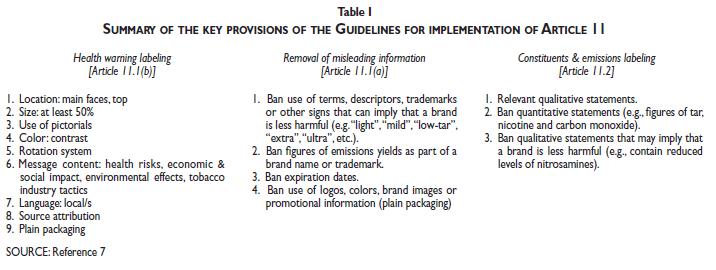
<body><![CDATA[<p>&nbsp;</p>     <p><font face="Verdana" size="2">Beginning with the United States (US) in 1966,1    governments have required printing health warning labels (HWLs) on cigarette    packages to warn smokers about the risks of tobacco use. Since then, at least    116 countries have adopted similar measures with a variety of characteristics.2    As more and more countries ban tobacco advertising, tobacco industry marketing    increasingly relies on the cigarette package to communicate with consumers and    potential consumers.3</font></p>     <p><font face="Verdana" size="2"> A 1993 study4 evaluated the presence, the content,    and the design of HWLs on cigarette packages in 28 countries of Latin America    and the Caribbean (LAC) and found that 25 of the countries either had a small    size, unspecific and weak warning such as "Smoking is harmful to health"    printed on the lateral side of the pack similar to the 1966 US warning, or had    no warnings at all. A 1999 study5 of cigarette labeling legislation in 45 countries,    including 6 from Latin America, assessed the content (developing a scale based    on a 10-point content score for 10 specific themes), size and location of HWLs.    The study found that packs from developed countries had a higher content score    reflecting the presence of multiple and specific warnings, compared to those    from developing countries. HWLs in developed countries were also 27% larger    and appeared more frequently on both front and back of the packs compared to    those from developing countries, where they were on the lateral side of the    packs.</font></p>     <p><font face="Verdana" size="2"> Article 11 of the World Health Organization    Framework Convention on Tobacco Control (WHO FCTC), in effect since 2005, establishes    provisions on tobacco product packaging and labeling, including HWLs, removal    of misleading information, and constituent and emissions labeling.6 In November    2008, the third Conference of the Parties (COP3) approved the Guidelines for    the implementation of Article 117 (<a href="/img/revistas/spm/v52s2/a145tab01.jpg">Table    I</a>). As of August 30, 2010, all LAC countries but Argentina, Cuba, El Salvador,    Dominican Republic, Haiti, Saint Kitts &amp; Nevis, and Saint Vincent &amp;    the Grenadines, have ratified the WHO FCTC. Three years after becoming Parties,    these countries are legally obligated to implement Article 11. </font></p>     <p><font face="Verdana" size="2"> This article describes current    cigarette labeling policies implemented in LAC countries and the progress achieved    in light of the FCTC. It also reports on tobacco industry interference, primarily    by British American Tobacco (BAT) and Philip Morris International (PMI), the    two transnational tobacco companies that have the greatest market share in the    region, as well as their local subsidiaries. </font></p>     <p>&nbsp;</p>     <p><font face="Verdana" size="3"><b>Material and Methods </b></font></p>     <p><font face="Verdana" size="2">This is a cross-country,    comparative analysis of HWLs printed on cigarette packages, as well as other    important characteristics of cigarette package labeling, among the 33 countries    of LAC. Information collected for this research came from governmental regulations    on packaging and labeling for tobacco products of each of the 33 countries,    tobacco industry corporate social responsibility reports, and cigarette packages    sold in the participating countries.</font></p>     <p>&nbsp;</p>     <p><font face="Verdana" size="3"><b>Tobacco labeling legislation</b></font></p>     ]]></body>
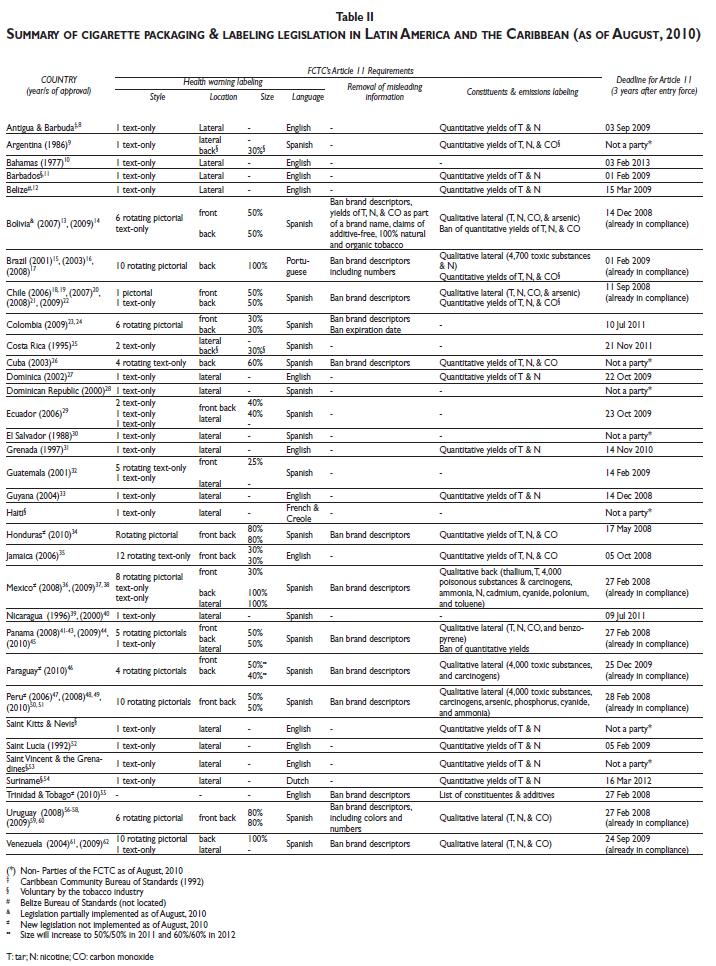
<body><![CDATA[<p><font face="Verdana" size="2">We reviewed current tobacco control legislation    (e.g., laws, executive decrees, ministerial resolutions, etc.) as of August,    2010 for the 33 LAC countries (<a href="/img/revistas/spm/v52s2/a145tab02.jpg">Table    II</a>) available at the Pan American Health Organization (PAHO)'s legislation    database PATIOS <a href="http://www.paho.org/tobacco/PatiosHome.asp" target="_blank">http://www.paho.org/tobacco/PatiosHome.asp</a>.    We analyzed mandatory HWLs printed on tobacco products, other warnings and messages,    removal of misleading information, tobacco constituents and emissions labeling,    and any other labeling regulations required by the government.</font></p>     <p>&nbsp;</p>     <p><font face="Verdana" size="3"><b>Tobacco industry reports</b></font></p>     <p><font face="Verdana" size="2">We analyzed information on cigarette labeling    in the "social reports" published by BAT's affiliates in some LAC countries    (Argentina, Brazil, Colombia, Costa Rica, Peru, Trinidad &amp; Tobago, and Venezuela),    which are part of their corporate social responsibility campaign, and are available    at the BAT website <a href="http://www.bat.com/global" target="_blank">http://www.bat.com/global</a>    (accessed between July 2007 and May 2010).</font></p>     <p>&nbsp;</p>     <p><font face="Verdana" size="3"><b>Cigarette packages repository</b></font></p>     <p><font face="Verdana" size="2">We collected 200 cigarette packages from 27 LAC    countries through PAHO and the Comit&eacute; Latino Americano Coordinador del    Control del Tabaquismo (CLACCTA, Latin American Coordinating Committee on Smoking    Control), the Latin America network of tobacco control researchers and advocates,    maintained by the InterAmerican Heart Foundation. The cigarette packages are    from different brand families belonging to the primary tobacco companies in    each country, which are part of a collection maintained at Roswell Park Cancer    Institute at: <a href="http://www.tobaccolatinamerica.org" target="_blank">http://www.tobaccolatinamerica.org</a>.</font></p>     <p>&nbsp;</p>     <p><font face="Verdana" size="3"><b>Results</b></font></p>     <p><font face="Verdana" size="3"><b>Packaging and labeling policies</b></font></p>     ]]></body>
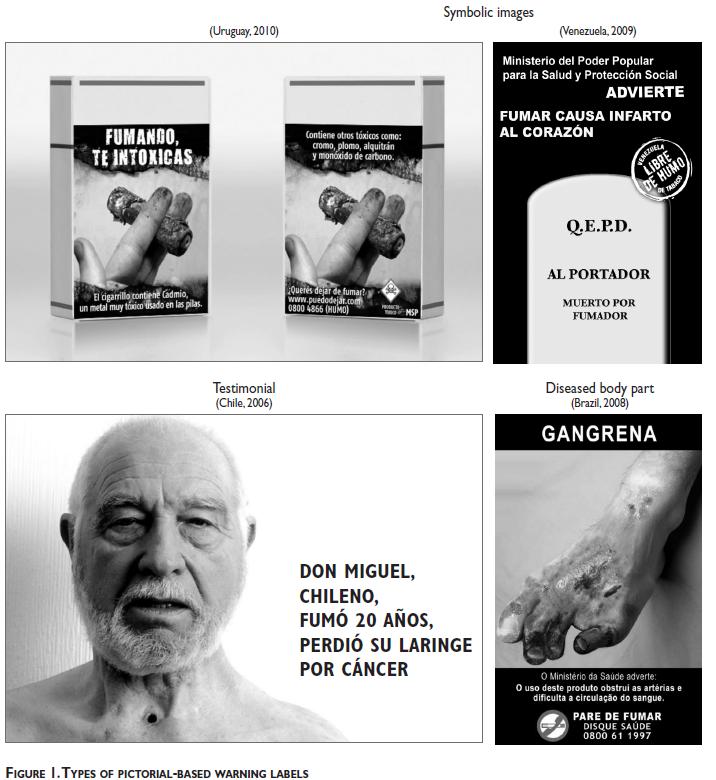
<body><![CDATA[<p><font face="Verdana" size="2">Following the Guidelines for implementing FCTC    Article 11,7 the information is presented under the three subareas.</font></p>     <p>&nbsp;</p>     <p><font face="Verdana" size="3"><b>Health warning labeling</b></font></p>     <p><font face="Verdana" size="2">We located local regulations related to packaging    and labeling on cigarettes for 19 of 20 countries in Latin American (all except    Haiti), and 7 out of 13 non-Latin Caribbean countries (<a href="/img/revistas/spm/v52s2/a145tab02.jpg">Table    II</a>). While we did not locate regulations for Antigua &amp; Barbuda, Barbados,    Belize, Saint Kitts &amp; Nevis, Saint Vincent &amp; the Grenadines, and Suriname,    cigarette packages from those countries did have a single text-only warning    as recommended by the CARICOM (the Caribbean Community) Bureau of Standards.63</font></p>     <p>&nbsp;</p>     <p><font face="Verdana" size="3"><b>Style </b></font></p>     <p><font face="Verdana" size="2">Most of the countries in the region (n=21) have    text-only warnings on tobacco products (<a href="/img/revistas/spm/v52s2/a145tab02.jpg">Table    II</a>). Following Canada's example (2001), seven Latin American countries adopted    a combination of text and pictorial-based HWLs: Brazil (2002), Venezuela (2004),    Uruguay (2006), Chile (2006), Panama (2006), Peru (2009), and Colombia (2010).    In addition, Bolivia, Mexico, and Paraguay have passed legislation mandating    pictures as part of their health warnings to be implemented by 2010. Honduras    will follow suit in 2011. The seven countries that have implemented graphical    warnings have adopted different types of photographs including diseased body    parts, symbolic images (an ABSTRACT representation of a condition), and testimonial    pictures (image of a face with or without personal identifying information)    (<a href="/img/revistas/spm/v52s2/a145img01.jpg">Figure 1</a>).</font></p>     <p>&nbsp;</p>     <p><font face="Verdana" size="3"><b>Number of warning messages and rotating system</b></font></p>     <p><font face="Verdana" size="2">Almost half of the LAC countries (n=19) have    only one warning message printed on all cigarette packages. The other 17 countries    have more than one message, ranging from 2 in Ecuador to 12 in Jamaica (<a href="/img/revistas/spm/v52s2/a145tab02.jpg">Table    II</a>). Uruguay has adopted four sets of multiple and concurrent pictorial    warnings (in 2006, 2007, early 2009, and late 2009), Brazil has adopted three    sets (in 2002, 2004, and 2009), and so Panama (in 2006, 2009, and 2010) and    Venezuela implemented two sets (in 2005 and 2009). Since 2006, Chile has a pair    of two warnings (one pictorial in the front and one text-only in the back) printed    at the same time in all cigarette packs and a new pair is introduced every year    (4th set in 2009).</font></p>     ]]></body>
<body><![CDATA[<p>&nbsp;</p>     <p><font face="Verdana" size="3"><b>Location and size</b></font></p>     <p><font face="Verdana" size="2">In almost half of the LAC countries (n=17) HWLs    mostly appear on the lateral side of the packs or less frequently, in the back    (BAT voluntary). The rest of the countries (n=15) have different regulations,    ranging from both main sides (e.g., front and back) and lateral side to only    one main side, which is generally the back. The size (measured as a percentage    of the principal display areas) ranges from 80% of both front and back in Uruguay    (<a href="/img/revistas/spm/v52s2/a145img01.jpg">Figure 1</a>) to    25% of the front in Guatemala (<a href="/img/revistas/spm/v52s2/a145tab02.jpg">Table    II</a>).</font></p>     <p>&nbsp;</p>     <p><font face="Verdana" size="3"><b>Message content </b></font></p>     <p><font face="Verdana" size="2">Almost half (n=16) of the LAC countries have    a weak and unspecific warning label message that only warns about the danger    or risk to health similar to the 1966 US warning "Caution: Cigarette Smoking    May be Hazardous to Your Health". Almost half (n=15) require warning label    messages with themes related to specific diseases and/or other health effects    or conditions (<a href="/img/revistas/spm/v52s2/a145tab03.jpg">Table    III</a>). The 2009 Venezuelan's warnings also include a logo with the message    "Venezuela Libre de Humo de Tabaco" Smokefree Venezuela (<a href="/img/revistas/spm/v52s2/a145img01.jpg">Figure    1</a>), which may help promote the public support of the adoption of smokefree    policies in the country. A toll-free telephone "quit line" number    is required in Brazil, Uruguay, and Mexico. In addition, the Uruguayan's cigarette    packages include a website address where smokers can get information on smoking    cessation (<a href="/img/revistas/spm/v52s2/a145img01.jpg">Figure    1</a>). Honduras and Trinidad &amp; Tobago have not specified the message content    of their HWLs as of August, 2010. Despite recommendations of Article 11's Guidelines,    as of August 2010, no countries in LAC had adopted non-health messages such    as the adverse economic or social outcomes, the environmental impact of tobacco    use, or tobacco industry practices. </font></p>     <p><font face="Verdana" size="2"> Almost a third of the LAC countries (n=10) require    a marker word in capital letters, sometimes in a different color, at the beginning    of the warning, which may draw the reader's attention to the message.64 Words    used include "ADVERTENCIA" warning, "PELIGRO" danger,    and "CUIDADO" careful. In Brazil the third set of pictorial warnings    use the name of a disease such as "GANGRENA" gangrene.</font></p>     <p>&nbsp;</p>     <p><font face="Verdana" size="3"><b>Language</b></font></p>     <p><font face="Verdana" size="2">Except in Haiti, where HWLs    are written in two languages (French and Creole), in the rest of LAC countries    HWLs are written in only one language, either Spanish (most of the Latin American    countries), Portuguese (only in Brazil), English (most of the CARICOM countries),    or Dutch (only in Suriname) (Table II). However, other languages are spoken    and officially recognized in four countries, Bolivia (Quechua or Aymara), Guatemala    (distinct Mayan languages), Peru (Quechua or Aymara), and Paraguay (Guarani).</font></p>     ]]></body>
<body><![CDATA[<p>&nbsp;</p>     <p><font face="Verdana" size="3"><b>Source attribution</b></font></p>     <p><font face="Verdana" size="2">Although not a requirement of Article 11, more    than half (n=20) countries attribute their warnings to either a national health    authority or a legal provision. Health agencies include the Minister of Health    (e.g., Barbados), the Institute for the Prevention of Alcohol and Drugs Addiction    (e.g., Honduras), Minister of Public Health and Social Welfare (e.g., El Salvador),    and the Chief Medical Officer (e.g., Jamaica). Costa Rica is the only country    that attributes their warnings to a specific legal provision. The use of source    of attribution can increase credibility in some countries but also can reduce    the impact of the warning if they are too big.7</font></p>     <p><font face="Verdana" size="3"><b>Removal of misleading information</b></font></p>     <p><font face="Verdana" size="2">Following FCTC Article 11's Guidelines, thirteen    LAC countries have banned brand descriptors with references to implied harm    reduction such as "light", "mild" or "low-tar."    In addition, Bolivia has banned claims of additive-free, 100% natural, or organic    tobacco; Brazil and Uruguay have banned the use of numbers as brand descriptors;    and Uruguay has banned the use of colors to identify different cigarette types    within a brand family (Table II). Colombia has banned the display of the expiration    date, which can mislead consumers into think that there is a safe time to consume    tobacco.7</font></p>     <p>&nbsp;</p>     <p><font face="Verdana" size="3"><b>Toxic constituents and emissions labeling</b></font></p>     <p><font face="Verdana" size="2">Toxic constituent information is required by    law or voluntarily displayed by tobacco companies in 24 LAC countries (Table    II). Cigarette packs in LAC have two types of constituent labeling: quantitative    and qualitative. Quantitative disclosure involves printing the yields of different    substances such as tar, nicotine, and carbon monoxide, which in 9 countries    is required by law. Nine countries require a legend (lateral or on the back),    with qualitative information on toxic constituents (e.g., tar, nicotine, and    CO) as recommended by the Guidelines of FCTC's Article 11. Bolivia, Chile, Mexico,    Peru, and Uruguay also disclose information on carcinogens other than tar (e.g.,    arsenic, cadmium and polonium). Mexico and Peru also provide information on    other toxic substances, such as cyanide, or additives such as ammonia (<a href="/img/revistas/spm/v52s2/a145tab02.jpg">Table    II</a>). Uruguayan cigarette packs require the skull-and-crossbones picture    with the legend "Toxic Product", an internationally recognized symbol    of poisonous substances (<a href="/img/revistas/spm/v52s2/a145img01.jpg">Figure    1</a>). Bolivia and Panama are the only countries in the region that have banned    the printing of the yields of tar, nicotine, and carbon monoxide that can be    deceptive to the consumers as suggested by the Guidelines.7 </font></p>     <p>&nbsp;</p>     <p><font face="Verdana" size="3"><b>The tobacco industry interference </b></font></p>     ]]></body>
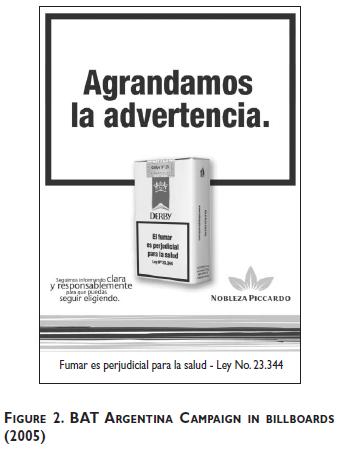
<body><![CDATA[<p><font face="Verdana" size="2">Tobacco company arguments and strategies to oppose    the implementation of effective cigarette labeling policies are similar across    LAC and around the world.1 Arguments used include: warnings do not work; smokers    already know the risks and therefore are not necessary; pictorial-based warnings    harass and scare smokers; new warnings would cost too much money to implement;    the timeline for implementation is too short and will take much more time; the    industry does not have the technology necessary to implement the regulations.    Tobacco companies have been using strategies to prevent the approval of laws    or to weaken their provisions, as well as to delay implementation of strong    HWLs and other effective labeling policies.</font></p>     <p>&nbsp;</p>     <p><font face="Verdana" size="3"><b>Preventing stronger policies</b></font></p>     <p><b><font face="Verdana" size="2">Voluntary measures </font></b></p>     <p><font face="Verdana" size="2">In 2005, BAT Argentina increased the size (up    to 30% in the back) of the weak and unspecific only-text warning label "Fumar    es perjudicial para la salud" Smoking is harmful to health. The company launched    a campaign on billboards claiming "We increased the health warning label. We    continue to inform clearly and responsibly so you can continue to choose. Nobleza    Piccardo" (<a href="#img02">Figure 2</a>).65 Similar measures were developed    by BAT in Colombia,66 Honduras,67,68 Costa Rica,69 and Trinidad &amp; Tobago.70</font></p>     <p align="center">&nbsp;</p>     <p align="center"><img src="/img/revistas/spm/v52s2/a145img02.jpg"><a name="img02"></a></p>     <p align="center">&nbsp;</p>     <p><font face="Verdana" size="2"> Tobacco companies also voluntarily    print the yields of tar, nicotine, and carbon monoxide on cigarette packs potentially    substitute for misleading descriptors such as "light", "ultra-light"    and "low-tar" in several countries (n=10).</font></p>     <p>&nbsp;</p>     ]]></body>
<body><![CDATA[<p><font face="Verdana" size="3"><b>Lobby legislative and executive authorities    </b></font></p>     <p><font face="Verdana" size="2">In 1986, the Congress of Argentina passed a very    weak national law that established the current text-only warning label printed    on all cigarette packs. However, the original draft of the bill required stronger    message content.71 In 1992, BAT and PMI managed to get the presidential veto    to a comprehensive law that Congress had approved and that would have resulted    in new, rotating HWLs.71</font></p>     <p>&nbsp;</p>     <p><font face="Verdana" size="3"><b>Weakening new legislation: Agreement with    health authorities </b></font></p>     <p><font face="Verdana" size="2">In 2004, BAT &amp; PMI Mexico signed an agreement    with the Secretary of Health of Mexico to increase the size of the HWLs from    25 to 50% of the back of the cigarette packages, under the condition that pictures    would be excluded. In addition, they agreed to place a lateral warning reading    "Currently there is no cigarette that reduces health risks" apparently    to prevent the banning of brand descriptors (as required by the FCTC) that continued    to appear on Mexican cigarette packs. Finally, the companies decided to include    an onsert in 25% of the packs of each brand sold in the country with "health    information" that was technical and difficult to read because of the small    font size.72,73</font></p>     <p>&nbsp;</p>     <p><font face="Verdana" size="3"><b>Undermining the implementation</b></font></p>     <p><font face="Verdana" size="2">In 2006, before the first pictorial warning label    appeared in Chile, BAT Chile began to give away metallic cigarette package covers    that could be used to stick the packs inside and which would hide the warning.74    In addition, BAT Chile launched new formats of packages ("book pack design")    that display two additional surfaces in the interior of the pack and break the    warning.75 Stickers with cartoon faces to be used to cover the pictorial warning    appeared in retail stores as well.</font></p>     <p>&nbsp;</p>     <p><font face="Verdana" size="3"><b>Delaying implementation: Litigation</b></font></p>     ]]></body>
<body><![CDATA[<p><font face="Verdana" size="2">Tobacco companies have litigated    against the new cigarette labeling policies in Uruguay, Brazil, and Paraguay    to stop or delay the implementation of pictorial warnings. As of August, 2010    the cases are pending in Brazil and Uruguay.</font></p>     <p><font face="Verdana" size="2"> After the approval of the third set of warning    labels in Brazil, four injunctions were filed against the Ag&ecirc;ncia Nacional    de Vigil&acirc;ncia Sanit&aacute;ria (ANVISA, National Agency of Health Surveillance).    In December 2008, the tobacco industry trade unions from the State of Rio Grande    do Sul (Sinditabaco/ RS) and the State of Rio de Janeiro (Sinditabaco/RJ) filed    two injunctions against the new set of warning labels. In March 2009, Souza    Cruz (BAT Brazil) filed a new injunction while the Public Minister of the State    of Santa Catarina had done the same earlier the same year. After a short period    of delay, the Court dismissed both cases and the new warnings began to appear    in April 2009. However, the companies appealed to the Supreme Court where the    final ruling is pending as of August, 2010.76,77 Arguments used were that the    images did not represent the smoking associated risks, they may confuse and    misinform the population, and that ANVISA should have used real images. In addition    they claimed that the pictures hurt human dignity.</font></p>     <p><font face="Verdana" size="2"> In September 2008, BAT Uruguay filed a complaint    against Ministerial Ordinance 51456 that had been enacted by the Minister of    Health of Uruguay on August 18, 2008, which among other provisions, banned tobacco    companies from having more than one presentation for each brand. In other words,    the law would allow only one type of Marlboro or other brand name. On October    1, 2008 the case was dismissed by the Court. According to a local newspaper,    in October 2009, Montepaz, Abal Hermanos (PM Uruguay), and BAT, the three tobacco    companies that share the market in Uruguay, filed a complaint against the Executive    Decree that increased the size of the HWLs from 50 to 80 % of the total display    areas. The companies called the decree "irrational, illegal, insensate,    overbearing, and arbitrary."78 On February 19, 2010, PMI sued the government    of Uruguay before the International Center for Settlement of Investment Disputes    (ICSID) alleging that the country requirements that banned the use of more than    one brand presentation infringed a bilateral Switzerland-Uruguay investment    treaty.79 According to its website "the primary purpose of ICSID is to    provide facilities for conciliation and arbitration of international investment    disputes."80 According to a representative from Abal Hermanos/PM Uruguay,    their goal is "to repair the damage from regulatory measures taken by the    Executive Branch during the last two years that harmed PMI investments in the    country and curtailed the company's right to use its registered brands, in frank    violation of Uruguay's international obligations" and " to suspend    the application of the recently approved regulations."79 As of August    2010, the final ruling was pending.</font></p>     <p><font face="Verdana" size="2"> On December 26, 2009 the Supreme Court of Justice    of Paraguay declared null the Ministerial Resolution enacted by the Minister    of Health and Social Welfare in May 2009, which sought the implementation of    new warning labels in the country. The ruling was a result of an injunction    presented by the Tobacco Union of Paraguay (on behalf of representatives of    all tobacco companies in Paraguay) on the grounds of unconstitutionality.81    However, in March, 2010, the President issued a Decree to comply with new HWLs    according to the FCTC.46</font></p>     <p>&nbsp;</p>     <p><font face="Verdana" size="3"><b>Discussion </b></font></p>     <p><font face="Verdana" size="2">In 2002, Brazil became the    first country within the region to implement pictorial-based HWLs, which it    did before the WHO FCTC entered into force in February 2005. Since then, and    in accordance with the recommendations of the WHO FCTC's Article 11 Guidelines,    six other LAC countries followed suit and four more have approved legislation    to be implemented during 2010 and 2011.</font></p>     <p><font face="Verdana" size="2"> Our results indicate that    around 27% (9/33) of LAC countries have implemented the minimum provisions of    Article 11 in all three sub-policy areas: 1) pictorial warning labels, at least    50% of main faces, specific health effects, rotating, principal/s language/s;    2) ban of brand descriptors; and 3) qualitative content and emissions label,    while 12% (4/33) adopted either one or two of them. However, the majority of    LAC countries (n=20) require less than the minimum provisions or none. </font></p>     <p><font face="Verdana" size="2"> Our results also indicate that cigarette package    warning content and style of presentation varies significantly across countries.    The effectiveness of different approaches is only beginning to be studied. A    study conducted as part of the International Tobacco Control Policy Evaluation    Project, evaluated the impact of HWLs in Uruguay, Brazil and Mexico and found    that Uruguayan smokers were more likely than Brazilian or Mexican smokers to    notice regularly HWLs, probably due to Uruguayan warnings were printed in both    main faces, whereas Brazilian and Mexican were only on the back. Furthermore,    this study indicates that Brazilian warnings had a greater cognitive and behavioral    impact than either Mexican or Uruguayan, with Mexican text-only labels doing    equal or better than Uruguayan labels. This result suggests that the ABSTRACT    representation of Uruguayan pictorial HWLs is not as effective as the Brazilian    strategy. Finally, the Brazilian pictorials had an inverse association with    educational achievement, suggesting that style of pictures could address literacy    issues.82 The WHO/CDC Global Adult Tobacco Survey conducted in Brazil83 (2008)    and Uruguay84 (2009) showed that 65% and 45% respectively of current smokers    thought about quitting because of a warning label. </font></p>     <p><font face="Verdana" size="2"> A few countries have developed and adopted synergistic    measures to enhance the impact of their HWLs, such as mass media campaigns and    mandating the placement of the same health warnings on tobacco advertising including    point-of-sale. For example, in 2002, the Brazilian government launched 2 TV    spots with the stories of "Euclide" and "Renata" victims    of larynx cancer and abortion respectively to promote two of the new pictorial    warnings.85 Since 2006, when it was implemented the first testimonial HWL in    Chile86 (<a href="/img/revistas/spm/v52s2/a145img01.jpg">Figure    1</a>), the Minister of Health of Chile has been launching the new picture in    a press conference contributing to the publicity of the health warning. In addition    to the cigarette packs, the Chilean law mandates the placement of the same health    warning label in 50% of all graphic tobacco advertising (counter-advertising)    such as billboards and point-of-sale displays.18 In Brazil and Uruguay, warnings    are also present at point-of-sale.57</font></p>     ]]></body>
<body><![CDATA[<p><font face="Verdana" size="2"> In 2009, Uruguay became the first country in    the world to limit brands to only one presentation per brand name (e.g., Marlboro),    which moves in the direction of plain packaging (e.g., completely removal of    brand imagery including color).87 This regulation aims to help eliminate misleading    consumers about relative risk of products. As of August, 2010, the tobacco industry    was not able to successfully challenge this significant progress. </font></p>     <p><font face="Verdana" size="2"> In addition to the information mandated by law,    tobacco companies generally print other messages on the cigarette packages either    to compete with the mandated health warnings or to mislead the consumers. Legends    with a reference to an expiration date such as "Better before"...    are printed on several countries of the region voluntary by the tobacco industry.    Only Colombia followed recommendations of Article 11's Guidelines and banned    it. Underage warnings such as "Only for adults" or "Underage    sale prohibited" are also printed voluntarily in cigarette packs from    several LAC countries. These legends are part of the tobacco industry's "youth    smoking prevention" programs developed in Latin America during the 1990s    to portray cigarettes as an adult product while continue marketing to young    people.88</font></p>     <p><font face="Verdana" size="2"> In 2009, an intergovernmental initiative was    developed within the countries from the MERCOSUR (the trade agreement of South    America) with the goal of creating and maintaining an electronic-based bank    of pictorial warnings, which are available for any country of the region seeking    to implement such policy: <a href="http://www.cictmercosur.org/esp/index.php" target="_blank">http://www.cictmercosur.org/esp/index.php</a>    The Convention Secretariat, following a decision by the COP3 and with the technical    assistance of WHO's Tobacco Free Initiative, established a central international    database of HWLs, which is available at: <a href="http://www.who.int/tobacco/healthwarningsdatabase/en/index.html" target="_blank">http://www.who.int/tobacco/healthwarningsdatabase/en/index.html</a>.</font></p>     <p>&nbsp;</p>     <p><font face="Verdana" size="3"><b>Conclusions</b></font></p>     <p><font face="Verdana" size="2">Since 2002, important progress    has been achieved in the region. However, only Bolivia, Brazil, Chile, Mexico,    Panama, Paraguay, Peru, Uruguay, and Venezuela meet FCTC's Article 11 minimum    requirements. Furthermore, as of August, 2010, 11 countries that are Parties    to the WHO FCTC have passed the deadline of 3 years between ratifying and implementing    Article 11. The tobacco industry has used predictable arguments and strategies    to block, undermine and delay the effective implementation of Article 11. Policymakers    who want to implement effective labeling policies in their countries need to    be aware and anticipate tobacco industry tactics to counteract them, prevent    loopholes in the regulations, and use scientific evidence and experience from    other countries. </font></p>     <p>&nbsp;</p>     <p><font face="Verdana" size="3"><b>Acknowledgements</b></font></p>     <p><font face="Verdana" size="2">This research was funded    by the Flight Attendant Medical Research Institute (FAMRI) and the National    Cancer Institute grant CA-87472 and program project grant P01 CA138389 "Effectiveness    of Tobacco Control Policies in High vs. Low Income Countries" to Roswell Park    Cancer Institute. The funding agencies played no role in the conduct of the    research or preparation of the manuscript.</font></p>     <p><font face="Verdana" size="2"> We would like to thank Rob    Cunningham and James Thrasher for their helpful comments on this article.</font></p>     ]]></body>
<body><![CDATA[<p>&nbsp;</p>     <p><font face="Verdana" size="3"><b>Declaration of conflicts of interest</b></font></p>     <p><font face="Verdana" size="2">We declare that we have no    conflicts of interest.</font></p>     <p>&nbsp;</p>     <p><font face="Verdana" size="3"><b>References</b></font></p>     <!-- ref --><p><font face="Verdana" size="2">1. Chapman S, Carter SM. "Avoid health warnings    on all tobacco products for just as long as we can": A history of Australian    tobacco industry efforts to avoid, delay and dilute health warnings on cigarettes.    Tob Control. 2003 Dec; 12 Suppl 3: iii13-22.    &nbsp;&nbsp;&nbsp;&nbsp;&nbsp;&nbsp;&nbsp;&nbsp;[&#160;<a href="javascript:void(0);" onclick="javascript: window.open('/scielo.php?script=sci_nlinks&ref=9359956&pid=S0036-3634201000080001900001&lng=','','width=640,height=500,resizable=yes,scrollbars=1,menubar=yes,');">Links</a>&#160;]<!-- end-ref --></font></p>     <!-- ref --><p><font face="Verdana" size="2">2. World Health Organization. WHO report on the    global tobacco epidemic, 2009: Implementing smoke-free environments. Geneva:    WHO; 2009.    &nbsp;&nbsp;&nbsp;&nbsp;&nbsp;&nbsp;&nbsp;&nbsp;[&#160;<a href="javascript:void(0);" onclick="javascript: window.open('/scielo.php?script=sci_nlinks&ref=9359958&pid=S0036-3634201000080001900002&lng=','','width=640,height=500,resizable=yes,scrollbars=1,menubar=yes,');">Links</a>&#160;]<!-- end-ref --></font></p>     <!-- ref --><p><font face="Verdana" size="2">3. Wakefield M, Morley C, Horan JK, Cummings    KM. The cigarette pack as image: New evidence from tobacco industry documents.    Tob Control. 2002 Mar; 11 Suppl 1: I73-80.    &nbsp;&nbsp;&nbsp;&nbsp;&nbsp;&nbsp;&nbsp;&nbsp;[&#160;<a href="javascript:void(0);" onclick="javascript: window.open('/scielo.php?script=sci_nlinks&ref=9359960&pid=S0036-3634201000080001900003&lng=','','width=640,height=500,resizable=yes,scrollbars=1,menubar=yes,');">Links</a>&#160;]<!-- end-ref --></font></p>     <!-- ref --><p><font face="Verdana" size="2">4. Vincent AL. Advertencias en las cajetillas    de cigarrillos en Am&eacute;rica Latina y el Caribe Warnings on cigarette packs    in Latin America and the Caribbean. Bol Oficina Sanit Panam. 1993 Jun; 114(6):    492-501.    &nbsp;&nbsp;&nbsp;&nbsp;&nbsp;&nbsp;&nbsp;&nbsp;[&#160;<a href="javascript:void(0);" onclick="javascript: window.open('/scielo.php?script=sci_nlinks&ref=9359962&pid=S0036-3634201000080001900004&lng=','','width=640,height=500,resizable=yes,scrollbars=1,menubar=yes,');">Links</a>&#160;]<!-- end-ref --></font></p>     <!-- ref --><p><font face="Verdana" size="2">5. Aftab M, Kolben D, Lurie P. International    cigarette labelling practices. Tob Control. 1999 Winter; 8(4):368-72.    &nbsp;&nbsp;&nbsp;&nbsp;&nbsp;&nbsp;&nbsp;&nbsp;[&#160;<a href="javascript:void(0);" onclick="javascript: window.open('/scielo.php?script=sci_nlinks&ref=9359964&pid=S0036-3634201000080001900005&lng=','','width=640,height=500,resizable=yes,scrollbars=1,menubar=yes,');">Links</a>&#160;]<!-- end-ref --></font></p>     <!-- ref --><p><font face="Verdana" size="2">6. World Health Organization. Framework Convention    on Tobacco Control. Geneva: WHO; 2003. Accessed 2010, March 20 Available in:    <a href="http://www.who.int/tobacco/framework/download/en/index.html" target="_blank">http://www.who.int/tobacco/framework/download/en/index.html</a></font>&nbsp;&nbsp;&nbsp;&nbsp;&nbsp;&nbsp;&nbsp;&nbsp;[&#160;<a href="javascript:void(0);" onclick="javascript: window.open('/scielo.php?script=sci_nlinks&ref=9359966&pid=S0036-3634201000080001900006&lng=','','width=640,height=500,resizable=yes,scrollbars=1,menubar=yes,');">Links</a>&#160;]<!-- end-ref --><!-- ref --><p><font face="Verdana" size="2">7. World Health Organization. Guidelines for    implementation of Article 11 of the WHO Framework Convention on Tobacco Control    (packaging and labelling of tobacco products). Durban; 2008 Nov 17-22. Accessed    2010, March 20 Available in: <a href="http://www.who.int/fctc/guidelines/article_11/en/index.html" target="_blank">http://www.who.int/fctc/guidelines/article_11/en/index.html</a></font>&nbsp;&nbsp;&nbsp;&nbsp;&nbsp;&nbsp;&nbsp;&nbsp;[&#160;<a href="javascript:void(0);" onclick="javascript: window.open('/scielo.php?script=sci_nlinks&ref=9359967&pid=S0036-3634201000080001900007&lng=','','width=640,height=500,resizable=yes,scrollbars=1,menubar=yes,');">Links</a>&#160;]<!-- end-ref --><!-- ref --><p><font face="Verdana" size="2">8. Personal communication Lalla-Rodrigues D.    Standards on labelling of cigarette packages in Antigua &amp; Barbuda. St John's:    ABBS; 2010.    &nbsp;&nbsp;&nbsp;&nbsp;&nbsp;&nbsp;&nbsp;&nbsp;[&#160;<a href="javascript:void(0);" onclick="javascript: window.open('/scielo.php?script=sci_nlinks&ref=9359968&pid=S0036-3634201000080001900008&lng=','','width=640,height=500,resizable=yes,scrollbars=1,menubar=yes,');">Links</a>&#160;]<!-- end-ref --></font></p>     <!-- ref --><p><font face="Verdana" size="2">9. Argentina Law 23.344 Â«Restricciones en la    publicidad de tabacos, cigarrillos, cigarros u otros productos destinados a    fumar- leyenda que deber&aacute;n llevar los envases»; 1986.    &nbsp;&nbsp;&nbsp;&nbsp;&nbsp;&nbsp;&nbsp;&nbsp;[&#160;<a href="javascript:void(0);" onclick="javascript: window.open('/scielo.php?script=sci_nlinks&ref=9359970&pid=S0036-3634201000080001900009&lng=','','width=640,height=500,resizable=yes,scrollbars=1,menubar=yes,');">Links</a>&#160;]<!-- end-ref --></font></p>     <!-- ref --><p><font face="Verdana" size="2">10. Bahamas health services (tobacco advertising    and sales) rules; 1977.    &nbsp;&nbsp;&nbsp;&nbsp;&nbsp;&nbsp;&nbsp;&nbsp;[&#160;<a href="javascript:void(0);" onclick="javascript: window.open('/scielo.php?script=sci_nlinks&ref=9359972&pid=S0036-3634201000080001900010&lng=','','width=640,height=500,resizable=yes,scrollbars=1,menubar=yes,');">Links</a>&#160;]<!-- end-ref --></font></p>     <!-- ref --><p><font face="Verdana" size="2">11. Personal communication Maloney A. Standards    on labelling of cigarette packages in Barbados. Saint Michael: Barbados National    Standards Institution (BNSI); 2010.    &nbsp;&nbsp;&nbsp;&nbsp;&nbsp;&nbsp;&nbsp;&nbsp;[&#160;<a href="javascript:void(0);" onclick="javascript: window.open('/scielo.php?script=sci_nlinks&ref=9359974&pid=S0036-3634201000080001900011&lng=','','width=640,height=500,resizable=yes,scrollbars=1,menubar=yes,');">Links</a>&#160;]<!-- end-ref --></font></p>     <!-- ref --><p><font face="Verdana" size="2">12. CTC (Caribbean Tobacco Company Ltd). Tobacco    use &amp; health. 2010 Accessed 2010 March 3. Available in: <a href="http://ctcbelize.com/health.shtml" target="_blank">http://ctcbelize.com/health.shtml</a></font>&nbsp;&nbsp;&nbsp;&nbsp;&nbsp;&nbsp;&nbsp;&nbsp;[&#160;<a href="javascript:void(0);" onclick="javascript: window.open('/scielo.php?script=sci_nlinks&ref=9359976&pid=S0036-3634201000080001900012&lng=','','width=640,height=500,resizable=yes,scrollbars=1,menubar=yes,');">Links</a>&#160;]<!-- end-ref --><!-- ref --><p><font face="Verdana" size="2">13. President of Bolivia. Supreme Decree N&deg;    29376 Reglamento de la Ley N&deg; 3029 de 22 de abril de 2005 de ratificaci&oacute;n    del "Convenio Marco para el Control del Tabaco"; 2007.    &nbsp;&nbsp;&nbsp;&nbsp;&nbsp;&nbsp;&nbsp;&nbsp;[&#160;<a href="javascript:void(0);" onclick="javascript: window.open('/scielo.php?script=sci_nlinks&ref=9359977&pid=S0036-3634201000080001900013&lng=','','width=640,height=500,resizable=yes,scrollbars=1,menubar=yes,');">Links</a>&#160;]<!-- end-ref --></font></p>     <!-- ref --><p><font face="Verdana" size="2">14. Minister of Health and Sports, Minister of    Education, Minister of Economy and Finances of Bolivia. Multiministerial Ruling    N&deg; 0003 "Reglamento especifico para la administraci&oacute;n de la    Ley N&deg; 3029 del Convenio Marco para el Control del Tabaco (REAT)";    2009.    &nbsp;&nbsp;&nbsp;&nbsp;&nbsp;&nbsp;&nbsp;&nbsp;[&#160;<a href="javascript:void(0);" onclick="javascript: window.open('/scielo.php?script=sci_nlinks&ref=9359979&pid=S0036-3634201000080001900014&lng=','','width=640,height=500,resizable=yes,scrollbars=1,menubar=yes,');">Links</a>&#160;]<!-- end-ref --></font></p>     ]]></body>
<body><![CDATA[<!-- ref --><p><font face="Verdana" size="2">15. Brazil National Health Surveillance Agency    (ANVISA). Ruling N&deg; 104; 2001.    &nbsp;&nbsp;&nbsp;&nbsp;&nbsp;&nbsp;&nbsp;&nbsp;[&#160;<a href="javascript:void(0);" onclick="javascript: window.open('/scielo.php?script=sci_nlinks&ref=9359981&pid=S0036-3634201000080001900015&lng=','','width=640,height=500,resizable=yes,scrollbars=1,menubar=yes,');">Links</a>&#160;]<!-- end-ref --></font></p>     <!-- ref --><p><font face="Verdana" size="2">16. Brazil National Health Surveillance Agency    (ANVISA). Ruling N&deg; 335; 2003.    &nbsp;&nbsp;&nbsp;&nbsp;&nbsp;&nbsp;&nbsp;&nbsp;[&#160;<a href="javascript:void(0);" onclick="javascript: window.open('/scielo.php?script=sci_nlinks&ref=9359983&pid=S0036-3634201000080001900016&lng=','','width=640,height=500,resizable=yes,scrollbars=1,menubar=yes,');">Links</a>&#160;]<!-- end-ref --></font></p>     <!-- ref --><p><font face="Verdana" size="2">17. Brazil National Health Surveillance Agency    (ANVISA). Ruling N&deg; 54; 2008.    &nbsp;&nbsp;&nbsp;&nbsp;&nbsp;&nbsp;&nbsp;&nbsp;[&#160;<a href="javascript:void(0);" onclick="javascript: window.open('/scielo.php?script=sci_nlinks&ref=9359985&pid=S0036-3634201000080001900017&lng=','','width=640,height=500,resizable=yes,scrollbars=1,menubar=yes,');">Links</a>&#160;]<!-- end-ref --></font></p>     <!-- ref --><p><font face="Verdana" size="2">18. Chile Law N&deg; 20.105 "Modifica la    Ley N&deg; 19.419, en materias relativas a la publicidad y el consumo del tabaco";    2006.    &nbsp;&nbsp;&nbsp;&nbsp;&nbsp;&nbsp;&nbsp;&nbsp;[&#160;<a href="javascript:void(0);" onclick="javascript: window.open('/scielo.php?script=sci_nlinks&ref=9359987&pid=S0036-3634201000080001900018&lng=','','width=640,height=500,resizable=yes,scrollbars=1,menubar=yes,');">Links</a>&#160;]<!-- end-ref --></font></p>     <!-- ref --><p><font face="Verdana" size="2">19. Minister of Health of Chile. Decree N&deg;    95 "Establece advertencia para envases y acciones publicitarias de productos    hechos con tabaco"; 2006.    &nbsp;&nbsp;&nbsp;&nbsp;&nbsp;&nbsp;&nbsp;&nbsp;[&#160;<a href="javascript:void(0);" onclick="javascript: window.open('/scielo.php?script=sci_nlinks&ref=9359989&pid=S0036-3634201000080001900019&lng=','','width=640,height=500,resizable=yes,scrollbars=1,menubar=yes,');">Links</a>&#160;]<!-- end-ref --></font></p>     ]]></body>
<body><![CDATA[<!-- ref --><p><font face="Verdana" size="2">20. Minister of Health of Chile. Decree N&deg;    128 "Establece advertencia para envases y acciones publicitarias de productos    hechos con tabaco"; 2007.    &nbsp;&nbsp;&nbsp;&nbsp;&nbsp;&nbsp;&nbsp;&nbsp;[&#160;<a href="javascript:void(0);" onclick="javascript: window.open('/scielo.php?script=sci_nlinks&ref=9359991&pid=S0036-3634201000080001900020&lng=','','width=640,height=500,resizable=yes,scrollbars=1,menubar=yes,');">Links</a>&#160;]<!-- end-ref --></font></p>     <!-- ref --><p><font face="Verdana" size="2">21. Minister of Health of Chile. Decree N&deg;    69 "Establece advertencia para envases y acciones publicitarias de productos    hechos con tabaco"; 2008.    &nbsp;&nbsp;&nbsp;&nbsp;&nbsp;&nbsp;&nbsp;&nbsp;[&#160;<a href="javascript:void(0);" onclick="javascript: window.open('/scielo.php?script=sci_nlinks&ref=9359993&pid=S0036-3634201000080001900021&lng=','','width=640,height=500,resizable=yes,scrollbars=1,menubar=yes,');">Links</a>&#160;]<!-- end-ref --></font></p>     <!-- ref --><p><font face="Verdana" size="2">22. Minister of Health of Chile. Decree N&deg;    61 "Establece advertencia para envases y acciones publicitarias de productos    hechos con tabaco"; 2009.    &nbsp;&nbsp;&nbsp;&nbsp;&nbsp;&nbsp;&nbsp;&nbsp;[&#160;<a href="javascript:void(0);" onclick="javascript: window.open('/scielo.php?script=sci_nlinks&ref=9359995&pid=S0036-3634201000080001900022&lng=','','width=640,height=500,resizable=yes,scrollbars=1,menubar=yes,');">Links</a>&#160;]<!-- end-ref --></font></p>     <!-- ref --><p><font face="Verdana" size="2">23. Colombia Law N&deg; 1335 "Disposiciones    por medio de las cuales se previenen danos a la salud de los menores de edad,    la poblaci&oacute;n no fumadora y se estipulan pol&iacute;ticas p&uacute;blicas    para la prevenci&oacute;n del consumo del tabaco y el abandono de la dependencia    del tabaco del fumador y sus derivados en la poblaci&oacute;n colombiana";    2009.    &nbsp;&nbsp;&nbsp;&nbsp;&nbsp;&nbsp;&nbsp;&nbsp;[&#160;<a href="javascript:void(0);" onclick="javascript: window.open('/scielo.php?script=sci_nlinks&ref=9359997&pid=S0036-3634201000080001900023&lng=','','width=640,height=500,resizable=yes,scrollbars=1,menubar=yes,');">Links</a>&#160;]<!-- end-ref --></font></p>     <!-- ref --><p><font face="Verdana" size="2">24. Ministry of Social Protection of Colombia.    Ruling N&deg; 003961 "Por la cual se establecen los requisitos de empaquetado    y etiquetado del tabaco y sus derivados"; 2009.    &nbsp;&nbsp;&nbsp;&nbsp;&nbsp;&nbsp;&nbsp;&nbsp;[&#160;<a href="javascript:void(0);" onclick="javascript: window.open('/scielo.php?script=sci_nlinks&ref=9359999&pid=S0036-3634201000080001900024&lng=','','width=640,height=500,resizable=yes,scrollbars=1,menubar=yes,');">Links</a>&#160;]<!-- end-ref --></font></p>     ]]></body>
<body><![CDATA[<!-- ref --><p><font face="Verdana" size="2">25. Costa Rica Law N&deg; 7.501 "Regulaci&oacute;n    del fumado"; 1995.    &nbsp;&nbsp;&nbsp;&nbsp;&nbsp;&nbsp;&nbsp;&nbsp;[&#160;<a href="javascript:void(0);" onclick="javascript: window.open('/scielo.php?script=sci_nlinks&ref=9360001&pid=S0036-3634201000080001900025&lng=','','width=640,height=500,resizable=yes,scrollbars=1,menubar=yes,');">Links</a>&#160;]<!-- end-ref --></font></p>     <!-- ref --><p><font face="Verdana" size="2">26. Minister of Health of Cuba. Resoluci&oacute;n    Ministerial N&deg; 275/2003 "Reglamento para el registro sanitario de los    productos manufacturados del tabaco"; 2003.    &nbsp;&nbsp;&nbsp;&nbsp;&nbsp;&nbsp;&nbsp;&nbsp;[&#160;<a href="javascript:void(0);" onclick="javascript: window.open('/scielo.php?script=sci_nlinks&ref=9360003&pid=S0036-3634201000080001900026&lng=','','width=640,height=500,resizable=yes,scrollbars=1,menubar=yes,');">Links</a>&#160;]<!-- end-ref --></font></p>     <!-- ref --><p><font face="Verdana" size="2">27. Dominica Bureau of Standards (DBOS). Specification    for labelling of commodities - retail packages of cigarettes dns 2: Part 6;    2002.    &nbsp;&nbsp;&nbsp;&nbsp;&nbsp;&nbsp;&nbsp;&nbsp;[&#160;<a href="javascript:void(0);" onclick="javascript: window.open('/scielo.php?script=sci_nlinks&ref=9360005&pid=S0036-3634201000080001900027&lng=','','width=640,height=500,resizable=yes,scrollbars=1,menubar=yes,');">Links</a>&#160;]<!-- end-ref --></font></p>     <!-- ref --><p><font face="Verdana" size="2">28. Dominican Republic Law N&deg; 48; 2000.    &nbsp;&nbsp;&nbsp;&nbsp;&nbsp;&nbsp;&nbsp;&nbsp;[&#160;<a href="javascript:void(0);" onclick="javascript: window.open('/scielo.php?script=sci_nlinks&ref=9360007&pid=S0036-3634201000080001900028&lng=','','width=640,height=500,resizable=yes,scrollbars=1,menubar=yes,');">Links</a>&#160;]<!-- end-ref --></font></p>     <!-- ref --><p><font face="Verdana" size="2">29. Ecuador "Ley org&aacute;nica reformatoria    a la ley org&aacute;nica de defensa del consumidor"; 2006.    &nbsp;&nbsp;&nbsp;&nbsp;&nbsp;&nbsp;&nbsp;&nbsp;[&#160;<a href="javascript:void(0);" onclick="javascript: window.open('/scielo.php?script=sci_nlinks&ref=9360009&pid=S0036-3634201000080001900029&lng=','','width=640,height=500,resizable=yes,scrollbars=1,menubar=yes,');">Links</a>&#160;]<!-- end-ref --></font></p>     ]]></body>
<body><![CDATA[<!-- ref --><p><font face="Verdana" size="2">30. Congress of El Salvador. Decreto legislativo    N&deg; 955 "C&oacute;digo de Salud"; 1988.    &nbsp;&nbsp;&nbsp;&nbsp;&nbsp;&nbsp;&nbsp;&nbsp;[&#160;<a href="javascript:void(0);" onclick="javascript: window.open('/scielo.php?script=sci_nlinks&ref=9360011&pid=S0036-3634201000080001900030&lng=','','width=640,height=500,resizable=yes,scrollbars=1,menubar=yes,');">Links</a>&#160;]<!-- end-ref --></font></p>     <!-- ref --><p><font face="Verdana" size="2">31. Grenada Bureau of Standards (GDBS). Gds 1:    Part 6: Labelling of retail packages of cigarettes; 1997.    &nbsp;&nbsp;&nbsp;&nbsp;&nbsp;&nbsp;&nbsp;&nbsp;[&#160;<a href="javascript:void(0);" onclick="javascript: window.open('/scielo.php?script=sci_nlinks&ref=9360013&pid=S0036-3634201000080001900031&lng=','','width=640,height=500,resizable=yes,scrollbars=1,menubar=yes,');">Links</a>&#160;]<!-- end-ref --></font></p>     <!-- ref --><p><font face="Verdana" size="2">32. President of Guatemala. Acuerdo Gubernativo    N&deg; 426-2001 "Reglamento para la regulaci&oacute;n, aprobaci&oacute;n    y control de la publicidad y lugares de consumo de productos relacionados con    el tabaco"; 2001.    &nbsp;&nbsp;&nbsp;&nbsp;&nbsp;&nbsp;&nbsp;&nbsp;[&#160;<a href="javascript:void(0);" onclick="javascript: window.open('/scielo.php?script=sci_nlinks&ref=9360015&pid=S0036-3634201000080001900032&lng=','','width=640,height=500,resizable=yes,scrollbars=1,menubar=yes,');">Links</a>&#160;]<!-- end-ref --></font></p>     <!-- ref --><p><font face="Verdana" size="2">33. Guyana National Bureau of Standards (GNBS).    Specification for labeling of commodities. Part 3: Labeling of retail packages    of cigarettes; 2004.    &nbsp;&nbsp;&nbsp;&nbsp;&nbsp;&nbsp;&nbsp;&nbsp;[&#160;<a href="javascript:void(0);" onclick="javascript: window.open('/scielo.php?script=sci_nlinks&ref=9360017&pid=S0036-3634201000080001900033&lng=','','width=640,height=500,resizable=yes,scrollbars=1,menubar=yes,');">Links</a>&#160;]<!-- end-ref --></font></p>     <!-- ref --><p><font face="Verdana" size="2">34. Instituto Hondure&ntilde;o para la Prevenci&oacute;n    del Alcoholismo Drogadicci&oacute;n y Farmacodependencia, (IHADFA). Ley especial    para el control del tabaco; 2010.    &nbsp;&nbsp;&nbsp;&nbsp;&nbsp;&nbsp;&nbsp;&nbsp;[&#160;<a href="javascript:void(0);" onclick="javascript: window.open('/scielo.php?script=sci_nlinks&ref=9360019&pid=S0036-3634201000080001900034&lng=','','width=640,height=500,resizable=yes,scrollbars=1,menubar=yes,');">Links</a>&#160;]<!-- end-ref --></font></p>     ]]></body>
<body><![CDATA[<!-- ref --><p><font face="Verdana" size="2">35. Jamaica Bureau of Standards. Jamaican standard    specification for the labeling of commodities part 25: Labeling of cigarette    packages; 2006.    &nbsp;&nbsp;&nbsp;&nbsp;&nbsp;&nbsp;&nbsp;&nbsp;[&#160;<a href="javascript:void(0);" onclick="javascript: window.open('/scielo.php?script=sci_nlinks&ref=9360021&pid=S0036-3634201000080001900035&lng=','','width=640,height=500,resizable=yes,scrollbars=1,menubar=yes,');">Links</a>&#160;]<!-- end-ref --></font></p>     <!-- ref --><p><font face="Verdana" size="2">36. Congress of Mexico Ley general para el control    del tabaco; 2008.    &nbsp;&nbsp;&nbsp;&nbsp;&nbsp;&nbsp;&nbsp;&nbsp;[&#160;<a href="javascript:void(0);" onclick="javascript: window.open('/scielo.php?script=sci_nlinks&ref=9360023&pid=S0036-3634201000080001900036&lng=','','width=640,height=500,resizable=yes,scrollbars=1,menubar=yes,');">Links</a>&#160;]<!-- end-ref --></font></p>     <!-- ref --><p><font face="Verdana" size="2">37. Secretary of Health of Mexico "Acuerdo    mediante el cual se dan a conocer las disposiciones para la formulaci&oacute;n,    aprobaci&oacute;n, aplicaci&oacute;n, utilizaci&oacute;n e incorporaci&oacute;n    de las leyendas, im&aacute;genes, pictogramas, mensajes sanitarios e informaci&oacute;n    que deber&aacute; figurar en todos los paquetes de productos del tabaco y en    todo empaquetado y etiquetado externo de los mismos". DOF; 2009.    &nbsp;&nbsp;&nbsp;&nbsp;&nbsp;&nbsp;&nbsp;&nbsp;[&#160;<a href="javascript:void(0);" onclick="javascript: window.open('/scielo.php?script=sci_nlinks&ref=9360025&pid=S0036-3634201000080001900037&lng=','','width=640,height=500,resizable=yes,scrollbars=1,menubar=yes,');">Links</a>&#160;]<!-- end-ref --></font></p>     <!-- ref --><p><font face="Verdana" size="2">38. President of Mexico. Reglamento de la ley    general para el control del tabaco; 2009.    &nbsp;&nbsp;&nbsp;&nbsp;&nbsp;&nbsp;&nbsp;&nbsp;[&#160;<a href="javascript:void(0);" onclick="javascript: window.open('/scielo.php?script=sci_nlinks&ref=9360027&pid=S0036-3634201000080001900038&lng=','','width=640,height=500,resizable=yes,scrollbars=1,menubar=yes,');">Links</a>&#160;]<!-- end-ref --></font></p>     <!-- ref --><p><font face="Verdana" size="2">39. Nicaragua Law N&deg; 224 "Ley de protecci&oacute;n    de los derechos humanos de los no fumadores"; 1996.    &nbsp;&nbsp;&nbsp;&nbsp;&nbsp;&nbsp;&nbsp;&nbsp;[&#160;<a href="javascript:void(0);" onclick="javascript: window.open('/scielo.php?script=sci_nlinks&ref=9360029&pid=S0036-3634201000080001900039&lng=','','width=640,height=500,resizable=yes,scrollbars=1,menubar=yes,');">Links</a>&#160;]<!-- end-ref --></font></p>     ]]></body>
<body><![CDATA[<!-- ref --><p><font face="Verdana" size="2">40. President of Nicaragua. Decreto N&deg; 29-2000    "Reglamento de la Ley N&deg; 224, ley de protecci&oacute;n de los derechos    humanos de los no fumadores"; 2000.    &nbsp;&nbsp;&nbsp;&nbsp;&nbsp;&nbsp;&nbsp;&nbsp;[&#160;<a href="javascript:void(0);" onclick="javascript: window.open('/scielo.php?script=sci_nlinks&ref=9360031&pid=S0036-3634201000080001900040&lng=','','width=640,height=500,resizable=yes,scrollbars=1,menubar=yes,');">Links</a>&#160;]<!-- end-ref --></font></p>     <!-- ref --><p><font face="Verdana" size="2">41. Congress of Panama Law N&deg; 13 "Que    adopta medidas para el control del tabaco y sus efectos nocivos en la salud";    2008.    &nbsp;&nbsp;&nbsp;&nbsp;&nbsp;&nbsp;&nbsp;&nbsp;[&#160;<a href="javascript:void(0);" onclick="javascript: window.open('/scielo.php?script=sci_nlinks&ref=9360033&pid=S0036-3634201000080001900041&lng=','','width=640,height=500,resizable=yes,scrollbars=1,menubar=yes,');">Links</a>&#160;]<!-- end-ref --></font></p>     <!-- ref --><p><font face="Verdana" size="2">42. President of Panama. Executive Decree N&deg;    230 "Que reglamenta la Ley 13 de 24 de enero de 2008 y dicta otras disposiciones";    2008.    &nbsp;&nbsp;&nbsp;&nbsp;&nbsp;&nbsp;&nbsp;&nbsp;[&#160;<a href="javascript:void(0);" onclick="javascript: window.open('/scielo.php?script=sci_nlinks&ref=9360035&pid=S0036-3634201000080001900042&lng=','','width=640,height=500,resizable=yes,scrollbars=1,menubar=yes,');">Links</a>&#160;]<!-- end-ref --></font></p>     <!-- ref --><p><font face="Verdana" size="2">43. Minister of Health of Panama. Resoluci&oacute;n    809; 2008.    &nbsp;&nbsp;&nbsp;&nbsp;&nbsp;&nbsp;&nbsp;&nbsp;[&#160;<a href="javascript:void(0);" onclick="javascript: window.open('/scielo.php?script=sci_nlinks&ref=9360037&pid=S0036-3634201000080001900043&lng=','','width=640,height=500,resizable=yes,scrollbars=1,menubar=yes,');">Links</a>&#160;]<!-- end-ref --></font></p>     <!-- ref --><p><font face="Verdana" size="2">44. Minister of Health of Panama. Resoluci&oacute;n    868; 2009.    &nbsp;&nbsp;&nbsp;&nbsp;&nbsp;&nbsp;&nbsp;&nbsp;[&#160;<a href="javascript:void(0);" onclick="javascript: window.open('/scielo.php?script=sci_nlinks&ref=9360039&pid=S0036-3634201000080001900044&lng=','','width=640,height=500,resizable=yes,scrollbars=1,menubar=yes,');">Links</a>&#160;]<!-- end-ref --></font></p>     ]]></body>
<body><![CDATA[<!-- ref --><p><font face="Verdana" size="2">45. Minister of Health of Panama. Resoluci&oacute;n    153; 2010.    &nbsp;&nbsp;&nbsp;&nbsp;&nbsp;&nbsp;&nbsp;&nbsp;[&#160;<a href="javascript:void(0);" onclick="javascript: window.open('/scielo.php?script=sci_nlinks&ref=9360041&pid=S0036-3634201000080001900045&lng=','','width=640,height=500,resizable=yes,scrollbars=1,menubar=yes,');">Links</a>&#160;]<!-- end-ref --></font></p>     <!-- ref --><p><font face="Verdana" size="2">46. President of Paraguay. Presidential Decree    N&deg; 4.106 "Por el cual se reglamenta el cumplimiento del art&iacute;culo    11 de la Ley NÂ° 2969106, que aprueba el Convenio Marco de la Organizaci&oacute;n    Mundial de la Salud (OMS) para el Control del Tabaco"; 2010.    &nbsp;&nbsp;&nbsp;&nbsp;&nbsp;&nbsp;&nbsp;&nbsp;[&#160;<a href="javascript:void(0);" onclick="javascript: window.open('/scielo.php?script=sci_nlinks&ref=9360043&pid=S0036-3634201000080001900046&lng=','','width=640,height=500,resizable=yes,scrollbars=1,menubar=yes,');">Links</a>&#160;]<!-- end-ref --></font></p>     <!-- ref --><p><font face="Verdana" size="2">47. Congress of Peru Law N&deg; 28.705 "Ley    general para la prevenci&oacute;n y control de los riesgos del consumo de tabaco";    2006.    &nbsp;&nbsp;&nbsp;&nbsp;&nbsp;&nbsp;&nbsp;&nbsp;[&#160;<a href="javascript:void(0);" onclick="javascript: window.open('/scielo.php?script=sci_nlinks&ref=9360045&pid=S0036-3634201000080001900047&lng=','','width=640,height=500,resizable=yes,scrollbars=1,menubar=yes,');">Links</a>&#160;]<!-- end-ref --></font></p>     <!-- ref --><p><font face="Verdana" size="2">48. President of Peru. Decreto Supremo N&deg;    015-2008-sa "Reglamento de la ley N&deg; 28705, ley general para la prevenci&oacute;n    y control de los riesgos del consumo del tabaco"; 2008.    &nbsp;&nbsp;&nbsp;&nbsp;&nbsp;&nbsp;&nbsp;&nbsp;[&#160;<a href="javascript:void(0);" onclick="javascript: window.open('/scielo.php?script=sci_nlinks&ref=9360047&pid=S0036-3634201000080001900048&lng=','','width=640,height=500,resizable=yes,scrollbars=1,menubar=yes,');">Links</a>&#160;]<!-- end-ref --></font></p>     <!-- ref --><p><font face="Verdana" size="2">49. Minister of Health of Peru. Resolucion Ministerial    N&deg; 899-2008 "Normativa gr&aacute;fica para el uso y aplicaci&oacute;n    de las advertencias sanitarias en envases, publicidad de cigarrillos y de otros    productos hechos con tabaco"; 2008.    &nbsp;&nbsp;&nbsp;&nbsp;&nbsp;&nbsp;&nbsp;&nbsp;[&#160;<a href="javascript:void(0);" onclick="javascript: window.open('/scielo.php?script=sci_nlinks&ref=9360049&pid=S0036-3634201000080001900049&lng=','','width=640,height=500,resizable=yes,scrollbars=1,menubar=yes,');">Links</a>&#160;]<!-- end-ref --></font></p>     ]]></body>
<body><![CDATA[<!-- ref --><p><font face="Verdana" size="2">50. Minister of Health of Peru. Resolucion Ministerial    N&deg; 097-2010; 2010.    &nbsp;&nbsp;&nbsp;&nbsp;&nbsp;&nbsp;&nbsp;&nbsp;[&#160;<a href="javascript:void(0);" onclick="javascript: window.open('/scielo.php?script=sci_nlinks&ref=9360051&pid=S0036-3634201000080001900050&lng=','','width=640,height=500,resizable=yes,scrollbars=1,menubar=yes,');">Links</a>&#160;]<!-- end-ref --></font></p>     <!-- ref --><p><font face="Verdana" size="2">51. Congerss of Peru Law N&deg; 29.517 "Ley    que modifica la ley N&deg; 28705, ley general para la prevenci&oacute;n y control    de los riesgos del consumo del tabaco, para adecuarse al Convenio Marco de la    Organizaci&oacute;n Mundial de la Salud para el Control del Tabaco"; 2010.    &nbsp;&nbsp;&nbsp;&nbsp;&nbsp;&nbsp;&nbsp;&nbsp;[&#160;<a href="javascript:void(0);" onclick="javascript: window.open('/scielo.php?script=sci_nlinks&ref=9360053&pid=S0036-3634201000080001900051&lng=','','width=640,height=500,resizable=yes,scrollbars=1,menubar=yes,');">Links</a>&#160;]<!-- end-ref --></font></p>     <!-- ref --><p><font face="Verdana" size="2">52. Saint Lucia Bureau of Standards (SLBS). Slns    17: Labelling of retail packages of cigarettes; 1992.    &nbsp;&nbsp;&nbsp;&nbsp;&nbsp;&nbsp;&nbsp;&nbsp;[&#160;<a href="javascript:void(0);" onclick="javascript: window.open('/scielo.php?script=sci_nlinks&ref=9360055&pid=S0036-3634201000080001900052&lng=','','width=640,height=500,resizable=yes,scrollbars=1,menubar=yes,');">Links</a>&#160;]<!-- end-ref --></font></p>     <!-- ref --><p><font face="Verdana" size="2">53. ZIGSAM - The Austrian cigarette collection.    Identifying cigarettes: Health warnings. 2010 Accessed 2010 March 3. Available    in: <a href="http://www.zigsam.at/R_Identify.htm" target="_blank">http://www.zigsam.at/R_Identify.htm</a>    </font>&nbsp;&nbsp;&nbsp;&nbsp;&nbsp;&nbsp;&nbsp;&nbsp;[&#160;<a href="javascript:void(0);" onclick="javascript: window.open('/scielo.php?script=sci_nlinks&ref=9360057&pid=S0036-3634201000080001900053&lng=','','width=640,height=500,resizable=yes,scrollbars=1,menubar=yes,');">Links</a>&#160;]<!-- end-ref --><!-- ref --><p><font face="Verdana" size="2">54. Personal communication Pawirodinomo M. Standards    on labelling of cigarette packages in Suriname. Paramaribo: SSB; 2010.    &nbsp;&nbsp;&nbsp;&nbsp;&nbsp;&nbsp;&nbsp;&nbsp;[&#160;<a href="javascript:void(0);" onclick="javascript: window.open('/scielo.php?script=sci_nlinks&ref=9360058&pid=S0036-3634201000080001900054&lng=','','width=640,height=500,resizable=yes,scrollbars=1,menubar=yes,');">Links</a>&#160;]<!-- end-ref --></font></p>     <!-- ref --><p><font face="Verdana" size="2">55. Parliament of Trinidad &amp; Tobago Tobacco    Control Act. 2010. Accessed 2010 February 17. Available in: <a href="http://www.ttparliament.org/publications.php?mid=28&id=545" target="_blank">http://www.ttparliament.org/publications.php?mid=28&amp;id=545</a>.    &nbsp;&nbsp;&nbsp;&nbsp;&nbsp;&nbsp;&nbsp;&nbsp;[&#160;<a href="javascript:void(0);" onclick="javascript: window.open('/scielo.php?script=sci_nlinks&ref=9360060&pid=S0036-3634201000080001900055&lng=','','width=640,height=500,resizable=yes,scrollbars=1,menubar=yes,');">Links</a>&#160;]<!-- end-ref --></font></p>     <!-- ref --><p><font face="Verdana" size="2">56. Minister of Health of Uruguay. Ministerial    Ordinance N&deg; 514; 2008.    &nbsp;&nbsp;&nbsp;&nbsp;&nbsp;&nbsp;&nbsp;&nbsp;[&#160;<a href="javascript:void(0);" onclick="javascript: window.open('/scielo.php?script=sci_nlinks&ref=9360062&pid=S0036-3634201000080001900056&lng=','','width=640,height=500,resizable=yes,scrollbars=1,menubar=yes,');">Links</a>&#160;]<!-- end-ref --></font></p>     <!-- ref --><p><font face="Verdana" size="2">57. Congress of Uruguay Law N&deg; 18.256 "Control    del tabaquismo"; 2008.    &nbsp;&nbsp;&nbsp;&nbsp;&nbsp;&nbsp;&nbsp;&nbsp;[&#160;<a href="javascript:void(0);" onclick="javascript: window.open('/scielo.php?script=sci_nlinks&ref=9360064&pid=S0036-3634201000080001900057&lng=','','width=640,height=500,resizable=yes,scrollbars=1,menubar=yes,');">Links</a>&#160;]<!-- end-ref --></font></p>     <!-- ref --><p><font face="Verdana" size="2">58. Minister of Health of Uruguay. Decree N&deg;    284 "Reglamenta la Ley N&deg; 18.256"; 2008.    &nbsp;&nbsp;&nbsp;&nbsp;&nbsp;&nbsp;&nbsp;&nbsp;[&#160;<a href="javascript:void(0);" onclick="javascript: window.open('/scielo.php?script=sci_nlinks&ref=9360066&pid=S0036-3634201000080001900058&lng=','','width=640,height=500,resizable=yes,scrollbars=1,menubar=yes,');">Links</a>&#160;]<!-- end-ref --></font></p>     <!-- ref --><p><font face="Verdana" size="2">59. Cabinet of Uruguay. Decree N&deg; 287/ 009;    2009.    &nbsp;&nbsp;&nbsp;&nbsp;&nbsp;&nbsp;&nbsp;&nbsp;[&#160;<a href="javascript:void(0);" onclick="javascript: window.open('/scielo.php?script=sci_nlinks&ref=9360068&pid=S0036-3634201000080001900059&lng=','','width=640,height=500,resizable=yes,scrollbars=1,menubar=yes,');">Links</a>&#160;]<!-- end-ref --></font></p>     <!-- ref --><p><font face="Verdana" size="2">60. Minister of Health of Uruguay. Ministerial    Ordinance N&deg; 466; 2009.    &nbsp;&nbsp;&nbsp;&nbsp;&nbsp;&nbsp;&nbsp;&nbsp;[&#160;<a href="javascript:void(0);" onclick="javascript: window.open('/scielo.php?script=sci_nlinks&ref=9360070&pid=S0036-3634201000080001900060&lng=','','width=640,height=500,resizable=yes,scrollbars=1,menubar=yes,');">Links</a>&#160;]<!-- end-ref --></font></p>     <!-- ref --><p><font face="Verdana" size="2">61. Ministry of Health of Venezuela. Ruling N&deg;    110; 2004.    &nbsp;&nbsp;&nbsp;&nbsp;&nbsp;&nbsp;&nbsp;&nbsp;[&#160;<a href="javascript:void(0);" onclick="javascript: window.open('/scielo.php?script=sci_nlinks&ref=9360072&pid=S0036-3634201000080001900061&lng=','','width=640,height=500,resizable=yes,scrollbars=1,menubar=yes,');">Links</a>&#160;]<!-- end-ref --></font></p>     <!-- ref --><p><font face="Verdana" size="2">62. Ministry of Health of Venezuela. Ruling N&deg;    056; 2009.    &nbsp;&nbsp;&nbsp;&nbsp;&nbsp;&nbsp;&nbsp;&nbsp;[&#160;<a href="javascript:void(0);" onclick="javascript: window.open('/scielo.php?script=sci_nlinks&ref=9360074&pid=S0036-3634201000080001900062&lng=','','width=640,height=500,resizable=yes,scrollbars=1,menubar=yes,');">Links</a>&#160;]<!-- end-ref --></font></p>     <!-- ref --><p><font face="Verdana" size="2">63. Caribbean Community Bureau of Standards.    Requirements for the labeling of retail packages of cigarettes: Ccs 0026; 1992.    &nbsp;&nbsp;&nbsp;&nbsp;&nbsp;&nbsp;&nbsp;&nbsp;[&#160;<a href="javascript:void(0);" onclick="javascript: window.open('/scielo.php?script=sci_nlinks&ref=9360076&pid=S0036-3634201000080001900063&lng=','','width=640,height=500,resizable=yes,scrollbars=1,menubar=yes,');">Links</a>&#160;]<!-- end-ref --></font></p>     <!-- ref --><p><font face="Verdana" size="2">64. Mahood G. Canada's tobacco package label    or warning system: "telling the truth" about tobacco product risks:    WHO; 2003.    &nbsp;&nbsp;&nbsp;&nbsp;&nbsp;&nbsp;&nbsp;&nbsp;[&#160;<a href="javascript:void(0);" onclick="javascript: window.open('/scielo.php?script=sci_nlinks&ref=9360078&pid=S0036-3634201000080001900064&lng=','','width=640,height=500,resizable=yes,scrollbars=1,menubar=yes,');">Links</a>&#160;]<!-- end-ref --></font></p>     <!-- ref --><p><font face="Verdana" size="2">65. Simpson D. Argentina: Down Mexico way? Tob    Control. 2006 Dec; 15(6):421.    &nbsp;&nbsp;&nbsp;&nbsp;&nbsp;&nbsp;&nbsp;&nbsp;[&#160;<a href="javascript:void(0);" onclick="javascript: window.open('/scielo.php?script=sci_nlinks&ref=9360080&pid=S0036-3634201000080001900065&lng=','','width=640,height=500,resizable=yes,scrollbars=1,menubar=yes,');">Links</a>&#160;]<!-- end-ref --></font></p>     <!-- ref --><p><font face="Verdana" size="2">66. BAT Colombia. Balance Social 2004/ 2005 Accessed    2010 March 15. Available in: <a href="http://www.batcolombia.com/oneweb/sites/BAT_6CFDZ6.nsf/vwPagesWebLive/DO6GU26E/$FILE/medMD7E7SNS.pdf?openelement" target="_blank">http://www.batcolombia.com/oneweb/sites/BAT_6CFDZ6.nsf/vwPagesWebLive/DO6GU26E/$FILE/medMD7E7SNS.pdf?openelement</a>.    &nbsp;&nbsp;&nbsp;&nbsp;&nbsp;&nbsp;&nbsp;&nbsp;[&#160;<a href="javascript:void(0);" onclick="javascript: window.open('/scielo.php?script=sci_nlinks&ref=9360082&pid=S0036-3634201000080001900066&lng=','','width=640,height=500,resizable=yes,scrollbars=1,menubar=yes,');">Links</a>&#160;]<!-- end-ref --></font></p>     <!-- ref --><p><font face="Verdana" size="2">67. BATCA, Tabacalera Hondure&ntilde;a. Balance    social 2007/ 2008 Ciclo 1 Honduras; 2008 March. Accessed 2010 March 7; Available    in: <a href="http://www.bat.com/group/sites/UK__3MNFEN.nsf/vwPagesWebLive/30B3A1E53F811B98C125763C004DE8F4/$FILE/Honduras%202007.pdf?openelement" target="_blank">http://www.bat.com/group/sites/UK__3MNFEN.nsf/vwPagesWebLive/30B3A1E53F811B98C125763C004DE8F4/$FILE/Honduras%202007.pdf?openelement</a>.    &nbsp;&nbsp;&nbsp;&nbsp;&nbsp;&nbsp;&nbsp;&nbsp;[&#160;<a href="javascript:void(0);" onclick="javascript: window.open('/scielo.php?script=sci_nlinks&ref=9360084&pid=S0036-3634201000080001900067&lng=','','width=640,height=500,resizable=yes,scrollbars=1,menubar=yes,');">Links</a>&#160;]<!-- end-ref --></font></p>     <!-- ref --><p><font face="Verdana" size="2">68. Revista Honduras Market. British American    Tobacco Central America aumenta voluntariamente el tama&ntilde;o de la advertencia    sanitaria. 2005. Accessed 2010 March 9. Available in: <a href="http://revistamarket.com/edicion_nov_2_2005/batca/batca.html" target="_blank">http://revistamarket.com/edicion_nov_2_2005/batca/batca.html</a>.    &nbsp;&nbsp;&nbsp;&nbsp;&nbsp;&nbsp;&nbsp;&nbsp;[&#160;<a href="javascript:void(0);" onclick="javascript: window.open('/scielo.php?script=sci_nlinks&ref=9360086&pid=S0036-3634201000080001900068&lng=','','width=640,height=500,resizable=yes,scrollbars=1,menubar=yes,');">Links</a>&#160;]<!-- end-ref --></font></p>     <!-- ref --><p><font face="Verdana" size="2">69. BATCA. Balance social 2006. Ciclo 2: Costa    Rica; 2006. Accessed 2010 March 9. Available in: <a href="http://www.batcentralamerica.com/oneweb/sites/BAT_58VLSP.nsf/vwPagesWebLive/DO6HKK3Z/$FILE/medMD7BER85.pdf?openelement" target="_blank">http://www.batcentralamerica.com/oneweb/sites/BAT_58VLSP.nsf/vwPagesWebLive/DO6HKK3Z/$FILE/medMD7BER85.pdf?openelement</a>.    &nbsp;&nbsp;&nbsp;&nbsp;&nbsp;&nbsp;&nbsp;&nbsp;[&#160;<a href="javascript:void(0);" onclick="javascript: window.open('/scielo.php?script=sci_nlinks&ref=9360088&pid=S0036-3634201000080001900069&lng=','','width=640,height=500,resizable=yes,scrollbars=1,menubar=yes,');">Links</a>&#160;]<!-- end-ref --></font></p>     <!-- ref --><p><font face="Verdana" size="2">70. West Indian Tobacco. 2007 Annual Report;    2007 Accessed 2010 March 9. Available in: <a href="http://www.batcentralamerica.com/oneweb/sites/BAT_58VLSP.nsf/vwPagesWebLive/DO66BRC6/$FILE/medMD7DCU9S.pdf?openelement" target="_blank">http://www.batcentralamerica.com/oneweb/sites/BAT_58VLSP.nsf/vwPagesWebLive/DO66BRC6/$FILE/medMD7DCU9S.pdf?openelement</a>.    &nbsp;&nbsp;&nbsp;&nbsp;&nbsp;&nbsp;&nbsp;&nbsp;[&#160;<a href="javascript:void(0);" onclick="javascript: window.open('/scielo.php?script=sci_nlinks&ref=9360090&pid=S0036-3634201000080001900070&lng=','','width=640,height=500,resizable=yes,scrollbars=1,menubar=yes,');">Links</a>&#160;]<!-- end-ref --></font></p>     <!-- ref --><p><font face="Verdana" size="2">71. Sebri&eacute; EM, Barnoya J, P&eacute;rez-Stable    EJ, Glantz SA. Tobacco industry successfully prevented tobacco control legislation    in Argentina. Tob Control. 2005 Oct; 14(5):e2.    &nbsp;&nbsp;&nbsp;&nbsp;&nbsp;&nbsp;&nbsp;&nbsp;[&#160;<a href="javascript:void(0);" onclick="javascript: window.open('/scielo.php?script=sci_nlinks&ref=9360092&pid=S0036-3634201000080001900071&lng=','','width=640,height=500,resizable=yes,scrollbars=1,menubar=yes,');">Links</a>&#160;]<!-- end-ref --></font></p>     <!-- ref --><p><font face="Verdana" size="2">72. Sebri&eacute; E, Glantz SA. The tobacco industry    in developing countries. BMJ. 2006 Feb 11;332 (7537): 313-4.    &nbsp;&nbsp;&nbsp;&nbsp;&nbsp;&nbsp;&nbsp;&nbsp;[&#160;<a href="javascript:void(0);" onclick="javascript: window.open('/scielo.php?script=sci_nlinks&ref=9360094&pid=S0036-3634201000080001900072&lng=','','width=640,height=500,resizable=yes,scrollbars=1,menubar=yes,');">Links</a>&#160;]<!-- end-ref --></font></p>     <!-- ref --><p><font face="Verdana" size="2">73. Sebri&eacute; E. Mexico: Backroom deal blunts    health warnings. Tob Control. 2006 Oct;15 (5): 348-9.    &nbsp;&nbsp;&nbsp;&nbsp;&nbsp;&nbsp;&nbsp;&nbsp;[&#160;<a href="javascript:void(0);" onclick="javascript: window.open('/scielo.php?script=sci_nlinks&ref=9360096&pid=S0036-3634201000080001900073&lng=','','width=640,height=500,resizable=yes,scrollbars=1,menubar=yes,');">Links</a>&#160;]<!-- end-ref --></font></p>     <!-- ref --><p><font face="Verdana" size="2">74. Diputado Rossi critic&oacute; a Chile tabacos    por promoci&oacute;n que regala cigarreras. Cooperativa.cl; 2006. Accessed 2010,    March 9. Available in: <a href="http://www.cooperativa.cl/prontus_nots/site/artic/20060510/pags/20060510155028.html" target="_blank">http://www.cooperativa.cl/prontus_nots/site/artic/20060510/pags/20060510155028.html</a>.    &nbsp;&nbsp;&nbsp;&nbsp;&nbsp;&nbsp;&nbsp;&nbsp;[&#160;<a href="javascript:void(0);" onclick="javascript: window.open('/scielo.php?script=sci_nlinks&ref=9360098&pid=S0036-3634201000080001900074&lng=','','width=640,height=500,resizable=yes,scrollbars=1,menubar=yes,');">Links</a>&#160;]<!-- end-ref --></font></p>     <!-- ref --><p><font face="Verdana" size="2">75. Araya E. Salud exige multa de 16 millones    de pesos para empresa Chiletabacos. La Naci&oacute;n 2007. Accessed 2010, March    9. Available in: <a href="http://www.lanacion.cl/prontus_noticias/site/artic/20070129/pags/20070129213407.html" target="_blank">http://www.lanacion.cl/prontus_noticias/site/artic/20070129/pags/20070129213407.html</a>.    &nbsp;&nbsp;&nbsp;&nbsp;&nbsp;&nbsp;&nbsp;&nbsp;[&#160;<a href="javascript:void(0);" onclick="javascript: window.open('/scielo.php?script=sci_nlinks&ref=9360100&pid=S0036-3634201000080001900075&lng=','','width=640,height=500,resizable=yes,scrollbars=1,menubar=yes,');">Links</a>&#160;]<!-- end-ref --></font></p>     <!-- ref --><p><font face="Verdana" size="2">76. Brazil National Cancer Institute (INCA).    Justi&ccedil;a nega liminar em a&ccedil;&atilde;o contra imagens de advert&ecirc;ncia    em ma&ccedil;os de cigarro. 2009. Accessed 2010, March 9. Available in: <a href="http://www.inca.gov.br/releases/press_release_view.asp?ID=1990" target="_blank">http://www.inca.gov.br/releases/press_release_view.asp?ID=1990</a>.    &nbsp;&nbsp;&nbsp;&nbsp;&nbsp;&nbsp;&nbsp;&nbsp;[&#160;<a href="javascript:void(0);" onclick="javascript: window.open('/scielo.php?script=sci_nlinks&ref=9360102&pid=S0036-3634201000080001900076&lng=','','width=640,height=500,resizable=yes,scrollbars=1,menubar=yes,');">Links</a>&#160;]<!-- end-ref --></font></p>     <!-- ref --><p><font face="Verdana" size="2">77. Formenti L. TRF derruba liminar contra nova    advert&ecirc;ncia em cigarro. Estadaocombr; 2009. Accessed 2010, March 20. Available    in: <a href="http://www.estadao.com.br/noticias/geral,trf-derruba-liminar-contra-nova-advertencia-em-cigarro,348511,0.htm" target="_blank">http://www.estadao.com.br/noticias/geral,trf-derruba-liminar-contra-nova-advertencia-em-cigarro,348511,0.htm</a>.    &nbsp;&nbsp;&nbsp;&nbsp;&nbsp;&nbsp;&nbsp;&nbsp;[&#160;<a href="javascript:void(0);" onclick="javascript: window.open('/scielo.php?script=sci_nlinks&ref=9360104&pid=S0036-3634201000080001900077&lng=','','width=640,height=500,resizable=yes,scrollbars=1,menubar=yes,');">Links</a>&#160;]<!-- end-ref --></font></p>     <!-- ref --><p><font face="Verdana" size="2">78. P&eacute;rgola G. Las tabacaleras recurren    decreto del ejecutivo Tobacco companies appealed against the presidential decree.    El Pa&iacute;s Digital. Montevideo; 2009. Accessed 2009, October 4. Available    in: <a href="http://www.elpais.com.uy/091004/pecono-445826/actualidad/las-tabacaleras-recurren-decreto-del-ejecutivo" target="_blank">http://www.elpais.com.uy/091004/pecono-445826/actualidad/las-tabacaleras-recurren-decreto-del-ejecutivo</a>.    &nbsp;&nbsp;&nbsp;&nbsp;&nbsp;&nbsp;&nbsp;&nbsp;[&#160;<a href="javascript:void(0);" onclick="javascript: window.open('/scielo.php?script=sci_nlinks&ref=9360106&pid=S0036-3634201000080001900078&lng=','','width=640,height=500,resizable=yes,scrollbars=1,menubar=yes,');">Links</a>&#160;]<!-- end-ref --></font></p>     <!-- ref --><p><font face="Verdana" size="2">79. Tiscornia F. Tabacalera demanda a Uruguay    en el exterior Tobacco company sues Uruguay abroad. El Pa&iacute;s Digital.    Montevideo; 2010. Accessed 2010, March 20. Available in: <a href="http://www.elpais.com.uy/100227/pecono-473697/economia/tabacalera-demanda-a-uruguay-en-el-exterior" target="_blank">http://www.elpais.com.uy/100227/pecono-473697/economia/tabacalera-demanda-a-uruguay-en-el-exterior</a>.    &nbsp;&nbsp;&nbsp;&nbsp;&nbsp;&nbsp;&nbsp;&nbsp;[&#160;<a href="javascript:void(0);" onclick="javascript: window.open('/scielo.php?script=sci_nlinks&ref=9360108&pid=S0036-3634201000080001900079&lng=','','width=640,height=500,resizable=yes,scrollbars=1,menubar=yes,');">Links</a>&#160;]<!-- end-ref --></font></p>     <!-- ref --><p><font face="Verdana" size="2">80. International Center for Settlement of Investment    Disputes (ICSID). 2010 Accessed 2010, March 20. Available in: <a href="http://icsid.worldbank.org/ICSID/FrontServlet" target="_blank">http://icsid.worldbank.org/ICSID/FrontServlet</a>    </font>&nbsp;&nbsp;&nbsp;&nbsp;&nbsp;&nbsp;&nbsp;&nbsp;[&#160;<a href="javascript:void(0);" onclick="javascript: window.open('/scielo.php?script=sci_nlinks&ref=9360110&pid=S0036-3634201000080001900080&lng=','','width=640,height=500,resizable=yes,scrollbars=1,menubar=yes,');">Links</a>&#160;]<!-- end-ref --><!-- ref --><p><font face="Verdana" size="2">81. Supreme Court of Justice of Paraguay. Acuerdo    y Sentencia N&deg; 916; 2009.    &nbsp;&nbsp;&nbsp;&nbsp;&nbsp;&nbsp;&nbsp;&nbsp;[&#160;<a href="javascript:void(0);" onclick="javascript: window.open('/scielo.php?script=sci_nlinks&ref=9360111&pid=S0036-3634201000080001900081&lng=','','width=640,height=500,resizable=yes,scrollbars=1,menubar=yes,');">Links</a>&#160;]<!-- end-ref --></font></p>     <!-- ref --><p><font face="Verdana" size="2">82. Thrasher JF, Villalobos V, Szklo A, Fong    GT, P&eacute;rez C, Sebri&eacute; E, et al. Assessing the impact of cigarette    package health warning labels that include different styles of pictorial imagery    and text: A cross-country comparison of adult smokers in Brazil, Uruguay, and    Mexico. Salud Publica Mex 2010;52(suppl 2):S204-S213.    &nbsp;&nbsp;&nbsp;&nbsp;&nbsp;&nbsp;&nbsp;&nbsp;[&#160;<a href="javascript:void(0);" onclick="javascript: window.open('/scielo.php?script=sci_nlinks&ref=9360113&pid=S0036-3634201000080001900082&lng=','','width=640,height=500,resizable=yes,scrollbars=1,menubar=yes,');">Links</a>&#160;]<!-- end-ref --></font></p>     <!-- ref --><p><font face="Verdana" size="2">83. INCA, IBGE, WHO, CDC. Global adult tobacco    survey (GATS). Pesquisa especial de tabagismo (Petab): Executive summary Brazil    2008. Rio de Janeiro; 2009. Accessed 2010, March 20. Available in: <a href="http://new.paho.org/hq/index.php?option=com_content&task=view&id=1818&Itemid=1187" target="_blank">http://new.paho.org/hq/index.php?option=com_content&amp;task=view&amp;id=1818&amp;Itemid=1187</a>.    &nbsp;&nbsp;&nbsp;&nbsp;&nbsp;&nbsp;&nbsp;&nbsp;[&#160;<a href="javascript:void(0);" onclick="javascript: window.open('/scielo.php?script=sci_nlinks&ref=9360115&pid=S0036-3634201000080001900083&lng=','','width=640,height=500,resizable=yes,scrollbars=1,menubar=yes,');">Links</a>&#160;]<!-- end-ref --></font></p>     <!-- ref --><p><font face="Verdana" size="2">84. WHO, CDC. Global adult tobacco survey (GATS):    Fact sheet Uruguay 2009; 2010. Accessed at 2010, March 20. Available in: <a href="http://new.paho.org/hq/index.php?option=com_content&task=view&id=1818&Itemid=1187" target="_blank">http://new.paho.org/hq/index.php?option=com_content&amp;task=view&amp;id=1818&amp;Itemid=1187</a>.    &nbsp;&nbsp;&nbsp;&nbsp;&nbsp;&nbsp;&nbsp;&nbsp;[&#160;<a href="javascript:void(0);" onclick="javascript: window.open('/scielo.php?script=sci_nlinks&ref=9360117&pid=S0036-3634201000080001900084&lng=','','width=640,height=500,resizable=yes,scrollbars=1,menubar=yes,');">Links</a>&#160;]<!-- end-ref --></font></p>     <!-- ref --><p><font face="Verdana" size="2">85. Brazil National Cancer Institute (INCA).    2010 Accessed 2010 March 20. Available in: <a href="http://www1.inca.gov.br/tabagismo/frameset.asp?item=multimidia&link=videos.swf" target="_blank">http://www1.inca.gov.br/tabagismo/frameset.asp?item=multimidia&amp;link=videos.swf</a></font>&nbsp;&nbsp;&nbsp;&nbsp;&nbsp;&nbsp;&nbsp;&nbsp;[&#160;<a href="javascript:void(0);" onclick="javascript: window.open('/scielo.php?script=sci_nlinks&ref=9360119&pid=S0036-3634201000080001900085&lng=','','width=640,height=500,resizable=yes,scrollbars=1,menubar=yes,');">Links</a>&#160;]<!-- end-ref --><!-- ref --><p><font face="Verdana" size="2">86. Antes de fumar, mire en su cajetilla a Don    Miguel Before smoking look at Don Miguel on the pack. La Naci&oacute;n; 2006.    Accessed 2010, March 20. Available in: <a href="http://www.lanacion.cl/prontus_noticias/site/artic/20061112/pags/20061112212105.html" target="_blank">http://www.lanacion.cl/prontus_noticias/site/artic/20061112/pags/20061112212105.html</a>.    &nbsp;&nbsp;&nbsp;&nbsp;&nbsp;&nbsp;&nbsp;&nbsp;[&#160;<a href="javascript:void(0);" onclick="javascript: window.open('/scielo.php?script=sci_nlinks&ref=9360120&pid=S0036-3634201000080001900086&lng=','','width=640,height=500,resizable=yes,scrollbars=1,menubar=yes,');">Links</a>&#160;]<!-- end-ref --></font></p>     <!-- ref --><p><font face="Verdana" size="2">87. Hammond D. "Plain packaging" regulations    for tobacco products: The impact of standardizing the color and design of cigarette    packs. Salud Publica Mex 2010;52(suppl 2):S224-S230.    &nbsp;&nbsp;&nbsp;&nbsp;&nbsp;&nbsp;&nbsp;&nbsp;[&#160;<a href="javascript:void(0);" onclick="javascript: window.open('/scielo.php?script=sci_nlinks&ref=9360122&pid=S0036-3634201000080001900087&lng=','','width=640,height=500,resizable=yes,scrollbars=1,menubar=yes,');">Links</a>&#160;]<!-- end-ref --></font></p>     <!-- ref --><p><font face="Verdana" size="2">88. Sebri&eacute; EM, Glantz SA. Attempts to    undermine tobacco control: Tobacco industry "Youth smoking prevention" Programs    to undermine meaningful tobacco control in Latin America. Am J Public Health.    2007 Aug; 97(8): 1357-67.    &nbsp;&nbsp;&nbsp;&nbsp;&nbsp;&nbsp;&nbsp;&nbsp;[&#160;<a href="javascript:void(0);" onclick="javascript: window.open('/scielo.php?script=sci_nlinks&ref=9360124&pid=S0036-3634201000080001900088&lng=','','width=640,height=500,resizable=yes,scrollbars=1,menubar=yes,');">Links</a>&#160;]<!-- end-ref --></font></p>     <p>&nbsp;</p>     <p>&nbsp;</p>     <p><font face="Verdana" size="2">Received on: March 26, 2010    <br>   Accepted on: June 9, 2010</font></p>     <p>&nbsp;</p>     ]]></body>
<body><![CDATA[<p><font face="Verdana" size="2">    <br>   Address reprint requests to: Ernesto M Sebri&eacute;, MD, MPH. Roswell Park    Cancer Institute. Elm &amp; Carlton Streets. 14263 Buffalo, NY, USA.    <br>   E-mail: <a href="mailton:ernesto.sebrie@roswellpark.org">ernesto.sebrie@roswellpark.org</a></font></p>      ]]></body><back>
<ref-list>
<ref id="B1">
<label>1</label><nlm-citation citation-type="journal">
<person-group person-group-type="author">
<name>
<surname><![CDATA[Chapman]]></surname>
<given-names><![CDATA[S]]></given-names>
</name>
<name>
<surname><![CDATA[Carter]]></surname>
<given-names><![CDATA[SM]]></given-names>
</name>
</person-group>
<article-title xml:lang="en"><![CDATA["Avoid health warnings on all tobacco products for just as long as we can"?: A history of Australian tobacco industry efforts to avoid, delay and dilute health warnings on cigarettes]]></article-title>
<source><![CDATA[Tob Control]]></source>
<year>2003</year>
<month> D</month>
<day>ec</day>
<volume>12</volume>
<numero>^sSuppl 3</numero>
<issue>^sSuppl 3</issue>
<supplement>Suppl 3</supplement>
<page-range>iii13-22</page-range></nlm-citation>
</ref>
<ref id="B2">
<label>2</label><nlm-citation citation-type="book">
<collab>World Health Organization</collab>
<source><![CDATA[WHO report on the global tobacco epidemic, 2009: Implementing smoke-free environments]]></source>
<year>2009</year>
<publisher-loc><![CDATA[Geneva ]]></publisher-loc>
<publisher-name><![CDATA[WHO]]></publisher-name>
</nlm-citation>
</ref>
<ref id="B3">
<label>3</label><nlm-citation citation-type="journal">
<person-group person-group-type="author">
<name>
<surname><![CDATA[Wakefield]]></surname>
<given-names><![CDATA[M]]></given-names>
</name>
<name>
<surname><![CDATA[Morley]]></surname>
<given-names><![CDATA[C]]></given-names>
</name>
<name>
<surname><![CDATA[Horan]]></surname>
<given-names><![CDATA[JK]]></given-names>
</name>
<name>
<surname><![CDATA[Cummings]]></surname>
<given-names><![CDATA[KM]]></given-names>
</name>
</person-group>
<article-title xml:lang="en"><![CDATA[The cigarette pack as image: New evidence from tobacco industry documents]]></article-title>
<source><![CDATA[Tob Control]]></source>
<year>2002</year>
<month>03</month>
<volume>11</volume>
<numero>^s1</numero>
<issue>^s1</issue>
<supplement>1</supplement>
<page-range>I73-80</page-range></nlm-citation>
</ref>
<ref id="B4">
<label>4</label><nlm-citation citation-type="journal">
<person-group person-group-type="author">
<name>
<surname><![CDATA[Vincent]]></surname>
<given-names><![CDATA[AL]]></given-names>
</name>
</person-group>
<article-title xml:lang="en"><![CDATA[Advertencias en las cajetillas de cigarrillos en América Latina y el Caribe [Warnings on cigarette packs in Latin America and the Caribbean]]]></article-title>
<source><![CDATA[Bol Oficina Sanit Panam]]></source>
<year>1993</year>
<month> J</month>
<day>un</day>
<volume>114</volume>
<numero>6</numero>
<issue>6</issue>
<page-range>492-501</page-range></nlm-citation>
</ref>
<ref id="B5">
<label>5</label><nlm-citation citation-type="journal">
<person-group person-group-type="author">
<name>
<surname><![CDATA[Aftab]]></surname>
<given-names><![CDATA[M]]></given-names>
</name>
<name>
<surname><![CDATA[Kolben]]></surname>
<given-names><![CDATA[D]]></given-names>
</name>
<name>
<surname><![CDATA[Lurie]]></surname>
<given-names><![CDATA[P]]></given-names>
</name>
</person-group>
<article-title xml:lang="en"><![CDATA[International cigarette labelling practices]]></article-title>
<source><![CDATA[Tob Control]]></source>
<year>1999</year>
<volume>8</volume>
<numero>4</numero>
<issue>4</issue>
<page-range>368-72</page-range></nlm-citation>
</ref>
<ref id="B6">
<label>6</label><nlm-citation citation-type="book">
<collab>World Health Organization</collab>
<source><![CDATA[Framework Convention on Tobacco Control]]></source>
<year>2003</year>
<publisher-loc><![CDATA[Geneva ]]></publisher-loc>
<publisher-name><![CDATA[WHO]]></publisher-name>
</nlm-citation>
</ref>
<ref id="B7">
<label>7</label><nlm-citation citation-type="">
<collab>World Health Organization</collab>
<source><![CDATA[Guidelines for implementation of Article 11 of the WHO Framework Convention on Tobacco Control (packaging and labelling of tobacco products)]]></source>
<year>2008</year>
<month> N</month>
<day>ov</day>
<publisher-loc><![CDATA[Durban ]]></publisher-loc>
</nlm-citation>
</ref>
<ref id="B8">
<label>8</label><nlm-citation citation-type="book">
<source><![CDATA[Personal communication Lalla-Rodrigues D. Standards on labelling of cigarette packages in Antigua & Barbuda]]></source>
<year>2010</year>
<publisher-loc><![CDATA[St John's ]]></publisher-loc>
<publisher-name><![CDATA[ABBS]]></publisher-name>
</nlm-citation>
</ref>
<ref id="B9">
<label>9</label><nlm-citation citation-type="">
<source><![CDATA[Argentina Law 23.344 Â«Restricciones en la publicidad de tabacos, cigarrillos, cigarros u otros productos destinados a fumar- leyenda que deberán llevar los envases»]]></source>
<year>1986</year>
</nlm-citation>
</ref>
<ref id="B10">
<label>10</label><nlm-citation citation-type="">
<source><![CDATA[Bahamas health services (tobacco advertising and sales) rules]]></source>
<year>1977</year>
</nlm-citation>
</ref>
<ref id="B11">
<label>11</label><nlm-citation citation-type="book">
<source><![CDATA[Personal communication Maloney A. Standards on labelling of cigarette packages in Barbados]]></source>
<year>2010</year>
<publisher-loc><![CDATA[Saint Michael ]]></publisher-loc>
<publisher-name><![CDATA[Barbados National Standards Institution (BNSI)]]></publisher-name>
</nlm-citation>
</ref>
<ref id="B12">
<label>12</label><nlm-citation citation-type="">
<collab>Caribbean Tobacco Company Ltd</collab>
<source><![CDATA[Tobacco use & health]]></source>
<year>2010</year>
</nlm-citation>
</ref>
<ref id="B13">
<label>13</label><nlm-citation citation-type="">
<source><![CDATA[President of Bolivia. Supreme Decree N° 29376 Reglamento de la Ley N° 3029 de 22 de abril de 2005 de ratificación del "Convenio Marco para el Control del Tabaco"]]></source>
<year>2007</year>
</nlm-citation>
</ref>
<ref id="B14">
<label>14</label><nlm-citation citation-type="">
<collab>Minister of Health and Sports, Minister of Education, Minister of Economy and Finances of Bolivia</collab>
<source><![CDATA[Multiministerial Ruling N° 0003 "Reglamento especifico para la administración de la Ley N° 3029 del Convenio Marco para el Control del Tabaco (REAT)"]]></source>
<year>2009</year>
</nlm-citation>
</ref>
<ref id="B15">
<label>15</label><nlm-citation citation-type="">
<source><![CDATA[Brazil National Health Surveillance Agency (ANVISA)]]></source>
<year>2001</year>
</nlm-citation>
</ref>
<ref id="B16">
<label>16</label><nlm-citation citation-type="">
<source><![CDATA[Brazil National Health Surveillance Agency (ANVISA)]]></source>
<year>2003</year>
</nlm-citation>
</ref>
<ref id="B17">
<label>17</label><nlm-citation citation-type="">
<source><![CDATA[Brazil National Health Surveillance Agency (ANVISA)]]></source>
<year>2008</year>
</nlm-citation>
</ref>
<ref id="B18">
<label>18</label><nlm-citation citation-type="">
<collab>Chile Law</collab>
<source><![CDATA[N° 20.105 "Modifica la Ley N° 19.419, en materias relativas a la publicidad y el consumo del tabaco"]]></source>
<year>2006</year>
</nlm-citation>
</ref>
<ref id="B19">
<label>19</label><nlm-citation citation-type="">
<collab>Minister of Health of Chile</collab>
<source><![CDATA[Decree N° 95 "Establece advertencia para envases y acciones publicitarias de productos hechos con tabaco"]]></source>
<year>2006</year>
</nlm-citation>
</ref>
<ref id="B20">
<label>20</label><nlm-citation citation-type="">
<collab>Minister of Health of Chile</collab>
<source><![CDATA[Decree N° 128 "Establece advertencia para envases y acciones publicitarias de productos hechos con tabaco"]]></source>
<year>2007</year>
</nlm-citation>
</ref>
<ref id="B21">
<label>21</label><nlm-citation citation-type="">
<collab>Minister of Health of Chile</collab>
<source><![CDATA[Decree N° 69 "Establece advertencia para envases y acciones publicitarias de productos hechos con tabaco"]]></source>
<year>2008</year>
</nlm-citation>
</ref>
<ref id="B22">
<label>22</label><nlm-citation citation-type="">
<collab>Minister of Health of Chile</collab>
<source><![CDATA[Decree N° 61 "Establece advertencia para envases y acciones publicitarias de productos hechos con tabaco"]]></source>
<year>2009</year>
</nlm-citation>
</ref>
<ref id="B23">
<label>23</label><nlm-citation citation-type="">
<collab>Colombia Law</collab>
<source><![CDATA[N° 1335 "Disposiciones por medio de las cuales se previenen danos a la salud de los menores de edad, la población no fumadora y se estipulan políticas públicas para la prevención del consumo del tabaco y el abandono de la dependencia del tabaco del fumador y sus derivados en la población colombiana"?]]></source>
<year>2009</year>
</nlm-citation>
</ref>
<ref id="B24">
<label>24</label><nlm-citation citation-type="">
<collab>Ministry of Social Protection of Colombia</collab>
<source><![CDATA[Ruling N° 003961 "Por la cual se establecen los requisitos de empaquetado y etiquetado del tabaco y sus derivados"?]]></source>
<year>2009</year>
</nlm-citation>
</ref>
<ref id="B25">
<label>25</label><nlm-citation citation-type="">
<collab>Costa Rica Law</collab>
<source><![CDATA[N° 7.501 "Regulación del fumado"]]></source>
<year>1995</year>
</nlm-citation>
</ref>
<ref id="B26">
<label>26</label><nlm-citation citation-type="">
<collab>Minister of Health of Cuba</collab>
<source><![CDATA[Resolución Ministerial N° 275/2003 "Reglamento para el registro sanitario de los productos manufacturados del tabaco"]]></source>
<year>2003</year>
</nlm-citation>
</ref>
<ref id="B27">
<label>27</label><nlm-citation citation-type="">
<collab>Dominica Bureau of Standards</collab>
<source><![CDATA[Specification for labelling of commodities: retail packages of cigarettes dns 2: Part 6]]></source>
<year>2002</year>
</nlm-citation>
</ref>
<ref id="B28">
<label>28</label><nlm-citation citation-type="">
<source><![CDATA[Dominican Republic Law N° 48]]></source>
<year>2000</year>
</nlm-citation>
</ref>
<ref id="B29">
<label>29</label><nlm-citation citation-type="">
<source><![CDATA[Ecuador "Ley orgánica reformatoria a la ley orgánica de defensa del consumidor"]]></source>
<year>2006</year>
</nlm-citation>
</ref>
<ref id="B30">
<label>30</label><nlm-citation citation-type="">
<collab>Congress of El Salvador</collab>
<source><![CDATA[Decreto legislativo N° 955 "Código de Salud"]]></source>
<year>1988</year>
</nlm-citation>
</ref>
<ref id="B31">
<label>31</label><nlm-citation citation-type="">
<collab>Grenada Bureau of Standards</collab>
<source><![CDATA[Gds 1: Part 6: Labelling of retail packages of cigarettes]]></source>
<year>1997</year>
</nlm-citation>
</ref>
<ref id="B32">
<label>32</label><nlm-citation citation-type="">
<source><![CDATA[President of Guatemala: Acuerdo Gubernativo N° 426-2001 "Reglamento para la regulación, aprobación y control de la publicidad y lugares de consumo de productos relacionados con el tabaco"]]></source>
<year>2001</year>
</nlm-citation>
</ref>
<ref id="B33">
<label>33</label><nlm-citation citation-type="">
<collab>Guyana National Bureau of Standards</collab>
<source><![CDATA[Specification for labeling of commodities: Part 3: Labeling of retail packages of cigarettes]]></source>
<year>2004</year>
</nlm-citation>
</ref>
<ref id="B34">
<label>34</label><nlm-citation citation-type="">
<collab>Instituto Hondureño para la Prevención del Alcoholismo Drogadicción y Farmacodependencia</collab>
<source><![CDATA[Ley especial para el control del tabaco]]></source>
<year>2010</year>
</nlm-citation>
</ref>
<ref id="B35">
<label>35</label><nlm-citation citation-type="">
<collab>Jamaica Bureau of Standards</collab>
<source><![CDATA[Jamaican standard specification for the labeling of commodities part 25: Labeling of cigarette packages]]></source>
<year>2006</year>
</nlm-citation>
</ref>
<ref id="B36">
<label>36</label><nlm-citation citation-type="">
<source><![CDATA[Congress of Mexico Ley general para el control del tabaco]]></source>
<year>2008</year>
</nlm-citation>
</ref>
<ref id="B37">
<label>37</label><nlm-citation citation-type="book">
<collab>Secretary of Health of Mexico</collab>
<source><![CDATA["Acuerdo mediante el cual se dan a conocer las disposiciones para la formulación, aprobación, aplicación, utilización e incorporación de las leyendas, imágenes, pictogramas, mensajes sanitarios e información que deberá figurar en todos los paquetes de productos del tabaco y en todo empaquetado y etiquetado externo de los mismos"]]></source>
<year>2009</year>
<publisher-name><![CDATA[DOF]]></publisher-name>
</nlm-citation>
</ref>
<ref id="B38">
<label>38</label><nlm-citation citation-type="">
<collab>President of Mexico</collab>
<source><![CDATA[Reglamento de la ley general para el control del tabaco]]></source>
<year>2009</year>
</nlm-citation>
</ref>
<ref id="B39">
<label>39</label><nlm-citation citation-type="">
<collab>Nicaragua Law</collab>
<source><![CDATA[N° 224 "Ley de protección de los derechos humanos de los no fumadores"]]></source>
<year>1996</year>
</nlm-citation>
</ref>
<ref id="B40">
<label>40</label><nlm-citation citation-type="">
<collab>President of Nicaragua</collab>
<source><![CDATA[Decreto N° 29-2000 "Reglamento de la Ley N° 224, ley de protección de los derechos humanos de los no fumadores"]]></source>
<year>2000</year>
</nlm-citation>
</ref>
<ref id="B41">
<label>41</label><nlm-citation citation-type="">
<collab>Congress of Panama Law</collab>
<source><![CDATA[N° 13 "Que adopta medidas para el control del tabaco y sus efectos nocivos en la salud"]]></source>
<year>2008</year>
</nlm-citation>
</ref>
<ref id="B42">
<label>42</label><nlm-citation citation-type="">
<collab>President of Panama</collab>
<source><![CDATA[Executive Decree N° 230 "Que reglamenta la Ley 13 de 24 de enero de 2008 y dicta otras disposiciones"]]></source>
<year>2008</year>
</nlm-citation>
</ref>
<ref id="B43">
<label>43</label><nlm-citation citation-type="">
<collab>Minister of Health of Panama</collab>
<source><![CDATA[Resolución 809]]></source>
<year>2008</year>
</nlm-citation>
</ref>
<ref id="B44">
<label>44</label><nlm-citation citation-type="">
<collab>Minister of Health of Panama</collab>
<source><![CDATA[Resolución 868]]></source>
<year>2009</year>
</nlm-citation>
</ref>
<ref id="B45">
<label>45</label><nlm-citation citation-type="">
<collab>Minister of Health of Panama</collab>
<source><![CDATA[Resolución 153]]></source>
<year>2010</year>
</nlm-citation>
</ref>
<ref id="B46">
<label>46</label><nlm-citation citation-type="">
<collab>President of Paraguay</collab>
<source><![CDATA[Presidential Decree N° 4.106 "Por el cual se reglamenta el cumplimiento del artículo 11 de la Ley NÂ° 2969106, que aprueba el Convenio Marco de la Organización Mundial de la Salud (OMS) para el Control del Tabaco"]]></source>
<year>2010</year>
</nlm-citation>
</ref>
<ref id="B47">
<label>47</label><nlm-citation citation-type="">
<collab>Congress of Peru Law</collab>
<source><![CDATA[N° 28.705 "Ley general para la prevención y control de los riesgos del consumo de tabaco"]]></source>
<year>2006</year>
</nlm-citation>
</ref>
<ref id="B48">
<label>48</label><nlm-citation citation-type="">
<collab>President of Peru</collab>
<source><![CDATA[Decreto Supremo N° 015-2008-sa "Reglamento de la ley N° 28705, ley general para la prevención y control de los riesgos del consumo del tabaco"]]></source>
<year>2008</year>
</nlm-citation>
</ref>
<ref id="B49">
<label>49</label><nlm-citation citation-type="">
<collab>Minister of Health of Peru</collab>
<source><![CDATA[Resolucion Ministerial N° 899-2008 "Normativa gráfica para el uso y aplicación de las advertencias sanitarias en envases, publicidad de cigarrillos y de otros productos hechos con tabaco"]]></source>
<year>2008</year>
</nlm-citation>
</ref>
<ref id="B50">
<label>50</label><nlm-citation citation-type="">
<collab>Minister of Health of Peru</collab>
<source><![CDATA[Resolucion Ministerial N° 097-2010]]></source>
<year>2010</year>
</nlm-citation>
</ref>
<ref id="B51">
<label>51</label><nlm-citation citation-type="">
<collab>Congerss of Peru Law</collab>
<source><![CDATA[N° 29.517 "Ley que modifica la ley N° 28705, ley general para la prevención y control de los riesgos del consumo del tabaco, para adecuarse al Convenio Marco de la Organización Mundial de la Salud para el Control del Tabaco"]]></source>
<year>2010</year>
</nlm-citation>
</ref>
<ref id="B52">
<label>52</label><nlm-citation citation-type="">
<collab>Saint Lucia Bureau of Standards</collab>
<source><![CDATA[Slns 17: Labelling of retail packages of cigarettes]]></source>
<year>1992</year>
</nlm-citation>
</ref>
<ref id="B53">
<label>53</label><nlm-citation citation-type="">
<collab>ZIGSAM</collab>
<source><![CDATA[The Austrian cigarette collection: Identifying cigarettes: Health warnings]]></source>
<year>2010</year>
</nlm-citation>
</ref>
<ref id="B54">
<label>54</label><nlm-citation citation-type="book">
<collab>Personal communication Pawirodinomo M</collab>
<source><![CDATA[Standards on labelling of cigarette packages in Suriname]]></source>
<year>2010</year>
<publisher-loc><![CDATA[Paramaribo ]]></publisher-loc>
<publisher-name><![CDATA[SSB]]></publisher-name>
</nlm-citation>
</ref>
<ref id="B55">
<label>55</label><nlm-citation citation-type="">
<source><![CDATA[Parliament of Trinidad & Tobago Tobacco Control Act.]]></source>
<year>2010</year>
</nlm-citation>
</ref>
<ref id="B56">
<label>56</label><nlm-citation citation-type="">
<collab>Minister of Health of Uruguay</collab>
<source><![CDATA[Ministerial Ordinance N° 514]]></source>
<year>2008</year>
</nlm-citation>
</ref>
<ref id="B57">
<label>57</label><nlm-citation citation-type="">
<collab>Congress of Uruguay Law</collab>
<source><![CDATA[N° 18.256 "Control del tabaquismo"]]></source>
<year>2008</year>
</nlm-citation>
</ref>
<ref id="B58">
<label>58</label><nlm-citation citation-type="">
<collab>Minister of Health of Uruguay</collab>
<source><![CDATA[Decree N° 284 "Reglamenta la Ley N° 18.256"]]></source>
<year>2008</year>
</nlm-citation>
</ref>
<ref id="B59">
<label>59</label><nlm-citation citation-type="">
<collab>Cabinet of Uruguay</collab>
<source><![CDATA[Decree N° 287/ 009]]></source>
<year>2009</year>
</nlm-citation>
</ref>
<ref id="B60">
<label>60</label><nlm-citation citation-type="">
<collab>Minister of Health of Uruguay</collab>
<source><![CDATA[Ministerial Ordinance N° 466]]></source>
<year>2009</year>
</nlm-citation>
</ref>
<ref id="B61">
<label>61</label><nlm-citation citation-type="">
<collab>Ministry of Health of Venezuela</collab>
<source><![CDATA[Ruling N° 110]]></source>
<year>2004</year>
</nlm-citation>
</ref>
<ref id="B62">
<label>62</label><nlm-citation citation-type="">
<collab>Ministry of Health of Venezuela</collab>
<source><![CDATA[Ruling N° 056]]></source>
<year>2009</year>
</nlm-citation>
</ref>
<ref id="B63">
<label>63</label><nlm-citation citation-type="">
<collab>Caribbean Community Bureau of Standards</collab>
<source><![CDATA[Requirements for the labeling of retail packages of cigarettes: Ccs 0026]]></source>
<year>1992</year>
</nlm-citation>
</ref>
<ref id="B64">
<label>64</label><nlm-citation citation-type="book">
<person-group person-group-type="author">
<name>
<surname><![CDATA[Mahood]]></surname>
<given-names><![CDATA[G]]></given-names>
</name>
</person-group>
<source><![CDATA[Canada's tobacco package label or warning system: "telling the truth" about tobacco product risks]]></source>
<year>2003</year>
<publisher-name><![CDATA[WHO]]></publisher-name>
</nlm-citation>
</ref>
<ref id="B65">
<label>65</label><nlm-citation citation-type="journal">
<person-group person-group-type="author">
<name>
<surname><![CDATA[Simpson]]></surname>
<given-names><![CDATA[D]]></given-names>
</name>
</person-group>
<article-title xml:lang="en"><![CDATA[Argentina: Down Mexico way?]]></article-title>
<source><![CDATA[Tob Control]]></source>
<year>2006</year>
<month> D</month>
<day>ec</day>
<volume>15</volume>
<numero>6</numero>
<issue>6</issue>
<page-range>421</page-range></nlm-citation>
</ref>
<ref id="B66">
<label>66</label><nlm-citation citation-type="">
<collab>BAT Colombia</collab>
<source><![CDATA[Balance Social 2004/ 2005]]></source>
<year></year>
</nlm-citation>
</ref>
<ref id="B67">
<label>67</label><nlm-citation citation-type="">
<collab>BATCA</collab>
<source><![CDATA[Balance social 2007/ 2008 Ciclo 1 Honduras]]></source>
<year>2008</year>
<month> M</month>
<day>ar</day>
</nlm-citation>
</ref>
<ref id="B68">
<label>68</label><nlm-citation citation-type="">
<collab>Revista Honduras Market</collab>
<source><![CDATA[British American Tobacco Central America aumenta voluntariamente el tamaño de la advertencia sanitaria]]></source>
<year>2005</year>
</nlm-citation>
</ref>
<ref id="B69">
<label>69</label><nlm-citation citation-type="">
<collab>BATCA</collab>
<source><![CDATA[Balance social 2006: Ciclo 2: Costa Rica]]></source>
<year>2006</year>
</nlm-citation>
</ref>
<ref id="B70">
<label>70</label><nlm-citation citation-type="">
<collab>West Indian Tobacco</collab>
<source><![CDATA[Annual Report; 2007]]></source>
<year>2007</year>
</nlm-citation>
</ref>
<ref id="B71">
<label>71</label><nlm-citation citation-type="journal">
<person-group person-group-type="author">
<name>
<surname><![CDATA[Sebrié]]></surname>
<given-names><![CDATA[EM]]></given-names>
</name>
<name>
<surname><![CDATA[Barnoya]]></surname>
<given-names><![CDATA[J]]></given-names>
</name>
<name>
<surname><![CDATA[Pérez-Stable]]></surname>
<given-names><![CDATA[EJ]]></given-names>
</name>
<name>
<surname><![CDATA[Glantz]]></surname>
<given-names><![CDATA[SA]]></given-names>
</name>
</person-group>
<article-title xml:lang="en"><![CDATA[Tobacco industry successfully prevented tobacco control legislation in Argentina]]></article-title>
<source><![CDATA[Tob Control]]></source>
<year>2005</year>
<month>10</month>
<volume>14</volume>
<numero>5</numero>
<issue>5</issue>
<page-range>e2</page-range></nlm-citation>
</ref>
<ref id="B72">
<label>72</label><nlm-citation citation-type="journal">
<person-group person-group-type="author">
<name>
<surname><![CDATA[Sebrié]]></surname>
<given-names><![CDATA[E]]></given-names>
</name>
<name>
<surname><![CDATA[Glantz]]></surname>
<given-names><![CDATA[SA]]></given-names>
</name>
</person-group>
<article-title xml:lang="en"><![CDATA[The tobacco industry in developing countries]]></article-title>
<source><![CDATA[BMJ]]></source>
<year>2006</year>
<month>02</month>
<day>11</day>
<volume>332</volume>
<numero>7537</numero>
<issue>7537</issue>
<page-range>313-4</page-range></nlm-citation>
</ref>
<ref id="B73">
<label>73</label><nlm-citation citation-type="journal">
<person-group person-group-type="author">
<name>
<surname><![CDATA[Sebrié]]></surname>
<given-names><![CDATA[E]]></given-names>
</name>
</person-group>
<article-title xml:lang="en"><![CDATA[Mexico: Backroom deal blunts health warnings]]></article-title>
<source><![CDATA[Tob Control]]></source>
<year>2006</year>
<month>10</month>
<volume>15</volume>
<numero>5</numero>
<issue>5</issue>
<page-range>348-9</page-range></nlm-citation>
</ref>
<ref id="B74">
<label>74</label><nlm-citation citation-type="">
<source><![CDATA[Diputado Rossi criticó a Chile tabacos por promoción que regala cigarreras]]></source>
<year>2006</year>
</nlm-citation>
</ref>
<ref id="B75">
<label>75</label><nlm-citation citation-type="">
<person-group person-group-type="author">
<name>
<surname><![CDATA[Araya]]></surname>
<given-names><![CDATA[E]]></given-names>
</name>
</person-group>
<source><![CDATA[Salud exige multa de 16 millones de pesos para empresa Chiletabacos]]></source>
<year>2007</year>
</nlm-citation>
</ref>
<ref id="B76">
<label>76</label><nlm-citation citation-type="">
<collab>Brazil National Cancer Institute</collab>
<source><![CDATA[Justiça nega liminar em ação contra imagens de advertência em maços de cigarro]]></source>
<year>2009</year>
</nlm-citation>
</ref>
<ref id="B77">
<label>77</label><nlm-citation citation-type="">
<person-group person-group-type="author">
<name>
<surname><![CDATA[Formenti]]></surname>
<given-names><![CDATA[L]]></given-names>
</name>
</person-group>
<source><![CDATA[TRF derruba liminar contra nova advertência em cigarro]]></source>
<year>2009</year>
</nlm-citation>
</ref>
<ref id="B78">
<label>78</label><nlm-citation citation-type="">
<person-group person-group-type="author">
<name>
<surname><![CDATA[Pérgola]]></surname>
<given-names><![CDATA[G]]></given-names>
</name>
</person-group>
<source><![CDATA[Las tabacaleras recurren decreto del ejecutivo]]></source>
<year>2009</year>
<publisher-loc><![CDATA[Montevideo ]]></publisher-loc>
</nlm-citation>
</ref>
<ref id="B79">
<label>79</label><nlm-citation citation-type="">
<person-group person-group-type="author">
<name>
<surname><![CDATA[Tiscornia]]></surname>
<given-names><![CDATA[F]]></given-names>
</name>
</person-group>
<source><![CDATA[Tabacalera demanda a Uruguay en el exterior [Tobacco company sues Uruguay abroad]]]></source>
<year>2010</year>
<publisher-loc><![CDATA[Montevideo ]]></publisher-loc>
</nlm-citation>
</ref>
<ref id="B80">
<label>80</label><nlm-citation citation-type="">
<collab>International Center for Settlement of Investment Disputes</collab>
<source><![CDATA[]]></source>
<year>2010</year>
</nlm-citation>
</ref>
<ref id="B81">
<label>81</label><nlm-citation citation-type="">
<collab>Supreme Court of Justice of Paraguay</collab>
<source><![CDATA[Acuerdo y Sentencia N° 916]]></source>
<year>2009</year>
</nlm-citation>
</ref>
<ref id="B82">
<label>82</label><nlm-citation citation-type="journal">
<person-group person-group-type="author">
<name>
<surname><![CDATA[Thrasher]]></surname>
<given-names><![CDATA[JF]]></given-names>
</name>
<name>
<surname><![CDATA[Villalobos]]></surname>
<given-names><![CDATA[V]]></given-names>
</name>
<name>
<surname><![CDATA[Szklo]]></surname>
<given-names><![CDATA[A]]></given-names>
</name>
<name>
<surname><![CDATA[Fong]]></surname>
<given-names><![CDATA[GT]]></given-names>
</name>
<name>
<surname><![CDATA[Pérez]]></surname>
<given-names><![CDATA[C]]></given-names>
</name>
<name>
<surname><![CDATA[Sebrié]]></surname>
<given-names><![CDATA[E]]></given-names>
</name>
</person-group>
<article-title xml:lang="en"><![CDATA[Assessing the impact of cigarette package health warning labels that include different styles of pictorial imagery and text: A cross-country comparison of adult smokers in Brazil, Uruguay, and Mexico]]></article-title>
<source><![CDATA[Salud Publica Mex]]></source>
<year>2010</year>
<volume>52</volume>
<numero>^s2</numero>
<issue>^s2</issue>
<supplement>2</supplement>
<page-range>S204-S213</page-range></nlm-citation>
</ref>
<ref id="B83">
<label>83</label><nlm-citation citation-type="">
<collab>INCA, IBGE, WHO, CDC^dGlobal adult tobacco survey</collab>
<source><![CDATA[Pesquisa especial de tabagismo (Petab): Executive summary Brazil 2008]]></source>
<year>2009</year>
<publisher-loc><![CDATA[Rio de Janeiro ]]></publisher-loc>
</nlm-citation>
</ref>
<ref id="B84">
<label>84</label><nlm-citation citation-type="">
<collab>WHO, CDC^dGlobal adult tobacco survey (GATS)</collab>
<source><![CDATA[Fact sheet Uruguay 2009]]></source>
<year>2010</year>
</nlm-citation>
</ref>
<ref id="B85">
<label>85</label><nlm-citation citation-type="">
<collab>Brazil National Cancer Institute</collab>
<source><![CDATA[]]></source>
<year>2010</year>
</nlm-citation>
</ref>
<ref id="B86">
<label>86</label><nlm-citation citation-type="">
<source><![CDATA[Antes de fumar, mire en su cajetilla a Don Miguel [Before smoking look at Don Miguel on the pack]]]></source>
<year>2006</year>
</nlm-citation>
</ref>
<ref id="B87">
<label>87</label><nlm-citation citation-type="journal">
<person-group person-group-type="author">
<name>
<surname><![CDATA[Hammond]]></surname>
<given-names><![CDATA[D]]></given-names>
</name>
</person-group>
<article-title xml:lang="en"><![CDATA["Plain packaging"? regulations for tobacco products: The impact of standardizing the color and design of cigarette packs]]></article-title>
<source><![CDATA[Salud Publica Mex]]></source>
<year>2010</year>
<volume>52</volume>
<numero>^ssuppl 2</numero>
<issue>^ssuppl 2</issue>
<supplement>suppl 2</supplement>
<page-range>S224-S230</page-range></nlm-citation>
</ref>
<ref id="B88">
<label>88</label><nlm-citation citation-type="journal">
<person-group person-group-type="author">
<name>
<surname><![CDATA[Sebrié]]></surname>
<given-names><![CDATA[EM]]></given-names>
</name>
<name>
<surname><![CDATA[Glantz]]></surname>
<given-names><![CDATA[SA]]></given-names>
</name>
</person-group>
<article-title xml:lang="en"><![CDATA[Attempts to undermine tobacco control: Tobacco industry "Youth smoking prevention" Programs to undermine meaningful tobacco control in Latin America]]></article-title>
<source><![CDATA[Am J Public Health]]></source>
<year>2007</year>
<month> A</month>
<day>ug</day>
<volume>97</volume>
<numero>8</numero>
<issue>8</issue>
<page-range>1357-67</page-range></nlm-citation>
</ref>
</ref-list>
</back>
</article>
