<?xml version="1.0" encoding="ISO-8859-1"?><article xmlns:mml="http://www.w3.org/1998/Math/MathML" xmlns:xlink="http://www.w3.org/1999/xlink" xmlns:xsi="http://www.w3.org/2001/XMLSchema-instance">
<front>
<journal-meta>
<journal-id>0036-3634</journal-id>
<journal-title><![CDATA[Salud Pública de México]]></journal-title>
<abbrev-journal-title><![CDATA[Salud pública Méx]]></abbrev-journal-title>
<issn>0036-3634</issn>
<publisher>
<publisher-name><![CDATA[Instituto Nacional de Salud Pública]]></publisher-name>
</publisher>
</journal-meta>
<article-meta>
<article-id>S0036-36342010000800016</article-id>
<title-group>
<article-title xml:lang="en"><![CDATA[Assessing the impact of cigarette package health warning labels: a cross-country comparison in Brazil, Uruguay and Mexico]]></article-title>
<article-title xml:lang="es"><![CDATA[Impacto de advertencias sanitarias del empaquetado de cigarros: un análisis comparativo en Brasil, Uruguay y México]]></article-title>
</title-group>
<contrib-group>
<contrib contrib-type="author">
<name>
<surname><![CDATA[Thrasher]]></surname>
<given-names><![CDATA[James F]]></given-names>
</name>
<xref ref-type="aff" rid="A01"/>
<xref ref-type="aff" rid="A02"/>
</contrib>
<contrib contrib-type="author">
<name>
<surname><![CDATA[Villalobos]]></surname>
<given-names><![CDATA[Victor]]></given-names>
</name>
<xref ref-type="aff" rid="A01"/>
</contrib>
<contrib contrib-type="author">
<name>
<surname><![CDATA[Szklo]]></surname>
<given-names><![CDATA[André]]></given-names>
</name>
<xref ref-type="aff" rid="A03"/>
</contrib>
<contrib contrib-type="author">
<name>
<surname><![CDATA[Fong]]></surname>
<given-names><![CDATA[Geoffrey T]]></given-names>
</name>
<xref ref-type="aff" rid="A04"/>
<xref ref-type="aff" rid="A05"/>
</contrib>
<contrib contrib-type="author">
<name>
<surname><![CDATA[Pérez]]></surname>
<given-names><![CDATA[Cristina]]></given-names>
</name>
<xref ref-type="aff" rid="A03"/>
</contrib>
<contrib contrib-type="author">
<name>
<surname><![CDATA[Sebrié]]></surname>
<given-names><![CDATA[Ernesto]]></given-names>
</name>
<xref ref-type="aff" rid="A06"/>
</contrib>
<contrib contrib-type="author">
<name>
<surname><![CDATA[Sansone]]></surname>
<given-names><![CDATA[Natalie]]></given-names>
</name>
<xref ref-type="aff" rid="A04"/>
</contrib>
<contrib contrib-type="author">
<name>
<surname><![CDATA[Figueiredo]]></surname>
<given-names><![CDATA[Valeska]]></given-names>
</name>
<xref ref-type="aff" rid="A03"/>
</contrib>
<contrib contrib-type="author">
<name>
<surname><![CDATA[Boado]]></surname>
<given-names><![CDATA[Marcelo]]></given-names>
</name>
<xref ref-type="aff" rid="A07"/>
<xref ref-type="aff" rid="A08"/>
</contrib>
<contrib contrib-type="author">
<name>
<surname><![CDATA[Arillo-Santillán]]></surname>
<given-names><![CDATA[Edna]]></given-names>
</name>
<xref ref-type="aff" rid="A01"/>
</contrib>
<contrib contrib-type="author">
<name>
<surname><![CDATA[Bianco]]></surname>
<given-names><![CDATA[Eduardo]]></given-names>
</name>
<xref ref-type="aff" rid="A08"/>
</contrib>
</contrib-group>
<aff id="A01">
<institution><![CDATA[,Instituto Nacional de Salud Pública  ]]></institution>
<addr-line><![CDATA[Cuernavaca Morelos]]></addr-line>
<country>México</country>
</aff>
<aff id="A02">
<institution><![CDATA[,University of South Carolina Arnold School of Public Health ]]></institution>
<addr-line><![CDATA[South Carolina ]]></addr-line>
<country>USA</country>
</aff>
<aff id="A03">
<institution><![CDATA[,Instituto Nacional de Cancer  ]]></institution>
<addr-line><![CDATA[Rio de Janeiro ]]></addr-line>
<country>Brasil</country>
</aff>
<aff id="A04">
<institution><![CDATA[,University of Waterloo Department of Psychology ]]></institution>
<addr-line><![CDATA[Waterloo Ontario]]></addr-line>
<country>Canada</country>
</aff>
<aff id="A05">
<institution><![CDATA[,Ontario Institute for Cancer Research  ]]></institution>
<addr-line><![CDATA[Toronto Ontario]]></addr-line>
<country>Canada</country>
</aff>
<aff id="A06">
<institution><![CDATA[,Roswell Park Cancer Institute Department of Health Behavior ]]></institution>
<addr-line><![CDATA[Buffalo New York]]></addr-line>
<country>USA</country>
</aff>
<aff id="A07">
<institution><![CDATA[,Universidad de la República Departamento de Sociología ]]></institution>
<addr-line><![CDATA[Montevideo ]]></addr-line>
<country>Uruguay</country>
</aff>
<aff id="A08">
<institution><![CDATA[,Centro de Investigación para la Epidemia de Tabaquismo  ]]></institution>
<addr-line><![CDATA[Montevideo ]]></addr-line>
<country>Uruguay</country>
</aff>
<pub-date pub-type="pub">
<day>00</day>
<month>00</month>
<year>2010</year>
</pub-date>
<pub-date pub-type="epub">
<day>00</day>
<month>00</month>
<year>2010</year>
</pub-date>
<volume>52</volume>
<fpage>S206</fpage>
<lpage>S215</lpage>
<copyright-statement/>
<copyright-year/>
<self-uri xlink:href="http://www.scielo.org.mx/scielo.php?script=sci_arttext&amp;pid=S0036-36342010000800016&amp;lng=en&amp;nrm=iso"></self-uri><self-uri xlink:href="http://www.scielo.org.mx/scielo.php?script=sci_abstract&amp;pid=S0036-36342010000800016&amp;lng=en&amp;nrm=iso"></self-uri><self-uri xlink:href="http://www.scielo.org.mx/scielo.php?script=sci_pdf&amp;pid=S0036-36342010000800016&amp;lng=en&amp;nrm=iso"></self-uri><abstract abstract-type="short" xml:lang="en"><p><![CDATA[Objective. To assess the impact of different health warning labels (HWL). Material and Methods. Data from the International Tobacco Control Survey (ITC Survey) were analyzed from adult smokers in Brazil, Uruguay and Mexico, each of which used a different HWL strategy (pictures of human suffering and diseased organs; abstract pictorial representations of risk; and text-only messages, respectively). Main outcomes were HWL salience and cognitive impact. Results. HWLs in Uruguay (which was the only country with a HWL on the front of the package) had higher salience than either Brazilian or Mexican packs. People at higher levels of educational attainment in Mexico were more likely to read the text-only HWLs whereas education was unassociated with salience in Brazil or Uruguay. Brazilian HWLs had greater cognitive impacts than HWLs in either Uruguay or Mexico. HWLs in Uruguay generated lower cognitive impacts than the text-only HWLs in Mexico. In Brazil, cognitive impacts were strongest among smokers with low educational attainment. Conclusions. This study suggests that HWLs have the most impact when they are prominent (i.e., front and back of the package) and include emotionally engaging imagery that illustrates negative bodily impacts or human suffering due to smoking.]]></p></abstract>
<abstract abstract-type="short" xml:lang="es"><p><![CDATA[Objetivo. Evaluar el impacto de diferentes advertencias sanitarias (AS). Material y métodos. Se analizaron datos de la Encuesta Internacional para el Control del Tabaco (ITC Survey), un estudio de fumadores adultos en Brasil, Uruguay y México, tres países con distintas AS (con imágenes de sufrimiento humano y órganos enfermos; con imágenes abstractas del riesgo; mensajes de solo texto, respectivamente). Se analizó prominencia e impacto cognitivo de las AS. Resultados. Las AS de Uruguay (que era el único país con AS en la parte frontal del paquete) tuvieron una mayor prominencia que en Brasil o México. En México, la gente que tenía un nivel de educación mayor eran mas propensos a leer mensajes de advertencia, mientras que educación no se asoció con prominencia en Brasil o Uruguay. Las AS de Brasil tuvieron un mayor impacto cognitivo y conductual que las AS de Uruguay o México. Las AS de Uruguay generaron un menor impacto cognitivo y conductual que las AS de sólo texto en México. En Brasil, los impactos cognitivos fueron los más fuertes entre fumadores con un bajo nivel educacional. Conclusiones. Este estudio sugiere que las AS tienen el mayor impacto cuando son prominentes (por ej. en el frente y la parte trasera del paquete) e incluyen imágenes emocionalmente llamativas que muestran impactos negativos en el cuerpo o sufrimiento humano debido al fumar.]]></p></abstract>
<kwd-group>
<kwd lng="en"><![CDATA[tobacco]]></kwd>
<kwd lng="en"><![CDATA[health policy]]></kwd>
<kwd lng="en"><![CDATA[product labeling]]></kwd>
<kwd lng="en"><![CDATA[warning]]></kwd>
<kwd lng="en"><![CDATA[mass media]]></kwd>
<kwd lng="es"><![CDATA[tabaco]]></kwd>
<kwd lng="es"><![CDATA[política de salud]]></kwd>
<kwd lng="es"><![CDATA[etiquetado de productos]]></kwd>
<kwd lng="es"><![CDATA[aviso]]></kwd>
<kwd lng="es"><![CDATA[medios de comunicación]]></kwd>
</kwd-group>
</article-meta>
</front><body><![CDATA[  				     <p align="right"><font face="Verdana" size="4"><b><font size="2">SOCIAL MARKETING</font></b></font></p>     <p>&nbsp;</p>     <p><font face="Verdana" size="4"><b>Assessing the impact of cigarette package    health warning labels: a cross-country comparison in Brazil, Uruguay and Mexico</b></font></p>     <p>&nbsp;</p>     <p><b><font size="3" face="Verdana, Arial, Helvetica, sans-serif">Impacto de advertencias    sanitarias del empaquetado de cigarros: un an&aacute;lisis comparativo en Brasil,    Uruguay y M&eacute;xico</font></b></p>     <p>&nbsp;</p>     <p>&nbsp;</p>     <p><b><font face="Verdana" size="2">James F Thrasher, PhD, MA, MS<sup>I,II;</sup>    Victor Villalobos, MS<sup>I</sup>; Andr&eacute; Szklo, PhD<sup>III</sup>; Geoffrey    T Fong, PhD<sup>IV,V</sup>; Cristina P&eacute;rez, BA<sup>III</sup>; Ernesto    Sebri&eacute;, MD, MPH<sup>VI</sup>; Natalie Sansone, BA<sup>IV</sup>; Valeska    Figueiredo, PhD<sup>III</sup>; Marcelo Boado, PhD<sup>VII,VIII</sup>; Edna Arillo-Santill&aacute;n,    MPH<sup>I</sup>; Eduardo Bianco<sup>VIII</sup></font></b></p>     <p>&nbsp;</p>     ]]></body>
<body><![CDATA[<p><font face="Verdana" size="2"><sup>I</sup>Instituto Nacional de Salud P&uacute;blica.    Cuernavaca, Morelos, M&eacute;xico.    <br>   </font><font face="Verdana" size="2"><sup>II</sup>Arnold School of Public Health,    University of South Carolina, South Carolina, USA.    <br>   </font><font face="Verdana" size="2"><sup>III</sup>Instituto Nacional de Cancer.    Rio de Janeiro, Brasil.    <br>   </font><font face="Verdana" size="2"><sup>IV</sup>Department of Psychology,    University of Waterloo. Waterloo, Ontario, Canada.    <br>   </font><font face="Verdana" size="2"><sup>V</sup>Ontario Institute for Cancer    Research. Toronto, Ontario, Canada.    <br>   </font><font face="Verdana" size="2"><sup>VI</sup>Department of Health Behavior,    Roswell Park Cancer Institute. Buffalo, New York, USA.    <br>   </font><font face="Verdana" size="2"><sup>VII</sup>Departamento de Sociolog&iacute;a,    Universidad de la Rep&uacute;blica. Montevideo, Uruguay.    <br>   </font><font face="Verdana" size="2"><sup>VIII</sup>Centro de Investigaci&oacute;n    para la Epidemia de Tabaquismo. Montevideo, Uruguay.</font></p>     <p>&nbsp;</p>     <p>&nbsp;</p> <hr size="1" noshade>     ]]></body>
<body><![CDATA[<p><font face="Verdana" size="2"><b>ABSTRACT</b></font></p>     <p><font face="Verdana" size="2">Objective. To assess the impact of different    health warning labels (HWL). Material and Methods. Data from the International    Tobacco Control Survey (ITC Survey) were analyzed from adult smokers in Brazil,    Uruguay and Mexico, each of which used a different HWL strategy (pictures of    human suffering and diseased organs; ABSTRACT pictorial representations of risk;    and text-only messages, respectively). Main outcomes were HWL salience and cognitive    impact. Results. HWLs in Uruguay (which was the only country with a HWL on the    front of the package) had higher salience than either Brazilian or Mexican packs.    People at higher levels of educational attainment in Mexico were more likely    to read the text-only HWLs whereas education was unassociated with salience    in Brazil or Uruguay. Brazilian HWLs had greater cognitive impacts than HWLs    in either Uruguay or Mexico. HWLs in Uruguay generated lower cognitive impacts    than the text-only HWLs in Mexico. In Brazil, cognitive impacts were strongest    among smokers with low educational attainment. Conclusions. This study suggests    that HWLs have the most impact when they are prominent (i.e., front and back    of the package) and include emotionally engaging imagery that illustrates negative    bodily impacts or human suffering due to smoking.</font></p>     <p><font face="Verdana" size="2"><b>Keywords: </b>tobacco; health policy; product    labeling; warning; mass media</font></p>     <p></p> <hr size="1" noshade>     <p><font face="Verdana" size="2"><b>RESUMEN</b></font></p>     <p><font face="Verdana" size="2">Objetivo.&nbsp;Evaluar el impacto de diferentes    advertencias sanitarias (AS). Material y m&eacute;todos. Se analizaron datos    de la Encuesta Internacional para el Control del Tabaco (ITC Survey), un estudio    de fumadores adultos en Brasil, Uruguay y M&eacute;xico, tres pa&iacute;ses    con distintas AS (con im&aacute;genes de sufrimiento humano y &oacute;rganos    enfermos; con im&aacute;genes ABSTRACTas del riesgo; mensajes de solo texto,    respectivamente). Se analiz&oacute; prominencia e impacto cognitivo de las AS.    Resultados. Las AS de Uruguay (que era el &uacute;nico pa&iacute;s con AS en    la parte frontal del paquete) tuvieron una mayor prominencia que en Brasil o    M&eacute;xico. En M&eacute;xico, la gente que ten&iacute;a un nivel de educaci&oacute;n    mayor&nbsp;eran mas propensos a leer mensajes de advertencia, mientras que educaci&oacute;n    no se asoci&oacute; con prominencia en Brasil o Uruguay. Las AS de Brasil tuvieron    un mayor impacto cognitivo y conductual que las AS de Uruguay o M&eacute;xico.    Las AS de Uruguay generaron un menor impacto cognitivo y conductual que las    AS de s&oacute;lo texto en M&eacute;xico. En Brasil, los impactos cognitivos    fueron los m&aacute;s fuertes entre fumadores con un bajo nivel educacional.    Conclusiones. Este estudio sugiere que las AS tienen el mayor impacto cuando    son prominentes (por ej. en el frente y la parte trasera del paquete) e incluyen    im&aacute;genes emocionalmente llamativas que muestran impactos negativos en    el cuerpo o sufrimiento humano debido al fumar. </font></p>     <p><font face="Verdana" size="2"><b>Palabras clave:</b> tabaco; pol&iacute;tica    de salud; etiquetado de productos; aviso; medios de comunicaci&oacute;n</font></p> <hr size="1" noshade>     <p>&nbsp;</p>     <p>&nbsp;</p>     <p><font face="Verdana" size="2">The World Health Organization's Framework Convention    on Tobacco Control (WHO-FCTC) promotes the use of strong, effective health warning    labels (HWLs) on tobacco product packaging in order to inform smokers and potential    smokers of the health risks of smoking.<sup>1</sup> In particular, the WHO-FCTC    stipulates that HWLs on cigarette packaging "should be 50% or more of the principal    display areas but shall be no less than 30%" and "may be in the form of or    use pictures or pictograms."<sup>2</sup> Recent research supports these standards,    with consistent evidence that warning labels that combine pictures and text    are more effective than text-only messages in engaging smokers, increasing their    knowledge about risks, promoting quitting, and decreasing demand for cigarettes.<sup><sup>3-11    </sup></sup> However, further research is needed to assess which pictorial HWL    formats and content work best, as well as to assess the potential modification    of these effects by subgroup characteristics that contribute to tobacco-related    health disparities.</font></p>     ]]></body>
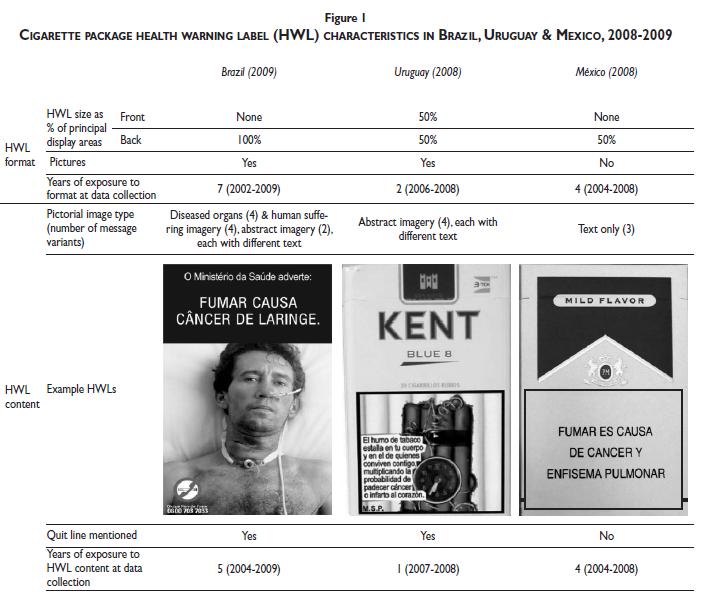
<body><![CDATA[<p><font face="Verdana" size="2"> Little is known about whether some types of    pictorial images on cigarette packs are more likely than other types to influence    smokers' knowledge, attitudes, and behaviors. However, focus groups in Canada,<sup>12</sup>    as well as experimental research in the US,<sup>13</sup> Mexico<sup>14</sup>    and Brazil<sup><sup>15,16 </sup></sup> suggest that gruesome imagery has greater    impact than ABSTRACT imagery. This finding is supported by surveys of adult    smokers in Uruguay, Thailand, and Australia, which suggest that after each country    instituted pictorial HWLs for the first time, the warnings had a lower impact    in Uruguay than in the other countries.<a href="#tx1">*</a><a name="nt01"></a>    This difference can be attributed to the relatively ABSTRACT imagery of HWLs    in Uruguay (<a href="/img/revistas/spm/v52s2/a12quad01.jpg">Figure 1</a>), which    contrasts with the more gruesome illustrations of smoking consequences in the    other countries.</font></p>     <p><font face="Verdana" size="2"> Research has generally not examined whether    HWLs formats have different effects across sociodemographic groups within different    countries. As tobacco policies and programs have been implemented in high-income    countries, smoking has become concentrated within socially disadvantaged groups.<sup>17</sup>    This disparate concentration may also occur in low- and middle-income countries    unless policies and programs have even impacts or help offset disparities that    arise from certain interventions, including communication interventions to which    low SES populations have lower levels of exposure or are less responsive. Warning    labels potentially communicate health risks to smokers across all SES groups,    and picture warning labels may reach an even greater audience as they overcome    issues with literacy.<sup>8,18</sup> As such, health warning labels could help    prevent and/or remediate smoking-related tobacco disparities. In this regard,    studies of the differential impact of mass media campaigns are suggestive. Some    mass media campaigns impact high- but not low-SES groups;<sup>19</sup> however,    other research has found that emotionally evocative ads and testimonials appear    to work better among lower than higher SES groups.<sup>20</sup> A key research    question for the future development of HWL messaging policies is whether pictorial    HWLs are better than text-only HWLs in influencing low SES groups, and whether    testimonial and emotionally evocative pictorial HWLs may do this more effectively    than other types of pictorials. We address this question in this article by    analyzing data from International Tobacco Control Policy Evaluation Project    (ITC Project) surveys in three Latin American countries with HWLs that likely    vary in emotional intensity that they provoke.</font></p>     <p>&nbsp;</p>     <p><font face="Verdana" size="3"><b>Health warning labels and the tobacco control    context in Brazil, Uruguay and Mexico</b></font></p>     <p><font face="Verdana" size="2">At the time of ITC survey data collection in    2008-2009, the health warning labels in Brazil, Uruguay and Mexico were quite    different (<a href="/img/revistas/spm/v52s2/a12quad01.jpg">Figure 1</a>). In    Brazil, HWLs covered 100% of the back of each cigarette pack, whereas they covered    50% of the back in Uruguay and Mexico. Unlike Brazil and Mexico, Uruguay's HWL    also covers the front of the pack. Brazil has had pictorial warning labels since    2002,<sup>21</sup> which were revised in 2004 and again in 2009,<sup>16</sup>    after the current study data were collected.<sup>16</sup> The 2004 HWLs included    four images of human suffering, four images of gruesome diseased organs and    death, and two ABSTRACT representations of poison (dead rat) and impotence (limp    cigarette). Uruguay implemented its first round of eight pictorial HWLs in 2006,    with a second round in 2008, and subsequent rounds after data were collected.    The first two rounds of pictorial HWLs consisted of ABSTRACT representations    of smoking-related consequences, which in the second round took the form of    a vial with skull and crossbones, dynamite, and a tombstone. The text-only HWLs    in Mexico have been in existence since 2004, and include three messages (Smoking    causes cancer and emphysema; Quitting smoking reduces important health risks;    Smoking during pregnancy increases risk of premature birth and low birthweight    babies).</font></p>     <p><font face="Verdana" size="2"> This paper uses cross-sectional data from these    three countries with distinct HWL policies in order to explore the following    hypotheses: 1) In Mexico, which has text-only HWLs, greater HWL salience and    cognitive impact will be associated with higher educational attainment, whereas    these associations will be negative in Brazil and Uruguay, which have pictorial    HWLs; 2) In Uruguay, which is the only country with a HWL on the front of the    package, HWL salience will be greater than in other countries; In Brazil HWLs    will be more salient than in Mexico, due to having more space dedicated to the    HWL; 3) The cognitive and behavioral impact of HWLs will be greater in Brazil    than in Uruguay, which will be greater than in Mexico.</font></p>     <p>&nbsp;</p>     <p><font face="Verdana" size="3"><b>Material and Methods</b></font></p>     <p><font face="Verdana" size="2"><i>Study sample:</i> As part of the International    Tobacco Control Policy Evaluation Project (ITC-Project), data were collected    from adult smokers in Brazil (Wave 1, April to June 2009), Uruguay (Wave 2,    September to December 2008), and Mexico (Wave 3, November to December 2008).    At the time of analysis, there was only one survey wave for Brazil, which occurred    when its HWLs had included pictorials for seven years; hence, we selected the    most recent ITC survey administrations in Uruguay and Mexico, so that the length    of time that participants would have been exposed to the HWLs was as comparable    as possible (since 2006 and 2004, respectively). In Brazil, telephone-administered    surveys were conducted with adult smokers using an area stratified random sampling    strategy, yielding a representative sample of 1215 smokers who lived in three    of the four largest cities in Brazil (Rio de Janeiro, Porto Alegre, and Sao    Paulo). For Brazil, the household telephone contact rate was 31.7% and the cooperation    rate among smokers identified as eligible was 85.2%. Eligible smokers were those    who smoked at least monthly and at least 100 lifetime cigarettes. The Uruguayan    and Mexican administrations of the ITC surveys were conducted using a similar    stratified, multi-stage sampling strategy that involved face-to-face interviews    with randomly selected adult smokers, defined as those who had smoked at least    once during the previous week and at least 100 lifetime cigarettes (for details,    see Thrasher <i>et al</i>., 2009). The wave 1 Uruguayan sample consisted of    households in the capital city of Montevideo, where 40% of the countries 3.5    million people live. In Montevideo, 95% of households selected were contacted    and 76% of selected smokers agreed to participate. At wave 2 (n=1378), which    comprises the analytic sample for the present study, 66% (585/885) of participants    were successfully re-interviewed, with replenishment of smokers in Montevideo    (n=391) and new samples (n=402) selected using the same procedures in four additional    smaller cities (Salto, Maldonado, Durazno, and Rivera), whose population ranged    from 30000 to 100000. The household enumeration and participation rates in these    new cities were 88% and 78%, respectively. People who no longer smoked (n= 85)    were excluded from the analytic sample. In Mexico, the wave 1 (2006) sampling    frame consisted of households within each of four of the six largest cities    in Mexico (Mexico City, Guadalajara, Tijuana, and Ciudad Ju&aacute;rez), but    which was expanded at wave 3 (2008) to include three additional cities that    are amongst the twelve most populous in Mexico (Monterrey, Puebla, and M&eacute;rida).    The household enumeration rate at wave 1 was 64% and the cooperation rate among    selected participants was 89%. At wave 2 in 2007, 70% (756/1079) were successfully    followed up, with replenishment of this sample with 289 randomly selected smokers    who lived within the same census tracts where the loss to follow up occurred.    The wave 3 sample (n=2010), which comprises the analytic sample for the present    study, includes 73% (762/1045) of those followed from wave 2, a replenishment    sample of 300 smokers randomly selected from the same census tracts, as well    as new samples in three cities (n=813) and in Mexico City (n=135). Household    contact and cooperation rates for this new sample were 79% and 70%, respectively.    People who were no longer smokers (n= 149) were excluded from the analytic sample.    For each country, sampling weights were developed to account for the likelihood    of participant selection. To produce more efficient estimates of association,<sup>22</sup>    the weights used for model estimation were rescaled to sum to the sample size    within each country. Protocols were approved by ethics review boards in each    country (INCA, Brazil; Universidad de la Rep&uacute;blica, Uruguay; INSP, M&eacute;xico).    Before participating, Brazilian smokers provided oral informed consent, while    Uruguayan and Mexican smokers provided written informed consent.</font></p>     <p><font face="Verdana" size="3"><b>Measurement</b></font></p>     ]]></body>
<body><![CDATA[<p><font face="Verdana" size="2"><i>Exposure and reactions to health warning labels:</i>    Warning label salience was assessed with two questions: how often smokers noticed    HWLs; and how often they read or looked closely at them. Responses for each    were dichotomized (1=<i>often or very often</i> vs. 0=<i>never or once in a    while</i> in Uruguay and Mexico or vs. 0=<i>never, rarely or sometimes</i> in    Brazil). Cognitive impact was assessed with three questions: how much HWLs made    participants think about the health risks of smoking; how much HWLs made participants    think about quitting; and how often HWLs made them think about quitting. For    simple comparative analises, response options were dichotomized (i.e., 0=<i>none</i>    vs. 1=<i>a little, somewhat</i>, or <i>a lot</i> for the first two questions;    0=<i>none or a little</i> vs. 1=<i>a lot</i> for the third). These three questions    were also rescaled to have the same range of responses and averaged together    to create a scale, which had good internal consistency in all three countries    (alpha=0.77, 0.78, and 0.71 in Brazil, Uruguay and Mexico, respectively). Finally,    assessment of behavioral impact of HWL involved asking if, in the last month,    health warnings had stopped participants from having a cigarette when they were    about to smoke one (i.e., 0=never, 1=at least once).</font></p>     <p><font face="Verdana" size="2"><i>Smoking-related variables:</i> Smokers were    asked if they smoke everyday or less frequently (coded as 1 and 0, respectively).    Participants were also asked how much smoking had harmed their health, as well    as how much they worried that smoking would harm them in the future. Response    options for each of these two questions (not at all, somewhat, a lot) were dummy    coded, with "not at all" as the reference group. Finally, participants were    asked if they had heard of or ever used a toll free quit line.</font></p>     <p><font face="Verdana" size="2"><i>Sociodemographics:</i> Sociodemographic characteristics    were assessed with standard questions on sex, age, and educational attainment.    Although educational systems vary in each country, a four-level variable was    a created that was a meaningful within and across groups. For Brazil, the reported    number of years of education were collected and recoded to reflect comparable    levels of attainment: primary school or less, 0-4 years; secondary school, 5-8    years; high school, 9-11 years; and university or higher, 12 or more years.    For Uruguay and Mexico, categorical variables were recoded to reflect primary    school or less, secondary school, high school or technical school, and university    or higher. In pooled analyses, differences between countries were assessed with    dummy variables that treated Mexico as the referent group. Interactions were    tested by multiplying the country dummy variable with the variable of interest.</font></p>     <p><font face="Verdana" size="3"><b>Analysis</b></font></p>     <p><font face="Verdana" size="2">All analyses were conducted using STATA, version    9. Sociodemographics and smoking-related characteristics were assessed without    adjusting for the survey design. T-tests and chi-square tests were used to assess    differences in these characteristics across countries, without survey adjustment.    All other univariate (i.e., health warning label indicators and quit line variables),    bivariate, and multivariate analyses involved adjustment for survey design and    sampling weights. In models stratified by country, multivariate logistic models    were estimated for dichotomous HWL indicators (i.e., salience variables and    behavioral impact), and linear regression models for the continuous, cognitive    impact HWL scale. In these models, HWL indicators were regressed on sociodemographics,    daily smoking, and risk perceptions. In pooled analyses, the same dependent    and independent variables were assessed, while also including dummy variables    for country and, where appropriate, a variable to express the interaction between    country and the variable of interest. For all analyses, p-values &lt;0.05 were    used to indicate statistical significance.</font></p>     <p><font face="Verdana" size="3"><b>Results</b></font></p>     <p><font face="Verdana" size="2"><a href="/img/revistas/spm/v52s2/a12tab01.jpg">Table    I</a> shows the characteristics of the analytic samples for this study. The    Brazilian sample was slightly older (mean age 44.4) and had higher educational    attainment than the Uruguayan and Mexican samples (mean age 40.8 and 40.2, respectively).    Participants in Brazil also held stronger beliefs about the harm they had already    experienced from tobacco use, with similar levels of perceived harm among Uruguayan    and Mexican participants. Brazilian and Mexican participants had comparable    expectations about future harms they would experience from smoking, with Uruguayan    participants indicating lower expectations about future harms. Brazilian participants    were much more likely than Uruguayan or Mexican participants to have heard of    the quit line (i.e., 93% vs 39% and 29%, respectively) and to have called the    quit line (7% vs 1% and 2%, respectively). When assessing warning label responses,    indicators of warning label salience (noticing and reading HWLs often or very    often) were significantly higher in Uruguay (62.3% and 42.4%, respectively)    than in either Brazil (45.5% and 29.5%, respectively) or Mexico (42.9% vs. 31.9%,    respectively). However, indicators of cognitive processing and behavioral impact    of HWLs were all higher in Brazil (38% to 84%) than in either Uruguay (6% to    63%) or Mexico (12% to 72%), with Uruguayans indicating lower levels of cognitive    impact than Mexicans. Most Brazilian participants also indicated that they wanted    more information on HWLs (57%), which was higher than their Uruguayan and Mexican    counterparts (32% and 47%, respectively).</font></p>     <p><font face="Verdana" size="3"><b>Noticing and reading/looking at HWLs</b></font></p>     <p><font face="Verdana" size="2">Logistic regression models were estimated to    assess factors associated with the noticing and reading/looking at HWLs within    and across countries (<a href="/img/revistas/spm/v52s2/a12tab02.jpg">Table    II</a>). In the case of Mexico, educational attainment had a positive, independent    association with salience in both models (B=0.14, p&lt;0.05; B=0.18, p&lt;0.01),    whereas education had no statistically significant association with either outcome    in Brazil or Uruguay. In the models stratified by country, other sociodemographic    and smoking-related variables generally indicated no statistically significant    association with HWL salience indicators, or they were associated with one,    but not the other outcome. Data were then pooled across countries to assess    country-level effects and interactions. In the model estimating predictors of    noticing HWLs, higher educational attainment was positively associated (B=0.08,    p&lt;0.05), and those who perceived a lot of future harm from smoking were more    likely to notice HWLs than those who did not perceive these harms (AOR=1.66).    Furthermore, Uruguayans were more likely than Mexicans to notice HWLs (AOR=2.38),    with no difference between Mexicans and Brazilians. Tests of interaction between    education and country were not significant. In the pooled model to assess predictors    of reading HWLs, reading was also significantly higher among Uruguayans than    among Mexicans, but a statistical interaction was found between Uruguay and    education such that the positive association between education and reading HWLs    in Mexico was significantly stronger than the lack of association found in Uruguay.</font></p>     <p><font face="Verdana" size="3"><b>Cognitive impact of HWLs</b></font></p>     ]]></body>
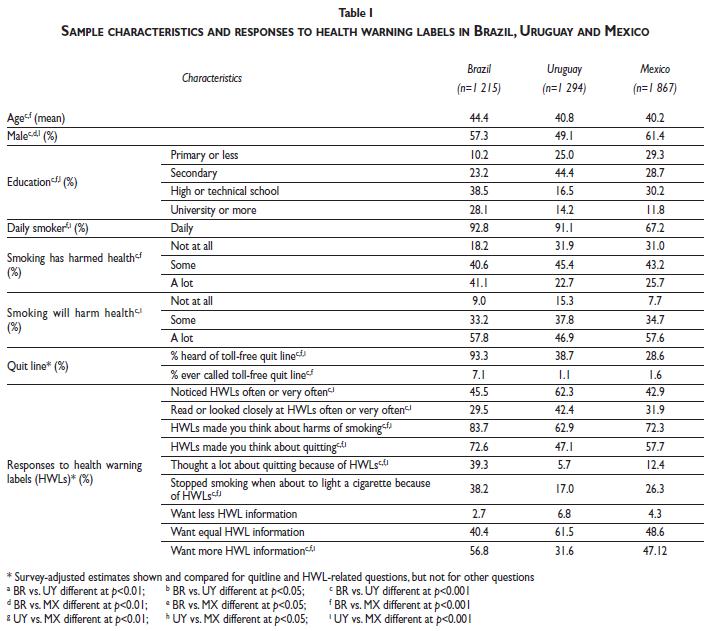
<body><![CDATA[<p><font face="Verdana" size="2">Linear regression models were also estimated,    regressing the scale of cognitive HWL impact on sociodemographics and smoking-related    variables (<a href="/img/revistas/spm/v52s2/a12tab03.jpg">Table    III</a>). In the models stratified by country, education was inversely associated    with cognitive impacts in Brazil (B= -0.20, p&lt;0.001), but unassociated in    Uruguay and Mexico. Non-daily smokers and those with greatest perceived current    and future harms due to smoking were also generally more likely to report cognitive    impacts due to HWLs. These relationships maintained statistical significance    in the pooled, multivariate model, where Uruguayans were significantly less    likely than Mexicans to experience cognitive HWL impacts (B=-0.09, p&lt;0.05),    whereas Brazilian counterparts were more likely to experience these impacts    (B=0.80, p&lt;0.001). A second pooled model indicated a statistically significant    interaction between Brazil and education, such that the inverse association    found between education and cognitive impacts from HWLs was significantly stronger    than the lack of association found in Mexico.</font></p>     <p><font face="Verdana" size="3"><b>Behavioral impact of HWLs</b></font></p>     <p><font face="Verdana" size="2">Finally, logistic regression models were estimated    to determine the factors associated with reporting that in the last month, HWLs    stopped a participant from smoking a cigarette when he was about to light one    (<a href="/img/revistas/spm/v52s2/a12tab03.jpg">Table III</a>). Results were    generally consistent with those found for the models estimating factors associated    with the cognitive impact of HWLs, including the inverse association with education    in Brazil (B=-0.29, p&lt;0.001) although this was also found for Uruguay (B=-0.20,    p&lt;0.05). In pooled models, Uruguayans were less likely, and Brazilians more    likely than Mexicans to report this outcome (AORUY vs MX=0.65, p&lt;0.001; AORBR    vs MX=2.01, p&lt;0.001). In the model that tested interactions between country    and educational attainment, results indicated that the inverse association between    education and behavior in Brazil was significantly different from the lack of    association found in Mexico.</font></p>     <p>&nbsp;</p>     <p><font face="Verdana" size="3"><b>Discussion</b></font></p>     <p><font face="Verdana" size="2">The results from this study confirmed key study    hypotheses. The salience of HWLs, as indicated by noticing and reading or looking    closely at the package, was significantly higher in Uruguay than in either Brazil    or Mexico. The length of time since introduction of the newest round of HWLs    in each country may help explain the greater salience in Uruguay, as attention    to HWLs "wears out" over time,<sup>7</sup> and they were introduced only 2    years prior to data collection in Uruguay, compared to 4 and 5 years prior in    Mexico and Brazil, respectively. However, the greater salience of Uruguayan    HWLs is also likely due to its being the only country with HWLs on both the    front and back of the pack. The history of tobacco packaging confirms this contention,    as a key innovation in cigarette marketing involved the display of brand imagery    on both sides of the pack in order to communicate this imagery as frequently    as possible.<sup>23,24</sup> Hence, countries should follow WHO-FCTC guidelines    for implementing prominent HWLs on all primary surfaces of the pack.<sup>25</sup></font></p>     <p><font face="Verdana" size="2"> The salience of text-only Mexican and pictorial    Brazilian HWLs was comparable, suggesting that the salience of pictorial HWLs    can be reduced to that found for text only HWLs when covering only one side.    Other studies have also found equivalent salience of pictorial (Canada and Australia)    and text only (United Kingdon) HWLs when they are similarly prominent on both    the front and back of the pack.<sup>7,9</sup> However, the argument in favor    of pictoral HWLs is bolserted by our finding that educational attainment was    positively associated with salience in Mexico, but unassociated either Brazil    or Uruguay. Text-only HWLs, like those in Mexico, may be more likely to be noticed    and read by people at higher levels of educational attainment; thus, text-only    HWLs may be less effective with more socioeconomically disadvantaged smokers.    Indeed, the potential to overcome health literacy issues is one of the key advantages    of pictorial warnings over text-only warnings.</font></p>     <p><font face="Verdana" size="2"> Our results also suggest that the Brazilian    strategy of using depictions of human suffering and gruesome bodily impacts    of smoking on its HWLs had a greater cognitive and behavioral impact than either    the ABSTRACT imagery used in Uruguay or the text-only HWL format used in Mexico.    This is consistent with experimental research,<sup>14</sup> although it has    not been studied before in surveys because countries' pictorial HWL systems    have not been distinct enough to allow for such a comparison.<sup>9</sup> The    ABSTRACT imagery used in Uruguay appears to have generated even lower cognitive    and behavioral impacts than the text-only Mexican HWLs. Another key finding    concerns the inverse association between educational attainment and cognitive    and behavioral impacts of HWLs in Brazil and Uruguay, but not in Mexico. In    pooled analyses, statistically significant interactions involving education    and country suggest that this inverse association is significantly different    in Brazil when compared to Mexico - in other words, testimonial and gruesome    imagery appears to do a better job of communicating risks and promoting thoughts    about quitting to smokers with lower educational attainment than those with    higher attainment. This is consistent with other studies of mass media campaigns    to promote cessation.<sup>20</sup> Hence, HWL images that depict the gruesome    nature of tobacco-related disease and those that depict the concrete human suffering    from smoking-related consequences may help offset smoking-related disparities    across SES groups or, in the case of countries that are only beginning to experience    the tobacco epidemic, prevent them from even happening.</font></p>     <p><font face="Verdana" size="2"> In general, Brazilian smokers had higher perceived    current and future harms due to smoking, perhaps reflecting the country's    longer tobacco control program when compared to Mexico and Uruguay. Our results    also indicate that the Brazilians were more likely than Uruguayans or Mexicans    to be aware of (93% vs 39% and 29%, respectively) and to have used (7% vs 1%    and 2%, respectively) telephone-based cessation assistance, which is advertised    in all Brazilian tobacco control media campaigns and HWLs, but only in media    campaigns in Mexico and Uruguiay. Across all three countries, however, those    who perceived greater future consequences from smoking were also more likely    to respond to HWLs, whether examined in terms of HWL salience, cognitive impact,    or behavioral impact. These cross-sectional data do not allow determination    of whether HWLs generate these concerns about future harm or whether this predisposition    contributes to selective attention to HWLs. Longitudinal analyses are needed    to determine how HWLs contribute to and interact with these perceptions to promote    downstream quit attempts. Indeed, a clear determination of the public health    impact of different HWL strategies will come from examining their impact on    consumption, including quitting.</font></p>     <p><font face="Verdana" size="2"> Although the study results are suggestive of    the greater impact of front-of-pack HWLs and the use of emotionally evocative    imagery, our interpretations should be tempered by a few additional observations.    First of all, HWL characteristics varied in size and positioning, as well as    in content. Conclusions about the greater cognitive and behavioral impact of    Brazilian than Uruguayan HWLs may be partly explained by Brazilian HWLs covering    100% of the back of the pack, instead of 50% of each side. However, our conclusions    regarding the greater effectiveness of the Brazilian-style pictorial HWLs are    supported by our finding that Uruguayan content had lower cognitive and behavioral    impacts than even the Mexican text-only HWLs that covered less surface area    (50% of the back) than Uruguayan labels. Furthermore, this difference was detected    in spite of the overall greater salience of Uruguayan labels. Nevertheless,    further research should be conducted to determine whether the imagery of human    suffering has a greater impact than gruesome diseased organs, or whether there    are synergies between the two that would not be obtained if either one or the    other strategy was adopted by itself. </font></p>     ]]></body>
<body><![CDATA[<p><font face="Verdana" size="2"> The internal validity of the study may have    been compromised by a number of issues, including slightly different response    options offered for some variables. Our use of educational attainment as an    indicator of SES is incomplete and may not adequately represent this concept.    Nevertheless, educational attainment is a reasonable indicator of literacy and    the impact of pictorials among populations with low literacy has not been examined    previously. In the case of Uruguay and Mexico, whose first wave was fielded    around the same time, researchers worked to develop consistent and harmonized    translations to reduce measurement biases introduced by survey translation;    however, Brazil did not undergo this process as it entered the study at a later    date, potentially biasing results in un predictable ways. Differing data collection    modes (i.e., telephone-administered in Brazil and face-to-face in Uruguay and    Mexico) may have also biased results. Although the coverage of phone lists in    Brazil is quite high (S&atilde;o Paulo 77%, Rio de Janeiro 75,2% and Porto Alegre    86,6%.),<sup>26</sup> smokers without landlines are likely to be from lower    SES groups and may respond differently to HWLs than the smokers with lower educational    attainment in our sample. Finally, the Brazilian sample included monthly smokers,    whereas the Uruguayan and Mexican samples excluded those who smoked less than    weekly. However, very few Brazilians smoked monthly, but not weekly, and these    few ar unlikely to influence results. </font></p>     <p><font face="Verdana" size="2"> Further research should also account for how    smokers' responses to HWLs interact with other features of the tobacco control    environment. Cross-country differences in tobacco control environments and histories    of education about tobacco could help account for our findings; however, we    focused our attention on theory-based mediators of HWL impacts on behavior in    order to help rule out this possibility.<sup>27</sup> Finally, despite the population-based    nature of our samples, non-response may have biased the generalizability of    our results to the broader population within each country. </font></p>     <p><font face="Verdana" size="2"> Overall, this study confirms WHO Article 11    implementation guidelines that countries should have HWLs that prominently occupy    both principal display areas of cigarette packages and include pictorial imagery.<sup>25</sup>    Article 11 guidelines suggest that "culturally appropriate pictures" be used,    without further specification. Our results suggest that pictures should include    emotionally engaging imagery that illustrates negative consequences, using images    of diseased organs or of human suffering. HWLs in each of the three countries    have changed or are about to change in ways that will further inform the further    evolution of Article 11. In 2009, Brazil implemented a set of HWL images found    to promote extreme negative emotions and aversion.<sup>16</sup> Since 2009,    Uruguay includes more gruesome imagery, and the pack space dedicated to HWLs    has increased to 80% on the front and back. In September 2010, Mexico will implement    pictorial HWLs that primarily emphasize the health and emotional consequences    of smoking on important others. Furthermore, the pictorials will appear on the    upper 30% of the front of the pack, with 100% of the back dedicated to only    text. Like Uruguay, Mexico can renew HWL content on an annual basis. The impact    of the periodicity of HWL rotation is not well understood. Longitudinal data    from the ITC survey will help understand the impacts of these changes so that    other countries can learn from these experiences.</font></p>     <p><font face="Verdana" size="3"><b>Declaration of conflicts of interest</b></font></p>     <p><font face="Verdana" size="2">We declare that we have no conflicts of interest.</font></p>     <p>&nbsp;</p>     <p><font face="Verdana" size="3"><b>Acknowledgements </b></font></p>     <p><font face="Verdana" size="2">Funding for data collection and analyses on this    study came from Consejo Nacional de Ciencia y Tecnolog&iacute;a (CONACyT Convocatoria    Salud-2007-C01-70032), with additional funding for analysis provided by the    National Cancer Institute (P01 CA138389) and an unrestricted grant from Johnson    &amp; Johnson. Dr Ernesto Sebri&eacute; was supported by the Flight Attendant Medical    Research Institute (FAMRI).</font></p>     <p>&nbsp;</p>     <p><font face="Verdana" size="3"><b>References</b></font></p>     ]]></body>
<body><![CDATA[<!-- ref --><p><font face="Verdana" size="2">01. WHO. WHO report on the global tobacco epidemic,    2008: The MPOWER package. Geneva: World Health Organization, 2008.    &nbsp;&nbsp;&nbsp;&nbsp;&nbsp;&nbsp;&nbsp;&nbsp;[&#160;<a href="javascript:void(0);" onclick="javascript: window.open('/scielo.php?script=sci_nlinks&ref=9312263&pid=S0036-3634201000080001600001&lng=','','width=640,height=500,resizable=yes,scrollbars=1,menubar=yes,');">Links</a>&#160;]<!-- end-ref --></font></p>     <!-- ref --><p><font face="Verdana" size="2">02. WHO. Framework Convention on Tobacco Control.    Geneva, Switzerland: World Health Organization, Tobacco Free Initiative, 2003.    &nbsp;&nbsp;&nbsp;&nbsp;&nbsp;&nbsp;&nbsp;&nbsp;[&#160;<a href="javascript:void(0);" onclick="javascript: window.open('/scielo.php?script=sci_nlinks&ref=9312265&pid=S0036-3634201000080001600002&lng=','','width=640,height=500,resizable=yes,scrollbars=1,menubar=yes,');">Links</a>&#160;]<!-- end-ref --></font></p>     <!-- ref --><p><font face="Verdana" size="2">03. Strahan E, White KS, Fong GT, Fabrigar L,    Zanna M, Cameron R. Enhancing the effectiveness of message labels on tobacco    packaging: A social psychological perspective. Tob Control 2002;11:183-190.    &nbsp;&nbsp;&nbsp;&nbsp;&nbsp;&nbsp;&nbsp;&nbsp;[&#160;<a href="javascript:void(0);" onclick="javascript: window.open('/scielo.php?script=sci_nlinks&ref=9312267&pid=S0036-3634201000080001600003&lng=','','width=640,height=500,resizable=yes,scrollbars=1,menubar=yes,');">Links</a>&#160;]<!-- end-ref --></font></p>     <!-- ref --><p><font face="Verdana" size="2">04. Hammond D, Fong GT, MacDonald P, Cameron    R, Brown K. Impact of graphic Canadian warning labels on adult smoking behavior.    Tob Control 2003;12:391-395.    &nbsp;&nbsp;&nbsp;&nbsp;&nbsp;&nbsp;&nbsp;&nbsp;[&#160;<a href="javascript:void(0);" onclick="javascript: window.open('/scielo.php?script=sci_nlinks&ref=9312269&pid=S0036-3634201000080001600004&lng=','','width=640,height=500,resizable=yes,scrollbars=1,menubar=yes,');">Links</a>&#160;]<!-- end-ref --></font></p>     <!-- ref --><p><font face="Verdana" size="2">05. O'Hegarty M, Pederson LL, Nelson DE, Mowery    P, Gable JM, Wortley P. Reactions of young adult smokers to warning labels on    cigarette packages. Am J Prev Med 2006;30(6):467-473.    &nbsp;&nbsp;&nbsp;&nbsp;&nbsp;&nbsp;&nbsp;&nbsp;[&#160;<a href="javascript:void(0);" onclick="javascript: window.open('/scielo.php?script=sci_nlinks&ref=9312271&pid=S0036-3634201000080001600005&lng=','','width=640,height=500,resizable=yes,scrollbars=1,menubar=yes,');">Links</a>&#160;]<!-- end-ref --></font></p>     ]]></body>
<body><![CDATA[<!-- ref --><p><font face="Verdana" size="2">06. Hammond D, Fong GT, McNeil A, Borland R,    Cummings KM. The effectiveness of cigarette warning labels in informing smokers    about the risks of smoking: Findings from the International Tobacco Control    (ITC) Four Country Survey. Tob Control 2006;15(Supp 3):iii19-25.    &nbsp;&nbsp;&nbsp;&nbsp;&nbsp;&nbsp;&nbsp;&nbsp;[&#160;<a href="javascript:void(0);" onclick="javascript: window.open('/scielo.php?script=sci_nlinks&ref=9312273&pid=S0036-3634201000080001600006&lng=','','width=640,height=500,resizable=yes,scrollbars=1,menubar=yes,');">Links</a>&#160;]<!-- end-ref --></font></p>     <!-- ref --><p><font face="Verdana" size="2">07. Hammond D, Fong GT, Borland R, Cummings KM,    McNeil AD, Driezen P. Text and graphic warnings on cigarette packages: Findings    from the International Tobacco Control Four Country Study. Am J Prev Med 2007;32(3):210-217.    &nbsp;&nbsp;&nbsp;&nbsp;&nbsp;&nbsp;&nbsp;&nbsp;[&#160;<a href="javascript:void(0);" onclick="javascript: window.open('/scielo.php?script=sci_nlinks&ref=9312275&pid=S0036-3634201000080001600007&lng=','','width=640,height=500,resizable=yes,scrollbars=1,menubar=yes,');">Links</a>&#160;]<!-- end-ref --></font></p>     <!-- ref --><p><font face="Verdana" size="2">08. Thrasher JF, Hammond D, Fong GT, Arillo-Santillan    E. Smokers' reactions to cigarette package warnings with graphic imagery and    with only text: A comparison between Mexico and Canada. Salud Publica Mex 2007;49(Sup    2):S233-S240.    &nbsp;&nbsp;&nbsp;&nbsp;&nbsp;&nbsp;&nbsp;&nbsp;[&#160;<a href="javascript:void(0);" onclick="javascript: window.open('/scielo.php?script=sci_nlinks&ref=9312277&pid=S0036-3634201000080001600008&lng=','','width=640,height=500,resizable=yes,scrollbars=1,menubar=yes,');">Links</a>&#160;]<!-- end-ref --></font></p>     <!-- ref --><p><font face="Verdana" size="2">09. Borland R, Wilson N, Fong GT, Hammond D,    Cummings KM, Yong H, et al. Impact of graphic and text warnings on cigarette    packs: Findings from four countries over five years. Tob Control 2009;18:358-364.    &nbsp;&nbsp;&nbsp;&nbsp;&nbsp;&nbsp;&nbsp;&nbsp;[&#160;<a href="javascript:void(0);" onclick="javascript: window.open('/scielo.php?script=sci_nlinks&ref=9312279&pid=S0036-3634201000080001600009&lng=','','width=640,height=500,resizable=yes,scrollbars=1,menubar=yes,');">Links</a>&#160;]<!-- end-ref --></font></p>     <!-- ref --><p><font face="Verdana" size="2">10. Shanahan P, Elliott D. Evaluation of the    effectiveness of the graphic health warnings on tobacco product packaging, 2008.    Canberra: Australian Government, Department of Health and Ageing, 2009.    &nbsp;&nbsp;&nbsp;&nbsp;&nbsp;&nbsp;&nbsp;&nbsp;[&#160;<a href="javascript:void(0);" onclick="javascript: window.open('/scielo.php?script=sci_nlinks&ref=9312281&pid=S0036-3634201000080001600010&lng=','','width=640,height=500,resizable=yes,scrollbars=1,menubar=yes,');">Links</a>&#160;]<!-- end-ref --></font></p>     ]]></body>
<body><![CDATA[<!-- ref --><p><font face="Verdana" size="2">11. Fong GT, Hammond D, Hitchman SC. The impact    of graphic pictures on the effectiveness of tobacco health warnings. Bull World    Health Organ 2009;87:640-3.    &nbsp;&nbsp;&nbsp;&nbsp;&nbsp;&nbsp;&nbsp;&nbsp;[&#160;<a href="javascript:void(0);" onclick="javascript: window.open('/scielo.php?script=sci_nlinks&ref=9312283&pid=S0036-3634201000080001600011&lng=','','width=640,height=500,resizable=yes,scrollbars=1,menubar=yes,');">Links</a>&#160;]<!-- end-ref --></font></p>     <!-- ref --><p><font face="Verdana" size="2">12. Environics Research Group. Testing new health    warning messages for cigarette packages: A summary of three phases of focus    group research. Ottawa: Health Canada, 2000.    &nbsp;&nbsp;&nbsp;&nbsp;&nbsp;&nbsp;&nbsp;&nbsp;[&#160;<a href="javascript:void(0);" onclick="javascript: window.open('/scielo.php?script=sci_nlinks&ref=9312285&pid=S0036-3634201000080001600012&lng=','','width=640,height=500,resizable=yes,scrollbars=1,menubar=yes,');">Links</a>&#160;]<!-- end-ref --></font></p>     <!-- ref --><p><font face="Verdana" size="2">13. Nimbarte A, Aghasadeh F, Harvey C. Comparison    of current US and Canadian cigarette pack warnings. Int Q Community Health Educ    2006;24(1):3-27.    &nbsp;&nbsp;&nbsp;&nbsp;&nbsp;&nbsp;&nbsp;&nbsp;[&#160;<a href="javascript:void(0);" onclick="javascript: window.open('/scielo.php?script=sci_nlinks&ref=9312287&pid=S0036-3634201000080001600013&lng=','','width=640,height=500,resizable=yes,scrollbars=1,menubar=yes,');">Links</a>&#160;]<!-- end-ref --></font></p>     <!-- ref --><p><font face="Verdana" size="2">14. Thrasher JF, Allen B, Anaya-Ocampo R, Reynales    LM, Lazcano-Ponce EC, Hern&aacute;ndez-Avila M. An&aacute;lisis del impacto    en fumadores Mexicanos de los avisos gr&aacute;ficos en las cajetillas de cigarros    Analysis of the impact of cigarette package warning labels with graphic images    among Mexican smokers. Salud Publica Mex 2006;48:S65-S75.    &nbsp;&nbsp;&nbsp;&nbsp;&nbsp;&nbsp;&nbsp;&nbsp;[&#160;<a href="javascript:void(0);" onclick="javascript: window.open('/scielo.php?script=sci_nlinks&ref=9312289&pid=S0036-3634201000080001600014&lng=','','width=640,height=500,resizable=yes,scrollbars=1,menubar=yes,');">Links</a>&#160;]<!-- end-ref --></font></p>     <!-- ref --><p><font face="Verdana" size="2">15. Nascimento B, Oliveira L, Vieira A, Joffily    M, Gleiser S, Pereira M, et al. Avoidance of smoking: The impact of warning    labels in Brazil. Tob Control 2008;17:405-409.    &nbsp;&nbsp;&nbsp;&nbsp;&nbsp;&nbsp;&nbsp;&nbsp;[&#160;<a href="javascript:void(0);" onclick="javascript: window.open('/scielo.php?script=sci_nlinks&ref=9312291&pid=S0036-3634201000080001600015&lng=','','width=640,height=500,resizable=yes,scrollbars=1,menubar=yes,');">Links</a>&#160;]<!-- end-ref --></font></p>     ]]></body>
<body><![CDATA[<!-- ref --><p><font face="Verdana" size="2">16. INCA. Brazil: Health warnings on tobacco    products - 2009. Rio di Janeiro: Ministereo de Saude, Instituto Nacional de    Cancer, 2009.    &nbsp;&nbsp;&nbsp;&nbsp;&nbsp;&nbsp;&nbsp;&nbsp;[&#160;<a href="javascript:void(0);" onclick="javascript: window.open('/scielo.php?script=sci_nlinks&ref=9312293&pid=S0036-3634201000080001600016&lng=','','width=640,height=500,resizable=yes,scrollbars=1,menubar=yes,');">Links</a>&#160;]<!-- end-ref --></font></p>     <!-- ref --><p><font face="Verdana" size="2">17. Link B. Epidemiological sociology and the    social shaping of population health. J Health Soc Behav 2008;49:367-384.    &nbsp;&nbsp;&nbsp;&nbsp;&nbsp;&nbsp;&nbsp;&nbsp;[&#160;<a href="javascript:void(0);" onclick="javascript: window.open('/scielo.php?script=sci_nlinks&ref=9312295&pid=S0036-3634201000080001600017&lng=','','width=640,height=500,resizable=yes,scrollbars=1,menubar=yes,');">Links</a>&#160;]<!-- end-ref --></font></p>     <!-- ref --><p><font face="Verdana" size="2">18. Thrasher JF, Rousu MC, Anaya-Ocampo R, Reynales-Shigematsu    LM, Arillo-Santill&aacute;n E, Hern&aacute;ndez-&Aacute;vila M. Estimating    the impact of graphic warning labels on cigarette packs: The auction method.    Addict Behav 2007;32(12):2916-2915.    &nbsp;&nbsp;&nbsp;&nbsp;&nbsp;&nbsp;&nbsp;&nbsp;[&#160;<a href="javascript:void(0);" onclick="javascript: window.open('/scielo.php?script=sci_nlinks&ref=9312297&pid=S0036-3634201000080001600018&lng=','','width=640,height=500,resizable=yes,scrollbars=1,menubar=yes,');">Links</a>&#160;]<!-- end-ref --></font></p>     <!-- ref --><p><font face="Verdana" size="2">19. Niederdeppe J, Fiore MC, Baker TB, Smith    SS. Smoking-cessation media campaigns and their effectiveness among socioeconomically    advantaged and disadvantaged populations. Am J Public Health 2008;98(5):916    - 924 </font>&nbsp;&nbsp;&nbsp;&nbsp;&nbsp;&nbsp;&nbsp;&nbsp;[&#160;<a href="javascript:void(0);" onclick="javascript: window.open('/scielo.php?script=sci_nlinks&ref=9312299&pid=S0036-3634201000080001600019&lng=','','width=640,height=500,resizable=yes,scrollbars=1,menubar=yes,');">Links</a>&#160;]<!-- end-ref --><!-- ref --><p><font face="Verdana" size="2">20. Durkin SJ, Biener L, Wakefield M. Effects    of different types of antismoking ads on reducing disparities in smoking cessation    among socioeconomic subgroups. Am J Public Health 2009;99(12):2217-2223.    &nbsp;&nbsp;&nbsp;&nbsp;&nbsp;&nbsp;&nbsp;&nbsp;[&#160;<a href="javascript:void(0);" onclick="javascript: window.open('/scielo.php?script=sci_nlinks&ref=9312300&pid=S0036-3634201000080001600020&lng=','','width=640,height=500,resizable=yes,scrollbars=1,menubar=yes,');">Links</a>&#160;]<!-- end-ref --></font></p>     <!-- ref --><p><font face="Verdana" size="2">21. Cavalcante TM. Labelling and packaging in    Brazil. Geneva, Switzerland: Organizacion Mundial de Salud, 2003.    &nbsp;&nbsp;&nbsp;&nbsp;&nbsp;&nbsp;&nbsp;&nbsp;[&#160;<a href="javascript:void(0);" onclick="javascript: window.open('/scielo.php?script=sci_nlinks&ref=9312302&pid=S0036-3634201000080001600021&lng=','','width=640,height=500,resizable=yes,scrollbars=1,menubar=yes,');">Links</a>&#160;]<!-- end-ref --></font></p>     <!-- ref --><p><font face="Verdana" size="2">22. Korn EL, Graubard BI. Analysis of health    surveys. New York: Wiley-Interscience, 1999.    &nbsp;&nbsp;&nbsp;&nbsp;&nbsp;&nbsp;&nbsp;&nbsp;[&#160;<a href="javascript:void(0);" onclick="javascript: window.open('/scielo.php?script=sci_nlinks&ref=9312304&pid=S0036-3634201000080001600022&lng=','','width=640,height=500,resizable=yes,scrollbars=1,menubar=yes,');">Links</a>&#160;]<!-- end-ref --></font></p>     <!-- ref --><p><font face="Verdana" size="2">23. Borland R. Tobacco health warnings and smoking-related    cognitions and behaviours. Addiction 1997;92(11):1427-1435.    &nbsp;&nbsp;&nbsp;&nbsp;&nbsp;&nbsp;&nbsp;&nbsp;[&#160;<a href="javascript:void(0);" onclick="javascript: window.open('/scielo.php?script=sci_nlinks&ref=9312306&pid=S0036-3634201000080001600023&lng=','','width=640,height=500,resizable=yes,scrollbars=1,menubar=yes,');">Links</a>&#160;]<!-- end-ref --></font></p>     <!-- ref --><p><font face="Verdana" size="2">24. Brandt AM. The cigarette century: The rise,    fall, and deadly persistence of the product that defined America. New York:    Basic Books, 2007.    &nbsp;&nbsp;&nbsp;&nbsp;&nbsp;&nbsp;&nbsp;&nbsp;[&#160;<a href="javascript:void(0);" onclick="javascript: window.open('/scielo.php?script=sci_nlinks&ref=9312308&pid=S0036-3634201000080001600024&lng=','','width=640,height=500,resizable=yes,scrollbars=1,menubar=yes,');">Links</a>&#160;]<!-- end-ref --></font></p>     <!-- ref --><p><font face="Verdana" size="2">25. WHO. Guidelines for implementation of Article    11 of the WHO Framework Convention on Tobacco Control (Packaging and labelling    of tobacco products). Geneva: World Health Organization, 2009.    &nbsp;&nbsp;&nbsp;&nbsp;&nbsp;&nbsp;&nbsp;&nbsp;[&#160;<a href="javascript:void(0);" onclick="javascript: window.open('/scielo.php?script=sci_nlinks&ref=9312310&pid=S0036-3634201000080001600025&lng=','','width=640,height=500,resizable=yes,scrollbars=1,menubar=yes,');">Links</a>&#160;]<!-- end-ref --></font></p>     <!-- ref --><p><font face="Verdana" size="2">26. IBGE. S&iacute;ntese de Indicadores Sociais    - Uma an&aacute;lise das condi&Aacute;§&Aacute;µes de vida da popula&Aacute;§&Aacute;£o    brasileira. Rio de Janeiro: Instituto Brasileiro de Geografia e Estat&iacute;stica,    2008.    &nbsp;&nbsp;&nbsp;&nbsp;&nbsp;&nbsp;&nbsp;&nbsp;[&#160;<a href="javascript:void(0);" onclick="javascript: window.open('/scielo.php?script=sci_nlinks&ref=9312312&pid=S0036-3634201000080001600026&lng=','','width=640,height=500,resizable=yes,scrollbars=1,menubar=yes,');">Links</a>&#160;]<!-- end-ref --></font></p>     <!-- ref --><p><font face="Verdana" size="2">27. Fong GT, Cummings KM, Borland R, Hastings    G, Hyland A, Giovino GA, et al. The conceptual framework of the International    Tobacco Control Policy Evaluation Project. Tob Control 2006;15(Supp 3):iii3-iii11.    &nbsp;&nbsp;&nbsp;&nbsp;&nbsp;&nbsp;&nbsp;&nbsp;[&#160;<a href="javascript:void(0);" onclick="javascript: window.open('/scielo.php?script=sci_nlinks&ref=9312314&pid=S0036-3634201000080001600027&lng=','','width=640,height=500,resizable=yes,scrollbars=1,menubar=yes,');">Links</a>&#160;]<!-- end-ref --></font></p>     <p>&nbsp;</p>     <p>&nbsp;</p>     <p><font face="Verdana" size="2">Received on: February 5, 2010    <br>   </font><font face="Verdana" size="2">Accepted on: June 2, 2010</font></p>     <p>&nbsp;</p>     <p><font face="Verdana" size="2">    <br>   Address reprint requests to: James F. Thrasher, PhD. Department of Health Promotion,    Education, and Behavior.    ]]></body>
<body><![CDATA[<br>   Arnold School of Public Health, University of South Carolina. 800 Sumter Street,    Room 215, Columbia, SC 29208, USA.    <br>   E-mail: <a href="mailto:thrasher@mailbox.sc.edu">thrasher@mailbox.sc.edu</a></font></p>     <p>&nbsp;</p>     <p>&nbsp;</p>     <p><font face="Verdana" size="2"><a href="#nt01">*</a><a name="tx1"></a> Thrasher    JF, Villalobos V, Cummings KM, Borland R, Yong H-H. Smokers&#146; reactions    to health warnings labels with pictorial imagery in Uruguay, Thailand and Australia:    Does fear arousing content matter? Under review.</font></p>      ]]></body><back>
<ref-list>
<ref id="B1">
<label>1</label><nlm-citation citation-type="book">
<collab>WHO</collab>
<source><![CDATA[WHO report on the global tobacco epidemic, 2008: The MPOWER package]]></source>
<year>2008</year>
<publisher-loc><![CDATA[Geneva ]]></publisher-loc>
<publisher-name><![CDATA[World Health Organization]]></publisher-name>
</nlm-citation>
</ref>
<ref id="B2">
<label>2</label><nlm-citation citation-type="book">
<collab>WHO</collab>
<source><![CDATA[Framework Convention on Tobacco Control.Geneva,]]></source>
<year>2003</year>
<publisher-loc><![CDATA[Switzerland ]]></publisher-loc>
<publisher-name><![CDATA[World Health Organization, Tobacco Free Initiative]]></publisher-name>
</nlm-citation>
</ref>
<ref id="B3">
<label>3</label><nlm-citation citation-type="journal">
<person-group person-group-type="author">
<name>
<surname><![CDATA[Strahan]]></surname>
<given-names><![CDATA[E]]></given-names>
</name>
<name>
<surname><![CDATA[White]]></surname>
<given-names><![CDATA[KS]]></given-names>
</name>
<name>
<surname><![CDATA[Fong]]></surname>
<given-names><![CDATA[GT]]></given-names>
</name>
<name>
<surname><![CDATA[Fabrigar]]></surname>
<given-names><![CDATA[L]]></given-names>
</name>
<name>
<surname><![CDATA[Zanna]]></surname>
<given-names><![CDATA[M]]></given-names>
</name>
<name>
<surname><![CDATA[Cameron]]></surname>
<given-names><![CDATA[R]]></given-names>
</name>
</person-group>
<article-title xml:lang="en"><![CDATA[Enhancing the effectiveness of message labels on tobacco packaging: A social psychological perspective]]></article-title>
<source><![CDATA[Tob Control]]></source>
<year>2002</year>
<volume>11</volume>
<page-range>183-190</page-range></nlm-citation>
</ref>
<ref id="B4">
<label>4</label><nlm-citation citation-type="journal">
<person-group person-group-type="author">
<name>
<surname><![CDATA[Hammond]]></surname>
<given-names><![CDATA[D]]></given-names>
</name>
<name>
<surname><![CDATA[Fong]]></surname>
<given-names><![CDATA[GT]]></given-names>
</name>
<name>
<surname><![CDATA[MacDonald]]></surname>
<given-names><![CDATA[P]]></given-names>
</name>
<name>
<surname><![CDATA[Cameron]]></surname>
<given-names><![CDATA[R]]></given-names>
</name>
<name>
<surname><![CDATA[Brown]]></surname>
<given-names><![CDATA[K]]></given-names>
</name>
</person-group>
<article-title xml:lang="en"><![CDATA[Impact of graphic Canadian warning labels on adult smoking behavior]]></article-title>
<source><![CDATA[Tob Control]]></source>
<year>2003</year>
<volume>12</volume>
<page-range>391-395</page-range></nlm-citation>
</ref>
<ref id="B5">
<label>5</label><nlm-citation citation-type="journal">
<person-group person-group-type="author">
<name>
<surname><![CDATA[O'Hegarty]]></surname>
<given-names><![CDATA[M]]></given-names>
</name>
<name>
<surname><![CDATA[Pederson]]></surname>
<given-names><![CDATA[LL]]></given-names>
</name>
<name>
<surname><![CDATA[Nelson]]></surname>
<given-names><![CDATA[DE]]></given-names>
</name>
<name>
<surname><![CDATA[Mowery]]></surname>
<given-names><![CDATA[P]]></given-names>
</name>
<name>
<surname><![CDATA[Gable]]></surname>
<given-names><![CDATA[JM]]></given-names>
</name>
<name>
<surname><![CDATA[Wortley]]></surname>
<given-names><![CDATA[P]]></given-names>
</name>
</person-group>
<article-title xml:lang="en"><![CDATA[Reactions of young adult smokers to warning labels on cigarette packages]]></article-title>
<source><![CDATA[Am J Prev Med]]></source>
<year>2006</year>
<volume>30</volume>
<numero>6</numero>
<issue>6</issue>
<page-range>467-473</page-range></nlm-citation>
</ref>
<ref id="B6">
<label>6</label><nlm-citation citation-type="journal">
<person-group person-group-type="author">
<name>
<surname><![CDATA[Hammond]]></surname>
<given-names><![CDATA[D]]></given-names>
</name>
<name>
<surname><![CDATA[Fong]]></surname>
<given-names><![CDATA[GT]]></given-names>
</name>
<name>
<surname><![CDATA[McNeil]]></surname>
<given-names><![CDATA[A]]></given-names>
</name>
<name>
<surname><![CDATA[Borland]]></surname>
<given-names><![CDATA[R]]></given-names>
</name>
<name>
<surname><![CDATA[Cummings]]></surname>
<given-names><![CDATA[KM]]></given-names>
</name>
</person-group>
<article-title xml:lang="en"><![CDATA[The effectiveness of cigarette warning labels in informing smokers about the risks of smoking: Findings from the International Tobacco Control (ITC) Four Country Survey]]></article-title>
<source><![CDATA[Tob Control]]></source>
<year>2006</year>
<volume>15</volume>
<numero>^sSupp 3</numero>
<issue>^sSupp 3</issue>
<supplement>Supp 3</supplement>
<page-range>iii19-25</page-range></nlm-citation>
</ref>
<ref id="B7">
<label>7</label><nlm-citation citation-type="journal">
<person-group person-group-type="author">
<name>
<surname><![CDATA[Hammond]]></surname>
<given-names><![CDATA[D]]></given-names>
</name>
<name>
<surname><![CDATA[Fong]]></surname>
<given-names><![CDATA[GT]]></given-names>
</name>
<name>
<surname><![CDATA[Borland]]></surname>
<given-names><![CDATA[R]]></given-names>
</name>
<name>
<surname><![CDATA[Cummings]]></surname>
<given-names><![CDATA[KM]]></given-names>
</name>
<name>
<surname><![CDATA[McNeil]]></surname>
<given-names><![CDATA[AD]]></given-names>
</name>
<name>
<surname><![CDATA[Driezen]]></surname>
<given-names><![CDATA[P]]></given-names>
</name>
</person-group>
<article-title xml:lang="en"><![CDATA[Text and graphic warnings on cigarette packages: Findings from the International Tobacco Control Four Country Study]]></article-title>
<source><![CDATA[Am J Prev Med]]></source>
<year>2007</year>
<volume>32</volume>
<numero>3</numero>
<issue>3</issue>
<page-range>210-217</page-range></nlm-citation>
</ref>
<ref id="B8">
<label>8</label><nlm-citation citation-type="journal">
<person-group person-group-type="author">
<name>
<surname><![CDATA[Thrasher]]></surname>
<given-names><![CDATA[JF]]></given-names>
</name>
<name>
<surname><![CDATA[Hammond]]></surname>
<given-names><![CDATA[D]]></given-names>
</name>
<name>
<surname><![CDATA[Fong]]></surname>
<given-names><![CDATA[GT]]></given-names>
</name>
<name>
<surname><![CDATA[Arillo-Santillan]]></surname>
<given-names><![CDATA[E]]></given-names>
</name>
</person-group>
<article-title xml:lang="en"><![CDATA[Smokers' reactions to cigarette package warnings with graphic imagery and with only text: A comparison between Mexico and Canada]]></article-title>
<source><![CDATA[Salud Publica Mex]]></source>
<year>2007</year>
<volume>49</volume>
<numero>^sSup 2</numero>
<issue>^sSup 2</issue>
<supplement>Sup 2</supplement>
<page-range>S233-S240</page-range></nlm-citation>
</ref>
<ref id="B9">
<label>9</label><nlm-citation citation-type="journal">
<person-group person-group-type="author">
<name>
<surname><![CDATA[Borland]]></surname>
<given-names><![CDATA[R]]></given-names>
</name>
<name>
<surname><![CDATA[Wilson]]></surname>
<given-names><![CDATA[N]]></given-names>
</name>
<name>
<surname><![CDATA[Fong]]></surname>
<given-names><![CDATA[GT]]></given-names>
</name>
<name>
<surname><![CDATA[Hammond]]></surname>
<given-names><![CDATA[D]]></given-names>
</name>
<name>
<surname><![CDATA[Cummings]]></surname>
<given-names><![CDATA[KM]]></given-names>
</name>
<name>
<surname><![CDATA[Yong]]></surname>
<given-names><![CDATA[H]]></given-names>
</name>
</person-group>
<article-title xml:lang="en"><![CDATA[Impact of graphic and text warnings on cigarette packs: Findings from four countries over five years]]></article-title>
<source><![CDATA[Tob Control]]></source>
<year>2009</year>
<volume>18</volume>
<page-range>358-364</page-range></nlm-citation>
</ref>
<ref id="B10">
<label>10</label><nlm-citation citation-type="book">
<person-group person-group-type="author">
<name>
<surname><![CDATA[Shanahan]]></surname>
<given-names><![CDATA[P]]></given-names>
</name>
<name>
<surname><![CDATA[Elliott]]></surname>
<given-names><![CDATA[D]]></given-names>
</name>
</person-group>
<source><![CDATA[Evaluation of the effectiveness of the graphic health warnings on tobacco product packaging, 2008]]></source>
<year>2009</year>
<publisher-loc><![CDATA[Canberra ]]></publisher-loc>
<publisher-name><![CDATA[Australian Government, Department of Health and Ageing]]></publisher-name>
</nlm-citation>
</ref>
<ref id="B11">
<label>11</label><nlm-citation citation-type="journal">
<person-group person-group-type="author">
<name>
<surname><![CDATA[Fong]]></surname>
<given-names><![CDATA[GT]]></given-names>
</name>
<name>
<surname><![CDATA[Hammond]]></surname>
<given-names><![CDATA[D]]></given-names>
</name>
<name>
<surname><![CDATA[Hitchman]]></surname>
<given-names><![CDATA[SC]]></given-names>
</name>
</person-group>
<article-title xml:lang="en"><![CDATA[The impact of graphic pictures on the effectiveness of tobacco health warnings]]></article-title>
<source><![CDATA[Bull World Health Organ]]></source>
<year>2009</year>
<volume>87</volume>
<page-range>640-3</page-range></nlm-citation>
</ref>
<ref id="B12">
<label>12</label><nlm-citation citation-type="book">
<collab>Environics Research Group</collab>
<source><![CDATA[Testing new health warning messages for cigarette packages: A summary of three phases of focus group research]]></source>
<year>2000</year>
<publisher-loc><![CDATA[Ottawa ]]></publisher-loc>
<publisher-name><![CDATA[Health Canada]]></publisher-name>
</nlm-citation>
</ref>
<ref id="B13">
<label>13</label><nlm-citation citation-type="journal">
<person-group person-group-type="author">
<name>
<surname><![CDATA[Nimbarte]]></surname>
<given-names><![CDATA[A]]></given-names>
</name>
<name>
<surname><![CDATA[Aghasadeh]]></surname>
<given-names><![CDATA[F]]></given-names>
</name>
<name>
<surname><![CDATA[Harvey]]></surname>
<given-names><![CDATA[C]]></given-names>
</name>
</person-group>
<article-title xml:lang="en"><![CDATA[Comparison of current US and Canadian cigarette pack warnings]]></article-title>
<source><![CDATA[Int Q Community Health Educ]]></source>
<year>2006</year>
<volume>24</volume>
<numero>1</numero>
<issue>1</issue>
<page-range>3-27</page-range></nlm-citation>
</ref>
<ref id="B14">
<label>14</label><nlm-citation citation-type="journal">
<person-group person-group-type="author">
<name>
<surname><![CDATA[Thrasher]]></surname>
<given-names><![CDATA[JF]]></given-names>
</name>
<name>
<surname><![CDATA[Allen]]></surname>
<given-names><![CDATA[B]]></given-names>
</name>
<name>
<surname><![CDATA[Anaya-Ocampo]]></surname>
<given-names><![CDATA[R]]></given-names>
</name>
<name>
<surname><![CDATA[Reynales]]></surname>
<given-names><![CDATA[LM]]></given-names>
</name>
<name>
<surname><![CDATA[Lazcano-Ponce]]></surname>
<given-names><![CDATA[EC]]></given-names>
</name>
<name>
<surname><![CDATA[Hernández-Avila]]></surname>
<given-names><![CDATA[M]]></given-names>
</name>
</person-group>
<article-title xml:lang="es"><![CDATA[Análisis del impacto en fumadores Mexicanos de los avisos gráficos en las cajetillas de cigarros [Analysis of the impact of cigarette package warning labels with graphic images among Mexican smokers]]]></article-title>
<source><![CDATA[Salud Publica Mex]]></source>
<year>2006</year>
<volume>48</volume>
<page-range>S65-S75</page-range></nlm-citation>
</ref>
<ref id="B15">
<label>15</label><nlm-citation citation-type="journal">
<person-group person-group-type="author">
<name>
<surname><![CDATA[Nascimento]]></surname>
<given-names><![CDATA[B]]></given-names>
</name>
<name>
<surname><![CDATA[Oliveira]]></surname>
<given-names><![CDATA[L]]></given-names>
</name>
<name>
<surname><![CDATA[Vieira]]></surname>
<given-names><![CDATA[A]]></given-names>
</name>
<name>
<surname><![CDATA[Joffily]]></surname>
<given-names><![CDATA[M]]></given-names>
</name>
<name>
<surname><![CDATA[Gleiser]]></surname>
<given-names><![CDATA[S]]></given-names>
</name>
<name>
<surname><![CDATA[Pereira]]></surname>
<given-names><![CDATA[M]]></given-names>
</name>
</person-group>
<article-title xml:lang="en"><![CDATA[Avoidance of smoking: The impact of warning labels in Brazil]]></article-title>
<source><![CDATA[Tob Control]]></source>
<year>2008</year>
<volume>17</volume>
<page-range>405-409</page-range></nlm-citation>
</ref>
<ref id="B16">
<label>16</label><nlm-citation citation-type="book">
<collab>INCA</collab>
<source><![CDATA[Brazil: Health warnings on tobacco products - 2009]]></source>
<year>2009</year>
<publisher-loc><![CDATA[Rio di Janeiro ]]></publisher-loc>
<publisher-name><![CDATA[Ministereo de Saude, Instituto Nacional de Cancer]]></publisher-name>
</nlm-citation>
</ref>
<ref id="B17">
<label>17</label><nlm-citation citation-type="journal">
<person-group person-group-type="author">
<name>
<surname><![CDATA[Link]]></surname>
<given-names><![CDATA[B]]></given-names>
</name>
</person-group>
<article-title xml:lang="en"><![CDATA[Epidemiological sociology and the social shaping of population health]]></article-title>
<source><![CDATA[J Health Soc Behav]]></source>
<year>2008</year>
<volume>49</volume>
<page-range>367-384</page-range></nlm-citation>
</ref>
<ref id="B18">
<label>18</label><nlm-citation citation-type="journal">
<person-group person-group-type="author">
<name>
<surname><![CDATA[Thrasher]]></surname>
<given-names><![CDATA[JF]]></given-names>
</name>
<name>
<surname><![CDATA[Rousu]]></surname>
<given-names><![CDATA[MC]]></given-names>
</name>
<name>
<surname><![CDATA[Anaya-Ocampo]]></surname>
<given-names><![CDATA[R]]></given-names>
</name>
<name>
<surname><![CDATA[Reynales-Shigematsu]]></surname>
<given-names><![CDATA[LM]]></given-names>
</name>
<name>
<surname><![CDATA[Arillo-Santillán]]></surname>
<given-names><![CDATA[E]]></given-names>
</name>
<name>
<surname><![CDATA[Hernández-Á?vila]]></surname>
<given-names><![CDATA[M]]></given-names>
</name>
</person-group>
<article-title xml:lang="en"><![CDATA[Estimating the impact of graphic warning labels on cigarette packs: The auction method]]></article-title>
<source><![CDATA[Addict Behav]]></source>
<year>2007</year>
<volume>32</volume>
<numero>12</numero>
<issue>12</issue>
<page-range>2916-2915</page-range></nlm-citation>
</ref>
<ref id="B19">
<label>19</label><nlm-citation citation-type="journal">
<person-group person-group-type="author">
<name>
<surname><![CDATA[Niederdeppe]]></surname>
<given-names><![CDATA[J]]></given-names>
</name>
<name>
<surname><![CDATA[Fiore]]></surname>
<given-names><![CDATA[MC]]></given-names>
</name>
<name>
<surname><![CDATA[Baker]]></surname>
<given-names><![CDATA[TB]]></given-names>
</name>
<name>
<surname><![CDATA[Smith]]></surname>
<given-names><![CDATA[SS]]></given-names>
</name>
</person-group>
<article-title xml:lang="en"><![CDATA[Smoking-cessation media campaigns and their effectiveness among socioeconomically advantaged and disadvantaged populations]]></article-title>
<source><![CDATA[Am J Public Health]]></source>
<year>2008</year>
<volume>98</volume>
<numero>5</numero>
<issue>5</issue>
<page-range>916-924</page-range></nlm-citation>
</ref>
<ref id="B20">
<label>20</label><nlm-citation citation-type="journal">
<person-group person-group-type="author">
<name>
<surname><![CDATA[Durkin]]></surname>
<given-names><![CDATA[SJ]]></given-names>
</name>
<name>
<surname><![CDATA[Biener]]></surname>
<given-names><![CDATA[L]]></given-names>
</name>
<name>
<surname><![CDATA[Wakefield]]></surname>
<given-names><![CDATA[M]]></given-names>
</name>
</person-group>
<article-title xml:lang="en"><![CDATA[Effects of different types of antismoking ads on reducing disparities in smoking cessation among socioeconomic subgroups]]></article-title>
<source><![CDATA[Am J Public Health]]></source>
<year>2009</year>
<volume>99</volume>
<numero>12</numero>
<issue>12</issue>
<page-range>2217-2223</page-range></nlm-citation>
</ref>
<ref id="B21">
<label>21</label><nlm-citation citation-type="book">
<person-group person-group-type="author">
<name>
<surname><![CDATA[Cavalcante]]></surname>
<given-names><![CDATA[TM]]></given-names>
</name>
</person-group>
<source><![CDATA[Labelling and packaging in Brazil.Geneva,]]></source>
<year>2003</year>
<publisher-loc><![CDATA[Switzerland ]]></publisher-loc>
<publisher-name><![CDATA[Organizacion Mundial de Salud]]></publisher-name>
</nlm-citation>
</ref>
<ref id="B22">
<label>22</label><nlm-citation citation-type="book">
<person-group person-group-type="author">
<name>
<surname><![CDATA[Korn]]></surname>
<given-names><![CDATA[EL]]></given-names>
</name>
<name>
<surname><![CDATA[Graubard]]></surname>
<given-names><![CDATA[BI]]></given-names>
</name>
</person-group>
<source><![CDATA[Analysis of health surveys]]></source>
<year>1999</year>
<publisher-loc><![CDATA[New York ]]></publisher-loc>
<publisher-name><![CDATA[Wiley-Interscience]]></publisher-name>
</nlm-citation>
</ref>
<ref id="B23">
<label>23</label><nlm-citation citation-type="journal">
<person-group person-group-type="author">
<name>
<surname><![CDATA[Borland]]></surname>
<given-names><![CDATA[R]]></given-names>
</name>
</person-group>
<article-title xml:lang="en"><![CDATA[Tobacco health warnings and smoking-related cognitions and behaviours]]></article-title>
<source><![CDATA[Addiction]]></source>
<year>1997</year>
<volume>92</volume>
<numero>11</numero>
<issue>11</issue>
<page-range>1427-1435</page-range></nlm-citation>
</ref>
<ref id="B24">
<label>24</label><nlm-citation citation-type="book">
<person-group person-group-type="author">
<name>
<surname><![CDATA[Brandt]]></surname>
<given-names><![CDATA[AM]]></given-names>
</name>
</person-group>
<source><![CDATA[The cigarette century: The rise, fall, and deadly persistence of the product that defined America]]></source>
<year>2007</year>
<publisher-loc><![CDATA[New York ]]></publisher-loc>
<publisher-name><![CDATA[Basic Books]]></publisher-name>
</nlm-citation>
</ref>
<ref id="B25">
<label>25</label><nlm-citation citation-type="book">
<collab>WHO</collab>
<source><![CDATA[Guidelines for implementation of Article 11 of the WHO Framework Convention on Tobacco Control (Packaging and labelling of tobacco products)]]></source>
<year>2009</year>
<publisher-loc><![CDATA[Geneva ]]></publisher-loc>
<publisher-name><![CDATA[World Health Organization]]></publisher-name>
</nlm-citation>
</ref>
<ref id="B26">
<label>26</label><nlm-citation citation-type="book">
<collab>IBGE</collab>
<source><![CDATA[Uma análise das condiÁ§Áµes de vida da populaÁ§Á£o brasileira]]></source>
<year>2008</year>
<publisher-loc><![CDATA[Rio de Janeiro ]]></publisher-loc>
<publisher-name><![CDATA[Instituto Brasileiro de Geografia e Estatística]]></publisher-name>
</nlm-citation>
</ref>
<ref id="B27">
<label>27</label><nlm-citation citation-type="journal">
<person-group person-group-type="author">
<name>
<surname><![CDATA[Fong]]></surname>
<given-names><![CDATA[GT]]></given-names>
</name>
<name>
<surname><![CDATA[Cummings]]></surname>
<given-names><![CDATA[KM]]></given-names>
</name>
<name>
<surname><![CDATA[Borland]]></surname>
<given-names><![CDATA[R]]></given-names>
</name>
<name>
<surname><![CDATA[Hastings]]></surname>
<given-names><![CDATA[G]]></given-names>
</name>
<name>
<surname><![CDATA[Hyland]]></surname>
<given-names><![CDATA[A]]></given-names>
</name>
<name>
<surname><![CDATA[Giovino]]></surname>
<given-names><![CDATA[GA]]></given-names>
</name>
</person-group>
<article-title xml:lang="en"><![CDATA[The conceptual framework of the International Tobacco Control Policy Evaluation Project]]></article-title>
<source><![CDATA[Tob Control]]></source>
<year>2006</year>
<volume>15</volume>
<numero>^sSupp 3</numero>
<issue>^sSupp 3</issue>
<supplement>Supp 3</supplement>
<page-range>iii3-iii11</page-range></nlm-citation>
</ref>
</ref-list>
</back>
</article>