<?xml version="1.0" encoding="ISO-8859-1"?><article xmlns:mml="http://www.w3.org/1998/Math/MathML" xmlns:xlink="http://www.w3.org/1999/xlink" xmlns:xsi="http://www.w3.org/2001/XMLSchema-instance">
<front>
<journal-meta>
<journal-id>0036-3634</journal-id>
<journal-title><![CDATA[Salud Pública de México]]></journal-title>
<abbrev-journal-title><![CDATA[Salud pública Méx]]></abbrev-journal-title>
<issn>0036-3634</issn>
<publisher>
<publisher-name><![CDATA[Instituto Nacional de Salud Pública]]></publisher-name>
</publisher>
</journal-meta>
<article-meta>
<article-id>S0036-36342010000800011</article-id>
<title-group>
<article-title xml:lang="en"><![CDATA[Informing effective smokefree policies in Argentina: air quality monitoring study in 15 cities (2007-2009)]]></article-title>
<article-title xml:lang="es"><![CDATA[Políticas efectivas de ambientes libres de humo de tabaco en Argentina: estudio de monitoreo de calidad del aire en 15 ciudades (2007-2009)]]></article-title>
</title-group>
<contrib-group>
<contrib contrib-type="author">
<name>
<surname><![CDATA[Schoj]]></surname>
<given-names><![CDATA[Verónica]]></given-names>
</name>
<xref ref-type="aff" rid="A01"/>
<xref ref-type="aff" rid="A02"/>
</contrib>
<contrib contrib-type="author">
<name>
<surname><![CDATA[Sebrié]]></surname>
<given-names><![CDATA[Ernesto M]]></given-names>
</name>
<xref ref-type="aff" rid="A02"/>
</contrib>
<contrib contrib-type="author">
<name>
<surname><![CDATA[Pizarro]]></surname>
<given-names><![CDATA[María Elizabeth]]></given-names>
</name>
<xref ref-type="aff" rid="A01"/>
<xref ref-type="aff" rid="A02"/>
</contrib>
<contrib contrib-type="author">
<name>
<surname><![CDATA[Hyland]]></surname>
<given-names><![CDATA[Andrew]]></given-names>
</name>
<xref ref-type="aff" rid="A03"/>
</contrib>
<contrib contrib-type="author">
<name>
<surname><![CDATA[Travers]]></surname>
<given-names><![CDATA[Mark J]]></given-names>
</name>
<xref ref-type="aff" rid="A03"/>
</contrib>
</contrib-group>
<aff id="A01">
<institution><![CDATA[,Fundación Interamericana del Corazón  ]]></institution>
<addr-line><![CDATA[ ]]></addr-line>
<country>Argentina</country>
</aff>
<aff id="A02">
<institution><![CDATA[,Hospital Italiano Tobacco Control Program GRANTAHI]]></institution>
<addr-line><![CDATA[Buenos Aires ]]></addr-line>
<country>Argentina</country>
</aff>
<aff id="A03">
<institution><![CDATA[,Roswell Park Cancer Institute Department of Health Behavior ]]></institution>
<addr-line><![CDATA[Buffalo New York]]></addr-line>
</aff>
<pub-date pub-type="pub">
<day>00</day>
<month>00</month>
<year>2010</year>
</pub-date>
<pub-date pub-type="epub">
<day>00</day>
<month>00</month>
<year>2010</year>
</pub-date>
<volume>52</volume>
<fpage>S157</fpage>
<lpage>S167</lpage>
<copyright-statement/>
<copyright-year/>
<self-uri xlink:href="http://www.scielo.org.mx/scielo.php?script=sci_arttext&amp;pid=S0036-36342010000800011&amp;lng=en&amp;nrm=iso"></self-uri><self-uri xlink:href="http://www.scielo.org.mx/scielo.php?script=sci_abstract&amp;pid=S0036-36342010000800011&amp;lng=en&amp;nrm=iso"></self-uri><self-uri xlink:href="http://www.scielo.org.mx/scielo.php?script=sci_pdf&amp;pid=S0036-36342010000800011&amp;lng=en&amp;nrm=iso"></self-uri><abstract abstract-type="short" xml:lang="en"><p><![CDATA[Objective. To evaluate indoor air pollution in hospitality venues in Argentina. Material and Methods. PM2.5 levels were measured in a convenience sample of venues in 15 cities with different legislative contexts following a protocol developed by Roswell Park Cancer Institute. Results. 554 samples were collected. Across all 5 smokefree cities the mean PM2.5 level was lower during daytime vs. evening hours, 24 vs. 98 PM2.5 respectively (p=.012). In the three cities evaluated before and after legislation, PM2.5 levels decreased dramatically (p<0.001 each). Overall, PM2.5 levels were 5 times higher in cities with no legislation vs. smokefree cities (p<0.001). In cities with designated smoking areas, PM2.5 levels were not statistically different between smoking and non-smoking areas (p=0.272). Non-smoking areas had significantly higher PM2.5 levels compared to 100% smokefree venues in the same city (twofold higher) (p=0.017). Conclusions. Most of the participating cities in this study had significantly lower PM2.5 levels after the implementation of 100% smokefree legislation. Hence, it represents a useful tool to promote 100% smokefree policies in Argentina.]]></p></abstract>
<abstract abstract-type="short" xml:lang="es"><p><![CDATA[Objetivo. Evaluar la polución ambiental del sector gastronómico en Argentina. Material y métodos. Se midieron los niveles de partículas respirables (PM2.5) en una muestra por conveniencia de establecimientos de 15 ciudades con diferente legislación, siguiendo un protocolo del Instituto de Cáncer Roswell Park. Resultados. Se recolectaron 554 muestras. En cinco ciudades libres de humo (CLH) la media de PM2.5 durante el día fue baja y menor a la observada durante la noche, 24 vs. 98 PM2.5 respectivamente (p=.012). En las tres ciudades evaluadas antes y después de la legislación, las PM2.5 disminuyeron drásticamente (p<0.001 cada una). Las PM2.5 fueron cinco veces mayores en ciudades sin legislación comparadas con CLH (p<0.001). En ciudades con restricción parcial, no hubo diferencia significativa entre las PM2.5 en el sector fumador y no fumador (p=0.272). Los sectores no fumadores tuvieron niveles PM2.5 significativamente más altos comparados con los lugares 100% libres de humo de la misma ciudad (p= 0.017). Conclusiones. La mayoría de las ciudades participantes en este estudio tuvieron niveles PM2.5 significativamente más bajos tras la implementación de leyes pro ambientes 100% libres de humo de tabaco, por lo que representa una herramienta útil para promover legislación 100% libre de humo en Argentina.]]></p></abstract>
<kwd-group>
<kwd lng="en"><![CDATA[tobacco smoke pollution]]></kwd>
<kwd lng="en"><![CDATA[air quality, indoor]]></kwd>
<kwd lng="en"><![CDATA[suspended particles]]></kwd>
<kwd lng="en"><![CDATA[smoking]]></kwd>
<kwd lng="es"><![CDATA[contaminación ambiental por humo de tabaco]]></kwd>
<kwd lng="es"><![CDATA[calidad del aire]]></kwd>
<kwd lng="es"><![CDATA[partículas suspendidas]]></kwd>
<kwd lng="es"><![CDATA[tabaquismo]]></kwd>
</kwd-group>
</article-meta>
</front><body><![CDATA[ <p align="right"><font face="Verdana" size="4"><b><font size="2">ENVIRONMENTAL    EXPOSURE TO TOBACCO SMOKE</font></b></font></p>     <p>&nbsp;</p>     <p><font face="Verdana" size="4"><b>Informing effective smokefree policies in    Argentina: air quality monitoring study in 15 cities (2007-2009)</b></font></p>     <p>&nbsp;</p>     <p><b><font size="3" face="Verdana, Arial, Helvetica, sans-serif">Pol&iacute;ticas    efectivas de ambientes libres de humo de tabaco en Argentina: estudio de monitoreo    de calidad del aire en 15 ciudades (2007-2009)</font></b></p>     <p>&nbsp;</p>     <p>&nbsp;</p>     <p><b><font face="Verdana" size="2">Verónica Schoj, MD<sup>I,II</sup>; Ernesto    M Sebrié, MD, MPH<sup>II</sup>; María Elizabeth Pizarro, MD<sup>I,II</sup>;    Andrew Hyland, PhD<sup>III</sup> Mark J Travers, PhD.<sup>III</sup></font></b></p>     <p><font face="Verdana" size="2"><sup>I</sup>Fundación Interamericana del Corazón.    Argentina.    <br>   </font><font face="Verdana" size="2"><sup>II</sup>GRANTAHI, Tobacco Control    Program - Hospital Italiano. Buenos Aires, Argentina.    ]]></body>
<body><![CDATA[<br>   </font><font face="Verdana" size="2"><sup>III</sup>Department of Health Behavior,    Roswell Park Cancer Institute. Buffalo, New York.</font></p>     <p>&nbsp;</p>     <p>&nbsp;</p> <hr size="1" noshade>     <p><font face="Verdana" size="2"><b>ABSTRACT</b></font></p>     <p><font face="Verdana" size="2">Objective. To evaluate indoor air pollution in    hospitality venues in Argentina. Material and Methods. PM<sub>2.5</sub> levels were measured    in a convenience sample of venues in 15 cities with different legislative contexts    following a protocol developed by Roswell Park Cancer Institute. Results. 554    samples were collected. Across all 5 smokefree cities the mean PM<sub>2.5</sub> level was    lower during daytime vs. evening hours, 24 vs. 98 PM<sub>2.5</sub> respectively (p=.012).    In the three cities evaluated before and after legislation, PM<sub>2.5</sub> levels decreased    dramatically (p&lt;0.001 each). Overall, PM<sub>2.5</sub> levels were 5 times higher in    cities with no legislation vs. smokefree cities (p&lt;0.001). In cities with    designated smoking areas, PM<sub>2.5</sub> levels were not statistically different between    smoking and non-smoking areas (p=0.272). Non-smoking areas had significantly    higher PM<sub>2.5</sub> levels compared to 100% smokefree venues in the same city (twofold    higher) (p=0.017). Conclusions. Most of the participating cities in this study    had significantly lower PM<sub>2.5</sub> levels after the implementation of 100% smokefree    legislation. Hence, it represents a useful tool to promote 100% smokefree policies    in Argentina.</font></p>     <p><font face="Verdana" size="2"><b>Keywords: </b>tobacco smoke pollution; air    quality, indoor; suspended particles; smoking/laws</font></p>     <p></p> <hr size="1" noshade>     <p><font face="Verdana" size="2"><b>RESUMEN</b></font></p>     <p><font face="Verdana" size="2">Objetivo. Evaluar la polución ambiental del sector    gastronómico en Argentina. Material y métodos. Se midieron los niveles de partículas    respirables (PM<sub>2.5</sub>) en una muestra por conveniencia de establecimientos de 15    ciudades con diferente legislación, siguiendo un protocolo del Instituto de    Cáncer Roswell Park. Resultados. Se recolectaron 554 muestras. En cinco ciudades    libres de humo (CLH) la media de PM<sub>2.5</sub> durante el día fue baja y menor a la    observada durante la noche, 24 vs. 98 PM<sub>2.5</sub> respectivamente (p=.012). En las    tres ciudades evaluadas antes y después de la legislación, las PM<sub>2.5</sub> disminuyeron    drásticamente (p&lt;0.001 cada una). Las PM<sub>2.5</sub> fueron cinco veces mayores en    ciudades sin legislación comparadas con CLH (p&lt;0.001). En ciudades con restricción    parcial, no hubo diferencia significativa entre las PM<sub>2.5</sub> en el sector fumador    y no fumador (p=0.272). Los sectores no fumadores tuvieron niveles PM<sub>2.5</sub> significativamente    más altos comparados con los lugares 100% libres de humo de la misma ciudad    (p= 0.017). Conclusiones. La mayoría de las ciudades participantes en este estudio    tuvieron niveles PM<sub>2.5</sub> significativamente más bajos tras la implementación de    leyes pro ambientes 100% libres de humo de tabaco, por lo que representa una    herramienta &uacute;til para promover legislación 100% libre de humo en Argentina.</font></p>     <p><font face="Verdana" size="2"><b>Palabras clave:</b> contaminación ambiental    por humo de tabaco; calidad del aire; partículas suspendidas; tabaquismo/leyes</font></p> <hr size="1" noshade>     ]]></body>
<body><![CDATA[<p>&nbsp;</p>     <p>&nbsp;</p>     <p><font face="Verdana" size="2">Secondhand tobacco smoke (SHS) is a combination    of more than 5000 toxic chemicals and cancer causing substances due to both,    exhaled mainstream smoke and particles emitted by the burning end of the cigarette.    Such particles belong to the fine to ultrafine particle size range<sup>1</sup>    (0.02 µm-2 µm). The US Surgeon General,<sup>1</sup> the International Agency    for Research on Cancer<sup>2</sup> and the California Environmental Protection    Agency3 have shown that exposure to SHS imposes a health hazard to humans (both    smokers and non-smokers) and increases their risk of disease and death. SHS    has been associated with an increased risk of respiratory disease, lung cancer,    acute myocardial infarction, and stroke.</font></p>     <p><font face="Verdana" size="2"> Article 8 of the World Health Organization Framework    Convention on Tobacco Control (WHO-FCTC) establishes the adoption of 100% smokefree    policies.<sup>4</sup> The guidelines for the implementation of Article 8 have    provided clear standards regarding the enactment and enforcement of 100% smokefree    laws with universal protection and the prohibition of false solutions such as    designated smoking areas (DSAs) and indoor air ventilation by means of air purifiers.<sup>4</sup></font></p>     <p><font face="Verdana" size="2"> In 2006, Uruguay became the first Latin American    country to implement a 100% smokefree policy in all public places, workplaces    and public transportation in accordance with the WHO recommendations. Since    then, Panama (2008), Colombia (2009) Guatemala (2009), Paraguay (2010) and Per&uacute;    (2010) at the national level, and Argentina, Venezuela, Mexico, and Brazil with    sub-national legislation, followed the Uruguayan example.<sup>5,6</sup></font></p>     <p><font face="Verdana" size="2"> As of August 2010, Argentina is one of the few    countries in Latin America that has not ratified the WHO-FCTC.<sup>4,7</sup>    There is no federal smokefree policy in the country. However, Argentina became    the first country in the region to implement 100% smokefree policies at the    sub-national level.<sup>5,8</sup> A high level of public support regarding the    implementation of smokefree environments has been shown by a public opinion    poll conducted in 2008-2009 by the Alianza Libre de Humo Argentina (ALIAR, Smokefree    Alliance of Argentina).* Between 2006 and October 2009, three provinces of Argentina    have implemented 100% smokefree legislation (Santa Fe, Tucumán, and Neuquén)    and five more (Mendoza, Córdoba, Entre Ríos, San Juan and Santiago del Estero)    have enacted comprehensive smokefree laws that exclude specific venues (e.g.,    casinos). Also, 21 cities from six other provinces (Corrientes, Chaco, Buenos    Aires, Chubut, Río Negro and Tierra del Fuego) have enacted 100% smokefree ordinances.    Up to August 2010, about 35.9% of the total Argentinean population was covered    by 100% smokefree policies (around 14384300 of the total 40000000 inhabitants)    and health benefits of 100% smokefree legislation has been already demonstrated    in Argentina.<sup><sup>9</sup></sup></font></p>     <p><font face="Verdana" size="2"> The tobacco industry and its allies have continuously    interfered in the enactment and enforcement of effective smokefree policies    in Argentina both by developing volunteer initiatives such as the Courtesy of    Choice Program and by directly lobbying governmental authorities.<sup>10,11,12</sup></font></p>     <p><font face="Verdana" size="2"> As a result, some jurisdictions in Argentina    either allow for DSAs in bars and restaurants, or exempt some venues such as    casinos and bingos. The cases of the laws approved in the city of Buenos Aires    (2005) and the province of Buenos Aires (2008) are examples of success of these    industry efforts. Furthermore, the hospitality industry has also shown resistance    regarding the implementation of 100% smokefree policies. </font></p>     <p><font face="Verdana" size="2"> As it has already been shown, restaurant and    bar workers who have a higher exposure to SHS have a significantly increased    risk of morbidity and mortality as compared to other workers.<sup>13</sup>,<sup>14</sup></font></p>     <p><font face="Verdana" size="2"> This study is part of the Global SHS Research    Study led by Roswell Park Cancer Institute (RPCI) conducted in more than 30    countries around the world.<sup>15</sup></font></p>     ]]></body>
<body><![CDATA[<p><font face="Verdana" size="2"> In Argentina, the goal was to assess indoor    air pollution among hospitality venues from cities with different smokefree    policies. </font></p>     <p><font face="Verdana" size="2"> The specific objectives of the study were: 1)    to determine differences in air pollution by type of legislation; 2) to determine    differences in air pollution by type of venue and time of day; 3) to determine    differences in air pollution before and after the implementation of smokefree    legislation; and 4) to use these measurements to advocate for the enactment    and the enforcement of 100% smokefree legislation throughout the country. </font></p>     <p>&nbsp;</p>     <p><font face="Verdana" size="3 "><b>Material and Methods</b></font></p>     <p><b><font face="Verdana" size="2">Overview</font></b></p>     <p><font face="Verdana" size="2">The RPCI has conducted indoor air pollution measurements    in over 30 countries worldwide.<sup>15</sup> In Latin America, Brazil, Uruguay,    and Venezuela have already been enrolled in these studies. Argentina has a heterogeneous    legislative setting and the federal characteristics of the political system    make it possible for each province or city to have its own local legislation.    In our setting there are cities with 100% or comprehensive smokefree legislation,    with partial restriction laws and with no legislation at all.</font></p>     <p><font face="Verdana" size="2"> In the cities included in our study, we evaluated    the compliance of local policies where 100% smokefree legislation had already    been implemented and the level of indoor air pollution in those cities with    partial or no smoking restriction. </font></p>     <p><font face="Verdana" size="2"> For each city, we selected a convenience sample    of venues including bars, restaurants, casinos, bingos, pubs, and discos.</font></p>     <p>&nbsp;</p>     <p><font face="Verdana" size="3"><b>Selection of cities and provinces and data    collection</b></font></p>     ]]></body>
<body><![CDATA[<p><font face="Verdana" size="2">We included cities with different types of local    legislation to obtain a representative scenario of the current situation in    Argentina.</font></p>     <p><font face="Verdana" size="2"> The type of legislation was defined as: "100%"    with no smoking allowed in any public place, "comprehensive" with no    smoking allowed in any public place with the exception of certain specific venues    such as smokers´ clubs, casinos and/or discos; and "partial" legislation    which allows for DSAs and ventilation.</font></p>     <p><font face="Verdana" size="2"> The type of hospitality venues were classified    into: "bars", whose primary purpose is the sale of non-alcoholic beverages    and light meals during daytime; "restaurants", whose primary purpose is    the sale of food; "pubs", whose primary purpose is the sale of alcohol late    at night; and "discos", whose primary purpose is dancing and the sale of    alcoholic beverages late at night.</font></p>     <p><font face="Verdana" size="2"> Both daytime and nighttime hours were defined    as from 8:00 AM to 8:00 PM and from 8:00 PM to 8:00 AM, respectively.</font></p>     <p><font face="Verdana" size="2"> Testing was completed in smoking and smokefree    venues on all days of the week and at all times of the day.</font></p>     <p><font face="Verdana" size="2"> Data was collected in each city from January    2007 to September 2009 and then sent to Buenos Aires to undergo a quality evaluation    process before they were sent to RPCI for the statistical analysis.</font></p>     <p><font face="Verdana" size="2"> For those places with 100% smokefree laws we    assessed compliance of the legislation. For those cities with partial smoking    restrictions we measured indoor air pollution in venues with designated smoking    and nonsmoking areas to raise awareness about the inefficacy of these measures    and to promote the enactment and enforcement of 100% smokefree policies. Measurements    were performed in the following cities: Santa Fe and Rosario (Santa Fe), Corrientes    (Corrientes), Tucumán (Tucumán), Córdoba (Córdoba) (with 100% or comprehensive    legislation in force at the moment of the study); city of Buenos Aires, Tandil,    Mar del Plata (partial smoking restriction), Olavarría, La Plata, Morón, (no    legislation). In Bahía Blanca (Buenos Aires), Neuquén (Neuquén), Godoy Cruz    and Mendoza (Mendoza) we performed measurements before and after the implementation    of the 100% smokefree legislation.</font></p>     <p>&nbsp;</p>     <p><font face="Verdana" size="3"><b>Training of data collection staff</b></font></p>     <p><font face="Verdana" size="2">Participating researchers completed the training    module from the web-based training course located at <a href="http://www.tobaccofreeair.org" target="_blank">http://www.tobaccofreeair.org</a>.    This training module included step-by-step instructions on the operation of    the air monitoring equipment, study protocol and data management. All instructions    were first translated into Spanish and were delivered to all participating locations.    Project researchers at RPCI provided technical support via telephone and email.</font></p>     ]]></body>
<body><![CDATA[<p>&nbsp;</p>     <p><font face="Verdana" size="3"><b>Measurement protocol</b></font></p>     <p><font face="Verdana" size="2">We followed the standard measurement protocol    designed by the RPCI described at <a href="http://www.tobaccofreeair.org" target="_blank">http://www.tobaccofreeair.org</a>    and used in previous studies.<sup>15</sup> Establishments were tested for a    minimum of 30 minutes. The number of people inside the venue and the number    of burning cigarettes were recorded every 15 minutes during sampling. These    observations were averaged over the time inside the venue to determine the average    number of people on the premises and the average number of burning cigarettes.    For most establishments, a sonic measure (Zircon Corporation, Campbell, CA)    was used to measure room dimensions and hence the volume of each of the venues.    When using the sonic measure to calculate room dimensions was not possible,    room measurements were made through estimation. The average smoker density (ASD)    or average number of burning cigarettes per 100m<sup>3</sup> was calculated    for each establishment.</font></p>     <p><font face="Verdana" size="2"> In each establishment, respirable suspended    particles (RSP) were measured using a TSI SidePak AM510 Personal Aerosol Monitor    (TSI, Inc., St. Paul, MN, USA). The SidePak uses a built-in sampling pump to    draw air through the device where the particulate matter in the air scatters    the light from a laser. The mass concentration of particles is not measured    directly but instead is determined by the amount of light scattering. This portable    light-scattering aerosol monitor was fitted with a 2.5 &#181;m impactor    in order to measure the concentration of particulate matter with a mass-median    aerodynamic diameter less than or equal to 2.5 &#181;m, or PM<sub>2.5</sub>.    Tobacco smoke particles are almost exclusively less than <sub>2.5</sub> &#181;m    with a mass-median diameter of 0.2 &#181;m. The SidePak was used with a calibration    factor setting of 0.32, suitable for secondhand smoke and used in previous studies    of SHS exposure.<sup>15,16,17,18,19</sup></font></p>     <p><font face="Verdana" size="2"> The equipment was set to a one-minute log interval,    which averages the previous 60 one-second measurements. The SidePak was zero-calibrated    prior to each use by attaching a HEPA filter according to the manufacturer's    specifications. Sampling was discreet in order not to disturb the occupants'    normal behavior. The monitor was generally located in a central location on    a table or bar and not on the floor so the air being sampled was within the    occupants' normal breathing zone. For each venue, the first and last minute    of logged data were removed because they are averaged with outdoors and entryway    air. The remaining data points were averaged to provide an average PM<sub>2.5</sub> concentration    within the venue.</font></p>     <p>&nbsp;</p>     <p><font face="Verdana" size="3"><b>Statistical analysis </b></font></p>     <p><font face="Verdana" size="2">Data were stratified according to the type of    legislation, type of venue (bars, restaurants, discos and pubs) and according    to the time of the day (daytime and nighttime). Comparisons were also made between    pre- and post law sampling in Bahía Blanca, Neuquén, and Godoy Cruz. Due to    the non-normal distribution of the PM<sub>2.5</sub> data the non-parametric Mann Whitney    Test was used for statistical comparisons. All tests are two-tailed with an    alpha of 0.05. All PM<sub>2.5</sub> values in this paper are in micrograms per cubic meter    (µg/m3).</font></p>     <p>&nbsp;</p>     <p><font face="Verdana" size="3"><b>Results </b></font></p>     ]]></body>
<body><![CDATA[<p><font face="Verdana" size="2">We collected 554 samples in 15 cities, 175 with    100% smokefree legislation (33 in Santa Fe, 30 in Rosario, 21 in Tucumán, 30    in Neuquén, 34 in Bahía Blanca and 27 in Corrientes), 66 with comprehensive    smokefree policies (36 in Córdoba, 14 in Mendoza, 16 in Godoy Cruz), and 154    with DSAs (52 in Mar del Plata, 62 in Buenos Aires, 17 in Mendoza City and 23    in Tandil) and 158 in cities without legislation (29 in La Plata, 15 in Morón,    37 in Bahía Blanca, 30 in Neuquén, 25 in Godoy Cruz, 22 in Olavarria). In the    cities of Bahía Blanca, Godoy Cruz, Mendoza and Neuquén we performed pre- and    post law measurements. <a href="/img/revistas/spm/v52s2/a07tab01.jpg">Table    I</a> shows all measurements conducted in the participating cities and particle    concentration levels in all venues.</font></p>     <p>&nbsp;</p>     <p><font face="Verdana" size="3"><b>Cities with 100% and comprehensive smokefree    legislation</b></font></p>     <p><font face="Verdana" size="2">We measured mean particle concentration in the    5 cities that had already introduced 100% or comprehensive smokefree legislation    at the moment of the initiation of our study: Santa Fe, Rosario, Córdoba, Tucumán,    and Corrientes. We observed a high level of compliance except in pubs and discos    late at night where compliance was significantly lower (<a href="#img01">Figure    1</a>). From the 33 measurements performed in the city of Santa Fe,<sup>19</sup>    performed during daytime showed mean concentration levels of 44 PM<sub>2.5</sub>    while 14 measurements performed at night showed mean particle concentration    levels of 109 PM<sub>2.5</sub>. In Rosario, 24 measurements performed during    daytime showed mean particle concentration levels of 22 PM<sub>2.5</sub> versus    212 PM<sub>2.5</sub> obtained in 6 venues late at night. In the city of Córdoba,    5 measurements performed during daytime showed mean concentration levels of    11 PM<sub>2.5</sub> versus 31 measurements performed late at night that showed    mean particle concentration levels of 150 PM<sub>2.5</sub>. Across all 5 cities    the mean PM<sub>2.5</sub> level was 24 during the day (before 8:00 PM) and 98    in the evening (after 8:00 PM). This difference is statistically significant    (p=.012) and is consistent with the difference in average smoking density between    day (0.01 burning cigs per 100m3) and night (1.79).</font></p>     <p>&nbsp;</p>     <p align="center">&nbsp;</p>     <p align="center"><img src="/img/revistas/spm/v52s2/a07img01.jpg"><a name="img01"></a></p>     <p align="center">&nbsp;</p>     <p align="center">&nbsp;</p>     <p><font face="Verdana" size="2"> Pre and post measurements were performed in    the cities of Neuquén, Bahía Blanca and Godoy Cruz. We performed 37 pre law    and 34 post law measurements in Bahía Blanca, 30 pre and 30 post law measurements    in Neuquén, and 25 pre and 16 post law measurements in Godoy Cruz. Sampling    was done in the same venues before and after the law but due to logistical issues    not all of the places were re-visited during post-law sampling. Pre law measurements    showed PM<sub>2.5</sub> levels of 126 in Bahía Blanca, 37 in Godoy Cruz, and 47 in Neuquén.    After the implementation of 100% smokefree legislation these levels dropped    to 5 in Bahía Blanca, 13 in Godoy Cruz and 5 in Neuquén (<a href="#img02">Figure    2</a>). The difference in PM<sub>2.5</sub> levels from pre- to post law was statistically    for all three cities (p&lt;0.001 for each).</font></p>     ]]></body>
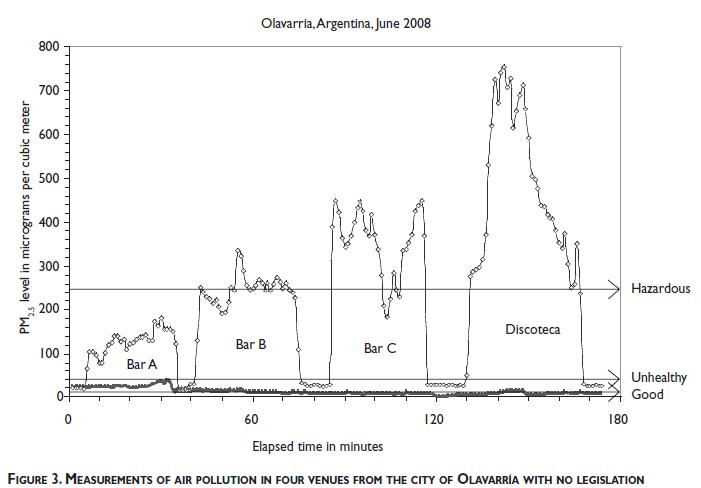
<body><![CDATA[<p>&nbsp;</p>     <p>&nbsp;</p>     <p align="center"><img src="/img/revistas/spm/v52s2/a07img02.jpg"><a name="img02"></a></p>     <p align="center">&nbsp;</p>     <p align="center">&nbsp;</p>     <p><font face="Verdana" size="3"><b>Cities with partial smoking restriction</b></font></p>     <p><font face="Verdana" size="2">Cities with partial smoking legislation had higher    PM<sub>2.5</sub> levels as compared to those with 100% smokefree venues: city of Buenos    Aires (53 PM<sub>2.5</sub>), Mar del Plata (57 PM<sub>2.5</sub>), Mendoza (pre law) (21 PM<sub>2.5</sub>), and    Tandil (10 PM<sub>2.5</sub>). In the city of Buenos Aires we performed 62 measurements.    In 40 smokefree venues (without DSAs) the mean concentration level was 35 PM<sub>2.5</sub>,    in 22 venues with DSAs we found mean particle concentration levels of 87 PM<sub>2.5</sub>.    From these 22, 12 had structurally separated DSAs where we measured both smoking    and non-smoking areas. Mean particle concentration levels were 104 PM<sub>2.5</sub> in    smoking areas vs. 80 PM<sub>2.5</sub> in non-smoking areas (this difference was not statistically    significant, p=0.272). In addition, the non-smoking areas had significantly    higher (p=0.017) PM<sub>2.5</sub> levels compared to 100% smokefree venues in the same    city (twofold higher). </font></p>     <p>&nbsp;</p>     <p><font face="Verdana" size="3"><b>Cities with no smoking restriction laws</b></font></p>     <p><font face="Verdana" size="2">In general, PM<sub>2.5</sub> levels were significantly higher    across all cities with no smoking restrictions: Olavarría (131), La Plata (100)    and Morón (61). <a href="/img/revistas/spm/v52s2/a07img03.jpg">Figure    3</a> shows an example of an evening of sampling in a city (Olavarría) with    no smoking restrictions at the moment of the evaluation. The graph demonstrates    high levels of particulate air pollution inside the 4 locations sampled compared    to the low outdoor levels seen in between each location visited. <br />   </font></p>     ]]></body>
<body><![CDATA[<p>&nbsp;</p>     <p><font face="Verdana" size="3"><b>Cities with 100% or comprehensive smokefree    legislation versus cities with no legislation</b></font></p>     <p><font face="Verdana" size="2">Overall, PM<sub>2.5</sub> levels were 5 times higher (p&lt;0.001)    in cities with no legislation compared to those with 100% or comprehensive legislation.    This includes all venues, whether or not smoking was actually observed.</font></p>     <p>&nbsp;</p>     <p><font face="Verdana" size="3"><b>Use in advocacy</b></font></p>     <p><font face="Verdana" size="2">We organized and conducted press conferences    in 8 cities and organized numerous interviews with key local reporters to inform    about the results of this study. As a result, over 50 articles containing SidePak    measurements were published in national and local newspapers from all over the    country. Due to the impact of these publications we were interviewed by numerous    radio and TV stations. Moreover, we used SidePak results to advocate for the    enactment and enforcement of 100% smokefree policies according to the local    contexts. We organized at least 2 meetings with local legislators to show the    results obtained in each participating city.</font></p>     <p><font face="Verdana" size="2"> The impact of such initiatives could be observed    in several jurisdictions: in the city of Córdoba, the second most populated    city in Argentina (about 1300000 inhabitants) with comprehensive smokefree legislation    we observed lack of compliance in pubs and discos late at night. SidePak measurements    were used to advocate for the modification of the local ordinance. This was    achieved in September 2009, and Córdoba has now introduced a 100% smokefree    legislation with the specific inclusion of discos. SidePak results were also    used to develop advocacy strategies to improve compliance in the cities of Santa    Fe and Rosario. For venues with partial smoking restrictions our results showed    the inefficacy of such measures with contamination levels in nonsmoking areas    significantly higher (almost twofold) than those of 100% smokefree venues. Also,    we used SidePak measurements to raise awareness among decision-makers about    the need to modify current policies. In Mar del Plata, one of the most popular    tourist attractions in Argentina, results were used by local NGOs to promote    the introduction of a 100% smokefree ordinance to modify the current partial    restriction policy. In the city of Buenos Aires, a bill has been introduced    to modify the current legislation into a 100% smokefree policy. This project    is still under consideration in the local legislature.<br />   For places with no legislation we used the results of our study to inform policymakers    and to raise public awareness about the need to enact laws to protect the health    of the population. In the provinces of Neuquén, Mendoza and in the city of    Olavarría (Buenos Aires), data obtained in our study contributed to successfully    enact and enforce 100% smokefree legislation in public places at the local level.    </font></p>     <p>&nbsp;</p>     <p><font face="Verdana" size="3"><b>Discussion</b></font></p>     <p><font face="Verdana" size="2">The findings of our study show that most of the    participating cities had significantly lower PM<sub>2.5</sub> levels after the    implementation of 100% smokefree legislation as compared to cities with no legislation    or with partial smoking restrictions. This has also been shown in previous studies.<sup>15,16,17,18</sup></font></p>     ]]></body>
<body><![CDATA[<p><font face="Verdana" size="2"> Furthermore, this study shows that 100% legislation    has a high level of compliance in most jurisdictions with a dramatic reduction    of SHS exposure in public places. However, pubs and discos from different parts    of the country mostly reaching young adults and adolescents remain resistant    to the new smokefree legislation and compliance still requires a tailored enforcement    strategy.</font></p>     <p><font face="Verdana" size="2"> Lack of compliance during nighttime hours in    cities such as Córdoba, Rosario and Santa Fe, is particularly alarming, not    only because of the harm caused to hospitality workers exposed to SHS but also    because it promotes early smoking initiation among young people. In the cities    of Bahía Blanca, Godoy Cruz and Neuquén, where we performed pre- and post law    measurements, we observed a significant reduction of indoor air pollution in    all venues. Similar results have been shown in other studies.<sup>16,17,18</sup></font></p>     <p><font face="Verdana" size="2"> Cities with no smokefree legislation had very    high levels of indoor air pollution any time of the day the measurements were    performed even exceeding the EPA public health standards by about ten-fold.<sup>20</sup>    As it has already been shown, due to the high prevalence of tobacco consumption    and the lack of smokefree legislation in some jurisdictions in Argentina, indoor    air pollution in public places was among the highest in the region.<sup>21</sup></font></p>     <p><font face="Verdana" size="2"> Partial restrictions show low enforcement with    significantly higher levels of respirable suspended particles as compared to    those observed in smokefree cities. This has also been shown by the opinion    poll performed by ALIAR in August 2009 where we observed a significantly lower    perception of compliance in jurisdictions with partial restriction laws as compared    with 100% smokefree cities. The city of Buenos Aires showed high PM<sub>2.5</sub>    concentration levels not only in designated smoking areas but also in designated    non-smoking areas when they were compared with smokefree venues. This confirms    data published in other studies showing the inefficacy of DSAs as a measure    to protect the health of the population.<sup>21,22</sup></font></p>     <p>&nbsp;</p>     <p><font face="Verdana" size="3"><b>Informing policy debates</b></font></p>     <p><font face="Verdana" size="2">Upon the conclusion of all measurements we developed    a strategy to communicate the results of the study. We organized press conferences    and published newspaper articles all around the country to inform the results    of our study to the media in general and NGOs, the general public and unions    in particular. Also, we developed factsheets to inform different policymakers    considering their local legislative objectives. </font></p>     <p><font face="Verdana" size="2"> Our study has been significantly useful to advocate    for 100% smokefree legislation in public places in Argentina. The simplicity    of the measurement process and the accuracy of our results provide a sound tool    to raise awareness among local key stakeholders. </font></p>     <p><font face="Verdana" size="2"> The study also provides local evidence to introduce    the issue of human rights perspective for workers in the public agenda of a    country where SHS has not been considered a risk factor among workers and where    there is no legislation to protect the health of all workers at the national    level. </font></p>     <p><font face="Verdana" size="2"> Furthermore, ALIAR granted numerous awards to    cities with excellent compliance with 100% smokefree legislation by showing    low suspended particle concentration levels. For example, Bahía Blanca, Santa    Fe and Neuquén received an award for their commitment to guarantee a high level    of compliance with local ordinances. </font></p>     ]]></body>
<body><![CDATA[<p>&nbsp;</p>     <p><font face="Verdana" size="3"><b>Limitations</b></font></p>     <p><font face="Verdana" size="2">A limitation to be considered when interpreting    our results is the lack of a randomized sample, which could contribute to potential    bias of results. </font></p>     <p>&nbsp;</p>     <p><font face="Verdana" size="3"><b>Conclusions</b></font></p>     <p><font face="Verdana" size="2">This study presents local scientific data about    the levels of air pollution among the different legislative scenarios and the    level of compliance in Argentina. Also, this study was useful to determine air    pollution in different types of venues and different times of the day and to    develop an effective advocacy strategy to promote legislative changes in Argentina    and to implement 100% smokefree legislation in different jurisdictions. </font></p>     <p>&nbsp;</p>     <p><font face="Verdana" size="3"><b>Acknowledgments</b></font></p>     <p><font face="Verdana" size="2">We thank the organizations from ALIAR that collaborated    in the development of this study and all the researchers who performed the measurements    in the participating cities: Finkielsztain V, Ortiz Basso T, Nikisch L, Schoj    E, Onexyn V, Pérez Cáceres ML, Cuatrocchio V, Dick I, Valeff E, Regueira G,    Pérez C, Ruíz E, Otero N, Hasdeu S, Villavicencio L, García C, Parada S,    Manrique A, Lungo B, Talamoni J, Bussoli M, Sericcio F, Candioti C, Rivera J,    Amato I, Rosende N, Rassmussen R, Kriscovich J, Armendáriz C, Tarcic A, N&uacute;Á±ez    P, Stock A, Castro Arroyo L, Zuliani M. We also thank Cheryl Higbee from the    RPCI team for her assistance in data analysis.</font></p>     <p>&nbsp;</p>     ]]></body>
<body><![CDATA[<p><font face="Verdana" size="3"><b>Funding</b></font></p>     <p><font face="Verdana" size="2">This research was funded by the Bloomberg Foundation    through a Bloomberg Initiative Grant to promote 100% smokefree environments    in Argentina, and the Flight Attendant Medical Research Institute (FAMRI) through    grants to Roswell Park Cancer Institute. The Bloomberg Foundation and FAMRI    played no role in the conduct of the research and the preparation of the manuscript.    The InterAmerican Heart Foundation Argentina, the Hospital Italiano de Buenos    Aires and other organizations members of ALIAR all around the country provided    administrative support and the human resources to carry out the study. The Roswell    Park Cancer Institute staff provided the equipment and performed the statistical    analyses.</font></p>     <p>&nbsp;</p>     <p><font face="Verdana" size="3"><b>Declaration of conflicts of interest</b></font></p>     <p><font face="Verdana" size="2">We declare that we have no conflicts of interest.</font></p>     <p>&nbsp;</p>     <p><font face="Verdana" size="3"><b>References</b></font></p>     <!-- ref --><p><font face="Verdana" size="2">01. US Department of Health and Human Services.    The health consequences of involuntary exposure to tobacco smoke: a report of    the Surgeon General - Executive Summary. Atlanta, GA: US Department of Health    and Human Services, Centers for Disease Control and Prevention, Coordinating    Center for Health Promotion, National Center for Chronic Disease Prevention    and Health Promotion, Office on Smoking and Health, 2006</font>&nbsp;&nbsp;&nbsp;&nbsp;&nbsp;&nbsp;&nbsp;&nbsp;[&#160;<a href="javascript:void(0);" onclick="javascript: window.open('/scielo.php?script=sci_nlinks&ref=9352549&pid=S0036-3634201000080001100001&lng=','','width=640,height=500,resizable=yes,scrollbars=1,menubar=yes,');">Links</a>&#160;]<!-- end-ref --><!-- ref --><p><font face="Verdana" size="2">02. IARC Monographs on the Evaluation of Carcinogenic    Risks to Humans. Tobacco smoke and involuntary smoking. Geneva: International    Agency for Research on Cancer (World Health Organization), 2002: 83.    &nbsp;&nbsp;&nbsp;&nbsp;&nbsp;&nbsp;&nbsp;&nbsp;[&#160;<a href="javascript:void(0);" onclick="javascript: window.open('/scielo.php?script=sci_nlinks&ref=9352550&pid=S0036-3634201000080001100002&lng=','','width=640,height=500,resizable=yes,scrollbars=1,menubar=yes,');">Links</a>&#160;]<!-- end-ref --></font></p>     ]]></body>
<body><![CDATA[<!-- ref --><p><font face="Verdana" size="2">03. California Environmental Protection Agency.    Proposed identification of environmental tobacco smoke as a toxic air contaminant.    Part B: Health effects. Sacramento, California: California Environmental Protection    Agency, Office of Environmental Health Hazard Assessment, 2005.    &nbsp;&nbsp;&nbsp;&nbsp;&nbsp;&nbsp;&nbsp;&nbsp;[&#160;<a href="javascript:void(0);" onclick="javascript: window.open('/scielo.php?script=sci_nlinks&ref=9352552&pid=S0036-3634201000080001100003&lng=','','width=640,height=500,resizable=yes,scrollbars=1,menubar=yes,');">Links</a>&#160;]<!-- end-ref --></font></p>     <!-- ref --><p><font face="Verdana" size="2">04. World Health Organization. WHO Framework    Convention on Tobacco Control (WHO FCTC). Accessed 19 May 2010. Available at:    <a href="http://www.who.int/tobacco/framework/en/" target="_blank">http://www.who.int/tobacco/framework/en/</a>.    &nbsp;&nbsp;&nbsp;&nbsp;&nbsp;&nbsp;&nbsp;&nbsp;[&#160;<a href="javascript:void(0);" onclick="javascript: window.open('/scielo.php?script=sci_nlinks&ref=9352554&pid=S0036-3634201000080001100004&lng=','','width=640,height=500,resizable=yes,scrollbars=1,menubar=yes,');">Links</a>&#160;]<!-- end-ref --></font></p>     <!-- ref --><p><font face="Verdana" size="2">05. Sebrié EM, Schoj V, Glantz SA. Smokefree    environments in Latin America: on the road to real change? Prev Control 2008;3(1):21-35.    &nbsp;&nbsp;&nbsp;&nbsp;&nbsp;&nbsp;&nbsp;&nbsp;[&#160;<a href="javascript:void(0);" onclick="javascript: window.open('/scielo.php?script=sci_nlinks&ref=9352556&pid=S0036-3634201000080001100005&lng=','','width=640,height=500,resizable=yes,scrollbars=1,menubar=yes,');">Links</a>&#160;]<!-- end-ref --></font></p>     <!-- ref --><p><font face="Verdana" size="2">06. Global Smoke-free Partnership. Accessed 15    May 2010. Available at: <a href="http://www.globalsmokefreepartnership.org/" target="_blank">http://www.globalsmokefreepartnership.org/</a>.    &nbsp;&nbsp;&nbsp;&nbsp;&nbsp;&nbsp;&nbsp;&nbsp;[&#160;<a href="javascript:void(0);" onclick="javascript: window.open('/scielo.php?script=sci_nlinks&ref=9352558&pid=S0036-3634201000080001100006&lng=','','width=640,height=500,resizable=yes,scrollbars=1,menubar=yes,');">Links</a>&#160;]<!-- end-ref -->    </font></p>     <!-- ref --><p><font face="Verdana" size="2">07. Mejia R, Schoj V, Barnoya J, Flores ML, Pérez-Stable    EJ. Tobacco industry strategies to obstruct the FCTC in Argentina. CVD prevention    and control 2008;3(4):173-179.    &nbsp;&nbsp;&nbsp;&nbsp;&nbsp;&nbsp;&nbsp;&nbsp;[&#160;<a href="javascript:void(0);" onclick="javascript: window.open('/scielo.php?script=sci_nlinks&ref=9352560&pid=S0036-3634201000080001100007&lng=','','width=640,height=500,resizable=yes,scrollbars=1,menubar=yes,');">Links</a>&#160;]<!-- end-ref --></font></p>     ]]></body>
<body><![CDATA[<!-- ref --><p><font face="Verdana" size="2">08. Sebrié EM, Glantz SA. Local smoke-free policy    development in Santa Fe, Argentina. . Tob Control 2010; 19 (2): 110-116.    &nbsp;&nbsp;&nbsp;&nbsp;&nbsp;&nbsp;&nbsp;&nbsp;[&#160;<a href="javascript:void(0);" onclick="javascript: window.open('/scielo.php?script=sci_nlinks&ref=9352562&pid=S0036-3634201000080001100008&lng=','','width=640,height=500,resizable=yes,scrollbars=1,menubar=yes,');">Links</a>&#160;]<!-- end-ref --></font></p>     <!-- ref --><p><font face="Verdana" size="2">09. Schoj V, Alderete M, Ruiz E, Hasdeu S, Linetzky    B, Ferrante D. The impact of a 100% smoke-free law on the health of hospitality    workers from the city of Neuquen, Argentina. Tob Control 2010;19(2):134-137.    &nbsp;&nbsp;&nbsp;&nbsp;&nbsp;&nbsp;&nbsp;&nbsp;[&#160;<a href="javascript:void(0);" onclick="javascript: window.open('/scielo.php?script=sci_nlinks&ref=9352564&pid=S0036-3634201000080001100009&lng=','','width=640,height=500,resizable=yes,scrollbars=1,menubar=yes,');">Links</a>&#160;]<!-- end-ref --></font></p>     <!-- ref --><p><font face="Verdana" size="2">10. Sebrié EM, Glantz SA "Accommodating"    smoke-free policies: tobacco industry's Courtesy of Choice programme in Latin    America. Tob Control 2007; 16 (5):e6.    &nbsp;&nbsp;&nbsp;&nbsp;&nbsp;&nbsp;&nbsp;&nbsp;[&#160;<a href="javascript:void(0);" onclick="javascript: window.open('/scielo.php?script=sci_nlinks&ref=9352566&pid=S0036-3634201000080001100010&lng=','','width=640,height=500,resizable=yes,scrollbars=1,menubar=yes,');">Links</a>&#160;]<!-- end-ref --></font></p>     <!-- ref --><p><font face="Verdana" size="2">11. Sebrié EM, Barnoya J, Perez-Stable EJ, Glantz    SA. Tobacco industry successfully prevented tobacco control legislation in Argentina.    Tob Control 2005; 14 (5): e2.    &nbsp;&nbsp;&nbsp;&nbsp;&nbsp;&nbsp;&nbsp;&nbsp;[&#160;<a href="javascript:void(0);" onclick="javascript: window.open('/scielo.php?script=sci_nlinks&ref=9352568&pid=S0036-3634201000080001100011&lng=','','width=640,height=500,resizable=yes,scrollbars=1,menubar=yes,');">Links</a>&#160;]<!-- end-ref --></font></p>     <!-- ref --><p><font face="Verdana" size="2">12. Barnoya J, Glantz S. Tobacco industry success    in preventing regulation of secondhand smoke in Latin America: the "Latin    Project". Tob Control 2002;11(4):305-314.    &nbsp;&nbsp;&nbsp;&nbsp;&nbsp;&nbsp;&nbsp;&nbsp;[&#160;<a href="javascript:void(0);" onclick="javascript: window.open('/scielo.php?script=sci_nlinks&ref=9352570&pid=S0036-3634201000080001100012&lng=','','width=640,height=500,resizable=yes,scrollbars=1,menubar=yes,');">Links</a>&#160;]<!-- end-ref --></font></p>     ]]></body>
<body><![CDATA[<!-- ref --><p><font face="Verdana" size="2">13. Siegel M, Skeer M. Exposure to secondhand    smoke and excess lung cancer mortality risk among workers in the "5 B's":    bars, bowling alleys, billiard halls, betting establishments, and bingo parlours.    Tob Control 2003;12(3):333-338.    &nbsp;&nbsp;&nbsp;&nbsp;&nbsp;&nbsp;&nbsp;&nbsp;[&#160;<a href="javascript:void(0);" onclick="javascript: window.open('/scielo.php?script=sci_nlinks&ref=9352572&pid=S0036-3634201000080001100013&lng=','','width=640,height=500,resizable=yes,scrollbars=1,menubar=yes,');">Links</a>&#160;]<!-- end-ref --></font></p>     <!-- ref --><p><font face="Verdana" size="2">14. International Labour Organization Introductory    Report: Decent Work - Safe Work. Geneva: International Labour Organization.    2005. Accessed 28 February 2010. Available at: <a href="http://www.ilo.org/public/libdoc/ilo/2005/105B09_281_engl.pdf" target="_blank">http://www.ilo.org/public/libdoc/ilo/2005/105B09_281_engl.pdf</a>.    &nbsp;&nbsp;&nbsp;&nbsp;&nbsp;&nbsp;&nbsp;&nbsp;[&#160;<a href="javascript:void(0);" onclick="javascript: window.open('/scielo.php?script=sci_nlinks&ref=9352574&pid=S0036-3634201000080001100014&lng=','','width=640,height=500,resizable=yes,scrollbars=1,menubar=yes,');">Links</a>&#160;]<!-- end-ref -->    </font></p>     <!-- ref --><p><font face="Verdana" size="2">15. Hyland A, Travers MJ, Dresler C, Higbee C,    Cummings KM. A 32-country comparison of tobacco smoke derived particle levels    in indoor public places. Tob Control 2008;17(3):159-165.    &nbsp;&nbsp;&nbsp;&nbsp;&nbsp;&nbsp;&nbsp;&nbsp;[&#160;<a href="javascript:void(0);" onclick="javascript: window.open('/scielo.php?script=sci_nlinks&ref=9352576&pid=S0036-3634201000080001100015&lng=','','width=640,height=500,resizable=yes,scrollbars=1,menubar=yes,');">Links</a>&#160;]<!-- end-ref --></font></p>     <!-- ref --><p><font face="Verdana" size="2">16. Travers MJ, Cummings KM, Hyland A, Repace    JL, Pechacek TF, Caraballo R, et al. Indoor air quality in hospitality venues    before and after the implementation of a Clean Indoor Air Law-Western New York,    2003. MMWR Morb Mortal Wkly Rep, 2004;53(44):1038-1041.    &nbsp;&nbsp;&nbsp;&nbsp;&nbsp;&nbsp;&nbsp;&nbsp;[&#160;<a href="javascript:void(0);" onclick="javascript: window.open('/scielo.php?script=sci_nlinks&ref=9352578&pid=S0036-3634201000080001100016&lng=','','width=640,height=500,resizable=yes,scrollbars=1,menubar=yes,');">Links</a>&#160;]<!-- end-ref --></font></p>     <!-- ref --><p><font face="Verdana" size="2">17. Repace JL, Hyde JN, Brugge D. Air pollution    in Boston bars before and after a smoking ban. BMC Public Health 2006;6:266.    &nbsp;&nbsp;&nbsp;&nbsp;&nbsp;&nbsp;&nbsp;&nbsp;[&#160;<a href="javascript:void(0);" onclick="javascript: window.open('/scielo.php?script=sci_nlinks&ref=9352580&pid=S0036-3634201000080001100017&lng=','','width=640,height=500,resizable=yes,scrollbars=1,menubar=yes,');">Links</a>&#160;]<!-- end-ref --></font></p>     ]]></body>
<body><![CDATA[<!-- ref --><p><font face="Verdana" size="2">18. Repace J. Respirable particles and carcinogens    in the air of Delaware hospitality venues before and after a smoking ban. J    Occup Environ Med 2004;46 (9):887-905.    &nbsp;&nbsp;&nbsp;&nbsp;&nbsp;&nbsp;&nbsp;&nbsp;[&#160;<a href="javascript:void(0);" onclick="javascript: window.open('/scielo.php?script=sci_nlinks&ref=9352582&pid=S0036-3634201000080001100018&lng=','','width=640,height=500,resizable=yes,scrollbars=1,menubar=yes,');">Links</a>&#160;]<!-- end-ref --></font></p>     <!-- ref --><p><font face="Verdana" size="2">19. Klepeis NE, Ott WR, Switzer P. Real-time    measurement of outdoor tobacco smoke particles. J Air Waste Man Assoc 2007;57    (5):522-534.    &nbsp;&nbsp;&nbsp;&nbsp;&nbsp;&nbsp;&nbsp;&nbsp;[&#160;<a href="javascript:void(0);" onclick="javascript: window.open('/scielo.php?script=sci_nlinks&ref=9352584&pid=S0036-3634201000080001100019&lng=','','width=640,height=500,resizable=yes,scrollbars=1,menubar=yes,');">Links</a>&#160;]<!-- end-ref --></font></p>     <!-- ref --><p><font face="Verdana" size="2">20. United States Environmental Protection Agency.    Air Quality Index. A Guide to Air Quality and Your Health. Accessed 3 March    2010. Available at: <a href="http://www.enviroflash.info/assets/pdf/AQI_2003_9-3.pdf" target="_blank">http://www.enviroflash.info/assets/pdf/AQI_2003_9-3.pdf</a>.    &nbsp;&nbsp;&nbsp;&nbsp;&nbsp;&nbsp;&nbsp;&nbsp;[&#160;<a href="javascript:void(0);" onclick="javascript: window.open('/scielo.php?script=sci_nlinks&ref=9352586&pid=S0036-3634201000080001100020&lng=','','width=640,height=500,resizable=yes,scrollbars=1,menubar=yes,');">Links</a>&#160;]<!-- end-ref -->    </font></p>     <!-- ref --><p><font face="Verdana" size="2">21. Navas-Acien A, Peruga A, Breysse P, Zavaleta    A, Blanco-Marquizo A, Pitarque R, et al. Secondhand tobacco smoke in public    places in Latin America, 2002-2003. JAMA 2004;291(22):2741-2745.    &nbsp;&nbsp;&nbsp;&nbsp;&nbsp;&nbsp;&nbsp;&nbsp;[&#160;<a href="javascript:void(0);" onclick="javascript: window.open('/scielo.php?script=sci_nlinks&ref=9352588&pid=S0036-3634201000080001100021&lng=','','width=640,height=500,resizable=yes,scrollbars=1,menubar=yes,');">Links</a>&#160;]<!-- end-ref --></font></p>     <!-- ref --><p><font face="Verdana" size="2">22. Chao C. Legislative Council Panel on Health    Services Findings of Technical Feasibility Study on Smoking Rooms. Accessed    5 February 2010. Available at: <a href="http://www.legco.gov.hk/yr08-09/english/panels/hs/papers/hs0420cb2-1324-5-e.pdf%202009" target="_blank">http://www.legco.gov.hk/yr08-09/english/panels/hs/papers/hs0420cb2-1324-5-e.pdf    2009</a>.    &nbsp;&nbsp;&nbsp;&nbsp;&nbsp;&nbsp;&nbsp;&nbsp;[&#160;<a href="javascript:void(0);" onclick="javascript: window.open('/scielo.php?script=sci_nlinks&ref=9352590&pid=S0036-3634201000080001100022&lng=','','width=640,height=500,resizable=yes,scrollbars=1,menubar=yes,');">Links</a>&#160;]<!-- end-ref --> </font></p>     ]]></body>
<body><![CDATA[<p>&nbsp;</p>     <p>&nbsp;</p>     <p><font face="Verdana" size="2">Received on: February 5, 2010    <br>   Accepted on: May 27, 2010</font></p>     <p>&nbsp;</p>     <p><font face="Verdana" size="2">    <br>   Address reprint requests to: Dra. Verónica Schoj. Fundación Interamericana del    Corazón Argentina. Julián Álvarez 813. 1414, Buenos Aires, Argentina.    <br>   E-mail: <a href="mailto:vschoj@fibertel.com.ar">vschoj@fibertel.com.ar</a></font></p>      ]]></body><back>
<ref-list>
<ref id="B1">
<label>1</label><nlm-citation citation-type="book">
<collab>US^dDepartment of Health and Human Services</collab>
<source><![CDATA[The health consequences of involuntary exposure to tobacco smoke: a report of the Surgeon General - Executive Summary]]></source>
<year>2006</year>
<publisher-loc><![CDATA[Atlanta^eGA GA]]></publisher-loc>
<publisher-name><![CDATA[US Department of Health and Human ServicesCenters for Disease Control and PreventionCoordinating Center for Health PromotionNational Center for Chronic Disease Prevention and Health PromotionOffice on Smoking and Health]]></publisher-name>
</nlm-citation>
</ref>
<ref id="B2">
<label>2</label><nlm-citation citation-type="book">
<collab>IARC Monographs on the Evaluation of Carcinogenic Risks to Humans</collab>
<source><![CDATA[Tobacco smoke and involuntary smoking]]></source>
<year>2002</year>
<page-range>83</page-range><publisher-loc><![CDATA[Geneva ]]></publisher-loc>
<publisher-name><![CDATA[International Agency for Research on CancerWorld Health Organization]]></publisher-name>
</nlm-citation>
</ref>
<ref id="B3">
<label>3</label><nlm-citation citation-type="">
<collab>California Environmental Protection Agency</collab>
<source><![CDATA[Proposed identification of environmental tobacco smoke as a toxic air contaminant. Part B: Health effects. Sacramento, California: California Environmental Protection Agency, Office of Environmental Health Hazard Assessment]]></source>
<year>2005</year>
</nlm-citation>
</ref>
<ref id="B4">
<label>4</label><nlm-citation citation-type="">
<collab>World Health Organization</collab>
<source><![CDATA[WHO Framework Convention on Tobacco Control (WHO FCTC)]]></source>
<year></year>
</nlm-citation>
</ref>
<ref id="B5">
<label>5</label><nlm-citation citation-type="journal">
<person-group person-group-type="author">
<name>
<surname><![CDATA[Sebrié]]></surname>
<given-names><![CDATA[EM]]></given-names>
</name>
<name>
<surname><![CDATA[Schoj]]></surname>
<given-names><![CDATA[V]]></given-names>
</name>
<name>
<surname><![CDATA[Glantz]]></surname>
<given-names><![CDATA[SA]]></given-names>
</name>
</person-group>
<article-title xml:lang="en"><![CDATA[Smokefree environments in Latin America: on the road to real change?]]></article-title>
<source><![CDATA[Prev Control]]></source>
<year>2008</year>
<volume>3</volume>
<numero>1</numero>
<issue>1</issue>
<page-range>21-35</page-range></nlm-citation>
</ref>
<ref id="B6">
<label>6</label><nlm-citation citation-type="">
<source><![CDATA[Global Smoke-free Partnership]]></source>
<year></year>
</nlm-citation>
</ref>
<ref id="B7">
<label>7</label><nlm-citation citation-type="journal">
<person-group person-group-type="author">
<name>
<surname><![CDATA[Mejia]]></surname>
<given-names><![CDATA[R]]></given-names>
</name>
<name>
<surname><![CDATA[Schoj]]></surname>
<given-names><![CDATA[V]]></given-names>
</name>
<name>
<surname><![CDATA[Barnoya]]></surname>
<given-names><![CDATA[J]]></given-names>
</name>
<name>
<surname><![CDATA[Flores]]></surname>
<given-names><![CDATA[ML]]></given-names>
</name>
<name>
<surname><![CDATA[Pérez-Stable]]></surname>
<given-names><![CDATA[EJ]]></given-names>
</name>
</person-group>
<article-title xml:lang="en"><![CDATA[Tobacco industry strategies to obstruct the FCTC in Argentina]]></article-title>
<source><![CDATA[CVD prevention and control]]></source>
<year>2008</year>
<volume>3</volume>
<numero>4</numero>
<issue>4</issue>
<page-range>173-179</page-range></nlm-citation>
</ref>
<ref id="B8">
<label>8</label><nlm-citation citation-type="journal">
<person-group person-group-type="author">
<name>
<surname><![CDATA[Sebrié]]></surname>
<given-names><![CDATA[EM]]></given-names>
</name>
<name>
<surname><![CDATA[Glantz]]></surname>
<given-names><![CDATA[SA]]></given-names>
</name>
</person-group>
<article-title xml:lang="en"><![CDATA[Local smoke-free policy development in Santa Fe, Argentina: . Tob]]></article-title>
<source><![CDATA[Control]]></source>
<year>2010</year>
<volume>19</volume>
<numero>2</numero>
<issue>2</issue>
<page-range>110-116</page-range></nlm-citation>
</ref>
<ref id="B9">
<label>9</label><nlm-citation citation-type="journal">
<person-group person-group-type="author">
<name>
<surname><![CDATA[Schoj]]></surname>
<given-names><![CDATA[V]]></given-names>
</name>
<name>
<surname><![CDATA[Alderete]]></surname>
<given-names><![CDATA[M]]></given-names>
</name>
<name>
<surname><![CDATA[Ruiz]]></surname>
<given-names><![CDATA[E]]></given-names>
</name>
<name>
<surname><![CDATA[Hasdeu]]></surname>
<given-names><![CDATA[S]]></given-names>
</name>
<name>
<surname><![CDATA[Linetzky]]></surname>
<given-names><![CDATA[B]]></given-names>
</name>
<name>
<surname><![CDATA[Ferrante]]></surname>
<given-names><![CDATA[D]]></given-names>
</name>
</person-group>
<article-title xml:lang="en"><![CDATA[The impact of a 100% smoke-free law on the health of hospitality workers from the city of Neuquen, Argentina]]></article-title>
<source><![CDATA[Tob Control]]></source>
<year>2010</year>
<volume>19</volume>
<numero>2</numero>
<issue>2</issue>
<page-range>134-137</page-range></nlm-citation>
</ref>
<ref id="B10">
<label>10</label><nlm-citation citation-type="journal">
<person-group person-group-type="author">
<name>
<surname><![CDATA[Sebrié]]></surname>
<given-names><![CDATA[EM]]></given-names>
</name>
<name>
<surname><![CDATA[Glantz]]></surname>
<given-names><![CDATA[SA]]></given-names>
</name>
</person-group>
<article-title xml:lang="en"><![CDATA["Accommodating"? smoke-free policies: tobacco industry's Courtesy of Choice programme in Latin America]]></article-title>
<source><![CDATA[Tob Control]]></source>
<year>2007</year>
<volume>16</volume>
<numero>5</numero>
<issue>5</issue>
<page-range>e6</page-range></nlm-citation>
</ref>
<ref id="B11">
<label>11</label><nlm-citation citation-type="journal">
<person-group person-group-type="author">
<name>
<surname><![CDATA[Sebrié]]></surname>
<given-names><![CDATA[EM]]></given-names>
</name>
<name>
<surname><![CDATA[Barnoya]]></surname>
<given-names><![CDATA[J]]></given-names>
</name>
<name>
<surname><![CDATA[Perez-Stable]]></surname>
<given-names><![CDATA[EJ]]></given-names>
</name>
<name>
<surname><![CDATA[Glantz]]></surname>
<given-names><![CDATA[SA]]></given-names>
</name>
</person-group>
<article-title xml:lang="en"><![CDATA[Tobacco industry successfully prevented tobacco control legislation in Argentina]]></article-title>
<source><![CDATA[Tob Control]]></source>
<year>2005</year>
<volume>14</volume>
<numero>5</numero>
<issue>5</issue>
<page-range>e2</page-range></nlm-citation>
</ref>
<ref id="B12">
<label>12</label><nlm-citation citation-type="journal">
<person-group person-group-type="author">
<name>
<surname><![CDATA[Barnoya]]></surname>
<given-names><![CDATA[J]]></given-names>
</name>
<name>
<surname><![CDATA[Glantz]]></surname>
<given-names><![CDATA[S]]></given-names>
</name>
</person-group>
<article-title xml:lang="en"><![CDATA[Tobacco industry success in preventing regulation of secondhand smoke in Latin America: the "Latin Project"?. Tob]]></article-title>
<source><![CDATA[Control]]></source>
<year>2002</year>
<volume>11</volume>
<numero>4</numero>
<issue>4</issue>
<page-range>305-314</page-range></nlm-citation>
</ref>
<ref id="B13">
<label>13</label><nlm-citation citation-type="journal">
<person-group person-group-type="author">
<name>
<surname><![CDATA[Siegel]]></surname>
<given-names><![CDATA[M]]></given-names>
</name>
<name>
<surname><![CDATA[Skeer]]></surname>
<given-names><![CDATA[M]]></given-names>
</name>
</person-group>
<article-title xml:lang="en"><![CDATA[Exposure to secondhand smoke and excess lung cancer mortality risk among workers in the "5 B's"?: bars, bowling alleys, billiard halls, betting establishments, and bingo parlours]]></article-title>
<source><![CDATA[Tob Control]]></source>
<year>2003</year>
<volume>12</volume>
<numero>3</numero>
<issue>3</issue>
<page-range>333-338</page-range></nlm-citation>
</ref>
<ref id="B14">
<label>14</label><nlm-citation citation-type="book">
<source><![CDATA[International Labour Organization Introductory Report: Decent Work - Safe Work]]></source>
<year>2005</year>
<publisher-loc><![CDATA[Geneva ]]></publisher-loc>
<publisher-name><![CDATA[International Labour Organization]]></publisher-name>
</nlm-citation>
</ref>
<ref id="B15">
<label>15</label><nlm-citation citation-type="journal">
<person-group person-group-type="author">
<name>
<surname><![CDATA[Hyland]]></surname>
<given-names><![CDATA[A]]></given-names>
</name>
<name>
<surname><![CDATA[Travers]]></surname>
<given-names><![CDATA[MJ]]></given-names>
</name>
<name>
<surname><![CDATA[Dresler]]></surname>
<given-names><![CDATA[C]]></given-names>
</name>
<name>
<surname><![CDATA[Higbee]]></surname>
<given-names><![CDATA[C]]></given-names>
</name>
<name>
<surname><![CDATA[Cummings]]></surname>
<given-names><![CDATA[KM]]></given-names>
</name>
</person-group>
<article-title xml:lang="en"><![CDATA[A 32-country comparison of tobacco smoke derived particle levels in indoor public places]]></article-title>
<source><![CDATA[Tob Control]]></source>
<year>2008</year>
<volume>17</volume>
<numero>3</numero>
<issue>3</issue>
<page-range>159-165</page-range></nlm-citation>
</ref>
<ref id="B16">
<label>16</label><nlm-citation citation-type="journal">
<person-group person-group-type="author">
<name>
<surname><![CDATA[Travers]]></surname>
<given-names><![CDATA[MJ]]></given-names>
</name>
<name>
<surname><![CDATA[Cummings]]></surname>
<given-names><![CDATA[KM]]></given-names>
</name>
<name>
<surname><![CDATA[Hyland]]></surname>
<given-names><![CDATA[A]]></given-names>
</name>
<name>
<surname><![CDATA[Repace]]></surname>
<given-names><![CDATA[JL]]></given-names>
</name>
<name>
<surname><![CDATA[Pechacek]]></surname>
<given-names><![CDATA[TF]]></given-names>
</name>
<name>
<surname><![CDATA[Caraballo]]></surname>
<given-names><![CDATA[R]]></given-names>
</name>
</person-group>
<article-title xml:lang="en"><![CDATA[Indoor air quality in hospitality venues before and after the implementation of a Clean Indoor Air Law-Western New York, 2003]]></article-title>
<source><![CDATA[MMWR Morb Mortal Wkly Rep,]]></source>
<year>2004</year>
<volume>53</volume>
<numero>44</numero>
<issue>44</issue>
<page-range>1038-1041</page-range></nlm-citation>
</ref>
<ref id="B17">
<label>17</label><nlm-citation citation-type="journal">
<person-group person-group-type="author">
<name>
<surname><![CDATA[Repace]]></surname>
<given-names><![CDATA[JL]]></given-names>
</name>
<name>
<surname><![CDATA[Hyde]]></surname>
<given-names><![CDATA[JN]]></given-names>
</name>
<name>
<surname><![CDATA[Brugge]]></surname>
<given-names><![CDATA[D]]></given-names>
</name>
</person-group>
<article-title xml:lang="en"><![CDATA[Air pollution in Boston bars before and after a smoking ban]]></article-title>
<source><![CDATA[BMC Public Health]]></source>
<year>2006</year>
<volume>6</volume>
<page-range>266</page-range></nlm-citation>
</ref>
<ref id="B18">
<label>18</label><nlm-citation citation-type="journal">
<person-group person-group-type="author">
<name>
<surname><![CDATA[Repace]]></surname>
<given-names><![CDATA[J]]></given-names>
</name>
</person-group>
<article-title xml:lang="en"><![CDATA[Respirable particles and carcinogens in the air of Delaware hospitality venues before and after a smoking ban]]></article-title>
<source><![CDATA[J Occup Environ Med]]></source>
<year>2004</year>
<volume>46</volume>
<numero>9</numero>
<issue>9</issue>
<page-range>887-905</page-range></nlm-citation>
</ref>
<ref id="B19">
<label>19</label><nlm-citation citation-type="journal">
<person-group person-group-type="author">
<name>
<surname><![CDATA[Klepeis]]></surname>
<given-names><![CDATA[NE]]></given-names>
</name>
<name>
<surname><![CDATA[Ott]]></surname>
<given-names><![CDATA[WR]]></given-names>
</name>
<name>
<surname><![CDATA[Switzer]]></surname>
<given-names><![CDATA[P]]></given-names>
</name>
</person-group>
<article-title xml:lang="en"><![CDATA[Real-time measurement of outdoor tobacco smoke particles]]></article-title>
<source><![CDATA[J Air Waste Man Assoc]]></source>
<year>2007</year>
<volume>57</volume>
<numero>5</numero>
<issue>5</issue>
<page-range>522-534</page-range></nlm-citation>
</ref>
<ref id="B20">
<label>20</label><nlm-citation citation-type="">
<collab>United States Environmental Protection Agency</collab>
<source><![CDATA[Air Quality Index: A Guide to Air Quality and Your Health]]></source>
<year></year>
</nlm-citation>
</ref>
<ref id="B21">
<label>21</label><nlm-citation citation-type="journal">
<person-group person-group-type="author">
<name>
<surname><![CDATA[Navas-Acien]]></surname>
<given-names><![CDATA[A]]></given-names>
</name>
<name>
<surname><![CDATA[Peruga]]></surname>
<given-names><![CDATA[A]]></given-names>
</name>
<name>
<surname><![CDATA[Breysse]]></surname>
<given-names><![CDATA[P]]></given-names>
</name>
<name>
<surname><![CDATA[Zavaleta]]></surname>
<given-names><![CDATA[A]]></given-names>
</name>
<name>
<surname><![CDATA[Blanco-Marquizo]]></surname>
<given-names><![CDATA[A]]></given-names>
</name>
<name>
<surname><![CDATA[Pitarque]]></surname>
<given-names><![CDATA[R]]></given-names>
</name>
</person-group>
<article-title xml:lang="en"><![CDATA[Secondhand tobacco smoke in public places in Latin America, 2002-2003]]></article-title>
<source><![CDATA[JAMA]]></source>
<year>2004</year>
<volume>291</volume>
<numero>22</numero>
<issue>22</issue>
<page-range>2741-2745</page-range></nlm-citation>
</ref>
<ref id="B22">
<label>22</label><nlm-citation citation-type="">
<person-group person-group-type="author">
<name>
<surname><![CDATA[Chao]]></surname>
<given-names><![CDATA[C]]></given-names>
</name>
</person-group>
<source><![CDATA[Legislative Council Panel on Health Services Findings of Technical Feasibility Study on Smoking Rooms]]></source>
<year></year>
</nlm-citation>
</ref>
</ref-list>
</back>
</article>