<?xml version="1.0" encoding="ISO-8859-1"?><article xmlns:mml="http://www.w3.org/1998/Math/MathML" xmlns:xlink="http://www.w3.org/1999/xlink" xmlns:xsi="http://www.w3.org/2001/XMLSchema-instance">
<front>
<journal-meta>
<journal-id>0036-3634</journal-id>
<journal-title><![CDATA[Salud Pública de México]]></journal-title>
<abbrev-journal-title><![CDATA[Salud pública Méx]]></abbrev-journal-title>
<issn>0036-3634</issn>
<publisher>
<publisher-name><![CDATA[Instituto Nacional de Salud Pública]]></publisher-name>
</publisher>
</journal-meta>
<article-meta>
<article-id>S0036-36342010000600005</article-id>
<title-group>
<article-title xml:lang="en"><![CDATA[Surveillance of nosocomial infections in a Mexican community hospital: how are we doing?]]></article-title>
<article-title xml:lang="es"><![CDATA[Vigilancia epidemiológica de infecciones nosocomiales en un hospital comunitario de México: ¿Cómo vamos?]]></article-title>
</title-group>
<contrib-group>
<contrib contrib-type="author">
<name>
<surname><![CDATA[García-García]]></surname>
<given-names><![CDATA[Lourdes]]></given-names>
</name>
<xref ref-type="aff" rid="A01"/>
</contrib>
<contrib contrib-type="author">
<name>
<surname><![CDATA[Jiménez-Corona]]></surname>
<given-names><![CDATA[María-Eugenia]]></given-names>
</name>
<xref ref-type="aff" rid="A03"/>
</contrib>
<contrib contrib-type="author">
<name>
<surname><![CDATA[Ramírez-López]]></surname>
<given-names><![CDATA[Laura-Elizabeth]]></given-names>
</name>
<xref ref-type="aff" rid="A01"/>
</contrib>
<contrib contrib-type="author">
<name>
<surname><![CDATA[Báez-Saldaña]]></surname>
<given-names><![CDATA[Renata]]></given-names>
</name>
<xref ref-type="aff" rid="A01"/>
</contrib>
<contrib contrib-type="author">
<name>
<surname><![CDATA[Ferreyra-Reyes]]></surname>
<given-names><![CDATA[Leticia]]></given-names>
</name>
<xref ref-type="aff" rid="A01"/>
</contrib>
<contrib contrib-type="author">
<name>
<surname><![CDATA[Ferreira-Guerrero]]></surname>
<given-names><![CDATA[Elizabeth]]></given-names>
</name>
<xref ref-type="aff" rid="A01"/>
</contrib>
<contrib contrib-type="author">
<name>
<surname><![CDATA[Cano-Arellano]]></surname>
<given-names><![CDATA[Bulmaro]]></given-names>
</name>
<xref ref-type="aff" rid="A01"/>
</contrib>
<contrib contrib-type="author">
<name>
<surname><![CDATA[Cruz-Hervert]]></surname>
<given-names><![CDATA[Pablo]]></given-names>
</name>
<xref ref-type="aff" rid="A01"/>
</contrib>
<contrib contrib-type="author">
<name>
<surname><![CDATA[Téllez-Vázquez]]></surname>
<given-names><![CDATA[Norma Araceli]]></given-names>
</name>
<xref ref-type="aff" rid="A01"/>
</contrib>
<contrib contrib-type="author">
<name>
<surname><![CDATA[Verduzco-Rodríguez]]></surname>
<given-names><![CDATA[Leonardo]]></given-names>
</name>
<xref ref-type="aff" rid="A02"/>
</contrib>
<contrib contrib-type="author">
<name>
<surname><![CDATA[Jaramillo-Cosme]]></surname>
<given-names><![CDATA[Yolanda]]></given-names>
</name>
<xref ref-type="aff" rid="A02"/>
</contrib>
<contrib contrib-type="author">
<name>
<surname><![CDATA[Luna-Téllez]]></surname>
<given-names><![CDATA[Eleazar]]></given-names>
</name>
<xref ref-type="aff" rid="A02"/>
</contrib>
<contrib contrib-type="author">
<name>
<surname><![CDATA[León-Rosales]]></surname>
<given-names><![CDATA[Samuel Ponce de]]></given-names>
</name>
<xref ref-type="aff" rid="A03"/>
</contrib>
</contrib-group>
<aff id="A01">
<institution><![CDATA[,Instituto Nacional de Salud Pública  ]]></institution>
<addr-line><![CDATA[Cuernavaca Morelos]]></addr-line>
<country>México</country>
</aff>
<aff id="A02">
<institution><![CDATA[,Hospital General de Río Blanco  ]]></institution>
<addr-line><![CDATA[Veracruz ]]></addr-line>
<country>México</country>
</aff>
<aff id="A03">
<institution><![CDATA[,Laboratorios de Biológicos y Reactivos de México  ]]></institution>
<addr-line><![CDATA[ México DF]]></addr-line>
<country>México</country>
</aff>
<pub-date pub-type="pub">
<day>00</day>
<month>12</month>
<year>2010</year>
</pub-date>
<pub-date pub-type="epub">
<day>00</day>
<month>12</month>
<year>2010</year>
</pub-date>
<volume>52</volume>
<numero>6</numero>
<fpage>511</fpage>
<lpage>516</lpage>
<copyright-statement/>
<copyright-year/>
<self-uri xlink:href="http://www.scielo.org.mx/scielo.php?script=sci_arttext&amp;pid=S0036-36342010000600005&amp;lng=en&amp;nrm=iso"></self-uri><self-uri xlink:href="http://www.scielo.org.mx/scielo.php?script=sci_abstract&amp;pid=S0036-36342010000600005&amp;lng=en&amp;nrm=iso"></self-uri><self-uri xlink:href="http://www.scielo.org.mx/scielo.php?script=sci_pdf&amp;pid=S0036-36342010000600005&amp;lng=en&amp;nrm=iso"></self-uri><abstract abstract-type="short" xml:lang="en"><p><![CDATA[OBJECTIVE. To compare the nosocomial infection (NI) rate obtained from a retrospective review of clinical charts with that from the routine nosocomial infection surveillance system in a community hospital. MATERIAL AND METHODS. Retrospective review of a randomized sample of clinical charts.Results were compared to standard surveillance using crude and adjusted analyses. RESULTS. A total of 440 discharges were reviewed, there were 27 episodes of NIs among 22 patients. Cumulated incidence was 6.13 NI per 100 discharges. Diarrhea, pneumonia and peritonitis were the most common infections. Predictors of NI by Cox regression analysis included pleural catheter (HR 16.38), entry through the emergency ward, hospitalization in the intensive care unit (HR 7.19), and placement of orotracheal tube (HR 5.54). CONCLUSIONS. Frequency of NIs in this community hospital was high and underestimated. We identified urgent needs in the areas of training and monitoring.]]></p></abstract>
<abstract abstract-type="short" xml:lang="es"><p><![CDATA[OBJETIVO. Comparar la tasa de infecciones nosocomiales (IN) resultante de la revisión retrospectiva de expedientes clínicos con los resultados del sistema rutinario de vigilancia de IN de un hospital general. MATERIAL Y MÉTODOS. Revisión retrospectiva de una muestra seleccionada aleatoriamente de expedientes clínicos. Comparación con los resultados obtenidos por el sistema rutinario de vigilancia de IN. Análisis bivariado y multivariado de datos retrospectivos. RESULTADOS. De 440 egresos hubo 27 episodios de IN en 22 pacientes. La incidencia acumulada fue de 6.13 IN por 100 egresos. Las infecciones más frecuentes fueron diarrea, neumonía y peritonitis. Los predictores de IN fueron catéter pleural (HR 16.38), ingreso por urgencias y estancia en cuidados intensivos (HR 7.19), y colocación de tubo orotraqueal (HR 5.54). CONCLUSIONES. La frecuencia de IN fue elevada y subestimada por el sistema rutinario. Identificamos necesidades urgentes de monitoreo y entrenamiento en áreas específicas.]]></p></abstract>
<kwd-group>
<kwd lng="en"><![CDATA[surveillance]]></kwd>
<kwd lng="en"><![CDATA[infection control]]></kwd>
<kwd lng="en"><![CDATA[risk factors]]></kwd>
<kwd lng="en"><![CDATA[hospitals, general]]></kwd>
<kwd lng="es"><![CDATA[vigilancia]]></kwd>
<kwd lng="es"><![CDATA[control de infecciones]]></kwd>
<kwd lng="es"><![CDATA[factores de riesgo]]></kwd>
<kwd lng="es"><![CDATA[hospitales generales]]></kwd>
</kwd-group>
</article-meta>
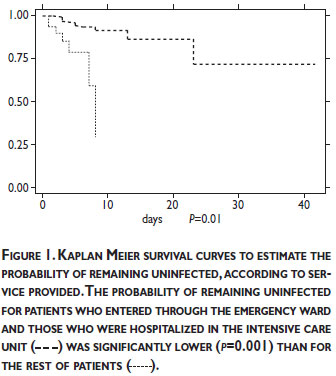
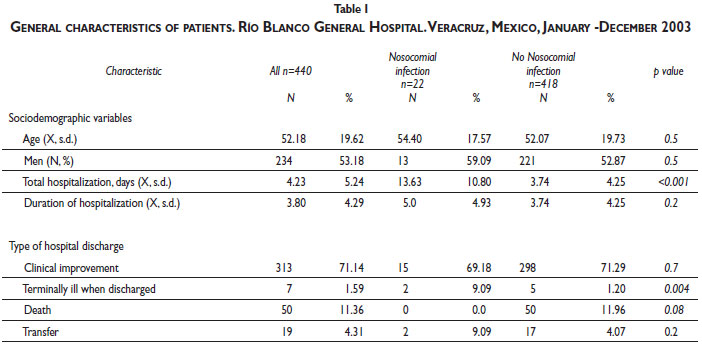
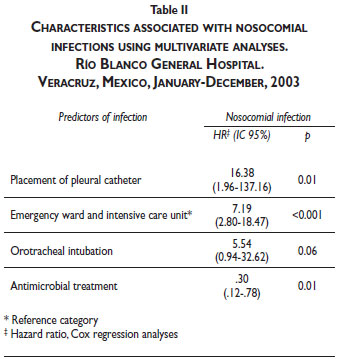
</front><body><![CDATA[ <P align="right"><font face="Verdana, Arial, Helvetica, sans-serif" size="2"><b>ART&Iacute;CULO    ORIGINAL</b></font></P>     <P>&nbsp;</P>     <P><font face="Verdana, Arial, Helvetica, sans-serif" size="4"><b>Surveillance    of nosocomial infections in a Mexican community hospital. How are we doing?</b></font></P>     <P>&nbsp;</P>     <P><font face="Verdana, Arial, Helvetica, sans-serif" size="3"><b>Vigilancia epidemiológica    de infecciones nosocomiales en un hospital comunitario de México. ¿Cómo vamos?</b></font></P>     <P>&nbsp;</P>     <P>&nbsp;</P>     <P><font face="Verdana, Arial, Helvetica, sans-serif" size="2"><b>Lourdes García-García,    MC, DSc<Sup>I;</Sup> María-Eugenia Jiménez-Corona, MC, DSc<Sup>III</Sup>; Laura-Elizabeth    Ramírez-López, MC, MSc<Sup>I</Sup>;Renata Báez-Saldaña, MC, DSc<Sup>I</Sup>;    Leticia Ferreyra-Reyes, MC, MSP<Sup>I</Sup>; Elizabeth Ferreira-Guerrero, MC<Sup>I</Sup>;    Bulmaro Cano-Arellano, Ing<Sup>I</Sup>; Pablo Cruz-Hervert, CD<Sup>I</Sup>;    Norma Araceli Téllez-Vázquez, Chem<Sup>I</Sup>; Leonardo Verduzco-Rodríguez,    MC<Sup>II</Sup>; Yolanda Jaramillo-Cosme, MC, MHA<Sup>II</Sup>; Eleazar Luna-Téllez,    MC<Sup>II</Sup>; Samuel Ponce de León-Rosales, MC MSc<Sup>III</Sup></b></font></P>     <P><font face="Verdana, Arial, Helvetica, sans-serif" size="2"><sup>I</sup> Instituto    Nacional de Salud Pública. Cuernavaca, Morelos, México    <br>   <sup>II</sup> Hospital General de Río Blanco. Veracruz, México    ]]></body>
<body><![CDATA[<br> <sup>III</sup> Laboratorios    de Biológicos y Reactivos de México &#40;BIRMEX&#41;. México DF, México</font></p>     <P>&nbsp;</P>     <P>&nbsp; </P> <hr size="1" noshade>     <P><font face="Verdana, Arial, Helvetica, sans-serif" size="2"><b>ABSTRACT</b></font></P>     <p><font face="Verdana, Arial, Helvetica, sans-serif" size="2"> <b>OBJECTIVE</b>.    To compare the nosocomial infection &#40;NI&#41; rate obtained from a retrospective    review of clinical charts with that from the routine nosocomial infection surveillance    system in a community hospital.    <br>   <b>MATERIAL AND METHODS</b>. Retrospective review of a randomized sample of    clinical charts.Results were compared to standard surveillance using crude and    adjusted analyses.     <br>   <b>RESULTS</b>. A total of 440 discharges were reviewed, there were 27 episodes    of NIs among 22 patients. Cumulated incidence was 6.13 NI per 100 discharges.    Diarrhea, pneumonia and peritonitis were the most common infections. Predictors    of NI by Cox regression analysis included pleural catheter &#40;HR 16.38&#41;,    entry through the emergency ward, hospitalization in the intensive care unit    &#40;HR 7.19&#41;, and placement of orotracheal tube &#40;HR 5.54&#41;.    <br>   <b>CONCLUSIONS</b>. Frequency of NIs in this community hospital was high and    underestimated. We identified urgent needs in the areas of training and monitoring.</font></p>     <p><font face="Verdana, Arial, Helvetica, sans-serif" size="2"> <b>Key words:</b>    surveillance; infection control; risk factors; hospitals, general</font></p> <hr size="1" noshade>     <P><font face="Verdana, Arial, Helvetica, sans-serif" size="2"><b>RESUMEN </b></font></P>     ]]></body>
<body><![CDATA[<p><font face="Verdana, Arial, Helvetica, sans-serif" size="2"> <b>OBJETIVO</b>.    Comparar la tasa de infecciones nosocomiales &#40;IN&#41; resultante de la revisión    retrospectiva de expedientes clínicos con los resultados del sistema rutinario    de vigilancia de IN de un hospital general.    <br>   <b>MATERIAL Y M&Eacute;TODOS</b>. Revisión retrospectiva de una muestra seleccionada    aleatoriamente de expedientes clínicos. Comparación con los resultados obtenidos    por el sistema rutinario de vigilancia de IN. Análisis bivariado y multivariado    de datos retrospectivos.     <br>   <b>RESULTADOS</b>. De 440 egresos hubo 27 episodios de IN en 22 pacientes. La    incidencia acumulada fue de 6.13 IN por 100 egresos. Las infecciones más frecuentes    fueron diarrea, neumonía y peritonitis. Los predictores de IN fueron catéter    pleural &#40;HR 16.38&#41;, ingreso por urgencias y estancia en cuidados intensivos    &#40;HR 7.19&#41;, y colocación de tubo orotraqueal &#40;HR 5.54&#41;.     <br>   <b>CONCLUSIONES</b>. La frecuencia de IN fue elevada y subestimada por el sistema    rutinario. Identificamos necesidades urgentes de monitoreo y entrenamiento en    áreas específicas.</font></p>     <p><font face="Verdana, Arial, Helvetica, sans-serif" size="2"> <b>Palabras clave:</b>    vigilancia; control de infecciones; factores de riesgo; hospitales generales</font></p> <hr size="1" noshade>     <p>&nbsp;</p>     <p>&nbsp;</p>     <P><font face="Verdana, Arial, Helvetica, sans-serif" size="2"> Nosocomial infections    &#40;NIs&#41; continue to represent an important public health problem. The World Health    Organization estimates that 8.4&#37; of hospitalized patients suffer from NIs,<Sup>1</Sup>    although estimates in developing countries have shown higher rates.<Sup><sup>2,3</sup></Sup>    Community hospitals are estimated to have lower rates, although still considerable.<Sup>4</Sup>    Infection control programs have been demonstrated to reduce NIs in hospitals    with active surveillance programs.<Sup>5</Sup> Therefore, it is important to    validate surveillance results, particularly in settings in which infrastructure    and resources are limited. Among the variety of methods proposed to validate    surveillance of NIs, retrospective review of clinical charts has been shown    to have a sensitivity of 70 to 80&#37;.<Sup>6</Sup></font></P>     <P><font face="Verdana, Arial, Helvetica, sans-serif" size="2"> The primary goal    of this study was to compare results obtained by a retrospective review of clinical    charts with those obtained by routine standard surveillance of NIs in the internal    medicine ward in a community hospital located in southern Mexico. Secondly,    we determined risk factors and consequences associated with NIs. We consider    that this hospital exemplifies the problems faced by many hospitals in developing    countries and that the limitations identified apply to most community hospitals    in Mexico and other similar settings. </font></P>     <P>&nbsp;</P>     ]]></body>
<body><![CDATA[<P><font face="Verdana, Arial, Helvetica, sans-serif" size="3"><b> Material and    Methods</b></font></P>     <P><font face="Verdana, Arial, Helvetica, sans-serif" size="2"> The hospital is    located in Rio Blanco, with a population 39 327, located in a predominantly    urban region in southern Mexico. It is affiliated with the Ministry of Health    and has an estimated coverage of 1 million persons. Forty-six of its 118 beds    are dedicated to internal medicine and surgery. During 2003 there were 7 598    discharges, of which 1 552 were from internal medicine. The hospital has had    an infection control program since 1986. Procedures and definitions follow official    guidelines.<Sup>7 </Sup>During 2003 this system reported a nosocomial infection    incidence rate of 2.4 episodes of infections per 100 discharges from internal    medicine. Hospital authorities requested that these results be validated. Institutional    approval from the appropriate boards was obtained. </font></P>     <P><font face="Verdana, Arial, Helvetica, sans-serif" size="2"> To review the    effectiveness of the surveillance system, a sample was randomly selected from    all patients who had been discharged from internal medicine during the study    period &#40;January to December, 2003&#41;. The clinical charts were reviewed for evidence    of NIs that met the definitions established by the official norm.<Sup>8</Sup>    Discharges were reviewed by one of the authors &#40;LR&#41; and data were collected    using standardized forms. A sample size of 500 discharges was planned to detect    an infection rate of 2&#37; from a total of 1 552 discharges, with a power of 80&#37;    and &#945; level of 0.05. This sample size included an additional 25&#37; for lost charts.</font></P>      <P><font face="Verdana, Arial, Helvetica, sans-serif" size="2"> <b>Definitions</b></font></P>     <P><font face="Verdana, Arial, Helvetica, sans-serif" size="2"> The definitions    for NIs, infection sites, invasive procedures and classification of discharges    followed standard guidelines.<Sup>7,9</Sup> Underlying diagnoses were classified    as described in the International Classification of Diseases.<Sup>8</Sup></font></P>     <P><font face="Verdana, Arial, Helvetica, sans-serif" size="2"> <b>Statistical    analyses</b></font></P>     <P><font face="Verdana, Arial, Helvetica, sans-serif" size="2"> Data from a review    of the 500 clinical charts were compiled for cumulated infection rates, types    of infections and bacterial isolates at infection sites. Incidence rates were    calculated as the number of episodes of nosocomial infection per 100 discharges    and the number of episodes of nosocomial infection per days of hospitalization.    For estimation of sensitivity, specificity and predictive value of the routine    surveillance system we compared results of the review of the 500 clinical charts    with what had been reported by the surveillance system. Patients who were determined    by the retrospective review of clinical charts to have acquired NIs were compared    with non-infected patients by bivariate and multivariate analyses to describe    the association between diagnosis of nosocomial infection and relevant demographic,    epidemiological and clinical characteristics. Length of stay for infected patients    was computed from date of admission to date of diagnosis of first or only nosocomial    infection, and for non-infected patients, from date of admission to date of    discharge. Hazard ratios associated with NIs were estimated using the Cox proportional    hazards model, using as reference time the period elapsed from first day of    hospitalization to date of diagnosis of nosocomial infection or discharge. Variables    were entered into the models according to their statistical significance in    the univariate analysis and their biological relevance. Survival analyses included    Kaplan-Meier curves to estimate the probability of acquiring a nosocomial infection.    We used STATA 7.0 for data analysis.</font></P>     <P><font face="Verdana, Arial, Helvetica, sans-serif" size="2"> <b>Sensitivity    analysis</b></font></P>     <P><font face="Verdana, Arial, Helvetica, sans-serif" size="2"> We considered    several sources of bias. We compared characteristics of patients who were randomly    selected for retrospective review with the rest of patients who were discharged    during 2003. Since we were unable to study 12&#37; of selected patients we evaluated    the possibility that patients whose clinical chart could not be found differed    from patients who were included in the study. First, we took advantage of the    existence of an administrative data set that compiled selected socio-demographic    and clinical variables from all patients and compared patients for whom we had    a clinical chart with patients for whom the clinical chart could not be found.    Second, we estimated the rate of NIs if 10&#37;, 25&#37;, 50&#37;, and 100&#37; of the missing    charts had been diagnosed with NIs.</font></P>     <P>&nbsp;</P>     ]]></body>
<body><![CDATA[<P><font face="Verdana, Arial, Helvetica, sans-serif" size="3"><b> Results</b></font></P>     <P><font face="Verdana, Arial, Helvetica, sans-serif" size="2"> There were 1 552    discharges from internal medicine during 2003. Of these, we randomly selected    500 discharges. There were 60 discharges that were either not available &#40;n=31&#41;    or had been apparently miss-classified as discharged from internal medicine    &#40;n=29&#41;. Of the 440 discharges that were reviewed, 413 patients had been hospitalized    once, 12 patients had been hospitalized twice and 1 had been hospitalized three    times during 2003. Therefore, we analyzed 440 hospital discharges from 426 individual    patients. </font></P>     <P><font face="Verdana, Arial, Helvetica, sans-serif" size="2"> <b>Frequency of    NIs</b></font></P>     <P><font face="Verdana, Arial, Helvetica, sans-serif" size="2"> There were 27    episodes of NIs for 22 hospital discharges among the 440 hospital discharges.    Nineteen patients had one episode, two patients had two episodes and one patient    had four episodes. Main types of infections were diarrhea &#40;9/27, 33.33&#37;&#41;, pneumonia    &#40;4/27, 14.81&#37;&#41; and peritonitis &#40;3/27, 11.11&#37;&#41;. Cumulated incidence was 6.13    infections per 100 discharges, with an incidence density of 1.63 episodes of    infection per 100 patient/days. Of the 27 episodes, cultures were performed    in only 40.74&#37; &#40;n=11&#41;. The main microorganisms were Candida albicans, Pseudomonas    aeruginosa and Klebsiella pneumoniae. </font></P>     <P><font face="Verdana, Arial, Helvetica, sans-serif" size="2"> <b>Patient characteristics    and risk factors associated with infections</b></font></P>     <P><font face="Verdana, Arial, Helvetica, sans-serif" size="2"> Characteristics    of patients are described in <a href="/img/revistas/spm/v52n6/a05tab1.jpg">Table I</a>. Most    of the patients were middle-aged men, and the average duration of hospitalization    was less than 5 days. The most frequent underlying diagnoses were diabetes mellitus,    renal failure, neoplasias, and diarrhea. There were no differences between infected    and non-infected patients regarding underlying diagnoses. Fifty &#40;11&#37;&#41;    of the 440 patients died. None of the infected patients died.</font></P>     <P><font face="Verdana, Arial, Helvetica, sans-serif" size="2"> Predictors of    nosocomial infection by Cox regression analysis are shown in <a href="#tab2">Table    II</a>. With the exception of orotracheal intubation, these associations were    maintained when the model was controlled for underlying diagnoses and age.</font></P>     <P><a name="tab2"></a></P>     <P>&nbsp;</P>     <P align="center"><img src="/img/revistas/spm/v52n6/a05tab2.jpg"></P>     ]]></body>
<body><![CDATA[<P>&nbsp;</P>     <P><font face="Verdana, Arial, Helvetica, sans-serif" size="2"> <b>Impact of NIs</b></font></P>     <P><font face="Verdana, Arial, Helvetica, sans-serif" size="2"> Infected patients    were found to have longer hospitalizations than non-infected patients &#40;p&#60;0.001&#41;,    &#40;<a href="/img/revistas/spm/v52n6/a05tab1.jpg">Table I</a>&#41;. This was observed for all    patients regardless of underlying diagnoses and when patients were stratified    for the most frequent underlying diagnoses. Mortality rates were similar between    infected and non-infected patients. However, patients with NIs were more likely    to be terminally ill when discharged than non-infected patients &#40;<a href="/img/revistas/spm/v52n6/a05tab1.jpg">Table    I</a>&#41;.</font></P>     <P><font face="Verdana, Arial, Helvetica, sans-serif" size="2"> <b>Survival analyses</b></font></P>     <P><font face="Verdana, Arial, Helvetica, sans-serif" size="2"> <a href="#fig1">Figure    1</a> indicates the survival probability of the remaining non-infected patients,    according to entry through the emergency ward and hospitalization in the intensive    care unit. Patients having been hospitalized in these two services had a lower    probability of remaining uninfected &#40;p=0.001&#41;.</font></P>     <P><a name="fig1"></a></P>     <P>&nbsp;</P>     <P align="center"><img src="/img/revistas/spm/v52n6/a05fig1.jpg"></P>     <P>&nbsp;</P>     <P><font face="Verdana, Arial, Helvetica, sans-serif" size="2"> <b>Sensitivity,    specificity and predictive value of the routine surveillance system</b></font></P>     ]]></body>
<body><![CDATA[<P><font face="Verdana, Arial, Helvetica, sans-serif" size="2"> The routine surveillance    system reported 38 nosocomial infection episodes that occurred among the 1552    discharges during 2003 &#40;rate of 2.4 per 100 discharges&#41;. Of the 27 episodes    that were detected through retrospective chart review, only five were also detected    by the routine system. If the retrospective review is considered as the gold    standard, the routine system had a sensitivity of 22.72&#37;, specificity of 98.88&#37;,    positive predictive value of 50.0&#37; and negative predictive value of 96.05&#37;.    The routine system did not detect the 9 episodes of nosocomial diarrhea.</font></P>     <P><font face="Verdana, Arial, Helvetica, sans-serif" size="2"> <b>Sensitivity    analyses</b></font></P>     <P><font face="Verdana, Arial, Helvetica, sans-serif" size="2"> The comparison    between the 500 discharges that were selected for analysis with the non-selected    1052 discharges from internal medicine during 2003 revealed that both groups    were similar regarding age, sex, average days of hospitalization, cause of hospital    discharge, main underlying diagnosis &#40;diabetes, renal failure, neoplasias and    diarrhea&#41; and proportion of patients undergoing surgery. The comparison of the    60 discharges for whom the clinical chart could not be found with the 440 discharges    whose charts were reviewed revealed that patients for whom the chart could not    be found had a greater probability of death &#40;48/440 &#91;10.91&#37;&#93; versus 15/60 &#91;25.00&#37;&#93;    p=0.002&#41; and renal failure &#40;17/440 &#91;3.80&#37;&#93; versus 6/60 &#91;10.0&#37;&#93; p=0.03&#41;. Estimation    of rates per 100 discharges if 0, 10, 25, 50 and 100&#37; of the missing patients    had been diagnosed with a nosocomial infection resulted in rates of 5.4, 6.6,    8.4, 11.4 and 17.4&#37;, respectively.</font></P>     <P>&nbsp;</P>     <P><font face="Verdana, Arial, Helvetica, sans-serif" size="3"> <b>Discussion</b></font></P>     <P><font face="Verdana, Arial, Helvetica, sans-serif" size="2"> This study shows    that a comprehensive understanding of the pattern of NIs in a hospital should    be based on a comprehensive clinical and bacteriological study. We were able    to document important limitations of the routine surveillance system, including    underreporting and lack of bacteriological information. We consider that the    reported rates are underestimated and that, most probably, real rates are much    higher. Despite these limitations we were able to show the impact that NIs have    on increased days of hospitalization. Additionally, we were able to identify    procedures and hospital areas that represent a higher probability of infection.    Finally, our data emphasizes the fact that the mere existence of a nosocomial    infection control program does not ensure the existence of â€œgoodâ€ surveillance;    it is necessary to validate its results and ensure adequate feedback to the    rest of the hospital. </font></P>     <P><font face="Verdana, Arial, Helvetica, sans-serif" size="2"> Since we were    unable to review 12&#37; of selected charts, non-reviewed and reviewed charts were    compared, revealing that the former had a higher probability of renal failure    as an underlying diagnosis or death. Since both of these conditions may be associated    with NIs, we estimated the rates of infection if a different proportion of patients    for whom we did not review the charts were infected. Our estimation revealed    that the real rate of infections may be up to three times our observed rate.    Two other conditions favor our impression that the real rate of NIs is probably    underestimated. First, the retrospective nature of our study harbors limitations    for detection of NIs that were not adequately documented in the chart. Second,    usage of microbiological support was very limited, which led to predominant    detection of infections based on clinical or radiologic criteria such as diarrhea,    pneumonia or peritonitis. Infections requiring microbiologic confirmation were    missed, such as bacteraemias and urinary tract infections. Since diarrhea, pneumonia    and peritonitis were the predominant type of infections we would expect different    patterns of etiologic agents &#40;such as Streptococcus pneumonia, Clostridium difficile,    Enteropathogenic Escherichia coli, Staphylococcus epidermidis, among others.&#41;.</font></P>     <P><font face="Verdana, Arial, Helvetica, sans-serif" size="2"> It is also worth    noting that the sample size allowed us to estimate general incidence rates;    it was not designed to estimate rates by type of underlying disease &#40;for example    among patients with renal insufficiency&#41; or rates of associated mortality. </font></P>     <P><font face="Verdana, Arial, Helvetica, sans-serif" size="2"> Our retrospective    review revealed that the rate of NIs in the internal medicine ward in this community    hospital is comparable to what has been reported in other community hospitals    in developing countries.<Sup>4,10,11</Sup> Diarrheas are most probably associated    with infrequent hand washing by health personnel and patients,<Sup>12</Sup>    and have been identified as a common complication in hospitalized patients.<Sup>13</Sup>    This problem had remained undetected by routine surveillance in the study hospital    and suggests the possibility that this condition is considered as common and    â€œnormalâ€ in a setting where gastrointestinal infections in the community    are common. As we do not have bacteriological information, we are unable to    exclude the fact that diarrheas could be due to non-infectious etiologies such    as adverse reactions to drugs. Another problem was the high frequency of NIs    associated with placement and use of devices, probably due to lack of training    of personnel performing the procedures.<Sup>14,15</Sup> Training in infection    control practices has been demonstrated to lower rates of infection in developing    countries.<Sup>16,17 </Sup>Infected patients had a higher likelihood of having    entered through the emergency ward and having been hospitalized in the intensive    care unit, and multiple factors condition higher rates of infection in these    areas; this needs to be carefully examined.<Sup>18,19 </Sup>In addition, a reduction    greater than 50&#37; in the rates of ventilator-associated pneumonia has been reported    as a result of quality improvement methods.<Sup>20</Sup> </font></P>     <P><font face="Verdana, Arial, Helvetica, sans-serif" size="2"> The impact of    NIs in developing countries is proportionately far greater than in developed    countries,<Sup>2,21-24</Sup> as rates are higher and resources are more limited.    Increase in days of hospitalization, as demonstrated in our study, has important    economic consequences.<Sup>25</Sup> Additionally, although we did not demonstrate    increased mortality due to NIs, patients with this condition were more probable    to be terminally ill when discharged. Although we were unable to determine if    the nosocomial infection was causally associated with this illness, it may likely    have contributed to worsening the prognosis. </font></P>     ]]></body>
<body><![CDATA[<P><font face="Verdana, Arial, Helvetica, sans-serif" size="2"> Retrospective    validation of prospective surveillance methods, although limited, has proved    to be useful in other settings.<Sup>26</Sup> After improving routine surveillance,    the hospital committee would need to select an appropriate validation system    according to the resources and identified problems &#40;prospective review of all    clinical charts and laboratory reports, periodic evaluation of risk areas, and    prevalence studies, among others&#41;.<Sup>27</Sup> Infection control programs have    been identified as a starting point for quality assurance in that they are relevant    to patient care and staff safety.<Sup>28,29</Sup> Therefore, data from this    study have important and challenging implications for the quality of care provided    in the study hospital. </font></P>     <P><font face="Verdana, Arial, Helvetica, sans-serif" size="2"> Our results indicate    evidence of diverse severe problems that urgently need to be addressed in terms    of training, use of prophylactic antibiotics and review of invasive and surgical    procedures, particularly those that take place in the emergency ward or intensive    care unit. This situation can probably be generalized to other community hospitals    in the country. As occurs in hospitals with a larger number of beds, existence    of official guidelines, in-hospital infection control committees and prospective    surveillance systems are insufficient if not supported by a comprehensive approach    that provides feedback regarding surveillance information on patient care.<Sup>30</Sup></font></P>     <P>&nbsp;</P>     <P><font face="Verdana, Arial, Helvetica, sans-serif" size="3"><b> Acknowledgments</b></font></P>     <P><font face="Verdana, Arial, Helvetica, sans-serif" size="2"> The authors want    to acknowledge the support of Drs. Sergio Orozco, Cecilia García, José Sifuentes    and Sigfrido Rangel, whose comments greatly improved the quality of the work;    the Infection Control Program of the Instituto Nacional de Ciencias Médicas    y Nutrición Salvador Zubirán, who supported the training of Dr. Ramírez,    and the personnel of the Hospital General de Río Blanco who supported the review    of clinical charts.</font></P>     <P><font face="Verdana, Arial, Helvetica, sans-serif" size="2"> Partial funding    was obtained from the Howard Hughes Medical Institute &#40;ID 55000632&#41;. Dr. Ramírez    López received an academic scholarship from the Mexican Council of Science    and Technology &#40;173754&#41;. </font></P>     <P><font face="Verdana, Arial, Helvetica, sans-serif" size="2"> <i>Declaration    of conflicts of interest</i></font></P>     <P><font face="Verdana, Arial, Helvetica, sans-serif" size="2"> We declare that    we have no conflicts of interest.</font></P>     <P>&nbsp;</P>     <P><font face="Verdana, Arial, Helvetica, sans-serif" size="3"><b> References</b></font></P>     ]]></body>
<body><![CDATA[<!-- ref --><P><font face="Verdana, Arial, Helvetica, sans-serif" size="2"> 1. Mayon-White    RT, Ducel G, Kereselidze T, Tikomirov E. An international survey of the prevalence    of hospital-acquired infection. J Hosp Infect 1988;11 Suppl A:43-8.    &nbsp;&nbsp;&nbsp;&nbsp;&nbsp;&nbsp;&nbsp;&nbsp;[&#160;<a href="javascript:void(0);" onclick="javascript: window.open('/scielo.php?script=sci_nlinks&ref=9347842&pid=S0036-3634201000060000500001&lng=','','width=640,height=500,resizable=yes,scrollbars=1,menubar=yes,');">Links</a>&#160;]<!-- end-ref --></font></P>     <!-- ref --><P><font face="Verdana, Arial, Helvetica, sans-serif" size="2"> 2. Ponce-de-Leon    S. The needs of developing countries and the resources required. J Hosp Infect    1991;18 Suppl A:376-81.    &nbsp;&nbsp;&nbsp;&nbsp;&nbsp;&nbsp;&nbsp;&nbsp;[&#160;<a href="javascript:void(0);" onclick="javascript: window.open('/scielo.php?script=sci_nlinks&ref=9347844&pid=S0036-3634201000060000500002&lng=','','width=640,height=500,resizable=yes,scrollbars=1,menubar=yes,');">Links</a>&#160;]<!-- end-ref --></font></P>     <!-- ref --><P><font face="Verdana, Arial, Helvetica, sans-serif" size="2"> 3. Apisarnthanarak    A, Fraser VJ. Feasibility and efficacy of infection-control interventions to    reduce the number of nosocomial infections and drug-resistant microorganisms    in developing countries: what else do we need? Clin Infect Dis 2009;48&#40;1&#41;:22-4.    &nbsp;&nbsp;&nbsp;&nbsp;&nbsp;&nbsp;&nbsp;&nbsp;[&#160;<a href="javascript:void(0);" onclick="javascript: window.open('/scielo.php?script=sci_nlinks&ref=9347846&pid=S0036-3634201000060000500003&lng=','','width=640,height=500,resizable=yes,scrollbars=1,menubar=yes,');">Links</a>&#160;]<!-- end-ref --></font></P>     <!-- ref --><P><font face="Verdana, Arial, Helvetica, sans-serif" size="2"> 4. Orrett FA,    Brooks PJ, Richardson EG. Nosocomial infections in a rural regional hospital    in a developing country: infection rates by site, service, cost, and infection    control practices. Infect Control Hosp Epidemiol 1998;19&#40;2&#41;:136-40.    &nbsp;&nbsp;&nbsp;&nbsp;&nbsp;&nbsp;&nbsp;&nbsp;[&#160;<a href="javascript:void(0);" onclick="javascript: window.open('/scielo.php?script=sci_nlinks&ref=9347848&pid=S0036-3634201000060000500004&lng=','','width=640,height=500,resizable=yes,scrollbars=1,menubar=yes,');">Links</a>&#160;]<!-- end-ref --></font></P>     <!-- ref --><P><font face="Verdana, Arial, Helvetica, sans-serif" size="2"> 5. Haley RW, Culver    DH, White JW, Morgan WM, Emori TG, Munn VP, et al. The efficacy of infection    surveillance and control programs in preventing nosocomial infections in US    hospitals. Am J Epidemiol 1985;121&#40;2&#41;:182-205.    &nbsp;&nbsp;&nbsp;&nbsp;&nbsp;&nbsp;&nbsp;&nbsp;[&#160;<a href="javascript:void(0);" onclick="javascript: window.open('/scielo.php?script=sci_nlinks&ref=9347850&pid=S0036-3634201000060000500005&lng=','','width=640,height=500,resizable=yes,scrollbars=1,menubar=yes,');">Links</a>&#160;]<!-- end-ref --></font></P>     ]]></body>
<body><![CDATA[<!-- ref --><P><font face="Verdana, Arial, Helvetica, sans-serif" size="2"> 6. Haley RW, Schaberg    DR, McClish DK, Quade D, Crossley KB, Culver DH, et al. The accuracy of retrospective    chart review in measuring nosocomial infection rates. Results of validation    studies in pilot hospitals. Am J Epidemiol 1980;111&#40;5&#41;:516-33.    &nbsp;&nbsp;&nbsp;&nbsp;&nbsp;&nbsp;&nbsp;&nbsp;[&#160;<a href="javascript:void(0);" onclick="javascript: window.open('/scielo.php?script=sci_nlinks&ref=9347852&pid=S0036-3634201000060000500006&lng=','','width=640,height=500,resizable=yes,scrollbars=1,menubar=yes,');">Links</a>&#160;]<!-- end-ref --></font></P>     <!-- ref --><P><font face="Verdana, Arial, Helvetica, sans-serif" size="2"> 7. Secretaría    de Salud. Norma Oficial Mexicana NOM-026-SSA2-1998, para la vigilancia epidemiológica,    prevención y control de las infecciones nosocomiales. Diario Oficial de la    Federación, March 30, 2000.    &nbsp;&nbsp;&nbsp;&nbsp;&nbsp;&nbsp;&nbsp;&nbsp;[&#160;<a href="javascript:void(0);" onclick="javascript: window.open('/scielo.php?script=sci_nlinks&ref=9347854&pid=S0036-3634201000060000500007&lng=','','width=640,height=500,resizable=yes,scrollbars=1,menubar=yes,');">Links</a>&#160;]<!-- end-ref --></font></P>     <!-- ref --><P><font face="Verdana, Arial, Helvetica, sans-serif" size="2"> 8. Clasificación    Estadística Internacional de Enfermedades y problemas relacionados con la salud.    Décima revisión. Washington DC: World Health Organizacion/Pan American Health    Organization, 1995.    &nbsp;&nbsp;&nbsp;&nbsp;&nbsp;&nbsp;&nbsp;&nbsp;[&#160;<a href="javascript:void(0);" onclick="javascript: window.open('/scielo.php?script=sci_nlinks&ref=9347856&pid=S0036-3634201000060000500008&lng=','','width=640,height=500,resizable=yes,scrollbars=1,menubar=yes,');">Links</a>&#160;]<!-- end-ref --></font></P>     <!-- ref --><P><font face="Verdana, Arial, Helvetica, sans-serif" size="2"> 9. Secretaría    de Salud. Norma Oficial Mexicana NOM-025-SSA2-1994, para la prestación de servicios    de salud en unidades de atención integral hospitalaria médico-psiquiátrica.    Diario Oficial de la Federación, November 16,1995.    &nbsp;&nbsp;&nbsp;&nbsp;&nbsp;&nbsp;&nbsp;&nbsp;[&#160;<a href="javascript:void(0);" onclick="javascript: window.open('/scielo.php?script=sci_nlinks&ref=9347858&pid=S0036-3634201000060000500009&lng=','','width=640,height=500,resizable=yes,scrollbars=1,menubar=yes,');">Links</a>&#160;]<!-- end-ref --></font></P>     <!-- ref --><P><font face="Verdana, Arial, Helvetica, sans-serif" size="2"> 10. Guerrant RL,    Hughes JM, Lima NL, Crane J. Diarrhea in developed and developing countries:    magnitude, special settings, and etiologies. Rev Infect Dis 1990;12 Suppl 1:S41-50.    &nbsp;&nbsp;&nbsp;&nbsp;&nbsp;&nbsp;&nbsp;&nbsp;[&#160;<a href="javascript:void(0);" onclick="javascript: window.open('/scielo.php?script=sci_nlinks&ref=9347860&pid=S0036-3634201000060000500010&lng=','','width=640,height=500,resizable=yes,scrollbars=1,menubar=yes,');">Links</a>&#160;]<!-- end-ref --></font></P>     ]]></body>
<body><![CDATA[<!-- ref --><P><font face="Verdana, Arial, Helvetica, sans-serif" size="2"> 11. Gray FJ. Surgical    wound infection in a developing country-Papua New Guinea. P N G Med J 1974;17&#40;4&#41;:373-8.    &nbsp;&nbsp;&nbsp;&nbsp;&nbsp;&nbsp;&nbsp;&nbsp;[&#160;<a href="javascript:void(0);" onclick="javascript: window.open('/scielo.php?script=sci_nlinks&ref=9347862&pid=S0036-3634201000060000500011&lng=','','width=640,height=500,resizable=yes,scrollbars=1,menubar=yes,');">Links</a>&#160;]<!-- end-ref --></font></P>     <!-- ref --><P><font face="Verdana, Arial, Helvetica, sans-serif" size="2"> 12. Ibarra-Colado    JE, Mendez-Hernandez S, Cortes-Castillo LF. &#91;Hospital infections in children    in a general hospital&#93;. Bol Med Hosp Infant Mex 1991;48&#40;11&#41;:820-5.    &nbsp;&nbsp;&nbsp;&nbsp;&nbsp;&nbsp;&nbsp;&nbsp;[&#160;<a href="javascript:void(0);" onclick="javascript: window.open('/scielo.php?script=sci_nlinks&ref=9347864&pid=S0036-3634201000060000500012&lng=','','width=640,height=500,resizable=yes,scrollbars=1,menubar=yes,');">Links</a>&#160;]<!-- end-ref --></font></P>     <!-- ref --><P><font face="Verdana, Arial, Helvetica, sans-serif" size="2"> 13. Zaidi M, Ponce    de Leon S, Ortiz RM, Ponce de Leon S, Calva JJ, Ruiz-Palacios G, et al. Hospital-acquired    diarrhea in adults: a prospective case-controlled study in Mexico. Infect Control    Hosp Epidemiol 1991;12&#40;6&#41;:349-55.    &nbsp;&nbsp;&nbsp;&nbsp;&nbsp;&nbsp;&nbsp;&nbsp;[&#160;<a href="javascript:void(0);" onclick="javascript: window.open('/scielo.php?script=sci_nlinks&ref=9347866&pid=S0036-3634201000060000500013&lng=','','width=640,height=500,resizable=yes,scrollbars=1,menubar=yes,');">Links</a>&#160;]<!-- end-ref --></font></P>     <!-- ref --><P><font face="Verdana, Arial, Helvetica, sans-serif" size="2"> 14. Hall G, Bogan    A, Dreis S, Duffy A, Greene S, Kelley K, et al. New directions in peritoneal    dialysis patient training. Nephrol Nurs J 2004;31&#40;2&#41;:149-54, 159-63.    &nbsp;&nbsp;&nbsp;&nbsp;&nbsp;&nbsp;&nbsp;&nbsp;[&#160;<a href="javascript:void(0);" onclick="javascript: window.open('/scielo.php?script=sci_nlinks&ref=9347868&pid=S0036-3634201000060000500014&lng=','','width=640,height=500,resizable=yes,scrollbars=1,menubar=yes,');">Links</a>&#160;]<!-- end-ref --></font></P>     <!-- ref --><P><font face="Verdana, Arial, Helvetica, sans-serif" size="2"> 15. Richards MJ,    Edwards JR, Culver DH, Gaynes RP. Nosocomial infections in combined medical-surgical    intensive care units in the United States. Infect Control Hosp Epidemiol 2000;21&#40;8&#41;:510-5.    &nbsp;&nbsp;&nbsp;&nbsp;&nbsp;&nbsp;&nbsp;&nbsp;[&#160;<a href="javascript:void(0);" onclick="javascript: window.open('/scielo.php?script=sci_nlinks&ref=9347870&pid=S0036-3634201000060000500015&lng=','','width=640,height=500,resizable=yes,scrollbars=1,menubar=yes,');">Links</a>&#160;]<!-- end-ref --></font></P>     ]]></body>
<body><![CDATA[<!-- ref --><P><font face="Verdana, Arial, Helvetica, sans-serif" size="2"> 16. Rosenthal    VD, Guzman S, Pezzotto SM, Crnich CJ. Effect of an infection control program    using education and performance feedback on rates of intravascular device-associated    bloodstream infections in intensive care units in Argentina. Am J Infect Control    2003;31&#40;7&#41;:405-9.    &nbsp;&nbsp;&nbsp;&nbsp;&nbsp;&nbsp;&nbsp;&nbsp;[&#160;<a href="javascript:void(0);" onclick="javascript: window.open('/scielo.php?script=sci_nlinks&ref=9347872&pid=S0036-3634201000060000500016&lng=','','width=640,height=500,resizable=yes,scrollbars=1,menubar=yes,');">Links</a>&#160;]<!-- end-ref --></font></P>     <!-- ref --><P><font face="Verdana, Arial, Helvetica, sans-serif" size="2"> 17. Rosenthal    VD, Guzman S, Safdar N. Effect of education and performance feedback on rates    of catheter-associated urinary tract infection in intensive care units in Argentina.    Infect Control Hosp Epidemiol 2004;25&#40;1&#41;:47-50.    &nbsp;&nbsp;&nbsp;&nbsp;&nbsp;&nbsp;&nbsp;&nbsp;[&#160;<a href="javascript:void(0);" onclick="javascript: window.open('/scielo.php?script=sci_nlinks&ref=9347874&pid=S0036-3634201000060000500017&lng=','','width=640,height=500,resizable=yes,scrollbars=1,menubar=yes,');">Links</a>&#160;]<!-- end-ref --></font></P>     <!-- ref --><P><font face="Verdana, Arial, Helvetica, sans-serif" size="2"> 18. Weber DJ,    Raasch R, Rutala WA. Nosocomial infections in the ICU: the growing importance    of antibiotic-resistant pathogens. Chest 1999;115&#40;3 Suppl&#41;:34S-41S.    &nbsp;&nbsp;&nbsp;&nbsp;&nbsp;&nbsp;&nbsp;&nbsp;[&#160;<a href="javascript:void(0);" onclick="javascript: window.open('/scielo.php?script=sci_nlinks&ref=9347876&pid=S0036-3634201000060000500018&lng=','','width=640,height=500,resizable=yes,scrollbars=1,menubar=yes,');">Links</a>&#160;]<!-- end-ref --></font></P>     <!-- ref --><P><font face="Verdana, Arial, Helvetica, sans-serif" size="2"> 19. Velasco E,    Thuler LC, Martins CA, Dias LM, Goncalves VM. Nosocomial infections in an oncology    intensive care unit. Am J Infect Control 1997;25&#40;6&#41;:458-62.    &nbsp;&nbsp;&nbsp;&nbsp;&nbsp;&nbsp;&nbsp;&nbsp;[&#160;<a href="javascript:void(0);" onclick="javascript: window.open('/scielo.php?script=sci_nlinks&ref=9347878&pid=S0036-3634201000060000500019&lng=','','width=640,height=500,resizable=yes,scrollbars=1,menubar=yes,');">Links</a>&#160;]<!-- end-ref --></font></P>     <!-- ref --><P><font face="Verdana, Arial, Helvetica, sans-serif" size="2"> 20. Nafzinger    DA. Nosocomial pneumonia. In: Wenzel RP, editor. Prevention and control of nosocomial    infections. 4 ed. Philadelphia: Lippincott Williams &amp; Williams, 1997:312-327.    &nbsp;&nbsp;&nbsp;&nbsp;&nbsp;&nbsp;&nbsp;&nbsp;[&#160;<a href="javascript:void(0);" onclick="javascript: window.open('/scielo.php?script=sci_nlinks&ref=9347880&pid=S0036-3634201000060000500020&lng=','','width=640,height=500,resizable=yes,scrollbars=1,menubar=yes,');">Links</a>&#160;]<!-- end-ref --></font></P>     ]]></body>
<body><![CDATA[<!-- ref --><P><font face="Verdana, Arial, Helvetica, sans-serif" size="2"> 21. Nosocomial    infection rates for interhospital comparison: limitations and possible solutions.    A Report from the National Nosocomial Infections Surveillance &#40;NNIS&#41; System.    Infect Control Hosp Epidemiol 1991;12&#40;10&#41;:609-21.    &nbsp;&nbsp;&nbsp;&nbsp;&nbsp;&nbsp;&nbsp;&nbsp;[&#160;<a href="javascript:void(0);" onclick="javascript: window.open('/scielo.php?script=sci_nlinks&ref=9347882&pid=S0036-3634201000060000500021&lng=','','width=640,height=500,resizable=yes,scrollbars=1,menubar=yes,');">Links</a>&#160;]<!-- end-ref --></font></P>     <!-- ref --><P><font face="Verdana, Arial, Helvetica, sans-serif" size="2"> 22. Jarvis WR.    Selected aspects of the socioeconomic impact of nosocomial infections: morbidity,    mortality, cost, and prevention. Infect Control Hosp Epidemiol 1996;17&#40;8&#41;:552-7.    &nbsp;&nbsp;&nbsp;&nbsp;&nbsp;&nbsp;&nbsp;&nbsp;[&#160;<a href="javascript:void(0);" onclick="javascript: window.open('/scielo.php?script=sci_nlinks&ref=9347884&pid=S0036-3634201000060000500022&lng=','','width=640,height=500,resizable=yes,scrollbars=1,menubar=yes,');">Links</a>&#160;]<!-- end-ref --></font></P>     <!-- ref --><P><font face="Verdana, Arial, Helvetica, sans-serif" size="2"> 23. Ponce De Leon    Rosales S. &#91;Intrahospital infections and quality of medical care. Is it possible    to save in health?&#93;. Salud Publica Mex 1991;33&#40;1&#41;:3-8.    &nbsp;&nbsp;&nbsp;&nbsp;&nbsp;&nbsp;&nbsp;&nbsp;[&#160;<a href="javascript:void(0);" onclick="javascript: window.open('/scielo.php?script=sci_nlinks&ref=9347886&pid=S0036-3634201000060000500023&lng=','','width=640,height=500,resizable=yes,scrollbars=1,menubar=yes,');">Links</a>&#160;]<!-- end-ref --></font></P>     <!-- ref --><P><font face="Verdana, Arial, Helvetica, sans-serif" size="2"> 24. Rangel-Frausto    MS, Morales-Garcia D, Baez-Martinez R, Ibarra-Blancas J, Ponce de Leon-Rosales    S. &#91;Evaluation of a nosocomial infection surveillance program&#93;. Salud Publica    Mex 1999;41 Suppl 1:S59-63.    &nbsp;&nbsp;&nbsp;&nbsp;&nbsp;&nbsp;&nbsp;&nbsp;[&#160;<a href="javascript:void(0);" onclick="javascript: window.open('/scielo.php?script=sci_nlinks&ref=9347888&pid=S0036-3634201000060000500024&lng=','','width=640,height=500,resizable=yes,scrollbars=1,menubar=yes,');">Links</a>&#160;]<!-- end-ref --></font></P>     <!-- ref --><P><font face="Verdana, Arial, Helvetica, sans-serif" size="2"> 25. Navarrete-Navarro    S, Armengol-Sanchez G. &#91;Secondary costs due to nosocomial infections in 2 pediatric    intensive care units&#93;. Salud Publica Mex 1999;41 Suppl 1:S51-8.    &nbsp;&nbsp;&nbsp;&nbsp;&nbsp;&nbsp;&nbsp;&nbsp;[&#160;<a href="javascript:void(0);" onclick="javascript: window.open('/scielo.php?script=sci_nlinks&ref=9347890&pid=S0036-3634201000060000500025&lng=','','width=640,height=500,resizable=yes,scrollbars=1,menubar=yes,');">Links</a>&#160;]<!-- end-ref --></font></P>     ]]></body>
<body><![CDATA[<!-- ref --><P><font face="Verdana, Arial, Helvetica, sans-serif" size="2"> 26. Emori TG,    Edwards JR, Culver DH, Sartor C, Stroud LA, Gaunt EE, et al. Accuracy of reporting    nosocomial infections in intensive-care-unit patients to the National Nosocomial    Infections Surveillance System: a pilot study. Infect Control Hosp Epidemiol    1998;19&#40;5&#41;:308-16.    &nbsp;&nbsp;&nbsp;&nbsp;&nbsp;&nbsp;&nbsp;&nbsp;[&#160;<a href="javascript:void(0);" onclick="javascript: window.open('/scielo.php?script=sci_nlinks&ref=9347892&pid=S0036-3634201000060000500026&lng=','','width=640,height=500,resizable=yes,scrollbars=1,menubar=yes,');">Links</a>&#160;]<!-- end-ref --></font></P>     <!-- ref --><P><font face="Verdana, Arial, Helvetica, sans-serif" size="2"> 27. Pottinger    JM, Herwaldt LA, Peri TM. Basics of surveillance--an overview. Infect Control    Hosp Epidemiol 1997;18&#40;7&#41;:513-27.    &nbsp;&nbsp;&nbsp;&nbsp;&nbsp;&nbsp;&nbsp;&nbsp;[&#160;<a href="javascript:void(0);" onclick="javascript: window.open('/scielo.php?script=sci_nlinks&ref=9347894&pid=S0036-3634201000060000500027&lng=','','width=640,height=500,resizable=yes,scrollbars=1,menubar=yes,');">Links</a>&#160;]<!-- end-ref --></font></P>     <!-- ref --><P><font face="Verdana, Arial, Helvetica, sans-serif" size="2"> 28. Wenzel R.    Health care Reform and the hospital epidemiologist In: Wenzel R, editor. Prevention    and Control of Nosocommial Infections. Baltimore: Williams and Wilkins, 1997:47-56.    &nbsp;&nbsp;&nbsp;&nbsp;&nbsp;&nbsp;&nbsp;&nbsp;[&#160;<a href="javascript:void(0);" onclick="javascript: window.open('/scielo.php?script=sci_nlinks&ref=9347896&pid=S0036-3634201000060000500028&lng=','','width=640,height=500,resizable=yes,scrollbars=1,menubar=yes,');">Links</a>&#160;]<!-- end-ref --></font></P>     <!-- ref --><P><font face="Verdana, Arial, Helvetica, sans-serif" size="2"> 29. Navarrete-Navarro    S, Rangel-Frausto MS. &#91;Nosocomial infections and quality of health care&#93;. Salud    Publica Mex 1999;41 Suppl 1:S64-8.    &nbsp;&nbsp;&nbsp;&nbsp;&nbsp;&nbsp;&nbsp;&nbsp;[&#160;<a href="javascript:void(0);" onclick="javascript: window.open('/scielo.php?script=sci_nlinks&ref=9347898&pid=S0036-3634201000060000500029&lng=','','width=640,height=500,resizable=yes,scrollbars=1,menubar=yes,');">Links</a>&#160;]<!-- end-ref --></font></P>     <!-- ref --><P><font face="Verdana, Arial, Helvetica, sans-serif" size="2"> 30. Rosenthal    VD. Device-associated nosocomial infections in limited-resources countries:    findings of the International Nosocomial Infection Control Consortium &#40;INICC&#41;.    Am J Infect Control 2008;36&#40;10&#41;:S171 e7-12.    &nbsp;&nbsp;&nbsp;&nbsp;&nbsp;&nbsp;&nbsp;&nbsp;[&#160;<a href="javascript:void(0);" onclick="javascript: window.open('/scielo.php?script=sci_nlinks&ref=9347900&pid=S0036-3634201000060000500030&lng=','','width=640,height=500,resizable=yes,scrollbars=1,menubar=yes,');">Links</a>&#160;]<!-- end-ref --></font></P>     ]]></body>
<body><![CDATA[<P>&nbsp;</P>     <P>&nbsp;</P>     <P><font face="Verdana, Arial, Helvetica, sans-serif" size="2">   Address reprint requests to: Ma. de Lourdes García-García. Instituto Nacional    de Salud Pública.    <br>   Av. Universidad No. 655, Col. Sta. María Ahuacatitlán, 62100, Cuernavaca, Mor.,    México.    <br>   E-mail: <a href="mailto:garcigarml@gmail.com">garcigarml@gmail.com</a></font></p>     <P>&nbsp;</p>     <P>&nbsp;</p>     <P><font face="Verdana, Arial, Helvetica, sans-serif" size="2"><b>Received on:</b>    April 27, 2009    <br>   <b>Accepted on:</b> July 29, 2010</font></p>       ]]></body><back>
<ref-list>
<ref id="B1">
<label>1</label><nlm-citation citation-type="journal">
<person-group person-group-type="author">
<name>
<surname><![CDATA[Mayon-White]]></surname>
<given-names><![CDATA[RT]]></given-names>
</name>
<name>
<surname><![CDATA[Ducel]]></surname>
<given-names><![CDATA[G]]></given-names>
</name>
<name>
<surname><![CDATA[Kereselidze]]></surname>
<given-names><![CDATA[T]]></given-names>
</name>
<name>
<surname><![CDATA[Tikomirov]]></surname>
<given-names><![CDATA[E]]></given-names>
</name>
</person-group>
<article-title xml:lang="en"><![CDATA[An international survey of the prevalence of hospital-acquired infection]]></article-title>
<source><![CDATA[J Hosp Infect]]></source>
<year>1988</year>
<volume>11</volume>
<numero>^sA</numero>
<issue>^sA</issue>
<supplement>A</supplement>
<page-range>43-8</page-range></nlm-citation>
</ref>
<ref id="B2">
<label>2</label><nlm-citation citation-type="journal">
<person-group person-group-type="author">
<name>
<surname><![CDATA[Ponce-de-Leon]]></surname>
<given-names><![CDATA[S]]></given-names>
</name>
</person-group>
<article-title xml:lang="en"><![CDATA[The needs of developing countries and the resources required]]></article-title>
<source><![CDATA[J Hosp Infect]]></source>
<year>1991</year>
<volume>18</volume>
<numero>^sA</numero>
<issue>^sA</issue>
<supplement>A</supplement>
<page-range>376-81</page-range></nlm-citation>
</ref>
<ref id="B3">
<label>3</label><nlm-citation citation-type="journal">
<person-group person-group-type="author">
<name>
<surname><![CDATA[Apisarnthanarak]]></surname>
<given-names><![CDATA[A]]></given-names>
</name>
<name>
<surname><![CDATA[Fraser]]></surname>
<given-names><![CDATA[VJ]]></given-names>
</name>
</person-group>
<article-title xml:lang="pt"><![CDATA[Feasibility and efficacy of infection-control interventions to reduce the number of nosocomial infections and drug-resistant microorganisms in developing countries: what else do we need?]]></article-title>
<source><![CDATA[Clin Infect Dis]]></source>
<year>2009</year>
<volume>48</volume>
<numero>1</numero>
<issue>1</issue>
<page-range>22-4</page-range></nlm-citation>
</ref>
<ref id="B4">
<label>4</label><nlm-citation citation-type="journal">
<person-group person-group-type="author">
<name>
<surname><![CDATA[Orrett]]></surname>
<given-names><![CDATA[FA]]></given-names>
</name>
<name>
<surname><![CDATA[Brooks]]></surname>
<given-names><![CDATA[PJ]]></given-names>
</name>
<name>
<surname><![CDATA[Richardson]]></surname>
<given-names><![CDATA[EG]]></given-names>
</name>
</person-group>
<article-title xml:lang="en"><![CDATA[Nosocomial infections in a rural regional hospital in a developing country: infection rates by site, service, cost, and infection control practices]]></article-title>
<source><![CDATA[Infect Control Hosp Epidemiol]]></source>
<year>1998</year>
<volume>19</volume>
<numero>2</numero>
<issue>2</issue>
<page-range>136-40</page-range></nlm-citation>
</ref>
<ref id="B5">
<label>5</label><nlm-citation citation-type="journal">
<person-group person-group-type="author">
<name>
<surname><![CDATA[Haley]]></surname>
<given-names><![CDATA[RW]]></given-names>
</name>
<name>
<surname><![CDATA[Culver]]></surname>
<given-names><![CDATA[DH]]></given-names>
</name>
<name>
<surname><![CDATA[White]]></surname>
<given-names><![CDATA[JW]]></given-names>
</name>
<name>
<surname><![CDATA[Morgan]]></surname>
<given-names><![CDATA[WM]]></given-names>
</name>
<name>
<surname><![CDATA[Emori]]></surname>
<given-names><![CDATA[TG]]></given-names>
</name>
<name>
<surname><![CDATA[Munn]]></surname>
<given-names><![CDATA[VP]]></given-names>
</name>
</person-group>
<article-title xml:lang="en"><![CDATA[The efficacy of infection surveillance and control programs in preventing nosocomial infections in US hospitals]]></article-title>
<source><![CDATA[Am J Epidemiol]]></source>
<year>1985</year>
<volume>121</volume>
<numero>2</numero>
<issue>2</issue>
<page-range>182-205</page-range></nlm-citation>
</ref>
<ref id="B6">
<label>6</label><nlm-citation citation-type="journal">
<person-group person-group-type="author">
<name>
<surname><![CDATA[Haley]]></surname>
<given-names><![CDATA[RW]]></given-names>
</name>
<name>
<surname><![CDATA[Schaberg]]></surname>
<given-names><![CDATA[DR]]></given-names>
</name>
<name>
<surname><![CDATA[McClish]]></surname>
<given-names><![CDATA[DK]]></given-names>
</name>
<name>
<surname><![CDATA[Quade]]></surname>
<given-names><![CDATA[D]]></given-names>
</name>
<name>
<surname><![CDATA[Crossley]]></surname>
<given-names><![CDATA[KB]]></given-names>
</name>
<name>
<surname><![CDATA[Culver]]></surname>
<given-names><![CDATA[DH]]></given-names>
</name>
</person-group>
<article-title xml:lang="en"><![CDATA[The accuracy of retrospective chart review in measuring nosocomial infection rates: Results of validation studies in pilot hospitals]]></article-title>
<source><![CDATA[Am J Epidemiol]]></source>
<year>1980</year>
<volume>111</volume>
<numero>5</numero>
<issue>5</issue>
<page-range>516-33</page-range></nlm-citation>
</ref>
<ref id="B7">
<label>7</label><nlm-citation citation-type="journal">
<collab>Secretaría de Salud</collab>
<article-title xml:lang="es"><![CDATA[Norma Oficial Mexicana NOM-026-SSA2-1998, para la vigilancia epidemiológica, prevención y control de las infecciones nosocomiales]]></article-title>
<source><![CDATA[Diario Oficial de la Federación]]></source>
<year>Marc</year>
<month>h </month>
<day>30</day>
</nlm-citation>
</ref>
<ref id="B8">
<label>8</label><nlm-citation citation-type="book">
<source><![CDATA[Clasificación Estadística Internacional de Enfermedades y problemas relacionados con la salud.Décima revisión]]></source>
<year>1995</year>
<publisher-loc><![CDATA[Washington DC ]]></publisher-loc>
<publisher-name><![CDATA[World Health Organizacion/Pan American Health Organization]]></publisher-name>
</nlm-citation>
</ref>
<ref id="B9">
<label>9</label><nlm-citation citation-type="journal">
<collab>Secretaría de Salud</collab>
<article-title xml:lang="es"><![CDATA[Norma Oficial Mexicana NOM-025-SSA2-1994, para la prestación de servicios de salud en unidades de atención integral hospitalaria médico-psiquiátrica]]></article-title>
<source><![CDATA[Diario Oficial de la Federación]]></source>
<year>Nove</year>
<month>mb</month>
<day>er</day>
</nlm-citation>
</ref>
<ref id="B10">
<label>10</label><nlm-citation citation-type="journal">
<person-group person-group-type="author">
<name>
<surname><![CDATA[Guerrant]]></surname>
<given-names><![CDATA[RL]]></given-names>
</name>
<name>
<surname><![CDATA[Hughes]]></surname>
<given-names><![CDATA[JM]]></given-names>
</name>
<name>
<surname><![CDATA[Lima]]></surname>
<given-names><![CDATA[NL]]></given-names>
</name>
<name>
<surname><![CDATA[Crane]]></surname>
<given-names><![CDATA[J]]></given-names>
</name>
</person-group>
<article-title xml:lang="en"><![CDATA[Diarrhea in developed and developing countries: magnitude, special settings, and etiologies]]></article-title>
<source><![CDATA[Rev Infect Dis]]></source>
<year>1990</year>
<volume>12</volume>
<numero>^s1</numero>
<issue>^s1</issue>
<supplement>1</supplement>
<page-range>S41-50</page-range></nlm-citation>
</ref>
<ref id="B11">
<label>11</label><nlm-citation citation-type="journal">
<person-group person-group-type="author">
<name>
<surname><![CDATA[Gray]]></surname>
<given-names><![CDATA[FJ]]></given-names>
</name>
</person-group>
<article-title xml:lang="en"><![CDATA[Surgical wound infection in a developing country-Papua New Guinea]]></article-title>
<source><![CDATA[P N G Med J]]></source>
<year>1974</year>
<volume>17</volume>
<numero>4</numero>
<issue>4</issue>
<page-range>373-8</page-range></nlm-citation>
</ref>
<ref id="B12">
<label>12</label><nlm-citation citation-type="journal">
<person-group person-group-type="author">
<name>
<surname><![CDATA[Ibarra-Colado]]></surname>
<given-names><![CDATA[JE]]></given-names>
</name>
<name>
<surname><![CDATA[Mendez-Hernandez]]></surname>
<given-names><![CDATA[S]]></given-names>
</name>
</person-group>
<collab>Cortes-Castillo LF &#091Hospital infections in children in a general hospital&#093</collab>
<article-title xml:lang="en"><![CDATA[Bol Med Hosp Infant]]></article-title>
<source><![CDATA[Mex]]></source>
<year>1991</year>
<volume>48</volume>
<numero>11</numero>
<issue>11</issue>
<page-range>820-5</page-range></nlm-citation>
</ref>
<ref id="B13">
<label>13</label><nlm-citation citation-type="journal">
<person-group person-group-type="author">
<name>
<surname><![CDATA[Zaidi]]></surname>
<given-names><![CDATA[M]]></given-names>
</name>
<name>
<surname><![CDATA[Ponce de Leon]]></surname>
<given-names><![CDATA[S]]></given-names>
</name>
<name>
<surname><![CDATA[Ortiz]]></surname>
<given-names><![CDATA[RM]]></given-names>
</name>
<name>
<surname><![CDATA[Ponce de Leon]]></surname>
<given-names><![CDATA[S]]></given-names>
</name>
<name>
<surname><![CDATA[Calva]]></surname>
<given-names><![CDATA[JJ]]></given-names>
</name>
<name>
<surname><![CDATA[Ruiz-Palacios]]></surname>
<given-names><![CDATA[G]]></given-names>
</name>
</person-group>
<article-title xml:lang="en"><![CDATA[Hospital-acquired diarrhea in adults: a prospective case-controlled study in Mexico]]></article-title>
<source><![CDATA[Infect Control Hosp Epidemiol]]></source>
<year>1991</year>
<volume>12</volume>
<numero>6</numero>
<issue>6</issue>
<page-range>349-55</page-range></nlm-citation>
</ref>
<ref id="B14">
<label>14</label><nlm-citation citation-type="journal">
<person-group person-group-type="author">
<name>
<surname><![CDATA[Hall]]></surname>
<given-names><![CDATA[G]]></given-names>
</name>
<name>
<surname><![CDATA[Bogan]]></surname>
<given-names><![CDATA[A]]></given-names>
</name>
<name>
<surname><![CDATA[Dreis]]></surname>
<given-names><![CDATA[S]]></given-names>
</name>
<name>
<surname><![CDATA[Duffy]]></surname>
<given-names><![CDATA[A]]></given-names>
</name>
<name>
<surname><![CDATA[Greene]]></surname>
<given-names><![CDATA[S]]></given-names>
</name>
<name>
<surname><![CDATA[Kelley]]></surname>
<given-names><![CDATA[K]]></given-names>
</name>
</person-group>
<article-title xml:lang="en"><![CDATA[New directions in peritoneal dialysis patient training]]></article-title>
<source><![CDATA[Nephrol Nurs J]]></source>
<year>2004</year>
<volume>31</volume>
<numero>2</numero>
<issue>2</issue>
<page-range>149-54, 159-63</page-range></nlm-citation>
</ref>
<ref id="B15">
<label>15</label><nlm-citation citation-type="journal">
<person-group person-group-type="author">
<name>
<surname><![CDATA[Richards]]></surname>
<given-names><![CDATA[MJ]]></given-names>
</name>
<name>
<surname><![CDATA[Edwards]]></surname>
<given-names><![CDATA[JR]]></given-names>
</name>
<name>
<surname><![CDATA[Culver]]></surname>
<given-names><![CDATA[DH]]></given-names>
</name>
<name>
<surname><![CDATA[Gaynes]]></surname>
<given-names><![CDATA[RP]]></given-names>
</name>
</person-group>
<article-title xml:lang="en"><![CDATA[Nosocomial infections in combined medical-surgical intensive care units in the United States]]></article-title>
<source><![CDATA[Infect Control Hosp Epidemiol]]></source>
<year>2000</year>
<volume>21</volume>
<numero>8</numero>
<issue>8</issue>
<page-range>510-5</page-range></nlm-citation>
</ref>
<ref id="B16">
<label>16</label><nlm-citation citation-type="journal">
<person-group person-group-type="author">
<name>
<surname><![CDATA[Rosenthal]]></surname>
<given-names><![CDATA[VD]]></given-names>
</name>
<name>
<surname><![CDATA[Guzman]]></surname>
<given-names><![CDATA[S]]></given-names>
</name>
<name>
<surname><![CDATA[Pezzotto]]></surname>
<given-names><![CDATA[SM]]></given-names>
</name>
<name>
<surname><![CDATA[Crnich]]></surname>
<given-names><![CDATA[CJ]]></given-names>
</name>
</person-group>
<article-title xml:lang="en"><![CDATA[Effect of an infection control program using education and performance feedback on rates of intravascular device-associated bloodstream infections in intensive care units in Argentina]]></article-title>
<source><![CDATA[Am J Infect Control]]></source>
<year>2003</year>
<volume>31</volume>
<numero>7</numero>
<issue>7</issue>
<page-range>405-9</page-range></nlm-citation>
</ref>
<ref id="B17">
<label>17</label><nlm-citation citation-type="journal">
<person-group person-group-type="author">
<name>
<surname><![CDATA[Rosenthal]]></surname>
<given-names><![CDATA[VD]]></given-names>
</name>
<name>
<surname><![CDATA[Guzman]]></surname>
<given-names><![CDATA[S]]></given-names>
</name>
<name>
<surname><![CDATA[Safdar]]></surname>
<given-names><![CDATA[N]]></given-names>
</name>
</person-group>
<article-title xml:lang="en"><![CDATA[Effect of education and performance feedback on rates of catheter-associated urinary tract infection in intensive care units in Argentina]]></article-title>
<source><![CDATA[Infect Control Hosp Epidemiol]]></source>
<year>2004</year>
<volume>25</volume>
<numero>1</numero>
<issue>1</issue>
<page-range>47-50</page-range></nlm-citation>
</ref>
<ref id="B18">
<label>18</label><nlm-citation citation-type="journal">
<person-group person-group-type="author">
<name>
<surname><![CDATA[Weber]]></surname>
<given-names><![CDATA[DJ]]></given-names>
</name>
<name>
<surname><![CDATA[Raasch]]></surname>
<given-names><![CDATA[R]]></given-names>
</name>
<name>
<surname><![CDATA[Rutala]]></surname>
<given-names><![CDATA[WA]]></given-names>
</name>
</person-group>
<article-title xml:lang="en"><![CDATA[Nosocomial infections in the ICU: the growing importance of antibiotic-resistant pathogens]]></article-title>
<source><![CDATA[Chest]]></source>
<year>1999</year>
<volume>115</volume>
<page-range>34S-41S</page-range></nlm-citation>
</ref>
<ref id="B19">
<label>19</label><nlm-citation citation-type="journal">
<person-group person-group-type="author">
<name>
<surname><![CDATA[Velasco]]></surname>
<given-names><![CDATA[E]]></given-names>
</name>
<name>
<surname><![CDATA[Thuler]]></surname>
<given-names><![CDATA[LC]]></given-names>
</name>
<name>
<surname><![CDATA[Martins]]></surname>
<given-names><![CDATA[CA]]></given-names>
</name>
<name>
<surname><![CDATA[Dias]]></surname>
<given-names><![CDATA[LM]]></given-names>
</name>
<name>
<surname><![CDATA[Goncalves]]></surname>
<given-names><![CDATA[VM]]></given-names>
</name>
</person-group>
<article-title xml:lang="en"><![CDATA[Nosocomial infections in an oncology intensive care unit]]></article-title>
<source><![CDATA[Am J Infect Control]]></source>
<year>1997</year>
<volume>25</volume>
<numero>6</numero>
<issue>6</issue>
<page-range>458-62</page-range></nlm-citation>
</ref>
<ref id="B20">
<label>20</label><nlm-citation citation-type="book">
<person-group person-group-type="author">
<name>
<surname><![CDATA[Nafzinger]]></surname>
<given-names><![CDATA[DA]]></given-names>
</name>
</person-group>
<article-title xml:lang="es"><![CDATA[Nosocomial pneumonia]]></article-title>
<person-group person-group-type="editor">
<name>
<surname><![CDATA[Wenzel]]></surname>
<given-names><![CDATA[RP]]></given-names>
</name>
</person-group>
<source><![CDATA[Prevention and control of nosocomial infections]]></source>
<year>1997</year>
<edition>4</edition>
<page-range>312-327</page-range><publisher-loc><![CDATA[Philadelphia ]]></publisher-loc>
<publisher-name><![CDATA[Lippincott Williams & Williams]]></publisher-name>
</nlm-citation>
</ref>
<ref id="B21">
<label>21</label><nlm-citation citation-type="journal">
<article-title xml:lang="en"><![CDATA[Nosocomial infection rates for interhospital comparison: limitations and possible solutions. A Report from the National Nosocomial Infections Surveillance (NNIS) System]]></article-title>
<source><![CDATA[Infect Control Hosp Epidemiol]]></source>
<year>1991</year>
<volume>12</volume>
<numero>10</numero>
<issue>10</issue>
<page-range>609-21</page-range></nlm-citation>
</ref>
<ref id="B22">
<label>22</label><nlm-citation citation-type="journal">
<person-group person-group-type="author">
<name>
<surname><![CDATA[Jarvis]]></surname>
<given-names><![CDATA[WR]]></given-names>
</name>
</person-group>
<article-title xml:lang="en"><![CDATA[Selected aspects of the socioeconomic impact of nosocomial infections: morbidity, mortality, cost, and prevention]]></article-title>
<source><![CDATA[Infect Control Hosp Epidemiol]]></source>
<year>1996</year>
<volume>17</volume>
<numero>8</numero>
<issue>8</issue>
<page-range>552-7</page-range></nlm-citation>
</ref>
<ref id="B23">
<label>23</label><nlm-citation citation-type="journal">
<collab>Ponce De Leon Rosales S &#091Intrahospital infections and quality of medical care</collab>
<article-title xml:lang="unknown"><![CDATA[Is it possible to save in health: ]. Salud Publica]]></article-title>
<source><![CDATA[Mex]]></source>
<year>1991</year>
<volume>33</volume>
<numero>1</numero>
<issue>1</issue>
<page-range>3-8</page-range></nlm-citation>
</ref>
<ref id="B24">
<label>24</label><nlm-citation citation-type="journal">
<person-group person-group-type="author">
<name>
<surname><![CDATA[Rangel-Frausto]]></surname>
<given-names><![CDATA[MS]]></given-names>
</name>
<name>
<surname><![CDATA[Morales-Garcia]]></surname>
<given-names><![CDATA[D]]></given-names>
</name>
<name>
<surname><![CDATA[Baez-Martinez]]></surname>
<given-names><![CDATA[R]]></given-names>
</name>
<name>
<surname><![CDATA[Ibarra-Blancas]]></surname>
<given-names><![CDATA[J]]></given-names>
</name>
</person-group>
<collab>Ponce de Leon-Rosales S &#091Evaluation of a nosocomial infection surveillance program&#093</collab>
<article-title xml:lang="es"><![CDATA[Salud Publica]]></article-title>
<source><![CDATA[Mex]]></source>
<year>1999</year>
<volume>41</volume>
<numero>^s1</numero>
<issue>^s1</issue>
<supplement>1</supplement>
<page-range>S59-63</page-range></nlm-citation>
</ref>
<ref id="B25">
<label>25</label><nlm-citation citation-type="journal">
<person-group person-group-type="author">
<name>
<surname><![CDATA[Navarrete-Navarro]]></surname>
<given-names><![CDATA[S]]></given-names>
</name>
</person-group>
<collab>Armengol-Sanchez G &#091Secondary costs due to nosocomial infections in 2 pediatric intensive care units&#093</collab>
<article-title xml:lang="es"><![CDATA[Salud Publica]]></article-title>
<source><![CDATA[Mex]]></source>
<year>1999</year>
<volume>41</volume>
<numero>^s1</numero>
<issue>^s1</issue>
<supplement>1</supplement>
<page-range>S51-8</page-range></nlm-citation>
</ref>
<ref id="B26">
<label>26</label><nlm-citation citation-type="journal">
<person-group person-group-type="author">
<name>
<surname><![CDATA[Emori]]></surname>
<given-names><![CDATA[TG]]></given-names>
</name>
<name>
<surname><![CDATA[Edwards]]></surname>
<given-names><![CDATA[JR]]></given-names>
</name>
<name>
<surname><![CDATA[Culver]]></surname>
<given-names><![CDATA[DH]]></given-names>
</name>
<name>
<surname><![CDATA[Sartor]]></surname>
<given-names><![CDATA[C]]></given-names>
</name>
<name>
<surname><![CDATA[Stroud]]></surname>
<given-names><![CDATA[LA]]></given-names>
</name>
<name>
<surname><![CDATA[Gaunt]]></surname>
<given-names><![CDATA[EE]]></given-names>
</name>
</person-group>
<article-title xml:lang="en"><![CDATA[Accuracy of reporting nosocomial infections in intensive-care-unit patients to the National Nosocomial Infections Surveillance System: a pilot study]]></article-title>
<source><![CDATA[Infect Control Hosp Epidemiol]]></source>
<year>1998</year>
<volume>19</volume>
<numero>5</numero>
<issue>5</issue>
<page-range>308-16</page-range></nlm-citation>
</ref>
<ref id="B27">
<label>27</label><nlm-citation citation-type="journal">
<person-group person-group-type="author">
<name>
<surname><![CDATA[Pottinger]]></surname>
<given-names><![CDATA[JM]]></given-names>
</name>
<name>
<surname><![CDATA[Herwaldt]]></surname>
<given-names><![CDATA[LA]]></given-names>
</name>
<name>
<surname><![CDATA[Peri]]></surname>
<given-names><![CDATA[TM]]></given-names>
</name>
</person-group>
<article-title xml:lang="en"><![CDATA[Basics of surveillance--an overview]]></article-title>
<source><![CDATA[Infect Control Hosp Epidemiol]]></source>
<year>1997</year>
<volume>18</volume>
<numero>7</numero>
<issue>7</issue>
<page-range>513-27</page-range></nlm-citation>
</ref>
<ref id="B28">
<label>28</label><nlm-citation citation-type="journal">
<person-group person-group-type="author">
<name>
<surname><![CDATA[Wenzel]]></surname>
<given-names><![CDATA[R]]></given-names>
</name>
</person-group>
<article-title xml:lang="en"><![CDATA[Health care Reform and the hospital epidemiologist In: Wenzel R, editor. Prevention and Control of Nosocommial Infections]]></article-title>
<source><![CDATA[Baltimore: Williams and Wilkins,]]></source>
<year>1997</year>
<page-range>47-56</page-range></nlm-citation>
</ref>
<ref id="B29">
<label>29</label><nlm-citation citation-type="journal">
<person-group person-group-type="author">
<name>
<surname><![CDATA[Navarrete-Navarro]]></surname>
<given-names><![CDATA[S]]></given-names>
</name>
</person-group>
<collab>Rangel-Frausto MS &#091Nosocomial infections and quality of health care&#093</collab>
<article-title xml:lang="es"><![CDATA[Salud Publica]]></article-title>
<source><![CDATA[Mex]]></source>
<year>1999</year>
<volume>41</volume>
<numero>^s1</numero>
<issue>^s1</issue>
<supplement>1</supplement>
<page-range>S64-8</page-range></nlm-citation>
</ref>
<ref id="B30">
<label>30</label><nlm-citation citation-type="journal">
<person-group person-group-type="author">
<name>
<surname><![CDATA[Rosenthal]]></surname>
<given-names><![CDATA[VD]]></given-names>
</name>
</person-group>
<article-title xml:lang="en"><![CDATA[Device-associated nosocomial infections in limited-resources countries: findings of the International Nosocomial Infection Control Consortium (INICC)]]></article-title>
<source><![CDATA[Am J Infect Control]]></source>
<year>2008</year>
<volume>36</volume><volume>10</volume>
<page-range>S171 e7-12</page-range></nlm-citation>
</ref>
</ref-list>
</back>
</article>