<?xml version="1.0" encoding="ISO-8859-1"?><article xmlns:mml="http://www.w3.org/1998/Math/MathML" xmlns:xlink="http://www.w3.org/1999/xlink" xmlns:xsi="http://www.w3.org/2001/XMLSchema-instance">
<front>
<journal-meta>
<journal-id>0036-3634</journal-id>
<journal-title><![CDATA[Salud Pública de México]]></journal-title>
<abbrev-journal-title><![CDATA[Salud pública Méx]]></abbrev-journal-title>
<issn>0036-3634</issn>
<publisher>
<publisher-name><![CDATA[Instituto Nacional de Salud Pública]]></publisher-name>
</publisher>
</journal-meta>
<article-meta>
<article-id>S0036-36342010000600002</article-id>
<title-group>
<article-title xml:lang="en"><![CDATA[Short-term risk of cervical intraepithelial neoplasia grades 2 and 3 for women with normal cytology and human papillomavirus infection]]></article-title>
<article-title xml:lang="es"><![CDATA[Riesgo a corto plazo de lesiones intraepiteliales cervicales grados 2 y 3 en mujeres con citología vaginal normal e infección por el virus del papiloma humano]]></article-title>
</title-group>
<contrib-group>
<contrib contrib-type="author">
<name>
<surname><![CDATA[Hernández-Suárez]]></surname>
<given-names><![CDATA[Gustavo]]></given-names>
</name>
<xref ref-type="aff" rid="A01"/>
</contrib>
<contrib contrib-type="author">
<name>
<surname><![CDATA[Ortiz]]></surname>
<given-names><![CDATA[Natasha]]></given-names>
</name>
<xref ref-type="aff" rid="A01"/>
</contrib>
<contrib contrib-type="author">
<name>
<surname><![CDATA[González]]></surname>
<given-names><![CDATA[Mauricio]]></given-names>
</name>
<xref ref-type="aff" rid="A01"/>
</contrib>
<contrib contrib-type="author">
<name>
<surname><![CDATA[Muñoz]]></surname>
<given-names><![CDATA[Nubia]]></given-names>
</name>
<xref ref-type="aff" rid="A01"/>
</contrib>
</contrib-group>
<aff id="A01">
<institution><![CDATA[,Instituto Nacional de Cancerología  ]]></institution>
<addr-line><![CDATA[Bogotá ]]></addr-line>
<country>Colombia</country>
</aff>
<pub-date pub-type="pub">
<day>00</day>
<month>12</month>
<year>2010</year>
</pub-date>
<pub-date pub-type="epub">
<day>00</day>
<month>12</month>
<year>2010</year>
</pub-date>
<volume>52</volume>
<numero>6</numero>
<fpage>486</fpage>
<lpage>492</lpage>
<copyright-statement/>
<copyright-year/>
<self-uri xlink:href="http://www.scielo.org.mx/scielo.php?script=sci_arttext&amp;pid=S0036-36342010000600002&amp;lng=en&amp;nrm=iso"></self-uri><self-uri xlink:href="http://www.scielo.org.mx/scielo.php?script=sci_abstract&amp;pid=S0036-36342010000600002&amp;lng=en&amp;nrm=iso"></self-uri><self-uri xlink:href="http://www.scielo.org.mx/scielo.php?script=sci_pdf&amp;pid=S0036-36342010000600002&amp;lng=en&amp;nrm=iso"></self-uri><abstract abstract-type="short" xml:lang="en"><p><![CDATA[OBJECTIVE. To assess the risk of cervical intraepithelial neoplasia grades 2, 3 or higher (CIN 2/3+) for women with normal cytology and concurrent high-risk human papillomavirus infection (HR-HPV). MATERIAL AND METHODS. We examined 2 200 women every 6 months for an average of 9 years. Cervical smears and samples for HPV DNA were obtained at each visit. Absolute risk of subsequent CIN2/CIN3+ was estimated using the Kaplan-Meier method. RESULTS. The absolute risk of CIN2/CIN3+ among HR-HPV-positive women with normal Pap smear results was 1.06% (95%CI, 0.57-2.20), 5 times higher the risk among all women with normal Pap smears (0.20%; 95%CI, 0.12-0.32) but 7 times lower than that for women with HR-HPV infection and LSIL (7.24%; 95%CI, 3.78-15.2). CONCLUSION. Short-term absolute risk of CIN2/3+ after a normal Pap smear with concurrent HR-HPV infection is low (~1%), suggesting that the HR-HPV test has limited utility in short-term clinical decision-making for women with normal cytology.]]></p></abstract>
<abstract abstract-type="short" xml:lang="es"><p><![CDATA[OBJETIVO. Evaluar el riesgo a corto plazo de neoplasia intraepitelial cervical de alto grado (CIN2/CIN3+) en mujeres con citologí-a cervicouterina normal e infección por virus del papiloma humano de alto riesgo (HR-HPV). MATERIAL Y MÉTODOS. Cohorte prospectiva de 2200 mujeres evaluadas cada seis meses durante 9 años en promedio. En cada visita se tomó muestra cervical para extendido y detección de HPV DNA. El riesgo absoluto de CIN2/CIN3+ a la siguiente visita fue calculado utilizando el método de Kaplan-Meier. RESULTADOS. En mujeres con citologí-a normal e infección concomitante por HR-HPV el riesgo absoluto de presentar CIN2/CIN3+ fue de 1.06% (95%CI, 0.57-2.20). Este riesgo fue cinco veces mayor al observado en todas las mujeres con citologí-a normal (0.20%; 95%CI, 0.12-0.32) pero siete veces menor que el observado en mujeres con lesiones intraepiteliales escamosas de bajo grado con infección concomitante (7.24%; 95%CI, 3.78-15.2). CONCLUSIÓN. El riesgo absoluto de CIN2/3+ a corto plazo luego de una citologí-a normal e infección por HR-HPV es baja (~1%), sugiriendo que, a corto plazo, la prueba de HR-HPV tiene utilidad clí-nica muy limitada en mujeres con citologí-a normal.]]></p></abstract>
<kwd-group>
<kwd lng="en"><![CDATA[cervical intraepithelial neoplasia]]></kwd>
<kwd lng="en"><![CDATA[human papilloma virus]]></kwd>
<kwd lng="en"><![CDATA[risk assessment]]></kwd>
<kwd lng="en"><![CDATA[Colombia]]></kwd>
<kwd lng="es"><![CDATA[neoplasia intraepitelial del cuello uterino]]></kwd>
<kwd lng="es"><![CDATA[virus del papiloma humano]]></kwd>
<kwd lng="es"><![CDATA[medición de riesgo]]></kwd>
<kwd lng="es"><![CDATA[Colombia]]></kwd>
</kwd-group>
</article-meta>
</front><body><![CDATA[ <p align="right"><font face="Verdana, Arial, Helvetica, sans-serif" size="2"><b>ART&Iacute;CULO    ORIGINAL</b></font></p>     <p align="right">&nbsp;</p>     <p><font face="Verdana, Arial, Helvetica, sans-serif" size="4"><b>Short-term risk    of cervical intraepithelial neoplasia grades 2 and 3 for women with normal cytology    and human papillomavirus infection</b></font></p>     <p>&nbsp;</p>     <p><font face="Verdana, Arial, Helvetica, sans-serif" size="3"><b>Riesgo a corto    plazo de lesiones intraepiteliales cervicales grados 2 y 3 en mujeres con citolog&iacute;a    vaginal normal e infecci&oacute;n por el virus del papiloma humano</b></font></p>     <p>&nbsp;</p>     <p>&nbsp;</p>     <p><font face="Verdana, Arial, Helvetica, sans-serif" size="2"><b>Gustavo Hernández-Suárez,    MD, MSc<sup>I</sup>; Natasha Ortiz, MD<sup>I</sup>; Mauricio González, MD<sup>I</sup>;    Nubia Muñoz, MD, MPH<sup>I</sup></b></font></p>     <p>    <p><font face="Verdana, Arial, Helvetica, sans-serif" size="2"><sup>I</sup> Instituto Nacional    de Cancerologí-a &#40;INC&#41;, Bogotá, Colombia.</font></p>     ]]></body>
<body><![CDATA[<p>&nbsp;</p>     <p>&nbsp;</p> <hr size="1" noshade>     <p><font face="Verdana, Arial, Helvetica, sans-serif" size="2"><b>ABSTRACT</b></font></p>     <p><font face="Verdana, Arial, Helvetica, sans-serif" size="2"><b>OBJECTIVE</b>.    To assess the risk of cervical intraepithelial neoplasia grades 2, 3 or higher    &#40;CIN 2/3+&#41; for women with normal cytology and concurrent high-risk human papillomavirus    infection &#40;HR-HPV&#41;.     <br>   <b>MATERIAL AND METHODS.</b> We examined 2 200 women every 6 months for an average    of 9 years. Cervical smears and samples for HPV DNA were obtained at each visit.    Absolute risk of subsequent CIN2/CIN3+ was estimated using the Kaplan-Meier    method.    <br>   <b>RESULTS.</b> The absolute risk of CIN2/CIN3+ among HR-HPV-positive women    with normal Pap smear results was 1.06&#37; &#40;95&#37;CI, 0.57&#150;2.20&#41;, 5 times higher    the risk among all women with normal Pap smears &#40;0.20&#37;; 95&#37;CI, 0.12&#150;0.32&#41;    but 7 times lower than that for women with HR-HPV infection and LSIL &#40;7.24&#37;;    95&#37;CI, 3.78&#150;15.2&#41;.    <br>   <b>CONCLUSION.</b> Short-term absolute risk of CIN2/3+ after a normal Pap smear    with concurrent HR-HPV infection is low &#40;~1&#37;&#41;, suggesting that the HR-HPV test    has limited utility in short-term clinical decision-making for women with normal    cytology. </font></p>     <p><font face="Verdana, Arial, Helvetica, sans-serif" size="2"><b>Key words</b>:    cervical intraepithelial neoplasia; human papilloma virus; risk assessment;    Colombia</font></p> <hr size="1" noshade>     <p><font face="Verdana, Arial, Helvetica, sans-serif" size="2"><b>RESUMEN</b></font></p>     <p><font face="Verdana, Arial, Helvetica, sans-serif" size="2"><b>OBJETIVO.</b>    Evaluar el riesgo a corto plazo de neoplasia intraepitelial cervical de alto    grado &#40;CIN2/CIN3+&#41; en mujeres con citologí-a cervicouterina normal e infección    por virus del papiloma humano de alto riesgo &#40;HR-HPV&#41;.    ]]></body>
<body><![CDATA[<br> <b>MATERIAL Y    M&Eacute;TODOS</b>. Cohorte prospectiva de 2200 mujeres evaluadas cada seis    meses durante 9 años en promedio. En cada visita se tomó muestra cervical para    extendido y detección de HPV DNA. El riesgo absoluto de CIN2/CIN3+ a la siguiente    visita fue calculado utilizando el método de Kaplan-Meier.     <br> <b>RESULTADOS</b>.    En mujeres con citologí-a normal e infección concomitante por HR-HPV el riesgo    absoluto de presentar CIN2/CIN3+ fue de 1.06&#37; &#40;95&#37;CI, 0.57-2.20&#41;. Este riesgo    fue cinco veces mayor al observado en todas las mujeres con citologí-a normal    &#40;0.20&#37;; 95&#37;CI, 0.12-0.32&#41; pero siete veces menor que el observado en mujeres    con lesiones intraepiteliales escamosas de bajo grado con infección concomitante    &#40;7.24&#37;; 95&#37;CI, 3.78-15.2&#41;.     <br> <b>CONCLUSI&Oacute;N</b>.    El riesgo absoluto de CIN2/3+ a corto plazo luego de una citologí-a normal e    infección por HR-HPV es baja &#40;~1&#37;&#41;, sugiriendo que, a corto plazo, la prueba    de HR-HPV tiene utilidad clí-nica muy limitada en mujeres con citologí-a normal.    </font></p>     <p><font face="Verdana, Arial, Helvetica, sans-serif" size="2"><b>Palabras clave</b>:    neoplasia intraepitelial del cuello uterino; virus del papiloma humano; medición    de riesgo; Colombia</font></p> <hr size="1" noshade>     <p>&nbsp;</p>     <p>&nbsp;</p>     <p><font face="Verdana, Arial, Helvetica, sans-serif" size="2">Unequivocal and    extensive evidence supports the conclusion that infection with certain types    of human papillomavirus &#40;HPV&#41; &#150;such as high-risk HPV &#40;HR-HPV&#41; types&#150; is    a necessary but not a sufficient cause of cervical intraepithelial neoplasia    and cervical cancer worldwide.<sup>1,2</sup> This knowledge has had enormous impact on    health care, including the use of HR-HPV testing in the triage of atypical squamous    cells of undetermined significance &#40;ASCUS&#41;,<sup>3</sup> which has significantly reduced    colposcopy referrals without losing the sensitivity to detect cervical cancer.    Further, emerging evidence shows that HR-HPV detection is a good alternative    to cytology as a primary screening test.<sup>4</sup> High expectations for the potential    of HPV screening have led certain countries to introduce it into their screening    programs &#150;in addition to cervical cytology&#150; despite the lack of consensus    on the clinical management of women with normal Pap smear and HR-HPV infection.<sup>5-7</sup>    Results from recent randomized controlled trials comparing cytology alone to    the use of HPV tests in parallel with cytology have shown that the latter detects    more precancerous lesions of the cervix than screening with cytology alone.<sup>8-10</sup>    In addition, a recent randomized controlled trial conducted in Finland &#150;in    which the HPV assay was used as primary screening, followed by triage with cytology&#150;    has shown that this sequential screening strategy, when compared with the traditional    screening based on cytology, not only increases the detection of precancerous    lesions but also the specificity.<sup>11</sup> In Mexico, results from a recent community-based    study<sup>12</sup> have shown that the introduction of HR-HPV testing can also improve    cervical cancer prevention in developing countries.</font></p>     <p><font face="Verdana, Arial, Helvetica, sans-serif" size="2"> Few prospective    studies have assessed the absolute risk of precancerous cervical lesions among    women with normal Pap smear and positive HR-HPV results.<sup>13-15</sup> Studies    have previously determined long-term risks &#40;i.e., 5&#150;10 years&#41; but    not the short-term or immediate risks &#40;i.e., the current risk or the risk    at next visit&#41;, which is a frequent question from patients seen in clinical    practice. Available case control studies do provide an answer to this question,    reporting increased odds of high-grade squamous intraepithelial lesions &#40;HSIL&#41;    immediately after an HR-HPV infection among women with normal Pap smear results.<sup>16,17</sup>    However, odds ratios &#40;as a relative measure of effect&#41; are not informative    regarding the absolute risk for defined exposure. Moreover, such values are    not always easy to interpret, making their application in clinical practice    fairly difficult.<sup>18</sup> In fact, high odds ratios do not necessarily mean high absolute    risks; thus, for the purpose of clinical decision-making it would be useful    to identify the absolute risk of CIN2/CIN3+ incidence at the next visit for    regularly screened women with an HR-HPV infection and normal Pap smear. In other    words, we will try to answer the following question: If a woman has a normal    cytology and an HPV-HR positive result, what is the risk of having a CIN2/CIN3    in the next visit, 6-12 months later?</font></p>     <p><font face="Verdana, Arial, Helvetica, sans-serif" size="2"> In this paper,    we assessed the absolute risk of subsequent CIN2/CIN3+ among women attending    scheduled screening visits, based on their Pap smear results and HPV status.    In addition, we assessed the association of known risk cofactors of cervical    cancer among women with HR-HPV infection and normal Pap smear results. </font></p>     <p>&nbsp;</p>     ]]></body>
<body><![CDATA[<p><font face="Verdana, Arial, Helvetica, sans-serif" size="3"><b>Material and    Methods</b></font></p>     <p><font face="Verdana, Arial, Helvetica, sans-serif" size="2">Detailed methods    of recruitment and data collection have been described elsewhere.<sup>19</sup> In brief,    in 1992 the Colombian National Institute initiated a national cervical cancer    control program. We identified four health districts in Bogota with low-income    neighborhoods and no previous access to an organized cervical cancer screening    program. Between 1993 and 1995, using the recruitment files of this program,    we invited the first 2000 identified women aged 18 and over to participate in    a population-based cohort study that aimed to study the natural history of HPV    infection. In addition, we invited 200 girls &#40;selected consecutively&#41; ages 13-17    seen at family planning clinics in the same area to participate in the study.</font></p>     <p><font face="Verdana, Arial, Helvetica, sans-serif" size="2"> Ethical approval    was obtained from the Review Board of the National Cancer Institute of Colombia.    Written informed consent was obtained from each patient prior to participation    in the study. Follow-up examinations included scheduled visits every 6 months    for up to 10 years. At each visit, a gynecological examination, a Pap smear    test, and an epidemiological questionnaire on cervical cancer risk factors was    administered to each participant. Sixty-one women refused to participate or    were considered ineligible &#40;because of mental illness, hysterectomy, or a history    of cervical cancer&#41;. The recruitment phase of the study lasted until the end    of 1994, and the follow-up period ended in 2004. </font></p>     <p><font face="Verdana, Arial, Helvetica, sans-serif" size="2"> Testing for HPV    was conducted using a standard GP5+/GP6+ polymerase chain reaction enzyme immunoassay    &#40;PCR-EIA&#41; as previously described.<sup>19</sup> Briefly, HPV-positive samples by GP5+/GP6+    PCR were subjected to EIA-HPV group-specific analysis using cocktail probes    for high-risk and low-risk HPV types.20 The high-risk HPV cocktail probe consisted    of oligoprobes for HPV 16, 18, 31, 33, 35, 39, 45, 51, 52, 56, 58, 59, 66 and    68. HPV infection was analyzed based on the epidemiological categorization proposed    by Muñoz et al. for high-risk and low-risk HPV types.<sup>21</sup> The Î²-globin gene    was amplified in 94&#37; of the sample specimens, and the HR-HPV detection rate    was 11&#37;. </font></p>     <p><font face="Verdana, Arial, Helvetica, sans-serif" size="2"> Pap smears were    read by two expert pathologists using the Bethesda system<sup>22</sup> and rated    as follows: normal, atypical squamous cells of undetermined significance &#40;ASCUS&#41;,    atypical glandular cells &#40;AGUS&#41;, and low- or high-grade squamous intraepithelial    lesions &#40;LSIL or HSIL, respectively&#41;. Women underwent colposcopy &#40;and    further biopsy to visualize suspected lesions&#41; if abnormalities were detected    in the Pap smear. The same two pathologists read the biopsies and classified    them as follows: normal; cervicitis; cervical intraepithelial neoplasia &#40;CIN&#41;    grade 1, 2, or 3, or; invasive cervical cancer &#40;ICC&#41;. Pathologists and    clinicians were always blinded to the HPV results.</font></p>     <p><font face="Verdana, Arial, Helvetica, sans-serif" size="2"><b>Statistical    analysis</b></font></p>     <p><font face="Verdana, Arial, Helvetica, sans-serif" size="2">The unit of analysis    was pairs of consecutive Pap smear test results. Information regarding the exposures    and outcomes of interest were obtained from the first &#40;index&#41; and the second    &#40;follow-up&#41; smears, respectively. Women with only one Pap smear result, with    pairs of Pap smears without an HPV result at the index visit, or with a time    gap of 3 years or more between two visits were excluded from the analysis. Our    main composite endpoint was CIN2, CIN3, invasive carcinoma, and HSIL without    histological confirmation. HSIL cases without histological confirmation were    included due to the high specificity of Pap smear results and the low sensitivity    of colposcopy, since a recent report has indicated that colposcopy with only    one biopsy misses at least 30&#37; of CIN3-positive cases.<sup>23</sup></font></p>     <p><font face="Verdana, Arial, Helvetica, sans-serif" size="2"> The Kaplan-Meier    method and 95&#37; jackknife confidence intervals &#40;95&#37;CI&#41; for clustered    observations were used to estimate the absolute risk based on the index Pap    smear results according to age group and HR-HPV status. A longitudinal approach    with changing exposure status<sup>24</sup> was considered, allowing several pairs of visits    by the same women &#40;clusters&#41; to be analyzed as separate observations, each with    a different HPV status at index visit. To assess the association of relevant    HPV cofactors, we calculated adjusted ORs that fitted a random effects model    for correlated data<sup>25</sup> using Poisson regression. The HPV cofactors related to    cervical cancer that we included in the analysis were age &#40;&lt;30 and &#8805;30    years&#41;, parity &#40;&lt;3 and &#8805;3 pregnancies&#41;, oral contraceptive use, smoking    status &#40;ever/never smoked&#41; and the time difference between subsequent visits.    Only pairs of Pap smears with no more than a 3-year gap between the index and    follow-up visits were considered for this analysis. All statistical analyses    were performed using STATA &#40;Statistical Software: Release 9.0., Stata Corporation,    College Station, TX: Stata Corporation&#41;. </font></p>     <p>&nbsp;</p>     <p><font face="Verdana, Arial, Helvetica, sans-serif" size="3"><b>Results</b></font></p>     ]]></body>
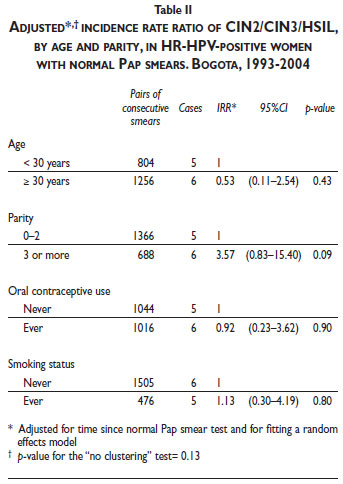
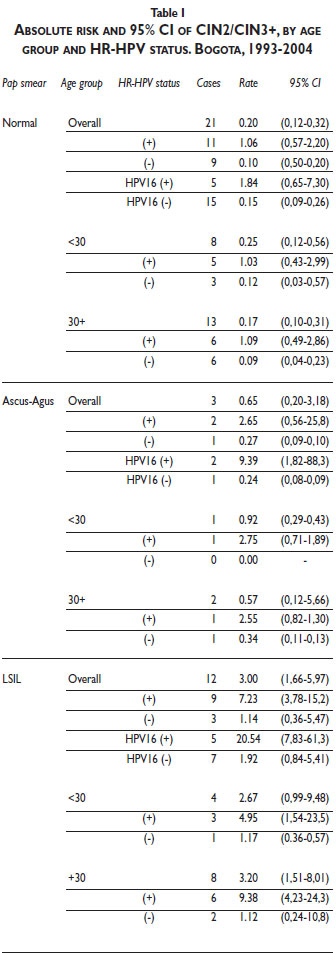
<body><![CDATA[<p><font face="Verdana, Arial, Helvetica, sans-serif" size="2">Of the 2 139 women    who were eventually included in the study, 261 came only for the initial visit    and did not return for further follow-up; they were therefore excluded from    this analysis. Of the remaining 1 878 women, 18 417 consecutive pairs of Pap    smear results were included, 13 284 of which had a valid HPV result at the index    visit, while 318 pairs had to be excluded due to a gap of 3 years or more between    visits. Thus, a total of 12 949 &#40;70&#37;&#41; pairs &#150;clustered in 1 409 women&#150; were    left for analysis. The average and median ages of the women at the time of the    index visit were 46 years and 44 years, respectively. The mean and median durations    between two visits were 10 and 6 months, respectively. By 2003, 10 years after    the first enrolment, 75&#37; percent of women with more than 1 visit were still    attending the scheduled visits. </font></p>     <p><font face="Verdana, Arial, Helvetica, sans-serif" size="2"> Thirty-six incident    cases &#40;9 CIN2, 16 CIN3, 3 invasive carcinoma, and 8 HSIL&#41; were observed during    11717 p-years of follow up, of which 21 &#40;7 CIN2; 7 CIN3; 2 invasive cancer and    5 HSIL&#41; were detected following a visit with normal Pap smear results. </font></p>     <p><font face="Verdana, Arial, Helvetica, sans-serif" size="2"> Absolute risk    of CIN2/CIN3+ among women with normal Pap smear results and concurrent positive    HR-HPV infection was 1.06&#37; &#40;95&#37;CI: 0.57&#150;2.20&#41;, which is    5 times higher than the CIN2/CIN3+ risk observed among all women with normal    Pap smear results &#40; 0.20; 95&#37;CI, 0.12&#150;0.32&#41; but less than half    the risk among HR-HPV-positive women with LSIL abnormality in the Pap smear    &#40;3.00; 95&#37;CI, 1.66- 5.97&#41; &#40;<a href="#tab1">Table I</a>&#41;.    The absolute risk &#40;1.84&#37;&#41; related to HPV16 in women with normal    Pap smear results was 9 times higher than that for all women with normal Pap    smear results and lower than that for women with LSIL &#40;20.54&#37;&#41; and    ASCUS &#40;9.39&#37;&#41; results. No risk difference for CIN2/CIN3+ was evident    with age. The risk of CIN2/3 was constant within 6-month intervals of time &#40;data    not shown&#41;.</font></p>     <p><a name="tab1"></a></p>     <p>&nbsp;</p>     <p align="center"><img src="/img/revistas/spm/v52n6/a02tab1.jpg"></p>     <p>&nbsp;</p>     <p><font face="Verdana, Arial, Helvetica, sans-serif" size="2"> The multivariate    analysis of cofactors associated with CIN2/CIN3 risk among women with normal    Pap smear results and concurrent positive HR-HPV results showed evidence of    a borderline association with parity &#40;&#8805;3 pregnancies; IRR 3.57; 95&#37;    CI, 0.83&#150;15.40; p = 0.09&#41;, including after taking clustering into account    &#40;p = 0.13&#41; &#40;<a href="#tab2">Table II</a>&#41;. </font></p>     <p><a name="tab2"></a></p>     <p>&nbsp;</p>     ]]></body>
<body><![CDATA[<p align="center"><img src="/img/revistas/spm/v52n6/a02tab2.jpg"></p>     <p>&nbsp;</p>     <p><font face="Verdana, Arial, Helvetica, sans-serif" size="3"><b>Discussion</b></font></p>     <p><font face="Verdana, Arial, Helvetica, sans-serif" size="2">To our knowledge,    this is the first report that focuses on the short-term &#40;immediate&#41; risk of    CIN2/CIN3+ for women followed periodically for more than 5 years. While previously    published results exist on incidence and determinants of HPV infection<sup>26</sup> and    on persistence and risk of high-grade cervical lesions in this cohort<sup>27</sup> &#150;providing    insight into long-term CIN2/CIN3 risk in our population&#150; our current analysis    reveals the magnitude and differences in short-term CIN2/CIN3 risk among women    with differing Pap smear results and HR-HPV status.</font></p>     <p><font face="Verdana, Arial, Helvetica, sans-serif" size="2"> The risk of CIN2/CIN3+    for women with normal Pap smear results and even those with concurrent positive    HR-HPV status &#40;cytology&#150;ve/HR-HPV+ve&#41; was low as compared to that observed    among women with mild abnormalities. This result may imply that establishing    HR-HPV status for women with normal cytology who were followed for 12 months    or less is not as useful as it is for women with ASCUS or LSIL cytology. </font></p>     <p><font face="Verdana, Arial, Helvetica, sans-serif" size="2"> According to our    results, HPV-HR testing of women with a normal Pap smear result requires 125    screenings &#40;NNS= /Risk difference of intervention * 100&#41; to detect CIN2/CIN3+    cases. This value is much higher compared to the NNS of HPV-HR testing observed    for women with ASCUS or LSIL &#40;50 and 25, respectively&#41;. Previous studies have    already recognized that the positive predictive value of a single Pap-negative,    HPV-positive cotest for CIN3 or higher remains less than ideal.<sup>28</sup></font></p>     <p><font face="Verdana, Arial, Helvetica, sans-serif" size="2"> The risk of CIN2/CIN3+    related to HPV 16 infection is the highest among women with normal and abnormal    cytology. This result agrees with the EUROGIN<sup>24</sup> recommendation of using a single    HPV 16 test as an alternative, to increase the specificity of the HR-HPV clinical    test &#40;i.e., Hybrid Capture II&#41;. However, the low short-term absolute risk observed    among women with normal cytology and concurrent HPV 16 infection &#40;1.84&#37;&#41; contrasts    with that observed among women with LSIL &#40;20.54&#37;&#41;, suggesting a potential limitation    of the short-term clinical utility of HPV-HR testing for women with a normal    Pap smear result. </font></p>     <p><font face="Verdana, Arial, Helvetica, sans-serif" size="2"> A recent clinical    trial showed that CIN2+ lesions &#150;which may spontaneously regress among women    aged 25-34 years&#150; may be over diagnosed if such women are immediately referred    to colposcopy after a positive HR-HPV result.29 In the case of older women,    the results still remain inconclusive. Data from the follow-up phase of the    same trial, which is currently underway, is expected to provide a direct estimate    of regression rates at different ages. Despite the fact that lesions found in    the 35 and older age group are expected to be potentially progressive, our results    show that the absolute risk of CIN2/3 in the short-term does not differ with    age. This is in agreement with the accumulating evidence that highlights the    relevance of HR-HPV persistence to CIN2/CIN3+ etiology and progression.<sup>27,30</sup>    Thus, clinical decision-making based on a single HR-HPV-positive result must    be revaluated. Clinicians should bear in mind that the number of women presenting    with concurrent normal Pap smear and positive HR-HPV results will probably increase    in the near future. A conservative approach, in accordance with current evidence,<sup>28</sup>    would be to retest the HPV status after 1 or 2 years of women with normal cytology    and concurrent HR-HPV positive result. </font></p>     <p><font face="Verdana, Arial, Helvetica, sans-serif" size="2"> Higher absolute    risk of CIN2/CIN3+ in women with lesser abnormalities agrees with the natural    progression of squamous intraepithelial lesions. Unfortunately, the low number    of events does not let us draw inferences regarding the differences in risk    between women with ASCUS and LSIL Pap smear results. Other studies have shown    overall higher rates of progression in women with LSIL as compared to women    with ASCUS, despite similar rates of HR-HPV infection.<sup>31</sup></font></p>     <p><font face="Verdana, Arial, Helvetica, sans-serif" size="2"> Parity was the    only cofactor that influenced the incidence risk of CIN2/CIN3+ for women in    this population with normal Pap smears. Women with normal Pap smear results    and more than two pregnancies presented a higher risk of detecting CIN2/CIN3    after an HR-HPV-positive test. Pregnancy has been shown to increase the exposure    of the transformation zone on the exocervix, escalating the risk of repeated    HPV infections. Recently, a large pooled analysis of multicentric case-control    studies on pregnancy and its association with cervical cancer demonstrated that    numerous pregnancies are related to invasive cervical cancer and early pregnancies    are related to CIN3+ lesions; thus, parity is a relevant cofactor that can influence    the difference in the cervical cancer risk between developed and developing    countries.<sup>32</sup></font></p>     ]]></body>
<body><![CDATA[<p><font face="Verdana, Arial, Helvetica, sans-serif" size="2"> Although our results    are obtained from a population-based study, we acknowledge that they may not    be generalizable to all populations worldwide. In fact, the likelihood of a    concurrent HR-HPV-positive result and a normal Pap smear test was higher among    our study population of women older than 30 years &#40;7.4&#37;&#41; in comparison with    other population-based studies,<sup>28</sup> reflecting differences in HR-HPV infection    dynamics across populations and thus affecting the positive predictive value    of HR-HPV testing.</font></p>     <p><font face="Verdana, Arial, Helvetica, sans-serif" size="2"> Our study has    several strengths, including the relatively large sample size, the broad age    range covered, the low proportion of refusals, the long follow-up period, the    short interval between follow-up visits &#40;median, 6 months&#41;, the comprehensive    information collected at baseline and during follow-up regarding risk factors,    and the use of sensitive and well-validated PCR assays for the detection of    HPV DNA in a central laboratory. By considering the time-dependent changing    HR-HPV status in the analysis strategy, we have attempted to overcome our main    limitation, which was the low number of CIN2/CIN3+ cases. This strategy maximizes    the statistical power of the low number of cases observed in our study during    follow-up.</font></p>     <p><font face="Verdana, Arial, Helvetica, sans-serif" size="2"> Our results may    not be directly applicable to clinical practice because the PCR methods used    for the HR-HPV diagnosis are not the same as the Hybrid Capture II currently    employed in clinical practice. Furthermore, colposcopy referral was performed    based only on Pap smear results, which might lead to an under diagnosis of CIN2+.    However, regarding the PCR test differences, there is evidence supporting that    the sensitivity and specificity do not largely differ between the above mentioned    two techniques.<sup>33</sup> On the other hand, the potential under diagnosis of CIN2+    in our study could be similar to that observed in the vast majority of screening    programs in which women are referred to colposcopy based on Pap smear results.    Therefore, although our results are not comparable to those derived from trials    or cohorts in which referral to colposcopy and biopsy is based on the results    of the HPV test, they may closely reflect actual clinical practice scenarios,    making our results more applicable, especially in Latin American countries.</font></p>     <p><font face="Verdana, Arial, Helvetica, sans-serif" size="2"> In conclusion,    the short-term absolute risk of CIN2/3 after a normal Pap smear with concurrent    HR-HPV infection is low &#40;~1&#37;&#41;, with no observed differences according to    age. In contrast to the strong negative predictive value of HPV testing, clinicians    should understand the limited usefulness of an HR-HPV-positive result to short-term    clinical decision-making for women with normal Pap smears. </font></p>     <p>&nbsp;</p>     <p><font face="Verdana, Arial, Helvetica, sans-serif" size="3"><b>Acknowledgments</b></font></p>     <p><font face="Verdana, Arial, Helvetica, sans-serif" size="2">Grant support was    received from the Colombian Science &amp; Research Department &#40;COLCIENCIAS&#41;;    the Department of Pathology, Vrije Universiteit Medical Center, the Netherlands;    and from contract &#40;#V501&#41; between Merck Research Laboratories and the Instituto    Nacional de Cancerologí-a, Colombia. We would like to thank Dr. Raul Murillo    at INC, Colombia for his comments on the manuscript. We would also like to thank    Dr. Alejandra Castanon at Wolfson Institute of Preventive Medicine, London UK    for her comments and English proof-reading before submitting this manuscript    for publication. The INC HPV study group: Drs. Monica Molano, Hector Posso,    Margarita Ronderos, Mauricio González, Joaquí-n Luna, Gilberto Martí-nez, Edmundo    Mora, Gonzalo Pérez, José Maria Fuentes, Constanza Gómez, Eva Klaus, Constanza    Camargo, Cecilia Tobón, Teodolinda Palacio, Carolina Suárez, and Claudia Molina.    </font></p>     <p><font face="Verdana, Arial, Helvetica, sans-serif" size="2"><i>Declaration    of conflicts of interest</i></font></p>     <p><font face="Verdana, Arial, Helvetica, sans-serif" size="2">We declare that    we have no conflicts of interest.</font></p>     <p>&nbsp;</p>     ]]></body>
<body><![CDATA[<p><font face="Verdana, Arial, Helvetica, sans-serif" size="3"><b>References</b></font></p>     <!-- ref --><p><font face="Verdana, Arial, Helvetica, sans-serif" size="2">1. Castellsague    X, Munoz N. Chapter 3: Cofactors in human papillomavirus carcinogenesis--role    of parity, oral contraceptives, and tobacco smoking. J Natl Cancer Inst Monogr    2003&#40;31&#41;:20-8.    &nbsp;&nbsp;&nbsp;&nbsp;&nbsp;&nbsp;&nbsp;&nbsp;[&#160;<a href="javascript:void(0);" onclick="javascript: window.open('/scielo.php?script=sci_nlinks&ref=9306086&pid=S0036-3634201000060000200001&lng=','','width=640,height=500,resizable=yes,scrollbars=1,menubar=yes,');">Links</a>&#160;]<!-- end-ref --></font></p>     <!-- ref --><p><font face="Verdana, Arial, Helvetica, sans-serif" size="2">2. Walboomers JM,    Jacobs MV, Manos MM, et al. Human papillomavirus is a necessary cause of invasive    cervical cancer worldwide. J Pathol 1999;189&#40;1&#41;:12-9.    &nbsp;&nbsp;&nbsp;&nbsp;&nbsp;&nbsp;&nbsp;&nbsp;[&#160;<a href="javascript:void(0);" onclick="javascript: window.open('/scielo.php?script=sci_nlinks&ref=9306088&pid=S0036-3634201000060000200002&lng=','','width=640,height=500,resizable=yes,scrollbars=1,menubar=yes,');">Links</a>&#160;]<!-- end-ref --></font></p>     <!-- ref --><p><font face="Verdana, Arial, Helvetica, sans-serif" size="2">3. Arbyn M, Paraskevaidis    E, Martin-Hirsch P, Prendiville W, Dillner J. Clinical utility of HPV-DNA detection:    triage of minor cervical lesions, follow-up of women treated for high-grade    CIN: an update of pooled evidence. Gynecol Oncol 2005;99&#40;3 Suppl 1&#41;:S7-11.    &nbsp;&nbsp;&nbsp;&nbsp;&nbsp;&nbsp;&nbsp;&nbsp;[&#160;<a href="javascript:void(0);" onclick="javascript: window.open('/scielo.php?script=sci_nlinks&ref=9306090&pid=S0036-3634201000060000200003&lng=','','width=640,height=500,resizable=yes,scrollbars=1,menubar=yes,');">Links</a>&#160;]<!-- end-ref --></font></p>     <!-- ref --><p><font face="Verdana, Arial, Helvetica, sans-serif" size="2">4. Cuzick J, Clavel    C, Petry KU, et al. Overview of the European and North American studies on HPV    testing in primary cervical cancer screening. Int J Cancer 2006;119&#40;5&#41;:1095-101.    &nbsp;&nbsp;&nbsp;&nbsp;&nbsp;&nbsp;&nbsp;&nbsp;[&#160;<a href="javascript:void(0);" onclick="javascript: window.open('/scielo.php?script=sci_nlinks&ref=9306092&pid=S0036-3634201000060000200004&lng=','','width=640,height=500,resizable=yes,scrollbars=1,menubar=yes,');">Links</a>&#160;]<!-- end-ref --></font></p>     <!-- ref --><p><font face="Verdana, Arial, Helvetica, sans-serif" size="2">5. Wright TC, Jr.,    Schiffman M, Solomon D, et al. Interim Guidance for the Use of Human Papillomavirus    DNA Testing as an Adjunct to Cervical Cytology for Screening. Obstet Gynecol    2004;103&#40;2&#41;:304-9.    &nbsp;&nbsp;&nbsp;&nbsp;&nbsp;&nbsp;&nbsp;&nbsp;[&#160;<a href="javascript:void(0);" onclick="javascript: window.open('/scielo.php?script=sci_nlinks&ref=9306094&pid=S0036-3634201000060000200005&lng=','','width=640,height=500,resizable=yes,scrollbars=1,menubar=yes,');">Links</a>&#160;]<!-- end-ref --></font></p>     <!-- ref --><p><font face="Verdana, Arial, Helvetica, sans-serif" size="2">6. Cuzick J, Szarewski    A, Cubie H, et al. Management of women who test positive for high-risk types    of human papillomavirus: the HART study. Lancet 2003;362&#40;9399&#41;:1871-6.    &nbsp;&nbsp;&nbsp;&nbsp;&nbsp;&nbsp;&nbsp;&nbsp;[&#160;<a href="javascript:void(0);" onclick="javascript: window.open('/scielo.php?script=sci_nlinks&ref=9306096&pid=S0036-3634201000060000200006&lng=','','width=640,height=500,resizable=yes,scrollbars=1,menubar=yes,');">Links</a>&#160;]<!-- end-ref --></font></p>     <!-- ref --><p><font face="Verdana, Arial, Helvetica, sans-serif" size="2">7. R. A. Smith,    V. Cokkinides, and H. J. Eyre. American Cancer Society guidelines for the early    detection of cancer, 2003. CA Cancer J Clin, January&nbsp;1,&nbsp;2003; 53&#40;1&#41;:    27 - 43 &#40;Accessed Sept 1, 2006, at <a href="http://caonline.amcancersoc.org/cgi/content/full/52/6/342" target="_blank">http://caonline.amcancersoc.org/cgi/content/full/52/6/342</a>.    &nbsp;&nbsp;&nbsp;&nbsp;&nbsp;&nbsp;&nbsp;&nbsp;[&#160;<a href="javascript:void(0);" onclick="javascript: window.open('/scielo.php?script=sci_nlinks&ref=9306098&pid=S0036-3634201000060000200007&lng=','','width=640,height=500,resizable=yes,scrollbars=1,menubar=yes,');">Links</a>&#160;]<!-- end-ref -->&#41;</font></p>     <!-- ref --><p><font face="Verdana, Arial, Helvetica, sans-serif" size="2">8. Kitchener HC,    Almonte M, Gilham C, et al. ARTISTIC: a randomised trial of human papillomavirus    &#40;HPV&#41; testing in primary cervical screening. Health Technol Assess 2009;13&#40;51&#41;:1-150,    iii-iv.    &nbsp;&nbsp;&nbsp;&nbsp;&nbsp;&nbsp;&nbsp;&nbsp;[&#160;<a href="javascript:void(0);" onclick="javascript: window.open('/scielo.php?script=sci_nlinks&ref=9306100&pid=S0036-3634201000060000200008&lng=','','width=640,height=500,resizable=yes,scrollbars=1,menubar=yes,');">Links</a>&#160;]<!-- end-ref --></font></p>     <!-- ref --><p><font face="Verdana, Arial, Helvetica, sans-serif" size="2">9. Bulkmans NW,    Berkhof J, Rozendaal L, et al. Human papillomavirus DNA testing for the detection    of cervical intraepithelial neoplasia grade 3 and cancer: 5-year follow-up of    a randomised controlled implementation trial. Lancet 2007;370&#40;9601&#41;:1764-72.    &nbsp;&nbsp;&nbsp;&nbsp;&nbsp;&nbsp;&nbsp;&nbsp;[&#160;<a href="javascript:void(0);" onclick="javascript: window.open('/scielo.php?script=sci_nlinks&ref=9306102&pid=S0036-3634201000060000200009&lng=','','width=640,height=500,resizable=yes,scrollbars=1,menubar=yes,');">Links</a>&#160;]<!-- end-ref --></font></p>     <!-- ref --><p><font face="Verdana, Arial, Helvetica, sans-serif" size="2">10. Naucler P,    Ryd W, Tornberg S, et al. Human papillomavirus and Papanicolaou tests to screen    for cervical cancer. N Engl J Med 2007;357&#40;16&#41;:1589-97.    &nbsp;&nbsp;&nbsp;&nbsp;&nbsp;&nbsp;&nbsp;&nbsp;[&#160;<a href="javascript:void(0);" onclick="javascript: window.open('/scielo.php?script=sci_nlinks&ref=9306104&pid=S0036-3634201000060000200010&lng=','','width=640,height=500,resizable=yes,scrollbars=1,menubar=yes,');">Links</a>&#160;]<!-- end-ref --></font></p>     <!-- ref --><p><font face="Verdana, Arial, Helvetica, sans-serif" size="2">11. Leinonen M,    Nieminen P, Kotaniemi-Talonen L, et al. Age-specific evaluation of primary human    papillomavirus screening vs conventional cytology in a randomized setting. J    Natl Cancer Inst 2009;101&#40;23&#41;:1612-23.    &nbsp;&nbsp;&nbsp;&nbsp;&nbsp;&nbsp;&nbsp;&nbsp;[&#160;<a href="javascript:void(0);" onclick="javascript: window.open('/scielo.php?script=sci_nlinks&ref=9306106&pid=S0036-3634201000060000200011&lng=','','width=640,height=500,resizable=yes,scrollbars=1,menubar=yes,');">Links</a>&#160;]<!-- end-ref --></font></p>     <!-- ref --><p><font face="Verdana, Arial, Helvetica, sans-serif" size="2">12. Lazcano-Ponce    E, Lorincz AT, Salmeron J, et al. A pilot study of HPV DNA and cytology testing    in 50,159 women in the routine Mexican Social Security Program. Cancer Causes    Control, 2010.    &nbsp;&nbsp;&nbsp;&nbsp;&nbsp;&nbsp;&nbsp;&nbsp;[&#160;<a href="javascript:void(0);" onclick="javascript: window.open('/scielo.php?script=sci_nlinks&ref=9306108&pid=S0036-3634201000060000200012&lng=','','width=640,height=500,resizable=yes,scrollbars=1,menubar=yes,');">Links</a>&#160;]<!-- end-ref --></font></p>     <!-- ref --><p><font face="Verdana, Arial, Helvetica, sans-serif" size="2">13. Castle PE,    Wacholder S, Sherman ME, et al. Absolute risk of a subsequent abnormal pap among    oncogenic human papillomavirus DNA-positive, cytologically negative women. Cancer    2002;95&#40;10&#41;:2145-51.    &nbsp;&nbsp;&nbsp;&nbsp;&nbsp;&nbsp;&nbsp;&nbsp;[&#160;<a href="javascript:void(0);" onclick="javascript: window.open('/scielo.php?script=sci_nlinks&ref=9306110&pid=S0036-3634201000060000200013&lng=','','width=640,height=500,resizable=yes,scrollbars=1,menubar=yes,');">Links</a>&#160;]<!-- end-ref --></font></p>     <!-- ref --><p><font face="Verdana, Arial, Helvetica, sans-serif" size="2">14. Sherman ME,    Lorincz AT, Scott DR, et al. Baseline cytology, human papillomavirus testing,    and risk for cervical neoplasia: a 10-year cohort analysis. J Natl Cancer Inst    2003;95&#40;1&#41;:46-52.    &nbsp;&nbsp;&nbsp;&nbsp;&nbsp;&nbsp;&nbsp;&nbsp;[&#160;<a href="javascript:void(0);" onclick="javascript: window.open('/scielo.php?script=sci_nlinks&ref=9306112&pid=S0036-3634201000060000200014&lng=','','width=640,height=500,resizable=yes,scrollbars=1,menubar=yes,');">Links</a>&#160;]<!-- end-ref --></font></p>     <!-- ref --><p><font face="Verdana, Arial, Helvetica, sans-serif" size="2">15. Kjaer S, Hogdall    E, Frederiksen K, et al. The absolute risk of cervical abnormalities in high-risk    human papillomavirus-positive, cytologically normal women over a 10-year period.    Cancer Res 2006;66&#40;21&#41;:10630-6.    &nbsp;&nbsp;&nbsp;&nbsp;&nbsp;&nbsp;&nbsp;&nbsp;[&#160;<a href="javascript:void(0);" onclick="javascript: window.open('/scielo.php?script=sci_nlinks&ref=9306114&pid=S0036-3634201000060000200015&lng=','','width=640,height=500,resizable=yes,scrollbars=1,menubar=yes,');">Links</a>&#160;]<!-- end-ref --></font></p>     <!-- ref --><p><font face="Verdana, Arial, Helvetica, sans-serif" size="2">16. Carozzi F,    Ronco G, Confortini M, et al. Prediction of high-grade cervical intraepithelial    neoplasia in cytologically normal women by human papillomavirus testing. Br    J Cancer 2000;83&#40;11&#41;:1462-7.    &nbsp;&nbsp;&nbsp;&nbsp;&nbsp;&nbsp;&nbsp;&nbsp;[&#160;<a href="javascript:void(0);" onclick="javascript: window.open('/scielo.php?script=sci_nlinks&ref=9306116&pid=S0036-3634201000060000200016&lng=','','width=640,height=500,resizable=yes,scrollbars=1,menubar=yes,');">Links</a>&#160;]<!-- end-ref --></font></p>     <!-- ref --><p><font face="Verdana, Arial, Helvetica, sans-serif" size="2">17. Liaw KL, Glass    AG, Manos MM, et al. Detection of human papillomavirus DNA in cytologically    normal women and subsequent cervical squamous intraepithelial lesions. J Natl    Cancer Inst 1999;91&#40;11&#41;:954-60.    &nbsp;&nbsp;&nbsp;&nbsp;&nbsp;&nbsp;&nbsp;&nbsp;[&#160;<a href="javascript:void(0);" onclick="javascript: window.open('/scielo.php?script=sci_nlinks&ref=9306118&pid=S0036-3634201000060000200017&lng=','','width=640,height=500,resizable=yes,scrollbars=1,menubar=yes,');">Links</a>&#160;]<!-- end-ref --></font></p>     <!-- ref --><p><font face="Verdana, Arial, Helvetica, sans-serif" size="2">18. Sackett DL,    Deeks JJ, Altman DG. Down with odds ratios! Evidence-Based Med 1996; 1: 164-166.    &nbsp;&nbsp;&nbsp;&nbsp;&nbsp;&nbsp;&nbsp;&nbsp;[&#160;<a href="javascript:void(0);" onclick="javascript: window.open('/scielo.php?script=sci_nlinks&ref=9306120&pid=S0036-3634201000060000200018&lng=','','width=640,height=500,resizable=yes,scrollbars=1,menubar=yes,');">Links</a>&#160;]<!-- end-ref --></font></p>     <!-- ref --><p><font face="Verdana, Arial, Helvetica, sans-serif" size="2">19. Molano M, Posso    H, Weiderpass E, et al. Prevalence and determinants of HPV infection among Colombian    women with normal cytology. Br J Cancer 2002;87&#40;3&#41;:324-33.    &nbsp;&nbsp;&nbsp;&nbsp;&nbsp;&nbsp;&nbsp;&nbsp;[&#160;<a href="javascript:void(0);" onclick="javascript: window.open('/scielo.php?script=sci_nlinks&ref=9306122&pid=S0036-3634201000060000200019&lng=','','width=640,height=500,resizable=yes,scrollbars=1,menubar=yes,');">Links</a>&#160;]<!-- end-ref --></font></p>     <!-- ref --><p><font face="Verdana, Arial, Helvetica, sans-serif" size="2">20. Jacobs MV,    Snijders PJ, van den Brule AJ, Helmerhorst TJ, Meijer CJ, Walboomers JM. A general    primer GP5+/GP6&#40;+&#41;-mediated PCR-enzyme immunoassay method for rapid detection    of 14 high-risk and 6 low-risk human papillomavirus genotypes in cervical scrapings.    J Clin Microbiol 1997;35&#40;3&#41;:791-5.    &nbsp;&nbsp;&nbsp;&nbsp;&nbsp;&nbsp;&nbsp;&nbsp;[&#160;<a href="javascript:void(0);" onclick="javascript: window.open('/scielo.php?script=sci_nlinks&ref=9306124&pid=S0036-3634201000060000200020&lng=','','width=640,height=500,resizable=yes,scrollbars=1,menubar=yes,');">Links</a>&#160;]<!-- end-ref --></font></p>     <!-- ref --><p><font face="Verdana, Arial, Helvetica, sans-serif" size="2">21. Munoz N, Bosch    FX, de Sanjose S, et al. Epidemiologic classification of human papillomavirus    types associated with cervical cancer. N Engl J Med 2003;348&#40;6&#41;:518-27.    &nbsp;&nbsp;&nbsp;&nbsp;&nbsp;&nbsp;&nbsp;&nbsp;[&#160;<a href="javascript:void(0);" onclick="javascript: window.open('/scielo.php?script=sci_nlinks&ref=9306126&pid=S0036-3634201000060000200021&lng=','','width=640,height=500,resizable=yes,scrollbars=1,menubar=yes,');">Links</a>&#160;]<!-- end-ref --></font></p>     <!-- ref --><p><font face="Verdana, Arial, Helvetica, sans-serif" size="2">22. Luff RD. The    Bethesda System for reporting cervical/vaginal cytologic diagnoses: report of    the 1991 Bethesda workshop. The Bethesda System Editorial Committee. Hum Pathol    1992;23&#40;7&#41;:719-21.    &nbsp;&nbsp;&nbsp;&nbsp;&nbsp;&nbsp;&nbsp;&nbsp;[&#160;<a href="javascript:void(0);" onclick="javascript: window.open('/scielo.php?script=sci_nlinks&ref=9306128&pid=S0036-3634201000060000200022&lng=','','width=640,height=500,resizable=yes,scrollbars=1,menubar=yes,');">Links</a>&#160;]<!-- end-ref --></font></p>     <!-- ref --><p><font face="Verdana, Arial, Helvetica, sans-serif" size="2">23. Gage JC, Hanson    VW, Abbey K, et al. Number of cervical biopsies and sensitivity of colposcopy.    Obstet Gynecol 2006;108&#40;2&#41;:264-72.    &nbsp;&nbsp;&nbsp;&nbsp;&nbsp;&nbsp;&nbsp;&nbsp;[&#160;<a href="javascript:void(0);" onclick="javascript: window.open('/scielo.php?script=sci_nlinks&ref=9306130&pid=S0036-3634201000060000200023&lng=','','width=640,height=500,resizable=yes,scrollbars=1,menubar=yes,');">Links</a>&#160;]<!-- end-ref --></font></p>     <!-- ref --><p><font face="Verdana, Arial, Helvetica, sans-serif" size="2">24. Schlecht NF,    Platt RW, Negassa A, et al. Modeling the time dependence of the association    between human papillomavirus infection and cervical cancer precursor lesions.    Am J Epidemiol 2003;158&#40;9&#41;:878-86.    &nbsp;&nbsp;&nbsp;&nbsp;&nbsp;&nbsp;&nbsp;&nbsp;[&#160;<a href="javascript:void(0);" onclick="javascript: window.open('/scielo.php?script=sci_nlinks&ref=9306132&pid=S0036-3634201000060000200024&lng=','','width=640,height=500,resizable=yes,scrollbars=1,menubar=yes,');">Links</a>&#160;]<!-- end-ref --></font></p>     <!-- ref --><p><font face="Verdana, Arial, Helvetica, sans-serif" size="2">25. Hedeker D,    Siddiqui O, Hu FB. Random-effects regression analysis of correlated grouped-time    survival data. Statistical Methods in Medical Research 2000;9&#40;2&#41;:161-79.    &nbsp;&nbsp;&nbsp;&nbsp;&nbsp;&nbsp;&nbsp;&nbsp;[&#160;<a href="javascript:void(0);" onclick="javascript: window.open('/scielo.php?script=sci_nlinks&ref=9306134&pid=S0036-3634201000060000200025&lng=','','width=640,height=500,resizable=yes,scrollbars=1,menubar=yes,');">Links</a>&#160;]<!-- end-ref --></font></p>     <!-- ref --><p><font face="Verdana, Arial, Helvetica, sans-serif" size="2">26. Munoz N, Mendez    F, Posso H, et al. Incidence, duration, and determinants of cervical human papillomavirus    infection in a cohort of Colombian women with normal cytological results. J    Infect Dis 2004;190&#40;12&#41;:2077-87.    &nbsp;&nbsp;&nbsp;&nbsp;&nbsp;&nbsp;&nbsp;&nbsp;[&#160;<a href="javascript:void(0);" onclick="javascript: window.open('/scielo.php?script=sci_nlinks&ref=9306136&pid=S0036-3634201000060000200026&lng=','','width=640,height=500,resizable=yes,scrollbars=1,menubar=yes,');">Links</a>&#160;]<!-- end-ref --></font></p>     <!-- ref --><p><font face="Verdana, Arial, Helvetica, sans-serif" size="2">27. Munoz N, Hernandez-Suarez    G, Mendez F, et al. Persistence of HPV infection and risk of high-grade cervical    intraepithelial neoplasia in a cohort of Colombian women. Br J Cancer 2009;100&#40;7&#41;:1184-90.    &nbsp;&nbsp;&nbsp;&nbsp;&nbsp;&nbsp;&nbsp;&nbsp;[&#160;<a href="javascript:void(0);" onclick="javascript: window.open('/scielo.php?script=sci_nlinks&ref=9306138&pid=S0036-3634201000060000200027&lng=','','width=640,height=500,resizable=yes,scrollbars=1,menubar=yes,');">Links</a>&#160;]<!-- end-ref --></font></p>     <!-- ref --><p><font face="Verdana, Arial, Helvetica, sans-serif" size="2">28. Castle PE,    Fetterman B, Poitras N, Lorey T, Shaber R, Kinney W. Five-year experience of    human papillomavirus DNA and Papanicolaou test cotesting. Obstet Gynecol 2009;113&#40;3&#41;:595-600.    &nbsp;&nbsp;&nbsp;&nbsp;&nbsp;&nbsp;&nbsp;&nbsp;[&#160;<a href="javascript:void(0);" onclick="javascript: window.open('/scielo.php?script=sci_nlinks&ref=9306140&pid=S0036-3634201000060000200028&lng=','','width=640,height=500,resizable=yes,scrollbars=1,menubar=yes,');">Links</a>&#160;]<!-- end-ref --></font></p>     <!-- ref --><p><font face="Verdana, Arial, Helvetica, sans-serif" size="2">29. Ronco G, Giorgi-Rossi    P, Carozzi F, et al. Results at recruitment from a randomized controlled trial    comparing human papillomavirus testing alone with conventional cytology as the    primary cervical cancer screening test. J Natl Cancer Inst 2008;100&#40;7&#41;:492-501.    &nbsp;&nbsp;&nbsp;&nbsp;&nbsp;&nbsp;&nbsp;&nbsp;[&#160;<a href="javascript:void(0);" onclick="javascript: window.open('/scielo.php?script=sci_nlinks&ref=9306142&pid=S0036-3634201000060000200029&lng=','','width=640,height=500,resizable=yes,scrollbars=1,menubar=yes,');">Links</a>&#160;]<!-- end-ref --></font></p>     <!-- ref --><p><font face="Verdana, Arial, Helvetica, sans-serif" size="2">30. Castle PE,    Rodriguez AC, Burk RD, et al. Short term persistence of human papillomavirus    and risk of cervical precancer and cancer: population based cohort study. Bmj    2009;339:b2569.    &nbsp;&nbsp;&nbsp;&nbsp;&nbsp;&nbsp;&nbsp;&nbsp;[&#160;<a href="javascript:void(0);" onclick="javascript: window.open('/scielo.php?script=sci_nlinks&ref=9306144&pid=S0036-3634201000060000200030&lng=','','width=640,height=500,resizable=yes,scrollbars=1,menubar=yes,');">Links</a>&#160;]<!-- end-ref --></font></p>     <!-- ref --><p><font face="Verdana, Arial, Helvetica, sans-serif" size="2">31. Castle PE,    Solomon D, Schiffman M, Wheeler CM. Human papillomavirus type 16 infections    and 2-year absolute risk of cervical precancer in women with equivocal or mild    cytologic abnormalities. J Natl Cancer Inst 2005;97&#40;14&#41;:1066-71.    &nbsp;&nbsp;&nbsp;&nbsp;&nbsp;&nbsp;&nbsp;&nbsp;[&#160;<a href="javascript:void(0);" onclick="javascript: window.open('/scielo.php?script=sci_nlinks&ref=9306146&pid=S0036-3634201000060000200031&lng=','','width=640,height=500,resizable=yes,scrollbars=1,menubar=yes,');">Links</a>&#160;]<!-- end-ref --></font></p>     <!-- ref --><p><font face="Verdana, Arial, Helvetica, sans-serif" size="2">32. Cervical carcinoma    and reproductive factors: collaborative reanalysis of individual data on 16,563    women with cervical carcinoma and 33,542 women without cervical carcinoma from    25 epidemiological studies. Int J Cancer 2006;119&#40;5&#41;:1108-24.    &nbsp;&nbsp;&nbsp;&nbsp;&nbsp;&nbsp;&nbsp;&nbsp;[&#160;<a href="javascript:void(0);" onclick="javascript: window.open('/scielo.php?script=sci_nlinks&ref=9306148&pid=S0036-3634201000060000200032&lng=','','width=640,height=500,resizable=yes,scrollbars=1,menubar=yes,');">Links</a>&#160;]<!-- end-ref --></font></p>     <!-- ref --><p><font face="Verdana, Arial, Helvetica, sans-serif" size="2">33. Bozzetti M,    Nonnenmacher B, Mielzinska II, et al. Comparison between hybrid capture II and    polymerase chain reaction results among women at low risk for cervical cancer.    Ann Epidemiol 2000;10&#40;7&#41;:466.    &nbsp;&nbsp;&nbsp;&nbsp;&nbsp;&nbsp;&nbsp;&nbsp;[&#160;<a href="javascript:void(0);" onclick="javascript: window.open('/scielo.php?script=sci_nlinks&ref=9306150&pid=S0036-3634201000060000200033&lng=','','width=640,height=500,resizable=yes,scrollbars=1,menubar=yes,');">Links</a>&#160;]<!-- end-ref --></font></p>     <p>&nbsp;</p>     <p>&nbsp;</p>     <p><font face="Verdana, Arial, Helvetica, sans-serif" size="2"> Address reprints    requests to: Dr. Gustavo Hernández-Suárez. Instituto Nacional de Cancerologí-a,    Grupo de Investigación epidemiológica.    ]]></body>
<body><![CDATA[<br>   Av 1 No 9-85, tercer piso. Bogotá, Colombia.    <br>   E-mail: <a href="mailto:gahernandez@cancer.gov.co">gahernandez@cancer.gov.co</a></font></p>     <p>&nbsp;</p>     <p>&nbsp;</p>     <p><font face="Verdana, Arial, Helvetica, sans-serif" size="2"><b>Received on:</b>    May 10, 2010     <br>   <b>Accepted on:</b> September 29, 2010</font></p>        ]]></body><back>
<ref-list>
<ref id="B1">
<label>1</label><nlm-citation citation-type="journal">
<person-group person-group-type="author">
<name>
<surname><![CDATA[Castellsague]]></surname>
<given-names><![CDATA[X]]></given-names>
</name>
<name>
<surname><![CDATA[Munoz]]></surname>
<given-names><![CDATA[N]]></given-names>
</name>
</person-group>
<article-title xml:lang="en"><![CDATA[Chapter 3: Cofactors in human papillomavirus carcinogenesis--role of parity, oral contraceptives, and tobacco smoking]]></article-title>
<source><![CDATA[J Natl Cancer Inst Monogr]]></source>
<year>2003</year>
<volume>31</volume>
<page-range>20-8</page-range></nlm-citation>
</ref>
<ref id="B2">
<label>2</label><nlm-citation citation-type="journal">
<person-group person-group-type="author">
<name>
<surname><![CDATA[Walboomers]]></surname>
<given-names><![CDATA[JM]]></given-names>
</name>
<name>
<surname><![CDATA[Jacobs]]></surname>
<given-names><![CDATA[MV]]></given-names>
</name>
<name>
<surname><![CDATA[Manos]]></surname>
<given-names><![CDATA[MM]]></given-names>
</name>
</person-group>
<article-title xml:lang="en"><![CDATA[Human papillomavirus is a necessary cause of invasive cervical cancer worldwide]]></article-title>
<source><![CDATA[J Pathol]]></source>
<year>1999</year>
<volume>189</volume>
<numero>1</numero>
<issue>1</issue>
<page-range>12-9</page-range></nlm-citation>
</ref>
<ref id="B3">
<label>3</label><nlm-citation citation-type="journal">
<person-group person-group-type="author">
<name>
<surname><![CDATA[Arbyn]]></surname>
<given-names><![CDATA[M]]></given-names>
</name>
<name>
<surname><![CDATA[Paraskevaidis]]></surname>
<given-names><![CDATA[E]]></given-names>
</name>
<name>
<surname><![CDATA[Martin-Hirsch]]></surname>
<given-names><![CDATA[P]]></given-names>
</name>
<name>
<surname><![CDATA[Prendiville]]></surname>
<given-names><![CDATA[W]]></given-names>
</name>
<name>
<surname><![CDATA[Dillner]]></surname>
<given-names><![CDATA[J]]></given-names>
</name>
</person-group>
<article-title xml:lang="en"><![CDATA[Clinical utility of HPV-DNA detection: triage of minor cervical lesions, follow-up of women treated for high-grade CIN: an update of pooled evidence]]></article-title>
<source><![CDATA[Gynecol Oncol]]></source>
<year>2005</year>
<month>99</month>
<volume>3</volume>
<numero>1</numero>
<issue>1</issue>
<page-range>S7-11</page-range></nlm-citation>
</ref>
<ref id="B4">
<label>4</label><nlm-citation citation-type="journal">
<person-group person-group-type="author">
<name>
<surname><![CDATA[Cuzick]]></surname>
<given-names><![CDATA[J]]></given-names>
</name>
<name>
<surname><![CDATA[Clavel]]></surname>
<given-names><![CDATA[C]]></given-names>
</name>
<name>
<surname><![CDATA[Petry]]></surname>
<given-names><![CDATA[KU]]></given-names>
</name>
</person-group>
<article-title xml:lang="en"><![CDATA[Overview of the European and North American studies on HPV testing in primary cervical cancer screening]]></article-title>
<source><![CDATA[Int J Cancer]]></source>
<year>2006</year>
<volume>119</volume>
<numero>5</numero>
<issue>5</issue>
<page-range>1095-101</page-range></nlm-citation>
</ref>
<ref id="B5">
<label>5</label><nlm-citation citation-type="journal">
<person-group person-group-type="author">
<name>
<surname><![CDATA[Wright]]></surname>
<given-names><![CDATA[TC, Jr.]]></given-names>
</name>
<name>
<surname><![CDATA[Schiffman]]></surname>
<given-names><![CDATA[M]]></given-names>
</name>
<name>
<surname><![CDATA[Solomon]]></surname>
<given-names><![CDATA[D]]></given-names>
</name>
</person-group>
<article-title xml:lang="en"><![CDATA[Interim Guidance for the Use of Human Papillomavirus DNA Testing as an Adjunct to Cervical Cytology for Screening]]></article-title>
<source><![CDATA[Obstet Gynecol]]></source>
<year>2004</year>
<volume>103</volume>
<numero>2</numero>
<issue>2</issue>
<page-range>304-9</page-range></nlm-citation>
</ref>
<ref id="B6">
<label>6</label><nlm-citation citation-type="journal">
<person-group person-group-type="author">
<name>
<surname><![CDATA[Cuzick]]></surname>
<given-names><![CDATA[J]]></given-names>
</name>
<name>
<surname><![CDATA[Szarewski]]></surname>
<given-names><![CDATA[A]]></given-names>
</name>
<name>
<surname><![CDATA[Cubie]]></surname>
<given-names><![CDATA[H]]></given-names>
</name>
</person-group>
<article-title xml:lang="en"><![CDATA[Management of women who test positive for high-risk types of human papillomavirus: the HART study]]></article-title>
<source><![CDATA[Lancet]]></source>
<year>2003</year>
<volume>362</volume>
<numero>9399</numero>
<issue>9399</issue>
<page-range>1871-6</page-range></nlm-citation>
</ref>
<ref id="B7">
<label>7</label><nlm-citation citation-type="journal">
<person-group person-group-type="author">
<name>
<surname><![CDATA[Smith]]></surname>
<given-names><![CDATA[R. A.]]></given-names>
</name>
<name>
<surname><![CDATA[Cokkinides]]></surname>
<given-names><![CDATA[V.]]></given-names>
</name>
<name>
<surname><![CDATA[Eyre]]></surname>
<given-names><![CDATA[H.]]></given-names>
</name>
</person-group>
<article-title xml:lang="en"><![CDATA[American Cancer Society guidelines for the early detection of cancer, 2003]]></article-title>
<source><![CDATA[CA Cancer J Clin]]></source>
<year>Janu</year>
<month>ar</month>
<day>y </day>
<volume>53</volume>
<numero>1</numero>
<issue>1</issue>
<page-range>27 - 43</page-range></nlm-citation>
</ref>
<ref id="B8">
<label>8</label><nlm-citation citation-type="journal">
<person-group person-group-type="author">
<name>
<surname><![CDATA[Kitchener]]></surname>
<given-names><![CDATA[HC]]></given-names>
</name>
<name>
<surname><![CDATA[Almonte]]></surname>
<given-names><![CDATA[M]]></given-names>
</name>
<name>
<surname><![CDATA[Gilham]]></surname>
<given-names><![CDATA[C]]></given-names>
</name>
</person-group>
<article-title xml:lang="en"><![CDATA[ARTISTIC: a randomised trial of human papillomavirus (HPV) testing in primary cervical screening]]></article-title>
<source><![CDATA[Health Technol Assess]]></source>
<year>2009</year>
<volume>13</volume>
<numero>51</numero>
<issue>51</issue>
<page-range>1-150</page-range></nlm-citation>
</ref>
<ref id="B9">
<label>9</label><nlm-citation citation-type="journal">
<person-group person-group-type="author">
<name>
<surname><![CDATA[Bulkmans]]></surname>
<given-names><![CDATA[NW]]></given-names>
</name>
<name>
<surname><![CDATA[Berkhof]]></surname>
<given-names><![CDATA[J]]></given-names>
</name>
<name>
<surname><![CDATA[Rozendaal]]></surname>
<given-names><![CDATA[L]]></given-names>
</name>
</person-group>
<article-title xml:lang="en"><![CDATA[Human papillomavirus DNA testing for the detection of cervical intraepithelial neoplasia grade 3 and cancer: 5-year follow-up of a randomised controlled implementation trial]]></article-title>
<source><![CDATA[Lancet]]></source>
<year>2007</year>
<volume>370</volume>
<numero>9601</numero>
<issue>9601</issue>
<page-range>1764-72</page-range></nlm-citation>
</ref>
<ref id="B10">
<label>10</label><nlm-citation citation-type="journal">
<person-group person-group-type="author">
<name>
<surname><![CDATA[Naucler]]></surname>
<given-names><![CDATA[P]]></given-names>
</name>
<name>
<surname><![CDATA[Ryd]]></surname>
<given-names><![CDATA[W]]></given-names>
</name>
<name>
<surname><![CDATA[Tornberg]]></surname>
<given-names><![CDATA[S]]></given-names>
</name>
</person-group>
<article-title xml:lang="en"><![CDATA[Human papillomavirus and Papanicolaou tests to screen for cervical cancer]]></article-title>
<source><![CDATA[N Engl J Med]]></source>
<year>2007</year>
<volume>357</volume>
<numero>16</numero>
<issue>16</issue>
<page-range>1589-97</page-range></nlm-citation>
</ref>
<ref id="B11">
<label>11</label><nlm-citation citation-type="journal">
<person-group person-group-type="author">
<name>
<surname><![CDATA[Leinonen]]></surname>
<given-names><![CDATA[M]]></given-names>
</name>
<name>
<surname><![CDATA[Nieminen]]></surname>
<given-names><![CDATA[P]]></given-names>
</name>
<name>
<surname><![CDATA[Kotaniemi-Talonen]]></surname>
<given-names><![CDATA[L]]></given-names>
</name>
</person-group>
<article-title xml:lang="en"><![CDATA[Age-specific evaluation of primary human papillomavirus screening vs conventional cytology in a randomized setting]]></article-title>
<source><![CDATA[J Natl Cancer Inst]]></source>
<year>2009</year>
<volume>101</volume>
<numero>23</numero>
<issue>23</issue>
<page-range>1612-23</page-range></nlm-citation>
</ref>
<ref id="B12">
<label>12</label><nlm-citation citation-type="">
<person-group person-group-type="author">
<name>
<surname><![CDATA[Lazcano-Ponce]]></surname>
<given-names><![CDATA[E]]></given-names>
</name>
<name>
<surname><![CDATA[Lorincz]]></surname>
<given-names><![CDATA[AT]]></given-names>
</name>
<name>
<surname><![CDATA[Salmeron]]></surname>
<given-names><![CDATA[J]]></given-names>
</name>
</person-group>
<article-title xml:lang="en"><![CDATA[A pilot study of HPV DNA and cytology testing in 50,159 women in the routine Mexican Social Security Program]]></article-title>
<source><![CDATA[Cancer Causes Control]]></source>
<year>2010</year>
</nlm-citation>
</ref>
<ref id="B13">
<label>13</label><nlm-citation citation-type="journal">
<person-group person-group-type="author">
<name>
<surname><![CDATA[Castle]]></surname>
<given-names><![CDATA[PE]]></given-names>
</name>
<name>
<surname><![CDATA[Wacholder]]></surname>
<given-names><![CDATA[S]]></given-names>
</name>
<name>
<surname><![CDATA[Sherman]]></surname>
<given-names><![CDATA[ME]]></given-names>
</name>
</person-group>
<article-title xml:lang="en"><![CDATA[Absolute risk of a subsequent abnormal pap among oncogenic human papillomavirus DNA-positive, cytologically negative women]]></article-title>
<source><![CDATA[Cancer]]></source>
<year>2002</year>
<volume>95</volume>
<numero>10</numero>
<issue>10</issue>
<page-range>2145-51</page-range></nlm-citation>
</ref>
<ref id="B14">
<label>14</label><nlm-citation citation-type="journal">
<person-group person-group-type="author">
<name>
<surname><![CDATA[Sherman]]></surname>
<given-names><![CDATA[ME]]></given-names>
</name>
<name>
<surname><![CDATA[Lorincz]]></surname>
<given-names><![CDATA[AT]]></given-names>
</name>
<name>
<surname><![CDATA[Scott]]></surname>
<given-names><![CDATA[DR]]></given-names>
</name>
</person-group>
<article-title xml:lang="en"><![CDATA[Baseline cytology, human papillomavirus testing, and risk for cervical neoplasia: a 10-year cohort analysis]]></article-title>
<source><![CDATA[J Natl Cancer Inst]]></source>
<year>2003</year>
<volume>95</volume>
<numero>1</numero>
<issue>1</issue>
<page-range>46-52</page-range></nlm-citation>
</ref>
<ref id="B15">
<label>15</label><nlm-citation citation-type="journal">
<person-group person-group-type="author">
<name>
<surname><![CDATA[Kjaer]]></surname>
<given-names><![CDATA[S]]></given-names>
</name>
<name>
<surname><![CDATA[Hogdall]]></surname>
<given-names><![CDATA[E]]></given-names>
</name>
<name>
<surname><![CDATA[Frederiksen]]></surname>
<given-names><![CDATA[K]]></given-names>
</name>
</person-group>
<article-title xml:lang="en"><![CDATA[The absolute risk of cervical abnormalities in high-risk human papillomavirus-positive, cytologically normal women over a 10-year period]]></article-title>
<source><![CDATA[Cancer Res]]></source>
<year>2006</year>
<volume>66</volume>
<numero>21</numero>
<issue>21</issue>
<page-range>10630-6</page-range></nlm-citation>
</ref>
<ref id="B16">
<label>16</label><nlm-citation citation-type="journal">
<person-group person-group-type="author">
<name>
<surname><![CDATA[Carozzi]]></surname>
<given-names><![CDATA[F]]></given-names>
</name>
<name>
<surname><![CDATA[Ronco]]></surname>
<given-names><![CDATA[G]]></given-names>
</name>
<name>
<surname><![CDATA[Confortini]]></surname>
<given-names><![CDATA[M]]></given-names>
</name>
</person-group>
<article-title xml:lang="en"><![CDATA[Prediction of high-grade cervical intraepithelial neoplasia in cytologically normal women by human papillomavirus testing]]></article-title>
<source><![CDATA[Br J Cancer]]></source>
<year>2000</year>
<volume>83</volume>
<numero>11</numero>
<issue>11</issue>
<page-range>1462-7</page-range></nlm-citation>
</ref>
<ref id="B17">
<label>17</label><nlm-citation citation-type="journal">
<person-group person-group-type="author">
<name>
<surname><![CDATA[Liaw]]></surname>
<given-names><![CDATA[KL]]></given-names>
</name>
<name>
<surname><![CDATA[Glass]]></surname>
<given-names><![CDATA[AG]]></given-names>
</name>
<name>
<surname><![CDATA[Manos]]></surname>
<given-names><![CDATA[MM]]></given-names>
</name>
</person-group>
<article-title xml:lang="en"><![CDATA[Detection of human papillomavirus DNA in cytologically normal women and subsequent cervical squamous intraepithelial lesions]]></article-title>
<source><![CDATA[J Natl Cancer Inst]]></source>
<year>1999</year>
<volume>91</volume>
<numero>11</numero>
<issue>11</issue>
<page-range>954-60</page-range></nlm-citation>
</ref>
<ref id="B18">
<label>18</label><nlm-citation citation-type="journal">
<person-group person-group-type="author">
<name>
<surname><![CDATA[Sackett]]></surname>
<given-names><![CDATA[DL]]></given-names>
</name>
<name>
<surname><![CDATA[Deeks]]></surname>
<given-names><![CDATA[JJ]]></given-names>
</name>
<name>
<surname><![CDATA[Altman]]></surname>
<given-names><![CDATA[DG]]></given-names>
</name>
</person-group>
<article-title xml:lang="en"><![CDATA[Down with odds ratios]]></article-title>
<source><![CDATA[Evidence-Based Med]]></source>
<year>1996</year>
<volume>1</volume>
<page-range>164-166</page-range></nlm-citation>
</ref>
<ref id="B19">
<label>19</label><nlm-citation citation-type="journal">
<person-group person-group-type="author">
<name>
<surname><![CDATA[Molano]]></surname>
<given-names><![CDATA[M]]></given-names>
</name>
<name>
<surname><![CDATA[Posso]]></surname>
<given-names><![CDATA[H]]></given-names>
</name>
<name>
<surname><![CDATA[Weiderpass]]></surname>
<given-names><![CDATA[E]]></given-names>
</name>
</person-group>
<article-title xml:lang="en"><![CDATA[Prevalence and determinants of HPV infection among Colombian women with normal cytology]]></article-title>
<source><![CDATA[Br J Cancer]]></source>
<year>2002</year>
<volume>87</volume>
<numero>3</numero>
<issue>3</issue>
<page-range>324-33</page-range></nlm-citation>
</ref>
<ref id="B20">
<label>20</label><nlm-citation citation-type="journal">
<person-group person-group-type="author">
<name>
<surname><![CDATA[Jacobs]]></surname>
<given-names><![CDATA[MV]]></given-names>
</name>
<name>
<surname><![CDATA[Snijders]]></surname>
<given-names><![CDATA[PJ]]></given-names>
</name>
</person-group>
<collab>van den Brule AJ.Helmerhorst TJ.Meijer CJ.Walboomers JM</collab>
<article-title xml:lang="en"><![CDATA[A general primer GP5+/GP6(+)-mediated PCR-enzyme immunoassay method for rapid detection of 14 high-risk and 6 low-risk human papillomavirus genotypes in cervical scrapings]]></article-title>
<source><![CDATA[J Clin Microbiol]]></source>
<year>1997</year>
<volume>35</volume>
<numero>3</numero>
<issue>3</issue>
<page-range>791-5</page-range></nlm-citation>
</ref>
<ref id="B21">
<label>21</label><nlm-citation citation-type="journal">
<person-group person-group-type="author">
<name>
<surname><![CDATA[Munoz]]></surname>
<given-names><![CDATA[N]]></given-names>
</name>
<name>
<surname><![CDATA[Bosch]]></surname>
<given-names><![CDATA[FX]]></given-names>
</name>
<name>
<surname><![CDATA[de Sanjose]]></surname>
<given-names><![CDATA[S]]></given-names>
</name>
</person-group>
<article-title xml:lang="en"><![CDATA[Epidemiologic classification of human papillomavirus types associated with cervical cancer]]></article-title>
<source><![CDATA[N Engl J Med]]></source>
<year>2003</year>
<volume>348</volume>
<numero>6</numero>
<issue>6</issue>
<page-range>518-27</page-range></nlm-citation>
</ref>
<ref id="B22">
<label>22</label><nlm-citation citation-type="journal">
<person-group person-group-type="author">
<name>
<surname><![CDATA[Luff]]></surname>
<given-names><![CDATA[RD]]></given-names>
</name>
</person-group>
<article-title xml:lang="en"><![CDATA[The Bethesda System for reporting cervical/vaginal cytologic diagnoses: report of the 1991 Bethesda workshop. The Bethesda System Editorial Committee]]></article-title>
<source><![CDATA[Hum Pathol]]></source>
<year>1992</year>
<volume>23</volume>
<numero>7</numero>
<issue>7</issue>
<page-range>719-21</page-range></nlm-citation>
</ref>
<ref id="B23">
<label>23</label><nlm-citation citation-type="journal">
<person-group person-group-type="author">
<name>
<surname><![CDATA[Gage]]></surname>
<given-names><![CDATA[JC]]></given-names>
</name>
<name>
<surname><![CDATA[Hanson]]></surname>
<given-names><![CDATA[VW]]></given-names>
</name>
<name>
<surname><![CDATA[Abbey]]></surname>
<given-names><![CDATA[K]]></given-names>
</name>
</person-group>
<article-title xml:lang="en"><![CDATA[Number of cervical biopsies and sensitivity of colposcopy]]></article-title>
<source><![CDATA[Obstet Gynecol]]></source>
<year>2006</year>
<volume>108</volume>
<numero>2</numero>
<issue>2</issue>
<page-range>264-72</page-range></nlm-citation>
</ref>
<ref id="B24">
<label>24</label><nlm-citation citation-type="journal">
<person-group person-group-type="author">
<name>
<surname><![CDATA[Schlecht]]></surname>
<given-names><![CDATA[NF]]></given-names>
</name>
<name>
<surname><![CDATA[Platt]]></surname>
<given-names><![CDATA[RW]]></given-names>
</name>
<name>
<surname><![CDATA[Negassa]]></surname>
<given-names><![CDATA[A]]></given-names>
</name>
</person-group>
<article-title xml:lang="en"><![CDATA[Modeling the time dependence of the association between human papillomavirus infection and cervical cancer precursor lesions]]></article-title>
<source><![CDATA[Am J Epidemiol]]></source>
<year>2003</year>
<volume>158</volume>
<numero>9</numero>
<issue>9</issue>
<page-range>878-86</page-range></nlm-citation>
</ref>
<ref id="B25">
<label>25</label><nlm-citation citation-type="journal">
<person-group person-group-type="author">
<name>
<surname><![CDATA[Hedeker]]></surname>
<given-names><![CDATA[D]]></given-names>
</name>
<name>
<surname><![CDATA[Siddiqui]]></surname>
<given-names><![CDATA[O]]></given-names>
</name>
<name>
<surname><![CDATA[Hu]]></surname>
<given-names><![CDATA[FB]]></given-names>
</name>
</person-group>
<article-title xml:lang="en"><![CDATA[Random-effects regression analysis of correlated grouped-time survival data]]></article-title>
<source><![CDATA[Statistical Methods in Medical Research]]></source>
<year>2000</year>
<volume>9</volume>
<numero>2</numero>
<issue>2</issue>
<page-range>161-79</page-range></nlm-citation>
</ref>
<ref id="B26">
<label>26</label><nlm-citation citation-type="journal">
<person-group person-group-type="author">
<name>
<surname><![CDATA[Munoz]]></surname>
<given-names><![CDATA[N]]></given-names>
</name>
<name>
<surname><![CDATA[Mendez]]></surname>
<given-names><![CDATA[F]]></given-names>
</name>
<name>
<surname><![CDATA[Posso]]></surname>
<given-names><![CDATA[H]]></given-names>
</name>
</person-group>
<article-title xml:lang="en"><![CDATA[Incidence, duration, and determinants of cervical human papillomavirus infection in a cohort of Colombian women with normal cytological results]]></article-title>
<source><![CDATA[J Infect Dis]]></source>
<year>2004</year>
<volume>190</volume>
<numero>12</numero>
<issue>12</issue>
<page-range>2077-87</page-range></nlm-citation>
</ref>
<ref id="B27">
<label>27</label><nlm-citation citation-type="journal">
<person-group person-group-type="author">
<name>
<surname><![CDATA[Munoz]]></surname>
<given-names><![CDATA[N]]></given-names>
</name>
<name>
<surname><![CDATA[Hernandez-Suarez]]></surname>
<given-names><![CDATA[G]]></given-names>
</name>
<name>
<surname><![CDATA[Mendez]]></surname>
<given-names><![CDATA[F]]></given-names>
</name>
</person-group>
<article-title xml:lang="en"><![CDATA[Persistence of HPV infection and risk of high-grade cervical intraepithelial neoplasia in a cohort of Colombian women]]></article-title>
<source><![CDATA[Br J Cancer]]></source>
<year>2009</year>
<volume>100</volume>
<numero>7</numero>
<issue>7</issue>
<page-range>1184-90</page-range></nlm-citation>
</ref>
<ref id="B28">
<label>28</label><nlm-citation citation-type="journal">
<person-group person-group-type="author">
<name>
<surname><![CDATA[Castle]]></surname>
<given-names><![CDATA[PE]]></given-names>
</name>
<name>
<surname><![CDATA[Fetterman]]></surname>
<given-names><![CDATA[B]]></given-names>
</name>
<name>
<surname><![CDATA[Poitras]]></surname>
<given-names><![CDATA[N]]></given-names>
</name>
<name>
<surname><![CDATA[Lorey]]></surname>
<given-names><![CDATA[T]]></given-names>
</name>
<name>
<surname><![CDATA[Shaber]]></surname>
<given-names><![CDATA[R]]></given-names>
</name>
<name>
<surname><![CDATA[Kinney]]></surname>
<given-names><![CDATA[W]]></given-names>
</name>
</person-group>
<article-title xml:lang="en"><![CDATA[Five-year experience of human papillomavirus DNA and Papanicolaou test cotesting]]></article-title>
<source><![CDATA[Obstet Gynecol]]></source>
<year>2009</year>
<volume>113</volume>
<numero>3</numero>
<issue>3</issue>
<page-range>595-600</page-range></nlm-citation>
</ref>
<ref id="B29">
<label>29</label><nlm-citation citation-type="journal">
<person-group person-group-type="author">
<name>
<surname><![CDATA[Ronco]]></surname>
<given-names><![CDATA[G]]></given-names>
</name>
<name>
<surname><![CDATA[Giorgi-Rossi]]></surname>
<given-names><![CDATA[P]]></given-names>
</name>
<name>
<surname><![CDATA[Carozzi]]></surname>
<given-names><![CDATA[F]]></given-names>
</name>
</person-group>
<article-title xml:lang="en"><![CDATA[Results at recruitment from a randomized controlled trial comparing human papillomavirus testing alone with conventional cytology as the primary cervical cancer screening test]]></article-title>
<source><![CDATA[J Natl Cancer Inst]]></source>
<year>2008</year>
<volume>100</volume>
<numero>7</numero>
<issue>7</issue>
<page-range>492-501</page-range></nlm-citation>
</ref>
<ref id="B30">
<label>30</label><nlm-citation citation-type="journal">
<person-group person-group-type="author">
<name>
<surname><![CDATA[Castle]]></surname>
<given-names><![CDATA[PE]]></given-names>
</name>
<name>
<surname><![CDATA[Rodriguez]]></surname>
<given-names><![CDATA[AC]]></given-names>
</name>
<name>
<surname><![CDATA[Burk]]></surname>
<given-names><![CDATA[RD]]></given-names>
</name>
</person-group>
<article-title xml:lang="en"><![CDATA[Short term persistence of human papillomavirus and risk of cervical precancer and cancer: population based cohort study]]></article-title>
<source><![CDATA[Bmj]]></source>
<year>2009</year>
<volume>339</volume>
<page-range>b2569</page-range></nlm-citation>
</ref>
<ref id="B31">
<label>31</label><nlm-citation citation-type="journal">
<person-group person-group-type="author">
<name>
<surname><![CDATA[Castle]]></surname>
<given-names><![CDATA[PE]]></given-names>
</name>
<name>
<surname><![CDATA[Solomon]]></surname>
<given-names><![CDATA[D]]></given-names>
</name>
<name>
<surname><![CDATA[Schiffman]]></surname>
<given-names><![CDATA[M]]></given-names>
</name>
<name>
<surname><![CDATA[Wheeler]]></surname>
<given-names><![CDATA[CM]]></given-names>
</name>
</person-group>
<article-title xml:lang="en"><![CDATA[Human papillomavirus type 16 infections and 2-year absolute risk of cervical precancer in women with equivocal or mild cytologic abnormalities]]></article-title>
<source><![CDATA[J Natl Cancer Inst]]></source>
<year>2005</year>
<volume>97</volume>
<numero>14</numero>
<issue>14</issue>
<page-range>1066-71</page-range></nlm-citation>
</ref>
<ref id="B32">
<label>32</label><nlm-citation citation-type="journal">
<article-title xml:lang="en"><![CDATA[Cervical carcinoma and reproductive factors: collaborative reanalysis of individual data on 16,563 women with cervical carcinoma and 33,542 women without cervical carcinoma from 25 epidemiological studies]]></article-title>
<source><![CDATA[Int J Cancer]]></source>
<year>2006</year>
<volume>119</volume>
<numero>5</numero>
<issue>5</issue>
<page-range>1108-24</page-range></nlm-citation>
</ref>
<ref id="B33">
<label>33</label><nlm-citation citation-type="journal">
<person-group person-group-type="author">
<name>
<surname><![CDATA[Bozzetti]]></surname>
<given-names><![CDATA[M]]></given-names>
</name>
<name>
<surname><![CDATA[Nonnenmacher]]></surname>
<given-names><![CDATA[B]]></given-names>
</name>
<name>
<surname><![CDATA[Mielzinska]]></surname>
<given-names><![CDATA[II]]></given-names>
</name>
</person-group>
<article-title xml:lang="en"><![CDATA[Comparison between hybrid capture II and polymerase chain reaction results among women at low risk for cervical cancer]]></article-title>
<source><![CDATA[Ann Epidemiol]]></source>
<year>2000</year>
<volume>10</volume>
<numero>7</numero>
<issue>7</issue>
<page-range>466</page-range></nlm-citation>
</ref>
</ref-list>
</back>
</article>