<?xml version="1.0" encoding="ISO-8859-1"?><article xmlns:mml="http://www.w3.org/1998/Math/MathML" xmlns:xlink="http://www.w3.org/1999/xlink" xmlns:xsi="http://www.w3.org/2001/XMLSchema-instance">
<front>
<journal-meta>
<journal-id>0036-3634</journal-id>
<journal-title><![CDATA[Salud Pública de México]]></journal-title>
<abbrev-journal-title><![CDATA[Salud pública Méx]]></abbrev-journal-title>
<issn>0036-3634</issn>
<publisher>
<publisher-name><![CDATA[Instituto Nacional de Salud Pública]]></publisher-name>
</publisher>
</journal-meta>
<article-meta>
<article-id>S0036-36342010000500007</article-id>
<title-group>
<article-title xml:lang="en"><![CDATA[The effect of exercise on cardiovascular risk markers in Mexican school-aged children: comparison between two structured group routines]]></article-title>
<article-title xml:lang="es"><![CDATA[Efecto del ejercicio sobre marcadores de riesgo cardiovascular en escolares mexicanos: comparación entre dos rutinas grupales]]></article-title>
</title-group>
<contrib-group>
<contrib contrib-type="author">
<name>
<surname><![CDATA[Balas-Nakash]]></surname>
<given-names><![CDATA[Margie]]></given-names>
</name>
<xref ref-type="aff" rid="A01"/>
</contrib>
<contrib contrib-type="author">
<name>
<surname><![CDATA[Benítez-Arciniega]]></surname>
<given-names><![CDATA[Alejandra]]></given-names>
</name>
<xref ref-type="aff" rid="A02"/>
</contrib>
<contrib contrib-type="author">
<name>
<surname><![CDATA[Perichart-Perera]]></surname>
<given-names><![CDATA[Otilia]]></given-names>
</name>
<xref ref-type="aff" rid="A01"/>
</contrib>
<contrib contrib-type="author">
<name>
<surname><![CDATA[Valdés-Ramos]]></surname>
<given-names><![CDATA[Roxana]]></given-names>
</name>
<xref ref-type="aff" rid="A02"/>
</contrib>
<contrib contrib-type="author">
<name>
<surname><![CDATA[Vadillo-Ortega]]></surname>
<given-names><![CDATA[Felipe]]></given-names>
</name>
<xref ref-type="aff" rid="A03"/>
</contrib>
</contrib-group>
<aff id="A01">
<institution><![CDATA[,Instituto Nacional de Perinatología Isidro Espinosa de los Reyes  ]]></institution>
<addr-line><![CDATA[México D.F]]></addr-line>
</aff>
<aff id="A02">
<institution><![CDATA[,Universidad Autónoma del Estado de México Facultad de Medicina ]]></institution>
<addr-line><![CDATA[Toluca ]]></addr-line>
<country>México</country>
</aff>
<aff id="A03">
<institution><![CDATA[,Universidad Nacional Autónoma de México Facultad de Medicina ]]></institution>
<addr-line><![CDATA[México D.F.]]></addr-line>
</aff>
<pub-date pub-type="pub">
<day>00</day>
<month>10</month>
<year>2010</year>
</pub-date>
<pub-date pub-type="epub">
<day>00</day>
<month>10</month>
<year>2010</year>
</pub-date>
<volume>52</volume>
<numero>5</numero>
<fpage>398</fpage>
<lpage>405</lpage>
<copyright-statement/>
<copyright-year/>
<self-uri xlink:href="http://www.scielo.org.mx/scielo.php?script=sci_arttext&amp;pid=S0036-36342010000500007&amp;lng=en&amp;nrm=iso"></self-uri><self-uri xlink:href="http://www.scielo.org.mx/scielo.php?script=sci_abstract&amp;pid=S0036-36342010000500007&amp;lng=en&amp;nrm=iso"></self-uri><self-uri xlink:href="http://www.scielo.org.mx/scielo.php?script=sci_pdf&amp;pid=S0036-36342010000500007&amp;lng=en&amp;nrm=iso"></self-uri><abstract abstract-type="short" xml:lang="en"><p><![CDATA[Objective. To assess the effects of two groups of exercise routines on cardiovascular disease risk markers. Material and Methods. An intervention study was conducted with 319 Mexican school-aged children in which routines were implemented Monday through Friday for 12 weeks. Routine A was the reference group, with 20 min of less intense activity and routine B was the new group with 40 min of aerobic exercises. Body mass index (BMI), waist circumference, fat mass percentage (FM%), systolic and diastolic blood pressure, lipids, lipoproteins, glucose and insulin were measured before and after the intervention. Results. Routine A had an effect on diastolic pressure, while routine B had an effect on BMI, FM%, blood pressure and triglycerides. Routine B had a greater effect on blood pressure than routine A. The prevalence of obesity, high blood pressure and hypertriglyceridemia decreased in both groups. Conclusion. Aerobic exercise is an effective health promotion strategy to reduce some cardiovascular disease risk markers.]]></p></abstract>
<abstract abstract-type="short" xml:lang="es"><p><![CDATA[Objetivo. Evaluar el efecto de dos rutinas grupales de ejercicio sobre marcadores de riesgo cardiovascular. Material y métodos. Intervención en 319 escolares mexicanos. Las rutinas fueron implementadas por 12 semanas (rutina A (referencia): 20 min con ejercicios menos intensos vs rutina B (nueva): 40 min con ejercicios aeróbicos). Se midieron al inicio y al final el índice de masa corporal (IMC), masa grasa (%MG), presión arterial sistólica y diastólica, lípidos, lipoproteínas, glucosa e insulina. Resultados. La rutina A tuvo efecto sobre la presión diastólica; la B tuvo efecto sobre el IMC, %MG, presión arterial y triglicéridos. La rutina B tuvo mayores efectos en la presión arterial que la rutina A. Las prevalencias de obesidad, hipertensión arterial e hipertrigliceridemia disminuyeron en ambos grupos. Conclusiones. El ejercicio aeróbico es una estrategia de promoción exitosa para reducir algunos marcadores de riesgo cardiovascular.]]></p></abstract>
<kwd-group>
<kwd lng="en"><![CDATA[exercise]]></kwd>
<kwd lng="en"><![CDATA[cardiovascular diseases]]></kwd>
<kwd lng="en"><![CDATA[obesity]]></kwd>
<kwd lng="en"><![CDATA[children]]></kwd>
<kwd lng="en"><![CDATA[Mexico]]></kwd>
<kwd lng="es"><![CDATA[ejercicio]]></kwd>
<kwd lng="es"><![CDATA[enfermedad cardiovascular]]></kwd>
<kwd lng="es"><![CDATA[obesidad]]></kwd>
<kwd lng="es"><![CDATA[escolares]]></kwd>
<kwd lng="es"><![CDATA[México]]></kwd>
</kwd-group>
</article-meta>
</front><body><![CDATA[ <p align="right"><font face="Verdana, Arial, Helvetica, sans-serif" size="2"><b>ARTÍCULO  ORIGINAL</b></font></P>    <p>     <p><b><font face="Verdana, Arial, Helvetica, sans-serif" size="4">The  effect of exercise on cardiovascular risk markers in Mexican school-aged children:  comparison between two structured group routines</font></b></p>    <p>&nbsp;</p>    <p><FONT FACE="Verdana" SIZE="3"><B>Efecto  del ejercicio sobre marcadores de riesgo cardiovascular en escolares mexicanos:  comparaci&oacute;n entre dos rutinas grupales.</B></FONT></p>    <p>&nbsp;</p>    <p>&nbsp;</p>    <p><font face="Verdana, Arial, Helvetica, sans-serif" size="2"><b>Margie  Balas-Nakash, MHS<sup>(I);</sup> Alejandra Ben&#237;tez-Arciniega, MPH<sup>(II)</sup>;  Otilia Perichart-Perera, MS<sup>(I)</sup>; Roxana Vald&#233;s-Ramos, PhD<sup>(II)</sup>;  Felipe Vadillo-Ortega, PhD<sup>(III) </sup></b></font></p>    <p><font face="Verdana, Arial, Helvetica, sans-serif" size="2"><sup>(I)</sup>  Instituto Nacional de Perinatolog&#237;a Isidro Espinosa de los Reyes. M&#233;xico,  D.F    <br> </font><font face="Verdana, Arial, Helvetica, sans-serif" size="2"><sup>(II)</sup>  Facultad de Medicina. Universidad Aut&#243;noma del Estado de M&#233;xico. Toluca,  M&#233;xico    ]]></body>
<body><![CDATA[<br> </font><font face="Verdana, Arial, Helvetica, sans-serif" size="2"><sup>(III)</sup>  Facultad de Medicina. Universidad Nacional Aut&#243;noma de M&#233;xico. M&#233;xico  D.F.</font></p>    <p>&nbsp;</p>    <p>&nbsp;</p>    <p> <hr size=1 noshade>     <p><font face="Verdana, Arial, Helvetica, sans-serif" size="2"><b>Abstract</b></font></p>    <p><font face="Verdana, Arial, Helvetica, sans-serif" size="2">Objective.  To assess the effects of two groups of exercise routines on cardiovascular disease  risk markers. Material and Methods. An intervention study was conducted with 319  Mexican school-aged children in which routines were implemented Monday through  Friday for 12 weeks. Routine A was the reference group, with 20 min of less intense  activity and routine B was the new group with 40 min of aerobic exercises. Body  mass index (BMI), waist circumference, fat mass percentage (FM%), systolic and  diastolic blood pressure, lipids, lipoproteins, glucose and insulin were measured  before and after the intervention. Results. Routine A had an effect on diastolic  pressure, while routine B had an effect on BMI, FM%, blood pressure and triglycerides.  Routine B had a greater effect on blood pressure than routine A. The prevalence  of obesity, high blood pressure and hypertriglyceridemia decreased in both groups.  Conclusion. Aerobic exercise is an effective health promotion strategy to reduce  some cardiovascular disease risk markers.</font></p>    <p><font face="Verdana, Arial, Helvetica, sans-serif" size="2"><b>Key  words:</b> exercise; cardiovascular diseases; obesity; children; Mexico</font></p>    <p></p>    <p>      <p> <hr size=1 noshade>     ]]></body>
<body><![CDATA[<p></p>    <p><b><font face="Verdana, Arial, Helvetica, sans-serif" size="2">Resumen</font></b></p>    <p><font face="Verdana, Arial, Helvetica, sans-serif" size="2">Objetivo.  Evaluar el efecto de dos rutinas grupales de ejercicio sobre marcadores de riesgo  cardiovascular. Material y m&#233;todos. Intervenci&#243;n en 319 escolares mexicanos.  Las rutinas fueron implementadas por 12 semanas (rutina A (referencia): 20 min  con ejercicios menos intensos vs rutina B (nueva): 40 min con ejercicios aer&#243;bicos).  Se midieron al inicio y al final el &#237;ndice de masa corporal (IMC), masa grasa  (%MG), presi&#243;n arterial sist&#243;lica y diast&#243;lica, l&#237;pidos, lipoprote&#237;nas,  glucosa e insulina. Resultados. La rutina A tuvo efecto sobre la presi&#243;n  diast&#243;lica; la B tuvo efecto sobre el IMC, %MG, presi&#243;n arterial y triglic&#233;ridos.  La rutina B tuvo mayores efectos en la presi&#243;n arterial que la rutina A.  Las prevalencias de obesidad, hipertensi&#243;n arterial e hipertrigliceridemia  disminuyeron en ambos grupos. Conclusiones. El ejercicio aer&#243;bico es una  estrategia de promoci&#243;n exitosa para reducir algunos marcadores de riesgo  cardiovascular.</font></p>    <p><font face="Verdana, Arial, Helvetica, sans-serif" size="2"><b>Palabras  clave</b>: ejercicio; enfermedad cardiovascular; obesidad; escolares; M&#233;xico</font></p>    <p>      <p> <hr size=1 noshade>     <p>&nbsp;</p>    <p>&nbsp;</p>    <p><font face="Verdana, Arial, Helvetica, sans-serif" size="2">An  increase in sedentary activities and low physical activity (PA) patterns are the  main risk factors for obesity, diabetes and cardiovascular disease (CVD).<sup>1,2</sup>  Mexican children spend 4.1 hours/day on sedentary activities<sup>3</sup> and a  high prevalence of risk markers has been reported among Mexican children.<sup>4</sup>  Meanwhile, the importance of physical activity as an effective strategy to prevent  obesity and reduce the risk of CVD has been recognized.<sup>2,5</sup> Aerobic  exercise promotes better oxygen transportation, increases HDL cholesterol and  decreases blood pressure, total and LDL cholesterol, insulin resistance and abdominal  obesity.<sup>5,6</sup> Nevertheless, recommendations on how to achieve specific  health benefits are controversial. </font></p>    <p><font face="Verdana, Arial, Helvetica, sans-serif" size="2">  To achieve changes in CVD risk factors in children and prevent obesity, the Center  for Disease Control and Prevention suggests at least 60 minutes of moderate-intensity  PA on most days of the week,<sup>7</sup> while the American Dietetic Association  recommends 30 minutes five times/week,<sup>8</sup> and other authors recommend  30-40 minutes 3 to 5 times per week during 12 weeks.<sup>9</sup></font></p>    ]]></body>
<body><![CDATA[<p><font face="Verdana, Arial, Helvetica, sans-serif" size="2">  Though some PA interventions have shown contradictory results in terms of reducing  obesity and CVD,<sup>1,5,8,10</sup> improvements in triglycerides and blood pressure  from PA have been strongly demonstrated,<sup>9,11-13</sup> and the only non-randomized  trial in Mexican children showed that a 20 minute exercise routine reduces these  markers.<sup>14</sup> In addition, while schools have been proposed as an ideal  setting to promote PA,<sup>1,15,16</sup> Mexican school-aged children only spend  12 min/week on moderate to vigorous PA and physical education classes do not meet  national recommendations.<sup>17</sup> </font></p>    <p><font face="Verdana, Arial, Helvetica, sans-serif" size="2">  In this study, we describe the design, implementation and evaluation of a new  routine as compared to a reference routine and its effect on CVD risk markers  in Mexican school-aged children.</font></p>    <p>&nbsp; </p>    <p><font face="Verdana, Arial, Helvetica, sans-serif" size="3"><b>Material  and Methods</b></font></p>    <p><font face="Verdana, Arial, Helvetica, sans-serif" size="2"><b>Subjects</b></font></p>    <p><font face="Verdana, Arial, Helvetica, sans-serif" size="2">Children  between 8 and 12 years of age from two public elementary schools in Toluca, Mexico  State were invited to participate (n=564); those with chronic diseases, who could  not exercise or were underweight (body mass index (BMI) &#8804;5th percentile)  (n=11) were excluded. Schools were selected by convenience. Of 171 schools in  the city, 58 were located near the research center, 10 had more than 400 children,  and six had adequate playgrounds. Only two agreed to participate. All school authorizations  were obtained. The children agreed to participate and their parents signed informed  consent.</font></p>    <p><font face="Verdana, Arial, Helvetica, sans-serif" size="2">  Both schools are urban public elementary schools. According to information provided  by the principal, children belong to a medium socio-economic level and most of  the parents are government employees. Exercise exposure among all children was  the same. Children in both schools receive 1 hr/week of physical education classes  in accordance with institutional guidelines and a health promoter is sent to each  school for physical education classes.</font></p>    <p><font face="Verdana, Arial, Helvetica, sans-serif" size="2">  The study was approved by the Institutional Review and Ethics Board of the National  Institute of Perinatology, Mexico City. </font></p>    <p><font face="Verdana, Arial, Helvetica, sans-serif" size="2"><b>Instruments  and Procedures</b></font></p>    <p><font face="Verdana, Arial, Helvetica, sans-serif" size="2">We  designed the routines under the supervision of a physical educator from the Mexican  National Sport Commission. Each routine included different fitness, gym, aerobics  and dance exercises. Children in routine A received the reference activity (20  min of less intensity) while children in routine B received the new activity (40  min of aerobic exercises). Both routines included an initial-phase with warm-up  exercises, a middle-phase with aerobic exercises and a final-phase for relaxation,  in accordance with national guidelines.<sup>18</sup> </font></p>    ]]></body>
<body><![CDATA[<p><font face="Verdana, Arial, Helvetica, sans-serif" size="2">  The middle-phase reflected the main difference between routines. Routine A (10  min) included marching, forward and backward walking without moving arms, separate  arm and leg elevations, lunges and slow dance moves. Routine B (30 min) included  more difficult exercises involving more effort, coordination and intensity. All  exercises included simultaneous movements of arms and legs.</font></p>    <p><font face="Verdana, Arial, Helvetica, sans-serif" size="2">  Before implementation, routines were tested in a pilot group to evaluate their  feasibility. Music used was selected according to rhythms for exercise. Routines  were conducted by a certified physical education trainer after school from Monday  through Friday during 12 weeks (August- November 2008). Trained personnel supervised  exercise sessions daily. Implementation and duration time for routines were based  on previous studies.<sup>5,11</sup></font></p>    <p><font face="Verdana, Arial, Helvetica, sans-serif" size="2">  A fitness test was performed for each participant to determine their initial physical  fitness level, according to national recommendations.<sup>18</sup> A validated  PA questionnaire was administered before and after the intervention to obtain  self-reported usual physical activity level (PAL) and hours/day spent on sedentary  activities.<sup>19</sup> </font></p>    <p><font face="Verdana, Arial, Helvetica, sans-serif" size="2">  To evaluate routine intensity, a computer heart rate monitor (Polar RS400, Kempele,  Finland) was used to record mean and highest heart rates (HR) throughout the intervention.  Each child was monitored monthly. All HRs were averaged and the %HRmax was calculated  using the predicted maximal HR equation proposed by Tanaka et al.<sup>20</sup></font></p>    <p><font face="Verdana, Arial, Helvetica, sans-serif" size="2">  Anthropometric (weight, height, waist circumference), clinical (blood pressure)  and biochemical measurements (glucose, total cholesterol, HDL cholesterol, LDL  cholesterol, and triacylglycerol (TAG)) were obtained in August and December 2008  using the methodology described elsewhere.<sup><sup>14,21</sup></sup> Fat mass  percentage (FM%) was measured using bioelectrical impedance analysis (Quantum  II Desktop BIA, RJL) with the equation for the pediatric population. Overweight  was defined as BMI &#8805;85th percentile and obesity as &#8805;95th percentile.<sup>22</sup>  The risk level for abdominal obesity was defined as waist circumference &#8805;90th  percentile, by sex and age.<sup>23</sup> High FM% was defined as &#8805;30% for  girls and &#8805;25% for boys.<sup>24</sup> Pre-hypertension and hypertension  were defined as the average of two measurements &#8805;90th percentile and &#8805;95th  percentile, respectively.<sup>25</sup> Cutoff levels for biochemical risk variables  were: high glucose &#8805;100 mg/dL,<sup>26</sup> high insulin concentrations  &#8805;15 µU/ml,<sup>27</sup> high HOMA &#8805;3.<sup>16,28,29</sup> high TAG  &#8805;150 mg/dl,<sup>26</sup> high total cholesterol &#8805;200 mg/dL,30 high  LDL cholesterol &#8805;130 mg/dL26 and low HDL cholesterol &lt;40 mg/dL.26After  intervention, children's satisfaction was assessed with an informal questionnaire.</font></p>    <p><font face="Verdana, Arial, Helvetica, sans-serif" size="2"><b>Data  analysis</b></font></p>    <p><font face="Verdana, Arial, Helvetica, sans-serif" size="2">The  sample size (n=131) was calculated based on the effect of a 20 min exercise routine  on systolic blood pressure,<sup>14</sup> with a confidence level of 95% and a  power of 80% (EPIDAT version 3.1). Baseline differences were identified using  Student's t-test, Mann-Whitney U and Chi-square tests. Data were analyzed by sex,  age (&#8804;9, 10, and &#8805;11 year old) and weight status. Differences before  and after the intervention were identified using paired Student's t-test or Wilcoxon  tests. Mann-Whitney U was used to identify differences in heart rate and a general  linear model was used to compare differences among the effects on CVD risk markers  between groups. The Statistical Package for Social Science (SPSS Inc, Chicago  TL Version 16) was used for all statistical analyses. Differences were considered  significant when p&lt;0.05. Intention to treat and complete case analysis was  conducted. Children lost to follow up were assumed to have maintained baseline  values (baseline observation carried forward imputation). </font></p>    <p>&nbsp;</p>    <p><font face="Verdana, Arial, Helvetica, sans-serif" size="3"><b>Results</b></font></p>    <p><font face="Verdana, Arial, Helvetica, sans-serif" size="2"><b>Intention  to treat analysis</b></font></p>    ]]></body>
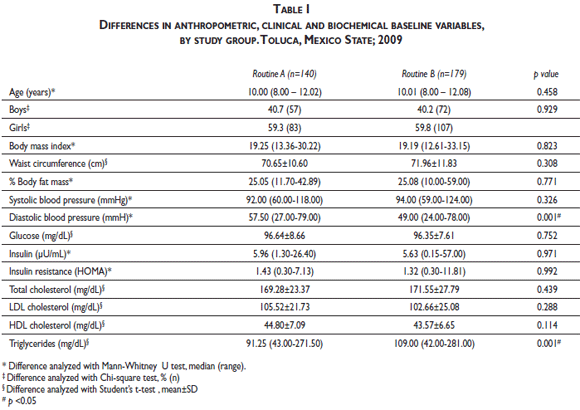
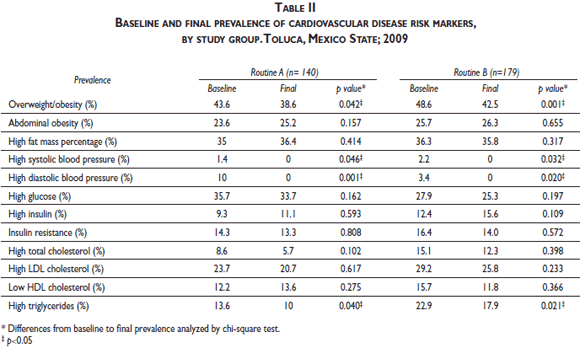
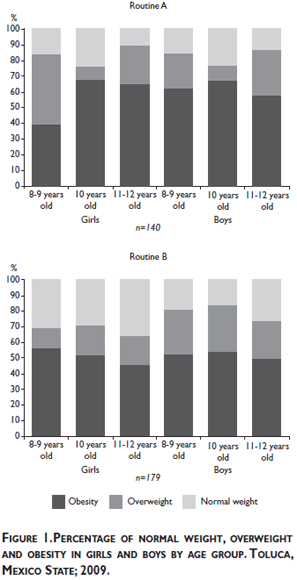
<body><![CDATA[<p><font face="Verdana, Arial, Helvetica, sans-serif" size="2">Of  319 children, 190 (59.6%) were girls (8 to 12 years of age). The proportion of  girls and boys was the same among age categories (p=0.374). <a href="#fg1">Figure  1</a> presents the percentages of normal weight, overweight and obesity by sex  and age, and divided by study group.</font></p>    <p><a name="fg1"></a></p>    <p>&nbsp;</p>    <p align="center"><img src="/img/revistas/spm/v52n5/a07fg01.gif"></p>    <p>&nbsp;</p>    <p><font face="Verdana, Arial, Helvetica, sans-serif" size="2">  Before intervention, children in routine A had higher DBP levels and lower TAG  concentrations than children in routine B (<a href="#tb1">Table I</a>). Girls  had higher insulin, TAG concentrations and HOMA index than boys (p&lt;0.022).  BMI, waist circumference, FM%, SBP, insulin concentrations, insulin resistance  and HDL cholesterol increased by age (p&lt;0.030). Prevalence of CVD risk markers  did not differ between groups by sex or age. Children in routine B had a higher  prevalence of hypertriglyceridemia (p=0.035) and a lower prevalence of high DBP  (p=0.045). No other differences were observed between groups (<a href="#tb2">Table  II</a>). </font></p>    <p><a name="tb1"></a></p>    <p>&nbsp;</p>    <p align="center"><img src="/img/revistas/spm/v52n5/a07tb01.gif"></p>    <p><a name="tb2"></a></p>    ]]></body>
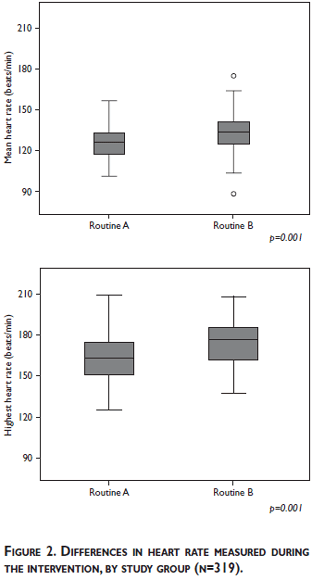
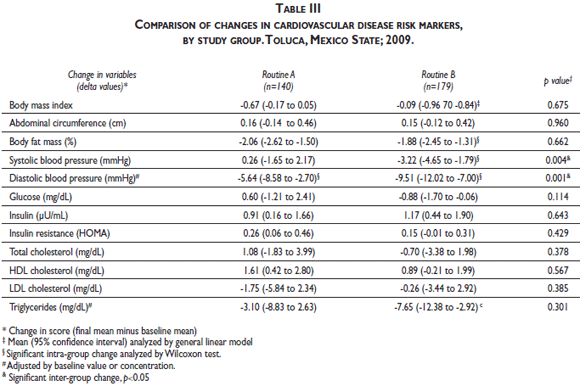
<body><![CDATA[<p>&nbsp;</p>    <p align="center"><img src="/img/revistas/spm/v52n5/a07tb02.gif"></p>    <p>&nbsp;</p>    <p><font face="Verdana, Arial, Helvetica, sans-serif" size="2">  Most children (95%) were classified as beginners (fitness test) and all were classified  as sedentary (PAL=1.02), spending 4.2 hours/day on sedentary activities. Overweight  and obese children had lower PAL than normal-weight children (1.01 vs. 1.02, p=0.008);  boys had higher PAL than girls (1.02 vs. 1.01, p=0.012). </font></p>    <p><font face="Verdana, Arial, Helvetica, sans-serif" size="2">  The participation rate in the intervention was 90% for both routines. Children  in routine B showed higher heart rates (<a href="#fg2">Figure 2</a>) and more  children in routine B achieved the aerobic exercise threshold of 120 beats/min  (81.9 vs. 65.9%, p= 0.002) and worked at a higher %HRmax (65.44% vs. 62.03%, p&lt;0.001).  Children in routine A presented a significant decrease in DBP, with a positive  effect shown in 47%. Fat mass percentage, BMI, SBP, DBP and TAG decreased in the  children in routine B, with a positive effect ranging between 38-45% of children.  Mean changes for the variables are presented in <a href="#tb3">Table III</a>.</font></p>    <p><a name="fg2"></a></p>    <p>&nbsp;</p>    <p align="center"><img src="/img/revistas/spm/v52n5/a07fg02.gif"></p>    <p><a name="tb3"></a></p>    <p>&nbsp;</p>    ]]></body>
<body><![CDATA[<p align="center"><img src="/img/revistas/spm/v52n5/a07tb03.gif"></p>    <p>&nbsp;</p>    <p><font face="Verdana, Arial, Helvetica, sans-serif" size="2">  The effect on CVD risk markers was not different between boys and girls. In routine  A, there was a greater effect on DBP for overweight or obese children than for  those with normal weight (-12.06 vs -6.78 mmHg, p=0.029). A greater effect on  DBP was shown for younger children (-14.22 mmHg for 8-9 years old; -7.54 for 10  years old; -3.36 mmHg for 11-12 years old; p=0.001). For children in both groups  with baseline alterations, a greater effect on all CVD risk markers was observed  compared to children with normal values (p&lt;0.041). The prevalence of overweight  and obesity, hypertriglyceridemia and high blood pressure decreased for both groups  (<a href="#tb2">Table II</a>). Inter-group differences showed that routine B had  a greater effect on SBP and DBP compared to routine A (<a href="#tb3">Table III</a>).</font></p>    <p><font face="Verdana, Arial, Helvetica, sans-serif" size="2"><b>Complete  case analysis</b></font></p>    <p><font face="Verdana, Arial, Helvetica, sans-serif" size="2">Of  the 319 children in the intervention, 105 (33%) dropped out, mainly because they  had another evening activity or did not had enough time. Baseline characteristics  were similar between participants and those who dropped out (p&gt;0.05). </font></p>     <p><font face="Verdana, Arial, Helvetica, sans-serif" size="2">  Greater intra-group differences were observed for the same CVD risk markers. Additionally,  a positive effect on FM% (-2.83±1.65%) and HDL (2.86±3.67mg/dL) (p&lt;0.010)  was shown for children in routine A. Inter-group differences were also similar.  </font></p>     <p><font face="Verdana, Arial, Helvetica, sans-serif" size="2"> After  six months of intervention, all children continued to be sedentary (PAL =1.02);  no differences were observed between groups. Most of the children (98%) reported  that they liked the routines; 88% said they would like to practice them again.  </font></p>    <p>&nbsp;</p>    <p><font face="Verdana, Arial, Helvetica, sans-serif" size="2"><b><font size="3">Discussion</font></b></font></p>    <p><font face="Verdana, Arial, Helvetica, sans-serif" size="2">To  our knowledge, this is the second school-based study done in Mexico to report  positive effects on some CVD risk markers in children. Routine B showed a greater  improvement in SBP and DBP, likely associated with aerobic exercise. These results  will enable guidelines to be proposed to develop better exercise programs for  Mexican school-aged children.</font></p>    ]]></body>
<body><![CDATA[<p><font face="Verdana, Arial, Helvetica, sans-serif" size="2">  The positive effect of exercise on SBP and DBP values was in accordance with results  reported in previous studies; in Mexican children, reductions in blood pressure  were observed with a 20 min exercise routine,<sup>14</sup> and in African-American  teenage girls, aerobic exercise proved to reduce blood pressure more than the  regular physical education classes.<sup>31</sup></font></p>    <p><font face="Verdana, Arial, Helvetica, sans-serif" size="2">  In terms of the reductions shown in the prevalence of BMI and overweight/obesity,  our results are similar to previous studies with 6-10 year old children using  similar interventions (short term, aerobic exercise).<sup>32,33</sup> And while  prevalence of overweight/obesity decreased in both groups, the reduction was significant  for routine B, which was associated with longer duration (200 min/week vs. 100  min/week); this result is consistent with a meta-analysis that proposed that 155-180  min a week of moderate to intense exercise is needed to reduce weight and body  fat.<sup>32</sup> In accordance with other studies, a reduction in FM% was observed  for routine B,<sup>1,5,27,33-35</sup> and the reductions were similar with those  found in 9-10 year-old children from Spain.<sup>36</sup></font></p>    <p><font face="Verdana, Arial, Helvetica, sans-serif" size="2">  TAG concentrations and the prevalence of hypertriacylglycerolemia also decreased  in the children in routine B, in accordance with what has been reported previously  for school-aged children from different countries.<sup>6,12</sup> Also similar  to previous studies, children with baseline alterations showed greater changes  than children with normal values.<sup>6,9,11,12,34</sup></font></p>    <p><font face="Verdana, Arial, Helvetica, sans-serif" size="2">  As was the case for the results of a previous Mexican study, no positive effects  were observed for glucose, insulin, insulin resistance, total cholesterol or LDL  cholesterol;14 other studies have shown inconsistent results for these markers,<sup>34,37</sup>  with some of the positive interventions having also included dietary modifications  or an educational component.<sup>13,38 </sup>In addition, Andersen et al. proposed  that 90 min sessions are needed to modify insulin resistance, which seems to be  the central feature of the CVD factors cluster.<sup>39</sup></font></p>    <p><font face="Verdana, Arial, Helvetica, sans-serif" size="2">  Furthermore, it has been hypothesized that genetics affect exercise performance  and the capacity of exercise to change body composition, blood pressure and other  biochemical serum concentrations.<sup>40</sup> Therefore, due to Hispanics having  an increased risk of diabetes and CVD associated with both genetics and cultural  background,<sup>41</sup> comparing our data with that of children with different  ethnic and geographic conditions could be biased because of the difference in  responses to exercise interventions among children with different backgrounds.<sup>40,41  </sup></font></p>    <p><font face="Verdana, Arial, Helvetica, sans-serif" size="2">  A high attrition rate is one of the main limitations of this study. Due to the  dropout rate of 33%, the analysis presented is based on intention to treat.<sup>2,5</sup>  In addition, school selection and individual routine designation was not possible,  resulting in baseline differences between groups.</font></p>    <p><font face="Verdana, Arial, Helvetica, sans-serif" size="2">  Since diet was not measured, the possibility that some subjects may have increased  or decreased their dietary intake cannot be ruled out. In addition, children may  modify some lifestyle behaviors just to be included in the study. Furthermore,  no follow up measures were possible to evaluate the effect of the results and  the usual PA among children was measured subjectively and therefore may not provide  an accurate description of activity. Puberty was another variable that was not  assessed and it is well known to be associated with body fat and insulin resistance.</font></p>    <p><font face="Verdana, Arial, Helvetica, sans-serif" size="2">  In this study, children were able to exercise at an average of 60% HRmax and the  intervention lasted only three months, lower than the recommendation for achieving  positive results.<sup>11,12</sup> In addition, since daily HR was not measured  for all children, the wide intra- and inter-individual variation of this measurement  could be a source of bias.<sup>10</sup> This variation was minimized by controlling  confounding factors. In addition, the inability to control children individually  was an obstacle during intervention. Insufficient playground space was another  limitation. </font></p>    <p><font face="Verdana, Arial, Helvetica, sans-serif" size="2">  Finally, while both exercise routines had positive effects on some CVD risk markers,  routine B had a greater positive effect on high blood pressure. The low exercise  patterns, high prevalence of obesity and high proportion of CVD risk alterations  in these children are consistent with previous findings in Mexico.<sup>4,21,14</sup>  We propose that school physical education classes and/or extracurricular exercise  programs provide aerobic exercises with moderate to vigorous intensity, at least  five times/week, with 40 minutes duration.</font></p>    <p>&nbsp;</p>    ]]></body>
<body><![CDATA[<p><font face="Verdana, Arial, Helvetica, sans-serif" size="3"><b>Acknowledgements</b></font></p>    <p><font face="Verdana, Arial, Helvetica, sans-serif" size="2">We  specially appreciate children and scholar authorities participation, and Dora-Esther  Tovar, Ma-Lizzeth M&#225;rquez, Ma-Cristina Ram&#237;rez, Ma-Eugenia Mendoza,  Esmeralda Almaz&#225;n, Camelia Gardu&#241;o, Jessica Mart&#237;nez, Ma-Antonieta  Hern&#225;ndez ,Maricruz Tolentino.</font></p>    <p><font face="Verdana, Arial, Helvetica, sans-serif" size="2"><b>Declaration  of conflicts of interest</b></font></p>    <p><font face="Verdana, Arial, Helvetica, sans-serif" size="2">We  declare that we have no conflicts of interest.</font></p>    <p>&nbsp;</p>    <p><font face="Verdana, Arial, Helvetica, sans-serif" size="3"><b>References  </b></font></p>    <p><font face="Verdana, Arial, Helvetica, sans-serif" size="2">1.  Zahner L, Puder J, Roth R, Schmid M, Guldimann R, P&#252;hse U et al. A school-based  physical activity program to improve health and fitness in children aged 6-13  years (-&#156;Kinder-Sportstudie KISS-): study design of a randomized controlled trial  &#91;ISRCTN15360785&#93;. BMC Public Health 2006;6:147.</font></p>    <!-- ref --><p><font face="Verdana, Arial, Helvetica, sans-serif" size="2">2.  Marcus B, Williams D, Dubbert P, Sallis J, King A, Yancey A et al. Physical activity  intervention studies: what we know and what we need to know: a scientific statement  from the American Heart Association Council on Nutrition, Physical Activity, and  Metabolism (Subcommittee on Physical Activity); Council on Cardiovascular Disease  in the Young; and the Interdisciplinary Working Group on Quality of Care and Outcomes  Research. Circulation 2006;114(24):2739-2752.    &nbsp;&nbsp;&nbsp;&nbsp;&nbsp;&nbsp;&nbsp;&nbsp;[&#160;<a href="javascript:void(0);" onclick="javascript: window.open('/scielo.php?script=sci_nlinks&ref=9304323&pid=S0036-3634201000050000700001&lng=','','width=640,height=500,resizable=yes,scrollbars=1,menubar=yes,');">Links</a>&#160;]<!-- end-ref --></font></p>    <!-- ref --><p><font face="Verdana, Arial, Helvetica, sans-serif" size="2">3.  Hern&#225;ndez B, Gortmaker S, Colditz G, Peterson K, Laird N, Parra-Cabrera S.  Association of obesity with physical activity, television programs and other forms  of video viewing among children in Mexico city. Int J Obes Relat Metab Disord  1999;23(8):845-854.    &nbsp;&nbsp;&nbsp;&nbsp;&nbsp;&nbsp;&nbsp;&nbsp;[&#160;<a href="javascript:void(0);" onclick="javascript: window.open('/scielo.php?script=sci_nlinks&ref=9304325&pid=S0036-3634201000050000700002&lng=','','width=640,height=500,resizable=yes,scrollbars=1,menubar=yes,');">Links</a>&#160;]<!-- end-ref --></font></p>    <!-- ref --><p><font face="Verdana, Arial, Helvetica, sans-serif" size="2">4.  Balas-Nakash M, Villanueva-Quintana A, Tawil-Dayan S, Schiffman-Selechnik E, Suverza-Fern&#225;ndez  A, Vadillo-Ortega F et al. Estudio piloto para la identificaci&#243;n de indicadores  antropom&#233;tricos asociados a marcadores de riesgo de s&#237;ndrome metab&#243;lico  en escolares mexicanos. Bol Med Hosp Infan M&#233;x 2008;65(3):100-109.    &nbsp;&nbsp;&nbsp;&nbsp;&nbsp;&nbsp;&nbsp;&nbsp;[&#160;<a href="javascript:void(0);" onclick="javascript: window.open('/scielo.php?script=sci_nlinks&ref=9304327&pid=S0036-3634201000050000700003&lng=','','width=640,height=500,resizable=yes,scrollbars=1,menubar=yes,');">Links</a>&#160;]<!-- end-ref --></font></p>    <!-- ref --><p><font face="Verdana, Arial, Helvetica, sans-serif" size="2">5.  Kelley G, Kelley K. Aerobic exercise and lipids and lipoproteins in children and  adolescents: a meta-analysis of randomized controlled trials. Atherosclerosis  2007;191(2):447-453.    &nbsp;&nbsp;&nbsp;&nbsp;&nbsp;&nbsp;&nbsp;&nbsp;[&#160;<a href="javascript:void(0);" onclick="javascript: window.open('/scielo.php?script=sci_nlinks&ref=9304329&pid=S0036-3634201000050000700004&lng=','','width=640,height=500,resizable=yes,scrollbars=1,menubar=yes,');">Links</a>&#160;]<!-- end-ref --></font></p>    <!-- ref --><p><font face="Verdana, Arial, Helvetica, sans-serif" size="2">6.  Froberg K, Andersen L. Mini review: physical activity and fitness and its relations  to cardiovascular disease risk factors in children. Int J Obes (Lond). 2005;29(Suppl  2):S34-39.    &nbsp;&nbsp;&nbsp;&nbsp;&nbsp;&nbsp;&nbsp;&nbsp;[&#160;<a href="javascript:void(0);" onclick="javascript: window.open('/scielo.php?script=sci_nlinks&ref=9304331&pid=S0036-3634201000050000700005&lng=','','width=640,height=500,resizable=yes,scrollbars=1,menubar=yes,');">Links</a>&#160;]<!-- end-ref --></font></p>    <!-- ref --><p><font face="Verdana, Arial, Helvetica, sans-serif" size="2">7.  U.S. Department of Health and Human Services. U.S. Department of Agriculture.  Dietary Guidelines for Americans, 2005. 6th Edition. Washington, DC: U.S. Government  Printing Office, 2005.    &nbsp;&nbsp;&nbsp;&nbsp;&nbsp;&nbsp;&nbsp;&nbsp;[&#160;<a href="javascript:void(0);" onclick="javascript: window.open('/scielo.php?script=sci_nlinks&ref=9304333&pid=S0036-3634201000050000700006&lng=','','width=640,height=500,resizable=yes,scrollbars=1,menubar=yes,');">Links</a>&#160;]<!-- end-ref --></font></p>    <!-- ref --><p><font face="Verdana, Arial, Helvetica, sans-serif" size="2">8.  Position of the American Dietetic Association: individual, family, school, and  community based interventions for pediatric overweight. J Am Diet Assoc 2006;106(6):925-945.    &nbsp;&nbsp;&nbsp;&nbsp;&nbsp;&nbsp;&nbsp;&nbsp;[&#160;<a href="javascript:void(0);" onclick="javascript: window.open('/scielo.php?script=sci_nlinks&ref=9304335&pid=S0036-3634201000050000700007&lng=','','width=640,height=500,resizable=yes,scrollbars=1,menubar=yes,');">Links</a>&#160;]<!-- end-ref --></font></p>    <!-- ref --><p><font face="Verdana, Arial, Helvetica, sans-serif" size="2">9.  Torrance B, McGuire K, Lewanczuk R, McGavock J. Overweight, physical activity  and high blood pressure in children: a review of the literature. Vasc Health Risk  Manag 2007;3(1):139-149.    &nbsp;&nbsp;&nbsp;&nbsp;&nbsp;&nbsp;&nbsp;&nbsp;[&#160;<a href="javascript:void(0);" onclick="javascript: window.open('/scielo.php?script=sci_nlinks&ref=9304337&pid=S0036-3634201000050000700008&lng=','','width=640,height=500,resizable=yes,scrollbars=1,menubar=yes,');">Links</a>&#160;]<!-- end-ref --></font></p>    <!-- ref --><p><font face="Verdana, Arial, Helvetica, sans-serif" size="2">10.  Epstein L, Paluch R, Kalakanis L, Goldfield G, Cerny F, Roemmich J. How much activity  do youth get? A quantitative review of heart-rate measured activity. Pediatrics  2001;108(3):E44.    &nbsp;&nbsp;&nbsp;&nbsp;&nbsp;&nbsp;&nbsp;&nbsp;[&#160;<a href="javascript:void(0);" onclick="javascript: window.open('/scielo.php?script=sci_nlinks&ref=9304339&pid=S0036-3634201000050000700009&lng=','','width=640,height=500,resizable=yes,scrollbars=1,menubar=yes,');">Links</a>&#160;]<!-- end-ref --></font></p>    <!-- ref --><p><font face="Verdana, Arial, Helvetica, sans-serif" size="2">11.  Tolfrey K, Jones A, Campbell I. The effect of aerobic exercise training on the  lipid-lipoprotein profile of children and adolescents. Sports Med 2000;29(2):99-112.    &nbsp;&nbsp;&nbsp;&nbsp;&nbsp;&nbsp;&nbsp;&nbsp;[&#160;<a href="javascript:void(0);" onclick="javascript: window.open('/scielo.php?script=sci_nlinks&ref=9304341&pid=S0036-3634201000050000700010&lng=','','width=640,height=500,resizable=yes,scrollbars=1,menubar=yes,');">Links</a>&#160;]<!-- end-ref --></font></p>    <!-- ref --><p><font face="Verdana, Arial, Helvetica, sans-serif" size="2">12.  Tolfrey K, Jones A, Campbell I. Lipid-lipoproteins in children: an exercise dose-response  study. Med Sci Sports Exerc 2004;36(3):418-427.    &nbsp;&nbsp;&nbsp;&nbsp;&nbsp;&nbsp;&nbsp;&nbsp;[&#160;<a href="javascript:void(0);" onclick="javascript: window.open('/scielo.php?script=sci_nlinks&ref=9304343&pid=S0036-3634201000050000700011&lng=','','width=640,height=500,resizable=yes,scrollbars=1,menubar=yes,');">Links</a>&#160;]<!-- end-ref --></font></p>    <!-- ref --><p><font face="Verdana, Arial, Helvetica, sans-serif" size="2">13.  Nemet D, Barkan S, Epstein Y, Friedland O, Kowen G, Eliakim A. Short- and long-term  beneficial effects of a combined dietary-behavioral-physical activity intervention  for the treatment of childhood obesity. Pediatrics 2005;115(4):443-449.    &nbsp;&nbsp;&nbsp;&nbsp;&nbsp;&nbsp;&nbsp;&nbsp;[&#160;<a href="javascript:void(0);" onclick="javascript: window.open('/scielo.php?script=sci_nlinks&ref=9304345&pid=S0036-3634201000050000700012&lng=','','width=640,height=500,resizable=yes,scrollbars=1,menubar=yes,');">Links</a>&#160;]<!-- end-ref --></font></p>    <!-- ref --><p><font face="Verdana, Arial, Helvetica, sans-serif" size="2">14.  Perichart-Perera O, Balas-Nakash M, Ortiz-Rodr&#237;guez V, Mor&#225;n-Zenteno  J, Guerrero-Ortiz J, Vadillo-Ortega F. A program to improve some cardiovascular  risk factors in Mexican school age children. Salud Publica Mex 2008;50(3):218-226.    &nbsp;&nbsp;&nbsp;&nbsp;&nbsp;&nbsp;&nbsp;&nbsp;[&#160;<a href="javascript:void(0);" onclick="javascript: window.open('/scielo.php?script=sci_nlinks&ref=9304347&pid=S0036-3634201000050000700013&lng=','','width=640,height=500,resizable=yes,scrollbars=1,menubar=yes,');">Links</a>&#160;]<!-- end-ref --></font></p>    <!-- ref --><p><font face="Verdana, Arial, Helvetica, sans-serif" size="2">15.  Pate R, Davis M, Robinson T, Stone E, McKenzie T, Young J et al. Promoting physical  activity in children and youth: a leadership role for schools: a scientific statement  from the American Heart Association Council on Nutrition, Physical Activity, and  Metabolism (Physical Activity Committee) in collaboration with the Councils on  Cardiovascular Disease in the Young and Cardiovascular Nursing. Circulation 2006;114(11):1214-1224.    &nbsp;&nbsp;&nbsp;&nbsp;&nbsp;&nbsp;&nbsp;&nbsp;[&#160;<a href="javascript:void(0);" onclick="javascript: window.open('/scielo.php?script=sci_nlinks&ref=9304349&pid=S0036-3634201000050000700014&lng=','','width=640,height=500,resizable=yes,scrollbars=1,menubar=yes,');">Links</a>&#160;]<!-- end-ref --></font></p>    <!-- ref --><p><font face="Verdana, Arial, Helvetica, sans-serif" size="2">16.  Dobbins M, De Corby K, Robeson P, Husson H, Tirilis D. School-based physical activity  programs for promoting physical activity and fitness in children and adolescents  aged 6-18. Cochrane Database Syst Rev 2009;21(1):CD007651.    &nbsp;&nbsp;&nbsp;&nbsp;&nbsp;&nbsp;&nbsp;&nbsp;[&#160;<a href="javascript:void(0);" onclick="javascript: window.open('/scielo.php?script=sci_nlinks&ref=9304351&pid=S0036-3634201000050000700015&lng=','','width=640,height=500,resizable=yes,scrollbars=1,menubar=yes,');">Links</a>&#160;]<!-- end-ref --></font></p>    <!-- ref --><p><font face="Verdana, Arial, Helvetica, sans-serif" size="2">17.  Jennings-Aburto N, Nava F, Bonvecchio A, Safdie M, Gonz&#225;lez-Casanova I, Gust  et al. Physical activity during the school day in public primary schools in Mexico  City. Salud Publica Mex 2009;51:141-147.    &nbsp;&nbsp;&nbsp;&nbsp;&nbsp;&nbsp;&nbsp;&nbsp;[&#160;<a href="javascript:void(0);" onclick="javascript: window.open('/scielo.php?script=sci_nlinks&ref=9304353&pid=S0036-3634201000050000700016&lng=','','width=640,height=500,resizable=yes,scrollbars=1,menubar=yes,');">Links</a>&#160;]<!-- end-ref --></font></p>    <!-- ref --><p><font face="Verdana, Arial, Helvetica, sans-serif" size="2">18.  Comisi&#243;n Nacional de Cultura Fisica y Deporte. Pruebas de valoraci&#243;n  fisica. Programa Nacional de Actividad F&#237;sica 2001. Mexico City: CONADE,  2001.    &nbsp;&nbsp;&nbsp;&nbsp;&nbsp;&nbsp;&nbsp;&nbsp;[&#160;<a href="javascript:void(0);" onclick="javascript: window.open('/scielo.php?script=sci_nlinks&ref=9304355&pid=S0036-3634201000050000700017&lng=','','width=640,height=500,resizable=yes,scrollbars=1,menubar=yes,');">Links</a>&#160;]<!-- end-ref --></font></p>    <!-- ref --><p><font face="Verdana, Arial, Helvetica, sans-serif" size="2">19.  Hern&#225;ndez B, Gortmaker S, Laird N, Colditz G, Parra-Cabrera S, Peterson K.  Validity and reproducibility of a questionnaire on physical activity and non-activity  for school children in Mexico City. Salud Publica Mex 2000;42(4):315-323.    &nbsp;&nbsp;&nbsp;&nbsp;&nbsp;&nbsp;&nbsp;&nbsp;[&#160;<a href="javascript:void(0);" onclick="javascript: window.open('/scielo.php?script=sci_nlinks&ref=9304357&pid=S0036-3634201000050000700018&lng=','','width=640,height=500,resizable=yes,scrollbars=1,menubar=yes,');">Links</a>&#160;]<!-- end-ref --></font></p>    <!-- ref --><p><font face="Verdana, Arial, Helvetica, sans-serif" size="2">20.  Tanaka H, Monahan K, Seals D. Age-predicted maximal heart rate revisited. J Am  Coll Cardiol 2001;37(1):153-156.    &nbsp;&nbsp;&nbsp;&nbsp;&nbsp;&nbsp;&nbsp;&nbsp;[&#160;<a href="javascript:void(0);" onclick="javascript: window.open('/scielo.php?script=sci_nlinks&ref=9304359&pid=S0036-3634201000050000700019&lng=','','width=640,height=500,resizable=yes,scrollbars=1,menubar=yes,');">Links</a>&#160;]<!-- end-ref --></font></p>    <!-- ref --><p><font face="Verdana, Arial, Helvetica, sans-serif" size="2">21.  Perichart-Perera O, Balas-Nakash M, Schiffman-Selechnik E, Barbato-Dosal A, Vadillo-Ortega  F. Obesity increases metabolic syndrome risk factors in school-aged children from  an urban school in Mexico city. J Am Diet Assoc 2007;107(1):81-91.    &nbsp;&nbsp;&nbsp;&nbsp;&nbsp;&nbsp;&nbsp;&nbsp;[&#160;<a href="javascript:void(0);" onclick="javascript: window.open('/scielo.php?script=sci_nlinks&ref=9304361&pid=S0036-3634201000050000700020&lng=','','width=640,height=500,resizable=yes,scrollbars=1,menubar=yes,');">Links</a>&#160;]<!-- end-ref --></font></p>    <!-- ref --><p><font face="Verdana, Arial, Helvetica, sans-serif" size="2">22.  Centers for Disease Control and Prevention, National Center for Health Statistics.  CDC growth charts. Georgia, United States: CDC &#91;Available at <a href="http://www.cdc.gov/growthcharts/" target="_blank">http://www.cdc.gov/growthcharts/</a>.&#93;&#91;Accessed  2009 July 11&#93;    &nbsp;&nbsp;&nbsp;&nbsp;&nbsp;&nbsp;&nbsp;&nbsp;[&#160;<a href="javascript:void(0);" onclick="javascript: window.open('/scielo.php?script=sci_nlinks&ref=9304363&pid=S0036-3634201000050000700021&lng=','','width=640,height=500,resizable=yes,scrollbars=1,menubar=yes,');">Links</a>&#160;]<!-- end-ref -->. </font></p>    <!-- ref --><p><font face="Verdana, Arial, Helvetica, sans-serif" size="2">23.  Fernandez JR, Redden F, Pietrobelli A, Allison DB. Waist circumference percentiles  in nationally representative sample of African-American, European-American and  Mexican-American children and adolescents. </font><font face="Verdana, Arial, Helvetica, sans-serif" size="2">J  Pediatr 2004;145(4):439-444.    &nbsp;&nbsp;&nbsp;&nbsp;&nbsp;&nbsp;&nbsp;&nbsp;[&#160;<a href="javascript:void(0);" onclick="javascript: window.open('/scielo.php?script=sci_nlinks&ref=9304365&pid=S0036-3634201000050000700022&lng=','','width=640,height=500,resizable=yes,scrollbars=1,menubar=yes,');">Links</a>&#160;]<!-- end-ref --></font></p>    <!-- ref --><p><font face="Verdana, Arial, Helvetica, sans-serif" size="2">24.  Williams D, Going S, Lohman T, Harsha D, Srinivasan S, Webber L et al. Body fatness  and risk for elevated blood pressure, total cholesterol, and serum lipoprotein  ratios in children and adolescents. Am J Public Health 1992;82(3):358-63.    &nbsp;&nbsp;&nbsp;&nbsp;&nbsp;&nbsp;&nbsp;&nbsp;[&#160;<a href="javascript:void(0);" onclick="javascript: window.open('/scielo.php?script=sci_nlinks&ref=9304367&pid=S0036-3634201000050000700023&lng=','','width=640,height=500,resizable=yes,scrollbars=1,menubar=yes,');">Links</a>&#160;]<!-- end-ref --></font></p>    <!-- ref --><p><font face="Verdana, Arial, Helvetica, sans-serif" size="2">25.  National High Blood Pressure Education Program Working Group on High Blood Pressure  in Children and Adolescents. The fourth report on the diagnosis, evaluation, and  treatment of high blood pressure in children and adolescents. Pediatrics 2004;114:555-76.    &nbsp;&nbsp;&nbsp;&nbsp;&nbsp;&nbsp;&nbsp;&nbsp;[&#160;<a href="javascript:void(0);" onclick="javascript: window.open('/scielo.php?script=sci_nlinks&ref=9304369&pid=S0036-3634201000050000700024&lng=','','width=640,height=500,resizable=yes,scrollbars=1,menubar=yes,');">Links</a>&#160;]<!-- end-ref --></font></p>    <!-- ref --><p><font face="Verdana, Arial, Helvetica, sans-serif" size="2">26.  International Diabetes Federation Task Force on Epidemiology and Prevention of  Diabetes. The metabolic syndrome in children and adolescents: the IDF consensus.  Diabetes Voice 2007;52(4):1-24.    &nbsp;&nbsp;&nbsp;&nbsp;&nbsp;&nbsp;&nbsp;&nbsp;[&#160;<a href="javascript:void(0);" onclick="javascript: window.open('/scielo.php?script=sci_nlinks&ref=9304371&pid=S0036-3634201000050000700025&lng=','','width=640,height=500,resizable=yes,scrollbars=1,menubar=yes,');">Links</a>&#160;]<!-- end-ref --></font></p>    <!-- ref --><p><font face="Verdana, Arial, Helvetica, sans-serif" size="2">27.  Conwell L, Trost S, Brown W, Batch J. Indexes of insulin resistance and secretion  in obese children and adolescents: a validation study. Diabetes Care 2004;27(2):314-319.    &nbsp;&nbsp;&nbsp;&nbsp;&nbsp;&nbsp;&nbsp;&nbsp;[&#160;<a href="javascript:void(0);" onclick="javascript: window.open('/scielo.php?script=sci_nlinks&ref=9304373&pid=S0036-3634201000050000700026&lng=','','width=640,height=500,resizable=yes,scrollbars=1,menubar=yes,');">Links</a>&#160;]<!-- end-ref --></font></p>    <!-- ref --><p><font face="Verdana, Arial, Helvetica, sans-serif" size="2">28.  Keskin M, Kurtoglu S, Kendirci M, Atabek M, Yazici C. Homeostasis model assessment  is more reliable than the fasting glucose/insulin ratio and quantitative insulin  sensitivity check index for assessing insulin resistance among obese children  and adolescents. Pediatrics 2005;115(4):500-503.    &nbsp;&nbsp;&nbsp;&nbsp;&nbsp;&nbsp;&nbsp;&nbsp;[&#160;<a href="javascript:void(0);" onclick="javascript: window.open('/scielo.php?script=sci_nlinks&ref=9304375&pid=S0036-3634201000050000700027&lng=','','width=640,height=500,resizable=yes,scrollbars=1,menubar=yes,');">Links</a>&#160;]<!-- end-ref --></font></p>    <!-- ref --><p><font face="Verdana, Arial, Helvetica, sans-serif" size="2">29.  Tresaco B, Bueno G, Pineda I, Moreno LA, Garagorri JM, Bueno M. Homeostatic model  assessment (HOMA) index cut-off values to identify the metabolic syndrome in children.  J Physiol Biochem 2005;61(2):381-388.    &nbsp;&nbsp;&nbsp;&nbsp;&nbsp;&nbsp;&nbsp;&nbsp;[&#160;<a href="javascript:void(0);" onclick="javascript: window.open('/scielo.php?script=sci_nlinks&ref=9304377&pid=S0036-3634201000050000700028&lng=','','width=640,height=500,resizable=yes,scrollbars=1,menubar=yes,');">Links</a>&#160;]<!-- end-ref --></font></p>    <!-- ref --><p><font face="Verdana, Arial, Helvetica, sans-serif" size="2">30.  Gidding S, Dennison B, Birch L, Daniels S, Gillman M, Gilman M et al. Dietary  recommendations for children and adolescents: a guide for practitioners: consensus  statement from the American Heart Association. Circulation 2005;112(13):2061-2075.    &nbsp;&nbsp;&nbsp;&nbsp;&nbsp;&nbsp;&nbsp;&nbsp;[&#160;<a href="javascript:void(0);" onclick="javascript: window.open('/scielo.php?script=sci_nlinks&ref=9304379&pid=S0036-3634201000050000700029&lng=','','width=640,height=500,resizable=yes,scrollbars=1,menubar=yes,');">Links</a>&#160;]<!-- end-ref --></font></p>    <!-- ref --><p><font face="Verdana, Arial, Helvetica, sans-serif" size="2">31.  Ewart CK, Young DR, Hagberg JM. Effects of school-based aerobic exercise on blood  pressure in adolescent girls at risk for hypertension. Am J Public Health 1998;88(6):949-51.    &nbsp;&nbsp;&nbsp;&nbsp;&nbsp;&nbsp;&nbsp;&nbsp;[&#160;<a href="javascript:void(0);" onclick="javascript: window.open('/scielo.php?script=sci_nlinks&ref=9304381&pid=S0036-3634201000050000700030&lng=','','width=640,height=500,resizable=yes,scrollbars=1,menubar=yes,');">Links</a>&#160;]<!-- end-ref --></font></p>    <!-- ref --><p><font face="Verdana, Arial, Helvetica, sans-serif" size="2">32.  Lazaar N, Aucouturier J, Ratel S, Rance M, Meyer M, Duch&#233; P. Effect of physical  activity intervention on body composition in young children: influence of body  mass index status and gender. Acta Paediatr 2007;96(9):1315-1320.    &nbsp;&nbsp;&nbsp;&nbsp;&nbsp;&nbsp;&nbsp;&nbsp;[&#160;<a href="javascript:void(0);" onclick="javascript: window.open('/scielo.php?script=sci_nlinks&ref=9304383&pid=S0036-3634201000050000700031&lng=','','width=640,height=500,resizable=yes,scrollbars=1,menubar=yes,');">Links</a>&#160;]<!-- end-ref --></font></p>    <!-- ref --><p><font face="Verdana, Arial, Helvetica, sans-serif" size="2">33.  Atlantis E, Barnes E, Singh M. Efficacy of exercise for treating overweight in  children and adolescents: a systematic review. Int J Obes (Lond) 2006;30(7):1027-1040.    &nbsp;&nbsp;&nbsp;&nbsp;&nbsp;&nbsp;&nbsp;&nbsp;[&#160;<a href="javascript:void(0);" onclick="javascript: window.open('/scielo.php?script=sci_nlinks&ref=9304385&pid=S0036-3634201000050000700032&lng=','','width=640,height=500,resizable=yes,scrollbars=1,menubar=yes,');">Links</a>&#160;]<!-- end-ref --></font></p>    <!-- ref --><p><font face="Verdana, Arial, Helvetica, sans-serif" size="2">34.  Strong W, Malina R, Blimkie C, Daniels S, Dishman R, Gutin B et al. Evidence based  physical activity for school-age youth. J Pediatr 2005;146(6):732-737.    &nbsp;&nbsp;&nbsp;&nbsp;&nbsp;&nbsp;&nbsp;&nbsp;[&#160;<a href="javascript:void(0);" onclick="javascript: window.open('/scielo.php?script=sci_nlinks&ref=9304387&pid=S0036-3634201000050000700033&lng=','','width=640,height=500,resizable=yes,scrollbars=1,menubar=yes,');">Links</a>&#160;]<!-- end-ref --></font></p>    <!-- ref --><p><font face="Verdana, Arial, Helvetica, sans-serif" size="2">35.  Carrel AL, Clark RR, Peterson SE, Nemeth BA, Sullivan J, Allen D. Improvement  of fitness, body composition, and insulin sensitivity in overweight children in  a school-based exercise program: a randomized, controlled study. Arch Pediatr  Adolesc Med 2005;159:963-968.    &nbsp;&nbsp;&nbsp;&nbsp;&nbsp;&nbsp;&nbsp;&nbsp;[&#160;<a href="javascript:void(0);" onclick="javascript: window.open('/scielo.php?script=sci_nlinks&ref=9304389&pid=S0036-3634201000050000700034&lng=','','width=640,height=500,resizable=yes,scrollbars=1,menubar=yes,');">Links</a>&#160;]<!-- end-ref --></font></p>    <!-- ref --><p><font face="Verdana, Arial, Helvetica, sans-serif" size="2">36.  Mart&#237;nez Vizca&#237;no V, Salcedo Aguilar F, Franquelo Guti&#233;rrez R,  Solera Mart&#237;nez M, S&#225;nchez L&#243;pez M, Serrano Mart&#237;nez S et  al. Assessment of an after-school physical activity program to prevent obesity  among 9- to 10-year-old children: a cluster randomized trial. Int J Obes (Lond)  2008;32(1):12-22.    &nbsp;&nbsp;&nbsp;&nbsp;&nbsp;&nbsp;&nbsp;&nbsp;[&#160;<a href="javascript:void(0);" onclick="javascript: window.open('/scielo.php?script=sci_nlinks&ref=9304391&pid=S0036-3634201000050000700035&lng=','','width=640,height=500,resizable=yes,scrollbars=1,menubar=yes,');">Links</a>&#160;]<!-- end-ref --></font></p>    <!-- ref --><p><font face="Verdana, Arial, Helvetica, sans-serif" size="2">37.  Webber L, Osganian S, Feldman H, Wu M, McKenzie T, Nichaman M et al. Cardiovascular  risk factors among children after a 21/2 year Intervention-the CATCH Study. Prev  Med 1996;25(4):432-41.    &nbsp;&nbsp;&nbsp;&nbsp;&nbsp;&nbsp;&nbsp;&nbsp;[&#160;<a href="javascript:void(0);" onclick="javascript: window.open('/scielo.php?script=sci_nlinks&ref=9304393&pid=S0036-3634201000050000700036&lng=','','width=640,height=500,resizable=yes,scrollbars=1,menubar=yes,');">Links</a>&#160;]<!-- end-ref --></font></p>    <!-- ref --><p><font face="Verdana, Arial, Helvetica, sans-serif" size="2">38.  Woo K, Chook P, Yu C, Sung R, Qiao M, Leung S et al. Effects of diet and exercise  on obesity-related vascular dysfunction in children. Circulation 2004;109(16):1981-1986.    &nbsp;&nbsp;&nbsp;&nbsp;&nbsp;&nbsp;&nbsp;&nbsp;[&#160;<a href="javascript:void(0);" onclick="javascript: window.open('/scielo.php?script=sci_nlinks&ref=9304395&pid=S0036-3634201000050000700037&lng=','','width=640,height=500,resizable=yes,scrollbars=1,menubar=yes,');">Links</a>&#160;]<!-- end-ref --></font></p>    <!-- ref --><p><font face="Verdana, Arial, Helvetica, sans-serif" size="2">39.  Andersen L, Harro M, Sardinha L, Froberg K, Ekelund U, Brage S et al. Physical  activity and clustered cardiovascular risk in children: a cross-sectional study  (The European Youth Heart Study). Lancet 2006;368(9532):299-304.    &nbsp;&nbsp;&nbsp;&nbsp;&nbsp;&nbsp;&nbsp;&nbsp;[&#160;<a href="javascript:void(0);" onclick="javascript: window.open('/scielo.php?script=sci_nlinks&ref=9304397&pid=S0036-3634201000050000700038&lng=','','width=640,height=500,resizable=yes,scrollbars=1,menubar=yes,');">Links</a>&#160;]<!-- end-ref --></font></p>    <!-- ref --><p><font face="Verdana, Arial, Helvetica, sans-serif" size="2">40.  Rankinen T, Bouchard C. Genetis and blood pressure response to exercise, and its  interactions with adiposity. Prev Cardiol 2002;5(3):138-44.    &nbsp;&nbsp;&nbsp;&nbsp;&nbsp;&nbsp;&nbsp;&nbsp;[&#160;<a href="javascript:void(0);" onclick="javascript: window.open('/scielo.php?script=sci_nlinks&ref=9304399&pid=S0036-3634201000050000700039&lng=','','width=640,height=500,resizable=yes,scrollbars=1,menubar=yes,');">Links</a>&#160;]<!-- end-ref --></font></p>    <!-- ref --><p><font face="Verdana, Arial, Helvetica, sans-serif" size="2">41.  Webber LS, Harsha DW, Phillips GT, Srinivasan SR, Simpson JW, Berenson GS. Cardiovascular  risk factors in Hispanic, white, and black children: the Brooks County and Bogalusa  Heart studies. Am J Epidemiol 1991;133(7):704-14.    &nbsp;&nbsp;&nbsp;&nbsp;&nbsp;&nbsp;&nbsp;&nbsp;[&#160;<a href="javascript:void(0);" onclick="javascript: window.open('/scielo.php?script=sci_nlinks&ref=9304401&pid=S0036-3634201000050000700040&lng=','','width=640,height=500,resizable=yes,scrollbars=1,menubar=yes,');">Links</a>&#160;]<!-- end-ref --></font></p>    <p></p>    <p>&nbsp;</p>    <p>&nbsp;</p>    ]]></body>
<body><![CDATA[<p></p>    <p><font face="Verdana, Arial, Helvetica, sans-serif" size="2">Address  reprint requests to: Dra. Alejandra Ben&#237;tez-Arciniega. Centro de Investigaci&#243;n  y Estudios avanzados en Ciencias de la Salud.</font></p>    <p><font face="Verdana, Arial, Helvetica, sans-serif" size="2">Facultad  de Medicina. Universidad Aut&#243;noma del Estado de M&#233;xico. Jes&#250;s Carranza  200, col. Universidad. Toluca, M&#233;xico.</font></p>    <p><font face="Verdana, Arial, Helvetica, sans-serif" size="2">E-mail:  <a href="mailto:abeniteza@uaemex.mx">abeniteza@uaemex.mx</a></font></p>    <p>&nbsp;</p>    <p>&nbsp;</p>    <p></p>    <p></p>    <p><font face="Verdana, Arial, Helvetica, sans-serif" size="2">Received  on: December 10, 2009 &#149; Accepted on: June 24, 2010</font></p>      ]]></body><back>
<ref-list>
<ref id="B1">
<label>2</label><nlm-citation citation-type="journal">
<person-group person-group-type="author">
<name>
<surname><![CDATA[Marcus]]></surname>
<given-names><![CDATA[B]]></given-names>
</name>
<name>
<surname><![CDATA[Williams]]></surname>
<given-names><![CDATA[D]]></given-names>
</name>
<name>
<surname><![CDATA[Dubbert]]></surname>
<given-names><![CDATA[P]]></given-names>
</name>
<name>
<surname><![CDATA[Sallis]]></surname>
<given-names><![CDATA[J]]></given-names>
</name>
<name>
<surname><![CDATA[King]]></surname>
<given-names><![CDATA[A]]></given-names>
</name>
<name>
<surname><![CDATA[Yancey]]></surname>
<given-names><![CDATA[A]]></given-names>
</name>
</person-group>
<article-title xml:lang="en"><![CDATA[Physical activity intervention studies: what we know and what we need to know: a scientific statement from the American Heart Association Council on Nutrition, Physical Activity, and Metabolism (Subcommittee on Physical Activity); Council on Cardiovascular Disease in the Young; and the Interdisciplinary Working Group on Quality of Care and Outcomes Research]]></article-title>
<source><![CDATA[Circulation]]></source>
<year>2006</year>
<volume>114</volume>
<numero>24</numero>
<issue>24</issue>
<page-range>2739-2752</page-range></nlm-citation>
</ref>
<ref id="B2">
<label>3</label><nlm-citation citation-type="journal">
<person-group person-group-type="author">
<name>
<surname><![CDATA[Hernández]]></surname>
<given-names><![CDATA[B]]></given-names>
</name>
<name>
<surname><![CDATA[Gortmaker]]></surname>
<given-names><![CDATA[S]]></given-names>
</name>
<name>
<surname><![CDATA[Colditz]]></surname>
<given-names><![CDATA[G]]></given-names>
</name>
<name>
<surname><![CDATA[Peterson]]></surname>
<given-names><![CDATA[K]]></given-names>
</name>
<name>
<surname><![CDATA[Laird]]></surname>
<given-names><![CDATA[N]]></given-names>
</name>
<name>
<surname><![CDATA[Parra-Cabrera]]></surname>
<given-names><![CDATA[S]]></given-names>
</name>
</person-group>
<article-title xml:lang="en"><![CDATA[Association of obesity with physical activity, television programs and other forms of video viewing among children in Mexico city]]></article-title>
<source><![CDATA[Int J Obes Relat Metab Disord]]></source>
<year>1999</year>
<volume>23</volume>
<numero>8</numero>
<issue>8</issue>
<page-range>845-854</page-range></nlm-citation>
</ref>
<ref id="B3">
<label>4</label><nlm-citation citation-type="journal">
<person-group person-group-type="author">
<name>
<surname><![CDATA[Balas-Nakash]]></surname>
<given-names><![CDATA[M]]></given-names>
</name>
<name>
<surname><![CDATA[Villanueva-Quintana]]></surname>
<given-names><![CDATA[A]]></given-names>
</name>
<name>
<surname><![CDATA[Tawil-Dayan]]></surname>
<given-names><![CDATA[S]]></given-names>
</name>
<name>
<surname><![CDATA[Schiffman-Selechnik]]></surname>
<given-names><![CDATA[E]]></given-names>
</name>
<name>
<surname><![CDATA[Suverza-Fernández]]></surname>
<given-names><![CDATA[A]]></given-names>
</name>
<name>
<surname><![CDATA[Vadillo-Ortega]]></surname>
<given-names><![CDATA[F]]></given-names>
</name>
</person-group>
<article-title xml:lang="es"><![CDATA[Estudio piloto para la identificación de indicadores antropométricos asociados a marcadores de riesgo de síndrome metabólico en escolares mexicanos]]></article-title>
<source><![CDATA[Bol Med Hosp Infan Méx]]></source>
<year>2008</year>
<volume>65</volume>
<numero>3</numero>
<issue>3</issue>
<page-range>100-109</page-range></nlm-citation>
</ref>
<ref id="B4">
<label>5</label><nlm-citation citation-type="journal">
<person-group person-group-type="author">
<name>
<surname><![CDATA[Kelley]]></surname>
<given-names><![CDATA[G]]></given-names>
</name>
<name>
<surname><![CDATA[Kelley]]></surname>
<given-names><![CDATA[K]]></given-names>
</name>
</person-group>
<article-title xml:lang="en"><![CDATA[Aerobic exercise and lipids and lipoproteins in children and adolescents: a meta-analysis of randomized controlled trials]]></article-title>
<source><![CDATA[Atherosclerosis]]></source>
<year>2007</year>
<volume>191</volume>
<numero>2</numero>
<issue>2</issue>
<page-range>447-453</page-range></nlm-citation>
</ref>
<ref id="B5">
<label>6</label><nlm-citation citation-type="journal">
<person-group person-group-type="author">
<name>
<surname><![CDATA[Froberg]]></surname>
<given-names><![CDATA[K]]></given-names>
</name>
<name>
<surname><![CDATA[Andersen]]></surname>
<given-names><![CDATA[L]]></given-names>
</name>
</person-group>
<article-title xml:lang="en"><![CDATA[Mini review: physical activity and fitness and its relations to cardiovascular disease risk factors in children]]></article-title>
<source><![CDATA[Int J Obes (Lond)]]></source>
<year>2005</year>
<volume>29</volume>
<numero>^s2</numero>
<issue>^s2</issue>
<supplement>2</supplement>
<page-range>S34-39</page-range></nlm-citation>
</ref>
<ref id="B6">
<label>7</label><nlm-citation citation-type="book">
<collab>U.S. Department of Health and Human Services^dU.S. Department of Agriculture</collab>
<source><![CDATA[Dietary Guidelines for Americans, 2005]]></source>
<year>2005</year>
<edition>6</edition>
<publisher-loc><![CDATA[Washington^eDC DC]]></publisher-loc>
<publisher-name><![CDATA[U.S. Government Printing Office]]></publisher-name>
</nlm-citation>
</ref>
<ref id="B7">
<label>8</label><nlm-citation citation-type="journal">
<article-title xml:lang="en"><![CDATA[Position of the American Dietetic Association: individual, family, school, and community based interventions for pediatric overweight]]></article-title>
<source><![CDATA[J Am Diet Assoc]]></source>
<year>2006</year>
<volume>106</volume>
<numero>6</numero>
<issue>6</issue>
<page-range>925-945</page-range></nlm-citation>
</ref>
<ref id="B8">
<label>9</label><nlm-citation citation-type="journal">
<person-group person-group-type="author">
<name>
<surname><![CDATA[Torrance]]></surname>
<given-names><![CDATA[B]]></given-names>
</name>
<name>
<surname><![CDATA[McGuire]]></surname>
<given-names><![CDATA[K]]></given-names>
</name>
<name>
<surname><![CDATA[Lewanczuk]]></surname>
<given-names><![CDATA[R]]></given-names>
</name>
<name>
<surname><![CDATA[McGavock]]></surname>
<given-names><![CDATA[J]]></given-names>
</name>
</person-group>
<article-title xml:lang="en"><![CDATA[Overweight, physical activity and high blood pressure in children: a review of the literature]]></article-title>
<source><![CDATA[Vasc Health Risk Manag]]></source>
<year>2007</year>
<volume>3</volume>
<numero>1</numero>
<issue>1</issue>
<page-range>139-149</page-range></nlm-citation>
</ref>
<ref id="B9">
<label>10</label><nlm-citation citation-type="journal">
<person-group person-group-type="author">
<name>
<surname><![CDATA[Epstein]]></surname>
<given-names><![CDATA[L]]></given-names>
</name>
<name>
<surname><![CDATA[Paluch]]></surname>
<given-names><![CDATA[R]]></given-names>
</name>
<name>
<surname><![CDATA[Kalakanis]]></surname>
<given-names><![CDATA[L]]></given-names>
</name>
<name>
<surname><![CDATA[Goldfield]]></surname>
<given-names><![CDATA[G]]></given-names>
</name>
<name>
<surname><![CDATA[Cerny]]></surname>
<given-names><![CDATA[F]]></given-names>
</name>
<name>
<surname><![CDATA[Roemmich]]></surname>
<given-names><![CDATA[J]]></given-names>
</name>
</person-group>
<article-title xml:lang="en"><![CDATA[How much activity do youth get?: A quantitative review of heart-rate measured activity]]></article-title>
<source><![CDATA[Pediatrics]]></source>
<year>2001</year>
<volume>108</volume>
<numero>3</numero>
<issue>3</issue>
<page-range>E44</page-range></nlm-citation>
</ref>
<ref id="B10">
<label>11</label><nlm-citation citation-type="journal">
<person-group person-group-type="author">
<name>
<surname><![CDATA[Tolfrey]]></surname>
<given-names><![CDATA[K]]></given-names>
</name>
<name>
<surname><![CDATA[Jones]]></surname>
<given-names><![CDATA[A]]></given-names>
</name>
<name>
<surname><![CDATA[Campbell]]></surname>
<given-names><![CDATA[I]]></given-names>
</name>
</person-group>
<article-title xml:lang="en"><![CDATA[The effect of aerobic exercise training on the lipid-lipoprotein profile of children and adolescents]]></article-title>
<source><![CDATA[Sports Med]]></source>
<year>2000</year>
<volume>29</volume>
<numero>2</numero>
<issue>2</issue>
<page-range>99-112</page-range></nlm-citation>
</ref>
<ref id="B11">
<label>12</label><nlm-citation citation-type="journal">
<person-group person-group-type="author">
<name>
<surname><![CDATA[Tolfrey]]></surname>
<given-names><![CDATA[K]]></given-names>
</name>
<name>
<surname><![CDATA[Jones]]></surname>
<given-names><![CDATA[A]]></given-names>
</name>
<name>
<surname><![CDATA[Campbell]]></surname>
<given-names><![CDATA[I]]></given-names>
</name>
</person-group>
<article-title xml:lang="en"><![CDATA[Lipid-lipoproteins in children: an exercise dose-response study]]></article-title>
<source><![CDATA[Med Sci Sports Exerc]]></source>
<year>2004</year>
<volume>36</volume>
<numero>3</numero>
<issue>3</issue>
<page-range>418-427</page-range></nlm-citation>
</ref>
<ref id="B12">
<label>13</label><nlm-citation citation-type="journal">
<person-group person-group-type="author">
<name>
<surname><![CDATA[Nemet]]></surname>
<given-names><![CDATA[D]]></given-names>
</name>
<name>
<surname><![CDATA[Barkan]]></surname>
<given-names><![CDATA[S]]></given-names>
</name>
<name>
<surname><![CDATA[Epstein]]></surname>
<given-names><![CDATA[Y]]></given-names>
</name>
<name>
<surname><![CDATA[Friedland]]></surname>
<given-names><![CDATA[O]]></given-names>
</name>
<name>
<surname><![CDATA[Kowen]]></surname>
<given-names><![CDATA[G]]></given-names>
</name>
<name>
<surname><![CDATA[Eliakim]]></surname>
<given-names><![CDATA[A]]></given-names>
</name>
</person-group>
<article-title xml:lang="en"><![CDATA[Short- and long-term beneficial effects of a combined dietary-behavioral-physical activity intervention for the treatment of childhood obesity]]></article-title>
<source><![CDATA[Pediatrics]]></source>
<year>2005</year>
<volume>115</volume>
<numero>4</numero>
<issue>4</issue>
<page-range>443-449</page-range></nlm-citation>
</ref>
<ref id="B13">
<label>14</label><nlm-citation citation-type="journal">
<person-group person-group-type="author">
<name>
<surname><![CDATA[Perichart-Perera]]></surname>
<given-names><![CDATA[O]]></given-names>
</name>
<name>
<surname><![CDATA[Balas-Nakash]]></surname>
<given-names><![CDATA[M]]></given-names>
</name>
<name>
<surname><![CDATA[Ortiz-Rodríguez]]></surname>
<given-names><![CDATA[V]]></given-names>
</name>
<name>
<surname><![CDATA[Morán-Zenteno]]></surname>
<given-names><![CDATA[J]]></given-names>
</name>
<name>
<surname><![CDATA[Guerrero-Ortiz]]></surname>
<given-names><![CDATA[J]]></given-names>
</name>
<name>
<surname><![CDATA[Vadillo-Ortega]]></surname>
<given-names><![CDATA[F]]></given-names>
</name>
</person-group>
<article-title xml:lang="en"><![CDATA[A program to improve some cardiovascular risk factors in Mexican school age children]]></article-title>
<source><![CDATA[Salud Publica Mex]]></source>
<year>2008</year>
<volume>50</volume>
<numero>3</numero>
<issue>3</issue>
<page-range>218-226</page-range></nlm-citation>
</ref>
<ref id="B14">
<label>15</label><nlm-citation citation-type="journal">
<person-group person-group-type="author">
<name>
<surname><![CDATA[Pate]]></surname>
<given-names><![CDATA[R]]></given-names>
</name>
<name>
<surname><![CDATA[Davis]]></surname>
<given-names><![CDATA[M]]></given-names>
</name>
<name>
<surname><![CDATA[Robinson]]></surname>
<given-names><![CDATA[T]]></given-names>
</name>
<name>
<surname><![CDATA[Stone]]></surname>
<given-names><![CDATA[E]]></given-names>
</name>
<name>
<surname><![CDATA[McKenzie]]></surname>
<given-names><![CDATA[T]]></given-names>
</name>
<name>
<surname><![CDATA[Young]]></surname>
<given-names><![CDATA[J]]></given-names>
</name>
</person-group>
<article-title xml:lang="en"><![CDATA[Promoting physical activity in children and youth: a leadership role for schools: a scientific statement from the American Heart Association Council on Nutrition, Physical Activity, and Metabolism (Physical Activity Committee) in collaboration with the Councils on Cardiovascular Disease in the Young and Cardiovascular Nursing]]></article-title>
<source><![CDATA[Circulation]]></source>
<year>2006</year>
<volume>114</volume>
<numero>11</numero>
<issue>11</issue>
<page-range>1214-1224</page-range></nlm-citation>
</ref>
<ref id="B15">
<label>16</label><nlm-citation citation-type="journal">
<person-group person-group-type="author">
<name>
<surname><![CDATA[Dobbins]]></surname>
<given-names><![CDATA[M]]></given-names>
</name>
<name>
<surname><![CDATA[De Corby]]></surname>
<given-names><![CDATA[K]]></given-names>
</name>
<name>
<surname><![CDATA[Robeson]]></surname>
<given-names><![CDATA[P]]></given-names>
</name>
<name>
<surname><![CDATA[Husson]]></surname>
<given-names><![CDATA[H]]></given-names>
</name>
<name>
<surname><![CDATA[Tirilis]]></surname>
<given-names><![CDATA[D]]></given-names>
</name>
</person-group>
<article-title xml:lang="en"><![CDATA[School-based physical activity programs for promoting physical activity and fitness in children and adolescents aged 6-18]]></article-title>
<source><![CDATA[Cochrane Database Syst Rev]]></source>
<year>2009</year>
<volume>21</volume>
<numero>1</numero>
<issue>1</issue>
<page-range>CD007651</page-range></nlm-citation>
</ref>
<ref id="B16">
<label>17</label><nlm-citation citation-type="journal">
<person-group person-group-type="author">
<name>
<surname><![CDATA[Jennings-Aburto]]></surname>
<given-names><![CDATA[N]]></given-names>
</name>
<name>
<surname><![CDATA[Nava]]></surname>
<given-names><![CDATA[F]]></given-names>
</name>
<name>
<surname><![CDATA[Bonvecchio]]></surname>
<given-names><![CDATA[A]]></given-names>
</name>
<name>
<surname><![CDATA[Safdie]]></surname>
<given-names><![CDATA[M]]></given-names>
</name>
<name>
<surname><![CDATA[González-Casanova]]></surname>
<given-names><![CDATA[I]]></given-names>
</name>
<name>
<surname><![CDATA[Gust]]></surname>
</name>
</person-group>
<article-title xml:lang="en"><![CDATA[Physical activity during the school day in public primary schools in Mexico City]]></article-title>
<source><![CDATA[Salud Publica Mex]]></source>
<year>2009</year>
<volume>51</volume>
<page-range>141-147</page-range></nlm-citation>
</ref>
<ref id="B17">
<label>18</label><nlm-citation citation-type="book">
<collab>Comisión Nacional de Cultura Fisica y Deporte</collab>
<source><![CDATA[Pruebas de valoración fisica. Programa Nacional de Actividad Física 2001]]></source>
<year>2001</year>
<publisher-loc><![CDATA[Mexico City ]]></publisher-loc>
<publisher-name><![CDATA[CONADE]]></publisher-name>
</nlm-citation>
</ref>
<ref id="B18">
<label>19</label><nlm-citation citation-type="journal">
<person-group person-group-type="author">
<name>
<surname><![CDATA[Hernández]]></surname>
<given-names><![CDATA[B]]></given-names>
</name>
<name>
<surname><![CDATA[Gortmaker]]></surname>
<given-names><![CDATA[S]]></given-names>
</name>
<name>
<surname><![CDATA[Laird]]></surname>
<given-names><![CDATA[N]]></given-names>
</name>
<name>
<surname><![CDATA[Colditz]]></surname>
<given-names><![CDATA[G]]></given-names>
</name>
<name>
<surname><![CDATA[Parra-Cabrera]]></surname>
<given-names><![CDATA[S]]></given-names>
</name>
<name>
<surname><![CDATA[Peterson]]></surname>
<given-names><![CDATA[K]]></given-names>
</name>
</person-group>
<article-title xml:lang="en"><![CDATA[Validity and reproducibility of a questionnaire on physical activity and non-activity for school children in Mexico City]]></article-title>
<source><![CDATA[Salud Publica Mex]]></source>
<year>2000</year>
<volume>42</volume>
<numero>4</numero>
<issue>4</issue>
<page-range>315-323</page-range></nlm-citation>
</ref>
<ref id="B19">
<label>20</label><nlm-citation citation-type="journal">
<person-group person-group-type="author">
<name>
<surname><![CDATA[Tanaka]]></surname>
<given-names><![CDATA[H]]></given-names>
</name>
<name>
<surname><![CDATA[Monahan]]></surname>
<given-names><![CDATA[K]]></given-names>
</name>
<name>
<surname><![CDATA[Seals]]></surname>
<given-names><![CDATA[D]]></given-names>
</name>
</person-group>
<article-title xml:lang="en"><![CDATA[Age-predicted maximal heart rate revisited]]></article-title>
<source><![CDATA[J Am Coll Cardiol]]></source>
<year>2001</year>
<volume>37</volume>
<numero>1</numero>
<issue>1</issue>
<page-range>153-156</page-range></nlm-citation>
</ref>
<ref id="B20">
<label>21</label><nlm-citation citation-type="journal">
<person-group person-group-type="author">
<name>
<surname><![CDATA[Perichart-Perera]]></surname>
<given-names><![CDATA[O]]></given-names>
</name>
<name>
<surname><![CDATA[Balas-Nakash]]></surname>
<given-names><![CDATA[M]]></given-names>
</name>
<name>
<surname><![CDATA[Schiffman-Selechnik]]></surname>
<given-names><![CDATA[E]]></given-names>
</name>
<name>
<surname><![CDATA[Barbato-Dosal]]></surname>
<given-names><![CDATA[A]]></given-names>
</name>
<name>
<surname><![CDATA[Vadillo-Ortega]]></surname>
<given-names><![CDATA[F]]></given-names>
</name>
</person-group>
<article-title xml:lang="en"><![CDATA[Obesity increases metabolic syndrome risk factors in school-aged children from an urban school in Mexico city]]></article-title>
<source><![CDATA[J Am Diet Assoc]]></source>
<year>2007</year>
<volume>107</volume>
<numero>1</numero>
<issue>1</issue>
<page-range>81-91</page-range></nlm-citation>
</ref>
<ref id="B21">
<label>22</label><nlm-citation citation-type="book">
<collab>National Center for Health Statistics^dCenters for Disease Control and Prevention</collab>
<source><![CDATA[CDC growth charts]]></source>
<year></year>
<publisher-loc><![CDATA[^eGeorgia Georgia]]></publisher-loc>
<publisher-name><![CDATA[CDC]]></publisher-name>
</nlm-citation>
</ref>
<ref id="B22">
<label>23</label><nlm-citation citation-type="journal">
<person-group person-group-type="author">
<name>
<surname><![CDATA[Fernandez]]></surname>
<given-names><![CDATA[JR]]></given-names>
</name>
<name>
<surname><![CDATA[Redden]]></surname>
<given-names><![CDATA[F]]></given-names>
</name>
<name>
<surname><![CDATA[Pietrobelli]]></surname>
<given-names><![CDATA[A]]></given-names>
</name>
<name>
<surname><![CDATA[Allison]]></surname>
<given-names><![CDATA[DB]]></given-names>
</name>
</person-group>
<article-title xml:lang="en"><![CDATA[Waist circumference percentiles in nationally representative sample of African-American, European-American and Mexican-American children and adolescents]]></article-title>
<source><![CDATA[J Pediatr]]></source>
<year>2004</year>
<volume>145</volume>
<numero>4</numero>
<issue>4</issue>
<page-range>439-444</page-range></nlm-citation>
</ref>
<ref id="B23">
<label>24</label><nlm-citation citation-type="journal">
<person-group person-group-type="author">
<name>
<surname><![CDATA[Williams]]></surname>
<given-names><![CDATA[D]]></given-names>
</name>
<name>
<surname><![CDATA[Going]]></surname>
<given-names><![CDATA[S]]></given-names>
</name>
<name>
<surname><![CDATA[Lohman]]></surname>
<given-names><![CDATA[T]]></given-names>
</name>
<name>
<surname><![CDATA[Harsha]]></surname>
<given-names><![CDATA[D]]></given-names>
</name>
<name>
<surname><![CDATA[Srinivasan]]></surname>
<given-names><![CDATA[S]]></given-names>
</name>
<name>
<surname><![CDATA[Webber]]></surname>
<given-names><![CDATA[L]]></given-names>
</name>
</person-group>
<article-title xml:lang="en"><![CDATA[Body fatness and risk for elevated blood pressure, total cholesterol, and serum lipoprotein ratios in children and adolescents]]></article-title>
<source><![CDATA[Am J Public Health]]></source>
<year>1992</year>
<volume>82</volume>
<numero>3</numero>
<issue>3</issue>
<page-range>358-63</page-range></nlm-citation>
</ref>
<ref id="B24">
<label>25</label><nlm-citation citation-type="journal">
<collab>National High Blood Pressure Education Program Working Group on High Blood Pressure in Children and Adolescents</collab>
<article-title xml:lang="en"><![CDATA[The fourth report on the diagnosis, evaluation, and treatment of high blood pressure in children and adolescents]]></article-title>
<source><![CDATA[Pediatrics]]></source>
<year>2004</year>
<volume>114</volume>
<page-range>555-76</page-range></nlm-citation>
</ref>
<ref id="B25">
<label>26</label><nlm-citation citation-type="journal">
<collab>International Diabetes Federation Task Force on Epidemiology and Prevention of Diabetes</collab>
<article-title xml:lang="en"><![CDATA[The metabolic syndrome in children and adolescents: the IDF consensus]]></article-title>
<source><![CDATA[Diabetes Voice]]></source>
<year>2007</year>
<volume>52</volume>
<numero>4</numero>
<issue>4</issue>
<page-range>1-24</page-range></nlm-citation>
</ref>
<ref id="B26">
<label>27</label><nlm-citation citation-type="journal">
<person-group person-group-type="author">
<name>
<surname><![CDATA[Conwell]]></surname>
<given-names><![CDATA[L]]></given-names>
</name>
<name>
<surname><![CDATA[Trost]]></surname>
<given-names><![CDATA[S]]></given-names>
</name>
<name>
<surname><![CDATA[Brown]]></surname>
<given-names><![CDATA[W]]></given-names>
</name>
<name>
<surname><![CDATA[Batch]]></surname>
<given-names><![CDATA[J]]></given-names>
</name>
</person-group>
<article-title xml:lang="en"><![CDATA[Indexes of insulin resistance and secretion in obese children and adolescents: a validation study]]></article-title>
<source><![CDATA[Diabetes Care]]></source>
<year>2004</year>
<volume>27</volume>
<numero>2</numero>
<issue>2</issue>
<page-range>314-319</page-range></nlm-citation>
</ref>
<ref id="B27">
<label>28</label><nlm-citation citation-type="journal">
<person-group person-group-type="author">
<name>
<surname><![CDATA[Keskin]]></surname>
<given-names><![CDATA[M]]></given-names>
</name>
<name>
<surname><![CDATA[Kurtoglu]]></surname>
<given-names><![CDATA[S]]></given-names>
</name>
<name>
<surname><![CDATA[Kendirci]]></surname>
<given-names><![CDATA[M]]></given-names>
</name>
<name>
<surname><![CDATA[Atabek]]></surname>
<given-names><![CDATA[M]]></given-names>
</name>
<name>
<surname><![CDATA[Yazici]]></surname>
<given-names><![CDATA[C]]></given-names>
</name>
</person-group>
<article-title xml:lang="en"><![CDATA[Homeostasis model assessment is more reliable than the fasting glucose/insulin ratio and quantitative insulin sensitivity check index for assessing insulin resistance among obese children and adolescents]]></article-title>
<source><![CDATA[Pediatrics]]></source>
<year>2005</year>
<volume>115</volume>
<numero>4</numero>
<issue>4</issue>
<page-range>500-503</page-range></nlm-citation>
</ref>
<ref id="B28">
<label>29</label><nlm-citation citation-type="journal">
<person-group person-group-type="author">
<name>
<surname><![CDATA[Tresaco]]></surname>
<given-names><![CDATA[B]]></given-names>
</name>
<name>
<surname><![CDATA[Bueno]]></surname>
<given-names><![CDATA[G]]></given-names>
</name>
<name>
<surname><![CDATA[Pineda]]></surname>
<given-names><![CDATA[I]]></given-names>
</name>
<name>
<surname><![CDATA[Moreno]]></surname>
<given-names><![CDATA[LA]]></given-names>
</name>
<name>
<surname><![CDATA[Garagorri]]></surname>
<given-names><![CDATA[JM]]></given-names>
</name>
<name>
<surname><![CDATA[Bueno]]></surname>
<given-names><![CDATA[M]]></given-names>
</name>
</person-group>
<article-title xml:lang="en"><![CDATA[Homeostatic model assessment (HOMA) index cut-off values to identify the metabolic syndrome in children]]></article-title>
<source><![CDATA[J Physiol Biochem]]></source>
<year>2005</year>
<volume>61</volume>
<numero>2</numero>
<issue>2</issue>
<page-range>381-388</page-range></nlm-citation>
</ref>
<ref id="B29">
<label>30</label><nlm-citation citation-type="journal">
<person-group person-group-type="author">
<name>
<surname><![CDATA[Gidding]]></surname>
<given-names><![CDATA[S]]></given-names>
</name>
<name>
<surname><![CDATA[Dennison]]></surname>
<given-names><![CDATA[B]]></given-names>
</name>
<name>
<surname><![CDATA[Birch]]></surname>
<given-names><![CDATA[L]]></given-names>
</name>
<name>
<surname><![CDATA[Daniels]]></surname>
<given-names><![CDATA[S]]></given-names>
</name>
<name>
<surname><![CDATA[Gillman]]></surname>
<given-names><![CDATA[M]]></given-names>
</name>
<name>
<surname><![CDATA[Gilman]]></surname>
<given-names><![CDATA[M]]></given-names>
</name>
</person-group>
<article-title xml:lang="en"><![CDATA[Dietary recommendations for children and adolescents: a guide for practitioners: consensus statement from the American Heart Association]]></article-title>
<source><![CDATA[Circulation]]></source>
<year>2005</year>
<volume>112</volume>
<numero>13</numero>
<issue>13</issue>
<page-range>2061-2075</page-range></nlm-citation>
</ref>
<ref id="B30">
<label>31</label><nlm-citation citation-type="journal">
<person-group person-group-type="author">
<name>
<surname><![CDATA[Ewart]]></surname>
<given-names><![CDATA[CK]]></given-names>
</name>
<name>
<surname><![CDATA[Young]]></surname>
<given-names><![CDATA[DR]]></given-names>
</name>
<name>
<surname><![CDATA[Hagberg]]></surname>
<given-names><![CDATA[JM]]></given-names>
</name>
</person-group>
<article-title xml:lang="en"><![CDATA[Effects of school-based aerobic exercise on blood pressure in adolescent girls at risk for hypertension]]></article-title>
<source><![CDATA[Am J Public Health]]></source>
<year>1998</year>
<volume>88</volume>
<numero>6</numero>
<issue>6</issue>
<page-range>949-51</page-range></nlm-citation>
</ref>
<ref id="B31">
<label>32</label><nlm-citation citation-type="journal">
<person-group person-group-type="author">
<name>
<surname><![CDATA[Lazaar]]></surname>
<given-names><![CDATA[N]]></given-names>
</name>
<name>
<surname><![CDATA[Aucouturier]]></surname>
<given-names><![CDATA[J]]></given-names>
</name>
<name>
<surname><![CDATA[Ratel]]></surname>
<given-names><![CDATA[S]]></given-names>
</name>
<name>
<surname><![CDATA[Rance]]></surname>
<given-names><![CDATA[M]]></given-names>
</name>
<name>
<surname><![CDATA[Meyer]]></surname>
<given-names><![CDATA[M]]></given-names>
</name>
<name>
<surname><![CDATA[Duché]]></surname>
<given-names><![CDATA[P]]></given-names>
</name>
</person-group>
<article-title xml:lang="en"><![CDATA[Effect of physical activity intervention on body composition in young children: influence of body mass index status and gender]]></article-title>
<source><![CDATA[Acta Paediatr]]></source>
<year>2007</year>
<volume>96</volume>
<numero>9</numero>
<issue>9</issue>
<page-range>1315-1320</page-range></nlm-citation>
</ref>
<ref id="B32">
<label>33</label><nlm-citation citation-type="journal">
<person-group person-group-type="author">
<name>
<surname><![CDATA[Atlantis]]></surname>
<given-names><![CDATA[E]]></given-names>
</name>
<name>
<surname><![CDATA[Barnes]]></surname>
<given-names><![CDATA[E]]></given-names>
</name>
<name>
<surname><![CDATA[Singh]]></surname>
<given-names><![CDATA[M]]></given-names>
</name>
</person-group>
<article-title xml:lang="en"><![CDATA[Efficacy of exercise for treating overweight in children and adolescents: a systematic review]]></article-title>
<source><![CDATA[Int J Obes (Lond)]]></source>
<year>2006</year>
<volume>30</volume>
<numero>7</numero>
<issue>7</issue>
<page-range>1027-1040</page-range></nlm-citation>
</ref>
<ref id="B33">
<label>34</label><nlm-citation citation-type="journal">
<person-group person-group-type="author">
<name>
<surname><![CDATA[Strong]]></surname>
<given-names><![CDATA[W]]></given-names>
</name>
<name>
<surname><![CDATA[Malina]]></surname>
<given-names><![CDATA[R]]></given-names>
</name>
<name>
<surname><![CDATA[Blimkie]]></surname>
<given-names><![CDATA[C]]></given-names>
</name>
<name>
<surname><![CDATA[Daniels]]></surname>
<given-names><![CDATA[S]]></given-names>
</name>
<name>
<surname><![CDATA[Dishman]]></surname>
<given-names><![CDATA[R]]></given-names>
</name>
<name>
<surname><![CDATA[Gutin]]></surname>
<given-names><![CDATA[B]]></given-names>
</name>
</person-group>
<article-title xml:lang="en"><![CDATA[Evidence based physical activity for school-age youth]]></article-title>
<source><![CDATA[J Pediatr]]></source>
<year>2005</year>
<volume>146</volume>
<numero>6</numero>
<issue>6</issue>
<page-range>732-737</page-range></nlm-citation>
</ref>
<ref id="B34">
<label>35</label><nlm-citation citation-type="journal">
<person-group person-group-type="author">
<name>
<surname><![CDATA[Carrel]]></surname>
<given-names><![CDATA[AL]]></given-names>
</name>
<name>
<surname><![CDATA[Clark]]></surname>
<given-names><![CDATA[RR]]></given-names>
</name>
<name>
<surname><![CDATA[Peterson]]></surname>
<given-names><![CDATA[SE]]></given-names>
</name>
<name>
<surname><![CDATA[Nemeth]]></surname>
<given-names><![CDATA[BA]]></given-names>
</name>
<name>
<surname><![CDATA[Sullivan]]></surname>
<given-names><![CDATA[J]]></given-names>
</name>
<name>
<surname><![CDATA[Allen]]></surname>
<given-names><![CDATA[D]]></given-names>
</name>
</person-group>
<article-title xml:lang="en"><![CDATA[Improvement of fitness, body composition, and insulin sensitivity in overweight children in a school-based exercise program: a randomized, controlled study]]></article-title>
<source><![CDATA[Arch Pediatr Adolesc Med]]></source>
<year>2005</year>
<volume>159</volume>
<page-range>963-968</page-range></nlm-citation>
</ref>
<ref id="B35">
<label>36</label><nlm-citation citation-type="journal">
<person-group person-group-type="author">
<name>
<surname><![CDATA[Martínez Vizcaíno]]></surname>
<given-names><![CDATA[V]]></given-names>
</name>
<name>
<surname><![CDATA[Salcedo Aguilar]]></surname>
<given-names><![CDATA[F]]></given-names>
</name>
<name>
<surname><![CDATA[Franquelo Gutiérrez]]></surname>
<given-names><![CDATA[R]]></given-names>
</name>
<name>
<surname><![CDATA[Solera Martínez]]></surname>
<given-names><![CDATA[M]]></given-names>
</name>
<name>
<surname><![CDATA[Sánchez López]]></surname>
<given-names><![CDATA[M]]></given-names>
</name>
<name>
<surname><![CDATA[Serrano Martínez]]></surname>
<given-names><![CDATA[S]]></given-names>
</name>
</person-group>
<article-title xml:lang="en"><![CDATA[Assessment of an after-school physical activity program to prevent obesity among 9- to 10-year-old children: a cluster randomized trial]]></article-title>
<source><![CDATA[Int J Obes (Lond)]]></source>
<year>2008</year>
<volume>32</volume>
<numero>1</numero>
<issue>1</issue>
<page-range>12-22</page-range></nlm-citation>
</ref>
<ref id="B36">
<label>37</label><nlm-citation citation-type="journal">
<person-group person-group-type="author">
<name>
<surname><![CDATA[Webber]]></surname>
<given-names><![CDATA[L]]></given-names>
</name>
<name>
<surname><![CDATA[Osganian]]></surname>
<given-names><![CDATA[S]]></given-names>
</name>
<name>
<surname><![CDATA[Feldman]]></surname>
<given-names><![CDATA[H]]></given-names>
</name>
<name>
<surname><![CDATA[Wu]]></surname>
<given-names><![CDATA[M]]></given-names>
</name>
<name>
<surname><![CDATA[McKenzie]]></surname>
<given-names><![CDATA[T]]></given-names>
</name>
<name>
<surname><![CDATA[Nichaman]]></surname>
<given-names><![CDATA[M]]></given-names>
</name>
</person-group>
<article-title xml:lang="en"><![CDATA[Cardiovascular risk factors among children after a 21/2 year Intervention-the CATCH Study]]></article-title>
<source><![CDATA[Prev Med]]></source>
<year>1996</year>
<volume>25</volume>
<numero>4</numero>
<issue>4</issue>
<page-range>432-41</page-range></nlm-citation>
</ref>
<ref id="B37">
<label>38</label><nlm-citation citation-type="journal">
<person-group person-group-type="author">
<name>
<surname><![CDATA[Woo]]></surname>
<given-names><![CDATA[K]]></given-names>
</name>
<name>
<surname><![CDATA[Chook]]></surname>
<given-names><![CDATA[P]]></given-names>
</name>
<name>
<surname><![CDATA[Yu]]></surname>
<given-names><![CDATA[C]]></given-names>
</name>
<name>
<surname><![CDATA[Sung]]></surname>
<given-names><![CDATA[R]]></given-names>
</name>
<name>
<surname><![CDATA[Qiao]]></surname>
<given-names><![CDATA[M]]></given-names>
</name>
<name>
<surname><![CDATA[Leung]]></surname>
<given-names><![CDATA[S]]></given-names>
</name>
</person-group>
<article-title xml:lang="en"><![CDATA[Effects of diet and exercise on obesity-related vascular dysfunction in children]]></article-title>
<source><![CDATA[Circulation]]></source>
<year>2004</year>
<volume>109</volume>
<numero>16</numero>
<issue>16</issue>
<page-range>1981-1986</page-range></nlm-citation>
</ref>
<ref id="B38">
<label>39</label><nlm-citation citation-type="journal">
<person-group person-group-type="author">
<name>
<surname><![CDATA[Andersen]]></surname>
<given-names><![CDATA[L]]></given-names>
</name>
<name>
<surname><![CDATA[Harro]]></surname>
<given-names><![CDATA[M]]></given-names>
</name>
<name>
<surname><![CDATA[Sardinha]]></surname>
<given-names><![CDATA[L]]></given-names>
</name>
<name>
<surname><![CDATA[Froberg]]></surname>
<given-names><![CDATA[K]]></given-names>
</name>
<name>
<surname><![CDATA[Ekelund]]></surname>
<given-names><![CDATA[U]]></given-names>
</name>
<name>
<surname><![CDATA[Brage]]></surname>
<given-names><![CDATA[S]]></given-names>
</name>
</person-group>
<article-title xml:lang="en"><![CDATA[Physical activity and clustered cardiovascular risk in children: a cross-sectional study (The European Youth Heart Study)]]></article-title>
<source><![CDATA[Lancet]]></source>
<year>2006</year>
<volume>368</volume>
<numero>9532</numero>
<issue>9532</issue>
<page-range>299-304</page-range></nlm-citation>
</ref>
<ref id="B39">
<label>40</label><nlm-citation citation-type="journal">
<person-group person-group-type="author">
<name>
<surname><![CDATA[Rankinen]]></surname>
<given-names><![CDATA[T]]></given-names>
</name>
<name>
<surname><![CDATA[Bouchard]]></surname>
<given-names><![CDATA[C]]></given-names>
</name>
</person-group>
<article-title xml:lang="en"><![CDATA[Genetis and blood pressure response to exercise, and its interactions with adiposity]]></article-title>
<source><![CDATA[Prev Cardiol]]></source>
<year>2002</year>
<volume>5</volume>
<numero>3</numero>
<issue>3</issue>
<page-range>138-44</page-range></nlm-citation>
</ref>
<ref id="B40">
<label>41</label><nlm-citation citation-type="journal">
<person-group person-group-type="author">
<name>
<surname><![CDATA[Webber]]></surname>
<given-names><![CDATA[LS]]></given-names>
</name>
<name>
<surname><![CDATA[Harsha]]></surname>
<given-names><![CDATA[DW]]></given-names>
</name>
<name>
<surname><![CDATA[Phillips]]></surname>
<given-names><![CDATA[GT]]></given-names>
</name>
<name>
<surname><![CDATA[Srinivasan]]></surname>
<given-names><![CDATA[SR]]></given-names>
</name>
<name>
<surname><![CDATA[Simpson]]></surname>
<given-names><![CDATA[JW]]></given-names>
</name>
<name>
<surname><![CDATA[Berenson]]></surname>
<given-names><![CDATA[GS]]></given-names>
</name>
</person-group>
<article-title xml:lang="en"><![CDATA[Cardiovascular risk factors in Hispanic, white, and black children: the Brooks County and Bogalusa Heart studies]]></article-title>
<source><![CDATA[Am J Epidemiol]]></source>
<year>1991</year>
<volume>133</volume>
<numero>7</numero>
<issue>7</issue>
<page-range>704-14</page-range></nlm-citation>
</ref>
</ref-list>
</back>
</article>