<?xml version="1.0" encoding="ISO-8859-1"?><article xmlns:mml="http://www.w3.org/1998/Math/MathML" xmlns:xlink="http://www.w3.org/1999/xlink" xmlns:xsi="http://www.w3.org/2001/XMLSchema-instance">
<front>
<journal-meta>
<journal-id>0036-3634</journal-id>
<journal-title><![CDATA[Salud Pública de México]]></journal-title>
<abbrev-journal-title><![CDATA[Salud pública Méx]]></abbrev-journal-title>
<issn>0036-3634</issn>
<publisher>
<publisher-name><![CDATA[Instituto Nacional de Salud Pública]]></publisher-name>
</publisher>
</journal-meta>
<article-meta>
<article-id>S0036-36342010000300007</article-id>
<title-group>
<article-title xml:lang="en"><![CDATA[Formative research to shape HPV vaccine introduction strategies in Peru]]></article-title>
<article-title xml:lang="es"><![CDATA[Investigación formativa relacionada con el diseño de estrategias para introducir la vacuna contra el VPH en Perú]]></article-title>
</title-group>
<contrib-group>
<contrib contrib-type="author">
<name>
<surname><![CDATA[Bartolini]]></surname>
<given-names><![CDATA[Rosario M]]></given-names>
</name>
<xref ref-type="aff" rid="A01"/>
</contrib>
<contrib contrib-type="author">
<name>
<surname><![CDATA[Drake]]></surname>
<given-names><![CDATA[Jennifer Kidwell]]></given-names>
</name>
<xref ref-type="aff" rid="A02"/>
</contrib>
<contrib contrib-type="author">
<name>
<surname><![CDATA[Creed-Kanashiro]]></surname>
<given-names><![CDATA[Hilary M]]></given-names>
</name>
<xref ref-type="aff" rid="A01"/>
</contrib>
<contrib contrib-type="author">
<name>
<surname><![CDATA[Díaz-Otoya]]></surname>
<given-names><![CDATA[Margarita M]]></given-names>
</name>
<xref ref-type="aff" rid="A01"/>
</contrib>
<contrib contrib-type="author">
<name>
<surname><![CDATA[Mosqueira-Lovón]]></surname>
<given-names><![CDATA[Nelly Rocío]]></given-names>
</name>
<xref ref-type="aff" rid="A01"/>
</contrib>
<contrib contrib-type="author">
<name>
<surname><![CDATA[Penny]]></surname>
<given-names><![CDATA[Mary E]]></given-names>
</name>
<xref ref-type="aff" rid="A01"/>
<xref ref-type="aff" rid="A03"/>
</contrib>
<contrib contrib-type="author">
<name>
<surname><![CDATA[Winkler]]></surname>
<given-names><![CDATA[Jennifer L]]></given-names>
</name>
<xref ref-type="aff" rid="A02"/>
</contrib>
<contrib contrib-type="author">
<name>
<surname><![CDATA[LaMontagne]]></surname>
<given-names><![CDATA[D Scott]]></given-names>
</name>
<xref ref-type="aff" rid="A02"/>
</contrib>
<contrib contrib-type="author">
<name>
<surname><![CDATA[Bingham]]></surname>
<given-names><![CDATA[Allison]]></given-names>
</name>
<xref ref-type="aff" rid="A02"/>
</contrib>
</contrib-group>
<aff id="A01">
<institution><![CDATA[,Instituto de Investigación Nutricional  ]]></institution>
<addr-line><![CDATA[Lima ]]></addr-line>
<country>Perú</country>
</aff>
<aff id="A02">
<institution><![CDATA[,PATH  ]]></institution>
<addr-line><![CDATA[Seattle WA]]></addr-line>
<country>USA</country>
</aff>
<aff id="A03">
<institution><![CDATA[,Harvard Medical School  ]]></institution>
<addr-line><![CDATA[Boston MA]]></addr-line>
<country>USA</country>
</aff>
<pub-date pub-type="pub">
<day>00</day>
<month>06</month>
<year>2010</year>
</pub-date>
<pub-date pub-type="epub">
<day>00</day>
<month>06</month>
<year>2010</year>
</pub-date>
<volume>52</volume>
<numero>3</numero>
<fpage>226</fpage>
<lpage>233</lpage>
<copyright-statement/>
<copyright-year/>
<self-uri xlink:href="http://www.scielo.org.mx/scielo.php?script=sci_arttext&amp;pid=S0036-36342010000300007&amp;lng=en&amp;nrm=iso"></self-uri><self-uri xlink:href="http://www.scielo.org.mx/scielo.php?script=sci_abstract&amp;pid=S0036-36342010000300007&amp;lng=en&amp;nrm=iso"></self-uri><self-uri xlink:href="http://www.scielo.org.mx/scielo.php?script=sci_pdf&amp;pid=S0036-36342010000300007&amp;lng=en&amp;nrm=iso"></self-uri><abstract abstract-type="short" xml:lang="en"><p><![CDATA[OBJECTIVE: To understand the sociocultural environment, health systems' capacities, and policy processes related to cervical cancer and HPV vaccines in order to inform HPV vaccine introduction. MATERIAL AND METHODS: Mixed-method formative research using qualitative and quantitative data collection techniques. Participants included girls, parents, community leaders, health and education officials, and policymakers. RESULTS: Respondents, including policymakers, generally supported HPV vaccine introduction, due partly to appreciation for the benefits of vaccination and the desire to prevent cancer. Community-level concerns regarding safety and quality of services will need to be addressed. The immunization system in Peru is strong and has capacity for including the HPV vaccine. CONCLUSION: Formative research provides key insights to help shape an effective program for HPV vaccine introduction.]]></p></abstract>
<abstract abstract-type="short" xml:lang="es"><p><![CDATA[OBJETIVO: Comprender el contexto sociocultural, las capacidades del sistema de salud y las condiciones políticas vinculadas al cáncer cervical y a la vacuna contra el VPH para diseñar una estrategia apropiada de introducción de la vacuna contra el VPH. MATERIAL Y MÉTODOS: Investigación formativa usando técnicas cualitativas y cuantitativas. Los participantes incluyeron niños, padres, líderes, funcionarios del sector salud y educación, y diseñadores de políticas. RESULTADOS: Generalmente se apoya la introducción de la vacuna contra el VPH, dado que se aprecian los beneficios de la vacunación y se desea prevenir el cáncer. En la comunidad se encontraron preocupaciones sobre seguridad, confianza y calidad de atención. El sistema de inmunizaciones en el Perú es eficiente y tiene la capacidad para incluir la vacuna contra el VPH. CONCLUSIONES: La investigación formativa permite comprender elementos clave que ayudan a diseñar un programa efectivo para la introducción de la vacuna contra el VPH.]]></p></abstract>
<kwd-group>
<kwd lng="en"><![CDATA[cervical cancer]]></kwd>
<kwd lng="en"><![CDATA[qualitative research]]></kwd>
<kwd lng="en"><![CDATA[human papillomavirus (HPV) vaccine]]></kwd>
<kwd lng="en"><![CDATA[Peru]]></kwd>
<kwd lng="es"><![CDATA[cáncer de cuello uterino]]></kwd>
<kwd lng="es"><![CDATA[investigación cualitativa]]></kwd>
<kwd lng="es"><![CDATA[vacunas contra el virus del papiloma humano]]></kwd>
<kwd lng="es"><![CDATA[Perú]]></kwd>
</kwd-group>
</article-meta>
</front><body><![CDATA[ <p align="right"><font face="Verdana" size="2"><b>ART&Iacute;CULO    ORIGINAL</b></font></p>     <p>&nbsp;</p>     <p><a name="top"></a><font face="Verdana" size="4"><b>Formative    research to shape HPV vaccine introduction strategies in Peru</b></font></p>     <p>&nbsp;</p>     <p><font face="Verdana" size="3"><b>Investigaci&oacute;n    formativa relacionada con el dise&ntilde;o de estrategias para introducir la    vacuna contra el VPH en Per&uacute;</b></font></p>     <p>&nbsp;</p>     <p>&nbsp;</p>     <p><font face="Verdana" size="2"><b>Rosario M Bartolini,    BsocSc,<sup>I</sup>; Jennifer Kidwell Drake, MPH,<sup>II</sup>; Hilary M Creed-Kanashiro,    MPhil,<sup>I</sup>; Margarita M D&iacute;az-Otoya, BA,<sup>I</sup>; Nelly Roc&iacute;o    Mosqueira-Lov&oacute;n, BA,<sup>I</sup>; Mary E Penny, MA, MBChB,<sup>I, III</sup>;    Jennifer L Winkler, MPH,<sup>II</sup>; D Scott LaMontagne, PhD, MPH, FRSPH,<sup>II</sup>;    Allison Bingham, PhD.<sup>II</sup></b></font></p>     <p><font face="Verdana" size="2"><sup>I</sup>Instituto    de Investigaci&oacute;n Nutricional. Lima, Per&uacute;    <br>   <sup>II</sup>PATH. Seattle,WA, USA    ]]></body>
<body><![CDATA[<br>   <sup>III</sup>Harvard Medical School. Boston MA, USA</font></p>     <p><font face="Verdana" size="2"><a href="#back">Address    reprint requests to</a></font></p>     <p>&nbsp;</p>     <p>&nbsp;</p> <hr size="1" noshade>     <p><font face="Verdana" size="2"><b>ABSTRACT</b></font></p>     <p><font face="Verdana" size="2"><b>OBJECTIVE:</b>    To understand the sociocultural environment, health systems' capacities, and    policy processes related to cervical cancer and HPV vaccines in order to inform    HPV vaccine introduction.    <br>   <b>MATERIAL AND METHODS:</b> Mixed-method formative research using qualitative    and quantitative data collection techniques. Participants included girls, parents,    community leaders, health and education officials, and policymakers.    <br>   <b>RESULTS:</b> Respondents, including policymakers, generally supported HPV    vaccine introduction, due partly to appreciation for the benefits of vaccination    and the desire to prevent cancer. Community-level concerns regarding safety    and quality of services will need to be addressed. The immunization system in    Peru is strong and has capacity for including the HPV vaccine.    <br>   <b>CONCLUSION:</b> Formative research provides key insights to help shape an    effective program for HPV vaccine introduction.</font></p>     <p><font face="Verdana" size="2"><b>Key words:</b>    cervical cancer; qualitative research; human papillomavirus (HPV) vaccine; Peru</font></p> <hr size="1" noshade>     ]]></body>
<body><![CDATA[<p><font face="Verdana" size="2"><B>RESUMEN</B></font></p>     <p><font face="Verdana" size="2"><b>OBJETIVO:</b>    Comprender el contexto sociocultural, las capacidades del sistema de salud y    las condiciones pol&iacute;ticas vinculadas al c&aacute;ncer cervical y a la    vacuna contra el VPH para dise&ntilde;ar una estrategia apropiada de introducci&oacute;n    de la vacuna contra el VPH.    <br>   <b>MATERIAL Y M&Eacute;TODOS:</b> Investigaci&oacute;n formativa usando t&eacute;cnicas    cualitativas y cuantitativas. Los participantes incluyeron ni&ntilde;os, padres,    l&iacute;deres, funcionarios del sector salud y educaci&oacute;n, y dise&ntilde;adores    de pol&iacute;ticas.    <br>   <b>RESULTADOS:</b> Generalmente se apoya la introducci&oacute;n de la vacuna    contra el VPH, dado que se aprecian los beneficios de la vacunaci&oacute;n y    se desea prevenir el c&aacute;ncer. En la comunidad se encontraron preocupaciones    sobre seguridad, confianza y calidad de atenci&oacute;n. El sistema de inmunizaciones    en el Per&uacute; es eficiente y tiene la capacidad para incluir la vacuna contra    el VPH.    <br>   <b>CONCLUSIONES:</b> La investigaci&oacute;n formativa permite comprender elementos    clave que ayudan a dise&ntilde;ar un programa efectivo para la introducci&oacute;n    de la vacuna contra el VPH.</font></p>     <p><font face="Verdana" size="2"><b>Palabras clave:    </b> c&aacute;ncer de cuello uterino; investigaci&oacute;n cualitativa, vacunas    contra el virus del papiloma humano; Per&uacute;</font></p> <hr size="1" noshade>     <p>&nbsp;</p>     <p>&nbsp;</p>     <p><font face="Verdana" size="2">Peru has some of    the highest cervical cancer incidence and mortality rates of the Latin American    and Caribbean region, where at least 33 000 women die annually.<sup>1</sup>    Efficacious vaccines for human papillomavirus (HPV) subtypes 16 and 18, which    cause nearly 70% of all cervical cancers,<sup>2-6</sup> present new opportunities    for primary prevention.</font></p>     <p><font face="Verdana" size="2">Health systems    readiness and recognition of a disease as a public health priority are key to    successful vaccine introduction.<sup>7-9</sup> Early formative research examines    these factors and provides a solid evidence base for implementation. Formative    studies gather information on a target audience's beliefs, values, attitudes,    knowledge, and practices related to a health problem of interest, as well as    the context that influences and is influenced by these individual-level factors    (e.g., health systems and health policy climate).<sup>10</sup></font></p>     ]]></body>
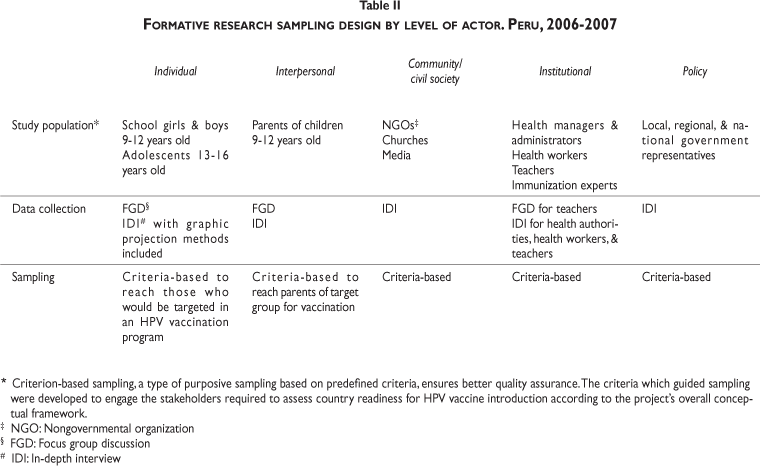
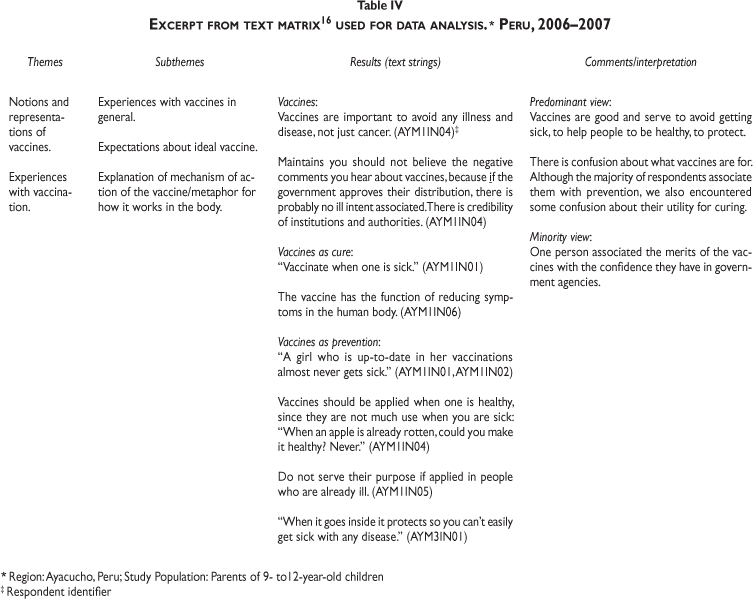
<body><![CDATA[<p><font face="Verdana" size="2">This paper presents    results from formative research in Peru conducted as part of PATH's four-country    "HPV Vaccines: Evidence for Impact" project, which aims to generate data for    government decision-making and operational planning related to HPV vaccine introduc-tion.<sup>11</sup>    Formative studies in each country consisted of sociocultural, health systems,    and policy research, in order to shape a vaccine delivery strategy, a communications    strategy, and an advocacy strategy. These three strategies are being implemented    and evaluated in a demonstration or pilot project in each country (results published    separately).</font></p>     <p>&nbsp;</p>     <p><font face="Verdana" size="3"><b>Material and    Methods</b></font></p>     <p><font face="Verdana" size="2">The methodology    in all four project countries was qualitative and guided by an ecological framework    that recognizes the importance of key actors at five levels for successful vaccine    introduction: individual, interpersonal, community, institutional, and policy.<sup>12,13</sup>    The research sought to obtain a wide range of experiences and informational    richness in order to capture the greatest variability, since a classic representative    sample was deemed neither appropriate nor feasible with this type of study design.    In Peru, data were collected through a health systems assessment to map the    national immunization strategy and other relevant policies, direct observation    of the school-based component of a national measles and rubella vaccination    campaign, and qualitative sociocultural research using focus group discussions    (FGDs) and in-depth interviews (IDIs) with actors at the five levels. Data collection    approaches and themes addressed in each component are listed in <a href="/img/revistas/spm/v52n3/07t01.gif">Table    I</a>. The formative research in Peru was conducted by the Instituto de Investigaci&oacute;n    Nutricional (IIN) between late 2006 and early 2007, with technical and financial    support from PATH.</font></p>     <p><font face="Verdana" size="2">The study followed    a criterion-based sampling strategy (<a href="/img/revistas/spm/v52n3/07t02.gif">Table    II</a>),<sup>14</sup> and was conducted in four diverse regions, selected in    consultation with Peru's Ministry of Health (MINSA): Piura (coast), Ayacucho    (Andean highlands), Ucayali (Amazon rain forest) and Lima (metropolitan urban    center). For the sociocultural research, health facilities and schools were    selected in each of the four regions based on input from regional vaccination    authorities and attainment of urban/rural diversity.<sup>15</sup> Guides for    IDIs, FGDs, and participatory techniques (<a href="/img/revistas/spm/v52n3/07t03.gif">Table    III</a>) were developed and modified during training of data collectors and    after initial piloting in each region. Focus groups and interviews were tape-recorded,    and field notes taken. Expanded field notes were created for each data collection    event and manually entered into textual matrixes (<a href="/img/revistas/spm/v52n3/07t04.gif">Table    IV</a> for a sample matrix), a recognized technique for systematically presenting,    ordering, and analyzing data.<sup>16</sup> Matrixes were organized by region,    study group, and theme/subtheme. Using a descriptive and interpretive approach    outlined in detail elsewhere,<sup>12</sup> similarities and differences in views    and experiences by level of actor were compared for each theme. The aim of this    analytic approach is to capture the range and variation of responses, including    regional variations; predominant views were also highlighted. Validation and    deeper understanding were reached through continuous triangulation during regular    team meetings. Triangulation involves the use of multiple theoretical perspectives,    as well as data sources and methods, to enhance validity.<sup>17</sup> Health    systems data collected at each facility were collated using a spreadsheet and    the results tabulated.</font></p>     <p><font face="Verdana" size="2">After preliminary    analysis, participatory workshops helped to further validate the findings, as    well as explore key issues in greater depth using ludic methodology.<sup>18</sup></font></p>     <p><font face="Verdana" size="2">The formative study    was approved by IIN's Ethical Committee and by PATH's Human Subjects Research    Committee as a non-research activity. Written consent for children's participation    in the study was provided by parents or guardians, and adults and children formally    assented to be interviewed or participate in focus groups, and for interviews    and focus groups to be tape-recorded.</font></p>     <p>&nbsp;</p>     <p><font face="Verdana" size="3"><b>Results</b></font></p>     <p><font face="Verdana" size="2">As part of the    health systems assessment, 24 policymaker interviews were conducted at national    and regional levels. Observation of the measles and rubella campaign took place    in 20 health facilities in all study regions except Lima, and included interviews    with 41 health personnel and 136 adolescents. For the sociocultural research,    266 interviews and 50 focus groups were conducted in the four regions (<a href="#t5">Table    V</a>).</font></p>     ]]></body>
<body><![CDATA[<p><a name="t5"></a></p>     <p>&nbsp;</p>     <p align="center"><img src="/img/revistas/spm/v52n3/07t05.gif"></p>     <p>&nbsp;</p>     <p><font face="Verdana" size="2"><b>Sociocultural</b></font></p>     <p><font face="Verdana" size="2">Cervical cancer    was recognized by many participants, including education, health, and civil    society representatives, as a serious disease. Some parents and children referred    to it more generally as a type of cancer that impacts female "intimate parts"    <i>(partes &iacute;ntimas).</i></font></p>     <p><font face="Verdana" size="2">Very few people,    aside from health workers and occasional parents and teachers, knew of HPV or    that it causes cervical cancer. Respondents in all groups instead cited perceived    "disorders" of sexual and reproductive life as causes (e.g., infidelity, promiscuous    sex). Several children, parents, and teachers attributed cervical cancer to    wounds in the "intimate parts" caused by blows or strikes <i>(golpes).</i></font></p>     <p><font face="Verdana" size="2">Vaccines appear    well-accepted by the population (see <a href="/img/revistas/spm/v52n3/07t04.gif">Table    IV</a> for additional data on this topic). Children reported that vaccination    enables them to avoid getting an illness and to be healthy:</font></p>     <blockquote>        <p><font face="Verdana" size="2"><i>She is a healthy      girl, happy; she's thinking she isn't going to have illnesses now..</i>. (Child,      Lima, in response to a photo of a girl being vaccinated)</font></p> </blockquote>     ]]></body>
<body><![CDATA[<p><font face="Verdana" size="2">Parents, members    of civil society, and teachers were also largely positive about immunization.</font></p>     <blockquote>        <p><font face="Verdana" size="2"><i>The vaccine      is a form of prevention; it's like an antidote that prevents certain viruses      or germs from invading us.</i> (Parent, Lima)</font></p> </blockquote>     <p><font face="Verdana" size="2">Despite general    support for vaccination, fears and doubts emerged. Most children were primarily    concerned about pain, and some also expressed distrust regarding the use of    expired vaccines or reused or rusty needles, being forced by health workers    to receive vaccines, lack of hygiene during vaccination, and viruses in the    vaccine making them sick. Some girls interviewed said they would prefer gentler    and more respectful treatment by, along with more information from, vaccination    nurses in future campaigns. Some parents expressed concern about secondary effects    of vaccination, including possible impacts on a girl's fertility:</font></p>     <blockquote>        <p><font face="Verdana" size="2"><i>Suspicious      parents think that they're giving their daughters a vaccine to stop them having      children, to ruin their uterus.</i> (Parent, Ucayali)</font></p> </blockquote>     <p><font face="Verdana" size="2">Most participants    responded that they would support a vaccine to prevent cervical cancer, provided    that it was not experimental, side effects were fully explained in advance,    and it was promoted through the existing health system. One teacher in Ucayali    even suggested that "nobody in their right mind" would oppose or refuse the    HPV vaccine, and one mother in the same region asked rhetorically "Who wouldn't    want to be vaccinated?"</font></p>     <p><font face="Verdana" size="2">Parents and others    expressed concern that the vaccine might be in a trial stage. Worries that HPV    vaccination would encourage early sexual activity were only mentioned by a few    parents. Others worried that the vaccine would accelerate girls' development    because it is administered before sexual maturity or activity.</font></p>     <p><font face="Verdana" size="2"><b>Health systems</b></font></p>     <p><font face="Verdana" size="2">The health systems    assessment confirmed a strong infrastructure for immunization in Peru, including    a cold chain management and delivery system. Vaccine coverage is generally high    in Peru, at least 93% (depending on the vaccine) in children less than one year    old as of December 2006. The health systems review did confirm that cold chain    capacity would need to increase in Ayacucho (by 91-103%), Piura (by 57-117%),    and Ucayali (by 19-167%) in order to accommodate the single-dose-vial packaging    of the HPV vaccine. Health authorities also reported that health workers need    additional training to prevent incorrect vaccination practice, including recapping    needles after administration.</font></p>     ]]></body>
<body><![CDATA[<p><font face="Verdana" size="2">Although post-licensing    surveillance of vaccines is relatively new, Peru has a comprehensive system    for monitoring, investigating, and reporting adverse events attributed to vaccination,    as well as a daily register system of vaccinations administered at each site.    However, it is difficult to track whether individuals have received all doses    of multiple-dose vaccines like HPV.</font></p>     <p><font face="Verdana" size="2">MINSA and other    key stakeholders strongly recommended school-based delivery of the HPV vaccine.    School-based immunizations, including the recent measles and rubella and yellow    fever campaigns, achieved high coverage. Most individuals interviewed were supportive    of a school-based vaccination strategy. Parents, for example, expressed a preference    for schools because of difficulty getting their children to health centers.</font></p>     <p><font face="Verdana" size="2">Participants also    expressed some concerns regarding school-based vaccination. Some teachers and    children were concerned about how adverse effects would be managed. Health workers    reported that some parents mistakenly believe that those who administer vaccines    in schools are actually personnel in training <i>(practicantes)</i> and not    experienced vaccinators.</font></p>     <p><font face="Verdana" size="2"><b>Policy</b></font></p>     <p><font face="Verdana" size="2">Most policymakers    reported that cancer is a life-threatening disease that should be addressed    by the health system, and that this perception is shared by the public:</font></p>     <blockquote>        <p><font face="Verdana" size="2"><i>People are      very impressed by the subject of cancer, particularly if it affects the uterus,      because it's an organ that means a lot to women.</i> (Policymaker, Piura)</font></p> </blockquote>     <p><font face="Verdana" size="2">By contrast, other    policymakers expressed concern that cervical cancer does not figure very prominently    when considered in terms of other health priorities:</font></p>     <blockquote>        <p><font face="Verdana" size="2"><i>It's the transmissible      diseases that generally predominate: respiratory, diarrheic, dermatological,      and sexually transmitted ones, with cervical cancer right at the end.</i>      (Policymaker)</font></p> </blockquote>     ]]></body>
<body><![CDATA[<p><font face="Verdana" size="2">Other policymakers    highlighted that a key challenge for prioritizing cervical cancer is a lack    of accurate data on disease prevalence.</font></p>     <p><font face="Verdana" size="2">According to the    policy review, resources for immunization have grown substantially in the past    decade. The National Immunization Strategy's <i>(Estrategia Sanitaria Nacional    de Immunizaci&oacute;n,</i> or ESNI) vision statement designates immunizations    as the "leading activity in the public health field." Policymakers interviewed    considered vaccines an important preventive health intervention.</font></p>     <p><font face="Verdana" size="2">Policymakers expressed    general support for HPV vaccine introduction, and many were interested in gathering    more information about the vaccine, benefits, possible side effects, cost, and    the etiology of cervical cancer. Many also expressed concern about introducing    a vaccine for young adolescent girls, and emphasized repeatedly that the public    will need significant information and outreach on the vaccine in advance:</font></p>     <blockquote>        <p><font face="Verdana" size="2"><i>You'd have      to disseminate the results &#91;of previous research&#93;, what reactions      it produces, .it only takes one girl with a reaction, .it's like a powder      keg.</i> (Regional policymaker)</font></p> </blockquote>     <p>&nbsp;</p>     <p><font face="Verdana" size="3"><b>Discussion</b></font></p>     <p><font face="Verdana" size="2">Implications of    the formative research for HPV vaccine introduction strategies are discussed    in the context of knowledge from developing countries, the region, and Peru.</font></p>     <p><font face="Verdana" size="2"><b>Vaccine delivery</b></font></p>     <p><font face="Verdana" size="2">The formative research    found that Peru's immunization system includes key vaccine delivery elements    recommended by WHO.<sup>19,</sup> <sup>20</sup> Peru demonstrated the highest    level of childhood immunization coverage of all four project countries, which    is consistent with high childhood vaccination coverage in Latin America generally.<sup>21,22</sup>    Our research also identified a need to increase storage capacity to support    a single-dose presentation of HPV vaccines, to adapt the vaccine monitoring    system to track this multi-dose vaccine, and to improve some health workers'    vaccination practice.</font></p>     ]]></body>
<body><![CDATA[<p><font face="Verdana" size="2">Feasibility of    vaccine delivery is a key contributor to achieving high coverage and vaccine    acceptance.<sup>23</sup> WHO has suggested that reaching young adolescents with    the HPV vaccine in developing countries could be challenging because they are    not usually included in immunization programs.<sup>24</sup> However, recent    initiatives to eliminate measles and rubella among adolescents in Latin America    including school-based components have been markedly successful. Reported rubella    cases in the region have dropped 98% since implementation of these programs.<sup>22</sup>    Health planners are therefore optimistic regarding feasibility of HPV vaccine    introduction in Latin American countries.<sup>22</sup></font></p>     <p><font face="Verdana" size="2">Peru recently completed    a widespread measles and rubella campaign which achieved fairly high acceptance    and over 97% coverage. Concerns regarding low- or non-school attendance are    less relevant in Peru than elsewhere; school attendance rates in 5<sup>th</sup>    grade are estimated to be above 95%, although this falls off markedly in 6<sup>th</sup>    grade and higher.<sup>25</sup> A small group of research participants did express    concerns, or alternative preferences for vaccine delivery locations, that helped    pinpoint challenges to address through a comprehensive introduction strategy.</font></p>     <p><font face="Verdana" size="2"><b>Communications</b></font></p>     <p><font face="Verdana" size="2">Health communication    messages which address local knowledge and attitudes will likely be most effective.<sup>26,27</sup></font></p>     <p><font face="Verdana" size="2">Our research found    relatively low levels of knowledge of cervical cancer, especially the cause    of cervical cancer, in Peru, which is consistent with other studies in the region.<sup>28,</sup>    <sup>29</sup> The research also found widespread understanding of cancer as    a deadly issue, including cancer of women's "intimate parts," also consistent    with previous studies in Peru.<sup>30,</sup> <sup>31</sup> Locally appropriate    messages can build on existing knowledge, terminology, and attitudes to fill    information gaps.</font></p>     <p><font face="Verdana" size="2">Experience with    vaccine introduction efforts has also shown that anticipating and addressing    community questions and concerns early is paramount for vaccine acceptance;<sup>23</sup>    this includes concerns of adolescents themselves. A 2005 guidebook from the    Pan American Health Organization (PAHO) for adolescent health promotion proposes    shaping health programs that respond to their often overlooked needs and concerns.<sup>32</sup>    Girls in our research expressed a desire for respectful treatment by and better    information from health workers, as well as concerns regarding hygiene and safe    vaccination practice. Addressing these concerns when training health workers    can help meet the expressed needs of this population.</font></p>     <p><font face="Verdana" size="2">Recognition of    the value of vaccination by a vaccine recipient's caretaker is also crucial    to acceptance.<sup>27</sup> To respond to concerns which were identified in    our research, communications campaigns might make it clear that the vaccines    are not experimental, have been widely used in developed countries with limited    side effects, and are endorsed by MINSA and other local authorities. In contrast    to the findings of adolescent sexual health researchers in other settings, such    as North America and Europe,<sup>33-35</sup> few respondents worried about the    vaccines promoting early sexual activity among their daughters.</font></p>     <p><font face="Verdana" size="2"><b>Advocacy</b></font></p>     <p><font face="Verdana" size="2">Our data were ambiguous    regarding whether policymakers consider cervical cancer a public health priority,    which can help facilitate vaccine introduction<sup>7</sup>; political will is    key.<sup>9,</sup> <sup>23</sup> Results from Peru imply that a successful advocacy    strategy might build on Peru's strong commitment to vaccination and the perception    that cancer is a high-prevalence and high-fatality disease. On the other hand,    our formative research findings reinforced those from other Latin American settings    -that awareness of the cervical cancer burden is fairly low and that more data,    information, and advocacy are needed.<sup><a name="top1"></a><a href="#back1">*</a>,1,36</sup></font></p>     <p><font face="Verdana" size="2">National governments    in the region, including Peru, have an opportunity to capitalize on recent momentum    to address cervical cancer in Latin America. In 2008, the Latin American Cancer    Prevention Initiative (LACPI) was launched.<sup>9</sup> The same year, PAHO    introduced a regional strategy for cervical cancer prevention and control to    its Directing Council, and a resolution was endorsed in response, committing    countries to scaling up comprehensive cervical cancer programs.<sup>8,37</sup>    In addition, PAHO's ProVac Initiative provides a framework for governments in    the region to tackle decision-making regarding HPV vaccine introduction in an    accelerated fashion, and the PAHO Revolving Fund can enable countries to purchase    vaccines at more affordable prices.<sup>22</sup></font></p>     ]]></body>
<body><![CDATA[<p>&nbsp;</p>     <p><font face="Verdana" size="3"><b>Conclusion</b></font></p>     <p><font face="Verdana" size="2">The formative research    in Peru found that individuals at five levels of influence are supportive of    HPV vaccine introduction in their communities. Respondents shared concerns about    safety and quality of care. There was a strong preference for school-based vaccine    delivery, and the research confirmed that Peru has a robust vaccine delivery    system in place. These findings were applied to help shape three strategies    -vaccine delivery, communications, and advocacy- that were tested in a demonstration    project in May 2008 in partnership with MINSA. Data from that work are undergoing    analysis at the time of this writing, but early indications are that coverage    and acceptance of the vaccine were reasonably high. The results of this formative    research and the demonstration project, together with those of the other three    countries, will supplement a small but growing evidence base for HPV vaccine    introduction throughout the developing world.</font></p>     <p>&nbsp;</p>     <p><font face="Verdana" size="3"><b>References</b></font></p>     <!-- ref --><p><font face="Verdana" size="2">1.&nbsp; Parkin    DM, Almonte M, Bruni L, Clifford C, Curado M, Pineros M. Burden and trends of    type-specific human papillomavirus infections and related diseases in the Latin    America and Caribbean region. Vaccine 2008;26(Suppl 11):L1-L15.    &nbsp;&nbsp;&nbsp;&nbsp;&nbsp;&nbsp;&nbsp;&nbsp;[&#160;<a href="javascript:void(0);" onclick="javascript: window.open('/scielo.php?script=sci_nlinks&ref=9300986&pid=S0036-3634201000030000700001&lng=','','width=640,height=500,resizable=yes,scrollbars=1,menubar=yes,');">Links</a>&#160;]<!-- end-ref --></font></p>     <!-- ref --><p><font face="Verdana" size="2">2.&nbsp; Koutsky    LA, Ault KA, Wheeler CM, Brown DR, Barr E, Alvarez FB. A controlled trial of    a human papillomavirus type I6 vaccine. N Engl J Med 2002;347(21):1645-1651.    &nbsp;&nbsp;&nbsp;&nbsp;&nbsp;&nbsp;&nbsp;&nbsp;[&#160;<a href="javascript:void(0);" onclick="javascript: window.open('/scielo.php?script=sci_nlinks&ref=9300988&pid=S0036-3634201000030000700002&lng=','','width=640,height=500,resizable=yes,scrollbars=1,menubar=yes,');">Links</a>&#160;]<!-- end-ref --></font></p>     <!-- ref --><p><font face="Verdana" size="2">3.&nbsp; Ling M,    Kanayama M, Roden R,Wu TC. Preventive and therapeutic vaccines for human papillomavirus-associated    cervical cancers. J Biomed Sci 2000;7(5):341-356.    &nbsp;&nbsp;&nbsp;&nbsp;&nbsp;&nbsp;&nbsp;&nbsp;[&#160;<a href="javascript:void(0);" onclick="javascript: window.open('/scielo.php?script=sci_nlinks&ref=9300990&pid=S0036-3634201000030000700003&lng=','','width=640,height=500,resizable=yes,scrollbars=1,menubar=yes,');">Links</a>&#160;]<!-- end-ref --></font></p>     <!-- ref --><p><font face="Verdana" size="2">4.&nbsp; Hildesheim    A, Markowitz L, Avila MH, Franceschi S. Research needs following initial licensure    of virus-like particle HPV vaccines.Vaccine 2006;24(Suppl 3):227-232.    &nbsp;&nbsp;&nbsp;&nbsp;&nbsp;&nbsp;&nbsp;&nbsp;[&#160;<a href="javascript:void(0);" onclick="javascript: window.open('/scielo.php?script=sci_nlinks&ref=9300992&pid=S0036-3634201000030000700004&lng=','','width=640,height=500,resizable=yes,scrollbars=1,menubar=yes,');">Links</a>&#160;]<!-- end-ref --></font></p>     <!-- ref --><p><font face="Verdana" size="2">5.&nbsp; Burchell    AN,Winer RL, de Sanjose S, Franco EL. Epidemiology and transmission dynamics    of genital HPV infection.Vaccine 2006;24(Suppl 3):52-61.    &nbsp;&nbsp;&nbsp;&nbsp;&nbsp;&nbsp;&nbsp;&nbsp;[&#160;<a href="javascript:void(0);" onclick="javascript: window.open('/scielo.php?script=sci_nlinks&ref=9300994&pid=S0036-3634201000030000700005&lng=','','width=640,height=500,resizable=yes,scrollbars=1,menubar=yes,');">Links</a>&#160;]<!-- end-ref --></font></p>     <!-- ref --><p><font face="Verdana" size="2">6.&nbsp; Clifford    G, Franceschi S, Diaz M, Munoz N,Villa LL. HPV type-distribution in women with    and without cervical neoplastic diseases. Vaccine 2006;24(Suppl 3):26-34.    &nbsp;&nbsp;&nbsp;&nbsp;&nbsp;&nbsp;&nbsp;&nbsp;[&#160;<a href="javascript:void(0);" onclick="javascript: window.open('/scielo.php?script=sci_nlinks&ref=9300996&pid=S0036-3634201000030000700006&lng=','','width=640,height=500,resizable=yes,scrollbars=1,menubar=yes,');">Links</a>&#160;]<!-- end-ref --></font></p>     <!-- ref --><p><font face="Verdana" size="2">7.&nbsp; World    Health Organization (WHO), Department of Immunization, Vaccines and Biologicals.    Vaccine Introduction Guidelines: Adding a Vaccine to a National Immunization    Programme: Decision and Implementation. Geneva (Switzerland): WHO, 2005.    &nbsp;&nbsp;&nbsp;&nbsp;&nbsp;&nbsp;&nbsp;&nbsp;[&#160;<a href="javascript:void(0);" onclick="javascript: window.open('/scielo.php?script=sci_nlinks&ref=9300998&pid=S0036-3634201000030000700007&lng=','','width=640,height=500,resizable=yes,scrollbars=1,menubar=yes,');">Links</a>&#160;]<!-- end-ref --></font></p>     <!-- ref --><p><font face="Verdana" size="2">8.&nbsp; Pan American    Health Organization (PAHO). Regional Strategy and Plan of Action for Cervical    Cancer Prevention and Control. Washington (DC): PAHO, 2008.    &nbsp;&nbsp;&nbsp;&nbsp;&nbsp;&nbsp;&nbsp;&nbsp;[&#160;<a href="javascript:void(0);" onclick="javascript: window.open('/scielo.php?script=sci_nlinks&ref=9301000&pid=S0036-3634201000030000700008&lng=','','width=640,height=500,resizable=yes,scrollbars=1,menubar=yes,');">Links</a>&#160;]<!-- end-ref --></font></p>     <!-- ref --><p><font face="Verdana" size="2">9.&nbsp; Correa    P. The war against cervical cancer in Latin America and the Caribbean. Triumph    of the scientists. Challenge for the community. Vaccine 2008;26(Suppl 11):iii-iv.    &nbsp;&nbsp;&nbsp;&nbsp;&nbsp;&nbsp;&nbsp;&nbsp;[&#160;<a href="javascript:void(0);" onclick="javascript: window.open('/scielo.php?script=sci_nlinks&ref=9301002&pid=S0036-3634201000030000700009&lng=','','width=640,height=500,resizable=yes,scrollbars=1,menubar=yes,');">Links</a>&#160;]<!-- end-ref --></font></p>     <!-- ref --><p><font face="Verdana" size="2">10.&nbsp; Newes    G, Helitzer DL, Caulfield LE, Borwn KH. Theory and practice: applying the ecological    model to formative research for a WIC training program in New York State. Health    Educ Res 2000;15(3):283-291.    &nbsp;&nbsp;&nbsp;&nbsp;&nbsp;&nbsp;&nbsp;&nbsp;[&#160;<a href="javascript:void(0);" onclick="javascript: window.open('/scielo.php?script=sci_nlinks&ref=9301004&pid=S0036-3634201000030000700010&lng=','','width=640,height=500,resizable=yes,scrollbars=1,menubar=yes,');">Links</a>&#160;]<!-- end-ref --></font></p>     <!-- ref --><p><font face="Verdana" size="2">11.&nbsp; Wittet    S. Cervical cancer vaccine project &#91;fact sheet&#93;. Seattle (WA): PATH,    2006.    &nbsp;&nbsp;&nbsp;&nbsp;&nbsp;&nbsp;&nbsp;&nbsp;[&#160;<a href="javascript:void(0);" onclick="javascript: window.open('/scielo.php?script=sci_nlinks&ref=9301006&pid=S0036-3634201000030000700011&lng=','','width=640,height=500,resizable=yes,scrollbars=1,menubar=yes,');">Links</a>&#160;]<!-- end-ref --></font></p>     <!-- ref --><p><font face="Verdana" size="2">12.&nbsp; Bingham    A, Janmohamed A, Bartolini R, Creed-Kanashiro H, Katahoire A, Khan I, <i>et    al.</i> An approach to formative research in HPV vaccine introduction planning    in low-resource settings. The Open Vaccine Journal 2009;2:1-16.    &nbsp;&nbsp;&nbsp;&nbsp;&nbsp;&nbsp;&nbsp;&nbsp;[&#160;<a href="javascript:void(0);" onclick="javascript: window.open('/scielo.php?script=sci_nlinks&ref=9301008&pid=S0036-3634201000030000700012&lng=','','width=640,height=500,resizable=yes,scrollbars=1,menubar=yes,');">Links</a>&#160;]<!-- end-ref --></font></p>     <!-- ref --><p><font face="Verdana" size="2">13.&nbsp; Green    LM, Kreuter MW. Health Promotion Planning: An Educational and Ecological Approach.    3rd ed. Mountain View (CA): Mayfield, 1999.    &nbsp;&nbsp;&nbsp;&nbsp;&nbsp;&nbsp;&nbsp;&nbsp;[&#160;<a href="javascript:void(0);" onclick="javascript: window.open('/scielo.php?script=sci_nlinks&ref=9301010&pid=S0036-3634201000030000700013&lng=','','width=640,height=500,resizable=yes,scrollbars=1,menubar=yes,');">Links</a>&#160;]<!-- end-ref --></font></p>     <!-- ref --><p><font face="Verdana" size="2">14.&nbsp; Kuzel    AJ. Sampling in qualitative inquiry. In Crabtree BF, Miller WL, eds. Doing Qualitative    Research. Newbury Park, CA: Sage Publications, 1992: 33-46.    &nbsp;&nbsp;&nbsp;&nbsp;&nbsp;&nbsp;&nbsp;&nbsp;[&#160;<a href="javascript:void(0);" onclick="javascript: window.open('/scielo.php?script=sci_nlinks&ref=9301012&pid=S0036-3634201000030000700014&lng=','','width=640,height=500,resizable=yes,scrollbars=1,menubar=yes,');">Links</a>&#160;]<!-- end-ref --></font></p>     <!-- ref --><p><font face="Verdana" size="2">15.&nbsp; PATH,    Instituto de Investigaci&oacute;n Nutricional (IIN). Shaping a Strategy to Introduce    HPV Vaccines in Peru: Formative Research Results from the HPV Vaccines: Evidence    For Impact <i>Project.</i> Seattle (WA): PATH, 2009.    &nbsp;&nbsp;&nbsp;&nbsp;&nbsp;&nbsp;&nbsp;&nbsp;[&#160;<a href="javascript:void(0);" onclick="javascript: window.open('/scielo.php?script=sci_nlinks&ref=9301014&pid=S0036-3634201000030000700015&lng=','','width=640,height=500,resizable=yes,scrollbars=1,menubar=yes,');">Links</a>&#160;]<!-- end-ref --></font></p>     <!-- ref --><p><font face="Verdana" size="2">16.&nbsp; Miles    MB, Huberman AM. Qualitative Data Analysis: An Expanded Sourcebook. Thousand    Oaks (CA): Sage Publications, 1994.    &nbsp;&nbsp;&nbsp;&nbsp;&nbsp;&nbsp;&nbsp;&nbsp;[&#160;<a href="javascript:void(0);" onclick="javascript: window.open('/scielo.php?script=sci_nlinks&ref=9301016&pid=S0036-3634201000030000700016&lng=','','width=640,height=500,resizable=yes,scrollbars=1,menubar=yes,');">Links</a>&#160;]<!-- end-ref --></font></p>     <!-- ref --><p><font face="Verdana" size="2">17.&nbsp; Gilchrist    VJ. Key informant interviews. In Crabtree BF, Miller WL, eds. Doing Qualitative    Research. Newbury Park, CA: Sage Publications, 1992:70-89.    &nbsp;&nbsp;&nbsp;&nbsp;&nbsp;&nbsp;&nbsp;&nbsp;[&#160;<a href="javascript:void(0);" onclick="javascript: window.open('/scielo.php?script=sci_nlinks&ref=9301018&pid=S0036-3634201000030000700017&lng=','','width=640,height=500,resizable=yes,scrollbars=1,menubar=yes,');">Links</a>&#160;]<!-- end-ref --></font></p>     <!-- ref --><p><font face="Verdana" size="2">18.&nbsp; Creed-Kanashiro    HM, Bartolini RM, Fukumoto MN, Uribe TG, Robert RC, Bentley ME. Formative research    to develop a nutrition education intervention to improve dietary iron intake    among women and adolescent girls through community kitchens in Lima, Peru. J    Nutr 2003;133(11 Suppl 2):3987S-3991S.    &nbsp;&nbsp;&nbsp;&nbsp;&nbsp;&nbsp;&nbsp;&nbsp;[&#160;<a href="javascript:void(0);" onclick="javascript: window.open('/scielo.php?script=sci_nlinks&ref=9301020&pid=S0036-3634201000030000700018&lng=','','width=640,height=500,resizable=yes,scrollbars=1,menubar=yes,');">Links</a>&#160;]<!-- end-ref --></font></p>     <!-- ref --><p><font face="Verdana" size="2">19.&nbsp; World    Health Organization (WHO). Training for Mid-Level Managers: Cold Chain,Vaccines    and Safe-Injection Equipment Management. Geneva (Switzerland): WHO, 2008.    &nbsp;&nbsp;&nbsp;&nbsp;&nbsp;&nbsp;&nbsp;&nbsp;[&#160;<a href="javascript:void(0);" onclick="javascript: window.open('/scielo.php?script=sci_nlinks&ref=9301022&pid=S0036-3634201000030000700019&lng=','','width=640,height=500,resizable=yes,scrollbars=1,menubar=yes,');">Links</a>&#160;]<!-- end-ref --></font></p>     <!-- ref --><p><font face="Verdana" size="2">20.&nbsp; United    States Agency for International Development (USAID). Immunization Essentials:    A Practical Field Guide. Washington (DC): USAID, 2003.    &nbsp;&nbsp;&nbsp;&nbsp;&nbsp;&nbsp;&nbsp;&nbsp;[&#160;<a href="javascript:void(0);" onclick="javascript: window.open('/scielo.php?script=sci_nlinks&ref=9301024&pid=S0036-3634201000030000700020&lng=','','width=640,height=500,resizable=yes,scrollbars=1,menubar=yes,');">Links</a>&#160;]<!-- end-ref --></font></p>     <!-- ref --><p><font face="Verdana" size="2">21.&nbsp; Biellik    R, Levin C, Mugisha E, LaMontagne DS, Bingham A, Kaipilyawar S, <i>et al.</i>    Health systems and immunization financing for human papillomavirus vaccine introduction    in low-resource settings. Vaccine 2009;27(44):6203- 6209.    &nbsp;&nbsp;&nbsp;&nbsp;&nbsp;&nbsp;&nbsp;&nbsp;[&#160;<a href="javascript:void(0);" onclick="javascript: window.open('/scielo.php?script=sci_nlinks&ref=9301026&pid=S0036-3634201000030000700021&lng=','','width=640,height=500,resizable=yes,scrollbars=1,menubar=yes,');">Links</a>&#160;]<!-- end-ref --></font></p>     <!-- ref --><p><font face="Verdana" size="2">22. Andrus JK,    Lewis MJ, Goldie SJ, Garc&iacute;a PJ,Winkler JL, Ruiz-Matus C, <i>et al.</i>    Human papillomavirus vaccine policy and delivery in Latin America and the Caribbean.    Vaccine 2008;26(Suppl 11):L80-L87.    &nbsp;&nbsp;&nbsp;&nbsp;&nbsp;&nbsp;&nbsp;&nbsp;[&#160;<a href="javascript:void(0);" onclick="javascript: window.open('/scielo.php?script=sci_nlinks&ref=9301028&pid=S0036-3634201000030000700022&lng=','','width=640,height=500,resizable=yes,scrollbars=1,menubar=yes,');">Links</a>&#160;]<!-- end-ref --></font></p>     <!-- ref --><p><font face="Verdana" size="2">23.Winkler JL,Wittet    S, Bartolini RM, Creed-Kanashiro HM, Lazcano-Ponce E, Lewis-Bell K, <i>et al.</i>    Determinants of human papillomavirus vaccine acceptability in Latin America    and the Caribbean. Vaccine 2008;26(Suppl 11):L73-L79.    &nbsp;&nbsp;&nbsp;&nbsp;&nbsp;&nbsp;&nbsp;&nbsp;[&#160;<a href="javascript:void(0);" onclick="javascript: window.open('/scielo.php?script=sci_nlinks&ref=9301030&pid=S0036-3634201000030000700023&lng=','','width=640,height=500,resizable=yes,scrollbars=1,menubar=yes,');">Links</a>&#160;]<!-- end-ref --></font></p>     <!-- ref --><p><font face="Verdana" size="2">24.&nbsp; World    Health Organization (WHO), United Nations Population Fund. Preparing for the    Introduction of HPV Vaccines: Policy and Programme Guidance for Countries. Geneva    (Switzerland): WHO, 2006.    &nbsp;&nbsp;&nbsp;&nbsp;&nbsp;&nbsp;&nbsp;&nbsp;[&#160;<a href="javascript:void(0);" onclick="javascript: window.open('/scielo.php?script=sci_nlinks&ref=9301032&pid=S0036-3634201000030000700024&lng=','','width=640,height=500,resizable=yes,scrollbars=1,menubar=yes,');">Links</a>&#160;]<!-- end-ref --></font></p>     <!-- ref --><p><font face="Verdana" size="2">25.&nbsp; Instituto    Nacional de Estad&iacute;stica e Inform&aacute;tica (INEI). Compendio Estad&iacute;stico    2006. Lima (Peru): INEI, 2006.    &nbsp;&nbsp;&nbsp;&nbsp;&nbsp;&nbsp;&nbsp;&nbsp;[&#160;<a href="javascript:void(0);" onclick="javascript: window.open('/scielo.php?script=sci_nlinks&ref=9301034&pid=S0036-3634201000030000700025&lng=','','width=640,height=500,resizable=yes,scrollbars=1,menubar=yes,');">Links</a>&#160;]<!-- end-ref --></font></p>     <!-- ref --><p><font face="Verdana" size="2">26.&nbsp; Kaljee    LM, Pack R, Pach A, Nyamete A, Stanton BF. Sociobehavioural research methods    for the introduction of vaccines in the Diseases of the Most Impoverished Programme.    J Health Popul Nutr 2004;22(3):293-303.    &nbsp;&nbsp;&nbsp;&nbsp;&nbsp;&nbsp;&nbsp;&nbsp;[&#160;<a href="javascript:void(0);" onclick="javascript: window.open('/scielo.php?script=sci_nlinks&ref=9301036&pid=S0036-3634201000030000700026&lng=','','width=640,height=500,resizable=yes,scrollbars=1,menubar=yes,');">Links</a>&#160;]<!-- end-ref --></font></p>     <!-- ref --><p><font face="Verdana" size="2">27.&nbsp; Jheeta    M, Jewell J. Childhood vaccination in Africa and Asia: the effects of parents'    knowledge and attitudes. Bull World Health Organ 2008;86(6):419.    &nbsp;&nbsp;&nbsp;&nbsp;&nbsp;&nbsp;&nbsp;&nbsp;[&#160;<a href="javascript:void(0);" onclick="javascript: window.open('/scielo.php?script=sci_nlinks&ref=9301038&pid=S0036-3634201000030000700027&lng=','','width=640,height=500,resizable=yes,scrollbars=1,menubar=yes,');">Links</a>&#160;]<!-- end-ref --></font></p>     <!-- ref --><p><font face="Verdana" size="2">28.&nbsp; Garcia    SG, Becker D, Tatum C, Aldrich T, Fernandez CA. Linking cervical cancer to the    human papillomavairus: findings from a qualitative study with Mexican women.    Health Care Women Int 2007;28(2):192-205.    &nbsp;&nbsp;&nbsp;&nbsp;&nbsp;&nbsp;&nbsp;&nbsp;[&#160;<a href="javascript:void(0);" onclick="javascript: window.open('/scielo.php?script=sci_nlinks&ref=9301040&pid=S0036-3634201000030000700028&lng=','','width=640,height=500,resizable=yes,scrollbars=1,menubar=yes,');">Links</a>&#160;]<!-- end-ref --></font></p>     <!-- ref --><p><font face="Verdana" size="2">29.&nbsp; Moreira    Jr. ED, Oliveira BG, Ferraz FM, Costa S, Costa Filho JO, Karic G. Knowledge    and attitudes about human papillomavirus, Pap smears, and cervical cancer among    young women in Brazil; implications for health education and prevention. Int    J Gynecol Cancer 2006;16(2):599-603.    &nbsp;&nbsp;&nbsp;&nbsp;&nbsp;&nbsp;&nbsp;&nbsp;[&#160;<a href="javascript:void(0);" onclick="javascript: window.open('/scielo.php?script=sci_nlinks&ref=9301042&pid=S0036-3634201000030000700029&lng=','','width=640,height=500,resizable=yes,scrollbars=1,menubar=yes,');">Links</a>&#160;]<!-- end-ref --></font></p>     <!-- ref --><p><font face="Verdana" size="2">30.&nbsp; Agurto    I, Bishop A, S&aacute;nchez G, Betancourt Z, Robles S. Perceived barriers and    benefits to cervical cancer screening in Latin America. Prev Med 2004;39(1):91-98.    &nbsp;&nbsp;&nbsp;&nbsp;&nbsp;&nbsp;&nbsp;&nbsp;[&#160;<a href="javascript:void(0);" onclick="javascript: window.open('/scielo.php?script=sci_nlinks&ref=9301044&pid=S0036-3634201000030000700030&lng=','','width=640,height=500,resizable=yes,scrollbars=1,menubar=yes,');">Links</a>&#160;]<!-- end-ref --></font></p>     <!-- ref --><p><font face="Verdana" size="2">31.&nbsp; Bingham    A, Bishop A, Coffey P,Winkler J, Bradley J, Dzuba I, <i>et al.</i> Factors affecting    utilization of cervical cancer prevention services in low-resource settings.    Salud Publica Mex 2003;45(Suppl 3):S408-S416.    &nbsp;&nbsp;&nbsp;&nbsp;&nbsp;&nbsp;&nbsp;&nbsp;[&#160;<a href="javascript:void(0);" onclick="javascript: window.open('/scielo.php?script=sci_nlinks&ref=9301046&pid=S0036-3634201000030000700031&lng=','','width=640,height=500,resizable=yes,scrollbars=1,menubar=yes,');">Links</a>&#160;]<!-- end-ref --></font></p>     <!-- ref --><p><font face="Verdana" size="2">32.&nbsp; Pan American    Health Organization (PAHO). Youth: Choices and Change; Promoting Health Behaviors    in Adolescents. Washington (DC): PAHO, 2005.    &nbsp;&nbsp;&nbsp;&nbsp;&nbsp;&nbsp;&nbsp;&nbsp;[&#160;<a href="javascript:void(0);" onclick="javascript: window.open('/scielo.php?script=sci_nlinks&ref=9301048&pid=S0036-3634201000030000700032&lng=','','width=640,height=500,resizable=yes,scrollbars=1,menubar=yes,');">Links</a>&#160;]<!-- end-ref --></font></p>     <!-- ref --><p><font face="Verdana" size="2">33.&nbsp; Zimet    GD, Liddon N, Rosenthal SL, Lazcano-Ponce E, Allen B. Chapter 24: Psychosocial    aspects of vaccine acceptability. Vaccine 2006;24(Suppl 3):201-209.    &nbsp;&nbsp;&nbsp;&nbsp;&nbsp;&nbsp;&nbsp;&nbsp;[&#160;<a href="javascript:void(0);" onclick="javascript: window.open('/scielo.php?script=sci_nlinks&ref=9301050&pid=S0036-3634201000030000700033&lng=','','width=640,height=500,resizable=yes,scrollbars=1,menubar=yes,');">Links</a>&#160;]<!-- end-ref --></font></p>     <!-- ref --><p><font face="Verdana" size="2">34.&nbsp; Kahn    JA, Burk RD. Papillomavirus vaccines in perspective. The Lancet 2007;369(9580):2135-2137.    &nbsp;&nbsp;&nbsp;&nbsp;&nbsp;&nbsp;&nbsp;&nbsp;[&#160;<a href="javascript:void(0);" onclick="javascript: window.open('/scielo.php?script=sci_nlinks&ref=9301052&pid=S0036-3634201000030000700034&lng=','','width=640,height=500,resizable=yes,scrollbars=1,menubar=yes,');">Links</a>&#160;]<!-- end-ref --></font></p>     <!-- ref --><p><font face="Verdana" size="2">35.&nbsp; Mays    RM, Sturm LM, Zimet GD. Parental perspectives on vaccinating children against    sexually transmitted infections. Soc Sci Med 2004;58(7):1405-1413.    &nbsp;&nbsp;&nbsp;&nbsp;&nbsp;&nbsp;&nbsp;&nbsp;[&#160;<a href="javascript:void(0);" onclick="javascript: window.open('/scielo.php?script=sci_nlinks&ref=9301054&pid=S0036-3634201000030000700035&lng=','','width=640,height=500,resizable=yes,scrollbars=1,menubar=yes,');">Links</a>&#160;]<!-- end-ref --></font></p>     <!-- ref --><p><font face="Verdana" size="2">36.&nbsp; Almonte    M, Albero G, Molano M, Carcamo C, Garcia PJ, Perez GI. Risk factors for human    papillomavirus exposure and co-factors for cervical cancer in Latin America    and the Caribbean. Vaccine 2008;26(Suppl 11):L16-L36.    &nbsp;&nbsp;&nbsp;&nbsp;&nbsp;&nbsp;&nbsp;&nbsp;[&#160;<a href="javascript:void(0);" onclick="javascript: window.open('/scielo.php?script=sci_nlinks&ref=9301056&pid=S0036-3634201000030000700036&lng=','','width=640,height=500,resizable=yes,scrollbars=1,menubar=yes,');">Links</a>&#160;]<!-- end-ref --></font></p>     <!-- ref --><p><font face="Verdana" size="2">37.&nbsp; Luciani    S, Andrus JK. A Pan American Health Organization strategy for cervical cancer    prevention and control in Latin America and the Caribbean. Reprod Health Matters    2008;16(32):59-66.    &nbsp;&nbsp;&nbsp;&nbsp;&nbsp;&nbsp;&nbsp;&nbsp;[&#160;<a href="javascript:void(0);" onclick="javascript: window.open('/scielo.php?script=sci_nlinks&ref=9301058&pid=S0036-3634201000030000700037&lng=','','width=640,height=500,resizable=yes,scrollbars=1,menubar=yes,');">Links</a>&#160;]<!-- end-ref --></font></p>     <p>&nbsp;</p>     ]]></body>
<body><![CDATA[<p>&nbsp;</p>     <p><font face="Verdana" size="2"><b><a name="back"></a><a href="#top"><img src="/img/revistas/spm/v52n3/seta.gif" border="0"></a>    Address reprint requests to:    <br>   </b> Jennifer Kidwell Drake    <br>   PO Box 900922, Seatle, WA, 98109, USA    <br>   E-mail: <a href="mailto:jdrake@path.org">jdrake@path.org</a></font></p>     <p><font face="Verdana" size="2">Received on: May    18, 2009    <br>   Accepted on: March 4, 2010</font></p>     <p>&nbsp;</p>     <p>&nbsp;</p>     <p><font face="Verdana" size="2"><a name="back1"></a><a href="#top1">*</a>    PATH. Developing-world policymakers' attitudes toward HPV vaccination &#91;unpublished    data&#93;. Located at: Seattle (WA): PATH, 2005.</font></p>     ]]></body>
<body><![CDATA[ ]]></body><back>
<ref-list>
<ref id="B1">
<label>1</label><nlm-citation citation-type="journal">
<person-group person-group-type="author">
<name>
<surname><![CDATA[Parkin]]></surname>
<given-names><![CDATA[DM]]></given-names>
</name>
<name>
<surname><![CDATA[Almonte]]></surname>
<given-names><![CDATA[M]]></given-names>
</name>
<name>
<surname><![CDATA[Bruni]]></surname>
<given-names><![CDATA[L]]></given-names>
</name>
<name>
<surname><![CDATA[Clifford]]></surname>
<given-names><![CDATA[C]]></given-names>
</name>
<name>
<surname><![CDATA[Curado]]></surname>
<given-names><![CDATA[M]]></given-names>
</name>
<name>
<surname><![CDATA[Pineros]]></surname>
<given-names><![CDATA[M]]></given-names>
</name>
</person-group>
<article-title xml:lang="en"><![CDATA[Burden and trends of type-specific human papillomavirus infections and related diseases in the Latin America and Caribbean region]]></article-title>
<source><![CDATA[Vaccine]]></source>
<year>2008</year>
<volume>26</volume>
<numero>^s11</numero>
<issue>^s11</issue>
<supplement>11</supplement>
<page-range>L1-L15</page-range></nlm-citation>
</ref>
<ref id="B2">
<label>2</label><nlm-citation citation-type="journal">
<person-group person-group-type="author">
<name>
<surname><![CDATA[Koutsky]]></surname>
<given-names><![CDATA[LA]]></given-names>
</name>
<name>
<surname><![CDATA[Ault]]></surname>
<given-names><![CDATA[KA]]></given-names>
</name>
<name>
<surname><![CDATA[Wheeler]]></surname>
<given-names><![CDATA[CM]]></given-names>
</name>
<name>
<surname><![CDATA[Brown]]></surname>
<given-names><![CDATA[DR]]></given-names>
</name>
<name>
<surname><![CDATA[Barr]]></surname>
<given-names><![CDATA[E]]></given-names>
</name>
<name>
<surname><![CDATA[Alvarez]]></surname>
<given-names><![CDATA[FB]]></given-names>
</name>
</person-group>
<article-title xml:lang="en"><![CDATA[A controlled trial of a human papillomavirus type I6 vaccine]]></article-title>
<source><![CDATA[N Engl J Med]]></source>
<year>2002</year>
<volume>347</volume>
<numero>21</numero>
<issue>21</issue>
<page-range>1645-1651</page-range></nlm-citation>
</ref>
<ref id="B3">
<label>3</label><nlm-citation citation-type="journal">
<person-group person-group-type="author">
<name>
<surname><![CDATA[Ling]]></surname>
<given-names><![CDATA[M]]></given-names>
</name>
<name>
<surname><![CDATA[Kanayama]]></surname>
<given-names><![CDATA[M]]></given-names>
</name>
<name>
<surname><![CDATA[Roden]]></surname>
<given-names><![CDATA[R]]></given-names>
</name>
<name>
<surname><![CDATA[Wu]]></surname>
<given-names><![CDATA[TC]]></given-names>
</name>
</person-group>
<article-title xml:lang="en"><![CDATA[Preventive and therapeutic vaccines for human papillomavirus-associated cervical cancers]]></article-title>
<source><![CDATA[J Biomed Sci]]></source>
<year>2000</year>
<volume>7</volume>
<numero>5</numero>
<issue>5</issue>
<page-range>341-356</page-range></nlm-citation>
</ref>
<ref id="B4">
<label>4</label><nlm-citation citation-type="journal">
<person-group person-group-type="author">
<name>
<surname><![CDATA[Hildesheim]]></surname>
<given-names><![CDATA[A]]></given-names>
</name>
<name>
<surname><![CDATA[Markowitz]]></surname>
<given-names><![CDATA[L]]></given-names>
</name>
<name>
<surname><![CDATA[Avila]]></surname>
<given-names><![CDATA[MH]]></given-names>
</name>
<name>
<surname><![CDATA[Franceschi]]></surname>
<given-names><![CDATA[S]]></given-names>
</name>
</person-group>
<article-title xml:lang="en"><![CDATA[Research needs following initial licensure of virus-like particle]]></article-title>
<source><![CDATA[HPV vaccines.Vaccine]]></source>
<year>2006</year>
<volume>24</volume>
<numero>^s3</numero>
<issue>^s3</issue>
<supplement>3</supplement>
<page-range>227-232</page-range></nlm-citation>
</ref>
<ref id="B5">
<label>5</label><nlm-citation citation-type="journal">
<person-group person-group-type="author">
<name>
<surname><![CDATA[Burchell]]></surname>
<given-names><![CDATA[AN]]></given-names>
</name>
<name>
<surname><![CDATA[Winer]]></surname>
<given-names><![CDATA[RL]]></given-names>
</name>
<name>
<surname><![CDATA[de Sanjose]]></surname>
<given-names><![CDATA[S]]></given-names>
</name>
<name>
<surname><![CDATA[Franco]]></surname>
<given-names><![CDATA[EL]]></given-names>
</name>
</person-group>
<article-title xml:lang="en"><![CDATA[Epidemiology and transmission dynamics of genital]]></article-title>
<source><![CDATA[HPV infection.Vaccine]]></source>
<year>2006</year>
<volume>24</volume>
<numero>^s3</numero>
<issue>^s3</issue>
<supplement>3</supplement>
<page-range>52-61</page-range></nlm-citation>
</ref>
<ref id="B6">
<label>6</label><nlm-citation citation-type="journal">
<person-group person-group-type="author">
<name>
<surname><![CDATA[Clifford]]></surname>
<given-names><![CDATA[G]]></given-names>
</name>
<name>
<surname><![CDATA[Franceschi]]></surname>
<given-names><![CDATA[S]]></given-names>
</name>
<name>
<surname><![CDATA[Diaz]]></surname>
<given-names><![CDATA[M]]></given-names>
</name>
<name>
<surname><![CDATA[Munoz]]></surname>
<given-names><![CDATA[N]]></given-names>
</name>
<name>
<surname><![CDATA[Villa]]></surname>
<given-names><![CDATA[LL]]></given-names>
</name>
</person-group>
<article-title xml:lang="en"><![CDATA[HPV type-distribution in women with and without cervical neoplastic diseases]]></article-title>
<source><![CDATA[Vaccine]]></source>
<year>2006</year>
<volume>24</volume>
<numero>^s3</numero>
<issue>^s3</issue>
<supplement>3</supplement>
<page-range>26-34</page-range></nlm-citation>
</ref>
<ref id="B7">
<label>7</label><nlm-citation citation-type="book">
<collab>World Health Organization^dDepartment of Immunization.Vaccines and Biologicals</collab>
<source><![CDATA[Vaccine Introduction Guidelines: Adding a Vaccine to a National Immunization Programme:Decision and Implementation]]></source>
<year>2005</year>
<publisher-loc><![CDATA[Geneva ]]></publisher-loc>
<publisher-name><![CDATA[WHO]]></publisher-name>
</nlm-citation>
</ref>
<ref id="B8">
<label>8</label><nlm-citation citation-type="book">
<collab>Pan American Health Organization</collab>
<source><![CDATA[Regional Strategy and Plan of Action for Cervical Cancer Prevention and Control]]></source>
<year>2008</year>
<publisher-loc><![CDATA[Washington^eDC DC]]></publisher-loc>
<publisher-name><![CDATA[PAHO]]></publisher-name>
</nlm-citation>
</ref>
<ref id="B9">
<label>9</label><nlm-citation citation-type="journal">
<person-group person-group-type="author">
<name>
<surname><![CDATA[Correa]]></surname>
<given-names><![CDATA[P]]></given-names>
</name>
</person-group>
<article-title xml:lang="en"><![CDATA[The war against cervical cancer in Latin America and the Caribbean. Triumph of the scientists. Challenge for the community]]></article-title>
<source><![CDATA[Vaccine]]></source>
<year>2008</year>
<volume>26</volume>
<numero>^s11</numero>
<issue>^s11</issue>
<supplement>11</supplement>
<page-range>iii-iv</page-range></nlm-citation>
</ref>
<ref id="B10">
<label>10</label><nlm-citation citation-type="journal">
<person-group person-group-type="author">
<name>
<surname><![CDATA[Newes]]></surname>
<given-names><![CDATA[G]]></given-names>
</name>
<name>
<surname><![CDATA[Helitzer]]></surname>
<given-names><![CDATA[DL]]></given-names>
</name>
<name>
<surname><![CDATA[Caulfield]]></surname>
<given-names><![CDATA[LE]]></given-names>
</name>
<name>
<surname><![CDATA[Borwn]]></surname>
<given-names><![CDATA[KH]]></given-names>
</name>
</person-group>
<article-title xml:lang="en"><![CDATA[Theory and practice: applying the ecological model to formative research for a WIC training program in New York State]]></article-title>
<source><![CDATA[Health Educ Res]]></source>
<year>2000</year>
<volume>15</volume>
<numero>3</numero>
<issue>3</issue>
<page-range>283-291</page-range></nlm-citation>
</ref>
<ref id="B11">
<label>11</label><nlm-citation citation-type="book">
<person-group person-group-type="author">
<name>
<surname><![CDATA[Wittet]]></surname>
<given-names><![CDATA[S]]></given-names>
</name>
</person-group>
<source><![CDATA[Cervical cancer vaccine project]]></source>
<year>2006</year>
<publisher-loc><![CDATA[Seattle^eWA WA]]></publisher-loc>
<publisher-name><![CDATA[PATH]]></publisher-name>
</nlm-citation>
</ref>
<ref id="B12">
<label>12</label><nlm-citation citation-type="journal">
<person-group person-group-type="author">
<name>
<surname><![CDATA[Bingham]]></surname>
<given-names><![CDATA[A]]></given-names>
</name>
<name>
<surname><![CDATA[Janmohamed]]></surname>
<given-names><![CDATA[A]]></given-names>
</name>
<name>
<surname><![CDATA[Bartolini]]></surname>
<given-names><![CDATA[R]]></given-names>
</name>
<name>
<surname><![CDATA[Creed-Kanashiro]]></surname>
<given-names><![CDATA[H]]></given-names>
</name>
<name>
<surname><![CDATA[Katahoire]]></surname>
<given-names><![CDATA[A]]></given-names>
</name>
<name>
<surname><![CDATA[Khan]]></surname>
<given-names><![CDATA[I]]></given-names>
</name>
</person-group>
<article-title xml:lang="en"><![CDATA[An approach to formative research in HPV vaccine introduction planning in low-resource settings]]></article-title>
<source><![CDATA[The Open Vaccine Journal]]></source>
<year>2009</year>
<volume>2</volume>
<page-range>1-16</page-range></nlm-citation>
</ref>
<ref id="B13">
<label>13</label><nlm-citation citation-type="book">
<person-group person-group-type="author">
<name>
<surname><![CDATA[Green]]></surname>
<given-names><![CDATA[LM]]></given-names>
</name>
<name>
<surname><![CDATA[Kreuter]]></surname>
<given-names><![CDATA[MW]]></given-names>
</name>
</person-group>
<source><![CDATA[Health Promotion Planning: An Educational and Ecological Approach]]></source>
<year>1999</year>
<edition>3</edition>
<publisher-loc><![CDATA[Mountain View^eCA CA]]></publisher-loc>
<publisher-name><![CDATA[Mayfield]]></publisher-name>
</nlm-citation>
</ref>
<ref id="B14">
<label>14</label><nlm-citation citation-type="book">
<person-group person-group-type="author">
<name>
<surname><![CDATA[Kuzel]]></surname>
<given-names><![CDATA[AJ]]></given-names>
</name>
</person-group>
<article-title xml:lang="en"><![CDATA[Sampling in qualitative inquiry]]></article-title>
<person-group person-group-type="editor">
<name>
<surname><![CDATA[Crabtree]]></surname>
<given-names><![CDATA[BF]]></given-names>
</name>
<name>
<surname><![CDATA[Miller]]></surname>
<given-names><![CDATA[WL]]></given-names>
</name>
</person-group>
<source><![CDATA[Doing Qualitative Research]]></source>
<year>1992</year>
<page-range>33-46</page-range><publisher-loc><![CDATA[Newbury Park^eCA CA]]></publisher-loc>
<publisher-name><![CDATA[Sage Publications]]></publisher-name>
</nlm-citation>
</ref>
<ref id="B15">
<label>15</label><nlm-citation citation-type="book">
<collab>PATH^dInstituto de Investigación Nutricional</collab>
<source><![CDATA[Shaping a Strategy to Introduce HPV Vaccines in Peru: Formative Research Results from the HPV Vaccines:Evidence For Impact Project]]></source>
<year>2009</year>
<publisher-loc><![CDATA[Seattle^eWA WA]]></publisher-loc>
<publisher-name><![CDATA[PATH]]></publisher-name>
</nlm-citation>
</ref>
<ref id="B16">
<label>16</label><nlm-citation citation-type="book">
<person-group person-group-type="author">
<name>
<surname><![CDATA[Miles]]></surname>
<given-names><![CDATA[MB]]></given-names>
</name>
<name>
<surname><![CDATA[Huberman]]></surname>
<given-names><![CDATA[AM]]></given-names>
</name>
</person-group>
<source><![CDATA[Qualitative Data Analysis: An Expanded Sourcebook]]></source>
<year>1994</year>
<publisher-loc><![CDATA[Thousand Oaks^eCA CA]]></publisher-loc>
<publisher-name><![CDATA[Sage Publications]]></publisher-name>
</nlm-citation>
</ref>
<ref id="B17">
<label>17</label><nlm-citation citation-type="book">
<person-group person-group-type="author">
<name>
<surname><![CDATA[Gilchrist]]></surname>
<given-names><![CDATA[VJ]]></given-names>
</name>
</person-group>
<article-title xml:lang="en"><![CDATA[Key informant interviews]]></article-title>
<person-group person-group-type="editor">
<name>
<surname><![CDATA[Crabtree]]></surname>
<given-names><![CDATA[BF]]></given-names>
</name>
<name>
<surname><![CDATA[Miller]]></surname>
<given-names><![CDATA[WL]]></given-names>
</name>
</person-group>
<source><![CDATA[Doing Qualitative Research]]></source>
<year>1992</year>
<page-range>70-89</page-range><publisher-loc><![CDATA[Newbury Park^eCA CA]]></publisher-loc>
<publisher-name><![CDATA[Sage Publications]]></publisher-name>
</nlm-citation>
</ref>
<ref id="B18">
<label>18</label><nlm-citation citation-type="journal">
<person-group person-group-type="author">
<name>
<surname><![CDATA[Creed-Kanashiro]]></surname>
<given-names><![CDATA[HM]]></given-names>
</name>
<name>
<surname><![CDATA[Bartolini]]></surname>
<given-names><![CDATA[RM]]></given-names>
</name>
<name>
<surname><![CDATA[Fukumoto]]></surname>
<given-names><![CDATA[MN]]></given-names>
</name>
<name>
<surname><![CDATA[Uribe]]></surname>
<given-names><![CDATA[TG]]></given-names>
</name>
<name>
<surname><![CDATA[Robert]]></surname>
<given-names><![CDATA[RC]]></given-names>
</name>
<name>
<surname><![CDATA[Bentley]]></surname>
<given-names><![CDATA[ME]]></given-names>
</name>
</person-group>
<article-title xml:lang="en"><![CDATA[Formative research to develop a nutrition education intervention to improve dietary iron intake among women and adolescent girls through community kitchens in Lima, Peru]]></article-title>
<source><![CDATA[J Nutr]]></source>
<year>2003</year>
<volume>133</volume>
<numero>^s2</numero>
<issue>^s2</issue>
<supplement>2</supplement>
<page-range>3987S-3991S</page-range></nlm-citation>
</ref>
<ref id="B19">
<label>19</label><nlm-citation citation-type="book">
<collab>World Health Organization</collab>
<source><![CDATA[Training for Mid-Level Managers: Cold Chain,Vaccines and Safe-Injection Equipment Management]]></source>
<year>2008</year>
<publisher-loc><![CDATA[Geneva ]]></publisher-loc>
<publisher-name><![CDATA[WHO]]></publisher-name>
</nlm-citation>
</ref>
<ref id="B20">
<label>20</label><nlm-citation citation-type="book">
<collab>United States Agency for International Development</collab>
<source><![CDATA[Immunization Essentials: A Practical Field]]></source>
<year>2003</year>
<publisher-loc><![CDATA[Guide. Washington^eDC DC]]></publisher-loc>
<publisher-name><![CDATA[USAID]]></publisher-name>
</nlm-citation>
</ref>
<ref id="B21">
<label>21</label><nlm-citation citation-type="journal">
<person-group person-group-type="author">
<name>
<surname><![CDATA[Biellik]]></surname>
<given-names><![CDATA[R]]></given-names>
</name>
<name>
<surname><![CDATA[Levin]]></surname>
<given-names><![CDATA[C]]></given-names>
</name>
<name>
<surname><![CDATA[Mugisha]]></surname>
<given-names><![CDATA[E]]></given-names>
</name>
<name>
<surname><![CDATA[LaMontagne]]></surname>
<given-names><![CDATA[DS]]></given-names>
</name>
<name>
<surname><![CDATA[Bingham]]></surname>
<given-names><![CDATA[A]]></given-names>
</name>
<name>
<surname><![CDATA[Kaipilyawar]]></surname>
<given-names><![CDATA[S]]></given-names>
</name>
</person-group>
<article-title xml:lang="en"><![CDATA[Health systems and immunization financing for human papillomavirus vaccine introduction in low-resource settings]]></article-title>
<source><![CDATA[Vaccine]]></source>
<year>2009</year>
<volume>27</volume>
<numero>44</numero>
<issue>44</issue>
<page-range>6203-6209</page-range></nlm-citation>
</ref>
<ref id="B22">
<label>22</label><nlm-citation citation-type="journal">
<person-group person-group-type="author">
<name>
<surname><![CDATA[Andrus]]></surname>
<given-names><![CDATA[JK]]></given-names>
</name>
<name>
<surname><![CDATA[Lewis]]></surname>
<given-names><![CDATA[MJ]]></given-names>
</name>
<name>
<surname><![CDATA[Goldie]]></surname>
<given-names><![CDATA[SJ]]></given-names>
</name>
<name>
<surname><![CDATA[García]]></surname>
<given-names><![CDATA[PJ]]></given-names>
</name>
<name>
<surname><![CDATA[Winkler]]></surname>
<given-names><![CDATA[JL]]></given-names>
</name>
<name>
<surname><![CDATA[Ruiz-Matus]]></surname>
<given-names><![CDATA[C]]></given-names>
</name>
</person-group>
<article-title xml:lang="en"><![CDATA[Human papillomavirus vaccine policy and delivery in Latin America and the Caribbean]]></article-title>
<source><![CDATA[Vaccine]]></source>
<year>2008</year>
<volume>26</volume>
<numero>^s11</numero>
<issue>^s11</issue>
<supplement>11</supplement>
<page-range>L80-L87</page-range></nlm-citation>
</ref>
<ref id="B23">
<label>23</label><nlm-citation citation-type="journal">
<person-group person-group-type="author">
<name>
<surname><![CDATA[Winkler]]></surname>
<given-names><![CDATA[JL]]></given-names>
</name>
<name>
<surname><![CDATA[Wittet]]></surname>
<given-names><![CDATA[S]]></given-names>
</name>
<name>
<surname><![CDATA[Bartolini]]></surname>
<given-names><![CDATA[RM]]></given-names>
</name>
<name>
<surname><![CDATA[Creed-Kanashiro]]></surname>
<given-names><![CDATA[HM]]></given-names>
</name>
<name>
<surname><![CDATA[Lazcano-Ponce]]></surname>
<given-names><![CDATA[E]]></given-names>
</name>
<name>
<surname><![CDATA[Lewis-Bell]]></surname>
<given-names><![CDATA[K]]></given-names>
</name>
</person-group>
<article-title xml:lang="en"><![CDATA[Determinants of human papillomavirus vaccine acceptability in Latin America and the Caribbean]]></article-title>
<source><![CDATA[Vaccine]]></source>
<year>2008</year>
<volume>26</volume>
<numero>^s11</numero>
<issue>^s11</issue>
<supplement>11</supplement>
<page-range>L73-L79</page-range></nlm-citation>
</ref>
<ref id="B24">
<label>24</label><nlm-citation citation-type="book">
<collab>World Health Organization.United Nations Population Fund</collab>
<source><![CDATA[Preparing for the Introduction of HPV Vaccines: Policy and Programme Guidance for Countries]]></source>
<year>2006</year>
<publisher-loc><![CDATA[Geneva ]]></publisher-loc>
<publisher-name><![CDATA[WHO]]></publisher-name>
</nlm-citation>
</ref>
<ref id="B25">
<label>25</label><nlm-citation citation-type="book">
<collab>Instituto Nacional de Estadística e Informática</collab>
<source><![CDATA[Compendio Estadístico 2006]]></source>
<year>2006</year>
<publisher-loc><![CDATA[Lima ]]></publisher-loc>
<publisher-name><![CDATA[INEI]]></publisher-name>
</nlm-citation>
</ref>
<ref id="B26">
<label>26</label><nlm-citation citation-type="journal">
<person-group person-group-type="author">
<name>
<surname><![CDATA[Kaljee]]></surname>
<given-names><![CDATA[LM]]></given-names>
</name>
<name>
<surname><![CDATA[Pack]]></surname>
<given-names><![CDATA[R]]></given-names>
</name>
<name>
<surname><![CDATA[Pach]]></surname>
<given-names><![CDATA[A]]></given-names>
</name>
<name>
<surname><![CDATA[Nyamete]]></surname>
<given-names><![CDATA[A]]></given-names>
</name>
<name>
<surname><![CDATA[Stanton]]></surname>
<given-names><![CDATA[BF]]></given-names>
</name>
</person-group>
<article-title xml:lang="en"><![CDATA[Sociobehavioural research methods for the introduction of vaccines in the Diseases of the Most Impoverished Programme]]></article-title>
<source><![CDATA[J Health Popul Nutr]]></source>
<year>2004</year>
<volume>22</volume>
<numero>3</numero>
<issue>3</issue>
<page-range>293-303</page-range></nlm-citation>
</ref>
<ref id="B27">
<label>27</label><nlm-citation citation-type="journal">
<person-group person-group-type="author">
<name>
<surname><![CDATA[Jheeta]]></surname>
<given-names><![CDATA[M]]></given-names>
</name>
<name>
<surname><![CDATA[Jewell]]></surname>
<given-names><![CDATA[J]]></given-names>
</name>
</person-group>
<article-title xml:lang="en"><![CDATA[Childhood vaccination in Africa and Asia: the effects of parents' knowledge and attitudes]]></article-title>
<source><![CDATA[Bull World Health Organ]]></source>
<year>2008</year>
<volume>86</volume>
<numero>6</numero>
<issue>6</issue>
<page-range>419</page-range></nlm-citation>
</ref>
<ref id="B28">
<label>28</label><nlm-citation citation-type="journal">
<person-group person-group-type="author">
<name>
<surname><![CDATA[Garcia]]></surname>
<given-names><![CDATA[SG]]></given-names>
</name>
<name>
<surname><![CDATA[Becker]]></surname>
<given-names><![CDATA[D]]></given-names>
</name>
<name>
<surname><![CDATA[Tatum]]></surname>
<given-names><![CDATA[C]]></given-names>
</name>
<name>
<surname><![CDATA[Aldrich]]></surname>
<given-names><![CDATA[T]]></given-names>
</name>
<name>
<surname><![CDATA[Fernandez]]></surname>
<given-names><![CDATA[CA]]></given-names>
</name>
</person-group>
<article-title xml:lang="en"><![CDATA[Linking cervical cancer to the human papillomavairus: findings from a qualitative study with Mexican women]]></article-title>
<source><![CDATA[Health Care Women Int]]></source>
<year>2007</year>
<volume>28</volume>
<numero>2</numero>
<issue>2</issue>
<page-range>192-205</page-range></nlm-citation>
</ref>
<ref id="B29">
<label>29</label><nlm-citation citation-type="journal">
<person-group person-group-type="author">
<name>
<surname><![CDATA[Moreira Jr]]></surname>
<given-names><![CDATA[ED]]></given-names>
</name>
<name>
<surname><![CDATA[Oliveira]]></surname>
<given-names><![CDATA[BG]]></given-names>
</name>
<name>
<surname><![CDATA[Ferraz]]></surname>
<given-names><![CDATA[FM]]></given-names>
</name>
<name>
<surname><![CDATA[Costa]]></surname>
<given-names><![CDATA[S]]></given-names>
</name>
<name>
<surname><![CDATA[Costa Filho]]></surname>
<given-names><![CDATA[JO]]></given-names>
</name>
<name>
<surname><![CDATA[Karic]]></surname>
<given-names><![CDATA[G.]]></given-names>
</name>
</person-group>
<article-title xml:lang="en"><![CDATA[Knowledge and attitudes about human papillomavirus, Pap smears, and cervical cancer among young women in Brazil; implications for health education and prevention]]></article-title>
<source><![CDATA[Int J Gynecol Cancer]]></source>
<year>2006</year>
<volume>16</volume>
<numero>2</numero>
<issue>2</issue>
<page-range>599-603</page-range></nlm-citation>
</ref>
<ref id="B30">
<label>30</label><nlm-citation citation-type="journal">
<person-group person-group-type="author">
<name>
<surname><![CDATA[Agurto]]></surname>
<given-names><![CDATA[I]]></given-names>
</name>
<name>
<surname><![CDATA[Bishop]]></surname>
<given-names><![CDATA[A]]></given-names>
</name>
<name>
<surname><![CDATA[Sánchez]]></surname>
<given-names><![CDATA[G]]></given-names>
</name>
<name>
<surname><![CDATA[Betancourt]]></surname>
<given-names><![CDATA[Z]]></given-names>
</name>
<name>
<surname><![CDATA[Robles]]></surname>
<given-names><![CDATA[S]]></given-names>
</name>
</person-group>
<article-title xml:lang="en"><![CDATA[Perceived barriers and benefits to cervical cancer screening in Latin America]]></article-title>
<source><![CDATA[Prev Med]]></source>
<year>2004</year>
<volume>39</volume>
<numero>1</numero>
<issue>1</issue>
<page-range>91-98</page-range></nlm-citation>
</ref>
<ref id="B31">
<label>31</label><nlm-citation citation-type="journal">
<person-group person-group-type="author">
<name>
<surname><![CDATA[Bingham]]></surname>
<given-names><![CDATA[A]]></given-names>
</name>
<name>
<surname><![CDATA[Bishop]]></surname>
<given-names><![CDATA[A]]></given-names>
</name>
<name>
<surname><![CDATA[Coffey]]></surname>
<given-names><![CDATA[P]]></given-names>
</name>
<name>
<surname><![CDATA[Winkler]]></surname>
<given-names><![CDATA[J]]></given-names>
</name>
<name>
<surname><![CDATA[Bradley]]></surname>
<given-names><![CDATA[J]]></given-names>
</name>
<name>
<surname><![CDATA[Dzuba]]></surname>
<given-names><![CDATA[I]]></given-names>
</name>
</person-group>
<article-title xml:lang="en"><![CDATA[Factors affecting utilization of cervical cancer prevention services in low-resource settings]]></article-title>
<source><![CDATA[Salud Publica Mex]]></source>
<year>2003</year>
<volume>45</volume>
<numero>^s3</numero>
<issue>^s3</issue>
<supplement>3</supplement>
<page-range>S408-S416</page-range></nlm-citation>
</ref>
<ref id="B32">
<label>32</label><nlm-citation citation-type="book">
<collab>Pan American Health Organization</collab>
<source><![CDATA[Youth: Choices and Change; Promoting Health Behaviors in Adolescents]]></source>
<year>2005</year>
<publisher-loc><![CDATA[Washington^eDC DC]]></publisher-loc>
<publisher-name><![CDATA[PAHO]]></publisher-name>
</nlm-citation>
</ref>
<ref id="B33">
<label>33</label><nlm-citation citation-type="journal">
<person-group person-group-type="author">
<name>
<surname><![CDATA[Zimet]]></surname>
<given-names><![CDATA[GD]]></given-names>
</name>
<name>
<surname><![CDATA[Liddon]]></surname>
<given-names><![CDATA[N]]></given-names>
</name>
<name>
<surname><![CDATA[Rosenthal]]></surname>
<given-names><![CDATA[SL]]></given-names>
</name>
<name>
<surname><![CDATA[Lazcano-Ponce]]></surname>
<given-names><![CDATA[E]]></given-names>
</name>
<name>
<surname><![CDATA[Allen]]></surname>
<given-names><![CDATA[B]]></given-names>
</name>
</person-group>
<article-title xml:lang="en"><![CDATA[Chapter 24: Psychosocial aspects of vaccine acceptability]]></article-title>
<source><![CDATA[Vaccine]]></source>
<year>2006</year>
<volume>24</volume>
<numero>^s3</numero>
<issue>^s3</issue>
<supplement>3</supplement>
<page-range>201-209</page-range></nlm-citation>
</ref>
<ref id="B34">
<label>34</label><nlm-citation citation-type="journal">
<person-group person-group-type="author">
<name>
<surname><![CDATA[Kahn]]></surname>
<given-names><![CDATA[JA]]></given-names>
</name>
<name>
<surname><![CDATA[Burk]]></surname>
<given-names><![CDATA[RD]]></given-names>
</name>
</person-group>
<article-title xml:lang="en"><![CDATA[Papillomavirus vaccines in perspective]]></article-title>
<source><![CDATA[The Lancet]]></source>
<year>2007</year>
<volume>369</volume>
<numero>9580</numero>
<issue>9580</issue>
<page-range>2135-2137</page-range></nlm-citation>
</ref>
<ref id="B35">
<label>35</label><nlm-citation citation-type="journal">
<person-group person-group-type="author">
<name>
<surname><![CDATA[Mays]]></surname>
<given-names><![CDATA[RM]]></given-names>
</name>
<name>
<surname><![CDATA[Sturm]]></surname>
<given-names><![CDATA[LM]]></given-names>
</name>
<name>
<surname><![CDATA[Zimet]]></surname>
<given-names><![CDATA[GD]]></given-names>
</name>
</person-group>
<article-title xml:lang="en"><![CDATA[Parental perspectives on vaccinating children against sexually transmitted infections]]></article-title>
<source><![CDATA[Soc Sci Med]]></source>
<year>2004</year>
<volume>58</volume>
<numero>7</numero>
<issue>7</issue>
<page-range>1405-1413</page-range></nlm-citation>
</ref>
<ref id="B36">
<label>36</label><nlm-citation citation-type="journal">
<person-group person-group-type="author">
<name>
<surname><![CDATA[Almonte]]></surname>
<given-names><![CDATA[M]]></given-names>
</name>
<name>
<surname><![CDATA[Albero]]></surname>
<given-names><![CDATA[G]]></given-names>
</name>
<name>
<surname><![CDATA[Molano]]></surname>
<given-names><![CDATA[M]]></given-names>
</name>
<name>
<surname><![CDATA[Carcamo]]></surname>
<given-names><![CDATA[C]]></given-names>
</name>
<name>
<surname><![CDATA[Garcia]]></surname>
<given-names><![CDATA[PJ]]></given-names>
</name>
<name>
<surname><![CDATA[Perez]]></surname>
<given-names><![CDATA[GI]]></given-names>
</name>
</person-group>
<article-title xml:lang="en"><![CDATA[Risk factors for human papillomavirus exposure and co-factors for cervical cancer in Latin America and the Caribbean]]></article-title>
<source><![CDATA[Vaccine]]></source>
<year>2008</year>
<volume>26</volume>
<numero>^s11</numero>
<issue>^s11</issue>
<supplement>11</supplement>
<page-range>L16-L36</page-range></nlm-citation>
</ref>
<ref id="B37">
<label>37</label><nlm-citation citation-type="journal">
<person-group person-group-type="author">
<name>
<surname><![CDATA[Luciani]]></surname>
<given-names><![CDATA[S]]></given-names>
</name>
<name>
<surname><![CDATA[Andrus]]></surname>
<given-names><![CDATA[JK]]></given-names>
</name>
</person-group>
<article-title xml:lang="en"><![CDATA[A Pan American Health Organization strategy for cervical cancer prevention and control in Latin America and the Caribbean]]></article-title>
<source><![CDATA[Reprod Health Matters]]></source>
<year>2008</year>
<volume>16</volume>
<numero>32</numero>
<issue>32</issue>
<page-range>59-66</page-range></nlm-citation>
</ref>
</ref-list>
</back>
</article>
