<?xml version="1.0" encoding="ISO-8859-1"?><article xmlns:mml="http://www.w3.org/1998/Math/MathML" xmlns:xlink="http://www.w3.org/1999/xlink" xmlns:xsi="http://www.w3.org/2001/XMLSchema-instance">
<front>
<journal-meta>
<journal-id>0036-3634</journal-id>
<journal-title><![CDATA[Salud Pública de México]]></journal-title>
<abbrev-journal-title><![CDATA[Salud pública Méx]]></abbrev-journal-title>
<issn>0036-3634</issn>
<publisher>
<publisher-name><![CDATA[Instituto Nacional de Salud Pública]]></publisher-name>
</publisher>
</journal-meta>
<article-meta>
<article-id>S0036-36342010000300002</article-id>
<title-group>
<article-title xml:lang="en"><![CDATA[Prevalence of disordered eating and its impact on quality of life among a group of college students in a province of west Turkey]]></article-title>
<article-title xml:lang="es"><![CDATA[Prevalencia de conductas alimentarias de riesgo y su impacto en la calidad de vida de un grupo de estudiantes universitarios en una provincia del oeste de Turquía]]></article-title>
</title-group>
<contrib-group>
<contrib contrib-type="author">
<name>
<surname><![CDATA[Tozun]]></surname>
<given-names><![CDATA[Mustafa]]></given-names>
</name>
<xref ref-type="aff" rid="A01"/>
</contrib>
<contrib contrib-type="author">
<name>
<surname><![CDATA[Unsal]]></surname>
<given-names><![CDATA[Alaettin]]></given-names>
</name>
<xref ref-type="aff" rid="A02"/>
</contrib>
<contrib contrib-type="author">
<name>
<surname><![CDATA[Ayranci]]></surname>
<given-names><![CDATA[Unal]]></given-names>
</name>
<xref ref-type="aff" rid="A02"/>
</contrib>
<contrib contrib-type="author">
<name>
<surname><![CDATA[Arslan]]></surname>
<given-names><![CDATA[Gul]]></given-names>
</name>
<xref ref-type="aff" rid="A02"/>
</contrib>
</contrib-group>
<aff id="A01">
<institution><![CDATA[,Odunpazari Community Health Center  ]]></institution>
<addr-line><![CDATA[Eskisehir Yenikent]]></addr-line>
<country>Turquía</country>
</aff>
<aff id="A02">
<institution><![CDATA[,Osmangazi University  ]]></institution>
<addr-line><![CDATA[Eskisehir Meselik]]></addr-line>
<country>Turquía</country>
</aff>
<pub-date pub-type="pub">
<day>00</day>
<month>06</month>
<year>2010</year>
</pub-date>
<pub-date pub-type="epub">
<day>00</day>
<month>06</month>
<year>2010</year>
</pub-date>
<volume>52</volume>
<numero>3</numero>
<fpage>190</fpage>
<lpage>198</lpage>
<copyright-statement/>
<copyright-year/>
<self-uri xlink:href="http://www.scielo.org.mx/scielo.php?script=sci_arttext&amp;pid=S0036-36342010000300002&amp;lng=en&amp;nrm=iso"></self-uri><self-uri xlink:href="http://www.scielo.org.mx/scielo.php?script=sci_abstract&amp;pid=S0036-36342010000300002&amp;lng=en&amp;nrm=iso"></self-uri><self-uri xlink:href="http://www.scielo.org.mx/scielo.php?script=sci_pdf&amp;pid=S0036-36342010000300002&amp;lng=en&amp;nrm=iso"></self-uri><abstract abstract-type="short" xml:lang="en"><p><![CDATA[OBJECTIVE: To determine the prevalence of disordered eating (DE) among a group of college students and assess its impact on quality of life. MATERIAL AND METHODS: This study was conducted between December 15th, 2008 and January 15th, 2009 at a Turkish University. Eating Attitudes Test-40 (EAT-40) was used to identify DE. Health Related Quality of Life (HRQoL) was assessed by Medical Outcomes Study Short Form-36. RESULTS: The prevalence of DE was 6.8%. Presence of any physical defect (OR: 2.657), parents living separately (OR: 3.114), mothers having an education level of secondary school and over (OR: 2.583), and families not having social health insurance (OR: 2.603) were important risk factors (f<0.05). CONCLUSIONS: The HRQoL of those with DE was worse than those without it. Periodic screenings should be done to determine DE cases.]]></p></abstract>
<abstract abstract-type="short" xml:lang="es"><p><![CDATA[OBJETIVO: Determinar la prevalencia de conductas alimentarias de riesgo (CAR) entre un grupo de estudiantes universitarios, y evaluar su impacto en la calidad de vida. MATERIAL Y MÉTODOS: Este estudio se realizó entre el 15 de diciembre de 2008 y enero de 2009 en una universidad turca. Se utilizó el Eating Attitudes Test-40 (EAT-40) para identificar CAR. La calidad de vida se evaluó por el estudio de resultados médicos Short Form-36. RESULTADOS: La prevalencia de CAR fue de 6,8%. La presencia de: cualquier defecto físico (RM: 2,657), padres separados (RM: 3,ll4), madre con nivel de educación de escuela de secundaria o más (RM: 2,583), familia sin seguro social (RM: 2,603) fueron importantes factores de riesgo (p<0,05). CONCLUSIONES: La salud y calidad de vida de las personas con CAR fue peor. Se deben hacer exámenes periódicos para determinar casos de CAR.]]></p></abstract>
<kwd-group>
<kwd lng="en"><![CDATA[disordered eating]]></kwd>
<kwd lng="en"><![CDATA[quality of life]]></kwd>
<kwd lng="en"><![CDATA[students]]></kwd>
<kwd lng="en"><![CDATA[Turkey]]></kwd>
<kwd lng="es"><![CDATA[trastornos de la alimentación]]></kwd>
<kwd lng="es"><![CDATA[calidad de vida]]></kwd>
<kwd lng="es"><![CDATA[estudiantes]]></kwd>
<kwd lng="es"><![CDATA[Turquía]]></kwd>
</kwd-group>
</article-meta>
</front><body><![CDATA[ <p align="right"><font face="Verdana" size="2"><b>ART&Iacute;CULO    ORIGINAL</b></font></p>     <p>&nbsp;</p>     <p><a name="top"></a><font face="Verdana" size="4"><b>Prevalence    of disordered eating and its impact on quality of life among a group of college    students in a province of west Turkey</b></font></p>     <p>&nbsp;</p>     <p><font face="Verdana" size="3"><b>Prevalencia    de conductas alimentarias de riesgo y su impacto en la calidad de vida de un    grupo de estudiantes universitarios en una provincia del oeste de Turqu&iacute;a</b></font></p>     <p>&nbsp;</p>     <p>&nbsp;</p>     <p><font face="Verdana" size="2"><b>Mustafa Tozun,    MD,<sup>I</sup>; Alaettin Unsal, MD,<sup>II</sup>; Unal Ayranci, MD,<sup>II</sup>;    Gul Arslan, PhD.<sup>II</sup></b></font></p>     <p><font face="Verdana" size="2"><sup>I</sup>Odunpazari    Community Health Center. Yenikent-Eskisehir, Turqu&iacute;a    <br>   <sup>II</sup>Osmangazi University. Meselik Eskisehir, Turqu&iacute;a</font></p>     ]]></body>
<body><![CDATA[<p><font size="2" face="Verdana"><a href="#back">Address    reprint requests to</a></font></p>     <p>&nbsp;</p>     <p>&nbsp;</p> <hr size="1" noshade>     <p><font face="Verdana" size="2"><b>ABSTRACT</b></font></p>     <p><font face="Verdana" size="2"><b>OBJECTIVE:</b>    To determine the prevalence of disordered eating (DE) among a group of college    students and assess its impact on quality of life.    <br>   <b>MATERIAL AND METHODS:</b> This study was conducted between December 15<sup>th</sup>,    2008 and January 15<sup>th</sup>, 2009 at a Turkish University. Eating Attitudes    Test-40 (EAT-40) was used to identify DE. Health Related Quality of Life (HRQoL)    was assessed by Medical Outcomes Study Short Form-36.    <br>   <b>RESULTS:</b> The prevalence of DE was 6.8%. Presence of any physical defect    (OR: 2.657), parents living separately (OR: 3.114), mothers having an education    level of secondary school and over (OR: 2.583), and families not having social    health insurance (OR: 2.603) were important risk factors (f&lt;0.05).    <br>   <b>CONCLUSIONS:</b> The HRQoL of those with DE was worse than those without    it. Periodic screenings should be done to determine DE cases.</font></p>     <p><font face="Verdana" size="2"><b>Key words:</b>    disordered eating; quality of life; students; Turkey</font></p> <hr size="1" noshade>     <p><font face="Verdana" size="2"><B>RESUMEN</B></font></p>     ]]></body>
<body><![CDATA[<p><font face="Verdana" size="2"><b>OBJETIVO:</b>    Determinar la prevalencia de conductas alimentarias de riesgo (CAR) entre un    grupo de estudiantes universitarios, y evaluar su impacto en la calidad de vida.    <br>   <b>MATERIAL Y M&Eacute;TODOS:</b> Este estudio se realiz&oacute; entre el 15    de diciembre de 2008 y enero de 2009 en una universidad turca. Se utiliz&oacute;    el Eating Attitudes Test-40 (EAT-40) para identificar CAR. La calidad de vida    se evalu&oacute; por el estudio de resultados m&eacute;dicos Short Form-36.    <br>   <b>RESULTADOS:</b> La prevalencia de CAR fue de 6,8%. La presencia de: cualquier    defecto f&iacute;sico (<i>RM</i>: 2,657), padres separados <i>(RM:</i> 3,ll4),    madre con nivel de educaci&oacute;n de escuela de secundaria o m&aacute;s (<i>RM</i>:    2,583), familia sin seguro social (<i>RM</i>: 2,603) fueron importantes factores    de riesgo (<i>p</i>&lt;0,05).    <br>   <b>CONCLUSIONES:</b> La salud y calidad de vida de las personas con CAR fue    peor. Se deben hacer ex&aacute;menes peri&oacute;dicos para determinar casos    de CAR.</font></p>     <p><font face="Verdana" size="2"><b>Palabras clave:    </b> trastornos de la alimentaci&oacute;n; calidad de vida; estudiantes; Turqu&iacute;a</font></p> <hr size="1" noshade>     <p>&nbsp;</p>     <p>&nbsp;</p>     <p><font face="Verdana" size="2">Disordered eating    (DE) patterns are a series of behavioral disorders which are associated with    physiological and physical alterations. The etiology of DE is unknown, but there    are many social, biological and psychological factors that play a relevant role    in their pathogenesis.<sup>1</sup> They are also known to be chronic, persistent,    and refractory to treatment.<sup>2</sup> DE is a major public health problem    among adolescents because of their high prevalence and their potentially serious    physical and psychological consequences.<sup>3</sup> In recent years, psychometric    tests have been used with patients with DE to evaluate different factors that    may be present in these patients. Among the many existing tests, two are the    most commonly used to evaluate DE: the Eating Disorders Inventory and the Eating    Attitudes Test (EAT-40).</font></p>     <p><font face="Verdana" size="2">Adolescence is    a transition from childhood to adulthood typically characterized by increased    demands for coping with multiple social, biological, and psychological changes,    as well as by the emergence of the cognitive precursors of adulthood. In some    instances, the changes and demands of adolescence may leave a teenager feeling    helpless, confused, and pessimistic about the future. Especially during this    period, increased concerns about body image can prepare the ground for DE.<sup>4</sup></font></p>     <p><font face="Verdana" size="2">Individuals with    DE have eating-related obsessions, such as anorexia and bulimia nervosa. The    personality profiles that emerged for anorexia nervosa are characterized by    low novelty seeking, high harm avoidance, high persistence, and low self-directedness,    and for bulimia nervosa they are high novelty seeking, high harm avoidance,    and low self-directedness.<sup>5</sup> The etiology of DE is widely accepted    to be a combination of genetic, psychological and socio-cultural factors, i.e.    they are bio-psycho-social disorders.<sup>6</sup> Common risk factors across    DE types include sex, race or ethnicity, childhood eating and gastrointestinal    problems, elevated shape and weight concerns, negative self-evaluation, sexual    abuse and other adverse events, and general psychiatric co-morbidity.<sup>7</sup></font></p>     ]]></body>
<body><![CDATA[<p><font face="Verdana" size="2">In some studies    previously conducted, the prevalence of DE among university students has been    reported to vary between 3.5% and 28.5%.<sup>8,9</sup> Several literature research    results indicate that the frequency or development of DE may be affected by    certain individual characteristics -such as gender, obesity, physical defects,    chronic diseases, undesirable events, smoking, alcohol consumption, body shape,    and acne- and certain parental characteristics -such as father's or mother's    educational level, job and family life and life event such as the death of parents.<sup>10-12</sup></font></p>     <p><font face="Verdana" size="2">In addition, DE    has an impairing effect on HRQoL, and impaired HRQoL denotes functional limitations    and perceived difficulties in everyday life caused by a disease or illness.<sup>13</sup>    There are many studies reporting that HRQoL among those with DE was affected    negatively.<sup>14,15</sup></font></p>     <p><font face="Verdana" size="2">The present study    was conducted to determine the prevalence of DE in a group of university students,    to ascertain the possible risk factors related to DE, and to assess its impact    on HRQoL.</font></p>     <p>&nbsp;</p>     <p><font face="Verdana" size="3"><b>Materials and    Methods</b></font></p>     <p><font face="Verdana" size="2"><b>Setting</b></font></p>     <p><font face="Verdana" size="2">The present study    was conducted in a cosmopolitan city with two universities. The study was carried    out at Anatolia University, which has 21 schools and colleges with roughly 25    000 students; it was conducted at the university's College of Physical Education.</font></p>     <p><font face="Verdana" size="2"><b>Instruments</b></font></p>     <p><font face="Verdana" size="2">A demographic questionnaire    was prepared by the researchers that included information about the students'    sociodemographic, individual and familial characteristics, as well as their    health status.</font></p>     <p><font face="Verdana" size="2">The Eating Attitudes    Test-40 (EAT-40) was used to identify DE. This test, developed by Garner and    Garfinkel, uses a self-assessment scale that objectively measures the symptoms    of DE.<sup>16</sup> Its validity and reliability was conducted by a study in    Turkey by Savasir and Erol.<sup>17</sup> The scale consists of 40 questions,    the answers to which were evaluated with a six-point Likert scale, from "always"    to "never." The resulting scores ranged between 0 and 120 points and individuals    scoring 30 points and over were considered as persons with a high risk of DE.</font></p>     ]]></body>
<body><![CDATA[<p><font face="Verdana" size="2">HRQoL was assessed    by the Medical Outcomes Study Short Form-36 (SF-36), which is the health survey    questionnaire most widely used for rating HRQoL. The original questionnaire    was developed by Ware and Sherbourne<sup>18</sup> and reliability and validity    studies for the Turkish version of SF-36 were performed by Kocyigit et al.<sup>19</sup>    This is a self-evaluation instrument consisting of 36 items. The individuals    answered the questions in the SF-36 scale according to their status over the    previous four weeks. The scores ranged between 0 and 100 for each separate area.    As the scores obtained from the scale increased, HRQoL also positively increased.</font></p>     <p><font face="Verdana" size="2"><b>Sampling</b></font></p>     <p><font face="Verdana" size="2">This study was    conducted between December 15th, 2008 and January 15th, 2009. The number of    the students studying in the college was 745, most of whom (n=542) were females.    Of the 745 students, 66 were excluded from the survey due to unwillingness to    participate in the research (n=17) and not being in classes at the time of the    study (n=49). The remaining 679 (679/745) students constituted the study group.</font></p>     <p><font face="Verdana" size="2"><b>Procedures</b></font></p>     <p><font face="Verdana" size="2">All subjects were    told that participation in the investigation was strictly voluntary and that    the data collected would not be used for anything except for this research study.    Following the completion of the questionnaires and inventories, their body mass    index (BMI) was calculated by measuring the heights and weights of each student.    Those who had BMIs of 25 kg/m<sup>2</sup> and over were defined as overweight    or obese.<sup>20</sup> Students were also examined for the existence of acne    vulgaris through physical inspection.</font></p>     <p><font face="Verdana" size="2">Smoker was defined    as having smoked at least one cigarette per day, and alcohol drinker as having    reported a weekly alcohol intake greater than 30 ml of ethanol. The amount of    pocket money that the students obtained from their family was evaluated as enough    or insufficient according to the students' own opinions. Those having physical    or sensorial problems were identified if any visual impairment, hearing and    orthopedic problems, etc. were present. Acne vulgaris was determined with visual    examination.</font></p>     <p><font face="Verdana" size="2"><b>Legal ethical    consent</b></font></p>     <p><font face="Verdana" size="2">Ethical permission    for the study was obtained prior to collecting data by contacting and receiving    approval from the appropriate authority at the Anatolia University. Informed    consent was obtained from the subjects participating in the study according    to that established by the Ethical Principles for Medical Research Involving    Human Subjects in the Helsinki Declaration.</font></p>     <p><font face="Verdana" size="2"><b>Statistics</b></font></p>     <p><font face="Verdana" size="2">The statistical    analysis was carried out using the Student's t-test for continuous variables    and the chi-square test for categorical variables. Significantly related variables    were assessed using a model with a backward stepwise logistic regression analysis.</font></p>     ]]></body>
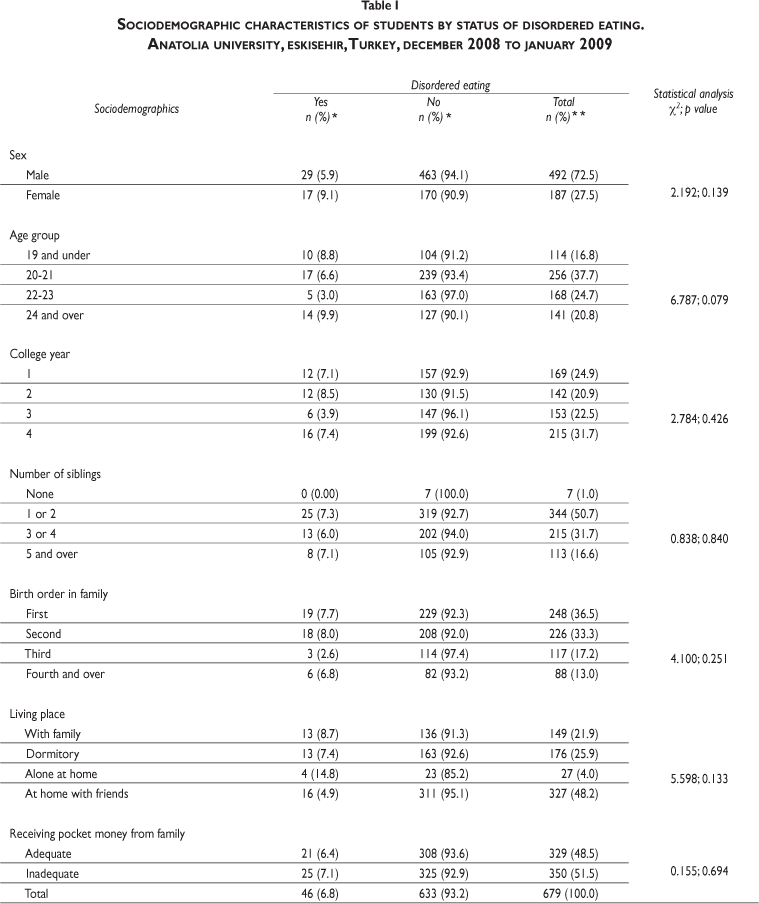
<body><![CDATA[<p>&nbsp;</p>     <p><font face="Verdana" size="3"><b>Results</b></font></p>     <p><font face="Verdana" size="2"><b>Sociodemographic    data</b></font></p>     <p><font face="Verdana" size="2">Of the participants,    492 (72.5%) were male and 187 (27.5%) female. The average age of the participants    was 21.6 &plusmn;2.2 years (range= 17-29 years). Nearly 30% of students were    in the 4<sup>th</sup> year (31.7%), followed by the 1<sup>st</sup> year (22.5%).    Most students (36.2%) were in the age group of 20 and below. Seven students    (1.0%) reported that they had no siblings, and 113 (16.6%) reported that they    had 5 siblings or over. Nearly 50% of the students (48.2%) reported that they    lived with their friends. The present study showed a prevalence of DE of 6.8%    (n=46).</font></p>     <p><font face="Verdana" size="2">Of the students    with DE, 29 (63.0%) were male and 17 (37.04%) female. Detailed sociodemographic    characteristics of students by status of disordered eating are presented in    <a href="/img/revistas/spm/v52n3/02t01.gif">Table I</a>.</font></p>     <p><font face="Verdana" size="2"><b>EAT-40 scores</b></font></p>     <p><font face="Verdana" size="2">The average score    that the students obtained from the EAT-40 was 15.13&plusmn;7.41, ranging from    1 to 40, with scores of 16.81&plusmn; 7.79 and 14.49&plusmn; 7.16 for females    and males, respectively (t= 3.670, df= 677, <i>p</i>&lt; 0.001) (data not shown).</font></p>     <p><font face="Verdana" size="2"><b>Individual characteristics</b></font></p>     <p><font face="Verdana" size="2">The prevalence    of overweight/obesity in the study group was 8.7% (n=59). There was no difference    between those with DE and without DE in terms of the frequency of DE (p&gt;0.05).    The number of those with any kind of physical or sensorial problem was 59 (8.7%),    and a significant difference in frequency of DE was found between those who    had physical or sensorial problems and those who did (15.3% vs 6.0%, respectively;    p&lt;0.05). The number of those with any type of chronic disease requiring the    use of drugs was 43 (6.3%). It was found that the frequency of smoking among    the students was 26.7% (n=181) and that frequency of alcohol consumption was    28.4% (n=193). The number of students experiencing an unwanted event in the    past was 184 (27.1%) and the prevalence of facial acne vulgaris was 29.3% (n=199).    The students' DE status according to their individual characteristics is presented    in <a href="/img/revistas/spm/v52n3/02t02.gif">Table II</a>.</font></p>     <p><font face="Verdana" size="2"><b>Parental characteristics</b></font></p>     ]]></body>
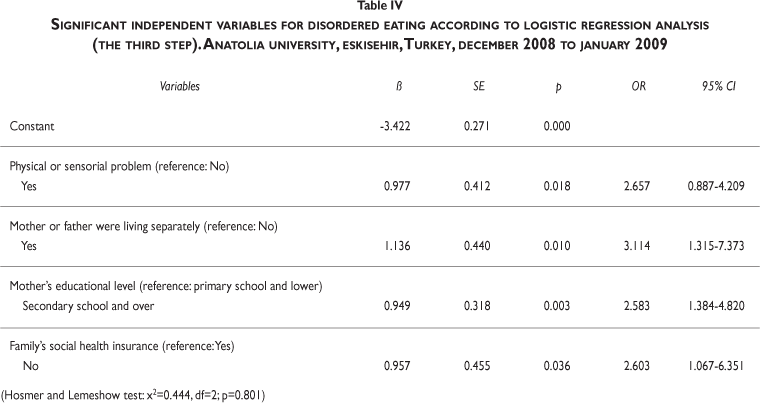
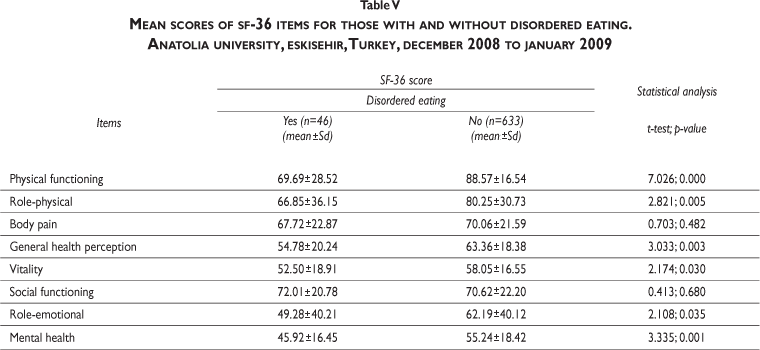
<body><![CDATA[<p><font face="Verdana" size="2">There was no difference    between those whose mother or father were dead and those whose mother or father    were alive in terms of the prevalence of DE (p&gt;0.05). The number of those    whose father or mother were living separately was 43 (6.3%). The number of those    whose mother's educational level was secondary school and over was 256 (37.7%),    and 431 (63.5%) students had fathers with an educational level of secondary    school and over. The frequency of DE was higher for those whose father or mother    were living separately, those whose mother's educational level was secondary    school and over, and those whose father's educational level was secondary school    and over (p&lt;0.05 each). The students' DE status according to their parental    characteristics is detailed in <a href="/img/revistas/spm/v52n3/02t03.gif">Table    III</a>. For the females, the frequency of DE was higher for those whose father    and mother were living separately (26.7% <i>vs</i> 7.6%, 0&lt;0.05), whose mother's    educational level was secondary school and over (14.1% vs 5.5%, <i>p</i>&lt;0.05),    whose father's educational level was secondary school and over (12.2% <i>vs</i>    3.1%, <i>p</i>&lt;0.05), whose father was unemployed (12.3% <i>vs</i> 3.1%,    <i>p</i>&lt;0.05) and for those whose family had no social health insurance    (25.0% <i>vs</i> 7.6%, <i>p</i>&lt;0.05). However, for the males, the frequency    of DE was higher only for those whose mother's educational level was secondary    school and over (9.0% vs 4.1%, <i>p</i>&lt;0.05) (data not published).</font></p>     <p><font face="Verdana" size="2"><b>Logistic analysis    results</b></font></p>     <p><font face="Verdana" size="2"><a href="/img/revistas/spm/v52n3/02t04.gif">Table    IV</a> shows the logistic analysis results for the variables age group, physical    or sensorial problems, whether the father and mother lived separately, mother's    educational level, father's educational level, health insurance status of the    family, and history of any physical disorders in the family that had significant    relationships with DE in the bivariate analysis.</font></p>     <p><font face="Verdana" size="2"><b>Quality of life    results</b></font></p>     <p><font face="Verdana" size="2">The average scores    received for the items on the SF-36 scale were lower for the students with DE    as compared to those without DE (<i>p</i>&lt;0.05), with the exception of 'body    pain' and 'social functioning' (<i>p</i>&gt;0.05 for each one). <a href="/img/revistas/spm/v52n3/02t05.gif">Table    V</a> indicates the average scores on the SF-36 scale for those with and without    DE.</font></p>     <p>&nbsp;</p>     <p><font face="Verdana" size="3"><b>Discussion</b></font></p>     <p><font face="Verdana" size="2">DE is considered    the third most prevalent chronic health condition among adolescent females.    In the present study, 6.8% of college students were rated with abnormal eating    attitudes by the EAT-40; this appears to be similar to findings by other studies    performed in Turkey and other countries.<sup>21,22</sup></font></p>     <p><font face="Verdana" size="2">DE can be expected    to be more common among those with a physical or sensorial problem, which is    consistent with the present study's findings that DE was more frequent among    those with physical or sensorial problems (OR:2.657, <i>p</i>&lt;0.05). In addition,    Pruneti <i>et al.</i> have reported that there was a relationship between body    perception and DE, especially for females.<sup>22</sup></font></p>     <p><font face="Verdana" size="2">As part of the    developmental process of adolescence, the individual undergoes dramatic physical,    psychological, and social changes. For the adolescent with a chronic illness,    these changes may impact the ability of the adolescent and their family to successfully    negotiate the demands of this period.<sup>6</sup> Chronic health conditions    may increase dissatisfaction with the body and feelings of isolation from peers,    potentially increasing the risk of psychopathology associated with adolescence,    such as eating and body image distortion.<sup>23</sup> The present study did    not find any differences in frequency of DE (<i>p</i>&gt;0.05) between the students    who had any chronic disease diagnosed by a physician and those who did not;    this is consistent with the study by Ilhan <i>et al.</i><sup>24</sup> However,    there are also many studies reporting that DE is seen more frequently in adolescents    who have chronic diseases.<sup>25</sup></font></p>     ]]></body>
<body><![CDATA[<p><font face="Verdana" size="2">In the present    study, there was no connection between those with facial acne vulgaris and those    without in terms of the frequency of DE <i>(p</i>&gt;0.05). This could be explained    by the fact that the number of students in the study group was low and that    the frequency of acne was rare. However, for those with DE, it is known that    the facial acne was significantly more frequent. By way of an explanation for    this, it has been suggested that acne negatively affects psychosocial health    due to the psychological issues attached to it, which include pain and discomfort,    shame, body image concerns, social assertiveness, obsessive-compulsiveness,    embarrassment, and social inhibition.<sup>10</sup></font></p>     <p><font face="Verdana" size="2">It has been known    that stressful life events -such as parents living separately, the loss of one    or both parents, and divorce- are significant risk factors for DE.<sup>26</sup>    This study did not find any difference between the students whose parents were    alive and those whose parents were dead in terms of the frequency of DE (<i>p</i>&gt;0.05).    However, for students whose parents were divorced/separated, the frequency of    DE was found to be higher when compared to those whose parents were living together    (<i>p</i>&lt;0.05). Logistic regression analysis conducted for the present study    also determined that having parents who live apart or who are divorced is an    important risk factor for DE <i>(OR:</i> 3.114; <i>p</i>&lt;0.05). Robinson    and Andersen also reported similar results.<sup>27</sup></font></p>     <p><font face="Verdana" size="2">Kim and Yang indicated    that there was a negative relationship between parent-adolescent communication    and DE.<sup>11</sup> One of the important factors affecting communication between    parents and children is the education level of parents. It is expected that    parents with higher education levels have better relationships with their children.    In the present survey, however, the frequency of DE was significantly higher    for students whose mother and father's education levels were secondary school    and over than for those whose mother and father's education level was primary    school and below (<i>p</i>&lt;0.05). Likewise, the logistic regression analysis    showed that having mothers with an education level of secondary school and over    was an important risk factor for DE (OR:2.583; <i>p</i>&lt;0.05). Contrary to    this, D&iacute;az Benavente et al. reported that they did not find any relationship    between education level and EAT-40 scores,<sup>28</sup> which suggests that    further studies are warranted.</font></p>     <p><font face="Verdana" size="2">The present study    determined that families with no social health insurance were at greater risk    of DE (OR:2.603; <i>p</i>&lt;0.05), which is consistent with the studies by    some researchers indicating that there was a connection between socioeconomic    status and the frequency of DE.<sup>12,29</sup></font></p>     <p><font face="Verdana" size="2">The present study    found that HRQoL was worse for students with DE. The average scores for all    the items on the SF-36 scale, except for 'body pain' and 'social functioning'    (<i>p</i>&gt;0.05, for each one), were lower for students with DE than for those    without <i>(p</i>&lt;0.05, for each one). Similarly, many studies indicated    that the average scores for all the items on the SF-36 scale were lower for    those with DE when compared to those without DE.<sup>15,16</sup></font></p>     <p><font face="Verdana" size="2">Several important    limitations should be considered when interpreting the results of the present    study, one which is that this study was cross-sectional, thus precluding inferences    of causality among variables. The second limitation is the use of self-reporting.    Third, the sample for the current study comprised a group of students in just    one city in Turkey, which may limit the generalization of results. Thus, a study    with a large sample containing different universities in the country needs to    be conducted. Finally, since the scale was used as a screening test rather than    a definite diagnosis, those who were at the risk of eating disorders were not    actually diagnosed with EAT-40.</font></p>     <p>&nbsp;</p>     <p><font face="Verdana" size="3"><b>Conclusions</b></font></p>     <p><font face="Verdana" size="2">The present study    found that DE among university students was a significant public health problem    and that the HRQoL of those with DE was worse. As a result, we conclude that    effective psychological counseling services for university students should be    provided and that periodic screenings should be done to determine DE cases in    the early stages. Finally, DE cases should be referred to specialized psychiatry    centers for specific diagnosis and treatment, which could result in an improvement    in HRQoL levels.</font></p>     <p>&nbsp;</p>     ]]></body>
<body><![CDATA[<p><font face="Verdana" size="3"><b>Acknowledgements</b></font></p>     <p><font face="Verdana" size="2">We would like to    thank the students for their valuable efforts and university management for    their permission. There is no conflict of interest for this study.</font></p>     <p>&nbsp;</p>     <p><font face="Verdana" size="3"><b>References</b></font></p>     <!-- ref --><p><font face="Verdana" size="2">1. RTI-UNIC Evidence-Based    Practice Center. Management of Eating Disorders. North Carolina: Research Triangle    Park. AHRQ Publication No. 06-E010, 2006.    &nbsp;&nbsp;&nbsp;&nbsp;&nbsp;&nbsp;&nbsp;&nbsp;[&#160;<a href="javascript:void(0);" onclick="javascript: window.open('/scielo.php?script=sci_nlinks&ref=9357314&pid=S0036-3634201000030000200001&lng=','','width=640,height=500,resizable=yes,scrollbars=1,menubar=yes,');">Links</a>&#160;]<!-- end-ref --></font></p>     <!-- ref --><p><font face="Verdana" size="2">2.&nbsp; Fairburn    CG, Harrison PJ. Eating disorders. Lancet 2003;361:1913-4.    &nbsp;&nbsp;&nbsp;&nbsp;&nbsp;&nbsp;&nbsp;&nbsp;[&#160;<a href="javascript:void(0);" onclick="javascript: window.open('/scielo.php?script=sci_nlinks&ref=9357316&pid=S0036-3634201000030000200002&lng=','','width=640,height=500,resizable=yes,scrollbars=1,menubar=yes,');">Links</a>&#160;]<!-- end-ref --></font></p>     <!-- ref --><p><font face="Verdana" size="2">3.&nbsp; Lau RR,    Qudarel MJ, Hartman KA. Development and change of young adults' preventive health    beliefs and behavior: influence from parents and pers. J Health Soc Behav 1990;31:240-59.    &nbsp;&nbsp;&nbsp;&nbsp;&nbsp;&nbsp;&nbsp;&nbsp;[&#160;<a href="javascript:void(0);" onclick="javascript: window.open('/scielo.php?script=sci_nlinks&ref=9357318&pid=S0036-3634201000030000200003&lng=','','width=640,height=500,resizable=yes,scrollbars=1,menubar=yes,');">Links</a>&#160;]<!-- end-ref --></font></p>     ]]></body>
<body><![CDATA[<!-- ref --><p><font face="Verdana" size="2">4.&nbsp; Patterson    JM, McCubbin HI. Adolescent coping style and behaviors: conceptualization and    measurement. J Adolesc 1987;10:163-86.    &nbsp;&nbsp;&nbsp;&nbsp;&nbsp;&nbsp;&nbsp;&nbsp;[&#160;<a href="javascript:void(0);" onclick="javascript: window.open('/scielo.php?script=sci_nlinks&ref=9357320&pid=S0036-3634201000030000200004&lng=','','width=640,height=500,resizable=yes,scrollbars=1,menubar=yes,');">Links</a>&#160;]<!-- end-ref --></font></p>     <!-- ref --><p><font face="Verdana" size="2">5.&nbsp; Fassino    S, Abbate-Daga G, Amianto F, Leombruni P, Boggio S, Rovera GG. Temperament and    character profile of eating disorders: a controlled study with the Temperament    and Character Inventory. Int J Eat Disord 2002;32:412-25.    &nbsp;&nbsp;&nbsp;&nbsp;&nbsp;&nbsp;&nbsp;&nbsp;[&#160;<a href="javascript:void(0);" onclick="javascript: window.open('/scielo.php?script=sci_nlinks&ref=9357322&pid=S0036-3634201000030000200005&lng=','','width=640,height=500,resizable=yes,scrollbars=1,menubar=yes,');">Links</a>&#160;]<!-- end-ref --></font></p>     <!-- ref --><p><font face="Verdana" size="2">6.&nbsp; Gonzalez    A, Kohn MR, Clarke SD. Eating disorders in adolescents. Aust Fam Physician 2007;36:614-9.    &nbsp;&nbsp;&nbsp;&nbsp;&nbsp;&nbsp;&nbsp;&nbsp;[&#160;<a href="javascript:void(0);" onclick="javascript: window.open('/scielo.php?script=sci_nlinks&ref=9357324&pid=S0036-3634201000030000200006&lng=','','width=640,height=500,resizable=yes,scrollbars=1,menubar=yes,');">Links</a>&#160;]<!-- end-ref --></font></p>     <!-- ref --><p><font face="Verdana" size="2">7.&nbsp; Berkman    ND, Bulik CM, Brownley KA, Lohr KN, Sedway JA, Rooks A, et al. Management of    eating disorders. Evid Rep Technol Assess (Full Rep) 2006;135:1-166</font>&nbsp;&nbsp;&nbsp;&nbsp;&nbsp;&nbsp;&nbsp;&nbsp;[&#160;<a href="javascript:void(0);" onclick="javascript: window.open('/scielo.php?script=sci_nlinks&ref=9357326&pid=S0036-3634201000030000200007&lng=','','width=640,height=500,resizable=yes,scrollbars=1,menubar=yes,');">Links</a>&#160;]<!-- end-ref --><!-- ref --><p><font face="Verdana" size="2">8.&nbsp; le Grange    D, Louw J, Russell B, Nel T, Silkstone C. Eating attitude and behaviours in    South african adolescents and young adults. Transcult Psychiatry 2006;43:401-7.    &nbsp;&nbsp;&nbsp;&nbsp;&nbsp;&nbsp;&nbsp;&nbsp;[&#160;<a href="javascript:void(0);" onclick="javascript: window.open('/scielo.php?script=sci_nlinks&ref=9357327&pid=S0036-3634201000030000200008&lng=','','width=640,height=500,resizable=yes,scrollbars=1,menubar=yes,');">Links</a>&#160;]<!-- end-ref --></font></p>     <!-- ref --><p><font face="Verdana" size="2">9.&nbsp; Celikel    FC, Cumurcu BE, Koc M, Etikan I, Yucel B. Psychologic correlates of eating attitudes    in Turkish female college students. Compr Psychiatry 2008;49:188-94.    &nbsp;&nbsp;&nbsp;&nbsp;&nbsp;&nbsp;&nbsp;&nbsp;[&#160;<a href="javascript:void(0);" onclick="javascript: window.open('/scielo.php?script=sci_nlinks&ref=9357329&pid=S0036-3634201000030000200009&lng=','','width=640,height=500,resizable=yes,scrollbars=1,menubar=yes,');">Links</a>&#160;]<!-- end-ref --></font></p>     <!-- ref --><p><font face="Verdana" size="2">10.&nbsp; Tan JK.    Psychosocial impact of acne vulgaris: evaluating the evidence. Skin Therapy    Lett 2004;9:9.    &nbsp;&nbsp;&nbsp;&nbsp;&nbsp;&nbsp;&nbsp;&nbsp;[&#160;<a href="javascript:void(0);" onclick="javascript: window.open('/scielo.php?script=sci_nlinks&ref=9357331&pid=S0036-3634201000030000200010&lng=','','width=640,height=500,resizable=yes,scrollbars=1,menubar=yes,');">Links</a>&#160;]<!-- end-ref --></font></p>     <!-- ref --><p><font face="Verdana" size="2">11.&nbsp; Kim KH,    Yang KM. The relationship between eating disorders and parent-adolescent communication    in middle school students in rural areas. Taehan Kanho Hakhoe Chi 2008;38:55-63.    &nbsp;&nbsp;&nbsp;&nbsp;&nbsp;&nbsp;&nbsp;&nbsp;[&#160;<a href="javascript:void(0);" onclick="javascript: window.open('/scielo.php?script=sci_nlinks&ref=9357333&pid=S0036-3634201000030000200011&lng=','','width=640,height=500,resizable=yes,scrollbars=1,menubar=yes,');">Links</a>&#160;]<!-- end-ref --></font></p>     <!-- ref --><p><font face="Verdana" size="2">12.&nbsp; Chen    H, Jackson T. Prevalence and sociodemographic correlates of eating disorder    endorsements among adolescents and young adults from China. Eur Eat Disord Rev    2008;16:375-85.    &nbsp;&nbsp;&nbsp;&nbsp;&nbsp;&nbsp;&nbsp;&nbsp;[&#160;<a href="javascript:void(0);" onclick="javascript: window.open('/scielo.php?script=sci_nlinks&ref=9357335&pid=S0036-3634201000030000200012&lng=','','width=640,height=500,resizable=yes,scrollbars=1,menubar=yes,');">Links</a>&#160;]<!-- end-ref --></font></p>     <!-- ref --><p><font face="Verdana" size="2">13.&nbsp; The WHOQOL    Group. The World Health Organization Quality of Life Assessment (WHOQOL): Position    Papaer From the World Health Organization. Soc Sci Med 1995;10:1403-9.    &nbsp;&nbsp;&nbsp;&nbsp;&nbsp;&nbsp;&nbsp;&nbsp;[&#160;<a href="javascript:void(0);" onclick="javascript: window.open('/scielo.php?script=sci_nlinks&ref=9357337&pid=S0036-3634201000030000200013&lng=','','width=640,height=500,resizable=yes,scrollbars=1,menubar=yes,');">Links</a>&#160;]<!-- end-ref --></font></p>     <!-- ref --><p><font face="Verdana" size="2">14.&nbsp; Mond    JM, Hay PJ, Rodgers B, Owen C, Beumont PJ. Assessing quality of life in eating    disorder patients. Qual Life Res 2005;14:171-8.    &nbsp;&nbsp;&nbsp;&nbsp;&nbsp;&nbsp;&nbsp;&nbsp;[&#160;<a href="javascript:void(0);" onclick="javascript: window.open('/scielo.php?script=sci_nlinks&ref=9357339&pid=S0036-3634201000030000200014&lng=','','width=640,height=500,resizable=yes,scrollbars=1,menubar=yes,');">Links</a>&#160;]<!-- end-ref --></font></p>     <!-- ref --><p><font face="Verdana" size="2">15.&nbsp; de le    Rie SM, Noordenbos G, van Furth EF. Quality of life and eating disorders. Qual    Life Res 2005;14:1511-22.    &nbsp;&nbsp;&nbsp;&nbsp;&nbsp;&nbsp;&nbsp;&nbsp;[&#160;<a href="javascript:void(0);" onclick="javascript: window.open('/scielo.php?script=sci_nlinks&ref=9357341&pid=S0036-3634201000030000200015&lng=','','width=640,height=500,resizable=yes,scrollbars=1,menubar=yes,');">Links</a>&#160;]<!-- end-ref --></font></p>     <!-- ref --><p><font face="Verdana" size="2">16.&nbsp; Garner    DM, Garfinkel PE. The Eating Attitudes Test: An index of the symptoms of anorexia    nervosa. Psychol Med 1979;9:273-9.    &nbsp;&nbsp;&nbsp;&nbsp;&nbsp;&nbsp;&nbsp;&nbsp;[&#160;<a href="javascript:void(0);" onclick="javascript: window.open('/scielo.php?script=sci_nlinks&ref=9357343&pid=S0036-3634201000030000200016&lng=','','width=640,height=500,resizable=yes,scrollbars=1,menubar=yes,');">Links</a>&#160;]<!-- end-ref --></font></p>     <!-- ref --><p><font face="Verdana" size="2">17.&nbsp; Savasir    I, Erol N. Yeme Tutumu Testi: Anoreksiya Nevroza Belirtileri Indeksi. Psikoloji    Dergisi 1989;7:19-25.    &nbsp;&nbsp;&nbsp;&nbsp;&nbsp;&nbsp;&nbsp;&nbsp;[&#160;<a href="javascript:void(0);" onclick="javascript: window.open('/scielo.php?script=sci_nlinks&ref=9357345&pid=S0036-3634201000030000200017&lng=','','width=640,height=500,resizable=yes,scrollbars=1,menubar=yes,');">Links</a>&#160;]<!-- end-ref --></font></p>     <!-- ref --><p><font face="Verdana" size="2">18.Ware JE, Sherbourne    CD. The MOS 36-item short-form health survey (SF-36). I. Conceptual framework    and item selection. Med Care 1992;30:473-83.    &nbsp;&nbsp;&nbsp;&nbsp;&nbsp;&nbsp;&nbsp;&nbsp;[&#160;<a href="javascript:void(0);" onclick="javascript: window.open('/scielo.php?script=sci_nlinks&ref=9357347&pid=S0036-3634201000030000200018&lng=','','width=640,height=500,resizable=yes,scrollbars=1,menubar=yes,');">Links</a>&#160;]<!-- end-ref --></font></p>     <p><font face="Verdana" size="2">19.&nbsp; Kocyigit    H, Aydemir O, Olmez N, Memis A. Reliability and validity of the Turkish version    of Short-Form-36 (SF-36). Turkish J Drugs Therap 1999;12:102-6.</font></p>     ]]></body>
<body><![CDATA[<p><font face="Verdana" size="2">20.&nbsp; World    Health Organization. Obesity: preventing and managing the global epidemic Report    of a WHO consultation on obesity. Technical report series No 894. Geneva: WHO,    2000.</font></p>     <p><font face="Verdana" size="2">21.&nbsp; Asci    FH, Tuzun M, Koca C. An examination of eating attitudes and physical activity    levels of Turkish University students with regard to self-presentational concern.    Eat Behav 2006;7:362-7.</font></p>     <p><font face="Verdana" size="2">22.&nbsp; Pruneti    C, Fontana F, Donalizio M, Buracchi G, Bicchieri L. Eating behaviour and body    image: epidemiological study on 4,243 senior and junior high school's Italian    students. Minerva Pediatr 2004;56:395-410.</font></p>     <p><font face="Verdana" size="2">23.&nbsp; Thompson    JK, Heinberg LJ,Altabe M, Tantleff-Dunn S. Exacting Beauty: Theory,Assessment    and Treatment of Body Image Disturbance. Washington, DC: American Psychological    Association, 1999.</font></p>     <p><font face="Verdana" size="2">24.&nbsp; Ilhan    MN, Ozkan S, Aksakal N, Aslan S, Durukan E, Maral I. Bir Tip Fakultesi Ogrencilerinde    Olasi Yeme Bozuklugu Sikligi. Turkiye'de Psikiyatri Dergisi 2006;8:151-5.</font></p>     <p><font face="Verdana" size="2">25.&nbsp; Smith    FM, Latchford GJ, Hall RM, Dickson RA. Do chronic medical conditions increase    the risk of eating disorder? A cross-sectional investigation of eating pathology    in adolescent females with scoliosis and diabetes. J Adolesc Health 2008;42:58-63.</font></p>     <p><font face="Verdana" size="2">26.&nbsp; Conte    FF. Eating Disorders and Adolescents: Conflict of Self Image. Curriculum Unit    84.05.05. New Jersey: Yale-New Haven Teachers Institute, 1984. <a href="http://yale.edu/ynhti/curriculum/units/I984/5/84.05.05.x.html" target="_blank">http://yale.edu/ynhti/curriculum/units/I984/5/84.05.05.x.html</a>    . Accessed on 26 January 2009.</font></p>     <p><font face="Verdana" size="2">27.&nbsp; Robinson    P, Andersen A. Anorexia nervosa in American blacks. J Psychiatr Res 1985;19:183-8.</font></p>     <p><font face="Verdana" size="2">28.&nbsp; D&iacute;az    Benavente M, Rodr&iacute;guez Morilla F, Mart&iacute;n Leal C, Hiruela Benjumea    MV. Risk factors related with eating disorders in a community of adolescents.    Aten Primaria 2003;32:403-7.</font></p>     <p><font face="Verdana" size="2">29.&nbsp; Latzer    Y,Vander S, Gilat I. Socio-demographic characteristics of eating disorder patients    in an outpatient clinic: a descriptive epidemiological study. Eur Eat Disord    Rev 2008;16:139-46.</font></p>     ]]></body>
<body><![CDATA[<p>&nbsp;</p>     <p>&nbsp;</p>     <p><font face="Verdana" size="2"><b><a name="back"></a><a href="#top"><img src="/img/revistas/spm/v52n3/seta.gif" border="0"></a>    Address reprint requests to:    <br>   </b> Unal Ayranci    <br>   Osmangazi University    <br>   Medico-Social Center    <br>   26480 Meselik-Eskisehir/Turqu&iacute;a    <br>   E-mail: <a href="mailto:unalayrancioglu@yahoo.com">unalayrancioglu@yahoo.com</a></font></p>     <p><font face="Verdana" size="2">Received on: August    17, 2009    <br>   Accepted on: March 19, 2010</font></p>     ]]></body>
<body><![CDATA[ ]]></body><back>
<ref-list>
<ref id="B1">
<label>1</label><nlm-citation citation-type="book">
<collab>RTI-UNIC Evidence-Based Practice Center</collab>
<source><![CDATA[Management of Eating Disorders]]></source>
<year>2006</year>
<publisher-loc><![CDATA[North Carolina ]]></publisher-loc>
<publisher-name><![CDATA[Research Triangle ParkAHRQ Publication No. 06-E010]]></publisher-name>
</nlm-citation>
</ref>
<ref id="B2">
<label>2</label><nlm-citation citation-type="journal">
<person-group person-group-type="author">
<name>
<surname><![CDATA[Fairburn]]></surname>
<given-names><![CDATA[CG]]></given-names>
</name>
<name>
<surname><![CDATA[Harrison]]></surname>
<given-names><![CDATA[PJ]]></given-names>
</name>
</person-group>
<article-title xml:lang="en"><![CDATA[Eating disorders]]></article-title>
<source><![CDATA[Lancet]]></source>
<year>2003</year>
<volume>361</volume>
<page-range>1913-4</page-range></nlm-citation>
</ref>
<ref id="B3">
<label>3</label><nlm-citation citation-type="journal">
<person-group person-group-type="author">
<name>
<surname><![CDATA[Lau]]></surname>
<given-names><![CDATA[RR]]></given-names>
</name>
<name>
<surname><![CDATA[Qudarel]]></surname>
<given-names><![CDATA[MJ]]></given-names>
</name>
<name>
<surname><![CDATA[Hartman]]></surname>
<given-names><![CDATA[KA]]></given-names>
</name>
</person-group>
<article-title xml:lang="en"><![CDATA[Development and change of young adults' preventive health beliefs and behavior: influence from parents and pers]]></article-title>
<source><![CDATA[J Health Soc Behav]]></source>
<year>1990</year>
<volume>31</volume>
<page-range>240-59</page-range></nlm-citation>
</ref>
<ref id="B4">
<label>4</label><nlm-citation citation-type="journal">
<person-group person-group-type="author">
<name>
<surname><![CDATA[Patterson]]></surname>
<given-names><![CDATA[JM]]></given-names>
</name>
<name>
<surname><![CDATA[McCubbin]]></surname>
<given-names><![CDATA[HI]]></given-names>
</name>
</person-group>
<article-title xml:lang="en"><![CDATA[Adolescent coping style and behaviors: conceptualization and measurement]]></article-title>
<source><![CDATA[J Adolesc]]></source>
<year>1987</year>
<volume>10</volume>
<page-range>163-86</page-range></nlm-citation>
</ref>
<ref id="B5">
<label>5</label><nlm-citation citation-type="journal">
<person-group person-group-type="author">
<name>
<surname><![CDATA[Fassino]]></surname>
<given-names><![CDATA[S]]></given-names>
</name>
<name>
<surname><![CDATA[Abbate-Daga]]></surname>
<given-names><![CDATA[G]]></given-names>
</name>
<name>
<surname><![CDATA[Amianto]]></surname>
<given-names><![CDATA[F]]></given-names>
</name>
<name>
<surname><![CDATA[Leombruni]]></surname>
<given-names><![CDATA[P]]></given-names>
</name>
<name>
<surname><![CDATA[Boggio]]></surname>
<given-names><![CDATA[S]]></given-names>
</name>
<name>
<surname><![CDATA[Rovera]]></surname>
<given-names><![CDATA[GG]]></given-names>
</name>
</person-group>
<article-title xml:lang="en"><![CDATA[Temperament and character profile of eating disorders: a controlled study with the Temperament and Character Inventory]]></article-title>
<source><![CDATA[Int J Eat Disord]]></source>
<year>2002</year>
<volume>32</volume>
<page-range>412-25</page-range></nlm-citation>
</ref>
<ref id="B6">
<label>6</label><nlm-citation citation-type="journal">
<person-group person-group-type="author">
<name>
<surname><![CDATA[Gonzalez]]></surname>
<given-names><![CDATA[A]]></given-names>
</name>
<name>
<surname><![CDATA[Kohn]]></surname>
<given-names><![CDATA[MR]]></given-names>
</name>
<name>
<surname><![CDATA[Clarke]]></surname>
<given-names><![CDATA[SD]]></given-names>
</name>
</person-group>
<article-title xml:lang="en"><![CDATA[Eating disorders in adolescents]]></article-title>
<source><![CDATA[Aust Fam Physician]]></source>
<year>2007</year>
<volume>36</volume>
<page-range>614-9</page-range></nlm-citation>
</ref>
<ref id="B7">
<label>7</label><nlm-citation citation-type="journal">
<person-group person-group-type="author">
<name>
<surname><![CDATA[Berkman]]></surname>
<given-names><![CDATA[ND]]></given-names>
</name>
<name>
<surname><![CDATA[Bulik]]></surname>
<given-names><![CDATA[CM]]></given-names>
</name>
<name>
<surname><![CDATA[Brownley]]></surname>
<given-names><![CDATA[KA]]></given-names>
</name>
<name>
<surname><![CDATA[Lohr]]></surname>
<given-names><![CDATA[KN]]></given-names>
</name>
<name>
<surname><![CDATA[Sedway]]></surname>
<given-names><![CDATA[JA]]></given-names>
</name>
<name>
<surname><![CDATA[Rooks]]></surname>
<given-names><![CDATA[A]]></given-names>
</name>
</person-group>
<article-title xml:lang="en"><![CDATA[Management of eating disorders]]></article-title>
<source><![CDATA[Evid Rep Technol Assess (Full Rep)]]></source>
<year>2006</year>
<volume>135</volume>
<page-range>1-166</page-range></nlm-citation>
</ref>
<ref id="B8">
<label>8</label><nlm-citation citation-type="">
<person-group person-group-type="author">
<name>
<surname><![CDATA[le Grange]]></surname>
<given-names><![CDATA[D]]></given-names>
</name>
<name>
<surname><![CDATA[Louw]]></surname>
<given-names><![CDATA[J]]></given-names>
</name>
<name>
<surname><![CDATA[Russell]]></surname>
<given-names><![CDATA[B]]></given-names>
</name>
<name>
<surname><![CDATA[Nel]]></surname>
<given-names><![CDATA[T]]></given-names>
</name>
<name>
<surname><![CDATA[Silkstone]]></surname>
<given-names><![CDATA[C]]></given-names>
</name>
</person-group>
<article-title xml:lang="en"><![CDATA[Eating attitude and behaviours in South african adolescents and young adults]]></article-title>
<source><![CDATA[]]></source>
<year></year>
</nlm-citation>
</ref>
<ref id="B9">
<label>9</label><nlm-citation citation-type="journal">
<person-group person-group-type="author">
<name>
<surname><![CDATA[Celikel]]></surname>
<given-names><![CDATA[FC]]></given-names>
</name>
<name>
<surname><![CDATA[Cumurcu]]></surname>
<given-names><![CDATA[BE]]></given-names>
</name>
<name>
<surname><![CDATA[Koc]]></surname>
<given-names><![CDATA[M]]></given-names>
</name>
<name>
<surname><![CDATA[Etikan]]></surname>
<given-names><![CDATA[I]]></given-names>
</name>
<name>
<surname><![CDATA[Yucel]]></surname>
<given-names><![CDATA[B]]></given-names>
</name>
</person-group>
<article-title xml:lang="en"><![CDATA[Psychologic correlates of eating attitudes in Turkish female college students]]></article-title>
<source><![CDATA[Compr Psychiatry]]></source>
<year>2008</year>
<volume>49</volume>
<page-range>188-94</page-range></nlm-citation>
</ref>
<ref id="B10">
<label>10</label><nlm-citation citation-type="journal">
<person-group person-group-type="author">
<name>
<surname><![CDATA[Tan]]></surname>
<given-names><![CDATA[JK]]></given-names>
</name>
</person-group>
<article-title xml:lang="en"><![CDATA[Psychosocial impact of acne vulgaris: evaluating the evidence]]></article-title>
<source><![CDATA[Skin Therapy Lett]]></source>
<year>2004</year>
<volume>9</volume>
<page-range>9</page-range></nlm-citation>
</ref>
<ref id="B11">
<label>11</label><nlm-citation citation-type="journal">
<person-group person-group-type="author">
<name>
<surname><![CDATA[Kim]]></surname>
<given-names><![CDATA[KH]]></given-names>
</name>
<name>
<surname><![CDATA[Yang]]></surname>
<given-names><![CDATA[KM]]></given-names>
</name>
</person-group>
<article-title xml:lang="en"><![CDATA[The relationship between eating disorders and parent-adolescent communication in middle school students in rural areas]]></article-title>
<source><![CDATA[Taehan Kanho Hakhoe Chi]]></source>
<year>2008</year>
<volume>38</volume>
<page-range>55-63</page-range></nlm-citation>
</ref>
<ref id="B12">
<label>12</label><nlm-citation citation-type="journal">
<person-group person-group-type="author">
<name>
<surname><![CDATA[Chen]]></surname>
<given-names><![CDATA[H]]></given-names>
</name>
<name>
<surname><![CDATA[Jackson]]></surname>
<given-names><![CDATA[T]]></given-names>
</name>
</person-group>
<article-title xml:lang="en"><![CDATA[Prevalence and sociodemographic correlates of eating disorder endorsements among adolescents and young adults from China]]></article-title>
<source><![CDATA[Eur Eat Disord Rev]]></source>
<year>2008</year>
<volume>16</volume>
<page-range>375-85</page-range></nlm-citation>
</ref>
<ref id="B13">
<label>13</label><nlm-citation citation-type="journal">
<collab>The WHOQOL Group</collab>
<article-title xml:lang="en"><![CDATA[The World Health Organization Quality of Life Assessment (WHOQOL): Position Papaer From the World Health Organization]]></article-title>
<source><![CDATA[Soc Sci Med]]></source>
<year>1995</year>
<volume>10</volume>
<page-range>1403-9</page-range></nlm-citation>
</ref>
<ref id="B14">
<label>14</label><nlm-citation citation-type="journal">
<person-group person-group-type="author">
<name>
<surname><![CDATA[Mond]]></surname>
<given-names><![CDATA[JM]]></given-names>
</name>
<name>
<surname><![CDATA[Hay]]></surname>
<given-names><![CDATA[PJ]]></given-names>
</name>
<name>
<surname><![CDATA[Rodgers]]></surname>
<given-names><![CDATA[B]]></given-names>
</name>
<name>
<surname><![CDATA[Owen]]></surname>
<given-names><![CDATA[C]]></given-names>
</name>
<name>
<surname><![CDATA[Beumont]]></surname>
<given-names><![CDATA[PJ]]></given-names>
</name>
</person-group>
<article-title xml:lang="en"><![CDATA[Assessing quality of life in eating disorder patients]]></article-title>
<source><![CDATA[Qual Life Res]]></source>
<year>2005</year>
<volume>14</volume>
<page-range>171-8</page-range></nlm-citation>
</ref>
<ref id="B15">
<label>15</label><nlm-citation citation-type="journal">
<person-group person-group-type="author">
<name>
<surname><![CDATA[de le Rie]]></surname>
<given-names><![CDATA[SM]]></given-names>
</name>
<name>
<surname><![CDATA[Noordenbos]]></surname>
<given-names><![CDATA[G]]></given-names>
</name>
<name>
<surname><![CDATA[van Furth]]></surname>
<given-names><![CDATA[EF]]></given-names>
</name>
</person-group>
<article-title xml:lang="en"><![CDATA[Quality of life and eating disorders]]></article-title>
<source><![CDATA[Qual Life Res]]></source>
<year>2005</year>
<volume>14</volume>
<page-range>1511-22</page-range></nlm-citation>
</ref>
<ref id="B16">
<label>16</label><nlm-citation citation-type="journal">
<person-group person-group-type="author">
<name>
<surname><![CDATA[Garner]]></surname>
<given-names><![CDATA[DM]]></given-names>
</name>
<name>
<surname><![CDATA[Garfinkel]]></surname>
<given-names><![CDATA[PE]]></given-names>
</name>
</person-group>
<article-title xml:lang="en"><![CDATA[The Eating Attitudes Test: An index of the symptoms of anorexia nervosa]]></article-title>
<source><![CDATA[Psychol Med]]></source>
<year>1979</year>
<volume>9</volume>
<page-range>273-9</page-range></nlm-citation>
</ref>
<ref id="B17">
<label>17</label><nlm-citation citation-type="journal">
<person-group person-group-type="author">
<name>
<surname><![CDATA[Savasir]]></surname>
<given-names><![CDATA[I]]></given-names>
</name>
<name>
<surname><![CDATA[Erol]]></surname>
<given-names><![CDATA[N]]></given-names>
</name>
</person-group>
<article-title xml:lang="tr"><![CDATA[Yeme Tutumu Testi: Anoreksiya Nevroza Belirtileri Indeksi]]></article-title>
<source><![CDATA[Psikoloji Dergisi]]></source>
<year>1989</year>
<volume>7</volume>
<page-range>19-25</page-range></nlm-citation>
</ref>
<ref id="B18">
<label>18</label><nlm-citation citation-type="journal">
<person-group person-group-type="author">
<name>
<surname><![CDATA[Ware]]></surname>
<given-names><![CDATA[JE]]></given-names>
</name>
<name>
<surname><![CDATA[Sherbourne]]></surname>
<given-names><![CDATA[CD]]></given-names>
</name>
</person-group>
<article-title xml:lang="en"><![CDATA[The MOS 36-item short-form health survey (SF-36): I. Conceptual framework and item selection]]></article-title>
<source><![CDATA[Med Care]]></source>
<year>1992</year>
<volume>30</volume>
<page-range>473-83</page-range></nlm-citation>
</ref>
</ref-list>
</back>
</article>
