<?xml version="1.0" encoding="ISO-8859-1"?><article xmlns:mml="http://www.w3.org/1998/Math/MathML" xmlns:xlink="http://www.w3.org/1999/xlink" xmlns:xsi="http://www.w3.org/2001/XMLSchema-instance">
<front>
<journal-meta>
<journal-id>0036-3634</journal-id>
<journal-title><![CDATA[Salud Pública de México]]></journal-title>
<abbrev-journal-title><![CDATA[Salud pública Méx]]></abbrev-journal-title>
<issn>0036-3634</issn>
<publisher>
<publisher-name><![CDATA[Instituto Nacional de Salud Pública]]></publisher-name>
</publisher>
</journal-meta>
<article-meta>
<article-id>S0036-36342010000200005</article-id>
<title-group>
<article-title xml:lang="en"><![CDATA[Factors affecting acceptance of complete immunization coverage of children under five years in rural Bangladesh]]></article-title>
<article-title xml:lang="es"><![CDATA[Factores que influyen en la aceptación de la cobertura de vacunación completa entre los niños menores de cinco años de edad en zonas rurales de Bangladesh]]></article-title>
</title-group>
<contrib-group>
<contrib contrib-type="author">
<name>
<surname><![CDATA[Rahman]]></surname>
<given-names><![CDATA[Mosiur]]></given-names>
</name>
<xref ref-type="aff" rid="A01"/>
</contrib>
<contrib contrib-type="author">
<name>
<surname><![CDATA[Obaida-Nasrin]]></surname>
<given-names><![CDATA[Sarker]]></given-names>
</name>
<xref ref-type="aff" rid="A01"/>
</contrib>
</contrib-group>
<aff id="A01">
<institution><![CDATA[,University of Rajshahi Department of Population Science and Human Resource Development ]]></institution>
<addr-line><![CDATA[Rajshahi ]]></addr-line>
<country>Bangladesh</country>
</aff>
<pub-date pub-type="pub">
<day>00</day>
<month>04</month>
<year>2010</year>
</pub-date>
<pub-date pub-type="epub">
<day>00</day>
<month>04</month>
<year>2010</year>
</pub-date>
<volume>52</volume>
<numero>2</numero>
<fpage>134</fpage>
<lpage>140</lpage>
<copyright-statement/>
<copyright-year/>
<self-uri xlink:href="http://www.scielo.org.mx/scielo.php?script=sci_arttext&amp;pid=S0036-36342010000200005&amp;lng=en&amp;nrm=iso"></self-uri><self-uri xlink:href="http://www.scielo.org.mx/scielo.php?script=sci_abstract&amp;pid=S0036-36342010000200005&amp;lng=en&amp;nrm=iso"></self-uri><self-uri xlink:href="http://www.scielo.org.mx/scielo.php?script=sci_pdf&amp;pid=S0036-36342010000200005&amp;lng=en&amp;nrm=iso"></self-uri><abstract abstract-type="short" xml:lang="en"><p><![CDATA[OBJECTIVE: This article establishes the hypothesis that predisposing, enabling and household needs influence the complete vaccination status of children. MATERIAL AND METHODS: Data from the 2004 Bangladesh Demographic and Health Survey (N= 3530) was used. The data was analyzed using descriptive and multiple logistic regression methods. RESULTS: Approximately 60% of the children in rural Bangladesh were fully immunized. The full vaccination rate increased with an increase in the previous birth interval and the education level of the mother. Women with the highest wealth index were significantly more likely to fully immunize their children. Distance from health facility, parity, mother's age, mass media, children's sex and tetanus toxoid injection were also significantly positively associated with full vaccination. CONCLUSIONS: Findings reflect that, irrespective of need, only children from higher economic or educational groups can afford to be fully vaccinated in rural Bangladesh. In other words, predisposing, enabling and need factors appear to have a strong association with full immunization coverage]]></p></abstract>
<abstract abstract-type="short" xml:lang="es"><p><![CDATA[OBJETIVO: Establecer la hipótesis de que los predisponentes, los facilitadores y los factores de necesidad de los hogares influyen en el estado de vacunación completa de los niños. MATERIAL Y MÉTODOS: Se utilizaron los datos de Bangladesh Demographic and Health Survey de 2004 (N= 3530). Es un estudio descriptivo en el que se utilizó el método de regresión logística múltiple para el análisis de datos. RESULTADOS: Aproximadamente 60% de los niños estaban completamente inmunizados en zonas rurales de Bangladesh. La tasa de vacunación completa aumentó con un incremento en el intervalo de los nacimientos anteriores y el nivel educativo de la madre. Las mujeres con mejor nivel económico muestran un índice significativamente más alto de probabilidad en el hecho de haber administrado todas las vacunas a sus hijos. La distancia del centro de salud, la paridad, la edad materna, los medios de comunicación, el sexo del niño y la inyección de toxoide tetánico también fueron significativamente asociados de forma positiva con la vacunación completa. CONCLUSIONES: Los resultados reflejan que, independientemente de su necesidad, sólo los niños de los grupos económicos o educativos más altos pueden tener mayores posibilidades de tener el esquema de vacunación completo en zonas rurales de Bangladesh. En otras palabras, los predisponentes, los facilitadores y los factores de necesidad parecen tener una fuerte asociación con la cobertura de inmunización completa.]]></p></abstract>
<kwd-group>
<kwd lng="en"><![CDATA[immunization]]></kwd>
<kwd lng="en"><![CDATA[logistic regression]]></kwd>
<kwd lng="en"><![CDATA[Bangladesh]]></kwd>
<kwd lng="es"><![CDATA[inmunización]]></kwd>
<kwd lng="es"><![CDATA[regresión logística]]></kwd>
<kwd lng="es"><![CDATA[Bangladesh]]></kwd>
</kwd-group>
</article-meta>
</front><body><![CDATA[ <p align="right"><font size="2" face="Verdana, Arial, Helvetica, sans-serif"><b>ART&Iacute;CULO ORIGINAL</b></font></p>     <p>&nbsp;</p>     <p><font size="4" face="Verdana, Arial, Helvetica, sans-serif"><b><a name="not1"></a>Factors affecting acceptance of complete immunization coverage of children under five years in rural Bangladesh</b></font></p>     <p>&nbsp;</p>     <p><font size="3" face="Verdana, Arial, Helvetica, sans-serif"><b>Factores que influyen en la aceptaci&oacute;n de la cobertura de vacunaci&oacute;n completa entre los ni&ntilde;os menores de cinco a&ntilde;os de edad en zonas rurales de Bangladesh</b></font></p>     <p>&nbsp;</p>     <p>&nbsp;</p>     <p><font size="2" face="Verdana, Arial, Helvetica, sans-serif"><b>Mosiur Rahman, MSc<sup>I</sup>; Sarker Obaida-Nasrin, MSc<sup>II</sup></b></font></p>     <p><font size="2" face="Verdana, Arial, Helvetica, sans-serif"><sup>I</sup>Department of Population Science and Human Resource Development, University of Rajshahi. Rajshahi, Bangladesh    <br> <sup>II</sup>M. Phil candidate at the Department of Population Science and Human Resource Development, University of Rajshahi. Rajshahi, Bangladesh</font></p>     ]]></body>
<body><![CDATA[<p><font size="2" face="Verdana, Arial, Helvetica, sans-serif"><a href="#not">Address reprint requests to</a></font></p>     <p>&nbsp;</p>     <p>&nbsp;</p> <hr size="1" noshade>     <p><font size="2" face="Verdana, Arial, Helvetica, sans-serif"><b>ABSTRACT</b></font></p>     <p><font size="2" face="Verdana, Arial, Helvetica, sans-serif"><b>OBJECTIVE:</b> This article establishes the hypothesis that predisposing, enabling and household needs influence the complete vaccination status of children.    <br> <b> MATERIAL AND METHODS:</b> Data from the 2004 Bangladesh Demographic and Health Survey (N= 3530) was used. The data was analyzed using descriptive and multiple logistic regression methods.    <br>  <b>RESULTS:</b> Approximately 60% of the children in rural Bangladesh were fully immunized. The full vaccination rate increased with an increase in the previous birth interval and the education level of the mother. Women with the highest wealth index were significantly more likely to fully immunize their children. Distance from health facility, parity, mother's age, mass media, children's sex and tetanus toxoid injection were also significantly positively associated with full vaccination.     <br> <b>CONCLUSIONS:</b> Findings reflect that, irrespective of need, only children from higher economic or educational groups can afford to be fully vaccinated in rural Bangladesh. In other words, predisposing, enabling and need factors appear to have a strong association with full immunization coverage </font></p>     <p><font size="2" face="Verdana, Arial, Helvetica, sans-serif"><b>Key words:</b> immunization; logistic regression; Bangladesh</font></p> <hr size="1" noshade>     <p><font size="2" face="Verdana, Arial, Helvetica, sans-serif"><b>RESUMEN</b></font></p>     ]]></body>
<body><![CDATA[<p><font size="2" face="Verdana, Arial, Helvetica, sans-serif"><b>OBJETIVO:</b> Establecer la hip&oacute;tesis de que los predisponentes, los facilitadores y los factores de necesidad de los hogares influyen en el estado de vacunaci&oacute;n completa de los ni&ntilde;os.     <br> <b>MATERIAL Y M&Eacute;TODOS:</b> Se utilizaron los datos de Bangladesh Demographic and Health Survey de 2004 (N= 3530). Es un estudio descriptivo en el que se utiliz&oacute; el m&eacute;todo de regresi&oacute;n log&iacute;stica m&uacute;ltiple para el an&aacute;lisis de datos.     <br> <b>RESULTADOS:</b> Aproximadamente 60% de los ni&ntilde;os estaban completamente inmunizados en zonas rurales de Bangladesh. La tasa de vacunaci&oacute;n completa aument&oacute; con un incremento en el intervalo de los nacimientos anteriores y el nivel educativo de la madre. Las mujeres con mejor nivel econ&oacute;mico muestran un &iacute;ndice significativamente m&aacute;s alto de probabilidad en el hecho de haber administrado todas las vacunas a sus hijos. La distancia del centro de salud, la paridad, la edad materna, los medios de comunicaci&oacute;n, el sexo del ni&ntilde;o y la inyecci&oacute;n de toxoide tet&aacute;nico tambi&eacute;n fueron significativamente asociados de forma positiva con la vacunaci&oacute;n completa.    <br> <b> CONCLUSIONES:</b> Los resultados reflejan que, independientemente de su necesidad, s&oacute;lo los ni&ntilde;os de los grupos econ&oacute;micos o educativos m&aacute;s altos pueden tener mayores posibilidades de tener el esquema de vacunaci&oacute;n completo en zonas rurales de Bangladesh. En otras palabras, los predisponentes, los facilitadores y los factores de necesidad parecen tener una fuerte asociaci&oacute;n con la cobertura de inmunizaci&oacute;n completa.</font></p>     <p><font size="2" face="Verdana, Arial, Helvetica, sans-serif"><b>Palabras clave:</b> inmunizaci&oacute;n; regresi&oacute;n log&iacute;stica; Bangladesh</font></p> <hr size="1" noshade>     <p>&nbsp;</p>     <p>&nbsp;</p>     <p><font size="2" face="Verdana, Arial, Helvetica, sans-serif">Survival is an enormous challenge for children younger than five years old, especially for those under one year.<sup>1</sup> Immunization is perhaps one of the most effective and efficient ways of protecting the health of children and women worldwide against some of the most lethal and debilitating diseases in modern times. Nevertheless, though the Expanded Program on Immunization (EPI) was formally launched in Bangladesh in 1979, EPI efforts were seriously considered only after 1985 when the country made its commitment at the United Nations to reach universal child immunization by 1990. Due to the continuing concerns and interests of all stakeholders in EPI, the program has had remarkable success in Bangladesh to increase its immunization coverage for children, for at least one dose, from 2% in the mid-1980s to 95% currently.<sup>2</sup> In addition, the valid coverage of fully immunized children (all doses given at correct intervals) increased from 52% in 2001 to 63% in 2003 and to 71% in 2006.<sup>3</sup> Bangladesh prepared three National Plans of Action (NPA) in 1990, 1999 and 2005 to fulfill its commitment to children.</font></p>     <p><font size="2" face="Verdana, Arial, Helvetica, sans-serif">	Although Bangladesh has had remarkable success in immunization coverage, a gap still exists between urban and rural areas. Seventy-five percent of the population in Bangladesh lives in the rural area and the majority of the labor force (87%) is employed in the informal economy.<sup>4</sup> According to the 2005 EPI Coverage Evaluation Survey, the full immunization rate with valid doses was 68% in urban areas and 63% in rural areas. In rural Bangladesh, while four out of five children are receiving at least one of the recommended vaccinations, only three in five are being fully immunized. Coverage is lowest for DPT3, polio3 and measles vaccinations.<sup>5</sup> In addition, approximately 1.5 million children remain unprotected, with dropout rates between 20 and 30% and a difference of vaccination likelihood between urban- and rural-born children of roughly 10%.<sup>6</sup> To improve the rate of full immunization coverage, we have to investigate and overcome the reasons for incomplete immunization. To this end, the present paper attempts to identify the factors associated with non-acceptance of full immunization coverage among children in rural Bangladesh.</font></p>     <p>&nbsp;</p>     ]]></body>
<body><![CDATA[<p><font size="3" face="Verdana, Arial, Helvetica, sans-serif"><b>Material and Methods</b></font></p>     <p><font size="2" face="Verdana, Arial, Helvetica, sans-serif"><b>Participants</b></font></p>     <p><font size="2" face="Verdana, Arial, Helvetica, sans-serif">The study described in the present article was based on secondary data from the national 2004 Bangladesh Demographic and Health Survey (BDHS). The sample for this analysis consisted of 3 530 rural children aged 12-59 months, where rural areas of Bangladesh contain more than 70% of the country's total population and 82% of total poor people.<sup>7</sup> </font></p>     <p><font size="2" face="Verdana, Arial, Helvetica, sans-serif"><b>Conceptual framework</b></font></p>     <p><font size="2" face="Verdana, Arial, Helvetica, sans-serif">The authors used Andersen and Newman's (1973) predisposing-enabling-need (PEN) explanatory model<sup>8-9</sup> to assess the immunization status of the children. Based on the model, utilization of childhood immunization is determined as a function of three sets of individual characteristics: 1) predisposing characteristics (e.g. age, level of education, previous birth interval and health-related attitude), 2) enabling characteristics (i.e. income and other socio-economic factors), and 3) need characteristics (i.e. accessibility, perceived health status and treatment facilities). </font></p>     <p><font size="2" face="Verdana, Arial, Helvetica, sans-serif"><b>Data analysis</b></font></p>     <p><font size="2" face="Verdana, Arial, Helvetica, sans-serif">Descriptive statistics (percentages) were used to describe the data. Two-way tables were utilized to assess the relationship between dependent and independent variables and the chi-square test was used to observe differences. Bivariate analyses were used to describe the association between independent and dependent variables and a multivariate analysis was used to show the factors affecting outcome variables. To determine which factors were most strongly associated with full immunization status, binary logistic regressions  were employed. The logistic model was fitted by considering the relative risk that a woman had fully vaccinated her last child, which was dichotomized by assigning 1 if the respondent fully vaccinated their child and 0 if not. For the logistic regression analysis, all variables were entered in one step and removed from the model according to the tolerance statistic (fitting the model using the ''enter'' criteria in SPSS for Windows 12.0). Adjusted odds ratios with their 95% confidence intervals (CI) were then calculated. Data were analyzed using SPSS, Version 16.0. A child was considered fully immunized when having received BCG, three doses of DPT and polio and measles. If a child had failed to receive any one of the doses of DPT or polio, or any one of the vaccines, he or she was considered partially immunized, and if a child had not received any one of the vaccines, he or she was considered as not immunized. This study was approved by the Research Review Committee of the University of Rajshahi, Bangladesh.</font></p>     <p>&nbsp;</p>     <p><font size="3" face="Verdana, Arial, Helvetica, sans-serif"><b>Results</b></font></p>     <p><font size="2" face="Verdana, Arial, Helvetica, sans-serif"><b>Vaccination coverage</b></font></p>     ]]></body>
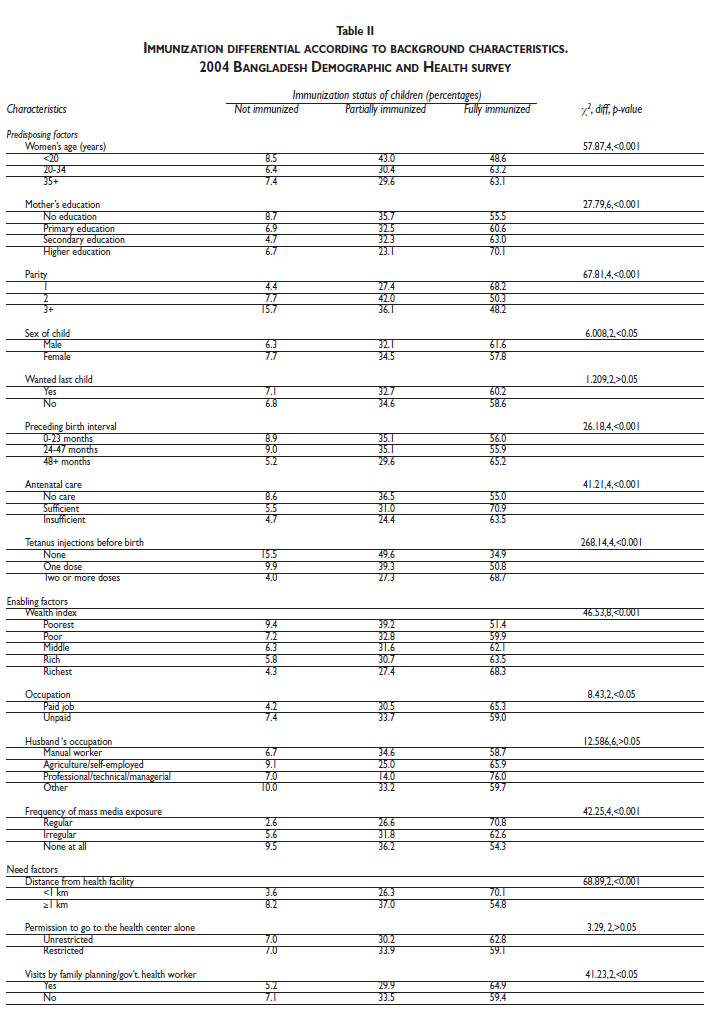
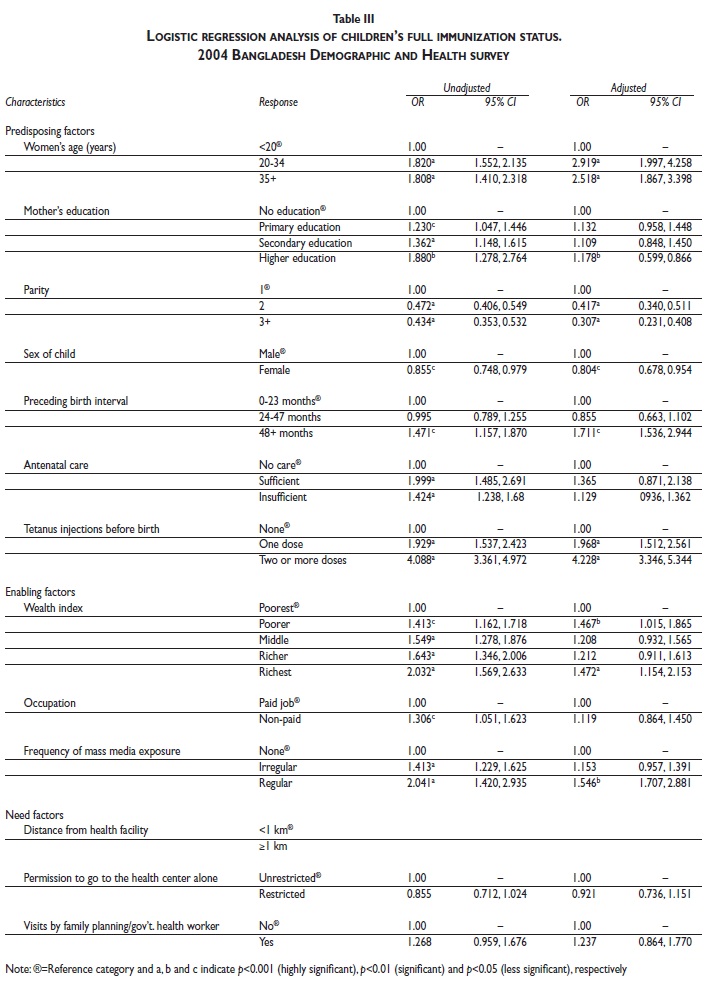
<body><![CDATA[<p><font size="2" face="Verdana, Arial, Helvetica, sans-serif"><a href="/img/revistas/spm/v52n2/a05tab01.gif">Table I</a> shows that polio1 has the highest coverage rate in both urban and rural areas. The percentage receiving the DPT vaccine decreases when higher doses are given; this situation is the same in the case of the polio vaccine. The measles vaccine has the lowest coverage rate, with 68% for urban children and 62.4% for rural children, and overall in Bangladesh only 64.1% of children received the measles vaccine. According to our findings, only 61.7% children were fully immunized and 6.1% were not immunized at all, which we undoubtedly consider unsatisfactory. Findings also reveal that a wide gap in vaccination coverage exists between urban and rural areas.</font></p>     <p><font size="2" face="Verdana, Arial, Helvetica, sans-serif"><b>Differentials in childhood vaccination coverage</b></font></p>     <p><font size="2" face="Verdana, Arial, Helvetica, sans-serif">Next, we investigated the differential impact of predisposing, enabling and need factors for the utilization of childhood immunization (<a href="/img/revistas/spm/v52n2/a05tab02.gif">Table II</a>). Significantly, children of mothers aged 20-34 years were more likely to be fully immunized (</font>&#967;<font size="2" face="Verdana, Arial, Helvetica, sans-serif"><sup>2</sup>= 57.87, <i>p</i>&lt;0.001) than children of younger (age &lt;20 years) and older mothers (age<u>&gt;</u>35 years). Education showed a positive relationship with child immunization coverage (</font>&#967;<font size="2" face="Verdana, Arial, Helvetica, sans-serif"><sup>2</sup>=27.79, <i>p</i>&lt;0.001), where 70.1% of children of mothers with higher education were fully immunized compared to 63.0% of those with secondary education and 60.6 and 55.5 % of those with primary and with no education, respectively. In addition, we observed that children of mothers with lower parity were more likely to be fully immunized (</font>&#967;<font size="2" face="Verdana, Arial, Helvetica, sans-serif"><sup>2</sup>= 67.81, <i>p</i>&lt;0.001) and male children were more likely to be fully immunized than female children (61.6% vs 57.8%, respectively, </font>&#967;<font size="2" face="Verdana, Arial, Helvetica, sans-serif"><sup>2</sup>=6.008, <i>p</i>&lt;0.05).</font></p>     <p><font size="2" face="Verdana, Arial, Helvetica, sans-serif">	Partial immunization coverage is higher for females (34.5%) than for males (32.1%). This is also the case for children with no immunization. The percentage of full immunization coverage increased with longer previous birth intervals (</font>&#967;<font size="2" face="Verdana, Arial, Helvetica, sans-serif"><sup>2</sup>=26.18, <i>p</i>&lt;0.001). Children of mothers who received sufficient antenatal care (at least five or more antenatal care visits) were significantly more likely to be fully immunized than children of those mothers who received insufficient antenatal care and those who had received no antenatal care (<i>p</i>&lt;0.001). It was also observed that mothers who had received two or more doses of tetanus toxoid (TT) injections (</font>&#967;<font size="2" face="Verdana, Arial, Helvetica, sans-serif"><sup>2</sup>=268.14, <i>p</i>&lt;0.001) were more likely to fully immunize their children than their counterparts.</font></p>     <p><font size="2" face="Verdana, Arial, Helvetica, sans-serif">	With regard to socioeconomic index, 68.3% of children of mothers in the richest index were completely immunized, followed by 63.5, 62.1, 59.9 and 51.4% for the rich, middle, poor and poorest socioeconomic indices, respectively. The difference between mothers with and without paid jobs with regard to full immunization coverage of their children, was roughly 6% (</font>&#967;<font size="2" face="Verdana, Arial, Helvetica, sans-serif">2=8.43, <i>p</i>&lt;0.05). The children of mothers whose husbands had good jobs were most likely to be fully immunized (76.0%). </font></p>     <p><font size="2" face="Verdana, Arial, Helvetica, sans-serif">	Mass media exposure showed a strong positive relationship with immunization status (</font>&#967;<font size="2" face="Verdana, Arial, Helvetica, sans-serif"><sup>2</sup>=42.25, <i>p</i>&lt;0.001), with 70.8% of the children of respondents who had mass media exposure (regularly watching TV and listening to radio) having been fully immunized, while non-immunization was found to be higher for children of respondents with no mass media exposure. Of the women who said there was a health facility nearby, 70.1% of children were fully vaccinated compared to 54.8% who said there was no health facility nearby (</font>&#967;<font size="2" face="Verdana, Arial, Helvetica, sans-serif"><sup>2</sup>=68.89, <i>p</i>&lt;0.001). Children of mothers for whom permission to go to the hospital alone was restricted were less fully immunized than mothers with unrestricted permission. A higher proportion full immunization coverage was found for families receiving visits from a family planning/health worker.</font></p>     <p><font size="2" face="Verdana, Arial, Helvetica, sans-serif"><b>Determinants of full immunization coverage</b></font></p>     <p><font size="2" face="Verdana, Arial, Helvetica, sans-serif">Results of the multivariate analysis are presented in <a href="/img/revistas/spm/v52n2/a05tab03.gif">Table III</a>. The age of mothers remained a significant factor for having a child fully immunized, after adjusting for other variables, with an approximately threefold difference in adjusted odds ratios between the youngest and middle age groups. Respondents who had primary, secondary and higher education were more likely to fully immunize their children than those with no education (adjusted odds ratio 1.132, 1.109 and 1.178, respectively). </font></p>     <p><font size="2" face="Verdana, Arial, Helvetica, sans-serif">	Parity and child's sex were shown to be major confounders for full immunization coverage. Previous birth interval (<u>&gt;</u>48 months) remained a significant independent factor for complete immunization coverage (adjusted odds ratio 1.711, 95% CI 1.536, 2.944). The unadjusted odds for full immunization were significantly higher when the mothers received sufficient antenatal care (unadjusted odds ratio 1.999, 95% CI 1.485, 2.691), but this significance was lost in the adjusted model. Full immunization was significantly associated with mothers receiving TT injections, after adjusting for potential confounding factors. This association was strengthened as the number of doses increased. Women in the richest category were 1.472 times more likely to fully immunize their children (95% CI 1.154, 2.153) than women in the poorest wealth index. Full immunization coverage was higher for children of mothers with paid jobs than for those whose mothers were engaged in unpaid jobs. However, this factor remained insignificant after adjustment for other variables. Respondents having mass media exposure ( regularly watching TV and listening to radio) were more likely to fully immunize their children than mothers who had no exposure (adjusted odds ratio 1.546, 95% CI 1.707, 2.881). Women who said that there was a health facility nearby (&lt;1 km) were more likely to fully immunize their children than those who said there was no health facility nearby (adjusted odds ratio 2.11, 95% CI 1.465, 2.561). Women whose permission to go to the hospital alone was restricted were less likely to fully immunize their children than those for whom permission was unrestricted. Visits from family planning/health workers were associated with an increase in full immunization coverage. However, neither of the above two variables show any significant effect on immunization status of the child.</font></p>     <p>&nbsp;</p>     ]]></body>
<body><![CDATA[<p><font size="3" face="Verdana, Arial, Helvetica, sans-serif"><b>Discussion</b></font></p>     <p><font size="2" face="Verdana, Arial, Helvetica, sans-serif">In this paper, we have examined a number of predisposing, enabling and need factors that influence the acceptance of complete vaccination coverage for children younger than five years of age in rural Bangladesh. The study highlighted an inadequate full immunization coverage in Bangladesh. Approximately 62% of children under age five were fully immunized in Bangladesh and substantial differences in complete vaccination rates were found for children in urban and rural areas (around 6%). This is probably partly due to the general distribution of healthcare facilities in the country, which tends to disproportionately favor urban areas. It may also be attributed to the lack of awareness of the importance of vaccination among mothers in rural areas in comparison to those in urban areas.</font></p>     <p><font size="2" face="Verdana, Arial, Helvetica, sans-serif">	The results from both bivariate and multivariate analyses confirmed the importance of maternal education for the acceptance of complete vaccination, which is consistent with findings from other studies.<sup>10,11 </sup>Maternal education may also act as a proxy variable for a number of background variables that reflect a woman's higher socio-economic status, thus enabling her to seek proper medical care for her child when necessary. </font></p>     <p><font size="2" face="Verdana, Arial, Helvetica, sans-serif">	It is well recognized that age plays an important role in women's utilization of medical services.<sup>12</sup> Maternal age may sometimes serve as a proxy for the women's accumulated knowledge of healthcare services, which may have a positive influence on acceptance of full immunization of children. Results of bivariate and multivariate analyses showed that mothers in the middle age group were more likely to fully immunize their children than the youngest and oldest age groups. This may be due to the development of modern medicine and the improvement in educational opportunities available to women in recent years, whereby women in the middle age group might have more knowledge about modern healthcare services and value modern medicine more than the older women.</font></p>     <p><font size="2" face="Verdana, Arial, Helvetica, sans-serif">	Distance from a health facility was found to be a significant predicator of full immunization. The women who reported having a health facility nearby (&lt;1 km) were more likely to fully immunize their children than those who said there was no health facility nearby. Other studies in developing countries have also suggested that walking or traveling time and distance are key factors that influence the utilization of healthcare services.<sup>13,14</sup> It has also been shown that wealth index has a positive effect on the acceptance of full immunization. Mothers from wealthy families are expected to seek modern/medical health services for their families whenever necessary.<sup>15</sup> The results of the present study also support the hypothesis that women with a higher economical status were more likely to fully immunize their children than poorer counterparts. </font></p>     <p><font size="2" face="Verdana, Arial, Helvetica, sans-serif">	Having more children may cause resource constraints, which has a negative effect on healthcare utilization.<sup>16, 17</sup> The study showed that mothers with greater parity were less likely to immunize their children. Sex discrimination against female children was also seen in child immunization in rural Bangladesh. The study revealed that male children were more likely to be fully immunized than females. Mothers having received TT injection was also found to be one of the significant  predictors of full immunization coverage for children.</font></p>     <p><font size="2" face="Verdana, Arial, Helvetica, sans-serif">	Based on bivariate analysis, women's occupation and antenatal care were found to be significantly associated with the acceptance of full immunization coverage. Women engaged in paid jobs are usually more educated and aware of the health of their family members and therefore know the harmful effects of non-immunization.<sup>18</sup> It was expected that antenatal care visits would have a positive impact on immunization coverage of children,<sup>19</sup> and the present study found that 70.9% mothers who received sufficient antenatal care fully immunized their children, compared to 55.0% of mothers who did not receive antenatal care. In addition, mass media has a positive effect on a child's immunization status. In recent years, a number of governmental and non-governmental organizations have expanded their maternal and child health-related programs on television, radio, and newspapers, likely having increased mothers' knowledge about immunization. </font></p>     <p><font size="2" face="Verdana, Arial, Helvetica, sans-serif">	Despite the increase in healthcare services and launching various programs in Bangladesh, full immunization coverage for children younger than five is currently still highly inadequate. That respondents who had higher levels of education, mothers who engaged in paid jobs and with the richest socieoeconomic level, those having mass media access, who received TT vaccines, and who had sufficient antenatal care were more likely to fully immunize their children reflects the reality that only people from a higher economic or educational group can afford to seek healthcare for their child, irrespective of need. The study therefore concludes that in order to achieve 100% immunization coverage in Bangladesh, (i) government should ensure the availability of health care centers that provide immunization, especially in the rural area; (ii) sufficient education should be provided to rural women, which will encourage them to seek immunization at the appropriate age of the child; (iii) parents should be encouraged to have small families by using contraception; (iv) maternal health care centers should be available to provide antenatal care; and (vi) mass media promotion programs should be undertaken so that parents understand the beneficial effect of immunization coverage and to encourage them to fully immunize their children.</font></p>     <p>&nbsp;</p>     <p><font size="3" face="Verdana, Arial, Helvetica, sans-serif"><b>References</b></font></p>     ]]></body>
<body><![CDATA[<!-- ref --><p><font size="2" face="Verdana, Arial, Helvetica, sans-serif">1. Chowdhury AMR, Aziz KMA, Bhuiya A. The 'near miracle' revisited: social science perspectives of the immunization program in Bangladesh. Amsterdam: Het Spinhuis, 1999:138.    &nbsp;&nbsp;&nbsp;&nbsp;&nbsp;&nbsp;&nbsp;&nbsp;[&#160;<a href="javascript:void(0);" onclick="javascript: window.open('/scielo.php?script=sci_nlinks&ref=9356215&pid=S0036-3634201000020000500001&lng=','','width=640,height=500,resizable=yes,scrollbars=1,menubar=yes,');">Links</a>&#160;]<!-- end-ref --></font></p>     <!-- ref --><p><font size="2" face="Verdana, Arial, Helvetica, sans-serif">2. Expanded Program on Immunization (EPI). National Coverage Evaluation Survey Report. Dhaka: Ministry of Health and Family Welfare, 2000.    &nbsp;&nbsp;&nbsp;&nbsp;&nbsp;&nbsp;&nbsp;&nbsp;[&#160;<a href="javascript:void(0);" onclick="javascript: window.open('/scielo.php?script=sci_nlinks&ref=9356217&pid=S0036-3634201000020000500002&lng=','','width=640,height=500,resizable=yes,scrollbars=1,menubar=yes,');">Links</a>&#160;]<!-- end-ref --> </font></p>     <!-- ref --><p><font size="2" face="Verdana, Arial, Helvetica, sans-serif">3. Expanded Program on Immunization (EPI). National Coverage Evaluation Survey Report. Dhaka: Ministry of Health and Family Welfare, 2006.    &nbsp;&nbsp;&nbsp;&nbsp;&nbsp;&nbsp;&nbsp;&nbsp;[&#160;<a href="javascript:void(0);" onclick="javascript: window.open('/scielo.php?script=sci_nlinks&ref=9356219&pid=S0036-3634201000020000500003&lng=','','width=640,height=500,resizable=yes,scrollbars=1,menubar=yes,');">Links</a>&#160;]<!-- end-ref --> </font></p>     <!-- ref --><p><font size="2" face="Verdana, Arial, Helvetica, sans-serif">4. National Institute of Population Research and Training (NIPORT). Bangladesh Demographic and Health Survey 1999-2000. Dhaka: Mitra and Associates, ORC Macro, 2001.    &nbsp;&nbsp;&nbsp;&nbsp;&nbsp;&nbsp;&nbsp;&nbsp;[&#160;<a href="javascript:void(0);" onclick="javascript: window.open('/scielo.php?script=sci_nlinks&ref=9356221&pid=S0036-3634201000020000500004&lng=','','width=640,height=500,resizable=yes,scrollbars=1,menubar=yes,');">Links</a>&#160;]<!-- end-ref --> </font></p>     <!-- ref --><p><font size="2" face="Verdana, Arial, Helvetica, sans-serif">5. Jamil K, Bhuiya A, Streatfield K, Chakrabarty N. The immunization program in Bangladesh: impressive gains in coverage, but gaps remain. Health Policy and Planning 2005;14(1):49-58.    &nbsp;&nbsp;&nbsp;&nbsp;&nbsp;&nbsp;&nbsp;&nbsp;[&#160;<a href="javascript:void(0);" onclick="javascript: window.open('/scielo.php?script=sci_nlinks&ref=9356223&pid=S0036-3634201000020000500005&lng=','','width=640,height=500,resizable=yes,scrollbars=1,menubar=yes,');">Links</a>&#160;]<!-- end-ref --> </font></p>     ]]></body>
<body><![CDATA[<!-- ref --><p><font size="2" face="Verdana, Arial, Helvetica, sans-serif">6. Uddin J, Ashraf A, Sirajuddin AKM, Alam M, Tunon C. Incorporation of community's voice into Health and Population Sector Program of Bangladesh for its transparency and accountability. Dhaka: ICDDR, B, 2001:Working Paper No 148.    &nbsp;&nbsp;&nbsp;&nbsp;&nbsp;&nbsp;&nbsp;&nbsp;[&#160;<a href="javascript:void(0);" onclick="javascript: window.open('/scielo.php?script=sci_nlinks&ref=9356225&pid=S0036-3634201000020000500006&lng=','','width=640,height=500,resizable=yes,scrollbars=1,menubar=yes,');">Links</a>&#160;]<!-- end-ref --></font></p>     <!-- ref --><p><font size="2" face="Verdana, Arial, Helvetica, sans-serif">7. Bangladesh Bureau of Statistics (BBS). Report of the household income and expenditure survey 2000. Bangladesh: Statistics Division, Ministry of Planning, Government Republic of Bangladesh, 2003.    &nbsp;&nbsp;&nbsp;&nbsp;&nbsp;&nbsp;&nbsp;&nbsp;[&#160;<a href="javascript:void(0);" onclick="javascript: window.open('/scielo.php?script=sci_nlinks&ref=9356227&pid=S0036-3634201000020000500007&lng=','','width=640,height=500,resizable=yes,scrollbars=1,menubar=yes,');">Links</a>&#160;]<!-- end-ref --></font></p>     <!-- ref --><p><font size="2" face="Verdana, Arial, Helvetica, sans-serif">8. Dutton D. Financial, organizational and professional factors affecting health care utilization. Social Sciences and Medicine 1986;23(7):721-735.    &nbsp;&nbsp;&nbsp;&nbsp;&nbsp;&nbsp;&nbsp;&nbsp;[&#160;<a href="javascript:void(0);" onclick="javascript: window.open('/scielo.php?script=sci_nlinks&ref=9356229&pid=S0036-3634201000020000500008&lng=','','width=640,height=500,resizable=yes,scrollbars=1,menubar=yes,');">Links</a>&#160;]<!-- end-ref --></font></p>     <!-- ref --><p><font size="2" face="Verdana, Arial, Helvetica, sans-serif">9. Andersen R, Newman JF. Societal and individual determinants of medical care utilization in the United States. Milbank Memorial Fund Quarterly 1973; 81:95-123.    &nbsp;&nbsp;&nbsp;&nbsp;&nbsp;&nbsp;&nbsp;&nbsp;[&#160;<a href="javascript:void(0);" onclick="javascript: window.open('/scielo.php?script=sci_nlinks&ref=9356231&pid=S0036-3634201000020000500009&lng=','','width=640,height=500,resizable=yes,scrollbars=1,menubar=yes,');">Links</a>&#160;]<!-- end-ref --></font></p>     <!-- ref --><p><font size="2" face="Verdana, Arial, Helvetica, sans-serif">10. Phukan RK, Barman MP, Mahanta J. Factors associated with immunization coverage of children in Assam, India: over the first year of life. Journal of Tropical Pediatrics 2008;1.    &nbsp;&nbsp;&nbsp;&nbsp;&nbsp;&nbsp;&nbsp;&nbsp;[&#160;<a href="javascript:void(0);" onclick="javascript: window.open('/scielo.php?script=sci_nlinks&ref=9356233&pid=S0036-3634201000020000500010&lng=','','width=640,height=500,resizable=yes,scrollbars=1,menubar=yes,');">Links</a>&#160;]<!-- end-ref --> </font></p>     ]]></body>
<body><![CDATA[<!-- ref --><p><font size="2" face="Verdana, Arial, Helvetica, sans-serif">11. Ibnouf AH,Van den Borne HW, Maarse JAM. Factors influencing immunization coverage among children under five years of age in Khartoum State, Sudan. South African Journal of Family Practice 2007;49(8).    &nbsp;&nbsp;&nbsp;&nbsp;&nbsp;&nbsp;&nbsp;&nbsp;[&#160;<a href="javascript:void(0);" onclick="javascript: window.open('/scielo.php?script=sci_nlinks&ref=9356235&pid=S0036-3634201000020000500011&lng=','','width=640,height=500,resizable=yes,scrollbars=1,menubar=yes,');">Links</a>&#160;]<!-- end-ref --></font></p>     <!-- ref --><p><font size="2" face="Verdana, Arial, Helvetica, sans-serif">12. Fosu GB. Childhood morbidity and health services utilization: cross-national comparisons of user-related factors from DHS data. Social Science and Medicine 1994;38:1209-1220.    &nbsp;&nbsp;&nbsp;&nbsp;&nbsp;&nbsp;&nbsp;&nbsp;[&#160;<a href="javascript:void(0);" onclick="javascript: window.open('/scielo.php?script=sci_nlinks&ref=9356237&pid=S0036-3634201000020000500012&lng=','','width=640,height=500,resizable=yes,scrollbars=1,menubar=yes,');">Links</a>&#160;]<!-- end-ref --></font></p>     <!-- ref --><p><font size="2" face="Verdana, Arial, Helvetica, sans-serif">13 Muller J, Smith T, Mellor S, Rare L, Genton B. The effects of distance from home on attendance at a small rural health centre in Papua New Guinea. International Journal of Epidemiology 1998;27(5):878-884.    &nbsp;&nbsp;&nbsp;&nbsp;&nbsp;&nbsp;&nbsp;&nbsp;[&#160;<a href="javascript:void(0);" onclick="javascript: window.open('/scielo.php?script=sci_nlinks&ref=9356239&pid=S0036-3634201000020000500013&lng=','','width=640,height=500,resizable=yes,scrollbars=1,menubar=yes,');">Links</a>&#160;]<!-- end-ref --> </font></p>     <!-- ref --><p><font size="2" face="Verdana, Arial, Helvetica, sans-serif">14. Wilson JB, Collison AH, Richardson D, Kwofie G, Senah KA, Tinkorang EK. The maternity home waiting concept: the Nsawam, Ghana experience. International Journal of Gynecology and Obstetrics 1997;59(suppl 2):165-172.    &nbsp;&nbsp;&nbsp;&nbsp;&nbsp;&nbsp;&nbsp;&nbsp;[&#160;<a href="javascript:void(0);" onclick="javascript: window.open('/scielo.php?script=sci_nlinks&ref=9356241&pid=S0036-3634201000020000500014&lng=','','width=640,height=500,resizable=yes,scrollbars=1,menubar=yes,');">Links</a>&#160;]<!-- end-ref --></font></p>     <!-- ref --><p><font size="2" face="Verdana, Arial, Helvetica, sans-serif">15. Gwatkin DR. Health inequalities and the health of the poor: What do you know? What can we do? Bull World Health Organ 2000;78(1):3-18.    &nbsp;&nbsp;&nbsp;&nbsp;&nbsp;&nbsp;&nbsp;&nbsp;[&#160;<a href="javascript:void(0);" onclick="javascript: window.open('/scielo.php?script=sci_nlinks&ref=9356243&pid=S0036-3634201000020000500015&lng=','','width=640,height=500,resizable=yes,scrollbars=1,menubar=yes,');">Links</a>&#160;]<!-- end-ref --></font></p>     ]]></body>
<body><![CDATA[<!-- ref --><p><font size="2" face="Verdana, Arial, Helvetica, sans-serif">16. Bhatia JC. Levels and causes of maternal mortality in Southern India. Studies in Family Planning 1992;24:310-318.    &nbsp;&nbsp;&nbsp;&nbsp;&nbsp;&nbsp;&nbsp;&nbsp;[&#160;<a href="javascript:void(0);" onclick="javascript: window.open('/scielo.php?script=sci_nlinks&ref=9356245&pid=S0036-3634201000020000500016&lng=','','width=640,height=500,resizable=yes,scrollbars=1,menubar=yes,');">Links</a>&#160;]<!-- end-ref --></font></p>     <!-- ref --><p><font size="2" face="Verdana, Arial, Helvetica, sans-serif">17. Pebley AR, Goldman N, Rodriguez G.Prenatal and delivery care and childhood immunization in Guatemala: do family and community matter? Demography 1996;33:231-247.    &nbsp;&nbsp;&nbsp;&nbsp;&nbsp;&nbsp;&nbsp;&nbsp;[&#160;<a href="javascript:void(0);" onclick="javascript: window.open('/scielo.php?script=sci_nlinks&ref=9356247&pid=S0036-3634201000020000500017&lng=','','width=640,height=500,resizable=yes,scrollbars=1,menubar=yes,');">Links</a>&#160;]<!-- end-ref --></font></p>     <!-- ref --><p><font size="2" face="Verdana, Arial, Helvetica, sans-serif">18. Chowdhury MR, Bhuiya A, Simeen Mahmud S, Salam AKMA, Karim F. Immunization divide: Who do get vaccinated in Bangladesh? Journal of Health, Population and Nutrition 2003;21(3):193-204.    &nbsp;&nbsp;&nbsp;&nbsp;&nbsp;&nbsp;&nbsp;&nbsp;[&#160;<a href="javascript:void(0);" onclick="javascript: window.open('/scielo.php?script=sci_nlinks&ref=9356249&pid=S0036-3634201000020000500018&lng=','','width=640,height=500,resizable=yes,scrollbars=1,menubar=yes,');">Links</a>&#160;]<!-- end-ref --></font></p>     <!-- ref --><p><font size="2" face="Verdana, Arial, Helvetica, sans-serif">19. Hemat S, Takano T, Kizuki M, Mashal T. Health-care provision factors associated with child immunization coverage in a city centre and a rural area in Kabul, Afghanistan. Vaccine 2009;11:27(21):2823-2829.    &nbsp;&nbsp;&nbsp;&nbsp;&nbsp;&nbsp;&nbsp;&nbsp;[&#160;<a href="javascript:void(0);" onclick="javascript: window.open('/scielo.php?script=sci_nlinks&ref=9356251&pid=S0036-3634201000020000500019&lng=','','width=640,height=500,resizable=yes,scrollbars=1,menubar=yes,');">Links</a>&#160;]<!-- end-ref --></font></p>     <p>&nbsp;</p>     <p>&nbsp;</p>     ]]></body>
<body><![CDATA[<p><font size="2" face="Verdana, Arial, Helvetica, sans-serif"><b><a name="not"></a><a href="#not1"><img src="/img/revistas/spm/v52n2/seta.gif" border="0"></a> Address reprint requests to:</b>    <br>  Md. Mosiur Rahman    <br> Department of Population Science and Human Resource Development    <br>  University of Rajshahi. Rajshahi-6205, Bangladesh    <br> E-mail: <a href="mailto:swaponru_2000@yahoo.com">swaponru_2000@yahoo.com</a></font></p>     <p><font size="2" face="Verdana, Arial, Helvetica, sans-serif">Received on: July 16, 2009     <br> Accepted on: December 15, 2009</font></p>      ]]></body><back>
<ref-list>
<ref id="B1">
<label>1</label><nlm-citation citation-type="book">
<person-group person-group-type="author">
<name>
<surname><![CDATA[Chowdhury]]></surname>
<given-names><![CDATA[AMR]]></given-names>
</name>
<name>
<surname><![CDATA[Aziz]]></surname>
<given-names><![CDATA[KMA]]></given-names>
</name>
<name>
<surname><![CDATA[Bhuiya]]></surname>
<given-names><![CDATA[A]]></given-names>
</name>
</person-group>
<source><![CDATA[The 'near miracle' revisited: social science perspectives of the immunization program in Bangladesh]]></source>
<year>1999</year>
<page-range>138</page-range><publisher-loc><![CDATA[Amsterdam ]]></publisher-loc>
<publisher-name><![CDATA[Het Spinhuis]]></publisher-name>
</nlm-citation>
</ref>
<ref id="B2">
<label>2</label><nlm-citation citation-type="book">
<source><![CDATA[Expanded Program on Immunization (EPI): National Coverage Evaluation Survey Report]]></source>
<year>2000</year>
<publisher-loc><![CDATA[Dhaka ]]></publisher-loc>
<publisher-name><![CDATA[Ministry of Health and Family Welfare]]></publisher-name>
</nlm-citation>
</ref>
<ref id="B3">
<label>3</label><nlm-citation citation-type="book">
<source><![CDATA[Expanded Program on Immunization (EPI): National Coverage Evaluation Survey Report]]></source>
<year>2006</year>
<publisher-loc><![CDATA[Dhaka ]]></publisher-loc>
<publisher-name><![CDATA[Ministry of Health and Family Welfare]]></publisher-name>
</nlm-citation>
</ref>
<ref id="B4">
<label>4</label><nlm-citation citation-type="book">
<collab>National Institute of Population Research and Training</collab>
<source><![CDATA[Bangladesh Demographic and Health Survey 1999-2000]]></source>
<year>2001</year>
<publisher-loc><![CDATA[Dhaka ]]></publisher-loc>
<publisher-name><![CDATA[Mitra and Associates, ORC Macro]]></publisher-name>
</nlm-citation>
</ref>
<ref id="B5">
<label>5</label><nlm-citation citation-type="journal">
<person-group person-group-type="author">
<name>
<surname><![CDATA[Jamil]]></surname>
<given-names><![CDATA[K]]></given-names>
</name>
<name>
<surname><![CDATA[Bhuiya]]></surname>
<given-names><![CDATA[A]]></given-names>
</name>
<name>
<surname><![CDATA[Streatfield]]></surname>
<given-names><![CDATA[K]]></given-names>
</name>
<name>
<surname><![CDATA[Chakrabarty]]></surname>
<given-names><![CDATA[N]]></given-names>
</name>
</person-group>
<article-title xml:lang="en"><![CDATA[The immunization program in Bangladesh: impressive gains in coverage, but gaps remain]]></article-title>
<source><![CDATA[Health Policy and Planning]]></source>
<year>2005</year>
<volume>14</volume>
<numero>1</numero>
<issue>1</issue>
<page-range>49-58</page-range></nlm-citation>
</ref>
<ref id="B6">
<label>6</label><nlm-citation citation-type="book">
<person-group person-group-type="author">
<name>
<surname><![CDATA[Uddin]]></surname>
<given-names><![CDATA[J]]></given-names>
</name>
<name>
<surname><![CDATA[Ashraf]]></surname>
<given-names><![CDATA[A]]></given-names>
</name>
<name>
<surname><![CDATA[Sirajuddin]]></surname>
<given-names><![CDATA[AKM]]></given-names>
</name>
<name>
<surname><![CDATA[Alam]]></surname>
<given-names><![CDATA[M]]></given-names>
</name>
<name>
<surname><![CDATA[Tunon]]></surname>
<given-names><![CDATA[C]]></given-names>
</name>
</person-group>
<source><![CDATA[Incorporation of community's voice into Health and Population Sector Program of Bangladesh for its transparency and accountability]]></source>
<year>2001</year>
<publisher-loc><![CDATA[Dhaka ]]></publisher-loc>
<publisher-name><![CDATA[ICDDR, B]]></publisher-name>
</nlm-citation>
</ref>
<ref id="B7">
<label>7</label><nlm-citation citation-type="book">
<collab>Bangladesh Bureau of Statistics</collab>
<source><![CDATA[Report of the household income and expenditure survey 2000]]></source>
<year>2003</year>
<publisher-loc><![CDATA[Bangladesh ]]></publisher-loc>
<publisher-name><![CDATA[Statistics Division, Ministry of Planning, Government Republic of Bangladesh]]></publisher-name>
</nlm-citation>
</ref>
<ref id="B8">
<label>8</label><nlm-citation citation-type="journal">
<person-group person-group-type="author">
<name>
<surname><![CDATA[Dutton]]></surname>
<given-names><![CDATA[D]]></given-names>
</name>
</person-group>
<article-title xml:lang="en"><![CDATA[Financial, organizational and professional factors affecting health care utilization]]></article-title>
<source><![CDATA[Social Sciences and Medicine]]></source>
<year>1986</year>
<volume>23</volume>
<numero>7</numero>
<issue>7</issue>
<page-range>721-735</page-range></nlm-citation>
</ref>
<ref id="B9">
<label>9</label><nlm-citation citation-type="journal">
<person-group person-group-type="author">
<name>
<surname><![CDATA[Andersen]]></surname>
<given-names><![CDATA[R]]></given-names>
</name>
<name>
<surname><![CDATA[Newman]]></surname>
<given-names><![CDATA[JF]]></given-names>
</name>
</person-group>
<article-title xml:lang="en"><![CDATA[Societal and individual determinants of medical care utilization in the United States]]></article-title>
<source><![CDATA[Milbank Memorial Fund Quarterly]]></source>
<year>1973</year>
<volume>81</volume>
<page-range>95-123</page-range></nlm-citation>
</ref>
<ref id="B10">
<label>10</label><nlm-citation citation-type="journal">
<person-group person-group-type="author">
<name>
<surname><![CDATA[Phukan]]></surname>
<given-names><![CDATA[RK]]></given-names>
</name>
<name>
<surname><![CDATA[Barman]]></surname>
<given-names><![CDATA[MP]]></given-names>
</name>
<name>
<surname><![CDATA[Mahanta]]></surname>
<given-names><![CDATA[J]]></given-names>
</name>
</person-group>
<article-title xml:lang="en"><![CDATA[Factors associated with immunization coverage of children in Assam, India: over the first year of life]]></article-title>
<source><![CDATA[Journal of Tropical Pediatrics]]></source>
<year>2008</year>
</nlm-citation>
</ref>
<ref id="B11">
<label>11</label><nlm-citation citation-type="journal">
<person-group person-group-type="author">
<name>
<surname><![CDATA[Ibnouf]]></surname>
<given-names><![CDATA[AH]]></given-names>
</name>
<name>
<surname><![CDATA[Van den Borne]]></surname>
<given-names><![CDATA[HW]]></given-names>
</name>
<name>
<surname><![CDATA[Maarse]]></surname>
<given-names><![CDATA[JAM]]></given-names>
</name>
</person-group>
<article-title xml:lang="en"><![CDATA[Factors influencing immunization coverage among children under five years of age in Khartoum State, Sudan]]></article-title>
<source><![CDATA[South African Journal of Family Practice]]></source>
<year>2007</year>
<volume>49</volume>
<numero>8</numero>
<issue>8</issue>
</nlm-citation>
</ref>
<ref id="B12">
<label>12</label><nlm-citation citation-type="journal">
<person-group person-group-type="author">
<name>
<surname><![CDATA[Fosu]]></surname>
<given-names><![CDATA[GB]]></given-names>
</name>
</person-group>
<article-title xml:lang="en"><![CDATA[Childhood morbidity and health services utilization: cross-national comparisons of user-related factors from DHS data]]></article-title>
<source><![CDATA[Social Science and Medicine]]></source>
<year>1994</year>
<volume>38</volume>
<page-range>1209-1220</page-range></nlm-citation>
</ref>
<ref id="B13">
<label>13</label><nlm-citation citation-type="journal">
<person-group person-group-type="author">
<name>
<surname><![CDATA[Muller]]></surname>
<given-names><![CDATA[J]]></given-names>
</name>
<name>
<surname><![CDATA[Smith]]></surname>
<given-names><![CDATA[T]]></given-names>
</name>
<name>
<surname><![CDATA[Mellor]]></surname>
<given-names><![CDATA[S]]></given-names>
</name>
<name>
<surname><![CDATA[Rare]]></surname>
<given-names><![CDATA[L]]></given-names>
</name>
<name>
<surname><![CDATA[Genton]]></surname>
<given-names><![CDATA[B]]></given-names>
</name>
</person-group>
<article-title xml:lang="en"><![CDATA[The effects of distance from home on attendance at a small rural health centre in Papua New Guinea]]></article-title>
<source><![CDATA[International Journal of Epidemiology]]></source>
<year>1998</year>
<volume>27</volume>
<numero>5</numero>
<issue>5</issue>
<page-range>878-884</page-range></nlm-citation>
</ref>
<ref id="B14">
<label>14</label><nlm-citation citation-type="journal">
<person-group person-group-type="author">
<name>
<surname><![CDATA[Wilson]]></surname>
<given-names><![CDATA[JB]]></given-names>
</name>
<name>
<surname><![CDATA[Collison]]></surname>
<given-names><![CDATA[AH]]></given-names>
</name>
<name>
<surname><![CDATA[Richardson]]></surname>
<given-names><![CDATA[D]]></given-names>
</name>
<name>
<surname><![CDATA[Kwofie]]></surname>
<given-names><![CDATA[G]]></given-names>
</name>
<name>
<surname><![CDATA[Senah]]></surname>
<given-names><![CDATA[KA]]></given-names>
</name>
<name>
<surname><![CDATA[Tinkorang]]></surname>
<given-names><![CDATA[EK]]></given-names>
</name>
</person-group>
<article-title xml:lang="en"><![CDATA[The maternity home waiting concept: the Nsawam, Ghana experience]]></article-title>
<source><![CDATA[International Journal of Gynecology and Obstetrics]]></source>
<year>1997</year>
<volume>59</volume>
<numero>^s2</numero>
<issue>^s2</issue>
<supplement>2</supplement>
<page-range>165-172</page-range></nlm-citation>
</ref>
<ref id="B15">
<label>15</label><nlm-citation citation-type="journal">
<person-group person-group-type="author">
<name>
<surname><![CDATA[Gwatkin]]></surname>
<given-names><![CDATA[DR]]></given-names>
</name>
</person-group>
<article-title xml:lang="en"><![CDATA[Health inequalities and the health of the poor: What do you know? What can we do?]]></article-title>
<source><![CDATA[Bull World Health Organ]]></source>
<year>2000</year>
<volume>78</volume>
<numero>1</numero>
<issue>1</issue>
<page-range>3-18</page-range></nlm-citation>
</ref>
<ref id="B16">
<label>16</label><nlm-citation citation-type="journal">
<person-group person-group-type="author">
<name>
<surname><![CDATA[Bhatia]]></surname>
<given-names><![CDATA[JC]]></given-names>
</name>
</person-group>
<article-title xml:lang="en"><![CDATA[Levels and causes of maternal mortality in Southern India]]></article-title>
<source><![CDATA[Studies in Family Planning]]></source>
<year>1992</year>
<volume>24</volume>
<page-range>310-318</page-range></nlm-citation>
</ref>
<ref id="B17">
<label>17</label><nlm-citation citation-type="journal">
<person-group person-group-type="author">
<name>
<surname><![CDATA[Pebley]]></surname>
<given-names><![CDATA[AR]]></given-names>
</name>
<name>
<surname><![CDATA[Goldman]]></surname>
<given-names><![CDATA[N]]></given-names>
</name>
<name>
<surname><![CDATA[Rodriguez]]></surname>
<given-names><![CDATA[G]]></given-names>
</name>
</person-group>
<article-title xml:lang="en"><![CDATA[Prenatal and delivery care and childhood immunization in Guatemala: do family and community matter?]]></article-title>
<source><![CDATA[Demography]]></source>
<year>1996</year>
<volume>33</volume>
<page-range>231-247</page-range></nlm-citation>
</ref>
<ref id="B18">
<label>18</label><nlm-citation citation-type="journal">
<person-group person-group-type="author">
<name>
<surname><![CDATA[Chowdhury]]></surname>
<given-names><![CDATA[MR]]></given-names>
</name>
<name>
<surname><![CDATA[Bhuiya]]></surname>
<given-names><![CDATA[A]]></given-names>
</name>
<name>
<surname><![CDATA[Simeen Mahmud]]></surname>
<given-names><![CDATA[S]]></given-names>
</name>
<name>
<surname><![CDATA[Salam]]></surname>
<given-names><![CDATA[AKMA]]></given-names>
</name>
<name>
<surname><![CDATA[Karim]]></surname>
<given-names><![CDATA[F]]></given-names>
</name>
</person-group>
<article-title xml:lang="en"><![CDATA[Immunization divide: Who do get vaccinated in Bangladesh?]]></article-title>
<source><![CDATA[Journal of Health, Population and Nutrition]]></source>
<year>2003</year>
<volume>21</volume>
<numero>3</numero>
<issue>3</issue>
<page-range>193-204</page-range></nlm-citation>
</ref>
<ref id="B19">
<label>19</label><nlm-citation citation-type="journal">
<person-group person-group-type="author">
<name>
<surname><![CDATA[Hemat]]></surname>
<given-names><![CDATA[S]]></given-names>
</name>
<name>
<surname><![CDATA[Takano]]></surname>
<given-names><![CDATA[T]]></given-names>
</name>
<name>
<surname><![CDATA[Kizuki]]></surname>
<given-names><![CDATA[M]]></given-names>
</name>
<name>
<surname><![CDATA[Mashal]]></surname>
<given-names><![CDATA[T]]></given-names>
</name>
</person-group>
<article-title xml:lang="en"><![CDATA[Health-care provision factors associated with child immunization coverage in a city centre and a rural area in Kabul, Afghanistan]]></article-title>
<source><![CDATA[Vaccine]]></source>
<year>2009</year>
<volume>27</volume>
<numero>21</numero>
<issue>21</issue>
<page-range>2823-2829</page-range></nlm-citation>
</ref>
</ref-list>
</back>
</article>
