<?xml version="1.0" encoding="ISO-8859-1"?><article xmlns:mml="http://www.w3.org/1998/Math/MathML" xmlns:xlink="http://www.w3.org/1999/xlink" xmlns:xsi="http://www.w3.org/2001/XMLSchema-instance">
<front>
<journal-meta>
<journal-id>0036-3634</journal-id>
<journal-title><![CDATA[Salud Pública de México]]></journal-title>
<abbrev-journal-title><![CDATA[Salud pública Méx]]></abbrev-journal-title>
<issn>0036-3634</issn>
<publisher>
<publisher-name><![CDATA[Instituto Nacional de Salud Pública]]></publisher-name>
</publisher>
</journal-meta>
<article-meta>
<article-id>S0036-36342010000200001</article-id>
<title-group>
<article-title xml:lang="en"><![CDATA[Body mass index and its relationship to mental disorders in the Mexican Adolescent Mental Health Survey]]></article-title>
<article-title xml:lang="es"><![CDATA[Índice de masa corporal y su relación con los trastornos mentales en la Encuesta de Salud Mental en Adolescentes de México]]></article-title>
</title-group>
<contrib-group>
<contrib contrib-type="author">
<name>
<surname><![CDATA[Borges]]></surname>
<given-names><![CDATA[Guilherme]]></given-names>
</name>
<xref ref-type="aff" rid="A01"/>
<xref ref-type="aff" rid="A02"/>
</contrib>
<contrib contrib-type="author">
<name>
<surname><![CDATA[Benjet]]></surname>
<given-names><![CDATA[Corina]]></given-names>
</name>
<xref ref-type="aff" rid="A01"/>
</contrib>
<contrib contrib-type="author">
<name>
<surname><![CDATA[Medina-Mora]]></surname>
<given-names><![CDATA[Maria Elena]]></given-names>
</name>
<xref ref-type="aff" rid="A01"/>
</contrib>
<contrib contrib-type="author">
<name>
<surname><![CDATA[Miller]]></surname>
<given-names><![CDATA[Matthew]]></given-names>
</name>
<xref ref-type="aff" rid="A03"/>
</contrib>
</contrib-group>
<aff id="A01">
<institution><![CDATA[,Instituto Nacional de Psiquiatría Ramón de la Fuente Muñiz  ]]></institution>
<addr-line><![CDATA[México DF]]></addr-line>
<country>México</country>
</aff>
<aff id="A02">
<institution><![CDATA[,Universidad Autónoma Metropolitana  ]]></institution>
<addr-line><![CDATA[México DF]]></addr-line>
<country>México</country>
</aff>
<aff id="A03">
<institution><![CDATA[,Harvard School of Public Health  ]]></institution>
<addr-line><![CDATA[Boston MA]]></addr-line>
<country>USA</country>
</aff>
<pub-date pub-type="pub">
<day>00</day>
<month>04</month>
<year>2010</year>
</pub-date>
<pub-date pub-type="epub">
<day>00</day>
<month>04</month>
<year>2010</year>
</pub-date>
<volume>52</volume>
<numero>2</numero>
<fpage>103</fpage>
<lpage>110</lpage>
<copyright-statement/>
<copyright-year/>
<self-uri xlink:href="http://www.scielo.org.mx/scielo.php?script=sci_arttext&amp;pid=S0036-36342010000200001&amp;lng=en&amp;nrm=iso"></self-uri><self-uri xlink:href="http://www.scielo.org.mx/scielo.php?script=sci_abstract&amp;pid=S0036-36342010000200001&amp;lng=en&amp;nrm=iso"></self-uri><self-uri xlink:href="http://www.scielo.org.mx/scielo.php?script=sci_pdf&amp;pid=S0036-36342010000200001&amp;lng=en&amp;nrm=iso"></self-uri><abstract abstract-type="short" xml:lang="en"><p><![CDATA[OBJECTIVE: To assess the association between body mass index (BMI) and the prevalence of psychiatric disorders among Mexico City adolescents. MATERIAL AND METHODS: Household survey of 3005 adolescents aged 12 to 17 residing in Mexico City in 2005 (response rate = 71%). Face to face interviews were carried out in the homes of participants with informed consent from a parent and/or legal guardian and the assent of the adolescent was obtained. Logistic regression analyses were performed. RESULTS: We only found an association between extremely low BMI and impulse control disorders. Elevated BMI was associated with impulse control disorders only among females. Specific impulse control disorders associated with low BMI included intermittent explosive disorder and conduct disorder. Only intermittent explosive disorder was associated with elevated BMI. CONCLUSION: Among Mexican adolescents, those with extremely high or extremely low BMI were more likely to have impulse control disorders than were adolescents with normal BMI.]]></p></abstract>
<abstract abstract-type="short" xml:lang="es"><p><![CDATA[OBJETIVO: Evaluar la asociación entre el índice de masa corporal (IMC) y la prevalencia de trastornos psiquiátricos en adolescentes de la Ciudad de México. MATERIAL Y MÉTODOS: 3005 adolescentes entre 12 y 17 años fueron entrevistados en 2005 (tasa de respuesta =71%). Las entrevistas cara a cara se hicieron en los hogares de los participantes seleccionados después del consentimiento de los padres o tutores. Se utilizó regresión logística. RESULTADOS: Sólo se encontró asociación entre IMC extremadamente bajo y trastornos de control de impulsos. El IMC elevado estuvo asociado con trastornos de control de impulsos sólo en las mujeres. Los trastornos de control de impulsos específicamente relacionados con bajo IMC incluyen el trastorno explosivo intermitente y el trastorno de conducta. El alto IMC estuvo relacionado únicamente con el trastorno explosivo intermitente. CONCLUSIÓN: Entre los adolescentes mexicanos, es más probable que aquellos con IMC extremadamente alto o bajo presenten trastornos de control de impulsos que aquellos con IMC normal.]]></p></abstract>
<kwd-group>
<kwd lng="en"><![CDATA[obesity]]></kwd>
<kwd lng="en"><![CDATA[adolescent]]></kwd>
<kwd lng="en"><![CDATA[race]]></kwd>
<kwd lng="en"><![CDATA[public health]]></kwd>
<kwd lng="en"><![CDATA[mental health]]></kwd>
<kwd lng="en"><![CDATA[Mexico]]></kwd>
<kwd lng="es"><![CDATA[obesidad]]></kwd>
<kwd lng="es"><![CDATA[adolescente]]></kwd>
<kwd lng="es"><![CDATA[raza]]></kwd>
<kwd lng="es"><![CDATA[salud pública]]></kwd>
<kwd lng="es"><![CDATA[salud mental]]></kwd>
<kwd lng="es"><![CDATA[México]]></kwd>
</kwd-group>
</article-meta>
</front><body><![CDATA[ <p align="right"><font size="2" face="Verdana, Arial, Helvetica, sans-serif"><b>ART&Iacute;CULO ORIGINAL</b></font></p>     <p>&nbsp;</p>     <p><font size="4" face="Verdana, Arial, Helvetica, sans-serif"><b><a name="add"></a>Body mass index and its relationship to mental disorders in the Mexican Adolescent Mental Health Survey</b></font></p>     <p>&nbsp;</p>     <p><font size="3" face="Verdana, Arial, Helvetica, sans-serif"><b>&Iacute;ndice de masa corporal y su relaci&oacute;n   con los trastornos mentales en la Encuesta de Salud Mental en Adolescentes de M&eacute;xico</b></font></p>     <p>&nbsp;</p>     <p>&nbsp;</p>     <p><font size="2" face="Verdana, Arial, Helvetica, sans-serif"><b>Guilherme Borges, ScD<sup>I,II</sup>; Corina Benjet, PhD<sup>I</sup>; Maria Elena Medina-Mora, PhD<sup>I</sup>; Matthew Miller, MD, ScD<sup>III</sup></b></font></p>     <p><font size="2" face="Verdana, Arial, Helvetica, sans-serif"><sup>I</sup>Instituto Nacional de Psiquiatr&iacute;a Ram&oacute;n de la Fuente Mu&ntilde;iz. M&eacute;xico DF, M&eacute;xico    <br> <sup>II</sup>Universidad Aut&oacute;noma Metropolitana. M&eacute;xico DF, M&eacute;xico    ]]></body>
<body><![CDATA[<br> <sup>III</sup>Harvard School of Public Health. Boston MA, USA</font></p>     <p><font size="2" face="Verdana, Arial, Helvetica, sans-serif"><a href="#add1">Address reprint requests to</a></font></p>     <p>&nbsp;</p>     <p>&nbsp;</p> <hr size="1" noshade>     <p><font size="2" face="Verdana, Arial, Helvetica, sans-serif"><b>ABSTRACT</b></font></p>     <p><font size="2" face="Verdana, Arial, Helvetica, sans-serif"><b>OBJECTIVE:</b> To assess the association between body mass index (BMI) and the prevalence of psychiatric disorders among Mexico City adolescents.     <br> <b>MATERIAL AND METHODS:</b> Household survey of 3005 adolescents aged 12 to 17 residing in Mexico City in 2005 (response rate = 71%). Face to face interviews were carried out in the homes of participants with informed consent from a parent and/or legal guardian and the assent of the adolescent was obtained. Logistic regression analyses were performed.     <br> <b>RESULTS:</b> We only found an association between extremely low BMI and impulse control disorders. Elevated BMI was associated with impulse control disorders only among females. Specific impulse control disorders associated with low BMI included intermittent explosive disorder and conduct disorder. Only intermittent explosive disorder was associated with elevated BMI.    <br> <b>CONCLUSION:</b> Among Mexican adolescents, those with extremely high or extremely low BMI were more likely to have impulse control disorders than were adolescents with normal BMI.</font></p>     <p><font size="2" face="Verdana, Arial, Helvetica, sans-serif"><b>Keywords:</b> obesity; adolescent; race/ethnicity; public health; mental health; Mexico</font></p> <hr size="1" noshade>     ]]></body>
<body><![CDATA[<p><font size="2" face="Verdana, Arial, Helvetica, sans-serif"><b>RESUMEN</b></font></p>     <p><font size="2" face="Verdana, Arial, Helvetica, sans-serif"><b>OBJETIVO:</b> Evaluar la asociaci&oacute;n entre el &iacute;ndice de masa corporal (IMC) y la prevalencia de trastornos psiqui&aacute;tricos en adolescentes de la Ciudad de M&eacute;xico.     <br> <b>MATERIAL Y M&Eacute;TODOS:</b> 3005 adolescentes entre 12 y 17 a&ntilde;os fueron entrevistados en 2005 (tasa de respuesta =71%). Las entrevistas cara a cara se hicieron en los hogares de los participantes seleccionados despu&eacute;s del consentimiento de los padres o tutores. Se utiliz&oacute; regresi&oacute;n log&iacute;stica.     <br> <b>RESULTADOS:</b> S&oacute;lo se encontr&oacute; asociaci&oacute;n entre IMC extremadamente bajo y trastornos de control de impulsos. El IMC elevado estuvo asociado con trastornos de control de impulsos s&oacute;lo en las mujeres. Los trastornos de control de impulsos espec&iacute;ficamente relacionados con bajo IMC incluyen el trastorno explosivo intermitente y el trastorno de conducta. El alto IMC estuvo relacionado &uacute;nicamente con el trastorno explosivo intermitente.     <br> <b>CONCLUSI&Oacute;N:</b> Entre los adolescentes mexicanos, es m&aacute;s probable que aquellos con IMC extremadamente alto o bajo presenten trastornos de control de impulsos que aquellos con IMC normal.</font></p>     <p><font size="2" face="Verdana, Arial, Helvetica, sans-serif"><b>Palabras clave:</b> obesidad; adolescente; raza; salud p&uacute;blica; salud mental; M&eacute;xico</font></p> <hr size="1" noshade>     <p>&nbsp;</p>     <p>&nbsp;</p>     <p><font size="2" face="Verdana, Arial, Helvetica, sans-serif">Elevated body mass index (BMI) ranks as the second leading risk factor for mortality and disability adjusted life-years in Mexico today <sup>1</sup> and contributes to the increasing incidence of ischemic heart disease and diabetes which together accounted for approximately 1 of every 4 deaths among Mexicans in 2004. The most recent data in Mexico suggest a high prevalence of overweight and obesity: overweight: 21.2% in males and 23.3% in females and obesity: 10% males and 9.2% females.<sup>2</sup> </font></p>     <p><font size="2" face="Verdana, Arial, Helvetica, sans-serif">	High BMI may also have mental health consequences. Elevated BMI has been linked to depression among adults in cross sectional studies.<sup>3,4</sup> and to the subsequent development of depression in prospective studies of adolescents and young adults in the United States.<sup>5</sup> Recent research among adults has extended the BMI mental health relationship to include psychiatric disorders other than depression.<sup>6-8</sup> Modest associations were found between adult BMI and not only mood but also anxiety disorders in the World Mental Health surveys,<sup>8</sup> an association accounted for by the disproportionate prevalence of these disorders among extremely obese females. The relationship between BMI and specific psychiatric disorders appears to vary by country; in the adult Mexican cohort, for example, only anxiety disorders were associated with BMI.<sup> 8</sup></font></p>     ]]></body>
<body><![CDATA[<p><font size="2" face="Verdana, Arial, Helvetica, sans-serif">	Although several common mental disorders have an early age of onset <sup>9</sup> and several commonly manifest for the first time during adolescence, few data are available on the relationship between BMI and mental disorders among adolescents. Studies of BMI that have used large, representative samples of adolescents<sup>10-14</sup> have tended to focus on a limited number of specific mental disorders, most often depression or anxiety, have relied on clinical samples,<sup>15,16</sup> or on measures of general distress<sup>12,17</sup> rather than clinical diagnostic categories. In addition, the majority of studies of BMI and mental illness have focused on the relation of high (rather than low) BMI and mental illness, even though work among adults have suggested a robust <i>inverse</i> association between BMI and completed suicide.<sup>18-20</sup> </font></p>     <p><font size="2" face="Verdana, Arial, Helvetica, sans-serif">	The current study extends prior work by examining the relationship between high and low BMI and a large number of specific psychiatric disorders among a large sample of adolescents in Mexico. Specifically, we report on associations between BMI and the 12-month prevalence of DSM-IV psychiatric disorders among adolescents aged 12 to 17 living in one of the largest metropolis in the world, the Mexico City Metropolitan Area. </font></p>     <p>&nbsp;</p>     <p><font size="3" face="Verdana, Arial, Helvetica, sans-serif"><b>Material and Methods</b></font></p>     <p><font size="2" face="Verdana, Arial, Helvetica, sans-serif"><b>Participants</b></font></p>     <p><font size="2" face="Verdana, Arial, Helvetica, sans-serif">Details about this sample are presented elsewhere.<sup>21</sup> The survey was designed to be representative of the 1834661 adolescents aged 12 to 17 that are permanent residents of private housing units in the Mexico City Metropolitan Area. The final sample included 3005 adolescent respondents selected from a stratified multistage area probability sample. In all strata, the primary sampling units were census count areas, or groups of them, similar to US census tracts. Secondary sampling units were city blocks (or groups of them) selected with probability proportional to size. All households within these city block units with adolescents aged 12 to 17 were selected. The response rate of eligible respondents was 71%. </font></p>     <p><font size="2" face="Verdana, Arial, Helvetica, sans-serif"><b>Procedures</b></font></p>     <p><font size="2" face="Verdana, Arial, Helvetica, sans-serif">Face to face interviews were carried out in the homes of the selected participants in 2005. A verbal and written explanation of the study was given to both parents and adolescents. Interviews were administered only to those participants for whom a signed informed consent from a parent and/or legal guardian and the assent of the adolescent was obtained. The adolescent interview took approximately two and a half hours to administer. All study participants were left contact information for institutions were they could seek services should they wish to do so. A total of 3005 adolescents completed the survey (response rate = 71%). The Human Subjects Committee of the Mexican National Institute of Psychiatry approved the recruitment, consent and field procedures.</font></p>     <p><font size="2" face="Verdana, Arial, Helvetica, sans-serif"><b>Diagnostic assessment</b></font></p>     <p><font size="2" face="Verdana, Arial, Helvetica, sans-serif">The Mexican Adolescent Mental Health Survey utilized the computer assisted (CAPI) version of the World Mental Health version of the Adolescent Composite International Diagnostic Interview (WMH-CIDI-	A) as the diagnostic tool. Psychiatric diagnosis was evaluated with the fully structured, computer assisted, World Mental Health adolescent version of the Composite International Diagnostic Interview (WMH-CIDI-A) the development of which is described elsewhere.<sup>22</sup> The WMH-CIDI-A is a downward extension of the adult version WMH-CIDI 3.0 used in the M-NCS; the adolescent version has been validated in a U.S. sample<sup>23 </sup>while the adult version has been validated in diverse countries and cultures.<sup>24 </sup></font></p>     ]]></body>
<body><![CDATA[<p><font size="2" face="Verdana, Arial, Helvetica, sans-serif">	We report on the associations between BMI and 12-month prevalence of psychiatric disorders, classified according to the diagnostic criteria of the Diagnostic and Statistical Manual of Mental Disorders, Fourth Edition (DSM-IV).<sup>25</sup> All disorders used organic exclusions rules as well as hierarchy definitions in order to avoid double counting of disorders in the same person. The disorders are grouped into the following categories:</font></p> <font size="2" face="Verdana, Arial, Helvetica, sans-serif">     <blockquote>     <p>1.	Mood disorders: major depressive episode, bipolar I and II disorder (which we group as "bipolar broad") and dysthymia with hierarchy;</p>     <p>2.	Anxiety disorders: specific phobia, social phobia, panic disorder, agoraphobia without panic disorder, separation anxiety disorder, generalized anxiety disorder and posttraumatic stress disorder;</p>     <p>3.	Substance disorders: alcohol and drug abuse and alcohol and drug abuse with dependence;</p>     <p>4.	Impulse-control disorders: oppositional-defiant disorder, conduct disorder, attention deficit/hyperactivity disorder, and intermittent explosive disorder.</p> </blockquote> </font>     <p><font size="2" face="Verdana, Arial, Helvetica, sans-serif"><b>Assessment of serious mental disorder</b></font></p>     <p><font size="2" face="Verdana, Arial, Helvetica, sans-serif">Disorder severity is defined as severe<sup>26</sup> if any one of the following conditions is met: the presence of bipolar I disorder, substance dependence with a physiological dependence syndrome, a suicide attempt in conjunction with any other disorder, or reporting at least two areas of role functioning with severe role impairment due to a mental disorder as measured by the disorder-specific Sheehan Disability Scales.<sup>27</sup></font></p>     <p><font size="2" face="Verdana, Arial, Helvetica, sans-serif"><b>Obesity and underweight</b></font></p>     <p><font size="2" face="Verdana, Arial, Helvetica, sans-serif">Height and weight was obtained by self-report. Body mass index (BMI) was calculated by self-reported weight in kilograms divided by self-reported height in meters squared. We followed the criteria for classifying the adolescents BMIs accordingly to the CDC recommendations, that is a BMI age- and sex-specific, often referred to as BMI-for-age (<a href="http://www.cdc.gov/nccdphp/dnpa/bmi/childrens_BMI/about_childrens_BMI.htm" target="_blank">http://www.cdc.gov/nccdphp/dnpa/bmi/childrens_BMI/about_childrens_BMI.htm</a>). Underweight was defined for those with a BMI less than the 5th percentile, normal weight as those from the 5th percentile to less than the 85th percentile, and overweight as those above the 85th percentile. </font></p>     ]]></body>
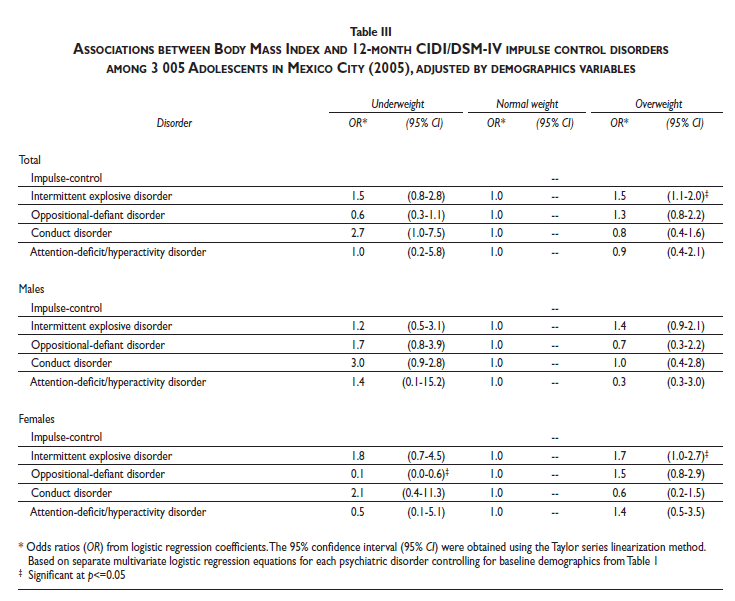
<body><![CDATA[<p><font size="2" face="Verdana, Arial, Helvetica, sans-serif"><b>Assessment of socio-demographic correlates</b></font></p>     <p><font size="2" face="Verdana, Arial, Helvetica, sans-serif">General information was collected on sex, age and family constellation. Family constellation was categorized as living with both parents or not living with both parents. Participants were considered students if currently enrolled as a student and drop outs if not currently enrolled as a student. Adolescents were asked whether they worked during the school year, whether they were ever married and whether they had children. All three conditions represent an additional burden not typical of the adolescent stage. Having answered affirmatively for any of the three, the participant was categorized as having adolescent burden. The adolescents were asked about the educational attainment of each of their parents which was then categorized as none/primary (six or less years of education), secondary (7-9 years of education), high school (10-12 years of education) or college (13 or more years of education); the score of the parent with the highest level of education was used. Parents reported family income was categorized into tertiles. We also included information on current (last 12-months) smoking (yes/no), non-medical diet in the last 12-months (yes/no) and frequency of heavy and light exercise &#91;three categories from tertiles, never-rarely (lower tertile), a few (middle) and frequently (upper tertile)&#93;.</font></p>     <p><font size="2" face="Verdana, Arial, Helvetica, sans-serif"><b>Analysis</b></font></p>     <p><font size="2" face="Verdana, Arial, Helvetica, sans-serif">The data were obtained from a stratified multistage sample and were thus subsequently weighted to adjust for differential probabilities of selection and non-response. Post-stratification to the total Mexico City Metropolitan Area adolescent population according to the year 2000 Census in the target age and sex range was also performed. </font></p>     <p><font size="2" face="Verdana, Arial, Helvetica, sans-serif">	As a result of this complex sample design and weighting, estimates of standard errors for proportions were obtained by the Taylor series linearization method using the SUDAAN software.<a name="not1"></a><a href="#not"><sup>*</sup></a> Logistic regression analysis was performed to study demographic correlates.<sup>28</sup> Estimates of standard errors of Odds Ratio (OR) from logistic regression coefficients were also obtained by SUDAAN, and 95% Confidence Intervals (CI) have been adjusted to design effects. Multivariate tests are based on Wald </font>&#967;<font size="2" face="Verdana, Arial, Helvetica, sans-serif"><sup>2</sup> tests computed from design-adjusted coefficient variance-covariance matrices, allowing us to test the global hypothesis that extremes in BMI are related to specific psychiatric diagnoses and groups of diagnoses. Statistical significance was based on two sided design based tests evaluated at the .05 level of significance.</font></p>     <p>&nbsp;</p>     <p><font size="3" face="Verdana, Arial, Helvetica, sans-serif"><b>Results</b></font></p>     <p><font size="2" face="Verdana, Arial, Helvetica, sans-serif">The (weighted) sample was 50.1% females, 50.7% between 15-17 years of age, 81.2% were currently attending school, and 63.3% came from families where their parents had a junior high education or less. No differences were found in the distribution of BMI according to measures of parental education or income (<a href="/img/revistas/spm/v52n2/a01tab01.gif">Table I</a>). Those living with parents were more likely to be underweight, and those under non-medical diets more likely to be overweight. </font></p>     <p><font size="2" face="Verdana, Arial, Helvetica, sans-serif">	For the total sample, we found an increase in the likelihood of impulse control disorders among adolescents with extreme BMI (i.e., high or low BMI compared to normal BMI, <i>p</i>&lt;0.001) (<a href="/img/revistas/spm/v52n2/a01tab02.gif">Table II</a>). The magnitude of the association between low BMI and impulse control disorders was similar for males (<i>OR</i>=1.7) and females (<i>OR</i>=1.6), though neither sex stratified association was significant at the <i>p</i>&lt;0.05 level. The increased prevalence of impulse control disorders among underweight adolescents was not due to a relationship with bulimia or anorexia, as the inclusion of both disorders in the model did not change the association between low BMI and impulse control disorders (data not shown). Female but not male adolescents with high BMI were more likely to have impulse control disorders (<i>OR</i>= 1.9 among females; <i>p</i>= 0.090 for the interaction). Among males, but not females, those with underweight had increase odds ratio of any severe disorder (<i>OR</i>= 2.3; <i>p</i>= 0.069 for the interaction).</font></p>     <p><font size="2" face="Verdana, Arial, Helvetica, sans-serif">	The association between extreme BMI and impulse control disorders among our cohort was attributable to a disproportionate prevalence of conduct disorder among adolescents with low BMI and intermittent explosive disorder among adolescents with high BMI (<i>OR</i>=2.7 and 1.5, respectively; <a href="/img/revistas/spm/v52n2/a01tab03.gif">Table III</a>). As a group, impulse control disorders were associated with high BMI only among females. Sensitivity analyses in the total sample for adolescents with BMI over the 95th percentile (obese) were similar to results presented for adolescents with BMI above the 85<sup>th</sup> percentile. </font></p>     ]]></body>
<body><![CDATA[<p>&nbsp;</p>     <p><font size="3" face="Verdana, Arial, Helvetica, sans-serif"><b>Discussion</b></font></p>     <p><font size="2" face="Verdana, Arial, Helvetica, sans-serif">Impulse control disorders, but not disorders of mood, anxiety or substance use, were disproportionately present among Mexican adolescents with extreme BMI. This result held even after controlling for comorbid psychiatric illness, including eating disorders, and several demographic characteristics. Our findings of an association between elevated BMI and impulse control disorders was primarily driven by the relationship among females, a finding that is consistent with a study of young adults followed from age 19 to 40 that found a similar gender based relationship between elevated BMI and aggressive personality traits.<sup>29</sup> Others studies that reported an association between impulse control disorders and elevated BMI did not find that the relationship was confined to females.<sup>14,30</sup> Among adolescents in the US, for example, chronic obesity was associated with oppositional defiant disorder<sup>14</sup> and adolescent conduct disorder predicted elevated BMI nine years later.<sup>30</sup> </font></p>     <p><font size="2" face="Verdana, Arial, Helvetica, sans-serif">	Consistent with some<sup>13,30</sup> but not other<sup>31</sup> studies we did not find an association between disorders of mood, anxiety or substance use among adolescents with either high or low BMI. Findings from other studies have, however, been inconsistent. For example, some studies have reported a positive association of elevated BMI and depression among females only,<sup>10</sup> others that obesity at the age of 14 years predicted depressive scores at the age of 31 years in both sexes,<sup>32</sup> others that the high BMI is associated with depressed mood only among younger (ages 12-14) but not older adolescents,<sup>11</sup> and others that depressive symptoms are more commonly found only among chronically obese boys.<sup>14</sup> Studies on the relationship between BMI and anxiety disorders among adolescents have also produced mixed results. One study found that adolescents with high BMI were less likely to develop generalized anxiety disorder during early adulthood,<sup>29</sup> whereas another study found no such relationship for BMI measured in early adulthood and symptoms of anxiety 10 years later.<sup>31</sup> We do not know whether our null finding for mood and anxiety disorders reflects cultural differences between Mexican adolescents and the adolescents in other studies, a possibility suggested by findings that the relationship between BMI and psychiatric disorders among adolescents depends on background ethnicity.<sup>17</sup> </font></p>     <p><font size="2" face="Verdana, Arial, Helvetica, sans-serif">	Our study can not determine causation or whether extremes in BMI preceded, followed or developed contemporaneous with the impulse control disorders with which they are related in cross section. Studies can be found that are consistent with all of these possibilities. For example, some studies have found that changes in corporal weight and body development during adolescence have been associated with changes in levels of testosterone and subsequent changes in aggressive behavior,<sup>33</sup> whereas other studies have found that conduct disorder during adolescence predicts subsequent changes in BMI during early adulthood.<sup>30</sup> </font></p>     <p><font size="2" face="Verdana, Arial, Helvetica, sans-serif">	Our findings must be considered in light of several additional study limitations. Our study was limited to adolescents living in one of the largest metropolitan areas in the world, but results may not be generalized to other urban or rural areas of Mexico. In addition, our household survey excluded youth who are institutionalized or living in the streets, both populations known to have a high prevalence of mental disorders.<sup>34</sup> The diagnostic instrument used did not include an assessment of all of the DSM-IV disorders, such as schizophrenia and other non-affective psychoses, some of which may be related to BMI, and diagnostic classifications were based on only one informant, namely, the adolescent.<sup>35</sup> Furthermore, although the WMH-CIDI-A was adapted from the adult version WMH-CIDI 3.0 used in Mexico and validated in other Spanish-speaking countries,<sup>23,24</sup> the reliability and validity of the adolescent version used in this survey has not yet been established in Mexico, and some misclassification of cases is therefore possible. BMI was derived from self-reported height and weight and this has been found to result in underestimates of the prevalence of obesity,<sup>36</sup> though this underestimate has not been shown to bear any relation to mental illness. In addition, we lack data about body weight perceptions and body weight satisfaction, which has been proposed as a possible mediator of the BMI mental illness relationship in other studies.<sup>12</sup> The 71% response rate is similar to those of other surveys of this type. The response rates of the World Mental Health Surveys vary from 45.9% to 87.7%.<sup>37</sup> Non-responders were more likely to be older and male, and thus the data were weighted by sex and age, but we do not know how non-responders might have differed from those who participated in terms of BMI or presence of a psychiatric disorder.</font></p>     <p><font size="2" face="Verdana, Arial, Helvetica, sans-serif">	Lastly, this repor is based on cross-sectional information and no directionality or causality can be assumed from these results. </font></p>     <p><font size="2" face="Verdana, Arial, Helvetica, sans-serif">	Despite these limitations, the current study adds to the literature on BMI and psychiatric illness among adolescents by examining a wide range of specific psychiatric diagnoses in relation to BMI while simultaneously controlling for several putative confounders, including tobacco use, diet, exercise, demographics and comorbid psychiatric disorders. The modest association we report between low BMI and impulse control disorders among male and female adolescents and between high BMI and impulse control disorders among females need to be explored in different adolescent populations and in larger studies. Future work should aim to collect additional information that may be relevant to better understanding the possible mechanisms linking BMI and psychopathology, such as body weight perception, body image satisfaction, and the timing of changes in BMI and the onset and duration of mental illness in adolescents.</font></p>     <p><font size="2" face="Verdana, Arial, Helvetica, sans-serif"><b>Acknowledgements</b></font></p>     <p><font size="2" face="Verdana, Arial, Helvetica, sans-serif">The Mexican Adolescent Mental Health Survey was supported by the National Council on Science and Technology in conjunction with the Ministry of Education (grant No. CONACYT-SEP-SSEDF-2003-CO1-22) and by the National Institute of Psychiatry Ramon de la Fuente Mu&ntilde;iz (DIES- 4845). Support for this work also came from CONACYT and Fundacion Harvard en Mexico grants to Guilherme Borges for a scholar affiliation at Harvard Injury Control Research Center, Harvard School of Public Health. </font></p>     ]]></body>
<body><![CDATA[<p><font size="2" face="Verdana, Arial, Helvetica, sans-serif">	The survey was carried out in conjunction with the World Health Organization World Mental Health (WMH) Survey Initiative. We thank the WMH staff for assistance with instrumentation, fieldwork, and data analysis. These activities were supported by the United States National Institute of Mental Health (R01MH070884), the John D. and Catherine T. MacArthur Foundation, the Pfizer Foundation, the US Public Health Service (R13-MH066849, R01-MH069864, and R01 DA016558), the Fogarty International Center (FIRCA R01-TW006481), the Pan American Health Organization, Eli Lilly and Company, Ortho-McNeil Pharmaceutical, Inc., GlaxoSmithKline, and Bristol-Myers Squibb.  </font></p>     <p>&nbsp;</p>     <p><font size="3" face="Verdana, Arial, Helvetica, sans-serif"><b>References</b></font></p>     <!-- ref --><p><font size="2" face="Verdana, Arial, Helvetica, sans-serif">1. Gonz&aacute;lez-Pier E, Guti&eacute;rrez-Delgado C, Stevens G, Barraza-Llor&eacute;ns M, Porras-Condey R, Carvalho N, <i>et al. </i>Priority setting for health interventions in mexico's system of social protection in health. Lancet. 2006;368:1608-18.    &nbsp;&nbsp;&nbsp;&nbsp;&nbsp;&nbsp;&nbsp;&nbsp;[&#160;<a href="javascript:void(0);" onclick="javascript: window.open('/scielo.php?script=sci_nlinks&ref=9298329&pid=S0036-3634201000020000100001&lng=','','width=640,height=500,resizable=yes,scrollbars=1,menubar=yes,');">Links</a>&#160;]<!-- end-ref --></font></p>     <!-- ref --><p><font size="2" face="Verdana, Arial, Helvetica, sans-serif">2. Cuevas Nasu L, Rivera Dommarco J, Shamah Levy T, Gonz&aacute;lez de Cossio Mart&iacute;nez TNS, Moreno Macias LM, Avila Arcos MA. Estado Nutricio. Cap 1. En: Shamah-Levy T, Villalpando-Hern&aacute;ndez S, Rivera-Dommarco JA. Resultados de Nutrici&oacute;n de la ENSANUT 2006. Cuernavaca, M&eacute;xico: Instituto Nacional de Salud P&uacute;blica, 2007. P56-57 </font>&nbsp;&nbsp;&nbsp;&nbsp;&nbsp;&nbsp;&nbsp;&nbsp;[&#160;<a href="javascript:void(0);" onclick="javascript: window.open('/scielo.php?script=sci_nlinks&ref=9298331&pid=S0036-3634201000020000100002&lng=','','width=640,height=500,resizable=yes,scrollbars=1,menubar=yes,');">Links</a>&#160;]<!-- end-ref --><!-- ref --><p><font size="2" face="Verdana, Arial, Helvetica, sans-serif">3. Roberts RE, Kaplan GA, Shema SJ, Strawbridge WJ. Are the obese at greater risk for depression? Am J Epidemiol. 2000;152:163-70.    &nbsp;&nbsp;&nbsp;&nbsp;&nbsp;&nbsp;&nbsp;&nbsp;[&#160;<a href="javascript:void(0);" onclick="javascript: window.open('/scielo.php?script=sci_nlinks&ref=9298332&pid=S0036-3634201000020000100003&lng=','','width=640,height=500,resizable=yes,scrollbars=1,menubar=yes,');">Links</a>&#160;]<!-- end-ref --></font></p>     <!-- ref --><p><font size="2" face="Verdana, Arial, Helvetica, sans-serif">4. Carpenter KM, Hasin DS, Allison DB, Faith MS. Relationships between obesity and DSM-IV major depressive disorder, suicide ideation, and suicide attempts: results from a general population study. Am J Public Health. 2000;90:251-7.    &nbsp;&nbsp;&nbsp;&nbsp;&nbsp;&nbsp;&nbsp;&nbsp;[&#160;<a href="javascript:void(0);" onclick="javascript: window.open('/scielo.php?script=sci_nlinks&ref=9298334&pid=S0036-3634201000020000100004&lng=','','width=640,height=500,resizable=yes,scrollbars=1,menubar=yes,');">Links</a>&#160;]<!-- end-ref --></font></p>     ]]></body>
<body><![CDATA[<!-- ref --><p><font size="2" face="Verdana, Arial, Helvetica, sans-serif">5. Roberts RE, Deleger S, Strawbridge WJ, Kaplan GA. Prospective association between obesity and depression: evidence from the alameda county study. Int J Obes Relat Metab Disord. 2003;27:514-21.    &nbsp;&nbsp;&nbsp;&nbsp;&nbsp;&nbsp;&nbsp;&nbsp;[&#160;<a href="javascript:void(0);" onclick="javascript: window.open('/scielo.php?script=sci_nlinks&ref=9298336&pid=S0036-3634201000020000100005&lng=','','width=640,height=500,resizable=yes,scrollbars=1,menubar=yes,');">Links</a>&#160;]<!-- end-ref --></font></p>     <!-- ref --><p><font size="2" face="Verdana, Arial, Helvetica, sans-serif">6. Simon GE, Von Korff M, Saunders K, Miglioretti DL, Crane PK, van Belle G, <i>et al.</i> Association between obesity and psychiatric disorders in the US adult population. Arch Gen Psychiatry. 2006;163:824-30.    &nbsp;&nbsp;&nbsp;&nbsp;&nbsp;&nbsp;&nbsp;&nbsp;[&#160;<a href="javascript:void(0);" onclick="javascript: window.open('/scielo.php?script=sci_nlinks&ref=9298338&pid=S0036-3634201000020000100006&lng=','','width=640,height=500,resizable=yes,scrollbars=1,menubar=yes,');">Links</a>&#160;]<!-- end-ref --></font></p>     <!-- ref --><p><font size="2" face="Verdana, Arial, Helvetica, sans-serif">7. Pickering RP, Grant BF, Chou SP, Compton WM. Are overweight, obesity, and extreme obesity associated with psychopathology? Results from the national epidemiologic survey on alcohol and related conditions. J Clin Psychiatry. 2007;68:998-1009.    &nbsp;&nbsp;&nbsp;&nbsp;&nbsp;&nbsp;&nbsp;&nbsp;[&#160;<a href="javascript:void(0);" onclick="javascript: window.open('/scielo.php?script=sci_nlinks&ref=9298340&pid=S0036-3634201000020000100007&lng=','','width=640,height=500,resizable=yes,scrollbars=1,menubar=yes,');">Links</a>&#160;]<!-- end-ref --></font></p>     <!-- ref --><p><font size="2" face="Verdana, Arial, Helvetica, sans-serif">8. Scott KM, Bruffaerts R, Simon GE, Alonso J, Angermeyer M, de Girolamo G, <i>et al.</i> Obesity and mental disorders in the general population: results from the world mental health surveys. Int J Obes (Lond). 2007 Aug 21; &#91;Epub ahead of print&#93;    &nbsp;&nbsp;&nbsp;&nbsp;&nbsp;&nbsp;&nbsp;&nbsp;[&#160;<a href="javascript:void(0);" onclick="javascript: window.open('/scielo.php?script=sci_nlinks&ref=9298342&pid=S0036-3634201000020000100008&lng=','','width=640,height=500,resizable=yes,scrollbars=1,menubar=yes,');">Links</a>&#160;]<!-- end-ref --></font></p>     <!-- ref --><p><font size="2" face="Verdana, Arial, Helvetica, sans-serif">9. Kessler, R.C., Angermeyer, M., Anthony, J.C., de Graff, R., Demyttenaere, K., Gasquet, I, <i>et al.</i> Lifetime prevalence and age-of-onset distributions of mental disorders in the WHO world mental health (WMH) surveys. World Psychiatry: 2007; 6:68-176.    &nbsp;&nbsp;&nbsp;&nbsp;&nbsp;&nbsp;&nbsp;&nbsp;[&#160;<a href="javascript:void(0);" onclick="javascript: window.open('/scielo.php?script=sci_nlinks&ref=9298344&pid=S0036-3634201000020000100009&lng=','','width=640,height=500,resizable=yes,scrollbars=1,menubar=yes,');">Links</a>&#160;]<!-- end-ref --></font></p>     ]]></body>
<body><![CDATA[<!-- ref --><p><font size="2" face="Verdana, Arial, Helvetica, sans-serif">10. Needham BL, Crosnoe R. Overweight status and depressive symptoms during adolescence. J Adolesc Health. 2005; 36:48-55.    &nbsp;&nbsp;&nbsp;&nbsp;&nbsp;&nbsp;&nbsp;&nbsp;[&#160;<a href="javascript:void(0);" onclick="javascript: window.open('/scielo.php?script=sci_nlinks&ref=9298346&pid=S0036-3634201000020000100010&lng=','','width=640,height=500,resizable=yes,scrollbars=1,menubar=yes,');">Links</a>&#160;]<!-- end-ref --></font></p>     <!-- ref --><p><font size="2" face="Verdana, Arial, Helvetica, sans-serif">11. Swallen KC, Reither EN, Haas SA, Meier AM. Overweight, obesity, and health-related quality of life among adolescents: the national longitudinal study of adolescent health. Pediatrics. 2005;115:340-7.    &nbsp;&nbsp;&nbsp;&nbsp;&nbsp;&nbsp;&nbsp;&nbsp;[&#160;<a href="javascript:void(0);" onclick="javascript: window.open('/scielo.php?script=sci_nlinks&ref=9298348&pid=S0036-3634201000020000100011&lng=','','width=640,height=500,resizable=yes,scrollbars=1,menubar=yes,');">Links</a>&#160;]<!-- end-ref --></font></p>     <!-- ref --><p><font size="2" face="Verdana, Arial, Helvetica, sans-serif">12. Ter-Bogt TF, Van Dorsselaer SA, Monshouwer K, Verdurmen JE, Engels RC, Vollebergh WA. Body mass index and body weight perception as risk factors for internalizing and externalizing problem behavior among adolescents. J Adolesc Health. 2006; 39:27-34.    &nbsp;&nbsp;&nbsp;&nbsp;&nbsp;&nbsp;&nbsp;&nbsp;[&#160;<a href="javascript:void(0);" onclick="javascript: window.open('/scielo.php?script=sci_nlinks&ref=9298350&pid=S0036-3634201000020000100012&lng=','','width=640,height=500,resizable=yes,scrollbars=1,menubar=yes,');">Links</a>&#160;]<!-- end-ref --></font></p>     <!-- ref --><p><font size="2" face="Verdana, Arial, Helvetica, sans-serif">13. Lamertz CM, Jacobi C, Yassouridis A, Arnold K, Henkel AW. Are obese adolescents and young adults at higher risk for mental disorders? A community survey. Obes Res. 2002; 10:1152-60.    &nbsp;&nbsp;&nbsp;&nbsp;&nbsp;&nbsp;&nbsp;&nbsp;[&#160;<a href="javascript:void(0);" onclick="javascript: window.open('/scielo.php?script=sci_nlinks&ref=9298352&pid=S0036-3634201000020000100013&lng=','','width=640,height=500,resizable=yes,scrollbars=1,menubar=yes,');">Links</a>&#160;]<!-- end-ref --></font></p>     <!-- ref --><p><font size="2" face="Verdana, Arial, Helvetica, sans-serif">14. Mustillo S, Worthman C, Erkanli A, Keeler G, Angold A, Costello EJ. Obesity and psychiatric disorder: developmental trajectories. Pediatrics. 2003;111:851-9.    &nbsp;&nbsp;&nbsp;&nbsp;&nbsp;&nbsp;&nbsp;&nbsp;[&#160;<a href="javascript:void(0);" onclick="javascript: window.open('/scielo.php?script=sci_nlinks&ref=9298354&pid=S0036-3634201000020000100014&lng=','','width=640,height=500,resizable=yes,scrollbars=1,menubar=yes,');">Links</a>&#160;]<!-- end-ref --> </font></p>     ]]></body>
<body><![CDATA[<!-- ref --><p><font size="2" face="Verdana, Arial, Helvetica, sans-serif">15. Pine DS, Goldstein RB, Wolk S, Weissman MM. The association between childhood depression and adulthood body mass index. Pediatrics. 2001; 107:1049-56.    &nbsp;&nbsp;&nbsp;&nbsp;&nbsp;&nbsp;&nbsp;&nbsp;[&#160;<a href="javascript:void(0);" onclick="javascript: window.open('/scielo.php?script=sci_nlinks&ref=9298356&pid=S0036-3634201000020000100015&lng=','','width=640,height=500,resizable=yes,scrollbars=1,menubar=yes,');">Links</a>&#160;]<!-- end-ref --></font></p>     <!-- ref --><p><font size="2" face="Verdana, Arial, Helvetica, sans-serif">16. Tanofsky-Kraff M, Cohen ML, Yanovski S, Cox C, Theim K, Keil M, <i>et al.</i> A prospective study of psychological predictors of body fat gain among children at high risk for adult obesity. Pediatrics, 2006;117:1203-1209.    &nbsp;&nbsp;&nbsp;&nbsp;&nbsp;&nbsp;&nbsp;&nbsp;[&#160;<a href="javascript:void(0);" onclick="javascript: window.open('/scielo.php?script=sci_nlinks&ref=9298358&pid=S0036-3634201000020000100016&lng=','','width=640,height=500,resizable=yes,scrollbars=1,menubar=yes,');">Links</a>&#160;]<!-- end-ref --></font></p>     <!-- ref --><p><font size="2" face="Verdana, Arial, Helvetica, sans-serif">17. Viner RM, Haines MM, Taylor SJ, Head J, Booy R, Stansfeld S. Body mass, weight control behaviours, weight perception and emotional well being in a multiethnic sample of early adolescents. Int J Obes (Lond). 2006; 30:1514-21.    &nbsp;&nbsp;&nbsp;&nbsp;&nbsp;&nbsp;&nbsp;&nbsp;[&#160;<a href="javascript:void(0);" onclick="javascript: window.open('/scielo.php?script=sci_nlinks&ref=9298360&pid=S0036-3634201000020000100017&lng=','','width=640,height=500,resizable=yes,scrollbars=1,menubar=yes,');">Links</a>&#160;]<!-- end-ref --> </font></p>     <!-- ref --><p><font size="2" face="Verdana, Arial, Helvetica, sans-serif">18. Gasse C, Derby LE, Vasilakis C, Jick H. Risk of suicide among users of calcium channel blockers: population based, nested case-control study. BMJ. 2000; 320:1251.    &nbsp;&nbsp;&nbsp;&nbsp;&nbsp;&nbsp;&nbsp;&nbsp;[&#160;<a href="javascript:void(0);" onclick="javascript: window.open('/scielo.php?script=sci_nlinks&ref=9298362&pid=S0036-3634201000020000100018&lng=','','width=640,height=500,resizable=yes,scrollbars=1,menubar=yes,');">Links</a>&#160;]<!-- end-ref --></font></p>     <!-- ref --><p><font size="2" face="Verdana, Arial, Helvetica, sans-serif">19. Mukamal KJ, Kawachi I, Miller M, Rimm EB. Body mass index and risk of suicide among men. Arch Intern Med. 2007; 167:468-75.    &nbsp;&nbsp;&nbsp;&nbsp;&nbsp;&nbsp;&nbsp;&nbsp;[&#160;<a href="javascript:void(0);" onclick="javascript: window.open('/scielo.php?script=sci_nlinks&ref=9298364&pid=S0036-3634201000020000100019&lng=','','width=640,height=500,resizable=yes,scrollbars=1,menubar=yes,');">Links</a>&#160;]<!-- end-ref --> </font></p>     ]]></body>
<body><![CDATA[<!-- ref --><p><font size="2" face="Verdana, Arial, Helvetica, sans-serif">20. Magnusson PK, Rasmussen F, Lawlor DA, Tynelius P, Gunnell D. Association of body mass index with suicide mortality: a prospective cohort study of more than one million men. Am J Epidemiol. 2006;163:1-8.    &nbsp;&nbsp;&nbsp;&nbsp;&nbsp;&nbsp;&nbsp;&nbsp;[&#160;<a href="javascript:void(0);" onclick="javascript: window.open('/scielo.php?script=sci_nlinks&ref=9298366&pid=S0036-3634201000020000100020&lng=','','width=640,height=500,resizable=yes,scrollbars=1,menubar=yes,');">Links</a>&#160;]<!-- end-ref --></font></p>     <!-- ref --><p><font size="2" face="Verdana, Arial, Helvetica, sans-serif">21. Benjet C, Borges G, Medina-Mora ME, Blanco J, Zambrano J, Orozco R, <i>et al.</i> Drug use opportunities and the transition to drug use among adolescents from the Mexico city metropolitan area. Drug and Alcohol Dependence, 2007; 90:128-34.    &nbsp;&nbsp;&nbsp;&nbsp;&nbsp;&nbsp;&nbsp;&nbsp;[&#160;<a href="javascript:void(0);" onclick="javascript: window.open('/scielo.php?script=sci_nlinks&ref=9298368&pid=S0036-3634201000020000100021&lng=','','width=640,height=500,resizable=yes,scrollbars=1,menubar=yes,');">Links</a>&#160;]<!-- end-ref --> </font></p>     <!-- ref --><p><font size="2" face="Verdana, Arial, Helvetica, sans-serif">22. Kessler RC, &Uuml;st&uuml;n TB. The world mental health (WMH) survey initiative version of the world health organization (WHO) composite international diagnostic interview (CIDI). Int J Methods Psychiatr Res. 2004; 13:93-121.    &nbsp;&nbsp;&nbsp;&nbsp;&nbsp;&nbsp;&nbsp;&nbsp;[&#160;<a href="javascript:void(0);" onclick="javascript: window.open('/scielo.php?script=sci_nlinks&ref=9298370&pid=S0036-3634201000020000100022&lng=','','width=640,height=500,resizable=yes,scrollbars=1,menubar=yes,');">Links</a>&#160;]<!-- end-ref --></font></p>     <!-- ref --><p><font size="2" face="Verdana, Arial, Helvetica, sans-serif">23. Merikangas KR, Avenevolli S, Costello EJ, Koretz D, Kessler RC. National Comorbidity Survey Replication adolescent supplement: I. Background and measures. J Am Acad Child Adolesc Psychiatry, 2009, 48, 367-379.    &nbsp;&nbsp;&nbsp;&nbsp;&nbsp;&nbsp;&nbsp;&nbsp;[&#160;<a href="javascript:void(0);" onclick="javascript: window.open('/scielo.php?script=sci_nlinks&ref=9298372&pid=S0036-3634201000020000100023&lng=','','width=640,height=500,resizable=yes,scrollbars=1,menubar=yes,');">Links</a>&#160;]<!-- end-ref --></font></p>     <!-- ref --><p><font size="2" face="Verdana, Arial, Helvetica, sans-serif">24. Haro JM, Arbabzadeh-Bouchez S, Brugha TS, de Girolamo G, Guyer ME, Jin R, <i>et al.</i> Concordance of the composite international diagnostic interview version 3.0 (CIDI 3.0) with standardized clinical assessments in the WHO world mental health surveys. Int J Methods Psychiatr Res. 2006;15:167-80.    &nbsp;&nbsp;&nbsp;&nbsp;&nbsp;&nbsp;&nbsp;&nbsp;[&#160;<a href="javascript:void(0);" onclick="javascript: window.open('/scielo.php?script=sci_nlinks&ref=9298374&pid=S0036-3634201000020000100024&lng=','','width=640,height=500,resizable=yes,scrollbars=1,menubar=yes,');">Links</a>&#160;]<!-- end-ref --></font></p>     ]]></body>
<body><![CDATA[<!-- ref --><p><font size="2" face="Verdana, Arial, Helvetica, sans-serif">25. American Psychiatric Association. Diagnostic and statistical manual of mental disorders, (DSM-IV), fourth edition. Washington, DC: American Psychiatric Association, 1994.    &nbsp;&nbsp;&nbsp;&nbsp;&nbsp;&nbsp;&nbsp;&nbsp;[&#160;<a href="javascript:void(0);" onclick="javascript: window.open('/scielo.php?script=sci_nlinks&ref=9298376&pid=S0036-3634201000020000100025&lng=','','width=640,height=500,resizable=yes,scrollbars=1,menubar=yes,');">Links</a>&#160;]<!-- end-ref --> </font></p>     <!-- ref --><p><font size="2" face="Verdana, Arial, Helvetica, sans-serif">26. WHO world mental health consortium. Prevalence, severity, and unmet need for treatment of mental disorders in the world health organization world mental health surveys. JAMA. 2004;291:2581-90.    &nbsp;&nbsp;&nbsp;&nbsp;&nbsp;&nbsp;&nbsp;&nbsp;[&#160;<a href="javascript:void(0);" onclick="javascript: window.open('/scielo.php?script=sci_nlinks&ref=9298378&pid=S0036-3634201000020000100026&lng=','','width=640,height=500,resizable=yes,scrollbars=1,menubar=yes,');">Links</a>&#160;]<!-- end-ref --></font></p>     <!-- ref --><p><font size="2" face="Verdana, Arial, Helvetica, sans-serif">27. Sheehan DV, Harnett-Sheehan K, Raj BA. The measurement of disability. International Clinical Psychopharmacology. 1996;11 Suppl 3, 89-95.    &nbsp;&nbsp;&nbsp;&nbsp;&nbsp;&nbsp;&nbsp;&nbsp;[&#160;<a href="javascript:void(0);" onclick="javascript: window.open('/scielo.php?script=sci_nlinks&ref=9298380&pid=S0036-3634201000020000100027&lng=','','width=640,height=500,resizable=yes,scrollbars=1,menubar=yes,');">Links</a>&#160;]<!-- end-ref --> </font></p>     <!-- ref --><p><font size="2" face="Verdana, Arial, Helvetica, sans-serif">28. Hosmer DW, Lemeshow S. Applied logistic regression. Second edition. New York: John Wiley &amp; Sons; 2000.    &nbsp;&nbsp;&nbsp;&nbsp;&nbsp;&nbsp;&nbsp;&nbsp;[&#160;<a href="javascript:void(0);" onclick="javascript: window.open('/scielo.php?script=sci_nlinks&ref=9298382&pid=S0036-3634201000020000100028&lng=','','width=640,height=500,resizable=yes,scrollbars=1,menubar=yes,');">Links</a>&#160;]<!-- end-ref --></font></p>     <!-- ref --><p><font size="2" face="Verdana, Arial, Helvetica, sans-serif">29. Hasler G, Pine DS, Gamma A, Milos G, Ajdacic V, Eich D, <i>et al.</i> The associations between psychopathology and being overweight: a 20-year prospective study. Psychol Med. 2004; 34:1047-57.    &nbsp;&nbsp;&nbsp;&nbsp;&nbsp;&nbsp;&nbsp;&nbsp;[&#160;<a href="javascript:void(0);" onclick="javascript: window.open('/scielo.php?script=sci_nlinks&ref=9298384&pid=S0036-3634201000020000100029&lng=','','width=640,height=500,resizable=yes,scrollbars=1,menubar=yes,');">Links</a>&#160;]<!-- end-ref --></font></p>     ]]></body>
<body><![CDATA[<!-- ref --><p><font size="2" face="Verdana, Arial, Helvetica, sans-serif">30. Pine DS, Cohen P, Brook J, Coplan JD. Psychiatric symptoms in adolescence as predictors of obesity in early adulthood: a longitudinal study. Am J Public Health. 1997; 87:1303-10.    &nbsp;&nbsp;&nbsp;&nbsp;&nbsp;&nbsp;&nbsp;&nbsp;[&#160;<a href="javascript:void(0);" onclick="javascript: window.open('/scielo.php?script=sci_nlinks&ref=9298386&pid=S0036-3634201000020000100030&lng=','','width=640,height=500,resizable=yes,scrollbars=1,menubar=yes,');">Links</a>&#160;]<!-- end-ref --></font></p>     <!-- ref --><p><font size="2" face="Verdana, Arial, Helvetica, sans-serif">31. Bjerkeset O, Romundstad P, Evans J, Gunnell D. Association of adult body mass index and height with anxiety, depression, and suicide in the general population: the HUNT Study. Am J Epidemiol. 2007; Nov 2; &#91;Epub ahead of print&#93;    &nbsp;&nbsp;&nbsp;&nbsp;&nbsp;&nbsp;&nbsp;&nbsp;[&#160;<a href="javascript:void(0);" onclick="javascript: window.open('/scielo.php?script=sci_nlinks&ref=9298388&pid=S0036-3634201000020000100031&lng=','','width=640,height=500,resizable=yes,scrollbars=1,menubar=yes,');">Links</a>&#160;]<!-- end-ref --></font></p>     <!-- ref --><p><font size="2" face="Verdana, Arial, Helvetica, sans-serif">32. Herva A, Laitinen J, Miettunen J, Veijola J, Karvonen JT, L&auml;ksy K, <i>et al.</i> Obesity and depression: results from the longitudinal northern Finland 1966 birth cohort study. Int J Obes (Lond). 2006;30:520-7.    &nbsp;&nbsp;&nbsp;&nbsp;&nbsp;&nbsp;&nbsp;&nbsp;[&#160;<a href="javascript:void(0);" onclick="javascript: window.open('/scielo.php?script=sci_nlinks&ref=9298390&pid=S0036-3634201000020000100032&lng=','','width=640,height=500,resizable=yes,scrollbars=1,menubar=yes,');">Links</a>&#160;]<!-- end-ref --></font></p>     <!-- ref --><p><font size="2" face="Verdana, Arial, Helvetica, sans-serif">33. Van Bokhoven I, Van Goozen SH, Van Engeland H, Schaal B, Arseneault L, S&eacute;guin JR, <i>et al.</i> Salivary testosterone and aggression, delinquency, and social dominance in a population-based longitudinal study of adolescent males. Horm Behav. 2006; 50:118-25.    &nbsp;&nbsp;&nbsp;&nbsp;&nbsp;&nbsp;&nbsp;&nbsp;[&#160;<a href="javascript:void(0);" onclick="javascript: window.open('/scielo.php?script=sci_nlinks&ref=9298392&pid=S0036-3634201000020000100033&lng=','','width=640,height=500,resizable=yes,scrollbars=1,menubar=yes,');">Links</a>&#160;]<!-- end-ref --> </font></p>     <!-- ref --><p><font size="2" face="Verdana, Arial, Helvetica, sans-serif">34. Gutierrez R, Vega L. Las investigaciones psicosociales sobre la subsistencia infantil en las calles desarrolladas en el INP durante los ultimos 25 a&ntilde;os. Salud Mental 2003; 26:27-34</font>&nbsp;&nbsp;&nbsp;&nbsp;&nbsp;&nbsp;&nbsp;&nbsp;[&#160;<a href="javascript:void(0);" onclick="javascript: window.open('/scielo.php?script=sci_nlinks&ref=9298394&pid=S0036-3634201000020000100034&lng=','','width=640,height=500,resizable=yes,scrollbars=1,menubar=yes,');">Links</a>&#160;]<!-- end-ref --><!-- ref --><p><font size="2" face="Verdana, Arial, Helvetica, sans-serif">35. Jensen PS, Rubio-Stipec M, Canino G, Bird HR, Dulcan MK, Schwab-Stone ME, <i>et al.</i> Parent and child contributions to diagnosis of mental disorder: are both informants always necessary? J Am Acad Child Adolesc Psychiatry. 1999; 38:1569-79.    &nbsp;&nbsp;&nbsp;&nbsp;&nbsp;&nbsp;&nbsp;&nbsp;[&#160;<a href="javascript:void(0);" onclick="javascript: window.open('/scielo.php?script=sci_nlinks&ref=9298395&pid=S0036-3634201000020000100035&lng=','','width=640,height=500,resizable=yes,scrollbars=1,menubar=yes,');">Links</a>&#160;]<!-- end-ref --></font></p>     <!-- ref --><p><font size="2" face="Verdana, Arial, Helvetica, sans-serif">36. Yun S, Zhu BP, Black W, Brownson RC. A comparison of national estimates of obesity prevalence from the behavioural risk factor surveillance system and the national health and nutrition examination survey. Int J Obes 2006; 30: 164-170.45.    &nbsp;&nbsp;&nbsp;&nbsp;&nbsp;&nbsp;&nbsp;&nbsp;[&#160;<a href="javascript:void(0);" onclick="javascript: window.open('/scielo.php?script=sci_nlinks&ref=9298397&pid=S0036-3634201000020000100036&lng=','','width=640,height=500,resizable=yes,scrollbars=1,menubar=yes,');">Links</a>&#160;]<!-- end-ref --></font></p>     <!-- ref --><p><font size="2" face="Verdana, Arial, Helvetica, sans-serif">37. Demyttenaere K, Bruffaerts R, Posada-Villa J, <i>et al.</i> Prevalence, severity and unmet need for treatment of mental disorders in the World Health Organization. World Mental Health Surveys. JAMA. 2004;291: 2581-2590.    &nbsp;&nbsp;&nbsp;&nbsp;&nbsp;&nbsp;&nbsp;&nbsp;[&#160;<a href="javascript:void(0);" onclick="javascript: window.open('/scielo.php?script=sci_nlinks&ref=9298399&pid=S0036-3634201000020000100037&lng=','','width=640,height=500,resizable=yes,scrollbars=1,menubar=yes,');">Links</a>&#160;]<!-- end-ref --></font></p>     <p>&nbsp;</p>     <p>&nbsp;</p>     <p><font size="2" face="Verdana, Arial, Helvetica, sans-serif"><a name="add1"></a><b><a href="#add"><img src="/img/revistas/spm/v52n2/seta.gif" border="0"></a> Address reprint requests to:</b>    <br>    Guilherme Borges    <br>    Instituto Nacional de Psiquiatr&iacute;a Ram&oacute;n de la Fuente Mu&ntilde;iz    ]]></body>
<body><![CDATA[<br>   Calzada M&eacute;xico Xochimilco 101, col. San Lorenzo Huipulco    <br>    14370 M&eacute;xico DF, M&eacute;xico    <br> Email: <a href="mailto:guibor@imp.edu.mx">guibor@imp.edu.mx</a></font></p>      <p><font size="2" face="Verdana, Arial, Helvetica, sans-serif">Received on:  March 19, 2009    <br>Accepted on: December 17, 2009</font></p>     <p>&nbsp;</p>     <p>&nbsp;</p>     <p><font size="2" face="Verdana, Arial, Helvetica, sans-serif"><a name="not"></a><a href="#not1"><sup>*</sup></a>	Research Triangle Institute. Sudaan Release 8.0.1. North Carolina: Research Triangle Institute; 2002.</font></p>      ]]></body><back>
<ref-list>
<ref id="B1">
<label>1</label><nlm-citation citation-type="journal">
<person-group person-group-type="author">
<name>
<surname><![CDATA[González-Pier]]></surname>
<given-names><![CDATA[E]]></given-names>
</name>
<name>
<surname><![CDATA[Gutiérrez-Delgado]]></surname>
<given-names><![CDATA[C]]></given-names>
</name>
<name>
<surname><![CDATA[Stevens]]></surname>
<given-names><![CDATA[G]]></given-names>
</name>
<name>
<surname><![CDATA[Barraza-Lloréns]]></surname>
<given-names><![CDATA[M]]></given-names>
</name>
<name>
<surname><![CDATA[Porras-Condey]]></surname>
<given-names><![CDATA[R]]></given-names>
</name>
<name>
<surname><![CDATA[Carvalho]]></surname>
<given-names><![CDATA[N]]></given-names>
</name>
</person-group>
<article-title xml:lang="en"><![CDATA[Priority setting for health interventions in mexico's system of social protection in health]]></article-title>
<source><![CDATA[Lancet]]></source>
<year>2006</year>
<volume>368</volume>
<page-range>1608-18</page-range></nlm-citation>
</ref>
<ref id="B2">
<label>2</label><nlm-citation citation-type="book">
<person-group person-group-type="author">
<name>
<surname><![CDATA[Cuevas Nasu]]></surname>
<given-names><![CDATA[L]]></given-names>
</name>
<name>
<surname><![CDATA[Rivera Dommarco]]></surname>
<given-names><![CDATA[J]]></given-names>
</name>
<name>
<surname><![CDATA[Shamah Levy]]></surname>
<given-names><![CDATA[T]]></given-names>
</name>
<name>
<surname><![CDATA[González de Cossio Martínez]]></surname>
<given-names><![CDATA[TNS]]></given-names>
</name>
<name>
<surname><![CDATA[Moreno Macias]]></surname>
<given-names><![CDATA[LM]]></given-names>
</name>
<name>
<surname><![CDATA[Avila Arcos]]></surname>
<given-names><![CDATA[MA]]></given-names>
</name>
</person-group>
<article-title xml:lang="es"><![CDATA[Estado Nutricio: Cap 1]]></article-title>
<person-group person-group-type="editor">
<name>
<surname><![CDATA[Shamah-Levy]]></surname>
<given-names><![CDATA[T]]></given-names>
</name>
<name>
<surname><![CDATA[Villalpando-Hernández]]></surname>
<given-names><![CDATA[S]]></given-names>
</name>
<name>
<surname><![CDATA[Rivera-Dommarco]]></surname>
<given-names><![CDATA[JA]]></given-names>
</name>
</person-group>
<source><![CDATA[Resultados de Nutrición de la ENSANUT 2006]]></source>
<year>2007</year>
<page-range>56-57</page-range><publisher-loc><![CDATA[Cuernavaca ]]></publisher-loc>
<publisher-name><![CDATA[Instituto Nacional de Salud Pública]]></publisher-name>
</nlm-citation>
</ref>
<ref id="B3">
<label>3</label><nlm-citation citation-type="journal">
<person-group person-group-type="author">
<name>
<surname><![CDATA[Roberts]]></surname>
<given-names><![CDATA[RE]]></given-names>
</name>
<name>
<surname><![CDATA[Kaplan]]></surname>
<given-names><![CDATA[GA]]></given-names>
</name>
<name>
<surname><![CDATA[Shema]]></surname>
<given-names><![CDATA[SJ]]></given-names>
</name>
<name>
<surname><![CDATA[Strawbridge]]></surname>
<given-names><![CDATA[WJ]]></given-names>
</name>
</person-group>
<article-title xml:lang="en"><![CDATA[Are the obese at greater risk for depression?]]></article-title>
<source><![CDATA[Am J Epidemiol]]></source>
<year>2000</year>
<volume>152</volume>
<page-range>163-70</page-range></nlm-citation>
</ref>
<ref id="B4">
<label>4</label><nlm-citation citation-type="journal">
<person-group person-group-type="author">
<name>
<surname><![CDATA[Carpenter]]></surname>
<given-names><![CDATA[KM]]></given-names>
</name>
<name>
<surname><![CDATA[Hasin]]></surname>
<given-names><![CDATA[DS]]></given-names>
</name>
<name>
<surname><![CDATA[Allison]]></surname>
<given-names><![CDATA[DB]]></given-names>
</name>
<name>
<surname><![CDATA[Faith]]></surname>
<given-names><![CDATA[MS]]></given-names>
</name>
</person-group>
<article-title xml:lang="en"><![CDATA[Relationships between obesity and DSM-IV major depressive disorder, suicide ideation, and suicide attempts: results from a general population study]]></article-title>
<source><![CDATA[Am J Public Health]]></source>
<year>2000</year>
<volume>90</volume>
<page-range>251-7</page-range></nlm-citation>
</ref>
<ref id="B5">
<label>5</label><nlm-citation citation-type="journal">
<person-group person-group-type="author">
<name>
<surname><![CDATA[Roberts]]></surname>
<given-names><![CDATA[RE]]></given-names>
</name>
<name>
<surname><![CDATA[Deleger]]></surname>
<given-names><![CDATA[S]]></given-names>
</name>
<name>
<surname><![CDATA[Strawbridge]]></surname>
<given-names><![CDATA[WJ]]></given-names>
</name>
<name>
<surname><![CDATA[Kaplan]]></surname>
<given-names><![CDATA[GA]]></given-names>
</name>
</person-group>
<article-title xml:lang="en"><![CDATA[Prospective association between obesity and depression: evidence from the alameda county study]]></article-title>
<source><![CDATA[Int J Obes Relat Metab Disord]]></source>
<year>2003</year>
<volume>27</volume>
<page-range>514-21</page-range></nlm-citation>
</ref>
<ref id="B6">
<label>6</label><nlm-citation citation-type="journal">
<person-group person-group-type="author">
<name>
<surname><![CDATA[Simon]]></surname>
<given-names><![CDATA[GE]]></given-names>
</name>
<name>
<surname><![CDATA[Von Korff]]></surname>
<given-names><![CDATA[M]]></given-names>
</name>
<name>
<surname><![CDATA[Saunders]]></surname>
<given-names><![CDATA[K]]></given-names>
</name>
<name>
<surname><![CDATA[Miglioretti]]></surname>
<given-names><![CDATA[DL]]></given-names>
</name>
<name>
<surname><![CDATA[Crane]]></surname>
<given-names><![CDATA[PK]]></given-names>
</name>
<name>
<surname><![CDATA[van Belle]]></surname>
<given-names><![CDATA[G]]></given-names>
</name>
</person-group>
<article-title xml:lang="en"><![CDATA[Association between obesity and psychiatric disorders in the US adult population]]></article-title>
<source><![CDATA[Arch Gen Psychiatry]]></source>
<year>2006</year>
<volume>163</volume>
<page-range>824-30</page-range></nlm-citation>
</ref>
<ref id="B7">
<label>7</label><nlm-citation citation-type="journal">
<person-group person-group-type="author">
<name>
<surname><![CDATA[Pickering]]></surname>
<given-names><![CDATA[RP]]></given-names>
</name>
<name>
<surname><![CDATA[Grant]]></surname>
<given-names><![CDATA[BF]]></given-names>
</name>
<name>
<surname><![CDATA[Chou]]></surname>
<given-names><![CDATA[SP]]></given-names>
</name>
<name>
<surname><![CDATA[Compton]]></surname>
<given-names><![CDATA[WM]]></given-names>
</name>
</person-group>
<article-title xml:lang="en"><![CDATA[Are overweight, obesity, and extreme obesity associated with psychopathology?: Results from the national epidemiologic survey on alcohol and related conditions]]></article-title>
<source><![CDATA[J Clin Psychiatry]]></source>
<year>2007</year>
<volume>68</volume>
<page-range>998-1009</page-range></nlm-citation>
</ref>
<ref id="B8">
<label>8</label><nlm-citation citation-type="journal">
<person-group person-group-type="author">
<name>
<surname><![CDATA[Scott]]></surname>
<given-names><![CDATA[KM]]></given-names>
</name>
<name>
<surname><![CDATA[Bruffaerts]]></surname>
<given-names><![CDATA[R]]></given-names>
</name>
<name>
<surname><![CDATA[Simon]]></surname>
<given-names><![CDATA[GE]]></given-names>
</name>
<name>
<surname><![CDATA[Alonso]]></surname>
<given-names><![CDATA[J]]></given-names>
</name>
<name>
<surname><![CDATA[Angermeyer]]></surname>
<given-names><![CDATA[M]]></given-names>
</name>
<name>
<surname><![CDATA[de Girolamo]]></surname>
<given-names><![CDATA[G]]></given-names>
</name>
</person-group>
<article-title xml:lang="en"><![CDATA[Obesity and mental disorders in the general population: results from the world mental health surveys]]></article-title>
<source><![CDATA[Int J Obes]]></source>
<year>2007</year>
<month> A</month>
<day>ug</day>
</nlm-citation>
</ref>
<ref id="B9">
<label>9</label><nlm-citation citation-type="journal">
<person-group person-group-type="author">
<name>
<surname><![CDATA[Kessler]]></surname>
<given-names><![CDATA[R.C]]></given-names>
</name>
<name>
<surname><![CDATA[Angermeyer]]></surname>
<given-names><![CDATA[M]]></given-names>
</name>
<name>
<surname><![CDATA[Anthony]]></surname>
<given-names><![CDATA[J.C]]></given-names>
</name>
<name>
<surname><![CDATA[de Graff]]></surname>
<given-names><![CDATA[R]]></given-names>
</name>
<name>
<surname><![CDATA[Demyttenaere]]></surname>
<given-names><![CDATA[K]]></given-names>
</name>
<name>
<surname><![CDATA[Gasquet]]></surname>
<given-names><![CDATA[I]]></given-names>
</name>
</person-group>
<article-title xml:lang="en"><![CDATA[Lifetime prevalence and age-of-onset distributions of mental disorders in the WHO world mental health (WMH) surveys]]></article-title>
<source><![CDATA[World Psychiatry]]></source>
<year>2007</year>
<volume>6</volume>
<page-range>68-176</page-range></nlm-citation>
</ref>
<ref id="B10">
<label>10</label><nlm-citation citation-type="journal">
<person-group person-group-type="author">
<name>
<surname><![CDATA[Needham]]></surname>
<given-names><![CDATA[BL]]></given-names>
</name>
<name>
<surname><![CDATA[Crosnoe]]></surname>
<given-names><![CDATA[R]]></given-names>
</name>
</person-group>
<article-title xml:lang="en"><![CDATA[Overweight status and depressive symptoms during adolescence]]></article-title>
<source><![CDATA[J Adolesc Health]]></source>
<year>2005</year>
<volume>36</volume>
<page-range>48-55</page-range></nlm-citation>
</ref>
<ref id="B11">
<label>11</label><nlm-citation citation-type="journal">
<person-group person-group-type="author">
<name>
<surname><![CDATA[Swallen]]></surname>
<given-names><![CDATA[KC]]></given-names>
</name>
<name>
<surname><![CDATA[Reither]]></surname>
<given-names><![CDATA[EN]]></given-names>
</name>
<name>
<surname><![CDATA[Haas]]></surname>
<given-names><![CDATA[SA]]></given-names>
</name>
<name>
<surname><![CDATA[Meier]]></surname>
<given-names><![CDATA[AM]]></given-names>
</name>
</person-group>
<article-title xml:lang="en"><![CDATA[Overweight, obesity, and health-related quality of life among adolescents: the national longitudinal study of adolescent health]]></article-title>
<source><![CDATA[Pediatrics]]></source>
<year>2005</year>
<volume>115</volume>
<page-range>340-7</page-range></nlm-citation>
</ref>
<ref id="B12">
<label>12</label><nlm-citation citation-type="journal">
<person-group person-group-type="author">
<name>
<surname><![CDATA[Ter-Bogt]]></surname>
<given-names><![CDATA[TF]]></given-names>
</name>
<name>
<surname><![CDATA[Van Dorsselaer]]></surname>
<given-names><![CDATA[SA]]></given-names>
</name>
<name>
<surname><![CDATA[Monshouwer]]></surname>
<given-names><![CDATA[K]]></given-names>
</name>
<name>
<surname><![CDATA[Verdurmen]]></surname>
<given-names><![CDATA[JE]]></given-names>
</name>
<name>
<surname><![CDATA[Engels]]></surname>
<given-names><![CDATA[RC]]></given-names>
</name>
<name>
<surname><![CDATA[Vollebergh]]></surname>
<given-names><![CDATA[WA]]></given-names>
</name>
</person-group>
<article-title xml:lang="en"><![CDATA[Body mass index and body weight perception as risk factors for internalizing and externalizing problem behavior among adolescents]]></article-title>
<source><![CDATA[J Adolesc Health]]></source>
<year>2006</year>
<volume>39</volume>
<page-range>27-34</page-range></nlm-citation>
</ref>
<ref id="B13">
<label>13</label><nlm-citation citation-type="journal">
<person-group person-group-type="author">
<name>
<surname><![CDATA[Lamertz]]></surname>
<given-names><![CDATA[CM]]></given-names>
</name>
<name>
<surname><![CDATA[Jacobi]]></surname>
<given-names><![CDATA[C]]></given-names>
</name>
<name>
<surname><![CDATA[Yassouridis]]></surname>
<given-names><![CDATA[A]]></given-names>
</name>
<name>
<surname><![CDATA[Arnold]]></surname>
<given-names><![CDATA[K]]></given-names>
</name>
<name>
<surname><![CDATA[Henkel]]></surname>
<given-names><![CDATA[AW]]></given-names>
</name>
</person-group>
<article-title xml:lang="en"><![CDATA[Are obese adolescents and young adults at higher risk for mental disorders?: A community survey]]></article-title>
<source><![CDATA[Obes Res]]></source>
<year>2002</year>
<volume>10</volume>
<page-range>1152-60</page-range></nlm-citation>
</ref>
<ref id="B14">
<label>14</label><nlm-citation citation-type="journal">
<person-group person-group-type="author">
<name>
<surname><![CDATA[Mustillo]]></surname>
<given-names><![CDATA[S]]></given-names>
</name>
<name>
<surname><![CDATA[Worthman]]></surname>
<given-names><![CDATA[C]]></given-names>
</name>
<name>
<surname><![CDATA[Erkanli]]></surname>
<given-names><![CDATA[A]]></given-names>
</name>
<name>
<surname><![CDATA[Keeler]]></surname>
<given-names><![CDATA[G]]></given-names>
</name>
<name>
<surname><![CDATA[Angold]]></surname>
<given-names><![CDATA[A]]></given-names>
</name>
<name>
<surname><![CDATA[Costello]]></surname>
<given-names><![CDATA[EJ]]></given-names>
</name>
</person-group>
<article-title xml:lang="en"><![CDATA[Obesity and psychiatric disorder: developmental trajectories]]></article-title>
<source><![CDATA[Pediatrics]]></source>
<year>2003</year>
<volume>111</volume>
<page-range>851-9</page-range></nlm-citation>
</ref>
<ref id="B15">
<label>15</label><nlm-citation citation-type="journal">
<person-group person-group-type="author">
<name>
<surname><![CDATA[Pine]]></surname>
<given-names><![CDATA[DS]]></given-names>
</name>
<name>
<surname><![CDATA[Goldstein]]></surname>
<given-names><![CDATA[RB]]></given-names>
</name>
<name>
<surname><![CDATA[Wolk]]></surname>
<given-names><![CDATA[S]]></given-names>
</name>
<name>
<surname><![CDATA[Weissman]]></surname>
<given-names><![CDATA[MM]]></given-names>
</name>
</person-group>
<article-title xml:lang="en"><![CDATA[The association between childhood depression and adulthood body mass index]]></article-title>
<source><![CDATA[Pediatrics]]></source>
<year>2001</year>
<volume>107</volume>
<page-range>1049-56</page-range></nlm-citation>
</ref>
<ref id="B16">
<label>16</label><nlm-citation citation-type="journal">
<person-group person-group-type="author">
<name>
<surname><![CDATA[Tanofsky-Kraff]]></surname>
<given-names><![CDATA[M]]></given-names>
</name>
<name>
<surname><![CDATA[Cohen]]></surname>
<given-names><![CDATA[ML]]></given-names>
</name>
<name>
<surname><![CDATA[Yanovski]]></surname>
<given-names><![CDATA[S]]></given-names>
</name>
<name>
<surname><![CDATA[Cox]]></surname>
<given-names><![CDATA[C]]></given-names>
</name>
<name>
<surname><![CDATA[Theim]]></surname>
<given-names><![CDATA[K]]></given-names>
</name>
<name>
<surname><![CDATA[Keil]]></surname>
<given-names><![CDATA[M]]></given-names>
</name>
</person-group>
<article-title xml:lang="en"><![CDATA[A prospective study of psychological predictors of body fat gain among children at high risk for adult obesity]]></article-title>
<source><![CDATA[Pediatrics]]></source>
<year>2006</year>
<volume>117</volume>
<page-range>1203-1209</page-range></nlm-citation>
</ref>
<ref id="B17">
<label>17</label><nlm-citation citation-type="journal">
<person-group person-group-type="author">
<name>
<surname><![CDATA[Viner]]></surname>
<given-names><![CDATA[RM]]></given-names>
</name>
<name>
<surname><![CDATA[Haines]]></surname>
<given-names><![CDATA[MM]]></given-names>
</name>
<name>
<surname><![CDATA[Taylor]]></surname>
<given-names><![CDATA[SJ]]></given-names>
</name>
<name>
<surname><![CDATA[Head]]></surname>
<given-names><![CDATA[J]]></given-names>
</name>
<name>
<surname><![CDATA[Booy]]></surname>
<given-names><![CDATA[R]]></given-names>
</name>
<name>
<surname><![CDATA[Stansfeld]]></surname>
<given-names><![CDATA[S]]></given-names>
</name>
</person-group>
<article-title xml:lang="en"><![CDATA[Body mass, weight control behaviours, weight perception and emotional well being in a multiethnic sample of early adolescents]]></article-title>
<source><![CDATA[Int J Obes]]></source>
<year>2006</year>
<volume>30</volume>
<page-range>1514-21</page-range></nlm-citation>
</ref>
<ref id="B18">
<label>18</label><nlm-citation citation-type="journal">
<person-group person-group-type="author">
<name>
<surname><![CDATA[Gasse]]></surname>
<given-names><![CDATA[C]]></given-names>
</name>
<name>
<surname><![CDATA[Derby]]></surname>
<given-names><![CDATA[LE]]></given-names>
</name>
<name>
<surname><![CDATA[Vasilakis]]></surname>
<given-names><![CDATA[C]]></given-names>
</name>
<name>
<surname><![CDATA[Jick]]></surname>
<given-names><![CDATA[H]]></given-names>
</name>
</person-group>
<article-title xml:lang="en"><![CDATA[Risk of suicide among users of calcium channel blockers: population based, nested case-control study]]></article-title>
<source><![CDATA[BMJ]]></source>
<year>2000</year>
<volume>320</volume>
</nlm-citation>
</ref>
<ref id="B19">
<label>19</label><nlm-citation citation-type="journal">
<person-group person-group-type="author">
<name>
<surname><![CDATA[Mukamal]]></surname>
<given-names><![CDATA[KJ]]></given-names>
</name>
<name>
<surname><![CDATA[Kawachi]]></surname>
<given-names><![CDATA[I]]></given-names>
</name>
<name>
<surname><![CDATA[Miller]]></surname>
<given-names><![CDATA[M]]></given-names>
</name>
<name>
<surname><![CDATA[Rimm]]></surname>
<given-names><![CDATA[EB]]></given-names>
</name>
</person-group>
<article-title xml:lang="en"><![CDATA[Body mass index and risk of suicide among men]]></article-title>
<source><![CDATA[Arch Intern Med]]></source>
<year>2007</year>
<volume>167</volume>
<page-range>468-75</page-range></nlm-citation>
</ref>
<ref id="B20">
<label>20</label><nlm-citation citation-type="journal">
<person-group person-group-type="author">
<name>
<surname><![CDATA[Magnusson]]></surname>
<given-names><![CDATA[PK]]></given-names>
</name>
<name>
<surname><![CDATA[Rasmussen]]></surname>
<given-names><![CDATA[F]]></given-names>
</name>
<name>
<surname><![CDATA[Lawlor]]></surname>
<given-names><![CDATA[DA]]></given-names>
</name>
<name>
<surname><![CDATA[Tynelius]]></surname>
<given-names><![CDATA[P]]></given-names>
</name>
<name>
<surname><![CDATA[Gunnell]]></surname>
<given-names><![CDATA[D]]></given-names>
</name>
</person-group>
<article-title xml:lang="en"><![CDATA[Association of body mass index with suicide mortality: a prospective cohort study of more than one million men]]></article-title>
<source><![CDATA[Am J Epidemiol]]></source>
<year>2006</year>
<volume>163</volume>
<page-range>1-8</page-range></nlm-citation>
</ref>
<ref id="B21">
<label>21</label><nlm-citation citation-type="journal">
<person-group person-group-type="author">
<name>
<surname><![CDATA[Benjet]]></surname>
<given-names><![CDATA[C]]></given-names>
</name>
<name>
<surname><![CDATA[Borges]]></surname>
<given-names><![CDATA[G]]></given-names>
</name>
<name>
<surname><![CDATA[Medina-Mora]]></surname>
<given-names><![CDATA[ME]]></given-names>
</name>
<name>
<surname><![CDATA[Blanco]]></surname>
<given-names><![CDATA[J]]></given-names>
</name>
<name>
<surname><![CDATA[Zambrano]]></surname>
<given-names><![CDATA[J]]></given-names>
</name>
<name>
<surname><![CDATA[Orozco]]></surname>
<given-names><![CDATA[R]]></given-names>
</name>
</person-group>
<article-title xml:lang="en"><![CDATA[Drug use opportunities and the transition to drug use among adolescents from the Mexico city metropolitan area]]></article-title>
<source><![CDATA[Drug and Alcohol Dependence]]></source>
<year>2007</year>
<volume>90</volume>
<page-range>128-34</page-range></nlm-citation>
</ref>
<ref id="B22">
<label>22</label><nlm-citation citation-type="journal">
<person-group person-group-type="author">
<name>
<surname><![CDATA[Kessler]]></surname>
<given-names><![CDATA[RC]]></given-names>
</name>
<name>
<surname><![CDATA[Üstün]]></surname>
<given-names><![CDATA[TB]]></given-names>
</name>
</person-group>
<article-title xml:lang="en"><![CDATA[The world mental health (WMH) survey initiative version of the world health organization (WHO) composite international diagnostic interview (CIDI)]]></article-title>
<source><![CDATA[Int J Methods Psychiatr Res]]></source>
<year>2004</year>
<volume>13</volume>
<page-range>93-121</page-range></nlm-citation>
</ref>
<ref id="B23">
<label>23</label><nlm-citation citation-type="journal">
<person-group person-group-type="author">
<name>
<surname><![CDATA[Merikangas]]></surname>
<given-names><![CDATA[KR]]></given-names>
</name>
<name>
<surname><![CDATA[Avenevolli]]></surname>
<given-names><![CDATA[S]]></given-names>
</name>
<name>
<surname><![CDATA[Costello]]></surname>
<given-names><![CDATA[EJ]]></given-names>
</name>
<name>
<surname><![CDATA[Koretz]]></surname>
<given-names><![CDATA[D]]></given-names>
</name>
<name>
<surname><![CDATA[Kessler]]></surname>
<given-names><![CDATA[RC]]></given-names>
</name>
</person-group>
<article-title xml:lang="en"><![CDATA[National Comorbidity Survey Replication adolescent supplement: I. Background and measures]]></article-title>
<source><![CDATA[J Am Acad Child Adolesc Psychiatry]]></source>
<year>2009</year>
<volume>48</volume>
<page-range>367-379</page-range></nlm-citation>
</ref>
<ref id="B24">
<label>24</label><nlm-citation citation-type="journal">
<person-group person-group-type="author">
<name>
<surname><![CDATA[Haro]]></surname>
<given-names><![CDATA[JM]]></given-names>
</name>
<name>
<surname><![CDATA[Arbabzadeh-Bouchez]]></surname>
<given-names><![CDATA[S]]></given-names>
</name>
<name>
<surname><![CDATA[Brugha]]></surname>
<given-names><![CDATA[TS]]></given-names>
</name>
<name>
<surname><![CDATA[de Girolamo]]></surname>
<given-names><![CDATA[G]]></given-names>
</name>
<name>
<surname><![CDATA[Guyer]]></surname>
<given-names><![CDATA[ME]]></given-names>
</name>
<name>
<surname><![CDATA[Jin]]></surname>
<given-names><![CDATA[R]]></given-names>
</name>
</person-group>
<article-title xml:lang="en"><![CDATA[Concordance of the composite international diagnostic interview version 3.0 (CIDI 3.0) with standardized clinical assessments in the WHO world mental health surveys]]></article-title>
<source><![CDATA[Int J Methods Psychiatr Res]]></source>
<year>2006</year>
<volume>15</volume>
<page-range>167-80</page-range></nlm-citation>
</ref>
<ref id="B25">
<label>25</label><nlm-citation citation-type="book">
<collab>American Psychiatric Association</collab>
<source><![CDATA[Diagnostic and statistical manual of mental disorders, (DSM-IV)]]></source>
<year>1994</year>
<edition>fourth</edition>
<publisher-loc><![CDATA[Washington^eDC DC]]></publisher-loc>
<publisher-name><![CDATA[American Psychiatric Association]]></publisher-name>
</nlm-citation>
</ref>
<ref id="B26">
<label>26</label><nlm-citation citation-type="journal">
<collab>WHO^dworld mental health consortium</collab>
<article-title xml:lang="en"><![CDATA[Prevalence, severity, and unmet need for treatment of mental disorders in the world health organization world mental health surveys]]></article-title>
<source><![CDATA[JAMA]]></source>
<year>2004</year>
<volume>291</volume>
<page-range>2581-90</page-range></nlm-citation>
</ref>
<ref id="B27">
<label>27</label><nlm-citation citation-type="journal">
<person-group person-group-type="author">
<name>
<surname><![CDATA[Sheehan]]></surname>
<given-names><![CDATA[DV]]></given-names>
</name>
<name>
<surname><![CDATA[Harnett-Sheehan]]></surname>
<given-names><![CDATA[K]]></given-names>
</name>
<name>
<surname><![CDATA[Raj]]></surname>
<given-names><![CDATA[BA]]></given-names>
</name>
</person-group>
<article-title xml:lang="en"><![CDATA[The measurement of disability]]></article-title>
<source><![CDATA[International Clinical Psychopharmacology]]></source>
<year>1996</year>
<volume>11</volume>
<numero>^s3</numero>
<issue>^s3</issue>
<supplement>3</supplement>
<page-range>89-95</page-range></nlm-citation>
</ref>
<ref id="B28">
<label>28</label><nlm-citation citation-type="book">
<person-group person-group-type="author">
<name>
<surname><![CDATA[Hosmer]]></surname>
<given-names><![CDATA[DW]]></given-names>
</name>
<name>
<surname><![CDATA[Lemeshow]]></surname>
<given-names><![CDATA[S]]></given-names>
</name>
</person-group>
<source><![CDATA[Applied logistic regression]]></source>
<year>2000</year>
<edition>Second</edition>
<publisher-loc><![CDATA[New York ]]></publisher-loc>
<publisher-name><![CDATA[John Wiley & Sons]]></publisher-name>
</nlm-citation>
</ref>
<ref id="B29">
<label>29</label><nlm-citation citation-type="journal">
<person-group person-group-type="author">
<name>
<surname><![CDATA[Hasler]]></surname>
<given-names><![CDATA[G]]></given-names>
</name>
<name>
<surname><![CDATA[Pine]]></surname>
<given-names><![CDATA[DS]]></given-names>
</name>
<name>
<surname><![CDATA[Gamma]]></surname>
<given-names><![CDATA[A]]></given-names>
</name>
<name>
<surname><![CDATA[Milos]]></surname>
<given-names><![CDATA[G]]></given-names>
</name>
<name>
<surname><![CDATA[Ajdacic]]></surname>
<given-names><![CDATA[V]]></given-names>
</name>
<name>
<surname><![CDATA[Eich]]></surname>
<given-names><![CDATA[D]]></given-names>
</name>
</person-group>
<article-title xml:lang="en"><![CDATA[The associations between psychopathology and being overweight: a 20-year prospective study]]></article-title>
<source><![CDATA[Psychol Med]]></source>
<year>2004</year>
<volume>34</volume>
<page-range>1047-57</page-range></nlm-citation>
</ref>
<ref id="B30">
<label>30</label><nlm-citation citation-type="journal">
<person-group person-group-type="author">
<name>
<surname><![CDATA[Pine]]></surname>
<given-names><![CDATA[DS]]></given-names>
</name>
<name>
<surname><![CDATA[Cohen]]></surname>
<given-names><![CDATA[P]]></given-names>
</name>
<name>
<surname><![CDATA[Brook]]></surname>
<given-names><![CDATA[J]]></given-names>
</name>
<name>
<surname><![CDATA[Coplan]]></surname>
<given-names><![CDATA[JD]]></given-names>
</name>
</person-group>
<article-title xml:lang="en"><![CDATA[Psychiatric symptoms in adolescence as predictors of obesity in early adulthood: a longitudinal study]]></article-title>
<source><![CDATA[Am J Public Health]]></source>
<year>1997</year>
<volume>87</volume>
<page-range>1303-10</page-range></nlm-citation>
</ref>
<ref id="B31">
<label>31</label><nlm-citation citation-type="journal">
<person-group person-group-type="author">
<name>
<surname><![CDATA[Bjerkeset]]></surname>
<given-names><![CDATA[O]]></given-names>
</name>
<name>
<surname><![CDATA[Romundstad]]></surname>
<given-names><![CDATA[P]]></given-names>
</name>
<name>
<surname><![CDATA[Evans]]></surname>
<given-names><![CDATA[J]]></given-names>
</name>
<name>
<surname><![CDATA[Gunnell]]></surname>
<given-names><![CDATA[D]]></given-names>
</name>
</person-group>
<article-title xml:lang="en"><![CDATA[Association of adult body mass index and height with anxiety, depression, and suicide in the general population: the HUNT Study]]></article-title>
<source><![CDATA[Am J Epidemiol]]></source>
<year>2007</year>
<month>; </month>
<day>No</day>
</nlm-citation>
</ref>
<ref id="B32">
<label>32</label><nlm-citation citation-type="journal">
<person-group person-group-type="author">
<name>
<surname><![CDATA[Herva]]></surname>
<given-names><![CDATA[A]]></given-names>
</name>
<name>
<surname><![CDATA[Laitinen]]></surname>
<given-names><![CDATA[J]]></given-names>
</name>
<name>
<surname><![CDATA[Miettunen]]></surname>
<given-names><![CDATA[J]]></given-names>
</name>
<name>
<surname><![CDATA[Veijola]]></surname>
<given-names><![CDATA[J]]></given-names>
</name>
<name>
<surname><![CDATA[Karvonen]]></surname>
<given-names><![CDATA[JT]]></given-names>
</name>
<name>
<surname><![CDATA[Läksy]]></surname>
<given-names><![CDATA[K]]></given-names>
</name>
</person-group>
<article-title xml:lang="en"><![CDATA[Obesity and depression: results from the longitudinal northern Finland 1966 birth cohort study]]></article-title>
<source><![CDATA[Int J Obes]]></source>
<year>2006</year>
<volume>30</volume>
<page-range>520-7</page-range></nlm-citation>
</ref>
<ref id="B33">
<label>33</label><nlm-citation citation-type="journal">
<person-group person-group-type="author">
<name>
<surname><![CDATA[Van Bokhoven]]></surname>
<given-names><![CDATA[I]]></given-names>
</name>
<name>
<surname><![CDATA[Van Goozen]]></surname>
<given-names><![CDATA[SH]]></given-names>
</name>
<name>
<surname><![CDATA[Van Engeland]]></surname>
<given-names><![CDATA[H]]></given-names>
</name>
<name>
<surname><![CDATA[Schaal]]></surname>
<given-names><![CDATA[B]]></given-names>
</name>
<name>
<surname><![CDATA[Arseneault]]></surname>
<given-names><![CDATA[L]]></given-names>
</name>
<name>
<surname><![CDATA[Séguin]]></surname>
<given-names><![CDATA[JR]]></given-names>
</name>
</person-group>
<article-title xml:lang="en"><![CDATA[Salivary testosterone and aggression, delinquency, and social dominance in a population-based longitudinal study of adolescent males]]></article-title>
<source><![CDATA[Horm Behav]]></source>
<year>2006</year>
<volume>50</volume>
<page-range>118-25</page-range></nlm-citation>
</ref>
<ref id="B34">
<label>34</label><nlm-citation citation-type="journal">
<person-group person-group-type="author">
<name>
<surname><![CDATA[Gutierrez]]></surname>
<given-names><![CDATA[R]]></given-names>
</name>
<name>
<surname><![CDATA[Vega]]></surname>
<given-names><![CDATA[L]]></given-names>
</name>
</person-group>
<article-title xml:lang="es"><![CDATA[Las investigaciones psicosociales sobre la subsistencia infantil en las calles desarrolladas en el INP durante los ultimos 25 años]]></article-title>
<source><![CDATA[Salud Mental]]></source>
<year>2003</year>
<volume>26</volume>
<page-range>27-34</page-range></nlm-citation>
</ref>
<ref id="B35">
<label>35</label><nlm-citation citation-type="journal">
<person-group person-group-type="author">
<name>
<surname><![CDATA[Jensen]]></surname>
<given-names><![CDATA[PS]]></given-names>
</name>
<name>
<surname><![CDATA[Rubio-Stipec]]></surname>
<given-names><![CDATA[M]]></given-names>
</name>
<name>
<surname><![CDATA[Canino]]></surname>
<given-names><![CDATA[G]]></given-names>
</name>
<name>
<surname><![CDATA[Bird]]></surname>
<given-names><![CDATA[HR]]></given-names>
</name>
<name>
<surname><![CDATA[Dulcan]]></surname>
<given-names><![CDATA[MK]]></given-names>
</name>
<name>
<surname><![CDATA[Schwab-Stone]]></surname>
<given-names><![CDATA[ME]]></given-names>
</name>
</person-group>
<article-title xml:lang="en"><![CDATA[Parent and child contributions to diagnosis of mental disorder: are both informants always necessary?]]></article-title>
<source><![CDATA[J Am Acad Child Adolesc Psychiatry]]></source>
<year>1999</year>
<volume>38</volume>
<page-range>1569-79</page-range></nlm-citation>
</ref>
<ref id="B36">
<label>36</label><nlm-citation citation-type="journal">
<person-group person-group-type="author">
<name>
<surname><![CDATA[Yun]]></surname>
<given-names><![CDATA[S]]></given-names>
</name>
<name>
<surname><![CDATA[Zhu]]></surname>
<given-names><![CDATA[BP]]></given-names>
</name>
<name>
<surname><![CDATA[Black]]></surname>
<given-names><![CDATA[W]]></given-names>
</name>
<name>
<surname><![CDATA[Brownson]]></surname>
<given-names><![CDATA[RC]]></given-names>
</name>
</person-group>
<article-title xml:lang="en"><![CDATA[A comparison of national estimates of obesity prevalence from the behavioural risk factor surveillance system and the national health and nutrition examination survey]]></article-title>
<source><![CDATA[Int J Obes]]></source>
<year>2006</year>
<volume>30</volume>
<page-range>164-170</page-range></nlm-citation>
</ref>
<ref id="B37">
<label>37</label><nlm-citation citation-type="journal">
<person-group person-group-type="author">
<name>
<surname><![CDATA[Demyttenaere]]></surname>
<given-names><![CDATA[K]]></given-names>
</name>
<name>
<surname><![CDATA[Bruffaerts]]></surname>
<given-names><![CDATA[R]]></given-names>
</name>
<name>
<surname><![CDATA[Posada-Villa]]></surname>
<given-names><![CDATA[J]]></given-names>
</name>
</person-group>
<article-title xml:lang="en"><![CDATA[Prevalence, severity and unmet need for treatment of mental disorders in the World Health Organization: World Mental Health Surveys]]></article-title>
<source><![CDATA[JAMA]]></source>
<year>2004</year>
<volume>291</volume>
<page-range>2581-2590</page-range></nlm-citation>
</ref>
</ref-list>
</back>
</article>
