<?xml version="1.0" encoding="ISO-8859-1"?><article xmlns:mml="http://www.w3.org/1998/Math/MathML" xmlns:xlink="http://www.w3.org/1999/xlink" xmlns:xsi="http://www.w3.org/2001/XMLSchema-instance">
<front>
<journal-meta>
<journal-id>0036-3634</journal-id>
<journal-title><![CDATA[Salud Pública de México]]></journal-title>
<abbrev-journal-title><![CDATA[Salud pública Méx]]></abbrev-journal-title>
<issn>0036-3634</issn>
<publisher>
<publisher-name><![CDATA[Instituto Nacional de Salud Pública]]></publisher-name>
</publisher>
</journal-meta>
<article-meta>
<article-id>S0036-36342009001000017</article-id>
<title-group>
<article-title xml:lang="en"><![CDATA[Physical activity and overweight/obesity in adult Mexican population: the Mexican National Health and Nutrition Survey 2006]]></article-title>
<article-title xml:lang="es"><![CDATA[Actividad física y sobrepeso/obesidad en población adulta mexicana: encuesta Nacional de Salud y Nutrición 2006]]></article-title>
</title-group>
<contrib-group>
<contrib contrib-type="author">
<name>
<surname><![CDATA[Gómez]]></surname>
<given-names><![CDATA[Luz María]]></given-names>
</name>
<xref ref-type="aff" rid="A01"/>
</contrib>
<contrib contrib-type="author">
<name>
<surname><![CDATA[Hernández-Prado]]></surname>
<given-names><![CDATA[Bernardo]]></given-names>
</name>
<xref ref-type="aff" rid="A02"/>
</contrib>
<contrib contrib-type="author">
<name>
<surname><![CDATA[Morales]]></surname>
<given-names><![CDATA[Ma del Carmen]]></given-names>
</name>
<xref ref-type="aff" rid="A01"/>
</contrib>
<contrib contrib-type="author">
<name>
<surname><![CDATA[Shamah-Levy]]></surname>
<given-names><![CDATA[Teresa]]></given-names>
</name>
<xref ref-type="aff" rid="A01"/>
</contrib>
</contrib-group>
<aff id="A01">
<institution><![CDATA[,Instituto Nacional de Salud Pública Centro de Investigación en Nutrición y Salud ]]></institution>
<addr-line><![CDATA[Cuernavaca Morelos]]></addr-line>
<country>México</country>
</aff>
<aff id="A02">
<institution><![CDATA[,Instituto Nacional de Salud Pública Centro de Investigación en Salud Poblacional ]]></institution>
<addr-line><![CDATA[Cuernavaca Morelos]]></addr-line>
<country>México</country>
</aff>
<pub-date pub-type="pub">
<day>00</day>
<month>00</month>
<year>2009</year>
</pub-date>
<pub-date pub-type="epub">
<day>00</day>
<month>00</month>
<year>2009</year>
</pub-date>
<volume>51</volume>
<fpage>S621</fpage>
<lpage>S629</lpage>
<copyright-statement/>
<copyright-year/>
<self-uri xlink:href="http://www.scielo.org.mx/scielo.php?script=sci_arttext&amp;pid=S0036-36342009001000017&amp;lng=en&amp;nrm=iso"></self-uri><self-uri xlink:href="http://www.scielo.org.mx/scielo.php?script=sci_abstract&amp;pid=S0036-36342009001000017&amp;lng=en&amp;nrm=iso"></self-uri><self-uri xlink:href="http://www.scielo.org.mx/scielo.php?script=sci_pdf&amp;pid=S0036-36342009001000017&amp;lng=en&amp;nrm=iso"></self-uri><abstract abstract-type="short" xml:lang="en"><p><![CDATA[OBJECTIVE: To determine the association between physical activity and overweight/obesity in Mexican adults. MATERIAL AND METHODS: Cross-sectional design. Adults 20 to 69 years of age were included in the Mexican National Health and Nutrition Survey 2006 (ENSANUT 2006). The dependent variable was overweight/obesity and the independent variable was recalled physical activity. Analysis was by logistic regression, adjusting for sex, age, residence area, region, socioeconomic status, indigenous ethnicity, smoking, schooling, work activity, alcohol consumption and sitting time. RESULTS: Data from 15 901 adults were analyzed. The prevalence of overweight/obesity had an inverse association with physical activity among men but not among women. CCONCLUSIONS: The practice of physical activity was negatively associated with the prevalence of overweight/obesity only in adult men. These results underscore the importance of promoting physical activity to prevent and control overweight/obesity.]]></p></abstract>
<abstract abstract-type="short" xml:lang="es"><p><![CDATA[OBJETIVO: Determinar la asociación entre la actividad física y el sobrepeso/obesidad en adultos mexicanos. MATERIAL Y MÉTODOS: Diseño transversal. Se incluyeron 15901 adultos de entre 20 a 69 años de edad, de la Encuesta Nacional de Salud y Nutrición 2006 (ENSANUT 2006). La variable dependiente fue sobrepeso/obesidad y la variable independiente fue la práctica de actividad física. Se usaron modelos de regresión logística ajustando por sexo, edad, área de residencia, región, nivel socioeconómico, indigenismo, tabaquismo, escolaridad, actividad laboral, consumo de alcohol y tiempo sentado. RESULTADOS: Se estudió a 15 901 adultos. La prevalencia de sobrepeso/obesidad tuvo una asociación inversa con la práctica de actividad física en hombres pero no en mujeres. CONCLUSIONES: La práctica de actividad física se asoció negativamente con la prevalencia del sobrepeso/obesidad únicamente en adultos hombres. Estos resultados subrayan la importancia de promover la actividad física para la prevención y control del sobrepeso/obesidad.]]></p></abstract>
<kwd-group>
<kwd lng="en"><![CDATA[overweight]]></kwd>
<kwd lng="en"><![CDATA[obesity]]></kwd>
<kwd lng="en"><![CDATA[physical activity]]></kwd>
<kwd lng="en"><![CDATA[adult]]></kwd>
<kwd lng="en"><![CDATA[Mexico]]></kwd>
<kwd lng="es"><![CDATA[sobrepeso]]></kwd>
<kwd lng="es"><![CDATA[obesidad]]></kwd>
<kwd lng="es"><![CDATA[actividad física]]></kwd>
<kwd lng="es"><![CDATA[adulto]]></kwd>
<kwd lng="es"><![CDATA[México]]></kwd>
</kwd-group>
</article-meta>
</front><body><![CDATA[ <p align="right"><font size="2" face="Verdana"><b>ORIGINAL ARTICLES</b></font></p>     <p>&nbsp;</p>     <p><font size="4" face="verdana"><b>Physical activity and overweight/obesity    in adult Mexican population. The Mexican National Health and Nutrition Survey    2006</b></font></p>     <p>&nbsp;</p>     <p><font size="3" face="Verdana"><b>Actividad f&iacute;sica y sobrepeso/obesidad    en poblaci&oacute;n adulta mexicana.    Encuesta Nacional de Salud y Nutrici&oacute;n    2006</b></font></p>     <p>&nbsp;</p>     <p>&nbsp;</p>     <p><font size="2" face="Verdana"><b>Luz Mar&iacute;a G&oacute;mez, MSc<SUP>I</SUP>;    Bernardo Hern&aacute;ndez&#45;Prado, DSc<SUP>II</SUP>; Ma del Carmen Morales, MSc<SUP>I</sup>;    Teresa Shamah&#45;Levy, MSc<SUP>I</SUP></b></font></p>     <p><font size="2" face="Verdana"><sup>I</sup>Centro de Investigaci&oacute;n en    Nutrici&oacute;n y Salud. Instituto Nacional de Salud P&uacute;blica. Cuernavaca,    Morelos, M&eacute;xico    <br>   <sup>II</sup>Centro de Investigaci&oacute;n en Salud Poblacional. Instituto    Nacional de Salud P&uacute;blica. Cuernavaca, Morelos, M&eacute;xico</font></p>      ]]></body>
<body><![CDATA[<p>&nbsp;</p>     <p>&nbsp;</p> <hr size="1" noshade>     <p><font size="2" face="VERDANA"><b>ABSTRACT</b></font></p>     <p><font size="2" face="Verdana"><B>OBJECTIVE: </b> To determine the association    between physical activity and overweight/obesity in Mexican adults.    <br>   <B>MATERIAL AND METHODS: </B> Cross&#45;sectional design. Adults 20 to 69 years    of age were included in the Mexican National Health and Nutrition Survey 2006    (ENSANUT 2006). The dependent variable was overweight/obesity and the independent    variable was recalled physical activity. Analysis was by logistic regression,    adjusting for sex, age, residence area, region, socioeconomic status, indigenous    ethnicity, smoking, schooling, work activity, alcohol consumption and sitting    time.    <br>   <B>RESULTS:</B> Data from 15 901 adults were analyzed. The prevalence of overweight/obesity    had an inverse association with physical activity among men but not among women.    <br>   <B>CCONCLUSIONS: </B> The practice of physical activity was negatively associated    with the prevalence of overweight/obesity only in adult men. These results underscore    the importance of promoting physical activity to prevent and control overweight/obesity.</font></p>     <p><font size="2" face="Verdana"><b>Key words:</b> overweight; obesity; physical    activity; adult; Mexico</font></p> <hr size="1" noshade>     <p><font size="2" face="VERDANA"><b>RESUMEN</b></font></p>     <p><font size="2" face="Verdana"><B>OBJETIVO:</b> Determinar la asociaci&oacute;n    entre la actividad f&iacute;sica y el sobrepeso/obesidad en adultos mexicanos.    ]]></body>
<body><![CDATA[<br>   <B>MATERIAL Y M&Eacute;TODOS:</B> Dise&ntilde;o transversal. Se incluyeron 15901    adultos de entre 20 a 69 a&ntilde;os de edad, de la Encuesta Nacional de Salud    y Nutrici&oacute;n 2006 (ENSANUT 2006). La variable dependiente fue sobrepeso/obesidad    y la variable independiente fue la pr&aacute;ctica de actividad f&iacute;sica.    Se usaron modelos de regresi&oacute;n log&iacute;stica ajustando por sexo, edad,    &aacute;rea de residencia, regi&oacute;n, nivel socioecon&oacute;mico, indigenismo,    tabaquismo, escolaridad, actividad laboral, consumo de alcohol y tiempo sentado.    <br>   <B>RESULTADOS:</B> Se estudi&oacute; a 15 901 adultos. La prevalencia de sobrepeso/obesidad    tuvo una asociaci&oacute;n inversa con la pr&aacute;ctica de actividad f&iacute;sica    en hombres pero no en mujeres.    <br>   <B>CONCLUSIONES:</B> La pr&aacute;ctica de actividad f&iacute;sica se asoci&oacute;    negativamente con la prevalencia del sobrepeso/obesidad &uacute;nicamente en    adultos hombres. Estos resultados subrayan la importancia de promover la actividad    f&iacute;sica para la prevenci&oacute;n y control del sobrepeso/obesidad.</font></p>     <p><font size="2" face="Verdana"><b>Palabras clave:</b> sobrepeso; obesidad; actividad    f&iacute;sica; adulto; M&eacute;xico</font></p> <hr size="1" noshade>     <p>&nbsp;</p>     <p>&nbsp;</p>     <p><FONT size="2" face="Verdana">Obesity is a worldwide public health problem.    The World Health Organization (WHO) estimates that there were 1600 million people    overweight in 2005, and there will be 2300 million overweight adults and more    than 700 million adults with obesity by 2015.<SUP>1</SUP> Obesity is a risk    factor for the development of diseases such as diabetes, heart disease, hypertension,    some types of cancer, etc. Those diseases account for 60% of all causes of death    in the world. This percentage could amount to 73% by year 2020, affecting mainly    people aged 18 to 70 years.<SUP>2</sup></font></p>     <p><font size="2" face="Verdana">In Mexico, there is a high prevalence of overweight/obesity.    According to data from the Mexican National Health and Nutrition Survey 2006    (ENSANUT 2006), prevalence of overweight/obesity in women older than 20 years    is 71.9%, and in men it is 66.7%. Also, there is a high prevalence of hypertension    (30.8%), diabetes, and other chronic diseases.<SUP>3</sup></font></p>     <p><font size="2" face="Verdana"> Physical activity is defined as any body    movement involving energy expenditure, and it is the component of energy expenditure    which varies the most, being to a certain extent expressed at will.<SUP> 4</SUP>    Physical activities play an important role in the prevention of chronic diseases;    they are regarded as a protection factor against ischemic cardiopathy, diabetes    mellitus, stroke, osteoporosis, mental disorders, and some types of cancer.<SUP>5    </SUP>Moreover, an inverse association between intense physical activities and    obesity has been found.<SUP>6</SUP></font></p>     <p><font size="2" face="Verdana"> Several studies have shown that performing    physical activities on a regular basis (at least 30 minutes a day of moderate    intensity physical activity) enhances life quality and health condition. Furthermore,    they contribute to prevent and control cardiovascular diseases, hypertension,    diabetes, obesity, etc.<SUP>7 </SUP>According to WHO estimations, up to 80%    of diabetes cases and cardiovascular diseases and up to 30% of some types of    cancer <SUP>8</SUP> could be avoided by establishing preventive interventions    such as improvement of diet quality and physical activity.</font></p>     ]]></body>
<body><![CDATA[<p><font size="2" face="Verdana"> Regarding physical activity in Mexico, an    analysis from the 1999 National Nutrition Survey (NNS&#45;99)<SUP>4</SUP> found    that sports practice is not a common type of physical activity in women of childbearing    age, particularly in those older than 20 years and those with low schooling.</font></p>     <p><font size="2" face="Verdana"> However, nationwide there is no information    about practice levels of physical activity in adults. Data are available only    from youth living in certain cities and from women of childbearing age countrywide,    and show low levels of physical activity.<SUP>9</SUP> There is also no information    based on large&#45;scale population studies in Mexico on the association between    physical activity practice and obesity. Hence, this study aimed at documenting    the levels of physical activity and evaluated the relationship between physical    activity and overweight/obesity in Mexican adults in order to design strategies    and interventions that help prevent and control this public health problem.</font></p>     <p>&nbsp;</p>     <p><font size="3" face="Verdana"><b>Material and Methods</b></font></p>     <p><font size="2" face="Verdana"><I>Design:</i> The ENSANUT 2006 was a cross&#45;sectional,    probabilistic survey with a stratified and clustered sampling design, representative    at the national, regional, and state levels. Its design enabled the analysis    of information on health and nutrition status of the Mexican population, and    on quality and response of health services, policies and programs. The methodology    of the ENSANUT 2006 has been described in detail elsewhere.<SUP>10</SUP></font></p>     <p><font size="2" face="Verdana"><I>Subjects:</i> Information from 48304 households    nationwide was collected in the ENSANUT 2006. The physical activity questionnaire    was administered to a subsample of 20360 men and women aged 20 to 99 years selected    at random. We conducted the analysis with a sample of men and women aged 20    to 69 years who lived in the selected households at the time of the survey.    Adults with undernutrition, low weight, incapable of performing physical activity,    and those older than 69 years were excluded from the analysis because the questionnaire    used to measure physical activity, which will be described later, was designed    to be applied to adults aged 15 to 69 years.</font></p>     <p><font size="2" face="Verdana"><I>Procedure: </i>Data were collected in selected    households between August and September 2005 by interviewers trained previously.    Objectives, procedures, risks and benefits of the study were explained in detail    to every potential participant. Those who agreed to participate were asked to    sign or fingerprint an informed consent. The protocol for this study was approved    by the Research, Biosafety, and Ethics Committees of the National Public Health    Institute: INSP, in Cuernavaca, Mexico.</font></p>     <p><font size="2" face="Verdana"><b>Outcome variables</b></font></p>     <p><font size="2" face="Verdana">The outcome variable for this study was overweight    or obesity based on body mass index (BMI) (weight in kilograms/height in meters<SUP>2</SUP>).    Anthropometric measures were taken by previously standardized personnel. Standardization    procedures were carried out before collecting data to minimize technical measurement    errors using the <I>Habicht </I>technique.<SUP>11</SUP> Weight was measured    with <I>Tanita</I> electronic scales with 100g accuracy. Height was measured    with stadimeters with capacity for 2 meters and accuracy to 1 mm.</font></p>     <p><font size="2" face="Verdana">Adults were classified according to their nutrition    status using the cutoff points recommended by the WHO for BMI as follows: undernutrition    (BMI &lt; 18.5), adequate nutrition status (BMI from 18.5 to 24.9), overweight    (BMI from 25.0 to 29.9), and obesity (BMI <u>&gt;</u> 30.0).<SUP>12</SUP> BMI values    between 10 and 58 kg/m<SUP>2</SUP> were considered as valid. </font></p>     ]]></body>
<body><![CDATA[<p><font size="2" face="Verdana"><b>Exposure measures</b></font></p>     <p><font size="2" face="Verdana"><I>Physical activity and sitting time:</i> Data    on hours weekly adults performed physical activity or remained sitting was collected    using the short version of the International Physical Activity Questionnaire<SUP>13</SUP>    (IPAQ), which is an instrument validated and used worldwide for the measurement    of physical activity.</font></p>     <p><font size="2" face="Verdana"><I>Vigorous physical activity</i> was defined as    a group of activities requiring an energy expenditure equal or higher than 6    METs/hour<a name="tx01"></a><a href="#nt01"><sup>*</sup></a> (physical activity energy expense unit); that is, those that demand    a considerable energy expenditure. This category included activities such as    aerobics, fast bicycle riding, lifting heavy objects, digging, farm work, or    activities that involve more difficult breathing than normal. <I>Moderate physical    activity</I> was defined as a group of activities requiring less energy expenditure    (between 3.0 and 5.9 METs/hour); those in which breathing is a little more difficult    than normal, such as lifting light objects or riding a bicycle at regular speed.    It did not include walking. Time spent walking was classified into a different    category and included walking in the work place, at home, from one place to    another, or walking during leisure time, for sports, exercise or pleasure for    periods of time of at least 10 minutes. <I>Sedentary activities</I> that require    less energy expenditure were also defined, such as time adults spent sitting    at work or at home, studying, watching TV, or resting. The methodology used    in the ENSANUT 2006 identified time devoted to vigorous and moderate physical    activity, walking, and sitting time, except sleeping time. Information on days,    hours, and minutes devoted to vigorous and moderate physical activity and walking    was collected. Once time spent performing each type of physical activity, in    minutes per week, was obtained, MET values were calculated by multiplying the    minutes per week of time devoted to moderate and vigorous physical activity    and walking by the values suggested by the IPAQ data processing guide (3.3 for    walking, 4.0 for moderate, and 8.0 for vigorous physical activity). Classification    of physical activity categories was as follows: low &lt; 600 METs/minutes/week;    moderate <u>&gt;</u> 600 to &lt; 3000 METs/minutes/week; high <u>&gt;</u> 3000 METs/minutes/week.    The above categories permitted simple identification of active or sedentary  lifestyle patterns.</font></p>     <p><font size="2" face="Verdana"><b>Covariates</b></font></p>     <p><font size="2" face="Verdana"><I>Socioeconomic status</i>: A socioeconomic status    index was constructed using variables on housing conditions and possession of    appliances and other goods.<SUP>14</SUP> Three categories were used to define    the socioeconomic level of adults (low, medium, high) according to tertile distribution    for this index.</font></p>     <p><font size="2" face="Verdana"><I>Socio&#45;demographic characteristics: </i>Among    the independent variables, some characteristics that could be associated with    physical activity and overweight/obesity were studied, such as age and living    in rural or urban areas (population over 2500 inhabitants). Adults were classified    according to four regions of residence: north, center, Mexico City, and south.<a name="tx02"></a><a href="#nt02"><sup>**</sup></a>  Data on tobacco and alcohol consumption and on the condition of being a speaker    of an indigenous language were also obtained.</font></p>     <p><font size="2" face="Verdana"><b>Statistical analysis</b></font></p>     <p><font size="2" face="Verdana">The ENSANUT 2006 was designed as a multistage,    clustered sampling study. Therefore, some adjustments were made in the analyses    according to the probability of every adult being included in the sample by    using a weighting factor. For controlling the design effect produced by the    cluster of observations in this sample, the SVY module for complex samples in    the STATA program version 9.2 was used.<a name="tx03"></a><a href="#nt03"><SUP>‡</sup></a></font></p>     <p><font size="2" face="Verdana"> An exploratory analysis of data was carried    out to identify implausible or extreme observations, to describe the population    characteristics, and to calculate time devoted to each type of physical activity.    Implausible physical activity values were defined as those with sum of time    devoted to different activities in one day that resulted in a value more than    24 hours.</font></p>     <p><font size="2" face="Verdana"> Since the outcome variable was BMI as indicator    of nutritional status, linear regression models were adjusted for the dependent    variable, taking as main exposure variable the categories of physical activity    (low, moderate, or high) based on METs according to the IPAQ, and controlling    for sex, age, residence area (rural or urban), region of the country (north,    center, Mexico City, south), socioeconomic status (low, middle, high), indigenous    ethnicity, smoking, schooling, work activity, alcohol consumption, and sitting    time. Different models were estimated for each sex.</font></p>     ]]></body>
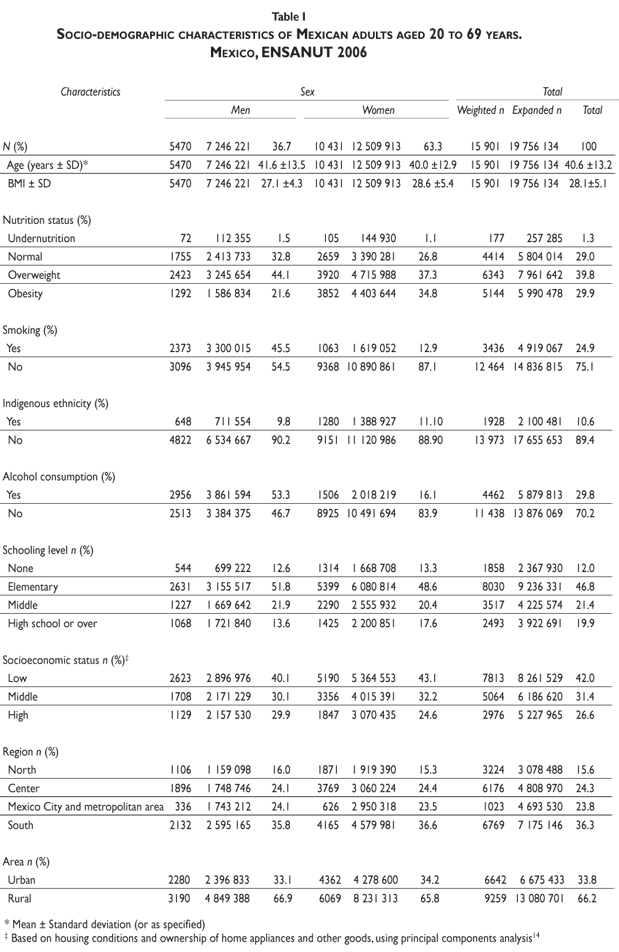
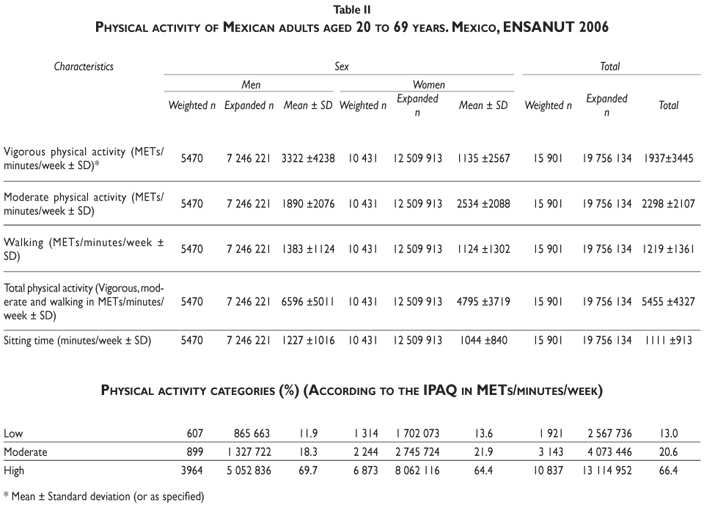
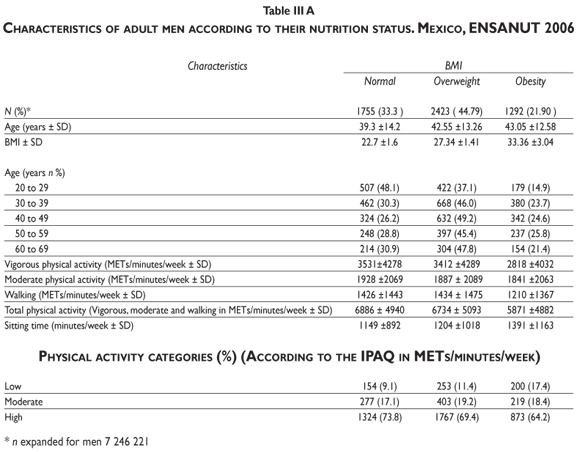
<body><![CDATA[<p><font size="2" face="Verdana"> In addition, a logistic regression model    was fitted to the data to test the possibility of being overweight or obese    based on physical activity categories (low, moderate, or high, in accordance    with the IPAQ), controlling for confounding variables. A significance level    of 0.05 was considered as statistically significant for all the analysis.</font></p>     <p>&nbsp;</p>     <p><font size="3" face="Verdana"><b>Results</b></font></p>     <p><font size="2" face="Verdana">Information    on physical activity was collected from 20360 Mexican men and women. Out of    those, 1390 adults were excluded as they did not answer all the questions related    to physical activity or gave implausible information. Another 3069 adults were    also excluded whose BMI data were incomplete, and older adults over 69 years    old were not considered because the IPAQ questionnaire used was only validated    for individuals aged 15 to 69 years.</font></p>     <p><font size="2" face="Verdana"> Thus, the final sample included 15901 adults,    which represented 19756134 Mexican adults using the expansion factor for this    survey. <a href="/img/revistas/spm/v51s4/a17tab01.gif">Table I</a> presents descriptive information for the sample. Most individuals    were women (63.3%) with a mean age of 39.9&plusmn;12.9 years. Men represented 36.7%    of the sample, with a mean age of 41.6&plusmn;13.5 years. The majority of individuals,    both men and women, were more than 30 years old (76.2% and 74.8%, respectively).    BMI mean was 27.1&plusmn; 4.3 in men and 28.6&plusmn;5.4 in women. A total of 65.7% of men    and 72.1% of women were overweight or obese. With respect to schooling, 12.0%    of the subjects had no formal education, 46.8% completed primary school, 21.4%    middle school, and 19.9% high school or higher. In addition, 10.6% spoke an    indigenous language, 25.0% of adults smoked, and 29.8% consumed alcohol at the    time of the survey, although most consumption of tobacco and alcohol was reported    in men (45.5% and 53.3%, respectively) compared with women (13.0% and 16.1%,    respectively). Most adults were of low socioeconomic status (42.0%), and lived    in rural areas (66.2%).</font></p>     <p><font size="2" face="Verdana"> <a href="/img/revistas/spm/v51s4/a17tab02.gif">Table II</a> presents descriptive information    for physical activity. Mean METs/minutes/week for vigorous physical activity    was greater in men than in women (3322 &plusmn; 4238 and 1135 &plusmn; 2567, respectively)    but it was not so for moderate physical activity (means 1890 &plusmn; 2076 and 2534    &plusmn; 2088, respectively). Mean METs/minutes/week for walking was 1219 &plusmn; 1361 for    both sexes, and for sitting time, it was 1111 &plusmn; 913. Most adults (66.4%) were    in the high physical activity practice category, 20.6% were in the moderate    category and 13.0% in the low category. </font></p>     <p><font size="2" face="Verdana"> According to data on men's nutrition status,    the greatest proportion of overweight/obesity was found in those aged 40 to    49 years (73.8%). Men with obesity had less METs/minutes/week physical activity    (vigorous, moderate, and walking) and remained sitting for a longer time compared    with men with adequate BMI. Most men in the low physical activity category were    overweight or obese, compared with men with adequate BMI (17.4% and 9.1%, respectively).    As for the high physical activity category, the greatest proportion corresponded    to men with adequate BMI compared with overweight or obese men (73.7% and 64.2%,    respectively) (<a href="#tab03a">Table III A</a>).</font></p>     <p><a name="tab03a"></a></p>     <p>&nbsp;</p>     <p align="center"><img src="/img/revistas/spm/v51s4/a17tab3a.gif"></p>     ]]></body>
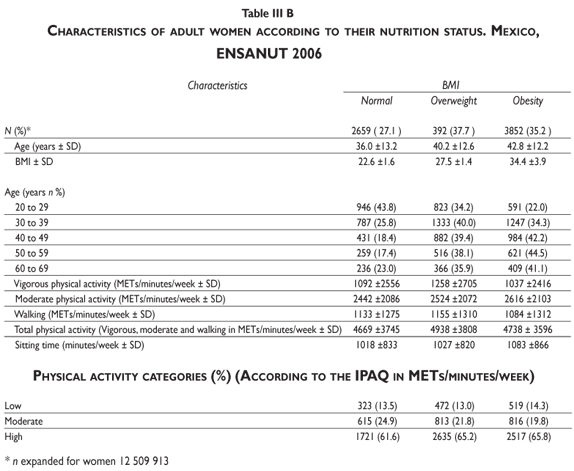
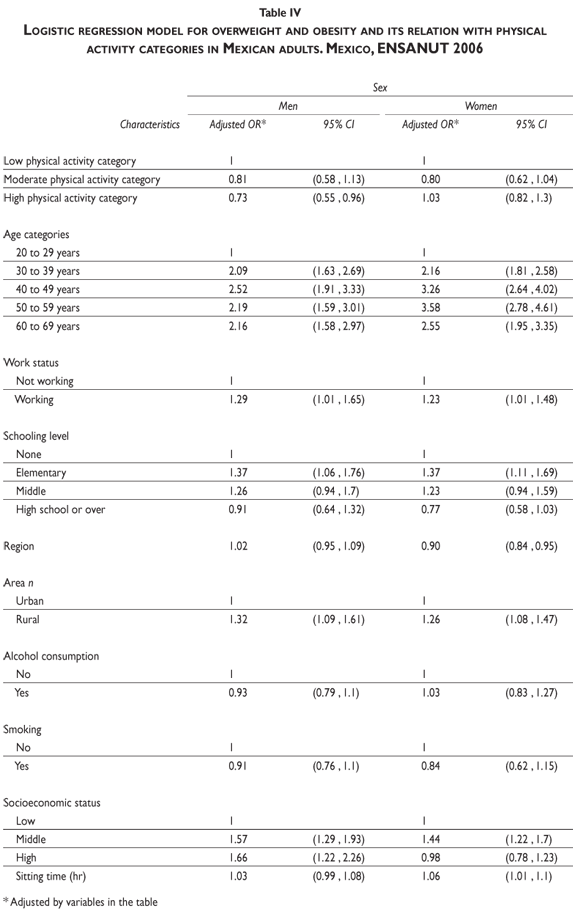
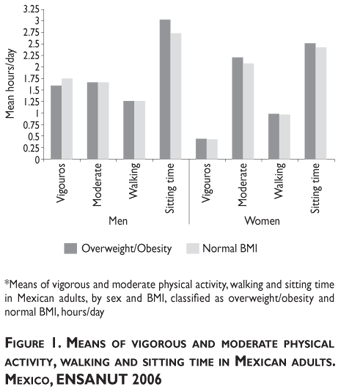
<body><![CDATA[<p>&nbsp;</p>     <p><font size="2" face="Verdana"> Concerning women, the greatest proportion    of overweight/obesity was found in those aged 50 to 59 years (82.6%). Overweight    women had more METs/minutes/week of vigorous physical activity and of walking    compared with women whose BMI was adequate, and with those with obesity. Likewise,    women with obesity had a greater METs/minutes/week of moderate physical activity    and reported more sitting time, compared with women whose BMI was adequate,    and with those with overweight. The majority of women in the low and high physical    activity categories were those with obesity (14.3% and 65.8%, respectively),    compared with women whose BMI was adequate and with those with overweight (<a href="#tab03b">Table   III B</a>). On the other hand, according to the IPAQ significant associations between    overweight/obesity and the physical activity practice categories were found    only in adult men, adjusting for confounding variables (age, residence area,    region of the country, socioeconomic status, indigenous ethnicity, smoking,    schooling, work activity, alcohol consumption, and sitting time) (See <a href="#tab04">table   IV</a>). Adult men in the high physical activity category were 27% less likely to    be overweight or obese compared with men in the low category (OR 0.73, 95% CI;    0.55, 0.96). Adult men of middle and high socioeconomic status were 57% more    likely to be overweight or obese (OR 1.57, 95% CI; 1.28, 1.92, and OR 1.66,    95% CI; 1.22, 2.25, respectively) compared with adult men of low socioeconomic    status. With regard to place of residence, adult men living in urban areas were    32% more likely to be overweight or obese compared with those living in rural    areas (OR 1.32, 95% CI; 1.08, 1.60). Adult men with primary schooling were 36%    more likely to be overweight or obese compared with those without formal education    (OR 1.36, 95% CI; 1.06, 1.76). Also, linear tendency was observed for a decreasing    probability of being overweight or obese from 50 years of age onward in this    population. The remaining socio&#45;demographic variables studied did not show any    significant association with the prevalence of obesity or overweight. Men with    adequate BMI spent more time doing vigorous physical activity than men who were    overweight/obese; conversely, women with overweight/obesity reported more time doing    moderate physical activity than women whose BMI was adequate (<a href="#fig">Figure   1</a>).</font></p>     <p><a name="tab03b"></a></p>     <p>&nbsp;</p>     <p align="center"><img src="/img/revistas/spm/v51s4/a17tab3b.gif"></p>     <p>&nbsp;</p>     <p><a name="tab04"></a></p>     <p>&nbsp;</p>     <p align="center"><img src="/img/revistas/spm/v51s4/a17tab04.gif"></p>     <p>&nbsp;</p>     ]]></body>
<body><![CDATA[<p><a name="fig"></a></p>     <p>&nbsp;</p>     <p align="center"><img src="/img/revistas/spm/v51s4/a17fig01.gif"></p>     <p>&nbsp;</p>     <p><font size="3" face="Verdana"><b>Discussion</b></font></p>     <p><font size="2" face="Verdana">The results    of this study show that physical activity was inversely associated with the    prevalence of overweight/obesity in a representative sample of Mexican adults.    Such association was observed only among adult men, but not among women. This    is the first study, to our knowledge, documenting this finding in a nationwide    probabilistic sample of Mexican adults of both sexes.</font></p>     <p><font size="2" face="Verdana"> We also show that men but not women in high    and middle socioeconomic status are more likely to be overweight or obese. Little    physical activity in women, particularly vigorous and moderate, may account    for that effect on the association. There also exists the possibility of overestimation    of physical activity in women with overweight/obesity, as has been documented    in other studies.<SUP>15&#45;19</sup></font></p>     <p><font size="2" face="Verdana"> The results are plausible given the observed    trend towards decrease in physical activity owing to the sedentary nature of    many work activities, the changes in transportation methods and sprawling urbanization.    In addition, the increase of energy&#45;dense foods, rich in fat and sugar, has    brought about an imbalance between intake and energy expenditure. The strength    of this study stems from being a probabilistic, nationwide survey. Also, physical    activity was measured through the IPAQ questionnaire, an internationally validated    instrument for measuring physical activity in individuals 15 to 69 years old,    which can be used in prevalence studies based on national populations. As a    standard indicator, the IPAQ questionnaire is recommended for making comparisons    within a country, between countries, and worldwide.</font></p>     <p><font size="2" face="Verdana"> This study has some limitations that should    be considered for the interpretation of results. Because of its cross&#45;sectional    design, causal inferences are difficult to make, so it is possible to identify    only some associations between socio&#45;demographic characteristics, physical activity    of adults, and overweight/obesity. However, this information is valuable as    it documents the association between physical activity and overweight/obesity    and helps to identify groups that perform less physical activity (particularly    intense physical activity in women, as has been documented in other studies);<SUP>4</SUP>    this underscores the necessity of focusing interventions on that population    group to promote physical activity. In conclusion, physical activity was inversely    associated with overweight/obesity in a representative sample of Mexican adult    men. Therefore, encouraging vigorous or moderate physical activity and reducing    sedentary activities, along with the promotion of a healthy diet, are necessary    steps aimed at preventing and controlling overweight/obesity in both adolescents    and adults, thus decreasing the risk of chronic diseases in those population    groups.</font></p>     <p>&nbsp;</p>     ]]></body>
<body><![CDATA[<p><font size="3" face="Verdana"><b>References</b></font></p>     <!-- ref --><p><font size="2" face="Verdana">1. Organizaci&oacute;n Mundial de la Salud. Obesidad    y sobrepeso. Nota descriptiva Nº 311. Septiembre de 2006. &#91;Consulted 2009 April    6&#93;. Available at: <a href="http://www.who.int/mediacentre/factsheets/fs311/es/index.html" target="_blank">http://www.who.int/mediacentre/factsheets/fs311/es/index.html</a>).    &nbsp;&nbsp;&nbsp;&nbsp;&nbsp;&nbsp;&nbsp;&nbsp;[&#160;<a href="javascript:void(0);" onclick="javascript: window.open('/scielo.php?script=sci_nlinks&ref=9295306&pid=S0036-3634200900100001700001&lng=','','width=640,height=500,resizable=yes,scrollbars=1,menubar=yes,');">Links</a>&#160;]<!-- end-ref --></font></p>     <!-- ref --><p><font size="2" face="Verdana">2. Organizaci&oacute;n Panamericana de la Salud.    Estrategia Mundial sobre Alimentaci&oacute;n Saludable, Actividad F&iacute;sica    y Salud (DPAS). Plan de Implementaci&oacute;n en Am&eacute;rica Latina y el    Caribe. 2006&#45;2007. Washington, DC: WHO, 2006.    &nbsp;&nbsp;&nbsp;&nbsp;&nbsp;&nbsp;&nbsp;&nbsp;[&#160;<a href="javascript:void(0);" onclick="javascript: window.open('/scielo.php?script=sci_nlinks&ref=9295308&pid=S0036-3634200900100001700002&lng=','','width=640,height=500,resizable=yes,scrollbars=1,menubar=yes,');">Links</a>&#160;]<!-- end-ref --></font></p>     <!-- ref --><p><FONT size="2" face="Verdana">3. Olaiz&#45;Fern&aacute;ndez G, Rivera&#45;Dommarco    J, Shamah&#45;Levy T, Rojas R, Villalpando&#45;Hern&aacute;ndez S, Hern&aacute;ndez&#45;&Aacute;vila    M, <I>et al</I>. Encuesta Nacional de Salud y Nutrici&oacute;n 2006. Cuernavaca,    M&eacute;xico: Instituto Nacional de Salud P&uacute;blica, 2006.    &nbsp;&nbsp;&nbsp;&nbsp;&nbsp;&nbsp;&nbsp;&nbsp;[&#160;<a href="javascript:void(0);" onclick="javascript: window.open('/scielo.php?script=sci_nlinks&ref=9295310&pid=S0036-3634200900100001700003&lng=','','width=640,height=500,resizable=yes,scrollbars=1,menubar=yes,');">Links</a>&#160;]<!-- end-ref --></font></p>     <!-- ref --><p><FONT size="2" face="Verdana"> 4. Hern&aacute;ndez B, de Haene J, Barquera    S, Monterrubio E, Rivera J, Shamah T, <I>et al</I>. Factors associated with    physical activity among Mexican women of childbearing age. Rev Panam Salud Publica    2003;14(4):235&#45;245.    &nbsp;&nbsp;&nbsp;&nbsp;&nbsp;&nbsp;&nbsp;&nbsp;[&#160;<a href="javascript:void(0);" onclick="javascript: window.open('/scielo.php?script=sci_nlinks&ref=9295312&pid=S0036-3634200900100001700004&lng=','','width=640,height=500,resizable=yes,scrollbars=1,menubar=yes,');">Links</a>&#160;]<!-- end-ref --></font></p>     <!-- ref --><p><font size="2" face="Verdana">5. U.S.Department of Health and Human Services.    Physical activity and health: a report of the surgeon general. Atlanta: U.S.    Department of Health and Human Services, Centers for Disease Control and Prevention,    National Center for Chronic Disease Prevention and Health Promotion, 1996.    &nbsp;&nbsp;&nbsp;&nbsp;&nbsp;&nbsp;&nbsp;&nbsp;[&#160;<a href="javascript:void(0);" onclick="javascript: window.open('/scielo.php?script=sci_nlinks&ref=9295314&pid=S0036-3634200900100001700005&lng=','','width=640,height=500,resizable=yes,scrollbars=1,menubar=yes,');">Links</a>&#160;]<!-- end-ref --></font></p>     <!-- ref --><p><font size="2" face="Verdana">6. Hern&aacute;ndez B, Gortmaker SL, Golditz    GA, Peterson KE, Laird NM, Parra&#45;Cabrera S. Association of obesity with physical    activity, television programs and other forms of video viewing among children    in M&eacute;xico City. Int J Obes 1999;23:845&#45;854.    &nbsp;&nbsp;&nbsp;&nbsp;&nbsp;&nbsp;&nbsp;&nbsp;[&#160;<a href="javascript:void(0);" onclick="javascript: window.open('/scielo.php?script=sci_nlinks&ref=9295316&pid=S0036-3634200900100001700006&lng=','','width=640,height=500,resizable=yes,scrollbars=1,menubar=yes,');">Links</a>&#160;]<!-- end-ref --></font></p>     <!-- ref --><p><font size="2" face="Verdana">7. Manson J, Skerrett P, Greeland P, Vanlallie    T. The escalating pandemics of obesity and sedentary lifestyle. Arch Intern    Med 2004;164:249&#45;258.    &nbsp;&nbsp;&nbsp;&nbsp;&nbsp;&nbsp;&nbsp;&nbsp;[&#160;<a href="javascript:void(0);" onclick="javascript: window.open('/scielo.php?script=sci_nlinks&ref=9295318&pid=S0036-3634200900100001700007&lng=','','width=640,height=500,resizable=yes,scrollbars=1,menubar=yes,');">Links</a>&#160;]<!-- end-ref --></font></p>     <!-- ref --><p><font size="2" face="Verdana">8. World Health Organization. Report of a Joint    WHO/FAO Expert Consultation. Diet Nutrition and the Prevention of Chronic Diseases.    WHO Technical Report Series 916. Geneva: WHO, 2003.    &nbsp;&nbsp;&nbsp;&nbsp;&nbsp;&nbsp;&nbsp;&nbsp;[&#160;<a href="javascript:void(0);" onclick="javascript: window.open('/scielo.php?script=sci_nlinks&ref=9295320&pid=S0036-3634200900100001700008&lng=','','width=640,height=500,resizable=yes,scrollbars=1,menubar=yes,');">Links</a>&#160;]<!-- end-ref --> </font></p>     <!-- ref --><p><font size="2" face="Verdana">9. Toussaint G. Patrones de dieta y actividad    f&iacute;sica en la patog&eacute;nesis de la obesidad en el escolar urbano.    Bol Med Hosp Infant Mex 2000;57(11):650&#45;661.    &nbsp;&nbsp;&nbsp;&nbsp;&nbsp;&nbsp;&nbsp;&nbsp;[&#160;<a href="javascript:void(0);" onclick="javascript: window.open('/scielo.php?script=sci_nlinks&ref=9295322&pid=S0036-3634200900100001700009&lng=','','width=640,height=500,resizable=yes,scrollbars=1,menubar=yes,');">Links</a>&#160;]<!-- end-ref --></font></p>     <!-- ref --><p><FONT size="2" face="Verdana">10. Palma O y col. Metodolog&iacute;a. En: Olaiz&#45;Fern&aacute;ndez    G, Rivera&#45;Dommarco J, Shamah&#45;Levy T, Rojas R, Villalpando&#45;Hern&aacute;ndez S,    Hern&aacute;ndez&#45;Avila M, <I>et al</I>. Encuesta Nacional de Salud y Nutrici&oacute;n    2006. Cuernavaca, M&eacute;xico: Instituto Nacional de Salud P&uacute;blica,    2006:19&#45;33.    &nbsp;&nbsp;&nbsp;&nbsp;&nbsp;&nbsp;&nbsp;&nbsp;[&#160;<a href="javascript:void(0);" onclick="javascript: window.open('/scielo.php?script=sci_nlinks&ref=9295324&pid=S0036-3634200900100001700010&lng=','','width=640,height=500,resizable=yes,scrollbars=1,menubar=yes,');">Links</a>&#160;]<!-- end-ref --></font></p>     <!-- ref --><p><font size="2" face="Verdana">11. Habicht JP. Estandarizaci&oacute;n de m&eacute;todos    epidemiol&oacute;gicos cuantitativos sobre el terreno. (Standardization of anthropometric    methods in the field). PAHO Bull 1974; 76:375&#45;384.    &nbsp;&nbsp;&nbsp;&nbsp;&nbsp;&nbsp;&nbsp;&nbsp;[&#160;<a href="javascript:void(0);" onclick="javascript: window.open('/scielo.php?script=sci_nlinks&ref=9295326&pid=S0036-3634200900100001700011&lng=','','width=640,height=500,resizable=yes,scrollbars=1,menubar=yes,');">Links</a>&#160;]<!-- end-ref --></font></p>     <!-- ref --><p><font size="2" face="Verdana">12. Cole T, Bellizi M. Establishing a standard    definition for child overweight and obesity worldwide: international survey.    BMJ 2000;320:1&#45;6.    &nbsp;&nbsp;&nbsp;&nbsp;&nbsp;&nbsp;&nbsp;&nbsp;[&#160;<a href="javascript:void(0);" onclick="javascript: window.open('/scielo.php?script=sci_nlinks&ref=9295328&pid=S0036-3634200900100001700012&lng=','','width=640,height=500,resizable=yes,scrollbars=1,menubar=yes,');">Links</a>&#160;]<!-- end-ref --></font></p>     <!-- ref --><p><font size="2" face="Verdana">13. Booth ML. Assessment of physical activity:    An international perspective. Res Q Exerc Sport 2000;71(2):S114&#45;S120.    &nbsp;&nbsp;&nbsp;&nbsp;&nbsp;&nbsp;&nbsp;&nbsp;[&#160;<a href="javascript:void(0);" onclick="javascript: window.open('/scielo.php?script=sci_nlinks&ref=9295330&pid=S0036-3634200900100001700013&lng=','','width=640,height=500,resizable=yes,scrollbars=1,menubar=yes,');">Links</a>&#160;]<!-- end-ref --></font></p>     <!-- ref --><p><font size="2" face="Verdana">14. Resano E, M&eacute;ndez I, Shamah T, Rivera    J, Sep&uacute;lveda J. Methods of the National Nutrition Survey 1999. Salud    Publica Mex 2003:45 suppl 4: S558&#45;S564.    &nbsp;&nbsp;&nbsp;&nbsp;&nbsp;&nbsp;&nbsp;&nbsp;[&#160;<a href="javascript:void(0);" onclick="javascript: window.open('/scielo.php?script=sci_nlinks&ref=9295332&pid=S0036-3634200900100001700014&lng=','','width=640,height=500,resizable=yes,scrollbars=1,menubar=yes,');">Links</a>&#160;]<!-- end-ref --></font></p>     <!-- ref --><p><font size="2" face="Verdana">15. Jackicic J, Polley B, Wing R. Accuracy of    self&#45;reported exercise and the relationship with weight loss in overweight women.    Med Sci Sports Exerc 1998;30:634&#45;638.    &nbsp;&nbsp;&nbsp;&nbsp;&nbsp;&nbsp;&nbsp;&nbsp;[&#160;<a href="javascript:void(0);" onclick="javascript: window.open('/scielo.php?script=sci_nlinks&ref=9295334&pid=S0036-3634200900100001700015&lng=','','width=640,height=500,resizable=yes,scrollbars=1,menubar=yes,');">Links</a>&#160;]<!-- end-ref --></font></p>     <!-- ref --><p><font size="2" face="Verdana">16. Irwin M, Ainsworth B, Conway J. Estimation    of energy expenditure from physical activity measures: determinants of accuracy.    Obes Res 2001;9:517&#45;525.    &nbsp;&nbsp;&nbsp;&nbsp;&nbsp;&nbsp;&nbsp;&nbsp;[&#160;<a href="javascript:void(0);" onclick="javascript: window.open('/scielo.php?script=sci_nlinks&ref=9295336&pid=S0036-3634200900100001700016&lng=','','width=640,height=500,resizable=yes,scrollbars=1,menubar=yes,');">Links</a>&#160;]<!-- end-ref --></font></p>     <!-- ref --><p><font size="2" face="Verdana">17. Buchowski M, Townsend K, Chen K, Acra S,    Sun M. Energy expenditure determined by self&#45;reported physical activity is related    to body fatness. Obes Res 1999;7:23&#45;33.    &nbsp;&nbsp;&nbsp;&nbsp;&nbsp;&nbsp;&nbsp;&nbsp;[&#160;<a href="javascript:void(0);" onclick="javascript: window.open('/scielo.php?script=sci_nlinks&ref=9295338&pid=S0036-3634200900100001700017&lng=','','width=640,height=500,resizable=yes,scrollbars=1,menubar=yes,');">Links</a>&#160;]<!-- end-ref --></font></p>     <!-- ref --><p><FONT size="2" face="Verdana">18. Lichtman S, Pisarska K, Berman E, Pestone    M, Dowling H, Offenbacher E, <I>et al</I>. Discrepancy between self&#45;reported    and actual caloric intake and exercise in obese subjects. N Engl J Med 1992;327:1893&#45;1898.    &nbsp;&nbsp;&nbsp;&nbsp;&nbsp;&nbsp;&nbsp;&nbsp;[&#160;<a href="javascript:void(0);" onclick="javascript: window.open('/scielo.php?script=sci_nlinks&ref=9295340&pid=S0036-3634200900100001700018&lng=','','width=640,height=500,resizable=yes,scrollbars=1,menubar=yes,');">Links</a>&#160;]<!-- end-ref --></font></p>     <!-- ref --><p><FONT size="2" face="Verdana"> 19. Mahabir S, Baer DJ, Giffen C, Clevidence    BA, Campbell WS, Taylor PR, <I>et al</I>. Comparison of energy expenditure estimates    from 4 physical activity questionnaires with doubly labeled water estimates    in postmenopausal women. Am J Clin Nutr 2006;84: 230&#45;236.    &nbsp;&nbsp;&nbsp;&nbsp;&nbsp;&nbsp;&nbsp;&nbsp;[&#160;<a href="javascript:void(0);" onclick="javascript: window.open('/scielo.php?script=sci_nlinks&ref=9295342&pid=S0036-3634200900100001700019&lng=','','width=640,height=500,resizable=yes,scrollbars=1,menubar=yes,');">Links</a>&#160;]<!-- end-ref --> </font></p>     <p>&nbsp;</p>     ]]></body>
<body><![CDATA[<p>&nbsp;</p>     <p><FONT size="2" FACE="Verdana">Received on: April 11, 2008    <br>   Accepted on: November 19, 2008</font></p>     <p>&nbsp;</p>     <p>&nbsp;</p>     <p><font size="2" face="Verdana">Addres     reprint requests to: M. en C. Luz Mar&iacute;a G&oacute;mez Acosta. Centro     de Investigaci&oacute;n en Nutrici&oacute;n y Salud. Instituto Nacional de     Salud P&uacute;blica. Av. Universidad 655, col. Santa Mar&iacute;a Ahuacatitl&aacute;n. 62100 Cuernavaca, Morelos, M&eacute;xico. E&#45;mail: <a href="mailto:lmgomez@insp.mx">lmgomez@insp.mx</a>    <br> <a name="nt01"></a><a href="#tx01">*</a> A unit of metabolic equivalent (MET) represents a multiple of the oxygen consumption at rest, which in turn correspond to 3.5 mL O2/kg min&#45;1. For example if one person doing exercise show an expenditure of 10 MET, this means that hew has consumed 10 times the oxygen amount which normally would consume being at rest.    <br> <a name="nt02"></a><a href="#tx02">**</a> North region included the states of Baja California, South Baja California,    <br> Coahuila, Chihuahua, Durango, Nuevo Le&oacute;n, Sonora and Tamaulipas; Center region: Aguascalientes, Colima, Guanajuato, Jalisco, Estado de Mexico (excluding Mexico City's metropolitan area) Michoacan, Morelos, Nayarit, Queretaro, San Luis Potosi, Sinaloa, and Zacatecas; Mexico City and its metropolitan area; and South region: Campeche, Chiapas, Guerrero, Hidalgo, Oaxaca, Puebla, Quintana Roo, Tabasco, Tlaxcala, Veracruz, and Yucatan.    <br> <a name="nt03"></a><a href="#tx03">&#135;</a>  Stata Corp. Intercooled Stata 9.2 College Station Texas, USA, 2006.</font></p>     ]]></body>
<body><![CDATA[ ]]></body><back>
<ref-list>
<ref id="B1">
<label>1</label><nlm-citation citation-type="">
<collab>Organización Mundial de la Salud</collab>
<source><![CDATA[Obesidad y sobrepeso: Nota descriptiva Nº 311]]></source>
<year>Sept</year>
<month>ie</month>
<day>mb</day>
</nlm-citation>
</ref>
<ref id="B2">
<label>2</label><nlm-citation citation-type="book">
<collab>Organización Panamericana de la Salud</collab>
<source><![CDATA[Estrategia Mundial sobre Alimentación Saludable, Actividad Física y Salud (DPAS): Plan de Implementación en América Latina y el Caribe. 2006-2007]]></source>
<year>2006</year>
<publisher-loc><![CDATA[Washington^eDC DC]]></publisher-loc>
<publisher-name><![CDATA[WHO]]></publisher-name>
</nlm-citation>
</ref>
<ref id="B3">
<label>3</label><nlm-citation citation-type="book">
<person-group person-group-type="author">
<name>
<surname><![CDATA[Olaiz-Fernández]]></surname>
<given-names><![CDATA[G]]></given-names>
</name>
<name>
<surname><![CDATA[Rivera-Dommarco]]></surname>
<given-names><![CDATA[J]]></given-names>
</name>
<name>
<surname><![CDATA[Shamah-Levy]]></surname>
<given-names><![CDATA[T]]></given-names>
</name>
<name>
<surname><![CDATA[Rojas]]></surname>
<given-names><![CDATA[R]]></given-names>
</name>
<name>
<surname><![CDATA[Villalpando-Hernández]]></surname>
<given-names><![CDATA[S]]></given-names>
</name>
<name>
<surname><![CDATA[Hernández-Ávila]]></surname>
<given-names><![CDATA[M]]></given-names>
</name>
</person-group>
<source><![CDATA[Encuesta Nacional de Salud y Nutrición 2006]]></source>
<year>2006</year>
<publisher-loc><![CDATA[Cuernavaca ]]></publisher-loc>
<publisher-name><![CDATA[Instituto Nacional de Salud Pública]]></publisher-name>
</nlm-citation>
</ref>
<ref id="B4">
<label>4</label><nlm-citation citation-type="journal">
<person-group person-group-type="author">
<name>
<surname><![CDATA[Hernández]]></surname>
<given-names><![CDATA[B]]></given-names>
</name>
<name>
<surname><![CDATA[de Haene]]></surname>
<given-names><![CDATA[J]]></given-names>
</name>
<name>
<surname><![CDATA[Barquera]]></surname>
<given-names><![CDATA[S]]></given-names>
</name>
<name>
<surname><![CDATA[Monterrubio]]></surname>
<given-names><![CDATA[E]]></given-names>
</name>
<name>
<surname><![CDATA[Rivera]]></surname>
<given-names><![CDATA[J]]></given-names>
</name>
<name>
<surname><![CDATA[Shamah]]></surname>
<given-names><![CDATA[T]]></given-names>
</name>
</person-group>
<article-title xml:lang="en"><![CDATA[Factors associated with physical activity among Mexican women of childbearing age]]></article-title>
<source><![CDATA[Rev Panam Salud Publica]]></source>
<year>2003</year>
<volume>14</volume>
<numero>4</numero>
<issue>4</issue>
<page-range>235-245</page-range></nlm-citation>
</ref>
<ref id="B5">
<label>5</label><nlm-citation citation-type="book">
<collab>U.S.Department of Health and Human Services</collab>
<source><![CDATA[Physical activity and health: a report of the surgeon general]]></source>
<year>1996</year>
<publisher-loc><![CDATA[Atlanta ]]></publisher-loc>
<publisher-name><![CDATA[U.S. Department of Health and Human Services, Centers for Disease Control and Prevention, National Center for Chronic Disease Prevention and Health Promotion]]></publisher-name>
</nlm-citation>
</ref>
<ref id="B6">
<label>6</label><nlm-citation citation-type="journal">
<person-group person-group-type="author">
<name>
<surname><![CDATA[Hernández]]></surname>
<given-names><![CDATA[B]]></given-names>
</name>
<name>
<surname><![CDATA[Gortmaker]]></surname>
<given-names><![CDATA[SL]]></given-names>
</name>
<name>
<surname><![CDATA[Golditz]]></surname>
<given-names><![CDATA[GA]]></given-names>
</name>
<name>
<surname><![CDATA[Peterson]]></surname>
<given-names><![CDATA[KE]]></given-names>
</name>
<name>
<surname><![CDATA[Laird]]></surname>
<given-names><![CDATA[NM]]></given-names>
</name>
<name>
<surname><![CDATA[Parra-Cabrera]]></surname>
<given-names><![CDATA[S]]></given-names>
</name>
</person-group>
<article-title xml:lang="en"><![CDATA[Association of obesity with physical activity, television programs and other forms of video viewing among children in México City]]></article-title>
<source><![CDATA[Int J Obes]]></source>
<year>1999</year>
<volume>23</volume>
<page-range>845-854</page-range></nlm-citation>
</ref>
<ref id="B7">
<label>7</label><nlm-citation citation-type="journal">
<person-group person-group-type="author">
<name>
<surname><![CDATA[Manson]]></surname>
<given-names><![CDATA[J]]></given-names>
</name>
<name>
<surname><![CDATA[Skerrett]]></surname>
<given-names><![CDATA[P]]></given-names>
</name>
<name>
<surname><![CDATA[Greeland]]></surname>
<given-names><![CDATA[P]]></given-names>
</name>
<name>
<surname><![CDATA[Vanlallie]]></surname>
<given-names><![CDATA[T]]></given-names>
</name>
</person-group>
<article-title xml:lang="en"><![CDATA[The escalating pandemics of obesity and sedentary lifestyle]]></article-title>
<source><![CDATA[Arch Intern Med]]></source>
<year>2004</year>
<volume>164</volume>
<page-range>249-258</page-range></nlm-citation>
</ref>
<ref id="B8">
<label>8</label><nlm-citation citation-type="book">
<collab>World Health Organization</collab>
<source><![CDATA[Report of a Joint WHO/FAO Expert Consultation: Diet Nutrition and the Prevention of Chronic Diseases. WHO Technical Report Series 916]]></source>
<year>2003</year>
<publisher-loc><![CDATA[Geneva ]]></publisher-loc>
<publisher-name><![CDATA[WHO]]></publisher-name>
</nlm-citation>
</ref>
<ref id="B9">
<label>9</label><nlm-citation citation-type="journal">
<person-group person-group-type="author">
<name>
<surname><![CDATA[Toussaint]]></surname>
<given-names><![CDATA[G]]></given-names>
</name>
</person-group>
<article-title xml:lang="es"><![CDATA[Patrones de dieta y actividad física en la patogénesis de la obesidad en el escolar urbano]]></article-title>
<source><![CDATA[Bol Med Hosp Infant Mex]]></source>
<year>2000</year>
<volume>57</volume>
<numero>11</numero>
<issue>11</issue>
<page-range>650-661</page-range></nlm-citation>
</ref>
<ref id="B10">
<label>10</label><nlm-citation citation-type="book">
<person-group person-group-type="author">
<name>
<surname><![CDATA[Palma]]></surname>
<given-names><![CDATA[O]]></given-names>
</name>
</person-group>
<article-title xml:lang="es"><![CDATA[Metodología]]></article-title>
<person-group person-group-type="editor">
<name>
<surname><![CDATA[Olaiz-Fernández]]></surname>
<given-names><![CDATA[G]]></given-names>
</name>
<name>
<surname><![CDATA[Rivera-Dommarco]]></surname>
<given-names><![CDATA[J]]></given-names>
</name>
<name>
<surname><![CDATA[Shamah-Levy]]></surname>
<given-names><![CDATA[T]]></given-names>
</name>
<name>
<surname><![CDATA[Rojas]]></surname>
<given-names><![CDATA[R]]></given-names>
</name>
<name>
<surname><![CDATA[Villalpando-Hernández]]></surname>
<given-names><![CDATA[S]]></given-names>
</name>
<name>
<surname><![CDATA[Hernández-Avila]]></surname>
<given-names><![CDATA[M]]></given-names>
</name>
</person-group>
<source><![CDATA[Encuesta Nacional de Salud y Nutrición 2006]]></source>
<year>2006</year>
<page-range>19-33</page-range><publisher-loc><![CDATA[Cuernavaca ]]></publisher-loc>
<publisher-name><![CDATA[Instituto Nacional de Salud Pública]]></publisher-name>
</nlm-citation>
</ref>
<ref id="B11">
<label>11</label><nlm-citation citation-type="journal">
<person-group person-group-type="author">
<name>
<surname><![CDATA[Habicht]]></surname>
<given-names><![CDATA[JP]]></given-names>
</name>
</person-group>
<article-title xml:lang="es"><![CDATA[Estandarización de métodos epidemiológicos cuantitativos sobre el terreno]]></article-title>
<source><![CDATA[PAHO Bull]]></source>
<year>1974</year>
<volume>76</volume>
<page-range>375-384</page-range></nlm-citation>
</ref>
<ref id="B12">
<label>12</label><nlm-citation citation-type="journal">
<person-group person-group-type="author">
<name>
<surname><![CDATA[Cole]]></surname>
<given-names><![CDATA[T]]></given-names>
</name>
<name>
<surname><![CDATA[Bellizi]]></surname>
<given-names><![CDATA[M]]></given-names>
</name>
</person-group>
<article-title xml:lang="en"><![CDATA[Establishing a standard definition for child overweight and obesity worldwide: international survey]]></article-title>
<source><![CDATA[BMJ]]></source>
<year>2000</year>
<volume>320</volume>
<page-range>1-6</page-range></nlm-citation>
</ref>
<ref id="B13">
<label>13</label><nlm-citation citation-type="journal">
<person-group person-group-type="author">
<name>
<surname><![CDATA[Booth]]></surname>
<given-names><![CDATA[ML]]></given-names>
</name>
</person-group>
<article-title xml:lang="en"><![CDATA[Assessment of physical activity: An international perspective]]></article-title>
<source><![CDATA[Res Q Exerc Sport]]></source>
<year>2000</year>
<volume>71</volume>
<numero>2</numero>
<issue>2</issue>
<page-range>S114-S120</page-range></nlm-citation>
</ref>
<ref id="B14">
<label>14</label><nlm-citation citation-type="journal">
<person-group person-group-type="author">
<name>
<surname><![CDATA[Resano]]></surname>
<given-names><![CDATA[E]]></given-names>
</name>
<name>
<surname><![CDATA[Méndez]]></surname>
<given-names><![CDATA[I]]></given-names>
</name>
<name>
<surname><![CDATA[Shamah]]></surname>
<given-names><![CDATA[T]]></given-names>
</name>
<name>
<surname><![CDATA[Rivera]]></surname>
<given-names><![CDATA[J]]></given-names>
</name>
<name>
<surname><![CDATA[Sepúlveda]]></surname>
<given-names><![CDATA[J]]></given-names>
</name>
</person-group>
<article-title xml:lang="en"><![CDATA[Methods of the National Nutrition Survey 1999]]></article-title>
<source><![CDATA[Salud Publica Mex]]></source>
<year>2003</year>
<volume>45</volume>
<numero>^s4</numero>
<issue>^s4</issue>
<supplement>4</supplement>
<page-range>S558-S564</page-range></nlm-citation>
</ref>
<ref id="B15">
<label>15</label><nlm-citation citation-type="journal">
<person-group person-group-type="author">
<name>
<surname><![CDATA[Jackicic]]></surname>
<given-names><![CDATA[J]]></given-names>
</name>
<name>
<surname><![CDATA[Polley]]></surname>
<given-names><![CDATA[B]]></given-names>
</name>
<name>
<surname><![CDATA[Wing]]></surname>
<given-names><![CDATA[R]]></given-names>
</name>
</person-group>
<article-title xml:lang="en"><![CDATA[Accuracy of self-reported exercise and the relationship with weight loss in overweight women]]></article-title>
<source><![CDATA[Med Sci Sports Exerc]]></source>
<year>1998</year>
<volume>30</volume>
<page-range>634-638</page-range></nlm-citation>
</ref>
<ref id="B16">
<label>16</label><nlm-citation citation-type="journal">
<person-group person-group-type="author">
<name>
<surname><![CDATA[Irwin]]></surname>
<given-names><![CDATA[M]]></given-names>
</name>
<name>
<surname><![CDATA[Ainsworth]]></surname>
<given-names><![CDATA[B]]></given-names>
</name>
<name>
<surname><![CDATA[Conway]]></surname>
<given-names><![CDATA[J]]></given-names>
</name>
</person-group>
<article-title xml:lang="en"><![CDATA[Estimation of energy expenditure from physical activity measures: determinants of accuracy]]></article-title>
<source><![CDATA[Obes Res]]></source>
<year>2001</year>
<volume>9</volume>
<page-range>517-525</page-range></nlm-citation>
</ref>
<ref id="B17">
<label>17</label><nlm-citation citation-type="journal">
<person-group person-group-type="author">
<name>
<surname><![CDATA[Buchowski]]></surname>
<given-names><![CDATA[M]]></given-names>
</name>
<name>
<surname><![CDATA[Townsend]]></surname>
<given-names><![CDATA[K]]></given-names>
</name>
<name>
<surname><![CDATA[Chen]]></surname>
<given-names><![CDATA[K]]></given-names>
</name>
<name>
<surname><![CDATA[Acra]]></surname>
<given-names><![CDATA[S]]></given-names>
</name>
<name>
<surname><![CDATA[Sun]]></surname>
<given-names><![CDATA[M]]></given-names>
</name>
</person-group>
<article-title xml:lang="en"><![CDATA[Energy expenditure determined by self-reported physical activity is related to body fatness]]></article-title>
<source><![CDATA[Obes Res]]></source>
<year>1999</year>
<volume>7</volume>
<page-range>23-33</page-range></nlm-citation>
</ref>
<ref id="B18">
<label>18</label><nlm-citation citation-type="journal">
<person-group person-group-type="author">
<name>
<surname><![CDATA[Lichtman]]></surname>
<given-names><![CDATA[S]]></given-names>
</name>
<name>
<surname><![CDATA[Pisarska]]></surname>
<given-names><![CDATA[K]]></given-names>
</name>
<name>
<surname><![CDATA[Berman]]></surname>
<given-names><![CDATA[E]]></given-names>
</name>
<name>
<surname><![CDATA[Pestone]]></surname>
<given-names><![CDATA[M]]></given-names>
</name>
<name>
<surname><![CDATA[Dowling]]></surname>
<given-names><![CDATA[H]]></given-names>
</name>
<name>
<surname><![CDATA[Offenbacher]]></surname>
<given-names><![CDATA[E]]></given-names>
</name>
</person-group>
<article-title xml:lang="en"><![CDATA[Discrepancy between self-reported and actual caloric intake and exercise in obese subjects]]></article-title>
<source><![CDATA[N Engl J Med]]></source>
<year>1992</year>
<volume>327</volume>
<page-range>1893-1898</page-range></nlm-citation>
</ref>
<ref id="B19">
<label>19</label><nlm-citation citation-type="journal">
<person-group person-group-type="author">
<name>
<surname><![CDATA[Mahabir]]></surname>
<given-names><![CDATA[S]]></given-names>
</name>
<name>
<surname><![CDATA[Baer]]></surname>
<given-names><![CDATA[DJ]]></given-names>
</name>
<name>
<surname><![CDATA[Giffen]]></surname>
<given-names><![CDATA[C]]></given-names>
</name>
<name>
<surname><![CDATA[Clevidence]]></surname>
<given-names><![CDATA[BA]]></given-names>
</name>
<name>
<surname><![CDATA[Campbell]]></surname>
<given-names><![CDATA[WS]]></given-names>
</name>
<name>
<surname><![CDATA[Taylor]]></surname>
<given-names><![CDATA[PR]]></given-names>
</name>
</person-group>
<article-title xml:lang="en"><![CDATA[Comparison of energy expenditure estimates from 4 physical activity questionnaires with doubly labeled water estimates in postmenopausal women]]></article-title>
<source><![CDATA[Am J Clin Nutr]]></source>
<year>2006</year>
<volume>84</volume>
<page-range>230-236</page-range></nlm-citation>
</ref>
</ref-list>
</back>
</article>