<?xml version="1.0" encoding="ISO-8859-1"?><article xmlns:mml="http://www.w3.org/1998/Math/MathML" xmlns:xlink="http://www.w3.org/1999/xlink" xmlns:xsi="http://www.w3.org/2001/XMLSchema-instance">
<front>
<journal-meta>
<journal-id>0036-3634</journal-id>
<journal-title><![CDATA[Salud Pública de México]]></journal-title>
<abbrev-journal-title><![CDATA[Salud pública Méx]]></abbrev-journal-title>
<issn>0036-3634</issn>
<publisher>
<publisher-name><![CDATA[Instituto Nacional de Salud Pública]]></publisher-name>
</publisher>
</journal-meta>
<article-meta>
<article-id>S0036-36342009001000013</article-id>
<title-group>
<article-title xml:lang="en"><![CDATA[Overweight and obesity trends in Mexican children 2 to 18 years of age from 1988 to 2006]]></article-title>
<article-title xml:lang="es"><![CDATA[Tendencias de sobrepeso y obesidad en niños mexicanos de 2 a 18 años de edad: 1988 a 2006]]></article-title>
</title-group>
<contrib-group>
<contrib contrib-type="author">
<name>
<surname><![CDATA[Bonvecchio]]></surname>
<given-names><![CDATA[Anabelle]]></given-names>
</name>
<xref ref-type="aff" rid="A01"/>
</contrib>
<contrib contrib-type="author">
<name>
<surname><![CDATA[Safdie]]></surname>
<given-names><![CDATA[Margarita]]></given-names>
</name>
<xref ref-type="aff" rid="A01"/>
</contrib>
<contrib contrib-type="author">
<name>
<surname><![CDATA[Monterrubio]]></surname>
<given-names><![CDATA[Eric A]]></given-names>
</name>
<xref ref-type="aff" rid="A01"/>
</contrib>
<contrib contrib-type="author">
<name>
<surname><![CDATA[Gust]]></surname>
<given-names><![CDATA[Tiffany]]></given-names>
</name>
<xref ref-type="aff" rid="A01"/>
</contrib>
<contrib contrib-type="author">
<name>
<surname><![CDATA[Villalpando]]></surname>
<given-names><![CDATA[Salvador]]></given-names>
</name>
<xref ref-type="aff" rid="A01"/>
</contrib>
<contrib contrib-type="author">
<name>
<surname><![CDATA[Rivera]]></surname>
<given-names><![CDATA[Juan A]]></given-names>
</name>
<xref ref-type="aff" rid="A01"/>
</contrib>
</contrib-group>
<aff id="A01">
<institution><![CDATA[,Instituto Nacional de Salud Pública  ]]></institution>
<addr-line><![CDATA[Cuernavaca Morelos]]></addr-line>
<country>México</country>
</aff>
<pub-date pub-type="pub">
<day>00</day>
<month>00</month>
<year>2009</year>
</pub-date>
<pub-date pub-type="epub">
<day>00</day>
<month>00</month>
<year>2009</year>
</pub-date>
<volume>51</volume>
<fpage>S586</fpage>
<lpage>S594</lpage>
<copyright-statement/>
<copyright-year/>
<self-uri xlink:href="http://www.scielo.org.mx/scielo.php?script=sci_arttext&amp;pid=S0036-36342009001000013&amp;lng=en&amp;nrm=iso"></self-uri><self-uri xlink:href="http://www.scielo.org.mx/scielo.php?script=sci_abstract&amp;pid=S0036-36342009001000013&amp;lng=en&amp;nrm=iso"></self-uri><self-uri xlink:href="http://www.scielo.org.mx/scielo.php?script=sci_pdf&amp;pid=S0036-36342009001000013&amp;lng=en&amp;nrm=iso"></self-uri><abstract abstract-type="short" xml:lang="en"><p><![CDATA[OBJECTIVE: To describe prevalences and trends of overweight and obesity/OW&OB in Mexican children from 1988 to 2006 at the national level and by relevant subpopulations. MATERIAL AND METHODS: Prevalences of OW&OB in children aged 2-18 years were estimated using body mass index data from three national surveys conducted in 1988, 1999 and 2006. RESULTS: Prevalences of OW&OB are high in children of all ages, particularly among school-age and adolescent groups disaggregated by regions, socioeconomic status, urban and rural areas, and ethnic groups. The overall prevalence of OW&OB in children 2 to 18 years old in 2006 was 26.3%. Prevalences by age groups were 16.7% in preschool-age, 26.2% in school-age, and 30.9% in adolescents, using the IOTF classification system. CONCLUSIONS: Upward trends were observed in school-age children and adolescents at the national level and in all subpopulations.]]></p></abstract>
<abstract abstract-type="short" xml:lang="es"><p><![CDATA[OBJETIVO: Describir las prevalencias y tendencias de sobrepeso y obesidad (SPyO) en niños mexicanos, de 1988 a 2006, en el ámbito nacional y por subgrupos relevantes de población. MATERIAL Y MÉTODOS: Las prevalencias de SPyO (peso no saludable) se estimaron usando cifras de índice de masa corporal de tres encuestas nacionales realizadas en 1988, 1999 y 2006. RESULTADOS: Las prevalencias de SPyO son altas en niños de todas las edades, particularmente en niños de edad escolar y adolescentes, estratificados por regiones, estado socioeconómico, áreas urbanas, rurales y grupo étnico. La prevalencia de SPyO en 2006 fue de 26.3% en el grupo de entre 2 a 18 años de edad, 16.7% en preescolares, 26.2% en escolares y 30.9% en adolescentes, usando la clasificación de The International Obesity Task Force (IOTF). CONCLUSIONES: Se observa una tendencia de sobrepeso y obesidad en aumento en niños de edad escolar y adolescentes, para todos los subgrupos de población.]]></p></abstract>
<kwd-group>
<kwd lng="en"><![CDATA[nutrition surveys]]></kwd>
<kwd lng="en"><![CDATA[overweight]]></kwd>
<kwd lng="en"><![CDATA[obesity]]></kwd>
<kwd lng="en"><![CDATA[children]]></kwd>
<kwd lng="en"><![CDATA[adolescents]]></kwd>
<kwd lng="en"><![CDATA[Mexico]]></kwd>
<kwd lng="es"><![CDATA[encuestas nutricionales]]></kwd>
<kwd lng="es"><![CDATA[sobrepeso]]></kwd>
<kwd lng="es"><![CDATA[obesidad]]></kwd>
<kwd lng="es"><![CDATA[niños]]></kwd>
<kwd lng="es"><![CDATA[adolescentes, México]]></kwd>
</kwd-group>
</article-meta>
</front><body><![CDATA[ <p align="right"><font size="2" face="Verdana"><b>ORIGINAL ARTICLES</b></font></p>     <p>&nbsp;</p>     <p><font size="4" face="verdana"><b>Overweight and obesity trends    in Mexican children 2 to 18 years of age from 1988 to 2006</b></font></p>     <p>&nbsp;</p>     <p><font size="3" face="verdana"><b>Tendencias de sobrepeso y obesidad en ni&ntilde;os    mexicanos de 2 a 18 a&ntilde;os de edad: 1988 a 2006</b></font></p>     <p>&nbsp;</p>     <p>&nbsp;</p>     <p><font size="2" face="Verdana"><b>Anabelle Bonvecchio, MPH; Margarita Safdie,    MSc; Eric A Monterrubio, MSc; Tiffany Gust, MPH; Salvador Villalpando, PhD;    Juan A Rivera, PhD</b></font></p>     <p><font size="2" face="Verdana">Instituto Nacional de Salud P&uacute;blica. Cuernavaca,    Morelos, M&eacute;xico</font></p>      <p>&nbsp;</p>     ]]></body>
<body><![CDATA[<p>&nbsp;</p> <hr size="1" noshade>     <p><font size="2" face="VERDANA"><b>ABSTRACT</b></font></p>     <p><font size="2" face="Verdana"><B>OBJECTIVE:</b> To describe prevalences and trends    of overweight and obesity/OW&amp;OB in Mexican children from 1988 to 2006 at    the national level and by relevant subpopulations.    <br>   <B>MATERIAL AND METHODS:</B> Prevalences of OW&amp;OB in children aged 2&#45;18    years were estimated using body mass index data from three national surveys    conducted in 1988, 1999 and 2006.    <br>   <B>RESULTS:</B> Prevalences of OW&amp;OB are high in children of all ages, particularly    among school&#45;age and adolescent groups disaggregated by regions, socioeconomic    status, urban and rural areas, and ethnic groups. The overall prevalence of    OW&amp;OB in children 2 to 18 years old in 2006 was 26.3%. Prevalences by age    groups were 16.7% in preschool&#45;age, 26.2% in school&#45;age, and 30.9% in adolescents,    using the IOTF classification system.    <br>   <B>CONCLUSIONS:</B> Upward trends were observed in school&#45;age children and adolescents    at the national level and in all subpopulations.</font></p>     <p><font size="2" face="Verdana"><b>Key words:</b> nutrition surveys; overweight;    obesity; children; adolescents; Mexico</font></p> <hr size="1" noshade>     <p><font size="2" face="VERDANA"><b>RESUMEN</b></font></p>     <p><font size="2" face="Verdana"><B>OBJETIVO:</b> Describir las prevalencias y tendencias    de sobrepeso y obesidad (SPyO) en ni&ntilde;os mexicanos, de 1988 a 2006, en    el &aacute;mbito nacional y por subgrupos relevantes de poblaci&oacute;n.    <br>   <B>MATERIAL Y M&Eacute;TODOS:</B> Las prevalencias de SPyO (peso no saludable)    se estimaron usando cifras de &iacute;ndice de masa corporal de tres encuestas    nacionales realizadas en 1988, 1999 y 2006.    ]]></body>
<body><![CDATA[<br>   <B>RESULTADOS:</B> Las prevalencias de SPyO son altas en ni&ntilde;os de todas    las edades, particularmente en ni&ntilde;os de edad escolar y adolescentes,    estratificados por regiones, estado socioecon&oacute;mico, &aacute;reas urbanas,    rurales y grupo &eacute;tnico. La prevalencia de SPyO en 2006 fue de 26.3% en    el grupo de entre 2 a 18 a&ntilde;os de edad, 16.7% en preescolares, 26.2% en    escolares y 30.9% en adolescentes, usando la clasificaci&oacute;n de The International    Obesity Task Force (IOTF).    <br>   <B>CONCLUSIONES:</B> Se observa una tendencia de sobrepeso y obesidad en aumento    en ni&ntilde;os de edad escolar y adolescentes, para todos los subgrupos de    poblaci&oacute;n.</font></p>     <p><font size="2" face="Verdana"><b>Palabras clave:</b> encuestas nutricionales;    sobrepeso; obesidad; ni&ntilde;os; adolescentes, M&eacute;xico</font></p> <hr size="1" noshade>     <p>&nbsp;</p>     <p>&nbsp;</p>     <p><FONT size="2" FACE="Verdana">The International Obesity Task Force (IOTF) has    estimated that a worldwide total of 155 million school&#45;age children (1 of every    10 children) and over 22 million children under the age of 5 are overweight    or obese.<SUP>1</SUP></font></p>     <p><font size="2" face="Verdana">A direct relationship between obesity in childhood    and the development of obesity in adulthood has been well established. The risk    of becoming an obese adult is double for obese children than for non&#45;obese children; almost half of obese school&#45;age children (42 to 63%) become obese adults.<SUP>2&#45;4</SUP>    The prevalence of overweight and obesity in Mexican adults and children has    risen alarmingly in the last two decades and represents a public health challenge.    Results from the 1999 National Health and Nutrition Survey (ENSANUT 1999) show    that obesity in children was already of concern. The prevalence of obesity and    at&#45;risk of obesity (&gt; 85<SUP>th</SUP> percentile of the age and gender specific    BMI charts developed by CDC in 2000)<SUP>5</SUP> among preschool&#45;age children    (2&#45;4 years old) increased approximately 27% from 1988 (21.6%) to 1999 (28.7%).<SUP>6</SUP>    In 1999, the prevalence of obesity and at&#45;risk of obesity among children 2&#45;18    years old was 16%<SUP>6</SUP> and the prevalence of overweight and obesity in    school&#45;age children 5&#45;11 years old using the IOTF<SUP>7</SUP> classification    system was 19.5%.<SUP>8</SUP> These increasing rates raise concerns because    of their implications for the future health of the population. Being overweight    or obese as a child or in adulthood increases the risk of chronic diseases such    as cardiovascular disease, hypertension, type 2 diabetes mellitus (DM2), dyslipidemia    and impaired glucose tolerance, among others.<SUP>9&#45;11 </SUP>This is of great    significance since DM2 and related complications are the leading causes of death    among Mexicans.<SUP>12</SUP> In 2000, the prevalence of DM2 among Mexican adults    aged 20+ was 7.4%;<SUP>12</SUP> the onset of diabetes in youth increases the    risk of cardiovascular disease, kidney failure, visual impairment, and limb    amputations in early adulthood. In addition, obesity in children and adolescents    has its most immediate consequences in the psychological and social realms.    Stigmatization of obese children and adolescents has long been recognized in    western cultures, and it is well documented among school peers.<SUP>13,14</SUP>    In youth, obesity also affects economic and social development, as evidenced    by higher school absentee rates.<SUP>15</SUP></font></p>     <p><font size="2" face="Verdana"> Additionally, widespread bias and discrimination    towards adults has been documented based on weight in areas of education, employment    and health care.<SUP>13</SUP> In developing countries, obesity is responsible    for high health care expenditures since it imposes indirect costs due to the    loss of lives, productivity and related income.<SUP>16</SUP> In Mexico, this    epidemic is already imposing an unacceptable burden on health systems, which    in turn has implications for society with regard to the quality and cost of    health care.<SUP>17</SUP> Furthermore, the effects of chronic diseases on the    health and survival of adults during their productive age adversely affect the    productivity of society.</font></p>     <p><font size="2" face="Verdana"> This article describes the prevalence of    obesity in Mexican children (2 to 18 years of age) according to the most recent    Mexican National Health and Nutrition Survey 2006 (ENSANUT 2006) and compares    the prevalence trends among the three national probabilistic surveys conducted    in 1988, 1999 and 2006. This information will be useful for designing interventions    targeted to prevent and control obesity among vulnerable groups of Mexican children    and adolescents.</font></p>     <p>&nbsp;</p>     ]]></body>
<body><![CDATA[<p><font size="3" face="Verdana"><b>Material and Methods</b></font></p>     <p><font size="2" face="Verdana">Information from three national probabilistic    surveys conducted in 1988,<SUP>18</SUP> 1999,<SUP>19</SUP> and 2006<SUP>20</SUP>    was used to estimate the prevalences of obesity for preschoolers 2&#45;4 years of    age, school&#45;age children 5&#45;11 years of age and adolescents 12&#45;18 years of age.    The information was representative of national, regional (North, Center, Mexico    City and South), rural (pop <u>&lt;</u> 2 500) and urban (pop&gt; 2 500) populations.    The design of the surveys was randomized, stratified, and by clusters and has    been described in detail in other publications.<SUP>20,21</SUP> The regions    included: North (Baja California, Baja California Sur, Coahuila, Chihuahua,    Durango, Nuevo Le&oacute;n, Sonora and Tamaulipas); Center (Aguascalientes,    Colima, Guanajuato, Jalisco, M&eacute;xico, Michoac&aacute;n, Morelos, Nayarit,    Quer&eacute;taro, San Luis Potos&iacute;, Sinaloa, Zacatecas); Mexico City (Federal    District and urbanized counties in the state of Mexico); and South (Campeche,    Chiapas, Guerrero, Hidalgo, Oaxaca, Puebla, Quintana Roo, Tabasco, Tlaxcala,    Veracruz, Yucat&aacute;n).</font></p>     <p><font size="2" face="Verdana"> The numbers of households included in the    surveys were 13326, 17716 and 48 304 for the 1988, 1999, and 2006 surveys, respectively.</font></p>     <p><font size="2" face="Verdana"><b>Variables studied</b></font></p>     <p><font size="2" face="Verdana">Anthropometry: Height was measured using stadiometers    (Dynatop) with 1 mm precision and body weight (kg) using a digital scale (Tanita)    with 100 g precision. Measurements were taken by trained and standardized personnel    using standard procedures.<SUP>22,23</sup></font></p>     <p><font size="2" face="Verdana"> Overweight and obesity were classified according    to IOTF criteria, based on BMI measurements, with cutoff points for BMI based    on an international reference population drafted from seven countries, specific    for age and sex. Said cutoff points are a projection of the criteria proposed    by WHO for diagnosing overweight (BMI of 25&#45;29.9) and obesity (BMI of 30 or    more) in adults.<SUP>7</SUP> </font></p>     <p><font size="2" face="Verdana"> For the purpose of this study, all BMI values    below or above the following figures were considered as not plausible and were    excluded from the analysis: preschoolers 10&#45;38 kg/m<SUP>2</SUP>, school&#45;age    children 10&#45;38 kg/m<SUP>2</SUP> and adolescents 10&#45;58 kg/m<SUP>2</SUP>. </font></p>     <p><font size="2" face="Verdana"> Informed consent was obtained from the parents    or caregivers of participants and they agreed to participate when appropriate.    Ethical clearance to conduct the national nutritional surveys was provided by    the Human Subject Ethics, Research and Biosecurity Board committees of the National    Institute of Public Health (Instituto Nacional de Salud P&uacute;blica).</font></p>     <p><font size="2" face="Verdana"><I>Definition of variables: </i>The living conditions    index was used as a proxy for socioeconomic level and was constructed for each    survey using principal components factor analysis<SUP>24</SUP> based on household    characteristics (number of rooms, running water, WC, and construction materials)    and assets. The living condition index described in the 1988 survey was 57.9%,    in the 1999 survey 56% and in the 2006 survey 46% of the variance. In the three    surveys only the first factor was used as the living condition index, which    was further divided into tertiles, and from here forward they will be referred    to as low, medium and upper socioeconomic status (SES) tertiles. </font></p>     <p><font size="2" face="Verdana"><I>Ethnicity/Indigenous: </i>In the 1988 survey    the households were considered indigenous if located in predominantly indigenous    municipalities,<a name="tx01"></a><a href="#nt01"><sup>*</sup></a> defined as those in which at least 40% of inhabitants spoke    an indigenous language. For the 1999 and 2006 surveys, households were defined    as indigenous if at least one woman aged 12 to 49 years spoke an indigenous    language.</font></p>     ]]></body>
<body><![CDATA[<p><font size="2" face="Verdana"><I>Statistical methods: </i>Descriptive analyses    were performed using frequencies stratified at the national level for the four    geographic regions, rural and urban areas, SES categories and ethnicity. The    prevalences were further divided by age group blocks. Trends for overweight    and obesity from the 1988, 1999 and 2006 surveys were calculated. School&#45;age    children and male adolescents were not measured in 1988, thus, comparisons for    those age groups only include 1999 and 2006. The 95% confidence intervals were    calculated for proportions, the Wald<SUP>25</SUP> test was used to estimate    differences among groups and logistic models were used to estimate differences    among categories. Standard errors were calculated adjusting for the complex  sample design<SUP>26</SUP> using the STATA SVY module.<a name="tx02"></a><a href="#nt02"><SUP>‡</sup></a></font></p>     <p>&nbsp;</p>     <p><font size="3" face="Verdana"><b>Results</b></font></p>     <p><font size="2" face="Verdana">The analysis included 62 494 children ages 2    to 18 years; 9682 from 1988, 19353 from 1999 and 33459 from the 2006 national    probabilistic surveys. The subpopulations by age group were: 4239 preschool&#45;age    children in 1988, 4716 in 1999 and 5129 in 2006; school&#45;age children included    10046 in 1999 and 15 111 in 2006; there were 5443 female adolescents in 1988,    4591 in 1999 and 6698 in 2006; and 6521 male adolescents in 2006. The samples    were representative of the Mexican population.</font></p>     <p><font size="2" face="Verdana"> The national prevalences of overweight and    obesity by age groups, region, rural/urban area, sex, living conditions, and    ethnic background based on the ENSANUT 2006 are presented in <a href="/img/revistas/spm/v51s4/a13tab01.gif">Table   I</a>. The overall    prevalence of unhealthy weight (the sum of overweight and obesity) in the 2    to 18 year&#45;old population was 26.3%. By age groups, the prevalence was 16.7%    for preschool&#45;age children, 26.2% for school&#45;age children and 30.9% for adolescents.</font></p>     <p><font size="2" face="Verdana"> Comparison of prevalences of overweight and    obesity by age groups showed the highest prevalence of obesity was in school&#45;age    and adolescents groups, while the prevalence of overweight was highest in the    adolescent group (<a href="/img/revistas/spm/v51s4/a13tab01.gif">Table I</a>).</font></p>     <p><font size="2" face="Verdana"> The highest prevalence of unhealthy weight    in preschool&#45;age children was observed in the southern region, followed by Mexico    City. Most of the differences among the regions were in the prevalence of overweight;    the prevalence of obesity was not different among regions. The highest prevalence    of unhealthy weight in school&#45;age children was observed in the Mexico City region,    followed by the northern, the central, and the southern regions. Both overweight    and obesity accounted for the differences among the regions. The highest prevalence    of unhealthy weight in adolescents was observed in the northern region. The    differences were mainly due to obesity (<a href="/img/revistas/spm/v51s4/a13tab01.gif">Table   I</a>).</font></p>     <p><font size="2" face="Verdana"> The prevalence of unhealthy weight was significantly    higher in the highest tertile of SES compared to the lowest SES for each of    the three age groups as well as for the overall 2&#45;18 year&#45;old group. In preschool&#45;age    children the differences in the prevalences of obesity were statistically significant    in the high SES tertile compared with the low (<I>p&lt;</I> 0.01). The prevalence    of overweight and obesity in school&#45;age children was nearly two times higher    in the highest SES tertile compared with the lowest (<I>p&lt;</I> 0.01). </font></p>     <p><font size="2" face="Verdana">  In adolescents the prevalence of unhealthy    weight as a whole, and for overweight and obesity specifically, were lower in    the low SES tertile relative to the other two tertiles (<I>p&lt;</I> 0.01 and    <I>p&lt;</I> 0.05); all differences were statistically significant (<I>p&lt;</I>    0.01) (<a href="/img/revistas/spm/v51s4/a13tab01.gif">Table I</a>). </font></p>     <p><font size="2" face="Verdana">  The prevalences of unhealthy weight, overweight    and obesity for the overall, the school&#45;age, and the adolescents groups of non&#45;indigenous    children were higher than in their indigenous counterparts (<I>p&lt;</I> 0.01).    In contrast, the prevalences of unhealthy weight and overweight in preschool&#45;age    children were higher in indigenous (<I>p&gt;</I> 0.05) than in non&#45;indigenous    children. No differences by sex were found within age group comparisons (<a href="/img/revistas/spm/v51s4/a13tab01.gif">Table   I</a>).</font></p>     ]]></body>
<body><![CDATA[<p><font size="2" face="Verdana"><I>Trends: </i>The complete information for the    three surveys is available only for preschool&#45;age children (both sexes) and    for female adolescents. Information on preschool&#45;age and school&#45;age children    of both sexes is available for the 1999 and 2006 surveys. </font></p>     <p><font size="2" face="Verdana">Over the last decade, a clear upward trend has    been seen in the prevalence of unhealthy weight, from 21% to almost 27% in female    children aged 2&#45;18 years. However, when disaggregated by age group, the upward    trend is observed in school&#45;age children and adolescents, but not in preschool&#45;age    children.</font></p>     <p><font size="2" face="Verdana"> <a href="#fig01">Figure 1</a> presents the overall trend of overweight    and obesity by age groups, based on the data of the three national probabilistic    surveys.</font></p>     <p><a name="fig01"></a></p>     <p>&nbsp;</p>     <p align="center"><img src="/img/revistas/spm/v51s4/a13fig01.gif"></p>     <p>&nbsp;</p>     <p><font size="2" face="Verdana"> In preschool&#45;age children, an overall increase    in unhealthy weight between 1988 and 1999, and a decrease from 1999 to 2006    were observed. The upward and downward trends from 1988 to 1999 and 1999 to    2006 are explained by changes in overweight. No major changes in obesity trends    were found over the period.</font></p>     <p><font size="2" face="Verdana"> Unlike the downward trend observed in preschool&#45;age    children from 1999 to 2006, the prevalence of unhealthy weight in school&#45;age    children increased dramatically, by 1.1 pp/year.</font></p>     <p><font size="2" face="Verdana"> In female adolescents a striking upward trend    in unhealthy weight was observed over the last two decades, with a more than    threefold increase in prevalence at the national level from 1988 to 2006. This    increase is mostly due to the dramatic increment observed in the 1988&#45;1999 period,    when the prevalence of unhealthy weight increased about threefold. </font></p>     ]]></body>
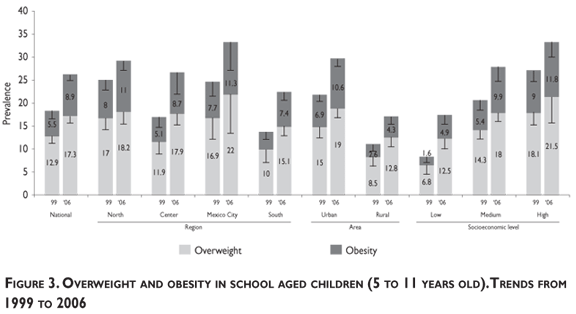
<body><![CDATA[<p><font size="2" face="Verdana"> Overweight also showed a marked upward trend    between 1988 and 1999, with an increase of 184% relative to baseline, compared    to only 6.2% relative to baseline between 1999 and 2006. Changes in obesity    were smaller in absolute terms, however in relative terms (relative to baseline)    increments in obesity were very significant during both periods: 160% between    1988 and 1999 and 121% between 1999&#45;2006.</font></p>     <p><font size="2" face="Verdana"><I>Preschool&#45;age children: </i><a href="#fig02">Figure       2</a> presents    trends of overweight and obesity for preschool&#45;age children disaggregated by    region, urban and rural areas, and SES tertiles for 1988, 1999 and 2006. Similar    upward trends in the 1988&#45;1999 period combined with downward trends in the 1999&#45;2006    period, as observed at the national level, were documented for the North, urban    areas, and the two lower SES tertiles. Similar upward trends for 1988&#45;1999 were    found for Mexico City, the South and the high SES, but the downward trend from    1999&#45;2006 was smaller; among rural areas, decreasing rates were observed from    1988&#45;2006. Relative to 1988, prevalences observed in 2006 were much higher in    Mexico City, the South and the high SES, and much lower in rural areas and the    central region (<a href="#fig02">Figure 2</a>).</font></p>     <p><a name="fig02"></a></p>     <p>&nbsp;</p>     <p align="center"><img src="/img/revistas/spm/v51s4/a13fig02.gif"></p>     <p>&nbsp;</p>     <p><font size="2" face="Verdana"><I>School&#45;age children:</i> <a href="#fig03">Figure       3</a> presents overweight    and obesity trends for school&#45;age children by region, urban and rural areas,    and SES. The data available for 1999 and 2006 showed an upward trend for unhealthy    weight in all regions, all SES levels, and in urban and rural areas. The prevalence    of unhealthy weight in school&#45;age children increased in 2006 about 8pp at the    national level. The highest prevalence was observed in school&#45;age children in    the highest SES, living in urban areas and in Mexico City (<a href="#fig03">Figure   3</a>). In addition,    during this period the prevalence of obesity increased 6.5 pp in indigenous    children (data not shown).</font></p>     <p><a name="fig03"></a></p>     <p>&nbsp;</p>     <p align="center"><img src="/img/revistas/spm/v51s4/a13fig03.gif"></p>     ]]></body>
<body><![CDATA[<p>&nbsp;</p>     <p><font size="2" face="Verdana"><I>Adolescent females:</i> <a href="#fig04">Figure       4</a> presents overweight    and obesity trends for female adolescents by region and urban and rural area,    and SES tertiles are presented for 1988, 1999 and 2006. A similar increase in    the prevalences of overweight and obesity shown for adolescents at the national    level in <a href="#fig01">Figure 1</a> was observed when they were disaggregated by subpopulations.    The highest increase in prevalence (16 pp) of unhealthy weight was observed    from 1988&#45;1999. The largest increase in overweight was observed in the central    region, urban areas and medium and high SES. The prevalence of obesity within    this age group increased almost fourfold from 1988&#45;2006 at the national level.    Mexico City was the region with the highest increase in the prevalence of obesity,    with 8.5 pp from 1999&#45;2006.</font></p>     <p><a name="fig04"></a></p>     <p>&nbsp;</p>     <p align="center"><img src="/img/revistas/spm/v51s4/a13fig04.gif"></p>     <p>&nbsp;</p>     <p><font size="3" face="Verdana"><b>Discussion</b></font></p>     <p><font size="2" face="Verdana">The epidemic    of overweight and obesity in Mexico is affecting children of all ages, regions,    SES, urban and rural areas and ethnic conditions.</font></p>     <p><font size="2" face="Verdana"> We present here evidence of a continuous    increase in the prevalence of unhealthy weight among Mexican children and adolescents    from 1988 to 2006, such that in the last survey in 2006, approximately 1034    million preschoolers, 4128 million school&#45;age children and 5048 million adolescents    had unhealthy weight. </font></p>     <p><font size="2" face="Verdana"> The increase in the prevalence of unhealthy    weight was nearly 1pp/year for both school&#45;age and adolescent populations over    the last decade, but the trend between 1988 to 1999 in the increment in the    prevalence of unhealthy weight in adolescents indicates that it rose faster    during that period (1.4 pp/year). </font></p>     ]]></body>
<body><![CDATA[<p><font size="2" face="Verdana"> The prevalence of unhealthy weight for both    school&#45;age children and adolescent females was higher in the sites with more    economic development (northern Mexico and the Mexico City region) than those    with less development (central and southern regions), was higher in urban areas    than in rural areas and in higher SES than in lower SES. And yet, the prevalence    of unhealthy weight was unacceptably high in children belonging to the lowest    SES (17.4% school&#45;age children and 26.5% female adolescents) and even for children    of indigenous ethnicity, considered the poorest of the poor, prevalence of unhealthy    weight increased at a pace of 0.7 pp/year. </font></p>     <p><font size="2" face="Verdana"> The highest contribution to the increase    of unhealthy weight from 1999&#45;2006 was overweight for school&#45;age children and    obesity for female adolescents, suggesting that early increments in overweight    precede later increments in obesity during adolescence years. </font></p>     <p><font size="2" face="Verdana"> The prevalence of unhealthy weight in preschool&#45;age    children deserves some consideration. Although relatively high, it remained    essentially stable throughout the three surveys, suggesting that regardless    of the etiological factors for obesity, their influence begins after age five.    This fact is highly important from a programmatic point of view because it represents    a window of opportunity to better understand the natural history of the onset    of overweight and obesity and to implement primary prevention programs.</font></p>     <p><font size="2" face="Verdana"> The accelerated rates of increase in unhealthy    weight in the Mexican population shown here are also observed worldwide. These    increasing trends of overweight and obesity are likely to be the consequence    of changes in diets and physical activity patterns.<SUP>27</SUP> Convincing    evidence links dietary and lifestyle factors and pervading household and school    environments to the risk of obesity. Regular physical activity and high intake    of dietary fiber decrease the risk, while sedentary lifestyles and intake of    energy&#45;dense micronutrient&#45;poor foods increase the risk.<SUP>3</SUP> Poor availability    of public places for physical activity and general lack of safety are common    barriers in most cities. Over a period of 14 years in Mexico, the purchases    of fruits and vegetables dropped 29.3% while purchases of high&#45;density industrialized    foods increased 6.3 and sweetened beverages 37.2%.<SUP>27</sup></font></p>     <p><font size="2" face="Verdana"> These trends are of particular concern because    of the increased risk of becoming obese in adulthood<SUP>5,6</SUP> and the early    appearance of diet&#45;related non&#45;communicable diseases (DR&#45;NCD) such as DM2, hypertension,    and dislipidemia,<SUP>28</SUP> in addition to psychosocial consequences.<SUP>29</SUP>    Type 2 DM is highly prevalent in Mexico<SUP>30,21</SUP> and it is one of the    leading causes of mortality among the Mexican adult population.<SUP>12</SUP>    The onset of NR&#45;NCD during youth and early adult ages seriously affect survival,    quality of life and social productivity. In addition, it imposes a great economic    burden to the health care system and the economy of families. The health cost    of obesity reached approximately 3.6 million USD in 1998; that is, 10.8% of    total healthcare expenditure in Mexico. In 2006, an average of 3.5% of household    income was spent on health care, however, the households in the lowest decile    of SES spent 7.9% of their income on medical care.<a name="tx03"></a><a href="#nt03"><sup>**</sup></a></font></p>     <p><font size="2" face="Verdana"> There is an urgent need to design culturally    acceptable effective interventions to prevent childhood obesity, especially    with regard to how to better approach the environmental factors that are associated    with and may be encouraging it. Prevention, the most cost&#45;effective action,    should include a clear understanding of the local determinants of childhood    obesity and a life cycle approach.</font></p>     <p><font size="2" face="Verdana"><b>Conclusions</b></font></p>     <p><font size="2" face="Verdana">This article furnished evidence that, in Mexico,    the onset of obesity occurs very early in life and increases progressively with    age. The current epidemic is affecting children from all age groups, SES, regions,    urban and rural areas, and both indigenous and non&#45;indigenous populations. The    magnitude of the prevalence is large enough to warrant a national prevention    strategy.</font></p>     <p><font size="2" face="Verdana"><b>Acknowledgements</b></font></p>     <p><font size="2" face="Verdana">We would like to acknowledge Deborah Salvo&#45;Dominguez    for her help in editing this paper.</font></p>     ]]></body>
<body><![CDATA[<p>&nbsp;</p>     <p><font size="3" face="Verdana"><b>References</b></font></p>     <!-- ref --><p><font size="2" face="Verdana">1. Lobstein T, Baur L, Uauy R. Obesity in children    and young people: a crisis in public health. Obes Rev 2004;5(supp1):4&#45;85.    &nbsp;&nbsp;&nbsp;&nbsp;&nbsp;&nbsp;&nbsp;&nbsp;[&#160;<a href="javascript:void(0);" onclick="javascript: window.open('/scielo.php?script=sci_nlinks&ref=9294524&pid=S0036-3634200900100001300001&lng=','','width=640,height=500,resizable=yes,scrollbars=1,menubar=yes,');">Links</a>&#160;]<!-- end-ref --> </font></p>     <!-- ref --><p><font size="2" face="Verdana">2. Serdula MK, Ivery D, Coates RJ, Freedman DS,    Williamson DF, Byers T. Do obese children become obese adults? A review of the    literature. Prev Med 1993;22:167&#45;177.    &nbsp;&nbsp;&nbsp;&nbsp;&nbsp;&nbsp;&nbsp;&nbsp;[&#160;<a href="javascript:void(0);" onclick="javascript: window.open('/scielo.php?script=sci_nlinks&ref=9294526&pid=S0036-3634200900100001300002&lng=','','width=640,height=500,resizable=yes,scrollbars=1,menubar=yes,');">Links</a>&#160;]<!-- end-ref --></font></p>     <!-- ref --><p><font size="2" face="Verdana">3. Joint WHO/FAO Expert Consultation on Diet,    Nutrition and the Prevention of Chronic Disease 2002. Geneva: WHO, 2003. WHO    Technical Report Series 916.    &nbsp;&nbsp;&nbsp;&nbsp;&nbsp;&nbsp;&nbsp;&nbsp;[&#160;<a href="javascript:void(0);" onclick="javascript: window.open('/scielo.php?script=sci_nlinks&ref=9294528&pid=S0036-3634200900100001300003&lng=','','width=640,height=500,resizable=yes,scrollbars=1,menubar=yes,');">Links</a>&#160;]<!-- end-ref --></font></p>     <!-- ref --><p><FONT size="2" FACE="Verdana">4. Anderson M. Understanding the childhood obesity    epidemic. Colorado State University Extension, Nutrition Resources. &#91;Consulted    2005 January 11&#93;. Available at: <a href="http://www.ext.colostate.edu/pubs/foodnut/09317.html" target="_blank">http://www.ext.colostate.edu/pubs/foodnut/09317.html</a></font>&nbsp;&nbsp;&nbsp;&nbsp;&nbsp;&nbsp;&nbsp;&nbsp;[&#160;<a href="javascript:void(0);" onclick="javascript: window.open('/scielo.php?script=sci_nlinks&ref=9294530&pid=S0036-3634200900100001300004&lng=','','width=640,height=500,resizable=yes,scrollbars=1,menubar=yes,');">Links</a>&#160;]<!-- end-ref --><!-- ref --><p><FONT size="2" FACE="Verdana">5. Kuczmarski RJ, Ogden CL, Grummer&#45;Strawn LM,    Flegal KM, Guo SS, Wei R, <I>et al</I>. CDC growth charts: United States. Advance    data from vital and health statistics;no. 314. Hyattsville, Maryland: National    Center for Health Statistics, 2000.    &nbsp;&nbsp;&nbsp;&nbsp;&nbsp;&nbsp;&nbsp;&nbsp;[&#160;<a href="javascript:void(0);" onclick="javascript: window.open('/scielo.php?script=sci_nlinks&ref=9294531&pid=S0036-3634200900100001300005&lng=','','width=640,height=500,resizable=yes,scrollbars=1,menubar=yes,');">Links</a>&#160;]<!-- end-ref --></font></p>     <!-- ref --><p><font size="2" face="Verdana">6. Instituto Nacional de Salud P&uacute;blica/Institute    of Medicine of the National Academies. Prevenci&oacute;n de la obesidad en ni&ntilde;os    y adolescentes de origen mexicano: taller de colaboraci&oacute;n Estados Unidos&#45;M&eacute;xico.    Mexico: INSP, December 2007.    &nbsp;&nbsp;&nbsp;&nbsp;&nbsp;&nbsp;&nbsp;&nbsp;[&#160;<a href="javascript:void(0);" onclick="javascript: window.open('/scielo.php?script=sci_nlinks&ref=9294533&pid=S0036-3634200900100001300006&lng=','','width=640,height=500,resizable=yes,scrollbars=1,menubar=yes,');">Links</a>&#160;]<!-- end-ref --></font></p>     <!-- ref --><p><font size="2" face="Verdana">7. Cole T, Bellizzi M. Establishing a standard    definition for child overweight and obesity worldwide: international survey.    BMJ 2000;320:1&#45;6.    &nbsp;&nbsp;&nbsp;&nbsp;&nbsp;&nbsp;&nbsp;&nbsp;[&#160;<a href="javascript:void(0);" onclick="javascript: window.open('/scielo.php?script=sci_nlinks&ref=9294535&pid=S0036-3634200900100001300007&lng=','','width=640,height=500,resizable=yes,scrollbars=1,menubar=yes,');">Links</a>&#160;]<!-- end-ref --></font></p>     <!-- ref --><p><FONT size="2" FACE="Verdana">8. Hern&aacute;ndez B, Cuevas&#45;Nasau L, Shamah&#45;Levy    T, Monterrubio E, Ram&iacute;rez&#45;Silva CI, Garc&iacute;a&#45;Feregrino, <I>et al</I>.    Factores asociados con sobrepeso y obesidad en ni&ntilde;os mexicanos de edad    escolar: resultados de la Encuesta Nacional de Nutrici&oacute;n 1999. Salud    Publica Mex 2003;45 Suppl 4:S551&#45;S557.    &nbsp;&nbsp;&nbsp;&nbsp;&nbsp;&nbsp;&nbsp;&nbsp;[&#160;<a href="javascript:void(0);" onclick="javascript: window.open('/scielo.php?script=sci_nlinks&ref=9294537&pid=S0036-3634200900100001300008&lng=','','width=640,height=500,resizable=yes,scrollbars=1,menubar=yes,');">Links</a>&#160;]<!-- end-ref --></font></p>     <!-- ref --><p><FONT size="2" FACE="Verdana"> 9. Dietz WH. Health consequences of obesity    in youth: childhood predictors of adult disease. Pediatrics 1998;101(3):518&#45;525.    &nbsp;&nbsp;&nbsp;&nbsp;&nbsp;&nbsp;&nbsp;&nbsp;[&#160;<a href="javascript:void(0);" onclick="javascript: window.open('/scielo.php?script=sci_nlinks&ref=9294539&pid=S0036-3634200900100001300009&lng=','','width=640,height=500,resizable=yes,scrollbars=1,menubar=yes,');">Links</a>&#160;]<!-- end-ref --></font></p>     <!-- ref --><p><FONT size="2" FACE="Verdana"> 10. Reilly JJ, Methven E, McDowell ZC, Hacking    B, Alexander D, Stewart L, <I>et al</I>. Health consequences of obesity. Arch    Dis Child 2003;88:748&#45;752.    &nbsp;&nbsp;&nbsp;&nbsp;&nbsp;&nbsp;&nbsp;&nbsp;[&#160;<a href="javascript:void(0);" onclick="javascript: window.open('/scielo.php?script=sci_nlinks&ref=9294541&pid=S0036-3634200900100001300010&lng=','','width=640,height=500,resizable=yes,scrollbars=1,menubar=yes,');">Links</a>&#160;]<!-- end-ref --></font></p>     <!-- ref --><p><FONT size="2" FACE="Verdana"> 11. Barquera S, Flores M, Olaiz&#45;Fernadez G,    Monterrubio E, Villalpando S, Gonzalez C, <I>et al</I>. Dyslipidemias and obesity    in Mexico. Salud Publica Mex 2007;49 Suppl 3:S338&#45;S347.    &nbsp;&nbsp;&nbsp;&nbsp;&nbsp;&nbsp;&nbsp;&nbsp;[&#160;<a href="javascript:void(0);" onclick="javascript: window.open('/scielo.php?script=sci_nlinks&ref=9294543&pid=S0036-3634200900100001300011&lng=','','width=640,height=500,resizable=yes,scrollbars=1,menubar=yes,');">Links</a>&#160;]<!-- end-ref --> </font></p>     <!-- ref --><p><font size="2" face="Verdana">12. Olaiz&#45;Fern&aacute;ndez G, Rojas R, Aguilar&#45;Salinas    CA, Rauda J, Villalpando S. Diabetes mellitus en adultos mexicanos. Resultados    de la Encuesta Nacional de Salud 2000. Salud Publica Mex 2007;49 supl 3:S331&#45;S337.    &nbsp;&nbsp;&nbsp;&nbsp;&nbsp;&nbsp;&nbsp;&nbsp;[&#160;<a href="javascript:void(0);" onclick="javascript: window.open('/scielo.php?script=sci_nlinks&ref=9294545&pid=S0036-3634200900100001300012&lng=','','width=640,height=500,resizable=yes,scrollbars=1,menubar=yes,');">Links</a>&#160;]<!-- end-ref --></font></p>     <!-- ref --><p><font size="2" face="Verdana">13. Puhl RM, Latner JD. Stigma, obesity, and    the health of the nation's children. Psychol Bull 2007;133(4):557&#45;580.    &nbsp;&nbsp;&nbsp;&nbsp;&nbsp;&nbsp;&nbsp;&nbsp;[&#160;<a href="javascript:void(0);" onclick="javascript: window.open('/scielo.php?script=sci_nlinks&ref=9294547&pid=S0036-3634200900100001300013&lng=','','width=640,height=500,resizable=yes,scrollbars=1,menubar=yes,');">Links</a>&#160;]<!-- end-ref --></font></p>     <!-- ref --><p><font size="2" face="Verdana">14. Mclean L, Edwards N, Garrard M, Sims&#45;Jones    N, Clinton K, Ashley L. Obesity, stigma and public health planning. Health Promot    Int 2009;24(1):88&#45;93.    &nbsp;&nbsp;&nbsp;&nbsp;&nbsp;&nbsp;&nbsp;&nbsp;[&#160;<a href="javascript:void(0);" onclick="javascript: window.open('/scielo.php?script=sci_nlinks&ref=9294549&pid=S0036-3634200900100001300014&lng=','','width=640,height=500,resizable=yes,scrollbars=1,menubar=yes,');">Links</a>&#160;]<!-- end-ref --></font></p>     <!-- ref --><p><FONT size="2" FACE="Verdana">15. Geier AB, Foster GD, Womble LG, McLaughlin    J, Borradaile KE, Nachmani J, <I>et al</I>. The relationship between relative    weight and school attendance among elementary school children. Obesity 2007;15(8):2157&#45;2161.    &nbsp;&nbsp;&nbsp;&nbsp;&nbsp;&nbsp;&nbsp;&nbsp;[&#160;<a href="javascript:void(0);" onclick="javascript: window.open('/scielo.php?script=sci_nlinks&ref=9294551&pid=S0036-3634200900100001300015&lng=','','width=640,height=500,resizable=yes,scrollbars=1,menubar=yes,');">Links</a>&#160;]<!-- end-ref --></font></p>     <!-- ref --><p><font size="2" face="Verdana">16. Suarez&#45;Berenguela R, Jacoby E. Assessing    the economic impact of obesity and associated chronic disease: Latin America    and the Caribbean. FACTS Sheet. Washington, DC: PAHO/WHO, 2006.    &nbsp;&nbsp;&nbsp;&nbsp;&nbsp;&nbsp;&nbsp;&nbsp;[&#160;<a href="javascript:void(0);" onclick="javascript: window.open('/scielo.php?script=sci_nlinks&ref=9294553&pid=S0036-3634200900100001300016&lng=','','width=640,height=500,resizable=yes,scrollbars=1,menubar=yes,');">Links</a>&#160;]<!-- end-ref --></font></p>     <!-- ref --><p><font size="2" face="Verdana">17. Rivera J, Sep&uacute;lveda&#45;Amor J.Conclusions    from the Mexican National Nutrition Survey 1999: Translating results into nutrition    policy. Salud Publica Mex 2003;45(4):565&#45;575.    &nbsp;&nbsp;&nbsp;&nbsp;&nbsp;&nbsp;&nbsp;&nbsp;[&#160;<a href="javascript:void(0);" onclick="javascript: window.open('/scielo.php?script=sci_nlinks&ref=9294555&pid=S0036-3634200900100001300017&lng=','','width=640,height=500,resizable=yes,scrollbars=1,menubar=yes,');">Links</a>&#160;]<!-- end-ref --></font></p>     <!-- ref --><p><font size="2" face="Verdana">18. Sep&uacute;lveda&#45;Amor J, Lezana MA, Tapia&#45;Conyer    R, Valdespino JL, Madrigal H, Kumate J. Estado nutricional de preescolares y    mujeres en M&eacute;xico: resultados de una encuesta probabil&iacute;stica Nacional.    Gac Med Mex 1990;126(3):207&#45;224.    &nbsp;&nbsp;&nbsp;&nbsp;&nbsp;&nbsp;&nbsp;&nbsp;[&#160;<a href="javascript:void(0);" onclick="javascript: window.open('/scielo.php?script=sci_nlinks&ref=9294557&pid=S0036-3634200900100001300018&lng=','','width=640,height=500,resizable=yes,scrollbars=1,menubar=yes,');">Links</a>&#160;]<!-- end-ref --></font></p>     <!-- ref --><p><font size="2" face="Verdana">19. Rivera&#45;Dommarco J, Shamah&#45;Levy T, Villalpando&#45;Hern&aacute;ndez    S, Gonz&aacute;lez&#45;de Coss&iacute;o T, Hern&aacute;ndez&#45;Prado B, Sep&uacute;lveda    J. Encuesta Nacional de Nutrici&oacute;n 1999. Estado nutricio de ni&ntilde;os    y mujeres en M&eacute;xico. Cuernavaca, Morelos, M&eacute;xico: Instituto Nacional    de Salud P&uacute;blica, 2001.    &nbsp;&nbsp;&nbsp;&nbsp;&nbsp;&nbsp;&nbsp;&nbsp;[&#160;<a href="javascript:void(0);" onclick="javascript: window.open('/scielo.php?script=sci_nlinks&ref=9294559&pid=S0036-3634200900100001300019&lng=','','width=640,height=500,resizable=yes,scrollbars=1,menubar=yes,');">Links</a>&#160;]<!-- end-ref --></font></p>     <!-- ref --><p><font size="2" face="Verdana">20. Shamah&#45;Levy T, Villalpando&#45;Hern&aacute;ndez    S, Rivera&#45;Dommarco JA. Resultados de Nutrici&oacute;n de la ENSANUT 2006. Cuernavaca,    Morelos, M&eacute;xico: Instituto Nacional de Salud P&uacute;blica, 2007.    &nbsp;&nbsp;&nbsp;&nbsp;&nbsp;&nbsp;&nbsp;&nbsp;[&#160;<a href="javascript:void(0);" onclick="javascript: window.open('/scielo.php?script=sci_nlinks&ref=9294561&pid=S0036-3634200900100001300020&lng=','','width=640,height=500,resizable=yes,scrollbars=1,menubar=yes,');">Links</a>&#160;]<!-- end-ref --></font></p>     <!-- ref --><p><FONT size="2" FACE="Verdana">21. Olaiz&#45;Fern&aacute;ndez G, Rivera&#45;Dommarco    J, Shamah&#45;Levy T, Rojas R, Villalpando&#45;Hern&aacute;ndez S, Hern&aacute;ndez&#45;Avila    M, <I>et al</I>. Encuesta Nacional de Salud y Nutrici&oacute;n 2006. Cuernavaca,    Morelos, M&eacute;xico: Instituto Nacional de Salud P&uacute;blica, 2006.    &nbsp;&nbsp;&nbsp;&nbsp;&nbsp;&nbsp;&nbsp;&nbsp;[&#160;<a href="javascript:void(0);" onclick="javascript: window.open('/scielo.php?script=sci_nlinks&ref=9294563&pid=S0036-3634200900100001300021&lng=','','width=640,height=500,resizable=yes,scrollbars=1,menubar=yes,');">Links</a>&#160;]<!-- end-ref --></font></p>     <!-- ref --><p><font size="2" face="Verdana">22. Lohman T, Roche A, Martorell R, Ed. Anthropometric    standardization reference manual. Champaign (IL): Human Kinetics Books, 1988.    &nbsp;&nbsp;&nbsp;&nbsp;&nbsp;&nbsp;&nbsp;&nbsp;[&#160;<a href="javascript:void(0);" onclick="javascript: window.open('/scielo.php?script=sci_nlinks&ref=9294565&pid=S0036-3634200900100001300022&lng=','','width=640,height=500,resizable=yes,scrollbars=1,menubar=yes,');">Links</a>&#160;]<!-- end-ref --></font></p>     <!-- ref --><p><font size="2" face="Verdana">23. Habicht JP. Estandarizaci&oacute;n de m&eacute;todos    epidemiol&oacute;gicos cuantitativos sobre el terreno (Standardization of anthropometric    methods in the field). Bull Pan Am Health Organ 1974;76:375&#45;384.    &nbsp;&nbsp;&nbsp;&nbsp;&nbsp;&nbsp;&nbsp;&nbsp;[&#160;<a href="javascript:void(0);" onclick="javascript: window.open('/scielo.php?script=sci_nlinks&ref=9294567&pid=S0036-3634200900100001300023&lng=','','width=640,height=500,resizable=yes,scrollbars=1,menubar=yes,');">Links</a>&#160;]<!-- end-ref --></font></p>     <!-- ref --><p><font size="2" face="Verdana">24. Hair JF, Anderson R, Tatham R, Black W. Multivariate    data analysis with readings. 3rd ed. New York (NY): Macmillan Publishing Company,    1992: 223&#45;253.    &nbsp;&nbsp;&nbsp;&nbsp;&nbsp;&nbsp;&nbsp;&nbsp;[&#160;<a href="javascript:void(0);" onclick="javascript: window.open('/scielo.php?script=sci_nlinks&ref=9294569&pid=S0036-3634200900100001300024&lng=','','width=640,height=500,resizable=yes,scrollbars=1,menubar=yes,');">Links</a>&#160;]<!-- end-ref --></font></p>     <!-- ref --><p><font size="2" face="Verdana">25. Lehtonen R, Pahkinen E. Practical methods    for design and analysis of complex surveys. Chichester, England: John Wiley    and Sons, 1995.    &nbsp;&nbsp;&nbsp;&nbsp;&nbsp;&nbsp;&nbsp;&nbsp;[&#160;<a href="javascript:void(0);" onclick="javascript: window.open('/scielo.php?script=sci_nlinks&ref=9294571&pid=S0036-3634200900100001300025&lng=','','width=640,height=500,resizable=yes,scrollbars=1,menubar=yes,');">Links</a>&#160;]<!-- end-ref --></font></p>     <!-- ref --><p><font size="2" face="Verdana">26. Hill JO, Wyatt HR, Reed GW, Peters JC. Obesity    and the environment: Where do we go from here? Science 2003;299(5608):853&#45;855.    &nbsp;&nbsp;&nbsp;&nbsp;&nbsp;&nbsp;&nbsp;&nbsp;[&#160;<a href="javascript:void(0);" onclick="javascript: window.open('/scielo.php?script=sci_nlinks&ref=9294573&pid=S0036-3634200900100001300026&lng=','','width=640,height=500,resizable=yes,scrollbars=1,menubar=yes,');">Links</a>&#160;]<!-- end-ref --></font></p>     <!-- ref --><p><font size="2" face="Verdana">27. Instituto Nacional de Estad&iacute;stica,    Geograf&iacute;a e Inform&aacute;tica. Encuesta Nacional de Ingresos y Gastos    de los Hogares. M&eacute;xico DF: INEGI, 1989, 1998 y 2006.    &nbsp;&nbsp;&nbsp;&nbsp;&nbsp;&nbsp;&nbsp;&nbsp;[&#160;<a href="javascript:void(0);" onclick="javascript: window.open('/scielo.php?script=sci_nlinks&ref=9294575&pid=S0036-3634200900100001300027&lng=','','width=640,height=500,resizable=yes,scrollbars=1,menubar=yes,');">Links</a>&#160;]<!-- end-ref --></font></p>     <!-- ref --><p><font size="2" face="Verdana">28. Freedman DS, Dietz WH, Srinivasan SR, Berenson    GS. The relation of overweight to cardiovascular risk factors among children    and adolescent: the Bogalusa Heart Study. Pediatrics 1999;103:1175&#45;1182.    &nbsp;&nbsp;&nbsp;&nbsp;&nbsp;&nbsp;&nbsp;&nbsp;[&#160;<a href="javascript:void(0);" onclick="javascript: window.open('/scielo.php?script=sci_nlinks&ref=9294577&pid=S0036-3634200900100001300028&lng=','','width=640,height=500,resizable=yes,scrollbars=1,menubar=yes,');">Links</a>&#160;]<!-- end-ref --></font></p>     <!-- ref --><p><font size="2" face="Verdana">29. Hill AJ, Silver EK. Fat friendless and unhealthy:  9 years old children's perception of body shapes stereotypes. Int J Obes 1995;19:423&#45;430.    &nbsp;&nbsp;&nbsp;&nbsp;&nbsp;&nbsp;&nbsp;&nbsp;[&#160;<a href="javascript:void(0);" onclick="javascript: window.open('/scielo.php?script=sci_nlinks&ref=9294579&pid=S0036-3634200900100001300029&lng=','','width=640,height=500,resizable=yes,scrollbars=1,menubar=yes,');">Links</a>&#160;]<!-- end-ref --></font></p>     <!-- ref --><p><font size="2" face="Verdana">30. Olaiz G, Rojas R, Barquera S, Shamah T, Aguilar    C, Cravioto P. Encuesta Nacional de Salud 2000. Cuernavaca, Morelos, Mexico:    Instituto Nacional de Salud P&uacute;blica, 2003.    &nbsp;&nbsp;&nbsp;&nbsp;&nbsp;&nbsp;&nbsp;&nbsp;[&#160;<a href="javascript:void(0);" onclick="javascript: window.open('/scielo.php?script=sci_nlinks&ref=9294581&pid=S0036-3634200900100001300030&lng=','','width=640,height=500,resizable=yes,scrollbars=1,menubar=yes,');">Links</a>&#160;]<!-- end-ref --></font></p>     <p>&nbsp;</p>     <p>&nbsp;</p>     <p><FONT size="2" FACE="Verdana">Received on: April 11, 2008    <br>   Accepted on: March 25, 2009</font></p>     <p>&nbsp;</p>     <p>&nbsp;</p>     <p><font size="2" face="Verdana">Address       reprint requests to: Mtra. Margarita Safdie.  Centro de Investigaci&oacute;n en Nutrici&oacute;n y Salud, Instituto Nacional de Salud P&uacute;blica. Av. Universidad 655, col. Santa Mar&iacute;a Ahuacatitl&aacute;n. 62100 Cuernavaca, Morelos, M&eacute;xico. E&#45;mail: <a href="mailto:msafdie@insp.mx">msafdie@insp.mx</a>    <br> <a name="nt01"></a><a href="#tx01">*</a> Counties    <br> <a name="nt02"></a><a href="#tx02">&#135;</a> Stata Statistical Software. Release 9.0. College Station (TX, USA): Stata Corporation, 2005.    ]]></body>
<body><![CDATA[<br> <a name="nt03"></a><a href="#tx03">**</a> Lara A, Berber A, Aguilar&#45;Salinas C. Cost of obesity in Mexico with stress in type 2 diabetes mellitus and hypertension, 2008 (in press).</font></p>      ]]></body><back>
<ref-list>
<ref id="B1">
<label>1</label><nlm-citation citation-type="journal">
<person-group person-group-type="author">
<name>
<surname><![CDATA[Lobstein]]></surname>
<given-names><![CDATA[T]]></given-names>
</name>
<name>
<surname><![CDATA[Baur]]></surname>
<given-names><![CDATA[L]]></given-names>
</name>
<name>
<surname><![CDATA[Uauy]]></surname>
<given-names><![CDATA[R]]></given-names>
</name>
</person-group>
<article-title xml:lang="en"><![CDATA[Obesity in children and young people: a crisis in public health]]></article-title>
<source><![CDATA[Obes Rev]]></source>
<year>2004</year>
<volume>5</volume>
<numero>^s1</numero>
<issue>^s1</issue>
<supplement>1</supplement>
<page-range>4-85</page-range></nlm-citation>
</ref>
<ref id="B2">
<label>2</label><nlm-citation citation-type="journal">
<person-group person-group-type="author">
<name>
<surname><![CDATA[Serdula]]></surname>
<given-names><![CDATA[MK]]></given-names>
</name>
<name>
<surname><![CDATA[Ivery]]></surname>
<given-names><![CDATA[D]]></given-names>
</name>
<name>
<surname><![CDATA[Coates]]></surname>
<given-names><![CDATA[RJ]]></given-names>
</name>
<name>
<surname><![CDATA[Freedman]]></surname>
<given-names><![CDATA[DS]]></given-names>
</name>
<name>
<surname><![CDATA[Williamson]]></surname>
<given-names><![CDATA[DF]]></given-names>
</name>
<name>
<surname><![CDATA[Byers]]></surname>
<given-names><![CDATA[T]]></given-names>
</name>
</person-group>
<article-title xml:lang="en"><![CDATA[Do obese children become obese adults?: A review of the literature]]></article-title>
<source><![CDATA[Prev Med]]></source>
<year>1993</year>
<volume>22</volume>
<page-range>167-177</page-range></nlm-citation>
</ref>
<ref id="B3">
<label>3</label><nlm-citation citation-type="book">
<source><![CDATA[Joint WHO/FAO Expert Consultation on Diet: Nutrition and the Prevention of Chronic Disease 2002]]></source>
<year>2003</year>
<publisher-loc><![CDATA[Geneva ]]></publisher-loc>
<publisher-name><![CDATA[WHO]]></publisher-name>
</nlm-citation>
</ref>
<ref id="B4">
<label>4</label><nlm-citation citation-type="">
<person-group person-group-type="author">
<name>
<surname><![CDATA[Anderson]]></surname>
<given-names><![CDATA[M]]></given-names>
</name>
</person-group>
<source><![CDATA[Understanding the childhood obesity epidemic: Colorado State University Extension, Nutrition Resources]]></source>
<year></year>
</nlm-citation>
</ref>
<ref id="B5">
<label>5</label><nlm-citation citation-type="book">
<person-group person-group-type="author">
<name>
<surname><![CDATA[Kuczmarski]]></surname>
<given-names><![CDATA[RJ]]></given-names>
</name>
<name>
<surname><![CDATA[Ogden]]></surname>
<given-names><![CDATA[CL]]></given-names>
</name>
<name>
<surname><![CDATA[Grummer-Strawn]]></surname>
<given-names><![CDATA[LM]]></given-names>
</name>
<name>
<surname><![CDATA[Flegal]]></surname>
<given-names><![CDATA[KM]]></given-names>
</name>
<name>
<surname><![CDATA[Guo]]></surname>
<given-names><![CDATA[SS]]></given-names>
</name>
<name>
<surname><![CDATA[Wei]]></surname>
<given-names><![CDATA[R]]></given-names>
</name>
</person-group>
<source><![CDATA[CDC growth charts: United States. Advance data from vital and health statistics;no. 314]]></source>
<year>2000</year>
<publisher-loc><![CDATA[Hyattsville^eMaryland Maryland]]></publisher-loc>
<publisher-name><![CDATA[National Center for Health Statistics]]></publisher-name>
</nlm-citation>
</ref>
<ref id="B6">
<label>6</label><nlm-citation citation-type="book">
<collab>Instituto Nacional de Salud Pública</collab>
<collab>Institute of Medicine of the National Academies</collab>
<source><![CDATA[Prevención de la obesidad en niños y adolescentes de origen mexicano: taller de colaboración Estados Unidos-México]]></source>
<year>Dece</year>
<month>mb</month>
<day>er</day>
<publisher-name><![CDATA[INSP]]></publisher-name>
</nlm-citation>
</ref>
<ref id="B7">
<label>7</label><nlm-citation citation-type="journal">
<person-group person-group-type="author">
<name>
<surname><![CDATA[Cole]]></surname>
<given-names><![CDATA[T]]></given-names>
</name>
<name>
<surname><![CDATA[Bellizzi]]></surname>
<given-names><![CDATA[M]]></given-names>
</name>
</person-group>
<article-title xml:lang="en"><![CDATA[Establishing a standard definition for child overweight and obesity worldwide: international survey]]></article-title>
<source><![CDATA[BMJ]]></source>
<year>2000</year>
<volume>320</volume>
<page-range>1-6</page-range></nlm-citation>
</ref>
<ref id="B8">
<label>8</label><nlm-citation citation-type="journal">
<person-group person-group-type="author">
<name>
<surname><![CDATA[Hernández]]></surname>
<given-names><![CDATA[B]]></given-names>
</name>
<name>
<surname><![CDATA[Cuevas-Nasau]]></surname>
<given-names><![CDATA[L]]></given-names>
</name>
<name>
<surname><![CDATA[Shamah-Levy]]></surname>
<given-names><![CDATA[T]]></given-names>
</name>
<name>
<surname><![CDATA[Monterrubio]]></surname>
<given-names><![CDATA[E]]></given-names>
</name>
<name>
<surname><![CDATA[Ramírez-Silva]]></surname>
<given-names><![CDATA[CI]]></given-names>
</name>
<name>
<surname><![CDATA[García-Feregrino]]></surname>
</name>
</person-group>
<article-title xml:lang="es"><![CDATA[Factores asociados con sobrepeso y obesidad en niños mexicanos de edad escolar: resultados de la Encuesta Nacional de Nutrición 1999]]></article-title>
<source><![CDATA[Salud Publica Mex]]></source>
<year>2003</year>
<volume>45</volume>
<numero>^s4</numero>
<issue>^s4</issue>
<supplement>4</supplement>
<page-range>S551-S557</page-range></nlm-citation>
</ref>
<ref id="B9">
<label>9</label><nlm-citation citation-type="journal">
<person-group person-group-type="author">
<name>
<surname><![CDATA[Dietz]]></surname>
<given-names><![CDATA[WH]]></given-names>
</name>
</person-group>
<article-title xml:lang="en"><![CDATA[Health consequences of obesity in youth: childhood predictors of adult disease]]></article-title>
<source><![CDATA[Pediatrics]]></source>
<year>1998</year>
<volume>101</volume>
<numero>3</numero>
<issue>3</issue>
<page-range>518-525</page-range></nlm-citation>
</ref>
<ref id="B10">
<label>10</label><nlm-citation citation-type="journal">
<person-group person-group-type="author">
<name>
<surname><![CDATA[Reilly]]></surname>
<given-names><![CDATA[JJ]]></given-names>
</name>
<name>
<surname><![CDATA[Methven]]></surname>
<given-names><![CDATA[E]]></given-names>
</name>
<name>
<surname><![CDATA[McDowell]]></surname>
<given-names><![CDATA[ZC]]></given-names>
</name>
<name>
<surname><![CDATA[Hacking]]></surname>
<given-names><![CDATA[B]]></given-names>
</name>
<name>
<surname><![CDATA[Alexander]]></surname>
<given-names><![CDATA[D]]></given-names>
</name>
<name>
<surname><![CDATA[Stewart]]></surname>
<given-names><![CDATA[L]]></given-names>
</name>
</person-group>
<article-title xml:lang="en"><![CDATA[Health consequences of obesity]]></article-title>
<source><![CDATA[Arch Dis Child]]></source>
<year>2003</year>
<volume>88</volume>
<page-range>748-752</page-range></nlm-citation>
</ref>
<ref id="B11">
<label>11</label><nlm-citation citation-type="journal">
<person-group person-group-type="author">
<name>
<surname><![CDATA[Barquera]]></surname>
<given-names><![CDATA[S]]></given-names>
</name>
<name>
<surname><![CDATA[Flores]]></surname>
<given-names><![CDATA[M]]></given-names>
</name>
<name>
<surname><![CDATA[Olaiz-Fernadez]]></surname>
<given-names><![CDATA[G]]></given-names>
</name>
<name>
<surname><![CDATA[Monterrubio]]></surname>
<given-names><![CDATA[E]]></given-names>
</name>
<name>
<surname><![CDATA[Villalpando]]></surname>
<given-names><![CDATA[S]]></given-names>
</name>
<name>
<surname><![CDATA[Gonzalez]]></surname>
<given-names><![CDATA[C]]></given-names>
</name>
</person-group>
<article-title xml:lang="en"><![CDATA[Dyslipidemias and obesity in Mexico]]></article-title>
<source><![CDATA[Salud Publica Mex]]></source>
<year>2007</year>
<volume>49</volume>
<numero>^s3</numero>
<issue>^s3</issue>
<supplement>3</supplement>
<page-range>S338-S347</page-range></nlm-citation>
</ref>
<ref id="B12">
<label>12</label><nlm-citation citation-type="journal">
<person-group person-group-type="author">
<name>
<surname><![CDATA[Olaiz-Fernández]]></surname>
<given-names><![CDATA[G]]></given-names>
</name>
<name>
<surname><![CDATA[Rojas]]></surname>
<given-names><![CDATA[R]]></given-names>
</name>
<name>
<surname><![CDATA[Aguilar-Salinas]]></surname>
<given-names><![CDATA[CA]]></given-names>
</name>
<name>
<surname><![CDATA[Rauda]]></surname>
<given-names><![CDATA[J]]></given-names>
</name>
<name>
<surname><![CDATA[Villalpando]]></surname>
<given-names><![CDATA[S]]></given-names>
</name>
</person-group>
<article-title xml:lang="es"><![CDATA[Diabetes mellitus en adultos mexicanos: Resultados de la Encuesta Nacional de Salud 2000]]></article-title>
<source><![CDATA[Salud Publica Mex]]></source>
<year>2007</year>
<volume>49</volume>
<numero>^s3</numero>
<issue>^s3</issue>
<supplement>3</supplement>
<page-range>S331-S337</page-range></nlm-citation>
</ref>
<ref id="B13">
<label>13</label><nlm-citation citation-type="journal">
<person-group person-group-type="author">
<name>
<surname><![CDATA[Puhl]]></surname>
<given-names><![CDATA[RM]]></given-names>
</name>
<name>
<surname><![CDATA[Latner]]></surname>
<given-names><![CDATA[JD]]></given-names>
</name>
</person-group>
<article-title xml:lang="en"><![CDATA[Stigma, obesity, and the health of the nation's children]]></article-title>
<source><![CDATA[Psychol Bull]]></source>
<year>2007</year>
<volume>133</volume>
<numero>4</numero>
<issue>4</issue>
<page-range>557-580</page-range></nlm-citation>
</ref>
<ref id="B14">
<label>14</label><nlm-citation citation-type="journal">
<person-group person-group-type="author">
<name>
<surname><![CDATA[Mclean]]></surname>
<given-names><![CDATA[L]]></given-names>
</name>
<name>
<surname><![CDATA[Edwards]]></surname>
<given-names><![CDATA[N]]></given-names>
</name>
<name>
<surname><![CDATA[Garrard]]></surname>
<given-names><![CDATA[M]]></given-names>
</name>
<name>
<surname><![CDATA[Sims-Jones]]></surname>
<given-names><![CDATA[N]]></given-names>
</name>
<name>
<surname><![CDATA[Clinton]]></surname>
<given-names><![CDATA[K]]></given-names>
</name>
<name>
<surname><![CDATA[Ashley]]></surname>
<given-names><![CDATA[L]]></given-names>
</name>
</person-group>
<article-title xml:lang="en"><![CDATA[Obesity, stigma and public health planning]]></article-title>
<source><![CDATA[Health Promot Int]]></source>
<year>2009</year>
<volume>24</volume>
<numero>1</numero>
<issue>1</issue>
<page-range>88-93</page-range></nlm-citation>
</ref>
<ref id="B15">
<label>15</label><nlm-citation citation-type="journal">
<person-group person-group-type="author">
<name>
<surname><![CDATA[Geier]]></surname>
<given-names><![CDATA[AB]]></given-names>
</name>
<name>
<surname><![CDATA[Foster]]></surname>
<given-names><![CDATA[GD]]></given-names>
</name>
<name>
<surname><![CDATA[Womble]]></surname>
<given-names><![CDATA[LG]]></given-names>
</name>
<name>
<surname><![CDATA[McLaughlin]]></surname>
<given-names><![CDATA[J]]></given-names>
</name>
<name>
<surname><![CDATA[Borradaile]]></surname>
<given-names><![CDATA[KE]]></given-names>
</name>
<name>
<surname><![CDATA[Nachmani]]></surname>
<given-names><![CDATA[J]]></given-names>
</name>
</person-group>
<article-title xml:lang="en"><![CDATA[The relationship between relative weight and school attendance among elementary school children]]></article-title>
<source><![CDATA[Obesity]]></source>
<year>2007</year>
<volume>15</volume>
<numero>8</numero>
<issue>8</issue>
<page-range>2157-2161</page-range></nlm-citation>
</ref>
<ref id="B16">
<label>16</label><nlm-citation citation-type="book">
<person-group person-group-type="author">
<name>
<surname><![CDATA[Suarez-Berenguela]]></surname>
<given-names><![CDATA[R]]></given-names>
</name>
<name>
<surname><![CDATA[Jacoby]]></surname>
<given-names><![CDATA[E]]></given-names>
</name>
</person-group>
<source><![CDATA[Assessing the economic impact of obesity and associated chronic disease: Latin America and the Caribbean. FACTS Sheet]]></source>
<year>2006</year>
<publisher-loc><![CDATA[Washington^eDC DC]]></publisher-loc>
<publisher-name><![CDATA[PAHOWHO]]></publisher-name>
</nlm-citation>
</ref>
<ref id="B17">
<label>17</label><nlm-citation citation-type="journal">
<person-group person-group-type="author">
<name>
<surname><![CDATA[Rivera]]></surname>
<given-names><![CDATA[J]]></given-names>
</name>
<name>
<surname><![CDATA[Sepúlveda-Amor]]></surname>
<given-names><![CDATA[J]]></given-names>
</name>
</person-group>
<article-title xml:lang="en"><![CDATA[Conclusions from the Mexican National Nutrition Survey 1999: Translating results into nutrition policy]]></article-title>
<source><![CDATA[Salud Publica Mex]]></source>
<year>2003</year>
<volume>45</volume>
<numero>4</numero>
<issue>4</issue>
<page-range>565-575</page-range></nlm-citation>
</ref>
<ref id="B18">
<label>18</label><nlm-citation citation-type="journal">
<person-group person-group-type="author">
<name>
<surname><![CDATA[Sepúlveda-Amor]]></surname>
<given-names><![CDATA[J]]></given-names>
</name>
<name>
<surname><![CDATA[Lezana]]></surname>
<given-names><![CDATA[MA]]></given-names>
</name>
<name>
<surname><![CDATA[Tapia-Conyer]]></surname>
<given-names><![CDATA[R]]></given-names>
</name>
<name>
<surname><![CDATA[Valdespino]]></surname>
<given-names><![CDATA[JL]]></given-names>
</name>
<name>
<surname><![CDATA[Madrigal]]></surname>
<given-names><![CDATA[H]]></given-names>
</name>
<name>
<surname><![CDATA[Kumate]]></surname>
<given-names><![CDATA[J]]></given-names>
</name>
</person-group>
<article-title xml:lang="es"><![CDATA[Estado nutricional de preescolares y mujeres en México: resultados de una encuesta probabilística Nacional]]></article-title>
<source><![CDATA[Gac Med Mex]]></source>
<year>1990</year>
<volume>126</volume>
<numero>3</numero>
<issue>3</issue>
<page-range>207-224</page-range></nlm-citation>
</ref>
<ref id="B19">
<label>19</label><nlm-citation citation-type="book">
<person-group person-group-type="author">
<name>
<surname><![CDATA[Rivera-Dommarco]]></surname>
<given-names><![CDATA[J]]></given-names>
</name>
<name>
<surname><![CDATA[Shamah-Levy]]></surname>
<given-names><![CDATA[T]]></given-names>
</name>
<name>
<surname><![CDATA[Villalpando-Hernández]]></surname>
<given-names><![CDATA[S]]></given-names>
</name>
<name>
<surname><![CDATA[González-de Cossío]]></surname>
<given-names><![CDATA[T]]></given-names>
</name>
<name>
<surname><![CDATA[Hernández-Prado]]></surname>
<given-names><![CDATA[B]]></given-names>
</name>
<name>
<surname><![CDATA[Sepúlveda]]></surname>
<given-names><![CDATA[J]]></given-names>
</name>
</person-group>
<source><![CDATA[Encuesta Nacional de Nutrición 1999: Estado nutricio de niños y mujeres en México]]></source>
<year>2001</year>
<publisher-loc><![CDATA[Cuernavaca^eMorelos Morelos]]></publisher-loc>
<publisher-name><![CDATA[Instituto Nacional de Salud Pública]]></publisher-name>
</nlm-citation>
</ref>
<ref id="B20">
<label>20</label><nlm-citation citation-type="book">
<person-group person-group-type="author">
<name>
<surname><![CDATA[Shamah-Levy]]></surname>
<given-names><![CDATA[T]]></given-names>
</name>
<name>
<surname><![CDATA[Villalpando-Hernández]]></surname>
<given-names><![CDATA[S]]></given-names>
</name>
<name>
<surname><![CDATA[Rivera-Dommarco]]></surname>
<given-names><![CDATA[JA]]></given-names>
</name>
</person-group>
<source><![CDATA[Resultados de Nutrición de la ENSANUT 2006]]></source>
<year>2007</year>
<publisher-loc><![CDATA[Cuernavaca^eMorelos Morelos]]></publisher-loc>
<publisher-name><![CDATA[Instituto Nacional de Salud Pública]]></publisher-name>
</nlm-citation>
</ref>
<ref id="B21">
<label>21</label><nlm-citation citation-type="book">
<person-group person-group-type="author">
<name>
<surname><![CDATA[Olaiz-Fernández]]></surname>
<given-names><![CDATA[G]]></given-names>
</name>
<name>
<surname><![CDATA[Rivera-Dommarco]]></surname>
<given-names><![CDATA[J]]></given-names>
</name>
<name>
<surname><![CDATA[Shamah-Levy]]></surname>
<given-names><![CDATA[T]]></given-names>
</name>
<name>
<surname><![CDATA[Rojas]]></surname>
<given-names><![CDATA[R]]></given-names>
</name>
<name>
<surname><![CDATA[Villalpando-Hernández]]></surname>
<given-names><![CDATA[S]]></given-names>
</name>
<name>
<surname><![CDATA[Hernández-Avila]]></surname>
<given-names><![CDATA[M]]></given-names>
</name>
</person-group>
<source><![CDATA[Encuesta Nacional de Salud y Nutrición 2006]]></source>
<year>2006</year>
<publisher-loc><![CDATA[Cuernavaca^eMorelos Morelos]]></publisher-loc>
<publisher-name><![CDATA[Instituto Nacional de Salud Pública]]></publisher-name>
</nlm-citation>
</ref>
<ref id="B22">
<label>22</label><nlm-citation citation-type="book">
<person-group person-group-type="author">
<name>
<surname><![CDATA[Lohman]]></surname>
<given-names><![CDATA[T]]></given-names>
</name>
<name>
<surname><![CDATA[Roche]]></surname>
<given-names><![CDATA[A]]></given-names>
</name>
<name>
<surname><![CDATA[Martorell]]></surname>
<given-names><![CDATA[R]]></given-names>
</name>
</person-group>
<source><![CDATA[Anthropometric standardization reference manual]]></source>
<year>1988</year>
<publisher-loc><![CDATA[Champaign^eIL IL]]></publisher-loc>
<publisher-name><![CDATA[Human Kinetics Books]]></publisher-name>
</nlm-citation>
</ref>
<ref id="B23">
<label>23</label><nlm-citation citation-type="journal">
<person-group person-group-type="author">
<name>
<surname><![CDATA[Habicht]]></surname>
<given-names><![CDATA[JP]]></given-names>
</name>
</person-group>
<article-title xml:lang="es"><![CDATA[Estandarización de métodos epidemiológicos cuantitativos sobre el terreno]]></article-title>
<source><![CDATA[Bull Pan Am Health Organ]]></source>
<year>1974</year>
<volume>76</volume>
<page-range>375-384</page-range></nlm-citation>
</ref>
<ref id="B24">
<label>24</label><nlm-citation citation-type="book">
<person-group person-group-type="author">
<name>
<surname><![CDATA[Hair]]></surname>
<given-names><![CDATA[JF]]></given-names>
</name>
<name>
<surname><![CDATA[Anderson]]></surname>
<given-names><![CDATA[R]]></given-names>
</name>
<name>
<surname><![CDATA[Tatham]]></surname>
<given-names><![CDATA[R]]></given-names>
</name>
<name>
<surname><![CDATA[Black]]></surname>
<given-names><![CDATA[W]]></given-names>
</name>
</person-group>
<source><![CDATA[Multivariate data analysis with readings]]></source>
<year>1992</year>
<edition>3</edition>
<page-range>223-253</page-range><publisher-loc><![CDATA[New York^eNY NY]]></publisher-loc>
<publisher-name><![CDATA[Macmillan Publishing Company]]></publisher-name>
</nlm-citation>
</ref>
<ref id="B25">
<label>25</label><nlm-citation citation-type="book">
<person-group person-group-type="author">
<name>
<surname><![CDATA[Lehtonen]]></surname>
<given-names><![CDATA[R]]></given-names>
</name>
<name>
<surname><![CDATA[Pahkinen]]></surname>
<given-names><![CDATA[E]]></given-names>
</name>
</person-group>
<source><![CDATA[Practical methods for design and analysis of complex surveys]]></source>
<year>1995</year>
<publisher-loc><![CDATA[Chichester ]]></publisher-loc>
<publisher-name><![CDATA[John Wiley and Sons]]></publisher-name>
</nlm-citation>
</ref>
<ref id="B26">
<label>26</label><nlm-citation citation-type="journal">
<person-group person-group-type="author">
<name>
<surname><![CDATA[Hill]]></surname>
<given-names><![CDATA[JO]]></given-names>
</name>
<name>
<surname><![CDATA[Wyatt]]></surname>
<given-names><![CDATA[HR]]></given-names>
</name>
<name>
<surname><![CDATA[Reed]]></surname>
<given-names><![CDATA[GW]]></given-names>
</name>
<name>
<surname><![CDATA[Peters]]></surname>
<given-names><![CDATA[JC]]></given-names>
</name>
</person-group>
<article-title xml:lang="en"><![CDATA[Obesity and the environment: Where do we go from here?]]></article-title>
<source><![CDATA[Science]]></source>
<year>2003</year>
<volume>299</volume>
<numero>5608</numero>
<issue>5608</issue>
<page-range>853-855</page-range></nlm-citation>
</ref>
<ref id="B27">
<label>27</label><nlm-citation citation-type="book">
<collab>Instituto Nacional de Estadística, Geografía e Informática</collab>
<source><![CDATA[Encuesta Nacional de Ingresos y Gastos de los Hogares]]></source>
<year>1989</year>
<month>19</month>
<day>98</day>
<publisher-loc><![CDATA[México^eDF DF]]></publisher-loc>
<publisher-name><![CDATA[INEGI]]></publisher-name>
</nlm-citation>
</ref>
<ref id="B28">
<label>28</label><nlm-citation citation-type="journal">
<person-group person-group-type="author">
<name>
<surname><![CDATA[Freedman]]></surname>
<given-names><![CDATA[DS]]></given-names>
</name>
<name>
<surname><![CDATA[Dietz]]></surname>
<given-names><![CDATA[WH]]></given-names>
</name>
<name>
<surname><![CDATA[Srinivasan]]></surname>
<given-names><![CDATA[SR]]></given-names>
</name>
<name>
<surname><![CDATA[Berenson]]></surname>
<given-names><![CDATA[GS]]></given-names>
</name>
</person-group>
<article-title xml:lang="en"><![CDATA[The relation of overweight to cardiovascular risk factors among children and adolescent: the Bogalusa Heart Study]]></article-title>
<source><![CDATA[Pediatrics]]></source>
<year>1999</year>
<volume>103</volume>
<page-range>1175-1182</page-range></nlm-citation>
</ref>
<ref id="B29">
<label>29</label><nlm-citation citation-type="journal">
<person-group person-group-type="author">
<name>
<surname><![CDATA[Hill]]></surname>
<given-names><![CDATA[AJ]]></given-names>
</name>
<name>
<surname><![CDATA[Silver]]></surname>
<given-names><![CDATA[EK]]></given-names>
</name>
</person-group>
<article-title xml:lang="en"><![CDATA[Fat friendless and unhealthy: 9 years old children's perception of body shapes stereotypes]]></article-title>
<source><![CDATA[Int J Obes]]></source>
<year>1995</year>
<volume>19</volume>
<page-range>423-430</page-range></nlm-citation>
</ref>
<ref id="B30">
<label>30</label><nlm-citation citation-type="book">
<person-group person-group-type="author">
<name>
<surname><![CDATA[Olaiz]]></surname>
<given-names><![CDATA[G]]></given-names>
</name>
<name>
<surname><![CDATA[Rojas]]></surname>
<given-names><![CDATA[R]]></given-names>
</name>
<name>
<surname><![CDATA[Barquera]]></surname>
<given-names><![CDATA[S]]></given-names>
</name>
<name>
<surname><![CDATA[Shamah]]></surname>
<given-names><![CDATA[T]]></given-names>
</name>
<name>
<surname><![CDATA[Aguilar]]></surname>
<given-names><![CDATA[C]]></given-names>
</name>
<name>
<surname><![CDATA[Cravioto]]></surname>
<given-names><![CDATA[P]]></given-names>
</name>
</person-group>
<source><![CDATA[Encuesta Nacional de Salud 2000]]></source>
<year>2003</year>
<publisher-loc><![CDATA[Cuernavaca^eMorelos Morelos]]></publisher-loc>
<publisher-name><![CDATA[Instituto Nacional de Salud Pública]]></publisher-name>
</nlm-citation>
</ref>
</ref-list>
</back>
</article>