<?xml version="1.0" encoding="ISO-8859-1"?><article xmlns:mml="http://www.w3.org/1998/Math/MathML" xmlns:xlink="http://www.w3.org/1999/xlink" xmlns:xsi="http://www.w3.org/2001/XMLSchema-instance">
<front>
<journal-meta>
<journal-id>0036-3634</journal-id>
<journal-title><![CDATA[Salud Pública de México]]></journal-title>
<abbrev-journal-title><![CDATA[Salud pública Méx]]></abbrev-journal-title>
<issn>0036-3634</issn>
<publisher>
<publisher-name><![CDATA[Instituto Nacional de Salud Pública]]></publisher-name>
</publisher>
</journal-meta>
<article-meta>
<article-id>S0036-36342009001000012</article-id>
<title-group>
<article-title xml:lang="en"><![CDATA[Fruit and vegetable intake in the Mexican population: results from the Mexican National Health and Nutrition Survey 2006]]></article-title>
<article-title xml:lang="es"><![CDATA[Consumo de frutas y verduras en la población mexicana]]></article-title>
</title-group>
<contrib-group>
<contrib contrib-type="author">
<name>
<surname><![CDATA[Ramírez-Silva]]></surname>
<given-names><![CDATA[Ivonne]]></given-names>
</name>
<xref ref-type="aff" rid="A01"/>
</contrib>
<contrib contrib-type="author">
<name>
<surname><![CDATA[Rivera]]></surname>
<given-names><![CDATA[Juan A]]></given-names>
</name>
<xref ref-type="aff" rid="A01"/>
</contrib>
<contrib contrib-type="author">
<name>
<surname><![CDATA[Ponce]]></surname>
<given-names><![CDATA[Xochitl]]></given-names>
</name>
<xref ref-type="aff" rid="A01"/>
</contrib>
<contrib contrib-type="author">
<name>
<surname><![CDATA[Hernández-Ávila]]></surname>
<given-names><![CDATA[Mauricio]]></given-names>
</name>
<xref ref-type="aff" rid="A02"/>
</contrib>
</contrib-group>
<aff id="A01">
<institution><![CDATA[,Instituto Nacional de Salud Pública Centro de Investigación en Nutrición y Salud ]]></institution>
<addr-line><![CDATA[Cuernavaca Morelos]]></addr-line>
<country>México</country>
</aff>
<aff id="A02">
<institution><![CDATA[,Secretaría de Salud  ]]></institution>
<addr-line><![CDATA[ ]]></addr-line>
<country>Mexico</country>
</aff>
<pub-date pub-type="pub">
<day>00</day>
<month>00</month>
<year>2009</year>
</pub-date>
<pub-date pub-type="epub">
<day>00</day>
<month>00</month>
<year>2009</year>
</pub-date>
<volume>51</volume>
<fpage>S574</fpage>
<lpage>S585</lpage>
<copyright-statement/>
<copyright-year/>
<self-uri xlink:href="http://www.scielo.org.mx/scielo.php?script=sci_arttext&amp;pid=S0036-36342009001000012&amp;lng=en&amp;nrm=iso"></self-uri><self-uri xlink:href="http://www.scielo.org.mx/scielo.php?script=sci_abstract&amp;pid=S0036-36342009001000012&amp;lng=en&amp;nrm=iso"></self-uri><self-uri xlink:href="http://www.scielo.org.mx/scielo.php?script=sci_pdf&amp;pid=S0036-36342009001000012&amp;lng=en&amp;nrm=iso"></self-uri><abstract abstract-type="short" xml:lang="en"><p><![CDATA[OBJECTIVE: To quantify fruit and vegetable (FV) dietary intake in the Mexican population and compliance with international recommendations. MATERIAL AND METHODS: FV dietary intake (FV-DI) and compliance with international recommendations were obtained in a representative sample of a Mexican population ages 1-59 years old using dietary data from the Mexican National Health and Nutrition Survey 2006 (ENSANUT 2006). RESULTS: Average FV-DI for different age groups range from 61 to 72 g for fruits and 26 to 56 g for vegetables. Average total FV intakes were 88.7 g in preschool-age, 103.1 g in school-aged children, 116.3 g in adolescents and 122.6 g in adults. The lowest intakes were observed in the northern region and among the population with the lowest wellbeing levels. CONCLUSIONS: Less than 30% of the Mexican population had adequate intakes of FV. Developing and implementing strategies aimed at increasing intake of these food groups is a national priority.]]></p></abstract>
<abstract abstract-type="short" xml:lang="es"><p><![CDATA[OBJETIVO: Cuantificar la ingestión dietética de frutas y verduras y el apego a recomendaciones internacionales en la población mexicana. MATERIAL Y MÉTODOS: La ingestión dietética de frutas y verduras y el apego a recomendaciones fueron obtenidas en una muestra representativa de la población mexicana de entre 1 a 59 años de edad, usando datos sobre dieta de la Encuesta Nacional de Salud y Nutrición 2006 (ENSANUT 2006). RESULTADOS: Los promedios de ingestión dietética para los diversos grupos de edad fluctuaron entre 61 y 72 g en frutas y 26 y 56 g en verduras. Los promedios de ingestión dietética total de frutas y verduras fueron: 87.5 g en preescolares, 103.1 g en escolares, 116.3 g en adolescentes y 122.6 g en adultos. Los menores consumos se observaron en la región norte y en la población con los menores niveles de bienestar. CONCLUSIONES: Menos de 30% de la población tuvo consumos adecuados. El desarrollo e implementación de estrategias y programas que contribuyan a aumentar el consumo de estos alimentos es de alta prioridad.]]></p></abstract>
<kwd-group>
<kwd lng="en"><![CDATA[fruits]]></kwd>
<kwd lng="en"><![CDATA[vegetables]]></kwd>
<kwd lng="en"><![CDATA[children]]></kwd>
<kwd lng="en"><![CDATA[adolescents]]></kwd>
<kwd lng="en"><![CDATA[adults]]></kwd>
<kwd lng="en"><![CDATA[Mexico]]></kwd>
<kwd lng="es"><![CDATA[frutas]]></kwd>
<kwd lng="es"><![CDATA[verduras]]></kwd>
<kwd lng="es"><![CDATA[niños]]></kwd>
<kwd lng="es"><![CDATA[adolescentes]]></kwd>
<kwd lng="es"><![CDATA[adultos]]></kwd>
<kwd lng="es"><![CDATA[México]]></kwd>
</kwd-group>
</article-meta>
</front><body><![CDATA[ <p align="right"><font size="2" face="Verdana"><b>ORIGINAL ARTICLES</b></font></p>     <p>&nbsp;</p>     <p><font size="4" face="verdana"><b>Fruit and vegetable intake    in the Mexican population: results from the Mexican National Health and Nutrition   Survey 2006</b></font></p>     <p>&nbsp;</p>     <p><font size="3" face="verdana"><b>Consumo de frutas y verduras en la poblaci&oacute;n    mexicana: resultados de la Encuesta Nacional de Salud y Nutrici&oacute;n 2006</b></font></p>     <p>&nbsp;</p>     <p>&nbsp;</p>     <p><font size="2" face="Verdana"><b>Ivonne Ram&iacute;rez&#45;Silva, MSc<SUP>I</SUP>;    Juan A Rivera, PhD<SUP>I</SUP>; Xochitl Ponce, MSc<SUP>I</sup>;    Mauricio Hern&aacute;ndez&#45;&Aacute;vila, MD, PhD<sup>II</sup></b></font></p>     <p><font size="2" face="Verdana"><sup>I</sup>Centro de Investigaci&oacute;n en    Nutrici&oacute;n y Salud. Instituto Nacional de Salud P&uacute;blica, Cuernavaca    Morelos. M&eacute;xico    <br>   <sup>II</sup>Secretar&iacute;a de Salud. Mexico</font></p>      ]]></body>
<body><![CDATA[<p>&nbsp;</p>     <p>&nbsp;</p> <hr size="1" noshade>     <p><font size="2" face="VERDANA"><b>ABSTRACT</b></font></p>     <p><font size="2" face="Verdana"><B>OBJECTIVE:</b> To quantify fruit and vegetable    (FV) dietary intake in the Mexican population and compliance with international    recommendations.    <br>   <B>MATERIAL AND METHODS:</B> FV dietary intake (FV&#45;DI) and compliance with international    recommendations were obtained in a representative sample of a Mexican population    ages 1&#45;59 years old using dietary data from the Mexican National Health and    Nutrition Survey 2006 (ENSANUT 2006).    <br>   <B>RESULTS:</B> Average FV&#45;DI for different age groups range from 61 to 72 g    for fruits and 26 to 56 g for vegetables. Average total FV intakes were 88.7    g in preschool&#45;age, 103.1 g in school&#45;aged children, 116.3 g in adolescents    and 122.6 g in adults. The lowest intakes were observed in the northern region    and among the population with the lowest wellbeing levels.    <br>   <B>CONCLUSIONS:</B> Less than 30% of the Mexican population had adequate intakes    of FV. Developing and implementing strategies aimed at increasing intake of    these food groups is a national priority.</font></p>     <p><font size="2" face="Verdana"><b>Key words:</b> fruits; vegetables; children;   adolescents; adults; Mexico</font></p> <hr size="1" noshade>     <p><font size="2" face="VERDANA"><b>RESUMEN</b></font></p>     <p><font size="2" face="Verdana"><B>OBJETIVO:</b> Cuantificar la ingesti&oacute;n    diet&eacute;tica de frutas y verduras y el apego a recomendaciones internacionales    en la poblaci&oacute;n mexicana.    ]]></body>
<body><![CDATA[<br>   <B>MATERIAL Y M&Eacute;TODOS:</B> La ingesti&oacute;n diet&eacute;tica de frutas    y verduras y el apego a recomendaciones fueron obtenidas en una muestra representativa    de la poblaci&oacute;n mexicana de entre 1 a 59 a&ntilde;os de edad, usando    datos sobre dieta de la Encuesta Nacional de Salud y Nutrici&oacute;n 2006 (ENSANUT    2006).    <br>   <B>RESULTADOS:</B> Los promedios de ingesti&oacute;n diet&eacute;tica para los    diversos grupos de edad fluctuaron entre 61 y 72 g en frutas y 26 y 56 g en    verduras. Los promedios de ingesti&oacute;n diet&eacute;tica total de frutas    y verduras fueron: 87.5 g en preescolares, 103.1 g en escolares, 116.3 g en    adolescentes y 122.6 g en adultos. Los menores consumos se observaron en la    regi&oacute;n norte y en la poblaci&oacute;n con los menores niveles de bienestar.    <br>   <B>CONCLUSIONES:</B> Menos de 30% de la poblaci&oacute;n tuvo consumos adecuados.    El desarrollo e implementaci&oacute;n de estrategias y programas que contribuyan    a aumentar el consumo de estos alimentos es de alta prioridad.</font></p>     <p><font size="2" face="Verdana"><b>Palabras clave:</b> frutas; verduras; ni&ntilde;os;    adolescentes; adultos; M&eacute;xico</font></p> <hr size="1" noshade>     <p>&nbsp;</p>     <p>&nbsp;</p>     <p><FONT size="2" FACE="Verdana">The World Health Organization (WHO) estimates    that 2.7 million lives lost due to cardiovascular disease could be prevented    if fruit and vegetable (FV) intake were adequate.<SUP>1</SUP> FV have beneficial    effects on health and on body mass index (BMI) since they provide vitamins,    minerals, fiber, and other dietary factors, such as photochemicals with different    protective effects, stimulating the immune system and other physiological systems.<SUP>2,3</SUP>    It has been largely documented that a high FV consumption is associated primarily    or secondarily with less incidence of obesity,<SUP>4&#45;6</SUP> cardiovascular    disease,<SUP>7&#45;10</SUP> diabetes mellitus type II,<SUP>10,11</SUP> and several    types of cancer.<SUP>12</SUP> Several of these chronic diseases are currently    of high prevalence among the Mexican population.<SUP>13,14</SUP> Obesity is    a risk factor for the development of chronic diseases.<SUP>15</SUP> FV intake    play an important role in preventing overweight and obesity due to their ability    to produce satiety, their high fiber and water content, and their low energy    density.<SUP>6</SUP> In addition, a low intake of FV has a detrimental effect    on mineral and vitamin status, with negative consequences on health.<SUP>16,17</SUP>    Based on food balance sheet data, availability of FV has increased worldwide;    however, their consumption has decreased in some countries, particularly in    low and middle income countries.<SUP>8,18</SUP> It has been documented that    FV intake is far less than the recommended amounts.<SUP>19</SUP> A 30% decrease    in FV purchases at the household level in Mexico has been documented.<SUP>20</SUP>    However, there is no nationally representative information regarding FV dietary    intake (DI) in Mexico.</font></p>     <p><font size="2" face="Verdana">Therefore, the objective of this study is to    describe FV intake as well as compliance with international recommendations    in the Mexican population aged 1 to 59 years old and in key relevant subpopulations.    The information from this study can help identify research questions and develop    actions, strategies and policies aimed at improving FV intake among the Mexican    population.</font></p>     <p>&nbsp;</p>     <p><font size="3" face="Verdana"><b>Material and Methods</b></font></p>     ]]></body>
<body><![CDATA[<p><font size="2" face="Verdana"><b>Population and study design</b></font></p>     <p><font size="2" face="Verdana">Data analyzed came from the Mexican National    Health and Nutrition Survey 2006 (ENSANUT 2006) conducted between October 2005    to May 2006, which collected information from 48 304 households. A detailed    description of sample procedures and methodology has been published elsewhere.<SUP>21</SUP>    The probabilistic sample is representative at the national level and of rural    and urban areas, the 31 states and Mexico City.</font></p>     <p><font size="2" face="Verdana"> The aim of the ENSANUT 2006 was to collect    information on the health and nutrition of the Mexican population. Analyses    in this article include information from a random subsample of about 30% of    the population for which dietary data were obtained. This subsample is representative    of the Mexican population and provides adequate numbers for estimations for    most of the categories studied. </font></p>     <p><font size="2" face="Verdana"> Age groups considered for this study were:    preschool&#45;age children (1 to 4 years old), school&#45;age children (5 to 11 years    old), adolescents (12 to 18 years old) and adults (19 to 59 years old). </font></p>     <p><font size="2" face="Verdana"><b>Data collection</b></font></p>     <p><font size="2" face="Verdana"><I>Dietary data:</i> Dietary data were obtained    through a 7&#45;day semi&#45;quantitative Food Frequency Questionnaire (FFQ). The FFQ    listed 101 foods including 13 fruits and 19 vegetables. A detailed description    of the dietary data collection and processing can be found elsewhere.<SUP>22</sup></font></p>     <p><font size="2" face="Verdana"><I>Anthropometric data:</i> Weight and length (for    children &lt;2 years) or height (for subjects 2 years of age or older) of each    subject were obtained according to techniques described by Lohman (1981)<SUP>23</SUP>    by trained and standardized personnel.<SUP>24</SUP> Weight (in kg) was obtained    and recorded with a precision of 100 g using digital scales (Model 1583, Tanita,    Tokyo, Japan) which were calibrated daily. Height was measured using a wall    stadimeter with a 2 m capacity and a 1 mm precision (Model E&#45;1, Dyna Top, Mexico    City, Mexico) and length was measured using a locally made wooden board with    1 mm precision. Height, length and weight data were used to compute anthropometric    indicators to classify individuals into overweight and obesity categories. Body    mass index (weight/&#91;height&#93;<SUP>2</SUP>) (kg/&#91;m&#93;<SUP>2</SUP>) was computed for    individuals from 5 to 59 years of age. For children from 1 to 4 years old, weight    for height z&#45;scores (WHZ) were obtained based on the new WHO growth standards    published in 2006,<SUP>25</SUP> using the processing program provided by WHO.<SUP>26</sup></font></p>     <p><font size="2" face="Verdana"><I>Sociodemographic data:</i> Demographic data    and housing characteristics were obtained using a household questionnaire. The    information for the purpose of this analysis included: head of household schooling,    age of the subjects studied, ethnic background (indigenous or non&#45;indigenous),    characteristics of the household and possession of goods.</font></p>     <p><font size="2" face="Verdana"><b>Ethical considerations</b></font></p>     <p><font size="2" face="Verdana">Consent for participation was obtained. The project    was approved by the Human Subjects Committee of the National Institute of Public    Health (Instituto Nacional de Salud P&uacute;blica, INSP).</font></p>     ]]></body>
<body><![CDATA[<p><font size="2" face="Verdana"><b>Variables included in analyses</b></font></p>     <p><font size="2" face="Verdana">The variables for this study included FV dietary    intake (g), adequacy of FV (% population consuming total or one&#45;half of amounts    recommended by the World Health Organization and the American Heart Association    &#150;AHA&#150;), region of the country, area of residence (urban or rural), household    wellbeing condition index (HWCI), ethnic background, age, sex and BMI categories.</font></p>     <p><font size="2" face="Verdana"><I>Definitions:</i> Vegetables were defined as    plants having edible parts such as: leaves (cabbage, lettuce, spinach, etc.),    stems (celery, etc.), sprouts (asparagus, etc.), flowers (cauliflower, artichoke,    etc.), pods (green beans, etc.), roots (carrots, beets, etc.), bulbs (onion,    garlic, etc.), fruits culturally considered vegetables in Mexico (tomato, cucumber,    avocado, etc.), and green seeds (peas, broad beans), except for mature seeds    from spike or gramineae (corn, wheat, rice, oats, etc.) as well as pulses (beans,    lentils, chickpeas, and soybeans). Fruits were botanically defined as fleshy    edible parts from trees or fresh plants containing seeds.<SUP>1</SUP></font></p>     <p><font size="2" face="Verdana">From this perspective, FV are considered foods    characterized as low energy density and rich in vitamins, minerals, fiber and    other bioactive components. Therefore, tubers were not considered in the vegetable    group in this study, given their high starch content and low contribution of    fiber and other micronutrients.<SUP>1</SUP> Fruit juices were excluded due to    their high content of fructose and energy and low fiber content<SUP>1</SUP>    and because of evidence suggesting negative effects on health.<SUP>27&#45;29</sup></font></p>     <p><font size="2" face="Verdana"><I>Fruit and vegetable of Dietary Intake (FV&#45; DI).    </i>The estimation of intake was performed through calculation of grams of food    intake per day based on the FFQ.<SUP>23</SUP></font></p>     <p><font size="2" face="Verdana">Consumption was expressed in grams rather than    in calories, since most recommendations use this unit. Adequacy intake of FV    (AI&#45;FV), was evaluated considering compliance with recommendations to prevent    cardiovascular disease as defined by who and the AHA.<SUP>30,31</SUP></font></p>     <p><font size="2" face="Verdana"> Recommended intakes were 200g for 1 to 4    years&#45;old children, 300 g for 5 to 8 years&#45;old<SUP>30</SUP> and 400 g for subjects    between 9 to 59 years.<SUP>31</SUP> Subjects were classified into three categories    according to their intakes relative to age&#45;specific recommendations: a) adequate    intake: at or above recommended intake or adequacy of 100% or more; b) moderately    inadequate intake (from 50% to 99% of recommended intake) and c) highly inadequate    intake (less than 50% of recommended intake or adequacy less than 50%). </font></p>     <p><font size="2" face="Verdana"><I>Regions:</i> The country was divided into four    regions: 1) north (including the status of Baja California, Baja California    Sur, Coahuila, Chihuahua, Durango, Nuevo Leon, Sonora and Tamaulipas); 2) center    (Aguascalientes, Colima, Guanajuato, Jalisco, State of Mexico, Michoacan, Morelos,    Nayarit, Queretaro, San Luis Potosi, Sinaloa, Zacatecas); 3) Mexico City and    4) south (Campeche, Chiapas, Guerrero, Hidalgo, Oaxaca, Puebla, Quintana Roo,    Tabasco, Tlaxcala, Veracruz and Yucatan).</font></p>     <p><font size="2" face="Verdana"><I>Urban and rural areas:</I> Were characterized    according to the National Institute of Statistics, Geography and Informatics    criteria, with urban areas as localities with <u>&gt;</u>2500 inhabitants and rural  areas as localities with &lt;2500 inhabitants.</font></p>     <p><font size="2" face="Verdana"><I>A Household Wellbeing Condition Index (HWCI):</i>    Was computed using household characteristics and possession of goods through    principal components analysis (PCA). We used the first component of the PCA,    which explained 46% of the variance. The variables in the model were floor material,    ceiling material, total number of rooms in the household, possession of refrigerator,    washing machine and stove as well as the number of electric appliances in the    household (radio, TV, video player, telephone, and computer). The HWCI was divided    into quintiles to categorize the wellbeing condition; thus, subjects in the    low wellbeing quintile had the lowest wellbeing condition and those in the highest    quintile (5) had the highest conditions.</font></p>     ]]></body>
<body><![CDATA[<p><font size="2" face="Verdana"><I>Ethnic background:</i> A household was classified    as indigenous when at least one member of the household older than five years    old spoke an indigenous language.</font></p>     <p><font size="2" face="Verdana"><I>Body Mass Index categories:</i> For the adult    population, BMI cutoff points were those recommended by who: underweight &lt;18.5    kg/m<SUP>2</SUP>, overweight 25 to 29.9 kg/m<SUP>2 </SUP>and obesity    &gt;30 kg/m<SUP>2</SUP>.<SUP>15 </SUP>For subjects between 5 to 18 years old,    cutoff points used were those specific for underweight, overweight and obesity    per age and sex, proposed by Cole <I>et al</I>.<SUP>32</SUP> For children younger    than five years old, overweight and obese children were defined as weight&#45;for&#45;age    z&#45;scores (WAZ) higher than two standard deviations (SD) and underweight children    were defined as below &#45;2.0 SD, using the new WHO growth standards.<SUP>25,26</sup></font></p>     <p><font size="2" face="Verdana"><b>Data analysis</b></font></p>     <p><font size="2" face="Verdana">Diet information was examined for validity. Data    of individuals with dietary information considered invalid were excluded according    to the following criteria: a) individuals with dietary intake adequacies above    five standard deviations (SD) for energy and nutrients, according to estimated    average requirements by age and sex, considering physical activity, b) individuals    having dietary adequacies lower than 25% of the total daily energy intake; and    c) individuals with FV intake (in grams) higher than five standard deviations    (intakes considered implausible). Pregnant and breastfeeding women were excluded    from the analyses. Average FV&#45;DI and proportion of the population who attained    the recommendation were estimated for each age group according to sociodemographic    and BMI categories characteristics.</font></p>     <p><font size="2" face="Verdana"> FV&#45;DI intakes were log&#45;transformed    to obtain a normal distribution.</font></p>     <p><font size="2" face="Verdana"> Adjusted FV mean intakes and proportion of    subjects who complied with recommended intakes AI&#45;FV were estimated using multiple    linear regressions and ordinal models, respectively. In both cases, models adjusted    for potentially confounding variables (age, sex and HWCI). Statistical tests    for the differences among categories of the variables studied were performed    using these models. To adjust for the study design, the SVY module in STATA    was employed. Statistical significance was stated at a <I>p&lt;</I> 0.05. </font></p>     <p>&nbsp;</p>     <p><font size="3" face="Verdana"><b>Results</b></font></p>     <p><font size="2" face="Verdana">We analyzed a total of 3224 children 1&#45;4 years    old, 8294 children 5&#45;11 years old, 7722 adolescents 12 to 18 years old and 16349    adults 19 to 59 years old, representing: 7072563, 14802442, 16422791, and 48908755    people for each age group, respectively (<a href="/img/revistas/spm/v51s4/a12tab01.gif">Table   I</a> and <a href="/img/revistas/spm/v51s4/a12tab02.gif">II</a>). <a href="/img/revistas/spm/v51s4/a12tab01.gif">Table   I</a> also shows    the sample sizes for all the categories of the variables for which information    on intake is presented. For most categories large sample sizes are observed.    The smaller samples are found, as expected, in children &lt; 5 years of age.    For most categories in this age group sample sizes are above 380. However, relatively    small sample sizes (<I>n</I> &lt; 150) are found in Mexico City (<I>n</I>= 149),    and in the overweight (<I>n</I>= 128), obesity (<I>n</I>= 62) and underweight    (<I>n</I>= 50) categories. For school&#45;age children, the only category with sample    size &lt; 150 is the underweight category (<I>n</I>= 117). For adolescents,    the only category with less than 150 cases is the underweight category (<I>n</I>=    87) and for adults, none of the categories had &lt; 150 cases.</font></p>     <p><font size="2" face="Verdana"><b>Fruit and vegetable intake and adequacy</b></font></p>     ]]></body>
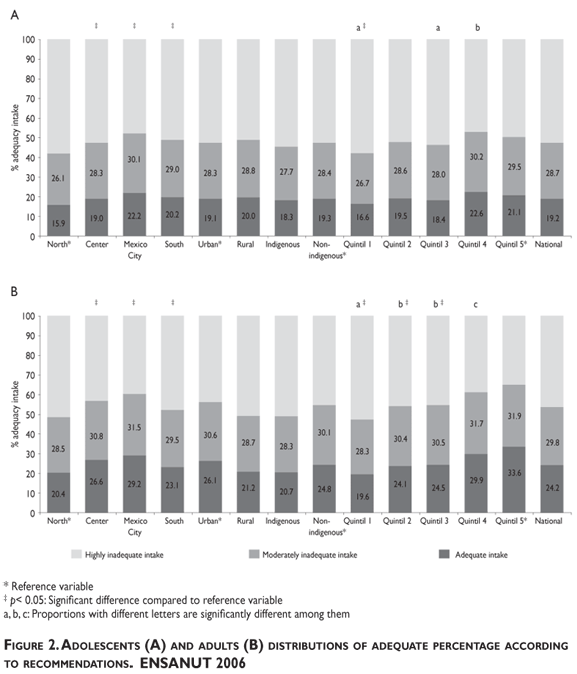
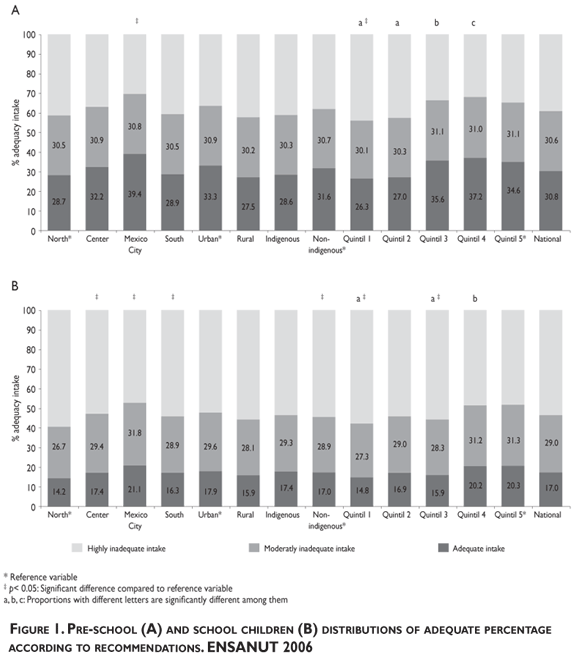
<body><![CDATA[<p><font size="2" face="Verdana"><a href="/img/revistas/spm/v51s4/a12tab01.gif">Tables I</a> and <a href="/img/revistas/spm/v51s4/a12tab02.gif">II</a> describe daily FV dietary intake    by age group, according to sociodemographic and BMI categories. In all age groups    fruit intake was substantially higher compared to vegetable intake, with 61.3    g <I>vs</I>. 26.2 g for preschool children, 68.9 g <I>vs</I>. 34.2 g for school    children, 72.9 g <I>vs</I>. 43.4 g for adolescents, and 65.8 g <I>vs</I>. 56.8    g for adults, respectively. The total amount of FV&#45;DI for each age group is    far below recommended intakes. The percentage of subjects with AI&#45;FV was: 30.8%    of preschool&#45;age children, 17.0% of school&#45;age children, 19.2% of adolescents    and 24.2% of adults.</font></p>     <p><font size="2" face="Verdana">Results on FV&#45;DI (g) as well as proportions of    the AI&#45;FV are presented below by age category.</font></p>     <p><font size="2" face="Verdana"><I>Preschool&#45;age children:</i> Children from the    northern region reported a significantly lower fruit intake compared to children    from the south (50.5 <I>vs</I>. 65.2 g, respectively; <I>p&lt;</I> 0.05). Urban    children reported a significantly higher fruit intake compared to children living    in rural settings (65.6 <I>vs</I>. 53.1 g; <I>p&lt;</I> 0.05). Fruit intake    had a progressive and significant increase from HWCI quintile 1 to 4 (49.2 g    to 85.1 g; <I>p&lt;</I> 0.05). Children aged 3 (70.5 g) and 4 (66.3g) years    old reported a significantly higher fruit intake compared to children aged 1    year old (47.5 g; <I>p&lt;</I> 0.05). </font></p>     <p><font size="2" face="Verdana">  Preschool children living in Mexico City reported    the highest vegetable intake (31.9 g) compared to the other regions of the country,    while children from the north reported a significantly lower vegetable intake    (21.3 g) compared to their counterparts from the other regions (<I>p&lt;</I>    0.05). A progressive increase in vegetable intake was observed as HWCI improved    (<I>p&lt;</I> 0.05). A significantly higher vegetable intake was observed among    children with adequate BMI (26.8 g)compared to obese children (17.3 g; p&lt;    0.05). Older children reported a significantly higher vegetable intake compared    to younger children (29.0 <I>vs</I>. 22.3 g, respectively; <I>p&lt;</I> 0.05)    (<a href="/img/revistas/spm/v51s4/a12tab01.gif">Table I</a>).</font></p>     <p><font size="2" face="Verdana">  Total AI&#45;FV followed the same pattern as FV&#45;DI.    Children from the north reported lower AI&#45;FV (28.7%) than children from Mexico    City (32.2%; p&lt; 0.05), although differences between center and south were    not statistically significant. AI&#45;FV was lower in the first two quintiles of    HWCI relative to the upper quintiles (<I>p&lt;</I> 0.05) and a trend of higher    intake with higher HWCI was evident (<a href="#fig01">Figure 1</a>). </font></p>     <p><a name="fig01"></a></p>     <p>&nbsp;</p>     <p align="center"><img src="/img/revistas/spm/v51s4/a12fig01.gif"></p>     <p>&nbsp;</p>     <p><font size="2" face="Verdana"><I>School&#45;age children:</i> Children aged 5 to    11 years living in the north present the lowest fruit intake (53.1 g) compared    to children from the other regions (<I>p&lt;</I> 0.05) and in particular to    children from Mexico City, who presented the highest fruit intake (84.    7 g; <I>p&lt;</I> 0.05). Fruit intake among children from the lowest HWCI was    the lowest (57.2 g) compared to the better&#45;off group (81.6g) (<I>p&lt;</I> 0.001)    and to the intermediate quintiles (<I>p&lt;</I> 0.05). Fruit intake in children    aged 5 years old was the highest (75.9 g) compared to children aged 9 and 11    years old which reported the lowest fruit intake (62.9g and 62.5 g, respectively,    <I>p&lt;</I> 0.08) (<a href="/img/revistas/spm/v51s4/a12tab01.gif">Table I</a>).</font></p>     ]]></body>
<body><![CDATA[<p><font size="2" face="Verdana">  Vegetable intake was significantly lower in    children living in the north (28.6 g) relative to the other three regions (<I>p&lt;</I>    0.05). Children living in Mexico City had higher intakes (49.3 g) than those    living in the north (28.6 g) and the center (32.8 g; <I>p&lt;</I> 0.05). Urban    school&#45;age children reported a significantly higher vegetable intake than rural    children (35.6 g <I>vs</I>. 31.9 g; <I>p&lt;</I> 0.05). A significant and progressive    increase in vegetable intake was observed as HWCI improved (27.0 g for quintile    1 <I>vs</I> 46.5 g for quintile 5; <I>p&lt;</I> 0.05) (<a href="/img/revistas/spm/v51s4/a12tab01.gif">Table   I</a>). </font></p>     <p><font size="2" face="Verdana">  The lowest adequacy of FV intake was reported    among children living in the north (14.2%) relative to the center, Mexico City    and the south (<I>p&lt;</I> 0.05). Indigenous children had a significantly slightly    higher AI&#45;FV compared to non&#45;indigenous children, and the difference was statistically    significant (17.4% <I>vs</I>. 17.0%, respectively; <I>p&lt;</I> 0.05). Better&#45;off    children (quintile 5) reported higher adequacy intake than worst&#45;off children    (quintiles 1 and 3; <I>p&lt;</I> 0.05) and a trend of higher intake with higher    HWCI was evident (<a href="#fig01">Figure 1</a>).</font></p>     <p><font size="2" face="Verdana"><I>Adolescents:</i> Fruit intake was substantially    lower in the north (48.7 g) compared to the other regions of the country (center,    77.2 g; Mexico City, 75.2 g; and south, 81.9g; <I>p&lt;</I> 0.05). Surprisingly,    indigenous adolescents, a group that lives in poverty, reported a significantly    higher fruit intake (87.3 g) than non&#45;indigenous adolescents (70.6 g; <I>p&lt;</I>    0.05). Eighteen year&#45;old adolescents had significantly lower intakes than adolescents    from other age groups (<I>p&lt;</I> 0.05).</font></p>     <p><font size="2" face="Verdana">  Vegetable intake in the north (35.7 g) was    significantly lower than intake in the center (44.7 g), Mexico City (50.2 g)    and the south (43.1 g; <I>p&lt;</I> 0.05). A significant and progressive increase    in vegetable intake was documented from quintile 1 (36.1 g) to quintile 4 (52.5g;    <I>p&lt;</I> 0.05) (<a href="/img/revistas/spm/v51s4/a12tab02.gif">Table II</a>). </font></p>     <p><font size="2" face="Verdana">  Adolescents from the north of the country    reported lower adequacy of FV intake (15.9%; <I>p&lt;</I> 0.05) compared to    adolescents from the other regions (center, 19.0%; Mexico City, 22.2%; and the    south, 20.2%). Adolescents from quintile 1 (16.6%) reported lower AI&#45;FV relative to    adolescents from quintile 4 (22.6%) and 5 (21.1%; <I>p&lt;</I> 0.05) (<a href="#fig02">Figure   2</a>).</font></p>     <p><a name="fig02"></a></p>     <p>&nbsp;</p>     <p align="center"><img src="/img/revistas/spm/v51s4/a12fig02.gif"></p>     <p>&nbsp;</p>     <p><font size="2" face="Verdana"><I>Adults:</i> Fruit intake was significantly lower    in subjects living in the north (45.7 g) compared to the other regions of the    country (<I>p</I> &lt;center, 67.3 g; Mexico City, 68.2 g; and south, 75.9 g;    <I>p&lt;</I> 0.05). Fruit intake significantly and progressively increased from    quintile 1 (55.4 g) to 5 (101.9 g). All differences with the highest quintile    were statistically significant (<I>p&lt;</I> 0.05). Overweight subjects consumed    a significantly higher fruit intake than obese adults (74.1 g <I>vs</I>. 61.9    g, respectively; <I>p&lt;</I> 0.05). A significantly higher intake of fruit    was observed among women (75.5 g) compared to men (52.3 g; <I>p&lt;</I> 0.05).    Fruit intake significantly and progressively increased with age (19 to 29 years    old, 53.4 g; 30 to 39 years old, 69 g; 40 to 59 years old, 74.1 g). Differences    between the youngest and all other groups were statistically significant (<I>p&lt;</I>    0.05) (<a href="/img/revistas/spm/v51s4/a12tab02.gif">Table II</a>).</font></p>     ]]></body>
<body><![CDATA[<p><font size="2" face="Verdana">  Adults living in the north (49.9 g) reported    a significantly lower vegetable intake compared to those living in the center    (59.8 g), Mexico City (61.5 g) and the south (56.2 g; <I>p&lt;</I> 0.05). There    was a significant and progressive increase in vegetable intake form quintile    1 (43.2 g) to quintile 5 (87.2 g; <I>p&lt;</I> 0.05). Overweight adults reported    a significantly higher vegetable intake (60.5 g) than underweight adults (37.8    g; <I>p&lt;</I> 0.05). Women's vegetable intake (61.2g) was significantly higher    than men's 50.2 g; <I>p&lt;</I> 0.05). Adults aged 19 to 29 years old reported    a significantly lower vegetable intake (47.1 g) compared to older adults (<I>p&lt;</I>    0.05) and adults between 40 to 49 years old reported a significantly higher    vegetable intake compared to their counterparts (63.2 g; <I>p&lt;</I> 0.05)    (<a href="/img/revistas/spm/v51s4/a12tab02.gif">Table II</a>).</font></p>     <p><font size="2" face="Verdana">  Subjects with the lowest percentages of AI&#45;FV    were found in the north (20.4%) and in the low HWCI (19.6%); compared to their    counterparts (<I>p&lt;</I> 0.05). A clear trend of higher intake with higher    HWCI was observed (<a href="#fig02">Figure 2</a>).</font></p>     <p><font size="2" face="Verdana">In summary, the overall results show consistent    FV intake patterns across age categories for regions and wellbeing conditions.    Residents from the northern region of the country had the lowest average intake    of both fruits and vegetables compared with all other regions, for all age groups.    In general, amounts of both fruits and vegetables consumed among those in the    poor (lower HWCI) quintiles were inferior to those in the high HWCI quintiles.    An exception was fruit intake in adolescents, where no differences among HWCI    quintiles were observed. </font></p>     <p><font size="2" face="Verdana"> Differences in intakes among categories of    other variables were not consistent across age groups. Intakes in rural areas    were lower than in urban areas in children less than five years old (of both    fruits and vegetables) and in school&#45;age children (only of vegetables). In contrast,    fruit intake in adolescents was lower in urban relative to rural areas. Intakes    of both fruits and vegetables were lower at younger ages in children less than    5 years old (<u>&lt;</u> 2 years <I>vs</I>. <u>&gt;</u> 3 years) and adults (&lt; 29    years <I>vs</I>. <u>&gt;</u> 30 years) and vegetable intake was also lower in younger    adolescents (12 years <I>vs</I>. 13 and 14 years). In contrast, for adolescents,    older subjects had lower fruit intakes than younger subjects (18 years <I>vs</I>.    12, 16 and 17 years). Female adults had higher FV&#45;DI but not female children.    Intakes were similar in indigenous and non&#45;indigenous populations, with the    only exception being fruit intake, which was lower in non&#45;indigenous adolescents.    Patterns were not consistent for BMI categories. </font></p>     <p><font size="2" face="Verdana">Large percentages of subjects with highly inadequate    intakes of FV (less than 50% of the recommended intake) were observed in all    age groups. The proportions with highly inadequate intakes were about 40% in    preschool&#45;age children, between 50 and 60% in school&#45;age children and adolescents,    and between 40 and 50% in adults.</font></p>     <p>&nbsp;</p>     <p><font size="3" face="Verdana"><b>Discussion</b></font></p>     <p><font size="2" face="Verdana">This study documents a low dietary intake of    FV among the Mexican population relative to international recommendations. Low    intakes were observed both in fruits and vegetables and in all age groups, regions,    ethnic groups, wellbeing categories, urban and rural populations and both sexes.    Only 30.8% of preschool children, 17.0% of school children, 19.2% of adolescents,    and 24.2% of the adult population fulfilled the recommended intakes.</font></p>     <p><font size="2" face="Verdana"> The consistent lower intake in low wellbeing    quintiles for all subgroups studied suggests barriers to the FV&#45;DI among the    poor. Although data does not allow identification of the specific reasons for    the lower intakes among the poor, the possible reasons include lower demand    due to, for example, higher prices of fruits and vegetables per calorie relative    to energy&#45;dense low&#45;price foods, and/or to social and cultural factors linked    to poverty. Another set of potential reasons may be due to lower FV supply in    areas where poor populations live or problems of access to markets due to limitations    in transportation systems.</font></p>     <p><font size="2" face="Verdana"> Another consistent finding across all subgroups    studied was lower intake of FV in the north, adjusting for wellbeing conditions,    age and sex. This finding indicates that there are barriers to the consumption    of FV in the north, which are more likely to be in the demand rather than the    supply side, given the relative higher development and wellbeing in the north    and the fact that the differences persist after adjusting for wellbeing conditions;    they may have to do with cultural factors or with changes in food patterns as    a result of the food and nutrition transition due to modernization. An alternative    cause of lower DI&#45;FV in the north may be that the north faces climate conditions    that are less favorable for FV production relative to other regions. Studies    should be conducted to identify the reasons for the lower FV&#45;DI in the north.</font></p>     ]]></body>
<body><![CDATA[<p><font size="2" face="Verdana"> The fact that the indigenous population's    intake is generally similar to the non&#45;indigenous population, after adjusting    for wellbeing conditions, suggest that FV supply in Indigenous communities,    which are usually more isolated than non&#45;indigenous communities, is not the    main problem. It is possible that the more restricted markets in isolated indigenous    villages are compensated with local production. This finding reinforces the    hypothesis that lower intakes in certain groups are probably more related to    demand than supply.</font></p>     <p><font size="2" face="Verdana"> A peculiar finding was the fact that rural    and indigenous adolescents intake more fruits than urban and non&#45;indigenous    adolescents. Again, it is unlikely that this lower intake could be explained    by limitations in supply. It is more likely that it has to do with demand issues,    such as changes in eating patterns related to modern and urban life; for example,    eating more fast food and outside the home.</font></p>     <p><font size="2" face="Verdana"> Adult women and older adults (<u>&gt;</u> 30    years old) consumed more FV than men and than younger adults (19 to 29 years    old). This higher intake may reflect a greater interest of women and older adults    in health and healthy lifestyles or eating more frequently at home as opposed  to eating fast food or away from home.</font></p>     <p><font size="2" face="Verdana"> There was not a consistent pattern of differences    in intake among BMI categories. Although there is evidence in the literature    that low energy density diets are associated with lower risk of obesity,<SUP>3,4</SUP>    the cross&#45;sectional nature of the data in this study is not adequate to study    causal associations. In addition, several other dietary factors and physical    activity may explain energy balance. However, despite the lack of a consistent    pattern, there were two age groups &#150;children less than five years old (for vegetables)    and adults (for fruits)&#150; in which lower BMIs were associated with higher intakes.</font></p>     <p><font size="2" face="Verdana"> The discussion so far has focused on the    differences among categories of the variables studied; however, the most important    finding is the strikingly low intake of fruits and the even lower intake of    vegetables in the population as a whole. The remarkably low intakes are more    evident when the percentages of highly inadequate intakes (less than 50% of    recommended intakes) are examined. These percentages range from approximately    40 to 60% for the different age groups.</font></p>     <p><font size="2" face="Verdana"> FV&#45;DI in the preschool Mexican population    (87.5g) is comparable to low income Southeast Asian countries such as Bangladesh,    India and Nepal (94 g/person/day).<SUP>33</SUP> In the adolescent and adult    population, average consumption (116.3 g and 122.6g, respectively) would be    similar to those of countries such as Estonia, Kazakhstan, Letonia, Lithuania,    and the Russian Federation (approximately 195g/person/day). The low consumption    in school&#45;age children (103.1g) is a special case, in which no country was found    to be comparable.</font></p>     <p><font size="2" face="Verdana"> Ruel <I>et al</I>. and Rojas<I> et al. </I>report    higher average FV intake in urban than rural areas in developing countries (Burundi,    Kenya and Costa Rica).<SUP>34,35</SUP> Our findings were similar only for children.    Although rural areas could have greater access to FV in theory, given that most    of the production occurs in these areas, however consumption is usually low probably    because most of the production goes to the market and that availability of a variety    of FV is more sustainable throughout the year in urban areas.<SUP>36,37</SUP></font></p>     <p><font size="2" face="Verdana">  Another identified factor associated with    DI&#45;FV in the Mexican population was wellbeing conditions. Studies by Fou&eacute;r&eacute;    <I>et al</I>.<SUP>38</SUP> and Arimond and Ruel<SUP>39 </SUP>found that decreasing    economic income was associated with lower DI&#45;FV in Africa, Cambodia, Nepal,    Colombia, Peru and Haiti. Hatloy<SUP>40</SUP> reported that when economic income    increases in Mali, food diversity also increases, and as a consequence, intake    of FV is higher.</font></p>     <p><font size="2" face="Verdana">It was also found that adult women presented    higher DI&#45;FV relative to adult men, consistent with what has been observed in    African populations.<SUP>34</SUP> A possible explanation that has been given    is that women give FV intake a higher priority than men in order to improve    diet quality.<SUP>41</sup></font></p>     <p><font size="2" face="Verdana"> One of the possible limitations of the present    analysis is the considerable number of subjects who were lost as a result of    data cleaning and missing data (18.6% pre&#45;school children and 11.6% school children),    which could have biased the sample. Analyses were made to determine differences    between excluded and non&#45;excluded subjects in the following variables: region,    rural/urban area, ethnic background, wellbeing condition quintiles, BMI category,    sex, and age. In general, no statistically significant differences were observed    in the variables compared (<I>p</I> &gt; 0.05), except for certain particular    ages in pre&#45;school children, ethnic background, urban/rural residence and BMI    categories in school&#45;age children. A higher proportion of excluded subjects    were found at 1 and 2 years of age. Also, a greater proportion of excluded subjects    were found in the urban area, non&#45;indigenous and school&#45;age children with adequate    BMI. For adults and adolescents, the proportions not included in the analysis    (3.4% and 4.2%, respectively) were lower than for children.</font></p>     ]]></body>
<body><![CDATA[<p><font size="2" face="Verdana">There were no estimations of FV intake at the    national level before this study. The data analyzed comes from the ENSANUT 2006,    which was designed to be representative at national, regional and state levels    and by urban and rural areas. Since we excluded foods with high starch content    like tubers or pulses, which are high in energy density and protein, our results    do not overestimate FV intake as could be the case of other studies<SUP>43,44</SUP>    where pulses, potatoes and potato chips were considered as vegetables.</font></p>     <p><font size="2" face="Verdana"> In order to evaluate AI&#45;FV in the pre&#45;school    and school population, recommendations from the AHA were adopted. One limitation    of this recommendation is that they were made for children from the United States    and not for Mexican children. The adult recommendations may be more appropriate    since they were made by WHO considering a more international scope.</font></p>     <p><font size="2" face="Verdana"> One limitation of the data is that it does    not provide information as to the form in which FV were prepared for consumption.    Identifying if FV were fried, boiled or dressed or raw would be important in    different studies, as healthy FV could be fried or consumed along with high    energy density foods like butter, mayonnaise, and other dressings.</font></p>     <p><font size="2" face="Verdana"> In conclusion, FV intake in the Mexican population    was much lower than recommended intakes in all age groups and, particularly,    in the school&#45;age and adolescent population. Vegetable intake was much lower    than fruit intake. Fruit intake was 2 to 5 times higher than vegetable intake    in the different groups, with the highest differences in school&#45;age children    and adolescents. In general, the population living in the northern region and    lowest HWCI were the subgroups having the lowest intakes and the lowest compliances    with recommended intakes of FV. Some subgroups had higher FV&#45;DI, such as the    population living in Mexico City and those classified in the highest HWCI; unfortunately    this consumption did not reach average recommended intakes and even in these    subgroups the percentages of individuals who complied with recommendations were    in all cases less than 35%.</font></p>     <p><font size="2" face="Verdana"> Research is needed to better understand the    reasons for the general low intakes and in certain subgroups. Using the results    of this research, the development and implementation of programs, strategies    and policies aimed at improving FV intake in the different population groups    is recommended. This could be done through: a) information and communication    strategies aimed at improving food preferences towards a higher intake of FV    in all age groups, and b) improving the availability and lowering the prices    of these foods for lower income households as needed. Particular programs should    be developed in schools to increase the availability and intake of fruits and    to create a new culture of FV consumption in the new generations.</font></p>     <p>&nbsp;</p>     <p><font size="3" face="Verdana"><b>References</b></font></p>     <!-- ref --><p><font size="2" face="Verdana">1. Agudo A. Measuring intake of fruit and vegetables.    Geneva: WHO, 2005.    &nbsp;&nbsp;&nbsp;&nbsp;&nbsp;&nbsp;&nbsp;&nbsp;[&#160;<a href="javascript:void(0);" onclick="javascript: window.open('/scielo.php?script=sci_nlinks&ref=9335480&pid=S0036-3634200900100001200001&lng=','','width=640,height=500,resizable=yes,scrollbars=1,menubar=yes,');">Links</a>&#160;]<!-- end-ref --></font></p>     <!-- ref --><p><font size="2" face="Verdana">2. World Cancer Research Fund/American Institute    for Cancer Research. Fruit and vegetables. Handbook of cancer prevention. London:    WCRF, Washington DC: AICR, 2003: 8.    &nbsp;&nbsp;&nbsp;&nbsp;&nbsp;&nbsp;&nbsp;&nbsp;[&#160;<a href="javascript:void(0);" onclick="javascript: window.open('/scielo.php?script=sci_nlinks&ref=9335482&pid=S0036-3634200900100001200002&lng=','','width=640,height=500,resizable=yes,scrollbars=1,menubar=yes,');">Links</a>&#160;]<!-- end-ref --></font></p>     <!-- ref --><p><font size="2" face="Verdana">3. World Health Organization. Fruit, Vegetables    and NCD disease prevention. Global, strategy on diet, physical activity and    health. Geneva: WHO, 2002.    &nbsp;&nbsp;&nbsp;&nbsp;&nbsp;&nbsp;&nbsp;&nbsp;[&#160;<a href="javascript:void(0);" onclick="javascript: window.open('/scielo.php?script=sci_nlinks&ref=9335484&pid=S0036-3634200900100001200003&lng=','','width=640,height=500,resizable=yes,scrollbars=1,menubar=yes,');">Links</a>&#160;]<!-- end-ref --></font></p>     <!-- ref --><p><font size="2" face="Verdana">4. Biing&#45;Hwan L, Mentzer&#45;Morrison R. Higher fruit    consumption linked with lower body mass index. Food Rev 2003;25(3):28&#45;32.    &nbsp;&nbsp;&nbsp;&nbsp;&nbsp;&nbsp;&nbsp;&nbsp;[&#160;<a href="javascript:void(0);" onclick="javascript: window.open('/scielo.php?script=sci_nlinks&ref=9335486&pid=S0036-3634200900100001200004&lng=','','width=640,height=500,resizable=yes,scrollbars=1,menubar=yes,');">Links</a>&#160;]<!-- end-ref --></font></p>     <!-- ref --><p><font size="2" face="Verdana">5. Lahti&#45;Koski M, Pietinen P, Heli&ouml;vaara    M,Vartiainen E. Associations of body mass index and obesity with physical activity,    food choices, alcohol intake, and smoking in the 1982&#45;1997 FINRISK Studies.    Am J Clin Nutr 2002;75:809&#45;817.    &nbsp;&nbsp;&nbsp;&nbsp;&nbsp;&nbsp;&nbsp;&nbsp;[&#160;<a href="javascript:void(0);" onclick="javascript: window.open('/scielo.php?script=sci_nlinks&ref=9335488&pid=S0036-3634200900100001200005&lng=','','width=640,height=500,resizable=yes,scrollbars=1,menubar=yes,');">Links</a>&#160;]<!-- end-ref --></font></p>     <!-- ref --><p><font size="2" face="Verdana">6. Carlton&#45;Tohill B. Dietary intake of fruit    and vegetables and management of body weight. Geneva: WHO, 2005.    &nbsp;&nbsp;&nbsp;&nbsp;&nbsp;&nbsp;&nbsp;&nbsp;[&#160;<a href="javascript:void(0);" onclick="javascript: window.open('/scielo.php?script=sci_nlinks&ref=9335490&pid=S0036-3634200900100001200006&lng=','','width=640,height=500,resizable=yes,scrollbars=1,menubar=yes,');">Links</a>&#160;]<!-- end-ref --></font></p>     <!-- ref --><p><font size="2" face="Verdana">7. Hu FB. Plant&#45;based foods and prevention of    cardiovascular disease: an overview. Am J Clin Nutr 2003;78:544S&#45;551S.    &nbsp;&nbsp;&nbsp;&nbsp;&nbsp;&nbsp;&nbsp;&nbsp;[&#160;<a href="javascript:void(0);" onclick="javascript: window.open('/scielo.php?script=sci_nlinks&ref=9335492&pid=S0036-3634200900100001200007&lng=','','width=640,height=500,resizable=yes,scrollbars=1,menubar=yes,');">Links</a>&#160;]<!-- end-ref --></font></p>     <!-- ref --><p><font size="2" face="Verdana">8. World Health Organization. Globalization,    Diets and Noncommunicable Diseases. Dietary Transition in Developing Countries:    Challenges for Chronic Disease Prevention. Geneva: WHO, 2002.    &nbsp;&nbsp;&nbsp;&nbsp;&nbsp;&nbsp;&nbsp;&nbsp;[&#160;<a href="javascript:void(0);" onclick="javascript: window.open('/scielo.php?script=sci_nlinks&ref=9335494&pid=S0036-3634200900100001200008&lng=','','width=640,height=500,resizable=yes,scrollbars=1,menubar=yes,');">Links</a>&#160;]<!-- end-ref --></font></p>     <!-- ref --><p><FONT size="2" FACE="Verdana">9. Joshipura KJ, Ascherio A, Manson JE, Stampfer    MJ, Rimm EB, Speizer FE, <I>et al</I>. Fruit and vegetable intake in relation    to risk of ischemic stroke. JAMA 1999;282:1233&#45;1239.    &nbsp;&nbsp;&nbsp;&nbsp;&nbsp;&nbsp;&nbsp;&nbsp;[&#160;<a href="javascript:void(0);" onclick="javascript: window.open('/scielo.php?script=sci_nlinks&ref=9335496&pid=S0036-3634200900100001200009&lng=','','width=640,height=500,resizable=yes,scrollbars=1,menubar=yes,');">Links</a>&#160;]<!-- end-ref --></font></p>     <!-- ref --><p><font size="2" face="Verdana">10. Bazzano L. Dietary intake of fruit and vegetables    and risk of diabetes mellitus and cardiovascular diseases. Geneva: WHO, 2005.    &nbsp;&nbsp;&nbsp;&nbsp;&nbsp;&nbsp;&nbsp;&nbsp;[&#160;<a href="javascript:void(0);" onclick="javascript: window.open('/scielo.php?script=sci_nlinks&ref=9335498&pid=S0036-3634200900100001200010&lng=','','width=640,height=500,resizable=yes,scrollbars=1,menubar=yes,');">Links</a>&#160;]<!-- end-ref --></font></p>     <!-- ref --><p><FONT size="2" FACE="Verdana">11. Giacco R, Parillo M, Rivellese A, Lasorella    G, GIiacco A, D'episcopo L, <I>et al</I>. Long&#45;term dietary treatment with increased    amounts of fiber&#45;rich low&#45;glycemic index natural foods improves blood glucose    control and reduces the number of hypoglycemic events in type 1 diabetic patients.    Diabetes Care 2000;23(10):1461&#45;1466.    &nbsp;&nbsp;&nbsp;&nbsp;&nbsp;&nbsp;&nbsp;&nbsp;[&#160;<a href="javascript:void(0);" onclick="javascript: window.open('/scielo.php?script=sci_nlinks&ref=9335500&pid=S0036-3634200900100001200011&lng=','','width=640,height=500,resizable=yes,scrollbars=1,menubar=yes,');">Links</a>&#160;]<!-- end-ref --></font></p>     <!-- ref --><p><font size="2" face="Verdana">12. World Cancer Research Fund / American Institute    for Cancer Research. Food, nutrition, physical activity, and the prevention    of cancer: a global perpective. Washington, DC: AICR, 2007.    &nbsp;&nbsp;&nbsp;&nbsp;&nbsp;&nbsp;&nbsp;&nbsp;[&#160;<a href="javascript:void(0);" onclick="javascript: window.open('/scielo.php?script=sci_nlinks&ref=9335502&pid=S0036-3634200900100001200012&lng=','','width=640,height=500,resizable=yes,scrollbars=1,menubar=yes,');">Links</a>&#160;]<!-- end-ref --></font></p>     <!-- ref --><p><font size="2" face="Verdana">13. Barquera S. Prevenci&oacute;n de la diabetes    mellitus: un problema mundial. Salud Publica Mex 2003;45:413&#45;414.    &nbsp;&nbsp;&nbsp;&nbsp;&nbsp;&nbsp;&nbsp;&nbsp;[&#160;<a href="javascript:void(0);" onclick="javascript: window.open('/scielo.php?script=sci_nlinks&ref=9335504&pid=S0036-3634200900100001200013&lng=','','width=640,height=500,resizable=yes,scrollbars=1,menubar=yes,');">Links</a>&#160;]<!-- end-ref --></font></p>     <!-- ref --><p><FONT size="2" FACE="Verdana">14. Olaiz G, Rojas R, Barquera S, Shamah T, Aguilar    C, Cravioto P, <I>et al</I>. Encuesta Nacional de Salud 2000. Cuernavaca, Morelos,    M&eacute;xico: Instituto Nacional de Salud P&uacute;blica, 2000.    &nbsp;&nbsp;&nbsp;&nbsp;&nbsp;&nbsp;&nbsp;&nbsp;[&#160;<a href="javascript:void(0);" onclick="javascript: window.open('/scielo.php?script=sci_nlinks&ref=9335506&pid=S0036-3634200900100001200014&lng=','','width=640,height=500,resizable=yes,scrollbars=1,menubar=yes,');">Links</a>&#160;]<!-- end-ref --></font></p>     <!-- ref --><p><font size="2" face="Verdana">15. World Health Organization. Obesity: Preventing    and Managing the Global Epidemic. Geneva: WHO, 2000.    &nbsp;&nbsp;&nbsp;&nbsp;&nbsp;&nbsp;&nbsp;&nbsp;[&#160;<a href="javascript:void(0);" onclick="javascript: window.open('/scielo.php?script=sci_nlinks&ref=9335508&pid=S0036-3634200900100001200015&lng=','','width=640,height=500,resizable=yes,scrollbars=1,menubar=yes,');">Links</a>&#160;]<!-- end-ref --></font></p>     <!-- ref --><p><font size="2" face="Verdana">16. Bermudez OI, Tucker KL. Trends in dietary    patterns of Latin American populations. Cad Saude Publica 2003; suppl 1:S87&#45;S99.    &nbsp;&nbsp;&nbsp;&nbsp;&nbsp;&nbsp;&nbsp;&nbsp;[&#160;<a href="javascript:void(0);" onclick="javascript: window.open('/scielo.php?script=sci_nlinks&ref=9335510&pid=S0036-3634200900100001200016&lng=','','width=640,height=500,resizable=yes,scrollbars=1,menubar=yes,');">Links</a>&#160;]<!-- end-ref --></font></p>     <!-- ref --><p><FONT size="2" FACE="Verdana">17. Torheim LE, Ouattara F, Diarra MM, Thiam    FD, Barikmo I, Hatloy A, <I>et al</I>. Nutrient adequacy and dietary diversity    in rural Mali: association and determinants. Eur J Clin Nutr 2004;58:594&#45;604.    &nbsp;&nbsp;&nbsp;&nbsp;&nbsp;&nbsp;&nbsp;&nbsp;[&#160;<a href="javascript:void(0);" onclick="javascript: window.open('/scielo.php?script=sci_nlinks&ref=9335512&pid=S0036-3634200900100001200017&lng=','','width=640,height=500,resizable=yes,scrollbars=1,menubar=yes,');">Links</a>&#160;]<!-- end-ref --></font></p>     <!-- ref --><p><font size="2" face="Verdana">18. Pollack SL. Consumer Demand for Fruit and    Vegetables: The U.S. Example. Washington, DC: Economic Research Service/USDA,    Changing Structure of Global Food Consumption and Trade, 2001: 49&#45;54.    &nbsp;&nbsp;&nbsp;&nbsp;&nbsp;&nbsp;&nbsp;&nbsp;[&#160;<a href="javascript:void(0);" onclick="javascript: window.open('/scielo.php?script=sci_nlinks&ref=9335514&pid=S0036-3634200900100001200018&lng=','','width=640,height=500,resizable=yes,scrollbars=1,menubar=yes,');">Links</a>&#160;]<!-- end-ref --> </font></p>     <!-- ref --><p><font size="2" face="Verdana">19. Rasmussen M, Kr&oslash;lner R, Klepp K, Lytle    L. Determinants of fruit and vegetable consumption among children and adolescents:    a review of the literature. Part I: quantitative studies. Int J Behav Nutr Phys    Act 2006;3:22.    &nbsp;&nbsp;&nbsp;&nbsp;&nbsp;&nbsp;&nbsp;&nbsp;[&#160;<a href="javascript:void(0);" onclick="javascript: window.open('/scielo.php?script=sci_nlinks&ref=9335516&pid=S0036-3634200900100001200019&lng=','','width=640,height=500,resizable=yes,scrollbars=1,menubar=yes,');">Links</a>&#160;]<!-- end-ref --></font></p>     <!-- ref --><p><FONT size="2" FACE="Verdana">20. Barquera S, Bernier R, Bouchard C, Bush M,    Drewnowsky A, Lee J, <I>et al</I>. Understanding and overcoming obesity: The    need for action. Cuernavaca, Mexico: Instituto Nacional de Salud P&uacute;blica,    2005.    &nbsp;&nbsp;&nbsp;&nbsp;&nbsp;&nbsp;&nbsp;&nbsp;[&#160;<a href="javascript:void(0);" onclick="javascript: window.open('/scielo.php?script=sci_nlinks&ref=9335518&pid=S0036-3634200900100001200020&lng=','','width=640,height=500,resizable=yes,scrollbars=1,menubar=yes,');">Links</a>&#160;]<!-- end-ref --></font></p>     <!-- ref --><p><font size="2" face="Verdana">21. Shamah&#45;Levy T, Villalpando&#45;Hern&aacute;ndez    S, Rivera&#45;Dommarco JA. Resultados de Nutrici&oacute;n de la ENSANUT 2006. Cuernavaca,    Mexico: Instituto Nacional de Salud P&uacute;blica, 2007.    &nbsp;&nbsp;&nbsp;&nbsp;&nbsp;&nbsp;&nbsp;&nbsp;[&#160;<a href="javascript:void(0);" onclick="javascript: window.open('/scielo.php?script=sci_nlinks&ref=9335520&pid=S0036-3634200900100001200021&lng=','','width=640,height=500,resizable=yes,scrollbars=1,menubar=yes,');">Links</a>&#160;]<!-- end-ref --></font></p>     <!-- ref --><p><font size="2" face="Verdana">22. Rodr&iacute;guez&#45; Ram&iacute;rez S, Mundo&#45;    Rosas V, Jim&eacute;nez&#45; Aguilar A, Shamah&#45; Levy T. Methodology for the analysis    of dietary data from the National Health and Nutrition Survey 2006. Salud Publica    Mex 2009;51.    &nbsp;&nbsp;&nbsp;&nbsp;&nbsp;&nbsp;&nbsp;&nbsp;[&#160;<a href="javascript:void(0);" onclick="javascript: window.open('/scielo.php?script=sci_nlinks&ref=9335522&pid=S0036-3634200900100001200022&lng=','','width=640,height=500,resizable=yes,scrollbars=1,menubar=yes,');">Links</a>&#160;]<!-- end-ref --></font></p>     <!-- ref --><p><font size="2" face="Verdana">23. Lohman T, Roche AF, Martorell R. Anthropometric    Standardization Reference Manual. Champaign(IL): Human Kinetics Books, 1991.    &nbsp;&nbsp;&nbsp;&nbsp;&nbsp;&nbsp;&nbsp;&nbsp;[&#160;<a href="javascript:void(0);" onclick="javascript: window.open('/scielo.php?script=sci_nlinks&ref=9335524&pid=S0036-3634200900100001200023&lng=','','width=640,height=500,resizable=yes,scrollbars=1,menubar=yes,');">Links</a>&#160;]<!-- end-ref --></font></p>     <!-- ref --><p><font size="2" face="Verdana">24. Habicht JP. Standardization of quantitative    epidemiological methods in the field. Bol Oficina Sanit Panam 1974;76(5):375&#45;384.    &nbsp;&nbsp;&nbsp;&nbsp;&nbsp;&nbsp;&nbsp;&nbsp;[&#160;<a href="javascript:void(0);" onclick="javascript: window.open('/scielo.php?script=sci_nlinks&ref=9335526&pid=S0036-3634200900100001200024&lng=','','width=640,height=500,resizable=yes,scrollbars=1,menubar=yes,');">Links</a>&#160;]<!-- end-ref --></font></p>     <!-- ref --><p><font size="2" face="Verdana">25. World Health Organization. Child Growth Standards    based on length/height, weight and age. Acta Paediatr 2006;450 Suppl:S76&#45;S85.    &nbsp;&nbsp;&nbsp;&nbsp;&nbsp;&nbsp;&nbsp;&nbsp;[&#160;<a href="javascript:void(0);" onclick="javascript: window.open('/scielo.php?script=sci_nlinks&ref=9335528&pid=S0036-3634200900100001200025&lng=','','width=640,height=500,resizable=yes,scrollbars=1,menubar=yes,');">Links</a>&#160;]<!-- end-ref --></font></p>     <!-- ref --><p><FONT size="2" FACE="Verdana">26. World Health Organization. WHO Anthro 2005    software and macros. Geneva: WHO, 2006. &#91;Consulted on 2007 Dec 10&#93;. Available    at: <a href="http://www.who.int/childgrowth/software/en/" target="_blank">http://www.who.int/childgrowth/software/en/</a>.    &nbsp;&nbsp;&nbsp;&nbsp;&nbsp;&nbsp;&nbsp;&nbsp;[&#160;<a href="javascript:void(0);" onclick="javascript: window.open('/scielo.php?script=sci_nlinks&ref=9335530&pid=S0036-3634200900100001200026&lng=','','width=640,height=500,resizable=yes,scrollbars=1,menubar=yes,');">Links</a>&#160;]<!-- end-ref --></font></p>     <!-- ref --><p><FONT size="2" FACE="Verdana"> 27. Tam CS, Garnett SP, Cowell CT, Campbell    K, Cabrera G, Baur LA. Soft drink consumption and excess weight gain in Australian    school students: Results from the Nepean study. Int J Obes 2006;30(7):1091&#45;1093.    &nbsp;&nbsp;&nbsp;&nbsp;&nbsp;&nbsp;&nbsp;&nbsp;[&#160;<a href="javascript:void(0);" onclick="javascript: window.open('/scielo.php?script=sci_nlinks&ref=9335532&pid=S0036-3634200900100001200027&lng=','','width=640,height=500,resizable=yes,scrollbars=1,menubar=yes,');">Links</a>&#160;]<!-- end-ref --></font></p>     <!-- ref --><p><font size="2" face="Verdana">28. Sanigorski AM, Bell AC. Association of key    foods and beverages with obesity in Australian schoolchildren. Public Health    Nutr 2007;10(2): 152&#45;157.    &nbsp;&nbsp;&nbsp;&nbsp;&nbsp;&nbsp;&nbsp;&nbsp;[&#160;<a href="javascript:void(0);" onclick="javascript: window.open('/scielo.php?script=sci_nlinks&ref=9335534&pid=S0036-3634200900100001200028&lng=','','width=640,height=500,resizable=yes,scrollbars=1,menubar=yes,');">Links</a>&#160;]<!-- end-ref --></font></p>     <!-- ref --><p><font size="2" face="Verdana">29. Bazzano LA, Tricia YL, Joshipura KJ, Hu FB.    Fruit and vegetable intake and risk of diabetes in women. Boston: Harvard University Department    of Nutrition, 2007.    &nbsp;&nbsp;&nbsp;&nbsp;&nbsp;&nbsp;&nbsp;&nbsp;[&#160;<a href="javascript:void(0);" onclick="javascript: window.open('/scielo.php?script=sci_nlinks&ref=9335536&pid=S0036-3634200900100001200029&lng=','','width=640,height=500,resizable=yes,scrollbars=1,menubar=yes,');">Links</a>&#160;]<!-- end-ref --></font></p>     <!-- ref --><p><FONT size="2" FACE="Verdana">30. Gidding SS, Dennison BA, Birch LL, Daniels    SR, Gillman MW, Lichtenstein AH, et al. American Heart Association. Dietary    recommendations for children and adolescents: a guide for practitioners. Pediatrics    2006;117(2):544&#45;559.    &nbsp;&nbsp;&nbsp;&nbsp;&nbsp;&nbsp;&nbsp;&nbsp;[&#160;<a href="javascript:void(0);" onclick="javascript: window.open('/scielo.php?script=sci_nlinks&ref=9335538&pid=S0036-3634200900100001200030&lng=','','width=640,height=500,resizable=yes,scrollbars=1,menubar=yes,');">Links</a>&#160;]<!-- end-ref --></font></p>     <!-- ref --><p><font size="2" face="Verdana">31. World Health Organization/Food and Agriculture    Organization. Dieta, nutrici&oacute;n y prevenci&oacute;n de enfermedades cr&oacute;nicas.    Geneva: WHO/FAO, 2003. Serie de informes t&eacute;cnicos 916.    &nbsp;&nbsp;&nbsp;&nbsp;&nbsp;&nbsp;&nbsp;&nbsp;[&#160;<a href="javascript:void(0);" onclick="javascript: window.open('/scielo.php?script=sci_nlinks&ref=9335540&pid=S0036-3634200900100001200031&lng=','','width=640,height=500,resizable=yes,scrollbars=1,menubar=yes,');">Links</a>&#160;]<!-- end-ref --> </font></p>     <!-- ref --><p><font size="2" face="Verdana">32. Cole TJ, Bellizzi MC, Flegal KM, Dietz WH.    Establishing a standard definition for child overweight and obesity worldwide:    International survey. BMJ 2000;320:1240&#45;1243.    &nbsp;&nbsp;&nbsp;&nbsp;&nbsp;&nbsp;&nbsp;&nbsp;[&#160;<a href="javascript:void(0);" onclick="javascript: window.open('/scielo.php?script=sci_nlinks&ref=9335542&pid=S0036-3634200900100001200032&lng=','','width=640,height=500,resizable=yes,scrollbars=1,menubar=yes,');">Links</a>&#160;]<!-- end-ref --></font></p>     <!-- ref --><p><FONT size="2" FACE="Verdana">33. Lock K, Pomerleau J, Causer L, Altmenn D,    Mckee M. The global burden of disease attributable to low consumption of fruit    and vegetables: implications for the global strategy on diet. Bull World Health    Organ 2005;83(2):100&#45;108.    &nbsp;&nbsp;&nbsp;&nbsp;&nbsp;&nbsp;&nbsp;&nbsp;[&#160;<a href="javascript:void(0);" onclick="javascript: window.open('/scielo.php?script=sci_nlinks&ref=9335544&pid=S0036-3634200900100001200033&lng=','','width=640,height=500,resizable=yes,scrollbars=1,menubar=yes,');">Links</a>&#160;]<!-- end-ref --></font></p>     <!-- ref --><p><font size="2" face="Verdana">34. Ruel MT, Minot N,Smith L. Paterns and determinants    of fruit and vegetable consumption in sub&#45;Saharian Africa: a multi&#45;country comparison.    Geneva: WHO, 2005.    &nbsp;&nbsp;&nbsp;&nbsp;&nbsp;&nbsp;&nbsp;&nbsp;[&#160;<a href="javascript:void(0);" onclick="javascript: window.open('/scielo.php?script=sci_nlinks&ref=9335546&pid=S0036-3634200900100001200034&lng=','','width=640,height=500,resizable=yes,scrollbars=1,menubar=yes,');">Links</a>&#160;]<!-- end-ref --></font></p>     <!-- ref --><p><font size="2" face="Verdana">35. Rojas R. Fruits and vegetables consumption    among Costa Rican adolescents. Arch Latinoam Nutr 2001;51:81&#45;85.    &nbsp;&nbsp;&nbsp;&nbsp;&nbsp;&nbsp;&nbsp;&nbsp;[&#160;<a href="javascript:void(0);" onclick="javascript: window.open('/scielo.php?script=sci_nlinks&ref=9335548&pid=S0036-3634200900100001200035&lng=','','width=640,height=500,resizable=yes,scrollbars=1,menubar=yes,');">Links</a>&#160;]<!-- end-ref --></font></p>     <!-- ref --><p><font size="2" face="Verdana">36. Solomons N, Gross R. Urban nutrition in developing    countries. Nutr Rev 1995;53:90&#45;95.    &nbsp;&nbsp;&nbsp;&nbsp;&nbsp;&nbsp;&nbsp;&nbsp;[&#160;<a href="javascript:void(0);" onclick="javascript: window.open('/scielo.php?script=sci_nlinks&ref=9335550&pid=S0036-3634200900100001200036&lng=','','width=640,height=500,resizable=yes,scrollbars=1,menubar=yes,');">Links</a>&#160;]<!-- end-ref --></font></p>     <!-- ref --><p><font size="2" face="Verdana">37. Delisle H. Patterns of urban food consumption    in developing countries: perspective from the 1980's, In: Food Policy and Nutrition    Division, FAO, ed. Rome: Food and Agricultural Organization, 1990.    &nbsp;&nbsp;&nbsp;&nbsp;&nbsp;&nbsp;&nbsp;&nbsp;[&#160;<a href="javascript:void(0);" onclick="javascript: window.open('/scielo.php?script=sci_nlinks&ref=9335552&pid=S0036-3634200900100001200037&lng=','','width=640,height=500,resizable=yes,scrollbars=1,menubar=yes,');">Links</a>&#160;]<!-- end-ref --></font></p>     <!-- ref --><p><font size="2" face="Verdana">38. Fou&eacute;r&eacute; T, Maire B, Delpeuch    F, Martin&#45;Pr&eacute;vel Y, Tchibindat F, Adoua&#45;Oyila G. Dietary changes in African    urban households in response to currency devaluation: foreseeable risks for    health and nutrition. Public Health Nutr 2000;3:293&#45;301.    &nbsp;&nbsp;&nbsp;&nbsp;&nbsp;&nbsp;&nbsp;&nbsp;[&#160;<a href="javascript:void(0);" onclick="javascript: window.open('/scielo.php?script=sci_nlinks&ref=9335554&pid=S0036-3634200900100001200038&lng=','','width=640,height=500,resizable=yes,scrollbars=1,menubar=yes,');">Links</a>&#160;]<!-- end-ref --></font></p>     <!-- ref --><p><font size="2" face="Verdana">39. Arimond M, Ruel TM. Dietary Diversity, Dietary    Quality and Child BMI categories: Evidence from Eleven Demographic and Health    Surveys. Washington, DC: Food and Nutritional Technical Assistance Project (FANTA),    2004.    &nbsp;&nbsp;&nbsp;&nbsp;&nbsp;&nbsp;&nbsp;&nbsp;[&#160;<a href="javascript:void(0);" onclick="javascript: window.open('/scielo.php?script=sci_nlinks&ref=9335556&pid=S0036-3634200900100001200039&lng=','','width=640,height=500,resizable=yes,scrollbars=1,menubar=yes,');">Links</a>&#160;]<!-- end-ref --></font></p>     <!-- ref --><p><font size="2" face="Verdana">40. Hatloy A, Hallund J, Diarra MM, Oshaug A.    Food variety, socioeconomic status and BMI categories in urban and rural areas    in Koutiala (Mali). Public Health Nutr 2000;3:57&#45;65.    &nbsp;&nbsp;&nbsp;&nbsp;&nbsp;&nbsp;&nbsp;&nbsp;[&#160;<a href="javascript:void(0);" onclick="javascript: window.open('/scielo.php?script=sci_nlinks&ref=9335558&pid=S0036-3634200900100001200040&lng=','','width=640,height=500,resizable=yes,scrollbars=1,menubar=yes,');">Links</a>&#160;]<!-- end-ref --></font></p>     <!-- ref --><p><font size="2" face="Verdana">41. Smith L. The importance of women's status    for child nutrition in developing countries. Washington, DC: International Food    Policy Research Institute, 2003.    &nbsp;&nbsp;&nbsp;&nbsp;&nbsp;&nbsp;&nbsp;&nbsp;[&#160;<a href="javascript:void(0);" onclick="javascript: window.open('/scielo.php?script=sci_nlinks&ref=9335560&pid=S0036-3634200900100001200041&lng=','','width=640,height=500,resizable=yes,scrollbars=1,menubar=yes,');">Links</a>&#160;]<!-- end-ref --></font></p>     <!-- ref --><p><font size="2" face="Verdana">42. Bazzano L. Dietary intake of fruit and vegetables    and risk of diabetes mellitus and cardiovascular diseases. Geneva: WHO, 2005.    &nbsp;&nbsp;&nbsp;&nbsp;&nbsp;&nbsp;&nbsp;&nbsp;[&#160;<a href="javascript:void(0);" onclick="javascript: window.open('/scielo.php?script=sci_nlinks&ref=9335562&pid=S0036-3634200900100001200042&lng=','','width=640,height=500,resizable=yes,scrollbars=1,menubar=yes,');">Links</a>&#160;]<!-- end-ref --></font></p>     <!-- ref --><p><FONT size="2" FACE="Verdana">43. Gillman MW, Cupples LA, Gagnon D, Posner    BM, Ellison RC, Castelli WP, <I>et al</I>. Protective effect of fruits and vegetables    on development of stroke in men. JAMA 1995;273:1113&#45;1117.    &nbsp;&nbsp;&nbsp;&nbsp;&nbsp;&nbsp;&nbsp;&nbsp;[&#160;<a href="javascript:void(0);" onclick="javascript: window.open('/scielo.php?script=sci_nlinks&ref=9335564&pid=S0036-3634200900100001200043&lng=','','width=640,height=500,resizable=yes,scrollbars=1,menubar=yes,');">Links</a>&#160;]<!-- end-ref --></font></p>     <!-- ref --><p><font size="2" face="Verdana">44. Steffen LM, Jacobs DR Jr, Stevens J, Shahar      E, Carithers T, Folsom AR. Associations of whole&#45;grain, refined&#45;grain, and     fruit  and vegetable consumption with risks of all&#45;cause mortality and incident     coronary  artery disease and ischemic stroke: the Atherosclerosis Risk in     Communities  (ARIC) Study. Am J Clin Nutr 2003;78:383&#45;390.    &nbsp;&nbsp;&nbsp;&nbsp;&nbsp;&nbsp;&nbsp;&nbsp;[&#160;<a href="javascript:void(0);" onclick="javascript: window.open('/scielo.php?script=sci_nlinks&ref=9335566&pid=S0036-3634200900100001200044&lng=','','width=640,height=500,resizable=yes,scrollbars=1,menubar=yes,');">Links</a>&#160;]<!-- end-ref --></font></p>     <p>&nbsp;</p>     <p>&nbsp;</p>     <p><FONT size="2" FACE="Verdana">Received on: April 11, 2008    <br>   Accepted on: April 28, 2009</font></p>     <p>&nbsp;</p>     ]]></body>
<body><![CDATA[<p>&nbsp;</p>     <p><font size="2" face="Verdana">Address       reprint requests to: Dr. Juan A. Rivera Dommarco.   Instituto Nacional de Salud P&uacute;blica. Av. Universidad 655,   col. Santa Mar&iacute;a Ahuacatitl&aacute;n. 62100 Cuernavaca, Morelos, M&eacute;xico. E&#45;mail: <a href="mailto:jrivera@correo.insp.mx ">jrivera@correo.insp.mx</a></font></p>      ]]></body><back>
<ref-list>
<ref id="B1">
<label>1</label><nlm-citation citation-type="book">
<person-group person-group-type="author">
<name>
<surname><![CDATA[Agudo]]></surname>
<given-names><![CDATA[A]]></given-names>
</name>
</person-group>
<source><![CDATA[Measuring intake of fruit and vegetables]]></source>
<year>2005</year>
<publisher-loc><![CDATA[Geneva ]]></publisher-loc>
<publisher-name><![CDATA[WHO]]></publisher-name>
</nlm-citation>
</ref>
<ref id="B2">
<label>2</label><nlm-citation citation-type="book">
<collab>World Cancer Research Fund</collab>
<collab>American Institute for Cancer Research</collab>
<source><![CDATA[Fruit and vegetables: Handbook of cancer prevention]]></source>
<year>2003</year>
<page-range>8</page-range><publisher-loc><![CDATA[London^eDCWashington DC]]></publisher-loc>
<publisher-name><![CDATA[WCRFAICR]]></publisher-name>
</nlm-citation>
</ref>
<ref id="B3">
<label>3</label><nlm-citation citation-type="book">
<collab>World Health Organization</collab>
<source><![CDATA[Fruit, Vegetables and NCD disease prevention: Global, strategy on diet, physical activity and health]]></source>
<year>2002</year>
<publisher-loc><![CDATA[Geneva ]]></publisher-loc>
<publisher-name><![CDATA[WHO]]></publisher-name>
</nlm-citation>
</ref>
<ref id="B4">
<label>4</label><nlm-citation citation-type="journal">
<person-group person-group-type="author">
<name>
<surname><![CDATA[Biing-Hwan]]></surname>
<given-names><![CDATA[L]]></given-names>
</name>
<name>
<surname><![CDATA[Mentzer-Morrison]]></surname>
<given-names><![CDATA[R]]></given-names>
</name>
</person-group>
<article-title xml:lang="en"><![CDATA[Higher fruit consumption linked with lower body mass index]]></article-title>
<source><![CDATA[Food Rev]]></source>
<year>2003</year>
<volume>25</volume>
<numero>3</numero>
<issue>3</issue>
<page-range>28-32</page-range></nlm-citation>
</ref>
<ref id="B5">
<label>5</label><nlm-citation citation-type="journal">
<person-group person-group-type="author">
<name>
<surname><![CDATA[Lahti-Koski]]></surname>
<given-names><![CDATA[M]]></given-names>
</name>
<name>
<surname><![CDATA[Pietinen]]></surname>
<given-names><![CDATA[P]]></given-names>
</name>
<name>
<surname><![CDATA[Heliövaara]]></surname>
<given-names><![CDATA[M]]></given-names>
</name>
<name>
<surname><![CDATA[Vartiainen]]></surname>
<given-names><![CDATA[E]]></given-names>
</name>
</person-group>
<article-title xml:lang="en"><![CDATA[Associations of body mass index and obesity with physical activity, food choices, alcohol intake, and smoking in the 1982-1997 FINRISK Studies]]></article-title>
<source><![CDATA[Am J Clin Nutr]]></source>
<year>2002</year>
<volume>75</volume>
<page-range>809-817</page-range></nlm-citation>
</ref>
<ref id="B6">
<label>6</label><nlm-citation citation-type="book">
<person-group person-group-type="author">
<name>
<surname><![CDATA[Carlton-Tohill]]></surname>
<given-names><![CDATA[B]]></given-names>
</name>
</person-group>
<source><![CDATA[Dietary intake of fruit and vegetables and management of body weight]]></source>
<year>2005</year>
<publisher-loc><![CDATA[Geneva ]]></publisher-loc>
<publisher-name><![CDATA[WHO]]></publisher-name>
</nlm-citation>
</ref>
<ref id="B7">
<label>7</label><nlm-citation citation-type="journal">
<person-group person-group-type="author">
<name>
<surname><![CDATA[Hu]]></surname>
<given-names><![CDATA[FB]]></given-names>
</name>
</person-group>
<article-title xml:lang="en"><![CDATA[Plant-based foods and prevention of cardiovascular disease: an overview]]></article-title>
<source><![CDATA[Am J Clin Nutr]]></source>
<year>2003</year>
<volume>78</volume>
<page-range>544S-551S</page-range></nlm-citation>
</ref>
<ref id="B8">
<label>8</label><nlm-citation citation-type="book">
<collab>World Health Organization</collab>
<source><![CDATA[Globalization, Diets and Noncommunicable Diseases: Dietary Transition in Developing Countries: Challenges for Chronic Disease Prevention]]></source>
<year>2002</year>
<publisher-loc><![CDATA[Geneva ]]></publisher-loc>
<publisher-name><![CDATA[WHO]]></publisher-name>
</nlm-citation>
</ref>
<ref id="B9">
<label>9</label><nlm-citation citation-type="journal">
<person-group person-group-type="author">
<name>
<surname><![CDATA[Joshipura]]></surname>
<given-names><![CDATA[KJ]]></given-names>
</name>
<name>
<surname><![CDATA[Ascherio]]></surname>
<given-names><![CDATA[A]]></given-names>
</name>
<name>
<surname><![CDATA[Manson]]></surname>
<given-names><![CDATA[JE]]></given-names>
</name>
<name>
<surname><![CDATA[Stampfer]]></surname>
<given-names><![CDATA[MJ]]></given-names>
</name>
<name>
<surname><![CDATA[Rimm]]></surname>
<given-names><![CDATA[EB]]></given-names>
</name>
<name>
<surname><![CDATA[Speizer]]></surname>
<given-names><![CDATA[FE]]></given-names>
</name>
</person-group>
<article-title xml:lang="en"><![CDATA[Fruit and vegetable intake in relation to risk of ischemic stroke]]></article-title>
<source><![CDATA[JAMA]]></source>
<year>1999</year>
<volume>282</volume>
<page-range>1233-1239</page-range></nlm-citation>
</ref>
<ref id="B10">
<label>10</label><nlm-citation citation-type="book">
<person-group person-group-type="author">
<name>
<surname><![CDATA[Bazzano]]></surname>
<given-names><![CDATA[L]]></given-names>
</name>
</person-group>
<source><![CDATA[Dietary intake of fruit and vegetables and risk of diabetes mellitus and cardiovascular diseases]]></source>
<year>2005</year>
<publisher-loc><![CDATA[Geneva ]]></publisher-loc>
<publisher-name><![CDATA[WHO]]></publisher-name>
</nlm-citation>
</ref>
<ref id="B11">
<label>11</label><nlm-citation citation-type="journal">
<person-group person-group-type="author">
<name>
<surname><![CDATA[Giacco]]></surname>
<given-names><![CDATA[R]]></given-names>
</name>
<name>
<surname><![CDATA[Parillo]]></surname>
<given-names><![CDATA[M]]></given-names>
</name>
<name>
<surname><![CDATA[Rivellese]]></surname>
<given-names><![CDATA[A]]></given-names>
</name>
<name>
<surname><![CDATA[Lasorella]]></surname>
<given-names><![CDATA[G]]></given-names>
</name>
<name>
<surname><![CDATA[GIiacco]]></surname>
<given-names><![CDATA[A]]></given-names>
</name>
<name>
<surname><![CDATA[D'episcopo]]></surname>
<given-names><![CDATA[L]]></given-names>
</name>
</person-group>
<article-title xml:lang="en"><![CDATA[Long-term dietary treatment with increased amounts of fiber-rich low-glycemic index natural foods improves blood glucose control and reduces the number of hypoglycemic events in type 1 diabetic patients]]></article-title>
<source><![CDATA[Diabetes Care]]></source>
<year>2000</year>
<volume>23</volume>
<numero>10</numero>
<issue>10</issue>
<page-range>1461-1466</page-range></nlm-citation>
</ref>
<ref id="B12">
<label>12</label><nlm-citation citation-type="book">
<collab>World Cancer Research Fund</collab>
<collab>American Institute for Cancer Research</collab>
<source><![CDATA[Food, nutrition, physical activity, and the prevention of cancer: a global perpective]]></source>
<year>2007</year>
<publisher-loc><![CDATA[Washington^eDC DC]]></publisher-loc>
<publisher-name><![CDATA[AICR]]></publisher-name>
</nlm-citation>
</ref>
<ref id="B13">
<label>13</label><nlm-citation citation-type="journal">
<person-group person-group-type="author">
<name>
<surname><![CDATA[Barquera]]></surname>
<given-names><![CDATA[S]]></given-names>
</name>
</person-group>
<article-title xml:lang="es"><![CDATA[Prevención de la diabetes mellitus: un problema mundial]]></article-title>
<source><![CDATA[Salud Publica Mex]]></source>
<year>2003</year>
<volume>45</volume>
<page-range>413-414</page-range></nlm-citation>
</ref>
<ref id="B14">
<label>14</label><nlm-citation citation-type="book">
<person-group person-group-type="author">
<name>
<surname><![CDATA[Olaiz]]></surname>
<given-names><![CDATA[G]]></given-names>
</name>
<name>
<surname><![CDATA[Rojas]]></surname>
<given-names><![CDATA[R]]></given-names>
</name>
<name>
<surname><![CDATA[Barquera]]></surname>
<given-names><![CDATA[S]]></given-names>
</name>
<name>
<surname><![CDATA[Shamah]]></surname>
<given-names><![CDATA[T]]></given-names>
</name>
<name>
<surname><![CDATA[Aguilar]]></surname>
<given-names><![CDATA[C]]></given-names>
</name>
<name>
<surname><![CDATA[Cravioto]]></surname>
<given-names><![CDATA[P]]></given-names>
</name>
</person-group>
<source><![CDATA[Encuesta Nacional de Salud 2000]]></source>
<year>2000</year>
<publisher-loc><![CDATA[Cuernavaca^eMorelos Morelos]]></publisher-loc>
<publisher-name><![CDATA[Instituto Nacional de Salud Pública]]></publisher-name>
</nlm-citation>
</ref>
<ref id="B15">
<label>15</label><nlm-citation citation-type="book">
<collab>World Health Organization</collab>
<source><![CDATA[Obesity: Preventing and Managing the Global Epidemic]]></source>
<year>2000</year>
<publisher-loc><![CDATA[Geneva ]]></publisher-loc>
<publisher-name><![CDATA[WHO]]></publisher-name>
</nlm-citation>
</ref>
<ref id="B16">
<label>16</label><nlm-citation citation-type="journal">
<person-group person-group-type="author">
<name>
<surname><![CDATA[Bermudez]]></surname>
<given-names><![CDATA[OI]]></given-names>
</name>
<name>
<surname><![CDATA[Tucker]]></surname>
<given-names><![CDATA[KL]]></given-names>
</name>
</person-group>
<article-title xml:lang="en"><![CDATA[Trends in dietary patterns of Latin American populations]]></article-title>
<source><![CDATA[Cad Saude Publica]]></source>
<year>2003</year>
<numero>^s1</numero>
<issue>^s1</issue>
<supplement>1</supplement>
<page-range>S87-S99</page-range></nlm-citation>
</ref>
<ref id="B17">
<label>17</label><nlm-citation citation-type="journal">
<person-group person-group-type="author">
<name>
<surname><![CDATA[Torheim]]></surname>
<given-names><![CDATA[LE]]></given-names>
</name>
<name>
<surname><![CDATA[Ouattara]]></surname>
<given-names><![CDATA[F]]></given-names>
</name>
<name>
<surname><![CDATA[Diarra]]></surname>
<given-names><![CDATA[MM]]></given-names>
</name>
<name>
<surname><![CDATA[Thiam]]></surname>
<given-names><![CDATA[FD]]></given-names>
</name>
<name>
<surname><![CDATA[Barikmo]]></surname>
<given-names><![CDATA[I]]></given-names>
</name>
<name>
<surname><![CDATA[Hatloy]]></surname>
<given-names><![CDATA[A]]></given-names>
</name>
</person-group>
<article-title xml:lang="en"><![CDATA[Nutrient adequacy and dietary diversity in rural Mali: association and determinants]]></article-title>
<source><![CDATA[Eur J Clin Nutr]]></source>
<year>2004</year>
<volume>58</volume>
<page-range>594-604</page-range></nlm-citation>
</ref>
<ref id="B18">
<label>18</label><nlm-citation citation-type="book">
<person-group person-group-type="author">
<name>
<surname><![CDATA[Pollack]]></surname>
<given-names><![CDATA[SL]]></given-names>
</name>
</person-group>
<source><![CDATA[Consumer Demand for Fruit and Vegetables: The U.S. Example]]></source>
<year>2001</year>
<page-range>49-54</page-range><publisher-loc><![CDATA[Washington^eDC DC]]></publisher-loc>
<publisher-name><![CDATA[Economic Research Service/USDA, Changing Structure of Global Food Consumption and Trade]]></publisher-name>
</nlm-citation>
</ref>
<ref id="B19">
<label>19</label><nlm-citation citation-type="journal">
<person-group person-group-type="author">
<name>
<surname><![CDATA[Rasmussen]]></surname>
<given-names><![CDATA[M]]></given-names>
</name>
<name>
<surname><![CDATA[Krølner]]></surname>
<given-names><![CDATA[R]]></given-names>
</name>
<name>
<surname><![CDATA[Klepp]]></surname>
<given-names><![CDATA[K]]></given-names>
</name>
<name>
<surname><![CDATA[Lytle]]></surname>
<given-names><![CDATA[L]]></given-names>
</name>
</person-group>
<article-title xml:lang="en"><![CDATA[Determinants of fruit and vegetable consumption among children and adolescents: a review of the literature. Part I: quantitative studies]]></article-title>
<source><![CDATA[Int J Behav Nutr Phys Act]]></source>
<year>2006</year>
<volume>3</volume>
<page-range>22</page-range></nlm-citation>
</ref>
<ref id="B20">
<label>20</label><nlm-citation citation-type="book">
<person-group person-group-type="author">
<name>
<surname><![CDATA[Barquera]]></surname>
<given-names><![CDATA[S]]></given-names>
</name>
<name>
<surname><![CDATA[Bernier]]></surname>
<given-names><![CDATA[R]]></given-names>
</name>
<name>
<surname><![CDATA[Bouchard]]></surname>
<given-names><![CDATA[C]]></given-names>
</name>
<name>
<surname><![CDATA[Bush]]></surname>
<given-names><![CDATA[M]]></given-names>
</name>
<name>
<surname><![CDATA[Drewnowsky]]></surname>
<given-names><![CDATA[A]]></given-names>
</name>
<name>
<surname><![CDATA[Lee]]></surname>
<given-names><![CDATA[J]]></given-names>
</name>
</person-group>
<source><![CDATA[Understanding and overcoming obesity: The need for action]]></source>
<year>2005</year>
<publisher-loc><![CDATA[Cuernavaca ]]></publisher-loc>
<publisher-name><![CDATA[Instituto Nacional de Salud Pública]]></publisher-name>
</nlm-citation>
</ref>
<ref id="B21">
<label>21</label><nlm-citation citation-type="book">
<person-group person-group-type="author">
<name>
<surname><![CDATA[Shamah-Levy]]></surname>
<given-names><![CDATA[T]]></given-names>
</name>
<name>
<surname><![CDATA[Villalpando-Hernández]]></surname>
<given-names><![CDATA[S]]></given-names>
</name>
<name>
<surname><![CDATA[Rivera-Dommarco]]></surname>
<given-names><![CDATA[JA]]></given-names>
</name>
</person-group>
<source><![CDATA[Resultados de Nutrición de la ENSANUT 2006]]></source>
<year>2007</year>
<publisher-loc><![CDATA[Cuernavaca ]]></publisher-loc>
<publisher-name><![CDATA[Instituto Nacional de Salud Pública]]></publisher-name>
</nlm-citation>
</ref>
<ref id="B22">
<label>22</label><nlm-citation citation-type="journal">
<person-group person-group-type="author">
<name>
<surname><![CDATA[Rodríguez- Ramírez]]></surname>
<given-names><![CDATA[S]]></given-names>
</name>
<name>
<surname><![CDATA[Mundo- Rosas]]></surname>
<given-names><![CDATA[V]]></given-names>
</name>
<name>
<surname><![CDATA[Jiménez- Aguilar]]></surname>
<given-names><![CDATA[A]]></given-names>
</name>
<name>
<surname><![CDATA[Shamah- Levy]]></surname>
<given-names><![CDATA[T]]></given-names>
</name>
</person-group>
<article-title xml:lang="en"><![CDATA[Methodology for the analysis of dietary data from the National Health and Nutrition Survey 2006]]></article-title>
<source><![CDATA[Salud Publica Mex]]></source>
<year>2009</year>
<volume>51</volume>
</nlm-citation>
</ref>
<ref id="B23">
<label>23</label><nlm-citation citation-type="book">
<person-group person-group-type="author">
<name>
<surname><![CDATA[Lohman]]></surname>
<given-names><![CDATA[T]]></given-names>
</name>
<name>
<surname><![CDATA[Roche]]></surname>
<given-names><![CDATA[AF]]></given-names>
</name>
<name>
<surname><![CDATA[Martorell]]></surname>
<given-names><![CDATA[R]]></given-names>
</name>
</person-group>
<source><![CDATA[Anthropometric Standardization Reference Manual]]></source>
<year>1991</year>
<publisher-loc><![CDATA[Champaign^eIL IL]]></publisher-loc>
<publisher-name><![CDATA[Human Kinetics Books]]></publisher-name>
</nlm-citation>
</ref>
<ref id="B24">
<label>24</label><nlm-citation citation-type="journal">
<person-group person-group-type="author">
<name>
<surname><![CDATA[Habicht]]></surname>
<given-names><![CDATA[JP]]></given-names>
</name>
</person-group>
<article-title xml:lang="en"><![CDATA[Standardization of quantitative epidemiological methods in the field]]></article-title>
<source><![CDATA[Bol Oficina Sanit Panam]]></source>
<year>1974</year>
<volume>76</volume>
<numero>5</numero>
<issue>5</issue>
<page-range>375-384</page-range></nlm-citation>
</ref>
<ref id="B25">
<label>25</label><nlm-citation citation-type="journal">
<collab>World Health Organization</collab>
<article-title xml:lang="en"><![CDATA[Child Growth Standards based on length/height, weight and age]]></article-title>
<source><![CDATA[Acta Paediatr]]></source>
<year>2006</year>
<volume>450</volume>
<numero>^sSuppl</numero>
<issue>^sSuppl</issue>
<supplement>Suppl</supplement>
<page-range>S76-S85</page-range></nlm-citation>
</ref>
<ref id="B26">
<label>26</label><nlm-citation citation-type="book">
<collab>World Health Organization</collab>
<source><![CDATA[WHO Anthro 2005 software and macros]]></source>
<year>2006</year>
<publisher-loc><![CDATA[Geneva ]]></publisher-loc>
<publisher-name><![CDATA[WHO]]></publisher-name>
</nlm-citation>
</ref>
<ref id="B27">
<label>27</label><nlm-citation citation-type="journal">
<person-group person-group-type="author">
<name>
<surname><![CDATA[Tam]]></surname>
<given-names><![CDATA[CS]]></given-names>
</name>
<name>
<surname><![CDATA[Garnett]]></surname>
<given-names><![CDATA[SP]]></given-names>
</name>
<name>
<surname><![CDATA[Cowell]]></surname>
<given-names><![CDATA[CT]]></given-names>
</name>
<name>
<surname><![CDATA[Campbell]]></surname>
<given-names><![CDATA[K]]></given-names>
</name>
<name>
<surname><![CDATA[Cabrera]]></surname>
<given-names><![CDATA[G]]></given-names>
</name>
<name>
<surname><![CDATA[Baur]]></surname>
<given-names><![CDATA[LA]]></given-names>
</name>
</person-group>
<article-title xml:lang="en"><![CDATA[Soft drink consumption and excess weight gain in Australian school students: Results from the Nepean study]]></article-title>
<source><![CDATA[Int J Obes]]></source>
<year>2006</year>
<volume>30</volume>
<numero>7</numero>
<issue>7</issue>
<page-range>1091-1093</page-range></nlm-citation>
</ref>
<ref id="B28">
<label>28</label><nlm-citation citation-type="journal">
<person-group person-group-type="author">
<name>
<surname><![CDATA[Sanigorski]]></surname>
<given-names><![CDATA[AM]]></given-names>
</name>
<name>
<surname><![CDATA[Bell]]></surname>
<given-names><![CDATA[AC]]></given-names>
</name>
</person-group>
<article-title xml:lang="en"><![CDATA[Association of key foods and beverages with obesity in Australian schoolchildren]]></article-title>
<source><![CDATA[Public Health Nutr]]></source>
<year>2007</year>
<volume>10</volume>
<numero>2</numero>
<issue>2</issue>
<page-range>152-157</page-range></nlm-citation>
</ref>
<ref id="B29">
<label>29</label><nlm-citation citation-type="book">
<person-group person-group-type="author">
<name>
<surname><![CDATA[Bazzano]]></surname>
<given-names><![CDATA[LA]]></given-names>
</name>
<name>
<surname><![CDATA[Tricia]]></surname>
<given-names><![CDATA[YL]]></given-names>
</name>
<name>
<surname><![CDATA[Joshipura]]></surname>
<given-names><![CDATA[KJ]]></given-names>
</name>
<name>
<surname><![CDATA[Hu]]></surname>
<given-names><![CDATA[FB]]></given-names>
</name>
</person-group>
<source><![CDATA[Fruit and vegetable intake and risk of diabetes in women]]></source>
<year>2007</year>
<publisher-loc><![CDATA[Boston ]]></publisher-loc>
<publisher-name><![CDATA[Harvard University Department of Nutrition]]></publisher-name>
</nlm-citation>
</ref>
<ref id="B30">
<label>30</label><nlm-citation citation-type="journal">
<person-group person-group-type="author">
<name>
<surname><![CDATA[Gidding]]></surname>
<given-names><![CDATA[SS]]></given-names>
</name>
<name>
<surname><![CDATA[Dennison]]></surname>
<given-names><![CDATA[BA]]></given-names>
</name>
<name>
<surname><![CDATA[Birch]]></surname>
<given-names><![CDATA[LL]]></given-names>
</name>
<name>
<surname><![CDATA[Daniels]]></surname>
<given-names><![CDATA[SR]]></given-names>
</name>
<name>
<surname><![CDATA[Gillman]]></surname>
<given-names><![CDATA[MW]]></given-names>
</name>
<name>
<surname><![CDATA[Lichtenstein]]></surname>
<given-names><![CDATA[AH]]></given-names>
</name>
</person-group>
<article-title xml:lang="en"><![CDATA[Dietary recommendations for children and adolescents: a guide for practitioners]]></article-title>
<source><![CDATA[Pediatrics]]></source>
<year>2006</year>
<volume>117</volume>
<numero>2</numero>
<issue>2</issue>
<page-range>544-559</page-range></nlm-citation>
</ref>
<ref id="B31">
<label>31</label><nlm-citation citation-type="book">
<collab>World Health Organization</collab>
<collab>Food and Agriculture Organization</collab>
<source><![CDATA[Dieta, nutrición y prevención de enfermedades crónicas]]></source>
<year>2003</year>
<publisher-loc><![CDATA[Geneva ]]></publisher-loc>
<publisher-name><![CDATA[WHOFAO]]></publisher-name>
</nlm-citation>
</ref>
<ref id="B32">
<label>32</label><nlm-citation citation-type="journal">
<person-group person-group-type="author">
<name>
<surname><![CDATA[Cole]]></surname>
<given-names><![CDATA[TJ]]></given-names>
</name>
<name>
<surname><![CDATA[Bellizzi]]></surname>
<given-names><![CDATA[MC]]></given-names>
</name>
<name>
<surname><![CDATA[Flegal]]></surname>
<given-names><![CDATA[KM]]></given-names>
</name>
<name>
<surname><![CDATA[Dietz]]></surname>
<given-names><![CDATA[WH]]></given-names>
</name>
</person-group>
<article-title xml:lang="en"><![CDATA[Establishing a standard definition for child overweight and obesity worldwide: International survey]]></article-title>
<source><![CDATA[BMJ]]></source>
<year>2000</year>
<volume>320</volume>
<page-range>1240-1243</page-range></nlm-citation>
</ref>
<ref id="B33">
<label>33</label><nlm-citation citation-type="journal">
<person-group person-group-type="author">
<name>
<surname><![CDATA[Lock]]></surname>
<given-names><![CDATA[K]]></given-names>
</name>
<name>
<surname><![CDATA[Pomerleau]]></surname>
<given-names><![CDATA[J]]></given-names>
</name>
<name>
<surname><![CDATA[Causer]]></surname>
<given-names><![CDATA[L]]></given-names>
</name>
<name>
<surname><![CDATA[Altmenn]]></surname>
<given-names><![CDATA[D]]></given-names>
</name>
<name>
<surname><![CDATA[Mckee]]></surname>
<given-names><![CDATA[M]]></given-names>
</name>
</person-group>
<article-title xml:lang="en"><![CDATA[The global burden of disease attributable to low consumption of fruit and vegetables: implications for the global strategy on diet]]></article-title>
<source><![CDATA[Bull World Health Organ]]></source>
<year>2005</year>
<volume>83</volume>
<numero>2</numero>
<issue>2</issue>
<page-range>100-108</page-range></nlm-citation>
</ref>
<ref id="B34">
<label>34</label><nlm-citation citation-type="book">
<person-group person-group-type="author">
<name>
<surname><![CDATA[Ruel]]></surname>
<given-names><![CDATA[MT]]></given-names>
</name>
<name>
<surname><![CDATA[Minot]]></surname>
<given-names><![CDATA[N]]></given-names>
</name>
<name>
<surname><![CDATA[Smith]]></surname>
<given-names><![CDATA[L]]></given-names>
</name>
</person-group>
<source><![CDATA[Paterns and determinants of fruit and vegetable consumption in sub-Saharian Africa: a multi-country comparison]]></source>
<year>2005</year>
<publisher-loc><![CDATA[Geneva ]]></publisher-loc>
<publisher-name><![CDATA[WHO]]></publisher-name>
</nlm-citation>
</ref>
<ref id="B35">
<label>35</label><nlm-citation citation-type="journal">
<person-group person-group-type="author">
<name>
<surname><![CDATA[Rojas]]></surname>
<given-names><![CDATA[R]]></given-names>
</name>
</person-group>
<article-title xml:lang="en"><![CDATA[Fruits and vegetables consumption among Costa Rican adolescents]]></article-title>
<source><![CDATA[Arch Latinoam Nutr]]></source>
<year>2001</year>
<volume>51</volume>
<page-range>81-85</page-range></nlm-citation>
</ref>
<ref id="B36">
<label>36</label><nlm-citation citation-type="journal">
<person-group person-group-type="author">
<name>
<surname><![CDATA[Solomons]]></surname>
<given-names><![CDATA[N]]></given-names>
</name>
<name>
<surname><![CDATA[Gross]]></surname>
<given-names><![CDATA[R]]></given-names>
</name>
</person-group>
<article-title xml:lang="en"><![CDATA[Urban nutrition in developing countries]]></article-title>
<source><![CDATA[Nutr Rev]]></source>
<year>1995</year>
<volume>53</volume>
<page-range>90-95</page-range></nlm-citation>
</ref>
<ref id="B37">
<label>37</label><nlm-citation citation-type="book">
<person-group person-group-type="author">
<name>
<surname><![CDATA[Delisle]]></surname>
<given-names><![CDATA[H]]></given-names>
</name>
</person-group>
<article-title xml:lang="en"><![CDATA[Patterns of urban food consumption in developing countries: perspective from the 1980's]]></article-title>
<collab>FAO^dFood Policy and Nutrition Division</collab>
<source><![CDATA[]]></source>
<year>1990</year>
<publisher-loc><![CDATA[Rome ]]></publisher-loc>
<publisher-name><![CDATA[Food and Agricultural Organization]]></publisher-name>
</nlm-citation>
</ref>
<ref id="B38">
<label>38</label><nlm-citation citation-type="journal">
<person-group person-group-type="author">
<name>
<surname><![CDATA[Fouéré]]></surname>
<given-names><![CDATA[T]]></given-names>
</name>
<name>
<surname><![CDATA[Maire]]></surname>
<given-names><![CDATA[B]]></given-names>
</name>
<name>
<surname><![CDATA[Delpeuch]]></surname>
<given-names><![CDATA[F]]></given-names>
</name>
<name>
<surname><![CDATA[Martin-Prével]]></surname>
<given-names><![CDATA[Y]]></given-names>
</name>
<name>
<surname><![CDATA[Tchibindat]]></surname>
<given-names><![CDATA[F]]></given-names>
</name>
<name>
<surname><![CDATA[Adoua-Oyila]]></surname>
<given-names><![CDATA[G]]></given-names>
</name>
</person-group>
<article-title xml:lang="en"><![CDATA[Dietary changes in African urban households in response to currency devaluation: foreseeable risks for health and nutrition]]></article-title>
<source><![CDATA[Public Health Nutr]]></source>
<year>2000</year>
<volume>3</volume>
<page-range>293-301</page-range></nlm-citation>
</ref>
<ref id="B39">
<label>39</label><nlm-citation citation-type="book">
<person-group person-group-type="author">
<name>
<surname><![CDATA[Arimond]]></surname>
<given-names><![CDATA[M]]></given-names>
</name>
<name>
<surname><![CDATA[Ruel]]></surname>
<given-names><![CDATA[TM]]></given-names>
</name>
</person-group>
<source><![CDATA[Dietary Diversity, Dietary Quality and Child BMI categories: Evidence from Eleven Demographic and Health Surveys]]></source>
<year>2004</year>
<publisher-loc><![CDATA[Washington^eDC DC]]></publisher-loc>
<publisher-name><![CDATA[Food and Nutritional Technical Assistance Project (FANTA)]]></publisher-name>
</nlm-citation>
</ref>
<ref id="B40">
<label>40</label><nlm-citation citation-type="journal">
<person-group person-group-type="author">
<name>
<surname><![CDATA[Hatloy]]></surname>
<given-names><![CDATA[A]]></given-names>
</name>
<name>
<surname><![CDATA[Hallund]]></surname>
<given-names><![CDATA[J]]></given-names>
</name>
<name>
<surname><![CDATA[Diarra]]></surname>
<given-names><![CDATA[MM]]></given-names>
</name>
<name>
<surname><![CDATA[Oshaug]]></surname>
<given-names><![CDATA[A]]></given-names>
</name>
</person-group>
<article-title xml:lang="en"><![CDATA[Food variety, socioeconomic status and BMI categories in urban and rural areas in Koutiala (Mali)]]></article-title>
<source><![CDATA[Public Health Nutr]]></source>
<year>2000</year>
<volume>3</volume>
<page-range>57-65</page-range></nlm-citation>
</ref>
<ref id="B41">
<label>41</label><nlm-citation citation-type="book">
<person-group person-group-type="author">
<name>
<surname><![CDATA[Smith]]></surname>
<given-names><![CDATA[L]]></given-names>
</name>
</person-group>
<source><![CDATA[The importance of women's status for child nutrition in developing countries]]></source>
<year>2003</year>
<publisher-loc><![CDATA[Washington^eDC DC]]></publisher-loc>
<publisher-name><![CDATA[International Food Policy Research Institute]]></publisher-name>
</nlm-citation>
</ref>
<ref id="B42">
<label>42</label><nlm-citation citation-type="book">
<person-group person-group-type="author">
<name>
<surname><![CDATA[Bazzano]]></surname>
<given-names><![CDATA[L]]></given-names>
</name>
</person-group>
<source><![CDATA[Dietary intake of fruit and vegetables and risk of diabetes mellitus and cardiovascular diseases]]></source>
<year>2005</year>
<publisher-loc><![CDATA[Geneva ]]></publisher-loc>
<publisher-name><![CDATA[WHO]]></publisher-name>
</nlm-citation>
</ref>
<ref id="B43">
<label>43</label><nlm-citation citation-type="journal">
<person-group person-group-type="author">
<name>
<surname><![CDATA[Gillman]]></surname>
<given-names><![CDATA[MW]]></given-names>
</name>
<name>
<surname><![CDATA[Cupples]]></surname>
<given-names><![CDATA[LA]]></given-names>
</name>
<name>
<surname><![CDATA[Gagnon]]></surname>
<given-names><![CDATA[D]]></given-names>
</name>
<name>
<surname><![CDATA[Posner]]></surname>
<given-names><![CDATA[BM]]></given-names>
</name>
<name>
<surname><![CDATA[Ellison]]></surname>
<given-names><![CDATA[RC]]></given-names>
</name>
<name>
<surname><![CDATA[Castelli]]></surname>
<given-names><![CDATA[WP]]></given-names>
</name>
</person-group>
<article-title xml:lang="en"><![CDATA[Protective effect of fruits and vegetables on development of stroke in men]]></article-title>
<source><![CDATA[JAMA]]></source>
<year>1995</year>
<volume>273</volume>
<page-range>1113-1117</page-range></nlm-citation>
</ref>
<ref id="B44">
<label>44</label><nlm-citation citation-type="journal">
<person-group person-group-type="author">
<name>
<surname><![CDATA[Steffen]]></surname>
<given-names><![CDATA[LM]]></given-names>
</name>
<name>
<surname><![CDATA[Jacobs]]></surname>
<given-names><![CDATA[DR Jr]]></given-names>
</name>
<name>
<surname><![CDATA[Stevens]]></surname>
<given-names><![CDATA[J]]></given-names>
</name>
<name>
<surname><![CDATA[Shahar]]></surname>
<given-names><![CDATA[E]]></given-names>
</name>
<name>
<surname><![CDATA[Carithers]]></surname>
<given-names><![CDATA[T]]></given-names>
</name>
<name>
<surname><![CDATA[Folsom]]></surname>
<given-names><![CDATA[AR]]></given-names>
</name>
</person-group>
<article-title xml:lang="en"><![CDATA[Associations of whole-grain, refined-grain, and fruit and vegetable consumption with risks of all-cause mortality and incident coronary artery disease and ischemic stroke: the Atherosclerosis Risk in Communities (ARIC) Study]]></article-title>
<source><![CDATA[Am J Clin Nutr]]></source>
<year>2003</year>
<volume>78</volume>
<page-range>383-390</page-range></nlm-citation>
</ref>
</ref-list>
</back>
</article>