<?xml version="1.0" encoding="ISO-8859-1"?><article xmlns:mml="http://www.w3.org/1998/Math/MathML" xmlns:xlink="http://www.w3.org/1999/xlink" xmlns:xsi="http://www.w3.org/2001/XMLSchema-instance">
<front>
<journal-meta>
<journal-id>0036-3634</journal-id>
<journal-title><![CDATA[Salud Pública de México]]></journal-title>
<abbrev-journal-title><![CDATA[Salud pública Méx]]></abbrev-journal-title>
<issn>0036-3634</issn>
<publisher>
<publisher-name><![CDATA[Instituto Nacional de Salud Pública]]></publisher-name>
</publisher>
</journal-meta>
<article-meta>
<article-id>S0036-36342009001000011</article-id>
<title-group>
<article-title xml:lang="en"><![CDATA[Energy and nutrient consumption in adults: analysis of the Mexican National Health and Nutrition Survey 2006]]></article-title>
<article-title xml:lang="es"><![CDATA[Ingesta de energía, macro y micronutrimentos en adultos mexicanos: análisis de la Encuesta Nacional de Salud y Nutrición 2006 (ENSANUT 2006)]]></article-title>
</title-group>
<contrib-group>
<contrib contrib-type="author">
<name>
<surname><![CDATA[Barquera]]></surname>
<given-names><![CDATA[Simón]]></given-names>
</name>
<xref ref-type="aff" rid="A01"/>
</contrib>
<contrib contrib-type="author">
<name>
<surname><![CDATA[Hernández-Barrera]]></surname>
<given-names><![CDATA[Lucía]]></given-names>
</name>
<xref ref-type="aff" rid="A01"/>
</contrib>
<contrib contrib-type="author">
<name>
<surname><![CDATA[Campos-Nonato]]></surname>
<given-names><![CDATA[Ismael]]></given-names>
</name>
<xref ref-type="aff" rid="A01"/>
</contrib>
<contrib contrib-type="author">
<name>
<surname><![CDATA[Espinosa]]></surname>
<given-names><![CDATA[Juan]]></given-names>
</name>
<xref ref-type="aff" rid="A01"/>
</contrib>
<contrib contrib-type="author">
<name>
<surname><![CDATA[Flores]]></surname>
<given-names><![CDATA[Mario]]></given-names>
</name>
<xref ref-type="aff" rid="A01"/>
</contrib>
<contrib contrib-type="author">
<name>
<surname><![CDATA[J]]></surname>
<given-names><![CDATA[Armando Barriguete]]></given-names>
</name>
<xref ref-type="aff" rid="A02"/>
</contrib>
<contrib contrib-type="author">
<name>
<surname><![CDATA[Rivera]]></surname>
<given-names><![CDATA[Juan A]]></given-names>
</name>
<xref ref-type="aff" rid="A01"/>
</contrib>
</contrib-group>
<aff id="A01">
<institution><![CDATA[,Instituto Nacional de Salud Pública Centro de Investigación en Nutrición y Salud ]]></institution>
<addr-line><![CDATA[Cuernavaca Morelos]]></addr-line>
<country>México</country>
</aff>
<aff id="A02">
<institution><![CDATA[,Secretaría de Salud Grupo de Trabajo en Enfermedades Crónicas ]]></institution>
<addr-line><![CDATA[México DF]]></addr-line>
<country>México</country>
</aff>
<pub-date pub-type="pub">
<day>00</day>
<month>00</month>
<year>2009</year>
</pub-date>
<pub-date pub-type="epub">
<day>00</day>
<month>00</month>
<year>2009</year>
</pub-date>
<volume>51</volume>
<fpage>S562</fpage>
<lpage>S573</lpage>
<copyright-statement/>
<copyright-year/>
<self-uri xlink:href="http://www.scielo.org.mx/scielo.php?script=sci_arttext&amp;pid=S0036-36342009001000011&amp;lng=en&amp;nrm=iso"></self-uri><self-uri xlink:href="http://www.scielo.org.mx/scielo.php?script=sci_abstract&amp;pid=S0036-36342009001000011&amp;lng=en&amp;nrm=iso"></self-uri><self-uri xlink:href="http://www.scielo.org.mx/scielo.php?script=sci_pdf&amp;pid=S0036-36342009001000011&amp;lng=en&amp;nrm=iso"></self-uri><abstract abstract-type="short" xml:lang="en"><p><![CDATA[OBJECTIVE: To describe energy and nutrient intake in adults. MATERIAL AND METHODS: The 2006 Mexican National Health and Nutrition Survey is a nationally representative cross-sectional household survey. A food frequency questionnaire was administered (n= 16 494 adults). Mean percent of adequacy (PA) and inadequacy (PA < 50%) of total energy and macro- and micro-nutrient intake was calculated for all subjects and by sociodemographic characteristics. RESULTS: Significant differences in PA and inadequate macro- and micro-nutrient intakes were found among sex, region, rural/urban area, and socioeconomic status tertile. PA < 50% was higher than 20% for vitamin A (26.2%), fat (24.8%), fiber (23.6%), folic acid (23.5%), vitamin C (21.3%) and calcium (21%). Obese subjects reported a lower energy intake than normal weight subjects. CONCLUSIONS: A significant proportion of the population was at risk of excessive carbohydrate and fat intake. Across the country there are significant sociodemographic differences in macro- and micro-nutrient intake and a myriad of micro-nutrient inadequacies continue to persist in Mexico.]]></p></abstract>
<abstract abstract-type="short" xml:lang="es"><p><![CDATA[OBJETIVO: Describir la ingesta de energía y nutrientes en adultos. MATERIAL Y MÉTODOS: La Encuesta Nacional de Salud y Nutrición 2006 (ENSANUT 2006) es una encuesta representativa de México. Se aplicó un cuestionario de frecuencia de alimentos a 16 494 adultos. Se calculó el porcentaje de adecuación (PA) e inadecuación (PA < 50%) de energía y nutrimentos y se estratificó por variables sociodemográficas. RESULTADOS: Se encontraron diferencias importantes en la ingesta de nutrimentos entre las regiones, área, sexo y nivel socioeconómico. La ingesta inadecuada (< 50%) fue mayor a 20% en: vitamina A (26.2%), grasa (24.8%), ácido fólico (23.5%), vitamina C (21.3%) y calcio (21%). Los sujetos obesos reportaron una menor ingesta de energía en todos los grupos de edad. CONCLUSIONES: Una importante proporción de la población estuvo en riesgo de tener una ingesta excesiva de hidratos de carbono y grasas. En el país hay diferencias importantes en la ingesta de energía y nutrimentos. Sin embargo, aún persisten deficiencias de nutrimentos en México.]]></p></abstract>
<kwd-group>
<kwd lng="en"><![CDATA[nutritional transition]]></kwd>
<kwd lng="en"><![CDATA[nutritional epidemiology]]></kwd>
<kwd lng="en"><![CDATA[obesity]]></kwd>
<kwd lng="en"><![CDATA[eating]]></kwd>
<kwd lng="en"><![CDATA[diet surveys]]></kwd>
<kwd lng="en"><![CDATA[Mexico]]></kwd>
<kwd lng="es"><![CDATA[dieta]]></kwd>
<kwd lng="es"><![CDATA[transición nutricional]]></kwd>
<kwd lng="es"><![CDATA[transición epidemiológica]]></kwd>
<kwd lng="es"><![CDATA[obesidad]]></kwd>
<kwd lng="es"><![CDATA[cuestionario de frecuencia alimentaria]]></kwd>
<kwd lng="es"><![CDATA[encuestas]]></kwd>
<kwd lng="es"><![CDATA[México]]></kwd>
</kwd-group>
</article-meta>
</front><body><![CDATA[ <p align="right"><font size="2" face="Verdana"><b>ORIGINAL ARTICLES</b></font></p>     <p>&nbsp;</p>     <p><font size="4" face="verdana"><b>Energy and nutrient consumption    in adults: analysis of the Mexican National Health and Nutrition Survey 2006</b></font></p>     <p>&nbsp;</p>     <p><font size="3" face="verdana"><b>Ingesta de energ&iacute;a, macro y micronutrimentos       en adultos mexicanos: an&aacute;lisis    de la Encuesta Nacional de Salud    y Nutrici&oacute;n 2006 (ENSANUT 2006)</b></font></p>     <p>&nbsp;</p>     <p>&nbsp;</p>     <p><font size="2" face="Verdana"><b>Sim&oacute;n Barquera, MD, PhD<sup>I</sup>;    Luc&iacute;a Hern&aacute;ndez&#45;Barrera, MSc<sup>I</sup>; Ismael Campos&#45;Nonato,    MD, MSc<sup>I</sup>; Juan Espinosa, MSc<sup>I</sup>; Mario    Flores, MD, MSc<sup>I</sup>; Armando Barriguete J, MD<sup>II</sup>; Juan A   Rivera, MSc, PhD<sup>I</sup></b></font></p>     <p><font size="2" face="Verdana"><sup>I</sup>Centro de Investigaci&oacute;n en    Nutrici&oacute;n y Salud, Instituto Nacional de Salud P&uacute;blica. Cuernavaca,    Morelos, M&eacute;xico    <br>   <sup>II</sup>Grupo de Trabajo en Enfermedades    Cr&oacute;nicas, Secretar&iacute;a de Salud. M&eacute;xico DF, M&eacute;xico</font></p>     ]]></body>
<body><![CDATA[<p>&nbsp;</p>     <p>&nbsp;</p> <hr size="1" noshade>     <p><font size="2" face="VERDANA"><b>ABSTRACT</b></font></p>     <p><font size="2" face="Verdana"><B>OBJECTIVE:</b> To describe energy and nutrient    intake in adults.    <br>   <B>MATERIAL AND METHODS:</B> The 2006 Mexican National Health and Nutrition    Survey is a nationally representative cross&#45;sectional household survey. A food    frequency questionnaire was administered (<I>n=</I> 16 494 adults). Mean percent    of adequacy (PA) and inadequacy (PA &lt; 50%) of total energy and macro&#45; and    micro&#45;nutrient intake was calculated for all subjects and by sociodemographic    characteristics.    <br>   <B>RESULTS:</B> Significant differences in PA and inadequate macro&#45; and micro&#45;nutrient    intakes were found among sex, region, rural/urban area, and socioeconomic status    tertile. PA &lt; 50% was higher than 20% for vitamin A (26.2%), fat (24.8%),    fiber (23.6%), folic acid (23.5%), vitamin C (21.3%) and calcium (21%). Obese    subjects reported a lower energy intake than normal weight subjects.    <br>   <B>CONCLUSIONS:</B> A significant proportion of the population was at risk of    excessive carbohydrate and fat intake. Across the country there are significant    sociodemographic differences in macro&#45; and micro&#45;nutrient intake and a myriad    of micro&#45;nutrient inadequacies continue to persist in Mexico.</font></p>     <p><font size="2" face="Verdana"><b>Key words:</b> nutritional transition; nutritional    epidemiology; obesity; eating; diet surveys; Mexico</font></p> <hr size="1" noshade>     <p><font size="2" face="VERDANA"><b>RESUMEN</b></font></p>     <p><font size="2" face="Verdana"><B>OBJETIVO:</b> Describir la ingesta de energ&iacute;a    y nutrientes en adultos.    ]]></body>
<body><![CDATA[<br>   <B>MATERIAL Y M&Eacute;TODOS:</B> La Encuesta Nacional de Salud y Nutrici&oacute;n    2006 (ENSANUT 2006) es una encuesta representativa de M&eacute;xico. Se aplic&oacute;    un cuestionario de frecuencia de alimentos a 16 494 adultos. Se calcul&oacute;    el porcentaje de adecuaci&oacute;n (PA) e inadecuaci&oacute;n (PA &lt; 50%)    de energ&iacute;a y nutrimentos y se estratific&oacute; por variables sociodemogr&aacute;ficas.    <br>   <B>RESULTADOS:</B> Se encontraron diferencias importantes en la ingesta de nutrimentos    entre las regiones, &aacute;rea, sexo y nivel socioecon&oacute;mico. La ingesta    inadecuada (&lt; 50%) fue mayor a 20% en: vitamina A (26.2%), grasa (24.8%),    &aacute;cido f&oacute;lico (23.5%), vitamina C (21.3%) y calcio (21%). Los sujetos    obesos reportaron una menor ingesta de energ&iacute;a en todos los grupos de    edad.    <br>   <B>CONCLUSIONES:</B> Una importante proporci&oacute;n de la poblaci&oacute;n    estuvo en riesgo de tener una ingesta excesiva de hidratos de carbono y grasas.    En el pa&iacute;s hay diferencias importantes en la ingesta de energ&iacute;a    y nutrimentos. Sin embargo, a&uacute;n persisten deficiencias de nutrimentos    en M&eacute;xico.</font></p>     <p><font size="2" face="Verdana"><b>Palabras clave:</b> dieta; transici&oacute;n    nutricional; transici&oacute;n epidemiol&oacute;gica; obesidad; cuestionario    de frecuencia alimentaria; encuestas; M&eacute;xico</font></p> <hr size="1" noshade>     <p>&nbsp;</p>     <p>&nbsp;</p>     <p><font size="2" face="Verdana">Over the past ten years, Mexico has experienced    a rapid nutrition transition. Recent studies confirm this phenomenon and have    permitted us to observe how the nutrition transition, accelerated in an unprecedented    form, is reflected by increases in the prevalence of obesity, chronic disease,    and cardiovascular disease mortality that have concomitantly taken place over    this time period.<SUP>1,2</SUP> Diverse socioeconomic, environmental, cultural    and demographic factors have been identified as useful determinants of dietary    quality.<SUP>3,4</SUP> Likely related to the emerging nutrition transition in    Mexico, increasing urbanization has raised the demand for and supply of high    energy&#45;dense fast food; this may be associated with a concomitant change in    dietary intake quality, which may in turn affect a person's nutritional status    and/or health.<SUP>5,6</SUP> At the same time, myriad micronutrient deficiencies    continue to be a public health problem in Mexico. Diet studies are useful to    understand the characteristics and dynamics of dietary intake and its relationship    to both health and disease, which in turn helps to identify vulnerable population    groups that may need further support from social programs.<SUP>7&#45;11</sup></font></p>     <p><font size="2" face="Verdana">Adult energy and nutrient intake in Mexico has    been described previously using data from the Mexican Nutrition Survey I (ENN    1988) and II (ENN 1999), but only among women of reproductive age.<SUP>12&#45;14</SUP>    Since resources were limited, this group was selected as a study priority due    to the central role that women play in Mexican families with regard to intra&#45;household    resource allocation and to the subsequent health of household members.<SUP>15&#45;19</SUP>    Until the Mexican National Health and Nutrition survey 2006 (ENSANUT 2006) was    conducted, there was no means by which to describe, at the national level, the    energy and nutrient intake of adult males of all ages or females older than    49 years of age. Although the food frequency questionnaire (FFQ) method to assess    dietary intake tends to overestimate energy intakes by 10&#45;15% compared to assessments    based on 24&#45;h dietary recalls,<SUP>20,21</SUP> it is currently the primary way    to assess usual dietary intake, and thus, the dietary quality of a population.<SUP>22,23</SUP>    In addition, those who are overweight or obese (roughly 70% of the Mexican adult    population) have a tendency to under&#45;report their dietary intake compared to    those of normal weight.<SUP>24</SUP> Thus, dietary intake data from the adults    included in the ENSANUT 2006 must be interpreted with caution. However, it is    still important to characterize and assess the adequacy of the total energy    and macro&#45; and micro&#45;nutrient intake of the Mexican population, particularly    as it pertains to chosen sub&#45;populations (e.g. region, rural/urban area, socioeconomic    status &#150;SES&#45;); this is the primary aim of this study. We believe the results    of this study will allow for better targeting of nutritional interventions to    specific populations where macro&#45; and micro&#45;nutrient deficiencies and excesses    exist. Thus, this study describes the total energy and macro&#45; and micro&#45;nutrient    intakes of male and female adults aged 20&#45;59 years old who completed a FFQ as    part of the ENSANUT 2006.</font></p>     <p>&nbsp;</p>     <p><font size="3" face="Verdana"><b>Material and Methods </b></font></p>     ]]></body>
<body><![CDATA[<p><font size="2" face="Verdana">The Mexican National Health and Nutrition Survey    (ENSANUT 2006) is a nationally representative, cross&#45;sectional, multi&#45;stage,    stratified cluster sampling survey that was conducted between October 2005 and    May 2006, with sampling power to disaggregate the study sample into urban (population    <u>&gt;</u> 2 500 inhabitants) and rural (population &lt; 2500 inhabitants) areas.    The objective of this survey was to characterize the health and nutritional    status, as well as the dietary and nutrient intake patterns of the Mexican population.    The ENSANUT 2006 collected information on both men and women from all ages.    The ENSANUT 2006 allows for the estimation of health indicators at the state    level by urban and rural area. The stratification of sampling units was made    considering a maximum of six strata per state. To determine the sample size,    the power to detect a minimum precision of 8.1% was considered at the state    level. A maximum relative error of 25% was set for the state estimators with    a 95% confidence level; the sample size was adjusted for a potential non&#45;response    rate of 20% and a design effect of 1.7 based on the 1999 Mexican National Nutrition    Survey (ENN 1999) and the 2000 Mexican Health Survey. As a result, a sample    size of at least 1 476 households per state was obtained, such that a total    of 48600 households were surveyed throughout all of Mexico's 32 states. Survey    questionnaires, anthropometric measurements and blood draws were all administered    by trained health personnel. Adults included in the survey were asked to complete    a self&#45;reported health questionnaire (<I>n=</I> 45446), anthropometric measures    (height, weight and waist circumference) (<I>n</I>= 33624), blood samples (<I>n</I>=    9691) and a FFQ (<I>n</I>= 20306). A detailed description of the sampling procedures    and survey methodology has been published elsewhere.<SUP>25,26</sup></font></p>     <p><font size="2" face="Verdana"><b>Anthropometry</b></font></p>     <p><font size="2" face="Verdana">Anthropometric measurements were obtained from      adults 20 years and older using internationally accepted procedures;<SUP>27</SUP>    only those aged 20&#45;59 years old who completed a FFQ were included in subsequent    analyses (<I>n</I>= 16494). Field personnel were trained and standardized    using  conventional protocols. Weight was measured to the nearest 10 g using    an electronic  scale (Tanita, Model 1583, Tokyo, Japan), and height (to the    nearest millimeter)  using a stadiometer with precision of 1mm (Dynatop E1,    Mexico City, Mexico).  Body mass index &#150;BMI&#45; (kg/m<SUP>2</SUP>) was calculated    for all individuals  with complete height and weight information (<I>n</I>=    15597) and their nutritional  status was determined based on WHO cutoff points:    underweight (BMI &lt; 18.5);    normal weight (BMI 18.5&#45;24.9), overweight (BMI 25&#45;29.9) and obese (BMI <u>&gt;</u>    30).<SUP>28</SUP> A binary indicator of obese versus non&#45;obese (18.5 <u>&lt;</u>  BMI &lt; 30) was also constructed. Those with a BMI less than 10 or greater     than 59 (<I>n</I>= 149) and pregnant (<I>n</I>= 144) were excluded from all      analyses.</font></p>     <p><font size="2" face="Verdana"><b>Regions included in the ENSANUT 2006</b></font></p>     <p><font size="2" face="Verdana">The ENSANUT 2006 is representative of the four    regions in Mexico: northern, central, Mexico City and southern. These four regions,    having common geographic and socioeconomic characteristics, encompass all of    Mexico's 32 states, with region (1) north: Baja California, Southern Baja California,    Coahuila, Durango, Nuevo Leon, Sonora, Sinaloa, Tamaulipas and Zacatecas; region    (2) central: Aguascalientes, Colima, Guanajuato, Hidalgo, Jalisco, Mexico, Michoacan,    Nayarit, Quer&eacute;taro, San Luis Potos&iacute; and Tlaxcala; region (3) Mexico    City and; region (4) south: Campeche, Chiapas, Guerrero, Morelos, Oaxaca, Puebla,    Quintana Roo, Tabasco, Veracruz and Yucatan. This regionalization scheme has    been used in previous epidemiologic analyses to make within&#45;country comparisons.<SUP>29,30</sup></font></p>     <p><font size="2" face="Verdana"><b>Configuration of a socioeconomic status index</b></font></p>     <p><font size="2" face="Verdana">Information collected from the ENSANUT 2006 on    household conditions (floor material, roof material, wall material, number of    persons residing in the household), basic household infrastructure (e.g. water    source and disposal) and total number of domestic appliances in the household    (e.g., radio, television and refrigerator) was used to construct a SES index.    This was done using principal component analysis (PCA) following a methodology    reported in the second National Nutrition Survey (ENN 1999).<SUP>13,31,32</SUP>    Households with incomplete data on any of the aforementioned household characteristics    were excluded from the PCA (<I>n</I>= 55). Based on these household characteristics,    the primary factor extracted from the PCA explained 42% of the variability among    households, based on their socioeconomic information. This factor had large    loadings for household characteristics such as sewer system and indoor plumbing.    Households were naturally divided into tertiles based on the value of this primary    component, that served as a proxy to classify households as either low, medium    or high socioeconomic status. </font></p>     <p><font size="2" face="Verdana"><b>ENSANUT 2006 dietary information </b></font></p>     <p><font size="2" face="Verdana">To estimate the dietary intake of adults included    in the ENSANUT 2006, a previously validated semi&#45;quantitative FFQ was used that    included 101 foods, or 14 different food groups.<SUP>20</SUP> Standardized personnel    administered the FFQ to a nationally&#45;representative sub&#45;sample of male and female    adults (<I>n</I>= 16 494) who were asked about their dietary intake over the    previous seven days, including the portion size of the foods most often consumed    in Mexico according to the ENN 1999. This sub&#45;sample included one of every three    households in the entire ENSANUT 2006 sample and all 16494 adults who completed    the FFQ were included in this analysis. The obtained dietary intake data was    converted into average grams (g) or milliliters (ml) of food consumed per person    per day. A diverse and extensive food composition database compiled by researchers    from the National Institute of Public Health (INSP) was then used to determine    the mean energy (kcal) and macro&#45; and micro&#45;nutrient intake per capita per day.<SUP>33</SUP>    Individuals with missing and/or aberrant dietary intake data were excluded from    all subsequent analyses with respect to diet (<I>n</I>= 543).</font></p>     <p><font size="2" face="Verdana"><b>Total energy, macro&#45; and micro&#45;nutrient intake    statistical analyses</b></font></p>     ]]></body>
<body><![CDATA[<p><font size="2" face="Verdana">To evaluate macro&#45; and micro&#45;nutrient intake, the    Dietary Reference Intakes (DRIs) proposed by the Institute of Medicine of the    United States were used as the reference.<SUP>34</SUP> To describe and evaluate    the macro&#45; and micro&#45;nutrient intake of adults included in this study, the percent    of adequacy was calculated (PA) for energy and selected macro&#45; and micro&#45;nutrients    (fiber, protein, fat, carbohydrates, vitamin A, vitamin C, folate, iron, zinc    and calcium). The PA compares the estimated Average Daily Nutrient Intake (ADNI)    relative to the DRIs for energy and each analyzed nutrient based on the age    and sex of each individual. The ADNI were expressed in g, mg or mcg for macro&#45;    and micro&#45;nutrients. The PA for energy was calculated using the Energy Estimated    Requirement (EER); to calculate the PA for carbohydrates, 50% of total energy    intake was used and for fat, 30% of the total energy intake was used, based    on the DRIs.<SUP>35&#45;37</SUP> In addition, the PAs for protein, iron, zinc, vitamin    C, vitamin A (Retinal Equivalents) (RE) and folic acid were determined using    the estimated average requirement (EAR); whereas for calcium and fiber adequate    intake (AI) was used. Risk of total energy, macro&#45; or micro&#45;nutrient inadequacy    intake was defined as having a PA &lt; 50%. Individuals were classified as having    a risk of excessive intake of carbohydrates when the proportion of carbohydrates    included in their total energy intake was &gt; 65%. Excessive fat intake was    defined as having a proportion of total energy intake from fat &gt; 35%.<SUP>38</SUP>    Aberrant data was reviewed case by case and corrected when possible. If the    reported value was not biologically plausible and the information to correct    the case was not available the individual case was eliminated from subsequent    analyses (<I>n</I>= 543, 3.29%). To estimate the total energy requirement of    cases without weight and/or height information (<I>n</I>= 897, 5.4%) the median    weight or height for the population of the same age and sex was imputed.<SUP>39</SUP>    Average PA and risk of inadequacy intake (PA &lt; 50%) were calculated by sex,    BMI category (obese, non&#45;obese), region, rural/urban area, and SES index tertile.    The percent of total energy intake from macro&#45;nutrients and saturated fat, and    the subsequent percent of adults at risk of excessive carbohydrate and/or fat    intake was calculated according to these same sociodemographic factors as well    as by age group; underweight individuals were excluded from these analyses (<I>n</I>=    160). Due to the skewed distribution of nutrient intake, average PA and risk    of inadequacy intake data were expressed by the median and the 25&#45;75 inter&#45;quartile    range (IQR). To evaluate statistically significant differences the ADNIs and    PAs were log&#45;transformed and means were compared using unadjusted linear regression    models. This procedure was also performed for nutrient densities per 1 000 kcal.    Multiple comparisons were adjusted using Bonferroni's method. Differences in    populations at risk of inadequacy was evaluated using unadjusted logistic regression    models.<SUP>40</SUP> When models were stratified by BMI category only, those    with both a calculated BMI and complete dietary intake data were included in    the sample size. The complex survey design was accounted for in all statistical    analyses using the SVY module with STATA release 9 (College Station, TX, USA).<a name="tx01"></a><a href="#nt01"><sup>*</sup></a>  Statistical significance was defined as a <I>p</I>&#45;value &lt; 0.05.</font></p>     <p><font size="2" face="Verdana"><b>Ethical Considerations</b></font></p>     <p><font size="2" face="Verdana">All participants signed an informed consent form    prior to the survey interview. The survey and the written informed consent form    were approved by the Ethics Committee of the National Institute of Public Health.</font></p>     <p>&nbsp;</p>     <p><font size="3" face="Verdana"><b>Results</b></font></p>     <p><font size="2" face="Verdana">A nationally representative sub&#45;sample of 16 494    male and female adults aged 20 years and older who participated in the ENSANUT    2006 were included in this study. Total of 15 746 adults were analyzed after    excluding pregnant or lactating women (<I>n</I>= 205) and adults with missing    information or aberrant dietary intake values (<I>n</I>= 543); this final sample    size is representative of a population of 47 946 764 nationwide. Characteristics    of the study sample are presented in <a href="#tab01">Table I</a>. </font></p>     <p><a name="tab01"></a></p>     <p>&nbsp;</p>     <p align="center"><img src="/img/revistas/spm/v51s4/a11tab01.gif"></p>     <p>&nbsp;</p>     ]]></body>
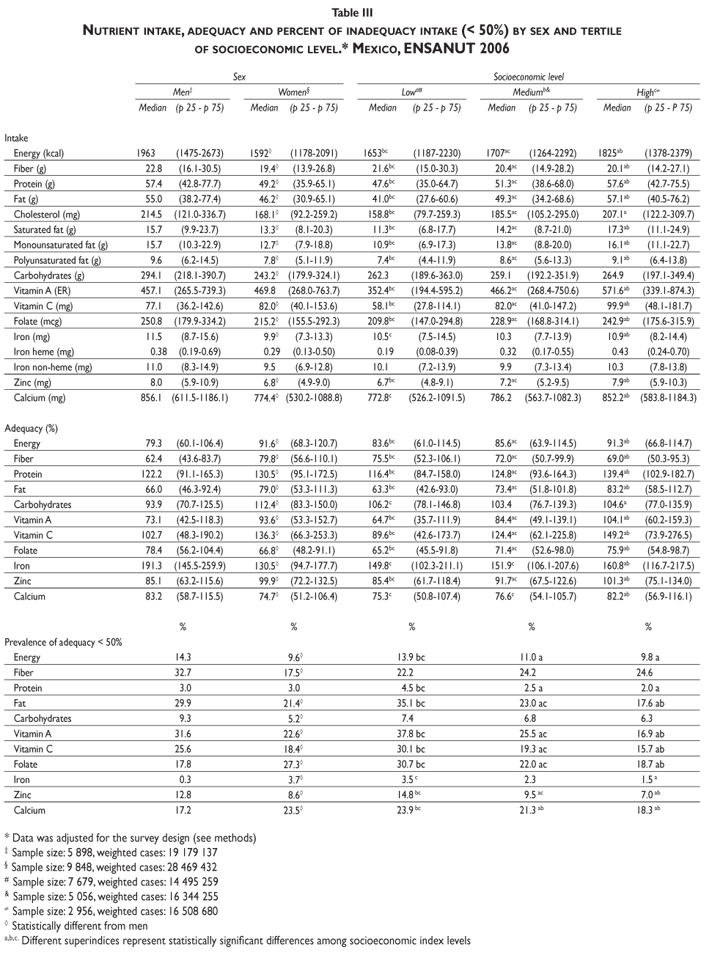
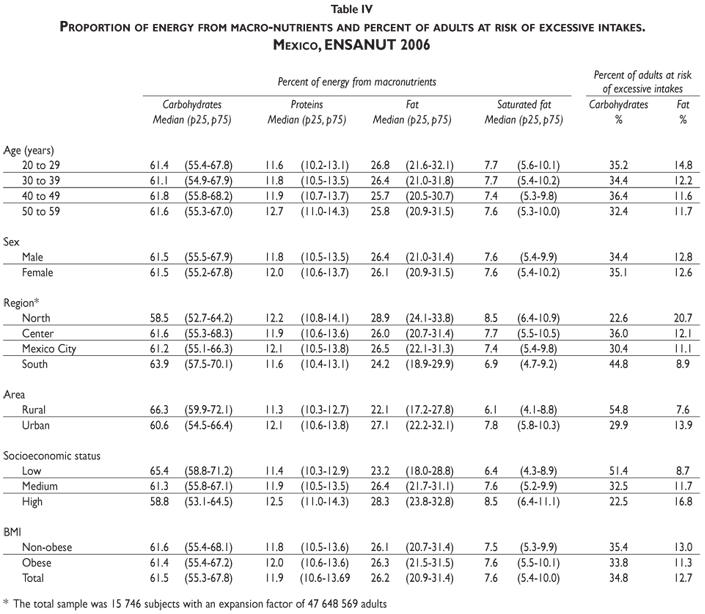
<body><![CDATA[<p><font size="2" face="Verdana">  Total energy, macro&#45; and micro&#45;nutrient intake,    and PA are presented in <a href="/img/revistas/spm/v51s4/a11tab02.gif">Table II</a>. Only those non&#45;pregnant or lactating with    a calculated BMI and complete dietary data were included in these analyses.    At the national level, a median total energy intake of 1 731 calories (kcal    per capita per day) was estimated, equivalent to a PA of 87.2%. Significant    differences in median total energy intake were found between the southern region    and the three other regions in Mexico, and between urban and rural areas (<a href="/img/revistas/spm/v51s4/a11tab02.gif">Table   II</a>). The lowest PAs were observed for vitamin A (61.3%), total fat (61.6%) and    folic acid (63.6%) and were among those who live in rural areas (<I>p</I> &lt;    0.05) (<a href="/img/revistas/spm/v51s4/a11tab02.gif">Table II</a>). The median fiber consumption estimated at the national level    was 20.7 g, with significant differences among regions (<a href="/img/revistas/spm/v51s4/a11tab02.gif">Table   II</a>). The PA for    protein for the entire study sample was 126.9% (<a href="/img/revistas/spm/v51s4/a11tab02.gif">Table   II</a>). Protein was identified    as being the nutrient with the highest PA, with carbohydrates having the next    highest PA across all four regions and both rural and urban areas (<a href="/img/revistas/spm/v51s4/a11tab02.gif">Table   II</a>).    For the entire study sample, a prevalence of inadequacy intake greater than    20% was observed for vitamin A (26.2%), fiber (23.6%), total fat (24.8%), folic    acid (23.5%), vitamin C (21.3%) and calcium (21%) (<a href="/img/revistas/spm/v51s4/a11tab02.gif">Table   II</a>).</font></p>     <p><font size="2" face="Verdana">  When stratified by sex, a median total energy    intake of 1 963 kcal was observed in men and 1 592 in women (<I>p</I> &lt; 0.05),    however the PA for protein, fat and carbohydrates were all higher among women    and also statistically significantly different than those among men (<a href="/img/revistas/spm/v51s4/a11tab03.gif">Table   III</a>).    The PA of iron, calcium and folate was higher in men than women (<I>p</I> &lt;    0.05) Total energy intakes for the low, medium and high SES index tertile were    1 653 kcal, 1 707 kcal, and 1 825 kcal, respectively, and all statistically    significantly different from each other (<a href="/img/revistas/spm/v51s4/a11tab03.gif">Table   III</a>). The low SES tertile had    significantly lower median intakes and adequacies of all the reported macro&#45;    and micro&#45;nutrients compared with the high SES tertile, with the exception of    the dietary intake of carbohydrates that was not statistically significantly    different between the lowest and highest SES tertile (<a href="/img/revistas/spm/v51s4/a11tab03.gif">Table   III</a>).</font></p>     <p><font size="2" face="Verdana"><a href="#fig01">Figure 1</a> shows the median total energy intake    by age group, stratified by BMI categories (normal, overweight and obese). A    lower energy intake is observed with each rise in age group. Obese subjects    reported a lower total energy intake than the normal weight subjects among all    age groups. For example, normal adults 20&#45;25 years old reported 1 898 kcal and    55&#45;59 years olds, 1 624 kcal (a 15% decrease) while obese adults 20&#45;25 years    old reported 1 810 kcal and 50&#45;59 years old, 1 480 kcal (a 18.2% decrease) (data    not shown). When macro&#45; and micro&#45;nutrient intake and PA are compared across    BMI categories, normal subjects show significantly higher intakes and PA of    most macro&#45; and micro&#45;nutrients (data not shown). However, when the same macro&#45;    and micro&#45;nutrients are expressed as densities (per 1 000 kcal) no statistically    significant differences are observed across BMI categories (data not shown).</font></p>     <p><a name="fig01"></a></p>     <p>&nbsp;</p>     <p align="center"><img src="/img/revistas/spm/v51s4/a11fig01.gif"></p>     <p>&nbsp;</p>     <p><font size="2" face="Verdana"> We also estimated the macro&#45;nutrient contribution    to per capita total energy intake and the percent of adults at risk of excessive    carbohydrate and/or fat intake by different sociodemographic indicators (age    group, sex, region, area, SES tertile). At the national level, on average, adults    (excluding those who are underweight) consumed 61.5% of their calories from    carbohydrates, 11.9% from proteins and 26.2% from fat (<a href="/img/revistas/spm/v51s4/a11tab04.gif">Table   IV</a>). Fat intake    was &lt; 30% across all of the sociodemographic groups (age group, sex, region,    rural/urban area, SES tertiles, BMI category) (<a href="/img/revistas/spm/v51s4/a11tab04.gif">Table   IV</a>). The highest proportion    of fat and saturated fat intakes were observed among all those adults living    in the northern region and those from the high SES index tertile (<a href="/img/revistas/spm/v51s4/a11tab04.gif">Table   IV</a>).    Based on the entire study sample, a total of 34.8% of the Mexican population    is estimated to be at risk of excessive carbohydrate intake and 12.7% of excessive    fat intake. Rural areas appeared to have the highest percentage of the population    at risk of excessive carbohydrate intake (54.8%) and the lowest of fat (7.6%)    (<a href="/img/revistas/spm/v51s4/a11tab04.gif">Table IV</a>). In contrast, the northern region had the highest percentage of the    population at risk of excessive fat intake (20.7%) (<a href="/img/revistas/spm/v51s4/a11tab04.gif">Table   IV</a>). </font></p>     <p>&nbsp;</p>     <p><font size="3" face="Verdana"><b>Discussion</b></font></p>     ]]></body>
<body><![CDATA[<p><font size="2" face="Verdana">Our article    describes for the first time the total energy, macro&#45; and micro&#45;nutrient intake    of both male and female adults aged 20&#45;59 years old in Mexico. Based on the    FFQ administered to a sub&#45;sample of adults in the ENSANUT 2006, we found a median    national total energy intake of 1 731 kcal, with a statistically significantly    higher total energy intake among males than females across all age groups, as    well as in the northern region and Mexico City, when compared to the southern    region. At the national level, adequacies were at an acceptable range for all    the analyzed nutrients. However, an important limitation of study results, with    respect to micro&#45;nutrient intake, is that it is difficult to measure the usual    intake of certain micronutrients, such as iron and zinc.<SUP>23,41</SUP> The    more developed northern region, urban areas and the high SES index tertile all    showed the highest median intake of total and saturated fat and the lowest median    fiber intake. In contrast, those living in rural areas and in the southern region    of Mexico had the lowest median intake of fat and micro&#45;nutrients (vitamin A,    vitamin C, folate and calcium) and the highest median fiber intake. Although    these findings were similar to those observed in 1999 (second Mexican Nutrition    Survey),<SUP>12</SUP> the results from the two surveys cannot be directly compared    since the methods were different (e.g. a 24&#45;hr recall was used to assess dietary    intake in the 1999 survey, but for logistical reasons a FFQ was used in ENSANUT    2006 and a different food composition table was used); in addition, the target    population in the 1999 survey was not representative of all Mexican adults (as    mentioned above, only adult women from 12&#45;49 years participated at that time    due to budget constraints).</font></p>     <p><font size="2" face="Verdana"> Protein adequacy was higher than 100% among    all sociodemographic groups analyzed. While the overweight and obese participants    in this study may have under&#45;reported their dietary intake on the FFQ, it is    apparent that protein intake is sufficient among the entire Mexican population.    This finding may be indicative of the nutrition transition in Mexico where protein    intake tends to increase as the economic development of country increases.<SUP>7,42,43</SUP>    Yet, due to the limitations of the FFQ itself, the study's findings that the    median total energy intake appears to be adequate and not excessive in Mexico,    as well as among all the study's sub&#45;populations, must be interpreted with caution.    Moreover, while total energy intake may be adequate across Mexico, this study    makes clear that adequate total energy intake is not commensurate with adequate    micro&#45;nutrient (and some macro&#45;nutrient) intake for many people. We found a    significantly greater percentage of men had inadequate intakes of fiber, vitamin    A, vitamin C and fat compared to women; while a greater percentage of women    had inadequate intakes of folate and calcium that were significantly different    than those of men. Adequate intake of vitamin A for men, and fiber in particular,    is associated with chronic disease prevention,<SUP>44,45</SUP> and among women,    both adequate intake of folate and calcium has long been identified as critical    to their reproductive and long&#45;term health.<SUP>35</SUP> This study also identified    significant micro&#45; and macro&#45;nutrient inadequacies among both sexes within certain    Mexican sub&#45;populations. A greater percentage of the populations in the low    SES tertile and rural areas was found to have inadequate intakes of vitamin    A, vitamin C, folate, and zinc compared to either higher SES or urban counterparts.    Thus, we believe that even greater efforts must be made through federal, state,    and community programs to improve the nutrition of those in the low SES and    those in rural areas, especially for populations that are both low SES and living    in a rural area. However, while this study confirmed that myriad micro&#45;nutrient    inadequacies continue to persist among the most vulnerable sub&#45;populations in    Mexico, it also alludes to an improvement in iron intake among these populations.    This is a positive finding and shows that the many initiatives in Mexico to    improve iron intake over the past two decades may be working.<SUP>46</SUP> In    this study, we found that iron adequacies were very high. However, when we stratified    by heme&#45; and non&#45;heme iron, only a small percentage of the total iron intake    came from animal sources (heme&#45;iron). Thus, our findings could be explained    by a greater ingestion of iron&#45;fortified foods, likely as a result of different    programs and regulations currently taking place in Mexico in an effort to decrease    iron&#45;deficiency anemia. Yet among certain regions and locations, this deficiency    continues to be a significant public health problem, as has been demonstrated    by previous studies performed at our research center. In addition to the source    of iron, other variables such as absorption modifiers (i.e., phytates and tannins)    could be contributing to iron&#45;deficiency anemia in certain population groups.<SUP>47&#45;49</SUP>    This phenomenon could explain, in part, why we found that high iron adequacies,    along with a high prevalence of anemia, is still a problem. </font></p>     <p><font size="2" face="Verdana"> Another important study finding is that a    proportion of the Mexican population appears to be at risk of excessive carbohydrate    and fat intake. And furthermore, that a greater percentage of the population    in the lowest SES tertile have excessive carbohydrate intake and inadequate    fat intake, significantly different than those of the other two SES tertiles;    excessive carbohydrate intake and inadequate fat intake was also greater in    rural areas and differed significantly from those in urban areas. Taken together,    these results indicate that much of the Mexican population may be experiencing    a nutrition transition, whereby total energy intake increases as a result of    increased carbohydrate and fat consumption, and those in the lowest SES and    in rural areas may be most susceptible to the effects of the emerging nutrition    transition in Mexico. </font></p>     <p><font size="2" face="Verdana"> When we further compared the macro&#45; and micro&#45;nutrient    intake between BMI categories using density per 1 000 kcal, no significant differences    were found in this regard, suggesting that people in Mexico, irrespective of    their nutritional status, tend to consume diets of similar quality in terms    of macro&#45; and micro&#45;nutrient intake; this is consistent with a previous study    that found similar prevalences of iron deficiency anemia between obese and non&#45;obese    Mexican women.<SUP>50</sup></font></p>     <p><font size="2" face="Verdana"> The high&#45;fat and high&#45;protein Mexican diet    has been associated with a rapid increase in non&#45;communicable chronic diseases    currently taking place in the country.<SUP>51</SUP> Our study identifies important    differences in both macro&#45; and micro&#45;nutrient consumption across diverse groups,    for which micro&#45;nutrient deficiencies must also be carefully acknowledged, along    with macro&#45;nutrient excess. Programs that aim to reduce carbohydrate and fat    intake while increasing micro&#45;nutrient intake could provide a dual opportunity    to prevent nutrition&#45;related chronic diseases associated with both over&#45; and    under&#45;nutrition.</font></p>     <p><font size="2" face="Verdana"><b>Acknowledgments</b></font></p>     <p><font size="2" face="Verdana">We would like to thank Rebecca Kanter for her    support in the preparation of this report.</font></p>     <p>&nbsp;</p>     <p><font size="3" face="Verdana"><b>References</b></font></p>     <!-- ref --><p><FONT size="2" FACE="Verdana">1. Barquera S, Hotz C, Rivera J, Tolentino L,    Espinoza J, Campos I, <I>et al</I>. Food consumption, food expenditure, anthropometric    status and nutrition related diseases in Mexico. Nutrition and the double&#45;burden    of disease in developing countries. Rome: Food and Agricultural Organization    (FAO), 2006.    &nbsp;&nbsp;&nbsp;&nbsp;&nbsp;&nbsp;&nbsp;&nbsp;[&#160;<a href="javascript:void(0);" onclick="javascript: window.open('/scielo.php?script=sci_nlinks&ref=9309770&pid=S0036-3634200900100001100001&lng=','','width=640,height=500,resizable=yes,scrollbars=1,menubar=yes,');">Links</a>&#160;]<!-- end-ref --></font></p>     <!-- ref --><p><FONT size="2" FACE="Verdana"> 2. Garc&iacute;a&#45;Garc&iacute;a E, Llata&#45;Romero    M, Kaufer&#45;Horwitz M, Tusi&eacute;&#45;Luna M, Calzada&#45;Le&oacute;n R, V&aacute;zquez&#45;Vel&aacute;zquez    V, <I>et al</I>. La obesidad y el s&iacute;ndrome metab&oacute;lico como problema    de salud p&uacute;blica. Una reflexi&oacute;n. Salud Publica de Mex 2008;50(6):530&#45;547.    &nbsp;&nbsp;&nbsp;&nbsp;&nbsp;&nbsp;&nbsp;&nbsp;[&#160;<a href="javascript:void(0);" onclick="javascript: window.open('/scielo.php?script=sci_nlinks&ref=9309772&pid=S0036-3634200900100001100002&lng=','','width=640,height=500,resizable=yes,scrollbars=1,menubar=yes,');">Links</a>&#160;]<!-- end-ref --></font></p>     <!-- ref --><p><font size="2" face="Verdana">3. Murphy SP, Rose D, Hudes M, Viteri FE. Demographic    and economic factors associated with dietary quality for adults in the 1987&#45;88    Nationwide Food Consumption Survey. J Am Diet Assoc 1992;92(11):1352&#45;1357.    &nbsp;&nbsp;&nbsp;&nbsp;&nbsp;&nbsp;&nbsp;&nbsp;[&#160;<a href="javascript:void(0);" onclick="javascript: window.open('/scielo.php?script=sci_nlinks&ref=9309774&pid=S0036-3634200900100001100003&lng=','','width=640,height=500,resizable=yes,scrollbars=1,menubar=yes,');">Links</a>&#160;]<!-- end-ref --></font></p>     <!-- ref --><p><font size="2" face="Verdana">4. Zeitlin MF, Ghassemi H, Mansour M, United    Nations University. Positive deviance in child nutrition: with emphasis on psychosocial    and behavioral aspects and implications for development. Tokyo, Japan: United    Nations University, 1990.    &nbsp;&nbsp;&nbsp;&nbsp;&nbsp;&nbsp;&nbsp;&nbsp;[&#160;<a href="javascript:void(0);" onclick="javascript: window.open('/scielo.php?script=sci_nlinks&ref=9309776&pid=S0036-3634200900100001100004&lng=','','width=640,height=500,resizable=yes,scrollbars=1,menubar=yes,');">Links</a>&#160;]<!-- end-ref --></font></p>     <!-- ref --><p><font size="2" face="Verdana">5. Duhl LJ. Urbanization, poverty, and health.    Bull N Y Acad Med 1966;42(5):369&#45;379.    &nbsp;&nbsp;&nbsp;&nbsp;&nbsp;&nbsp;&nbsp;&nbsp;[&#160;<a href="javascript:void(0);" onclick="javascript: window.open('/scielo.php?script=sci_nlinks&ref=9309778&pid=S0036-3634200900100001100005&lng=','','width=640,height=500,resizable=yes,scrollbars=1,menubar=yes,');">Links</a>&#160;]<!-- end-ref --></font></p>     <!-- ref --><p><font size="2" face="Verdana">6. Loslier L. Ambiocontrol as a primary factor    of health. Soc Sci Med 1993;37(6):735&#45;743.    &nbsp;&nbsp;&nbsp;&nbsp;&nbsp;&nbsp;&nbsp;&nbsp;[&#160;<a href="javascript:void(0);" onclick="javascript: window.open('/scielo.php?script=sci_nlinks&ref=9309780&pid=S0036-3634200900100001100006&lng=','','width=640,height=500,resizable=yes,scrollbars=1,menubar=yes,');">Links</a>&#160;]<!-- end-ref --></font></p>     <!-- ref --><p><font size="2" face="Verdana">7. Drewnowski A, Popkin BM. The nutrition transition:    new trends in the global diet. Nutr Rev 1997;55(2):31&#45;43.    &nbsp;&nbsp;&nbsp;&nbsp;&nbsp;&nbsp;&nbsp;&nbsp;[&#160;<a href="javascript:void(0);" onclick="javascript: window.open('/scielo.php?script=sci_nlinks&ref=9309782&pid=S0036-3634200900100001100007&lng=','','width=640,height=500,resizable=yes,scrollbars=1,menubar=yes,');">Links</a>&#160;]<!-- end-ref --></font></p>     <!-- ref --><p><font size="2" face="Verdana">8. Gonz&aacute;lez&#45;Coss&iacute;o T, Rivera J,    Shamah T, Barquera S, Hern&aacute;ndez B, Sep&uacute;lveda J. Obesity in Mexico:    A growing national epidemic. Ann Nutr Metabol 2001;45(Suppl 1):405.    &nbsp;&nbsp;&nbsp;&nbsp;&nbsp;&nbsp;&nbsp;&nbsp;[&#160;<a href="javascript:void(0);" onclick="javascript: window.open('/scielo.php?script=sci_nlinks&ref=9309784&pid=S0036-3634200900100001100008&lng=','','width=640,height=500,resizable=yes,scrollbars=1,menubar=yes,');">Links</a>&#160;]<!-- end-ref --></font></p>     <!-- ref --><p><font size="2" face="Verdana">9. Hernandez B, Peterson K, Sobol A, Rivera J,    Sepulveda J, Lezana MA. Overweight in 12&#45;49 year&#45;old women and children under    5 years of age in Mexico. Salud Publica Mex 1996;38(3):178&#45;188.    &nbsp;&nbsp;&nbsp;&nbsp;&nbsp;&nbsp;&nbsp;&nbsp;[&#160;<a href="javascript:void(0);" onclick="javascript: window.open('/scielo.php?script=sci_nlinks&ref=9309786&pid=S0036-3634200900100001100009&lng=','','width=640,height=500,resizable=yes,scrollbars=1,menubar=yes,');">Links</a>&#160;]<!-- end-ref --></font></p>     <!-- ref --><p><FONT size="2" FACE="Verdana">10. Hernandez&#45;Diaz S, Peterson KE, Dixit S, Hernandez    B, Parra S, Barquera S, <I>et al</I>. Association of maternal short stature    with stunting in Mexican children: common genes<I> vs</I> common environment.    Eur J Clin Nutr 1999;53(12):938&#45;945.    &nbsp;&nbsp;&nbsp;&nbsp;&nbsp;&nbsp;&nbsp;&nbsp;[&#160;<a href="javascript:void(0);" onclick="javascript: window.open('/scielo.php?script=sci_nlinks&ref=9309788&pid=S0036-3634200900100001100010&lng=','','width=640,height=500,resizable=yes,scrollbars=1,menubar=yes,');">Links</a>&#160;]<!-- end-ref --></font></p>     <!-- ref --><p><font size="2" face="Verdana">11. Romieu I, Hernandez&#45;Avila M, Rivera JA, Ruel    MT, Parra S. Dietary studies in countries experiencing a health transition:    Mexico and Central America. Am J Clin Nutr 1997;65 Suppl 4:1159S&#45;1165S.    &nbsp;&nbsp;&nbsp;&nbsp;&nbsp;&nbsp;&nbsp;&nbsp;[&#160;<a href="javascript:void(0);" onclick="javascript: window.open('/scielo.php?script=sci_nlinks&ref=9309790&pid=S0036-3634200900100001100011&lng=','','width=640,height=500,resizable=yes,scrollbars=1,menubar=yes,');">Links</a>&#160;]<!-- end-ref --></font></p>     <!-- ref --><p><font size="2" face="Verdana">12. Barquera S, Rivera JA, Espinosa&#45;Montero J,    Safdie M, Campirano F, Monterrubio EA. Energy and nutrient consumption in Mexican    women 12&#45;49 years of age: analysis of the National Nutrition Survey 1999. Salud    Publica Mex 2003;45 Suppl 4:S530&#45;S539.    &nbsp;&nbsp;&nbsp;&nbsp;&nbsp;&nbsp;&nbsp;&nbsp;[&#160;<a href="javascript:void(0);" onclick="javascript: window.open('/scielo.php?script=sci_nlinks&ref=9309792&pid=S0036-3634200900100001100012&lng=','','width=640,height=500,resizable=yes,scrollbars=1,menubar=yes,');">Links</a>&#160;]<!-- end-ref --></font></p>     <!-- ref --><p><font size="2" face="Verdana">13. Flores M, Melgar H, Cortes C, Rivera M, Rivera    J, Sepulveda J. Energy and nutrient consumption in Mexican women in reproductive    age. Salud Publica de Mex 1998;40(2):161&#45;171.    &nbsp;&nbsp;&nbsp;&nbsp;&nbsp;&nbsp;&nbsp;&nbsp;[&#160;<a href="javascript:void(0);" onclick="javascript: window.open('/scielo.php?script=sci_nlinks&ref=9309794&pid=S0036-3634200900100001100013&lng=','','width=640,height=500,resizable=yes,scrollbars=1,menubar=yes,');">Links</a>&#160;]<!-- end-ref --></font></p>     <!-- ref --><p><font size="2" face="Verdana">14. Secretar&iacute;a de Salud. Programa Nacional    de Salud 2001&#45;2006. Mexico City: SSA, 2000.    &nbsp;&nbsp;&nbsp;&nbsp;&nbsp;&nbsp;&nbsp;&nbsp;[&#160;<a href="javascript:void(0);" onclick="javascript: window.open('/scielo.php?script=sci_nlinks&ref=9309796&pid=S0036-3634200900100001100014&lng=','','width=640,height=500,resizable=yes,scrollbars=1,menubar=yes,');">Links</a>&#160;]<!-- end-ref --></font></p>     <!-- ref --><p><font size="2" face="Verdana">15. Barker D. Fetal growth and adult disease.    Br J Obstet Gynaecol 1992;99:275&#45;276.    &nbsp;&nbsp;&nbsp;&nbsp;&nbsp;&nbsp;&nbsp;&nbsp;[&#160;<a href="javascript:void(0);" onclick="javascript: window.open('/scielo.php?script=sci_nlinks&ref=9309798&pid=S0036-3634200900100001100015&lng=','','width=640,height=500,resizable=yes,scrollbars=1,menubar=yes,');">Links</a>&#160;]<!-- end-ref --></font></p>     <!-- ref --><p><font size="2" face="Verdana">16. Barker D, Osmond C, Simmonds SJ, Wield GA.    The relation of small head circumference and thinness at birth to death from    cardiovascular disease in adult life. BMJ 1993;306:422&#45;426.    &nbsp;&nbsp;&nbsp;&nbsp;&nbsp;&nbsp;&nbsp;&nbsp;[&#160;<a href="javascript:void(0);" onclick="javascript: window.open('/scielo.php?script=sci_nlinks&ref=9309800&pid=S0036-3634200900100001100016&lng=','','width=640,height=500,resizable=yes,scrollbars=1,menubar=yes,');">Links</a>&#160;]<!-- end-ref --></font></p>     <!-- ref --><p><font size="2" face="Verdana">17. Barker D. Maternal nutrition, fetal nutrition,    and disease in later life. J Nutr 1997;13:807&#45;813.    &nbsp;&nbsp;&nbsp;&nbsp;&nbsp;&nbsp;&nbsp;&nbsp;[&#160;<a href="javascript:void(0);" onclick="javascript: window.open('/scielo.php?script=sci_nlinks&ref=9309802&pid=S0036-3634200900100001100017&lng=','','width=640,height=500,resizable=yes,scrollbars=1,menubar=yes,');">Links</a>&#160;]<!-- end-ref --></font></p>     <!-- ref --><p><font size="2" face="Verdana">18. Hales C, Barker DJ. Type 2 (non&#45;insulin&#45;dependent)    diabetes mellitus: The thrifty phenotype hypothesis. Diabetologia 1992;35:595&#45;601.    &nbsp;&nbsp;&nbsp;&nbsp;&nbsp;&nbsp;&nbsp;&nbsp;[&#160;<a href="javascript:void(0);" onclick="javascript: window.open('/scielo.php?script=sci_nlinks&ref=9309804&pid=S0036-3634200900100001100018&lng=','','width=640,height=500,resizable=yes,scrollbars=1,menubar=yes,');">Links</a>&#160;]<!-- end-ref --></font></p>     <!-- ref --><p><font size="2" face="Verdana">19. Hales C. Metabolic consequences of intrauterine    growth retardation. Acta Paediatr 1997;423 Suppl:184&#45;187.    &nbsp;&nbsp;&nbsp;&nbsp;&nbsp;&nbsp;&nbsp;&nbsp;[&#160;<a href="javascript:void(0);" onclick="javascript: window.open('/scielo.php?script=sci_nlinks&ref=9309806&pid=S0036-3634200900100001100019&lng=','','width=640,height=500,resizable=yes,scrollbars=1,menubar=yes,');">Links</a>&#160;]<!-- end-ref --></font></p>     <!-- ref --><p><font size="2" face="Verdana">20. Hernandez&#45;Avila M, Romieu I, Parra S, Hernandez&#45;Avila    J, Madrigal H, Willett W. Validity and reproducibility of a food frequency questionnaire    to assess dietary intake of women living in Mexico City. Salud Publica Mex 1998;40(2):133&#45;140.    &nbsp;&nbsp;&nbsp;&nbsp;&nbsp;&nbsp;&nbsp;&nbsp;[&#160;<a href="javascript:void(0);" onclick="javascript: window.open('/scielo.php?script=sci_nlinks&ref=9309808&pid=S0036-3634200900100001100020&lng=','','width=640,height=500,resizable=yes,scrollbars=1,menubar=yes,');">Links</a>&#160;]<!-- end-ref --></font></p>     <!-- ref --><p><font size="2" face="Verdana">21. Livingstone MB, Black AE. Markers of the    validity of reported energy intake. J Nutr 2003;133 Suppl 3:895S&#45;920S.    &nbsp;&nbsp;&nbsp;&nbsp;&nbsp;&nbsp;&nbsp;&nbsp;[&#160;<a href="javascript:void(0);" onclick="javascript: window.open('/scielo.php?script=sci_nlinks&ref=9309810&pid=S0036-3634200900100001100021&lng=','','width=640,height=500,resizable=yes,scrollbars=1,menubar=yes,');">Links</a>&#160;]<!-- end-ref --></font></p>     <!-- ref --><p><font size="2" face="Verdana">22. Willett W. Nutritional Epidemiology. Second    edition. Oxford: Oxford University Press, 1998.    &nbsp;&nbsp;&nbsp;&nbsp;&nbsp;&nbsp;&nbsp;&nbsp;[&#160;<a href="javascript:void(0);" onclick="javascript: window.open('/scielo.php?script=sci_nlinks&ref=9309812&pid=S0036-3634200900100001100022&lng=','','width=640,height=500,resizable=yes,scrollbars=1,menubar=yes,');">Links</a>&#160;]<!-- end-ref --></font></p>     <!-- ref --><p><FONT size="2" FACE="Verdana">23. Willett W. Food&#45;Frequency Methods. Nutritional    Epidemiology. Second edition. Oxford: Oxford University Press, 1998.    &nbsp;&nbsp;&nbsp;&nbsp;&nbsp;&nbsp;&nbsp;&nbsp;[&#160;<a href="javascript:void(0);" onclick="javascript: window.open('/scielo.php?script=sci_nlinks&ref=9309814&pid=S0036-3634200900100001100023&lng=','','width=640,height=500,resizable=yes,scrollbars=1,menubar=yes,');">Links</a>&#160;]<!-- end-ref --></font></p>     <!-- ref --><p><font size="2" face="Verdana">24. Campirano F, Barquera S, Rivera J, Hern&aacute;ndez&#45;Prado    B, Flores M, Monterrubio E. Estimation of energy under&#45;reporting in obese and    non&#45;obese Mexican women using different equations: Analysis of the Mexican Nutrition    Survey. Ann Nutr Metabol 2001;45:146.    &nbsp;&nbsp;&nbsp;&nbsp;&nbsp;&nbsp;&nbsp;&nbsp;[&#160;<a href="javascript:void(0);" onclick="javascript: window.open('/scielo.php?script=sci_nlinks&ref=9309816&pid=S0036-3634200900100001100024&lng=','','width=640,height=500,resizable=yes,scrollbars=1,menubar=yes,');">Links</a>&#160;]<!-- end-ref --></font></p>     <!-- ref --><p><FONT size="2" FACE="Verdana">25. Olaiz&#45;Fern&aacute;ndez G, Rivera&#45;Dommarco    J, Shamah&#45;Levy T, Rojas R, Villalpando&#45;Hern&aacute;ndez S, Hern&aacute;ndez&#45;Avila    M, <I>et al</I>. Encuesta Nacional de Salud y Nutrici&oacute;n 2006. Cuernavaca,    M&eacute;xico: Instituto Nacional de Salud P&uacute;blica, 2006.    &nbsp;&nbsp;&nbsp;&nbsp;&nbsp;&nbsp;&nbsp;&nbsp;[&#160;<a href="javascript:void(0);" onclick="javascript: window.open('/scielo.php?script=sci_nlinks&ref=9309818&pid=S0036-3634200900100001100025&lng=','','width=640,height=500,resizable=yes,scrollbars=1,menubar=yes,');">Links</a>&#160;]<!-- end-ref --></font></p>     <!-- ref --><p><FONT size="2" FACE="Verdana"> 26. Palma O, Shamah&#45;Levy T, Franco A, Olaiz    G, M&eacute;ndez&#45;Ram&iacute;rez I. Metodolog&iacute;a. In: Olaiz&#45;Fern&aacute;ndez    G, Rivera&#45;Dommarco J, Shamah&#45;Levy T, Rojas R, Villalpando&#45;Hern&aacute;ndez S,    Hern&aacute;ndez&#45;Avila M, <I>et al</I>. Encuesta Nacional de Salud y Nutrici&oacute;n    2006. Cuernavaca, M&eacute;xico: Instituto Nacional de Salud P&uacute;blica,    2006: 21&#45;33.    &nbsp;&nbsp;&nbsp;&nbsp;&nbsp;&nbsp;&nbsp;&nbsp;[&#160;<a href="javascript:void(0);" onclick="javascript: window.open('/scielo.php?script=sci_nlinks&ref=9309820&pid=S0036-3634200900100001100026&lng=','','width=640,height=500,resizable=yes,scrollbars=1,menubar=yes,');">Links</a>&#160;]<!-- end-ref --></font></p>     <!-- ref --><p><font size="2" face="Verdana">27. Habicht JP. Standardization of quantitative    epidemiological methods in the field. Bol Oficina Sanit Panam 1974;76(5):375&#45;384.    &nbsp;&nbsp;&nbsp;&nbsp;&nbsp;&nbsp;&nbsp;&nbsp;[&#160;<a href="javascript:void(0);" onclick="javascript: window.open('/scielo.php?script=sci_nlinks&ref=9309822&pid=S0036-3634200900100001100027&lng=','','width=640,height=500,resizable=yes,scrollbars=1,menubar=yes,');">Links</a>&#160;]<!-- end-ref --></font></p>     <!-- ref --><p><font size="2" face="Verdana">28. World Health Organization. Expert Committee    on Physical Status: The use and interpretation of anthropometry. Geneva: WHO,    1995.    &nbsp;&nbsp;&nbsp;&nbsp;&nbsp;&nbsp;&nbsp;&nbsp;[&#160;<a href="javascript:void(0);" onclick="javascript: window.open('/scielo.php?script=sci_nlinks&ref=9309824&pid=S0036-3634200900100001100028&lng=','','width=640,height=500,resizable=yes,scrollbars=1,menubar=yes,');">Links</a>&#160;]<!-- end-ref --></font></p>     <!-- ref --><p><FONT size="2" FACE="Verdana">29. Barquera S, Peterson KE, Must A, Rogers BL,    Flores M, Houser R, <I>et al</I>. Coexistence of maternal central adiposity    and child stunting in Mexico. Int J Obes (Lond) 2007;31(4):601&#45;607.    &nbsp;&nbsp;&nbsp;&nbsp;&nbsp;&nbsp;&nbsp;&nbsp;[&#160;<a href="javascript:void(0);" onclick="javascript: window.open('/scielo.php?script=sci_nlinks&ref=9309826&pid=S0036-3634200900100001100029&lng=','','width=640,height=500,resizable=yes,scrollbars=1,menubar=yes,');">Links</a>&#160;]<!-- end-ref --></font></p>     <!-- ref --><p><font size="2" face="Verdana">30. Barquera S, Tovar&#45;Guzman V, Campos&#45;Nonato    I, Gonzalez&#45;Villalpando C, Rivera&#45;Dommarco J. Geography of diabetes mellitus    mortality in Mexico: an epidemiologic transition analysis. Arch Med Res 2003;34(5):407&#45;414.    &nbsp;&nbsp;&nbsp;&nbsp;&nbsp;&nbsp;&nbsp;&nbsp;[&#160;<a href="javascript:void(0);" onclick="javascript: window.open('/scielo.php?script=sci_nlinks&ref=9309828&pid=S0036-3634200900100001100030&lng=','','width=640,height=500,resizable=yes,scrollbars=1,menubar=yes,');">Links</a>&#160;]<!-- end-ref --></font></p>     <!-- ref --><p><font size="2" face="Verdana">31. Kleinbaum DG, Kleinbaum DG. Applied regression    analysis and other multivariable methods. 3rd ed. Pacific Grove: Duxbury Press,    1998.    &nbsp;&nbsp;&nbsp;&nbsp;&nbsp;&nbsp;&nbsp;&nbsp;[&#160;<a href="javascript:void(0);" onclick="javascript: window.open('/scielo.php?script=sci_nlinks&ref=9309830&pid=S0036-3634200900100001100031&lng=','','width=640,height=500,resizable=yes,scrollbars=1,menubar=yes,');">Links</a>&#160;]<!-- end-ref --></font></p>     <!-- ref --><p><font size="2" face="Verdana">32. Reyment R, J&ouml;reskog K. Applied factor    analysis in the natural sciences. Cambridge, UK: Cambridge University Press,    1996.    &nbsp;&nbsp;&nbsp;&nbsp;&nbsp;&nbsp;&nbsp;&nbsp;[&#160;<a href="javascript:void(0);" onclick="javascript: window.open('/scielo.php?script=sci_nlinks&ref=9309832&pid=S0036-3634200900100001100032&lng=','','width=640,height=500,resizable=yes,scrollbars=1,menubar=yes,');">Links</a>&#160;]<!-- end-ref --></font></p>     <!-- ref --><p><font size="2" face="Verdana">33. Safdie M, Barquera S, Porcayo M, Rodr&iacute;guez    S, Ram&iacute;rez I, Rivera J. Bases de datos de valor nutritivo de los alimentos.    Compilaci&oacute;n del Instituto Nacional de Salud P&uacute;blica. Cuernavaca,    Morelos: Instituto Nacional de Salud P&uacute;blica, 2004.    &nbsp;&nbsp;&nbsp;&nbsp;&nbsp;&nbsp;&nbsp;&nbsp;[&#160;<a href="javascript:void(0);" onclick="javascript: window.open('/scielo.php?script=sci_nlinks&ref=9309834&pid=S0036-3634200900100001100033&lng=','','width=640,height=500,resizable=yes,scrollbars=1,menubar=yes,');">Links</a>&#160;]<!-- end-ref --></font></p>     <!-- ref --><p><font size="2" face="Verdana">34. Panel on Dietary Antioxidants and Related    Compounds, Subcommittees on Upper Reference Levels of Nutrients and Interpretation    and Uses of DRIs, Standing Committee on the Scientific Evaluation of Dietary    Reference Intakes, Food and Nutrition Board, Institute of Medicine. Vitamin    C. In: Dietary reference intakes for: Vitamin C, Vitamin E, selenium and carotenoids.    Washington, DC: Institute of Medicine, The National Academies Press, 2000: 95&#45;185.    &nbsp;&nbsp;&nbsp;&nbsp;&nbsp;&nbsp;&nbsp;&nbsp;[&#160;<a href="javascript:void(0);" onclick="javascript: window.open('/scielo.php?script=sci_nlinks&ref=9309836&pid=S0036-3634200900100001100034&lng=','','width=640,height=500,resizable=yes,scrollbars=1,menubar=yes,');">Links</a>&#160;]<!-- end-ref --></font></p>     <!-- ref --><p><font size="2" face="Verdana">35. Institute of Medicine. Dietary Reference    Intakes for Calcium, Phosphorus, Magnesium, Vitamin D, and Fluoride. Washington,    DC: National Academy Press, 1997.    &nbsp;&nbsp;&nbsp;&nbsp;&nbsp;&nbsp;&nbsp;&nbsp;[&#160;<a href="javascript:void(0);" onclick="javascript: window.open('/scielo.php?script=sci_nlinks&ref=9309838&pid=S0036-3634200900100001100035&lng=','','width=640,height=500,resizable=yes,scrollbars=1,menubar=yes,');">Links</a>&#160;]<!-- end-ref --></font></p>     <!-- ref --><p><font size="2" face="Verdana">36. Institute of Medicine. Dietary Reference    Intakes for Vitamin A, Vitamin K, Arsenic, Boron, Chromium, Copper, Iodine,    Iron, Manganese, Molybdenum, Nickel, Silicon, Vanadium, Zinc. Washington, DC:    National Academy Press, 2001.    &nbsp;&nbsp;&nbsp;&nbsp;&nbsp;&nbsp;&nbsp;&nbsp;[&#160;<a href="javascript:void(0);" onclick="javascript: window.open('/scielo.php?script=sci_nlinks&ref=9309840&pid=S0036-3634200900100001100036&lng=','','width=640,height=500,resizable=yes,scrollbars=1,menubar=yes,');">Links</a>&#160;]<!-- end-ref --></font></p>     <!-- ref --><p><font size="2" face="Verdana">37. Panel on Macronutrients, Subcommittees on    Upper Reference Levels of Nutrients and Interpretation and Uses of Dietary Reference    Intakes, and the Standing Committee on the Scientific Evaluation of Dietary    Reference Intakes. Dietary Reference Intakes for Energy, Carbohydrate, Fiber,    Fat, Fatty Acids, Cholesterol, Protein, and Amino Acids (Macronutrients). Washington,    DC: Institute of Medicine, The National Academies Press, 2005: 589&#45;630.    &nbsp;&nbsp;&nbsp;&nbsp;&nbsp;&nbsp;&nbsp;&nbsp;[&#160;<a href="javascript:void(0);" onclick="javascript: window.open('/scielo.php?script=sci_nlinks&ref=9309842&pid=S0036-3634200900100001100037&lng=','','width=640,height=500,resizable=yes,scrollbars=1,menubar=yes,');">Links</a>&#160;]<!-- end-ref --></font></p>     <!-- ref --><p><font size="2" face="Verdana">38. Subcommittee on Interpretation and Uses of    Dietary Reference Intakes, and the Standing Committee on the Scientific Evaluation    of Dietary Reference Intakes. Dietary reference intakes. Applications in dietary    assessment. Washington, DC: National Academy Press, 2000.    &nbsp;&nbsp;&nbsp;&nbsp;&nbsp;&nbsp;&nbsp;&nbsp;[&#160;<a href="javascript:void(0);" onclick="javascript: window.open('/scielo.php?script=sci_nlinks&ref=9309844&pid=S0036-3634200900100001100038&lng=','','width=640,height=500,resizable=yes,scrollbars=1,menubar=yes,');">Links</a>&#160;]<!-- end-ref --></font></p>     <!-- ref --><p><font size="2" face="Verdana">39. Rodr&iacute;guez&#45;Ram&iacute;rez, Mundo&#45;Rosas    V, Jim&eacute;nez&#45;Aguilar A, Shamah&#45;Levy T. Methodology for the analysis of    dietary data from the Mexican National Health and Nutrition Survey 2006. Salud    Publica Mex 2009;51 suppl 4:S523&#45;S529.    &nbsp;&nbsp;&nbsp;&nbsp;&nbsp;&nbsp;&nbsp;&nbsp;[&#160;<a href="javascript:void(0);" onclick="javascript: window.open('/scielo.php?script=sci_nlinks&ref=9309846&pid=S0036-3634200900100001100039&lng=','','width=640,height=500,resizable=yes,scrollbars=1,menubar=yes,');">Links</a>&#160;]<!-- end-ref --></font></p>     <!-- ref --><p><font size="2" face="Verdana">40. Millns H, Woodward M, Bolton&#45;Smith C. Is    it necessary to transform nutrient variables prior to statistical analyses?    Am J Epidemiol 1995;141(3):251&#45;262.    &nbsp;&nbsp;&nbsp;&nbsp;&nbsp;&nbsp;&nbsp;&nbsp;[&#160;<a href="javascript:void(0);" onclick="javascript: window.open('/scielo.php?script=sci_nlinks&ref=9309848&pid=S0036-3634200900100001100040&lng=','','width=640,height=500,resizable=yes,scrollbars=1,menubar=yes,');">Links</a>&#160;]<!-- end-ref --></font></p>     <!-- ref --><p><FONT size="2" FACE="Verdana">41. Willett W, Buzzard M. Foods and Nutrients. Nutritional Epidemiology. Second ed. Oxford: Oxford University Press, 1998:    18&#45;32.    &nbsp;&nbsp;&nbsp;&nbsp;&nbsp;&nbsp;&nbsp;&nbsp;[&#160;<a href="javascript:void(0);" onclick="javascript: window.open('/scielo.php?script=sci_nlinks&ref=9309850&pid=S0036-3634200900100001100041&lng=','','width=640,height=500,resizable=yes,scrollbars=1,menubar=yes,');">Links</a>&#160;]<!-- end-ref --></font></p>     <!-- ref --><p><font size="2" face="Verdana">42. Kim S, Moon S, Popkin BM. The nutrition transition    in South Korea. Am J Clin Nutr 2000;71(1):44&#45;53.    &nbsp;&nbsp;&nbsp;&nbsp;&nbsp;&nbsp;&nbsp;&nbsp;[&#160;<a href="javascript:void(0);" onclick="javascript: window.open('/scielo.php?script=sci_nlinks&ref=9309852&pid=S0036-3634200900100001100042&lng=','','width=640,height=500,resizable=yes,scrollbars=1,menubar=yes,');">Links</a>&#160;]<!-- end-ref --></font></p>     <!-- ref --><p><font size="2" face="Verdana">43. Lee SK, Sobal J. Socio&#45;economic, dietary,    activity, nutrition and body weight transitions in South Korea. Public Health    Nutr 2003;6(7):665&#45;674.    &nbsp;&nbsp;&nbsp;&nbsp;&nbsp;&nbsp;&nbsp;&nbsp;[&#160;<a href="javascript:void(0);" onclick="javascript: window.open('/scielo.php?script=sci_nlinks&ref=9309854&pid=S0036-3634200900100001100043&lng=','','width=640,height=500,resizable=yes,scrollbars=1,menubar=yes,');">Links</a>&#160;]<!-- end-ref --></font></p>     <!-- ref --><p><font size="2" face="Verdana">44. Fairfield KM, Fletcher RH. Vitamins for chronic    disease prevention in adults: scientific review. JAMA 2002;287(23):3116&#45;3126.    &nbsp;&nbsp;&nbsp;&nbsp;&nbsp;&nbsp;&nbsp;&nbsp;[&#160;<a href="javascript:void(0);" onclick="javascript: window.open('/scielo.php?script=sci_nlinks&ref=9309856&pid=S0036-3634200900100001100044&lng=','','width=640,height=500,resizable=yes,scrollbars=1,menubar=yes,');">Links</a>&#160;]<!-- end-ref --></font></p>     <!-- ref --><p><font size="2" face="Verdana">45. Fletcher RH, Fairfield KM. Vitamins for chronic    disease prevention in adults: clinical applications. JAMA 2002;287(23):3127&#45;3129.    &nbsp;&nbsp;&nbsp;&nbsp;&nbsp;&nbsp;&nbsp;&nbsp;[&#160;<a href="javascript:void(0);" onclick="javascript: window.open('/scielo.php?script=sci_nlinks&ref=9309858&pid=S0036-3634200900100001100045&lng=','','width=640,height=500,resizable=yes,scrollbars=1,menubar=yes,');">Links</a>&#160;]<!-- end-ref --></font></p>     <!-- ref --><p><font size="2" face="Verdana">46. Gonzalez&#45;Coss&iacute;o T, Rivera&#45;Dommarco    J, L&oacute;pez G, Rubio G. Nutrici&oacute;n y pobreza: Pol&iacute;tica p&uacute;blica    basada en evidencia. Mexico: World Bank, SEDESOL, 2008.    &nbsp;&nbsp;&nbsp;&nbsp;&nbsp;&nbsp;&nbsp;&nbsp;[&#160;<a href="javascript:void(0);" onclick="javascript: window.open('/scielo.php?script=sci_nlinks&ref=9309860&pid=S0036-3634200900100001100046&lng=','','width=640,height=500,resizable=yes,scrollbars=1,menubar=yes,');">Links</a>&#160;]<!-- end-ref --></font></p>     <!-- ref --><p><font size="2" face="Verdana">47. Shamah&#45;Levy T, Villalpando S, Rivera JA,    Mejia&#45;Rodriguez F, Camacho&#45;Cisneros M, Monterrubio EA. Anemia in Mexican women:    a public health problem. Salud Publica Mex 2003;45 Suppl 4:S499&#45;S507.    &nbsp;&nbsp;&nbsp;&nbsp;&nbsp;&nbsp;&nbsp;&nbsp;[&#160;<a href="javascript:void(0);" onclick="javascript: window.open('/scielo.php?script=sci_nlinks&ref=9309862&pid=S0036-3634200900100001100047&lng=','','width=640,height=500,resizable=yes,scrollbars=1,menubar=yes,');">Links</a>&#160;]<!-- end-ref --></font></p>     <!-- ref --><p><FONT size="2" FACE="Verdana">48. Villalpando S, Garcia&#45;Guerra A, Ramirez&#45;Silva    CI, Mejia&#45;Rodriguez F, Matute G, Shamah&#45;Levy T, <I>et al</I>. Iron, zinc and    iodide status in Mexican children under 12 years and women 12&#45;49 years of age.    A probabilistic national survey. Salud Publica Mex 2003;45 Suppl 4:S520&#45;S529.    &nbsp;&nbsp;&nbsp;&nbsp;&nbsp;&nbsp;&nbsp;&nbsp;[&#160;<a href="javascript:void(0);" onclick="javascript: window.open('/scielo.php?script=sci_nlinks&ref=9309864&pid=S0036-3634200900100001100048&lng=','','width=640,height=500,resizable=yes,scrollbars=1,menubar=yes,');">Links</a>&#160;]<!-- end-ref --></font></p>     <!-- ref --><p><font size="2" face="Verdana">49. Villalpando S, Perez&#45;Exposito AB, Shamah&#45;Levy    T, Rivera JA. Distribution of anemia associated with micronutrient deficiencies    other than iron in a probabilistic sample of Mexican children. Ann Nutr Metab    2006;50(6):506&#45;511.    &nbsp;&nbsp;&nbsp;&nbsp;&nbsp;&nbsp;&nbsp;&nbsp;[&#160;<a href="javascript:void(0);" onclick="javascript: window.open('/scielo.php?script=sci_nlinks&ref=9309866&pid=S0036-3634200900100001100049&lng=','','width=640,height=500,resizable=yes,scrollbars=1,menubar=yes,');">Links</a>&#160;]<!-- end-ref --></font></p>     <!-- ref --><p><font size="2" face="Verdana">50. Eckhardt CL, Torheim LE, Monterrubio E, Barquera    S, Ruel MT. The overlap of overweight and anaemia among women in three countries    undergoing the nutrition transition. Eur J Clin Nutr 2008;62(2):238&#45;246.    &nbsp;&nbsp;&nbsp;&nbsp;&nbsp;&nbsp;&nbsp;&nbsp;[&#160;<a href="javascript:void(0);" onclick="javascript: window.open('/scielo.php?script=sci_nlinks&ref=9309868&pid=S0036-3634200900100001100050&lng=','','width=640,height=500,resizable=yes,scrollbars=1,menubar=yes,');">Links</a>&#160;]<!-- end-ref --></font></p>     <!-- ref --><p><font size="2" face="Verdana">51. Rivera JA, Barquera S, Campirano F, Campos    I, Safdie M, Tovar V. Epidemiological and nutritional transition in Mexico:    rapid increase of non&#45;communicable chronic diseases and obesity. Public Health    Nutr 2002;5(1A):113&#45;122.    &nbsp;&nbsp;&nbsp;&nbsp;&nbsp;&nbsp;&nbsp;&nbsp;[&#160;<a href="javascript:void(0);" onclick="javascript: window.open('/scielo.php?script=sci_nlinks&ref=9309870&pid=S0036-3634200900100001100051&lng=','','width=640,height=500,resizable=yes,scrollbars=1,menubar=yes,');">Links</a>&#160;]<!-- end-ref --></font></p>     <p>&nbsp;</p>     <p>&nbsp;</p>     <p><FONT size="2" FACE="Verdana">Received on: April 11, 2008    <br>   Accepted on: February 25, 2009</font></p>     <p>&nbsp;</p>     <p>&nbsp;</p>     <p><font size="2" face="Verdana">An unrestricted grant from Kellogg's de     Mexico made this study possible.    <br> Address       reprint requests to: Dr. Sim&oacute;n Barquera.   Departamento de Enfermedades Cr&oacute;nicas y Dieta, Centro de Investigaci&oacute;n   en Nutrici&oacute;n y Salud,   Instituto Nacional de Salud P&uacute;blica. Av. Universidad 655, col. Santa   Mar&iacute;a Ahuacatitl&aacute;n. 62100 Cuernavaca, Morelos, M&eacute;xico. E&#45;mail: <a href="mailto:sbarquera@insp.mx">sbarquera@insp.mx</a>    <br> <a name="nt01"></a><a href="#tx01">*</a> Stata Corporation. Stata 7 reference manual extract: release 7. College Station, TX: Stata Press 2001.</font></p>     ]]></body>
<body><![CDATA[ ]]></body><back>
<ref-list>
<ref id="B1">
<label>1</label><nlm-citation citation-type="book">
<person-group person-group-type="author">
<name>
<surname><![CDATA[Barquera]]></surname>
<given-names><![CDATA[S]]></given-names>
</name>
<name>
<surname><![CDATA[Hotz]]></surname>
<given-names><![CDATA[C]]></given-names>
</name>
<name>
<surname><![CDATA[Rivera]]></surname>
<given-names><![CDATA[J]]></given-names>
</name>
<name>
<surname><![CDATA[Tolentino]]></surname>
<given-names><![CDATA[L]]></given-names>
</name>
<name>
<surname><![CDATA[Espinoza]]></surname>
<given-names><![CDATA[J]]></given-names>
</name>
<name>
<surname><![CDATA[Campos]]></surname>
<given-names><![CDATA[I]]></given-names>
</name>
</person-group>
<source><![CDATA[Food consumption, food expenditure, anthropometric status and nutrition related diseases in Mexico: Nutrition and the double-burden of disease in developing countries]]></source>
<year>2006</year>
<publisher-loc><![CDATA[Rome ]]></publisher-loc>
<publisher-name><![CDATA[Food and Agricultural Organization (FAO)]]></publisher-name>
</nlm-citation>
</ref>
<ref id="B2">
<label>2</label><nlm-citation citation-type="journal">
<person-group person-group-type="author">
<name>
<surname><![CDATA[García-García]]></surname>
<given-names><![CDATA[E]]></given-names>
</name>
<name>
<surname><![CDATA[Llata-Romero]]></surname>
<given-names><![CDATA[M]]></given-names>
</name>
<name>
<surname><![CDATA[Kaufer-Horwitz]]></surname>
<given-names><![CDATA[M]]></given-names>
</name>
<name>
<surname><![CDATA[Tusié-Luna]]></surname>
<given-names><![CDATA[M]]></given-names>
</name>
<name>
<surname><![CDATA[Calzada-León]]></surname>
<given-names><![CDATA[R]]></given-names>
</name>
<name>
<surname><![CDATA[Vázquez-Velázquez]]></surname>
<given-names><![CDATA[V]]></given-names>
</name>
</person-group>
<article-title xml:lang="es"><![CDATA[La obesidad y el síndrome metabólico como problema de salud pública: Una reflexión]]></article-title>
<source><![CDATA[Salud Publica de Mex]]></source>
<year>2008</year>
<volume>50</volume>
<numero>6</numero>
<issue>6</issue>
<page-range>530-547</page-range></nlm-citation>
</ref>
<ref id="B3">
<label>3</label><nlm-citation citation-type="journal">
<person-group person-group-type="author">
<name>
<surname><![CDATA[Murphy]]></surname>
<given-names><![CDATA[SP]]></given-names>
</name>
<name>
<surname><![CDATA[Rose]]></surname>
<given-names><![CDATA[D]]></given-names>
</name>
<name>
<surname><![CDATA[Hudes]]></surname>
<given-names><![CDATA[M]]></given-names>
</name>
<name>
<surname><![CDATA[Viteri]]></surname>
<given-names><![CDATA[FE]]></given-names>
</name>
</person-group>
<article-title xml:lang="en"><![CDATA[Demographic and economic factors associated with dietary quality for adults in the 1987-88 Nationwide Food Consumption Survey]]></article-title>
<source><![CDATA[J Am Diet Assoc]]></source>
<year>1992</year>
<volume>92</volume>
<numero>11</numero>
<issue>11</issue>
<page-range>1352-1357</page-range></nlm-citation>
</ref>
<ref id="B4">
<label>4</label><nlm-citation citation-type="book">
<person-group person-group-type="author">
<name>
<surname><![CDATA[Zeitlin]]></surname>
<given-names><![CDATA[MF]]></given-names>
</name>
<name>
<surname><![CDATA[Ghassemi]]></surname>
<given-names><![CDATA[H]]></given-names>
</name>
<name>
<surname><![CDATA[Mansour]]></surname>
<given-names><![CDATA[M]]></given-names>
</name>
</person-group>
<collab>United Nations University</collab>
<source><![CDATA[Positive deviance in child nutrition: with emphasis on psychosocial and behavioral aspects and implications for development]]></source>
<year>1990</year>
<publisher-loc><![CDATA[Tokyo ]]></publisher-loc>
<publisher-name><![CDATA[United Nations University]]></publisher-name>
</nlm-citation>
</ref>
<ref id="B5">
<label>5</label><nlm-citation citation-type="journal">
<person-group person-group-type="author">
<name>
<surname><![CDATA[Duhl]]></surname>
<given-names><![CDATA[LJ]]></given-names>
</name>
</person-group>
<article-title xml:lang="en"><![CDATA[Urbanization, poverty, and health]]></article-title>
<source><![CDATA[Bull N Y Acad Med]]></source>
<year>1966</year>
<volume>42</volume>
<numero>5</numero>
<issue>5</issue>
<page-range>369-379</page-range></nlm-citation>
</ref>
<ref id="B6">
<label>6</label><nlm-citation citation-type="journal">
<person-group person-group-type="author">
<name>
<surname><![CDATA[Loslier]]></surname>
<given-names><![CDATA[L]]></given-names>
</name>
</person-group>
<article-title xml:lang="en"><![CDATA[Ambiocontrol as a primary factor of health]]></article-title>
<source><![CDATA[Soc Sci Med]]></source>
<year>1993</year>
<volume>37</volume>
<numero>6</numero>
<issue>6</issue>
<page-range>735-743</page-range></nlm-citation>
</ref>
<ref id="B7">
<label>7</label><nlm-citation citation-type="journal">
<person-group person-group-type="author">
<name>
<surname><![CDATA[Drewnowski]]></surname>
<given-names><![CDATA[A]]></given-names>
</name>
<name>
<surname><![CDATA[Popkin]]></surname>
<given-names><![CDATA[BM]]></given-names>
</name>
</person-group>
<article-title xml:lang="en"><![CDATA[The nutrition transition: new trends in the global diet]]></article-title>
<source><![CDATA[Nutr Rev]]></source>
<year>1997</year>
<volume>55</volume>
<numero>2</numero>
<issue>2</issue>
</nlm-citation>
</ref>
<ref id="B8">
<label>8</label><nlm-citation citation-type="journal">
<person-group person-group-type="author">
<name>
<surname><![CDATA[González-Cossío]]></surname>
<given-names><![CDATA[T]]></given-names>
</name>
<name>
<surname><![CDATA[Rivera]]></surname>
<given-names><![CDATA[J]]></given-names>
</name>
<name>
<surname><![CDATA[Shamah]]></surname>
<given-names><![CDATA[T]]></given-names>
</name>
<name>
<surname><![CDATA[Barquera]]></surname>
<given-names><![CDATA[S]]></given-names>
</name>
<name>
<surname><![CDATA[Hernández]]></surname>
<given-names><![CDATA[B]]></given-names>
</name>
<name>
<surname><![CDATA[Sepúlveda]]></surname>
<given-names><![CDATA[J]]></given-names>
</name>
</person-group>
<article-title xml:lang="en"><![CDATA[Obesity in Mexico: A growing national epidemic]]></article-title>
<source><![CDATA[Ann Nutr Metabol]]></source>
<year>2001</year>
<volume>45</volume>
<numero>^s1</numero>
<issue>^s1</issue>
<supplement>1</supplement>
<page-range>405</page-range></nlm-citation>
</ref>
<ref id="B9">
<label>9</label><nlm-citation citation-type="journal">
<person-group person-group-type="author">
<name>
<surname><![CDATA[Hernandez]]></surname>
<given-names><![CDATA[B]]></given-names>
</name>
<name>
<surname><![CDATA[Peterson]]></surname>
<given-names><![CDATA[K]]></given-names>
</name>
<name>
<surname><![CDATA[Sobol]]></surname>
<given-names><![CDATA[A]]></given-names>
</name>
<name>
<surname><![CDATA[Rivera]]></surname>
<given-names><![CDATA[J]]></given-names>
</name>
<name>
<surname><![CDATA[Sepulveda]]></surname>
<given-names><![CDATA[J]]></given-names>
</name>
<name>
<surname><![CDATA[Lezana]]></surname>
<given-names><![CDATA[MA]]></given-names>
</name>
</person-group>
<article-title xml:lang="en"><![CDATA[Overweight in 12-49 year-old women and children under 5 years of age in Mexico]]></article-title>
<source><![CDATA[Salud Publica Mex]]></source>
<year>1996</year>
<volume>38</volume>
<numero>3</numero>
<issue>3</issue>
<page-range>178-188</page-range></nlm-citation>
</ref>
<ref id="B10">
<label>10</label><nlm-citation citation-type="journal">
<person-group person-group-type="author">
<name>
<surname><![CDATA[Hernandez-Diaz]]></surname>
<given-names><![CDATA[S]]></given-names>
</name>
<name>
<surname><![CDATA[Peterson]]></surname>
<given-names><![CDATA[KE]]></given-names>
</name>
<name>
<surname><![CDATA[Dixit]]></surname>
<given-names><![CDATA[S]]></given-names>
</name>
<name>
<surname><![CDATA[Hernandez]]></surname>
<given-names><![CDATA[B]]></given-names>
</name>
<name>
<surname><![CDATA[Parra]]></surname>
<given-names><![CDATA[S]]></given-names>
</name>
<name>
<surname><![CDATA[Barquera]]></surname>
<given-names><![CDATA[S]]></given-names>
</name>
</person-group>
<article-title xml:lang="en"><![CDATA[Association of maternal short stature with stunting in Mexican children: common genes vs common environment]]></article-title>
<source><![CDATA[Eur J Clin Nutr]]></source>
<year>1999</year>
<volume>53</volume>
<numero>12</numero>
<issue>12</issue>
<page-range>938-945</page-range></nlm-citation>
</ref>
<ref id="B11">
<label>11</label><nlm-citation citation-type="journal">
<person-group person-group-type="author">
<name>
<surname><![CDATA[Romieu]]></surname>
<given-names><![CDATA[I]]></given-names>
</name>
<name>
<surname><![CDATA[Hernandez-Avila]]></surname>
<given-names><![CDATA[M]]></given-names>
</name>
<name>
<surname><![CDATA[Rivera]]></surname>
<given-names><![CDATA[JA]]></given-names>
</name>
<name>
<surname><![CDATA[Ruel]]></surname>
<given-names><![CDATA[MT]]></given-names>
</name>
<name>
<surname><![CDATA[Parra]]></surname>
<given-names><![CDATA[S]]></given-names>
</name>
</person-group>
<article-title xml:lang="en"><![CDATA[Dietary studies in countries experiencing a health transition: Mexico and Central America]]></article-title>
<source><![CDATA[Am J Clin Nutr]]></source>
<year>1997</year>
<volume>65</volume>
<numero>^s4</numero>
<issue>^s4</issue>
<supplement>4</supplement>
<page-range>1159S-1165S</page-range></nlm-citation>
</ref>
<ref id="B12">
<label>12</label><nlm-citation citation-type="journal">
<person-group person-group-type="author">
<name>
<surname><![CDATA[Barquera]]></surname>
<given-names><![CDATA[S]]></given-names>
</name>
<name>
<surname><![CDATA[Rivera]]></surname>
<given-names><![CDATA[JA]]></given-names>
</name>
<name>
<surname><![CDATA[Espinosa-Montero]]></surname>
<given-names><![CDATA[J]]></given-names>
</name>
<name>
<surname><![CDATA[Safdie]]></surname>
<given-names><![CDATA[M]]></given-names>
</name>
<name>
<surname><![CDATA[Campirano]]></surname>
<given-names><![CDATA[F]]></given-names>
</name>
<name>
<surname><![CDATA[Monterrubio]]></surname>
<given-names><![CDATA[EA]]></given-names>
</name>
</person-group>
<article-title xml:lang="en"><![CDATA[Energy and nutrient consumption in Mexican women 12-49 years of age: analysis of the National Nutrition Survey 1999]]></article-title>
<source><![CDATA[Salud Publica Mex]]></source>
<year>2003</year>
<volume>45</volume>
<numero>^s4</numero>
<issue>^s4</issue>
<supplement>4</supplement>
<page-range>S530-S539</page-range></nlm-citation>
</ref>
<ref id="B13">
<label>13</label><nlm-citation citation-type="journal">
<person-group person-group-type="author">
<name>
<surname><![CDATA[Flores]]></surname>
<given-names><![CDATA[M]]></given-names>
</name>
<name>
<surname><![CDATA[Melgar]]></surname>
<given-names><![CDATA[H]]></given-names>
</name>
<name>
<surname><![CDATA[Cortes]]></surname>
<given-names><![CDATA[C]]></given-names>
</name>
<name>
<surname><![CDATA[Rivera]]></surname>
<given-names><![CDATA[M]]></given-names>
</name>
<name>
<surname><![CDATA[Rivera]]></surname>
<given-names><![CDATA[J]]></given-names>
</name>
<name>
<surname><![CDATA[Sepulveda]]></surname>
<given-names><![CDATA[J]]></given-names>
</name>
</person-group>
<article-title xml:lang="en"><![CDATA[Energy and nutrient consumption in Mexican women in reproductive age]]></article-title>
<source><![CDATA[Salud Publica de Mex]]></source>
<year>1998</year>
<volume>40</volume>
<numero>2</numero>
<issue>2</issue>
<page-range>161-171</page-range></nlm-citation>
</ref>
<ref id="B14">
<label>14</label><nlm-citation citation-type="book">
<collab>Secretaría de Salud</collab>
<source><![CDATA[Programa Nacional de Salud 2001-2006]]></source>
<year>2000</year>
<publisher-loc><![CDATA[Mexico City ]]></publisher-loc>
<publisher-name><![CDATA[SSA]]></publisher-name>
</nlm-citation>
</ref>
<ref id="B15">
<label>15</label><nlm-citation citation-type="journal">
<person-group person-group-type="author">
<name>
<surname><![CDATA[Barker]]></surname>
<given-names><![CDATA[D]]></given-names>
</name>
</person-group>
<article-title xml:lang="en"><![CDATA[Fetal growth and adult disease]]></article-title>
<source><![CDATA[Br J Obstet Gynaecol]]></source>
<year>1992</year>
<volume>99</volume>
<page-range>275-276</page-range></nlm-citation>
</ref>
<ref id="B16">
<label>16</label><nlm-citation citation-type="journal">
<person-group person-group-type="author">
<name>
<surname><![CDATA[Barker]]></surname>
<given-names><![CDATA[D]]></given-names>
</name>
<name>
<surname><![CDATA[Osmond]]></surname>
<given-names><![CDATA[C]]></given-names>
</name>
<name>
<surname><![CDATA[Simmonds]]></surname>
<given-names><![CDATA[SJ]]></given-names>
</name>
<name>
<surname><![CDATA[Wield]]></surname>
<given-names><![CDATA[GA]]></given-names>
</name>
</person-group>
<article-title xml:lang="en"><![CDATA[The relation of small head circumference and thinness at birth to death from cardiovascular disease in adult life]]></article-title>
<source><![CDATA[BMJ]]></source>
<year>1993</year>
<volume>306</volume>
<page-range>422-426</page-range></nlm-citation>
</ref>
<ref id="B17">
<label>17</label><nlm-citation citation-type="journal">
<person-group person-group-type="author">
<name>
<surname><![CDATA[Barker]]></surname>
<given-names><![CDATA[D]]></given-names>
</name>
</person-group>
<article-title xml:lang="en"><![CDATA[Maternal nutrition, fetal nutrition, and disease in later life]]></article-title>
<source><![CDATA[J Nutr]]></source>
<year>1997</year>
<volume>13</volume>
<page-range>807-813</page-range></nlm-citation>
</ref>
<ref id="B18">
<label>18</label><nlm-citation citation-type="journal">
<person-group person-group-type="author">
<name>
<surname><![CDATA[Hales]]></surname>
<given-names><![CDATA[C]]></given-names>
</name>
<name>
<surname><![CDATA[Barker]]></surname>
<given-names><![CDATA[DJ]]></given-names>
</name>
</person-group>
<article-title xml:lang="en"><![CDATA[Type 2 (non-insulin-dependent) diabetes mellitus: The thrifty phenotype hypothesis]]></article-title>
<source><![CDATA[Diabetologia]]></source>
<year>1992</year>
<volume>35</volume>
<page-range>595-601</page-range></nlm-citation>
</ref>
<ref id="B19">
<label>19</label><nlm-citation citation-type="journal">
<person-group person-group-type="author">
<name>
<surname><![CDATA[Hales]]></surname>
<given-names><![CDATA[C]]></given-names>
</name>
</person-group>
<article-title xml:lang="en"><![CDATA[Metabolic consequences of intrauterine growth retardation]]></article-title>
<source><![CDATA[Acta Paediatr]]></source>
<year>1997</year>
<volume>423</volume>
<numero>^sSuppl</numero>
<issue>^sSuppl</issue>
<supplement>Suppl</supplement>
<page-range>184-187</page-range></nlm-citation>
</ref>
<ref id="B20">
<label>20</label><nlm-citation citation-type="journal">
<person-group person-group-type="author">
<name>
<surname><![CDATA[Hernandez-Avila]]></surname>
<given-names><![CDATA[M]]></given-names>
</name>
<name>
<surname><![CDATA[Romieu]]></surname>
<given-names><![CDATA[I]]></given-names>
</name>
<name>
<surname><![CDATA[Parra]]></surname>
<given-names><![CDATA[S]]></given-names>
</name>
<name>
<surname><![CDATA[Hernandez-Avila]]></surname>
<given-names><![CDATA[J]]></given-names>
</name>
<name>
<surname><![CDATA[Madrigal]]></surname>
<given-names><![CDATA[H]]></given-names>
</name>
<name>
<surname><![CDATA[Willett]]></surname>
<given-names><![CDATA[W]]></given-names>
</name>
</person-group>
<article-title xml:lang="en"><![CDATA[Validity and reproducibility of a food frequency questionnaire to assess dietary intake of women living in Mexico City]]></article-title>
<source><![CDATA[Salud Publica Mex]]></source>
<year>1998</year>
<volume>40</volume>
<numero>2</numero>
<issue>2</issue>
<page-range>133-140</page-range></nlm-citation>
</ref>
<ref id="B21">
<label>21</label><nlm-citation citation-type="journal">
<person-group person-group-type="author">
<name>
<surname><![CDATA[Livingstone]]></surname>
<given-names><![CDATA[MB]]></given-names>
</name>
<name>
<surname><![CDATA[Black]]></surname>
<given-names><![CDATA[AE]]></given-names>
</name>
</person-group>
<article-title xml:lang="en"><![CDATA[Markers of the validity of reported energy intake]]></article-title>
<source><![CDATA[J Nutr]]></source>
<year>2003</year>
<volume>133</volume>
<numero>^s3</numero>
<issue>^s3</issue>
<supplement>3</supplement>
<page-range>895S-920S</page-range></nlm-citation>
</ref>
<ref id="B22">
<label>22</label><nlm-citation citation-type="book">
<person-group person-group-type="author">
<name>
<surname><![CDATA[Willett]]></surname>
<given-names><![CDATA[W]]></given-names>
</name>
</person-group>
<source><![CDATA[Nutritional Epidemiology]]></source>
<year>1998</year>
<edition>Second</edition>
<publisher-loc><![CDATA[Oxford ]]></publisher-loc>
<publisher-name><![CDATA[Oxford University Press]]></publisher-name>
</nlm-citation>
</ref>
<ref id="B23">
<label>23</label><nlm-citation citation-type="book">
<person-group person-group-type="author">
<name>
<surname><![CDATA[Willett]]></surname>
<given-names><![CDATA[W]]></given-names>
</name>
</person-group>
<source><![CDATA[Food-Frequency Methods: Nutritional Epidemiology]]></source>
<year>1998</year>
<edition>Second</edition>
<publisher-loc><![CDATA[Oxford ]]></publisher-loc>
<publisher-name><![CDATA[Oxford University Press]]></publisher-name>
</nlm-citation>
</ref>
<ref id="B24">
<label>24</label><nlm-citation citation-type="journal">
<person-group person-group-type="author">
<name>
<surname><![CDATA[Campirano]]></surname>
<given-names><![CDATA[F]]></given-names>
</name>
<name>
<surname><![CDATA[Barquera]]></surname>
<given-names><![CDATA[S]]></given-names>
</name>
<name>
<surname><![CDATA[Rivera]]></surname>
<given-names><![CDATA[J]]></given-names>
</name>
<name>
<surname><![CDATA[Hernández-Prado]]></surname>
<given-names><![CDATA[B]]></given-names>
</name>
<name>
<surname><![CDATA[Flores]]></surname>
<given-names><![CDATA[M]]></given-names>
</name>
<name>
<surname><![CDATA[Monterrubio]]></surname>
<given-names><![CDATA[E]]></given-names>
</name>
</person-group>
<article-title xml:lang="en"><![CDATA[Estimation of energy under-reporting in obese and non-obese Mexican women using different equations: Analysis of the Mexican Nutrition Survey]]></article-title>
<source><![CDATA[Ann Nutr Metabol]]></source>
<year>2001</year>
<volume>45</volume>
<page-range>146</page-range></nlm-citation>
</ref>
<ref id="B25">
<label>25</label><nlm-citation citation-type="book">
<person-group person-group-type="author">
<name>
<surname><![CDATA[Olaiz-Fernández]]></surname>
<given-names><![CDATA[G]]></given-names>
</name>
<name>
<surname><![CDATA[Rivera-Dommarco]]></surname>
<given-names><![CDATA[J]]></given-names>
</name>
<name>
<surname><![CDATA[Shamah-Levy]]></surname>
<given-names><![CDATA[T]]></given-names>
</name>
<name>
<surname><![CDATA[Rojas]]></surname>
<given-names><![CDATA[R]]></given-names>
</name>
<name>
<surname><![CDATA[Villalpando-Hernández]]></surname>
<given-names><![CDATA[S]]></given-names>
</name>
<name>
<surname><![CDATA[Hernández-Avila]]></surname>
<given-names><![CDATA[M]]></given-names>
</name>
</person-group>
<source><![CDATA[Encuesta Nacional de Salud y Nutrición 2006]]></source>
<year>2006</year>
<publisher-loc><![CDATA[Cuernavaca ]]></publisher-loc>
<publisher-name><![CDATA[Instituto Nacional de Salud Pública]]></publisher-name>
</nlm-citation>
</ref>
<ref id="B26">
<label>26</label><nlm-citation citation-type="book">
<person-group person-group-type="author">
<name>
<surname><![CDATA[Palma]]></surname>
<given-names><![CDATA[O]]></given-names>
</name>
<name>
<surname><![CDATA[Shamah-Levy]]></surname>
<given-names><![CDATA[T]]></given-names>
</name>
<name>
<surname><![CDATA[Franco]]></surname>
<given-names><![CDATA[A]]></given-names>
</name>
<name>
<surname><![CDATA[Olaiz]]></surname>
<given-names><![CDATA[G]]></given-names>
</name>
<name>
<surname><![CDATA[Méndez-Ramírez]]></surname>
<given-names><![CDATA[I]]></given-names>
</name>
</person-group>
<article-title xml:lang="es"><![CDATA[Metodología]]></article-title>
<person-group person-group-type="editor">
<name>
<surname><![CDATA[Olaiz-Fernández]]></surname>
<given-names><![CDATA[G]]></given-names>
</name>
<name>
<surname><![CDATA[Rivera-Dommarco]]></surname>
<given-names><![CDATA[J]]></given-names>
</name>
<name>
<surname><![CDATA[Shamah-Levy]]></surname>
<given-names><![CDATA[T]]></given-names>
</name>
<name>
<surname><![CDATA[Rojas]]></surname>
<given-names><![CDATA[R]]></given-names>
</name>
<name>
<surname><![CDATA[Villalpando-Hernández]]></surname>
<given-names><![CDATA[S]]></given-names>
</name>
<name>
<surname><![CDATA[Hernández-Avila]]></surname>
<given-names><![CDATA[M]]></given-names>
</name>
</person-group>
<source><![CDATA[Encuesta Nacional de Salud y Nutrición 2006]]></source>
<year>2006</year>
<page-range>21-33</page-range><publisher-loc><![CDATA[Cuernavaca ]]></publisher-loc>
<publisher-name><![CDATA[Instituto Nacional de Salud Pública]]></publisher-name>
</nlm-citation>
</ref>
<ref id="B27">
<label>27</label><nlm-citation citation-type="journal">
<person-group person-group-type="author">
<name>
<surname><![CDATA[Habicht]]></surname>
<given-names><![CDATA[JP]]></given-names>
</name>
</person-group>
<article-title xml:lang="en"><![CDATA[Standardization of quantitative epidemiological methods in the field]]></article-title>
<source><![CDATA[Bol Oficina Sanit Panam]]></source>
<year>1974</year>
<volume>76</volume>
<numero>5</numero>
<issue>5</issue>
<page-range>375-384</page-range></nlm-citation>
</ref>
<ref id="B28">
<label>28</label><nlm-citation citation-type="book">
<collab>World Health Organization</collab>
<source><![CDATA[Expert Committee on Physical Status: The use and interpretation of anthropometry]]></source>
<year>1995</year>
<publisher-loc><![CDATA[Geneva ]]></publisher-loc>
<publisher-name><![CDATA[WHO]]></publisher-name>
</nlm-citation>
</ref>
<ref id="B29">
<label>29</label><nlm-citation citation-type="journal">
<person-group person-group-type="author">
<name>
<surname><![CDATA[Barquera]]></surname>
<given-names><![CDATA[S]]></given-names>
</name>
<name>
<surname><![CDATA[Peterson]]></surname>
<given-names><![CDATA[KE]]></given-names>
</name>
<name>
<surname><![CDATA[Must]]></surname>
<given-names><![CDATA[A]]></given-names>
</name>
<name>
<surname><![CDATA[Rogers]]></surname>
<given-names><![CDATA[BL]]></given-names>
</name>
<name>
<surname><![CDATA[Flores]]></surname>
<given-names><![CDATA[M]]></given-names>
</name>
<name>
<surname><![CDATA[Houser]]></surname>
<given-names><![CDATA[R]]></given-names>
</name>
</person-group>
<article-title xml:lang="en"><![CDATA[Coexistence of maternal central adiposity and child stunting in Mexico]]></article-title>
<source><![CDATA[Int J Obes (Lond)]]></source>
<year>2007</year>
<volume>31</volume>
<numero>4</numero>
<issue>4</issue>
<page-range>601-607</page-range></nlm-citation>
</ref>
<ref id="B30">
<label>30</label><nlm-citation citation-type="journal">
<person-group person-group-type="author">
<name>
<surname><![CDATA[Barquera]]></surname>
<given-names><![CDATA[S]]></given-names>
</name>
<name>
<surname><![CDATA[Tovar-Guzman]]></surname>
<given-names><![CDATA[V]]></given-names>
</name>
<name>
<surname><![CDATA[Campos-Nonato]]></surname>
<given-names><![CDATA[I]]></given-names>
</name>
<name>
<surname><![CDATA[Gonzalez-Villalpando]]></surname>
<given-names><![CDATA[C]]></given-names>
</name>
<name>
<surname><![CDATA[Rivera-Dommarco]]></surname>
<given-names><![CDATA[J]]></given-names>
</name>
</person-group>
<article-title xml:lang="en"><![CDATA[Geography of diabetes mellitus mortality in Mexico: an epidemiologic transition analysis]]></article-title>
<source><![CDATA[Arch Med Res]]></source>
<year>2003</year>
<volume>34</volume>
<numero>5</numero>
<issue>5</issue>
<page-range>407-414</page-range></nlm-citation>
</ref>
<ref id="B31">
<label>31</label><nlm-citation citation-type="book">
<person-group person-group-type="author">
<name>
<surname><![CDATA[Kleinbaum]]></surname>
<given-names><![CDATA[DG]]></given-names>
</name>
<name>
<surname><![CDATA[Kleinbaum]]></surname>
<given-names><![CDATA[DG]]></given-names>
</name>
</person-group>
<source><![CDATA[Applied regression analysis and other multivariable methods]]></source>
<year>1998</year>
<edition>3</edition>
<publisher-loc><![CDATA[Pacific Grove ]]></publisher-loc>
<publisher-name><![CDATA[Duxbury Press]]></publisher-name>
</nlm-citation>
</ref>
<ref id="B32">
<label>32</label><nlm-citation citation-type="book">
<person-group person-group-type="author">
<name>
<surname><![CDATA[Reyment]]></surname>
<given-names><![CDATA[R]]></given-names>
</name>
<name>
<surname><![CDATA[Jöreskog]]></surname>
<given-names><![CDATA[K]]></given-names>
</name>
</person-group>
<source><![CDATA[Applied factor analysis in the natural sciences]]></source>
<year>1996</year>
<publisher-loc><![CDATA[Cambridge ]]></publisher-loc>
<publisher-name><![CDATA[Cambridge University Press]]></publisher-name>
</nlm-citation>
</ref>
<ref id="B33">
<label>33</label><nlm-citation citation-type="book">
<person-group person-group-type="author">
<name>
<surname><![CDATA[Safdie]]></surname>
<given-names><![CDATA[M]]></given-names>
</name>
<name>
<surname><![CDATA[Barquera]]></surname>
<given-names><![CDATA[S]]></given-names>
</name>
<name>
<surname><![CDATA[Porcayo]]></surname>
<given-names><![CDATA[M]]></given-names>
</name>
<name>
<surname><![CDATA[Rodríguez]]></surname>
<given-names><![CDATA[S]]></given-names>
</name>
<name>
<surname><![CDATA[Ramírez]]></surname>
<given-names><![CDATA[I]]></given-names>
</name>
<name>
<surname><![CDATA[Rivera]]></surname>
<given-names><![CDATA[J]]></given-names>
</name>
</person-group>
<source><![CDATA[Bases de datos de valor nutritivo de los alimentos: Compilación del Instituto Nacional de Salud Pública]]></source>
<year>2004</year>
<publisher-loc><![CDATA[Cuernavaca^eMorelos Morelos]]></publisher-loc>
<publisher-name><![CDATA[Instituto Nacional de Salud Pública]]></publisher-name>
</nlm-citation>
</ref>
<ref id="B34">
<label>34</label><nlm-citation citation-type="book">
<collab>Institute of Medicine^dPanel on Dietary Antioxidants and Related Compounds, Subcommittees on Upper Reference Levels of Nutrients and Interpretation and Uses of DRIs, Standing Committee on the Scientific Evaluation of Dietary Reference Intakes, Food and Nutrition Board</collab>
<article-title xml:lang="en"><![CDATA[Vitamin C]]></article-title>
<source><![CDATA[Dietary reference intakes for: Vitamin C, Vitamin E, selenium and carotenoids]]></source>
<year>2000</year>
<page-range>95-185</page-range><publisher-loc><![CDATA[Washington^eDC DC]]></publisher-loc>
<publisher-name><![CDATA[Institute of Medicine, The National Academies Press]]></publisher-name>
</nlm-citation>
</ref>
<ref id="B35">
<label>35</label><nlm-citation citation-type="book">
<collab>Institute of Medicine</collab>
<source><![CDATA[Dietary Reference Intakes for Calcium, Phosphorus, Magnesium, Vitamin D, and Fluoride]]></source>
<year>1997</year>
<publisher-loc><![CDATA[Washington^eDC DC]]></publisher-loc>
<publisher-name><![CDATA[National Academy Press]]></publisher-name>
</nlm-citation>
</ref>
<ref id="B36">
<label>36</label><nlm-citation citation-type="book">
<collab>Institute of Medicine</collab>
<source><![CDATA[Dietary Reference Intakes for Vitamin A, Vitamin K, Arsenic, Boron, Chromium, Copper, Iodine, Iron, Manganese, Molybdenum, Nickel, Silicon, Vanadium, Zinc]]></source>
<year>2001</year>
<publisher-loc><![CDATA[Washington^eDC DC]]></publisher-loc>
<publisher-name><![CDATA[National Academy Press]]></publisher-name>
</nlm-citation>
</ref>
<ref id="B37">
<label>37</label><nlm-citation citation-type="book">
<collab>Panel on Macronutrients, Subcommittees on Upper Reference Levels of Nutrients and Interpretation and Uses of Dietary Reference Intakes, and the Standing Committee on the Scientific Evaluation of Dietary Reference Intakes</collab>
<source><![CDATA[Dietary Reference Intakes for Energy, Carbohydrate, Fiber, Fat, Fatty Acids, Cholesterol, Protein, and Amino Acids (Macronutrients)]]></source>
<year>2005</year>
<page-range>589-630</page-range><publisher-loc><![CDATA[Washington^eDC DC]]></publisher-loc>
<publisher-name><![CDATA[Institute of Medicine, The National Academies Press]]></publisher-name>
</nlm-citation>
</ref>
<ref id="B38">
<label>38</label><nlm-citation citation-type="book">
<collab>Subcommittee on Interpretation and Uses of Dietary Reference Intakes</collab>
<collab>Standing Committee on the Scientific Evaluation of Dietary Reference Intakes</collab>
<source><![CDATA[Dietary reference intakes: Applications in dietary assessment]]></source>
<year>2000</year>
<publisher-loc><![CDATA[Washington^eDC DC]]></publisher-loc>
<publisher-name><![CDATA[National Academy Press]]></publisher-name>
</nlm-citation>
</ref>
<ref id="B39">
<label>39</label><nlm-citation citation-type="journal">
<person-group person-group-type="author">
<name>
<surname><![CDATA[Rodríguez-Ramírez]]></surname>
</name>
<name>
<surname><![CDATA[Mundo-Rosas]]></surname>
<given-names><![CDATA[V]]></given-names>
</name>
<name>
<surname><![CDATA[Jiménez-Aguilar]]></surname>
<given-names><![CDATA[A]]></given-names>
</name>
<name>
<surname><![CDATA[Shamah-Levy]]></surname>
<given-names><![CDATA[T]]></given-names>
</name>
</person-group>
<article-title xml:lang="en"><![CDATA[Methodology for the analysis of dietary data from the Mexican National Health and Nutrition Survey 2006]]></article-title>
<source><![CDATA[Salud Publica Mex]]></source>
<year>2009</year>
<volume>51</volume>
<numero>^s4</numero>
<issue>^s4</issue>
<supplement>4</supplement>
<page-range>S523-S529</page-range></nlm-citation>
</ref>
<ref id="B40">
<label>40</label><nlm-citation citation-type="journal">
<person-group person-group-type="author">
<name>
<surname><![CDATA[Millns]]></surname>
<given-names><![CDATA[H]]></given-names>
</name>
<name>
<surname><![CDATA[Woodward]]></surname>
<given-names><![CDATA[M]]></given-names>
</name>
<name>
<surname><![CDATA[Bolton-Smith]]></surname>
<given-names><![CDATA[C]]></given-names>
</name>
</person-group>
<article-title xml:lang="en"><![CDATA[Is it necessary to transform nutrient variables prior to statistical analyses?]]></article-title>
<source><![CDATA[Am J Epidemiol]]></source>
<year>1995</year>
<volume>141</volume>
<numero>3</numero>
<issue>3</issue>
<page-range>251-262</page-range></nlm-citation>
</ref>
<ref id="B41">
<label>41</label><nlm-citation citation-type="book">
<person-group person-group-type="author">
<name>
<surname><![CDATA[Willett]]></surname>
<given-names><![CDATA[W]]></given-names>
</name>
<name>
<surname><![CDATA[Buzzard]]></surname>
<given-names><![CDATA[M]]></given-names>
</name>
</person-group>
<source><![CDATA[Foods and Nutrients: Nutritional Epidemiology]]></source>
<year>1998</year>
<edition>Second</edition>
<page-range>18-32</page-range><publisher-loc><![CDATA[Oxford ]]></publisher-loc>
<publisher-name><![CDATA[Oxford University Press]]></publisher-name>
</nlm-citation>
</ref>
<ref id="B42">
<label>42</label><nlm-citation citation-type="journal">
<person-group person-group-type="author">
<name>
<surname><![CDATA[Kim]]></surname>
<given-names><![CDATA[S]]></given-names>
</name>
<name>
<surname><![CDATA[Moon]]></surname>
<given-names><![CDATA[S]]></given-names>
</name>
<name>
<surname><![CDATA[Popkin]]></surname>
<given-names><![CDATA[BM]]></given-names>
</name>
</person-group>
<article-title xml:lang="en"><![CDATA[The nutrition transition in South Korea]]></article-title>
<source><![CDATA[Am J Clin Nutr]]></source>
<year>2000</year>
<volume>71</volume>
<numero>1</numero>
<issue>1</issue>
<page-range>44-53</page-range></nlm-citation>
</ref>
<ref id="B43">
<label>43</label><nlm-citation citation-type="journal">
<person-group person-group-type="author">
<name>
<surname><![CDATA[Lee]]></surname>
<given-names><![CDATA[SK]]></given-names>
</name>
<name>
<surname><![CDATA[Sobal]]></surname>
<given-names><![CDATA[J]]></given-names>
</name>
</person-group>
<article-title xml:lang="en"><![CDATA[Socio-economic, dietary, activity, nutrition and body weight transitions in South Korea]]></article-title>
<source><![CDATA[Public Health Nutr]]></source>
<year>2003</year>
<volume>6</volume>
<numero>7</numero>
<issue>7</issue>
<page-range>665-674</page-range></nlm-citation>
</ref>
<ref id="B44">
<label>44</label><nlm-citation citation-type="journal">
<person-group person-group-type="author">
<name>
<surname><![CDATA[Fairfield]]></surname>
<given-names><![CDATA[KM]]></given-names>
</name>
<name>
<surname><![CDATA[Fletcher]]></surname>
<given-names><![CDATA[RH]]></given-names>
</name>
</person-group>
<article-title xml:lang="en"><![CDATA[Vitamins for chronic disease prevention in adults: scientific review]]></article-title>
<source><![CDATA[JAMA]]></source>
<year>2002</year>
<volume>287</volume>
<numero>23</numero>
<issue>23</issue>
<page-range>3116-3126</page-range></nlm-citation>
</ref>
<ref id="B45">
<label>45</label><nlm-citation citation-type="journal">
<person-group person-group-type="author">
<name>
<surname><![CDATA[Fletcher]]></surname>
<given-names><![CDATA[RH]]></given-names>
</name>
<name>
<surname><![CDATA[Fairfield]]></surname>
<given-names><![CDATA[KM]]></given-names>
</name>
</person-group>
<article-title xml:lang="en"><![CDATA[Vitamins for chronic disease prevention in adults: clinical applications]]></article-title>
<source><![CDATA[JAMA]]></source>
<year>2002</year>
<volume>287</volume>
<numero>23</numero>
<issue>23</issue>
<page-range>3127-3129</page-range></nlm-citation>
</ref>
<ref id="B46">
<label>46</label><nlm-citation citation-type="book">
<person-group person-group-type="author">
<name>
<surname><![CDATA[Gonzalez-Cossío]]></surname>
<given-names><![CDATA[T]]></given-names>
</name>
<name>
<surname><![CDATA[Rivera-Dommarco]]></surname>
<given-names><![CDATA[J]]></given-names>
</name>
<name>
<surname><![CDATA[López]]></surname>
<given-names><![CDATA[G]]></given-names>
</name>
<name>
<surname><![CDATA[Rubio]]></surname>
<given-names><![CDATA[G]]></given-names>
</name>
</person-group>
<source><![CDATA[Nutrición y pobreza: Política pública basada en evidencia]]></source>
<year>2008</year>
<publisher-name><![CDATA[World BankSEDESOL]]></publisher-name>
</nlm-citation>
</ref>
<ref id="B47">
<label>47</label><nlm-citation citation-type="journal">
<person-group person-group-type="author">
<name>
<surname><![CDATA[Shamah-Levy]]></surname>
<given-names><![CDATA[T]]></given-names>
</name>
<name>
<surname><![CDATA[Villalpando]]></surname>
<given-names><![CDATA[S]]></given-names>
</name>
<name>
<surname><![CDATA[Rivera]]></surname>
<given-names><![CDATA[JA]]></given-names>
</name>
<name>
<surname><![CDATA[Mejia-Rodriguez]]></surname>
<given-names><![CDATA[F]]></given-names>
</name>
<name>
<surname><![CDATA[Camacho-Cisneros]]></surname>
<given-names><![CDATA[M]]></given-names>
</name>
<name>
<surname><![CDATA[Monterrubio]]></surname>
<given-names><![CDATA[EA]]></given-names>
</name>
</person-group>
<article-title xml:lang="en"><![CDATA[Anemia in Mexican women: a public health problem]]></article-title>
<source><![CDATA[Salud Publica Mex]]></source>
<year>2003</year>
<volume>45</volume>
<numero>^s4</numero>
<issue>^s4</issue>
<supplement>4</supplement>
<page-range>S499-S507</page-range></nlm-citation>
</ref>
<ref id="B48">
<label>48</label><nlm-citation citation-type="journal">
<person-group person-group-type="author">
<name>
<surname><![CDATA[Villalpando]]></surname>
<given-names><![CDATA[S]]></given-names>
</name>
<name>
<surname><![CDATA[Garcia-Guerra]]></surname>
<given-names><![CDATA[A]]></given-names>
</name>
<name>
<surname><![CDATA[Ramirez-Silva]]></surname>
<given-names><![CDATA[CI]]></given-names>
</name>
<name>
<surname><![CDATA[Mejia-Rodriguez]]></surname>
<given-names><![CDATA[F]]></given-names>
</name>
<name>
<surname><![CDATA[Matute]]></surname>
<given-names><![CDATA[G]]></given-names>
</name>
<name>
<surname><![CDATA[Shamah-Levy]]></surname>
<given-names><![CDATA[T]]></given-names>
</name>
</person-group>
<article-title xml:lang="en"><![CDATA[Iron, zinc and iodide status in Mexican children under 12 years and women 12-49 years of age: A probabilistic national survey]]></article-title>
<source><![CDATA[Salud Publica Mex]]></source>
<year>2003</year>
<volume>45</volume>
<numero>^s4</numero>
<issue>^s4</issue>
<supplement>4</supplement>
<page-range>S520-S529</page-range></nlm-citation>
</ref>
<ref id="B49">
<label>49</label><nlm-citation citation-type="journal">
<person-group person-group-type="author">
<name>
<surname><![CDATA[Villalpando]]></surname>
<given-names><![CDATA[S]]></given-names>
</name>
<name>
<surname><![CDATA[Perez-Exposito]]></surname>
<given-names><![CDATA[AB]]></given-names>
</name>
<name>
<surname><![CDATA[Shamah-Levy]]></surname>
<given-names><![CDATA[T]]></given-names>
</name>
<name>
<surname><![CDATA[Rivera]]></surname>
<given-names><![CDATA[JA]]></given-names>
</name>
</person-group>
<article-title xml:lang="en"><![CDATA[Distribution of anemia associated with micronutrient deficiencies other than iron in a probabilistic sample of Mexican children]]></article-title>
<source><![CDATA[Ann Nutr Metab]]></source>
<year>2006</year>
<volume>50</volume>
<numero>6</numero>
<issue>6</issue>
<page-range>506-511</page-range></nlm-citation>
</ref>
<ref id="B50">
<label>50</label><nlm-citation citation-type="journal">
<person-group person-group-type="author">
<name>
<surname><![CDATA[Eckhardt]]></surname>
<given-names><![CDATA[CL]]></given-names>
</name>
<name>
<surname><![CDATA[Torheim]]></surname>
<given-names><![CDATA[LE]]></given-names>
</name>
<name>
<surname><![CDATA[Monterrubio]]></surname>
<given-names><![CDATA[E]]></given-names>
</name>
<name>
<surname><![CDATA[Barquera]]></surname>
<given-names><![CDATA[S]]></given-names>
</name>
<name>
<surname><![CDATA[Ruel]]></surname>
<given-names><![CDATA[MT]]></given-names>
</name>
</person-group>
<article-title xml:lang="en"><![CDATA[The overlap of overweight and anaemia among women in three countries undergoing the nutrition transition]]></article-title>
<source><![CDATA[Eur J Clin Nutr]]></source>
<year>2008</year>
<volume>62</volume>
<numero>2</numero>
<issue>2</issue>
<page-range>238-246</page-range></nlm-citation>
</ref>
<ref id="B51">
<label>51</label><nlm-citation citation-type="journal">
<person-group person-group-type="author">
<name>
<surname><![CDATA[Rivera]]></surname>
<given-names><![CDATA[JA]]></given-names>
</name>
<name>
<surname><![CDATA[Barquera]]></surname>
<given-names><![CDATA[S]]></given-names>
</name>
<name>
<surname><![CDATA[Campirano]]></surname>
<given-names><![CDATA[F]]></given-names>
</name>
<name>
<surname><![CDATA[Campos]]></surname>
<given-names><![CDATA[I]]></given-names>
</name>
<name>
<surname><![CDATA[Safdie]]></surname>
<given-names><![CDATA[M]]></given-names>
</name>
<name>
<surname><![CDATA[Tovar]]></surname>
<given-names><![CDATA[V]]></given-names>
</name>
</person-group>
<article-title xml:lang="en"><![CDATA[Epidemiological and nutritional transition in Mexico: rapid increase of non-communicable chronic diseases and obesity]]></article-title>
<source><![CDATA[Public Health Nutr]]></source>
<year>2002</year>
<volume>5</volume>
<numero>1A</numero>
<issue>1A</issue>
<page-range>113-122</page-range></nlm-citation>
</ref>
</ref-list>
</back>
</article>