<?xml version="1.0" encoding="ISO-8859-1"?><article xmlns:mml="http://www.w3.org/1998/Math/MathML" xmlns:xlink="http://www.w3.org/1999/xlink" xmlns:xsi="http://www.w3.org/2001/XMLSchema-instance">
<front>
<journal-meta>
<journal-id>0036-3634</journal-id>
<journal-title><![CDATA[Salud Pública de México]]></journal-title>
<abbrev-journal-title><![CDATA[Salud pública Méx]]></abbrev-journal-title>
<issn>0036-3634</issn>
<publisher>
<publisher-name><![CDATA[Instituto Nacional de Salud Pública]]></publisher-name>
</publisher>
</journal-meta>
<article-meta>
<article-id>S0036-36342009001000009</article-id>
<title-group>
<article-title xml:lang="en"><![CDATA[Energy and nutrient intake among Mexican school-aged children, Mexican National Health and Nutrition Survey 2006]]></article-title>
<article-title xml:lang="es"><![CDATA[Consumo de energía y nutrimentos en niños mexicanos en edad escolar, Encuesta Nacional de Salud y Nutrición 2006]]></article-title>
</title-group>
<contrib-group>
<contrib contrib-type="author">
<name>
<surname><![CDATA[Flores]]></surname>
<given-names><![CDATA[Mario]]></given-names>
</name>
<xref ref-type="aff" rid="A01"/>
</contrib>
<contrib contrib-type="author">
<name>
<surname><![CDATA[Macías]]></surname>
<given-names><![CDATA[Nayeli]]></given-names>
</name>
<xref ref-type="aff" rid="A01"/>
</contrib>
<contrib contrib-type="author">
<name>
<surname><![CDATA[Rivera]]></surname>
<given-names><![CDATA[Marta]]></given-names>
</name>
<xref ref-type="aff" rid="A01"/>
</contrib>
<contrib contrib-type="author">
<name>
<surname><![CDATA[Barquera]]></surname>
<given-names><![CDATA[Simón]]></given-names>
</name>
<xref ref-type="aff" rid="A01"/>
</contrib>
<contrib contrib-type="author">
<name>
<surname><![CDATA[Hernández]]></surname>
<given-names><![CDATA[Lucía]]></given-names>
</name>
<xref ref-type="aff" rid="A01"/>
</contrib>
<contrib contrib-type="author">
<name>
<surname><![CDATA[García-Guerra]]></surname>
<given-names><![CDATA[Armando]]></given-names>
</name>
<xref ref-type="aff" rid="A01"/>
</contrib>
<contrib contrib-type="author">
<name>
<surname><![CDATA[Rivera]]></surname>
<given-names><![CDATA[Juan A]]></given-names>
</name>
<xref ref-type="aff" rid="A01"/>
</contrib>
</contrib-group>
<aff id="A01">
<institution><![CDATA[,Instituto Nacional de Salud Pública Centro de Investigación en Nutrición y Salud ]]></institution>
<addr-line><![CDATA[Cuernavaca Morelos]]></addr-line>
<country>México</country>
</aff>
<pub-date pub-type="pub">
<day>00</day>
<month>00</month>
<year>2009</year>
</pub-date>
<pub-date pub-type="epub">
<day>00</day>
<month>00</month>
<year>2009</year>
</pub-date>
<volume>51</volume>
<fpage>S540</fpage>
<lpage>S550</lpage>
<copyright-statement/>
<copyright-year/>
<self-uri xlink:href="http://www.scielo.org.mx/scielo.php?script=sci_arttext&amp;pid=S0036-36342009001000009&amp;lng=en&amp;nrm=iso"></self-uri><self-uri xlink:href="http://www.scielo.org.mx/scielo.php?script=sci_abstract&amp;pid=S0036-36342009001000009&amp;lng=en&amp;nrm=iso"></self-uri><self-uri xlink:href="http://www.scielo.org.mx/scielo.php?script=sci_pdf&amp;pid=S0036-36342009001000009&amp;lng=en&amp;nrm=iso"></self-uri><abstract abstract-type="short" xml:lang="en"><p><![CDATA[OBJECTIVE: To estimate energy, nutrient intake and diet adequacy in school-aged children based on the Mexican National Health and Nutrition Survey 2006 (ENSANUT 2006). MATERIAL AND METHODS: Food intake data from food frequency questionnaires was analyzed for 8 716 children aged 5 to 11 years. Energy and nutrients intake and adequacy were obtained. Comparisons were made at regional, urban/rural areas, socioeconomic status (SES) and nutrition status (body mass index and height/age). RESULTS: Median energy intake was 1501 kcal/d (percent adequacy: 88.0). Overweight and obesity prevalence was 25.5%. Stunting prevalence was 10%. Children at lowest SES, indigenous and from rural communities showed the highest inadequacies for vitamin A, folate, zinc, and calcium. Overweight children and those highest SES had higher risk of excessive intakes. CONCLUSIONS: Coexistence of over and undernutrition reflects a polarized model of nutrition transition among Mexican children.]]></p></abstract>
<abstract abstract-type="short" xml:lang="es"><p><![CDATA[OBJETIVO: Estimar el consumo y adecuación de energía y nutrimentos en niños escolares mexicanos que participaron en la Encuesta Nacional de Salud y Nutrición 2006 (ENSANUT 2006). MATERIAL Y MÉTODOS: Se analizaron datos de frecuencia de consumo de alimentos en 8 716 niños de entre 5 y 11 años de edad. Se calcularon la ingesta y la adecuación de energía y nutrimentos. Se hicieron comparaciones por región, área urbana/rural, nivel socioeconómico (NSE) y estado nutricio (índice de masa corporal y talla/edad). RESULTADOS: La mediana de ingestión de energía fue 1 501 kcal/día (% adecuación 88.0); 25.5% de los niños tuvieron sobrepeso u obesidad; 10%, retardo en talla. Los niños con menor NSE, los indígenas y los de comunidades rurales mostraron mayores inadecuaciones dietarias de vitamina A, folato, zinc y calcio. Los niños con sobrepeso y los de mayor NSE presentaron más riesgo de ingestiones excesivas. CONCLUSIONES: La coexistencia de malnutrición por exceso y por deficiencia evidencia una transición nutricional polarizada en niños mexicanos.]]></p></abstract>
<kwd-group>
<kwd lng="en"><![CDATA[diet]]></kwd>
<kwd lng="en"><![CDATA[micronutrients]]></kwd>
<kwd lng="en"><![CDATA[malnutrition]]></kwd>
<kwd lng="en"><![CDATA[nutrition surveys]]></kwd>
<kwd lng="en"><![CDATA[children]]></kwd>
<kwd lng="en"><![CDATA[Mexico]]></kwd>
<kwd lng="es"><![CDATA[dieta]]></kwd>
<kwd lng="es"><![CDATA[micronutrientes]]></kwd>
<kwd lng="es"><![CDATA[desnutrición]]></kwd>
<kwd lng="es"><![CDATA[encuestas nutricionales]]></kwd>
<kwd lng="es"><![CDATA[niños]]></kwd>
<kwd lng="es"><![CDATA[México]]></kwd>
</kwd-group>
</article-meta>
</front><body><![CDATA[ <p align="right"><font size="2" face="Verdana"><b>ORIGINAL ARTICLES</b></font></p>     <p>&nbsp;</p>     <p><font size="4" face="verdana"><b>Energy and nutrient intake    among Mexican school&#45;aged children, Mexican National Health and Nutrition Survey    2006</b></font></p>     <p>&nbsp;</p>     <p><font size="3" face="Verdana"><b>Consumo de energ&iacute;a y nutrimentos en    ni&ntilde;os mexicanos en edad escolar,    Encuesta Nacional de Salud y Nutrici&oacute;n 2006</b></font></p>     <p>&nbsp;</p>     <p>&nbsp;</p>     <p><font size="2" face="Verdana"><b>Mario Flores, MD, MSc; Nayeli Mac&iacute;as,    MSc; Marta Rivera, MSc; Sim&oacute;n Barquera, MD, MSc, PhD; Luc&iacute;a    Hern&aacute;ndez, MSc; Armando Garc&iacute;a&#45;Guerra, MSc; Juan A Rivera, MSc,   PhD</b></font></p>     <p><font size="2" face="Verdana">Centro de Investigaci&oacute;n en Nutrici&oacute;n    y Salud, Instituto Nacional de Salud P&uacute;blica. Cuernavaca, Morelos, M&eacute;xico</font></p>      <p>&nbsp;</p>     ]]></body>
<body><![CDATA[<p>&nbsp;</p> <hr size="1" noshade>     <p><font size="2" face="VERDANA"><b>ABSTRACT</b></font></p>     <p><font size="2" face="Verdana"><B>OBJECTIVE:</b> To estimate energy, nutrient    intake and diet adequacy in school&#45;aged children based on the Mexican National    Health and Nutrition Survey 2006 (ENSANUT 2006).    <br>   <B>MATERIAL AND METHODS: </B> Food intake data from food frequency questionnaires    was analyzed for 8 716 children aged 5 to 11 years. Energy and nutrients intake    and adequacy were obtained. Comparisons were made at regional, urban/rural areas,    socioeconomic status (SES) and nutrition status (body mass index and height/age).    <br>   <B>RESULTS:</B> Median energy intake was 1501 kcal/d (percent adequacy: 88.0).    Overweight and obesity prevalence was 25.5%. Stunting prevalence was 10%. Children    at lowest SES, indigenous and from rural communities showed the highest inadequacies    for vitamin A, folate, zinc, and calcium. Overweight children and those highest    SES had higher risk of excessive intakes.    <br>   <B>CONCLUSIONS:</B> Coexistence of over and undernutrition reflects a polarized    model of nutrition transition among Mexican children. </font></p>     <p><font size="2" face="Verdana"><b>Key words:</b> diet; micronutrients; malnutrition;    nutrition surveys; children; Mexico</font></p> <hr size="1" noshade>     <p><font size="2" face="VERDANA"><b>RESUMEN</b></font></p>     <p><font size="2" face="Verdana"><B>OBJETIVO:</b> Estimar el consumo y adecuaci&oacute;n    de energ&iacute;a y nutrimentos en ni&ntilde;os escolares mexicanos que participaron    en la Encuesta Nacional de Salud y Nutrici&oacute;n 2006 (ENSANUT 2006).    <br>   <B>MATERIAL Y M&Eacute;TODOS: </B> Se analizaron datos de frecuencia de consumo    de alimentos en 8 716 ni&ntilde;os de entre 5 y 11 a&ntilde;os de edad. Se calcularon    la ingesta y la adecuaci&oacute;n de energ&iacute;a y nutrimentos. Se hicieron    comparaciones por regi&oacute;n, &aacute;rea urbana/rural, nivel socioecon&oacute;mico    (NSE) y estado nutricio (&iacute;ndice de masa corporal y talla/edad).    ]]></body>
<body><![CDATA[<br>   <B>RESULTADOS: </B> La mediana de ingesti&oacute;n de energ&iacute;a fue 1 501    kcal/d&iacute;a (% adecuaci&oacute;n 88.0); 25.5% de los ni&ntilde;os tuvieron    sobrepeso u obesidad; 10%, retardo en talla. Los ni&ntilde;os con menor NSE,    los ind&iacute;genas y los de comunidades rurales mostraron mayores inadecuaciones    dietarias de vitamina A, folato, zinc y calcio. Los ni&ntilde;os con sobrepeso    y los de mayor NSE presentaron m&aacute;s riesgo de ingestiones excesivas.    <br>   <B>CONCLUSIONES:</B> La coexistencia de malnutrici&oacute;n por exceso y por    deficiencia evidencia una transici&oacute;n nutricional polarizada en ni&ntilde;os    mexicanos.</font></p>     <p><font size="2" face="Verdana"><b>Palabras clave:</b> dieta; micronutrientes;    desnutrici&oacute;n; encuestas nutricionales; ni&ntilde;os; M&eacute;xico</font></p> <hr size="1" noshade>     <p>&nbsp;</p>     <p>&nbsp;</p>     <p><FONT size="2" FACE="Verdana">A series of nationally representative health    and nutrition surveys (1988, 1999 and 2006) have shown a "polarized model    of nutrition transition" in Mexico.<SUP>1,2</SUP> This nutrition transition    model is characterized by a rapid increase in nutrition&#45;related chronic diseases    and a reduction of infectious diseases and nutritional deficiencies.<SUP>3</sup></font></p>     <p><font size="2" face="Verdana">At the same time, excessive energy intakes and    reductions in physical activity have been documented as possible contributing    factors to the current epidemic of nutrition&#45;related chronic diseases in Mexico.<SUP>4</SUP>    </font></p>     <p><font size="2" face="Verdana">However, recent studies have shown that micronutrient    deficiencies and iron deficiency anemia are still significant public health    problems, affecting the most vulnerable age and gender groups.<SUP>5,6</SUP>    The consequences of nutrition deficiencies during childhood lead to growth retardation,    decreased learning capacity and impaired immune response. Additionally, under&#45;nourishment    is causally related to a higher risk of chronic disease in adulthood.<SUP>7,8</SUP>    The coexistence of excess and deficiency conditions complicates the epidemiologic    panorama in Mexico.</font></p>     <p><font size="2" face="Verdana"> Nowadays, public health decision&#45;makers have    to deal with both sides of malnutrition, and this is the greatest challenge    that the public health system in Mexico has to overcome. </font></p>     <p><font size="2" face="Verdana"> The objective of this paper is to estimate    and compare energy, nutrient intake and dietary adequacy according to biological,    social and nutritional characteristics in a nationally representative sample    of Mexican children 5 to 11 years of age.</font></p>     ]]></body>
<body><![CDATA[<p>&nbsp;</p>     <p><font size="3" face="Verdana"><b>Material and Methods</b></font></p>     <p><font size="2" face="Verdana">Data for this analysis were obtained from the    Mexican National Health and Nutrition Survey 2006 (ENSANUT 2006). In summary,    the ENSANUT 2006 included a probabilistic sample of 48600 households representative    at national, regional and state levels. The sampling framework    for selecting the households was provided by the National Institute of Statistics,    Geography and Informatics (INEGI: Instituto Nacional de Estad&iacute;stica,    Geograf&iacute;a e Inform&aacute;tica). The ENSANUT 2006 sample included preschoolers,    school&#45;aged children, adolescents, adults and elderly males and females. The    methods of the ENSANUT 2006 are described in detail elsewhere.<SUP>9</sup></font></p>     <p><font size="2" face="Verdana"> For sampling and analytical purposes, the ENSANUT    2006 divided the country into four regions: <I>north </I>(Baja California, Baja    California Sur, Coahuila, Chihuahua, Durango, Nuevo Le&oacute;n, Sonora, Tamaulipas);    <I>center </I>(Aguascalientes, Colima, Estado de M&eacute;xico, Guanajuato,    Jalisco, Michoac&aacute;n, Morelos, Nayarit, Quer&eacute;taro, San Luis Potos&iacute;,    Sinaloa, Zacatecas); <I>Mexico City, </I>and <I>south </I>(Campeche, Chiapas,    Guerrero, Hidalgo, Oaxaca, Puebla, Quintana Roo, Tabasco, Tlaxcala, Veracruz,    Yucat&aacute;n). Locations with 2500 or more inhabitants were classified as    urban and those with 2 499 or less inhabitants were considered rural.</font></p>     <p><font size="2" face="Verdana"><I>Data collection:</i> To obtain dietary information,    a random subsample of approximately one&#45;third of the 48600 total households    participating in the ENSANUT 2006 was selected. Dietary information was obtained    for 9383 children from 5 to 11 years of age. A semi&#45;quantitative food frequency    questionnaire (FFQ) was administered to mothers or caregivers by standardized    personnel.<SUP>10</SUP> The questionnaire included 101 food items classified    in 14 groups. The interviewers asked for the days of the week, times of the    day, portion sizes and total of portions consumed for each food item during    a seven&#45;day period before the interview.<SUP>9</SUP> Trained personnel converted    the reported consumptions into grams or milliliters of food items at the time    of the interview.</font></p>     <p><font size="2" face="Verdana">Individuals with energy intakes above 5 standard    deviations or with less than 25% of adequacy were eliminated from the analysis    (<I>n</I>= 667) because they were considered "outliers".<SUP>11,12</SUP>Aberrant    food consumptions were manually reviewed and revised when a clear mistake was    detected or eliminated if the value was not plausible. Reported atypical consumptions    and adequacies were reviewed case by case and corrected when possible. If the    value was not biologically plausible and information to correct it was not available,    the data was eliminated. </font></p>     <p><font size="2" face="Verdana">To weigh the children, a Tanita scale (Tokyo,    Japan, model 1631) with precision of &plusmn; 200 g was used. The accuracy of the scale    was verified with a standard weight of 5.0 kg. The height was measured with    a stadiometer (Seca, Mexico, City, model 206) that was placed perpendicular    to a regular surface. All measurements were obtained by trained and standardized    personnel using international protocols.<SUP>13</SUP> </font></p>     <p><font size="2" face="Verdana"> The ENSANUT 2006 obtained socioeconomic information    such as household conditions, basic services (such as water disposal and drainage)    and possession of domestic appliances. With this information, an indicator of    socioeconomic status (SES) was obtained by principal components factor analysis,    as described elsewhere. The first single factor was used, which explained approximately    40% of the variance, and was divided into tertiles.<SUP>12</sup></font></p>     <p><font size="2" face="Verdana"> To have an approximation of indigenous ethnicity,    the mother or caregiver was asked if the child spoke an indigenous language.    If the answer was "yes," the child was considered "indigenous."</font></p>     <p><font size="2" face="Verdana"><I>Data analysis:</i> Once the dietary information    was collected, energy and nutrient consumption were calculated using a comprehensive    database compiled from diverse sources.<a name="tx01"></a><a href="#nt01"><sup>*</sup></a> To obtain the average of energy and  nutrients consumed daily, the total obtained was divided by seven. </font></p>     ]]></body>
<body><![CDATA[<p><font size="2" face="Verdana">The percent adequacy was calculated using the    reference values proposed by the United States Institute of Medicine (IOM).<SUP>14&#45;19</SUP>    The estimated average requirement (EAR) was used to estimate protein, iron,    zinc, vitamin C, retinol equivalents and folic acid adequacies.<SUP>14&#45;17</SUP>    Dietary heme iron was calculated as the total daily quantity of iron originating    from meat, poultry and fish, and non&#45;heme iron was obtained by summing the iron    from all other sources. In most cases, approximately 40% of iron from meat products    is heme iron.<SUP>18</SUP> For calcium, the adequate intake (AI) reference value    was used.<SUP>19</SUP> Energy adequacy was calculated using the estimated energy    requirements,<SUP>20</SUP> considering weight, height, age and physical activity.    <SUP>10</SUP>The energy requirement was calculated based on the body mass index (BMI)    of well&#45;nourished children.</font></p>     <p><font size="2" face="Verdana"> To assess the risk of inadequate intakes,    the proportion of children below the corresponding EAR was calculated. In a    normal population, it is expected that 50% of individuals do not reach their    EAR, thus the proportion of individuals above this number reflects the excess    prevalence at risk.<SUP>14&#45;19</sup></font></p>     <p><font size="2" face="Verdana"> To estimate the risk of excessive macronutrient    intakes, a percent contribution of macronutrients to total energy intake of    &gt; 65% was considered for carbohydrates, &gt; 35% for fat, and &gt; 30% for    protein.<SUP>12</sup></font></p>     <p><font size="2" face="Verdana"> Statistical analysis started with descriptive    statistics as well as the evaluation of normality for continuous variables and    simple tabulations for categorical variables. Due to the skewed distributions    of energy and nutrient intakes and adequacies, medians and inter&#45;quartile ranges    were used for comparing them across categories of interest. </font></p>     <p><font size="2" face="Verdana"> Sampling weights (expansion factors) were    calculated as the inverse of the selection probability for each individual,    according to the sampling scheme used.<SUP>19</SUP> All calculations were weighted    by expansion factors and adjusted for sampling (clustering) effects using the    STATA 9.0 SVY module for complex surveys.<a name="tx02"></a><a href="#nt02"><SUP>‡</sup></a> A statistically significant    level of 0.05 was used.</font></p>     <p><font size="2" face="Verdana"><I>Screening for implausible reporters:</i> After    excluding outliers from the analysis, the remaining individuals (<I>n</I>= 8716)    were classified as plausible or as under&#45; or over&#45;reporters using a &plusmn; 1 standard    deviation (SD) cutoff for reported energy intake (rEI) as a percentage of predicted    energy requirement (pER). Individuals were considered plausible reporters if    rEI as a percentage of pER was within the &plusmn; 1 SD cutoff.<SUP>21</sup></font></p>     <p><font size="2" face="Verdana"><I>Anthropometric indicators: </i>A cutoff of &#45;2.0    SD was used for classifying children as stunted based on individual height&#45;for&#45;age    z&#45;scores, according to international sex and age&#45;specific references.<SUP>22</SUP> BMI was calculated as weight in kilograms divided by height in meters squared.    The sex&#45; and age&#45;specific cutoff values for BMI suggested by Cole were used    to classify children's weight status as normal, overweight or obese. Cole's    cut off values for children are equivalent to BMI classification of overweight    (25 kg/m<SUP>2</SUP>) and obesity (30 kg/m<SUP>2</SUP>) in adults.<SUP>23</sup></font></p>     <p>&nbsp;</p>     <p><font size="3" face="Verdana"><b>Results</b></font></p>     <p><font size="2" face="Verdana">Data are presented for 8716 school children (ages    5 to 11 years) who had valid dietary information. This sample represents approximately    14.3 million school&#45;aged children.</font></p>     ]]></body>
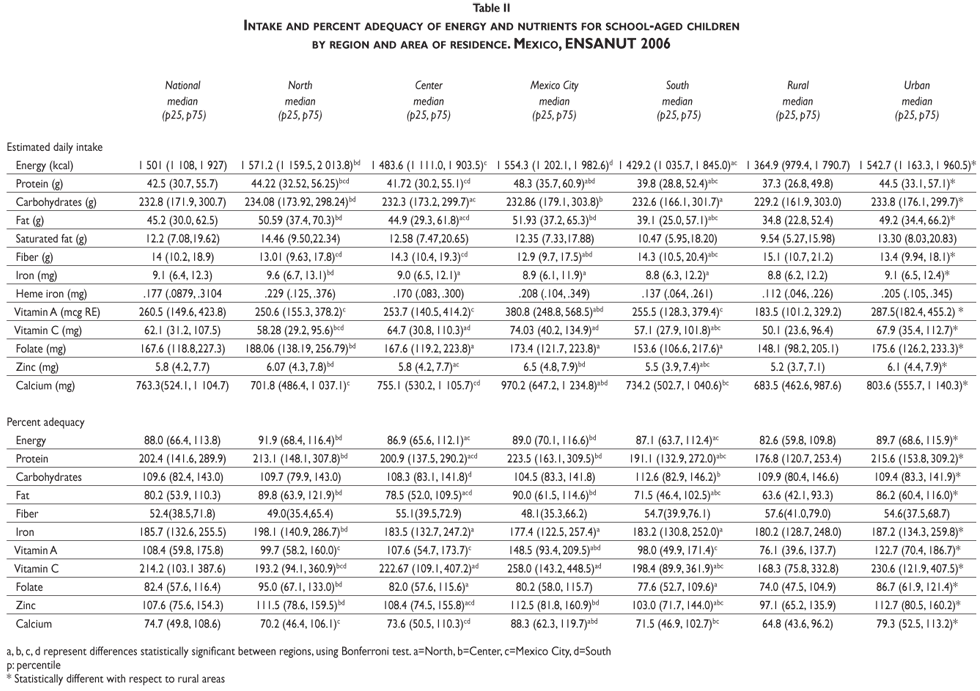
<body><![CDATA[<p><font size="2" face="Verdana"> Sociodemographic and anthropometric characteristics    of children are shown in <a href="#tab01">Table I</a>. Mean age was 8.21 &plusmn; 1.97 years. Distribution    by sex was close to 50% each. About one&#45;third of the children (29.4%) lived    in rural areas. The proportion of indigenous children was 6.5% and mean BMI    was 17.7 &plusmn; 3.21.</font></p>     <p><a name="tab01"></a></p>     <p>&nbsp;</p>     <p align="center"><img src="/img/revistas/spm/v51s4/a09tab01.gif"></p>     <p>&nbsp;</p>     <p><font size="2" face="Verdana"> Chronic malnutrition (that is, stunting:    height&#45;for&#45;age z&#45;score&lt; &#45;2.0) was present among 10.0% of children. Prevalence    of overweight or obesity was 25.5%.</font></p>     <p><font size="2" face="Verdana"> Children with valid dietary information differed    from children excluded from analysis with respect to sex (49.4% and 54.4% females,    respectively) and age (mean age was 8.3 years and 8.0 years, respectively) (<I>p</I>&lt;    0.05).</font></p>     <p><font size="2" face="Verdana"><I>Energy and macronutrient intakes:</i> Estimated    daily energy and nutrient intakes and adequacies are shown in <a href="/img/revistas/spm/v51s4/a09tab02.gif">Table   II</a> by region    and area of residency. The estimated median energy intake was 1 501 kcal/d (percent    adequacy &#91;PA&#93;= 88%). Median protein intake was 42.5 g/d (PA= 202%) and median    carbohydrate intake was 233 g/d (PA= 110%); median fat intake was 45.2 g/d (PA=    80%) and median fiber intake was 14.0 g/d (PA= 52%).</font></p>     <p><font size="2" face="Verdana">  The highest energy and fat intakes were observed    in Mexico City, with the exception of saturated fat and carbohydrates, which    was higher in the northern region. A slight difference in carbohydrate intake    was observed across regions and between rural and urban areas. The lowest energy,    protein, saturated fat and fiber intakes were observed in the southern region.    Children in rural areas had the highest consumption of fiber. Differences among    regions were statistically significant (<I>p</I>&lt; 0.05)</font></p>     <p><font size="2" face="Verdana"><I>Micronutrients.</i> Median total iron intake    was 9.1 mg/d (PA= 186%) and median heme iron intake was 0.18 mg/d; national    median vitamin A intake was 260.5 mcg RE/d (PA= 108%) and median vitamin C intake    was 62.1 mg/d (PA= 214%); median folic acid intake was 167.6 mcg/d (PA= 82%),    median zinc intake was 5.8 mg/d (PA= 108%) and median calcium intake was 763    mg/d (PA= 75%).</font></p>     ]]></body>
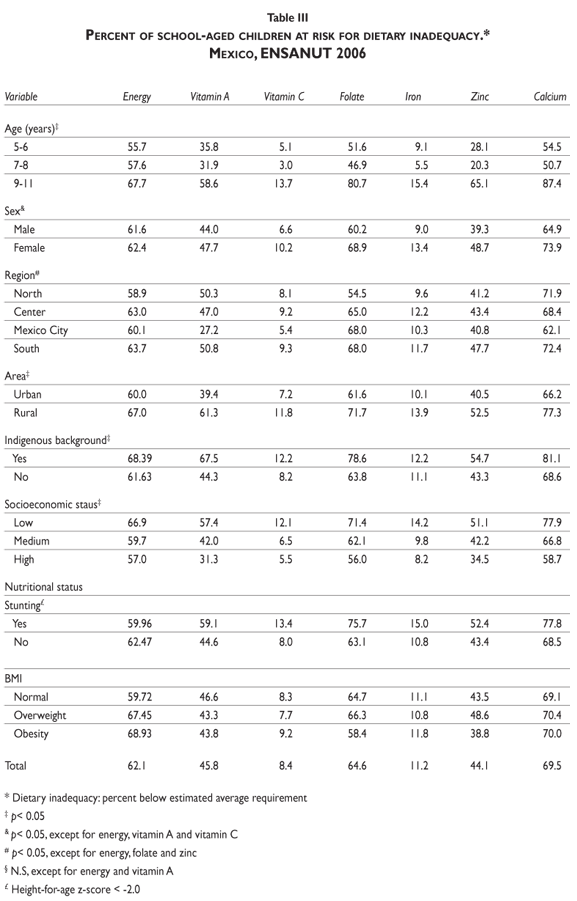
<body><![CDATA[<p><font size="2" face="Verdana">  The highest intakes of iron, heme iron and    folic acid were observed among children from the northern region. Children living    in the Mexico City region had the highest intakes of vitamin A, vitamin C, zinc    and calcium (<I>p</I>&lt; 0.05).</font></p>     <p><font size="2" face="Verdana">  The lowest iron, heme iron, vitamin C, folic    acid and zinc intakes were observed in the southern region, whereas the lowest    calcium intake was observed in the northern region. Micronutrient intakes were    higher in urban areas as compared to rural areas (<I>p</I>&lt; 0.05).</font></p>     <p><font size="2" face="Verdana"><I>Evaluation of risk for inadequate energy and    nutrient intakes.</i> The prevalence of cases below the energy requirement and    the percentage at risk of dietary inadequacies for micronutrients is presented    in <a href="#tab03">Table III</a>, according to sociodemographic characteristics and nutritional    status.</font></p>     <p><a name="tab03"></a></p>     <p>&nbsp;</p>     <p align="center"><img src="/img/revistas/spm/v51s4/a09tab03.gif"></p>     <p>&nbsp;</p>     <p><font size="2" face="Verdana"> For energy and most nutrients, the proportion    of children at risk of inadequacy was higher among older children (9 to 11 years),    children from rural areas (with the exception of folic acid), indigenous children,    and among children of low SES (<I>p</I>&lt; 0.05). </font></p>     <p><font size="2" face="Verdana"> Differences were also observed among regions;    the southern region presented a higher proportion of children at risk, except    for iron, which showed the highest prevalence of children at risk of inadequacy    (<I>p</I>&lt; 0.05) to be in the central region. The northern region had the    lowest proportion of children at risk of dietary inadequacies of energy, folic    acid, and iron (<I>p</I>&lt; 0.05).</font></p>     <p><font size="2" face="Verdana">  The proportion of children at risk of inadequate    energy intake was higher among non&#45;stunted children compared to children who    had growth retardation, while the risk of dietary micronutrient inadequacies    was higher among stunted children (<I>p</I>&lt; 0.05).</font></p>     ]]></body>
<body><![CDATA[<p><font size="2" face="Verdana">In relation to BMI status, the prevalence of    inadequate intakes of energy, vitamin C and iron were higher among children    who were obese. Inadequate intakes of folic acid, zinc and calcium were more    frequent among overweight children. The proportion of children at risk for inadequate    vitamin A intake was higher among children with normal BMI. </font></p>     <p><font size="2" face="Verdana"><I>The macronutrient composition of diets:</i>    The macronutrient composition of diets in terms of percent contribution to total    energy intake is shown in <a href="#tab04">Table IV</a>; carbohydrates accounted for 63% of energy    intake, protein accounted for 11.4% and fat, 28%.</font></p>     <p><a name="tab04"></a></p>     <p>&nbsp;</p>     <p align="center"><img src="/img/revistas/spm/v51s4/a09tab04.gif"></p>     <p>&nbsp;</p>     <p><font size="2" face="Verdana">The highest proportion of energy from carbohydrates    was observed among children who were older, lived in rural areas, stunted children    and children with low SES. The opposite occurred with the proportion of energy    from fat, with the highest proportion being among children who were either overweight    or obese. The percent contribution of saturated fat to total energy intake decreased with    age, was higher in the northern region, and was related to better SES conditions.</font></p>     <p><font size="2" face="Verdana"><I>Risk of excessive macronutrient intakes</i>:    The proportion of children at risk of relative excessive macronutrient (carbohydrate    and fat) intakes according to sociodemographic characteristics and nutritional    status is shown in the right panel in <a href="#tab04">Table IV</a>. There were no children who had    excessive intakes of protein (&gt; 30% of total energy intake). Moreover, there were    no children who simultaneously had excess fat and excess carbohydrate intakes.</font></p>     <p><font size="2" face="Verdana">The proportion of excess carbohydrate intake    was 44.7% and the prevalence of excess fat intake was 14.3%.</font></p>     <p><font size="2" face="Verdana"> Opposite tendencies were observed in relation    to the risk of excessive dietary intakes of carbohydrate and fat. For example,    excessive carbohydrate intake (EC) increases with age, while the risk of excessive    fat intake (EF) decreases (<I>p</I>&lt; 0.05). The highest prevalences of EC    were observed in the southern and central regions, which also had the lowest    prevalences of EF. The highest prevalences of EF were observed in the northern    and Mexico City regions (<I>p&lt;</I> 0.05). EC was likely to be associated with    low SES chronic malnutrition and indigenous ethnicity. On the other hand, EF was    more frequent among non&#45;indigenous children, children with better SES conditions,    and among children who were overweight or obese (<I>p</I>&lt; 0.05).</font></p>     ]]></body>
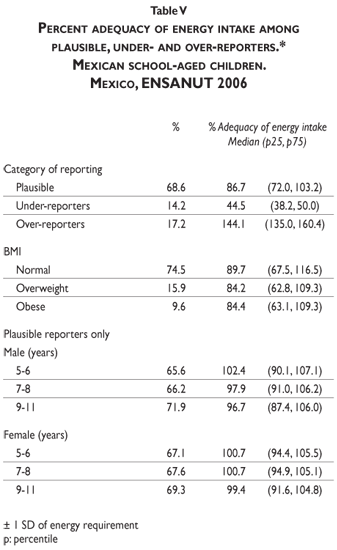
<body><![CDATA[<p><font size="2" face="Verdana">  Notably, children who had carbohydrate intakes    exceeding the recommendations also had higher risks of dietary insufficiency    for energy and most micronutrients compared to children without excessive carbohydrate    intakes (<I>p</I>&lt; 0.05). These children also had higher fiber intakes compared    to other children (<I>p</I>&lt; 0.05) (results not shown).</font></p>     <p><font size="2" face="Verdana"><I>Implausible reporters: </i>Percent adequacy    of energy intake among plausible, under&#45; and over&#45;reporters is shown in <a href="#tab05">Table   V</a>. Of the children studied, nearly 70% were classified as plausible reporters,    while roughly 14% were classified as under&#45;reporters and roughly 17% as over&#45;reporters.    The proportion of under&#45;reporters was higher among girls (14.5%) compared to    boys (13.8%) (<I>p</I>&lt; 0.001). A negative correlation was observed between    BMI and percent adequacy of energy intake (<I>r</I>= &#45;0.08, <I>p</I>&lt; 0.001).</font></p>     <p><a name="tab05"></a></p>     <p>&nbsp;</p>     <p align="center"><img src="/img/revistas/spm/v51s4/a09tab05.gif"></p>     <p>&nbsp;</p>     <p><font size="2" face="Verdana">The proportion of under&#45;reporters was higher    among older children (9&#45;11 years), which is also the group with the highest    prevalence of overweight and obesity.</font></p>     <p><font size="2" face="Verdana"> Notably, the percent adequacy of energy intake    was lower among children with overweight or obesity compared to children with    normal BMI (<I>p</I>&lt; 0.001). This coincides with results shown in <a href="#tab03">Table   III</a>, in which the proportion of children at risk of dietary energy inadequacy    was higher among overweight and obese children. These findings suggest that    energy under&#45;reporting is related to overweight and obesity in this representative    sample of Mexican school&#45;aged children.</font></p>     <p>&nbsp;</p>     <p><font size="3" face="Verdana"><b>Discussion</b></font></p>     ]]></body>
<body><![CDATA[<p><font size="2" face="Verdana">Significant differences in energy, macronutrient    and micronutrient intakes across regions, socioeconomic characteristics, and    nutritional status were found in this sample of Mexican school&#45;aged children    who participated in the ENSANUT 2006.</font></p>     <p><font size="2" face="Verdana"> A mixed picture has emerged for risks of    dietary inadequacies &#150;particularly of vitamin A, folate, zinc and calcium&#150; among    children of low SES, rural and indigenous children, as well as for risks of    excessive fat intakes among those of higher SES and among children living in    more developed regions.</font></p>     <p><font size="2" face="Verdana"> Results are in accordance with a previous    study of school&#45;aged children, conducted by the author, which used data from    the 1999 National Nutrition Survey (NNS&#45;99).<SUP>24</SUP> That study identified    two contrasting dietary patterns: a "rural" pattern (43% of children)    which was associated with poverty, high carbohydrate intake, and increased risk    of dietary micronutrient deficiencies; and a "western" pattern which    was related to excessive fat intake and an adjusted 45% increase in the risk    of overweight or obesity. In that study, among children with a "rural"    dietary pattern, corn tortillas and corn&#45;based foods accounted for approximately    52% of energy intake, in contrast with 21% among children with a "western"    diet, whereas with meat, poultry, dairy and industrialized foods the percent    contribution to diet was higher among children with a "western" diet.</font></p>     <p><font size="2" face="Verdana"> While in the present study we did not analyze    foods, food groups or dietary patterns, one could argue that the observed clustering    of dietary risks of deficiencies and excessive intakes could follow the same    logic, and that both studies are consistent with a "polarized" model    of nutrition transition in Mexican children.</font></p>     <p><font size="2" face="Verdana"> Even though there are differences among methodologies,    sampling, and timeframes, it is pertinent to compare the present findings with    the results of the NNS&#45;99 for the same age group.<SUP>12</SUP> In general terms,    energy and nutrient intakes seem to be higher in the present study than in those    observed in the NNS&#45;99. For example, median percent energy adequacy was 88%    in the present survey, which contrasts with 69% in the NNS&#45;99. In turn, vitamin    A, vitamin C, iron and zinc median percent adequacies seem to have doubled since    the NNS&#45;99. However, a significant reduction in the risk of dietary inadequacies    between the NNS&#45;99 and the current survey was observed for vitamin C and iron    only (47% <I>vs</I>. 8.4%, and 23% <I>vs</I>. 11%, respectively). </font></p>     <p><font size="2" face="Verdana">There are some aspects that have to be considered    to explain the higher energy and nutrient intakes and adequacies observed in    the current study in comparison with the previous nationally representative    NNS&#45;1999 data.</font></p>     <p><font size="2" face="Verdana"> First, epidemiological studies based on different    nationally representative surveys have documented that an actual increase in    food consumption, as well as a significant shift towards energy&#45;dense foods    is occurring in Mexican population.<SUP>4 </sup></font></p>     <p><font size="2" face="Verdana"> Second, even though different portion sizes    were used for different age groups, the FFQ used in the current survey may overestimate    intakes to some degree, as it has been seen that longer FFQs tend to overestimate    nutrient intakes compared to short FFQs. The FFQ used in this survey has 101    food items, whereas Block's FFQ for children (aged 8&#45;17 years), for example,  has only 77 food items.<SUP>25</sup></font></p>     <p><font size="2" face="Verdana"> Third, improved and updated food composition    tables that focus on micronutrients that have been a problem in the Mexican    diet are now being used by the authors. The result of this updating process    can lead to an apparent increase in micronutrient intakes. </font></p>     <p><font size="2" face="Verdana"> Fourth, a considerable effort on the part    of the Mexican government to fight malnutrition and micronutrient deficiencies    among the poor is being carried out, and has been shown to be of considerable    success. For example, a randomized effectiveness study showed that Progresa,    a large&#45;scale government program that distributes nutritional supplements to    preschool children, is associated with better growth in height and lower rates    of anemia in low&#45;income rural Mexican infants.<SUP>26</SUP> It is notable that    consumption of these micronutrient&#45;rich nutritional supplements by other family    members &#150;particularly by older siblings&#150; has been reported,<SUP>27</SUP> which    could be having some impact on dietary micronutrient intakes by school&#45;aged    children. More importantly, other programs are currently in place to improve    diets among the poor,<SUP>28</SUP> while nationwide corn and flour micronutrient    fortification programs could also be contributing to higher micronutrient intakes    in the whole population.<SUP>29</sup></font></p>     ]]></body>
<body><![CDATA[<p><font size="2" face="Verdana"> Fifth, median energy adequacy among children    in the high SES was 96% in the current survey, compared to 80% for the same    group in the NNS&#45;99. One would expect that among those with better SES conditions,    percent energy intake adequacy would be close to 100%. Thus, the previous 1999    survey could have underestimated energy and nutrient intakes.<SUP>12</sup></font></p>     <p><font size="2" face="Verdana"> In relation to energy intake, in the present    study energy intake under&#45;reporting was positively associated with BMI, which    coincides with other studies among children. However, the proportion of plausible    reporters is higher in our study, while the proportion of under&#45;reporters is    14% in the present study, which is much lower than the 34% observed in another    study.<SUP>30</SUP> A sensitivity analysis was carried out that included plausible    reporters only (<I>n</I>= 5 939) and slight differences (&lt; 3%) were observed    in relation to most energy and nutrient intakes and adequacies at national and    regional levels. </font></p>     <p><font size="2" face="Verdana">These considerations taken together support the    validity of the current estimates. </font></p>     <p><font size="2" face="Verdana"> One problem that deserves special attention    is the case of iron intakes in this population. As has been shown, the risk    of dietary iron deficiency seems to be low, roughly 11%, while the median percent    adequacies are 185%. However, this percent adequacy is based on the recommendation    by IOM,<SUP>31</SUP> for which a bioavailability of 10% for heme iron was considered.    Recent estimates of the bioavailability of iron in the diet of Mexican children    suggest that a 10% bioavailability is high for this population due to the considerable    presence of dietary inhibitors of iron absorption.<SUP>16</SUP> Estimates of    iron bioavailability in the diets of Mexican children, depending on different    assumptions on body iron stores, showed that bioavailable iron in their diets    ranged between 0.14 and 0.37 mg/d, which represents 2.7% to 6.1% of iron bioavailability.<SUP>16</SUP>    These findings indicate that the present study may underestimate the actual    problem of dietary risk of iron deficiency in Mexican children. </font></p>     <p><font size="2" face="Verdana"> In summary, the analysis of dietary data    for school&#45;aged Mexican children who participated in a national survey showed    that risks of dietary deficiencies of vitamin A, folate, zinc and calcium continue    to be significant public nutrition problems among this population. On the other    hand, there seems to be no problem with energy and macronutrient intakes, in    terms of dietary deficiency, among Mexican school&#45;aged children. Moreover, certain    groups of these children could be at risk of excessive energy and macronutrient    intakes. This has to be taken into consideration when designing massive interventions    aimed to reduce the risk of dietary deficiencies in Mexican children. To avoid    these risks and related health problems in Mexican children, a nationwide effort    to promote a healthy diet and lifestyle should be of the greatest priority.</font></p>     <p>&nbsp;</p>     <p><font size="3" face="Verdana"><b>References</b></font></p>     <!-- ref --><p><font size="2" face="Verdana">1. Rivera J, Shamah T. An&aacute;lisis cr&iacute;tico    de la mala nutrici&oacute;n durante las &uacute;ltimas d&eacute;cadas en M&eacute;xico:    Resultados de ni&ntilde;os. Salud Publica Mex 2007;49:E267&#45;E269.    &nbsp;&nbsp;&nbsp;&nbsp;&nbsp;&nbsp;&nbsp;&nbsp;[&#160;<a href="javascript:void(0);" onclick="javascript: window.open('/scielo.php?script=sci_nlinks&ref=9293613&pid=S0036-3634200900100000900001&lng=','','width=640,height=500,resizable=yes,scrollbars=1,menubar=yes,');">Links</a>&#160;]<!-- end-ref --> </font></p>     <!-- ref --><p><font size="2" face="Verdana">2. Popkin BM. The nutrition transition in low    income countries: An emerging crisis. Nutr Rev 1994;52:285&#45;298.    &nbsp;&nbsp;&nbsp;&nbsp;&nbsp;&nbsp;&nbsp;&nbsp;[&#160;<a href="javascript:void(0);" onclick="javascript: window.open('/scielo.php?script=sci_nlinks&ref=9293615&pid=S0036-3634200900100000900002&lng=','','width=640,height=500,resizable=yes,scrollbars=1,menubar=yes,');">Links</a>&#160;]<!-- end-ref --></font></p>     <!-- ref --><p><font size="2" face="Verdana">3. Drewnowski A, Popkin BM. The nutrition transition:    New trends in the global diet. Nutr Rev 1997;55:31&#45;43.    &nbsp;&nbsp;&nbsp;&nbsp;&nbsp;&nbsp;&nbsp;&nbsp;[&#160;<a href="javascript:void(0);" onclick="javascript: window.open('/scielo.php?script=sci_nlinks&ref=9293617&pid=S0036-3634200900100000900003&lng=','','width=640,height=500,resizable=yes,scrollbars=1,menubar=yes,');">Links</a>&#160;]<!-- end-ref --></font></p>     <!-- ref --><p><font size="2" face="Verdana">4. Rivera J, Barquera S, Campirano F, Campos    I, Safdie M, Tovar V. Epidemiological and nutritional transition in M&eacute;xico:    Rapid increase of non&#45;communicable chronic diseases and obesity. Public Health    Nutr 2002;14:113&#45;122.    &nbsp;&nbsp;&nbsp;&nbsp;&nbsp;&nbsp;&nbsp;&nbsp;[&#160;<a href="javascript:void(0);" onclick="javascript: window.open('/scielo.php?script=sci_nlinks&ref=9293619&pid=S0036-3634200900100000900004&lng=','','width=640,height=500,resizable=yes,scrollbars=1,menubar=yes,');">Links</a>&#160;]<!-- end-ref --></font></p>     <!-- ref --><p><font size="2" face="Verdana">5. Mej&iacute;a F, Shamah&#45;Levy T, Ram&iacute;rez    I, Rivera JA, Villalpando S. Prevalencia de anemia en ni&ntilde;os de 1 a 12    a&ntilde;os de edad: resultados de una encuesta probabil&iacute;stica nacional.    Salud Publica Mex 2003;45:490&#45;498.    &nbsp;&nbsp;&nbsp;&nbsp;&nbsp;&nbsp;&nbsp;&nbsp;[&#160;<a href="javascript:void(0);" onclick="javascript: window.open('/scielo.php?script=sci_nlinks&ref=9293621&pid=S0036-3634200900100000900005&lng=','','width=640,height=500,resizable=yes,scrollbars=1,menubar=yes,');">Links</a>&#160;]<!-- end-ref --> </font></p>     <!-- ref --><p><FONT size="2" FACE="Verdana">6. Villalpando S, Montalvo&#45;Velarde I, Zambrano    N, Garc&iacute;a&#45;Guerra A, Ram&iacute;rez&#45;Silva CI, Shamah&#45;Levy T, <I>et al.</I>    Vitamins A, and C and folic acid status in Mexican children under 12 years and    women 12&#45;49 years: a probabilistic national survey. Salud Publica Mex 2003;45 Suppl    4:S508&#45;S519.    &nbsp;&nbsp;&nbsp;&nbsp;&nbsp;&nbsp;&nbsp;&nbsp;[&#160;<a href="javascript:void(0);" onclick="javascript: window.open('/scielo.php?script=sci_nlinks&ref=9293623&pid=S0036-3634200900100000900006&lng=','','width=640,height=500,resizable=yes,scrollbars=1,menubar=yes,');">Links</a>&#160;]<!-- end-ref --></font></p>     <!-- ref --><p><FONT size="2" FACE="Verdana"> 7. Engle PL, Black MM, Behrman JR, Cabral de    Mello M, Gertler PJ, Kapiriri L, <I>et al.</I> International Child Development    Steering Group. Strategies to avoid the loss of developmental potential in more    than 200 million children in the developing world. Lancet 2007;369:229&#45;242.    &nbsp;&nbsp;&nbsp;&nbsp;&nbsp;&nbsp;&nbsp;&nbsp;[&#160;<a href="javascript:void(0);" onclick="javascript: window.open('/scielo.php?script=sci_nlinks&ref=9293625&pid=S0036-3634200900100000900007&lng=','','width=640,height=500,resizable=yes,scrollbars=1,menubar=yes,');">Links</a>&#160;]<!-- end-ref --></font></p>     <!-- ref --><p><font size="2" face="Verdana">8. Dietz WH. Health consequences of obesity in    youth: Childhood predictors of adult disease. Pediatrics1998;101:518&#45;525.    &nbsp;&nbsp;&nbsp;&nbsp;&nbsp;&nbsp;&nbsp;&nbsp;[&#160;<a href="javascript:void(0);" onclick="javascript: window.open('/scielo.php?script=sci_nlinks&ref=9293627&pid=S0036-3634200900100000900008&lng=','','width=640,height=500,resizable=yes,scrollbars=1,menubar=yes,');">Links</a>&#160;]<!-- end-ref --> </font></p>     <!-- ref --><p><font size="2" face="Verdana">9. Olaiz G, Rivera J, Shamah T, Rojas R, Villalpando    S, Sep&uacute;lveda J. Encuesta Nacional de Salud y Nutrici&oacute;n 2006. Cuernavaca,    M&eacute;xico: Instituto Nacional de Salud P&uacute;blica, 2006.    &nbsp;&nbsp;&nbsp;&nbsp;&nbsp;&nbsp;&nbsp;&nbsp;[&#160;<a href="javascript:void(0);" onclick="javascript: window.open('/scielo.php?script=sci_nlinks&ref=9293629&pid=S0036-3634200900100000900009&lng=','','width=640,height=500,resizable=yes,scrollbars=1,menubar=yes,');">Links</a>&#160;]<!-- end-ref --></font></p>     <!-- ref --><p><FONT size="2" FACE="Verdana">10. Ram&iacute;rez&#45;Silva CI, Mundo&#45;Rosas V, Rodr&iacute;guez&#45;Ram&iacute;rez    SC, Vizuet&#45;Vega NI, Hern&aacute;ndez&#45;Carapia N, Jim&eacute;nez&#45;Aguilar A. Encuestas    diet&eacute;ticas: recordatorio de 24 horas y frecuencia de consumo de alimentos.    In: Shamah&#45; Levy T, Villalpando&#45; Hern&aacute;ndez S, Rivera&#45;Dommarco J. Manual    de procedimientos para proyectos de nutrici&oacute;n. Cuernavaca, M&eacute;xico:    Instituto Nacional de Salud P&uacute;blica, 2006:27&#45;108. &#91;Consulted 2009 April    29&#93;Available at: <a href="http://www.insp.mx/Portal/insp_publica/proy_nutricion.pdf" target="_blank">http://www.insp.mx/Portal/insp_publica/proy_nutricion.pdf</a>.    &nbsp;&nbsp;&nbsp;&nbsp;&nbsp;&nbsp;&nbsp;&nbsp;[&#160;<a href="javascript:void(0);" onclick="javascript: window.open('/scielo.php?script=sci_nlinks&ref=9293631&pid=S0036-3634200900100000900010&lng=','','width=640,height=500,resizable=yes,scrollbars=1,menubar=yes,');">Links</a>&#160;]<!-- end-ref --></font></p>     <!-- ref --><p><font size="2" face="Verdana">11. Barquera S, Rivera J, Espinosa&#45;Montero J,    Safdie M, Campirano F, Monterrubio E. Energy and nutrient consumption in Mexican    women 12&#45;49 years of age. Analysis of the National Nutrition Survey 1999. Salud    Publica Mex 2003;45 Suppl 4:S530&#45;S539.    &nbsp;&nbsp;&nbsp;&nbsp;&nbsp;&nbsp;&nbsp;&nbsp;[&#160;<a href="javascript:void(0);" onclick="javascript: window.open('/scielo.php?script=sci_nlinks&ref=9293633&pid=S0036-3634200900100000900011&lng=','','width=640,height=500,resizable=yes,scrollbars=1,menubar=yes,');">Links</a>&#160;]<!-- end-ref --></font></p>     <!-- ref --><p><font size="2" face="Verdana">12. Barquera S, Rivera J, Safdie M, Flores M,    Campos&#45;Nonato I, Campirano F. Energy and nutrient intake in preschool and school    age Mexican children: National Nutrition Survey 1999. Salud Publica Mex 2003;45    Suppl 4:S540&#45;S550.    &nbsp;&nbsp;&nbsp;&nbsp;&nbsp;&nbsp;&nbsp;&nbsp;[&#160;<a href="javascript:void(0);" onclick="javascript: window.open('/scielo.php?script=sci_nlinks&ref=9293635&pid=S0036-3634200900100000900012&lng=','','width=640,height=500,resizable=yes,scrollbars=1,menubar=yes,');">Links</a>&#160;]<!-- end-ref --></font></p>     <!-- ref --><p><font size="2" face="Verdana">13. Lohman T, Roche A, Martorell R. Anthropometrics    standardization reference manual. Champaign (IL): Human Kinetics Books, 1988.    &nbsp;&nbsp;&nbsp;&nbsp;&nbsp;&nbsp;&nbsp;&nbsp;[&#160;<a href="javascript:void(0);" onclick="javascript: window.open('/scielo.php?script=sci_nlinks&ref=9293637&pid=S0036-3634200900100000900013&lng=','','width=640,height=500,resizable=yes,scrollbars=1,menubar=yes,');">Links</a>&#160;]<!-- end-ref --></font></p>     <!-- ref --><p><font size="2" face="Verdana">14. A Report of the Panel on Macronutrients,    Subcommittees on Upper Reference Levels of Nutrients and Interpretation and    Uses of Dietary Reference Intakes, and the Standing Committee on the Scientific    Evaluation of Dietary Reference Intakes. Dietary reference intakes for energy,    carbohydrate, fiber, fat, fatty acids, cholesterol, protein, and amino acids    (macronutrients). Washington, DC: Institute of Medicine, The National Academies    Press, 2005: 589&#45;630.    &nbsp;&nbsp;&nbsp;&nbsp;&nbsp;&nbsp;&nbsp;&nbsp;[&#160;<a href="javascript:void(0);" onclick="javascript: window.open('/scielo.php?script=sci_nlinks&ref=9293639&pid=S0036-3634200900100000900014&lng=','','width=640,height=500,resizable=yes,scrollbars=1,menubar=yes,');">Links</a>&#160;]<!-- end-ref --></font></p>     <!-- ref --><p><font size="2" face="Verdana">15. Panel on Dietary Antioxidants and Related    Compounds, Subcommittees on Upper Reference Levels of Nutrients and Interpretation    and Uses of DRIs, Standing Committee on the Scientific Evaluation of Dietary    Reference Intakes, Food and Nutrition Board, Institute of Medicine. Vitamin    C. In: Dietary reference intakes for: Vitamin C, Vitamin E, selenium and carotenoids.    Washington, DC: Institute of Medicine, The National Academies Press, 2000: 95&#45;185.    &nbsp;&nbsp;&nbsp;&nbsp;&nbsp;&nbsp;&nbsp;&nbsp;[&#160;<a href="javascript:void(0);" onclick="javascript: window.open('/scielo.php?script=sci_nlinks&ref=9293641&pid=S0036-3634200900100000900015&lng=','','width=640,height=500,resizable=yes,scrollbars=1,menubar=yes,');">Links</a>&#160;]<!-- end-ref --></font></p>     <!-- ref --><p><font size="2" face="Verdana">16. Institute of Medicine. Dietary reference    intakes for Vitamin A, vitamin K, arsenic, boron, chromium, copper, iodine,    iron, manganese, molybdenum, nickel, silicon, vanadium and zinc. Washington,    DC: Institute of Medicine, The National Academies Press, 2000.    &nbsp;&nbsp;&nbsp;&nbsp;&nbsp;&nbsp;&nbsp;&nbsp;[&#160;<a href="javascript:void(0);" onclick="javascript: window.open('/scielo.php?script=sci_nlinks&ref=9293643&pid=S0036-3634200900100000900016&lng=','','width=640,height=500,resizable=yes,scrollbars=1,menubar=yes,');">Links</a>&#160;]<!-- end-ref --></font></p>     <!-- ref --><p><font size="2" face="Verdana">17. A Report of the Standing Committee on the    Scientific Evaluation of Dietary Reference Intakes and its Panel on Folate,    Other B Vitamins, and Choline and Subcommittee on Upper Reference Levels of    Nutrients, Food and Nutrition Board, Institute of Medicine. Folate: In: Dietary    reference intakes for: Thiamin, riboflavin, niacin, vitamin B6, folate, vitamin    B12, pantothenic acid, biotin and choline. Washington, DC: Institute of Medicine,    The National Academies Press, 2000: 196&#45;305.    &nbsp;&nbsp;&nbsp;&nbsp;&nbsp;&nbsp;&nbsp;&nbsp;[&#160;<a href="javascript:void(0);" onclick="javascript: window.open('/scielo.php?script=sci_nlinks&ref=9293645&pid=S0036-3634200900100000900017&lng=','','width=640,height=500,resizable=yes,scrollbars=1,menubar=yes,');">Links</a>&#160;]<!-- end-ref --></font></p>     <!-- ref --><p><font size="2" face="Verdana">18. Tseng M, Chakraborty H, Robinson DT, Mendez    M, Kohlmeier L. Adjustment of iron intake for dietary enhancers and inhibitors    in population studies: Bioavailable iron in rural and urban residing Russian    women and children. J Nutr 1997;127:1456&#45;1468.    &nbsp;&nbsp;&nbsp;&nbsp;&nbsp;&nbsp;&nbsp;&nbsp;[&#160;<a href="javascript:void(0);" onclick="javascript: window.open('/scielo.php?script=sci_nlinks&ref=9293647&pid=S0036-3634200900100000900018&lng=','','width=640,height=500,resizable=yes,scrollbars=1,menubar=yes,');">Links</a>&#160;]<!-- end-ref --></font></p>     <!-- ref --><p><font size="2" face="Verdana">19. Standing Committee on the Scientific Evaluation    of Dietary Reference Intakes, Food and Nutrition Board, Institute of Medicine.    Calcium. In: Dietary reference intakes for: Calcium, phosphorus, magnesium,    vitamin D and fluoride. Washington, DC: Institute of Medicine, The National    Academies Press, 2000: 71&#45;145.    &nbsp;&nbsp;&nbsp;&nbsp;&nbsp;&nbsp;&nbsp;&nbsp;[&#160;<a href="javascript:void(0);" onclick="javascript: window.open('/scielo.php?script=sci_nlinks&ref=9293649&pid=S0036-3634200900100000900019&lng=','','width=640,height=500,resizable=yes,scrollbars=1,menubar=yes,');">Links</a>&#160;]<!-- end-ref --></font></p>     <!-- ref --><p><font size="2" face="Verdana">20. Institute of Medicine. Energy. In: Dietary    reference intakes for energy, carbohydrates, fiber, fat, protein and amino acids    (macronutrients). Washington, DC: Institute of Medicine, The National Academies    Press, 2005:107&#45;264.    &nbsp;&nbsp;&nbsp;&nbsp;&nbsp;&nbsp;&nbsp;&nbsp;[&#160;<a href="javascript:void(0);" onclick="javascript: window.open('/scielo.php?script=sci_nlinks&ref=9293651&pid=S0036-3634200900100000900020&lng=','','width=640,height=500,resizable=yes,scrollbars=1,menubar=yes,');">Links</a>&#160;]<!-- end-ref --></font></p>     <!-- ref --><p><font size="2" face="Verdana">21. Huang T, Howarth N, Lin B&#45;H, Roberts SB,    McCrory M. Energy intake and meal portions: associations with BMI percentile    in U.S. children. Obes Res 2004;12(11):1875&#45;1885.    &nbsp;&nbsp;&nbsp;&nbsp;&nbsp;&nbsp;&nbsp;&nbsp;[&#160;<a href="javascript:void(0);" onclick="javascript: window.open('/scielo.php?script=sci_nlinks&ref=9293653&pid=S0036-3634200900100000900021&lng=','','width=640,height=500,resizable=yes,scrollbars=1,menubar=yes,');">Links</a>&#160;]<!-- end-ref --></font></p>     <!-- ref --><p><FONT size="2" FACE="Verdana">22. Kuczmarski RJ, Ogden CL, Grummer&#45;Strawn LM,    Flegal KM, Guo SS, Wei R, <I>et al.</I> CDC growth charts: United States. Advance    data from Vital and Health Statistics; Num. 314. Hyattsville (MD): National    Center for Health Statistics, 2000.    &nbsp;&nbsp;&nbsp;&nbsp;&nbsp;&nbsp;&nbsp;&nbsp;[&#160;<a href="javascript:void(0);" onclick="javascript: window.open('/scielo.php?script=sci_nlinks&ref=9293655&pid=S0036-3634200900100000900022&lng=','','width=640,height=500,resizable=yes,scrollbars=1,menubar=yes,');">Links</a>&#160;]<!-- end-ref --></font></p>     <!-- ref --><p><font size="2" face="Verdana">23. Cole TJ, Bellizzi MC, Flegal KM, Dietz WH.    Establishing a standard definition for child overweight and obesity worldwide:    international survey. BMJ 2000;320:1240&#45;1243.    &nbsp;&nbsp;&nbsp;&nbsp;&nbsp;&nbsp;&nbsp;&nbsp;[&#160;<a href="javascript:void(0);" onclick="javascript: window.open('/scielo.php?script=sci_nlinks&ref=9293657&pid=S0036-3634200900100000900023&lng=','','width=640,height=500,resizable=yes,scrollbars=1,menubar=yes,');">Links</a>&#160;]<!-- end-ref --></font></p>     <!-- ref --><p><font size="2" face="Verdana">24. Flores M, Rodr&iacute;guez S, Mac&iacute;as    N, Barquera S. Patrones dietarios de ni&ntilde;os mexicanos en edad escolar.    Brasil: Memorias Congreso de la Sociedad Latinoamericana de Nutrici&oacute;n,    2006.    &nbsp;&nbsp;&nbsp;&nbsp;&nbsp;&nbsp;&nbsp;&nbsp;[&#160;<a href="javascript:void(0);" onclick="javascript: window.open('/scielo.php?script=sci_nlinks&ref=9293659&pid=S0036-3634200900100000900024&lng=','','width=640,height=500,resizable=yes,scrollbars=1,menubar=yes,');">Links</a>&#160;]<!-- end-ref --></font></p>     <!-- ref --><p><font size="2" face="Verdana">25. Cade JE, Burley VJ, Warm DL, Thompson RL,    Margetts BM. Food&#45;frequency questionnaires: a review of their design, validation    and utilisation. Nutr Res Rev 2004;17:5&#45;22.    &nbsp;&nbsp;&nbsp;&nbsp;&nbsp;&nbsp;&nbsp;&nbsp;[&#160;<a href="javascript:void(0);" onclick="javascript: window.open('/scielo.php?script=sci_nlinks&ref=9293661&pid=S0036-3634200900100000900025&lng=','','width=640,height=500,resizable=yes,scrollbars=1,menubar=yes,');">Links</a>&#160;]<!-- end-ref --></font></p>     <!-- ref --><p><font size="2" face="Verdana">26. Rivera JA, Sotres&#45;Alvarez D, Habicht JP,    Shamah T, Villalpando S. Impact of the Mexican program for education, health,    and nutrition (Progresa) on rates of growth and anemia in infants and young    children: a randomized effectiveness study. JAMA 2004; 291:2563&#45;2570.    &nbsp;&nbsp;&nbsp;&nbsp;&nbsp;&nbsp;&nbsp;&nbsp;[&#160;<a href="javascript:void(0);" onclick="javascript: window.open('/scielo.php?script=sci_nlinks&ref=9293663&pid=S0036-3634200900100000900026&lng=','','width=640,height=500,resizable=yes,scrollbars=1,menubar=yes,');">Links</a>&#160;]<!-- end-ref --></font></p>     <!-- ref --><p><font size="2" face="Verdana">27. Zarco A, Mora G, Pelcastre B, Flores M, Bronfman    M. Aceptabilidad de los suplementos alimenticios del Programa Oportunidades.    Salud Publica Mex 2006;48:325&#45;331.    &nbsp;&nbsp;&nbsp;&nbsp;&nbsp;&nbsp;&nbsp;&nbsp;[&#160;<a href="javascript:void(0);" onclick="javascript: window.open('/scielo.php?script=sci_nlinks&ref=9293665&pid=S0036-3634200900100000900027&lng=','','width=640,height=500,resizable=yes,scrollbars=1,menubar=yes,');">Links</a>&#160;]<!-- end-ref --></font></p>     <!-- ref --><p><FONT size="2" FACE="Verdana">28. Gonzalez&#45;Coss&iacute;o T, Rivera&#45;Dommarco    J, Guti&eacute;rrez JP, Neufeld L, Rodr&iacute;guez S, Gonzales D, <I>et al.</I>    Evaluaci&oacute;n del estado de nutrici&oacute;n de ni&ntilde;os menores de    5 a&ntilde;os y sus madres y gasto en alimentos de familias de localidades marginales    de M&eacute;xico. Recolecci&oacute;n de datos del primer seguimiento 2005. Informe    final. Cuernavaca, Morelos: Instituto Nacional de Salud P&uacute;blica, 2005.    &nbsp;&nbsp;&nbsp;&nbsp;&nbsp;&nbsp;&nbsp;&nbsp;[&#160;<a href="javascript:void(0);" onclick="javascript: window.open('/scielo.php?script=sci_nlinks&ref=9293667&pid=S0036-3634200900100000900028&lng=','','width=640,height=500,resizable=yes,scrollbars=1,menubar=yes,');">Links</a>&#160;]<!-- end-ref --></font></p>     <!-- ref --><p><font size="2" face="Verdana">29. Hernandez M, Sousa V, Villalpando S, Moreno    A, Montalvo I, Lopez&#45;Alarcon M. Cooking and Fe fortification have different    effects on Fe bioavailability of bread and tortillas. J Am Coll Nutr 2006;25(1):20&#45;25.    &nbsp;&nbsp;&nbsp;&nbsp;&nbsp;&nbsp;&nbsp;&nbsp;[&#160;<a href="javascript:void(0);" onclick="javascript: window.open('/scielo.php?script=sci_nlinks&ref=9293669&pid=S0036-3634200900100000900029&lng=','','width=640,height=500,resizable=yes,scrollbars=1,menubar=yes,');">Links</a>&#160;]<!-- end-ref --></font></p>     <!-- ref --><p><font size="2" face="Verdana">30. Fiorito LM, Ventura AK, Mitchel DC, Smicklas&#45;Wright    H, Birch LL. Girls' dairy intake, energy intake and weight status. J Am Diet  Assoc 2006;106:1851&#45;1855.    &nbsp;&nbsp;&nbsp;&nbsp;&nbsp;&nbsp;&nbsp;&nbsp;[&#160;<a href="javascript:void(0);" onclick="javascript: window.open('/scielo.php?script=sci_nlinks&ref=9293671&pid=S0036-3634200900100000900030&lng=','','width=640,height=500,resizable=yes,scrollbars=1,menubar=yes,');">Links</a>&#160;]<!-- end-ref --></font></p>     <!-- ref --><p><font size="2" face="Verdana">31. Institute of Medicine. Dietary reference    intakes for: Vitamin A, vitamin K, arsenic, boron, chromium, copper, iodine,    iron, manganese, molybdenum, nickel, silicon, vanadium and zinc. Washington,    DC: Institute of Medicine, National Academies Press, 2000.    &nbsp;&nbsp;&nbsp;&nbsp;&nbsp;&nbsp;&nbsp;&nbsp;[&#160;<a href="javascript:void(0);" onclick="javascript: window.open('/scielo.php?script=sci_nlinks&ref=9293673&pid=S0036-3634200900100000900031&lng=','','width=640,height=500,resizable=yes,scrollbars=1,menubar=yes,');">Links</a>&#160;]<!-- end-ref --></font></p>     <p>&nbsp;</p>     ]]></body>
<body><![CDATA[<p>&nbsp;</p>     <p><font size="2" face="Verdana">Received on: April 11, 2008    <br>   Accepted on: February 10, 2009</font></p>     <p>&nbsp;</p>     <p>&nbsp;</p>     <p><font size="2" face="Verdana">Danone de M&eacute;xico provided an unrestricted    grant which made this work possible.    <br>   Address   reprint requests to: Dr. Mario Flores. Head of Department. Data analysis.   Centro de Investigaci&oacute;n en Nutrici&oacute;n y Salud. Instituto Nacional de Salud P&uacute;blica. Av. Universidad 655, col. Santa Mar&iacute;a Ahuacatitl&aacute;n. 62100 Cuernavaca, Morelos, M&eacute;xico. E&#45;mail: <A HREF="mailto:mflores@correo.insp.mx">mflores@correo.insp.mx</A>    <br> <a name="nt01"></a><a href="#tx01">*</a> Instituto Nacional de Salud P&uacute;blica. Database for nutritient values for food. Compiled by the Instituto Nacional de Salud P&uacute;blica, 2004 (unpublished document).    <br> <a name="nt02"></a><a href="#tx02">&#135;</a> Stata 9.0. Stata Corporation. College Station, TX. USA. 2001.</font></p>      ]]></body><back>
<ref-list>
<ref id="B1">
<label>1</label><nlm-citation citation-type="journal">
<person-group person-group-type="author">
<name>
<surname><![CDATA[Rivera]]></surname>
<given-names><![CDATA[J]]></given-names>
</name>
<name>
<surname><![CDATA[Shamah]]></surname>
<given-names><![CDATA[T]]></given-names>
</name>
</person-group>
<article-title xml:lang="es"><![CDATA[Análisis crítico de la mala nutrición durante las últimas décadas en México: Resultados de niños]]></article-title>
<source><![CDATA[Salud Publica Mex]]></source>
<year>2007</year>
<volume>49</volume>
<page-range>E267-E269</page-range></nlm-citation>
</ref>
<ref id="B2">
<label>2</label><nlm-citation citation-type="journal">
<person-group person-group-type="author">
<name>
<surname><![CDATA[Popkin]]></surname>
<given-names><![CDATA[BM]]></given-names>
</name>
</person-group>
<article-title xml:lang="en"><![CDATA[The nutrition transition in low income countries: An emerging crisis]]></article-title>
<source><![CDATA[Nutr Rev]]></source>
<year>1994</year>
<volume>52</volume>
<page-range>285-298</page-range></nlm-citation>
</ref>
<ref id="B3">
<label>3</label><nlm-citation citation-type="journal">
<person-group person-group-type="author">
<name>
<surname><![CDATA[Drewnowski]]></surname>
<given-names><![CDATA[A]]></given-names>
</name>
<name>
<surname><![CDATA[Popkin]]></surname>
<given-names><![CDATA[BM]]></given-names>
</name>
</person-group>
<article-title xml:lang="en"><![CDATA[The nutrition transition: New trends in the global diet]]></article-title>
<source><![CDATA[Nutr Rev]]></source>
<year>1997</year>
<volume>55</volume>
<page-range>31-43</page-range></nlm-citation>
</ref>
<ref id="B4">
<label>4</label><nlm-citation citation-type="journal">
<person-group person-group-type="author">
<name>
<surname><![CDATA[Rivera]]></surname>
<given-names><![CDATA[J]]></given-names>
</name>
<name>
<surname><![CDATA[Barquera]]></surname>
<given-names><![CDATA[S]]></given-names>
</name>
<name>
<surname><![CDATA[Campirano]]></surname>
<given-names><![CDATA[F]]></given-names>
</name>
<name>
<surname><![CDATA[Campos]]></surname>
<given-names><![CDATA[I]]></given-names>
</name>
<name>
<surname><![CDATA[Safdie]]></surname>
<given-names><![CDATA[M]]></given-names>
</name>
<name>
<surname><![CDATA[Tovar]]></surname>
<given-names><![CDATA[V]]></given-names>
</name>
</person-group>
<article-title xml:lang="en"><![CDATA[Epidemiological and nutritional transition in México: Rapid increase of non-communicable chronic diseases and obesity]]></article-title>
<source><![CDATA[Public Health Nutr]]></source>
<year>2002</year>
<volume>14</volume>
<page-range>113-122</page-range></nlm-citation>
</ref>
<ref id="B5">
<label>5</label><nlm-citation citation-type="journal">
<person-group person-group-type="author">
<name>
<surname><![CDATA[Mejía]]></surname>
<given-names><![CDATA[F]]></given-names>
</name>
<name>
<surname><![CDATA[Shamah-Levy]]></surname>
<given-names><![CDATA[T]]></given-names>
</name>
<name>
<surname><![CDATA[Ramírez]]></surname>
<given-names><![CDATA[I]]></given-names>
</name>
<name>
<surname><![CDATA[Rivera]]></surname>
<given-names><![CDATA[JA]]></given-names>
</name>
<name>
<surname><![CDATA[Villalpando]]></surname>
<given-names><![CDATA[S]]></given-names>
</name>
</person-group>
<article-title xml:lang="es"><![CDATA[Prevalencia de anemia en niños de 1 a 12 años de edad: resultados de una encuesta probabilística nacional]]></article-title>
<source><![CDATA[Salud Publica Mex]]></source>
<year>2003</year>
<volume>45</volume>
<page-range>490-498</page-range></nlm-citation>
</ref>
<ref id="B6">
<label>6</label><nlm-citation citation-type="journal">
<person-group person-group-type="author">
<name>
<surname><![CDATA[Villalpando]]></surname>
<given-names><![CDATA[S]]></given-names>
</name>
<name>
<surname><![CDATA[Montalvo-Velarde]]></surname>
<given-names><![CDATA[I]]></given-names>
</name>
<name>
<surname><![CDATA[Zambrano]]></surname>
<given-names><![CDATA[N]]></given-names>
</name>
<name>
<surname><![CDATA[García-Guerra]]></surname>
<given-names><![CDATA[A]]></given-names>
</name>
<name>
<surname><![CDATA[Ramírez-Silva]]></surname>
<given-names><![CDATA[CI]]></given-names>
</name>
<name>
<surname><![CDATA[Shamah-Levy]]></surname>
<given-names><![CDATA[T]]></given-names>
</name>
</person-group>
<article-title xml:lang="en"><![CDATA[Vitamins A, and C and folic acid status in Mexican children under 12 years and women 12-49 years: a probabilistic national survey]]></article-title>
<source><![CDATA[Salud Publica Mex]]></source>
<year>2003</year>
<volume>45</volume>
<numero>^s4</numero>
<issue>^s4</issue>
<supplement>4</supplement>
<page-range>S508-S519</page-range></nlm-citation>
</ref>
<ref id="B7">
<label>7</label><nlm-citation citation-type="journal">
<person-group person-group-type="author">
<name>
<surname><![CDATA[Engle]]></surname>
<given-names><![CDATA[PL]]></given-names>
</name>
<name>
<surname><![CDATA[Black]]></surname>
<given-names><![CDATA[MM]]></given-names>
</name>
<name>
<surname><![CDATA[Behrman]]></surname>
<given-names><![CDATA[JR]]></given-names>
</name>
<name>
<surname><![CDATA[Cabral de Mello]]></surname>
<given-names><![CDATA[M]]></given-names>
</name>
<name>
<surname><![CDATA[Gertler]]></surname>
<given-names><![CDATA[PJ]]></given-names>
</name>
<name>
<surname><![CDATA[Kapiriri]]></surname>
<given-names><![CDATA[L]]></given-names>
</name>
</person-group>
<article-title xml:lang="en"><![CDATA[International Child Development Steering Group: Strategies to avoid the loss of developmental potential in more than 200 million children in the developing world]]></article-title>
<source><![CDATA[Lancet]]></source>
<year>2007</year>
<volume>369</volume>
<page-range>229-242</page-range></nlm-citation>
</ref>
<ref id="B8">
<label>8</label><nlm-citation citation-type="journal">
<person-group person-group-type="author">
<name>
<surname><![CDATA[Dietz]]></surname>
<given-names><![CDATA[WH]]></given-names>
</name>
</person-group>
<article-title xml:lang="en"><![CDATA[Health consequences of obesity in youth: Childhood predictors of adult disease]]></article-title>
<source><![CDATA[Pediatrics]]></source>
<year>1998</year>
<volume>101</volume>
<page-range>518-525</page-range></nlm-citation>
</ref>
<ref id="B9">
<label>9</label><nlm-citation citation-type="book">
<person-group person-group-type="author">
<name>
<surname><![CDATA[Olaiz]]></surname>
<given-names><![CDATA[G]]></given-names>
</name>
<name>
<surname><![CDATA[Rivera]]></surname>
<given-names><![CDATA[J]]></given-names>
</name>
<name>
<surname><![CDATA[Shamah]]></surname>
<given-names><![CDATA[T]]></given-names>
</name>
<name>
<surname><![CDATA[Rojas]]></surname>
<given-names><![CDATA[R]]></given-names>
</name>
<name>
<surname><![CDATA[Villalpando]]></surname>
<given-names><![CDATA[S]]></given-names>
</name>
<name>
<surname><![CDATA[Sepúlveda]]></surname>
<given-names><![CDATA[J]]></given-names>
</name>
</person-group>
<source><![CDATA[Encuesta Nacional de Salud y Nutrición 2006]]></source>
<year>2006</year>
<publisher-loc><![CDATA[Cuernavaca ]]></publisher-loc>
<publisher-name><![CDATA[Instituto Nacional de Salud Pública]]></publisher-name>
</nlm-citation>
</ref>
<ref id="B10">
<label>10</label><nlm-citation citation-type="book">
<person-group person-group-type="author">
<name>
<surname><![CDATA[Ramírez-Silva]]></surname>
<given-names><![CDATA[CI]]></given-names>
</name>
<name>
<surname><![CDATA[Mundo-Rosas]]></surname>
<given-names><![CDATA[V]]></given-names>
</name>
<name>
<surname><![CDATA[Rodríguez-Ramírez]]></surname>
<given-names><![CDATA[SC]]></given-names>
</name>
<name>
<surname><![CDATA[Vizuet-Vega]]></surname>
<given-names><![CDATA[NI]]></given-names>
</name>
<name>
<surname><![CDATA[Hernández-Carapia]]></surname>
<given-names><![CDATA[N]]></given-names>
</name>
<name>
<surname><![CDATA[Jiménez-Aguilar]]></surname>
<given-names><![CDATA[A]]></given-names>
</name>
</person-group>
<article-title xml:lang="es"><![CDATA[Encuestas dietéticas: recordatorio de 24 horas y frecuencia de consumo de alimentos]]></article-title>
<person-group person-group-type="editor">
<name>
<surname><![CDATA[Shamah- Levy]]></surname>
<given-names><![CDATA[T]]></given-names>
</name>
<name>
<surname><![CDATA[Villalpando- Hernández]]></surname>
<given-names><![CDATA[S]]></given-names>
</name>
<name>
<surname><![CDATA[Rivera-Dommarco]]></surname>
<given-names><![CDATA[J]]></given-names>
</name>
</person-group>
<source><![CDATA[Manual de procedimientos para proyectos de nutrición]]></source>
<year>2006</year>
<page-range>27-108</page-range><publisher-loc><![CDATA[Cuernavaca ]]></publisher-loc>
<publisher-name><![CDATA[Instituto Nacional de Salud Pública]]></publisher-name>
</nlm-citation>
</ref>
<ref id="B11">
<label>11</label><nlm-citation citation-type="journal">
<person-group person-group-type="author">
<name>
<surname><![CDATA[Barquera]]></surname>
<given-names><![CDATA[S]]></given-names>
</name>
<name>
<surname><![CDATA[Rivera]]></surname>
<given-names><![CDATA[J]]></given-names>
</name>
<name>
<surname><![CDATA[Espinosa-Montero]]></surname>
<given-names><![CDATA[J]]></given-names>
</name>
<name>
<surname><![CDATA[Safdie]]></surname>
<given-names><![CDATA[M]]></given-names>
</name>
<name>
<surname><![CDATA[Campirano]]></surname>
<given-names><![CDATA[F]]></given-names>
</name>
<name>
<surname><![CDATA[Monterrubio]]></surname>
<given-names><![CDATA[E]]></given-names>
</name>
</person-group>
<article-title xml:lang="en"><![CDATA[Energy and nutrient consumption in Mexican women 12-49 years of age: Analysis of the National Nutrition Survey 1999]]></article-title>
<source><![CDATA[Salud Publica Mex]]></source>
<year>2003</year>
<volume>45</volume>
<numero>^s4</numero>
<issue>^s4</issue>
<supplement>4</supplement>
<page-range>S530-S539</page-range></nlm-citation>
</ref>
<ref id="B12">
<label>12</label><nlm-citation citation-type="journal">
<person-group person-group-type="author">
<name>
<surname><![CDATA[Barquera]]></surname>
<given-names><![CDATA[S]]></given-names>
</name>
<name>
<surname><![CDATA[Rivera]]></surname>
<given-names><![CDATA[J]]></given-names>
</name>
<name>
<surname><![CDATA[Safdie]]></surname>
<given-names><![CDATA[M]]></given-names>
</name>
<name>
<surname><![CDATA[Flores]]></surname>
<given-names><![CDATA[M]]></given-names>
</name>
<name>
<surname><![CDATA[Campos-Nonato]]></surname>
<given-names><![CDATA[I]]></given-names>
</name>
<name>
<surname><![CDATA[Campirano]]></surname>
<given-names><![CDATA[F]]></given-names>
</name>
</person-group>
<article-title xml:lang="en"><![CDATA[Energy and nutrient intake in preschool and school age Mexican children: National Nutrition Survey 1999]]></article-title>
<source><![CDATA[Salud Publica Mex]]></source>
<year>2003</year>
<volume>45</volume>
<numero>^s4</numero>
<issue>^s4</issue>
<supplement>4</supplement>
<page-range>S540-S550</page-range></nlm-citation>
</ref>
<ref id="B13">
<label>13</label><nlm-citation citation-type="book">
<person-group person-group-type="author">
<name>
<surname><![CDATA[Lohman]]></surname>
<given-names><![CDATA[T]]></given-names>
</name>
<name>
<surname><![CDATA[Roche]]></surname>
<given-names><![CDATA[A]]></given-names>
</name>
<name>
<surname><![CDATA[Martorell]]></surname>
<given-names><![CDATA[R]]></given-names>
</name>
</person-group>
<source><![CDATA[Anthropometrics standardization reference manual]]></source>
<year>1988</year>
<publisher-loc><![CDATA[Champaign^eIL IL]]></publisher-loc>
<publisher-name><![CDATA[Human Kinetics Books]]></publisher-name>
</nlm-citation>
</ref>
<ref id="B14">
<label>14</label><nlm-citation citation-type="book">
<source><![CDATA[A Report of the Panel on Macronutrients, Subcommittees on Upper Reference Levels of Nutrients and Interpretation and Uses of Dietary Reference Intakes, and the Standing Committee on the Scientific Evaluation of Dietary Reference Intakes: Dietary reference intakes for energy, carbohydrate, fiber, fat, fatty acids, cholesterol, protein, and amino acids (macronutrients)]]></source>
<year>2005</year>
<page-range>589-630</page-range><publisher-loc><![CDATA[Washington^eDC DC]]></publisher-loc>
<publisher-name><![CDATA[Institute of MedicineThe National Academies Press]]></publisher-name>
</nlm-citation>
</ref>
<ref id="B15">
<label>15</label><nlm-citation citation-type="book">
<article-title xml:lang="en"><![CDATA[Panel on Dietary Antioxidants and Related Compounds, Subcommittees on Upper Reference Levels of Nutrients and Interpretation and Uses of DRIs, Standing Committee on the Scientific Evaluation of Dietary Reference Intakes, Food and Nutrition Board, Institute of Medicine: Vitamin C]]></article-title>
<source><![CDATA[Dietary reference intakes for: Vitamin C, Vitamin E, selenium and carotenoids]]></source>
<year>2000</year>
<page-range>95-185</page-range><publisher-loc><![CDATA[Washington^eDC DC]]></publisher-loc>
<publisher-name><![CDATA[Institute of MedicineThe National Academies Press]]></publisher-name>
</nlm-citation>
</ref>
<ref id="B16">
<label>16</label><nlm-citation citation-type="book">
<collab>Institute of Medicine</collab>
<source><![CDATA[Dietary reference intakes for Vitamin A, vitamin K, arsenic, boron, chromium, copper, iodine, iron, manganese, molybdenum, nickel, silicon, vanadium and zinc]]></source>
<year>2000</year>
<publisher-loc><![CDATA[Washington^eDC DC]]></publisher-loc>
<publisher-name><![CDATA[Institute of MedicineThe National Academies Press]]></publisher-name>
</nlm-citation>
</ref>
<ref id="B17">
<label>17</label><nlm-citation citation-type="book">
<article-title xml:lang="en"><![CDATA[A Report of the Standing Committee on the Scientific Evaluation of Dietary Reference Intakes and its Panel on Folate, Other B Vitamins, and Choline and Subcommittee on Upper Reference Levels of Nutrients, Food and Nutrition Board, Institute of Medicine: Folate]]></article-title>
<source><![CDATA[Dietary reference intakes for: Thiamin, riboflavin, niacin, vitamin B6, folate, vitamin B12, pantothenic acid, biotin and choline]]></source>
<year>2000</year>
<page-range>196-305</page-range><publisher-loc><![CDATA[Washington^eDC DC]]></publisher-loc>
<publisher-name><![CDATA[Institute of MedicineThe National Academies Press]]></publisher-name>
</nlm-citation>
</ref>
<ref id="B18">
<label>18</label><nlm-citation citation-type="journal">
<person-group person-group-type="author">
<name>
<surname><![CDATA[Tseng]]></surname>
<given-names><![CDATA[M]]></given-names>
</name>
<name>
<surname><![CDATA[Chakraborty]]></surname>
<given-names><![CDATA[H]]></given-names>
</name>
<name>
<surname><![CDATA[Robinson]]></surname>
<given-names><![CDATA[DT]]></given-names>
</name>
<name>
<surname><![CDATA[Mendez]]></surname>
<given-names><![CDATA[M]]></given-names>
</name>
<name>
<surname><![CDATA[Kohlmeier]]></surname>
<given-names><![CDATA[L]]></given-names>
</name>
</person-group>
<article-title xml:lang="en"><![CDATA[Adjustment of iron intake for dietary enhancers and inhibitors in population studies: Bioavailable iron in rural and urban residing Russian women and children]]></article-title>
<source><![CDATA[J Nutr]]></source>
<year>1997</year>
<volume>127</volume>
<page-range>1456-1468</page-range></nlm-citation>
</ref>
<ref id="B19">
<label>19</label><nlm-citation citation-type="book">
<article-title xml:lang="en"><![CDATA[Standing Committee on the Scientific Evaluation of Dietary Reference Intakes, Food and Nutrition Board, Institute of Medicine: Calcium]]></article-title>
<source><![CDATA[Dietary reference intakes for: Calcium, phosphorus, magnesium, vitamin D and fluoride]]></source>
<year>2000</year>
<page-range>71-145</page-range><publisher-loc><![CDATA[Washington^eDC DC]]></publisher-loc>
<publisher-name><![CDATA[Institute of MedicineThe National Academies Press]]></publisher-name>
</nlm-citation>
</ref>
<ref id="B20">
<label>20</label><nlm-citation citation-type="book">
<collab>Institute of Medicine</collab>
<article-title xml:lang="en"><![CDATA[Energy]]></article-title>
<source><![CDATA[Dietary reference intakes for energy, carbohydrates, fiber, fat, protein and amino acids (macronutrients)]]></source>
<year>2005</year>
<page-range>107-264</page-range><publisher-loc><![CDATA[Washington^eDC DC]]></publisher-loc>
<publisher-name><![CDATA[Institute of MedicineThe National Academies Press]]></publisher-name>
</nlm-citation>
</ref>
<ref id="B21">
<label>21</label><nlm-citation citation-type="journal">
<person-group person-group-type="author">
<name>
<surname><![CDATA[Huang]]></surname>
<given-names><![CDATA[T]]></given-names>
</name>
<name>
<surname><![CDATA[Howarth]]></surname>
<given-names><![CDATA[N]]></given-names>
</name>
<name>
<surname><![CDATA[Lin]]></surname>
<given-names><![CDATA[B-H]]></given-names>
</name>
<name>
<surname><![CDATA[Roberts]]></surname>
<given-names><![CDATA[SB]]></given-names>
</name>
<name>
<surname><![CDATA[McCrory]]></surname>
<given-names><![CDATA[M]]></given-names>
</name>
</person-group>
<article-title xml:lang="en"><![CDATA[Energy intake and meal portions: associations with BMI percentile in U.S. children]]></article-title>
<source><![CDATA[Obes Res]]></source>
<year>2004</year>
<volume>12</volume>
<numero>11</numero>
<issue>11</issue>
<page-range>1875-1885</page-range></nlm-citation>
</ref>
<ref id="B22">
<label>22</label><nlm-citation citation-type="book">
<person-group person-group-type="author">
<name>
<surname><![CDATA[Kuczmarski]]></surname>
<given-names><![CDATA[RJ]]></given-names>
</name>
<name>
<surname><![CDATA[Ogden]]></surname>
<given-names><![CDATA[CL]]></given-names>
</name>
<name>
<surname><![CDATA[Grummer-Strawn]]></surname>
<given-names><![CDATA[LM]]></given-names>
</name>
<name>
<surname><![CDATA[Flegal]]></surname>
<given-names><![CDATA[KM]]></given-names>
</name>
<name>
<surname><![CDATA[Guo]]></surname>
<given-names><![CDATA[SS]]></given-names>
</name>
<name>
<surname><![CDATA[Wei]]></surname>
<given-names><![CDATA[R]]></given-names>
</name>
</person-group>
<source><![CDATA[CDC growth charts: United States. Advance data from Vital and Health Statistics; Num. 314]]></source>
<year>2000</year>
<publisher-loc><![CDATA[Hyattsville^eMD MD]]></publisher-loc>
<publisher-name><![CDATA[National Center for Health Statistics]]></publisher-name>
</nlm-citation>
</ref>
<ref id="B23">
<label>23</label><nlm-citation citation-type="journal">
<person-group person-group-type="author">
<name>
<surname><![CDATA[Cole]]></surname>
<given-names><![CDATA[TJ]]></given-names>
</name>
<name>
<surname><![CDATA[Bellizzi]]></surname>
<given-names><![CDATA[MC]]></given-names>
</name>
<name>
<surname><![CDATA[Flegal]]></surname>
<given-names><![CDATA[KM]]></given-names>
</name>
<name>
<surname><![CDATA[Dietz]]></surname>
<given-names><![CDATA[WH]]></given-names>
</name>
</person-group>
<article-title xml:lang="en"><![CDATA[Establishing a standard definition for child overweight and obesity worldwide: international survey]]></article-title>
<source><![CDATA[BMJ]]></source>
<year>2000</year>
<volume>320</volume>
<page-range>1240-1243</page-range></nlm-citation>
</ref>
<ref id="B24">
<label>24</label><nlm-citation citation-type="book">
<person-group person-group-type="author">
<name>
<surname><![CDATA[Flores]]></surname>
<given-names><![CDATA[M]]></given-names>
</name>
<name>
<surname><![CDATA[Rodríguez]]></surname>
<given-names><![CDATA[S]]></given-names>
</name>
<name>
<surname><![CDATA[Macías]]></surname>
<given-names><![CDATA[N]]></given-names>
</name>
<name>
<surname><![CDATA[Barquera]]></surname>
<given-names><![CDATA[S]]></given-names>
</name>
</person-group>
<source><![CDATA[Patrones dietarios de niños mexicanos en edad escolar]]></source>
<year>2006</year>
<publisher-name><![CDATA[Memorias Congreso de la Sociedad Latinoamericana de Nutrición]]></publisher-name>
</nlm-citation>
</ref>
<ref id="B25">
<label>25</label><nlm-citation citation-type="journal">
<person-group person-group-type="author">
<name>
<surname><![CDATA[Cade]]></surname>
<given-names><![CDATA[JE]]></given-names>
</name>
<name>
<surname><![CDATA[Burley]]></surname>
<given-names><![CDATA[VJ]]></given-names>
</name>
<name>
<surname><![CDATA[Warm]]></surname>
<given-names><![CDATA[DL]]></given-names>
</name>
<name>
<surname><![CDATA[Thompson]]></surname>
<given-names><![CDATA[RL]]></given-names>
</name>
<name>
<surname><![CDATA[Margetts]]></surname>
<given-names><![CDATA[BM]]></given-names>
</name>
</person-group>
<article-title xml:lang="en"><![CDATA[Food-frequency questionnaires: a review of their design, validation and utilisation]]></article-title>
<source><![CDATA[Nutr Res Rev]]></source>
<year>2004</year>
<volume>17</volume>
<page-range>5-22</page-range></nlm-citation>
</ref>
<ref id="B26">
<label>26</label><nlm-citation citation-type="journal">
<person-group person-group-type="author">
<name>
<surname><![CDATA[Rivera]]></surname>
<given-names><![CDATA[JA]]></given-names>
</name>
<name>
<surname><![CDATA[Sotres-Alvarez]]></surname>
<given-names><![CDATA[D]]></given-names>
</name>
<name>
<surname><![CDATA[Habicht]]></surname>
<given-names><![CDATA[JP]]></given-names>
</name>
<name>
<surname><![CDATA[Shamah]]></surname>
<given-names><![CDATA[T]]></given-names>
</name>
<name>
<surname><![CDATA[Villalpando]]></surname>
<given-names><![CDATA[S]]></given-names>
</name>
</person-group>
<article-title xml:lang="en"><![CDATA[Impact of the Mexican program for education, health, and nutrition (Progresa) on rates of growth and anemia in infants and young children: a randomized effectiveness study]]></article-title>
<source><![CDATA[JAMA]]></source>
<year>2004</year>
<volume>291</volume>
<page-range>2563-2570</page-range></nlm-citation>
</ref>
<ref id="B27">
<label>27</label><nlm-citation citation-type="journal">
<person-group person-group-type="author">
<name>
<surname><![CDATA[Zarco]]></surname>
<given-names><![CDATA[A]]></given-names>
</name>
<name>
<surname><![CDATA[Mora]]></surname>
<given-names><![CDATA[G]]></given-names>
</name>
<name>
<surname><![CDATA[Pelcastre]]></surname>
<given-names><![CDATA[B]]></given-names>
</name>
<name>
<surname><![CDATA[Flores]]></surname>
<given-names><![CDATA[M]]></given-names>
</name>
<name>
<surname><![CDATA[Bronfman]]></surname>
<given-names><![CDATA[M]]></given-names>
</name>
</person-group>
<article-title xml:lang="es"><![CDATA[Aceptabilidad de los suplementos alimenticios del Programa Oportunidades]]></article-title>
<source><![CDATA[Salud Publica Mex]]></source>
<year>2006</year>
<volume>48</volume>
<page-range>325-331</page-range></nlm-citation>
</ref>
<ref id="B28">
<label>28</label><nlm-citation citation-type="book">
<person-group person-group-type="author">
<name>
<surname><![CDATA[Gonzalez-Cossío]]></surname>
<given-names><![CDATA[T]]></given-names>
</name>
<name>
<surname><![CDATA[Rivera-Dommarco]]></surname>
<given-names><![CDATA[J]]></given-names>
</name>
<name>
<surname><![CDATA[Gutiérrez]]></surname>
<given-names><![CDATA[JP]]></given-names>
</name>
<name>
<surname><![CDATA[Neufeld]]></surname>
<given-names><![CDATA[L]]></given-names>
</name>
<name>
<surname><![CDATA[Rodríguez]]></surname>
<given-names><![CDATA[S]]></given-names>
</name>
<name>
<surname><![CDATA[Gonzales]]></surname>
<given-names><![CDATA[D]]></given-names>
</name>
</person-group>
<source><![CDATA[Evaluación del estado de nutrición de niños menores de 5 años y sus madres y gasto en alimentos de familias de localidades marginales de México: Recolección de datos del primer seguimiento 2005]]></source>
<year>2005</year>
<publisher-loc><![CDATA[Cuernavaca^eMorelos Morelos]]></publisher-loc>
<publisher-name><![CDATA[Instituto Nacional de Salud Pública]]></publisher-name>
</nlm-citation>
</ref>
<ref id="B29">
<label>29</label><nlm-citation citation-type="journal">
<person-group person-group-type="author">
<name>
<surname><![CDATA[Hernandez]]></surname>
<given-names><![CDATA[M]]></given-names>
</name>
<name>
<surname><![CDATA[Sousa]]></surname>
<given-names><![CDATA[V]]></given-names>
</name>
<name>
<surname><![CDATA[Villalpando]]></surname>
<given-names><![CDATA[S]]></given-names>
</name>
<name>
<surname><![CDATA[Moreno]]></surname>
<given-names><![CDATA[A]]></given-names>
</name>
<name>
<surname><![CDATA[Montalvo]]></surname>
<given-names><![CDATA[I]]></given-names>
</name>
<name>
<surname><![CDATA[Lopez-Alarcon]]></surname>
<given-names><![CDATA[M]]></given-names>
</name>
</person-group>
<article-title xml:lang="en"><![CDATA[Cooking and Fe fortification have different effects on Fe bioavailability of bread and tortillas]]></article-title>
<source><![CDATA[J Am Coll Nutr]]></source>
<year>2006</year>
<volume>25</volume>
<numero>1</numero>
<issue>1</issue>
<page-range>20-25</page-range></nlm-citation>
</ref>
<ref id="B30">
<label>30</label><nlm-citation citation-type="journal">
<person-group person-group-type="author">
<name>
<surname><![CDATA[Fiorito]]></surname>
<given-names><![CDATA[LM]]></given-names>
</name>
<name>
<surname><![CDATA[Ventura]]></surname>
<given-names><![CDATA[AK]]></given-names>
</name>
<name>
<surname><![CDATA[Mitchel]]></surname>
<given-names><![CDATA[DC]]></given-names>
</name>
<name>
<surname><![CDATA[Smicklas-Wright]]></surname>
<given-names><![CDATA[H]]></given-names>
</name>
<name>
<surname><![CDATA[Birch]]></surname>
<given-names><![CDATA[LL]]></given-names>
</name>
</person-group>
<article-title xml:lang="en"><![CDATA[Girls' dairy intake, energy intake and weight status]]></article-title>
<source><![CDATA[J Am Diet Assoc]]></source>
<year>2006</year>
<volume>106</volume>
<page-range>1851-1855</page-range></nlm-citation>
</ref>
<ref id="B31">
<label>31</label><nlm-citation citation-type="book">
<collab>Institute of Medicine</collab>
<source><![CDATA[Dietary reference intakes for: Vitamin A, vitamin K, arsenic, boron, chromium, copper, iodine, iron, manganese, molybdenum, nickel, silicon, vanadium and zinc]]></source>
<year>2000</year>
<publisher-loc><![CDATA[Washington^eDC DC]]></publisher-loc>
<publisher-name><![CDATA[Institute of MedicineNational Academies Press]]></publisher-name>
</nlm-citation>
</ref>
</ref-list>
</back>
</article>