<?xml version="1.0" encoding="ISO-8859-1"?><article xmlns:mml="http://www.w3.org/1998/Math/MathML" xmlns:xlink="http://www.w3.org/1999/xlink" xmlns:xsi="http://www.w3.org/2001/XMLSchema-instance">
<front>
<journal-meta>
<journal-id>0036-3634</journal-id>
<journal-title><![CDATA[Salud Pública de México]]></journal-title>
<abbrev-journal-title><![CDATA[Salud pública Méx]]></abbrev-journal-title>
<issn>0036-3634</issn>
<publisher>
<publisher-name><![CDATA[Instituto Nacional de Salud Pública]]></publisher-name>
</publisher>
</journal-meta>
<article-meta>
<article-id>S0036-36342009001000007</article-id>
<title-group>
<article-title xml:lang="en"><![CDATA[Methodology for the analysis of dietary data from the Mexican National Health and Nutrition Survey 2006]]></article-title>
<article-title xml:lang="es"><![CDATA[Metodología para el análisis de información dietética de la Encuesta Nacional de Salud y Nutrición 2006]]></article-title>
</title-group>
<contrib-group>
<contrib contrib-type="author">
<name>
<surname><![CDATA[Rodríguez-Ramírez]]></surname>
<given-names><![CDATA[Sonia]]></given-names>
</name>
<xref ref-type="aff" rid="A01"/>
</contrib>
<contrib contrib-type="author">
<name>
<surname><![CDATA[Mundo-Rosas]]></surname>
<given-names><![CDATA[Verónica]]></given-names>
</name>
<xref ref-type="aff" rid="A01"/>
</contrib>
<contrib contrib-type="author">
<name>
<surname><![CDATA[Jiménez-Aguilar]]></surname>
<given-names><![CDATA[Alejandra]]></given-names>
</name>
<xref ref-type="aff" rid="A01"/>
</contrib>
<contrib contrib-type="author">
<name>
<surname><![CDATA[Shamah-Levy]]></surname>
<given-names><![CDATA[Teresa]]></given-names>
</name>
<xref ref-type="aff" rid="A01"/>
</contrib>
</contrib-group>
<aff id="A01">
<institution><![CDATA[,Instituto Nacional de Salud Pública Centro de Investigación en Nutrición y Salud ]]></institution>
<addr-line><![CDATA[Cuernavaca Morelos]]></addr-line>
<country>México</country>
</aff>
<pub-date pub-type="pub">
<day>00</day>
<month>00</month>
<year>2009</year>
</pub-date>
<pub-date pub-type="epub">
<day>00</day>
<month>00</month>
<year>2009</year>
</pub-date>
<volume>51</volume>
<fpage>S523</fpage>
<lpage>S529</lpage>
<copyright-statement/>
<copyright-year/>
<self-uri xlink:href="http://www.scielo.org.mx/scielo.php?script=sci_arttext&amp;pid=S0036-36342009001000007&amp;lng=en&amp;nrm=iso"></self-uri><self-uri xlink:href="http://www.scielo.org.mx/scielo.php?script=sci_abstract&amp;pid=S0036-36342009001000007&amp;lng=en&amp;nrm=iso"></self-uri><self-uri xlink:href="http://www.scielo.org.mx/scielo.php?script=sci_pdf&amp;pid=S0036-36342009001000007&amp;lng=en&amp;nrm=iso"></self-uri><abstract abstract-type="short" xml:lang="en"><p><![CDATA[OBJECTIVE: To describe the methodology for the analysis of dietary data from the Mexican National Health and Nutrition Survey 2006 (ENSANUT 2006) carried out in Mexico. MATERIAL AND METHODS: Dietary data from the population who participated in the ENSANUT 2006 were collected through a 7-day food-frequency questionnaire. Energy and nutrient intake of each food consumed and adequacy percentage by day were also estimated. Intakes and adequacy percentages &gt; 5 SDs from the energy and nutrient general distribution and observations with energy adequacy percentages < 25% were excluded from the analysis. RESULTS: Valid dietary data were obtained from 3552 children aged 1 to 4 years, 8716 children aged 5 to 11 years, 8442 adolescents, 15951 adults, and 3357 older adults. CONCLUSIONS: It is important to detail the methodology for the analysis of dietary data to standardize data cleaning criteria and to be able to compare the results of different studies.]]></p></abstract>
<abstract abstract-type="short" xml:lang="es"><p><![CDATA[OBJETIVO: Describir la metodología de análisis de la información dietética de la Encuesta Nacional de Salud y Nutrición de México (ENSANUT 2006). MATERIAL Y MÉTODOS: Se recolectó de la ENSANUT 2006 información dietética de la población mediante un cuestionario de frecuencia de consumo de siete días. Se estimó la ingesta y porcentaje de adecuación de energía y nutrimentos. Se excluyeron del análisis porcentajes de adecuación &gt; 5 DE de la distribución general de energía y nutrimentos y observaciones con porcentaje de energía <25%. RESULTADOS: Se obtuvo información dietética válida de 3552 niños de entre 1 a 4 años de edad, 8716 niños de 5 a 11 años de edad, 8442 adolescentes, 15 951 adultos y 3357 adultos mayores. CONCLUSIONES: Detallar la metodología de análisis de la información dietética sirve para estandarizar los criterios de limpieza de la información y hacer comparables los resultados entre diferentes estudios.]]></p></abstract>
<kwd-group>
<kwd lng="en"><![CDATA[energy, nutrient intake analysis]]></kwd>
<kwd lng="en"><![CDATA[nutrition surveys]]></kwd>
<kwd lng="en"><![CDATA[Mexico]]></kwd>
<kwd lng="es"><![CDATA[análisis de ingestion de energía y alimentos]]></kwd>
<kwd lng="es"><![CDATA[encuestas de nutrición]]></kwd>
<kwd lng="es"><![CDATA[México]]></kwd>
</kwd-group>
</article-meta>
</front><body><![CDATA[ <p align="right"><font size="2" face="Verdana"><b>ORIGINAL ARTICLES</b></font></p>     <p>&nbsp;</p>     <p><font size="4" face="verdana"><b>Methodology for the analysis    of dietary data from the Mexican National Health and Nutrition Survey 2006 </b></font></p>     <p>&nbsp;</p>     <p><font size="3" face="verdana"><b>Metodolog&iacute;a para el an&aacute;lisis    de informaci&oacute;n diet&eacute;tica de    la Encuesta Nacional de Salud y Nutrici&oacute;n 2006</b></font></p>     <p>&nbsp;</p>     <p>&nbsp;</p>     <p><font size="2" face="Verdana"><b>Sonia Rodr&iacute;guez&#45;Ram&iacute;rez, MSc;    Ver&oacute;nica Mundo&#45;Rosas, MSc; Alejandra Jim&eacute;nez&#45;Aguilar, MSc; Teresa   Shamah&#45;Levy, MSc</b></font></p>     <p><font size="2" face="Verdana">Centro de Investigaci&oacute;n en Nutrici&oacute;n    y Salud, Instituto Nacional de Salud P&uacute;blica. Cuernavaca, Morelos, M&eacute;xico</font></p>     <p>&nbsp;</p>     ]]></body>
<body><![CDATA[<p>&nbsp;</p> <hr size="1" noshade>     <p><font size="2" face="VERDANA"><b>ABSTRACT</b></font></p>     <p><font size="2" face="Verdana"><B>OBJECTIVE:</b> To describe the methodology for    the analysis of dietary data from the Mexican National Health and Nutrition    Survey 2006 (ENSANUT 2006) carried out in Mexico.    <br>   <B>MATERIAL AND METHODS:</B> Dietary data from the population who participated    in the ENSANUT 2006 were collected through a 7&#45;day food&#45;frequency questionnaire.    Energy and nutrient intake of each food consumed and adequacy percentage by    day were also estimated. Intakes and adequacy percentages &gt; 5 SDs from the    energy and nutrient general distribution and observations with energy adequacy    percentages &lt; 25% were excluded from the analysis.    <br>   <B>RESULTS:</B> Valid dietary data were obtained from 3552 children aged 1 to    4 years, 8716 children aged 5 to 11 years, 8442 adolescents, 15951 adults, and    3357 older adults.    <br>   <B>CONCLUSIONS:</B> It is important to detail the methodology for the analysis    of dietary data to standardize data cleaning criteria and to be able to compare    the results of different studies.</font></p>     <p><font size="2" face="Verdana"><b>Key words:</b> energy, nutrient intake analysis;   nutrition surveys; Mexico</font></p> <hr size="1" noshade>     <p><font size="2" face="VERDANA"><b>RESUMEN</b></font></p>     <p><font size="2" face="Verdana"><B>OBJETIVO:</b> Describir la metodolog&iacute;a    de an&aacute;lisis de la informaci&oacute;n diet&eacute;tica de la Encuesta    Nacional de Salud y Nutrici&oacute;n de M&eacute;xico (ENSANUT 2006).    <br>   <B>MATERIAL Y M&Eacute;TODOS:</B> Se recolect&oacute; de la ENSANUT 2006 informaci&oacute;n    diet&eacute;tica de la poblaci&oacute;n mediante un cuestionario de frecuencia    de consumo de siete d&iacute;as. Se estim&oacute; la ingesta y porcentaje de    adecuaci&oacute;n de energ&iacute;a y nutrimentos. Se excluyeron del an&aacute;lisis    porcentajes de adecuaci&oacute;n &gt; 5 DE de la distribuci&oacute;n general    de energ&iacute;a y nutrimentos y observaciones con porcentaje de energ&iacute;a    &lt;25%.    ]]></body>
<body><![CDATA[<br>   <B>RESULTADOS: </B> Se obtuvo informaci&oacute;n diet&eacute;tica v&aacute;lida    de 3552 ni&ntilde;os de entre 1 a 4 a&ntilde;os de edad, 8716 ni&ntilde;os de    5 a 11 a&ntilde;os de edad, 8442 adolescentes, 15 951 adultos y 3357 adultos    mayores.    <br>   <B>CONCLUSIONES:</B> Detallar la metodolog&iacute;a de an&aacute;lisis de la    informaci&oacute;n diet&eacute;tica sirve para estandarizar los criterios de    limpieza de la informaci&oacute;n y hacer comparables los resultados entre diferentes    estudios.</font></p>     <p><font size="2" face="Verdana"><b>Palabras clave:</b> an&aacute;lisis de ingestion    de energ&iacute;a y alimentos; encuestas de nutrici&oacute;n; M&eacute;xico</font></p> <hr size="1" noshade>     <p>&nbsp;</p>     <p>&nbsp;</p>     <p><font size="2" face="Verdana">One of the main reasons for collecting dietary    data through national surveys is to have an integral evaluation of the population    nutrition status<SUP>1</SUP> and to be able to provide information about the    average dietary intake of a specific population group.<SUP>2</SUP> The use of    dietary data can be broadly classified into three categories: monitoring and    nutrition surveillance, analysis of the relationship between diet and disease,    and evaluation of the impact of policies and programs related to nutrition.<SUP>3,4</sup></font></p>     <p><font size="2" face="Verdana">Using methods like 24&#45;hour recall or food frequency    allows the identification of dietary indicators that can be employed to compare    the intake of nutrient&#45;rich food and its association with risk factors. They    also help to establish food&#45;intake patterns in the population.<SUP>1</SUP></font></p>     <p><font size="2" face="Verdana"> Care in dietary data processing (i.e. collection,    input of data, cleaning and analysis) must be taken into consideration when    designing national surveys to ensure data will be accurate and valid, which    will help to adequately estimate energy and nutrient intakes.</font></p>     <p><font size="2" face="Verdana"> Dietary data from several national nutrition    surveys are available in Mexico. Dietary information from children and women    of reproductive age was obtained in the 1988 survey,<SUP>5</SUP> whereas dietary    information from pre&#45;school and school children, as well as from women of reproductive    age, was collected in the 1999 national survey. The most recent available data    come from the Mexican National Health and Nutrition Survey 2006 (ENSANUT 2006),    in which dietary information was collected from pre&#45;school and school children,    adolescents, adults, and older adults, for both sexes. Data from this survey    are representative at the national, regional, and local urban and rural levels.<SUP>6,7</sup></font></p>     <p><font size="2" face="Verdana"> It has become necessary to timely document    the tools and processes created to analyze, in a confident manner, Mexican population    dietary data taken from probabilistic national samples. This paper aims to describe    the methodology used for the analysis of dietary data from the ENSANUT 2006.</font></p>     ]]></body>
<body><![CDATA[<p>&nbsp;</p>     <p><font size="3" face="Verdana"><b>Material and Methods</b></font></p>     <p><font size="2" face="Verdana"><I>Study population:</i> We included data from    pre&#45;school children aged 1 to 4 years, school children aged 5 to 11 years, adolescents    aged 12 to 19 years, adults aged 20 to 59 years, and older adults aged 60 years    and over.</font></p>     <p><font size="2" face="Verdana"><I>Sample selection:</i> The ENSANUT 2006 was a    nationally representative probabilistic survey stratified by clusters. It was    carried out from October 2005 to May 2006. Data from 48 304 households were    obtained. Collected information included general data about households, health,    anthropometry, biochemical tests, and dietary quality and quantity. For determining    sample size it was considered that the minor importance proportion (minimum    interest prevalence) should have a value of 8.1%. It was also considered that    state estimators obtained through the survey should have a 25% maximum relative    error, a 95% confidence interval, a 20% nonresponse rate, and a design effect of 1.7,    determining a sample size of at least 1 476 households by state. A subsample corresponding    to a third of the whole sample was selected for dietary information.<SUP>8</SUP></font></p>     <p><font size="2" face="Verdana">Informed consent was obtained from each subject    or subject's parent or guardian for their participation in the study. The survey    protocol was approved by the Ethics Committee of the National Institute of Public    Health, Mexico.</font></p>     <p><font size="2" face="Verdana"><I>Dietary data collection instrument:</i> Dietary    information was collected with an adapted version of the semiquantitative food&#45;frequency    questionnaire found in the Procedure Handbook for Nutrition Projects, published    by the National Institute of Public Health (INSP).<SUP>9</SUP> The questionnaire    included 101 foods classified into 14 groups. For each food, number of days    of intake per week, times a day, portion size, and number of portions consumed    within the seven days before the date of interview were asked.</font></p>     <p><font size="2" face="Verdana">The food table included in the questionnaire,    as well as the portion size (very small, small, medium, large, and very large)    and mean weight of portion, for each population group, were estimated by a group    of INSP researchers from the analysis of the most&#45;consumed&#45;foods data obtained    from the National Nutrition Survey 1999. It is worth mentioning that portion    sizes were different for each age group studied.</font></p>     <p><font size="2" face="Verdana"><I>Personnel training:</i> The food&#45;frequency questionnaire    was administered by personnel trained and standardized on collection and input    of data. Details on the data collection method are available in the above&#45;mentioned    procedure handbook.<SUP>9</SUP> Data were entered into HP Compaq nx 6120 and    Dell Latitude D510 laptop computers. Personnel from the INSP developed and validated    the electronic questionnaires for input of data into the Fox Pro program version    7. Input was backed up and data were sent daily to the INSP.</font></p>     <p><font size="2" face="Verdana"><I>Quantity of food consumed: </i>Per&#45;week and    per&#45;day quantities of each food consumed was obtained from the number of days    per&#45;week, times a day, portion size (weight) and number of portions.</font></p>     <p><font size="2" face="Verdana">Cleaning of the quantity of each food consumed    by setting the maximum values that corresponded to a plausible intake for each    age, sex and physiological status group was carried out. Food&#45;frequency tables    for every food analyzed were generated to establish plausible intake of each    food in each population group (pre&#45;school children, school children, adolescents,    adults and older adults), with the goal of observing maximum and minimum number    of portions consumed per&#45;week of each food included in the questionnaire. Maximum    values considered non&#45;biologically plausible were excluded, although exclusion    should not go beyond 1% of accumulated percentage. No minimum value was excluded    and all quantities below the maximum cutoff points for each food were considered    as valid.</font></p>     ]]></body>
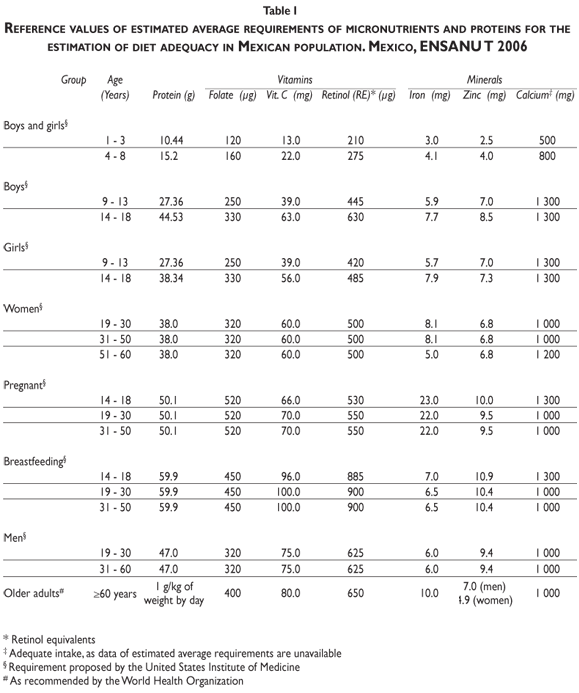
<body><![CDATA[<p><font size="2" face="Verdana"><I>Cleaning of maximum and minimum values of corn    flour and wheat flour tortillas: </i>Because tortilla is a staple for the Mexican    population, an additional cleaning procedure was performed considering the weight    of both corn and wheat tortillas, with a valid interval of 10 g minimum value    and 500 g maximum value. Those values came from the mean range observed on tortilla    weight reported by the same population. On the basis of that range, mean weight    of both corn and wheat tortillas was calculated for each state. Mean weight    was also imputed to those cases outside the valid interval.</font></p>     <p><font size="2" face="Verdana"><I>Energy, macronutrient and micronutrient intakes:</i>    Total energy and nutrients contained in each food consumed and in total diet    for each individual were estimated through the nutrient composition database    compiled by the INSP.<a name="tx01"></a><a href="#nt01"><sup>*</sup></a> Energy, carbohydrate, protein, fat, fiber, iron (total,    heme, and nonheme), zinc, vitamin C, vitamin A, folate and calcium intakes were    calculated. Because information was organized by week of intake, total quantities    of energy and nutrients were divided by 7 to obtain an average intake per day.    With respect to vitamin C, loss during cooking was considered, so the quantity    of vitamin C was adjusted depending on type of food and cooking method commonly  used.<SUP>10&#45;13</sup></font></p>     <p><font size="2" face="Verdana">Some of the items on the food&#45;frequency table    were made up of several ingredients, so an average estimation of their nutritional    value was performed. That value was calculated by adding the nutrients of each    ingredient or food (as specified in the nutrient composition database) employed    in Mexican dishes according to the proportions indicated in the recipes. Food    was considered in raw condition. Although the estimation is imprecise, not having    come from a bromatological analysis, it is a good approximation of the quantity    of nutrients contained in some dishes, as it takes into account loss factors    and gram conversion, such as densities, edible portion and cooked&#45;raw/raw&#45;cooked    factor.</font></p>     <p><font size="2" face="Verdana"><I>Energy and nutrient adequacy percentage:</i>    Nutrient adequacy percentage for children, adolescents and adults was calculated    from intake data using the reference values proposed by the United States Institute    of Medicine (IOM). The estimation of protein, iron, zinc, vitamin C, retinol    and folate adequacy was done using the Estimated Average Requirement.<SUP>14&#45;19</SUP>    For calcium, Adequate Intake value was used as reference since the Estimated    Average Requirement value has not yet been established because of lack of information    for such calculations.<SUP>20</SUP> For carbohydrates and fats, 50 and 30%,    respectively, of the energy derived from those macronutrients were used as adequacy    values. Reference values for the estimation of protein and micronutrient adequacy    are shown in <a href="#tab01">Table I</a>.</font></p>     <p><a name="tab01"></a></p>     <p>&nbsp;</p>     <p align="center"><img src="/img/revistas/spm/v51s4/a07tab01.gif"></p>     <p>&nbsp;</p>     <p><font size="2" face="Verdana">Regarding older adults over 60 years of age,    adequacy percentages were calculated in accordance with the guide of nutrition    needs for older adults published by the WHO.<SUP>21</sup></font></p>     <p><font size="2" face="Verdana"> Energy adequacy for each individual was calculated    employing the Estimated Energy Requirements as the reference.<SUP>22</SUP> Therefore,    it was necessary to make use of several data included in the calculation equations;    those data were weight, height, age, and physiological status of each individual.    Energy requirements were calculated for those individuals with a body mass index    (BMI) within the normal limits for their age and sex. For adults, BMI limits    were <u>&gt;</u> 18.5 and &lt; 25; for <u>&gt;</u> 2&#45;years&#45;old children and for adolescents    those limits were based on data distribution, considering as minimum value above    1% of the distribution, and as maximum value the cutoff points proposed by Cole  <I>et al</I>.<SUP>23</SUP></font></p>     ]]></body>
<body><![CDATA[<p><font size="2" face="Verdana">For those individuals with a BMI outside the    normality range, weight corresponding to the BMI limit value, considering the    height of the individual, was imputed. For instance, in adults with BMI <u>&gt;</u>    25 the weight corresponding to a BMI of 24.9 was imputed. The same was done    for the lower limit value, BMI &lt; 18.5, by imputing the weight corresponding  to a BMI of 18.5.</font></p>     <p><font size="2" face="Verdana"> For those individuals without available height    and weight data, median value of height and weight for the population with same    age, sex, and physiological status, and with data availability, was imputed.</font></p>     <p><font size="2" face="Verdana"> On the other hand, as it is well known, equations    require a specific physical activity factor. There was no data on physical activity    for this analysis; therefore, we used data from the 1999 National Nutrition    Survey that showed that women led a sedentary life.<SUP>24</SUP> Likewise, children    were found to have low physical activity, in accordance with a Torun <I>et al</I>.    study.<SUP>25</SUP> Regarding men, they also showed low physical activity.</font></p>     <p><font size="2" face="Verdana"><I>Cleaning of data on intake and percentages of    energy and nutrient adequacy:</i> As suggested in dietary analyses,<SUP>6, 7</SUP>    intake and adequacy observations greater than 5 SDs from the general distribution    of energy, macronutrients, iron, zinc, vitamin C, vitamin A, folates and calcium    were excluded from the analysis. Further on, data distribution was graphically    analyzed, and those observations within 5 SDs but graphically separated from    the conglomerate of the majority of data were eliminated as well. Concerning    lower values, energy adequacy values less than 25% were eliminated for all age    groups, as adequacy percentages less than that could not represent an intake    compatible with life.</font></p>     <p><font size="2" face="Verdana">Due to the data elimination during the cleaning    process, we calculated new expansion factors.</font></p>     <p><font size="2" face="Verdana"> Because dietary data distribution is usually    biased toward high values, data are presented as medians, 25 and 75 percentiles    of the distribution. The process to obtain nutrient vectors from data was done    in Access (Microsoft Office, 2003) using the Visual Basic code and SQL consults.    Data cleaning was performed with Stata, version 9.2 (Stata Corporation, TX,    USA) and SPSS, version 15.0 (SPSS Inc., Chicago, IL, USA).</font></p>     <p>&nbsp;</p>     <p><font size="3" face="Verdana"><b>Results</b></font></p>     <p><font size="2" face="Verdana">We analyzed dietary information of 39998 individuals.      Data lost by the cleaning process were between 3.3 and 11.9% among the different      groups of population.</font></p>     <p><font size="2" face="Verdana"><I>Pre&#45;school children:</i> Dietary data from 3959    children less than 5 years old were obtained. Because 461 observations lacked    data on weight and height, it was necessary to impute data from the same study    population in accordance with age and sex so as to be able to calculate the    percentage of energy adequacy.</font></p>     ]]></body>
<body><![CDATA[<p><font size="2" face="Verdana">After cleaning, 407 observations were excluded    (10.3%). In 203 of those, there was low energy (less than 25%) or energy adequacy    greater than 5 SDs from the adequacy mean. The other 204 observations had adequacies    above 5 SDs from the adequacy of several nutrients. Final sample size after    cleaning of all the main variables (energy, macronutrients, total iron, zinc,    vitamin C, retinol equivalents, folate and calcium) was 3552 observations, which    represented a total of 7 836674 children aged 1 to 4 years countrywide.</font></p>     <p><font size="2" face="Verdana"><I>School children:</i> Dietary data were collected    from 9383 children between 5 and 11 years of age. In 396 observations it was    necessary to impute height and weight of the distribution median according to    age and sex since that data was not available.</font></p>     <p><font size="2" face="Verdana">Because 667 observations (7.1%) had adequacy    percentages above 5 SDs for one or more of the nutrients studied, or an energy    adequacy percentage less than 25%, they had to be excluded.</font></p>     <p><font size="2" face="Verdana"> In total, 8716 valid complete data were analyzed,    representing 15494558 children aged 5 to 11 years (<a href="#tab02">Table II</a>).</font></p>     <p><a name="tab02"></a></p>     <p>&nbsp;</p>     <p align="center"><img src="/img/revistas/spm/v51s4/a07tab02.gif"></p>     <p>&nbsp;</p>     <p><font size="2" face="Verdana"><I>Adolescents:</i> Data from 8 768 adolescents    aged 12 to 19 years were obtained. It was necessary to impute height and weight    of the distribution median in 532 and 545 observations, respectively, in accordance    with age and sex, as those observations lacked that information.</font></p>     <p><font size="2" face="Verdana">After cleaning, 326 observations (3.7%) were    eliminated because of energy and/or nutrient adequacy percentages above 5 SDs    or energy adequacy percentage less than 25%. Therefore, 8442 observations with    valid dietary information were considered, which represented 18276531 adolescents    at a national level.</font></p>     ]]></body>
<body><![CDATA[<p><font size="2" face="Verdana"><I>Adults aged 20 to 59 years:</i> Data from 16494    adults were obtained, and 543 (3.3%) observations were eliminated as they presented    intakes and adequacy percentages above 5 SDs or energy intakes less than 25%.    Thus, valid information corresponded to 15951 individuals aged 20 to 59 years,    who represented a population of 47946764 nationwide.</font></p>     <p><font size="2" face="Verdana"><I>Older adults:</i> Data from 3812 adults between    60 to 99 years old were collected, and 455 observations were eliminated (11.9%)    owing to adequacies above 5 SDs from the energy and nutrient adequacy mean,    or energy adequacies less than 25% of those recommended.</font></p>     <p><font size="2" face="Verdana">In total, valid information was obtained from 3357    adults who represented 11084070 older adults aged 60 years and over nationwide.</font></p>     <p><font size="2" face="Verdana"> <a href="#tab02">Table II</a> shows original sample size and total    number of feasible data, by age group and with valid dietary information, obtained    through the different cleaning stages.</font></p>     <p>&nbsp;</p>     <p><font size="3" face="Verdana"><b>Discussion</b></font></p>     <p><font size="2" face="Verdana">The contribution of this paper is that it shows    in detail how the methodology for processing and analyzing dietary data from    the ENSANUT 2006 in Mexico was established, from its planning to the presentation    of results. This methodology has been used in the presentation of descriptive    dietary information of different groups from the population in the ENSANUT 2006.<SUP>26&#45;29</SUP>    This paper can be useful to standardize data cleaning in different population    groups and in different studies, making it possible to compare results and to    handle data easily, as well as to establish criteria and to validate steps for    data processing. This information is also very valuable as it comes from a nationally    representative survey, which permits the extrapolation of results to all the    population.</font></p>     <p><font size="2" face="Verdana"> This methodology is similar to the one employed    in other national nutrition surveys. This is the case of the National Nutrition    Survey 2005 of Colombia and the NNS&#45;99 in Mexico where, for several nutrients,    the reference values proposed by the United States Institute of Medicine were    used to estimate adequacy percentage and population at risk of dietary inadequacy.    Also, weight limits and physical activity assumption were used to calculate    energy adequacy. Unlike ENSANUT 2006, in Colombia 24&#45;hours recall method was    employed to obtain the dietary information.<SUP>30</sup></font></p>     <p><font size="2" face="Verdana"> With regard to the cleaning process, this    is similar to the process used in the NNS&#45;99.<SUP>6,7</SUP> We found that the    dietary data quality is good, since we had low percentage of losses in the cleaning    process (3.3 to 11.9%); the highest losses were for pre&#45;school children (10.3%)    and older adults (11.9%), possibly due to bias in the reporting of dietary information.</font></p>     <p><font size="2" face="Verdana"> We consider that the methodology employed    is valid since it has been used in other studies with optimal/positive results.</font></p>     ]]></body>
<body><![CDATA[<p><font size="2" face="Verdana"> When developing the methodology for processing    and analyzing dietary data, researchers must warrant the validity of results    since its use is of great importance for evaluating population nutrition status    as well as for further planning and evaluation of programs and policies related    to food production and marketing, nutrition education and food assistance and    security.</font></p>     <p><font size="2" face="Verdana"><b>Acknowledgements</b></font></p>     <p><font size="2" face="Verdana">We are grateful to the group of researchers from    the Nutrition and Health Research Center of the National Institute of Public    Health, particularly to Alfonso Jes&uacute;s Mendoza Ram&iacute;rez, Claudia    Ivonne Ram&iacute;rez Silva, Juan Espinosa Montero, Luc&iacute;a Hern&aacute;ndez    Barrera, and X&oacute;chitl Ponce Mart&iacute;nez, for their remarks, which    helped to improve the methodology.</font></p>     <p>&nbsp;</p>     <p><font size="3" face="Verdana"><b>References</b></font></p>     <!-- ref --><p><FONT size="2" FACE="Verdana">1. Briefel RR, Sempos ChT, McDowell MA, Chien    S (Chia&#45;Ying), Alaimo K. Dietary methods researching the third National   Health and Nutrition Examination Survey: Underreporting of energy. Am J Clin   Nutr 1997:65 Suppl:1203S&#45;1209S.    &nbsp;&nbsp;&nbsp;&nbsp;&nbsp;&nbsp;&nbsp;&nbsp;[&#160;<a href="javascript:void(0);" onclick="javascript: window.open('/scielo.php?script=sci_nlinks&ref=9350333&pid=S0036-3634200900100000700001&lng=','','width=640,height=500,resizable=yes,scrollbars=1,menubar=yes,');">Links</a>&#160;]<!-- end-ref --></font></p>     <!-- ref --><p><font size="2" face="Verdana">2. Perloff B, Rizek R, Haytowitz D. Dietary intake    methodology II. USDA's nutrient data base for nationwide dietary intake surveys.    J Nutr 1990;120:1530&#45;1534.    &nbsp;&nbsp;&nbsp;&nbsp;&nbsp;&nbsp;&nbsp;&nbsp;[&#160;<a href="javascript:void(0);" onclick="javascript: window.open('/scielo.php?script=sci_nlinks&ref=9350335&pid=S0036-3634200900100000700002&lng=','','width=640,height=500,resizable=yes,scrollbars=1,menubar=yes,');">Links</a>&#160;]<!-- end-ref --></font></p>     <!-- ref --><p><font size="2" face="Verdana">3. Rizek R, Pao EM. Dietary intake methodology    I. USDA survey and supporting research. J Nutr 1990;120:1525&#45;1529.    &nbsp;&nbsp;&nbsp;&nbsp;&nbsp;&nbsp;&nbsp;&nbsp;[&#160;<a href="javascript:void(0);" onclick="javascript: window.open('/scielo.php?script=sci_nlinks&ref=9350337&pid=S0036-3634200900100000700003&lng=','','width=640,height=500,resizable=yes,scrollbars=1,menubar=yes,');">Links</a>&#160;]<!-- end-ref --></font></p>     <!-- ref --><p><font size="2" face="Verdana">4. Murphy SP. Collection and analysis of intake    data from the integrated survey. J Nutr 2003;133:585S&#45;589S.    &nbsp;&nbsp;&nbsp;&nbsp;&nbsp;&nbsp;&nbsp;&nbsp;[&#160;<a href="javascript:void(0);" onclick="javascript: window.open('/scielo.php?script=sci_nlinks&ref=9350339&pid=S0036-3634200900100000700004&lng=','','width=640,height=500,resizable=yes,scrollbars=1,menubar=yes,');">Links</a>&#160;]<!-- end-ref --></font></p>     <!-- ref --><p><font size="2" face="Verdana">5. Flores M, Melgar H, Cortes C, Rivera M, Rivera    J, Sepulveda J. Energy and nutrient consumption in Mexican women in reproductive    age. Salud Publica Mex 1998;40:161&#45;171.    &nbsp;&nbsp;&nbsp;&nbsp;&nbsp;&nbsp;&nbsp;&nbsp;[&#160;<a href="javascript:void(0);" onclick="javascript: window.open('/scielo.php?script=sci_nlinks&ref=9350341&pid=S0036-3634200900100000700005&lng=','','width=640,height=500,resizable=yes,scrollbars=1,menubar=yes,');">Links</a>&#160;]<!-- end-ref --></font></p>     <!-- ref --><p><font size="2" face="Verdana">6. Barquera S, Rivera J, Espinosa&#45;Montero J,    Safdie M, Campirano F, Monterrubio E. Energy and nutrient consumption in Mexican    women 12&#45;49 years of age. Analysis of the National Nutrition Survey 1999. Salud    Publica Mex 2003;45 Suppl 4:S530&#45;S539.    &nbsp;&nbsp;&nbsp;&nbsp;&nbsp;&nbsp;&nbsp;&nbsp;[&#160;<a href="javascript:void(0);" onclick="javascript: window.open('/scielo.php?script=sci_nlinks&ref=9350343&pid=S0036-3634200900100000700006&lng=','','width=640,height=500,resizable=yes,scrollbars=1,menubar=yes,');">Links</a>&#160;]<!-- end-ref --></font></p>     <!-- ref --><p><font size="2" face="Verdana">7. Barquera S, Rivera J, Safdie M, Flores M,    Campos&#45;Nonato I, Campirano F. Energy and nutrient intake in preschool and school    age Mexican children: National Nutrition Survey 1999. Salud Publica Mex 2003;45    Suppl 4:S540&#45;S550.    &nbsp;&nbsp;&nbsp;&nbsp;&nbsp;&nbsp;&nbsp;&nbsp;[&#160;<a href="javascript:void(0);" onclick="javascript: window.open('/scielo.php?script=sci_nlinks&ref=9350345&pid=S0036-3634200900100000700007&lng=','','width=640,height=500,resizable=yes,scrollbars=1,menubar=yes,');">Links</a>&#160;]<!-- end-ref --></font></p>     <!-- ref --><p><font size="2" face="Verdana">8 . Palma O, Shamah T, Franco A, Olaiz G, M&eacute;ndez    I. Metodolog&iacute;a. En: Encuesta Nacional de Salud y Nutrici&oacute;n (ENSANUT&#45;2006).    Cuernavaca, M&eacute;xico: Instituto Nacional de Salud P&uacute;blica, 2006:    19&#45;33.    &nbsp;&nbsp;&nbsp;&nbsp;&nbsp;&nbsp;&nbsp;&nbsp;[&#160;<a href="javascript:void(0);" onclick="javascript: window.open('/scielo.php?script=sci_nlinks&ref=9350347&pid=S0036-3634200900100000700008&lng=','','width=640,height=500,resizable=yes,scrollbars=1,menubar=yes,');">Links</a>&#160;]<!-- end-ref --></font></p>     <!-- ref --><p><font size="2" face="Verdana">9. Ram&iacute;rez I, Mundo V, Rodr&iacute;guez    S, Vizuet I, Hern&aacute;ndez N, Jim&eacute;nez A. Encuestas diet&eacute;ticas.    In: Shamah&#45;Levy T, Villalpando&#45;Hern&aacute;ndez S, Rivera&#45;Dommarco J. Manual    de procedimientos para proyectos de nutrici&oacute;n. Cuernavaca, M&eacute;xico:    Instituto Nacional de Salud P&uacute;blica, 2006: 27&#45;108. &#91;Consulted 2009 marzo    31&#93;. Available at: <a href="http://www.salud.gob.mx/unidades/cdi/documentos/proy_nutricion.pdf" target="_blank">http://www.salud.gob.mx/unidades/cdi/documentos/proy_nutricion.pdf</a>.    &nbsp;&nbsp;&nbsp;&nbsp;&nbsp;&nbsp;&nbsp;&nbsp;[&#160;<a href="javascript:void(0);" onclick="javascript: window.open('/scielo.php?script=sci_nlinks&ref=9350349&pid=S0036-3634200900100000700009&lng=','','width=640,height=500,resizable=yes,scrollbars=1,menubar=yes,');">Links</a>&#160;]<!-- end-ref --></font></p>     <!-- ref --><p><font size="2" face="Verdana">10. Souci SW, Fachmann W, Kraut H. Food composition    and nutrition tables. 6th Edition. Stuttgart, Germany: Medpharm, 2000.    &nbsp;&nbsp;&nbsp;&nbsp;&nbsp;&nbsp;&nbsp;&nbsp;[&#160;<a href="javascript:void(0);" onclick="javascript: window.open('/scielo.php?script=sci_nlinks&ref=9350351&pid=S0036-3634200900100000700010&lng=','','width=640,height=500,resizable=yes,scrollbars=1,menubar=yes,');">Links</a>&#160;]<!-- end-ref --></font></p>     <!-- ref --><p><font size="2" face="Verdana">11. Agte V, Tarwadi K, Mengale S, Hinge A, Chiplonkar    S. Vitamin profile of cooked foods: how healthy is the practice of ready&#45;to&#45;eat    foods? Int J Food Sci Nutr 2002;53(3):197&#45;208.    &nbsp;&nbsp;&nbsp;&nbsp;&nbsp;&nbsp;&nbsp;&nbsp;[&#160;<a href="javascript:void(0);" onclick="javascript: window.open('/scielo.php?script=sci_nlinks&ref=9350353&pid=S0036-3634200900100000700011&lng=','','width=640,height=500,resizable=yes,scrollbars=1,menubar=yes,');">Links</a>&#160;]<!-- end-ref --></font></p>     <!-- ref --><p><font size="2" face="Verdana">12. Han JS, Kozukue N, Young KS, Lee KR, Friedman    M. Distribution of ascorbic acid in potato tubers and in home&#45;processed and    commercial potato foods. J Agric Food Chem 2004;52 (21): 6516&#45;6521.    &nbsp;&nbsp;&nbsp;&nbsp;&nbsp;&nbsp;&nbsp;&nbsp;[&#160;<a href="javascript:void(0);" onclick="javascript: window.open('/scielo.php?script=sci_nlinks&ref=9350355&pid=S0036-3634200900100000700012&lng=','','width=640,height=500,resizable=yes,scrollbars=1,menubar=yes,');">Links</a>&#160;]<!-- end-ref --></font></p>     <!-- ref --><p><font size="2" face="Verdana">13. Mareschi JP, Belliot JP, Fourlon C, Gey KF.    Changes in vitamin C content of Bintje potatoes during storage and usual culinary    preparations. Int J Vitam Nutr Res 1983;53(4):402&#45;411.    &nbsp;&nbsp;&nbsp;&nbsp;&nbsp;&nbsp;&nbsp;&nbsp;[&#160;<a href="javascript:void(0);" onclick="javascript: window.open('/scielo.php?script=sci_nlinks&ref=9350357&pid=S0036-3634200900100000700013&lng=','','width=640,height=500,resizable=yes,scrollbars=1,menubar=yes,');">Links</a>&#160;]<!-- end-ref --></font></p>     <!-- ref --><p><font size="2" face="Verdana">14. Institute of Medicine. Protein. In: Dietary    Reference Intakes for Energy, Carbohydrates, Fiber, Fat, Protein and Amino Acids    (Macronutrients). Washington, DC: Institute of Medicine, The National Academies    Press, 2005: 589&#45;630.    &nbsp;&nbsp;&nbsp;&nbsp;&nbsp;&nbsp;&nbsp;&nbsp;[&#160;<a href="javascript:void(0);" onclick="javascript: window.open('/scielo.php?script=sci_nlinks&ref=9350359&pid=S0036-3634200900100000700014&lng=','','width=640,height=500,resizable=yes,scrollbars=1,menubar=yes,');">Links</a>&#160;]<!-- end-ref --></font></p>     <!-- ref --><p><font size="2" face="Verdana">15. Institute of Medicine. Vitamin C. In: Dietary    reference intakes for vitamin C, vitamin E, selenium and carotenoids. Washington,    DC: Institute of Medicine, The National Academies Press, 2000: 95&#45;185.    &nbsp;&nbsp;&nbsp;&nbsp;&nbsp;&nbsp;&nbsp;&nbsp;[&#160;<a href="javascript:void(0);" onclick="javascript: window.open('/scielo.php?script=sci_nlinks&ref=9350361&pid=S0036-3634200900100000700015&lng=','','width=640,height=500,resizable=yes,scrollbars=1,menubar=yes,');">Links</a>&#160;]<!-- end-ref --></font></p>     <!-- ref --><p><font size="2" face="Verdana">16 . Institute of Medicine. Iron. In: Dietary    reference intakes for vitamin A, vitamin K, arsenic, boron, chromium, copper,    iodine, iron, manganese, molybdenum, nickel, silicon, vanadium and zinc. Washington,    DC: Institute of Medicine, The National Academies Press, 2000.    &nbsp;&nbsp;&nbsp;&nbsp;&nbsp;&nbsp;&nbsp;&nbsp;[&#160;<a href="javascript:void(0);" onclick="javascript: window.open('/scielo.php?script=sci_nlinks&ref=9350363&pid=S0036-3634200900100000700016&lng=','','width=640,height=500,resizable=yes,scrollbars=1,menubar=yes,');">Links</a>&#160;]<!-- end-ref --></font></p>     <!-- ref --><p><font size="2" face="Verdana">17. Institute of Medicine. Vitamin A. In: Dietary    reference intakes for vitamin A, vitamin K, arsenic, boron, chromium, copper,    iodine, iron, manganese, molybdenum, nickel, silicon, vanadium and zinc. Washington,    DC: Institute of Medicine, The National Academies Press, 2000.    &nbsp;&nbsp;&nbsp;&nbsp;&nbsp;&nbsp;&nbsp;&nbsp;[&#160;<a href="javascript:void(0);" onclick="javascript: window.open('/scielo.php?script=sci_nlinks&ref=9350365&pid=S0036-3634200900100000700017&lng=','','width=640,height=500,resizable=yes,scrollbars=1,menubar=yes,');">Links</a>&#160;]<!-- end-ref --></font></p>     <!-- ref --><p><font size="2" face="Verdana">18. Institute of Medicine. Zinc. In: Dietary    reference intakes for vitamin A, vitamin K, arsenic, boron, chromium, copper,    iodine, iron, manganese, molybdenum, nickel, silicon, vanadium and zinc. Washington,    DC: Institute of Medicine, The National Academies Press, 2000.    &nbsp;&nbsp;&nbsp;&nbsp;&nbsp;&nbsp;&nbsp;&nbsp;[&#160;<a href="javascript:void(0);" onclick="javascript: window.open('/scielo.php?script=sci_nlinks&ref=9350367&pid=S0036-3634200900100000700018&lng=','','width=640,height=500,resizable=yes,scrollbars=1,menubar=yes,');">Links</a>&#160;]<!-- end-ref --></font></p>     <!-- ref --><p><font size="2" face="Verdana">19. Institute of Medicine. Folate: In: Dietary    reference intakes for thiamin, riboflavin, niacin, vitamin B6, folate, vitamin    B12, pantothenic acid, biotin and choline. Washington, DC: Institute of Medicine,    The National Academies Press, 2000:196&#45;305.    &nbsp;&nbsp;&nbsp;&nbsp;&nbsp;&nbsp;&nbsp;&nbsp;[&#160;<a href="javascript:void(0);" onclick="javascript: window.open('/scielo.php?script=sci_nlinks&ref=9350369&pid=S0036-3634200900100000700019&lng=','','width=640,height=500,resizable=yes,scrollbars=1,menubar=yes,');">Links</a>&#160;]<!-- end-ref --></font></p>     <!-- ref --><p><font size="2" face="Verdana">20. Institute of Medicine. Calcium. In: Dietary    reference intakes for calcium, phosphorus, magnesium, vitamin D and fluoride.    Washington, DC: Institute of Medicine, The National Academies Press, 2000:71&#45;145.    &nbsp;&nbsp;&nbsp;&nbsp;&nbsp;&nbsp;&nbsp;&nbsp;[&#160;<a href="javascript:void(0);" onclick="javascript: window.open('/scielo.php?script=sci_nlinks&ref=9350371&pid=S0036-3634200900100000700020&lng=','','width=640,height=500,resizable=yes,scrollbars=1,menubar=yes,');">Links</a>&#160;]<!-- end-ref --></font></p>     <!-- ref --><p><font size="2" face="Verdana">21. World Health Organization, Tufts University.    Keep fit for life: Meeting the nutritional needs of older persons. Geneva, Switzerland:    World Health Organization, 2002.    &nbsp;&nbsp;&nbsp;&nbsp;&nbsp;&nbsp;&nbsp;&nbsp;[&#160;<a href="javascript:void(0);" onclick="javascript: window.open('/scielo.php?script=sci_nlinks&ref=9350373&pid=S0036-3634200900100000700021&lng=','','width=640,height=500,resizable=yes,scrollbars=1,menubar=yes,');">Links</a>&#160;]<!-- end-ref --></font></p>     <!-- ref --><p><font size="2" face="Verdana">22. Institute of Medicine. Energy. In: Dietary    reference intakes for energy, carbohydrates, fiber, fat, protein and amino acids    (macronutrients). Washington, DC: Institute of Medicine, The National Academies    Press, 2005:107&#45;264.    &nbsp;&nbsp;&nbsp;&nbsp;&nbsp;&nbsp;&nbsp;&nbsp;[&#160;<a href="javascript:void(0);" onclick="javascript: window.open('/scielo.php?script=sci_nlinks&ref=9350375&pid=S0036-3634200900100000700022&lng=','','width=640,height=500,resizable=yes,scrollbars=1,menubar=yes,');">Links</a>&#160;]<!-- end-ref --> </font></p>     <!-- ref --><p><FONT size="2" FACE="Verdana">23. Cole T, Bellizzi M, Flegal K, Dietz W. Establishing    a standard definition for child overweight and obesity worldwide: International    survey. BMJ 2000;320:1240&#45;1243.    &nbsp;&nbsp;&nbsp;&nbsp;&nbsp;&nbsp;&nbsp;&nbsp;[&#160;<a href="javascript:void(0);" onclick="javascript: window.open('/scielo.php?script=sci_nlinks&ref=9350377&pid=S0036-3634200900100000700023&lng=','','width=640,height=500,resizable=yes,scrollbars=1,menubar=yes,');">Links</a>&#160;]<!-- end-ref --></font></p>     <!-- ref --><p><font size="2" face="Verdana">24. Rivera&#45;Dommarco J, Shama&#45;Levy T, Villalpando&#45;Hern&aacute;ndez    S, Gonz&aacute;lez de Coss&iacute;o T, Hern&aacute;ndez&#45;Prado B, Sep&uacute;lveda    J. Encuesta Nacional de Nutrici&oacute;n 1999. Estado nutricio de ni&ntilde;os    y mujeres en M&eacute;xico. Cuernavaca, Morelos, M&eacute;xico: Instituto Nacional    de Salud P&uacute;blica, 2001.    &nbsp;&nbsp;&nbsp;&nbsp;&nbsp;&nbsp;&nbsp;&nbsp;[&#160;<a href="javascript:void(0);" onclick="javascript: window.open('/scielo.php?script=sci_nlinks&ref=9350379&pid=S0036-3634200900100000700024&lng=','','width=640,height=500,resizable=yes,scrollbars=1,menubar=yes,');">Links</a>&#160;]<!-- end-ref --></font></p>     <!-- ref --><p><font size="2" face="Verdana">25. Torun B, Daviel PSW, Livingstone MBE, Poalisso    M, Sackett R, Spurr GB. Energy requirements and dietary energy recommendations    for children and adolescents 1 to 18 years old. Eur J Clin Nutr 1996;50:S37&#45;S81.    &nbsp;&nbsp;&nbsp;&nbsp;&nbsp;&nbsp;&nbsp;&nbsp;[&#160;<a href="javascript:void(0);" onclick="javascript: window.open('/scielo.php?script=sci_nlinks&ref=9350381&pid=S0036-3634200900100000700025&lng=','','width=640,height=500,resizable=yes,scrollbars=1,menubar=yes,');">Links</a>&#160;]<!-- end-ref --></font></p>     <!-- ref --><p><font size="2" face="Verdana">26. Mundo V, Rodriguez S, Shamah T. Energy and    nutrient intake in Mexican Children 1 to 5 years old. Results from the Mexican    National Health and Nutrition Survey 2006. Salud Publica Mex 2009;51 suppl 4:S530&#45;S539.    &nbsp;&nbsp;&nbsp;&nbsp;&nbsp;&nbsp;&nbsp;&nbsp;[&#160;<a href="javascript:void(0);" onclick="javascript: window.open('/scielo.php?script=sci_nlinks&ref=9350383&pid=S0036-3634200900100000700026&lng=','','width=640,height=500,resizable=yes,scrollbars=1,menubar=yes,');">Links</a>&#160;]<!-- end-ref --></font></p>     <!-- ref --><p><font size="2" face="Verdana">27. Flores M, Mac&iacute;as N, Rivera M, Barquera    S, Hern&aacute;ndez L, Garc&iacute;a A, <I>et al</i>. Energy and nutrient intake among    Mexican school 1&#45;age 1<SUP>d</SUP> children. Mexican National Health and Nutrition Survey 2006. Salud Publica Mex    2009;51 suppl 4:S540&#45;S550.    &nbsp;&nbsp;&nbsp;&nbsp;&nbsp;&nbsp;&nbsp;&nbsp;[&#160;<a href="javascript:void(0);" onclick="javascript: window.open('/scielo.php?script=sci_nlinks&ref=9350385&pid=S0036-3634200900100000700027&lng=','','width=640,height=500,resizable=yes,scrollbars=1,menubar=yes,');">Links</a>&#160;]<!-- end-ref --> </font></p>     <!-- ref --><p><font size="2" face="Verdana">28. Rodr&iacute;guez&#45;Ram&iacute;rez S, Mundo&#45;Rosas    V, Shamah T, Ponce X, Jimenez A, Gonzalez&#45;de Cossio T. Energy and nutrient intake    in Mexican adolescents: Analysis of the Mexican National Health and Nutrition    Survey 2006. Salud Publica Mex 2009;51 suppl 4:S551&#45;S561.    &nbsp;&nbsp;&nbsp;&nbsp;&nbsp;&nbsp;&nbsp;&nbsp;[&#160;<a href="javascript:void(0);" onclick="javascript: window.open('/scielo.php?script=sci_nlinks&ref=9350387&pid=S0036-3634200900100000700028&lng=','','width=640,height=500,resizable=yes,scrollbars=1,menubar=yes,');">Links</a>&#160;]<!-- end-ref --></font></p>     <!-- ref --><p><FONT size="2" FACE="Verdana">29. Barquera S, Hernandez&#45;Barrera L, Campos I,    Espinosa J, Flores M, Barriguete JA, <I>et al</I>. Energy and nutrient consumption    in adults: Analysis of the Mexican National Health and Nutrition Survey 2006.    Salud Publica Mex 2009;51 suppl 4: S562&#45;S573.    &nbsp;&nbsp;&nbsp;&nbsp;&nbsp;&nbsp;&nbsp;&nbsp;[&#160;<a href="javascript:void(0);" onclick="javascript: window.open('/scielo.php?script=sci_nlinks&ref=9350389&pid=S0036-3634200900100000700029&lng=','','width=640,height=500,resizable=yes,scrollbars=1,menubar=yes,');">Links</a>&#160;]<!-- end-ref --></font></p>     <!-- ref --><p><font size="2" face="Verdana">30. Instituto Colombiano de Bienestar Familiar.    Ingesta diet&eacute;tica. In: Encuesta nacional de la situaci&oacute;n nutricional    en Colombia, 2005. Bogot&aacute;: Instituto Colombiano de Bienestar Familiar,    2006:; 227&#45;316.    &nbsp;&nbsp;&nbsp;&nbsp;&nbsp;&nbsp;&nbsp;&nbsp;[&#160;<a href="javascript:void(0);" onclick="javascript: window.open('/scielo.php?script=sci_nlinks&ref=9350391&pid=S0036-3634200900100000700030&lng=','','width=640,height=500,resizable=yes,scrollbars=1,menubar=yes,');">Links</a>&#160;]<!-- end-ref --></font></p>     <p>&nbsp;</p>     <p>&nbsp;</p>     <p><FONT size="2" FACE="Verdana">Received on: April 11, 2008    <br>   Accepted on: November 19, 2008</font></p>     <p>&nbsp;</p>     ]]></body>
<body><![CDATA[<p>&nbsp;</p>     <p><font size="2" face="Verdana">Address       reprint requests to: Mtra. Ver&oacute;nica Mundo.   Instituto Nacional de Salud P&uacute;blica, Av. Universidad 655,   col. Santa Mar&iacute;a Ahuacatitl&aacute;n. 62100 Cuernavaca, Morelos, M&eacute;xico. E&#45;mail: <a href="mailto:vmundo@insp.mx">vmundo@insp.mx</a>    <br> <a name="nt01"></a><a href="#tx01">*</a> INSP. Bases de datos del valor nutritivo de los alimentos. Compilaci&oacute;n del Instituto Nacional de Salud P&uacute;blica. 2004 (Unpublished document).</font></p>      ]]></body><back>
<ref-list>
<ref id="B1">
<label>1</label><nlm-citation citation-type="journal">
<person-group person-group-type="author">
<name>
<surname><![CDATA[Briefel]]></surname>
<given-names><![CDATA[RR]]></given-names>
</name>
<name>
<surname><![CDATA[Sempos]]></surname>
<given-names><![CDATA[ChT]]></given-names>
</name>
<name>
<surname><![CDATA[McDowell]]></surname>
<given-names><![CDATA[MA]]></given-names>
</name>
<name>
<surname><![CDATA[Chien]]></surname>
<given-names><![CDATA[S]]></given-names>
</name>
<name>
<surname><![CDATA[Chia-Ying]]></surname>
</name>
<name>
<surname><![CDATA[Alaimo]]></surname>
<given-names><![CDATA[K]]></given-names>
</name>
</person-group>
<article-title xml:lang="en"><![CDATA[Dietary methods researching the third National Health and Nutrition Examination Survey: Underreporting of energy]]></article-title>
<source><![CDATA[Am J Clin Nutr]]></source>
<year>1997</year>
<volume>65</volume>
<numero>^sSuppl</numero>
<issue>^sSuppl</issue>
<supplement>Suppl</supplement>
<page-range>1203S-1209S</page-range></nlm-citation>
</ref>
<ref id="B2">
<label>2</label><nlm-citation citation-type="journal">
<person-group person-group-type="author">
<name>
<surname><![CDATA[Perloff]]></surname>
<given-names><![CDATA[B]]></given-names>
</name>
<name>
<surname><![CDATA[Rizek]]></surname>
<given-names><![CDATA[R]]></given-names>
</name>
<name>
<surname><![CDATA[Haytowitz]]></surname>
<given-names><![CDATA[D]]></given-names>
</name>
</person-group>
<article-title xml:lang="en"><![CDATA[Dietary intake methodology II: USDA's nutrient data base for nationwide dietary intake surveys]]></article-title>
<source><![CDATA[J Nutr]]></source>
<year>1990</year>
<volume>120</volume>
<page-range>1530-1534</page-range></nlm-citation>
</ref>
<ref id="B3">
<label>3</label><nlm-citation citation-type="journal">
<person-group person-group-type="author">
<name>
<surname><![CDATA[Rizek]]></surname>
<given-names><![CDATA[R]]></given-names>
</name>
<name>
<surname><![CDATA[Pao]]></surname>
<given-names><![CDATA[EM]]></given-names>
</name>
</person-group>
<article-title xml:lang="en"><![CDATA[Dietary intake methodology I: USDA survey and supporting research]]></article-title>
<source><![CDATA[J Nutr]]></source>
<year>1990</year>
<volume>120</volume>
<page-range>1525-1529</page-range></nlm-citation>
</ref>
<ref id="B4">
<label>4</label><nlm-citation citation-type="journal">
<person-group person-group-type="author">
<name>
<surname><![CDATA[Murphy]]></surname>
<given-names><![CDATA[SP]]></given-names>
</name>
</person-group>
<article-title xml:lang="en"><![CDATA[Collection and analysis of intake data from the integrated survey]]></article-title>
<source><![CDATA[J Nutr]]></source>
<year>2003</year>
<volume>133</volume>
<page-range>585S-589S</page-range></nlm-citation>
</ref>
<ref id="B5">
<label>5</label><nlm-citation citation-type="journal">
<person-group person-group-type="author">
<name>
<surname><![CDATA[Flores]]></surname>
<given-names><![CDATA[M]]></given-names>
</name>
<name>
<surname><![CDATA[Melgar]]></surname>
<given-names><![CDATA[H]]></given-names>
</name>
<name>
<surname><![CDATA[Cortes]]></surname>
<given-names><![CDATA[C]]></given-names>
</name>
<name>
<surname><![CDATA[Rivera]]></surname>
<given-names><![CDATA[M]]></given-names>
</name>
<name>
<surname><![CDATA[Rivera]]></surname>
<given-names><![CDATA[J]]></given-names>
</name>
<name>
<surname><![CDATA[Sepulveda]]></surname>
<given-names><![CDATA[J]]></given-names>
</name>
</person-group>
<article-title xml:lang="en"><![CDATA[Energy and nutrient consumption in Mexican women in reproductive age]]></article-title>
<source><![CDATA[Salud Publica Mex]]></source>
<year>1998</year>
<volume>40</volume>
<page-range>161-171</page-range></nlm-citation>
</ref>
<ref id="B6">
<label>6</label><nlm-citation citation-type="journal">
<person-group person-group-type="author">
<name>
<surname><![CDATA[Barquera]]></surname>
<given-names><![CDATA[S]]></given-names>
</name>
<name>
<surname><![CDATA[Rivera]]></surname>
<given-names><![CDATA[J]]></given-names>
</name>
<name>
<surname><![CDATA[Espinosa-Montero]]></surname>
<given-names><![CDATA[J]]></given-names>
</name>
<name>
<surname><![CDATA[Safdie]]></surname>
<given-names><![CDATA[M]]></given-names>
</name>
<name>
<surname><![CDATA[Campirano]]></surname>
<given-names><![CDATA[F]]></given-names>
</name>
<name>
<surname><![CDATA[Monterrubio]]></surname>
<given-names><![CDATA[E]]></given-names>
</name>
</person-group>
<article-title xml:lang="en"><![CDATA[Energy and nutrient consumption in Mexican women 12-49 years of age: Analysis of the National Nutrition Survey 1999]]></article-title>
<source><![CDATA[Salud Publica Mex]]></source>
<year>2003</year>
<volume>45</volume>
<numero>^s4</numero>
<issue>^s4</issue>
<supplement>4</supplement>
<page-range>S530-S539</page-range></nlm-citation>
</ref>
<ref id="B7">
<label>7</label><nlm-citation citation-type="journal">
<person-group person-group-type="author">
<name>
<surname><![CDATA[Barquera]]></surname>
<given-names><![CDATA[S]]></given-names>
</name>
<name>
<surname><![CDATA[Rivera]]></surname>
<given-names><![CDATA[J]]></given-names>
</name>
<name>
<surname><![CDATA[Safdie]]></surname>
<given-names><![CDATA[M]]></given-names>
</name>
<name>
<surname><![CDATA[Flores]]></surname>
<given-names><![CDATA[M]]></given-names>
</name>
<name>
<surname><![CDATA[Campos-Nonato]]></surname>
<given-names><![CDATA[I]]></given-names>
</name>
<name>
<surname><![CDATA[Campirano]]></surname>
<given-names><![CDATA[F]]></given-names>
</name>
</person-group>
<article-title xml:lang="en"><![CDATA[Energy and nutrient intake in preschool and school age Mexican children: National Nutrition Survey 1999]]></article-title>
<source><![CDATA[Salud Publica Mex]]></source>
<year>2003</year>
<volume>45</volume>
<numero>^s4</numero>
<issue>^s4</issue>
<supplement>4</supplement>
<page-range>S540-S550</page-range></nlm-citation>
</ref>
<ref id="B8">
<label>8</label><nlm-citation citation-type="book">
<person-group person-group-type="author">
<name>
<surname><![CDATA[Palma]]></surname>
<given-names><![CDATA[O]]></given-names>
</name>
<name>
<surname><![CDATA[Shamah]]></surname>
<given-names><![CDATA[T]]></given-names>
</name>
<name>
<surname><![CDATA[Franco]]></surname>
<given-names><![CDATA[A]]></given-names>
</name>
<name>
<surname><![CDATA[Olaiz]]></surname>
<given-names><![CDATA[G]]></given-names>
</name>
<name>
<surname><![CDATA[Méndez]]></surname>
<given-names><![CDATA[I]]></given-names>
</name>
</person-group>
<article-title xml:lang="pt"><![CDATA[Metodología]]></article-title>
<source><![CDATA[Encuesta Nacional de Salud y Nutrición (ENSANUT-2006)]]></source>
<year>2006</year>
<page-range>19-33</page-range><publisher-loc><![CDATA[Cuernavaca ]]></publisher-loc>
<publisher-name><![CDATA[Instituto Nacional de Salud Pública]]></publisher-name>
</nlm-citation>
</ref>
<ref id="B9">
<label>9</label><nlm-citation citation-type="book">
<person-group person-group-type="author">
<name>
<surname><![CDATA[Ramírez]]></surname>
<given-names><![CDATA[I]]></given-names>
</name>
<name>
<surname><![CDATA[Mundo]]></surname>
<given-names><![CDATA[V]]></given-names>
</name>
<name>
<surname><![CDATA[Rodríguez]]></surname>
<given-names><![CDATA[S]]></given-names>
</name>
<name>
<surname><![CDATA[Vizuet]]></surname>
<given-names><![CDATA[I]]></given-names>
</name>
<name>
<surname><![CDATA[Hernández]]></surname>
<given-names><![CDATA[N]]></given-names>
</name>
<name>
<surname><![CDATA[Jiménez]]></surname>
<given-names><![CDATA[A]]></given-names>
</name>
</person-group>
<article-title xml:lang="es"><![CDATA[Encuestas dietéticas]]></article-title>
<person-group person-group-type="editor">
<name>
<surname><![CDATA[Shamah-Levy]]></surname>
<given-names><![CDATA[T]]></given-names>
</name>
<name>
<surname><![CDATA[Villalpando-Hernández]]></surname>
<given-names><![CDATA[S]]></given-names>
</name>
<name>
<surname><![CDATA[Rivera-Dommarco]]></surname>
<given-names><![CDATA[J]]></given-names>
</name>
</person-group>
<source><![CDATA[Manual de procedimientos para proyectos de nutrición]]></source>
<year>2006</year>
<page-range>27-108</page-range><publisher-loc><![CDATA[Cuernavaca ]]></publisher-loc>
<publisher-name><![CDATA[Instituto Nacional de Salud Pública]]></publisher-name>
</nlm-citation>
</ref>
<ref id="B10">
<label>10</label><nlm-citation citation-type="book">
<person-group person-group-type="author">
<name>
<surname><![CDATA[Souci]]></surname>
<given-names><![CDATA[SW]]></given-names>
</name>
<name>
<surname><![CDATA[Fachmann]]></surname>
<given-names><![CDATA[W]]></given-names>
</name>
<name>
<surname><![CDATA[Kraut]]></surname>
<given-names><![CDATA[H]]></given-names>
</name>
</person-group>
<source><![CDATA[Food composition and nutrition tables]]></source>
<year>2000</year>
<edition>6</edition>
<publisher-loc><![CDATA[Stuttgart ]]></publisher-loc>
<publisher-name><![CDATA[Medpharm]]></publisher-name>
</nlm-citation>
</ref>
<ref id="B11">
<label>11</label><nlm-citation citation-type="journal">
<person-group person-group-type="author">
<name>
<surname><![CDATA[Agte]]></surname>
<given-names><![CDATA[V]]></given-names>
</name>
<name>
<surname><![CDATA[Tarwadi]]></surname>
<given-names><![CDATA[K]]></given-names>
</name>
<name>
<surname><![CDATA[Mengale]]></surname>
<given-names><![CDATA[S]]></given-names>
</name>
<name>
<surname><![CDATA[Hinge]]></surname>
<given-names><![CDATA[A]]></given-names>
</name>
<name>
<surname><![CDATA[Chiplonkar]]></surname>
<given-names><![CDATA[S]]></given-names>
</name>
</person-group>
<article-title xml:lang="en"><![CDATA[Vitamin profile of cooked foods: how healthy is the practice of ready-to-eat foods?]]></article-title>
<source><![CDATA[Int J Food Sci Nutr]]></source>
<year>2002</year>
<volume>53</volume>
<numero>3</numero>
<issue>3</issue>
<page-range>197-208</page-range></nlm-citation>
</ref>
<ref id="B12">
<label>12</label><nlm-citation citation-type="journal">
<person-group person-group-type="author">
<name>
<surname><![CDATA[Han]]></surname>
<given-names><![CDATA[JS]]></given-names>
</name>
<name>
<surname><![CDATA[Kozukue]]></surname>
<given-names><![CDATA[N]]></given-names>
</name>
<name>
<surname><![CDATA[Young]]></surname>
<given-names><![CDATA[KS]]></given-names>
</name>
<name>
<surname><![CDATA[Lee]]></surname>
<given-names><![CDATA[KR]]></given-names>
</name>
<name>
<surname><![CDATA[Friedman]]></surname>
<given-names><![CDATA[M]]></given-names>
</name>
</person-group>
<article-title xml:lang="en"><![CDATA[Distribution of ascorbic acid in potato tubers and in home-processed and commercial potato foods]]></article-title>
<source><![CDATA[J Agric Food Chem]]></source>
<year>2004</year>
<volume>52</volume>
<numero>21</numero>
<issue>21</issue>
<page-range>6516-6521</page-range></nlm-citation>
</ref>
<ref id="B13">
<label>13</label><nlm-citation citation-type="journal">
<person-group person-group-type="author">
<name>
<surname><![CDATA[Mareschi]]></surname>
<given-names><![CDATA[JP]]></given-names>
</name>
<name>
<surname><![CDATA[Belliot]]></surname>
<given-names><![CDATA[JP]]></given-names>
</name>
<name>
<surname><![CDATA[Fourlon]]></surname>
<given-names><![CDATA[C]]></given-names>
</name>
<name>
<surname><![CDATA[Gey]]></surname>
<given-names><![CDATA[KF]]></given-names>
</name>
</person-group>
<article-title xml:lang="en"><![CDATA[Changes in vitamin C content of Bintje potatoes during storage and usual culinary preparations]]></article-title>
<source><![CDATA[Int J Vitam Nutr Res]]></source>
<year>1983</year>
<volume>53</volume>
<numero>4</numero>
<issue>4</issue>
<page-range>402-411</page-range></nlm-citation>
</ref>
<ref id="B14">
<label>14</label><nlm-citation citation-type="book">
<collab>Institute of Medicine</collab>
<article-title xml:lang="en"><![CDATA[Protein]]></article-title>
<source><![CDATA[Dietary Reference Intakes for Energy, Carbohydrates, Fiber, Fat, Protein and Amino Acids (Macronutrients)]]></source>
<year>2005</year>
<page-range>589-630</page-range><publisher-loc><![CDATA[Washington^eDC DC]]></publisher-loc>
<publisher-name><![CDATA[Institute of MedicineThe National Academies Press]]></publisher-name>
</nlm-citation>
</ref>
<ref id="B15">
<label>15</label><nlm-citation citation-type="book">
<collab>Institute of Medicine</collab>
<article-title xml:lang="en"><![CDATA[Vitamin C]]></article-title>
<source><![CDATA[Dietary reference intakes for vitamin C, vitamin E, selenium and carotenoids]]></source>
<year>2000</year>
<page-range>95-185</page-range><publisher-loc><![CDATA[Washington^eDC DC]]></publisher-loc>
<publisher-name><![CDATA[Institute of MedicineThe National Academies Press]]></publisher-name>
</nlm-citation>
</ref>
<ref id="B16">
<label>16</label><nlm-citation citation-type="book">
<collab>Institute of Medicine</collab>
<article-title xml:lang="en"><![CDATA[Iron]]></article-title>
<source><![CDATA[Dietary reference intakes for vitamin A, vitamin K, arsenic, boron, chromium, copper, iodine, iron, manganese, molybdenum, nickel, silicon, vanadium and zinc]]></source>
<year>2000</year>
<publisher-loc><![CDATA[Washington^eDC DC]]></publisher-loc>
<publisher-name><![CDATA[Institute of MedicineThe National Academies Press]]></publisher-name>
</nlm-citation>
</ref>
<ref id="B17">
<label>17</label><nlm-citation citation-type="book">
<collab>Institute of Medicine</collab>
<article-title xml:lang="en"><![CDATA[Vitamin A]]></article-title>
<source><![CDATA[Dietary reference intakes for vitamin A, vitamin K, arsenic, boron, chromium, copper, iodine, iron, manganese, molybdenum, nickel, silicon, vanadium and zinc]]></source>
<year>2000</year>
<publisher-loc><![CDATA[Washington^eDC DC]]></publisher-loc>
<publisher-name><![CDATA[Institute of MedicineThe National Academies Press]]></publisher-name>
</nlm-citation>
</ref>
<ref id="B18">
<label>18</label><nlm-citation citation-type="book">
<collab>Institute of Medicine</collab>
<article-title xml:lang="en"><![CDATA[Zinc]]></article-title>
<source><![CDATA[Dietary reference intakes for vitamin A, vitamin K, arsenic, boron, chromium, copper, iodine, iron, manganese, molybdenum, nickel, silicon, vanadium and zinc]]></source>
<year>2000</year>
<publisher-loc><![CDATA[Washington^eDC DC]]></publisher-loc>
<publisher-name><![CDATA[Institute of MedicineThe National Academies Press]]></publisher-name>
</nlm-citation>
</ref>
<ref id="B19">
<label>19</label><nlm-citation citation-type="book">
<collab>Institute of Medicine</collab>
<article-title xml:lang="en"><![CDATA[Folate]]></article-title>
<source><![CDATA[Dietary reference intakes for thiamin, riboflavin, niacin, vitamin B6, folate, vitamin B12, pantothenic acid, biotin and choline]]></source>
<year>2000</year>
<page-range>196-305</page-range><publisher-loc><![CDATA[Washington^eDC DC]]></publisher-loc>
<publisher-name><![CDATA[Institute of MedicineThe National Academies Press]]></publisher-name>
</nlm-citation>
</ref>
<ref id="B20">
<label>20</label><nlm-citation citation-type="book">
<collab>Institute of Medicine</collab>
<article-title xml:lang="en"><![CDATA[Calcium]]></article-title>
<source><![CDATA[Dietary reference intakes for calcium, phosphorus, magnesium, vitamin D and fluoride]]></source>
<year>2000</year>
<page-range>71-145</page-range><publisher-loc><![CDATA[Washington^eDC DC]]></publisher-loc>
<publisher-name><![CDATA[Institute of MedicineThe National Academies Press]]></publisher-name>
</nlm-citation>
</ref>
<ref id="B21">
<label>21</label><nlm-citation citation-type="book">
<collab>Tufts University^dWorld Health Organization</collab>
<source><![CDATA[Keep fit for life: Meeting the nutritional needs of older persons]]></source>
<year>2002</year>
<publisher-loc><![CDATA[Geneva ]]></publisher-loc>
<publisher-name><![CDATA[World Health Organization]]></publisher-name>
</nlm-citation>
</ref>
<ref id="B22">
<label>22</label><nlm-citation citation-type="book">
<collab>Institute of Medicine</collab>
<article-title xml:lang="en"><![CDATA[Energy]]></article-title>
<source><![CDATA[Dietary reference intakes for energy, carbohydrates, fiber, fat, protein and amino acids (macronutrients)]]></source>
<year>2005</year>
<page-range>107-264</page-range><publisher-loc><![CDATA[Washington^eDC DC]]></publisher-loc>
<publisher-name><![CDATA[Institute of MedicineThe National Academies Press]]></publisher-name>
</nlm-citation>
</ref>
<ref id="B23">
<label>23</label><nlm-citation citation-type="journal">
<person-group person-group-type="author">
<name>
<surname><![CDATA[Cole]]></surname>
<given-names><![CDATA[T]]></given-names>
</name>
<name>
<surname><![CDATA[Bellizzi]]></surname>
<given-names><![CDATA[M]]></given-names>
</name>
<name>
<surname><![CDATA[Flegal]]></surname>
<given-names><![CDATA[K]]></given-names>
</name>
<name>
<surname><![CDATA[Dietz]]></surname>
<given-names><![CDATA[W]]></given-names>
</name>
</person-group>
<article-title xml:lang="en"><![CDATA[Establishing a standard definition for child overweight and obesity worldwide: International survey]]></article-title>
<source><![CDATA[BMJ]]></source>
<year>2000</year>
<volume>320</volume>
<page-range>1240-1243</page-range></nlm-citation>
</ref>
<ref id="B24">
<label>24</label><nlm-citation citation-type="book">
<person-group person-group-type="author">
<name>
<surname><![CDATA[Rivera-Dommarco]]></surname>
<given-names><![CDATA[J]]></given-names>
</name>
<name>
<surname><![CDATA[T]]></surname>
<given-names><![CDATA[Shama-Levy]]></given-names>
</name>
<name>
<surname><![CDATA[S]]></surname>
<given-names><![CDATA[Villalpando-Hernández]]></given-names>
</name>
<name>
<surname><![CDATA[T]]></surname>
<given-names><![CDATA[González de Cossío]]></given-names>
</name>
<name>
<surname><![CDATA[Hernández-Prado]]></surname>
<given-names><![CDATA[B]]></given-names>
</name>
<name>
<surname><![CDATA[Sepúlveda]]></surname>
<given-names><![CDATA[J]]></given-names>
</name>
</person-group>
<source><![CDATA[Encuesta Nacional de Nutrición 1999: Estado nutricio de niños y mujeres en México]]></source>
<year>2001</year>
<publisher-loc><![CDATA[Cuernavaca^eMorelos Morelos]]></publisher-loc>
<publisher-name><![CDATA[Instituto Nacional de Salud Pública]]></publisher-name>
</nlm-citation>
</ref>
<ref id="B25">
<label>25</label><nlm-citation citation-type="journal">
<person-group person-group-type="author">
<name>
<surname><![CDATA[Torun]]></surname>
<given-names><![CDATA[B]]></given-names>
</name>
<name>
<surname><![CDATA[Daviel]]></surname>
<given-names><![CDATA[PSW]]></given-names>
</name>
<name>
<surname><![CDATA[Livingstone]]></surname>
<given-names><![CDATA[MBE]]></given-names>
</name>
<name>
<surname><![CDATA[Poalisso]]></surname>
<given-names><![CDATA[M]]></given-names>
</name>
<name>
<surname><![CDATA[Sackett]]></surname>
<given-names><![CDATA[R]]></given-names>
</name>
<name>
<surname><![CDATA[Spurr]]></surname>
<given-names><![CDATA[GB]]></given-names>
</name>
</person-group>
<article-title xml:lang="en"><![CDATA[Energy requirements and dietary energy recommendations for children and adolescents 1 to 18 years old]]></article-title>
<source><![CDATA[Eur J Clin Nutr]]></source>
<year>1996</year>
<volume>50</volume>
<page-range>S37-S81</page-range></nlm-citation>
</ref>
<ref id="B26">
<label>26</label><nlm-citation citation-type="journal">
<person-group person-group-type="author">
<name>
<surname><![CDATA[Mundo]]></surname>
<given-names><![CDATA[V]]></given-names>
</name>
<name>
<surname><![CDATA[Rodriguez]]></surname>
<given-names><![CDATA[S]]></given-names>
</name>
<name>
<surname><![CDATA[Shamah]]></surname>
<given-names><![CDATA[T]]></given-names>
</name>
</person-group>
<article-title xml:lang="en"><![CDATA[Energy and nutrient intake in Mexican Children 1 to 5 years old: Results from the Mexican National Health and Nutrition Survey 2006]]></article-title>
<source><![CDATA[Salud Publica Mex]]></source>
<year>2009</year>
<volume>51</volume>
<numero>^s4</numero>
<issue>^s4</issue>
<supplement>4</supplement>
<page-range>S530-S539</page-range></nlm-citation>
</ref>
<ref id="B27">
<label>27</label><nlm-citation citation-type="journal">
<person-group person-group-type="author">
<name>
<surname><![CDATA[Flores]]></surname>
<given-names><![CDATA[M]]></given-names>
</name>
<name>
<surname><![CDATA[Macías]]></surname>
<given-names><![CDATA[N]]></given-names>
</name>
<name>
<surname><![CDATA[Rivera]]></surname>
<given-names><![CDATA[M]]></given-names>
</name>
<name>
<surname><![CDATA[Barquera]]></surname>
<given-names><![CDATA[S]]></given-names>
</name>
<name>
<surname><![CDATA[Hernández]]></surname>
<given-names><![CDATA[L]]></given-names>
</name>
<name>
<surname><![CDATA[García]]></surname>
<given-names><![CDATA[A]]></given-names>
</name>
</person-group>
<article-title xml:lang="en"><![CDATA[Energy and nutrient intake among Mexican school 1-age 1d children: Mexican National Health and Nutrition Survey 2006]]></article-title>
<source><![CDATA[Salud Publica Mex]]></source>
<year>2009</year>
<volume>51</volume>
<numero>^s4</numero>
<issue>^s4</issue>
<supplement>4</supplement>
<page-range>S540-S550</page-range></nlm-citation>
</ref>
<ref id="B28">
<label>28</label><nlm-citation citation-type="journal">
<person-group person-group-type="author">
<name>
<surname><![CDATA[Rodríguez-Ramírez]]></surname>
<given-names><![CDATA[S]]></given-names>
</name>
<name>
<surname><![CDATA[Mundo-Rosas]]></surname>
<given-names><![CDATA[V]]></given-names>
</name>
<name>
<surname><![CDATA[Shamah]]></surname>
<given-names><![CDATA[T]]></given-names>
</name>
<name>
<surname><![CDATA[Ponce]]></surname>
<given-names><![CDATA[X]]></given-names>
</name>
<name>
<surname><![CDATA[Jimenez]]></surname>
<given-names><![CDATA[A]]></given-names>
</name>
<name>
<surname><![CDATA[Gonzalez-de Cossio]]></surname>
<given-names><![CDATA[T]]></given-names>
</name>
</person-group>
<article-title xml:lang="en"><![CDATA[Energy and nutrient intake in Mexican adolescents: Analysis of the Mexican National Health and Nutrition Survey 2006]]></article-title>
<source><![CDATA[Salud Publica Mex]]></source>
<year>2009</year>
<volume>51</volume>
<numero>^s4</numero>
<issue>^s4</issue>
<supplement>4</supplement>
<page-range>S551-S561</page-range></nlm-citation>
</ref>
<ref id="B29">
<label>29</label><nlm-citation citation-type="journal">
<person-group person-group-type="author">
<name>
<surname><![CDATA[Barquera]]></surname>
<given-names><![CDATA[S]]></given-names>
</name>
<name>
<surname><![CDATA[Hernandez-Barrera]]></surname>
<given-names><![CDATA[L]]></given-names>
</name>
<name>
<surname><![CDATA[Campos]]></surname>
<given-names><![CDATA[I]]></given-names>
</name>
<name>
<surname><![CDATA[Espinosa]]></surname>
<given-names><![CDATA[J]]></given-names>
</name>
<name>
<surname><![CDATA[Flores]]></surname>
<given-names><![CDATA[M]]></given-names>
</name>
<name>
<surname><![CDATA[Barriguete]]></surname>
<given-names><![CDATA[JA]]></given-names>
</name>
</person-group>
<article-title xml:lang="en"><![CDATA[Energy and nutrient consumption in adults: Analysis of the Mexican National Health and Nutrition Survey 2006]]></article-title>
<source><![CDATA[Salud Publica Mex]]></source>
<year>2009</year>
<volume>51</volume>
<numero>^s4</numero>
<issue>^s4</issue>
<supplement>4</supplement>
<page-range>S562-S573</page-range></nlm-citation>
</ref>
<ref id="B30">
<label>30</label><nlm-citation citation-type="book">
<collab>Instituto Colombiano de Bienestar Familiar</collab>
<article-title xml:lang="pt"><![CDATA[Ingesta dietética]]></article-title>
<source><![CDATA[Encuesta nacional de la situación nutricional en Colombia, 2005]]></source>
<year>2006</year>
<page-range>227-316</page-range><publisher-loc><![CDATA[Bogotá ]]></publisher-loc>
<publisher-name><![CDATA[Instituto Colombiano de Bienestar Familiar]]></publisher-name>
</nlm-citation>
</ref>
</ref-list>
</back>
</article>
