<?xml version="1.0" encoding="ISO-8859-1"?><article xmlns:mml="http://www.w3.org/1998/Math/MathML" xmlns:xlink="http://www.w3.org/1999/xlink" xmlns:xsi="http://www.w3.org/2001/XMLSchema-instance">
<front>
<journal-meta>
<journal-id>0036-3634</journal-id>
<journal-title><![CDATA[Salud Pública de México]]></journal-title>
<abbrev-journal-title><![CDATA[Salud pública Méx]]></abbrev-journal-title>
<issn>0036-3634</issn>
<publisher>
<publisher-name><![CDATA[Instituto Nacional de Salud Pública]]></publisher-name>
</publisher>
</journal-meta>
<article-meta>
<article-id>S0036-36342009001000006</article-id>
<title-group>
<article-title xml:lang="en"><![CDATA[Anemia in Mexican women: results of two national probabilistic surveys]]></article-title>
<article-title xml:lang="es"><![CDATA[Anemia en mujeres mexicanas: resultados de dos encuestas nacionales probabilísticas]]></article-title>
</title-group>
<contrib-group>
<contrib contrib-type="author">
<name>
<surname><![CDATA[Shamah-Levy]]></surname>
<given-names><![CDATA[Teresa]]></given-names>
</name>
<xref ref-type="aff" rid="A01"/>
</contrib>
<contrib contrib-type="author">
<name>
<surname><![CDATA[Villalpando-Hernández]]></surname>
<given-names><![CDATA[Salvador]]></given-names>
</name>
<xref ref-type="aff" rid="A01"/>
</contrib>
<contrib contrib-type="author">
<name>
<surname><![CDATA[García-Guerra]]></surname>
<given-names><![CDATA[Armando]]></given-names>
</name>
<xref ref-type="aff" rid="A01"/>
</contrib>
<contrib contrib-type="author">
<name>
<surname><![CDATA[Mundo-Rosas]]></surname>
<given-names><![CDATA[Verónica]]></given-names>
</name>
<xref ref-type="aff" rid="A01"/>
</contrib>
<contrib contrib-type="author">
<name>
<surname><![CDATA[Mejía-Rodríguez]]></surname>
<given-names><![CDATA[Fabiola]]></given-names>
</name>
<xref ref-type="aff" rid="A01"/>
</contrib>
<contrib contrib-type="author">
<name>
<surname><![CDATA[Domínguez-Islas]]></surname>
<given-names><![CDATA[Clara Penélope]]></given-names>
</name>
<xref ref-type="aff" rid="A01"/>
</contrib>
</contrib-group>
<aff id="A01">
<institution><![CDATA[,Instituto Nacional de Salud Pública Centro de Investigación en Nutrición y Salud ]]></institution>
<addr-line><![CDATA[Cuernavaca Morelos]]></addr-line>
<country>México</country>
</aff>
<pub-date pub-type="pub">
<day>00</day>
<month>00</month>
<year>2009</year>
</pub-date>
<pub-date pub-type="epub">
<day>00</day>
<month>00</month>
<year>2009</year>
</pub-date>
<volume>51</volume>
<fpage>S515</fpage>
<lpage>S522</lpage>
<copyright-statement/>
<copyright-year/>
<self-uri xlink:href="http://www.scielo.org.mx/scielo.php?script=sci_arttext&amp;pid=S0036-36342009001000006&amp;lng=en&amp;nrm=iso"></self-uri><self-uri xlink:href="http://www.scielo.org.mx/scielo.php?script=sci_abstract&amp;pid=S0036-36342009001000006&amp;lng=en&amp;nrm=iso"></self-uri><self-uri xlink:href="http://www.scielo.org.mx/scielo.php?script=sci_pdf&amp;pid=S0036-36342009001000006&amp;lng=en&amp;nrm=iso"></self-uri><abstract abstract-type="short" xml:lang="en"><p><![CDATA[OBJECTIVE: To describe the prevalence of anemia in Mexican women and analyze its trends with information from the last two national nutrition surveys. MATERIAL AND METHODS: The prevalence of anemia in women was analyzed. Anemia was adjusted by socioeconomic profile and by potentially explanatory variables. RESULTS: The overall prevalence of anemia for pregnant women was 20.2% (95% CI 15.9, 26.2%) and 15.5% for non-pregnant women (95% CI 14.7, 16.4%). The prevalence of anemia in women decreased from 1999 to 2006 in all socioeconomic profiles. Adolescent women living in the northern and in the southern regions had a greater risk of anemia than those in Mexico City (p= 0.05). Significant risk was found among low socioeconomic level (p< 0.06). Greater parity was a significant risk factor (p< 0.05) for being anemic. CONCLUSIONS: Although anemia in reproductive age women in Mexico decreased, it continues to be a public health problem.]]></p></abstract>
<abstract abstract-type="short" xml:lang="es"><p><![CDATA[OBJETIVO: Describir la prevalencia de anemia en mujeres y analizar su tendencia a través de las dos últimas encuestas nacionales de nutrición. MATERIAL Y MÉTODOS: Se analizó la prevalencia de anemia en mujeres. La prevalencia de anemia se ajustó por perfil socioeconómico y por posibles variables que la expliquen. RESULTADOS: La prevalencia global de anemia fue de 20.2% (IC95% 15.9, 26.2%) para mujeres embarazadas y de 15.5% (IC95% 14.7, 16.4%) para mujeres no embarazadas. La prevalencia de anemia en mujeres disminuyó de 1999 a 2006 en todos los niveles socioeconómicos. Las mujeres adolescentes que viven en las regiones norte y sur tuvieron mayor riesgo de anemia que las que viven en la Ciudad de México (p= 0.05). Se encontró un riesgo significativo asociado con el nivel socioeconómico bajo (p< 0.06). La mayor paridad resultó ser un factor de riesgo significativo (p< 0.05). CONCLUSIONES: Aun cuando la presencia de anemia en mujeres en edad reproductiva en México ha disminuido, continúa siendo un problema de salud pública.]]></p></abstract>
<kwd-group>
<kwd lng="en"><![CDATA[anemia]]></kwd>
<kwd lng="en"><![CDATA[women]]></kwd>
<kwd lng="en"><![CDATA[surveys]]></kwd>
<kwd lng="en"><![CDATA[prevalence]]></kwd>
<kwd lng="en"><![CDATA[Mexico]]></kwd>
<kwd lng="es"><![CDATA[anemia]]></kwd>
<kwd lng="es"><![CDATA[mujeres]]></kwd>
<kwd lng="es"><![CDATA[encuestas]]></kwd>
<kwd lng="es"><![CDATA[prevalencia]]></kwd>
<kwd lng="es"><![CDATA[México]]></kwd>
</kwd-group>
</article-meta>
</front><body><![CDATA[ <p align="right"><font size="2" face="Verdana"><b>ORIGINAL ARTICLES</b></font></p>     <p>&nbsp;</p>     <p><font size="4" face="verdana"><b>Anemia in Mexican women: results of two national    probabilistic surveys</b></font></p>     <p>&nbsp;</p>     <p><font size="3" face="verdana"><b>Anemia en mujeres mexicanas: resultados de    dos encuestas nacionales probabil&iacute;sticas</b></font></p>     <p>&nbsp;</p>     <p>&nbsp;</p>     <p><font size="2" face="Verdana"><b>Teresa Shamah&#45;Levy, MSc; Salvador Villalpando&#45;Hern&aacute;ndez,    PhD; Armando Garc&iacute;a&#45;Guerra, MSc; Ver&oacute;nica Mundo&#45;Rosas, MSc; Fabiola    Mej&iacute;a&#45;Rodr&iacute;guez, MSc; Clara Pen&eacute;lope Dom&iacute;nguez&#45;Islas,   MAS</b></font></p>     <p><font size="2" face="Verdana">Centro de Investigaci&oacute;n en Nutrici&oacute;n    y Salud, Instituto Nacional de Salud P&uacute;blica. Cuernavaca, Morelos, M&eacute;xico</font></p>     <p>&nbsp;</p>     ]]></body>
<body><![CDATA[<p>&nbsp;</p> <hr size="1" noshade>     <p><font size="2" face="VERDANA"><b>ABSTRACT</b></font></p>     <p><font size="2" face="Verdana"><B>OBJECTIVE:</b> To describe the prevalence of    anemia in Mexican women and analyze its trends with information from the last    two national nutrition surveys.    <br>   <B>MATERIAL AND METHODS:</B> The prevalence of anemia in women was analyzed.    Anemia was adjusted by socioeconomic profile and by potentially explanatory    variables.    <br>   <B>RESULTS:</B> The overall prevalence of anemia for pregnant women was 20.2%    (95% <I>CI</I> 15.9, 26.2%) and 15.5% for non&#45;pregnant women (95% <I>CI</I>    14.7, 16.4%). The prevalence of anemia in women decreased from 1999 to 2006    in all socioeconomic profiles. Adolescent women living in the northern and in    the southern regions had a greater risk of anemia than those in Mexico City    (<I>p</I>= 0.05). Significant risk was found among low socioeconomic level (<I>p</I>&lt;    0.06). Greater parity was a significant risk factor (<I>p</I>&lt; 0.05) for    being anemic.    <br>   <B>CONCLUSIONS:</B> Although anemia in reproductive age women in Mexico decreased,    it continues to be a public health problem.</font></p>     <p><font size="2" face="Verdana"><b>Keywords:</b> anemia; women; surveys; prevalence;    Mexico</font></p> <hr size="1" noshade>     <p><font size="2" face="VERDANA"><b>RESUMEN</b></font></p>     <p><font size="2" face="Verdana"><B>OBJETIVO:</b> Describir la prevalencia de anemia    en mujeres y analizar su tendencia a trav&eacute;s de las dos &uacute;ltimas    encuestas nacionales de nutrici&oacute;n.     <br>   <B>MATERIAL Y M&Eacute;TODOS:</B> Se analiz&oacute; la prevalencia de anemia en    mujeres. La prevalencia de anemia se ajust&oacute; por perfil socioecon&oacute;mico    y por posibles variables que la expliquen.    ]]></body>
<body><![CDATA[<br>   <B>RESULTADOS:</B> La prevalencia global de anemia fue de 20.2% (<I>IC</I>95%    15.9, 26.2%) para mujeres embarazadas y de 15.5% (<I>IC</I>95% 14.7, 16.4%)    para mujeres no embarazadas. La prevalencia de anemia en mujeres disminuy&oacute;    de 1999 a 2006 en todos los niveles socioecon&oacute;micos. Las mujeres adolescentes    que viven en las regiones norte y sur tuvieron mayor riesgo de anemia que las    que viven en la Ciudad de M&eacute;xico (<I>p</I>= 0.05). Se encontr&oacute;    un riesgo significativo asociado con el nivel socioecon&oacute;mico bajo (<I>p</I>&lt;    0.06). La mayor paridad result&oacute; ser un factor de riesgo significativo    (<I>p</I>&lt; 0.05).    <br>   <B>CONCLUSIONES:</B> Aun cuando la presencia de anemia en mujeres en edad reproductiva    en M&eacute;xico ha disminuido, contin&uacute;a siendo un problema de salud    p&uacute;blica.</font></p>     <p><font size="2" face="Verdana"><b>Palabras clave:</b> anemia; mujeres; encuestas;    prevalencia; M&eacute;xico</font></p> <hr size="1" noshade>     <p>&nbsp;</p>     <p>&nbsp;</p>     <p><FONT size="2" FACE="Verdana">Anemia is a public health problem affecting millions    of people; it has far&#45;reaching consequences for human health and social and    economic development.<SUP>1</SUP> The World Health Organization (WHO, 2001)    estimated that a total of 2 000 million people worldwide were anemic, half of    those being cases associated with iron deficiency.<SUP>2</SUP> Severe anemia    in women is associated with a higher risk of perinatal morbidity and mortality;    it is also associated with impaired cognitive and physical development in children    as well as with low work productivity in adults.<SUP>3,4</sup></font></p>     <p><font size="2" face="Verdana">It has been estimated that the risk to develop    anemia is 2 to 7 times greater in developing countries than in industrialized    ones, particularly in rural areas.<SUP>5</SUP> Prevalence of anemia may be as    high as 35% in women of reproductive age and 50% in pregnant women<SUP>5</SUP>    living in economically depressed regions.<SUP>6&#45;9</SUP> </font></p>     <p><font size="2" face="Verdana"> Casanueva et al, reviewed 46 epidemiological    and clinical studies published between 1939 and 2005, as well as Mexico&#45;based    governmental intervention programs. They found that the estimated prevalence    of anemia in non&#45;pregnant women of reproductive age has decreased from 39.6    to 15.5% (24.1 percentage points (pp) in the last 65 years), whereas in pregnant    women it has only decreased 10 pp. Therefore, anemia in Mexican pregnant women    is a more critical public health problem.<SUP>10</sup></font></p>     <p><font size="2" face="Verdana"> The two most recent probabilistic national    nutrition and health surveys reported a prevalence of 15.4 and 20.8% in non&#45;pregnant    and 18.2 and 26.7% in pregnant women.<SUP>11&#45;12</sup></font></p>     <p><font size="2" face="Verdana"> The objective of this investigation is to    describe the prevalence and distribution of anemia in women 12 to 49 years of    age in the latest Mexican National Nutrition and Health Survey 2006 (ENSANUT    2006) and to compare the changes related to the previous survey carried out    in 1999 (ENN99). Such analyses are intended to provide relevant information    for developing appropriate national policies aimed at reducing and controlling    the prevalence of anemia in Mexican women, as it is one of the most important    national nutritional problems.</font></p>     ]]></body>
<body><![CDATA[<p>&nbsp;</p>     <p><font size="3" face="Verdana"><b>Material and methods</b></font></p>     <p><font size="2" face="Verdana"><b>Population</b></font></p>     <p><font size="2" face="Verdana">Samples of women of reproductive age (12 to 49    years old) from two national nutrition surveys were collected. The ENN99 with    a sample size of 17 194 subjects and the ENSANUT 2006, with a sample size of    21 135 women.</font></p>     <p><font size="2" face="Verdana"><b>Surveys' design</b></font></p>     <p><font size="2" face="Verdana">Both surveys were designed to be representative    at the national level, in rural and urban areas, and in four geographic regions    defined as: northern, central, Mexico City (included its metropolitan municipalities)    and the southern region. The design of the surveys was stratified and by conglomerates.    Further details about the methodology used for these two surveys have been described    previously.<SUP>13,14</SUP> The methodological design, operative definitions    and instruments used were purposely maintained as equal as possible for both    surveys, allowing for fair comparisons among them.</font></p>     <p><font size="2" face="Verdana"><i>Data Collection</i></font></p>     <p><font size="2" face="Verdana">Anemia</font></p>     <p><font size="2" face="Verdana">The hemoglobin concentrations in ENN 99 and ENSANUT    2006 were measured in capillary blood using a portable photometer Hemocue (Hemocue    Inc., Angelholm, Sweden). Anemia was defined as the concentration of hemoglobin    below 12.0 g/dL at sea level for non&#45;pregnant women and below 11.0 g/dL for    pregnant women, in accordance with WHO recommendations.<SUP>15</SUP> Hemoglobin    concentrations were adjusted for altitude using the equation published by Cohen    and Hass.<SUP>16</SUP> Hemoglobin values under 5.0 g/dL and above 18.5 g/dL    were considered spurious and excluded from the analysis according to criteria    published previously.<SUP>17,18</sup></font></p>     <p><font size="2" face="Verdana">Socioeconomic characteristics</font></p>     ]]></body>
<body><![CDATA[<p><font size="2" face="Verdana">Information on socioeconomic characteristics    in both Surveys was based on housing characteristics (flooring material, sewage    system, water piping) and family assets (ownership of a car, refrigerator, radio,    television and telephone and being beneficiary of a food distribution program).    Parity was stratified into three categories: women with less than three children,    with three to five children, and with more than five children. </font></p>     <p><font size="2" face="Verdana"><b>Anthropometry</b></font></p>     <p><font size="2" face="Verdana">Weight and height were measured using standard    anthropometric methodology.<SUP>19,20</SUP> Weight was measured using an electronic    scale with 10g of precision (Tanita, model 1583, Tokyo, Japan). Height was measured    using an anthropometer with a maximum capacity of 2m and a precision of 1mm    (Dyna&#45;Top, model E&#45;1, Mexico). In both surveys, communities with a population    of less than 2 500 were considered as rural and those over 2 500 as urban. A    family was categorized as indigenous when at least the mother spoke an indigenous    language.</font></p>     <p><font size="2" face="Verdana"><b>Statistical analysis</b></font></p>     <p><font size="2" face="Verdana">Descriptive results are presented as proportions,    means, 95% confidence intervals and standard deviations for pregnant and non&#45;pregnant    women. In order to calculate the probabilities of anemia adjusted by mean socioeconomic    profile, a logistic regression model was constructed. Secondary logistic models    were used in order to assess the association between the prevalence of anemia    with potentially explanatory variables in adolescent and adult women, separately.    Because the sample size for pregnant women was small they were not included    in this set of analysis.</font></p>     <p><font size="2" face="Verdana"> The first model included several variables    such as age, body mass index (BMI) and the following household characteristics    and assets: cement floor, piped water, sewage system, possession of car, refrigerator,    radio or television sets and telephone. Availability of any of those characteristics    or assets was graded as 1; otherwise the grading was 0. As a central reference    for the data of all women, three socioeconomic profiles were defined for women    with mean age of 27 years and BMI of 25 kg/m<SUP>2</SUP>. The high profile was    defined when all household characteristics and assets were graded as 1; profile    medium when the number of household characteristics and assets graded as 1 corresponded    to the mode; and low when all characteristics and assets were graded as 0. In    a second step, the probability of being anemic was calculated for the three    socioeconomic profiles for each one of the surveys (ENN 99 and ENSANUT 2006).    Comparisons of the adjusted prevalence of anemia between surveys were then performed    at national, regional and urban/rural levels. </font></p>     <p><font size="2" face="Verdana">  The OR and 95% confidence intervals (95% <I>CI</I>)    were derived in a second step from separate logistic models for adolescent and    adult women having as covariables some potentially explanatory variables. The    covariables introduced to the adolescents' model were age at menarche, height,    indigenous ethnicity, household characteristics and assets, and being beneficiary    of a food distribution program. For adult women, the model included the same    variables plus body mass index (BMI) and parity; age at menarche was excluded.</font></p>     <p><font size="2" face="Verdana">  All analyses were adjusted by the sampling    design. Statistical significance was set with a <I>p</I> value &lt;0.05. The    data analysis was performed using the statistical software SAS v9.1 (SAS Institute.    Proprietary Software Release 9.1 TS Level 1M3. Cary, NC: SAS, 2002&#45;2003) and    Stata 9.2 (College Station, Texas, Stata Corp. 2006).</font></p>     <p>&nbsp;</p>     <p><font size="3" face="Verdana"><b>Results</b></font></p>     ]]></body>
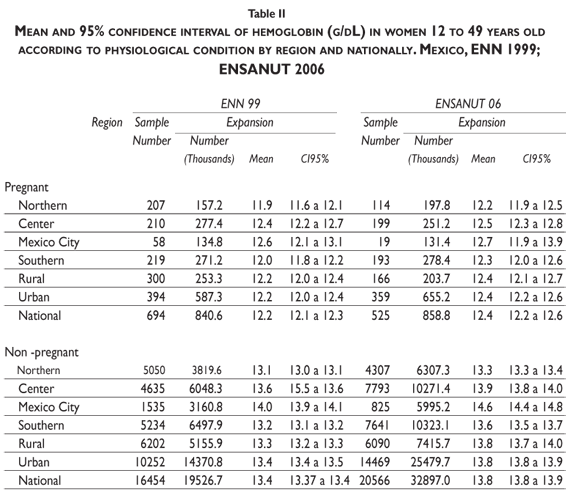
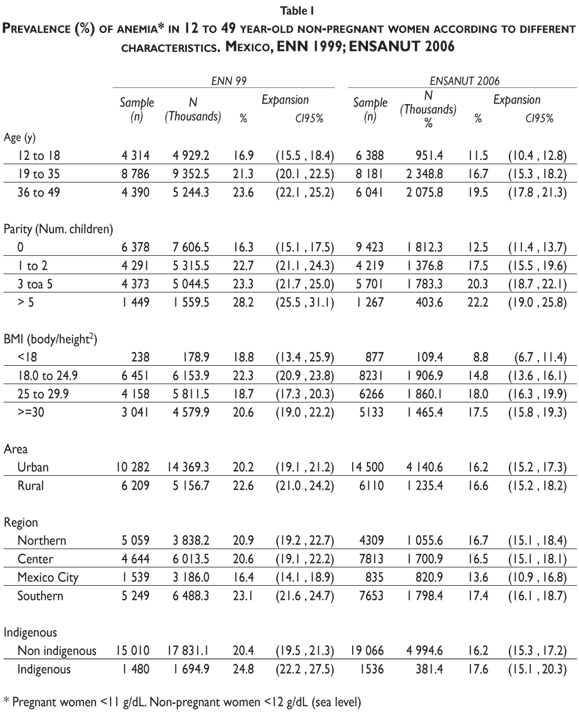
<body><![CDATA[<p><font size="2" face="Verdana">The overall prevalence of anemia in ENSANUT 2006    for pregnant women was 20.2% (95% <I>CI</I> 15.9, 26.2%) and 15.5% for non&#45;pregnant    women (95% <I>CI</I>; 14.7, 16.4%). A reduction of 4.9 pp in the prevalence    of anemia in non&#45;pregnant women and of 4.5 pp in pregnant women from 1999 to    2006 was observed.</font></p>     <p><font size="2" face="Verdana">The prevalence of anemia for each survey in non&#45;pregnant    women is shown in <a href="#tab01">Table I</a>. In both surveys (ENN99, and ENSANUT 2006), the prevalence    of anemia increased with age and it was higher in pregnant than in non&#45;pregnant    women. The prevalence of anemia was 12 pp higher in women with a larger parity    (&gt; 5 children) than those with parity 0 (<a href="#tab01">Table I</a>). The prevalence of anemia    increased as BMI increased in ENSANUT 2006 but not in ENN99. Women living in    the northern and southern regions and of indigenous ethnicity were the most    affected by anemia in both surveys; reductions of about 5 pp were observed in    these categories from 1999 to 2006.</font></p>     <p><a name="tab01"></a></p>     <p>&nbsp;</p>     <p align="center"><img src="/img/revistas/spm/v51s4/a06tab01.gif"></p>     <p>&nbsp;</p>     <p><font size="2" face="Verdana"> <a href="#tab02">Table II</a> shows the mean concentrations of    hemoglobin (g/dL) of women studied in both nutrition surveys, categorized by    pregnant or non&#45;pregnant status, geographical region and urban or rural dwelling.    The hemoglobin concentration of non&#45;pregnant women was more than 1 g/dL higher    than that of pregnant women but no significant differences were observed between    the overall and category&#45;specific means of hemoglobin in 1999 and 2006.</font></p>     <p><a name="tab02"></a></p>     <p>&nbsp;</p>     <p align="center"><img src="/img/revistas/spm/v51s4/a06tab02.gif"></p>     ]]></body>
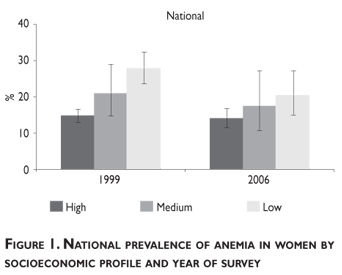
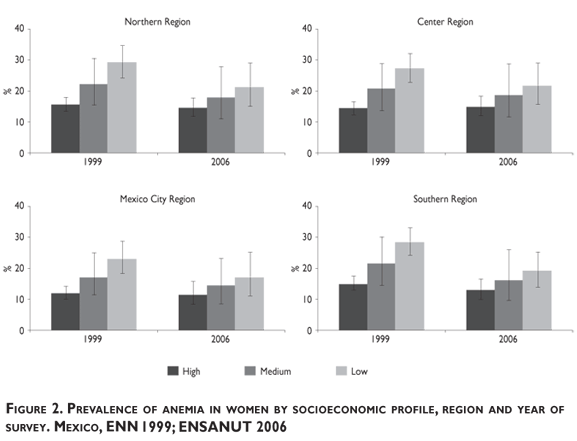
<body><![CDATA[<p>&nbsp;</p>     <p><font size="2" face="Verdana"> <a href="#fig01">Figure 1</a> shows the overall prevalence of    anemia in non&#45;pregnant women adjusted by socioeconomic profile for each survey.    Although the prevalence of anemia was not different among surveys it tended    to be lower in 2006 than in 1999 in the medium and low socioeconomic profiles.    Comparisons within surveys showed a lower prevalence in the higher socioeconomic    profile compared to the low in 1999. Such a difference vanished in 2006.</font></p>     <p><a name="fig01"></a></p>     <p>&nbsp;</p>     <p align="center"><img src="/img/revistas/spm/v51s4/a06fig01.gif"></p>     <p>&nbsp;</p>     <p><font size="2" face="Verdana"> The prevalence of anemia by region adjusted    by socioeconomic profile according to the year of the survey is presented in      <a href="#fig02">figure 2</a>. In 2006, there was a reduction in the prevalence of anemia in all    three profiles; however, it was not statistically significant.</font></p>     <p><a name="fig02"></a></p>     <p>&nbsp;</p>     <p align="center"><img src="/img/revistas/spm/v51s4/a06fig02.gif"></p>     ]]></body>
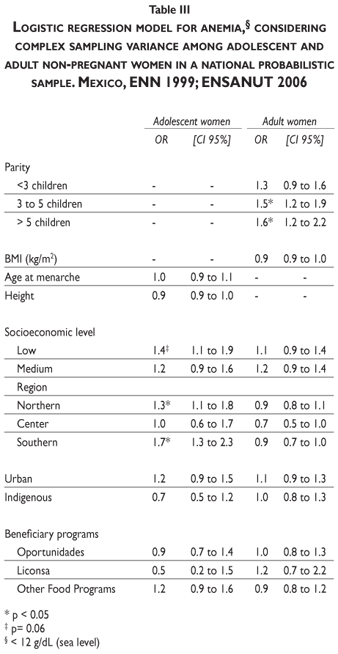
<body><![CDATA[<p>&nbsp;</p>     <p><font size="2" face="Verdana"> Adjusted OR for adolescent women living in    the northern and southern regions was higher than that of those living in Mexico    City (<I>p</I>=0.05). Another risk factor was belonging to low socioeconomic    level (<I>p</I>&lt;0.06). For adult women, parity greater than three was a significant    risk (<I>p</I>&lt;0.05). Having indigenous ethnicity or being beneficiary of    food distribution programs was not associated with anemia (<a href="#tab03">Table   III</a>).</font></p>     <p><a name="tab03"></a></p>     <p>&nbsp;</p>     <p align="center"><img src="/img/revistas/spm/v51s4/a06tab03.gif"></p>     <p>&nbsp;</p>     <p><font size="3" face="Verdana"><b>Discussion</b></font></p>     <p><font size="2" face="Verdana">Anemia in women of reproductive age continues    to be a public health problem in Mexico, although of medium importance according    to the WHO grading of the prevalence of anemia in non&#45;pregnant (medium= 5 &#45;    19.9%) and pregnant women (&gt;20).<SUP>21</SUP> In this period (1999&#45;2006),    there was a 5.6 pp decrease for non&#45;pregnant and 4.5 pp for pregnant women.    If the changes between 1999 and 2006 continue at the same pace, 8.4 and 9.6    years would be needed to reduce the prevalence of anemia of non&#45;pregnant and    pregnant women, respectively, to acceptable rates (&lt;5.0%).<SUP>22</sup></font></p>     <p><font size="2" face="Verdana"> When adjusting the information from both    surveys according to socioeconomic profile, we found that the southern region    shows a severe anemia prevalence regardless of the period observed. This fact    must be kept in sight since this region concentrates a high proportion of indigenous    population with the least economic opportunities and the worst life standards.<SUP>23</SUP>    Also to be noticed are the consistently high prevalences of anemia in women    in the northern region where the population with the highest socioeconomic profile    concentrates (<a href="#fig02">Figure 2</a>). This can be a result of such variables as age, sex,    kind of diet, frequency and intensity of acute recurrent infections, the existence    of chronic inflammatory processes<SUP>20</SUP> or other nutritional deficiencies    such as folate or vitamin A or B12.<SUP>24</SUP> Similar prevalences can be    found among women in small towns in the northern region as is the case in the    Tarahumara area where anemia prevalence was 16.1% (mean of hemoglobin concentration    140&plusmn;16 g/l) and 25.7% (129&plusmn;12 g/l) for non&#45;pregnant and pregnant women, respectively.<SUP>25</sup></font></p>     <p><font size="2" face="Verdana"> It has been documented that demographic indicators    such as age, number of children, parity and education were associated with iron    deficiency or anemia<SUP>26</SUP> and there was an association between education    and increasing meat intake.<SUP>27</SUP> This suggests better&#45;educated women    can afford, or make it a priority to include meat in their diet.<SUP>28</sup></font></p>     ]]></body>
<body><![CDATA[<p><font size="2" face="Verdana"> It is also possible to suppose that factors    other than socioeconomic profile contribute importantly to the presence of anemia    (<a href="#fig01">Figure 1</a>).</font></p>     <p><font size="2" face="Verdana"> These results suggest that priority should    be given to cure anemia in pregnant women since 1 out of 5 women suffer from    it, not only because of its deleterious effects on the maternal body but also    because of the grave repercussions for their neonates.<SUP>29&#45;30</sup></font></p>     <p><font size="2" face="Verdana"> In several countries worldwide, various iron    supplementation programs have been enacted to reduce anemia in pregnant and    breastfeeding women. However, most of these programs have not been successful    due in many instances to late intervention during pregnancy.<SUP>31,32</SUP>    In addition, one of the main problems is low compliance with iron supplementation.<SUP>33,34</SUP>    In the case of small children, an age when iron deficiency anemia is also highly    prevalent, few countries have large scale programs to reduce and control anemia.    As a result of the latter two situations an unchanged worldwide prevalence of    anemia has been maintained for the past 15 years.<SUP>35</sup></font></p>     <p><font size="2" face="Verdana"> An important proportion of the cases with    anemia is not exclusively due to iron deficiency; deficiencies of other hemopoietic    micronutrients such as folate, vitamin B12 and vitamin A are associated with    anemia. If the actual goal of public health programs is to control anemia, then    the problem can not be tackled simply aiming to reduce iron deficiency. In a    randomized controlled study carried out in rural Nepal; women were treated with    either: a) folic acid, b) folic acid with iron, c) folic acid with iron, zinc    and other 11 micronutrients or vitamin A. Women receiving folic acid and iron    had the highest hemoglobin concentration at the end of the trial.<SUP>36</sup></font></p>     <p><font size="2" face="Verdana"> The association of higher prevalence of anemia    with parity suggests a progressive depletion of iron stores during successive    pregnancies without an adequate recovery, thus multiparous women had a greater    risk for anemia than primiparous women.<SUP>37,38</sup></font></p>     <p><font size="2" face="Verdana"> It has been documented that iron deficiency    anemia is a serious public health problem, especially for women and small children,    causing negative consequences on human capital for a country. Based on that    evidence, goals to fight anemia have been established at international, national    and local levels. Such strategies include actions aimed to increase, for the    whole population, the supply, access and intake of quality foods, along with    programs to supplement and fortify food with iron.<SUP>39</sup></font></p>     <p><font size="2" face="Verdana"> Consistent and updated information have been    produced in Mexico to quantify the prevalence and distribution of anemia in    women of reproductive age. Nearly three&#45;fourths of the research published are    of descriptive nature; more recently, a handful of clinical trials have evaluated    the efficacy and effectiveness of public nutrition programs, demonstrating variable    success of the interventions.<SUP>10</SUP> However, the reduction of 0.7 pp    in the prevalence of anemia from 1999 to 2006 suggests a positive impact of    massive nutritional supplementation programs directed to highly vulnerable populations    living in extreme poverty. This is the case of <I>Oportunidades</I> which provides    21.2% of pregnant women with anemia with a fortified beverage (ENSANUT 2006)<SUP>40</SUP>    and <I>Arranque Parejo en la Vida</I> which distributes a multi&#45;mineral and    vitamin supplement; their impact, however, has not yet been documented. </font></p>     <p><font size="2" face="Verdana">In Mexico, economic indicators have not changed    with respect to the percentage of people who live in nutritional poverty, according    to GINI's index of indicators of nutrition status.<a name="tx01"></a><a href="#nt01"><sup>*</sup></a> Also, the use of the contraceptive    methods for the prevention of the pregnancy does not show variation over the    past decades, specifically in the use of intrauterine devices (&#8776; 20%)    that could generate bleeding in women.<SUP>41,42</sup></font></p>     <p><font size="2" face="Verdana"> Regardless of the progress achieved in reducing    anemia in women of reproductive age, the problem is far from being resolved.    Process evaluation research of programs is needed to improve their effectiveness.    Moreover, it is necessary to study and evaluate new strategies for the supplementation    and fortification of food with micronutrients to fight anemia in women. Targeted    screening and interventions to improve and strengthen effectiveness of interventions    such as diet and compliance with iron supplementation are warranted for this    at&#45;risk group and developing stronger political commitments on the part of national    and international agencies to enhance coverage of effective interventions is    urged. Furthermore, it is essential to consider a strong educational strategy    among the population that receives food and benefits from nutrition programs.</font></p>     <p>&nbsp;</p>     ]]></body>
<body><![CDATA[<p><font size="3" face="Verdana"><b>References</b></font></p>     <!-- ref --><p><font size="2" face="Verdana">1. Trowbridge F, Martorell R. Summary and recommendations.    Supplement: Forging Effective Strategies to Combat Iron Deficiency. J Nutr 2002;132:875S&#45;879S.    &nbsp;&nbsp;&nbsp;&nbsp;&nbsp;&nbsp;&nbsp;&nbsp;[&#160;<a href="javascript:void(0);" onclick="javascript: window.open('/scielo.php?script=sci_nlinks&ref=9350110&pid=S0036-3634200900100000600001&lng=','','width=640,height=500,resizable=yes,scrollbars=1,menubar=yes,');">Links</a>&#160;]<!-- end-ref --></font></p>     <!-- ref --><p><font size="2" face="Verdana">2. WHO/UNICEF/UNU. Iron deficiency anaemia: assessment,    prevention, and control. Geneva: World Health Organization, 2001 (WHO/NHD/01.3).    &nbsp;&nbsp;&nbsp;&nbsp;&nbsp;&nbsp;&nbsp;&nbsp;[&#160;<a href="javascript:void(0);" onclick="javascript: window.open('/scielo.php?script=sci_nlinks&ref=9350112&pid=S0036-3634200900100000600002&lng=','','width=640,height=500,resizable=yes,scrollbars=1,menubar=yes,');">Links</a>&#160;]<!-- end-ref --></font></p>     <!-- ref --><p><font size="2" face="Verdana">3. Stoltzfus RJ. Iron&#45;deficiency anemia: reexamining    the nature and magnitude of the public health problem. Summary: implications    for research and programs. J Nutr 2001;131:697S&#45;701S.    &nbsp;&nbsp;&nbsp;&nbsp;&nbsp;&nbsp;&nbsp;&nbsp;[&#160;<a href="javascript:void(0);" onclick="javascript: window.open('/scielo.php?script=sci_nlinks&ref=9350114&pid=S0036-3634200900100000600003&lng=','','width=640,height=500,resizable=yes,scrollbars=1,menubar=yes,');">Links</a>&#160;]<!-- end-ref --></font></p>     <!-- ref --><p><font size="2" face="Verdana">4. Haas JD, Brownlie IVT. Iron deficiency and    reduced work capacity: a critical review of the research to determine a causal    relationship. J Nutr 2001;131:676S&#45;690S.    &nbsp;&nbsp;&nbsp;&nbsp;&nbsp;&nbsp;&nbsp;&nbsp;[&#160;<a href="javascript:void(0);" onclick="javascript: window.open('/scielo.php?script=sci_nlinks&ref=9350116&pid=S0036-3634200900100000600004&lng=','','width=640,height=500,resizable=yes,scrollbars=1,menubar=yes,');">Links</a>&#160;]<!-- end-ref --></font></p>     <!-- ref --><p><font size="2" face="Verdana">5. Stoltzfus RJ. Defining iron deficiency anemia    in public health terms: a time for reflection. J Nutr 2001;131:565S&#45;567S.    &nbsp;&nbsp;&nbsp;&nbsp;&nbsp;&nbsp;&nbsp;&nbsp;[&#160;<a href="javascript:void(0);" onclick="javascript: window.open('/scielo.php?script=sci_nlinks&ref=9350118&pid=S0036-3634200900100000600005&lng=','','width=640,height=500,resizable=yes,scrollbars=1,menubar=yes,');">Links</a>&#160;]<!-- end-ref --></font></p>     <!-- ref --><p><font size="2" face="Verdana">6. Brabin BJ, Hakimi M, Pelletier D. An analysis    of anemia and pregnancy&#45;related maternal mortality. J Nutr 2001;131:604S&#45;615S.    &nbsp;&nbsp;&nbsp;&nbsp;&nbsp;&nbsp;&nbsp;&nbsp;[&#160;<a href="javascript:void(0);" onclick="javascript: window.open('/scielo.php?script=sci_nlinks&ref=9350120&pid=S0036-3634200900100000600006&lng=','','width=640,height=500,resizable=yes,scrollbars=1,menubar=yes,');">Links</a>&#160;]<!-- end-ref --></font></p>     <!-- ref --><p><font size="2" face="Verdana">7. Brabin BJ, Premji Z, Verhoeff F. An analysis    of anemia and child mortality. J Nutr 2001;131:636S&#45;648S.    &nbsp;&nbsp;&nbsp;&nbsp;&nbsp;&nbsp;&nbsp;&nbsp;[&#160;<a href="javascript:void(0);" onclick="javascript: window.open('/scielo.php?script=sci_nlinks&ref=9350122&pid=S0036-3634200900100000600007&lng=','','width=640,height=500,resizable=yes,scrollbars=1,menubar=yes,');">Links</a>&#160;]<!-- end-ref --></font></p>     <!-- ref --><p><font size="2" face="Verdana">8. International Nutritional Anemia Consultative    Group (INACG). Anemia Prevention and Control: What works? Part I. Program Guidance.    Washington, DC: USAID, The World Bank, UNICEF, PAHO, FAO, The Micronutrient    Initiative, 2003.    &nbsp;&nbsp;&nbsp;&nbsp;&nbsp;&nbsp;&nbsp;&nbsp;[&#160;<a href="javascript:void(0);" onclick="javascript: window.open('/scielo.php?script=sci_nlinks&ref=9350124&pid=S0036-3634200900100000600008&lng=','','width=640,height=500,resizable=yes,scrollbars=1,menubar=yes,');">Links</a>&#160;]<!-- end-ref --></font></p>     <!-- ref --><p><font size="2" face="Verdana">9. International Nutritional Anemia Consultative    Group (INACG). Anemia Prevention and Control: What works? Part II. Tools and    Resources. Washington, DC: USAID, The World Bank, UNICEF, PAHO, FAO, The Micronutrient    Initiative, 2003.    &nbsp;&nbsp;&nbsp;&nbsp;&nbsp;&nbsp;&nbsp;&nbsp;[&#160;<a href="javascript:void(0);" onclick="javascript: window.open('/scielo.php?script=sci_nlinks&ref=9350126&pid=S0036-3634200900100000600009&lng=','','width=640,height=500,resizable=yes,scrollbars=1,menubar=yes,');">Links</a>&#160;]<!-- end-ref --></font></p>     <!-- ref --><p><font size="2" face="Verdana">10. Casanueva E, De Regil LM, Flores&#45;Campuzano    MF. Anemia por deficiencia de hierro en mujeres mexicanas en edad reproductiva.    Historia de un problema no resuelto. Salud Publica Mex 2006;48:166&#45;175.    &nbsp;&nbsp;&nbsp;&nbsp;&nbsp;&nbsp;&nbsp;&nbsp;[&#160;<a href="javascript:void(0);" onclick="javascript: window.open('/scielo.php?script=sci_nlinks&ref=9350128&pid=S0036-3634200900100000600010&lng=','','width=640,height=500,resizable=yes,scrollbars=1,menubar=yes,');">Links</a>&#160;]<!-- end-ref --></font></p>     <!-- ref --><p><font size="2" face="Verdana">11.Mart&iacute;nez H, Gonz&aacute;lez&#45;Coss&iacute;o    T, Flores M, Rivera&#45;Domarco J, Lezana MA, Sep&uacute;lveda&#45;Amor J. Anemia en    mujeres de edad reproductiva. Resultados de una encuesta probabil&iacute;stica    nacional. Salud Publica Mex 1995;37:108&#45;119.    &nbsp;&nbsp;&nbsp;&nbsp;&nbsp;&nbsp;&nbsp;&nbsp;[&#160;<a href="javascript:void(0);" onclick="javascript: window.open('/scielo.php?script=sci_nlinks&ref=9350130&pid=S0036-3634200900100000600011&lng=','','width=640,height=500,resizable=yes,scrollbars=1,menubar=yes,');">Links</a>&#160;]<!-- end-ref --></font></p>     <!-- ref --><p><font size="2" face="Verdana">12. Shamah&#45;Levy T, Villalpando S, Rivera JA,    Mejia&#45;Rodriguez F, Camacho&#45; Cisneros M, Monterrubio EA. Anemia en mujeres mexicanas.    Un problema de salud p&uacute;blica. Salud Publica Mex 2003;45 suppl 4:S499&#45;S507.    &nbsp;&nbsp;&nbsp;&nbsp;&nbsp;&nbsp;&nbsp;&nbsp;[&#160;<a href="javascript:void(0);" onclick="javascript: window.open('/scielo.php?script=sci_nlinks&ref=9350132&pid=S0036-3634200900100000600012&lng=','','width=640,height=500,resizable=yes,scrollbars=1,menubar=yes,');">Links</a>&#160;]<!-- end-ref --></font></p>     <!-- ref --><p><font size="2" face="Verdana">13. Resano&#45;P&eacute;rez E, M&eacute;ndez&#45;Ram&iacute;rez    I, Shamah&#45;Levy T, Rivera JA, Sep&uacute;lveda&#45;Amor J. Methods of the Nacional    Nutrition Survey 1999. Salud Publica Mex 2003;45 Suppl 4:S558&#45;S564.    &nbsp;&nbsp;&nbsp;&nbsp;&nbsp;&nbsp;&nbsp;&nbsp;[&#160;<a href="javascript:void(0);" onclick="javascript: window.open('/scielo.php?script=sci_nlinks&ref=9350134&pid=S0036-3634200900100000600013&lng=','','width=640,height=500,resizable=yes,scrollbars=1,menubar=yes,');">Links</a>&#160;]<!-- end-ref --></font></p>     <!-- ref --><p><font size="2" face="Verdana">14. Palma O, Shamah T, Franco A, Olaiz G, M&eacute;ndez    I. Metodolog&iacute;a. In: Encuesta Nacional de Salud y Nutrici&oacute;n (ENSANUT&#45;2006).    Cuernavaca, Mexico: Instituto Nacional de Salud P&uacute;blica, 2006:19&#45;33.    &nbsp;&nbsp;&nbsp;&nbsp;&nbsp;&nbsp;&nbsp;&nbsp;[&#160;<a href="javascript:void(0);" onclick="javascript: window.open('/scielo.php?script=sci_nlinks&ref=9350136&pid=S0036-3634200900100000600014&lng=','','width=640,height=500,resizable=yes,scrollbars=1,menubar=yes,');">Links</a>&#160;]<!-- end-ref --></font></p>     <!-- ref --><p><font size="2" face="Verdana">15. World Health Organization. The prevalence    of anemia in women: a tabulation of available information. 2nd edition. Ginebra:    WHO, 1992.    &nbsp;&nbsp;&nbsp;&nbsp;&nbsp;&nbsp;&nbsp;&nbsp;[&#160;<a href="javascript:void(0);" onclick="javascript: window.open('/scielo.php?script=sci_nlinks&ref=9350138&pid=S0036-3634200900100000600015&lng=','','width=640,height=500,resizable=yes,scrollbars=1,menubar=yes,');">Links</a>&#160;]<!-- end-ref --></font></p>     <!-- ref --><p><font size="2" face="Verdana">16. Cohen JH, Hass JD. Hemoglobin correction    factors for estimating the prevalence of iron deficiency anemia in pregnant    women residing at high altitudes in Bolivia. Pan Am J Public Health 1999;6(6):392&#45;399.    &nbsp;&nbsp;&nbsp;&nbsp;&nbsp;&nbsp;&nbsp;&nbsp;[&#160;<a href="javascript:void(0);" onclick="javascript: window.open('/scielo.php?script=sci_nlinks&ref=9350140&pid=S0036-3634200900100000600016&lng=','','width=640,height=500,resizable=yes,scrollbars=1,menubar=yes,');">Links</a>&#160;]<!-- end-ref --></font></p>     <!-- ref --><p><font size="2" face="Verdana">17. Rush D. Nutrition and maternal mortality    in developing world. Am J Clin Nutr 2000;72 Suppl:212S&#45;240S.    &nbsp;&nbsp;&nbsp;&nbsp;&nbsp;&nbsp;&nbsp;&nbsp;[&#160;<a href="javascript:void(0);" onclick="javascript: window.open('/scielo.php?script=sci_nlinks&ref=9350142&pid=S0036-3634200900100000600017&lng=','','width=640,height=500,resizable=yes,scrollbars=1,menubar=yes,');">Links</a>&#160;]<!-- end-ref --></font></p>     <!-- ref --><p><font size="2" face="Verdana">18. Yip R. Significance of an abnormally low    or high hemoglobin concentration during pregnancy: special consideration of    iron nutrition. Am J Clin Nutr 2000;72 Suppl:272S&#45;279S.    &nbsp;&nbsp;&nbsp;&nbsp;&nbsp;&nbsp;&nbsp;&nbsp;[&#160;<a href="javascript:void(0);" onclick="javascript: window.open('/scielo.php?script=sci_nlinks&ref=9350144&pid=S0036-3634200900100000600018&lng=','','width=640,height=500,resizable=yes,scrollbars=1,menubar=yes,');">Links</a>&#160;]<!-- end-ref --></font></p>     <!-- ref --><p><font size="2" face="Verdana">19. Lohman T, Roche A, Martorell R. Anthropometric    standarization reference manual. Champlaign (IL): Human Kinetics,1988.    &nbsp;&nbsp;&nbsp;&nbsp;&nbsp;&nbsp;&nbsp;&nbsp;[&#160;<a href="javascript:void(0);" onclick="javascript: window.open('/scielo.php?script=sci_nlinks&ref=9350146&pid=S0036-3634200900100000600019&lng=','','width=640,height=500,resizable=yes,scrollbars=1,menubar=yes,');">Links</a>&#160;]<!-- end-ref --></font></p>     <!-- ref --><p><font size="2" face="Verdana">20. Habicht JP. Estandarizaci&oacute;n de m&eacute;todos    epidemiol&oacute;gicos cuantitativos sobre el terreno (Standardization of anthropometric    methods in the field). PAHO Bull 1974;76:375&#45;384.    &nbsp;&nbsp;&nbsp;&nbsp;&nbsp;&nbsp;&nbsp;&nbsp;[&#160;<a href="javascript:void(0);" onclick="javascript: window.open('/scielo.php?script=sci_nlinks&ref=9350148&pid=S0036-3634200900100000600020&lng=','','width=640,height=500,resizable=yes,scrollbars=1,menubar=yes,');">Links</a>&#160;]<!-- end-ref --></font></p>     <!-- ref --><p><font size="2" face="Verdana">21. World Health Organization and Food and Agriculture    Organization of the United Nations. Guidelines on food fortification with micronutrients.    France: WHO/FAO, 2006: 47.    &nbsp;&nbsp;&nbsp;&nbsp;&nbsp;&nbsp;&nbsp;&nbsp;[&#160;<a href="javascript:void(0);" onclick="javascript: window.open('/scielo.php?script=sci_nlinks&ref=9350150&pid=S0036-3634200900100000600021&lng=','','width=640,height=500,resizable=yes,scrollbars=1,menubar=yes,');">Links</a>&#160;]<!-- end-ref --></font></p>     <!-- ref --><p><FONT size="2" FACE="Verdana">22. Olaiz&#45;Fern&aacute;ndez G, Rivera&#45;Dommarco    J, Shamah&#45;Levy T, Rojas R, Villalpando&#45;Hern&aacute;ndez S, Hern&aacute;ndez&#45;Avila    M, <I>et al</I>. Encuesta Nacional de Salud y Nutrici&oacute;n 2006. Cuernavaca,    M&eacute;xico: Instituto Nacional de Salud P&uacute;blica, 2006.    &nbsp;&nbsp;&nbsp;&nbsp;&nbsp;&nbsp;&nbsp;&nbsp;[&#160;<a href="javascript:void(0);" onclick="javascript: window.open('/scielo.php?script=sci_nlinks&ref=9350152&pid=S0036-3634200900100000600022&lng=','','width=640,height=500,resizable=yes,scrollbars=1,menubar=yes,');">Links</a>&#160;]<!-- end-ref --> </font></p>     <!-- ref --><p><font size="2" face="Verdana">23. Consejo Nacional de Evaluaci&oacute;n de    la Pol&iacute;tica de Desarrollo Social.CONEVAL. Los Mapas de Pobreza en M&eacute;xico.    M&eacute;xico, julio 2007.    &nbsp;&nbsp;&nbsp;&nbsp;&nbsp;&nbsp;&nbsp;&nbsp;[&#160;<a href="javascript:void(0);" onclick="javascript: window.open('/scielo.php?script=sci_nlinks&ref=9350154&pid=S0036-3634200900100000600023&lng=','','width=640,height=500,resizable=yes,scrollbars=1,menubar=yes,');">Links</a>&#160;]<!-- end-ref --></font></p>     <!-- ref --><p><font size="2" face="Verdana">24. Suharno D, West CE, Muhilal, Karyadi D, Hautvast    JG. Supplementation with vitamin A and iron for nutritional anaemia in pregnant    women in West Java, Indonesia. Lancet 1993;342:1325&#45;1328.    &nbsp;&nbsp;&nbsp;&nbsp;&nbsp;&nbsp;&nbsp;&nbsp;[&#160;<a href="javascript:void(0);" onclick="javascript: window.open('/scielo.php?script=sci_nlinks&ref=9350156&pid=S0036-3634200900100000600024&lng=','','width=640,height=500,resizable=yes,scrollbars=1,menubar=yes,');">Links</a>&#160;]<!-- end-ref --></font></p>     <!-- ref --><p><font size="2" face="Verdana">25. Mon&aacute;rrez&#45;Espino J, Mart&iacute;nez    H, Greiner T. Iron deficiency anemia in reproductive&#45;age Tarahumara women of    Northern Mexico. Salud Publica Mex 2001;43:392&#45;401.    &nbsp;&nbsp;&nbsp;&nbsp;&nbsp;&nbsp;&nbsp;&nbsp;[&#160;<a href="javascript:void(0);" onclick="javascript: window.open('/scielo.php?script=sci_nlinks&ref=9350158&pid=S0036-3634200900100000600025&lng=','','width=640,height=500,resizable=yes,scrollbars=1,menubar=yes,');">Links</a>&#160;]<!-- end-ref --> </font></p>     <!-- ref --><p><FONT size="2" FACE="Verdana">26. Iannotti LL, O'Brien KO, Chang SCh, Mancini    J, Schulman&#45;Nathanson M, Liu Sh, <I>et al</I>. Iron Deficiency Anemia and Depleted    Body Iron Reserves Are Prevalent among Pregnant African&#45;American Adolescents.    J Nutr 2005;135:2572&#45;2577.    &nbsp;&nbsp;&nbsp;&nbsp;&nbsp;&nbsp;&nbsp;&nbsp;[&#160;<a href="javascript:void(0);" onclick="javascript: window.open('/scielo.php?script=sci_nlinks&ref=9350160&pid=S0036-3634200900100000600026&lng=','','width=640,height=500,resizable=yes,scrollbars=1,menubar=yes,');">Links</a>&#160;]<!-- end-ref --></font></p>     <!-- ref --><p><FONT size="2" FACE="Verdana"> 27. Pasricha Sant&#45;Rayn, Caruana SR, Phuc TQ,    Casey GJ, Jolley D, Kingsland S, <I>et al</I>. Anemia, Iron Deficiency, Meat    Consumption, and Hookworm Infection in Women of Reproductive Age in Northwest    Vietnam. Am J Trop Med Hyg 2008;78(3):375&#45;381.    &nbsp;&nbsp;&nbsp;&nbsp;&nbsp;&nbsp;&nbsp;&nbsp;[&#160;<a href="javascript:void(0);" onclick="javascript: window.open('/scielo.php?script=sci_nlinks&ref=9350162&pid=S0036-3634200900100000600027&lng=','','width=640,height=500,resizable=yes,scrollbars=1,menubar=yes,');">Links</a>&#160;]<!-- end-ref --></font></p>     <!-- ref --><p><FONT size="2" FACE="Verdana"> 28. Nguyen PH, Nguyen KC, Le Mai B, Nguyen TV,    Ha KH, Bern C, <I>et al</I>. Risk factors for anemia in Vietnam. Southeast Asian J Trop Med Public Health 2006;37<I>:</I>1213&#45;1223.    &nbsp;&nbsp;&nbsp;&nbsp;&nbsp;&nbsp;&nbsp;&nbsp;[&#160;<a href="javascript:void(0);" onclick="javascript: window.open('/scielo.php?script=sci_nlinks&ref=9350164&pid=S0036-3634200900100000600028&lng=','','width=640,height=500,resizable=yes,scrollbars=1,menubar=yes,');">Links</a>&#160;]<!-- end-ref --></font></p>     <!-- ref --><p><FONT size="2" FACE="Verdana"> 29. Sanghvi T, RossJ, Heymann H. Why is reducing    vitamin and mineral deficiencies critical for development? The links between    VMDs and survival, health, education, and productivity. Food Nut Bull 2007; 28(1)    Suppl:S167&#45; S173.    &nbsp;&nbsp;&nbsp;&nbsp;&nbsp;&nbsp;&nbsp;&nbsp;[&#160;<a href="javascript:void(0);" onclick="javascript: window.open('/scielo.php?script=sci_nlinks&ref=9350166&pid=S0036-3634200900100000600029&lng=','','width=640,height=500,resizable=yes,scrollbars=1,menubar=yes,');">Links</a>&#160;]<!-- end-ref --></font></p>     <!-- ref --><p><font size="2" face="Verdana">30. Stoltzfus RM, Mullany L, Black RE. Iron deficiency    anaemia. In: Comparative Quantification of Health Risks: The Global and Regional    Burden of Disease due to 25 Selected Major Risk Factors. Cambridge (MA): World    Health Organization/Harvard University Press, 2004.    &nbsp;&nbsp;&nbsp;&nbsp;&nbsp;&nbsp;&nbsp;&nbsp;[&#160;<a href="javascript:void(0);" onclick="javascript: window.open('/scielo.php?script=sci_nlinks&ref=9350168&pid=S0036-3634200900100000600030&lng=','','width=640,height=500,resizable=yes,scrollbars=1,menubar=yes,');">Links</a>&#160;]<!-- end-ref --></font></p>     <!-- ref --><p><font size="2" face="Verdana">31. Scanlon K, Yip R, Schieve L, Cogswell M.    High and Low Hemoglobin Levels During Pregnancy: Differential Risks for Preterm    Birth and Small for Gestational Age. Obstet Gynecol 2000;96:741&#45;748.    &nbsp;&nbsp;&nbsp;&nbsp;&nbsp;&nbsp;&nbsp;&nbsp;[&#160;<a href="javascript:void(0);" onclick="javascript: window.open('/scielo.php?script=sci_nlinks&ref=9350170&pid=S0036-3634200900100000600031&lng=','','width=640,height=500,resizable=yes,scrollbars=1,menubar=yes,');">Links</a>&#160;]<!-- end-ref --></font></p>     <!-- ref --><p><font size="2" face="Verdana">32. Scholl T. Iron status during pregnancy: setting    the stage for mother and infant. Am J Clin Nutr 2005;81:1218S&#45;1222S.    &nbsp;&nbsp;&nbsp;&nbsp;&nbsp;&nbsp;&nbsp;&nbsp;[&#160;<a href="javascript:void(0);" onclick="javascript: window.open('/scielo.php?script=sci_nlinks&ref=9350172&pid=S0036-3634200900100000600032&lng=','','width=640,height=500,resizable=yes,scrollbars=1,menubar=yes,');">Links</a>&#160;]<!-- end-ref --></font></p>     <!-- ref --><p><font size="2" face="Verdana">33. Schultink W, Ree M, Matulessi P, Gross R.    Low compliance with an iron&#45;supplementation program: a study among pregnant    women in Jakarta, Indonesia. Am J Clin Nutr 1993;57:135&#45;139.    &nbsp;&nbsp;&nbsp;&nbsp;&nbsp;&nbsp;&nbsp;&nbsp;[&#160;<a href="javascript:void(0);" onclick="javascript: window.open('/scielo.php?script=sci_nlinks&ref=9350174&pid=S0036-3634200900100000600033&lng=','','width=640,height=500,resizable=yes,scrollbars=1,menubar=yes,');">Links</a>&#160;]<!-- end-ref --></font></p>     <!-- ref --><p><font size="2" face="Verdana">34. Allen LH. Nutritional supplementation for    the pregnant woman. Clin Obstet Gynecol 1994;37:587&#45;595.    &nbsp;&nbsp;&nbsp;&nbsp;&nbsp;&nbsp;&nbsp;&nbsp;[&#160;<a href="javascript:void(0);" onclick="javascript: window.open('/scielo.php?script=sci_nlinks&ref=9350176&pid=S0036-3634200900100000600034&lng=','','width=640,height=500,resizable=yes,scrollbars=1,menubar=yes,');">Links</a>&#160;]<!-- end-ref --></font></p>     <!-- ref --><p><font size="2" face="Verdana">35. Mason J, Rivers J, Helwig C. Recent Trends    in Malnutrition in Developing Regions: Vitamin A deficiency, anemia, iodine    deficiency, and child underweight. Food Nutr Bull 2005;26:28&#45;34.    &nbsp;&nbsp;&nbsp;&nbsp;&nbsp;&nbsp;&nbsp;&nbsp;[&#160;<a href="javascript:void(0);" onclick="javascript: window.open('/scielo.php?script=sci_nlinks&ref=9350178&pid=S0036-3634200900100000600035&lng=','','width=640,height=500,resizable=yes,scrollbars=1,menubar=yes,');">Links</a>&#160;]<!-- end-ref --></font></p>     <!-- ref --><p><font size="2" face="Verdana">36. International Nutritional Anemia Consultative    Group. INACG Symposium. Why iron is important and what to do about it: a new    perspective. Washington, DC: International Life Sciences Institute Research    Foundation, Human Nutrition Institute, INACG, 2002 Mar. 50 p.    &nbsp;&nbsp;&nbsp;&nbsp;&nbsp;&nbsp;&nbsp;&nbsp;[&#160;<a href="javascript:void(0);" onclick="javascript: window.open('/scielo.php?script=sci_nlinks&ref=9350180&pid=S0036-3634200900100000600036&lng=','','width=640,height=500,resizable=yes,scrollbars=1,menubar=yes,');">Links</a>&#160;]<!-- end-ref --></font></p>     <!-- ref --><p><FONT size="2" FACE="Verdana">37. Christian P, Shrestha J, LeClerq SC, Khatry    SK, Jiang T, Wagner T, <I>et al</I>. Supplementation with Micronutrients in    Addition to Iron and Folic Acid Does Not Further Improve the Hematologic Status    of Pregnant Women in Rural Nepal. J Nutr 2003;133:3492&#45;3498.    &nbsp;&nbsp;&nbsp;&nbsp;&nbsp;&nbsp;&nbsp;&nbsp;[&#160;<a href="javascript:void(0);" onclick="javascript: window.open('/scielo.php?script=sci_nlinks&ref=9350182&pid=S0036-3634200900100000600037&lng=','','width=640,height=500,resizable=yes,scrollbars=1,menubar=yes,');">Links</a>&#160;]<!-- end-ref --></font></p>     <!-- ref --><p><FONT size="2" FACE="Verdana"> 38. Diallo MS, Diallo TS, Diallo FB, Diallo    Y, Camara AY, Onivogui G, <I>et al</I>. Anemia and pregnancy: epidemiologic,    clinical and prognostic study at the university clinic of the Ignace Deen Hospital,    Conakry (Guin&eacute;e). Rev Fr Gynecol Obstet 1995;90:138&#45;141.    &nbsp;&nbsp;&nbsp;&nbsp;&nbsp;&nbsp;&nbsp;&nbsp;[&#160;<a href="javascript:void(0);" onclick="javascript: window.open('/scielo.php?script=sci_nlinks&ref=9350184&pid=S0036-3634200900100000600038&lng=','','width=640,height=500,resizable=yes,scrollbars=1,menubar=yes,');">Links</a>&#160;]<!-- end-ref --></font></p>     <!-- ref --><p><font size="2" face="Verdana">39. Brunvand L, Henriksen C, Larsson M, Sandberg.    AS. Iron deficiency among pregnant Pakistanis in Norway and the content of phyticacid    in their diet. Acta obstet Gynecol Scand 1995;74:520&#45;525.    &nbsp;&nbsp;&nbsp;&nbsp;&nbsp;&nbsp;&nbsp;&nbsp;[&#160;<a href="javascript:void(0);" onclick="javascript: window.open('/scielo.php?script=sci_nlinks&ref=9350186&pid=S0036-3634200900100000600039&lng=','','width=640,height=500,resizable=yes,scrollbars=1,menubar=yes,');">Links</a>&#160;]<!-- end-ref --></font></p>     <!-- ref --><p><font size="2" face="Verdana">40. Rivera&#45;Dommarco J, Shamah&#45;Levy T, Villalpando&#45;Hern&aacute;ndez    S. Versi&oacute;n final del segundo documento t&eacute;cnico de resultados.    Comparaci&oacute;n en beneficiarios y no beneficiarios del programa Oportunidades.    Cuernavaca, Morelos: Instituto Nacional de Salud P&uacute;blica, 2006:67&#45;68.    &nbsp;&nbsp;&nbsp;&nbsp;&nbsp;&nbsp;&nbsp;&nbsp;[&#160;<a href="javascript:void(0);" onclick="javascript: window.open('/scielo.php?script=sci_nlinks&ref=9350188&pid=S0036-3634200900100000600040&lng=','','width=640,height=500,resizable=yes,scrollbars=1,menubar=yes,');">Links</a>&#160;]<!-- end-ref --></font></p>     <!-- ref --><p><FONT size="2" FACE="Verdana">41. Last updated 2001, Mexico. OPS, OMS. &#91;Consulted    October 7, 2008&#93;. Available at: <A HREF="http://www.paho.org/Spanish/SHA/prflMEX.htm" target="_blank">http://www.paho.org/Spanish/SHA/prflMEX.htm</A>.    &nbsp;&nbsp;&nbsp;&nbsp;&nbsp;&nbsp;&nbsp;&nbsp;[&#160;<a href="javascript:void(0);" onclick="javascript: window.open('/scielo.php?script=sci_nlinks&ref=9350190&pid=S0036-3634200900100000600041&lng=','','width=640,height=500,resizable=yes,scrollbars=1,menubar=yes,');">Links</a>&#160;]<!-- end-ref --></font></p>     <!-- ref --><p><font size="2" face="Verdana">42. Velasco&#45;Murillo V, Padilla I, de la Cruz    L, Acosta&#45;Cazares B. Salud Reproductiva, 2003. Rev Med Inst Mex Seguro Soc 2006;44    suppl 1: S87&#45;S95.    &nbsp;&nbsp;&nbsp;&nbsp;&nbsp;&nbsp;&nbsp;&nbsp;[&#160;<a href="javascript:void(0);" onclick="javascript: window.open('/scielo.php?script=sci_nlinks&ref=9350192&pid=S0036-3634200900100000600042&lng=','','width=640,height=500,resizable=yes,scrollbars=1,menubar=yes,');">Links</a>&#160;]<!-- end-ref --></font></p>     <p>&nbsp;</p>     <p>&nbsp;</p>     <p><FONT size="2" FACE="Verdana">Received on: April 11, 2008    <br> Accepted on: November 19, 2008</font></p>     <p>&nbsp;</p>     ]]></body>
<body><![CDATA[<p>&nbsp;</p>     <p><FONT size="2" FACE="Verdana">Address       reprint requests to: Mtra. Teresa Shamah Levy. Departamento de Vigilancia de la Nutrici&oacute;n. Instituto Nacional de Salud P&uacute;blica. Av. Universidad 655, col. Sta Mar&iacute;a Ahuacatitl&aacute;n. 62100, Cuernavaca Morelos, M&eacute;xico. E&#45;mail: <A HREF="mailto:tshamah@insp.mx ">tshamah@insp.mx</A>    <br> <a name="nt01"></a><a href="#tx01">*</a> CONEVAL. <a href="http://www.coneval.gob.mx" target="_blank">http://www.coneval.gob.mx</a>.</font></p>      ]]></body><back>
<ref-list>
<ref id="B1">
<label>1</label><nlm-citation citation-type="journal">
<person-group person-group-type="author">
<name>
<surname><![CDATA[Trowbridge]]></surname>
<given-names><![CDATA[F]]></given-names>
</name>
<name>
<surname><![CDATA[Martorell]]></surname>
<given-names><![CDATA[R]]></given-names>
</name>
</person-group>
<article-title xml:lang="en"><![CDATA[Summary and recommendations: Supplement: Forging Effective Strategies to Combat Iron Deficiency]]></article-title>
<source><![CDATA[J Nutr]]></source>
<year>2002</year>
<volume>132</volume>
<page-range>875S-879S</page-range></nlm-citation>
</ref>
<ref id="B2">
<label>2</label><nlm-citation citation-type="book">
<collab>WHO</collab>
<collab>UNICEF</collab>
<collab>UNU</collab>
<source><![CDATA[Iron deficiency anaemia: assessment, prevention, and control]]></source>
<year>2001</year>
<publisher-loc><![CDATA[Geneva ]]></publisher-loc>
<publisher-name><![CDATA[World Health Organization]]></publisher-name>
</nlm-citation>
</ref>
<ref id="B3">
<label>3</label><nlm-citation citation-type="journal">
<person-group person-group-type="author">
<name>
<surname><![CDATA[Stoltzfus]]></surname>
<given-names><![CDATA[RJ]]></given-names>
</name>
</person-group>
<article-title xml:lang="en"><![CDATA[Iron-deficiency anemia: reexamining the nature and magnitude of the public health problem]]></article-title>
<source><![CDATA[J Nutr]]></source>
<year>2001</year>
<volume>131</volume>
<page-range>697S-701S</page-range></nlm-citation>
</ref>
<ref id="B4">
<label>4</label><nlm-citation citation-type="journal">
<person-group person-group-type="author">
<name>
<surname><![CDATA[Haas]]></surname>
<given-names><![CDATA[JD]]></given-names>
</name>
<name>
<surname><![CDATA[Brownlie]]></surname>
<given-names><![CDATA[IVT]]></given-names>
</name>
</person-group>
<article-title xml:lang="en"><![CDATA[Iron deficiency and reduced work capacity: a critical review of the research to determine a causal relationship]]></article-title>
<source><![CDATA[J Nutr]]></source>
<year>2001</year>
<volume>131</volume>
<page-range>676S-690S</page-range></nlm-citation>
</ref>
<ref id="B5">
<label>5</label><nlm-citation citation-type="journal">
<person-group person-group-type="author">
<name>
<surname><![CDATA[Stoltzfus]]></surname>
<given-names><![CDATA[RJ]]></given-names>
</name>
</person-group>
<article-title xml:lang="en"><![CDATA[Defining iron deficiency anemia in public health terms: a time for reflection]]></article-title>
<source><![CDATA[J Nutr]]></source>
<year>2001</year>
<volume>131</volume>
<page-range>565S-567S</page-range></nlm-citation>
</ref>
<ref id="B6">
<label>6</label><nlm-citation citation-type="journal">
<person-group person-group-type="author">
<name>
<surname><![CDATA[Brabin]]></surname>
<given-names><![CDATA[BJ]]></given-names>
</name>
<name>
<surname><![CDATA[Hakimi]]></surname>
<given-names><![CDATA[M]]></given-names>
</name>
<name>
<surname><![CDATA[Pelletier]]></surname>
<given-names><![CDATA[D]]></given-names>
</name>
</person-group>
<article-title xml:lang="en"><![CDATA[An analysis of anemia and pregnancy-related maternal mortality]]></article-title>
<source><![CDATA[J Nutr]]></source>
<year>2001</year>
<volume>131</volume>
<page-range>604S-615S</page-range></nlm-citation>
</ref>
<ref id="B7">
<label>7</label><nlm-citation citation-type="journal">
<person-group person-group-type="author">
<name>
<surname><![CDATA[Brabin]]></surname>
<given-names><![CDATA[BJ]]></given-names>
</name>
<name>
<surname><![CDATA[Premji]]></surname>
<given-names><![CDATA[Z]]></given-names>
</name>
<name>
<surname><![CDATA[Verhoeff]]></surname>
<given-names><![CDATA[F]]></given-names>
</name>
</person-group>
<article-title xml:lang="en"><![CDATA[An analysis of anemia and child mortality]]></article-title>
<source><![CDATA[J Nutr]]></source>
<year>2001</year>
<volume>131</volume>
<page-range>636S-648S</page-range></nlm-citation>
</ref>
<ref id="B8">
<label>8</label><nlm-citation citation-type="book">
<collab>International Nutritional Anemia Consultative Group</collab>
<source><![CDATA[Anemia Prevention and Control: What works? Part I. Program Guidance]]></source>
<year>2003</year>
<publisher-loc><![CDATA[Washington^eDC DC]]></publisher-loc>
<publisher-name><![CDATA[USAIDThe World BankUNICEFPAHOFAOThe Micronutrient Initiative]]></publisher-name>
</nlm-citation>
</ref>
<ref id="B9">
<label>9</label><nlm-citation citation-type="book">
<collab>International Nutritional Anemia Consultative Group</collab>
<source><![CDATA[Anemia Prevention and Control: What works? Part II. Tools and Resources]]></source>
<year>2003</year>
<publisher-loc><![CDATA[Washington^eDC DC]]></publisher-loc>
<publisher-name><![CDATA[USAIDThe World BankUNICEFPAHOFAOThe Micronutrient Initiative]]></publisher-name>
</nlm-citation>
</ref>
<ref id="B10">
<label>10</label><nlm-citation citation-type="journal">
<person-group person-group-type="author">
<name>
<surname><![CDATA[Casanueva]]></surname>
<given-names><![CDATA[E]]></given-names>
</name>
<name>
<surname><![CDATA[De Regil]]></surname>
<given-names><![CDATA[LM]]></given-names>
</name>
<name>
<surname><![CDATA[Flores-Campuzano]]></surname>
<given-names><![CDATA[MF]]></given-names>
</name>
</person-group>
<article-title xml:lang="es"><![CDATA[Anemia por deficiencia de hierro en mujeres mexicanas en edad reproductiva: Historia de un problema no resuelto]]></article-title>
<source><![CDATA[Salud Publica Mex]]></source>
<year>2006</year>
<volume>48</volume>
<page-range>166-175</page-range></nlm-citation>
</ref>
<ref id="B11">
<label>11</label><nlm-citation citation-type="journal">
<person-group person-group-type="author">
<name>
<surname><![CDATA[Martínez]]></surname>
<given-names><![CDATA[H]]></given-names>
</name>
<name>
<surname><![CDATA[González-Cossío]]></surname>
<given-names><![CDATA[T]]></given-names>
</name>
<name>
<surname><![CDATA[Flores]]></surname>
<given-names><![CDATA[M]]></given-names>
</name>
<name>
<surname><![CDATA[Rivera-Domarco]]></surname>
<given-names><![CDATA[J]]></given-names>
</name>
<name>
<surname><![CDATA[Lezana]]></surname>
<given-names><![CDATA[MA]]></given-names>
</name>
<name>
<surname><![CDATA[Sepúlveda-Amor]]></surname>
<given-names><![CDATA[J]]></given-names>
</name>
</person-group>
<article-title xml:lang="es"><![CDATA[Anemia en mujeres de edad reproductiva: Resultados de una encuesta probabilística nacional]]></article-title>
<source><![CDATA[Salud Publica Mex]]></source>
<year>1995</year>
<volume>37</volume>
<page-range>108-119</page-range></nlm-citation>
</ref>
<ref id="B12">
<label>12</label><nlm-citation citation-type="journal">
<person-group person-group-type="author">
<name>
<surname><![CDATA[Shamah-Levy]]></surname>
<given-names><![CDATA[T]]></given-names>
</name>
<name>
<surname><![CDATA[Villalpando]]></surname>
<given-names><![CDATA[S]]></given-names>
</name>
<name>
<surname><![CDATA[Rivera]]></surname>
<given-names><![CDATA[JA]]></given-names>
</name>
<name>
<surname><![CDATA[Mejia-Rodriguez]]></surname>
<given-names><![CDATA[F]]></given-names>
</name>
<name>
<surname><![CDATA[Camacho- Cisneros]]></surname>
<given-names><![CDATA[M]]></given-names>
</name>
<name>
<surname><![CDATA[Monterrubio]]></surname>
<given-names><![CDATA[EA]]></given-names>
</name>
</person-group>
<article-title xml:lang="es"><![CDATA[Anemia en mujeres mexicanas: Un problema de salud pública]]></article-title>
<source><![CDATA[Salud Publica Mex]]></source>
<year>2003</year>
<volume>45</volume>
<numero>^s4</numero>
<issue>^s4</issue>
<supplement>4</supplement>
<page-range>S499-S507</page-range></nlm-citation>
</ref>
<ref id="B13">
<label>13</label><nlm-citation citation-type="journal">
<person-group person-group-type="author">
<name>
<surname><![CDATA[Resano-Pérez]]></surname>
<given-names><![CDATA[E]]></given-names>
</name>
<name>
<surname><![CDATA[Méndez-Ramírez]]></surname>
<given-names><![CDATA[I]]></given-names>
</name>
<name>
<surname><![CDATA[Shamah-Levy]]></surname>
<given-names><![CDATA[T]]></given-names>
</name>
<name>
<surname><![CDATA[Rivera]]></surname>
<given-names><![CDATA[JA]]></given-names>
</name>
<name>
<surname><![CDATA[Sepúlveda-Amor]]></surname>
<given-names><![CDATA[J]]></given-names>
</name>
</person-group>
<article-title xml:lang="en"><![CDATA[Methods of the Nacional Nutrition Survey 1999]]></article-title>
<source><![CDATA[Salud Publica Mex]]></source>
<year>2003</year>
<volume>45</volume>
<numero>^s4</numero>
<issue>^s4</issue>
<supplement>4</supplement>
<page-range>S558-S564</page-range></nlm-citation>
</ref>
<ref id="B14">
<label>14</label><nlm-citation citation-type="book">
<person-group person-group-type="author">
<name>
<surname><![CDATA[Palma]]></surname>
<given-names><![CDATA[O]]></given-names>
</name>
<name>
<surname><![CDATA[Shamah]]></surname>
<given-names><![CDATA[T]]></given-names>
</name>
<name>
<surname><![CDATA[Franco]]></surname>
<given-names><![CDATA[A]]></given-names>
</name>
<name>
<surname><![CDATA[Olaiz]]></surname>
<given-names><![CDATA[G]]></given-names>
</name>
<name>
<surname><![CDATA[Méndez]]></surname>
<given-names><![CDATA[I]]></given-names>
</name>
</person-group>
<article-title xml:lang="en"><![CDATA[Metodología]]></article-title>
<source><![CDATA[Encuesta Nacional de Salud y Nutrición (ENSANUT-2006)]]></source>
<year>2006</year>
<page-range>19-33</page-range><publisher-loc><![CDATA[Cuernavaca ]]></publisher-loc>
<publisher-name><![CDATA[Instituto Nacional de Salud Pública]]></publisher-name>
</nlm-citation>
</ref>
<ref id="B15">
<label>15</label><nlm-citation citation-type="book">
<collab>World Health Organization</collab>
<source><![CDATA[The prevalence of anemia in women: a tabulation of available information]]></source>
<year>1992</year>
<edition>2</edition>
<publisher-loc><![CDATA[Ginebra ]]></publisher-loc>
<publisher-name><![CDATA[WHO]]></publisher-name>
</nlm-citation>
</ref>
<ref id="B16">
<label>16</label><nlm-citation citation-type="journal">
<person-group person-group-type="author">
<name>
<surname><![CDATA[Cohen]]></surname>
<given-names><![CDATA[JH]]></given-names>
</name>
<name>
<surname><![CDATA[Hass]]></surname>
<given-names><![CDATA[JD]]></given-names>
</name>
</person-group>
<article-title xml:lang="en"><![CDATA[Hemoglobin correction factors for estimating the prevalence of iron deficiency anemia in pregnant women residing at high altitudes in Bolivia]]></article-title>
<source><![CDATA[Pan Am J Public Health]]></source>
<year>1999</year>
<volume>6</volume>
<numero>6</numero>
<issue>6</issue>
<page-range>392-399</page-range></nlm-citation>
</ref>
<ref id="B17">
<label>17</label><nlm-citation citation-type="journal">
<person-group person-group-type="author">
<name>
<surname><![CDATA[Rush]]></surname>
<given-names><![CDATA[D]]></given-names>
</name>
</person-group>
<article-title xml:lang="en"><![CDATA[Nutrition and maternal mortality in developing world]]></article-title>
<source><![CDATA[Am J Clin Nutr]]></source>
<year>2000</year>
<volume>72</volume>
<numero>^sSuppl</numero>
<issue>^sSuppl</issue>
<supplement>Suppl</supplement>
<page-range>212S-240S</page-range></nlm-citation>
</ref>
<ref id="B18">
<label>18</label><nlm-citation citation-type="journal">
<person-group person-group-type="author">
<name>
<surname><![CDATA[Yip]]></surname>
<given-names><![CDATA[R]]></given-names>
</name>
</person-group>
<article-title xml:lang="en"><![CDATA[Significance of an abnormally low or high hemoglobin concentration during pregnancy: special consideration of iron nutrition]]></article-title>
<source><![CDATA[Am J Clin Nutr]]></source>
<year>2000</year>
<volume>72</volume>
<numero>^sSuppl</numero>
<issue>^sSuppl</issue>
<supplement>Suppl</supplement>
<page-range>272S-279S</page-range></nlm-citation>
</ref>
<ref id="B19">
<label>19</label><nlm-citation citation-type="book">
<person-group person-group-type="author">
<name>
<surname><![CDATA[Lohman]]></surname>
<given-names><![CDATA[T]]></given-names>
</name>
<name>
<surname><![CDATA[Roche]]></surname>
<given-names><![CDATA[A]]></given-names>
</name>
<name>
<surname><![CDATA[Martorell]]></surname>
<given-names><![CDATA[R]]></given-names>
</name>
</person-group>
<source><![CDATA[Anthropometric standarization reference manual]]></source>
<year>1988</year>
<publisher-loc><![CDATA[Champlaign^eIL IL]]></publisher-loc>
<publisher-name><![CDATA[Human Kinetics]]></publisher-name>
</nlm-citation>
</ref>
<ref id="B20">
<label>20</label><nlm-citation citation-type="journal">
<person-group person-group-type="author">
<name>
<surname><![CDATA[Habicht]]></surname>
<given-names><![CDATA[JP]]></given-names>
</name>
</person-group>
<article-title xml:lang="es"><![CDATA[Estandarización de métodos epidemiológicos cuantitativos sobre el terreno (Standardization of anthropometric methods in the field)]]></article-title>
<source><![CDATA[PAHO Bull]]></source>
<year>1974</year>
<volume>76</volume>
<page-range>375-384</page-range></nlm-citation>
</ref>
<ref id="B21">
<label>21</label><nlm-citation citation-type="book">
<collab>World Health Organization and Food and Agriculture Organization of the United Nations</collab>
<source><![CDATA[Guidelines on food fortification with micronutrients]]></source>
<year>2006</year>
<page-range>47</page-range><publisher-name><![CDATA[WHOFAO]]></publisher-name>
</nlm-citation>
</ref>
<ref id="B22">
<label>22</label><nlm-citation citation-type="book">
<person-group person-group-type="author">
<name>
<surname><![CDATA[Olaiz-Fernández]]></surname>
<given-names><![CDATA[G]]></given-names>
</name>
<name>
<surname><![CDATA[Rivera-Dommarco]]></surname>
<given-names><![CDATA[J]]></given-names>
</name>
<name>
<surname><![CDATA[Shamah-Levy]]></surname>
<given-names><![CDATA[T]]></given-names>
</name>
<name>
<surname><![CDATA[Rojas]]></surname>
<given-names><![CDATA[R]]></given-names>
</name>
<name>
<surname><![CDATA[Villalpando-Hernández]]></surname>
<given-names><![CDATA[S]]></given-names>
</name>
<name>
<surname><![CDATA[Hernández-Avila]]></surname>
<given-names><![CDATA[M]]></given-names>
</name>
</person-group>
<source><![CDATA[Encuesta Nacional de Salud y Nutrición 2006]]></source>
<year>2006</year>
<publisher-loc><![CDATA[Cuernavaca ]]></publisher-loc>
<publisher-name><![CDATA[Instituto Nacional de Salud Pública]]></publisher-name>
</nlm-citation>
</ref>
<ref id="B23">
<label>23</label><nlm-citation citation-type="">
<collab>Consejo Nacional de Evaluación de la Política de Desarrollo Social</collab>
<source><![CDATA[Los Mapas de Pobreza en México]]></source>
<year>juli</year>
<month>o </month>
<day>20</day>
</nlm-citation>
</ref>
<ref id="B24">
<label>24</label><nlm-citation citation-type="journal">
<person-group person-group-type="author">
<name>
<surname><![CDATA[Suharno]]></surname>
<given-names><![CDATA[D]]></given-names>
</name>
<name>
<surname><![CDATA[West]]></surname>
<given-names><![CDATA[CE]]></given-names>
</name>
<name>
<surname><![CDATA[Muhilal]]></surname>
</name>
<name>
<surname><![CDATA[Karyadi]]></surname>
<given-names><![CDATA[D]]></given-names>
</name>
<name>
<surname><![CDATA[Hautvast]]></surname>
<given-names><![CDATA[JG]]></given-names>
</name>
</person-group>
<article-title xml:lang="en"><![CDATA[Supplementation with vitamin A and iron for nutritional anaemia in pregnant women in West Java, Indonesia]]></article-title>
<source><![CDATA[Lancet]]></source>
<year>1993</year>
<volume>342</volume>
<page-range>1325-1328</page-range></nlm-citation>
</ref>
<ref id="B25">
<label>25</label><nlm-citation citation-type="journal">
<person-group person-group-type="author">
<name>
<surname><![CDATA[Monárrez-Espino]]></surname>
<given-names><![CDATA[J]]></given-names>
</name>
<name>
<surname><![CDATA[Martínez]]></surname>
<given-names><![CDATA[H]]></given-names>
</name>
<name>
<surname><![CDATA[Greiner]]></surname>
<given-names><![CDATA[T]]></given-names>
</name>
</person-group>
<article-title xml:lang="en"><![CDATA[Iron deficiency anemia in reproductive-age Tarahumara women of Northern Mexico]]></article-title>
<source><![CDATA[Salud Publica Mex]]></source>
<year>2001</year>
<volume>43</volume>
<page-range>392-401</page-range></nlm-citation>
</ref>
<ref id="B26">
<label>26</label><nlm-citation citation-type="journal">
<person-group person-group-type="author">
<name>
<surname><![CDATA[Iannotti]]></surname>
<given-names><![CDATA[LL]]></given-names>
</name>
<name>
<surname><![CDATA[O'Brien]]></surname>
<given-names><![CDATA[KO]]></given-names>
</name>
<name>
<surname><![CDATA[Chang]]></surname>
<given-names><![CDATA[SCh]]></given-names>
</name>
<name>
<surname><![CDATA[Mancini]]></surname>
<given-names><![CDATA[J]]></given-names>
</name>
<name>
<surname><![CDATA[Schulman-Nathanson]]></surname>
<given-names><![CDATA[M]]></given-names>
</name>
<name>
<surname><![CDATA[Liu]]></surname>
<given-names><![CDATA[Sh]]></given-names>
</name>
</person-group>
<article-title xml:lang="en"><![CDATA[Iron Deficiency Anemia and Depleted Body Iron Reserves Are Prevalent among Pregnant African-American Adolescents]]></article-title>
<source><![CDATA[J Nutr]]></source>
<year>2005</year>
<volume>135</volume>
<page-range>2572-2577</page-range></nlm-citation>
</ref>
<ref id="B27">
<label>27</label><nlm-citation citation-type="journal">
<person-group person-group-type="author">
<name>
<surname><![CDATA[Sant-Rayn]]></surname>
<given-names><![CDATA[Pasricha]]></given-names>
</name>
<name>
<surname><![CDATA[Caruana]]></surname>
<given-names><![CDATA[SR]]></given-names>
</name>
<name>
<surname><![CDATA[Phuc]]></surname>
<given-names><![CDATA[TQ]]></given-names>
</name>
<name>
<surname><![CDATA[Casey]]></surname>
<given-names><![CDATA[GJ]]></given-names>
</name>
<name>
<surname><![CDATA[Jolley]]></surname>
<given-names><![CDATA[D]]></given-names>
</name>
<name>
<surname><![CDATA[Kingsland]]></surname>
<given-names><![CDATA[S]]></given-names>
</name>
</person-group>
<article-title xml:lang="en"><![CDATA[Anemia, Iron Deficiency, Meat Consumption, and Hookworm Infection in Women of Reproductive Age in Northwest Vietnam]]></article-title>
<source><![CDATA[Am J Trop Med Hyg]]></source>
<year>2008</year>
<volume>78</volume>
<numero>3</numero>
<issue>3</issue>
<page-range>375-381</page-range></nlm-citation>
</ref>
<ref id="B28">
<label>28</label><nlm-citation citation-type="journal">
<person-group person-group-type="author">
<name>
<surname><![CDATA[Nguyen]]></surname>
<given-names><![CDATA[PH]]></given-names>
</name>
<name>
<surname><![CDATA[Nguyen]]></surname>
<given-names><![CDATA[KC]]></given-names>
</name>
<name>
<surname><![CDATA[Le Mai]]></surname>
<given-names><![CDATA[B]]></given-names>
</name>
<name>
<surname><![CDATA[Nguyen]]></surname>
<given-names><![CDATA[TV]]></given-names>
</name>
<name>
<surname><![CDATA[Ha]]></surname>
<given-names><![CDATA[KH]]></given-names>
</name>
<name>
<surname><![CDATA[Bern]]></surname>
<given-names><![CDATA[C]]></given-names>
</name>
</person-group>
<article-title xml:lang="en"><![CDATA[Risk factors for anemia in Vietnam]]></article-title>
<source><![CDATA[Southeast Asian J Trop Med Public Health]]></source>
<year>2006</year>
<volume>37</volume>
<page-range>1213-1223</page-range></nlm-citation>
</ref>
<ref id="B29">
<label>29</label><nlm-citation citation-type="journal">
<person-group person-group-type="author">
<name>
<surname><![CDATA[Sanghvi]]></surname>
<given-names><![CDATA[T]]></given-names>
</name>
<name>
<surname><![CDATA[Ross]]></surname>
<given-names><![CDATA[J]]></given-names>
</name>
<name>
<surname><![CDATA[Heymann]]></surname>
<given-names><![CDATA[H]]></given-names>
</name>
</person-group>
<article-title xml:lang="en"><![CDATA[Why is reducing vitamin and mineral deficiencies critical for development?: The links between VMDs and survival, health, education, and productivity]]></article-title>
<source><![CDATA[Food Nut Bull]]></source>
<year>2007</year>
<volume>28</volume>
<numero>1^sSuppl</numero>
<issue>1^sSuppl</issue>
<supplement>Suppl</supplement>
<page-range>S167- S173</page-range></nlm-citation>
</ref>
<ref id="B30">
<label>30</label><nlm-citation citation-type="book">
<person-group person-group-type="author">
<name>
<surname><![CDATA[Stoltzfus]]></surname>
<given-names><![CDATA[RM]]></given-names>
</name>
<name>
<surname><![CDATA[Mullany]]></surname>
<given-names><![CDATA[L]]></given-names>
</name>
<name>
<surname><![CDATA[Black]]></surname>
<given-names><![CDATA[RE]]></given-names>
</name>
</person-group>
<article-title xml:lang="en"><![CDATA[Iron deficiency anaemia]]></article-title>
<source><![CDATA[Comparative Quantification of Health Risks: The Global and Regional Burden of Disease due to 25 Selected Major Risk Factors]]></source>
<year>2004</year>
<publisher-loc><![CDATA[Cambridge^eMA MA]]></publisher-loc>
<publisher-name><![CDATA[World Health OrganizationHarvard University Press]]></publisher-name>
</nlm-citation>
</ref>
<ref id="B31">
<label>31</label><nlm-citation citation-type="journal">
<person-group person-group-type="author">
<name>
<surname><![CDATA[Scanlon]]></surname>
<given-names><![CDATA[K]]></given-names>
</name>
<name>
<surname><![CDATA[Yip]]></surname>
<given-names><![CDATA[R]]></given-names>
</name>
<name>
<surname><![CDATA[Schieve]]></surname>
<given-names><![CDATA[L]]></given-names>
</name>
<name>
<surname><![CDATA[Cogswell]]></surname>
<given-names><![CDATA[M]]></given-names>
</name>
</person-group>
<article-title xml:lang="en"><![CDATA[High and Low Hemoglobin Levels During Pregnancy: Differential Risks for Preterm Birth and Small for Gestational Age]]></article-title>
<source><![CDATA[Obstet Gynecol]]></source>
<year>2000</year>
<volume>96</volume>
<page-range>741-748</page-range></nlm-citation>
</ref>
<ref id="B32">
<label>32</label><nlm-citation citation-type="journal">
<person-group person-group-type="author">
<name>
<surname><![CDATA[Scholl]]></surname>
<given-names><![CDATA[T]]></given-names>
</name>
</person-group>
<article-title xml:lang="en"><![CDATA[Iron status during pregnancy: setting the stage for mother and infant]]></article-title>
<source><![CDATA[Am J Clin Nutr]]></source>
<year>2005</year>
<volume>81</volume>
<page-range>1218S-1222S</page-range></nlm-citation>
</ref>
<ref id="B33">
<label>33</label><nlm-citation citation-type="journal">
<person-group person-group-type="author">
<name>
<surname><![CDATA[Schultink]]></surname>
<given-names><![CDATA[W]]></given-names>
</name>
<name>
<surname><![CDATA[Ree]]></surname>
<given-names><![CDATA[M]]></given-names>
</name>
<name>
<surname><![CDATA[Matulessi]]></surname>
<given-names><![CDATA[P]]></given-names>
</name>
<name>
<surname><![CDATA[Gross]]></surname>
<given-names><![CDATA[R]]></given-names>
</name>
</person-group>
<article-title xml:lang="en"><![CDATA[Low compliance with an iron-supplementation program: a study among pregnant women in Jakarta, Indonesia]]></article-title>
<source><![CDATA[Am J Clin Nutr]]></source>
<year>1993</year>
<volume>57</volume>
<page-range>135-139</page-range></nlm-citation>
</ref>
<ref id="B34">
<label>34</label><nlm-citation citation-type="journal">
<person-group person-group-type="author">
<name>
<surname><![CDATA[Allen]]></surname>
<given-names><![CDATA[LH]]></given-names>
</name>
</person-group>
<article-title xml:lang="en"><![CDATA[Nutritional supplementation for the pregnant woman]]></article-title>
<source><![CDATA[Clin Obstet Gynecol]]></source>
<year>1994</year>
<volume>37</volume>
<page-range>587-595</page-range></nlm-citation>
</ref>
<ref id="B35">
<label>35</label><nlm-citation citation-type="journal">
<person-group person-group-type="author">
<name>
<surname><![CDATA[Mason]]></surname>
<given-names><![CDATA[J]]></given-names>
</name>
<name>
<surname><![CDATA[Rivers]]></surname>
<given-names><![CDATA[J]]></given-names>
</name>
<name>
<surname><![CDATA[Helwig]]></surname>
<given-names><![CDATA[C]]></given-names>
</name>
</person-group>
<article-title xml:lang="en"><![CDATA[Recent Trends in Malnutrition in Developing Regions: Vitamin A deficiency, anemia, iodine deficiency, and child underweight]]></article-title>
<source><![CDATA[Food Nutr Bull]]></source>
<year>2005</year>
<volume>26</volume>
<page-range>28-34</page-range></nlm-citation>
</ref>
<ref id="B36">
<label>36</label><nlm-citation citation-type="book">
<collab>International Nutritional Anemia Consultative Group</collab>
<source><![CDATA[Why iron is important and what to do about it: a new perspective]]></source>
<year>2002</year>
<month> M</month>
<day>ar</day>
<page-range>50</page-range><publisher-loc><![CDATA[Washington^eDC DC]]></publisher-loc>
<publisher-name><![CDATA[International Life Sciences Institute Research FoundationHuman Nutrition InstituteINACG]]></publisher-name>
</nlm-citation>
</ref>
<ref id="B37">
<label>37</label><nlm-citation citation-type="journal">
<person-group person-group-type="author">
<name>
<surname><![CDATA[Christian]]></surname>
<given-names><![CDATA[P]]></given-names>
</name>
<name>
<surname><![CDATA[Shrestha]]></surname>
<given-names><![CDATA[J]]></given-names>
</name>
<name>
<surname><![CDATA[LeClerq]]></surname>
<given-names><![CDATA[SC]]></given-names>
</name>
<name>
<surname><![CDATA[Khatry]]></surname>
<given-names><![CDATA[SK]]></given-names>
</name>
<name>
<surname><![CDATA[Jiang]]></surname>
<given-names><![CDATA[T]]></given-names>
</name>
<name>
<surname><![CDATA[Wagner]]></surname>
<given-names><![CDATA[T]]></given-names>
</name>
</person-group>
<article-title xml:lang="en"><![CDATA[Supplementation with Micronutrients in Addition to Iron and Folic Acid Does Not Further Improve the Hematologic Status of Pregnant Women in Rural Nepal]]></article-title>
<source><![CDATA[J Nutr]]></source>
<year>2003</year>
<volume>133</volume>
<page-range>3492-3498</page-range></nlm-citation>
</ref>
<ref id="B38">
<label>38</label><nlm-citation citation-type="journal">
<person-group person-group-type="author">
<name>
<surname><![CDATA[Diallo]]></surname>
<given-names><![CDATA[MS]]></given-names>
</name>
<name>
<surname><![CDATA[Diallo]]></surname>
<given-names><![CDATA[TS]]></given-names>
</name>
<name>
<surname><![CDATA[Diallo]]></surname>
<given-names><![CDATA[FB]]></given-names>
</name>
<name>
<surname><![CDATA[Diallo]]></surname>
<given-names><![CDATA[Y]]></given-names>
</name>
<name>
<surname><![CDATA[Camara]]></surname>
<given-names><![CDATA[AY]]></given-names>
</name>
<name>
<surname><![CDATA[Onivogui]]></surname>
<given-names><![CDATA[G]]></given-names>
</name>
</person-group>
<article-title xml:lang="en"><![CDATA[Anemia and pregnancy: epidemiologic, clinical and prognostic study at the university clinic of the Ignace Deen Hospital, Conakry (Guinée)]]></article-title>
<source><![CDATA[Rev Fr Gynecol Obstet]]></source>
<year>1995</year>
<volume>90</volume>
<page-range>138-141</page-range></nlm-citation>
</ref>
<ref id="B39">
<label>39</label><nlm-citation citation-type="journal">
<person-group person-group-type="author">
<name>
<surname><![CDATA[Brunvand]]></surname>
<given-names><![CDATA[L]]></given-names>
</name>
<name>
<surname><![CDATA[Henriksen]]></surname>
<given-names><![CDATA[C]]></given-names>
</name>
<name>
<surname><![CDATA[Larsson]]></surname>
<given-names><![CDATA[M]]></given-names>
</name>
<name>
<surname><![CDATA[Sandberg]]></surname>
<given-names><![CDATA[AS]]></given-names>
</name>
</person-group>
<article-title xml:lang="en"><![CDATA[Iron deficiency among pregnant Pakistanis in Norway and the content of phyticacid in their diet]]></article-title>
<source><![CDATA[Acta obstet Gynecol Scand]]></source>
<year>1995</year>
<volume>74</volume>
<page-range>520-525</page-range></nlm-citation>
</ref>
<ref id="B40">
<label>40</label><nlm-citation citation-type="book">
<person-group person-group-type="author">
<name>
<surname><![CDATA[Rivera-Dommarco]]></surname>
<given-names><![CDATA[J]]></given-names>
</name>
<name>
<surname><![CDATA[Shamah-Levy]]></surname>
<given-names><![CDATA[T]]></given-names>
</name>
<name>
<surname><![CDATA[Villalpando-Hernández]]></surname>
<given-names><![CDATA[S]]></given-names>
</name>
</person-group>
<source><![CDATA[Versión final del segundo documento técnico de resultados: Comparación en beneficiarios y no beneficiarios del programa Oportunidades]]></source>
<year>2006</year>
<page-range>67-68</page-range><publisher-loc><![CDATA[Cuernavaca^eMorelos Morelos]]></publisher-loc>
<publisher-name><![CDATA[Instituto Nacional de Salud Pública]]></publisher-name>
</nlm-citation>
</ref>
<ref id="B41">
<label>41</label><nlm-citation citation-type="book">
<source><![CDATA[]]></source>
<year>2001</year>
<publisher-loc><![CDATA[Mexico ]]></publisher-loc>
<publisher-name><![CDATA[OPSOMS]]></publisher-name>
</nlm-citation>
</ref>
<ref id="B42">
<label>42</label><nlm-citation citation-type="journal">
<person-group person-group-type="author">
<name>
<surname><![CDATA[Velasco-Murillo]]></surname>
<given-names><![CDATA[V]]></given-names>
</name>
<name>
<surname><![CDATA[Padilla]]></surname>
<given-names><![CDATA[I]]></given-names>
</name>
<name>
<surname><![CDATA[de la Cruz]]></surname>
<given-names><![CDATA[L]]></given-names>
</name>
<name>
<surname><![CDATA[Acosta-Cazares]]></surname>
<given-names><![CDATA[B]]></given-names>
</name>
</person-group>
<article-title xml:lang="es"><![CDATA[Salud Reproductiva, 2003]]></article-title>
<source><![CDATA[Rev Med Inst Mex Seguro Soc]]></source>
<year>2006</year>
<volume>44</volume>
<numero>^s1</numero>
<issue>^s1</issue>
<supplement>1</supplement>
<page-range>S87-S95</page-range></nlm-citation>
</ref>
</ref-list>
</back>
</article>