<?xml version="1.0" encoding="ISO-8859-1"?><article xmlns:mml="http://www.w3.org/1998/Math/MathML" xmlns:xlink="http://www.w3.org/1999/xlink" xmlns:xsi="http://www.w3.org/2001/XMLSchema-instance">
<front>
<journal-meta>
<journal-id>0036-3634</journal-id>
<journal-title><![CDATA[Salud Pública de México]]></journal-title>
<abbrev-journal-title><![CDATA[Salud pública Méx]]></abbrev-journal-title>
<issn>0036-3634</issn>
<publisher>
<publisher-name><![CDATA[Instituto Nacional de Salud Pública]]></publisher-name>
</publisher>
</journal-meta>
<article-meta>
<article-id>S0036-36342009001000004</article-id>
<title-group>
<article-title xml:lang="en"><![CDATA[Child malnutrition in Mexico in the last two decades: prevalence using the new WHO 2006 growth standards]]></article-title>
<article-title xml:lang="es"><![CDATA[Malnutrición preescolar en México en las últimas dos décadas: prevalencias usando los estándares de la OMS-2006]]></article-title>
</title-group>
<contrib-group>
<contrib contrib-type="author">
<name>
<surname><![CDATA[Cossío]]></surname>
<given-names><![CDATA[Teresa González-de]]></given-names>
</name>
<xref ref-type="aff" rid="A01"/>
</contrib>
<contrib contrib-type="author">
<name>
<surname><![CDATA[Rivera]]></surname>
<given-names><![CDATA[Juan A]]></given-names>
</name>
<xref ref-type="aff" rid="A01"/>
</contrib>
<contrib contrib-type="author">
<name>
<surname><![CDATA[González-Castell]]></surname>
<given-names><![CDATA[Dinorah]]></given-names>
</name>
<xref ref-type="aff" rid="A01"/>
</contrib>
<contrib contrib-type="author">
<name>
<surname><![CDATA[Unar-Munguía]]></surname>
<given-names><![CDATA[Mishel]]></given-names>
</name>
<xref ref-type="aff" rid="A01"/>
</contrib>
<contrib contrib-type="author">
<name>
<surname><![CDATA[Monterrubio]]></surname>
<given-names><![CDATA[Eric A]]></given-names>
</name>
<xref ref-type="aff" rid="A01"/>
</contrib>
</contrib-group>
<aff id="A01">
<institution><![CDATA[,Instituto Nacional de Salud Pública Centro de Investigaciones en Nutrición y Salud ]]></institution>
<addr-line><![CDATA[Cuernavaca Morelos]]></addr-line>
<country>México</country>
</aff>
<pub-date pub-type="pub">
<day>00</day>
<month>00</month>
<year>2009</year>
</pub-date>
<pub-date pub-type="epub">
<day>00</day>
<month>00</month>
<year>2009</year>
</pub-date>
<volume>51</volume>
<fpage>S494</fpage>
<lpage>S506</lpage>
<copyright-statement/>
<copyright-year/>
<self-uri xlink:href="http://www.scielo.org.mx/scielo.php?script=sci_arttext&amp;pid=S0036-36342009001000004&amp;lng=en&amp;nrm=iso"></self-uri><self-uri xlink:href="http://www.scielo.org.mx/scielo.php?script=sci_abstract&amp;pid=S0036-36342009001000004&amp;lng=en&amp;nrm=iso"></self-uri><self-uri xlink:href="http://www.scielo.org.mx/scielo.php?script=sci_pdf&amp;pid=S0036-36342009001000004&amp;lng=en&amp;nrm=iso"></self-uri><abstract abstract-type="short" xml:lang="en"><p><![CDATA[OBJECTIVE: To describe preschool malnutrition prevalence and trends in Mexican children for the 1988, 1999 and 2006 Mexican National Nutrition Surveys using WHO-2006 standards and National Center for Health Statistics/WHO (NCHS/WHO) references. MATERIAL AND METHODS: Prevalence of undernutrition (< minus 2 z-score for weight/age, height/age and weight/height) and overweight (&gt; plus 2 z-score for weight/height) were calculated. RESULTS: Height/age and weight/height have increased over time (p< 0.05). Using WHO-2006 standards, stunting in children less than 5 years years old was 26.9%, 21.5% and 15.5% in 1988, 1999 and 2006, respectively; values for wasting were 6.2%, 2.1% and 2.0%, respectively. Wasting in the very young (< 6 mo) in 2006 is high (4.9%). Overweight increased from 1988 to 1999 (6.1% to 7.5%) and stabilized in 2006 (7.6%). Gaps among ethnic and socioeconomic groups have decreased over time. CONCLUSIONS: Stunting has decreased markedly but continues to be the main malnutrition problem. Overweight has emerged as a public health problem in the young. Lower NCHS/WHO estimates previously published underestimated true prevalence. Length deviations in attained height after 12 months indicate poor infant feeding practices, probably coupled with early infections. Results reinforce the need to improve the quality of nutrition programs and to promote adequate lactation and infant feeding practices in Mexico.]]></p></abstract>
<abstract abstract-type="short" xml:lang="es"><p><![CDATA[OBJETIVO: Describir las prevalencias y tendencias de malnutrición en preescolares mexicanos, según resultados de las Encuestas Nacionales de Nutrición 1988, 1999 y 2006, usando estándares de la Organización Mundial de la Salud de 2006 y referencias del National Center for Health Statistics/ World Health Organization (NCHS/WHO). MATERIAL Y MÉTODOS: Se calcularon prevalencias de desnutrición (puntaje z < -2 para talla/edad, peso/edad, y peso/talla) y de sobrepeso (&gt; +2z peso/talla). RESULTADOS: La talla/edad y el peso/talla han aumentado con el tiempo (p< 0.05). Usando los estándares de la OMS de 2006, el desmedro en menores de cinco años de edad era de 26.9, 21.5 y 15.5% en 1988, 1999 y 2006, respectivamente. Los valores de emaciación fueron 6.2, 2.1 y 2.0%. La emaciación en 2006 en los menores de seis meses de edad fue de 4.9%. El sobrepeso aumentó de 1988 a 1999 (6.1 a 7.5%) y se estabilizó en 2006 (7.6%). Las diferencias entre grupos étnicos y socioeconómicos disminuyeron con el tiempo. CONCLUSIONES: El desmedro disminuyó marcadamente, pero continúa siendo el principal problema de malnutrición. El sobrepeso emergió como problema de salud pública en niños. Las estimaciones de desnutrición en preescolares previamente publicadas usando las referencias del NCHS/WHO subestimaban las verdaderas cifras. Las desviaciones en la talla alcanzada a partir de los 12 meses de edad revelan prácticas de lactancia y alimentación infantil pobres, probablemente aunadas a infecciones tempranas. Estos resultados refuerzan la necesidad de mejorar la calidad de los programas de nutrición y de promover prácticas adecuadas de alimentación infantil en México.]]></p></abstract>
<kwd-group>
<kwd lng="en"><![CDATA[child malnutrition]]></kwd>
<kwd lng="en"><![CDATA[wasting]]></kwd>
<kwd lng="en"><![CDATA[overweight]]></kwd>
<kwd lng="en"><![CDATA[obesity]]></kwd>
<kwd lng="en"><![CDATA[Mexico]]></kwd>
<kwd lng="en"><![CDATA[WHO]]></kwd>
<kwd lng="es"><![CDATA[malnutrición preescolar]]></kwd>
<kwd lng="es"><![CDATA[desmedro]]></kwd>
<kwd lng="es"><![CDATA[sobrepeso]]></kwd>
<kwd lng="es"><![CDATA[obesidad]]></kwd>
<kwd lng="es"><![CDATA[México]]></kwd>
<kwd lng="es"><![CDATA[OMS]]></kwd>
</kwd-group>
</article-meta>
</front><body><![CDATA[ <p align="right"><font size="2" face="Verdana"><b>ORIGINAL ARTICLES</b></font></p>     <p>&nbsp;</p>     <p><font size="4" face="verdana"><b>Child malnutrition in Mexico    in the last two decades: prevalence using the new WHO 2006 growth standards</b></font></p>     <p>&nbsp;</p>     <p><font size="3" face="verdana"><b>Malnutrici&oacute;n preescolar en M&eacute;xico    en las &uacute;ltimas dos d&eacute;cadas: prevalencias    usando los est&aacute;ndares de la OMS&#45;2006</b></font></p>     <p>&nbsp;</p>     <p>&nbsp;</p>     <p><font size="2" face="Verdana"><b>Teresa Gonz&aacute;lez&#45;de Coss&iacute;o, PhD;    Juan A Rivera, PhD; Dinorah Gonz&aacute;lez&#45;Castell, MC; Mishel    Unar&#45;Mungu&iacute;a, LE; Eric A Monterrubio, MC</b></font></p>     <p><font size="2" face="Verdana">Centro de Investigaciones en Nutrici&oacute;n    y Salud. Instituto Nacional de Salud P&uacute;blica. Cuernavaca, Morelos, M&eacute;xico</font></p>     <p>&nbsp;</p>     ]]></body>
<body><![CDATA[<p>&nbsp;</p> <hr size="1" noshade>     <p><font size="2" face="VERDANA"><b>ABSTRACT</b></font></p>     <p><font size="2" face="Verdana"><B>OBJECTIVE:</b> To describe preschool malnutrition    prevalence and trends in Mexican children for the 1988, 1999 and 2006 Mexican    National Nutrition Surveys using WHO&#45;2006 standards and National Center for    Health Statistics/WHO (NCHS/WHO) references.    <br>   <B>MATERIAL AND METHODS:</B> Prevalence of undernutrition (&lt; minus 2 z&#45;score    for weight/age, height/age and weight/height) and overweight (&gt; plus 2 z&#45;score    for weight/height) were calculated.    <br>   <B>RESULTS:</B> Height/age and weight/height have increased over time (<I>p</I>&lt;    0.05). Using WHO&#45;2006 standards, stunting in children less than 5 years years    old was 26.9%, 21.5% and 15.5% in 1988, 1999 and 2006, respectively; values    for wasting were 6.2%, 2.1% and 2.0%, respectively. Wasting in the very young    (&lt; 6 mo) in 2006 is high (4.9%). Overweight increased from 1988 to 1999 (6.1%    to 7.5%) and stabilized in 2006 (7.6%). Gaps among ethnic and socioeconomic    groups have decreased over time.    <br>   <B>CONCLUSIONS:</B> Stunting has decreased markedly but continues to be the    main malnutrition problem. Overweight has emerged as a public health problem    in the young. Lower NCHS/WHO estimates previously published underestimated true    prevalence. Length deviations in attained height after 12 months indicate poor    infant feeding practices, probably coupled with early infections. Results reinforce    the need to improve the quality of nutrition programs and to promote adequate    lactation and infant feeding practices in Mexico.</font></p>     <p><font size="2" face="Verdana"><b>Key words:</b> child malnutrition; wasting;    overweight; obesity; Mexico; WHO</font></p> <hr size="1" noshade>     <p><font size="2" face="Verdana"><b>RESUMEN</b></font></p>     <p><font size="2" face="Verdana"><B>OBJETIVO:</b> Describir las prevalencias y tendencias    de malnutrici&oacute;n en preescolares mexicanos, seg&uacute;n resultados de    las Encuestas Nacionales de Nutrici&oacute;n 1988, 1999 y 2006, usando est&aacute;ndares    de la Organizaci&oacute;n Mundial de la Salud de 2006 y referencias del National    Center for Health Statistics/ World Health Organization (NCHS/WHO).    <br>   <B>MATERIAL Y M&Eacute;TODOS:</B> Se calcularon prevalencias de desnutrici&oacute;n    (puntaje z &lt; &#45;2 para talla/edad, peso/edad, y peso/talla) y de sobrepeso    (&gt; +2z peso/talla).    ]]></body>
<body><![CDATA[<br>   <B>RESULTADOS:</B> La talla/edad y el peso/talla han aumentado con el tiempo    (<I>p</I>&lt; 0.05). Usando los est&aacute;ndares de la OMS de 2006, el desmedro    en menores de cinco a&ntilde;os de edad era de 26.9, 21.5 y 15.5% en 1988, 1999    y 2006, respectivamente. Los valores de emaciaci&oacute;n fueron 6.2, 2.1 y    2.0%. La emaciaci&oacute;n en 2006 en los menores de seis meses de edad fue    de 4.9%. El sobrepeso aument&oacute; de 1988 a 1999 (6.1 a 7.5%) y se estabiliz&oacute;    en 2006 (7.6%). Las diferencias entre grupos &eacute;tnicos y socioecon&oacute;micos    disminuyeron con el tiempo.    <br>   <B>CONCLUSIONES:</B> El desmedro disminuy&oacute; marcadamente, pero contin&uacute;a    siendo el principal problema de malnutrici&oacute;n. El sobrepeso emergi&oacute;    como problema de salud p&uacute;blica en ni&ntilde;os. Las estimaciones de desnutrici&oacute;n    en preescolares previamente publicadas usando las referencias del NCHS/WHO subestimaban    las verdaderas cifras. Las desviaciones en la talla alcanzada a partir de los    12 meses de edad revelan pr&aacute;cticas de lactancia y alimentaci&oacute;n    infantil pobres, probablemente aunadas a infecciones tempranas. Estos resultados    refuerzan la necesidad de mejorar la calidad de los programas de nutrici&oacute;n    y de promover pr&aacute;cticas adecuadas de alimentaci&oacute;n infantil en    M&eacute;xico.</font></p>     <p><font size="2" face="Verdana"><b>Palabras clave:</b> malnutrici&oacute;n preescolar;    desmedro; sobrepeso; obesidad; M&eacute;xico; OMS</font></p> <hr size="1" noshade>     <p>&nbsp;</p>     <p>&nbsp;</p>     <p><FONT size="2" FACE="Verdana">The National Center for Health Statistics/World    Health Organization (NCHS/WHO) growth reference has been recommended since the    late 1970s for evaluating child growth and for international comparisons.<SUP>1</SUP>    However, this reference does not adequately represent early childhood growth    because it was derived based on children who were mixed&#45;fed, with a large proportion    of formula&#45;fed infants,<SUP>2</SUP> and formula&#45;fed infants grow differently    than their breast&#45;fed counterparts. Differences in growth vary according to    age and sex, but in general, breast&#45;fed infants &lt; 6 months are heavier and    track on length as compared to formula&#45;fed infants. After 6 months of life,    breast&#45;fed babies are lighter than formula&#45;fed children and still track in length    &#150;except between 24 and 36 months, when they are taller. In addition, the distributions    of weight and height in breast&#45;fed and formula&#45;fed babies differ. As a result    of differences in growth trajectories and distributions, references based on    populations with different feeding modes will yield dissimilar prevalences of    malnutrition when applied to the same group of children.</font></p>     <p><font size="2" face="Verdana">The new WHO 2006 child growth standards were    developed to evaluate the growth of healthy children. These standards were derived    from a MultiCenter Growth Reference Study (MCGRS) conducted between 1997 and    2003. In this study, information on 8 440 children aged 0&#45;71 months was collected    from countries around the world representing widely diverse ethnic and cultural    backgrounds. Participating countries were Brazil, Ghana, India, Norway, Oman    and the United States. The MCGRS selected healthy children living in environments    likely to favor the achievement of their full genetic growth potential, who    were fed following WHO recommendations, particularly in regards to breast feeding,    and whose mothers were non smokers.<SUP>3</SUP> Therefore, the WHO 2006 standards    represent adequate growth better than the previous NCHS/WHO references and are more    appropriate to identify deviations from normal growth due to malnutrition.</font></p>     <p><font size="2" face="Verdana"> Results from the MCGRS show that the growth    of children within the study sites is strikingly similar regardless of their    widely different ethnic (genetic) diversity. This finding supports the view    that most of the variability in growth in children less than 5 years old is    related not to genetics but to environmental factors such as feeding mode, health    conditions and care, and exposure to environmental contaminants (tobacco, lead,    etc.), among others.<SUP>4</sup></font></p>     <p><font size="2" face="Verdana"> The prevalence of malnutrition in Mexico<SUP>5&#45;7</SUP>    has been estimated and published using the previous NCHS/WHO references. Thus,    it is expected that prevalences of undernutrition and excess weight using the    new WHO 2006 standards will differ from previous published prevalences. Malnutrition    will not have changed; only our appreciation of it will. Given the normative    nature of the WHO 2006 standards, estimates derived from them are more appropriate    to identify the magnitudes of the different forms of malnutrition in Mexico    than previous NCHS/WHO references that included mixed&#45;fed measures. </font></p>     <p><font size="2" face="Verdana"> Evaluation of the nutritional status of children    is a crucial part of the national agenda in terms of health and equity. National    representative surveys offer data that is useful for planning and adjusting    policy and programs in accordance with health objectives. Thus, the most appropriate    estimates should be made available for central as well as for local planning.    The objectives of this paper are to describe the prevalences and trends of the different    forms of malnutrition in Mexican children less than 5 years of age based on the    WHO 2006<SUP>8</SUP> standards using data from the three national probabilistic    nutrition surveys (1988, 1999 and 2006), and to compare such prevalences and trends    with those that have been published using the previous NCHS/WHO references.</font></p>     ]]></body>
<body><![CDATA[<p>&nbsp;</p>     <p><font size="3" face="Verdana"><b>Material and Methods</b></font></p>     <p><font size="2" face="Verdana">The methods employed in the data collection of    all three surveys have been described in detail elsewhere. <SUP>6,7,9</sup></font></p>     <p><font size="2" face="Verdana"><b>Subjects</b></font></p>     <p><font size="2" face="Verdana">For the purpose of the present analysis, national    data from children 0 to &lt; 5 years of age from the three Mexican National    Nutrition Surveys conducted in 1988, 1999 and 2006 will be analyzed. </font></p>     <p><font size="2" face="Verdana"><b>Sampling</b></font></p>     <p><font size="2" face="Verdana">Multi&#45;stage cluster and stratified random sampling    selection methods were used in all three surveys. Data collected in the three    national surveys were representative at the national and regional (four regions) levels.    Data from 1999 and 2006 are also representative of rural and urban locations, and for    the first time the 2006 survey had a 32&#45;state&#45;level statistical representation.</font></p>     <p><font size="2" face="Verdana"> All three surveys included children under 5 years    of age. Data collected in other age groups are not used in this analysis.</font></p>     <p><font size="2" face="Verdana"><b>Data collection</b></font></p>     <p><font size="2" face="Verdana">Variables used for these analyses were: anthropometric      measures of weight, length (in children under 2 years old) and height (in     children <u>&gt;</u> 2 years of age), sociodemographic variables such as age, sex, and ethnicity    (indigenous if at least one woman in the household spoke an indigenous language    &#91;in 1999 and 2006&#93; or households in municipalities where indigenous languages    were spoken in 40% or more households &#91;in 1988&#93;, non&#45;indigenous otherwise),    and a living conditions index which will be described below. </font></p>     ]]></body>
<body><![CDATA[<p><font size="2" face="Verdana"><I>Anthropometric measurements</i>: Weight and    recumbent length (in children under 2 years of age) or standing height (in children    2 to &lt; 5 years old) were obtained using standard anthropometric methodology.<SUP>9</SUP>    Weight was measured to the nearest 100 g using an electronic scale (Tanita,    Model 1583, Tokyo, Japan), length (to the nearest millimeter) using a locally    made measuring board of 1.3 meters, and standing height using a stadiometer    with capacity to measure up to 2 meters and precision of 1 mm (Dyna&#45;Top, model    E&#45;1, Mexico City, Mexico). The measurements were obtained by anthropometrists    who were trained and standardized in all measurements using standard techniques.<SUP>9,10</SUP>    The birth date was reported by the mother and verified in a large proportion    of children using birth certificates or vaccination cards, which are considered    reliable sources of the date of birth in Mexico.</font></p>     <p><font size="2" face="Verdana"><b>Data processing</b></font></p>     <p><font size="2" face="Verdana"><I>Living conditions index (LCI):</i> The LCI was    obtained using the first component resulting from a Principal Components Analysis.<SUP>11</SUP>    The variables employed were housing conditions and accumulated wealth. The score    resulting from the factor analysis was either used as a continuous variable    or divided into living conditions tertiles (LCTs) in different analyses. In    the 1988 survey, the variables in the model were floor material, availability    of piped water, sewage, availability of bathroom, and head of family's formal    education. The first component explained 57.9% of the total variance. In the    1999 survey, the variables in the model were floor material, availability of    piped water, possession of refrigerator, washing machine and stove as well as    the number of electric appliances in the household (radio, TV, video player,    telephone and computer). The first component explained 56% of the total variance.    In the 2006 survey, the variables in the model were floor material, ceiling    material, total number of rooms in the household, possession of refrigerator,    washing machine and stove as well as a number of electric appliances in the    household (radio, TV, video player, telephone and computer). The first component    explained 46% of the total variance.</font></p>     <p><font size="2" face="Verdana"><I>Anthropometric indices and indicators of malnutrition</i>:    Anthropometric measurements, age, and sex of the children studied were used    to calculate z&#45;scores for weight/age, height/age, and weight/height in accordance    with the NCHS/WHO references<SUP>1</SUP> and the WHO2006 standards.<SUP>8</SUP>    The prevalence of the different forms of undernutrition (stunting, wasting and    underweight) were calculated using minus 2 z&#45;scores for each indicator (length&#45;    or height&#45;for&#45;age, weight&#45;for&#45;length or height&#45; and weight&#45;for&#45;age) at specific    cutoff points for age and sex. Prevalence of overweight or obesity, hereafter    referred to as prevalence of overweight, was defined as weight for length/height    above plus 2 z&#45;Scores. For simplicity, hereafter length/height will be referred    to as height regardless of whether the actual measurement was length or height.</font></p>     <p><font size="2" face="Verdana"><b>Statistical analyses</b></font></p>     <p><font size="2" face="Verdana"><I>Epi Info<a name="tx01"></a><a href="#nt01"><sup>*</sup></a></i> was used with the NCHS/WHO references    to calculate medians and standard deviations (<I>SD</I>) of the anthropometric    indices and prevalences of the different forms of malnutrition. To obtain prevalence    of malnutrition with the WHO 2006 standards we used the macro procedures provided    by WHO 2006.<a name="tx02"></a><a href="#nt02"><SUP>‡</sup></a> We report means and <I>SD</I> of the anthropometric    indices as well as prevalence and standard errors for the different types of    malnutrition. Test for trend of malnutrition indicators were performed with    a linear regression for age group, ethnicity and level of conditions index,    controlling for year of survey and sample design. Differences in means and proportions    were tested using the linear combination test (lincom command in Stata 9.0).</font></p>     <p><font size="2" face="Verdana"><b>Informed consent</b></font></p>     <p><font size="2" face="Verdana">For the 1999 and 2006 surveys, informed consent    from participants and approval from the Ethics Committee at the National Public    Health Institute (INSP) were obtained. The national survey conducted in 1988    obtained internal approval from the Ministry of Health.</font></p>     <p>&nbsp;</p>     <p><font size="3" face="Verdana"><b>Results</b></font></p>     ]]></body>
<body><![CDATA[<p><font size="2" face="Verdana">Information    was obtained from 13 236 (1988), 17 716 (1999), and 48 304 households (2006)    in each survey. Results from the first two surveys have been published elsewhere.<SUP>6,7</sup></font></p>     <p><font size="2" face="Verdana"> <a href="#tab01">Tables I</a>, <a href="#tab02">II</a> and <a href="#tab03">III</a> present data by age for    children less than 5 years old studied in the 2006, 1999 and 1988 surveys, respectively.    The total number of children for each survey were 7 707 (2006), 7 590 (1999)    and 6 937 (1988). Between 16% and 24% were distributed among each 12&#45;month age    category. Anthropometric data in the 2006 survey (<a href="#tab01">Table I</a>) show that, on average,    height&#45;for&#45;age was three quarters of a <I>SD</I> (&#45;0.75&plusmn;2.4) below and weight&#45;for&#45;    height was almost half a <I>SD </I>above (0.43&plusmn;1.8) the median values for the    WHO 2006 standards. Seven percent of children in the 1988 survey and 11% in    the 1999 and 2006 surveys were indigenous.</font></p>     <p><a name="tab01"></a></p>     <p>&nbsp;</p>     <p align="center"><img src="/img/revistas/spm/v51s4/a04tab01.gif"></p>     <p>&nbsp;</p>     <p><a name="tab02"></a></p>     <p>&nbsp;</p>     <p align="center"><img src="/img/revistas/spm/v51s4/a04tab02.gif"></p>     <p>&nbsp;</p>     ]]></body>
<body><![CDATA[<p><a name="tab03"></a></p>     <p>&nbsp;</p>     <p align="center"><img src="/img/revistas/spm/v51s4/a04tab03.gif"></p>     <p>&nbsp;</p>     <p><font size="2" face="Verdana">  Average height&#45;for&#45;age z&#45;score decreases with    increasing child age in all three surveys. Analyses of changes over time in    the first 6 months of life indicate a decreasing trend, from the 1988 survey,    length&#45;for&#45;age was normal (0.11 &plusmn; 2.1), it was lower in 1999 (&#45;0.21 &plusmn; 2.0) and    lowest in the 2006 (&#45;0.48 &plusmn; 2.4) survey (test for trend <I>p</I> &lt; 0.01).</font></p>     <p><font size="2" face="Verdana">  From 12 months on, the opposite is observed;    for each age category, height&#45;for&#45;age z&#45;score is increasingly higher in consecutive    surveys (test for trend <I>p</I>&lt; 0.01). The largest positive difference    between surveys occurred mostly in the 12&#45;47 month range and from the 1999 to    the 2006 survey (test for trend <I>p</I>&lt; 0.01).</font></p>     <p><font size="2" face="Verdana">  Indigenous children have considerably lower    height&#45;for&#45;age z&#45;scores than those who are non&#45;indigenous, but the gap between    the groups has decreased over time (test for trend <I>p</I>&lt; 0.05). In 1988,    height&#45;for&#45;age z&#45;scores for indigenous children was 1.14 score points lower    than those who were non&#45;indigenous, while in 2006 this difference was 0.73 z&#45;score    points.</font></p>     <p><font size="2" face="Verdana">  For the indigenous children, height&#45;for&#45;age    z&#45;score increased 0.31 points and 0.41 units from 1988 to 1999 and 1999 to 2006,    respectively (test for trend <I>p</I>&lt; 0.01). For non&#45;indigenous children,    changes over these same periods were smaller and relatively constant from survey    to survey, increasing 0.15 and 0.16 z&#45;score points, and were also statistically    significant (test for trend <I>p</I>&lt; 0.01).</font></p>     <p><font size="2" face="Verdana">  Similarly, the gap between LCI has become    increasingly smaller over time; from 1.4 z&#45;score units between extremes of LCI    in 1988 to almost half this figure (0.75 points) between extremes in the 2006    surveys (test for trend <I>p</I>&lt; 0.01). Most of the increase in mean height&#45;for&#45;age    z&#45;score values has been observed in children in the low LCI.</font></p>     <p><font size="2" face="Verdana">  Regarding weight&#45;for&#45;height z&#45;scores, differences    over time and within groups are smaller than those observed for height&#45;for&#45;age    z&#45;scores. Weight&#45;for&#45;height seems relatively constant in the first 5 years of    life, but has been consistently higher in consecutive surveys, from close to    the norm in 1988 (0.1&plusmn;1.9 z&#45;scores) to almost one&#45;half of a <I>SD</I> (0.43&plusmn;1.8)    (test for trend <I>p&lt;</I> 0.01) above the median reference value in 2006.    Non&#45;indigenous have had slightly higher values than indigenous children, by    less than 0.1 z&#45;score points, and this gap was maintained between the first    and the last survey (the difference in gaps between surveys is not statistically    significant).</font></p>     ]]></body>
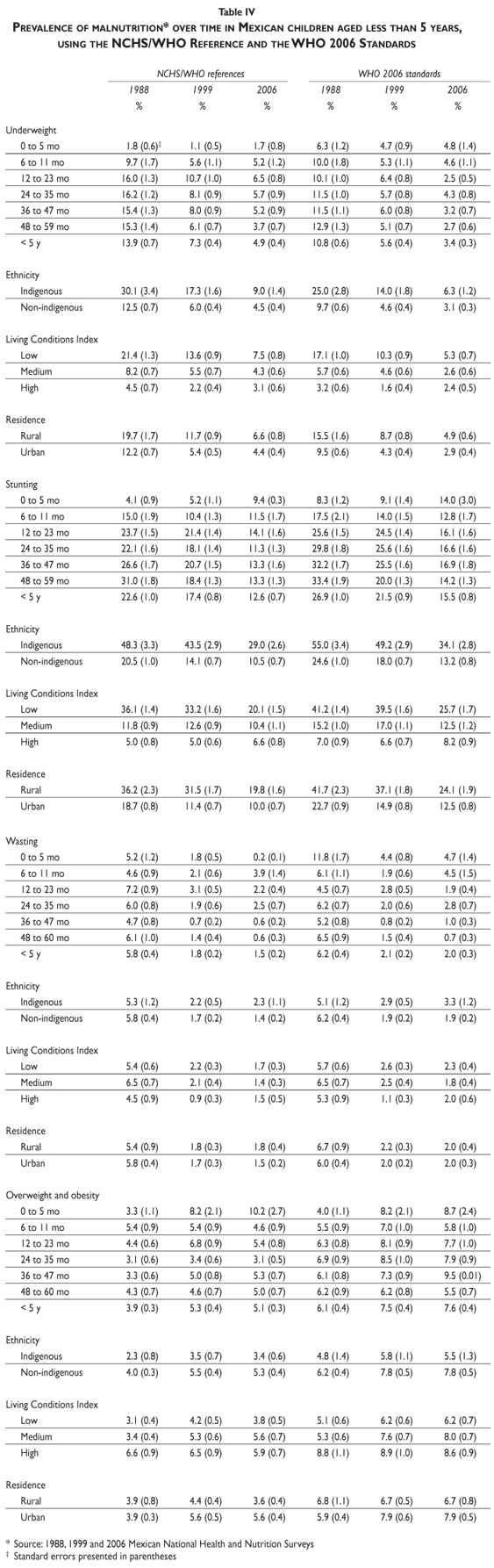
<body><![CDATA[<p><font size="2" face="Verdana">  Results for mean weight&#45;for&#45;height z&#45;scores    by living conditions reveal that children from the highest tertile are heavier    than those in the lowest tertile (lincom test <I>p</I>&lt; 0.05), but on average,    all tertiles have been above the norm. </font></p>     <p><font size="2" face="Verdana">  Prevalence of malnutrition by age categories    for the three surveys using the WHO 2006 standards show that stunting has been    consistently above 8% in early infancy (0&#45;5 months) since the first survey (<a href="#tab04">table   IV</a>). In accordance with results from the z&#45;scores. These data also show that    while the rates of undernutrition have become smaller over time in children    6 to 59 months of age, stunting has increased from 8.3% in 1988 to 13.8% in 2006    (tests for trend <I>p</I>&lt; 0.01), in infants less than 6 months old.</font></p>     <p><a name="tab04"></a></p>     <p>&nbsp;</p>     <p align="center"><img src="/img/revistas/spm/v51s4/a04tab04.gif"></p>     <p>&nbsp;</p>     <p><font size="2" face="Verdana">  Overall undernutrition (low weight&#45;for&#45;age)    has decreased and overweight has increased over time (test for trend <I>p</I>&lt;    0.01) in Mexican children, as can be observed in <a href="#tab04">Table IV</a> and <a href="#fig01">Figure   1</a>. Regardless    of the reference used, stunting has been the main undernutrition problem throughout    the 18&#45;year period included in these analyses, and continues to be so in 2006.    In contrast, wasting has not been a generalized public health problem since    1999, although it continues to be high in the first year of life, as observed    in <a href="#tab04">Table IV</a>. The prevalence of overweight (&gt; plus 2 <I>SD </I>weight/height)    increased from 1988 to 1999 and appears to have stabilized in the last seven    years (test for trend <I>p</I>&lt; 0.01). Estimates of the prevalence of malnutrition    using the NCHS/WHO references underestimate wasting, stunting and overweight,    while it overestimates the prevalence of underweight in most age groups. There    are a few exceptions to these findings: wasting particularly in the 12&#45;23 month    category, is not underestimated with the NCHS/WHO references, nor is overweight    in the 0&#45;5 month category of the last two surveys. The 2006 survey prevalence    in children less than 5 years old using the NCHS/WHO references underestimates    stunting by 2.9 percentage points (pp), wasting by 0.5 pp and overweight by    2.4 pp, while underweight is overestimated by 1.5 pp (<I>p</I>&lt; 0.01 in all    lincom tests).</font></p>     <p><a name="fig01"></a></p>     <p>&nbsp;</p>     <p align="center"><img src="/img/revistas/spm/v51s4/a04fig01.gif"></p>     ]]></body>
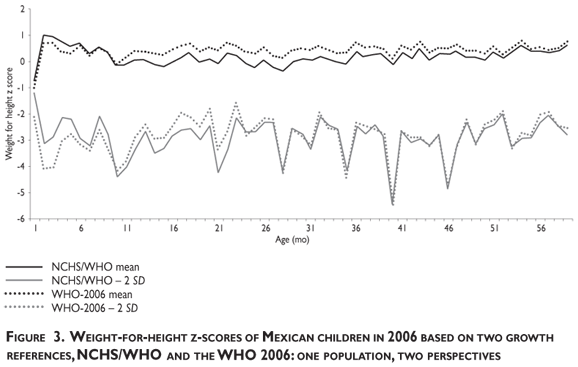
<body><![CDATA[<p>&nbsp;</p>     <p><font size="2" face="Verdana">  The greatest differences between estimates    from NCHS/WHO references and 2006 WHO standards are observed in the youngest    age category (&lt; 5 months), where prevalence is 2 to 3 times higher for underweight    and about 20 times higher for wasting (0.2% <I>vs.</I> 4.7%) according to 2006    WHO relative to the HCHS/WHO estimates.</font></p>     <p><font size="2" face="Verdana">  To understand the effect that different population    distributions have on z&#45;score values and estimated rates of malnutrition, <a href="#fig02">Figure   2</a> presents height&#45;for&#45;age z&#45; scores of Mexican children using the NCHS/WHO and    WHO 2006 growth references. For each reference, the z&#45;score corresponding to    mean value as well as the value at minus 2 <I>SD</I> for the Mexican population    distributions are plotted. <a href="#fig03">Figure 3</a> shows similar values for weight&#45;for&#45;height    z&#45;scores.</font></p>     <p><a name="fig02"></a></p>     <p>&nbsp;</p>     <p align="center"><img src="/img/revistas/spm/v51s4/a04fig02.gif"></p>     <p>&nbsp;</p>     <p><a name="fig03"></a></p>     <p>&nbsp;</p>     <p align="center"><img src="/img/revistas/spm/v51s4/a04fig03.gif"></p>     ]]></body>
<body><![CDATA[<p>&nbsp;</p>     <p><font size="2" face="Verdana">These figures show that the average height&#45;for&#45;age    and weight&#45;for&#45;height z&#45; scores obtained for the mean values of Mexican children    between references are generally similar, although in some age groups the difference    can reach about half of a z&#45;score. The differences are slightly more pronounced    for height&#45;for&#45;age than for weight&#45;for&#45;height. In contrast, the differences    in z&#45;scores between references observed in the lower tails of the Mexican distribution    are much larger in most age categories. Moreover, the z&#45;scores estimated with    the WHO 2006 standards lie further below the z&#45;scores estimated using the NCHS/WHO    references. This is observed particularly in the first 12 months for height&#45;for&#45;age,    and in the first 6 months for weight&#45;for&#45;height.</font></p>     <p><font size="2" face="Verdana"> <a href="#fig04">Figure 4</a> shows average and minus 2 <I>SD</I>    (or the 3<SUP>rd</SUP> percentile) for attained growth (cm) for the three different    populations: those pertaining to the NCHS/WHO references, those in the WHO 2006    standards and those of Mexican children in the ENSANUT 2006. Mean length at    birth is very similar in the three populations, but Mexican children depart    downwards from the growth curves of both references between about 3 to 6 months    and abruptly separate at about 12 months of age. In addition, at almost every    age the minus 2 <I>SD</I> value for the Mexican distribution lies far below the height    values at the 3<SUP>rd</SUP> centile of both reference distributions.</font></p>     <p><a name="fig04"></a></p>     <p>&nbsp;</p>     <p align="center"><img src="/img/revistas/spm/v51s4/a04fig04.gif"></p>     <p>&nbsp;</p>     <p><font size="3" face="Verdana"><b>Discussion</b></font></p>     <p><font size="2" face="Verdana">The 18 year span data from the three National    Nutrition Surveys show that rates of preschool undernutrition have decreased,    and those of overweight have increased in Mexico.</font></p>     <p><font size="2" face="Verdana"> Improvements in average attained growth have    been consistent over time and especially noticeable from the 1999 to the 2006    surveys. Both average height&#45;for&#45;age and prevalence of stunting data have improved,    indicating clear reductions in child undernutrition. These improvements have    occurred especially in children from the lowest living condition tertile and    the indigenous population, the poorest population in Mexico. These changes imply    that reductions in inequity have occurred in the country. However, despite the    reductions in stunting among the poor, the gaps between children living in high    <I>vs</I>. low living conditions remain large. In addition, average improvements,    though a national success, have not occurred across all age groups. Specifically,    reductions in growth deficits are not observed in the youngest infants. In fact,    average attained height&#45;for&#45;age of babies less than 5 months of age have been    decreasing from a normal value in 1988 (z&#45;score of 0.11) to a deficit of almost    half a <I>SD</I> (&#45;0.48) in the same age range in 2006.</font></p>     ]]></body>
<body><![CDATA[<p><font size="2" face="Verdana">  Estimates of the prevalence of malnutrition    differ using the recently developed WHO 2006 growth standards <I>vs</I>. the    NCHS/WHO references.</font></p>     <p><font size="2" face="Verdana">Differences between estimates using both growth    references depended on the age of the child and the indicator analyzed. For    infants, z&#45;scores estimated from the WHO&#45;2006 standards are similar or slightly    lower than estimates from the NCHS/WHO references, however, the variances are    smaller in the WHO 2006 standards relative to the NCHS/WHO references. Thus,    estimated prevalence below particular cutoff points below the mean ( for example    &lt; minus 2 z&#45;score) for height&#45;for&#45;age and weight&#45;for&#45;height are generally    higher when using these WHO 2006 standards.<SUP>3</SUP> The opposite happens    with weight&#45;for&#45;age and therefore the prevalence of underweight using the WHO    2006 standards are lower.</font></p>     <p><font size="2" face="Verdana"> In Mexican children the difference in the    estimations of malnutrition was particularly observed in the rates of child    stunting and infant wasting. With the WHO 2006 standards, overall stunting in    children aged less than 5 years in 2006 was 2.9 pp higher than previously estimated.<SUP>5</SUP>    The magnitude of the difference in prevalence between the references and standards    varies throughout childhood but it is generally higher for estimates using the    2006 WHO reference. The bias associated with the use of the former growth references    was also observed in wasting. Although the overall prevalence of wasting for    children aged less than 5 years as estimated with the WHO 2006 standards was    only half of a pp higher relative to the old references, in the first 6 months    of life the underestimation was more than 20&#45;fold. This occurs not because attained    weight in the WHO 2006 population is greater than weight in the previous NCHS/WHO    references, but because the variance in attained weight at this early age is    much smaller in the WHO&#45;2006 standards than in the NCHS/WHO references. Therefore    the newly estimated prevalence below minus 2 z&#45;scores for weight/length is higher    in Mexican infants.</font></p>     <p><font size="2" face="Verdana"> We consider that the lower prevalence of    wasting and stunting estimated using the NCHS/WHO references, relative to the    WHO 2006 standards are underestimates of the true prevalence because, as mentioned    in the introduction, the 2006 norms represent adequate growth better than the    previous NCHS/WHO references and are more appropriate to identify deviations    from normal growth due to malnutrition. </font></p>     <p><font size="2" face="Verdana"> The underestimation in stunting of 2.9 pp    is not trivial; when expanded to the population of children less than 5 years    old it represents almost 274 thousand children and the underestimation of the    prevalence of wasting of half a pp amounts to over 47 thousand children.</font></p>     <p><font size="2" face="Verdana"> The underestimation in the rates of child    malnutrition was expected. The WHO group<SUP>3</SUP> showed similar patterns    of underestimations in malnutrition in children from a developing country (Bangladesh)    when using the WHO 2006 standards. In Bangladesh, the rates of undernutrition    as well as its underestimation were higher than in Mexico; the case was similar    with respect to overweight.</font></p>     <p><font size="2" face="Verdana"> Of particular relevance for public policy    is the finding that the prevalence of wasting (weight&#45;for&#45;length &lt; minus    2 z&#45;scores) in young Mexican infants (&lt; 6 months old) had been at or below    the figures expected in a normal population in the last two national surveys    (<a href="#tab04">Table IV</a>) when estimated with the NCHS/WHO references, therefore wasting was    no longer considered a public health problem for that age group. There was one    exception in 2006 when wasting in late infancy (6 &#45; 11 months old) was 3.7%.    However, when the WHO&#45;2006 standards are used to evaluate infant nutritional    status, it is clear that wasting has been a public nutrition problem in infancy    (0 &#45; 11 months old).</font></p>     <p><font size="2" face="Verdana"> This concept is not new. Underestimation of    malnutrition, particularly of wasting, using the NCHS/WHO references <I>vs</I>.    breast&#45;fed infants was documented well before the WHO 2006 standards were issued.    The Report of the Expert Committee back in 1995 documented large underestimations    of undernutrition rates among young Indian and Peruvian infants,<SUP>12</SUP>    evidencing the different interpretation in the timing of growth faltering when    estimated using a narrow variance distribution of breast&#45;fed infants.</font></p>     <p><font size="2" face="Verdana">Differences observed among Mexican children over    the last 20 years occurred in the expected direction given the prescriptive    nature of child growth standards.<SUP>8</SUP> Our data show that there is a    large variability in growth within Mexican children. This is expected given    the large heterogeneity in the environmental, socioeconomic and health backgrounds    and in infant feeding patterns across the country.</font></p>     <p><font size="2" face="Verdana"> These new estimates point out nutritional    problems in the earliest stages of life. Excess wasting in young infants underscore    undesirably poor breastfeeding practices and largely heterogeneous environmental    conditions in Mexico. Current (2006) infant feeding practices in Mexico have    not yet been published, but previous national nutrition data (1999) show that    median duration of lactation was 9 months, with only 20% of infants aged less    than 6 months (at any given month) being exclusively breast&#45;fed. At the end    of 1 month of life, only 42% of infants were exclusively breast&#45;fed, followed    by a marked decline, reaching values under 5% at the end of the fifth month.<SUP>13</SUP>    The large prevalence of undernutrition in early infancy identified in Mexican    infants in 2006 most probably reflects adverse feeding practices and environmental    conditions that need to be improved.</font></p>     ]]></body>
<body><![CDATA[<p><font size="2" face="Verdana"> Although average length at birth is apparently    at or above the 2006 norm (<a href="#fig04">Figure 4</a>) the minus 2 <I>SD</I> values of the length    distribution during the first months of life falls below the 3<SUP>rd</SUP>    centile of the 2006 norm. Therefore, maternal factors such as undernutrition    and micronutrient deficiencies may play a role in explaining undernutrition    during early infancy, although probably to a lesser degree than infant feeding    practices.</font></p>     <p><font size="2" face="Verdana">Several large&#45;scale programs in Mexico targeted    to low&#45;income households with young children are promoting appropriate complementary    feeding through the distribution of fortified foods and through nutrition education.    Although evidence suggests that these programs have been partially successful    on the basis of their impact evaluation<SUP>14,15</SUP> and the reduction in    stunting in Mexico in the last decade,<SUP>16</SUP> the clear departure of the    mean height in Mexican children relative to the norm after 12 months of age    in the 2006 survey suggests inadequate complementary feeding and probable negative    effects of infections. Most of the large&#45;scale programs have been evaluated    and recommendations for improving their effectiveness have been formulated.    It is important to implement those recommendations in order to improve the effectiveness    of these actions. These data provide evidence for the need to revise current    nutrition policy aimed at reducing undernutrition, and underscore the urgency    to place lactation promotion and protection on the national health agenda and    identify specific programmatic issues and areas for immediate action. Breastfeeding    promotion has not been the emphasis of large&#45;scale programs aimed at improving    the nutritional status of young children in Mexico. Although several programs    with broad coverage are promoting nutrition during pregnancy, there is a need    for evaluating their operations and impact in order to ensure their effectiveness.    Protecting and promoting adequate infant feeding practices, including exclusive    breastfeeding for infants aged less than 6 months, followed by the introduction    of adequate complementary feeding and a continuation of breastfeeding until    2 years of life or beyond (should the mother&#45;infant couple so desire) would    improve growth performance, especially in early childhood.</font></p>     <p><font size="2" face="Verdana"> These new estimates reinforce the need to    improve the quality of programs that address nutrition in order to reduce the    gaps between socioeconomic groups and, particularly, point to the need to promote    and protect lactation and infant feeding practices as a priority for Mexico's    public policy agenda.</font></p>     <p>&nbsp;</p>     <p><font size="3" face="Verdana"><b>References</b></font></p>     <!-- ref --><p><font size="2" face="Verdana">1. World Health Organization. Measurement of    nutritional impact. Geneva: WHO, 1979.    &nbsp;&nbsp;&nbsp;&nbsp;&nbsp;&nbsp;&nbsp;&nbsp;[&#160;<a href="javascript:void(0);" onclick="javascript: window.open('/scielo.php?script=sci_nlinks&ref=9294168&pid=S0036-3634200900100000400001&lng=','','width=640,height=500,resizable=yes,scrollbars=1,menubar=yes,');">Links</a>&#160;]<!-- end-ref --></font></p>     <!-- ref --><p><font size="2" face="Verdana">2. Hamill PV, Drizd TA, Johnson CL, Reed RB,    Roche AF, Moore WM. Physical growth: National Center for Health Statistics percentiles.    Am J Clin Nutr 1979;32:607&#45;629.    &nbsp;&nbsp;&nbsp;&nbsp;&nbsp;&nbsp;&nbsp;&nbsp;[&#160;<a href="javascript:void(0);" onclick="javascript: window.open('/scielo.php?script=sci_nlinks&ref=9294170&pid=S0036-3634200900100000400002&lng=','','width=640,height=500,resizable=yes,scrollbars=1,menubar=yes,');">Links</a>&#160;]<!-- end-ref --></font></p>     <!-- ref --><p><font size="2" face="Verdana">3. De On&iacute;s M, Onyango AW, Borghi E, Garza    C, Yang H. Comparison of the World Health Organization (WHO) Child Growth Standards    and the National Center for Health Statistics/WHO international growth reference:    implications for child health programmes. Public Health Nutr 2006;9:942&#45;947.    &nbsp;&nbsp;&nbsp;&nbsp;&nbsp;&nbsp;&nbsp;&nbsp;[&#160;<a href="javascript:void(0);" onclick="javascript: window.open('/scielo.php?script=sci_nlinks&ref=9294172&pid=S0036-3634200900100000400003&lng=','','width=640,height=500,resizable=yes,scrollbars=1,menubar=yes,');">Links</a>&#160;]<!-- end-ref --></font></p>     <!-- ref --><p><font size="2" face="Verdana">4. World Health Organization. Task Force on methods    for the natural regulation of fertility. The World Health Organization Multinational    Study of Breasthfeeding and Lactational Amenorrhea. I. Description of infant    feeding patterns and of the return of menses. Fertil Steril 1998;70:448&#45;460.    &nbsp;&nbsp;&nbsp;&nbsp;&nbsp;&nbsp;&nbsp;&nbsp;[&#160;<a href="javascript:void(0);" onclick="javascript: window.open('/scielo.php?script=sci_nlinks&ref=9294174&pid=S0036-3634200900100000400004&lng=','','width=640,height=500,resizable=yes,scrollbars=1,menubar=yes,');">Links</a>&#160;]<!-- end-ref --></font></p>     <!-- ref --><p><FONT size="2" FACE="Verdana">5. Rivera&#45;Dommarco J, Cuevas&#45;Nasu L, Shamah&#45;Levy    T, Villalpando&#45;Hern&aacute;ndez S, &Aacute;vila&#45;Arcos MA, Jim&eacute;nez&#45;Aguilar    A. Estado nutricio. En: Olaiz&#45;Fern&aacute;ndez G, Rivera&#45;Dommarco J, Shamah&#45;Levy    T, Rojas R, Villalpando&#45;Hern&aacute;ndez S, Hern&aacute;ndez&#45;Avila M, <I>et    al</I>. Encuesta Nacional de Salud y Nutrici&oacute;n 2006. Cuernavaca, M&eacute;xico:    Instituto Nacional de Salud P&uacute;blica, 2006.    &nbsp;&nbsp;&nbsp;&nbsp;&nbsp;&nbsp;&nbsp;&nbsp;[&#160;<a href="javascript:void(0);" onclick="javascript: window.open('/scielo.php?script=sci_nlinks&ref=9294176&pid=S0036-3634200900100000400005&lng=','','width=640,height=500,resizable=yes,scrollbars=1,menubar=yes,');">Links</a>&#160;]<!-- end-ref --></font></p>     <!-- ref --><p><font size="2" face="Verdana">6. Rivera&#45;Dommarco J, Shamah&#45;Levy T, Villalpando&#45;Hern&aacute;ndez    S, Gonz&aacute;lez&#45;de Coss&iacute;o T, Hern&aacute;ndez&#45;Prado B, Sep&uacute;lveda    J. Encuesta Nacional de Nutrici&oacute;n 1999. Estado nutricio de ni&ntilde;os    y mujeres en M&eacute;xico. Cuernavaca, Morelos, M&eacute;xico: Instituto Nacional    de Salud P&uacute;blica, 2001.    &nbsp;&nbsp;&nbsp;&nbsp;&nbsp;&nbsp;&nbsp;&nbsp;[&#160;<a href="javascript:void(0);" onclick="javascript: window.open('/scielo.php?script=sci_nlinks&ref=9294178&pid=S0036-3634200900100000400006&lng=','','width=640,height=500,resizable=yes,scrollbars=1,menubar=yes,');">Links</a>&#160;]<!-- end-ref --></font></p>     <!-- ref --><p><font size="2" face="Verdana">7. Sep&uacute;lveda J, Lezana M, Tapia R, Valdespino    J, Madrigal H, Kumate J. Estado nutricional de preescolares y mujeres en M&eacute;xico:    resultados de una encuesta probabil&iacute;stica nacional. Gac Med Mex 1990;126:207&#45;225.    &nbsp;&nbsp;&nbsp;&nbsp;&nbsp;&nbsp;&nbsp;&nbsp;[&#160;<a href="javascript:void(0);" onclick="javascript: window.open('/scielo.php?script=sci_nlinks&ref=9294180&pid=S0036-3634200900100000400007&lng=','','width=640,height=500,resizable=yes,scrollbars=1,menubar=yes,');">Links</a>&#160;]<!-- end-ref --></font></p>     <!-- ref --><p><font size="2" face="Verdana">8. WHO Multicentre Growth Reference Study Group.    WHO Child Growth Standards: Length/height&#45;for&#45;age, weight&#45;for&#45;age, weight&#45;for&#45;length,    weight&#45;for&#45;height and body mass index&#45;for&#45;age: Methods and development. Geneva:    World Health Organization, 2006.    &nbsp;&nbsp;&nbsp;&nbsp;&nbsp;&nbsp;&nbsp;&nbsp;[&#160;<a href="javascript:void(0);" onclick="javascript: window.open('/scielo.php?script=sci_nlinks&ref=9294182&pid=S0036-3634200900100000400008&lng=','','width=640,height=500,resizable=yes,scrollbars=1,menubar=yes,');">Links</a>&#160;]<!-- end-ref --> </font></p>     <!-- ref --><p><font size="2" face="Verdana">9. Habicht JP. Estandarizaci&oacute;n de m&eacute;todos    epidemiol&oacute;gicos cuantitativos sobre el terreno (Standardization of anthropometric    methods in the field). Bull Pan Am Health Organ 1974;76:375&#45;384.    &nbsp;&nbsp;&nbsp;&nbsp;&nbsp;&nbsp;&nbsp;&nbsp;[&#160;<a href="javascript:void(0);" onclick="javascript: window.open('/scielo.php?script=sci_nlinks&ref=9294184&pid=S0036-3634200900100000400009&lng=','','width=640,height=500,resizable=yes,scrollbars=1,menubar=yes,');">Links</a>&#160;]<!-- end-ref --></font></p>     <!-- ref --><p><font size="2" face="Verdana">10. Lohman T, Roche A, Martorell R. Anthropometric    standardization reference manual. Champlain (IL): Human Kinetics, 1988.    &nbsp;&nbsp;&nbsp;&nbsp;&nbsp;&nbsp;&nbsp;&nbsp;[&#160;<a href="javascript:void(0);" onclick="javascript: window.open('/scielo.php?script=sci_nlinks&ref=9294186&pid=S0036-3634200900100000400010&lng=','','width=640,height=500,resizable=yes,scrollbars=1,menubar=yes,');">Links</a>&#160;]<!-- end-ref --></font></p>     <!-- ref --><p><font size="2" face="Verdana">11. Hair JF, Anderson R, Tatham R, Black W. Multivariate    data analysis with readings. 3a ed. New York (NY): Macmillan Publishing Company,    1992: 223&#45;253.    &nbsp;&nbsp;&nbsp;&nbsp;&nbsp;&nbsp;&nbsp;&nbsp;[&#160;<a href="javascript:void(0);" onclick="javascript: window.open('/scielo.php?script=sci_nlinks&ref=9294188&pid=S0036-3634200900100000400011&lng=','','width=640,height=500,resizable=yes,scrollbars=1,menubar=yes,');">Links</a>&#160;]<!-- end-ref --></font></p>     <!-- ref --><p><font size="2" face="Verdana">12. World Health Organization. Physical status:    the use and interpretation of anthropometry. Report of a WHO Expert Committee.    Geneva: WHO, 1995. WHO Technical Report Series No. 854.    &nbsp;&nbsp;&nbsp;&nbsp;&nbsp;&nbsp;&nbsp;&nbsp;[&#160;<a href="javascript:void(0);" onclick="javascript: window.open('/scielo.php?script=sci_nlinks&ref=9294190&pid=S0036-3634200900100000400012&lng=','','width=640,height=500,resizable=yes,scrollbars=1,menubar=yes,');">Links</a>&#160;]<!-- end-ref --> </font></p>     <!-- ref --><p><FONT size="2" FACE="Verdana">13. Gonz&aacute;lez&#45;Coss&iacute;o T, Moreno&#45;Mac&iacute;as    H, Rivera JA, Villalpando S, Shamah&#45;Levy T, Monterrubio EA, <I>et al</I>. Breast&#45;feeding    practices in Mexico: Results from the Second National Nutrition Survey, 1999.    Salud Publica Mex 2003;45(Suppl 4):S477&#45;S489.    &nbsp;&nbsp;&nbsp;&nbsp;&nbsp;&nbsp;&nbsp;&nbsp;[&#160;<a href="javascript:void(0);" onclick="javascript: window.open('/scielo.php?script=sci_nlinks&ref=9294192&pid=S0036-3634200900100000400013&lng=','','width=640,height=500,resizable=yes,scrollbars=1,menubar=yes,');">Links</a>&#160;]<!-- end-ref --></font></p>     <!-- ref --><p><font size="2" face="Verdana">14. Leroy JL, Garc&iacute;a&#45;Guerra A, Garc&iacute;a    R, Dominguez C, Rivera JA, Neufeld LM. The Oportunidades Program increases the    linear growth of children enrolled at young ages in urban Mexico. J Nutr 2008;138:793&#45;798.    &nbsp;&nbsp;&nbsp;&nbsp;&nbsp;&nbsp;&nbsp;&nbsp;[&#160;<a href="javascript:void(0);" onclick="javascript: window.open('/scielo.php?script=sci_nlinks&ref=9294194&pid=S0036-3634200900100000400014&lng=','','width=640,height=500,resizable=yes,scrollbars=1,menubar=yes,');">Links</a>&#160;]<!-- end-ref --></font></p>     <!-- ref --><p><font size="2" face="Verdana">15. Rivera JA, Sotres&#45;Alvarez D, Habicht JP,    Shamah T, Villalpando S. Impact of the Mexican Program for Education, Health,    and Nutrition (Progresa) on rates of growth and anemia in infants and young    children. A randomized effectiveness study. JAMA 2004;291:2563&#45;2570.    &nbsp;&nbsp;&nbsp;&nbsp;&nbsp;&nbsp;&nbsp;&nbsp;[&#160;<a href="javascript:void(0);" onclick="javascript: window.open('/scielo.php?script=sci_nlinks&ref=9294196&pid=S0036-3634200900100000400015&lng=','','width=640,height=500,resizable=yes,scrollbars=1,menubar=yes,');">Links</a>&#160;]<!-- end-ref --></font></p>     <!-- ref --><p><font size="2" face="Verdana">16. Rivera JA, Shamah T, Villalpando S, Cuevas    L, Mundo V, Morales&#45;Ruan C. Cap. 1 El estado nutricional de la poblaci&oacute;n    en M&eacute;xico: cambios en la magnitud, distribuci&oacute;n y tendencias de    la mala nutrici&oacute;n de 1988 a 2006. In: Gonz&aacute;lez&#45;de Coss&iacute;o    T, Rivera&#45;Dommarco JA, L&oacute;pez&#45;Acevedo G, Rubio&#45;Soto GM, eds. Nutrici&oacute;n    y pobreza: pol&iacute;tica p&uacute;blica basada en evidencia. World Bank, Secretar&iacute;a    de Desarrollo Social en M&eacute;xico (Sedesol), 2008.    &nbsp;&nbsp;&nbsp;&nbsp;&nbsp;&nbsp;&nbsp;&nbsp;[&#160;<a href="javascript:void(0);" onclick="javascript: window.open('/scielo.php?script=sci_nlinks&ref=9294198&pid=S0036-3634200900100000400016&lng=','','width=640,height=500,resizable=yes,scrollbars=1,menubar=yes,');">Links</a>&#160;]<!-- end-ref --></font></p>     <p>&nbsp;</p>     <p>&nbsp;</p>     <p><FONT size="2" FACE="Verdana">Received on: July 22, 2008    ]]></body>
<body><![CDATA[<br>   Accepted on: February 25, 2009</font></p>     <p>&nbsp;</p>     <p>&nbsp;</p>     <p><font size="2" face="Verdana">Address reprint requests to: Teresa Gonz&aacute;lez     de Coss&iacute;o. Centro de Investigaci&oacute;n y Salud. Instituto Nacional     de Salud P&uacute;blica. Av. Universidad 655, col. Santa Mar&iacute;a Ahuacatitl&aacute;n. 62100 Cuernavaca, Morelos, M&eacute;xico. E&#45;mail: <A HREF="mailto:tgonzale@insp.mx">tgonzale@insp.mx</A>    <br> Funding for the surveys: Mexican Ministry of Health    and the Federal Program <i>Oportunidades</i>.    <br>   <a name="nt01"></a><a href="#tx01">*</a> The module Nutstat is a nutrition anthropometry program included as a key feature in Epilnfo, and we used the CDC&#45;WHO 1978 growth reference. <a href="http://www.cdc.gov/epiinfo/" target="_blank">http://www.cdc.gov/epiinfo/</a>    <br> <a name="nt02"></a><a href="#tx02">&#135;</a> For calculation with WHO&#45;2006 standards, we used the macros offered    <br> in their website (<a href="http://www.who.int/childgrowth/software/en/" target="_blank">http://www.who.int/childgrowth/software/en/</a>) in Stata. Statistical Software: Release 9.0. College Station, TX: Stata Corporation, USA 2005.</font></p>      ]]></body><back>
<ref-list>
<ref id="B1">
<label>1</label><nlm-citation citation-type="book">
<collab>World Health Organization</collab>
<source><![CDATA[Measurement of nutritional impact]]></source>
<year>1979</year>
<publisher-loc><![CDATA[Geneva ]]></publisher-loc>
<publisher-name><![CDATA[WHO]]></publisher-name>
</nlm-citation>
</ref>
<ref id="B2">
<label>2</label><nlm-citation citation-type="journal">
<person-group person-group-type="author">
<name>
<surname><![CDATA[Hamill]]></surname>
<given-names><![CDATA[PV]]></given-names>
</name>
<name>
<surname><![CDATA[Drizd]]></surname>
<given-names><![CDATA[TA]]></given-names>
</name>
<name>
<surname><![CDATA[Johnson]]></surname>
<given-names><![CDATA[CL]]></given-names>
</name>
<name>
<surname><![CDATA[Reed]]></surname>
<given-names><![CDATA[RB]]></given-names>
</name>
<name>
<surname><![CDATA[Roche]]></surname>
<given-names><![CDATA[AF]]></given-names>
</name>
<name>
<surname><![CDATA[Moore]]></surname>
<given-names><![CDATA[WM]]></given-names>
</name>
</person-group>
<article-title xml:lang="en"><![CDATA[Physical growth: National Center for Health Statistics percentiles]]></article-title>
<source><![CDATA[Am J Clin Nutr]]></source>
<year>1979</year>
<volume>32</volume>
<page-range>607-629</page-range></nlm-citation>
</ref>
<ref id="B3">
<label>3</label><nlm-citation citation-type="journal">
<person-group person-group-type="author">
<name>
<surname><![CDATA[De Onís]]></surname>
<given-names><![CDATA[M]]></given-names>
</name>
<name>
<surname><![CDATA[Onyango]]></surname>
<given-names><![CDATA[AW]]></given-names>
</name>
<name>
<surname><![CDATA[Borghi]]></surname>
<given-names><![CDATA[E]]></given-names>
</name>
<name>
<surname><![CDATA[Garza]]></surname>
<given-names><![CDATA[C]]></given-names>
</name>
<name>
<surname><![CDATA[Yang]]></surname>
<given-names><![CDATA[H]]></given-names>
</name>
</person-group>
<article-title xml:lang="en"><![CDATA[Comparison of the World Health Organization (WHO) Child Growth Standards and the National Center for Health Statistics/WHO international growth reference: implications for child health programmes]]></article-title>
<source><![CDATA[Public Health Nutr]]></source>
<year>2006</year>
<volume>9</volume>
<page-range>942-947</page-range></nlm-citation>
</ref>
<ref id="B4">
<label>4</label><nlm-citation citation-type="journal">
<collab>World Health Organization</collab>
<article-title xml:lang="en"><![CDATA[Task Force on methods for the natural regulation of fertility: The World Health Organization Multinational Study of Breasthfeeding and Lactational Amenorrhea. I. Description of infant feeding patterns and of the return of menses]]></article-title>
<source><![CDATA[Fertil Steril]]></source>
<year>1998</year>
<volume>70</volume>
<page-range>448-460</page-range></nlm-citation>
</ref>
<ref id="B5">
<label>5</label><nlm-citation citation-type="book">
<person-group person-group-type="author">
<name>
<surname><![CDATA[Rivera-Dommarco]]></surname>
<given-names><![CDATA[J]]></given-names>
</name>
<name>
<surname><![CDATA[Cuevas-Nasu]]></surname>
<given-names><![CDATA[L]]></given-names>
</name>
<name>
<surname><![CDATA[Shamah-Levy]]></surname>
<given-names><![CDATA[T]]></given-names>
</name>
<name>
<surname><![CDATA[Villalpando-Hernández]]></surname>
<given-names><![CDATA[S]]></given-names>
</name>
<name>
<surname><![CDATA[Ávila-Arcos]]></surname>
<given-names><![CDATA[MA]]></given-names>
</name>
<name>
<surname><![CDATA[Jiménez-Aguilar]]></surname>
<given-names><![CDATA[A]]></given-names>
</name>
</person-group>
<article-title xml:lang="pt"><![CDATA[Estado nutricio]]></article-title>
<person-group person-group-type="editor">
<name>
<surname><![CDATA[Olaiz-Fernández]]></surname>
<given-names><![CDATA[G]]></given-names>
</name>
<name>
<surname><![CDATA[Rivera-Dommarco]]></surname>
<given-names><![CDATA[J]]></given-names>
</name>
<name>
<surname><![CDATA[Shamah-Levy]]></surname>
<given-names><![CDATA[T]]></given-names>
</name>
<name>
<surname><![CDATA[Rojas]]></surname>
<given-names><![CDATA[R]]></given-names>
</name>
<name>
<surname><![CDATA[Villalpando-Hernández]]></surname>
<given-names><![CDATA[S]]></given-names>
</name>
<name>
<surname><![CDATA[Hernández-Avila]]></surname>
<given-names><![CDATA[M]]></given-names>
</name>
</person-group>
<source><![CDATA[Encuesta Nacional de Salud y Nutrición 2006]]></source>
<year>2006</year>
<publisher-loc><![CDATA[Cuernavaca ]]></publisher-loc>
<publisher-name><![CDATA[Instituto Nacional de Salud Pública]]></publisher-name>
</nlm-citation>
</ref>
<ref id="B6">
<label>6</label><nlm-citation citation-type="book">
<person-group person-group-type="author">
<name>
<surname><![CDATA[Rivera-Dommarco]]></surname>
<given-names><![CDATA[J]]></given-names>
</name>
<name>
<surname><![CDATA[Shamah-Levy]]></surname>
<given-names><![CDATA[T]]></given-names>
</name>
<name>
<surname><![CDATA[Villalpando-Hernández]]></surname>
<given-names><![CDATA[S]]></given-names>
</name>
<name>
<surname><![CDATA[González-de Cossío]]></surname>
<given-names><![CDATA[T]]></given-names>
</name>
<name>
<surname><![CDATA[Hernández-Prado]]></surname>
<given-names><![CDATA[B]]></given-names>
</name>
<name>
<surname><![CDATA[Sepúlveda]]></surname>
<given-names><![CDATA[J]]></given-names>
</name>
</person-group>
<source><![CDATA[Encuesta Nacional de Nutrición 1999: Estado nutricio de niños y mujeres en México]]></source>
<year>2001</year>
<publisher-loc><![CDATA[Cuernavaca^eMorelos Morelos]]></publisher-loc>
<publisher-name><![CDATA[Instituto Nacional de Salud Pública]]></publisher-name>
</nlm-citation>
</ref>
<ref id="B7">
<label>7</label><nlm-citation citation-type="journal">
<person-group person-group-type="author">
<name>
<surname><![CDATA[Sepúlveda]]></surname>
<given-names><![CDATA[J]]></given-names>
</name>
<name>
<surname><![CDATA[Lezana]]></surname>
<given-names><![CDATA[M]]></given-names>
</name>
<name>
<surname><![CDATA[Tapia]]></surname>
<given-names><![CDATA[R]]></given-names>
</name>
<name>
<surname><![CDATA[Valdespino]]></surname>
<given-names><![CDATA[J]]></given-names>
</name>
<name>
<surname><![CDATA[Madrigal]]></surname>
<given-names><![CDATA[H]]></given-names>
</name>
<name>
<surname><![CDATA[Kumate]]></surname>
<given-names><![CDATA[J]]></given-names>
</name>
</person-group>
<article-title xml:lang="es"><![CDATA[Estado nutricional de preescolares y mujeres en México: resultados de una encuesta probabilística nacional]]></article-title>
<source><![CDATA[Gac Med Mex]]></source>
<year>1990</year>
<volume>126</volume>
<page-range>207-225</page-range></nlm-citation>
</ref>
<ref id="B8">
<label>8</label><nlm-citation citation-type="book">
<collab>WHO^dMulticentre Growth Reference Study Group</collab>
<source><![CDATA[WHO Child Growth Standards: Length/height-for-age, weight-for-age, weight-for-length, weight-for-height and body mass index-for-age]]></source>
<year>2006</year>
<publisher-loc><![CDATA[Geneva ]]></publisher-loc>
<publisher-name><![CDATA[World Health Organization]]></publisher-name>
</nlm-citation>
</ref>
<ref id="B9">
<label>9</label><nlm-citation citation-type="journal">
<person-group person-group-type="author">
<name>
<surname><![CDATA[Habicht]]></surname>
<given-names><![CDATA[JP]]></given-names>
</name>
</person-group>
<article-title xml:lang="es"><![CDATA[Estandarización de métodos epidemiológicos cuantitativos sobre el terreno (Standardization of anthropometric methods in the field)]]></article-title>
<source><![CDATA[Bull Pan Am Health Organ]]></source>
<year>1974</year>
<volume>76</volume>
<page-range>375-384</page-range></nlm-citation>
</ref>
<ref id="B10">
<label>10</label><nlm-citation citation-type="book">
<person-group person-group-type="author">
<name>
<surname><![CDATA[Lohman]]></surname>
<given-names><![CDATA[T]]></given-names>
</name>
<name>
<surname><![CDATA[Roche]]></surname>
<given-names><![CDATA[A]]></given-names>
</name>
<name>
<surname><![CDATA[Martorell]]></surname>
<given-names><![CDATA[R]]></given-names>
</name>
</person-group>
<source><![CDATA[Anthropometric standardization reference manual]]></source>
<year>1988</year>
<publisher-loc><![CDATA[Champlain^eIL IL]]></publisher-loc>
<publisher-name><![CDATA[Human Kinetics]]></publisher-name>
</nlm-citation>
</ref>
<ref id="B11">
<label>11</label><nlm-citation citation-type="book">
<person-group person-group-type="author">
<name>
<surname><![CDATA[Hair]]></surname>
<given-names><![CDATA[JF]]></given-names>
</name>
<name>
<surname><![CDATA[Anderson]]></surname>
<given-names><![CDATA[R]]></given-names>
</name>
<name>
<surname><![CDATA[Tatham]]></surname>
<given-names><![CDATA[R]]></given-names>
</name>
<name>
<surname><![CDATA[Black]]></surname>
<given-names><![CDATA[W]]></given-names>
</name>
</person-group>
<source><![CDATA[Multivariate data analysis with readings]]></source>
<year>1992</year>
<edition>3</edition>
<page-range>223-253</page-range><publisher-loc><![CDATA[New York^eNY NY]]></publisher-loc>
<publisher-name><![CDATA[Macmillan Publishing Company]]></publisher-name>
</nlm-citation>
</ref>
<ref id="B12">
<label>12</label><nlm-citation citation-type="book">
<collab>World Health Organization</collab>
<source><![CDATA[Physical status: the use and interpretation of anthropometry]]></source>
<year>1995</year>
<publisher-loc><![CDATA[Geneva ]]></publisher-loc>
<publisher-name><![CDATA[WHO]]></publisher-name>
</nlm-citation>
</ref>
<ref id="B13">
<label>13</label><nlm-citation citation-type="journal">
<person-group person-group-type="author">
<name>
<surname><![CDATA[González-Cossío]]></surname>
<given-names><![CDATA[T]]></given-names>
</name>
<name>
<surname><![CDATA[Moreno-Macías]]></surname>
<given-names><![CDATA[H]]></given-names>
</name>
<name>
<surname><![CDATA[Rivera]]></surname>
<given-names><![CDATA[JA]]></given-names>
</name>
<name>
<surname><![CDATA[Villalpando]]></surname>
<given-names><![CDATA[S]]></given-names>
</name>
<name>
<surname><![CDATA[Shamah-Levy]]></surname>
<given-names><![CDATA[T]]></given-names>
</name>
<name>
<surname><![CDATA[Monterrubio]]></surname>
<given-names><![CDATA[EA]]></given-names>
</name>
</person-group>
<article-title xml:lang="en"><![CDATA[Breast-feeding practices in Mexico: Results from the Second National Nutrition Survey, 1999]]></article-title>
<source><![CDATA[Salud Publica Mex]]></source>
<year>2003</year>
<volume>45</volume>
<numero>^s4</numero>
<issue>^s4</issue>
<supplement>4</supplement>
<page-range>S477-S489</page-range></nlm-citation>
</ref>
<ref id="B14">
<label>14</label><nlm-citation citation-type="journal">
<person-group person-group-type="author">
<name>
<surname><![CDATA[Leroy]]></surname>
<given-names><![CDATA[JL]]></given-names>
</name>
<name>
<surname><![CDATA[García-Guerra]]></surname>
<given-names><![CDATA[A]]></given-names>
</name>
<name>
<surname><![CDATA[García]]></surname>
<given-names><![CDATA[R]]></given-names>
</name>
<name>
<surname><![CDATA[Dominguez]]></surname>
<given-names><![CDATA[C]]></given-names>
</name>
<name>
<surname><![CDATA[Rivera]]></surname>
<given-names><![CDATA[JA]]></given-names>
</name>
<name>
<surname><![CDATA[Neufeld]]></surname>
<given-names><![CDATA[LM]]></given-names>
</name>
</person-group>
<article-title xml:lang="en"><![CDATA[The Oportunidades Program increases the linear growth of children enrolled at young ages in urban Mexico]]></article-title>
<source><![CDATA[J Nutr]]></source>
<year>2008</year>
<volume>138</volume>
<page-range>793-798</page-range></nlm-citation>
</ref>
<ref id="B15">
<label>15</label><nlm-citation citation-type="journal">
<person-group person-group-type="author">
<name>
<surname><![CDATA[Rivera]]></surname>
<given-names><![CDATA[JA]]></given-names>
</name>
<name>
<surname><![CDATA[Sotres-Alvarez]]></surname>
<given-names><![CDATA[D]]></given-names>
</name>
<name>
<surname><![CDATA[Habicht]]></surname>
<given-names><![CDATA[JP]]></given-names>
</name>
<name>
<surname><![CDATA[Shamah]]></surname>
<given-names><![CDATA[T]]></given-names>
</name>
<name>
<surname><![CDATA[Villalpando]]></surname>
<given-names><![CDATA[S]]></given-names>
</name>
</person-group>
<article-title xml:lang="en"><![CDATA[Impact of the Mexican Program for Education, Health, and Nutrition (Progresa) on rates of growth and anemia in infants and young children: A randomized effectiveness study]]></article-title>
<source><![CDATA[JAMA]]></source>
<year>2004</year>
<volume>291</volume>
<page-range>2563-2570</page-range></nlm-citation>
</ref>
<ref id="B16">
<label>16</label><nlm-citation citation-type="book">
<person-group person-group-type="author">
<name>
<surname><![CDATA[Rivera]]></surname>
<given-names><![CDATA[JA]]></given-names>
</name>
<name>
<surname><![CDATA[Shamah]]></surname>
<given-names><![CDATA[T]]></given-names>
</name>
<name>
<surname><![CDATA[Villalpando]]></surname>
<given-names><![CDATA[S]]></given-names>
</name>
<name>
<surname><![CDATA[Cuevas]]></surname>
<given-names><![CDATA[L]]></given-names>
</name>
<name>
<surname><![CDATA[Mundo]]></surname>
<given-names><![CDATA[V]]></given-names>
</name>
<name>
<surname><![CDATA[Morales-Ruan]]></surname>
<given-names><![CDATA[C]]></given-names>
</name>
</person-group>
<article-title xml:lang="es"><![CDATA[Cap. 1 El estado nutricional de la población en México: cambios en la magnitud, distribución y tendencias de la mala nutrición de 1988 a 2006]]></article-title>
<person-group person-group-type="editor">
<name>
<surname><![CDATA[González-de Cossío]]></surname>
<given-names><![CDATA[T]]></given-names>
</name>
<name>
<surname><![CDATA[Rivera-Dommarco]]></surname>
<given-names><![CDATA[JA]]></given-names>
</name>
<name>
<surname><![CDATA[López-Acevedo]]></surname>
<given-names><![CDATA[G]]></given-names>
</name>
<name>
<surname><![CDATA[Rubio-Soto]]></surname>
<given-names><![CDATA[GM]]></given-names>
</name>
</person-group>
<source><![CDATA[Nutrición y pobreza: política pública basada en evidencia]]></source>
<year>2008</year>
<publisher-name><![CDATA[World Bank, Secretaría de Desarrollo Social en México (Sedesol)]]></publisher-name>
</nlm-citation>
</ref>
</ref-list>
</back>
</article>