<?xml version="1.0" encoding="ISO-8859-1"?><article xmlns:mml="http://www.w3.org/1998/Math/MathML" xmlns:xlink="http://www.w3.org/1999/xlink" xmlns:xsi="http://www.w3.org/2001/XMLSchema-instance">
<front>
<journal-meta>
<journal-id>0036-3634</journal-id>
<journal-title><![CDATA[Salud Pública de México]]></journal-title>
<abbrev-journal-title><![CDATA[Salud pública Méx]]></abbrev-journal-title>
<issn>0036-3634</issn>
<publisher>
<publisher-name><![CDATA[Instituto Nacional de Salud Pública]]></publisher-name>
</publisher>
</journal-meta>
<article-meta>
<article-id>S0036-36342009000900014</article-id>
<title-group>
<article-title xml:lang="en"><![CDATA[Molecular diagnosis of human papillomavirus in the development of cervical cancer]]></article-title>
<article-title xml:lang="es"><![CDATA[Diagnóstico molecular del virus del papiloma humano en el desarrollo del cáncer cervical]]></article-title>
</title-group>
<contrib-group>
<contrib contrib-type="author">
<name>
<surname><![CDATA[Gutiérrez-Xicoténcatl]]></surname>
<given-names><![CDATA[Lourdes]]></given-names>
</name>
<xref ref-type="aff" rid="A01"/>
</contrib>
<contrib contrib-type="author">
<name>
<surname><![CDATA[Plett-Torres]]></surname>
<given-names><![CDATA[Tanya]]></given-names>
</name>
<xref ref-type="aff" rid="A01"/>
</contrib>
<contrib contrib-type="author">
<name>
<surname><![CDATA[Madrid-González]]></surname>
<given-names><![CDATA[Claudia L]]></given-names>
</name>
<xref ref-type="aff" rid="A01"/>
</contrib>
<contrib contrib-type="author">
<name>
<surname><![CDATA[Madrid-Marina]]></surname>
<given-names><![CDATA[Vicente]]></given-names>
</name>
<xref ref-type="aff" rid="A02"/>
</contrib>
</contrib-group>
<aff id="A01">
<institution><![CDATA[,Instituto Nacional de Salud Pública Centro de Investigación sobre Enfermedades Infecciosas Departamento de Interacción Epidemiológica]]></institution>
<addr-line><![CDATA[Cuernavaca Morelos]]></addr-line>
<country>México</country>
</aff>
<aff id="A02">
<institution><![CDATA[,Instituto Nacional de Salud Pública Centro de Investigación sobre Enfermedades Infecciosas Dirección de Infecciones Crónicas y Cáncer]]></institution>
<addr-line><![CDATA[Cuernavaca Morelos]]></addr-line>
<country>México</country>
</aff>
<pub-date pub-type="pub">
<day>00</day>
<month>00</month>
<year>2009</year>
</pub-date>
<pub-date pub-type="epub">
<day>00</day>
<month>00</month>
<year>2009</year>
</pub-date>
<volume>51</volume>
<fpage>s479</fpage>
<lpage>s488</lpage>
<copyright-statement/>
<copyright-year/>
<self-uri xlink:href="http://www.scielo.org.mx/scielo.php?script=sci_arttext&amp;pid=S0036-36342009000900014&amp;lng=en&amp;nrm=iso"></self-uri><self-uri xlink:href="http://www.scielo.org.mx/scielo.php?script=sci_abstract&amp;pid=S0036-36342009000900014&amp;lng=en&amp;nrm=iso"></self-uri><self-uri xlink:href="http://www.scielo.org.mx/scielo.php?script=sci_pdf&amp;pid=S0036-36342009000900014&amp;lng=en&amp;nrm=iso"></self-uri><abstract abstract-type="short" xml:lang="en"><p><![CDATA[Cervical cancer (CC) is a major public health problem in developing countries and its most significant etiological risk factor is infection by the human papillomavirus (HPV). The main approach to date for the prevention of CC has been through screening programs, using the cervical smear (PAP test) to detect precursory lesions. The sensitivity and specificity of the PAP smear depend on the skills of the observer to recognize and classify a variety of cellular abnormalities. The development of early diagnoses to detect HPV infection has been a problem as cytology and colposcopy identify the lesion at an advanced stage. Therefore, molecular approaches have become more successful for early CC diagnosis. These molecular techniques recognize HPV DNA sequences by DNA hybridization, PCR-RFLP, hybrid capture and reverse line blot systems. Unfortunately, these systems cannot determine whether the HPV infection is active, latent or persistent. Thus, immunological techniques such as Western blot and ELISA have been designed to follow the immune response against the virus, and they can also be used to identify the stage of the infection. Several companies have developed, manufactured and merchandised gene-based testing systems for the screening, monitoring and diagnosis of HPV. Our review and comments focus on the critical analysis of existing products and their use in clinical practice as well as on immunological systems used mainly in research, but that may be applied in large population screening programs.]]></p></abstract>
<abstract abstract-type="short" xml:lang="es"><p><![CDATA[El cáncer cervical (CC) es el mayor problema de salud pública en países en vías de desarrollo, al ser la infección por el virus del papiloma humano (HPV) el factor etiológico más importante de esta enfermedad. Actualmente, el principal acercamiento para la prevención del CC ha sido a través de programas de detección oportuna del cáncer, lo cual se ha realizado a través del estudio citológico del Papanicolaou (Pap) para la detección de lesiones precursoras. Sin embargo, la sensibilidad y especificidad de la prueba de Pap depende de la destreza del observador en el reconocimiento y clasificación de diferentes anormalidades en las células. El desarrollo de sistemas de diagnóstico temprano para la detección de la infección por HPV ha sido problemático debido a que tanto la citología como la colposcopía identifican la lesión cervical en estadios muy avanzados. De esta forma, la aplicación de las pruebas moleculares ha sido exitosa en el diagnóstico temprano del CC. Estas técnicas moleculares se basan en el reconocimiento de secuencias de ADN de HPV por medio de hibridación del ADN, PCR-RFLP, captura de híbridos (hybrid capture) y el sistema de línea reversa (reverse line blot). Desafortunadamente, estos sistemas no pueden identificar si se trata de una infección activa, latente o persistente. Por esta razón, las técnicas inmunológicas como el Western blot y el ELISA han sido diseñadas para realizar el seguimiento de la respuesta inmune contra el virus. Por ello, aquí se hace una revisión de las técnicas moleculares utilizadas para detectar el HPV, como factor de riesgo del CC, así como las técnicas inmunológicas desarrolladas para el seguimiento de la respuesta inmune contra este virus. Existen diferentes compañías que han desarrollado, manufacturado y comercializado pruebas diagnósticas basadas en identificación de genes para el tamizaje, monitoreo y diagnóstico de HPV. Nuestra revisión se enfoca en el análisis de productos que existen en el mercado, así como en los sistemas inmunológicos usados en investigación y en programas de tamizaje de extensas poblaciones.]]></p></abstract>
<kwd-group>
<kwd lng="en"><![CDATA[human papillomavirus]]></kwd>
<kwd lng="en"><![CDATA[uterine cerival neoplasms]]></kwd>
<kwd lng="en"><![CDATA[diagnosis]]></kwd>
<kwd lng="es"><![CDATA[virus del papiloma humano]]></kwd>
<kwd lng="es"><![CDATA[neoplasias del cuello uterino]]></kwd>
<kwd lng="es"><![CDATA[diagnóstico]]></kwd>
</kwd-group>
</article-meta>
</front><body><![CDATA[ <p align="right"><font size="2" face="Verdana"><b>ART&Iacute;CULOS DE REVISI&Oacute;N</b></font></p>     <p>&nbsp;</p>     <p><font size="4" face="verdana"><b>Molecular diagnosis of human    papillomavirus in the development of cervical cancer</b></font></p>     <p>&nbsp;</p> <font size="3" face="verdana"><b>Diagn&oacute;stico molecular del virus del papiloma  humano en el desarrollo del c&aacute;ncer cervical</b></font>       <p>&nbsp;</p>     <p>&nbsp;</p>     <p><font size="2" face="Verdana"><b>Lourdes Guti&eacute;rrez-Xicot&eacute;ncatl,    Dra en C<sup>I</sup>; Tanya Plett-Torres, M en C<sup>I</sup>; <B>Claudia L Madrid-Gonz&aacute;lez,    MC<sup>I</sup>; Vicente Madrid-Marina, Dr en C<sup>II</sup></b></B></font></p>     <p><font size="2" face="Verdana"><sup>I</sup>Departamento de Interacci&oacute;n    Epidemiol&oacute;gica, Centro de Investigaci&oacute;n sobre Enfermedades Infecciosas,    Instituto Nacional de Salud P&uacute;blica. Cuernavaca, Morelos, M&eacute;xico    <br>  <sup>II</sup>Direcci&oacute;n de Infecciones    Cr&oacute;nicas y C&aacute;ncer, Centro de Investigaci&oacute;n sobre Enfermedades    Infecciosas, Instituto Nacional de Salud P&uacute;blica. Cuernavaca, Morelos,    M&eacute;xico</font></p>     <p>&nbsp;</p>     ]]></body>
<body><![CDATA[<p>&nbsp; </p> <hr size="1" noshade>     <p><font size="2" face="Verdana"><b>ABSTRACT</B></font></p>     <p><font size="2" face="Verdana">Cervical cancer (CC) is a major public health    problem in developing countries and its most significant etiological risk factor    is infection by the human papillomavirus (HPV). The main approach to date for    the prevention of CC has been through screening programs, using the cervical    smear (PAP test) to detect precursory lesions. The sensitivity and specificity    of the PAP smear depend on the skills of the observer to recognize and classify    a variety of cellular abnormalities. The development of early diagnoses to detect    HPV infection has been a problem as cytology and colposcopy identify the lesion    at an advanced stage. Therefore, molecular approaches have become more successful    for early CC diagnosis. These molecular techniques recognize HPV DNA sequences    by DNA hybridization, PCR-RFLP, hybrid capture and reverse line blot systems.    Unfortunately, these systems cannot determine whether the HPV infection is active,    latent or persistent. Thus, immunological techniques such as Western blot and    ELISA have been designed to follow the immune response against the virus, and    they can also be used to identify the stage of the infection. Several companies    have developed, manufactured and merchandised gene-based testing systems for    the screening, monitoring and diagnosis of HPV. Our review and comments focus    on the critical analysis of existing products and their use in clinical practice    as well as on immunological systems used mainly in research, but that may be    applied in large population screening programs.</font></p>     <p><font size="2" face="Verdana"><b>Key words:</b> human papillomavirus; uterine    cerival neoplasms; diagnosis</font></p>  <hr size="1" noshade>     <p><font size="2" face="Verdana"><b>RESUMEN</B></font></p>     <p><font size="2" face="Verdana">El c&aacute;ncer cervical (CC) es el mayor problema    de salud p&uacute;blica en pa&iacute;ses en v&iacute;as de desarrollo, al ser    la infecci&oacute;n por el virus del papiloma humano (HPV) el factor etiol&oacute;gico    m&aacute;s importante de esta enfermedad. Actualmente, el principal acercamiento    para la prevenci&oacute;n del CC ha sido a trav&eacute;s de programas de detecci&oacute;n    oportuna del c&aacute;ncer, lo cual se ha realizado a trav&eacute;s del estudio    citol&oacute;gico del Papanicolaou (Pap) para la detecci&oacute;n de lesiones    precursoras. Sin embargo, la sensibilidad y especificidad de la prueba de Pap    depende de la destreza del observador en el reconocimiento y clasificaci&oacute;n    de diferentes anormalidades en las c&eacute;lulas. El desarrollo de sistemas    de diagn&oacute;stico temprano para la detecci&oacute;n de la infecci&oacute;n    por HPV ha sido problem&aacute;tico debido a que tanto la citolog&iacute;a como    la colposcop&iacute;a identifican la lesi&oacute;n cervical en estadios muy    avanzados. De esta forma, la aplicaci&oacute;n de las pruebas moleculares ha    sido exitosa en el diagn&oacute;stico temprano del CC. Estas t&eacute;cnicas    moleculares se basan en el reconocimiento de secuencias de ADN de HPV por medio    de hibridaci&oacute;n del ADN, PCR-RFLP, captura de h&iacute;bridos (hybrid    capture) y el sistema de l&iacute;nea reversa (reverse line blot). Desafortunadamente,    estos sistemas no pueden identificar si se trata de una infecci&oacute;n activa,    latente o persistente. Por esta raz&oacute;n, las t&eacute;cnicas inmunol&oacute;gicas    como el Western blot y el ELISA han sido dise&ntilde;adas para realizar el seguimiento    de la respuesta inmune contra el virus. Por ello, aqu&iacute; se hace una revisi&oacute;n    de las t&eacute;cnicas moleculares utilizadas para detectar el HPV, como factor    de riesgo del CC, as&iacute; como las t&eacute;cnicas inmunol&oacute;gicas desarrolladas    para el seguimiento de la respuesta inmune contra este virus. Existen diferentes    compa&ntilde;&iacute;as que han desarrollado, manufacturado y comercializado    pruebas diagn&oacute;sticas basadas en identificaci&oacute;n de genes para el    tamizaje, monitoreo y diagn&oacute;stico de HPV. Nuestra revisi&oacute;n se    enfoca en el an&aacute;lisis de productos que existen en el mercado, as&iacute;    como en los sistemas inmunol&oacute;gicos usados en investigaci&oacute;n y en    programas de tamizaje de extensas poblaciones.</font></p>     <p><font size="2" face="Verdana"><b>Palabras clave:</b> virus del papiloma humano;    neoplasias del cuello uterino; diagn&oacute;stico</font></p> <hr size="1" noshade>     <p>&nbsp;</p>      <p>&nbsp;</p>     <p><font size="2" face="Verdana">Cervical cancer (CC) is one of the main public    health problems worldwide, and it accounts for 231000 deaths each year.<SUP>1,2</SUP>    More than 80% of the 500000 new cases of CC are diagnosed in developing countries,    and Latin America is the region with the highest incidence rates in the world.<SUP>3,4</SUP>    In Mexico, CC is one of the major causes of mortality among young women 35 to    59 years of age, and it accounts for around 5000 deaths every year.<SUP>5</SUP>    The introduction of effective population-based screening programs using the    Papanicolaou test (Pap) to detect precancerous lesions has significantly reduced    the number of CC cases in developed countries, but this has not been the case    in developing countries. Despite the existence of a national screening program    since 1974, it is estimated that only 13% of the CC cases are detected in Mexico    and this is due to the quality of the diagnostic system. In fact, mortality    rates attributed to CC in Mexico have remained stable during the last three    decades, at around 17 deaths per 100000 women.<SUP>6,7</SUP> </font></p>     ]]></body>
<body><![CDATA[<p><font size="2" face="Verdana"> The viral origin of cervical cancer has now    been proven beyond any reasonable doubt.<SUP>8,9</SUP> Recent studies have shown    that HPV DNA can be found in 99.7% of all cervical carcinomas and types 16,    18, 31 and 45 are those most frequently found.<SUP>8,10</SUP> Based on these    observations, anogenital HPVs have been divided into two groups: the first is    associated with a high risk (HR) of cervical cancer development &#150;the HR-HPVs    (16,18,26,31,33,35, 39,45,51,52,53,56,58, 59,66,68,73 and 82)&#150; and the second    with low carcinogenic potential &#150;the low risk (LR) HPVs (6,11,40,42,43,44,54,61,72    and 81).<SUP>10</SUP> It has now been proven that infection with an HR-HPV is    a necessary prerequisite for the development of CC, and this is why the World    Health Organization (WHO) has recognized HPV-16 and HPV-18 as carcinogenic agents    for humans.</font></p>     <p><font size="2" face="Verdana"> It is very well known that the role the HPV    infection plays in the development of CC generates a humoral immune response    against various viral antigens, but especially against the L1 major capsid protein.<SUP>11</SUP>    However, many of the techniques used to diagnose other viral infections have    not been successful in the diagnosis of HPV infections due to the fact that    it has not been possible to grow this virus in cell culture. Only recently have    the HPV particles been propagated <I>in vitro</I> in raft cultures and xenografts,<SUP>12</SUP>    but the amount of viral particles obtained is very low to generate enough protein    burdens to be used in immunological tests. Therefore, the development of alternative    ways of producing large-scale HPV antigens has been essential to achieve an    immunodiagnosis of HPV.</font></p>     <p><font size="2" face="Verdana"> The detection of HPV DNA has been used as a    marker for the presence of the virus in a cervical lesion, although this is    not indicative of a productive infection or presence of a cervical lesion. Thus,    clinical lesions and cytological alterations remain the most frequent methods    used to identify precancerous lesions, some of which may be associated with    the presence of HPV infection. However, nowadays clinicians are misusing Pap    test and colposcopy to diagnose viral lesions. For this reason, molecular techniques    have recently been introduced to detect HPV DNA in cervical samples that, in    combination with Pap and colposcopy tests, aim to identify HPV infected women    at risk of developing CC. </font></p>     <p>&nbsp;</p>     <p><font size="3" face="Verdana"><B>Human papillomavirus</B></font></p>     <p><font size="2" face="Verdana">HPV is part of the newly described papillomaviridae    family.<SUP>13</SUP> These viruses range in size between 55 and 60 nm and contain    a capsid and a double strand DNA genome approximately 8000 bp long.<SUP>14</SUP>    The viral genome contains open reading frames (ORFs) organized in three regions:    the early expression region (E), the late region (L) and the long control region    (LCR) that bears the origin of viral replication and transcription.<SUP>15</SUP>    The E region codes for proteins related to replication (E1) and to activation    or repression of the viral DNA (E2). The E1 protein is an ATP hydrolyze and    it is essential for HPV replication,<SUP>16</SUP> while the E2 protein is a    DNA binding protein able to trans-activate the HPV LCR region.<SUP>17,18</SUP>    The E2 ORF codes for at least two proteins that function as transcription factors    and as internal regulators of the viral E6 and E7 oncogenes expression.<SUP>15</SUP>    The deletion of the E2 ORF is frequently observed in biopsies of cervical cancer    and this suggests that the loss of the E2 gene expression allows for the over-expression    of the E6 and E7 oncogenes which, in turn, initiates the transformation process.<SUP>14</SUP>    E4 is another early expressing protein that binds to the cytoskeleton, to cytokeratins    and to zinc, and these activities seem to be related to the collapse of the    cytoskeleton, which enhances virus release.<SUP>19,20</SUP> </font></p>     <p><font size="2" face="Verdana"> The mechanisms through which HPVs induce cell    transformation have been intensively investigated during the last few years.    The E6 and E7 open reading frames are the most abundant viral transcripts in    tumors and tumor cell lines; these oncogenes are necessary and sufficient to    induce an HPV-mediated transformation of murine cells<SUP>21</SUP> and the immortalization    of human fibroblasts.<SUP>22</SUP> Moreover, the E7 gene corresponding to an    HR type cooperates with <I>ras</I> in the transformation of baby rat kidney    cells and primary human keratinocytes.<SUP>22</SUP> The greatest evidence of    the involvement of E6 and E7 in the process of malignant transformation comes    from biochemical studies. E6 and E7 from HR-HPV types have the ability to alter    pathways involved in cell cycle control by interacting with and neutralizing    the regulatory function of suppressor proteins p53 and pRb, respectively.<SUP>23,24</SUP>    More recently, it has been shown that HPV-16 E7 binds to other proteins that    are important for the progression of the cell cycle, such as the pRb-related    protein p107 and the cyclin A/CDK2 complex that inhibits the interaction of    pRb and the E2F promoter. All these studies suggest that the E7 protein plays    a central role in the transformation process. </font></p>     <p><font size="2" face="Verdana"> The E6 protein from HR-HPVs can induce the rapid    degradation of p53 through an ubiquitin-dependent pathway,<SUP>25</SUP> and    it is able to interfere with the transcriptional function of p53 <I>in vivo</I>.<SUP>26</SUP>    Summarizing, it can be pointed out that oncogenic E6 and E7 proteins abolish    the negative growth regulation process through the inhibition of proteins such    as p53 and pRb, resulting in genetic instability, and through the accumulation    of mutations that might contribute to the final oncogenesis. </font></p>     <p><font size="2" face="Verdana"> E5 is another oncogenic HPV protein able to    induce the growth of murine cells in soft agar; this effect increases with the    presence of EGF.<SUP>27,28</SUP> It is also known that E5 increases the half-life    of EGF and PDGF receptors in cells that have been transfected with it.<SUP>27</SUP>    Contrary to the behavior of E6 and E7, the E5 oncogene is lost in the late stages    of CC due to the viral integration into the host genome; however, high levels    of mRNA and protein are found in LSIL (low grade squamous intraepithelial lesion).<SUP>29</SUP>    Its close association with growth factor receptors could suggest that E5 plays    a key role in the viral life cycle and that it may have an important function    in the early development of the neoplasia, but it does not appear to be essential    for the maintenance of the transformation stage. </font></p>     <p><font size="2" face="Verdana"> Thus, it can be said that the development of    cervical cancer is the consequence of an abortive viral cycle that generates    the deregulation of the cell cycle at different levels, depending on the different    HPV oncogenes (E5, E6 and E7), all of which allow the initiation of the malignant    process. </font></p>     ]]></body>
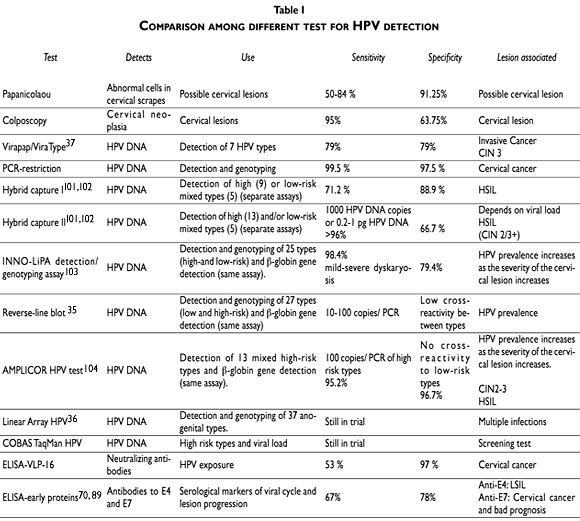
<body><![CDATA[<p>&nbsp;</p>     <p><font size="3" face="Verdana"><B>Molecular biology-based techniques</B></font></p>     <p><font size="2" face="Verdana">There are several molecular techniques used for    HPV DNA detection, most of which are used for research purposes. They include:    a) DNA hybridization,<SUP>30</SUP> b)PCR-RFLP,<SUP>31,32</SUP> c) reverse-line    hybridization<SUP>33</SUP> and d) hybrid capture assay.<SUP>34</SUP> The method    most commonly used is the polymerase chain reaction (PCR). At present, several    primers from different HPV genes have been designed, but the most popular ones    are based on the L1 gene. Amplification of HPV DNA by L1 consensus primer systems    (e.g., MY09/11 or GP5<SUP>+</SUP>/6<SUP>+</SUP>) can detect as few as 10 to    100 molecules of HPV targets from a genital sample (<a href="#tab01">Table I</a>).<SUP>35,36</sup></font>  </p>     <p><a name="tab01" id="tab01"></a></p>     <p>&nbsp;</p>     <p align="center"><img src="/img/revistas/spm/v51s3/a14tab01.gif"> </p>     <p>&nbsp;</p> <I>     <p><font size="2" face="Verdana">Detection of human papillomavirus infection by    nucleic acid hybridization</font></p> </I>      <p><font size="2" face="Verdana">Single-stranded nucleic acid molecules that are    complementary to each other will form hybrids under appropriate conditions.    Hybridization tests are based on this phenomenon and they employ labeled probe    molecules to detect specific complementary target molecules. Nucleic acid hybridization    is the most sensitive method for detecting HPV in clinical specimens and the    only one capable of identifying specific HPV types. There are many alternative    hybridization test formats; most of them use either filters or glass slides    as solid supports. Of the established tests, Southern blot hybridization remains    the most sensitive and specific test for HPV DNA,<SUP>37</SUP> but has the drawback    of also being the most time consuming. Several novel methods are promising and    some innovative procedures may eventually dominate routine nucleic acid detection.    The ideal test should be simple enough to allow automatization.</font></p> <I>     <p><font size="2" face="Verdana">Validation assays: correlation of filter in situ,dot    blot and PCR with Southern blot</font></p> </I>      ]]></body>
<body><![CDATA[<p><font size="2" face="Verdana">A number of validation experiments have compared    the most commonly used HPV hybridization methods with the accepted gold standard    &#150;Southern blot hybridization. The methods discussed are filter in situ hybridization    (FISH), dot blot hybridization (ViraPap/ViraType), and polymerase chain reaction    (PCR). FISH appears too inaccurate to be recommended for future epidemiological    studies. ViraPap/ViraType agrees with Southern blot, but the sensitivity of    the system is low as it only detects seven genital HPV types (<a href="#tab01">Table I</a>).<SUP>37</SUP>    PCR-based methods may be more sensitive than Southern blot and are likewise    capable of detecting the most known genital HPV types.<SUP>38</SUP> Direct comparison    of the several available PCR methods has shown that they present different sensitivities    and specificities, and this could be due to the use of different oligonucleotide    probes directed to different HPV genes. The sensitivity of the PCR system could    also be affected by the quality of the sample and the DNA extracted. Moreover,    there is no standardized method for cervical sampling and sample medium preservation,    which also accounts for the variability of the PCR systems. Currently, there    is no perfect method for HPV testing because Southern blot itself is prone to    some errors in performance and interpretation. Given that the scientific and    clinical usefulness of HPV tests depends on the precision and accuracy of the    assays, more intra- and inter-assay comparisons should be done to establish    reference standards useful for this area of molecular diagnostics.</font></p> <I>     <p><font size="2" face="Verdana">Genotyping HPV PCR products by a single-hybridization,    reverse line blot</font></p> </I>      <p><font size="2" face="Verdana">There are several molecular biology techniques    used together as HPV detection methods. One is dot blot hybridization, where    HPV type-specific oligonucleotide probes are immobilized on a solid phase and    hybridized to a PCR product in the liquid phase. This procedure is complicated,    especially when trying to detect separate HPV types, because it requires separate    rounds of hybridization for each type detected. On the other hand, reverse hybridization    systems provide an attractive tool for simultaneous hybridization of a PCR product    to multiple oligonucleotide probes. The most frequently used methods involve    a membrane strip containing multiple probes immobilized as parallel lines, called    line probe (LiPA), line blot assay (LBA) or linear array (LA).<SUP>39,40</SUP>    In this system, a PCR product is generated using biotinylated primers, denatured    under alkaline conditions and added to the strip in a hybridization buffer.    After hybridization and stringent washing, the hybrids can be detected by addition    of a streptavidin-conjugate and a substrate generating color at the probe line,    which can be visually interpreted. This method allows multiple HPV type detection    in a single step and requires only a limited amount of PCR product.<SUP>41-43</sup></font></p>     <p><font size="2" face="Verdana"> Alternative reverse hybridization methods for    HPV and genotyping are the line blot assay using PGMY primers<SUP>35, 44-47</SUP>    and the reverse line blot for GP5+/6+.<SUP>36</SUP> HPV DNA micro arrays work    on the same principle.<SUP>48, 49</SUP> Reverse hybridization methods are particularly    useful for the detection of type-specific infections and multiple genotypes.    Some reverse-line hybridization methods may include from 27 to 37 probes for    different HR and LR HPV types. The performance of the strip method has been    evaluated relative to that of a previously reported dot blot format<SUP>50</SUP>    by testing 467 cervical swab samples collected in Digene specimen transport    medium (Digene Diagnostics, Silver Spring, Md.). Using the PCR format, the researchers    found that 46% of the study population was infected with HPV, whereas the ViraPap    test showed an HPV prevalence of only 11%. Nearly all of the discrepant HPV-positive    samples resulted from weak signals and can be attributed to sampling error from    specimens with low concentrations (&lt;1 copy/</font><font>&#181;</font><font size="2" face="verdana">l) of HPV DNA.<SUP>50</SUP> At    the same time, the difference in sensitivity could be due to the low number    of HPV types comprised in the different tests. The primary advantage of the    strip-based detection system is the ability to rapidly genotype HPVs present    in genital samples with high sensitivity and specificity, minimizing the likelihood    of misclassification (<a href="#tab01">Table I</a>). </font></p> <I>     <p><font size="2" face="Verdana">Detection of integrated HPV sequences by ligation-mediated    PCR (DIPS-PCR)</font></p> </I>      <p><font size="2" face="Verdana">The HPV genome usually persists as episomal molecules    in HPV-associated preneoplastic lesions, where it is frequently integrated into    the host cell genome in HPV-related cancer cells. This suggests that malignant    conversion of HPV-infected epithelia is linked to the recombination of cellular    and viral sequences. Due to technical limitations, precise sequence information    on viral-cellular junctions was obtained only for a few cell lines and primary    lesions. To facilitate the molecular analysis of genomic HPV integration, a    ligation-mediated PCR assay was established for the detection of integrated    HPV sequences (DIPS-PCR). This method was initially used to amplify genomic    viral-cellular junctions from HPV-associated cervical cancer cell lines (C4-I,    C4-II, SW756 and HeLa) and HPV-immortalized keratinocyte lines (HPKIA, HPKII).    In addition to junctions already reported, various new fusion fragments were    identified.<SUP>51</SUP> Different viral-cellular junctions were amplified from    cervical carcinomas and a vulval intraepithelial neoplasia (VIN III). Sequence    analysis of each junction revealed that the viral E1 ORF was fused to cellular    sequences in 91% of the cases. Chromosomal integration loci mapped to chromosomes    1 (2n), 2 (3n), 7 (2n), 8 (3n), 10 (1n), 14 (5n), 16 (1n), 17 (2n), and mitochondrial    DNA (1n), suggesting random distribution of chromosomal integration sites.<SUP>52</SUP>    Precise sequence information obtained by DIPS-PCR is used to monitor the monoclonal    origin of cervical cancers, recurrent pre-malignant lesions and lymph node metastasis.    DIPS-PCR might be useful for efficient therapy control and prediction of relapse    in patients with HPV-associated anogenital cancers.</font></p>     <p>&nbsp;</p>     <p><font size="3" face="Verdana"><B>Immunological techniques</B></font></p>     <p><font size="2" face="Verdana">The role played by the humoral immune response    during the HPV infection is not very well understood; however, this response    is generated all throughout the malignant process. This has allowed for the    development of different techniques and reagents to detect antibodies against    early and late HPV proteins. Among all these different techniques, recombinant    fusion proteins have been used as antigens in Western blot,<SUP>53-57</SUP>    as synthetic peptides representing important immunogenic B-cell epitopes in    the case of ELISA (Enzyme Linked Immunoabsorbent Assay),<SUP>58,59</SUP> and    modifications of this technique have been used to increase the specificity and    sensitivity of the assay (<a href="#tab01">Table I</a>). Another system developed to detect HPV antibodies    involves the <I>in vitro </I>protein transcription and translation used for    radioimmunoprecipitation.<SUP>60-63</SUP> All these techniques have shown that    the measurement of antibodies against different HPV proteins could be useful    biological markers of different types of lesions of the uterine cervix.</font></p>     <p><font size="2" face="Verdana">Detection of antibodies against oncogenic HPV    proteins by Western blot</font></p>      ]]></body>
<body><![CDATA[<p><font size="2" face="Verdana">The generation of recombinant HPV proteins through    molecular biology techniques has allowed the isolation and purification of different    viral antigens useful for detecting antibodies in different body samples (blood,    saliva, cervical mucus). The Western blot assay is the most specific system    used for the detection of antibodies, and it has been the confirmatory test    for HIV and HSV infections.<SUP>64,65 </SUP>The advantage of Western blot assay    is that a particular protein band, together with its molecular weight, can be    detected from a mixture of antigens. However, due to the denaturing conditions    that characterize this system, only linear epitopes are recognized and the complexity    of the procedure makes it difficult to handle a large number of samples. </font></p>     <p><font size="2" face="Verdana"> The Western blot technique involves the separation    of the antigen by its molecular weight through a polyacrylamide gel electrophoresis    followed by a transfer to nitrocellulose membranes.<SUP>66</SUP> After the protein    is transferred, the filters are blocked and cut into strips to be incubated    with the patient sample (serum, saliva, cervical mucus) for 4-16 h. The antigen-antibody    complex is detected by a secondary antibody complex conjugated with an oxidizing    enzyme, such as horseradish peroxidase, producing a colored molecule or luminescence.    Thus, a high correlation between the presence of HPV-16 E7 antibodies and CC    was found by means of the Western blot system.<SUP>53, 67-69</SUP> The presence    of anti-E4 antibodies has been controversial, as some groups found them equally    distributed among healthy donors and cancer patients,<SUP>53, 57</SUP> while    others reported that the prevalence of antibodies against HPV-16 E4 was higher    in subjects with CC than in the control population.<SUP>55,68,70</SUP> More    recently, our group showed that anti-E4 antibodies can be used as markers for    HPV infection as well as to detect early stages of cervical lesions (high antibody    prevalence in CIN I-II lesions).<SUP>71,72</SUP> In summary, the advantage of    the Western blot system is the ability to detect antibodies against several    linear epitopes, which accounts for its high specificity (78%) and sensitivity    (67%)<SUP>71</SUP> (<a href="#tab01">Table I</a>), and it is, hence, highly suitable for the diagnosis    of different cervical lesions. </font></p> <I>     <p><font size="2" face="Verdana">HPV antibody detection by ELISA</font></p> </I>      <p><font size="2" face="Verdana">The ELISA is the main tool used for clinical    diagnosis. It is mostly used to screen large populations and it has been widely    used for molecular epidemiology research. The advantage of the ELISA is that    both conformational and linear epitopes can be recognized by antibodies, as    the method cannot be used under denaturing conditions. </font></p>     <p><font size="2" face="Verdana"> The ELISA system has been broadly used to study    the immunological response to different HPV antigens. In this sense, there are    reports that show the presence of antibodies against the L1 capsid viral proteins    in <I>condyloma acuminata</I> and in LSIL.<SUP>73</SUP> These anti-L1 antibodies    are scarce in HSIL (high grade squamous intraepithelial lesion) and are almost    absent in CC.<SUP>57</SUP> However, there are some controversies, as a high    frequency of L1 antibodies has been reported in control populations.<SUP>74</SUP>    Further on, the development of Virus Like Particles (VLPs) allowed for a detection    system that is more sensitive to anti-HPV antibodies and, hence, can identify    conformational epitopes as well as neutralizing antibodies.<SUP>75,76</SUP>    The VLPs were initially produced from baculovirus and vaccinia virus,<SUP>77,78</SUP>    but more recently a recombinant yeast expression system driven by a strong galactose-inducible    promoter was developed to express these antigens successfully.<SUP>79</SUP>    This material has been used for the development of the new HPV vaccine by Merk    &amp; Co. ELISA assays for VLPs have been shown to be type-specific as low cross-reaction    with HPVs from the same family has been found. A follow up study<SUP>80</SUP>    has shown that the detection of anti-VLPs antibodies by ELISA is useful to detect    newly acquired HPV infections in virgin women. Another study showed that HPV-16    DNA-positive and anti-VLP-positive women had the highest risk of concurrent    CIN 3 and cancer.<SUP>81</SUP> An immunoglobulin type-specific ELISA-VLP system    showed that the systemic IgA response was associated with successful clearance    of HPV infection. At the same time, the presence of IgA anti-VLPs in HPV-16-positive    women is very specific to detect actual infections that are in the process of    being eliminated.<SUP>82</sup></font></p>     <p><font size="2" face="Verdana"> In relation to the E2 protein, little has been    done with this antigen. Dillner and coworkers<SUP>58,83</SUP> used a peptide    from the E2 protein C-terminal region to show that the IgG and IgA responses    were elevated in patients with CC. Other reports show that the anti-E2 antibodies    were present in normal subjects;<SUP>84</SUP> they have also been shown to be    markers of CIN lesions, but only in women over 40 years of age.<SUP>85</SUP>    </font></p>     <p><font size="2" face="Verdana"> On the other hand, high concentrations of E4    ORF transcripts have been found in pre-cancerous lesions associated with HPV-16.    Moreover, both LSIL and HSIL have been shown to exhibit the expression of the    E4 protein, but not invasive cancer.<SUP>86</SUP> E4 antibodies have been found    both in patients with pre-cancerous lesions and in normal subjects.<SUP>53,63,83,86,87</SUP>    Some groups report the presence of anti-E4 antibodies in cancer patients as    well as in control groups,<SUP>67,70</SUP> whereas others report a higher prevalence    of E4 antibodies in cancer patients than in normal individuals.<SUP>57,68,88</SUP>    Previous studies in our laboratory have shown E4 antibodies to be highly associated    with the CIN 1/2 lesions.<SUP>89</SUP> Due to the fact that E4 antibodies have    been mainly found in early cervical lesions, it has been suggested that the    E4 protein might be implicated in active viral replication.<SUP>53,70</SUP>    </font></p>     <p><font size="2" face="Verdana"> There are several studies that have investigated    the antibody response against E6 and E7 oncoproteins and it has been demonstrated    that a higher proportion of anti-E6 is present in patients with CC than in patients    with early lesions or in healthy subjects.<SUP>57,60,90,91</SUP> In the case    of HPV-16 E7 antibodies, a higher prevalence has been shown for CC patients    compared to controls,<SUP>53,57,58,60,67-70,83,91-96</SUP> suggesting that these    antibodies might be used as markers for this type of cancer. Although the antibodies    against these oncoproteins have enabled the identification of women with CC,    this has occurred at a very late diagnostic stage. Thus, identifying biomarkers    for early stages of CC will be essential in order to achieve an early diagnosis    and offer timely treatment for women at risk of developing this disease. This    also explains why studying the immune response against viral proteins (such    as E2, E4 and E5 possibly related to the early stages in the development process    of CC) constitutes a very important research field. </font></p>     <p><font size="2" face="Verdana"> It should also be noted that the use of different    systems for the production of recombinant proteins, as well as the use of synthetic    peptides, will allow the recognition of a greater number of epitopes on the    viral proteins, and this will enhance the sensitivity of the immune assays.    Recently, the identification of isotype profiles (IgG, IgA, IgM) against early    HPV proteins (E4, E7) has shown to be useful to identify the infection stage    important in the progression to CC. Moreover, combining diagnostic procedures    (such as cytology, DNA and antibodies) will offer the possibility of a timely    and accurate diagnosis, essential to detect women at high risk to develop CC.    A detailed study of the humoral immune response against HPV antigens will allow    the development of highly sensitive and specific diagnostic systems corresponding    to the different HR-HPV types, as well as to follow up the protective immune    response of the vaccinate population with the new HPV vaccine based on L1 antigens.    </font></p>     <p>&nbsp;</p>     ]]></body>
<body><![CDATA[<p><font size="3" face="Verdana"><B>Conclusions</B></font></p>     <p><font size="2" face="Verdana">HPV cannot be grown in large quantities in cell    culture. This fact has limited the use of common powerful immunological assays    used for HPV diagnosis. Thus, the diagnosis of HPV-related diseases has relied    on the detection of the viral DNA in patient samples. The use of molecular biology    has enhanced a highly sensitive detection process of HPV DNA in the case of    current infections, but this approach cannot determine whether the HPV infection    is active, latent or persistent. On the other hand, these techniques are highly    sensitive, but high technical skills are required for the sampling procedure.    Large amounts of recombinant viral antigens as well as HPV-VLPs have been produced    based on the most recent advances achieved by molecular biology. Thus, the humoral    immune response offers the possibility to detect the infection stage as well    as a follow-up process. However, a more specific antibody profile (immunoglobulin    type) needs to be established to be able to discriminate between present and    past infections.</font></p>     <p><font size="2" face="Verdana"> Epidemiological studies have shown a wide range    of HPV frequencies worldwide,<SUP>50,97,98</SUP> but there is a high point prevalence    of HPV among young women (&lt; 30 years).<SUP>99</SUP> Although nearly 90% of    the HPV infections are cleared in less than 24 months,<SUP>100</SUP> sampling    errors and HPV-DNA detection techniques bearing different sensitivity and specificity    appear to account for the heterogeneity of the results. To overcome these shortcomings,    a combined detection system including HPV DNA detection (to identify the presence    of the virus) and an antibody profile against different viral antigens (to determine    the stage of the infection) will help to identify persistent infections that    play an important role in the development of CC.</font></p>     <p><font size="2" face="Verdana"> To close, it should be noted that the development    of prophylactic HPV vaccines is a major advance in cancer prevention, as these    vaccines protect against infection with certain oncogenic HPV types and, therefore,    reduce the development of cervical lesions and the risk of CC. Routine HPV vaccination    of adolescent girls will require screening guidelines in order to follow up    the effectiveness of the vaccine protection. In this sense, immunological assays    will not only be useful as specific biomarkers of the stage of the HPV infection    and the lesions in women's cervixes, but they will also play an important role    in the follow-up process of the protective immune response against HPV in vaccinated    populations. </font></p>     <p>&nbsp;</p>     <p><font size="3" face="Verdana"><b>References</b></font></p>      <!-- ref --><p><font size="2" face="Verdana">1. Eluf-Neto J, Nascimento CM. Cervical cancer    in Latin America. Semin Oncol 2001;28(2):188-197.    &nbsp;&nbsp;&nbsp;&nbsp;&nbsp;&nbsp;&nbsp;&nbsp;[&#160;<a href="javascript:void(0);" onclick="javascript: window.open('/scielo.php?script=sci_nlinks&ref=9292086&pid=S0036-3634200900090001400001&lng=','','width=640,height=500,resizable=yes,scrollbars=1,menubar=yes,');">Links</a>&#160;]<!-- end-ref --></font></p>     <!-- ref --><p><font size="2" face="Verdana">2. World Health Organization. &#91;Accessed August    7, 2003&#93;. Available at: <a href="http://www.who.int/en/" target="_blank">http://www.who.int/en/</a>.    &nbsp;&nbsp;&nbsp;&nbsp;&nbsp;&nbsp;&nbsp;&nbsp;[&#160;<a href="javascript:void(0);" onclick="javascript: window.open('/scielo.php?script=sci_nlinks&ref=9292088&pid=S0036-3634200900090001400002&lng=','','width=640,height=500,resizable=yes,scrollbars=1,menubar=yes,');">Links</a>&#160;]<!-- end-ref --></font></p>     ]]></body>
<body><![CDATA[<!-- ref --><p><font size="2" face="Verdana">3. Blumenthal PD, Ringers P, McIntosh N, Graffikin    L. Innovative approaches to cervical cancer prevention. Medscape Womens Health    2001;6:1.    &nbsp;&nbsp;&nbsp;&nbsp;&nbsp;&nbsp;&nbsp;&nbsp;[&#160;<a href="javascript:void(0);" onclick="javascript: window.open('/scielo.php?script=sci_nlinks&ref=9292090&pid=S0036-3634200900090001400003&lng=','','width=640,height=500,resizable=yes,scrollbars=1,menubar=yes,');">Links</a>&#160;]<!-- end-ref --></font></p>     <!-- ref --><p><font size="2" face="Verdana">4. McCracken M, Olsen M, Chen MS Jr, Jemal A,    Thun M, Cokkinides V, <I>et al</I>. Cancer incidence, mortality, and associated    risk factors among Asian Americans of Chinese, Filipino, Vietnamese, Korean,    and Japanese ethnicities. CA Cancer J Clin 2007;57(4):190-205.    &nbsp;&nbsp;&nbsp;&nbsp;&nbsp;&nbsp;&nbsp;&nbsp;[&#160;<a href="javascript:void(0);" onclick="javascript: window.open('/scielo.php?script=sci_nlinks&ref=9292092&pid=S0036-3634200900090001400004&lng=','','width=640,height=500,resizable=yes,scrollbars=1,menubar=yes,');">Links</a>&#160;]<!-- end-ref --> </font></p>     <!-- ref --><p><font size="2" face="Verdana">5. Tapia-Conyer R, Kuri-Morales P, Mac&iacute;as-Mart&iacute;nez    CG. Registro Histopatol&oacute;gico de Neoplasias en M&eacute;xico. Mexico:    Direcci&oacute;n General de Epidemiolog&iacute;a, Secretar&iacute;a de Salud,    2000.    &nbsp;&nbsp;&nbsp;&nbsp;&nbsp;&nbsp;&nbsp;&nbsp;[&#160;<a href="javascript:void(0);" onclick="javascript: window.open('/scielo.php?script=sci_nlinks&ref=9292094&pid=S0036-3634200900090001400005&lng=','','width=640,height=500,resizable=yes,scrollbars=1,menubar=yes,');">Links</a>&#160;]<!-- end-ref --></font></p>     <!-- ref --><p><font size="2" face="Verdana">6. Flores Y, Keerti S, Lazcano-Ponce E, Hernandez    M, Bishai D, Ferris DG <I>et al</I>. Design and methods of the evaluation of    an HPV-based cervical cancer screening strategy in Mexico: The Morelos HPV Study.    Salud Publica Mex 2002;44:335-344.    &nbsp;&nbsp;&nbsp;&nbsp;&nbsp;&nbsp;&nbsp;&nbsp;[&#160;<a href="javascript:void(0);" onclick="javascript: window.open('/scielo.php?script=sci_nlinks&ref=9292096&pid=S0036-3634200900090001400006&lng=','','width=640,height=500,resizable=yes,scrollbars=1,menubar=yes,');">Links</a>&#160;]<!-- end-ref --></font></p>     <!-- ref --><p><font size="2" face="Verdana">7. Lazcano-Ponce E, Alonso P, Ruiz-Moreno JA,    Hern&aacute;ndez-Avila M. Recommendations for cervical cancer screening programs    in developing countries. The need for equity and technological development.    Salud Publica Mex 2003;45 suppl 3:S449-S462.    &nbsp;&nbsp;&nbsp;&nbsp;&nbsp;&nbsp;&nbsp;&nbsp;[&#160;<a href="javascript:void(0);" onclick="javascript: window.open('/scielo.php?script=sci_nlinks&ref=9292098&pid=S0036-3634200900090001400007&lng=','','width=640,height=500,resizable=yes,scrollbars=1,menubar=yes,');">Links</a>&#160;]<!-- end-ref --></font></p>     ]]></body>
<body><![CDATA[<!-- ref --><p><font size="2" face="Verdana">8. Walboomers JM, Jacobs MV, Manos MM, Bosch    FX, Kummer JA, Shah KV, <I>et al.</I> Human papillomavirus is a necessary cause    of invasive cervical cancer worldwide. J. Patol 1999;189:12-19.    &nbsp;&nbsp;&nbsp;&nbsp;&nbsp;&nbsp;&nbsp;&nbsp;[&#160;<a href="javascript:void(0);" onclick="javascript: window.open('/scielo.php?script=sci_nlinks&ref=9292100&pid=S0036-3634200900090001400008&lng=','','width=640,height=500,resizable=yes,scrollbars=1,menubar=yes,');">Links</a>&#160;]<!-- end-ref --></font></p>     <!-- ref --><p><font size="2" face="Verdana">9. Bosch FX, Lorincz A, Mu&ntilde;oz N, Meijer    CJ, Shah KV. The causal relation between human papillomavirus and cervical cancer.    J Clin Pathol 2002;55:244-265.    &nbsp;&nbsp;&nbsp;&nbsp;&nbsp;&nbsp;&nbsp;&nbsp;[&#160;<a href="javascript:void(0);" onclick="javascript: window.open('/scielo.php?script=sci_nlinks&ref=9292102&pid=S0036-3634200900090001400009&lng=','','width=640,height=500,resizable=yes,scrollbars=1,menubar=yes,');">Links</a>&#160;]<!-- end-ref --></font></p>     <!-- ref --><p><font size="2" face="Verdana">10. Mu&ntilde;oz N, Bosch FX, de Sanjos&eacute;    S, Herrero R, Castellsagu&eacute; X, Shah KV, <I>et al.</I> Epidemiologic classification    of human papillomavirus types associated with cervical cancer. N Engl J Med    2003;348:518-527.    &nbsp;&nbsp;&nbsp;&nbsp;&nbsp;&nbsp;&nbsp;&nbsp;[&#160;<a href="javascript:void(0);" onclick="javascript: window.open('/scielo.php?script=sci_nlinks&ref=9292104&pid=S0036-3634200900090001400010&lng=','','width=640,height=500,resizable=yes,scrollbars=1,menubar=yes,');">Links</a>&#160;]<!-- end-ref --></font></p>     <!-- ref --><p><font size="2" face="Verdana">11. Dillner J. The serological response to papillomaviruses.    Semin Cancer Biol 1999;9(6):423-430.    &nbsp;&nbsp;&nbsp;&nbsp;&nbsp;&nbsp;&nbsp;&nbsp;[&#160;<a href="javascript:void(0);" onclick="javascript: window.open('/scielo.php?script=sci_nlinks&ref=9292106&pid=S0036-3634200900090001400011&lng=','','width=640,height=500,resizable=yes,scrollbars=1,menubar=yes,');">Links</a>&#160;]<!-- end-ref --> </font></p>     <!-- ref --><p><font size="2" face="Verdana">12. Chow LT, Broker TR. In vitro experimental    systems for HPV: epithelial raft cultures for investigations of viral reproduction    and pathogenesis and for genetic analyses of viral proteins and regulatory sequences.    Clin Dermatol 1997;15(2):217-227.    &nbsp;&nbsp;&nbsp;&nbsp;&nbsp;&nbsp;&nbsp;&nbsp;[&#160;<a href="javascript:void(0);" onclick="javascript: window.open('/scielo.php?script=sci_nlinks&ref=9292108&pid=S0036-3634200900090001400012&lng=','','width=640,height=500,resizable=yes,scrollbars=1,menubar=yes,');">Links</a>&#160;]<!-- end-ref --></font></p>     ]]></body>
<body><![CDATA[<!-- ref --><p><font size="2" face="Verdana">13. de Villiers EM, Fauquet C, Broker TR, Bernard    HU, zur Hausen H. Classification of Papillomaviruses. Virol 2004;324:17-27.    &nbsp;&nbsp;&nbsp;&nbsp;&nbsp;&nbsp;&nbsp;&nbsp;[&#160;<a href="javascript:void(0);" onclick="javascript: window.open('/scielo.php?script=sci_nlinks&ref=9292110&pid=S0036-3634200900090001400013&lng=','','width=640,height=500,resizable=yes,scrollbars=1,menubar=yes,');">Links</a>&#160;]<!-- end-ref --></font></p>     <!-- ref --><p><font size="2" face="Verdana">14. zur Hausen H. Papillomaviruses in human cancers.    In: Infectious causes of cancer: Targets for intervention. Ed. Goedert JJ. USA:Humana    Press, 2000:245-261.    &nbsp;&nbsp;&nbsp;&nbsp;&nbsp;&nbsp;&nbsp;&nbsp;[&#160;<a href="javascript:void(0);" onclick="javascript: window.open('/scielo.php?script=sci_nlinks&ref=9292112&pid=S0036-3634200900090001400014&lng=','','width=640,height=500,resizable=yes,scrollbars=1,menubar=yes,');">Links</a>&#160;]<!-- end-ref --></font></p>     <!-- ref --><p><font size="2" face="Verdana">15. zur Hausen H. Roots and perspectives of contemporary    papillomavirus research. J. Cancer Res Clin Oncol 1996;122:3-13.    &nbsp;&nbsp;&nbsp;&nbsp;&nbsp;&nbsp;&nbsp;&nbsp;[&#160;<a href="javascript:void(0);" onclick="javascript: window.open('/scielo.php?script=sci_nlinks&ref=9292114&pid=S0036-3634200900090001400015&lng=','','width=640,height=500,resizable=yes,scrollbars=1,menubar=yes,');">Links</a>&#160;]<!-- end-ref --></font></p>     <!-- ref --><p><font size="2" face="Verdana">16. Beutner KR, Tyring S. Human papillomavirus    and human disease. Am J Med 1997;102(5A):9-15.    &nbsp;&nbsp;&nbsp;&nbsp;&nbsp;&nbsp;&nbsp;&nbsp;[&#160;<a href="javascript:void(0);" onclick="javascript: window.open('/scielo.php?script=sci_nlinks&ref=9292116&pid=S0036-3634200900090001400016&lng=','','width=640,height=500,resizable=yes,scrollbars=1,menubar=yes,');">Links</a>&#160;]<!-- end-ref --> </font></p>     <!-- ref --><p><font size="2" face="Verdana">17. Garc&iacute;a-Carranc&aacute; A, Gariglio    PV. Molecular aspects of human papillomaviruses and their relation to uterine    cervix cancer. Rev Invest Clin 1993;45(1):85-92.    &nbsp;&nbsp;&nbsp;&nbsp;&nbsp;&nbsp;&nbsp;&nbsp;[&#160;<a href="javascript:void(0);" onclick="javascript: window.open('/scielo.php?script=sci_nlinks&ref=9292118&pid=S0036-3634200900090001400017&lng=','','width=640,height=500,resizable=yes,scrollbars=1,menubar=yes,');">Links</a>&#160;]<!-- end-ref --> </font></p>     ]]></body>
<body><![CDATA[<!-- ref --><p><font size="2" face="Verdana">18. Hebner CM, Laimins LA. Human papillomaviruses:    basic mechanisms of pathogenesis and oncogenicity. Rev Med Virol 2006;16(2):83-97.    &nbsp;&nbsp;&nbsp;&nbsp;&nbsp;&nbsp;&nbsp;&nbsp;[&#160;<a href="javascript:void(0);" onclick="javascript: window.open('/scielo.php?script=sci_nlinks&ref=9292120&pid=S0036-3634200900090001400018&lng=','','width=640,height=500,resizable=yes,scrollbars=1,menubar=yes,');">Links</a>&#160;]<!-- end-ref -->    </font></p>     <!-- ref --><p><font size="2" face="Verdana">19. Gaillard-R C, Breitburd F, Orth G. Human    Papillomavirus type 1 E4 N-terminal ends has distinct cellular localizations    when transiently expressed in vitro. J Virol 1992;66:816-823.    &nbsp;&nbsp;&nbsp;&nbsp;&nbsp;&nbsp;&nbsp;&nbsp;[&#160;<a href="javascript:void(0);" onclick="javascript: window.open('/scielo.php?script=sci_nlinks&ref=9292122&pid=S0036-3634200900090001400019&lng=','','width=640,height=500,resizable=yes,scrollbars=1,menubar=yes,');">Links</a>&#160;]<!-- end-ref --></font></p>     <!-- ref --><p><font size="2" face="Verdana">20. Roberts S, Ashmole I, Gibson LJ, Rookes SM,    Barton GJ, Gallimore PH. Mutational analysis of Human Papillomavirus E4 proteins:    Identification of structural features important in the formation of cytoplasmic    E4/ cytokeratin networks in epithelial cells. J Virol 1994;68:6432-6445.    &nbsp;&nbsp;&nbsp;&nbsp;&nbsp;&nbsp;&nbsp;&nbsp;[&#160;<a href="javascript:void(0);" onclick="javascript: window.open('/scielo.php?script=sci_nlinks&ref=9292124&pid=S0036-3634200900090001400020&lng=','','width=640,height=500,resizable=yes,scrollbars=1,menubar=yes,');">Links</a>&#160;]<!-- end-ref --></font></p>     <!-- ref --><p><font size="2" face="Verdana">21. Yasumoto S, Burkhardt AL, Doniger J, DiPaolo    JA. Human papillomavirus type 16 DNA-induced malignant transformation of NIH    3T3 cells. J Virol 1986;57:572-577.    &nbsp;&nbsp;&nbsp;&nbsp;&nbsp;&nbsp;&nbsp;&nbsp;[&#160;<a href="javascript:void(0);" onclick="javascript: window.open('/scielo.php?script=sci_nlinks&ref=9292126&pid=S0036-3634200900090001400021&lng=','','width=640,height=500,resizable=yes,scrollbars=1,menubar=yes,');">Links</a>&#160;]<!-- end-ref --></font></p>     <!-- ref --><p><font size="2" face="Verdana">22. Pirisi L, Yasumoto S, Feller M, Doniger J,    DiPaolo JA. Transformation of human fibroblasts and keratinocytes with human    papillomavirus type 16 DNA. J Virol 1987;61:1061-1066.    &nbsp;&nbsp;&nbsp;&nbsp;&nbsp;&nbsp;&nbsp;&nbsp;[&#160;<a href="javascript:void(0);" onclick="javascript: window.open('/scielo.php?script=sci_nlinks&ref=9292128&pid=S0036-3634200900090001400022&lng=','','width=640,height=500,resizable=yes,scrollbars=1,menubar=yes,');">Links</a>&#160;]<!-- end-ref --></font></p>     ]]></body>
<body><![CDATA[<!-- ref --><p><font size="2" face="Verdana">23. Dyson N, Guida P, Munger K, Harlow E. Homologous    sequences in adenovirus E1A and human papillomavirus E7 proteins mediate interaction    with the same set of cellular proteins. J Virol 1992;66:6893-6902.    &nbsp;&nbsp;&nbsp;&nbsp;&nbsp;&nbsp;&nbsp;&nbsp;[&#160;<a href="javascript:void(0);" onclick="javascript: window.open('/scielo.php?script=sci_nlinks&ref=9292130&pid=S0036-3634200900090001400023&lng=','','width=640,height=500,resizable=yes,scrollbars=1,menubar=yes,');">Links</a>&#160;]<!-- end-ref --> </font></p>     <!-- ref --><p><font size="2" face="Verdana">24. Werness BA, Levine AJ. Howley PM, Association    of human papillomavirus types 16 and 18 E6 proteins with p53. Science 1990;248:76-79.    &nbsp;&nbsp;&nbsp;&nbsp;&nbsp;&nbsp;&nbsp;&nbsp;[&#160;<a href="javascript:void(0);" onclick="javascript: window.open('/scielo.php?script=sci_nlinks&ref=9292132&pid=S0036-3634200900090001400024&lng=','','width=640,height=500,resizable=yes,scrollbars=1,menubar=yes,');">Links</a>&#160;]<!-- end-ref --></font></p>     <!-- ref --><p><font size="2" face="Verdana">25. Scheffner M, Werness BA, Huibregtse JM, Levine    AJ, Howley PM. The E6 oncoprotein encoded by human papillomavirus types 16 and    18 promotes the degradation of p53. Cell 1990 63:1129-1136.    &nbsp;&nbsp;&nbsp;&nbsp;&nbsp;&nbsp;&nbsp;&nbsp;[&#160;<a href="javascript:void(0);" onclick="javascript: window.open('/scielo.php?script=sci_nlinks&ref=9292134&pid=S0036-3634200900090001400025&lng=','','width=640,height=500,resizable=yes,scrollbars=1,menubar=yes,');">Links</a>&#160;]<!-- end-ref --> </font></p>     <!-- ref --><p><font size="2" face="Verdana">26. Mietz JA, Unger T, Huibregtse JM, Howley    PM. The transcriptional transactivation function of wild-type p53 is inhibited    by SV40 large T-antigen and by HPV-16 E6 oncoprotein. EMBO J 1992;11(13):5013-5020.    &nbsp;&nbsp;&nbsp;&nbsp;&nbsp;&nbsp;&nbsp;&nbsp;[&#160;<a href="javascript:void(0);" onclick="javascript: window.open('/scielo.php?script=sci_nlinks&ref=9292136&pid=S0036-3634200900090001400026&lng=','','width=640,height=500,resizable=yes,scrollbars=1,menubar=yes,');">Links</a>&#160;]<!-- end-ref -->    </font></p>     <!-- ref --><p><font size="2" face="Verdana">27. Leechanachai P, Banks L, Moreau F, Matlashewski    G. The E5 gene from human papillomavirus type 16 is an oncogene which enhances    growth factor-mediated signal transduction to the nucleus. Oncogene 1992;7(1):19-25.    &nbsp;&nbsp;&nbsp;&nbsp;&nbsp;&nbsp;&nbsp;&nbsp;[&#160;<a href="javascript:void(0);" onclick="javascript: window.open('/scielo.php?script=sci_nlinks&ref=9292138&pid=S0036-3634200900090001400027&lng=','','width=640,height=500,resizable=yes,scrollbars=1,menubar=yes,');">Links</a>&#160;]<!-- end-ref -->    </font></p>     ]]></body>
<body><![CDATA[<!-- ref --><p><font size="2" face="Verdana">28. Bouvard V, Matlashewski G, Gu Z-M, Storey    A, Banks L. The human papillomavirus type 16 E5 gene cooperates with the E7    gene to stimulate proliferation of primary cells and increases viral gene expression.    Virology 1994;203:73-80.    &nbsp;&nbsp;&nbsp;&nbsp;&nbsp;&nbsp;&nbsp;&nbsp;[&#160;<a href="javascript:void(0);" onclick="javascript: window.open('/scielo.php?script=sci_nlinks&ref=9292140&pid=S0036-3634200900090001400028&lng=','','width=640,height=500,resizable=yes,scrollbars=1,menubar=yes,');">Links</a>&#160;]<!-- end-ref --></font></p>     <!-- ref --><p><font size="2" face="Verdana">29. Biswas C, Kell B, Mant C, Jewers RJ, Cason    J, Muir P, <I>et al</I>. Detection of human papillomavirus type 16 early-gene    transcription by reverse transcription-PCR is associated with abnormal cervical    cytology. J Clin Microbiol 1997;35(6):1560-1564.    &nbsp;&nbsp;&nbsp;&nbsp;&nbsp;&nbsp;&nbsp;&nbsp;[&#160;<a href="javascript:void(0);" onclick="javascript: window.open('/scielo.php?script=sci_nlinks&ref=9292142&pid=S0036-3634200900090001400029&lng=','','width=640,height=500,resizable=yes,scrollbars=1,menubar=yes,');">Links</a>&#160;]<!-- end-ref --> </font></p>     <!-- ref --><p><font size="2" face="Verdana">30. Denny LA, Wright TC Jr. Human papillomavirus    testing and screening. Best Pract Res Clin Obstet Gynaecol 2005;19:501-515.    &nbsp;&nbsp;&nbsp;&nbsp;&nbsp;&nbsp;&nbsp;&nbsp;[&#160;<a href="javascript:void(0);" onclick="javascript: window.open('/scielo.php?script=sci_nlinks&ref=9292144&pid=S0036-3634200900090001400030&lng=','','width=640,height=500,resizable=yes,scrollbars=1,menubar=yes,');">Links</a>&#160;]<!-- end-ref --></font></p>     <!-- ref --><p><font size="2" face="Verdana">31. Brink AA, Snijders PJ, Meijer CJ. HPV detection    methods. Dis Markers 2007; 23: 273-281.    &nbsp;&nbsp;&nbsp;&nbsp;&nbsp;&nbsp;&nbsp;&nbsp;[&#160;<a href="javascript:void(0);" onclick="javascript: window.open('/scielo.php?script=sci_nlinks&ref=9292146&pid=S0036-3634200900090001400031&lng=','','width=640,height=500,resizable=yes,scrollbars=1,menubar=yes,');">Links</a>&#160;]<!-- end-ref --></font></p>     <!-- ref --><p><font size="2" face="Verdana">32. Molijn A, Kleter B, Quint W, van Doorn LJ.    Molecular diagnosis of human papillomavirus (HPV) infections. J Clin Virol 2005;32    suppl 1:S43-S51.    &nbsp;&nbsp;&nbsp;&nbsp;&nbsp;&nbsp;&nbsp;&nbsp;[&#160;<a href="javascript:void(0);" onclick="javascript: window.open('/scielo.php?script=sci_nlinks&ref=9292148&pid=S0036-3634200900090001400032&lng=','','width=640,height=500,resizable=yes,scrollbars=1,menubar=yes,');">Links</a>&#160;]<!-- end-ref --></font></p>     ]]></body>
<body><![CDATA[<!-- ref --><p><font size="2" face="Verdana">33. Klug SJ, Molijn A, Schopp B, Holz B, Iftner    A, Quint W, <I>et al.</I> Comparison of the performance of different HPV genotyping    methods for detecting genital HPV types. J Med Virol 2008;80:1264-1274.    &nbsp;&nbsp;&nbsp;&nbsp;&nbsp;&nbsp;&nbsp;&nbsp;[&#160;<a href="javascript:void(0);" onclick="javascript: window.open('/scielo.php?script=sci_nlinks&ref=9292150&pid=S0036-3634200900090001400033&lng=','','width=640,height=500,resizable=yes,scrollbars=1,menubar=yes,');">Links</a>&#160;]<!-- end-ref --></font></p>     <!-- ref --><p><font size="2" face="Verdana"> 34. L&ouml;rincz AT. Screening for cervical    cancer: new alternatives and research. Salud Publica Mex 2003;45 suppl 3:S376-S387.    &nbsp;&nbsp;&nbsp;&nbsp;&nbsp;&nbsp;&nbsp;&nbsp;[&#160;<a href="javascript:void(0);" onclick="javascript: window.open('/scielo.php?script=sci_nlinks&ref=9292152&pid=S0036-3634200900090001400034&lng=','','width=640,height=500,resizable=yes,scrollbars=1,menubar=yes,');">Links</a>&#160;]<!-- end-ref --></font></p>     <!-- ref --><p><font size="2" face="Verdana">35. Gravitt PE, Peyton CN, Apple RJ, Wheeler    CM. Genotyping of 27 Human Papillomavirus Types by Using L1 Consensus PCR Products    by a Single-Hybridization, Reverse Line Blot Detection Method. J Clin Microbiol    1998;36(10):3020-3027.    &nbsp;&nbsp;&nbsp;&nbsp;&nbsp;&nbsp;&nbsp;&nbsp;[&#160;<a href="javascript:void(0);" onclick="javascript: window.open('/scielo.php?script=sci_nlinks&ref=9292154&pid=S0036-3634200900090001400035&lng=','','width=640,height=500,resizable=yes,scrollbars=1,menubar=yes,');">Links</a>&#160;]<!-- end-ref --> </font></p>     <!-- ref --><p><font size="2" face="Verdana">36. van den Brule AJ, Pol R, Fransen-Daalmeijer    N, Schouls LM, Meijer CJ, Snijders PJ. GP5+/6+ PCR followed by reverse line    blot analysis enables rapid and high-throughput identification of human papillomavirus    genotypes. J Clin Microbiol 2002;40(3):779-787.    &nbsp;&nbsp;&nbsp;&nbsp;&nbsp;&nbsp;&nbsp;&nbsp;[&#160;<a href="javascript:void(0);" onclick="javascript: window.open('/scielo.php?script=sci_nlinks&ref=9292156&pid=S0036-3634200900090001400036&lng=','','width=640,height=500,resizable=yes,scrollbars=1,menubar=yes,');">Links</a>&#160;]<!-- end-ref --> </font></p>     <!-- ref --><p><font size="2" face="Verdana">37. Schiffman MH. Validation of hybridization    assays: correlation of filter in situ, dot blot and PCR with Southern blot.    IARC Sci Publ 1992;119:169-179.    &nbsp;&nbsp;&nbsp;&nbsp;&nbsp;&nbsp;&nbsp;&nbsp;[&#160;<a href="javascript:void(0);" onclick="javascript: window.open('/scielo.php?script=sci_nlinks&ref=9292158&pid=S0036-3634200900090001400037&lng=','','width=640,height=500,resizable=yes,scrollbars=1,menubar=yes,');">Links</a>&#160;]<!-- end-ref --></font></p>     ]]></body>
<body><![CDATA[<!-- ref --><p><font size="2" face="Verdana">38. Nijhuis ER, Reesink-Peters N, Wisman GB,    Nijman HW, van Zanden J, Volders H, <I>et al.</I> An overview of innovative    techniques to improve cervical cancer screening. Cell Oncol 2006;28(5-6):233-246.    &nbsp;&nbsp;&nbsp;&nbsp;&nbsp;&nbsp;&nbsp;&nbsp;[&#160;<a href="javascript:void(0);" onclick="javascript: window.open('/scielo.php?script=sci_nlinks&ref=9292160&pid=S0036-3634200900090001400038&lng=','','width=640,height=500,resizable=yes,scrollbars=1,menubar=yes,');">Links</a>&#160;]<!-- end-ref --></font></p>     <!-- ref --><p><font size="2" face="Verdana"> 39. Castle PE, Gravitt PE, Solomon D, Wheeler    CM, Schiffman M. Comparison of linear array and line blot assay for detection    of human papillomavirus and diagnosis of cervical precancer and cancer in the    atypical squamous cell of undetermined significance and low-grade squamous intraepithelial    lesion triage study. J Clin Microbiol 2008;46(1):109-117.    &nbsp;&nbsp;&nbsp;&nbsp;&nbsp;&nbsp;&nbsp;&nbsp;[&#160;<a href="javascript:void(0);" onclick="javascript: window.open('/scielo.php?script=sci_nlinks&ref=9292162&pid=S0036-3634200900090001400039&lng=','','width=640,height=500,resizable=yes,scrollbars=1,menubar=yes,');">Links</a>&#160;]<!-- end-ref --> </font></p>     <!-- ref --><p><font size="2" face="Verdana"> 40. Sabol I, Salakova M, Smahelova J, Pawlita    M, Schmitt M, Gasperov NM, <I>et al</I>. Evaluation of different techniques    for identification of human papillomavirus types of low prevalence. J Clin Microbiol    2008;46(5):1606-1613.    &nbsp;&nbsp;&nbsp;&nbsp;&nbsp;&nbsp;&nbsp;&nbsp;[&#160;<a href="javascript:void(0);" onclick="javascript: window.open('/scielo.php?script=sci_nlinks&ref=9292164&pid=S0036-3634200900090001400040&lng=','','width=640,height=500,resizable=yes,scrollbars=1,menubar=yes,');">Links</a>&#160;]<!-- end-ref --> </font></p>     <!-- ref --><p><font size="2" face="Verdana"> 41. Kleter B, van Doorn LJ, Schrauwen L, Molijn    A, Sastrowijoto S, ter Schegget J, <I>et al</I>. Development and clinical evaluation    of a highly sensitive PCR-reverse hybridization line probe assay for detection    and identification of anogenital human papillomavirus. J Clin Microbiol 1999;37(8):2508-2517.    &nbsp;&nbsp;&nbsp;&nbsp;&nbsp;&nbsp;&nbsp;&nbsp;[&#160;<a href="javascript:void(0);" onclick="javascript: window.open('/scielo.php?script=sci_nlinks&ref=9292166&pid=S0036-3634200900090001400041&lng=','','width=640,height=500,resizable=yes,scrollbars=1,menubar=yes,');">Links</a>&#160;]<!-- end-ref -->    </font></p>     <!-- ref --><p><font size="2" face="Verdana">42. Melchers WJ, Bakkers JM, Wang J, de Wilde    PC, Boonstra H, Quint WG, <I>et al</I>. Short fragment polymerase chain reaction    reverse hybridization line probe assay to detect and genotype a broad spectrum    of human papillomavirus types. Clinical evaluation and follow-up. Am J Pathol    1999;155(5):1473-1478.    &nbsp;&nbsp;&nbsp;&nbsp;&nbsp;&nbsp;&nbsp;&nbsp;[&#160;<a href="javascript:void(0);" onclick="javascript: window.open('/scielo.php?script=sci_nlinks&ref=9292168&pid=S0036-3634200900090001400042&lng=','','width=640,height=500,resizable=yes,scrollbars=1,menubar=yes,');">Links</a>&#160;]<!-- end-ref --></font></p>     ]]></body>
<body><![CDATA[<!-- ref --><p><font size="2" face="Verdana"> 43. Quint WG, Scholte G, van Doorn LJ, Kleter    B, Smits PH, Lindeman J. Comparative analysis of human papillomavirus infections    in cervical scrapes and biopsy specimens by general SPF (10) PCR and HPV genotyping.    J Pathol 2001;194:51-58.    &nbsp;&nbsp;&nbsp;&nbsp;&nbsp;&nbsp;&nbsp;&nbsp;[&#160;<a href="javascript:void(0);" onclick="javascript: window.open('/scielo.php?script=sci_nlinks&ref=9292170&pid=S0036-3634200900090001400043&lng=','','width=640,height=500,resizable=yes,scrollbars=1,menubar=yes,');">Links</a>&#160;]<!-- end-ref --></font></p>     <!-- ref --><p><font size="2" face="Verdana"> 44. Coutl&eacute;e F, Gravitt P, Richardson    H, Hankins C, Franco E, Lapointe N, <I>et al</I>. Nonisotopic detection and    typing of human papillomavirus DNA in genital samples by the line blot assay.    The Canadian Women's HIV study group. J Clin Microbiol 1999;37(6):1852-1857.    &nbsp;&nbsp;&nbsp;&nbsp;&nbsp;&nbsp;&nbsp;&nbsp;[&#160;<a href="javascript:void(0);" onclick="javascript: window.open('/scielo.php?script=sci_nlinks&ref=9292172&pid=S0036-3634200900090001400044&lng=','','width=640,height=500,resizable=yes,scrollbars=1,menubar=yes,');">Links</a>&#160;]<!-- end-ref -->    </font></p>     <!-- ref --><p><font size="2" face="Verdana">45. Vernon SD, Unger ER, Williams D. Comparison    of human papillomavirus detection and typing by cycle sequencing, line blotting,    and hybrid capture. J Clin Microbiol 2000;38(2):651-655.    &nbsp;&nbsp;&nbsp;&nbsp;&nbsp;&nbsp;&nbsp;&nbsp;[&#160;<a href="javascript:void(0);" onclick="javascript: window.open('/scielo.php?script=sci_nlinks&ref=9292174&pid=S0036-3634200900090001400045&lng=','','width=640,height=500,resizable=yes,scrollbars=1,menubar=yes,');">Links</a>&#160;]<!-- end-ref --> </font></p>     <!-- ref --><p><font size="2" face="Verdana">46. Gravitt PE, Peyton CL, Alessi TQ, Wheeler    CM, Coutl&eacute;e F, Hildesheim A, <I>et al.</I> Improved amplification of    genital human papillomaviruses. J Clin Microbiol 2000;38(1):357-361.    &nbsp;&nbsp;&nbsp;&nbsp;&nbsp;&nbsp;&nbsp;&nbsp;[&#160;<a href="javascript:void(0);" onclick="javascript: window.open('/scielo.php?script=sci_nlinks&ref=9292176&pid=S0036-3634200900090001400046&lng=','','width=640,height=500,resizable=yes,scrollbars=1,menubar=yes,');">Links</a>&#160;]<!-- end-ref --> </font></p>     <!-- ref --><p><font size="2" face="Verdana"> 47. Lazcano-Ponce E, Herrero R, Mu&ntilde;oz    N, Cruz A, Shah KV, Alonso P, <I>et al</I>. Epidemiology of HPV infection among    Mexican women with normal cervical cytology. Int J Cancer 2001;91(3):412-420.    &nbsp;&nbsp;&nbsp;&nbsp;&nbsp;&nbsp;&nbsp;&nbsp;[&#160;<a href="javascript:void(0);" onclick="javascript: window.open('/scielo.php?script=sci_nlinks&ref=9292178&pid=S0036-3634200900090001400047&lng=','','width=640,height=500,resizable=yes,scrollbars=1,menubar=yes,');">Links</a>&#160;]<!-- end-ref -->    </font></p>     ]]></body>
<body><![CDATA[<!-- ref --><p><font size="2" face="Verdana">48. Klaassen CH, Prinsen CF, de Valk HA, Horrevorts    AM, Jeunink MA, Thunnissen FB. DNA microarray format for detection and subtyping    of human papillomavirus. J Clin Microbiol 2004;42(5):2152-2160.    &nbsp;&nbsp;&nbsp;&nbsp;&nbsp;&nbsp;&nbsp;&nbsp;[&#160;<a href="javascript:void(0);" onclick="javascript: window.open('/scielo.php?script=sci_nlinks&ref=9292180&pid=S0036-3634200900090001400048&lng=','','width=640,height=500,resizable=yes,scrollbars=1,menubar=yes,');">Links</a>&#160;]<!-- end-ref --></font></p>     <!-- ref --><p><font size="2" face="Verdana">49. Park TW, Zivanovic O, Theuerkauf I, D&uuml;rkop    B, Hernando JJ, Simon M, <I>et al</I>. The diagnostic utility of human papillomavirus-testing    in combination with immunohistochemistry in advanced gynaecologic pelvic tumours:    a new diagnostic approach. Int J Oncol 2004;24(4):829-836.    &nbsp;&nbsp;&nbsp;&nbsp;&nbsp;&nbsp;&nbsp;&nbsp;[&#160;<a href="javascript:void(0);" onclick="javascript: window.open('/scielo.php?script=sci_nlinks&ref=9292182&pid=S0036-3634200900090001400049&lng=','','width=640,height=500,resizable=yes,scrollbars=1,menubar=yes,');">Links</a>&#160;]<!-- end-ref --> </font></p>     <!-- ref --><p><font size="2" face="Verdana"> 50. Bauer HM, Ting Y, Greer CE, Chambers JC,    Tashiro CJ, Chimera J, <I>et al</I>. Genital human papillomavirus infection    in female university students as determined by a PCR-based method. JAMA 1991;265(4):472-477.    &nbsp;&nbsp;&nbsp;&nbsp;&nbsp;&nbsp;&nbsp;&nbsp;[&#160;<a href="javascript:void(0);" onclick="javascript: window.open('/scielo.php?script=sci_nlinks&ref=9292184&pid=S0036-3634200900090001400050&lng=','','width=640,height=500,resizable=yes,scrollbars=1,menubar=yes,');">Links</a>&#160;]<!-- end-ref -->    </font></p>     <!-- ref --><p><font size="2" face="Verdana"> 51. Luft F, Klaes R, Nees M, D&uuml;rst M, Heilmann    V, Melsheimer P, <I>et al</I>. Detection of integrated papillomavirus sequences    by ligation-mediated PCR (DIPS-PCR) and molecular characterization in cervical    cancer cells. Int J Cancer 2001;92(1):9-17.    &nbsp;&nbsp;&nbsp;&nbsp;&nbsp;&nbsp;&nbsp;&nbsp;[&#160;<a href="javascript:void(0);" onclick="javascript: window.open('/scielo.php?script=sci_nlinks&ref=9292186&pid=S0036-3634200900090001400051&lng=','','width=640,height=500,resizable=yes,scrollbars=1,menubar=yes,');">Links</a>&#160;]<!-- end-ref --></font></p>     <!-- ref --><p><font size="2" face="Verdana">52. De Marco L, Gillio-Tos A, Bonello L, Ghisetti    V, Ronco G, Merletti F. Detection of human papillomavirus type 16 integration    in pre-neoplastic cervical lesions and confirmation by DIPS-PCR and sequencing.    J Clin Virol 2007;38(1):7-13.    &nbsp;&nbsp;&nbsp;&nbsp;&nbsp;&nbsp;&nbsp;&nbsp;[&#160;<a href="javascript:void(0);" onclick="javascript: window.open('/scielo.php?script=sci_nlinks&ref=9292188&pid=S0036-3634200900090001400052&lng=','','width=640,height=500,resizable=yes,scrollbars=1,menubar=yes,');">Links</a>&#160;]<!-- end-ref --> </font></p>     ]]></body>
<body><![CDATA[<!-- ref --><p><font size="2" face="Verdana">53. Jochmus-Kudielka I, Schneider A, Braun R,    Kimming R, Koldovsky U, Schneweis KE, <I>et al</I>. Antibodies against the human    papillomavirus type 16 early proteins in human sera: correlation of anti-E7    reactivity with cervical cancer. J Natl Cancer Inst 1989;81:1698-1704</font>&nbsp;&nbsp;&nbsp;&nbsp;&nbsp;&nbsp;&nbsp;&nbsp;[&#160;<a href="javascript:void(0);" onclick="javascript: window.open('/scielo.php?script=sci_nlinks&ref=9292190&pid=S0036-3634200900090001400053&lng=','','width=640,height=500,resizable=yes,scrollbars=1,menubar=yes,');">Links</a>&#160;]<!-- end-ref --><!-- ref --><p><font size="2" face="Verdana"> 54. Jenison SA, Yu XP, Valentine JM, Koutsky    LA, Christiansen AE, Beckmann AM, <I>et al</I>. Evidence of prevalent genital-type    human papillomavirus infections in adults and children. J Infect Dis 1990;162(1):60-69.    &nbsp;&nbsp;&nbsp;&nbsp;&nbsp;&nbsp;&nbsp;&nbsp;[&#160;<a href="javascript:void(0);" onclick="javascript: window.open('/scielo.php?script=sci_nlinks&ref=9292191&pid=S0036-3634200900090001400054&lng=','','width=640,height=500,resizable=yes,scrollbars=1,menubar=yes,');">Links</a>&#160;]<!-- end-ref -->    </font></p>     <!-- ref --><p><font size="2" face="Verdana">55. K&ouml;chel HG, Sievert K, Monazahian M,    Mittlest&auml;d-Deterding A, Teichmann A, Thomssen R. Antibodies to human papillomavirus&nbsp;type-16    in human sera as reveled by the use of prokaryotically expressed viral gene    products. Virology 1991;182:644-654.    &nbsp;&nbsp;&nbsp;&nbsp;&nbsp;&nbsp;&nbsp;&nbsp;[&#160;<a href="javascript:void(0);" onclick="javascript: window.open('/scielo.php?script=sci_nlinks&ref=9292193&pid=S0036-3634200900090001400055&lng=','','width=640,height=500,resizable=yes,scrollbars=1,menubar=yes,');">Links</a>&#160;]<!-- end-ref --> </font></p>     <!-- ref --><p><font size="2" face="Verdana">56. Mandelson MT, Jenison SA, Sherman KJ, Valentine    JM, McKnight B, Daling JR, <I>et al</I>. The association of human papillomavirus    antibodies with cervical cancer risk. Cancer Epidemiol Biomarkers Prev 1992;1(4):281-286.    &nbsp;&nbsp;&nbsp;&nbsp;&nbsp;&nbsp;&nbsp;&nbsp;[&#160;<a href="javascript:void(0);" onclick="javascript: window.open('/scielo.php?script=sci_nlinks&ref=9292195&pid=S0036-3634200900090001400056&lng=','','width=640,height=500,resizable=yes,scrollbars=1,menubar=yes,');">Links</a>&#160;]<!-- end-ref -->    </font></p>     <!-- ref --><p><font size="2" face="Verdana"> 57. Ghosh AK, Smith NK, Stacey SN, Glew SS,    Connor ME, Arrand JR, <I>et al</I>. Serological responses to HPV16 in cervical    dysplasia and neoplasia: correlation of antibodies to E6 with cervical cancer.    Int J Cancer 1993;53:591-596.    &nbsp;&nbsp;&nbsp;&nbsp;&nbsp;&nbsp;&nbsp;&nbsp;[&#160;<a href="javascript:void(0);" onclick="javascript: window.open('/scielo.php?script=sci_nlinks&ref=9292197&pid=S0036-3634200900090001400057&lng=','','width=640,height=500,resizable=yes,scrollbars=1,menubar=yes,');">Links</a>&#160;]<!-- end-ref --></font></p>     <!-- ref --><p><font size="2" face="Verdana">58. Dillner J. Mapping of linear epitopes of    human papillomavirus type 16: the E1, E2, E4, E5, E6 and E7 open reading frames.    Int J Cancer 1990;46(4):703-711.    &nbsp;&nbsp;&nbsp;&nbsp;&nbsp;&nbsp;&nbsp;&nbsp;[&#160;<a href="javascript:void(0);" onclick="javascript: window.open('/scielo.php?script=sci_nlinks&ref=9292199&pid=S0036-3634200900090001400058&lng=','','width=640,height=500,resizable=yes,scrollbars=1,menubar=yes,');">Links</a>&#160;]<!-- end-ref --> </font></p>     <!-- ref --><p><font size="2" face="Verdana"> 59. M&uuml;ller M, Gausepohl H, de Martynoff    G, Frank R, Brasseur R, Gissmann L. Identification of seroreactive regions of    the human papillomavirus type 16 protein E4, E6, E7 and L1. J Gen Virol 1990;71    (Pt 11):2709-2717.    &nbsp;&nbsp;&nbsp;&nbsp;&nbsp;&nbsp;&nbsp;&nbsp;[&#160;<a href="javascript:void(0);" onclick="javascript: window.open('/scielo.php?script=sci_nlinks&ref=9292201&pid=S0036-3634200900090001400059&lng=','','width=640,height=500,resizable=yes,scrollbars=1,menubar=yes,');">Links</a>&#160;]<!-- end-ref --> </font></p>     <!-- ref --><p><font size="2" face="Verdana"> 60. Viscidi RP, Sun Y, Tsuzaki B, Bosch FX,    Mu&ntilde;oz N, Shah KV. Serologic response in human papillomavirus-associated    invasive cervical cancer. Int J Cancer 1993;55(5):780-784.    &nbsp;&nbsp;&nbsp;&nbsp;&nbsp;&nbsp;&nbsp;&nbsp;[&#160;<a href="javascript:void(0);" onclick="javascript: window.open('/scielo.php?script=sci_nlinks&ref=9292203&pid=S0036-3634200900090001400060&lng=','','width=640,height=500,resizable=yes,scrollbars=1,menubar=yes,');">Links</a>&#160;]<!-- end-ref --> </font></p>     <!-- ref --><p><font size="2" face="Verdana">61. Nindl I, Benitez-Bribiesca L, Berumen J,    Farmanara N, Fisher S, Gross G, <I>et al.</I> Antibodies against linear and    conformational epitopes of the human papillomavirus (HPV) type 16 E6 and E7    oncoproteins in sera of cervical cancer patients. Arch Virol 1994;137(3-4):341-353.    &nbsp;&nbsp;&nbsp;&nbsp;&nbsp;&nbsp;&nbsp;&nbsp;[&#160;<a href="javascript:void(0);" onclick="javascript: window.open('/scielo.php?script=sci_nlinks&ref=9292205&pid=S0036-3634200900090001400061&lng=','','width=640,height=500,resizable=yes,scrollbars=1,menubar=yes,');">Links</a>&#160;]<!-- end-ref -->    </font></p>     <!-- ref --><p><font size="2" face="Verdana">62. Sun Y, Shah KV, M&uuml;ller M, Mu&ntilde;oz    N, Bosch XF, Viscidi RP. Comparison of peptide enzyme-linked immunosorbent assay    and radioimmunoprecipitation assay with in vitro-translated proteins for detection    of serum antibodies to human papillomavirus type 16 E6 and E7 proteins. J Clin    Microbiol 1994;32(9):2216-2220.    &nbsp;&nbsp;&nbsp;&nbsp;&nbsp;&nbsp;&nbsp;&nbsp;[&#160;<a href="javascript:void(0);" onclick="javascript: window.open('/scielo.php?script=sci_nlinks&ref=9292207&pid=S0036-3634200900090001400062&lng=','','width=640,height=500,resizable=yes,scrollbars=1,menubar=yes,');">Links</a>&#160;]<!-- end-ref --> </font></p>     <!-- ref --><p><font size="2" face="Verdana">63. M&uuml;ller M, Viscidi RP, Ulken V, Bavinck    JN, Hill PM, Fisher SG, <I>et al.</I> Antibodies to the E4, E6, and E7 proteins    of human papillomavirus (HPV) type 16 in patients with HPV-associated diseases    and in the normal population. J Invest Dermatol 1995;104(1):138-141.    &nbsp;&nbsp;&nbsp;&nbsp;&nbsp;&nbsp;&nbsp;&nbsp;[&#160;<a href="javascript:void(0);" onclick="javascript: window.open('/scielo.php?script=sci_nlinks&ref=9292209&pid=S0036-3634200900090001400063&lng=','','width=640,height=500,resizable=yes,scrollbars=1,menubar=yes,');">Links</a>&#160;]<!-- end-ref --> </font></p>     <!-- ref --><p><font size="2" face="Verdana">64. Dax, EM, Arnott A. Advances in laboratory    testing for HIV. Pathology 2004;36:551-560.    &nbsp;&nbsp;&nbsp;&nbsp;&nbsp;&nbsp;&nbsp;&nbsp;[&#160;<a href="javascript:void(0);" onclick="javascript: window.open('/scielo.php?script=sci_nlinks&ref=9292211&pid=S0036-3634200900090001400064&lng=','','width=640,height=500,resizable=yes,scrollbars=1,menubar=yes,');">Links</a>&#160;]<!-- end-ref --> </font></p>     <!-- ref --><p><font size="2" face="Verdana">65. Constantine, NT, Zink H. HIV testing technologies    after two decades of evolution. Indian J Med Res 2005;121:519-538.    &nbsp;&nbsp;&nbsp;&nbsp;&nbsp;&nbsp;&nbsp;&nbsp;[&#160;<a href="javascript:void(0);" onclick="javascript: window.open('/scielo.php?script=sci_nlinks&ref=9292213&pid=S0036-3634200900090001400065&lng=','','width=640,height=500,resizable=yes,scrollbars=1,menubar=yes,');">Links</a>&#160;]<!-- end-ref --></font></p>     <!-- ref --><p><font size="2" face="Verdana">66. Towbin H, Staehelin T, Gordon J. Electrophoretic    transfer of proteins from polyacrylamide gels to nitrocellulose sheets: Procedure    and some applications. Proc Natl Acad Sci 1979;76:4350-4354.    &nbsp;&nbsp;&nbsp;&nbsp;&nbsp;&nbsp;&nbsp;&nbsp;[&#160;<a href="javascript:void(0);" onclick="javascript: window.open('/scielo.php?script=sci_nlinks&ref=9292215&pid=S0036-3634200900090001400066&lng=','','width=640,height=500,resizable=yes,scrollbars=1,menubar=yes,');">Links</a>&#160;]<!-- end-ref --></font></p>     <!-- ref --><p><font size="2" face="Verdana">67. K&ouml;chel HG, Monazahian M, Sievert K,    Hohne M, Thomssen C, Teichmann A, <I>et al</I>. Occurrence of antibodies of    L1, L2, E4 and E7 gene products of human papillomavirus types 6b, 16 and 18    among cervical-cancer patients and controls. Int J Cancer 1991;48:682-688.    &nbsp;&nbsp;&nbsp;&nbsp;&nbsp;&nbsp;&nbsp;&nbsp;[&#160;<a href="javascript:void(0);" onclick="javascript: window.open('/scielo.php?script=sci_nlinks&ref=9292217&pid=S0036-3634200900090001400067&lng=','','width=640,height=500,resizable=yes,scrollbars=1,menubar=yes,');">Links</a>&#160;]<!-- end-ref --></font></p>     <!-- ref --><p><font size="2" face="Verdana"> 68. Such&aacute;nkov&aacute; A, Ritterov&aacute;    L, Krcm&aacute;r M, Krchn&aacute;k V, V&aacute;gner J, Jochmus I, <I>et al.</I>    Comparison of ELISA and Western blotting for human papillomavirus type 16 E7    antibody determination. J Gen Virol 1991;72:2577-2581.    &nbsp;&nbsp;&nbsp;&nbsp;&nbsp;&nbsp;&nbsp;&nbsp;[&#160;<a href="javascript:void(0);" onclick="javascript: window.open('/scielo.php?script=sci_nlinks&ref=9292219&pid=S0036-3634200900090001400068&lng=','','width=640,height=500,resizable=yes,scrollbars=1,menubar=yes,');">Links</a>&#160;]<!-- end-ref --></font></p>     <!-- ref --><p><font size="2" face="Verdana">69. Fujii T, Matsushima Y, Yajima M, Sugimura    T, Terada M. Serum antibody against unfused recombinant E7 protein of human    papillomavirus type 16 in cervical cancer patients. Jpn J Cancer Res 1995;86:28-34.    &nbsp;&nbsp;&nbsp;&nbsp;&nbsp;&nbsp;&nbsp;&nbsp;[&#160;<a href="javascript:void(0);" onclick="javascript: window.open('/scielo.php?script=sci_nlinks&ref=9292221&pid=S0036-3634200900090001400069&lng=','','width=640,height=500,resizable=yes,scrollbars=1,menubar=yes,');">Links</a>&#160;]<!-- end-ref --></font></p>     <!-- ref --><p><font size="2" face="Verdana">70. Kanda T, Onda T, Zanma S, Yasugi T, Furuno    A, Watanabe S, <I>et al.</I> Independent association of antibodies against HPV    type 16 E1/E4 and E7 proteins with cervical cancer. Virol 1992;190:724-732.    &nbsp;&nbsp;&nbsp;&nbsp;&nbsp;&nbsp;&nbsp;&nbsp;[&#160;<a href="javascript:void(0);" onclick="javascript: window.open('/scielo.php?script=sci_nlinks&ref=9292223&pid=S0036-3634200900090001400070&lng=','','width=640,height=500,resizable=yes,scrollbars=1,menubar=yes,');">Links</a>&#160;]<!-- end-ref --></font></p>     <!-- ref --><p><font size="2" face="Verdana">71. Pedroza-Saavedra A, Cruz A, Esquivel F, De    La Torre F, Berumen J, Gariglio P, et al. High prevalence of serum antibodies    to Ras and type 16 E4 proteins of human papillomavirus in patients with precancerous    lesions of the uterine cervix. Arch Virol 2000;145(3):603-623.    &nbsp;&nbsp;&nbsp;&nbsp;&nbsp;&nbsp;&nbsp;&nbsp;[&#160;<a href="javascript:void(0);" onclick="javascript: window.open('/scielo.php?script=sci_nlinks&ref=9292225&pid=S0036-3634200900090001400071&lng=','','width=640,height=500,resizable=yes,scrollbars=1,menubar=yes,');">Links</a>&#160;]<!-- end-ref --></font></p>     <!-- ref --><p><font size="2" face="Verdana">72. Middleton K, Peh V, Southern S, Griffin H,    Stolar K, Nakahara T, <I>et al.</I> Organization of human papillomavirus productive    cycle during neoplastic progression provides a basis for selection of diagnostic    markers. J Virol 2003;77(19):10186-10201.    &nbsp;&nbsp;&nbsp;&nbsp;&nbsp;&nbsp;&nbsp;&nbsp;[&#160;<a href="javascript:void(0);" onclick="javascript: window.open('/scielo.php?script=sci_nlinks&ref=9292227&pid=S0036-3634200900090001400072&lng=','','width=640,height=500,resizable=yes,scrollbars=1,menubar=yes,');">Links</a>&#160;]<!-- end-ref --> </font></p>     <!-- ref --><p><font size="2" face="Verdana">73. Jenison SA, Yu XP, Valentine JM, Galloway    DA. Human antibodies react with an epitope of the human papillomavirus type    6b L1 open reading frame which is distinct from the type-common epitope. J Virol    1989;63(2):809-818.    &nbsp;&nbsp;&nbsp;&nbsp;&nbsp;&nbsp;&nbsp;&nbsp;[&#160;<a href="javascript:void(0);" onclick="javascript: window.open('/scielo.php?script=sci_nlinks&ref=9292229&pid=S0036-3634200900090001400073&lng=','','width=640,height=500,resizable=yes,scrollbars=1,menubar=yes,');">Links</a>&#160;]<!-- end-ref --></font></p>     <!-- ref --><p><font size="2" face="Verdana">74. Di Lonardo A, Campo MS, Venuti A, Marcante    ML. Brief report: antibody response to E6, E7, and L1 proteins of human papillomavirus    16 in an Italian population. J Med Virol 1994;43(4):357-361.    &nbsp;&nbsp;&nbsp;&nbsp;&nbsp;&nbsp;&nbsp;&nbsp;[&#160;<a href="javascript:void(0);" onclick="javascript: window.open('/scielo.php?script=sci_nlinks&ref=9292231&pid=S0036-3634200900090001400074&lng=','','width=640,height=500,resizable=yes,scrollbars=1,menubar=yes,');">Links</a>&#160;]<!-- end-ref --> </font></p>     <!-- ref --><p><font size="2" face="Verdana"> 75. Zhou J, Sun XY, Davies H, Crawford L, Park    D, Frazer IH. Definition of linear antigenic regions of the HPV16 L1 capsid    protein using synthetic virion-like particles. Virology 1992;189(2):592-599.    &nbsp;&nbsp;&nbsp;&nbsp;&nbsp;&nbsp;&nbsp;&nbsp;[&#160;<a href="javascript:void(0);" onclick="javascript: window.open('/scielo.php?script=sci_nlinks&ref=9292233&pid=S0036-3634200900090001400075&lng=','','width=640,height=500,resizable=yes,scrollbars=1,menubar=yes,');">Links</a>&#160;]<!-- end-ref -->    </font></p>     <!-- ref --><p><font size="2" face="Verdana"> 76. Xu YF, Zhang YQ, Xu XM, Song GX. Papillomavirus    virus-like particles as vehicles for the delivery of epitopes or genes. Arch    Virol 2006;151(11):2133-2148.    &nbsp;&nbsp;&nbsp;&nbsp;&nbsp;&nbsp;&nbsp;&nbsp;[&#160;<a href="javascript:void(0);" onclick="javascript: window.open('/scielo.php?script=sci_nlinks&ref=9292235&pid=S0036-3634200900090001400076&lng=','','width=640,height=500,resizable=yes,scrollbars=1,menubar=yes,');">Links</a>&#160;]<!-- end-ref --></font></p>     <!-- ref --><p><font size="2" face="Verdana"> 77. Zhou J, Sun XY, Stenzel DJ, Frazer IH. Expression    of vaccinia recombinant HPV 16 L1 and L2 ORF proteins in epithelial cells is    sufficient for assembly of HPV virion-like particles. Virology 1991;185(1):251-257.    &nbsp;&nbsp;&nbsp;&nbsp;&nbsp;&nbsp;&nbsp;&nbsp;[&#160;<a href="javascript:void(0);" onclick="javascript: window.open('/scielo.php?script=sci_nlinks&ref=9292237&pid=S0036-3634200900090001400077&lng=','','width=640,height=500,resizable=yes,scrollbars=1,menubar=yes,');">Links</a>&#160;]<!-- end-ref -->    </font></p>     <!-- ref --><p><font size="2" face="Verdana"> 78. Kirnbauer R, Hubbert NL, Wheeler CM, Becker    TM, Lowy DR, Schiller JT. A virus-like particle enzyme-linked immunosorbent    assay detects serum antibodies in a majority of women infected with human papillomavirus    type 16. J Natl Cancer Inst 1994;86(7):494-499.    &nbsp;&nbsp;&nbsp;&nbsp;&nbsp;&nbsp;&nbsp;&nbsp;[&#160;<a href="javascript:void(0);" onclick="javascript: window.open('/scielo.php?script=sci_nlinks&ref=9292239&pid=S0036-3634200900090001400078&lng=','','width=640,height=500,resizable=yes,scrollbars=1,menubar=yes,');">Links</a>&#160;]<!-- end-ref --> </font></p>     <!-- ref --><p><font size="2" face="Verdana">79. Hofmann KJ, Neeper MP, Markus HZ, Brown DR,    M&uuml;ller M, Jansen KU. Sequence conservation within the major capsid protein    of human papillomavirus (HPV) type 18 and formation of HPV-18 virus-like particles    in Saccharomyces cerevisiae. J Gen Virol 1996;77(Pt 3):465-468.    &nbsp;&nbsp;&nbsp;&nbsp;&nbsp;&nbsp;&nbsp;&nbsp;[&#160;<a href="javascript:void(0);" onclick="javascript: window.open('/scielo.php?script=sci_nlinks&ref=9292241&pid=S0036-3634200900090001400079&lng=','','width=640,height=500,resizable=yes,scrollbars=1,menubar=yes,');">Links</a>&#160;]<!-- end-ref --></font></p>     <!-- ref --><p><font size="2" face="Verdana">80. Kjaer SK, Chackerian B, van den Brule AJ,    Svare EI, Paull G, Walbomers JM, <I>et al.</I> High-risk human papillomavirus    is sexually transmitted: evidence from a follow-up study of virgins starting    sexual activity (intercourse). Cancer Epidemiol Biomarkers Prev 2001;10(2):101-106.    &nbsp;&nbsp;&nbsp;&nbsp;&nbsp;&nbsp;&nbsp;&nbsp;[&#160;<a href="javascript:void(0);" onclick="javascript: window.open('/scielo.php?script=sci_nlinks&ref=9292243&pid=S0036-3634200900090001400080&lng=','','width=640,height=500,resizable=yes,scrollbars=1,menubar=yes,');">Links</a>&#160;]<!-- end-ref -->    </font></p>     <!-- ref --><p><font size="2" face="Verdana"> 81. Wang SS, Schiffman M, Shields TS, Herrero    R, Hildesheim A, Bratti MC, <I>et al</I>. Seroprevalence of human papillomavirus-16,    -18, -31, and -45 in a population-based cohort of 10000 women in Costa Rica.    Br J Cancer 2003;89(7):1248-1254.    &nbsp;&nbsp;&nbsp;&nbsp;&nbsp;&nbsp;&nbsp;&nbsp;[&#160;<a href="javascript:void(0);" onclick="javascript: window.open('/scielo.php?script=sci_nlinks&ref=9292245&pid=S0036-3634200900090001400081&lng=','','width=640,height=500,resizable=yes,scrollbars=1,menubar=yes,');">Links</a>&#160;]<!-- end-ref --> </font></p>     <!-- ref --><p><font size="2" face="Verdana">82. Bontkes HJ, de Gruijl TD, Walboomers JM,    Schiller JT, Dillner J, Helmerhorst TJ, <I>etal.</I> Immune responses    against human papillomavirus (HPV) type 16 virus-like particles in a cohort    study of women with cervical intraepithelial neoplasia. II. Systemic but not    local IgA responses correlate with clearance of HPV-16. J Gen Virol 1999;80    (Pt 2):409-417.    &nbsp;&nbsp;&nbsp;&nbsp;&nbsp;&nbsp;&nbsp;&nbsp;[&#160;<a href="javascript:void(0);" onclick="javascript: window.open('/scielo.php?script=sci_nlinks&ref=9292247&pid=S0036-3634200900090001400082&lng=','','width=640,height=500,resizable=yes,scrollbars=1,menubar=yes,');">Links</a>&#160;]<!-- end-ref --> </font></p>     <!-- ref --><p><font size="2" face="Verdana"> 83. Dillner J, Lenner P, Lehtinen M, Eklund    C, Heino P, Wiklund F, <I>et al</I>. A population-based seroepidemiological    study of cervical cancer. Cancer Res. 1994;54(1):134-141.    &nbsp;&nbsp;&nbsp;&nbsp;&nbsp;&nbsp;&nbsp;&nbsp;[&#160;<a href="javascript:void(0);" onclick="javascript: window.open('/scielo.php?script=sci_nlinks&ref=9292249&pid=S0036-3634200900090001400083&lng=','','width=640,height=500,resizable=yes,scrollbars=1,menubar=yes,');">Links</a>&#160;]<!-- end-ref --> </font></p>     <!-- ref --><p><font size="2" face="Verdana"> 84. Veress G, K&oacute;nya J, Csiky-M&eacute;sz&aacute;ros    T, Czegl&eacute;dy J, Gergely L. Human papillomavirus DNA and anti-HPV secretory    IgA antibodies in cytologically normal cervical specimens. J Med Virol 1994;43(2):201-207.    &nbsp;&nbsp;&nbsp;&nbsp;&nbsp;&nbsp;&nbsp;&nbsp;[&#160;<a href="javascript:void(0);" onclick="javascript: window.open('/scielo.php?script=sci_nlinks&ref=9292251&pid=S0036-3634200900090001400084&lng=','','width=640,height=500,resizable=yes,scrollbars=1,menubar=yes,');">Links</a>&#160;]<!-- end-ref -->    </font></p>     <!-- ref --><p><font size="2" face="Verdana"> 85. Marais D, Rose RC, Williamson AL. Age distribution    of antibodies to human papillomavirus in children, women with cervical intraepithelial    neoplasia and blood donors from South Africa. J Med Virol 1997;51(2):126-131.    &nbsp;&nbsp;&nbsp;&nbsp;&nbsp;&nbsp;&nbsp;&nbsp;[&#160;<a href="javascript:void(0);" onclick="javascript: window.open('/scielo.php?script=sci_nlinks&ref=9292253&pid=S0036-3634200900090001400085&lng=','','width=640,height=500,resizable=yes,scrollbars=1,menubar=yes,');">Links</a>&#160;]<!-- end-ref -->    </font></p>     <!-- ref --><p><font size="2" face="Verdana"> 86. Crum CP, Barber S, Symbula M, Snyder K,    Saleh AM, Roche JK. Coexpression of the human papillomavirus type 16 E4 and    L1 open reading frames in early cervical neoplasia. Virology 1990;178(1):238-246.    &nbsp;&nbsp;&nbsp;&nbsp;&nbsp;&nbsp;&nbsp;&nbsp;[&#160;<a href="javascript:void(0);" onclick="javascript: window.open('/scielo.php?script=sci_nlinks&ref=9292255&pid=S0036-3634200900090001400086&lng=','','width=640,height=500,resizable=yes,scrollbars=1,menubar=yes,');">Links</a>&#160;]<!-- end-ref -->    </font></p>     <!-- ref --><p><font size="2" face="Verdana"> 87. Snyder KA, Barber SR, Symbula M, Taylor    PT, Crum CP, Roche JK. Binding by immunoglobulin to the HPV-16-derived proteins    L1 and E4 in cervical secretions of women with HPV-related cervical disease.    Cancer Res 1991;51(16):4423-4429.    &nbsp;&nbsp;&nbsp;&nbsp;&nbsp;&nbsp;&nbsp;&nbsp;[&#160;<a href="javascript:void(0);" onclick="javascript: window.open('/scielo.php?script=sci_nlinks&ref=9292257&pid=S0036-3634200900090001400087&lng=','','width=640,height=500,resizable=yes,scrollbars=1,menubar=yes,');">Links</a>&#160;]<!-- end-ref --> </font></p>     <!-- ref --><p><font size="2" face="Verdana"> 88. Gaarenstroom KN, Kenter GG, Bonfrer JM,    Korse CM, Gallee MP, Hart AA, <I>et al.</I> Prognostic significance of serum    antibodies to human papillomavirus-16 E4 and E7 peptides in cervical cancer.    Cancer 1994;74(8):2307-2313.    &nbsp;&nbsp;&nbsp;&nbsp;&nbsp;&nbsp;&nbsp;&nbsp;[&#160;<a href="javascript:void(0);" onclick="javascript: window.open('/scielo.php?script=sci_nlinks&ref=9292259&pid=S0036-3634200900090001400088&lng=','','width=640,height=500,resizable=yes,scrollbars=1,menubar=yes,');">Links</a>&#160;]<!-- end-ref --> </font></p>     <!-- ref --><p><font size="2" face="Verdana">89. Vazquez-Corzo S, Trejo-Becerril C, Cruz-Valdez    A, Hernandez-Nevarez P, Esquivel-Guadarrama R, Gutierrez-Xicotencatl L. Association    between anti-Ras and anti-HPV16 E4/E7 with intraepihelial cervical lesions.    Rev Salud Pub Mex 2003;45:335-345. Available at: <A HREF="http://www.insp.mx/ salud/45/eng/i455_1.pdf" target="_blank">http://www.insp.mx/    salud/45/eng/i455_1.pdf</A>.    &nbsp;&nbsp;&nbsp;&nbsp;&nbsp;&nbsp;&nbsp;&nbsp;[&#160;<a href="javascript:void(0);" onclick="javascript: window.open('/scielo.php?script=sci_nlinks&ref=9292261&pid=S0036-3634200900090001400089&lng=','','width=640,height=500,resizable=yes,scrollbars=1,menubar=yes,');">Links</a>&#160;]<!-- end-ref --> </font></p>     <!-- ref --><p><font size="2" face="Verdana"> 90. Bleul C, M&uuml;ller M, Frank R, Gausepohl    H, Koldovsky U, Mgaya HN, <I>et al.</I> Human papillomavirus type 18 E6 and    E7 antibodies in human sera: increased anti-E7 prevalence in cervical cancer    patients. J Clin Microbiol 1991;29(8):1579-1588.    &nbsp;&nbsp;&nbsp;&nbsp;&nbsp;&nbsp;&nbsp;&nbsp;[&#160;<a href="javascript:void(0);" onclick="javascript: window.open('/scielo.php?script=sci_nlinks&ref=9292263&pid=S0036-3634200900090001400090&lng=','','width=640,height=500,resizable=yes,scrollbars=1,menubar=yes,');">Links</a>&#160;]<!-- end-ref --> </font></p>     <!-- ref --><p><font size="2" face="Verdana"> 91. M&uuml;ller M, Viscidi RP, Sun Y, Guerrero    E, Hill PM, Shah F, <I>et al</I>. Antibodies to HPV-16 E6 and E7 proteins as    markers for HPV-16-associated invasive cervical cancer. Virology 1992;187(2):508-514.    &nbsp;&nbsp;&nbsp;&nbsp;&nbsp;&nbsp;&nbsp;&nbsp;[&#160;<a href="javascript:void(0);" onclick="javascript: window.open('/scielo.php?script=sci_nlinks&ref=9292265&pid=S0036-3634200900090001400091&lng=','','width=640,height=500,resizable=yes,scrollbars=1,menubar=yes,');">Links</a>&#160;]<!-- end-ref -->    </font></p>     <!-- ref --><p><font size="2" face="Verdana">92. Krchn&aacute;k V, V&aacute;gner J, Such&aacute;nkov&aacute;    A, Krcm&aacute;r M, Ritterov&aacute; L, Vonka V. Synthetic peptides derived    from E7 region of human papillomavirus type 16 used as antigens in ELISA. J    Gen Virol 1990;71(Pt 11):2719-2724.    &nbsp;&nbsp;&nbsp;&nbsp;&nbsp;&nbsp;&nbsp;&nbsp;[&#160;<a href="javascript:void(0);" onclick="javascript: window.open('/scielo.php?script=sci_nlinks&ref=9292267&pid=S0036-3634200900090001400092&lng=','','width=640,height=500,resizable=yes,scrollbars=1,menubar=yes,');">Links</a>&#160;]<!-- end-ref --> </font></p>     <!-- ref --><p><font size="2" face="Verdana">93. Dillner J. Disappearance of antibodies to    HPV 16 E7 after treatment for cervical cancer. Lancet 1993;341(8860):1594.    &nbsp;&nbsp;&nbsp;&nbsp;&nbsp;&nbsp;&nbsp;&nbsp;[&#160;<a href="javascript:void(0);" onclick="javascript: window.open('/scielo.php?script=sci_nlinks&ref=9292269&pid=S0036-3634200900090001400093&lng=','','width=640,height=500,resizable=yes,scrollbars=1,menubar=yes,');">Links</a>&#160;]<!-- end-ref --></font></p>     <!-- ref --><p><font size="2" face="Verdana">94. Hamsikov&aacute; E, Nov&aacute;k J, Hofmannov&aacute;    V, Munoz N, Bosch FX, de Sanjos&eacute; S. Presence of antibodies to seven human    papillomavirus type 16-derived peptides in cervical cancer patients and healthy    controls. J Infect Dis 1994;170(6):1424-1431.    &nbsp;&nbsp;&nbsp;&nbsp;&nbsp;&nbsp;&nbsp;&nbsp;[&#160;<a href="javascript:void(0);" onclick="javascript: window.open('/scielo.php?script=sci_nlinks&ref=9292271&pid=S0036-3634200900090001400094&lng=','','width=640,height=500,resizable=yes,scrollbars=1,menubar=yes,');">Links</a>&#160;]<!-- end-ref --> </font></p>     <!-- ref --><p><font size="2" face="Verdana">95. de Sanjos&eacute; S, Bosch FX, Mu&ntilde;oz    N, Tafur L, Gili M, Izarzugaza I, <I>et al</I>. Socioeconomic differences in    cervical cancer: two case-control studies in Colombia and Spain. Am J Public    Health 1996;86(11):1532-1538.    &nbsp;&nbsp;&nbsp;&nbsp;&nbsp;&nbsp;&nbsp;&nbsp;[&#160;<a href="javascript:void(0);" onclick="javascript: window.open('/scielo.php?script=sci_nlinks&ref=9292273&pid=S0036-3634200900090001400095&lng=','','width=640,height=500,resizable=yes,scrollbars=1,menubar=yes,');">Links</a>&#160;]<!-- end-ref --> </font></p>     <!-- ref --><p><font size="2" face="Verdana"> 96. Fisher SG, Benitez-Bribiesca L, Nindl I,    Stockfleth E, Muller M, Wolf H, <I>et al.</I> The association of human papillomavirus    type 16 E6 and E7 antibodies with stage of cervical cancer. Gynecol Oncol 1996;61(1):73-78.    &nbsp;&nbsp;&nbsp;&nbsp;&nbsp;&nbsp;&nbsp;&nbsp;[&#160;<a href="javascript:void(0);" onclick="javascript: window.open('/scielo.php?script=sci_nlinks&ref=9292275&pid=S0036-3634200900090001400096&lng=','','width=640,height=500,resizable=yes,scrollbars=1,menubar=yes,');">Links</a>&#160;]<!-- end-ref -->    </font></p>     <!-- ref --><p><font size="2" face="Verdana">97. Yamada T, Manos MM, Peto J, Greer CE, Munoz    N, Bosch FX, <I>et al</I>. Human papillomavirus type 16 sequence variation in    cervical cancers: a worldwide perspective. J Virol 1997;71(3):2463-2472.    &nbsp;&nbsp;&nbsp;&nbsp;&nbsp;&nbsp;&nbsp;&nbsp;[&#160;<a href="javascript:void(0);" onclick="javascript: window.open('/scielo.php?script=sci_nlinks&ref=9292277&pid=S0036-3634200900090001400097&lng=','','width=640,height=500,resizable=yes,scrollbars=1,menubar=yes,');">Links</a>&#160;]<!-- end-ref --></font></p>     <!-- ref --><p><font size="2" face="Verdana">98. Mu&ntilde;oz N. Human papillomavirus and    cancer: the epidemiological evidence. J Clin Virol 2000;19(1-2):1-5.    &nbsp;&nbsp;&nbsp;&nbsp;&nbsp;&nbsp;&nbsp;&nbsp;[&#160;<a href="javascript:void(0);" onclick="javascript: window.open('/scielo.php?script=sci_nlinks&ref=9292279&pid=S0036-3634200900090001400098&lng=','','width=640,height=500,resizable=yes,scrollbars=1,menubar=yes,');">Links</a>&#160;]<!-- end-ref --></font></p>     <!-- ref --><p><font size="2" face="Verdana">99. de Roda-Husman AM, Walboomers JM, Hopman    E, Bleker OP, Helmerhorst TM, Rozendaal L, <I>et al.</I> HPV prevalence in cytomorphologically    normal cervical scrapes of pregnant women as determined by PCR: the age-related    pattern. J Med Virol 1995;46(2):97-102.    &nbsp;&nbsp;&nbsp;&nbsp;&nbsp;&nbsp;&nbsp;&nbsp;[&#160;<a href="javascript:void(0);" onclick="javascript: window.open('/scielo.php?script=sci_nlinks&ref=9292281&pid=S0036-3634200900090001400099&lng=','','width=640,height=500,resizable=yes,scrollbars=1,menubar=yes,');">Links</a>&#160;]<!-- end-ref --> </font></p>     <!-- ref --><p><font size="2" face="Verdana">100. Moscicki AB. HPV infections in adolescents.    Dis Markers 2007; 23(4): 229-234.    &nbsp;&nbsp;&nbsp;&nbsp;&nbsp;&nbsp;&nbsp;&nbsp;[&#160;<a href="javascript:void(0);" onclick="javascript: window.open('/scielo.php?script=sci_nlinks&ref=9292283&pid=S0036-3634200900090001400100&lng=','','width=640,height=500,resizable=yes,scrollbars=1,menubar=yes,');">Links</a>&#160;]<!-- end-ref --> </font></p>     <!-- ref --><p><font size="2" face="Verdana">101. Poljak M, Brencic A, Seme K, Vince A, Marin    IJ. Comparative evaluation of first- and second-generation digene hybrid capture    assays for detection of human papillomaviruses associated with high or intermediate    risk for cervical cancer. J Clin Microbiol 1999;37(3):796-797.    &nbsp;&nbsp;&nbsp;&nbsp;&nbsp;&nbsp;&nbsp;&nbsp;[&#160;<a href="javascript:void(0);" onclick="javascript: window.open('/scielo.php?script=sci_nlinks&ref=9292285&pid=S0036-3634200900090001400101&lng=','','width=640,height=500,resizable=yes,scrollbars=1,menubar=yes,');">Links</a>&#160;]<!-- end-ref --></font></p>     <!-- ref --><p><font size="2" face="Verdana">102. Clavel C, Masure M, Putaud I, Thomas K,    Bory JP, Gabriel R, <I>et al</I>. Hybrid capture II, a new sensitive test for    human papillomavirus detection. Comparison with hybrid capture I and PCR results    in cervical lesions. J Clin Pathol 1998;51(10):737-740.    &nbsp;&nbsp;&nbsp;&nbsp;&nbsp;&nbsp;&nbsp;&nbsp;[&#160;<a href="javascript:void(0);" onclick="javascript: window.open('/scielo.php?script=sci_nlinks&ref=9292287&pid=S0036-3634200900090001400102&lng=','','width=640,height=500,resizable=yes,scrollbars=1,menubar=yes,');">Links</a>&#160;]<!-- end-ref --></font></p>     <!-- ref --><p><font size="2" face="Verdana">103. Monsonego J, Bohbot JM, Pollini G, Krawec    C, Vincent C, Merignargues I, <I>et al.</I> Performance of the Roche AMPLICOR    human papillomavirus (HPV) test in prediction of cervical intraepithelial neoplasia    (CIN) in women with abnormal PAP smear. Gynecol Oncol 2005;99(1):160-168.    &nbsp;&nbsp;&nbsp;&nbsp;&nbsp;&nbsp;&nbsp;&nbsp;[&#160;<a href="javascript:void(0);" onclick="javascript: window.open('/scielo.php?script=sci_nlinks&ref=9292289&pid=S0036-3634200900090001400103&lng=','','width=640,height=500,resizable=yes,scrollbars=1,menubar=yes,');">Links</a>&#160;]<!-- end-ref --></font></p>     <p>&nbsp;</p>     <p>&nbsp;</p>     <p><font size="2" face="Verdana">Received on: July 28, 2008     <br> Accepted on:March 9, 2009</font></p>     <p>&nbsp;</p>     <p>&nbsp;</p>     <p><font size="2" face="Verdana">Address reprint requests to:  Lourdes Guti&eacute;rrez-Xicot&eacute;ncatl.    Centro de Investigaci&oacute;n sobre Enfermedades Infecciosas. </font> <font size="2" face="Verdana">Instituto Nacional de Salud P&uacute;blica.    Av. Universidad 655, Col. Santa Mar&iacute;a Ahuacatitl&aacute;n.    62100 Cuernavaca Morelos, M&eacute;xico.  E-mail: <A HREF="mailto:mlxico@correo.insp.mx ">mlxico@correo.insp.mx</A></font></p>      ]]></body><back>
<ref-list>
<ref id="B1">
<label>1</label><nlm-citation citation-type="journal">
<person-group person-group-type="author">
<name>
<surname><![CDATA[Eluf-Neto]]></surname>
<given-names><![CDATA[J]]></given-names>
</name>
<name>
<surname><![CDATA[Nascimento]]></surname>
<given-names><![CDATA[CM]]></given-names>
</name>
</person-group>
<article-title xml:lang="en"><![CDATA[Cervical cancer in Latin America]]></article-title>
<source><![CDATA[Semin Oncol]]></source>
<year>2001</year>
<volume>28</volume>
<numero>2</numero>
<issue>2</issue>
<page-range>188-197</page-range></nlm-citation>
</ref>
<ref id="B2">
<label>2</label><nlm-citation citation-type="">
<collab>World Health Organization</collab>
<source><![CDATA[]]></source>
<year></year>
</nlm-citation>
</ref>
<ref id="B3">
<label>3</label><nlm-citation citation-type="journal">
<person-group person-group-type="author">
<name>
<surname><![CDATA[Blumenthal]]></surname>
<given-names><![CDATA[PD]]></given-names>
</name>
<name>
<surname><![CDATA[Ringers]]></surname>
<given-names><![CDATA[P]]></given-names>
</name>
<name>
<surname><![CDATA[McIntosh]]></surname>
<given-names><![CDATA[N]]></given-names>
</name>
<name>
<surname><![CDATA[Graffikin]]></surname>
<given-names><![CDATA[L]]></given-names>
</name>
</person-group>
<article-title xml:lang="en"><![CDATA[Innovative approaches to cervical cancer prevention]]></article-title>
<source><![CDATA[Medscape Womens Health]]></source>
<year>2001</year>
<volume>6</volume>
<page-range>1</page-range></nlm-citation>
</ref>
<ref id="B4">
<label>4</label><nlm-citation citation-type="journal">
<person-group person-group-type="author">
<name>
<surname><![CDATA[McCracken]]></surname>
<given-names><![CDATA[M]]></given-names>
</name>
<name>
<surname><![CDATA[Olsen]]></surname>
<given-names><![CDATA[M]]></given-names>
</name>
<name>
<surname><![CDATA[Chen]]></surname>
<given-names><![CDATA[MS Jr]]></given-names>
</name>
<name>
<surname><![CDATA[Jemal]]></surname>
<given-names><![CDATA[A]]></given-names>
</name>
<name>
<surname><![CDATA[Thun]]></surname>
<given-names><![CDATA[M]]></given-names>
</name>
<name>
<surname><![CDATA[Cokkinides]]></surname>
<given-names><![CDATA[V]]></given-names>
</name>
</person-group>
<article-title xml:lang="en"><![CDATA[Cancer incidence, mortality, and associated risk factors among Asian Americans of Chinese, Filipino, Vietnamese, Korean, and Japanese ethnicities]]></article-title>
<source><![CDATA[CA Cancer J Clin]]></source>
<year>2007</year>
<volume>57</volume>
<numero>4</numero>
<issue>4</issue>
<page-range>190-205</page-range></nlm-citation>
</ref>
<ref id="B5">
<label>5</label><nlm-citation citation-type="book">
<person-group person-group-type="author">
<name>
<surname><![CDATA[Tapia-Conyer]]></surname>
<given-names><![CDATA[R]]></given-names>
</name>
<name>
<surname><![CDATA[Kuri-Morales]]></surname>
<given-names><![CDATA[P]]></given-names>
</name>
<name>
<surname><![CDATA[Macías-Martínez]]></surname>
<given-names><![CDATA[CG]]></given-names>
</name>
</person-group>
<source><![CDATA[Registro Histopatológico de Neoplasias en México]]></source>
<year>2000</year>
<publisher-loc><![CDATA[Mexico ]]></publisher-loc>
<publisher-name><![CDATA[Dirección General de EpidemiologíaSecretaría de Salud]]></publisher-name>
</nlm-citation>
</ref>
<ref id="B6">
<label>6</label><nlm-citation citation-type="journal">
<person-group person-group-type="author">
<name>
<surname><![CDATA[Flores]]></surname>
<given-names><![CDATA[Y]]></given-names>
</name>
<name>
<surname><![CDATA[Keerti]]></surname>
<given-names><![CDATA[S]]></given-names>
</name>
<name>
<surname><![CDATA[Lazcano-Ponce]]></surname>
<given-names><![CDATA[E]]></given-names>
</name>
<name>
<surname><![CDATA[Hernandez]]></surname>
<given-names><![CDATA[M]]></given-names>
</name>
<name>
<surname><![CDATA[Bishai]]></surname>
<given-names><![CDATA[D]]></given-names>
</name>
<name>
<surname><![CDATA[Ferris]]></surname>
<given-names><![CDATA[DG]]></given-names>
</name>
</person-group>
<article-title xml:lang="en"><![CDATA[Design and methods of the evaluation of an HPV-based cervical cancer screening strategy in Mexico: The Morelos HPV Study]]></article-title>
<source><![CDATA[Salud Publica Mex]]></source>
<year>2002</year>
<volume>44</volume>
<page-range>335-344</page-range></nlm-citation>
</ref>
<ref id="B7">
<label>7</label><nlm-citation citation-type="journal">
<person-group person-group-type="author">
<name>
<surname><![CDATA[Lazcano-Ponce]]></surname>
<given-names><![CDATA[E]]></given-names>
</name>
<name>
<surname><![CDATA[Alonso]]></surname>
<given-names><![CDATA[P]]></given-names>
</name>
<name>
<surname><![CDATA[Ruiz-Moreno]]></surname>
<given-names><![CDATA[JA]]></given-names>
</name>
<name>
<surname><![CDATA[Hernández-Avila]]></surname>
<given-names><![CDATA[M]]></given-names>
</name>
</person-group>
<article-title xml:lang="en"><![CDATA[Recommendations for cervical cancer screening programs in developing countries: The need for equity and technological development]]></article-title>
<source><![CDATA[Salud Publica Mex]]></source>
<year>2003</year>
<volume>45</volume>
<numero>^s3</numero>
<issue>^s3</issue>
<supplement>3</supplement>
<page-range>S449-S462</page-range></nlm-citation>
</ref>
<ref id="B8">
<label>8</label><nlm-citation citation-type="journal">
<person-group person-group-type="author">
<name>
<surname><![CDATA[Walboomers]]></surname>
<given-names><![CDATA[JM]]></given-names>
</name>
<name>
<surname><![CDATA[Jacobs]]></surname>
<given-names><![CDATA[MV]]></given-names>
</name>
<name>
<surname><![CDATA[Manos]]></surname>
<given-names><![CDATA[MM]]></given-names>
</name>
<name>
<surname><![CDATA[Bosch]]></surname>
<given-names><![CDATA[FX]]></given-names>
</name>
<name>
<surname><![CDATA[Kummer]]></surname>
<given-names><![CDATA[JA]]></given-names>
</name>
<name>
<surname><![CDATA[Shah]]></surname>
<given-names><![CDATA[KV]]></given-names>
</name>
</person-group>
<article-title xml:lang="en"><![CDATA[Human papillomavirus is a necessary cause of invasive cervical cancer worldwide]]></article-title>
<source><![CDATA[J. Patol]]></source>
<year>1999</year>
<volume>189</volume>
<page-range>12-19</page-range></nlm-citation>
</ref>
<ref id="B9">
<label>9</label><nlm-citation citation-type="journal">
<person-group person-group-type="author">
<name>
<surname><![CDATA[Bosch]]></surname>
<given-names><![CDATA[FX]]></given-names>
</name>
<name>
<surname><![CDATA[Lorincz]]></surname>
<given-names><![CDATA[A]]></given-names>
</name>
<name>
<surname><![CDATA[Muñoz]]></surname>
<given-names><![CDATA[N]]></given-names>
</name>
<name>
<surname><![CDATA[Meijer]]></surname>
<given-names><![CDATA[CJ]]></given-names>
</name>
<name>
<surname><![CDATA[Shah]]></surname>
<given-names><![CDATA[KV]]></given-names>
</name>
</person-group>
<article-title xml:lang="en"><![CDATA[The causal relation between human papillomavirus and cervical cancer]]></article-title>
<source><![CDATA[J Clin Pathol]]></source>
<year>2002</year>
<volume>55</volume>
<page-range>244-265</page-range></nlm-citation>
</ref>
<ref id="B10">
<label>10</label><nlm-citation citation-type="journal">
<person-group person-group-type="author">
<name>
<surname><![CDATA[Muñoz]]></surname>
<given-names><![CDATA[N]]></given-names>
</name>
<name>
<surname><![CDATA[Bosch]]></surname>
<given-names><![CDATA[FX]]></given-names>
</name>
<name>
<surname><![CDATA[de Sanjosé]]></surname>
<given-names><![CDATA[S]]></given-names>
</name>
<name>
<surname><![CDATA[Herrero]]></surname>
<given-names><![CDATA[R]]></given-names>
</name>
<name>
<surname><![CDATA[Castellsagué]]></surname>
<given-names><![CDATA[X]]></given-names>
</name>
<name>
<surname><![CDATA[Shah]]></surname>
<given-names><![CDATA[KV]]></given-names>
</name>
</person-group>
<article-title xml:lang="en"><![CDATA[Epidemiologic classification of human papillomavirus types associated with cervical cancer]]></article-title>
<source><![CDATA[N Engl J Med]]></source>
<year>2003</year>
<volume>348</volume>
<page-range>518-527</page-range></nlm-citation>
</ref>
<ref id="B11">
<label>11</label><nlm-citation citation-type="journal">
<person-group person-group-type="author">
<name>
<surname><![CDATA[Dillner]]></surname>
<given-names><![CDATA[J]]></given-names>
</name>
</person-group>
<article-title xml:lang="en"><![CDATA[The serological response to papillomaviruses]]></article-title>
<source><![CDATA[Semin Cancer Biol]]></source>
<year>1999</year>
<volume>9</volume>
<numero>6</numero>
<issue>6</issue>
<page-range>423-430</page-range></nlm-citation>
</ref>
<ref id="B12">
<label>12</label><nlm-citation citation-type="journal">
<person-group person-group-type="author">
<name>
<surname><![CDATA[Chow]]></surname>
<given-names><![CDATA[LT]]></given-names>
</name>
<name>
<surname><![CDATA[Broker]]></surname>
<given-names><![CDATA[TR]]></given-names>
</name>
</person-group>
<article-title xml:lang="en"><![CDATA[In vitro experimental systems for HPV: epithelial raft cultures for investigations of viral reproduction and pathogenesis and for genetic analyses of viral proteins and regulatory sequences]]></article-title>
<source><![CDATA[Clin Dermatol]]></source>
<year>1997</year>
<volume>15</volume>
<numero>2</numero>
<issue>2</issue>
<page-range>217-227</page-range></nlm-citation>
</ref>
<ref id="B13">
<label>13</label><nlm-citation citation-type="journal">
<person-group person-group-type="author">
<name>
<surname><![CDATA[de Villiers]]></surname>
<given-names><![CDATA[EM]]></given-names>
</name>
<name>
<surname><![CDATA[Fauquet]]></surname>
<given-names><![CDATA[C]]></given-names>
</name>
<name>
<surname><![CDATA[Broker]]></surname>
<given-names><![CDATA[TR]]></given-names>
</name>
<name>
<surname><![CDATA[Bernard]]></surname>
<given-names><![CDATA[HU]]></given-names>
</name>
<name>
<surname><![CDATA[zur Hausen]]></surname>
<given-names><![CDATA[H]]></given-names>
</name>
</person-group>
<article-title xml:lang="en"><![CDATA[Classification of Papillomaviruses]]></article-title>
<source><![CDATA[Virol]]></source>
<year>2004</year>
<volume>324</volume>
<page-range>17-27</page-range></nlm-citation>
</ref>
<ref id="B14">
<label>14</label><nlm-citation citation-type="book">
<person-group person-group-type="author">
<name>
<surname><![CDATA[zur Hausen]]></surname>
<given-names><![CDATA[H]]></given-names>
</name>
</person-group>
<article-title xml:lang="en"><![CDATA[Papillomaviruses in human cancers]]></article-title>
<source><![CDATA[Infectious causes of cancer: Targets for intervention]]></source>
<year>2000</year>
<page-range>245-261</page-range><publisher-name><![CDATA[Ed. Goedert JJHumana Press]]></publisher-name>
</nlm-citation>
</ref>
<ref id="B15">
<label>15</label><nlm-citation citation-type="journal">
<person-group person-group-type="author">
<name>
<surname><![CDATA[zur Hausen]]></surname>
<given-names><![CDATA[H]]></given-names>
</name>
</person-group>
<article-title xml:lang="en"><![CDATA[Roots and perspectives of contemporary papillomavirus research]]></article-title>
<source><![CDATA[J. Cancer Res Clin Oncol]]></source>
<year>1996</year>
<volume>122</volume>
<page-range>3-13</page-range></nlm-citation>
</ref>
<ref id="B16">
<label>16</label><nlm-citation citation-type="journal">
<person-group person-group-type="author">
<name>
<surname><![CDATA[Beutner]]></surname>
<given-names><![CDATA[KR]]></given-names>
</name>
<name>
<surname><![CDATA[Tyring]]></surname>
<given-names><![CDATA[S]]></given-names>
</name>
</person-group>
<article-title xml:lang="en"><![CDATA[Human papillomavirus and human disease]]></article-title>
<source><![CDATA[Am J Med]]></source>
<year>1997</year>
<volume>102</volume>
<numero>5A</numero>
<issue>5A</issue>
<page-range>9-15</page-range></nlm-citation>
</ref>
<ref id="B17">
<label>17</label><nlm-citation citation-type="journal">
<person-group person-group-type="author">
<name>
<surname><![CDATA[García-Carrancá]]></surname>
<given-names><![CDATA[A]]></given-names>
</name>
<name>
<surname><![CDATA[Gariglio]]></surname>
<given-names><![CDATA[PV]]></given-names>
</name>
</person-group>
<article-title xml:lang="en"><![CDATA[Molecular aspects of human papillomaviruses and their relation to uterine cervix cancer]]></article-title>
<source><![CDATA[Rev Invest Clin]]></source>
<year>1993</year>
<volume>45</volume>
<numero>1</numero>
<issue>1</issue>
<page-range>85-92</page-range></nlm-citation>
</ref>
<ref id="B18">
<label>18</label><nlm-citation citation-type="journal">
<person-group person-group-type="author">
<name>
<surname><![CDATA[Hebner]]></surname>
<given-names><![CDATA[CM]]></given-names>
</name>
<name>
<surname><![CDATA[Laimins]]></surname>
<given-names><![CDATA[LA]]></given-names>
</name>
</person-group>
<article-title xml:lang="en"><![CDATA[Human papillomaviruses: basic mechanisms of pathogenesis and oncogenicity]]></article-title>
<source><![CDATA[Rev Med Virol]]></source>
<year>2006</year>
<volume>16</volume>
<numero>2</numero>
<issue>2</issue>
<page-range>83-97</page-range></nlm-citation>
</ref>
<ref id="B19">
<label>19</label><nlm-citation citation-type="journal">
<person-group person-group-type="author">
<name>
<surname><![CDATA[Gaillard-R]]></surname>
<given-names><![CDATA[C]]></given-names>
</name>
<name>
<surname><![CDATA[Breitburd]]></surname>
<given-names><![CDATA[F]]></given-names>
</name>
<name>
<surname><![CDATA[Orth]]></surname>
<given-names><![CDATA[G]]></given-names>
</name>
</person-group>
<article-title xml:lang="en"><![CDATA[Human Papillomavirus type 1 E4 N-terminal ends has distinct cellular localizations when transiently expressed in vitro]]></article-title>
<source><![CDATA[J Virol]]></source>
<year>1992</year>
<volume>66</volume>
<page-range>816-823</page-range></nlm-citation>
</ref>
<ref id="B20">
<label>20</label><nlm-citation citation-type="journal">
<person-group person-group-type="author">
<name>
<surname><![CDATA[Roberts]]></surname>
<given-names><![CDATA[S]]></given-names>
</name>
<name>
<surname><![CDATA[Ashmole]]></surname>
<given-names><![CDATA[I]]></given-names>
</name>
<name>
<surname><![CDATA[Gibson]]></surname>
<given-names><![CDATA[LJ]]></given-names>
</name>
<name>
<surname><![CDATA[Rookes]]></surname>
<given-names><![CDATA[SM]]></given-names>
</name>
<name>
<surname><![CDATA[Barton]]></surname>
<given-names><![CDATA[GJ]]></given-names>
</name>
<name>
<surname><![CDATA[Gallimore]]></surname>
<given-names><![CDATA[PH]]></given-names>
</name>
</person-group>
<article-title xml:lang="en"><![CDATA[Mutational analysis of Human Papillomavirus E4 proteins: Identification of structural features important in the formation of cytoplasmic E4/ cytokeratin networks in epithelial cells]]></article-title>
<source><![CDATA[J Virol]]></source>
<year>1994</year>
<volume>68</volume>
<page-range>6432-6445</page-range></nlm-citation>
</ref>
<ref id="B21">
<label>21</label><nlm-citation citation-type="journal">
<person-group person-group-type="author">
<name>
<surname><![CDATA[Yasumoto]]></surname>
<given-names><![CDATA[S]]></given-names>
</name>
<name>
<surname><![CDATA[Burkhardt]]></surname>
<given-names><![CDATA[AL]]></given-names>
</name>
<name>
<surname><![CDATA[Doniger]]></surname>
<given-names><![CDATA[J]]></given-names>
</name>
<name>
<surname><![CDATA[DiPaolo]]></surname>
<given-names><![CDATA[JA]]></given-names>
</name>
</person-group>
<article-title xml:lang="en"><![CDATA[Human papillomavirus type 16 DNA-induced malignant transformation of NIH 3T3 cells]]></article-title>
<source><![CDATA[J Virol]]></source>
<year>1986</year>
<volume>57</volume>
<page-range>572-577</page-range></nlm-citation>
</ref>
<ref id="B22">
<label>22</label><nlm-citation citation-type="journal">
<person-group person-group-type="author">
<name>
<surname><![CDATA[Pirisi]]></surname>
<given-names><![CDATA[L]]></given-names>
</name>
<name>
<surname><![CDATA[Yasumoto]]></surname>
<given-names><![CDATA[S]]></given-names>
</name>
<name>
<surname><![CDATA[Feller]]></surname>
<given-names><![CDATA[M]]></given-names>
</name>
<name>
<surname><![CDATA[Doniger]]></surname>
<given-names><![CDATA[J]]></given-names>
</name>
<name>
<surname><![CDATA[DiPaolo]]></surname>
<given-names><![CDATA[JA]]></given-names>
</name>
</person-group>
<article-title xml:lang="en"><![CDATA[Transformation of human fibroblasts and keratinocytes with human papillomavirus type 16 DNA]]></article-title>
<source><![CDATA[J Virol]]></source>
<year>1987</year>
<volume>61</volume>
<page-range>1061-1066</page-range></nlm-citation>
</ref>
<ref id="B23">
<label>23</label><nlm-citation citation-type="journal">
<person-group person-group-type="author">
<name>
<surname><![CDATA[Dyson]]></surname>
<given-names><![CDATA[N]]></given-names>
</name>
<name>
<surname><![CDATA[Guida]]></surname>
<given-names><![CDATA[P]]></given-names>
</name>
<name>
<surname><![CDATA[Munger]]></surname>
<given-names><![CDATA[K]]></given-names>
</name>
<name>
<surname><![CDATA[Harlow]]></surname>
<given-names><![CDATA[E]]></given-names>
</name>
</person-group>
<article-title xml:lang="en"><![CDATA[Homologous sequences in adenovirus E1A and human papillomavirus E7 proteins mediate interaction with the same set of cellular proteins]]></article-title>
<source><![CDATA[J Virol]]></source>
<year>1992</year>
<volume>66</volume>
<page-range>6893-6902</page-range></nlm-citation>
</ref>
<ref id="B24">
<label>24</label><nlm-citation citation-type="journal">
<person-group person-group-type="author">
<name>
<surname><![CDATA[Werness]]></surname>
<given-names><![CDATA[BA]]></given-names>
</name>
<name>
<surname><![CDATA[Levine]]></surname>
<given-names><![CDATA[AJ]]></given-names>
</name>
<name>
<surname><![CDATA[Howley]]></surname>
<given-names><![CDATA[PM]]></given-names>
</name>
</person-group>
<article-title xml:lang="en"><![CDATA[Association of human papillomavirus types 16 and 18 E6 proteins with p53]]></article-title>
<source><![CDATA[Science]]></source>
<year>1990</year>
<volume>248</volume>
<page-range>76-79</page-range></nlm-citation>
</ref>
<ref id="B25">
<label>25</label><nlm-citation citation-type="journal">
<person-group person-group-type="author">
<name>
<surname><![CDATA[Scheffner]]></surname>
<given-names><![CDATA[M]]></given-names>
</name>
<name>
<surname><![CDATA[Werness]]></surname>
<given-names><![CDATA[BA]]></given-names>
</name>
<name>
<surname><![CDATA[Huibregtse]]></surname>
<given-names><![CDATA[JM]]></given-names>
</name>
<name>
<surname><![CDATA[Levine]]></surname>
<given-names><![CDATA[AJ]]></given-names>
</name>
<name>
<surname><![CDATA[Howley]]></surname>
<given-names><![CDATA[PM]]></given-names>
</name>
</person-group>
<article-title xml:lang="en"><![CDATA[The E6 oncoprotein encoded by human papillomavirus types 16 and 18 promotes the degradation of p53]]></article-title>
<source><![CDATA[Cell]]></source>
<year>1990</year>
<volume>63</volume>
<page-range>1129-1136</page-range></nlm-citation>
</ref>
<ref id="B26">
<label>26</label><nlm-citation citation-type="journal">
<person-group person-group-type="author">
<name>
<surname><![CDATA[Mietz]]></surname>
<given-names><![CDATA[JA]]></given-names>
</name>
<name>
<surname><![CDATA[Unger]]></surname>
<given-names><![CDATA[T]]></given-names>
</name>
<name>
<surname><![CDATA[Huibregtse]]></surname>
<given-names><![CDATA[JM]]></given-names>
</name>
<name>
<surname><![CDATA[Howley]]></surname>
<given-names><![CDATA[PM]]></given-names>
</name>
</person-group>
<article-title xml:lang="en"><![CDATA[The transcriptional transactivation function of wild-type p53 is inhibited by SV40 large T-antigen and by HPV-16 E6 oncoprotein]]></article-title>
<source><![CDATA[EMBO J]]></source>
<year>1992</year>
<volume>11</volume>
<numero>13</numero>
<issue>13</issue>
<page-range>5013-5020</page-range></nlm-citation>
</ref>
<ref id="B27">
<label>27</label><nlm-citation citation-type="journal">
<person-group person-group-type="author">
<name>
<surname><![CDATA[Leechanachai]]></surname>
<given-names><![CDATA[P]]></given-names>
</name>
<name>
<surname><![CDATA[Banks]]></surname>
<given-names><![CDATA[L]]></given-names>
</name>
<name>
<surname><![CDATA[Moreau]]></surname>
<given-names><![CDATA[F]]></given-names>
</name>
<name>
<surname><![CDATA[Matlashewski]]></surname>
<given-names><![CDATA[G]]></given-names>
</name>
</person-group>
<article-title xml:lang="en"><![CDATA[The E5 gene from human papillomavirus type 16 is an oncogene which enhances growth factor-mediated signal transduction to the nucleus]]></article-title>
<source><![CDATA[Oncogene]]></source>
<year>1992</year>
<volume>7</volume>
<numero>1</numero>
<issue>1</issue>
<page-range>19-25</page-range></nlm-citation>
</ref>
<ref id="B28">
<label>28</label><nlm-citation citation-type="journal">
<person-group person-group-type="author">
<name>
<surname><![CDATA[Bouvard]]></surname>
<given-names><![CDATA[V]]></given-names>
</name>
<name>
<surname><![CDATA[Matlashewski]]></surname>
<given-names><![CDATA[G]]></given-names>
</name>
<name>
<surname><![CDATA[Gu]]></surname>
<given-names><![CDATA[Z-M]]></given-names>
</name>
<name>
<surname><![CDATA[Storey]]></surname>
<given-names><![CDATA[A]]></given-names>
</name>
<name>
<surname><![CDATA[Banks]]></surname>
<given-names><![CDATA[L]]></given-names>
</name>
</person-group>
<article-title xml:lang="en"><![CDATA[The human papillomavirus type 16 E5 gene cooperates with the E7 gene to stimulate proliferation of primary cells and increases viral gene expression]]></article-title>
<source><![CDATA[Virology]]></source>
<year>1994</year>
<volume>203</volume>
<page-range>73-80</page-range></nlm-citation>
</ref>
<ref id="B29">
<label>29</label><nlm-citation citation-type="journal">
<person-group person-group-type="author">
<name>
<surname><![CDATA[Biswas]]></surname>
<given-names><![CDATA[C]]></given-names>
</name>
<name>
<surname><![CDATA[Kell]]></surname>
<given-names><![CDATA[B]]></given-names>
</name>
<name>
<surname><![CDATA[Mant]]></surname>
<given-names><![CDATA[C]]></given-names>
</name>
<name>
<surname><![CDATA[Jewers]]></surname>
<given-names><![CDATA[RJ]]></given-names>
</name>
<name>
<surname><![CDATA[Cason]]></surname>
<given-names><![CDATA[J]]></given-names>
</name>
<name>
<surname><![CDATA[Muir]]></surname>
<given-names><![CDATA[P]]></given-names>
</name>
</person-group>
<article-title xml:lang="en"><![CDATA[Detection of human papillomavirus type 16 early-gene transcription by reverse transcription-PCR is associated with abnormal cervical cytology]]></article-title>
<source><![CDATA[J Clin Microbiol]]></source>
<year>1997</year>
<volume>35</volume>
<numero>6</numero>
<issue>6</issue>
<page-range>1560-1564</page-range></nlm-citation>
</ref>
<ref id="B30">
<label>30</label><nlm-citation citation-type="journal">
<person-group person-group-type="author">
<name>
<surname><![CDATA[Denny]]></surname>
<given-names><![CDATA[LA]]></given-names>
</name>
<name>
<surname><![CDATA[Wright]]></surname>
<given-names><![CDATA[TC Jr]]></given-names>
</name>
</person-group>
<article-title xml:lang="en"><![CDATA[Human papillomavirus testing and screening]]></article-title>
<source><![CDATA[Best Pract Res Clin Obstet Gynaecol]]></source>
<year>2005</year>
<volume>19</volume>
<page-range>501-515</page-range></nlm-citation>
</ref>
<ref id="B31">
<label>31</label><nlm-citation citation-type="journal">
<person-group person-group-type="author">
<name>
<surname><![CDATA[Brink]]></surname>
<given-names><![CDATA[AA]]></given-names>
</name>
<name>
<surname><![CDATA[Snijders]]></surname>
<given-names><![CDATA[PJ]]></given-names>
</name>
<name>
<surname><![CDATA[Meijer]]></surname>
<given-names><![CDATA[CJ]]></given-names>
</name>
</person-group>
<article-title xml:lang="en"><![CDATA[HPV detection methods]]></article-title>
<source><![CDATA[Dis Markers]]></source>
<year>2007</year>
<volume>23</volume>
<page-range>273-281</page-range></nlm-citation>
</ref>
<ref id="B32">
<label>32</label><nlm-citation citation-type="journal">
<person-group person-group-type="author">
<name>
<surname><![CDATA[Molijn]]></surname>
<given-names><![CDATA[A]]></given-names>
</name>
<name>
<surname><![CDATA[Kleter]]></surname>
<given-names><![CDATA[B]]></given-names>
</name>
<name>
<surname><![CDATA[Quint]]></surname>
<given-names><![CDATA[W]]></given-names>
</name>
<name>
<surname><![CDATA[van Doorn]]></surname>
<given-names><![CDATA[LJ]]></given-names>
</name>
</person-group>
<article-title xml:lang="en"><![CDATA[Molecular diagnosis of human papillomavirus (HPV) infections]]></article-title>
<source><![CDATA[J Clin Virol]]></source>
<year>2005</year>
<volume>32</volume>
<numero>^s1</numero>
<issue>^s1</issue>
<supplement>1</supplement>
<page-range>S43-S51</page-range></nlm-citation>
</ref>
<ref id="B33">
<label>33</label><nlm-citation citation-type="journal">
<person-group person-group-type="author">
<name>
<surname><![CDATA[Klug]]></surname>
<given-names><![CDATA[SJ]]></given-names>
</name>
<name>
<surname><![CDATA[Molijn]]></surname>
<given-names><![CDATA[A]]></given-names>
</name>
<name>
<surname><![CDATA[Schopp]]></surname>
<given-names><![CDATA[B]]></given-names>
</name>
<name>
<surname><![CDATA[Holz]]></surname>
<given-names><![CDATA[B]]></given-names>
</name>
<name>
<surname><![CDATA[Iftner]]></surname>
<given-names><![CDATA[A]]></given-names>
</name>
<name>
<surname><![CDATA[Quint]]></surname>
<given-names><![CDATA[W]]></given-names>
</name>
</person-group>
<article-title xml:lang="en"><![CDATA[Comparison of the performance of different HPV genotyping methods for detecting genital HPV types]]></article-title>
<source><![CDATA[J Med Virol]]></source>
<year>2008</year>
<volume>80</volume>
<page-range>1264-1274</page-range></nlm-citation>
</ref>
<ref id="B34">
<label>34</label><nlm-citation citation-type="journal">
<person-group person-group-type="author">
<name>
<surname><![CDATA[Lörincz]]></surname>
<given-names><![CDATA[AT]]></given-names>
</name>
</person-group>
<article-title xml:lang="en"><![CDATA[Screening for cervical cancer: new alternatives and research]]></article-title>
<source><![CDATA[Salud Publica Mex]]></source>
<year>2003</year>
<volume>45</volume>
<numero>^s3</numero>
<issue>^s3</issue>
<supplement>3</supplement>
<page-range>S376-S387</page-range></nlm-citation>
</ref>
<ref id="B35">
<label>35</label><nlm-citation citation-type="journal">
<person-group person-group-type="author">
<name>
<surname><![CDATA[Gravitt]]></surname>
<given-names><![CDATA[PE]]></given-names>
</name>
<name>
<surname><![CDATA[Peyton]]></surname>
<given-names><![CDATA[CN]]></given-names>
</name>
<name>
<surname><![CDATA[Apple]]></surname>
<given-names><![CDATA[RJ]]></given-names>
</name>
<name>
<surname><![CDATA[Wheeler]]></surname>
<given-names><![CDATA[CM]]></given-names>
</name>
</person-group>
<article-title xml:lang="en"><![CDATA[Genotyping of 27 Human Papillomavirus Types by Using L1 Consensus PCR Products by a Single-Hybridization, Reverse Line Blot Detection Method]]></article-title>
<source><![CDATA[J Clin Microbiol]]></source>
<year>1998</year>
<volume>36</volume>
<numero>10</numero>
<issue>10</issue>
<page-range>3020-3027</page-range></nlm-citation>
</ref>
<ref id="B36">
<label>36</label><nlm-citation citation-type="journal">
<person-group person-group-type="author">
<name>
<surname><![CDATA[van den Brule]]></surname>
<given-names><![CDATA[AJ]]></given-names>
</name>
<name>
<surname><![CDATA[Pol]]></surname>
<given-names><![CDATA[R]]></given-names>
</name>
<name>
<surname><![CDATA[Fransen-Daalmeijer]]></surname>
<given-names><![CDATA[N]]></given-names>
</name>
<name>
<surname><![CDATA[Schouls]]></surname>
<given-names><![CDATA[LM]]></given-names>
</name>
<name>
<surname><![CDATA[Meijer]]></surname>
<given-names><![CDATA[CJ]]></given-names>
</name>
<name>
<surname><![CDATA[Snijders]]></surname>
<given-names><![CDATA[PJ]]></given-names>
</name>
</person-group>
<article-title xml:lang="en"><![CDATA[GP5+/6+ PCR followed by reverse line blot analysis enables rapid and high-throughput identification of human papillomavirus genotypes]]></article-title>
<source><![CDATA[J Clin Microbiol]]></source>
<year>2002</year>
<volume>40</volume>
<numero>3</numero>
<issue>3</issue>
<page-range>779-787</page-range></nlm-citation>
</ref>
<ref id="B37">
<label>37</label><nlm-citation citation-type="journal">
<person-group person-group-type="author">
<name>
<surname><![CDATA[Schiffman]]></surname>
<given-names><![CDATA[MH]]></given-names>
</name>
</person-group>
<article-title xml:lang="en"><![CDATA[Validation of hybridization assays: correlation of filter in situ, dot blot and PCR with Southern blot]]></article-title>
<source><![CDATA[IARC Sci Publ]]></source>
<year>1992</year>
<volume>119</volume>
<page-range>169-179</page-range></nlm-citation>
</ref>
<ref id="B38">
<label>38</label><nlm-citation citation-type="journal">
<person-group person-group-type="author">
<name>
<surname><![CDATA[Nijhuis]]></surname>
<given-names><![CDATA[ER]]></given-names>
</name>
<name>
<surname><![CDATA[Reesink-Peters]]></surname>
<given-names><![CDATA[N]]></given-names>
</name>
<name>
<surname><![CDATA[Wisman]]></surname>
<given-names><![CDATA[GB]]></given-names>
</name>
<name>
<surname><![CDATA[Nijman]]></surname>
<given-names><![CDATA[HW]]></given-names>
</name>
<name>
<surname><![CDATA[van Zanden]]></surname>
<given-names><![CDATA[J]]></given-names>
</name>
<name>
<surname><![CDATA[Volders]]></surname>
<given-names><![CDATA[H]]></given-names>
</name>
</person-group>
<article-title xml:lang="en"><![CDATA[An overview of innovative techniques to improve cervical cancer screening]]></article-title>
<source><![CDATA[Cell Oncol]]></source>
<year>2006</year>
<volume>28</volume>
<numero>5-6</numero>
<issue>5-6</issue>
<page-range>233-246</page-range></nlm-citation>
</ref>
<ref id="B39">
<label>39</label><nlm-citation citation-type="journal">
<person-group person-group-type="author">
<name>
<surname><![CDATA[Castle]]></surname>
<given-names><![CDATA[PE]]></given-names>
</name>
<name>
<surname><![CDATA[Gravitt]]></surname>
<given-names><![CDATA[PE]]></given-names>
</name>
<name>
<surname><![CDATA[Solomon]]></surname>
<given-names><![CDATA[D]]></given-names>
</name>
<name>
<surname><![CDATA[Wheeler]]></surname>
<given-names><![CDATA[CM]]></given-names>
</name>
<name>
<surname><![CDATA[Schiffman]]></surname>
<given-names><![CDATA[M]]></given-names>
</name>
</person-group>
<article-title xml:lang="en"><![CDATA[Comparison of linear array and line blot assay for detection of human papillomavirus and diagnosis of cervical precancer and cancer in the atypical squamous cell of undetermined significance and low-grade squamous intraepithelial lesion triage study]]></article-title>
<source><![CDATA[J Clin Microbiol]]></source>
<year>2008</year>
<volume>46</volume>
<numero>1</numero>
<issue>1</issue>
<page-range>109-117</page-range></nlm-citation>
</ref>
<ref id="B40">
<label>40</label><nlm-citation citation-type="journal">
<person-group person-group-type="author">
<name>
<surname><![CDATA[Sabol]]></surname>
<given-names><![CDATA[I]]></given-names>
</name>
<name>
<surname><![CDATA[Salakova]]></surname>
<given-names><![CDATA[M]]></given-names>
</name>
<name>
<surname><![CDATA[Smahelova]]></surname>
<given-names><![CDATA[J]]></given-names>
</name>
<name>
<surname><![CDATA[Pawlita]]></surname>
<given-names><![CDATA[M]]></given-names>
</name>
<name>
<surname><![CDATA[Schmitt]]></surname>
<given-names><![CDATA[M]]></given-names>
</name>
<name>
<surname><![CDATA[Gasperov]]></surname>
<given-names><![CDATA[NM]]></given-names>
</name>
</person-group>
<article-title xml:lang="en"><![CDATA[Evaluation of different techniques for identification of human papillomavirus types of low prevalence]]></article-title>
<source><![CDATA[J Clin Microbiol]]></source>
<year>2008</year>
<volume>46</volume>
<numero>5</numero>
<issue>5</issue>
<page-range>1606-1613</page-range></nlm-citation>
</ref>
<ref id="B41">
<label>41</label><nlm-citation citation-type="journal">
<person-group person-group-type="author">
<name>
<surname><![CDATA[Kleter]]></surname>
<given-names><![CDATA[B]]></given-names>
</name>
<name>
<surname><![CDATA[van Doorn]]></surname>
<given-names><![CDATA[LJ]]></given-names>
</name>
<name>
<surname><![CDATA[Schrauwen]]></surname>
<given-names><![CDATA[L]]></given-names>
</name>
<name>
<surname><![CDATA[Molijn]]></surname>
<given-names><![CDATA[A]]></given-names>
</name>
<name>
<surname><![CDATA[Sastrowijoto]]></surname>
<given-names><![CDATA[S]]></given-names>
</name>
<name>
<surname><![CDATA[ter Schegget]]></surname>
<given-names><![CDATA[J]]></given-names>
</name>
</person-group>
<article-title xml:lang="en"><![CDATA[Development and clinical evaluation of a highly sensitive PCR-reverse hybridization line probe assay for detection and identification of anogenital human papillomavirus]]></article-title>
<source><![CDATA[J Clin Microbiol]]></source>
<year>1999</year>
<volume>37</volume>
<numero>8</numero>
<issue>8</issue>
<page-range>2508-2517</page-range></nlm-citation>
</ref>
<ref id="B42">
<label>42</label><nlm-citation citation-type="journal">
<person-group person-group-type="author">
<name>
<surname><![CDATA[Melchers]]></surname>
<given-names><![CDATA[WJ]]></given-names>
</name>
<name>
<surname><![CDATA[Bakkers]]></surname>
<given-names><![CDATA[JM]]></given-names>
</name>
<name>
<surname><![CDATA[Wang]]></surname>
<given-names><![CDATA[J]]></given-names>
</name>
<name>
<surname><![CDATA[de Wilde]]></surname>
<given-names><![CDATA[PC]]></given-names>
</name>
<name>
<surname><![CDATA[Boonstra]]></surname>
<given-names><![CDATA[H]]></given-names>
</name>
<name>
<surname><![CDATA[Quint]]></surname>
<given-names><![CDATA[WG]]></given-names>
</name>
</person-group>
<article-title xml:lang="en"><![CDATA[Short fragment polymerase chain reaction reverse hybridization line probe assay to detect and genotype a broad spectrum of human papillomavirus types: Clinical evaluation and follow-up]]></article-title>
<source><![CDATA[Am J Pathol]]></source>
<year>1999</year>
<volume>155</volume>
<numero>5</numero>
<issue>5</issue>
<page-range>1473-1478</page-range></nlm-citation>
</ref>
<ref id="B43">
<label>43</label><nlm-citation citation-type="journal">
<person-group person-group-type="author">
<name>
<surname><![CDATA[Quint]]></surname>
<given-names><![CDATA[WG]]></given-names>
</name>
<name>
<surname><![CDATA[Scholte]]></surname>
<given-names><![CDATA[G]]></given-names>
</name>
<name>
<surname><![CDATA[van Doorn]]></surname>
<given-names><![CDATA[LJ]]></given-names>
</name>
<name>
<surname><![CDATA[Kleter]]></surname>
<given-names><![CDATA[B]]></given-names>
</name>
<name>
<surname><![CDATA[Smits]]></surname>
<given-names><![CDATA[PH]]></given-names>
</name>
<name>
<surname><![CDATA[Lindeman]]></surname>
<given-names><![CDATA[J]]></given-names>
</name>
</person-group>
<article-title xml:lang="en"><![CDATA[Comparative analysis of human papillomavirus infections in cervical scrapes and biopsy specimens by general SPF (10) PCR and HPV genotyping]]></article-title>
<source><![CDATA[J Pathol]]></source>
<year>2001</year>
<volume>194</volume>
<page-range>51-58</page-range></nlm-citation>
</ref>
<ref id="B44">
<label>44</label><nlm-citation citation-type="journal">
<person-group person-group-type="author">
<name>
<surname><![CDATA[Coutlée]]></surname>
<given-names><![CDATA[F]]></given-names>
</name>
<name>
<surname><![CDATA[Gravitt]]></surname>
<given-names><![CDATA[P]]></given-names>
</name>
<name>
<surname><![CDATA[Richardson]]></surname>
<given-names><![CDATA[H]]></given-names>
</name>
<name>
<surname><![CDATA[Hankins]]></surname>
<given-names><![CDATA[C]]></given-names>
</name>
<name>
<surname><![CDATA[Franco]]></surname>
<given-names><![CDATA[E]]></given-names>
</name>
<name>
<surname><![CDATA[Lapointe]]></surname>
<given-names><![CDATA[N]]></given-names>
</name>
</person-group>
<article-title xml:lang="en"><![CDATA[Nonisotopic detection and typing of human papillomavirus DNA in genital samples by the line blot assay: The Canadian Women's HIV study group]]></article-title>
<source><![CDATA[J Clin Microbiol]]></source>
<year>1999</year>
<volume>37</volume>
<numero>^s6</numero>
<issue>^s6</issue>
<supplement>6</supplement>
<page-range>1852-1857</page-range></nlm-citation>
</ref>
<ref id="B45">
<label>45</label><nlm-citation citation-type="journal">
<person-group person-group-type="author">
<name>
<surname><![CDATA[Vernon]]></surname>
<given-names><![CDATA[SD]]></given-names>
</name>
<name>
<surname><![CDATA[Unger]]></surname>
<given-names><![CDATA[ER]]></given-names>
</name>
<name>
<surname><![CDATA[Williams]]></surname>
<given-names><![CDATA[D]]></given-names>
</name>
</person-group>
<article-title xml:lang="en"><![CDATA[Comparison of human papillomavirus detection and typing by cycle sequencing, line blotting, and hybrid capture]]></article-title>
<source><![CDATA[J Clin Microbiol]]></source>
<year>2000</year>
<volume>38</volume>
<numero>2</numero>
<issue>2</issue>
<page-range>651-655</page-range></nlm-citation>
</ref>
<ref id="B46">
<label>46</label><nlm-citation citation-type="journal">
<person-group person-group-type="author">
<name>
<surname><![CDATA[Gravitt]]></surname>
<given-names><![CDATA[PE]]></given-names>
</name>
<name>
<surname><![CDATA[Peyton]]></surname>
<given-names><![CDATA[CL]]></given-names>
</name>
<name>
<surname><![CDATA[Alessi]]></surname>
<given-names><![CDATA[TQ]]></given-names>
</name>
<name>
<surname><![CDATA[Wheeler]]></surname>
<given-names><![CDATA[CM]]></given-names>
</name>
<name>
<surname><![CDATA[Coutlée]]></surname>
<given-names><![CDATA[F]]></given-names>
</name>
<name>
<surname><![CDATA[Hildesheim]]></surname>
<given-names><![CDATA[A]]></given-names>
</name>
</person-group>
<article-title xml:lang="en"><![CDATA[Improved amplification of genital human papillomaviruses]]></article-title>
<source><![CDATA[J Clin Microbiol]]></source>
<year>2000</year>
<volume>38</volume>
<numero>1</numero>
<issue>1</issue>
<page-range>357-361</page-range></nlm-citation>
</ref>
<ref id="B47">
<label>47</label><nlm-citation citation-type="journal">
<person-group person-group-type="author">
<name>
<surname><![CDATA[Lazcano-Ponce]]></surname>
<given-names><![CDATA[E]]></given-names>
</name>
<name>
<surname><![CDATA[Herrero]]></surname>
<given-names><![CDATA[R]]></given-names>
</name>
<name>
<surname><![CDATA[Muñoz]]></surname>
<given-names><![CDATA[N]]></given-names>
</name>
<name>
<surname><![CDATA[Cruz]]></surname>
<given-names><![CDATA[A]]></given-names>
</name>
<name>
<surname><![CDATA[Shah]]></surname>
<given-names><![CDATA[KV]]></given-names>
</name>
<name>
<surname><![CDATA[Alonso]]></surname>
<given-names><![CDATA[P]]></given-names>
</name>
</person-group>
<article-title xml:lang="en"><![CDATA[Epidemiology of HPV infection among Mexican women with normal cervical cytology]]></article-title>
<source><![CDATA[Int J Cancer]]></source>
<year>2001</year>
<volume>91</volume>
<numero>3</numero>
<issue>3</issue>
<page-range>412-420</page-range></nlm-citation>
</ref>
<ref id="B48">
<label>48</label><nlm-citation citation-type="journal">
<person-group person-group-type="author">
<name>
<surname><![CDATA[Klaassen]]></surname>
<given-names><![CDATA[CH]]></given-names>
</name>
<name>
<surname><![CDATA[Prinsen]]></surname>
<given-names><![CDATA[CF]]></given-names>
</name>
<name>
<surname><![CDATA[de Valk]]></surname>
<given-names><![CDATA[HA]]></given-names>
</name>
<name>
<surname><![CDATA[Horrevorts]]></surname>
<given-names><![CDATA[AM]]></given-names>
</name>
<name>
<surname><![CDATA[Jeunink]]></surname>
<given-names><![CDATA[MA]]></given-names>
</name>
<name>
<surname><![CDATA[Thunnissen]]></surname>
<given-names><![CDATA[FB]]></given-names>
</name>
</person-group>
<article-title xml:lang="en"><![CDATA[DNA microarray format for detection and subtyping of human papillomavirus]]></article-title>
<source><![CDATA[J Clin Microbiol]]></source>
<year>2004</year>
<volume>42</volume>
<numero>5</numero>
<issue>5</issue>
<page-range>2152-2160</page-range></nlm-citation>
</ref>
<ref id="B49">
<label>49</label><nlm-citation citation-type="journal">
<person-group person-group-type="author">
<name>
<surname><![CDATA[Park]]></surname>
<given-names><![CDATA[TW]]></given-names>
</name>
<name>
<surname><![CDATA[Zivanovic]]></surname>
<given-names><![CDATA[O]]></given-names>
</name>
<name>
<surname><![CDATA[Theuerkauf]]></surname>
<given-names><![CDATA[I]]></given-names>
</name>
<name>
<surname><![CDATA[Dürkop]]></surname>
<given-names><![CDATA[B]]></given-names>
</name>
<name>
<surname><![CDATA[Hernando]]></surname>
<given-names><![CDATA[JJ]]></given-names>
</name>
<name>
<surname><![CDATA[Simon]]></surname>
<given-names><![CDATA[M]]></given-names>
</name>
</person-group>
<article-title xml:lang="en"><![CDATA[The diagnostic utility of human papillomavirus-testing in combination with immunohistochemistry in advanced gynaecologic pelvic tumours: a new diagnostic approach]]></article-title>
<source><![CDATA[Int J Oncol]]></source>
<year>2004</year>
<volume>24</volume>
<numero>4</numero>
<issue>4</issue>
<page-range>829-836</page-range></nlm-citation>
</ref>
<ref id="B50">
<label>50</label><nlm-citation citation-type="journal">
<person-group person-group-type="author">
<name>
<surname><![CDATA[Bauer]]></surname>
<given-names><![CDATA[HM]]></given-names>
</name>
<name>
<surname><![CDATA[Ting]]></surname>
<given-names><![CDATA[Y]]></given-names>
</name>
<name>
<surname><![CDATA[Greer]]></surname>
<given-names><![CDATA[CE]]></given-names>
</name>
<name>
<surname><![CDATA[Chambers]]></surname>
<given-names><![CDATA[JC]]></given-names>
</name>
<name>
<surname><![CDATA[Tashiro]]></surname>
<given-names><![CDATA[CJ]]></given-names>
</name>
<name>
<surname><![CDATA[Chimera]]></surname>
<given-names><![CDATA[J]]></given-names>
</name>
</person-group>
<article-title xml:lang="en"><![CDATA[Genital human papillomavirus infection in female university students as determined by a PCR-based method]]></article-title>
<source><![CDATA[JAMA]]></source>
<year>1991</year>
<volume>265</volume>
<numero>4</numero>
<issue>4</issue>
<page-range>472-477</page-range></nlm-citation>
</ref>
<ref id="B51">
<label>51</label><nlm-citation citation-type="journal">
<person-group person-group-type="author">
<name>
<surname><![CDATA[Luft]]></surname>
<given-names><![CDATA[F]]></given-names>
</name>
<name>
<surname><![CDATA[Klaes]]></surname>
<given-names><![CDATA[R]]></given-names>
</name>
<name>
<surname><![CDATA[Nees]]></surname>
<given-names><![CDATA[M]]></given-names>
</name>
<name>
<surname><![CDATA[Dürst]]></surname>
<given-names><![CDATA[M]]></given-names>
</name>
<name>
<surname><![CDATA[Heilmann]]></surname>
<given-names><![CDATA[V]]></given-names>
</name>
<name>
<surname><![CDATA[Melsheimer]]></surname>
<given-names><![CDATA[P]]></given-names>
</name>
</person-group>
<article-title xml:lang="en"><![CDATA[Detection of integrated papillomavirus sequences by ligation-mediated PCR (DIPS-PCR) and molecular characterization in cervical cancer cells]]></article-title>
<source><![CDATA[Int J Cancer]]></source>
<year>2001</year>
<volume>92</volume>
<numero>1</numero>
<issue>1</issue>
<page-range>9-17</page-range></nlm-citation>
</ref>
<ref id="B52">
<label>52</label><nlm-citation citation-type="journal">
<person-group person-group-type="author">
<name>
<surname><![CDATA[De Marco]]></surname>
<given-names><![CDATA[L]]></given-names>
</name>
<name>
<surname><![CDATA[Gillio-Tos]]></surname>
<given-names><![CDATA[A]]></given-names>
</name>
<name>
<surname><![CDATA[Bonello]]></surname>
<given-names><![CDATA[L]]></given-names>
</name>
<name>
<surname><![CDATA[Ghisetti]]></surname>
<given-names><![CDATA[V]]></given-names>
</name>
<name>
<surname><![CDATA[Ronco]]></surname>
<given-names><![CDATA[G]]></given-names>
</name>
<name>
<surname><![CDATA[Merletti]]></surname>
<given-names><![CDATA[F]]></given-names>
</name>
</person-group>
<article-title xml:lang="en"><![CDATA[Detection of human papillomavirus type 16 integration in pre-neoplastic cervical lesions and confirmation by DIPS-PCR and sequencing]]></article-title>
<source><![CDATA[J Clin Virol]]></source>
<year>2007</year>
<volume>38</volume>
<numero>1</numero>
<issue>1</issue>
<page-range>7-13</page-range></nlm-citation>
</ref>
<ref id="B53">
<label>53</label><nlm-citation citation-type="journal">
<person-group person-group-type="author">
<name>
<surname><![CDATA[Jochmus-Kudielka]]></surname>
<given-names><![CDATA[I]]></given-names>
</name>
<name>
<surname><![CDATA[Schneider]]></surname>
<given-names><![CDATA[A]]></given-names>
</name>
<name>
<surname><![CDATA[Braun]]></surname>
<given-names><![CDATA[R]]></given-names>
</name>
<name>
<surname><![CDATA[Kimming]]></surname>
<given-names><![CDATA[R]]></given-names>
</name>
<name>
<surname><![CDATA[Koldovsky]]></surname>
<given-names><![CDATA[U]]></given-names>
</name>
<name>
<surname><![CDATA[Schneweis]]></surname>
<given-names><![CDATA[KE]]></given-names>
</name>
</person-group>
<article-title xml:lang="en"><![CDATA[Antibodies against the human papillomavirus type 16 early proteins in human sera: correlation of anti-E7 reactivity with cervical cancer]]></article-title>
<source><![CDATA[J Natl Cancer Inst]]></source>
<year>1989</year>
<volume>81</volume>
<page-range>1698-1704</page-range></nlm-citation>
</ref>
<ref id="B54">
<label>54</label><nlm-citation citation-type="journal">
<person-group person-group-type="author">
<name>
<surname><![CDATA[Jenison]]></surname>
<given-names><![CDATA[SA]]></given-names>
</name>
<name>
<surname><![CDATA[Yu]]></surname>
<given-names><![CDATA[XP]]></given-names>
</name>
<name>
<surname><![CDATA[Valentine]]></surname>
<given-names><![CDATA[JM]]></given-names>
</name>
<name>
<surname><![CDATA[Koutsky]]></surname>
<given-names><![CDATA[LA]]></given-names>
</name>
<name>
<surname><![CDATA[Christiansen]]></surname>
<given-names><![CDATA[AE]]></given-names>
</name>
<name>
<surname><![CDATA[Beckmann]]></surname>
<given-names><![CDATA[AM]]></given-names>
</name>
</person-group>
<article-title xml:lang="en"><![CDATA[Evidence of prevalent genital-type human papillomavirus infections in adults and children]]></article-title>
<source><![CDATA[J Infect Dis]]></source>
<year>1990</year>
<volume>162</volume>
<numero>1</numero>
<issue>1</issue>
<page-range>60-69</page-range></nlm-citation>
</ref>
<ref id="B55">
<label>55</label><nlm-citation citation-type="journal">
<person-group person-group-type="author">
<name>
<surname><![CDATA[Köchel]]></surname>
<given-names><![CDATA[HG]]></given-names>
</name>
<name>
<surname><![CDATA[Sievert]]></surname>
<given-names><![CDATA[K]]></given-names>
</name>
<name>
<surname><![CDATA[Monazahian]]></surname>
<given-names><![CDATA[M]]></given-names>
</name>
<name>
<surname><![CDATA[Mittlestäd-Deterding]]></surname>
<given-names><![CDATA[A]]></given-names>
</name>
<name>
<surname><![CDATA[Teichmann]]></surname>
<given-names><![CDATA[A]]></given-names>
</name>
<name>
<surname><![CDATA[Thomssen]]></surname>
<given-names><![CDATA[R]]></given-names>
</name>
</person-group>
<article-title xml:lang="en"><![CDATA[Antibodies to human papillomavirus type-16 in human sera as reveled by the use of prokaryotically expressed viral gene products]]></article-title>
<source><![CDATA[Virology]]></source>
<year>1991</year>
<volume>182</volume>
<page-range>644-654</page-range></nlm-citation>
</ref>
<ref id="B56">
<label>56</label><nlm-citation citation-type="journal">
<person-group person-group-type="author">
<name>
<surname><![CDATA[Mandelson]]></surname>
<given-names><![CDATA[MT]]></given-names>
</name>
<name>
<surname><![CDATA[Jenison]]></surname>
<given-names><![CDATA[SA]]></given-names>
</name>
<name>
<surname><![CDATA[Sherman]]></surname>
<given-names><![CDATA[KJ]]></given-names>
</name>
<name>
<surname><![CDATA[Valentine]]></surname>
<given-names><![CDATA[JM]]></given-names>
</name>
<name>
<surname><![CDATA[McKnight]]></surname>
<given-names><![CDATA[B]]></given-names>
</name>
<name>
<surname><![CDATA[Daling]]></surname>
<given-names><![CDATA[JR]]></given-names>
</name>
</person-group>
<article-title xml:lang="en"><![CDATA[The association of human papillomavirus antibodies with cervical cancer risk]]></article-title>
<source><![CDATA[Cancer Epidemiol Biomarkers Prev]]></source>
<year>1992</year>
<volume>1</volume>
<numero>4</numero>
<issue>4</issue>
<page-range>281-286</page-range></nlm-citation>
</ref>
<ref id="B57">
<label>57</label><nlm-citation citation-type="journal">
<person-group person-group-type="author">
<name>
<surname><![CDATA[Ghosh]]></surname>
<given-names><![CDATA[AK]]></given-names>
</name>
<name>
<surname><![CDATA[Smith]]></surname>
<given-names><![CDATA[NK]]></given-names>
</name>
<name>
<surname><![CDATA[Stacey]]></surname>
<given-names><![CDATA[SN]]></given-names>
</name>
<name>
<surname><![CDATA[Glew]]></surname>
<given-names><![CDATA[SS]]></given-names>
</name>
<name>
<surname><![CDATA[Connor]]></surname>
<given-names><![CDATA[ME]]></given-names>
</name>
<name>
<surname><![CDATA[Arrand]]></surname>
<given-names><![CDATA[JR]]></given-names>
</name>
</person-group>
<article-title xml:lang="en"><![CDATA[Serological responses to HPV16 in cervical dysplasia and neoplasia: correlation of antibodies to E6 with cervical cancer]]></article-title>
<source><![CDATA[Int J Cancer]]></source>
<year>1993</year>
<volume>53</volume>
<page-range>591-596</page-range></nlm-citation>
</ref>
<ref id="B58">
<label>58</label><nlm-citation citation-type="journal">
<person-group person-group-type="author">
<name>
<surname><![CDATA[Dillner]]></surname>
<given-names><![CDATA[J]]></given-names>
</name>
</person-group>
<article-title xml:lang="en"><![CDATA[Mapping of linear epitopes of human papillomavirus type 16: the E1, E2, E4, E5, E6 and E7 open reading frames]]></article-title>
<source><![CDATA[Int J Cancer]]></source>
<year>1990</year>
<volume>46</volume>
<numero>4</numero>
<issue>4</issue>
<page-range>703-711</page-range></nlm-citation>
</ref>
<ref id="B59">
<label>59</label><nlm-citation citation-type="journal">
<person-group person-group-type="author">
<name>
<surname><![CDATA[Müller]]></surname>
<given-names><![CDATA[M]]></given-names>
</name>
<name>
<surname><![CDATA[Gausepohl]]></surname>
<given-names><![CDATA[H]]></given-names>
</name>
<name>
<surname><![CDATA[de Martynoff]]></surname>
<given-names><![CDATA[G]]></given-names>
</name>
<name>
<surname><![CDATA[Frank]]></surname>
<given-names><![CDATA[R]]></given-names>
</name>
<name>
<surname><![CDATA[Brasseur]]></surname>
<given-names><![CDATA[R]]></given-names>
</name>
<name>
<surname><![CDATA[Gissmann]]></surname>
<given-names><![CDATA[L]]></given-names>
</name>
</person-group>
<article-title xml:lang="en"><![CDATA[Identification of seroreactive regions of the human papillomavirus type 16 protein E4, E6, E7 and L1]]></article-title>
<source><![CDATA[J Gen Virol]]></source>
<year>1990</year>
<volume>71</volume>
<page-range>2709-2717</page-range></nlm-citation>
</ref>
<ref id="B60">
<label>60</label><nlm-citation citation-type="journal">
<person-group person-group-type="author">
<name>
<surname><![CDATA[Viscidi]]></surname>
<given-names><![CDATA[RP]]></given-names>
</name>
<name>
<surname><![CDATA[Sun]]></surname>
<given-names><![CDATA[Y]]></given-names>
</name>
<name>
<surname><![CDATA[Tsuzaki]]></surname>
<given-names><![CDATA[B]]></given-names>
</name>
<name>
<surname><![CDATA[Bosch]]></surname>
<given-names><![CDATA[FX]]></given-names>
</name>
<name>
<surname><![CDATA[Muñoz]]></surname>
<given-names><![CDATA[N]]></given-names>
</name>
<name>
<surname><![CDATA[Shah]]></surname>
<given-names><![CDATA[KV]]></given-names>
</name>
</person-group>
<article-title xml:lang="en"><![CDATA[Serologic response in human papillomavirus-associated invasive cervical cancer]]></article-title>
<source><![CDATA[Int J Cancer]]></source>
<year>1993</year>
<volume>55</volume>
<numero>5</numero>
<issue>5</issue>
<page-range>780-784</page-range></nlm-citation>
</ref>
<ref id="B61">
<label>61</label><nlm-citation citation-type="journal">
<person-group person-group-type="author">
<name>
<surname><![CDATA[Nindl]]></surname>
<given-names><![CDATA[I]]></given-names>
</name>
<name>
<surname><![CDATA[Benitez-Bribiesca]]></surname>
<given-names><![CDATA[L]]></given-names>
</name>
<name>
<surname><![CDATA[Berumen]]></surname>
<given-names><![CDATA[J]]></given-names>
</name>
<name>
<surname><![CDATA[Farmanara]]></surname>
<given-names><![CDATA[N]]></given-names>
</name>
<name>
<surname><![CDATA[Fisher]]></surname>
<given-names><![CDATA[S]]></given-names>
</name>
<name>
<surname><![CDATA[Gross]]></surname>
<given-names><![CDATA[G]]></given-names>
</name>
</person-group>
<article-title xml:lang="en"><![CDATA[Antibodies against linear and conformational epitopes of the human papillomavirus (HPV) type 16 E6 and E7 oncoproteins in sera of cervical cancer patients]]></article-title>
<source><![CDATA[Arch Virol]]></source>
<year>1994</year>
<volume>137</volume>
<numero>3-4</numero>
<issue>3-4</issue>
<page-range>341-353</page-range></nlm-citation>
</ref>
<ref id="B62">
<label>62</label><nlm-citation citation-type="journal">
<person-group person-group-type="author">
<name>
<surname><![CDATA[Sun]]></surname>
<given-names><![CDATA[Y]]></given-names>
</name>
<name>
<surname><![CDATA[Shah]]></surname>
<given-names><![CDATA[KV]]></given-names>
</name>
<name>
<surname><![CDATA[Müller]]></surname>
<given-names><![CDATA[M]]></given-names>
</name>
<name>
<surname><![CDATA[Muñoz]]></surname>
<given-names><![CDATA[N]]></given-names>
</name>
<name>
<surname><![CDATA[Bosch]]></surname>
<given-names><![CDATA[XF]]></given-names>
</name>
<name>
<surname><![CDATA[Viscidi]]></surname>
<given-names><![CDATA[RP]]></given-names>
</name>
</person-group>
<article-title xml:lang="en"><![CDATA[Comparison of peptide enzyme-linked immunosorbent assay and radioimmunoprecipitation assay with in vitro-translated proteins for detection of serum antibodies to human papillomavirus type 16 E6 and E7 proteins]]></article-title>
<source><![CDATA[J Clin Microbiol]]></source>
<year>1994</year>
<volume>32</volume>
<numero>9</numero>
<issue>9</issue>
<page-range>2216-2220</page-range></nlm-citation>
</ref>
<ref id="B63">
<label>63</label><nlm-citation citation-type="journal">
<person-group person-group-type="author">
<name>
<surname><![CDATA[Müller]]></surname>
<given-names><![CDATA[M]]></given-names>
</name>
<name>
<surname><![CDATA[Viscidi]]></surname>
<given-names><![CDATA[RP]]></given-names>
</name>
<name>
<surname><![CDATA[Ulken]]></surname>
<given-names><![CDATA[V]]></given-names>
</name>
<name>
<surname><![CDATA[Bavinck]]></surname>
<given-names><![CDATA[JN]]></given-names>
</name>
<name>
<surname><![CDATA[Hill]]></surname>
<given-names><![CDATA[PM]]></given-names>
</name>
<name>
<surname><![CDATA[Fisher]]></surname>
<given-names><![CDATA[SG]]></given-names>
</name>
</person-group>
<article-title xml:lang="en"><![CDATA[Antibodies to the E4, E6, and E7 proteins of human papillomavirus (HPV) type 16 in patients with HPV-associated diseases and in the normal population]]></article-title>
<source><![CDATA[J Invest Dermatol]]></source>
<year>1995</year>
<volume>104</volume>
<numero>1</numero>
<issue>1</issue>
<page-range>138-141</page-range></nlm-citation>
</ref>
<ref id="B64">
<label>64</label><nlm-citation citation-type="journal">
<person-group person-group-type="author">
<name>
<surname><![CDATA[Dax]]></surname>
<given-names><![CDATA[EM]]></given-names>
</name>
<name>
<surname><![CDATA[Arnott]]></surname>
<given-names><![CDATA[A]]></given-names>
</name>
</person-group>
<article-title xml:lang="en"><![CDATA[Advances in laboratory testing for HIV]]></article-title>
<source><![CDATA[Pathology]]></source>
<year>2004</year>
<volume>36</volume>
<page-range>551-560</page-range></nlm-citation>
</ref>
<ref id="B65">
<label>65</label><nlm-citation citation-type="journal">
<person-group person-group-type="author">
<name>
<surname><![CDATA[Constantine]]></surname>
<given-names><![CDATA[NT]]></given-names>
</name>
<name>
<surname><![CDATA[Zink]]></surname>
<given-names><![CDATA[H]]></given-names>
</name>
</person-group>
<article-title xml:lang="en"><![CDATA[HIV testing technologies after two decades of evolution]]></article-title>
<source><![CDATA[Indian J Med Res]]></source>
<year>2005</year>
<volume>121</volume>
<page-range>519-538</page-range></nlm-citation>
</ref>
<ref id="B66">
<label>66</label><nlm-citation citation-type="journal">
<person-group person-group-type="author">
<name>
<surname><![CDATA[Towbin]]></surname>
<given-names><![CDATA[H]]></given-names>
</name>
<name>
<surname><![CDATA[Staehelin]]></surname>
<given-names><![CDATA[T]]></given-names>
</name>
<name>
<surname><![CDATA[Gordon]]></surname>
<given-names><![CDATA[J]]></given-names>
</name>
</person-group>
<article-title xml:lang="en"><![CDATA[Electrophoretic transfer of proteins from polyacrylamide gels to nitrocellulose sheets: Procedure and some applications]]></article-title>
<source><![CDATA[Proc Natl Acad Sci]]></source>
<year>1979</year>
<volume>76</volume>
<page-range>4350-4354</page-range></nlm-citation>
</ref>
<ref id="B67">
<label>67</label><nlm-citation citation-type="journal">
<person-group person-group-type="author">
<name>
<surname><![CDATA[Köchel]]></surname>
<given-names><![CDATA[HG]]></given-names>
</name>
<name>
<surname><![CDATA[Monazahian]]></surname>
<given-names><![CDATA[M]]></given-names>
</name>
<name>
<surname><![CDATA[Sievert]]></surname>
<given-names><![CDATA[K]]></given-names>
</name>
<name>
<surname><![CDATA[Hohne]]></surname>
<given-names><![CDATA[M]]></given-names>
</name>
<name>
<surname><![CDATA[Thomssen]]></surname>
<given-names><![CDATA[C]]></given-names>
</name>
<name>
<surname><![CDATA[Teichmann]]></surname>
<given-names><![CDATA[A]]></given-names>
</name>
</person-group>
<article-title xml:lang="en"><![CDATA[Occurrence of antibodies of L1, L2, E4 and E7 gene products of human papillomavirus types 6b, 16 and 18 among cervical-cancer patients and controls]]></article-title>
<source><![CDATA[Int J Cancer]]></source>
<year>1991</year>
<volume>48</volume>
<page-range>682-688</page-range></nlm-citation>
</ref>
<ref id="B68">
<label>68</label><nlm-citation citation-type="journal">
<person-group person-group-type="author">
<name>
<surname><![CDATA[Suchánková]]></surname>
<given-names><![CDATA[A]]></given-names>
</name>
<name>
<surname><![CDATA[Ritterová]]></surname>
<given-names><![CDATA[L]]></given-names>
</name>
<name>
<surname><![CDATA[Krcmár]]></surname>
<given-names><![CDATA[M]]></given-names>
</name>
<name>
<surname><![CDATA[Krchnák]]></surname>
<given-names><![CDATA[V]]></given-names>
</name>
<name>
<surname><![CDATA[Vágner]]></surname>
<given-names><![CDATA[J]]></given-names>
</name>
<name>
<surname><![CDATA[Jochmus]]></surname>
<given-names><![CDATA[I]]></given-names>
</name>
</person-group>
<article-title xml:lang="en"><![CDATA[Comparison of ELISA and Western blotting for human papillomavirus type 16 E7 antibody determination]]></article-title>
<source><![CDATA[J Gen Virol]]></source>
<year>1991</year>
<volume>72</volume>
<page-range>2577-2581</page-range></nlm-citation>
</ref>
<ref id="B69">
<label>69</label><nlm-citation citation-type="journal">
<person-group person-group-type="author">
<name>
<surname><![CDATA[Fujii]]></surname>
<given-names><![CDATA[T]]></given-names>
</name>
<name>
<surname><![CDATA[Matsushima]]></surname>
<given-names><![CDATA[Y]]></given-names>
</name>
<name>
<surname><![CDATA[Yajima]]></surname>
<given-names><![CDATA[M]]></given-names>
</name>
<name>
<surname><![CDATA[Sugimura]]></surname>
<given-names><![CDATA[T]]></given-names>
</name>
<name>
<surname><![CDATA[Terada]]></surname>
<given-names><![CDATA[M]]></given-names>
</name>
</person-group>
<article-title xml:lang="en"><![CDATA[Serum antibody against unfused recombinant E7 protein of human papillomavirus type 16 in cervical cancer patients]]></article-title>
<source><![CDATA[Jpn J Cancer Res]]></source>
<year>1995</year>
<volume>86</volume>
<page-range>28-34</page-range></nlm-citation>
</ref>
<ref id="B70">
<label>70</label><nlm-citation citation-type="journal">
<person-group person-group-type="author">
<name>
<surname><![CDATA[Kanda]]></surname>
<given-names><![CDATA[T]]></given-names>
</name>
<name>
<surname><![CDATA[Onda]]></surname>
<given-names><![CDATA[T]]></given-names>
</name>
<name>
<surname><![CDATA[Zanma]]></surname>
<given-names><![CDATA[S]]></given-names>
</name>
<name>
<surname><![CDATA[Yasugi]]></surname>
<given-names><![CDATA[T]]></given-names>
</name>
<name>
<surname><![CDATA[Furuno]]></surname>
<given-names><![CDATA[A]]></given-names>
</name>
<name>
<surname><![CDATA[Watanabe]]></surname>
<given-names><![CDATA[S]]></given-names>
</name>
</person-group>
<article-title xml:lang="en"><![CDATA[Independent association of antibodies against HPV type 16 E1/E4 and E7 proteins with cervical cancer]]></article-title>
<source><![CDATA[Virol]]></source>
<year>1992</year>
<volume>190</volume>
<page-range>724-732</page-range></nlm-citation>
</ref>
<ref id="B71">
<label>71</label><nlm-citation citation-type="journal">
<person-group person-group-type="author">
<name>
<surname><![CDATA[Pedroza-Saavedra]]></surname>
<given-names><![CDATA[A]]></given-names>
</name>
<name>
<surname><![CDATA[Cruz]]></surname>
<given-names><![CDATA[A]]></given-names>
</name>
<name>
<surname><![CDATA[Esquivel]]></surname>
<given-names><![CDATA[F]]></given-names>
</name>
<name>
<surname><![CDATA[De La Torre]]></surname>
<given-names><![CDATA[F]]></given-names>
</name>
<name>
<surname><![CDATA[Berumen]]></surname>
<given-names><![CDATA[J]]></given-names>
</name>
<name>
<surname><![CDATA[Gariglio]]></surname>
<given-names><![CDATA[P]]></given-names>
</name>
</person-group>
<article-title xml:lang="en"><![CDATA[High prevalence of serum antibodies to Ras and type 16 E4 proteins of human papillomavirus in patients with precancerous lesions of the uterine cervix]]></article-title>
<source><![CDATA[Arch Virol]]></source>
<year>2000</year>
<volume>145</volume>
<numero>3</numero>
<issue>3</issue>
<page-range>603-623</page-range></nlm-citation>
</ref>
<ref id="B72">
<label>72</label><nlm-citation citation-type="journal">
<person-group person-group-type="author">
<name>
<surname><![CDATA[Middleton]]></surname>
<given-names><![CDATA[K]]></given-names>
</name>
<name>
<surname><![CDATA[Peh]]></surname>
<given-names><![CDATA[V]]></given-names>
</name>
<name>
<surname><![CDATA[Southern]]></surname>
<given-names><![CDATA[S]]></given-names>
</name>
<name>
<surname><![CDATA[Griffin]]></surname>
<given-names><![CDATA[H]]></given-names>
</name>
<name>
<surname><![CDATA[Stolar]]></surname>
<given-names><![CDATA[K]]></given-names>
</name>
<name>
<surname><![CDATA[Nakahara]]></surname>
<given-names><![CDATA[T]]></given-names>
</name>
</person-group>
<article-title xml:lang="en"><![CDATA[Organization of human papillomavirus productive cycle during neoplastic progression provides a basis for selection of diagnostic markers]]></article-title>
<source><![CDATA[J Virol]]></source>
<year>2003</year>
<volume>77</volume>
<numero>19</numero>
<issue>19</issue>
<page-range>10186-10201</page-range></nlm-citation>
</ref>
<ref id="B73">
<label>73</label><nlm-citation citation-type="journal">
<person-group person-group-type="author">
<name>
<surname><![CDATA[Jenison]]></surname>
<given-names><![CDATA[SA]]></given-names>
</name>
<name>
<surname><![CDATA[Yu]]></surname>
<given-names><![CDATA[XP]]></given-names>
</name>
<name>
<surname><![CDATA[Valentine]]></surname>
<given-names><![CDATA[JM]]></given-names>
</name>
<name>
<surname><![CDATA[Galloway]]></surname>
<given-names><![CDATA[DA]]></given-names>
</name>
</person-group>
<article-title xml:lang="en"><![CDATA[Human antibodies react with an epitope of the human papillomavirus type 6b L1 open reading frame which is distinct from the type-common epitope]]></article-title>
<source><![CDATA[J Virol]]></source>
<year>1989</year>
<volume>63</volume>
<numero>2</numero>
<issue>2</issue>
<page-range>809-818</page-range></nlm-citation>
</ref>
<ref id="B74">
<label>74</label><nlm-citation citation-type="journal">
<person-group person-group-type="author">
<name>
<surname><![CDATA[Di Lonardo]]></surname>
<given-names><![CDATA[A]]></given-names>
</name>
<name>
<surname><![CDATA[Campo]]></surname>
<given-names><![CDATA[MS]]></given-names>
</name>
<name>
<surname><![CDATA[Venuti]]></surname>
<given-names><![CDATA[A]]></given-names>
</name>
<name>
<surname><![CDATA[Marcante]]></surname>
<given-names><![CDATA[ML]]></given-names>
</name>
</person-group>
<article-title xml:lang="en"><![CDATA[Brief report: antibody response to E6, E7, and L1 proteins of human papillomavirus 16 in an Italian population]]></article-title>
<source><![CDATA[J Med Virol]]></source>
<year>1994</year>
<volume>43</volume>
<numero>4</numero>
<issue>4</issue>
<page-range>357-361</page-range></nlm-citation>
</ref>
<ref id="B75">
<label>75</label><nlm-citation citation-type="journal">
<person-group person-group-type="author">
<name>
<surname><![CDATA[Zhou]]></surname>
<given-names><![CDATA[J]]></given-names>
</name>
<name>
<surname><![CDATA[Sun]]></surname>
<given-names><![CDATA[XY]]></given-names>
</name>
<name>
<surname><![CDATA[Davies]]></surname>
<given-names><![CDATA[H]]></given-names>
</name>
<name>
<surname><![CDATA[Crawford]]></surname>
<given-names><![CDATA[L]]></given-names>
</name>
<name>
<surname><![CDATA[Park]]></surname>
<given-names><![CDATA[D]]></given-names>
</name>
<name>
<surname><![CDATA[Frazer]]></surname>
<given-names><![CDATA[IH]]></given-names>
</name>
</person-group>
<article-title xml:lang="en"><![CDATA[Definition of linear antigenic regions of the HPV16 L1 capsid protein using synthetic virion-like particles]]></article-title>
<source><![CDATA[Virology]]></source>
<year>1992</year>
<volume>189</volume>
<numero>2</numero>
<issue>2</issue>
<page-range>592-599</page-range></nlm-citation>
</ref>
<ref id="B76">
<label>76</label><nlm-citation citation-type="journal">
<person-group person-group-type="author">
<name>
<surname><![CDATA[Xu]]></surname>
<given-names><![CDATA[YF]]></given-names>
</name>
<name>
<surname><![CDATA[Zhang]]></surname>
<given-names><![CDATA[YQ]]></given-names>
</name>
<name>
<surname><![CDATA[Xu]]></surname>
<given-names><![CDATA[XM]]></given-names>
</name>
<name>
<surname><![CDATA[Song]]></surname>
<given-names><![CDATA[GX]]></given-names>
</name>
</person-group>
<article-title xml:lang="en"><![CDATA[Papillomavirus virus-like particles as vehicles for the delivery of epitopes or genes]]></article-title>
<source><![CDATA[Arch Virol]]></source>
<year>2006</year>
<volume>151</volume>
<numero>11</numero>
<issue>11</issue>
<page-range>2133-2148</page-range></nlm-citation>
</ref>
<ref id="B77">
<label>77</label><nlm-citation citation-type="journal">
<person-group person-group-type="author">
<name>
<surname><![CDATA[Zhou]]></surname>
<given-names><![CDATA[J]]></given-names>
</name>
<name>
<surname><![CDATA[Sun]]></surname>
<given-names><![CDATA[XY]]></given-names>
</name>
<name>
<surname><![CDATA[Stenzel]]></surname>
<given-names><![CDATA[DJ]]></given-names>
</name>
<name>
<surname><![CDATA[Frazer]]></surname>
<given-names><![CDATA[IH]]></given-names>
</name>
</person-group>
<article-title xml:lang="en"><![CDATA[Expression of vaccinia recombinant HPV 16 L1 and L2 ORF proteins in epithelial cells is sufficient for assembly of HPV virion-like particles]]></article-title>
<source><![CDATA[Virology]]></source>
<year>1991</year>
<volume>185</volume>
<numero>1</numero>
<issue>1</issue>
<page-range>251-257</page-range></nlm-citation>
</ref>
<ref id="B78">
<label>78</label><nlm-citation citation-type="journal">
<person-group person-group-type="author">
<name>
<surname><![CDATA[Kirnbauer]]></surname>
<given-names><![CDATA[R]]></given-names>
</name>
<name>
<surname><![CDATA[Hubbert]]></surname>
<given-names><![CDATA[NL]]></given-names>
</name>
<name>
<surname><![CDATA[Wheeler]]></surname>
<given-names><![CDATA[CM]]></given-names>
</name>
<name>
<surname><![CDATA[Becker]]></surname>
<given-names><![CDATA[TM]]></given-names>
</name>
<name>
<surname><![CDATA[Lowy]]></surname>
<given-names><![CDATA[DR]]></given-names>
</name>
<name>
<surname><![CDATA[Schiller]]></surname>
<given-names><![CDATA[JT]]></given-names>
</name>
</person-group>
<article-title xml:lang="en"><![CDATA[A virus-like particle enzyme-linked immunosorbent assay detects serum antibodies in a majority of women infected with human papillomavirus type 16]]></article-title>
<source><![CDATA[J Natl Cancer Inst]]></source>
<year>1994</year>
<volume>86</volume>
<numero>7</numero>
<issue>7</issue>
<page-range>494-499</page-range></nlm-citation>
</ref>
<ref id="B79">
<label>79</label><nlm-citation citation-type="journal">
<person-group person-group-type="author">
<name>
<surname><![CDATA[Hofmann]]></surname>
<given-names><![CDATA[KJ]]></given-names>
</name>
<name>
<surname><![CDATA[Neeper]]></surname>
<given-names><![CDATA[MP]]></given-names>
</name>
<name>
<surname><![CDATA[Markus]]></surname>
<given-names><![CDATA[HZ]]></given-names>
</name>
<name>
<surname><![CDATA[Brown]]></surname>
<given-names><![CDATA[DR]]></given-names>
</name>
<name>
<surname><![CDATA[Müller]]></surname>
<given-names><![CDATA[M]]></given-names>
</name>
<name>
<surname><![CDATA[Jansen]]></surname>
<given-names><![CDATA[KU]]></given-names>
</name>
</person-group>
<article-title xml:lang="en"><![CDATA[Sequence conservation within the major capsid protein of human papillomavirus (HPV) type 18 and formation of HPV-18 virus-like particles in Saccharomyces cerevisiae]]></article-title>
<source><![CDATA[J Gen Virol]]></source>
<year>1996</year>
<volume>77</volume>
<page-range>465-468</page-range></nlm-citation>
</ref>
<ref id="B80">
<label>80</label><nlm-citation citation-type="journal">
<person-group person-group-type="author">
<name>
<surname><![CDATA[Kjaer]]></surname>
<given-names><![CDATA[SK]]></given-names>
</name>
<name>
<surname><![CDATA[Chackerian]]></surname>
<given-names><![CDATA[B]]></given-names>
</name>
<name>
<surname><![CDATA[van den Brule]]></surname>
<given-names><![CDATA[AJ]]></given-names>
</name>
<name>
<surname><![CDATA[Svare]]></surname>
<given-names><![CDATA[EI]]></given-names>
</name>
<name>
<surname><![CDATA[Paull]]></surname>
<given-names><![CDATA[G]]></given-names>
</name>
<name>
<surname><![CDATA[Walbomers]]></surname>
<given-names><![CDATA[JM]]></given-names>
</name>
</person-group>
<article-title xml:lang="en"><![CDATA[High-risk human papillomavirus is sexually transmitted: evidence from a follow-up study of virgins starting sexual activity (intercourse)]]></article-title>
<source><![CDATA[Cancer Epidemiol Biomarkers Prev]]></source>
<year>2001</year>
<volume>10</volume>
<numero>2</numero>
<issue>2</issue>
<page-range>101-106</page-range></nlm-citation>
</ref>
<ref id="B81">
<label>81</label><nlm-citation citation-type="journal">
<person-group person-group-type="author">
<name>
<surname><![CDATA[Wang]]></surname>
<given-names><![CDATA[SS]]></given-names>
</name>
<name>
<surname><![CDATA[Schiffman]]></surname>
<given-names><![CDATA[M]]></given-names>
</name>
<name>
<surname><![CDATA[Shields]]></surname>
<given-names><![CDATA[TS]]></given-names>
</name>
<name>
<surname><![CDATA[Herrero]]></surname>
<given-names><![CDATA[R]]></given-names>
</name>
<name>
<surname><![CDATA[Hildesheim]]></surname>
<given-names><![CDATA[A]]></given-names>
</name>
<name>
<surname><![CDATA[Bratti]]></surname>
<given-names><![CDATA[MC]]></given-names>
</name>
</person-group>
<article-title xml:lang="en"><![CDATA[Seroprevalence of human papillomavirus-16, -18, -31, and -45 in a population-based cohort of 10000 women in Costa Rica]]></article-title>
<source><![CDATA[Br J Cancer]]></source>
<year>2003</year>
<volume>89</volume>
<numero>7</numero>
<issue>7</issue>
<page-range>1248-1254</page-range></nlm-citation>
</ref>
<ref id="B82">
<label>82</label><nlm-citation citation-type="journal">
<person-group person-group-type="author">
<name>
<surname><![CDATA[Bontkes]]></surname>
<given-names><![CDATA[HJ]]></given-names>
</name>
<name>
<surname><![CDATA[de Gruijl]]></surname>
<given-names><![CDATA[TD]]></given-names>
</name>
<name>
<surname><![CDATA[Walboomers]]></surname>
<given-names><![CDATA[JM]]></given-names>
</name>
<name>
<surname><![CDATA[Schiller]]></surname>
<given-names><![CDATA[JT]]></given-names>
</name>
<name>
<surname><![CDATA[Dillner]]></surname>
<given-names><![CDATA[J]]></given-names>
</name>
<name>
<surname><![CDATA[Helmerhorst]]></surname>
<given-names><![CDATA[TJ]]></given-names>
</name>
</person-group>
<article-title xml:lang="en"><![CDATA[Immune responses against human papillomavirus (HPV) type 16 virus-like particles in a cohort study of women with cervical intraepithelial neoplasia: II. Systemic but not local IgA responses correlate with clearance of HPV-16]]></article-title>
<source><![CDATA[J Gen Virol]]></source>
<year>1999</year>
<volume>80</volume>
<page-range>409-417</page-range></nlm-citation>
</ref>
<ref id="B83">
<label>83</label><nlm-citation citation-type="journal">
<person-group person-group-type="author">
<name>
<surname><![CDATA[Dillner]]></surname>
<given-names><![CDATA[J]]></given-names>
</name>
<name>
<surname><![CDATA[Lenner]]></surname>
<given-names><![CDATA[P]]></given-names>
</name>
<name>
<surname><![CDATA[Lehtinen]]></surname>
<given-names><![CDATA[M]]></given-names>
</name>
<name>
<surname><![CDATA[Eklund]]></surname>
<given-names><![CDATA[C]]></given-names>
</name>
<name>
<surname><![CDATA[Heino]]></surname>
<given-names><![CDATA[P]]></given-names>
</name>
<name>
<surname><![CDATA[Wiklund]]></surname>
<given-names><![CDATA[F]]></given-names>
</name>
</person-group>
<article-title xml:lang="en"><![CDATA[A population-based seroepidemiological study of cervical cancer]]></article-title>
<source><![CDATA[Cancer Res]]></source>
<year>1994</year>
<volume>54</volume>
<numero>1</numero>
<issue>1</issue>
<page-range>134-141</page-range></nlm-citation>
</ref>
<ref id="B84">
<label>84</label><nlm-citation citation-type="journal">
<person-group person-group-type="author">
<name>
<surname><![CDATA[Veress]]></surname>
<given-names><![CDATA[G]]></given-names>
</name>
<name>
<surname><![CDATA[Kónya]]></surname>
<given-names><![CDATA[J]]></given-names>
</name>
<name>
<surname><![CDATA[Csiky-Mészáros]]></surname>
<given-names><![CDATA[T]]></given-names>
</name>
<name>
<surname><![CDATA[Czeglédy]]></surname>
<given-names><![CDATA[J]]></given-names>
</name>
<name>
<surname><![CDATA[Gergely]]></surname>
<given-names><![CDATA[L]]></given-names>
</name>
</person-group>
<article-title xml:lang="en"><![CDATA[Human papillomavirus DNA and anti-HPV secretory IgA antibodies in cytologically normal cervical specimens]]></article-title>
<source><![CDATA[J Med Virol]]></source>
<year>1994</year>
<volume>43</volume>
<numero>2</numero>
<issue>2</issue>
<page-range>201-207</page-range></nlm-citation>
</ref>
<ref id="B85">
<label>85</label><nlm-citation citation-type="journal">
<person-group person-group-type="author">
<name>
<surname><![CDATA[Marais]]></surname>
<given-names><![CDATA[D]]></given-names>
</name>
<name>
<surname><![CDATA[Rose]]></surname>
<given-names><![CDATA[RC]]></given-names>
</name>
<name>
<surname><![CDATA[Williamson]]></surname>
<given-names><![CDATA[AL]]></given-names>
</name>
</person-group>
<article-title xml:lang="en"><![CDATA[Age distribution of antibodies to human papillomavirus in children, women with cervical intraepithelial neoplasia and blood donors from South Africa]]></article-title>
<source><![CDATA[J Med Virol]]></source>
<year>1997</year>
<volume>51</volume>
<numero>2</numero>
<issue>2</issue>
<page-range>126-131</page-range></nlm-citation>
</ref>
<ref id="B86">
<label>86</label><nlm-citation citation-type="journal">
<person-group person-group-type="author">
<name>
<surname><![CDATA[Crum]]></surname>
<given-names><![CDATA[CP]]></given-names>
</name>
<name>
<surname><![CDATA[Barber]]></surname>
<given-names><![CDATA[S]]></given-names>
</name>
<name>
<surname><![CDATA[Symbula]]></surname>
<given-names><![CDATA[M]]></given-names>
</name>
<name>
<surname><![CDATA[Snyder]]></surname>
<given-names><![CDATA[K]]></given-names>
</name>
<name>
<surname><![CDATA[Saleh]]></surname>
<given-names><![CDATA[AM]]></given-names>
</name>
<name>
<surname><![CDATA[Roche]]></surname>
<given-names><![CDATA[JK]]></given-names>
</name>
</person-group>
<article-title xml:lang="en"><![CDATA[Coexpression of the human papillomavirus type 16 E4 and L1 open reading frames in early cervical neoplasia]]></article-title>
<source><![CDATA[Virology]]></source>
<year>1990</year>
<volume>178</volume>
<numero>1</numero>
<issue>1</issue>
<page-range>238-246</page-range></nlm-citation>
</ref>
<ref id="B87">
<label>87</label><nlm-citation citation-type="journal">
<person-group person-group-type="author">
<name>
<surname><![CDATA[Snyder]]></surname>
<given-names><![CDATA[KA]]></given-names>
</name>
<name>
<surname><![CDATA[Barber]]></surname>
<given-names><![CDATA[SR]]></given-names>
</name>
<name>
<surname><![CDATA[Symbula]]></surname>
<given-names><![CDATA[M]]></given-names>
</name>
<name>
<surname><![CDATA[Taylor]]></surname>
<given-names><![CDATA[PT]]></given-names>
</name>
<name>
<surname><![CDATA[Crum]]></surname>
<given-names><![CDATA[CP]]></given-names>
</name>
<name>
<surname><![CDATA[Roche]]></surname>
<given-names><![CDATA[JK]]></given-names>
</name>
</person-group>
<article-title xml:lang="en"><![CDATA[Binding by immunoglobulin to the HPV-16-derived proteins L1 and E4 in cervical secretions of women with HPV-related cervical disease]]></article-title>
<source><![CDATA[Cancer Res]]></source>
<year>1991</year>
<volume>51</volume>
<numero>16</numero>
<issue>16</issue>
<page-range>4423-4429</page-range></nlm-citation>
</ref>
<ref id="B88">
<label>88</label><nlm-citation citation-type="journal">
<person-group person-group-type="author">
<name>
<surname><![CDATA[Gaarenstroom]]></surname>
<given-names><![CDATA[KN]]></given-names>
</name>
<name>
<surname><![CDATA[Kenter]]></surname>
<given-names><![CDATA[GG]]></given-names>
</name>
<name>
<surname><![CDATA[Bonfrer]]></surname>
<given-names><![CDATA[JM]]></given-names>
</name>
<name>
<surname><![CDATA[Korse]]></surname>
<given-names><![CDATA[CM]]></given-names>
</name>
<name>
<surname><![CDATA[Gallee]]></surname>
<given-names><![CDATA[MP]]></given-names>
</name>
<name>
<surname><![CDATA[Hart]]></surname>
<given-names><![CDATA[AA]]></given-names>
</name>
</person-group>
<article-title xml:lang="en"><![CDATA[Prognostic significance of serum antibodies to human papillomavirus-16 E4 and E7 peptides in cervical cancer]]></article-title>
<source><![CDATA[Cancer]]></source>
<year>1994</year>
<volume>74</volume>
<numero>8</numero>
<issue>8</issue>
<page-range>2307-2313</page-range></nlm-citation>
</ref>
<ref id="B89">
<label>89</label><nlm-citation citation-type="journal">
<person-group person-group-type="author">
<name>
<surname><![CDATA[Vazquez-Corzo]]></surname>
<given-names><![CDATA[S]]></given-names>
</name>
<name>
<surname><![CDATA[Trejo-Becerril]]></surname>
<given-names><![CDATA[C]]></given-names>
</name>
<name>
<surname><![CDATA[Cruz-Valdez]]></surname>
<given-names><![CDATA[A]]></given-names>
</name>
<name>
<surname><![CDATA[Hernandez-Nevarez]]></surname>
<given-names><![CDATA[P]]></given-names>
</name>
<name>
<surname><![CDATA[Esquivel-Guadarrama]]></surname>
<given-names><![CDATA[R]]></given-names>
</name>
<name>
<surname><![CDATA[Gutierrez-Xicotencatl]]></surname>
<given-names><![CDATA[L]]></given-names>
</name>
</person-group>
<article-title xml:lang="en"><![CDATA[Association between anti-Ras and anti-HPV16 E4/E7 with intraepihelial cervical lesions]]></article-title>
<source><![CDATA[Rev Salud Pub Mex]]></source>
<year>2003</year>
<volume>45</volume>
<page-range>335-345</page-range></nlm-citation>
</ref>
<ref id="B90">
<label>90</label><nlm-citation citation-type="journal">
<person-group person-group-type="author">
<name>
<surname><![CDATA[Bleul]]></surname>
<given-names><![CDATA[C]]></given-names>
</name>
<name>
<surname><![CDATA[Müller]]></surname>
<given-names><![CDATA[M]]></given-names>
</name>
<name>
<surname><![CDATA[Frank]]></surname>
<given-names><![CDATA[R]]></given-names>
</name>
<name>
<surname><![CDATA[Gausepohl]]></surname>
<given-names><![CDATA[H]]></given-names>
</name>
<name>
<surname><![CDATA[Koldovsky]]></surname>
<given-names><![CDATA[U]]></given-names>
</name>
<name>
<surname><![CDATA[Mgaya]]></surname>
<given-names><![CDATA[HN]]></given-names>
</name>
</person-group>
<article-title xml:lang="en"><![CDATA[Human papillomavirus type 18 E6 and E7 antibodies in human sera: increased anti-E7 prevalence in cervical cancer patients]]></article-title>
<source><![CDATA[J Clin Microbiol]]></source>
<year>1991</year>
<volume>29</volume>
<numero>8</numero>
<issue>8</issue>
<page-range>1579-1588</page-range></nlm-citation>
</ref>
<ref id="B91">
<label>91</label><nlm-citation citation-type="journal">
<person-group person-group-type="author">
<name>
<surname><![CDATA[Müller]]></surname>
<given-names><![CDATA[M]]></given-names>
</name>
<name>
<surname><![CDATA[Viscidi]]></surname>
<given-names><![CDATA[RP]]></given-names>
</name>
<name>
<surname><![CDATA[Sun]]></surname>
<given-names><![CDATA[Y]]></given-names>
</name>
<name>
<surname><![CDATA[Guerrero]]></surname>
<given-names><![CDATA[E]]></given-names>
</name>
<name>
<surname><![CDATA[Hill]]></surname>
<given-names><![CDATA[PM]]></given-names>
</name>
<name>
<surname><![CDATA[Shah]]></surname>
<given-names><![CDATA[F]]></given-names>
</name>
</person-group>
<article-title xml:lang="en"><![CDATA[Antibodies to HPV-16 E6 and E7 proteins as markers for HPV-16-associated invasive cervical cancer]]></article-title>
<source><![CDATA[Virology]]></source>
<year>1992</year>
<volume>187</volume>
<numero>2</numero>
<issue>2</issue>
<page-range>508-514</page-range></nlm-citation>
</ref>
<ref id="B92">
<label>92</label><nlm-citation citation-type="journal">
<person-group person-group-type="author">
<name>
<surname><![CDATA[Krchnák]]></surname>
<given-names><![CDATA[V]]></given-names>
</name>
<name>
<surname><![CDATA[Vágner]]></surname>
<given-names><![CDATA[J]]></given-names>
</name>
<name>
<surname><![CDATA[Suchánková]]></surname>
<given-names><![CDATA[A]]></given-names>
</name>
<name>
<surname><![CDATA[Krcmár]]></surname>
<given-names><![CDATA[M]]></given-names>
</name>
<name>
<surname><![CDATA[Ritterová]]></surname>
<given-names><![CDATA[L]]></given-names>
</name>
<name>
<surname><![CDATA[Vonka]]></surname>
<given-names><![CDATA[V]]></given-names>
</name>
</person-group>
<article-title xml:lang="en"><![CDATA[Synthetic peptides derived from E7 region of human papillomavirus type 16 used as antigens in ELISA]]></article-title>
<source><![CDATA[J Gen Virol]]></source>
<year>1990</year>
<volume>71</volume>
<page-range>2719-2724</page-range></nlm-citation>
</ref>
<ref id="B93">
<label>93</label><nlm-citation citation-type="journal">
<person-group person-group-type="author">
<name>
<surname><![CDATA[Dillner]]></surname>
<given-names><![CDATA[J]]></given-names>
</name>
</person-group>
<article-title xml:lang="en"><![CDATA[Disappearance of antibodies to HPV 16 E7 after treatment for cervical cancer]]></article-title>
<source><![CDATA[Lancet]]></source>
<year>1993</year>
<volume>341</volume>
<numero>8860</numero>
<issue>8860</issue>
<page-range>1594</page-range></nlm-citation>
</ref>
<ref id="B94">
<label>94</label><nlm-citation citation-type="journal">
<person-group person-group-type="author">
<name>
<surname><![CDATA[Hamsiková]]></surname>
<given-names><![CDATA[E]]></given-names>
</name>
<name>
<surname><![CDATA[Novák]]></surname>
<given-names><![CDATA[J]]></given-names>
</name>
<name>
<surname><![CDATA[Hofmannová]]></surname>
<given-names><![CDATA[V]]></given-names>
</name>
<name>
<surname><![CDATA[Munoz]]></surname>
<given-names><![CDATA[N]]></given-names>
</name>
<name>
<surname><![CDATA[Bosch]]></surname>
<given-names><![CDATA[FX]]></given-names>
</name>
<name>
<surname><![CDATA[de Sanjosé]]></surname>
<given-names><![CDATA[S]]></given-names>
</name>
</person-group>
<article-title xml:lang="en"><![CDATA[Presence of antibodies to seven human papillomavirus type 16-derived peptides in cervical cancer patients and healthy controls]]></article-title>
<source><![CDATA[J Infect Dis]]></source>
<year>1994</year>
<volume>170</volume>
<numero>6</numero>
<issue>6</issue>
<page-range>1424-1431</page-range></nlm-citation>
</ref>
<ref id="B95">
<label>95</label><nlm-citation citation-type="journal">
<person-group person-group-type="author">
<name>
<surname><![CDATA[de Sanjosé]]></surname>
<given-names><![CDATA[S]]></given-names>
</name>
<name>
<surname><![CDATA[Bosch]]></surname>
<given-names><![CDATA[FX]]></given-names>
</name>
<name>
<surname><![CDATA[Muñoz]]></surname>
<given-names><![CDATA[N]]></given-names>
</name>
<name>
<surname><![CDATA[Tafur]]></surname>
<given-names><![CDATA[L]]></given-names>
</name>
<name>
<surname><![CDATA[Gili]]></surname>
<given-names><![CDATA[M]]></given-names>
</name>
<name>
<surname><![CDATA[Izarzugaza]]></surname>
<given-names><![CDATA[I]]></given-names>
</name>
</person-group>
<article-title xml:lang="en"><![CDATA[Socioeconomic differences in cervical cancer: two case-control studies in Colombia and Spain]]></article-title>
<source><![CDATA[Am J Public Health]]></source>
<year>1996</year>
<volume>86</volume>
<numero>11</numero>
<issue>11</issue>
<page-range>1532-1538</page-range></nlm-citation>
</ref>
<ref id="B96">
<label>96</label><nlm-citation citation-type="journal">
<person-group person-group-type="author">
<name>
<surname><![CDATA[Fisher]]></surname>
<given-names><![CDATA[SG]]></given-names>
</name>
<name>
<surname><![CDATA[Benitez-Bribiesca]]></surname>
<given-names><![CDATA[L]]></given-names>
</name>
<name>
<surname><![CDATA[Nindl]]></surname>
<given-names><![CDATA[I]]></given-names>
</name>
<name>
<surname><![CDATA[Stockfleth]]></surname>
<given-names><![CDATA[E]]></given-names>
</name>
<name>
<surname><![CDATA[Muller]]></surname>
<given-names><![CDATA[M]]></given-names>
</name>
<name>
<surname><![CDATA[Wolf]]></surname>
<given-names><![CDATA[H]]></given-names>
</name>
</person-group>
<article-title xml:lang="en"><![CDATA[The association of human papillomavirus type 16 E6 and E7 antibodies with stage of cervical cancer]]></article-title>
<source><![CDATA[Gynecol Oncol]]></source>
<year>1996</year>
<volume>61</volume>
<numero>1</numero>
<issue>1</issue>
<page-range>73-78</page-range></nlm-citation>
</ref>
<ref id="B97">
<label>97</label><nlm-citation citation-type="journal">
<person-group person-group-type="author">
<name>
<surname><![CDATA[Yamada]]></surname>
<given-names><![CDATA[T]]></given-names>
</name>
<name>
<surname><![CDATA[Manos]]></surname>
<given-names><![CDATA[MM]]></given-names>
</name>
<name>
<surname><![CDATA[Peto]]></surname>
<given-names><![CDATA[J]]></given-names>
</name>
<name>
<surname><![CDATA[Greer]]></surname>
<given-names><![CDATA[CE]]></given-names>
</name>
<name>
<surname><![CDATA[Munoz]]></surname>
<given-names><![CDATA[N]]></given-names>
</name>
<name>
<surname><![CDATA[Bosch]]></surname>
<given-names><![CDATA[FX]]></given-names>
</name>
</person-group>
<article-title xml:lang="en"><![CDATA[Human papillomavirus type 16 sequence variation in cervical cancers: a worldwide perspective]]></article-title>
<source><![CDATA[J Virol]]></source>
<year>1997</year>
<volume>71</volume>
<numero>3</numero>
<issue>3</issue>
<page-range>2463-2472</page-range></nlm-citation>
</ref>
<ref id="B98">
<label>98</label><nlm-citation citation-type="journal">
<person-group person-group-type="author">
<name>
<surname><![CDATA[Muñoz]]></surname>
<given-names><![CDATA[N]]></given-names>
</name>
</person-group>
<article-title xml:lang="en"><![CDATA[Human papillomavirus and cancer: the epidemiological evidence]]></article-title>
<source><![CDATA[J Clin Virol]]></source>
<year>2000</year>
<volume>19</volume>
<numero>1-2</numero>
<issue>1-2</issue>
<page-range>1-5</page-range></nlm-citation>
</ref>
<ref id="B99">
<label>99</label><nlm-citation citation-type="journal">
<person-group person-group-type="author">
<name>
<surname><![CDATA[de Roda-Husman]]></surname>
<given-names><![CDATA[AM]]></given-names>
</name>
<name>
<surname><![CDATA[Walboomers]]></surname>
<given-names><![CDATA[JM]]></given-names>
</name>
<name>
<surname><![CDATA[Hopman]]></surname>
<given-names><![CDATA[E]]></given-names>
</name>
<name>
<surname><![CDATA[Bleker]]></surname>
<given-names><![CDATA[OP]]></given-names>
</name>
<name>
<surname><![CDATA[Helmerhorst]]></surname>
<given-names><![CDATA[TM]]></given-names>
</name>
<name>
<surname><![CDATA[Rozendaal]]></surname>
<given-names><![CDATA[L]]></given-names>
</name>
</person-group>
<article-title xml:lang="en"><![CDATA[HPV prevalence in cytomorphologically normal cervical scrapes of pregnant women as determined by PCR: the age-related pattern]]></article-title>
<source><![CDATA[J Med Virol]]></source>
<year>1995</year>
<volume>46</volume>
<numero>2</numero>
<issue>2</issue>
<page-range>97-102</page-range></nlm-citation>
</ref>
<ref id="B100">
<label>100</label><nlm-citation citation-type="journal">
<person-group person-group-type="author">
<name>
<surname><![CDATA[Moscicki]]></surname>
<given-names><![CDATA[AB]]></given-names>
</name>
</person-group>
<article-title xml:lang="en"><![CDATA[HPV infections in adolescents]]></article-title>
<source><![CDATA[Dis Markers]]></source>
<year>2007</year>
<volume>23</volume>
<numero>4</numero>
<issue>4</issue>
<page-range>229-234</page-range></nlm-citation>
</ref>
<ref id="B101">
<label>101</label><nlm-citation citation-type="journal">
<person-group person-group-type="author">
<name>
<surname><![CDATA[Poljak]]></surname>
<given-names><![CDATA[M]]></given-names>
</name>
<name>
<surname><![CDATA[Brencic]]></surname>
<given-names><![CDATA[A]]></given-names>
</name>
<name>
<surname><![CDATA[Seme]]></surname>
<given-names><![CDATA[K]]></given-names>
</name>
<name>
<surname><![CDATA[Vince]]></surname>
<given-names><![CDATA[A]]></given-names>
</name>
<name>
<surname><![CDATA[Marin]]></surname>
<given-names><![CDATA[IJ]]></given-names>
</name>
</person-group>
<article-title xml:lang="en"><![CDATA[Comparative evaluation of first- and second-generation digene hybrid capture assays for detection of human papillomaviruses associated with high or intermediate risk for cervical cancer]]></article-title>
<source><![CDATA[J Clin Microbiol]]></source>
<year>1999</year>
<volume>37</volume>
<numero>3</numero>
<issue>3</issue>
<page-range>796-797</page-range></nlm-citation>
</ref>
<ref id="B102">
<label>102</label><nlm-citation citation-type="journal">
<person-group person-group-type="author">
<name>
<surname><![CDATA[Clavel]]></surname>
<given-names><![CDATA[C]]></given-names>
</name>
<name>
<surname><![CDATA[Masure]]></surname>
<given-names><![CDATA[M]]></given-names>
</name>
<name>
<surname><![CDATA[Putaud]]></surname>
<given-names><![CDATA[I]]></given-names>
</name>
<name>
<surname><![CDATA[Thomas]]></surname>
<given-names><![CDATA[K]]></given-names>
</name>
<name>
<surname><![CDATA[Bory]]></surname>
<given-names><![CDATA[JP]]></given-names>
</name>
<name>
<surname><![CDATA[Gabriel]]></surname>
<given-names><![CDATA[R]]></given-names>
</name>
</person-group>
<article-title xml:lang="en"><![CDATA[Hybrid capture II, a new sensitive test for human papillomavirus detection: Comparison with hybrid capture I and PCR results in cervical lesions]]></article-title>
<source><![CDATA[J Clin Pathol]]></source>
<year>1998</year>
<volume>51</volume>
<numero>10</numero>
<issue>10</issue>
<page-range>737-740</page-range></nlm-citation>
</ref>
<ref id="B103">
<label>103</label><nlm-citation citation-type="journal">
<person-group person-group-type="author">
<name>
<surname><![CDATA[Monsonego]]></surname>
<given-names><![CDATA[J]]></given-names>
</name>
<name>
<surname><![CDATA[Bohbot]]></surname>
<given-names><![CDATA[JM]]></given-names>
</name>
<name>
<surname><![CDATA[Pollini]]></surname>
<given-names><![CDATA[G]]></given-names>
</name>
<name>
<surname><![CDATA[Krawec]]></surname>
<given-names><![CDATA[C]]></given-names>
</name>
<name>
<surname><![CDATA[Vincent]]></surname>
<given-names><![CDATA[C]]></given-names>
</name>
<name>
<surname><![CDATA[Merignargues]]></surname>
<given-names><![CDATA[I]]></given-names>
</name>
</person-group>
<article-title xml:lang="en"><![CDATA[Performance of the Roche AMPLICOR human papillomavirus (HPV) test in prediction of cervical intraepithelial neoplasia (CIN) in women with abnormal PAP smear]]></article-title>
<source><![CDATA[Gynecol Oncol]]></source>
<year>2005</year>
<volume>99</volume>
<numero>1</numero>
<issue>1</issue>
<page-range>160-168</page-range></nlm-citation>
</ref>
</ref-list>
</back>
</article>
