<?xml version="1.0" encoding="ISO-8859-1"?><article xmlns:mml="http://www.w3.org/1998/Math/MathML" xmlns:xlink="http://www.w3.org/1999/xlink" xmlns:xsi="http://www.w3.org/2001/XMLSchema-instance">
<front>
<journal-meta>
<journal-id>0036-3634</journal-id>
<journal-title><![CDATA[Salud Pública de México]]></journal-title>
<abbrev-journal-title><![CDATA[Salud pública Méx]]></abbrev-journal-title>
<issn>0036-3634</issn>
<publisher>
<publisher-name><![CDATA[Instituto Nacional de Salud Pública]]></publisher-name>
</publisher>
</journal-meta>
<article-meta>
<article-id>S0036-36342009000700015</article-id>
<title-group>
<article-title xml:lang="en"><![CDATA[Treatment options for osteoporosis and decision making criteria: 2009]]></article-title>
<article-title xml:lang="es"><![CDATA[Alternativas de tratamiento para osteoporosis y criterios de decisión: 2009]]></article-title>
</title-group>
<contrib-group>
<contrib contrib-type="author">
<name>
<surname><![CDATA[Ortiz-Luna]]></surname>
<given-names><![CDATA[Guillermo]]></given-names>
</name>
<xref ref-type="aff" rid="A01"/>
</contrib>
<contrib contrib-type="author">
<name>
<surname><![CDATA[García-Hernández]]></surname>
<given-names><![CDATA[Pedro]]></given-names>
</name>
<xref ref-type="aff" rid="A02"/>
</contrib>
<contrib contrib-type="author">
<name>
<surname><![CDATA[Tamayo-Orozco]]></surname>
<given-names><![CDATA[Juan A.]]></given-names>
</name>
<xref ref-type="aff" rid="A03"/>
</contrib>
</contrib-group>
<aff id="A01">
<institution><![CDATA[,Instituto Nacional de Perinatología  ]]></institution>
<addr-line><![CDATA[México DF]]></addr-line>
</aff>
<aff id="A02">
<institution><![CDATA[,Hospital Universitario  ]]></institution>
<addr-line><![CDATA[Monterrey NL]]></addr-line>
</aff>
<aff id="A03">
<institution><![CDATA[,Comité Mexicano para la Prevención de la Osteoporosis  ]]></institution>
<addr-line><![CDATA[AC DF]]></addr-line>
<country>México</country>
</aff>
<pub-date pub-type="pub">
<day>00</day>
<month>00</month>
<year>2009</year>
</pub-date>
<pub-date pub-type="epub">
<day>00</day>
<month>00</month>
<year>2009</year>
</pub-date>
<volume>51</volume>
<fpage>s114</fpage>
<lpage>s125</lpage>
<copyright-statement/>
<copyright-year/>
<self-uri xlink:href="http://www.scielo.org.mx/scielo.php?script=sci_arttext&amp;pid=S0036-36342009000700015&amp;lng=en&amp;nrm=iso"></self-uri><self-uri xlink:href="http://www.scielo.org.mx/scielo.php?script=sci_abstract&amp;pid=S0036-36342009000700015&amp;lng=en&amp;nrm=iso"></self-uri><self-uri xlink:href="http://www.scielo.org.mx/scielo.php?script=sci_pdf&amp;pid=S0036-36342009000700015&amp;lng=en&amp;nrm=iso"></self-uri><abstract abstract-type="short" xml:lang="en"><p><![CDATA[Osteoporosis is recognized worldwide as a major public health problem since many decades ago, mainly due to the cost of treatment for related fragility fractures. Fortunately, WHO has provided new strategies for identifying populations with a high ten-year fracture risk, which together with increasingly sensitive diagnostic methods make it feasible for decision makers in this field to design cost effective fracture prevention strategies. These strategies are aimed at preventing falls and improving bone strength and therefore diminishing the prevalence and incidence of new or recurrent osteoporosis related fractures. Herein we review the content of these new strategies, and the medical treatments available, as well as their efficacy in the Mexican context. Several countries are now reporting a decreasing incidence and prevalence of osteoporosis related fractures, after 30 years of clinical and population-based interventions. Mexico has several effective anti-fracture drug treatments available. Such drugs can be classified according to the mechanism that makes them effective as: 1) antidestuctive or anticatabolic, 2) bone forming or anabolic, and 3) those with both actions or mixed drugs. The authors argue that treatment strategies that use drugs to strengthen bone tissue must assure normal mineralization of the already formed, remnant bone tissue and/or the newly formed bone tissue in order to encourage biochemical outcomes like formation of mature hydroxyapatite crystals with complete biomechanical and biochemical properties and therefore long term benefits. The present review includes some perspectives that will surely enhance osteoporosis management in the near future and which will bring about a decrease in the impact of the problems in Mexico.]]></p></abstract>
<abstract abstract-type="short" xml:lang="es"><p><![CDATA[La osteoporosis se reconoce mundialmente como un problema de salud pública desde hace muchas décadas, principalmente por el impacto global implícito en la atención de las fracturas que ocasiona. Afortunadamente, cada vez contamos con más y mejores estrategias desarrolladas por la OMS para identificar oportunamente a las personas en riesgo de sufrir una fractura; actualmente es posible definir este riesgo para los siguientes diez años. Lo cual, aunado a métodos cada vez más sensibles para establecer diagnósticos definitivos y opciones de tratamiento costo-eficaces para evitar caídas y disminuir significativamente la presentación de fracturas, permite a quien toma decisiones en este problema diseñar y poner en práctica planes de atención sustentados en la mejor evidencia científica, que son motivo de esta revisión. Varios países empiezan a informar un abatimiento del número de fracturas, después de haber establecido programas dirigidos a este fin desde hace 30 años. Contamos con medicamentos que han demostrado su eficacia para abatir la presentación de la primera fractura o de fracturas recurrentes de manera costo-eficiente, estos se pueden dividir para su estudio de acuerdo al mecanismo de acción que los vuelve eficaces. Así, aquellos que frenan la destrucción del tejido óseo se clasifican como anti-catabólicos, los que estimulan la formación de tejido óseo nuevo son anabólicos, los que tienen ambas acciones se conocen como de acción mixta. En todos los casos, el tejido remanente, previamente formado o en vías de destrucción, que se fortalecerá o el tejido de nueva formación, requieren medidas para garantizar que el proceso de mineralización suceda normalmente y se genere hidroxiapatita o un compuesto con características similares para que la eficiencia biomecánica del tejido realmente mejore a largo plazo. Esta revisión incluye algunas perspectivas que seguramente mejorarán nuestro manejo de la osteoporosis en el futuro inmediato y que se deberán reflejar en una disminución del impacto de este problema en México.]]></p></abstract>
<kwd-group>
<kwd lng="en"><![CDATA[osteoporosis management]]></kwd>
<kwd lng="en"><![CDATA[diagnosis]]></kwd>
<kwd lng="en"><![CDATA[treatment]]></kwd>
<kwd lng="en"><![CDATA[drugs]]></kwd>
<kwd lng="en"><![CDATA[anabolic]]></kwd>
<kwd lng="en"><![CDATA[catabolic]]></kwd>
<kwd lng="en"><![CDATA[mineralization]]></kwd>
<kwd lng="en"><![CDATA[cost effectiveness]]></kwd>
<kwd lng="en"><![CDATA[benefit]]></kwd>
<kwd lng="es"><![CDATA[osteoporosis]]></kwd>
<kwd lng="es"><![CDATA[manejo]]></kwd>
<kwd lng="es"><![CDATA[diagnóstico]]></kwd>
<kwd lng="es"><![CDATA[tratamiento]]></kwd>
<kwd lng="es"><![CDATA[drogas]]></kwd>
<kwd lng="es"><![CDATA[anabólicas]]></kwd>
<kwd lng="es"><![CDATA[catabólicas]]></kwd>
<kwd lng="es"><![CDATA[mineralización]]></kwd>
<kwd lng="es"><![CDATA[costo efectividad]]></kwd>
<kwd lng="es"><![CDATA[beneficio]]></kwd>
</kwd-group>
</article-meta>
</front><body><![CDATA[ <p align="right"><font size="2" face="Verdana"><b>ART&Iacute;CULO ESPECIAL</b></font></p>     <p>&nbsp;</p>     <p><font size="4" face="verdana"><b>Treatment options for osteoporosis and decision    making criteria: 2009</b></font></p>     <p>&nbsp;</p>     <p><b><font size="3" face="verdana">Alternativas de tratamiento para osteoporosis y criterios de decisi&oacute;n: 2009</font></b></p>     <p>&nbsp;</p>     <p>&nbsp;</p>     <p><font size="2" face="Verdana"><b>Guillermo Ortiz&#45;Luna, MC<SUP>I</SUP>; Pedro    Garc&iacute;a&#45;Hern&aacute;ndez, MC<SUP>II</SUP>; Juan A. Tamayo&#45;Orozco, MD<sup>I,      III</sup> </b></font></p>     <p><font size="2" face="Verdana"><sup>I</sup>Instituto Nacional de Perinatolog&iacute;a,    M&eacute;xico, DF    <br>   <sup>II</sup>Hospital Universitario "Dr. Jos&eacute; Eleuterio Gonz&aacute;lez",    Monterrey, NL    ]]></body>
<body><![CDATA[<br>   <sup>III</sup>Comit&eacute; Mexicano para la Prevenci&oacute;n de la Osteoporosis,    AC, M&eacute;xico DF</font></p>     <p>&nbsp;</p>     <p>&nbsp;</p> <hr size="1" noshade>     <p><font size="2" face="VERDANA"><b>ABSTRACT</b></font></p>     <p><font size="2" face="Verdana">Osteoporosis is recognized worldwide as a major    public health problem since many decades ago, mainly due to the cost of treatment    for related fragility fractures. Fortunately, WHO has provided new strategies    for identifying populations with a high ten&#45;year fracture risk, which together    with increasingly sensitive diagnostic methods make it feasible for decision    makers in this field to design cost effective fracture prevention strategies.    These strategies are aimed at preventing falls and improving bone strength and    therefore diminishing the prevalence and incidence of new or recurrent osteoporosis    related fractures. Herein we review the content of these new strategies, and    the medical treatments available, as well as their efficacy in the Mexican context.    Several countries are now reporting a decreasing incidence and prevalence of    osteoporosis related fractures, after 30 years of clinical and population&#45;based    interventions. Mexico has several effective anti&#45;fracture drug treatments available.    Such drugs can be classified according to the mechanism that makes them effective    as: 1) antidestuctive or anticatabolic, 2) bone forming or anabolic, and 3)    those with both actions or mixed drugs. The authors argue that treatment strategies    that use drugs to strengthen bone tissue must assure normal mineralization of    the already formed, remnant bone tissue and/or the newly formed bone tissue    in order to encourage biochemical outcomes like formation of mature hydroxyapatite    crystals with complete biomechanical and biochemical properties and therefore    long term benefits. The present review includes some perspectives that will    surely enhance osteoporosis management in the near future and which will bring    about a decrease in the impact of the problems in Mexico. </font></p>     <p><font size="2" face="Verdana"><b>Key words:</b>    osteoporosis management; diagnosis; treatment; drugs; anabolic; catabolic; mineralization;    cost effectiveness; benefit</font></p> <hr size="1" noshade>     <p><font size="2" face="Verdana"><b>RESUMEN</b></font></p>     <p><font size="2" face="Verdana">La osteoporosis se reconoce mundialmente como    un problema de salud p&uacute;blica desde hace muchas d&eacute;cadas, principalmente    por el impacto global impl&iacute;cito en la atenci&oacute;n de las fracturas    que ocasiona. Afortunadamente, cada vez contamos con m&aacute;s y mejores estrategias    desarrolladas por la OMS para identificar oportunamente a las personas en riesgo    de sufrir una fractura; actualmente es posible definir este riesgo para los    siguientes diez a&ntilde;os. Lo cual, aunado a m&eacute;todos cada vez m&aacute;s    sensibles para establecer diagn&oacute;sticos definitivos y opciones de tratamiento    costo&#45;eficaces para evitar ca&iacute;das y disminuir significativamente la presentaci&oacute;n    de fracturas, permite a quien toma decisiones en este problema dise&ntilde;ar    y poner en pr&aacute;ctica planes de atenci&oacute;n sustentados en la mejor    evidencia cient&iacute;fica, que son motivo de esta revisi&oacute;n. Varios    pa&iacute;ses empiezan a informar un abatimiento del n&uacute;mero de fracturas,    despu&eacute;s de haber establecido programas dirigidos a este fin desde hace    30 a&ntilde;os. Contamos con medicamentos que han demostrado su eficacia para    abatir la presentaci&oacute;n de la primera fractura o de fracturas recurrentes    de manera costo&#45;eficiente, estos se pueden dividir para su estudio de acuerdo    al mecanismo de acci&oacute;n que los vuelve eficaces. As&iacute;, aquellos    que frenan la destrucci&oacute;n del tejido &oacute;seo se clasifican como anti&#45;catab&oacute;licos,    los que estimulan la formaci&oacute;n de tejido &oacute;seo nuevo son anab&oacute;licos,    los que tienen ambas acciones se conocen como de acci&oacute;n mixta. En todos    los casos, el tejido remanente, previamente formado o en v&iacute;as de destrucci&oacute;n,    que se fortalecer&aacute; o el tejido de nueva formaci&oacute;n, requieren medidas    para garantizar que el proceso de mineralizaci&oacute;n suceda normalmente y    se genere hidroxiapatita o un compuesto con caracter&iacute;sticas similares    para que la eficiencia biomec&aacute;nica del tejido realmente mejore a largo    plazo. Esta revisi&oacute;n incluye algunas perspectivas que seguramente mejorar&aacute;n    nuestro manejo de la osteoporosis en el futuro inmediato y que se deber&aacute;n    reflejar en una disminuci&oacute;n del impacto de este problema en M&eacute;xico.</font></p>     <p><font size="2" face="Verdana"><b>Palabras clave:</b> osteoporosis; manejo;    diagn&oacute;stico; tratamiento; drogas; anab&oacute;licas; catab&oacute;licas;    mineralizaci&oacute;n; costo efectividad; beneficio</font></p> <hr size="1" noshade>     <p>&nbsp;</p>     ]]></body>
<body><![CDATA[<p>&nbsp;</p>     <p><font size="2" face="Verdana">Osteoporosis is a major public health problem    worldwide due to the socioeconomic impact of related fragility bone fractures.<SUP>1,2</SUP>    Mexico and Latin America are no exception to the problem of osteoporosis.<SUP>3&#45;5</SUP>    Although significant progress has been made during the last three decades towards    developing strategies, diagnostic methods, and efficient anti&#45;fracture treatments    that have significantly enhanced osteoporosis treatment, Mexico is lacking well    designed public policy to address this important problem. Other nations have    established strategies for identifying osteoporosis risk and treating fractures    over the past 30 years. These strategies include highly sensitive case finding    strategies linked to well validated clinical guidelines for clinical decision    making regarding treatment and resource use,<SUP>6,7</SUP> and have resulted    in a reduction in the prevalence and incidence of fragility fractures in their    aging populations.<SUP>8&#45;10</SUP> This paper will review these treatment methods,    in the context of their usefulness in the Mexican population; the review will    thus be of use to both epidemiologists and clinical professionals.</font> </p>     <p>&nbsp;</p>     <p><font size="3" face="verdana"><b>Brief history of case finding strategies and    their impact in bone health worldwide</b></font></p>     <p><font size="2" face="Verdana">By assessing Bone Mineral Density as grams of    hydroxyapatite per square centimeter (BMD) through dual, low energy, X&#45;ray bone    absorptiometry (DXA) and defining the T&#45; score for each individual's BMD result    according to WHO criteria.<SUP>1</SUP> Since 1994 the scientific community has    been able to classify individuals' BMD result as normal or with a gradient of    increased lifelong, relative risk for suffering fragility fractures if nothing    is done to avoid them: Osteopenic if the T score is between minus one and minus    2.49 standard deviations from T and Osteoporotic if it is two and a half standard    deviations or more below T. T is determined as the mean plus or minus one standard    deviation of the BMD of the normal male or female young adult population 20    to 39 years of age. Soon the diagnostic sensitivity of the T score determination    was improved obtaining information through questionnaires on the individual's    risk factors. With this combination, it has become possible to distinguish at    least three populations with an elevated lifetime risk for becoming osteoporotic    and / or suffering from bone fragility fractures; these populations require    different treatment strategies. At&#45;risk groups are: 1) people younger than 35    years of age with lower than normal peak bone mass development, 2) people of    both sexes younger than 60 that have both a BMD value classified as osteopenic    by WHO criteria and one or more fracture risk factors, but who do not have bone    fragility fractures, and 3) Postmenopausal women or men older than 60 with low    BMD values, three or more risk factors, and prevalent bone fragility fractures.<SUP>6</sup></font></p>     <p><font size="2" face="Verdana"> The division of those populations at risk for    fragility fractures into these subgroups has raised two key questions that will    be addressed in this paper: 1) Are preventive interventions cost efficient in    younger populations with a high lifetime risk of having a fragility fracture?    and 2) Do we have cost efficient therapeutic interventions for populations with    a demonstrated, high 10 year risk of having a bone fragility fracture using    the new diagnostic tool recently published by WHO named FRAX?<SUP>7,11,12</sup></font></p>     <p><font size="2" face="Verdana"><i>Are preventive interventions cost efficient    in populations with a high lifetime risk of fragility fracture? </i></font></p>     <p><font size="2" face="Verdana">Prevention strategies for osteoporosis and/or    bone fragility fractures in younger populations without evidence of current    fractures has been the subject of an intense debate that will continue until    scientific evidence accrues that demonstrates these strategies to be cost efficient:<SUP>11,12</SUP>    Why are preventive interventions a matter of such intense debate? Good scientific    evidence makes it theoretically reasonable to recommend two kinds of interventions    as lifelong preventive measures to stop the development of osteoporosis and/or    fragility fractures in later life by: 1) optimizing peak bone mass<SUP>13&#45;19</SUP>    and 2) increasing bone mass.<SUP>20</SUP> In this introduction we will briefly    concentrate on some details of the two interventions mentioned, and will go    into more detail later in this paper. The interested reader will also find more    information regarding these issues in other contributions published also in    this special number of the journal.</font></p>     <p><font size="2" face="Verdana"><I>The case of optimizing peak bone mass (PBM)</i>.    PBM is defined by the moment in which bone mineral accretion stops and reaches    its maximum value. This phenomenon is asynchronous throughout the 206 bones    of the skeleton, and starts in some anatomical regions as early as at the age    of 18 years and involves the whole skeleton between the ages of 35 to 40 years.    After PBM is attained, a slow but permanent decrease in BMD begins and will    continue until death. Therefore, PBM represents the intact and maximal bone    mineral reserve of each person, from which bone loss will happen in a bone mass    deteriorating condition.</font></p>     <p><font size="2" face="Verdana"> Although excellent scientific evidence has demonstrated    that increasing PBM by 10% provides 50% protection against future osteoporosis,<SUP>1,13&#45;19</SUP>    the challenge is to demonstrate that a public health program designed to improve    PBM would decrease the incidence of osteoporosis in the population within 50    years; this would be a very difficult and costly study to perform, and thus    has yet to be executed.</font></p>     ]]></body>
<body><![CDATA[<p><font size="2" face="Verdana"><I>The case of drug interventions to improve    Bone Mineral Density (BMD) long before the event of the first bone fragility    fracture</i>. A similar challenge is to demonstrate the population efficacy    of the use of drugs to improve bone mass in people of both sexes before age    60, who have different degrees of osteopenia according to WHO's T&#45; score criteria    and three or more fracture risk factors, without prevalent bone fragility fractures.<SUP>11,12,20</sup></font></p>     <p><font size="2" face="Verdana"> As in the case of improving PBM, excellent scientific    evidence demonstrates that various drugs improve bone mass independently of    the patient's age and the kind of risk involved. However, the results of the    very few studies large enough to estimate the number of cases that must be treated    in order to avoid a fracture, have not demonstrated yet that they are cost efficient.<SUP>20&#45;22</SUP>    The interested reader is referred to special and excellent reviews on this matter    in the recent literature as well as in other contributions of this special number    of the journal.<SUP>12&#45;22</SUP> The rest of this introduction will focus on    developing a step by step decision making process in order to answer the second    question of this paper.</font></p>     <p><font size="2" face="Verdana"><i>Do we have cost efficient therapeutic interventions    for populations with demonstrated, high 10 year risk of having a bone fragility    fracture?</i></font></p>     <p><font size="2" face="Verdana">A simple answer to this question is yes, and    we foresee that important developments in drug therapy will be introduced promptly,    enhancing our scope to combat this public health problem more efficiently, which    is the essential point of this review. This question relates to the existence    of cost effective therapeutic interventions for populations identified with    the new diagnostic tool recently published by WHO named FRAX.<SUP>7,11,12</SUP>    </font></p>     <p><font size="2" face="Verdana"> Therefore it is convenient to briefly review    the recent introduction of the FRAX by WHO. Improving case finding strategies    of osteoporosis in different populations was a task adopted by the expert panel    of WHO since 1994. After introducing the T score determination<SUP>1</SUP> they    continued reviewing the published evidence from several large, long term international    epidemiological cohort studies on the most important risk factors associated    with bone fragility fracture. These factors were identified and combined in    a mathematical model with body mass index, sex, ethnicity, femoral BMD and a    few other socioeconomic criteria in order to determine the absolute 10 year    fracture risk and the burden for a particular case. FRAX incorporates all these    factors in a computerized format that improves the diagnostic sensitivity of    the WHO criteria published in 1994 and defines who has a significant and absolute    high risk of presenting a fragility fracture in the next 10 years.<SUP>23</sup></font></p>     <p><font size="2" face="Verdana"> FRAX identifies the fracture risk of a person    at the primary health level, allowing a general practitioner to use it. Thus    a new decision making scenario has arisen, in which the primary healthcare practitioner    needs to confirm that a high risk individual has osteoporosis and therefore    needs to choose and follow a cost effective anti&#45;fracture treatment. In order    to: a) Establish the presence of osteoporosis, b) Choose between the different    therapy options and c) Be cost effective. </font></p>     <p><font size="2" face="Verdana"> The medical practitioner will need additional    information derived from well validated diagnostic methods that we will briefly    review. In our step&#45;by&#45;step action plan to treat the osteoporotic patient, we    will not discuss how to define whether the patient has the disease &#150;it is beyond    the scope of this review&#150; but once it is confirmed that the patient has it,    it is essential to define: 1) Baseline BMD at the lumbar spine and in the whole    proximal femoral region, and if possible bone quality (<I>vide infra</I>). 2)    The kind of bone remodeling present reflecting the functional state of bone    tissue.</font></p>     <p><font size="2" face="Verdana"> The advances in diagnostic methodology that    we will review are those that yield the best results for the care of individual    patients, because they allow the clinician to follow&#45;up the changes induced    by treatment either with single drug schemes, combination and even sequential    regimes to be reviewed in the following sections of this paper and are the result    of enhanced knowledge of the cellular and molecular mechanisms involved in normal    bone mass remodeling, deterioration and restoration. This knowledge has also    been instrumental in the development of new drugs, targeted at increasing the    efficacy of specific mechanisms of bone remodeling to restore normal bone quality.<SUP>24&#45;41</sup></font></p>     <p><font size="2" face="Verdana"> The advantages of having new case finding strategies    like FRAX, diagnostic tests for determining the activity of bone remodeling,    and other imaging procedures useful for choosing the optimal treatment regime    and defining the clinical outcomes to be expected are extensively discussed    elsewhere.<SUP>40,42&#45;44</SUP> In this paper the available treatments will also    be analyzed based on their efficacy from the moment the treatment decision is    made, throughout the follow up period.</font></p>     <p>&nbsp;</p>     ]]></body>
<body><![CDATA[<p><font size="3" face="verdana"><b>Step by step action plan to treat patients    with osteoporosis and significantly elevated 10 year risk of fracture</b></font></p>     <p><font size="2" face="Verdana">Our action plan starts defining an astounding    fact: "During the first year of treatment the most effective anti&#45;fracture    strategy is to prevent falls",<SUP>45</SUP> drugs with proven anti&#45;fracture    efficacy must be started simultaneously with the anti&#45;fall program, it is necessary    to consider that it will take any available drug at least six months to restore    the remnant bone tissue and to develop new bone&#45;forming units that will protect    the skeleton in the long term. In order to achieve these important goals, a    step&#45;by&#45;step decision making process needs to be followed including the actions    listed below as well as the way to evaluate them: </font></p>     <blockquote>        <p><font size="2" face="Verdana">1. Define the pre&#45;treatment patient's BMD values      and if possible consider measuring the bone quality of the remnant bone mass      in the anatomical regions that are currently at fracture risk (baseline values).      </font></p>       <p><font size="2" face="Verdana">2. Classify the bone remodeling activity as      one of the following patterns: A) High bone turnover rate, characterized by      predominance of destruction activity mediated through osteoclasts/osteocytes.      B) Normal bone turnover rate or C) Low bone turnover. </font></p>       <p><font size="2" face="Verdana">3. Depending upon these design criteria: A)      Anti&#45;fall strategies to prevent fractures in the short term, while bone strength      is improved in the long term with drugs; keeping in mind that a minimum of      six months is required with the most potent of them. B) Choose an effective,      scientific based drug regime. C) Define the treatment targets and the time      intervals at which their results will be evaluated. At these subsequent points      in time, decide to continue or to change therapy options based on the treatments'      efficacy.</font></p> </blockquote>     <p><font size="2" face="Verdana"> All of the above said, we will continue this    important section of our suggested step by step decision making process, analyzing    the role of baseline BMD values and the characteristics of the residual bone    mass present before treatment, namely quality and functionality of bone tissue,    as gold standard criteria to evaluate the response to the selected treatment:</font></p>     <blockquote>        <p><font size="2" face="Verdana">1. <I>Define pre&#45;treatment patient's BMD values      and if possible consider measuring bone quality of the remnant bone</I>. The      yearly increase in BMD is small, and is difficult to determine precisely in      clinical densitometry laboratories as their high <I>in vivo</I> variation      coefficient is greater than the drug's induced increase in BMD (see below);      therefore it is convenient to measure it not earlier than one year and not      later than two years after pharmacological treatment is started.</font></p> </blockquote>     <p><font size="2" face="Verdana"> What is the role of baseline BMD values and    if available, the bone quality of the residual bone mass in anatomical regions    that are currently at risk of fracture, as baseline values to be compared with    the changes induced by treatment?</font></p>     ]]></body>
<body><![CDATA[<p><font size="2" face="Verdana"> Several lines of evidence have shown that the    initial values of BMD alone are insufficient criteria to decide who should receive    treatment. The same observation can be made regarding changes in BMD to follow    up the results of a therapeutic regime and to define who is responding.<SUP>43,44</SUP>    </font></p>     <p><font size="2" face="Verdana"> The lack of BMD sensitivity to decide who should    receive treatment and with what kind of drug, can be explained simply by stating    that having low BMD at any anatomical site may not be due only to osteoporosis,    but to a number of other clinical conditions such as hypodense osteomalatias    or osteodystrophies, which require different diagnosis and therapeutic approaches    and imply different risks of developing fragility fractures.<SUP>47&#45;51</SUP>    </font></p>     <p><font size="2" face="Verdana"> On the other hand, the use of the change in    BMD as a criterion to evaluate the response to treatment is not as useful as    may be expected. Large, well designed studies on a wide variety of drug treatments,    with proven anti&#45;fracture efficacy have shown that induced increases in BMD    are very small, meaning that they reach an increase between 2 and maximum 6%    per year above baseline values, an amount of bone mineral difficult to measure    in the conventional, clinical bone densitometry laboratory that runs with a    variation coefficient <I>in vivo</I> of 2% or more. And although the increase    in BMD is undoubtedly part of the restoration of bone mass, it is not the only    change related to the anti&#45;fracture efficacy of these treatments.<SUP>20&#45;22,25,30,52</SUP>    Possible explanations of this lack of sensitivity of BMD for this particular    purpose, besides the technological issue just cited, are related to the fact    that most treatment schemes also improve muscle function, nerve reflexes and    other non&#45;BMD factors, that also have protective anti&#45;fracture effects.<SUP>52,53</sup></font></p>     <p><font size="2" face="Verdana"> In addition to the reasons just reviewed, that    explain in part why BMD is not as useful as expected in determining the success    of a treatment regime, there are two other major concerns regarding the characteristics    of the already existing bone, to be taken in consideration before treatment    is started and that will define the success of treatment: the quality of the    remnant bone tissue and its functional characteristics.<SUP>38&#45;41</sup></font></p>     <p><font size="2" face="Verdana"> We will begin by pointing out that the goal    of any anti&#45;fracture treatment starts by improving the quality and functionality    of the pre&#45;existing, remaining bone reserve, whether it is healthy or not. </font></p>     <p><font size="2" face="Verdana"> If one look at bone surfaces in an osteoporotic    skeleton, they will show different stages (asynchronous) and kinds of structural    alterations (asymmetrical), going from trabecular thinning to trabecular loss    and connectivity. There will be zones of cortical tunneling, widening of endosteal    diameters and debilitation of the cortical width, that can be assessed by different    imaging procedures as the Ultrasound transmission or attenuation (BUA and SOS),    peripheral computed tomography, microanalysis magnetic resonance, and dynamic    mineralized bone histomorphometry.<SUP>43,44</SUP> </font></p>     <p><font size="2" face="Verdana"> Bone quality will also depend on the materials    deposited when induced remodeling takes place, their composition relates to    the type and organization of bone matrix as well as the kind of crystals, and    mineral maturation in the bone matrix, <I>i.e</I>.: true, efficient hydroxyapatite    <I>vs</I>. false, inefficient apatites (fluoride or another mineral matrix/organizations).</font></p>     <blockquote>        <p><font size="2" face="Verdana">2.<I> Classify the bone remodeling activity      as one of the following patterns</I>: A) High bone turnover rate, characterized      by predominance of destruction activity mediated through osteoclasts/osteocytes.      B) Normal bone turnover rate or C) Low bone turnover. In the previous step      we did review the importance of bone quality of the remnant bone tissue in      the osteoporotic skeleton, let's continue analyzing the functional characteristics      of the already existing bone, that depend on the kind of remodeling activity      present and the minerals deposited in the mineralization front. The minute&#45;to&#45;minute,      as well as the long&#45;term, mineral exchange between bone and extra cellular      fluid will also be affected by the homeostasis integrity of bone mineral metabolism.<SUP>41</sup></font></p>       <blockquote>          ]]></body>
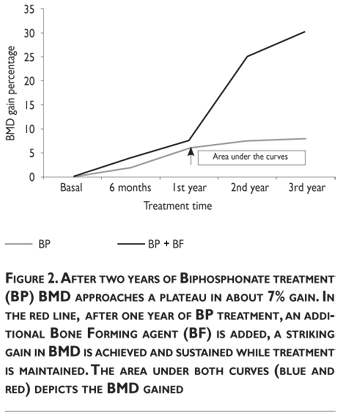
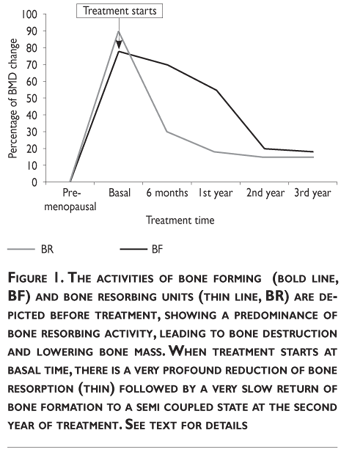
<body><![CDATA[<p><font size="2" face="Verdana"> A) As stated at the beginning of this step,        if there is a high bone turnover rate, bone deterioration takes place when        destruction activity through osteoclasts/osteocytes prevails over bone formation        activity. The left side of <a href="#fig01">figure 1</a> depicts this situation.        The duration of this disequilibrium determines the amount of bone mass lost.        In this situation, administration of an anti&#45;catabolic drug will be very        effective, as shown in the right side of <a href="#fig01">figure 1</a>.        It is very apparent that after a potent anti&#45;destructive drug is administered        in this condition, where both cellular activities are increased, bone destruction        is acutely depressed and this is sustained while the drug is administered        during three years. Notice that bone formation is uncoupled immediately        after the administration of the anti&#45;destructive drug, and slowly returns        almost to the coupled state after the second year of treatment, remaining        above bone destruction, thus favoring bone gain. The increase in BMD will        be equal to the amount of bone tissue lost during the pre&#45;treatment phase        of the disease, in other words to the amount of bone destroyed. Therefore,        administering an anti&#45;destructive drug will be useful while the activity        of bone turnover remains unbalanced, and bone formation prevails; the benefit        will stop when bone formation becomes equal to bone destruction, a fact        that is generally observed after 24 months of effective anti&#45;destructive        therapy with bisphosphonates, potent anti&#45;catabolic agents.</font></p>   </blockquote> </blockquote>     <p><a name="fig01"></a></p>     <p>&nbsp;</p>     <p align="center"><img src="/img/revistas/spm/v51s1/a15fig01.gif"></p>     <p>&nbsp;</p>     <blockquote>        <blockquote>          <p><font size="2" face="Verdana">B,C) There is normal or low bone turnover.        This situation is commonly seen when patients have received anti&#45;destructive        treatments and/or when the patient is approaching old age. These patients        will benefit from a bone forming agent, a drug that will be considered anabolic        for bone tissue (<a href="#fig02">figure 2</a>). These concepts are quite        important in clinical practice because they provide the basis to recapture        the interest raised theoretically 20 years ago in sequential treatment schemes,        adjusted according to the periodical investigation of bone turnover activity.<SUP>55</sup></font></p>   </blockquote> </blockquote>     <p><a name="fig02"></a></p>     <p>&nbsp;</p>     ]]></body>
<body><![CDATA[<p align="center"><img src="/img/revistas/spm/v51s1/a15fig02.gif"></p>     <p>&nbsp;</p>     <blockquote>        <p><font size="2" face="Verdana">3.<I> Depending upon these design criteria</I>:      A) Anti&#45;fall strategies to prevent fractures in the short term, while bone      strength is improved in the long term with drugs, keeping in mind that a minimum      of six months is required with the most potent of them. B)Choose an effective,      scientific based drug regime. C)Define treatment targets and time intervals      at which their results will be evaluated. At these subsequent time points,      decide whether to continue or to change therapy options based on treatment      efficacy.</font></p>       <blockquote>          <p><font size="2" face="Verdana"> A) Design anti&#45;fall strategies to prevent        fractures in the short term, while bone strength is being improved. Before        treatment is started, the integrity of residual bone mass is affected throughout        the skeleton; improving bone quality and strength will take at least six        months to be protective against new fractures.<SUP>56</SUP> Thus, it is        very important to perform a careful evaluation of the patient's musculoskeletal        stability and design a program to prevent falls, the most common cause of        fragility fractures in the elderly.<SUP>57</sup></font></p>         <p><font size="2" face="Verdana">B) Choose an effective drug regimen. Drugs        available to treat osteoporosis fall into the following categories:<SUP>42&#45;44</SUP>        1) Anti&#45;catabolic: drugs that decrease bone destruction by restoring all        hyperactive bone reabsorbing cells to their normal state (Osteoclasts and/or        osteocytes), independently of the intrinsic mechanism of drug action. 2)        Anabolic: drugs that augment the bone forming activity through the osteoblast        related cell lineage. 3) Mixed or dual action: agents that have both effects.<SUP>42&#45;44</SUP>        Regardless of the kind of drug treatment used to restore deteriorated bone        to health, there is general agreement on the need of Vitamin D3 and dietary        mineral supplementation in order to guarantee normal mineralization of already        existing osteoid seams or of newly formed bone tissue.<SUP>46&#45;52</SUP> Maturation        of normal hydroxyapatite salts and/or other apatites upon the osteoid seams        with equivalent biomechanical properties is needed to restore the functional        integrity of the bone's micro.<SUP>50,51</SUP> A related key concern is        to demonstrate the kind of bone tissue acquired after treatment with the        different drugs available in clinical use in.<SUP>38&#45;41,54</sup></font></p>         <p><font size="2" face="Verdana">C) Define the treatment targets and the time        intervals at which their results will be evaluated. At these subsequent        time points, decide to continue or to change therapy options based on treatment        efficacy. Considering that restoration of the remnant bone reserve will        take at least one year, a fracture that occurs during the first year of        follow up does not represent treatment failure. Time intervals as well as        biochemical markers of bone turnover and determination of changes in BUA        or SOS attenuation, microanalytical MRI, peripheral PCT or BMD should be        designed according to the individual conditions and/or to follow, if available,        an internationally accepted clinical guideline.</font></p>   </blockquote>   </blockquote>       <p>&nbsp;</p>          <p> <font size="3" face="verdana"><b>Drug interventions available in Mexico</b></font></p>      ]]></body>
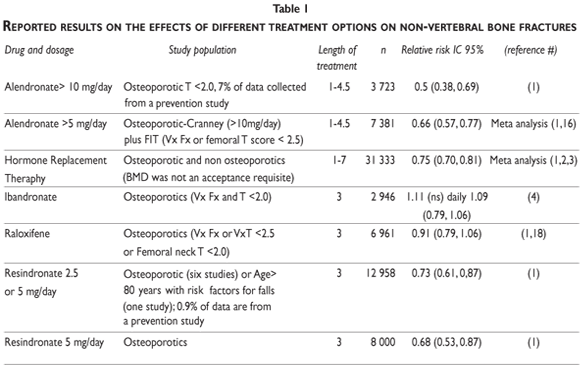
<body><![CDATA[<p><font size="2" face="Verdana">We will now address some practical issues associated    with the drugs that are proven to be effective against fracture and are available    in Mexico.</font></p>     <blockquote>        <p><font size="2" face="Verdana">1. Drugs acting predominantly as anti&#45;catabolic      or anti&#45;destructive agents: These are represented in the Mexican scenario      by a) Estrogens, b) Selective Estrogen receptor modulators and c) Bisphosphonates.      We will briefly review the highlights of each agent.</font></p>       <blockquote>          <p><font size="2" face="Verdana"> a) Estrogens: The anti&#45;fracture efficacy        of estrogens alone or combined in different regimes of hormone replacement        therapy (HRT) is demonstrated but controversial. While their effect in the        normalization of bone remodeling as well as in BMD is well demonstrated,        it is lost as soon as from the first month after discontinuation. At that        time, the activity of bone turnover increases with a predominance of the        destruction of bone by the osteoclasts and osteocytes. Resembling the active        phase of post menopausal bone loss similar to that illustrated in <a href="#fig01">figure        1</a>, and undoes the protective effects of the HRT.<SUP>58</sup></font></p>         <p><font size="2" face="Verdana">b) Selective Estrogen Receptor Modulators:        The role of SERMS is also well documented: they normalize and stabilize        bone turnover in the early postmenopausal period. Raloxifene is the only        SERM available in Mexico, and its anti&#45;fracture efficacy makes it an excellent        option both in the early postmenopausal period as well as in elderly women.        However, as in the case of HRT, the protective effect of SERMS on bone mass        is lost as soon as one month after discontinuation of treatment.<SUP>59,60</sup></font></p>         <p><font size="2" face="Verdana">c) Bisphosphonates: The anti&#45;fracture efficacy        of bisphosphonates is well documented at vertebral and most non&#45;vertebral        skeletal sites; its effects against proximal femur fractures are the best        studied.<SUP>61, 62 </SUP>There are several bisphosphonates of different        potencies available, designed to improve tolerance and long term adherence.<SUP>63&#45;73</SUP>        These drugs evolved from daily treatments to drugs administered weekly,        monthly or every six to twelve months. One such drug, alendronate, incorporates        25 OH Vitamin D3, assuring that the patient receives his/her weekly recommended        amount of this steroid, which is important for promoting a positive mineral        balance and improving bone matrix mineralization. This is the only bisphosphonate        that has been shown to have a permanent protective anti&#45;fracture effect        after discontinuation following a two year period of administration.<SUP>63,74</SUP>        Almost all of the bisphosphonate preparations available today are effective        in reducing fracture risk by 14 to 50% after six months of continuous treatment,        and provide more than 60% protection against fractures if treatment is successfully        followed for more than 18 months.<SUP>61&#45;63</SUP> These results occur irrespective        of the administration scheme, be it orally at daily, weekly or monthly intervals        or intravenously every six months or once a year.</font></p>   </blockquote> </blockquote>     <p><font size="2" face="Verdana"> <a href="#tab01">Table I</a> provides a summary    of the anti&#45;fracture efficacy of anti&#45;destructive agents. Caution must be taken    after the second year of administration of such a regime in order to avoid fatigue    damage; after four months of administration, the biochemical markers of bone    turnover should be examined.<SUP>54 </sup></font></p>     <p><a name="tab01"></a></p>     <p>&nbsp;</p>     ]]></body>
<body><![CDATA[<p align="center"><img src="/img/revistas/spm/v51s1/a15tab01.gif"></p>     <p>&nbsp;</p>     <p><font size="2" face="Verdana">From a public health perspective, compliance    represents a problem for treatment using bisphosphonates. The least favorable    effect that would justify an investment in population&#45;level treatment with biphosphonates    would be to decrease the fracture incidence by a minimum of 40% in each individual.    The available evidence demonstrates that an effective six&#45;month period is the    minimum timeframe needed to attain such an effect. Therefore, those regimes    that facilitate compliance for six months or more, such as injections or monthly    dosages, may be superior to daily or weekly orally administered options.<SUP>21,22</sup></font></p>     <p><font size="2" face="Verdana"> Finally, considering that the fracture risk    is so high in the population selected by FRAX, the number of cases that need    treatment to prevent a fracture is cost effective, making this treatment a very    good choice. Studies have found that 40 to 60 patients need to be treated to    prevent one vertebral or proximal femur fracture. This is a highly efficient    cost/benefit ratio if one considers that direct cost of a single proximal femoral    fracture is in the range of 37 000 Mexican pesos, while the most expensive anti&#45;catabolic    treatment available costs a mean 12 000 Mexican pesos per year (2006 USD dollar    parity).<SUP>75</SUP> </font></p>     <blockquote>        <p><font size="2" face="Verdana">2. Drugs acting as anabolic, bone forming or      dual action agents: Parathyroid hormone has long been used as a therapeutic      agent against osteoporosis based on the classic experimental demonstration      in humans that a daily low dose pulse of PTH, by daily morning administration      of one gram neutral phosphate, increases bone mass if it is followed in a      sequential scheme by the administration of Calcitonin.<SUP>76&#45;78</SUP> These      studies were the first clinical evidence demonstrating anabolic effects with      this low dose polypeptide induction. They were published two decades ago,      before the development of the new generation of synthetic PTH analogues like      teriparatide, which has proven anti&#45;fracture efficacy sooner than the most      potent anti&#45;catabolic compounds; the anti&#45;fracture effect of the former is      also evident when administered in combination therapeutic regimes.<SUP>78,79</SUP>      Daily, low dose PTH administration or carefully controlled induction is a      gold standard anti&#45;fracture compound nowadays.</font></p> </blockquote>     <p><font size="2" face="Verdana"> Dual&#45;acting drugs like strontium ranelate are    raising hopes for the efficacy of single drug or combination regimes that will    render better long term results improving the bone quality and strength achieved,<SUP>80&#45;83</SUP>    they are available in Mexico, are well tolerated and considering their cost,    do represent a very good option. </font></p>     <p><font size="2" face="Verdana"> The quality of bone tissue formed by these anabolic    compounds is normal. Therefore, they do represent a great option to start treatment    in low or normal bone remodeling patients or in those treated with an anti&#45;catabolic    drug once bone remodeling activity reaches equilibrium, avoiding the inconvenience    of fatigue damage.</font></p>     <p><font size="2" face="Verdana"> Patient compliance is the single most important    factor to be considered when choosing between these two, daily administered    medications. Teriparatide must be refrigerated and injected subdermally daily,    factors that hamper compliance and raise the long&#45;term cost of the treatment.    While strontium ranelate does not have these drawbacks, it must be dissolved    in liquid and taken on an empty stomach one or two hours before meals, factors    that adversely influence compliance with this drug regimen.</font></p>     <blockquote>        ]]></body>
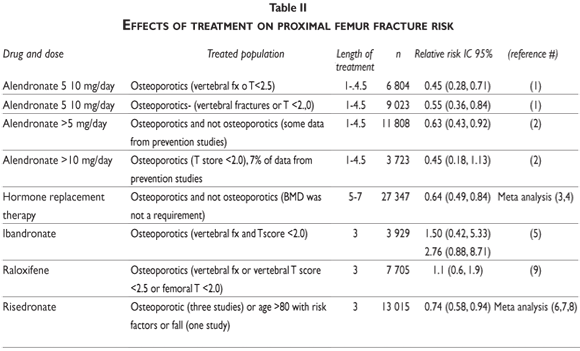
<body><![CDATA[<p><font size="2" face="Verdana">3. Combination therapies: On a long&#45;term basis,      optimal anti&#45;fracture effects can be obtained by prescribing a carefully orchestrated      sequence of anti&#45;catabolic and bone forming agents.<SUP>77,79</sup></font></p>       <p><font size="2" face="Verdana">4. The Pandemic of 25 OH Vitamin D3 deficiency,      insufficiency or inefficiency: Quite recently, several groups have called      attention to an old and very well known requisite for bone mineralization,      the availability of enough Vitamin D3 and its active metabolites to guarantee      positive mineral body balance and adequate bone mineralization.<SUP>42&#45;52</sup></font></p> </blockquote>     <p><font size="2" face="Verdana"> It has been demonstrated that although they    may have normal reference values for Vitamin D3, most osteoporotic patients,    and more significantly those who suffer a fragility fracture, have levels of    25 OH Vitamin D3 (calcidiol) insufficient to sustain normal parathyroid function.<SUP>52,74</sup></font></p>     <p><font size="2" face="Verdana"> Therefore it is now recommended to measure patients'    25 OH Vitamin D3 serum levels in combination with total and /or ionized serum    calcium and intact PTH concentration, in order to improve bone quality and strength    if low or inefficient Vitamin D3 and high intact PTH serum levels are present.<SUP>52</SUP>    In <a href="#tab02">table II</a> we analyze some data from the literature regarding    the anti&#45;fracture efficacy in proximal femur fracture of the drugs available    in Mexico.</font></p>     <p><a name="tab02"></a></p>     <p>&nbsp;</p>     <p align="center"><img src="/img/revistas/spm/v51s1/a15tab02.gif"></p>     <p>&nbsp;</p>     <p><font size="2" face="Verdana">It is convenient to briefly analyze fatigue damage    of bone induced by bisphosphonates and its prevention: During the last decade,    the generalized use of different bisphosphonates on a long&#45;term basis has raised    the possibility of inducing fatigue damage in bone secondary to decreased or    blunted normal bone remodeling. Most anti&#45;catabolic agents of the kind literally    stop bone destruction, regardless of whether it was involved in a normal BMU    remodeling or in a pathological one. Scientific evidence suggests that stopping    the removal of old, damaged bone by normal physical activity (micro trauma)    with bisphosphonates impede the renewal of these bone sections; the bone thus    becomes old and will develop structural damage (fatigue) over time. This situation    leads to structural inefficacy and paradoxically increases fracture risk, beginning    after five years of normal osteoclastic, osteocytic activity blockade in normal    BMUs.<SUP>38&#45;44,54</SUP> In order to counteract this situation one must consider    avoiding administration of anti&#45;catabolic drugs without the evidence of high    bone turnover activity or if there is no routine access to these determinations,    never administer a bisphosphonate for more than three years without confirmation    of bone remodeling activity, which is always feasible throughout Mexico.</font></p>     <p><font size="2" face="Verdana"> New drug development: Physiologically oriented    anti&#45;catabolic agents, like demosunab, that target the OPG&#45;RANK&#45;L complex, and    inhibitors of the different cathepsins that regulate the coupling between bone    resorptive and bone forming cells, are currently in phase III clinical trials.    Bone formed under these more physiologically acting therapies is expected to    be of normal quality and strength.<SUP>85&#45;87</sup></font></p>     ]]></body>
<body><![CDATA[<p>&nbsp;</p>     <p><font size="3" face="verdana"><b>Conclusions</b></font></p>     <p><font size="2" face="Verdana">Mexico, like most countries worldwide, faces    an extraordinary opportunity to fight fragility fractures in the population    at high risk for suffering a fragility fracture in the next 10 years. It is    feasible because Mexico has access to FRAX, and although there is no Mexican    data base available, the Hispanic data base can be used while the Mexican one    is validated. There are facilities to determine BMD in the lumbar spine and    proximal femur in almost all major cities of the country and the number of peripheral    equipment for BMD screening is growing. Moreover, the drugs proven to be useful    as anti&#45;fracture agents are available and there is growing awareness among the    population that this is a preventable complication with better quality of life    expectancy. </font></p>     <p><font size="2" face="Verdana"> This is an opportune moment to positively impact    our health system with an effective case finding strategy undertaken in high    risk populations, coupled with an early intervention clinical guideline strategy    based on the best available scientific evidence, to lower the global burden    of osteoporosis and metabolic bone disease. It is expected that such an intervention    would both lower the incidence of fragility bone fractures and decrease the    number of osteoporotic patients in the coming decades.<SUP>3&#45;5</SUP> </font></p>     <p>&nbsp;</p>     <p><font size="3" face="verdana"><b>References</b></font></p>     <!-- ref --><p><font size="2" face="Verdana">1. World Health Organization. Assessment of fracture    risk and its application to screening for postmenopausal osteoporosis. Report    of a WHO study group. WHO Technical Report Series. 1994;No 843.</font>&nbsp;&nbsp;&nbsp;&nbsp;&nbsp;&nbsp;&nbsp;&nbsp;[&#160;<a href="javascript:void(0);" onclick="javascript: window.open('/scielo.php?script=sci_nlinks&ref=9324981&pid=S0036-3634200900070001500001&lng=','','width=640,height=500,resizable=yes,scrollbars=1,menubar=yes,');">Links</a>&#160;]<!-- end-ref --><!-- ref --><p><font size="2" face="Verdana">2. Johnell O, Kanis JA. An estimate of the worldwide    prevalence and disability associated with osteoporotic fractures. Osteoporos    Int 2006; 17(12):1726&#45;1733.</font>&nbsp;&nbsp;&nbsp;&nbsp;&nbsp;&nbsp;&nbsp;&nbsp;[&#160;<a href="javascript:void(0);" onclick="javascript: window.open('/scielo.php?script=sci_nlinks&ref=9324982&pid=S0036-3634200900070001500002&lng=','','width=640,height=500,resizable=yes,scrollbars=1,menubar=yes,');">Links</a>&#160;]<!-- end-ref --><!-- ref --><p><font size="2" face="Verdana">3. Clark P, Lavielle Pilar, Franco&#45;Marina F,Ramirez    E, Salmer&oacute;n J, Kanis JA, <I>et al</I>. Incidente rates and life&#45;time    risk of hip fractures in Mexicans over 50 years of age: a population&#45;based study.    Osteoporosis Int 2005; 16: 2025&#45;2030.</font>&nbsp;&nbsp;&nbsp;&nbsp;&nbsp;&nbsp;&nbsp;&nbsp;[&#160;<a href="javascript:void(0);" onclick="javascript: window.open('/scielo.php?script=sci_nlinks&ref=9324983&pid=S0036-3634200900070001500003&lng=','','width=640,height=500,resizable=yes,scrollbars=1,menubar=yes,');">Links</a>&#160;]<!-- end-ref --><!-- ref --><p><font size="2" face="Verdana">4. Clark P, Cons&#45;Molina F, Deleze M, Ragi S,    Haddock L, Zanchetta JR, <I>et al</I>. The prevalence of radiographic vertebral    fractures in Latin American countries: the Latin American Vertebral Osteoporosis    Study (LAVOS). Osteoporos Int 2008;19(3):269&#45;276.</font>&nbsp;&nbsp;&nbsp;&nbsp;&nbsp;&nbsp;&nbsp;&nbsp;[&#160;<a href="javascript:void(0);" onclick="javascript: window.open('/scielo.php?script=sci_nlinks&ref=9324984&pid=S0036-3634200900070001500004&lng=','','width=640,height=500,resizable=yes,scrollbars=1,menubar=yes,');">Links</a>&#160;]<!-- end-ref --><!-- ref --><p><font size="2" face="Verdana">5. Morales&#45;Torres J, Guti&eacute;rrez&#45;Ure&ntilde;a    S, <I>et al.</I> The burden of osteoporosis in Latin America. Osteoporos Int.    2004;15:625&#45;632.</font>&nbsp;&nbsp;&nbsp;&nbsp;&nbsp;&nbsp;&nbsp;&nbsp;[&#160;<a href="javascript:void(0);" onclick="javascript: window.open('/scielo.php?script=sci_nlinks&ref=9324985&pid=S0036-3634200900070001500005&lng=','','width=640,height=500,resizable=yes,scrollbars=1,menubar=yes,');">Links</a>&#160;]<!-- end-ref --><!-- ref --><p><font size="2" face="Verdana">6. Cummings SR, Melton LJ. Epidemiology and outcomes    of osteoporotic fractures. Lancet 2002; 359: 1761&#45;1767.</font>&nbsp;&nbsp;&nbsp;&nbsp;&nbsp;&nbsp;&nbsp;&nbsp;[&#160;<a href="javascript:void(0);" onclick="javascript: window.open('/scielo.php?script=sci_nlinks&ref=9324986&pid=S0036-3634200900070001500006&lng=','','width=640,height=500,resizable=yes,scrollbars=1,menubar=yes,');">Links</a>&#160;]<!-- end-ref --><!-- ref --><p><font size="2" face="Verdana">7. Kanis JA, Johnell O, Oden A, Dawson A, De    Laet C, Jonsson B. Ten year probabilities of osteoporotic fractures according    to BMD and diagnostic thresholds. Osteoporos Int 2001; 12(12):989&#45;995.</font>&nbsp;&nbsp;&nbsp;&nbsp;&nbsp;&nbsp;&nbsp;&nbsp;[&#160;<a href="javascript:void(0);" onclick="javascript: window.open('/scielo.php?script=sci_nlinks&ref=9324987&pid=S0036-3634200900070001500007&lng=','','width=640,height=500,resizable=yes,scrollbars=1,menubar=yes,');">Links</a>&#160;]<!-- end-ref --><!-- ref --><p><font size="2" face="Verdana">8. Cooper C, Campion G, Melton LJ. Hip fractures    in the elderly: a world&#45;wide projection. Osteoporos Int 1992; 2(6):285&#45;289.    </font>&nbsp;&nbsp;&nbsp;&nbsp;&nbsp;&nbsp;&nbsp;&nbsp;[&#160;<a href="javascript:void(0);" onclick="javascript: window.open('/scielo.php?script=sci_nlinks&ref=9324988&pid=S0036-3634200900070001500008&lng=','','width=640,height=500,resizable=yes,scrollbars=1,menubar=yes,');">Links</a>&#160;]<!-- end-ref --><!-- ref --><p><font size="2" face="Verdana">9. Kannus P, Niemi S, Parkkari J, Palvanen M,    Vuori I, Jarvinen M. Nationwide decline in incidence of hip fracture. J Bone    Miner Res 2006; 21(12):1836&#45;1838.</font>&nbsp;&nbsp;&nbsp;&nbsp;&nbsp;&nbsp;&nbsp;&nbsp;[&#160;<a href="javascript:void(0);" onclick="javascript: window.open('/scielo.php?script=sci_nlinks&ref=9324989&pid=S0036-3634200900070001500009&lng=','','width=640,height=500,resizable=yes,scrollbars=1,menubar=yes,');">Links</a>&#160;]<!-- end-ref --><!-- ref --><p><font size="2" face="Verdana">10. Jaglal SB, Weller I, Mamdani M, Hawker G,    Kreder H, Jaakkimainen L, <I>et al</I>. Population trends in BMD testing, treatment,    and hip and wrist fracture rates: are the hip fracture projections wrong? J    Bone Miner Res 2005; 20(6):898&#45;905.</font>&nbsp;&nbsp;&nbsp;&nbsp;&nbsp;&nbsp;&nbsp;&nbsp;[&#160;<a href="javascript:void(0);" onclick="javascript: window.open('/scielo.php?script=sci_nlinks&ref=9324990&pid=S0036-3634200900070001500010&lng=','','width=640,height=500,resizable=yes,scrollbars=1,menubar=yes,');">Links</a>&#160;]<!-- end-ref --><!-- ref --><p><font size="2" face="Verdana">11. KM, Nicholson GC, Watts JJ, Pasco JA, Henry    MJ, Kotowicz MA, Seeman E. Half the burden of fragility fractures in the community    occur in women without osteoporosis. When is fracture prevention cost&#45;effective?    Bone 2006;38(5):694&#45;700 </font>&nbsp;&nbsp;&nbsp;&nbsp;&nbsp;&nbsp;&nbsp;&nbsp;[&#160;<a href="javascript:void(0);" onclick="javascript: window.open('/scielo.php?script=sci_nlinks&ref=9324991&pid=S0036-3634200900070001500011&lng=','','width=640,height=500,resizable=yes,scrollbars=1,menubar=yes,');">Links</a>&#160;]<!-- end-ref --><!-- ref --><p><font size="2" face="Verdana">12. Siris E, Chen Y&#45;T, Abbott T, <I>et al</I>.    Bone mineral density thresholds for pharmacological intervention to prevent    fractures. Arch Intern Med 2004; 164: 1108&#45;1112.</font>&nbsp;&nbsp;&nbsp;&nbsp;&nbsp;&nbsp;&nbsp;&nbsp;[&#160;<a href="javascript:void(0);" onclick="javascript: window.open('/scielo.php?script=sci_nlinks&ref=9324992&pid=S0036-3634200900070001500012&lng=','','width=640,height=500,resizable=yes,scrollbars=1,menubar=yes,');">Links</a>&#160;]<!-- end-ref --><!-- ref --><p><font size="2" face="Verdana">13. Bonjour JP, Theintz G, Law F, Slosman D,    Rizzoli R. Peak bone mass. Osteoporos Int 1994;4 Suppl 1:7&#45;13.</font>&nbsp;&nbsp;&nbsp;&nbsp;&nbsp;&nbsp;&nbsp;&nbsp;[&#160;<a href="javascript:void(0);" onclick="javascript: window.open('/scielo.php?script=sci_nlinks&ref=9324993&pid=S0036-3634200900070001500013&lng=','','width=640,height=500,resizable=yes,scrollbars=1,menubar=yes,');">Links</a>&#160;]<!-- end-ref --><!-- ref --><p><font size="2" face="Verdana">14. Bonjour JP, Chevalley T. Pubertal timing,    peak bone mass and fragility fracture risk. BoneKey&#45;Osteovision. 2007; 4:30&#45;48.    Available in: <a href="http://www.bonekey&#45;ibms.org/cgi/content/full/ibmske;4/2/30" target="_blank">http://www.bonekey&#45;ibms.org/cgi/content/full/ibmske;4/2/30</a>.</font>&nbsp;&nbsp;&nbsp;&nbsp;&nbsp;&nbsp;&nbsp;&nbsp;[&#160;<a href="javascript:void(0);" onclick="javascript: window.open('/scielo.php?script=sci_nlinks&ref=9324994&pid=S0036-3634200900070001500014&lng=','','width=640,height=500,resizable=yes,scrollbars=1,menubar=yes,');">Links</a>&#160;]<!-- end-ref --><!-- ref --><p><font size="2" face="Verdana">15. Gilsanz V, Gibbens DT, Carlson M, Boechat    MI, Cann CE, Schulz EE. Peak trabecular vertebral density: a comparison of adolescent    and adult females. Calcified tissue international 1988; 43(4):260&#45;262.</font>&nbsp;&nbsp;&nbsp;&nbsp;&nbsp;&nbsp;&nbsp;&nbsp;[&#160;<a href="javascript:void(0);" onclick="javascript: window.open('/scielo.php?script=sci_nlinks&ref=9324995&pid=S0036-3634200900070001500015&lng=','','width=640,height=500,resizable=yes,scrollbars=1,menubar=yes,');">Links</a>&#160;]<!-- end-ref --><!-- ref --><p><font size="2" face="Verdana">16. Davis JW, Grove JS, Ross PD, Vogel JM, Wasnich    RD. Relationship between bone mass and rates of bone change at appendicular    measurement sites. J Bone Miner Res 1992; 7(7):719&#45;725.</font>&nbsp;&nbsp;&nbsp;&nbsp;&nbsp;&nbsp;&nbsp;&nbsp;[&#160;<a href="javascript:void(0);" onclick="javascript: window.open('/scielo.php?script=sci_nlinks&ref=9324996&pid=S0036-3634200900070001500016&lng=','','width=640,height=500,resizable=yes,scrollbars=1,menubar=yes,');">Links</a>&#160;]<!-- end-ref --><!-- ref --><p><font size="2" face="Verdana">17. Buchs B, Rizzoli R, Slosman D, Nydegger V,    Bonjour JP. Densit&eacute; min&eacute;rale osseuse de la colonne lombaire, du    col et de la diaphyse f&eacute;moraux d'un &eacute;chantillon de la population    genevoise. Schweiz Med Wochenschr 1992; 122(30):1129&#45;1136.</font>&nbsp;&nbsp;&nbsp;&nbsp;&nbsp;&nbsp;&nbsp;&nbsp;[&#160;<a href="javascript:void(0);" onclick="javascript: window.open('/scielo.php?script=sci_nlinks&ref=9324997&pid=S0036-3634200900070001500017&lng=','','width=640,height=500,resizable=yes,scrollbars=1,menubar=yes,');">Links</a>&#160;]<!-- end-ref --><!-- ref --><p><font size="2" face="Verdana">18. Melton LJ, Atkinson EJ, Khosla S, Oberg AL,    Riggs BL. Evaluation of a prediction model for long&#45;term fracture risk. J Bone    Miner Res 2005; 20(4):551&#45;556.</font>&nbsp;&nbsp;&nbsp;&nbsp;&nbsp;&nbsp;&nbsp;&nbsp;[&#160;<a href="javascript:void(0);" onclick="javascript: window.open('/scielo.php?script=sci_nlinks&ref=9324998&pid=S0036-3634200900070001500018&lng=','','width=640,height=500,resizable=yes,scrollbars=1,menubar=yes,');">Links</a>&#160;]<!-- end-ref --><!-- ref --><p><font size="2" face="Verdana">19. Hernandez CJ, Beaupre GS, Carter DR. A theoretical    analysis of the relative influences of peak BMD, age&#45;related bone loss and menopause    on the development of osteoporosis. Osteoporos Int 2003; 14(10):843&#45;847.</font>&nbsp;&nbsp;&nbsp;&nbsp;&nbsp;&nbsp;&nbsp;&nbsp;[&#160;<a href="javascript:void(0);" onclick="javascript: window.open('/scielo.php?script=sci_nlinks&ref=9324999&pid=S0036-3634200900070001500019&lng=','','width=640,height=500,resizable=yes,scrollbars=1,menubar=yes,');">Links</a>&#160;]<!-- end-ref --><!-- ref --><p><font size="2" face="Verdana">20. Black DM, Thompson DE, Bauer DC <I>et al</I>.    Fracture risk reduction with alendronate in women with osteoporosis: the fracture    intervention trial. J Clin Endocrinol Metab 2000;85: 4118&#45;4124.</font>&nbsp;&nbsp;&nbsp;&nbsp;&nbsp;&nbsp;&nbsp;&nbsp;[&#160;<a href="javascript:void(0);" onclick="javascript: window.open('/scielo.php?script=sci_nlinks&ref=9325000&pid=S0036-3634200900070001500020&lng=','','width=640,height=500,resizable=yes,scrollbars=1,menubar=yes,');">Links</a>&#160;]<!-- end-ref --><!-- ref --><p><font size="2" face="Verdana">21. Weycker D, Macarios D, Edelsberg J, Oster    G, <I>et al</I>. Compliance with drug therapy for postmenopausal osteoporosis,    Osteoporos Int 2006; 17:1645&#45;1652</font>&nbsp;&nbsp;&nbsp;&nbsp;&nbsp;&nbsp;&nbsp;&nbsp;[&#160;<a href="javascript:void(0);" onclick="javascript: window.open('/scielo.php?script=sci_nlinks&ref=9325001&pid=S0036-3634200900070001500021&lng=','','width=640,height=500,resizable=yes,scrollbars=1,menubar=yes,');">Links</a>&#160;]<!-- end-ref --><!-- ref --><p><font size="2" face="Verdana">22. Weycker D, Macarios D, Edelsberg J, Oster    G, <I>et al</I>. Compliance with osteoporosis drug therapy and risk of fracture.    Osteoporos Int 2007; 18:271&#45;277.</font>&nbsp;&nbsp;&nbsp;&nbsp;&nbsp;&nbsp;&nbsp;&nbsp;[&#160;<a href="javascript:void(0);" onclick="javascript: window.open('/scielo.php?script=sci_nlinks&ref=9325002&pid=S0036-3634200900070001500022&lng=','','width=640,height=500,resizable=yes,scrollbars=1,menubar=yes,');">Links</a>&#160;]<!-- end-ref --><!-- ref --><p><font size="2" face="Verdana">23. WHO scientific group on the assesment of    osteoporosis at primary health care level. Geneva: World Health Organization,    2007.</font>&nbsp;&nbsp;&nbsp;&nbsp;&nbsp;&nbsp;&nbsp;&nbsp;[&#160;<a href="javascript:void(0);" onclick="javascript: window.open('/scielo.php?script=sci_nlinks&ref=9325003&pid=S0036-3634200900070001500023&lng=','','width=640,height=500,resizable=yes,scrollbars=1,menubar=yes,');">Links</a>&#160;]<!-- end-ref --><!-- ref --><p><font size="2" face="Verdana">24. Miller PD, Barlas S, Brenneman Sk, <I>et    al</I>. An approach to identifying osteopenic women at increased short&#45;term    risk of fracture. Arch Intern Med 2004; 164: 1113&#45;1120.</font>&nbsp;&nbsp;&nbsp;&nbsp;&nbsp;&nbsp;&nbsp;&nbsp;[&#160;<a href="javascript:void(0);" onclick="javascript: window.open('/scielo.php?script=sci_nlinks&ref=9325004&pid=S0036-3634200900070001500024&lng=','','width=640,height=500,resizable=yes,scrollbars=1,menubar=yes,');">Links</a>&#160;]<!-- end-ref --><!-- ref --><p><font size="2" face="Verdana">25. Klibanski A. NIH Consensus Development Panel    on Osteoporosis Prevention, Diagnosis, and Therapy. JAMA 2001; (6): 785&#45;795    </font>&nbsp;&nbsp;&nbsp;&nbsp;&nbsp;&nbsp;&nbsp;&nbsp;[&#160;<a href="javascript:void(0);" onclick="javascript: window.open('/scielo.php?script=sci_nlinks&ref=9325005&pid=S0036-3634200900070001500025&lng=','','width=640,height=500,resizable=yes,scrollbars=1,menubar=yes,');">Links</a>&#160;]<!-- end-ref --><!-- ref --><p><font size="2" face="Verdana">26. Caderette SM, Jaglal SB, Murray T, <I>et    al</I>. Evaluation of decision rules for referring women for bone densitometry    by dual&#45;energy x&#45;ray absorptiometry. JAMA 2001; 286(1): 57&#45;63.</font>&nbsp;&nbsp;&nbsp;&nbsp;&nbsp;&nbsp;&nbsp;&nbsp;[&#160;<a href="javascript:void(0);" onclick="javascript: window.open('/scielo.php?script=sci_nlinks&ref=9325006&pid=S0036-3634200900070001500026&lng=','','width=640,height=500,resizable=yes,scrollbars=1,menubar=yes,');">Links</a>&#160;]<!-- end-ref --><!-- ref --><p><font size="2" face="Verdana">27. Schousboe JT, Bauer DC, Nyman JA, Kane RL,    Melton LJ, Ensrud KE. Potential for bone turnover markers to cost&#45;effectively    identify and select post&#45;menopausal osteopenic women at high risk of fracture    for bisphosphonate therapy. Osteoporos Int 2007;18:201&#150;210</font>&nbsp;&nbsp;&nbsp;&nbsp;&nbsp;&nbsp;&nbsp;&nbsp;[&#160;<a href="javascript:void(0);" onclick="javascript: window.open('/scielo.php?script=sci_nlinks&ref=9325007&pid=S0036-3634200900070001500027&lng=','','width=640,height=500,resizable=yes,scrollbars=1,menubar=yes,');">Links</a>&#160;]<!-- end-ref --><!-- ref --><p><font size="2" face="Verdana">28. Blake GM, Fogelman I. Role of Dual&#45;Energy    X&#45;Ray Absorptiometry in the Diagnosis and Treatment of Osteoporosis. Journal    of Clinical Densitometry 2007;(10)1:102&#45;110.</font>&nbsp;&nbsp;&nbsp;&nbsp;&nbsp;&nbsp;&nbsp;&nbsp;[&#160;<a href="javascript:void(0);" onclick="javascript: window.open('/scielo.php?script=sci_nlinks&ref=9325008&pid=S0036-3634200900070001500028&lng=','','width=640,height=500,resizable=yes,scrollbars=1,menubar=yes,');">Links</a>&#160;]<!-- end-ref --><!-- ref --><p><font size="2" face="Verdana">29. Arlot. Trabecular and Endocortical Bone Remodeling    in Postmenopausal Osteoporosis: Comparison with Normal Postmenopausal Women.    Osteoporosis Int 1990;1:41&#45;49. </font>&nbsp;&nbsp;&nbsp;&nbsp;&nbsp;&nbsp;&nbsp;&nbsp;[&#160;<a href="javascript:void(0);" onclick="javascript: window.open('/scielo.php?script=sci_nlinks&ref=9325009&pid=S0036-3634200900070001500029&lng=','','width=640,height=500,resizable=yes,scrollbars=1,menubar=yes,');">Links</a>&#160;]<!-- end-ref --><!-- ref --><p><font size="2" face="Verdana">30. Meunier PJ, Boivin G. Bone mineral density    reflects bone mass but also the degree of mineralisation of bone: therapeutic    implications. Bone 1997;21:373&#45;377</font>&nbsp;&nbsp;&nbsp;&nbsp;&nbsp;&nbsp;&nbsp;&nbsp;[&#160;<a href="javascript:void(0);" onclick="javascript: window.open('/scielo.php?script=sci_nlinks&ref=9325010&pid=S0036-3634200900070001500030&lng=','','width=640,height=500,resizable=yes,scrollbars=1,menubar=yes,');">Links</a>&#160;]<!-- end-ref --><!-- ref --><p><font size="2" face="Verdana">31. Boivin G, Meunier PJ. The degree of mineralization    of bone tissue measured by computerized quantitative contact microradiography.    Calcif. Tissue Int 2002;70:503&#45;511.</font>&nbsp;&nbsp;&nbsp;&nbsp;&nbsp;&nbsp;&nbsp;&nbsp;[&#160;<a href="javascript:void(0);" onclick="javascript: window.open('/scielo.php?script=sci_nlinks&ref=9325011&pid=S0036-3634200900070001500031&lng=','','width=640,height=500,resizable=yes,scrollbars=1,menubar=yes,');">Links</a>&#160;]<!-- end-ref --><!-- ref --><p><font size="2" face="Verdana">32. Cameron JR, Sorenson JA. Measurement of Bone    Mineral in vivo: An improved method. Science 1963;142:230&#45;232.</font>&nbsp;&nbsp;&nbsp;&nbsp;&nbsp;&nbsp;&nbsp;&nbsp;[&#160;<a href="javascript:void(0);" onclick="javascript: window.open('/scielo.php?script=sci_nlinks&ref=9325012&pid=S0036-3634200900070001500032&lng=','','width=640,height=500,resizable=yes,scrollbars=1,menubar=yes,');">Links</a>&#160;]<!-- end-ref --><!-- ref --><p><font size="2" face="Verdana">33. Mazzes RB, Peppler WW, Chestnut ChD. Total    body bone mineral and lean body mass by dual photon absorptiometry II. Comparison    with total body calcium by neutron activation analysis. Calcif Tissue Int 1982;    3:361&#45;363.</font>&nbsp;&nbsp;&nbsp;&nbsp;&nbsp;&nbsp;&nbsp;&nbsp;[&#160;<a href="javascript:void(0);" onclick="javascript: window.open('/scielo.php?script=sci_nlinks&ref=9325013&pid=S0036-3634200900070001500033&lng=','','width=640,height=500,resizable=yes,scrollbars=1,menubar=yes,');">Links</a>&#160;]<!-- end-ref --><!-- ref --><p><font size="2" face="Verdana">34. Whaner HW, Dunn WL, Brown MC. Comparison    of dual energy X ray absorptiometry and photon absorptiometry for bone mineral    measurement of lumbar spine. Mayo Clin Proc 1988; 63:1075&#45;1084.</font>&nbsp;&nbsp;&nbsp;&nbsp;&nbsp;&nbsp;&nbsp;&nbsp;[&#160;<a href="javascript:void(0);" onclick="javascript: window.open('/scielo.php?script=sci_nlinks&ref=9325014&pid=S0036-3634200900070001500034&lng=','','width=640,height=500,resizable=yes,scrollbars=1,menubar=yes,');">Links</a>&#160;]<!-- end-ref --><!-- ref --><p><font size="2" face="Verdana">35. Lindsay R, Cosman F, Zhou H, Bostrom MP,    Shen VW, Cruz JD, <I>et al.</I> A novel Tetracycline Labelling Schedule for    Longitudinal Evaluation of the Short&#45;Term Effects of Anabolic Therapy With a    Single Iliac Crest Bone Biopsy : Early Actions of Teriparatide. J Bone Miner    Res 2006;21(3):366&#45;373. </font>&nbsp;&nbsp;&nbsp;&nbsp;&nbsp;&nbsp;&nbsp;&nbsp;[&#160;<a href="javascript:void(0);" onclick="javascript: window.open('/scielo.php?script=sci_nlinks&ref=9325015&pid=S0036-3634200900070001500035&lng=','','width=640,height=500,resizable=yes,scrollbars=1,menubar=yes,');">Links</a>&#160;]<!-- end-ref --><!-- ref --><p><font size="2" face="Verdana">36. Odgaard A, Gundersen HJG. Quantification    of connectivity in cancellous bone, with special emphasis on 3&#45;D reconstruction.    Bone 1993;14:173&#45;182.</font>&nbsp;&nbsp;&nbsp;&nbsp;&nbsp;&nbsp;&nbsp;&nbsp;[&#160;<a href="javascript:void(0);" onclick="javascript: window.open('/scielo.php?script=sci_nlinks&ref=9325016&pid=S0036-3634200900070001500036&lng=','','width=640,height=500,resizable=yes,scrollbars=1,menubar=yes,');">Links</a>&#160;]<!-- end-ref --><!-- ref --><p><font size="2" face="Verdana">37. Odgaard A. Three&#45;Dimensional methods for    Quantification of Cancellous Bone Architecture. Bone 1997;20,(4) 315&#45;328.</font>&nbsp;&nbsp;&nbsp;&nbsp;&nbsp;&nbsp;&nbsp;&nbsp;[&#160;<a href="javascript:void(0);" onclick="javascript: window.open('/scielo.php?script=sci_nlinks&ref=9325017&pid=S0036-3634200900070001500037&lng=','','width=640,height=500,resizable=yes,scrollbars=1,menubar=yes,');">Links</a>&#160;]<!-- end-ref --><p><font size="2" face="Verdana">38. Seeman E. Bone quality. Osteoporos Int 2003;14(Suppl    5):S3&#150;S7.</font></p>     <!-- ref --><p><font size="2" face="Verdana">39. Seeman E. Osteocytes&#151;martyrs for integrity    of bone strength. Osteoporos Int 2006; 17:1443&#45;1448.</font>&nbsp;&nbsp;&nbsp;&nbsp;&nbsp;&nbsp;&nbsp;&nbsp;[&#160;<a href="javascript:void(0);" onclick="javascript: window.open('/scielo.php?script=sci_nlinks&ref=9325019&pid=S0036-3634200900070001500039&lng=','','width=640,height=500,resizable=yes,scrollbars=1,menubar=yes,');">Links</a>&#160;]<!-- end-ref --><!-- ref --><p><font size="2" face="Verdana">40. Seeman E. The periosteum&#151;a surface for all    seasons. Osteoporos Int 2007;8:123&#45;128.</font>&nbsp;&nbsp;&nbsp;&nbsp;&nbsp;&nbsp;&nbsp;&nbsp;[&#160;<a href="javascript:void(0);" onclick="javascript: window.open('/scielo.php?script=sci_nlinks&ref=9325020&pid=S0036-3634200900070001500040&lng=','','width=640,height=500,resizable=yes,scrollbars=1,menubar=yes,');">Links</a>&#160;]<!-- end-ref --><!-- ref --><p><font size="2" face="Verdana">41. Jee WSS, Tian XY, Setterberg RB. Cancellous    bone minimodeling&#45;based formation: A Frost, Takahashi Legacy. J Musculoskelet    Neuronal Interact 2007;7(3):232&#45;239.</font>&nbsp;&nbsp;&nbsp;&nbsp;&nbsp;&nbsp;&nbsp;&nbsp;[&#160;<a href="javascript:void(0);" onclick="javascript: window.open('/scielo.php?script=sci_nlinks&ref=9325021&pid=S0036-3634200900070001500041&lng=','','width=640,height=500,resizable=yes,scrollbars=1,menubar=yes,');">Links</a>&#160;]<!-- end-ref --><!-- ref --><p><font size="2" face="Verdana">42. Kristina &Aring;kesson K. New approaches    to pharmacological treatment of osteoporosis.Bull World Health Organ 2003;81:657&#45;664.</font>&nbsp;&nbsp;&nbsp;&nbsp;&nbsp;&nbsp;&nbsp;&nbsp;[&#160;<a href="javascript:void(0);" onclick="javascript: window.open('/scielo.php?script=sci_nlinks&ref=9325022&pid=S0036-3634200900070001500042&lng=','','width=640,height=500,resizable=yes,scrollbars=1,menubar=yes,');">Links</a>&#160;]<!-- end-ref --><!-- ref --><p><font size="2" face="Verdana">43. Riggs BL, Parfitt AM. Perspective; Drugs    Used to Treat Osteoporosis: The Critical Need for a Uniform Nomenclature Based    on Their Action on Bone Remodeling, J Bone Miner Res 2005;20:177&#150;184.</font>&nbsp;&nbsp;&nbsp;&nbsp;&nbsp;&nbsp;&nbsp;&nbsp;[&#160;<a href="javascript:void(0);" onclick="javascript: window.open('/scielo.php?script=sci_nlinks&ref=9325023&pid=S0036-3634200900070001500043&lng=','','width=640,height=500,resizable=yes,scrollbars=1,menubar=yes,');">Links</a>&#160;]<!-- end-ref --><!-- ref --><p><font size="2" face="Verdana">44. Kleerekoper M. Osteoporosis prevention and    therapy: preserving and building strength through bone quality Osteoporos Int    (2006);17:1707&#45;1715.</font>&nbsp;&nbsp;&nbsp;&nbsp;&nbsp;&nbsp;&nbsp;&nbsp;[&#160;<a href="javascript:void(0);" onclick="javascript: window.open('/scielo.php?script=sci_nlinks&ref=9325024&pid=S0036-3634200900070001500044&lng=','','width=640,height=500,resizable=yes,scrollbars=1,menubar=yes,');">Links</a>&#160;]<!-- end-ref --><!-- ref --><p><font size="2" face="Verdana">45. Gillespie LD, Gillespie WJ, Robertson MC,    Lamb SE, Cumming RG, Rowe BH. Interventions for preventing falls in elderly    people. Cochrane Database of Systematic Reviews. Accession Number:00075320&#45;100000000&#45;00635;    4, 2007. </font>&nbsp;&nbsp;&nbsp;&nbsp;&nbsp;&nbsp;&nbsp;&nbsp;[&#160;<a href="javascript:void(0);" onclick="javascript: window.open('/scielo.php?script=sci_nlinks&ref=9325025&pid=S0036-3634200900070001500045&lng=','','width=640,height=500,resizable=yes,scrollbars=1,menubar=yes,');">Links</a>&#160;]<!-- end-ref --><!-- ref --><p><font size="2" face="Verdana">46. Jackson RD, LaCroix A, Gass M, Wallace RB,    <I>et.al</I>. Calcium plus Vitamin D Supplementation and the Risk of Fracture.    NEJM 2006;344(7):667&#45;683.</font>&nbsp;&nbsp;&nbsp;&nbsp;&nbsp;&nbsp;&nbsp;&nbsp;[&#160;<a href="javascript:void(0);" onclick="javascript: window.open('/scielo.php?script=sci_nlinks&ref=9325026&pid=S0036-3634200900070001500046&lng=','','width=640,height=500,resizable=yes,scrollbars=1,menubar=yes,');">Links</a>&#160;]<!-- end-ref --><!-- ref --><p><font size="2" face="Verdana">47. Avenell A, Handoll HHG. Nutritional supplementation    for hip fracture aftercare in older people. Cochrane Database of Systematic    Reviews. Accession Number:00075320&#45;100000000&#45;01344; 4, 2007</font>&nbsp;&nbsp;&nbsp;&nbsp;&nbsp;&nbsp;&nbsp;&nbsp;[&#160;<a href="javascript:void(0);" onclick="javascript: window.open('/scielo.php?script=sci_nlinks&ref=9325027&pid=S0036-3634200900070001500047&lng=','','width=640,height=500,resizable=yes,scrollbars=1,menubar=yes,');">Links</a>&#160;]<!-- end-ref --><!-- ref --><p><font size="2" face="Verdana">48. Milne AC, Potter J, Avenell A. Protein and    energy supplementation in elderly people at risk from malnutrition. Cochrane    Database of Systematic Reviews. Accession Number:00075320&#45;100000000&#45;02297;4,    2007.</font>&nbsp;&nbsp;&nbsp;&nbsp;&nbsp;&nbsp;&nbsp;&nbsp;[&#160;<a href="javascript:void(0);" onclick="javascript: window.open('/scielo.php?script=sci_nlinks&ref=9325028&pid=S0036-3634200900070001500048&lng=','','width=640,height=500,resizable=yes,scrollbars=1,menubar=yes,');">Links</a>&#160;]<!-- end-ref --><!-- ref --><p><font size="2" face="Verdana">49. Avenell A, Gillespie WJ, Gillespie LD, O'Connell    DL. Vitamin D and vitamin D analogues for preventing fractures associated with    involutional and post&#45;menopausal osteoporosis. Cochrane Database of Systematic    Reviews. Accession Number 00075320&#45;100000000&#45;00018; 4, 2007.</font>&nbsp;&nbsp;&nbsp;&nbsp;&nbsp;&nbsp;&nbsp;&nbsp;[&#160;<a href="javascript:void(0);" onclick="javascript: window.open('/scielo.php?script=sci_nlinks&ref=9325029&pid=S0036-3634200900070001500049&lng=','','width=640,height=500,resizable=yes,scrollbars=1,menubar=yes,');">Links</a>&#160;]<!-- end-ref --><!-- ref --><p><font size="2" face="Verdana">50. Meunier PJ, Boivin G. Bone mineral density    reflects bone mass but also the degree of mineralisation of bone: therapeutic    implications. Bone 1997;21:373&#45;377.</font>&nbsp;&nbsp;&nbsp;&nbsp;&nbsp;&nbsp;&nbsp;&nbsp;[&#160;<a href="javascript:void(0);" onclick="javascript: window.open('/scielo.php?script=sci_nlinks&ref=9325030&pid=S0036-3634200900070001500050&lng=','','width=640,height=500,resizable=yes,scrollbars=1,menubar=yes,');">Links</a>&#160;]<!-- end-ref --><!-- ref --><p><font size="2" face="Verdana">51. Boivin G, Meunier PJ. The degree of mineralisation    of bone tissue measured by computerized quantitative contact microradiography.    Calcif Tissue Int 2002;70:503&#45;511.</font>&nbsp;&nbsp;&nbsp;&nbsp;&nbsp;&nbsp;&nbsp;&nbsp;[&#160;<a href="javascript:void(0);" onclick="javascript: window.open('/scielo.php?script=sci_nlinks&ref=9325031&pid=S0036-3634200900070001500051&lng=','','width=640,height=500,resizable=yes,scrollbars=1,menubar=yes,');">Links</a>&#160;]<!-- end-ref --><!-- ref --><p><font size="2" face="Verdana">52. Holick MF, Siris ES, Binkley N, Beard MK,    Khan A, Katzer JT, <I>et al</I>. Prevalence of Vitamin D Inadequacy among Postmenopausal    North American Women Receiving Osteoporosis Therapy. J Clin Endocrinol Metab    2005;90: 3215&#45;3224.</font>&nbsp;&nbsp;&nbsp;&nbsp;&nbsp;&nbsp;&nbsp;&nbsp;[&#160;<a href="javascript:void(0);" onclick="javascript: window.open('/scielo.php?script=sci_nlinks&ref=9325032&pid=S0036-3634200900070001500052&lng=','','width=640,height=500,resizable=yes,scrollbars=1,menubar=yes,');">Links</a>&#160;]<!-- end-ref --><!-- ref --><p><font size="2" face="Verdana">53. Degens H. Age&#45;related skeletal muscle dysfunction:    causes and mechanisms. J Musculo skelet Neuronal Interact 2007;7(3):246&#45;252.</font>&nbsp;&nbsp;&nbsp;&nbsp;&nbsp;&nbsp;&nbsp;&nbsp;[&#160;<a href="javascript:void(0);" onclick="javascript: window.open('/scielo.php?script=sci_nlinks&ref=9325033&pid=S0036-3634200900070001500053&lng=','','width=640,height=500,resizable=yes,scrollbars=1,menubar=yes,');">Links</a>&#160;]<!-- end-ref --><!-- ref --><p><font size="2" face="Verdana">54. Arlot M, Meunier PJ, Boivin G, Haddock L,    Tamayo J, Correa&#45;Rotter R, <I>et al</I>. Differential effects of teriparatide    and alendronate on bone remodeling in postmenopausal women assessed by histomorphometric    parameters. J Bone Miner Res 2005; 20:1244&#45;1253. </font>&nbsp;&nbsp;&nbsp;&nbsp;&nbsp;&nbsp;&nbsp;&nbsp;[&#160;<a href="javascript:void(0);" onclick="javascript: window.open('/scielo.php?script=sci_nlinks&ref=9325034&pid=S0036-3634200900070001500054&lng=','','width=640,height=500,resizable=yes,scrollbars=1,menubar=yes,');">Links</a>&#160;]<!-- end-ref --><!-- ref --><p><font size="2" face="Verdana">55. Parfitt AM. The coupling of bone formation    to bone resorption: a critical analysis of the concept and its relevance to    the pathogenesis of osteoporosis. Metab Bone Dis Relat Res 1982; 4:1&#45;6.</font>&nbsp;&nbsp;&nbsp;&nbsp;&nbsp;&nbsp;&nbsp;&nbsp;[&#160;<a href="javascript:void(0);" onclick="javascript: window.open('/scielo.php?script=sci_nlinks&ref=9325035&pid=S0036-3634200900070001500055&lng=','','width=640,height=500,resizable=yes,scrollbars=1,menubar=yes,');">Links</a>&#160;]<!-- end-ref --><!-- ref --><p><font size="2" face="Verdana">56. Feldstein AC, Vollmer WM, Smith DH, Petrick    A, Schneider J, Glauber H, <I>et al</I>. An outreach program improved osteoporosis    management after a fracture. J Bone Min Res 2007; 22: S508.</font>&nbsp;&nbsp;&nbsp;&nbsp;&nbsp;&nbsp;&nbsp;&nbsp;[&#160;<a href="javascript:void(0);" onclick="javascript: window.open('/scielo.php?script=sci_nlinks&ref=9325036&pid=S0036-3634200900070001500056&lng=','','width=640,height=500,resizable=yes,scrollbars=1,menubar=yes,');">Links</a>&#160;]<!-- end-ref --><!-- ref --><p><font size="2" face="Verdana">57. Walsh MC, Hunter GR, Livingstone MB.Sarcopenia    in premenopausal and postmenopausal women with osteopenia, osteoporosis and    normal bone mineral density. Osteoporos Int 2006; 17: 61&#150;67.</font>&nbsp;&nbsp;&nbsp;&nbsp;&nbsp;&nbsp;&nbsp;&nbsp;[&#160;<a href="javascript:void(0);" onclick="javascript: window.open('/scielo.php?script=sci_nlinks&ref=9325037&pid=S0036-3634200900070001500057&lng=','','width=640,height=500,resizable=yes,scrollbars=1,menubar=yes,');">Links</a>&#160;]<!-- end-ref --><p><font size="2" face="Verdana">58. U.S. Preventive Services Task Force. Hormone    Therapy for the Prevention of Chronic Conditions in Postmenopausal Women: Recommendations    from the U.S. Preventive Services Task Force. Ann Intern Med 2005;142:855&#45;860.</font></p>     <!-- ref --><p><font size="2" face="Verdana">59. Ettinger B, Black DM, Mitlak BH, Knickerbocker    RK, Nickelsen T, Genant HK, <I>et al</I>. Reduction of vertebral fracture risk    in postmenopausal women with osteoporosis treated with raloxifene:results from    a 3&#45;year randomized clinical trial. Multiple Outcomes of Raloxifene Evaluation    (MORE). JAMA 1999; 282: 637&#45;645.</font>&nbsp;&nbsp;&nbsp;&nbsp;&nbsp;&nbsp;&nbsp;&nbsp;[&#160;<a href="javascript:void(0);" onclick="javascript: window.open('/scielo.php?script=sci_nlinks&ref=9325039&pid=S0036-3634200900070001500059&lng=','','width=640,height=500,resizable=yes,scrollbars=1,menubar=yes,');">Links</a>&#160;]<!-- end-ref --><!-- ref --><p><font size="2" face="Verdana">60. National Institute for Clinical Excellence    (NICE) Bisphosphonates (alendronate, etidronate, risedronate), selective oestrogen    receptor modulato rs (raloxifene) and parathyroid hormone (teriparatide) for    the secondary prevention of osteoporotic fragility fractures in postmenopausal    women. London; NICE Technology Appraisal 87, 2005.</font>&nbsp;&nbsp;&nbsp;&nbsp;&nbsp;&nbsp;&nbsp;&nbsp;[&#160;<a href="javascript:void(0);" onclick="javascript: window.open('/scielo.php?script=sci_nlinks&ref=9325040&pid=S0036-3634200900070001500060&lng=','','width=640,height=500,resizable=yes,scrollbars=1,menubar=yes,');">Links</a>&#160;]<!-- end-ref --><!-- ref --><p><font size="2" face="Verdana">61. Liberman UA. Hip and non&#45;spine fracture risk    reductions differ among antiresortive agents: evidence from randomized controlled    trial. Int J Clin Pract 2006;60(11):1394&#45;1400.</font>&nbsp;&nbsp;&nbsp;&nbsp;&nbsp;&nbsp;&nbsp;&nbsp;[&#160;<a href="javascript:void(0);" onclick="javascript: window.open('/scielo.php?script=sci_nlinks&ref=9325041&pid=S0036-3634200900070001500061&lng=','','width=640,height=500,resizable=yes,scrollbars=1,menubar=yes,');">Links</a>&#160;]<!-- end-ref --><!-- ref --><p><font size="2" face="Verdana">62. Bianchi G, Sambrook P. Oral nitrogen&#45;containing    bisphosphonates: a systematic review of randomized clinical trials and vertebral    fractures. Curr Med Res Opin 2008; Aug 8.</font>&nbsp;&nbsp;&nbsp;&nbsp;&nbsp;&nbsp;&nbsp;&nbsp;[&#160;<a href="javascript:void(0);" onclick="javascript: window.open('/scielo.php?script=sci_nlinks&ref=9325042&pid=S0036-3634200900070001500062&lng=','','width=640,height=500,resizable=yes,scrollbars=1,menubar=yes,');">Links</a>&#160;]<!-- end-ref --><!-- ref --><p><font size="2" face="Verdana">63. Papapoulos SE, Quandt SA, Liberman UA. Meta&#45;analysis    if the eficacy of alendronate for the prevention of hip fractures in postmenopausal    women. Osteoporos Int 2005; 16: 468&#45;474.</font>&nbsp;&nbsp;&nbsp;&nbsp;&nbsp;&nbsp;&nbsp;&nbsp;[&#160;<a href="javascript:void(0);" onclick="javascript: window.open('/scielo.php?script=sci_nlinks&ref=9325043&pid=S0036-3634200900070001500063&lng=','','width=640,height=500,resizable=yes,scrollbars=1,menubar=yes,');">Links</a>&#160;]<!-- end-ref --><!-- ref --><p><font size="2" face="Verdana">64. Mortensen L, Charles P, Bekker PJ, Digennaro    J, Johnston CC. Risedronate increases bone mass in an early postmenopausal population:    two years of treatment plus one year of follow up. J Clin Endocrinol Metab 1998;83:396&#45;402.</font>&nbsp;&nbsp;&nbsp;&nbsp;&nbsp;&nbsp;&nbsp;&nbsp;[&#160;<a href="javascript:void(0);" onclick="javascript: window.open('/scielo.php?script=sci_nlinks&ref=9325044&pid=S0036-3634200900070001500064&lng=','','width=640,height=500,resizable=yes,scrollbars=1,menubar=yes,');">Links</a>&#160;]<!-- end-ref --><!-- ref --><p><font size="2" face="Verdana">65. Reginster JY, Minne HW, Sorensen OH. Randomizad    trial of the effects of risendonate on vertebral fractures in women with established    postmenopausal osteoporosis. Osteoporos Int 2000;11:83&#45;91.</font>&nbsp;&nbsp;&nbsp;&nbsp;&nbsp;&nbsp;&nbsp;&nbsp;[&#160;<a href="javascript:void(0);" onclick="javascript: window.open('/scielo.php?script=sci_nlinks&ref=9325045&pid=S0036-3634200900070001500065&lng=','','width=640,height=500,resizable=yes,scrollbars=1,menubar=yes,');">Links</a>&#160;]<!-- end-ref --><!-- ref --><p><font size="2" face="Verdana">66. McClung MR, Geusens P, Millar PD, Zippel    H, Bensen WG, Roux C, <I>et al</I>. Effect of risedronate on the risk of hip    fracture in elderly women. Hip Intervention Program Study Goup. N Engl J Med    2001;344:333&#45;340.</font>&nbsp;&nbsp;&nbsp;&nbsp;&nbsp;&nbsp;&nbsp;&nbsp;[&#160;<a href="javascript:void(0);" onclick="javascript: window.open('/scielo.php?script=sci_nlinks&ref=9325046&pid=S0036-3634200900070001500066&lng=','','width=640,height=500,resizable=yes,scrollbars=1,menubar=yes,');">Links</a>&#160;]<!-- end-ref --><!-- ref --><p><font size="2" face="Verdana">67. Cranney A, Adachi JD, Guyatt G, Papaioannou    A, Robinson VA, Shea BJ, <I>et al</I>. Risedronate for the prevention and treatment    of postmenopausal osteoporosis. Cochrane Database of Systematic Reviews. Accession    Number:00075320&#45;100000000&#45;03532;4, 2007</font>&nbsp;&nbsp;&nbsp;&nbsp;&nbsp;&nbsp;&nbsp;&nbsp;[&#160;<a href="javascript:void(0);" onclick="javascript: window.open('/scielo.php?script=sci_nlinks&ref=9325047&pid=S0036-3634200900070001500067&lng=','','width=640,height=500,resizable=yes,scrollbars=1,menubar=yes,');">Links</a>&#160;]<!-- end-ref --><!-- ref --><p><font size="2" face="Verdana">68. Schreck B, Serota A, Helfet D, Peterson MGE,    Sinha N, Lane JM. Vitamin D Deficiency: a common occurrence in both high and    low energy fractures. J Bone Min Res 2007:22: S481.</font>&nbsp;&nbsp;&nbsp;&nbsp;&nbsp;&nbsp;&nbsp;&nbsp;[&#160;<a href="javascript:void(0);" onclick="javascript: window.open('/scielo.php?script=sci_nlinks&ref=9325048&pid=S0036-3634200900070001500068&lng=','','width=640,height=500,resizable=yes,scrollbars=1,menubar=yes,');">Links</a>&#160;]<!-- end-ref --><!-- ref --><p><font size="2" face="Verdana">69. Chesnut CH III, Skag A, Christiansen C. Effects    of oral ibandronate administered daily or intermittently on fracture risk in    postmenopausal osteoporosis. J Bone Miner Res 2004; 19:1241&#45;1249.</font>&nbsp;&nbsp;&nbsp;&nbsp;&nbsp;&nbsp;&nbsp;&nbsp;[&#160;<a href="javascript:void(0);" onclick="javascript: window.open('/scielo.php?script=sci_nlinks&ref=9325049&pid=S0036-3634200900070001500069&lng=','','width=640,height=500,resizable=yes,scrollbars=1,menubar=yes,');">Links</a>&#160;]<!-- end-ref --><!-- ref --><p><font size="2" face="Verdana">70. Register JY, Adami S, <I>et.al</I>. Efficacy    and tolerability of one&#45;monthy oral ibandronate in postmenopausal osteoporosis:    2 year results from the MOBILE study. Annals of the Rheumatic Diseases 2006:    65:654&#45;661.</font>&nbsp;&nbsp;&nbsp;&nbsp;&nbsp;&nbsp;&nbsp;&nbsp;[&#160;<a href="javascript:void(0);" onclick="javascript: window.open('/scielo.php?script=sci_nlinks&ref=9325050&pid=S0036-3634200900070001500070&lng=','','width=640,height=500,resizable=yes,scrollbars=1,menubar=yes,');">Links</a>&#160;]<!-- end-ref --><!-- ref --><p><font size="2" face="Verdana">71. United States Food and Drug Administration,    Center for Drug Evaluation and Research. Application Number 21&#45;455. Bonviva    Medical Review. (Accessed May 27, 2006). Available at: <a href="http://www.fda.gov/cder/foi/nda/2003/21&#45;455_Bonviva_medr:P1.pdf" target="_blank">http://www.fda.gov/cder/foi/nda/2003/    21&#45;455_Bonviva_medr:P1.pdf</a> </font>&nbsp;&nbsp;&nbsp;&nbsp;&nbsp;&nbsp;&nbsp;&nbsp;[&#160;<a href="javascript:void(0);" onclick="javascript: window.open('/scielo.php?script=sci_nlinks&ref=9325051&pid=S0036-3634200900070001500071&lng=','','width=640,height=500,resizable=yes,scrollbars=1,menubar=yes,');">Links</a>&#160;]<!-- end-ref --><!-- ref --><p><font size="2" face="Verdana">72. Lyles K, Colon&#45;Emeric C, Magaziner J, Adachi    J, Pieper C, HyldstrupL, <I>et al</I>. Efficacy and safety of zolendronic acid    5mg.in preventing fractures in men and women with prevalent hip fracture: the    HORIZON recurrent fracture trial. J Bone and Min Res 2007;22:S16.</font>&nbsp;&nbsp;&nbsp;&nbsp;&nbsp;&nbsp;&nbsp;&nbsp;[&#160;<a href="javascript:void(0);" onclick="javascript: window.open('/scielo.php?script=sci_nlinks&ref=9325052&pid=S0036-3634200900070001500072&lng=','','width=640,height=500,resizable=yes,scrollbars=1,menubar=yes,');">Links</a>&#160;]<!-- end-ref --><!-- ref --><p><font size="2" face="Verdana">73. Bolland MJ, Grey A, Horne A, Briggs S, Thomas    M, Ellis&#45;Pegler R, <I>et al</I>. The effects of intravenous zolendronate on    bone turnover and bone density persist for at least 24 months. J Bone Min res    2007:22:S 325.</font>&nbsp;&nbsp;&nbsp;&nbsp;&nbsp;&nbsp;&nbsp;&nbsp;[&#160;<a href="javascript:void(0);" onclick="javascript: window.open('/scielo.php?script=sci_nlinks&ref=9325053&pid=S0036-3634200900070001500073&lng=','','width=640,height=500,resizable=yes,scrollbars=1,menubar=yes,');">Links</a>&#160;]<!-- end-ref --><!-- ref --><p><font size="2" face="Verdana">74. Hagenau T, Vest R, Gissel T, Poulsen CS,    Erlandsen M, Mosekilde L,<I> et al</I>. Global Vitamin levels in realtion to    age, gender, etnicity and latitude: an ecologic metaregression analysis. J Bone    Min Res 2007;22:S401.</font>&nbsp;&nbsp;&nbsp;&nbsp;&nbsp;&nbsp;&nbsp;&nbsp;[&#160;<a href="javascript:void(0);" onclick="javascript: window.open('/scielo.php?script=sci_nlinks&ref=9325054&pid=S0036-3634200900070001500074&lng=','','width=640,height=500,resizable=yes,scrollbars=1,menubar=yes,');">Links</a>&#160;]<!-- end-ref --><!-- ref --><p><font size="2" face="Verdana">75. Clark P, Carlos F, Barrera C, Guzman J, Maetzel    A, Lavielle P, <I>et al</I>. Direct costs of osteoporosis and hip fracture:    an analysis for the Mexican healthcare system. Osteoporos Int 2008;19(3):269&#45;276.</font>&nbsp;&nbsp;&nbsp;&nbsp;&nbsp;&nbsp;&nbsp;&nbsp;[&#160;<a href="javascript:void(0);" onclick="javascript: window.open('/scielo.php?script=sci_nlinks&ref=9325055&pid=S0036-3634200900070001500075&lng=','','width=640,height=500,resizable=yes,scrollbars=1,menubar=yes,');">Links</a>&#160;]<!-- end-ref --><!-- ref --><p><font size="2" face="Verdana">76. Aurbach GD. Isolation of parathyroid hormone    after extraction with phenol. J Biol Chem 1959; 234:3179.</font>&nbsp;&nbsp;&nbsp;&nbsp;&nbsp;&nbsp;&nbsp;&nbsp;[&#160;<a href="javascript:void(0);" onclick="javascript: window.open('/scielo.php?script=sci_nlinks&ref=9325056&pid=S0036-3634200900070001500076&lng=','','width=640,height=500,resizable=yes,scrollbars=1,menubar=yes,');">Links</a>&#160;]<!-- end-ref --><!-- ref --><p><font size="2" face="Verdana">77. Alexandre C, Chappard D, Caulin F, Bertrand    A, Palle S, Riffat G. Effects of a one&#45;year administration of phosphate and    intermittent calcitonin on bone&#45;forming and bone&#45;resorbing cells in involutional    osteoporosis: a histomorphometric study. Calcif Tissue Int 1988;42:345&#150;350.</font>&nbsp;&nbsp;&nbsp;&nbsp;&nbsp;&nbsp;&nbsp;&nbsp;[&#160;<a href="javascript:void(0);" onclick="javascript: window.open('/scielo.php?script=sci_nlinks&ref=9325057&pid=S0036-3634200900070001500077&lng=','','width=640,height=500,resizable=yes,scrollbars=1,menubar=yes,');">Links</a>&#160;]<!-- end-ref --><!-- ref --><p><font size="2" face="Verdana">78. Neer RM, Rnaud CD, Zanchetta JR, Prince R,    Gaich GA,Reginster JY, <I>et al</I>. Effect of parathyroid hormone on fractures    and bone mineral density in postmenopausal women with osteoporosis. N Engl J    Med 2001;344:1434&#45;1441.</font>&nbsp;&nbsp;&nbsp;&nbsp;&nbsp;&nbsp;&nbsp;&nbsp;[&#160;<a href="javascript:void(0);" onclick="javascript: window.open('/scielo.php?script=sci_nlinks&ref=9325058&pid=S0036-3634200900070001500078&lng=','','width=640,height=500,resizable=yes,scrollbars=1,menubar=yes,');">Links</a>&#160;]<!-- end-ref --><!-- ref --><p><font size="2" face="Verdana">79. Black DM, Greenspan SL, Enrud KE, Palermo    L, McGowan JA, Lang TF, <I>et al</I>. The effects of parathyroid hormone and    alendronate alone or in combination in postmenopausal osteoporosis. N Engl J    Med 2003;349:1207&#45;1215.</font>&nbsp;&nbsp;&nbsp;&nbsp;&nbsp;&nbsp;&nbsp;&nbsp;[&#160;<a href="javascript:void(0);" onclick="javascript: window.open('/scielo.php?script=sci_nlinks&ref=9325059&pid=S0036-3634200900070001500079&lng=','','width=640,height=500,resizable=yes,scrollbars=1,menubar=yes,');">Links</a>&#160;]<!-- end-ref --><!-- ref --><p><font size="2" face="Verdana">80. Marie P. Mechanisms of action and therapeutic    potential of strontium in bone&#45; Calcif Tissue Int 2001;69(3):121&#45;129.</font>&nbsp;&nbsp;&nbsp;&nbsp;&nbsp;&nbsp;&nbsp;&nbsp;[&#160;<a href="javascript:void(0);" onclick="javascript: window.open('/scielo.php?script=sci_nlinks&ref=9325060&pid=S0036-3634200900070001500080&lng=','','width=640,height=500,resizable=yes,scrollbars=1,menubar=yes,');">Links</a>&#160;]<!-- end-ref --><!-- ref --><p><font size="2" face="Verdana">81. Marie PJ. Optimizing bone metabolism in osteoporosis:    insight into the pharmacologic profile of estrontium renalate. Osteoporosis    Int 2003;14:S9&#45;S12.</font>&nbsp;&nbsp;&nbsp;&nbsp;&nbsp;&nbsp;&nbsp;&nbsp;[&#160;<a href="javascript:void(0);" onclick="javascript: window.open('/scielo.php?script=sci_nlinks&ref=9325061&pid=S0036-3634200900070001500081&lng=','','width=640,height=500,resizable=yes,scrollbars=1,menubar=yes,');">Links</a>&#160;]<!-- end-ref --><!-- ref --><p><font size="2" face="Verdana">82. Meunier PJ. The effects of Strontium Ranelate    on the risk of vertebral fracture in women with postmenopausal osteoporosis.    N Engl J Med 2004;350(5):459&#45;468.</font>&nbsp;&nbsp;&nbsp;&nbsp;&nbsp;&nbsp;&nbsp;&nbsp;[&#160;<a href="javascript:void(0);" onclick="javascript: window.open('/scielo.php?script=sci_nlinks&ref=9325062&pid=S0036-3634200900070001500082&lng=','','width=640,height=500,resizable=yes,scrollbars=1,menubar=yes,');">Links</a>&#160;]<!-- end-ref --><!-- ref --><p><font size="2" face="Verdana">83. O'Donnell S, Cranney A, Wells GA, Adachi    JD, Reginster JY. Strontium ranelate for preventing and treating postmenopausal    osteoporosis. Cochrane Database of Systematic Reviews. Accession Number: 00075320&#45;100000000&#45;04300;    4, 2007.</font>&nbsp;&nbsp;&nbsp;&nbsp;&nbsp;&nbsp;&nbsp;&nbsp;[&#160;<a href="javascript:void(0);" onclick="javascript: window.open('/scielo.php?script=sci_nlinks&ref=9325063&pid=S0036-3634200900070001500083&lng=','','width=640,height=500,resizable=yes,scrollbars=1,menubar=yes,');">Links</a>&#160;]<!-- end-ref --><!-- ref --><p><font size="2" face="Verdana">84. Matkovic V, Kostial K, Simonovic I. Bone    status and fracture rates in two regions of Yugoslavia. Am J Clin Nutr 1979;32:540&#45;549.</font>&nbsp;&nbsp;&nbsp;&nbsp;&nbsp;&nbsp;&nbsp;&nbsp;[&#160;<a href="javascript:void(0);" onclick="javascript: window.open('/scielo.php?script=sci_nlinks&ref=9325064&pid=S0036-3634200900070001500084&lng=','','width=640,height=500,resizable=yes,scrollbars=1,menubar=yes,');">Links</a>&#160;]<!-- end-ref --><!-- ref --><p><font size="2" face="Verdana">85. Miller P, Bolognese M, Lewiecky EM, McClung    M, Ding B,Liu Y, <I>et al</I>. Effect of denosumab on bone mineral density and    bone turnover markers: 48&#45;month results. J Bone Min Res 2007:22: S58.</font>&nbsp;&nbsp;&nbsp;&nbsp;&nbsp;&nbsp;&nbsp;&nbsp;[&#160;<a href="javascript:void(0);" onclick="javascript: window.open('/scielo.php?script=sci_nlinks&ref=9325065&pid=S0036-3634200900070001500085&lng=','','width=640,height=500,resizable=yes,scrollbars=1,menubar=yes,');">Links</a>&#160;]<!-- end-ref --><!-- ref --><p><font size="2" face="Verdana">86. Westover AJ, Chagnovich D, Long MW. Dual    action cathepsin K inhibitors: modulation of human osteoclast function. J Bone    Min Res 2007:22:S204.</font>&nbsp;&nbsp;&nbsp;&nbsp;&nbsp;&nbsp;&nbsp;&nbsp;[&#160;<a href="javascript:void(0);" onclick="javascript: window.open('/scielo.php?script=sci_nlinks&ref=9325066&pid=S0036-3634200900070001500086&lng=','','width=640,height=500,resizable=yes,scrollbars=1,menubar=yes,');">Links</a>&#160;]<!-- end-ref --><!-- ref --><p><font size="2" face="Verdana">87. KR62980 a novel compound, enhances bone formation    through promoting osteoblastogenesis and inhibiting osteoclastogenesis. J Bone    Min Res 2007:22;S204.</font>&nbsp;&nbsp;&nbsp;&nbsp;&nbsp;&nbsp;&nbsp;&nbsp;[&#160;<a href="javascript:void(0);" onclick="javascript: window.open('/scielo.php?script=sci_nlinks&ref=9325067&pid=S0036-3634200900070001500087&lng=','','width=640,height=500,resizable=yes,scrollbars=1,menubar=yes,');">Links</a>&#160;]<!-- end-ref --><p>&nbsp;</p>     <p>&nbsp;</p>     <p><font size="2" face="Verdana">Received on: October 10, 2008    <br>   Accepted on: December 9, 2008</font></p>     <p>&nbsp;</p>     <p>&nbsp;</p>     <p><font size="2" face="Verdana">Address reprint requests to: Dr. Juan Alfredo    Tamayo. Insurgentes Sur 299, PH. Col. Hip&oacute;dromo Condesa CP 06100 M&eacute;xico,    DF.    ]]></body>
<body><![CDATA[<br>   E&#45;mail: <a href="mailto:dr.tamayo@osteosol.com">dr.tamayo@osteosol.com</a></font></p>      ]]></body><back>
<ref-list>
<ref id="B1">
<label>1</label><nlm-citation citation-type="">
<collab>World Health Organization</collab>
<source><![CDATA[Assessment of fracture risk and its application to screening for postmenopausal osteoporosis]]></source>
<year>1994</year>
</nlm-citation>
</ref>
<ref id="B2">
<label>2</label><nlm-citation citation-type="journal">
<person-group person-group-type="author">
<name>
<surname><![CDATA[Johnell]]></surname>
<given-names><![CDATA[O]]></given-names>
</name>
<name>
<surname><![CDATA[Kanis]]></surname>
<given-names><![CDATA[JA]]></given-names>
</name>
</person-group>
<article-title xml:lang="en"><![CDATA[An estimate of the worldwide prevalence and disability associated with osteoporotic fractures]]></article-title>
<source><![CDATA[Osteoporos Int]]></source>
<year>2006</year>
<volume>17</volume>
<numero>12</numero>
<issue>12</issue>
<page-range>1726-1733</page-range></nlm-citation>
</ref>
<ref id="B3">
<label>3</label><nlm-citation citation-type="journal">
<person-group person-group-type="author">
<name>
<surname><![CDATA[Clark]]></surname>
<given-names><![CDATA[P]]></given-names>
</name>
<name>
<surname><![CDATA[Lavielle Pilar]]></surname>
</name>
<name>
<surname><![CDATA[Franco-Marina]]></surname>
<given-names><![CDATA[F]]></given-names>
</name>
<name>
<surname><![CDATA[Ramirez]]></surname>
<given-names><![CDATA[E]]></given-names>
</name>
<name>
<surname><![CDATA[Salmerón]]></surname>
<given-names><![CDATA[J]]></given-names>
</name>
<name>
<surname><![CDATA[Kanis]]></surname>
<given-names><![CDATA[JA]]></given-names>
</name>
</person-group>
<article-title xml:lang="en"><![CDATA[Incidente rates and life-time risk of hip fractures in Mexicans over 50 years of age: a population-based study]]></article-title>
<source><![CDATA[Osteoporosis Int]]></source>
<year>2005</year>
<volume>16</volume>
<page-range>2025-2030</page-range></nlm-citation>
</ref>
<ref id="B4">
<label>4</label><nlm-citation citation-type="journal">
<person-group person-group-type="author">
<name>
<surname><![CDATA[Clark]]></surname>
<given-names><![CDATA[P]]></given-names>
</name>
<name>
<surname><![CDATA[Cons-Molina]]></surname>
<given-names><![CDATA[F]]></given-names>
</name>
<name>
<surname><![CDATA[Deleze]]></surname>
<given-names><![CDATA[M]]></given-names>
</name>
<name>
<surname><![CDATA[Ragi]]></surname>
<given-names><![CDATA[S]]></given-names>
</name>
<name>
<surname><![CDATA[Haddock]]></surname>
<given-names><![CDATA[L]]></given-names>
</name>
<name>
<surname><![CDATA[Zanchetta]]></surname>
<given-names><![CDATA[JR]]></given-names>
</name>
</person-group>
<article-title xml:lang="en"><![CDATA[The prevalence of radiographic vertebral fractures in Latin American countries: the Latin American Vertebral Osteoporosis Study (LAVOS)]]></article-title>
<source><![CDATA[Osteoporos Int]]></source>
<year>2008</year>
<volume>19</volume>
<numero>3</numero>
<issue>3</issue>
<page-range>269-276</page-range></nlm-citation>
</ref>
<ref id="B5">
<label>5</label><nlm-citation citation-type="journal">
<person-group person-group-type="author">
<name>
<surname><![CDATA[Morales-Torres]]></surname>
<given-names><![CDATA[J]]></given-names>
</name>
<name>
<surname><![CDATA[Gutiérrez-Ureña]]></surname>
<given-names><![CDATA[S]]></given-names>
</name>
</person-group>
<article-title xml:lang="en"><![CDATA[The burden of osteoporosis in Latin America]]></article-title>
<source><![CDATA[Osteoporos Int]]></source>
<year>2004</year>
<volume>15</volume>
<page-range>625-632</page-range></nlm-citation>
</ref>
<ref id="B6">
<label>6</label><nlm-citation citation-type="journal">
<person-group person-group-type="author">
<name>
<surname><![CDATA[Cummings]]></surname>
<given-names><![CDATA[SR]]></given-names>
</name>
<name>
<surname><![CDATA[Melton]]></surname>
<given-names><![CDATA[LJ]]></given-names>
</name>
</person-group>
<article-title xml:lang="en"><![CDATA[Epidemiology and outcomes of osteoporotic fractures]]></article-title>
<source><![CDATA[Lancet]]></source>
<year>2002</year>
<volume>359</volume>
<page-range>1761-1767</page-range></nlm-citation>
</ref>
<ref id="B7">
<label>7</label><nlm-citation citation-type="journal">
<person-group person-group-type="author">
<name>
<surname><![CDATA[Kanis]]></surname>
<given-names><![CDATA[JA]]></given-names>
</name>
<name>
<surname><![CDATA[Johnell]]></surname>
<given-names><![CDATA[O]]></given-names>
</name>
<name>
<surname><![CDATA[Oden]]></surname>
<given-names><![CDATA[A]]></given-names>
</name>
<name>
<surname><![CDATA[Dawson]]></surname>
<given-names><![CDATA[A]]></given-names>
</name>
<name>
<surname><![CDATA[De Laet]]></surname>
<given-names><![CDATA[C]]></given-names>
</name>
<name>
<surname><![CDATA[Jonsson]]></surname>
<given-names><![CDATA[B]]></given-names>
</name>
</person-group>
<article-title xml:lang="en"><![CDATA[Ten year probabilities of osteoporotic fractures according to BMD and diagnostic thresholds]]></article-title>
<source><![CDATA[Osteoporos Int]]></source>
<year>2001</year>
<volume>12</volume>
<numero>12</numero>
<issue>12</issue>
<page-range>989-995</page-range></nlm-citation>
</ref>
<ref id="B8">
<label>8</label><nlm-citation citation-type="journal">
<person-group person-group-type="author">
<name>
<surname><![CDATA[Cooper]]></surname>
<given-names><![CDATA[C]]></given-names>
</name>
<name>
<surname><![CDATA[Campion]]></surname>
<given-names><![CDATA[G]]></given-names>
</name>
<name>
<surname><![CDATA[Melton]]></surname>
<given-names><![CDATA[LJ]]></given-names>
</name>
</person-group>
<article-title xml:lang="en"><![CDATA[Hip fractures in the elderly: a world-wide projection]]></article-title>
<source><![CDATA[Osteoporos Int]]></source>
<year>1992</year>
<volume>2</volume>
<numero>6</numero>
<issue>6</issue>
<page-range>285-289</page-range></nlm-citation>
</ref>
<ref id="B9">
<label>9</label><nlm-citation citation-type="journal">
<person-group person-group-type="author">
<name>
<surname><![CDATA[Kannus]]></surname>
<given-names><![CDATA[P]]></given-names>
</name>
<name>
<surname><![CDATA[Niemi]]></surname>
<given-names><![CDATA[S]]></given-names>
</name>
<name>
<surname><![CDATA[Parkkari]]></surname>
<given-names><![CDATA[J]]></given-names>
</name>
<name>
<surname><![CDATA[Palvanen]]></surname>
<given-names><![CDATA[M]]></given-names>
</name>
<name>
<surname><![CDATA[Vuori]]></surname>
<given-names><![CDATA[I]]></given-names>
</name>
<name>
<surname><![CDATA[Jarvinen]]></surname>
<given-names><![CDATA[M]]></given-names>
</name>
</person-group>
<article-title xml:lang="en"><![CDATA[Nationwide decline in incidence of hip fracture]]></article-title>
<source><![CDATA[J Bone Miner Res]]></source>
<year>2006</year>
<volume>21</volume>
<numero>12</numero>
<issue>12</issue>
<page-range>1836-1838</page-range></nlm-citation>
</ref>
<ref id="B10">
<label>10</label><nlm-citation citation-type="journal">
<person-group person-group-type="author">
<name>
<surname><![CDATA[Jaglal]]></surname>
<given-names><![CDATA[SB]]></given-names>
</name>
<name>
<surname><![CDATA[Weller]]></surname>
<given-names><![CDATA[I]]></given-names>
</name>
<name>
<surname><![CDATA[Mamdani]]></surname>
<given-names><![CDATA[M]]></given-names>
</name>
<name>
<surname><![CDATA[Hawker]]></surname>
<given-names><![CDATA[G]]></given-names>
</name>
<name>
<surname><![CDATA[Kreder]]></surname>
<given-names><![CDATA[H]]></given-names>
</name>
<name>
<surname><![CDATA[Jaakkimainen]]></surname>
<given-names><![CDATA[L]]></given-names>
</name>
</person-group>
<article-title xml:lang="en"><![CDATA[Population trends in BMD testing, treatment, and hip and wrist fracture rates: are the hip fracture projections wrong?]]></article-title>
<source><![CDATA[J Bone Miner Res]]></source>
<year>2005</year>
<volume>20</volume>
<numero>6</numero>
<issue>6</issue>
<page-range>898-905</page-range></nlm-citation>
</ref>
<ref id="B11">
<label>11</label><nlm-citation citation-type="journal">
<person-group person-group-type="author">
<name>
<surname><![CDATA[KM]]></surname>
</name>
<name>
<surname><![CDATA[Nicholson]]></surname>
<given-names><![CDATA[GC]]></given-names>
</name>
<name>
<surname><![CDATA[Watts]]></surname>
<given-names><![CDATA[JJ]]></given-names>
</name>
<name>
<surname><![CDATA[Pasco]]></surname>
<given-names><![CDATA[JA]]></given-names>
</name>
<name>
<surname><![CDATA[Henry]]></surname>
<given-names><![CDATA[MJ]]></given-names>
</name>
<name>
<surname><![CDATA[Kotowicz]]></surname>
<given-names><![CDATA[MA]]></given-names>
</name>
<name>
<surname><![CDATA[Seeman]]></surname>
<given-names><![CDATA[E]]></given-names>
</name>
</person-group>
<article-title xml:lang="en"><![CDATA[Half the burden of fragility fractures in the community occur in women without osteoporosis: When is fracture prevention cost-effective?]]></article-title>
<source><![CDATA[Bone]]></source>
<year>2006</year>
<volume>38</volume>
<numero>5</numero>
<issue>5</issue>
<page-range>694-700</page-range></nlm-citation>
</ref>
<ref id="B12">
<label>12</label><nlm-citation citation-type="journal">
<person-group person-group-type="author">
<name>
<surname><![CDATA[Siris]]></surname>
<given-names><![CDATA[E]]></given-names>
</name>
<name>
<surname><![CDATA[Chen Y-T]]></surname>
</name>
<name>
<surname><![CDATA[Abbott]]></surname>
<given-names><![CDATA[T]]></given-names>
</name>
</person-group>
<article-title xml:lang="en"><![CDATA[Bone mineral density thresholds for pharmacological intervention to prevent fractures]]></article-title>
<source><![CDATA[Arch Intern Med]]></source>
<year>2004</year>
<volume>164</volume>
<page-range>1108-1112</page-range></nlm-citation>
</ref>
<ref id="B13">
<label>13</label><nlm-citation citation-type="journal">
<person-group person-group-type="author">
<name>
<surname><![CDATA[Bonjour]]></surname>
<given-names><![CDATA[JP]]></given-names>
</name>
<name>
<surname><![CDATA[Theintz]]></surname>
<given-names><![CDATA[G]]></given-names>
</name>
<name>
<surname><![CDATA[Law]]></surname>
<given-names><![CDATA[F]]></given-names>
</name>
<name>
<surname><![CDATA[Slosman]]></surname>
<given-names><![CDATA[D]]></given-names>
</name>
<name>
<surname><![CDATA[Rizzoli]]></surname>
<given-names><![CDATA[R]]></given-names>
</name>
</person-group>
<article-title xml:lang="en"><![CDATA[Peak bone mass]]></article-title>
<source><![CDATA[Osteoporos Int]]></source>
<year>1994</year>
<volume>4</volume>
<numero>^sSuppl 1</numero>
<issue>^sSuppl 1</issue>
<supplement>Suppl 1</supplement>
<page-range>7-13</page-range></nlm-citation>
</ref>
<ref id="B14">
<label>14</label><nlm-citation citation-type="journal">
<person-group person-group-type="author">
<name>
<surname><![CDATA[Bonjour]]></surname>
<given-names><![CDATA[JP]]></given-names>
</name>
<name>
<surname><![CDATA[Chevalley]]></surname>
<given-names><![CDATA[T]]></given-names>
</name>
</person-group>
<article-title xml:lang="en"><![CDATA[Pubertal timing, peak bone mass and fragility fracture risk]]></article-title>
<source><![CDATA[BoneKey-Osteovision]]></source>
<year>2007</year>
<volume>4</volume>
<page-range>30-48</page-range></nlm-citation>
</ref>
<ref id="B15">
<label>15</label><nlm-citation citation-type="journal">
<person-group person-group-type="author">
<name>
<surname><![CDATA[Gilsanz]]></surname>
<given-names><![CDATA[V]]></given-names>
</name>
<name>
<surname><![CDATA[Gibbens]]></surname>
<given-names><![CDATA[DT]]></given-names>
</name>
<name>
<surname><![CDATA[Carlson]]></surname>
<given-names><![CDATA[M]]></given-names>
</name>
<name>
<surname><![CDATA[Boechat]]></surname>
<given-names><![CDATA[MI]]></given-names>
</name>
<name>
<surname><![CDATA[Cann]]></surname>
<given-names><![CDATA[CE]]></given-names>
</name>
<name>
<surname><![CDATA[Schulz]]></surname>
<given-names><![CDATA[EE]]></given-names>
</name>
</person-group>
<article-title xml:lang="en"><![CDATA[Peak trabecular vertebral density: a comparison of adolescent and adult females]]></article-title>
<source><![CDATA[Calcified tissue international]]></source>
<year>1988</year>
<volume>43</volume>
<numero>4</numero>
<issue>4</issue>
<page-range>260-262</page-range></nlm-citation>
</ref>
<ref id="B16">
<label>16</label><nlm-citation citation-type="journal">
<person-group person-group-type="author">
<name>
<surname><![CDATA[Davis]]></surname>
<given-names><![CDATA[JW]]></given-names>
</name>
<name>
<surname><![CDATA[Grove]]></surname>
<given-names><![CDATA[JS]]></given-names>
</name>
<name>
<surname><![CDATA[Ross]]></surname>
<given-names><![CDATA[PD]]></given-names>
</name>
<name>
<surname><![CDATA[Vogel]]></surname>
<given-names><![CDATA[JM]]></given-names>
</name>
<name>
<surname><![CDATA[Wasnich]]></surname>
<given-names><![CDATA[RD]]></given-names>
</name>
</person-group>
<article-title xml:lang="en"><![CDATA[Relationship between bone mass and rates of bone change at appendicular measurement sites]]></article-title>
<source><![CDATA[J Bone Miner Res]]></source>
<year>1992</year>
<volume>7</volume>
<numero>7</numero>
<issue>7</issue>
<page-range>719-725</page-range></nlm-citation>
</ref>
<ref id="B17">
<label>17</label><nlm-citation citation-type="journal">
<person-group person-group-type="author">
<name>
<surname><![CDATA[Buchs]]></surname>
<given-names><![CDATA[B]]></given-names>
</name>
<name>
<surname><![CDATA[Rizzoli]]></surname>
<given-names><![CDATA[R]]></given-names>
</name>
<name>
<surname><![CDATA[Slosman]]></surname>
<given-names><![CDATA[D]]></given-names>
</name>
<name>
<surname><![CDATA[Nydegger]]></surname>
<given-names><![CDATA[V]]></given-names>
</name>
<name>
<surname><![CDATA[Bonjour]]></surname>
<given-names><![CDATA[JP]]></given-names>
</name>
</person-group>
<article-title xml:lang="fr"><![CDATA[Densité minérale osseuse de la colonne lombaire, du col et de la diaphyse fémoraux d'un échantillon de la population genevoise]]></article-title>
<source><![CDATA[Schweiz Med Wochenschr]]></source>
<year>1992</year>
<volume>122</volume>
<numero>30</numero>
<issue>30</issue>
<page-range>1129-1136</page-range></nlm-citation>
</ref>
<ref id="B18">
<label>18</label><nlm-citation citation-type="journal">
<person-group person-group-type="author">
<name>
<surname><![CDATA[Melton]]></surname>
<given-names><![CDATA[LJ]]></given-names>
</name>
<name>
<surname><![CDATA[Atkinson]]></surname>
<given-names><![CDATA[EJ]]></given-names>
</name>
<name>
<surname><![CDATA[Khosla]]></surname>
<given-names><![CDATA[S]]></given-names>
</name>
<name>
<surname><![CDATA[Oberg]]></surname>
<given-names><![CDATA[AL]]></given-names>
</name>
<name>
<surname><![CDATA[Riggs]]></surname>
<given-names><![CDATA[BL]]></given-names>
</name>
</person-group>
<article-title xml:lang="en"><![CDATA[Evaluation of a prediction model for long-term fracture risk]]></article-title>
<source><![CDATA[J Bone Miner Res]]></source>
<year>2005</year>
<volume>20</volume>
<numero>4</numero>
<issue>4</issue>
<page-range>551-556</page-range></nlm-citation>
</ref>
<ref id="B19">
<label>19</label><nlm-citation citation-type="journal">
<person-group person-group-type="author">
<name>
<surname><![CDATA[Hernandez]]></surname>
<given-names><![CDATA[CJ]]></given-names>
</name>
<name>
<surname><![CDATA[Beaupre]]></surname>
<given-names><![CDATA[GS]]></given-names>
</name>
<name>
<surname><![CDATA[Carter]]></surname>
<given-names><![CDATA[DR]]></given-names>
</name>
</person-group>
<article-title xml:lang="en"><![CDATA[A theoretical analysis of the relative influences of peak BMD, age-related bone loss and menopause on the development of osteoporosis]]></article-title>
<source><![CDATA[Osteoporos Int]]></source>
<year>2003</year>
<volume>14</volume>
<numero>10</numero>
<issue>10</issue>
<page-range>843-847</page-range></nlm-citation>
</ref>
<ref id="B20">
<label>20</label><nlm-citation citation-type="journal">
<person-group person-group-type="author">
<name>
<surname><![CDATA[Black]]></surname>
<given-names><![CDATA[DM]]></given-names>
</name>
<name>
<surname><![CDATA[Thompson]]></surname>
<given-names><![CDATA[DE]]></given-names>
</name>
</person-group>
<collab>Bauer DC et al</collab>
<article-title xml:lang="en"><![CDATA[Fracture risk reduction with alendronate in women with osteoporosis: the fracture intervention trial]]></article-title>
<source><![CDATA[J Clin Endocrinol Metab]]></source>
<year>2000</year>
<volume>85</volume>
<page-range>4118-4124</page-range></nlm-citation>
</ref>
<ref id="B21">
<label>21</label><nlm-citation citation-type="journal">
<person-group person-group-type="author">
<name>
<surname><![CDATA[Weycker]]></surname>
<given-names><![CDATA[D]]></given-names>
</name>
<name>
<surname><![CDATA[Macarios]]></surname>
<given-names><![CDATA[D]]></given-names>
</name>
<name>
<surname><![CDATA[Edelsberg]]></surname>
<given-names><![CDATA[J]]></given-names>
</name>
<name>
<surname><![CDATA[Oster]]></surname>
<given-names><![CDATA[G]]></given-names>
</name>
</person-group>
<article-title xml:lang="en"><![CDATA[Compliance with drug therapy for postmenopausal osteoporosis, Osteoporos]]></article-title>
<source><![CDATA[Int]]></source>
<year>2006</year>
<volume>17</volume>
<page-range>1645-1652</page-range></nlm-citation>
</ref>
<ref id="B22">
<label>22</label><nlm-citation citation-type="journal">
<person-group person-group-type="author">
<name>
<surname><![CDATA[Weycker]]></surname>
<given-names><![CDATA[D]]></given-names>
</name>
<name>
<surname><![CDATA[Macarios]]></surname>
<given-names><![CDATA[D]]></given-names>
</name>
<name>
<surname><![CDATA[Edelsberg]]></surname>
<given-names><![CDATA[J]]></given-names>
</name>
<name>
<surname><![CDATA[Oster]]></surname>
<given-names><![CDATA[G]]></given-names>
</name>
</person-group>
<article-title xml:lang="en"><![CDATA[Compliance with osteoporosis drug therapy and risk of fracture]]></article-title>
<source><![CDATA[Osteoporos Int]]></source>
<year>2007</year>
<volume>18</volume>
<page-range>271-277</page-range></nlm-citation>
</ref>
<ref id="B23">
<label>23</label><nlm-citation citation-type="book">
<source><![CDATA[WHO scientific group on the assesment of osteoporosis at primary health care level]]></source>
<year>2007</year>
<publisher-loc><![CDATA[Geneva ]]></publisher-loc>
<publisher-name><![CDATA[World Health Organization]]></publisher-name>
</nlm-citation>
</ref>
<ref id="B24">
<label>24</label><nlm-citation citation-type="journal">
<person-group person-group-type="author">
<name>
<surname><![CDATA[Miller]]></surname>
<given-names><![CDATA[PD]]></given-names>
</name>
<name>
<surname><![CDATA[Barlas]]></surname>
<given-names><![CDATA[S]]></given-names>
</name>
<name>
<surname><![CDATA[Brenneman Sk]]></surname>
</name>
</person-group>
<article-title xml:lang="en"><![CDATA[An approach to identifying osteopenic women at increased short-term risk of fracture]]></article-title>
<source><![CDATA[Arch Intern Med]]></source>
<year>2004</year>
<volume>164</volume>
<page-range>1113-1120</page-range></nlm-citation>
</ref>
<ref id="B25">
<label>25</label><nlm-citation citation-type="journal">
<person-group person-group-type="author">
<name>
<surname><![CDATA[Klibanski]]></surname>
<given-names><![CDATA[A]]></given-names>
</name>
</person-group>
<article-title xml:lang="en"><![CDATA[NIH Consensus Development Panel on Osteoporosis Prevention, Diagnosis, and Therapy]]></article-title>
<source><![CDATA[JAMA]]></source>
<year>2001</year>
<numero>6</numero>
<issue>6</issue>
<page-range>785-795</page-range></nlm-citation>
</ref>
<ref id="B26">
<label>26</label><nlm-citation citation-type="journal">
<person-group person-group-type="author">
<name>
<surname><![CDATA[Caderette]]></surname>
<given-names><![CDATA[SM]]></given-names>
</name>
<name>
<surname><![CDATA[Jaglal]]></surname>
<given-names><![CDATA[SB]]></given-names>
</name>
<name>
<surname><![CDATA[Murray]]></surname>
<given-names><![CDATA[T]]></given-names>
</name>
</person-group>
<article-title xml:lang="en"><![CDATA[Evaluation of decision rules for referring women for bone densitometry by dual-energy x-ray absorptiometry]]></article-title>
<source><![CDATA[JAMA]]></source>
<year>2001</year>
<volume>286</volume>
<numero>1</numero>
<issue>1</issue>
<page-range>57-63</page-range></nlm-citation>
</ref>
<ref id="B27">
<label>27</label><nlm-citation citation-type="journal">
<person-group person-group-type="author">
<name>
<surname><![CDATA[Schousboe]]></surname>
<given-names><![CDATA[JT]]></given-names>
</name>
<name>
<surname><![CDATA[Bauer]]></surname>
<given-names><![CDATA[DC]]></given-names>
</name>
<name>
<surname><![CDATA[Nyman]]></surname>
<given-names><![CDATA[JA]]></given-names>
</name>
<name>
<surname><![CDATA[Kane]]></surname>
<given-names><![CDATA[RL]]></given-names>
</name>
<name>
<surname><![CDATA[Melton]]></surname>
<given-names><![CDATA[LJ]]></given-names>
</name>
<name>
<surname><![CDATA[Ensrud]]></surname>
<given-names><![CDATA[KE]]></given-names>
</name>
</person-group>
<article-title xml:lang="en"><![CDATA[Potential for bone turnover markers to cost-effectively identify and select post-menopausal osteopenic women at high risk of fracture for bisphosphonate therapy]]></article-title>
<source><![CDATA[Osteoporos Int]]></source>
<year>2007</year>
<volume>18</volume>
<page-range>201-210</page-range></nlm-citation>
</ref>
<ref id="B28">
<label>28</label><nlm-citation citation-type="journal">
<person-group person-group-type="author">
<name>
<surname><![CDATA[Blake]]></surname>
<given-names><![CDATA[GM]]></given-names>
</name>
<name>
<surname><![CDATA[Fogelman]]></surname>
<given-names><![CDATA[I]]></given-names>
</name>
</person-group>
<article-title xml:lang="en"><![CDATA[Role of Dual-Energy X-Ray Absorptiometry in the Diagnosis and Treatment of Osteoporosis]]></article-title>
<source><![CDATA[Journal of Clinical Densitometry]]></source>
<year>2007</year>
<volume>10</volume>
<numero>1</numero>
<issue>1</issue>
<page-range>102-110</page-range></nlm-citation>
</ref>
<ref id="B29">
<label>29</label><nlm-citation citation-type="journal">
<person-group person-group-type="author">
<name>
<surname><![CDATA[Arlot]]></surname>
</name>
</person-group>
<article-title xml:lang="en"><![CDATA[Trabecular and Endocortical Bone Remodeling in Postmenopausal Osteoporosis: Comparison with Normal Postmenopausal Women]]></article-title>
<source><![CDATA[Osteoporosis Int]]></source>
<year>1990</year>
<volume>1</volume>
<page-range>41-49</page-range></nlm-citation>
</ref>
<ref id="B30">
<label>30</label><nlm-citation citation-type="journal">
<person-group person-group-type="author">
<name>
<surname><![CDATA[Meunier]]></surname>
<given-names><![CDATA[PJ]]></given-names>
</name>
<name>
<surname><![CDATA[Boivin]]></surname>
<given-names><![CDATA[G]]></given-names>
</name>
</person-group>
<article-title xml:lang="en"><![CDATA[Bone mineral density reflects bone mass but also the degree of mineralisation of bone: therapeutic implications]]></article-title>
<source><![CDATA[Bone]]></source>
<year>1997</year>
<volume>21</volume>
<page-range>373-377</page-range></nlm-citation>
</ref>
<ref id="B31">
<label>31</label><nlm-citation citation-type="journal">
<person-group person-group-type="author">
<name>
<surname><![CDATA[Boivin]]></surname>
<given-names><![CDATA[G]]></given-names>
</name>
<name>
<surname><![CDATA[Meunier]]></surname>
<given-names><![CDATA[PJ]]></given-names>
</name>
</person-group>
<article-title xml:lang="en"><![CDATA[The degree of mineralization of bone tissue measured by computerized quantitative contact microradiography]]></article-title>
<source><![CDATA[Calcif.Tissue Int]]></source>
<year>2002</year>
<volume>70</volume>
<page-range>503-511</page-range></nlm-citation>
</ref>
<ref id="B32">
<label>32</label><nlm-citation citation-type="journal">
<person-group person-group-type="author">
<name>
<surname><![CDATA[Cameron]]></surname>
<given-names><![CDATA[JR]]></given-names>
</name>
<name>
<surname><![CDATA[Sorenson]]></surname>
<given-names><![CDATA[JA]]></given-names>
</name>
</person-group>
<article-title xml:lang="en"><![CDATA[Measurement of Bone Mineral in vivo: An improved method]]></article-title>
<source><![CDATA[Science]]></source>
<year>1963</year>
<volume>142</volume>
<page-range>230-232</page-range></nlm-citation>
</ref>
<ref id="B33">
<label>33</label><nlm-citation citation-type="journal">
<person-group person-group-type="author">
<name>
<surname><![CDATA[Mazzes]]></surname>
<given-names><![CDATA[RB]]></given-names>
</name>
<name>
<surname><![CDATA[Peppler]]></surname>
<given-names><![CDATA[WW]]></given-names>
</name>
<name>
<surname><![CDATA[Chestnut ChD]]></surname>
</name>
</person-group>
<article-title xml:lang="en"><![CDATA[Total body bone mineral and lean body mass by dual photon absorptiometry II: Comparison with total body calcium by neutron activation analysis]]></article-title>
<source><![CDATA[Calcif Tissue Int]]></source>
<year>1982</year>
<volume>3</volume>
<page-range>361-363</page-range></nlm-citation>
</ref>
<ref id="B34">
<label>34</label><nlm-citation citation-type="journal">
<person-group person-group-type="author">
<name>
<surname><![CDATA[Whaner]]></surname>
<given-names><![CDATA[HW]]></given-names>
</name>
<name>
<surname><![CDATA[Dunn]]></surname>
<given-names><![CDATA[WL]]></given-names>
</name>
<name>
<surname><![CDATA[Brown]]></surname>
<given-names><![CDATA[MC]]></given-names>
</name>
</person-group>
<article-title xml:lang="en"><![CDATA[Comparison of dual energy X ray absorptiometry and photon absorptiometry for bone mineral measurement of lumbar spine]]></article-title>
<source><![CDATA[Mayo Clin Proc]]></source>
<year>1988</year>
<volume>63</volume>
<page-range>1075-1084</page-range></nlm-citation>
</ref>
<ref id="B35">
<label>35</label><nlm-citation citation-type="journal">
<person-group person-group-type="author">
<name>
<surname><![CDATA[Lindsay]]></surname>
<given-names><![CDATA[R]]></given-names>
</name>
<name>
<surname><![CDATA[Cosman]]></surname>
<given-names><![CDATA[F]]></given-names>
</name>
<name>
<surname><![CDATA[Zhou]]></surname>
<given-names><![CDATA[H]]></given-names>
</name>
<name>
<surname><![CDATA[Bostrom]]></surname>
<given-names><![CDATA[MP]]></given-names>
</name>
<name>
<surname><![CDATA[Shen]]></surname>
<given-names><![CDATA[VW]]></given-names>
</name>
<name>
<surname><![CDATA[Cruz]]></surname>
<given-names><![CDATA[JD]]></given-names>
</name>
</person-group>
<article-title xml:lang="en"><![CDATA[A novel Tetracycline Labelling Schedule for Longitudinal Evaluation of the Short-Term Effects of Anabolic Therapy With a Single Iliac Crest Bone Biopsy: Early Actions of Teriparatide]]></article-title>
<source><![CDATA[J Bone Miner Res]]></source>
<year>2006</year>
<volume>21</volume>
<numero>3</numero>
<issue>3</issue>
<page-range>366-373</page-range></nlm-citation>
</ref>
<ref id="B36">
<label>36</label><nlm-citation citation-type="journal">
<person-group person-group-type="author">
<name>
<surname><![CDATA[Odgaard]]></surname>
<given-names><![CDATA[A]]></given-names>
</name>
<name>
<surname><![CDATA[Gundersen]]></surname>
<given-names><![CDATA[HJG]]></given-names>
</name>
</person-group>
<article-title xml:lang="en"><![CDATA[Quantification of connectivity in cancellous bone, with special emphasis on 3-D reconstruction]]></article-title>
<source><![CDATA[Bone]]></source>
<year>1993</year>
<volume>14</volume>
<page-range>173-182</page-range></nlm-citation>
</ref>
<ref id="B37">
<label>37</label><nlm-citation citation-type="journal">
<person-group person-group-type="author">
<name>
<surname><![CDATA[Odgaard]]></surname>
<given-names><![CDATA[A]]></given-names>
</name>
</person-group>
<article-title xml:lang="en"><![CDATA[Three-Dimensional methods for Quantification of Cancellous Bone Architecture]]></article-title>
<source><![CDATA[Bone]]></source>
<year>1997</year>
<volume>20</volume>
<numero>4</numero>
<issue>4</issue>
<page-range>315-328</page-range></nlm-citation>
</ref>
<ref id="B38">
<label>38</label><nlm-citation citation-type="journal">
<person-group person-group-type="author">
<name>
<surname><![CDATA[Seeman]]></surname>
<given-names><![CDATA[E]]></given-names>
</name>
</person-group>
<article-title xml:lang="en"><![CDATA[Bone quality]]></article-title>
<source><![CDATA[Osteoporos Int]]></source>
<year>2003</year>
<volume>14</volume>
<page-range>S3-S7</page-range></nlm-citation>
</ref>
<ref id="B39">
<label>39</label><nlm-citation citation-type="journal">
<person-group person-group-type="author">
<name>
<surname><![CDATA[Seeman]]></surname>
<given-names><![CDATA[E]]></given-names>
</name>
</person-group>
<article-title xml:lang="en"><![CDATA[Osteocytes-martyrs for integrity of bone strength]]></article-title>
<source><![CDATA[Osteoporos Int]]></source>
<year>2006</year>
<volume>17</volume>
<page-range>1443-1448</page-range></nlm-citation>
</ref>
<ref id="B40">
<label>40</label><nlm-citation citation-type="journal">
<person-group person-group-type="author">
<name>
<surname><![CDATA[Seeman]]></surname>
<given-names><![CDATA[E]]></given-names>
</name>
</person-group>
<article-title xml:lang="en"><![CDATA[The periosteum-a surface for all seasons]]></article-title>
<source><![CDATA[Osteoporos Int]]></source>
<year>2007</year>
<volume>8</volume>
<page-range>123-128</page-range></nlm-citation>
</ref>
<ref id="B41">
<label>41</label><nlm-citation citation-type="journal">
<person-group person-group-type="author">
<name>
<surname><![CDATA[Jee]]></surname>
<given-names><![CDATA[WSS]]></given-names>
</name>
<name>
<surname><![CDATA[Tian]]></surname>
<given-names><![CDATA[XY]]></given-names>
</name>
<name>
<surname><![CDATA[Setterberg]]></surname>
<given-names><![CDATA[RB]]></given-names>
</name>
</person-group>
<article-title xml:lang="en"><![CDATA[Cancellous bone minimodeling-based formation: A Frost, Takahashi Legacy]]></article-title>
<source><![CDATA[J Musculoskelet Neuronal Interact]]></source>
<year>2007</year>
<volume>7</volume>
<numero>3</numero>
<issue>3</issue>
<page-range>232-239</page-range></nlm-citation>
</ref>
<ref id="B42">
<label>42</label><nlm-citation citation-type="journal">
<person-group person-group-type="author">
<name>
<surname><![CDATA[Kristina Åkesson]]></surname>
<given-names><![CDATA[K]]></given-names>
</name>
</person-group>
<article-title xml:lang="en"><![CDATA[New approaches to pharmacological treatment of osteoporosis]]></article-title>
<source><![CDATA[Bull World Health Organ]]></source>
<year>2003</year>
<volume>81</volume>
<page-range>657-664</page-range></nlm-citation>
</ref>
<ref id="B43">
<label>43</label><nlm-citation citation-type="journal">
<person-group person-group-type="author">
<name>
<surname><![CDATA[Riggs]]></surname>
<given-names><![CDATA[BL]]></given-names>
</name>
<name>
<surname><![CDATA[Parfitt]]></surname>
<given-names><![CDATA[AM]]></given-names>
</name>
</person-group>
<article-title xml:lang="en"><![CDATA[Perspective; Drugs Used to Treat Osteoporosis: The Critical Need for a Uniform Nomenclature Based on Their Action on Bone Remodeling]]></article-title>
<source><![CDATA[J Bone Miner Res]]></source>
<year>2005</year>
<volume>20</volume>
<page-range>177-184</page-range></nlm-citation>
</ref>
<ref id="B44">
<label>44</label><nlm-citation citation-type="journal">
<person-group person-group-type="author">
<name>
<surname><![CDATA[Kleerekoper]]></surname>
<given-names><![CDATA[M]]></given-names>
</name>
</person-group>
<article-title xml:lang="en"><![CDATA[Osteoporosis prevention and therapy: preserving and building strength through bone quality]]></article-title>
<source><![CDATA[Osteoporos Int]]></source>
<year>2006</year>
<volume>17</volume>
<page-range>1707-1715</page-range></nlm-citation>
</ref>
<ref id="B45">
<label>45</label><nlm-citation citation-type="journal">
<person-group person-group-type="author">
<name>
<surname><![CDATA[Gillespie]]></surname>
<given-names><![CDATA[LD]]></given-names>
</name>
<name>
<surname><![CDATA[Gillespie]]></surname>
<given-names><![CDATA[WJ]]></given-names>
</name>
<name>
<surname><![CDATA[Robertson]]></surname>
<given-names><![CDATA[MC]]></given-names>
</name>
<name>
<surname><![CDATA[Lamb]]></surname>
<given-names><![CDATA[SE]]></given-names>
</name>
<name>
<surname><![CDATA[Cumming]]></surname>
<given-names><![CDATA[RG]]></given-names>
</name>
<name>
<surname><![CDATA[Rowe]]></surname>
<given-names><![CDATA[BH]]></given-names>
</name>
</person-group>
<article-title xml:lang="en"><![CDATA[Interventions for preventing falls in elderly people]]></article-title>
<source><![CDATA[Cochrane Database of Systematic Reviews]]></source>
<year>2007</year>
<volume>4</volume>
<numero>00075320-100000000-00635</numero>
<issue>00075320-100000000-00635</issue>
</nlm-citation>
</ref>
<ref id="B46">
<label>46</label><nlm-citation citation-type="journal">
<person-group person-group-type="author">
<name>
<surname><![CDATA[Jackson]]></surname>
<given-names><![CDATA[RD]]></given-names>
</name>
<name>
<surname><![CDATA[LaCroix]]></surname>
<given-names><![CDATA[A]]></given-names>
</name>
<name>
<surname><![CDATA[Gass]]></surname>
<given-names><![CDATA[M]]></given-names>
</name>
<name>
<surname><![CDATA[Wallace]]></surname>
<given-names><![CDATA[RB]]></given-names>
</name>
</person-group>
<collab>etal</collab>
<article-title xml:lang="en"><![CDATA[Calcium plus Vitamin D Supplementation and the Risk of Fracture]]></article-title>
<source><![CDATA[NEJM]]></source>
<year>2006</year>
<volume>344</volume>
<numero>7</numero>
<issue>7</issue>
<page-range>667-683</page-range></nlm-citation>
</ref>
<ref id="B47">
<label>47</label><nlm-citation citation-type="journal">
<person-group person-group-type="author">
<name>
<surname><![CDATA[Avenell]]></surname>
<given-names><![CDATA[A]]></given-names>
</name>
<name>
<surname><![CDATA[Handoll]]></surname>
<given-names><![CDATA[HHG]]></given-names>
</name>
</person-group>
<article-title xml:lang="en"><![CDATA[Nutritional supplementation for hip fracture aftercare in older people]]></article-title>
<source><![CDATA[Cochrane Database of Systematic Reviews]]></source>
<year>2007</year>
<volume>4</volume>
<numero>00075320-100000000-01344</numero>
<issue>00075320-100000000-01344</issue>
</nlm-citation>
</ref>
<ref id="B48">
<label>48</label><nlm-citation citation-type="journal">
<person-group person-group-type="author">
<name>
<surname><![CDATA[Milne]]></surname>
<given-names><![CDATA[AC]]></given-names>
</name>
<name>
<surname><![CDATA[Potter]]></surname>
<given-names><![CDATA[J]]></given-names>
</name>
<name>
<surname><![CDATA[Avenell]]></surname>
<given-names><![CDATA[A]]></given-names>
</name>
</person-group>
<article-title xml:lang="en"><![CDATA[Protein and energy supplementation in elderly people at risk from malnutrition]]></article-title>
<source><![CDATA[Cochrane Database of Systematic Reviews]]></source>
<year>2007</year>
<volume>4</volume>
<numero>00075320-100000000-02297</numero>
<issue>00075320-100000000-02297</issue>
</nlm-citation>
</ref>
<ref id="B49">
<label>49</label><nlm-citation citation-type="journal">
<person-group person-group-type="author">
<name>
<surname><![CDATA[Avenell]]></surname>
<given-names><![CDATA[A]]></given-names>
</name>
<name>
<surname><![CDATA[Gillespie]]></surname>
<given-names><![CDATA[WJ]]></given-names>
</name>
<name>
<surname><![CDATA[Gillespie]]></surname>
<given-names><![CDATA[LD]]></given-names>
</name>
<name>
<surname><![CDATA[O'Connell]]></surname>
<given-names><![CDATA[DL]]></given-names>
</name>
</person-group>
<article-title xml:lang="en"><![CDATA[Vitamin D and vitamin D analogues for preventing fractures associated with involutional and post-menopausal osteoporosis]]></article-title>
<source><![CDATA[Cochrane Database of Systematic Reviews]]></source>
<year>2007</year>
<volume>4</volume>
<numero>00075320-100000000-00018</numero>
<issue>00075320-100000000-00018</issue>
</nlm-citation>
</ref>
<ref id="B50">
<label>50</label><nlm-citation citation-type="journal">
<person-group person-group-type="author">
<name>
<surname><![CDATA[Meunier]]></surname>
<given-names><![CDATA[PJ]]></given-names>
</name>
<name>
<surname><![CDATA[Boivin]]></surname>
<given-names><![CDATA[G]]></given-names>
</name>
</person-group>
<article-title xml:lang="en"><![CDATA[Bone mineral density reflects bone mass but also the degree of mineralisation of bone: therapeutic implications]]></article-title>
<source><![CDATA[Bone]]></source>
<year>1997</year>
<volume>21</volume>
<page-range>373-377</page-range></nlm-citation>
</ref>
<ref id="B51">
<label>51</label><nlm-citation citation-type="journal">
<person-group person-group-type="author">
<name>
<surname><![CDATA[Boivin]]></surname>
<given-names><![CDATA[G]]></given-names>
</name>
<name>
<surname><![CDATA[Meunier]]></surname>
<given-names><![CDATA[PJ]]></given-names>
</name>
</person-group>
<article-title xml:lang="en"><![CDATA[The degree of mineralisation of bone tissue measured by computerized quantitative contact microradiography]]></article-title>
<source><![CDATA[Calcif Tissue Int]]></source>
<year>2002</year>
<volume>70</volume>
<page-range>503-511</page-range></nlm-citation>
</ref>
<ref id="B52">
<label>52</label><nlm-citation citation-type="journal">
<person-group person-group-type="author">
<name>
<surname><![CDATA[Holick]]></surname>
<given-names><![CDATA[MF]]></given-names>
</name>
<name>
<surname><![CDATA[Siris]]></surname>
<given-names><![CDATA[ES]]></given-names>
</name>
<name>
<surname><![CDATA[Binkley]]></surname>
<given-names><![CDATA[N]]></given-names>
</name>
<name>
<surname><![CDATA[Beard]]></surname>
<given-names><![CDATA[MK]]></given-names>
</name>
<name>
<surname><![CDATA[Khan]]></surname>
<given-names><![CDATA[A]]></given-names>
</name>
<name>
<surname><![CDATA[Katzer]]></surname>
<given-names><![CDATA[JT]]></given-names>
</name>
</person-group>
<article-title xml:lang="en"><![CDATA[Prevalence of Vitamin D Inadequacy among Postmenopausal North American Women Receiving Osteoporosis Therapy]]></article-title>
<source><![CDATA[J Clin Endocrinol Metab]]></source>
<year>2005</year>
<volume>90</volume>
<page-range>3215-3224</page-range></nlm-citation>
</ref>
<ref id="B53">
<label>53</label><nlm-citation citation-type="journal">
<person-group person-group-type="author">
<name>
<surname><![CDATA[Degens]]></surname>
<given-names><![CDATA[H]]></given-names>
</name>
</person-group>
<article-title xml:lang="en"><![CDATA[Age-related skeletal muscle dysfunction: causes and mechanisms]]></article-title>
<source><![CDATA[J Musculo skelet Neuronal Interact]]></source>
<year>2007</year>
<volume>7</volume>
<numero>3</numero>
<issue>3</issue>
<page-range>246-252</page-range></nlm-citation>
</ref>
<ref id="B54">
<label>54</label><nlm-citation citation-type="journal">
<person-group person-group-type="author">
<name>
<surname><![CDATA[Arlot]]></surname>
<given-names><![CDATA[M]]></given-names>
</name>
<name>
<surname><![CDATA[Meunier]]></surname>
<given-names><![CDATA[PJ]]></given-names>
</name>
<name>
<surname><![CDATA[Boivin]]></surname>
<given-names><![CDATA[G]]></given-names>
</name>
<name>
<surname><![CDATA[Haddock]]></surname>
<given-names><![CDATA[L]]></given-names>
</name>
<name>
<surname><![CDATA[Tamayo]]></surname>
<given-names><![CDATA[J]]></given-names>
</name>
<name>
<surname><![CDATA[Correa-Rotter]]></surname>
<given-names><![CDATA[R]]></given-names>
</name>
</person-group>
<article-title xml:lang="en"><![CDATA[Differential effects of teriparatide and alendronate on bone remodeling in postmenopausal women assessed by histomorphometric parameters]]></article-title>
<source><![CDATA[J Bone Miner Res]]></source>
<year>2005</year>
<volume>20</volume>
<page-range>1244-1253</page-range></nlm-citation>
</ref>
<ref id="B55">
<label>55</label><nlm-citation citation-type="journal">
<person-group person-group-type="author">
<name>
<surname><![CDATA[Parfitt]]></surname>
<given-names><![CDATA[AM]]></given-names>
</name>
</person-group>
<article-title xml:lang="en"><![CDATA[The coupling of bone formation to bone resorption: a critical analysis of the concept and its relevance to the pathogenesis of osteoporosis]]></article-title>
<source><![CDATA[Metab Bone Dis Relat Res]]></source>
<year>1982</year>
<volume>4</volume>
<page-range>1-6</page-range></nlm-citation>
</ref>
<ref id="B56">
<label>56</label><nlm-citation citation-type="journal">
<person-group person-group-type="author">
<name>
<surname><![CDATA[Feldstein]]></surname>
<given-names><![CDATA[AC]]></given-names>
</name>
<name>
<surname><![CDATA[Vollmer]]></surname>
<given-names><![CDATA[WM]]></given-names>
</name>
<name>
<surname><![CDATA[Smith]]></surname>
<given-names><![CDATA[DH]]></given-names>
</name>
<name>
<surname><![CDATA[Petrick]]></surname>
<given-names><![CDATA[A]]></given-names>
</name>
<name>
<surname><![CDATA[Schneider]]></surname>
<given-names><![CDATA[J]]></given-names>
</name>
<name>
<surname><![CDATA[Glauber]]></surname>
<given-names><![CDATA[H]]></given-names>
</name>
</person-group>
<article-title xml:lang="en"><![CDATA[An outreach program improved osteoporosis management after a fracture]]></article-title>
<source><![CDATA[J Bone Min Res]]></source>
<year>2007</year>
<volume>22</volume>
<page-range>S508</page-range></nlm-citation>
</ref>
<ref id="B57">
<label>57</label><nlm-citation citation-type="journal">
<person-group person-group-type="author">
<name>
<surname><![CDATA[Walsh]]></surname>
<given-names><![CDATA[MC]]></given-names>
</name>
<name>
<surname><![CDATA[Hunter]]></surname>
<given-names><![CDATA[GR]]></given-names>
</name>
<name>
<surname><![CDATA[Livingstone]]></surname>
<given-names><![CDATA[MB]]></given-names>
</name>
</person-group>
<article-title xml:lang="en"><![CDATA[Sarcopenia in premenopausal and postmenopausal women with osteopenia, osteoporosis and normal bone mineral density]]></article-title>
<source><![CDATA[Osteoporos Int]]></source>
<year>2006</year>
<volume>17</volume>
<page-range>61-67</page-range></nlm-citation>
</ref>
<ref id="B58">
<label>58</label><nlm-citation citation-type="journal">
<article-title xml:lang="en"><![CDATA[58. U.S. Preventive Services Task Force. Hormone Therapy for the Prevention of Chronic Conditions in Postmenopausal Women: Recommendations from the U.S. Preventive Services Task Force]]></article-title>
<source><![CDATA[Ann Intern Med]]></source>
<year>2005</year>
<volume>142</volume>
<page-range>855-860</page-range></nlm-citation>
</ref>
<ref id="B59">
<label>59</label><nlm-citation citation-type="journal">
<person-group person-group-type="author">
<name>
<surname><![CDATA[Ettinger]]></surname>
<given-names><![CDATA[B]]></given-names>
</name>
<name>
<surname><![CDATA[Black]]></surname>
<given-names><![CDATA[DM]]></given-names>
</name>
<name>
<surname><![CDATA[Mitlak]]></surname>
<given-names><![CDATA[BH]]></given-names>
</name>
<name>
<surname><![CDATA[Knickerbocker]]></surname>
<given-names><![CDATA[RK]]></given-names>
</name>
<name>
<surname><![CDATA[Nickelsen]]></surname>
<given-names><![CDATA[T]]></given-names>
</name>
<name>
<surname><![CDATA[Genant]]></surname>
<given-names><![CDATA[HK]]></given-names>
</name>
</person-group>
<article-title xml:lang="en"><![CDATA[Reduction of vertebral fracture risk in postmenopausal women with osteoporosis treated with raloxifene: results from a 3-year randomized clinical trial. Multiple Outcomes of Raloxifene Evaluation (MORE)]]></article-title>
<source><![CDATA[JAMA]]></source>
<year>1999</year>
<volume>282</volume>
<page-range>637-645</page-range></nlm-citation>
</ref>
<ref id="B60">
<label>60</label><nlm-citation citation-type="">
<collab>National Institute for Clinical Excellence</collab>
<source><![CDATA[Bisphosphonates (alendronate, etidronate, risedronate), selective oestrogen receptor modulato rs (raloxifene) and parathyroid hormone (teriparatide) for the secondary prevention of osteoporotic fragility fractures in postmenopausal women]]></source>
<year>2005</year>
<publisher-loc><![CDATA[London ]]></publisher-loc>
</nlm-citation>
</ref>
<ref id="B61">
<label>61</label><nlm-citation citation-type="journal">
<person-group person-group-type="author">
<name>
<surname><![CDATA[Liberman]]></surname>
<given-names><![CDATA[UA]]></given-names>
</name>
</person-group>
<article-title xml:lang="en"><![CDATA[Hip and non-spine fracture risk reductions differ among antiresortive agents: evidence from randomized controlled trial]]></article-title>
<source><![CDATA[Int J Clin Pract]]></source>
<year>2006</year>
<volume>60</volume>
<numero>11</numero>
<issue>11</issue>
<page-range>1394-1400</page-range></nlm-citation>
</ref>
<ref id="B62">
<label>62</label><nlm-citation citation-type="journal">
<person-group person-group-type="author">
<name>
<surname><![CDATA[Bianchi]]></surname>
<given-names><![CDATA[G]]></given-names>
</name>
<name>
<surname><![CDATA[Sambrook]]></surname>
<given-names><![CDATA[P]]></given-names>
</name>
</person-group>
<article-title xml:lang="en"><![CDATA[Oral nitrogen-containing bisphosphonates: a systematic review of randomized clinical trials and vertebral fractures]]></article-title>
<source><![CDATA[Curr Med Res Opin]]></source>
<year>2008</year>
<month> A</month>
<day>ug</day>
</nlm-citation>
</ref>
<ref id="B63">
<label>63</label><nlm-citation citation-type="journal">
<person-group person-group-type="author">
<name>
<surname><![CDATA[Papapoulos]]></surname>
<given-names><![CDATA[SE]]></given-names>
</name>
<name>
<surname><![CDATA[Quandt]]></surname>
<given-names><![CDATA[SA]]></given-names>
</name>
<name>
<surname><![CDATA[Liberman]]></surname>
<given-names><![CDATA[UA]]></given-names>
</name>
</person-group>
<article-title xml:lang="en"><![CDATA[Meta-analysis if the eficacy of alendronate for the prevention of hip fractures in postmenopausal women]]></article-title>
<source><![CDATA[Osteoporos Int]]></source>
<year>2005</year>
<volume>16</volume>
<page-range>468-474</page-range></nlm-citation>
</ref>
<ref id="B64">
<label>64</label><nlm-citation citation-type="journal">
<person-group person-group-type="author">
<name>
<surname><![CDATA[Mortensen]]></surname>
<given-names><![CDATA[L]]></given-names>
</name>
<name>
<surname><![CDATA[Charles]]></surname>
<given-names><![CDATA[P]]></given-names>
</name>
<name>
<surname><![CDATA[Bekker]]></surname>
<given-names><![CDATA[PJ]]></given-names>
</name>
<name>
<surname><![CDATA[Digennaro]]></surname>
<given-names><![CDATA[J]]></given-names>
</name>
<name>
<surname><![CDATA[Johnston]]></surname>
<given-names><![CDATA[CC]]></given-names>
</name>
</person-group>
<article-title xml:lang="en"><![CDATA[Risedronate increases bone mass in an early postmenopausal population: two years of treatment plus one year of follow up]]></article-title>
<source><![CDATA[J Clin Endocrinol Metab]]></source>
<year>1998</year>
<volume>83</volume>
<page-range>396-402</page-range></nlm-citation>
</ref>
<ref id="B65">
<label>65</label><nlm-citation citation-type="journal">
<person-group person-group-type="author">
<name>
<surname><![CDATA[Reginster]]></surname>
<given-names><![CDATA[JY]]></given-names>
</name>
<name>
<surname><![CDATA[Minne]]></surname>
<given-names><![CDATA[HW]]></given-names>
</name>
<name>
<surname><![CDATA[Sorensen]]></surname>
<given-names><![CDATA[OH]]></given-names>
</name>
</person-group>
<article-title xml:lang="en"><![CDATA[Randomizad trial of the effects of risendonate on vertebral fractures in women with established postmenopausal osteoporosis]]></article-title>
<source><![CDATA[Osteoporos Int]]></source>
<year>2000</year>
<volume>11</volume>
<page-range>83-91</page-range></nlm-citation>
</ref>
<ref id="B66">
<label>66</label><nlm-citation citation-type="journal">
<person-group person-group-type="author">
<name>
<surname><![CDATA[McClung]]></surname>
<given-names><![CDATA[MR]]></given-names>
</name>
<name>
<surname><![CDATA[Geusens]]></surname>
<given-names><![CDATA[P]]></given-names>
</name>
<name>
<surname><![CDATA[Millar]]></surname>
<given-names><![CDATA[PD]]></given-names>
</name>
<name>
<surname><![CDATA[Zippel]]></surname>
<given-names><![CDATA[H]]></given-names>
</name>
<name>
<surname><![CDATA[Bensen]]></surname>
<given-names><![CDATA[WG]]></given-names>
</name>
<name>
<surname><![CDATA[Roux]]></surname>
<given-names><![CDATA[C]]></given-names>
</name>
</person-group>
<article-title xml:lang="en"><![CDATA[Effect of risedronate on the risk of hip fracture in elderly women: Hip Intervention Program Study Goup]]></article-title>
<source><![CDATA[N Engl J Med]]></source>
<year>2001</year>
<volume>344</volume>
<page-range>333-340</page-range></nlm-citation>
</ref>
<ref id="B67">
<label>67</label><nlm-citation citation-type="journal">
<person-group person-group-type="author">
<name>
<surname><![CDATA[Cranney]]></surname>
<given-names><![CDATA[A]]></given-names>
</name>
<name>
<surname><![CDATA[Adachi]]></surname>
<given-names><![CDATA[JD]]></given-names>
</name>
<name>
<surname><![CDATA[Guyatt]]></surname>
<given-names><![CDATA[G]]></given-names>
</name>
<name>
<surname><![CDATA[Papaioannou]]></surname>
<given-names><![CDATA[A]]></given-names>
</name>
<name>
<surname><![CDATA[Robinson]]></surname>
<given-names><![CDATA[VA]]></given-names>
</name>
<name>
<surname><![CDATA[Shea]]></surname>
<given-names><![CDATA[BJ]]></given-names>
</name>
</person-group>
<article-title xml:lang="en"><![CDATA[Risedronate for the prevention and treatment of postmenopausal osteoporosis]]></article-title>
<source><![CDATA[Cochrane Database of Systematic Reviews]]></source>
<year>2007</year>
<volume>4</volume>
<numero>00075320-100000000-03532</numero>
<issue>00075320-100000000-03532</issue>
</nlm-citation>
</ref>
<ref id="B68">
<label>68</label><nlm-citation citation-type="journal">
<person-group person-group-type="author">
<name>
<surname><![CDATA[Schreck]]></surname>
<given-names><![CDATA[B]]></given-names>
</name>
<name>
<surname><![CDATA[Serota]]></surname>
<given-names><![CDATA[A]]></given-names>
</name>
<name>
<surname><![CDATA[Helfet]]></surname>
<given-names><![CDATA[D]]></given-names>
</name>
<name>
<surname><![CDATA[Peterson]]></surname>
<given-names><![CDATA[MGE]]></given-names>
</name>
<name>
<surname><![CDATA[Sinha]]></surname>
<given-names><![CDATA[N]]></given-names>
</name>
<name>
<surname><![CDATA[Lane]]></surname>
<given-names><![CDATA[JM]]></given-names>
</name>
</person-group>
<article-title xml:lang="en"><![CDATA[Vitamin D Deficiency: a common occurrence in both high and low energy fractures]]></article-title>
<source><![CDATA[J Bone Min Res]]></source>
<year>2007</year>
<volume>22</volume>
<page-range>S481</page-range></nlm-citation>
</ref>
<ref id="B69">
<label>69</label><nlm-citation citation-type="journal">
<person-group person-group-type="author">
<name>
<surname><![CDATA[Chesnut CH]]></surname>
<given-names><![CDATA[III]]></given-names>
</name>
<name>
<surname><![CDATA[Skag]]></surname>
<given-names><![CDATA[A]]></given-names>
</name>
<name>
<surname><![CDATA[Christiansen]]></surname>
<given-names><![CDATA[C]]></given-names>
</name>
</person-group>
<article-title xml:lang="en"><![CDATA[Effects of oral ibandronate administered daily or intermittently on fracture risk in postmenopausal osteoporosis]]></article-title>
<source><![CDATA[J Bone Miner Res]]></source>
<year>2004</year>
<volume>19</volume>
<page-range>1241-1249</page-range></nlm-citation>
</ref>
<ref id="B70">
<label>70</label><nlm-citation citation-type="journal">
<person-group person-group-type="author">
<name>
<surname><![CDATA[Register]]></surname>
<given-names><![CDATA[JY]]></given-names>
</name>
<name>
<surname><![CDATA[Adami]]></surname>
<given-names><![CDATA[S]]></given-names>
</name>
</person-group>
<article-title xml:lang="en"><![CDATA[Efficacy and tolerability of one-monthy oral ibandronate in postmenopausal osteoporosis: 2 year results from the MOBILE study]]></article-title>
<source><![CDATA[Annals of the Rheumatic Diseases]]></source>
<year>2006</year>
<volume>65</volume>
<page-range>654-661</page-range></nlm-citation>
</ref>
<ref id="B71">
<label>71</label><nlm-citation citation-type="journal">
<collab>United States Food and Drug Administration^dCenter for Drug Evaluation and Research</collab>
<article-title xml:lang="en"><![CDATA[Application Number 21-455]]></article-title>
<source><![CDATA[Bonviva Medical Review]]></source>
<year></year>
</nlm-citation>
</ref>
<ref id="B72">
<label>72</label><nlm-citation citation-type="journal">
<person-group person-group-type="author">
<name>
<surname><![CDATA[Lyles]]></surname>
<given-names><![CDATA[K]]></given-names>
</name>
<name>
<surname><![CDATA[Colon-Emeric]]></surname>
<given-names><![CDATA[C]]></given-names>
</name>
<name>
<surname><![CDATA[Magaziner]]></surname>
<given-names><![CDATA[J]]></given-names>
</name>
<name>
<surname><![CDATA[Adachi]]></surname>
<given-names><![CDATA[J]]></given-names>
</name>
<name>
<surname><![CDATA[Pieper]]></surname>
<given-names><![CDATA[C]]></given-names>
</name>
<name>
<surname><![CDATA[HyldstrupL]]></surname>
</name>
</person-group>
<article-title xml:lang="en"><![CDATA[Efficacy and safety of zolendronic acid 5mg.in preventing fractures in men and women with prevalent hip fracture: the HORIZON recurrent fracture trial]]></article-title>
<source><![CDATA[J Bone and Min Res]]></source>
<year>2007</year>
<volume>22</volume>
<page-range>S16</page-range></nlm-citation>
</ref>
<ref id="B73">
<label>73</label><nlm-citation citation-type="journal">
<person-group person-group-type="author">
<name>
<surname><![CDATA[Bolland]]></surname>
<given-names><![CDATA[MJ]]></given-names>
</name>
<name>
<surname><![CDATA[Grey]]></surname>
<given-names><![CDATA[A]]></given-names>
</name>
<name>
<surname><![CDATA[Horne]]></surname>
<given-names><![CDATA[A]]></given-names>
</name>
<name>
<surname><![CDATA[Briggs]]></surname>
<given-names><![CDATA[S]]></given-names>
</name>
<name>
<surname><![CDATA[Thomas]]></surname>
<given-names><![CDATA[M]]></given-names>
</name>
<name>
<surname><![CDATA[Ellis-Pegler]]></surname>
<given-names><![CDATA[R]]></given-names>
</name>
</person-group>
<article-title xml:lang="en"><![CDATA[The effects of intravenous zolendronate on bone turnover and bone density persist for at least 24 months]]></article-title>
<source><![CDATA[J Bone Min res]]></source>
<year>2007</year>
<volume>22</volume>
<page-range>S 325</page-range></nlm-citation>
</ref>
<ref id="B74">
<label>74</label><nlm-citation citation-type="journal">
<person-group person-group-type="author">
<name>
<surname><![CDATA[Hagenau]]></surname>
<given-names><![CDATA[T]]></given-names>
</name>
<name>
<surname><![CDATA[Vest]]></surname>
<given-names><![CDATA[R]]></given-names>
</name>
<name>
<surname><![CDATA[Gissel]]></surname>
<given-names><![CDATA[T]]></given-names>
</name>
<name>
<surname><![CDATA[Poulsen]]></surname>
<given-names><![CDATA[CS]]></given-names>
</name>
<name>
<surname><![CDATA[Erlandsen]]></surname>
<given-names><![CDATA[M]]></given-names>
</name>
<name>
<surname><![CDATA[Mosekilde]]></surname>
<given-names><![CDATA[L]]></given-names>
</name>
</person-group>
<article-title xml:lang="en"><![CDATA[Global Vitamin levels in realtion to age, gender, etnicity and latitude: an ecologic metaregression analysis]]></article-title>
<source><![CDATA[J Bone Min Res]]></source>
<year>2007</year>
<volume>22</volume>
<page-range>S401</page-range></nlm-citation>
</ref>
<ref id="B75">
<label>75</label><nlm-citation citation-type="journal">
<person-group person-group-type="author">
<name>
<surname><![CDATA[Clark]]></surname>
<given-names><![CDATA[P]]></given-names>
</name>
<name>
<surname><![CDATA[Carlos]]></surname>
<given-names><![CDATA[F]]></given-names>
</name>
<name>
<surname><![CDATA[Barrera]]></surname>
<given-names><![CDATA[C]]></given-names>
</name>
<name>
<surname><![CDATA[Guzman]]></surname>
<given-names><![CDATA[J]]></given-names>
</name>
<name>
<surname><![CDATA[Maetzel]]></surname>
<given-names><![CDATA[A]]></given-names>
</name>
<name>
<surname><![CDATA[Lavielle]]></surname>
<given-names><![CDATA[P]]></given-names>
</name>
</person-group>
<article-title xml:lang="en"><![CDATA[Direct costs of osteoporosis and hip fracture: an analysis for the Mexican healthcare system]]></article-title>
<source><![CDATA[Osteoporos Int]]></source>
<year>2008</year>
<volume>19</volume>
<numero>3</numero>
<issue>3</issue>
<page-range>269-276</page-range></nlm-citation>
</ref>
<ref id="B76">
<label>76</label><nlm-citation citation-type="journal">
<person-group person-group-type="author">
<name>
<surname><![CDATA[Aurbach]]></surname>
<given-names><![CDATA[GD]]></given-names>
</name>
</person-group>
<article-title xml:lang="en"><![CDATA[Isolation of parathyroid hormone after extraction with phenol]]></article-title>
<source><![CDATA[J Biol Chem]]></source>
<year>1959</year>
<volume>234</volume>
<page-range>3179</page-range></nlm-citation>
</ref>
<ref id="B77">
<label>77</label><nlm-citation citation-type="journal">
<person-group person-group-type="author">
<name>
<surname><![CDATA[Alexandre]]></surname>
<given-names><![CDATA[C]]></given-names>
</name>
<name>
<surname><![CDATA[Chappard]]></surname>
<given-names><![CDATA[D]]></given-names>
</name>
<name>
<surname><![CDATA[Caulin]]></surname>
<given-names><![CDATA[F]]></given-names>
</name>
<name>
<surname><![CDATA[Bertrand]]></surname>
<given-names><![CDATA[A]]></given-names>
</name>
<name>
<surname><![CDATA[Palle]]></surname>
<given-names><![CDATA[S]]></given-names>
</name>
<name>
<surname><![CDATA[Riffat]]></surname>
<given-names><![CDATA[G]]></given-names>
</name>
</person-group>
<article-title xml:lang="en"><![CDATA[Effects of a one-year administration of phosphate and intermittent calcitonin on bone-forming and bone-resorbing cells in involutional osteoporosis: a histomorphometric study]]></article-title>
<source><![CDATA[Calcif Tissue Int]]></source>
<year>1988</year>
<volume>42</volume>
<page-range>345-350</page-range></nlm-citation>
</ref>
<ref id="B78">
<label>78</label><nlm-citation citation-type="journal">
<person-group person-group-type="author">
<name>
<surname><![CDATA[Neer]]></surname>
<given-names><![CDATA[RM]]></given-names>
</name>
<name>
<surname><![CDATA[Rnaud]]></surname>
<given-names><![CDATA[CD]]></given-names>
</name>
<name>
<surname><![CDATA[Zanchetta]]></surname>
<given-names><![CDATA[JR]]></given-names>
</name>
<name>
<surname><![CDATA[Prince]]></surname>
<given-names><![CDATA[R]]></given-names>
</name>
<name>
<surname><![CDATA[Gaich]]></surname>
<given-names><![CDATA[GA]]></given-names>
</name>
<name>
<surname><![CDATA[Reginster]]></surname>
<given-names><![CDATA[JY]]></given-names>
</name>
</person-group>
<article-title xml:lang="en"><![CDATA[Effect of parathyroid hormone on fractures and bone mineral density in postmenopausal women with osteoporosis]]></article-title>
<source><![CDATA[N Engl J Med]]></source>
<year>2001</year>
<volume>344</volume>
<page-range>1434-1441</page-range></nlm-citation>
</ref>
<ref id="B79">
<label>79</label><nlm-citation citation-type="journal">
<person-group person-group-type="author">
<name>
<surname><![CDATA[Black]]></surname>
<given-names><![CDATA[DM]]></given-names>
</name>
<name>
<surname><![CDATA[Greenspan]]></surname>
<given-names><![CDATA[SL]]></given-names>
</name>
<name>
<surname><![CDATA[Enrud]]></surname>
<given-names><![CDATA[KE]]></given-names>
</name>
<name>
<surname><![CDATA[Palermo]]></surname>
<given-names><![CDATA[L]]></given-names>
</name>
<name>
<surname><![CDATA[McGowan]]></surname>
<given-names><![CDATA[JA]]></given-names>
</name>
<name>
<surname><![CDATA[Lang]]></surname>
<given-names><![CDATA[TF]]></given-names>
</name>
</person-group>
<article-title xml:lang="en"><![CDATA[The effects of parathyroid hormone and alendronate alone or in combination in postmenopausal osteoporosis]]></article-title>
<source><![CDATA[N Engl J Med]]></source>
<year>2003</year>
<volume>349</volume>
<page-range>1207-1215</page-range></nlm-citation>
</ref>
<ref id="B80">
<label>80</label><nlm-citation citation-type="journal">
<person-group person-group-type="author">
<name>
<surname><![CDATA[Marie]]></surname>
<given-names><![CDATA[P]]></given-names>
</name>
</person-group>
<article-title xml:lang="en"><![CDATA[Mechanisms of action and therapeutic potential of strontium in bone-Calcif]]></article-title>
<source><![CDATA[Tissue Int]]></source>
<year>2001</year>
<volume>69</volume>
<numero>3</numero>
<issue>3</issue>
<page-range>121-129</page-range></nlm-citation>
</ref>
<ref id="B81">
<label>81</label><nlm-citation citation-type="journal">
<person-group person-group-type="author">
<name>
<surname><![CDATA[Marie]]></surname>
<given-names><![CDATA[PJ]]></given-names>
</name>
</person-group>
<article-title xml:lang="en"><![CDATA[Optimizing bone metabolism in osteoporosis: insight into the pharmacologic profile of estrontium renalate]]></article-title>
<source><![CDATA[Osteoporosis Int]]></source>
<year>2003</year>
<volume>14</volume>
<page-range>S9-S12</page-range></nlm-citation>
</ref>
<ref id="B82">
<label>82</label><nlm-citation citation-type="journal">
<person-group person-group-type="author">
<name>
<surname><![CDATA[Meunier]]></surname>
<given-names><![CDATA[PJ]]></given-names>
</name>
</person-group>
<article-title xml:lang="en"><![CDATA[The effects of Strontium Ranelate on the risk of vertebral fracture in women with postmenopausal osteoporosis]]></article-title>
<source><![CDATA[N Engl J Med]]></source>
<year>2004</year>
<volume>350</volume>
<numero>5</numero>
<issue>5</issue>
<page-range>459-468</page-range></nlm-citation>
</ref>
<ref id="B83">
<label>83</label><nlm-citation citation-type="journal">
<person-group person-group-type="author">
<name>
<surname><![CDATA[O'Donnell]]></surname>
<given-names><![CDATA[S]]></given-names>
</name>
<name>
<surname><![CDATA[Cranney]]></surname>
<given-names><![CDATA[A]]></given-names>
</name>
<name>
<surname><![CDATA[Wells]]></surname>
<given-names><![CDATA[GA]]></given-names>
</name>
<name>
<surname><![CDATA[Adachi]]></surname>
<given-names><![CDATA[JD]]></given-names>
</name>
<name>
<surname><![CDATA[Reginster]]></surname>
<given-names><![CDATA[JY]]></given-names>
</name>
</person-group>
<article-title xml:lang="en"><![CDATA[Strontium ranelate for preventing and treating postmenopausal osteoporosis]]></article-title>
<source><![CDATA[Cochrane Database of Systematic Reviews]]></source>
<year>2007</year>
<volume>4</volume>
<numero>00075320-100000000-04300</numero>
<issue>00075320-100000000-04300</issue>
</nlm-citation>
</ref>
<ref id="B84">
<label>84</label><nlm-citation citation-type="journal">
<person-group person-group-type="author">
<name>
<surname><![CDATA[Matkovic]]></surname>
<given-names><![CDATA[V]]></given-names>
</name>
<name>
<surname><![CDATA[Kostial]]></surname>
<given-names><![CDATA[K]]></given-names>
</name>
<name>
<surname><![CDATA[Simonovic]]></surname>
<given-names><![CDATA[I]]></given-names>
</name>
</person-group>
<article-title xml:lang="en"><![CDATA[Bone status and fracture rates in two regions of Yugoslavia]]></article-title>
<source><![CDATA[Am J Clin Nutr]]></source>
<year>1979</year>
<volume>32</volume>
<page-range>540-549</page-range></nlm-citation>
</ref>
<ref id="B85">
<label>85</label><nlm-citation citation-type="journal">
<person-group person-group-type="author">
<name>
<surname><![CDATA[Miller]]></surname>
<given-names><![CDATA[P]]></given-names>
</name>
<name>
<surname><![CDATA[Bolognese]]></surname>
<given-names><![CDATA[M]]></given-names>
</name>
<name>
<surname><![CDATA[Lewiecky]]></surname>
<given-names><![CDATA[EM]]></given-names>
</name>
<name>
<surname><![CDATA[McClung]]></surname>
<given-names><![CDATA[M]]></given-names>
</name>
<name>
<surname><![CDATA[Ding]]></surname>
<given-names><![CDATA[B]]></given-names>
</name>
<name>
<surname><![CDATA[Liu]]></surname>
<given-names><![CDATA[Y]]></given-names>
</name>
</person-group>
<article-title xml:lang="en"><![CDATA[Effect of denosumab on bone mineral density and bone turnover markers: 48-month results]]></article-title>
<source><![CDATA[J Bone Min Res]]></source>
<year>2007</year>
<volume>22</volume>
<page-range>S58</page-range></nlm-citation>
</ref>
<ref id="B86">
<label>86</label><nlm-citation citation-type="journal">
<person-group person-group-type="author">
<name>
<surname><![CDATA[Westover]]></surname>
<given-names><![CDATA[AJ]]></given-names>
</name>
<name>
<surname><![CDATA[Chagnovich]]></surname>
<given-names><![CDATA[D]]></given-names>
</name>
<name>
<surname><![CDATA[Long]]></surname>
<given-names><![CDATA[MW]]></given-names>
</name>
</person-group>
<article-title xml:lang="en"><![CDATA[Dual action cathepsin K inhibitors: modulation of human osteoclast function]]></article-title>
<source><![CDATA[J Bone Min Res]]></source>
<year>2007</year>
<volume>22</volume>
<page-range>S204</page-range></nlm-citation>
</ref>
<ref id="B87">
<label>87</label><nlm-citation citation-type="journal">
<article-title xml:lang="en"><![CDATA[KR62980 a novel compound, enhances bone formation through promoting osteoblastogenesis and inhibiting osteoclastogenesis]]></article-title>
<source><![CDATA[J Bone Min Res]]></source>
<year>2007</year>
<volume>22</volume>
<page-range>S204</page-range></nlm-citation>
</ref>
</ref-list>
</back>
</article>