<?xml version="1.0" encoding="ISO-8859-1"?><article xmlns:mml="http://www.w3.org/1998/Math/MathML" xmlns:xlink="http://www.w3.org/1999/xlink" xmlns:xsi="http://www.w3.org/2001/XMLSchema-instance">
<front>
<journal-meta>
<journal-id>0036-3634</journal-id>
<journal-title><![CDATA[Salud Pública de México]]></journal-title>
<abbrev-journal-title><![CDATA[Salud pública Méx]]></abbrev-journal-title>
<issn>0036-3634</issn>
<publisher>
<publisher-name><![CDATA[Instituto Nacional de Salud Pública]]></publisher-name>
</publisher>
</journal-meta>
<article-meta>
<article-id>S0036-36342009000700014</article-id>
<title-group>
<article-title xml:lang="en"><![CDATA[Direct costs of osteoporosis and hip fracture: an analysis for the Mexican Social Insurance Health Care System]]></article-title>
<article-title xml:lang="es"><![CDATA[Costos directos de la osteoporosis y fracturas de cadera: un análisis para el sistema de salud mexicano]]></article-title>
</title-group>
<contrib-group>
<contrib contrib-type="author">
<name>
<surname><![CDATA[Carlos]]></surname>
<given-names><![CDATA[Fernando]]></given-names>
</name>
<xref ref-type="aff" rid="A01"/>
</contrib>
<contrib contrib-type="author">
<name>
<surname><![CDATA[Clark]]></surname>
<given-names><![CDATA[Patricia]]></given-names>
</name>
<xref ref-type="aff" rid="A01"/>
</contrib>
<contrib contrib-type="author">
<name>
<surname><![CDATA[Maciel]]></surname>
<given-names><![CDATA[Humberto]]></given-names>
</name>
<xref ref-type="aff" rid="A02"/>
</contrib>
<contrib contrib-type="author">
<name>
<surname><![CDATA[Tamayo]]></surname>
<given-names><![CDATA[Juan A]]></given-names>
</name>
<xref ref-type="aff" rid="A03"/>
</contrib>
</contrib-group>
<aff id="A01">
<institution><![CDATA[,Faculty of Medicine UNAM Clinical Epidemiology Unit IMSS]]></institution>
<addr-line><![CDATA[ ]]></addr-line>
<country>Mexico</country>
</aff>
<aff id="A02">
<institution><![CDATA[,National Commission of Social Health Protection Comisión Nacional de Protección Social en Salud ]]></institution>
<addr-line><![CDATA[ ]]></addr-line>
<country>Mexico</country>
</aff>
<aff id="A03">
<institution><![CDATA[,Mexican Committee for the Prevention of Osteoporosis COMOP ]]></institution>
<addr-line><![CDATA[ ]]></addr-line>
<country>Mexico</country>
</aff>
<pub-date pub-type="pub">
<day>00</day>
<month>00</month>
<year>2009</year>
</pub-date>
<pub-date pub-type="epub">
<day>00</day>
<month>00</month>
<year>2009</year>
</pub-date>
<volume>51</volume>
<fpage>s108</fpage>
<lpage>s113</lpage>
<copyright-statement/>
<copyright-year/>
<self-uri xlink:href="http://www.scielo.org.mx/scielo.php?script=sci_arttext&amp;pid=S0036-36342009000700014&amp;lng=en&amp;nrm=iso"></self-uri><self-uri xlink:href="http://www.scielo.org.mx/scielo.php?script=sci_abstract&amp;pid=S0036-36342009000700014&amp;lng=en&amp;nrm=iso"></self-uri><self-uri xlink:href="http://www.scielo.org.mx/scielo.php?script=sci_pdf&amp;pid=S0036-36342009000700014&amp;lng=en&amp;nrm=iso"></self-uri><abstract abstract-type="short" xml:lang="en"><p><![CDATA[OBJECTIVE: To compare costs of diagnosis and annual treatment of osteoporosis and hip fracture between the Instituto Nacional de Rehabilitación (INR) and the protocol used by the Seguro Popular de Salud (SPSS). METHODS: Direct costs gathered in a prospective study with real cases at the INR are presented, and then this data is re-analyzed with the methodology and protocol for the SPSS to estimate the costs of those cases if treated with the SPSS protocol. RESULTS: Important differences were found in the cost of hip fracture: the SPSS estimates ($37 363.73 MXN) almost double the INR cost ($20 286.86 MXN ). This discrepancy was caused by the different types of surgeries the INR and SPSS protocols call for (the SPSS assumes that all hip fractures will necessitate a hip replacement) and the cost of subsequent hospitalization. A prospective study at the SPSS is needed to validate these results. CONCLUSIONS: Important differences were found between treatment of the same osteoporosis related problems at the INR and SPSS. We recommend revising the SPSS protocol to include less costly surgical treatments.]]></p></abstract>
<abstract abstract-type="short" xml:lang="es"><p><![CDATA[OBJETIVO: Realizar una comparación de costos de diagnóstico y tratamiento anual de la osteoporosis y la fractura de cadera entre el Instituto Nacional de Rehabilitación (INR) y el protocolo utilizado por el Seguro Popular de Salud (SPSS). MATERIAL Y MÉTODOS: Los costos directos obtenidos en un estudio prospectivo con casos reales en el INR fueron utilizados para realizar un escenario considerando la metodología y protocolo del SPSS para estimar los costos de este último. RESULTADOS: Existen diferencias importantes en el costo de la fractura de cadera utilizando el escenario de SPSS; los costos estimados en SPSS fueron casi del doble respecto al INR ($37 363.73 vs. $20 286.86 pesos). Las diferencias están dadas por el tipo y costo de la cirugía (el SPSS asume que todas las fracturas de cadera tengan un remplazo total de cadera) y el costo de la hospitalización. Se requiere un estudio prospectivo para validar estos resultados en el SPSS. CONCLUSIONES: Se encontraron diferencias importantes entre el tratamiento de problemas relacionados con osteoporosis en el INR y el SPSS. Se recomienda revisar el protocolo del SPSS para incluir tratamientos quirúrgicos menos costosos.]]></p></abstract>
<kwd-group>
<kwd lng="en"><![CDATA[cost and cost analysis]]></kwd>
<kwd lng="en"><![CDATA[osteoporosis]]></kwd>
<kwd lng="en"><![CDATA[hip fractures]]></kwd>
<kwd lng="en"><![CDATA[Mexico]]></kwd>
<kwd lng="es"><![CDATA[costos y análisis de costo]]></kwd>
<kwd lng="es"><![CDATA[osteoporosis]]></kwd>
<kwd lng="es"><![CDATA[fracturas de cadera]]></kwd>
<kwd lng="es"><![CDATA[México]]></kwd>
</kwd-group>
</article-meta>
</front><body><![CDATA[ <p align="right"><font size="2" face="Verdana"><b>ART&Iacute;CULO ORIGINAL</b></font></p>     <p>&nbsp;</p>     <p><font size="4" face="verdana"><b>Direct costs of osteoporosis and hip fracture:    an analysis for the Mexican Social Insurance Health Care System</b></font></p>     <p>&nbsp;</p>     <p><b><font size="3" face="verdana">Costos directos de la osteoporosis y fracturas de cadera: un an&aacute;lisis para el sistema de salud mexicano</font></b></p>     <p>&nbsp;</p>     <p>&nbsp;</p>     <p><font size="2" face="Verdana"><b>Fernando Carlos, MHE<SUP>I</SUP>; Patricia    Clark, MD PhD<SUP>I</SUP>; Humberto Maciel, MD, Ms Adm<SUP>II</SUP>; Juan A    Tamayo, MD<sup>III</sup></b></font></p>     <p><font size="2" face="Verdana"><sup>I</sup>Clinical Epidemiology Unit IMSS;    Faculty of Medicine UNAM. Mexico    <br>   <sup>II</sup>National Commission of Social Health Protection (Comisi&oacute;n    Nacional de Protecci&oacute;n Social en Salud). Mexico    ]]></body>
<body><![CDATA[<br>   <sup>III</sup>Mexican Committee for the Prevention of Osteoporosis, COMOP. Mexico</font></p>     <p>&nbsp;</p>     <p>&nbsp;</p> <hr size="1" noshade>     <p><font size="2" face="VERDANA"><b>ABSTRACT</b></font></p>     <p><font size="2" face="Verdana"><b>OBJECTIVE:</b> To compare costs of diagnosis    and annual treatment of osteoporosis and hip fracture between the Instituto    Nacional de Rehabilitaci&oacute;n (INR) and the protocol used by the Seguro    Popular de Salud (SPSS).    <br>   <b>METHODS:</b> Direct costs gathered in a prospective study with real cases    at the INR are presented, and then this data is re&#45;analyzed with the methodology    and protocol for the SPSS to estimate the costs of those cases if treated with    the SPSS protocol.    <br>   <b>RESULTS:</b> Important differences were found in the cost of hip fracture:    the SPSS estimates ($37 363.73 MXN) almost double the INR cost ($20 286.86 MXN    ). This discrepancy was caused by the different types of surgeries the INR and    SPSS protocols call for (the SPSS assumes that all hip fractures will necessitate    a hip replacement) and the cost of subsequent hospitalization. A prospective    study at the SPSS is needed to validate these results.    <br>   <b>CONCLUSIONS:</b> Important differences were found between treatment of the    same osteoporosis related problems at the INR and SPSS. We recommend revising    the SPSS protocol to include less costly surgical treatments.</font></p>     <p><font size="2" face="Verdana"><b>Key words:</b>    cost and cost analysis; osteoporosis; hip fractures; Mexico</font></p> <hr size="1" noshade>     <p><font size="2" face="Verdana"><b>RESUMEN</b></font></p>     ]]></body>
<body><![CDATA[<p><font size="2" face="Verdana"><b>OBJETIVO:</b> Realizar una comparaci&oacute;n    de costos de diagn&oacute;stico y tratamiento anual de la osteoporosis y la    fractura de cadera entre el Instituto Nacional de Rehabilitaci&oacute;n (INR)    y el protocolo utilizado por el Seguro Popular de Salud (SPSS).    <br>   <b>MATERIAL Y M&Eacute;TODOS:</b> Los costos directos obtenidos en un estudio    prospectivo con casos reales en el INR fueron utilizados para realizar un escenario    considerando la metodolog&iacute;a y protocolo del SPSS para estimar los costos    de este &uacute;ltimo.    <br>   <b>RESULTADOS:</b> Existen diferencias importantes en el costo de la fractura    de cadera utilizando el escenario de SPSS; los costos estimados en SPSS fueron    casi del doble respecto al INR ($37 363.73 <I>vs.</I> $20 286.86 pesos). Las    diferencias est&aacute;n dadas por el tipo y costo de la cirug&iacute;a (el    SPSS asume que todas las fracturas de cadera tengan un remplazo total de cadera)    y el costo de la hospitalizaci&oacute;n. Se requiere un estudio prospectivo    para validar estos resultados en el SPSS.    <br>   <b>CONCLUSIONES:</b> Se encontraron diferencias importantes entre el tratamiento    de problemas relacionados con osteoporosis en el INR y el SPSS. Se recomienda    revisar el protocolo del SPSS para incluir tratamientos quir&uacute;rgicos menos    costosos.</font></p>     <p><font size="2" face="Verdana"><b>Palabras clave:</b> costos y an&aacute;lisis    de costo; osteoporosis; fracturas de cadera; M&eacute;xico</font></p> <hr size="1" noshade>     <p>&nbsp;</p>     <p>&nbsp;</p>     <p><font size="2" face="Verdana">Osteoporosis (OP) has become a major health burden    due to the cost of its most common complication, fragility fractures.<SUP>1,2</SUP>    In Mexico, 169 women and 98 men per 100 000 person years were reported to have    a hip fracture in the year 2000; 1 out of 12 women and 1 out of 20 men are predicted    to sustain a hip fracture after 50 years of age, making hip fractures common    in the Mexican population.<SUP>3</SUP> The costs of the acute treatment of hip    fractures in Mexico are high (over $97 million US dollars in 2006) and are expected    to grow as life expectancy and the number of elderly in the Mexican population    increase.<SUP>4</SUP> In 2003, the Mexican Congress approved a new social security    system dedicated to paying for treatment at accredited medical Institutions    that is not covered by the traditional Social Security Institutions IMSS and    ISSSTE (which cover approximately 49 million of the 110 million population).<SUP>5,6</SUP>    As of January 2007, this new Seguro Popular (SPSS) has enrolled 20 million Mexicans    of all ages, particularly those living in the lowest three socioeconomic deciles,    who frequently live in rural areas. With these figures, we estimate that at    least 1000 hip fractures received surgical management paid for by SPSS in 2006.</font>  </p>     <p><font size="2" face="Verdana"> We recently published<SUP>4</SUP> an analysis    of the direct costs of OP and hip fracture in the Mexican Health System, which    did not include information on the cost paid by the new SPSS to their health    providers. This study compares our data on the costs of OP and hip fracture    for other government insurance programs and the cost authorized by SPSS for    surgical management of hip fracture and for diagnosis and annual treatment of    osteoporosis.<SUP>7</SUP> This type of economic analysis is an important component    of health research that helps policy makers to better allocate resources. In    this case, comparing the costs of two treatment protocols within the same health    system sheds light on the advantageousness of each program.</font></p>     <p><font size="2" face="Verdana"> Our results can also be used to create practical    clinical intervention guidelines for allocating SPSS resources most effectively.    Early identification of patients at risk for fracture, as well as follow up    and treatment of the population that has sustained a fracture with effective    anti fracture measurements will yield better outcomes. </font></p>     ]]></body>
<body><![CDATA[<p>&nbsp;</p>     <p><font size="3" face="verdana"><b>Material and Methods</b></font></p>     <p><font size="2" face="Verdana">For the present analysis we compared estimated    costs for OP and hip fracture treatment at the SPSS with previously estimated    costs for this treatment at the Instituto Nacional de Rehabilitaci&oacute;n    (INR), a health institution run by the Secretary of Health in Mexico City. These    INR costs were estimated in a previous study in which 81 patients with OP (as    defined by the WHO classification criteria) and one year of treatment with no    fractures, and 61 patients with hip fractures received treatment at the INR.    All patients were aged 50 or older. Resource use for OP diagnosis was obtained    by consulting the protocol presented at the INR institutional web site.<SUP>8</SUP>    Resource use during a complete year of treatment after OP diagnosis and for    the surgical management of a hip fracture was gathered from two different and    complementary sources: a questionnaire specifically designed for this study    that all the patients answered and a clinical chart review.</font></p>     <p><font size="2" face="Verdana"> The costs of drugs were calculated on the basis    of the wholesale prices listed in the 2007 pharmaceutical company bids made    to governmental healthcare institutions. Unit costs of services were obtained    from authorized cost recovery fees for patients at socioeconomic level 6 receiving    medical attention at the INR during 2007.<SUP>9</sup></font></p>     <p><font size="2" face="Verdana"> The protocol for this study was approved by    the Institutional Research and Ethics Review Board at the Hospital de Especialidades    CMN IMSS and written consent was obtained from all participants.<SUP>4</sup></font></p>     <p><font size="2" face="Verdana"><b>Estimates of costs</b></font></p>     <p><font size="2" face="Verdana">The relevant units of every resource use per    episode (OP or hip fracture) were multiplied by the unit cost to estimate the    total cost per patient, according to the following formula:</font></p>     <p><font size="2" face="Verdana">Total cost per patient= <img src="/img/revistas/spm/v51s1/a14img01.gif" align="absmiddle"></font></p>     <p><font size="2" face="Verdana">Where: <I>Q<SUB>ix</sub></I>= Number of units    of resource "i" used by patient "x",</font></p>     <p><font size="2" face="Verdana">and P<SUB>i </SUB>= Unit cost of resource "i"</font></p>     ]]></body>
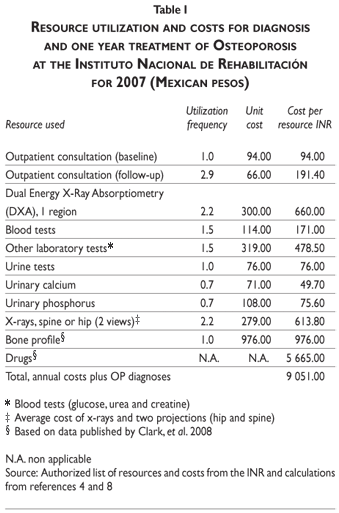
<body><![CDATA[<p><font size="2" face="Verdana"> We added all these costs to calculate the total    estimated costs of diagnosis and one&#45;year treatment for OP, and the acute treatment    for hip fracture. Total cost per patient was calculated as the total cost divided    by the total number of patients with either OP or hip fracture. The analysis    was performed under the public provider of services, assuming that the cost    recovery fees paid by patients at socioeconomic level 6 reflect the true costs    paid by the INR. A mixture of micro&#45;costing and activity&#45;based costing techniques    for governmental institutions was used and a detailed explanation of the methods    used are provided elsewhere.<SUP>4</SUP> In a second step, the average resource    use derived from the previous study was entered into a model of the costs for    the SPSS.</font></p>     <p><font size="2" face="Verdana"> The methods used to estimate the costs for the    SPSS are as follows. At its inception, the SPSS calculated the per capita annual    cost of treatment, in order to be able to pay for 249 medical interventions    including prevention, diagnosis and treatment from authorized medical providers.<SUP>7</sup></font></p>     <p><font size="2" face="Verdana"> In order to calculate the annual per capita    cost of each approved intervention, a group of experts analyzed the incidence    and prevalence of each intervention and defined their cost.<SUP>7</SUP> Clinical    intervention guidelines that account for the various phases of the medical decision    making process was used to create this estimate.<SUP>7,10 </SUP>Final estimates    include the human resources, materials, diagnostic tests, and drugs needed,    as well as other factors like outpatient consultation, days of hospital stay,    intensive care unit cost per day, operating room cost per hour, and unit cost    of drugs and tests (clinical chemistry, x&#45;rays, bone density test, etc.)</font></p>     <p><font size="2" face="Verdana"> With these basic production functions defined,    the individual intervention cost was set using data matrices in a calculation    sheet. To facilitate payment for the services provided, the basic unit cost    was divided into its fixed and variable components.</font></p>     <p><font size="2" face="Verdana"> Fixed costs include the infrastructure that    belongs to the different medical institutions (provider) independently of treatment    demand, including: the facility (hospital building), capital cost (instrumental,    equipment and furniture costs), basic services (electricity, water supply, maintenance,    taxes) and to the costs of human resources. These capital costs are summarized    as basic measurement unit for each approved intervention, which are figured    on an annual basis and are specific to the type of medical facility. A costing    technique was used to establish the equivalent cost for each effective year    of each particular capital good.<SUP>7,11</SUP> Variable costs were defined    using the official published catalogs for clinical chemistry laboratory, cabinet    tests, drugs and materials and are based upon 2007 data. </font></p>     <p>&nbsp;</p>     <p><font size="3" face="verdana"><b>Results</b></font></p>     <p><font size="2" face="Verdana">Cost estimations for diagnosis and annual treatment    of OP and surgical management of hip fracture based on each protocol are provided    below. <a href="#tab01">Table I</a> shows the resource utilization at the INR    for these different diagnoses, and an average of the costs incurred for one    year of treatment in the sample of patients studied at this institution. The    standard protocol for diagnosis of OP patients at the INR includes two out patient    consultations, a Dual Energy X&#45;Ray Absorptiometry (DXA) (1 region), laboratory    tests (blood and urine) and hip and spine x rays. An additional bone profile    (bone alkaline phosphatase, osteocalcin, urine N&#45;telopeptide, hidroxipronine,    pyridinoline and deoxiypyridinoline) is included for these patients.</font></p>     <p><a name="tab01"></a></p>     <p>&nbsp;</p>     ]]></body>
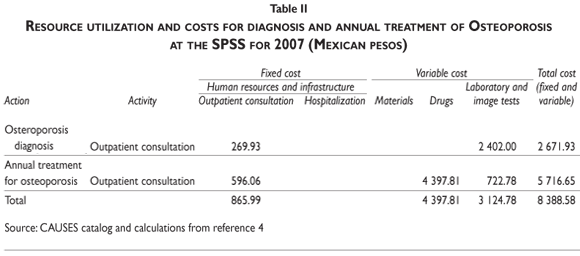
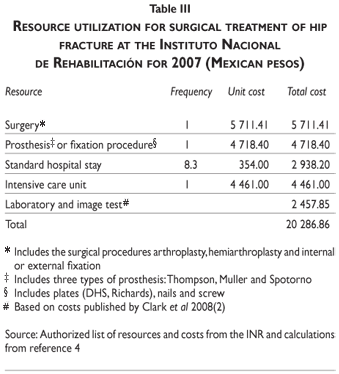
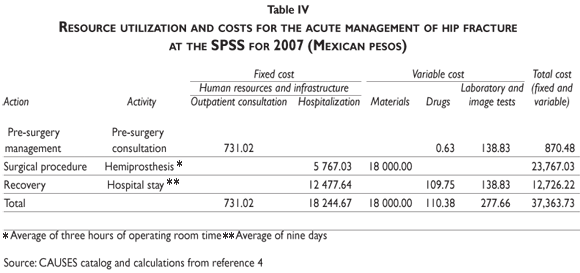
<body><![CDATA[<p align="center"><img src="/img/revistas/spm/v51s1/a14tab01.gif"></p>     <p>&nbsp;</p>     <p><font size="2" face="Verdana">The cost per patient diagnosed with OP at the    INR for 2007 is estimated at $2 503.00 Mexican pesos (data not shown). An additional    year of treatment with the drugs provided by the INR, (patient interviews and    chart review show that 52% of patients receive alendronate and 37% receive calcium    carbonate, the most frequently prescribed drugs) for a total cost of $9 051.00    Mexican pesos per patient.</font></p>     <p><font size="2" face="Verdana"> <a href="#tab02">Table II</a> shows the resource    utilization diagnosis and annual treatment of OP and hip fracture with the SPSS    protocol. The estimated cost to diagnose OP is almost the same as at the INR    ($2 671.93 Mexican pesos; data not shown) and the two protocols are similar,    including: two outpatient consultations, one DXA (one region), laboratory tests    and x&#45;rays. The cost of diagnosis plus a year of treatment at the SPSS is estimated    at $8 388.58 Mexican pesos, $ 662.42 Mexican pesos greater than the INR cost.    The drugs approved by the SPSS for OP treatment are raloxifene, alendronate,    hormone replacement therapy and calcitriol. For the SPSS, 90% of the costs of    these drugs are included in the variable cost component.</font></p>     <p><a name="tab02"></a></p>     <p>&nbsp;</p>     <p align="center"><img src="/img/revistas/spm/v51s1/a14tab02.gif"></p>     <p>&nbsp;</p>     <p><font size="2" face="Verdana">The average cost of surgical management of a    hip fracture case at the INR based in the sample prospectively taken from this    institution was $20286.86 Mexican pesos. This estimate includes: surgical costs    (arthroplasty, hemiarthoplasty and fixation), prosthesis; nine days of hospital    stay (including one day at the intensive care unit) and the costs of laboratory    tests and x&#45;rays before and after surgery and until the patient was discharged.    This data was gathered from patient interviews and chart review at the INR.    The unit costs are given in <a href="#tab03">table III</a>. For the SPSS, using    the same protocol as that described for the INR based in real cases observed    between 2005 and 2006, the total cost for surgical management of a hip fracture    case was estimated at $37363.73 Mexican pesos per patient, almost the double    cost charged at the INR (a difference of $17 076.87). In both scenarios the    surgery and prosthesis represented the highest cost: $23767.03 Mexican pesos    at the SPSS and $10429.81 at the INR. Information about these costs at the SPSS    is shown in <a href="#tab04">table IV</a>. In the SPSS, the distribution between    fixed costs (a preoperative consultation, surgery and operating room) and variable    costs (consumables, surgical supplies, and prosthesis and fixation devices,    drugs, laboratory tests and X&#45;rays) was similar, representing 51% of the fixed    costs and 49% of the variable cost.</font></p>     <p><a name="tab03"></a></p>     ]]></body>
<body><![CDATA[<p>&nbsp;</p>     <p align="center"><img src="/img/revistas/spm/v51s1/a14tab03.gif"></p>     <p>&nbsp;</p>     <p><a name="tab04"></a></p>     <p>&nbsp;</p>     <p align="center"><img src="/img/revistas/spm/v51s1/a14tab04.gif"></p>     <p>&nbsp;</p>     <p><font size="3" face="verdana"><b>Discussion</b></font></p>     <p><font size="2" face="Verdana">The present study analyzed and compared the costs    of two different scenarios: the diagnosis of and annual treatment for osteoporosis,    and the cost for acute surgical treatment of hip fracture, in patients 50 years    and over from two different protocols in governmental health providers in Mexico.    Analysis of costs at the INR was generated with prospective data gathered via    patient interviews and medical chart review. Costs for treatment covered by    the SPSS was estimated by applying the methods, infrastructure, supplies and    costs approved by the SPSS to the treatment data gathered at the INR.</font></p>     <p><font size="2" face="Verdana"> In the case of diagnosis and annual treatment    of osteoporosis, the INR and SPSS costs very similar, probably since the unit    costs involved were relatively standard, and both organizations use a similar    treatment protocol. However, we found important differences in the costs for    the acute surgical treatment of hip fracture between the INR and the SPSS: the    costs for hip fracture treatment at the SPSS was almost double that of the INR    ($37 363.73 <I>vs.</I> $20 286.86). The highest proportion of expenditures in    both the INR and SPSS were for the costs of prosthesis and hospitalization,    though these costs were higher for the SPSS. These differences in costs have    two explanations: differences in treatment protocols and differences in the    cost of infrastructure.</font></p>     ]]></body>
<body><![CDATA[<p><font size="2" face="Verdana"> As was mentioned previously, the estimation    of the costs at the INR were based on prospective interviews and chart reviews    of hospitalized patients attending this institution, and using the institutions'    published cost tabulations.<SUP>9</SUP> It is noteworthy that not all hip fracture    patients at the INR underwent hip replacement. In fact, external and internal    fixation were the most common procedures, used in 85% of the cases at this institution,    and the cost of this type of surgery is lower than that of hip replacement.    The estimate per hip fracture patient at the INR therefore was the actual unitary    cost, and the global estimate presented for each item represents the average    cost per item. In the case of the SPSS, the estimations were done according    with their protocol and costs but based on the data obtained with the patients    at the INR (e.g. nine days of hospitalization, time of surgery, etc.) but the    SPSS protocol assumes that every case of hip fracture will have a hip replacement.    Thus, the overall costs for this item carried higher costs at the SPSS. In light    of these results, it seems desirable for the SPSS to revise its protocol to    include internal or external fixation as potential treatments for hip fracture.</font></p>     <p><font size="2" face="Verdana"> Hospitalization costs also differed between    the INR and SPSS. The INR estimate includes an average of $2938.00 Mexican pesos    for the standard 8.3 day hospital stay, plus one day at the intensive care unit    at $4461.00 for a total of $7399.00 Mexican pesos. The SPSS does not incorporate    the cost of the intensive care unit in its protocol, but instead estimates a    higher unit cost for a standard day of hospital stay, resulting in a higher    total cost at of $12477.00 Mexican pesos for a nine day hospitalization at the    SPSS. It is important to mention that subsidies for medical attention at the    INR are unknown and thus not included, but might raise the actual unit cost    for a standard hospital stay at this institution.</font></p>     <p><font size="2" face="Verdana"> Our study had the advantage of access to direct    information taken from the patients and charts at the INR and thus reflects    a real life example of the resource utilization for hip fracture cases. We are    also confident that the unit costs estimated are accurate, since a micro&#45;costing    of procedures was carried out.<SUP>4</SUP> Our application of SPSS protocol    and costs to this real life scenario might be a limitation of the study; since    we do not know the real SPSS resource utilization per case for hip fracture    cases or OP diagnosis and treatment (e.g. the SPSS could have shorter average    hospital stays).</font></p>     <p><font size="2" face="Verdana"> In conclusion, we found important differences    in costs between treatment of the same OP related problems at the INR and SPSS.    The differences found were largely in the cost of surgery, due to the SPSS assumption    that all hip fractures will result in hip replacement, as well as different    unit costs for standard hospitalization. We thus recommend that revising the    SPSS protocol to include the less costly surgical treatments for hip fracture    commonly provided at the INR. However, a prospective study to validate the costs    at the SPSS is also needed.</font></p>     <p>&nbsp;</p>     <p><font size="3" face="verdana"><b>References</b></font></p>     <!-- ref --><p><font size="2" face="Verdana">1. Johnell O, Kanis JA. An estimate of the worldwide    prevalence, mortality and disability associated with hip fracture. Osteoporos    Int 2004;15(11):897&#45;902.</font>&nbsp;&nbsp;&nbsp;&nbsp;&nbsp;&nbsp;&nbsp;&nbsp;[&#160;<a href="javascript:void(0);" onclick="javascript: window.open('/scielo.php?script=sci_nlinks&ref=9283640&pid=S0036-3634200900070001400001&lng=','','width=640,height=500,resizable=yes,scrollbars=1,menubar=yes,');">Links</a>&#160;]<!-- end-ref --><!-- ref --><p><font size="2" face="Verdana">2. Johnell O, Kanis JA, Jonsson B, Oden A, Johansson    H, De Laet C. The burden of hospitalised fractures in Sweden. Osteoporos Int    2005;16(2):222&#45;228.</font>&nbsp;&nbsp;&nbsp;&nbsp;&nbsp;&nbsp;&nbsp;&nbsp;[&#160;<a href="javascript:void(0);" onclick="javascript: window.open('/scielo.php?script=sci_nlinks&ref=9283641&pid=S0036-3634200900070001400002&lng=','','width=640,height=500,resizable=yes,scrollbars=1,menubar=yes,');">Links</a>&#160;]<!-- end-ref --><!-- ref --><p><font size="2" face="Verdana">3. Clark P, Lavielle P, Franco&#45;Marina F, Ramirez    E, Salmeron J, Kanis JA, <I>et al</I>. Incidence rates and life&#45;time risk of    hip fractures in Mexicans over 50 years of age: a population&#45;based study. Osteoporos    Int 2005;16(12):2025&#45;2030.</font>&nbsp;&nbsp;&nbsp;&nbsp;&nbsp;&nbsp;&nbsp;&nbsp;[&#160;<a href="javascript:void(0);" onclick="javascript: window.open('/scielo.php?script=sci_nlinks&ref=9283642&pid=S0036-3634200900070001400003&lng=','','width=640,height=500,resizable=yes,scrollbars=1,menubar=yes,');">Links</a>&#160;]<!-- end-ref --><!-- ref --><p><font size="2" face="Verdana">4. Clark P, Carlos F, Barrera C, Guzman J, Maetzel    A, Lavielle P, <I>et al</I>. Direct costs of osteoporosis and hip fracture:    an analysis for the Mexican healthcare system. Osteoporos Int 2008;19(3):269&#45;276.</font>&nbsp;&nbsp;&nbsp;&nbsp;&nbsp;&nbsp;&nbsp;&nbsp;[&#160;<a href="javascript:void(0);" onclick="javascript: window.open('/scielo.php?script=sci_nlinks&ref=9283643&pid=S0036-3634200900070001400004&lng=','','width=640,height=500,resizable=yes,scrollbars=1,menubar=yes,');">Links</a>&#160;]<!-- end-ref --><!-- ref --><p><font size="2" face="Verdana">5. Frenk J, Sepulveda J, Gomez&#45;Dantes O, Knaul    F. Evidence&#45;based health policy: three generations of reform in Mexico. Lancet    2003;362(9396):1667&#45;1671.</font>&nbsp;&nbsp;&nbsp;&nbsp;&nbsp;&nbsp;&nbsp;&nbsp;[&#160;<a href="javascript:void(0);" onclick="javascript: window.open('/scielo.php?script=sci_nlinks&ref=9283644&pid=S0036-3634200900070001400005&lng=','','width=640,height=500,resizable=yes,scrollbars=1,menubar=yes,');">Links</a>&#160;]<!-- end-ref --><!-- ref --><p><font size="2" face="Verdana">6. Frenk J, Gonzalez&#45;Pier E, Gomez&#45;Dantes O,    Lezana MA, Knaul FM. Comprehensive reform to improve health system performance    in Mexico. Lancet 2006;368(9546):1524&#45;1534.</font>&nbsp;&nbsp;&nbsp;&nbsp;&nbsp;&nbsp;&nbsp;&nbsp;[&#160;<a href="javascript:void(0);" onclick="javascript: window.open('/scielo.php?script=sci_nlinks&ref=9283645&pid=S0036-3634200900070001400006&lng=','','width=640,height=500,resizable=yes,scrollbars=1,menubar=yes,');">Links</a>&#160;]<!-- end-ref --><!-- ref --><p><font size="2" face="Verdana">7. Sistema de Protecci&oacute;n Social en Salud.    Elementos conceptuales,econ&oacute;micos y operativos. In: Econ&oacute;micos    UdA, editor. Primera Edici&oacute;n. M&eacute;xico: Secretar&iacute;a de Salud,    2005:11&#45;38.</font>&nbsp;&nbsp;&nbsp;&nbsp;&nbsp;&nbsp;&nbsp;&nbsp;[&#160;<a href="javascript:void(0);" onclick="javascript: window.open('/scielo.php?script=sci_nlinks&ref=9283646&pid=S0036-3634200900070001400007&lng=','','width=640,height=500,resizable=yes,scrollbars=1,menubar=yes,');">Links</a>&#160;]<!-- end-ref --><p><font size="2" face="Verdana">8. Zingmond DS, Melton LJ 3rd, Silverman SL.    Increasing hip fracture incidence in California Hispanics, 1983 to 2000. Osteoporos    Int 2004;15(8):603&#45;610.</font></p>     <!-- ref --><p><font size="2" face="Verdana">9. Instituto Nacional de Rehabilitaci&oacute;n.    Tabulador de costos de recuperaci&oacute;n 2007. M&eacute;xico: Secretar&iacute;a    de Salud, 2007.</font>&nbsp;&nbsp;&nbsp;&nbsp;&nbsp;&nbsp;&nbsp;&nbsp;[&#160;<a href="javascript:void(0);" onclick="javascript: window.open('/scielo.php?script=sci_nlinks&ref=9283648&pid=S0036-3634200900070001400009&lng=','','width=640,height=500,resizable=yes,scrollbars=1,menubar=yes,');">Links</a>&#160;]<!-- end-ref --><!-- ref --><p><font size="2" face="Verdana">10. Murray C, Frenk J. World Health Report 2000:    a step towards evidence&#45;based health policy. Lancet 2001;357(9269):1698&#45;1700.</font>&nbsp;&nbsp;&nbsp;&nbsp;&nbsp;&nbsp;&nbsp;&nbsp;[&#160;<a href="javascript:void(0);" onclick="javascript: window.open('/scielo.php?script=sci_nlinks&ref=9283649&pid=S0036-3634200900070001400010&lng=','','width=640,height=500,resizable=yes,scrollbars=1,menubar=yes,');">Links</a>&#160;]<!-- end-ref --><!-- ref --><p><font size="2" face="Verdana">11. Brundtland GH, Frenk J, Murray CJ. Who assessment    of health systems performance. Lancet 2003;361(9375):2155.</font>&nbsp;&nbsp;&nbsp;&nbsp;&nbsp;&nbsp;&nbsp;&nbsp;[&#160;<a href="javascript:void(0);" onclick="javascript: window.open('/scielo.php?script=sci_nlinks&ref=9283650&pid=S0036-3634200900070001400011&lng=','','width=640,height=500,resizable=yes,scrollbars=1,menubar=yes,');">Links</a>&#160;]<!-- end-ref --><p>&nbsp;</p>     <p>&nbsp;</p>     <p><font size="2" face="Verdana">Received on: January 10, 2008    ]]></body>
<body><![CDATA[<br>   Accepted on: September 30, 2008</font></p>     <p>&nbsp;</p>     <p>&nbsp;</p>     <p><font size="2" face="Verdana">Address reprint requests to: Patricia Clark MD    PhD. Clinical Epidemiology Unit IMSS. Blvd. Virreyes 1010, Lomas de Chapultepec.    11000 Mexico City.    <br>   E&#45;mail: <a href="mailto:patriciaclark@prodigy.net.mx">patriciaclark@prodigy.net.mx</a></font></p>      ]]></body><back>
<ref-list>
<ref id="B1">
<label>1</label><nlm-citation citation-type="journal">
<person-group person-group-type="author">
<name>
<surname><![CDATA[Johnell]]></surname>
<given-names><![CDATA[O]]></given-names>
</name>
<name>
<surname><![CDATA[Kanis]]></surname>
<given-names><![CDATA[JA]]></given-names>
</name>
</person-group>
<article-title xml:lang="en"><![CDATA[An estimate of the worldwide prevalence, mortality and disability associated with hip fracture]]></article-title>
<source><![CDATA[Osteoporos Int]]></source>
<year>2004</year>
<volume>15</volume>
<numero>11</numero>
<issue>11</issue>
<page-range>897-902</page-range></nlm-citation>
</ref>
<ref id="B2">
<label>2</label><nlm-citation citation-type="journal">
<person-group person-group-type="author">
<name>
<surname><![CDATA[Johnell]]></surname>
<given-names><![CDATA[O]]></given-names>
</name>
<name>
<surname><![CDATA[Kanis]]></surname>
<given-names><![CDATA[JA]]></given-names>
</name>
<name>
<surname><![CDATA[Jonsson]]></surname>
<given-names><![CDATA[B]]></given-names>
</name>
<name>
<surname><![CDATA[Oden]]></surname>
<given-names><![CDATA[A]]></given-names>
</name>
<name>
<surname><![CDATA[Johansson]]></surname>
<given-names><![CDATA[H]]></given-names>
</name>
<name>
<surname><![CDATA[De Laet]]></surname>
<given-names><![CDATA[C]]></given-names>
</name>
</person-group>
<article-title xml:lang="en"><![CDATA[The burden of hospitalised fractures in Sweden]]></article-title>
<source><![CDATA[Osteoporos Int]]></source>
<year>2005</year>
<volume>16</volume>
<numero>2</numero>
<issue>2</issue>
<page-range>222-228</page-range></nlm-citation>
</ref>
<ref id="B3">
<label>3</label><nlm-citation citation-type="journal">
<person-group person-group-type="author">
<name>
<surname><![CDATA[Clark]]></surname>
<given-names><![CDATA[P]]></given-names>
</name>
<name>
<surname><![CDATA[Lavielle]]></surname>
<given-names><![CDATA[P]]></given-names>
</name>
<name>
<surname><![CDATA[Franco-Marina]]></surname>
<given-names><![CDATA[F]]></given-names>
</name>
<name>
<surname><![CDATA[Ramirez]]></surname>
<given-names><![CDATA[E]]></given-names>
</name>
<name>
<surname><![CDATA[Salmeron]]></surname>
<given-names><![CDATA[J]]></given-names>
</name>
<name>
<surname><![CDATA[Kanis]]></surname>
<given-names><![CDATA[JA]]></given-names>
</name>
</person-group>
<article-title xml:lang="en"><![CDATA[Incidence rates and life-time risk of hip fractures in Mexicans over 50 years of age: a population-based study]]></article-title>
<source><![CDATA[Osteoporos Int]]></source>
<year>2005</year>
<volume>16</volume>
<numero>12</numero>
<issue>12</issue>
<page-range>2025-2030</page-range></nlm-citation>
</ref>
<ref id="B4">
<label>4</label><nlm-citation citation-type="journal">
<person-group person-group-type="author">
<name>
<surname><![CDATA[Clark]]></surname>
<given-names><![CDATA[P]]></given-names>
</name>
<name>
<surname><![CDATA[Carlos]]></surname>
<given-names><![CDATA[F]]></given-names>
</name>
<name>
<surname><![CDATA[Barrera]]></surname>
<given-names><![CDATA[C]]></given-names>
</name>
<name>
<surname><![CDATA[Guzman]]></surname>
<given-names><![CDATA[J]]></given-names>
</name>
<name>
<surname><![CDATA[Maetzel]]></surname>
<given-names><![CDATA[A]]></given-names>
</name>
<name>
<surname><![CDATA[Lavielle]]></surname>
<given-names><![CDATA[P]]></given-names>
</name>
</person-group>
<article-title xml:lang="en"><![CDATA[Direct costs of osteoporosis and hip fracture: an analysis for the Mexican healthcare system]]></article-title>
<source><![CDATA[Osteoporos Int]]></source>
<year>2008</year>
<volume>19</volume>
<numero>3</numero>
<issue>3</issue>
<page-range>269-276</page-range></nlm-citation>
</ref>
<ref id="B5">
<label>5</label><nlm-citation citation-type="journal">
<person-group person-group-type="author">
<name>
<surname><![CDATA[Frenk]]></surname>
<given-names><![CDATA[J]]></given-names>
</name>
<name>
<surname><![CDATA[Sepulveda]]></surname>
<given-names><![CDATA[J]]></given-names>
</name>
<name>
<surname><![CDATA[Gomez-Dantes]]></surname>
<given-names><![CDATA[O]]></given-names>
</name>
<name>
<surname><![CDATA[Knaul]]></surname>
<given-names><![CDATA[F]]></given-names>
</name>
</person-group>
<article-title xml:lang="en"><![CDATA[Evidence-based health policy: three generations of reform in Mexico]]></article-title>
<source><![CDATA[Lancet]]></source>
<year>2003</year>
<volume>362</volume>
<numero>9396</numero>
<issue>9396</issue>
<page-range>1667-1671</page-range></nlm-citation>
</ref>
<ref id="B6">
<label>6</label><nlm-citation citation-type="journal">
<person-group person-group-type="author">
<name>
<surname><![CDATA[Frenk]]></surname>
<given-names><![CDATA[J]]></given-names>
</name>
<name>
<surname><![CDATA[Gonzalez-Pier]]></surname>
<given-names><![CDATA[E]]></given-names>
</name>
<name>
<surname><![CDATA[Gomez-Dantes]]></surname>
<given-names><![CDATA[O]]></given-names>
</name>
<name>
<surname><![CDATA[Lezana]]></surname>
<given-names><![CDATA[MA]]></given-names>
</name>
<name>
<surname><![CDATA[Knaul]]></surname>
<given-names><![CDATA[FM]]></given-names>
</name>
</person-group>
<article-title xml:lang="en"><![CDATA[Comprehensive reform to improve health system performance in Mexico]]></article-title>
<source><![CDATA[Lancet]]></source>
<year>2006</year>
<volume>368</volume>
<numero>9546</numero>
<issue>9546</issue>
<page-range>1524-1534</page-range></nlm-citation>
</ref>
<ref id="B7">
<label>7</label><nlm-citation citation-type="book">
<collab>Sistema de Protección Social en Salud</collab>
<article-title xml:lang="en"><![CDATA[Elementos conceptuales,económicos y operativos]]></article-title>
<source><![CDATA[Económicos UdA]]></source>
<year>2005</year>
<edition>Primera</edition>
<page-range>11-38</page-range><publisher-loc><![CDATA[México ]]></publisher-loc>
<publisher-name><![CDATA[Secretaría de Salud]]></publisher-name>
</nlm-citation>
</ref>
<ref id="B8">
<label>8</label><nlm-citation citation-type="journal">
<person-group person-group-type="author">
<name>
<surname><![CDATA[Zingmond]]></surname>
<given-names><![CDATA[DS]]></given-names>
</name>
<name>
<surname><![CDATA[Melton 3rd]]></surname>
<given-names><![CDATA[LJ]]></given-names>
</name>
<name>
<surname><![CDATA[Silverman]]></surname>
<given-names><![CDATA[SL]]></given-names>
</name>
</person-group>
<article-title xml:lang="en"><![CDATA[Increasing hip fracture incidence in California Hispanics, 1983 to 2000]]></article-title>
<source><![CDATA[Osteoporos Int]]></source>
<year>2004</year>
<volume>15</volume>
<numero>8</numero>
<issue>8</issue>
<page-range>603-610</page-range></nlm-citation>
</ref>
<ref id="B9">
<label>9</label><nlm-citation citation-type="book">
<collab>Instituto Nacional de Rehabilitación</collab>
<source><![CDATA[Tabulador de costos de recuperación 2007]]></source>
<year>2007</year>
<publisher-loc><![CDATA[México ]]></publisher-loc>
<publisher-name><![CDATA[Secretaría de Salud]]></publisher-name>
</nlm-citation>
</ref>
<ref id="B10">
<label>10</label><nlm-citation citation-type="journal">
<person-group person-group-type="author">
<name>
<surname><![CDATA[Murray]]></surname>
<given-names><![CDATA[C]]></given-names>
</name>
<name>
<surname><![CDATA[Frenk]]></surname>
<given-names><![CDATA[J]]></given-names>
</name>
</person-group>
<article-title xml:lang="en"><![CDATA[World Health Report 2000: a step towards evidence-based health policy]]></article-title>
<source><![CDATA[Lancet]]></source>
<year>2001</year>
<volume>357</volume>
<numero>9269</numero>
<issue>9269</issue>
<page-range>1698-1700</page-range></nlm-citation>
</ref>
<ref id="B11">
<label>11</label><nlm-citation citation-type="journal">
<person-group person-group-type="author">
<name>
<surname><![CDATA[Brundtland]]></surname>
<given-names><![CDATA[GH]]></given-names>
</name>
<name>
<surname><![CDATA[Frenk]]></surname>
<given-names><![CDATA[J]]></given-names>
</name>
<name>
<surname><![CDATA[Murray]]></surname>
<given-names><![CDATA[CJ]]></given-names>
</name>
</person-group>
<article-title xml:lang="en"><![CDATA[Who assessment of health systems performance]]></article-title>
<source><![CDATA[Lancet]]></source>
<year>2003</year>
<volume>361</volume>
<numero>9375</numero>
<issue>9375</issue>
<page-range>2155</page-range></nlm-citation>
</ref>
</ref-list>
</back>
</article>