<?xml version="1.0" encoding="ISO-8859-1"?><article xmlns:mml="http://www.w3.org/1998/Math/MathML" xmlns:xlink="http://www.w3.org/1999/xlink" xmlns:xsi="http://www.w3.org/2001/XMLSchema-instance">
<front>
<journal-meta>
<journal-id>0036-3634</journal-id>
<journal-title><![CDATA[Salud Pública de México]]></journal-title>
<abbrev-journal-title><![CDATA[Salud pública Méx]]></abbrev-journal-title>
<issn>0036-3634</issn>
<publisher>
<publisher-name><![CDATA[Instituto Nacional de Salud Pública]]></publisher-name>
</publisher>
</journal-meta>
<article-meta>
<article-id>S0036-36342009000700012</article-id>
<title-group>
<article-title xml:lang="en"><![CDATA[Correlation trends for bone mineral density in Mexican women: evidence of familiar predisposition]]></article-title>
<article-title xml:lang="es"><![CDATA[Tendencias de correlación para la densidad mineral ósea en mujeres mexicanas: pruebas de predisposición familiar]]></article-title>
</title-group>
<contrib-group>
<contrib contrib-type="author">
<name>
<surname><![CDATA[Lazcano-Ponce]]></surname>
<given-names><![CDATA[Eduardo]]></given-names>
</name>
<xref ref-type="aff" rid="A01"/>
</contrib>
<contrib contrib-type="author">
<name>
<surname><![CDATA[Tamayo]]></surname>
<given-names><![CDATA[Juan]]></given-names>
</name>
<xref ref-type="aff" rid="A02"/>
</contrib>
<contrib contrib-type="author">
<name>
<surname><![CDATA[Díaz]]></surname>
<given-names><![CDATA[Rodrigo]]></given-names>
</name>
<xref ref-type="aff" rid="A01"/>
</contrib>
<contrib contrib-type="author">
<name>
<surname><![CDATA[Burguete]]></surname>
<given-names><![CDATA[Ana I.]]></given-names>
</name>
<xref ref-type="aff" rid="A01"/>
</contrib>
<contrib contrib-type="author">
<name>
<surname><![CDATA[Salmerón]]></surname>
<given-names><![CDATA[Jorge]]></given-names>
</name>
<xref ref-type="aff" rid="A03"/>
</contrib>
</contrib-group>
<aff id="A01">
<institution><![CDATA[,Instituto Nacional de Salud Pública Centro de Investigación en Salud Poblacional ]]></institution>
<addr-line><![CDATA[Cuernavaca Morelos]]></addr-line>
<country>México</country>
</aff>
<aff id="A02">
<institution><![CDATA[,Comité Mexicano  ]]></institution>
<addr-line><![CDATA[México Distrito Federal]]></addr-line>
</aff>
<aff id="A03">
<institution><![CDATA[,Instituto Mexicano del Seguro Social Unidad de Investigación Epidemiológica y en Servicios de Salud ]]></institution>
<addr-line><![CDATA[Cuernavaca Morelos ]]></addr-line>
<country>México</country>
</aff>
<pub-date pub-type="pub">
<day>00</day>
<month>00</month>
<year>2009</year>
</pub-date>
<pub-date pub-type="epub">
<day>00</day>
<month>00</month>
<year>2009</year>
</pub-date>
<volume>51</volume>
<fpage>s93</fpage>
<lpage>s99</lpage>
<copyright-statement/>
<copyright-year/>
<self-uri xlink:href="http://www.scielo.org.mx/scielo.php?script=sci_arttext&amp;pid=S0036-36342009000700012&amp;lng=en&amp;nrm=iso"></self-uri><self-uri xlink:href="http://www.scielo.org.mx/scielo.php?script=sci_abstract&amp;pid=S0036-36342009000700012&amp;lng=en&amp;nrm=iso"></self-uri><self-uri xlink:href="http://www.scielo.org.mx/scielo.php?script=sci_pdf&amp;pid=S0036-36342009000700012&amp;lng=en&amp;nrm=iso"></self-uri><abstract abstract-type="short" xml:lang="en"><p><![CDATA[OBJECTIVE: Genetic factors determine bone mineral density (BMD) and peak bone density between 20 and 30 years of age, as well as bone mineral loss after menopause. BMD is a predictor of fractures due to osteoporosis and the impact of genetic factors on osteoporosis. The variation in BMD for each individual is determined by an underlying genetic structure, common genetic effects, particularly with respect to compact bones as compared to those that are primarily trabecular. This article presents the correlation of BMD by anatomical site among different samples of Mexican grandmothers, mothers and granddaughters of mixed race. MATERIAL AND METHODS: The present analysis was performed of healthy employees and their healthy relatives from three different health and academic institutions: the Instituto Mexicano del Seguro Social and the Instituto Nacional de Salud Pública, both located in Cuernavaca, Morelos, as well as the Universidad Autónoma del Estado de México. We selected family-related female participants in order to obtain pairs of mothers and daughters and, whenever possible, grandmother-mother-daughter groups. We were able to match 591 mother-daughter pairs for analysis. Additionally, we were able to include grandmothers to create grandmother-mother-daughter triads for further analysis. Bone density measurements were performed of the non-dominant proximal femur, the lumbar spine (L1-L4) and the whole body using a dual X-ray absorptiometry (DXA) Lunar DPX NT instrument. RESULTS: This study included 591 granddaughters, 591 mothers and 69 grandmothers; mean ages were 20, 47 and 72 years old, respectively. A close relationship existed with respect to body mass index (BMI) between mothers and grandmothers (27.9 vs. 27.3). The largest proportion of body fat mass was observed in the group of mothers (28.5%), but was also high in grandmothers (25.7%) and granddaughters (21.1%). The percentage of lean body mass was similar among the three family groups. The correlation of BMD between mothers and grandmothers was greatest for subtotal BMD (0.44) and was very high for the hips (0.39). Using predictive models for hip BMD among grandmothers, mothers and grandchildren, we observed that hip BMD of grandmothers is a predictor of BMD in mothers, with a beta of 0.46 (p 0.001, CI95% 0.19-0.73); (R²: 0.41). A predictor of BMD of the lumbar spine in grandchildren is BMD of the lumbar spine in mothers (beta 0.30 CI95% 0.07-0.53). CONCLUSIONS: The results obtained in this study suggest that daughters whose mothers have a low BMD for their age will tend to develop the same condition. This indicates the importance of monitoring for girls and adolescent females whose mothers have problems related to osteopenia or osteoporosis. It will therefore be necessary to conduct studies to identify the most significant genes and specific anatomical sites among our population for the purpose of establishing the polymorphic variants for high-risk in the Mexican population.]]></p></abstract>
<abstract abstract-type="short" xml:lang="es"><p><![CDATA[OBJETIVO: Factores genéticos determinan la densidad mineral ósea (DMO) y el pico máximo de masa ósea entre los 20 y 30 años de edad, así como la pérdida de densidad mineral ósea después de la menopausia. La DMO es un predictor de fracturas debido a osteoporosis y el impacto de factores genéticos sobre esta. La variación en DMO para cada individuo es determinada genéticamente, en particular en lo que concierne a huesos compactos en comparación con aquellos que son principalmente trabeculares. Este artículo presenta la correlación de DMO por sitio anatómico entre abuelas, madres y nietas mexicanas. MATERIAL Y MÉTODOS: El presente análisis fue realizado en empleados sanos y sus familiares sanos de tres diferentes instituciones de salud e instituciones académicas: el Instituto Mexicano del Seguro Social, Instituto Nacional de Salud Pública, ambos localizados en Cuernavaca, Morelos, así como la Universidad Autónoma del Estado de México. Seleccionamos a participantes femeninos relacionados para obtener los pares de madres e hijas y siempre que fuera posible a las abuelas. Nos fue posible recolectar 591 pares de madre-hija para el análisis. Además de incluir a abuelas para crear tríadas abuela-madre-hija para el análisis. Las medidas de densidad ósea fueron realizadas del fémur proximal no dominante, espina lumbar (L1-L4) y DMO total mediante el instrumento DPX DXA Lunar NT. RESULTADOS: Este estudio incluyó a 591 nietas, 591 madres y 69 abuelas; la edad promedio fue 20, 47 y 72 años. Hay una relalción entre el índice de masa corporal (BMI) entre madres y abuelas de 27.9 contra 27.3. La proporción mayor de masa grasa de cuerpo fue observada en el grupo de madres (el 28.5%), pero también se observó alto en abuelas (el 25.7 %) y nietas (el 21.1 %). El porcentaje de masa magra fue similar entre los tres grupos. La correlación mayor de DMO entre madres y abuelas fue para el DMO subtotal (0.44), y para caderas (0.39). Usando modelos predictivos para DMO de cadera entre abuelas, madres y nietas, observamos que la DMO de cadera de abuelas es un predictor de DMO en las hijas, con un coeficiente beta de 0.46 (p 0.001, CI95 el % 0.19-0.73); (R2: 0.41). Un predictor de DMO de espina lumbar en las nietas es la DMO de espina lumbar en las madres (beta 0.30 CI95% 0.07-0.53). CONCLUSIONES: Los resultados obtenidos en este estudio sugieren que las hijas de madres con DMO bajo para su edad tenderán a la misma condición. Esto indica la importancia de vigilancia en jóvenes y mujeres adolescentes cuyas madres tengan osteopenia u osteoporosis. Por lo tanto, será necesario conducir estudios para identificar los genes más significativos por sitio anatómico específicos, para la identificación de las variantes polimórficas de riesgo en la población mexicana.]]></p></abstract>
<kwd-group>
<kwd lng="en"><![CDATA[bone mineral density]]></kwd>
<kwd lng="en"><![CDATA[familiar predisposition]]></kwd>
<kwd lng="en"><![CDATA[mixed-race]]></kwd>
<kwd lng="en"><![CDATA[Mexico]]></kwd>
<kwd lng="es"><![CDATA[densidad mineral ósea]]></kwd>
<kwd lng="es"><![CDATA[predisposición familiar]]></kwd>
<kwd lng="es"><![CDATA[mestizos]]></kwd>
<kwd lng="es"><![CDATA[México]]></kwd>
</kwd-group>
</article-meta>
</front><body><![CDATA[ <p align="right"><font size="2" face="Verdana"><b>ART&Iacute;CULO ORIGINAL</b></font></p>     <p>&nbsp;</p>     <p><font size="4" face="verdana"><b>Correlation trends for bone mineral density    in Mexican women: evidence of familiar predisposition</b></font></p>     <p>&nbsp;</p>     <p><b><font size="3" face="verdana">Tendencias de correlaci&oacute;n para la densidad mineral &oacute;sea en mujeres mexicanas: pruebas de predisposici&oacute;n familiar</font></b></p>     <p>&nbsp;</p>     <p>&nbsp;</p>     <p><font size="2" face="Verdana"><b>Eduardo Lazcano&#45;Ponce, Dr Sc<SUP>I</SUP>;    Juan Tamayo, MD<SUP>II</SUP>; Rodrigo D&iacute;az, PhD<SUP>I</sup>; Ana I. Burguete,    Dr Sc<SUP>I</SUP>; Jorge Salmer&oacute;n, Dr Sc<SUP>III</sup></b></font></p>     <p><font size="2" face="Verdana"><SUP>I</sup>Centro de Investigaci&oacute;n en    Salud Poblacional. Instituto Nacional de Salud P&uacute;blica. Cuernavaca Morelos,    M&eacute;xico    <br>   <SUP>II</sup>Comit&eacute; Mexicano para la Prevenci&oacute;n de la Osteoporosis    A,C., M&eacute;xico Distrito Federal    ]]></body>
<body><![CDATA[<br>   <SUP>III</sup>Unidad de Investigaci&oacute;n Epidemiol&oacute;gica y en Servicios    de Salud, Instituto Mexicano del Seguro Social. Cuernavaca Morelos, M&eacute;xico</font></p>     <p>&nbsp;</p>     <p>&nbsp;</p> <hr size="1" noshade>     <p><font size="2" face="VERDANA"><b>ABSTRACT</b></font></p>     <p><font size="2" face="Verdana"><b>OBJECTIVE:</b> Genetic factors determine bone    mineral density (BMD) and peak bone density between 20 and 30 years of age,    as well as bone mineral loss after menopause. BMD is a predictor of fractures    due to osteoporosis and the impact of genetic factors on osteoporosis. The variation    in BMD for each individual is determined by an underlying genetic structure,    common genetic effects, particularly with respect to compact bones as compared    to those that are primarily trabecular. This article presents the correlation    of BMD by anatomical site among different samples of Mexican grandmothers, mothers    and granddaughters of mixed race.    <br>   <b>MATERIAL AND METHODS:</b> The present analysis was performed of healthy employees    and their healthy relatives from three different health and academic institutions:    the Instituto Mexicano del Seguro Social and the Instituto Nacional de Salud    P&uacute;blica, both located in Cuernavaca, Morelos, as well as the Universidad    Aut&oacute;noma del Estado de M&eacute;xico. We selected family&#45;related female    participants in order to obtain pairs of mothers and daughters and, whenever    possible, grandmother&#45;mother&#45;daughter groups. We were able to match 591 mother&#45;daughter    pairs for analysis. Additionally, we were able to include grandmothers to create    grandmother&#45;mother&#45;daughter triads for further analysis. Bone density measurements    were performed of the non&#45;dominant proximal femur, the lumbar spine (L1&#45;L4)    and the whole body using a dual X&#45;ray absorptiometry (DXA) Lunar DPX NT instrument.    <br>   <b>RESULTS:</b> This study included 591 granddaughters, 591 mothers and 69 grandmothers;    mean ages were 20, 47 and 72 years old, respectively. A close relationship existed    with respect to body mass index (BMI) between mothers and grandmothers (27.9    vs. 27.3). The largest proportion of body fat mass was observed in the group    of mothers (28.5%), but was also high in grandmothers (25.7%) and granddaughters    (21.1%). The percentage of lean body mass was similar among the three family    groups. The correlation of BMD between mothers and grandmothers was greatest    for subtotal BMD (0.44) and was very high for the hips (0.39). Using predictive    models for hip BMD among grandmothers, mothers and grandchildren, we observed    that hip BMD of grandmothers is a predictor of BMD in mothers, with a beta of    0.46 (p 0.001, <I>CI</I>95% 0.19&#45;0.73); (R<SUP>2</SUP>: 0.41). A predictor of    BMD of the lumbar spine in grandchildren is BMD of the lumbar spine in mothers    (beta 0.30 <I>CI</I>95% 0.07&#45;0.53).    <br>   <b>CONCLUSIONS:</b> The results obtained in this study suggest that daughters    whose mothers have a low BMD for their age will tend to develop the same condition.    This indicates the importance of monitoring for girls and adolescent females    whose mothers have problems related to osteopenia or osteoporosis. It will therefore    be necessary to conduct studies to identify the most significant genes and specific    anatomical sites among our population for the purpose of establishing the polymorphic    variants for high&#45;risk in the Mexican population.</font></p>     <p><font size="2" face="Verdana"><b>Key words:</b> bone mineral density; familiar    predisposition; mixed&#45;race; Mexico</font></p> <hr size="1" noshade>     <p><font size="2" face="Verdana"><b>RESUMEN</b></font></p>     ]]></body>
<body><![CDATA[<p><font size="2" face="Verdana"><b>OBJETIVO:</b> Factores gen&eacute;ticos determinan    la densidad mineral &oacute;sea (DMO) y el pico m&aacute;ximo de masa &oacute;sea    entre los 20 y 30 a&ntilde;os de edad, as&iacute; como la p&eacute;rdida de    densidad mineral &oacute;sea despu&eacute;s de la menopausia. La DMO es un predictor    de fracturas debido a osteoporosis y el impacto de factores gen&eacute;ticos    sobre esta. La variaci&oacute;n en DMO para cada individuo es determinada gen&eacute;ticamente,    en particular en lo que concierne a huesos compactos en comparaci&oacute;n con    aquellos que son principalmente trabeculares. Este art&iacute;culo presenta    la correlaci&oacute;n de DMO por sitio anat&oacute;mico entre abuelas, madres    y nietas mexicanas.    <br>   <b>MATERIAL Y M&Eacute;TODOS:</b> El presente an&aacute;lisis fue realizado    en empleados sanos y sus familiares sanos de tres diferentes instituciones de    salud e instituciones acad&eacute;micas: el Instituto Mexicano del Seguro Social,    Instituto Nacional de Salud P&uacute;blica, ambos localizados en Cuernavaca,    Morelos, as&iacute; como la Universidad Aut&oacute;noma del Estado de M&eacute;xico.    Seleccionamos a participantes femeninos relacionados para obtener los pares    de madres e hijas y siempre que fuera posible a las abuelas. Nos fue posible    recolectar 591 pares de madre&#45;hija para el an&aacute;lisis. Adem&aacute;s de    incluir a abuelas para crear tr&iacute;adas abuela&#45;madre&#45;hija para el an&aacute;lisis.    Las medidas de densidad &oacute;sea fueron realizadas del f&eacute;mur proximal    no dominante, espina lumbar (L1&#45;L4) y DMO total mediante el instrumento DPX    DXA Lunar NT.    <br>   <b>RESULTADOS:</b> Este estudio incluy&oacute; a 591 nietas, 591 madres y 69    abuelas; la edad promedio fue 20, 47 y 72 a&ntilde;os. Hay una relalci&oacute;n    entre el &iacute;ndice de masa corporal (BMI) entre madres y abuelas de 27.9    contra 27.3. La proporci&oacute;n mayor de masa grasa de cuerpo fue observada    en el grupo de madres (el 28.5%), pero tambi&eacute;n se observ&oacute; alto    en abuelas (el 25.7 %) y nietas (el 21.1 %). El porcentaje de masa magra fue    similar entre los tres grupos. La correlaci&oacute;n mayor de DMO entre madres    y abuelas fue para el DMO subtotal (0.44), y para caderas (0.39). Usando modelos    predictivos para DMO de cadera entre abuelas, madres y nietas, observamos que    la DMO de cadera de abuelas es un predictor de DMO en las hijas, con un coeficiente    beta de 0.46 (p 0.001, CI95 el % 0.19&#45;0.73); (R2: 0.41). Un predictor de DMO    de espina lumbar en las nietas es la DMO de espina lumbar en las madres (beta    0.30 CI95% 0.07&#45;0.53).    <br>   <b>CONCLUSIONES:</b> Los resultados obtenidos en este estudio sugieren que las    hijas de madres con DMO bajo para su edad tender&aacute;n a la misma condici&oacute;n.    Esto indica la importancia de vigilancia en j&oacute;venes y mujeres adolescentes    cuyas madres tengan osteopenia u osteoporosis. Por lo tanto, ser&aacute; necesario    conducir estudios para identificar los genes m&aacute;s significativos por sitio    anat&oacute;mico espec&iacute;ficos, para la identificaci&oacute;n de las variantes    polim&oacute;rficas de riesgo en la poblaci&oacute;n mexicana. </font></p>     <p><font size="2" face="Verdana"><b>Palabras claves:</b> densidad mineral &oacute;sea;    predisposici&oacute;n familiar; mestizos; M&eacute;xico</font></p> <hr size="1" noshade>     <p>&nbsp;</p>     <p>&nbsp;</p>     <p><font size="2" face="Verdana">Bone mineral density is greatly influenced by    genetic factors as compared to environmental ones.<SUP>1</SUP> Previous studies    have suggested that the hereditary nature of bone density in women has two main    components, one related with peak bone density reached at early ages and the    other with the loss of bone density during menopause.<SUP>2</SUP> Bone mineral    density (BMD) and the size of the bone have been widely studied as the main    determinants of osteoporosis and, consequently, of risk of fractures, but there    has been little exploration as to the prognostic value of heredity,<SUP>3,4</SUP>    which could potentially be applied to the prevention of the disease. Age at    menarche influences BMD and both variables are phenotypically and genetically    determined.<SUP>5,6</SUP> Notable differences exist with respect to the effect    of bone mineralization as a function of age when various ethnic groups are studied    that have similar lifestyles, which is significantly explained by genetic influence.<SUP>7</SUP>    Genetic factors determine BMD and peak bone density between 20 and 30 years    of age and bone mineral loss after menopause.<SUP>8</SUP> BMD is a predictor    of fractures due to osteoporosis and the impact of genetic factors for this    nosological group is not yet well&#45;defined. Nevertheless, variations in BMD in    each individual is caused by an underlining genetic structure, common genetic    effects,<SUP>9</SUP> particularly with regard to compact bones as compared to    those that are primarily trabecular. In addition, BMD at different anatomical    sites may be determined by type&#45;specific genetic factors, those that are clinically    influenced and expressed by environmental factors.<SUP>10</SUP> Evidence exists    that the greatest variability in BMD, influenced by genetic factors, is observed    in the lumbar spine and hips.<SUP>11,12</SUP> Osteoporosis is one of the main    causes of disability among adults and numerous factors have been described to    determine associated factors, among which hereditary factors have had the strongest    association. Studies in families and twins have found a strong genetic component    in the determination of BMD, but the hereditary element is not sufficiently    understood,<SUP>13</SUP> particularly with respect to polygenetic factors.<SUP>14</SUP>    This article presents the correlation of BMD by anatomical site among triad    groups of Mexican grandmothers, mothers and granddaughters.</font></p>     <p>&nbsp;</p>     <p><font size="3" face="verdana"><b>Methods</b></font></p>     ]]></body>
<body><![CDATA[<p><font size="2" face="Verdana"><b>Study population</b></font></p>     <p><font size="2" face="Verdana">The present analysis was performed among healthy    employees and their healthy relatives from three different health and academic    institutions: the <I>Instituto Mexicano del Seguro Social</I> and the <I>Instituto    Nacional de Salud P&uacute;blica</I>, both located in Cuernavaca, Morelos, as    well the <I>Universidad Aut&oacute;noma del Estado de M&eacute;xico</I>, located    in Toluca, in the state of Mexico during January 2006 to January 2007. Subjects    recruited for the study were participating in the first stage of an on going,    long&#45;term cohort study focusing on lifestyle and health. A total of 8 307 adults    were formally enrolled. Those participants who were parents of children 7 to    22 years of age were also asked to invite their children to be part of the study.    Of those willing to participate, 1 639 youths were formally invited and enrolled    in the study. In order to examine the correlation between relatives grandmother,    mother and daughters, we selected family&#45;related female participants in order    to obtain mother&#45;daughter pairs and, whenever possible, grandmother&#45;mother&#45;daughters    groups. We were able to match 591 pairs of mother and daughters for analysis.    Additionally, we were able to include grandmothers to create grandmother&#45;mother&#45;daughters    triads for further analysis. All the participants sign a consent informed, and    the project was evaluated and approved by research and ethics committees of    the participant institutions. </font></p>     <p><font size="2" face="Verdana"><b>BMD assessment </b></font></p>     <p><font size="2" face="Verdana">Bone density measurements were performed of the    non&#45;dominant proximal femur, the lumbar spine (L1&#45;L4) and the whole body using    a dual X&#45;ray absorptiometry (DXA) Lunar DPX NT instrument. User manual instructions    and International Society of Clinical Densitometry procedures were strictly    followed. Standardized densitometry technicians performed all BMD measurements.    Standard calibration of instruments was performed daily using the phantom provided    by the manufacturer; technicians ensured that the daily variation coefficient    (VC) was within normal operational standards and that the <I>in vivo</I> VC    was lower than 1.5%. BMD results obtained by the DXA are expressed as grams    of hydroxyapatite per square centimeter.</font></p>     <p>&nbsp;</p>     <p><font size="3" face="verdana"><b>Results</b></font></p>     <p><font size="2" face="Verdana">This study included 591 granddaughters, 591 mothers    and 69 grandmothers; mean age was 20, 47 and 72 years old, respectively. A close    correlation existed with respect to body mass index (BMI) between mothers and    grandmothers (27.9 <I>vs</I>. 27.3). The greatest proportion of body fat mass    was observed in the group of mothers (28.5%), but it was also high in grandmothers    (25.7%) and granddaughters (21.1%). The percentage of lean body mass was similar    among the three family groups (<a href="#tab01">Table I</a>). The correlation    of BMD between mothers and grandmothers was greatest for subtotal BMD (0.44);    in addition, BMD of the hips was very high among mothers and granddaughters    (0.39) (<a href="#tab02">Table II&#45;1</a>).</font></p>     <p><a name="tab01"></a></p>     <p>&nbsp;</p>     <p align="center"><img src="/img/revistas/spm/v51s1/a12tab01.gif"></p>     ]]></body>
<body><![CDATA[<p>&nbsp;</p>     <p><a name="tab02"></a></p>     <p>&nbsp;</p>     <p align="center"><img src="/img/revistas/spm/v51s1/a12tab02.gif"></p>     <p>&nbsp;</p>     <p><font size="2" face="Verdana">A high correlation of subtotal BMD (0.26) between    mothers and granddaughters was present; nevertheless, the highest correlation    index was observed between BMD of the spinal column in mothers and BMD of the    hips in granddaughters (Pearson correlation 0.30). Finally, the Pearson correlation    between grandmothers and granddaughters was high for subtotal BMD (34.6), the    BMD of the spinal column (30.0) and the hips (31.0), as shown in <a href="#tab02">Table    II</a>. These correlation models in the three anatomical sites and among grandmothers,    mothers and granddaughters can also be seen in <a href="#fig01">Figure 1</a>.</font></p>     <p><a name="fig01"></a></p>     <p>&nbsp;</p>     <p align="center"><img src="/img/revistas/spm/v51s1/a12fig01.gif"></p>     <p>&nbsp;</p>     ]]></body>
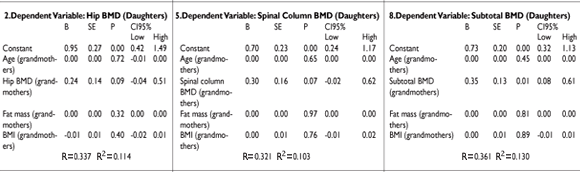
<body><![CDATA[<p><font size="2" face="Verdana">Using predictive models for BMD of the hips among    grandmothers, mothers and granddaughters, we observed that BMD of the hips in    grandmothers is a predictor of BMD in mothers, with a beta of 0.46 (<I>p=</I>    0.001, CI95% 0.19&#45;0.73); (R<SUP>2</SUP>= 0.41).</font></p>     <p><font size="2" face="Verdana"> With respect to mothers and granddaughters,    the correlation was not significant (beta= 0.19, CI95% &#45;0.08 &#150; 0.45)    (<a href="#tab03c">Table III&#45;3</a>).</font></p>     <p><a name="tab03a"></a></p>     <p>&nbsp;</p>     <p align="center"><img src="/img/revistas/spm/v51s1/a12tab03_147.gif"></p>     <p><a name="tab03b"></a></p>     <p align="center"><img src="/img/revistas/spm/v51s1/a12tab03_258.gif"></p>     <p><a name="tab03c"></a></p>     <p align="center"><img src="/img/revistas/spm/v51s1/a12tab03.gif"></p>     <p>&nbsp;</p>     ]]></body>
<body><![CDATA[<p><font size="2" face="Verdana">Finally, the correlation of BMD of the hips between    grandmothers and granddaughters was not significant (beta= 0.24, CI95% &#45;0.04&#45;0.51),    as seen in <a href="#tab03b">Table III&#45;2</a>.</font></p>     <p><font size="2" face="Verdana"> In <a href="#tab03a">Tables III&#45;4</a>, <a href="#tab03b">5</a>    and <a href="#tab03c">6</a>, predictive models for BMD of the lumbar spine in    grandmothers, mothers and granddaughters are shown. A predictor of BMD in the    lumbar spine in granddaughters is BMD of the lumbar spine in mothers (beta=    0.30 CI95% 0.07&#45;0.53). In addition, no statistically significant correlation    existed between grandmothers and mothers and between grandmothers and granddaughters.</font></p>     <p><font size="2" face="Verdana"> In predictive models for total BMD (except the    head) in grandmothers, mothers and granddaughters, there was a close correlation    of total BMD (except the head) between grandmothers and mothers (beta 0.32,    CI95% 0.070&#45;0.58 ) independent of age, with a high level of prediction (R<SUP>2</SUP>:    0.45 ). This correlation was also observed between mothers and granddaughters,    with a beta value of 0.33 (CI95% 0.06&#45;0.60), as well as between grandmothers    and granddaughters, with a beta of 0.34 (CI95% 0.07&#45;0.61), as shown in <a href="#tab03a">Table    III&#45;7</a>, <a href="#tab03b">8</a> and <a href="#tab03c">9</a>.</font></p>     <p>&nbsp;</p>     <p><font size="3" face="verdana"><b>Discussion</b></font></p>     <p><font size="2" face="Verdana">In our triad of Mexican grandmothers, mothers    and granddaughters, we observed a high correlation of BMD among the three generations,    which indicates an enormous genetic influence on bone mineralization. Body composition    trends are transmitted from mothers to daughters, and although this factor could    be influenced by hereditary factors, it is important to consider the fact that    lifestyle characteristics are shared.</font></p>     <p><font size="2" face="Verdana"> We observed a strong association of BMD of the    hips between grandmothers and mothers; this association was also found between    mothers and granddaughters. Nevertheless, the latter was not significant, possibly    as a result of a lack of statistical power. This correlation of BMD among generations    could be explained by factors such as dietary and lifestyle habits; findings    of differences in prediction among different anatomical sites suggest the influence    of genetic factors. Diverse studies have described the importance of genetic    determination on BMD. <SUP>8,15&#45;19</sup></font></p>     <p><font size="2" face="Verdana"> In 1999, Francois S <I>et al</I>., and Mitchell    <I>et al.</I> in 2003, reported that the children of mothers with a familiar    history of osteoporosis presented a decrease in BMD for their age.<SUP>8,20</SUP>    This finding suggests that BMD presents a hereditable trend among generations,    which is explained by genetic predisposition and its interaction with environmental    factors. This is reflected in our study when observing the strong correlation    among direct descendents which, though it continues to be positive, decreases    for the second generation.</font></p>     <p><font size="2" face="Verdana"> Another important finding in our study is the    high prediction of BMD in women belonging to the group of granddaughters when    evaluating subtotal BMD among the three generations. Nevertheless, when stratifying    by anatomical site, the effect is different for the lumbar spine and hips, which    strengthens the hypothesis of genetic predisposition mediated by a pleiotropical    effect of genes associated with BMD. The fact that the bone of the spinal column    is made up of both cortical as well as trabecular bone and the hips are primarily    trabecular explains how the correlation found in our study reflects a genetically    determined osteoporosis phenotype dependent on the anatomical site, where at    the femoral level there is an association with chromosome 21q and with chromosome    14q31 at the lumbar spine.<SUP>12,21</SUP> The intergenerational correlation    of subtotal BMD by specific anatomical site supports the hypothesis that a significant    genetic component is involved. These findings are consistent with various reports    that associate diverse gene polymorphisms with BMD regulation. Genetic influence    determines a lower peak bone density in individuals with a familiar history    of osteoporosis; numerous genes have been identified as determinants of bone    density, among which are those that code for the vitamin D receptor, the    estrogen receptor, type 1 collagen, IGF1, TGF&#45;beta and BMPs. <SUP>5&#45;8,22&#45;24</sup></font></p>     <p><font size="2" face="Verdana"> A recent report of a high resolution linkage    study and the evaluation of linkage disequilibrium for SNPs on chromosome 1p36    in 39 pedigrees with osteoporosis identifies new gene candidates associated    with low bone mineral density in distinct anatomical sites. The genes identified    in this study include RERE (SNP rs11121179 <I>p</I>=0.000005) for the spinal    column, G1P2, SSU72 and CCDC27.<SUP>25</sup></font></p>     ]]></body>
<body><![CDATA[<p><font size="2" face="Verdana"> Although the present study does not evaluate    genetic determinants, it provides important evidence to establish that the risk    of osteoporosis, as measured by BMD, presents a model particular to heredity    that enables the prediction of risk in young women of developing osteoporosis    in adulthood. The fact that an intergenerational association of BMD is observed    substantiates the potential effect of common genes at the different anatomical    sites that would be regulating bone metabolism.</font></p>     <p>&nbsp;</p>     <p><font size="3" face="verdana"><b>Conclusions</b></font></p>     <p><font size="2" face="Verdana">The results obtained in this study suggest that    daughters of women with low BMD for their age will tend to have the same condition.    This indicates the importance of monitoring girls and female adolescents whose    mothers have problems with osteopenia or osteoporosis. Therefore, it will be    necessary to conduct studies to identify the most significant genes and the    specific anatomical sites in our population to establish polymorphic variants    for high&#45;risk in the Mexican population.</font></p>     <p><font size="2" face="Verdana"> Understanding the mechanisms by which genetic    factors regulate BMD and other phenotypes related with osteoporosis has important    implications for clinical practice. The genes that regulate BMD and bone fragility    could potentially be used as diagnostic markers for the evaluation of individuals    at risk for developing osteoporosis. These markers could be used along with    biochemical markers and BMD evaluation to develop more specific therapies for    individuals at high risk of osteoporosis.</font></p>     <p><font size="2" face="Verdana"> The future identification of genes associated    with osteoporosis will provide relevant information for the creation of instruments    to identify high&#45;risk individuals in a timely manner, to whom health interventions    can be directed with greater effectiveness and which will surely translate into    an effect on morbidity and the reduction of medical costs.</font></p>     <p>&nbsp;</p>     <p><font size="3" face="verdana"><b>References</b></font></p>     <p><font size="2" face="Verdana">1. Yang TL, Zhao LJ, Liu YJ, Liu JF, Recker RR,    Deng HW. Genetic and environmental correlations of bone mineral density at different    skeletal sites in females and males. Calcif Tissue Int 2006 Apr;78(4):212&#45;7.</font></p>     <p><font size="2" face="Verdana">2. Lutz J, Tesar R. Mother&#45;daughter pairs: spinal    and femoral bone densities and dietary intakes. Am J Clin Nutr 1990 Nov;52(5):872&#45;7.</font></p>     ]]></body>
<body><![CDATA[<!-- ref --><p><font size="2" face="Verdana">3. Wang YB, Lei SF, Dvornyk V, Sun X, Jiang DK,    Li MX, Deng HW. The genetic, environmental and phenotypic correlations of bone    phenotypes at the spine and hip in Chinese. Ann Hum Biol 2006 Jul&#45;Aug;33(4):500&#45;9.</font>&nbsp;&nbsp;&nbsp;&nbsp;&nbsp;&nbsp;&nbsp;&nbsp;[&#160;<a href="javascript:void(0);" onclick="javascript: window.open('/scielo.php?script=sci_nlinks&ref=9283344&pid=S0036-3634200900070001200003&lng=','','width=640,height=500,resizable=yes,scrollbars=1,menubar=yes,');">Links</a>&#160;]<!-- end-ref --><p><font size="2" face="Verdana">4. Deng FY, Lei SF, Li MX, Jiang C, Dvornyk V,    Deng HW. Genetic determination and correlation of body mass index and bone mineral    density at the spine and hip in Chinese Han ethnicity. Osteoporos Int 2006 Jan;17(1):119&#45;24.</font></p>     <p><font size="2" face="Verdana">5. Guo Y, Zhao LJ, Shen H, Guo Y, Deng HW. Genetic    and environmental correlations between age at menarche and bone mineral density    at different skeletal sites. Calcif Tissue Int 2005 Dec;77(6):356&#45;60.</font></p>     <p><font size="2" face="Verdana">6. Yang YJ, Dvornyk V, Jian WX, Xiao SM, Deng    HW. Genetic and environmental correlations between bone phenotypes and anthropometric    indices in Chinese. Osteoporos Int 2005 Sep;16(9):1134&#45;40.</font></p>     <p><font size="2" face="Verdana">7. Bachrach LK, Hastie T, Wang MC, Narasimhan    B, Marcus R. Bone mineral acquisition in healthy Asian, Hispanic, Black, and    Caucasian youth: a longitudinal study. J Clin Endocrinol Metab 1999 Dec;84(12):4702&#45;12.</font></p>     <p><font size="2" face="Verdana">8. Brown LB, Streeten EA, Shapiro JR, McBride    D, Shuldiner AR, Peyser PA, Mitchell BD. Genetic and environmental influences    on bone mineral density in pre&#45; and post&#45;menopausal women. Osteoporos Int 2005    Dec;16(12):1849&#45;56.</font></p>     <p><font size="2" face="Verdana">9. Peacock M, Koller DL, Fishburn T, Krishnan    S, Lai D, Hui S, Johnston CC, Foroud T, Econs MJ.Sex&#45;specific and non&#45;sex&#45;specific    quantitative trait loci contribute to normal variation in bone mineral density    in men. J Clin Endocrinol Metab 2005 May;90(5):3060&#45;6.</font></p>     <p><font size="2" face="Verdana">10. Livshits G, Deng HW, Nguyen TV, Yakovenko    K, Recker RR, Eisman JA. Genetics of bone mineral density: evidence for a major    pleiotropic effect from an intercontinental study. J Bone Miner Res 2004 Jun;19(6):914&#45;23.</font></p>     <!-- ref --><p><font size="2" face="Verdana">11. Jian WX, Long JR, Li MX, Liu XH, Deng HW.    Genetic determination of variation and covariation of bone mineral density at    the hip and spine in a Chinese population. J Bone Miner Metab 2005;23(2):181&#45;5.</font>&nbsp;&nbsp;&nbsp;&nbsp;&nbsp;&nbsp;&nbsp;&nbsp;[&#160;<a href="javascript:void(0);" onclick="javascript: window.open('/scielo.php?script=sci_nlinks&ref=9283352&pid=S0036-3634200900070001200011&lng=','','width=640,height=500,resizable=yes,scrollbars=1,menubar=yes,');">Links</a>&#160;]<!-- end-ref --><p><font size="2" face="Verdana">12. Duncan EL, Cardon LR, Sinsheimer JS, Wass    JA, Brown MA. Site and gender specificity of inheritance of bone mineral density.    J Bone Miner Res 2003 Aug;18(8):1531&#45;8.</font></p>     ]]></body>
<body><![CDATA[<p><font size="2" face="Verdana">13. Mitchell BD, Kammerer CM, Schneider JL, Perez    R, Bauer RL. Genetic and environmental determinants of bone mineral density    in Mexican Americans: results from the San Antonio Family Osteoporosis Study.    Bone 2003 Nov;33(5):839&#45;46.</font></p>     <p><font size="2" face="Verdana">14. Pelat C, Van Pottelbergh I, Cohen&#45;Solal M,    Ostertag A, Kaufman JM, Martinez M, de Vernejoul MC. Complex segregation analysis    accounting for GxE of bone mineral density in European pedigrees selected through    a male proband with low BMD. Ann Hum Genet 2007 Jan;71(Pt 1):29&#45;42.</font></p>     <p><font size="2" face="Verdana">15. Greendale GA, Chu J, Ferrell R, Randolph    JF Jr, Johnston JM, Sowers MR. The association of bone mineral density with    estrogen receptor gene polymorphisms. Am J Med 2006; 119 (9 Supl 1): S79&#45;86.</font></p>     <!-- ref --><p><font size="2" face="Verdana">16. Williams FM, Spector TD. Recent advances    in the genetics of osteoporosis. J Musculoskelet Neuronal Interact 2006; 6:    27&#45;35.</font>&nbsp;&nbsp;&nbsp;&nbsp;&nbsp;&nbsp;&nbsp;&nbsp;[&#160;<a href="javascript:void(0);" onclick="javascript: window.open('/scielo.php?script=sci_nlinks&ref=9283357&pid=S0036-3634200900070001200016&lng=','','width=640,height=500,resizable=yes,scrollbars=1,menubar=yes,');">Links</a>&#160;]<!-- end-ref --><!-- ref --><p><font size="2" face="Verdana">17. Francois S, Benmalek A, Guaydier&#45;Souquieres    G, Sabatier JP, Marcelli C. Heritability of bone mineral density. Rev Rhum Engl    Ed 1999; 66: 146&#45;51.</font>&nbsp;&nbsp;&nbsp;&nbsp;&nbsp;&nbsp;&nbsp;&nbsp;[&#160;<a href="javascript:void(0);" onclick="javascript: window.open('/scielo.php?script=sci_nlinks&ref=9283358&pid=S0036-3634200900070001200017&lng=','','width=640,height=500,resizable=yes,scrollbars=1,menubar=yes,');">Links</a>&#160;]<!-- end-ref --><!-- ref --><p><font size="2" face="Verdana">18. Runyan SM, Stadler DD, Bainbridge CN, Miller    SC, Moyer&#45; Mileur LJ. Familial resemblance of bone mineralization, calcium intake,    and physical activity in early&#45;adolescent daughters, their mothers, and maternal    grandmothers. J Am Diet Assoc 2003; 103: 1320&#45;5.</font>&nbsp;&nbsp;&nbsp;&nbsp;&nbsp;&nbsp;&nbsp;&nbsp;[&#160;<a href="javascript:void(0);" onclick="javascript: window.open('/scielo.php?script=sci_nlinks&ref=9283359&pid=S0036-3634200900070001200018&lng=','','width=640,height=500,resizable=yes,scrollbars=1,menubar=yes,');">Links</a>&#160;]<!-- end-ref --><!-- ref --><p><font size="2" face="Verdana">19. Tylavsky FA, Bortz AD, Hancock RL, Anderson    JJ. Familial resemblance of radial bone mass between premenopausal mothers and    their college&#45;age daughters. Calcif Tissue Int 1989; 45: 265&#45;72.</font>&nbsp;&nbsp;&nbsp;&nbsp;&nbsp;&nbsp;&nbsp;&nbsp;[&#160;<a href="javascript:void(0);" onclick="javascript: window.open('/scielo.php?script=sci_nlinks&ref=9283360&pid=S0036-3634200900070001200019&lng=','','width=640,height=500,resizable=yes,scrollbars=1,menubar=yes,');">Links</a>&#160;]<!-- end-ref --><!-- ref --><p><font size="2" face="Verdana">20. Danielson ME, Cauley JA, Baker CE, Newman    AB, Dorman JS, Towers JD, <I>et al</I>. Familial resemblance of bone mineral    density (BMD) and calcaneal ultrasound attenuation: the BMD in mothers and daughters    study, J Bone Miner Res 1999; 14: 102&#45;10.</font>&nbsp;&nbsp;&nbsp;&nbsp;&nbsp;&nbsp;&nbsp;&nbsp;[&#160;<a href="javascript:void(0);" onclick="javascript: window.open('/scielo.php?script=sci_nlinks&ref=9283361&pid=S0036-3634200900070001200020&lng=','','width=640,height=500,resizable=yes,scrollbars=1,menubar=yes,');">Links</a>&#160;]<!-- end-ref --><p><font size="2" face="Verdana">21. Karasik D, Myers RH, Cupples LA, Hannan MT,    Gagnon DR, Herbert A, Kiel DP. Genome screen for quantitative trait loci contributing    to normal variation in bone mineral density: the Framingham Study. J Bone Miner    Res 2002 Sep;17(9):1718&#45;27. </font></p>     <!-- ref --><p><font size="2" face="Verdana">22. Mezquita&#45;Raya P, Mu&ntilde;oz&#45;Torres M, de    Dios Luna J, Lopez&#45;Rodriguez F, Quesada JM, Luque&#45;Recio F, Escobar&#45;Jim&eacute;nez    F. Performance of COLIA1 polymorphism and bone turnover markers to identify    postmenopausal women with prevalent vertebral fractures. Osteoporos Int 2002;13(6):506&#45;12.    </font>&nbsp;&nbsp;&nbsp;&nbsp;&nbsp;&nbsp;&nbsp;&nbsp;[&#160;<a href="javascript:void(0);" onclick="javascript: window.open('/scielo.php?script=sci_nlinks&ref=9283363&pid=S0036-3634200900070001200022&lng=','','width=640,height=500,resizable=yes,scrollbars=1,menubar=yes,');">Links</a>&#160;]<!-- end-ref --><!-- ref --><p><font size="2" face="Verdana">23. Quesada JM, Casado A, D&iacute;az C, Barrios    L, Cuenca&#45;Acevedo R, Dorado G. Allele&#45;frequency determination of BsmI and FokI    polymorphisms of the VDR gene by quantitative real&#45;time PCR (QRT&#45;PCR) in pooled    genomic DNA samples. J Steroid Biochem Mol Biol 2004 May;89&#45;90(1&#45;5):209&#45;14.</font>&nbsp;&nbsp;&nbsp;&nbsp;&nbsp;&nbsp;&nbsp;&nbsp;[&#160;<a href="javascript:void(0);" onclick="javascript: window.open('/scielo.php?script=sci_nlinks&ref=9283364&pid=S0036-3634200900070001200023&lng=','','width=640,height=500,resizable=yes,scrollbars=1,menubar=yes,');">Links</a>&#160;]<!-- end-ref --><p><font size="2" face="Verdana">24. Albagha OM, Ralston SH. Genetic determinants    of susceptibility to osteoporosis. Endocrinol Metab Clin North Am 2003 Mar;32(1):6    </font></p>     <!-- ref --><p><font size="2" face="Verdana">25. Zhang H, Sol&#45;Church K, Rydbeck H, Stabley    D, Spotila LD, Devoto M. High resolution linkage and linkage disequilibrium    analyses of chromosome 1p36 SNPs identify new positional candidate genes for    low bone mineral density. Osteoporos Int 2008 Jul 3.</font>&nbsp;&nbsp;&nbsp;&nbsp;&nbsp;&nbsp;&nbsp;&nbsp;[&#160;<a href="javascript:void(0);" onclick="javascript: window.open('/scielo.php?script=sci_nlinks&ref=9283366&pid=S0036-3634200900070001200025&lng=','','width=640,height=500,resizable=yes,scrollbars=1,menubar=yes,');">Links</a>&#160;]<!-- end-ref --><p>&nbsp;</p>     <p>&nbsp;</p>     <p><font size="2" face="Verdana">Received on: November 3, 2008    <br>   Accepted on: December 11, 2008</font></p>     <p>&nbsp;</p>     <p>&nbsp;</p>     <p><font size="2" face="Verdana">Address reprint requests to: Dr. Eduardo Lazcano    Ponce. Instituto Nacional de Salud P&uacute;blica. Av. Universidad # 655 Col.    Sta. Mar&iacute;a Ahuacatitl&aacute;n. 62508 Cuernavaca, Mor., M&eacute;xico.    ]]></body>
<body><![CDATA[<br>   E&#45;mail: <a href="mailto:elazcano@insp.mx">elazcano@insp.mx</a></font></p>      ]]></body><back>
<ref-list>
<ref id="B1">
<label>1</label><nlm-citation citation-type="journal">
<person-group person-group-type="author">
<name>
<surname><![CDATA[Yang]]></surname>
<given-names><![CDATA[TL]]></given-names>
</name>
<name>
<surname><![CDATA[Zhao]]></surname>
<given-names><![CDATA[LJ]]></given-names>
</name>
<name>
<surname><![CDATA[Liu]]></surname>
<given-names><![CDATA[YJ]]></given-names>
</name>
<name>
<surname><![CDATA[Liu]]></surname>
<given-names><![CDATA[JF]]></given-names>
</name>
<name>
<surname><![CDATA[Recker]]></surname>
<given-names><![CDATA[RR]]></given-names>
</name>
<name>
<surname><![CDATA[Deng]]></surname>
<given-names><![CDATA[HW]]></given-names>
</name>
</person-group>
<article-title xml:lang="en"><![CDATA[Genetic and environmental correlations of bone mineral density at different skeletal sites in females and males]]></article-title>
<source><![CDATA[Calcif Tissue Int]]></source>
<year>2006</year>
<month>04</month>
<volume>78</volume>
<numero>4</numero>
<issue>4</issue>
<page-range>212-7</page-range></nlm-citation>
</ref>
<ref id="B2">
<label>2</label><nlm-citation citation-type="journal">
<person-group person-group-type="author">
<name>
<surname><![CDATA[Lutz]]></surname>
<given-names><![CDATA[J]]></given-names>
</name>
<name>
<surname><![CDATA[Tesar]]></surname>
<given-names><![CDATA[R]]></given-names>
</name>
</person-group>
<article-title xml:lang="en"><![CDATA[Mother-daughter pairs: spinal and femoral bone densities and dietary intakes]]></article-title>
<source><![CDATA[Am J Clin Nutr]]></source>
<year>1990</year>
<month>11</month>
<volume>52</volume>
<numero>5</numero>
<issue>5</issue>
<page-range>872-7</page-range></nlm-citation>
</ref>
<ref id="B3">
<label>3</label><nlm-citation citation-type="journal">
<person-group person-group-type="author">
<name>
<surname><![CDATA[Wang]]></surname>
<given-names><![CDATA[YB]]></given-names>
</name>
<name>
<surname><![CDATA[Lei]]></surname>
<given-names><![CDATA[SF]]></given-names>
</name>
<name>
<surname><![CDATA[Dvornyk]]></surname>
<given-names><![CDATA[V]]></given-names>
</name>
<name>
<surname><![CDATA[X]]></surname>
<given-names><![CDATA[Sun]]></given-names>
</name>
<name>
<surname><![CDATA[Jiang]]></surname>
<given-names><![CDATA[DK]]></given-names>
</name>
<name>
<surname><![CDATA[Li]]></surname>
<given-names><![CDATA[MX]]></given-names>
</name>
<name>
<surname><![CDATA[Deng]]></surname>
<given-names><![CDATA[HW]]></given-names>
</name>
</person-group>
<article-title xml:lang="en"><![CDATA[The genetic, environmental and phenotypic correlations of bone phenotypes at the spine and hip in Chinese]]></article-title>
<source><![CDATA[Ann Hum Biol]]></source>
<year>2006</year>
<month> J</month>
<day>ul</day>
<volume>33</volume>
<numero>4</numero>
<issue>4</issue>
<page-range>500-9</page-range></nlm-citation>
</ref>
<ref id="B4">
<label>4</label><nlm-citation citation-type="journal">
<person-group person-group-type="author">
<name>
<surname><![CDATA[Deng]]></surname>
<given-names><![CDATA[FY]]></given-names>
</name>
<name>
<surname><![CDATA[Lei]]></surname>
<given-names><![CDATA[SF]]></given-names>
</name>
<name>
<surname><![CDATA[Li]]></surname>
<given-names><![CDATA[MX]]></given-names>
</name>
<name>
<surname><![CDATA[Jiang]]></surname>
<given-names><![CDATA[C]]></given-names>
</name>
<name>
<surname><![CDATA[Dvornyk]]></surname>
<given-names><![CDATA[V]]></given-names>
</name>
<name>
<surname><![CDATA[Deng]]></surname>
<given-names><![CDATA[HW]]></given-names>
</name>
</person-group>
<article-title xml:lang="en"><![CDATA[Genetic determination and correlation of body mass index and bone mineral density at the spine and hip in Chinese Han ethnicity]]></article-title>
<source><![CDATA[Osteoporos Int]]></source>
<year>2006</year>
<month>01</month>
<volume>17</volume>
<numero>1</numero>
<issue>1</issue>
<page-range>119-24</page-range></nlm-citation>
</ref>
<ref id="B5">
<label>5</label><nlm-citation citation-type="journal">
<person-group person-group-type="author">
<name>
<surname><![CDATA[Guo]]></surname>
<given-names><![CDATA[Y]]></given-names>
</name>
<name>
<surname><![CDATA[Zhao]]></surname>
<given-names><![CDATA[LJ]]></given-names>
</name>
<name>
<surname><![CDATA[Shen]]></surname>
<given-names><![CDATA[H]]></given-names>
</name>
<name>
<surname><![CDATA[Guo]]></surname>
<given-names><![CDATA[Y]]></given-names>
</name>
<name>
<surname><![CDATA[Deng]]></surname>
<given-names><![CDATA[HW]]></given-names>
</name>
</person-group>
<article-title xml:lang="en"><![CDATA[Genetic and environmental correlations between age at menarche and bone mineral density at different skeletal sites]]></article-title>
<source><![CDATA[Calcif Tissue Int]]></source>
<year>2005</year>
<month>12</month>
<volume>77</volume>
<numero>6</numero>
<issue>6</issue>
<page-range>356-60</page-range></nlm-citation>
</ref>
<ref id="B6">
<label>6</label><nlm-citation citation-type="journal">
<person-group person-group-type="author">
<name>
<surname><![CDATA[Yang]]></surname>
<given-names><![CDATA[YJ]]></given-names>
</name>
<name>
<surname><![CDATA[Dvornyk]]></surname>
<given-names><![CDATA[V]]></given-names>
</name>
<name>
<surname><![CDATA[Jian]]></surname>
<given-names><![CDATA[WX]]></given-names>
</name>
<name>
<surname><![CDATA[Xiao]]></surname>
<given-names><![CDATA[SM]]></given-names>
</name>
<name>
<surname><![CDATA[Deng]]></surname>
<given-names><![CDATA[HW]]></given-names>
</name>
</person-group>
<article-title xml:lang="en"><![CDATA[Genetic and environmental correlations between bone phenotypes and anthropometric indices in Chinese]]></article-title>
<source><![CDATA[Osteoporos Int]]></source>
<year>2005</year>
<month>09</month>
<volume>16</volume>
<numero>9</numero>
<issue>9</issue>
<page-range>1134-40</page-range></nlm-citation>
</ref>
<ref id="B7">
<label>7</label><nlm-citation citation-type="journal">
<person-group person-group-type="author">
<name>
<surname><![CDATA[Bachrach]]></surname>
<given-names><![CDATA[LK]]></given-names>
</name>
<name>
<surname><![CDATA[Hastie]]></surname>
<given-names><![CDATA[T]]></given-names>
</name>
<name>
<surname><![CDATA[Wang]]></surname>
<given-names><![CDATA[MC]]></given-names>
</name>
<name>
<surname><![CDATA[Narasimhan]]></surname>
<given-names><![CDATA[B]]></given-names>
</name>
<name>
<surname><![CDATA[Marcus]]></surname>
<given-names><![CDATA[R]]></given-names>
</name>
</person-group>
<article-title xml:lang="en"><![CDATA[Bone mineral acquisition in healthy Asian, Hispanic, Black, and Caucasian youth: a longitudinal study]]></article-title>
<source><![CDATA[J Clin Endocrinol Metab]]></source>
<year>1999</year>
<month>12</month>
<volume>84</volume>
<numero>12</numero>
<issue>12</issue>
<page-range>4702-12</page-range></nlm-citation>
</ref>
<ref id="B8">
<label>8</label><nlm-citation citation-type="journal">
<person-group person-group-type="author">
<name>
<surname><![CDATA[Brown]]></surname>
<given-names><![CDATA[LB]]></given-names>
</name>
<name>
<surname><![CDATA[Streeten]]></surname>
<given-names><![CDATA[EA]]></given-names>
</name>
<name>
<surname><![CDATA[Shapiro]]></surname>
<given-names><![CDATA[JR]]></given-names>
</name>
<name>
<surname><![CDATA[McBride]]></surname>
<given-names><![CDATA[D]]></given-names>
</name>
<name>
<surname><![CDATA[Shuldiner]]></surname>
<given-names><![CDATA[AR]]></given-names>
</name>
<name>
<surname><![CDATA[Peyser]]></surname>
<given-names><![CDATA[PA]]></given-names>
</name>
<name>
<surname><![CDATA[Mitchell]]></surname>
<given-names><![CDATA[BD]]></given-names>
</name>
</person-group>
<article-title xml:lang="en"><![CDATA[Genetic and environmental influences on bone mineral density in pre-: and post-menopausal women]]></article-title>
<source><![CDATA[Osteoporos Int]]></source>
<year>2005</year>
<month>12</month>
<volume>16</volume>
<numero>12</numero>
<issue>12</issue>
<page-range>1849-56</page-range></nlm-citation>
</ref>
<ref id="B9">
<label>9</label><nlm-citation citation-type="journal">
<person-group person-group-type="author">
<name>
<surname><![CDATA[Peacock]]></surname>
<given-names><![CDATA[M]]></given-names>
</name>
<name>
<surname><![CDATA[Koller]]></surname>
<given-names><![CDATA[DL]]></given-names>
</name>
<name>
<surname><![CDATA[Fishburn]]></surname>
<given-names><![CDATA[T]]></given-names>
</name>
<name>
<surname><![CDATA[Krishnan]]></surname>
<given-names><![CDATA[S]]></given-names>
</name>
<name>
<surname><![CDATA[Lai]]></surname>
<given-names><![CDATA[D]]></given-names>
</name>
<name>
<surname><![CDATA[Hui]]></surname>
<given-names><![CDATA[S]]></given-names>
</name>
<name>
<surname><![CDATA[Johnston]]></surname>
<given-names><![CDATA[CC]]></given-names>
</name>
<name>
<surname><![CDATA[Foroud]]></surname>
<given-names><![CDATA[T]]></given-names>
</name>
<name>
<surname><![CDATA[Econs]]></surname>
<given-names><![CDATA[MJ]]></given-names>
</name>
</person-group>
<article-title xml:lang="en"><![CDATA[Sex-specific and non-sex-specific quantitative trait loci contribute to normal variation in bone mineral density in men]]></article-title>
<source><![CDATA[J Clin Endocrinol Metab]]></source>
<year>2005</year>
<month>05</month>
<volume>90</volume>
<numero>5</numero>
<issue>5</issue>
<page-range>3060-6</page-range></nlm-citation>
</ref>
<ref id="B10">
<label>10</label><nlm-citation citation-type="journal">
<person-group person-group-type="author">
<name>
<surname><![CDATA[Livshits]]></surname>
<given-names><![CDATA[G]]></given-names>
</name>
<name>
<surname><![CDATA[Deng]]></surname>
<given-names><![CDATA[HW]]></given-names>
</name>
<name>
<surname><![CDATA[Nguyen]]></surname>
<given-names><![CDATA[TV]]></given-names>
</name>
<name>
<surname><![CDATA[Yakovenko]]></surname>
<given-names><![CDATA[K]]></given-names>
</name>
<name>
<surname><![CDATA[Recker]]></surname>
<given-names><![CDATA[RR]]></given-names>
</name>
<name>
<surname><![CDATA[Eisman]]></surname>
<given-names><![CDATA[JA]]></given-names>
</name>
</person-group>
<article-title xml:lang="en"><![CDATA[Genetics of bone mineral density: evidence for a major pleiotropic effect from an intercontinental study]]></article-title>
<source><![CDATA[J Bone Miner Res]]></source>
<year>2004</year>
<month>06</month>
<volume>19</volume>
<numero>6</numero>
<issue>6</issue>
<page-range>914-23</page-range></nlm-citation>
</ref>
<ref id="B11">
<label>11</label><nlm-citation citation-type="journal">
<person-group person-group-type="author">
<name>
<surname><![CDATA[Jian]]></surname>
<given-names><![CDATA[WX]]></given-names>
</name>
<name>
<surname><![CDATA[Long]]></surname>
<given-names><![CDATA[JR]]></given-names>
</name>
<name>
<surname><![CDATA[Li]]></surname>
<given-names><![CDATA[MX]]></given-names>
</name>
<name>
<surname><![CDATA[Liu]]></surname>
<given-names><![CDATA[XH]]></given-names>
</name>
<name>
<surname><![CDATA[Deng]]></surname>
<given-names><![CDATA[HW]]></given-names>
</name>
</person-group>
<article-title xml:lang="en"><![CDATA[Genetic determination of variation and covariation of bone mineral density at the hip and spine in a Chinese population]]></article-title>
<source><![CDATA[J Bone Miner Metab]]></source>
<year>2005</year>
<volume>23</volume>
<numero>2</numero>
<issue>2</issue>
<page-range>181-5</page-range></nlm-citation>
</ref>
<ref id="B12">
<label>12</label><nlm-citation citation-type="journal">
<person-group person-group-type="author">
<name>
<surname><![CDATA[Duncan]]></surname>
<given-names><![CDATA[EL]]></given-names>
</name>
<name>
<surname><![CDATA[Cardon]]></surname>
<given-names><![CDATA[LR]]></given-names>
</name>
<name>
<surname><![CDATA[Sinsheimer]]></surname>
<given-names><![CDATA[JS]]></given-names>
</name>
<name>
<surname><![CDATA[Wass]]></surname>
<given-names><![CDATA[JA]]></given-names>
</name>
<name>
<surname><![CDATA[Brown]]></surname>
<given-names><![CDATA[MA]]></given-names>
</name>
</person-group>
<article-title xml:lang="en"><![CDATA[Site and gender specificity of inheritance of bone mineral density]]></article-title>
<source><![CDATA[J Bone Miner Res]]></source>
<year>2003</year>
<month>08</month>
<volume>18</volume>
<numero>8</numero>
<issue>8</issue>
<page-range>1531-8</page-range></nlm-citation>
</ref>
<ref id="B13">
<label>13</label><nlm-citation citation-type="journal">
<person-group person-group-type="author">
<name>
<surname><![CDATA[Mitchell]]></surname>
<given-names><![CDATA[BD]]></given-names>
</name>
<name>
<surname><![CDATA[Kammerer]]></surname>
<given-names><![CDATA[CM]]></given-names>
</name>
<name>
<surname><![CDATA[Schneider]]></surname>
<given-names><![CDATA[JL]]></given-names>
</name>
<name>
<surname><![CDATA[Perez]]></surname>
<given-names><![CDATA[R]]></given-names>
</name>
<name>
<surname><![CDATA[Bauer]]></surname>
<given-names><![CDATA[RL]]></given-names>
</name>
</person-group>
<article-title xml:lang="en"><![CDATA[Genetic and environmental determinants of bone mineral density in Mexican Americans: results from the San Antonio Family Osteoporosis Study]]></article-title>
<source><![CDATA[Bone]]></source>
<year>2003</year>
<month>11</month>
<volume>33</volume>
<numero>5</numero>
<issue>5</issue>
<page-range>839-46</page-range></nlm-citation>
</ref>
<ref id="B14">
<label>14</label><nlm-citation citation-type="journal">
<person-group person-group-type="author">
<name>
<surname><![CDATA[Pelat]]></surname>
<given-names><![CDATA[C]]></given-names>
</name>
<name>
<surname><![CDATA[Van Pottelbergh]]></surname>
<given-names><![CDATA[I]]></given-names>
</name>
<name>
<surname><![CDATA[Cohen-Solal]]></surname>
<given-names><![CDATA[M]]></given-names>
</name>
<name>
<surname><![CDATA[Ostertag]]></surname>
<given-names><![CDATA[A]]></given-names>
</name>
<name>
<surname><![CDATA[Kaufman]]></surname>
<given-names><![CDATA[JM]]></given-names>
</name>
<name>
<surname><![CDATA[Martinez]]></surname>
<given-names><![CDATA[M]]></given-names>
</name>
<name>
<surname><![CDATA[de Vernejoul]]></surname>
<given-names><![CDATA[MC]]></given-names>
</name>
</person-group>
<article-title xml:lang="en"><![CDATA[Complex segregation analysis accounting for GxE of bone mineral density in European pedigrees selected through a male proband with low BMD]]></article-title>
<source><![CDATA[Ann Hum Genet]]></source>
<year>2007</year>
<month>01</month>
<volume>71</volume>
<numero>Pt 1</numero>
<issue>Pt 1</issue>
<page-range>29-42</page-range></nlm-citation>
</ref>
<ref id="B15">
<label>15</label><nlm-citation citation-type="journal">
<person-group person-group-type="author">
<name>
<surname><![CDATA[Greendale]]></surname>
<given-names><![CDATA[GA]]></given-names>
</name>
<name>
<surname><![CDATA[Chu]]></surname>
<given-names><![CDATA[J]]></given-names>
</name>
<name>
<surname><![CDATA[Ferrell]]></surname>
<given-names><![CDATA[R]]></given-names>
</name>
<name>
<surname><![CDATA[Randolph Jr]]></surname>
<given-names><![CDATA[JF]]></given-names>
</name>
<name>
<surname><![CDATA[Johnston]]></surname>
<given-names><![CDATA[JM]]></given-names>
</name>
<name>
<surname><![CDATA[Sowers]]></surname>
<given-names><![CDATA[MR]]></given-names>
</name>
</person-group>
<article-title xml:lang="en"><![CDATA[The association of bone mineral density with estrogen receptor gene polymorphisms]]></article-title>
<source><![CDATA[Am J Med]]></source>
<year>2006</year>
<volume>119</volume>
<numero>9 Suppl 1</numero>
<issue>9 Suppl 1</issue>
<page-range>S79-86</page-range></nlm-citation>
</ref>
<ref id="B16">
<label>16</label><nlm-citation citation-type="journal">
<person-group person-group-type="author">
<name>
<surname><![CDATA[Williams]]></surname>
<given-names><![CDATA[FM]]></given-names>
</name>
<name>
<surname><![CDATA[Spector]]></surname>
<given-names><![CDATA[TD]]></given-names>
</name>
</person-group>
<article-title xml:lang="en"><![CDATA[Recent advances in the genetics of osteoporosis]]></article-title>
<source><![CDATA[J Musculoskelet Neuronal Interact]]></source>
<year>2006</year>
<volume>6</volume>
<page-range>27-35</page-range></nlm-citation>
</ref>
<ref id="B17">
<label>17</label><nlm-citation citation-type="journal">
<person-group person-group-type="author">
<name>
<surname><![CDATA[Francois]]></surname>
<given-names><![CDATA[S]]></given-names>
</name>
<name>
<surname><![CDATA[Benmalek]]></surname>
<given-names><![CDATA[A]]></given-names>
</name>
<name>
<surname><![CDATA[Guaydier-Souquieres]]></surname>
<given-names><![CDATA[G]]></given-names>
</name>
<name>
<surname><![CDATA[Sabatier]]></surname>
<given-names><![CDATA[JP]]></given-names>
</name>
<name>
<surname><![CDATA[Marcelli]]></surname>
<given-names><![CDATA[C]]></given-names>
</name>
</person-group>
<article-title xml:lang="en"><![CDATA[Heritability of bone mineral density]]></article-title>
<source><![CDATA[Rev Rhum Engl Ed]]></source>
<year>1999</year>
<volume>66</volume>
<page-range>146-51</page-range></nlm-citation>
</ref>
<ref id="B18">
<label>18</label><nlm-citation citation-type="journal">
<person-group person-group-type="author">
<name>
<surname><![CDATA[Runyan]]></surname>
<given-names><![CDATA[SM]]></given-names>
</name>
<name>
<surname><![CDATA[Stadler]]></surname>
<given-names><![CDATA[DD]]></given-names>
</name>
<name>
<surname><![CDATA[Bainbridge]]></surname>
<given-names><![CDATA[CN]]></given-names>
</name>
<name>
<surname><![CDATA[Miller]]></surname>
<given-names><![CDATA[SC]]></given-names>
</name>
<name>
<surname><![CDATA[Moyer- Mileur]]></surname>
<given-names><![CDATA[LJ]]></given-names>
</name>
</person-group>
<article-title xml:lang="en"><![CDATA[Familial resemblance of bone mineralization, calcium intake, and physical activity in early-adolescent daughters, their mothers, and maternal grandmothers]]></article-title>
<source><![CDATA[J Am Diet Assoc]]></source>
<year>2003</year>
<volume>103</volume>
<page-range>1320-5</page-range></nlm-citation>
</ref>
<ref id="B19">
<label>19</label><nlm-citation citation-type="journal">
<person-group person-group-type="author">
<name>
<surname><![CDATA[Tylavsky]]></surname>
<given-names><![CDATA[FA]]></given-names>
</name>
<name>
<surname><![CDATA[Bortz]]></surname>
<given-names><![CDATA[AD]]></given-names>
</name>
<name>
<surname><![CDATA[Hancock]]></surname>
<given-names><![CDATA[RL]]></given-names>
</name>
<name>
<surname><![CDATA[Anderson]]></surname>
<given-names><![CDATA[JJ]]></given-names>
</name>
</person-group>
<article-title xml:lang="en"><![CDATA[Familial resemblance of radial bone mass between premenopausal mothers and their college-age daughters]]></article-title>
<source><![CDATA[Calcif Tissue Int]]></source>
<year>1989</year>
<volume>45</volume>
<page-range>265-72</page-range></nlm-citation>
</ref>
<ref id="B20">
<label>20</label><nlm-citation citation-type="journal">
<person-group person-group-type="author">
<name>
<surname><![CDATA[Danielson]]></surname>
<given-names><![CDATA[ME]]></given-names>
</name>
<name>
<surname><![CDATA[Cauley]]></surname>
<given-names><![CDATA[JA]]></given-names>
</name>
<name>
<surname><![CDATA[Baker]]></surname>
<given-names><![CDATA[CE]]></given-names>
</name>
<name>
<surname><![CDATA[Newman]]></surname>
<given-names><![CDATA[AB]]></given-names>
</name>
<name>
<surname><![CDATA[Dorman]]></surname>
<given-names><![CDATA[JS]]></given-names>
</name>
<name>
<surname><![CDATA[Towers]]></surname>
<given-names><![CDATA[JD]]></given-names>
</name>
</person-group>
<article-title xml:lang="en"><![CDATA[Familial resemblance of bone mineral density (BMD) and calcaneal ultrasound attenuation: the BMD in mothers and daughters study]]></article-title>
<source><![CDATA[J Bone Miner Res]]></source>
<year>1999</year>
<volume>14</volume>
<page-range>102-10</page-range></nlm-citation>
</ref>
<ref id="B21">
<label>21</label><nlm-citation citation-type="journal">
<person-group person-group-type="author">
<name>
<surname><![CDATA[Karasik]]></surname>
<given-names><![CDATA[D]]></given-names>
</name>
<name>
<surname><![CDATA[Myers]]></surname>
<given-names><![CDATA[RH]]></given-names>
</name>
<name>
<surname><![CDATA[Cupples]]></surname>
<given-names><![CDATA[LA]]></given-names>
</name>
<name>
<surname><![CDATA[Hannan]]></surname>
<given-names><![CDATA[MT]]></given-names>
</name>
<name>
<surname><![CDATA[Gagnon]]></surname>
<given-names><![CDATA[DR]]></given-names>
</name>
<name>
<surname><![CDATA[Herbert]]></surname>
<given-names><![CDATA[A]]></given-names>
</name>
<name>
<surname><![CDATA[Kiel]]></surname>
<given-names><![CDATA[DP]]></given-names>
</name>
</person-group>
<article-title xml:lang="en"><![CDATA[Genome screen for quantitative trait loci contributing to normal variation in bone mineral density: the Framingham Study]]></article-title>
<source><![CDATA[J Bone Miner Res]]></source>
<year>2002</year>
<month>09</month>
<volume>17</volume>
<numero>9</numero>
<issue>9</issue>
<page-range>1718-27</page-range></nlm-citation>
</ref>
<ref id="B22">
<label>22</label><nlm-citation citation-type="journal">
<person-group person-group-type="author">
<name>
<surname><![CDATA[Mezquita-Raya]]></surname>
<given-names><![CDATA[P]]></given-names>
</name>
<name>
<surname><![CDATA[Muñoz-Torres]]></surname>
<given-names><![CDATA[M]]></given-names>
</name>
<name>
<surname><![CDATA[de Dios Luna]]></surname>
<given-names><![CDATA[J]]></given-names>
</name>
<name>
<surname><![CDATA[Lopez-Rodriguez]]></surname>
<given-names><![CDATA[F]]></given-names>
</name>
<name>
<surname><![CDATA[Quesada]]></surname>
<given-names><![CDATA[JM]]></given-names>
</name>
<name>
<surname><![CDATA[Luque-Recio]]></surname>
<given-names><![CDATA[F]]></given-names>
</name>
<name>
<surname><![CDATA[Escobar-Jiménez]]></surname>
<given-names><![CDATA[F]]></given-names>
</name>
</person-group>
<article-title xml:lang="en"><![CDATA[Performance of COLIA1 polymorphism and bone turnover markers to identify postmenopausal women with prevalent vertebral fractures]]></article-title>
<source><![CDATA[Osteoporos Int]]></source>
<year>2002</year>
<volume>13</volume>
<numero>6</numero>
<issue>6</issue>
<page-range>506-12</page-range></nlm-citation>
</ref>
<ref id="B23">
<label>23</label><nlm-citation citation-type="journal">
<person-group person-group-type="author">
<name>
<surname><![CDATA[Quesada]]></surname>
<given-names><![CDATA[JM]]></given-names>
</name>
<name>
<surname><![CDATA[Casado]]></surname>
<given-names><![CDATA[A]]></given-names>
</name>
<name>
<surname><![CDATA[Díaz]]></surname>
<given-names><![CDATA[C]]></given-names>
</name>
<name>
<surname><![CDATA[Barrios]]></surname>
<given-names><![CDATA[L]]></given-names>
</name>
<name>
<surname><![CDATA[Cuenca-Acevedo]]></surname>
<given-names><![CDATA[R]]></given-names>
</name>
<name>
<surname><![CDATA[Dorado]]></surname>
<given-names><![CDATA[G]]></given-names>
</name>
</person-group>
<article-title xml:lang="en"><![CDATA[Allele-frequency determination of BsmI and FokI polymorphisms of the VDR gene by quantitative real-time PCR (QRT-PCR) in pooled genomic DNA samples]]></article-title>
<source><![CDATA[J Steroid Biochem Mol Biol]]></source>
<year>2004</year>
<month> M</month>
<day>ay</day>
<volume>89-90</volume>
<numero>1-5</numero>
<issue>1-5</issue>
<page-range>209-14</page-range></nlm-citation>
</ref>
<ref id="B24">
<label>24</label><nlm-citation citation-type="journal">
<person-group person-group-type="author">
<name>
<surname><![CDATA[Albagha]]></surname>
<given-names><![CDATA[OM]]></given-names>
</name>
<name>
<surname><![CDATA[Ralston]]></surname>
<given-names><![CDATA[SH]]></given-names>
</name>
</person-group>
<article-title xml:lang="en"><![CDATA[Genetic determinants of susceptibility to osteoporosis]]></article-title>
<source><![CDATA[Endocrinol Metab Clin North Am]]></source>
<year>2003</year>
<month>03</month>
<volume>32</volume>
<numero>1</numero>
<issue>1</issue>
<page-range>6</page-range></nlm-citation>
</ref>
<ref id="B25">
<label>25</label><nlm-citation citation-type="journal">
<person-group person-group-type="author">
<name>
<surname><![CDATA[Zhang]]></surname>
<given-names><![CDATA[H]]></given-names>
</name>
<name>
<surname><![CDATA[Sol-Church]]></surname>
<given-names><![CDATA[K]]></given-names>
</name>
<name>
<surname><![CDATA[Rydbeck]]></surname>
<given-names><![CDATA[H]]></given-names>
</name>
<name>
<surname><![CDATA[Stabley]]></surname>
<given-names><![CDATA[D]]></given-names>
</name>
<name>
<surname><![CDATA[Spotila]]></surname>
<given-names><![CDATA[LD]]></given-names>
</name>
<name>
<surname><![CDATA[Devoto]]></surname>
<given-names><![CDATA[M]]></given-names>
</name>
</person-group>
<article-title xml:lang="en"><![CDATA[High resolution linkage and linkage disequilibrium analyses of chromosome 1p36 SNPs identify new positional candidate genes for low bone mineral density]]></article-title>
<source><![CDATA[Osteoporos Int]]></source>
<year>2008</year>
<month> J</month>
<day>ul</day>
</nlm-citation>
</ref>
</ref-list>
</back>
</article>