<?xml version="1.0" encoding="ISO-8859-1"?><article xmlns:mml="http://www.w3.org/1998/Math/MathML" xmlns:xlink="http://www.w3.org/1999/xlink" xmlns:xsi="http://www.w3.org/2001/XMLSchema-instance">
<front>
<journal-meta>
<journal-id>0036-3634</journal-id>
<journal-title><![CDATA[Salud Pública de México]]></journal-title>
<abbrev-journal-title><![CDATA[Salud pública Méx]]></abbrev-journal-title>
<issn>0036-3634</issn>
<publisher>
<publisher-name><![CDATA[Instituto Nacional de Salud Pública]]></publisher-name>
</publisher>
</journal-meta>
<article-meta>
<article-id>S0036-36342009000700010</article-id>
<title-group>
<article-title xml:lang="en"><![CDATA[Reference values for areal bone mineral density among a healthy Mexican population]]></article-title>
<article-title xml:lang="es"><![CDATA[Valores de referencia para la densidad mineral ósea expresada en área para una población mexicana sana]]></article-title>
</title-group>
<contrib-group>
<contrib contrib-type="author">
<name>
<surname><![CDATA[Tamayo]]></surname>
<given-names><![CDATA[Juan]]></given-names>
</name>
<xref ref-type="aff" rid="A01"/>
</contrib>
<contrib contrib-type="author">
<name>
<surname><![CDATA[Díaz]]></surname>
<given-names><![CDATA[Rodrigo]]></given-names>
</name>
<xref ref-type="aff" rid="A02"/>
</contrib>
<contrib contrib-type="author">
<name>
<surname><![CDATA[Lazcano-Ponce]]></surname>
<given-names><![CDATA[Eduardo]]></given-names>
</name>
<xref ref-type="aff" rid="A02"/>
</contrib>
<contrib contrib-type="author">
<name>
<surname><![CDATA[Muñoz]]></surname>
<given-names><![CDATA[Madeline]]></given-names>
</name>
<xref ref-type="aff" rid="A04"/>
</contrib>
<contrib contrib-type="author">
<name>
<surname><![CDATA[Huitrón]]></surname>
<given-names><![CDATA[Gerardo]]></given-names>
</name>
<xref ref-type="aff" rid="A03"/>
</contrib>
<contrib contrib-type="author">
<name>
<surname><![CDATA[Halley]]></surname>
<given-names><![CDATA[Elizabeth]]></given-names>
</name>
<xref ref-type="aff" rid="A05"/>
</contrib>
<contrib contrib-type="author">
<name>
<surname><![CDATA[Díaz-Montiel]]></surname>
<given-names><![CDATA[Juan Carlos]]></given-names>
</name>
<xref ref-type="aff" rid="A04"/>
</contrib>
<contrib contrib-type="author">
<name>
<surname><![CDATA[Mudgal]]></surname>
<given-names><![CDATA[Jyoti]]></given-names>
</name>
<xref ref-type="aff" rid="A04"/>
</contrib>
<contrib contrib-type="author">
<name>
<surname><![CDATA[Hernández-Ávila]]></surname>
<given-names><![CDATA[Mauricio]]></given-names>
</name>
<xref ref-type="aff" rid="A02"/>
</contrib>
<contrib contrib-type="author">
<name>
<surname><![CDATA[Salmerón]]></surname>
<given-names><![CDATA[Jorge]]></given-names>
</name>
<xref ref-type="aff" rid="A04"/>
</contrib>
</contrib-group>
<aff id="A01">
<institution><![CDATA[,Comité Mexicano  ]]></institution>
<addr-line><![CDATA[ ]]></addr-line>
</aff>
<aff id="A02">
<institution><![CDATA[,Instituto Nacional de Salud Pública Centro de Investigación en Salud Poblacional ]]></institution>
<addr-line><![CDATA[ ]]></addr-line>
</aff>
<aff id="A03">
<institution><![CDATA[,Universidad Autónoma del Estado de México Centro de Investigación en Ciencias Médicas ]]></institution>
<addr-line><![CDATA[ ]]></addr-line>
</aff>
<aff id="A04">
<institution><![CDATA[,Instituto Mexicano del Seguro Social Unidad de Investigación Epidemiológica ]]></institution>
<addr-line><![CDATA[ ]]></addr-line>
</aff>
<aff id="A05">
<institution><![CDATA[,Instituto de Salud del Estado de México Unidad de Enseñanza Investigación y Calidad]]></institution>
<addr-line><![CDATA[ ]]></addr-line>
</aff>
<pub-date pub-type="pub">
<day>00</day>
<month>00</month>
<year>2009</year>
</pub-date>
<pub-date pub-type="epub">
<day>00</day>
<month>00</month>
<year>2009</year>
</pub-date>
<volume>51</volume>
<fpage>s56</fpage>
<lpage>s83</lpage>
<copyright-statement/>
<copyright-year/>
<self-uri xlink:href="http://www.scielo.org.mx/scielo.php?script=sci_arttext&amp;pid=S0036-36342009000700010&amp;lng=en&amp;nrm=iso"></self-uri><self-uri xlink:href="http://www.scielo.org.mx/scielo.php?script=sci_abstract&amp;pid=S0036-36342009000700010&amp;lng=en&amp;nrm=iso"></self-uri><self-uri xlink:href="http://www.scielo.org.mx/scielo.php?script=sci_pdf&amp;pid=S0036-36342009000700010&amp;lng=en&amp;nrm=iso"></self-uri><abstract abstract-type="short" xml:lang="en"><p><![CDATA[OBJECTIVE: Compare the influence of ethnicity in the prevalence of osteopenia and osteoporosis in various Mexican populations using two normal dual X-ray absorptiometry (DXA) reference databases: manufacturer's incorporating US Hispanic population and a normal mestizo Mexican population. MATERIAL AND METHODS: MMP included 9 946 subjects participating in an ongoing long-term cohort study focusing on lifestyle and chronic diseases, of which 6 487 MMP males and females aged 7 to 80 years were the normal subjects used to determine bone density T- and Z-scores, following WHO criteria, and peak bone mass values. Abnormal bone mass density values estimated by the manufacturer's and peak bone mass reference values were compared. RESULTS AND CONCLUSIONS: Our results show that by using the manufacturer's T-score values in the mestizo Mexican population we are underestimating the number of abnormal bone mass BMD populations.]]></p></abstract>
<abstract abstract-type="short" xml:lang="es"><p><![CDATA[OBJETIVO: Comparar la influencia de la etnicidad en la prevalencia de osteopenia y osteoporosis en varias poblaciones mexicanas utilizando dos bases de referencia normal de densitometría de rayos X (DXA): referencia del fabricante que incorpora hispanos en Estados Unidos y datos de una población mestiza mexicana. MATERIAL Y MÉTODOS: Un total de 9 946 sujetos de población mestiza mexicana participantes en una cohorte de largo plazo dirigida al estudio de estilos de vida y ocurrencia de enfermedades crónicas; de los cuales 6 487 sujetos sanos de ambos sexos, con edad entre los 7 y los 80 años, fueron utilizados para determinar los valores T, Z, de acuerdo a los criterios de la OMS, así como a los valores de masa ósea pico. Se compararon los casos de densidad mineral ósea anormal de acuerdo a los valores de referencia del fabricante y los valores de masa ósea pico de la población mestiza. RESULTADOS Y CONCLUSIÓN: Las bases de referencia del fabricante subestima significativamente el número de casos con densidad mineral ósea anormal en la población mestiza mexicana.]]></p></abstract>
<kwd-group>
<kwd lng="en"><![CDATA[bone densitometry]]></kwd>
<kwd lng="en"><![CDATA[normal reference values]]></kwd>
<kwd lng="en"><![CDATA[ethnicity]]></kwd>
<kwd lng="en"><![CDATA[Mexico]]></kwd>
<kwd lng="es"><![CDATA[densitometría ósea]]></kwd>
<kwd lng="es"><![CDATA[valores normales referencia]]></kwd>
<kwd lng="es"><![CDATA[etnicidad]]></kwd>
<kwd lng="es"><![CDATA[México]]></kwd>
</kwd-group>
</article-meta>
</front><body><![CDATA[ <p align="right"><font size="2" face="Verdana"><b>ART&Iacute;CULO ORIGINAL</b></font></p>     <p>&nbsp;</p>     <p><font size="4" face="verdana"><b>Reference values for areal bone mineral density    among a healthy Mexican population</b></font></p>     <p>&nbsp;</p>     <p><b><font size="3" face="verdana">Valores de referencia para la densidad mineral &oacute;sea expresada en &aacute;rea para una poblaci&oacute;n mexicana sana</font></b></p>     <p>&nbsp;</p>     <p>&nbsp;</p>     <p><font size="2" face="Verdana"><b>Juan Tamayo, MD<SUP>I</SUP>; Rodrigo D&iacute;az,    PhD<SUP>II</SUP>; Eduardo Lazcano&#45;Ponce, DrSc<SUP>II</SUP>; Madeline Mu&ntilde;oz,    MSc<SUP>IV</sup>; Gerardo Huitr&oacute;n, MD<SUP>III</SUP>; Elizabeth Halley,    MSc<SUP>V</SUP>; Juan Carlos D&iacute;az&#45;Montiel, MSc<SUP>IV</SUP>; Jyoti Mudgal,    PhD<SUP>IV</sup>; Mauricio Hern&aacute;ndez&#45;&Aacute;vila, PhD<SUP>II</SUP>;    Jorge Salmer&oacute;n, DrSc<SUP>IV</sup></b></font></p>     <p><font size="2" face="Verdana"><SUP>I</SUP>Comit&eacute; Mexicano para la prevenci&oacute;n    de la Osteoporosis    <br>   <SUP>II</SUP>Centro de Investigaci&oacute;n en Salud Poblacional, Instituto    Nacional de Salud P&uacute;blica    ]]></body>
<body><![CDATA[<br>   <SUP>III</SUP>Centro de Investigaci&oacute;n en Ciencias M&eacute;dicas, Universidad    Aut&oacute;noma del Estado de M&eacute;xico    <br>   <SUP>IV</SUP>Unidad de Investigaci&oacute;n Epidemiol&oacute;gica y en Servicios    de Salud, Morelos. Instituto Mexicano del Seguro Social    <br>   <SUP>V</SUP>Unidad de Ense&ntilde;anza, Investigaci&oacute;n y Calidad. Instituto    de Salud del Estado de M&eacute;xico</font></p>     <p>&nbsp;</p>     <p>&nbsp;</p> <hr size="1" noshade>     <p><font size="2" face="VERDANA"><b>ABSTRACT</b></font></p>     <p><font size="2" face="Verdana"><b>OBJECTIVE:</b> Compare the influence of ethnicity    in the prevalence of osteopenia and osteoporosis in various Mexican populations    using two normal dual X&#45;ray absorptiometry (DXA) reference databases: manufacturer's    incorporating US Hispanic population and a normal mestizo Mexican population.    <br>   <b>MATERIAL AND METHODS:</b> MMP included 9 946 subjects participating in an    ongoing long&#45;term cohort study focusing on lifestyle and chronic diseases, of    which 6 487 MMP males and females aged 7 to 80 years were the normal subjects    used to determine bone density T&#45; and Z&#45;scores, following WHO criteria, and    peak bone mass values. Abnormal bone mass density values estimated by the manufacturer's    and peak bone mass reference values were compared.    <br>   <b>RESULTS AND CONCLUSIONS:</b> Our results show that by using the manufacturer's    T&#45;score values in the mestizo Mexican population we are underestimating the    number of abnormal bone mass BMD populations.</font></p>     <p><font size="2" face="Verdana"><b>Key words: </b>bone densitometry, normal reference    values, ethnicity, Mexico</font></p> <hr size="1" noshade>     ]]></body>
<body><![CDATA[<p><font size="2" face="Verdana"><b>RESUMEN</b></font></p>     <p><font size="2" face="Verdana"><b>OBJETIVO:</b> Comparar la influencia de la    etnicidad en la prevalencia de osteopenia y osteoporosis en varias poblaciones    mexicanas utilizando dos bases de referencia normal de densitometr&iacute;a    de rayos X (DXA): referencia del fabricante que incorpora hispanos en Estados    Unidos y datos de una poblaci&oacute;n mestiza mexicana.    <br>   <b>MATERIAL Y M&Eacute;TODOS:</b> Un total de 9 946 sujetos de poblaci&oacute;n    mestiza mexicana participantes en una cohorte de largo plazo dirigida al estudio    de estilos de vida y ocurrencia de enfermedades cr&oacute;nicas; de los cuales    6 487 sujetos sanos de ambos sexos, con edad entre los 7 y los 80 a&ntilde;os,    fueron utilizados para determinar los valores T, Z, de acuerdo a los criterios    de la OMS, as&iacute; como a los valores de masa &oacute;sea pico. Se compararon    los casos de densidad mineral &oacute;sea anormal de acuerdo a los valores de    referencia del fabricante y los valores de masa &oacute;sea pico de la poblaci&oacute;n    mestiza.    <br>   <b>RESULTADOS Y CONCLUSI&Oacute;N:</b> Las bases de referencia del fabricante    subestima significativamente el n&uacute;mero de casos con densidad mineral    &oacute;sea anormal en la poblaci&oacute;n mestiza mexicana.</font></p>     <p><font size="2" face="Verdana"><b>Palabras clave:</b> densitometr&iacute;a &oacute;sea,    valores normales referencia, etnicidad; M&eacute;xico</font></p> <hr size="1" noshade>     <p>&nbsp;</p>     <p>&nbsp;</p>     <p><font size="2" face="Verdana">Osteoporosis and its most common complication,    fragility fractures, are well recognized internationally as public health problems.<SUP>1&#45;6</SUP>    Mexico is no exception, as femoral fractures account for nearly 40 000 hip replacement    surgeries performed in the nation each year<SUP>7&#45;13</SUP> with an estimated    direct cost of 800 000 US dollars. In 1994, the World Health Organization (WHO)    developed criteria to classify bone mineral density (BMD) values as an estimation    of lifelong relative fracture risk<SUP>14</SUP> and to classify people as osteopenic    or osteoporotic based on the low energy dual x&#45;ray absorptiometry (DXA) T&#45;score    values of healthy young adults (20 to 40 years old). BMD is influenced by genetic    and lifestyle factors which may significantly vary between ethnic groups. BMD    reference values for the US Hispanic population are available from the National    Health and Nutrition Examination Survey (NAHNES) and can be found in clinical    equipment software. However, there are no such reference values available for    the healthy Mexican population, which is ethnically distinct from the US Hispanic    population. </font></p>     <p><font size="2" face="Verdana"> Over the last 15 years, DXA has been widely    used to determine bone mineral density (BMD) at different anatomical sites.    This technology has been used for early detection of individuals at high risk    of osteoporotic fractures. According to these WHO criteria, T&#45;scores should    be developed based on mean BMD values +/&#45; standard deviation (SD) among a reference    population of healthy young adults (20 to 40 years old). These criteria have    been adopted as the optimal bone strength reference values to qualify as osteopenic    or osteoporotic, based on the BMD evaluation. A T&#45;score value above 1.0 SD is    considered normal, between &#45;1.0 and &#45;2.5 SD as osteopenia, and below &#45;2.5 as    osteoporosis.<SUP>14&#45;16</SUP> A Z&#45;score was also developed as a comparison for    BMD determinations against age&#45; and gender&#45;matched healthy individuals. The    lifelong relative fracture risk for the osteopenic range increased to 1.6 and    it was over 2.0 for the osteoporotic range. The prediction is stronger if data    is analyzed for the specific region of interest, namely, if one measures femoral    neck results to predict the relative risk of having a femoral neck fracture;    in such an example the relative risk increases to over 2 for an osteopenic BMD    value and to over 6 for osteoporotic values.<SUP>14</SUP> </font></p>     <p><font size="2" face="Verdana"> In order to minimize the differences between    reference populations, researchers sought to generate BMD reference values for    different ethnic groups in the United States based on National Health and Nutrition    Examination Survey (NHANES) data.<SUP>17&#45;19</SUP> T&#45;scores for Hologic and Lunar    instruments have thus been developed for specific anatomical regions among 20    to 40 year&#45;old healthy adult men and women and for different ethnicities. During    the last 10 years, these estimates have been used as reference values for operational    and diagnostic purposes at the clinical level.</font></p>     ]]></body>
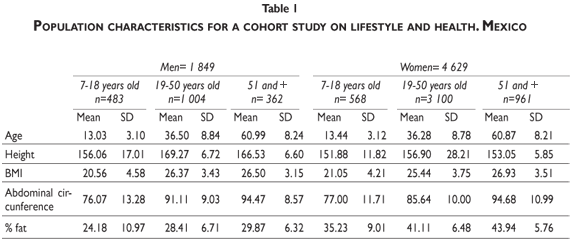
<body><![CDATA[<p><font size="2" face="Verdana"> In recent years, the use of BMD T&#45;score values    for different ethnic groups and countries has been questioned in light of increasing    evidence that the true maximal bone strength at skeletal maturity is the peak    bone mass (PBM), representing the optimal bone mass of an individual.<SUP>20</SUP>    It is now believed that a T&#45;score computed using this optimal bone strength    value (PBM) may be a better reference than the mean of a healthy young adult    population because bone mass is still increasing<SUP>21&#45;22</SUP> in individuals    between 20 and 30 years of age. Therefore, including sub&#45;optimal BMD estimates    in the calculation of T&#45;scores may lead to a significant underestimation of    osteopenic and/or osteoporotic cases.</font></p>     <p><font size="2" face="Verdana"> BMD is the strongest predictive factor of fractures    that can be assessed with high reproducibility and specificity.<SUP>22&#45;26</SUP>    To use this predictor in Mexico, it is thus crucial to have reference PBM values    for the Mexican population in order to compute a T&#45;score that truly reflects    optimal bone strength at skeletal maturity. Adopting national standards based    on BMD reference values and T&#45;score estimates for our population may improve    the assessment of osteoporosis in Mexico. Since anti&#45;fracture interventions    provide over 50 percent protection against osteoporotic fractures after the    first year of treatment, improved ability to assess fracture risk would improve    both public health decision making and clinical outcomes.<SUP>3</SUP> </font></p>     <p><font size="2" face="Verdana"> The aim of the study is to provide BMD reference    values based on a healthy, urban Mexican population aged 7 to 80 years and stratified    by sex, enabling us to estimate the PBM reference values for the Mexican population.    These values are necessary for computing a T&#45;score that truly reflects optimal    bone strength at skeletal maturity in this population. Using these BMD reference    values, we are able to calculate optimal BMD T&#45; and Z&#45;scores, both according    to WHO criteria and PBM values. Adopting these reference values as a national    standard can improve public health practices and clinical assessment of osteoporosis    in Mexico. </font></p>     <p>&nbsp;</p>     <p><font size="3" face="verdana"><b>Material and Methods</b></font></p>     <p><font size="2" face="Verdana">Study Population: The present analysis was performed    with healthy employees and their healthy relatives from three different health    and academic institutions: Instituto Mexicano del Seguro Social (IMSS) and the    Instituto Nacional de Salud P&uacute;blica (INSP) in Cuernavaca, Morelos, Mexico,    and employees from the Universidad Aut&oacute;noma del Estado de M&eacute;xico    (UAEM) in Toluca, State of Mexico. Subjects recruited for the study were participating    in the first stage of an ongoing, long&#45;term cohort study focusing on lifestyle    and health, approved by the respective ethical committees of each participating    institution; informed consent was obtained in all cases. Out of a total population    of 13275 study candidates identified between March 2004 and April 2006, 9467    employees were invited to participate in the cohort study and a total of 8 307    adults were formally enrolled. Those participants who were parents of children    7 to 18 years of age (about 20% of the employees) were also asked to invite    their children to be part of the study. Of those willing to participate, 1639    youths were formally invited and enrolled in the study. Thus, a total of 9946    subjects between 7 and 92 years of age were formally recruited. BMD determinations    in this study population constitute part of a more extensive epidemiologic evaluation    designed to prospectively evaluate different hypotheses about the relationships    between lifestyle and chronic disease occurrence in Mexico. </font></p>     <p><font size="2" face="Verdana"> For the present analysis, we excluded subjects    older than 80 years of age as well as participants with chronic diseases that    may affect bone metabolism and/or alter the BMD values, such as: diabetes (n=631),    cancer (n=96), obesity (BMI &gt;35, n=262), arthritis (n=286), kidney stones    (n=182), renal dysfunction (creatinine &gt;2 mg/dL for men, &gt;1.8 mg/dL for    females, n=283) previously diagnosed osteopenia/osteoporosis or fractures after    the age of 45 (n=64), use of medications that may alter bone metabolism (n=69),    and weight change in previous year (&gt;10 kg, n=89). We also excluded pregnant    women and those women who were unable to undergo BMD measurements. The final    healthy reference population for the present analysis is 6 478. This large sample    allowed us to estimate PBM as well as T&#45; and Z&#45;scores. The general characteristics    of this population are depicted in <a href="#tab01">table I</a>.</font></p>     <p><a name="tab01"></a></p>     <p>&nbsp;</p>     <p align="center"><img src="/img/revistas/spm/v51s1/a10tab01.gif"></p>     ]]></body>
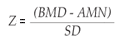
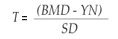
<body><![CDATA[<p>&nbsp;</p>     <p><font size="2" face="verdana"><b>BMD assessment </b></font></p>     <p><font size="2" face="Verdana">Bone density measurements were performed at the    non&#45;dominant proximal femur, the lumbar spine (L1&#45;L4), and whole body using    a DXA Lunar DPX NT instrument. The user manual instructions and International    Society of Clinical Densitometry (ISCD) procedures were strictly followed.<SUP>16,27</SUP>    Standardized densitometry technicians performed all BMD measurements. Standard    calibration of instruments was performed daily using the phantom provided by    the manufacturer; technicians ensured that the daily variation coefficient (VC)    was within normal operational standards and <I>in vivo</I> VC was lower than    1.5%. Results obtained by DXA are expressed as grams of hydroxyapatite per square    centimeter (WHO Technical Report Series: Prevention and Management of Osteoporosis.    <a href="http://whqlibdoc.who.int/trs/WHO_TRS_921.pdf" target="_blank">http://whqlibdoc.who.int/trs/WHO_TRS_921.pdf</a>).    </font></p>     <p><font size="2" face="verdana"><b>T&#45; and Z&#45;scores estimates procedures </b></font></p>     <p><font size="2" face="Verdana">In order to compute T&#45;scores by specific site    (total body, femur and lumbar spine), we first estimated the reference value    for PBM in our population following a previously reported procedure.<SUP>28</SUP>    Briefly, we calculated the difference in g/cm<SUP>2</SUP> between the BMD of    a subject and the PBM for the corresponding sex. The difference between these    values is expressed as standard deviation (SD), or in other words, the difference    between the studied subject and the PBM is standardized. The T&#45;score obtained    with this method represents the difference expressed by the number of standard    deviations between the Young Normal (YN) value of the population of the same    sex and the BMD of the subject studied. This sequence is summarized by the following    formula: </font></p>     <p align="center"><img src="/img/revistas/spm/v51s1/a10img01.gif"></p>     <p><font size="2" face="Verdana">Similarly the Z&#45;value or Z&#45;score represents the    comparison between the subject's BMD and the mean BMD value of the healthy adult    population of the same age and sex, referred to as Adult Mean Normal (AMN).    It is also used as a measure of the standard deviation of the reference population.    The formula is:</font></p>     <p align="center"><img src="/img/revistas/spm/v51s1/a10img02.gif"></p>     <p>&nbsp;</p>     <p><font size="3" face="verdana"><b>Results</b></font></p>     ]]></body>
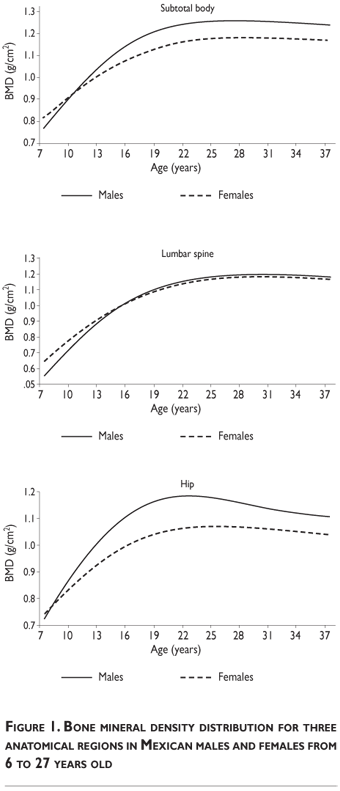
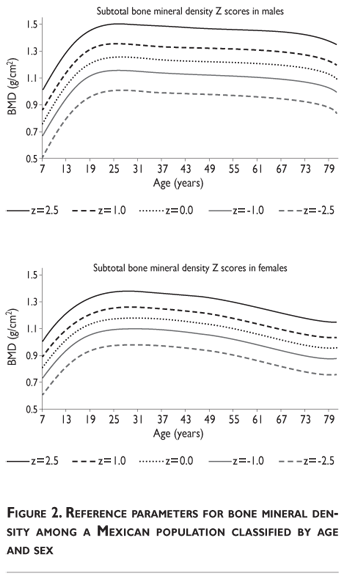
<body><![CDATA[<p><font size="2" face="Verdana">We evaluated 6 478 healthy men and women from    7 to 80 years of age who did not have conditions affecting bone health, out    of a total of 8307 adults and 1603 of their children formally enrolled in the    first stage of an ongoing, long&#45;term cohort study focusing on lifestyle and    health. This recruitment strategy allowed us to have a cohort with healthy bones    resembling the real ethnical mixture of a socioeconomic urban middle class population    reflecting a wide sector of the Mexican population. </font></p>     <p><font size="2" face="Verdana"> As shown in <a href="#fig01">figure 1</a>, BMD    increases from infancy on and reaches PBM sometime between the late twenties    and the mid thirties. Once PBM is reached, there is a progressive decrease in    BMD with advancing age; these values curve as the population grows older and    vary by sex and by skeletal region. Male BMD values are always greater than    female BMD values. As shown in <a href="#fig01">Figure 1</a>, males reach the    PBM subtotal of the skeleton and whole body BMD values (excluding the skull)    between ages 22 and 25, while females do so at 27. Males reach PBM of the total    femur measurement at age 23, while females reach it at age 27. Males and females    both reach PBM of the lumbar spine at age 32. </font></p>     <p><a name="fig01"></a></p>     <p>&nbsp;</p>     <p align="center"><img src="/img/revistas/spm/v51s1/a10fig01.gif"></p>     <p>&nbsp;</p>     <p><font size="2" face="Verdana">Z&#45;score values are depicted in <a href="#fig02">figure    2</a>. The curves for female BMD values are dramatically different than those    for male values; male values are greater than female values starting in early    childhood and continuing throughout life. It should also be noted that the values    decrease less dramatically for males in later adulthood compared to females.    Z&#45;scores reflect a comparison of the individual patient compared to age&#45; and    sex&#45;matched controls and can be used to evaluate follow&#45;up studies in other    clinical applications. </font></p>     <p><a name="fig02"></a></p>     <p>&nbsp;</p>     <p align="center"><img src="/img/revistas/spm/v51s1/a10fig02.gif"></p>     ]]></body>
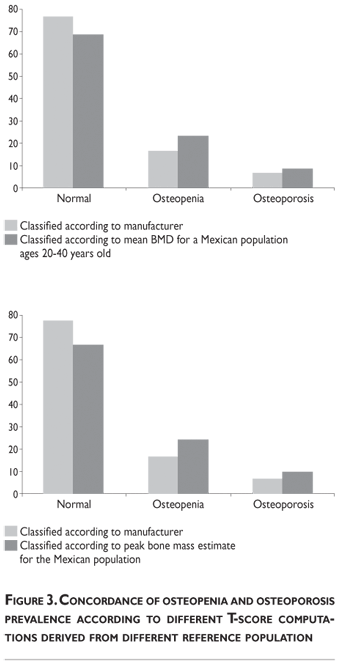
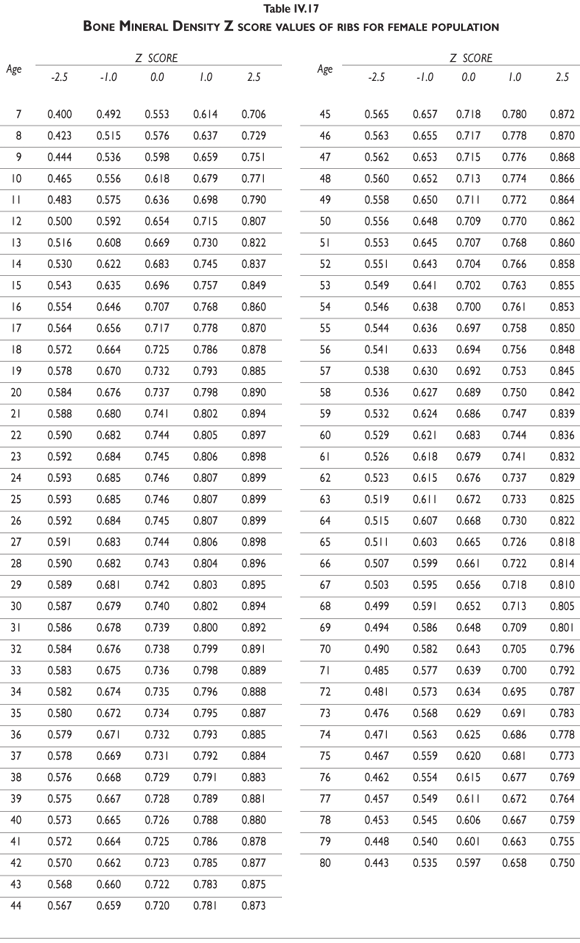
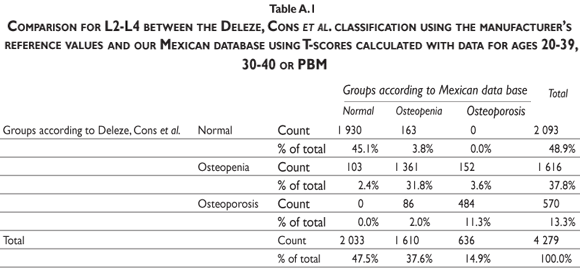
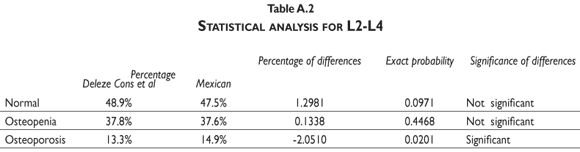
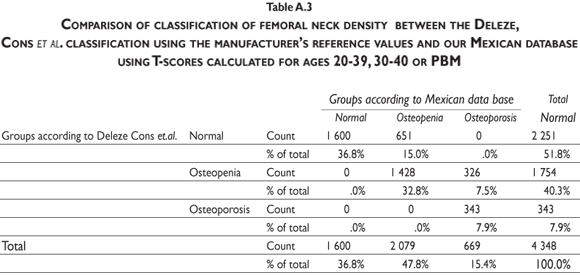
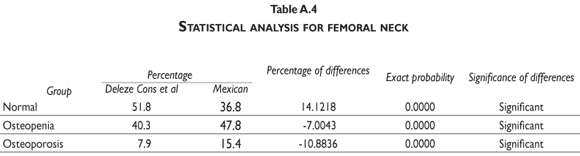
<body><![CDATA[<p>&nbsp;</p>     <p><font size="2" face="Verdana">According to WHO recommendations, computation    of the T&#45;score is necessary to establish the cut&#45;off point for defining the    presence of osteopenia and/or osteoporosis in each specific population. Therefore,    both the method for computing T&#45;scores and the reference population used for    these computations must be optimized to generate accurate frequency estimates    of these health problems. Currently, using instruments on one population that    have been calibrated for another can thus impede accurate measurement. The DEXA    instruments used in Mexico compute T&#45;scores according to the BMD mean derived    from a reference population of healthy US Hispanics between ages 20 and 40.    In <a href="#tab02">table II</a>, we document the differences in the number    of osteopenic and osteoporosis cases that occur when US Hispanics versus Mexicans    are used as reference populations. </font></p>     <p><a name="tab02"></a></p>     <p>&nbsp;</p>     <p align="center"><img src="/img/revistas/spm/v51s1/a10tab02.gif"></p>     <p>&nbsp;</p>     <p><font size="2" face="Verdana">Our results indicate that, by using the normal    reference T&#45;scores obtained from the BMD values for the normal female population    aged 20 to 40 in our cohort to classify the individual BMD values obtained from    two large patient populations (the abnormal population in our cohort and the    BMD data obtained and kindly provided to us by Deleze, Cons <I>et al</I>. &#91;previously    used for another publication<SUP>29</SUP>&#93;) that included 4460 women aged 50    and older who were classified as normal, osteopenic or osteoporotic by 10 densitometry    centers located across the country, a higher prevalence of osteopenia and osteoporosis    is observed compared to the prevalence obtained using the reference population    of healthy US Hispanics integrated in the densitometer by the manufacturer (see    <a href="#afig03">figure 3</a> and <a href="#taba1">tables A.1&#45;A.4</a> at the    appendix). If we restrict the reference population to only those between the    ages of 30 to 40 years, there is not a greater underestimation of cases of osteopenia    and osteoporosis found using the manufacturer's database (<a href="#afig03">figure    3</a>). If the T&#45;score is computed using the PBM value instead of mean BMD,    which we consider to be a more realistic way to define the optimal bone quality    reached at skeletal maturation,<SUP>21</SUP> the degree of discrepancies between    the manufacturer's and our estimates of osteopenia and osteoporosis are substantially    similar using the T&#45;scores obtained from either of our Mexican populations (women    ages 20 to 40 or ages 30 to 40 years old) (<a href="#afig03">figure 3</a>).</font></p>     <p><a name="afig03"></a></p>     <p>&nbsp;</p>     <p align="center"><img src="/img/revistas/spm/v51s1/a10fig03.gif"></p>     ]]></body>
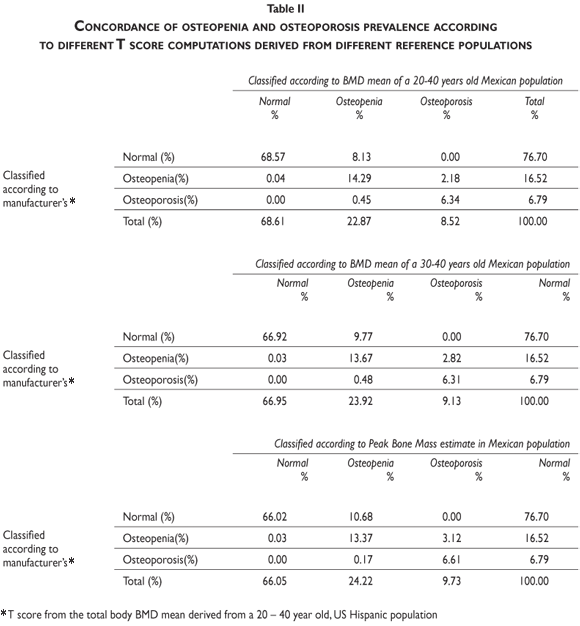
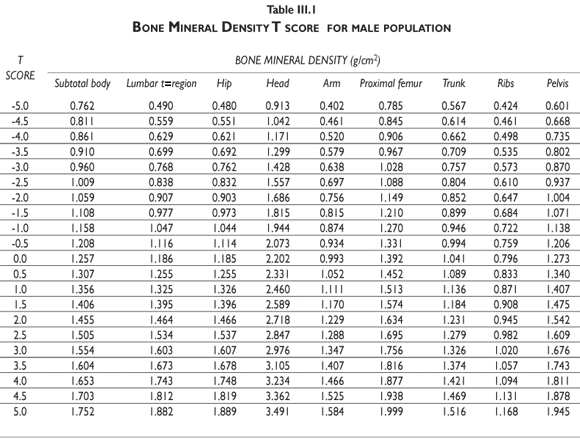
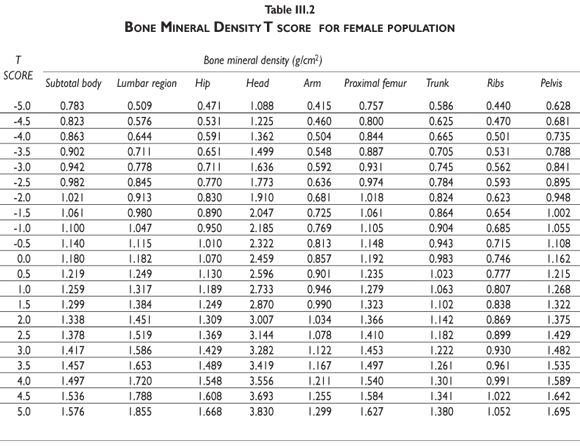
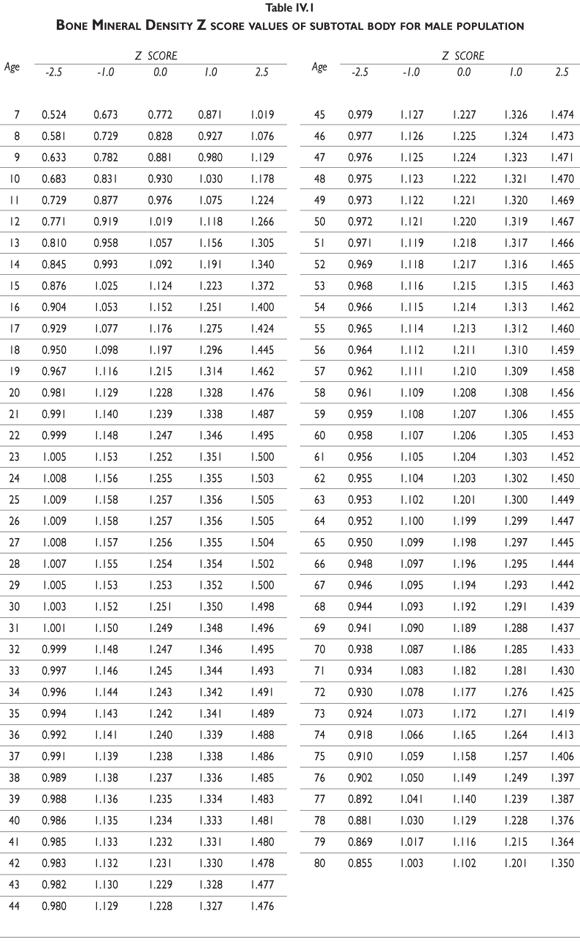
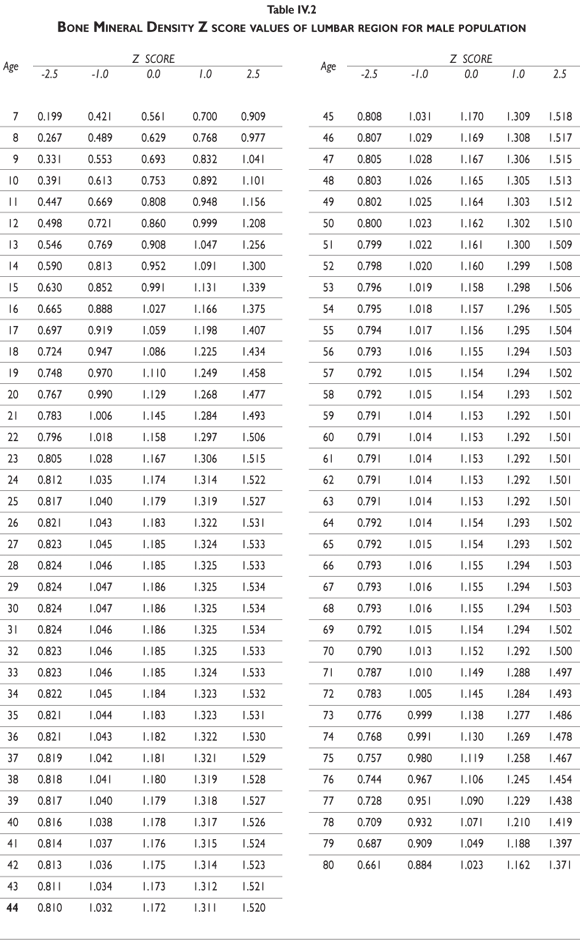
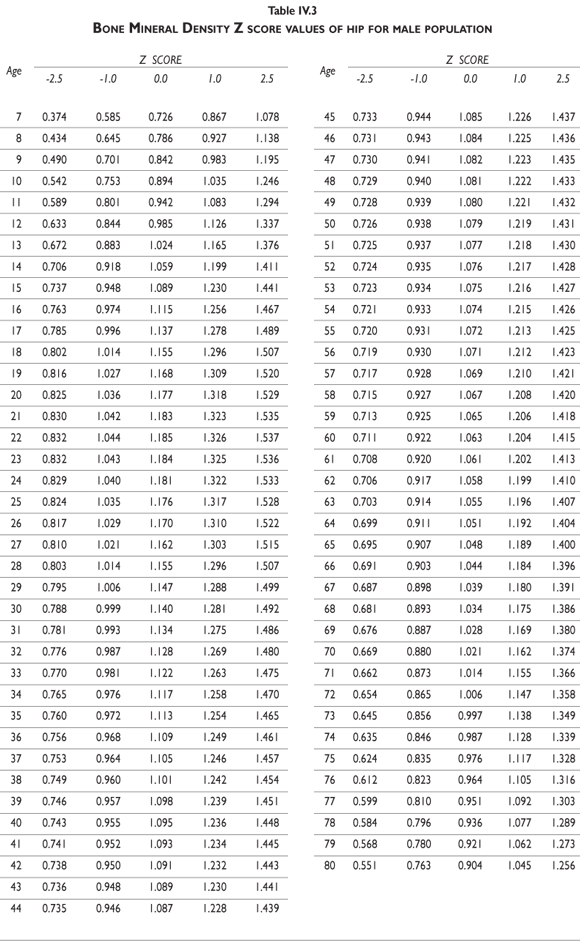
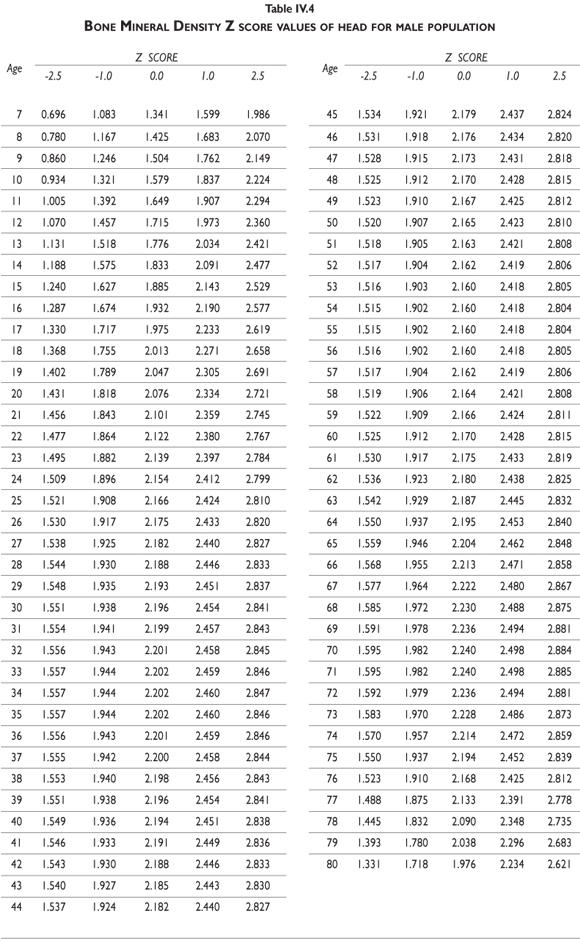
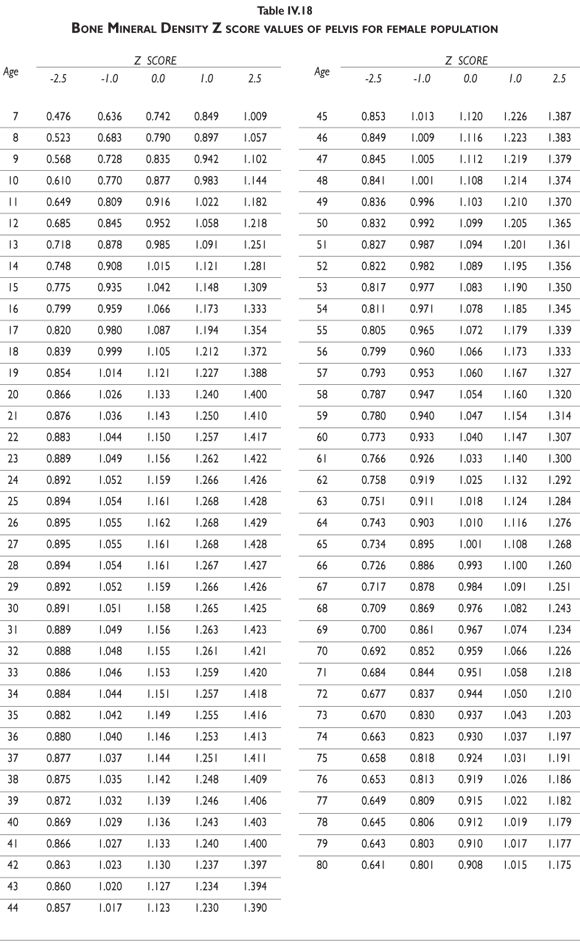
<body><![CDATA[<p>&nbsp;</p>     <p><font size="2" face="Verdana">It is clear that by using the manufacturer's    T&#45;score values to classify our abnormal Mexican population, we are underestimating    the number of abnormal BMD cases. Using either our own T&#45;scores calculated for    populations aged 20 to 40 or 30 to 40, or our PBM, we found that 24.22% of the    cohort population is osteopenic, whereas using the manufacturer's T&#45;score for    this value is only 16.52%. The results are similar for osteporotic classification:    using PBM we detect a prevalence of 9.73% versus 6.79% when using the manufacturer's    values. Analyzing the data obtained from the Deleze, Cons cohort with the same    criteria, it also became clear that there is a significant underestimation,    restricted only to the femoral neck region (<a href="#taba1">tables A.1&#45;A.4</a>    at the appendix).</font></p>     <p><font size="2" face="Verdana"> <a href="#tab31">Tables III.1&#45;III.2</a> provide    a comprehensive reference for the PBM&#45;derived T&#45;score values for a male and    female Mexican population. These tables include reference values for both sexes    for the 1) total skeleton (excluding the head from whole body scans), 2) the    complete proximal femur, and 3) the lumbar region (L1&#45;L4). <a href="#tab41">Tables    IV.1&#45;IV.18</a> describe the Z&#45;score for the same population, depicting each    age and the corresponding BMD. These tables can be used manually to find the    T&#45;score and Z&#45;score for the urban Mexican population.</font></p>     <p><a name="tab31"></a></p>     <p>&nbsp;</p>     <p align="center"><img src="/img/revistas/spm/v51s1/a10tab31.gif"></p>     <p>&nbsp;</p>     <p>&nbsp;</p>     <p align="center"><img src="/img/revistas/spm/v51s1/a10tab32.gif"></p>     <p>&nbsp;</p>     ]]></body>
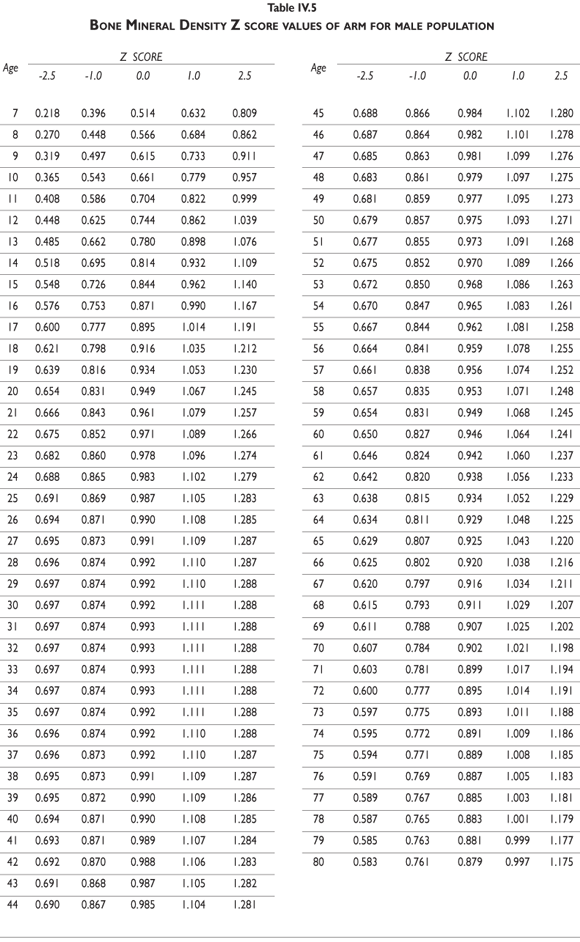
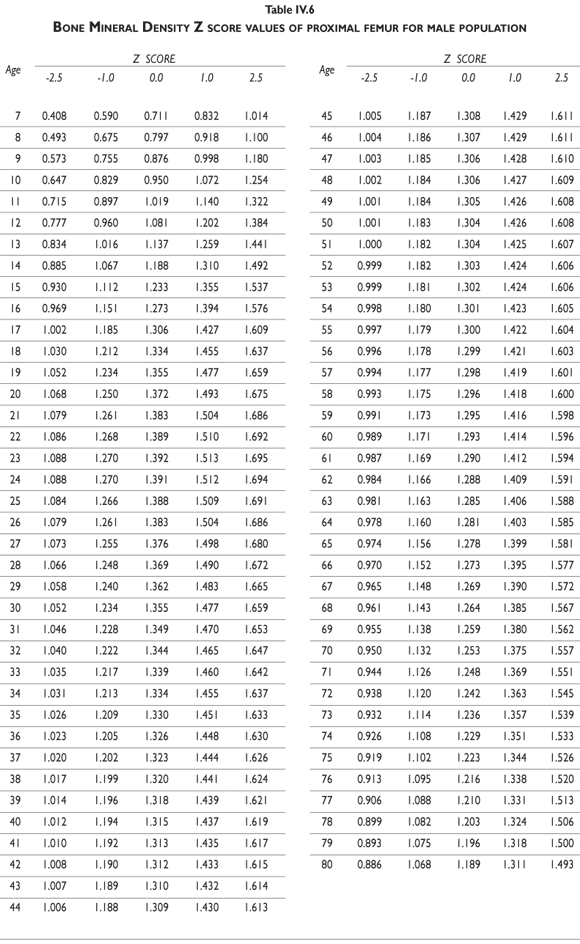
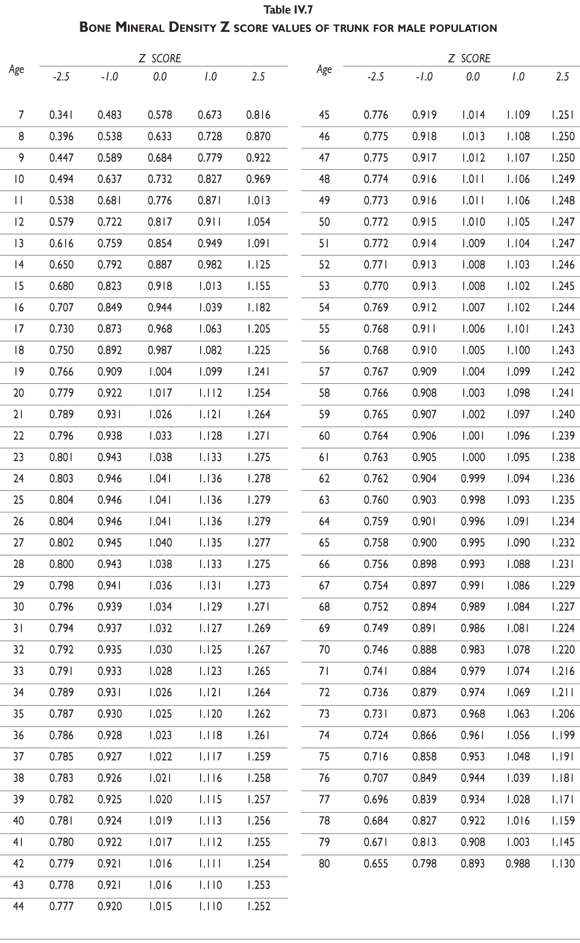
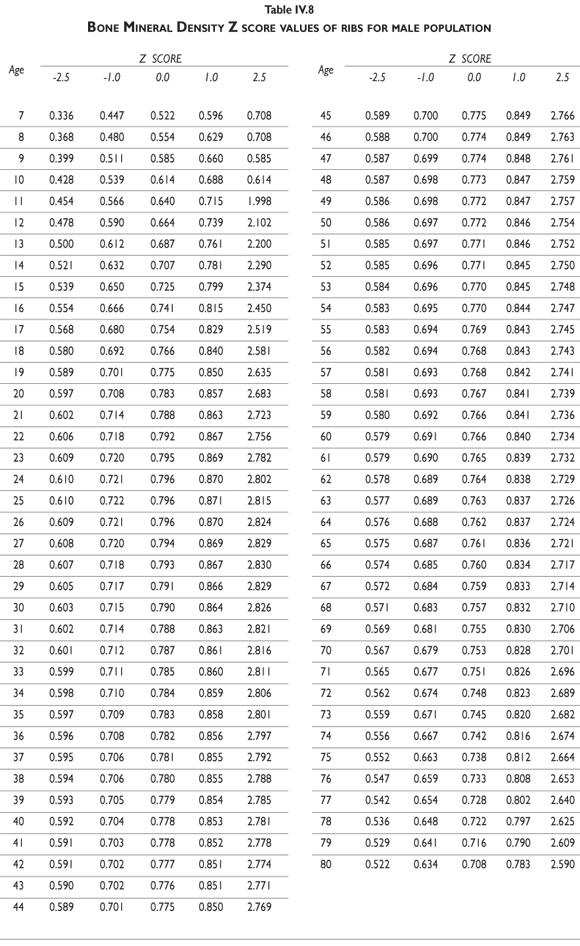
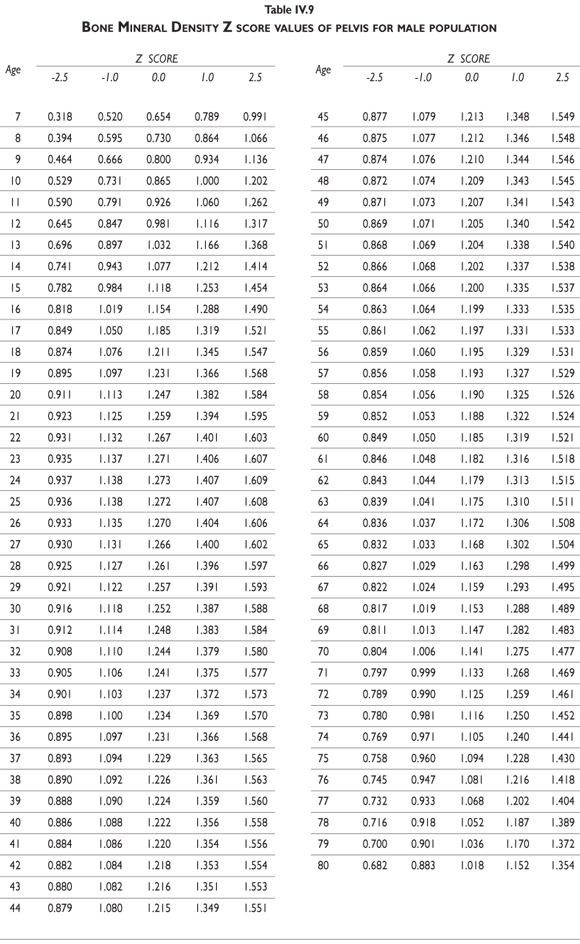
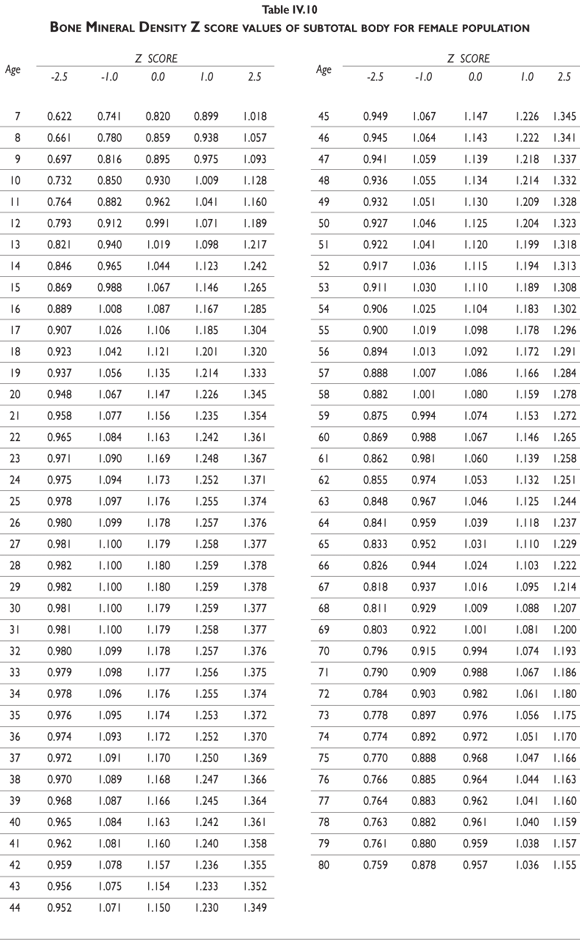
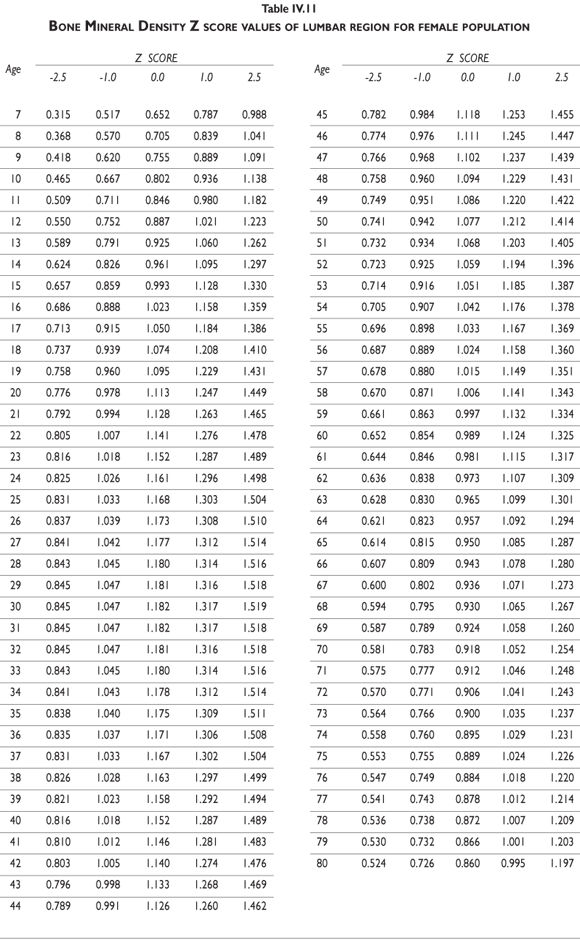
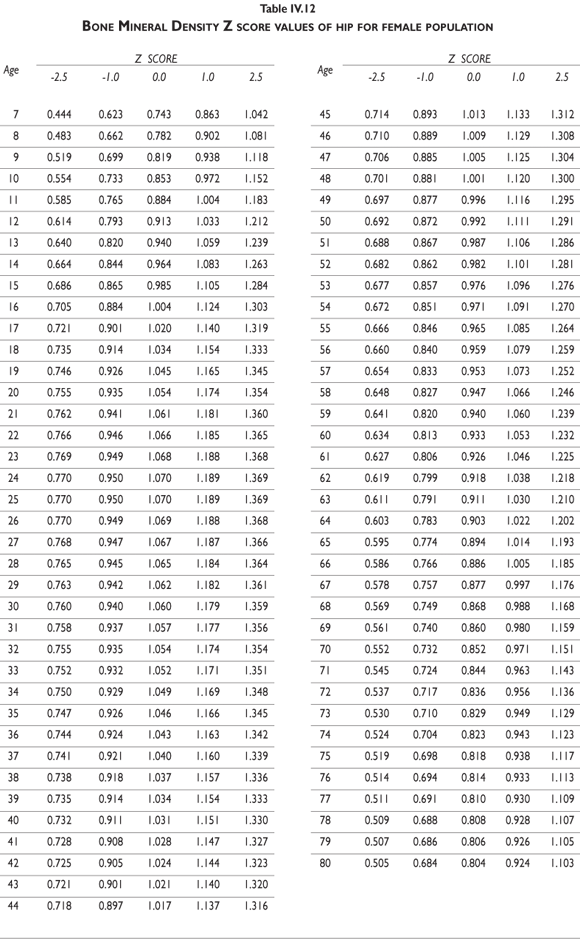
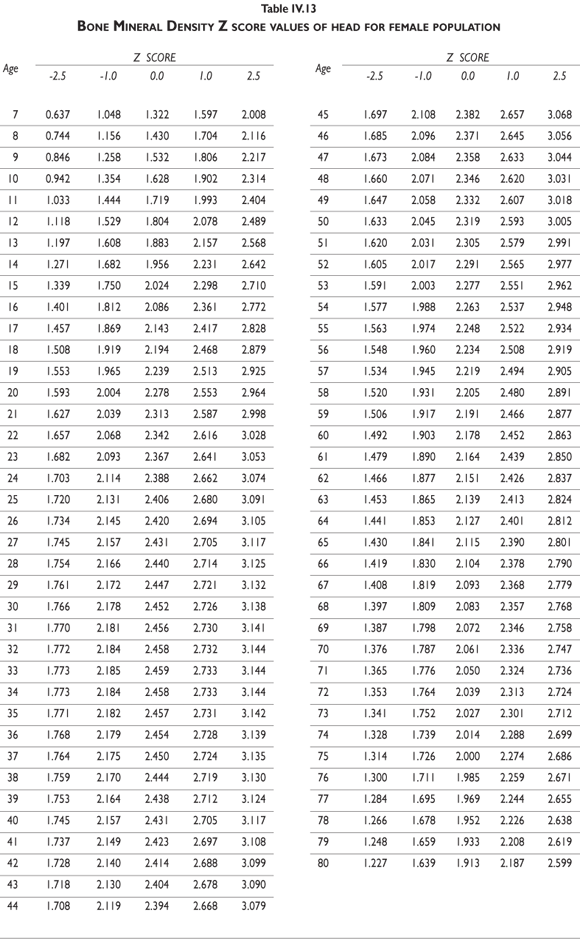
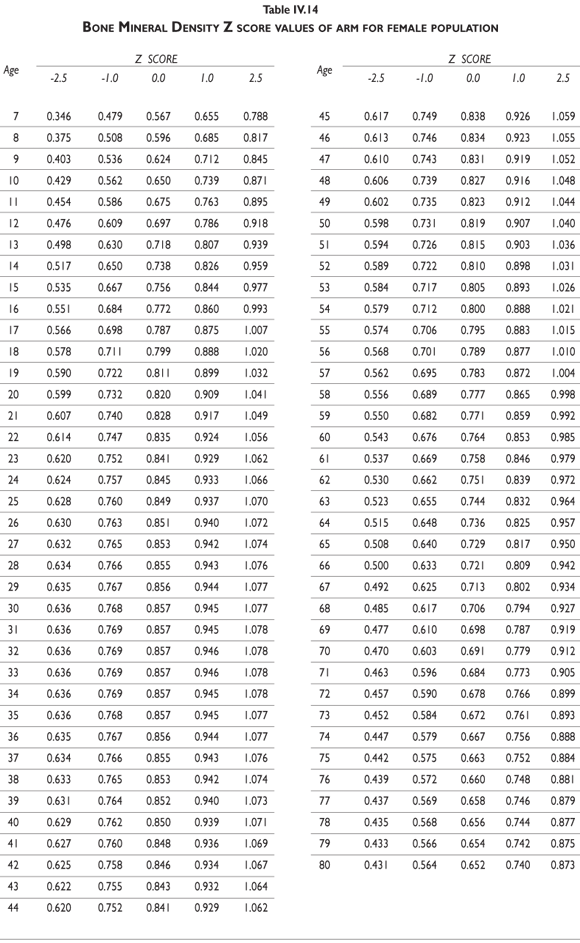
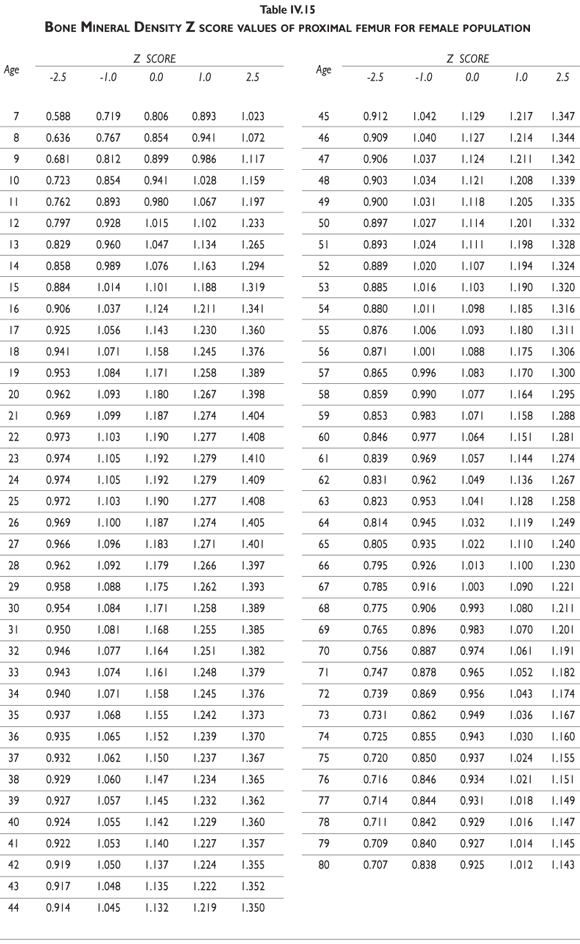
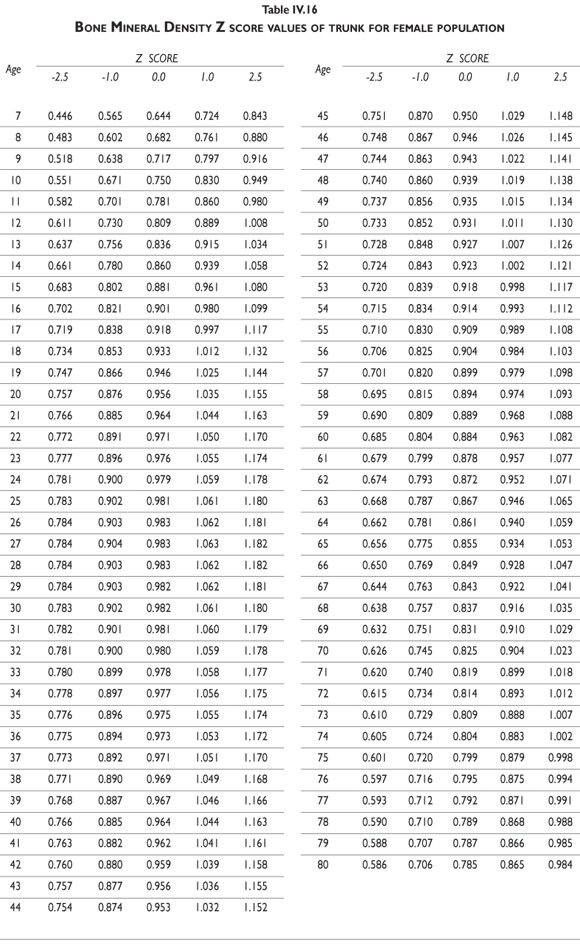
<body><![CDATA[<p><a name="tab41"></a></p>     <p>&nbsp;</p>     <p align="center"><img src="/img/revistas/spm/v51s1/a10tab41.gif"></p>     <p>&nbsp;</p>     <p>&nbsp;</p>     <p align="center"><img src="/img/revistas/spm/v51s1/a10tab42.gif"></p>     <p>&nbsp;</p>     <p>&nbsp;</p>     <p align="center"><img src="/img/revistas/spm/v51s1/a10tab43.gif"></p>     <p>&nbsp;</p>     ]]></body>
<body><![CDATA[<p>&nbsp;</p>     <p align="center"><img src="/img/revistas/spm/v51s1/a10tab44.gif"></p>     <p>&nbsp;</p>     <p>&nbsp;</p>     <p align="center"><img src="/img/revistas/spm/v51s1/a10tab45.gif"></p>     <p>&nbsp;</p>     <p>&nbsp;</p>     <p align="center"><img src="/img/revistas/spm/v51s1/a10tab46.gif"></p>     <p>&nbsp;</p>     <p>&nbsp;</p>     ]]></body>
<body><![CDATA[<p align="center"><img src="/img/revistas/spm/v51s1/a10tab47.gif"></p>     <p>&nbsp;</p>     <p>&nbsp;</p>     <p align="center"><img src="/img/revistas/spm/v51s1/a10tab48.gif"></p>     <p>&nbsp;</p>     <p>&nbsp;</p>     <p align="center"><img src="/img/revistas/spm/v51s1/a10tab49.gif"></p>     <p>&nbsp;</p>     <p>&nbsp;</p>     <p align="center"><img src="/img/revistas/spm/v51s1/a10tb410.gif"></p>     ]]></body>
<body><![CDATA[<p>&nbsp;</p>     <p>&nbsp;</p>     <p align="center"><img src="/img/revistas/spm/v51s1/a10tb411.gif"></p>     <p>&nbsp;</p>     <p>&nbsp;</p>     <p align="center"><img src="/img/revistas/spm/v51s1/a10tb412.gif"></p>     <p>&nbsp;</p>     <p>&nbsp;</p>     <p align="center"><img src="/img/revistas/spm/v51s1/a10tb413.gif"></p>     <p>&nbsp;</p>     ]]></body>
<body><![CDATA[<p>&nbsp;</p>     <p align="center"><img src="/img/revistas/spm/v51s1/a10tb414.gif"></p>     <p>&nbsp;</p>     <p>&nbsp;</p>     <p align="center"><img src="/img/revistas/spm/v51s1/a10tb415.gif"></p>     <p>&nbsp;</p>     <p>&nbsp;</p>     <p align="center"><img src="/img/revistas/spm/v51s1/a10tb416.gif"></p>     <p>&nbsp;</p>     <p>&nbsp;</p>     ]]></body>
<body><![CDATA[<p align="center"><img src="/img/revistas/spm/v51s1/a10tb417.gif"></p>     <p>&nbsp;</p>     <p>&nbsp;</p>     <p align="center"><img src="/img/revistas/spm/v51s1/a10tb418.gif"></p>     <p>&nbsp;</p>     <p><font size="3" face="verdana"><b>Discussion</b></font></p>     <p><font size="2" face="Verdana">WHO guidelines are helpful for clinically adapting    previous definitions of osteoporosis; practically speaking, these guidelines    allow for greater accuracy when describing the extent and characteristics of    osteoporosis. However, the expert panel that created these guidelines recognized    that they would likely change as new knowledge was gathered.<SUP>30</SUP> Today,    it has become quite evident that fracture risk is also affected by factors other    than BMD; not all individuals with low BMD will fracture, while some with normal    BMD will.<SUP>31</SUP> Also, WHO criteria define low BMD without regard to an    individual's age, missing a key element of fracture risk. For example, though    a 40 year&#45;old and 65 year&#45;old woman may have the same BMD levels, the older    woman's probability of suffering a fracture is increased by the concurrent presence    of other risk factors.<SUP>33&#45;35</SUP> In addition to excluding age from risk    assessment, WHO criteria do not use PBM values as the optimal bone quality,    using the less accurate mean BMD distribution for young adults (20 to 40 years    old). The rationale behind the use of this age range is not clearly identified,    nor is it clear how to form a reference group for populations that include different    racial or ethnic groups.<SUP>22&#45;26, 32</SUP> </font></p>     <p><font size="2" face="Verdana"> For Mexico, as well as for many other developing    countries, the importance of having BMD T&#45;score reference values that reflect    the population's unique characteristics has become a critical issue.<SUP>33,34</SUP>    Several studies have shown that the reference data provided by manufacturers    for a US Hispanic population may lead to dangerous underestimations of the population    at risk.<SUP>18,34&#45;38</SUP> The reference databases provided by manufacturers    do not reflect the complex heritage of the Mexican population, also called <I>mestizo</I>,    which reflects both indigenous Mexican and Spanish ancestry. </font></p>     <p><font size="2" face="Verdana"> To address a few of these emerging issues, we    used the worker's cohort study data with the T&#45;score reference values that reflect    the population's unique characteristics to study bone density data from a large    number of subjects of both sexes, age 7 to 80. This was done in order to determine    whether there were differences in the number of people classified as having    a higher than normal lifelong relative risk of having a fracture, in order to    build a normal mestizo reference database that allowed us to define the age    at which PBM is established at different skeletal sites. To the best of our    knowledge, our study is the largest reported in Latin America, with a data set    comprised of healthy, urban <I>mestizos</I> from early childhood to old age,    which may represent more than 70% of the Mexican population. PBM and T&#45;scores    derived for this population differ significantly from values derived from commercial    manufacturer's US Hispanic database, with our data reflecting significantly    higher values and a curve indicating that age&#45;dependent BMD loss is also very    different. The T&#45;score derived from our PBM values had only an 86% concordance    with the manufacturers' Hispanic values that classify the normal population    using PBM reference values, and up to 89% for T&#45;score values for the population    aged 20 to 40. Using our reference values, the number of people in the range    of osteopenia and osteoporosis increased by 31 and 32 percent, respectively.    As expected, this lack of concordance between the Mexican database and the manufacturers'    Hispanic database increases as age increases. Revising estimates of fracture    risk based on our numbers will have a major clinical impact since fracture prevention    interventions will increase.<SUP>29</SUP> </font></p>     <p><font size="2" face="Verdana"> Since our Mexican database of reference values    are not currently included in the software of commercial densitometers used    in Mexico, interested users can classify their specific BMD values reported    by these instruments according to the reference values presented in the BMD    tables of this report (<a href="#tab31">tables III.1&#45;III.2</a>, <a href="#tab41">IV1&#45;IV.18</a>).    Having normative BMD reference values for the urban Mexican population will    be very relevant for our densitometry community. This more accurate normative    reference data may give us the opportunity to improve the decision making process    used in the prevention and care of bone density&#45;related public health problems,    though we must ensure that it does not simply amount to an increased burden    on an already strained healthcare system. These considerations should be taken    into account by policy makers in order to improve the Mexican healthcare infrastructure    as well as to seek new ways to address the growing populations' healthcare needs.    </font></p>     ]]></body>
<body><![CDATA[<p>&nbsp;</p>     <p><font size="3" face="verdana"><b>References</b></font></p>     <!-- ref --><p><font size="2" face="Verdana">1. Zingmond DS, Melton III LJ, Silverman SL.    Increasing hip fracture incidence in California Hispanics; 1983 to 2000. Osteoporos    Int 2004;15:603&#150;610.</font>&nbsp;&nbsp;&nbsp;&nbsp;&nbsp;&nbsp;&nbsp;&nbsp;[&#160;<a href="javascript:void(0);" onclick="javascript: window.open('/scielo.php?script=sci_nlinks&ref=9309502&pid=S0036-3634200900070001000001&lng=','','width=640,height=500,resizable=yes,scrollbars=1,menubar=yes,');">Links</a>&#160;]<!-- end-ref --><!-- ref --><p><font size="2" face="Verdana">2. Chang KP, Center JR, Nguyen TV, Eisman JA.    Incidence of hip and other osteoporotic fractures in elderly men and women:    Dubbo osteoporosis epidemiology study. Journal Bone and Min Res 2004;19.</font>&nbsp;&nbsp;&nbsp;&nbsp;&nbsp;&nbsp;&nbsp;&nbsp;[&#160;<a href="javascript:void(0);" onclick="javascript: window.open('/scielo.php?script=sci_nlinks&ref=9309503&pid=S0036-3634200900070001000002&lng=','','width=640,height=500,resizable=yes,scrollbars=1,menubar=yes,');">Links</a>&#160;]<!-- end-ref --><!-- ref --><p><font size="2" face="Verdana">3. Eisman J, Clapham S, Kehoe L. Osteoporosis    prevalence and levels of treatment in primary care: the australian bone care    study. J Bone Miner Res 2004;19:1969&#45;1975.</font>&nbsp;&nbsp;&nbsp;&nbsp;&nbsp;&nbsp;&nbsp;&nbsp;[&#160;<a href="javascript:void(0);" onclick="javascript: window.open('/scielo.php?script=sci_nlinks&ref=9309504&pid=S0036-3634200900070001000003&lng=','','width=640,height=500,resizable=yes,scrollbars=1,menubar=yes,');">Links</a>&#160;]<!-- end-ref --><!-- ref --><p><font size="2" face="Verdana">4. Siris ES, Brenneman SK, Miller PD, Barrett&#45;Connor    E, Chen YT, Sherwood LM, <I>et al</I>. Predictive value of low BMD for 1&#45;year    fracture outcomes is similar for postmenopausal women ages 50&#150;64 and 65 and    older: results from the National Osteoporosis Risk Assessment (NORA). J Bone    Miner Res 2004;19:1215&#45;1220.</font>&nbsp;&nbsp;&nbsp;&nbsp;&nbsp;&nbsp;&nbsp;&nbsp;[&#160;<a href="javascript:void(0);" onclick="javascript: window.open('/scielo.php?script=sci_nlinks&ref=9309505&pid=S0036-3634200900070001000004&lng=','','width=640,height=500,resizable=yes,scrollbars=1,menubar=yes,');">Links</a>&#160;]<!-- end-ref --><!-- ref --><p><font size="2" face="Verdana">5. Barrett&#45;Connor E, Siris ES, Wehren LE, Miller    PD, Abbott TA, Berger ML, <I>et al</I>. Osteoporosis and fracture risk in women    of different ethnic groups. J Bone Miner Res 2005;20:185&#45;194.</font>&nbsp;&nbsp;&nbsp;&nbsp;&nbsp;&nbsp;&nbsp;&nbsp;[&#160;<a href="javascript:void(0);" onclick="javascript: window.open('/scielo.php?script=sci_nlinks&ref=9309506&pid=S0036-3634200900070001000005&lng=','','width=640,height=500,resizable=yes,scrollbars=1,menubar=yes,');">Links</a>&#160;]<!-- end-ref --><!-- ref --><p><font size="2" face="Verdana">6. Nevitt MC, Cummings SR, Stone KL, Palermo    L, Black DM, Bauer DC, <I>et al</I>. Risk factors for a first&#45;incident radiographic    vertebral fracture in women &gt; 65 Years of Age: the study of osteoporotic    fractures. J Bone Miner Res 2005;20:131&#45;140.</font>&nbsp;&nbsp;&nbsp;&nbsp;&nbsp;&nbsp;&nbsp;&nbsp;[&#160;<a href="javascript:void(0);" onclick="javascript: window.open('/scielo.php?script=sci_nlinks&ref=9309507&pid=S0036-3634200900070001000006&lng=','','width=640,height=500,resizable=yes,scrollbars=1,menubar=yes,');">Links</a>&#160;]<!-- end-ref --><!-- ref --><p><font size="2" face="Verdana">7. Velasco&#45;Murillo V. Fracturas en mujeres posmenop&aacute;usicas    en el IMSS: frecuencia y costos de su atenci&oacute;n hospitalaria. Gac M&eacute;d    M&eacute;x. 2003;139:453&#45;458.</font>&nbsp;&nbsp;&nbsp;&nbsp;&nbsp;&nbsp;&nbsp;&nbsp;[&#160;<a href="javascript:void(0);" onclick="javascript: window.open('/scielo.php?script=sci_nlinks&ref=9309508&pid=S0036-3634200900070001000007&lng=','','width=640,height=500,resizable=yes,scrollbars=1,menubar=yes,');">Links</a>&#160;]<!-- end-ref --><!-- ref --><p><font size="2" face="Verdana">8. Morales Torres J, Hern&aacute;ndez Ochoa C,    Hern&aacute;ndez Paz R, Hern&aacute;ndez Morales G. Fracturas de cadera en egresos    de hospitales de Le&oacute;n, Gto. un indicador econom&eacute;trico de osteoporosis.    Rev Mex Reumat. 1997;12:119&#150;124.</font>&nbsp;&nbsp;&nbsp;&nbsp;&nbsp;&nbsp;&nbsp;&nbsp;[&#160;<a href="javascript:void(0);" onclick="javascript: window.open('/scielo.php?script=sci_nlinks&ref=9309509&pid=S0036-3634200900070001000008&lng=','','width=640,height=500,resizable=yes,scrollbars=1,menubar=yes,');">Links</a>&#160;]<!-- end-ref --><!-- ref --><p><font size="2" face="Verdana">9. G&oacute;mez Garc&iacute;a F. Morbimortalidad    de fracturas de cadera en el hospital de traumatolog&iacute;a magdalena de las    salinas, IMSS. Rev Mex Ortop Traum 1998;2:48&#45;52.</font>&nbsp;&nbsp;&nbsp;&nbsp;&nbsp;&nbsp;&nbsp;&nbsp;[&#160;<a href="javascript:void(0);" onclick="javascript: window.open('/scielo.php?script=sci_nlinks&ref=9309510&pid=S0036-3634200900070001000009&lng=','','width=640,height=500,resizable=yes,scrollbars=1,menubar=yes,');">Links</a>&#160;]<!-- end-ref --><!-- ref --><p><font size="2" face="Verdana">10. Clark P, de la Pe&ntilde;a F, Gomez&#45;Garcia    F, Orozco JA, Tugwell P. Risk factors for osteoporotic hip fractures in mexicans.    Arch Med Res 1998;29:253&#45;257.</font>&nbsp;&nbsp;&nbsp;&nbsp;&nbsp;&nbsp;&nbsp;&nbsp;[&#160;<a href="javascript:void(0);" onclick="javascript: window.open('/scielo.php?script=sci_nlinks&ref=9309511&pid=S0036-3634200900070001000010&lng=','','width=640,height=500,resizable=yes,scrollbars=1,menubar=yes,');">Links</a>&#160;]<!-- end-ref --><!-- ref --><p><font size="2" face="Verdana">11. Espino DV, Palmer RF, Miles TP <I>et al</I>.    Prevalence, incidence, and risk factors associated with hip fractures in community&#45;dwelling    older Mexican Americans: results of the Hispanic EPESE study. Establish Population    for the Epidemiologic Study for the Elderly. J Am Geriatr Soc 2000;48:1252&#45;126.</font>&nbsp;&nbsp;&nbsp;&nbsp;&nbsp;&nbsp;&nbsp;&nbsp;[&#160;<a href="javascript:void(0);" onclick="javascript: window.open('/scielo.php?script=sci_nlinks&ref=9309512&pid=S0036-3634200900070001000011&lng=','','width=640,height=500,resizable=yes,scrollbars=1,menubar=yes,');">Links</a>&#160;]<!-- end-ref --><!-- ref --><p><font size="2" face="Verdana">12. Clark P, Lavielle P, Salmer&oacute;n J Y,    Cummings S. Tasas de incidencia de fracturas de cadera en poblaci&oacute;n mexicana    mayor de 50 a&ntilde;os (abstract). Rev Metab Oseo Min. 2003;1:41.</font>&nbsp;&nbsp;&nbsp;&nbsp;&nbsp;&nbsp;&nbsp;&nbsp;[&#160;<a href="javascript:void(0);" onclick="javascript: window.open('/scielo.php?script=sci_nlinks&ref=9309513&pid=S0036-3634200900070001000012&lng=','','width=640,height=500,resizable=yes,scrollbars=1,menubar=yes,');">Links</a>&#160;]<!-- end-ref --><!-- ref --><p><font size="2" face="Verdana">13. Clark P, Delez&eacute; M, Cons&#45;Molina F,    Salmer&oacute;n J, Palermo L, Cummings SR, <I>et al</I>. Prevalencia de fracturas    vertebrales en poblaci&oacute;n Mexicana (abstract). Rev Metab Oseo Min. 2003;1:41.</font>&nbsp;&nbsp;&nbsp;&nbsp;&nbsp;&nbsp;&nbsp;&nbsp;[&#160;<a href="javascript:void(0);" onclick="javascript: window.open('/scielo.php?script=sci_nlinks&ref=9309514&pid=S0036-3634200900070001000013&lng=','','width=640,height=500,resizable=yes,scrollbars=1,menubar=yes,');">Links</a>&#160;]<!-- end-ref --><!-- ref --><p><font size="2" face="Verdana">14. Kanis JA for the WHO Study Group (1994) Assessment    of fracture risk and its application to screening for postmenopausal osteoporosis:    Synopsis of a WHO report. Osteoporos Int 4:368&#45;381. </font>&nbsp;&nbsp;&nbsp;&nbsp;&nbsp;&nbsp;&nbsp;&nbsp;[&#160;<a href="javascript:void(0);" onclick="javascript: window.open('/scielo.php?script=sci_nlinks&ref=9309515&pid=S0036-3634200900070001000014&lng=','','width=640,height=500,resizable=yes,scrollbars=1,menubar=yes,');">Links</a>&#160;]<!-- end-ref --><p><font size="2" face="Verdana">15.&#45;The Writing Group for the ISCD Position Development    Conference. Nomenclature and Decimal Places in Bone Densitometry (2004) JClin    Densit, 7: 45&#45;49.</font></p>     <!-- ref --><p><font size="2" face="Verdana">16. Leib ES, Lewiecki EM, Binkley N, Hamdy RC.    Official Positions of the International Society for Clinical Densitometry. JClin    Densit. 2004;7:1&#45;5.</font>&nbsp;&nbsp;&nbsp;&nbsp;&nbsp;&nbsp;&nbsp;&nbsp;[&#160;<a href="javascript:void(0);" onclick="javascript: window.open('/scielo.php?script=sci_nlinks&ref=9309517&pid=S0036-3634200900070001000015&lng=','','width=640,height=500,resizable=yes,scrollbars=1,menubar=yes,');">Links</a>&#160;]<!-- end-ref --><!-- ref --><p><font size="2" face="Verdana">17. Melton III LJ, Chrischilles EA, Cooper C,    Lane AW, Riggs BL. How Many Women Have Osteoporosis?. J Bone Min Res. 1992;7:1005&#45;1010.</font>&nbsp;&nbsp;&nbsp;&nbsp;&nbsp;&nbsp;&nbsp;&nbsp;[&#160;<a href="javascript:void(0);" onclick="javascript: window.open('/scielo.php?script=sci_nlinks&ref=9309518&pid=S0036-3634200900070001000016&lng=','','width=640,height=500,resizable=yes,scrollbars=1,menubar=yes,');">Links</a>&#160;]<!-- end-ref --><!-- ref --><p><font size="2" face="Verdana">18. Arzac P, Tamayo J. How many women have osteoporosis    in medica sur osteoporosis clinic. J Bone Miner Res. 1996;11:S361.</font>&nbsp;&nbsp;&nbsp;&nbsp;&nbsp;&nbsp;&nbsp;&nbsp;[&#160;<a href="javascript:void(0);" onclick="javascript: window.open('/scielo.php?script=sci_nlinks&ref=9309519&pid=S0036-3634200900070001000017&lng=','','width=640,height=500,resizable=yes,scrollbars=1,menubar=yes,');">Links</a>&#160;]<!-- end-ref --><!-- ref --><p><font size="2" face="Verdana">19. Melton III LJ, Beck TJ, Amin S, Khosla S,    Achenbach SJ, Oberg AL, Riggs BL. Contributions of bone density and structure    to fracture risk assessment in men and women. Osteoporos Int. 2005;16:460&#45;467.</font>&nbsp;&nbsp;&nbsp;&nbsp;&nbsp;&nbsp;&nbsp;&nbsp;[&#160;<a href="javascript:void(0);" onclick="javascript: window.open('/scielo.php?script=sci_nlinks&ref=9309520&pid=S0036-3634200900070001000018&lng=','','width=640,height=500,resizable=yes,scrollbars=1,menubar=yes,');">Links</a>&#160;]<!-- end-ref --><!-- ref --><p><font size="2" face="Verdana">20. Heaney RP, Abrams S, Dawson&#45;Hughes B, Looker    A, Marcus R, Matkovic V, Weaver C. Peak bone mass. Osteoporosis Int. 2000;11:985&#45;1009.</font>&nbsp;&nbsp;&nbsp;&nbsp;&nbsp;&nbsp;&nbsp;&nbsp;[&#160;<a href="javascript:void(0);" onclick="javascript: window.open('/scielo.php?script=sci_nlinks&ref=9309521&pid=S0036-3634200900070001000019&lng=','','width=640,height=500,resizable=yes,scrollbars=1,menubar=yes,');">Links</a>&#160;]<!-- end-ref --><!-- ref --><p><font size="2" face="Verdana">21. Chevalley T, Rizzoli R, Hans D, Ferrari S,    Bonjour JP. Interaction between calcium intake and menarcheal age on bone mass    gain: an eight&#45;year follow&#45;up study from prepuberty to postmenarche. J Clin    Endocrinol Metab. 2005;90:44&#45;51.</font>&nbsp;&nbsp;&nbsp;&nbsp;&nbsp;&nbsp;&nbsp;&nbsp;[&#160;<a href="javascript:void(0);" onclick="javascript: window.open('/scielo.php?script=sci_nlinks&ref=9309522&pid=S0036-3634200900070001000020&lng=','','width=640,height=500,resizable=yes,scrollbars=1,menubar=yes,');">Links</a>&#160;]<!-- end-ref --><!-- ref --><p><font size="2" face="Verdana">22. Richy F, Ethgen O, Bruyere O, Mawet A, Reginster    JY. Primary prevention of osteoporosis: mass screening scenario or prescreening    with questionnaires? an economic perspective. J Bone Min Res. 2004;19:1955&#45;1960.</font>&nbsp;&nbsp;&nbsp;&nbsp;&nbsp;&nbsp;&nbsp;&nbsp;[&#160;<a href="javascript:void(0);" onclick="javascript: window.open('/scielo.php?script=sci_nlinks&ref=9309523&pid=S0036-3634200900070001000021&lng=','','width=640,height=500,resizable=yes,scrollbars=1,menubar=yes,');">Links</a>&#160;]<!-- end-ref --><!-- ref --><p><font size="2" face="Verdana">23. Kanis JA., Johnell O. Requirements for DXA    for the management of osteoporosis in Europe Osteoporos Int. 2005;16:229&#45;238.</font>&nbsp;&nbsp;&nbsp;&nbsp;&nbsp;&nbsp;&nbsp;&nbsp;[&#160;<a href="javascript:void(0);" onclick="javascript: window.open('/scielo.php?script=sci_nlinks&ref=9309524&pid=S0036-3634200900070001000022&lng=','','width=640,height=500,resizable=yes,scrollbars=1,menubar=yes,');">Links</a>&#160;]<!-- end-ref --><!-- ref --><p><font size="2" face="Verdana">24. Gourlay ML, Miller WC, Richy F, Garrett JM,    Hanson LC, Reginster JY. Performance of osteoporosis risk assessment tools in    postmenopausal women aged 45&#150;64 years. Osteoporos Int. 2005;16:921&#45;927.</font>&nbsp;&nbsp;&nbsp;&nbsp;&nbsp;&nbsp;&nbsp;&nbsp;[&#160;<a href="javascript:void(0);" onclick="javascript: window.open('/scielo.php?script=sci_nlinks&ref=9309525&pid=S0036-3634200900070001000023&lng=','','width=640,height=500,resizable=yes,scrollbars=1,menubar=yes,');">Links</a>&#160;]<!-- end-ref --><!-- ref --><p><font size="2" face="Verdana">25. Cummings,S.R. Bone Density Screening: A New    Level of Evidence?. Ann Intern Med. 2005;142:217&#45;219.</font>&nbsp;&nbsp;&nbsp;&nbsp;&nbsp;&nbsp;&nbsp;&nbsp;[&#160;<a href="javascript:void(0);" onclick="javascript: window.open('/scielo.php?script=sci_nlinks&ref=9309526&pid=S0036-3634200900070001000024&lng=','','width=640,height=500,resizable=yes,scrollbars=1,menubar=yes,');">Links</a>&#160;]<!-- end-ref --><!-- ref --><p><font size="2" face="Verdana">26. Raisz L. Screening for Osteoporosis. New    Eng J Med. 2005;353:164&#45;171.</font>&nbsp;&nbsp;&nbsp;&nbsp;&nbsp;&nbsp;&nbsp;&nbsp;[&#160;<a href="javascript:void(0);" onclick="javascript: window.open('/scielo.php?script=sci_nlinks&ref=9309527&pid=S0036-3634200900070001000025&lng=','','width=640,height=500,resizable=yes,scrollbars=1,menubar=yes,');">Links</a>&#160;]<!-- end-ref --><!-- ref --><p><font size="2" face="Verdana">27. Owner's Manual, LUNAR Corp.</font>&nbsp;&nbsp;&nbsp;&nbsp;&nbsp;&nbsp;&nbsp;&nbsp;[&#160;<a href="javascript:void(0);" onclick="javascript: window.open('/scielo.php?script=sci_nlinks&ref=9309528&pid=S0036-3634200900070001000026&lng=','','width=640,height=500,resizable=yes,scrollbars=1,menubar=yes,');">Links</a>&#160;]<!-- end-ref --><!-- ref --><p><font size="2" face="Verdana">28. Lazcano&#45;Ponce E, Tamayo J, Cruz&#45;Valdez A,    D&iacute;az R, Hern&aacute;ndez B, Del Cueto R, Hern&aacute;ndez&#45;Avila M. Peak    bone mineral area density and determinants among females aged 9 to 24 years    in Mexico. Osteoporos Int. 2003;14: 539&#45;547.</font>&nbsp;&nbsp;&nbsp;&nbsp;&nbsp;&nbsp;&nbsp;&nbsp;[&#160;<a href="javascript:void(0);" onclick="javascript: window.open('/scielo.php?script=sci_nlinks&ref=9309529&pid=S0036-3634200900070001000027&lng=','','width=640,height=500,resizable=yes,scrollbars=1,menubar=yes,');">Links</a>&#160;]<!-- end-ref --><!-- ref --><p><font size="2" face="Verdana">29. Delez&eacute; M, Cons&#45;Molina F, Villa AR,    Morales&#45;Torres J, <I>et al</I>. Geographic Differences in Bone Mineral Density    of Mexican Women. Osteoporos Int. 2000;11:562&#45;569.</font>&nbsp;&nbsp;&nbsp;&nbsp;&nbsp;&nbsp;&nbsp;&nbsp;[&#160;<a href="javascript:void(0);" onclick="javascript: window.open('/scielo.php?script=sci_nlinks&ref=9309530&pid=S0036-3634200900070001000028&lng=','','width=640,height=500,resizable=yes,scrollbars=1,menubar=yes,');">Links</a>&#160;]<!-- end-ref --><!-- ref --><p><font size="2" face="Verdana">30. Morales&#45;Torres J, Guti&eacute;rrez&#45;Ure&ntilde;a    S. The burden of osteoporosis in Latin America. Osteoporos Int. 2004;15:625&#45;632.</font>&nbsp;&nbsp;&nbsp;&nbsp;&nbsp;&nbsp;&nbsp;&nbsp;[&#160;<a href="javascript:void(0);" onclick="javascript: window.open('/scielo.php?script=sci_nlinks&ref=9309531&pid=S0036-3634200900070001000029&lng=','','width=640,height=500,resizable=yes,scrollbars=1,menubar=yes,');">Links</a>&#160;]<!-- end-ref --><!-- ref --><p><font size="2" face="Verdana">31. Johnell O, Kanis JA. An estimate of the worldwide    prevalence, mortality and disability associated with hip fracture. Osteoporos    Int. 2004;15:897&#45;902.</font>&nbsp;&nbsp;&nbsp;&nbsp;&nbsp;&nbsp;&nbsp;&nbsp;[&#160;<a href="javascript:void(0);" onclick="javascript: window.open('/scielo.php?script=sci_nlinks&ref=9309532&pid=S0036-3634200900070001000030&lng=','','width=640,height=500,resizable=yes,scrollbars=1,menubar=yes,');">Links</a>&#160;]<!-- end-ref --><!-- ref --><p><font size="2" face="Verdana">32. Melton III LJ, Johnell O, Lau E, Mautalen    CA, Seeman E. Osteoporosis and the Global Competition for Health Care Resources.    J Bone Miner Res. 2004;19:1055&#45;1058.</font>&nbsp;&nbsp;&nbsp;&nbsp;&nbsp;&nbsp;&nbsp;&nbsp;[&#160;<a href="javascript:void(0);" onclick="javascript: window.open('/scielo.php?script=sci_nlinks&ref=9309533&pid=S0036-3634200900070001000031&lng=','','width=640,height=500,resizable=yes,scrollbars=1,menubar=yes,');">Links</a>&#160;]<!-- end-ref --><!-- ref --><p><font size="2" face="Verdana">33. Binkley N, Kiebzak GM, Lewiecki EM, Krueger    D, Gangnon RE, Miller PD, <I>et al</I>. Recalculation of the NHANES database    SD improves T&#45;score agreement and reduces osteoporosis prevalence. J Bone Miner    Res. 2005;20:195&#45;201.</font>&nbsp;&nbsp;&nbsp;&nbsp;&nbsp;&nbsp;&nbsp;&nbsp;[&#160;<a href="javascript:void(0);" onclick="javascript: window.open('/scielo.php?script=sci_nlinks&ref=9309534&pid=S0036-3634200900070001000032&lng=','','width=640,height=500,resizable=yes,scrollbars=1,menubar=yes,');">Links</a>&#160;]<!-- end-ref --><!-- ref --><p><font size="2" face="Verdana">34. Api M. Letter to the Editor, Are We Treating    Women with Postmenopausal Osteoporosis for their low BMD or high fracture risk?    J Bone Miner Res. 2005;20:1480&#45;1481.</font>&nbsp;&nbsp;&nbsp;&nbsp;&nbsp;&nbsp;&nbsp;&nbsp;[&#160;<a href="javascript:void(0);" onclick="javascript: window.open('/scielo.php?script=sci_nlinks&ref=9309535&pid=S0036-3634200900070001000033&lng=','','width=640,height=500,resizable=yes,scrollbars=1,menubar=yes,');">Links</a>&#160;]<!-- end-ref --><!-- ref --><p><font size="2" face="Verdana">35. Hui SL, Slemenda CW, Johnston Jr CC, <I>et    al</I>. Age and bone mass as predictors of fracture in a prospective study.    J Clin Invest. 1988;81:1804&#45;1809.</font>&nbsp;&nbsp;&nbsp;&nbsp;&nbsp;&nbsp;&nbsp;&nbsp;[&#160;<a href="javascript:void(0);" onclick="javascript: window.open('/scielo.php?script=sci_nlinks&ref=9309536&pid=S0036-3634200900070001000034&lng=','','width=640,height=500,resizable=yes,scrollbars=1,menubar=yes,');">Links</a>&#160;]<!-- end-ref --><!-- ref --><p><font size="2" face="Verdana">36. Lindsay R, Pack S, Li Z. Longitudinal progression    of fracture prevalence through a population of postmenopausal women with osteoporosis.    Osteoporos Int. 2005;16:306&#45;312.</font>&nbsp;&nbsp;&nbsp;&nbsp;&nbsp;&nbsp;&nbsp;&nbsp;[&#160;<a href="javascript:void(0);" onclick="javascript: window.open('/scielo.php?script=sci_nlinks&ref=9309537&pid=S0036-3634200900070001000035&lng=','','width=640,height=500,resizable=yes,scrollbars=1,menubar=yes,');">Links</a>&#160;]<!-- end-ref --><!-- ref --><p><font size="2" face="Verdana">37. Porias H, Morales Torres J, <I>et al</I>.    Consenso Mexicano de Osteoporosis. Rev Metab Oseo Min. 2003;1:1&#45;24.</font>&nbsp;&nbsp;&nbsp;&nbsp;&nbsp;&nbsp;&nbsp;&nbsp;[&#160;<a href="javascript:void(0);" onclick="javascript: window.open('/scielo.php?script=sci_nlinks&ref=9309538&pid=S0036-3634200900070001000036&lng=','','width=640,height=500,resizable=yes,scrollbars=1,menubar=yes,');">Links</a>&#160;]<!-- end-ref --><!-- ref --><p><font size="2" face="Verdana">38. Reza Albarran AA,Vergara L&oacute;pez A,    Mendoza Zubieta V, Mart&iacute;nez Sobaja C, Z&uacute;&ntilde;iga Gonz&aacute;lez    S, Porias Cuellar HL, Arechavaleta Granell R. Osteoporosis, Posici&oacute;n    de la Sociedad Mexicana de Nutrici&oacute;n y Endocrinolog&iacute;a. Rev Endoc    y Nutr. 2004;12:123&#45;163.</font>&nbsp;&nbsp;&nbsp;&nbsp;&nbsp;&nbsp;&nbsp;&nbsp;[&#160;<a href="javascript:void(0);" onclick="javascript: window.open('/scielo.php?script=sci_nlinks&ref=9309539&pid=S0036-3634200900070001000037&lng=','','width=640,height=500,resizable=yes,scrollbars=1,menubar=yes,');">Links</a>&#160;]<!-- end-ref --><p>&nbsp;</p>     <p>&nbsp;</p>     <p><font size="2" face="Verdana">Received on: October 10, 2008    <br>   Accepted on: December 11, 2008</font></p>     <p>&nbsp;</p>     <p>&nbsp;</p>     <p><font size="2" face="Verdana">Address reprint requests to: Dr. Eduardo Lazcano&#45;Ponce,    INSP, Centro de Investigaci&oacute;n en Salud Poblacional. Av. Universidad N°    655 Col. Santa Mar&iacute;a Ahuacatitl&aacute;n 62508, Cuernavaca, Morelos,    Mexico.    <br>   E&#45; mail: <a href="mailto:elazcano@insp.mx">elazcano@insp.mx</a></font></p>     <p>&nbsp;</p>     <p>&nbsp;</p>     ]]></body>
<body><![CDATA[<p><font size="3" face="verdana"><b>Appendix</b></font></p>     <p><a name="taba1"></a></p>     <p>&nbsp;</p>     <p align="center"><img src="/img/revistas/spm/v51s1/a10taba1.gif"></p>     <p>&nbsp;</p>     <p>&nbsp;</p>     <p align="center"><img src="/img/revistas/spm/v51s1/a10taba2.gif"></p>     <p>&nbsp;</p>     <p>&nbsp;</p>     <p align="center"><img src="/img/revistas/spm/v51s1/a10taba3.gif"></p>     ]]></body>
<body><![CDATA[<p>&nbsp;</p>     <p>&nbsp;</p>     <p align="center"><img src="/img/revistas/spm/v51s1/a10taba4.gif"></p>      ]]></body><back>
<ref-list>
<ref id="B1">
<label>1</label><nlm-citation citation-type="journal">
<person-group person-group-type="author">
<name>
<surname><![CDATA[Zingmond]]></surname>
<given-names><![CDATA[DS]]></given-names>
</name>
<name>
<surname><![CDATA[Melton III]]></surname>
<given-names><![CDATA[LJ]]></given-names>
</name>
<name>
<surname><![CDATA[Silverman]]></surname>
<given-names><![CDATA[SL]]></given-names>
</name>
</person-group>
<article-title xml:lang="en"><![CDATA[Increasing hip fracture incidence in California Hispanics; 1983 to 2000]]></article-title>
<source><![CDATA[Osteoporos Int]]></source>
<year>2004</year>
<volume>15</volume>
<page-range>603-610</page-range></nlm-citation>
</ref>
<ref id="B2">
<label>2</label><nlm-citation citation-type="journal">
<person-group person-group-type="author">
<name>
<surname><![CDATA[Chang]]></surname>
<given-names><![CDATA[KP]]></given-names>
</name>
<name>
<surname><![CDATA[Center]]></surname>
<given-names><![CDATA[JR]]></given-names>
</name>
<name>
<surname><![CDATA[Nguyen]]></surname>
<given-names><![CDATA[TV]]></given-names>
</name>
<name>
<surname><![CDATA[Eisman]]></surname>
<given-names><![CDATA[JA]]></given-names>
</name>
</person-group>
<article-title xml:lang="en"><![CDATA[Incidence of hip and other osteoporotic fractures in elderly men and women: Dubbo osteoporosis epidemiology study]]></article-title>
<source><![CDATA[Journal Bone and Min Res]]></source>
<year>2004</year>
<volume>19</volume>
</nlm-citation>
</ref>
<ref id="B3">
<label>3</label><nlm-citation citation-type="journal">
<person-group person-group-type="author">
<name>
<surname><![CDATA[Eisman]]></surname>
<given-names><![CDATA[J]]></given-names>
</name>
<name>
<surname><![CDATA[Clapham]]></surname>
<given-names><![CDATA[S]]></given-names>
</name>
<name>
<surname><![CDATA[Kehoe]]></surname>
<given-names><![CDATA[L]]></given-names>
</name>
</person-group>
<article-title xml:lang="en"><![CDATA[Osteoporosis prevalence and levels of treatment in primary care: the australian bone care study]]></article-title>
<source><![CDATA[J Bone Miner Res]]></source>
<year>2004</year>
<volume>19</volume>
<page-range>1969-1975</page-range></nlm-citation>
</ref>
<ref id="B4">
<label>4</label><nlm-citation citation-type="journal">
<person-group person-group-type="author">
<name>
<surname><![CDATA[Siris]]></surname>
<given-names><![CDATA[ES]]></given-names>
</name>
<name>
<surname><![CDATA[Brenneman]]></surname>
<given-names><![CDATA[SK]]></given-names>
</name>
<name>
<surname><![CDATA[Miller]]></surname>
<given-names><![CDATA[PD]]></given-names>
</name>
<name>
<surname><![CDATA[Barrett-Connor]]></surname>
<given-names><![CDATA[E]]></given-names>
</name>
<name>
<surname><![CDATA[Chen]]></surname>
<given-names><![CDATA[YT]]></given-names>
</name>
<name>
<surname><![CDATA[Sherwood]]></surname>
<given-names><![CDATA[LM]]></given-names>
</name>
</person-group>
<article-title xml:lang="en"><![CDATA[Predictive value of low BMD for 1-year fracture outcomes is similar for postmenopausal women ages 50-64 and 65 and older): results from the National Osteoporosis Risk Assessment (NORA]]></article-title>
<source><![CDATA[J Bone Miner Res]]></source>
<year>2004</year>
<volume>19</volume>
<page-range>1215-1220</page-range></nlm-citation>
</ref>
<ref id="B5">
<label>5</label><nlm-citation citation-type="journal">
<person-group person-group-type="author">
<name>
<surname><![CDATA[Barrett-Connor]]></surname>
<given-names><![CDATA[E]]></given-names>
</name>
<name>
<surname><![CDATA[Siris]]></surname>
<given-names><![CDATA[ES]]></given-names>
</name>
<name>
<surname><![CDATA[Wehren]]></surname>
<given-names><![CDATA[LE]]></given-names>
</name>
<name>
<surname><![CDATA[Miller]]></surname>
<given-names><![CDATA[PD]]></given-names>
</name>
<name>
<surname><![CDATA[Abbott]]></surname>
<given-names><![CDATA[TA]]></given-names>
</name>
<name>
<surname><![CDATA[Berger]]></surname>
<given-names><![CDATA[ML]]></given-names>
</name>
</person-group>
<article-title xml:lang="en"><![CDATA[Osteoporosis and fracture risk in women of different ethnic groups]]></article-title>
<source><![CDATA[J Bone Miner Res]]></source>
<year>2005</year>
<volume>20</volume>
<page-range>185-194</page-range></nlm-citation>
</ref>
<ref id="B6">
<label>6</label><nlm-citation citation-type="journal">
<person-group person-group-type="author">
<name>
<surname><![CDATA[Nevitt]]></surname>
<given-names><![CDATA[MC]]></given-names>
</name>
<name>
<surname><![CDATA[Cummings]]></surname>
<given-names><![CDATA[SR]]></given-names>
</name>
<name>
<surname><![CDATA[Stone]]></surname>
<given-names><![CDATA[KL]]></given-names>
</name>
<name>
<surname><![CDATA[Palermo]]></surname>
<given-names><![CDATA[L]]></given-names>
</name>
<name>
<surname><![CDATA[Black]]></surname>
<given-names><![CDATA[DM]]></given-names>
</name>
<name>
<surname><![CDATA[Bauer]]></surname>
<given-names><![CDATA[DC]]></given-names>
</name>
</person-group>
<article-title xml:lang="en"><![CDATA[Risk factors for a first-incident radiographic vertebral fracture in women > 65 Years of Age: the study of osteoporotic fractures]]></article-title>
<source><![CDATA[J Bone Miner Res]]></source>
<year>2005</year>
<volume>20</volume>
<page-range>131-140</page-range></nlm-citation>
</ref>
<ref id="B7">
<label>7</label><nlm-citation citation-type="journal">
<person-group person-group-type="author">
<name>
<surname><![CDATA[Velasco-Murillo]]></surname>
<given-names><![CDATA[V]]></given-names>
</name>
</person-group>
<article-title xml:lang="pt"><![CDATA[Fracturas en mujeres posmenopáusicas en el IMSS: frecuencia y costos de su atención hospitalaria]]></article-title>
<source><![CDATA[Gac Méd Méx]]></source>
<year>2003</year>
<volume>139</volume>
<page-range>453-458</page-range></nlm-citation>
</ref>
<ref id="B8">
<label>8</label><nlm-citation citation-type="journal">
<person-group person-group-type="author">
<name>
<surname><![CDATA[Morales Torres]]></surname>
<given-names><![CDATA[J]]></given-names>
</name>
<name>
<surname><![CDATA[Hernández Ochoa]]></surname>
<given-names><![CDATA[C]]></given-names>
</name>
<name>
<surname><![CDATA[Hernández Paz]]></surname>
<given-names><![CDATA[R]]></given-names>
</name>
<name>
<surname><![CDATA[Hernández Morales]]></surname>
<given-names><![CDATA[G]]></given-names>
</name>
</person-group>
<article-title xml:lang="pt"><![CDATA[Fracturas de cadera en egresos de hospitales de León, Gto: un indicador econométrico de osteoporosis]]></article-title>
<source><![CDATA[Rev Mex Reumat]]></source>
<year>1997</year>
<volume>12</volume>
<page-range>119-124</page-range></nlm-citation>
</ref>
<ref id="B9">
<label>9</label><nlm-citation citation-type="journal">
<person-group person-group-type="author">
<name>
<surname><![CDATA[Gómez García]]></surname>
<given-names><![CDATA[F]]></given-names>
</name>
</person-group>
<article-title xml:lang="pt"><![CDATA[Morbimortalidad de fracturas de cadera en el hospital de traumatología magdalena de las salinas, IMSS]]></article-title>
<source><![CDATA[Rev Mex Ortop Traum]]></source>
<year>1998</year>
<volume>2</volume>
<page-range>48-52</page-range></nlm-citation>
</ref>
<ref id="B10">
<label>10</label><nlm-citation citation-type="journal">
<person-group person-group-type="author">
<name>
<surname><![CDATA[Clark]]></surname>
<given-names><![CDATA[P]]></given-names>
</name>
<name>
<surname><![CDATA[de la Peña]]></surname>
<given-names><![CDATA[F]]></given-names>
</name>
<name>
<surname><![CDATA[Gomez-Garcia]]></surname>
<given-names><![CDATA[F]]></given-names>
</name>
<name>
<surname><![CDATA[Orozco]]></surname>
<given-names><![CDATA[JA]]></given-names>
</name>
<name>
<surname><![CDATA[Tugwell]]></surname>
<given-names><![CDATA[P]]></given-names>
</name>
</person-group>
<article-title xml:lang="en"><![CDATA[Risk factors for osteoporotic hip fractures in mexicans]]></article-title>
<source><![CDATA[Arch Med Res]]></source>
<year>1998</year>
<volume>29</volume>
<page-range>253-257</page-range></nlm-citation>
</ref>
<ref id="B11">
<label>11</label><nlm-citation citation-type="journal">
<person-group person-group-type="author">
<name>
<surname><![CDATA[Espino]]></surname>
<given-names><![CDATA[DV]]></given-names>
</name>
<name>
<surname><![CDATA[Palmer]]></surname>
<given-names><![CDATA[RF]]></given-names>
</name>
</person-group>
<collab>Miles TP et al</collab>
<article-title xml:lang="en"><![CDATA[Prevalence, incidence, and risk factors associated with hip fractures in community-dwelling older Mexican Americans: results of the Hispanic EPESE study. Establish Population for the Epidemiologic Study for the Elderly]]></article-title>
<source><![CDATA[J Am Geriatr Soc]]></source>
<year>2000</year>
<volume>48</volume>
<page-range>1252-126</page-range></nlm-citation>
</ref>
<ref id="B12">
<label>12</label><nlm-citation citation-type="journal">
<person-group person-group-type="author">
<name>
<surname><![CDATA[Clark]]></surname>
<given-names><![CDATA[P]]></given-names>
</name>
<name>
<surname><![CDATA[Lavielle]]></surname>
<given-names><![CDATA[P]]></given-names>
</name>
<name>
<surname><![CDATA[Salmerón J]]></surname>
<given-names><![CDATA[Y]]></given-names>
</name>
<name>
<surname><![CDATA[Cummings]]></surname>
<given-names><![CDATA[S]]></given-names>
</name>
</person-group>
<article-title xml:lang="pt"><![CDATA[Tasas de incidencia de fracturas de cadera en población mexicana mayor de 50 años (abstract)]]></article-title>
<source><![CDATA[Rev Metab Oseo Min]]></source>
<year>2003</year>
<volume>1</volume>
<page-range>41</page-range></nlm-citation>
</ref>
<ref id="B13">
<label>13</label><nlm-citation citation-type="journal">
<person-group person-group-type="author">
<name>
<surname><![CDATA[Clark]]></surname>
<given-names><![CDATA[P]]></given-names>
</name>
<name>
<surname><![CDATA[Delezé]]></surname>
<given-names><![CDATA[M]]></given-names>
</name>
<name>
<surname><![CDATA[Cons-Molina]]></surname>
<given-names><![CDATA[F]]></given-names>
</name>
<name>
<surname><![CDATA[Salmerón]]></surname>
<given-names><![CDATA[J]]></given-names>
</name>
<name>
<surname><![CDATA[Palermo]]></surname>
<given-names><![CDATA[L]]></given-names>
</name>
<name>
<surname><![CDATA[Cummings]]></surname>
<given-names><![CDATA[SR]]></given-names>
</name>
</person-group>
<article-title xml:lang="pt"><![CDATA[Prevalencia de fracturas vertebrales en población Mexicana (abstract)]]></article-title>
<source><![CDATA[Rev Metab Oseo Min]]></source>
<year>2003</year>
<volume>1</volume>
<page-range>41</page-range></nlm-citation>
</ref>
<ref id="B14">
<label>14</label><nlm-citation citation-type="journal">
<person-group person-group-type="author">
<name>
<surname><![CDATA[Kanis]]></surname>
<given-names><![CDATA[JA]]></given-names>
</name>
</person-group>
<collab>WHO Study Group</collab>
<article-title xml:lang="en"><![CDATA[Assessment of fracture risk and its application to screening for postmenopausal osteoporosis: Synopsis of a WHO report]]></article-title>
<source><![CDATA[Osteoporos Int]]></source>
<year></year>
<volume>4</volume>
<page-range>368-381</page-range></nlm-citation>
</ref>
<ref id="B15">
<label>16</label><nlm-citation citation-type="journal">
<person-group person-group-type="author">
<name>
<surname><![CDATA[Leib]]></surname>
<given-names><![CDATA[ES]]></given-names>
</name>
<name>
<surname><![CDATA[Lewiecki]]></surname>
<given-names><![CDATA[EM]]></given-names>
</name>
<name>
<surname><![CDATA[Binkley]]></surname>
<given-names><![CDATA[N]]></given-names>
</name>
<name>
<surname><![CDATA[Hamdy]]></surname>
<given-names><![CDATA[RC]]></given-names>
</name>
</person-group>
<article-title xml:lang="en"><![CDATA[Official Positions of the International Society for Clinical Densitometry]]></article-title>
<source><![CDATA[JClin Densit]]></source>
<year>2004</year>
<volume>7</volume>
<page-range>1-5</page-range></nlm-citation>
</ref>
<ref id="B16">
<label>17</label><nlm-citation citation-type="journal">
<person-group person-group-type="author">
<name>
<surname><![CDATA[Melton III]]></surname>
<given-names><![CDATA[LJ]]></given-names>
</name>
<name>
<surname><![CDATA[Chrischilles]]></surname>
<given-names><![CDATA[EA]]></given-names>
</name>
<name>
<surname><![CDATA[Cooper]]></surname>
<given-names><![CDATA[C]]></given-names>
</name>
<name>
<surname><![CDATA[Lane]]></surname>
<given-names><![CDATA[AW]]></given-names>
</name>
<name>
<surname><![CDATA[Riggs]]></surname>
<given-names><![CDATA[BL]]></given-names>
</name>
</person-group>
<article-title xml:lang="en"><![CDATA[How Many Women Have Osteoporosis?]]></article-title>
<source><![CDATA[J Bone Min Res]]></source>
<year>1992</year>
<volume>7</volume>
<page-range>1005-1010</page-range></nlm-citation>
</ref>
<ref id="B17">
<label>18</label><nlm-citation citation-type="journal">
<person-group person-group-type="author">
<name>
<surname><![CDATA[Arzac]]></surname>
<given-names><![CDATA[P]]></given-names>
</name>
<name>
<surname><![CDATA[Tamayo]]></surname>
<given-names><![CDATA[J]]></given-names>
</name>
</person-group>
<article-title xml:lang="en"><![CDATA[How many women have osteoporosis in medica sur osteoporosis clinic]]></article-title>
<source><![CDATA[J Bone Miner Res]]></source>
<year>1996</year>
<volume>11</volume>
<page-range>S361</page-range></nlm-citation>
</ref>
<ref id="B18">
<label>19</label><nlm-citation citation-type="journal">
<person-group person-group-type="author">
<name>
<surname><![CDATA[Melton III]]></surname>
<given-names><![CDATA[LJ]]></given-names>
</name>
<name>
<surname><![CDATA[Beck]]></surname>
<given-names><![CDATA[TJ]]></given-names>
</name>
<name>
<surname><![CDATA[Amin]]></surname>
<given-names><![CDATA[S]]></given-names>
</name>
<name>
<surname><![CDATA[Khosla]]></surname>
<given-names><![CDATA[S]]></given-names>
</name>
<name>
<surname><![CDATA[Achenbach]]></surname>
<given-names><![CDATA[SJ]]></given-names>
</name>
<name>
<surname><![CDATA[Oberg]]></surname>
<given-names><![CDATA[AL]]></given-names>
</name>
<name>
<surname><![CDATA[Riggs]]></surname>
<given-names><![CDATA[BL]]></given-names>
</name>
</person-group>
<article-title xml:lang="en"><![CDATA[Contributions of bone density and structure to fracture risk assessment in men and women]]></article-title>
<source><![CDATA[Osteoporos Int]]></source>
<year>2005</year>
<volume>16</volume>
<page-range>460-467</page-range></nlm-citation>
</ref>
<ref id="B19">
<label>20</label><nlm-citation citation-type="journal">
<person-group person-group-type="author">
<name>
<surname><![CDATA[Heaney]]></surname>
<given-names><![CDATA[RP]]></given-names>
</name>
<name>
<surname><![CDATA[Abrams]]></surname>
<given-names><![CDATA[S]]></given-names>
</name>
<name>
<surname><![CDATA[Dawson-Hughes]]></surname>
<given-names><![CDATA[B]]></given-names>
</name>
<name>
<surname><![CDATA[Looker]]></surname>
<given-names><![CDATA[A]]></given-names>
</name>
<name>
<surname><![CDATA[Marcus]]></surname>
<given-names><![CDATA[R]]></given-names>
</name>
<name>
<surname><![CDATA[Matkovic]]></surname>
<given-names><![CDATA[V]]></given-names>
</name>
<name>
<surname><![CDATA[Weaver]]></surname>
<given-names><![CDATA[C]]></given-names>
</name>
</person-group>
<article-title xml:lang="en"><![CDATA[Peak bone mass]]></article-title>
<source><![CDATA[Osteoporosis Int]]></source>
<year>2000</year>
<volume>11</volume>
<page-range>985-1009</page-range></nlm-citation>
</ref>
<ref id="B20">
<label>21</label><nlm-citation citation-type="journal">
<person-group person-group-type="author">
<name>
<surname><![CDATA[Chevalley]]></surname>
<given-names><![CDATA[T]]></given-names>
</name>
<name>
<surname><![CDATA[Rizzoli]]></surname>
<given-names><![CDATA[R]]></given-names>
</name>
<name>
<surname><![CDATA[Hans]]></surname>
<given-names><![CDATA[D]]></given-names>
</name>
<name>
<surname><![CDATA[Ferrari]]></surname>
<given-names><![CDATA[S]]></given-names>
</name>
<name>
<surname><![CDATA[Bonjour]]></surname>
<given-names><![CDATA[JP]]></given-names>
</name>
</person-group>
<article-title xml:lang="en"><![CDATA[Interaction between calcium intake and menarcheal age on bone mass gain: an eight-year follow-up study from prepuberty to postmenarche]]></article-title>
<source><![CDATA[J Clin Endocrinol Metab]]></source>
<year>2005</year>
<volume>90</volume>
<page-range>44-51</page-range></nlm-citation>
</ref>
<ref id="B21">
<label>22</label><nlm-citation citation-type="journal">
<person-group person-group-type="author">
<name>
<surname><![CDATA[Richy]]></surname>
<given-names><![CDATA[F]]></given-names>
</name>
<name>
<surname><![CDATA[Ethgen]]></surname>
<given-names><![CDATA[O]]></given-names>
</name>
<name>
<surname><![CDATA[Bruyere]]></surname>
<given-names><![CDATA[O]]></given-names>
</name>
<name>
<surname><![CDATA[Mawet]]></surname>
<given-names><![CDATA[A]]></given-names>
</name>
<name>
<surname><![CDATA[Reginster]]></surname>
<given-names><![CDATA[JY]]></given-names>
</name>
</person-group>
<article-title xml:lang="en"><![CDATA[Primary prevention of osteoporosis: mass screening scenario or prescreening with questionnaires?: an economic perspective]]></article-title>
<source><![CDATA[J Bone Min Res]]></source>
<year>2004</year>
<volume>19</volume>
<page-range>1955-1960</page-range></nlm-citation>
</ref>
<ref id="B22">
<label>23</label><nlm-citation citation-type="journal">
<person-group person-group-type="author">
<name>
<surname><![CDATA[Kanis]]></surname>
<given-names><![CDATA[JA]]></given-names>
</name>
<name>
<surname><![CDATA[Johnell]]></surname>
<given-names><![CDATA[O]]></given-names>
</name>
</person-group>
<article-title xml:lang="en"><![CDATA[Requirements for DXA for the management of osteoporosis in Europe Osteoporos]]></article-title>
<source><![CDATA[Int]]></source>
<year>2005</year>
<volume>16</volume>
<page-range>229-238</page-range></nlm-citation>
</ref>
<ref id="B23">
<label>24</label><nlm-citation citation-type="journal">
<person-group person-group-type="author">
<name>
<surname><![CDATA[Gourlay]]></surname>
<given-names><![CDATA[ML]]></given-names>
</name>
<name>
<surname><![CDATA[Miller]]></surname>
<given-names><![CDATA[WC]]></given-names>
</name>
<name>
<surname><![CDATA[Richy]]></surname>
<given-names><![CDATA[F]]></given-names>
</name>
<name>
<surname><![CDATA[Garrett]]></surname>
<given-names><![CDATA[JM]]></given-names>
</name>
<name>
<surname><![CDATA[Hanson]]></surname>
<given-names><![CDATA[LC]]></given-names>
</name>
<name>
<surname><![CDATA[Reginster]]></surname>
<given-names><![CDATA[JY]]></given-names>
</name>
</person-group>
<article-title xml:lang="en"><![CDATA[Performance of osteoporosis risk assessment tools in postmenopausal women aged 45-64 years]]></article-title>
<source><![CDATA[Osteoporos Int]]></source>
<year>2005</year>
<volume>16</volume>
<page-range>921-927</page-range></nlm-citation>
</ref>
<ref id="B24">
<label>25</label><nlm-citation citation-type="journal">
<person-group person-group-type="author">
<name>
<surname><![CDATA[Cummings]]></surname>
<given-names><![CDATA[S.R.]]></given-names>
</name>
</person-group>
<article-title xml:lang="en"><![CDATA[Bone Density Screening: A New Level of Evidence?]]></article-title>
<source><![CDATA[Ann Intern Med]]></source>
<year>2005</year>
<volume>142</volume>
<page-range>217-219</page-range></nlm-citation>
</ref>
<ref id="B25">
<label>26</label><nlm-citation citation-type="journal">
<person-group person-group-type="author">
<name>
<surname><![CDATA[Raisz]]></surname>
<given-names><![CDATA[L]]></given-names>
</name>
</person-group>
<article-title xml:lang="en"><![CDATA[Screening for Osteoporosis]]></article-title>
<source><![CDATA[New Eng J Med]]></source>
<year>2005</year>
<volume>353</volume>
<page-range>164-171</page-range></nlm-citation>
</ref>
<ref id="B26">
<label>27</label><nlm-citation citation-type="book">
<source><![CDATA[Owner's Manual]]></source>
<year></year>
<publisher-name><![CDATA[LUNAR Corp]]></publisher-name>
</nlm-citation>
</ref>
<ref id="B27">
<label>28</label><nlm-citation citation-type="journal">
<person-group person-group-type="author">
<name>
<surname><![CDATA[Lazcano-Ponce]]></surname>
<given-names><![CDATA[E]]></given-names>
</name>
<name>
<surname><![CDATA[Tamayo]]></surname>
<given-names><![CDATA[J]]></given-names>
</name>
<name>
<surname><![CDATA[Cruz-Valdez]]></surname>
<given-names><![CDATA[A]]></given-names>
</name>
<name>
<surname><![CDATA[Díaz]]></surname>
<given-names><![CDATA[R]]></given-names>
</name>
<name>
<surname><![CDATA[Hernández]]></surname>
<given-names><![CDATA[B]]></given-names>
</name>
<name>
<surname><![CDATA[Del Cueto]]></surname>
<given-names><![CDATA[R]]></given-names>
</name>
<name>
<surname><![CDATA[Hernández-Avila]]></surname>
<given-names><![CDATA[M]]></given-names>
</name>
</person-group>
<article-title xml:lang="en"><![CDATA[Peak bone mineral area density and determinants among females aged 9 to 24 years in Mexico]]></article-title>
<source><![CDATA[Osteoporos Int]]></source>
<year>2003</year>
<volume>14</volume>
<page-range>539-547</page-range></nlm-citation>
</ref>
<ref id="B28">
<label>29</label><nlm-citation citation-type="journal">
<person-group person-group-type="author">
<name>
<surname><![CDATA[Delezé]]></surname>
<given-names><![CDATA[M]]></given-names>
</name>
<name>
<surname><![CDATA[Cons-Molina]]></surname>
<given-names><![CDATA[F]]></given-names>
</name>
<name>
<surname><![CDATA[Villa]]></surname>
<given-names><![CDATA[AR]]></given-names>
</name>
<name>
<surname><![CDATA[Morales-Torres]]></surname>
<given-names><![CDATA[J]]></given-names>
</name>
</person-group>
<article-title xml:lang="en"><![CDATA[Geographic Differences in Bone Mineral Density of Mexican Women]]></article-title>
<source><![CDATA[Osteoporos Int]]></source>
<year>2000</year>
<volume>11</volume>
<page-range>562-569</page-range></nlm-citation>
</ref>
<ref id="B29">
<label>30</label><nlm-citation citation-type="journal">
<person-group person-group-type="author">
<name>
<surname><![CDATA[Morales-Torres]]></surname>
<given-names><![CDATA[J]]></given-names>
</name>
<name>
<surname><![CDATA[Gutiérrez-Ureña]]></surname>
<given-names><![CDATA[S]]></given-names>
</name>
</person-group>
<article-title xml:lang="en"><![CDATA[The burden of osteoporosis in Latin America]]></article-title>
<source><![CDATA[Osteoporos Int]]></source>
<year>2004</year>
<volume>15</volume>
<page-range>625-632</page-range></nlm-citation>
</ref>
<ref id="B30">
<label>31</label><nlm-citation citation-type="journal">
<person-group person-group-type="author">
<name>
<surname><![CDATA[Johnell]]></surname>
<given-names><![CDATA[O]]></given-names>
</name>
<name>
<surname><![CDATA[Kanis]]></surname>
<given-names><![CDATA[JA]]></given-names>
</name>
</person-group>
<article-title xml:lang="en"><![CDATA[An estimate of the worldwide prevalence, mortality and disability associated with hip fracture]]></article-title>
<source><![CDATA[Osteoporos Int]]></source>
<year>2004</year>
<volume>15</volume>
<page-range>897-902</page-range></nlm-citation>
</ref>
<ref id="B31">
<label>32</label><nlm-citation citation-type="journal">
<person-group person-group-type="author">
<name>
<surname><![CDATA[Melton III]]></surname>
<given-names><![CDATA[LJ]]></given-names>
</name>
<name>
<surname><![CDATA[Johnell]]></surname>
<given-names><![CDATA[O]]></given-names>
</name>
<name>
<surname><![CDATA[Lau]]></surname>
<given-names><![CDATA[E]]></given-names>
</name>
<name>
<surname><![CDATA[Mautalen]]></surname>
<given-names><![CDATA[CA]]></given-names>
</name>
<name>
<surname><![CDATA[Seeman]]></surname>
<given-names><![CDATA[E]]></given-names>
</name>
</person-group>
<article-title xml:lang="en"><![CDATA[Osteoporosis and the Global Competition for Health Care Resources]]></article-title>
<source><![CDATA[J Bone Miner Res]]></source>
<year>2004</year>
<volume>19</volume>
<page-range>1055-1058</page-range></nlm-citation>
</ref>
<ref id="B32">
<label>33</label><nlm-citation citation-type="journal">
<person-group person-group-type="author">
<name>
<surname><![CDATA[Binkley]]></surname>
<given-names><![CDATA[N]]></given-names>
</name>
<name>
<surname><![CDATA[Kiebzak]]></surname>
<given-names><![CDATA[GM]]></given-names>
</name>
<name>
<surname><![CDATA[Lewiecki]]></surname>
<given-names><![CDATA[EM]]></given-names>
</name>
<name>
<surname><![CDATA[Krueger]]></surname>
<given-names><![CDATA[D]]></given-names>
</name>
<name>
<surname><![CDATA[Gangnon]]></surname>
<given-names><![CDATA[RE]]></given-names>
</name>
<name>
<surname><![CDATA[Miller]]></surname>
<given-names><![CDATA[PD]]></given-names>
</name>
</person-group>
<article-title xml:lang="en"><![CDATA[Recalculation of the NHANES database SD improves T-score agreement and reduces osteoporosis prevalence]]></article-title>
<source><![CDATA[J Bone Miner Res]]></source>
<year>2005</year>
<volume>20</volume>
<page-range>195-201</page-range></nlm-citation>
</ref>
<ref id="B33">
<label>34</label><nlm-citation citation-type="journal">
<person-group person-group-type="author">
<name>
<surname><![CDATA[Api]]></surname>
<given-names><![CDATA[M]]></given-names>
</name>
</person-group>
<article-title xml:lang="en"><![CDATA[Letter to the Editor, Are We Treating Women with Postmenopausal Osteoporosis for their low BMD or high fracture risk?]]></article-title>
<source><![CDATA[J Bone Miner Res]]></source>
<year>2005</year>
<volume>20</volume>
<page-range>1480-1481</page-range></nlm-citation>
</ref>
<ref id="B34">
<label>35</label><nlm-citation citation-type="journal">
<person-group person-group-type="author">
<name>
<surname><![CDATA[Hui]]></surname>
<given-names><![CDATA[SL]]></given-names>
</name>
<name>
<surname><![CDATA[Slemenda]]></surname>
<given-names><![CDATA[CW]]></given-names>
</name>
<name>
<surname><![CDATA[Johnston Jr]]></surname>
<given-names><![CDATA[CC]]></given-names>
</name>
</person-group>
<article-title xml:lang="en"><![CDATA[Age and bone mass as predictors of fracture in a prospective study]]></article-title>
<source><![CDATA[J Clin Invest]]></source>
<year>1988</year>
<volume>81</volume>
<page-range>1804-1809</page-range></nlm-citation>
</ref>
<ref id="B35">
<label>36</label><nlm-citation citation-type="journal">
<person-group person-group-type="author">
<name>
<surname><![CDATA[Lindsay]]></surname>
<given-names><![CDATA[R]]></given-names>
</name>
<name>
<surname><![CDATA[Pack]]></surname>
<given-names><![CDATA[S]]></given-names>
</name>
<name>
<surname><![CDATA[Li]]></surname>
<given-names><![CDATA[Z]]></given-names>
</name>
</person-group>
<article-title xml:lang="en"><![CDATA[Longitudinal progression of fracture prevalence through a population of postmenopausal women with osteoporosis]]></article-title>
<source><![CDATA[Osteoporos Int]]></source>
<year>2005</year>
<volume>16</volume>
<page-range>306-312</page-range></nlm-citation>
</ref>
<ref id="B36">
<label>37</label><nlm-citation citation-type="journal">
<person-group person-group-type="author">
<name>
<surname><![CDATA[Porias]]></surname>
<given-names><![CDATA[H]]></given-names>
</name>
<name>
<surname><![CDATA[Morales Torres]]></surname>
<given-names><![CDATA[J]]></given-names>
</name>
</person-group>
<article-title xml:lang="pt"><![CDATA[Consenso Mexicano de Osteoporosis]]></article-title>
<source><![CDATA[Rev Metab Oseo Min]]></source>
<year>2003</year>
<volume>1</volume>
<page-range>1-24</page-range></nlm-citation>
</ref>
<ref id="B37">
<label>38</label><nlm-citation citation-type="journal">
<person-group person-group-type="author">
<name>
<surname><![CDATA[Reza Albarran]]></surname>
<given-names><![CDATA[AA]]></given-names>
</name>
<name>
<surname><![CDATA[Vergara López]]></surname>
<given-names><![CDATA[A]]></given-names>
</name>
<name>
<surname><![CDATA[Mendoza Zubieta]]></surname>
<given-names><![CDATA[V]]></given-names>
</name>
<name>
<surname><![CDATA[Martínez Sobaja]]></surname>
<given-names><![CDATA[C]]></given-names>
</name>
<name>
<surname><![CDATA[Zúñiga González]]></surname>
<given-names><![CDATA[S]]></given-names>
</name>
<name>
<surname><![CDATA[Porias Cuellar]]></surname>
<given-names><![CDATA[HL]]></given-names>
</name>
<name>
<surname><![CDATA[Arechavaleta Granell]]></surname>
<given-names><![CDATA[R]]></given-names>
</name>
</person-group>
<article-title xml:lang="pt"><![CDATA[Osteoporosis, Posición de la Sociedad Mexicana de Nutrición y Endocrinología]]></article-title>
<source><![CDATA[Rev Endoc y Nutr]]></source>
<year>2004</year>
<volume>12</volume>
<page-range>123-163</page-range></nlm-citation>
</ref>
</ref-list>
</back>
</article>