<?xml version="1.0" encoding="ISO-8859-1"?><article xmlns:mml="http://www.w3.org/1998/Math/MathML" xmlns:xlink="http://www.w3.org/1999/xlink" xmlns:xsi="http://www.w3.org/2001/XMLSchema-instance">
<front>
<journal-meta>
<journal-id>0036-3634</journal-id>
<journal-title><![CDATA[Salud Pública de México]]></journal-title>
<abbrev-journal-title><![CDATA[Salud pública Méx]]></abbrev-journal-title>
<issn>0036-3634</issn>
<publisher>
<publisher-name><![CDATA[Instituto Nacional de Salud Pública]]></publisher-name>
</publisher>
</journal-meta>
<article-meta>
<article-id>S0036-36342009000700004</article-id>
<title-group>
<article-title xml:lang="en"><![CDATA[The importance and relevance of peak bone mass in the prevalence of osteoporosis]]></article-title>
<article-title xml:lang="es"><![CDATA[Importancia y relevancia de la masa ósea máxima en la prevalencia de osteoporosis]]></article-title>
</title-group>
<contrib-group>
<contrib contrib-type="author">
<name>
<surname><![CDATA[Bonjour]]></surname>
<given-names><![CDATA[Jean-Philippe]]></given-names>
</name>
<xref ref-type="aff" rid="A01"/>
<xref ref-type="aff" rid="A02"/>
</contrib>
<contrib contrib-type="author">
<name>
<surname><![CDATA[Chevalley]]></surname>
<given-names><![CDATA[Thierry]]></given-names>
</name>
<xref ref-type="aff" rid="A01"/>
<xref ref-type="aff" rid="A02"/>
</contrib>
<contrib contrib-type="author">
<name>
<surname><![CDATA[Ferrari]]></surname>
<given-names><![CDATA[Serge]]></given-names>
</name>
<xref ref-type="aff" rid="A01"/>
<xref ref-type="aff" rid="A02"/>
</contrib>
<contrib contrib-type="author">
<name>
<surname><![CDATA[Rizzoli]]></surname>
<given-names><![CDATA[René]]></given-names>
</name>
<xref ref-type="aff" rid="A01"/>
<xref ref-type="aff" rid="A02"/>
</contrib>
</contrib-group>
<aff id="A01">
<institution><![CDATA[,Geneva University Hospital Department of Rehabilitation and Geriatrics Service of Bone Diseases]]></institution>
<addr-line><![CDATA[Geneva ]]></addr-line>
<country>Switzerland</country>
</aff>
<aff id="A02">
<institution><![CDATA[,Center for Osteoporosis Prevention  ]]></institution>
<addr-line><![CDATA[ ]]></addr-line>
</aff>
<pub-date pub-type="pub">
<day>00</day>
<month>00</month>
<year>2009</year>
</pub-date>
<pub-date pub-type="epub">
<day>00</day>
<month>00</month>
<year>2009</year>
</pub-date>
<volume>51</volume>
<fpage>s5</fpage>
<lpage>s17</lpage>
<copyright-statement/>
<copyright-year/>
<self-uri xlink:href="http://www.scielo.org.mx/scielo.php?script=sci_arttext&amp;pid=S0036-36342009000700004&amp;lng=en&amp;nrm=iso"></self-uri><self-uri xlink:href="http://www.scielo.org.mx/scielo.php?script=sci_abstract&amp;pid=S0036-36342009000700004&amp;lng=en&amp;nrm=iso"></self-uri><self-uri xlink:href="http://www.scielo.org.mx/scielo.php?script=sci_pdf&amp;pid=S0036-36342009000700004&amp;lng=en&amp;nrm=iso"></self-uri><abstract abstract-type="short" xml:lang="en"><p><![CDATA[Bone mass and strength achieved at the end of the growth period, simply designated as "Peak Bone Mass (PBM)", plays an essential role in the risk of osteoporotic fractures occurring in adulthood. It is considered that an increase of PBM by one standard deviation would reduce the fracture risk by 50%. As estimated from twin studies, genetics is the major determinant of PBM, accounting for about 60 to 80% of its variance. During pubertal maturation, the size of the bone increases whereas the volumetric bone mineral density remains constant in both genders. At the end of puberty, the sex difference is essentially due to a greater bone size in male than female subjects. This is achieved by larger periosteal deposition in boys, thus conferring at PBM a better resistance to mechanical forces in men than in women. Sex hormones and the IGF-1 system are implicated in the bone sexual dimorphism occurring during pubertal maturation. The genetically determined trajectory of bone mass development can be modulated to a certain extent by modifiable environmental factors, particularly physical activity, calcium and protein intakes. Prepuberty appears to be an opportune time to modify environmental factors that impinge on bone mineral mass acquisition.]]></p></abstract>
<abstract abstract-type="short" xml:lang="es"><p><![CDATA[La masa y fortaleza ósea conseguida al final del periodo de crecimiento, designada simplemente como masa ósea máxima (MOM), constituye un factor crítico en cuanto al riesgo de fracturas osteoporóticas en la edad adulta. Se considera que un aumento de MOM de una desviación estándar reduciría el riesgo de fracturas en 50 por ciento. Los estudios en gemelos han mostrado que la genética es el principal determinante de MOM, siendo responsable de 60 a 80% de su variación. Durante la maduración puberal el tamaño de los huesos aumenta mientras que su densidad mineral volumétrica permanece constante en ambos géneros. Al final de la pubertad la diferenciación sexual se debe básicamente al mayor tamaño de los huesos en hombres que en mujeres. Esto se consigue mediante una mayor deposición periosteal en los muchachos, confiriéndole así a la MOM mayor resistencia a las fuerzas mecánicas en hombres que en mujeres. Este dimorfismo sexual óseo que se presenta durante la maduración puberal se debe sobre todo a las hormonas sexuales y al factor de crecimiento insulínco 1 (IGF-1). La trayectoria genéticamente determinada de desarrollo de la masa ósea puede modularse hasta cierto punto mediante factores ambientales modificables, sobre todo la actividad física y la ingesta de calcio y proteínas. El periodo prepuberal parece ser el momento oportuno para modificar los factores ambientales que afectan la adquisición de masa mineral ósea.]]></p></abstract>
<kwd-group>
<kwd lng="en"><![CDATA[bone growth]]></kwd>
<kwd lng="en"><![CDATA[peak bone mass]]></kwd>
<kwd lng="en"><![CDATA[genetic determinants]]></kwd>
<kwd lng="en"><![CDATA[sex hormones]]></kwd>
<kwd lng="en"><![CDATA[IGF-I]]></kwd>
<kwd lng="en"><![CDATA[physical activity]]></kwd>
<kwd lng="en"><![CDATA[calcium intake]]></kwd>
<kwd lng="en"><![CDATA[protein intake]]></kwd>
<kwd lng="es"><![CDATA[crecimiento óseo]]></kwd>
<kwd lng="es"><![CDATA[masa ósea máxima]]></kwd>
<kwd lng="es"><![CDATA[determinantes genéticos]]></kwd>
<kwd lng="es"><![CDATA[hormonas sexuales]]></kwd>
<kwd lng="es"><![CDATA[factor de crecimiento insulínco 1 (IGF-1)]]></kwd>
<kwd lng="es"><![CDATA[actividad motora]]></kwd>
<kwd lng="es"><![CDATA[ingesta de calcio]]></kwd>
<kwd lng="es"><![CDATA[ingesta de proteínas]]></kwd>
</kwd-group>
</article-meta>
</front><body><![CDATA[ <p align="right"><font size="2" face="Verdana"><b>ART&Iacute;CULO DE REVISI&Oacute;N</b></font></p>     <p>&nbsp;</p>     <p><font size="4" face="verdana"><b>The importance and relevance of peak bone    mass in the prevalence of osteoporosis</b></font></p>     <p>&nbsp;</p>     <p><b><font size="3" face="verdana">Importancia y relevancia de la masa &oacute;sea m&aacute;xima en la prevalencia de osteoporosis</font></b></p>     <p>&nbsp;</p>     <p>&nbsp;</p>     <p><font size="2" face="Verdana"><b>Jean&#45;Philippe Bonjour, MD; Thierry Chevalley,    MD; Serge Ferrari, MD; Ren&eacute; Rizzoli, MD</b></font></p>     <p><font size="2" face="Verdana">Service of Bone Diseases, Department of Rehabilitation    and Geriatrics, Geneva University Hospital, Geneva, Switzerland. WHO Collaborating    Center for Osteoporosis Prevention</font></p>     <p>&nbsp;</p>     ]]></body>
<body><![CDATA[<p>&nbsp;</p> <hr size="1" noshade>     <p><font size="2" face="VERDANA"><b>ABSTRACT</b></font></p>     <p><font size="2" face="Verdana">Bone mass and strength achieved at the end of    the growth period, simply designated as "Peak Bone Mass (PBM)", plays    an essential role in the risk of osteoporotic fractures occurring in adulthood.    It is considered that an increase of PBM by one standard deviation would reduce    the fracture risk by 50%. As estimated from twin studies, genetics is the major    determinant of PBM, accounting for about 60 to 80% of its variance. During pubertal    maturation, the size of the bone increases whereas the volumetric bone mineral    density remains constant in both genders. At the end of puberty, the sex difference    is essentially due to a greater bone size in male than female subjects. This    is achieved by larger periosteal deposition in boys, thus conferring at PBM    a better resistance to mechanical forces in men than in women. Sex hormones    and the IGF&#45;1 system are implicated in the bone sexual dimorphism occurring    during pubertal maturation. The genetically determined trajectory of bone mass    development can be modulated to a certain extent by modifiable environmental    factors, particularly physical activity, calcium and protein intakes. Prepuberty    appears to be an opportune time to modify environmental factors that impinge    on bone mineral mass acquisition. </font></p>     <p><font size="2" face="Verdana"><b>Key words:</b> bone growth; peak bone mass;    genetic determinants; sex hormones; IGF&#45;I; physical activity; calcium intake;    protein intake</font></p> <hr size="1" noshade>     <p><font size="2" face="Verdana"><b>RESUMEN</b></font></p>     <p><font size="2" face="Verdana">La masa y fortaleza &oacute;sea conseguida al    final del periodo de crecimiento, designada simplemente como masa &oacute;sea    m&aacute;xima (MOM), constituye un factor cr&iacute;tico en cuanto al riesgo    de fracturas osteopor&oacute;ticas en la edad adulta. Se considera que un aumento    de MOM de una desviaci&oacute;n est&aacute;ndar reducir&iacute;a el riesgo de    fracturas en 50 por ciento. Los estudios en gemelos han mostrado que la gen&eacute;tica    es el principal determinante de MOM, siendo responsable de 60 a 80% de su variaci&oacute;n.    Durante la maduraci&oacute;n puberal el tama&ntilde;o de los huesos aumenta    mientras que su densidad mineral volum&eacute;trica permanece constante en ambos    g&eacute;neros. Al final de la pubertad la diferenciaci&oacute;n sexual se debe    b&aacute;sicamente al mayor tama&ntilde;o de los huesos en hombres que en mujeres.    Esto se consigue mediante una mayor deposici&oacute;n periosteal en los muchachos,    confiri&eacute;ndole as&iacute; a la MOM mayor resistencia a las fuerzas mec&aacute;nicas    en hombres que en mujeres. Este dimorfismo sexual &oacute;seo que se presenta    durante la maduraci&oacute;n puberal se debe sobre todo a las hormonas sexuales    y al factor de crecimiento insul&iacute;nco 1 (IGF&#45;1). La trayectoria gen&eacute;ticamente    determinada de desarrollo de la masa &oacute;sea puede modularse hasta cierto    punto mediante factores ambientales modificables, sobre todo la actividad f&iacute;sica    y la ingesta de calcio y prote&iacute;nas. El periodo prepuberal parece ser    el momento oportuno para modificar los factores ambientales que afectan la adquisici&oacute;n    de masa mineral &oacute;sea.</font></p>     <p><font size="2" face="Verdana"><b>Palabras clave:</b> crecimiento &oacute;seo;    masa &oacute;sea m&aacute;xima; determinantes gen&eacute;ticos; hormonas sexuales;    factor de crecimiento insul&iacute;nco 1 (IGF&#45;1); actividad motora; ingesta    de calcio; ingesta de prote&iacute;nas</font></p> <hr size="1" noshade>     <p>&nbsp;</p>     <p>&nbsp;</p>     <p><font size="2" face="Verdana">This review deals with the development of bone    mineral mass and strength in conditions of good health. The notions are essentially    presented in relation with the risk of adult osteoporosis. The review does not    cover any diagnostic or therapeutic aspects of pediatric bone diseases. </font></p>     ]]></body>
<body><![CDATA[<p><font size="2" face="Verdana"> In the first part of the review we present the    main characteristics of bone mass and strength acquisition from birth to maturity.    Then, we analyze the basis upon which one can consider that the bone mass and    strength acquired by the end of the growth period pertains to the risk of fragility    fractures that exponentially increase in both women and men in the second half    of adult life. The last part of the review deals with the contribution in the    development of bone mass and strength of genetic, endocrine, mechanical and    nutritional factors.</font></p>     <p>&nbsp;</p>     <p><font size="3" face="verdana"><b>Characteristics of bone mass and strength    acquisition</b></font></p>     <p><font size="2" face="Verdana"><I>Assessment</i>. Several structural elements    determine the mechanical strength of bone. The size of the bone, the amount    of bony tissue within the periosteal envelope and its spatial distribution,    i.e. the micro&#45; and macro&#45;architecture, and the degree of mineralization and    structural organization of the organic matrix are the most important elements    that determine the resistance to mechanical loading. In each individual, these    components as a whole follow a trajectory from the intrauterine life to completion    of the skeletal growth process, i.e. at the attainment of peak bone mass (PBM).    To date, the areal bone mineral density (aBMD in g/cm<SUP>2</SUP>), as it can    be assessed by dual X&#45;Ray absorptiometry (DXA), is the most common variable    studied during infancy, childhood and adolescence. There are several explanations    for the widespread use of aBMD measurement to study bone acquisition during    growth in relation to the risk of osteoporosis in adulthood. Determination of    aBMD is particularly convenient in terms of availability of equipment, low exposure    to irradiation, reproducibility of the measurement at several sites of the skeleton    and, last but not least, its relationship with adult osteoporosis fracture risk    as adequately documented in large cohorts of women and men. Because of this    last characteristic, aBMD was recognized by several national and international    institutions including the World Health Organization (WHO),<SUP>1</SUP> as the    variable to be measured for establishing the diagnosis of adult osteoporosis.    These positive aspects do not mean that aBMD measurement integrates all determinants    of bone strength. Structural and functional components contribute to the degree    of bone fragility and therefore to the risk of experiencing osteoporotic fractures    during adult life. The recent use of high&#45;resolution peripheral quantitative    computed tomography (pQCT) can provide additional information on more subtle    bone structural mechanical resistance components. This technical approach is    expected to improve the prediction of bone strength as compared to the current    use of the variables that can easily be captured by DXA: aBMD, bone mineral    content (BMC), and the bone size of the region of interest. In addition, at    some skeletal sites an estimate of volumetric (v)BMD, cortical thickness, cross&#45;sectional    area and moment of inertia can be computed. </font></p>     <p><font size="2" face="Verdana"> Quantitative ultrasonography (QUS) has been    compared to DXA for identifying adults with osteoporosis and fragility fractures.    Although QUS parameters determined in some but not all tested devices can predict    the osteoporotic fracture risk, their use is still not recommended for the diagnosis    or treatment monitoring of adult osteoporosis.<SUP>2</SUP> The application of    QUS technology in pediatric populations is attractive because of several characteristics    including absence of ionizing radiation, portability and low cost. Calcaneous    QUS measurements can detect low bone mass during childhood and adolescence.    However, as recently argued, this technique remains a research tool in the pediatric    population.<SUP>3</SUP> </font></p>     <p><font size="2" face="Verdana"><I>Structural development</i>. During growth,    aBMD increment is essentially due to an increase in bone size,<SUP>4</SUP> which    is closely linked to a virtually commensurate increment in the amount of mineralized    tissue contained within the periosteal envelope. Consequently, vBMD increases    very little from infancy to the end of the growth period. </font></p>     <p><font size="2" face="Verdana"> In healthy girls, longitudinal examination of    the lumbar spine development during pubertal maturation indicates that the standard    deviation scores (Z&#45;scores) of aBMD, BMC, vBMD, as well as vertebral body width    and height are highly correlated, with "r" coefficients ranging from    0.70 to 0.82, as compared to 0.85 for standing height.<SUP>5</SUP> </font></p>     <p><font size="2" face="Verdana"> Before puberty, no substantial gender difference    has been reported in bone mass of the axial (lumbar spine) or appendicular (e.g.    radius and femur) skeleton when adjusted for age, nutrition and physical activity.    There is no evidence of a gender difference in bone mass at birth; the vBMD    appears to be similar in female and male newborns. This absence of substantial    sex differences in bone mass is maintained until the onset of pubertal maturation.    The gender difference in bone mass is expressed during puberty. This difference    appears to be due mainly to a more prolonged bone maturation period in males    than in females, with a larger resulting increase in bone size and cortical    thickness. Puberty affects bone size much more than it does vBMD. There is no    significant sex difference in volumetric trabecular density at the end of pubertal    maturation.<SUP>4,6,7</SUP> Bone mass accumulation rate at both lumbar spine    and femoral neck levels increases 4 to 6&#45;fold over a 3&#45; and 4&#45;year period in    females and males, respectively. The increment in bone mass gain is less marked    in long bone diaphyses.<SUP>8</SUP> </font></p>     <p><font size="2" face="Verdana"> In the lumbar spine, the gender difference observed    when PBM is attained consists essentially of a greater vertebral body diameter    in the frontal plane of males as compared to females.<SUP>9</SUP> This gender&#45;related    structural dimorphism does not attenuate with ageing. It certainly represents    an important macro&#45;architectural determinant of the difference in the incidence    of vertebral fragility fractures observed between female and male subjects in    later life. Within each gender, this structural property also plays an important    role in vertebral fracture risk. In postmenopausal women, a smaller cross&#45;sectional    area of vertebral bodies was measured in those with than without vertebral fractures    despite the fact that the two groups displayed equally low trabecular vBMD as    determined by spinal QCT.<SUP>10</sup></font></p>     <p><font size="2" face="Verdana"> The gender difference in either aBMD or BMC    observed in the radial or femoral diaphysis once PBM is attained also appears    to be essentially due to a greater gain in bone size in males than females during    pubertal maturation. A recent study comparing bone variables (BMC, aBMD and    vBMD) in opposite&#45;sex twins corroborates this notion.<SUP>11</sup></font></p>     ]]></body>
<body><![CDATA[<p><font size="2" face="Verdana"><I>Transient fragility. </i>There is an asynchrony    between the gain in standing height and the growth of bone mineral mass during    pubertal maturation.<SUP>8,12</SUP> This phenomenon may be responsible for the    occurrence of a transient bone fragility in adolescence that may contribute    to the higher incidence of fractures that occurs when the dissociation is maximal    between the rates of standing height and mineral mass accrual.<SUP>13,14</SUP>    Nevertheless, some trauma fractures observed during childhood or adolescence    may be unrelated to transient bone fragility that occurs at peak height velocity    during the peripubertal growth phase. It is possible that some of these fractures    may also be determined by tracking, from infancy to the end of skeletal maturation,    along a relatively low bone mass percentile (Z&#45;score).<SUP>15</SUP> Thus, the    deficit would be permanent and expressed by a relatively low PBM and increased    risk of fragility fracture in later adult life.<SUP>16</sup></font></p>     <p><font size="2" face="Verdana"><I>Time of peak bone mass attainment. </i>In    adolescent females, gain in bone mass declines rapidly after menarche; no further    statistical gains are observed 2 years later at least in sites such as the lumbar    spine or femoral neck. In adolescent males, the gain in BMD or BMC that is accelerated    particularly from 13&#45;17 years declines markedly thereafter, although it remains    significant between 17&#45;20 yrs in both lumbar spine BMD and BMC and in midfemoral    shaft BMD; in contrast, no significant increase is observed for femoral neck    BMD.<SUP>8</SUP> In subjects who reached pubertal stage P5 and grew less than    1 cm/yr, a significant bone mass gain persisted in males but not in females.<SUP>8</SUP>    This suggests the existence of an important sex difference in the magnitude    and/or duration of the so&#45;called "consolidation" phenomenon that contributes    to PBM.</font></p>     <p><font size="2" face="Verdana"> As described above the change in vBMD during    growth is very modest as compared to the increment in bone size. Furthermore    the increased vBMD as measured by QCT has been detected in vertebral cancellous    bone but not in appendicular cortical tissue.<SUP>6</SUP> In the lumbar vertebral    body, no difference is observed between the mean values of 16 year&#45;old and 30    year&#45;old subjects.<SUP>17</SUP> This observation supports the notion that the    modest increase in vertebral trabecular vBMD is achieved soon after menarche.    This is in keeping with numerous observations indicating that at most skeletal    sites, total bone mineral mass does not significantly increase from the third    to the fifth decade. Nevertheless, a few cross&#45;sectional studies suggest that    bone mass acquisition may still be substantial during the third and fourth decades.    In any case, the balance of published data does not sustain the concept that    bone mass at any skeletal site, in either gender and in any ethnic geographic    population group, continues to accumulate through the fourth decade.<SUP>4</sup></font></p>     <p>&nbsp;</p>     <p><font size="3" face="verdana"><b>Importance of peak bone mass</b></font></p>     <p><font size="2" face="Verdana">The relative contribution of peak bone mass to    fracture risk has been explored by examining the variability of aBMD individual    values in relation with age. If PBM was relatively unimportant in the determination    of aBMD and fracture risk in later life, one would expect an enlargement of    the range of aBMD values with aging. However, several observations are not consistent    with such an increased range in aBMD values in relation to age. In untreated    post&#45;menopausal women, the standard deviation (SD) of bone mineral mass measured    at both the proximal and distal radius was not greater in women aged 70 to 75    compared to 55 to 59 years.<SUP>18</SUP> Similar findings were reported at two    other clinically relevant skeletal sites at risk of osteoporotic fractures.    Thus, at both the lumbar spine and femoral neck, the range of aBMD values was    no wider in women aged 70 to 90 years old than in women aged 20 to 30 years.<SUP>19</SUP>    This constant range of individual aBMD values was observed despite the marked    reduction in spine and femoral neck aBMD values in the older women.<SUP>19</SUP>    </font></p>     <p><font size="2" face="Verdana"> In agreement with these cross&#45;sectional findings,    a longitudinal study of women ranging in age from 20 to 94 years (median age    60 years), with follow&#45;up periods as long as 22 years, showed that the average    annual rate of bone loss was relatively constant and tracked well within one    person.<SUP>20</SUP> High correlations (r=0.80) were observed between the baseline    aBMD values and those obtained after 22 years of follow&#45;up.<SUP>20</SUP> This    tracking pattern of aBMD, which is already observed during growth, would appear    to persist over six decades of adult life. The notion of 'tracking' has two    important implications. First, the prediction of fracture risk based on one    single measurement of femoral neck aBMD remains reliable in the long term.<SUP>20</SUP>    Second, within the large range of femoral neck aBMD values, little variation    occurs during adult life in individual Z&#45;scores or percentiles. From these two    implications, it can be inferred that the bone mass acquired at the end of the    growth period appears to be more important than the bone loss occuring during    adult life. </font></p>     <p><font size="2" face="Verdana"> In a mathematical model using several experimental    variables to predict the relative influences of peak bone mass, menopause and    age&#45;related bone loss on the development of osteoporosis,<SUP>21</SUP> it was    calculated that an increase in peak bone mass of 10% would delay the onset of    osteoporosis by 13 years.<SUP>1</SUP> In comparison, a 10% increase in the age    of menopause, or a 10% reduction in age&#45;related (non&#45;menopausal) bone loss would    only delay the onset of osteoporosis by 2 years.<SUP>21</SUP> Thus, this theoretical    analysis indicates that peak bone mass could be the single most important factor    for the prevention of osteoporosis later in life.<SUP>21</SUP> </font></p>     <p><font size="2" face="Verdana"> There is also evidence that the risk of fracture    after the sixth decade may be related to structural and biomechanical properties    of the bone acquired during the first 2&#45;3 decades of life. Duan<I> et al</I>.<SUP>22</SUP>    calculated the fracture risk index (FRI) of the vertebral bodies based on the    ratio of the compressive load and strength in young and older adults (~30 to    70 years of age). Load was determined by upper body weight, height and the muscle    moment arm, and bone strength estimated from the bone cross&#45;sectional area (CSA)    and vBMD. From young to older adulthood, this index increased more in women    (Chinese and Caucasian) than men of the same ethnicity.<SUP>22</SUP> However,    the dispersion of CSA, vBMD and FRI values around the mean did not increase    with age within a given sex in either the Chinese or the Caucasian ethnic groups,<SUP>22</SUP>    suggesting an important role of bone acquired prior to the age of 30. Similar    conclusion was reached concerning the construction of the femoral neck.<SUP>23</sup></font></p>     <p><font size="2" face="Verdana"> The importance of maximizing PBM has also been    estimated from the determination of the risk of experiencing an osteoporotic    fracture in adulthood. From the results of epidemiological studies, it is possible    to predict that a 10% increase (about 1 SD) in PBM could reduce the risk of    fracture by 50% in women after the menopause.<SUP>1,24,25</SUP> Together, these    findings strengthen the notion that maximizing bone health during growth may    represent an important strategy in the prevention of osteoporosis and fractures    during ageing. </font></p>     ]]></body>
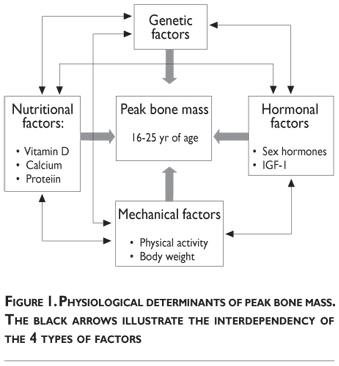
<body><![CDATA[<p>&nbsp;</p>     <p><font size="3" face="verdana"><b>Determinants of peak bone mass and strength</b></font></p>     <p><font size="2" face="Verdana">Several interconnected factors influence bone    mass accumulation during growth. These physiological determinants classically    include heredity, vitamin D and bonetropic nutrients (calcium, proteins), endocrine    factors (sex steroids, IGF&#45;I, 1.25(OH)<SUB>2</SUB>D), mechanical forces (physical    activity, body weight) (<a href="#fig01">figure 1</a>). Quantitatively, the    most prominent determinant appears to be genetically related.</font></p>     <p><a name="fig01"></a></p>     <p>&nbsp;</p>     <p align="center"><img src="/img/revistas/spm/v51s1/a04fig01.gif"></p>     <p>&nbsp;</p>     <p><font size="2" face="Verdana"><i>Heredity </i></font></p>     <p><font size="2" face="Verdana">Mass Parent&#45;offspring comparison studies reveal    a significant relationship in the risk of osteoporosis within families, with    apparent transmission from either mothers or fathers to their children.<SUP>5,26,27</SUP>    The familial resemblance for bone mineral mass in mothers and daughters is expressed    before the onset of pubertal maturation.<SUP>5</sup></font></p>     <p><font size="2" face="Verdana"> Comparison in the degree of correlation between    pairs of monozygotic versus dizygotic twins allows one to estimate the contribution    of heritability to the variance of bone mineral mass more precisely.<SUP>28</SUP>    This computation suggests that heritability, i.e. the additive effects of genes,    explains 60 to 80% of the variance of adult bone mineral mass. This "genetic    effect" appears to be greater in skeletal sites such as the lumbar spine    compared to the femoral neck.<SUP>28</SUP> It is possible that mechanical factors    (e.g. physical activity, body weight, muscle force) exert greater influence    on the cortical component of the proximal femur than on the prevailing trabecular    framework of vertebral bodies, thus explaining the relatively low heritability    of femoral aBMD. Despite the strong impact of heritability on aBMD, environmental    factors still play an important role since they may account for up to 20 to    40% of peak bone mass variance</font></p>     ]]></body>
<body><![CDATA[<p> <font size="2" face="Verdana"><I>Search for osteoporosis genes</i>. Two main    approaches have dominated the search for genetic factors that would influence    bone acquisition and thereby modify the susceptibility to osteoporosis in later    life. One approach is to search by genome&#45;wide screening for loci flanked by    DNA micro&#45;satellite markers that would co&#45;segregate with the phenotype of interest    in a population of related individuals. The pedigrees investigated to date consist    mainly of families with a member at either extreme of the skeletal phenotype    spectrum, particularly those exhibiting either very high or very low bone mineral    mass or areal density. Genome screening for quantitative trait loci (QTLs) have    also been used to detect within the "normal" population families and/or    siblings with marked differences in bone mass, size or geometry. The second    most frequently used approach is to search for an association between allelic    variants or polymorphisms of genes coding for products that are implicated in    bone acquisition or loss. Numerous polymorphisms of "candidate" genes    have been found to be associated with aBMD, so far the most convenient measurable    surrogate of bone mass and strength. The genes studied code for molecules implicated    in bone function and structure such as circulating endocrine factors, hormone    receptors, local regulators of bone modeling and remodeling or matrix molecules.    None of these genes appears to account for more than a few percent of PBM variance.    See for review.<SUP>28,30</sup></font></p>     <p><font size="2" face="Verdana"> Gene&#45;environmement interactions in the skeletal    response to nutrition and physical activity during growth is a difficult domain    that remains to be approached by appropriate study designs. Identifying the    implicated genes interacting with bone&#45;specific nutrients and the response to    mechanical loading represents a formidable, but hopefully not intractable, challenge.<SUP>31</SUP>    </font></p>     <p>&nbsp;</p>     <p><font size="3" face="verdana"><b>Endocrine factors</b></font></p>     <p> <font size="2" face="Verdana"><I>Sex hormones</i>. As specified above, the    development of bone mineral mass during the entire growth period, including    during pubertal maturation, is essentially due to an increase in bone size,    with very mild changes in the amount of mineralized tissue within the bone envelope.<SUP>4,7,32,33</SUP>    Likewise, once pubertal maturation has been reached, the gender difference in    bone mass essentially results from a greater bone size increment in male subjects.<SUP>4,7,32,33</SUP>    In boys, the onset of puberty occurs later than in girls and the period of accelerated    bone growth lasts for four as compared to three years in girls.<SUP>8</SUP>    These two characteristics probably account to a large extent for the gender    difference in mean PBM observed in healthy young adults.<SUP>4</sup></font></p>     <p><font size="2" face="Verdana"> An androgen receptor has been localized in growth    plate chondrocytes in humans during pubertal maturation.<SUP>32,33</SUP> However,    there is no evidence that androgens stimulate longitudinal bone growth by a    direct action on the skeleton. In adulthood, patients affected by the androgen    insensitivity syndrome, with XY genotype and a marked female phenotype are taller    than the average standing height of the corresponding female population.<SUP>32,33</SUP>    In contrast, it is well documented that estrogens play an essential role in    longitudinal bone growth. They exert biphasic effects by accelerating bone growth    at the beginning of puberty whereas in both genders, estrogens are key determinants    for the closing of growth plates.<SUP>7,33</SUP> During pubertal maturation,    cross&#45;sectional analysis of appendicular bone, at least in the upper limb, reveals    some distinct gender dimorphism. In female subjects, bone mineral mass increases    more by endosteal than periosteal accrual.<SUP>34</SUP> In male subjects, the    opposite structural modifications are observed with greater increases in periosteal    than endosteal apposition resulting in the increment of both external and internal    perimeters of the cortical structure.<SUP>34</SUP> At the end of pubertal maturation,    the cortical thickness is greater in male than female subjects. In vertebral    bodies, the gender structural dimorphism is mainly expressed in the frontal    axis, which is 10&#45;15% larger in males than in females.<SUP>9</SUP> These morphological    differences in the geometry and mineral mass distribution of both axial and    appendicular bones confer a greater mechanical resistance to loading of the    male skeleton. To a large extent, they explain the greater risk of osteoporotic    fractures occurring in adult women than men. The increased bone mineral apposition    at the level of the endosteal surface during puberty in female subjects may    teleologically represent a biological adaptation allowing the rapid mobilization    of bone mineral in response to the increased needs during pregnancy and lactation.    </font></p>     <p><font size="2" face="Verdana"> A later age at menarche was found to be associated    with lower aBMD in the spine and proximal femur<SUP>35,36</SUP> and higher risk    of vertebral<SUP>37</SUP> and hip fracture<SUP>38</SUP> in adulthood. Indirect    evidence from a retrospective epidemiological survey suggests that this association    is likely to be related to the influence of pubertal timing on PBM attainment.    In premenopausal women, early compared to late menarche, is associated with    higher aBMD.<SUP>39,40</SUP> This association is usually considered as the expression    of earlier and thereby longer exposure to estrogen. Although this intuitive    explanation appears to be quite reasonable, there is no unequivocal evidence    demonstrating that sex hormone exposure is the essential causal factor accounting    for the association between pubertal timing and the risk of osteoporosis.<SUP>16</SUP>    A recent report also indicates that pubertal timing, as assessed in males by    using age at peak height velocity, predicts fractures occurring before PBM attainment    and aBMD in young adult men.<SUP>41</SUP> </font></p>     <p><font size="2" face="Verdana"> In a prospective study in healthy girls with    normal pubertal development, we observed a significantly greater proximal femur    aBMD in those with mean menarcheal age of 12 as compared to 14 years.<SUP>42</SUP>    This study also suggested an interaction between the factors that trigger the    onset of pubertal maturation and calcium intake.<SUP>42</SUP> Whether calcium    supplementation administered at the onset of pubertal maturation may influence    the hypothalamic&#45;pituitary&#45;gonadal axis, by a leptin&#45;dependent or &#150;independent    pathway, and thereby accelerate the occurrence of menarche remains an open question.</font></p>     <p><font size="2" face="Verdana"><i>The growth hormone&#45;insulin&#45;like growth factor&#45;1    system</i></font></p>     <p><font size="2" face="Verdana">From birth to the end of adolescence, the GH&#45;IGF&#45;1    system is essential for harmonious skeleton development. During puberty, the    plasma level of IGF&#45;1 rises transiently according to a pattern that is similar    to the curve of the gain in bone mass and size.<SUP>4</SUP> IGF&#45;1 positively    influences the growth in both length and width of the skeletal pieces. This    factor exerts a direct action on both growth plate chondrocytes and osteogenic    cells responsible for building both cortical and trabecular bone tissue constituents.    This activity is also expressed by parallel changes in the circulating biochemical    markers of bone formation, osteocalcin and alkaline phosphatase. In addition,    IGF&#45;1 exerts an important impact on renal endocrine and transport functions    that are essential for bone mineral economy. IGF&#45;1 receptors are localized in    the renal tubular cells. They are connected to both the production machinery    of the hormonal form of vitamin D, namely 1,25(OH)<SUB>2</SUB>D and to the transport    system of inorganic phosphate (Pi) localized in the luminal membrane of the    tubular cells. By enhancing the production and circulating level of 1,25(OH)<SUB>2</SUB>D,    IGF&#45;1 indirectly stimulates the intestinal absorption of Ca and Pi (<a href="#fig02">figure    2</a>). Coupled to the stimulation of the tubular capacity to reabsorb Pi, the    extra cellular Ca&#45;Pi product is increased by IGF&#45;1, which, through this dual    renal action, favors the mineralization of the bone matrix. Furthermore, at    the bone level, IGF&#45;1 still directly enhances the osteoblastic formation of    the extra cellular matrix. In growth plate chondrocytes as well as in their    plasma membrane derived extra cellular matrix vesicles are equipped by a phosphate    transport system that plays a key role in the process of primary calcification    and thereby in bone development. This Pi transport system is also present in    other osteogenic cells<SUP>43</SUP> and interestingly, is regulated by IGF&#45;1.    The hepatic production of IGF&#45;1, which is the main source of its circulating    level, is influenced not only by GH, but also by other factors, particularly    by amino acids from dietary proteins (<a href="#fig02">figure 2</a>). </font></p>     ]]></body>
<body><![CDATA[<p><a name="fig02"></a></p>     <p>&nbsp;</p>     <p align="center"><img src="/img/revistas/spm/v51s1/a04fig02.gif"></p>     <p>&nbsp;</p>     <p><font size="2" face="Verdana">During pubertal maturation, there is an interaction    between sex steroids and the GH&#45;IGF&#45;1 system. The modalities of this interaction    have still to be delineated in humans. From animal studies, relatively low concentrations    of estrogens would appear to stimulate the hepatic production of IGF&#45;1, whereas    large concentrations apparently exert an inhibitory effect.<SUP>33</SUP> Androgens    would appear to act mainly at the pituitary level, but only after being converted    into estrogens by the enzymatic activity of aromatase.<SUP>33</sup></font></p>     <p>&nbsp;</p>     <p><font size="3" face="verdana"><b>Mechanical factors</b></font></p>     <p><font size="2" face="Verdana"><I>Molecular pathways.</i> Mechanical forces    impinge on the skeleton by enhancing osteoblastic bone formation, while inhibiting    osteoclastic bone resorption.<SUP>44</SUP> The effect on osteoblast numbers    and activity probably involve several local factors. Some appear to be produced    by the osteocytes. The density, distribution and extensive communication network    of osteocytes make them particularly well structured to function as detectors    of mechanical strain by sensing fluid movement within the bone canaliculi. They    can direct the formation of new bone by activating lining cells to differentiate    in preosteoblasts.<SUP>44</SUP> A key molecule implicated in this mechanotransduction    process appears to be sclerostin, the product of the SOST gene.<SUP>45</SUP>    Patients with sclerosteosis and high bone mass<SUP>46</SUP> can have mutations    in either the LRP5 or SOST gene. Sclerostin can bind and antagonize LRP5, a    Wnt co&#45;receptor that is required for bone formation in response to mechanical    load. Mechanical loading can induce a marked reduction of sclerostin in both    osteocytes and in the canaliculi network.<SUP>45</SUP> Furthermore, evidence    for a key role of this molecular pathway has been recently reported by demonstrating    that administration of sclerostin monoclonal antibodies to primates leads to    a dramatic increase in bone formation, trabecular thickness, radial, femoral    and vertebral BMD as well as in bone strength.<SUP>47</SUP> Therefore genes    coding for the LRP5&#45;Wnt co receptor and sclerostin are implicated in the bone    anabolic response to increased mechanical strain. The mechanosensation and transduction    in osteocytes still involve other factors including nitric oxide (NO), prostaglandins    and ATP.<SUP>44</SUP> IGF&#45;1, membrane ion channels, integrins and connexins    are also locally implicated in the response of cells to mechanical signaling    in bone.</font></p>     <p><font size="2" face="Verdana"><I>Age and optimal response to loading</i>. Growing    bones are usually more responsive to mechanical loading than adult bones. Physical    activity increases bone mineral mass accumulation in both children and adolescents.    However, the impact appears to be stronger before than during or after the period    of pubertal maturation.<SUP>48</SUP> Children and adolescents involved in various    competitive sports such as gymnastics, freestyle skiing, figure or speed skating,    soccer, and therefore undergoing intense training, display increased bone mineral    mass gain. The greater gain in aBMD or BMC in young athletes compared with less    active controls is preferentially localized in weight bearing bones, such as    the proximal femur. Studies in adult elite athletes strongly indicate that increased    bone mass gains resulting from intense physical activity during childhood and    adolescence are maintained after training attenuates or even completely ceases.    </font></p>     <p><font size="2" face="Verdana"><I>Exercise during growth and fracture prevention    in adulthood</i>.The question whether the increased PBM induced by physical    exercise will be maintained into old age and confer a reduction in fracture    rate remains uncertain. A cross&#45;sectional study of retired Australian elite    soccer players suggested that this might not be the case.<SUP>49</SUP> However,    in another study, benefits were attenuated but not lost.<SUP>50</SUP> Thus,    in ice hockey and soccer players, although exercise&#45;induced BMD benefits during    growth are partially reduced after retirement from sports, higher PBM may contribute    to the lower incidence of fragility fractures observed in retired athletes beyond    60 years of age compared to matched controls.<SUP>50</sup></font></p>     ]]></body>
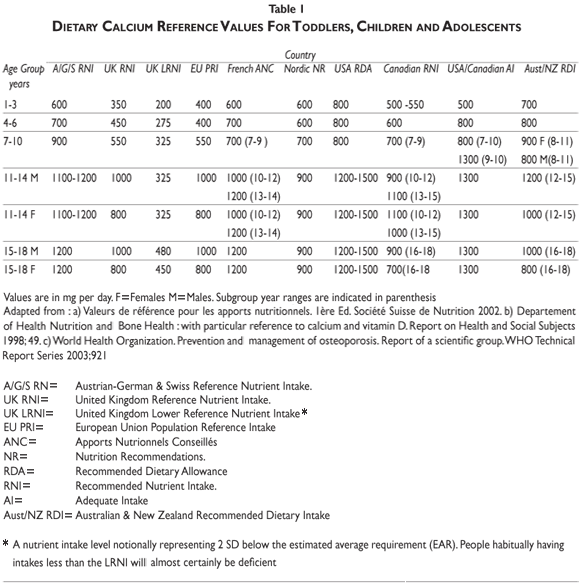
<body><![CDATA[<p><font size="2" face="Verdana"><I>Moderate exercise for public health program</i>.    In the perspective of public health programs aimed at increasing bone mineral    mass gain in children and adolescents, it is obvious that only physical exercise    of moderate intensity, duration and frequency, but which would still be effective,    can be taken into consideration. In children, prepubertal individuals or those    at an early stage of sexual maturation, several interventions implemented within    the school curriculum indicate that moderate exercise can impact positively    on bone development. Nevertheless, it remains uncertain to what extent the greater    aBMD gain in response to moderate and readily accessible weight&#45;bearing exercise    is associated with a commensurate increase in bone strength. The magnitude of    benefit in terms of bone strength will depend upon the nature of the structural    change. An effect consisting primarily of an increased periosteal apposition    and consecutive diameter will confer greater mechanical resistance than a response    limited to the endosteal apposition rate leading essentially to a reduction    in the endocortical diameter.</font></p>     <p><font size="2" face="Verdana"><I>Skeletal site specificity</i>. Recent studies    suggest site&#45;specific differences in how the pre&#45;pubertal skeleton develops    in response to repetitive loading.<SUP>51</SUP> At some sites, such as the tibia    diaphysis, loading will result in geometrical changes with larger bone and greater    cortical area, whereas at sites consisting predominantly of trabecular tissue,    such as the distal radius and tibia, physical activity may increase the volumetric    mineral density.<SUP>51</SUP> Quantitative bone structural analysis in children    and adolescents<SUP>3</SUP> will provide a clearer assessment of the actual    effects of mechanical loading components, such as intensity, duration and frequency,    of various types of exercises on the size, geometry and mineral density of cortical    and trabecular bones in children and adolescents. </font></p>     <p><font size="2" face="Verdana"><I>Role of energy intake and muscle mass development</i>.    In healthy subjects, the energy intake is adjusted to increased physical activity.    Hence it is difficult to ascribe the additional gain in bone mass to mechanical    loading alone. Indeed, nutrients such as calcium and proteins, that are usually    consumed in various amounts in relation to physical activity, could substantially    contribute to the positive effect on bone mass acquisition. The independent    mechanical contribution can be measured by the differential effect observed    according to the skeletal sites solicited. However, the best evidence of the    distinct effect of mechanical loading from concomitant increase in nutritional    intakes is provided by studies on the use of rackets, as determined by measuring    the difference between loaded and unloaded arms. </font></p>     <p><font size="2" face="Verdana"> It has been suggested that the exercise&#45;induced    gain in bone mass, size and strength essentially results from an adaptation    secondary to the increase in muscle mass and strength.<SUP>52</SUP> This model    has more recently been challenged by several observations demonstrating that    bone growth can be dissociated from muscle development.<SUP>53,54</sup></font></p>     <p><font size="2" face="Verdana"><I>Negative impact of intensive physical exercise</i>.    Impaired bone mass acquisition can occur when intensive physical activity leads    to hypogonadism and low body mass.<SUP>55</SUP> Both nutritional and hormonal    factors probably contribute to this impairment. Intake of energy, protein and    calcium may be inadequate as athletes go on diets to maintain an idealized physique    for their sport. Intensive training during childhood may contribute to a later    onset and completion of puberty. Hypogonadism, as expressed by the occurrence    of oligomenorrhea or amenorrhea, can lead to bone loss in females who begin    training intensively after menarche.<SUP>55</sup></font></p>     <p>&nbsp;</p>     <p><font size="3" face="verdana"><b>Nutrition: The differential impact of calcium</b></font></p>     <p><font size="2" face="Verdana">The extent to which variations in the intake    of certain nutrients by healthy, apparently well&#45;nourished, children and adolescents    affect bone mass accumulation, particularly at sites susceptible to osteoporotic    fractures, has received increasing attention over the last 15 years. Most studies    have focused on the intake of calcium. However, other nutrients such as proteins,    which are not discussed in this review, should also be considered.</font></p>     <p><font size="2" face="Verdana"> In most regions of the world, the supply of    calcium is sufficient to avoid the occurrence of clinically manifest bone disorders    during growth. Nevertheless, by securing adequate calcium intake, provided the    skin and food supply of vitamin D is adequate, it is expected that bone mass    gain can be increased during infancy, childhood and adolescence and thereby    optimal PBM can be achieved. The prevention of adult osteoporotic fractures    is the main reason for this widespread preoccupation. </font></p>     <p><font size="2" face="Verdana"><I>Calcium recommendations</i>. International    and national agencies have adopted recommendations for calcium intake from infancy    to the last decades of life. Decisions from these recommending bodies can be    based on either calcium balance, allowing estimations to be made regarding maximal    retention, or on a factorial method that calculates from available data on calcium    accretion and endogenous losses modified by fractional absorption. Observational    and interventional studies are also taken into consideration. The recommendations    vary widely among regional agencies<SUP>56</SUP> (<a href="#tab01">table I</a>).    Thus, for children aged 6&#45;10 years, the recommended daily calcium intakes are    set at 500, 700, 800, and up to 1200 mg, in the United Kingdom, the Nordic European    countries, France and the United States of America, respectively. For female    adolescents aged 11&#45;17 they are set at 800, 900, 1200 and up to 1500 mg/day    in the same geographical regions, respectively. Variability in calcium intake    recommendations can be explained partly by the discrepant results obtained in    observational and interventional studies.</font></p>     ]]></body>
<body><![CDATA[<p><a name="tab01"></a></p>     <p>&nbsp;</p>     <p align="center"><img src="/img/revistas/spm/v51s1/a04tab01.gif"></p>     <p>&nbsp;</p>     <p><font size="2" face="Verdana"><I>Epidemiological studies</i>. Retrospective    epidemiological data obtained in women aged 20&#45;49 years, indicated that milk    consumption during childhood and adolescence can be positively correlated to    bone mineral mass.<SUP>57</SUP> In some but not all observational studies carried    out during childhood and adolescence, a positive correlation between dietary    calcium and bone mineral mass was reported.<SUP>58,59</SUP> In our own longitudinal    prospective observational study, a significant positive relationship between    total calcium intakes, as determined by two 5&#45;day diaries and bone mass accrual    was found in the pubertal subgroup P1&#45;P4, but not in the P5 subgroup.<SUP>59</SUP>    Furthermore, when results were analyzed by taking into account the influence    of age and pubertal maturation, the relationship between the absolute values    of calcium intake and the gain in the BMD <I>Z</I>&#45;score suggested that calcium    might be more important before than during pubertal maturation.<SUP>59</sup></font></p>     <p><font size="2" face="Verdana"><I>Interventional studies.</i> Several calcium    intervention studies have been carried out in children and adolescents. See    for review.<SUP>58,60</SUP> Overall these studies indicated a greater bone mineral    mass gain in children and adolescents receiving calcium supplementation over    periods varying from 12 to 36 months (<a href="#tab02">table II</a>). Nevertheless,    the response appears to vary markedly according to several factors including    the skeletal sites examined, the stage of pubertal maturation, the basal nutritional    conditions, i.e. spontaneous calcium and protein intakes, the level of physical    activity and the genetic background </font></p>     <p><a name="tab02"></a></p>     <p>&nbsp;</p>     <p align="center"><img src="/img/revistas/spm/v51s1/a04tab02.gif"></p>     <p>&nbsp;</p>     ]]></body>
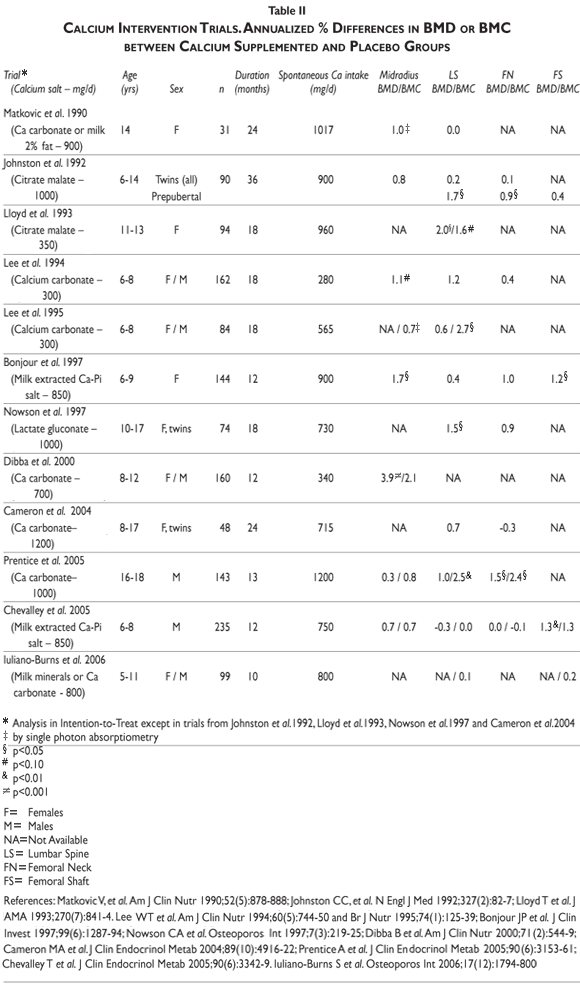
<body><![CDATA[<p><font size="2" face="Verdana"><I>Differential skeletal site responsiveness</i>.    The benefit of supplemental calcium was usually greater in the appendicular    that in the axial skeleton.<SUP>58,60</SUP> Thus, in prepubertal children, calcium    supplementation is more effective on cortical appendicular bone (radial and    femoral diaphysis) than on axial trabecular rich bone (lumbar spine) or in the    proximal femur .<SUP>58,60</SUP> </font></p>     <p><font size="2" face="Verdana"><I>Influence of stage of pubertal maturation.</i>    In agreement with our longitudinal observation in healthy subjects aged 8 to    19 years (figure 6), the skeleton appears to be more responsive to calcium supplementation    before the onset of pubertal maturation than during the peripubertal period.<SUP>58,60</SUP>    Randomized placebo&#45;controlled trials in twins are particularly informative in    this regard.<SUP>61</SUP> Indeed, the co&#45;twin design to test the effect of calcium    supplementation confers a substantial advantage in statistical power, compared    with intervention studies in unrelated individuals. Two co&#45;twin studies strongly    suggest that increasing calcium intake after the onset of pubertal maturation    above a daily spontaneous intake of about 800&#45;900 mg does not exert a significant    positive effect on bone mineral mass acquisition. This contrasts to the widespread    intuitive belief that the period of pubertal maturation with its acceleration    of bone mineral mass accrual would be the most attractive time for enhancing    calcium intake well above the prepubertal requirements. As described above efficient    adaptive mechanisms secure an adequate bone mineral economy in response to the    increased demand of the peripubertal growth spurt.<SUP>61</SUP> Thanks to these    adaptive processes, one can infer that the dependency on environmental mineral    supply to secure bone growth demand is not necessarily increased during the    peripubertal period as compared to the years preceding the onset of sexual maturation.<SUP>61</SUP>    </font></p>     <p><font size="2" face="Verdana"><I>Spontaneous calcium intake</i>. As intuitively    expected, the benefit observed at the end of intervention is particularly substantial    in children with a relatively low calcium intake.<SUP>58,60</SUP> In 8&#45;year&#45;old    prepubertal girls with relatively low spontaneous calcium intake, increasing    the calcium intake resulted in an additionnal gain by about 0.25 SD as compared    to the placebo group after one year of supplementation. In contrast, the additional    gain was minimal in those girls with a relatively high calcium intake.<SUP>60</SUP>    Therefore, below a certain threshold in the spontaneous supply it is quite likely    that increasing the calcium intake can "push upward" the bone individual    growth trajectory and thereby positively influence the value of PBM. According    to the "programming" concept, environmental stimuli during critical    periods of early development can provoke long&#45;lasting modifications in structure    and function of various biological systems.<SUP>63</SUP> Interventions limited    to the first period of life may modify the trajectory of bone mass accrual.<SUP>64</SUP>    This concept received some support in relation with calcium economy since vitamin    D given in physiological doses (400 IU=10</font><i><font>&#181;</font></i><font size="2" face="verdana">g)    to female infants for an average of one year was associated with a significant    increase in aBMD measured at the age of 7&#45;9 years.<SUP>65</SUP> In this study,    the aBMD difference between the vitamin D&#45;supplemented and non&#45;supplemented    infants was most significant at the femoral neck, trochanter and radial metaphysis.<SUP>65</SUP>    </font></p>     <p><font size="2" face="Verdana"><I>Calcium intake and physical activity interaction</i>.    The possibility that physical activity could modulate the bone response to dietary    calcium supplementation during growth has been considered in infants, children    and adolescents. Overall, the results suggest an interaction: the higher the    calcium intake, the more positive the effect that increased physical activity    exerts on bone growth. At moderately low calcium intake, the effect may not    be positive. Thus, in a longitudinal study in infants 6&#45;18 months of age, i.e.    during rapid bone growth, loading of the skeleton was associated with a reduced    increase in total body BMC in the presence of a moderately low calcium intake.    In young children aged 3&#45;5 years, either calcium supplement or gross motor activity    increased bone mass accrual as compared to either placebo or fine motor activity.<SUP>66</SUP>    Furthermore, the bone response to calcium supplement was greater in children    with gross than fine physical activity.<SUP>66</SUP> In another study in 8&#45;9    year&#45;old girls, greater gains in bone mass at weight&#45;bearing skeletal sites    were observed when moderate exercise was combined with calcium supplementation.<SUP>66</SUP>    Thus, the positive interaction of calcium intake and physical activity appears    to be region&#45;specific. This regional specificity suggests that the effect of    physical activity alone or combined with relatively high calcium supply is not    merely due to an indirect influence on the energy intake, which in turn would    positively affect bone mass acquisition.</font></p>     <p><font size="2" face="Verdana"><I>Other unresolved issues</i>. It has not been    established whether the type of calcium salt used to supplement diets may modulate    the nature of the bone response. The observation that calcium supplementation    can increase bone size, at least transiently, has been observed using either    milk extracted calcium&#45;phosphate as well as calcium carbonate salt.<SUP>58,60</SUP>    It is interesting to note that an effect on bone size has been observed in response    to whole milk supplementation.<SUP>68</SUP> In this type of intervention, the    effect could be due to other nutrients, or their association with calcium, such    as milk&#45;proteins. Another uncertainty is the question of whether gains observed    by the end of the intervention are maintained or lost after discontinuation    of calcium supplementation. A clear answer to this question requires long term    follow up, since sustained gain even on bone mass and size may be transient,    possibly resulting from some indirect influence of calcium supplementation on    the tempo of pubertal and thereby bone maturation.<SUP>42,69</sup></font></p>     <p><font size="2" face="Verdana"><I>Calcium intake: how much eventually to recommend    from prepuberty to end of adolescence?</i> The observational and interventional    studies discussed above illustrate the numerous factors that can modulate the    bone response to calcium intake. This foregoing analysis may, at least in part,    explain the difficulty to reach a scientifically based worldwide consensus on    dietary allowance recommendation for children and adolescents. Nevertheless,    taking into account both the results of all studies as well as our knowledge    on the physiology of calcium and bone metabolism, particularly on the adaptive    mechanisms operating during the peripubertal period,<SUP>61</SUP> it appears    reasonable and safe to recommend food intake that would provide about 1000 mg    of calcium per day from prepuberty to the end of adolescence. </font></p>     <p>&nbsp;</p>     <p><font size="3" face="verdana"><b>References</b></font></p>     <!-- ref --><p><font size="2" face="Verdana">1. World Health Organization. Assessment of fracture    risk and its application to screening for postmenopausal osteoporosis. Report    of a WHO study group. WHO Tech Rep Ser: 843;1994.</font>&nbsp;&nbsp;&nbsp;&nbsp;&nbsp;&nbsp;&nbsp;&nbsp;[&#160;<a href="javascript:void(0);" onclick="javascript: window.open('/scielo.php?script=sci_nlinks&ref=9322597&pid=S0036-3634200900070000400001&lng=','','width=640,height=500,resizable=yes,scrollbars=1,menubar=yes,');">Links</a>&#160;]<!-- end-ref --><!-- ref --><p><font size="2" face="Verdana">2. Briot K, Roux C. What is the role of DXA,    QUS and bone markers in fracture prediction, treatment allocation and monitoring?    Best Pract Res Clin Rheumatol 2005;19(6):951&#45;964.</font>&nbsp;&nbsp;&nbsp;&nbsp;&nbsp;&nbsp;&nbsp;&nbsp;[&#160;<a href="javascript:void(0);" onclick="javascript: window.open('/scielo.php?script=sci_nlinks&ref=9322598&pid=S0036-3634200900070000400002&lng=','','width=640,height=500,resizable=yes,scrollbars=1,menubar=yes,');">Links</a>&#160;]<!-- end-ref --><!-- ref --><p><font size="2" face="Verdana">3. Specker BL, Schoenau E. Quantitative bone    analysis in children: current methods and recommendations. J Pediatr 2005;146(6):726&#45;731.</font>&nbsp;&nbsp;&nbsp;&nbsp;&nbsp;&nbsp;&nbsp;&nbsp;[&#160;<a href="javascript:void(0);" onclick="javascript: window.open('/scielo.php?script=sci_nlinks&ref=9322599&pid=S0036-3634200900070000400003&lng=','','width=640,height=500,resizable=yes,scrollbars=1,menubar=yes,');">Links</a>&#160;]<!-- end-ref --><!-- ref --><p><font size="2" face="Verdana">4. Bonjour JP, Theintz G, Law F, Slosman D, Rizzoli    R. Peak bone mass. Osteoporos Int 1994;4 Suppl 1:7&#45;13.</font>&nbsp;&nbsp;&nbsp;&nbsp;&nbsp;&nbsp;&nbsp;&nbsp;[&#160;<a href="javascript:void(0);" onclick="javascript: window.open('/scielo.php?script=sci_nlinks&ref=9322600&pid=S0036-3634200900070000400004&lng=','','width=640,height=500,resizable=yes,scrollbars=1,menubar=yes,');">Links</a>&#160;]<!-- end-ref --><!-- ref --><p><font size="2" face="Verdana">5. Ferrari S, Rizzoli R, Slosman D, Bonjour JP.    Familial resemblance for bone mineral mass is expressed before puberty. J Clin    Endocrinol Metab 1998;83(2):358&#45;361.</font>&nbsp;&nbsp;&nbsp;&nbsp;&nbsp;&nbsp;&nbsp;&nbsp;[&#160;<a href="javascript:void(0);" onclick="javascript: window.open('/scielo.php?script=sci_nlinks&ref=9322601&pid=S0036-3634200900070000400005&lng=','','width=640,height=500,resizable=yes,scrollbars=1,menubar=yes,');">Links</a>&#160;]<!-- end-ref --><!-- ref --><p><font size="2" face="Verdana">6. Gilsanz V, Skaggs DL, Kovanlikaya A, Sayre    J, Loro ML, Kaufman F, <I>et al. </i>Differential effect of race on the axial    and appendicular skeletons of children. J Clin Endocrinol Metab 1998;83(5):1420&#45;1427.</font>&nbsp;&nbsp;&nbsp;&nbsp;&nbsp;&nbsp;&nbsp;&nbsp;[&#160;<a href="javascript:void(0);" onclick="javascript: window.open('/scielo.php?script=sci_nlinks&ref=9322602&pid=S0036-3634200900070000400006&lng=','','width=640,height=500,resizable=yes,scrollbars=1,menubar=yes,');">Links</a>&#160;]<!-- end-ref --><!-- ref --><p><font size="2" face="Verdana">7. Seeman E. Pathogenesis of bone fragility in    women and men. Lancet 2002;359(9320):1841&#45;1850.</font>&nbsp;&nbsp;&nbsp;&nbsp;&nbsp;&nbsp;&nbsp;&nbsp;[&#160;<a href="javascript:void(0);" onclick="javascript: window.open('/scielo.php?script=sci_nlinks&ref=9322603&pid=S0036-3634200900070000400007&lng=','','width=640,height=500,resizable=yes,scrollbars=1,menubar=yes,');">Links</a>&#160;]<!-- end-ref --><!-- ref --><p><font size="2" face="Verdana">8. Theintz G, Buchs B, Rizzoli R, Slosman D,    Clavien H, Sizonenko PC, <I>et al</I>. Longitudinal monitoring of bone mass    accumulation in healthy adolescents: Evidence for a marked reduction after 16    years of age at the levels of lumbar spine and femoral neck in female subjects.    J Clin Endocrinol Metab 1992;75(4):1060&#45;1065.</font>&nbsp;&nbsp;&nbsp;&nbsp;&nbsp;&nbsp;&nbsp;&nbsp;[&#160;<a href="javascript:void(0);" onclick="javascript: window.open('/scielo.php?script=sci_nlinks&ref=9322604&pid=S0036-3634200900070000400008&lng=','','width=640,height=500,resizable=yes,scrollbars=1,menubar=yes,');">Links</a>&#160;]<!-- end-ref --><!-- ref --><p><font size="2" face="Verdana">9. Fournier PE, Rizzoli R, Slosman DO, Buchs    B, Bonjour JP. Relative contribution of vertebral body and posterior arch in    female and male lumbar spine peak bone mass. Osteoporos Int 1994;4(5):264&#45;272.</font>&nbsp;&nbsp;&nbsp;&nbsp;&nbsp;&nbsp;&nbsp;&nbsp;[&#160;<a href="javascript:void(0);" onclick="javascript: window.open('/scielo.php?script=sci_nlinks&ref=9322605&pid=S0036-3634200900070000400009&lng=','','width=640,height=500,resizable=yes,scrollbars=1,menubar=yes,');">Links</a>&#160;]<!-- end-ref --><!-- ref --><p><font size="2" face="Verdana">10. Gilsanz V, Loro ML, Roe TF, Sayre J, Gilsanz    R, Schulz EE. Vertebral size in elderly women with osteoporosis. Mechanical    implications and relationship to fractures. J Clin Invest 1995;95(5):2332&#45;2337.</font>&nbsp;&nbsp;&nbsp;&nbsp;&nbsp;&nbsp;&nbsp;&nbsp;[&#160;<a href="javascript:void(0);" onclick="javascript: window.open('/scielo.php?script=sci_nlinks&ref=9322606&pid=S0036-3634200900070000400010&lng=','','width=640,height=500,resizable=yes,scrollbars=1,menubar=yes,');">Links</a>&#160;]<!-- end-ref --><!-- ref --><p><font size="2" face="Verdana">11. Naganathan V, Sambrook P. Gender differences    in volumetric bone density: a study of opposite&#45;sex twins. Osteoporos Int 2003;14(7):564&#45;569.</font>&nbsp;&nbsp;&nbsp;&nbsp;&nbsp;&nbsp;&nbsp;&nbsp;[&#160;<a href="javascript:void(0);" onclick="javascript: window.open('/scielo.php?script=sci_nlinks&ref=9322607&pid=S0036-3634200900070000400011&lng=','','width=640,height=500,resizable=yes,scrollbars=1,menubar=yes,');">Links</a>&#160;]<!-- end-ref --><!-- ref --><p><font size="2" face="Verdana">12. Fournier PE, Rizzoli R, Slosman DO, Theintz    G, Bonjour JP. Asynchrony between the rates of standing height gain and bone    mass accumulation during puberty. Osteoporos Int 1997;7(6):525&#45;532.</font>&nbsp;&nbsp;&nbsp;&nbsp;&nbsp;&nbsp;&nbsp;&nbsp;[&#160;<a href="javascript:void(0);" onclick="javascript: window.open('/scielo.php?script=sci_nlinks&ref=9322608&pid=S0036-3634200900070000400012&lng=','','width=640,height=500,resizable=yes,scrollbars=1,menubar=yes,');">Links</a>&#160;]<!-- end-ref --><!-- ref --><p><font size="2" face="Verdana">13. Landin LA. Fracture patterns in children.    Analysis of 8,682 fractures with special reference to incidence, etiology and    secular changes in a Swedish urban population 1950&#45;1979. Acta Orthop Scand Suppl    1983;202:1&#45;109.</font>&nbsp;&nbsp;&nbsp;&nbsp;&nbsp;&nbsp;&nbsp;&nbsp;[&#160;<a href="javascript:void(0);" onclick="javascript: window.open('/scielo.php?script=sci_nlinks&ref=9322609&pid=S0036-3634200900070000400013&lng=','','width=640,height=500,resizable=yes,scrollbars=1,menubar=yes,');">Links</a>&#160;]<!-- end-ref --><!-- ref --><p><font size="2" face="Verdana">14. Bailey DA, Wedge JH, McCulloch RG, Martin    AD, Bernhardson SC. Epidemiology of fractures of the distal end of the radius    in children as associated with growth. J Bone Joint Surg 1989;71(8):1225&#45;1231.</font>&nbsp;&nbsp;&nbsp;&nbsp;&nbsp;&nbsp;&nbsp;&nbsp;[&#160;<a href="javascript:void(0);" onclick="javascript: window.open('/scielo.php?script=sci_nlinks&ref=9322610&pid=S0036-3634200900070000400014&lng=','','width=640,height=500,resizable=yes,scrollbars=1,menubar=yes,');">Links</a>&#160;]<!-- end-ref --><!-- ref --><p><font size="2" face="Verdana">15. Ferrari SL, Chevalley T, Bonjour JP, Rizzoli    R. Childhood fractures are associated with decreased bone mass gain during puberty:    An early marker of persistent bone fragility? J Bone Miner Res 2006;21(4):501&#45;507.</font>&nbsp;&nbsp;&nbsp;&nbsp;&nbsp;&nbsp;&nbsp;&nbsp;[&#160;<a href="javascript:void(0);" onclick="javascript: window.open('/scielo.php?script=sci_nlinks&ref=9322611&pid=S0036-3634200900070000400015&lng=','','width=640,height=500,resizable=yes,scrollbars=1,menubar=yes,');">Links</a>&#160;]<!-- end-ref --><!-- ref --><p><font size="2" face="Verdana">16. Bonjour JP, Chevalley T. Pubertal timing,    peak bone mass and fragility fracture risk. BoneKey&#45;Osteovision. 2007;4:30&#45;48.    Available from: <a href="http://www.bonekey&#45;ibms.org/cgi/content/full/ibmske;4/2/30" target="_blank">http://www.bonekey&#45;ibms.org/cgi/content/full/ibmske;4/2/30</a>.</font>&nbsp;&nbsp;&nbsp;&nbsp;&nbsp;&nbsp;&nbsp;&nbsp;[&#160;<a href="javascript:void(0);" onclick="javascript: window.open('/scielo.php?script=sci_nlinks&ref=9322612&pid=S0036-3634200900070000400016&lng=','','width=640,height=500,resizable=yes,scrollbars=1,menubar=yes,');">Links</a>&#160;]<!-- end-ref --><!-- ref --><p><font size="2" face="Verdana">17. Gilsanz V, Gibbens DT, Carlson M, Boechat    MI, Cann CE, Schulz EE. Peak trabecular vertebral density: a comparison of adolescent    and adult females. Calcif Tissue Int 1988;43(4):260&#45;262.</font>&nbsp;&nbsp;&nbsp;&nbsp;&nbsp;&nbsp;&nbsp;&nbsp;[&#160;<a href="javascript:void(0);" onclick="javascript: window.open('/scielo.php?script=sci_nlinks&ref=9322613&pid=S0036-3634200900070000400017&lng=','','width=640,height=500,resizable=yes,scrollbars=1,menubar=yes,');">Links</a>&#160;]<!-- end-ref --><!-- ref --><p><font size="2" face="Verdana">18. Davis JW, Grove JS, Ross PD, Vogel JM, Wasnich    RD. Relationship between bone mass and rates of bone change at appendicular    measurement sites. J Bone Miner Res 1992;7(7):719&#45;725.</font>&nbsp;&nbsp;&nbsp;&nbsp;&nbsp;&nbsp;&nbsp;&nbsp;[&#160;<a href="javascript:void(0);" onclick="javascript: window.open('/scielo.php?script=sci_nlinks&ref=9322614&pid=S0036-3634200900070000400018&lng=','','width=640,height=500,resizable=yes,scrollbars=1,menubar=yes,');">Links</a>&#160;]<!-- end-ref --><!-- ref --><p><font size="2" face="Verdana">19. Buchs B, Rizzoli R, Slosman D, Nydegger V,    Bonjour JP. Densit&eacute; min&eacute;rale osseuse de la colonne lombaire, du    col et de la diaphyse f&eacute;moraux d'un &eacute;chantillon de la population    genevoise. Schweiz Med Wochenschr 1992;25;122(30):1129&#45;1136.</font>&nbsp;&nbsp;&nbsp;&nbsp;&nbsp;&nbsp;&nbsp;&nbsp;[&#160;<a href="javascript:void(0);" onclick="javascript: window.open('/scielo.php?script=sci_nlinks&ref=9322615&pid=S0036-3634200900070000400019&lng=','','width=640,height=500,resizable=yes,scrollbars=1,menubar=yes,');">Links</a>&#160;]<!-- end-ref --><!-- ref --><p><font size="2" face="Verdana">20. Melton LJ, 3rd, Atkinson EJ, Khosla S, Oberg    AL, Riggs BL. Evaluation of a prediction model for long&#45;term fracture risk.    J Bone Miner Res. 2005;20(4):551&#45;556.</font>&nbsp;&nbsp;&nbsp;&nbsp;&nbsp;&nbsp;&nbsp;&nbsp;[&#160;<a href="javascript:void(0);" onclick="javascript: window.open('/scielo.php?script=sci_nlinks&ref=9322616&pid=S0036-3634200900070000400020&lng=','','width=640,height=500,resizable=yes,scrollbars=1,menubar=yes,');">Links</a>&#160;]<!-- end-ref --><!-- ref --><p><font size="2" face="Verdana">21. Hernandez CJ, Beaupre GS, Carter DR. A theoretical    analysis of the relative influences of peak BMD, age&#45;related bone loss and menopause    on the development of osteoporosis. Osteoporos Int 2003;14(10):843&#45;847.</font>&nbsp;&nbsp;&nbsp;&nbsp;&nbsp;&nbsp;&nbsp;&nbsp;[&#160;<a href="javascript:void(0);" onclick="javascript: window.open('/scielo.php?script=sci_nlinks&ref=9322617&pid=S0036-3634200900070000400021&lng=','','width=640,height=500,resizable=yes,scrollbars=1,menubar=yes,');">Links</a>&#160;]<!-- end-ref --><!-- ref --><p><font size="2" face="Verdana">22. Duan Y, Wang XF, Evans A, Seeman E. Structural    and biomechanical basis of racial and sex differences in vertebral fragility    in Chinese and Caucasians. Bone 2005;36(6):987&#45;998.</font>&nbsp;&nbsp;&nbsp;&nbsp;&nbsp;&nbsp;&nbsp;&nbsp;[&#160;<a href="javascript:void(0);" onclick="javascript: window.open('/scielo.php?script=sci_nlinks&ref=9322618&pid=S0036-3634200900070000400022&lng=','','width=640,height=500,resizable=yes,scrollbars=1,menubar=yes,');">Links</a>&#160;]<!-- end-ref --><!-- ref --><p><font size="2" face="Verdana">23. Zebaze RM, Jones A, Knackstedt M, Maalouf    G, Seeman E. Construction of the femoral neck during growth determines its strength    in old age. J Bone Miner Res 2007;22(7):1055&#45;1061.</font>&nbsp;&nbsp;&nbsp;&nbsp;&nbsp;&nbsp;&nbsp;&nbsp;[&#160;<a href="javascript:void(0);" onclick="javascript: window.open('/scielo.php?script=sci_nlinks&ref=9322619&pid=S0036-3634200900070000400023&lng=','','width=640,height=500,resizable=yes,scrollbars=1,menubar=yes,');">Links</a>&#160;]<!-- end-ref --><!-- ref --><p><font size="2" face="Verdana">24. Cummings SR, Black DM, Nevitt MC, Browner    W, Cauley J, Ensrud K, <I>et al</I>. Bone density at various sites for prediction    of hip fractures. The Study of Osteoporotic Fractures Research Group. Lancet    1993;9;341(8837):72&#45;75.</font>&nbsp;&nbsp;&nbsp;&nbsp;&nbsp;&nbsp;&nbsp;&nbsp;[&#160;<a href="javascript:void(0);" onclick="javascript: window.open('/scielo.php?script=sci_nlinks&ref=9322620&pid=S0036-3634200900070000400024&lng=','','width=640,height=500,resizable=yes,scrollbars=1,menubar=yes,');">Links</a>&#160;]<!-- end-ref --><!-- ref --><p><font size="2" face="Verdana">25. Marshall D, Johnell O, Wedel H. Meta&#45;analysis    of how well measures of bone mineral density predict occurrence of osteoporotic    fractures. Br Med J 1996;18;312(7041):1254&#45;1259.</font>&nbsp;&nbsp;&nbsp;&nbsp;&nbsp;&nbsp;&nbsp;&nbsp;[&#160;<a href="javascript:void(0);" onclick="javascript: window.open('/scielo.php?script=sci_nlinks&ref=9322621&pid=S0036-3634200900070000400025&lng=','','width=640,height=500,resizable=yes,scrollbars=1,menubar=yes,');">Links</a>&#160;]<!-- end-ref --><!-- ref --><p><font size="2" face="Verdana">26. Seeman E, Hopper JL, Bach LA, Cooper ME,    Parkinson E, McKay J, <I>et al</I>. Reduced bone mass in daughters of women    with osteoporosis. N Engl J Med 1989;2;320(9):554&#45;558.</font>&nbsp;&nbsp;&nbsp;&nbsp;&nbsp;&nbsp;&nbsp;&nbsp;[&#160;<a href="javascript:void(0);" onclick="javascript: window.open('/scielo.php?script=sci_nlinks&ref=9322622&pid=S0036-3634200900070000400026&lng=','','width=640,height=500,resizable=yes,scrollbars=1,menubar=yes,');">Links</a>&#160;]<!-- end-ref --><!-- ref --><p><font size="2" face="Verdana">27. Cohen&#45;Solal ME, Baudoin C, Omouri M, Kuntz    D, De Vernejoul MC. Bone mass in middle&#45;aged osteoporotic men and their relatives:    familial effect. J Bone Miner Res 1998;13(12):1909&#45;1914.</font>&nbsp;&nbsp;&nbsp;&nbsp;&nbsp;&nbsp;&nbsp;&nbsp;[&#160;<a href="javascript:void(0);" onclick="javascript: window.open('/scielo.php?script=sci_nlinks&ref=9322623&pid=S0036-3634200900070000400027&lng=','','width=640,height=500,resizable=yes,scrollbars=1,menubar=yes,');">Links</a>&#160;]<!-- end-ref --><!-- ref --><p><font size="2" face="Verdana">28. Eisman JA. Genetics of osteoporosis. Endocr    Rev 1999;20(6):788&#45;804.</font>&nbsp;&nbsp;&nbsp;&nbsp;&nbsp;&nbsp;&nbsp;&nbsp;[&#160;<a href="javascript:void(0);" onclick="javascript: window.open('/scielo.php?script=sci_nlinks&ref=9322624&pid=S0036-3634200900070000400028&lng=','','width=640,height=500,resizable=yes,scrollbars=1,menubar=yes,');">Links</a>&#160;]<!-- end-ref --><!-- ref --><p><font size="2" face="Verdana">29. Peacock M, Turner CH, Econs MJ, Foroud T.    Genetics of osteoporosis. Endocr Rev 2002;23(3):303&#45;326.</font>&nbsp;&nbsp;&nbsp;&nbsp;&nbsp;&nbsp;&nbsp;&nbsp;[&#160;<a href="javascript:void(0);" onclick="javascript: window.open('/scielo.php?script=sci_nlinks&ref=9322625&pid=S0036-3634200900070000400029&lng=','','width=640,height=500,resizable=yes,scrollbars=1,menubar=yes,');">Links</a>&#160;]<!-- end-ref --><!-- ref --><p><font size="2" face="Verdana">30. Ferrari SL. Osteoporosis: a complex disorder    of aging with multiple genetic and environmental determinants. World Rev Nutr    Diet 2005;95:35&#45;51.</font>&nbsp;&nbsp;&nbsp;&nbsp;&nbsp;&nbsp;&nbsp;&nbsp;[&#160;<a href="javascript:void(0);" onclick="javascript: window.open('/scielo.php?script=sci_nlinks&ref=9322626&pid=S0036-3634200900070000400030&lng=','','width=640,height=500,resizable=yes,scrollbars=1,menubar=yes,');">Links</a>&#160;]<!-- end-ref --><!-- ref --><p><font size="2" face="Verdana">31. Bonjour JP, Chevalley T, Rizzoli R, Ferrari    S. Gene&#45;environment interactions in the skeletal response to nutrition and exercise    during growth. Med Sport Sci 2007;51:64&#45;80.</font>&nbsp;&nbsp;&nbsp;&nbsp;&nbsp;&nbsp;&nbsp;&nbsp;[&#160;<a href="javascript:void(0);" onclick="javascript: window.open('/scielo.php?script=sci_nlinks&ref=9322627&pid=S0036-3634200900070000400031&lng=','','width=640,height=500,resizable=yes,scrollbars=1,menubar=yes,');">Links</a>&#160;]<!-- end-ref --><!-- ref --><p><font size="2" face="Verdana">32. Vanderschueren D, Vandenput L, Boonen S,    Lindberg MK, Bouillon R, Ohlsson C. Androgens and bone. Endocr Rev 2004;25(3):389&#45;425.</font>&nbsp;&nbsp;&nbsp;&nbsp;&nbsp;&nbsp;&nbsp;&nbsp;[&#160;<a href="javascript:void(0);" onclick="javascript: window.open('/scielo.php?script=sci_nlinks&ref=9322628&pid=S0036-3634200900070000400032&lng=','','width=640,height=500,resizable=yes,scrollbars=1,menubar=yes,');">Links</a>&#160;]<!-- end-ref --><!-- ref --><p><font size="2" face="Verdana">33. Vanderschueren D, Vandenput L, Boonen S.    Reversing sex steroid deficiency and optimizing skeletal development in the    adolescent with gonadal failure. Endocr Dev 2005;8:150&#45;165.</font>&nbsp;&nbsp;&nbsp;&nbsp;&nbsp;&nbsp;&nbsp;&nbsp;[&#160;<a href="javascript:void(0);" onclick="javascript: window.open('/scielo.php?script=sci_nlinks&ref=9322629&pid=S0036-3634200900070000400033&lng=','','width=640,height=500,resizable=yes,scrollbars=1,menubar=yes,');">Links</a>&#160;]<!-- end-ref --><!-- ref --><p><font size="2" face="Verdana">34. Garn SM. The earlier gain and later loss    of cortical bone: Nutritional perspectives. In: Thomas CC, ed.: Springfield    1970:3&#45;120.</font>&nbsp;&nbsp;&nbsp;&nbsp;&nbsp;&nbsp;&nbsp;&nbsp;[&#160;<a href="javascript:void(0);" onclick="javascript: window.open('/scielo.php?script=sci_nlinks&ref=9322630&pid=S0036-3634200900070000400034&lng=','','width=640,height=500,resizable=yes,scrollbars=1,menubar=yes,');">Links</a>&#160;]<!-- end-ref --><!-- ref --><p><font size="2" face="Verdana">35. Ribot C, Pouilles JM, Bonneu M, Tremollieres    F. Assessment of the risk of post&#45;menopausal osteoporosis using clinical factors.    Clin Endocrinol (Oxf) 1992;36(3):225&#45;228.</font>&nbsp;&nbsp;&nbsp;&nbsp;&nbsp;&nbsp;&nbsp;&nbsp;[&#160;<a href="javascript:void(0);" onclick="javascript: window.open('/scielo.php?script=sci_nlinks&ref=9322631&pid=S0036-3634200900070000400035&lng=','','width=640,height=500,resizable=yes,scrollbars=1,menubar=yes,');">Links</a>&#160;]<!-- end-ref --><!-- ref --><p><font size="2" face="Verdana">36. Tuppurainen M, Kroger H, Saarikoski S, Honkanen    R, Alhava E. The effect of gynecological risk factors on lumbar and femoral    bone mineral density in peri&#45; and postmenopausal women. Maturitas 1995;21(2):137&#45;145.</font>&nbsp;&nbsp;&nbsp;&nbsp;&nbsp;&nbsp;&nbsp;&nbsp;[&#160;<a href="javascript:void(0);" onclick="javascript: window.open('/scielo.php?script=sci_nlinks&ref=9322632&pid=S0036-3634200900070000400036&lng=','','width=640,height=500,resizable=yes,scrollbars=1,menubar=yes,');">Links</a>&#160;]<!-- end-ref --><!-- ref --><p><font size="2" face="Verdana">37. Melton LJ, 3rd. Epidemiology of spinal osteoporosis.    Spine 1997; 15;22(24 Suppl):S2&#45;S11.</font>&nbsp;&nbsp;&nbsp;&nbsp;&nbsp;&nbsp;&nbsp;&nbsp;[&#160;<a href="javascript:void(0);" onclick="javascript: window.open('/scielo.php?script=sci_nlinks&ref=9322633&pid=S0036-3634200900070000400037&lng=','','width=640,height=500,resizable=yes,scrollbars=1,menubar=yes,');">Links</a>&#160;]<!-- end-ref --><!-- ref --><p><font size="2" face="Verdana">38. Johnell O, Gullberg B, Kanis JA, Allander    E, Elffors L, Dequeker J, <I>et al.</I> Risk factors for hip fracture in European    women: the MEDOS Study. Mediterranean Osteoporosis Study. J Bone Miner Res 1995;10(11):1802&#45;1815.</font>&nbsp;&nbsp;&nbsp;&nbsp;&nbsp;&nbsp;&nbsp;&nbsp;[&#160;<a href="javascript:void(0);" onclick="javascript: window.open('/scielo.php?script=sci_nlinks&ref=9322634&pid=S0036-3634200900070000400038&lng=','','width=640,height=500,resizable=yes,scrollbars=1,menubar=yes,');">Links</a>&#160;]<!-- end-ref --><!-- ref --><p><font size="2" face="Verdana">39. Ito M, Yamada M, Hayashi K, Ohki M, Uetani    M, Nakamura T. Relation of early menarche to high bone mineral density. Calcif    Tissue Int 1995;57(1):11&#45;4.</font>&nbsp;&nbsp;&nbsp;&nbsp;&nbsp;&nbsp;&nbsp;&nbsp;[&#160;<a href="javascript:void(0);" onclick="javascript: window.open('/scielo.php?script=sci_nlinks&ref=9322635&pid=S0036-3634200900070000400039&lng=','','width=640,height=500,resizable=yes,scrollbars=1,menubar=yes,');">Links</a>&#160;]<!-- end-ref --><!-- ref --><p><font size="2" face="Verdana">40. Fujita Y, Katsumata K, Unno A, Tawa T, Tokita    A. Factors affecting peak bone density in Japanese women. Calcif Tissue Int    1999;64(2):107&#45;111.</font>&nbsp;&nbsp;&nbsp;&nbsp;&nbsp;&nbsp;&nbsp;&nbsp;[&#160;<a href="javascript:void(0);" onclick="javascript: window.open('/scielo.php?script=sci_nlinks&ref=9322636&pid=S0036-3634200900070000400040&lng=','','width=640,height=500,resizable=yes,scrollbars=1,menubar=yes,');">Links</a>&#160;]<!-- end-ref --><!-- ref --><p><font size="2" face="Verdana">41. Kindblom JM, Lorentzon M, Norjavaara E, Hellqvist    A, Nilsson S, Mellstrom D, <I>et al.</I> Pubertal timing predicts previous fractures    and BMD in young adult men: the GOOD study. J Bone Miner Res 2006;21(5):790&#45;795.</font>&nbsp;&nbsp;&nbsp;&nbsp;&nbsp;&nbsp;&nbsp;&nbsp;[&#160;<a href="javascript:void(0);" onclick="javascript: window.open('/scielo.php?script=sci_nlinks&ref=9322637&pid=S0036-3634200900070000400041&lng=','','width=640,height=500,resizable=yes,scrollbars=1,menubar=yes,');">Links</a>&#160;]<!-- end-ref --><!-- ref --><p><font size="2" face="Verdana">42. Chevalley T, Rizzoli R, Hans D, Ferrari S,    Bonjour JP. Interaction between calcium intake and menarcheal age on bone mass    gain: An eight&#45;year follow&#45;up study from prepuberty to postmenarche. J Clin    Endocrinol Metab 2005;90(1):44&#45;51.</font>&nbsp;&nbsp;&nbsp;&nbsp;&nbsp;&nbsp;&nbsp;&nbsp;[&#160;<a href="javascript:void(0);" onclick="javascript: window.open('/scielo.php?script=sci_nlinks&ref=9322638&pid=S0036-3634200900070000400042&lng=','','width=640,height=500,resizable=yes,scrollbars=1,menubar=yes,');">Links</a>&#160;]<!-- end-ref --><!-- ref --><p><font size="2" face="Verdana">43. Caverzasio J, Bonjour JP. Characteristics    and regulation of Pi transport in osteogenic cells for bone metabolism. Kidney    Int 1996;49(4):975&#45;980.</font>&nbsp;&nbsp;&nbsp;&nbsp;&nbsp;&nbsp;&nbsp;&nbsp;[&#160;<a href="javascript:void(0);" onclick="javascript: window.open('/scielo.php?script=sci_nlinks&ref=9322639&pid=S0036-3634200900070000400043&lng=','','width=640,height=500,resizable=yes,scrollbars=1,menubar=yes,');">Links</a>&#160;]<!-- end-ref --><!-- ref --><p><font size="2" face="Verdana">44. Robling AG, Castillo AB, Turner CH. Biomechanical    and molecular regulation of bone remodeling. Annu Rev Biomed Eng 2006;8:455&#45;498.</font>&nbsp;&nbsp;&nbsp;&nbsp;&nbsp;&nbsp;&nbsp;&nbsp;[&#160;<a href="javascript:void(0);" onclick="javascript: window.open('/scielo.php?script=sci_nlinks&ref=9322640&pid=S0036-3634200900070000400044&lng=','','width=640,height=500,resizable=yes,scrollbars=1,menubar=yes,');">Links</a>&#160;]<!-- end-ref --><p><font size="2" face="Verdana">45. Robling AG, Bellido TM, Turner CH. Mechanical    loading reduced osteocyte expression of sclerostin protein. J Bone Miner Res    2006;21(Suppl 1):S72.</font></p>     <p><font size="2" face="Verdana">46. Gardner JC, van Bezooijen RL, Mervis B, Hamdy    NA, Lowik CW, Hamersma H, <I>et al.</I> Bone mineral density in sclerosteosis;    affected individuals and gene carriers. J Clin Endocrinol Metab 2005 Dec;90(12):6392&#45;6395.</font></p>     <p><font size="2" face="Verdana">47. Ominsky M, Stouch B, Doellgast G, Gong G,    Cao J, Gao Y, <I>et al.</I> Aministration of sclerostin antibodies to female    cynomolgus monkeys results in increased bone formation, bone mineral density    and bone strength. J Bone Miner Res 2006;21(Suppl 1):S44.</font></p>     <!-- ref --><p><font size="2" face="Verdana">48. Bass SL, Saxon L, Daly RM, Turner CH, Robling    AG, Seeman E, <I>et al.</I> The effect of mechanical loading on the size and    shape of bone in pre&#45;, peri&#45;, and postpubertal girls: a study in tennis players.    J Bone Miner Res 2002;17(12):2274&#45;2280.</font>&nbsp;&nbsp;&nbsp;&nbsp;&nbsp;&nbsp;&nbsp;&nbsp;[&#160;<a href="javascript:void(0);" onclick="javascript: window.open('/scielo.php?script=sci_nlinks&ref=9322644&pid=S0036-3634200900070000400048&lng=','','width=640,height=500,resizable=yes,scrollbars=1,menubar=yes,');">Links</a>&#160;]<!-- end-ref --><!-- ref --><p><font size="2" face="Verdana">49. Karlsson MK, Linden C, Karlsson C, Johnell    O, Obrant K, Seeman E. Exercise during growth and bone mineral density and fractures    in old age. Lancet 2000; 5;355(9202):469&#45;470.</font>&nbsp;&nbsp;&nbsp;&nbsp;&nbsp;&nbsp;&nbsp;&nbsp;[&#160;<a href="javascript:void(0);" onclick="javascript: window.open('/scielo.php?script=sci_nlinks&ref=9322645&pid=S0036-3634200900070000400049&lng=','','width=640,height=500,resizable=yes,scrollbars=1,menubar=yes,');">Links</a>&#160;]<!-- end-ref --><!-- ref --><p><font size="2" face="Verdana">50. Nordstrom A, Karlsson C, Nyquist F, Olsson    T, Nordstrom P, Karlsson M. Bone loss and fracture risk after reduced physical    activity. J Bone Miner Res 2005;20(2):202&#45;207.</font>&nbsp;&nbsp;&nbsp;&nbsp;&nbsp;&nbsp;&nbsp;&nbsp;[&#160;<a href="javascript:void(0);" onclick="javascript: window.open('/scielo.php?script=sci_nlinks&ref=9322646&pid=S0036-3634200900070000400050&lng=','','width=640,height=500,resizable=yes,scrollbars=1,menubar=yes,');">Links</a>&#160;]<!-- end-ref --><!-- ref --><p><font size="2" face="Verdana">51. Ward KA, Roberts SA, Adams JE, Mughal MZ.    Bone geometry and density in the skeleton of pre&#45;pubertal gymnasts and school    children. Bone 2005;36(6):1012&#45;1018.</font>&nbsp;&nbsp;&nbsp;&nbsp;&nbsp;&nbsp;&nbsp;&nbsp;[&#160;<a href="javascript:void(0);" onclick="javascript: window.open('/scielo.php?script=sci_nlinks&ref=9322647&pid=S0036-3634200900070000400051&lng=','','width=640,height=500,resizable=yes,scrollbars=1,menubar=yes,');">Links</a>&#160;]<!-- end-ref --><!-- ref --><p><font size="2" face="Verdana">52. Schoenau E, Frost HM. The "muscle&#45;bone    unit" in children and adolescents. Calcif Tissue Int 2002;70(5):405&#45;407.</font>&nbsp;&nbsp;&nbsp;&nbsp;&nbsp;&nbsp;&nbsp;&nbsp;[&#160;<a href="javascript:void(0);" onclick="javascript: window.open('/scielo.php?script=sci_nlinks&ref=9322648&pid=S0036-3634200900070000400052&lng=','','width=640,height=500,resizable=yes,scrollbars=1,menubar=yes,');">Links</a>&#160;]<!-- end-ref --><!-- ref --><p><font size="2" face="Verdana">53. Daly RM, Saxon L, Turner CH, Robling AG,    Bass SL. The relationship between muscle size and bone geometry during growth    and in response to exercise. Bone 2004;34(2):281&#45;287.</font>&nbsp;&nbsp;&nbsp;&nbsp;&nbsp;&nbsp;&nbsp;&nbsp;[&#160;<a href="javascript:void(0);" onclick="javascript: window.open('/scielo.php?script=sci_nlinks&ref=9322649&pid=S0036-3634200900070000400053&lng=','','width=640,height=500,resizable=yes,scrollbars=1,menubar=yes,');">Links</a>&#160;]<!-- end-ref --><!-- ref --><p><font size="2" face="Verdana">54. Ducher G, Courteix D, Meme S, Magni C, Viala    JF, Benhamou CL. Bone geometry in response to long&#45;term tennis playing and its    relationship with muscle volume: a quantitative magnetic resonance imaging study    in tennis players. Bone 2005;37(4):457&#45;466.</font>&nbsp;&nbsp;&nbsp;&nbsp;&nbsp;&nbsp;&nbsp;&nbsp;[&#160;<a href="javascript:void(0);" onclick="javascript: window.open('/scielo.php?script=sci_nlinks&ref=9322650&pid=S0036-3634200900070000400054&lng=','','width=640,height=500,resizable=yes,scrollbars=1,menubar=yes,');">Links</a>&#160;]<!-- end-ref --><!-- ref --><p><font size="2" face="Verdana">55. Warren MP, Goodman LR. Exercise&#45;induced endocrine    pathologies. J Endocrinol Invest 2003;26(9):873&#45;878.</font>&nbsp;&nbsp;&nbsp;&nbsp;&nbsp;&nbsp;&nbsp;&nbsp;[&#160;<a href="javascript:void(0);" onclick="javascript: window.open('/scielo.php?script=sci_nlinks&ref=9322651&pid=S0036-3634200900070000400055&lng=','','width=640,height=500,resizable=yes,scrollbars=1,menubar=yes,');">Links</a>&#160;]<!-- end-ref --><!-- ref --><p><font size="2" face="Verdana">56. World Health Organization. Prevention and    management of osteoporosis. Report of a scientific group. WHO Technical Report    Series: 921;2003.</font>&nbsp;&nbsp;&nbsp;&nbsp;&nbsp;&nbsp;&nbsp;&nbsp;[&#160;<a href="javascript:void(0);" onclick="javascript: window.open('/scielo.php?script=sci_nlinks&ref=9322652&pid=S0036-3634200900070000400056&lng=','','width=640,height=500,resizable=yes,scrollbars=1,menubar=yes,');">Links</a>&#160;]<!-- end-ref --><!-- ref --><p><font size="2" face="Verdana">57. Kalkwarf HJ, Khoury JC, Lanphear BP. Milk    intake during childhood and adolescence, adult bone density, and osteoporotic    fractures in US women. Am J Clin Nutr 2003;77(1):257&#45;265.</font>&nbsp;&nbsp;&nbsp;&nbsp;&nbsp;&nbsp;&nbsp;&nbsp;[&#160;<a href="javascript:void(0);" onclick="javascript: window.open('/scielo.php?script=sci_nlinks&ref=9322653&pid=S0036-3634200900070000400057&lng=','','width=640,height=500,resizable=yes,scrollbars=1,menubar=yes,');">Links</a>&#160;]<!-- end-ref --><!-- ref --><p><font size="2" face="Verdana">58. Wosje KS, Specker BL. Role of calcium in    bone health during childhood. Nutr Rev 2000;58(9):253&#45;268.</font>&nbsp;&nbsp;&nbsp;&nbsp;&nbsp;&nbsp;&nbsp;&nbsp;[&#160;<a href="javascript:void(0);" onclick="javascript: window.open('/scielo.php?script=sci_nlinks&ref=9322654&pid=S0036-3634200900070000400058&lng=','','width=640,height=500,resizable=yes,scrollbars=1,menubar=yes,');">Links</a>&#160;]<!-- end-ref --><!-- ref --><p><font size="2" face="Verdana">59. Bonjour JP, Rizzoli R. Bone acquisition in    adolescence. In: Marcus R, Feldman D, Kelsey J, eds. Osteoporosis. San Diego:    Academic Press 2001:621&#45;638.</font>&nbsp;&nbsp;&nbsp;&nbsp;&nbsp;&nbsp;&nbsp;&nbsp;[&#160;<a href="javascript:void(0);" onclick="javascript: window.open('/scielo.php?script=sci_nlinks&ref=9322655&pid=S0036-3634200900070000400059&lng=','','width=640,height=500,resizable=yes,scrollbars=1,menubar=yes,');">Links</a>&#160;]<!-- end-ref --><!-- ref --><p><font size="2" face="Verdana">60. Bonjour JP, Ammann P, Chevalley T, Ferrari    S, Rizzoli R. Nutritional aspects of bone growth: An overview. In: New S, Bonjour    JP, eds. Nutritional aspects of bone health. Cambridge, UK: The Royal Society    of Chemistry, 2003:111&#45;27.</font>&nbsp;&nbsp;&nbsp;&nbsp;&nbsp;&nbsp;&nbsp;&nbsp;[&#160;<a href="javascript:void(0);" onclick="javascript: window.open('/scielo.php?script=sci_nlinks&ref=9322656&pid=S0036-3634200900070000400060&lng=','','width=640,height=500,resizable=yes,scrollbars=1,menubar=yes,');">Links</a>&#160;]<!-- end-ref --><!-- ref --><p><font size="2" face="Verdana">61. Bonjour JP. Is peripuberty the most opportune    time to increase calcium intake in healthy girls ? BoneKey&#45;Osteoporosis 2005;2:6&#45;11.    Available from: <a href="http://www.bonekey&#45;ibms.org/cgi/content/full/ibmske;2/3/6" target="_blank">http://www.bonekey&#45;ibms.org/cgi/content/full/ibmske;2/3/6</a>.</font>&nbsp;&nbsp;&nbsp;&nbsp;&nbsp;&nbsp;&nbsp;&nbsp;[&#160;<a href="javascript:void(0);" onclick="javascript: window.open('/scielo.php?script=sci_nlinks&ref=9322657&pid=S0036-3634200900070000400061&lng=','','width=640,height=500,resizable=yes,scrollbars=1,menubar=yes,');">Links</a>&#160;]<!-- end-ref --><!-- ref --><p><font size="2" face="Verdana">62. Bonjour JP, Carrie AL, Ferrari S, Clavien    H, Slosman D, Theintz G, <I>et al.</i> Calcium&#45;enriched foods and bone mass    growth in prepubertal girls: a randomized, double&#45;blind, placebo&#45;controlled    trial. J Clin Invest 1997;15;99(6):1287&#45;1294.</font>&nbsp;&nbsp;&nbsp;&nbsp;&nbsp;&nbsp;&nbsp;&nbsp;[&#160;<a href="javascript:void(0);" onclick="javascript: window.open('/scielo.php?script=sci_nlinks&ref=9322658&pid=S0036-3634200900070000400062&lng=','','width=640,height=500,resizable=yes,scrollbars=1,menubar=yes,');">Links</a>&#160;]<!-- end-ref --><!-- ref --><p><font size="2" face="Verdana">63. Barker DJ. Intrauterine programming of adult    disease. Mol Med Today 1995;1(9):418&#45;423.</font>&nbsp;&nbsp;&nbsp;&nbsp;&nbsp;&nbsp;&nbsp;&nbsp;[&#160;<a href="javascript:void(0);" onclick="javascript: window.open('/scielo.php?script=sci_nlinks&ref=9322659&pid=S0036-3634200900070000400063&lng=','','width=640,height=500,resizable=yes,scrollbars=1,menubar=yes,');">Links</a>&#160;]<!-- end-ref --><!-- ref --><p><font size="2" face="Verdana">64. Cooper C, Fall C, Egger P, Hobbs R, Eastell    R, Barker D. Growth in infancy and bone mass in later life. Ann Rheum Dis 1997;56(1):17&#45;21.</font>&nbsp;&nbsp;&nbsp;&nbsp;&nbsp;&nbsp;&nbsp;&nbsp;[&#160;<a href="javascript:void(0);" onclick="javascript: window.open('/scielo.php?script=sci_nlinks&ref=9322660&pid=S0036-3634200900070000400064&lng=','','width=640,height=500,resizable=yes,scrollbars=1,menubar=yes,');">Links</a>&#160;]<!-- end-ref --><!-- ref --><p><font size="2" face="Verdana">65. Zamora SA, Rizzoli R, Belli DC, Slosman DO,    Bonjour JP. Vitamin D supplementation during infancy is associated with higher    bone mineral mass in prepubertal girls. J Clin Endocrinol Metabol 1999;84(12):4541&#45;4544.</font>&nbsp;&nbsp;&nbsp;&nbsp;&nbsp;&nbsp;&nbsp;&nbsp;[&#160;<a href="javascript:void(0);" onclick="javascript: window.open('/scielo.php?script=sci_nlinks&ref=9322661&pid=S0036-3634200900070000400065&lng=','','width=640,height=500,resizable=yes,scrollbars=1,menubar=yes,');">Links</a>&#160;]<!-- end-ref --><!-- ref --><p><font size="2" face="Verdana">66. Specker B, Binkley T. Randomized trial of    physical activity and calcium supplementation on bone mineral content in 3&#45;    to 5&#45;year&#45;old children. J Bone Miner Res 2003;18(5):885&#45;892.</font>&nbsp;&nbsp;&nbsp;&nbsp;&nbsp;&nbsp;&nbsp;&nbsp;[&#160;<a href="javascript:void(0);" onclick="javascript: window.open('/scielo.php?script=sci_nlinks&ref=9322662&pid=S0036-3634200900070000400066&lng=','','width=640,height=500,resizable=yes,scrollbars=1,menubar=yes,');">Links</a>&#160;]<!-- end-ref --><!-- ref --><p><font size="2" face="Verdana">67. Iuliano&#45;Burns S, Saxon L, Naughton G, Gibbons    K, Bass SL. Regional specificity of exercise and calcium during skeletal growth    in girls: A randomized controlled trial. J Bone Miner Res 2003;18(1):156&#45;162.</font>&nbsp;&nbsp;&nbsp;&nbsp;&nbsp;&nbsp;&nbsp;&nbsp;[&#160;<a href="javascript:void(0);" onclick="javascript: window.open('/scielo.php?script=sci_nlinks&ref=9322663&pid=S0036-3634200900070000400067&lng=','','width=640,height=500,resizable=yes,scrollbars=1,menubar=yes,');">Links</a>&#160;]<!-- end-ref --><!-- ref --><p><font size="2" face="Verdana">68. Cadogan J, Eastell R, Jones N, Barker ME.    Milk intake and bone mineral acquisition in adolescent girls: randomised, controlled    intervention trial. Br Med J 1997;315(7118):1255&#45;1260.</font>&nbsp;&nbsp;&nbsp;&nbsp;&nbsp;&nbsp;&nbsp;&nbsp;[&#160;<a href="javascript:void(0);" onclick="javascript: window.open('/scielo.php?script=sci_nlinks&ref=9322664&pid=S0036-3634200900070000400068&lng=','','width=640,height=500,resizable=yes,scrollbars=1,menubar=yes,');">Links</a>&#160;]<!-- end-ref --><!-- ref --><p><font size="2" face="Verdana">69. Prentice A, Ginty F, Stear SJ, Jones SC,    Laskey MA, Cole TJ. Calcium supplementation increases stature and bone mineral    mass of 16&#45; to 18&#45;year&#45;old boys. J Clin Endocrinol Metabol 2005;90(6):3153&#45;3161.</font>&nbsp;&nbsp;&nbsp;&nbsp;&nbsp;&nbsp;&nbsp;&nbsp;[&#160;<a href="javascript:void(0);" onclick="javascript: window.open('/scielo.php?script=sci_nlinks&ref=9322665&pid=S0036-3634200900070000400069&lng=','','width=640,height=500,resizable=yes,scrollbars=1,menubar=yes,');">Links</a>&#160;]<!-- end-ref --><p>&nbsp;</p>     <p>&nbsp;</p>     <p><font size="2" face="Verdana">Received on: January 7, 2008    ]]></body>
<body><![CDATA[<br>   Accepted on: March 7, 2008</font></p>     <p>&nbsp;</p>     <p>&nbsp;</p>     <p><font size="2" face="Verdana">Address reprint requests to: Professor Jean&#45;Philippe    Bonjour. Service of Bone Diseases, University Hospital. Rue Micheli&#45;du&#45;Crest    24. 1211 Geneva 14, Switzerland    <br>   E&#45;mail: <a href="mailto:jean-philippe.bonjour@medecine.unige.ch">Jean&#45;Philippe.Bonjour@medecine.unige.ch</a></font></p>      ]]></body><back>
<ref-list>
<ref id="B1">
<label>1</label><nlm-citation citation-type="">
<collab>World Health Organization</collab>
<source><![CDATA[Assessment of fracture risk and its application to screening for postmenopausal osteoporosis.Report of a WHO study group]]></source>
<year>1994</year>
</nlm-citation>
</ref>
<ref id="B2">
<label>2</label><nlm-citation citation-type="journal">
<person-group person-group-type="author">
<name>
<surname><![CDATA[Briot]]></surname>
<given-names><![CDATA[K]]></given-names>
</name>
<name>
<surname><![CDATA[Roux]]></surname>
<given-names><![CDATA[C]]></given-names>
</name>
</person-group>
<article-title xml:lang="en"><![CDATA[What is the role of DXA, QUS and bone markers in fracture prediction, treatment allocation and monitoring?]]></article-title>
<source><![CDATA[Best Pract Res Clin Rheumatol]]></source>
<year>2005</year>
<volume>19</volume>
<numero>6</numero>
<issue>6</issue>
<page-range>951-964</page-range></nlm-citation>
</ref>
<ref id="B3">
<label>3</label><nlm-citation citation-type="journal">
<person-group person-group-type="author">
<name>
<surname><![CDATA[Specker]]></surname>
<given-names><![CDATA[BL]]></given-names>
</name>
<name>
<surname><![CDATA[Schoenau]]></surname>
<given-names><![CDATA[E]]></given-names>
</name>
</person-group>
<article-title xml:lang="en"><![CDATA[Quantitative bone analysis in children: current methods and recommendations]]></article-title>
<source><![CDATA[J Pediatr]]></source>
<year>2005</year>
<volume>146</volume>
<numero>6</numero>
<issue>6</issue>
<page-range>726-731</page-range></nlm-citation>
</ref>
<ref id="B4">
<label>4</label><nlm-citation citation-type="journal">
<person-group person-group-type="author">
<name>
<surname><![CDATA[Bonjour]]></surname>
<given-names><![CDATA[JP]]></given-names>
</name>
<name>
<surname><![CDATA[Theintz]]></surname>
<given-names><![CDATA[G]]></given-names>
</name>
<name>
<surname><![CDATA[Law]]></surname>
<given-names><![CDATA[F]]></given-names>
</name>
<name>
<surname><![CDATA[Slosman]]></surname>
<given-names><![CDATA[D]]></given-names>
</name>
<name>
<surname><![CDATA[Rizzoli]]></surname>
<given-names><![CDATA[R]]></given-names>
</name>
</person-group>
<article-title xml:lang="en"><![CDATA[Peak bone mass]]></article-title>
<source><![CDATA[Osteoporos Int]]></source>
<year>1994</year>
<volume>4</volume>
<numero>^sSuppl 1</numero>
<issue>^sSuppl 1</issue>
<supplement>Suppl 1</supplement>
<page-range>7-13</page-range></nlm-citation>
</ref>
<ref id="B5">
<label>5</label><nlm-citation citation-type="journal">
<person-group person-group-type="author">
<name>
<surname><![CDATA[Ferrari]]></surname>
<given-names><![CDATA[S]]></given-names>
</name>
<name>
<surname><![CDATA[Rizzoli]]></surname>
<given-names><![CDATA[R]]></given-names>
</name>
<name>
<surname><![CDATA[Slosman]]></surname>
<given-names><![CDATA[D]]></given-names>
</name>
<name>
<surname><![CDATA[Bonjour]]></surname>
<given-names><![CDATA[JP]]></given-names>
</name>
</person-group>
<article-title xml:lang="en"><![CDATA[Familial resemblance for bone mineral mass is expressed before puberty]]></article-title>
<source><![CDATA[J Clin Endocrinol Metab]]></source>
<year>1998</year>
<volume>83</volume>
<numero>2</numero>
<issue>2</issue>
<page-range>358-361</page-range></nlm-citation>
</ref>
<ref id="B6">
<label>6</label><nlm-citation citation-type="journal">
<person-group person-group-type="author">
<name>
<surname><![CDATA[Gilsanz]]></surname>
<given-names><![CDATA[V]]></given-names>
</name>
<name>
<surname><![CDATA[Skaggs]]></surname>
<given-names><![CDATA[DL]]></given-names>
</name>
<name>
<surname><![CDATA[Kovanlikaya]]></surname>
<given-names><![CDATA[A]]></given-names>
</name>
<name>
<surname><![CDATA[Sayre]]></surname>
<given-names><![CDATA[J]]></given-names>
</name>
<name>
<surname><![CDATA[Loro]]></surname>
<given-names><![CDATA[ML]]></given-names>
</name>
<name>
<surname><![CDATA[Kaufman]]></surname>
<given-names><![CDATA[F]]></given-names>
</name>
</person-group>
<article-title xml:lang="en"><![CDATA[Differential effect of race on the axial and appendicular skeletons of children]]></article-title>
<source><![CDATA[J Clin Endocrinol Metab]]></source>
<year>1998</year>
<volume>83</volume>
<numero>5</numero>
<issue>5</issue>
<page-range>1420-1427</page-range></nlm-citation>
</ref>
<ref id="B7">
<label>7</label><nlm-citation citation-type="journal">
<person-group person-group-type="author">
<name>
<surname><![CDATA[Seeman]]></surname>
<given-names><![CDATA[E]]></given-names>
</name>
</person-group>
<article-title xml:lang="en"><![CDATA[Pathogenesis of bone fragility in women and men]]></article-title>
<source><![CDATA[Lancet]]></source>
<year>2002</year>
<volume>359</volume>
<numero>9320</numero>
<issue>9320</issue>
<page-range>1841-1850</page-range></nlm-citation>
</ref>
<ref id="B8">
<label>8</label><nlm-citation citation-type="journal">
<person-group person-group-type="author">
<name>
<surname><![CDATA[Theintz]]></surname>
<given-names><![CDATA[G]]></given-names>
</name>
<name>
<surname><![CDATA[Buchs]]></surname>
<given-names><![CDATA[B]]></given-names>
</name>
<name>
<surname><![CDATA[Rizzoli]]></surname>
<given-names><![CDATA[R]]></given-names>
</name>
<name>
<surname><![CDATA[Slosman]]></surname>
<given-names><![CDATA[D]]></given-names>
</name>
<name>
<surname><![CDATA[Clavien]]></surname>
<given-names><![CDATA[H]]></given-names>
</name>
<name>
<surname><![CDATA[Sizonenko]]></surname>
<given-names><![CDATA[PC]]></given-names>
</name>
</person-group>
<article-title xml:lang="en"><![CDATA[Longitudinal monitoring of bone mass accumulation in healthy adolescents: Evidence for a marked reduction after 16 years of age at the levels of lumbar spine and femoral neck in female subjects]]></article-title>
<source><![CDATA[J Clin Endocrinol Metab]]></source>
<year>1992</year>
<volume>75</volume>
<numero>4</numero>
<issue>4</issue>
<page-range>1060-1065</page-range></nlm-citation>
</ref>
<ref id="B9">
<label>9</label><nlm-citation citation-type="journal">
<person-group person-group-type="author">
<name>
<surname><![CDATA[Fournier]]></surname>
<given-names><![CDATA[PE]]></given-names>
</name>
<name>
<surname><![CDATA[Rizzoli]]></surname>
<given-names><![CDATA[R]]></given-names>
</name>
<name>
<surname><![CDATA[Slosman]]></surname>
<given-names><![CDATA[DO]]></given-names>
</name>
<name>
<surname><![CDATA[Buchs]]></surname>
<given-names><![CDATA[B]]></given-names>
</name>
<name>
<surname><![CDATA[Bonjour]]></surname>
<given-names><![CDATA[JP]]></given-names>
</name>
</person-group>
<article-title xml:lang="en"><![CDATA[Relative contribution of vertebral body and posterior arch in female and male lumbar spine peak bone mass]]></article-title>
<source><![CDATA[Osteoporos Int]]></source>
<year>1994</year>
<volume>4</volume>
<numero>5</numero>
<issue>5</issue>
<page-range>264-272</page-range></nlm-citation>
</ref>
<ref id="B10">
<label>10</label><nlm-citation citation-type="journal">
<person-group person-group-type="author">
<name>
<surname><![CDATA[Gilsanz]]></surname>
<given-names><![CDATA[V]]></given-names>
</name>
<name>
<surname><![CDATA[Loro]]></surname>
<given-names><![CDATA[ML]]></given-names>
</name>
<name>
<surname><![CDATA[Roe]]></surname>
<given-names><![CDATA[TF]]></given-names>
</name>
<name>
<surname><![CDATA[Sayre]]></surname>
<given-names><![CDATA[J]]></given-names>
</name>
<name>
<surname><![CDATA[Gilsanz]]></surname>
<given-names><![CDATA[R]]></given-names>
</name>
<name>
<surname><![CDATA[Schulz]]></surname>
<given-names><![CDATA[EE]]></given-names>
</name>
</person-group>
<article-title xml:lang="en"><![CDATA[Vertebral size in elderly women with osteoporosis: Mechanical implications and relationship to fractures]]></article-title>
<source><![CDATA[J Clin Invest]]></source>
<year>1995</year>
<volume>95</volume>
<numero>5</numero>
<issue>5</issue>
<page-range>2332-2337</page-range></nlm-citation>
</ref>
<ref id="B11">
<label>11</label><nlm-citation citation-type="journal">
<person-group person-group-type="author">
<name>
<surname><![CDATA[Naganathan]]></surname>
<given-names><![CDATA[V]]></given-names>
</name>
<name>
<surname><![CDATA[Sambrook]]></surname>
<given-names><![CDATA[P]]></given-names>
</name>
</person-group>
<article-title xml:lang="en"><![CDATA[Gender differences in volumetric bone density: a study of opposite-sex twins]]></article-title>
<source><![CDATA[Osteoporos Int]]></source>
<year>2003</year>
<volume>14</volume>
<numero>7</numero>
<issue>7</issue>
<page-range>564-569</page-range></nlm-citation>
</ref>
<ref id="B12">
<label>12</label><nlm-citation citation-type="journal">
<person-group person-group-type="author">
<name>
<surname><![CDATA[Fournier]]></surname>
<given-names><![CDATA[PE]]></given-names>
</name>
<name>
<surname><![CDATA[Rizzoli]]></surname>
<given-names><![CDATA[R]]></given-names>
</name>
<name>
<surname><![CDATA[Slosman]]></surname>
<given-names><![CDATA[DO]]></given-names>
</name>
<name>
<surname><![CDATA[Theintz]]></surname>
<given-names><![CDATA[G]]></given-names>
</name>
<name>
<surname><![CDATA[Bonjour]]></surname>
<given-names><![CDATA[JP]]></given-names>
</name>
</person-group>
<article-title xml:lang="en"><![CDATA[Asynchrony between the rates of standing height gain and bone mass accumulation during puberty]]></article-title>
<source><![CDATA[Osteoporos Int]]></source>
<year>1997</year>
<volume>7</volume>
<numero>6</numero>
<issue>6</issue>
<page-range>525-532</page-range></nlm-citation>
</ref>
<ref id="B13">
<label>13</label><nlm-citation citation-type="journal">
<person-group person-group-type="author">
<name>
<surname><![CDATA[Landin]]></surname>
<given-names><![CDATA[LA]]></given-names>
</name>
</person-group>
<article-title xml:lang="en"><![CDATA[Fracture patterns in children. Analysis of 8,682 fractures with special reference to incidence, etiology and secular changes in a Swedish urban population 1950-1979]]></article-title>
<source><![CDATA[Acta Orthop Scand Suppl]]></source>
<year>1983</year>
<volume>202</volume>
<page-range>1-109</page-range></nlm-citation>
</ref>
<ref id="B14">
<label>14</label><nlm-citation citation-type="journal">
<person-group person-group-type="author">
<name>
<surname><![CDATA[Bailey]]></surname>
<given-names><![CDATA[DA]]></given-names>
</name>
<name>
<surname><![CDATA[Wedge]]></surname>
<given-names><![CDATA[JH]]></given-names>
</name>
<name>
<surname><![CDATA[McCulloch]]></surname>
<given-names><![CDATA[RG]]></given-names>
</name>
<name>
<surname><![CDATA[Martin]]></surname>
<given-names><![CDATA[AD]]></given-names>
</name>
<name>
<surname><![CDATA[Bernhardson]]></surname>
<given-names><![CDATA[SC]]></given-names>
</name>
</person-group>
<article-title xml:lang="en"><![CDATA[Epidemiology of fractures of the distal end of the radius in children as associated with growth]]></article-title>
<source><![CDATA[J Bone Joint Surg]]></source>
<year>1989</year>
<volume>71</volume>
<numero>8</numero>
<issue>8</issue>
<page-range>1225-1231</page-range></nlm-citation>
</ref>
<ref id="B15">
<label>15</label><nlm-citation citation-type="journal">
<person-group person-group-type="author">
<name>
<surname><![CDATA[Ferrari]]></surname>
<given-names><![CDATA[SL]]></given-names>
</name>
<name>
<surname><![CDATA[Chevalley]]></surname>
<given-names><![CDATA[T]]></given-names>
</name>
<name>
<surname><![CDATA[Bonjour]]></surname>
<given-names><![CDATA[JP]]></given-names>
</name>
<name>
<surname><![CDATA[Rizzoli]]></surname>
<given-names><![CDATA[R]]></given-names>
</name>
</person-group>
<article-title xml:lang="en"><![CDATA[Childhood fractures are associated with decreased bone mass gain during puberty: An early marker of persistent bone fragility?]]></article-title>
<source><![CDATA[J Bone Miner Res]]></source>
<year>2006</year>
<volume>21</volume>
<numero>4</numero>
<issue>4</issue>
<page-range>501-507</page-range></nlm-citation>
</ref>
<ref id="B16">
<label>16</label><nlm-citation citation-type="journal">
<person-group person-group-type="author">
<name>
<surname><![CDATA[Bonjour]]></surname>
<given-names><![CDATA[JP]]></given-names>
</name>
<name>
<surname><![CDATA[Chevalley]]></surname>
<given-names><![CDATA[T]]></given-names>
</name>
</person-group>
<article-title xml:lang="en"><![CDATA[Pubertal timing, peak bone mass and fragility fracture risk]]></article-title>
<source><![CDATA[BoneKey-Osteovision]]></source>
<year>2007</year>
<volume>4</volume>
<page-range>30-48</page-range></nlm-citation>
</ref>
<ref id="B17">
<label>17</label><nlm-citation citation-type="journal">
<person-group person-group-type="author">
<name>
<surname><![CDATA[Gilsanz]]></surname>
<given-names><![CDATA[V]]></given-names>
</name>
<name>
<surname><![CDATA[Gibbens]]></surname>
<given-names><![CDATA[DT]]></given-names>
</name>
<name>
<surname><![CDATA[Carlson]]></surname>
<given-names><![CDATA[M]]></given-names>
</name>
<name>
<surname><![CDATA[Boechat]]></surname>
<given-names><![CDATA[MI]]></given-names>
</name>
<name>
<surname><![CDATA[Cann]]></surname>
<given-names><![CDATA[CE]]></given-names>
</name>
<name>
<surname><![CDATA[Schulz]]></surname>
<given-names><![CDATA[EE]]></given-names>
</name>
</person-group>
<article-title xml:lang="en"><![CDATA[Peak trabecular vertebral density: a comparison of adolescent and adult females]]></article-title>
<source><![CDATA[Calcif Tissue Int]]></source>
<year>1988</year>
<volume>43</volume>
<numero>4</numero>
<issue>4</issue>
<page-range>260-262</page-range></nlm-citation>
</ref>
<ref id="B18">
<label>18</label><nlm-citation citation-type="journal">
<person-group person-group-type="author">
<name>
<surname><![CDATA[Davis]]></surname>
<given-names><![CDATA[JW]]></given-names>
</name>
<name>
<surname><![CDATA[Grove]]></surname>
<given-names><![CDATA[JS]]></given-names>
</name>
<name>
<surname><![CDATA[Ross]]></surname>
<given-names><![CDATA[PD]]></given-names>
</name>
<name>
<surname><![CDATA[Vogel]]></surname>
<given-names><![CDATA[JM]]></given-names>
</name>
<name>
<surname><![CDATA[Wasnich]]></surname>
<given-names><![CDATA[RD]]></given-names>
</name>
</person-group>
<article-title xml:lang="en"><![CDATA[Relationship between bone mass and rates of bone change at appendicular measurement sites]]></article-title>
<source><![CDATA[J Bone Miner Res]]></source>
<year>1992</year>
<volume>7</volume>
<numero>7</numero>
<issue>7</issue>
<page-range>719-725</page-range></nlm-citation>
</ref>
<ref id="B19">
<label>19</label><nlm-citation citation-type="journal">
<person-group person-group-type="author">
<name>
<surname><![CDATA[Buchs]]></surname>
<given-names><![CDATA[B]]></given-names>
</name>
<name>
<surname><![CDATA[Rizzoli]]></surname>
<given-names><![CDATA[R]]></given-names>
</name>
<name>
<surname><![CDATA[Slosman]]></surname>
<given-names><![CDATA[D]]></given-names>
</name>
<name>
<surname><![CDATA[Nydegger]]></surname>
<given-names><![CDATA[V]]></given-names>
</name>
<name>
<surname><![CDATA[Bonjour]]></surname>
<given-names><![CDATA[JP]]></given-names>
</name>
</person-group>
<article-title xml:lang="fr"><![CDATA[Densité minérale osseuse de la colonne lombaire, du col et de la diaphyse fémoraux d'un échantillon de la population genevoise]]></article-title>
<source><![CDATA[Schweiz Med Wochenschr]]></source>
<year>1992</year>
<volume>25</volume>
<numero>122^s30</numero>
<issue>122^s30</issue>
<supplement>30</supplement>
<page-range>1129-1136</page-range></nlm-citation>
</ref>
<ref id="B20">
<label>20</label><nlm-citation citation-type="journal">
<person-group person-group-type="author">
<name>
<surname><![CDATA[Melton]]></surname>
<given-names><![CDATA[LJ]]></given-names>
</name>
<name>
<surname><![CDATA[Atkinson]]></surname>
<given-names><![CDATA[EJ]]></given-names>
</name>
<name>
<surname><![CDATA[Khosla]]></surname>
<given-names><![CDATA[S]]></given-names>
</name>
<name>
<surname><![CDATA[Oberg]]></surname>
<given-names><![CDATA[AL]]></given-names>
</name>
<name>
<surname><![CDATA[Riggs]]></surname>
<given-names><![CDATA[BL]]></given-names>
</name>
</person-group>
<article-title xml:lang="en"><![CDATA[Evaluation of a prediction model for long-term fracture risk]]></article-title>
<source><![CDATA[J Bone Miner Res]]></source>
<year>2005</year>
<volume>20</volume>
<numero>4</numero>
<issue>4</issue>
<page-range>551-556</page-range></nlm-citation>
</ref>
<ref id="B21">
<label>21</label><nlm-citation citation-type="journal">
<person-group person-group-type="author">
<name>
<surname><![CDATA[Hernandez]]></surname>
<given-names><![CDATA[CJ]]></given-names>
</name>
<name>
<surname><![CDATA[Beaupre]]></surname>
<given-names><![CDATA[GS]]></given-names>
</name>
<name>
<surname><![CDATA[Carter]]></surname>
<given-names><![CDATA[DR]]></given-names>
</name>
</person-group>
<article-title xml:lang="en"><![CDATA[A theoretical analysis of the relative influences of peak BMD, age-related bone loss and menopause on the development of osteoporosis]]></article-title>
<source><![CDATA[Osteoporos Int]]></source>
<year>2003</year>
<volume>14</volume>
<numero>10</numero>
<issue>10</issue>
<page-range>843-847</page-range></nlm-citation>
</ref>
<ref id="B22">
<label>22</label><nlm-citation citation-type="journal">
<person-group person-group-type="author">
<name>
<surname><![CDATA[Duan]]></surname>
<given-names><![CDATA[Y]]></given-names>
</name>
<name>
<surname><![CDATA[Wang]]></surname>
<given-names><![CDATA[XF]]></given-names>
</name>
<name>
<surname><![CDATA[Evans]]></surname>
<given-names><![CDATA[A]]></given-names>
</name>
<name>
<surname><![CDATA[Seeman]]></surname>
<given-names><![CDATA[E]]></given-names>
</name>
</person-group>
<article-title xml:lang="en"><![CDATA[Structural and biomechanical basis of racial and sex differences in vertebral fragility in Chinese and Caucasians]]></article-title>
<source><![CDATA[Bone]]></source>
<year>2005</year>
<volume>36</volume>
<numero>6</numero>
<issue>6</issue>
<page-range>987-998</page-range></nlm-citation>
</ref>
<ref id="B23">
<label>23</label><nlm-citation citation-type="journal">
<person-group person-group-type="author">
<name>
<surname><![CDATA[Zebaze]]></surname>
<given-names><![CDATA[RM]]></given-names>
</name>
<name>
<surname><![CDATA[Jones]]></surname>
<given-names><![CDATA[A]]></given-names>
</name>
<name>
<surname><![CDATA[Knackstedt]]></surname>
<given-names><![CDATA[M]]></given-names>
</name>
<name>
<surname><![CDATA[Maalouf]]></surname>
<given-names><![CDATA[G]]></given-names>
</name>
<name>
<surname><![CDATA[Seeman]]></surname>
<given-names><![CDATA[E]]></given-names>
</name>
</person-group>
<article-title xml:lang="en"><![CDATA[Construction of the femoral neck during growth determines its strength in old age]]></article-title>
<source><![CDATA[J Bone Miner Res]]></source>
<year>2007</year>
<volume>22</volume>
<numero>7</numero>
<issue>7</issue>
<page-range>1055-1061</page-range></nlm-citation>
</ref>
<ref id="B24">
<label>24</label><nlm-citation citation-type="journal">
<person-group person-group-type="author">
<name>
<surname><![CDATA[Cummings]]></surname>
<given-names><![CDATA[SR]]></given-names>
</name>
<name>
<surname><![CDATA[Black]]></surname>
<given-names><![CDATA[DM]]></given-names>
</name>
<name>
<surname><![CDATA[Nevitt]]></surname>
<given-names><![CDATA[MC]]></given-names>
</name>
<name>
<surname><![CDATA[Browner]]></surname>
<given-names><![CDATA[W]]></given-names>
</name>
<name>
<surname><![CDATA[Cauley]]></surname>
<given-names><![CDATA[J]]></given-names>
</name>
<name>
<surname><![CDATA[Ensrud]]></surname>
<given-names><![CDATA[K]]></given-names>
</name>
</person-group>
<article-title xml:lang="en"><![CDATA[Bone density at various sites for prediction of hip fractures: The Study of Osteoporotic Fractures Research Group]]></article-title>
<source><![CDATA[Lancet]]></source>
<year>1993</year>
<volume>9</volume>
<numero>341^s8837</numero>
<issue>341^s8837</issue>
<supplement>8837</supplement>
<page-range>72-75</page-range></nlm-citation>
</ref>
<ref id="B25">
<label>25</label><nlm-citation citation-type="journal">
<person-group person-group-type="author">
<name>
<surname><![CDATA[Marshall]]></surname>
<given-names><![CDATA[D]]></given-names>
</name>
<name>
<surname><![CDATA[Johnell]]></surname>
<given-names><![CDATA[O]]></given-names>
</name>
<name>
<surname><![CDATA[Wedel]]></surname>
<given-names><![CDATA[H]]></given-names>
</name>
</person-group>
<article-title xml:lang="en"><![CDATA[Meta-analysis of how well measures of bone mineral density predict occurrence of osteoporotic fractures]]></article-title>
<source><![CDATA[Br Med J]]></source>
<year>1996</year>
<volume>18</volume>
<numero>312^s7041</numero>
<issue>312^s7041</issue>
<supplement>7041</supplement>
<page-range>1254-1259</page-range></nlm-citation>
</ref>
<ref id="B26">
<label>26</label><nlm-citation citation-type="journal">
<person-group person-group-type="author">
<name>
<surname><![CDATA[Seeman]]></surname>
<given-names><![CDATA[E]]></given-names>
</name>
<name>
<surname><![CDATA[Hopper]]></surname>
<given-names><![CDATA[JL]]></given-names>
</name>
<name>
<surname><![CDATA[Bach]]></surname>
<given-names><![CDATA[LA]]></given-names>
</name>
<name>
<surname><![CDATA[Cooper]]></surname>
<given-names><![CDATA[ME]]></given-names>
</name>
<name>
<surname><![CDATA[Parkinson]]></surname>
<given-names><![CDATA[E]]></given-names>
</name>
<name>
<surname><![CDATA[McKay]]></surname>
<given-names><![CDATA[J]]></given-names>
</name>
</person-group>
<article-title xml:lang="en"><![CDATA[Reduced bone mass in daughters of women with osteoporosis]]></article-title>
<source><![CDATA[N Engl J Med]]></source>
<year>1989</year>
<volume>2</volume>
<numero>320^s9</numero>
<issue>320^s9</issue>
<supplement>9</supplement>
<page-range>554-558</page-range></nlm-citation>
</ref>
<ref id="B27">
<label>27</label><nlm-citation citation-type="journal">
<person-group person-group-type="author">
<name>
<surname><![CDATA[Cohen-Solal]]></surname>
<given-names><![CDATA[ME]]></given-names>
</name>
<name>
<surname><![CDATA[Baudoin]]></surname>
<given-names><![CDATA[C]]></given-names>
</name>
<name>
<surname><![CDATA[Omouri]]></surname>
<given-names><![CDATA[M]]></given-names>
</name>
<name>
<surname><![CDATA[Kuntz]]></surname>
<given-names><![CDATA[D]]></given-names>
</name>
<name>
<surname><![CDATA[De Vernejoul]]></surname>
<given-names><![CDATA[MC]]></given-names>
</name>
</person-group>
<article-title xml:lang="en"><![CDATA[Bone mass in middle-aged osteoporotic men and their relatives: familial effect]]></article-title>
<source><![CDATA[J Bone Miner Res]]></source>
<year>1998</year>
<volume>13</volume>
<numero>12</numero>
<issue>12</issue>
<page-range>1909-1914</page-range></nlm-citation>
</ref>
<ref id="B28">
<label>28</label><nlm-citation citation-type="journal">
<person-group person-group-type="author">
<name>
<surname><![CDATA[Eisman]]></surname>
<given-names><![CDATA[JA]]></given-names>
</name>
</person-group>
<article-title xml:lang="en"><![CDATA[Genetics of osteoporosis]]></article-title>
<source><![CDATA[Endocr Rev]]></source>
<year>1999</year>
<volume>20</volume>
<numero>6</numero>
<issue>6</issue>
<page-range>788-804</page-range></nlm-citation>
</ref>
<ref id="B29">
<label>29</label><nlm-citation citation-type="journal">
<person-group person-group-type="author">
<name>
<surname><![CDATA[Peacock]]></surname>
<given-names><![CDATA[M]]></given-names>
</name>
<name>
<surname><![CDATA[Turner]]></surname>
<given-names><![CDATA[CH]]></given-names>
</name>
<name>
<surname><![CDATA[Econs]]></surname>
<given-names><![CDATA[MJ]]></given-names>
</name>
<name>
<surname><![CDATA[Foroud]]></surname>
<given-names><![CDATA[T]]></given-names>
</name>
</person-group>
<article-title xml:lang="en"><![CDATA[Genetics of osteoporosis]]></article-title>
<source><![CDATA[Endocr Rev]]></source>
<year>2002</year>
<volume>23</volume>
<numero>3</numero>
<issue>3</issue>
<page-range>303-326</page-range></nlm-citation>
</ref>
<ref id="B30">
<label>30</label><nlm-citation citation-type="journal">
<person-group person-group-type="author">
<name>
<surname><![CDATA[Ferrari]]></surname>
<given-names><![CDATA[SL]]></given-names>
</name>
</person-group>
<article-title xml:lang="en"><![CDATA[Osteoporosis: a complex disorder of aging with multiple genetic and environmental determinants]]></article-title>
<source><![CDATA[World Rev Nutr Diet]]></source>
<year>2005</year>
<volume>95</volume>
<page-range>35-51</page-range></nlm-citation>
</ref>
<ref id="B31">
<label>31</label><nlm-citation citation-type="journal">
<person-group person-group-type="author">
<name>
<surname><![CDATA[Bonjour]]></surname>
<given-names><![CDATA[JP]]></given-names>
</name>
<name>
<surname><![CDATA[Chevalley]]></surname>
<given-names><![CDATA[T]]></given-names>
</name>
<name>
<surname><![CDATA[Rizzoli]]></surname>
<given-names><![CDATA[R]]></given-names>
</name>
<name>
<surname><![CDATA[Ferrari]]></surname>
<given-names><![CDATA[S]]></given-names>
</name>
</person-group>
<article-title xml:lang="en"><![CDATA[Gene-environment interactions in the skeletal response to nutrition and exercise during growth]]></article-title>
<source><![CDATA[Med Sport Sci]]></source>
<year>2007</year>
<volume>51</volume>
<page-range>64-80</page-range></nlm-citation>
</ref>
<ref id="B32">
<label>32</label><nlm-citation citation-type="journal">
<person-group person-group-type="author">
<name>
<surname><![CDATA[Vanderschueren]]></surname>
<given-names><![CDATA[D]]></given-names>
</name>
<name>
<surname><![CDATA[Vandenput]]></surname>
<given-names><![CDATA[L]]></given-names>
</name>
<name>
<surname><![CDATA[Boonen]]></surname>
<given-names><![CDATA[S]]></given-names>
</name>
<name>
<surname><![CDATA[Lindberg]]></surname>
<given-names><![CDATA[MK]]></given-names>
</name>
<name>
<surname><![CDATA[Bouillon]]></surname>
<given-names><![CDATA[R]]></given-names>
</name>
<name>
<surname><![CDATA[Ohlsson]]></surname>
<given-names><![CDATA[C]]></given-names>
</name>
</person-group>
<article-title xml:lang="en"><![CDATA[Androgens and bone]]></article-title>
<source><![CDATA[Endocr Rev]]></source>
<year>2004</year>
<volume>25</volume>
<numero>3</numero>
<issue>3</issue>
<page-range>389-425</page-range></nlm-citation>
</ref>
<ref id="B33">
<label>33</label><nlm-citation citation-type="journal">
<person-group person-group-type="author">
<name>
<surname><![CDATA[Vanderschueren]]></surname>
<given-names><![CDATA[D]]></given-names>
</name>
<name>
<surname><![CDATA[Vandenput]]></surname>
<given-names><![CDATA[L]]></given-names>
</name>
<name>
<surname><![CDATA[Boonen]]></surname>
<given-names><![CDATA[S]]></given-names>
</name>
</person-group>
<article-title xml:lang="en"><![CDATA[Reversing sex steroid deficiency and optimizing skeletal development in the adolescent with gonadal failure]]></article-title>
<source><![CDATA[Endocr Dev]]></source>
<year>2005</year>
<volume>8</volume>
<page-range>150-165</page-range></nlm-citation>
</ref>
<ref id="B34">
<label>34</label><nlm-citation citation-type="book">
<person-group person-group-type="author">
<name>
<surname><![CDATA[Garn]]></surname>
<given-names><![CDATA[SM]]></given-names>
</name>
</person-group>
<article-title xml:lang="en"><![CDATA[The earlier gain and later loss of cortical bone: Nutritional perspectives]]></article-title>
<person-group person-group-type="editor">
<name>
<surname><![CDATA[Thomas]]></surname>
<given-names><![CDATA[CC]]></given-names>
</name>
</person-group>
<source><![CDATA[]]></source>
<year>1970</year>
<page-range>3-120</page-range><publisher-name><![CDATA[Springfield]]></publisher-name>
</nlm-citation>
</ref>
<ref id="B35">
<label>35</label><nlm-citation citation-type="journal">
<person-group person-group-type="author">
<name>
<surname><![CDATA[Ribot]]></surname>
<given-names><![CDATA[C]]></given-names>
</name>
<name>
<surname><![CDATA[Pouilles]]></surname>
<given-names><![CDATA[JM]]></given-names>
</name>
<name>
<surname><![CDATA[Bonneu]]></surname>
<given-names><![CDATA[M]]></given-names>
</name>
<name>
<surname><![CDATA[Tremollieres]]></surname>
<given-names><![CDATA[F]]></given-names>
</name>
</person-group>
<article-title xml:lang="en"><![CDATA[Assessment of the risk of post-menopausal osteoporosis using clinical factors]]></article-title>
<source><![CDATA[Clin Endocrinol (Oxf)]]></source>
<year>1992</year>
<volume>36</volume>
<numero>3</numero>
<issue>3</issue>
<page-range>225-228</page-range></nlm-citation>
</ref>
<ref id="B36">
<label>36</label><nlm-citation citation-type="journal">
<person-group person-group-type="author">
<name>
<surname><![CDATA[Tuppurainen]]></surname>
<given-names><![CDATA[M]]></given-names>
</name>
<name>
<surname><![CDATA[Kroger]]></surname>
<given-names><![CDATA[H]]></given-names>
</name>
<name>
<surname><![CDATA[Saarikoski]]></surname>
<given-names><![CDATA[S]]></given-names>
</name>
<name>
<surname><![CDATA[Honkanen]]></surname>
<given-names><![CDATA[R]]></given-names>
</name>
<name>
<surname><![CDATA[Alhava]]></surname>
<given-names><![CDATA[E]]></given-names>
</name>
</person-group>
<article-title xml:lang="en"><![CDATA[The effect of gynecological risk factors on lumbar and femoral bone mineral density in peri: and postmenopausal women]]></article-title>
<source><![CDATA[Maturitas]]></source>
<year>1995</year>
<volume>21</volume>
<numero>2</numero>
<issue>2</issue>
<page-range>137-145</page-range></nlm-citation>
</ref>
<ref id="B37">
<label>37</label><nlm-citation citation-type="journal">
<person-group person-group-type="author">
<name>
<surname><![CDATA[Melton]]></surname>
<given-names><![CDATA[LJ]]></given-names>
</name>
</person-group>
<article-title xml:lang="en"><![CDATA[Epidemiology of spinal osteoporosis]]></article-title>
<source><![CDATA[Spine]]></source>
<year>1997</year>
<volume>15</volume>
<numero>22^s24</numero>
<issue>22^s24</issue>
<supplement>24</supplement>
<page-range>S2-S11</page-range></nlm-citation>
</ref>
<ref id="B38">
<label>38</label><nlm-citation citation-type="journal">
<person-group person-group-type="author">
<name>
<surname><![CDATA[Johnell]]></surname>
<given-names><![CDATA[O]]></given-names>
</name>
<name>
<surname><![CDATA[Gullberg]]></surname>
<given-names><![CDATA[B]]></given-names>
</name>
<name>
<surname><![CDATA[Kanis]]></surname>
<given-names><![CDATA[JA]]></given-names>
</name>
<name>
<surname><![CDATA[Allander]]></surname>
<given-names><![CDATA[E]]></given-names>
</name>
<name>
<surname><![CDATA[Elffors]]></surname>
<given-names><![CDATA[L]]></given-names>
</name>
<name>
<surname><![CDATA[Dequeker]]></surname>
<given-names><![CDATA[J]]></given-names>
</name>
</person-group>
<article-title xml:lang="en"><![CDATA[Risk factors for hip fracture in European women: the MEDOS Study. Mediterranean Osteoporosis Study]]></article-title>
<source><![CDATA[J Bone Miner Res]]></source>
<year>1995</year>
<volume>10</volume>
<numero>11</numero>
<issue>11</issue>
<page-range>1802-1815</page-range></nlm-citation>
</ref>
<ref id="B39">
<label>39</label><nlm-citation citation-type="journal">
<person-group person-group-type="author">
<name>
<surname><![CDATA[Ito]]></surname>
<given-names><![CDATA[M]]></given-names>
</name>
<name>
<surname><![CDATA[Yamada]]></surname>
<given-names><![CDATA[M]]></given-names>
</name>
<name>
<surname><![CDATA[Hayashi]]></surname>
<given-names><![CDATA[K]]></given-names>
</name>
<name>
<surname><![CDATA[Ohki]]></surname>
<given-names><![CDATA[M]]></given-names>
</name>
<name>
<surname><![CDATA[Uetani]]></surname>
<given-names><![CDATA[M]]></given-names>
</name>
<name>
<surname><![CDATA[Nakamura]]></surname>
<given-names><![CDATA[T]]></given-names>
</name>
</person-group>
<article-title xml:lang="en"><![CDATA[Relation of early menarche to high bone mineral density]]></article-title>
<source><![CDATA[Calcif Tissue Int]]></source>
<year>1995</year>
<volume>57</volume>
<numero>1</numero>
<issue>1</issue>
<page-range>11-4</page-range></nlm-citation>
</ref>
<ref id="B40">
<label>40</label><nlm-citation citation-type="journal">
<person-group person-group-type="author">
<name>
<surname><![CDATA[Fujita]]></surname>
<given-names><![CDATA[Y]]></given-names>
</name>
<name>
<surname><![CDATA[Katsumata]]></surname>
<given-names><![CDATA[K]]></given-names>
</name>
<name>
<surname><![CDATA[Unno]]></surname>
<given-names><![CDATA[A]]></given-names>
</name>
<name>
<surname><![CDATA[Tawa]]></surname>
<given-names><![CDATA[T]]></given-names>
</name>
<name>
<surname><![CDATA[Tokita]]></surname>
<given-names><![CDATA[A]]></given-names>
</name>
</person-group>
<article-title xml:lang="en"><![CDATA[Factors affecting peak bone density in Japanese women]]></article-title>
<source><![CDATA[Calcif Tissue Int]]></source>
<year>1999</year>
<volume>64</volume>
<numero>2</numero>
<issue>2</issue>
<page-range>107-111</page-range></nlm-citation>
</ref>
<ref id="B41">
<label>41</label><nlm-citation citation-type="journal">
<person-group person-group-type="author">
<name>
<surname><![CDATA[Kindblom]]></surname>
<given-names><![CDATA[JM]]></given-names>
</name>
<name>
<surname><![CDATA[Lorentzon]]></surname>
<given-names><![CDATA[M]]></given-names>
</name>
<name>
<surname><![CDATA[Norjavaara]]></surname>
<given-names><![CDATA[E]]></given-names>
</name>
<name>
<surname><![CDATA[Hellqvist]]></surname>
<given-names><![CDATA[A]]></given-names>
</name>
<name>
<surname><![CDATA[Nilsson]]></surname>
<given-names><![CDATA[S]]></given-names>
</name>
<name>
<surname><![CDATA[Mellstrom]]></surname>
<given-names><![CDATA[D]]></given-names>
</name>
</person-group>
<article-title xml:lang="en"><![CDATA[Pubertal timing predicts previous fractures and BMD in young adult men: the GOOD study]]></article-title>
<source><![CDATA[J Bone Miner Res]]></source>
<year>2006</year>
<volume>21</volume>
<numero>5</numero>
<issue>5</issue>
<page-range>790-795</page-range></nlm-citation>
</ref>
<ref id="B42">
<label>42</label><nlm-citation citation-type="journal">
<person-group person-group-type="author">
<name>
<surname><![CDATA[Chevalley]]></surname>
<given-names><![CDATA[T]]></given-names>
</name>
<name>
<surname><![CDATA[Rizzoli]]></surname>
<given-names><![CDATA[R]]></given-names>
</name>
<name>
<surname><![CDATA[Hans]]></surname>
<given-names><![CDATA[D]]></given-names>
</name>
<name>
<surname><![CDATA[Ferrari]]></surname>
<given-names><![CDATA[S]]></given-names>
</name>
<name>
<surname><![CDATA[Bonjour]]></surname>
<given-names><![CDATA[JP]]></given-names>
</name>
</person-group>
<article-title xml:lang="en"><![CDATA[Interaction between calcium intake and menarcheal age on bone mass gain: An eight-year follow-up study from prepuberty to postmenarche]]></article-title>
<source><![CDATA[J Clin Endocrinol Metab]]></source>
<year>2005</year>
<volume>90</volume>
<numero>1</numero>
<issue>1</issue>
<page-range>44-51</page-range></nlm-citation>
</ref>
<ref id="B43">
<label>43</label><nlm-citation citation-type="journal">
<person-group person-group-type="author">
<name>
<surname><![CDATA[Caverzasio]]></surname>
<given-names><![CDATA[J]]></given-names>
</name>
<name>
<surname><![CDATA[Bonjour]]></surname>
<given-names><![CDATA[JP]]></given-names>
</name>
</person-group>
<article-title xml:lang="en"><![CDATA[Characteristics and regulation of Pi transport in osteogenic cells for bone metabolism]]></article-title>
<source><![CDATA[Kidney Int]]></source>
<year>1996</year>
<volume>49</volume>
<numero>4</numero>
<issue>4</issue>
<page-range>975-980</page-range></nlm-citation>
</ref>
<ref id="B44">
<label>44</label><nlm-citation citation-type="journal">
<person-group person-group-type="author">
<name>
<surname><![CDATA[Robling]]></surname>
<given-names><![CDATA[AG]]></given-names>
</name>
<name>
<surname><![CDATA[Castillo]]></surname>
<given-names><![CDATA[AB]]></given-names>
</name>
<name>
<surname><![CDATA[Turner]]></surname>
<given-names><![CDATA[CH]]></given-names>
</name>
</person-group>
<article-title xml:lang="en"><![CDATA[Biomechanical and molecular regulation of bone remodeling]]></article-title>
<source><![CDATA[Annu Rev Biomed Eng]]></source>
<year>2006</year>
<volume>8</volume>
<page-range>455-498</page-range></nlm-citation>
</ref>
<ref id="B45">
<label>45</label><nlm-citation citation-type="journal">
<person-group person-group-type="author">
<name>
<surname><![CDATA[Robling]]></surname>
<given-names><![CDATA[AG]]></given-names>
</name>
<name>
<surname><![CDATA[Bellido]]></surname>
<given-names><![CDATA[TM]]></given-names>
</name>
<name>
<surname><![CDATA[Turner]]></surname>
<given-names><![CDATA[CH]]></given-names>
</name>
</person-group>
<article-title xml:lang="en"><![CDATA[Mechanical loading reduced osteocyte expression of sclerostin protein]]></article-title>
<source><![CDATA[J Bone Miner Res]]></source>
<year>2006</year>
<volume>21</volume>
<page-range>S72</page-range></nlm-citation>
</ref>
<ref id="B46">
<label>46</label><nlm-citation citation-type="journal">
<person-group person-group-type="author">
<name>
<surname><![CDATA[Gardner]]></surname>
<given-names><![CDATA[JC]]></given-names>
</name>
<name>
<surname><![CDATA[van Bezooijen]]></surname>
<given-names><![CDATA[RL]]></given-names>
</name>
<name>
<surname><![CDATA[Mervis]]></surname>
<given-names><![CDATA[B]]></given-names>
</name>
<name>
<surname><![CDATA[Hamdy]]></surname>
<given-names><![CDATA[NA]]></given-names>
</name>
<name>
<surname><![CDATA[Lowik]]></surname>
<given-names><![CDATA[CW]]></given-names>
</name>
<name>
<surname><![CDATA[Hamersma]]></surname>
<given-names><![CDATA[H]]></given-names>
</name>
</person-group>
<article-title xml:lang="en"><![CDATA[Bone mineral density in sclerosteosis; affected individuals and gene carriers]]></article-title>
<source><![CDATA[J Clin Endocrinol Metab]]></source>
<year>2005</year>
<month>12</month>
<volume>90</volume>
<numero>12</numero>
<issue>12</issue>
<page-range>6392-6395</page-range></nlm-citation>
</ref>
<ref id="B47">
<label>47</label><nlm-citation citation-type="journal">
<person-group person-group-type="author">
<name>
<surname><![CDATA[Ominsky]]></surname>
<given-names><![CDATA[M]]></given-names>
</name>
<name>
<surname><![CDATA[Stouch]]></surname>
<given-names><![CDATA[B]]></given-names>
</name>
<name>
<surname><![CDATA[Doellgast]]></surname>
<given-names><![CDATA[G]]></given-names>
</name>
<name>
<surname><![CDATA[Gong]]></surname>
<given-names><![CDATA[G]]></given-names>
</name>
<name>
<surname><![CDATA[Cao]]></surname>
<given-names><![CDATA[J]]></given-names>
</name>
<name>
<surname><![CDATA[Gao]]></surname>
<given-names><![CDATA[Y]]></given-names>
</name>
</person-group>
<article-title xml:lang="en"><![CDATA[Aministration of sclerostin antibodies to female cynomolgus monkeys results in increased bone formation, bone mineral density and bone strength]]></article-title>
<source><![CDATA[J Bone Miner Res]]></source>
<year>2006</year>
<volume>21</volume>
<page-range>S44</page-range></nlm-citation>
</ref>
<ref id="B48">
<label>48</label><nlm-citation citation-type="journal">
<person-group person-group-type="author">
<name>
<surname><![CDATA[Bass]]></surname>
<given-names><![CDATA[SL]]></given-names>
</name>
<name>
<surname><![CDATA[Saxon]]></surname>
<given-names><![CDATA[L]]></given-names>
</name>
<name>
<surname><![CDATA[Daly]]></surname>
<given-names><![CDATA[RM]]></given-names>
</name>
<name>
<surname><![CDATA[Turner]]></surname>
<given-names><![CDATA[CH]]></given-names>
</name>
<name>
<surname><![CDATA[Robling]]></surname>
<given-names><![CDATA[AG]]></given-names>
</name>
<name>
<surname><![CDATA[Seeman]]></surname>
<given-names><![CDATA[E]]></given-names>
</name>
</person-group>
<article-title xml:lang="en"><![CDATA[The effect of mechanical loading on the size and shape of bone in pre-, peri-, and postpubertal girls: a study in tennis players]]></article-title>
<source><![CDATA[J Bone Miner Res]]></source>
<year>2002</year>
<volume>17</volume>
<numero>12</numero>
<issue>12</issue>
<page-range>2274-2280</page-range></nlm-citation>
</ref>
<ref id="B49">
<label>49</label><nlm-citation citation-type="journal">
<person-group person-group-type="author">
<name>
<surname><![CDATA[Karlsson]]></surname>
<given-names><![CDATA[MK]]></given-names>
</name>
<name>
<surname><![CDATA[Linden]]></surname>
<given-names><![CDATA[C]]></given-names>
</name>
<name>
<surname><![CDATA[Karlsson]]></surname>
<given-names><![CDATA[C]]></given-names>
</name>
<name>
<surname><![CDATA[Johnell]]></surname>
<given-names><![CDATA[O]]></given-names>
</name>
<name>
<surname><![CDATA[Obrant]]></surname>
<given-names><![CDATA[K]]></given-names>
</name>
<name>
<surname><![CDATA[Seeman]]></surname>
<given-names><![CDATA[E]]></given-names>
</name>
</person-group>
<article-title xml:lang="en"><![CDATA[Exercise during growth and bone mineral density and fractures in old age]]></article-title>
<source><![CDATA[Lancet]]></source>
<year>2000</year>
<volume>5</volume>
<numero>355^s9202</numero>
<issue>355^s9202</issue>
<supplement>9202</supplement>
<page-range>469-470</page-range></nlm-citation>
</ref>
<ref id="B50">
<label>50</label><nlm-citation citation-type="journal">
<person-group person-group-type="author">
<name>
<surname><![CDATA[Nordstrom]]></surname>
<given-names><![CDATA[A]]></given-names>
</name>
<name>
<surname><![CDATA[Karlsson]]></surname>
<given-names><![CDATA[C]]></given-names>
</name>
<name>
<surname><![CDATA[Nyquist]]></surname>
<given-names><![CDATA[F]]></given-names>
</name>
<name>
<surname><![CDATA[Olsson]]></surname>
<given-names><![CDATA[T]]></given-names>
</name>
<name>
<surname><![CDATA[Nordstrom]]></surname>
<given-names><![CDATA[P]]></given-names>
</name>
<name>
<surname><![CDATA[Karlsson]]></surname>
<given-names><![CDATA[M]]></given-names>
</name>
</person-group>
<article-title xml:lang="en"><![CDATA[Bone loss and fracture risk after reduced physical activity]]></article-title>
<source><![CDATA[J Bone Miner Res]]></source>
<year>2005</year>
<volume>20</volume>
<numero>2</numero>
<issue>2</issue>
<page-range>202-207</page-range></nlm-citation>
</ref>
<ref id="B51">
<label>51</label><nlm-citation citation-type="journal">
<person-group person-group-type="author">
<name>
<surname><![CDATA[Ward]]></surname>
<given-names><![CDATA[KA]]></given-names>
</name>
<name>
<surname><![CDATA[Roberts]]></surname>
<given-names><![CDATA[SA]]></given-names>
</name>
<name>
<surname><![CDATA[Adams]]></surname>
<given-names><![CDATA[JE]]></given-names>
</name>
<name>
<surname><![CDATA[Mughal]]></surname>
<given-names><![CDATA[MZ]]></given-names>
</name>
</person-group>
<article-title xml:lang="en"><![CDATA[Bone geometry and density in the skeleton of pre-pubertal gymnasts and school children]]></article-title>
<source><![CDATA[Bone]]></source>
<year>2005</year>
<volume>36</volume>
<numero>6</numero>
<issue>6</issue>
<page-range>1012-1018</page-range></nlm-citation>
</ref>
<ref id="B52">
<label>52</label><nlm-citation citation-type="journal">
<person-group person-group-type="author">
<name>
<surname><![CDATA[Schoenau]]></surname>
<given-names><![CDATA[E]]></given-names>
</name>
<name>
<surname><![CDATA[Frost]]></surname>
<given-names><![CDATA[HM]]></given-names>
</name>
</person-group>
<article-title xml:lang="en"><![CDATA[The "muscle-bone unit" in children and adolescents]]></article-title>
<source><![CDATA[Calcif Tissue Int]]></source>
<year>2002</year>
<volume>70</volume>
<numero>5</numero>
<issue>5</issue>
<page-range>405-407</page-range></nlm-citation>
</ref>
<ref id="B53">
<label>53</label><nlm-citation citation-type="journal">
<person-group person-group-type="author">
<name>
<surname><![CDATA[Daly]]></surname>
<given-names><![CDATA[RM]]></given-names>
</name>
<name>
<surname><![CDATA[Saxon]]></surname>
<given-names><![CDATA[L]]></given-names>
</name>
<name>
<surname><![CDATA[Turner]]></surname>
<given-names><![CDATA[CH]]></given-names>
</name>
<name>
<surname><![CDATA[Robling]]></surname>
<given-names><![CDATA[AG]]></given-names>
</name>
<name>
<surname><![CDATA[Bass]]></surname>
<given-names><![CDATA[SL]]></given-names>
</name>
</person-group>
<article-title xml:lang="en"><![CDATA[The relationship between muscle size and bone geometry during growth and in response to exercise]]></article-title>
<source><![CDATA[Bone]]></source>
<year>2004</year>
<volume>34</volume>
<numero>2</numero>
<issue>2</issue>
<page-range>281-287</page-range></nlm-citation>
</ref>
<ref id="B54">
<label>54</label><nlm-citation citation-type="journal">
<person-group person-group-type="author">
<name>
<surname><![CDATA[Ducher]]></surname>
<given-names><![CDATA[G]]></given-names>
</name>
<name>
<surname><![CDATA[Courteix]]></surname>
<given-names><![CDATA[D]]></given-names>
</name>
<name>
<surname><![CDATA[Meme]]></surname>
<given-names><![CDATA[S]]></given-names>
</name>
<name>
<surname><![CDATA[Magni]]></surname>
<given-names><![CDATA[C]]></given-names>
</name>
<name>
<surname><![CDATA[Viala]]></surname>
<given-names><![CDATA[JF]]></given-names>
</name>
<name>
<surname><![CDATA[Benhamou]]></surname>
<given-names><![CDATA[CL]]></given-names>
</name>
</person-group>
<article-title xml:lang="en"><![CDATA[Bone geometry in response to long-term tennis playing and its relationship with muscle volume: a quantitative magnetic resonance imaging study in tennis players]]></article-title>
<source><![CDATA[Bone]]></source>
<year>2005</year>
<volume>37</volume>
<numero>4</numero>
<issue>4</issue>
<page-range>457-466</page-range></nlm-citation>
</ref>
<ref id="B55">
<label>55</label><nlm-citation citation-type="journal">
<person-group person-group-type="author">
<name>
<surname><![CDATA[Warren]]></surname>
<given-names><![CDATA[MP]]></given-names>
</name>
<name>
<surname><![CDATA[Goodman]]></surname>
<given-names><![CDATA[LR]]></given-names>
</name>
</person-group>
<article-title xml:lang="en"><![CDATA[Exercise-induced endocrine pathologies]]></article-title>
<source><![CDATA[J Endocrinol Invest]]></source>
<year>2003</year>
<volume>26</volume>
<numero>9</numero>
<issue>9</issue>
<page-range>873-878</page-range></nlm-citation>
</ref>
<ref id="B56">
<label>56</label><nlm-citation citation-type="">
<collab>World Health Organization</collab>
<source><![CDATA[Prevention and management of osteoporosis: Report of a scientific group]]></source>
<year>2003</year>
</nlm-citation>
</ref>
<ref id="B57">
<label>57</label><nlm-citation citation-type="journal">
<person-group person-group-type="author">
<name>
<surname><![CDATA[Kalkwarf]]></surname>
<given-names><![CDATA[HJ]]></given-names>
</name>
<name>
<surname><![CDATA[Khoury]]></surname>
<given-names><![CDATA[JC]]></given-names>
</name>
<name>
<surname><![CDATA[Lanphear]]></surname>
<given-names><![CDATA[BP]]></given-names>
</name>
</person-group>
<article-title xml:lang="en"><![CDATA[Milk intake during childhood and adolescence, adult bone density, and osteoporotic fractures in US women]]></article-title>
<source><![CDATA[Am J Clin Nutr]]></source>
<year>2003</year>
<volume>77</volume>
<numero>1</numero>
<issue>1</issue>
<page-range>257-265</page-range></nlm-citation>
</ref>
<ref id="B58">
<label>58</label><nlm-citation citation-type="journal">
<person-group person-group-type="author">
<name>
<surname><![CDATA[Wosje]]></surname>
<given-names><![CDATA[KS]]></given-names>
</name>
<name>
<surname><![CDATA[Specker]]></surname>
<given-names><![CDATA[BL]]></given-names>
</name>
</person-group>
<article-title xml:lang="en"><![CDATA[Role of calcium in bone health during childhood]]></article-title>
<source><![CDATA[Nutr Rev]]></source>
<year>2000</year>
<volume>58</volume>
<numero>9</numero>
<issue>9</issue>
<page-range>253-268</page-range></nlm-citation>
</ref>
<ref id="B59">
<label>59</label><nlm-citation citation-type="book">
<person-group person-group-type="author">
<name>
<surname><![CDATA[Bonjour]]></surname>
<given-names><![CDATA[JP]]></given-names>
</name>
<name>
<surname><![CDATA[Rizzoli]]></surname>
<given-names><![CDATA[R]]></given-names>
</name>
</person-group>
<article-title xml:lang="en"><![CDATA[Bone acquisition in adolescence]]></article-title>
<person-group person-group-type="editor">
<name>
<surname><![CDATA[Marcus]]></surname>
<given-names><![CDATA[R]]></given-names>
</name>
<name>
<surname><![CDATA[Feldman]]></surname>
<given-names><![CDATA[D]]></given-names>
</name>
<name>
<surname><![CDATA[Kelsey]]></surname>
<given-names><![CDATA[J]]></given-names>
</name>
</person-group>
<source><![CDATA[Osteoporosis]]></source>
<year></year>
<page-range>621-638</page-range><publisher-loc><![CDATA[San Diego ]]></publisher-loc>
<publisher-name><![CDATA[Academic Press 2001]]></publisher-name>
</nlm-citation>
</ref>
<ref id="B60">
<label>60</label><nlm-citation citation-type="book">
<person-group person-group-type="author">
<name>
<surname><![CDATA[Bonjour]]></surname>
<given-names><![CDATA[JP]]></given-names>
</name>
<name>
<surname><![CDATA[Ammann]]></surname>
<given-names><![CDATA[P]]></given-names>
</name>
<name>
<surname><![CDATA[Chevalley]]></surname>
<given-names><![CDATA[T]]></given-names>
</name>
<name>
<surname><![CDATA[Ferrari]]></surname>
<given-names><![CDATA[S]]></given-names>
</name>
<name>
<surname><![CDATA[Rizzoli]]></surname>
<given-names><![CDATA[R]]></given-names>
</name>
</person-group>
<article-title xml:lang="en"><![CDATA[Nutritional aspects of bone growth: An overview]]></article-title>
<person-group person-group-type="editor">
<name>
<surname><![CDATA[New]]></surname>
<given-names><![CDATA[S]]></given-names>
</name>
<name>
<surname><![CDATA[Bonjour]]></surname>
<given-names><![CDATA[JP]]></given-names>
</name>
</person-group>
<source><![CDATA[Nutritional aspects of bone health Cambridge]]></source>
<year>2003</year>
<page-range>111-27</page-range><publisher-name><![CDATA[The Royal Society of Chemistry]]></publisher-name>
</nlm-citation>
</ref>
<ref id="B61">
<label>61</label><nlm-citation citation-type="journal">
<person-group person-group-type="author">
<name>
<surname><![CDATA[Bonjour]]></surname>
<given-names><![CDATA[JP.]]></given-names>
</name>
</person-group>
<article-title xml:lang="en"><![CDATA[Is peripuberty the most opportune time to increase calcium intake in healthy girls ?]]></article-title>
<source><![CDATA[BoneKey-Osteoporosis]]></source>
<year>2005</year>
<volume>2</volume>
<page-range>6-11</page-range></nlm-citation>
</ref>
<ref id="B62">
<label>62</label><nlm-citation citation-type="journal">
<person-group person-group-type="author">
<name>
<surname><![CDATA[Bonjour]]></surname>
<given-names><![CDATA[JP]]></given-names>
</name>
<name>
<surname><![CDATA[Carrie]]></surname>
<given-names><![CDATA[AL]]></given-names>
</name>
<name>
<surname><![CDATA[Ferrari]]></surname>
<given-names><![CDATA[S]]></given-names>
</name>
<name>
<surname><![CDATA[Clavien]]></surname>
<given-names><![CDATA[H]]></given-names>
</name>
<name>
<surname><![CDATA[Slosman]]></surname>
<given-names><![CDATA[D]]></given-names>
</name>
<name>
<surname><![CDATA[Theintz]]></surname>
<given-names><![CDATA[G]]></given-names>
</name>
</person-group>
<article-title xml:lang="en"><![CDATA[Calcium-enriched foods and bone mass growth in prepubertal girls: a randomized, double-blind, placebo-controlled trial]]></article-title>
<source><![CDATA[J Clin Invest]]></source>
<year>1997</year>
<volume>15</volume>
<numero>99^s6</numero>
<issue>99^s6</issue>
<supplement>6</supplement>
<page-range>1287-1294</page-range></nlm-citation>
</ref>
<ref id="B63">
<label>63</label><nlm-citation citation-type="journal">
<person-group person-group-type="author">
<name>
<surname><![CDATA[Barker]]></surname>
<given-names><![CDATA[DJ]]></given-names>
</name>
</person-group>
<article-title xml:lang="en"><![CDATA[Intrauterine programming of adult disease]]></article-title>
<source><![CDATA[Mol Med Today]]></source>
<year>1995</year>
<volume>1</volume>
<numero>9</numero>
<issue>9</issue>
<page-range>418-423</page-range></nlm-citation>
</ref>
<ref id="B64">
<label>64</label><nlm-citation citation-type="journal">
<person-group person-group-type="author">
<name>
<surname><![CDATA[Cooper]]></surname>
<given-names><![CDATA[C]]></given-names>
</name>
<name>
<surname><![CDATA[Fall]]></surname>
<given-names><![CDATA[C]]></given-names>
</name>
<name>
<surname><![CDATA[Egger]]></surname>
<given-names><![CDATA[P]]></given-names>
</name>
<name>
<surname><![CDATA[Hobbs]]></surname>
<given-names><![CDATA[R]]></given-names>
</name>
<name>
<surname><![CDATA[Eastell]]></surname>
<given-names><![CDATA[R]]></given-names>
</name>
<name>
<surname><![CDATA[Barker]]></surname>
<given-names><![CDATA[D]]></given-names>
</name>
</person-group>
<article-title xml:lang="en"><![CDATA[Growth in infancy and bone mass in later life]]></article-title>
<source><![CDATA[Ann Rheum Dis]]></source>
<year>1997</year>
<volume>56</volume>
<numero>1</numero>
<issue>1</issue>
<page-range>17-21</page-range></nlm-citation>
</ref>
<ref id="B65">
<label>65</label><nlm-citation citation-type="journal">
<person-group person-group-type="author">
<name>
<surname><![CDATA[Zamora]]></surname>
<given-names><![CDATA[SA]]></given-names>
</name>
<name>
<surname><![CDATA[Rizzoli]]></surname>
<given-names><![CDATA[R]]></given-names>
</name>
<name>
<surname><![CDATA[Belli]]></surname>
<given-names><![CDATA[DC]]></given-names>
</name>
<name>
<surname><![CDATA[Slosman]]></surname>
<given-names><![CDATA[DO]]></given-names>
</name>
<name>
<surname><![CDATA[Bonjour]]></surname>
<given-names><![CDATA[JP]]></given-names>
</name>
</person-group>
<article-title xml:lang="en"><![CDATA[Vitamin D supplementation during infancy is associated with higher bone mineral mass in prepubertal girls]]></article-title>
<source><![CDATA[J Clin Endocrinol Metabol]]></source>
<year>1999</year>
<volume>84</volume>
<numero>12</numero>
<issue>12</issue>
<page-range>4541-4544</page-range></nlm-citation>
</ref>
<ref id="B66">
<label>66</label><nlm-citation citation-type="journal">
<person-group person-group-type="author">
<name>
<surname><![CDATA[Specker]]></surname>
<given-names><![CDATA[B]]></given-names>
</name>
<name>
<surname><![CDATA[Binkley]]></surname>
<given-names><![CDATA[T]]></given-names>
</name>
</person-group>
<article-title xml:lang="en"><![CDATA[Randomized trial of physical activity and calcium supplementation on bone mineral content in 3- to 5-year-old children]]></article-title>
<source><![CDATA[J Bone Miner Res]]></source>
<year>2003</year>
<volume>18</volume>
<numero>5</numero>
<issue>5</issue>
<page-range>885-892</page-range></nlm-citation>
</ref>
<ref id="B67">
<label>67</label><nlm-citation citation-type="journal">
<person-group person-group-type="author">
<name>
<surname><![CDATA[Iuliano-Burns]]></surname>
<given-names><![CDATA[S]]></given-names>
</name>
<name>
<surname><![CDATA[Saxon]]></surname>
<given-names><![CDATA[L]]></given-names>
</name>
<name>
<surname><![CDATA[Naughton]]></surname>
<given-names><![CDATA[G]]></given-names>
</name>
<name>
<surname><![CDATA[Gibbons]]></surname>
<given-names><![CDATA[K]]></given-names>
</name>
<name>
<surname><![CDATA[Bass]]></surname>
<given-names><![CDATA[SL]]></given-names>
</name>
</person-group>
<article-title xml:lang="en"><![CDATA[Regional specificity of exercise and calcium during skeletal growth in girls: A randomized controlled trial]]></article-title>
<source><![CDATA[J Bone Miner Res]]></source>
<year>2003</year>
<volume>18</volume>
<numero>1</numero>
<issue>1</issue>
<page-range>156-162</page-range></nlm-citation>
</ref>
<ref id="B68">
<label>68</label><nlm-citation citation-type="journal">
<person-group person-group-type="author">
<name>
<surname><![CDATA[Cadogan]]></surname>
<given-names><![CDATA[J]]></given-names>
</name>
<name>
<surname><![CDATA[Eastell]]></surname>
<given-names><![CDATA[R]]></given-names>
</name>
<name>
<surname><![CDATA[Jones]]></surname>
<given-names><![CDATA[N]]></given-names>
</name>
<name>
<surname><![CDATA[Barker]]></surname>
<given-names><![CDATA[ME]]></given-names>
</name>
</person-group>
<article-title xml:lang="en"><![CDATA[Milk intake and bone mineral acquisition in adolescent girls: randomised, controlled intervention trial]]></article-title>
<source><![CDATA[Br Med J]]></source>
<year>1997</year>
<volume>315</volume>
<numero>7118</numero>
<issue>7118</issue>
<page-range>1255-1260</page-range></nlm-citation>
</ref>
<ref id="B69">
<label>69</label><nlm-citation citation-type="journal">
<person-group person-group-type="author">
<name>
<surname><![CDATA[Prentice]]></surname>
<given-names><![CDATA[A]]></given-names>
</name>
<name>
<surname><![CDATA[Ginty]]></surname>
<given-names><![CDATA[F]]></given-names>
</name>
<name>
<surname><![CDATA[Stear]]></surname>
<given-names><![CDATA[SJ]]></given-names>
</name>
<name>
<surname><![CDATA[Jones]]></surname>
<given-names><![CDATA[SC]]></given-names>
</name>
<name>
<surname><![CDATA[Laskey]]></surname>
<given-names><![CDATA[MA]]></given-names>
</name>
<name>
<surname><![CDATA[Cole]]></surname>
<given-names><![CDATA[TJ]]></given-names>
</name>
</person-group>
<article-title xml:lang="en"><![CDATA[Calcium supplementation increases stature and bone mineral mass of 16- to 18-year-old boys]]></article-title>
<source><![CDATA[J Clin Endocrinol Metabol]]></source>
<year>2005</year>
<volume>90</volume>
<numero>6</numero>
<issue>6</issue>
<page-range>3153-3161</page-range></nlm-citation>
</ref>
</ref-list>
</back>
</article>