<?xml version="1.0" encoding="ISO-8859-1"?><article xmlns:mml="http://www.w3.org/1998/Math/MathML" xmlns:xlink="http://www.w3.org/1999/xlink" xmlns:xsi="http://www.w3.org/2001/XMLSchema-instance">
<front>
<journal-meta>
<journal-id>0036-3634</journal-id>
<journal-title><![CDATA[Salud Pública de México]]></journal-title>
<abbrev-journal-title><![CDATA[Salud pública Méx]]></abbrev-journal-title>
<issn>0036-3634</issn>
<publisher>
<publisher-name><![CDATA[Instituto Nacional de Salud Pública]]></publisher-name>
</publisher>
</journal-meta>
<article-meta>
<article-id>S0036-36342009000300014</article-id>
<title-group>
<article-title xml:lang="en"><![CDATA[Satisfaction of patients suffering from type 2 diabetes and/or hypertension with care offered in family medicine clinics in Mexico]]></article-title>
<article-title xml:lang="es"><![CDATA[Satisfacción en pacientes con diabetes mellitus o hipertensión arterial atendidos en clínicas de medicina familiar en México]]></article-title>
</title-group>
<contrib-group>
<contrib contrib-type="author">
<name>
<surname><![CDATA[Doubova]]></surname>
<given-names><![CDATA[Svetlana Vladislavovna]]></given-names>
</name>
<xref ref-type="aff" rid="A01"/>
</contrib>
<contrib contrib-type="author">
<name>
<surname><![CDATA[Pérez-Cuevas]]></surname>
<given-names><![CDATA[Ricardo]]></given-names>
</name>
<xref ref-type="aff" rid="A01"/>
</contrib>
<contrib contrib-type="author">
<name>
<surname><![CDATA[Zepeda-Arias]]></surname>
<given-names><![CDATA[Maribel]]></given-names>
</name>
<xref ref-type="aff" rid="A02"/>
</contrib>
<contrib contrib-type="author">
<name>
<surname><![CDATA[Flores-Hernández]]></surname>
<given-names><![CDATA[Sergio]]></given-names>
</name>
<xref ref-type="aff" rid="A03"/>
</contrib>
</contrib-group>
<aff id="A01">
<institution><![CDATA[,Instituto Mexicano del Seguro Social Centro Médico Nacional Siglo XXI Unidad de Investigación Epidemiológica y en Servicios de Salud]]></institution>
<addr-line><![CDATA[México DF]]></addr-line>
<country>México</country>
</aff>
<aff id="A02">
<institution><![CDATA[,IMSS División de Equipamiento Médico Coordinación de Infraestructura Médica]]></institution>
<addr-line><![CDATA[México DF]]></addr-line>
<country>México</country>
</aff>
<aff id="A03">
<institution><![CDATA[,IMSS Centro Médico Nacional Siglo XXI Coordinación de Investigación en Salud]]></institution>
<addr-line><![CDATA[México DF]]></addr-line>
<country>México</country>
</aff>
<pub-date pub-type="pub">
<day>00</day>
<month>06</month>
<year>2009</year>
</pub-date>
<pub-date pub-type="epub">
<day>00</day>
<month>06</month>
<year>2009</year>
</pub-date>
<volume>51</volume>
<numero>3</numero>
<fpage>231</fpage>
<lpage>239</lpage>
<copyright-statement/>
<copyright-year/>
<self-uri xlink:href="http://www.scielo.org.mx/scielo.php?script=sci_arttext&amp;pid=S0036-36342009000300014&amp;lng=en&amp;nrm=iso"></self-uri><self-uri xlink:href="http://www.scielo.org.mx/scielo.php?script=sci_abstract&amp;pid=S0036-36342009000300014&amp;lng=en&amp;nrm=iso"></self-uri><self-uri xlink:href="http://www.scielo.org.mx/scielo.php?script=sci_pdf&amp;pid=S0036-36342009000300014&amp;lng=en&amp;nrm=iso"></self-uri><abstract abstract-type="short" xml:lang="en"><p><![CDATA[OBJECTIVE:To evaluate the satisfaction and the factors related to dissatisfaction in patients suffering from type 2 diabetes and/or hypertension with care offered in family medicine clinics. MATERIAL AND METHOD: A secondary data analysis was conducted. Main outcome measures were two indices of satisfaction: family doctor-patient relationship (FDPR) and clinic organizational arrangements (OA). RESULTS: Approximately half of patients (n=1 323) were satisfied with care. In the FDPR index the items "kindness of the family doctor" (FD) scored high, while the lowest score was for the items: "the FD allows the patient to give an opinion about his/her treatment," "the patient understands the information" and "the FD spends enough time on the consultation." As for satisfaction with OA, the items "cleanliness of the clinic" and "ease of administrative procedures" obtained the lowest scores. In the logistic regression analysis the covariate "negative self-rated health" and "type of institution" were associated with dissatisfaction. CONCLUSIONS:There are aspects of the FDPR and OA that reveal dissatisfaction of patients with chronic conditions.]]></p></abstract>
<abstract abstract-type="short" xml:lang="es"><p><![CDATA[OBJETIVO:Analizar la satisfacción y los factores relacionados con insatisfacción en pacientes con diabetes mellitus (DM) o hipertensión arterial (HTA) atendidos en clínicas de medicina familiar (MF). MATERIAL Y MÉTODOS:Se realizó análisis secundario de datos. Las variables de resultado fueron dos índices de satisfacción: relación médico familiar-paciente (RMFP) y aspectos organizacionales (AO). RESULTADOS:Aproximadamente la mitad de los pacientes (n=1 323) estuvieron satisfechos. Para la RMFP, "la amabilidad del MF" obtuvo la mayor calificación, y la más baja fue para "el MF permite la opinión del paciente sobre los tratamientos", "comprensión de la información" y "tiempo que el MF dedica al paciente". Para satisfacción con AO, "la limpieza de la clínica" y "fácil solución de los trámites administrativos" calificaron más bajo. En la regresión múltiple, la "autopercepción negativa de la salud" y "tipo de la institución" fueron relacionados con insatisfacción. CONCLUSIÓN: Existen aspectos de RMFP y AO que provocan mayor insatisfacción en los pacientes crónicos y requieren mayor atención.]]></p></abstract>
<kwd-group>
<kwd lng="en"><![CDATA[patient satisfaction]]></kwd>
<kwd lng="en"><![CDATA[diabetes]]></kwd>
<kwd lng="en"><![CDATA[hypertension]]></kwd>
<kwd lng="en"><![CDATA[family medicine]]></kwd>
<kwd lng="en"><![CDATA[Mexico]]></kwd>
<kwd lng="es"><![CDATA[satisfacción de los pacientes]]></kwd>
<kwd lng="es"><![CDATA[diabetes]]></kwd>
<kwd lng="es"><![CDATA[hipertensión]]></kwd>
<kwd lng="es"><![CDATA[medicina familiar]]></kwd>
</kwd-group>
</article-meta>
</front><body><![CDATA[ <p align="right"><font face="Verdana, Arial, Helvetica, sans-serif" size="2"><b>ART&Iacute;CULO    ORIGINAL</b></font></p>     <p>&nbsp;</p>     <p><font face="Verdana, Arial, Helvetica, sans-serif" size="4"><b>Satisfaction    of patients suffering from type 2 diabetes and/or hypertension with care offered    in family medicine clinics in Mexico</b></font></p>     <p>&nbsp;</p>     <p><font face="Verdana, Arial, Helvetica, sans-serif" size="3"><b>Satisfacci&oacute;n    en pacientes con diabetes mellitus o hipertensi&oacute;n arterial atendidos    en cl&iacute;nicas de medicina familiar en M&eacute;xico</b></font></p>     <p>&nbsp;</p>     <p>&nbsp;</p>     <p><font face="Verdana, Arial, Helvetica, sans-serif" size="2"><b>Svetlana Vladislavovna    Doubova, MC, MSc<sup>I</sup>; Ricardo P&eacute;rez-Cuevas, MC, MSc, Dr PH<sup>I</sup>;    Maribel Zepeda-Arias PHS<sup>II</sup>; Sergio Flores-Hern&aacute;ndez, MC, MSc<sup>III</sup></b></font></p>     <p><font face="Verdana, Arial, Helvetica, sans-serif" size="2"><sup>I</sup>Unidad    de Investigaci&oacute;n Epidemiol&oacute;gica y en Servicios de Salud. Centro    M&eacute;dico Nacional Siglo XXI. Instituto Mexicano del Seguro Social (IMSS).    M&eacute;xico, DF, M&eacute;xico    <br>   <sup>II</sup>Coordinaci&oacute;n de Infraestructura M&eacute;dica. Divisi&oacute;n    de Equipamiento M&eacute;dico. IMSS. M&eacute;xico, DF, M&eacute;xico    ]]></body>
<body><![CDATA[<br>   <sup>III</sup>Coordinaci&oacute;n de Investigaci&oacute;n en Salud, Centro M&eacute;dico    Nacional Siglo XXI. IMSS. M&eacute;xico, DF, M&eacute;xico</font></p>     <p>&nbsp;</p>     <p>&nbsp;</p> <hr size="1" noshade>     <p><font face="Verdana, Arial, Helvetica, sans-serif" size="2"><b>ABSTRACT</b></font></p>     <p><font face="Verdana, Arial, Helvetica, sans-serif" size="2"><b>OBJECTIVE:</b>To    evaluate the satisfaction and the factors related to dissatisfaction in patients    suffering from type 2 diabetes and/or hypertension with care offered in family    medicine clinics. <b>    <br>   MATERIAL AND METHOD:</b> A secondary data analysis was conducted. Main outcome    measures were two indices of satisfaction: family doctor-patient relationship    (FDPR) and clinic organizational arrangements (OA).    <br>   <b>RESULTS:</b> Approximately half of patients (<i>n</i>=1 323) were satisfied    with care. In the FDPR index the items "kindness of the family doctor" (FD)    scored high, while the lowest score was for the items: "the FD allows the patient    to give an opinion about his/her treatment," "the patient understands the information"    and "the FD spends enough time on the consultation." As for satisfaction with    OA, the items "cleanliness of the clinic" and "ease of administrative procedures"    obtained the lowest scores. In the logistic regression analysis the covariate    "negative self-rated health" and "type of institution" were associated with    dissatisfaction.    <br>   <b>CONCLUSIONS:</b>There are aspects of the FDPR and OA that reveal dissatisfaction    of patients with chronic conditions.</font></p>     <p><font face="Verdana, Arial, Helvetica, sans-serif" size="2"><b>Key words:</b>    patient satisfaction, diabetes, hypertension, family medicine, Mexico</font></p> <hr size="1" noshade>     <p><font face="Verdana, Arial, Helvetica, sans-serif" size="2"><b>RESUMEN</b></font></p>     ]]></body>
<body><![CDATA[<p><font face="Verdana, Arial, Helvetica, sans-serif" size="2"><b>OBJETIVO:</b>Analizar    la satisfacci&oacute;n y los factores relacionados con insatisfacci&oacute;n    en pacientes con diabetes mellitus (DM) o hipertensi&oacute;n arterial (HTA)    atendidos en cl&iacute;nicas de medicina familiar (MF).    <br>   <b>MATERIAL Y M&Eacute;TODOS:</b>Se realiz&oacute; an&aacute;lisis secundario    de datos. Las variables de resultado fueron dos &iacute;ndices de satisfacci&oacute;n:    relaci&oacute;n m&eacute;dico familiar-paciente (RMFP) y aspectos organizacionales    (AO).    <br>   <b>RESULTADOS:</b>Aproximadamente la mitad de los pacientes (<i>n</i>=1 323)    estuvieron satisfechos. Para la RMFP, "la amabilidad del MF" obtuvo la mayor    calificaci&oacute;n, y la m&aacute;s baja fue para "el MF permite la opini&oacute;n    del paciente sobre los tratamientos", "comprensi&oacute;n de la informaci&oacute;n"    y "tiempo que el MF dedica al paciente". Para satisfacci&oacute;n con AO, "la    limpieza de la cl&iacute;nica" y "f&aacute;cil soluci&oacute;n de los tr&aacute;mites    administrativos" calificaron m&aacute;s bajo. En la regresi&oacute;n m&uacute;ltiple,    la "autopercepci&oacute;n negativa de la salud" y "tipo de la instituci&oacute;n"    fueron relacionados con insatisfacci&oacute;n. <b>    <br>   CONCLUSI&Oacute;N:</b> Existen aspectos de RMFP y AO que provocan mayor insatisfacci&oacute;n    en los pacientes cr&oacute;nicos y requieren mayor atenci&oacute;n.</font></p>     <p><font face="Verdana, Arial, Helvetica, sans-serif" size="2"><b>Palabras clave:    </b>satisfacci&oacute;n de los pacientes, diabetes, hipertensi&oacute;n, medicina    familiar</font></p> <hr size="1" noshade>     <p>&nbsp;</p>     <p>&nbsp;</p>     <p><font face="Verdana, Arial, Helvetica, sans-serif" size="2">Satisfaction of    users of health services is a quality-of-care indicator employed to evaluate    health care and to identify, from the user perspective, aspects of services    that can be improved; it also serves as a method to conduct comparative analyses    of health care programs.<sup>1,2</sup></font></p>     <p><font face="Verdana, Arial, Helvetica, sans-serif" size="2">Satisfaction is    multifaceted and reflects the experiences, expectations and preferences of users    with regard to different components of the care process, such as access, facilities    available, interpersonal relationships and technical quality. Satisfaction is    influenced by user characteristics such as gender, age, socio-economic status,    and comorbidity, and by the health outcomes achieved by care -principally expectation    fulfillment.<sup>1-4</sup> Also, satisfaction has an effect on user behavior.    Specifically, individuals who are satisfied with health care are more likely    to comply with treatment regimens and are more willing to continue visiting    the same doctor in the same institution.<sup>5,6</sup></font></p>     <p><font face="Verdana, Arial, Helvetica, sans-serif" size="2">In Mexico, a number    of studies have evaluated user satisfaction with health care in different public    institutions and at different care levels. The proportion of ambulatory patients    receiving care who were satisfied ranged from 64.8% to 88.0%. Several aspects    of care cause greater dissatisfaction than others; provision of little information    by the doctor, a perception that care was untimely, difficulty in obtaining    an appointment, long waiting times and drug shortage are found by patients to    be particularly annoying.<sup>7-9</sup></font></p>     ]]></body>
<body><![CDATA[<p><font face="Verdana, Arial, Helvetica, sans-serif" size="2">Although there    is a substantial body of literature addressing patient satisfaction, its focus    on chronically ill patients is still incipient in the international arena.</font></p>     <p><font face="Verdana, Arial, Helvetica, sans-serif" size="2">In both developed    and developing countries the incidence and prevalence of chronic diseases is    showing a steady increase and Mexico is facing a growing demand for care of    patients with chronic conditions as well. The two main Mexican social security    institutions, which cover 60% of the population, are the Mexican Institute of    Social Security (IMSS) and the Institute of Security and Social Services for    State Employees (ISSSTE). These institutions have reported that hypertension    and type 2 diabetes are among the top causes of medical visits to family medicine    clinics and of hospitalizations.<sup>10,11</sup></font></p>     <p><font face="Verdana, Arial, Helvetica, sans-serif" size="2">Satisfaction with    health care on the part of patients with chronic conditions is of particular    importance, given that they will interact continuously with health services    from the time the disease is detected and diagnosis is confirmed through all    stages of their condition. As long as their needs and expectations are satisfied,    their collaboration in managing illnesses will be maintained and may even increase.</font></p>     <p><font face="Verdana, Arial, Helvetica, sans-serif" size="2">The present study    has two objectives: to evaluate satisfaction with health care and factors related    to dissatisfaction among patients who receive care from the Mexican social security    institutes and who suffer from type 2 diabetes and/or hypertension.</font></p>     <p>&nbsp;</p>     <p><font face="Verdana, Arial, Helvetica, sans-serif" size="3"><b>Material and    Methods</b></font></p>     <p><font face="Verdana, Arial, Helvetica, sans-serif" size="2">The present paper    is a secondary data analysis from the study "Model of Integrated Ambulatory    Care for patients with type 2 diabetes and/or hypertension" (MIAC Study) which    was aimed at improving care for such patients, and was carried out during 2005-2006    in eight family medicine clinics: five IMSS clinics and three ISSSTE clinics    that were located in Mexico City and in the cities of Monterey, Tijuana, Oaxaca,    Durango and Tlalnepantla.</font></p>     <p><font face="Verdana, Arial, Helvetica, sans-serif" size="2">For the MIAC study,    the participating clinics had ten or more examining rooms and were similar in    organization to the rest of those that constitute IMSS and ISSSTE primary care    systems. The family medicine clinics were selected by convenience. The MIAC    Study was approved by the Institutional Research and Ethics Review Boards.</font></p>     <p><font face="Verdana, Arial, Helvetica, sans-serif" size="2">Cross-sectional    data from 1323 ambulatory patients with type 2 diabetes and/or hypertension    were collected. We included patients older than 20 years of age and who had    been receiving care at the clinics over the previous six months.</font></p>     <p><font face="Verdana, Arial, Helvetica, sans-serif" size="2">Patients were included    when going to a control visit for their chronic disease. Immediately after the    visit, specially trained nurses interviewed all patients who accepted to participate    in the MIAC study and gave voluntary written informed consent.</font></p>     ]]></body>
<body><![CDATA[<p><font face="Verdana, Arial, Helvetica, sans-serif" size="2">Satisfaction was    ascertained by using a 19-item questionnaire, which is a modified version of    a questionnaire that was developed and validated in Mexico by our group (<a href="#a">appendix</a>).<a name="top1"></a><a href="#back1"><sup>*</sup></a>    We did not use the complete questionnaire, as some questions from the original    instrument were not applicable to patients in this study.</font></p>     <p><font face="Verdana, Arial, Helvetica, sans-serif" size="2">Each item was scored    using a 5-point Likert scale in which the highest satisfaction score was five    and the lowest was one. The questionnaire explored satisfaction with the care    process in the preceding six months. An exploratory factor analysis was used    to identify satisfaction indices by applying a principal components extraction    method and orthogonal rotation, reducing the number of items and analyzing relationships    among them. Each index (factor) was integrated with all items that had a common    factor variance &gt;0.30. To identify significant factor loadings for the items,    load values &gt;0.50 were sought. All factors that individually attained &lt;3    significant variables were eliminated (the criterion of existence was employed).<sup>12</sup>    This exploratory factor analysis allowed the creation of two indices. One index    evaluated satisfaction with the family doctor-patient relationship (FDPR) and    was composed of eight items: kindness of the family doctor, physical examination,    treatment, whether the family doctor allows the patient to give his/her opinion    about the treatment, whether the patient understands the information, whether    the doctor clarifies patient questions, whether the family doctor spends enough    time on the consultation, and general satisfaction with the family doctor. The    other index measured satisfaction with the organizational arrangement (OA) and    included six items: organization of the clinic, convenience of appointment times,    clinic comfort, trust in the quality of clinic care, clinic cleanliness, and    resolution of administrative difficulties (<a href="#t1">Table I</a>).</font></p>     <p><a name="t1"></a></p>     <p>&nbsp;</p>     <p align="center"><img src="/img/revistas/spm/v51n3/14t1.gif"></p>     <p>&nbsp;</p>     <p><font face="Verdana, Arial, Helvetica, sans-serif" size="2">Each item in the    FDPR and OA indices was evaluated individually; then, the average score of all    items in each index was calculated. Next, each index was divided into two categories,    satisfaction and dissatisfaction. A patient was considered satisfied when the    average score for each index reached 4 points or more, and dissatisfied when    the average score was 3 points or less on each.</font></p>     <p><font face="Verdana, Arial, Helvetica, sans-serif" size="2">Other variables    were general patient characteristics, including sex, age, marital status (married,    including consensual union, or single, including divorced or separated), literacy    (elementary school or below or secondary school or above), occupation (homemaker,    retired and with or without paid work), number of consultations during the last    six months, medical diagnosis (type 2 diabetes and/or hypertension), presence    or not of both chronic diseases, chronic disease control (criterion for controlled    hypertension was blood pressure &lt;140/90 mmHg and for diabetes, blood glucose    &lt;140 mg/dl. Patients with results above these figures were considered uncontrolled)    and self-rated health status, which was measured using a 5-point Likert scale    and then categorized as negative and positive self-rated health.</font></p>     <p><font face="Verdana, Arial, Helvetica, sans-serif" size="2">Patient characteristics    and their satisfaction with care were analyzed using descriptive statistics,    such as mean and standard deviation for continuous variables and absolute and    relative frequencies for categorical variables. To establish which patient characteristics    were associated with dissatisfaction with the family doctor-patient relationship    and which with the organizational arrangement, a bivariate analysis was performed    by using the chi-square test for categorical variables. To obtain the adjusted    association, we carried out a multiple logistic regression analysis using the    backward stepwise method. The logistic regression analysis was run for each    index. For this analysis, the variables showing <i>p</i> values &lt;0.25 in    the bivariate analysis and plausible variables were included (i.e. chronic disease    control). Due to the fact that self-rated health could be different when the    patient suffers from both diabetes and hypertension and may affect the outcome    variable, the interaction between the presence of both chronic diseases and    negative self-rated health was also assessed. Furthermore, the goodness of fit    test was assessed for determining the best model. The analysis was carried out    using the statistical package Stata (Stata Statistical Software, Release 8.0    STATA 2003).</font></p>     <p><font face="Verdana, Arial, Helvetica, sans-serif" size="2">A power analysis    showed that the study had 90% power to detect an odds ratio of 1.26 between    satisfied and dissatisfied patients affiliated with a social security institution.</font></p>     ]]></body>
<body><![CDATA[<p>&nbsp;</p>     <p><font face="Verdana, Arial, Helvetica, sans-serif" size="3"><b>Results</b></font></p>     <p><font face="Verdana, Arial, Helvetica, sans-serif" size="2">A total of 1418    patients with type 2 diabetes and/or hypertension were invited to participate    in the MIAC Study, among which 5% refused to answer the questionnaire because    they had time restrictions, although they fulfilled the inclusion criteria (age    and time of enrollment in the clinic). A total of 1351 patients were interviewed,    of which 28 (2.0%) did not complete the questionnaire and were excluded from    the final analysis; the final figure was 1323 patients. We compared the sociodemographic    characteristics, diagnosis and self-rated health of those who answered the questionnaire    versus those who did not. There were no differences between these two groups    (<i>p</i>&gt; 0.05).</font></p>     <p><font face="Verdana, Arial, Helvetica, sans-serif" size="2">The mean age was    57 years old; there were more women than men. Most patients lived with their    partners. Regarding the occupation, approximately 50% of them were homemakers,    roughly 30% had paid work and 14% were retirees. Sixty-two percent had elementary    school education or below. IMSS provided care to 68.7% and ISSSTE to the remaining    31.3%. The average number of consultations they went to in the previous six    months was 5.13. There were more patients (72.1%) with hypertension than with    type 2 diabetes (54.7%) and 26.8% had both diseases. Less than half of patients    (42.0%) had their disease controlled (45.8% of patients with hypertension had    blood pressure &lt;140/90mmHg and two of every three patients with type 2 diabetes    had blood glucose &lt;140 mg/dl). Furthermore, more than half of patients reported    positive self-rated health (<a href="#t2">Table II</a>).</font></p>     <p><a name="t2"></a></p>     <p>&nbsp;</p>     <p align="center"><img src="/img/revistas/spm/v51n3/14t2.gif"></p>     <p>&nbsp;</p>     <p><font face="Verdana, Arial, Helvetica, sans-serif" size="2">The analysis of    the satisfaction of patients with the family doctor-patient relationship and    the organizational arrangements showed the following: the mean rate of satisfaction    of the family doctor-patient relationship index was 3.84 points (on a 1 to 5    scale); the items "kindness of the family doctor" followed by "general satisfaction    with the family doctor" scored highly, while the lowest scores were for the    items "the family doctor allows the patient to give an opinion about his/her    treatment," "the patient understands the information," "the family doctor spends    enough time on the consultation" and "physical examination."</font></p>     <p><font face="Verdana, Arial, Helvetica, sans-serif" size="2">The satisfaction    score for the organizational arrangements index was roughly 3.89 points; the    items in this index that scored the lowest are "cleanliness of the clinic" and    "resolution of administrative difficulties."</font></p>     ]]></body>
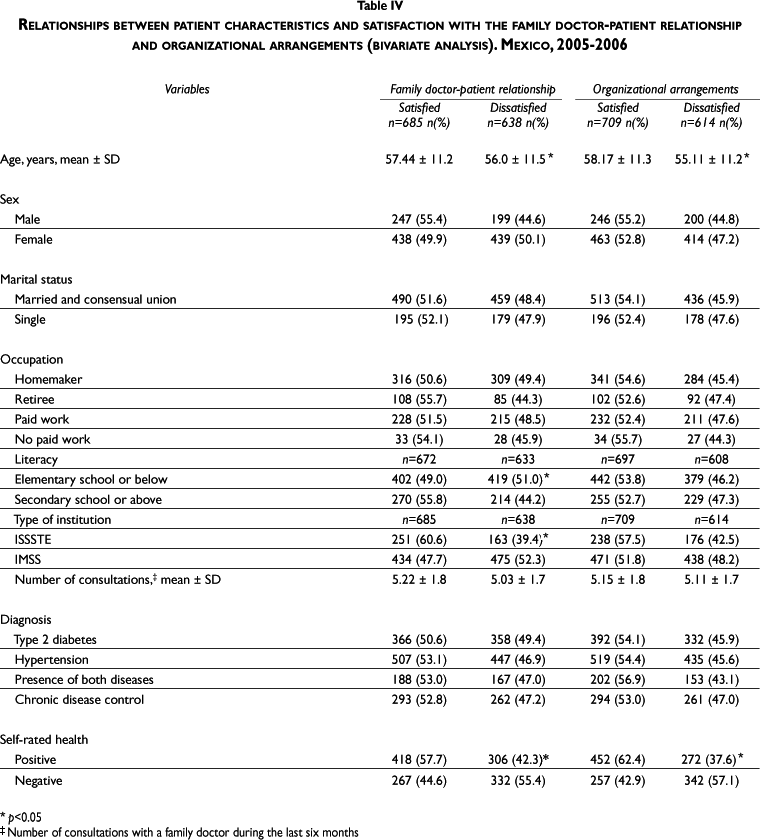
<body><![CDATA[<p><font face="Verdana, Arial, Helvetica, sans-serif" size="2">After the patients    were categorized as satisfied or dissatisfied, slightly more than half of them    were shown to be satisfied with the family doctor-patient relationship (51.8%)    and with the organizational arrangements (53.6%) (<a href="#t3">Table III</a>).</font></p>     <p><a name="t3"></a></p>     <p>&nbsp;</p>     <p align="center"><img src="/img/revistas/spm/v51n3/14t3.gif"></p>     <p>&nbsp;</p>     <p><font face="Verdana, Arial, Helvetica, sans-serif" size="2">The bivariate analysis    and the logistic regression modeling of the family doctor-patient relationship    index showed that negative self-rated health and being an IMSS affiliate were    significantly associated with dissatisfaction, whereas older age and literacy    of secondary school or above showed a protective effect against dissatisfaction    (<a href="/img/revistas/spm/v51n3/14t4.gif">Table IV</a>). Furthermore, after    adjusting by health status (control of chronic disease), the effect of self-rated    health on the family doctor-patient relationship was dependent upon whether    the patient had hypertension, diabetes or both (interaction term; adjusted odds    ratio &#91;a<i>OR</i>&#93;: 1.82, 95% <i>CI:</i> 1.1- 3.0, <i>p</i> &lt;0.05).    Being IMSS affiliated had 69% more possibilities of dissatisfaction (a<i>OR</i>:    1.69, 95%<i>CI</i>; 1.31-2.18), secondary school or above (a<i>OR</i>: 0.78,    95% <i>CI</i>; 0.59 -0.99), and age (a<i>OR</i>: 0.99, 95% <i>CI</i>; 0.98-0.99)    (<a href="/img/revistas/spm/v51n3/14t5.gif">Table V</a>).</font></p>     <p><font face="Verdana, Arial, Helvetica, sans-serif" size="2">With regard to    the organizational index, the bivariate analysis showed that the patients who    had negative self-rated health were the most dissatisfied (<i>p</i>&lt;0.05),    whereas older age showed a protective effect (<a href="/img/revistas/spm/v51n3/14t4.gif">Table    IV</a>). Furthermore, in the logistic regression analysis for the organizational    index, the adjusted odds ratio showed that patients affiliated with IMSS were    the most dissatisfied (<a href="/img/revistas/spm/v51n3/14t5.gif">Table V</a>).    The interaction term was not statistically significant.</font></p>     <p>&nbsp;</p>     <p><font face="Verdana, Arial, Helvetica, sans-serif" size="3"><b>Discussion</b></font></p>     <p><font face="Verdana, Arial, Helvetica, sans-serif" size="2">The present study    found that little more than half of patients in the study with type 2 diabetes    and hypertension receiving care from two Mexican social security institutions    were satisfied with the care they received. These findings are consistent with    those of other studies reporting that patients with chronic conditions stated    being dissatisfied more frequently.<sup>13</sup> The fact that more patients    with chronic conditions are dissatisfied deserves attention because they use    the health services continually and their satisfaction can influence their contribution    to disease management, which is important for better control of their conditions.    Patients with chronic conditions receive long-term care and this should be reliable,    periodic, continuous, and coordinated among different providers.</font></p>     ]]></body>
<body><![CDATA[<p><font face="Verdana, Arial, Helvetica, sans-serif" size="2">From our perspective,    close family doctor-patient communication is the backbone of care; this allows    the family doctor to better know the condition of the patient and to place treatment    in a context that permits comprehensive disease management.</font></p>     <p><font face="Verdana, Arial, Helvetica, sans-serif" size="2">Nevertheless, we    found communication gaps between patients and family doctors, leading to dissatisfaction.    Informing patients on different aspects of their health and about the care they    need are very important for those with chronic conditions. Also, treating patients    as co-participants in the process of decision-making has been repeatedly emphasized    as an important patient right;<sup>1</sup> when patients are well-informed and    participate in treatment decisions, their anxiety decreases and their therapeutic    adherence improves, thus increasing the chances of getting better health outcomes.<sup>14</sup>    Nevertheless, this critical component of communication is badly neglected by    family doctors.<sup>1, 15-19</sup> For example, our prior study found that one    of the most frequent prescription errors in ambulatory patients over 60 years    of age with non-malignant pain syndrome was that family doctors failed to provide    instructions to the patients about how to take the prescribed drugs and did    not inform them of possible adverse effects.<sup>19</sup></font></p>     <p><font face="Verdana, Arial, Helvetica, sans-serif" size="2">Moreover, effective    family doctor-patient communication requires sufficient consultation time. We    found that the item "the family doctor spends enough time on the consultation"    showed low satisfaction. Patients with chronic conditions relate better to family    doctors who spend more time on consultations because they perceive that such    family doctors can identify their needs, are able to recognize and to treat    emotional changes secondary to the illness, and can provide information on self-care.    They consider that these aspects of the family doctor-patient relationship are    equal in importance to the technical quality of diagnosis and treatment.<sup>20</sup></font></p>     <p><font face="Verdana, Arial, Helvetica, sans-serif" size="2">Some characteristics    of the organizational dimension cause dissatisfaction. The main problems are    related to cleanliness of the facilities and administrative procedures. In the    institutions examined, paperwork prior to receiving care is lengthy and has    some flaws. Checking that a patient has the right to receive care, opening a    clinical chart for a newcomer, or arranging a temporary disability leave are    procedures that take longer than expected and sometimes cause dissatisfaction.    This is consistent with reports from other developing countries.<sup>21</sup></font></p>     <p><font face="Verdana, Arial, Helvetica, sans-serif" size="2">Attention to both    elements -the family doctor-patient relationship and organizational arrangements-    are essential to improve patient satisfaction. The improvement of the family    doctor-patient relationship (process) depends heavily on the attitude of the    family doctors, whereas the improvement of organizational arrangements (structure)    is the responsibility of managers.</font></p>     <p><font face="Verdana, Arial, Helvetica, sans-serif" size="2">Differences in    satisfaction between institutions deserve comment. Although at first glance    the results appear to suggest that IMSS patients are more dissatisfied than    those affiliated with ISSSTE, it is important to interpret this result conservatively.    Both health institutions have rigid structures and processes to provide health    care and patients and family doctors are forced to adapt to conditions that    the services impose on them, the former to receive care and the latter to provide    it. For example, examination of the workload of family doctors, measured by    the number of consultations in a 6-hour shift shows that an IMSS family doctor    gives twice as many consultations as does an ISSSTE family doctor.<sup>22</sup>    In practical terms, it is desirable to study, in-depth, the organizational conditions    that hamper the provision of health care and generate user dissatisfaction,    particularly among patients with chronic conditions.</font></p>     <p><font face="Verdana, Arial, Helvetica, sans-serif" size="2">Patients with negative    self-rated health were at greater risk for dissatisfaction; this finding was    maintained after adjusting for other variables such as age, literacy, institution    and chronic disease control. A chronic condition is related to negative self-rated    health and, at the same time, patients with such conditions tend to perceive    health care as unsatisfactory.<sup>4, 23-26</sup> Positive self-rated health    is related to better functional and physical states.<sup>27</sup> Therefore,    keeping disease under control in a patient with a chronic condition is crucial    for a positive perception of self-rated health.</font></p>     <p><font face="Verdana, Arial, Helvetica, sans-serif" size="2">When the patient    has two chronic conditions, such as type 2 diabetes and hypertension, care management    is increasingly complex, which could affect negatively self-rated health and    the family doctor-patient relationship and could therefore be associated with    more dissatisfaction. This is a possible explanation of the significant interaction    term between having two chronic conditions and negative self-rated health found    in this study. That the relationship between good control of the chronic disease    and the patient's satisfaction could be positive is pertinent; however, it seems    that for the patient, his/her self-rated health is more important than clinical    or metabolic parameters.</font></p>     <p><font face="Verdana, Arial, Helvetica, sans-serif" size="2">This study has    several caveats that should be addressed:</font></p> <ul>       <li><font face="Verdana, Arial, Helvetica, sans-serif" size="2">This is a cross-sectional      study and, as such, it tends to overestimate the odds ratios.</font></li>       ]]></body>
<body><![CDATA[<li><font face="Verdana, Arial, Helvetica, sans-serif" size="2">The results      of the study may not be generalizable to users with other chronic diseases,      such as cancer, or to users receiving care at other types of institutions      or private clinics.</font></li>       <li><font face="Verdana, Arial, Helvetica, sans-serif" size="2">The sample for      this secondary data analysis came from the MIAC Study, which is a clinical      trial and by nature of its design involves a select, non-representative population.      Therefore, for this analysis it is not possible to assure the representativeness      of the sample given the absence of an eligible sampling frame for the eligible      study population. The frequency of patients that had adequate control figures      for their chronic disease was slightly more than the results of studies conducted      in social security institutions,<sup>28</sup> suggesting an underestimate      by the results of our study.</font></li>       <li><font face="Verdana, Arial, Helvetica, sans-serif" size="2">We also may      assume that those patients who are very unsatisfied did not participate in      the study, because it is possible that they seek care in institutions other      than social security health care facilities.</font></li>     </ul>     <p>&nbsp;</p>     <p><font face="Verdana, Arial, Helvetica, sans-serif" size="3"><b>Conclusions</b></font></p>     <p><font face="Verdana, Arial, Helvetica, sans-serif" size="2">There are some    interpersonal and organizational situations that reveal dissatisfaction among    patients with chronic conditions receiving care from family medicine clinics.    Responding to the satisfaction of patients with chronic conditions is advisable    to improve the quality of the services that are most important to them. As the    items "the patient understands the information" and "the family doctor spends    enough time on the consultation" scored the lowest, improvement in these areas    should be considered by family doctors, clinical managers and policymakers.    Additionally, negative self-rated health and the type of social security institution    are associated with dissatisfaction in patients with chronic conditions. Therefore,    better management of patients with chronic conditions by family doctors is desirable,    as are institutional changes that enable doctors to provide more consultation    time.</font></p>     <p><font face="Verdana, Arial, Helvetica, sans-serif" size="2"><b>Competing interests</b></font></p>     <p><font face="Verdana, Arial, Helvetica, sans-serif" size="2">The author(s) declare    that they have no competing interests.</font></p>     <p>&nbsp;</p>     ]]></body>
<body><![CDATA[<p><font face="Verdana, Arial, Helvetica, sans-serif" size="3"><b>References</b></font></p>     <!-- ref --><p><font face="Verdana, Arial, Helvetica, sans-serif" size="2">1. Sitzia J, Wood    N. Patient satisfaction: a review of issues and concepts. Soc Sci Med 1997;45:1829-1843.</font>&nbsp;&nbsp;&nbsp;&nbsp;&nbsp;&nbsp;&nbsp;&nbsp;[&#160;<a href="javascript:void(0);" onclick="javascript: window.open('/scielo.php?script=sci_nlinks&ref=9321970&pid=S0036-3634200900030001400001&lng=','','width=640,height=500,resizable=yes,scrollbars=1,menubar=yes,');">Links</a>&#160;]<!-- end-ref --><!-- ref --><p><font face="Verdana, Arial, Helvetica, sans-serif" size="2">2. Jackson JL,    Chamberlin J, Kroenke K. Predictors of patient satisfaction. Soc Sci Med 2001;52:609-620.</font>&nbsp;&nbsp;&nbsp;&nbsp;&nbsp;&nbsp;&nbsp;&nbsp;[&#160;<a href="javascript:void(0);" onclick="javascript: window.open('/scielo.php?script=sci_nlinks&ref=9321971&pid=S0036-3634200900030001400002&lng=','','width=640,height=500,resizable=yes,scrollbars=1,menubar=yes,');">Links</a>&#160;]<!-- end-ref --><!-- ref --><p><font face="Verdana, Arial, Helvetica, sans-serif" size="2">3. Lezzoni LI,    Davis RB, Soukup J, O&acute;Day B. Quality dimensions that most concern people    with physical and sensory disabilities. Arch Intern Med 2003; 163:2085-2092.</font>&nbsp;&nbsp;&nbsp;&nbsp;&nbsp;&nbsp;&nbsp;&nbsp;[&#160;<a href="javascript:void(0);" onclick="javascript: window.open('/scielo.php?script=sci_nlinks&ref=9321972&pid=S0036-3634200900030001400003&lng=','','width=640,height=500,resizable=yes,scrollbars=1,menubar=yes,');">Links</a>&#160;]<!-- end-ref --><!-- ref --><p><font face="Verdana, Arial, Helvetica, sans-serif" size="2">4. Wensing M, Grol    R, Asberg J, van Monfort P, van Weel C, Feling A. Does the health status of    chronically ill patients predict their judgments of the quality of general practice    care? Qual Life Res 1997;6:293-299.</font>&nbsp;&nbsp;&nbsp;&nbsp;&nbsp;&nbsp;&nbsp;&nbsp;[&#160;<a href="javascript:void(0);" onclick="javascript: window.open('/scielo.php?script=sci_nlinks&ref=9321973&pid=S0036-3634200900030001400004&lng=','','width=640,height=500,resizable=yes,scrollbars=1,menubar=yes,');">Links</a>&#160;]<!-- end-ref --><!-- ref --><p><font face="Verdana, Arial, Helvetica, sans-serif" size="2">5. Kincey JA, Bradshaw    PW, Ley P. Patient satisfaction and reported acceptance of advice in general    practice. J R Coll Gen Pract 1975;25: 558-566.</font>&nbsp;&nbsp;&nbsp;&nbsp;&nbsp;&nbsp;&nbsp;&nbsp;[&#160;<a href="javascript:void(0);" onclick="javascript: window.open('/scielo.php?script=sci_nlinks&ref=9321974&pid=S0036-3634200900030001400005&lng=','','width=640,height=500,resizable=yes,scrollbars=1,menubar=yes,');">Links</a>&#160;]<!-- end-ref --><!-- ref --><p><font face="Verdana, Arial, Helvetica, sans-serif" size="2">6. Larsen DE, Rootman    R. Physicians role performance and patient satisfaction. Soc Sci Med 1976;10:29-32.</font>&nbsp;&nbsp;&nbsp;&nbsp;&nbsp;&nbsp;&nbsp;&nbsp;[&#160;<a href="javascript:void(0);" onclick="javascript: window.open('/scielo.php?script=sci_nlinks&ref=9321975&pid=S0036-3634200900030001400006&lng=','','width=640,height=500,resizable=yes,scrollbars=1,menubar=yes,');">Links</a>&#160;]<!-- end-ref --><!-- ref --><p><font face="Verdana, Arial, Helvetica, sans-serif" size="2">7. Aguirre-Gas    H. Evaluation of the medical care quality. Expectations of the patients and    the workers of the medical units. Salud Publica Mex 1990;32:170-180. (Spanish)</font>&nbsp;&nbsp;&nbsp;&nbsp;&nbsp;&nbsp;&nbsp;&nbsp;[&#160;<a href="javascript:void(0);" onclick="javascript: window.open('/scielo.php?script=sci_nlinks&ref=9321976&pid=S0036-3634200900030001400007&lng=','','width=640,height=500,resizable=yes,scrollbars=1,menubar=yes,');">Links</a>&#160;]<!-- end-ref --><!-- ref --><p><font face="Verdana, Arial, Helvetica, sans-serif" size="2">8. Ramirez de la-Roche    O, L&oacute;pez-Serrano A, Barrag&aacute;n-Solis A, Arce-Arrieta E. &#91;User    Satisfaction at a Social Security Institute Family Medical Center in Mexico    City.&#93; Arch Med Fam 2005;7:22-26. (Spanish)</font>&nbsp;&nbsp;&nbsp;&nbsp;&nbsp;&nbsp;&nbsp;&nbsp;[&#160;<a href="javascript:void(0);" onclick="javascript: window.open('/scielo.php?script=sci_nlinks&ref=9321977&pid=S0036-3634200900030001400008&lng=','','width=640,height=500,resizable=yes,scrollbars=1,menubar=yes,');">Links</a>&#160;]<!-- end-ref --><!-- ref --><p><font face="Verdana, Arial, Helvetica, sans-serif" size="2">9. Hern&aacute;ndez-Leyva    B, Garcia-Pe&ntilde;a C, Anzures-Carro R, Orozco-L&oacute;pez M. &#91;User Satisfaction    in family medicine clinics.&#93; Rev Med IMSS 2002;40:373-378. (Spanish)</font>&nbsp;&nbsp;&nbsp;&nbsp;&nbsp;&nbsp;&nbsp;&nbsp;[&#160;<a href="javascript:void(0);" onclick="javascript: window.open('/scielo.php?script=sci_nlinks&ref=9321978&pid=S0036-3634200900030001400009&lng=','','width=640,height=500,resizable=yes,scrollbars=1,menubar=yes,');">Links</a>&#160;]<!-- end-ref --><!-- ref --><p><font face="Verdana, Arial, Helvetica, sans-serif" size="2">10. Instituto de    Seguridad y Servicios Sociales de los Trabajadores del Estado. Anuario estad&iacute;stico    2006. Morbilidad de las 15 enfermedades notificadas con mayor frecuencia. Available    at: <a href="http://www.issste.gob.mx/issste/anuarios" target="_blank">http//www.issste.gob.mx/issste/anuarios</a>.</font>&nbsp;&nbsp;&nbsp;&nbsp;&nbsp;&nbsp;&nbsp;&nbsp;[&#160;<a href="javascript:void(0);" onclick="javascript: window.open('/scielo.php?script=sci_nlinks&ref=9321979&pid=S0036-3634200900030001400010&lng=','','width=640,height=500,resizable=yes,scrollbars=1,menubar=yes,');">Links</a>&#160;]<!-- end-ref --><!-- ref --><p><font face="Verdana, Arial, Helvetica, sans-serif" size="2">11. Instituto Mexicano    del Seguro Social. Informaci&oacute;n estad&iacute;stica en salud, principales    motivos de consulta en medicina familiar. Total nacional 2006. Available at:    <a href="http://www.imss.gob.mx/dpm/dties" target="_blank">http://www.imss.gob.mx/dpm/dties</a></font>&nbsp;&nbsp;&nbsp;&nbsp;&nbsp;&nbsp;&nbsp;&nbsp;[&#160;<a href="javascript:void(0);" onclick="javascript: window.open('/scielo.php?script=sci_nlinks&ref=9321980&pid=S0036-3634200900030001400011&lng=','','width=640,height=500,resizable=yes,scrollbars=1,menubar=yes,');">Links</a>&#160;]<!-- end-ref --><p><font face="Verdana, Arial, Helvetica, sans-serif" size="2">12. Hatcher L.    A step-by -step approach to using SAS for factor analysis and structural equation    modeling. 2nd ed. Chapter 1. North Carolina: SAS Press,1994.</font></p>     <!-- ref --><p><font face="Verdana, Arial, Helvetica, sans-serif" size="2">13. Druss BG, Schlesinger    M, Thomas T, Allen H: Chronic illness and plan satisfaction under managed care.    Health Aff (Millwood) 2000;19:203-209.</font>&nbsp;&nbsp;&nbsp;&nbsp;&nbsp;&nbsp;&nbsp;&nbsp;[&#160;<a href="javascript:void(0);" onclick="javascript: window.open('/scielo.php?script=sci_nlinks&ref=9321982&pid=S0036-3634200900030001400013&lng=','','width=640,height=500,resizable=yes,scrollbars=1,menubar=yes,');">Links</a>&#160;]<!-- end-ref --><!-- ref --><p><font face="Verdana, Arial, Helvetica, sans-serif" size="2">14. Stewart MA.    Effective physician-patient communication and health outcomes: a review. Can    Med Assoc J 1995;152:1423-1433.</font>&nbsp;&nbsp;&nbsp;&nbsp;&nbsp;&nbsp;&nbsp;&nbsp;[&#160;<a href="javascript:void(0);" onclick="javascript: window.open('/scielo.php?script=sci_nlinks&ref=9321983&pid=S0036-3634200900030001400014&lng=','','width=640,height=500,resizable=yes,scrollbars=1,menubar=yes,');">Links</a>&#160;]<!-- end-ref --><!-- ref --><p><font face="Verdana, Arial, Helvetica, sans-serif" size="2">15. Williams SJ,    Calnan M. Key determinants of consumer satisfaction with general practice. Fam    Pract 1991;8:237-242.</font>&nbsp;&nbsp;&nbsp;&nbsp;&nbsp;&nbsp;&nbsp;&nbsp;[&#160;<a href="javascript:void(0);" onclick="javascript: window.open('/scielo.php?script=sci_nlinks&ref=9321984&pid=S0036-3634200900030001400015&lng=','','width=640,height=500,resizable=yes,scrollbars=1,menubar=yes,');">Links</a>&#160;]<!-- end-ref --><!-- ref --><p><font face="Verdana, Arial, Helvetica, sans-serif" size="2">16. Anderson R,    Barbara A, Feldman S. What patients want: A content analysis of key qualities    that influence patient satisfaction. J Med Pract Manage 2007; 22:255-261.</font>&nbsp;&nbsp;&nbsp;&nbsp;&nbsp;&nbsp;&nbsp;&nbsp;[&#160;<a href="javascript:void(0);" onclick="javascript: window.open('/scielo.php?script=sci_nlinks&ref=9321985&pid=S0036-3634200900030001400016&lng=','','width=640,height=500,resizable=yes,scrollbars=1,menubar=yes,');">Links</a>&#160;]<!-- end-ref --><!-- ref --><p><font face="Verdana, Arial, Helvetica, sans-serif" size="2">17. Schmader K,    Halon JT, Weinberger M, Landsman P, Samsa GP, Lewis I, et al. Appropriateness    of medication prescribing in ambulatory elderly patients. J Am Geriatr Soc 1994;42:1241-1247.</font>&nbsp;&nbsp;&nbsp;&nbsp;&nbsp;&nbsp;&nbsp;&nbsp;[&#160;<a href="javascript:void(0);" onclick="javascript: window.open('/scielo.php?script=sci_nlinks&ref=9321986&pid=S0036-3634200900030001400017&lng=','','width=640,height=500,resizable=yes,scrollbars=1,menubar=yes,');">Links</a>&#160;]<!-- end-ref --><!-- ref --><p><font face="Verdana, Arial, Helvetica, sans-serif" size="2">18. Morris LA,    Grossman R, Barkdol GL, Gordon E, Soviero C. A survey of patients sources of    prescription drug information. Am J Public Health 1984; 74:1161-1162.</font>&nbsp;&nbsp;&nbsp;&nbsp;&nbsp;&nbsp;&nbsp;&nbsp;[&#160;<a href="javascript:void(0);" onclick="javascript: window.open('/scielo.php?script=sci_nlinks&ref=9321987&pid=S0036-3634200900030001400018&lng=','','width=640,height=500,resizable=yes,scrollbars=1,menubar=yes,');">Links</a>&#160;]<!-- end-ref --><!-- ref --><p><font face="Verdana, Arial, Helvetica, sans-serif" size="2">19. Doubova SV,    Torres-Arreola LP, Rosas-Carrasco O, P&eacute;rez-Cuevas R. Quality of medication    prescribing for elderly patients with non-malignant pain syndrome attending    to family medicine clinics. Rev Invest Clin 2007;59:428-436. (Spanish)</font>&nbsp;&nbsp;&nbsp;&nbsp;&nbsp;&nbsp;&nbsp;&nbsp;[&#160;<a href="javascript:void(0);" onclick="javascript: window.open('/scielo.php?script=sci_nlinks&ref=9321988&pid=S0036-3634200900030001400019&lng=','','width=640,height=500,resizable=yes,scrollbars=1,menubar=yes,');">Links</a>&#160;]<!-- end-ref --><!-- ref --><p><font face="Verdana, Arial, Helvetica, sans-serif" size="2">20. Infante FA,    Proudfoot JG, Davies GP, Bubner TK, Holton CH, Beilby JJ, et al. How people    with chronic conditions view their care in general practice: a qualitative study.    Med J Aust 2004;181:70-73.</font>&nbsp;&nbsp;&nbsp;&nbsp;&nbsp;&nbsp;&nbsp;&nbsp;[&#160;<a href="javascript:void(0);" onclick="javascript: window.open('/scielo.php?script=sci_nlinks&ref=9321989&pid=S0036-3634200900030001400020&lng=','','width=640,height=500,resizable=yes,scrollbars=1,menubar=yes,');">Links</a>&#160;]<!-- end-ref --><!-- ref --><p><font face="Verdana, Arial, Helvetica, sans-serif" size="2">21. Bernhart MH,    Wiadnyana IG, Wihardjo H, Pohan I. Patient satisfaction in developing countries.    Soc Sci Med 1999;48:989-996.</font>&nbsp;&nbsp;&nbsp;&nbsp;&nbsp;&nbsp;&nbsp;&nbsp;[&#160;<a href="javascript:void(0);" onclick="javascript: window.open('/scielo.php?script=sci_nlinks&ref=9321990&pid=S0036-3634200900030001400021&lng=','','width=640,height=500,resizable=yes,scrollbars=1,menubar=yes,');">Links</a>&#160;]<!-- end-ref --><!-- ref --><p><font face="Verdana, Arial, Helvetica, sans-serif" size="2">22. Secretar&iacute;a    de Salud. Bolet&iacute;n de informaci&oacute;n estad&iacute;stica No.19, Vol    I, M&eacute;xico 2001.</font>&nbsp;&nbsp;&nbsp;&nbsp;&nbsp;&nbsp;&nbsp;&nbsp;[&#160;<a href="javascript:void(0);" onclick="javascript: window.open('/scielo.php?script=sci_nlinks&ref=9321991&pid=S0036-3634200900030001400022&lng=','','width=640,height=500,resizable=yes,scrollbars=1,menubar=yes,');">Links</a>&#160;]<!-- end-ref --><!-- ref --><p><font face="Verdana, Arial, Helvetica, sans-serif" size="2">23. Al-Mandhari    AS, Hassan AA, Haran D. Association between perceived health status and satisfaction    with quality of care: evidence from users of primary health care in Oman. Fam    Pract 2004;21:519-527.</font>&nbsp;&nbsp;&nbsp;&nbsp;&nbsp;&nbsp;&nbsp;&nbsp;[&#160;<a href="javascript:void(0);" onclick="javascript: window.open('/scielo.php?script=sci_nlinks&ref=9321992&pid=S0036-3634200900030001400023&lng=','','width=640,height=500,resizable=yes,scrollbars=1,menubar=yes,');">Links</a>&#160;]<!-- end-ref --><!-- ref --><p><font face="Verdana, Arial, Helvetica, sans-serif" size="2">24. Hall JA, Milburn    MA, Epstein AM. A causal model of health status and satisfaction with medical    care. Med Care 1993;31:84-94.</font>&nbsp;&nbsp;&nbsp;&nbsp;&nbsp;&nbsp;&nbsp;&nbsp;[&#160;<a href="javascript:void(0);" onclick="javascript: window.open('/scielo.php?script=sci_nlinks&ref=9321993&pid=S0036-3634200900030001400024&lng=','','width=640,height=500,resizable=yes,scrollbars=1,menubar=yes,');">Links</a>&#160;]<!-- end-ref --><!-- ref --><p><font face="Verdana, Arial, Helvetica, sans-serif" size="2">25. Westaway MS,    Rheeder P, Van Zyl DG, Seager JR. Interpersonal and organizational dimensions    of patient satisfaction: the moderating effects of health status. Int J Qual    Health Care 2003;15:337-344.</font>&nbsp;&nbsp;&nbsp;&nbsp;&nbsp;&nbsp;&nbsp;&nbsp;[&#160;<a href="javascript:void(0);" onclick="javascript: window.open('/scielo.php?script=sci_nlinks&ref=9321994&pid=S0036-3634200900030001400025&lng=','','width=640,height=500,resizable=yes,scrollbars=1,menubar=yes,');">Links</a>&#160;]<!-- end-ref --><!-- ref --><p><font face="Verdana, Arial, Helvetica, sans-serif" size="2">26. Cott CA, Gignac    MA, Badley EM. Determinants of self rated health for Canadians with chronic    disease and disability. J Epidemiol Community Health 1999;53:731-736.</font>&nbsp;&nbsp;&nbsp;&nbsp;&nbsp;&nbsp;&nbsp;&nbsp;[&#160;<a href="javascript:void(0);" onclick="javascript: window.open('/scielo.php?script=sci_nlinks&ref=9321995&pid=S0036-3634200900030001400026&lng=','','width=640,height=500,resizable=yes,scrollbars=1,menubar=yes,');">Links</a>&#160;]<!-- end-ref --><!-- ref --><p><font face="Verdana, Arial, Helvetica, sans-serif" size="2">27. Shooshtari    S, Menec V, Tate R. Comparing predictors of positive and negative self-rated    health between younger (25-54) and older (55+) Canadian adults: A Longitudinal    Study of Well-Being. Res Aging 2007;29:512-554.</font>&nbsp;&nbsp;&nbsp;&nbsp;&nbsp;&nbsp;&nbsp;&nbsp;[&#160;<a href="javascript:void(0);" onclick="javascript: window.open('/scielo.php?script=sci_nlinks&ref=9321996&pid=S0036-3634200900030001400027&lng=','','width=640,height=500,resizable=yes,scrollbars=1,menubar=yes,');">Links</a>&#160;]<!-- end-ref --><!-- ref --><p><font face="Verdana, Arial, Helvetica, sans-serif" size="2">28. Gardu&ntilde;o    J, Galindo G, Rangel S, Mu&ntilde;oz O. Mejora de la calidad de atenci&oacute;n    m&eacute;dica a pacientes con diabetes mellitus tipo 2 por medio de la retroalimentaci&oacute;n    del desempe&ntilde;o m&eacute;dico y alertas en el expediente cl&iacute;nico.    In: Las M&uacute;ltiples Facetas de la Investigaci&oacute;n en Salud. Proyectos    Estrat&eacute;gicos del Instituto Mexicano del Seguro Social. M&eacute;xico:    IMSS, 2001.</font>&nbsp;&nbsp;&nbsp;&nbsp;&nbsp;&nbsp;&nbsp;&nbsp;[&#160;<a href="javascript:void(0);" onclick="javascript: window.open('/scielo.php?script=sci_nlinks&ref=9321997&pid=S0036-3634200900030001400028&lng=','','width=640,height=500,resizable=yes,scrollbars=1,menubar=yes,');">Links</a>&#160;]<!-- end-ref --><p>&nbsp;</p>     ]]></body>
<body><![CDATA[<p>&nbsp;</p>     <p><font face="Verdana, Arial, Helvetica, sans-serif" size="2">Received on: August    22, 2008    <br>   Accepted on: February 25, 2009    <br>   The study was supported by grants from the Consejo Nacional de Ciencia y Tecnolog&iacute;a    (CONACYT): SALUD-2004-C01-145 and by the Instituto Mexicano del Seguro Social    (IMSS) 2003-785-024.</font></p>     <p>&nbsp;</p>     <p>&nbsp;</p>     <p><font face="Verdana, Arial, Helvetica, sans-serif" size="2">Address reprint    requests to: Dr. Svetlana Vladislavovna Doubova. Unidad de Investigaci&oacute;n    Epidemiol&oacute;gica y en Servicios de Salud. Centro M&eacute;dico Nacional    Siglo XXI. Instituto Mexicano del Seguro Social. Cuauht&eacute;moc 330, col    Doctores, 3<sup>er</sup> piso. 06725 M&eacute;xico, DF, M&eacute;xico. E-mail:    <a href="mailto:svetlana.doubova@imss.gob.mx">svetlana.doubova@imss.gob.mx</a>    <br>   <a name="back1"></a><a href="#top1">*</a> Zepeda-Arias M. Development and validation    of an inventory to measure satisfaction of users of family medicine clinics    with hypertension and diabetes in Mexico. Master's degree thesis. Universidad    Aut&oacute;noma de Aguascalientes; 2005. Unpublished.</font></p>     <p>&nbsp;</p>     <p>&nbsp;</p>     ]]></body>
<body><![CDATA[<p><font face="Verdana, Arial, Helvetica, sans-serif" size="4"><b><a name="a"></a>Appendix</b></font></p>     <p><font face="Verdana, Arial, Helvetica, sans-serif" size="2"><b>QUESTIONS USED    TO MEASURE SATISFACTION</b></font></p>     <p><font face="Verdana, Arial, Helvetica, sans-serif" size="2"><i>Questions:</i></font></p>     <p><font face="Verdana, Arial, Helvetica, sans-serif" size="2">In general, how    do you find the organization of this clinic?</font></p>     <p><font face="Verdana, Arial, Helvetica, sans-serif" size="2">How convenient    are the appointment times of the clinic for you?</font></p>     <p><font face="Verdana, Arial, Helvetica, sans-serif" size="2">How easy is resolution    of administrative difficulties in the clinic for you?</font></p>     <p><font face="Verdana, Arial, Helvetica, sans-serif" size="2">How often do they    give you an appointment on the day that you request?</font></p>     <p><font face="Verdana, Arial, Helvetica, sans-serif" size="2">How often has the    family doctor seen you on the same day on which you come for consultation?</font></p>     <p><font face="Verdana, Arial, Helvetica, sans-serif" size="2">Are you satisfied    with the time that you have to wait from the time of your appointment until    the actual consultation?</font></p>     <p><font face="Verdana, Arial, Helvetica, sans-serif" size="2">How often do they    give you all prescribed medicines in the clinic's pharmacy?</font></p>     ]]></body>
<body><![CDATA[<p><font face="Verdana, Arial, Helvetica, sans-serif" size="2">How do you rate    the comfort of the clinic?</font></p>     <p><font face="Verdana, Arial, Helvetica, sans-serif" size="2">How do you rate    the cleanliness of clinic facilities?</font></p>     <p><font face="Verdana, Arial, Helvetica, sans-serif" size="2">In general, how    much trust do you have in the care that the clinic provides?</font></p>     <p><font face="Verdana, Arial, Helvetica, sans-serif" size="2">How do you rate    the kindness of the family doctor?</font></p>     <p><font face="Verdana, Arial, Helvetica, sans-serif" size="2">How do you rate    the physical examination that the family doctor gives you?</font></p>     <p><font face="Verdana, Arial, Helvetica, sans-serif" size="2">How do you rate    the treatment that the family doctor gives you to treat your illness?</font></p>     <p><font face="Verdana, Arial, Helvetica, sans-serif" size="2">Are you satisfied    with the information the family doctor provides to you about possible drug reactions    that can arise during your treatment?</font></p>     <p><font face="Verdana, Arial, Helvetica, sans-serif" size="2">Are you satisfied    that the family doctor allows you to give an opinion about your treatment?</font></p>     <p><font face="Verdana, Arial, Helvetica, sans-serif" size="2">How often does    your family doctor clarify your questions regarding your treatment?</font></p>     <p><font face="Verdana, Arial, Helvetica, sans-serif" size="2">How well do you    understand the information that your family doctor provides to you?</font></p>     ]]></body>
<body><![CDATA[<p><font face="Verdana, Arial, Helvetica, sans-serif" size="2">Are you satisfied    with the time that the family doctor spends on the consultation?</font></p>     <p><font face="Verdana, Arial, Helvetica, sans-serif" size="2">In general, are    you satisfied with your family doctor?</font></p>      ]]></body><back>
<ref-list>
<ref id="B1">
<label>1</label><nlm-citation citation-type="journal">
<person-group person-group-type="author">
<name>
<surname><![CDATA[Sitzia]]></surname>
<given-names><![CDATA[J]]></given-names>
</name>
<name>
<surname><![CDATA[Wood]]></surname>
<given-names><![CDATA[N]]></given-names>
</name>
</person-group>
<article-title xml:lang="en"><![CDATA[Patient satisfaction: a review of issues and concepts]]></article-title>
<source><![CDATA[Soc Sci Med]]></source>
<year>1997</year>
<volume>45</volume>
<page-range>1829-1843</page-range></nlm-citation>
</ref>
<ref id="B2">
<label>2</label><nlm-citation citation-type="journal">
<person-group person-group-type="author">
<name>
<surname><![CDATA[Jackson]]></surname>
<given-names><![CDATA[JL]]></given-names>
</name>
<name>
<surname><![CDATA[Chamberlin]]></surname>
<given-names><![CDATA[J]]></given-names>
</name>
<name>
<surname><![CDATA[Kroenke]]></surname>
<given-names><![CDATA[K]]></given-names>
</name>
</person-group>
<article-title xml:lang="en"><![CDATA[Predictors of patient satisfaction]]></article-title>
<source><![CDATA[Soc Sci Med]]></source>
<year>2001</year>
<volume>52</volume>
<page-range>609-620</page-range></nlm-citation>
</ref>
<ref id="B3">
<label>3</label><nlm-citation citation-type="journal">
<person-group person-group-type="author">
<name>
<surname><![CDATA[Lezzoni]]></surname>
<given-names><![CDATA[LI]]></given-names>
</name>
<name>
<surname><![CDATA[Davis]]></surname>
<given-names><![CDATA[RB]]></given-names>
</name>
<name>
<surname><![CDATA[Soukup]]></surname>
<given-names><![CDATA[J]]></given-names>
</name>
<name>
<surname><![CDATA[O´Day]]></surname>
<given-names><![CDATA[B]]></given-names>
</name>
</person-group>
<article-title xml:lang="en"><![CDATA[Quality dimensions that most concern people with physical and sensory disabilities]]></article-title>
<source><![CDATA[Arch Intern Med]]></source>
<year>2003</year>
<volume>163</volume>
<page-range>2085-2092</page-range></nlm-citation>
</ref>
<ref id="B4">
<label>4</label><nlm-citation citation-type="journal">
<person-group person-group-type="author">
<name>
<surname><![CDATA[Wensing]]></surname>
<given-names><![CDATA[M]]></given-names>
</name>
<name>
<surname><![CDATA[Grol]]></surname>
<given-names><![CDATA[R]]></given-names>
</name>
<name>
<surname><![CDATA[Asberg]]></surname>
<given-names><![CDATA[J]]></given-names>
</name>
<name>
<surname><![CDATA[van Monfort]]></surname>
<given-names><![CDATA[P]]></given-names>
</name>
<name>
<surname><![CDATA[van Weel]]></surname>
<given-names><![CDATA[C]]></given-names>
</name>
<name>
<surname><![CDATA[Feling]]></surname>
<given-names><![CDATA[A]]></given-names>
</name>
</person-group>
<article-title xml:lang="en"><![CDATA[Does the health status of chronically ill patients predict their judgments of the quality of general practice care?]]></article-title>
<source><![CDATA[Qual Life Res]]></source>
<year>1997</year>
<volume>6</volume>
<page-range>293-299</page-range></nlm-citation>
</ref>
<ref id="B5">
<label>5</label><nlm-citation citation-type="journal">
<person-group person-group-type="author">
<name>
<surname><![CDATA[Kincey]]></surname>
<given-names><![CDATA[JA]]></given-names>
</name>
<name>
<surname><![CDATA[Bradshaw]]></surname>
<given-names><![CDATA[PW]]></given-names>
</name>
<name>
<surname><![CDATA[Ley]]></surname>
<given-names><![CDATA[P]]></given-names>
</name>
</person-group>
<article-title xml:lang="en"><![CDATA[Patient satisfaction and reported acceptance of advice in general practice]]></article-title>
<source><![CDATA[J R Coll Gen Pract]]></source>
<year>1975</year>
<volume>25</volume>
<page-range>558-566</page-range></nlm-citation>
</ref>
<ref id="B6">
<label>6</label><nlm-citation citation-type="journal">
<person-group person-group-type="author">
<name>
<surname><![CDATA[Larsen]]></surname>
<given-names><![CDATA[DE]]></given-names>
</name>
<name>
<surname><![CDATA[Rootman]]></surname>
<given-names><![CDATA[R]]></given-names>
</name>
</person-group>
<article-title xml:lang="en"><![CDATA[Physicians role performance and patient satisfaction]]></article-title>
<source><![CDATA[Soc Sci Med]]></source>
<year>1976</year>
<volume>10</volume>
<page-range>29-32</page-range></nlm-citation>
</ref>
<ref id="B7">
<label>7</label><nlm-citation citation-type="journal">
<person-group person-group-type="author">
<name>
<surname><![CDATA[Aguirre-Gas]]></surname>
<given-names><![CDATA[H]]></given-names>
</name>
</person-group>
<article-title xml:lang="en"><![CDATA[Evaluation of the medical care quality: Expectations of the patients and the workers of the medical units]]></article-title>
<source><![CDATA[Salud Publica Mex]]></source>
<year>1990</year>
<volume>32</volume>
<page-range>170-180</page-range></nlm-citation>
</ref>
<ref id="B8">
<label>8</label><nlm-citation citation-type="journal">
<person-group person-group-type="author">
<name>
<surname><![CDATA[Ramirez de la-Roche]]></surname>
<given-names><![CDATA[O]]></given-names>
</name>
<name>
<surname><![CDATA[López-Serrano]]></surname>
<given-names><![CDATA[A]]></given-names>
</name>
<name>
<surname><![CDATA[Barragán-Solis]]></surname>
<given-names><![CDATA[A]]></given-names>
</name>
<name>
<surname><![CDATA[Arce-Arrieta]]></surname>
<given-names><![CDATA[E]]></given-names>
</name>
</person-group>
<article-title xml:lang="en"><![CDATA[[User Satisfaction at a Social Security Institute Family Medical Center in Mexico City.]]]></article-title>
<source><![CDATA[Arch Med Fam]]></source>
<year>2005</year>
<volume>7</volume>
<page-range>22-26</page-range></nlm-citation>
</ref>
<ref id="B9">
<label>9</label><nlm-citation citation-type="journal">
<person-group person-group-type="author">
<name>
<surname><![CDATA[Hernández-Leyva]]></surname>
<given-names><![CDATA[B]]></given-names>
</name>
<name>
<surname><![CDATA[Garcia-Peña]]></surname>
<given-names><![CDATA[C]]></given-names>
</name>
<name>
<surname><![CDATA[Anzures-Carro]]></surname>
<given-names><![CDATA[R]]></given-names>
</name>
<name>
<surname><![CDATA[Orozco-López]]></surname>
<given-names><![CDATA[M]]></given-names>
</name>
</person-group>
<article-title xml:lang="en"><![CDATA[[User Satisfaction in family medicine clinics.]]]></article-title>
<source><![CDATA[Rev Med IMSS]]></source>
<year>2002</year>
<volume>40</volume>
<page-range>373-378</page-range></nlm-citation>
</ref>
<ref id="B10">
<label>10</label><nlm-citation citation-type="">
<collab>Instituto de Seguridad y Servicios Sociales de los Trabajadores del Estado</collab>
<source><![CDATA[Anuario estadístico 2006: Morbilidad de las 15 enfermedades notificadas con mayor frecuencia]]></source>
<year></year>
</nlm-citation>
</ref>
<ref id="B11">
<label>11</label><nlm-citation citation-type="">
<collab>Instituto Mexicano del Seguro Social</collab>
<source><![CDATA[Información estadística en salud, principales motivos de consulta en medicina familiar: Total nacional 2006]]></source>
<year></year>
</nlm-citation>
</ref>
<ref id="B12">
<label>12</label><nlm-citation citation-type="book">
<person-group person-group-type="author">
<name>
<surname><![CDATA[Hatcher]]></surname>
<given-names><![CDATA[L]]></given-names>
</name>
</person-group>
<source><![CDATA[A step-by -step approach to using SAS for factor analysis and structural equation modeling]]></source>
<year>1994</year>
<edition>2</edition>
<publisher-loc><![CDATA[North Carolina ]]></publisher-loc>
<publisher-name><![CDATA[SAS Press]]></publisher-name>
</nlm-citation>
</ref>
<ref id="B13">
<label>13</label><nlm-citation citation-type="journal">
<person-group person-group-type="author">
<name>
<surname><![CDATA[Druss]]></surname>
<given-names><![CDATA[BG]]></given-names>
</name>
<name>
<surname><![CDATA[Schlesinger]]></surname>
<given-names><![CDATA[M]]></given-names>
</name>
<name>
<surname><![CDATA[Thomas]]></surname>
<given-names><![CDATA[T]]></given-names>
</name>
<name>
<surname><![CDATA[Allen]]></surname>
<given-names><![CDATA[H]]></given-names>
</name>
</person-group>
<article-title xml:lang="en"><![CDATA[Chronic illness and plan satisfaction under managed care]]></article-title>
<source><![CDATA[Health Aff (Millwood)]]></source>
<year>2000</year>
<volume>19</volume>
<page-range>203-209</page-range></nlm-citation>
</ref>
<ref id="B14">
<label>14</label><nlm-citation citation-type="journal">
<person-group person-group-type="author">
<name>
<surname><![CDATA[Stewart]]></surname>
<given-names><![CDATA[MA]]></given-names>
</name>
</person-group>
<article-title xml:lang="en"><![CDATA[Effective physician-patient communication and health outcomes: a review]]></article-title>
<source><![CDATA[Can Med Assoc J]]></source>
<year>1995</year>
<volume>152</volume>
<page-range>1423-1433</page-range></nlm-citation>
</ref>
<ref id="B15">
<label>15</label><nlm-citation citation-type="journal">
<person-group person-group-type="author">
<name>
<surname><![CDATA[Williams]]></surname>
<given-names><![CDATA[SJ]]></given-names>
</name>
<name>
<surname><![CDATA[Calnan]]></surname>
<given-names><![CDATA[M]]></given-names>
</name>
</person-group>
<article-title xml:lang="en"><![CDATA[Key determinants of consumer satisfaction with general practice]]></article-title>
<source><![CDATA[Fam Pract]]></source>
<year>1991</year>
<volume>8</volume>
<page-range>237-242</page-range></nlm-citation>
</ref>
<ref id="B16">
<label>16</label><nlm-citation citation-type="journal">
<person-group person-group-type="author">
<name>
<surname><![CDATA[Anderson]]></surname>
<given-names><![CDATA[R]]></given-names>
</name>
<name>
<surname><![CDATA[Barbara]]></surname>
<given-names><![CDATA[A]]></given-names>
</name>
<name>
<surname><![CDATA[Feldman]]></surname>
<given-names><![CDATA[S]]></given-names>
</name>
</person-group>
<article-title xml:lang="en"><![CDATA[What patients want: A content analysis of key qualities that influence patient satisfaction]]></article-title>
<source><![CDATA[J Med Pract Manage]]></source>
<year>2007</year>
<volume>22</volume>
<page-range>255-261</page-range></nlm-citation>
</ref>
<ref id="B17">
<label>17</label><nlm-citation citation-type="journal">
<person-group person-group-type="author">
<name>
<surname><![CDATA[Schmader]]></surname>
<given-names><![CDATA[K]]></given-names>
</name>
<name>
<surname><![CDATA[Halon]]></surname>
<given-names><![CDATA[JT]]></given-names>
</name>
<name>
<surname><![CDATA[Weinberger]]></surname>
<given-names><![CDATA[M]]></given-names>
</name>
<name>
<surname><![CDATA[Landsman]]></surname>
<given-names><![CDATA[P]]></given-names>
</name>
<name>
<surname><![CDATA[Samsa]]></surname>
<given-names><![CDATA[GP]]></given-names>
</name>
<name>
<surname><![CDATA[Lewis]]></surname>
<given-names><![CDATA[I]]></given-names>
</name>
</person-group>
<article-title xml:lang="en"><![CDATA[Appropriateness of medication prescribing in ambulatory elderly patients]]></article-title>
<source><![CDATA[J Am Geriatr Soc]]></source>
<year>1994</year>
<volume>42</volume>
<page-range>1241-1247</page-range></nlm-citation>
</ref>
<ref id="B18">
<label>18</label><nlm-citation citation-type="journal">
<person-group person-group-type="author">
<name>
<surname><![CDATA[Morris]]></surname>
<given-names><![CDATA[LA]]></given-names>
</name>
<name>
<surname><![CDATA[Grossman]]></surname>
<given-names><![CDATA[R]]></given-names>
</name>
<name>
<surname><![CDATA[Barkdol]]></surname>
<given-names><![CDATA[GL]]></given-names>
</name>
<name>
<surname><![CDATA[Gordon]]></surname>
<given-names><![CDATA[E]]></given-names>
</name>
<name>
<surname><![CDATA[Soviero]]></surname>
<given-names><![CDATA[C]]></given-names>
</name>
</person-group>
<article-title xml:lang="en"><![CDATA[A survey of patients sources of prescription drug information]]></article-title>
<source><![CDATA[Am J Public Health]]></source>
<year>1984</year>
<volume>74</volume>
<page-range>1161-1162</page-range></nlm-citation>
</ref>
<ref id="B19">
<label>19</label><nlm-citation citation-type="journal">
<person-group person-group-type="author">
<name>
<surname><![CDATA[Doubova]]></surname>
<given-names><![CDATA[SV]]></given-names>
</name>
<name>
<surname><![CDATA[Torres-Arreola]]></surname>
<given-names><![CDATA[LP]]></given-names>
</name>
<name>
<surname><![CDATA[Rosas-Carrasco]]></surname>
<given-names><![CDATA[O]]></given-names>
</name>
<name>
<surname><![CDATA[Pérez-Cuevas]]></surname>
<given-names><![CDATA[R]]></given-names>
</name>
</person-group>
<article-title xml:lang="en"><![CDATA[Quality of medication prescribing for elderly patients with non-malignant pain syndrome attending to family medicine clinics]]></article-title>
<source><![CDATA[Rev Invest Clin]]></source>
<year>2007</year>
<volume>59</volume>
<page-range>428-436</page-range></nlm-citation>
</ref>
<ref id="B20">
<label>20</label><nlm-citation citation-type="journal">
<person-group person-group-type="author">
<name>
<surname><![CDATA[Infante]]></surname>
<given-names><![CDATA[FA]]></given-names>
</name>
<name>
<surname><![CDATA[Proudfoot]]></surname>
<given-names><![CDATA[JG]]></given-names>
</name>
<name>
<surname><![CDATA[Davies]]></surname>
<given-names><![CDATA[GP]]></given-names>
</name>
<name>
<surname><![CDATA[Bubner]]></surname>
<given-names><![CDATA[TK]]></given-names>
</name>
<name>
<surname><![CDATA[Holton]]></surname>
<given-names><![CDATA[CH]]></given-names>
</name>
<name>
<surname><![CDATA[Beilby]]></surname>
<given-names><![CDATA[JJ]]></given-names>
</name>
</person-group>
<article-title xml:lang="en"><![CDATA[How people with chronic conditions view their care in general practice: a qualitative study]]></article-title>
<source><![CDATA[Med J Aust]]></source>
<year>2004</year>
<volume>181</volume>
<page-range>70-73</page-range></nlm-citation>
</ref>
<ref id="B21">
<label>21</label><nlm-citation citation-type="journal">
<person-group person-group-type="author">
<name>
<surname><![CDATA[Bernhart]]></surname>
<given-names><![CDATA[MH]]></given-names>
</name>
<name>
<surname><![CDATA[Wiadnyana]]></surname>
<given-names><![CDATA[IG]]></given-names>
</name>
<name>
<surname><![CDATA[Wihardjo]]></surname>
<given-names><![CDATA[H]]></given-names>
</name>
<name>
<surname><![CDATA[Pohan]]></surname>
<given-names><![CDATA[I]]></given-names>
</name>
</person-group>
<article-title xml:lang="en"><![CDATA[Patient satisfaction in developing countries]]></article-title>
<source><![CDATA[Soc Sci Med]]></source>
<year>1999</year>
<volume>48</volume>
<page-range>989-996</page-range></nlm-citation>
</ref>
<ref id="B22">
<label>22</label><nlm-citation citation-type="">
<collab>Secretaría de Salud</collab>
<source><![CDATA[Boletín de información estadística No.19]]></source>
<year>2001</year>
<publisher-loc><![CDATA[México ]]></publisher-loc>
</nlm-citation>
</ref>
<ref id="B23">
<label>23</label><nlm-citation citation-type="journal">
<person-group person-group-type="author">
<name>
<surname><![CDATA[Al-Mandhari]]></surname>
<given-names><![CDATA[AS]]></given-names>
</name>
<name>
<surname><![CDATA[Hassan]]></surname>
<given-names><![CDATA[AA]]></given-names>
</name>
<name>
<surname><![CDATA[Haran]]></surname>
<given-names><![CDATA[D]]></given-names>
</name>
</person-group>
<article-title xml:lang="en"><![CDATA[Association between perceived health status and satisfaction with quality of care: evidence from users of primary health care in Oman]]></article-title>
<source><![CDATA[Fam Pract]]></source>
<year>2004</year>
<volume>21</volume>
<page-range>519-527</page-range></nlm-citation>
</ref>
<ref id="B24">
<label>24</label><nlm-citation citation-type="journal">
<person-group person-group-type="author">
<name>
<surname><![CDATA[Hall]]></surname>
<given-names><![CDATA[JA]]></given-names>
</name>
<name>
<surname><![CDATA[Milburn]]></surname>
<given-names><![CDATA[MA]]></given-names>
</name>
<name>
<surname><![CDATA[Epstein]]></surname>
<given-names><![CDATA[AM]]></given-names>
</name>
</person-group>
<article-title xml:lang="en"><![CDATA[A causal model of health status and satisfaction with medical care]]></article-title>
<source><![CDATA[Med Care]]></source>
<year>1993</year>
<volume>31</volume>
<page-range>84-94</page-range></nlm-citation>
</ref>
<ref id="B25">
<label>25</label><nlm-citation citation-type="journal">
<person-group person-group-type="author">
<name>
<surname><![CDATA[Westaway]]></surname>
<given-names><![CDATA[MS]]></given-names>
</name>
<name>
<surname><![CDATA[Rheeder]]></surname>
<given-names><![CDATA[P]]></given-names>
</name>
<name>
<surname><![CDATA[Van Zyl]]></surname>
<given-names><![CDATA[DG]]></given-names>
</name>
<name>
<surname><![CDATA[Seager]]></surname>
<given-names><![CDATA[JR]]></given-names>
</name>
</person-group>
<article-title xml:lang="en"><![CDATA[Interpersonal and organizational dimensions of patient satisfaction: the moderating effects of health status]]></article-title>
<source><![CDATA[Int J Qual Health Care]]></source>
<year>2003</year>
<volume>15</volume>
<page-range>337-344</page-range></nlm-citation>
</ref>
<ref id="B26">
<label>26</label><nlm-citation citation-type="journal">
<person-group person-group-type="author">
<name>
<surname><![CDATA[Cott]]></surname>
<given-names><![CDATA[CA]]></given-names>
</name>
<name>
<surname><![CDATA[Gignac]]></surname>
<given-names><![CDATA[MA]]></given-names>
</name>
<name>
<surname><![CDATA[Badley]]></surname>
<given-names><![CDATA[EM]]></given-names>
</name>
</person-group>
<article-title xml:lang="en"><![CDATA[Determinants of self rated health for Canadians with chronic disease and disability]]></article-title>
<source><![CDATA[J Epidemiol Community Health]]></source>
<year>1999</year>
<volume>53</volume>
<page-range>731-736</page-range></nlm-citation>
</ref>
<ref id="B27">
<label>27</label><nlm-citation citation-type="journal">
<person-group person-group-type="author">
<name>
<surname><![CDATA[Shooshtari]]></surname>
<given-names><![CDATA[S]]></given-names>
</name>
<name>
<surname><![CDATA[Menec]]></surname>
<given-names><![CDATA[V]]></given-names>
</name>
<name>
<surname><![CDATA[Tate]]></surname>
<given-names><![CDATA[R]]></given-names>
</name>
</person-group>
<article-title xml:lang="en"><![CDATA[Comparing predictors of positive and negative self-rated health between younger (25-54) and older (55+) Canadian adults: A Longitudinal Study of Well-Being]]></article-title>
<source><![CDATA[Res Aging]]></source>
<year>2007</year>
<volume>29</volume>
<page-range>512-554</page-range></nlm-citation>
</ref>
<ref id="B28">
<label>28</label><nlm-citation citation-type="book">
<person-group person-group-type="author">
<name>
<surname><![CDATA[Garduño]]></surname>
<given-names><![CDATA[J]]></given-names>
</name>
<name>
<surname><![CDATA[Galindo]]></surname>
<given-names><![CDATA[G]]></given-names>
</name>
<name>
<surname><![CDATA[Rangel]]></surname>
<given-names><![CDATA[S]]></given-names>
</name>
<name>
<surname><![CDATA[Muñoz]]></surname>
<given-names><![CDATA[O]]></given-names>
</name>
</person-group>
<article-title xml:lang="es"><![CDATA[Mejora de la calidad de atención médica a pacientes con diabetes mellitus tipo 2 por medio de la retroalimentación del desempeño médico y alertas en el expediente clínico]]></article-title>
<source><![CDATA[Las Múltiples Facetas de la Investigación en Salud: Proyectos Estratégicos del Instituto Mexicano del Seguro Social]]></source>
<year>2001</year>
<publisher-loc><![CDATA[México ]]></publisher-loc>
<publisher-name><![CDATA[IMSS]]></publisher-name>
</nlm-citation>
</ref>
</ref-list>
</back>
</article>