<?xml version="1.0" encoding="ISO-8859-1"?><article xmlns:mml="http://www.w3.org/1998/Math/MathML" xmlns:xlink="http://www.w3.org/1999/xlink" xmlns:xsi="http://www.w3.org/2001/XMLSchema-instance">
<front>
<journal-meta>
<journal-id>0036-3634</journal-id>
<journal-title><![CDATA[Salud Pública de México]]></journal-title>
<abbrev-journal-title><![CDATA[Salud pública Méx]]></abbrev-journal-title>
<issn>0036-3634</issn>
<publisher>
<publisher-name><![CDATA[Instituto Nacional de Salud Pública]]></publisher-name>
</publisher>
</journal-meta>
<article-meta>
<article-id>S0036-36342009000300011</article-id>
<title-group>
<article-title xml:lang="en"><![CDATA[Early hospital discharge and early puerperal complications]]></article-title>
<article-title xml:lang="es"><![CDATA[Egreso temprano postparto y complicaciones en el puerperio mediato]]></article-title>
</title-group>
<contrib-group>
<contrib contrib-type="author">
<name>
<surname><![CDATA[Ramírez-Villalobos]]></surname>
<given-names><![CDATA[Dolores]]></given-names>
</name>
<xref ref-type="aff" rid="A01"/>
</contrib>
<contrib contrib-type="author">
<name>
<surname><![CDATA[Hernández-Garduño]]></surname>
<given-names><![CDATA[Adolfo]]></given-names>
</name>
<xref ref-type="aff" rid="A02"/>
</contrib>
<contrib contrib-type="author">
<name>
<surname><![CDATA[Salinas]]></surname>
<given-names><![CDATA[Aarón]]></given-names>
</name>
<xref ref-type="aff" rid="A03"/>
</contrib>
<contrib contrib-type="author">
<name>
<surname><![CDATA[González]]></surname>
<given-names><![CDATA[Dolores]]></given-names>
</name>
<xref ref-type="aff" rid="A01"/>
</contrib>
<contrib contrib-type="author">
<name>
<surname><![CDATA[Walker]]></surname>
<given-names><![CDATA[Dilys]]></given-names>
</name>
<xref ref-type="aff" rid="A01"/>
</contrib>
<contrib contrib-type="author">
<name>
<surname><![CDATA[Rojo-Herrera]]></surname>
<given-names><![CDATA[Guadalupe]]></given-names>
</name>
<xref ref-type="aff" rid="A02"/>
</contrib>
<contrib contrib-type="author">
<name>
<surname><![CDATA[Hernández-Prado]]></surname>
<given-names><![CDATA[Bernardo]]></given-names>
</name>
<xref ref-type="aff" rid="A01"/>
</contrib>
</contrib-group>
<aff id="A01">
<institution><![CDATA[,Instituto Nacional de Salud Pública Centro de Investigación en Salud Poblacional ]]></institution>
<addr-line><![CDATA[Cuernavaca Morelos]]></addr-line>
<country>México</country>
</aff>
<aff id="A02">
<institution><![CDATA[,Secretaría de Salud Hospital General de México ]]></institution>
<addr-line><![CDATA[México DF]]></addr-line>
</aff>
<aff id="A03">
<institution><![CDATA[,Instituto Nacional de Salud Pública Centro de Investigación en Evaluación y Encuestas ]]></institution>
<addr-line><![CDATA[Cuernavaca Morelos]]></addr-line>
<country>México</country>
</aff>
<pub-date pub-type="pub">
<day>00</day>
<month>06</month>
<year>2009</year>
</pub-date>
<pub-date pub-type="epub">
<day>00</day>
<month>06</month>
<year>2009</year>
</pub-date>
<volume>51</volume>
<numero>3</numero>
<fpage>212</fpage>
<lpage>218</lpage>
<copyright-statement/>
<copyright-year/>
<self-uri xlink:href="http://www.scielo.org.mx/scielo.php?script=sci_arttext&amp;pid=S0036-36342009000300011&amp;lng=en&amp;nrm=iso"></self-uri><self-uri xlink:href="http://www.scielo.org.mx/scielo.php?script=sci_abstract&amp;pid=S0036-36342009000300011&amp;lng=en&amp;nrm=iso"></self-uri><self-uri xlink:href="http://www.scielo.org.mx/scielo.php?script=sci_pdf&amp;pid=S0036-36342009000300011&amp;lng=en&amp;nrm=iso"></self-uri><abstract abstract-type="short" xml:lang="en"><p><![CDATA[OBJECTIVE:To evaluate the association between time of postpartum discharge and symptoms indicative of complications during the first postpartum week. MATERIALS AND METHODS: Women with vaginal delivery at a Mexico City public hospital, without complications before the hospital discharge, were interviewed seven days after delivery. Time of postpartum discharge was classified as early (&lt;24 hours) or late (>25 hours). The dependent variable was defined as the occurrence and severity of puerperal complication symptoms. RESULTS:Out of 303 women, 208 (68%) were discharged early. However, women with early discharge and satisfactory prenatal care had lower odds of presenting symptoms in early puerperium than women without early discharge and inadequate prenatal care (OR 0.36; 95% confidence intervals = 0.17-0.76). CONCLUSIONS:There was no association between early discharge and symptoms of complications during the first postpartum week; the odds of complications were lower for mothers with early discharge and satisfactory prenatal care.]]></p></abstract>
<abstract abstract-type="short" xml:lang="es"><p><![CDATA[OBJETIVO:Evaluar la asociación entre el tiempo de egreso posparto y las posibles complicaciones en el puerperio mediato. MATERIAL Y MÉTODOS:Mujeres con parto vaginal atendidas en un hospital público de la Ciudad de México, sin complicaciones antes del egreso hospitalario, fueron entrevistadas a los siete días de egreso. La variable dependiente fue la ocurrencia y severidad de complicaciones. Se calcularon media y desviación estándar para las variables continuas, y proporciones para las categóricas. Las variables relacionadas con egreso temprano en el análisis bivariado (con p<0.15) fueron incluidas en un modelo de regresión logística. RESULTADOS:Se analizó información de 303 partos, de los cuales 208 (68%) tuvieron egreso temprano posparto. Las mujeres que fueron egresadas en forma temprana con un control prenatal adecuado reportaron menos síntomas de complicaciones en el puerperio mediato (RM= 0.36; IC 95% = 0.17-0.76). CONCLUSIONES:Aunque no se encontró asociación entre el egreso temprano y los síntomas de complicaciones durante la primera semana del posparto, el riesgo de complicaciones fue menor en mujeres con egreso temprano y con cuidado prenatal adecuado, comparadas con las mujeres que presentaron egreso tardío sin control prenatal.]]></p></abstract>
<kwd-group>
<kwd lng="en"><![CDATA[patient discharge]]></kwd>
<kwd lng="en"><![CDATA[postpartum period]]></kwd>
<kwd lng="en"><![CDATA[postnatal care]]></kwd>
<kwd lng="en"><![CDATA[Mexico]]></kwd>
<kwd lng="es"><![CDATA[alta del paciente]]></kwd>
<kwd lng="es"><![CDATA[periodo de posparto]]></kwd>
<kwd lng="es"><![CDATA[atención posnatal]]></kwd>
<kwd lng="es"><![CDATA[México]]></kwd>
</kwd-group>
</article-meta>
</front><body><![CDATA[ <p align="right"><font face="Verdana, Arial, Helvetica, sans-serif" size="2"><b>ART&Iacute;CULO    ORIGINAL</b></font></p>     <p>&nbsp;</p>     <p><font face="Verdana, Arial, Helvetica, sans-serif" size="4"><b>Early hospital    discharge and early puerperal complications</b></font></p>     <p>&nbsp;</p>     <p><font face="Verdana, Arial, Helvetica, sans-serif" size="3"><b>Egreso temprano    postparto y complicaciones en el puerperio mediato</b></font></p>     <p>&nbsp;</p>     <p>&nbsp;</p>     <p><font face="Verdana, Arial, Helvetica, sans-serif" size="2"><b>Dolores Ram&iacute;rez-Villalobos,    MSc<sup>I</sup>; Adolfo Hern&aacute;ndez-Gardu&ntilde;o, DSc<sup>II</sup>; Aar&oacute;n    Salinas, MSc<sup>III</sup>; Dolores Gonz&aacute;lez, MSc<sup>I</sup>; Dilys    Walker, MD<sup>I</sup>; Guadalupe Rojo-Herrera, MD<sup>II</sup>; Bernardo Hern&aacute;ndez-Prado,    DSc<sup>I</sup></b></font></p>     <p><font face="Verdana, Arial, Helvetica, sans-serif" size="2"><sup>I</sup>Centro    de Investigaci&oacute;n en Salud Poblacional. Instituto Nacional de Salud P&uacute;blica.    Cuernavaca, Morelos, M&eacute;xico    <br>   <sup>II</sup>Hospital General de M&eacute;xico, Secretar&iacute;a de Salud,    M&eacute;xico, DF    ]]></body>
<body><![CDATA[<br>   <sup>III</sup>Centro de Investigaci&oacute;n en Evaluaci&oacute;n y Encuestas.    Instituto Nacional de Salud P&uacute;blica. Cuernavaca, Morelos, M&eacute;xico</font></p>     <p>&nbsp;</p>     <p>&nbsp;</p> <hr size="1" noshade>     <p><font face="Verdana, Arial, Helvetica, sans-serif" size="2"><b>ABSTRACT</b></font></p>     <p><font face="Verdana, Arial, Helvetica, sans-serif" size="2"><b>OBJECTIVE:</b>To    evaluate the association between time of postpartum discharge and symptoms indicative    of complications during the first postpartum week. <b>    <br>   MATERIALS AND METHODS:</b> Women with vaginal delivery at a Mexico City public    hospital, without complications before the hospital discharge, were interviewed    seven days after delivery. Time of postpartum discharge was classified as early    (<u>&lt;</u>24 hours) or late (&gt;25 hours). The dependent variable was defined    as the occurrence and severity of puerperal complication symptoms.    <br>   <b>RESULTS:</b>Out of 303 women, 208 (68%) were discharged early. However, women    with early discharge and satisfactory prenatal care had lower odds of presenting    symptoms in early puerperium than women without early discharge and inadequate    prenatal care (OR 0.36; 95% confidence intervals = 0.17-0.76).    <br>   <b>CONCLUSIONS:</b>There was no association between early discharge and symptoms    of complications during the first postpartum week; the odds of complications    were lower for mothers with early discharge and satisfactory prenatal care.</font></p>     <p><font face="Verdana, Arial, Helvetica, sans-serif" size="2"><b>Key words:</b>    patient discharge; postpartum period; postnatal care; Mexico</font></p> <hr size="1" noshade>     <p><font face="Verdana, Arial, Helvetica, sans-serif" size="2"><b>RESUMEN</b></font></p>     ]]></body>
<body><![CDATA[<p><font face="Verdana, Arial, Helvetica, sans-serif" size="2"><b>OBJETIVO:</b>Evaluar    la asociaci&oacute;n entre el tiempo de egreso posparto y las posibles complicaciones    en el puerperio mediato.    <br>   <b>MATERIAL Y M&Eacute;TODOS:</b>Mujeres con parto vaginal atendidas en un hospital    p&uacute;blico de la Ciudad de M&eacute;xico, sin complicaciones antes del egreso    hospitalario, fueron entrevistadas a los siete d&iacute;as de egreso. La variable    dependiente fue la ocurrencia y severidad de complicaciones. Se calcularon media    y desviaci&oacute;n est&aacute;ndar para las variables continuas, y proporciones    para las categ&oacute;ricas. Las variables relacionadas con egreso temprano    en el an&aacute;lisis bivariado (con <i>p</i>&lt;0.15) fueron incluidas en un    modelo de regresi&oacute;n log&iacute;stica.    <br>   <b>RESULTADOS:</b>Se analiz&oacute; informaci&oacute;n de 303 partos, de los    cuales 208 (68%) tuvieron egreso temprano posparto. Las mujeres que fueron egresadas    en forma temprana con un control prenatal adecuado reportaron menos s&iacute;ntomas    de complicaciones en el puerperio mediato (RM= 0.36; IC 95% = 0.17-0.76).     <br>   <b>CONCLUSIONES:</b>Aunque no se encontr&oacute; asociaci&oacute;n entre el    egreso temprano y los s&iacute;ntomas de complicaciones durante la primera semana    del posparto, el riesgo de complicaciones fue menor en mujeres con egreso temprano    y con cuidado prenatal adecuado, comparadas con las mujeres que presentaron    egreso tard&iacute;o sin control prenatal.</font></p>     <p><font face="Verdana, Arial, Helvetica, sans-serif" size="2"><b>Palabras clave:    </b>alta del paciente;&nbsp; periodo de posparto; atenci&oacute;n posnatal;    M&eacute;xico</font></p> <hr size="1" noshade>     <p>&nbsp;</p>     <p>&nbsp;</p>     <p><font face="Verdana, Arial, Helvetica, sans-serif" size="2">In recent years,    there has been growing interest to determine the ideal time for postpartum discharge    for optimal maternal and child outcomes.<sup>1-9</sup> Hospital length of stay    after childbirth has decreased progressively during the past 60 years.<sup>10-15</sup>    In the early 1980s in Mexico, the Mexican Social Security Institute (Instituto    Mexicano del Seguro Social - IMSS) developed the program <i>Atenci&oacute;n    de Parto de Bajo Riesgo</i> (Care for Low-Risk Delivery),<sup>16, 17</sup> which    resulted in a six-hour reduction in postpartum hospital stays.</font></p>     <p><font face="Verdana, Arial, Helvetica, sans-serif" size="2">For women who have    uncomplicated vaginal deliveries, the American College of Obstetrics and Gynecology    (ACOG) defines early discharge (ED) as a hospital stay lasting 48 hours or less,    and considers a stay of 24 hours or less very early discharge (VED).<sup>18-21</sup>    The hypothesis of this study is that shorter postpartum stays are associated    with poor health outcomes because of the decreased probability of detecting    postpartum complications, as has been found in studies with other populations.<sup>22</sup></font></p>     <p><font face="Verdana, Arial, Helvetica, sans-serif" size="2">Little information    is available in Mexico to assess the potentially negative effects of early hospital    discharge on maternal health during early puerperium, defined as the period    between 24 hours to 7 days postpartum.<sup>23</sup> It is important to assess    whether mothers who are discharged early after vaginal delivery are at risk    to develop complications, as well as what type of complications may occur. The    aim of this study was to evaluate the association between time of postpartum    discharge and reported symptoms indicative of complications during early puerperium.</font></p>     ]]></body>
<body><![CDATA[<p>&nbsp;</p>     <p><font face="Verdana, Arial, Helvetica, sans-serif" size="3"><b>Material and    Methods</b></font></p>     <p><font face="Verdana, Arial, Helvetica, sans-serif" size="2">The study population    consisted of women who received obstetric care after normal vaginal delivery    at the Gynecology and Obstetrics Department of the General Hospital of Mexico    (HGM), Mexico City, Ministry of Health (Secretar&iacute;a de Salud, SSA) between    April and December 2003.</font></p>     <p><font face="Verdana, Arial, Helvetica, sans-serif" size="2">The inclusion criteria    for the study were: a) vaginal delivery of a live singleton term infant (gestational    age 37 to 41 weeks); b) uncomplicated pregnancy without concomitant diseases    such as diabetes, hypertension, preeclampsia, cardiopathy, epilepsy, or evident    infections; c) routine postpartum care, and d) residence in Mexico City. The    exclusion criteria were refusal to participate, checking out of the hospital    separately from the child and residing outside the city. The withdrawal criteria    were refusal to continue participating and failure to locate the patient after    three attempts.</font></p>     <p><font face="Verdana, Arial, Helvetica, sans-serif" size="2">Six trained interviewers    evaluated medical records to select subjects who fulfilled the inclusion criteria    and then invited eligible mothers to participate in the study. After signed    informed consent, selected mothers participated in a face-to-face interview    prior to leaving the hospital to collect the following baseline data: a) sociodemographic    characteristics; b) gynecologic and obstetric history; c) prenatal care assessed    according to the Official Mexican Norm (NOM-007-SSA2-1993),<sup>24</sup> d)    delivery events, including vaginal lacerations; e) clinical characteristics    of the immediate puerperium, (considered as the 24-hour period following delivery);<sup>24</sup>    and f) physician's discharge orders. A chart review was performed for all cases    to corroborate questionnaire data and obtain clinical information. Upon discharge,    mother-child pairs were invited for a medical visit seven days after delivery    to assess newborn health status. At this visit, mothers underwent another face-to-face    interview to obtain information related to maternal and infant postpartum health.</font></p>     <p><font face="Verdana, Arial, Helvetica, sans-serif" size="2">Women reporting    serious complication symptoms were referred to the hospital's Gynecology and    Obstetrics Service for clinical evaluation. In the event that the mother failed    to attend the 7-day follow-up appointment, a trained interviewer visited her    at home to complete the interview. The study was approved by the Ethics, Biosafety,    and Research Committees of the Mexican National Institute of Public Health and    of the General Hospital of Mexico.</font></p>     <p><font face="Verdana, Arial, Helvetica, sans-serif" size="2">The study outcome    variable was the presence of self-reported symptoms in early puerperium. This    variable was measured using symptoms reported by the mother during an interview    conducted seven days after hospital discharge. Symptoms were categorized as    suggestive of: a) urinary tract infection (dysuria, frequent urination, bladder    tenesmus); b) episiotomy complications (local pain or discomfort, bleeding,    separation of sutures, c) episiotomy infection (purulent discharge, pain, warmth    and redness in the area); d) endometritis: (uterine pain, foul smelling lochia,    and fever or shivering); f) mastitis and/or mammary abscess (pain, heat, and    redness or cracking of nipples); and g) other reported symptoms or hospital    readmission. Subjects were assigned one of two categories: a) absence of symptoms    or b) presence of any symptom.</font></p>     <p><font face="Verdana, Arial, Helvetica, sans-serif" size="2">The exposure variable    was the time of postpartum hospital discharge, measured as the time elapsed    from delivery to hospital discharge (according to hospital records). For this    study, early postpartum discharge (ED) was defined as 24 hours or less, whereas    late discharge (LD) was defined as later than 25 hours. Potential confounders    included sociodemographic or obstetric variables, perinatal and delivery events,    and early postpartum complications.</font></p>     <p><font face="Verdana, Arial, Helvetica, sans-serif" size="2">It is important    to clarify that in the facility where the study was conducted, physicians' discharge    orders are given by the responsible obstetrician during clinical rounds that    occur each day in the morning and afternoon. Depending on the clinical status    of the patient the rounding physician will give the discharge order. These orders    depend on non-clinical (bill must be paid prior to discharge and dedicated blood    donation is sometimes required) as well as clinical (no apparent complication)    indications for discharge. In some cases of non-clinical discharge, some women    in the late discharge group were actually candidates for early discharge but    were kept for non-clinical reasons.</font></p>     <p><font face="Verdana, Arial, Helvetica, sans-serif" size="2"><b>Statistics</b></font></p>     ]]></body>
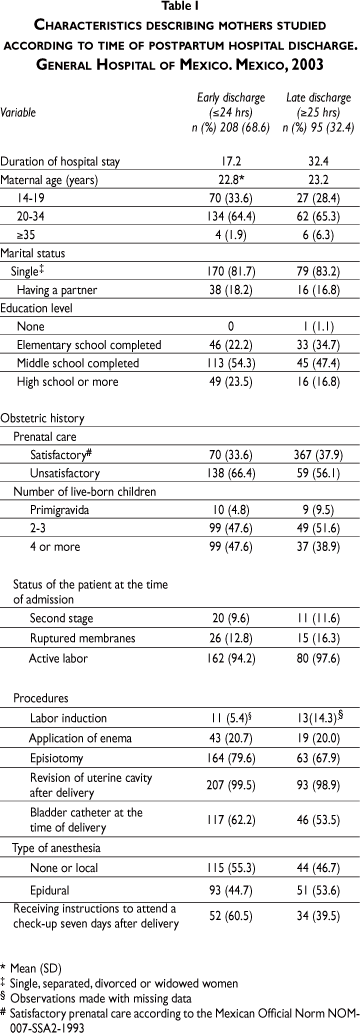
<body><![CDATA[<p><font face="Verdana, Arial, Helvetica, sans-serif" size="2">Data are presented    as mean and standard deviation for continuous variables and proportions for    categorical variables. Bivariate associations between the outcome variable and    each of the covariates were assessed to obtain odds ratios and 95% confidence    intervals. The variables related to early discharge in the bivariate analysis    at <i>p</i>&lt;0.15 were included in a logistic regression model.</font></p>     <p><font face="Verdana, Arial, Helvetica, sans-serif" size="2">An interaction    term was added to assess the potential modifying effect of ED with satisfactory    prenatal care on the presence of complications in early puerperium. All women    with any complication identified during the hospital stay were excluded from    the analysis. There were four women whose hospital stays were longer than 72    hours (77, 79, 87 and 99 hours). The analysis was conducted both including and    excluding those observations, and no differences were found. The results that    we present in this paper include these four women.</font></p>     <p><font face="Verdana, Arial, Helvetica, sans-serif" size="2">Finally, regression    diagnostics were obtained for the logistic model.<sup>25</sup> The statistical    analysis was performed using Stata Version 9.0.*</font></p>     <p>&nbsp;</p>     <p><font face="Verdana, Arial, Helvetica, sans-serif" size="3"><b>Results</b></font></p>     <p><font face="Verdana, Arial, Helvetica, sans-serif" size="2">Of the 5 326 women    who delivered at the HGM between April 11 and December 15, 2003, a total of    2 710 (50.8%) had normal vaginal deliveries; 829 of those were eliminated due    to premature birth, low birth weight (d"2 600 g or d"36 weeks gestational age),    stillbirths, or twins. Of the remaining 1 881 vaginal deliveries, 1 216 (64.6%)    fulfilled all inclusion criteria. Of these women, 323 (26.6%) did not participate    because they resided outside the metropolitan area or simply because they did    not wish to participate in the study. No differences were found between women    who agreed to participate and those who did not with respect to number of live    born children, newborn weight, maternal age or time of discharge. From the 893    remaining women, 497 were excluded from the analysis because they had complications    before the hospital discharge. Out of the 396 women without complications prior    to hospital discharge, only 303 were included in the analysis because 93 did    not have complete information on the variables under study (<a href="/img/revistas/spm/v51n3/11f1.gif">Figure    1</a>). We did not find significant differences between women with complete    and incomplete information regarding their age, length of hospital stay and    number of live-born children.</font></p>     <p><font face="Verdana, Arial, Helvetica, sans-serif" size="2">During follow-up,    63 women (15.9%) were lost due to change of residence, failure to locate the    place of residence after three attempts, or incorrect address. No significant    differences were found between women who completed the study and those who were    lost to follow-up, regarding the length of hospital stay, age, and number of    live-born children.</font></p>     <p><font face="Verdana, Arial, Helvetica, sans-serif" size="2">A total of 303    mothers were included in the analysis. Almost two thirds (67.2%) were interviewed    at the hospital appointment while 32.8% were interviewed at home. Among these    women, 208 (68.6%) had early postpartum discharge and 62 (15.6%) had their discharge    delayed for administrative reasons; of these, 14 (6.7%) were in the late discharge    group. There were no differences found in age or length of hospital stay between    women with delayed discharge due to administrative reasons and those without    this delay.</font></p>     <p><font face="Verdana, Arial, Helvetica, sans-serif" size="2"><a href="#t1">Table    I</a> shows sociodemographic and delivery characteristics of participating women,    by time of discharge. The mean hospital stay (HS) was 21.5 &plusmn; 8.5 hours.</font></p>     <p><a name="t1"></a></p>     ]]></body>
<body><![CDATA[<p>&nbsp;</p>     <p align="center"><img src="/img/revistas/spm/v51n3/11t1.gif"></p>     <p>&nbsp;</p>     <p><font face="Verdana, Arial, Helvetica, sans-serif" size="2"><a href="/img/revistas/spm/v51n3/11t2.gif">Table    II</a> presents symptoms reported up to the seventh day postpartum, analyzed    from the time of discharge. From the 303 women included in the analysis, 65%    (215) reported at least one symptom after hospital discharge. The most frequent    symptom was genital discomfort, which was reported by 26.9% of the women, followed    by symptoms suggesting urinary tract infection (23.1%) and symptoms suggesting    endometritis (3.4%). We found no significant differences in the occurrence of    each of the signs and symptoms by time of discharge (<a href="/img/revistas/spm/v51n3/11t2.gif">Table    II</a>). One woman was hospitalized on the fifth day after delivery with fever.</font></p>     <p><font face="Verdana, Arial, Helvetica, sans-serif" size="2">We fit a multivariate    logistic regression model with the dependent variable being the presence of    symptoms and the covariates being age of the mother in years, number of live-born    children, admission in the second stage of labor, satisfactory prenatal care,    application of enema prior to the delivery and having received instructions    to have a medical check-up seven days after delivery. The analysis also included    the time between maternal discharge from the hospital and the day on which the    interview was conducted. The results are shown in <a href="/img/revistas/spm/v51n3/11t3.gif">Table    III</a>.</font></p>     <p><font face="Verdana, Arial, Helvetica, sans-serif" size="2">The raw analysis    did not find any variable associated with the presence of early puerperium complications.    The analysis adjusted for confounding variables found that women who received    no instructions to have a medical check-up seven days after delivery had a higher    odds ratio of reporting symptoms of complications than women who received follow-up    instructions (<i>OR</i> 1.73; 95% CI 1.01. 2.97). Early discharge was not associated    with the presence of symptoms during early puerperium. Nevertheless, in the    adjusted models with interaction terms between early discharge and satisfactory    prenatal care, we found that women with early discharge and satisfactory prenatal    care had a 63% lower odds of presenting symptoms compared with women with late    discharge and whose prenatal control was unsatisfactory.</font></p>     <p>&nbsp;</p>     <p><font face="Verdana, Arial, Helvetica, sans-serif" size="3"><b>Discussion</b></font></p>     <p><font face="Verdana, Arial, Helvetica, sans-serif" size="2">This study found    no significant association between early discharge and maternal symptoms of    complications during the early puerperium. This result is consistent with other    investigators such as Brown <i>et al</i>.<sup>12</sup> We found that women who    had satisfactory prenatal care and early discharge had lower odds ratio of presenting    symptoms of complications than mothers who had early discharge but whose prenatal    care was not satisfactory. This study also found that women who received no    instructions to get a medical check-up after discharge had a higher risk of    presenting complications, what may be an indicator of a positive effect of counseling    during the hospital stay.</font></p>     <p><font face="Verdana, Arial, Helvetica, sans-serif" size="2">The association    between prenatal care and reported symptoms can be interpreted in the following    manner: satisfactory prenatal care serves as an important venue for educating    women about postnatal care and their own health;<sup>24-26</sup> prenatal visits    can help resolve mothers' doubts about events during puerperium as well as provide    instructions for when to seek medical care;<sup>27,28</sup> early postpartum    discharge (EPD) can reduce the window of opportunity for detecting potential    complications and for counseling the mother on puerperal care, especially if    she did not receive satisfactory prenatal care. It is important to note that    even with early discharge, women with satisfactory prenatal care had lower odds    of complications than women without early discharge and unsatisfactory prenatal    care. This finding indicates that prenatal care plays an important role not    only in the prevention of prenatal and delivery complications, but also serves    to educate the mother as to early postpartum care.</font></p>     ]]></body>
<body><![CDATA[<p><font face="Verdana, Arial, Helvetica, sans-serif" size="2">There are a number    of limitations of this study that deserve mentioning. The data on the presence    and severity of symptoms of complications during early puerperium were obtained    by interviewing the mothers and not by clinical exam or evaluation, which may    lead to errors in classification. Also, we did not determine the reasons why    mothers did not seek medical attention despite complaining of certain symptoms.    However, we presume that the problems in detection and identification of these    symptoms, as well as the reasons for not seeking medical care despite the presence    of symptoms, are not related to the time of postpartum discharge. This would    likely result in a non-differential error in measurement and would only attenuate    the associations found between time of postpartum discharge and the occurrence    of complications.</font></p>     <p><font face="Verdana, Arial, Helvetica, sans-serif" size="2">Recall bias may    be another limitation of this study, as mothers simply tried to remember symptoms    when the survey was administered. However, the authors contend that if such    bias were present it also would be non-differential, given that mothers were    all asked in the same manner (regardless of early or late discharge). Another    limitation of the study is the short follow up period of only seven days. Although    the majority of the symptoms identified here occur preferentially during the    first week postpartum, it is possible that other symptoms or complications appeared    after those seven days and were not identified or analyzed, but this issue is    part of a future complementary analysis.</font></p>     <p><font face="Verdana, Arial, Helvetica, sans-serif" size="2">In the present    study, early discharge was decided by the responsible physician. Women in the    early discharge group were all clinically stable. However, for administrative    reasons, some women who would have been candidates for early discharge were    kept in the hospital. Although it is impossible to control for this effect,    we included this "late discharge for administrative reasons" variable in the    model and found no significant attributable effect.</font></p>     <p><font face="Verdana, Arial, Helvetica, sans-serif" size="2">The ideal design    for evaluating the association between the time of discharge postpartum and    the presence of complications would be a randomized clinical trial instead of    the cohort observational design used in our study. Such a design would randomize    women to early or late discharge groups, and clinical assessment and follow-up    would yield more accurate data on puerperal complications. Due to ethical and    logistic reasons, it was not possible to use such design in this report.</font></p>     <p><font face="Verdana, Arial, Helvetica, sans-serif" size="2">There may be a    residual effect of complications in the immediate postpartum period, which may    increase the time to discharge as well as increase the probability of complications    appearing during early puerperium. Thus, the results of this study may overestimate    the association between early postpartum discharge and the presence and severity    of puerperal complications. To decrease the possible bias, we opted for the    restriction of the study sample to only those women with no complications at    the time of discharge and those with puerperal complications after delivery    and before hospital discharge, which could considerably affect the time of postpartum    discharge and the probability of later complications.</font></p>     <p><font face="Verdana, Arial, Helvetica, sans-serif" size="2">The results of    this study show that although there was no association between early discharge    and the severity of complications during early puerperium for all mothers, the    presence of symptoms decreased among women who received indications to have    a medical check up one week later, and among women with early discharge and    satisfactory prenatal care, compared with those with early discharge and unsatisfactory    prenatal care, suggesting a positive effect of satisfactory prenatal care even    with an early discharge. This correlation deserves further study in order to    better understand its importance.</font></p>     <p><font face="Verdana, Arial, Helvetica, sans-serif" size="2"><b>Acknowledgements</b></font></p>     <p><font face="Verdana, Arial, Helvetica, sans-serif" size="2">No author has any    financial or other relationships that might lead to a conflict of interest.    All authors have contributed substantially to the paper. All co-authors contributed    to revising and editing drafts of the paper.</font></p>     <p><font face="Verdana, Arial, Helvetica, sans-serif" size="2">We appreciate the    support from authorities of the General Hospital of Mexico in conducting this    study. We acknowledge Irma Aldana, IIeana Salvador, Araceli Hernandez, Virginia    Torres and Emelina Cardoso for their support in conducting the interviews, Noemi    Figueroa, Esperanza Pi&ntilde;a and Marlene Hernandez for their support in the    integration of the database, and Jose Alonso Restrepo for his support in the    revision of the manuscript.</font></p>     <p>&nbsp;</p>     ]]></body>
<body><![CDATA[<p><font face="Verdana, Arial, Helvetica, sans-serif" size="3"><b>References</b></font></p>     <!-- ref --><p><font face="Verdana, Arial, Helvetica, sans-serif" size="2">1. Olaiz-Fern&aacute;ndez    G, Rivera-Dommarco J, Shamah-Levy T, Rojas R, Villalpando-Hern&aacute;ndez S,    Hern&aacute;ndez-Avila M et al. Encuesta Nacional de Salud y Nutrici&oacute;n    2006. Cuernavaca, Mexico: Instituto Nacional de Salud P&uacute;blica, 2006.</font>&nbsp;&nbsp;&nbsp;&nbsp;&nbsp;&nbsp;&nbsp;&nbsp;[&#160;<a href="javascript:void(0);" onclick="javascript: window.open('/scielo.php?script=sci_nlinks&ref=9331635&pid=S0036-3634200900030001100001&lng=','','width=640,height=500,resizable=yes,scrollbars=1,menubar=yes,');">Links</a>&#160;]<!-- end-ref --><!-- ref --><p><font face="Verdana, Arial, Helvetica, sans-serif" size="2">2. Grullon KE,    Grimes DA. The safety of early postpartum discharge: a review and critique.    Obstet Gynecol 1997;90:860-865.</font>&nbsp;&nbsp;&nbsp;&nbsp;&nbsp;&nbsp;&nbsp;&nbsp;[&#160;<a href="javascript:void(0);" onclick="javascript: window.open('/scielo.php?script=sci_nlinks&ref=9331636&pid=S0036-3634200900030001100002&lng=','','width=640,height=500,resizable=yes,scrollbars=1,menubar=yes,');">Links</a>&#160;]<!-- end-ref --><!-- ref --><p><font face="Verdana, Arial, Helvetica, sans-serif" size="2">3. Madden JM, Soumerai    SB, Lieu TA, Mandl KD, Zhang F, Ross-Degnan D. Health maintenance organization.    Effects of a law against early postpartum discharge on newborn follow-up, adverse    events, and HMO expenditures. N Engl J Med 2002;347:2031-2038.</font>&nbsp;&nbsp;&nbsp;&nbsp;&nbsp;&nbsp;&nbsp;&nbsp;[&#160;<a href="javascript:void(0);" onclick="javascript: window.open('/scielo.php?script=sci_nlinks&ref=9331637&pid=S0036-3634200900030001100003&lng=','','width=640,height=500,resizable=yes,scrollbars=1,menubar=yes,');">Links</a>&#160;]<!-- end-ref --><!-- ref --><p><font face="Verdana, Arial, Helvetica, sans-serif" size="2">4. Braveman P,    Egerter S, Pearl M, Marchi K, Miller C. Problems associated with early discharge    of newborn infants. Early discharge of newborn and mothers: a critical review    of the literature. Pediatrics 1995;96:716-726.</font>&nbsp;&nbsp;&nbsp;&nbsp;&nbsp;&nbsp;&nbsp;&nbsp;[&#160;<a href="javascript:void(0);" onclick="javascript: window.open('/scielo.php?script=sci_nlinks&ref=9331638&pid=S0036-3634200900030001100004&lng=','','width=640,height=500,resizable=yes,scrollbars=1,menubar=yes,');">Links</a>&#160;]<!-- end-ref --><!-- ref --><p><font face="Verdana, Arial, Helvetica, sans-serif" size="2">5. Briton JR, Briton    HL, Beebe SA. Early discharge of the term newborn: a continued dilemma. Pediatrics    1994;94:291-295.</font>&nbsp;&nbsp;&nbsp;&nbsp;&nbsp;&nbsp;&nbsp;&nbsp;[&#160;<a href="javascript:void(0);" onclick="javascript: window.open('/scielo.php?script=sci_nlinks&ref=9331639&pid=S0036-3634200900030001100005&lng=','','width=640,height=500,resizable=yes,scrollbars=1,menubar=yes,');">Links</a>&#160;]<!-- end-ref --><!-- ref --><p><font face="Verdana, Arial, Helvetica, sans-serif" size="2">6. Yaffe MJ, Russillo    B, Hyland C. Better care and better teaching. New model of postpartum care for    early. Can Fam Physician 2001;47:2027-2033.</font>&nbsp;&nbsp;&nbsp;&nbsp;&nbsp;&nbsp;&nbsp;&nbsp;[&#160;<a href="javascript:void(0);" onclick="javascript: window.open('/scielo.php?script=sci_nlinks&ref=9331640&pid=S0036-3634200900030001100006&lng=','','width=640,height=500,resizable=yes,scrollbars=1,menubar=yes,');">Links</a>&#160;]<!-- end-ref --><!-- ref --><p><font face="Verdana, Arial, Helvetica, sans-serif" size="2">7. Lieu TA, Braveman    PA, Escobar GJ, Fischer AF, Jensvold NG, Capra AM. A randomized comparison of    home and clinic follow-up visits after early postpartum hospital discharge.    Pediatrics 2000;105:1058-1065.</font>&nbsp;&nbsp;&nbsp;&nbsp;&nbsp;&nbsp;&nbsp;&nbsp;[&#160;<a href="javascript:void(0);" onclick="javascript: window.open('/scielo.php?script=sci_nlinks&ref=9331641&pid=S0036-3634200900030001100007&lng=','','width=640,height=500,resizable=yes,scrollbars=1,menubar=yes,');">Links</a>&#160;]<!-- end-ref --><!-- ref --><p><font face="Verdana, Arial, Helvetica, sans-serif" size="2">8. Norr KF, Nacion    K. Outcomes of postpartum early discharge, 1960-1986. A comparative review.    Birth 1987;14:135-141.</font>&nbsp;&nbsp;&nbsp;&nbsp;&nbsp;&nbsp;&nbsp;&nbsp;[&#160;<a href="javascript:void(0);" onclick="javascript: window.open('/scielo.php?script=sci_nlinks&ref=9331642&pid=S0036-3634200900030001100008&lng=','','width=640,height=500,resizable=yes,scrollbars=1,menubar=yes,');">Links</a>&#160;]<!-- end-ref --><!-- ref --><p><font face="Verdana, Arial, Helvetica, sans-serif" size="2">9. Beck C. Early    postpartum discharge programs in the United States: a literature review and    critique. Women Health 1991;17:125-138.</font>&nbsp;&nbsp;&nbsp;&nbsp;&nbsp;&nbsp;&nbsp;&nbsp;[&#160;<a href="javascript:void(0);" onclick="javascript: window.open('/scielo.php?script=sci_nlinks&ref=9331643&pid=S0036-3634200900030001100009&lng=','','width=640,height=500,resizable=yes,scrollbars=1,menubar=yes,');">Links</a>&#160;]<!-- end-ref --><!-- ref --><p><font face="Verdana, Arial, Helvetica, sans-serif" size="2">10. Helleman LM,    Kohl SG, Palmer J. Early hospital discharge in obstetrics. Lancet 1962;1:227-232.</font>&nbsp;&nbsp;&nbsp;&nbsp;&nbsp;&nbsp;&nbsp;&nbsp;[&#160;<a href="javascript:void(0);" onclick="javascript: window.open('/scielo.php?script=sci_nlinks&ref=9331644&pid=S0036-3634200900030001100010&lng=','','width=640,height=500,resizable=yes,scrollbars=1,menubar=yes,');">Links</a>&#160;]<!-- end-ref --><!-- ref --><p><font face="Verdana, Arial, Helvetica, sans-serif" size="2">11. Anonymous.    Hospital stays continue 10 year decline. Am J Public Health 1992;82:54.</font>&nbsp;&nbsp;&nbsp;&nbsp;&nbsp;&nbsp;&nbsp;&nbsp;[&#160;<a href="javascript:void(0);" onclick="javascript: window.open('/scielo.php?script=sci_nlinks&ref=9331645&pid=S0036-3634200900030001100011&lng=','','width=640,height=500,resizable=yes,scrollbars=1,menubar=yes,');">Links</a>&#160;]<!-- end-ref --><!-- ref --><p><font face="Verdana, Arial, Helvetica, sans-serif" size="2">12. Brown SS, Faber    RB, Krastev AD. Early postnatal discharge from hospital for healthy mothers    and term infants. The Cochrane Database Systematic Reviews 2002, Issue 3, Art.    No: CD002958. DOI: 10.1002/14651858.CD002958.</font>&nbsp;&nbsp;&nbsp;&nbsp;&nbsp;&nbsp;&nbsp;&nbsp;[&#160;<a href="javascript:void(0);" onclick="javascript: window.open('/scielo.php?script=sci_nlinks&ref=9331646&pid=S0036-3634200900030001100012&lng=','','width=640,height=500,resizable=yes,scrollbars=1,menubar=yes,');">Links</a>&#160;]<!-- end-ref --><!-- ref --><p><font face="Verdana, Arial, Helvetica, sans-serif" size="2">13. Brumfield CG.    Early postpartum discharge. Clin Obstet Gynecol 1998;41:611-625.</font>&nbsp;&nbsp;&nbsp;&nbsp;&nbsp;&nbsp;&nbsp;&nbsp;[&#160;<a href="javascript:void(0);" onclick="javascript: window.open('/scielo.php?script=sci_nlinks&ref=9331647&pid=S0036-3634200900030001100013&lng=','','width=640,height=500,resizable=yes,scrollbars=1,menubar=yes,');">Links</a>&#160;]<!-- end-ref --><!-- ref --><p><font face="Verdana, Arial, Helvetica, sans-serif" size="2">14. Watt S, Sword    W, Krueger P. Longer postpartum hospitalization options who stays, who leaves,    what changes? BMC Pregnancy Childbirth 2005;5:13.</font>&nbsp;&nbsp;&nbsp;&nbsp;&nbsp;&nbsp;&nbsp;&nbsp;[&#160;<a href="javascript:void(0);" onclick="javascript: window.open('/scielo.php?script=sci_nlinks&ref=9331648&pid=S0036-3634200900030001100014&lng=','','width=640,height=500,resizable=yes,scrollbars=1,menubar=yes,');">Links</a>&#160;]<!-- end-ref --><!-- ref --><p><font face="Verdana, Arial, Helvetica, sans-serif" size="2">15. Madlon-Kay    DJ, DeFor TA. Maternal postpartum health care utilization and the effect of    Minnesota early discharge legislation. J Am Board Fam Pract 2005;18:307-311.</font>&nbsp;&nbsp;&nbsp;&nbsp;&nbsp;&nbsp;&nbsp;&nbsp;[&#160;<a href="javascript:void(0);" onclick="javascript: window.open('/scielo.php?script=sci_nlinks&ref=9331649&pid=S0036-3634200900030001100015&lng=','','width=640,height=500,resizable=yes,scrollbars=1,menubar=yes,');">Links</a>&#160;]<!-- end-ref --><!-- ref --><p><font face="Verdana, Arial, Helvetica, sans-serif" size="2">16. Subdirecci&oacute;n    General M&eacute;dica. Jefatura de Servicios de Hospitales. Programa de atenci&oacute;n    de puerperio de bajo riesgo. Mexico City: Instituto Mexicano del Seguro Social,    1985.</font>&nbsp;&nbsp;&nbsp;&nbsp;&nbsp;&nbsp;&nbsp;&nbsp;[&#160;<a href="javascript:void(0);" onclick="javascript: window.open('/scielo.php?script=sci_nlinks&ref=9331650&pid=S0036-3634200900030001100016&lng=','','width=640,height=500,resizable=yes,scrollbars=1,menubar=yes,');">Links</a>&#160;]<!-- end-ref --><!-- ref --><p><font face="Verdana, Arial, Helvetica, sans-serif" size="2">17. de Mucha-Mac&iacute;as    RA, Ray LJ, S&aacute;nchez NM. Resultados preliminares del puerperio de bajo    riesgo en el Instituto Mexicano del Seguro Social. Rev Med IMSS (Mex) 1988;26:333-345.</font>&nbsp;&nbsp;&nbsp;&nbsp;&nbsp;&nbsp;&nbsp;&nbsp;[&#160;<a href="javascript:void(0);" onclick="javascript: window.open('/scielo.php?script=sci_nlinks&ref=9331651&pid=S0036-3634200900030001100017&lng=','','width=640,height=500,resizable=yes,scrollbars=1,menubar=yes,');">Links</a>&#160;]<!-- end-ref --><p><font face="Verdana, Arial, Helvetica, sans-serif" size="2">18. American Academy    of Pediatric, American College of Obstetrics and Gynecology. Guidelines for    Perinatal Care. 5th ed. Elk Grove Village (IL): American Academy of Pediatrics,    2002.</font></p>     <!-- ref --><p><font face="Verdana, Arial, Helvetica, sans-serif" size="2">19. American Academy    of Pediatrics. Committee on the fetus and newborn. Hospital stay for healthy    term newborns. Pediatrics 1995;96:788-790.</font>&nbsp;&nbsp;&nbsp;&nbsp;&nbsp;&nbsp;&nbsp;&nbsp;[&#160;<a href="javascript:void(0);" onclick="javascript: window.open('/scielo.php?script=sci_nlinks&ref=9331653&pid=S0036-3634200900030001100019&lng=','','width=640,height=500,resizable=yes,scrollbars=1,menubar=yes,');">Links</a>&#160;]<!-- end-ref --><!-- ref --><p><font face="Verdana, Arial, Helvetica, sans-serif" size="2">20. Yanover MJ,    Jones D, Miller MD. Perinatal care of low-risk mothers and infants. Early discharge    with home care. N Engl J Med 1976;294:702-705.</font>&nbsp;&nbsp;&nbsp;&nbsp;&nbsp;&nbsp;&nbsp;&nbsp;[&#160;<a href="javascript:void(0);" onclick="javascript: window.open('/scielo.php?script=sci_nlinks&ref=9331654&pid=S0036-3634200900030001100020&lng=','','width=640,height=500,resizable=yes,scrollbars=1,menubar=yes,');">Links</a>&#160;]<!-- end-ref --><!-- ref --><p><font face="Verdana, Arial, Helvetica, sans-serif" size="2">21. Scupholme A.    Postpartum early discharge: An inner city experience. J Nurse Midwifery 1981;26:19-22.</font>&nbsp;&nbsp;&nbsp;&nbsp;&nbsp;&nbsp;&nbsp;&nbsp;[&#160;<a href="javascript:void(0);" onclick="javascript: window.open('/scielo.php?script=sci_nlinks&ref=9331655&pid=S0036-3634200900030001100021&lng=','','width=640,height=500,resizable=yes,scrollbars=1,menubar=yes,');">Links</a>&#160;]<!-- end-ref --><!-- ref --><p><font face="Verdana, Arial, Helvetica, sans-serif" size="2">22. Avery MD, Fournier    LC, Jones PL, Sipovic CP. An early postpartum hospital discharge program. JOGN    Nurs 1982;11:233-235.</font>&nbsp;&nbsp;&nbsp;&nbsp;&nbsp;&nbsp;&nbsp;&nbsp;[&#160;<a href="javascript:void(0);" onclick="javascript: window.open('/scielo.php?script=sci_nlinks&ref=9331656&pid=S0036-3634200900030001100022&lng=','','width=640,height=500,resizable=yes,scrollbars=1,menubar=yes,');">Links</a>&#160;]<!-- end-ref --><!-- ref --><p><font face="Verdana, Arial, Helvetica, sans-serif" size="2">23. Fajardo-Gutierrez    A, Hernandez-Perez A, Huerta-Diaz E, Danglot-Banck C, Gomez-Gomez M, Valle-Gay    A. Puerperio de corta estancia hospitalaria. Ginecol Obstet Mex 1996;64:105-109.</font>&nbsp;&nbsp;&nbsp;&nbsp;&nbsp;&nbsp;&nbsp;&nbsp;[&#160;<a href="javascript:void(0);" onclick="javascript: window.open('/scielo.php?script=sci_nlinks&ref=9331657&pid=S0036-3634200900030001100023&lng=','','width=640,height=500,resizable=yes,scrollbars=1,menubar=yes,');">Links</a>&#160;]<!-- end-ref --><!-- ref --><p><font face="Verdana, Arial, Helvetica, sans-serif" size="2">24. Norma Oficial    Mexicana "NOM-007-SSA2-1993. Atenci&oacute;n de la Mujer durante el Embarazo,    Parto y Puerperio y del Reci&eacute;n Nacido. Mexico City: Diario oficial de    la Federaci&oacute;n, Jan 6, 1995.</font>&nbsp;&nbsp;&nbsp;&nbsp;&nbsp;&nbsp;&nbsp;&nbsp;[&#160;<a href="javascript:void(0);" onclick="javascript: window.open('/scielo.php?script=sci_nlinks&ref=9331658&pid=S0036-3634200900030001100024&lng=','','width=640,height=500,resizable=yes,scrollbars=1,menubar=yes,');">Links</a>&#160;]<!-- end-ref --><p><font face="Verdana, Arial, Helvetica, sans-serif" size="2">25. Hosmer DW,    Lemeshow S. Applied Logistic Regression. 2nd ed. New York (NY): John Wiley &amp;    Sons, 2000.</font></p>     <!-- ref --><p><font face="Verdana, Arial, Helvetica, sans-serif" size="2">26. Waldenstr&ouml;m    U, Rudman A, Hildingsson I. Intrapartum and postpartum care in Sweden: women's    opinions and risk factors for not being satisfied. Acta Obstet Gynecol Scand    2006;85:551-560.</font>&nbsp;&nbsp;&nbsp;&nbsp;&nbsp;&nbsp;&nbsp;&nbsp;[&#160;<a href="javascript:void(0);" onclick="javascript: window.open('/scielo.php?script=sci_nlinks&ref=9331660&pid=S0036-3634200900030001100026&lng=','','width=640,height=500,resizable=yes,scrollbars=1,menubar=yes,');">Links</a>&#160;]<!-- end-ref --><!-- ref --><p><font face="Verdana, Arial, Helvetica, sans-serif" size="2">27. Gennaro S,    Bloch JR. Postpartum health in mothers of term and preterm infants. Women Health    2005;41:99-112.</font>&nbsp;&nbsp;&nbsp;&nbsp;&nbsp;&nbsp;&nbsp;&nbsp;[&#160;<a href="javascript:void(0);" onclick="javascript: window.open('/scielo.php?script=sci_nlinks&ref=9331661&pid=S0036-3634200900030001100027&lng=','','width=640,height=500,resizable=yes,scrollbars=1,menubar=yes,');">Links</a>&#160;]<!-- end-ref --><!-- ref --><p><font face="Verdana, Arial, Helvetica, sans-serif" size="2">28. Heaman MI,    Gupton AL, Moffatt ME. Prevalence and predictors of inadequate prenatal care:    a comparison of aboriginal and non-aboriginal women in Manitoba. J Obstet Gynaecol    Can 2005 Mar;27:237-246.</font>&nbsp;&nbsp;&nbsp;&nbsp;&nbsp;&nbsp;&nbsp;&nbsp;[&#160;<a href="javascript:void(0);" onclick="javascript: window.open('/scielo.php?script=sci_nlinks&ref=9331662&pid=S0036-3634200900030001100028&lng=','','width=640,height=500,resizable=yes,scrollbars=1,menubar=yes,');">Links</a>&#160;]<!-- end-ref --><p>&nbsp;</p>     ]]></body>
<body><![CDATA[<p>&nbsp;</p>     <p><font face="Verdana, Arial, Helvetica, sans-serif" size="2">Received on: January    28, 2008    <br>   Accepted on: January 26, 2009    <br>   This study has been funded by Consejo Nacional de Ciencia y Tecnolog&iacute;a,    (National Council of Science and Technology). M&eacute;xico.</font></p>     <p>&nbsp;</p>     <p>&nbsp;</p>     <p><font face="Verdana, Arial, Helvetica, sans-serif" size="2">Solicitud de sobretiros:    Dolores Ram&iacute;rez Villalobos. Instituto Nacional de Salud P&uacute;blica-M&eacute;xico    (INSP). Av. Universidad 655, 3er piso, Col Sta. Ma. Ahuacatitl&aacute;n. 62508    Cuernavaca, Morelos, M&eacute;xico. E-mail: <a href="mailto:mdolores@correo.insp.mx">mdolores@correo.insp.mx</a>;    <a href="mailto:mdoloresram@hotmail.com">mdoloresram@hotmail.com</a></font></p>      ]]></body><back>
<ref-list>
<ref id="B1">
<label>1</label><nlm-citation citation-type="book">
<person-group person-group-type="author">
<name>
<surname><![CDATA[Olaiz-Fernández]]></surname>
<given-names><![CDATA[G]]></given-names>
</name>
<name>
<surname><![CDATA[Rivera-Dommarco]]></surname>
<given-names><![CDATA[J]]></given-names>
</name>
<name>
<surname><![CDATA[Shamah-Levy]]></surname>
<given-names><![CDATA[T]]></given-names>
</name>
<name>
<surname><![CDATA[Rojas]]></surname>
<given-names><![CDATA[R]]></given-names>
</name>
<name>
<surname><![CDATA[Villalpando-Hernández]]></surname>
<given-names><![CDATA[S]]></given-names>
</name>
<name>
<surname><![CDATA[Hernández-Avila]]></surname>
<given-names><![CDATA[M]]></given-names>
</name>
</person-group>
<source><![CDATA[Encuesta Nacional de Salud y Nutrición 2006]]></source>
<year>2006</year>
<publisher-loc><![CDATA[Cuernavaca ]]></publisher-loc>
<publisher-name><![CDATA[Instituto Nacional de Salud Pública]]></publisher-name>
</nlm-citation>
</ref>
<ref id="B2">
<label>2</label><nlm-citation citation-type="journal">
<person-group person-group-type="author">
<name>
<surname><![CDATA[Grullon]]></surname>
<given-names><![CDATA[KE]]></given-names>
</name>
<name>
<surname><![CDATA[Grimes]]></surname>
<given-names><![CDATA[DA]]></given-names>
</name>
</person-group>
<article-title xml:lang="en"><![CDATA[The safety of early postpartum discharge: a review and critique]]></article-title>
<source><![CDATA[Obstet Gynecol]]></source>
<year>1997</year>
<volume>90</volume>
<page-range>860-865</page-range></nlm-citation>
</ref>
<ref id="B3">
<label>3</label><nlm-citation citation-type="journal">
<person-group person-group-type="author">
<name>
<surname><![CDATA[Madden]]></surname>
<given-names><![CDATA[JM]]></given-names>
</name>
<name>
<surname><![CDATA[Soumerai]]></surname>
<given-names><![CDATA[SB]]></given-names>
</name>
<name>
<surname><![CDATA[Lieu]]></surname>
<given-names><![CDATA[TA]]></given-names>
</name>
<name>
<surname><![CDATA[Mandl]]></surname>
<given-names><![CDATA[KD]]></given-names>
</name>
<name>
<surname><![CDATA[Zhang]]></surname>
<given-names><![CDATA[F]]></given-names>
</name>
<name>
<surname><![CDATA[Ross-Degnan]]></surname>
<given-names><![CDATA[D]]></given-names>
</name>
</person-group>
<article-title xml:lang="en"><![CDATA[Health maintenance organization. Effects of a law against early postpartum discharge on newborn follow-up, adverse events, and HMO expenditures]]></article-title>
<source><![CDATA[N Engl J Med]]></source>
<year>2002</year>
<volume>347</volume>
<page-range>2031-2038</page-range></nlm-citation>
</ref>
<ref id="B4">
<label>4</label><nlm-citation citation-type="journal">
<person-group person-group-type="author">
<name>
<surname><![CDATA[Braveman]]></surname>
<given-names><![CDATA[P]]></given-names>
</name>
<name>
<surname><![CDATA[Egerter]]></surname>
<given-names><![CDATA[S]]></given-names>
</name>
<name>
<surname><![CDATA[Pearl]]></surname>
<given-names><![CDATA[M]]></given-names>
</name>
<name>
<surname><![CDATA[Marchi]]></surname>
<given-names><![CDATA[K]]></given-names>
</name>
<name>
<surname><![CDATA[Miller]]></surname>
<given-names><![CDATA[C]]></given-names>
</name>
</person-group>
<article-title xml:lang="en"><![CDATA[Problems associated with early discharge of newborn infants: Early discharge of newborn and mothersa critical review of the literature]]></article-title>
<source><![CDATA[Pediatrics]]></source>
<year>1995</year>
<volume>96</volume>
<page-range>716-726</page-range></nlm-citation>
</ref>
<ref id="B5">
<label>5</label><nlm-citation citation-type="journal">
<person-group person-group-type="author">
<name>
<surname><![CDATA[Briton]]></surname>
<given-names><![CDATA[JR]]></given-names>
</name>
<name>
<surname><![CDATA[Briton]]></surname>
<given-names><![CDATA[HL]]></given-names>
</name>
<name>
<surname><![CDATA[Beebe]]></surname>
<given-names><![CDATA[SA]]></given-names>
</name>
</person-group>
<article-title xml:lang="en"><![CDATA[Early discharge of the term newborn: a continued dilemma]]></article-title>
<source><![CDATA[Pediatrics]]></source>
<year>1994</year>
<volume>94</volume>
<page-range>291-295</page-range></nlm-citation>
</ref>
<ref id="B6">
<label>6</label><nlm-citation citation-type="journal">
<person-group person-group-type="author">
<name>
<surname><![CDATA[Yaffe]]></surname>
<given-names><![CDATA[MJ]]></given-names>
</name>
<name>
<surname><![CDATA[Russillo]]></surname>
<given-names><![CDATA[B]]></given-names>
</name>
<name>
<surname><![CDATA[Hyland]]></surname>
<given-names><![CDATA[C]]></given-names>
</name>
</person-group>
<article-title xml:lang="en"><![CDATA[Better care and better teaching: New model of postpartum care for early]]></article-title>
<source><![CDATA[Can Fam Physician]]></source>
<year>2001</year>
<volume>47</volume>
<page-range>2027-2033</page-range></nlm-citation>
</ref>
<ref id="B7">
<label>7</label><nlm-citation citation-type="journal">
<person-group person-group-type="author">
<name>
<surname><![CDATA[Lieu]]></surname>
<given-names><![CDATA[TA]]></given-names>
</name>
<name>
<surname><![CDATA[Braveman]]></surname>
<given-names><![CDATA[PA]]></given-names>
</name>
<name>
<surname><![CDATA[Escobar]]></surname>
<given-names><![CDATA[GJ]]></given-names>
</name>
<name>
<surname><![CDATA[Fischer]]></surname>
<given-names><![CDATA[AF]]></given-names>
</name>
<name>
<surname><![CDATA[Jensvold]]></surname>
<given-names><![CDATA[NG]]></given-names>
</name>
<name>
<surname><![CDATA[Capra]]></surname>
<given-names><![CDATA[AM]]></given-names>
</name>
</person-group>
<article-title xml:lang="en"><![CDATA[A randomized comparison of home and clinic follow-up visits after early postpartum hospital discharge]]></article-title>
<source><![CDATA[Pediatrics]]></source>
<year>2000</year>
<volume>105</volume>
<page-range>1058-1065</page-range></nlm-citation>
</ref>
<ref id="B8">
<label>8</label><nlm-citation citation-type="journal">
<person-group person-group-type="author">
<name>
<surname><![CDATA[Norr]]></surname>
<given-names><![CDATA[KF]]></given-names>
</name>
<name>
<surname><![CDATA[Nacion]]></surname>
<given-names><![CDATA[K]]></given-names>
</name>
</person-group>
<article-title xml:lang="en"><![CDATA[Outcomes of postpartum early discharge, 1960-1986. A comparative review]]></article-title>
<source><![CDATA[Birth]]></source>
<year>1987</year>
<volume>14</volume>
<page-range>135-141</page-range></nlm-citation>
</ref>
<ref id="B9">
<label>9</label><nlm-citation citation-type="journal">
<person-group person-group-type="author">
<name>
<surname><![CDATA[Beck]]></surname>
<given-names><![CDATA[C]]></given-names>
</name>
</person-group>
<article-title xml:lang="en"><![CDATA[Early postpartum discharge programs in the United States: a literature review and critique]]></article-title>
<source><![CDATA[Women Health]]></source>
<year>1991</year>
<volume>17</volume>
<page-range>125-138</page-range></nlm-citation>
</ref>
<ref id="B10">
<label>10</label><nlm-citation citation-type="journal">
<person-group person-group-type="author">
<name>
<surname><![CDATA[Helleman]]></surname>
<given-names><![CDATA[LM]]></given-names>
</name>
<name>
<surname><![CDATA[Kohl]]></surname>
<given-names><![CDATA[SG]]></given-names>
</name>
<name>
<surname><![CDATA[Palmer]]></surname>
<given-names><![CDATA[J]]></given-names>
</name>
</person-group>
<article-title xml:lang="en"><![CDATA[Early hospital discharge in obstetrics]]></article-title>
<source><![CDATA[Lancet]]></source>
<year>1962</year>
<volume>1</volume>
<page-range>227-232</page-range></nlm-citation>
</ref>
<ref id="B11">
<label>11</label><nlm-citation citation-type="journal">
<person-group person-group-type="author">
<name>
<surname><![CDATA[Anonymous]]></surname>
</name>
</person-group>
<article-title xml:lang="en"><![CDATA[Hospital stays continue 10 year decline]]></article-title>
<source><![CDATA[Am J Public Health]]></source>
<year>1992</year>
<volume>82</volume>
<page-range>54</page-range></nlm-citation>
</ref>
<ref id="B12">
<label>12</label><nlm-citation citation-type="">
<person-group person-group-type="author">
<name>
<surname><![CDATA[Brown]]></surname>
<given-names><![CDATA[SS]]></given-names>
</name>
<name>
<surname><![CDATA[Faber]]></surname>
<given-names><![CDATA[RB]]></given-names>
</name>
<name>
<surname><![CDATA[Krastev]]></surname>
<given-names><![CDATA[AD]]></given-names>
</name>
</person-group>
<source><![CDATA[Early postnatal discharge from hospital for healthy mothers and term infants: The Cochrane Database Systematic Reviews 2002]]></source>
<year></year>
</nlm-citation>
</ref>
<ref id="B13">
<label>13</label><nlm-citation citation-type="journal">
<person-group person-group-type="author">
<name>
<surname><![CDATA[Brumfield]]></surname>
<given-names><![CDATA[CG]]></given-names>
</name>
</person-group>
<article-title xml:lang="en"><![CDATA[Early postpartum discharge]]></article-title>
<source><![CDATA[Clin Obstet Gynecol]]></source>
<year>1998</year>
<volume>41</volume>
<page-range>611-625</page-range></nlm-citation>
</ref>
<ref id="B14">
<label>14</label><nlm-citation citation-type="journal">
<person-group person-group-type="author">
<name>
<surname><![CDATA[Watt]]></surname>
<given-names><![CDATA[S]]></given-names>
</name>
<name>
<surname><![CDATA[Sword]]></surname>
<given-names><![CDATA[W]]></given-names>
</name>
<name>
<surname><![CDATA[Krueger]]></surname>
<given-names><![CDATA[P]]></given-names>
</name>
</person-group>
<article-title xml:lang="en"><![CDATA[Longer postpartum hospitalization options who stays, who leaves, what changes?]]></article-title>
<source><![CDATA[BMC Pregnancy Childbirth]]></source>
<year>2005</year>
<volume>5</volume>
<page-range>13</page-range></nlm-citation>
</ref>
<ref id="B15">
<label>15</label><nlm-citation citation-type="journal">
<person-group person-group-type="author">
<name>
<surname><![CDATA[Madlon-Kay]]></surname>
<given-names><![CDATA[DJ]]></given-names>
</name>
<name>
<surname><![CDATA[DeFor]]></surname>
<given-names><![CDATA[TA]]></given-names>
</name>
</person-group>
<article-title xml:lang="en"><![CDATA[Maternal postpartum health care utilization and the effect of Minnesota early discharge legislation]]></article-title>
<source><![CDATA[J Am Board Fam Pract]]></source>
<year>2005</year>
<volume>18</volume>
<page-range>307-311</page-range></nlm-citation>
</ref>
<ref id="B16">
<label>16</label><nlm-citation citation-type="book">
<collab>Subdirección General Médica</collab>
<source><![CDATA[Jefatura de Servicios de Hospitales: Programa de atención de puerperio de bajo riesgo]]></source>
<year>1985</year>
<publisher-loc><![CDATA[Mexico City ]]></publisher-loc>
<publisher-name><![CDATA[Instituto Mexicano del Seguro Social]]></publisher-name>
</nlm-citation>
</ref>
<ref id="B17">
<label>17</label><nlm-citation citation-type="journal">
<person-group person-group-type="author">
<name>
<surname><![CDATA[de Mucha-Macías]]></surname>
<given-names><![CDATA[RA]]></given-names>
</name>
<name>
<surname><![CDATA[Ray]]></surname>
<given-names><![CDATA[LJ]]></given-names>
</name>
<name>
<surname><![CDATA[Sánchez]]></surname>
<given-names><![CDATA[NM]]></given-names>
</name>
</person-group>
<article-title xml:lang="es"><![CDATA[Resultados preliminares del puerperio de bajo riesgo en el Instituto Mexicano del Seguro Social]]></article-title>
<source><![CDATA[Rev Med IMSS (Mex)]]></source>
<year>1988</year>
<volume>26</volume>
<page-range>333-345</page-range></nlm-citation>
</ref>
<ref id="B18">
<label>18</label><nlm-citation citation-type="book">
<collab>American Academy of Pediatric^dAmerican College of Obstetrics and Gynecology</collab>
<source><![CDATA[Guidelines for Perinatal Care]]></source>
<year>2002</year>
<edition>5</edition>
<publisher-loc><![CDATA[Elk Grove Village^eIL IL]]></publisher-loc>
<publisher-name><![CDATA[American Academy of Pediatrics]]></publisher-name>
</nlm-citation>
</ref>
<ref id="B19">
<label>19</label><nlm-citation citation-type="journal">
<collab>American Academy of Pediatrics</collab>
<article-title xml:lang="en"><![CDATA[Committee on the fetus and newborn: Hospital stay for healthy term newborns]]></article-title>
<source><![CDATA[Pediatrics]]></source>
<year>1995</year>
<volume>96</volume>
<page-range>788-790</page-range></nlm-citation>
</ref>
<ref id="B20">
<label>20</label><nlm-citation citation-type="journal">
<person-group person-group-type="author">
<name>
<surname><![CDATA[Yanover]]></surname>
<given-names><![CDATA[MJ]]></given-names>
</name>
<name>
<surname><![CDATA[Jones]]></surname>
<given-names><![CDATA[D]]></given-names>
</name>
<name>
<surname><![CDATA[Miller]]></surname>
<given-names><![CDATA[MD]]></given-names>
</name>
</person-group>
<article-title xml:lang="en"><![CDATA[Perinatal care of low-risk mothers and infants: Early discharge with home care]]></article-title>
<source><![CDATA[N Engl J Med]]></source>
<year>1976</year>
<volume>294</volume>
<page-range>702-705</page-range></nlm-citation>
</ref>
<ref id="B21">
<label>21</label><nlm-citation citation-type="journal">
<person-group person-group-type="author">
<name>
<surname><![CDATA[Scupholme]]></surname>
<given-names><![CDATA[A]]></given-names>
</name>
</person-group>
<article-title xml:lang="en"><![CDATA[Postpartum early discharge: An inner city experience]]></article-title>
<source><![CDATA[J Nurse Midwifery]]></source>
<year>1981</year>
<volume>26</volume>
<page-range>19-22</page-range></nlm-citation>
</ref>
<ref id="B22">
<label>22</label><nlm-citation citation-type="journal">
<person-group person-group-type="author">
<name>
<surname><![CDATA[Avery]]></surname>
<given-names><![CDATA[MD]]></given-names>
</name>
<name>
<surname><![CDATA[Fournier]]></surname>
<given-names><![CDATA[LC]]></given-names>
</name>
<name>
<surname><![CDATA[Jones]]></surname>
<given-names><![CDATA[PL]]></given-names>
</name>
<name>
<surname><![CDATA[Sipovic]]></surname>
<given-names><![CDATA[CP]]></given-names>
</name>
</person-group>
<article-title xml:lang="en"><![CDATA[An early postpartum hospital discharge program]]></article-title>
<source><![CDATA[JOGN Nurs]]></source>
<year>1982</year>
<volume>11</volume>
<page-range>233-235</page-range></nlm-citation>
</ref>
<ref id="B23">
<label>23</label><nlm-citation citation-type="journal">
<person-group person-group-type="author">
<name>
<surname><![CDATA[Fajardo-Gutierrez]]></surname>
<given-names><![CDATA[A]]></given-names>
</name>
<name>
<surname><![CDATA[Hernandez-Perez]]></surname>
<given-names><![CDATA[A]]></given-names>
</name>
<name>
<surname><![CDATA[Huerta-Diaz]]></surname>
<given-names><![CDATA[E]]></given-names>
</name>
<name>
<surname><![CDATA[Danglot-Banck]]></surname>
<given-names><![CDATA[C]]></given-names>
</name>
<name>
<surname><![CDATA[Gomez-Gomez]]></surname>
<given-names><![CDATA[M]]></given-names>
</name>
<name>
<surname><![CDATA[Valle-Gay]]></surname>
<given-names><![CDATA[A]]></given-names>
</name>
</person-group>
<article-title xml:lang="es"><![CDATA[Puerperio de corta estancia hospitalaria]]></article-title>
<source><![CDATA[Ginecol Obstet Mex]]></source>
<year>1996</year>
<volume>64</volume>
<page-range>105-109</page-range></nlm-citation>
</ref>
<ref id="B24">
<label>24</label><nlm-citation citation-type="book">
<source><![CDATA[Norma Oficial Mexicana "NOM-007-SSA2-1993: Atención de la Mujer durante el Embarazo, Parto y Puerperio y del Recién Nacido]]></source>
<year>Jan </year>
<month>6,</month>
<day> 1</day>
<publisher-loc><![CDATA[Mexico City ]]></publisher-loc>
<publisher-name><![CDATA[Diario oficial de la Federación]]></publisher-name>
</nlm-citation>
</ref>
<ref id="B25">
<label>25</label><nlm-citation citation-type="book">
<person-group person-group-type="author">
<name>
<surname><![CDATA[Hosmer]]></surname>
<given-names><![CDATA[DW]]></given-names>
</name>
<name>
<surname><![CDATA[Lemeshow]]></surname>
<given-names><![CDATA[S]]></given-names>
</name>
</person-group>
<source><![CDATA[Applied Logistic Regression]]></source>
<year>2000</year>
<edition>2</edition>
<publisher-loc><![CDATA[New York^eNY NY]]></publisher-loc>
<publisher-name><![CDATA[John Wiley & Sons]]></publisher-name>
</nlm-citation>
</ref>
<ref id="B26">
<label>26</label><nlm-citation citation-type="journal">
<person-group person-group-type="author">
<name>
<surname><![CDATA[Waldenström]]></surname>
<given-names><![CDATA[U]]></given-names>
</name>
<name>
<surname><![CDATA[Rudman]]></surname>
<given-names><![CDATA[A]]></given-names>
</name>
<name>
<surname><![CDATA[Hildingsson]]></surname>
<given-names><![CDATA[I]]></given-names>
</name>
</person-group>
<article-title xml:lang="en"><![CDATA[Intrapartum and postpartum care in Sweden: women's opinions and risk factors for not being satisfied]]></article-title>
<source><![CDATA[Acta Obstet Gynecol Scand]]></source>
<year>2006</year>
<volume>85</volume>
<page-range>551-560</page-range></nlm-citation>
</ref>
<ref id="B27">
<label>27</label><nlm-citation citation-type="journal">
<person-group person-group-type="author">
<name>
<surname><![CDATA[Gennaro]]></surname>
<given-names><![CDATA[S]]></given-names>
</name>
<name>
<surname><![CDATA[Bloch]]></surname>
<given-names><![CDATA[JR]]></given-names>
</name>
</person-group>
<article-title xml:lang="en"><![CDATA[Postpartum health in mothers of term and preterm infants]]></article-title>
<source><![CDATA[Women Health]]></source>
<year>2005</year>
<volume>41</volume>
<page-range>99-112</page-range></nlm-citation>
</ref>
<ref id="B28">
<label>28</label><nlm-citation citation-type="journal">
<person-group person-group-type="author">
<name>
<surname><![CDATA[Heaman]]></surname>
<given-names><![CDATA[MI]]></given-names>
</name>
<name>
<surname><![CDATA[Gupton]]></surname>
<given-names><![CDATA[AL]]></given-names>
</name>
<name>
<surname><![CDATA[Moffatt]]></surname>
<given-names><![CDATA[ME]]></given-names>
</name>
</person-group>
<article-title xml:lang="en"><![CDATA[Prevalence and predictors of inadequate prenatal care: a comparison of aboriginal and non-aboriginal women in Manitoba]]></article-title>
<source><![CDATA[J Obstet Gynaecol Can]]></source>
<year>2005</year>
<month> M</month>
<day>ar</day>
<volume>27</volume>
<page-range>237-246</page-range></nlm-citation>
</ref>
</ref-list>
</back>
</article>
