<?xml version="1.0" encoding="ISO-8859-1"?><article xmlns:mml="http://www.w3.org/1998/Math/MathML" xmlns:xlink="http://www.w3.org/1999/xlink" xmlns:xsi="http://www.w3.org/2001/XMLSchema-instance">
<front>
<journal-meta>
<journal-id>0036-3634</journal-id>
<journal-title><![CDATA[Salud Pública de México]]></journal-title>
<abbrev-journal-title><![CDATA[Salud pública Méx]]></abbrev-journal-title>
<issn>0036-3634</issn>
<publisher>
<publisher-name><![CDATA[Instituto Nacional de Salud Pública]]></publisher-name>
</publisher>
</journal-meta>
<article-meta>
<article-id>S0036-36342009000200010</article-id>
<title-group>
<article-title xml:lang="en"><![CDATA[Physical activity during the school day in public primary schools in Mexico City]]></article-title>
<article-title xml:lang="es"><![CDATA[La actividad física durante la jornada escolar en escuelas primarias públicas en la Ciudad de México]]></article-title>
</title-group>
<contrib-group>
<contrib contrib-type="author">
<name>
<surname><![CDATA[Jennings-Aburto]]></surname>
<given-names><![CDATA[Nancy]]></given-names>
</name>
<xref ref-type="aff" rid="A01"/>
</contrib>
<contrib contrib-type="author">
<name>
<surname><![CDATA[Nava]]></surname>
<given-names><![CDATA[Fernanda]]></given-names>
</name>
<xref ref-type="aff" rid="A01"/>
</contrib>
<contrib contrib-type="author">
<name>
<surname><![CDATA[Bonvecchio]]></surname>
<given-names><![CDATA[Anabelle]]></given-names>
</name>
<xref ref-type="aff" rid="A01"/>
</contrib>
<contrib contrib-type="author">
<name>
<surname><![CDATA[Safdie]]></surname>
<given-names><![CDATA[Margarita]]></given-names>
</name>
<xref ref-type="aff" rid="A01"/>
</contrib>
<contrib contrib-type="author">
<name>
<surname><![CDATA[González-Casanova]]></surname>
<given-names><![CDATA[Inés]]></given-names>
</name>
<xref ref-type="aff" rid="A01"/>
</contrib>
<contrib contrib-type="author">
<name>
<surname><![CDATA[Gust]]></surname>
<given-names><![CDATA[Tiffany]]></given-names>
</name>
<xref ref-type="aff" rid="A01"/>
</contrib>
<contrib contrib-type="author">
<name>
<surname><![CDATA[Rivera]]></surname>
<given-names><![CDATA[Juan]]></given-names>
</name>
<xref ref-type="aff" rid="A01"/>
</contrib>
</contrib-group>
<aff id="A01">
<institution><![CDATA[,Instituto Nacional de Salud Pública Centro de Investigación en Nutrición y Salud ]]></institution>
<addr-line><![CDATA[Cuernavaca ]]></addr-line>
<country>México</country>
</aff>
<pub-date pub-type="pub">
<day>00</day>
<month>04</month>
<year>2009</year>
</pub-date>
<pub-date pub-type="epub">
<day>00</day>
<month>04</month>
<year>2009</year>
</pub-date>
<volume>51</volume>
<numero>2</numero>
<fpage>141</fpage>
<lpage>147</lpage>
<copyright-statement/>
<copyright-year/>
<self-uri xlink:href="http://www.scielo.org.mx/scielo.php?script=sci_arttext&amp;pid=S0036-36342009000200010&amp;lng=en&amp;nrm=iso"></self-uri><self-uri xlink:href="http://www.scielo.org.mx/scielo.php?script=sci_abstract&amp;pid=S0036-36342009000200010&amp;lng=en&amp;nrm=iso"></self-uri><self-uri xlink:href="http://www.scielo.org.mx/scielo.php?script=sci_pdf&amp;pid=S0036-36342009000200010&amp;lng=en&amp;nrm=iso"></self-uri><abstract abstract-type="short" xml:lang="en"><p><![CDATA[OBJECTIVE: To quantify the physical activity (PA) of students and describe the school environment surrounding PA. MATERIAL AND METHODS: Between November 2005 and March 2006, in Mexico City, we conducted quantitative and qualitative observations to describe the PA and the school context. RESULTS: Recess and physical education class (PE) were the only opportunities to participate in PA. PE occurred one time per week with a duration of 39.8±10.6 minutes which is less than national and international recommendations. Students participated in moderate-to-vigorous PA 29.2±17.8% of PE. The dynamics of PE did not promote the inclusion of all students or PA. During recess there was overcrowding of the school patio and no equipment for PA or organization of PA. DISCUSSION: The PA of students in public schools in Mexico City can be improved by increasing the quantity and quality of PE and increasing opportunities for activity during recess.]]></p></abstract>
<abstract abstract-type="short" xml:lang="es"><p><![CDATA[OBJETIVO: Cuantificar la actividad física (AF) en niños escolares y describir el entorno escolar relacionado con la AF. MATERIAL Y MÉTODOS: Entre noviembre de 2005 y marzo de 2006 en la Ciudad de México, se realizó observación directa cuantitativa y cualitativa para describir el nivel de AF y el contexto escolar durante recreo y clases de educación física (CEF). RESULTADOS: El recreo y las CEF fueron los únicos espacios en los que se realizó AF. Las CEF se impartieron una vez a la semana y duraron 39.8±10.6 minutos, lo que está por debajo de las recomendaciones internacionales. Se participó en actividades moderadas-vigorosas 29.2±17.8% de las CEF. La dinámica de las CEF no favoreció la AF. Durante el recreo se observó saturación del patio y no se realizaron actividades organizadas ni se utilizaron materiales para promover la AF. DISCUSIÓN: Se recomienda incrementar la calidad y la cantidad de las CEF y el tiempo dedicado a jugar durante el recreo.]]></p></abstract>
<kwd-group>
<kwd lng="en"><![CDATA[physical activity]]></kwd>
<kwd lng="en"><![CDATA[child]]></kwd>
<kwd lng="en"><![CDATA[Mexico]]></kwd>
<kwd lng="en"><![CDATA[obesity]]></kwd>
<kwd lng="es"><![CDATA[actividad física]]></kwd>
<kwd lng="es"><![CDATA[escolares]]></kwd>
<kwd lng="es"><![CDATA[México]]></kwd>
<kwd lng="es"><![CDATA[obesidad]]></kwd>
</kwd-group>
</article-meta>
</front><body><![CDATA[ <p align="right"><font size="2" face="Verdana, Arial, Helvetica, sans-serif"><b>ORIGINAL ARTICLES</b></font></p>     <p>&nbsp;</p>     <p><font size="4" face="Verdana, Arial, Helvetica, sans-serif"><b>Physical activity during the school day in public primary schools in Mexico City</b></font></p>     <p>&nbsp;</p>     <p><font size="3" face="Verdana, Arial, Helvetica, sans-serif"><b>La actividad f&iacute;sica durante la jornada escolar en escuelas primarias p&uacute;blicas en la Ciudad de M&eacute;xico</b></font></p>     <p>&nbsp;</p>     <p>&nbsp;</p>     <p><font size="2" face="Verdana, Arial, Helvetica, sans-serif"><b>Nancy Jennings-Aburto, PhD; Fernanda Nava, MS; Anabelle Bonvecchio, MPH; Margarita Safdie, MS; In&eacute;s Gonz&aacute;lez-Casanova, BS; Tiffany Gust, MPH; Juan Rivera, PhD</b></font></p>     <p><font size="2" face="Verdana, Arial, Helvetica, sans-serif">Instituto Nacional de Salud P&uacute;blica, Centro de Investigaci&oacute;n en Nutrici&oacute;n y Salud. Cuernavaca, M&eacute;xico</font></p>     <p>&nbsp;</p>     ]]></body>
<body><![CDATA[<p>&nbsp;</p> <hr size="1" noshade>     <p><font size="2" face="Verdana, Arial, Helvetica, sans-serif"><b>ABSTRACT</b></font></p>     <p><font size="2" face="Verdana, Arial, Helvetica, sans-serif"><b>OBJECTIVE:</b> To quantify the physical activity (PA) of students and describe the school environment surrounding PA.     <br> <b>MATERIAL AND METHODS:</b> Between November 2005 and March 2006, in Mexico City, we conducted quantitative and qualitative observations to describe the PA and the school context.    <br> <b>RESULTS:</b> Recess and physical education class (PE) were the only opportunities to participate in PA. PE occurred one time per week with a duration of 39.8±10.6 minutes which is less than national and international recommendations. Students participated in moderate-to-vigorous PA 29.2±17.8% of PE. The dynamics of PE did not promote the inclusion of all students or PA. During recess there was overcrowding of the school patio and no equipment for PA or organization of PA.    <br> <b>DISCUSSION:</b> The PA of students in public schools in Mexico City can be improved by increasing the quantity and quality of PE and increasing opportunities for activity during recess.</font></p>     <p><font size="2" face="Verdana, Arial, Helvetica, sans-serif"><b>Key words:</b> physical activity; child; Mexico; obesity</font></p> <hr size="1" noshade>     <p><font size="2" face="Verdana, Arial, Helvetica, sans-serif"><b>RESUMEN</b></font></p>     <p><font size="2" face="Verdana, Arial, Helvetica, sans-serif"><b>OBJETIVO:</b> Cuantificar la actividad f&iacute;sica (AF) en ni&ntilde;os escolares y describir el entorno escolar relacionado con la AF.     <br> <b>MATERIAL Y M&Eacute;TODOS:</b> Entre noviembre de 2005 y marzo de 2006 en la Ciudad de M&eacute;xico, se realiz&oacute; observaci&oacute;n directa cuantitativa y cualitativa para describir el nivel de AF y el contexto escolar durante recreo y clases de educaci&oacute;n f&iacute;sica (CEF).    ]]></body>
<body><![CDATA[<br> <b>RESULTADOS:</b> El recreo y las CEF fueron los &uacute;nicos espacios en los que se realiz&oacute; AF. Las CEF se impartieron una vez a la semana y duraron 39.8±10.6 minutos, lo que est&aacute; por debajo de las recomendaciones internacionales. Se particip&oacute; en actividades moderadas-vigorosas 29.2±17.8% de las CEF. La din&aacute;mica de las CEF no favoreci&oacute; la AF. Durante el recreo se observ&oacute; saturaci&oacute;n del patio y no se realizaron actividades organizadas ni se utilizaron materiales para promover la AF.    <br> <b>DISCUSI&Oacute;N:</b> Se recomienda incrementar la calidad y la cantidad de las CEF y el tiempo dedicado a jugar durante el recreo.</font></p>     <p><font size="2" face="Verdana, Arial, Helvetica, sans-serif"><b>Palabras claves:</b> actividad f&iacute;sica; escolares; M&eacute;xico; obesidad</font></p> <hr size="1" noshade>     <p>&nbsp;</p>     <p>&nbsp;</p>     <p><font size="2" face="Verdana, Arial, Helvetica, sans-serif">The 2006 National Health and Nutrition Survey of Mexico revealed that nearly 26% of Mexican school-aged children (5 to 11 years) have an unhealthy weight,<sup>1</sup> defined as either overweight or obesity according to BMI cut-points established by the International Obesity Task Force.<sup>2</sup> Perhaps more alarming than the high prevalence of unhealthy weight was the sharp rise, almost 33%, in only seven years in this age group.<sup>1,3 </sup></font></p>     <p><font size="2" face="Verdana, Arial, Helvetica, sans-serif"> Though the etiology of obesity is complex, the root cause is an imbalance between energy intake and expenditure.<sup>4</sup> Because physical activity is the only component of energy expenditure that can be altered voluntarily, the study of physical activity is a crucial component of research in the field of unhealthy weight. Additionally, there are numerous benefits to physical activity in childhood including improved motor development, balance and flexibility,<sup>5</sup> increased bone strength,<sup>6</sup> improved insulin sensitivity,<sup>7</sup> increased self-esteem, reduced depression,<sup>8</sup> and the formation of lifelong exercise habits.<sup>9 </sup></font></p>     <p><font size="2" face="Verdana, Arial, Helvetica, sans-serif"> The physical and social environments of the school can influence the physical activity of students.<sup>10</sup> The school physical education class (PE) is important for training active behaviors and instilling the importance of an active lifestyle.<sup>11-13</sup> A number of school-based interventions have successfully increased physical activity both in and out of school,<sup>13</sup> improved physical fitness<sup>14</sup> and reduced unhealthy weight.<sup>15-17 </sup>Kain and colleagues published the only account of a school-based intervention in Latin America.<sup>17</sup> The report highlighted the differences in school environments between the United States and Latin American countries which impact intervention effectiveness.<sup>15 </sup>Successful interventions to combat the problem of unhealthy weight in Mexican children are urgently needed; however, currently there is no information regarding the physical activity of Mexican children nor is there information regarding the school environment in terms of the physical activity of students. The first step in designing and implementing a successful intervention is the diagnosis of the problem(s) and its environmental context.<sup>18</sup> The objective of this investigation was to evaluate the physical activity of students attending public schools in Mexico City and describe the school environment regarding the practice of physical activity during the school day.</font></p>     <p>&nbsp;</p>     <p><font size="3" face="Verdana, Arial, Helvetica, sans-serif"><b>Material and Methods</b></font></p>     ]]></body>
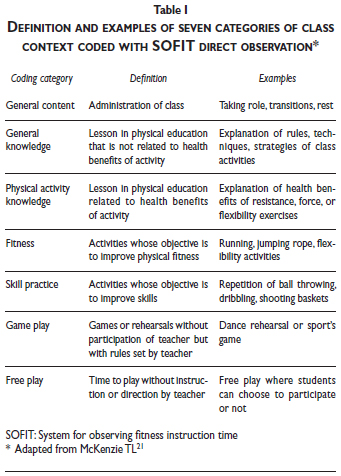
<body><![CDATA[<p><font size="2" face="Verdana, Arial, Helvetica, sans-serif"><i>Sample:</i> This investigation was a component of a large intervention trial to combat unhealthy weight in Mexican children conducted by the National Institute of Public Health, Mexico (INSP, per its abbreviation in Spanish); it was conducted in Mexico City from November 2005 to March 2006. The sample size was based on the theory of information saturation commonly used in qualitative research. The literature supports the use of generalization of results based on this theory when the sample selected is typical of the general population.<sup>19</sup> In order to select a typical sample, the Secretary of Education (SEP, per its abbreviation in Spanish) provided a list of schools which most closely reflected the majority of schools in Mexico City (morning-session schools, classified by the SEP as low socioeconomic status, beneficiary of the Federal School Breakfast Program). For logistical reasons the study was confined to the southern area of Mexico City and, for the implementation of the study, the schools were required to possess minimum facilities necessary for study execution as well as the set of sports equipment issued by SEP, and have a population of at least 300 students and at least two classrooms per grade. There were a total of 1 286 morning-session schools in Mexico City. In the southern area of the city there were four delegations with a total of 274 schools, of which, 83 met all inclusion criteria. We randomly chose 12 schools from those 83.</font></p>     <p><font size="2" face="Verdana, Arial, Helvetica, sans-serif"> We used a two-step process to select students for the physical activity measurement in the current study. Because the intervention of the larger study included 4<sup>th</sup> and 5<sup>th</sup> grade students, first, we randomly selected one 4<sup>th</sup> or 5<sup>th</sup> grade classroom from each school. Second, we randomly selected 33% of the students from each classroom using a computer-generated random-number list.</font></p>     <p><font size="2" face="Verdana, Arial, Helvetica, sans-serif"> Project staff visited each school and held informational meetings with the parents of all eligible students. Parents who were willing to have their child participate signed an informed consent. The Research, Ethics and Biosecurity Commissions of the INSP reviewed and approved the study protocol.</font></p>     <p><font size="2" face="Verdana, Arial, Helvetica, sans-serif"><i>Quantitative observation: </i>We used the SOFIT (System for Observing Fitness Instruction Time) direct observation instrument to quantify students' activity level and describe the lesson context during recess and PE. This method has been described elsewhere.<sup>20,21</sup> In summary, observers recorded intensity of physical activity and class context using a time-sampling system of 10-second intervals.<sup>21</sup> Observers coded intensity of physical activity as: 1- lying, 2- sitting, 3- standing, 4- walking and 5-very active (requiring more energy than ordinary walking). Observers coded lesson context as: general content, general knowledge, physical activity knowledge, fitness, skill practice, game play, and free play (<a href="#tab1">table I</a>). Studies have reported the validity and reliability of SOFIT to quantify the proportion of time students are engaged in moderate to vigorous physical activity (MVPA).<sup>22,23</sup></font></p>     <p><a name="tab1"></a></p>     <p>&nbsp;</p>     <p align="center"><img src="/img/revistas/spm/v51n2/a10tab01.jpg"></p>     <p>&nbsp;</p>     <p><font size="2" face="Verdana, Arial, Helvetica, sans-serif"><i>Field procedures:</i> Trained observers achieved a concordance of at least 90% with the expert before beginning data collection. Re-standardization occurred periodically throughout data collection.</font></p>     <p><font size="2" face="Verdana, Arial, Helvetica, sans-serif"> Before PE began, the observers placed themselves where they could listen to the professors' instructions and see the entire class. During recess, the observers moved around the school patio in order to observe all behavior. Observation began the moment the students entered the school patio and continued until students returned to their classrooms. Observation did not interfere with students' activities.</font></p>     ]]></body>
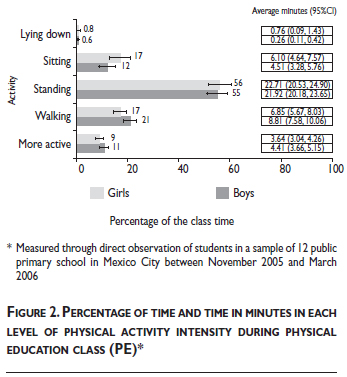
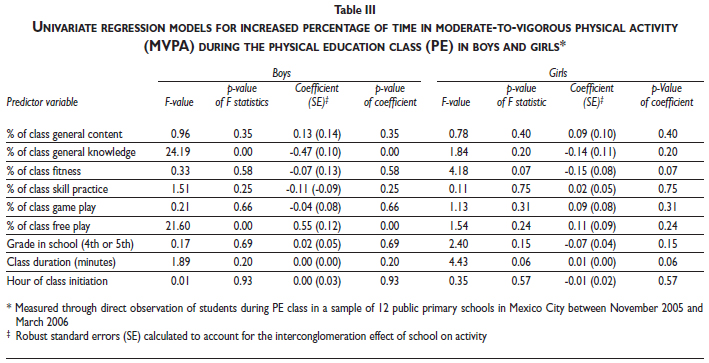
<body><![CDATA[<p><font size="2" face="Verdana, Arial, Helvetica, sans-serif"><i>Qualitative observation: </i>Observers made qualitative assessments in each school using a semi-structured guide. Observations began 30 minutes before classes started and ended when the school was empty of students. Observers registered everything about the school population and environment related to physical activity.</font></p>     <p><font size="2" face="Verdana, Arial, Helvetica, sans-serif"><i>Data analyses: </i>Using the data from SOFIT, we calculated the percentage of time dedicated to each class context and each activity intensity. Percentage of time in MVPA was the sum of percentage of time walking and being "more active."<sup>24-26 </sup>We generated descriptive statistics stratified by observation period (recess or PE). Using univariate linear regression models, we tested whether percentage of class time in each context, grade in school, class duration, and hour of class initiation were significant predictors of percentage time in MVPA. We tested for effect modification by gender on the relationship between these predictor variables and percentage of time in MVPA. An effect modification was significant at an alpha &lt; 0.10. To test for significance, we calculated robust standard errors to account for the inter-conglomeration effect of school on activity. We performed all analyses using STATA 9.0 statistical software.</font></p>     <p><font size="2" face="Verdana, Arial, Helvetica, sans-serif"> To analyze the qualitative data, we used the grounded theory approach, an inductive process where qualitative data are organized in different categories.<sup>27</sup> We defined categories <i>a priori</i> as: 1) opportunities for physical activity, 2) barriers to physical activity, 3) sports equipment, and 4) facilities. We performed the qualitative analyses using FileMaker Pro 6.0.</font></p>     <p>&nbsp;</p>     <p><font size="3" face="Verdana, Arial, Helvetica, sans-serif"><b>Results</b></font></p>     <p><font size="2" face="Verdana, Arial, Helvetica, sans-serif">The qualitative observation detected that during the 4.5-hour school day there were two opportunities for physical activity: 1) recess and 2) PE. Recess occurred daily. Barriers to physical activity during recess included time dedicated to purchasing and consuming food, no organization of physical activities, no professor participation in student activity, and the prohibition of sports equipment such as balls, jump ropes, cones, and nets even though all schools had this equipment. Additionally, patios were overcrowded and observers noted that schools either had signs prohibiting running and playing during recess or that teachers enforced a no running and playing policy because of overcrowding.</font></p>     <p><font size="2" face="Verdana, Arial, Helvetica, sans-serif"> The other opportunity for physical activity was PE. All 12 schools held PE once per week. Barriers to physical activity during PE included the frequent cancelling of PE in order to accommodate other activities, the sparse use of sports equipment and the lack of appropriate facilities. Facilities were limited to cement patios with uneven surfaces, holes, or other obstructions. Observers noted that during PE, generally one child would participate while the rest of the class observed and waited their turn.</font></p>     <p><font size="2" face="Verdana, Arial, Helvetica, sans-serif"> There were a total of 431 SOFIT quantitative observations made during 26 PE and 25 recess periods (<a href="#tab2">table II</a>). The average duration of recess was 29.6±2.1 minutes. The average duration of PE was 39.7±10.6 minutes. During recess, students participated in MVPA 39.6±24.5% of the time or 11.7±7.3 minutes (<a href="#fig1">figure 1</a>). The majority of the MVPA during recess was walking (89.4±20.2%). Students participated in MVPA 29.2±17.8% of PE or approximately 12.0±8.6 minutes. Boys spent a greater percentage of time (32.1±15.6%) in MVPA than girls (25.7±15.6%) (p &lt; 0.05). Students spent the majority of PE standing (<a href="#fig2">figure 2</a>).</font></p>     <p><a name="tab2"></a></p>     <p>&nbsp;</p>     ]]></body>
<body><![CDATA[<p align="center"><img src="/img/revistas/spm/v51n2/a10tab02.jpg"></p>     <p>&nbsp;</p>     <p><a name="fig1"></a></p>     <p>&nbsp;</p>     <p align="center"><img src="/img/revistas/spm/v51n2/a10fig01.jpg"></p>     <p>&nbsp;</p>     <p><a name="fig2"></a></p>     <p>&nbsp;</p>     <p align="center"><img src="/img/revistas/spm/v51n2/a10fig02.jpg"></p>     <p>&nbsp;</p>     ]]></body>
<body><![CDATA[<p><font size="2" face="Verdana, Arial, Helvetica, sans-serif"> The context of all recess periods was "free play." During PE the context was divided between six of the seven SOFIT categories (<a href="#fig3">figure 3</a>). The most common class contexts were "fitness" (21.7±22.8%) and "skill practice" (27.1±28.5%). Classes never participated in "fitness knowledge."</font></p>     <p><a name="fig3"></a></p>     <p>&nbsp;</p>     <p align="center"><img src="/img/revistas/spm/v51n2/a10fig03.jpg"></p>     <p>&nbsp;</p>     <p><font size="2" face="Verdana, Arial, Helvetica, sans-serif"> There was a significant effect modification by gender (<i>p</i>&lt; 0.05) on the relationship between percentage of time in MVPA and class context. We stratified the data by gender and ran the univariate regression models for boys and girls separately (<a href="/img/revistas/spm/v51n2/a10tab03.jpg">table III</a>). For boys, the percentage of class time dedicated to "general knowledge" had a significant negative relationship (</font>&#946;<font size="2" face="Verdana, Arial, Helvetica, sans-serif">= -0.47, <i>p</i>&lt; 0.01) and the percentage of time dedicated to "free play" had a significant positive relationship (</font>&#946;<font size="2" face="Verdana, Arial, Helvetica, sans-serif">= 0.55, p &lt; 0.01) with percentage of time in MVPA. For girls, the percentage of class time dedicated to "fitness" had a negative relationship (</font>&#946;<font size="2" face="Verdana, Arial, Helvetica, sans-serif">= -0.15, <i>p</i>= 0.07) and class duration had a positive relationship (</font>&#946;<font size="2" face="Verdana, Arial, Helvetica, sans-serif">= 0.01, p= 0.06) with percentage of time in MVPA.</font></p>     <p>&nbsp;</p>     <p><font size="3" face="Verdana, Arial, Helvetica, sans-serif"><b>Discussion</b></font></p>     <p><font size="2" face="Verdana, Arial, Helvetica, sans-serif">In this sample of public primary schools in Mexico City, 4<sup>th</sup> and 5<sup>th</sup> grade students participated in little physical activity during the school day. Although the SEP policy states that students should participate in PE twice a week for 50 minutes per class,<sup>28</sup> PE only occurred once a week lasting, on average, less than 40 minutes. Additionally, the schools cancelled PE frequently because of professor absence or to accommodate other school events. United States' National Association for Sport and Physical Education (NASPE) recommends 150 minutes of PE per week.<sup>29</sup> The SEP policy does not reach this international recommendation and, thus, schools cannot offer students the internationally recommended time in PE. Ideally, the policy could be changed to increase class duration and frequency so that schools could dedicate more time to PE.</font></p>     <p><font size="2" face="Verdana, Arial, Helvetica, sans-serif"> Students should spend 33-50% of PE in MVPA in order to reach the recommended 60 minutes of MVPA a day.<sup>30-33</sup> Combining this recommendation with that of 150 minutes of PE per week generates a recommendation of 50-75 minutes of MVPA during PE per week. Our sample participated in MVPA approximately 12 minutes per week or 16-24% of the recommendation. The students spent most of the class watching others and waiting their turn. In order to increase MVPA during PE, the class should aspire to all students participating at all times.</font></p>     ]]></body>
<body><![CDATA[<p><font size="2" face="Verdana, Arial, Helvetica, sans-serif"> Activity guidelines for children emphasize offering a variety of activities which will hopefully lead to lifelong healthy activity.<sup>31</sup> PE offered a number of different activities. The most common class contexts were "fitness" and "skill practice," both of which involved the physical activity of students. However, greater than 20% of class time was dedicated to "general content" during which students are not intended to be active.<sup>21</sup> Given the reduced time in PE per week, time in this context should be minimized. Gender modified the effect that context of the class had on percentage of time in MVPA. The MVPA of boys was associated with greater time in "free play." However, the class should not be entirely unstructured for two reasons: 1) girls would not reach MVPA recommendations and 2) the class would not fulfill the two important PE goals of enhancing physical, mental and emotional development, and developing an appreciation of physical activity's importance in health.<sup>29,34</sup> Gender differences should be recognized in order that both boys and girls increase activity during PE.</font></p>     <p><font size="2" face="Verdana, Arial, Helvetica, sans-serif"> The context of "fitness knowledge" was not utilized by professors. One goal of a quality PE program is to teach students the value of an active lifestyle.<sup>29,35</sup> Increasing time in "fitness knowledge" could facilitate reaching this goal. In addition, during recess there was no organization of physical activity; however, both boys and girls participated in more MVPA during recess than during PE, highlighting the need to increase activity during PE. Nonetheless, the majority of the activity during recess was walking around the school patio visiting food vendors. The overcrowding of the school patio, the policies against running, and the lack of equipment were barriers to participation in activity during recess. A number of international agencies recommend that schools provide students with at least one 20-minute discretionary recess period per day when students can participate in physical activity.<sup>36-39</sup> Activity during recess can make a significant contribution to a student's total time in MVPA<sup>39</sup> and, therefore, should be offered to students daily.</font></p>     <p><font size="2" face="Verdana, Arial, Helvetica, sans-serif"> This investigation was subject to a number of limitations. First, the intensity of the qualitative and quantitative methods used limited the number of schools we could observe. However, we selected typical schools and collected information until reaching information saturation and, therefore, our results should be generalizable to other schools in southern Mexico City with similar characteristics.<sup>19</sup> Qualitative interviews with SEP administrators indicated that many of the opportunities and barriers for physical activity noted in this investigation were pervasive in the Mexico City school system. Second, the presence of observers in the schools may have affected the behaviour of students and/or PE teachers. This effect was likely very small, however, because study staff were in the schools every day for several months before conducting the observations. The students and teachers were accustomed to the staff presence and were likely not affected. Finally, this investigation only measured physical activity during specific time periods in school. We cannot speculate how other factors may influence the physical activity of students such as the physical activity in which the students participate outside of school or the home environment and parental attitudes toward physical activity.</font></p>     <p><font size="2" face="Verdana, Arial, Helvetica, sans-serif"> In our sample of public primary schools in Mexico City, students are not reaching national or international recommendations regarding time in PE or time in MVPA during the school day. In order to increase the physical activity of students, schools should provide a daily period dedicated solely to physical activity and should increase the quantity and quality of PE. The school setting offers a great opportunity to influence the lives of students and to improve their health through physical activity during recess and PE. The public primary schools in Mexico City could take greater advantage of this opportunity in order to fight the emerging epidemic of unhealthy weight in Mexican children.</font></p>     <p>&nbsp;</p>     <p><font size="3" face="Verdana, Arial, Helvetica, sans-serif"><b>Acknowledgements</b></font></p>     <p><font size="2" face="Verdana, Arial, Helvetica, sans-serif">The original study was funded by the Healthy Lifestyles, Healthy People (HLHP) Project of the Pan American Health Organization (PAHO), the International Life Sciences Institute (ILSI) and the Centers for Disease Control and Prevention  (CDC) of the United States. The opinions expressed herein are those of the authors and do not necessarily represent the views of PAHO, ILSI or CDC. Additional funds for different stages of the study were provided by two Mexican Institutions: the National Council for Science and Technology (CONACyT) and the Ministry of Health. The Principal Investigator was J. Rivera.</font></p>     <p><font size="2" face="Verdana, Arial, Helvetica, sans-serif"> The authors would like to acknowledge the contri-bution of Deborah Salvo Dominguez and Eric A Mon-terrubio from the INSP, and Karen Kovacs, Guillermo Ayala &Aacute;lvarez, and Elodia Silva of SEP, Mexico City.</font></p>     <p>&nbsp;</p>     <p><font size="3" face="Verdana, Arial, Helvetica, sans-serif"><b>References</b></font></p>     ]]></body>
<body><![CDATA[<p><font size="2" face="Verdana, Arial, Helvetica, sans-serif">1. Olaiz-Fern&aacute;ndez G, Rivera-Dommarco J, Shamah-Levy T, Rojas R, Villalpando-Hern&aacute;ndez S, Hern&aacute;ndez-Avila M, <i>et al</i>. Encuesta nacional de salud y nutrici&oacute;n 2006 2nd ed. Cuernavaca, Mexico: INSP, 2006.</font></p>     <!-- ref --><p><font size="2" face="Verdana, Arial, Helvetica, sans-serif">2. Cole TJ, Bellizzi MC, Flegal KM, Dietz WH. Establishing a standard definition for child overweight and obesity worldwide: international survey. BMJ 2000;320:1240-1243.</font>&nbsp;&nbsp;&nbsp;&nbsp;&nbsp;&nbsp;&nbsp;&nbsp;[&#160;<a href="javascript:void(0);" onclick="javascript: window.open('/scielo.php?script=sci_nlinks&ref=9273156&pid=S0036-3634200900020001000002&lng=','','width=640,height=500,resizable=yes,scrollbars=1,menubar=yes,');">Links</a>&#160;]<!-- end-ref --><!-- ref --><p><font size="2" face="Verdana, Arial, Helvetica, sans-serif">3. Rivera JA, Sepulveda-Amor J. Conclusions from the Mexican National Nutrition Survey 1999: translating results into nutrition policy. Salud Publica Mex 2003;45(suppl4):S565-S575.</font>&nbsp;&nbsp;&nbsp;&nbsp;&nbsp;&nbsp;&nbsp;&nbsp;[&#160;<a href="javascript:void(0);" onclick="javascript: window.open('/scielo.php?script=sci_nlinks&ref=9273157&pid=S0036-3634200900020001000003&lng=','','width=640,height=500,resizable=yes,scrollbars=1,menubar=yes,');">Links</a>&#160;]<!-- end-ref --><!-- ref --><p><font size="2" face="Verdana, Arial, Helvetica, sans-serif">4. Spielgelman BM, Flier JS. Obesity and the regulation of energy balance. Cell 2001;104:531-543.</font>&nbsp;&nbsp;&nbsp;&nbsp;&nbsp;&nbsp;&nbsp;&nbsp;[&#160;<a href="javascript:void(0);" onclick="javascript: window.open('/scielo.php?script=sci_nlinks&ref=9273158&pid=S0036-3634200900020001000004&lng=','','width=640,height=500,resizable=yes,scrollbars=1,menubar=yes,');">Links</a>&#160;]<!-- end-ref --><!-- ref --><p><font size="2" face="Verdana, Arial, Helvetica, sans-serif">5. Roberts S. The role of physical activity in the prevention and treatment of childhood obesity. Pediatr Nurs 2000;26:33-37.</font>&nbsp;&nbsp;&nbsp;&nbsp;&nbsp;&nbsp;&nbsp;&nbsp;[&#160;<a href="javascript:void(0);" onclick="javascript: window.open('/scielo.php?script=sci_nlinks&ref=9273159&pid=S0036-3634200900020001000005&lng=','','width=640,height=500,resizable=yes,scrollbars=1,menubar=yes,');">Links</a>&#160;]<!-- end-ref --><!-- ref --><p><font size="2" face="Verdana, Arial, Helvetica, sans-serif">6. Laing EM, Massoni JA, Nickols-Richardson SM, Modlesky CM, O'Connor PJ, Lewis RD. A prospective study of bone mass and body composition in female adolescent gymnasts. J Pediatr 2002;141:211-216.</font>&nbsp;&nbsp;&nbsp;&nbsp;&nbsp;&nbsp;&nbsp;&nbsp;[&#160;<a href="javascript:void(0);" onclick="javascript: window.open('/scielo.php?script=sci_nlinks&ref=9273160&pid=S0036-3634200900020001000006&lng=','','width=640,height=500,resizable=yes,scrollbars=1,menubar=yes,');">Links</a>&#160;]<!-- end-ref --><!-- ref --><p><font size="2" face="Verdana, Arial, Helvetica, sans-serif">7. Schmitz KH, Jacobs DR , Hong CP, Steinberger J, Moran A, Sinaiko AR. Association of physical activity with insulin sensitivity in children. Int J Obes Relat Metab Disord 2002;26:1310-1316.</font>&nbsp;&nbsp;&nbsp;&nbsp;&nbsp;&nbsp;&nbsp;&nbsp;[&#160;<a href="javascript:void(0);" onclick="javascript: window.open('/scielo.php?script=sci_nlinks&ref=9273161&pid=S0036-3634200900020001000007&lng=','','width=640,height=500,resizable=yes,scrollbars=1,menubar=yes,');">Links</a>&#160;]<!-- end-ref --><!-- ref --><p><font size="2" face="Verdana, Arial, Helvetica, sans-serif">8.  Haugland S, Wold B, Torsheim T. Relieving the pressure? The role of physical activity in the relationship between school-related stress and adolescent health complaints. Res Q Exerc Sport 2003;74:127-135.</font>&nbsp;&nbsp;&nbsp;&nbsp;&nbsp;&nbsp;&nbsp;&nbsp;[&#160;<a href="javascript:void(0);" onclick="javascript: window.open('/scielo.php?script=sci_nlinks&ref=9273162&pid=S0036-3634200900020001000008&lng=','','width=640,height=500,resizable=yes,scrollbars=1,menubar=yes,');">Links</a>&#160;]<!-- end-ref --><!-- ref --><p><font size="2" face="Verdana, Arial, Helvetica, sans-serif">9. Twisk JW, Kemper HC, van Mechelen W. Tracking of activity and fitness and the relationship with cardiovascular disease risk factors. Med Sci Sports Exerc 2000;32:1455-1461.</font>&nbsp;&nbsp;&nbsp;&nbsp;&nbsp;&nbsp;&nbsp;&nbsp;[&#160;<a href="javascript:void(0);" onclick="javascript: window.open('/scielo.php?script=sci_nlinks&ref=9273163&pid=S0036-3634200900020001000009&lng=','','width=640,height=500,resizable=yes,scrollbars=1,menubar=yes,');">Links</a>&#160;]<!-- end-ref --><!-- ref --><p><font size="2" face="Verdana, Arial, Helvetica, sans-serif">10. Trudeau F, Shephard RJ. Contribution of school programmes to physical activity levels and attitudes in children and adults. Sports Med 2005;35:89-105.</font>&nbsp;&nbsp;&nbsp;&nbsp;&nbsp;&nbsp;&nbsp;&nbsp;[&#160;<a href="javascript:void(0);" onclick="javascript: window.open('/scielo.php?script=sci_nlinks&ref=9273164&pid=S0036-3634200900020001000010&lng=','','width=640,height=500,resizable=yes,scrollbars=1,menubar=yes,');">Links</a>&#160;]<!-- end-ref --><!-- ref --><p><font size="2" face="Verdana, Arial, Helvetica, sans-serif">11. American Academy of Pediatrics Committee on Sports Medicine and Fitness and Committee on School Health. Physical fitness and activity in schools. Pediatrics 2000;105:1156-1157.</font>&nbsp;&nbsp;&nbsp;&nbsp;&nbsp;&nbsp;&nbsp;&nbsp;[&#160;<a href="javascript:void(0);" onclick="javascript: window.open('/scielo.php?script=sci_nlinks&ref=9273165&pid=S0036-3634200900020001000011&lng=','','width=640,height=500,resizable=yes,scrollbars=1,menubar=yes,');">Links</a>&#160;]<!-- end-ref --><!-- ref --><p><font size="2" face="Verdana, Arial, Helvetica, sans-serif">12. Simons-Morton BG, Taylor WC, Snider SA, Huang IW, Fulton JE. Observed levels of elementary and middle school children's physical activity during physical education classes. Prev Med 1994;23:437-441.</font>&nbsp;&nbsp;&nbsp;&nbsp;&nbsp;&nbsp;&nbsp;&nbsp;[&#160;<a href="javascript:void(0);" onclick="javascript: window.open('/scielo.php?script=sci_nlinks&ref=9273166&pid=S0036-3634200900020001000012&lng=','','width=640,height=500,resizable=yes,scrollbars=1,menubar=yes,');">Links</a>&#160;]<!-- end-ref --><!-- ref --><p><font size="2" face="Verdana, Arial, Helvetica, sans-serif">13. McKenzie TL, Nader PR, Strikmiller PK, Yang M, Stone EJ, Perry CL, <i>et al</i>. School physical education: effect of the child and adolescent trial for cardiovascular health. Prev Med 1996;25:423-431.</font>&nbsp;&nbsp;&nbsp;&nbsp;&nbsp;&nbsp;&nbsp;&nbsp;[&#160;<a href="javascript:void(0);" onclick="javascript: window.open('/scielo.php?script=sci_nlinks&ref=9273167&pid=S0036-3634200900020001000013&lng=','','width=640,height=500,resizable=yes,scrollbars=1,menubar=yes,');">Links</a>&#160;]<!-- end-ref --><!-- ref --><p><font size="2" face="Verdana, Arial, Helvetica, sans-serif">14. Heath EM, Coleman KJ. Evaluation of the institutionalization of the coordinated approach to child health (CATCH) in a US/Mexico border community. Health Educ Behav 2002;29:444-460.</font>&nbsp;&nbsp;&nbsp;&nbsp;&nbsp;&nbsp;&nbsp;&nbsp;[&#160;<a href="javascript:void(0);" onclick="javascript: window.open('/scielo.php?script=sci_nlinks&ref=9273168&pid=S0036-3634200900020001000014&lng=','','width=640,height=500,resizable=yes,scrollbars=1,menubar=yes,');">Links</a>&#160;]<!-- end-ref --><!-- ref --><p><font size="2" face="Verdana, Arial, Helvetica, sans-serif">15. Doak CM, Visscher TL, Renders CM, Seidell JC. The prevention of overweight and obesity in children and adolescents: a review of interventions and programmes. Obes Rev 2006;7:111-136.</font>&nbsp;&nbsp;&nbsp;&nbsp;&nbsp;&nbsp;&nbsp;&nbsp;[&#160;<a href="javascript:void(0);" onclick="javascript: window.open('/scielo.php?script=sci_nlinks&ref=9273169&pid=S0036-3634200900020001000015&lng=','','width=640,height=500,resizable=yes,scrollbars=1,menubar=yes,');">Links</a>&#160;]<!-- end-ref --><!-- ref --><p><font size="2" face="Verdana, Arial, Helvetica, sans-serif">16. Flodmark CE, Marcus C, Britton M. Interventions to prevent obesity in children and adolescents: a systematic literature review. Int J Obes (Lond) 2006;30:579-589.</font>&nbsp;&nbsp;&nbsp;&nbsp;&nbsp;&nbsp;&nbsp;&nbsp;[&#160;<a href="javascript:void(0);" onclick="javascript: window.open('/scielo.php?script=sci_nlinks&ref=9273170&pid=S0036-3634200900020001000016&lng=','','width=640,height=500,resizable=yes,scrollbars=1,menubar=yes,');">Links</a>&#160;]<!-- end-ref --><!-- ref --><p><font size="2" face="Verdana, Arial, Helvetica, sans-serif">17. Kain J, Uauy R, Albala C, Vio F, Cerda R, Leyton B. School-based obesity prevention in Chilean primary school children: methodology and evaluation of a controlled study. Int J Obes Relat Metab Disord 2004;28:483-493.</font>&nbsp;&nbsp;&nbsp;&nbsp;&nbsp;&nbsp;&nbsp;&nbsp;[&#160;<a href="javascript:void(0);" onclick="javascript: window.open('/scielo.php?script=sci_nlinks&ref=9273171&pid=S0036-3634200900020001000017&lng=','','width=640,height=500,resizable=yes,scrollbars=1,menubar=yes,');">Links</a>&#160;]<!-- end-ref --><!-- ref --><p><font size="2" face="Verdana, Arial, Helvetica, sans-serif">18. Newes-Adeyi G, Helitzer DL, Caulfield LE, Bronner Y. Theory and practice: applying the ecological model to formative research for a WIC training program in New York State. Health Educ Res 2000;15:283-291.</font>&nbsp;&nbsp;&nbsp;&nbsp;&nbsp;&nbsp;&nbsp;&nbsp;[&#160;<a href="javascript:void(0);" onclick="javascript: window.open('/scielo.php?script=sci_nlinks&ref=9273172&pid=S0036-3634200900020001000018&lng=','','width=640,height=500,resizable=yes,scrollbars=1,menubar=yes,');">Links</a>&#160;]<!-- end-ref --><!-- ref --><p><font size="2" face="Verdana, Arial, Helvetica, sans-serif">19. Pope C, Ziebland S, Mays N. Qualitative research in health care: Analyzing qualitative data. BMJ 2000;320:114-116.</font>&nbsp;&nbsp;&nbsp;&nbsp;&nbsp;&nbsp;&nbsp;&nbsp;[&#160;<a href="javascript:void(0);" onclick="javascript: window.open('/scielo.php?script=sci_nlinks&ref=9273173&pid=S0036-3634200900020001000019&lng=','','width=640,height=500,resizable=yes,scrollbars=1,menubar=yes,');">Links</a>&#160;]<!-- end-ref --><!-- ref --><p><font size="2" face="Verdana, Arial, Helvetica, sans-serif">20.  McKenzie TL, Sallis JF, Nader PR. SOFIT: System for observing fitness instruction time. Journal of Teaching in Physical Education 1991;11:195-205.</font>&nbsp;&nbsp;&nbsp;&nbsp;&nbsp;&nbsp;&nbsp;&nbsp;[&#160;<a href="javascript:void(0);" onclick="javascript: window.open('/scielo.php?script=sci_nlinks&ref=9273174&pid=S0036-3634200900020001000020&lng=','','width=640,height=500,resizable=yes,scrollbars=1,menubar=yes,');">Links</a>&#160;]<!-- end-ref --><!-- ref --><p><font size="2" face="Verdana, Arial, Helvetica, sans-serif">21. McKenzie TL. SOFIT: System for Observing Fitness Instruction Time Overview and Training Manual. San Diego CA: San Diego State University, 2002.</font>&nbsp;&nbsp;&nbsp;&nbsp;&nbsp;&nbsp;&nbsp;&nbsp;[&#160;<a href="javascript:void(0);" onclick="javascript: window.open('/scielo.php?script=sci_nlinks&ref=9273175&pid=S0036-3634200900020001000021&lng=','','width=640,height=500,resizable=yes,scrollbars=1,menubar=yes,');">Links</a>&#160;]<!-- end-ref --><!-- ref --><p><font size="2" face="Verdana, Arial, Helvetica, sans-serif">22. Rowe PJ, Schuldheisz JM, van der Mars H. Measuring physical activity in physical education: validation of the SOFIT direct observation instrument for use with first to eighth grade students. Pediatr Exerc Sci 1997;9:136-149.</font>&nbsp;&nbsp;&nbsp;&nbsp;&nbsp;&nbsp;&nbsp;&nbsp;[&#160;<a href="javascript:void(0);" onclick="javascript: window.open('/scielo.php?script=sci_nlinks&ref=9273176&pid=S0036-3634200900020001000022&lng=','','width=640,height=500,resizable=yes,scrollbars=1,menubar=yes,');">Links</a>&#160;]<!-- end-ref --><p><font size="2" face="Verdana, Arial, Helvetica, sans-serif">23. Pope RP, Coleman KJ, Gonzalez BF, Heath EM. Validating SOFIT during physical education in a predominantly Hispanic community. Med Sci Sports Exerc 2000;Supp32(5):328.</font></p>     <!-- ref --><p><font size="2" face="Verdana, Arial, Helvetica, sans-serif">24. U.S. Department of Health and Human Services. Physical activity and health: a report from the Surgeon General. Atlanta, GA: US Department of Health and Human Services, Centers for Disease Control and Prevention, National Center for Chronic Disease Prevention and Health Promotion, 1996.</font>&nbsp;&nbsp;&nbsp;&nbsp;&nbsp;&nbsp;&nbsp;&nbsp;[&#160;<a href="javascript:void(0);" onclick="javascript: window.open('/scielo.php?script=sci_nlinks&ref=9273178&pid=S0036-3634200900020001000024&lng=','','width=640,height=500,resizable=yes,scrollbars=1,menubar=yes,');">Links</a>&#160;]<!-- end-ref --><!-- ref --><p><font size="2" face="Verdana, Arial, Helvetica, sans-serif">25. Ainsworth BE, Haskell WL, Whitt MC, Irwin ML, Swartz AM, Strath SJ, <i>et al</i>. Compendium of physical activities: an update of activity codes and MET intensities. Med Sci Sports Exerc 2000;Supp 32(9):498-516.</font>&nbsp;&nbsp;&nbsp;&nbsp;&nbsp;&nbsp;&nbsp;&nbsp;[&#160;<a href="javascript:void(0);" onclick="javascript: window.open('/scielo.php?script=sci_nlinks&ref=9273179&pid=S0036-3634200900020001000025&lng=','','width=640,height=500,resizable=yes,scrollbars=1,menubar=yes,');">Links</a>&#160;]<!-- end-ref --><!-- ref --><p><font size="2" face="Verdana, Arial, Helvetica, sans-serif">26. Caspersen CJ, Powel KEl, Christensen GM. Physical activity, exercise, and physical fitness: definitions and distinctions for health-related research. Public Health Rep 1985;100:126-130.</font>&nbsp;&nbsp;&nbsp;&nbsp;&nbsp;&nbsp;&nbsp;&nbsp;[&#160;<a href="javascript:void(0);" onclick="javascript: window.open('/scielo.php?script=sci_nlinks&ref=9273180&pid=S0036-3634200900020001000026&lng=','','width=640,height=500,resizable=yes,scrollbars=1,menubar=yes,');">Links</a>&#160;]<!-- end-ref --><p><font size="2" face="Verdana, Arial, Helvetica, sans-serif">27. Glaser B, Strauss A. The discovery of grounded theory: strategies for qualitative research. 1st ed. London, England: Weidenfeld and Nicolson, 1968.</font></p>     <!-- ref --><p><font size="2" face="Verdana, Arial, Helvetica, sans-serif">28. Administraci&oacute;n Federal de Servicios Educativos en el Distrito Federal Direcci&oacute;n General de Educaci&oacute;n F&iacute;sica. Direcci&oacute;n General de Planeaci&oacute;n, Programaci&oacute;n y Evaluaci&oacute;n Educativa: Lineamientos para la Organizaci&oacute;n y Funcionamiento de los Servicios de Educaci&oacute;n F&iacute;sica en el Distrito Federal 2006-2007. Mexico City: 2006.</font>&nbsp;&nbsp;&nbsp;&nbsp;&nbsp;&nbsp;&nbsp;&nbsp;[&#160;<a href="javascript:void(0);" onclick="javascript: window.open('/scielo.php?script=sci_nlinks&ref=9273182&pid=S0036-3634200900020001000028&lng=','','width=640,height=500,resizable=yes,scrollbars=1,menubar=yes,');">Links</a>&#160;]<!-- end-ref --><!-- ref --><p><font size="2" face="Verdana, Arial, Helvetica, sans-serif">29. National Association for Sport and Physical Education. Moving into the future: national standards for physical education. 2nd ed. Reston VA: National Association for Sport and Physical Education. 2004.</font>&nbsp;&nbsp;&nbsp;&nbsp;&nbsp;&nbsp;&nbsp;&nbsp;[&#160;<a href="javascript:void(0);" onclick="javascript: window.open('/scielo.php?script=sci_nlinks&ref=9273183&pid=S0036-3634200900020001000029&lng=','','width=640,height=500,resizable=yes,scrollbars=1,menubar=yes,');">Links</a>&#160;]<!-- end-ref --><!-- ref --><p><font size="2" face="Verdana, Arial, Helvetica, sans-serif">30. Institute of Medicine. Dietary reference intakes for energy, carbohydrate, fiber, fat, fatty acids, cholesterol, protein, and amino acids. Washington DC: National Academics Press, 2002.</font>&nbsp;&nbsp;&nbsp;&nbsp;&nbsp;&nbsp;&nbsp;&nbsp;[&#160;<a href="javascript:void(0);" onclick="javascript: window.open('/scielo.php?script=sci_nlinks&ref=9273184&pid=S0036-3634200900020001000030&lng=','','width=640,height=500,resizable=yes,scrollbars=1,menubar=yes,');">Links</a>&#160;]<!-- end-ref --><!-- ref --><p><font size="2" face="Verdana, Arial, Helvetica, sans-serif">31. National Association for Sport and Physical Education. Physical activity for children: a statement of guidelines, 2nd ed. Reston, VA: National Association for Sport and Physical Education. 2004.</font>&nbsp;&nbsp;&nbsp;&nbsp;&nbsp;&nbsp;&nbsp;&nbsp;[&#160;<a href="javascript:void(0);" onclick="javascript: window.open('/scielo.php?script=sci_nlinks&ref=9273185&pid=S0036-3634200900020001000031&lng=','','width=640,height=500,resizable=yes,scrollbars=1,menubar=yes,');">Links</a>&#160;]<!-- end-ref --><!-- ref --><p><font size="2" face="Verdana, Arial, Helvetica, sans-serif">32. United States Department of Health and Human Services &amp; United States Department of Agriculture. The dietary guidelines for Americans, 2005 6th ed. Washington DC: United States Department of Health and Human Services &amp; United States Department of Agriculture. 2005.</font>&nbsp;&nbsp;&nbsp;&nbsp;&nbsp;&nbsp;&nbsp;&nbsp;[&#160;<a href="javascript:void(0);" onclick="javascript: window.open('/scielo.php?script=sci_nlinks&ref=9273186&pid=S0036-3634200900020001000032&lng=','','width=640,height=500,resizable=yes,scrollbars=1,menubar=yes,');">Links</a>&#160;]<!-- end-ref --><!-- ref --><p><font size="2" face="Verdana, Arial, Helvetica, sans-serif">33. Scruggs PW, Beveridge SK, Eisenman PA, Watson DL, Shultz BB, Ransdell LB. Quantifying physical activity via pedometry in elementary physical education. Med Sci Sports Exerc 2003;35:1065-1071.</font>&nbsp;&nbsp;&nbsp;&nbsp;&nbsp;&nbsp;&nbsp;&nbsp;[&#160;<a href="javascript:void(0);" onclick="javascript: window.open('/scielo.php?script=sci_nlinks&ref=9273187&pid=S0036-3634200900020001000033&lng=','','width=640,height=500,resizable=yes,scrollbars=1,menubar=yes,');">Links</a>&#160;]<!-- end-ref --><!-- ref --><p><font size="2" face="Verdana, Arial, Helvetica, sans-serif">34. Direcci&oacute;n General de Educaci&oacute;n F&iacute;sica. Subsecretar&iacute;a de Educaci&oacute;n B&aacute;sica. Secretaria de Educaci&oacute;n P&uacute;blica. Programa de Educaci&oacute;n F&iacute;sica. 1st ed. ISBN 968-29-6344-3:1994.</font>&nbsp;&nbsp;&nbsp;&nbsp;&nbsp;&nbsp;&nbsp;&nbsp;[&#160;<a href="javascript:void(0);" onclick="javascript: window.open('/scielo.php?script=sci_nlinks&ref=9273188&pid=S0036-3634200900020001000034&lng=','','width=640,height=500,resizable=yes,scrollbars=1,menubar=yes,');">Links</a>&#160;]<!-- end-ref --><!-- ref --><p><font size="2" face="Verdana, Arial, Helvetica, sans-serif">35. Council of Physical Education for Children. Physical education is critical to a complete education: a position paper from the National Association for Sport and Physical Education. Reston, VA: Council of Physical Education for Children. 2002.</font>&nbsp;&nbsp;&nbsp;&nbsp;&nbsp;&nbsp;&nbsp;&nbsp;[&#160;<a href="javascript:void(0);" onclick="javascript: window.open('/scielo.php?script=sci_nlinks&ref=9273189&pid=S0036-3634200900020001000035&lng=','','width=640,height=500,resizable=yes,scrollbars=1,menubar=yes,');">Links</a>&#160;]<!-- end-ref --><!-- ref --><p><font size="2" face="Verdana, Arial, Helvetica, sans-serif">36. Centres for Disease Control and Prevention. Guidelines for school and community programs to promote lifelong physical activity among young people. MMWR 1997;46:12.</font>&nbsp;&nbsp;&nbsp;&nbsp;&nbsp;&nbsp;&nbsp;&nbsp;[&#160;<a href="javascript:void(0);" onclick="javascript: window.open('/scielo.php?script=sci_nlinks&ref=9273190&pid=S0036-3634200900020001000036&lng=','','width=640,height=500,resizable=yes,scrollbars=1,menubar=yes,');">Links</a>&#160;]<!-- end-ref --><!-- ref --><p><font size="2" face="Verdana, Arial, Helvetica, sans-serif">37. United States Department of Health and Human Resources &amp; United States Department of Education. Promoting better health for young people through physical activity and sport. Washington DC: United States Department of Health and Human Resources &amp; United States Department of Education. 2000.</font>&nbsp;&nbsp;&nbsp;&nbsp;&nbsp;&nbsp;&nbsp;&nbsp;[&#160;<a href="javascript:void(0);" onclick="javascript: window.open('/scielo.php?script=sci_nlinks&ref=9273191&pid=S0036-3634200900020001000037&lng=','','width=640,height=500,resizable=yes,scrollbars=1,menubar=yes,');">Links</a>&#160;]<!-- end-ref --><!-- ref --><p><font size="2" face="Verdana, Arial, Helvetica, sans-serif">38. National Association for the Education of Young Children: The value of school recess and outdoor play. &#91;Consulted Feb 20, 2007&#93;. Available at: <a href="http://www.naeyc.org/ece/1998/08.asp" target="_blank">http://www.naeyc.org/ece/1998/08.asp</a></font>&nbsp;&nbsp;&nbsp;&nbsp;&nbsp;&nbsp;&nbsp;&nbsp;[&#160;<a href="javascript:void(0);" onclick="javascript: window.open('/scielo.php?script=sci_nlinks&ref=9273192&pid=S0036-3634200900020001000038&lng=','','width=640,height=500,resizable=yes,scrollbars=1,menubar=yes,');">Links</a>&#160;]<!-- end-ref --><!-- ref --><p><font size="2" face="Verdana, Arial, Helvetica, sans-serif">39. Council of Physical Education for Children. Recess for elementary school students: a position paper from the National Association for Sport and Physical Education. Reston, VA: Council of Physical Education for Children. 2006.</font>&nbsp;&nbsp;&nbsp;&nbsp;&nbsp;&nbsp;&nbsp;&nbsp;[&#160;<a href="javascript:void(0);" onclick="javascript: window.open('/scielo.php?script=sci_nlinks&ref=9273193&pid=S0036-3634200900020001000039&lng=','','width=640,height=500,resizable=yes,scrollbars=1,menubar=yes,');">Links</a>&#160;]<!-- end-ref --><p>&nbsp;</p>     ]]></body>
<body><![CDATA[<p>&nbsp;</p>     <p><font size="2" face="Verdana, Arial, Helvetica, sans-serif">Received on: June 17, 2008     <br> Accepted on: January 16, 2009</font></p>     <p>&nbsp;</p>     <p>&nbsp;</p>     <p><font size="2" face="Verdana, Arial, Helvetica, sans-serif">Address reprint requests to:    <br> Anabelle Bonvecchio    <br> Av. Universidad 655    <br> col. Santa Mar&iacute;a Ahuacatitl&aacute;n. 62508     <br> Cuernavaca, Mor. M&eacute;xico    ]]></body>
<body><![CDATA[<br> E-mail: <a href="mailto:bonvecchio@correo.insp.mx">bonvecchio@correo.insp.mx</a></font></p>      ]]></body><back>
<ref-list>
<ref id="B1">
<label>1</label><nlm-citation citation-type="book">
<person-group person-group-type="author">
<name>
<surname><![CDATA[Olaiz-Fernández]]></surname>
<given-names><![CDATA[G]]></given-names>
</name>
<name>
<surname><![CDATA[Rivera-Dommarco]]></surname>
<given-names><![CDATA[J]]></given-names>
</name>
<name>
<surname><![CDATA[Shamah-Levy]]></surname>
<given-names><![CDATA[T]]></given-names>
</name>
<name>
<surname><![CDATA[Rojas]]></surname>
<given-names><![CDATA[R]]></given-names>
</name>
<name>
<surname><![CDATA[Villalpando-Hernández]]></surname>
<given-names><![CDATA[S]]></given-names>
</name>
<name>
<surname><![CDATA[Hernández-Avila]]></surname>
<given-names><![CDATA[M]]></given-names>
</name>
</person-group>
<source><![CDATA[Encuesta nacional de salud y nutrición 2006]]></source>
<year>2006</year>
<edition>2</edition>
<publisher-loc><![CDATA[Mexico ]]></publisher-loc>
<publisher-name><![CDATA[INSP]]></publisher-name>
</nlm-citation>
</ref>
<ref id="B2">
<label>2</label><nlm-citation citation-type="journal">
<person-group person-group-type="author">
<name>
<surname><![CDATA[Cole]]></surname>
<given-names><![CDATA[TJ]]></given-names>
</name>
<name>
<surname><![CDATA[Bellizzi]]></surname>
<given-names><![CDATA[MC]]></given-names>
</name>
<name>
<surname><![CDATA[Flegal]]></surname>
<given-names><![CDATA[KM]]></given-names>
</name>
<name>
<surname><![CDATA[Dietz]]></surname>
<given-names><![CDATA[WH]]></given-names>
</name>
</person-group>
<article-title xml:lang="en"><![CDATA[Establishing a standard definition for child overweight and obesity worldwide: international survey]]></article-title>
<source><![CDATA[BMJ]]></source>
<year>2000</year>
<volume>320</volume>
<page-range>1240-1243</page-range></nlm-citation>
</ref>
<ref id="B3">
<label>3</label><nlm-citation citation-type="journal">
<person-group person-group-type="author">
<name>
<surname><![CDATA[Rivera]]></surname>
<given-names><![CDATA[JA]]></given-names>
</name>
<name>
<surname><![CDATA[Sepulveda-Amor]]></surname>
<given-names><![CDATA[J]]></given-names>
</name>
</person-group>
<article-title xml:lang="en"><![CDATA[Conclusions from the Mexican National Nutrition Survey 1999: translating results into nutrition policy]]></article-title>
<source><![CDATA[Salud Publica Mex]]></source>
<year>2003</year>
<volume>45</volume>
<numero>^s4</numero>
<issue>^s4</issue>
<supplement>4</supplement>
<page-range>S565-S575</page-range></nlm-citation>
</ref>
<ref id="B4">
<label>4</label><nlm-citation citation-type="journal">
<person-group person-group-type="author">
<name>
<surname><![CDATA[Spielgelman]]></surname>
<given-names><![CDATA[BM]]></given-names>
</name>
<name>
<surname><![CDATA[Flier]]></surname>
<given-names><![CDATA[JS]]></given-names>
</name>
</person-group>
<article-title xml:lang="en"><![CDATA[Obesity and the regulation of energy balance]]></article-title>
<source><![CDATA[Cell]]></source>
<year>2001</year>
<volume>104</volume>
<page-range>531-543</page-range></nlm-citation>
</ref>
<ref id="B5">
<label>5</label><nlm-citation citation-type="journal">
<person-group person-group-type="author">
<name>
<surname><![CDATA[Roberts]]></surname>
<given-names><![CDATA[S]]></given-names>
</name>
</person-group>
<article-title xml:lang="en"><![CDATA[The role of physical activity in the prevention and treatment of childhood obesity]]></article-title>
<source><![CDATA[Pediatr Nurs]]></source>
<year>2000</year>
<volume>26</volume>
<page-range>33-37</page-range></nlm-citation>
</ref>
<ref id="B6">
<label>6</label><nlm-citation citation-type="journal">
<person-group person-group-type="author">
<name>
<surname><![CDATA[Laing]]></surname>
<given-names><![CDATA[EM]]></given-names>
</name>
<name>
<surname><![CDATA[Massoni]]></surname>
<given-names><![CDATA[JA]]></given-names>
</name>
<name>
<surname><![CDATA[Nickols-Richardson]]></surname>
<given-names><![CDATA[SM]]></given-names>
</name>
<name>
<surname><![CDATA[Modlesky]]></surname>
<given-names><![CDATA[CM]]></given-names>
</name>
<name>
<surname><![CDATA[O'Connor PJ]]></surname>
</name>
<name>
<surname><![CDATA[Lewis]]></surname>
<given-names><![CDATA[RD]]></given-names>
</name>
</person-group>
<article-title xml:lang="en"><![CDATA[A prospective study of bone mass and body composition in female adolescent gymnasts]]></article-title>
<source><![CDATA[J Pediatr]]></source>
<year>2002</year>
<volume>141</volume>
<page-range>211-216</page-range></nlm-citation>
</ref>
<ref id="B7">
<label>7</label><nlm-citation citation-type="journal">
<person-group person-group-type="author">
<name>
<surname><![CDATA[Schmitz]]></surname>
<given-names><![CDATA[KH]]></given-names>
</name>
<name>
<surname><![CDATA[Jacobs]]></surname>
<given-names><![CDATA[DR]]></given-names>
</name>
<name>
<surname><![CDATA[Hong]]></surname>
<given-names><![CDATA[CP]]></given-names>
</name>
<name>
<surname><![CDATA[Steinberger]]></surname>
<given-names><![CDATA[J]]></given-names>
</name>
<name>
<surname><![CDATA[Moran]]></surname>
<given-names><![CDATA[A]]></given-names>
</name>
<name>
<surname><![CDATA[Sinaiko]]></surname>
<given-names><![CDATA[AR]]></given-names>
</name>
</person-group>
<article-title xml:lang="en"><![CDATA[Association of physical activity with insulin sensitivity in children]]></article-title>
<source><![CDATA[Int J Obes Relat Metab Disord]]></source>
<year>2002</year>
<volume>26</volume>
<page-range>1310-1316</page-range></nlm-citation>
</ref>
<ref id="B8">
<label>8</label><nlm-citation citation-type="journal">
<person-group person-group-type="author">
<name>
<surname><![CDATA[Haugland]]></surname>
<given-names><![CDATA[S]]></given-names>
</name>
<name>
<surname><![CDATA[Wold]]></surname>
<given-names><![CDATA[B]]></given-names>
</name>
<name>
<surname><![CDATA[Torsheim]]></surname>
<given-names><![CDATA[T]]></given-names>
</name>
</person-group>
<article-title xml:lang="en"><![CDATA[Relieving the pressure?: The role of physical activity in the relationship between school-related stress and adolescent health complaints]]></article-title>
<source><![CDATA[Res Q Exerc Sport]]></source>
<year>2003</year>
<volume>74</volume>
<page-range>127-135</page-range></nlm-citation>
</ref>
<ref id="B9">
<label>9</label><nlm-citation citation-type="journal">
<person-group person-group-type="author">
<name>
<surname><![CDATA[Twisk]]></surname>
<given-names><![CDATA[JW]]></given-names>
</name>
<name>
<surname><![CDATA[Kemper]]></surname>
<given-names><![CDATA[HC]]></given-names>
</name>
<name>
<surname><![CDATA[van Mechelen]]></surname>
<given-names><![CDATA[W]]></given-names>
</name>
</person-group>
<article-title xml:lang="en"><![CDATA[Tracking of activity and fitness and the relationship with cardiovascular disease risk factors]]></article-title>
<source><![CDATA[Med Sci Sports Exerc]]></source>
<year>2000</year>
<volume>32</volume>
<page-range>1455-1461</page-range></nlm-citation>
</ref>
<ref id="B10">
<label>10</label><nlm-citation citation-type="journal">
<person-group person-group-type="author">
<name>
<surname><![CDATA[Trudeau]]></surname>
<given-names><![CDATA[F]]></given-names>
</name>
<name>
<surname><![CDATA[Shephard]]></surname>
<given-names><![CDATA[RJ]]></given-names>
</name>
</person-group>
<article-title xml:lang="en"><![CDATA[Contribution of school programmes to physical activity levels and attitudes in children and adults]]></article-title>
<source><![CDATA[Sports Med]]></source>
<year>2005</year>
<volume>35</volume>
<page-range>89-105</page-range></nlm-citation>
</ref>
<ref id="B11">
<label>11</label><nlm-citation citation-type="journal">
<collab>American Academy of Pediatrics Committee on Sports Medicine and Fitness and Committee on School Health</collab>
<article-title xml:lang="en"><![CDATA[Physical fitness and activity in schools]]></article-title>
<source><![CDATA[Pediatrics]]></source>
<year>2000</year>
<volume>105</volume>
<page-range>1156-1157</page-range></nlm-citation>
</ref>
<ref id="B12">
<label>12</label><nlm-citation citation-type="journal">
<person-group person-group-type="author">
<name>
<surname><![CDATA[Simons-Morton]]></surname>
<given-names><![CDATA[BG]]></given-names>
</name>
<name>
<surname><![CDATA[Taylor]]></surname>
<given-names><![CDATA[WC]]></given-names>
</name>
<name>
<surname><![CDATA[Snider]]></surname>
<given-names><![CDATA[SA]]></given-names>
</name>
<name>
<surname><![CDATA[Huang]]></surname>
<given-names><![CDATA[IW]]></given-names>
</name>
<name>
<surname><![CDATA[Fulton]]></surname>
<given-names><![CDATA[JE]]></given-names>
</name>
</person-group>
<article-title xml:lang="en"><![CDATA[Observed levels of elementary and middle school children's physical activity during physical education classes]]></article-title>
<source><![CDATA[Prev Med]]></source>
<year>1994</year>
<volume>23</volume>
<page-range>437-441</page-range></nlm-citation>
</ref>
<ref id="B13">
<label>13</label><nlm-citation citation-type="journal">
<person-group person-group-type="author">
<name>
<surname><![CDATA[McKenzie]]></surname>
<given-names><![CDATA[TL]]></given-names>
</name>
<name>
<surname><![CDATA[Nader]]></surname>
<given-names><![CDATA[PR]]></given-names>
</name>
<name>
<surname><![CDATA[Strikmiller]]></surname>
<given-names><![CDATA[PK]]></given-names>
</name>
<name>
<surname><![CDATA[Yang]]></surname>
<given-names><![CDATA[M]]></given-names>
</name>
<name>
<surname><![CDATA[Stone]]></surname>
<given-names><![CDATA[EJ]]></given-names>
</name>
<name>
<surname><![CDATA[Perry]]></surname>
<given-names><![CDATA[CL]]></given-names>
</name>
</person-group>
<article-title xml:lang="en"><![CDATA[School physical education: effect of the child and adolescent trial for cardiovascular health]]></article-title>
<source><![CDATA[Prev Med]]></source>
<year>1996</year>
<volume>25</volume>
<page-range>423-431</page-range></nlm-citation>
</ref>
<ref id="B14">
<label>14</label><nlm-citation citation-type="journal">
<person-group person-group-type="author">
<name>
<surname><![CDATA[Heath]]></surname>
<given-names><![CDATA[EM]]></given-names>
</name>
<name>
<surname><![CDATA[Coleman]]></surname>
<given-names><![CDATA[KJ]]></given-names>
</name>
</person-group>
<article-title xml:lang="en"><![CDATA[Evaluation of the institutionalization of the coordinated approach to child health (CATCH) in a US/Mexico border community]]></article-title>
<source><![CDATA[Health Educ Behav]]></source>
<year>2002</year>
<volume>29</volume>
<page-range>444-460</page-range></nlm-citation>
</ref>
<ref id="B15">
<label>15</label><nlm-citation citation-type="journal">
<person-group person-group-type="author">
<name>
<surname><![CDATA[Doak]]></surname>
<given-names><![CDATA[CM]]></given-names>
</name>
<name>
<surname><![CDATA[Visscher]]></surname>
<given-names><![CDATA[TL]]></given-names>
</name>
<name>
<surname><![CDATA[Renders]]></surname>
<given-names><![CDATA[CM]]></given-names>
</name>
<name>
<surname><![CDATA[Seidell]]></surname>
<given-names><![CDATA[JC]]></given-names>
</name>
</person-group>
<article-title xml:lang="en"><![CDATA[The prevention of overweight and obesity in children and adolescents: a review of interventions and programmes]]></article-title>
<source><![CDATA[Obes Rev]]></source>
<year>2006</year>
<volume>7</volume>
<page-range>111-136</page-range></nlm-citation>
</ref>
<ref id="B16">
<label>16</label><nlm-citation citation-type="journal">
<person-group person-group-type="author">
<name>
<surname><![CDATA[Flodmark]]></surname>
<given-names><![CDATA[CE]]></given-names>
</name>
<name>
<surname><![CDATA[Marcus]]></surname>
<given-names><![CDATA[C]]></given-names>
</name>
<name>
<surname><![CDATA[Britton]]></surname>
<given-names><![CDATA[M]]></given-names>
</name>
</person-group>
<article-title xml:lang="en"><![CDATA[Interventions to prevent obesity in children and adolescents: a systematic literature review]]></article-title>
<source><![CDATA[Int J Obes (Lond)]]></source>
<year>2006</year>
<volume>30</volume>
<page-range>579-589</page-range></nlm-citation>
</ref>
<ref id="B17">
<label>17</label><nlm-citation citation-type="journal">
<person-group person-group-type="author">
<name>
<surname><![CDATA[Kain]]></surname>
<given-names><![CDATA[J]]></given-names>
</name>
<name>
<surname><![CDATA[Uauy]]></surname>
<given-names><![CDATA[R]]></given-names>
</name>
<name>
<surname><![CDATA[Albala]]></surname>
<given-names><![CDATA[C]]></given-names>
</name>
<name>
<surname><![CDATA[Vio]]></surname>
<given-names><![CDATA[F]]></given-names>
</name>
<name>
<surname><![CDATA[Cerda]]></surname>
<given-names><![CDATA[R]]></given-names>
</name>
<name>
<surname><![CDATA[Leyton]]></surname>
<given-names><![CDATA[B]]></given-names>
</name>
</person-group>
<article-title xml:lang="en"><![CDATA[School-based obesity prevention in Chilean primary school children: methodology and evaluation of a controlled study]]></article-title>
<source><![CDATA[Int J Obes Relat Metab Disord]]></source>
<year>2004</year>
<volume>28</volume>
<page-range>483-493</page-range></nlm-citation>
</ref>
<ref id="B18">
<label>18</label><nlm-citation citation-type="journal">
<person-group person-group-type="author">
<name>
<surname><![CDATA[Newes-Adeyi]]></surname>
<given-names><![CDATA[G]]></given-names>
</name>
<name>
<surname><![CDATA[Helitzer]]></surname>
<given-names><![CDATA[DL]]></given-names>
</name>
<name>
<surname><![CDATA[Caulfield]]></surname>
<given-names><![CDATA[LE]]></given-names>
</name>
<name>
<surname><![CDATA[Bronner]]></surname>
<given-names><![CDATA[Y]]></given-names>
</name>
</person-group>
<article-title xml:lang="en"><![CDATA[Theory and practice: applying the ecological model to formative research for a WIC training program in New York State]]></article-title>
<source><![CDATA[Health Educ Res]]></source>
<year>2000</year>
<volume>15</volume>
<page-range>283-291</page-range></nlm-citation>
</ref>
<ref id="B19">
<label>19</label><nlm-citation citation-type="journal">
<person-group person-group-type="author">
<name>
<surname><![CDATA[Pope]]></surname>
<given-names><![CDATA[C]]></given-names>
</name>
<name>
<surname><![CDATA[Ziebland]]></surname>
<given-names><![CDATA[S]]></given-names>
</name>
<name>
<surname><![CDATA[Mays]]></surname>
<given-names><![CDATA[N]]></given-names>
</name>
</person-group>
<article-title xml:lang="en"><![CDATA[Qualitative research in health care: Analyzing qualitative data]]></article-title>
<source><![CDATA[BMJ]]></source>
<year>2000</year>
<volume>320</volume>
<page-range>114-116</page-range></nlm-citation>
</ref>
<ref id="B20">
<label>20</label><nlm-citation citation-type="journal">
<person-group person-group-type="author">
<name>
<surname><![CDATA[McKenzie]]></surname>
<given-names><![CDATA[TL]]></given-names>
</name>
<name>
<surname><![CDATA[Sallis]]></surname>
<given-names><![CDATA[JF]]></given-names>
</name>
<name>
<surname><![CDATA[Nader]]></surname>
<given-names><![CDATA[PR]]></given-names>
</name>
</person-group>
<article-title xml:lang="en"><![CDATA[SOFIT: System for observing fitness instruction time]]></article-title>
<source><![CDATA[Journal of Teaching in Physical Education]]></source>
<year>1991</year>
<volume>11</volume>
<page-range>195-205</page-range></nlm-citation>
</ref>
<ref id="B21">
<label>21</label><nlm-citation citation-type="book">
<person-group person-group-type="author">
<name>
<surname><![CDATA[McKenzie]]></surname>
<given-names><![CDATA[TL]]></given-names>
</name>
</person-group>
<source><![CDATA[SOFIT: System for Observing Fitness Instruction Time Overview and Training Manual]]></source>
<year>2002</year>
<publisher-loc><![CDATA[San Diego CA ]]></publisher-loc>
<publisher-name><![CDATA[San Diego State University]]></publisher-name>
</nlm-citation>
</ref>
<ref id="B22">
<label>22</label><nlm-citation citation-type="journal">
<person-group person-group-type="author">
<name>
<surname><![CDATA[Rowe]]></surname>
<given-names><![CDATA[PJ]]></given-names>
</name>
<name>
<surname><![CDATA[Schuldheisz]]></surname>
<given-names><![CDATA[JM]]></given-names>
</name>
<name>
<surname><![CDATA[van der Mars]]></surname>
<given-names><![CDATA[H]]></given-names>
</name>
</person-group>
<article-title xml:lang="en"><![CDATA[Measuring physical activity in physical education: validation of the SOFIT direct observation instrument for use with first to eighth grade students]]></article-title>
<source><![CDATA[Pediatr Exerc Sci]]></source>
<year>1997</year>
<volume>9</volume>
<page-range>136-149</page-range></nlm-citation>
</ref>
<ref id="B23">
<label>23</label><nlm-citation citation-type="journal">
<person-group person-group-type="author">
<name>
<surname><![CDATA[Pope]]></surname>
<given-names><![CDATA[RP]]></given-names>
</name>
<name>
<surname><![CDATA[Coleman]]></surname>
<given-names><![CDATA[KJ]]></given-names>
</name>
<name>
<surname><![CDATA[Gonzalez]]></surname>
<given-names><![CDATA[BF]]></given-names>
</name>
<name>
<surname><![CDATA[Heath]]></surname>
<given-names><![CDATA[EM]]></given-names>
</name>
</person-group>
<article-title xml:lang="en"><![CDATA[Validating SOFIT during physical education in a predominantly Hispanic community]]></article-title>
<source><![CDATA[Med Sci Sports Exerc]]></source>
<year>2000</year>
<volume>32</volume>
<numero>5</numero>
<issue>5</issue>
<page-range>328</page-range></nlm-citation>
</ref>
<ref id="B24">
<label>24</label><nlm-citation citation-type="book">
<collab>U.S. Department of Health and Human Services</collab>
<source><![CDATA[Physical activity and health: a report from the Surgeon General]]></source>
<year>1996</year>
<publisher-loc><![CDATA[Atlanta ]]></publisher-loc>
<publisher-name><![CDATA[US Department of Health and Human Services, Centers for Disease Control and Prevention, National Center for Chronic Disease Prevention and Health Promotion]]></publisher-name>
</nlm-citation>
</ref>
<ref id="B25">
<label>25</label><nlm-citation citation-type="journal">
<person-group person-group-type="author">
<name>
<surname><![CDATA[Ainsworth]]></surname>
<given-names><![CDATA[BE]]></given-names>
</name>
<name>
<surname><![CDATA[Haskell]]></surname>
<given-names><![CDATA[WL]]></given-names>
</name>
<name>
<surname><![CDATA[Whitt]]></surname>
<given-names><![CDATA[MC]]></given-names>
</name>
<name>
<surname><![CDATA[Irwin]]></surname>
<given-names><![CDATA[ML]]></given-names>
</name>
<name>
<surname><![CDATA[Swartz]]></surname>
<given-names><![CDATA[AM]]></given-names>
</name>
<name>
<surname><![CDATA[Strath]]></surname>
<given-names><![CDATA[SJ]]></given-names>
</name>
</person-group>
<article-title xml:lang="en"><![CDATA[Compendium of physical activities: an update of activity codes and MET intensities]]></article-title>
<source><![CDATA[Med Sci Sports Exerc]]></source>
<year>2000</year>
<volume>9</volume>
<numero>^s32</numero>
<issue>^s32</issue>
<supplement>32</supplement>
<page-range>498-516</page-range></nlm-citation>
</ref>
<ref id="B26">
<label>26</label><nlm-citation citation-type="journal">
<person-group person-group-type="author">
<name>
<surname><![CDATA[Caspersen]]></surname>
<given-names><![CDATA[CJ]]></given-names>
</name>
<name>
<surname><![CDATA[Powel KEl]]></surname>
</name>
<name>
<surname><![CDATA[Christensen]]></surname>
<given-names><![CDATA[GM]]></given-names>
</name>
</person-group>
<article-title xml:lang="en"><![CDATA[Physical activity, exercise, and physical fitness: definitions and distinctions for health-related research]]></article-title>
<source><![CDATA[Public Health Rep]]></source>
<year>1985</year>
<volume>100</volume>
<page-range>126-130</page-range></nlm-citation>
</ref>
<ref id="B27">
<label>27</label><nlm-citation citation-type="book">
<person-group person-group-type="author">
<name>
<surname><![CDATA[Glaser]]></surname>
<given-names><![CDATA[B]]></given-names>
</name>
<name>
<surname><![CDATA[Strauss]]></surname>
<given-names><![CDATA[A]]></given-names>
</name>
</person-group>
<source><![CDATA[The discovery of grounded theory:strategies for qualitative research]]></source>
<year>1968</year>
<edition>1st ed.</edition>
<publisher-loc><![CDATA[England ]]></publisher-loc>
<publisher-name><![CDATA[Weidenfeld and Nicolson]]></publisher-name>
</nlm-citation>
</ref>
<ref id="B28">
<label>28</label><nlm-citation citation-type="">
<collab>Administración Federal de Servicios Educativos en el Distrito Federal Dirección General de Educación Física</collab>
<source><![CDATA[Dirección General de Planeación, Programación y Evaluación Educativa: Lineamientos para la Organización y Funcionamiento de los Servicios de Educación Física en el Distrito Federal 2006-2007]]></source>
<year>2006</year>
<publisher-loc><![CDATA[Mexico City ]]></publisher-loc>
</nlm-citation>
</ref>
<ref id="B29">
<label>29</label><nlm-citation citation-type="book">
<collab>National Association for Sport and Physical Education</collab>
<source><![CDATA[Moving into the future: national standards for physical education]]></source>
<year>2004</year>
<edition>2</edition>
<publisher-loc><![CDATA[Reston^eVA VA]]></publisher-loc>
<publisher-name><![CDATA[National Association for Sport and Physical Education]]></publisher-name>
</nlm-citation>
</ref>
<ref id="B30">
<label>30</label><nlm-citation citation-type="book">
<collab>Institute of Medicine</collab>
<source><![CDATA[Dietary reference intakes for energy, carbohydrate, fiber, fat, fatty acids, cholesterol, protein, and amino acids]]></source>
<year>2002</year>
<publisher-loc><![CDATA[Washington^eDC DC]]></publisher-loc>
<publisher-name><![CDATA[National Academics Press]]></publisher-name>
</nlm-citation>
</ref>
<ref id="B31">
<label>31</label><nlm-citation citation-type="book">
<collab>National Association for Sport and Physical Education</collab>
<source><![CDATA[Physical activity for children: a statement of guidelines]]></source>
<year>2004</year>
<edition>2</edition>
<publisher-loc><![CDATA[Reston^eVA VA]]></publisher-loc>
<publisher-name><![CDATA[National Association for Sport and Physical Education]]></publisher-name>
</nlm-citation>
</ref>
<ref id="B32">
<label>32</label><nlm-citation citation-type="book">
<collab>States Department of Agriculture</collab>
<source><![CDATA[The dietary guidelines for Americans]]></source>
<year>2005</year>
<month>20</month>
<day>05</day>
<edition>6</edition>
<publisher-loc><![CDATA[Washington^eDC DC]]></publisher-loc>
<publisher-name><![CDATA[United States Department of Health and Human Services & United States Department of Agriculture]]></publisher-name>
</nlm-citation>
</ref>
<ref id="B33">
<label>33</label><nlm-citation citation-type="journal">
<person-group person-group-type="author">
<name>
<surname><![CDATA[Scruggs]]></surname>
<given-names><![CDATA[PW]]></given-names>
</name>
<name>
<surname><![CDATA[Beveridge]]></surname>
<given-names><![CDATA[SK]]></given-names>
</name>
<name>
<surname><![CDATA[Eisenman]]></surname>
<given-names><![CDATA[PA]]></given-names>
</name>
<name>
<surname><![CDATA[Watson]]></surname>
<given-names><![CDATA[DL]]></given-names>
</name>
<name>
<surname><![CDATA[Shultz]]></surname>
<given-names><![CDATA[BB]]></given-names>
</name>
<name>
<surname><![CDATA[Ransdell]]></surname>
<given-names><![CDATA[LB]]></given-names>
</name>
</person-group>
<article-title xml:lang="en"><![CDATA[Quantifying physical activity via pedometry in elementary physical education]]></article-title>
<source><![CDATA[Med Sci Sports Exerc]]></source>
<year>2003</year>
<volume>35</volume>
<page-range>1065-1071</page-range></nlm-citation>
</ref>
<ref id="B34">
<label>34</label><nlm-citation citation-type="">
<collab>Dirección General de Educación Física^dSubsecretaría de Educación Básica. Secretaria de Educación Pública</collab>
<source><![CDATA[Programa de Educación Física]]></source>
<year></year>
<edition>1</edition>
</nlm-citation>
</ref>
<ref id="B35">
<label>35</label><nlm-citation citation-type="book">
<collab>Council of Physical Education for Children</collab>
<source><![CDATA[Physical education is critical to a complete education: a position paper from the National Association for Sport and Physical Education]]></source>
<year>2002</year>
<publisher-loc><![CDATA[Reston^eVA VA]]></publisher-loc>
<publisher-name><![CDATA[Council of Physical Education for Children]]></publisher-name>
</nlm-citation>
</ref>
<ref id="B36">
<label>36</label><nlm-citation citation-type="journal">
<collab>Centres for Disease Control and Prevention</collab>
<article-title xml:lang="en"><![CDATA[Guidelines for school and community programs to promote lifelong physical activity among young people]]></article-title>
<source><![CDATA[MMWR]]></source>
<year>1997</year>
<volume>46</volume>
<page-range>12</page-range></nlm-citation>
</ref>
<ref id="B37">
<label>37</label><nlm-citation citation-type="book">
<collab>United States Department of Health and Human Resources & United States Department of Education</collab>
<source><![CDATA[Promoting better health for young people through physical activity and sport]]></source>
<year>2000</year>
<publisher-loc><![CDATA[Washington^eDC DC]]></publisher-loc>
<publisher-name><![CDATA[United States Department of Health and Human Resources & United States Department of Education]]></publisher-name>
</nlm-citation>
</ref>
<ref id="B38">
<label>38</label><nlm-citation citation-type="">
<collab>National Association for the Education of Young Children</collab>
<source><![CDATA[The value of school recess and outdoor play]]></source>
<year></year>
</nlm-citation>
</ref>
<ref id="B39">
<label>39</label><nlm-citation citation-type="book">
<collab>Council of Physical Education for Children</collab>
<source><![CDATA[Recess for elementary school students: a position paper from the National Association for Sport and Physical Education]]></source>
<year>2006</year>
<publisher-loc><![CDATA[Reston^eVA VA]]></publisher-loc>
<publisher-name><![CDATA[Council of Physical Education for Children]]></publisher-name>
</nlm-citation>
</ref>
</ref-list>
</back>
</article>