<?xml version="1.0" encoding="ISO-8859-1"?><article xmlns:mml="http://www.w3.org/1998/Math/MathML" xmlns:xlink="http://www.w3.org/1999/xlink" xmlns:xsi="http://www.w3.org/2001/XMLSchema-instance">
<front>
<journal-meta>
<journal-id>0036-3634</journal-id>
<journal-title><![CDATA[Salud Pública de México]]></journal-title>
<abbrev-journal-title><![CDATA[Salud pública Méx]]></abbrev-journal-title>
<issn>0036-3634</issn>
<publisher>
<publisher-name><![CDATA[Instituto Nacional de Salud Pública]]></publisher-name>
</publisher>
</journal-meta>
<article-meta>
<article-id>S0036-36342009000100009</article-id>
<title-group>
<article-title xml:lang="en"><![CDATA[Culture supernatants from V. cholerae O1 ElTor strains isolated from different geographic areas induce cell vacuolation and cytotoxicity]]></article-title>
<article-title xml:lang="es"><![CDATA[Cepas de V. cholerae O1 biotipo ElTor aisladas de diferente origen geográfico inducen vacuolización celular y citotoxicidad]]></article-title>
</title-group>
<contrib-group>
<contrib contrib-type="author">
<name>
<surname><![CDATA[Vidal]]></surname>
<given-names><![CDATA[Jorge E]]></given-names>
</name>
<xref ref-type="aff" rid="A01"/>
</contrib>
<contrib contrib-type="author">
<name>
<surname><![CDATA[Enríquez-Rincón]]></surname>
<given-names><![CDATA[Fernando]]></given-names>
</name>
<xref ref-type="aff" rid="A02"/>
</contrib>
<contrib contrib-type="author">
<name>
<surname><![CDATA[Giono-Cerezo]]></surname>
<given-names><![CDATA[Silvia]]></given-names>
</name>
<xref ref-type="aff" rid="A03"/>
</contrib>
<contrib contrib-type="author">
<name>
<surname><![CDATA[Ribas-Aparicio]]></surname>
<given-names><![CDATA[Rosa María]]></given-names>
</name>
<xref ref-type="aff" rid="A03"/>
</contrib>
<contrib contrib-type="author">
<name>
<surname><![CDATA[Figueroa-Arredondo]]></surname>
<given-names><![CDATA[Paula]]></given-names>
</name>
<xref ref-type="aff" rid="A04"/>
</contrib>
</contrib-group>
<aff id="A01">
<institution><![CDATA[,University of Pittsburgh School of Medicine Department of Microbiology and Molecular Genetics ]]></institution>
<addr-line><![CDATA[Pittsburgh PA]]></addr-line>
<country>USA</country>
</aff>
<aff id="A02">
<institution><![CDATA[,Centro de Investigación y de Estudios Avanzados del Instituto Politécnico Nacional Departamento de Biología Celular ]]></institution>
<addr-line><![CDATA[ ]]></addr-line>
<country>Mexico</country>
</aff>
<aff id="A03">
<institution><![CDATA[,Instituto Politécnico Nacional Escuela Nacional de Ciencias Biológicas Departamento de Microbiología]]></institution>
<addr-line><![CDATA[ ]]></addr-line>
<country>Mexico</country>
</aff>
<aff id="A04">
<institution><![CDATA[,Instituto Politécnico Nacional Escuela Nacional de Medicina y Homeopatía ]]></institution>
<addr-line><![CDATA[ ]]></addr-line>
<country>Mexico</country>
</aff>
<pub-date pub-type="pub">
<day>00</day>
<month>02</month>
<year>2009</year>
</pub-date>
<pub-date pub-type="epub">
<day>00</day>
<month>02</month>
<year>2009</year>
</pub-date>
<volume>51</volume>
<numero>1</numero>
<fpage>39</fpage>
<lpage>47</lpage>
<copyright-statement/>
<copyright-year/>
<self-uri xlink:href="http://www.scielo.org.mx/scielo.php?script=sci_arttext&amp;pid=S0036-36342009000100009&amp;lng=en&amp;nrm=iso"></self-uri><self-uri xlink:href="http://www.scielo.org.mx/scielo.php?script=sci_abstract&amp;pid=S0036-36342009000100009&amp;lng=en&amp;nrm=iso"></self-uri><self-uri xlink:href="http://www.scielo.org.mx/scielo.php?script=sci_pdf&amp;pid=S0036-36342009000100009&amp;lng=en&amp;nrm=iso"></self-uri><abstract abstract-type="short" xml:lang="en"><p><![CDATA[OBJECTIVE: To investigate whether the HlyA-induced vacuolating effect is produced by V. cholerae O1 ElTor strains isolated from different geographic origins, including Mexico. MATERIAL AND METHODS: Supernatant-induced haemolysis, vacuolating activity and cytotoxicity in Vero cells were recorded. PCR, RFLP analysis and molecular cloning were performed. RESULTS: All ElTor strains analyzed induced cellular vacuolation. Ribotype 2 strains isolates from the U.S. gulf coast yielded the highest titer of vacuolating activity. Eight of nine strains were haemolytic, while all strains were PCR positive for the hlyA gene. We cloned the hlyA gene from two ElTor strains, a toxigenic (2514-88, ctxAB+) and a non-toxigenic Mexican strain (CM 91-3, ctxAB-). Supernatant from those recombinant E. coli strains induced haemolysis, cell vacuolation and cytotoxicity. RFLP-PCR analysis revealed similarities in the hlyA gene from all strains tested. CONCLUSION: The HlyA-induced vacuolating effect is a widespread phenotype of epidemic V. cholerae O1 ElTor strains.]]></p></abstract>
<abstract abstract-type="short" xml:lang="es"><p><![CDATA[OBJETIVO: Analizar el efecto vacuolizante de cepas de V. cholerae O1 ElTor aisladas de diferente origen geográfico, incluyendo México. MATERIAL Y MÉTODOS: Se realizaron pruebas de hemolisis, vacuolización y citotoxicidad en células Vero, así como PCR, análisis por RFLP y clonación molecular. RESULTADOS: Todas las cepas indujeron el efecto vacuolizante. Las cepas del ribotipo 2, aisladas de las costas del Golfo en Estados Unidos, presentaron títulos altos de vacuolización. El gen hlyA fue amplificado en las nueve cepas mediante PCR, aunque sólo ocho fueron hemolíticas. Se clonó el gen hlyA de una cepa toxigénica (2514-88, ctxAB+) y de una cepa no toxigénica aislada en México (CM 91-3, ctxAB-). El sobrenadante de las clonas recombinantes indujo hemólisis, efecto vacuolizante y citotoxicidad. El RFLP mostró alta similitud del gen hlyA de las cepas estudiadas. CONCLUSIÓN: El efecto vacuolizante es un fenotipo ampliamente distribuido en cepas epidémicas de V. cholerae O1 biotipo ElTor.]]></p></abstract>
<kwd-group>
<kwd lng="en"><![CDATA[V. cholerae]]></kwd>
<kwd lng="en"><![CDATA[haemolysin]]></kwd>
<kwd lng="en"><![CDATA[HlyA]]></kwd>
<kwd lng="en"><![CDATA[vacuolating effect]]></kwd>
<kwd lng="es"><![CDATA[V. cholerae]]></kwd>
<kwd lng="es"><![CDATA[hemolisina]]></kwd>
<kwd lng="es"><![CDATA[HlyA]]></kwd>
<kwd lng="es"><![CDATA[efecto vacuolizante]]></kwd>
</kwd-group>
</article-meta>
</front><body><![CDATA[ <p align="right"><font size="2" face="Verdana, Arial, Helvetica, sans-serif"><b>ART&Iacute;CULO    ORIGINAL</b></font></p>     <p>&nbsp;</p>     <p><a name="top"></a><font face="Verdana, Arial, Helvetica, sans-serif" size="4"><b>Culture    supernatants from V. cholerae O1 ElTor strains isolated from different geographic    areas induce cell vacuolation and cytotoxicity</b> </font></p>     <p>&nbsp;</p>     <p><font face="Verdana, Arial, Helvetica, sans-serif" size="3"><b>Cepas de V.    cholerae O1 biotipo ElTor aisladas de diferente origen geogr&aacute;fico inducen    vacuolizaci&oacute;n celular y citotoxicidad</b></font></p>     <p>&nbsp;</p>     <p>&nbsp;</p>     <p><font face="Verdana, Arial, Helvetica, sans-serif" size="2"><b>Jorge E Vidal,    PhD<sup>I</sup>; Fernando Enr&iacute;quez-Rinc&oacute;n, PhD<sup>II</sup>; Silvia    Giono-Cerezo, PhD<sup>III</sup>; Rosa Mar&iacute;a Ribas-Aparicio, PhD<sup>III</sup>;    Paula Figueroa-Arredondo, PhD<sup>IV</sup></b></font></p>     <p><font face="Verdana, Arial, Helvetica, sans-serif" size="2"><sup>I</sup>Department    of Microbiology and Molecular Genetics, University of Pittsburgh School of Medicine.    Pittsburgh PA, USA    <br>   <sup>II</sup>Departamento de Biolog&iacute;a Celular, Centro de Investigaci&oacute;n    y de Estudios Avanzados del Instituto Polit&eacute;cnico Nacional. Mexico    ]]></body>
<body><![CDATA[<br>   <sup>III</sup>Departamento de Microbiolog&iacute;a, Escuela Nacional de Ciencias    Biol&oacute;gicas del Instituto Polit&eacute;cnico Nacional. Mexico    <br>   <sup>IV</sup>Programa Institucional de Biomedicina Molecular, Escuela Nacional    de Medicina y Homeopat&iacute;a del Instituto Polit&eacute;cnico Nacional, Mexico</font></p>     <p>&nbsp;</p>     <p>&nbsp;</p> <hr size="1" noshade>     <p><font face="Verdana, Arial, Helvetica, sans-serif" size="2"><b>ABSTRACT</b></font></p>     <p><font face="Verdana, Arial, Helvetica, sans-serif" size="2"><b>OBJECTIVE:</b>    To investigate whether the HlyA-induced vacuolating effect is produced by <i>V.    cholerae</i> O1 ElTor strains isolated from different geographic origins, including    Mexico.    <br>   <b>MATERIAL AND METHODS:</b> Supernatant-induced haemolysis, vacuolating activity    and cytotoxicity in Vero cells were recorded. PCR, RFLP analysis and molecular    cloning were performed.    <br>   <b>RESULTS:</b> All ElTor strains analyzed induced cellular vacuolation. Ribotype    2 strains isolates from the U.S. gulf coast yielded the highest titer of vacuolating    activity. Eight of nine strains were haemolytic, while all strains were PCR    positive for the <i>hly</i>A gene. We cloned the <i>hly</i>A gene from two ElTor    strains, a toxigenic (2514-88, <i>ctx</i>AB<sup>+</sup>) and a non-toxigenic    Mexican strain (CM 91-3, <i>ctx</i>AB<sup>-</sup>). Supernatant from those recombinant    <i>E. coli</i> strains induced haemolysis, cell vacuolation and cytotoxicity.    RFLP-PCR analysis revealed similarities in the <i>hly</i>A gene from all strains    tested.    <br>   <b>CONCLUSION:</b> The HlyA-induced vacuolating effect is a widespread phenotype    of epidemic <i>V. cholerae</i> O1 ElTor strains.</font></p>     <p><font face="Verdana, Arial, Helvetica, sans-serif" size="2"><b>Key words:</b>    <i>V. cholerae</i>; haemolysin; HlyA; vacuolating effect</font></p> <hr noshade size="1">     ]]></body>
<body><![CDATA[<p><font face="Verdana, Arial, Helvetica, sans-serif" size="2"><b>RESUMEN</b></font></p>     <p><font face="Verdana, Arial, Helvetica, sans-serif" size="2"><b>OBJETIVO:</b>    Analizar el efecto vacuolizante de cepas de <i>V. cholerae</i> O1 ElTor aisladas    de diferente origen geogr&aacute;fico, incluyendo M&eacute;xico.    <br>   <b>MATERIAL Y M&Eacute;TODOS:</b> Se realizaron pruebas de hemolisis, vacuolizaci&oacute;n    y citotoxicidad en c&eacute;lulas Vero, as&iacute; como PCR, an&aacute;lisis    por RFLP y clonaci&oacute;n molecular.    <br>   <b>RESULTADOS:</b> Todas las cepas indujeron el efecto vacuolizante. Las cepas    del ribotipo 2, aisladas de las costas del Golfo en Estados Unidos, presentaron    t&iacute;tulos altos de vacuolizaci&oacute;n. El gen <i>hly</i>A fue amplificado    en las nueve cepas mediante PCR, aunque s&oacute;lo ocho fueron hemol&iacute;ticas.    Se clon&oacute; el gen <i>hly</i>A de una cepa toxig&eacute;nica (2514-88, <i>ctx</i>AB<sup>+</sup>)    y de una cepa no toxig&eacute;nica aislada en M&eacute;xico (CM 91-3, <i>ctx</i>AB<sup>-</sup>).    El sobrenadante de las clonas recombinantes indujo hem&oacute;lisis, efecto    vacuolizante y citotoxicidad. El RFLP mostr&oacute; alta similitud del gen <i>hly</i>A    de las cepas estudiadas.    <br>   <b>CONCLUSI&Oacute;N:</b> El efecto vacuolizante es un fenotipo ampliamente    distribuido en cepas epid&eacute;micas de <i>V. cholerae</i> O1 biotipo ElTor.</font></p>     <p><font face="Verdana, Arial, Helvetica, sans-serif" size="2"><b>Palabras clave:    </b> <i>V. cholerae</i>; hemolisina; HlyA; efecto vacuolizante</font></p> <hr noshade size="1">     <p>&nbsp;</p>     <p>&nbsp;</p>     <p><font face="Verdana, Arial, Helvetica, sans-serif" size="2">Cholera is a diarrheal    disease prevalent in the world from ancient times and nowadays it still represents    a serious problem in developing countries. The etiological agents, <i>Vibrio    cholerae</i> O1 or O139, both must produce cholera toxin (CT) which is a potent    enterotoxin responsible for lethal symptoms of cholera. Besides CT, other toxins    contributing to cholera and cholera-like diseases have been described. For example,    <i>zonula occludens</i> toxin (ZOT) and the accessory cholera toxin (ACE), both    induce ion absorption alterations and loss of electrolytes through the intestinal    epithelium.<sup>1</sup> <i>V. cholerae</i> heat-stable toxin activates the guanylate    cyclase and influxes of Ca<sup>2+</sup> ions across the plasma membrane.<sup>2</sup>    The recently described cholix toxin, secreted by non-O1 strains, possesses ADP-ribose    transferase activity against ribosomal eukaryotic elongation factor.<sup>3</sup></font></p>     <p><font face="Verdana, Arial, Helvetica, sans-serif" size="2"><i>V. cholerae</i>    ElTor haemolysin (HlyA) is another important toxin secreted by most <i>V. cholerae</i>    O1 and non-O1 strains.<sup>4,5</sup> In purified form, HlyA induces enterotoxicity,    cytotoxicity, lysis of erythrocytes from several species, and it is lethal for    mice.<sup>5,6</sup> <i>In vivo</i> studies have demonstrated that HlyA is the    most important lethal factor of <i>V. cholerae</i> O1 ElTor in a mouse model    of intestinal infection.<sup>7</sup> HlyA also induced fluid accumulation and    histopathological damage when a strain of <i>V. cholerae</i> non-O1 was injected    into rabbit ileal loops.<sup>8</sup> We recently found that culture supernatants    from <i>V. cholerae</i> non-O1 strains, isolated from different states of Mexico,    induce cellular vacuolation as well as cytotoxicity on HeLa cells. We also demonstrated,    using different approaches, that HlyA is responsible for the vacuolating phenotype.    We blocked cellular vacuolation by pre-treating the culture supernatant with    a neutralizing anti-HlyA antibody. Moreover, culture supernatant from an <i>E.    coli</i> encoding the <i>hly</i>A gene induced cell vacuolation and cytotoxicity.    Those non-O1 strains were isolated from patients suffering cholera-like disease    in Mexico, strongly suggesting that HlyA was the responsible factor for pathogenesis.<sup>9</sup></font></p>     ]]></body>
<body><![CDATA[<p><font face="Verdana, Arial, Helvetica, sans-serif" size="2">HlyA is secreted    as a pro-toxin monomer of 80 kDa which is proteolitically cleavaged to produce    the active form of 65 kDa. Activated HlyA then binds to the plasma membrane    forming a specific anion-selective pentameric channel that leads to cell swelling    and lysis.<sup>5,10,11</sup> It has also been shown that HlyA is internalized    and reaches the late endosomal compartment as well as the <i>trans</i> Golgi    network. As a consequence, HlyA-formed anionic channels become associated with    intracellular compartments characterized by the presence of the v-ATPase. This    v-ATPase pumps protons inside the organelles rendering the lumen acidic and    forming the cytoplasmic vacuoles.<sup>12</sup> In addition, recent evidence    has suggested that autophagy significantly contributes to the formation of vacuoles.<sup>13</sup></font></p>     <p><font face="Verdana, Arial, Helvetica, sans-serif" size="2">The HlyA-induced    vacuolating phenotype has also been detected using culture supernatant from    <i>V. cholerae</i> strain isolates from India, Brazil and Argentina.<sup>8,14,15</sup>    Cell-free culture supernatant from <i>V. fluvialis</i> strains, which encodes    a <i>hly</i>A-like gene (&gt;81% homology), isolated from patients suffering    cholera-like disease, induces cellular vacuolation and cytotoxicity.<sup>16</sup>    This vacuolating effect appears to contribute to the virulence of pathogenic    <i>Vibrio</i> species and this can be an important factor contributing to the    lethality of epidemic cholera.</font></p>     <p><font face="Verdana, Arial, Helvetica, sans-serif" size="2">The objective of    this research work was to investigate whether the vacuolating phenotype is induced    by <i>V. cholerae</i> O1 ElTor strain isolates from different geographic origins    during the seventh cholera pandemic. These ElTor strains have been previously    characterized by ribotyping, serotypification and presence of CT genes (<i>ctx</i>AB<sup>+</sup>)    by Popivic <i>et al</i>. Ribotypes help to establish the clonality of <i>V.    cholera</i> O1 epidemic strains, especially in areas where different ribotypes    are present. This study analyzed Latin America epidemic strains belonging to    ribotype 5, US gulf coast isolates of ribotype 2. Also used were a ribotype    10 strain from Australia and a ribotype 6 strain from Romania , which is actually    the most widely distributed ribotype in the world.<sup>17</sup> As previously    reported, all those reference strains encode <i>ctx</i>AB genes and secrete    CT.<sup>17</sup> A non-toxigenic <i>V. cholerae</i> O1 ElTor strain (<i>ctx</i>AB<sup>-</sup>)    of ribotype 12 was also included, which was isolated in Mexico and characterized    by our group and others.<sup>13,17</sup></font></p>     <p><font face="Verdana, Arial, Helvetica, sans-serif" size="2">Our studies showed    that all ElTor strains, independently of whether or not they produce CT, induced    cell vacuolation and cytotoxicity in Vero cells. This suggests that cell vacuolation    is a widespread virulence phenotype of ElTor strains. Those isolates from U.S.    gulf coast (ribotype 2) yielded the highest vacuolating titer among all strains    analyzed. All other strains yielded low vacuolating titers. We also corroborated    that HlyA induces cell vacuolation.</font></p>     <p>&nbsp;</p>     <p><font face="Verdana, Arial, Helvetica, sans-serif" size="3"><b>Material and    methods</b></font></p>     <p><font face="Verdana, Arial, Helvetica, sans-serif" size="2">Bacterial strains.    Strains used in this study are listed in <a href="#tab1">Table I</a>. All <i>Vibrio</i>    strains were provided by the Cholera Laboratory at Mexico's National Institute    of Diagnosis and Epidemiologic Reference (INDRE, which stands for Instituto    Nacional de Diagn&oacute;stico y Referencia Epidemiol&oacute;gica de M&eacute;xico).    For DNA cloning, <i>E. coli</i> DH5a <sup>18</sup> was used as host. Recombinant    <i>E. coli</i> strains were grown in Luria-Bertani agar (LB) with 100 &#181;g/ml    of ampicillin (Sigma). Experiments shown were performed at the Department of    Microbiology of the National School of Biological Sciences, National Polytechnic    Institute of Mexico (Departamento de Microbiolog&iacute;a de la Escuela Nacional    de Ciencias Biol&oacute;gicas del IPN ENCB-IPN) and the Department of Cell Biology,    Mexico's Center of Research and Advanced Studies (Departamento de Biolog&iacute;a    Celular del Centro de Investigaci&oacute;n y Estudios Avanzados, CINVESTAV).</font></p>     <p><a name="tab1"></a></p>     <p>&nbsp;</p>     <p align="center"><img src="/img/revistas/spm/v51n1/09t1.gif"></p>     ]]></body>
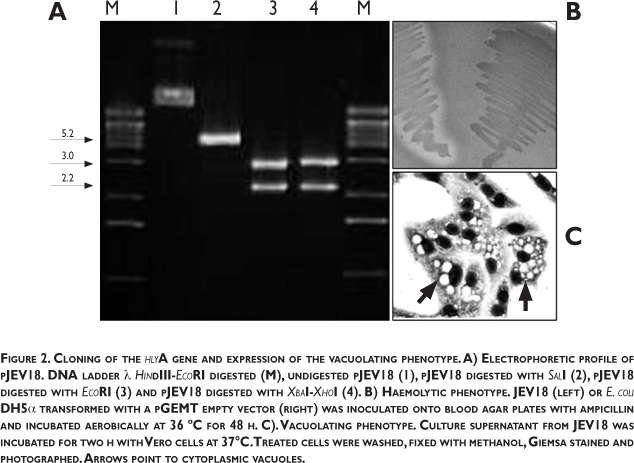
<body><![CDATA[<p>&nbsp;</p>     <p><font face="Verdana, Arial, Helvetica, sans-serif" size="2">Cell vacuolation    assay and haemolysis test: Vero cells (ATCC CCL-81) were grown in DMEM (Gibco,    BRL) and supplemented with heat-inactivated 10% fetal calf serum (FCS) (Invitrogen),    1% non-essential amino acids (Sigma), 1% glutamine (Sigma), penicillin (100    U/ml), and streptomycin (100 &#181;g/ml). Routinely, cells were treated with    0.25% trypsin, seeded in flat -bottom 96- well microplates (Falcon) and then    incubated at 37 &deg;C in a humidified 5% CO<sub>2</sub> atmosphere until they    reached 70-80% of confluency.</font></p>     <p><font face="Verdana, Arial, Helvetica, sans-serif" size="2">Vacuolating and    cytotoxicity assays: Strains were inoculated in Craig medium &#91;3 % Casaminoacids,    0.4 % Bacto yeast extract, 0.2 % glucose and 0.05 % K<sub>2</sub>HPO<sub>4</sub>    (pH 7.0)&#93; and incubated at 37&deg;C for 16 h in an orbital rotator (150    RPM). Bacteria were then pelleted and the culture supernatant was filter sterilized    through a 0.22 &#181;m-diameter filter (Millipore). A 100 &#181;l-aliquot of    sterile culture supernatant was either incubated with cells or serially diluted    using DMEM (with 2% of FCS) and then added to the cell cultures. Treated cells    were incubated at 37&deg;C for 2 h. The titers of cell vacuolation activity    and cytotoxicity were recorded following our previously established criteria.<sup>9</sup>    At the end of the experiment, cells were washed three times with PBS, fixed    with methanol (Baker) and Giemsa stained. Pictures were then taken using an    upright microscope (Nikon).</font></p>     <p><font face="Verdana, Arial, Helvetica, sans-serif" size="2">To detect haemolysis,    strains were inoculated onto blood agar plates (Difco laboratories) containing    5% rabbit or sheep red blood cells and incubated under conditions described    elsewhere.<sup>19</sup> Haemolysis was scored as positive upon formation of    a transparent halo around a single bacterial colony over a period of 48 h. To    additionally confirm that the culture supernatant induces haemolysis, we utilized    the haemolysis test tube.<sup>13</sup> In short, 1 ml of a culture supernatant    (prepared as mentioned above) was mixed with 1 ml of a 2% suspension of rabbit    or sheep erythrocytes. This suspension was then incubated at room temperature    for 1 h and pelleted by centrifugation. Haemolysis was detected by hemoglobin    release into the supernatant at A<sub>570nm</sub>.</font></p>     <p><font face="Verdana, Arial, Helvetica, sans-serif" size="2">PCR procedures:    A phenol-chloroform method was used for DNA extraction.<sup>20</sup> Amplification    of <i>hly</i>A gene from strains was made by using the following primers: Hly    Fwd (5&acute;-CTG <u>TCT AGA</u> &#91;<i>Xba</i>I&#93; AGT GAG GTT TAT ATG CCA    AAA CTC AAT CGT) and Hly Rev (5&acute;-CTG <u>CTC GAG</u> &#91;<i>Xho</i>I&#93;    TTA GTT CAA ATC AAA TTG AAC CCC TTT CAC CAA).<sup>9,21</sup> The reaction mixture    was prepared as follows: 1 &#181;l of template DNA (0.10 &#181;g), 0.5 U of    Taq DNA polymerase (Sigma), 1.5 &#181;l of reaction buffer, 2.5 mM of each deoxynucleoside    triphosphate, and 10 pmol of each primer. PCR was performed in an automated    thermocycler (Perkin-Elmer) for 30 cycles of 94 &deg;C for 1 min, 60 &deg;C    for 1 min, and 72 &deg;C for 1 min and a final extension at 72 &deg;C for 10    min. Reactions were run in a 1% agarose gel and stained with ethidium bromide    for visualization.</font></p>     <p><font face="Verdana, Arial, Helvetica, sans-serif" size="2">RFLP-PCR analysis:    Each PCR-amplified <i>hly</i>A gene was purified by affinity column (Qiagen)    and then digested separately with <i>Rsa</i>I, <i>Hind</i>III, <i>Hinc</i>II,    <i>Bam</i>HI, <i>Eco</i>RI, <i>Xba</i>I, and <i>Xho</i>I (all enzymes from Gibco,    BRL) for 3 h at 37 &deg;C. Reactions were electrophoresed as described above    and photographed to analyze the digested fragments. To construct a phenogram,    each fragment was scored as binary data. The presence (1) or absence (0) of    a determined band was incorporated in a database, and coefficients of similarity    were generated by the band-based method of Jaccard.<sup>22</sup> A phenogram    showing the similarities of the <i>hly</i>A gene was then generated by the unweighted    pair group method with arithmetic mean (UPGMA). Analysis and construction of    the phenogram was made using the NTSYSpc2.02j software. Jaccard's index of genetic    similarity under 0.5 is considered diverse.</font></p>     <p><font face="Verdana, Arial, Helvetica, sans-serif" size="2">PCR-based cloning    of <i>hly</i>A gene: The <i>hly</i>A gene was PCR-amplified as described above    from either 2514-88 or CM91-3 strain. Each PCR product was ligated in pGEM-T    Easy vector (Promega), transformed into <i>E. coli</i> DH5a competent cells    and then plated in blood agar plates with ampicillin (100 &#181;g/ml). Those    recombinant <i>E. coli hly</i>A-clones acquiring the haemolytic phenotype were    analyzed by PCR (using primers amplifying the <i>hly</i>A gene). To further    confirm <i>hly</i>A cloning, the plasmids were digested with <i>Xba</i>I and    <i>Xho</i>I (restriction enzyme sites were added to both ends of primers) or    <i>Eco</i>RI (sites flanking the pGEM-T multiple cloning site).</font></p>     <p>&nbsp;</p>     <p><font face="Verdana, Arial, Helvetica, sans-serif" size="3"><b>Results</b></font></p>     <p><font face="Verdana, Arial, Helvetica, sans-serif" size="2">Culture supernatant    from epidemic strains of <i>V. cholerae</i> O1 ElTor induces cytotoxicity and    cell vacuolation. It has been previously showed that HlyA-containing culture    supernatant from <i>V. cholerae</i> O1 ElTor isolates from India and Brazil    induces cell vacuolation.<sup>9,14,15</sup> To further evaluate whether <i>V.    cholerae</i> O1 ElTor strains isolated from different geographic origins can    produce cytotoxicity and cell vacuolation, we incubated the culture supernatant    from epidemic ElTor isolates with Vero cell cultures for 2 h. As shown in <a href="#tab1">table    I</a>, the non-diluted culture supernatant from all ElTor strains induced cytotoxicity    in Vero cell cultures. This cytotoxic effect was characterized by rapid appearance    of cytoplasmic vacuoles which was preceded by changes on cell morphology, cell    contraction, rounding and detachment (<a href="/img/revistas/spm/v51n1/html/09f1.htm#ab">figure    1B</a>). A similar cytotoxic phenotype was induced by the culture supernatant    from non-O1 <i>V. cholerae</i> strains (<a href="#tab1">table I</a>). Cytotoxicity    in Vero cells was also induced by haemolysin-containing culture supernatant    from <i>V. parahaemolyticus,</i> as previously described,<sup>23</sup> but cytoplasmic    vacuoles were absent (<a href="/img/revistas/spm/v51n1/html/09f1.htm#cd">figure    1C</a>). In contrast, culture supernatant from a non-hemolytic <i>V. cholerae</i>    strain O395 belonging to the classical biotype (which encodes a truncated <i>hly</i>A    gene)<sup>24</sup> was unable to induce cytotoxicity in Vero cells (<a href="/img/revistas/spm/v51n1/html/09f1.htm#ab">figure    1A</a>).</font></p>     ]]></body>
<body><![CDATA[<p><font face="Verdana, Arial, Helvetica, sans-serif" size="2">To better characterize    the vacuolating phenotype, we incubated a two-fold dilution series of the culture    supernatant with Vero cells for two h. As dilutions were incubated, the supernatant-induced    cytotoxic effect turned into a striking vacuolating phenotype characterized    by the presence of cytoplasmic vacuoles (<a href="/img/revistas/spm/v51n1/html/09f1.htm#cd">figure    1D</a>). All <i>V. cholerae</i> O1 ElTor strains induced this vacuolating phenotype    (<a href="#tab1">table I</a>). Despite being cytotoxic, the diluted culture    supernatant from a <i>V. parahaemolyticus</i> strain did not induce cellular    vacuolation (data not shown). <i>V. cholerae</i> O1 ElTor strain isolates from    the US Gulf coast yielded the highest vacuolating titers (up to 10240). All    other ElTor isolates yielded low vacuolating titers (ranging from 40 to 320)    (<a href="#tab1">table I</a>).</font></p>     <p><font face="Verdana, Arial, Helvetica, sans-serif" size="2">The haemolytic    genotype and phenotype of strains using PCR and two haemolysis assays were next    confirmed. As shown in <a href="#tab1">table I</a>, the <i>hly</i>A gene from    all strains were PCR-amplified. All <i>V. cholerae</i> O1 ElTor strains but    one gave a haemolysis positive reaction. Those results and previous works <sup>9,15</sup>    suggest that cell vacuolation is a widespread phenotype mediated by HlyA-containing    culture supernatant from <i>V. cholerae</i> strains.</font></p>     <p><font face="Verdana, Arial, Helvetica, sans-serif" size="2">Cloning of the    <i>hly</i>A vacuolating gene: It has been previously shown that <i>V. cholerae</i>    HlyA can be produced and secreted when the <i>hly</i>A gene is cloned in <i>E.    coli.</i> <sup>9,25</sup> Molecular cloning was used to further corroborate    the role of HlyA in cell vacuolation. The <i>hly</i>A gene was PCR-amplified    from chromosomal DNA obtained from <i>V. cholerae</i> 251488 or CM91-3 strain    and then ligated into pGEMT plasmid. The plasmid carrying the <i>hly</i>A gene    was then transformed into <i>E. coli</i> DH5</font><font size="2">&#945;</font><font face="Verdana, Arial, Helvetica, sans-serif" size="2"> to    obtain the strains JEV18 and JEV35. These recombinant <i>E. coli</i> strains    were haemolytic on blood agar plates (<a href="#tab1">table I</a> and <a href="/img/revistas/spm/v51n1/09f2.gif">figure    2</a>). Plasmids were also extracted and the insert was released using restriction    enzymes cutting along the vector or at both ends of the <i>hly</i>A gene (<a href="/img/revistas/spm/v51n1/09f2.gif">figure    2A</a>). In addition, culture supernatant from JEV18 and JEV35 induced haemolysis    and cytotoxicity and cell vacuolation in Vero cell cultures (<a href="#tab1">table    I</a> and <a href="/img/revistas/spm/v51n1/09f2.gif">figure 2</a>). Vacuolating    titers of those recombinant strains were low (32 and 64, respectively) (<a href="#tab1">table    I</a>). As expected, culture supernatant from <i>E. coli</i> DH5a encoding a    pGEMT empty vector did not induce haemolysis or cell vacuolation (<a href="/img/revistas/spm/v51n1/09f2.gif">figure    2B</a>). Results here shown confirm that HlyA secreted by <i>V. cholerae</i>    ElTor biotype strains isolates from different regions during the seventh pandemic    of cholerae induce cellular vacuolation and cytotoxicity.</font></p>     <p><font face="Verdana, Arial, Helvetica, sans-serif" size="2">RFLP analysis of    the <i>hly</i>A gene from epidemic ElTor strains: Since ElTor strains yielded    different vacuolating titers, we analyzed the <i>hly</i>A gene by RFLP. For    comparison, three strains of <i>V. cholerae</i> non-O1 were also included. Each    PCR amplified-<i>hly</i>A gene was purified and then digested separately with    seven different restriction enzymes named <i>Hin</i>cII (<a href="/img/revistas/spm/v51n1/html/09f3.htm#ab">figure    3A</a>), <i>Rsa</i>I (<a href="/img/revistas/spm/v51n1/html/09f3.htm#ab">figure    3B</a>), <i>Hin</i>dIII, <i>Bam</i>HI, <i>Eco</i>RI, <i>Xba</i>I and <i>Xho</i>I    (data not shown). Those <i>hly</i>A-RFLP patterns were nearly identical, indicating    that the <i>hly</i>A gene sequence is conserved among epidemic <i>V. cholerae</i>    O1 ElTor and non-O1 strains. A phenogram depicted using the RFLP&acute;s patterns    (Material and Methods) showed one major branch including seven strains with    100% similarity in the <i>hly</i>A-RFLP pattern. These strains exerted either    high or low vacuolating activity (<a href="/img/revistas/spm/v51n1/html/09f3.htm#c">figure    3C</a>). The non-toxigenic <i>V. cholerae</i> O1 CM91-3 isolated from Mexico    showed a more distant <i>hly</i>A-RFLP pattern in comparison to all other ElTor    strains (<a href="/img/revistas/spm/v51n1/html/09f3.htm#ab">figures 3A</a> and    <a href="/img/revistas/spm/v51n1/html/09f3.htm#ab">B</a> line 9 and <a href="/img/revistas/spm/v51n1/html/09f3.htm#c">3C</a>).</font></p>     <p>&nbsp;</p>     <p><font face="Verdana, Arial, Helvetica, sans-serif" size="3"><b>Discussion</b></font></p>     <p><font face="Verdana, Arial, Helvetica, sans-serif" size="2">We described in    this research that strains of <i>V. cholerae</i> O1 ElTor isolates from different    geographic origin during the seventh pandemic of cholera induce cellular vacuolation    and cytotoxicity in Vero cells. We also confirmed that HlyA is responsible for    these phenotypes. Culture supernatant from two recombinant <i>E. coli</i> strains    encoding the <i>hly</i>A gene induced cell vacuolation and cytotoxicity. These    results suggest that HlyA could boost the severity of infection in patients    infected with toxigenic strains of <i>V. cholerae</i> O1 ElTor. Furthermore,    it is also likely that the vacuolating factor is responsible for those clinical    symptoms of cholera-like disease seen in patients infected with <i>V. cholerae</i>    O1 CT-negative strains or <i>V. cholerae</i> non-O1 strains.</font></p>     <p><font face="Verdana, Arial, Helvetica, sans-serif" size="2">Strains of <i>V.    cholerae</i> O1 ElTor isolated from US gulf coast induced strong cell-vacuolating    activity as measured by the titration assay in Vero cell cultures (<a href="#tab1">table    I</a>). Correlating with their cell vacuolating activity, those US gulf coast    isolates have been previously described as strongly haemolytic.<sup>26</sup>    Their ability to secrete into the supernatant high amounts of HlyA is still    unknown. A putative candidate that up-regulate HlyA secretion is a regulatory    protein called HlyU. It was previously shown that HlyU up-regulates <i>hly</i>A    gene expression at the transcription level.<sup>27,28</sup> Genetic studies    are needed to elucidate the role of HlyU in the cell vacuolating activity of    those US gulf coast isolates.</font></p>     <p><font face="Verdana, Arial, Helvetica, sans-serif" size="2">The <i>hly</i>A    gene of those isolates used in this study showed genetic similarity. Seven strains    had the same RFLP pattern (<a href="/img/revistas/spm/v51n1/html/09f3.htm#ab">figure    3</a>). Belonging to this group were strains yielding either low or high vacuolating    activity, thereby we could not associate any <i>hly</i>A RFLP-pattern with the    vacuolating activity of strains. Only two ElTor strains (2270-77 and CM91-3)    showed polymorphic sites along the <i>hly</i>A sequence (<a href="/img/revistas/spm/v51n1/html/09f3.htm#ab">figure    3</a>). In agreement with our results, Byun <i>et al.</i> found minimum variations    along the <i>hly</i>A gene sequence from different <i>V. cholerae</i> isolates,<sup>29</sup>    thus indicating that its genetic sequence is well conserved.</font></p>     <p><font face="Verdana, Arial, Helvetica, sans-serif" size="2">Interestingly,    ElTor strain C7986 (<i>hly</i>A<sup>+</sup>) was unable to induce lysis of erythrocytes,    while the supernatant induced cytotoxicity and cell vacuolation (<a href="#tab1">table    I</a>). The loss of haemolysis suggests that the vacuolating and haemolytic    activities could reside in different domains of HlyA. Rader and Murphy found    that the sequence of the <i>hly</i>A gene from two haemolytic variants of <i>V.    cholerae</i> ElTor strain RV79 (called Hly<sup>+</sup> and Hly<sup>"</sup>)    was identical.<sup>30</sup> Further research is needed to clarify whether HlyA    has different domains for inducing haemolysis or cell vacuolation.</font></p>     ]]></body>
<body><![CDATA[<p><font face="Verdana, Arial, Helvetica, sans-serif" size="2">HlyA has been previously    linked to clinical symptoms induced by CT negative strains of <i>V. cholerae.</i><sup>31</sup>    Our findings show that the culture supernatant from <i>V. cholerae</i> O1 strain    CM91-3, which neither produces CT nor encodes <i>ctx</i>AB genes, induced cellular    vacuolation and cytotoxicity. As CM 91-3 strain was isolated from a patient    suffering cholera-like disease in Quintana Roo, Mexico and no other known toxin    gene but <i>hly</i>A was detected,<sup>13</sup> our findings suggest that the    gastrointestinal symptoms were mediated by HlyA.</font></p>     <p><font face="Verdana, Arial, Helvetica, sans-serif" size="2">In agree with this    hypothesis, it has been recently shown that the supernatant containing an ElTor    related haemolysin from clinical isolates of <i>V. fluvialis</i> also induces    cellular vacuolation.<sup>16</sup> The HlyA-containing culture supernatant of    an Argentinean <i>V. cholerae</i> non-O1 strain (CT negative) but not an isogenic    <i>hly</i>A mutant, induces fluid accumulation in rabbit ileal loops and histopathological    damage of the intestinal mucosa.<sup>8</sup></font></p>     <p><font face="Verdana, Arial, Helvetica, sans-serif" size="2">In summary, the    present study findings show that <i>V. cholerae</i> O1 ElTor isolates from different    geographic origins induce cellular vacuolation and cytotoxicity. It was also    demonstrated that these two activities were mediated by HlyA. This property    of ElTor haemolysin can give an advantage to strains to potentially increase    the clinical symptoms seen in cholera patients.</font></p>     <p><font face="Verdana, Arial, Helvetica, sans-serif" size="2"><b>Acknowledgements</b></font></p>     <p><font face="Verdana, Arial, Helvetica, sans-serif" size="2">We thank Dr. Jacobo    Zu&ntilde;iga-Castillo for reviewing the manuscript and his suggestions. This    work was generously supported by Mexico's National Council of Science and Technology    (CONACyT). JEV is a recipient of a postdoctoral scholarship from CONACyT. The    authors thank Dr. G. Rodr&iacute;guez-Angeles from the cholera laboratory at    INDRE for supplying all <i>Vibrio</i> strains.</font></p>     <p>&nbsp;</p>     <p><font face="Verdana, Arial, Helvetica, sans-serif" size="3"><b>References</b></font></p>     <!-- ref --><p><font face="Verdana, Arial, Helvetica, sans-serif" size="2">1. Kaper JB, Morris    JG, Jr, Levine MM. Cholera. Clin Microbiol Rev 1995;8(1):48-86.</font>&nbsp;&nbsp;&nbsp;&nbsp;&nbsp;&nbsp;&nbsp;&nbsp;[&#160;<a href="javascript:void(0);" onclick="javascript: window.open('/scielo.php?script=sci_nlinks&ref=9271474&pid=S0036-3634200900010000900001&lng=','','width=640,height=500,resizable=yes,scrollbars=1,menubar=yes,');">Links</a>&#160;]<!-- end-ref --><!-- ref --><p><font face="Verdana, Arial, Helvetica, sans-serif" size="2">2. Hoque KM, Pal    A, Nair GB, Chattopadhyay S, Chakrabarti MK. Evidence of calcium influx across    the plasma membrane depends upon the initial rise of cytosolic calcium with    activation of IP(3) in rat enterocytes by heat-stable enterotoxin of <i>Vibrio    cholerae</i> non-O1. FEMS Microbiol Lett 2001;196(1):45-50.</font>&nbsp;&nbsp;&nbsp;&nbsp;&nbsp;&nbsp;&nbsp;&nbsp;[&#160;<a href="javascript:void(0);" onclick="javascript: window.open('/scielo.php?script=sci_nlinks&ref=9271475&pid=S0036-3634200900010000900002&lng=','','width=640,height=500,resizable=yes,scrollbars=1,menubar=yes,');">Links</a>&#160;]<!-- end-ref --><!-- ref --><p><font face="Verdana, Arial, Helvetica, sans-serif" size="2">3. Jorgensen R,    Purdy AE, Fieldhouse RJ, Kimber MS, Bartlett DH, Merrill AR. Cholix toxin, a    novel ADP-ribosylating factor from <i>Vibrio cholerae</i>. J Biol Chem 2008;283(16):10671-10678.</font>&nbsp;&nbsp;&nbsp;&nbsp;&nbsp;&nbsp;&nbsp;&nbsp;[&#160;<a href="javascript:void(0);" onclick="javascript: window.open('/scielo.php?script=sci_nlinks&ref=9271476&pid=S0036-3634200900010000900003&lng=','','width=640,height=500,resizable=yes,scrollbars=1,menubar=yes,');">Links</a>&#160;]<!-- end-ref --><!-- ref --><p><font face="Verdana, Arial, Helvetica, sans-serif" size="2">4. Honda T, Finkelstein    RA. Purification and characterization of a hemolysin produced by <i>Vibrio cholerae</i>    biotype El Tor: another toxic substance produced by cholera vibrios. Infect    Immun 1979;26(3):1020-1027.</font>&nbsp;&nbsp;&nbsp;&nbsp;&nbsp;&nbsp;&nbsp;&nbsp;[&#160;<a href="javascript:void(0);" onclick="javascript: window.open('/scielo.php?script=sci_nlinks&ref=9271477&pid=S0036-3634200900010000900004&lng=','','width=640,height=500,resizable=yes,scrollbars=1,menubar=yes,');">Links</a>&#160;]<!-- end-ref --><!-- ref --><p><font face="Verdana, Arial, Helvetica, sans-serif" size="2">5. Zitzer A, Wassenaar    TM, Walev I, Bhakdi S. Potent membrane-permeabilizing and cytocidal action of    <i>Vibrio cholerae</i> cytolysin on human intestinal cells. Infect Immun 1997;65(4):1293-1298.</font>&nbsp;&nbsp;&nbsp;&nbsp;&nbsp;&nbsp;&nbsp;&nbsp;[&#160;<a href="javascript:void(0);" onclick="javascript: window.open('/scielo.php?script=sci_nlinks&ref=9271478&pid=S0036-3634200900010000900005&lng=','','width=640,height=500,resizable=yes,scrollbars=1,menubar=yes,');">Links</a>&#160;]<!-- end-ref --><!-- ref --><p><font face="Verdana, Arial, Helvetica, sans-serif" size="2">6. Ikigai H, Akatsuka    A, Tsujiyama H, Nakae T, Shimamura T. Mechanism of membrane damage by El Tor    hemolysin of <i>Vibrio cholerae</i> O1. Infect Immun 1996;64(8):2968-2973.</font>&nbsp;&nbsp;&nbsp;&nbsp;&nbsp;&nbsp;&nbsp;&nbsp;[&#160;<a href="javascript:void(0);" onclick="javascript: window.open('/scielo.php?script=sci_nlinks&ref=9271479&pid=S0036-3634200900010000900006&lng=','','width=640,height=500,resizable=yes,scrollbars=1,menubar=yes,');">Links</a>&#160;]<!-- end-ref --><!-- ref --><p><font face="Verdana, Arial, Helvetica, sans-serif" size="2">7. Olivier V, Haines    GK, 3rd, Tan Y, Satchell KJ. Hemolysin and the multifunctional autoprocessing    RTX toxin are virulence factors during intestinal infection of mice with <i>Vibrio    cholerae</i> El Tor O1 strains. Infect Immun 2007;75(10):5035-5042.</font>&nbsp;&nbsp;&nbsp;&nbsp;&nbsp;&nbsp;&nbsp;&nbsp;[&#160;<a href="javascript:void(0);" onclick="javascript: window.open('/scielo.php?script=sci_nlinks&ref=9271480&pid=S0036-3634200900010000900007&lng=','','width=640,height=500,resizable=yes,scrollbars=1,menubar=yes,');">Links</a>&#160;]<!-- end-ref --><!-- ref --><p><font face="Verdana, Arial, Helvetica, sans-serif" size="2">8. Saka HA, Bidinost    C, Sola C, Carranza P, Collino C, Ortiz S, <i>et al. Vibrio cholerae</i> cytolysin    is essential for high enterotoxicity and apoptosis induction produced by a cholera    toxin gene-negative <i>V. cholerae</i> non-O1, non-O139 strain. Microb Pathog    2008;44(2):118-128.</font>&nbsp;&nbsp;&nbsp;&nbsp;&nbsp;&nbsp;&nbsp;&nbsp;[&#160;<a href="javascript:void(0);" onclick="javascript: window.open('/scielo.php?script=sci_nlinks&ref=9271481&pid=S0036-3634200900010000900008&lng=','','width=640,height=500,resizable=yes,scrollbars=1,menubar=yes,');">Links</a>&#160;]<!-- end-ref --><!-- ref --><p><font face="Verdana, Arial, Helvetica, sans-serif" size="2">9. Figueroa-Arredondo    P, Heuser JE, Akopyants NS, Morisaki JH, Giono-Cerezo S, Enr&iacute;quez-Rinc&oacute;n    F, <i>et al</i>. Cell vacuolation caused by Vibrio cholerae hemolysin. Infect    Immun 2001;69(3):1613-1624.</font>&nbsp;&nbsp;&nbsp;&nbsp;&nbsp;&nbsp;&nbsp;&nbsp;[&#160;<a href="javascript:void(0);" onclick="javascript: window.open('/scielo.php?script=sci_nlinks&ref=9271482&pid=S0036-3634200900010000900009&lng=','','width=640,height=500,resizable=yes,scrollbars=1,menubar=yes,');">Links</a>&#160;]<!-- end-ref --><!-- ref --><p><font face="Verdana, Arial, Helvetica, sans-serif" size="2">10. Zitzer A, Zitzer    O, Bhakdi S, Palmer M. Oligomerization of <i>Vibrio cholerae</i> cytolysin yields    a pentameric pore and has a dual specificity for cholesterol and sphingolipids    in the target membrane. J Biol Chem 1999;274(3):1375-1380.</font>&nbsp;&nbsp;&nbsp;&nbsp;&nbsp;&nbsp;&nbsp;&nbsp;[&#160;<a href="javascript:void(0);" onclick="javascript: window.open('/scielo.php?script=sci_nlinks&ref=9271483&pid=S0036-3634200900010000900010&lng=','','width=640,height=500,resizable=yes,scrollbars=1,menubar=yes,');">Links</a>&#160;]<!-- end-ref --><!-- ref --><p><font face="Verdana, Arial, Helvetica, sans-serif" size="2">11. Zitzer A, Palmer    M, Weller U, Wassenaar T, Biermann C, Tranum-Jensen J, <i>et al</i>. Mode of    primary binding to target membranes and pore formation induced by <i>Vibrio    cholerae</i> cytolysin (hemolysin). Eur J Biochem 1997;247(1):209-216.</font>&nbsp;&nbsp;&nbsp;&nbsp;&nbsp;&nbsp;&nbsp;&nbsp;[&#160;<a href="javascript:void(0);" onclick="javascript: window.open('/scielo.php?script=sci_nlinks&ref=9271484&pid=S0036-3634200900010000900011&lng=','','width=640,height=500,resizable=yes,scrollbars=1,menubar=yes,');">Links</a>&#160;]<!-- end-ref --><!-- ref --><p><font face="Verdana, Arial, Helvetica, sans-serif" size="2">12. Moschioni M,    Tombola F, de Bernard M, <i>et al</i>. The <i>Vibrio cholerae</i> haemolysin    anion channel is required for cell vacuolation and death. Cell Microbiol 2002;4(7):397-409.</font>&nbsp;&nbsp;&nbsp;&nbsp;&nbsp;&nbsp;&nbsp;&nbsp;[&#160;<a href="javascript:void(0);" onclick="javascript: window.open('/scielo.php?script=sci_nlinks&ref=9271485&pid=S0036-3634200900010000900012&lng=','','width=640,height=500,resizable=yes,scrollbars=1,menubar=yes,');">Links</a>&#160;]<!-- end-ref --><!-- ref --><p><font face="Verdana, Arial, Helvetica, sans-serif" size="2">13. Giono-Cerezo    S, Rodriguez-Angeles MG, Gutierrez-Cogco L, Valdespino-Gomez JL. Phenotypic    and genotypic characterization of <i>Vibrio cholerae</i> O1. Rev Latinoam Microbiol    1994;36(4):243-251.</font>&nbsp;&nbsp;&nbsp;&nbsp;&nbsp;&nbsp;&nbsp;&nbsp;[&#160;<a href="javascript:void(0);" onclick="javascript: window.open('/scielo.php?script=sci_nlinks&ref=9271486&pid=S0036-3634200900010000900013&lng=','','width=640,height=500,resizable=yes,scrollbars=1,menubar=yes,');">Links</a>&#160;]<!-- end-ref --><!-- ref --><p><font face="Verdana, Arial, Helvetica, sans-serif" size="2">14. Coelho A, Andrade    JR, Vicente AC, Dirita VJ. Cytotoxic cell vacuolating activity from <i>Vibrio    cholerae</i> hemolysin. Infect Immun 2000;68(3):1700-1705.</font>&nbsp;&nbsp;&nbsp;&nbsp;&nbsp;&nbsp;&nbsp;&nbsp;[&#160;<a href="javascript:void(0);" onclick="javascript: window.open('/scielo.php?script=sci_nlinks&ref=9271487&pid=S0036-3634200900010000900014&lng=','','width=640,height=500,resizable=yes,scrollbars=1,menubar=yes,');">Links</a>&#160;]<!-- end-ref --><!-- ref --><p><font face="Verdana, Arial, Helvetica, sans-serif" size="2">15. Mitra R, Figueroa    P, Mukhopadhyay AK, Shimada T, Takeda Y, Berg DE, <i>et al</i>. Cell vacuolation,    a manifestation of the El tor hemolysin of <i>Vibrio cholerae</i>. <i>Infect    Immun</i> 2000;68(4):1928-33.</font>&nbsp;&nbsp;&nbsp;&nbsp;&nbsp;&nbsp;&nbsp;&nbsp;[&#160;<a href="javascript:void(0);" onclick="javascript: window.open('/scielo.php?script=sci_nlinks&ref=9271488&pid=S0036-3634200900010000900015&lng=','','width=640,height=500,resizable=yes,scrollbars=1,menubar=yes,');">Links</a>&#160;]<!-- end-ref --><!-- ref --><p><font face="Verdana, Arial, Helvetica, sans-serif" size="2">16. Chakraborty    R, Chakraborty S, De K, <i>et al</i>. Cytotoxic and cell vacuolating activity    of <i>Vibrio fluvialis</i> isolated from paediatric patients with diarrhoea.    J Med Microbiol 2005;54(Pt 8):707-716.</font>&nbsp;&nbsp;&nbsp;&nbsp;&nbsp;&nbsp;&nbsp;&nbsp;[&#160;<a href="javascript:void(0);" onclick="javascript: window.open('/scielo.php?script=sci_nlinks&ref=9271489&pid=S0036-3634200900010000900016&lng=','','width=640,height=500,resizable=yes,scrollbars=1,menubar=yes,');">Links</a>&#160;]<!-- end-ref --><!-- ref --><p><font face="Verdana, Arial, Helvetica, sans-serif" size="2">17. Popovic T,    Bopp C, Olsvik O, Wachsmuth K. Epidemiologic application of a standardized ribotype    scheme for <i>Vibrio cholerae</i> O1. J Clin Microbio<i>l</i> 1993;31(9):2474-2482.</font>&nbsp;&nbsp;&nbsp;&nbsp;&nbsp;&nbsp;&nbsp;&nbsp;[&#160;<a href="javascript:void(0);" onclick="javascript: window.open('/scielo.php?script=sci_nlinks&ref=9271490&pid=S0036-3634200900010000900017&lng=','','width=640,height=500,resizable=yes,scrollbars=1,menubar=yes,');">Links</a>&#160;]<!-- end-ref --><!-- ref --><p><font face="Verdana, Arial, Helvetica, sans-serif" size="2">18. Hanahan D,    Meselson M. Plasmid screening at high colony density. Methods Enzymol 1983;100:333-342.</font>&nbsp;&nbsp;&nbsp;&nbsp;&nbsp;&nbsp;&nbsp;&nbsp;[&#160;<a href="javascript:void(0);" onclick="javascript: window.open('/scielo.php?script=sci_nlinks&ref=9271491&pid=S0036-3634200900010000900018&lng=','','width=640,height=500,resizable=yes,scrollbars=1,menubar=yes,');">Links</a>&#160;]<!-- end-ref --><!-- ref --><p><font face="Verdana, Arial, Helvetica, sans-serif" size="2">19. Richardson    K, Michalski J, Kaper JB. Hemolysin production and cloning of two hemolysin    determinants from classical <i>Vibrio cholerae.</i> Infect Immun 1986;54(2):415-420.</font>&nbsp;&nbsp;&nbsp;&nbsp;&nbsp;&nbsp;&nbsp;&nbsp;[&#160;<a href="javascript:void(0);" onclick="javascript: window.open('/scielo.php?script=sci_nlinks&ref=9271492&pid=S0036-3634200900010000900019&lng=','','width=640,height=500,resizable=yes,scrollbars=1,menubar=yes,');">Links</a>&#160;]<!-- end-ref --><!-- ref --><p><font face="Verdana, Arial, Helvetica, sans-serif" size="2">20. Sambrook J,    Fritsch EF, Maniatis T. Molecular cloning : a laboratory manual. 2nd ed. Cold    Spring Harbor, NY: Cold Spring Harbor Laboratory, 1989.</font>&nbsp;&nbsp;&nbsp;&nbsp;&nbsp;&nbsp;&nbsp;&nbsp;[&#160;<a href="javascript:void(0);" onclick="javascript: window.open('/scielo.php?script=sci_nlinks&ref=9271493&pid=S0036-3634200900010000900020&lng=','','width=640,height=500,resizable=yes,scrollbars=1,menubar=yes,');">Links</a>&#160;]<!-- end-ref --><!-- ref --><p><font face="Verdana, Arial, Helvetica, sans-serif" size="2">21. Mitra RK, Nandy    RK, Ramamurthy T, Bhattacharya SK, Yamasaki S, Shimada T, <i>et al</i>. Molecular    characterisation of rough variants of <i>Vibrio cholerae</i> isolated from hospitalised    patients with diarrhoea. J Med Microbiol 2001;50(3):268-276.</font>&nbsp;&nbsp;&nbsp;&nbsp;&nbsp;&nbsp;&nbsp;&nbsp;[&#160;<a href="javascript:void(0);" onclick="javascript: window.open('/scielo.php?script=sci_nlinks&ref=9271494&pid=S0036-3634200900010000900021&lng=','','width=640,height=500,resizable=yes,scrollbars=1,menubar=yes,');">Links</a>&#160;]<!-- end-ref --><!-- ref --><p><font face="Verdana, Arial, Helvetica, sans-serif" size="2">22. Boldo XM, Villa-Tanaca    L, Zuniga G, Hernandez-Rodriguez C. Genetic diversity among clinical isolates    of <i>Candida glabrata</i> analyzed by randomly amplified polymorphic DNA and    multilocus enzyme electrophoresis analyses. J Clin Microbiol 2003;41(10):4799-4804.</font>&nbsp;&nbsp;&nbsp;&nbsp;&nbsp;&nbsp;&nbsp;&nbsp;[&#160;<a href="javascript:void(0);" onclick="javascript: window.open('/scielo.php?script=sci_nlinks&ref=9271495&pid=S0036-3634200900010000900022&lng=','','width=640,height=500,resizable=yes,scrollbars=1,menubar=yes,');">Links</a>&#160;]<!-- end-ref --><!-- ref --><p><font face="Verdana, Arial, Helvetica, sans-serif" size="2">23. Nishibuchi    M, Kaper JB. Thermostable direct hemolysin gene of <i>Vibrio parahaemolyticus</i>:    a virulence gene acquired by a marine bacterium. Infect Immun 1995;63(6):2093-2099.</font>&nbsp;&nbsp;&nbsp;&nbsp;&nbsp;&nbsp;&nbsp;&nbsp;[&#160;<a href="javascript:void(0);" onclick="javascript: window.open('/scielo.php?script=sci_nlinks&ref=9271496&pid=S0036-3634200900010000900023&lng=','','width=640,height=500,resizable=yes,scrollbars=1,menubar=yes,');">Links</a>&#160;]<!-- end-ref --><!-- ref --><p><font face="Verdana, Arial, Helvetica, sans-serif" size="2">24. Alm RA, Manning    PA. Biotype-specific probe for <i>Vibrio cholerae</i> serogroup O1. J Clin Microbio<i>l</i>    1990;28(4):823-824.</font>&nbsp;&nbsp;&nbsp;&nbsp;&nbsp;&nbsp;&nbsp;&nbsp;[&#160;<a href="javascript:void(0);" onclick="javascript: window.open('/scielo.php?script=sci_nlinks&ref=9271497&pid=S0036-3634200900010000900024&lng=','','width=640,height=500,resizable=yes,scrollbars=1,menubar=yes,');">Links</a>&#160;]<!-- end-ref --><!-- ref --><p><font face="Verdana, Arial, Helvetica, sans-serif" size="2">25. Alm RA, Manning    PA. Characterization of the hlyB gene and its role in the production of the    El Tor haemolysin of <i>Vibrio cholerae</i> O1. Mol Microbiol 1990;4(3):413-425.</font>&nbsp;&nbsp;&nbsp;&nbsp;&nbsp;&nbsp;&nbsp;&nbsp;[&#160;<a href="javascript:void(0);" onclick="javascript: window.open('/scielo.php?script=sci_nlinks&ref=9271498&pid=S0036-3634200900010000900025&lng=','','width=640,height=500,resizable=yes,scrollbars=1,menubar=yes,');">Links</a>&#160;]<!-- end-ref --><!-- ref --><p><font face="Verdana, Arial, Helvetica, sans-serif" size="2">26. Barrett TJ,    Blake PA. Epidemiological usefulness of changes in hemolytic activity of <i>Vibrio    cholerae</i> biotype El Tor during the seventh pandemic. J Clin Microbiol 1981;13(1):126-129.</font>&nbsp;&nbsp;&nbsp;&nbsp;&nbsp;&nbsp;&nbsp;&nbsp;[&#160;<a href="javascript:void(0);" onclick="javascript: window.open('/scielo.php?script=sci_nlinks&ref=9271499&pid=S0036-3634200900010000900026&lng=','','width=640,height=500,resizable=yes,scrollbars=1,menubar=yes,');">Links</a>&#160;]<!-- end-ref --><!-- ref --><p><font face="Verdana, Arial, Helvetica, sans-serif" size="2">27. Williams SG,    Manning PA. Transcription of the <i>Vibrio cholerae</i> haemolysin gene, hlyA,    and cloning of a positive regulatory locus, hlyU. Mol Microbiol 1991;5(8):2031-2038.</font>&nbsp;&nbsp;&nbsp;&nbsp;&nbsp;&nbsp;&nbsp;&nbsp;[&#160;<a href="javascript:void(0);" onclick="javascript: window.open('/scielo.php?script=sci_nlinks&ref=9271500&pid=S0036-3634200900010000900027&lng=','','width=640,height=500,resizable=yes,scrollbars=1,menubar=yes,');">Links</a>&#160;]<!-- end-ref --><!-- ref --><p><font face="Verdana, Arial, Helvetica, sans-serif" size="2">28. Williams SG,    Attridge SR, Manning PA. The transcriptional activator HlyU of <i>Vibrio cholerae</i>:    nucleotide sequence and role in virulence gene expression. Mol Microbiol 1993;9(4):751-760.</font>&nbsp;&nbsp;&nbsp;&nbsp;&nbsp;&nbsp;&nbsp;&nbsp;[&#160;<a href="javascript:void(0);" onclick="javascript: window.open('/scielo.php?script=sci_nlinks&ref=9271501&pid=S0036-3634200900010000900028&lng=','','width=640,height=500,resizable=yes,scrollbars=1,menubar=yes,');">Links</a>&#160;]<!-- end-ref --><!-- ref --><p><font face="Verdana, Arial, Helvetica, sans-serif" size="2">29. Byun R, Elbourne    LD, Lan R, Reeves PR. Evolutionary relationships of pathogenic clones of <i>Vibrio    cholerae</i> by sequence analysis of four housekeeping genes. Infect Immun 1999;67(3):1116-1124.</font>&nbsp;&nbsp;&nbsp;&nbsp;&nbsp;&nbsp;&nbsp;&nbsp;[&#160;<a href="javascript:void(0);" onclick="javascript: window.open('/scielo.php?script=sci_nlinks&ref=9271502&pid=S0036-3634200900010000900029&lng=','','width=640,height=500,resizable=yes,scrollbars=1,menubar=yes,');">Links</a>&#160;]<!-- end-ref --><!-- ref --><p><font face="Verdana, Arial, Helvetica, sans-serif" size="2">30. Rader AE, Murphy    JR. Nucleotide sequences and comparison of the hemolysin determinants of Vibrio    cholerae El Tor RV79(Hly+) and RV79(Hly-) and classical 569B(Hly- ). Infect    Immun 1988;56(6):1414-1419.</font>&nbsp;&nbsp;&nbsp;&nbsp;&nbsp;&nbsp;&nbsp;&nbsp;[&#160;<a href="javascript:void(0);" onclick="javascript: window.open('/scielo.php?script=sci_nlinks&ref=9271503&pid=S0036-3634200900010000900030&lng=','','width=640,height=500,resizable=yes,scrollbars=1,menubar=yes,');">Links</a>&#160;]<!-- end-ref --><!-- ref --><p><font face="Verdana, Arial, Helvetica, sans-serif" size="2">31. Ichinose Y,    Yamamoto K, Nakasone N, Tanabe MJ, Takeda T, Miwatani T, <i>et al.</i> Enterotoxicity    of El Tor-like hemolysin of non-O1 <i>Vibrio cholerae</i>. Infect Immun 1987;55(5):1090-1093.</font>&nbsp;&nbsp;&nbsp;&nbsp;&nbsp;&nbsp;&nbsp;&nbsp;[&#160;<a href="javascript:void(0);" onclick="javascript: window.open('/scielo.php?script=sci_nlinks&ref=9271504&pid=S0036-3634200900010000900031&lng=','','width=640,height=500,resizable=yes,scrollbars=1,menubar=yes,');">Links</a>&#160;]<!-- end-ref --><p>&nbsp;</p>     <p>&nbsp;</p>     ]]></body>
<body><![CDATA[<p><font face="Verdana, Arial, Helvetica, sans-serif" size="2">Received on: February    1, 2008<b>    <br>   </b> Accepted on: September 5, 2008</font></p>     <p>&nbsp;</p>     <p>&nbsp;</p>     <p><font face="Verdana, Arial, Helvetica, sans-serif" size="2">Address reprint    requests to: Jorge E. Vidal, PhD. Department of Microbiology and Molecular Genetics,    University of Pittsburgh School of Medicine.    <br>   200 Lothrop St. Biomedical Science Tower W1114, University of Pittsburgh School    of Medicine, Pittsburgh, PA, 15261, USA.    <br>   E-mail: <a href="mailto:jev20@pitt.edu">jev20@pitt.edu</a></font></p>      ]]></body><back>
<ref-list>
<ref id="B1">
<label>1</label><nlm-citation citation-type="journal">
<person-group person-group-type="author">
<name>
<surname><![CDATA[Kaper]]></surname>
<given-names><![CDATA[JB]]></given-names>
</name>
<name>
<surname><![CDATA[Morris]]></surname>
<given-names><![CDATA[JG]]></given-names>
</name>
<name>
<surname><![CDATA[Jr]]></surname>
</name>
<name>
<surname><![CDATA[Levine]]></surname>
<given-names><![CDATA[MM]]></given-names>
</name>
</person-group>
<article-title xml:lang="en"><![CDATA[Cholera]]></article-title>
<source><![CDATA[Clin Microbiol Rev]]></source>
<year>1995</year>
<volume>8</volume>
<numero>1</numero>
<issue>1</issue>
<page-range>48-86</page-range></nlm-citation>
</ref>
<ref id="B2">
<label>2</label><nlm-citation citation-type="journal">
<person-group person-group-type="author">
<name>
<surname><![CDATA[Hoque]]></surname>
<given-names><![CDATA[KM]]></given-names>
</name>
<name>
<surname><![CDATA[Pal]]></surname>
<given-names><![CDATA[A]]></given-names>
</name>
<name>
<surname><![CDATA[Nair]]></surname>
<given-names><![CDATA[GB]]></given-names>
</name>
<name>
<surname><![CDATA[Chattopadhyay]]></surname>
<given-names><![CDATA[S]]></given-names>
</name>
<name>
<surname><![CDATA[Chakrabarti]]></surname>
<given-names><![CDATA[MK]]></given-names>
</name>
</person-group>
<article-title xml:lang="en"><![CDATA[Evidence of calcium influx across the plasma membrane depends upon the initial rise of cytosolic calcium with activation of IP(3) in rat enterocytes by heat-stable enterotoxin of Vibrio cholerae non-O1]]></article-title>
<source><![CDATA[FEMS Microbiol Lett]]></source>
<year>2001</year>
<volume>196</volume>
<numero>1</numero>
<issue>1</issue>
<page-range>45-50</page-range></nlm-citation>
</ref>
<ref id="B3">
<label>3</label><nlm-citation citation-type="journal">
<person-group person-group-type="author">
<name>
<surname><![CDATA[Jorgensen]]></surname>
<given-names><![CDATA[R]]></given-names>
</name>
<name>
<surname><![CDATA[Purdy]]></surname>
<given-names><![CDATA[AE]]></given-names>
</name>
<name>
<surname><![CDATA[Fieldhouse]]></surname>
<given-names><![CDATA[RJ]]></given-names>
</name>
<name>
<surname><![CDATA[Kimber]]></surname>
<given-names><![CDATA[MS]]></given-names>
</name>
<name>
<surname><![CDATA[Bartlett]]></surname>
<given-names><![CDATA[DH]]></given-names>
</name>
<name>
<surname><![CDATA[Merrill]]></surname>
<given-names><![CDATA[AR]]></given-names>
</name>
</person-group>
<article-title xml:lang="en"><![CDATA[Cholix toxin, a novel ADP-ribosylating factor from Vibrio cholerae]]></article-title>
<source><![CDATA[J Biol Chem]]></source>
<year>2008</year>
<volume>283</volume>
<numero>16</numero>
<issue>16</issue>
<page-range>10671-10678</page-range></nlm-citation>
</ref>
<ref id="B4">
<label>4</label><nlm-citation citation-type="journal">
<person-group person-group-type="author">
<name>
<surname><![CDATA[Honda]]></surname>
<given-names><![CDATA[T]]></given-names>
</name>
<name>
<surname><![CDATA[Finkelstein]]></surname>
<given-names><![CDATA[RA]]></given-names>
</name>
</person-group>
<article-title xml:lang="en"><![CDATA[Purification and characterization of a hemolysin produced by Vibrio cholerae biotype El Tor: another toxic substance produced by cholera vibrios]]></article-title>
<source><![CDATA[Infect Immun]]></source>
<year>1979</year>
<volume>26</volume>
<numero>3</numero>
<issue>3</issue>
<page-range>1020-1027</page-range></nlm-citation>
</ref>
<ref id="B5">
<label>5</label><nlm-citation citation-type="journal">
<person-group person-group-type="author">
<name>
<surname><![CDATA[Zitzer]]></surname>
<given-names><![CDATA[A]]></given-names>
</name>
<name>
<surname><![CDATA[Wassenaar]]></surname>
<given-names><![CDATA[TM]]></given-names>
</name>
<name>
<surname><![CDATA[Walev]]></surname>
<given-names><![CDATA[I]]></given-names>
</name>
<name>
<surname><![CDATA[Bhakdi]]></surname>
<given-names><![CDATA[S]]></given-names>
</name>
</person-group>
<article-title xml:lang="en"><![CDATA[Potent membrane-permeabilizing and cytocidal action of Vibrio cholerae cytolysin on human intestinal cells]]></article-title>
<source><![CDATA[Infect Immun]]></source>
<year>1997</year>
<volume>65</volume>
<numero>4</numero>
<issue>4</issue>
<page-range>1293-1298</page-range></nlm-citation>
</ref>
<ref id="B6">
<label>6</label><nlm-citation citation-type="journal">
<person-group person-group-type="author">
<name>
<surname><![CDATA[Ikigai]]></surname>
<given-names><![CDATA[H]]></given-names>
</name>
<name>
<surname><![CDATA[Akatsuka]]></surname>
<given-names><![CDATA[A]]></given-names>
</name>
<name>
<surname><![CDATA[Tsujiyama]]></surname>
<given-names><![CDATA[H]]></given-names>
</name>
<name>
<surname><![CDATA[Nakae]]></surname>
<given-names><![CDATA[T]]></given-names>
</name>
<name>
<surname><![CDATA[Shimamura]]></surname>
<given-names><![CDATA[T]]></given-names>
</name>
</person-group>
<article-title xml:lang="en"><![CDATA[Mechanism of membrane damage by El Tor hemolysin of Vibrio cholerae O1]]></article-title>
<source><![CDATA[Infect Immun]]></source>
<year>1996</year>
<volume>64</volume>
<numero>8</numero>
<issue>8</issue>
<page-range>2968-2973</page-range></nlm-citation>
</ref>
<ref id="B7">
<label>7</label><nlm-citation citation-type="journal">
<person-group person-group-type="author">
<name>
<surname><![CDATA[Olivier]]></surname>
<given-names><![CDATA[V]]></given-names>
</name>
<name>
<surname><![CDATA[Haines]]></surname>
<given-names><![CDATA[GK]]></given-names>
</name>
</person-group>
<collab>3rd.Tan Y.Satchell KJ</collab>
<article-title xml:lang="en"><![CDATA[Hemolysin and the multifunctional autoprocessing RTX toxin are virulence factors during intestinal infection of mice with Vibrio cholerae El Tor O1 strains]]></article-title>
<source><![CDATA[Infect Immun]]></source>
<year>2007</year>
<volume>75</volume>
<numero>10</numero>
<issue>10</issue>
<page-range>5035-5042</page-range></nlm-citation>
</ref>
<ref id="B8">
<label>8</label><nlm-citation citation-type="journal">
<person-group person-group-type="author">
<name>
<surname><![CDATA[Saka]]></surname>
<given-names><![CDATA[HA]]></given-names>
</name>
<name>
<surname><![CDATA[Bidinost]]></surname>
<given-names><![CDATA[C]]></given-names>
</name>
<name>
<surname><![CDATA[Sola]]></surname>
<given-names><![CDATA[C]]></given-names>
</name>
<name>
<surname><![CDATA[Carranza]]></surname>
<given-names><![CDATA[P]]></given-names>
</name>
<name>
<surname><![CDATA[Collino]]></surname>
<given-names><![CDATA[C]]></given-names>
</name>
<name>
<surname><![CDATA[Ortiz]]></surname>
<given-names><![CDATA[S]]></given-names>
</name>
</person-group>
<article-title xml:lang="en"><![CDATA[Vibrio cholerae cytolysin is essential for high enterotoxicity and apoptosis induction produced by a cholera toxin gene-negative V. cholerae non-O1, non-O139 strain]]></article-title>
<source><![CDATA[Microb Pathog]]></source>
<year>2008</year>
<volume>44</volume>
<numero>2</numero>
<issue>2</issue>
<page-range>118-128</page-range></nlm-citation>
</ref>
<ref id="B9">
<label>9</label><nlm-citation citation-type="journal">
<person-group person-group-type="author">
<name>
<surname><![CDATA[Figueroa-Arredondo]]></surname>
<given-names><![CDATA[P]]></given-names>
</name>
<name>
<surname><![CDATA[Heuser]]></surname>
<given-names><![CDATA[JE]]></given-names>
</name>
<name>
<surname><![CDATA[Akopyants]]></surname>
<given-names><![CDATA[NS]]></given-names>
</name>
<name>
<surname><![CDATA[Morisaki]]></surname>
<given-names><![CDATA[JH]]></given-names>
</name>
<name>
<surname><![CDATA[Giono-Cerezo]]></surname>
<given-names><![CDATA[S]]></given-names>
</name>
<name>
<surname><![CDATA[Enríquez-Rincón]]></surname>
<given-names><![CDATA[F]]></given-names>
</name>
</person-group>
<article-title xml:lang="en"><![CDATA[Cell vacuolation caused by Vibrio cholerae hemolysin]]></article-title>
<source><![CDATA[Infect Immun]]></source>
<year>2001</year>
<volume>69</volume>
<numero>3</numero>
<issue>3</issue>
<page-range>1613-1624</page-range></nlm-citation>
</ref>
<ref id="B10">
<label>10</label><nlm-citation citation-type="journal">
<person-group person-group-type="author">
<name>
<surname><![CDATA[Zitzer]]></surname>
<given-names><![CDATA[A]]></given-names>
</name>
<name>
<surname><![CDATA[Zitzer]]></surname>
<given-names><![CDATA[O]]></given-names>
</name>
<name>
<surname><![CDATA[Bhakdi]]></surname>
<given-names><![CDATA[S]]></given-names>
</name>
<name>
<surname><![CDATA[Palmer]]></surname>
<given-names><![CDATA[M]]></given-names>
</name>
</person-group>
<article-title xml:lang="en"><![CDATA[Oligomerization of Vibrio cholerae cytolysin yields a pentameric pore and has a dual specificity for cholesterol and sphingolipids in the target membrane]]></article-title>
<source><![CDATA[J Biol Chem]]></source>
<year>1999</year>
<volume>274</volume>
<numero>3</numero>
<issue>3</issue>
<page-range>1375-1380</page-range></nlm-citation>
</ref>
<ref id="B11">
<label>11</label><nlm-citation citation-type="journal">
<person-group person-group-type="author">
<name>
<surname><![CDATA[Zitzer]]></surname>
<given-names><![CDATA[A]]></given-names>
</name>
<name>
<surname><![CDATA[Palmer]]></surname>
<given-names><![CDATA[M]]></given-names>
</name>
<name>
<surname><![CDATA[Weller]]></surname>
<given-names><![CDATA[U]]></given-names>
</name>
<name>
<surname><![CDATA[Wassenaar]]></surname>
<given-names><![CDATA[T]]></given-names>
</name>
<name>
<surname><![CDATA[Biermann]]></surname>
<given-names><![CDATA[C]]></given-names>
</name>
<name>
<surname><![CDATA[Tranum-Jensen]]></surname>
<given-names><![CDATA[J]]></given-names>
</name>
</person-group>
<article-title xml:lang="en"><![CDATA[Mode of primary binding to target membranes and pore formation induced by Vibrio cholerae cytolysin (hemolysin)]]></article-title>
<source><![CDATA[Eur J Biochem]]></source>
<year>1997</year>
<volume>247</volume>
<numero>1</numero>
<issue>1</issue>
<page-range>209-216</page-range></nlm-citation>
</ref>
<ref id="B12">
<label>12</label><nlm-citation citation-type="journal">
<person-group person-group-type="author">
<name>
<surname><![CDATA[Moschioni]]></surname>
<given-names><![CDATA[M]]></given-names>
</name>
<name>
<surname><![CDATA[Tombola]]></surname>
<given-names><![CDATA[F]]></given-names>
</name>
<name>
<surname><![CDATA[de Bernard]]></surname>
<given-names><![CDATA[M]]></given-names>
</name>
</person-group>
<article-title xml:lang="en"><![CDATA[The Vibrio cholerae haemolysin anion channel is required for cell vacuolation and death]]></article-title>
<source><![CDATA[Cell Microbiol]]></source>
<year>2002</year>
<volume>4</volume>
<numero>7</numero>
<issue>7</issue>
<page-range>397-409</page-range></nlm-citation>
</ref>
<ref id="B13">
<label>13</label><nlm-citation citation-type="journal">
<person-group person-group-type="author">
<name>
<surname><![CDATA[Giono-Cerezo]]></surname>
<given-names><![CDATA[S]]></given-names>
</name>
<name>
<surname><![CDATA[Rodriguez-Angeles]]></surname>
<given-names><![CDATA[MG]]></given-names>
</name>
<name>
<surname><![CDATA[Gutierrez-Cogco]]></surname>
<given-names><![CDATA[L]]></given-names>
</name>
<name>
<surname><![CDATA[Valdespino-Gomez]]></surname>
<given-names><![CDATA[JL]]></given-names>
</name>
</person-group>
<article-title xml:lang="en"><![CDATA[Phenotypic and genotypic characterization of Vibrio cholerae O1]]></article-title>
<source><![CDATA[Rev Latinoam Microbiol]]></source>
<year>1994</year>
<volume>36</volume>
<numero>4</numero>
<issue>4</issue>
<page-range>243-251</page-range></nlm-citation>
</ref>
<ref id="B14">
<label>14</label><nlm-citation citation-type="journal">
<person-group person-group-type="author">
<name>
<surname><![CDATA[Coelho]]></surname>
<given-names><![CDATA[A]]></given-names>
</name>
<name>
<surname><![CDATA[Andrade]]></surname>
<given-names><![CDATA[JR]]></given-names>
</name>
<name>
<surname><![CDATA[Vicente]]></surname>
<given-names><![CDATA[AC]]></given-names>
</name>
<name>
<surname><![CDATA[Dirita]]></surname>
<given-names><![CDATA[VJ]]></given-names>
</name>
</person-group>
<article-title xml:lang="en"><![CDATA[Cytotoxic cell vacuolating activity from Vibrio cholerae hemolysin]]></article-title>
<source><![CDATA[Infect Immun]]></source>
<year>2000</year>
<volume>68</volume>
<numero>3</numero>
<issue>3</issue>
<page-range>1700-1705</page-range></nlm-citation>
</ref>
<ref id="B15">
<label>15</label><nlm-citation citation-type="journal">
<person-group person-group-type="author">
<name>
<surname><![CDATA[Mitra]]></surname>
<given-names><![CDATA[R]]></given-names>
</name>
<name>
<surname><![CDATA[Figueroa]]></surname>
<given-names><![CDATA[P]]></given-names>
</name>
<name>
<surname><![CDATA[Mukhopadhyay]]></surname>
<given-names><![CDATA[AK]]></given-names>
</name>
<name>
<surname><![CDATA[Shimada]]></surname>
<given-names><![CDATA[T]]></given-names>
</name>
<name>
<surname><![CDATA[Takeda]]></surname>
<given-names><![CDATA[Y]]></given-names>
</name>
<name>
<surname><![CDATA[Berg]]></surname>
<given-names><![CDATA[DE]]></given-names>
</name>
</person-group>
<article-title xml:lang="en"><![CDATA[Cell vacuolation, a manifestation of the El tor hemolysin of Vibrio cholerae]]></article-title>
<source><![CDATA[Infect Immun]]></source>
<year>2000</year>
<volume>68</volume>
<numero>4</numero>
<issue>4</issue>
<page-range>1928-33</page-range></nlm-citation>
</ref>
<ref id="B16">
<label>16</label><nlm-citation citation-type="journal">
<person-group person-group-type="author">
<name>
<surname><![CDATA[Chakraborty]]></surname>
<given-names><![CDATA[R]]></given-names>
</name>
<name>
<surname><![CDATA[Chakraborty]]></surname>
<given-names><![CDATA[S]]></given-names>
</name>
<name>
<surname><![CDATA[De]]></surname>
<given-names><![CDATA[K]]></given-names>
</name>
</person-group>
<article-title xml:lang="en"><![CDATA[Cytotoxic and cell vacuolating activity of Vibrio fluvialis isolated from paediatric patients with diarrhoea]]></article-title>
<source><![CDATA[J Med Microbiol]]></source>
<year>2005</year>
<volume>54</volume>
<numero>Pt 8</numero>
<issue>Pt 8</issue>
<page-range>707-716</page-range></nlm-citation>
</ref>
<ref id="B17">
<label>17</label><nlm-citation citation-type="journal">
<person-group person-group-type="author">
<name>
<surname><![CDATA[Popovic]]></surname>
<given-names><![CDATA[T]]></given-names>
</name>
<name>
<surname><![CDATA[Bopp]]></surname>
<given-names><![CDATA[C]]></given-names>
</name>
<name>
<surname><![CDATA[Olsvik]]></surname>
<given-names><![CDATA[O]]></given-names>
</name>
<name>
<surname><![CDATA[Wachsmuth]]></surname>
<given-names><![CDATA[K]]></given-names>
</name>
</person-group>
<article-title xml:lang="en"><![CDATA[Epidemiologic application of a standardized ribotype scheme for Vibrio cholerae O1]]></article-title>
<source><![CDATA[J Clin Microbiol]]></source>
<year>1993</year>
<volume>31</volume>
<numero>9</numero>
<issue>9</issue>
<page-range>2474-2482</page-range></nlm-citation>
</ref>
<ref id="B18">
<label>18</label><nlm-citation citation-type="journal">
<person-group person-group-type="author">
<name>
<surname><![CDATA[Hanahan]]></surname>
<given-names><![CDATA[D]]></given-names>
</name>
<name>
<surname><![CDATA[Meselson]]></surname>
<given-names><![CDATA[M]]></given-names>
</name>
</person-group>
<article-title xml:lang="en"><![CDATA[Plasmid screening at high colony density]]></article-title>
<source><![CDATA[Methods Enzymol]]></source>
<year>1983</year>
<volume>100</volume>
<page-range>333-342</page-range></nlm-citation>
</ref>
<ref id="B19">
<label>19</label><nlm-citation citation-type="journal">
<person-group person-group-type="author">
<name>
<surname><![CDATA[Richardson]]></surname>
<given-names><![CDATA[K]]></given-names>
</name>
<name>
<surname><![CDATA[Michalski]]></surname>
<given-names><![CDATA[J]]></given-names>
</name>
<name>
<surname><![CDATA[Kaper]]></surname>
<given-names><![CDATA[JB]]></given-names>
</name>
</person-group>
<article-title xml:lang="en"><![CDATA[Hemolysin production and cloning of two hemolysin determinants from classical Vibrio cholerae]]></article-title>
<source><![CDATA[Infect Immun]]></source>
<year>1986</year>
<volume>54</volume>
<numero>2</numero>
<issue>2</issue>
<page-range>415-420</page-range></nlm-citation>
</ref>
<ref id="B20">
<label>20</label><nlm-citation citation-type="book">
<person-group person-group-type="author">
<name>
<surname><![CDATA[Sambrook]]></surname>
<given-names><![CDATA[J]]></given-names>
</name>
<name>
<surname><![CDATA[Fritsch]]></surname>
<given-names><![CDATA[EF]]></given-names>
</name>
<name>
<surname><![CDATA[Maniatis]]></surname>
<given-names><![CDATA[T]]></given-names>
</name>
</person-group>
<source><![CDATA[Molecular cloning: a laboratory manual]]></source>
<year>1989</year>
<edition>2nd ed.</edition>
<publisher-loc><![CDATA[Cold Spring Harbor^eNY NY]]></publisher-loc>
<publisher-name><![CDATA[Cold Spring Harbor Laboratory]]></publisher-name>
</nlm-citation>
</ref>
<ref id="B21">
<label>21</label><nlm-citation citation-type="journal">
<person-group person-group-type="author">
<name>
<surname><![CDATA[Mitra]]></surname>
<given-names><![CDATA[RK]]></given-names>
</name>
<name>
<surname><![CDATA[Nandy]]></surname>
<given-names><![CDATA[RK]]></given-names>
</name>
<name>
<surname><![CDATA[Ramamurthy]]></surname>
<given-names><![CDATA[T]]></given-names>
</name>
<name>
<surname><![CDATA[Bhattacharya]]></surname>
<given-names><![CDATA[SK]]></given-names>
</name>
<name>
<surname><![CDATA[Yamasaki]]></surname>
<given-names><![CDATA[S]]></given-names>
</name>
<name>
<surname><![CDATA[Shimada]]></surname>
<given-names><![CDATA[T]]></given-names>
</name>
</person-group>
<article-title xml:lang="en"><![CDATA[Molecular characterisation of rough variants of Vibrio cholerae isolated from hospitalised patients with diarrhoea]]></article-title>
<source><![CDATA[J Med Microbiol]]></source>
<year>2001</year>
<volume>50</volume>
<numero>3</numero>
<issue>3</issue>
<page-range>268-276</page-range></nlm-citation>
</ref>
<ref id="B22">
<label>22</label><nlm-citation citation-type="journal">
<person-group person-group-type="author">
<name>
<surname><![CDATA[Boldo]]></surname>
<given-names><![CDATA[XM]]></given-names>
</name>
<name>
<surname><![CDATA[Villa-Tanaca]]></surname>
<given-names><![CDATA[L]]></given-names>
</name>
<name>
<surname><![CDATA[Zuniga]]></surname>
<given-names><![CDATA[G]]></given-names>
</name>
<name>
<surname><![CDATA[Hernandez-Rodriguez]]></surname>
<given-names><![CDATA[C]]></given-names>
</name>
</person-group>
<article-title xml:lang="en"><![CDATA[Genetic diversity among clinical isolates of Candida glabrata analyzed by randomly amplified polymorphic DNA and multilocus enzyme electrophoresis analyses]]></article-title>
<source><![CDATA[J Clin Microbiol]]></source>
<year>2003</year>
<volume>41</volume>
<numero>10</numero>
<issue>10</issue>
<page-range>4799-4804</page-range></nlm-citation>
</ref>
<ref id="B23">
<label>23</label><nlm-citation citation-type="journal">
<person-group person-group-type="author">
<name>
<surname><![CDATA[Nishibuchi]]></surname>
<given-names><![CDATA[M]]></given-names>
</name>
<name>
<surname><![CDATA[Kaper]]></surname>
<given-names><![CDATA[JB]]></given-names>
</name>
</person-group>
<article-title xml:lang="en"><![CDATA[Thermostable direct hemolysin gene of Vibrio parahaemolyticus: a virulence gene acquired by a marine bacterium]]></article-title>
<source><![CDATA[Infect Immun]]></source>
<year>1995</year>
<volume>63</volume>
<numero>6</numero>
<issue>6</issue>
<page-range>2093-2099</page-range></nlm-citation>
</ref>
<ref id="B24">
<label>24</label><nlm-citation citation-type="journal">
<person-group person-group-type="author">
<name>
<surname><![CDATA[Alm]]></surname>
<given-names><![CDATA[RA]]></given-names>
</name>
<name>
<surname><![CDATA[Manning]]></surname>
<given-names><![CDATA[PA]]></given-names>
</name>
</person-group>
<article-title xml:lang="en"><![CDATA[Biotype-specific probe for Vibrio cholerae serogroup O1]]></article-title>
<source><![CDATA[J Clin Microbiol]]></source>
<year>1990</year>
<volume>28</volume>
<numero>4</numero>
<issue>4</issue>
<page-range>823-824</page-range></nlm-citation>
</ref>
<ref id="B25">
<label>25</label><nlm-citation citation-type="journal">
<person-group person-group-type="author">
<name>
<surname><![CDATA[Alm]]></surname>
<given-names><![CDATA[RA]]></given-names>
</name>
<name>
<surname><![CDATA[Manning]]></surname>
<given-names><![CDATA[PA]]></given-names>
</name>
</person-group>
<article-title xml:lang="en"><![CDATA[Characterization of the hlyB gene and its role in the production of the El Tor haemolysin of Vibrio cholerae O1]]></article-title>
<source><![CDATA[Mol Microbiol]]></source>
<year>1990</year>
<volume>4</volume>
<numero>3</numero>
<issue>3</issue>
<page-range>413-425</page-range></nlm-citation>
</ref>
<ref id="B26">
<label>26</label><nlm-citation citation-type="journal">
<person-group person-group-type="author">
<name>
<surname><![CDATA[Barrett]]></surname>
<given-names><![CDATA[TJ]]></given-names>
</name>
<name>
<surname><![CDATA[Blake]]></surname>
<given-names><![CDATA[PA]]></given-names>
</name>
</person-group>
<article-title xml:lang="en"><![CDATA[Epidemiological usefulness of changes in hemolytic activity of Vibrio cholerae biotype El Tor during the seventh pandemic]]></article-title>
<source><![CDATA[J Clin Microbiol]]></source>
<year>1981</year>
<volume>13</volume>
<numero>1</numero>
<issue>1</issue>
<page-range>126-129</page-range></nlm-citation>
</ref>
<ref id="B27">
<label>27</label><nlm-citation citation-type="journal">
<person-group person-group-type="author">
<name>
<surname><![CDATA[Williams]]></surname>
<given-names><![CDATA[SG]]></given-names>
</name>
<name>
<surname><![CDATA[Manning]]></surname>
<given-names><![CDATA[PA]]></given-names>
</name>
</person-group>
<article-title xml:lang="en"><![CDATA[Transcription of the Vibrio cholerae haemolysin gene, hlyA, and cloning of a positive regulatory locus, hlyU]]></article-title>
<source><![CDATA[Mol Microbiol]]></source>
<year>1991</year>
<volume>5</volume>
<numero>8</numero>
<issue>8</issue>
<page-range>2031-2038</page-range></nlm-citation>
</ref>
<ref id="B28">
<label>28</label><nlm-citation citation-type="journal">
<person-group person-group-type="author">
<name>
<surname><![CDATA[Williams]]></surname>
<given-names><![CDATA[SG]]></given-names>
</name>
<name>
<surname><![CDATA[Attridge]]></surname>
<given-names><![CDATA[SR]]></given-names>
</name>
<name>
<surname><![CDATA[Manning]]></surname>
<given-names><![CDATA[PA]]></given-names>
</name>
</person-group>
<article-title xml:lang="en"><![CDATA[The transcriptional activator HlyU of Vibrio cholerae: nucleotide sequence and role in virulence gene expression]]></article-title>
<source><![CDATA[Mol Microbiol]]></source>
<year>1993</year>
<volume>9</volume>
<numero>4</numero>
<issue>4</issue>
<page-range>751-760</page-range></nlm-citation>
</ref>
<ref id="B29">
<label>29</label><nlm-citation citation-type="journal">
<person-group person-group-type="author">
<name>
<surname><![CDATA[Byun]]></surname>
<given-names><![CDATA[R]]></given-names>
</name>
<name>
<surname><![CDATA[Elbourne]]></surname>
<given-names><![CDATA[LD]]></given-names>
</name>
<name>
<surname><![CDATA[Lan]]></surname>
<given-names><![CDATA[R]]></given-names>
</name>
<name>
<surname><![CDATA[Reeves]]></surname>
<given-names><![CDATA[PR]]></given-names>
</name>
</person-group>
<article-title xml:lang="en"><![CDATA[Evolutionary relationships of pathogenic clones of Vibrio cholerae by sequence analysis of four housekeeping genes]]></article-title>
<source><![CDATA[Infect Immun]]></source>
<year>1999</year>
<volume>67</volume>
<numero>3</numero>
<issue>3</issue>
<page-range>1116-1124</page-range></nlm-citation>
</ref>
<ref id="B30">
<label>30</label><nlm-citation citation-type="journal">
<person-group person-group-type="author">
<name>
<surname><![CDATA[Rader]]></surname>
<given-names><![CDATA[AE]]></given-names>
</name>
<name>
<surname><![CDATA[Murphy]]></surname>
<given-names><![CDATA[JR]]></given-names>
</name>
</person-group>
<article-title xml:lang="en"><![CDATA[Nucleotide sequences and comparison of the hemolysin determinants of Vibrio cholerae El Tor RV79(Hly+) and RV79(Hly-) and classical 569B(Hly- )]]></article-title>
<source><![CDATA[Infect Immun]]></source>
<year>1988</year>
<volume>56</volume>
<numero>6</numero>
<issue>6</issue>
<page-range>1414-1419</page-range></nlm-citation>
</ref>
<ref id="B31">
<label>31</label><nlm-citation citation-type="journal">
<person-group person-group-type="author">
<name>
<surname><![CDATA[Ichinose]]></surname>
<given-names><![CDATA[Y]]></given-names>
</name>
<name>
<surname><![CDATA[Yamamoto]]></surname>
<given-names><![CDATA[K]]></given-names>
</name>
<name>
<surname><![CDATA[Nakasone]]></surname>
<given-names><![CDATA[N]]></given-names>
</name>
<name>
<surname><![CDATA[Tanabe]]></surname>
<given-names><![CDATA[MJ]]></given-names>
</name>
<name>
<surname><![CDATA[Takeda]]></surname>
<given-names><![CDATA[T]]></given-names>
</name>
<name>
<surname><![CDATA[Miwatani]]></surname>
<given-names><![CDATA[T]]></given-names>
</name>
</person-group>
<article-title xml:lang="en"><![CDATA[Enterotoxicity of El Tor-like hemolysin of non-O1 Vibrio cholerae]]></article-title>
<source><![CDATA[Infect Immun]]></source>
<year>1987</year>
<volume>55</volume>
<numero>5</numero>
<issue>5</issue>
<page-range>1090-1093</page-range></nlm-citation>
</ref>
</ref-list>
</back>
</article>