<?xml version="1.0" encoding="ISO-8859-1"?><article xmlns:mml="http://www.w3.org/1998/Math/MathML" xmlns:xlink="http://www.w3.org/1999/xlink" xmlns:xsi="http://www.w3.org/2001/XMLSchema-instance">
<front>
<journal-meta>
<journal-id>0036-3634</journal-id>
<journal-title><![CDATA[Salud Pública de México]]></journal-title>
<abbrev-journal-title><![CDATA[Salud pública Méx]]></abbrev-journal-title>
<issn>0036-3634</issn>
<publisher>
<publisher-name><![CDATA[Instituto Nacional de Salud Pública]]></publisher-name>
</publisher>
</journal-meta>
<article-meta>
<article-id>S0036-36342009000100004</article-id>
<title-group>
<article-title xml:lang="en"><![CDATA[Social networks and health-related quality of life: a population based study among older adults]]></article-title>
<article-title xml:lang="es"><![CDATA[Redes sociales y calidad de vida relacionada a la salud: un estudio de base poblacional en adultos mayores]]></article-title>
</title-group>
<contrib-group>
<contrib contrib-type="author">
<name>
<surname><![CDATA[Gallegos-Carrillo]]></surname>
<given-names><![CDATA[Katia]]></given-names>
</name>
<xref ref-type="aff" rid="A01"/>
</contrib>
<contrib contrib-type="author">
<name>
<surname><![CDATA[Mudgal]]></surname>
<given-names><![CDATA[Jyoti]]></given-names>
</name>
<xref ref-type="aff" rid="A01"/>
</contrib>
<contrib contrib-type="author">
<name>
<surname><![CDATA[Sánchez-García]]></surname>
<given-names><![CDATA[Sergio]]></given-names>
</name>
<xref ref-type="aff" rid="A02"/>
</contrib>
<contrib contrib-type="author">
<name>
<surname><![CDATA[Wagner]]></surname>
<given-names><![CDATA[Fernando A]]></given-names>
</name>
<xref ref-type="aff" rid="A03"/>
</contrib>
<contrib contrib-type="author">
<name>
<surname><![CDATA[Gallo]]></surname>
<given-names><![CDATA[Joseph J]]></given-names>
</name>
<xref ref-type="aff" rid="A04"/>
</contrib>
<contrib contrib-type="author">
<name>
<surname><![CDATA[Salmerón]]></surname>
<given-names><![CDATA[Jorge]]></given-names>
</name>
<xref ref-type="aff" rid="A01"/>
</contrib>
<contrib contrib-type="author">
<name>
<surname><![CDATA[García-Peña]]></surname>
<given-names><![CDATA[Carmen]]></given-names>
</name>
<xref ref-type="aff" rid="A02"/>
</contrib>
</contrib-group>
<aff id="A01">
<institution><![CDATA[,Hospital General Regional Instituto Mexicano del Seguro Social Unidad de Investigación Epidemiológica y en Servicios de Salud, Morelos]]></institution>
<addr-line><![CDATA[Cuernavaca Morelos]]></addr-line>
<country>México</country>
</aff>
<aff id="A02">
<institution><![CDATA[,Centro Médico Nacional Siglo XXI Unidad de Investigación Epidemiológica y en Servicios de Salud, Área Envejecimiento IMSS ]]></institution>
<addr-line><![CDATA[ ]]></addr-line>
<country>México</country>
</aff>
<aff id="A03">
<institution><![CDATA[,Morgan State University School of Public Health and Policy Center for Health Disparities Solutions]]></institution>
<addr-line><![CDATA[Baltimore Maryland]]></addr-line>
<country>USA</country>
</aff>
<aff id="A04">
<institution><![CDATA[,University of Pennsylvania Department of Family Medicine & Community Health ]]></institution>
<addr-line><![CDATA[Philadelphia Pennsylvania]]></addr-line>
<country>USA</country>
</aff>
<pub-date pub-type="pub">
<day>00</day>
<month>02</month>
<year>2009</year>
</pub-date>
<pub-date pub-type="epub">
<day>00</day>
<month>02</month>
<year>2009</year>
</pub-date>
<volume>51</volume>
<numero>1</numero>
<fpage>06</fpage>
<lpage>13</lpage>
<copyright-statement/>
<copyright-year/>
<self-uri xlink:href="http://www.scielo.org.mx/scielo.php?script=sci_arttext&amp;pid=S0036-36342009000100004&amp;lng=en&amp;nrm=iso"></self-uri><self-uri xlink:href="http://www.scielo.org.mx/scielo.php?script=sci_abstract&amp;pid=S0036-36342009000100004&amp;lng=en&amp;nrm=iso"></self-uri><self-uri xlink:href="http://www.scielo.org.mx/scielo.php?script=sci_pdf&amp;pid=S0036-36342009000100004&amp;lng=en&amp;nrm=iso"></self-uri><abstract abstract-type="short" xml:lang="en"><p><![CDATA[OBJECTIVE: To examine the relationship between components of social networks and health-related quality of life (HRQL) in older adults with and without depressive symptoms. MATERIAL AND METHODS: Comparative cross-sectional study with data from the cohort study "Integral Study of Depression", carried out in Mexico City during 2004. The sample was selected through a multi-stage probability design. HRQL was measured with the SF-36. Geriatric Depression Scale (GDS) and the Short Anxiety Screening Test (SAST) determined depressive symptoms and anxiety. T-test and multiple linear regressions were conducted. RESULTS: Older adults with depressive symptoms had the lowest scores in all HRQL scales. A larger network of close relatives and friends was associated with better HRQL on several scales. Living alone did not significantly affect HRQL level, in either the study or comparison group. CONCLUSIONS: A positive association between some components of social networks and good HRQL exists even in older adults with depressive symptoms.]]></p></abstract>
<abstract abstract-type="short" xml:lang="es"><p><![CDATA[OBJETIVO: Examinar la relación entre componentes de redes sociales y calidad de vida relacionada con la salud (CVRS) de adultos mayores con o sin síntomas depresivos. MATERIAL Y MÉTODOS: Estudio transversal comparativo con datos de la cohorte "Estudio Integral de Depresión", realizado en la Ciudad de México en 2004. La muestra fue seleccionada por diseño probabilístico multietápico. La CVRS se midió con SF-36, mientras que Geriatric Depression Scale y Short Anxiety Screening Test determinaron síntomas de depresión y ansiedad. El análisis consistió de prueba T y regresiones lineales múltiples. RESULTADOS: Ancianos con síntomas de depresión reportaron puntuaciones más bajas en todas las escalas de CVRS; una red más grande de familiares y amigos se asoció con mejor CVRS en varias escalas. Vivir solo no afectó la CVRS en grupos de estudio y comparación. CONCLUSIONES: Existe una asociación positiva de algunos componentes de las redes sociales con la CVRS, incluso en ancianos con síntomas depresivos.]]></p></abstract>
<kwd-group>
<kwd lng="en"><![CDATA[social support]]></kwd>
<kwd lng="en"><![CDATA[quality of life]]></kwd>
<kwd lng="en"><![CDATA[depression]]></kwd>
<kwd lng="en"><![CDATA[health of the elderly]]></kwd>
<kwd lng="es"><![CDATA[apoyo social]]></kwd>
<kwd lng="es"><![CDATA[calidad de vida]]></kwd>
<kwd lng="es"><![CDATA[depresión]]></kwd>
<kwd lng="es"><![CDATA[salud del anciano]]></kwd>
</kwd-group>
</article-meta>
</front><body><![CDATA[ <p align="right"><font size="2" face="Verdana, Arial, Helvetica, sans-serif"><b>ART&Iacute;CULO    ORIGINAL</b></font></p>     <p>&nbsp;</p>     <p><a name="top"></a><font face="Verdana, Arial, Helvetica, sans-serif" size="4"><b>Social    networks and health-related quality of life: a population based study among    older adults</b> </font></p>     <p>&nbsp;</p>     <p><font face="Verdana, Arial, Helvetica, sans-serif" size="3"><b>Redes sociales    y calidad de vida relacionada a la salud: un estudio de base poblacional en    adultos mayores</b></font></p>     <p>&nbsp;</p>     <p>&nbsp;</p>     <p><font face="Verdana, Arial, Helvetica, sans-serif" size="2"><b>Katia Gallegos-Carrillo,    MSc<sup>I</sup>; Jyoti Mudgal, MSP, PhD<sup>I</sup>; Sergio S&aacute;nchez-Garc&iacute;a,    MSc<sup>II</sup>; Fernando A Wagner, MPH, ScD<sup>III</sup>; Joseph J Gallo,    MD, MPH<sup>IV</sup>; Jorge Salmer&oacute;n, MD, MSc, ScD<sup>I</sup>; Carmen    Garc&iacute;a-Pe&ntilde;a, MD, MSc, PhD<sup>II</sup></b></font></p>     <p><font face="Verdana, Arial, Helvetica, sans-serif" size="2"><sup>I</sup>Unidad    de Investigaci&oacute;n Epidemiol&oacute;gica y en Servicios de Salud, Morelos.    Instituto Mexicano del Seguro Social (IMSS). Hospital General Regional No. 1.    Cuernavaca, Morelos. M&eacute;xico    <br>   <sup>II</sup>Unidad de Investigaci&oacute;n Epidemiol&oacute;gica y en Servicios    de Salud, &Aacute;rea Envejecimiento IMSS. Centro M&eacute;dico Nacional Siglo    XXI, M&eacute;xico    ]]></body>
<body><![CDATA[<br>   <sup>III</sup>Drug Abuse Research Program, Center for Health Disparities Solutions,    School of Public Health and Policy, Morgan State University. Baltimore, Maryland,    USA    <br>   <sup>IV</sup>Department of Family Medicine &amp; Community Health, University    of Pennsylvania. Philadelphia, Pennsylvania, USA</font></p>     <p>&nbsp;</p>     <p>&nbsp;</p> <hr size="1" noshade>     <p><font face="Verdana, Arial, Helvetica, sans-serif" size="2"><b>ABSTRACT</b></font></p>     <p><font face="Verdana, Arial, Helvetica, sans-serif" size="2"><b>OBJECTIVE:</b>    To examine the relationship between components of social networks and health-related    quality of life (HRQL) in older adults with and without depressive symptoms.    <br>   <b>MATERIAL AND METHODS:</b> Comparative cross-sectional study with data from    the cohort study "Integral Study of Depression", carried out in Mexico City    during 2004. The sample was selected through a multi-stage probability design.    HRQL was measured with the SF-36. Geriatric Depression Scale (GDS) and the Short    Anxiety Screening Test (SAST) determined depressive symptoms and anxiety. T-test    and multiple linear regressions were conducted.    <br>   <b>RESULTS:</b> Older adults with depressive symptoms had the lowest scores    in all HRQL scales. A larger network of close relatives and friends was associated    with better HRQL on several scales. Living alone did not significantly affect    HRQL level, in either the study or comparison group.    <br>   <b>CONCLUSIONS:</b> A positive association between some components of social    networks and good HRQL exists even in older adults with depressive symptoms.</font></p>     <p><font face="Verdana, Arial, Helvetica, sans-serif" size="2"><b>Key words:</b>    social support, quality of life, depression, health of the elderly</font></p> <hr noshade size="1">     ]]></body>
<body><![CDATA[<p><font face="Verdana, Arial, Helvetica, sans-serif" size="2"><b>RESUMEN</b></font></p>     <p><font face="Verdana, Arial, Helvetica, sans-serif" size="2"><b>OBJETIVO:</b>    Examinar la relaci&oacute;n entre componentes de redes sociales y calidad de    vida relacionada con la salud (CVRS) de adultos mayores con o sin s&iacute;ntomas    depresivos.    <br>   <b>MATERIAL Y M&Eacute;TODOS:</b> Estudio transversal comparativo con datos    de la cohorte "Estudio Integral de Depresi&oacute;n", realizado en la Ciudad    de M&eacute;xico en 2004. La muestra fue seleccionada por dise&ntilde;o probabil&iacute;stico    multiet&aacute;pico. La CVRS se midi&oacute; con SF-36, mientras que <i>Geriatric    Depression Scale</i> y <i>Short Anxiety Screening Test</i> determinaron s&iacute;ntomas    de depresi&oacute;n y ansiedad. El an&aacute;lisis consisti&oacute; de prueba    T y regresiones lineales m&uacute;ltiples.    <br>   <b>RESULTADOS:</b> Ancianos con s&iacute;ntomas de depresi&oacute;n reportaron    puntuaciones m&aacute;s bajas en todas las escalas de CVRS; una red m&aacute;s    grande de familiares y amigos se asoci&oacute; con mejor CVRS en varias escalas.    Vivir solo no afect&oacute; la CVRS en grupos de estudio y comparaci&oacute;n.    <br>   <b>CONCLUSIONES:</b> Existe una asociaci&oacute;n positiva de algunos componentes    de las redes sociales con la CVRS, incluso en ancianos con s&iacute;ntomas depresivos.</font></p>     <p><font face="Verdana, Arial, Helvetica, sans-serif" size="2"><b>Palabras clave:    </b> apoyo social; calidad de vida; depresi&oacute;n; salud del anciano</font></p> <hr noshade size="1">     <p>&nbsp;</p>     <p>&nbsp;</p>     <p><font face="Verdana, Arial, Helvetica, sans-serif" size="2">Research has thoroughly    corroborated the links between social relationships and health.<sup>1,2</sup>    The complex causal relation between these phenomena<sup>3</sup> involves material,    behavioral, psychological, and physiological pathways; for instance, several    studies have demonstrated that the connection between social relationships and    health varies over the life course.<sup>4,5</sup></font></p>     <p><font face="Verdana, Arial, Helvetica, sans-serif" size="2">Thus, as the population    of many nations becomes demographically older, and social networks change, new    relationships may form between individuals' social worlds and physical health.</font></p>     ]]></body>
<body><![CDATA[<p><font face="Verdana, Arial, Helvetica, sans-serif" size="2">Like that of many    other nations, the Mexican population is aging. However, this demographic shift    is happening twice as fast in Mexico compared to many other countries, quickly    increasing both the absolute and relative numbers of older adults in the population.<sup>6</sup>    The population of older Mexicans grew by only 1.4% in the last 50 years (1950-2000),    but will grow by 17.7% in the next 50 years (2000-2050). In absolute terms this    means that in 2050, there will be 166.5 older adults for every 100 children.<sup>7</sup></font></p>     <p><font face="Verdana, Arial, Helvetica, sans-serif" size="2">This shift is not    only a demographic problem, but also a social one, since existing governmental    support structures may be unable to meet this older population's health and    social support needs. Taking the place of some government services, older adults'    social networks may come to play an even greater role in their well-being.</font></p>     <p><font face="Verdana, Arial, Helvetica, sans-serif" size="2">Social networks'    forms and impacts on health are culturally specific. In Mexico, family relationships    are the most important type of social networks.<sup>8,9</sup> This may become    increasingly true as the population gets older and more individuals have been    out of the workforce -a significant source of peer relationships- for longer    periods of time.<sup>10,11</sup> Despite the obvious and increasing importance    of social networks in older Mexicans' health, few studies have addressed this    topic. What few exist were conducted in specific sub-populations with specific    characteristics, including rural seniors affected by migration to the United    States,<sup>12</sup> and the impoverished, ill elderly.<sup>13</sup></font></p>     <p><font face="Verdana, Arial, Helvetica, sans-serif" size="2">The authors sought    to assess the relationship between social networks and health using the concepts    of the convoy model and the measured health-related quality of life (HRQL).    The convoy model is a way to understand social relationships; the model maps    the existence and nature of each strand in the web of social relationships that    surround an individual.<sup>14,15</sup></font></p>     <p><font face="Verdana, Arial, Helvetica, sans-serif" size="2">The authors hypothesize    that more extended networks characterized by stronger support lead to greater    well-being, while deficient social networks and lack of social support may contribute    to poor health.<sup>3,16</sup> This hypothesis is based on findings that impoverished    social environments negatively impact health;<sup>17</sup> for instance, Spanish    older adults with infrequent social contacts experienced diminished HRQL.<sup>18</sup>    The impact of these social networks on health was measured using HRQL, a measurement    frequently used to assess health, illness and the impact of medical management    from the subject's perspective. HRQL is a subjective concept through which the    physical psychological and social dimensions of health are categorized as different    areas that are influenced by the individual's experiences, beliefs, expectations    and perceptions.<sup>19</sup></font></p>     <p><font face="Verdana, Arial, Helvetica, sans-serif" size="2">Since depression    is a significant public health problem in Mexico and common cause of reduced    quality of life in the elderly Mexican population, this study examined the relationship    between social networks and HRQL in community dwelling older adults with and    without depressive symptoms.<sup>20-22</sup> For this purpose, a group of older    adults suffering from depressive symptoms was selected and used for comparison.    The objective of this was to understand the relationship between some components    of these groups' social networks and their health-related quality of life perception,    as well as to identify whether those components and the size of the social network    contribute to a greater or lesser extent to this relationship.</font></p>     <p>&nbsp;</p>     <p><font face="Verdana, Arial, Helvetica, sans-serif" size="3"><b>Material and    Methods</b></font></p>     <p><font face="Verdana, Arial, Helvetica, sans-serif" size="2">This is a comparative    cross-sectional study using data collected during the first phase of a cohort    study entitled "Integral study of depression among older adults in Mexico City's    Mexican Institute of Social Security (IMSS) Policyholders". IMSS offers healthcare    and social security services to roughly half of the Mexican population in Mexico    City, (4166086 people; 15% of whom are 60 years of age or older). This segment    of the population forms the basis of this study's subject group.</font></p>     <p><font face="Verdana, Arial, Helvetica, sans-serif" size="2">The study sample    (n= 7525) is representative of the population of IMSS affiliates 60 years of    age and older. Participants were selected through a multi-stage cluster probability    design. Included were adults 60 years of age or older who were insured by the    IMSS under any of its healthcare schemes, regardless of healthcare utilization.    Older adults excluded from the study were: institutionalized individuals; those    deceased before the first evaluation; those not found at their home after two    visits and multiple notifications; those with false or incorrect addresses,    those who declined inclusion, and those who provided incomplete information    on key constructs.</font></p>     ]]></body>
<body><![CDATA[<p><font face="Verdana, Arial, Helvetica, sans-serif" size="2">The sample of older    adults was selected with multi-stage cluster probability sampling. In the first    stage, IMSS Family Medicine Units were the primary sampling units: eight of    the 45 Family Units were selected (two in each of the four regions). A second    cluster was comprised of Family Medicine physician consulting offices. Twelve    offices were randomly selected from each selected Family Medicine Unit. In a    third stage, the population censuses of each selected physician's office were    integrated; the sample framework included all subjects with birthdates prior    to 1944.</font></p>     <p><font face="Verdana, Arial, Helvetica, sans-serif" size="2">The study was conducted    from July to December 2004. Participants were visited and interviewed at their    home. After informed consent was obtained, information was gathered by means    of a standardized questionnaire, which was specifically designed for the purposes    of the study and validated through a pilot test. All information was collected    through face-to-face interviews conducted by trained personnel.</font></p>     <p><font face="Verdana, Arial, Helvetica, sans-serif" size="2">The Mexican Institute    of Social Security's Institutional Review Board reviewed and approved the research    procedures. The confidentiality and anonymity of participants was preserved    and no pressure was exerted on the study participants. Respondents having baseline    measurements at the threshold of depression and anxiety were included in the    study. Finally a nearly equal number of participants without depressive symptoms    or anxiety were randomly selected and included in the study.</font></p>     <p><font face="Verdana, Arial, Helvetica, sans-serif" size="2"><b>Measures</b></font></p>     <p><font face="Verdana, Arial, Helvetica, sans-serif" size="2"><i>Social Networks.</i>    To evaluate social networks, their structures were conceptualized by estimating    the availability of contacts offering resources within networks and the size    of the network. The following variables were used to assess the specific elements    of social networks: marital status, living alone, size of network of close relatives,    and size of the network of available friends. The scope for measuring these    variables covered: 1) marital status &#91;0= married; 1= unmarried&#93;; 2)    living alone &#91;0= not living alone; 1= living alone&#93;; 3) size of the    network of close relatives was grouped in the following categories: 0= none    &#91;reference&#93;; 1= one or two relatives; 2= three or more relatives, and    4) size of the network of available friends, including these categories: 0=    none &#91;reference&#93;; 1= one friend; 2= two or more friends.</font></p>     <p><font face="Verdana, Arial, Helvetica, sans-serif" size="2"><i>Health-related    Quality of Life (HRQL).</i> Assessment of this variable was based on the concept    of health-related quality of life (HRQL) in older adults.<sup>19</sup> The present    study used the Medical Outcomes Study' 36-item-Short-Form Health Survey SF-36<sup>23</sup>    in its Spanish version, which has been validated for the Mexican population.<sup>24</sup>    SF-36 consists of 36 items that measure the HRQL during the four-week period    prior to the application of the questionnaire, by means of eight scales or dimensions:    physical functioning (PF), role limitations due to physical health problems    (RP), bodily pain (BP), social functioning (SF), general mental health that    includes psychological stress (MH), role limitations due to emotional problems    (RE), vitality, energy or fatigue (VT), and general health perception (GH).    PF, RP, and BP scales reflect the physical elements of health; SF, RE, and MH    represent psychological aspects, while VT and GH reveal both subjective perceptions    of health. Each scale measured by this instrument has a transformed score ranging    from 0 to 100, where higher figures denote a better health-related quality of    life.<sup>23</sup> To avoid colinearity between health related quality of life    scales and depression, only the physical components of SF-36 were taken into    account; thus the scales measuring general mental health that includes psychological    stress (MH) and role limitations due to emotional problems (RE) were not considered.</font></p>     <p><font face="Verdana, Arial, Helvetica, sans-serif" size="2"><i>Depressive symptoms.</i>    The 30-item Geriatric Depression Scale (GDS) was used to assess depressive symptoms.<sup>25</sup>    This instrument was specifically developed for use with older people, does not    include somatic symptoms and has been shown to have adequate levels of sensibility    and specificity in several studies, including other community studies<sup>9,26-28</sup>    Participants with a score of 11 points or more were considered to have probable    depression.<sup>26</sup></font></p>     <p><font face="Verdana, Arial, Helvetica, sans-serif" size="2"><i>Anxiety.</i>    The Short Anxiety Screening Test (SAST) was used to assess participant's anxiety.    This scale was developed by G. Sinoff and coworkers in 1999<sup>29</sup> with    the aim of standardizing anxiety screening in older adults, and it considers    the likely co-existence of depression with other diseases. The SAST includes    somatic symptoms that are often found in elderly people afflicted by anxiety.    Anxiety was thus presumed when respondents reported scores <u>&gt;</u> 23 points    in the SAST.</font></p>     <p><font face="Verdana, Arial, Helvetica, sans-serif" size="2">Study group participants    were included if they met the following criteria for depression and anxiety:    1) Score <u>&gt;</u> 11 points on the GDS,<sup>26</sup> and 2) score <u>&gt;</u>    23 points in the SAST.<sup>30</sup> A similar number of participants were randomly    selected from the group of respondents that scored lower on the depression and    anxiety questionnaires, and had agreed to take part in this study.</font></p>     <p><font face="Verdana, Arial, Helvetica, sans-serif" size="2">The socio-demographic    variables considered in this study included age, sex, and education level. In    addition, to examine the association between social networks and health related    quality of life, variables regarding morbidity and health behavior were included,    as the following adjusted variables: chronic morbidity, acute morbidity, physical    activity, alcohol and tobacco consumption and adverse life events.</font></p>     ]]></body>
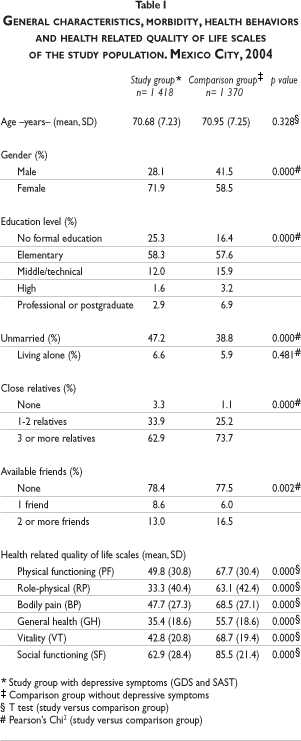
<body><![CDATA[<p><font face="Verdana, Arial, Helvetica, sans-serif" size="2"><b>Data analysis</b></font></p>     <p><font face="Verdana, Arial, Helvetica, sans-serif" size="2">Three kinds of    analyses were carried out. First, a descriptive analysis was performed, classifying    the study participants into the study (with depressive symptoms and anxiety)    and comparison (without depressive symptoms and anxiety) groups, and identifying    differences between these groups. Differences in study variables were assessed    with Pearson's Chi<sup>2</sup> for categorical or dummy variables and the T-test    for continuous variables (age). Values of <i>p</i> &lt; 0.05 or higher were    considered statistically significant.</font></p>     <p><font face="Verdana, Arial, Helvetica, sans-serif" size="2">Secondly, older    adults' HRQL was assessed with the eight scales of the SF-36 and differences    among the scores on these scales were evaluated against social network variables    in both the study and comparison groups through a T-test analysis (significance    level, <i>p</i> &lt; 0.05).</font></p>     <p><font face="Verdana, Arial, Helvetica, sans-serif" size="2">Finally, in order    to estimate the association between social networks and HRQL in the groups with    and without depressive symptoms, multiple linear regression analyses were developed    in which the dependent variable was the score on each of the SF-36 scales, adjusting    for co-variables (socio-demographic) and morbidity and health behaviors variables.</font></p>     <p>&nbsp;</p>     <p><font face="Verdana, Arial, Helvetica, sans-serif" size="3"><b>Results</b></font></p>     <p><font face="Verdana, Arial, Helvetica, sans-serif" size="2">From the study    sample's framework, a total of 7526 older adults were interviewed. Of these,    1418 (18.8%) reported significant depressive symptoms, anxiety, or both (study    group). For the purpose of this analysis the study excluded 212 individuals    since they did not provide full data for all variables. Thus, the total number    of older adults in the study was 2788, with 1418 in the study group and 1370    in the comparison group.</font></p>     <p><font face="Verdana, Arial, Helvetica, sans-serif" size="2">The mean age was    similar between study (70.6 years old) and comparison (70.9 years old) groups.    However, the study group had a higher proportion of women (72% vs. 59%) and    a lower education level, as shown in <a href="#tab1">table I</a>.</font></p>     <p><a name="tab1"></a></p>     <p>&nbsp;</p>     ]]></body>
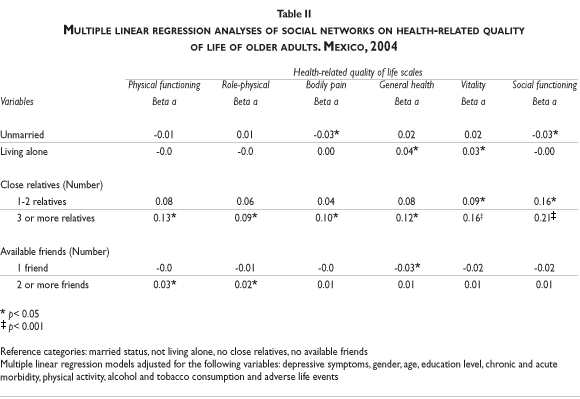
<body><![CDATA[<p align="center"><img src="/img/revistas/spm/v51n1/04t1.gif"></p>     <p>&nbsp;</p>     <p><font face="Verdana, Arial, Helvetica, sans-serif" size="2">Concerning the    social network variables, in the study group 47.2 percent were not married,    6.6 percent lived alone, 3.25 percent did not have a network of close relatives,    and 12.9 percent relied on a network of at least two available friends. In the    comparison group 39 percent were not married, 5.9 percent lived alone, 1 percent    did not have a network of close relatives, and 17 percent had a network with    at least two available friends. However, in both groups the proportion of older    adults having social networks with no friends reached almost 80 percent (<a href="#tab1">table    I</a>).</font></p>     <p><font face="Verdana, Arial, Helvetica, sans-serif" size="2">The social network    variables marital status, living alone, and size of the network of close relatives    and available friends impacted HRQL in both groups. The HRQL on each scale and    in the presence of the four social network variables was considerably lower    in the study group than the comparison group (<i>p</i>&lt; 0.001) (<a href="/img/revistas/spm/v51n1/04f1.gif">figure    1</a>). Marital status was a key variable in both groups; although the study    group reported the lowest HRQL scores (<i>p</i>&lt; 0.001), married people in    this group report better scores than those not married on the scales of physical    functioning (PF), role-physical (RP), and bodily pain (BP). In the comparison    group, being married generated better scores on the scales SF (social functioning),    PF, and BP (<a href="/img/revistas/spm/v51n1/04f1.gif">figure 1</a>).</font></p>     <p><font face="Verdana, Arial, Helvetica, sans-serif" size="2">On the other hand,    study group participants living alone reported a lower HRQL on almost every    scale, except for the GH (general health) and VT (vitality) scales. Living alone    did not significantly affect HRQL in the comparison group, except for GH, on    which those living alone scored higher. It is worth noting that when the association    of these two variables is analyzed together (marital status and living alone)    similar differences in the HRQL scales remain between the study group and the    comparison group (data not shown).</font></p>     <p><font face="Verdana, Arial, Helvetica, sans-serif" size="2">The lowest HRQLs,    even on the RP scale, were reported in both groups among older adults without    a network of close relatives. Members of the comparison group without such a    network reported HRQL scores similar to those of the study group (<a href="/img/revistas/spm/v51n1/04f1.gif">figure    1</a>).</font></p>     <p><font face="Verdana, Arial, Helvetica, sans-serif" size="2">As seen in the    study group, having a network with only one friend does not impact HRQL perception    differently from having no friends. However, networks with two or more friends    generate a positive impact on PF and RP scales in the group with depressive    symptoms. Within the comparison group, those with networks of two or more scored    better on all HRQL scales (<a href="/img/revistas/spm/v51n1/04f1.gif">figure    1</a>). As the number of relatives and friends in the social networks rises,    especially for those in the study group, HRQL scores tend to be better.</font></p>     <p><font face="Verdana, Arial, Helvetica, sans-serif" size="2">Standardized regression    coefficients reveal interesting links between social networks and HRQL in the    context of the variable of depression (depressive symptoms and anxiety characterized    by low HRQL in all scales measured by SF-36). After adjusting for socio-demographic    variables, morbidity and adverse life events and health behaviors variables,    being unmarried had a negative impact on the HRQL in BP and SF scales. In contrast,    living alone had a significant (<i>p</i> &lt; 0.05) positive association with    better HRQL scores on the GH and VT scales (<a href="#tab2">table II</a>).</font></p>     <p><a name="tab2"></a></p>     <p>&nbsp;</p>     ]]></body>
<body><![CDATA[<p align="center"><img src="/img/revistas/spm/v51n1/04t2.gif"></p>     <p>&nbsp;</p>     <p><font face="Verdana, Arial, Helvetica, sans-serif" size="2">As the network    of close relatives grows, HRQL perception improves. Outcomes of HRQL revealed    that having a network of 1-2 relatives is positively associated with VT and    SF scores (<i>p</i>&lt; 0.05). A network with three or more close relatives    had a positive and significant impact (<i>p</i>&lt; 0.05) on all HRQL scales;    particularly on VT and SF (<i>p</i> value &lt; 0.001) (<a href="#tab2">table    II</a>).</font></p>     <p><font face="Verdana, Arial, Helvetica, sans-serif" size="2">Additionally, multivariate    analysis confirms that networks of two or more friends are associated with better    HRQL scores, but only on the PF and RP scales. Networks of a single friend are    negatively associated with GH scale scores / (<i>p</i>&lt; 0.05), (<a href="#tab2">table    II</a>).</font></p>     <p>&nbsp;</p>     <p><font face="Verdana, Arial, Helvetica, sans-serif" size="3"><b>Discussion</b></font></p>     <p><font face="Verdana, Arial, Helvetica, sans-serif" size="2">These results confirm    the widely known association between depression and decreased health-related    quality of life (HRQL) in older adults, including the community-dwelling elderly<sup>20,30,31</sup>    and older adults whose HRQL has been measured with SF-36.<sup>32</sup></font></p>     <p><font face="Verdana, Arial, Helvetica, sans-serif" size="2">The main contribution    of this study is the finding that particular types of social networks seem to    improve older adults' HRQL, particularly for those whose HRQL is affected by    depressive symptoms. Social networks including a spouse and larger networks    of close relatives and friends appear to mitigate the influence of depressive    symptoms on some HRQL scales.</font></p>     <p><font face="Verdana, Arial, Helvetica, sans-serif" size="2">It was also found    that in spite of the changes in population structure, Mexican older adults'    social networks continue to consist largely of family. While many elderly Mexicans    are not married, most live and generally associate with family. In contrast    with other cultures where friend networks are key to older people's social lives,<sup>18</sup>    it was found that a high proportion of older Mexicans do not have a network    of friends. However, results reveal that elderly Mexicans with and without depressive    symptoms who have networks with larger numbers of friends have better HRQLs.</font></p>     <p><font face="Verdana, Arial, Helvetica, sans-serif" size="2">In light of the    finding that larger networks of friends and family increased HRQL, living alone    had a counterintuitive effect on reported quality of life. Many studies have    reported conflicting conclusions on the complex relationship between depression    and loneliness.<sup>33,34</sup></font></p>     ]]></body>
<body><![CDATA[<p><font face="Verdana, Arial, Helvetica, sans-serif" size="2">This pattern was    also found in this study, particularly regarding the physical health related    dimensions of general health and vitality. Older adults living alone scored    better on these scales, a trend that remains in the group without depressive    symptoms also in the general health scale. However, living alone did not improve    scores on the other HRQL scales. Such a finding may suggest that those live    alone are able to do so because their health status allows it. It is important    to note that the percentage of participants living alone in this study is lower    than that reported in other studies, where up to 50 percent of older patients    were living alone or experiencing loneliness.<sup>35,36</sup> Nevertheless,    the finding that being unmarried or living alone may not reduce HRQLs is congruent    with previous studies of elderly population without depression.<sup>37</sup></font></p>     <p><font face="Verdana, Arial, Helvetica, sans-serif" size="2">One must also consider    the limitations caused by the definition and assessment of social networks created    in the present study. First, since specific measures to evaluate social networks    were not employed, description of social networks is limited to some key features    of the network structure and does not include all the network's elements and    characteristics. While the level of detail collected was suitable for the analysis,    using a specific scale to measure these networks might have revealed associations    that were not visible in this study. Secondly, social networks were assessed    only in terms of structure. Contact frequency within the network structure and    the quality of the social networks were not considered. While this information    would have enriched the study, it was not feasible to collect because of the    study's cross-sectional design. This design impedes estimation of causation.    For instance, it was not possible to establish the direction of the association    among social networks, HRQL and depression.</font></p>     <p><font face="Verdana, Arial, Helvetica, sans-serif" size="2">In conclusion,    the findings of the present study have specific policy implications: government    policies encouraging the formation of social groups could combat depression    in older adults. The finding in this study that social networks of certain size    and composition (larger networks of family and friends) improve HRQL in older    adults, regardless of their depressive symptoms, suggests that social networks    provide not only moral and emotional, but physical support as well. Larger social    networks may thus support and enhance the work of national health systems. This    suggestion is based on previous studies' assertions that depression can be mitigated    by enhancing social networks.<sup>38</sup> For instance, Demura &amp; Sato<sup>31</sup>    showed that depressive symptoms can be reduced by increasing an individual's    number of friends. Thus, fostering social networks around elderly people, particularly    expanding friend networks and contact with relatives, would likely mitigate    depressive symptoms and their negative impact on HRQL.</font></p>     <p><font face="Verdana, Arial, Helvetica, sans-serif" size="2"><b>Acknowledgements</b></font></p>     <p><font face="Verdana, Arial, Helvetica, sans-serif" size="2">This project was    supported by grants from CONACyT (Mexico) 2002-CO1-6868, Mexican Institute of    Social Security (IMSS 2002-382) and NIH-FIRCA R03 TW005888. Dr. Wagner was funded    through grant DA 17796 from NIDA and P60-MD002217 from the NCMHHD.</font></p>     <p>&nbsp;</p>     <p><font face="Verdana, Arial, Helvetica, sans-serif" size="3"><b>References</b></font></p>     <!-- ref --><p><font face="Verdana, Arial, Helvetica, sans-serif" size="2">1. House J, Landis    KR, Umberson D. Social relationships and health. Science 1988, 241: 540-545.</font>&nbsp;&nbsp;&nbsp;&nbsp;&nbsp;&nbsp;&nbsp;&nbsp;[&#160;<a href="javascript:void(0);" onclick="javascript: window.open('/scielo.php?script=sci_nlinks&ref=9270769&pid=S0036-3634200900010000400001&lng=','','width=640,height=500,resizable=yes,scrollbars=1,menubar=yes,');">Links</a>&#160;]<!-- end-ref --><!-- ref --><p><font face="Verdana, Arial, Helvetica, sans-serif" size="2">2. Litwin H. Social    network type and health status in a national sample of elderly Israelis. Soc    Sci Med 1998; 46:599-609.</font>&nbsp;&nbsp;&nbsp;&nbsp;&nbsp;&nbsp;&nbsp;&nbsp;[&#160;<a href="javascript:void(0);" onclick="javascript: window.open('/scielo.php?script=sci_nlinks&ref=9270770&pid=S0036-3634200900010000400002&lng=','','width=640,height=500,resizable=yes,scrollbars=1,menubar=yes,');">Links</a>&#160;]<!-- end-ref --><!-- ref --><p><font face="Verdana, Arial, Helvetica, sans-serif" size="2">3. Berkman LF,    Glass T, Brissette I, Seeman T. From social integration to health: Durkheim    in the new millennium. Soc Sci Med 2000; 51: 843-857.</font>&nbsp;&nbsp;&nbsp;&nbsp;&nbsp;&nbsp;&nbsp;&nbsp;[&#160;<a href="javascript:void(0);" onclick="javascript: window.open('/scielo.php?script=sci_nlinks&ref=9270771&pid=S0036-3634200900010000400003&lng=','','width=640,height=500,resizable=yes,scrollbars=1,menubar=yes,');">Links</a>&#160;]<!-- end-ref --><!-- ref --><p><font face="Verdana, Arial, Helvetica, sans-serif" size="2">4. Orth-Gomer K,    Johnson JV. Social network interaction and mortality: A six-year follow-up of    a random sample of the Swedish population. J Chronic Dis 1987; 40: 949-957.</font>&nbsp;&nbsp;&nbsp;&nbsp;&nbsp;&nbsp;&nbsp;&nbsp;[&#160;<a href="javascript:void(0);" onclick="javascript: window.open('/scielo.php?script=sci_nlinks&ref=9270772&pid=S0036-3634200900010000400004&lng=','','width=640,height=500,resizable=yes,scrollbars=1,menubar=yes,');">Links</a>&#160;]<!-- end-ref --><!-- ref --><p><font face="Verdana, Arial, Helvetica, sans-serif" size="2">5. Vogt TM, Mullooly    JP, Ernst D, Pope CR, Hollis JF. Social networks as predictors of ischemic heart    disease, cancer, stroke and hypertension: incidence, survival and mortality.    J Clin Epidemiol 1992; 45: 659-666.</font>&nbsp;&nbsp;&nbsp;&nbsp;&nbsp;&nbsp;&nbsp;&nbsp;[&#160;<a href="javascript:void(0);" onclick="javascript: window.open('/scielo.php?script=sci_nlinks&ref=9270773&pid=S0036-3634200900010000400005&lng=','','width=640,height=500,resizable=yes,scrollbars=1,menubar=yes,');">Links</a>&#160;]<!-- end-ref --><!-- ref --><p><font face="Verdana, Arial, Helvetica, sans-serif" size="2">6. World Bank.    Policy Research Report. Averting the old age crisis policies to project the    old and promote growth. Washington DC: Oxford University Press, 1994.</font>&nbsp;&nbsp;&nbsp;&nbsp;&nbsp;&nbsp;&nbsp;&nbsp;[&#160;<a href="javascript:void(0);" onclick="javascript: window.open('/scielo.php?script=sci_nlinks&ref=9270774&pid=S0036-3634200900010000400006&lng=','','width=640,height=500,resizable=yes,scrollbars=1,menubar=yes,');">Links</a>&#160;]<!-- end-ref --><p><font face="Verdana, Arial, Helvetica, sans-serif" size="2">7. Consejo Nacional    de Poblaci&oacute;n (CONAPO). Proyecciones de Poblaci&oacute;n 2000-2050. Mexico    City: CONAPO, 2002.</font></p>     <!-- ref --><p><font face="Verdana, Arial, Helvetica, sans-serif" size="2">8. Encuesta Nacional    sobre Salud y Envejecimiento en M&eacute;xico (ENASEM), 2001.&#91;Consultado    2 de noviembre de 2007&#93;. Disponible en <a href="http://www.mhas.pop.upenn.edu" target="_blank">http://www.mhas.pop.upenn.edu</a>.</font>&nbsp;&nbsp;&nbsp;&nbsp;&nbsp;&nbsp;&nbsp;&nbsp;[&#160;<a href="javascript:void(0);" onclick="javascript: window.open('/scielo.php?script=sci_nlinks&ref=9270776&pid=S0036-3634200900010000400008&lng=','','width=640,height=500,resizable=yes,scrollbars=1,menubar=yes,');">Links</a>&#160;]<!-- end-ref --><!-- ref --><p><font face="Verdana, Arial, Helvetica, sans-serif" size="2">9. Reyes-Frausto    S. Population ageing in the Mexican Institute of Social Security: Health Policy    and Economic Implications. Instituto Mexicano del Seguro Social. Fundaci&oacute;n    Mexicana para la Salud. Mexico: FUNSALUD, 2001.</font>&nbsp;&nbsp;&nbsp;&nbsp;&nbsp;&nbsp;&nbsp;&nbsp;[&#160;<a href="javascript:void(0);" onclick="javascript: window.open('/scielo.php?script=sci_nlinks&ref=9270777&pid=S0036-3634200900010000400009&lng=','','width=640,height=500,resizable=yes,scrollbars=1,menubar=yes,');">Links</a>&#160;]<!-- end-ref --><!-- ref --><p><font face="Verdana, Arial, Helvetica, sans-serif" size="2">10. Kahn RL. Aging    and social support. In: Riley M, ed. Aging from birth to death. Boulder: Westview,    1979:75-93.</font>&nbsp;&nbsp;&nbsp;&nbsp;&nbsp;&nbsp;&nbsp;&nbsp;[&#160;<a href="javascript:void(0);" onclick="javascript: window.open('/scielo.php?script=sci_nlinks&ref=9270778&pid=S0036-3634200900010000400010&lng=','','width=640,height=500,resizable=yes,scrollbars=1,menubar=yes,');">Links</a>&#160;]<!-- end-ref --><!-- ref --><p><font face="Verdana, Arial, Helvetica, sans-serif" size="2">11. Mel&eacute;ndez-Moral    JC, Tom&aacute;s-Miguel JM, Navarro-Pardo E. Analyses of the social networks    for the elderly through the Manheim interview. Salud Publica Mex 2007; 49:408-414.</font>&nbsp;&nbsp;&nbsp;&nbsp;&nbsp;&nbsp;&nbsp;&nbsp;[&#160;<a href="javascript:void(0);" onclick="javascript: window.open('/scielo.php?script=sci_nlinks&ref=9270779&pid=S0036-3634200900010000400011&lng=','','width=640,height=500,resizable=yes,scrollbars=1,menubar=yes,');">Links</a>&#160;]<!-- end-ref --><!-- ref --><p><font face="Verdana, Arial, Helvetica, sans-serif" size="2">12. Gonzalez-Vazquez    T, Bonilla-Fernandez P, Jauregui-Ortiz B, Yamanis TJ, Salgado-de Snyder VN.    Well-being and family support among elderly rural Mexicans in the context of    migration to the United States. J Aging Health 2007: 19; 334-355.</font>&nbsp;&nbsp;&nbsp;&nbsp;&nbsp;&nbsp;&nbsp;&nbsp;[&#160;<a href="javascript:void(0);" onclick="javascript: window.open('/scielo.php?script=sci_nlinks&ref=9270780&pid=S0036-3634200900010000400012&lng=','','width=640,height=500,resizable=yes,scrollbars=1,menubar=yes,');">Links</a>&#160;]<!-- end-ref --><!-- ref --><p><font face="Verdana, Arial, Helvetica, sans-serif" size="2">13. Robles L, Rizo-Curiel    G, Camarena-Garcia LM, Cervantes-Coles L, G&oacute;mez-Medrano MS, Siordia-Gonzalez    M. Social network and social support among poor elderly ill in Guadalajara,    Mexico. Cad Saude Publica 2000; 16: 557-560.</font>&nbsp;&nbsp;&nbsp;&nbsp;&nbsp;&nbsp;&nbsp;&nbsp;[&#160;<a href="javascript:void(0);" onclick="javascript: window.open('/scielo.php?script=sci_nlinks&ref=9270781&pid=S0036-3634200900010000400013&lng=','','width=640,height=500,resizable=yes,scrollbars=1,menubar=yes,');">Links</a>&#160;]<!-- end-ref --><!-- ref --><p><font face="Verdana, Arial, Helvetica, sans-serif" size="2">14. Antonucci TC,    Akiyama H. Social networks in the adult life and a preliminary examination of    the convoy model. J Gerontol 1987; 42: 519-527.</font>&nbsp;&nbsp;&nbsp;&nbsp;&nbsp;&nbsp;&nbsp;&nbsp;[&#160;<a href="javascript:void(0);" onclick="javascript: window.open('/scielo.php?script=sci_nlinks&ref=9270782&pid=S0036-3634200900010000400014&lng=','','width=640,height=500,resizable=yes,scrollbars=1,menubar=yes,');">Links</a>&#160;]<!-- end-ref --><!-- ref --><p><font face="Verdana, Arial, Helvetica, sans-serif" size="2">15. Fischer CS.    To dwell among friends: personal networks in town and city. Chicago: University    of Chicago Press, 1982.</font>&nbsp;&nbsp;&nbsp;&nbsp;&nbsp;&nbsp;&nbsp;&nbsp;[&#160;<a href="javascript:void(0);" onclick="javascript: window.open('/scielo.php?script=sci_nlinks&ref=9270783&pid=S0036-3634200900010000400015&lng=','','width=640,height=500,resizable=yes,scrollbars=1,menubar=yes,');">Links</a>&#160;]<!-- end-ref --><!-- ref --><p><font face="Verdana, Arial, Helvetica, sans-serif" size="2">16. Melchior M,    Berkman LF, Niedhammer I, Chea M, Goldberg M. Social relationship and self-reported    health: a prospective analysis of the French Gazel cohort. Soc Sci Med 2003;    56: 1817-1830.</font>&nbsp;&nbsp;&nbsp;&nbsp;&nbsp;&nbsp;&nbsp;&nbsp;[&#160;<a href="javascript:void(0);" onclick="javascript: window.open('/scielo.php?script=sci_nlinks&ref=9270784&pid=S0036-3634200900010000400016&lng=','','width=640,height=500,resizable=yes,scrollbars=1,menubar=yes,');">Links</a>&#160;]<!-- end-ref --><!-- ref --><p><font face="Verdana, Arial, Helvetica, sans-serif" size="2">17. Newsom JT,    Schulz R. Social support as a mediator in the relation between functional status    and quality of life in older adults. Psychol Aging 1996; 11: 34-44.</font>&nbsp;&nbsp;&nbsp;&nbsp;&nbsp;&nbsp;&nbsp;&nbsp;[&#160;<a href="javascript:void(0);" onclick="javascript: window.open('/scielo.php?script=sci_nlinks&ref=9270785&pid=S0036-3634200900010000400017&lng=','','width=640,height=500,resizable=yes,scrollbars=1,menubar=yes,');">Links</a>&#160;]<!-- end-ref --><!-- ref --><p><font face="Verdana, Arial, Helvetica, sans-serif" size="2">18. Garcia EL,    Banegas JR, Perez-Regadera AG, Cabrera RH, Rodriguez-Artalejo F. Social network    and health-related quality of life in older adults: a population-based study    in Spain. Qual Life Res 2005;14: 511-520.</font>&nbsp;&nbsp;&nbsp;&nbsp;&nbsp;&nbsp;&nbsp;&nbsp;[&#160;<a href="javascript:void(0);" onclick="javascript: window.open('/scielo.php?script=sci_nlinks&ref=9270786&pid=S0036-3634200900010000400018&lng=','','width=640,height=500,resizable=yes,scrollbars=1,menubar=yes,');">Links</a>&#160;]<!-- end-ref --><!-- ref --><p><font face="Verdana, Arial, Helvetica, sans-serif" size="2">19. Testa MA, Simonson    DC. Current concepts: assessment of quality-of-life outcomes. N Engl J Med 1996;    334: 835-840.</font>&nbsp;&nbsp;&nbsp;&nbsp;&nbsp;&nbsp;&nbsp;&nbsp;[&#160;<a href="javascript:void(0);" onclick="javascript: window.open('/scielo.php?script=sci_nlinks&ref=9270787&pid=S0036-3634200900010000400019&lng=','','width=640,height=500,resizable=yes,scrollbars=1,menubar=yes,');">Links</a>&#160;]<!-- end-ref --><!-- ref --><p><font face="Verdana, Arial, Helvetica, sans-serif" size="2">20. Wada T, Ishine    M, Sakagami T, Kita T, Okumiya L, Mizuno K <i>et al</i>. Depression, activities    of daily living, and quality of life of community dwelling elderly in three    Asian countries: Indonesia, Vietnam, and Japan. Arch Gerontol Geriatr 2005;    41: 271-280.</font>&nbsp;&nbsp;&nbsp;&nbsp;&nbsp;&nbsp;&nbsp;&nbsp;[&#160;<a href="javascript:void(0);" onclick="javascript: window.open('/scielo.php?script=sci_nlinks&ref=9270788&pid=S0036-3634200900010000400020&lng=','','width=640,height=500,resizable=yes,scrollbars=1,menubar=yes,');">Links</a>&#160;]<!-- end-ref --><!-- ref --><p><font face="Verdana, Arial, Helvetica, sans-serif" size="2">21. Papakostas    GI, Petersen T, Mahal Y, Mischoulon D, Nierenberg AA, Fava M. Quality of life    assessment in major depressive disorder: a review of literature. Gen Hosp Psychiatry    2004; 26:13-17.</font>&nbsp;&nbsp;&nbsp;&nbsp;&nbsp;&nbsp;&nbsp;&nbsp;[&#160;<a href="javascript:void(0);" onclick="javascript: window.open('/scielo.php?script=sci_nlinks&ref=9270789&pid=S0036-3634200900010000400021&lng=','','width=640,height=500,resizable=yes,scrollbars=1,menubar=yes,');">Links</a>&#160;]<!-- end-ref --><!-- ref --><p><font face="Verdana, Arial, Helvetica, sans-serif" size="2">22. Wells KB, Stewart    A, Hays RD, Burnam MA, Rogers W, Daniels M. The functioning and well-being of    depressed patients. Results from the Medical Outcomes Study. JAMA 1989; 18:    914-919.</font>&nbsp;&nbsp;&nbsp;&nbsp;&nbsp;&nbsp;&nbsp;&nbsp;[&#160;<a href="javascript:void(0);" onclick="javascript: window.open('/scielo.php?script=sci_nlinks&ref=9270790&pid=S0036-3634200900010000400022&lng=','','width=640,height=500,resizable=yes,scrollbars=1,menubar=yes,');">Links</a>&#160;]<!-- end-ref --><p><font face="Verdana, Arial, Helvetica, sans-serif" size="2">23. Ware JE Jr,    Sherbourne CD. The MOS-36-item-short-form health survey (SF-36): I. Conceptual    framework and item selection. Med Care 1992; 30: 473-483.</font></p>     ]]></body>
<body><![CDATA[<!-- ref --><p><font face="Verdana, Arial, Helvetica, sans-serif" size="2">24. Z&uacute;&ntilde;iga    MA, Carrillo-Jim&eacute;nez GT, Fox PJ, Gandek B, Medina-Moreno MR. Evaluaci&oacute;n    del estado de salud con la Encuesta SF-36: resultados preliminares. Salud Publica    Mex 1999; 41: 110-118.</font>&nbsp;&nbsp;&nbsp;&nbsp;&nbsp;&nbsp;&nbsp;&nbsp;[&#160;<a href="javascript:void(0);" onclick="javascript: window.open('/scielo.php?script=sci_nlinks&ref=9270792&pid=S0036-3634200900010000400024&lng=','','width=640,height=500,resizable=yes,scrollbars=1,menubar=yes,');">Links</a>&#160;]<!-- end-ref --><!-- ref --><p><font face="Verdana, Arial, Helvetica, sans-serif" size="2">25. Yesavage JA,    Brink TL, Rose TL, Lum O, Huang V, Adey M, Leirer O. Development and validation    of a geriatric depression screening scale: preliminary report. J Psychiatr Res    1983; 17: 37-49.</font>&nbsp;&nbsp;&nbsp;&nbsp;&nbsp;&nbsp;&nbsp;&nbsp;[&#160;<a href="javascript:void(0);" onclick="javascript: window.open('/scielo.php?script=sci_nlinks&ref=9270793&pid=S0036-3634200900010000400025&lng=','','width=640,height=500,resizable=yes,scrollbars=1,menubar=yes,');">Links</a>&#160;]<!-- end-ref --><!-- ref --><p><font face="Verdana, Arial, Helvetica, sans-serif" size="2">26. Fern&aacute;ndez-San    Mart&iacute;n MI, Andrade C, Molina J, Mu&ntilde;oz PE, Carretero B, Rodr&iacute;guez    M, <i>et al.</i> Validation of the Spanish version of the Geriatric Depression    Scale (GDS) in primary care. Int J Geriatr Psychiatry 2002; 17: 279-287.</font>&nbsp;&nbsp;&nbsp;&nbsp;&nbsp;&nbsp;&nbsp;&nbsp;[&#160;<a href="javascript:void(0);" onclick="javascript: window.open('/scielo.php?script=sci_nlinks&ref=9270794&pid=S0036-3634200900010000400026&lng=','','width=640,height=500,resizable=yes,scrollbars=1,menubar=yes,');">Links</a>&#160;]<!-- end-ref --><!-- ref --><p><font face="Verdana, Arial, Helvetica, sans-serif" size="2">27. Lyness JM,    Noel TK, Cox C, King DA, Conwell Y, Caine ED. Screening for depression in elderly    primary care patients: A comparison of the Center for Epidemiologic Studies-Depression    Scale and the Geriatric Depression Scale. Arch Intern Med 1997; 157: 449-454.</font>&nbsp;&nbsp;&nbsp;&nbsp;&nbsp;&nbsp;&nbsp;&nbsp;[&#160;<a href="javascript:void(0);" onclick="javascript: window.open('/scielo.php?script=sci_nlinks&ref=9270795&pid=S0036-3634200900010000400027&lng=','','width=640,height=500,resizable=yes,scrollbars=1,menubar=yes,');">Links</a>&#160;]<!-- end-ref --><!-- ref --><p><font face="Verdana, Arial, Helvetica, sans-serif" size="2">28. Onishi J, Suzuki    Y, Umegaki H, Endo H, Kawamura T, Iguchi A. A comparison of depressive mood    of older adults in a community, nursing homes, and a geriatric hospital: factor    analysis of Geriatric Depression Scale. J Geriatr Psychiatry Neurol 2006; 19:    26-31.</font>&nbsp;&nbsp;&nbsp;&nbsp;&nbsp;&nbsp;&nbsp;&nbsp;[&#160;<a href="javascript:void(0);" onclick="javascript: window.open('/scielo.php?script=sci_nlinks&ref=9270796&pid=S0036-3634200900010000400028&lng=','','width=640,height=500,resizable=yes,scrollbars=1,menubar=yes,');">Links</a>&#160;]<!-- end-ref --><!-- ref --><p><font face="Verdana, Arial, Helvetica, sans-serif" size="2">29. Sinoff G, Ore    L, Zlotogorsky D, Tamir D. Short Anxiety Screening Test- a brief instrument    for detecting anxiety in the elderly. Int J Geriatr Psychiatry 1999; 14: 1062-1071.</font>&nbsp;&nbsp;&nbsp;&nbsp;&nbsp;&nbsp;&nbsp;&nbsp;[&#160;<a href="javascript:void(0);" onclick="javascript: window.open('/scielo.php?script=sci_nlinks&ref=9270797&pid=S0036-3634200900010000400029&lng=','','width=640,height=500,resizable=yes,scrollbars=1,menubar=yes,');">Links</a>&#160;]<!-- end-ref --><!-- ref --><p><font face="Verdana, Arial, Helvetica, sans-serif" size="2">30. Scocco P, Fantoni    G, Caon F. Role of depressive and cognitive status in self-reported evaluation    of quality of life in older people: comparing proxy and physician perspectives.    Age Ageing 2006; 35: 166-171.</font>&nbsp;&nbsp;&nbsp;&nbsp;&nbsp;&nbsp;&nbsp;&nbsp;[&#160;<a href="javascript:void(0);" onclick="javascript: window.open('/scielo.php?script=sci_nlinks&ref=9270798&pid=S0036-3634200900010000400030&lng=','','width=640,height=500,resizable=yes,scrollbars=1,menubar=yes,');">Links</a>&#160;]<!-- end-ref --><!-- ref --><p><font face="Verdana, Arial, Helvetica, sans-serif" size="2">31. Demura S, Sato    S. Relationships between depression, lifestyle and quality of life in the community    dwelling elderly: a comparison between gender and age groups. J Physiol Anthropol    Appl Human Sci 2003; 22: 159-166.</font>&nbsp;&nbsp;&nbsp;&nbsp;&nbsp;&nbsp;&nbsp;&nbsp;[&#160;<a href="javascript:void(0);" onclick="javascript: window.open('/scielo.php?script=sci_nlinks&ref=9270799&pid=S0036-3634200900010000400031&lng=','','width=640,height=500,resizable=yes,scrollbars=1,menubar=yes,');">Links</a>&#160;]<!-- end-ref --><!-- ref --><p><font face="Verdana, Arial, Helvetica, sans-serif" size="2">32. Stein MB, Barrett-Connor    E. Quality of life in older adults receiving medications for anxiety, depression,    or insomnia: findings from a community-based study. Am J Geriatr Psychiatry    2002; 10: 568-574.</font>&nbsp;&nbsp;&nbsp;&nbsp;&nbsp;&nbsp;&nbsp;&nbsp;[&#160;<a href="javascript:void(0);" onclick="javascript: window.open('/scielo.php?script=sci_nlinks&ref=9270800&pid=S0036-3634200900010000400032&lng=','','width=640,height=500,resizable=yes,scrollbars=1,menubar=yes,');">Links</a>&#160;]<!-- end-ref --><!-- ref --><p><font face="Verdana, Arial, Helvetica, sans-serif" size="2">33. Heikkinen RL,    Kauppinen M. Depressive symptoms in late life: A 10-year follow-up. Arch Gerontol    Geriatr 2004; 38: 239-250.</font>&nbsp;&nbsp;&nbsp;&nbsp;&nbsp;&nbsp;&nbsp;&nbsp;[&#160;<a href="javascript:void(0);" onclick="javascript: window.open('/scielo.php?script=sci_nlinks&ref=9270801&pid=S0036-3634200900010000400033&lng=','','width=640,height=500,resizable=yes,scrollbars=1,menubar=yes,');">Links</a>&#160;]<!-- end-ref --><!-- ref --><p><font face="Verdana, Arial, Helvetica, sans-serif" size="2">34. Holm&eacute;n    K, Furukawa H. Loneliness, health and social network among elderly people: A    follow-up study. Arch Gerontol Geriatr 2002; 35: 261-274.</font>&nbsp;&nbsp;&nbsp;&nbsp;&nbsp;&nbsp;&nbsp;&nbsp;[&#160;<a href="javascript:void(0);" onclick="javascript: window.open('/scielo.php?script=sci_nlinks&ref=9270802&pid=S0036-3634200900010000400034&lng=','','width=640,height=500,resizable=yes,scrollbars=1,menubar=yes,');">Links</a>&#160;]<!-- end-ref --><!-- ref --><p><font face="Verdana, Arial, Helvetica, sans-serif" size="2">35. Chalise HN,    Saito T, Takahashi M, Kai I. Relationship specialization amongst sources and    receivers of social support and its correlations with loneliness and subjective    well-being: A cross sectional study of Nepalese older adults. Arch Gerontol    Geriatr 2007; 44: 299-314.</font>&nbsp;&nbsp;&nbsp;&nbsp;&nbsp;&nbsp;&nbsp;&nbsp;[&#160;<a href="javascript:void(0);" onclick="javascript: window.open('/scielo.php?script=sci_nlinks&ref=9270803&pid=S0036-3634200900010000400035&lng=','','width=640,height=500,resizable=yes,scrollbars=1,menubar=yes,');">Links</a>&#160;]<!-- end-ref --><!-- ref --><p><font face="Verdana, Arial, Helvetica, sans-serif" size="2">36. Forbes A. Caring    for older people: Loneliness. BMJ 1996; 313: 352-354.</font>&nbsp;&nbsp;&nbsp;&nbsp;&nbsp;&nbsp;&nbsp;&nbsp;[&#160;<a href="javascript:void(0);" onclick="javascript: window.open('/scielo.php?script=sci_nlinks&ref=9270804&pid=S0036-3634200900010000400036&lng=','','width=640,height=500,resizable=yes,scrollbars=1,menubar=yes,');">Links</a>&#160;]<!-- end-ref --><!-- ref --><p><font face="Verdana, Arial, Helvetica, sans-serif" size="2">37. Litwin H. Social    network type and morale in old age. Gerontologist 2001; 41: 516-524.</font>&nbsp;&nbsp;&nbsp;&nbsp;&nbsp;&nbsp;&nbsp;&nbsp;[&#160;<a href="javascript:void(0);" onclick="javascript: window.open('/scielo.php?script=sci_nlinks&ref=9270805&pid=S0036-3634200900010000400037&lng=','','width=640,height=500,resizable=yes,scrollbars=1,menubar=yes,');">Links</a>&#160;]<!-- end-ref --><!-- ref --><p><font face="Verdana, Arial, Helvetica, sans-serif" size="2">38. Blazer DG.    Impact of late life depression on the social network. Am J Psychiatry 1983;    140: 162-165.</font>&nbsp;&nbsp;&nbsp;&nbsp;&nbsp;&nbsp;&nbsp;&nbsp;[&#160;<a href="javascript:void(0);" onclick="javascript: window.open('/scielo.php?script=sci_nlinks&ref=9270806&pid=S0036-3634200900010000400038&lng=','','width=640,height=500,resizable=yes,scrollbars=1,menubar=yes,');">Links</a>&#160;]<!-- end-ref --><p>&nbsp;</p>     <p>&nbsp;</p>     <p><font face="Verdana, Arial, Helvetica, sans-serif" size="2">Received on: December    4, 2008<b>    <br>   </b> Accepted on: August 13, 2008</font></p>     <p>&nbsp;</p>     ]]></body>
<body><![CDATA[<p>&nbsp;</p>     <p><font face="Verdana, Arial, Helvetica, sans-serif" size="2">Address reprint    requests to: PhD. Carmen Garc&iacute;a-Pe&ntilde;a. Unidad de Investigaci&oacute;n    Epidemiol&oacute;gica y en Servicios de Salud/&Aacute;rea Envejecimiento. Edificio    Administrativo, 3er. Piso, Centro M&eacute;dico Nacional Siglo XXI. Av. Cuauht&eacute;moc    330, col. Doctores. 06725 Delegaci&oacute;n Cuauht&eacute;moc. M&eacute;xico    DF, M&eacute;xico    <br>   E-mail: <a href="mailto:carmen.garcia@imss.gob.mx">carmen.garcia@imss.gob.mx</a></font></p>      ]]></body><back>
<ref-list>
<ref id="B1">
<label>1</label><nlm-citation citation-type="journal">
<person-group person-group-type="author">
<name>
<surname><![CDATA[House]]></surname>
<given-names><![CDATA[J]]></given-names>
</name>
<name>
<surname><![CDATA[Landis]]></surname>
<given-names><![CDATA[KR]]></given-names>
</name>
<name>
<surname><![CDATA[Umberson]]></surname>
<given-names><![CDATA[D.]]></given-names>
</name>
</person-group>
<article-title xml:lang="en"><![CDATA[Social relationships and health]]></article-title>
<source><![CDATA[Science]]></source>
<year>1988</year>
<volume>241</volume>
<page-range>540-545</page-range></nlm-citation>
</ref>
<ref id="B2">
<label>2</label><nlm-citation citation-type="journal">
<person-group person-group-type="author">
<name>
<surname><![CDATA[Litwin]]></surname>
<given-names><![CDATA[H]]></given-names>
</name>
</person-group>
<article-title xml:lang="en"><![CDATA[Social network type and health status in a national sample of elderly Israelis]]></article-title>
<source><![CDATA[Soc Sci Med]]></source>
<year>1998</year>
<volume>46</volume>
<page-range>599-609</page-range></nlm-citation>
</ref>
<ref id="B3">
<label>3</label><nlm-citation citation-type="journal">
<person-group person-group-type="author">
<name>
<surname><![CDATA[Berkman]]></surname>
<given-names><![CDATA[LF]]></given-names>
</name>
<name>
<surname><![CDATA[Glass]]></surname>
<given-names><![CDATA[T]]></given-names>
</name>
<name>
<surname><![CDATA[Brissette]]></surname>
<given-names><![CDATA[I]]></given-names>
</name>
<name>
<surname><![CDATA[Seeman]]></surname>
<given-names><![CDATA[T]]></given-names>
</name>
</person-group>
<article-title xml:lang="en"><![CDATA[From social integration to health: Durkheim in the new millennium]]></article-title>
<source><![CDATA[Soc Sci Med]]></source>
<year>2000</year>
<volume>51</volume>
<page-range>843-857</page-range></nlm-citation>
</ref>
<ref id="B4">
<label>4</label><nlm-citation citation-type="journal">
<person-group person-group-type="author">
<name>
<surname><![CDATA[Orth-Gomer]]></surname>
<given-names><![CDATA[K]]></given-names>
</name>
<name>
<surname><![CDATA[Johnson]]></surname>
<given-names><![CDATA[JV]]></given-names>
</name>
</person-group>
<article-title xml:lang="en"><![CDATA[Social network interaction and mortality: A six-year follow-up of a random sample of the Swedish population]]></article-title>
<source><![CDATA[J Chronic Dis]]></source>
<year>1987</year>
<volume>40</volume>
<page-range>949-957</page-range></nlm-citation>
</ref>
<ref id="B5">
<label>5</label><nlm-citation citation-type="journal">
<person-group person-group-type="author">
<name>
<surname><![CDATA[Vogt]]></surname>
<given-names><![CDATA[TM]]></given-names>
</name>
<name>
<surname><![CDATA[Mullooly]]></surname>
<given-names><![CDATA[JP]]></given-names>
</name>
<name>
<surname><![CDATA[Ernst]]></surname>
<given-names><![CDATA[D]]></given-names>
</name>
<name>
<surname><![CDATA[Pope]]></surname>
<given-names><![CDATA[CR]]></given-names>
</name>
<name>
<surname><![CDATA[Hollis]]></surname>
<given-names><![CDATA[JF]]></given-names>
</name>
</person-group>
<article-title xml:lang="en"><![CDATA[Social networks as predictors of ischemic heart disease, cancer, stroke and hypertension: incidence, survival and mortality]]></article-title>
<source><![CDATA[J Clin Epidemiol]]></source>
<year>1992</year>
<volume>45</volume>
<page-range>659-666</page-range></nlm-citation>
</ref>
<ref id="B6">
<label>6</label><nlm-citation citation-type="book">
<collab>World Bank.</collab>
<source><![CDATA[Policy Research Report: Averting the old age crisis policies to project the old and promote growth]]></source>
<year>1994</year>
<publisher-loc><![CDATA[Washington DC ]]></publisher-loc>
<publisher-name><![CDATA[Oxford University Press]]></publisher-name>
</nlm-citation>
</ref>
<ref id="B7">
<label>7</label><nlm-citation citation-type="book">
<collab>Consejo Nacional de Población</collab>
<source><![CDATA[Proyecciones de Población 2000-2050]]></source>
<year>2002</year>
<publisher-loc><![CDATA[Mexico City ]]></publisher-loc>
<publisher-name><![CDATA[CONAPO]]></publisher-name>
</nlm-citation>
</ref>
<ref id="B8">
<label>8</label><nlm-citation citation-type="">
<source><![CDATA[Encuesta Nacional sobre Salud y Envejecimiento en México (ENASEM)]]></source>
<year>2001</year>
</nlm-citation>
</ref>
<ref id="B9">
<label>9</label><nlm-citation citation-type="book">
<person-group person-group-type="author">
<name>
<surname><![CDATA[Reyes-Frausto]]></surname>
<given-names><![CDATA[S]]></given-names>
</name>
</person-group>
<source><![CDATA[Population ageing in the Mexican Institute of Social Security: Health Policy and Economic Implications. Instituto Mexicano del Seguro Social. Fundación Mexicana para la Salud]]></source>
<year>2001</year>
<publisher-loc><![CDATA[Mexico ]]></publisher-loc>
<publisher-name><![CDATA[FUNSALUD]]></publisher-name>
</nlm-citation>
</ref>
<ref id="B10">
<label>10</label><nlm-citation citation-type="book">
<person-group person-group-type="author">
<name>
<surname><![CDATA[Kahn]]></surname>
<given-names><![CDATA[RL.]]></given-names>
</name>
</person-group>
<article-title xml:lang="en"><![CDATA[Aging and social support]]></article-title>
<person-group person-group-type="editor">
<name>
<surname><![CDATA[Riley]]></surname>
<given-names><![CDATA[M]]></given-names>
</name>
</person-group>
<source><![CDATA[Aging from birth to death]]></source>
<year>1979</year>
<page-range>75-93</page-range><publisher-loc><![CDATA[Boulder ]]></publisher-loc>
<publisher-name><![CDATA[Westview]]></publisher-name>
</nlm-citation>
</ref>
<ref id="B11">
<label>11</label><nlm-citation citation-type="journal">
<person-group person-group-type="author">
<name>
<surname><![CDATA[Meléndez-Moral]]></surname>
<given-names><![CDATA[JC]]></given-names>
</name>
<name>
<surname><![CDATA[Tomás-Miguel]]></surname>
<given-names><![CDATA[JM]]></given-names>
</name>
<name>
<surname><![CDATA[Navarro-Pardo]]></surname>
<given-names><![CDATA[E]]></given-names>
</name>
</person-group>
<article-title xml:lang="en"><![CDATA[Analyses of the social networks for the elderly through the Manheim interview]]></article-title>
<source><![CDATA[Salud Publica Mex]]></source>
<year>2007</year>
<volume>49</volume>
<page-range>408-414</page-range></nlm-citation>
</ref>
<ref id="B12">
<label>12</label><nlm-citation citation-type="journal">
<person-group person-group-type="author">
<name>
<surname><![CDATA[Gonzalez-Vazquez]]></surname>
<given-names><![CDATA[T]]></given-names>
</name>
<name>
<surname><![CDATA[Bonilla-Fernandez]]></surname>
<given-names><![CDATA[P]]></given-names>
</name>
<name>
<surname><![CDATA[Jauregui-Ortiz]]></surname>
<given-names><![CDATA[B]]></given-names>
</name>
<name>
<surname><![CDATA[Yamanis]]></surname>
<given-names><![CDATA[TJ]]></given-names>
</name>
<name>
<surname><![CDATA[Salgado-de Snyder]]></surname>
<given-names><![CDATA[VN.]]></given-names>
</name>
</person-group>
<article-title xml:lang="en"><![CDATA[Well-being and family support among elderly rural Mexicans in the context of migration to the United States]]></article-title>
<source><![CDATA[J Aging Health]]></source>
<year>2007</year>
<volume>19</volume>
<page-range>334-355</page-range></nlm-citation>
</ref>
<ref id="B13">
<label>13</label><nlm-citation citation-type="journal">
<person-group person-group-type="author">
<name>
<surname><![CDATA[Robles]]></surname>
<given-names><![CDATA[L]]></given-names>
</name>
<name>
<surname><![CDATA[Rizo-Curiel]]></surname>
<given-names><![CDATA[G]]></given-names>
</name>
<name>
<surname><![CDATA[Camarena-Garcia]]></surname>
<given-names><![CDATA[LM]]></given-names>
</name>
<name>
<surname><![CDATA[Cervantes-Coles]]></surname>
<given-names><![CDATA[L]]></given-names>
</name>
<name>
<surname><![CDATA[Gómez-Medrano]]></surname>
<given-names><![CDATA[MS]]></given-names>
</name>
<name>
<surname><![CDATA[Siordia-Gonzalez]]></surname>
<given-names><![CDATA[M]]></given-names>
</name>
</person-group>
<article-title xml:lang="en"><![CDATA[Social network and social support among poor elderly ill in Guadalajara, Mexico]]></article-title>
<source><![CDATA[Cad Saude Publica]]></source>
<year>2000</year>
<volume>16</volume>
<page-range>557-560</page-range></nlm-citation>
</ref>
<ref id="B14">
<label>14</label><nlm-citation citation-type="journal">
<person-group person-group-type="author">
<name>
<surname><![CDATA[Antonucci]]></surname>
<given-names><![CDATA[TC]]></given-names>
</name>
<name>
<surname><![CDATA[Akiyama]]></surname>
<given-names><![CDATA[H]]></given-names>
</name>
</person-group>
<article-title xml:lang="en"><![CDATA[Social networks in the adult life and a preliminary examination of the convoy model]]></article-title>
<source><![CDATA[J Gerontol]]></source>
<year>1987</year>
<volume>42</volume>
<page-range>519-527</page-range></nlm-citation>
</ref>
<ref id="B15">
<label>15</label><nlm-citation citation-type="book">
<person-group person-group-type="author">
<name>
<surname><![CDATA[Fischer]]></surname>
<given-names><![CDATA[CS]]></given-names>
</name>
</person-group>
<source><![CDATA[To dwell among friends: personal networks in town and city]]></source>
<year>1982</year>
<publisher-loc><![CDATA[Chicago ]]></publisher-loc>
<publisher-name><![CDATA[University of Chicago Press]]></publisher-name>
</nlm-citation>
</ref>
<ref id="B16">
<label>16</label><nlm-citation citation-type="journal">
<person-group person-group-type="author">
<name>
<surname><![CDATA[Melchior]]></surname>
<given-names><![CDATA[M]]></given-names>
</name>
<name>
<surname><![CDATA[Berkman]]></surname>
<given-names><![CDATA[LF]]></given-names>
</name>
<name>
<surname><![CDATA[Niedhammer]]></surname>
<given-names><![CDATA[I]]></given-names>
</name>
<name>
<surname><![CDATA[Chea]]></surname>
<given-names><![CDATA[M]]></given-names>
</name>
<name>
<surname><![CDATA[Goldberg]]></surname>
<given-names><![CDATA[M]]></given-names>
</name>
</person-group>
<article-title xml:lang="en"><![CDATA[Social relationship and self-reported health: a prospective analysis of the French Gazel cohort]]></article-title>
<source><![CDATA[Soc Sci Med]]></source>
<year>2003</year>
<volume>56</volume>
<page-range>1817-1830</page-range></nlm-citation>
</ref>
<ref id="B17">
<label>17</label><nlm-citation citation-type="journal">
<person-group person-group-type="author">
<name>
<surname><![CDATA[Newsom]]></surname>
<given-names><![CDATA[JT]]></given-names>
</name>
<name>
<surname><![CDATA[Schulz]]></surname>
<given-names><![CDATA[R]]></given-names>
</name>
</person-group>
<article-title xml:lang="en"><![CDATA[Social support as a mediator in the relation between functional status and quality of life in older adults]]></article-title>
<source><![CDATA[Psychol Aging]]></source>
<year>1996</year>
<volume>11</volume>
<page-range>34-44</page-range></nlm-citation>
</ref>
<ref id="B18">
<label>18</label><nlm-citation citation-type="journal">
<person-group person-group-type="author">
<name>
<surname><![CDATA[Garcia]]></surname>
<given-names><![CDATA[EL]]></given-names>
</name>
<name>
<surname><![CDATA[Banegas]]></surname>
<given-names><![CDATA[JR]]></given-names>
</name>
<name>
<surname><![CDATA[Perez-Regadera]]></surname>
<given-names><![CDATA[AG]]></given-names>
</name>
<name>
<surname><![CDATA[Cabrera]]></surname>
<given-names><![CDATA[RH]]></given-names>
</name>
<name>
<surname><![CDATA[Rodriguez-Artalejo]]></surname>
<given-names><![CDATA[F]]></given-names>
</name>
</person-group>
<article-title xml:lang="en"><![CDATA[Social network and health-related quality of life in older adults: a population-based study in Spain]]></article-title>
<source><![CDATA[Qual Life Res]]></source>
<year>2005</year>
<volume>14</volume>
<page-range>511-520</page-range></nlm-citation>
</ref>
<ref id="B19">
<label>19</label><nlm-citation citation-type="journal">
<person-group person-group-type="author">
<name>
<surname><![CDATA[Testa]]></surname>
<given-names><![CDATA[MA]]></given-names>
</name>
<name>
<surname><![CDATA[Simonson]]></surname>
<given-names><![CDATA[DC]]></given-names>
</name>
</person-group>
<article-title xml:lang="en"><![CDATA[Current concepts: assessment of quality-of-life outcomes]]></article-title>
<source><![CDATA[N Engl J Med]]></source>
<year>1996</year>
<volume>334</volume>
<page-range>835-840</page-range></nlm-citation>
</ref>
<ref id="B20">
<label>20</label><nlm-citation citation-type="journal">
<person-group person-group-type="author">
<name>
<surname><![CDATA[Wada]]></surname>
<given-names><![CDATA[T]]></given-names>
</name>
<name>
<surname><![CDATA[Ishine]]></surname>
<given-names><![CDATA[M]]></given-names>
</name>
<name>
<surname><![CDATA[Sakagami]]></surname>
<given-names><![CDATA[T]]></given-names>
</name>
<name>
<surname><![CDATA[Kita]]></surname>
<given-names><![CDATA[T]]></given-names>
</name>
<name>
<surname><![CDATA[Okumiya]]></surname>
<given-names><![CDATA[L]]></given-names>
</name>
<name>
<surname><![CDATA[Mizuno]]></surname>
<given-names><![CDATA[K]]></given-names>
</name>
</person-group>
<article-title xml:lang="en"><![CDATA[Depression, activities of daily living, and quality of life of community dwelling elderly in three Asian countries: Indonesia, Vietnam, and Japan]]></article-title>
<source><![CDATA[Arch Gerontol Geriatr]]></source>
<year>2005</year>
<volume>41</volume>
<page-range>271-280</page-range></nlm-citation>
</ref>
<ref id="B21">
<label>21</label><nlm-citation citation-type="journal">
<person-group person-group-type="author">
<name>
<surname><![CDATA[Papakostas]]></surname>
<given-names><![CDATA[GI]]></given-names>
</name>
<name>
<surname><![CDATA[Petersen]]></surname>
<given-names><![CDATA[T]]></given-names>
</name>
<name>
<surname><![CDATA[Mahal]]></surname>
<given-names><![CDATA[Y]]></given-names>
</name>
<name>
<surname><![CDATA[Mischoulon]]></surname>
<given-names><![CDATA[D]]></given-names>
</name>
<name>
<surname><![CDATA[Nierenberg]]></surname>
<given-names><![CDATA[AA]]></given-names>
</name>
<name>
<surname><![CDATA[Fava]]></surname>
<given-names><![CDATA[M]]></given-names>
</name>
</person-group>
<article-title xml:lang="en"><![CDATA[Quality of life assessment in major depressive disorder: a review of literature]]></article-title>
<source><![CDATA[Gen Hosp Psychiatry]]></source>
<year>2004</year>
<volume>26</volume>
<page-range>13-17</page-range></nlm-citation>
</ref>
<ref id="B22">
<label>22</label><nlm-citation citation-type="journal">
<person-group person-group-type="author">
<name>
<surname><![CDATA[Wells]]></surname>
<given-names><![CDATA[KB]]></given-names>
</name>
<name>
<surname><![CDATA[Stewart]]></surname>
<given-names><![CDATA[A]]></given-names>
</name>
<name>
<surname><![CDATA[Hays]]></surname>
<given-names><![CDATA[RD]]></given-names>
</name>
<name>
<surname><![CDATA[Burnam]]></surname>
<given-names><![CDATA[MA]]></given-names>
</name>
<name>
<surname><![CDATA[Rogers]]></surname>
<given-names><![CDATA[W]]></given-names>
</name>
<name>
<surname><![CDATA[Daniels]]></surname>
<given-names><![CDATA[M]]></given-names>
</name>
</person-group>
<article-title xml:lang="en"><![CDATA[The functioning and well-being of depressed patients: Results from the Medical Outcomes Study]]></article-title>
<source><![CDATA[JAMA]]></source>
<year>1989</year>
<volume>18</volume>
<page-range>914-919</page-range></nlm-citation>
</ref>
<ref id="B23">
<label>23</label><nlm-citation citation-type="journal">
<person-group person-group-type="author">
<name>
<surname><![CDATA[Ware Jr]]></surname>
<given-names><![CDATA[JE]]></given-names>
</name>
<name>
<surname><![CDATA[Sherbourne]]></surname>
<given-names><![CDATA[CD]]></given-names>
</name>
</person-group>
<article-title xml:lang="en"><![CDATA[The MOS-36-item-short-form health survey (SF-36): I. Conceptual framework and item selection]]></article-title>
<source><![CDATA[Med Care]]></source>
<year>1992</year>
<volume>30</volume>
<page-range>473-483</page-range></nlm-citation>
</ref>
<ref id="B24">
<label>24</label><nlm-citation citation-type="journal">
<person-group person-group-type="author">
<name>
<surname><![CDATA[Zúñiga]]></surname>
<given-names><![CDATA[MA]]></given-names>
</name>
<name>
<surname><![CDATA[Carrillo-Jiménez]]></surname>
<given-names><![CDATA[GT]]></given-names>
</name>
<name>
<surname><![CDATA[Fox]]></surname>
<given-names><![CDATA[PJ]]></given-names>
</name>
<name>
<surname><![CDATA[Gandek]]></surname>
<given-names><![CDATA[B]]></given-names>
</name>
<name>
<surname><![CDATA[Medina-Moreno]]></surname>
<given-names><![CDATA[MR]]></given-names>
</name>
</person-group>
<article-title xml:lang="es"><![CDATA[Evaluación del estado de salud con la Encuesta SF-36: resultados preliminares]]></article-title>
<source><![CDATA[Salud Publica Mex]]></source>
<year>1999</year>
<volume>41</volume>
<page-range>110-118</page-range></nlm-citation>
</ref>
<ref id="B25">
<label>25</label><nlm-citation citation-type="journal">
<person-group person-group-type="author">
<name>
<surname><![CDATA[Yesavage]]></surname>
<given-names><![CDATA[JA]]></given-names>
</name>
<name>
<surname><![CDATA[Brink]]></surname>
<given-names><![CDATA[TL]]></given-names>
</name>
<name>
<surname><![CDATA[Rose]]></surname>
<given-names><![CDATA[TL]]></given-names>
</name>
<name>
<surname><![CDATA[Lum]]></surname>
<given-names><![CDATA[O]]></given-names>
</name>
<name>
<surname><![CDATA[Huang]]></surname>
<given-names><![CDATA[V]]></given-names>
</name>
<name>
<surname><![CDATA[Adey]]></surname>
<given-names><![CDATA[M]]></given-names>
</name>
<name>
<surname><![CDATA[Leirer]]></surname>
<given-names><![CDATA[O]]></given-names>
</name>
</person-group>
<article-title xml:lang="en"><![CDATA[Development and validation of a geriatric depression screening scale: preliminary report]]></article-title>
<source><![CDATA[J Psychiatr Res]]></source>
<year>1983</year>
<volume>17</volume>
<page-range>37-49</page-range></nlm-citation>
</ref>
<ref id="B26">
<label>26</label><nlm-citation citation-type="journal">
<person-group person-group-type="author">
<name>
<surname><![CDATA[Fernández-San Martín]]></surname>
<given-names><![CDATA[MI]]></given-names>
</name>
<name>
<surname><![CDATA[Andrade]]></surname>
<given-names><![CDATA[C]]></given-names>
</name>
<name>
<surname><![CDATA[Molina]]></surname>
<given-names><![CDATA[J]]></given-names>
</name>
<name>
<surname><![CDATA[Muñoz]]></surname>
<given-names><![CDATA[PE]]></given-names>
</name>
<name>
<surname><![CDATA[Carretero]]></surname>
<given-names><![CDATA[B]]></given-names>
</name>
<name>
<surname><![CDATA[Rodríguez]]></surname>
<given-names><![CDATA[M]]></given-names>
</name>
</person-group>
<article-title xml:lang="en"><![CDATA[Validation of the Spanish version of the Geriatric Depression Scale (GDS) in primary care]]></article-title>
<source><![CDATA[Int J Geriatr Psychiatry]]></source>
<year>2002</year>
<volume>17</volume>
<page-range>279-287</page-range></nlm-citation>
</ref>
<ref id="B27">
<label>27</label><nlm-citation citation-type="journal">
<person-group person-group-type="author">
<name>
<surname><![CDATA[Lyness]]></surname>
<given-names><![CDATA[JM]]></given-names>
</name>
<name>
<surname><![CDATA[Noel]]></surname>
<given-names><![CDATA[TK]]></given-names>
</name>
<name>
<surname><![CDATA[Cox]]></surname>
<given-names><![CDATA[C]]></given-names>
</name>
<name>
<surname><![CDATA[King]]></surname>
<given-names><![CDATA[DA]]></given-names>
</name>
<name>
<surname><![CDATA[Conwell]]></surname>
<given-names><![CDATA[Y]]></given-names>
</name>
<name>
<surname><![CDATA[Caine]]></surname>
<given-names><![CDATA[ED]]></given-names>
</name>
</person-group>
<article-title xml:lang="en"><![CDATA[Screening for depression in elderly primary care patients: A comparison of the Center for Epidemiologic Studies-Depression Scale and the Geriatric Depression Scale]]></article-title>
<source><![CDATA[Arch Intern Med]]></source>
<year>1997</year>
<volume>157</volume>
<page-range>449-454</page-range></nlm-citation>
</ref>
<ref id="B28">
<label>28</label><nlm-citation citation-type="journal">
<person-group person-group-type="author">
<name>
<surname><![CDATA[Onishi]]></surname>
<given-names><![CDATA[J]]></given-names>
</name>
<name>
<surname><![CDATA[Suzuki]]></surname>
<given-names><![CDATA[Y]]></given-names>
</name>
<name>
<surname><![CDATA[Umegaki]]></surname>
<given-names><![CDATA[H]]></given-names>
</name>
<name>
<surname><![CDATA[Endo]]></surname>
<given-names><![CDATA[H]]></given-names>
</name>
<name>
<surname><![CDATA[Kawamura]]></surname>
<given-names><![CDATA[T]]></given-names>
</name>
<name>
<surname><![CDATA[Iguchi]]></surname>
<given-names><![CDATA[A]]></given-names>
</name>
</person-group>
<article-title xml:lang="en"><![CDATA[A comparison of depressive mood of older adults in a community, nursing homes, and a geriatric hospital: factor analysis of Geriatric Depression Scale]]></article-title>
<source><![CDATA[J Geriatr Psychiatry Neurol]]></source>
<year>2006</year>
<volume>19</volume>
<page-range>26-31</page-range></nlm-citation>
</ref>
<ref id="B29">
<label>29</label><nlm-citation citation-type="journal">
<person-group person-group-type="author">
<name>
<surname><![CDATA[Sinoff]]></surname>
<given-names><![CDATA[G]]></given-names>
</name>
<name>
<surname><![CDATA[Ore]]></surname>
<given-names><![CDATA[L]]></given-names>
</name>
<name>
<surname><![CDATA[Zlotogorsky]]></surname>
<given-names><![CDATA[D]]></given-names>
</name>
<name>
<surname><![CDATA[Tamir]]></surname>
<given-names><![CDATA[D]]></given-names>
</name>
</person-group>
<article-title xml:lang="en"><![CDATA[Short Anxiety Screening Test- a brief instrument for detecting anxiety in the elderly]]></article-title>
<source><![CDATA[Int J Geriatr Psychiatry]]></source>
<year>1999</year>
<volume>14</volume>
<page-range>1062-1071</page-range></nlm-citation>
</ref>
<ref id="B30">
<label>30</label><nlm-citation citation-type="journal">
<person-group person-group-type="author">
<name>
<surname><![CDATA[Scocco]]></surname>
<given-names><![CDATA[P]]></given-names>
</name>
<name>
<surname><![CDATA[Fantoni]]></surname>
<given-names><![CDATA[G]]></given-names>
</name>
<name>
<surname><![CDATA[Caon]]></surname>
<given-names><![CDATA[F]]></given-names>
</name>
</person-group>
<article-title xml:lang="en"><![CDATA[Role of depressive and cognitive status in self-reported evaluation of quality of life in older people: comparing proxy and physician perspectives]]></article-title>
<source><![CDATA[Age Ageing]]></source>
<year>2006</year>
<volume>35</volume>
<page-range>166-171</page-range></nlm-citation>
</ref>
<ref id="B31">
<label>31</label><nlm-citation citation-type="journal">
<person-group person-group-type="author">
<name>
<surname><![CDATA[Demura]]></surname>
<given-names><![CDATA[S]]></given-names>
</name>
<name>
<surname><![CDATA[Sato]]></surname>
<given-names><![CDATA[S]]></given-names>
</name>
</person-group>
<article-title xml:lang="en"><![CDATA[Relationships between depression, lifestyle and quality of life in the community dwelling elderly: a comparison between gender and age groups]]></article-title>
<source><![CDATA[J Physiol Anthropol Appl Human Sci]]></source>
<year>2003</year>
<volume>22</volume>
<page-range>159-166</page-range></nlm-citation>
</ref>
<ref id="B32">
<label>32</label><nlm-citation citation-type="journal">
<person-group person-group-type="author">
<name>
<surname><![CDATA[Stein]]></surname>
<given-names><![CDATA[MB]]></given-names>
</name>
<name>
<surname><![CDATA[Barrett-Connor]]></surname>
<given-names><![CDATA[E]]></given-names>
</name>
</person-group>
<article-title xml:lang="en"><![CDATA[Quality of life in older adults receiving medications for anxiety, depression, or insomnia: findings from a community-based study]]></article-title>
<source><![CDATA[Am J Geriatr Psychiatry]]></source>
<year>2002</year>
<volume>10</volume>
<page-range>568-574</page-range></nlm-citation>
</ref>
<ref id="B33">
<label>33</label><nlm-citation citation-type="journal">
<person-group person-group-type="author">
<name>
<surname><![CDATA[Heikkinen]]></surname>
<given-names><![CDATA[RL]]></given-names>
</name>
<name>
<surname><![CDATA[Kauppinen]]></surname>
<given-names><![CDATA[M]]></given-names>
</name>
</person-group>
<article-title xml:lang="en"><![CDATA[Depressive symptoms in late life: A 10-year follow-up]]></article-title>
<source><![CDATA[Arch Gerontol Geriatr]]></source>
<year>2004</year>
<volume>38</volume>
<page-range>239-250</page-range></nlm-citation>
</ref>
<ref id="B34">
<label>34</label><nlm-citation citation-type="journal">
<person-group person-group-type="author">
<name>
<surname><![CDATA[Holmén]]></surname>
<given-names><![CDATA[K]]></given-names>
</name>
<name>
<surname><![CDATA[Furukawa]]></surname>
<given-names><![CDATA[H]]></given-names>
</name>
</person-group>
<article-title xml:lang="en"><![CDATA[Loneliness, health and social network among elderly people: A follow-up study]]></article-title>
<source><![CDATA[Arch Gerontol Geriatr]]></source>
<year>2002</year>
<volume>35</volume>
<page-range>261-274</page-range></nlm-citation>
</ref>
<ref id="B35">
<label>35</label><nlm-citation citation-type="journal">
<person-group person-group-type="author">
<name>
<surname><![CDATA[Chalise]]></surname>
<given-names><![CDATA[HN]]></given-names>
</name>
<name>
<surname><![CDATA[Saito]]></surname>
<given-names><![CDATA[T]]></given-names>
</name>
<name>
<surname><![CDATA[Takahashi]]></surname>
<given-names><![CDATA[M]]></given-names>
</name>
<name>
<surname><![CDATA[Kai]]></surname>
<given-names><![CDATA[I]]></given-names>
</name>
</person-group>
<article-title xml:lang="en"><![CDATA[Relationship specialization amongst sources and receivers of social support and its correlations with loneliness and subjective well-being: A cross sectional study of Nepalese older adults]]></article-title>
<source><![CDATA[Arch Gerontol Geriatr]]></source>
<year>2007</year>
<volume>44</volume>
<page-range>299-314</page-range></nlm-citation>
</ref>
<ref id="B36">
<label>36</label><nlm-citation citation-type="journal">
<person-group person-group-type="author">
<name>
<surname><![CDATA[Forbes]]></surname>
<given-names><![CDATA[A]]></given-names>
</name>
</person-group>
<article-title xml:lang="en"><![CDATA[Caring for older people: Loneliness]]></article-title>
<source><![CDATA[BMJ]]></source>
<year>1996</year>
<volume>313</volume>
<page-range>352-354</page-range></nlm-citation>
</ref>
<ref id="B37">
<label>37</label><nlm-citation citation-type="journal">
<person-group person-group-type="author">
<name>
<surname><![CDATA[Litwin]]></surname>
<given-names><![CDATA[H]]></given-names>
</name>
</person-group>
<article-title xml:lang="en"><![CDATA[Social network type and morale in old age]]></article-title>
<source><![CDATA[Gerontologist]]></source>
<year>2001</year>
<volume>41</volume>
<page-range>516-524</page-range></nlm-citation>
</ref>
<ref id="B38">
<label>38</label><nlm-citation citation-type="journal">
<person-group person-group-type="author">
<name>
<surname><![CDATA[Blazer]]></surname>
<given-names><![CDATA[DG]]></given-names>
</name>
</person-group>
<article-title xml:lang="en"><![CDATA[Impact of late life depression on the social network]]></article-title>
<source><![CDATA[Am J Psychiatry]]></source>
<year>1983</year>
<volume>140</volume>
<page-range>162-165</page-range></nlm-citation>
</ref>
</ref-list>
</back>
</article>