<?xml version="1.0" encoding="ISO-8859-1"?><article xmlns:mml="http://www.w3.org/1998/Math/MathML" xmlns:xlink="http://www.w3.org/1999/xlink" xmlns:xsi="http://www.w3.org/2001/XMLSchema-instance">
<front>
<journal-meta>
<journal-id>0036-3634</journal-id>
<journal-title><![CDATA[Salud Pública de México]]></journal-title>
<abbrev-journal-title><![CDATA[Salud pública Méx]]></abbrev-journal-title>
<issn>0036-3634</issn>
<publisher>
<publisher-name><![CDATA[Instituto Nacional de Salud Pública]]></publisher-name>
</publisher>
</journal-meta>
<article-meta>
<article-id>S0036-36342008001000004</article-id>
<title-group>
<article-title xml:lang="en"><![CDATA[Costing of scaling up HIV/AIDS treatment in Mexico]]></article-title>
<article-title xml:lang="es"><![CDATA[Costos del tratamiento de VIH/SIDA en México]]></article-title>
</title-group>
<contrib-group>
<contrib contrib-type="author">
<name>
<surname><![CDATA[Bautista-Arredondo]]></surname>
<given-names><![CDATA[Sergio]]></given-names>
</name>
<xref ref-type="aff" rid="A01"/>
</contrib>
<contrib contrib-type="author">
<name>
<surname><![CDATA[Dmytraczenko]]></surname>
<given-names><![CDATA[Tania]]></given-names>
</name>
<xref ref-type="aff" rid="A02"/>
</contrib>
<contrib contrib-type="author">
<name>
<surname><![CDATA[Kombe]]></surname>
<given-names><![CDATA[Gilbert]]></given-names>
</name>
<xref ref-type="aff" rid="A02"/>
</contrib>
<contrib contrib-type="author">
<name>
<surname><![CDATA[Bertozzi]]></surname>
<given-names><![CDATA[Stefano M]]></given-names>
</name>
<xref ref-type="aff" rid="A03"/>
</contrib>
</contrib-group>
<aff id="A01">
<institution><![CDATA[,National Institute of Public Health Health Economics Division ]]></institution>
<addr-line><![CDATA[Cuernavaca ]]></addr-line>
<country>Mexico</country>
</aff>
<aff id="A02">
<institution><![CDATA[,Abt Associates Inc  ]]></institution>
<addr-line><![CDATA[Washington DC]]></addr-line>
<country>USA</country>
</aff>
<aff id="A03">
<institution><![CDATA[,Centro de Investigación y Docencia Económicas  ]]></institution>
<addr-line><![CDATA[Mexico City ]]></addr-line>
</aff>
<pub-date pub-type="pub">
<day>00</day>
<month>00</month>
<year>2008</year>
</pub-date>
<pub-date pub-type="epub">
<day>00</day>
<month>00</month>
<year>2008</year>
</pub-date>
<volume>50</volume>
<fpage>S437</fpage>
<lpage>S444</lpage>
<copyright-statement/>
<copyright-year/>
<self-uri xlink:href="http://www.scielo.org.mx/scielo.php?script=sci_arttext&amp;pid=S0036-36342008001000004&amp;lng=en&amp;nrm=iso"></self-uri><self-uri xlink:href="http://www.scielo.org.mx/scielo.php?script=sci_abstract&amp;pid=S0036-36342008001000004&amp;lng=en&amp;nrm=iso"></self-uri><self-uri xlink:href="http://www.scielo.org.mx/scielo.php?script=sci_pdf&amp;pid=S0036-36342008001000004&amp;lng=en&amp;nrm=iso"></self-uri><abstract abstract-type="short" xml:lang="en"><p><![CDATA[OBJECTIVE: To determine the net effect of introducing highly active antiretroviral treatment (HAART) in Mexico on total annual per-patient costs for HIV/AIDS care, taking into account potential savings from treatment of opportunistic infections and hospitalizations. MATERIAL AND METHODS: A multi-center, retrospective patient chart review and collection of unit cost data were performed to describe the utilization of services and estimate costs of care for 1003 adult HIV+ patients in the public sector. RESULTS: HAART is not cost-saving and the average annual cost per patient increases after initiation of HAART due to antiretrovirals, accounting for 90% of total costs. Hospitalizations do decrease post-HAART, but not enough to offset the increased cost. CONCLUSIONS: Scaling up access to HAART is feasible in middle income settings. Since antiretrovirals are so costly, optimizing efficiency in procurement and prescribing is paramount. The observed adherence was low, suggesting that a proportion of these high drug costs translated into limited health benefits.]]></p></abstract>
<abstract abstract-type="short" xml:lang="es"><p><![CDATA[OBJETIVO: Determinar el efecto neto de la introducción de la terapia antirretroviral altamente activa (TARAA) en México sobre los costos anuales totales por paciente en el tratamiento de VIH/SIDA, tomando en cuenta el posible ahorro en el tratamiento de infecciones oportunistas y hospitalización. MATERIAL Y MÉTODOS: Se hizo un estudio retrospectivo, multicéntrico, mediante la revisión de los expedientes de los pacientes y la recolección de datos de costos unitarios para describir la utilización de los servicios y calcular los costos de la atención de 1 003 pacientes adultos VIH positivos en el sector público. RESULTADOS: La TARAA no ahorra costos y el costo promedio anual por paciente aumenta después de su inicio debido a los antirretrovirales, que representan 90% del costo total. Las hospitalizaciones disminuyen después de iniciada la TARAA, pero no lo suficiente como para compensar el aumento en costos. CONCLUSIONES: Incrementar el acceso a la TARAA es factible en países con ingresos medios. Debido al alto costo de los antirretrovirales resulta esencial que se optimice la eficiencia en la compra y prescripción. El apego al tratamiento observado fue bajo, lo que sugiere que una proporción de estos altos costos en medicamentos no se traducen en beneficios a la salud significativos.]]></p></abstract>
<kwd-group>
<kwd lng="en"><![CDATA[acquired immunodeficiency syndrome]]></kwd>
<kwd lng="en"><![CDATA[antiretroviral therapy, highly active]]></kwd>
<kwd lng="en"><![CDATA[costs and cost analysis]]></kwd>
<kwd lng="en"><![CDATA[health care costs]]></kwd>
<kwd lng="en"><![CDATA[Mexico]]></kwd>
<kwd lng="es"><![CDATA[síndrome de inmunodeficiencia adquirida]]></kwd>
<kwd lng="es"><![CDATA[terapia antirretroviral altamente activa]]></kwd>
<kwd lng="es"><![CDATA[costos y análisis de costos]]></kwd>
<kwd lng="es"><![CDATA[costos de la atención a la salud]]></kwd>
<kwd lng="es"><![CDATA[México]]></kwd>
</kwd-group>
</article-meta>
</front><body><![CDATA[ <p align="right"><font size="2" face="Verdana, Arial, Helvetica, sans-serif"><b>ARTICULO    ORIGINAL</b></font></p>     <p>&nbsp;</p>     <p><font face="Verdana, Arial, Helvetica, sans-serif" size="4"><b>Costing of scaling    up HIV/AIDS treatment in Mexico</b></font></p>     <p>&nbsp;</p>     <p><font face="Verdana, Arial, Helvetica, sans-serif" size="3"><b>Costos del tratamiento    de VIH/SIDA en M&eacute;xico</b></font></p>     <p>&nbsp;</p>     <p>&nbsp;</p>     <p><font face="Verdana, Arial, Helvetica, sans-serif" size="2"><b>Sergio Bautista-Arredondo,    MSc<sup>I</sup>; Tania Dmytraczenko, PhD<sup>II</sup>; Gilbert Kombe, MD, MPH<sup>II</sup>;    Stefano M Bertozzi, MD, PhD<sup>I, III, IV</sup></b></font></p>     <p><font face="Verdana, Arial, Helvetica, sans-serif" size="2"><sup>I</sup>Health    Economics Division at the National Institute of Public Health (INSP), Cuernavaca,    Mexico    <br>   <sup>II</sup>PHRplus. Abt Associates Inc., Washington, DC, USA    ]]></body>
<body><![CDATA[<br>   <sup>III</sup>CIDE (Centro de Investigaci&oacute;n y Docencia Econ&oacute;micas),    Mexico City    <br>   <sup>IV</sup>University of California, Berkeley, USA</font></p>     <p>&nbsp;</p>     <p>&nbsp;</p> <hr size="1" noshade>     <p><font face="Verdana, Arial, Helvetica, sans-serif" size="2"><b>ABSTRACT</b></font></p>     <p><font face="Verdana, Arial, Helvetica, sans-serif" size="2"><b>OBJECTIVE:</b>    To determine the net effect of introducing highly active antiretroviral treatment    (HAART) in Mexico on total annual per-patient costs for HIV/AIDS care, taking    into account potential savings from treatment of opportunistic infections and    hospitalizations.    <br>   <b>MATERIAL AND METHODS:</b> A multi-center, retrospective patient chart review    and collection of unit cost data were performed to describe the utilization    of services and estimate costs of care for 1003 adult HIV+ patients in the public    sector.    <br>   <b>RESULTS:</b> HAART is not cost-saving and the average annual cost per patient    increases after initiation of HAART due to antiretrovirals, accounting for 90%    of total costs. Hospitalizations do decrease post-HAART, but not enough to offset    the increased cost.    <br>   <b>CONCLUSIONS:</b> Scaling up access to HAART is feasible in middle income    settings. Since antiretrovirals are so costly, optimizing efficiency in procurement    and prescribing is paramount. The observed adherence was low, suggesting that    a proportion of these high drug costs translated into limited health benefits.</font></p>     <p><font face="Verdana, Arial, Helvetica, sans-serif" size="2"><b>Key words:</b>    acquired immunodeficiency syndrome; antiretroviral therapy, highly active; costs    and cost analysis; health care costs; Mexico</font></p> <hr size="1" noshade>     ]]></body>
<body><![CDATA[<p><font face="Verdana, Arial, Helvetica, sans-serif" size="2"><b>RESUMEN</b></font></p>     <p><font face="Verdana, Arial, Helvetica, sans-serif" size="2"><b>OBJETIVO:</b>    Determinar el efecto neto de la introducci&oacute;n de la terapia antirretroviral    altamente activa (TARAA) en M&eacute;xico sobre los costos anuales totales por    paciente en el tratamiento de VIH/SIDA, tomando en cuenta el posible ahorro    en el tratamiento de infecciones oportunistas y hospitalizaci&oacute;n.    <br>   <b>MATERIAL Y M&Eacute;TODOS:</b> Se hizo un estudio retrospectivo, multic&eacute;ntrico,    mediante la revisi&oacute;n de los expedientes de los pacientes y la recolecci&oacute;n    de datos de costos unitarios para describir la utilizaci&oacute;n de los servicios    y calcular los costos de la atenci&oacute;n de 1 003 pacientes adultos VIH positivos    en el sector p&uacute;blico.    <br>   <b>RESULTADOS:</b> La TARAA no ahorra costos y el costo promedio anual por paciente    aumenta despu&eacute;s de su inicio debido a los antirretrovirales, que representan    90% del costo total. Las hospitalizaciones disminuyen despu&eacute;s de iniciada    la TARAA, pero no lo suficiente como para compensar el aumento en costos.    <br>   <b>CONCLUSIONES:</b> Incrementar el acceso a la TARAA es factible en pa&iacute;ses    con ingresos medios. Debido al alto costo de los antirretrovirales resulta esencial    que se optimice la eficiencia en la compra y prescripci&oacute;n. El apego al    tratamiento observado fue bajo, lo que sugiere que una proporci&oacute;n de    estos altos costos en medicamentos no se traducen en beneficios a la salud significativos.</font></p>     <p><font face="Verdana, Arial, Helvetica, sans-serif" size="2"><b>Palabras clave:    </b> s&iacute;ndrome de inmunodeficiencia adquirida; terapia antirretroviral    altamente activa; costos y an&aacute;lisis de costos; costos de la atenci&oacute;n    a la salud; M&eacute;xico</font></p> <hr size="1" noshade>     <p>&nbsp;</p>     <p>&nbsp;</p>     <p><font face="Verdana, Arial, Helvetica, sans-serif" size="2">Mexico ranks third    in the Americas in the total number of HIV cases reported.<sup>1</sup> While    AIDS is the 16<sup>th</sup> leading cause of death in Mexico, it jumps to as    high as fourth when only men aged 25 to 34 are considered.<sup>2</sup> The disease    has been reported in all 32 states of Mexico. From 1983 to 2004, 93979 cumulative    cases of AIDS were recorded in Mexico<sup>3</sup>. Due to delays and underestimation    in reporting, the government estimates that 116000 to 177000 people are currently    infected with HIV.<sup>4</sup></font></p>     <p><font face="Verdana, Arial, Helvetica, sans-serif" size="2">Antiretroviral    treatment (ART), when used in combinations of two or more drugs, has dramatically    improved the health and lives of people living with HIV/AIDS (PLHA) around the    world.<sup>5,6,7</sup> However, the high cost and substantial clinical requirements    of providing these cocktails, known as Highly Active Antiretroviral Therapy    (HAART), have until recently kept them out of the reach of the vast majority    of PLHA in low- and middle-income countries. This situation started to change    recently in some countries, reflecting the confluence of two factors: First,    the price reduction of antiretroviral drugs, which had a substantial impact    on the affordability of therapy. In Latin American and Caribbean countries prices    dropped as much as 54% from 2001 to 2002 and in some countries they continue    to drop as a result of negotiations between ministries of health and pharmaceutical    companies.<sup>8</sup> Generic production and/or purchasing from unlicensed    producers (Brazil, South Africa) also contributed to the reduction in drug prices.    Secondly, the international community has intensified its efforts to combat    AIDS. In recent years, a number of international initiatives have improved access    to ART in poor countries by making financial resources available for the purchase    of pharmaceutical products.<sup>9,10,11</sup></font></p>     ]]></body>
<body><![CDATA[<p><font face="Verdana, Arial, Helvetica, sans-serif" size="2">This study was    conducted at the time when Mexico started to significantly increase access to    HAART, which happened around 2002. Before that, only patients eligible for care    in one of Mexico's five social health insurance institutions had access to free    ART. The uninsured population who received care at Ministry of Health (SSA)    facilities had more difficulty accessing ART treatment, having no access to    the drugs at all or having to pay for it largely out-of-pocket. In 2001 the    Ministry of Health committed to providing, by 2006, ART to everyone who needs    it, regardless of their insurance status.<sup>12</sup> According to official    sources, this goal was met by the end of 2003.<sup>1</sup> Currently, every    patient who approaches the Mexican Health System has access to antiretrovirals    either through the traditional Social Security System or through the Popular    Insurance System, introduced by the Government as a pilot project in 2001, and    significantly expanded over the entire period until 2006.<a name="top1"></a><a href="#back1"><sup>1</sup></a></font></p>     <p><font face="Verdana, Arial, Helvetica, sans-serif" size="2">There are previous    studies documenting the economic burden of HIV/AIDS in Mexico,<a name="top2"></a><a href="#back2"><sup>2</sup></a><sup>,13-16</sup>    however, this is the first study to our knowledge describing and analyzing the    changes in costs associated with characteristics of the provision of HIV/AIDS    care, in the context of the rapid scaling up of HAART in Mexico. The authors    were especially interested in contrasting the Mexican experience with that of    Brazil, which reported overall cost savings due to the decrease in opportunistic    infections (OI) and hospitalization. The present analysis compared experiences    in facilities of the three major Mexican health subsystems providing HIV/AIDS    care -the SSA (Mexican Ministry of Health), IMSS/ISSSTE- the Mexican Social    Security Institute and the Mexican Social Security and Services Institute for    State Workers which are the two largest social health insurance entities in    Mexico; and the National Institutes of Health (INS). The SSA and IMSS together    provide health care for more than 90% of the Mexican population. Annual total    costs per patient of HIV/AIDS treatment were estimated, as well as the costs    of specific treatment categories (including ART, OI drugs and procedures, hospitalizations,    outpatient visits, and laboratory analyses) before and after the introduction    of HAART.</font></p>     <p>&nbsp;</p>     <p><font face="Verdana, Arial, Helvetica, sans-serif" size="3"><b>Material and    Methods</b></font></p>     <p><font face="Verdana, Arial, Helvetica, sans-serif" size="2"><b>Study sites    and sample of patients</b></font></p>     <p><font face="Verdana, Arial, Helvetica, sans-serif" size="2">A multicenter,    retrospective patient chart review was conducted and complementary unit cost    data were collected to describe the utilization of services and estimate care    costs for adult (<u>&gt;</u>18 years of age) HIV+ patients in the public sector    in Mexico. A total of 11 health facilities were selected for the study. The    analysis was conducted from the perspective of the Mexican Public Health System    and considers direct costs exclusively. Sites were chosen to reflect several    criteria, including health subsystem, geographic location, and level of care.    To ensure representation of the three health subsystems providing care for PLHA    in the public sector in Mexico, five sites were selected from the SSA, four    from the IMSS/ISSSTE, and two from the INS. Of these 11 health facilities, three    are highly specialized tertiary care facilities; seven provide secondary care;    and one is a specialized HIV outpatient clinic. For more detail, the general    methodology of the study has been described elsewhere.<sup>17</sup></font></p>     <p><font face="Verdana, Arial, Helvetica, sans-serif" size="2">As costs and patterns    of care are likely to differ considerably between Mexico's largest urban center,    Mexico City, and other areas of the country, facilities from three urban centers    were selected: Mexico City (six sites), Guadalajara (three sites) and Cuernavaca    (two sites). These centers are located in states with varying prevalence of    the disease.<sup>2</sup> Since HIV cases as well as patient care are concentrated    in urban areas, the cities selected not only provide most of the care for HIV    patients in these states, but for a significant number of HIV patients from    neighboring states as well.</font></p>     <p><font face="Verdana, Arial, Helvetica, sans-serif" size="2">A sample of patients    was randomly selected from each study site. The study was approved by the Ethics    Committee of the Mexican National Institute of Public Health, and by all health    facilities from which information was extracted. Patients meeting three criteria    were eligible for inclusion in the study: diagnosis of HIV infection confirmed    by ELISA, Western Blot or laboratory culture, or symptomatic AIDS; being 18    years of age or older at the time of the first consultation, and having at least    one documented medical visit to a study site between January 1, 2000, and December    31, 2001. Subjects initiating treatment during the study period were deliberately    over-sampled to see how cost patterns changed as HAART was initiated. Those    who died during the study period were also over-sampled to see how costs changed    in the last year of life. For those included in the study, data were captured    retrospectively for a period of up to three years as calculated from the last    consultation in the study period or until the beginning of the patient chart.    A total of 1003 HIV+ patients were selected.<a name="top3"></a><a href="#back3"><sup>3</sup></a></font></p>     <p><font face="Verdana, Arial, Helvetica, sans-serif" size="2"><b>Study instruments,    costing methodology, and data management</b></font></p>     <p><font face="Verdana, Arial, Helvetica, sans-serif" size="2">Two study instruments    were developed. A utilization questionnaire applied at the patient level collected    comprehensive data on patient sociodemographic characteristics; clinical events;    use of outpatient, inpatient, laboratory services, and prescribed medications.    The data were entered from medical charts, into a structured computer-based    interface.<a name="top4"></a><a href="#back4"><sup>4</sup></a> A costing questionnaire    was applied at the facility level and data were collected on unit costs of ambulatory,    inpatient, and laboratory services and medications.<a name="top5"></a><a href="#back5"><sup>5</sup></a></font></p>     ]]></body>
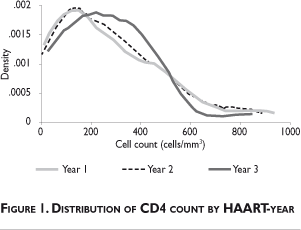
<body><![CDATA[<p><font face="Verdana, Arial, Helvetica, sans-serif" size="2">In this study,    two different approaches were used to generate unit costs. For the most relevant    cost categories, namely drug costs and the cost of ART-associated monitoring    tests, researchers performed microcosting,<sup>18</sup> reviewed the primary    purchasing data in the case of drugs, and conducted a detailed analysis of the    relevant laboratory procedures.<sup>19</sup> For the remainder of the unit costs    (cost per bed day, cost per visit, procedures costs, etc.), the facility-specific    unit cost estimates provided by the facility's administrative office were used.    Treatment costs were estimated multiplying utilization data from patient charts    by unit costs. For all years, US dollar 2002 unit costs (including antiretroviral    costs) were applied to utilization data. The authors' interest is to describe    changes in cost patterns determined by changes in service utilization. Therefore    prices are kept as constant. In any event, antiretroviral drug prices have not    changed significantly in Mexico since 2002. For the pre- post-HAART initiation    analyses, patient-months were aligned according to the date of initiation of    HAART. Thus, Year 1 (Y1) refers to the 12-month period beginning with the month    when treatment was initiated and Y-1 is the 12-month period prior to initiation;    henceforth The five-year period covered by the study (1997-2001) generates data    up to five years on either side of the initiation date of HAART (Y-5 to Y5).    However, due to the small sample size at the endpoints of the distribution,    the reporting of findings was restricted to analysis for Y-3 to Y3.</font></p>     <p>&nbsp;</p>     <p><font face="Verdana, Arial, Helvetica, sans-serif" size="3"><b>Results</b></font></p>     <p><font face="Verdana, Arial, Helvetica, sans-serif" size="2"><b>Characteristics    of the sample of patients</b></font></p>     <p><font face="Verdana, Arial, Helvetica, sans-serif" size="2">As shown in <a href="/img/revistas/spm/v50s4/04t1.gif">Table    I</a>, the patient sample is broadly similar to the national PLHA population    in terms of percentage of men, modes of transmission, and sexual preference.    The one exception is the low reported level of men who have sex with men (MSM)    in the IMSS/ISSSTE, which is likely to be the result of reporting bias due to    stigma or fear of discrimination since social security coverage is employment-based.    The IMSS/ISSSTE population's educational level is higher, as expected, given    that IMSS/ISSSTE insures formal sector employees.</font></p>     <p><font face="Verdana, Arial, Helvetica, sans-serif" size="2"><b>Rapid scaling    up of HAART in Mexico</b></font></p>     <p><font face="Verdana, Arial, Helvetica, sans-serif" size="2">There was a progressive    and rapid move toward HAART in the patient sample, as shown in <a href="/img/revistas/spm/v50s4/04t2.gif">Table    II</a>. In 1997, 59% of patients receiving ART were on double therapy and only    11% were on triple therapy. By 2001 the share of patients on HAART had more    than tripled (40%), while the share of double therapy recipients had dropped    to 35%. The number of patients on monotherapy dropped steadily from 30% in 1997    to 25% in 2001. This relative decline obscures the growth in the absolute number    of patients in the sample that receive a single medication, despite treatment    guidelines recommending HAART as the norm and double therapy in exceptional    cases.</font></p>     <p><font face="Verdana, Arial, Helvetica, sans-serif" size="2">Data from the study    appears to confirm the commonly held belief that patients only initiate HAART    in Mexico in advanced stages of the disease. The median CD4 count was 150 cells/mm<sup>3</sup>    at Y-1 (<a href="#fig1">figure 1</a>). In this year there is a high concentration    of patients around the median, indicating that a large number of patients who    likely qualify for triple therapy are instead receiving either double, mono,    or no ART.</font></p>     <p><a name="fig1"></a></p>     <p>&nbsp;</p>     ]]></body>
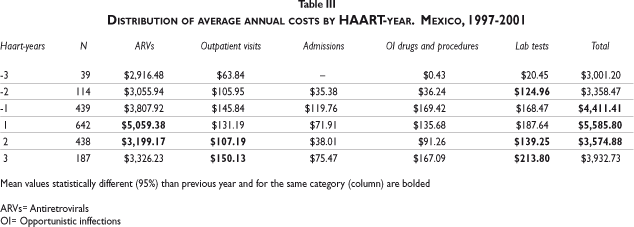
<body><![CDATA[<p align="center"><img src="/img/revistas/spm/v50s4/04f1.gif"></p>     <p>&nbsp;</p>     <p><font face="Verdana, Arial, Helvetica, sans-serif" size="2"><b>Total costs    are substantially higher under triple therapy</b></font></p>     <p><font face="Verdana, Arial, Helvetica, sans-serif" size="2">There is a marked    increase in the average annual cost per patient after initiation of HAART (see    <a href="/img/revistas/spm/v50s4/04t3.gif">Table 3</a>). This is overwhelmingly    due to the cost of antiretrovirals. These drugs are the single largest cost    component throughout the study period. ART costs are adjusted by estimated adherence,    that is, by the estimated number of months on treatment. A detailed analysis    of adherence is hindered by two factors: lack of reporting patients' prescription    renewals in the clinical files; and the fact that patients were only required    to visit a doctor every three months. In between visits, patients were allowed    to fill their prescriptions directly at the pharmacy. Patient records rarely    reflect whether the prescription was actually filled. In these analyses, ART    utilization was assumed to continue for up to three months. If no outpatient    visit occurred after three months, then consumption of ART was assumed to cease    until the following visit.</font></p>     <p><font face="Verdana, Arial, Helvetica, sans-serif" size="2">A significant drop    was observed in cost per patient in the second year after initiation of HAART.    Total patient costs declined from an average of $5585 in Y1 to $3575 in Y2.    A drop in ART costs accounts for the majority (92.5%) of this decrease. This    decrease in ART costs is explained by two factors: reduced adherence in Y2 compared    to Y1 and switching to less costly combinations -mono- or double therapy or    in some cases lower-cost triple therapy. Outpatient visits, OI drugs and procedures    and lab tests also decrease in Y2 suggesting an overall reduction in adherence,    not just to ART.</font></p>     <p><font face="Verdana, Arial, Helvetica, sans-serif" size="2">A surprising result,    given what has been reported about costs of AIDS care in other countries (Guinness    <i>et al</i>. 2002), is that hospitalization costs are not a major determinant    of total costs. In this sample, hospitalization represented less than 6% of    total costs in any given year. While our use of institutional costs may have    somewhat underestimated the cost per bed-day, the hospitalization rate is so    low that even a significant underestimation would not change the observation    that hospitalization costs are a minor component of total costs.</font></p>     <p><font face="Verdana, Arial, Helvetica, sans-serif" size="2">Study results show    a decline in hospital days after patients begin triple therapy (Y-1toY1)). However,    this decline is not large enough to offset the increase in costs due to ART.    Hospitalization costs would have to be on average more than 25 times higher    in Y-1 in order to offset the change in ART drug costs in Y1. Said differently,    even a 90% reduction in antiretroviral costs would not be enough to render ART    cost-savings in the first year (not even considering the net present value of    the cost of future years of treatment).</font></p>     <p><font face="Verdana, Arial, Helvetica, sans-serif" size="2"><b>Costs vary across    subsystems</b></font></p>     <p><font face="Verdana, Arial, Helvetica, sans-serif" size="2">The total cost    patterns discussed above are replicated uniformly across the three Mexican subsystems.    There is a marked increase in cost after initiation of HAART, and antiretrovirals    are the major contributing factor to this increase. Costs are higher in IMSS/ISSSTE    and the INS subsystems as compared to the SSA. However, total cost per patient    masks some important differences across subsystems. For instance, the INS spends    more on lab tests -both in absolute terms and as a share of total spending (6.2%    on average across years)- than the SSA (2.7%) and IMSS/ISSSTE (3.3%). Conversely,    a significantly larger share of IMSS/ISSSTE's total costs is associated with    the provision of outpatient services (7.6% on average compared to 0.7% and 2.4%    at the SSA and INS respectively). This, along with the fact that utilization    of OI drugs does not vary significantly over the study period, reflects that    IMSS/ISSSTE patients received more monitoring visits than their SSA and INS    counterparts.</font></p>     <p><font face="Verdana, Arial, Helvetica, sans-serif" size="2"><b>Treatment costs    are higher for patients in advanced stages of illness and in their last year    of life</b></font></p>     ]]></body>
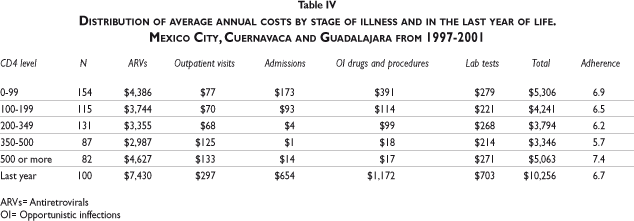
<body><![CDATA[<p><font face="Verdana, Arial, Helvetica, sans-serif" size="2">As the health of    the patient worsens -measured by CD4 count- associated treatment costs increase.    Costs of antiretrovirals, hospitalizations, and OI drugs and procedures increase    steadily as CD4 falls. There is one exception to that trend, and that is patients    with CD4 count greater than 500 receiving ART. This patient population had significantly    higher levels of adherence with resultant higher ART costs. To the extent that    this group selects for patients who have increased their CD4 on therapy to &gt;500,    it is not surprising that they would have higher adherence/utilization.</font></p>     <p><font face="Verdana, Arial, Helvetica, sans-serif" size="2">The hypothesis    that treatment costs are higher at more advanced stages of illness is further    reinforced by the finding that costs are significantly higher for patients in    the last year of life. Average costs in the year preceding death are greater    across all treatment components, considering either stage of illness (<a href="/img/revistas/spm/v50s4/04t4.gif">table    4</a>) or HAART-year (<a href="/img/revistas/spm/v50s4/04t3.gif">table III</a>).</font></p>     <p>&nbsp;</p>     <p><font face="Verdana, Arial, Helvetica, sans-serif" size="3"><b>Discussion</b></font></p>     <p><font face="Verdana, Arial, Helvetica, sans-serif" size="2">Mexico's experience    has shown that providing HAART to PLHA is both operationally feasible and affordable    for a middle income country with a concentrated epidemic. The costs of the antiretrovirals    and the associated monitoring are in the range of one to two times per capita    GDP at current prices, depending on the setting in which care is delivered.    While this annual expense is probably not competitive with the most cost-effective    health interventions supported by the public sector in Mexico, it is not among    the least cost-effective either.</font></p>     <p><font face="Verdana, Arial, Helvetica, sans-serif" size="2">Antiretrovirals    represent the largest proportion of costs for HIV/AIDS care. Our conservative    approach to estimating ART utilization suggests that true costs are likely to    be even higher than those estimated here. If the sector is successful at improving    the low levels of adherence observed during this period of initial roll-out    of triple therapy, drug costs will increase proportionately.<sup>20</sup> The    Mexican government, like all governments in developing countries facing large    costs for the treatment of HIV/AIDS, is concerned about the cost of treatment    and is exploring a number of responses. Given that ART costs are the single    largest determinant of treatment cost, negotiating lower drug prices and ensuring    the use of the most cost-effective combinations of drugs are central to containing    costs and ensuring sustainability of the universal coverage program.</font></p>     <p><font face="Verdana, Arial, Helvetica, sans-serif" size="2">This study found    evidence that antiretrovirals were not cost saving when they were initially    rolled-out and are unlikely to become cost saving even under optimistic assumptions    of reductions in drug costs or increases in effectiveness. Although study results    show a decline in hospital days after patients begin triple therapy, this decline    is not nearly large enough to offset the increase in costs attributable to ART.    This is consistent with the findings of a study of HIV/AIDS care costs in Thailand<sup>21</sup>    yet contrary to data from a Brazilian study which suggested that ART actually    has a cost-saving effect due to the sharp decline in annual AIDS-related admissions    per patient following introduction of HAART.<sup>22</sup> Furthermore, the effect    of ART is to prolong life rather than cure HIV, such that on average the burden    of hospitalization costs will be postponed, not eliminated. Even though the    intention to show that HAART is cost-saving might seem laudable for advocate    reasons at fist sight, it might also be dangerous when decision makers realize    that this is not the case. HAART represents an enormous improvement in quality    of life and life expectancy for those receiving it, and has changed the prognosis    of PLHA in developed countries. It does not have to be cost-saving to be socially    desirable to continuing scaling up treatment in middle income countries, but    it is absolutely necessary that the budgetary implications of this decision    be taken into account.</font></p>     <p><font face="Verdana, Arial, Helvetica, sans-serif" size="2">This study also    highlights several important issues of quality of care when rapidly scaling    up HAART. Enormous variability in patterns of care was found and the sporadic    adherence to official guidelines and norms suggest that there is much room for    improvement in the effectiveness of HIV/AIDS care. Further investigation is    necessary to understand which are the most important determinants of this variability,    and should address training and management needs, and especially provider knowledge,    practices and incentives.</font></p>     <p><font face="Verdana, Arial, Helvetica, sans-serif" size="2">Adherence to ART    treatment emerges as a central problem. While it is difficult to distinguish    between poor medical recordkeeping and poor adherence, the authors were conservative    in the coding of adherence failure and the problem may be worse than reported.    Reasons for patients suspending treatment may be structural, such as stock-outs    at the hospital pharmacy, or related to patient behavior. Given the high levels    of adherence necessary for effective treatment,<sup>23</sup> further investigation    into its determinants and strategies for improving patient adherence is warranted.</font></p>     <p><font face="Verdana, Arial, Helvetica, sans-serif" size="2">The highest rate    of utilization of inpatient services occurs in the 12 months before patients    start triple therapy. This suggests that many patients begin therapy when they    already have the advanced stages of the disease. The median CD4 count during    this period is 150 cells/mm<sup>3</sup> with a mean 223 cells/mm<sup>3</sup>.    The point recommended for the initiation of ART therapy in the latest guidelines    is between 200-350 cells/mm<sup>3</sup> yet half of the patients are initiating    with CD4 count lower than 150. Late initiation of ART therapy also contributes    to suboptimal response to treatment.<sup>24-26</sup></font></p>     ]]></body>
<body><![CDATA[<p><font face="Verdana, Arial, Helvetica, sans-serif" size="2"><b>Study limitations</b></font></p>     <p><font face="Verdana, Arial, Helvetica, sans-serif" size="2">The study was not    designed to be statistically representative of ART treatment in Mexico; even    though within facilities patients were randomly selected, convenience was considered    rather than taking a random sample of facilities. Patient records across facilities    are not linked. Thus, it is not possible to follow patients across subsystems    of the Mexican healthcare system, whether public or private. Hence, costs estimated    using this sample do not include the cost of care received in other facilities    and therefore likely underestimate actual treatment costs.</font></p>     <p><font face="Verdana, Arial, Helvetica, sans-serif" size="2">Further, the quality    of patient records is poor. Symptoms are more often recorded than diagnoses.    This precluded the estimation of OI-specific costs. Furthermore, inadequate    recording suggests another source of downward bias in the estimation of utilization    and thus costs.</font></p>     <p><font face="Verdana, Arial, Helvetica, sans-serif" size="2">For admission,    outpatient visits, procedures and some diagnostic tests, unit costs were estimated    by facilities for accounting purposes and may not reflect economic costs. However,    this is not likely to significantly bias the results, given that antiretrovirals    account for 77-98% of total treatment costs.</font></p>     <p>&nbsp;</p>     <p><font face="Verdana, Arial, Helvetica, sans-serif" size="3"><b>Acknowledgements</b></font></p>     <p><font face="Verdana, Arial, Helvetica, sans-serif" size="2">This study was    conducted in collaboration with many organizations in Mexico, in addition to    the National Institute of Public Health (INSP). The authors would like to thank    the National Center for the Prevention and Control of HIV/AIDS (Censida); the    Federal Ministry of Health (SSA); the State Ministries of Health of Morelos,    Jalisco, and the Federal District; the Mexican Social Security Institute (IMSS);    the Mexican Social Security and Services Institute for Workers of the State    of Jalisco; the Condesa Clinic in Mexico City; the National Cancer Institute;    and the National Institute of Nutrition and Medical Sciences.</font></p>     <p>&nbsp;</p>     <p><font face="Verdana, Arial, Helvetica, sans-serif" size="3"><b>References</b></font></p>     <!-- ref --><p><font face="Verdana, Arial, Helvetica, sans-serif" size="2">1. CENSIDA. El    SIDA en cifras, 2005. &#91;Accessed on October 2007&#93;. Available from: <a href="http://www.salud.gob.mx/conasida/estadis/2005/El%20SIDA%20en%20cifras.pdf" target="_blank">http://www.salud.gob.mx/conasida/estadis/2005/El%20SIDA%20en%20cifras.pdf</a></font>&nbsp;&nbsp;&nbsp;&nbsp;&nbsp;&nbsp;&nbsp;&nbsp;[&#160;<a href="javascript:void(0);" onclick="javascript: window.open('/scielo.php?script=sci_nlinks&ref=9269119&pid=S0036-3634200800100000400001&lng=','','width=640,height=500,resizable=yes,scrollbars=1,menubar=yes,');">Links</a>&#160;]<!-- end-ref --><!-- ref --><p><font face="Verdana, Arial, Helvetica, sans-serif" size="2">2. Uribe-Z&uacute;&ntilde;iga    P, Magis-Rodr&iacute;guez C, Bravo-Garc&iacute;a E. AIDS in Mexico. J Int Assoc    Physicians AIDS Care 1998; 4:29-33.</font>&nbsp;&nbsp;&nbsp;&nbsp;&nbsp;&nbsp;&nbsp;&nbsp;[&#160;<a href="javascript:void(0);" onclick="javascript: window.open('/scielo.php?script=sci_nlinks&ref=9269120&pid=S0036-3634200800100000400002&lng=','','width=640,height=500,resizable=yes,scrollbars=1,menubar=yes,');">Links</a>&#160;]<!-- end-ref --><!-- ref --><p><font face="Verdana, Arial, Helvetica, sans-serif" size="2">3. CENSIDA. Panorama    epidemiol&oacute;gico del VIH/SIDA e ITS en M&eacute;xico. Mexico City: CENSIDA,    2004.</font>&nbsp;&nbsp;&nbsp;&nbsp;&nbsp;&nbsp;&nbsp;&nbsp;[&#160;<a href="javascript:void(0);" onclick="javascript: window.open('/scielo.php?script=sci_nlinks&ref=9269121&pid=S0036-3634200800100000400003&lng=','','width=640,height=500,resizable=yes,scrollbars=1,menubar=yes,');">Links</a>&#160;]<!-- end-ref --><!-- ref --><p><font face="Verdana, Arial, Helvetica, sans-serif" size="2">4. CONASIDA. Panorama    epidemiol&oacute;gico del VIH/SIDA e ITS en M&eacute;xico. Mexico City: CONASIDA,    2002.</font>&nbsp;&nbsp;&nbsp;&nbsp;&nbsp;&nbsp;&nbsp;&nbsp;[&#160;<a href="javascript:void(0);" onclick="javascript: window.open('/scielo.php?script=sci_nlinks&ref=9269122&pid=S0036-3634200800100000400004&lng=','','width=640,height=500,resizable=yes,scrollbars=1,menubar=yes,');">Links</a>&#160;]<!-- end-ref --><!-- ref --><p><font face="Verdana, Arial, Helvetica, sans-serif" size="2">5. Wood E, Braitstein    P, Montaner JSG, Schechter MT, Tyndall MW, O'Shaughnessy MV, <i>et al</i>. Extent    to Which Low-Level Use of Antiretroviral Treatment Could Curb the AIDS Epidemic    in Sub-Saharan Africa. Lancet 2000; 355:2095-2100.</font>&nbsp;&nbsp;&nbsp;&nbsp;&nbsp;&nbsp;&nbsp;&nbsp;[&#160;<a href="javascript:void(0);" onclick="javascript: window.open('/scielo.php?script=sci_nlinks&ref=9269123&pid=S0036-3634200800100000400005&lng=','','width=640,height=500,resizable=yes,scrollbars=1,menubar=yes,');">Links</a>&#160;]<!-- end-ref --><!-- ref --><p><font face="Verdana, Arial, Helvetica, sans-serif" size="2">6. Wilkinson D,    Floyd K, Gilks CF. Antiretroviral drugs as a public health intervention for    pregnant HIV-infected women in rural South Africa: an issue of cost-effectiveness    and capacity. AIDS 1998; 12:1675-1682.</font>&nbsp;&nbsp;&nbsp;&nbsp;&nbsp;&nbsp;&nbsp;&nbsp;[&#160;<a href="javascript:void(0);" onclick="javascript: window.open('/scielo.php?script=sci_nlinks&ref=9269124&pid=S0036-3634200800100000400006&lng=','','width=640,height=500,resizable=yes,scrollbars=1,menubar=yes,');">Links</a>&#160;]<!-- end-ref --><!-- ref --><p><font face="Verdana, Arial, Helvetica, sans-serif" size="2">7. Marins JR, Jamal    LF, Chen SY, Barros MB, Hudes ES, Barbosa AA, <i>et al</i>. Dramatic improvement    in survival among adult Brazilian AIDS patients. AIDS 2003; 17:1675-1682.</font>&nbsp;&nbsp;&nbsp;&nbsp;&nbsp;&nbsp;&nbsp;&nbsp;[&#160;<a href="javascript:void(0);" onclick="javascript: window.open('/scielo.php?script=sci_nlinks&ref=9269125&pid=S0036-3634200800100000400007&lng=','','width=640,height=500,resizable=yes,scrollbars=1,menubar=yes,');">Links</a>&#160;]<!-- end-ref --><!-- ref --><p><font face="Verdana, Arial, Helvetica, sans-serif" size="2">8. Fitzgerald J,    Gomez B. On Open Competition Model for Regional Price Negotiations Yields Lowest    ART Prices in the Americas. Presentation at the 8th STI/AIDS Congress, December    2-5, 2003. Puntal del Este, Uruguay.</font>&nbsp;&nbsp;&nbsp;&nbsp;&nbsp;&nbsp;&nbsp;&nbsp;[&#160;<a href="javascript:void(0);" onclick="javascript: window.open('/scielo.php?script=sci_nlinks&ref=9269126&pid=S0036-3634200800100000400008&lng=','','width=640,height=500,resizable=yes,scrollbars=1,menubar=yes,');">Links</a>&#160;]<!-- end-ref --><!-- ref --><p><font face="Verdana, Arial, Helvetica, sans-serif" size="2">9. The Global Fund    to Fight AIDS, Tuberculosis and Malaria. A force for change: the Global Fund    at 30 months. Geneva: The Global Fund to Fight AIDS, Tuberculosis and Malaria,    2004.</font>&nbsp;&nbsp;&nbsp;&nbsp;&nbsp;&nbsp;&nbsp;&nbsp;[&#160;<a href="javascript:void(0);" onclick="javascript: window.open('/scielo.php?script=sci_nlinks&ref=9269127&pid=S0036-3634200800100000400009&lng=','','width=640,height=500,resizable=yes,scrollbars=1,menubar=yes,');">Links</a>&#160;]<!-- end-ref --><!-- ref --><p><font face="Verdana, Arial, Helvetica, sans-serif" size="2">10. The White House.    Fact sheet: the President's Emergency Plan for AIDS Relief. Washington: The    White House, 2003.</font>&nbsp;&nbsp;&nbsp;&nbsp;&nbsp;&nbsp;&nbsp;&nbsp;[&#160;<a href="javascript:void(0);" onclick="javascript: window.open('/scielo.php?script=sci_nlinks&ref=9269128&pid=S0036-3634200800100000400010&lng=','','width=640,height=500,resizable=yes,scrollbars=1,menubar=yes,');">Links</a>&#160;]<!-- end-ref --><!-- ref --><p><font face="Verdana, Arial, Helvetica, sans-serif" size="2">11. World Health    Organization. Treating 3 million by 2005: making it happen: the WHO strategy.    The WHO and UNAIDS global initiative to provide antiretroviral therapy to 3    million people with HIV/AIDS in developing countries by the end of 2005. Geneva:    WHO, 2004.</font>&nbsp;&nbsp;&nbsp;&nbsp;&nbsp;&nbsp;&nbsp;&nbsp;[&#160;<a href="javascript:void(0);" onclick="javascript: window.open('/scielo.php?script=sci_nlinks&ref=9269129&pid=S0036-3634200800100000400011&lng=','','width=640,height=500,resizable=yes,scrollbars=1,menubar=yes,');">Links</a>&#160;]<!-- end-ref --><!-- ref --><p><font face="Verdana, Arial, Helvetica, sans-serif" size="2">12. Ministry of    Health, Mexico. Programa nacional de salud 2001-2006. Ciudad de M&eacute;xico:    SSA, 2001.</font>&nbsp;&nbsp;&nbsp;&nbsp;&nbsp;&nbsp;&nbsp;&nbsp;[&#160;<a href="javascript:void(0);" onclick="javascript: window.open('/scielo.php?script=sci_nlinks&ref=9269130&pid=S0036-3634200800100000400012&lng=','','width=640,height=500,resizable=yes,scrollbars=1,menubar=yes,');">Links</a>&#160;]<!-- end-ref --><!-- ref --><p><font face="Verdana, Arial, Helvetica, sans-serif" size="2">13. Magis-Rodr&iacute;guez    C, Rivera-Reyes MP, Gasca-Pineda R, Guti&eacute;rrez JP. El gasto en la atenci&oacute;n    y la prevenci&oacute;n del VIH/SIDA en M&eacute;xico: tendencias y estimaciones    1997-2002. Salud Publica Mex 2005;47(5):361-368.</font>&nbsp;&nbsp;&nbsp;&nbsp;&nbsp;&nbsp;&nbsp;&nbsp;[&#160;<a href="javascript:void(0);" onclick="javascript: window.open('/scielo.php?script=sci_nlinks&ref=9269131&pid=S0036-3634200800100000400013&lng=','','width=640,height=500,resizable=yes,scrollbars=1,menubar=yes,');">Links</a>&#160;]<!-- end-ref --><!-- ref --><p><font face="Verdana, Arial, Helvetica, sans-serif" size="2">14. Izazola-Licea    JA, &Aacute;vila-Figueroa C, Ar&aacute;n D, Piola S, Perdomo R, Hern&aacute;ndez    P, <i>et al.</i> Country response to HIV/AIDS: National Health Accounts on HIV/AIDS    in Brazil, Guatemala, Honduras, Mexico and Uruguay. AIDS 2002, 16 (suppl 3):S66-S75.</font>&nbsp;&nbsp;&nbsp;&nbsp;&nbsp;&nbsp;&nbsp;&nbsp;[&#160;<a href="javascript:void(0);" onclick="javascript: window.open('/scielo.php?script=sci_nlinks&ref=9269132&pid=S0036-3634200800100000400014&lng=','','width=640,height=500,resizable=yes,scrollbars=1,menubar=yes,');">Links</a>&#160;]<!-- end-ref --><!-- ref --><p><font face="Verdana, Arial, Helvetica, sans-serif" size="2">15. Aracena B,    Guti&eacute;rrez JP, Bertozzi SM, Gertter P. Cost of AIDS Care in Mexico: What    Are its Main Individual Predictors? Arch Med Res 2005;36:560-566.</font>&nbsp;&nbsp;&nbsp;&nbsp;&nbsp;&nbsp;&nbsp;&nbsp;[&#160;<a href="javascript:void(0);" onclick="javascript: window.open('/scielo.php?script=sci_nlinks&ref=9269133&pid=S0036-3634200800100000400015&lng=','','width=640,height=500,resizable=yes,scrollbars=1,menubar=yes,');">Links</a>&#160;]<!-- end-ref --><!-- ref --><p><font face="Verdana, Arial, Helvetica, sans-serif" size="2">16. Bautista-Arredondo    S, Mane A, Bertozzi SM. Economic impact of antiretroviral therapy prescription    decisions in the context of rapid scaling-up of access to treatment: lessons    from Mexico. AIDS 2006, 20:101-109.</font>&nbsp;&nbsp;&nbsp;&nbsp;&nbsp;&nbsp;&nbsp;&nbsp;[&#160;<a href="javascript:void(0);" onclick="javascript: window.open('/scielo.php?script=sci_nlinks&ref=9269134&pid=S0036-3634200800100000400016&lng=','','width=640,height=500,resizable=yes,scrollbars=1,menubar=yes,');">Links</a>&#160;]<!-- end-ref --><!-- ref --><p><font face="Verdana, Arial, Helvetica, sans-serif" size="2">17. USAID, Partners    for Health Reform plus. Costing of HIV/AIDS Treatment in Mexico. &#91;Accessed    on march 2008&#93;. Available from: <a href="http://www.phrplus.org/Pubs/Tech020_fin.pdf" target="_blank">http://www.phrplus.org/Pubs/Tech020_fin.pdf</a>.</font>&nbsp;&nbsp;&nbsp;&nbsp;&nbsp;&nbsp;&nbsp;&nbsp;[&#160;<a href="javascript:void(0);" onclick="javascript: window.open('/scielo.php?script=sci_nlinks&ref=9269135&pid=S0036-3634200800100000400017&lng=','','width=640,height=500,resizable=yes,scrollbars=1,menubar=yes,');">Links</a>&#160;]<!-- end-ref --><!-- ref --><p><font face="Verdana, Arial, Helvetica, sans-serif" size="2">18. Drummond MF,    O'Brian BJ, Stoddart GL, Torrance GW. Methods for the Economic Evaluation of    Health Care Programmes. 2nd edition. Oxford University Press, 1997.</font>&nbsp;&nbsp;&nbsp;&nbsp;&nbsp;&nbsp;&nbsp;&nbsp;[&#160;<a href="javascript:void(0);" onclick="javascript: window.open('/scielo.php?script=sci_nlinks&ref=9269136&pid=S0036-3634200800100000400018&lng=','','width=640,height=500,resizable=yes,scrollbars=1,menubar=yes,');">Links</a>&#160;]<!-- end-ref --><!-- ref --><p><font face="Verdana, Arial, Helvetica, sans-serif" size="2">19. Gasca R, Bertozzi    S, Mowatt R. Estimaci&oacute;n del Costo de la Cuantificaci&oacute;n de la Carga    Viral en Pacientes con VIH/SIDA: Un Modelo para Guiar la Toma de Decisiones    de Inversi&oacute;n en Servicios de Salud. Cuernavaca, M&eacute;xico: Instituto    Nacional de Salud P&uacute;blica, 2004.</font>&nbsp;&nbsp;&nbsp;&nbsp;&nbsp;&nbsp;&nbsp;&nbsp;[&#160;<a href="javascript:void(0);" onclick="javascript: window.open('/scielo.php?script=sci_nlinks&ref=9269137&pid=S0036-3634200800100000400019&lng=','','width=640,height=500,resizable=yes,scrollbars=1,menubar=yes,');">Links</a>&#160;]<!-- end-ref --><!-- ref --><p><font face="Verdana, Arial, Helvetica, sans-serif" size="2">20. Bautista-Arredondo    S, Mane A, Bertozzi S. Economic impact of antiretroviral therapy prescription    decisions in the context of rapid scaling-up of access to treatment: lessons    from M&eacute;xico. AIDS 2006, 20:101-109.</font>&nbsp;&nbsp;&nbsp;&nbsp;&nbsp;&nbsp;&nbsp;&nbsp;[&#160;<a href="javascript:void(0);" onclick="javascript: window.open('/scielo.php?script=sci_nlinks&ref=9269138&pid=S0036-3634200800100000400020&lng=','','width=640,height=500,resizable=yes,scrollbars=1,menubar=yes,');">Links</a>&#160;]<!-- end-ref --><!-- ref --><p><font face="Verdana, Arial, Helvetica, sans-serif" size="2">21. Kitajima T,    Kobayashi Y, Chaipah W, Sato H, Chadbunchachai W, Thuennadee R. Costs for medical    services for patients with HIV/AIDS in Khon Kaen, Thailand. AIDS 2003, 17:2375-2381.</font>&nbsp;&nbsp;&nbsp;&nbsp;&nbsp;&nbsp;&nbsp;&nbsp;[&#160;<a href="javascript:void(0);" onclick="javascript: window.open('/scielo.php?script=sci_nlinks&ref=9269139&pid=S0036-3634200800100000400021&lng=','','width=640,height=500,resizable=yes,scrollbars=1,menubar=yes,');">Links</a>&#160;]<!-- end-ref --><!-- ref --><p><font face="Verdana, Arial, Helvetica, sans-serif" size="2">22. Teixeira PR,    Vitoria MA, Barcarolo J. Antiretroviral treatment in resource-poor settings:    the Brazilian experience. AIDS 2004, 18:S5-S7.</font>&nbsp;&nbsp;&nbsp;&nbsp;&nbsp;&nbsp;&nbsp;&nbsp;[&#160;<a href="javascript:void(0);" onclick="javascript: window.open('/scielo.php?script=sci_nlinks&ref=9269140&pid=S0036-3634200800100000400022&lng=','','width=640,height=500,resizable=yes,scrollbars=1,menubar=yes,');">Links</a>&#160;]<!-- end-ref --><!-- ref --><p><font face="Verdana, Arial, Helvetica, sans-serif" size="2">23. Chesney M.    Adherence to HAART regimens. AIDS Patient Care STDS 2003, 17:169-177.</font>&nbsp;&nbsp;&nbsp;&nbsp;&nbsp;&nbsp;&nbsp;&nbsp;[&#160;<a href="javascript:void(0);" onclick="javascript: window.open('/scielo.php?script=sci_nlinks&ref=9269141&pid=S0036-3634200800100000400023&lng=','','width=640,height=500,resizable=yes,scrollbars=1,menubar=yes,');">Links</a>&#160;]<!-- end-ref --><!-- ref --><p><font face="Verdana, Arial, Helvetica, sans-serif" size="2">24. Dybul M, Fauci    AS, Bartlett JG, Kaplan JE, Pau AK. Panel on Clinical Practices for Treatment    of HIV. Guidelines for using antiretroviral agents among HIV-infected adults    and adolescents. Ann Intern Med 2002; 137:381-433.</font>&nbsp;&nbsp;&nbsp;&nbsp;&nbsp;&nbsp;&nbsp;&nbsp;[&#160;<a href="javascript:void(0);" onclick="javascript: window.open('/scielo.php?script=sci_nlinks&ref=9269142&pid=S0036-3634200800100000400024&lng=','','width=640,height=500,resizable=yes,scrollbars=1,menubar=yes,');">Links</a>&#160;]<!-- end-ref --><!-- ref --><p><font face="Verdana, Arial, Helvetica, sans-serif" size="2">25. Antiretroviral    treatment. HIV infection in adults: better-defined first-line treatment. Prescrire    Int 2004; 13:144-150.</font>&nbsp;&nbsp;&nbsp;&nbsp;&nbsp;&nbsp;&nbsp;&nbsp;[&#160;<a href="javascript:void(0);" onclick="javascript: window.open('/scielo.php?script=sci_nlinks&ref=9269143&pid=S0036-3634200800100000400025&lng=','','width=640,height=500,resizable=yes,scrollbars=1,menubar=yes,');">Links</a>&#160;]<!-- end-ref --><!-- ref --><p><font face="Verdana, Arial, Helvetica, sans-serif" size="2">26. World Health    Organization. Scaling up antiretroviral therapy in resource-limited settings:    guidelines for a public health approach. Geneva, Switzerland: WHO, 2001. &#91;    &nbsp;&nbsp;&nbsp;&nbsp;&nbsp;&nbsp;&nbsp;&nbsp;[&#160;<a href="javascript:void(0);" onclick="javascript: window.open('/scielo.php?script=sci_nlinks&ref=9269144&pid=S0036-3634200800100000400026&lng=','','width=640,height=500,resizable=yes,scrollbars=1,menubar=yes,');">Links</a>&#160;]<!-- end-ref -->Accessed    on October 2007&#93;. Available at:<a href="http://www.who.int/hiv/pub/prev_care/en/ScalingUp_E.pdf" target="_blank">    http://www.who.int/hiv/pub/prev_care/en/ScalingUp_E.pdf</a> </font></p>     <p>&nbsp;</p>     <p>&nbsp;</p>     <p><font face="Verdana, Arial, Helvetica, sans-serif" size="2">Received on: August    01, 2007<b>    <br>   </b> Accepted on: August 25, 2008    ]]></body>
<body><![CDATA[<br>   Sources of financial support: The authors would like to thank the Office of    HIV/AIDS of the Bureau for Global Health and the Latin America and Caribbean    Health Sector Reform Initiative at the United States Agency for International    Development for jointly funding this study.</font></p>     <p>&nbsp;</p>     <p>&nbsp;</p>     <p><font face="Verdana, Arial, Helvetica, sans-serif" size="2">Address reprint    requests to: Stefano M. Bertozzi. Av. Universidad 655, col. Santa Mar&iacute;a    Ahuacatitl&aacute;n. 62508 Cuernavaca, Mor, M&eacute;xico. E-mail: <a href="mailto:sbertozzi@insp.mx">sbertozzi@insp.mx</a>.    <br>   <a name="back1"></a><a href="#top1">1</a> By the end of 2006, the Popular Insurance    System covered 5.1 million families in Mexico.    <br>   <a name="back2"></a><a href="#top2">2</a> Two of them, explain the trend of    HIV/AIDS total expenditures in Mexico using the National Health Accounts on    HIV/AIDS;<sup>13,14</sup> one<sup>15</sup> analyzes the individual socio-demographic    characteristics of patients that explain the variability of treatment costs;    and one analyzing the inefficiencies associated with patterns of prescription    of ARVs in Mexico.<sup>16</sup>    <br>   <a name="back3"></a><a href="#top3">3</a> A convenience framework was used and    the sample size was designed to provide representativeness of the sites included    in the study.    <br>   <a name="back4"></a><a href="#top4">4</a> The interface was programmed in Microsoft    Visual Basic 6 and the data stored in Microsoft Access 2000.    <br>   <a name="back5"></a><a href="#top5">5</a> The data were gathered using a structure    computer-based interface programmed in Microsoft Excel XP 2002.</font></p>      ]]></body><back>
<ref-list>
<ref id="B1">
<label>1</label><nlm-citation citation-type="">
<collab>CENSIDA</collab>
<source><![CDATA[El SIDA en cifras, 2005]]></source>
<year></year>
</nlm-citation>
</ref>
<ref id="B2">
<label>2</label><nlm-citation citation-type="journal">
<person-group person-group-type="author">
<name>
<surname><![CDATA[Uribe-Zúñiga]]></surname>
<given-names><![CDATA[P]]></given-names>
</name>
<name>
<surname><![CDATA[Magis-Rodríguez]]></surname>
<given-names><![CDATA[C]]></given-names>
</name>
<name>
<surname><![CDATA[Bravo-García]]></surname>
<given-names><![CDATA[E]]></given-names>
</name>
</person-group>
<article-title xml:lang="es"><![CDATA[AIDS in Mexico]]></article-title>
<source><![CDATA[J Int Assoc Physicians AIDS Care]]></source>
<year>1998</year>
<volume>4</volume>
<page-range>29-33</page-range></nlm-citation>
</ref>
<ref id="B3">
<label>3</label><nlm-citation citation-type="book">
<person-group person-group-type="author">
<name>
<surname><![CDATA[CENSIDA]]></surname>
</name>
</person-group>
<source><![CDATA[Panorama epidemiológico del VIH/SIDA e ITS en México]]></source>
<year>2004</year>
<publisher-loc><![CDATA[Mexico City ]]></publisher-loc>
<publisher-name><![CDATA[CENSIDA]]></publisher-name>
</nlm-citation>
</ref>
<ref id="B4">
<label>4</label><nlm-citation citation-type="book">
<person-group person-group-type="author">
<name>
<surname><![CDATA[CONASIDA]]></surname>
</name>
</person-group>
<source><![CDATA[Panorama epidemiológico del VIH/SIDA e ITS en México]]></source>
<year>2002</year>
<publisher-loc><![CDATA[Mexico City ]]></publisher-loc>
<publisher-name><![CDATA[CONASIDA]]></publisher-name>
</nlm-citation>
</ref>
<ref id="B5">
<label>5</label><nlm-citation citation-type="journal">
<person-group person-group-type="author">
<name>
<surname><![CDATA[Wood]]></surname>
<given-names><![CDATA[E]]></given-names>
</name>
<name>
<surname><![CDATA[Braitstein]]></surname>
<given-names><![CDATA[P]]></given-names>
</name>
<name>
<surname><![CDATA[Montaner]]></surname>
<given-names><![CDATA[JSG]]></given-names>
</name>
<name>
<surname><![CDATA[Schechter]]></surname>
<given-names><![CDATA[MT]]></given-names>
</name>
<name>
<surname><![CDATA[Tyndall]]></surname>
<given-names><![CDATA[MW]]></given-names>
</name>
<name>
<surname><![CDATA[O'Shaughnessy]]></surname>
<given-names><![CDATA[MV]]></given-names>
</name>
</person-group>
<article-title xml:lang="en"><![CDATA[Extent to Which Low-Level Use of Antiretroviral Treatment Could Curb the AIDS Epidemic in Sub-Saharan Africa]]></article-title>
<source><![CDATA[Lancet]]></source>
<year>2000</year>
<volume>355</volume>
<page-range>2095-2100</page-range></nlm-citation>
</ref>
<ref id="B6">
<label>6</label><nlm-citation citation-type="journal">
<person-group person-group-type="author">
<name>
<surname><![CDATA[Wilkinson]]></surname>
<given-names><![CDATA[D]]></given-names>
</name>
<name>
<surname><![CDATA[Floyd]]></surname>
<given-names><![CDATA[K]]></given-names>
</name>
<name>
<surname><![CDATA[Gilks]]></surname>
<given-names><![CDATA[CF]]></given-names>
</name>
</person-group>
<article-title xml:lang="en"><![CDATA[Antiretroviral drugs as a public health intervention for pregnant HIV-infected women in rural South Africa: an issue of cost-effectiveness and capacity]]></article-title>
<source><![CDATA[AIDS]]></source>
<year>1998</year>
<volume>12</volume>
<page-range>1675-1682</page-range></nlm-citation>
</ref>
<ref id="B7">
<label>7</label><nlm-citation citation-type="journal">
<person-group person-group-type="author">
<name>
<surname><![CDATA[Marins]]></surname>
<given-names><![CDATA[JR]]></given-names>
</name>
<name>
<surname><![CDATA[Jamal]]></surname>
<given-names><![CDATA[LF]]></given-names>
</name>
<name>
<surname><![CDATA[Chen]]></surname>
<given-names><![CDATA[SY]]></given-names>
</name>
<name>
<surname><![CDATA[Barros]]></surname>
<given-names><![CDATA[MB]]></given-names>
</name>
<name>
<surname><![CDATA[Hudes]]></surname>
<given-names><![CDATA[ES]]></given-names>
</name>
<name>
<surname><![CDATA[Barbosa]]></surname>
<given-names><![CDATA[AA]]></given-names>
</name>
</person-group>
<article-title xml:lang="en"><![CDATA[Dramatic improvement in survival among adult Brazilian AIDS patients]]></article-title>
<source><![CDATA[AIDS]]></source>
<year>2003</year>
<volume>17</volume>
<page-range>1675-1682</page-range></nlm-citation>
</ref>
<ref id="B8">
<label>8</label><nlm-citation citation-type="confpro">
<person-group person-group-type="author">
<name>
<surname><![CDATA[Fitzgerald]]></surname>
<given-names><![CDATA[J]]></given-names>
</name>
<name>
<surname><![CDATA[Gomez]]></surname>
<given-names><![CDATA[B]]></given-names>
</name>
</person-group>
<source><![CDATA[On Open Competition Model for Regional Price Negotiations Yields Lowest ART Prices in the Americas]]></source>
<year></year>
<conf-name><![CDATA[8 STI/AIDS Congress]]></conf-name>
<conf-date>December 2-5, 2003</conf-date>
<conf-loc>Puntal del Este </conf-loc>
</nlm-citation>
</ref>
<ref id="B9">
<label>9</label><nlm-citation citation-type="book">
<collab>The Global Fund to Fight AIDS.Tuberculosis and Malaria</collab>
<source><![CDATA[A force for change: the Global Fund at 30 months]]></source>
<year>2004</year>
<publisher-loc><![CDATA[Geneva ]]></publisher-loc>
<publisher-name><![CDATA[The Global Fund to Fight AIDS, Tuberculosis and Malaria]]></publisher-name>
</nlm-citation>
</ref>
<ref id="B10">
<label>10</label><nlm-citation citation-type="book">
<collab>The White House</collab>
<source><![CDATA[Fact sheet: the President's Emergency Plan for AIDS Relief]]></source>
<year>2003</year>
<publisher-loc><![CDATA[Washington ]]></publisher-loc>
<publisher-name><![CDATA[The White House]]></publisher-name>
</nlm-citation>
</ref>
<ref id="B11">
<label>11</label><nlm-citation citation-type="book">
<collab>World Health Organization</collab>
<source><![CDATA[Treating 3 million by 2005: making it happen:the WHO strategy: The WHO and UNAIDS global initiative to provide antiretroviral therapy to 3 million people with HIV/AIDS in developing countries by the end of 2005]]></source>
<year>2004</year>
<publisher-loc><![CDATA[Geneva ]]></publisher-loc>
<publisher-name><![CDATA[WHO]]></publisher-name>
</nlm-citation>
</ref>
<ref id="B12">
<label>12</label><nlm-citation citation-type="book">
<collab>Mexico^dMinistry of Health</collab>
<source><![CDATA[Programa nacional de salud 2001-2006]]></source>
<year>2001</year>
<publisher-loc><![CDATA[Ciudad de México ]]></publisher-loc>
<publisher-name><![CDATA[SSA]]></publisher-name>
</nlm-citation>
</ref>
<ref id="B13">
<label>13</label><nlm-citation citation-type="journal">
<person-group person-group-type="author">
<name>
<surname><![CDATA[Magis-Rodríguez]]></surname>
<given-names><![CDATA[C]]></given-names>
</name>
<name>
<surname><![CDATA[Rivera-Reyes]]></surname>
<given-names><![CDATA[MP]]></given-names>
</name>
<name>
<surname><![CDATA[Gasca-Pineda]]></surname>
<given-names><![CDATA[R]]></given-names>
</name>
<name>
<surname><![CDATA[Gutiérrez]]></surname>
<given-names><![CDATA[JP]]></given-names>
</name>
</person-group>
<article-title xml:lang="es"><![CDATA[El gasto en la atención y la prevención del VIH/SIDA en México: tendencias y estimaciones 1997-2002]]></article-title>
<source><![CDATA[Salud Publica Mex]]></source>
<year>2005</year>
<volume>47</volume>
<numero>5</numero>
<issue>5</issue>
<page-range>361-368</page-range></nlm-citation>
</ref>
<ref id="B14">
<label>14</label><nlm-citation citation-type="journal">
<person-group person-group-type="author">
<name>
<surname><![CDATA[Izazola-Licea]]></surname>
<given-names><![CDATA[JA]]></given-names>
</name>
<name>
<surname><![CDATA[Ávila-Figueroa]]></surname>
<given-names><![CDATA[C]]></given-names>
</name>
<name>
<surname><![CDATA[Arán]]></surname>
<given-names><![CDATA[D]]></given-names>
</name>
<name>
<surname><![CDATA[Piola]]></surname>
<given-names><![CDATA[S]]></given-names>
</name>
<name>
<surname><![CDATA[Perdomo]]></surname>
<given-names><![CDATA[R]]></given-names>
</name>
<name>
<surname><![CDATA[Hernández]]></surname>
<given-names><![CDATA[P]]></given-names>
</name>
</person-group>
<article-title xml:lang="en"><![CDATA[Country response to HIV/AIDS: National Health Accounts on HIV/AIDS in Brazil, Guatemala, Honduras, Mexico and Uruguay]]></article-title>
<source><![CDATA[AIDS]]></source>
<year>2002</year>
<volume>16</volume>
<numero>^s3</numero>
<issue>^s3</issue>
<supplement>3</supplement>
<page-range>S66-S75</page-range></nlm-citation>
</ref>
<ref id="B15">
<label>15</label><nlm-citation citation-type="journal">
<person-group person-group-type="author">
<name>
<surname><![CDATA[Aracena]]></surname>
<given-names><![CDATA[B]]></given-names>
</name>
<name>
<surname><![CDATA[Gutiérrez]]></surname>
<given-names><![CDATA[JP]]></given-names>
</name>
<name>
<surname><![CDATA[Bertozzi]]></surname>
<given-names><![CDATA[SM]]></given-names>
</name>
<name>
<surname><![CDATA[Gertter]]></surname>
<given-names><![CDATA[P]]></given-names>
</name>
</person-group>
<article-title xml:lang="en"><![CDATA[Cost of AIDS Care in Mexico: What Are its Main Individual Predictors?]]></article-title>
<source><![CDATA[Arch Med Res]]></source>
<year>2005</year>
<volume>36</volume>
<page-range>560-566</page-range></nlm-citation>
</ref>
<ref id="B16">
<label>16</label><nlm-citation citation-type="journal">
<person-group person-group-type="author">
<name>
<surname><![CDATA[Bautista-Arredondo]]></surname>
<given-names><![CDATA[S]]></given-names>
</name>
<name>
<surname><![CDATA[Mane]]></surname>
<given-names><![CDATA[A]]></given-names>
</name>
<name>
<surname><![CDATA[Bertozzi]]></surname>
<given-names><![CDATA[SM]]></given-names>
</name>
</person-group>
<article-title xml:lang="en"><![CDATA[Economic impact of antiretroviral therapy prescription decisions in the context of rapid scaling-up of access to treatment: lessons from Mexico]]></article-title>
<source><![CDATA[AIDS]]></source>
<year>2006</year>
<volume>20</volume>
<page-range>101-109</page-range></nlm-citation>
</ref>
<ref id="B17">
<label>17</label><nlm-citation citation-type="">
<collab>USAID, Partners for Health Reform plus</collab>
<source><![CDATA[Costing of HIV/AIDS Treatment in Mexico]]></source>
<year></year>
</nlm-citation>
</ref>
<ref id="B18">
<label>18</label><nlm-citation citation-type="book">
<person-group person-group-type="author">
<name>
<surname><![CDATA[Drummond]]></surname>
<given-names><![CDATA[MF]]></given-names>
</name>
<name>
<surname><![CDATA[O'Brian]]></surname>
<given-names><![CDATA[BJ]]></given-names>
</name>
<name>
<surname><![CDATA[Stoddart]]></surname>
<given-names><![CDATA[GL]]></given-names>
</name>
<name>
<surname><![CDATA[Torrance]]></surname>
<given-names><![CDATA[GW]]></given-names>
</name>
</person-group>
<source><![CDATA[Methods for the Economic Evaluation of Health Care Programmes]]></source>
<year>1997</year>
<edition>2</edition>
<publisher-name><![CDATA[Oxford University Press]]></publisher-name>
</nlm-citation>
</ref>
<ref id="B19">
<label>19</label><nlm-citation citation-type="book">
<person-group person-group-type="author">
<name>
<surname><![CDATA[Gasca]]></surname>
<given-names><![CDATA[R]]></given-names>
</name>
<name>
<surname><![CDATA[Bertozzi]]></surname>
<given-names><![CDATA[S]]></given-names>
</name>
<name>
<surname><![CDATA[Mowatt]]></surname>
<given-names><![CDATA[R]]></given-names>
</name>
</person-group>
<source><![CDATA[Estimación del Costo de la Cuantificación de la Carga Viral en Pacientes con VIH/SIDA: Un Modelo para Guiar la Toma de Decisiones de Inversión en Servicios de Salud]]></source>
<year>2004</year>
<publisher-loc><![CDATA[Cuernavaca ]]></publisher-loc>
<publisher-name><![CDATA[Instituto Nacional de Salud Pública]]></publisher-name>
</nlm-citation>
</ref>
<ref id="B20">
<label>20</label><nlm-citation citation-type="journal">
<person-group person-group-type="author">
<name>
<surname><![CDATA[Bautista-Arredondo]]></surname>
<given-names><![CDATA[S]]></given-names>
</name>
<name>
<surname><![CDATA[Mane]]></surname>
<given-names><![CDATA[A]]></given-names>
</name>
<name>
<surname><![CDATA[Bertozzi]]></surname>
<given-names><![CDATA[S]]></given-names>
</name>
</person-group>
<article-title xml:lang="en"><![CDATA[Economic impact of antiretroviral therapy prescription decisions in the context of rapid scaling-up of access to treatment: lessons from México]]></article-title>
<source><![CDATA[AIDS]]></source>
<year>2006</year>
<volume>20</volume>
<page-range>101-109</page-range></nlm-citation>
</ref>
<ref id="B21">
<label>21</label><nlm-citation citation-type="journal">
<person-group person-group-type="author">
<name>
<surname><![CDATA[Kitajima]]></surname>
<given-names><![CDATA[T]]></given-names>
</name>
<name>
<surname><![CDATA[Kobayashi]]></surname>
<given-names><![CDATA[Y]]></given-names>
</name>
<name>
<surname><![CDATA[Chaipah]]></surname>
<given-names><![CDATA[W]]></given-names>
</name>
<name>
<surname><![CDATA[Sato]]></surname>
<given-names><![CDATA[H]]></given-names>
</name>
<name>
<surname><![CDATA[Chadbunchachai]]></surname>
<given-names><![CDATA[W]]></given-names>
</name>
<name>
<surname><![CDATA[Thuennadee]]></surname>
<given-names><![CDATA[R]]></given-names>
</name>
</person-group>
<article-title xml:lang="en"><![CDATA[Costs for medical services for patients with HIV/AIDS in Khon Kaen, Thailand]]></article-title>
<source><![CDATA[AIDS]]></source>
<year>2003</year>
<volume>17</volume>
<page-range>2375-2381</page-range></nlm-citation>
</ref>
<ref id="B22">
<label>22</label><nlm-citation citation-type="journal">
<person-group person-group-type="author">
<name>
<surname><![CDATA[Teixeira]]></surname>
<given-names><![CDATA[PR]]></given-names>
</name>
<name>
<surname><![CDATA[Vitoria]]></surname>
<given-names><![CDATA[MA]]></given-names>
</name>
<name>
<surname><![CDATA[Barcarolo]]></surname>
<given-names><![CDATA[J]]></given-names>
</name>
</person-group>
<article-title xml:lang="en"><![CDATA[Antiretroviral treatment in resource-poor settings: the Brazilian experience]]></article-title>
<source><![CDATA[AIDS]]></source>
<year>2004</year>
<volume>18</volume>
<page-range>S5-S7</page-range></nlm-citation>
</ref>
<ref id="B23">
<label>23</label><nlm-citation citation-type="journal">
<person-group person-group-type="author">
<name>
<surname><![CDATA[Chesney]]></surname>
<given-names><![CDATA[M]]></given-names>
</name>
</person-group>
<article-title xml:lang="en"><![CDATA[Adherence to HAART regimens]]></article-title>
<source><![CDATA[AIDS Patient Care STDS]]></source>
<year>2003</year>
<volume>17</volume>
<page-range>169-177</page-range></nlm-citation>
</ref>
<ref id="B24">
<label>24</label><nlm-citation citation-type="journal">
<person-group person-group-type="author">
<name>
<surname><![CDATA[Dybul]]></surname>
<given-names><![CDATA[M]]></given-names>
</name>
<name>
<surname><![CDATA[Fauci]]></surname>
<given-names><![CDATA[AS]]></given-names>
</name>
<name>
<surname><![CDATA[Bartlett]]></surname>
<given-names><![CDATA[JG]]></given-names>
</name>
<name>
<surname><![CDATA[Kaplan]]></surname>
<given-names><![CDATA[JE]]></given-names>
</name>
<name>
<surname><![CDATA[Pau]]></surname>
<given-names><![CDATA[AK]]></given-names>
</name>
</person-group>
<article-title xml:lang="en"><![CDATA[Panel on Clinical Practices for Treatment of HIV: Guidelines for using antiretroviral agents among HIV-infected adults and adolescents]]></article-title>
<source><![CDATA[Ann Intern Med]]></source>
<year>2002</year>
<volume>137</volume>
<page-range>381-433</page-range></nlm-citation>
</ref>
<ref id="B25">
<label>25</label><nlm-citation citation-type="journal">
<article-title xml:lang="en"><![CDATA[Antiretroviral treatment: HIV infection in adults: better-defined first-line treatment]]></article-title>
<source><![CDATA[Prescrire Int]]></source>
<year>2004</year>
<volume>13</volume>
<page-range>144-150</page-range></nlm-citation>
</ref>
<ref id="B26">
<label>26</label><nlm-citation citation-type="book">
<collab>World Health Organization</collab>
<source><![CDATA[Scaling up antiretroviral therapy in resource-limited settings: guidelines for a public health approach]]></source>
<year>2001</year>
<publisher-loc><![CDATA[Geneva ]]></publisher-loc>
<publisher-name><![CDATA[WHO]]></publisher-name>
</nlm-citation>
</ref>
</ref-list>
</back>
</article>