<?xml version="1.0" encoding="ISO-8859-1"?><article xmlns:mml="http://www.w3.org/1998/Math/MathML" xmlns:xlink="http://www.w3.org/1999/xlink" xmlns:xsi="http://www.w3.org/2001/XMLSchema-instance">
<front>
<journal-meta>
<journal-id>0036-3634</journal-id>
<journal-title><![CDATA[Salud Pública de México]]></journal-title>
<abbrev-journal-title><![CDATA[Salud pública Méx]]></abbrev-journal-title>
<issn>0036-3634</issn>
<publisher>
<publisher-name><![CDATA[Instituto Nacional de Salud Pública]]></publisher-name>
</publisher>
</journal-meta>
<article-meta>
<article-id>S0036-36342008000900006</article-id>
<title-group>
<article-title xml:lang="en"><![CDATA[The global momentum for smokefree public places: best practice in current and forthcoming smokefree policies]]></article-title>
<article-title xml:lang="en"><![CDATA[El momento global para espacios públicos libres de tabaco: mejores prácticas en políticas actuales y futuras]]></article-title>
</title-group>
<contrib-group>
<contrib contrib-type="author">
<name>
<surname><![CDATA[G Griffith]]></surname>
<given-names><![CDATA[BA]]></given-names>
</name>
<xref ref-type="aff" rid="A01"/>
</contrib>
<contrib contrib-type="author">
<name>
<surname><![CDATA[C Welch]]></surname>
<given-names><![CDATA[MPP]]></given-names>
</name>
<xref ref-type="aff" rid="A02"/>
</contrib>
<contrib contrib-type="author">
<name>
<surname><![CDATA[A Cardone]]></surname>
<given-names><![CDATA[MBA]]></given-names>
</name>
<xref ref-type="aff" rid="A03"/>
</contrib>
<contrib contrib-type="author">
<name>
<surname><![CDATA[A Valdemoro]]></surname>
<given-names><![CDATA[BSFS]]></given-names>
</name>
<xref ref-type="aff" rid="A04"/>
</contrib>
<contrib contrib-type="author">
<name>
<surname><![CDATA[C Jo]]></surname>
<given-names><![CDATA[AB]]></given-names>
</name>
<xref ref-type="aff" rid="A05"/>
</contrib>
</contrib-group>
<aff id="A01">
<institution><![CDATA[,Trinity College  ]]></institution>
<addr-line><![CDATA[ ]]></addr-line>
<country>Ireland</country>
</aff>
<aff id="A02">
<institution><![CDATA[,Johns Hopkins University Paul A. Nitze School of Advanced and International Studies ]]></institution>
<addr-line><![CDATA[Washington DC ]]></addr-line>
<country>USA</country>
</aff>
<aff id="A03">
<institution><![CDATA[,Università di Torino  ]]></institution>
<addr-line><![CDATA[Torino ]]></addr-line>
<country>Italy</country>
</aff>
<aff id="A04">
<institution><![CDATA[,Georgetown University Edmund A. Walsh School of Foreign Service ]]></institution>
<addr-line><![CDATA[ ]]></addr-line>
<country>USA</country>
</aff>
<aff id="A05">
<institution><![CDATA[,Duke University  ]]></institution>
<addr-line><![CDATA[Durham North Carolina]]></addr-line>
<country>USA</country>
</aff>
<pub-date pub-type="pub">
<day>00</day>
<month>00</month>
<year>2008</year>
</pub-date>
<pub-date pub-type="epub">
<day>00</day>
<month>00</month>
<year>2008</year>
</pub-date>
<volume>50</volume>
<fpage>299</fpage>
<lpage>308</lpage>
<copyright-statement/>
<copyright-year/>
<self-uri xlink:href="http://www.scielo.org.mx/scielo.php?script=sci_arttext&amp;pid=S0036-36342008000900006&amp;lng=en&amp;nrm=iso"></self-uri><self-uri xlink:href="http://www.scielo.org.mx/scielo.php?script=sci_abstract&amp;pid=S0036-36342008000900006&amp;lng=en&amp;nrm=iso"></self-uri><self-uri xlink:href="http://www.scielo.org.mx/scielo.php?script=sci_pdf&amp;pid=S0036-36342008000900006&amp;lng=en&amp;nrm=iso"></self-uri><abstract abstract-type="short" xml:lang="en"><p><![CDATA[The Global Smokefree Partnership has recently prepared a map of smokefree campaigns and policies around the world. It focuses primarily on countries that are parties to the WHO Framework Convention on Tobacco Control, but other countries were included. The smokefree status of 172 countries was mapped. Of these countries, 31 (18.0%) have established comprehensive smokefree policies, either nationally or at state or city level - best practice; 25 (14.6%) are planning to implement smokefree policies in 2008 or 2009; and 51(29.6%) are making significant progress with smokefree policies. Only 65 countries (37.8%) have limited or no smokefree polices. A selection of countries representing best practices in smokefree policies or planning to implement smokefree policies in 2008 or 2009 is highlighted. They illustrate the significant global momentum for smokefree policies, the success of established policies, the importance of civil society and the sharing of experience between countries.]]></p></abstract>
<abstract abstract-type="short" xml:lang="es"><p><![CDATA[El Global Smokefree Partnership recién completó un mapa de las campañas para promover políticas de ambientes libres de humo (ALH) a nivel mundial. El mapa se centra en los países Partes al Convenio Marco para el Control del Tabaco de la OMS, aunque otros países también se incluyen, y documenta el estatus de 172 países en el tema de los ALH. De estos países, 31 (18.0%) tienen políticas comprehensivas de ALH, a nivel nacional, provincial, y/o estatal - mejores prácticas; 25 (14.6%) prevén la implementación de políticas de ALH en 2008 o 2009; y 51 (29.6%) han progresado significativamente con estas políticas. Sólo 65 países (37.8%) no tienen políticas de ALH, o sólo políticas limitadas en este ámbito. Este ensayo destaca una selección de países que representan las mejores prácticas en las políticas de ALH o que prevén la implementación de estas políticas en 2008 o 2009, con tal de ilustrar el movimiento global hacia los ambientes libres de humo; el éxito de las políticas ya establecidas; la importancia de la sociedad civil en este proceso; y el intercambio de experiencias entre países.]]></p></abstract>
<kwd-group>
<kwd lng="en"><![CDATA[tobacco; legislation]]></kwd>
<kwd lng="en"><![CDATA[public policies]]></kwd>
<kwd lng="en"><![CDATA[smoking cessation]]></kwd>
<kwd lng="es"><![CDATA[tabaco]]></kwd>
<kwd lng="es"><![CDATA[legislación]]></kwd>
<kwd lng="es"><![CDATA[políticas públicas]]></kwd>
<kwd lng="es"><![CDATA[cese del tabaquismo]]></kwd>
</kwd-group>
</article-meta>
</front><body><![CDATA[ <p align="right"><font size="2" face="Verdana"><b>ENSAYO</b></font></p>     <p>&nbsp;</p>     <p><font size="4" face="verdana"><b>The global momentum for smokefree public places:    best practice in current and forthcoming smokefree policies</b></font></p>     <p>&nbsp;</p>     <p><font size="2" face="Verdana"><b><font size="3">El momento global para espacios    p&uacute;blicos libres de tabaco: mejores pr&aacute;cticas en pol&iacute;ticas    actuales y futuras</font></b></font></p>     <p>&nbsp;</p>     <p>&nbsp;</p>     <p><font size="2" face="Verdana"><b>G Griffith, BA (Mod), MA<SUP>I</SUP>; C Welch,    MPP<SUP>II</SUP>; A Cardone, MBA<SUP>III</sup>; A Valdemoro, BSFS<SUP>IV</SUP>;    C Jo, AB.<SUP>V</sup></b></font></p>     <p><font size="2" face="Verdana"><SUP>I</sup>Trinity College, Dublin, Ireland,    c/o The Global Smokefree Partnership, Ireland    <br>   <SUP>II</sup>Johns Hopkins University Paul A. Nitze School of Advanced and International    Studies, Washington DC. The Global Smokefree Partnership, USA    ]]></body>
<body><![CDATA[<br>   <SUP>III</sup>Universit&agrave; di Torino, Torino, Italy. The Global Smokefree    Partnership, Italy    <br>   <SUP>IV</sup>Edmund A. Walsh School of Foreign Service, Georgetown University,    Washington DC. The Global Smokefree Partnership, USA    <br>   <SUP>V</sup>Duke University, Durham, North Carolina. American Cancer Society;    USA</font></p>     <p>&nbsp;</p>     <p>&nbsp;</p> <hr size="1" noshade>     <p><font size="2" face="Verdana"><b>ABSTRACT</b></font></p>     <p><font size="2" face="Verdana">The Global Smokefree Partnership has recently    prepared a map of smokefree campaigns and policies around the world. It focuses    primarily on countries that are parties to the WHO Framework Convention on Tobacco    Control, but other countries were included. The smokefree status of 172 countries    was mapped. Of these countries, 31 (18.0%) have established comprehensive smokefree    policies, either nationally or at state or city level – best practice; 25 (14.6%)    are planning to implement smokefree policies in 2008 or 2009; and 51(29.6%)    are making significant progress with smokefree policies. Only 65 countries (37.8%)    have limited or no smokefree polices. A selection of countries representing    best practices in smokefree policies or planning to implement smokefree policies    in 2008 or 2009 is highlighted. They illustrate the significant global momentum    for smokefree policies, the success of established policies, the importance    of civil society and the sharing of experience between countries.</font></p>     <p><font size="2" face="Verdana"><b> Keywords:</b> tobacco; legislation; public    policies; smoking cessation</font></p> <hr size="1" noshade>     <p><font size="2" face="Verdana"><b>RESUMEN</b></font></p>     <p><font size="2" face="Verdana">El Global Smokefree Partnership reci&eacute;n    complet&oacute; un mapa de las campa&ntilde;as para promover pol&iacute;ticas    de ambientes libres de humo (ALH) a nivel mundial. El mapa se centra en los    pa&iacute;ses Partes al Convenio Marco para el Control del Tabaco de la OMS,    aunque otros pa&iacute;ses tambi&eacute;n se incluyen, y documenta el estatus    de 172 pa&iacute;ses en el tema de los ALH. De estos pa&iacute;ses, 31 (18.0%)    tienen pol&iacute;ticas comprehensivas de ALH, a nivel nacional, provincial,    y/o estatal – mejores pr&aacute;cticas; 25 (14.6%) prev&eacute;n la implementaci&oacute;n    de pol&iacute;ticas de ALH en 2008 o 2009; y 51 (29.6%) han progresado significativamente    con estas pol&iacute;ticas. S&oacute;lo 65 pa&iacute;ses (37.8%) no tienen pol&iacute;ticas    de ALH, o s&oacute;lo pol&iacute;ticas limitadas en este &aacute;mbito. Este    ensayo destaca una selecci&oacute;n de pa&iacute;ses que representan las mejores    pr&aacute;cticas en las pol&iacute;ticas de ALH o que prev&eacute;n la implementaci&oacute;n    de estas pol&iacute;ticas en 2008 o 2009, con tal de ilustrar el movimiento    global hacia los ambientes libres de humo; el &eacute;xito de las pol&iacute;ticas    ya establecidas; la importancia de la sociedad civil en este proceso; y el intercambio    de experiencias entre pa&iacute;ses.</font></p>     ]]></body>
<body><![CDATA[<p><font size="2" face="Verdana"><b>Palabras clave:</b> tabaco; legislaci&oacute;n;    pol&iacute;ticas p&uacute;blicas; cese del tabaquismo</font></p> <hr size="1" noshade>     <p>&nbsp;</p>     <p>&nbsp;</p>     <p><font size="2" face="Verdana">The Global Smokefree Partnership (GSP) is a multipartner    initiative that promotes effective smokefree policies worldwide.<a name="tx01"></a><a href="#nt01"><sup>1</sup></a>    The Partnership works by helping practitioners and advocates of smokefree policies    access the evidence for smokefree policies, request assistance from a network    of experts, and take action in support of smokefree policies. GSP is hosted    by the American Cancer Society and the Framework Convention Alliance and has    more than 20 partner organisations and 300 members.</font></p>     <p><font size="2" face="Verdana"> A key factor in the adoption of smokefree    policies worldwide is the World Health Organization (WHO) Framework Convention    on Tobacco Control (FCTC), the first global public health treaty.<a name="tx02"></a><a href="#nt02"><SUP>2</SUP></a>    Article 8 of the FCTC recognises that scientific evidence has established that    exposure to tobacco smoke causes death, disease and disability. It commits governments    to adopting and implementing effective legislative measures to protect their    citizens from exposure to secondhand smoke in indoor workplaces, indoor public    places, public transport and, as appropriate, other public places.<SUP><a name="tx03"></a><a href="#nt03">3</a></sup></font></p>     <p><font size="2" face="Verdana"> In July 2007 the draft Article 8 Guidelines,    which reflect best practices and current evidence, were adopted by all Parties    to the FCTC.<SUP>1</SUP></font></p>     <p><font size="2" face="Verdana">GSP recently prepared a map of smokefree campaigns    and policies around the world. The overall aim was to identify the countries    and regions that are planning to adopt smokefree policies in 2008 and 2009,    in particular low-income countries. The map focused on countries that are Parties    to the FCTC, although several other countries such as Argentina and Italy were    included as well. </font></p>     <p><font size="2" face="Verdana"> This research highlights significant global    momentum for smokefree policies. Countries with established policies are enjoying    high compliance rates and are sharing their experience with other countries.    Smokefree cities and states are helping to build momentum in countries with    no national smokefree legislation. An organised civil society and funding from    international organisations is helping to create this momentum, particularly    in low-income countries. </font></p>     <p><font size="2" face="Verdana"><b>Methodology used to prepare the GSP smokefree    map</b></font></p>     <p><font size="2" face="Verdana">Most of the information for the smokefree map    was compiled from personal communication with key contacts in each country and    region between January and March 2008. A brief e-mail questionnaire was sent    to each contact, asking them to provide information which included the following:    (1) Current and forthcoming smokefree initiatives, in particular any plans for    implementation of Article 8 of the FCTC; (2) Smokefree resources currently available    –for example, tobacco control groups, assistance from NGOs.</font></p>     ]]></body>
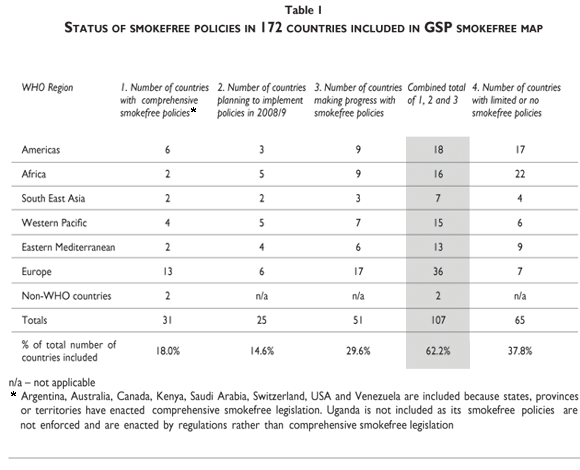
<body><![CDATA[<p><font size="2" face="Verdana"> A total of 124 people were contacted and    98 of them responded to the questionnaire, a response rate of almost 80%. In    some regions, such as the WHO African and the Eastern Mediterranean regions,    one key contact person acted as a coordinator for questionnaires from several    countries in that region. Much of the information from countries with established    smokefree policies is available to the public, and websites were the primary    sources of information for the smokefree map. For a small number of countries    where no contact person was available, reports were used to gather information.<SUP>2,<a name="tx04"></a><a href="#nt04">4</a></SUP></font></p>     <p><font size="2" face="Verdana"><b>Overall results</b></font></p>     <p><font size="2" face="Verdana">Information was compiled on a total of 172 countries    from all six WHO regions. Countries were grouped into four main categories based    on the current and future status of their smokefree policies. The categories    were defined as follows:</font></p>     <blockquote>        <p><font size="2" face="Verdana">1. Countries with comprehensive smokefree      policies. This category includes countries that prohibit smoking in all enclosed      public places and workplaces, even if they allow designated smoking rooms.      Countries in which cities or states have enacted smokefree legislation are      also included. This category reflects best practices in smokefree policies.</font></p>       <p><font size="2" face="Verdana">2. Countries planning comprehensive smokefree      policies for 2008/2009. This category includes countries that have passed      legislation, drafted it or have announced plans for implementation by 2009.      It includes countries with smokefree legislation at the city and state levels,      even when there is no national smokefree legislation. </font></p>       <p><font size="2" face="Verdana">3. Countries making progress with smokefree      policies. This category includes countries that have passed legislation but      have made several exemptions, suggesting that revisions may be needed in the      future. It also includes countries where smoke free efforts have not progressed,      due to lack of government commitment, tobacco industry opposition, or other      factors, even though comprehensive smokefree legislation has been drafted.      Countries that currently have weak legislation but are planning to improve      it at some point are also included. The countries in this section are not      listed by name in this article.</font></p>       <p><font size="2" face="Verdana">4. Countries with limited or no smokefree      policies. This includes countries with weak legislation and no concrete plans      to improve it. The countries in this section are not listed by name.</font></p> </blockquote>     <p><font size="2" face="Verdana"> <a href="#tab01">Table I</a> shows the number    of countries in each of the four categories, grouped by WHO region. Two countries    were from outside the WHO area. Of the 172 countries included in the map, 31    (18.0%) have established comprehensive smokefree policies (includes states/provinces/territories    and cities), 25 (14.6%) are planning to implement smokefree policies in 2008    or 2009, and 51 (29.6%) are making significant progress with smokefree policies.    When these three categories are combined, it shows that 107, or almost two thirds    of the 172 countries (62.2%), are making progress towards smokefree public places    and workplaces or have already achieved it. Only 65 countries (37.8%) have limited    or no smokefree policies. This number is falling each year. For example, when    GSP began compiling the smokefree map, Greece was categorised as a country with    very limited smokefree policies. However, on 8 April 2008 the Greek Health Ministry    announced that it will gradually ban smoking in public places, including cafes    and restaurants, by 2010.<SUP>3</sup></font></p>     <p><font size="2" face="Verdana"><a name="tab01"></a></font></p>     ]]></body>
<body><![CDATA[<p>&nbsp;</p>     <p align="center"><img src="/img/revistas/spm/v50s3/a06tab01.gif"></p>     <p>&nbsp;</p>     <p><font size="2" face="Verdana"> These results clearly demonstrate that there    is global momentum for the introduction and implementation of smokefree policies.    </font></p>     <p><font size="2" face="Verdana">Other findings include:</font></p> <ul>       <li>         <p><font size="2" face="Verdana"> A growing number of countries have best        practices in smokefree legislation. New smokefree initiatives in some of        these countries include prohibiting smoking in cars carrying children, and        prohibiting smoking in several outdoor places.</font></p>   </li>       <li>         <p><font size="2" face="Verdana">Where a country does not have national smokefree        legislation, tobacco control advocates have focused on creating smokefree        cities or states in an effort to build momentum for smokefree policies in        that country.</font></p>   </li>       <li>         ]]></body>
<body><![CDATA[<p><font size="2" face="Verdana"> In countries with comprehensive smokefree        legislation, the policies are popular and compliance is high. This result        helps to reinforce the fact that comprehensive smokefree policies are the        most effective way of protecting people from exposure to secondhand smoke.<SUP>2</sup></font></p>   </li>       <li>         <p><font size="2" face="Verdana"> An organised civil society has been the        driving force behind implementation of smokefree legislation in most countries.        </font></p>   </li>       <li>         <p><font size="2" face="Verdana"> Collaboration between neighbouring countries        on smokefree policies is taking place in Latin America to allow knowledge        and experience to be shared.</font></p>   </li>       <li>         <p><font size="2" face="Verdana"> Grants from international donors such as        the Bloomberg Initiative are providing much needed resources for smokefree        policies in low-income countries around the world.</font></p>   </li>     </ul>     <p><font size="2" face="Verdana"> This article focuses on the countries that    have established comprehensive smokefree policies or are planning to implement    smokefree policies in 2008 and 2009. </font></p>     <p><font size="2" face="Verdana"><b>Best practices in smokefree policies</b></font></p>     ]]></body>
<body><![CDATA[<p><font size="2" face="Verdana">The smokefree map includes many examples of best    practices in smokefree legislation, where best practices are defined as smokefree    legislation that prohibits smoking in all enclosed public places and workplaces,    public transport and bars and restaurants. Ideally, designated smoking rooms    are not allowed. Examples of best practices in countries, states/provinces and    cities are described here.</font></p>     <p><font size="2" face="Verdana"><b>Smokefree countries</b></font></p>     <p><font size="2" face="Verdana">The success of smokefree policies in countries    such as Ireland and New Zealand is well documented,<SUP>4,5</SUP> so in this    section, best practices from other countries are highlighted.</font></p>     <p><font size="2" face="Verdana"><i>Uruguay<SUP>6,</SUP></i><sup><a name="tx05"></a><a href="#nt05">5</a></sup></font></p>     <p><font size="2" face="Verdana">Uruguay passed national smokefree legislation    on 29 February 2008, although the country has been smokefree since March 2006    by presidential decree and has enjoyed high public support. By November 2006,    80% of people supported the ban. Smoking is prohibited in all public places,    workplaces, public transport and some outdoor places. Designated smoking rooms    are not allowed. The law is very well-enforced overall. Strong fines were set    for breaches of the ban, and inspections were made at the very beginning of    the implementation phase. Few people violated the decree, and any violations    that did occur generated media coverage. </font></p>     <p><font size="2" face="Verdana"> The civil society tobacco control movement    was strongly involved in the preparation of the smokefree legislation. In 2005    the incoming President, Tabar&eacute; Vasquez, an oncologist, made tobacco control    a national priority. These factors were crucial to the successful implementation    of smokefree policies.</font></p>     <p><font size="2" face="Verdana"> Uruguay is planning additional smokefree    initiatives. A decree for implementing tobacco control has been passed, and    a new campaign will advocate for the prohibition of smoking in cars and at home    in the presence of children. </font></p>     <p><font size="2" face="Verdana"><i>Italy<SUP>7</sup></i></font></p>     <p><font size="2" face="Verdana">Smoking is prohibited in all indoor public places    and workplaces, including public transport and bars and restaurants. Designated    smoking rooms are allowed but must be enclosed and ventilated, with an automatically    closing door, and must take up no more than 50% of the total area of the restaurant,    bar or club. Non-smokers must not be obliged to pass through the smoking room.    </font></p>     <p><font size="2" face="Verdana"> The campaign for smokefree legislation was    lengthy and labour-intensive. In 2001, a national coalition for tobacco control    was founded, bringing together governmental and non-governmental organisations,    scientific associations and individuals to lobby for smokefree policies. After    an earlier failed attempt, smokefree legislation was passed in 2003 and implemented    on 10 January 2005, in spite of opposition from the tobacco industry.</font></p>     ]]></body>
<body><![CDATA[<p><font size="2" face="Verdana"> The support and strategy of the Health Minister    helped to ensure success. He presented the legislation as a means of protecting    people from secondhand smoke, rather than banning smoking. He invited associations    to join his campaign, including the police.</font></p>     <p><font size="2" face="Verdana"> Research carried out since the introduction    of smokefree legislation has found it to be highly popular. Environmental air    quality has improved dramatically, and smoking prevalence has fallen.<SUP>8</SUP>    The number of acute coronary events fell significantly in the year after the    smoking ban was introduced.<a href="#nt09"><SUP>9</sup></a></font></p>     <p><font size="2" face="Verdana"><i>Lithuania</i><a name="tx06"></a><a href="#nt06"><sup>6</sup></a></font></p>     <p><font size="2" face="Verdana">Lithuania introduced smokefree legislation on    1 January 2007, one year earlier than planned. Smoking is prohibited in enclosed    public places and workplaces, including bars, restaurants, caf&eacute;s and    clubs. Designated smoking rooms are not allowed, but workplace smoking rooms    are allowed. Because the requirements for smoking rooms are so strict and expensive,    it appears that employers are not installing them. Cigar and pipe clubs are    exempt from the legislation. </font></p>     <p><font size="2" face="Verdana"> A number of external factors influenced Lithuania’s    progress with smokefree policies: (1) smokefree policies in Ireland, Italy,    Malta and other European countries; (2) evidence from other countries that smokefree    legislation does not damage business; and (3) the FCTC. Internal factors included    (1) active support from Minister of Health who was a Professor of Public Health;    (2) a strong NGO movement; (3) The European Commission project ‘HELP – for a    life without tobacco; (4) an existing tobacco advertising ban; and (5) high    public awareness of the health effects of tobacco.</font></p>     <p><font size="2" face="Verdana"> After a first failed attempt to introduce    legislation, a second proposal was submitted, in a coordinated strategy among    NGOs and the Ministry of Health. This proposal was supported via public opinion    surveys, a public relations campaign and evidence-based information for tobacco    control advocates. The key messages used in the public opinion surveys –protection    from secondhand smoke, the right to a healthy workplace, the positive influence    on children– enabled this second proposal to capture high levels of public support    for the smoking ban.</font></p>     <p><font size="2" face="Verdana"> The tobacco industry used the same arguments    it had used in other countries through certain NGOs – the rights of smokers,    investments made in ventilation, the impact on the hospitality industry. While    largely unsuccessful, these arguments had partial success with the exemption    for cigar and pipe clubs.</font></p>     <p><font size="2" face="Verdana"> Compliance with the legislation has been    high, and only a few fines were given to bars in 2007. Public awareness has    also been high. While there were some efforts to discredit the ban, it has largely    been respected and implemented without problems.</font></p>     <p><font size="2" face="Verdana"><i>United Kingdom</i></font></p>     <p><font size="2" face="Verdana">The entire UK became smokefree in 2007, making    it the world’s most populated smokefree jurisdiction. Scotland was the first    part of the UK to implement smokefree legislation (26 March 2006), followed    by Wales (2 April 2007), Northern Ireland (30 April 2007) and England (1 July    2007). There are some differences between the legislation in each of these countries,    but in all four, smoking is prohibited in enclosed or substantially enclosed    public places and workplaces, public transport, bars and restaurants. Designated    smoking rooms are not allowed. </font></p>     ]]></body>
<body><![CDATA[<p><font size="2" face="Verdana"> The devolved Scottish government supported    the introduction of smokefree legislation and worked with NGOs to gain public    support for it. A report was published in 2005, prior to the implantation of    legislation, which showed how the smokefree campaign was won.<SUP>10</SUP> It    describes how campaigners learned to combat tobacco industry arguments and tactics,    using the experiences of other countries. It currently acts as a guide for campaigners    in countries wanting to introduce smokefree legislation. </font></p>     <p><font size="2" face="Verdana"> By contrast, the UK government did not support    smokefree legislation in England, preferring a voluntary approach to regulation.    In spite of this, a strategy by health advocates focusing on comprehensive workplace    legislation succeeded because of effective advocacy. It showed clear public    and media support for smokefree legislation. It also showed how the interests    of the tobacco industry and the hospitality industry differ. This difference    was used to secure the support of the hospitality industry for comprehensive    national legislation in order to achieve a level playing field and protect itself    from litigation. England is an example of successful advocacy efforts, achieving    legislation when faced with strong resistance by Government.<SUP>11</sup></font></p>     <p><font size="2" face="Verdana"> The laws have been well observed and enforced    in the UK. For example, in England compliance after three months was 98%,<SUP>12</SUP>    and in Scotland after nine months it was never less than 95%.<SUP>13</SUP> A    study of nine Scottish hospitals found a 17% fall in total admissions for acute    coronary events in the 12 months after smokefree legislation was introduced,    compared with an annual reduction of 3% in the previous ten years.<a href="#nt14"><SUP>14</sup></a></font></p>     <p><font size="2" face="Verdana"><i>Thailand</i></font></p>     <p><font size="2" face="Verdana">Thailand banned smoking in all indoor public    places in 2002, but night entertainment venues and bars were exempted.<SUP>15</SUP>    On 11 February 2008, a comprehensive ban on smoking in public places took effect.    All bars, pubs, discotheques and clubs, indoor and outdoor marketplaces are    covered by the regulations. Non-air conditioned restaurants are also included    in the ban, but these venues can provide designated smoking rooms. </font></p>     <p><font size="2" face="Verdana"><i>Other countries</i></font></p>     <p><font size="2" face="Verdana">Other countries that have best practices in smokefree    policies are: Bhutan, Estonia, Finland, France, Hong Kong, Iceland, Iran, Malta,    Norway, Singapore, Slovenia, Sweden, South Africa.<a name="tx07"></a><a href="#nt07"><sup>7</sup></a>    Bermuda (British Overseas Territory) and Isle of Man (British Crown Dependency)    also have comprehensive smokefree legislation.</font></p>     <p><font size="2" face="Verdana"> Note: In Uganda, smoking is prohibited in    indoor public places and workplaces. Designated smoking rooms are allowed. There    is no comprehensive tobacco control law, but there are regulations which were    enacted in 2004&nbsp;as a result of a court case.&nbsp; The regulations are    poorly enforced.<SUP>16</SUP> </font></p>     <p><font size="2" face="Verdana"><b>Smokefree states, provinces and territories</b></font></p>     <p><font size="2" face="Verdana">The countries featured in this section have introduced    smokefree legislation in individual states, provinces and territories. </font></p>     ]]></body>
<body><![CDATA[<p><font size="2" face="Verdana"><i>Argentina</i></font></p>     <p><font size="2" face="Verdana">Given that the Argentinean government has blocked    FCTC ratification and the passage of tobacco control laws, advocates have been    working province by province and city by city to implement smokefree policies.    </font></p>     <p><font size="2" face="Verdana"> Five of Argentina’s 23 provinces are now    100% smokefree –Santa Fe (March 2006); C&oacute;rdoba (May 2006); Tucum&aacute;n    (June 2006); Mendoza (February 2008); and Neuqu&eacute;n (6 May 2008). The first    two provinces are very significant because of the size of their population.    The tobacco-growing province of Salta wants to go smokefree, and legislators    are looking for a basic consensus with NGOs on how to proceed.<SUP>17,<a name="tx08"></a><a href="#nt08">8</a></sup></font></p>     <p><font size="2" face="Verdana"> A grant from the Bloomberg Initiative will    help ensure effective enforcement of smokefree laws. A National smokefree alliance    will be launched in 2008. (confidential until 8 May 2008)</font></p>     <p><font size="2" face="Verdana"><i>Australia</i></font></p>     <p><font size="2" face="Verdana">Australian States each have separate smokefree    legislation, but the provisions are becoming more and more consistent, as some    of the original exemptions have been phased out. Smoking is banned in enclosed    or partially enclosed public places and workplaces in all eight jurisdictions,    and only one allows exemptions for bars (licensed premises). Designated rooms    are not allowed. </font></p>     <p><font size="2" face="Verdana"> Queensland provides a good example of best    practices in smokefree legislation.<SUP>18</SUP> All enclosed public places    and workplaces, including outdoor areas where food or drink is served, and sporting    stadiums are smokefree. Smoking is also prohibited within 10 metres of children’s’    playgrounds, within four metres of entrances to non-residential buildings, and    on patrolled beaches. All outdoor areas serving food or drink, or where entertainers    are working, must be smokefree. The only exemption is for high roller rooms    in casinos. Outdoor smoking is allowed but only in designated smoking areas    that may not take up more than 50% of the outdoor area. </font></p>     <p><font size="2" face="Verdana"> Prohibiting smoking in cars carrying children    is also a current issue in smokefree policy in Australia, and legislation to    this effect has been implemented in the states of South Australia<SUP>19</SUP>    and Tasmania.<SUP>20</sup></font></p>     <p><font size="2" face="Verdana"><i>Canada</i></font></p>     <p><font size="2" face="Verdana">Canada’s first comprehensive smokefree laws took    effect in the city of Victoria, British Columbia in 1999. Two provinces and    two territories became smokefree in 2004, and most of Canada’s 13 provinces    and territories now have comprehensive smokefree legislation.<a href="#nt21"><SUP>21</SUP></a>    Each province used individual campaigns to achieve its goals, but the key factors    in their success were:</font></p> <ul>       ]]></body>
<body><![CDATA[<li>         <p><font size="2" face="Verdana"> Strongly and clearly written legislation        that does not allow exemptions. </font></p>   </li>       <li>         <p><font size="2" face="Verdana"> Strong media strategies.</font></p>   </li>       <li>         <p><font size="2" face="Verdana"> High profile people to champion the law.        </font></p>   </li>       <li>         <p><font size="2" face="Verdana"> Awareness of tobacco industry tactics to        stop or delay laws and strategies to counter these tactics</font></p>   </li>       <li>         <p><font size="2" face="Verdana"> Strict enforcement of the laws.</font></p>   </li>     ]]></body>
<body><![CDATA[</ul>     <p><font size="2" face="Verdana">  Campaigners used region-specific studies    to provide evidence of the benefits of smokefree legislation. These surveys    also helped encourage municipalities to adopt smokefree bylaws before the province    went smokefree. Campaigners did not compromise on issues such as allowing designated    smok ing rooms.<SUP>22</sup></font></p>     <p><font size="2" face="Verdana"> Prohibiting smoking in cars carrying children    is a current issue in smokefree policy in Canada. Legislation has either been    implemented, will be implemented soon or under consideration in British Columbia,    Manitoba, New Brunswick, Nova Scotia, Ontario.<SUP>23</sup></font></p>     <p><font size="2" face="Verdana"><i>USA</i></font></p>     <p><font size="2" face="Verdana">Although the USA has not ratified the FCTC, many    of its states have best practices in smokefree legislation. A total of 12 states,    Washington DC, and Puerto Rico have passed comprehensive smokefree legislation    covering enclosed public places and workplaces. An additional two states will    become smokefree in 2009.<SUP>24</sup></font></p>     <p><font size="2" face="Verdana"><i>Other countries</i></font></p>     <p><font size="2" face="Verdana">The State of Joao Pessoa in North Eastern Brazil    has recently introduced smokefree legislation, given political will from governmental    authorities.<a href="#nt09"><sup>9</sup></a> In Switzerland, the federal parliament    is considering a national smokefree law, but the cantons (states) are taking    action independently. Six cantons have already become smokefree, and votes in    more cantons are expected in 2008.<SUP>25</SUP> Monagas state in Venezuela introduced    comprehensive smokefree legislation in 2003.<SUP>26</sup></font></p>     <p><font size="2" face="Verdana"><b>Smokefree cities</b></font></p>     <p><font size="2" face="Verdana">In some countries with no or limited national    smokefree policies, comprehensive smokefree legislation has been introduced    in cities. Some examples of best practices for smokefree cities are included    here:</font></p>     <p><font size="2" face="Verdana"><i>Argentina</i></font></p>     ]]></body>
<body><![CDATA[<p><font size="2" face="Verdana">Three major cities have enacted smokefree ordinances:    Bah&iacute;a Blanca (to be implemented 1 September 2008); Corrientes, capital    of Corrientes province (October 2006); and Resistencia, capital of Chaco province.    Corrientes is a very significant case, since it is the capital of a tobacco    growing province. Buenos Aires has only partial smoking restrictions and does    not represent best practices.<SUP>18</SUP> </font></p>     <p><font size="2" face="Verdana"><i>Kenya</i></font></p>     <p><font size="2" face="Verdana">The capital city, Nairobi, banned smoking in    July 2007 following the lead of two other cities, Mombasa and Nakuru. Another    initiative is the ongoing ban on smoking in the streets (except in designated    areas) by three councils including Nairobi. </font></p>     <p><font size="2" face="Verdana"><i>Other countries </i></font></p>     <p><font size="2" face="Verdana">The City of Recife in Brazil successfully implemented    smokefree legislation in February 2008.<a href="#nt09"><sup>9</sup></a> The    cities of Mecca and Medina in Saudi Arabia are smokefree by royal assent.<SUP>27</sup></font></p>     <p><font size="2" face="Verdana"><b>Future smokefree initiatives for 2008 and    2009</b></font></p>     <p><font size="2" face="Verdana">A large number of countries, states/provinces/territories,    and cities are planning to implement smokefree legislation in 2008 and 2009.    A selection of them are highlighted in this section.</font></p>     <p><font size="2" face="Verdana"><b>Smokefree countries</b></font></p>     <p><font size="2" face="Verdana"><i>Mexico</i></font></p>     <p><font size="2" face="Verdana">A strengthened smokefree law was approved by    the Senate on 26 February 2008 and is currently awaiting the signature of the    President. It prohibits smoking in indoor workplaces and enclosed public places.    Smoking is allowed in separate designated smoking rooms (DSRs) or outdoor smoking    areas. Businesses have 180 days to set up DSRs.<a name="tx10"></a><a href="#nt10"><sup>10</sup></a></font></p>     ]]></body>
<body><![CDATA[<p><font size="2" face="Verdana"><i>Turkey</i></font></p>     <p><font size="2" face="Verdana">Turkey adopted smokefree legislation in January    2008 and will implement it later in the year. Smoking is prohibited in enclosed    public places and workplaces, and designated smoking rooms are not allowed.    The legislation received strong support from the Justice and Development Party    of Prime Minister Recep Tayyip Erdogan, who is an ardent anti-smoking campaigner.<SUP>28</SUP>    A Bloomberg Initiative grant will help enforcement of the law.<SUP><a name="tx11"></a><a href="#nt11">11</a></sup></font></p>     <p><font size="2" face="Verdana"><i>Panama </i></font></p>     <p><font size="2" face="Verdana">Panama will implement comprehensive smokefree    legislation in April 2008. Smoking will be prohibited in all indoor workplaces    and public places.<sup><a name="tx12"></a><a href="#nt12">12</a></sup></font></p>     <p><font size="2" face="Verdana"><i>Kenya</i></font></p>     <p><font size="2" face="Verdana">In addition to passing smokefree legislation    in several cities, Kenya will be introducing national smokefree legislation    on 1 July 2008 (Tobacco Control Act). It will prohibit smoking in public places    but will allow designated smoking rooms.</font></p>     <p><font size="2" face="Verdana"><i>Guatemala</i></font></p>     <p><font size="2" face="Verdana">A national bill has been drafted for comprehensive    smokefree legislation. Smoking will be prohibited in enclosed public spaces    and workplaces, as well as sports stadiums, playgrounds and outdoor eating areas.    The Bill is now on the National Congress agenda, and its third and final discussion    is pending, before it is officially approved.<a name="tx13"></a><a href="#nt13"><sup>13</sup></a></font></p>     <p><font size="2" face="Verdana"><i>Czech Republic</i></font></p>     <p><font size="2" face="Verdana">On 16 January 2008 the Parliament of the Czech    Republic voted for comprehensive smokefree legislation, which would prohibit    smoking in indoor public places, including restaurants. The MP Boris Št'astný,    is the driving force behind the proposal for legislation. Attempts are being    made to weaken the proposed legislation and a decision has not yet been made.    The Smokefree Partnership is offering support for Mr Št'astný.<a href="#nt14"><SUP>14</sup></a></font></p>     ]]></body>
<body><![CDATA[<p><font size="2" face="Verdana"><i>Nigeria</i></font></p>     <p><font size="2" face="Verdana">A National Tobacco Bill has been drafted which    proposes to prohibit smoking in all public places. It may also prohibit smoking    in cars with children under 14.<SUP><a name="tx15"></a><a href="#nt15">15</a></SUP>    Smokefree legislation is planned for two states in the country.</font></p>     <p><font size="2" face="Verdana"><i>Other countries</i></font></p>     <p><font size="2" face="Verdana">Several countries in Europe are implementing    or planning for smokefree legislation in 2008 and 2009, and the European Union    will publish a communication on smokefree places in late 2008.<a href="#nt14"><SUP>14</SUP></a>    In Serbia a 100% smokefree law is being adopted in 2008/2009. It covers all    public places and workplaces and designated smoking rooms are not allowed.<SUP><a name="tx16"></a><a href="#nt16">16</a></sup></font></p>     <p><font size="2" face="Verdana"> Smokefree legislation in The Netherlands    will be amended in July 2008 to prohibit smoking in bars, clubs and restaurants.    It is likely that enclosed smoking rooms with no size restrictions will be allowed.    Smoking is banned in pubs and restaurants in most of Germany’s 16 states. Some    bans are more comprehensive than others – the hospitality sector in Bavaria    is totally smokefree, but the Oktoberfest is exempt for 2008.<a name="tx17"></a><a href="#nt17"><sup>17</sup></a>    Moldova implemented smokefree legislation in March 2008.<SUP><a name="tx18"></a><a href="#nt18">18</a></sup></font></p>     <p><font size="2" face="Verdana"> In Mauritius, the Public Health Act is being    amended in 2008 to ban smoking in all public places, including outdoor bars    and restaurants, bus terminals, bus stops, taxi stands, public gardens and beaches.    A public consultation will take place to measure public support for the smokefree    law.<SUP>29</SUP> The Malaysian government has pledged to begin legislating    for 100% smokefree public places in 2008.<SUP>30</SUP> In Burkina Faso new smokefree    legislation is being planned in accordance with Article 8, with the aid of a    Bloomberg Initiative grant. Bloomberg Initiative funding will also help to create    smokefree places in Niger and Sri Lanka.<SUP><a name="tx19"></a><a href="#nt19">19</a></SUP>    Smokefree legislation is being drafted in Bahrain, Cambodia, Nauru and Oman.</font></p>     <p><font size="2" face="Verdana"><b>Smokefree states, provinces and territories</b></font></p>     <p><font size="2" face="Verdana"><i>Nigeria</i></font></p>     <p><font size="2" face="Verdana">A tobacco control bill has been drafted for Lagos    State, which contains provisions to prohibit smoking in public places. A similar    bill has also been draft for the Federal Capital Territory, which includes the    capital city of Abuja. The Nigeria Tobacco Control Alliance has launched a campaign    to make Nigerian airports smokefree.<SUP><a name="tx20"></a><a href="#nt20">20</a></SUP>    </font></p>     <p><font size="2" face="Verdana"><b>Smokefree cities</b></font></p>     ]]></body>
<body><![CDATA[<p><font size="2" face="Verdana"><i>Mexico</i></font></p>     <p><font size="2" face="Verdana">In February 2008 Mexico City passed comprehensive    smokefree legislation that prohibits smoking in enclosed public places and workplaces,    on public transport and in bars and restaurants. Designated smoking rooms are    not allowed. This legislation is more comprehensive than the national smokefree    legislation sent for Senate approval in February 2008 which allows for designated    smoking rooms.<a href="#nt21"><sup>21</sup></a> Since the legislation entered    into force in April 2008, compliance has been high.</font></p>     <p><font size="2" face="Verdana"> The Mexican Government asked Uruguay to help    it develop smokefree legislation. An Uruguayan delegation –one Parliamentarian    (Dr. Asqueta), a Ministry of Health tobacco control focal point (Dr. Abascal),    and the President of the Bar and Restaurant’s Owners Association, travelled    to meet Parliamentarians, the Ministry of Health and businessmen in Mexico.<a href="#nt21"><sup>21</sup></a>    This type of collaboration has also happened in El Salvador and could act as    a model for other regions and countries.</font></p>     <p><font size="2" face="Verdana"><i>Philippines</i></font></p>     <p><font size="2" face="Verdana">A number of cities in The Philippines have been    smokefree for a number of years –Davao City (2002), Makati City (2003), Legazpi    (2005). However, designated smoking rooms are allowed and the laws have not    been compliant with Article 8 of the FCTC. Some cities are now planning comprehensive    smokefree legislation –Davao City, Makati, Legazpi, Silang (Cavite), Ilolio.    These cities have set up anti-smoking task forces. The Davao task force includes    the mayor, tourism office and police. The City of Manila is also hoping to launch    a task force. Pasig and Taguig (cities in Metro Manila) have recently announced    plans to go smokefree.<a name="tx22"></a><a href="#nt22"><sup>22</sup></a></font></p>     <p><font size="2" face="Verdana"><i>Other countries</i></font></p>     <p><font size="2" face="Verdana">Funding from the Bloomberg Initiative will be    used from 2008-2010 to implement smokefree legislation in Hanoi City in Vietnam<a name="tx23"></a><a href="#nt23"><sup>23</sup></a>    and Dar es Salaam in Tanzania.<a name="tx24"></a><a href="#nt24"><sup>24</sup></a>    In Pakistan, there are plans to develop model smokefree cities in each of the    country’s four provinces.<a name="tx25"></a><a href="#nt25"><sup>25</sup></a>    There are also initiatives to create smokefree cities in India (Chennai and    Delhi)<a name="tx26"></a><a href="#nt26"><sup>26</sup></a> and Egypt (Alexandria).<a name="tx27"></a><a href="#nt27"><sup>27</sup></a></font></p>     <p><font size="2" face="Verdana"><b>Conclusion</b></font></p>     <p><font size="2" face="Verdana">The large number of countries, states/provinces/territories    and cities worldwide that have implemented comprehensive smokefree policies    or are planning to do so in the next few years reflects a global movement towards    smokefree public places and workplaces. This movement is being pushed forward    by advocacy efforts from an organised civil society, funding from international    funders, the examples shown by countries with effective smokefree policies and    the sharing of experience between countries.</font></p>     <p><font size="2" face="Verdana"><b>Acknowledgements</b></font></p>     ]]></body>
<body><![CDATA[<p><font size="2" face="Verdana">The Global Smokefree Partnership would like to    thank the many people in tobacco control worldwide who contributed to the preparation    of the smokefree map which formed the basis of this article.</font></p>     <p>&nbsp;</p>     <p><font size="3" face="verdana"><b>References</b></font></p>     <!-- ref --><p><font size="2" face="Verdana">1. First report of Committee A. Conference of    the parties to the WHO Framework Convention on Tobacco Control. Second session.    4 July 2007. Available online at <A HREF="http://www.who.int/gb/fctc/PDF/cop2/FCTC_COP2_17P-en.pdf" target="_blank">http://www.who.int/gb/fctc/PDF/cop2/FCTC_COP2_17P-en.pdf</A>.</font>&nbsp;&nbsp;&nbsp;&nbsp;&nbsp;&nbsp;&nbsp;&nbsp;[&#160;<a href="javascript:void(0);" onclick="javascript: window.open('/scielo.php?script=sci_nlinks&ref=9437588&pid=S0036-3634200800090000600001&lng=','','width=640,height=500,resizable=yes,scrollbars=1,menubar=yes,');">Links</a>&#160;]<!-- end-ref --><!-- ref --><p> <font size="2" face="Verdana">2. WHO report on the global tobacco epidemic,    2008. The MPOWER packgage. Geneva, World Health Organization, 2008. Available    online at <A HREF="http://www.who.int/tobacco/mpower/en/index.html" target="_blank">http://www.who.int/tobacco/mpower/en/index.html</A>.</font>&nbsp;&nbsp;&nbsp;&nbsp;&nbsp;&nbsp;&nbsp;&nbsp;[&#160;<a href="javascript:void(0);" onclick="javascript: window.open('/scielo.php?script=sci_nlinks&ref=9437589&pid=S0036-3634200800090000600002&lng=','','width=640,height=500,resizable=yes,scrollbars=1,menubar=yes,');">Links</a>&#160;]<!-- end-ref --><!-- ref --><p> <font size="2" face="Verdana">3. GLOBALink NIMI Daily - Wednesday 9 April    2008. Available online at <A HREF="http://www.globalink.org/" target="_blank">www.globalink.org</A>.</font>&nbsp;&nbsp;&nbsp;&nbsp;&nbsp;&nbsp;&nbsp;&nbsp;[&#160;<a href="javascript:void(0);" onclick="javascript: window.open('/scielo.php?script=sci_nlinks&ref=9437590&pid=S0036-3634200800090000600003&lng=','','width=640,height=500,resizable=yes,scrollbars=1,menubar=yes,');">Links</a>&#160;]<!-- end-ref --><!-- ref --><p> <font size="2" face="Verdana">4. Allwright S, Paul G, Greiner B, Mullally    BJ, Pursell L, Kelly A, et al. Legislation for smoke-free workplaces and health    of bar workers in Ireland: before and after study. Br Med J 2005;331:1117 Available    online at <A HREF="http://www.bmj.com/cgi/content/full/331/7525/1117" target="_blank">http://www.bmj.com/cgi/content/full/331/7525/1117</A>.</font>&nbsp;&nbsp;&nbsp;&nbsp;&nbsp;&nbsp;&nbsp;&nbsp;[&#160;<a href="javascript:void(0);" onclick="javascript: window.open('/scielo.php?script=sci_nlinks&ref=9437591&pid=S0036-3634200800090000600004&lng=','','width=640,height=500,resizable=yes,scrollbars=1,menubar=yes,');">Links</a>&#160;]<!-- end-ref --><!-- ref --><p> <font size="2" face="Verdana">5. After the smoke has cleared: evaluation of    the impact of a new smokefree law. Wellington, Ministry of Health, 2006. Available    online at <A HREF="http://www.hpac.govt.nz/moh.nsf/UnidPrint/MH5599?OpenDocument#information" target="_blank">http://www.hpac.govt.nz/moh.nsf/UnidPrint/MH5599?OpenDocument#information</A>.</font>&nbsp;&nbsp;&nbsp;&nbsp;&nbsp;&nbsp;&nbsp;&nbsp;[&#160;<a href="javascript:void(0);" onclick="javascript: window.open('/scielo.php?script=sci_nlinks&ref=9437592&pid=S0036-3634200800090000600005&lng=','','width=640,height=500,resizable=yes,scrollbars=1,menubar=yes,');">Links</a>&#160;]<!-- end-ref --><!-- ref --><p><font size="2" face="Verdana">6. Blanco A. Success stories: Uruguay. Global    Smokfree Partnership. Published online at <a href="http://www.globalsmokefreepartnership.org/news.php?id=196" target="_blank">www.globalsmokefreepartnership.org/news.php?id=196</a>.</font>&nbsp;&nbsp;&nbsp;&nbsp;&nbsp;&nbsp;&nbsp;&nbsp;[&#160;<a href="javascript:void(0);" onclick="javascript: window.open('/scielo.php?script=sci_nlinks&ref=9437593&pid=S0036-3634200800090000600006&lng=','','width=640,height=500,resizable=yes,scrollbars=1,menubar=yes,');">Links</a>&#160;]<!-- end-ref --><!-- ref --><p><font size="2" face="Verdana">7. Tamang E. Success Stories: Italy. Global Smokfree    Partnership. Published online at <a href="http://www.globalsmokefreepartnership.org/evidence.php?id=19" target="_blank">www.globalsmokefreepartnership.org/evidence.php?id=19</a>.</font>&nbsp;&nbsp;&nbsp;&nbsp;&nbsp;&nbsp;&nbsp;&nbsp;[&#160;<a href="javascript:void(0);" onclick="javascript: window.open('/scielo.php?script=sci_nlinks&ref=9437594&pid=S0036-3634200800090000600007&lng=','','width=640,height=500,resizable=yes,scrollbars=1,menubar=yes,');">Links</a>&#160;]<!-- end-ref --><!-- ref --><p><font size="2" face="Verdana">8. Gorini G, Chellini E, Galeone D. What happened    in Italy? A brief summary of studies conducted in Italy to evaluate the impact    of the smoking ban. Annals of Oncology 2007;18:1620-1622. </font>&nbsp;&nbsp;&nbsp;&nbsp;&nbsp;&nbsp;&nbsp;&nbsp;[&#160;<a href="javascript:void(0);" onclick="javascript: window.open('/scielo.php?script=sci_nlinks&ref=9437595&pid=S0036-3634200800090000600008&lng=','','width=640,height=500,resizable=yes,scrollbars=1,menubar=yes,');">Links</a>&#160;]<!-- end-ref --><!-- ref --><p> <font size="2" face="Verdana">9. Cesaroni G, Forastiere F, Agabiti N, Valente    P, Zuccaro P, Perucci CA. Effect of the Italian smoking ban on population rates    of acute coronary events. Circulation. 2008 Mar 4;117(9):1183-8.</font>&nbsp;&nbsp;&nbsp;&nbsp;&nbsp;&nbsp;&nbsp;&nbsp;[&#160;<a href="javascript:void(0);" onclick="javascript: window.open('/scielo.php?script=sci_nlinks&ref=9437596&pid=S0036-3634200800090000600009&lng=','','width=640,height=500,resizable=yes,scrollbars=1,menubar=yes,');">Links</a>&#160;]<!-- end-ref --><!-- ref --><p> <font size="2" face="Verdana">10. Action on Smoking and Health, Scotland.    Cancer Research UK. The unwelcome guest: how Scotland invited the tobacco industry    to smoke outside’. 2005. Available online at <A HREF="http://www.ashscotland.org.uk/ash/files/The Unwelcome Guest.pdf" target="_blank">http://www.ashscotland.org.uk/ash/files/The%20Unwelcome%20Guest.pdf</A></font>&nbsp;&nbsp;&nbsp;&nbsp;&nbsp;&nbsp;&nbsp;&nbsp;[&#160;<a href="javascript:void(0);" onclick="javascript: window.open('/scielo.php?script=sci_nlinks&ref=9437597&pid=S0036-3634200800090000600010&lng=','','width=640,height=500,resizable=yes,scrollbars=1,menubar=yes,');">Links</a>&#160;]<!-- end-ref --><!-- ref --><p><font size="2" face="Verdana">11. Arnott D, Dockrell M, Sanford A, Willmore    I. Comprehensive smokefree legislation in England: how advocacy won the day.Available    online at <a href="http://www.ash.org.uk/files/documents/ASH_675.pdf" target="_blank">www.ash.org.uk/files/documents/ASH_675.pdf</a>.</font>&nbsp;&nbsp;&nbsp;&nbsp;&nbsp;&nbsp;&nbsp;&nbsp;[&#160;<a href="javascript:void(0);" onclick="javascript: window.open('/scielo.php?script=sci_nlinks&ref=9437598&pid=S0036-3634200800090000600011&lng=','','width=640,height=500,resizable=yes,scrollbars=1,menubar=yes,');">Links</a>&#160;]<!-- end-ref --><!-- ref --><p><font size="2" face="Verdana">12. Smokefree England. Awareness, attitudes and    compliance three months after the commencement of smokefree legislation – a    summary report. Available online at <a href="http://www.smokefreeengland.co.uk/files/three-month-report-factsheet.pdf" target="_blank">www.smokefreeengland.co.uk/files/three-month-report-factsheet.pdf</a>.</font>&nbsp;&nbsp;&nbsp;&nbsp;&nbsp;&nbsp;&nbsp;&nbsp;[&#160;<a href="javascript:void(0);" onclick="javascript: window.open('/scielo.php?script=sci_nlinks&ref=9437599&pid=S0036-3634200800090000600012&lng=','','width=640,height=500,resizable=yes,scrollbars=1,menubar=yes,');">Links</a>&#160;]<!-- end-ref --><!-- ref --><p><font size="2" face="Verdana">13. ASH Scotland. Smokefree legislation in Scotland:    12 month briefing. March 2007. Available online at <A HREF="http://www.aerzteinitiative.at/Scotland1yearSmokefree.pdf" target="_blank">www.aerzteinitiative.at/Scotland1yearSmokefree.pdf</A>.</font>&nbsp;&nbsp;&nbsp;&nbsp;&nbsp;&nbsp;&nbsp;&nbsp;[&#160;<a href="javascript:void(0);" onclick="javascript: window.open('/scielo.php?script=sci_nlinks&ref=9437600&pid=S0036-3634200800090000600013&lng=','','width=640,height=500,resizable=yes,scrollbars=1,menubar=yes,');">Links</a>&#160;]<!-- end-ref --><!-- ref --><p> <font size="2" face="Verdana">14. The Scottish Government. News. Available    online at <A HREF="http://www.scotland.gov.uk/News/Releases/2007/09/10081400" target="_blank">http://www.scotland.gov.uk/News/Releases/2007/09/10081400</A>.</font>&nbsp;&nbsp;&nbsp;&nbsp;&nbsp;&nbsp;&nbsp;&nbsp;[&#160;<a href="javascript:void(0);" onclick="javascript: window.open('/scielo.php?script=sci_nlinks&ref=9437601&pid=S0036-3634200800090000600014&lng=','','width=640,height=500,resizable=yes,scrollbars=1,menubar=yes,');">Links</a>&#160;]<!-- end-ref --><!-- ref --><p><font size="2" face="Verdana">15. ASH Thailand. <a href="http://www.ashthailand.or.th/ens" target="_blank">www.ashthailand.or.th/ens</a>.</font>&nbsp;&nbsp;&nbsp;&nbsp;&nbsp;&nbsp;&nbsp;&nbsp;[&#160;<a href="javascript:void(0);" onclick="javascript: window.open('/scielo.php?script=sci_nlinks&ref=9437602&pid=S0036-3634200800090000600015&lng=','','width=640,height=500,resizable=yes,scrollbars=1,menubar=yes,');">Links</a>&#160;]<!-- end-ref --><!-- ref --><p><font size="2" face="Verdana">16. Tumwine J. Smokefree challenge: Uganda. Global    Smokfree Partnership. Published online at <a href="http://www.globalsmokefreepartnership.org/evidence.php?id=22" target="_blank">www.globalsmokefreepartnership.org/evidence.php?id=22</a>.</font>&nbsp;&nbsp;&nbsp;&nbsp;&nbsp;&nbsp;&nbsp;&nbsp;[&#160;<a href="javascript:void(0);" onclick="javascript: window.open('/scielo.php?script=sci_nlinks&ref=9437603&pid=S0036-3634200800090000600016&lng=','','width=640,height=500,resizable=yes,scrollbars=1,menubar=yes,');">Links</a>&#160;]<!-- end-ref --><!-- ref --><p><font size="2" face="Verdana">17. Sebrie E, Schoj V, Glantz S. Smoke free environments    in Latin America: on the road to change? Prevention and Control 2008;21-35.    </font>&nbsp;&nbsp;&nbsp;&nbsp;&nbsp;&nbsp;&nbsp;&nbsp;[&#160;<a href="javascript:void(0);" onclick="javascript: window.open('/scielo.php?script=sci_nlinks&ref=9437604&pid=S0036-3634200800090000600017&lng=','','width=640,height=500,resizable=yes,scrollbars=1,menubar=yes,');">Links</a>&#160;]<!-- end-ref --><!-- ref --><p><font size="2" face="Verdana">18. Queensland government. Tobacco laws. Available    online at <A HREF="http://www.health.qld.gov.au/atods/tobaccolaws/index.asp" target="_blank">www.health.qld.gov.au/atods/tobaccolaws/index.asp</A>.</font>&nbsp;&nbsp;&nbsp;&nbsp;&nbsp;&nbsp;&nbsp;&nbsp;[&#160;<a href="javascript:void(0);" onclick="javascript: window.open('/scielo.php?script=sci_nlinks&ref=9437605&pid=S0036-3634200800090000600018&lng=','','width=640,height=500,resizable=yes,scrollbars=1,menubar=yes,');">Links</a>&#160;]<!-- end-ref --><!-- ref --><p><font size="2" face="Verdana">19. Government of South Australia. Tobacco control    in South Australia. <a href="http://www.tobaccolaws.sa.gov.au" target="_blank">www.tobaccolaws.sa.gov.au</a>.</font>&nbsp;&nbsp;&nbsp;&nbsp;&nbsp;&nbsp;&nbsp;&nbsp;[&#160;<a href="javascript:void(0);" onclick="javascript: window.open('/scielo.php?script=sci_nlinks&ref=9437606&pid=S0036-3634200800090000600019&lng=','','width=640,height=500,resizable=yes,scrollbars=1,menubar=yes,');">Links</a>&#160;]<!-- end-ref --><!-- ref --><p><font size="2" face="Verdana">20. Department of Health and Human Services Tasmania.    Tobacco. <a href="http://www.dhhs.tas.gov.au/agency/pro/tobacco/index.php" target="_blank">www.dhhs.tas.gov.au/agency/pro/tobacco/index.php</a>.</font>&nbsp;&nbsp;&nbsp;&nbsp;&nbsp;&nbsp;&nbsp;&nbsp;[&#160;<a href="javascript:void(0);" onclick="javascript: window.open('/scielo.php?script=sci_nlinks&ref=9437607&pid=S0036-3634200800090000600020&lng=','','width=640,height=500,resizable=yes,scrollbars=1,menubar=yes,');">Links</a>&#160;]<!-- end-ref --><!-- ref --><p><font size="2" face="Verdana">21. Non-Smokers’ Rights Association. Provincial    &amp; Territorial Legislation, Regulation or Policy <A HREF="http://www.nsra-adnf.ca/cms/index.cfm?group_id=1461" target="_blank">www.nsra-adnf.ca/cms/index.cfm?group_id=1461</A></font>&nbsp;&nbsp;&nbsp;&nbsp;&nbsp;&nbsp;&nbsp;&nbsp;[&#160;<a href="javascript:void(0);" onclick="javascript: window.open('/scielo.php?script=sci_nlinks&ref=9437608&pid=S0036-3634200800090000600021&lng=','','width=640,height=500,resizable=yes,scrollbars=1,menubar=yes,');">Links</a>&#160;]<!-- end-ref --><!-- ref --><p><font size="2" face="Verdana">22. Drope J. Success stories: Canada. Global    Smokfree Partnership. Published online at <a href="http://www.globalsmokefreepartnership.org/evidence.php?id=57" target="_blank">www.globalsmokefreepartnership.org/evidence.php?id=57</a></font>&nbsp;&nbsp;&nbsp;&nbsp;&nbsp;&nbsp;&nbsp;&nbsp;[&#160;<a href="javascript:void(0);" onclick="javascript: window.open('/scielo.php?script=sci_nlinks&ref=9437609&pid=S0036-3634200800090000600022&lng=','','width=640,height=500,resizable=yes,scrollbars=1,menubar=yes,');">Links</a>&#160;]<!-- end-ref --><!-- ref --><p><font size="2" face="Verdana">23. GLOBALink tobacco news service. <A HREF="http://www.globalink.org/" target="_blank">www.globalink.org</A></font>&nbsp;&nbsp;&nbsp;&nbsp;&nbsp;&nbsp;&nbsp;&nbsp;[&#160;<a href="javascript:void(0);" onclick="javascript: window.open('/scielo.php?script=sci_nlinks&ref=9437610&pid=S0036-3634200800090000600023&lng=','','width=640,height=500,resizable=yes,scrollbars=1,menubar=yes,');">Links</a>&#160;]<!-- end-ref --><!-- ref --><p><font size="2" face="Verdana">24. Overview list: how many smokefree laws? American    Non-smokers’ Rights Foundation <A HREF="http://www.no-smoke.org/pdf/mediaordlist.pdf" target="_blank">www.no-smoke.org/pdf/mediaordlist.pdf</A></font>&nbsp;&nbsp;&nbsp;&nbsp;&nbsp;&nbsp;&nbsp;&nbsp;[&#160;<a href="javascript:void(0);" onclick="javascript: window.open('/scielo.php?script=sci_nlinks&ref=9437611&pid=S0036-3634200800090000600024&lng=','','width=640,height=500,resizable=yes,scrollbars=1,menubar=yes,');">Links</a>&#160;]<!-- end-ref --><!-- ref --><p><font size="2" face="Verdana">25. GLOBALink tobacco news service. <A HREF="http://www.globalink.org/" target="_blank">www.globalink.org</A></font>&nbsp;&nbsp;&nbsp;&nbsp;&nbsp;&nbsp;&nbsp;&nbsp;[&#160;<a href="javascript:void(0);" onclick="javascript: window.open('/scielo.php?script=sci_nlinks&ref=9437612&pid=S0036-3634200800090000600025&lng=','','width=640,height=500,resizable=yes,scrollbars=1,menubar=yes,');">Links</a>&#160;]<!-- end-ref --><!-- ref --><p><font size="2" face="Verdana">26. Sebrie E, Schoj V, Glantz S. Smoke free environments    in Latin America: on the road to change? Prevention and Control 2008;21-35.</font>&nbsp;&nbsp;&nbsp;&nbsp;&nbsp;&nbsp;&nbsp;&nbsp;[&#160;<a href="javascript:void(0);" onclick="javascript: window.open('/scielo.php?script=sci_nlinks&ref=9437613&pid=S0036-3634200800090000600026&lng=','','width=640,height=500,resizable=yes,scrollbars=1,menubar=yes,');">Links</a>&#160;]<!-- end-ref --><!-- ref --><p><font size="2" face="Verdana">27. WHO Eastern Mediterranean regional office.    <A HREF="http://www.emro.who.int/tfi/wntd2007/pdf/tobacco_free_mecca_medina.pdf" target="_blank">www.emro.who.int/tfi/wntd2007/pdf/tobacco_free_mecca_medina.pdf</A></font>&nbsp;&nbsp;&nbsp;&nbsp;&nbsp;&nbsp;&nbsp;&nbsp;[&#160;<a href="javascript:void(0);" onclick="javascript: window.open('/scielo.php?script=sci_nlinks&ref=9437614&pid=S0036-3634200800090000600027&lng=','','width=640,height=500,resizable=yes,scrollbars=1,menubar=yes,');">Links</a>&#160;]<!-- end-ref --><!-- ref --><p><font size="2" face="Verdana">28. Global Smokefree Partnership. Turkish parliament    passes smoking ban bill. <a href="http://www.globalsmokefreepartnership.org/news.php?id=251" target="_blank">www.globalsmokefreepartnership.org/news.php?id=251</a></font>&nbsp;&nbsp;&nbsp;&nbsp;&nbsp;&nbsp;&nbsp;&nbsp;[&#160;<a href="javascript:void(0);" onclick="javascript: window.open('/scielo.php?script=sci_nlinks&ref=9437615&pid=S0036-3634200800090000600028&lng=','','width=640,height=500,resizable=yes,scrollbars=1,menubar=yes,');">Links</a>&#160;]<!-- end-ref --><!-- ref --><p><font size="2" face="Verdana">29. Republic of Mauritius. The Public Health    Act. Available online at <A HREF="http://www.gov.mu/portal/goc/moh/file/tobacco.pdf" target="_blank">www.gov.mu/portal/goc/moh/file/tobacco.pdf</A>.</font>&nbsp;&nbsp;&nbsp;&nbsp;&nbsp;&nbsp;&nbsp;&nbsp;[&#160;<a href="javascript:void(0);" onclick="javascript: window.open('/scielo.php?script=sci_nlinks&ref=9437616&pid=S0036-3634200800090000600029&lng=','','width=640,height=500,resizable=yes,scrollbars=1,menubar=yes,');">Links</a>&#160;]<!-- end-ref --><!-- ref --><p><font size="2" face="Verdana">30. South East Asia Tobacco Control Alliance,    News Database 6 December 2007. <a href="http://www.seatca.org/newsview.asp?ID=418" target="_blank">www.seatca.org/newsview.asp?ID=418</a>.</font>&nbsp;&nbsp;&nbsp;&nbsp;&nbsp;&nbsp;&nbsp;&nbsp;[&#160;<a href="javascript:void(0);" onclick="javascript: window.open('/scielo.php?script=sci_nlinks&ref=9437617&pid=S0036-3634200800090000600030&lng=','','width=640,height=500,resizable=yes,scrollbars=1,menubar=yes,');">Links</a>&#160;]<!-- end-ref --><p>&nbsp;</p>     <p>&nbsp;</p>     <p><font size="2" face="Verdana">Accepted on: 28 de abril de 2008</font></p>     <p>&nbsp;</p>     <p>&nbsp;</p>     <p><font size="2" face="Verdana">Address reprint requests to: Ami Valdemoro Program    Coordinator, Global Smokefree Partnership, 901 E Street NW Suite 500 Washington,    DC 20004 T: +1 202 661 5705 F: +1 202 661 5750, E-mail: <a href="mailto:Ami.Valdemoro@cancer.org">Ami.Valdemoro@cancer.org</a>    <br>   <a name="nt01"></a><a href="#tx01">1</a> The Global Smokefree Partnership    <A HREF="http://www.globalsmokefreepartnership.org/" target="_blank">www.globalsmokefreepartnership.org</A>    ]]></body>
<body><![CDATA[<br>   <a name="nt02"></a><a href="#tx02">2</a> The Framework Convention Alliance for    Tobacco Control. <A HREF="http://www.fctc.org/" target="_blank">www.fctc.org</A>    <br>   <a name="nt03"></a><a href="#tx03">3</a> Global Smokefree Partnership. Global    voices for a smokefree world: movement towards a smokefree future. Status report    2007.    <br>   <a name="nt04"></a><a href="#tx04">4</a> Personal communication, March 2008.    Smokefree legislation summary table provided by Doreen McIntyre, INGCAT.    <br>   <a name="nt05"></a><a href="#tx05">5</a>  Personal communication from Eduardo    Bianco, Framework Convention Alliance, Latin America.    <br>   <a name="nt06"></a><a href="#tx06">6</a>  Personal communication from Aurelijus    Veryga, Lithuanian National Tobacco and Alcohol Control Coalition and Kaunas    University of Medicine. March 2008.    <br>   <a name="nt07"></a><a href="#tx07">7</a>  Global Smokefree Partnership. Global    voices for a smokefree world: movement towards a smokefree future. Status report    2007.    <br>   <a name="nt08"></a><a href="#tx08">8</a> Personal communication from Veronica    Schoj, Hospital Italiano Tobacco Control Program Coordinator and Regional Consultant    for the Inter American Heart Foundation, February 2008.    <br>   <a name="nt09"></a>9 Personal communication from Paula Johns, ACT, Brazil, February    2008. <A HREF="http://www.actbr.org.br/" target="_blank">www.actbr.org.br</A>    <br>   <a name="nt10"></a><a href="#tx10">10</a> Personal communication from Eduardo    Bianco, Framework Convention Alliance, Latin America.    <br>   <a name="nt11"></a><a href="#tx11">11</a> Bloomberg initiative to reduce tobacco    use. <a href="http://www.tobaccocontrolgrants.org" target="_blank">www.tobaccocontrolgrants.org</a>.    ]]></body>
<body><![CDATA[<br>   <a name="nt12"></a><a href="#tx12">12</a> Personal communication from Reina    Roa, Coalition Against Tobacco Panama (COPACET) February 2008.    <br>   <a name="nt13"></a><a href="#tx13">13</a> Personal communication from Dora Oliva,    Project Coordinator, IMSALUD / Executive Director, One Voice Against Cancer,    March 2008 <A HREF="http://www.imsalud.org/" target="_blank">www.imsalud.org</A>.    <br>   <a name="nt14"></a>14 Personal communication from Florence Berteletti-Kemp,    Smokefree Partnership. February 2008. <a href="http://www.smokefreepartnership.eu" target="_blank">www.smokefreepartnership.eu</a>.    <br>   <a name="nt15"></a><a href="#tx15">15</a> Personal communication from Akinbode    Oluwafemi, Friends of the Earth/ERA, Nigeria, January 2008.    <br>   <a name="nt16"></a><a href="#tx16">16</a> Personal communication from Andjelka    Dzeletovic, Tobacco Control Office, Institute of Public Health, Serbia, March    2008.    <br>   <a name="nt17"></a><a href="#tx17">17</a>  Personal communication from Florence    Berteletti-Kemp, Smokefree Partnership. February 2008. <a href="http://www.smokefreepartnership.eu" target="_blank">www.smokefreepartnership.eu</a>.    <br>   <a name="nt18"></a><a href="#tx18">18</a> Personal communication from Victoria    Tataru, Executive Director for The Center of Information, Education and Social    Analyses, Moldova, March 2008.    <br>   <a name="nt19"></a><a href="#tx19">19</a> Bloomberg initiative to reduce tobacco    use. <a href="http://www.tobaccocontrolgrants.org" target="_blank">www.tobaccocontrolgrants.org</a>.    <br>   <a name="nt20"></a><a href="#tx20">20</a> Personal communication from Akinbode    Oluwafemi, Friends of the Earth/ERA, Nigeria, January 2008.    <br>   <a name="nt21"></a>21 Personal communication from Eduardo Bianco, Framework    Convention Alliance, Latin America.    ]]></body>
<body><![CDATA[<br>   <a name="nt22"></a><a href="#tx22">22</a> Personal communication from Debby    Sy, Legal Advisor, FCTC Alliance Philippines, February 2008. <a href="http://www.tobaccocontrol.ph" target="_blank">www.tobaccocontrol.ph</a>    <br>   <a name="nt23"></a><a href="#tx23">23</a> Personal communication from Ulysses    Dorotheo, Framework Convention Alliance, January 2008.    <br>   <a name="nt24"></a><a href="#tx24">24</a> Bloomberg initiative to reduce    tobacco use. <a href="http://www.tobaccocontrolgrants.org" target="_blank">www.tobaccocontrolgrants.org</a>.    <br>   <a name="nt25"></a><a href="#tx25">25</a> Personal communication from Dr. Ehsan    Latif. Regional Advisor, Eastern Mediteranean, The Union (IUATLD) founder Coalition    for Tobacco Control-Pakistan, February 2008.    <br>   <a name="nt26"></a><a href="#tx26">26</a> Personal communication from Shoba    John, HealthBridge India, February 2008.    <br>   <a name="nt27"></a><a href="#tx27">27</a> Personal communication from Farrukh    Qureshi and Fatimah El-Awa, WHO EMRO, Egypt 2008. <a href="http://www.emro.who.int" target="_blank">www.emro.who.int</a>..</font></p>      ]]></body><back>
<ref-list>
<ref id="B1">
<label>1</label><nlm-citation citation-type="confpro">
<source><![CDATA[First report of Committee A]]></source>
<year></year>
<conf-name><![CDATA[ Conference of the parties to the WHO Framework Convention on Tobacco Control. Second session]]></conf-name>
<conf-date>4 July 2007</conf-date>
<conf-loc> </conf-loc>
</nlm-citation>
</ref>
<ref id="B2">
<label>2</label><nlm-citation citation-type="book">
<source><![CDATA[WHO report on the global tobacco epidemic]]></source>
<year>2008</year>
<month>20</month>
<day>08</day>
<publisher-loc><![CDATA[Geneva ]]></publisher-loc>
<publisher-name><![CDATA[World Health Organization]]></publisher-name>
</nlm-citation>
</ref>
<ref id="B3">
<label>3</label><nlm-citation citation-type="">
<source><![CDATA[GLOBALink NIMI Daily]]></source>
<year></year>
</nlm-citation>
</ref>
<ref id="B4">
<label>4</label><nlm-citation citation-type="journal">
<person-group person-group-type="author">
<name>
<surname><![CDATA[Allwright]]></surname>
<given-names><![CDATA[S]]></given-names>
</name>
<name>
<surname><![CDATA[Paul]]></surname>
<given-names><![CDATA[G]]></given-names>
</name>
<name>
<surname><![CDATA[Greiner]]></surname>
<given-names><![CDATA[B]]></given-names>
</name>
<name>
<surname><![CDATA[Mullally]]></surname>
<given-names><![CDATA[BJ]]></given-names>
</name>
<name>
<surname><![CDATA[Pursell]]></surname>
<given-names><![CDATA[L]]></given-names>
</name>
<name>
<surname><![CDATA[Kelly]]></surname>
<given-names><![CDATA[A]]></given-names>
</name>
</person-group>
<article-title xml:lang="en"><![CDATA[Legislation for smoke-free workplaces and health of bar workers in Ireland: before and after study]]></article-title>
<source><![CDATA[Br Med J]]></source>
<year>2005</year>
<volume>331</volume>
<page-range>1117</page-range></nlm-citation>
</ref>
<ref id="B5">
<label>5</label><nlm-citation citation-type="book">
<source><![CDATA[After the smoke has cleared: evaluation of the impact of a new smokefree law]]></source>
<year>2006</year>
<publisher-loc><![CDATA[Wellington ]]></publisher-loc>
<publisher-name><![CDATA[Ministry of Health]]></publisher-name>
</nlm-citation>
</ref>
<ref id="B6">
<label>6</label><nlm-citation citation-type="book">
<person-group person-group-type="author">
<name>
<surname><![CDATA[Blanco]]></surname>
<given-names><![CDATA[A]]></given-names>
</name>
</person-group>
<source><![CDATA[Success stories: Uruguay]]></source>
<year></year>
<publisher-name><![CDATA[Global Smokfree Partnership]]></publisher-name>
</nlm-citation>
</ref>
<ref id="B7">
<label>7</label><nlm-citation citation-type="book">
<person-group person-group-type="author">
<name>
<surname><![CDATA[Tamang]]></surname>
<given-names><![CDATA[E]]></given-names>
</name>
</person-group>
<source><![CDATA[Success Stories: Italy]]></source>
<year></year>
<publisher-name><![CDATA[Global Smokfree Partnership]]></publisher-name>
</nlm-citation>
</ref>
<ref id="B8">
<label>8</label><nlm-citation citation-type="journal">
<person-group person-group-type="author">
<name>
<surname><![CDATA[Gorini]]></surname>
<given-names><![CDATA[G]]></given-names>
</name>
<name>
<surname><![CDATA[Chellini]]></surname>
<given-names><![CDATA[E]]></given-names>
</name>
<name>
<surname><![CDATA[Galeone]]></surname>
<given-names><![CDATA[D]]></given-names>
</name>
</person-group>
<article-title xml:lang="en"><![CDATA[What happened in Italy?: A brief summary of studies conducted in Italy to evaluate the impact of the smoking ban]]></article-title>
<source><![CDATA[Annals of Oncology]]></source>
<year>2007</year>
<volume>18</volume>
<page-range>1620-1622</page-range></nlm-citation>
</ref>
<ref id="B9">
<label>9</label><nlm-citation citation-type="journal">
<person-group person-group-type="author">
<name>
<surname><![CDATA[Cesaroni]]></surname>
<given-names><![CDATA[G]]></given-names>
</name>
<name>
<surname><![CDATA[Forastiere]]></surname>
<given-names><![CDATA[F]]></given-names>
</name>
<name>
<surname><![CDATA[Agabiti]]></surname>
<given-names><![CDATA[N]]></given-names>
</name>
<name>
<surname><![CDATA[Valente]]></surname>
<given-names><![CDATA[P]]></given-names>
</name>
<name>
<surname><![CDATA[Zuccaro]]></surname>
<given-names><![CDATA[P]]></given-names>
</name>
<name>
<surname><![CDATA[Perucci]]></surname>
<given-names><![CDATA[CA.]]></given-names>
</name>
</person-group>
<article-title xml:lang="en"><![CDATA[Effect of the Italian smoking ban on population rates of acute coronary events]]></article-title>
<source><![CDATA[Circulation]]></source>
<year>2008</year>
<month> M</month>
<day>ar</day>
<volume>117</volume>
<numero>9</numero>
<issue>9</issue>
<page-range>1183-8</page-range></nlm-citation>
</ref>
<ref id="B10">
<label>10</label><nlm-citation citation-type="">
<collab>Action on Smoking and Health, Scotland^dCancer Research UK</collab>
<source><![CDATA[The unwelcome guest: how Scotland invited the tobacco industry to smoke outside]]></source>
<year>2005</year>
</nlm-citation>
</ref>
<ref id="B11">
<label>11</label><nlm-citation citation-type="">
<person-group person-group-type="author">
<name>
<surname><![CDATA[Arnott]]></surname>
<given-names><![CDATA[D]]></given-names>
</name>
<name>
<surname><![CDATA[Dockrell]]></surname>
<given-names><![CDATA[M]]></given-names>
</name>
<name>
<surname><![CDATA[Sanford]]></surname>
<given-names><![CDATA[A]]></given-names>
</name>
<name>
<surname><![CDATA[Willmore]]></surname>
<given-names><![CDATA[I]]></given-names>
</name>
</person-group>
<source><![CDATA[Comprehensive smokefree legislation in England: how advocacy won the day]]></source>
<year></year>
</nlm-citation>
</ref>
<ref id="B12">
<label>12</label><nlm-citation citation-type="">
<collab>Smokefree England</collab>
<source><![CDATA[Awareness, attitudes and compliance three months after the commencement of smokefree legislation - a summary report]]></source>
<year></year>
</nlm-citation>
</ref>
<ref id="B13">
<label>13</label><nlm-citation citation-type="">
<collab>ASH Scotland</collab>
<source><![CDATA[Smokefree legislation in Scotland: 12 month briefing]]></source>
<year>Marc</year>
<month>h </month>
<day>20</day>
</nlm-citation>
</ref>
<ref id="B14">
<label>14</label><nlm-citation citation-type="">
<collab>The Scottish Government</collab>
<source><![CDATA[News]]></source>
<year></year>
</nlm-citation>
</ref>
<ref id="B15">
<label>15</label><nlm-citation citation-type="">
<source><![CDATA[ASH Thailand]]></source>
<year></year>
</nlm-citation>
</ref>
<ref id="B16">
<label>16</label><nlm-citation citation-type="book">
<person-group person-group-type="author">
<name>
<surname><![CDATA[Tumwine]]></surname>
<given-names><![CDATA[J]]></given-names>
</name>
</person-group>
<source><![CDATA[Smokefree challenge: Uganda]]></source>
<year></year>
<publisher-name><![CDATA[Global Smokfree Partnership]]></publisher-name>
</nlm-citation>
</ref>
<ref id="B17">
<label>17</label><nlm-citation citation-type="journal">
<person-group person-group-type="author">
<name>
<surname><![CDATA[Sebrie]]></surname>
<given-names><![CDATA[E]]></given-names>
</name>
<name>
<surname><![CDATA[Schoj]]></surname>
<given-names><![CDATA[V]]></given-names>
</name>
<name>
<surname><![CDATA[Glantz]]></surname>
<given-names><![CDATA[S]]></given-names>
</name>
</person-group>
<article-title xml:lang="en"><![CDATA[Smoke free environments in Latin America: on the road to change?]]></article-title>
<source><![CDATA[Prevention and Control]]></source>
<year>2008</year>
<page-range>21-3</page-range></nlm-citation>
</ref>
<ref id="B18">
<label>18</label><nlm-citation citation-type="">
<collab>Queensland government</collab>
<source><![CDATA[Tobacco laws]]></source>
<year></year>
</nlm-citation>
</ref>
<ref id="B19">
<label>19</label><nlm-citation citation-type="">
<collab>Government of South Australia</collab>
<source><![CDATA[Tobacco control in South Australia]]></source>
<year></year>
</nlm-citation>
</ref>
<ref id="B20">
<label>20</label><nlm-citation citation-type="">
<collab>Department of Health and Human Services Tasmania</collab>
<source><![CDATA[Tobacco]]></source>
<year></year>
</nlm-citation>
</ref>
<ref id="B21">
<label>21</label><nlm-citation citation-type="">
<collab>Non-Smokers’ Rights Association</collab>
<source><![CDATA[Provincial & Territorial Legislation, Regulation or Policy]]></source>
<year></year>
</nlm-citation>
</ref>
<ref id="B22">
<label>22</label><nlm-citation citation-type="book">
<person-group person-group-type="author">
<name>
<surname><![CDATA[Drope]]></surname>
<given-names><![CDATA[J]]></given-names>
</name>
</person-group>
<source><![CDATA[Success stories: Canada]]></source>
<year></year>
<publisher-name><![CDATA[Global Smokfree Partnership]]></publisher-name>
</nlm-citation>
</ref>
<ref id="B23">
<label>23</label><nlm-citation citation-type="">
<source><![CDATA[GLOBALink tobacco news service]]></source>
<year></year>
</nlm-citation>
</ref>
<ref id="B24">
<label>24</label><nlm-citation citation-type="book">
<source><![CDATA[Overview list: how many smokefree laws?]]></source>
<year></year>
<publisher-name><![CDATA[American Non-smokers’ Rights Foundation]]></publisher-name>
</nlm-citation>
</ref>
<ref id="B25">
<label>25</label><nlm-citation citation-type="">
<source><![CDATA[GLOBALink tobacco news service]]></source>
<year></year>
</nlm-citation>
</ref>
<ref id="B26">
<label>26</label><nlm-citation citation-type="journal">
<person-group person-group-type="author">
<name>
<surname><![CDATA[Sebrie]]></surname>
<given-names><![CDATA[E]]></given-names>
</name>
<name>
<surname><![CDATA[Schoj]]></surname>
<given-names><![CDATA[V]]></given-names>
</name>
<name>
<surname><![CDATA[Glantz]]></surname>
<given-names><![CDATA[S]]></given-names>
</name>
</person-group>
<article-title xml:lang="en"><![CDATA[Smoke free environments in Latin America: on the road to change?]]></article-title>
<source><![CDATA[Prevention and Control]]></source>
<year>2008</year>
<page-range>21-35</page-range></nlm-citation>
</ref>
<ref id="B27">
<label>27</label><nlm-citation citation-type="">
<collab>WHO Eastern Mediterranean regional office</collab>
<source><![CDATA[]]></source>
<year></year>
</nlm-citation>
</ref>
<ref id="B28">
<label>28</label><nlm-citation citation-type="">
<collab>Global Smokefree Partnership</collab>
<source><![CDATA[Turkish parliament passes smoking ban bill]]></source>
<year></year>
</nlm-citation>
</ref>
<ref id="B29">
<label>29</label><nlm-citation citation-type="">
<collab>Republic of Mauritius</collab>
<source><![CDATA[The Public Health Act]]></source>
<year></year>
</nlm-citation>
</ref>
<ref id="B30">
<label>30</label><nlm-citation citation-type="">
<collab>South East Asia Tobacco Control Alliance</collab>
<source><![CDATA[News Database]]></source>
<year>6 De</year>
<month>ce</month>
<day>mb</day>
</nlm-citation>
</ref>
</ref-list>
</back>
</article>
