<?xml version="1.0" encoding="ISO-8859-1"?><article xmlns:mml="http://www.w3.org/1998/Math/MathML" xmlns:xlink="http://www.w3.org/1999/xlink" xmlns:xsi="http://www.w3.org/2001/XMLSchema-instance">
<front>
<journal-meta>
<journal-id>0036-3634</journal-id>
<journal-title><![CDATA[Salud Pública de México]]></journal-title>
<abbrev-journal-title><![CDATA[Salud pública Méx]]></abbrev-journal-title>
<issn>0036-3634</issn>
<publisher>
<publisher-name><![CDATA[Instituto Nacional de Salud Pública]]></publisher-name>
</publisher>
</journal-meta>
<article-meta>
<article-id>S0036-36342008000900004</article-id>
<title-group>
<article-title xml:lang="en"><![CDATA[The Framework Convention on Tobacco Control: opportunities and issues]]></article-title>
<article-title xml:lang="es"><![CDATA[El Convenio Marco para el Control del Tabaco: oportunidades y problemas]]></article-title>
</title-group>
<contrib-group>
<contrib contrib-type="author">
<name>
<surname><![CDATA[E Warner]]></surname>
<given-names><![CDATA[Kenneth]]></given-names>
</name>
<xref ref-type="aff" rid="A01"/>
</contrib>
</contrib-group>
<aff id="A01">
<institution><![CDATA[,University of Michigan  ]]></institution>
<addr-line><![CDATA[Ann Arbor ]]></addr-line>
<country>USA</country>
</aff>
<pub-date pub-type="pub">
<day>00</day>
<month>00</month>
<year>2008</year>
</pub-date>
<pub-date pub-type="epub">
<day>00</day>
<month>00</month>
<year>2008</year>
</pub-date>
<volume>50</volume>
<fpage>283</fpage>
<lpage>291</lpage>
<copyright-statement/>
<copyright-year/>
<self-uri xlink:href="http://www.scielo.org.mx/scielo.php?script=sci_arttext&amp;pid=S0036-36342008000900004&amp;lng=en&amp;nrm=iso"></self-uri><self-uri xlink:href="http://www.scielo.org.mx/scielo.php?script=sci_abstract&amp;pid=S0036-36342008000900004&amp;lng=en&amp;nrm=iso"></self-uri><self-uri xlink:href="http://www.scielo.org.mx/scielo.php?script=sci_pdf&amp;pid=S0036-36342008000900004&amp;lng=en&amp;nrm=iso"></self-uri><abstract abstract-type="short" xml:lang="en"><p><![CDATA[The Framework Convention on Tobacco Control (FCTC), a World Health Organization sponsored global tobacco control treaty, constitutes the first major international tool with the potential to significantly reduce the global pandemic of tobacco-produced disease and death. After providing background on the prevalence of cigarette smoking and smoking attributable mortality, both at present and projected for the future, the paper then describes the FCTC and discusses its development, the barriers it has confronted, and the opportunities it offers for improving global health. Successful implementation of the provisions in the treaty could avoid literally tens of millions of premature tobacco-produced deaths over the next few decades.]]></p></abstract>
<abstract abstract-type="short" xml:lang="es"><p><![CDATA[El Convenio Marco para el Control del Tabaco (CMCT), un tratado para el control global del tabaco patrocinado por la Organización Mundial de la Salud, constituye la primera herramienta internacional importante con el potencial de reducir significativamente la pandemia mundial de enfermedades y decesos producidos por el tabaco. Este ensayo proporciona antecedentes sobre la prevalencia de consumo de cigarrillos y sobre mortalidad atribuible a dicho consumo, tanto al presente como con proyección a futuro. Después describe el CMCT, su desarrollo, las barreras que ha confrontado y las oportunidades que ofrece para mejorar la salud global. La implementación exitosa de las disposiciones del tratado podría evitar, literalmente, decenas de millones de muertes prematuras producidas por el tabaco en las próximas décadas.]]></p></abstract>
<kwd-group>
<kwd lng="en"><![CDATA[smoking]]></kwd>
<kwd lng="en"><![CDATA[tobacco control]]></kwd>
<kwd lng="en"><![CDATA[treaty]]></kwd>
<kwd lng="en"><![CDATA[Framework Convention on Tobacco Control]]></kwd>
<kwd lng="es"><![CDATA[tabaquismo]]></kwd>
<kwd lng="es"><![CDATA[control del tabaco]]></kwd>
<kwd lng="es"><![CDATA[tratado]]></kwd>
<kwd lng="es"><![CDATA[Convenio Marco para el Control del Tabaco]]></kwd>
</kwd-group>
</article-meta>
</front><body><![CDATA[ <p align="right"><font size="2" face="Verdana"><b>ENSAYO</b></font></p>     <p>&nbsp;</p>     <p><font size="4" face="verdana"><b>The Framework Convention on Tobacco Control:    opportunities and issues</b></font></p>     <p>&nbsp;</p>     <p><font size="3" face="verdana"><b>El Convenio Marco para el Control del Tabaco:    oportunidades y problemas</b></font></p>     <p>&nbsp;</p>     <p>&nbsp;</p>     <p><font size="2" face="Verdana"><b>Kenneth E Warner, PhD</b></font></p>     <p><font size="2" face="Verdana">Dean &amp; Avedis Donabedian Distinguished University    Professor of Public Health, School of Public Health. University of Michigan,    USA</font></p>     <p>&nbsp;</p>     ]]></body>
<body><![CDATA[<p>&nbsp;</p> <hr size="1" noshade>     <p><font size="2" face="VERDANA"><b>ABSTRACT</b></font></p>     <p><font size="2" face="Verdana">The Framework Convention on Tobacco Control (FCTC),    a World Health Organization sponsored global tobacco control treaty, constitutes    the first major international tool with the potential to significantly reduce    the global pandemic of tobacco-produced disease and death. After providing background    on the prevalence of cigarette smoking and smoking attributable mortality, both    at present and projected for the future, the paper then describes the FCTC and    discusses its development, the barriers it has confronted, and the opportunities    it offers for improving global health. Successful implementation of the provisions    in the treaty could avoid literally tens of millions of premature tobacco-produced    deaths over the next few decades.</font></p>     <p><font size="2" face="Verdana"><b>Key words:</b> smoking; tobacco control; treaty;    Framework Convention on Tobacco Control</font></p> <hr size="1" noshade>     <p><font size="2" face="VERDANA"><b>RESUMEN</b></font></p>     <p><font size="2" face="Verdana">El Convenio Marco para el Control del Tabaco    (CMCT), un tratado para el control global del tabaco patrocinado por la Organizaci&oacute;n    Mundial de la Salud, constituye la primera herramienta internacional importante    con el potencial de reducir significativamente la pandemia mundial de enfermedades    y decesos producidos por el tabaco. Este ensayo proporciona antecedentes sobre    la prevalencia de consumo de cigarrillos y sobre mortalidad atribuible a dicho    consumo, tanto al presente como con proyecci&oacute;n a futuro. Despu&eacute;s    describe el CMCT, su desarrollo, las barreras que ha confrontado y las oportunidades    que ofrece para mejorar la salud global. La implementaci&oacute;n exitosa de    las disposiciones del tratado podr&iacute;a evitar, literalmente, decenas de    millones de muertes prematuras producidas por el tabaco en las pr&oacute;ximas    d&eacute;cadas.</font></p>     <p><font size="2" face="Verdana"><b>Palabras clave:</b> tabaquismo; control del    tabaco; tratado; Convenio Marco para el Control del Tabaco</font></p> <hr size="1" noshade>     <p>&nbsp;</p>     <p>&nbsp;</p>     <p><font size="2" face="Verdana">Long a plague among the world’s affluent nations,    cigarette smoking is increasingly the source of death and devastation in middle    income and developing countries as well. In recent years a powerful new tool    has become available to address the toll of tobacco: the Framework Convention    on Tobacco Control (FCTC),<SUP>1</SUP> a World Health Organization sponsored    global tobacco control treaty. This paper opens with context addressing the    need for the treaty, providing background on the prevalence of cigarette smoking    and smoking attributable mortality, both at present and projected for the future,    with specific reference to the prevalence of smoking in Mexico. The bulk of    the paper is then devoted to describing the FCTC and discussing its development,    the barriers it has confronted, and the opportunities it offers for improving    global health.</font></p>     ]]></body>
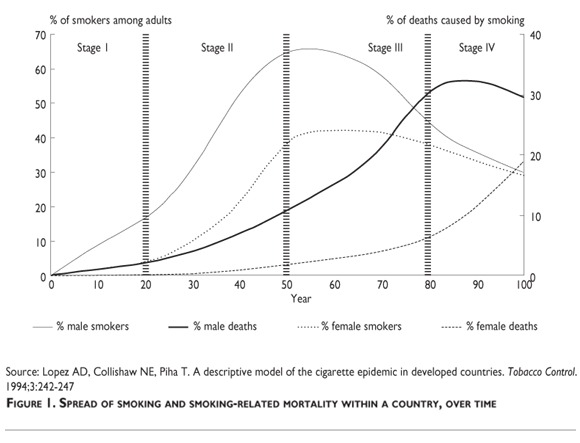
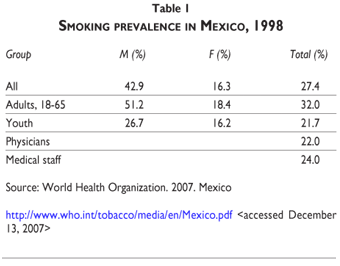
<body><![CDATA[<p><font size="2" face="Verdana"><b>Background</b></font></p>     <p><font size="2" face="Verdana"><i>Smoking prevalence</i></font></p>     <p><font size="2" face="Verdana">Worldwide some 5.6 trillion cigarettes are consumed    annually, nearly <I>900</I> for every man, woman, and child. In those countries    for which data are available, per capita cigarette consumption –total cigarette    consumption divided by the population– ranged from 53 in Ethiopia to 3441 in    Bulgaria.<SUP>2</SUP> In Mexico, per capita consumption stood at 733 a figure    that, impressively, has halved since 1980.<SUP>3</SUP> </font></p>     <p><font size="2" face="Verdana"> Almost one billion men smoke around the world.    In developed countries, an average of 35 percent of men are smokers. In developing    countries, the average is 50 percent. There are over 300 million male smokers    in China alone. Two hundred and fifty million women are smokers worldwide. At    present, 22 percent of women in developed countries smoke, while in developing    countries the figure is only 9 percent.<SUP>2 </SUP>In Mexico, in 1998, data    indicate that nearly 43 percent of males were smokers, while 16 percent of females    smoked, for a total smoking prevalence of 27.4 percent. Among adults, age 18-65,    over half of all men smoked, while just under a fifth of women smoked. It is    notable, if discouraging, that over a fifth of all physicians in Mexico –22    percent– were smokers<SUP>3</SUP> (<a href="#tab01">Table I</a>).</font></p>     <p><a name="tab01"></a></p>     <p>&nbsp;</p>     <p align="center"><img src="/img/revistas/spm/v50s3/a04tab01.gif" border="0" usemap="#Map">    <map name="Map">     <area shape="rect" coords="6,208,235,223" href="http://www.who.int/tobacco/media/en/Mexico.pdf" target="_blank">   </map> </p>     <p>&nbsp;</p>     <p><font size="2" face="Verdana"> The World Health Organization projects that    the number of smokers worldwide will increase from 1.25 billion today to about    1.7 billion in two decades.<SUP>4</SUP> This increase will primarily reflect    population growth, but it will also represent a continuing shift in the smoking    population from the developed nations, where smoking prevalence is declining,    to developing countries, in many of which it is increasing. Growth will be far    more substantial among women than man, especially in developing countries.</font></p>     <p><font size="2" face="Verdana"><i>Smoking-produced mortality</i></font></p>     ]]></body>
<body><![CDATA[<p><font size="2" face="Verdana">Each year cigarette smoking kills 5 million people,    one-half of them during their working age years (35-69).<SUP>4 </SUP>While lung    cancer is the most feared consequence of smoking, the behavior claims a roughly    equal number of lives as a result of cardiovascular disease. It is also the    leading cause of death attributable to chronic obstructive pulmonary disease.<SUP>5</SUP>    The importance of smoking in national mortality statistics is illustrated by    the fact that, in the United States, lung cancer was a virtually unheard of    disease in the early 1900s. At present, it is the leading cause of cancer mortality    in both men and women, and epidemiologic research indicates that as much as    90 percent of lung cancer deaths would not occur in the absence of smoking.<SUP>5    </SUP>While many think of the adverse health consequences of smoking as a developed    country problem, more than half of smoking-related deaths today occur in developing    countries.<SUP>4 </sup></font></p>     <p><font size="2" face="Verdana"> As a consequence of the projected increases    in global smoking, smoking-related deaths are predicted by WHO to increase to    about 10 million per year roughly less than two decades from now.<SUP>4</SUP>    At that time, 70 percent of those deaths will occur in developing countries.    Cigarette smoking will then be the leading avoidable behavioral cause of death    throughout the world.</font></p>     <p><font size="2" face="Verdana"><i>Temporal pattern of smoking and smoking-produced    mortality within a country</i></font></p>     <p><font size="2" face="Verdana"><a href="#fig01">Figure 1</a> is a conceptual    schema depicting the typical spread of smoking and smoking-related mortality    within a developed country over time.<SUP>6</SUP> It is important to emphasize    that the figure is merely a characterization of the typical experience to date.    The pattern is not preordained or inevitable. It is useful primarily for understanding    where a country stands in the evolution of its own smoking epidemic and hence    providing benchmarks for progress in combating it. In those countries where    it remains possible, the goal, of course, is to short-circuit both the spread    of smoking and its inevitable trail of disease and death.</font></p>     <p><a name="fig01"></a></p>     <p>&nbsp;</p>     <p align="center"><img src="/img/revistas/spm/v50s3/a04fig01.gif"></p>     <p>&nbsp;</p>     <p><font size="2" face="Verdana"> The figure shows four stages in the smoking    epidemic. During the first stage, the beginning of the epidemic, smoking among    men starts to rise rapidly. There is little smoking among women, and little    mortality as a result of the fact that smoking is relatively new. In the figure,    the first stage lasts about 20 years. </font></p>     <p><font size="2" face="Verdana"> In the second stage, smoking among men continues    to climb fairly rapidly, although eventually at a decelerating rate, reaching    what ultimately becomes the peak smoking prevalence among males at something    in access of 60 percent. Smoking among women starts to rise rapidly during this    period as well, reaching as much as 30 to 35 percent. Mortality as a result    of smoking begins a long and sustained increase to the point where, by the end    of the second stage, some 10 percent of a country’s total deaths may be caused    by smoking. This second stage lasts about 30 years.</font></p>     ]]></body>
<body><![CDATA[<p><font size="2" face="Verdana"> In the third stage, male smoking, having    peaked, begins a steady decline. By the end of this stage, which also takes    about 30 years, male smoking will have dropped to about 25 percent of all men,    having more than halved. Smoking prevalence among women flattens during this    period and then begins a gradual decline. However, the decline is much less    rapid than that of men, meaning that the prevalence of smoking among males begins    to approach that of females by the end of this stage. Mortality has increased    significantly for both men and women. </font></p>     <p><font size="2" face="Verdana"> In the fourth stage, estimated to last about    20 years, male smoking declines to something under 20 percent, as does female    smoking, at which point men and women smoke at virtually identical rates. Male    smoking-related mortality declines as well, while female smoking-related mortality    continues to increase, the result of the later adoption of smoking by large    numbers of women and their more gradual rate of cessation. Smoking now accounts    for close to a quarter of a nation’s total mortality.</font></p>     <p><font size="2" face="Verdana"> Although this model does not apply precisely    to all countries, it is an important demonstration of a general pattern that    has applied in many. Note that no country has as yet experienced a fifth, or    perhaps sixth, stage in which smoking becomes a rare phenomenon and the death    toll associated with the behavior becomes of limited significance in overall    mortality statistics. Those are the goals of tobacco control worldwide.</font></p>     <p><font size="2" face="verdana"><b>Background on the Framework Convention on    Tobacco Control</b></font></p>     <p><font size="2" face="Verdana"><i>Nature of a framework convention</i></font></p>     <p><font size="2" face="Verdana">The Framework Convention on Tobacco Control (FCTC)    represents the World Health Organization’s first-ever use of its long standing    authority to create a global public health treaty.<SUP>1</SUP> A framework convention    is a treaty that creates a set of principles and general duties for nations    to address in a broad subject area, like tobacco use. As the name suggests,    it creates a framework for approaching a problem. Specific requirements of the    nations that ratify the convention are then fleshed out through negotiation    of detailed "protocols" after countries have ratified the convention.    As such, a framework convention stands in contrast to a conventional treaty    in which the specific requirements of the members are specified quite precisely    prior to ratification.</font></p>     <p><font size="2" face="Verdana"> An example of a well-known framework convention    is the Framework Convention on Climate Change, which established a framework    for addressing global warming. The Kyoto Protocol created specific binding rules    on the member nations that had ratified the convention.</font></p>     <p><font size="2" face="Verdana"><i>Objective</i></font></p>     <p><font size="2" face="Verdana">The objective of the FCTC, codified in Article    3, is the following: "&#91;T&#93;o protect present and future generations from    the devastating health, social, environmental and economic consequences of tobacco    consumption and exposure to tobacco smoke by providing a framework for tobacco    control measures &#91;…&#93; to reduce continually and substantially the prevalence    of tobacco use and exposure to tobacco smoke".<SUP>7</SUP> The convention    encourages three principal types of strategies: </font></p>     <blockquote>        ]]></body>
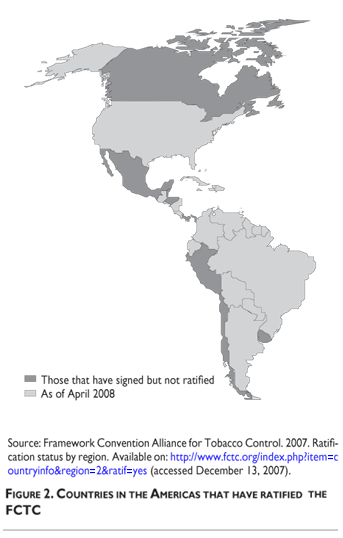
<body><![CDATA[<p><font size="2" face="Verdana">1) a public health approach that seeks to      change the social climate and promote a supportive environment for smoking      cessation and non-initiation; </font></p>       <p><font size="2" face="Verdana">2) a health systems approach that focuses      on promoting and integrating clinical best practices (behavioral and pharmacological)      that help tobacco-dependent consumers increase their chance of quitting successfully;      </font></p>       <p><font size="2" face="Verdana">3)  a surveillance, research, and information      approach that promotes the exchange of information and knowledge so as to      increase awareness of specific tobacco control needs, as well as the need      to change social norms.</font></p> </blockquote>     <p><font size="2" face="Verdana"><i>History</i></font></p>     <p><font size="2" face="Verdana">The idea underlying development of a framework    convention on tobacco control originated around 1994 and was introduced at the    World Health Assembly in May 1995. The following year, the 49<SUP>th</SUP> WHA    passed a resolution asking the Director-General of WHO to initiate development    of a WHO Framework Convention on Tobacco Control. In 1998, soon after Dr. Gro    Harlem Brundtland assumed the office of Director General of WHO, the Framework    Convention was made a WHO leadership priority. In 1999-2000, informal working    groups laid out the process by which the convention would be developed. Formal    negotiations among the world’s countries occurred from 2000-2003, with delegates    meeting twice annually in Geneva for periods ranging from ten days to two weeks.    In May 2003, the World Health Assembly approved the FCTC, with the 168 member    countries present signing. </font></p>     <p><font size="2" face="Verdana"> From 2003 to the present, ratification by    individual countries has taken place. The treaty entered into force as a binding    treaty on February 27, 2005, at which time 65 countries had ratified. Forty    were required to make the treaty effective. The FCTC is one of the most rapidly    and widely embraced UN treaties in history. As of April 10 2008, 154 countries    had ratified the Framework Convention. Mexico was among the early members, having    ratified on May 28, 2004. <a href="#fig02">Figure 2</a> shows the countries    in the Americas that have ratified the treaty and those that have signed but    thus far not yet ratified it. For a list of countries that have and have not    ratified, go to <a href="http://www.fctc.org/index.php" target="_blank">http://www.fctc.org/index.php</a>.</font></p>     <p><a name="fig02"></a></p>     <p>&nbsp;</p>     <p align="center"><img src="/img/revistas/spm/v50s3/a04fig02.gif" border="0" usemap="#Map2">    <map name="Map2">     <area shape="rect" coords="169,449,340,463" href="http://www.fctc.org/index.php?item=countryinfo&region=2&ratif=yes" target="_blank">     <area shape="rect" coords="7,463,148,477" href="http://www.fctc.org/index.php?item=countryinfo&region=2&ratif=yes" target="_blank">   </map> </p>     <p>&nbsp;</p>     ]]></body>
<body><![CDATA[<p><font size="2" face="Verdana"> According to treaty provisions, by February    27, 2008, the 40 original ratifying countries must have health warnings with    specific characteristics on all packages of cigarettes. Two years later, by    February 27, 2010, the 40 original countries must have banned advertising and    promotion of tobacco products.</font></p>     <p><font size="2" face="Verdana"> Beginning in February 2006, the countries    that have ratified the FCTC met in the first meeting of what is known as the    Conference of the Parties (COP) to negotiate specific protocols. The COP is    the supreme organ of the Convention. It is empowered to adopt amendments to    the FCTC, to adopt protocols or annexes, and to provide overall policy guidance    for implementation. All Parties to the FCTC are automatically members of the    COP with voting rights. </font></p>     <p><font size="2" face="Verdana"> COP I took place in Geneva from February    7-16, 2006. At COP I, the Parties created working groups to begin development    of protocols regarding cross border advertising and illicit trade; agreed to    develop (nonbinding) guidelines on smoke-free policies and tobacco product regulation;    developed a pilot reporting questionnaire; and agreed to establish an expert    group regarding the idea of encouraging alternative crops to tobacco.<SUP>8</SUP>    </font></p>     <p><font size="2" face="Verdana"> COP II met in Bangkok from June 30-July 6,    2007. At COP II, the parties adopted a 100 percent smoke-free guideline and    agreed to start work on guidelines regarding packaging and labeling; advertising,    promotion, and sponsorship; public education; cessation; and product testing    and disclosure. As well, the Parties agreed to develop financial assistance    for the adoption and implementation of the FCTC by countries in need of such    assistance.<SUP>9</SUP> </font></p>     <p><font size="2" face="Verdana"><i>Forces supporting and opposing development    of the FCTC</i></font></p>     <p><font size="2" face="Verdana">The principal factors that contributed to the    evolution and eventual adoption of the treaty were the following: </font></p> <ul>       <li>         <p><font size="2" face="Verdana">The clear importance of the public health        case concerning smoking and health. </font></p>   </li>       <li>         <p><font size="2" face="Verdana">Research regarding the economic, behavioral,        and health impact of smoking and of interventions to reduce smoking.</font></p>   </li>       ]]></body>
<body><![CDATA[<li>         <p><font size="2" face="Verdana">A highly effective coalition of Non-Governmental        Organizations (NGOs), called the Framework Convention Alliance (FCA).<SUP>10        </sup></font></p>   </li>       <li>         <p><font size="2" face="Verdana">Unified regional groups, notably including        the continent of Africa.</font></p>   </li>       <li>         <p><font size="2" face="Verdana">A unified response to what was widely perceived        to be bullying by the U.S. delegation. (This is discussed below.)</font></p>   </li>     </ul>     <p><font size="2" face="Verdana"> The FCA is particularly worthy of note, given    the major role it played in guiding the negotiations toward an evidence-based    treaty, as well as its ongoing role in the COPs. The FCA consists of over 200    NGOs from over 100 countries. These organizations include health, consumer,    human rights, environmental, and religious groups united to address global tobacco    control. The FCA was a powerful voice in the negotiating process that led to    development and adoption of the Framework Convention. The alliance provided    lobbying and educational sessions throughout the negotiations. Subsequent to    the February 2005 official adoption of the treaty, the FCA has assisted countries    in developing a strategic plan to encourage them to become Parties to the FCTC.    The alliance engages in several monitoring activities as well, monitoring FCTC    implementation by Parties at the national level; the status of tobacco and trade    agreements (national, regional, and international); and industry behavior in    the member countries. Finally, the FCA has assisted with protocol development    at the COPs. Throughout all phases of the FCTC process, the FCA has demonstrated    remarkable political acuity and unwavering commitment, all the while advocating    for evidence-based, best-practice implementation of FCTC measures.</font></p>     <p><font size="2" face="Verdana"> The treaty was not developed without strong    opposition. Two major groups fought the development of a strong FCTC. The multinational    tobacco companies were prominent in efforts to prevent the development of such    a treaty. Similarly, tobacco growers, tobacco product producers, and governments    in four countries, all major tobacco or tobacco product producers – the United    States, Japan, China, and Germany – tried to water down the strength of the    treaty. Throughout the negotiations, the U.S. delegation, in particular, was    commonly regarded as a "bully," attempting to throw the country’s    weight around in an effort to subvert development of a strong treaty. Although    the evidence is only anecdotal, many prominent participants in the negotiations    credit the U.S. delegation’s unsavory methods with creating a unity of purpose    among the vast majority of countries that came to Geneva to make important progress    in public health.</font></p>     <p><font size="2" face="Verdana">Policy areas in the FCTC</font></p>     ]]></body>
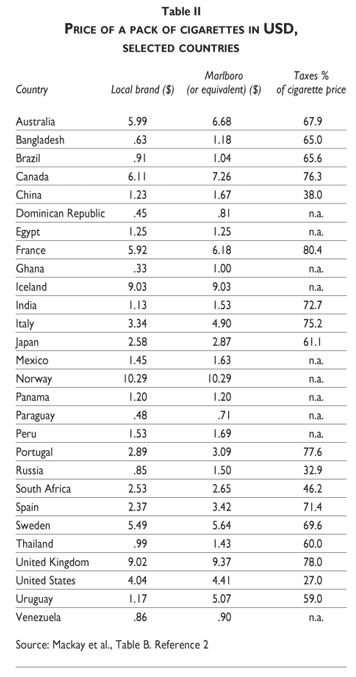
<body><![CDATA[<p><font size="2" face="Verdana">The major policy areas considered in the FCTC    include the following: advertising and promotion of tobacco products; labeling;    taxation; protection against exposure to second-hand smoke; counter marketing;    sales practices; cigarette smuggling; product regulation; and legal liability.    This section focuses on five of these subjects: advertising, labeling, taxation,    second-hand smoke, and sales practices. For the specific text regarding each,    refer to the FCTC itself.<SUP>1</sup></font></p>     <p><font size="2" face="Verdana"><i>Advertising and promotion</i></font></p>     <p><font size="2" face="Verdana">With regard to advertising and promotion, the    key FCTC provisions called for a complete ban on all advertising and sponsorships,    direct and indirect, within five years of ratification of the treaty. Countries    that are not permitted constitutionally to ban advertising must restrict it    within the limits of their constitutions, including cross border advertising    and sponsorships. </font></p>     <p><font size="2" face="Verdana"> The advertising discussion in the negotiations    drew on a substantial body of research. That research provides mixed findings    on the effects of advertising and promotion, although the weight of the evidence    clearly favors a causal connection between advertising and cigarette smoking.<SUP>11</SUP>    The single best study of the issue concluded that a complete ban on all forms    of tobacco advertising and marketing would cause consumption to decline by about    6 percent.<SUP>12 </SUP>The authors argued that partial bans would be ineffective,    however, due to the potential for the industry to substitute a variety of marketing    forms for the banned activities. </font></p>     <p><font size="2" face="Verdana"> During the FCTC debate there was little discussion    about the effects of advertising. Rather, there was universal acceptance that    advertising increased smoking (or at least the proposition went unchallenged    during the debate). The major concern focused on the constitutionality of bans    in several countries, including the United States. To address the constitutionality    issue, negotiators proposed the compromise noted above: countries in which a    ban would be unconstitutional would be required to restrict advertising and    promotion within the limits of the law. Despite this protection, which covered    its own situation, the U.S. rejected the proposal. Ultimately, however, the    Convention overrode the objections of the U.S.</font></p>     <p><font size="2" face="Verdana"><i>Labeling</i></font></p>     <p><font size="2" face="Verdana">The FCTC calls for a rotating warning label covering    at least 30 percent of the front and back of every pack of cigarettes. This    was a compromise position relative to a stronger provision favored by many delegations.    They preferred a requirement that 50 percent of the front and back of packs    be dedicated to a warning, with graphic representations of the damage caused    by tobacco included. Several countries have adopted such policies or slight    variations on them, including Canada and Brazil. The novel labels can be viewed    on the Web.<SUP>13,14</SUP> There is limited research on the effects of pack    warnings, most of it related to the traditional form (i.e., small and poorly    placed warnings). That research has produced little evidence of impact. However,    new research on Canadian-type labels indicates an impact on smokers’ intention    to quit smoking and, possibly, on quitting itself.<SUP>15,16</SUP> </font></p>     <p><font size="2" face="Verdana"> During the negotiations, the debate on labeling    focused on practical (political) considerations. Much of the discussion focused    on the use of terms like "light" and "low" to describe cigarettes.    A wealth of evidence demonstrates that these terms are inaccurate –so-called    low tar and nicotine cigarettes can be just as dangerous as "full flavor"    cigarettes– and that smokers are misled by them.<SUP>17 </SUP>Product regulation    provisions in the FCTC, not discussed further here, ban the use of misleading    descriptive terms like "light" and "low". </font></p>     <p><font size="2" face="Verdana"><i>Taxation</i></font></p>     <p><font size="2" face="Verdana">Cigarette prices vary dramatically from country    to country, ranging from as low as 23 cents per pack to more than $10.<SUP>2    </SUP><a href="#tab02">Table II</a> shows prices of both local brands and Marlboro    (or equivalent international brand) in U.S. dollars in several representative    countries. The primary factor accounting for the huge price ranges is tax. Among    countries for which the data are available, tax varies from 19.7 to 80.4% of    retail price. The FCTC acknowledges that increases in tax and price are highly    effective in reducing cigarette consumption. However, the Convention’s requirement    is much weaker than the importance of taxation would suggest. Countries are    merely required to consider health objectives in setting tobacco taxes.</font></p>     ]]></body>
<body><![CDATA[<p><a name="tab02"></a></p>     <p>&nbsp;</p>     <p align="center"><img src="/img/revistas/spm/v50s3/a04tab02.gif" border="0">  </p>     <p>&nbsp;</p>     <p><font size="2" face="Verdana"> The evidence regarding the impact of taxation    constitutes the strongest research base of all tobacco control policies.<SUP>18</SUP>    In general, a 10 percent increase in cigarette price leads to a 3-4 percent    decrease in the quantity of cigarettes demanded by adults in developed countries,    as demonstrated in close to 100 studies.<SUP>19</SUP> In children and youth    in developed nations, the impact of that same 10 percent price increase is on    the order of 6-8 percent. This conclusion derives from a much smaller base of    research. The same impact –6-8 percent– is estimated to apply to adults in less    developed countries. While one would expect a more substantial response to increased    prices in developing countries, the research supporting this conclusion reflects    only a handful of studies.<SUP>18 </SUP>All told, however, the empirical evidence    that increasing price leads to decreasing consumption is so strong that taxation    has become a "first principle" of tobacco control policy worldwide.    </font></p>     <p><font size="2" face="Verdana"> During the FCTC negotiations, debate regarding    taxation focused on the notion of "harmonization," bringing disparate    rates across countries within a single region (e.g., Europe) into a consistent    pattern. The negotiators were unable to resolve the conflicting concerns regarding    harmonization and high taxation. They thus ended up with the aforementioned    weak statement that countries must contemplate the health importance of taxation    when developing tax policy. </font></p>     <p><font size="2" face="Verdana"><i>Smoke-free environments</i></font></p>     <p><font size="2" face="Verdana">Currently, nearly a dozen countries ban smoking    in virtually all indoor work places, including restaurants and bars. These include    Ireland, Italy, Uruguay, Norway, Scotland, Bhutan, New Zealand, Northern Ireland,    England, Wales, and France. The FCTC declares it "unequivocally established"    that second-hand smoke causes death and disease. It requires parties to adopt    "effective … measures" to protect nonsmokers against exposure in indoor    workplaces and indoor public places. </font></p>     <p><font size="2" face="Verdana"> The evidence base for the impact of second-hand    smoke is substantial. Well-designed epidemiologic studies conclude that exposure    to second-hand smoke (SHS) causes lung cancer in otherwise healthy nonsmokers    and contributes significantly to heart disease as well.<SUP>20</SUP> With regard    to the latter, recent research has found significant decreases in acute myocardial    infarctions in communities following their implementation of smoke-free laws.<SUP>21,22</SUP>    Further, there is ample research demonstrating that bans on smoking in workplaces:</font></p> <ul>       <li>          ]]></body>
<body><![CDATA[<p><font size="2" face="Verdana">Dramatically reduce workers' exposures to        SHS<SUP>23</sup></font></p>   </li>       <li>          <p><font size="2" face="Verdana">Increase quitting<SUP>24</sup></font></p>   </li>       <li>          <p><font size="2" face="Verdana">Do not harm business in hospitality industry        enterprises<SUP>25</sup></font></p>   </li>     </ul>     <p><font size="2" face="Verdana"> During the FCTC negotiations, there was limited    argument about the health effects of second-hand smoke. Delegates did debate,    however, how "far" the FCTC should go in addressing the problem of    second-hand smoke. There was some sentiment for "restrictions" on    smoking in public places –i.e., requiring nonsmoking areas– and there was also    much sentiment favoring complete prohibition. Two categories of issues complicated    the discussion. The first were philosophical issues concerning "smokers’    rights." Second, delegates from countries with federal systems of government    expressed concern about requiring a nation-wide law, since their legal systems    assign responsibility for such policies to individual states, rather than the    federal government. Ironically, while nonsmokers are protected from SHS throughout    much of the U.S. (close to 30 states ban smoking in all workplaces including    restaurants and bars<SUP>26</SUP>), the U.S. delegation was one of the most    vociferous opponents of a call for a complete ban, even when a constitutional    exception was suggested.</font></p>     <p><font size="2" face="Verdana"><i>Sales practices</i></font></p>     <p><font size="2" face="Verdana">With regard to sales practices, the FCTC calls    for bans on:</font></p> <ul>       <li>          ]]></body>
<body><![CDATA[<p><font size="2" face="Verdana">Sales to minors</font></p>   </li>       <li>          <p><font size="2" face="Verdana">Distribution of free samples of tobacco products</font></p>   </li>       <li>          <p><font size="2" face="Verdana">Sales of "loosies" (single cigarettes)</font></p>   </li>     </ul>     <p><font size="2" face="Verdana"> The Convention suggests, but does not mandate,    banning self-service machines and candy cigarettes and making vending machines    inaccessible to children.</font></p>     <p><font size="2" face="Verdana"> There is little research on the impact of    sales practices. Bans on sales to minors have received the most attention. The    research indicates that such bans are effective only if there are very serious    penalties and serious, widespread enforcement, conditions that rarely exist.    Even with an effective ban on sales directly to children, children find many    mechanisms to acquire cigarettes.<SUP>27</sup></font></p>     <p><font size="2" face="Verdana"> During the FCTC, several respected delegations    emphasized the importance of banning sales to youth, despite the lack of demonstrated    effectiveness supporting the policy. Negotiators expressed little opposition    to including it in the Convention. The most compelling argument against such    a policy, presented during the negotiations, was that enforcement of it would    consume resources that would be better placed in more cost-effective interventions.    Ultimately, this argument carried little weight.</font></p>     <p><font size="2" face="Verdana">The Impact of Evidence on the FCTC</font></p>     ]]></body>
<body><![CDATA[<p><font size="2" face="Verdana">Evidence-based research played a significant    role in the evolution and eventual development of the FCTC. The health effects    literature, covering both primary and second-hand smoking, clearly motivated    the treaty and many of its strong provisions. Delegates learned a great deal    from policy research, especially as it was summarized in a World Bank report,    <I>Curving the Epidemic: Governments and the Economics of Tobacco Control</I>,    published in 1999.<SUP>28</SUP> This volume summarized the research-based findings    on the effects of tobacco control policies. It became something of a "bible"    during the negotiations leading up to the FCTC. The delegates clearly relied    on policy research findings when they supported popular polices in which the    research was consistent with the policy preferences of the delegates.</font></p>     <p><font size="2" face="Verdana"> Some of the best examples of research that    had a significant impact throughout the negotiations included the following:    </font></p> <ul>       <li>          <p><font size="2" face="Verdana">The original epidemiologic studies linking        smoking and lung cancer<SUP>29,30</sup></font></p>   </li>       <li>          <p><font size="2" face="Verdana">Research on behavioral and pharmacological        approaches to treating smoking<SUP>31</sup></font></p>   </li>       <li>          <p><font size="2" face="Verdana">Research on the effects of second-hand smoke        on health<SUP>20</sup></font></p>   </li>       <li>          <p><font size="2" face="Verdana">Research linking tax increases to smoking        decreases<SUP>18 </sup></font></p>   </li>     ]]></body>
<body><![CDATA[</ul>     <p><font size="2" face="Verdana"> The research-based evidence has been incorporated    into model legislation for tobacco control, including manuals intended for the    use of Convention delegates and their countries.<SUP>32</SUP> These in turn    have been used to develop national level reports. </font></p>     <p><font size="2" face="Verdana"> Evidence-based research did not always win    the day, however. Negative findings from the research literature were often    ignored when they were not consistent with delegates’ perception of "the    right thing to do." Illustrative is the aforementioned nearly universal    support for bans on sales to minors. In short, and as would be expected, political    considerations often ruled the day. </font></p>     <p><font size="2" face="Verdana"><b>Conclusion</b></font></p>     <p><font size="2" face="Verdana">Implementation of the FCTC in the 150-plus countries    that have ratified faces several obstacles.<SUP>33</SUP> These include:</font></p> <ul>       <li>          <p><font size="2" face="Verdana"> Inadequate in-country research talent.        There are relatively few countries in which there are researchers active        in the field of tobacco control research. </font></p>   </li>       <li>          <p><font size="2" face="Verdana">Inadequate financial institutional resources        to support implementation of the FCTC.</font></p>   </li>       <li>          ]]></body>
<body><![CDATA[<p><font size="2" face="Verdana">A lack of political will and, frankly, interest        in many countries.</font></p>   </li>       <li>          <p><font size="2" face="Verdana">Political and economic opposition, led by        the powerful tobacco industry in many countries.</font></p>   </li>     </ul>     <p><font size="2" face="Verdana"> If significant progress can be made in combating    smoking, the benefits will be enormous. Consider that if youth taking up smoking    could be cut in half, 20 million deaths from tobacco-related diseases would    be prevented worldwide by 2050. If adult consumption could be halved, 30 million    deaths would be prevented by 2025. Further, fully 150 million deaths would be    prevented by the middle of this century.<SUP>28</sup></font></p>     <p><font size="2" face="Verdana"> Few issues are as important in public health    as grappling with the epidemic of tobacco-produced disease. The Framework Convention    on Tobacco Control constitutes the first global weapon with which to make a    serious attempt to reduce this remarkably devastating man-made source of death    and misery. </font></p>     <p>&nbsp;</p>     <p><font size="3" face="Verdana"><b>References</b></font></p>     <!-- ref --><p><font size="2" face="Verdana">1. World Health Organization. WHO Framework Convention    on Tobacco Control (WHO FCTC) <a href="http://www.who.int/tobacco/framework/en/" target="_blank">http://www.who.int/tobacco/framework/en/</a>    &lt;accessed December 12, 2007&gt;.</font>&nbsp;&nbsp;&nbsp;&nbsp;&nbsp;&nbsp;&nbsp;&nbsp;[&#160;<a href="javascript:void(0);" onclick="javascript: window.open('/scielo.php?script=sci_nlinks&ref=9307195&pid=S0036-3634200800090000400001&lng=','','width=640,height=500,resizable=yes,scrollbars=1,menubar=yes,');">Links</a>&#160;]<!-- end-ref --><!-- ref --><p><font size="2" face="Verdana">2. Mackay J, Eriksen M, Shafey O. The Tobacco    Atlas. 2<SUP>nd</SUP> edition. Atlanta: American Cancer Society, 2006. </font>&nbsp;&nbsp;&nbsp;&nbsp;&nbsp;&nbsp;&nbsp;&nbsp;[&#160;<a href="javascript:void(0);" onclick="javascript: window.open('/scielo.php?script=sci_nlinks&ref=9307196&pid=S0036-3634200800090000400002&lng=','','width=640,height=500,resizable=yes,scrollbars=1,menubar=yes,');">Links</a>&#160;]<!-- end-ref --><!-- ref --><p><font size="2" face="Verdana">3. American Cancer Society. Tobacco control country    profiles: Mexico, 2003. <a href="http://www.who.int/tobacco/media/en/Mexico.pdf" target="_blank">http://www.who.int/tobacco/media/en/Mexico.pdf</a>    &lt;accessed December 13, 2007&gt;.</font>&nbsp;&nbsp;&nbsp;&nbsp;&nbsp;&nbsp;&nbsp;&nbsp;[&#160;<a href="javascript:void(0);" onclick="javascript: window.open('/scielo.php?script=sci_nlinks&ref=9307197&pid=S0036-3634200800090000400003&lng=','','width=640,height=500,resizable=yes,scrollbars=1,menubar=yes,');">Links</a>&#160;]<!-- end-ref --><!-- ref --><p><font size="2" face="Verdana">4. World Health Organization. Building blocks    for tobacco control: A handbook. Geneva: WHO, 2004. <a href="http://www.who.int/tobacco/resources/publications/general/HANDBOOK%20Lowres%20with%20cover.pdf" target="_blank">http://www.who.int/tobacco/resources/publications/general/HANDBOOK%20Lowres%20with%20cover.pdf</a>    &lt;accessed December 13, 2007&gt;.</font>&nbsp;&nbsp;&nbsp;&nbsp;&nbsp;&nbsp;&nbsp;&nbsp;[&#160;<a href="javascript:void(0);" onclick="javascript: window.open('/scielo.php?script=sci_nlinks&ref=9307198&pid=S0036-3634200800090000400004&lng=','','width=640,height=500,resizable=yes,scrollbars=1,menubar=yes,');">Links</a>&#160;]<!-- end-ref --><!-- ref --><p><font size="2" face="Verdana">5. Department of Health and Human Services. The    health consequences of smoking: a report of the surgeon general. Centers for    Disease Control and Prevention, National Center for Chronic Disease Prevention    and Health Promotion, Office on Smoking and Health. Washington (D.C.): U.S.    G.P.O., 2004.</font>&nbsp;&nbsp;&nbsp;&nbsp;&nbsp;&nbsp;&nbsp;&nbsp;[&#160;<a href="javascript:void(0);" onclick="javascript: window.open('/scielo.php?script=sci_nlinks&ref=9307199&pid=S0036-3634200800090000400005&lng=','','width=640,height=500,resizable=yes,scrollbars=1,menubar=yes,');">Links</a>&#160;]<!-- end-ref --><!-- ref --><p><font size="2" face="Verdana">6. Lopez AD, Collishaw NE, Piha T. A descriptive    model of the cigarette epidemic in developed countries. Tob Control 1994;3:242-247.    </font>&nbsp;&nbsp;&nbsp;&nbsp;&nbsp;&nbsp;&nbsp;&nbsp;[&#160;<a href="javascript:void(0);" onclick="javascript: window.open('/scielo.php?script=sci_nlinks&ref=9307200&pid=S0036-3634200800090000400006&lng=','','width=640,height=500,resizable=yes,scrollbars=1,menubar=yes,');">Links</a>&#160;]<!-- end-ref --><!-- ref --><p><font size="2" face="Verdana">7. World Health Organization. WHO Framework Convention    on Tobacco Control. Article 3, 2003. <a href="http://www.who.int/tobacco/framework/WHO_FCTC_english.pdf" target="_blank">http://www.who.int/tobacco/framework/WHO_FCTC_english.pdf</a>    &lt;accessed December 13, 2007&gt;.</font>&nbsp;&nbsp;&nbsp;&nbsp;&nbsp;&nbsp;&nbsp;&nbsp;[&#160;<a href="javascript:void(0);" onclick="javascript: window.open('/scielo.php?script=sci_nlinks&ref=9307201&pid=S0036-3634200800090000400007&lng=','','width=640,height=500,resizable=yes,scrollbars=1,menubar=yes,');">Links</a>&#160;]<!-- end-ref --><!-- ref --><p><font size="2" face="Verdana">8. World Health Organization. The first session    of the Conference of the Parties to the WHO Framework Convention on Tobacco    Control, 2007. <a href="http://www.who.int/tobacco/fctc/cop/en/" target="_blank">http://www.who.int/tobacco/fctc/cop/en/</a>    &lt;accessed December 13, 2007&gt;.</font>&nbsp;&nbsp;&nbsp;&nbsp;&nbsp;&nbsp;&nbsp;&nbsp;[&#160;<a href="javascript:void(0);" onclick="javascript: window.open('/scielo.php?script=sci_nlinks&ref=9307202&pid=S0036-3634200800090000400008&lng=','','width=640,height=500,resizable=yes,scrollbars=1,menubar=yes,');">Links</a>&#160;]<!-- end-ref --><!-- ref --><p><font size="2" face="Verdana">9. World Health Organization. Conference of the    Parties to the WHO Framework Convention on Tobacco Control, 2007. <a href="http://www.who.int/gb/fctc/E/E_cop2.htm" target="_blank">http://www.who.int/gb/fctc/E/E_cop2.htm</a>    &lt;accessed December 13, 2007&gt;.</font>&nbsp;&nbsp;&nbsp;&nbsp;&nbsp;&nbsp;&nbsp;&nbsp;[&#160;<a href="javascript:void(0);" onclick="javascript: window.open('/scielo.php?script=sci_nlinks&ref=9307203&pid=S0036-3634200800090000400009&lng=','','width=640,height=500,resizable=yes,scrollbars=1,menubar=yes,');">Links</a>&#160;]<!-- end-ref --><!-- ref --><p><font size="2" face="Verdana">10. Framework Convention Alliance, 2007. <a href="http://www.fctc.org/" target="_blank">http://www.fctc.org/</a>    &lt;accessed December 13, 2007&gt;.</font>&nbsp;&nbsp;&nbsp;&nbsp;&nbsp;&nbsp;&nbsp;&nbsp;[&#160;<a href="javascript:void(0);" onclick="javascript: window.open('/scielo.php?script=sci_nlinks&ref=9307204&pid=S0036-3634200800090000400010&lng=','','width=640,height=500,resizable=yes,scrollbars=1,menubar=yes,');">Links</a>&#160;]<!-- end-ref --><!-- ref --><p><font size="2" face="Verdana">11. U.S. Department of Health and Human Services.    Reducing the health consequences of smoking: 25 years of progress. A report    of the Surgeon General.  Public Health Service, Centers for Disease Control,    National Center for Chronic Disease Prevention and Health Promotion, Office    on Smoking and Health. DHHS Publication No. (CDC), 1989;89-8411.</font>&nbsp;&nbsp;&nbsp;&nbsp;&nbsp;&nbsp;&nbsp;&nbsp;[&#160;<a href="javascript:void(0);" onclick="javascript: window.open('/scielo.php?script=sci_nlinks&ref=9307205&pid=S0036-3634200800090000400011&lng=','','width=640,height=500,resizable=yes,scrollbars=1,menubar=yes,');">Links</a>&#160;]<!-- end-ref --><!-- ref --><p><font size="2" face="Verdana">12. Saffer H, Chaloupka F. The effect of tobacco    advertising bans on tobacco consumption. J Health Econ 2000;19:1117-1137.</font>&nbsp;&nbsp;&nbsp;&nbsp;&nbsp;&nbsp;&nbsp;&nbsp;[&#160;<a href="javascript:void(0);" onclick="javascript: window.open('/scielo.php?script=sci_nlinks&ref=9307206&pid=S0036-3634200800090000400012&lng=','','width=640,height=500,resizable=yes,scrollbars=1,menubar=yes,');">Links</a>&#160;]<!-- end-ref --><!-- ref --><p><font size="2" face="Verdana">13. Health Canada. Health warning labels for    consumer tobacco products, 2007. <a href="http://www.hc-sc.gc.ca/ahc-asc/media/   photogal/label-etiquette/index_e.html" target="_blank">   http://www.hc-sc.gc.ca/ahc-asc/media/photogal/label-etiquette/index_e.html</a>    &lt;accessed December 13, 2007&gt;.</font>&nbsp;&nbsp;&nbsp;&nbsp;&nbsp;&nbsp;&nbsp;&nbsp;[&#160;<a href="javascript:void(0);" onclick="javascript: window.open('/scielo.php?script=sci_nlinks&ref=9307207&pid=S0036-3634200800090000400013&lng=','','width=640,height=500,resizable=yes,scrollbars=1,menubar=yes,');">Links</a>&#160;]<!-- end-ref --><!-- ref --><p><font size="2" face="Verdana">14. Tobacco Control Supersite. Picture gallery    – cigarette packs and graphical cigarette pack warnings, 2007. <a href="http://tobacco.health.usyd.edu.au/site/ supersite/resources/docs/gallery_packwarnings.htm" target="_blank"> http://tobacco.health.usyd.edu.au/site/supersite/    resources/docs/gallery_packwarnings.htm</a> &lt;accessed December 13, 2007&gt;.</font>&nbsp;&nbsp;&nbsp;&nbsp;&nbsp;&nbsp;&nbsp;&nbsp;[&#160;<a href="javascript:void(0);" onclick="javascript: window.open('/scielo.php?script=sci_nlinks&ref=9307208&pid=S0036-3634200800090000400014&lng=','','width=640,height=500,resizable=yes,scrollbars=1,menubar=yes,');">Links</a>&#160;]<!-- end-ref --><!-- ref --><p><font size="2" face="Verdana">15. Hammond D, Fong GT, McDonald PW, Cameron    R, Brown KS. Impact of the graphic Canadian warning labels on adult smoking    behaviour. Tob Control 2003;12:391-395.</font>&nbsp;&nbsp;&nbsp;&nbsp;&nbsp;&nbsp;&nbsp;&nbsp;[&#160;<a href="javascript:void(0);" onclick="javascript: window.open('/scielo.php?script=sci_nlinks&ref=9307209&pid=S0036-3634200800090000400015&lng=','','width=640,height=500,resizable=yes,scrollbars=1,menubar=yes,');">Links</a>&#160;]<!-- end-ref --><!-- ref --><p><font size="2" face="Verdana">16. Hammond D, Fong GT, McNeill A, Borland R,    Cummings KM. Effectiveness of cigarette warning labels in informing smokers    about the risks of smoking: Findings from the International Tobacco Control    (ITC) Four Country Survey. Tob Control 2006;15(Suppl 3 ):iii19-iii25.</font>&nbsp;&nbsp;&nbsp;&nbsp;&nbsp;&nbsp;&nbsp;&nbsp;[&#160;<a href="javascript:void(0);" onclick="javascript: window.open('/scielo.php?script=sci_nlinks&ref=9307210&pid=S0036-3634200800090000400016&lng=','','width=640,height=500,resizable=yes,scrollbars=1,menubar=yes,');">Links</a>&#160;]<!-- end-ref --><!-- ref --><p><font size="2" face="Verdana">17. National Cancer Institute. Risks associated    with smoking cigarettes with low machine-measured yields of tar and nicotine.     Smoking and Tobacco Control Monograph 13. National Institutes of Health, Public    Health Service, Department of Health and Human Services, 2001. <a href="http://cancercontrol.cancer.gov/tcrb/monographs/13/m13_complete.pdf" target="_blank">http://cancercontrol.cancer.gov/tcrb/monographs/13/m13_complete.pdf</a>    &lt;accessed December 13, 2007&gt;.</font>&nbsp;&nbsp;&nbsp;&nbsp;&nbsp;&nbsp;&nbsp;&nbsp;[&#160;<a href="javascript:void(0);" onclick="javascript: window.open('/scielo.php?script=sci_nlinks&ref=9307211&pid=S0036-3634200800090000400017&lng=','','width=640,height=500,resizable=yes,scrollbars=1,menubar=yes,');">Links</a>&#160;]<!-- end-ref --><!-- ref --><p> <font size="2" face="Verdana">18. Chaloupka FJ, Hu TW, Warner KE, Jacobs R,    Yurekli A. In: Jha P, Chaloupka F, eds. Tobacco control in developing countries.     New York: Oxford University Press, 2000.</font>&nbsp;&nbsp;&nbsp;&nbsp;&nbsp;&nbsp;&nbsp;&nbsp;[&#160;<a href="javascript:void(0);" onclick="javascript: window.open('/scielo.php?script=sci_nlinks&ref=9307212&pid=S0036-3634200800090000400018&lng=','','width=640,height=500,resizable=yes,scrollbars=1,menubar=yes,');">Links</a>&#160;]<!-- end-ref --><!-- ref --><p><font size="2" face="Verdana">19. Gallet CA, List JA. Cigarette demand: A meta-analysis    of elasticities. Health Econ 2003;12:821-835.</font>&nbsp;&nbsp;&nbsp;&nbsp;&nbsp;&nbsp;&nbsp;&nbsp;[&#160;<a href="javascript:void(0);" onclick="javascript: window.open('/scielo.php?script=sci_nlinks&ref=9307213&pid=S0036-3634200800090000400019&lng=','','width=640,height=500,resizable=yes,scrollbars=1,menubar=yes,');">Links</a>&#160;]<!-- end-ref --><!-- ref --><p><font size="2" face="Verdana">20. U.S. Department of Health and Human Services.    The health consequences of involuntary exposure to tobacco smoke: A report of    the Surgeon General—executive summary. Centers for Disease Control and    Prevention, Coordinating Center for Health Promotion, National Center for Chronic    Disease Prevention and Health Promotion, Office on Smoking and Health, 2006.    </font>&nbsp;&nbsp;&nbsp;&nbsp;&nbsp;&nbsp;&nbsp;&nbsp;[&#160;<a href="javascript:void(0);" onclick="javascript: window.open('/scielo.php?script=sci_nlinks&ref=9307214&pid=S0036-3634200800090000400020&lng=','','width=640,height=500,resizable=yes,scrollbars=1,menubar=yes,');">Links</a>&#160;]<!-- end-ref --><!-- ref --><p><font size="2" face="Verdana">21. Dinno A, Glantz S. Clean indoor air laws    immediately reduce heart attacks. Prev Med 2007;45:9-11.</font>&nbsp;&nbsp;&nbsp;&nbsp;&nbsp;&nbsp;&nbsp;&nbsp;[&#160;<a href="javascript:void(0);" onclick="javascript: window.open('/scielo.php?script=sci_nlinks&ref=9307215&pid=S0036-3634200800090000400021&lng=','','width=640,height=500,resizable=yes,scrollbars=1,menubar=yes,');">Links</a>&#160;]<!-- end-ref --><!-- ref --><p><font size="2" face="Verdana">22. Juster HR, Loomis BR, Hinman TM, Farrelly    MC, Hyland A, Bauer UE,<I> et al</I>. Declines in hospital admissions for acute    myocardial infarction in New York State after implementation of a comprehensive    smoking ban. Am J Public Health 2007;97:2035-2039.</font>&nbsp;&nbsp;&nbsp;&nbsp;&nbsp;&nbsp;&nbsp;&nbsp;[&#160;<a href="javascript:void(0);" onclick="javascript: window.open('/scielo.php?script=sci_nlinks&ref=9307216&pid=S0036-3634200800090000400022&lng=','','width=640,height=500,resizable=yes,scrollbars=1,menubar=yes,');">Links</a>&#160;]<!-- end-ref --><!-- ref --><p><font size="2" face="Verdana">23. Goodman P, Agnew M, McCaffrey M, Paul G,    Clancy L. Effects of the Irish smoking ban on respiratory health of bar workers    and air quality in Dublin pubs. Am J Respir Crit Care Med 2007;175:751-753.</font>&nbsp;&nbsp;&nbsp;&nbsp;&nbsp;&nbsp;&nbsp;&nbsp;[&#160;<a href="javascript:void(0);" onclick="javascript: window.open('/scielo.php?script=sci_nlinks&ref=9307217&pid=S0036-3634200800090000400023&lng=','','width=640,height=500,resizable=yes,scrollbars=1,menubar=yes,');">Links</a>&#160;]<!-- end-ref --><!-- ref --><p><font size="2" face="Verdana">24. Fichtenberg CM, Glantz SA. Effect of smoke-free    workplaces on smoking behaviour: Systematic review. BMJ 2002;325:188-195.</font>&nbsp;&nbsp;&nbsp;&nbsp;&nbsp;&nbsp;&nbsp;&nbsp;[&#160;<a href="javascript:void(0);" onclick="javascript: window.open('/scielo.php?script=sci_nlinks&ref=9307218&pid=S0036-3634200800090000400024&lng=','','width=640,height=500,resizable=yes,scrollbars=1,menubar=yes,');">Links</a>&#160;]<!-- end-ref --><!-- ref --><p><font size="2" face="Verdana">25. Alpert HR, Carpenter CM, Travers MJ, Connolly    G. Environmental and economic evaluation of the Massachusetts Smoke-Free Workplace    Law. J Community Health 2007;32:269-281.</font>&nbsp;&nbsp;&nbsp;&nbsp;&nbsp;&nbsp;&nbsp;&nbsp;[&#160;<a href="javascript:void(0);" onclick="javascript: window.open('/scielo.php?script=sci_nlinks&ref=9307219&pid=S0036-3634200800090000400025&lng=','','width=640,height=500,resizable=yes,scrollbars=1,menubar=yes,');">Links</a>&#160;]<!-- end-ref --><!-- ref --><p><font size="2" face="Verdana">26. American Nonsmokers’ Rights Foundation. Summary    of 100% smokefree state laws and population protected by 100% U.S. smokefree    laws, 2007. <a href="http://www.no-smoke.org/pdf/SummaryUSPopList.pdf" target="_blank">http://www.no-smoke.org/pdf/SummaryUSPopList.pdf</a>    &lt;accessed December 14, 2007&gt;.</font>&nbsp;&nbsp;&nbsp;&nbsp;&nbsp;&nbsp;&nbsp;&nbsp;[&#160;<a href="javascript:void(0);" onclick="javascript: window.open('/scielo.php?script=sci_nlinks&ref=9307220&pid=S0036-3634200800090000400026&lng=','','width=640,height=500,resizable=yes,scrollbars=1,menubar=yes,');">Links</a>&#160;]<!-- end-ref --><!-- ref --><p> <font size="2" face="Verdana">27. Stead LF, Lancaster T. Interventions for    preventing tobacco sales to minors. Cochrane Database of Systematic Reviews    2005; (1):CD001497.</font>&nbsp;&nbsp;&nbsp;&nbsp;&nbsp;&nbsp;&nbsp;&nbsp;[&#160;<a href="javascript:void(0);" onclick="javascript: window.open('/scielo.php?script=sci_nlinks&ref=9307221&pid=S0036-3634200800090000400027&lng=','','width=640,height=500,resizable=yes,scrollbars=1,menubar=yes,');">Links</a>&#160;]<!-- end-ref --><!-- ref --><p><font size="2" face="Verdana">28. World Bank. Curbing the epidemic: Governments    and the economics of tobacco control. Washington: World Bank, 1999</font>&nbsp;&nbsp;&nbsp;&nbsp;&nbsp;&nbsp;&nbsp;&nbsp;[&#160;<a href="javascript:void(0);" onclick="javascript: window.open('/scielo.php?script=sci_nlinks&ref=9307222&pid=S0036-3634200800090000400028&lng=','','width=640,height=500,resizable=yes,scrollbars=1,menubar=yes,');">Links</a>&#160;]<!-- end-ref --><!-- ref --><p><font size="2" face="Verdana">29. Wynder EL, Graham EA. Tobacco smoking as    a possible etiologic factor in bronchiogenic carcinoma: A study of 684 proved    cases. JAMA 1950;143:329-396.</font>&nbsp;&nbsp;&nbsp;&nbsp;&nbsp;&nbsp;&nbsp;&nbsp;[&#160;<a href="javascript:void(0);" onclick="javascript: window.open('/scielo.php?script=sci_nlinks&ref=9307223&pid=S0036-3634200800090000400029&lng=','','width=640,height=500,resizable=yes,scrollbars=1,menubar=yes,');">Links</a>&#160;]<!-- end-ref --><!-- ref --><p><font size="2" face="Verdana">30. Doll R, Hill AB. The mortality of doctors    in relation to their smoking habits: A preliminary report. BMJ 1954;1:1451-1455.</font>&nbsp;&nbsp;&nbsp;&nbsp;&nbsp;&nbsp;&nbsp;&nbsp;[&#160;<a href="javascript:void(0);" onclick="javascript: window.open('/scielo.php?script=sci_nlinks&ref=9307224&pid=S0036-3634200800090000400030&lng=','','width=640,height=500,resizable=yes,scrollbars=1,menubar=yes,');">Links</a>&#160;]<!-- end-ref --><!-- ref --><p><font size="2" face="Verdana">31. Fiore MC, Bailey WC, Cohen SJ, Dorfman, SF,    Goldstein, MG, Gritz, ER. Treating tobacco use and dependence. Clinical practice    guideline. U.S. Department of Health and Human Services, Public Health Service,    2000. <a href="http://www.surgeongeneral.gov/tobacco/treating_tobacco_use.pdf" target="_blank">http://www.surgeongeneral.gov/tobacco/treating_tobacco_use.pdf</a>    &lt;accessed December 15, 2007&gt;.</font>&nbsp;&nbsp;&nbsp;&nbsp;&nbsp;&nbsp;&nbsp;&nbsp;[&#160;<a href="javascript:void(0);" onclick="javascript: window.open('/scielo.php?script=sci_nlinks&ref=9307225&pid=S0036-3634200800090000400031&lng=','','width=640,height=500,resizable=yes,scrollbars=1,menubar=yes,');">Links</a>&#160;]<!-- end-ref --><!-- ref --><p><font size="2" face="Verdana">32. Nathan R. Model legislation for tobacco control:    A policy development and legislative drafting manual. Saint-Denis, France: International    Union for Health Promotion and Education, 2004.</font>&nbsp;&nbsp;&nbsp;&nbsp;&nbsp;&nbsp;&nbsp;&nbsp;[&#160;<a href="javascript:void(0);" onclick="javascript: window.open('/scielo.php?script=sci_nlinks&ref=9307226&pid=S0036-3634200800090000400032&lng=','','width=640,height=500,resizable=yes,scrollbars=1,menubar=yes,');">Links</a>&#160;]<!-- end-ref --><!-- ref --><p><font size="2" face="Verdana">33. Warner KE. The role of research in international    tobacco control. Am J Public Health 2005;95:976-984.</font>&nbsp;&nbsp;&nbsp;&nbsp;&nbsp;&nbsp;&nbsp;&nbsp;[&#160;<a href="javascript:void(0);" onclick="javascript: window.open('/scielo.php?script=sci_nlinks&ref=9307227&pid=S0036-3634200800090000400033&lng=','','width=640,height=500,resizable=yes,scrollbars=1,menubar=yes,');">Links</a>&#160;]<!-- end-ref --><p>&nbsp;</p>     <p>&nbsp;</p>     <p><font size="2" face="Verdana">Accepted on: January 20, 2008</font></p>     <p>&nbsp;</p>     <p>&nbsp;</p>     <p><font size="2" face="Verdana">Address reprint requests to: Dr. Kenneth E Warner.    University of Michigan. 109 Observatory Street. Ann Arbor, MI 48109-2029, USA    E-mail: <a href="mailto:kwarner@umich.edu">kwarner@umich.edu</a></font></p>      ]]></body><back>
<ref-list>
<ref id="B1">
<label>1</label><nlm-citation citation-type="">
<collab>World Health Organization</collab>
<source><![CDATA[WHO Framework Convention on Tobacco Control (WHO FCTC)]]></source>
<year></year>
</nlm-citation>
</ref>
<ref id="B2">
<label>2</label><nlm-citation citation-type="book">
<person-group person-group-type="author">
<name>
<surname><![CDATA[Mackay]]></surname>
<given-names><![CDATA[J]]></given-names>
</name>
<name>
<surname><![CDATA[Eriksen]]></surname>
<given-names><![CDATA[M]]></given-names>
</name>
<name>
<surname><![CDATA[Shafey]]></surname>
<given-names><![CDATA[O]]></given-names>
</name>
</person-group>
<source><![CDATA[The Tobacco Atlas]]></source>
<year>2006</year>
<edition>2</edition>
<publisher-loc><![CDATA[Atlanta ]]></publisher-loc>
<publisher-name><![CDATA[American Cancer Society]]></publisher-name>
</nlm-citation>
</ref>
<ref id="B3">
<label>3</label><nlm-citation citation-type="">
<collab>American Cancer Society</collab>
<source><![CDATA[Tobacco control country profiles]]></source>
<year>2003</year>
</nlm-citation>
</ref>
<ref id="B4">
<label>4</label><nlm-citation citation-type="book">
<collab>World Health Organization</collab>
<source><![CDATA[Building blocks for tobacco control: A handbook]]></source>
<year>2004</year>
<publisher-loc><![CDATA[Geneva ]]></publisher-loc>
<publisher-name><![CDATA[WHO]]></publisher-name>
</nlm-citation>
</ref>
<ref id="B5">
<label>5</label><nlm-citation citation-type="book">
<collab>Department of Health and Human Services</collab>
<source><![CDATA[The health consequences of smoking: a report of the surgeon general]]></source>
<year>2004</year>
<publisher-loc><![CDATA[Washington (D.C.) ]]></publisher-loc>
<publisher-name><![CDATA[Centers for Disease Control and Prevention, National Center for Chronic Disease Prevention and Health Promotion, Office on Smoking and Health]]></publisher-name>
</nlm-citation>
</ref>
<ref id="B6">
<label>6</label><nlm-citation citation-type="journal">
<person-group person-group-type="author">
<name>
<surname><![CDATA[Lopez]]></surname>
<given-names><![CDATA[AD]]></given-names>
</name>
<name>
<surname><![CDATA[Collishaw]]></surname>
<given-names><![CDATA[NE]]></given-names>
</name>
<name>
<surname><![CDATA[Piha]]></surname>
<given-names><![CDATA[T]]></given-names>
</name>
</person-group>
<article-title xml:lang="en"><![CDATA[A descriptive model of the cigarette epidemic in developed countries]]></article-title>
<source><![CDATA[Tob Control]]></source>
<year>1994</year>
<volume>3</volume>
<page-range>242-247</page-range></nlm-citation>
</ref>
<ref id="B7">
<label>7</label><nlm-citation citation-type="">
<collab>World Health Organization</collab>
<source><![CDATA[WHO Framework Convention on Tobacco Control]]></source>
<year>2003</year>
</nlm-citation>
</ref>
<ref id="B8">
<label>8</label><nlm-citation citation-type="confpro">
<collab>World Health Organization</collab>
<source><![CDATA[]]></source>
<year></year>
<conf-name><![CDATA[ Conference of the Parties to the WHO Framework Convention on Tobacco Control]]></conf-name>
<conf-date>2007</conf-date>
<conf-loc> </conf-loc>
</nlm-citation>
</ref>
<ref id="B9">
<label>9</label><nlm-citation citation-type="confpro">
<collab>World Health Organization</collab>
<source><![CDATA[]]></source>
<year></year>
<conf-name><![CDATA[ Conference of the Parties to the WHO Framework Convention on Tobacco Control]]></conf-name>
<conf-date>2007</conf-date>
<conf-loc> </conf-loc>
</nlm-citation>
</ref>
<ref id="B10">
<label>10</label><nlm-citation citation-type="">
<source><![CDATA[Framework Convention Alliance]]></source>
<year>2007</year>
</nlm-citation>
</ref>
<ref id="B11">
<label>11</label><nlm-citation citation-type="journal">
<collab>U.S. Department of Health and Human Services</collab>
<source><![CDATA[DHHS PublicationReducing the health consequences of smoking: 25 years of progress. A report of the Surgeon General]]></source>
<year>1989</year>
<page-range>89-8411</page-range><publisher-name><![CDATA[Public Health Service, Centers for Disease Control, National Center for Chronic Disease Prevention and Health Promotion, Office on Smoking and Health]]></publisher-name>
</nlm-citation>
</ref>
<ref id="B12">
<label>12</label><nlm-citation citation-type="journal">
<person-group person-group-type="author">
<name>
<surname><![CDATA[Saffer]]></surname>
<given-names><![CDATA[H]]></given-names>
</name>
<name>
<surname><![CDATA[Chaloupka]]></surname>
<given-names><![CDATA[F]]></given-names>
</name>
</person-group>
<article-title xml:lang="en"><![CDATA[The effect of tobacco advertising bans on tobacco consumption]]></article-title>
<source><![CDATA[J Health Econ]]></source>
<year>2000</year>
<volume>19</volume>
<page-range>1117-1137</page-range></nlm-citation>
</ref>
<ref id="B13">
<label>13</label><nlm-citation citation-type="">
<collab>Health Canada</collab>
<source><![CDATA[Health warning labels for consumer tobacco products]]></source>
<year>2007</year>
</nlm-citation>
</ref>
<ref id="B14">
<label>14</label><nlm-citation citation-type="">
<collab>Tobacco Control Supersite</collab>
<source><![CDATA[Picture gallery - cigarette packs and graphical cigarette pack warnings]]></source>
<year>2007</year>
</nlm-citation>
</ref>
<ref id="B15">
<label>15</label><nlm-citation citation-type="journal">
<person-group person-group-type="author">
<name>
<surname><![CDATA[Hammond]]></surname>
<given-names><![CDATA[D]]></given-names>
</name>
<name>
<surname><![CDATA[Fong]]></surname>
<given-names><![CDATA[GT]]></given-names>
</name>
<name>
<surname><![CDATA[McDonald]]></surname>
<given-names><![CDATA[PW]]></given-names>
</name>
<name>
<surname><![CDATA[Cameron]]></surname>
<given-names><![CDATA[R]]></given-names>
</name>
<name>
<surname><![CDATA[Brown]]></surname>
<given-names><![CDATA[KS]]></given-names>
</name>
</person-group>
<article-title xml:lang="en"><![CDATA[Impact of the graphic Canadian warning labels on adult smoking behaviour]]></article-title>
<source><![CDATA[Tob Control]]></source>
<year>2003</year>
<volume>12</volume>
<page-range>391-395</page-range></nlm-citation>
</ref>
<ref id="B16">
<label>16</label><nlm-citation citation-type="journal">
<person-group person-group-type="author">
<name>
<surname><![CDATA[Hammond]]></surname>
<given-names><![CDATA[D]]></given-names>
</name>
<name>
<surname><![CDATA[Fong]]></surname>
<given-names><![CDATA[GT]]></given-names>
</name>
<name>
<surname><![CDATA[McNeill]]></surname>
<given-names><![CDATA[A]]></given-names>
</name>
<name>
<surname><![CDATA[Borland]]></surname>
<given-names><![CDATA[R]]></given-names>
</name>
<name>
<surname><![CDATA[Cummings]]></surname>
<given-names><![CDATA[KM]]></given-names>
</name>
</person-group>
<article-title xml:lang="en"><![CDATA[Effectiveness of cigarette warning labels in informing smokers about the risks of smoking: Findings from the International Tobacco Control (ITC) Four Country Survey]]></article-title>
<source><![CDATA[Tob Control]]></source>
<year>2006</year>
<volume>15</volume>
<numero>^s3</numero>
<issue>^s3</issue>
<supplement>3</supplement>
<page-range>iii19-iii25</page-range></nlm-citation>
</ref>
<ref id="B17">
<label>17</label><nlm-citation citation-type="book">
<collab>National Cancer Institute</collab>
<source><![CDATA[Risks associated with smoking cigarettes with low machine-measured yields of tar and nicotine]]></source>
<year>2001</year>
<volume>13</volume>
<publisher-name><![CDATA[National Institutes of Health, Public Health Service, Department of Health and Human Services]]></publisher-name>
</nlm-citation>
</ref>
<ref id="B18">
<label>18</label><nlm-citation citation-type="book">
<person-group person-group-type="author">
<name>
<surname><![CDATA[Chaloupka]]></surname>
<given-names><![CDATA[FJ]]></given-names>
</name>
<name>
<surname><![CDATA[Hu]]></surname>
<given-names><![CDATA[TW]]></given-names>
</name>
<name>
<surname><![CDATA[Warner]]></surname>
<given-names><![CDATA[KE]]></given-names>
</name>
<name>
<surname><![CDATA[Jacobs]]></surname>
<given-names><![CDATA[R]]></given-names>
</name>
<name>
<surname><![CDATA[Yurekli]]></surname>
<given-names><![CDATA[A]]></given-names>
</name>
</person-group>
<person-group person-group-type="editor">
<name>
<surname><![CDATA[Jha]]></surname>
<given-names><![CDATA[P]]></given-names>
</name>
<name>
<surname><![CDATA[Chaloupka]]></surname>
<given-names><![CDATA[F]]></given-names>
</name>
</person-group>
<source><![CDATA[Tobacco control in developing countries]]></source>
<year>2000</year>
<publisher-loc><![CDATA[New York ]]></publisher-loc>
<publisher-name><![CDATA[Oxford University Press]]></publisher-name>
</nlm-citation>
</ref>
<ref id="B19">
<label>19</label><nlm-citation citation-type="journal">
<person-group person-group-type="author">
<name>
<surname><![CDATA[Gallet]]></surname>
<given-names><![CDATA[CA]]></given-names>
</name>
<name>
<surname><![CDATA[List]]></surname>
<given-names><![CDATA[JA]]></given-names>
</name>
</person-group>
<article-title xml:lang="en"><![CDATA[Cigarette demand: A meta-analysis of elasticities]]></article-title>
<source><![CDATA[Health Econ]]></source>
<year>2003</year>
<volume>12</volume>
<page-range>821-835</page-range></nlm-citation>
</ref>
<ref id="B20">
<label>20</label><nlm-citation citation-type="book">
<collab>U.S. Department of Health and Human Services</collab>
<source><![CDATA[The health consequences of involuntary exposure to tobacco smoke: A report of the Surgeon General-executive summary]]></source>
<year>2006</year>
<publisher-name><![CDATA[Centers for Disease Control and Prevention, Coordinating Center for Health Promotion, National Center for Chronic Disease Prevention and Health Promotion, Office on Smoking and Health]]></publisher-name>
</nlm-citation>
</ref>
<ref id="B21">
<label>21</label><nlm-citation citation-type="journal">
<person-group person-group-type="author">
<name>
<surname><![CDATA[Dinno]]></surname>
<given-names><![CDATA[A]]></given-names>
</name>
<name>
<surname><![CDATA[Glantz]]></surname>
<given-names><![CDATA[S]]></given-names>
</name>
</person-group>
<article-title xml:lang="en"><![CDATA[Clean indoor air laws immediately reduce heart attacks]]></article-title>
<source><![CDATA[Prev Med]]></source>
<year>2007</year>
<volume>45</volume>
<page-range>9-11</page-range></nlm-citation>
</ref>
<ref id="B22">
<label>22</label><nlm-citation citation-type="journal">
<person-group person-group-type="author">
<name>
<surname><![CDATA[Juster]]></surname>
<given-names><![CDATA[HR]]></given-names>
</name>
<name>
<surname><![CDATA[Loomis]]></surname>
<given-names><![CDATA[BR]]></given-names>
</name>
<name>
<surname><![CDATA[Hinman]]></surname>
<given-names><![CDATA[TM]]></given-names>
</name>
<name>
<surname><![CDATA[Farrelly]]></surname>
<given-names><![CDATA[MC]]></given-names>
</name>
<name>
<surname><![CDATA[Hyland]]></surname>
<given-names><![CDATA[A]]></given-names>
</name>
<name>
<surname><![CDATA[Bauer]]></surname>
<given-names><![CDATA[UE]]></given-names>
</name>
</person-group>
<article-title xml:lang="en"><![CDATA[Declines in hospital admissions for acute myocardial infarction in New York State after implementation of a comprehensive smoking ban]]></article-title>
<source><![CDATA[Am J Public Health]]></source>
<year>2007</year>
<volume>97</volume>
<page-range>2035-2039</page-range></nlm-citation>
</ref>
<ref id="B23">
<label>23</label><nlm-citation citation-type="journal">
<person-group person-group-type="author">
<name>
<surname><![CDATA[Goodman]]></surname>
<given-names><![CDATA[P]]></given-names>
</name>
<name>
<surname><![CDATA[Agnew]]></surname>
<given-names><![CDATA[M]]></given-names>
</name>
<name>
<surname><![CDATA[McCaffrey]]></surname>
<given-names><![CDATA[M]]></given-names>
</name>
<name>
<surname><![CDATA[Paul]]></surname>
<given-names><![CDATA[G]]></given-names>
</name>
<name>
<surname><![CDATA[Clancy]]></surname>
<given-names><![CDATA[L]]></given-names>
</name>
</person-group>
<article-title xml:lang="en"><![CDATA[Effects of the Irish smoking ban on respiratory health of bar workers and air quality in Dublin pubs]]></article-title>
<source><![CDATA[Am J Respir Crit Care Med]]></source>
<year>2007</year>
<volume>175</volume>
<page-range>751-753</page-range></nlm-citation>
</ref>
<ref id="B24">
<label>24</label><nlm-citation citation-type="journal">
<person-group person-group-type="author">
<name>
<surname><![CDATA[Fichtenberg]]></surname>
<given-names><![CDATA[CM]]></given-names>
</name>
<name>
<surname><![CDATA[Glantz]]></surname>
<given-names><![CDATA[SA]]></given-names>
</name>
</person-group>
<article-title xml:lang="en"><![CDATA[Effect of smoke-free workplaces on smoking behaviour: Systematic review]]></article-title>
<source><![CDATA[BMJ]]></source>
<year>2002</year>
<volume>325</volume>
<page-range>188-195</page-range></nlm-citation>
</ref>
<ref id="B25">
<label>25</label><nlm-citation citation-type="journal">
<person-group person-group-type="author">
<name>
<surname><![CDATA[Alpert]]></surname>
<given-names><![CDATA[HR]]></given-names>
</name>
<name>
<surname><![CDATA[Carpenter]]></surname>
<given-names><![CDATA[CM]]></given-names>
</name>
<name>
<surname><![CDATA[Travers]]></surname>
<given-names><![CDATA[MJ]]></given-names>
</name>
<name>
<surname><![CDATA[Connolly]]></surname>
<given-names><![CDATA[G]]></given-names>
</name>
</person-group>
<article-title xml:lang="en"><![CDATA[Environmental and economic evaluation of the Massachusetts Smoke-Free Workplace Law]]></article-title>
<source><![CDATA[J Community Health]]></source>
<year>2007</year>
<volume>32</volume>
<page-range>269-281</page-range></nlm-citation>
</ref>
<ref id="B26">
<label>26</label><nlm-citation citation-type="">
<collab>American Nonsmokers’ Rights Foundation</collab>
<source><![CDATA[Summary of 100% smokefree state laws and population protected by 100% U.S. smokefree laws]]></source>
<year>2007</year>
</nlm-citation>
</ref>
<ref id="B27">
<label>27</label><nlm-citation citation-type="journal">
<person-group person-group-type="author">
<name>
<surname><![CDATA[Stead]]></surname>
<given-names><![CDATA[LF]]></given-names>
</name>
<name>
<surname><![CDATA[Lancaster]]></surname>
<given-names><![CDATA[T]]></given-names>
</name>
</person-group>
<article-title xml:lang="en"><![CDATA[Interventions for preventing tobacco sales to minors]]></article-title>
<source><![CDATA[Cochrane Database of Systematic Reviews]]></source>
<year>2005</year>
<volume>1</volume>
<page-range>CD001497</page-range></nlm-citation>
</ref>
<ref id="B28">
<label>28</label><nlm-citation citation-type="book">
<collab>World Bank</collab>
<source><![CDATA[Curbing the epidemic: Governments and the economics of tobacco control]]></source>
<year>1999</year>
<publisher-loc><![CDATA[Washington ]]></publisher-loc>
<publisher-name><![CDATA[World Bank]]></publisher-name>
</nlm-citation>
</ref>
<ref id="B29">
<label>29</label><nlm-citation citation-type="journal">
<person-group person-group-type="author">
<name>
<surname><![CDATA[Wynder]]></surname>
<given-names><![CDATA[EL]]></given-names>
</name>
<name>
<surname><![CDATA[Graham]]></surname>
<given-names><![CDATA[EA]]></given-names>
</name>
</person-group>
<article-title xml:lang="en"><![CDATA[Tobacco smoking as a possible etiologic factor in bronchiogenic carcinoma: A study of 684 proved cases]]></article-title>
<source><![CDATA[JAMA]]></source>
<year>1950</year>
<volume>143</volume>
<page-range>329-396</page-range></nlm-citation>
</ref>
<ref id="B30">
<label>30</label><nlm-citation citation-type="journal">
<person-group person-group-type="author">
<name>
<surname><![CDATA[Doll]]></surname>
<given-names><![CDATA[R]]></given-names>
</name>
<name>
<surname><![CDATA[Hill]]></surname>
<given-names><![CDATA[AB]]></given-names>
</name>
</person-group>
<article-title xml:lang="en"><![CDATA[The mortality of doctors in relation to their smoking habits: A preliminary report]]></article-title>
<source><![CDATA[BMJ]]></source>
<year>1954</year>
<volume>1</volume>
<page-range>1451-1455</page-range></nlm-citation>
</ref>
<ref id="B31">
<label>31</label><nlm-citation citation-type="book">
<person-group person-group-type="author">
<name>
<surname><![CDATA[Fiore]]></surname>
<given-names><![CDATA[MC]]></given-names>
</name>
<name>
<surname><![CDATA[Bailey]]></surname>
<given-names><![CDATA[WC]]></given-names>
</name>
<name>
<surname><![CDATA[Cohen]]></surname>
<given-names><![CDATA[SJ]]></given-names>
</name>
<name>
<surname><![CDATA[Dorfman]]></surname>
<given-names><![CDATA[SF]]></given-names>
</name>
<name>
<surname><![CDATA[Goldstein]]></surname>
<given-names><![CDATA[MG]]></given-names>
</name>
<name>
<surname><![CDATA[Gritz]]></surname>
<given-names><![CDATA[ER]]></given-names>
</name>
</person-group>
<source><![CDATA[Treating tobacco use and dependence: Clinical practice guideline]]></source>
<year>2000</year>
<publisher-name><![CDATA[U.S. Department of Health and Human Services, Public Health Service]]></publisher-name>
</nlm-citation>
</ref>
<ref id="B32">
<label>32</label><nlm-citation citation-type="book">
<person-group person-group-type="author">
<name>
<surname><![CDATA[Nathan]]></surname>
<given-names><![CDATA[R]]></given-names>
</name>
</person-group>
<source><![CDATA[Model legislation for tobacco control: A policy development and legislative drafting manual]]></source>
<year>2004</year>
<publisher-loc><![CDATA[Saint-Denis ]]></publisher-loc>
<publisher-name><![CDATA[International Union for Health Promotion and Education]]></publisher-name>
</nlm-citation>
</ref>
<ref id="B33">
<label>33</label><nlm-citation citation-type="journal">
<person-group person-group-type="author">
<name>
<surname><![CDATA[Warner]]></surname>
<given-names><![CDATA[KE]]></given-names>
</name>
</person-group>
<article-title xml:lang="en"><![CDATA[The role of research in international tobacco control]]></article-title>
<source><![CDATA[Am J Public Health]]></source>
<year>2005</year>
<volume>95</volume>
<page-range>976-984</page-range></nlm-citation>
</ref>
</ref-list>
</back>
</article>