<?xml version="1.0" encoding="ISO-8859-1"?><article xmlns:mml="http://www.w3.org/1998/Math/MathML" xmlns:xlink="http://www.w3.org/1999/xlink" xmlns:xsi="http://www.w3.org/2001/XMLSchema-instance">
<front>
<journal-meta>
<journal-id>0036-3634</journal-id>
<journal-title><![CDATA[Salud Pública de México]]></journal-title>
<abbrev-journal-title><![CDATA[Salud pública Méx]]></abbrev-journal-title>
<issn>0036-3634</issn>
<publisher>
<publisher-name><![CDATA[Instituto Nacional de Salud Pública]]></publisher-name>
</publisher>
</journal-meta>
<article-meta>
<article-id>S0036-36342008000800006</article-id>
<title-group>
<article-title xml:lang="en"><![CDATA[Intellectual disability: an approach from the health sciences perspective]]></article-title>
<article-title xml:lang="es"><![CDATA[Discapacidad intelectual: un enfoque desde la perspectiva de las ciencias de la salud]]></article-title>
</title-group>
<contrib-group>
<contrib contrib-type="author">
<name>
<surname><![CDATA[Salvador-Carulla]]></surname>
<given-names><![CDATA[Luis]]></given-names>
</name>
<xref ref-type="aff" rid="A01"/>
</contrib>
<contrib contrib-type="author">
<name>
<surname><![CDATA[Rodríguez-Blázquez]]></surname>
<given-names><![CDATA[Carmen]]></given-names>
</name>
<xref ref-type="aff" rid="A02"/>
</contrib>
<contrib contrib-type="author">
<name>
<surname><![CDATA[Martorell]]></surname>
<given-names><![CDATA[Almudena]]></given-names>
</name>
<xref ref-type="aff" rid="A03"/>
</contrib>
</contrib-group>
<aff id="A01">
<institution><![CDATA[,World Psychiatric Association Psychiatry of Intellectual Disability ]]></institution>
<addr-line><![CDATA[ ]]></addr-line>
</aff>
<aff id="A02">
<institution><![CDATA[,Instituto de Salud Carlos III Centro Nacional de Epidemiología ]]></institution>
<addr-line><![CDATA[Madrid ]]></addr-line>
<country>Spain</country>
</aff>
<aff id="A03">
<institution><![CDATA[,Fundación Carmen Pardo-Valcarce  ]]></institution>
<addr-line><![CDATA[Madrid ]]></addr-line>
<country>Spain</country>
</aff>
<pub-date pub-type="pub">
<day>00</day>
<month>00</month>
<year>2008</year>
</pub-date>
<pub-date pub-type="epub">
<day>00</day>
<month>00</month>
<year>2008</year>
</pub-date>
<volume>50</volume>
<fpage>s142</fpage>
<lpage>s150</lpage>
<copyright-statement/>
<copyright-year/>
<self-uri xlink:href="http://www.scielo.org.mx/scielo.php?script=sci_arttext&amp;pid=S0036-36342008000800006&amp;lng=en&amp;nrm=iso"></self-uri><self-uri xlink:href="http://www.scielo.org.mx/scielo.php?script=sci_abstract&amp;pid=S0036-36342008000800006&amp;lng=en&amp;nrm=iso"></self-uri><self-uri xlink:href="http://www.scielo.org.mx/scielo.php?script=sci_pdf&amp;pid=S0036-36342008000800006&amp;lng=en&amp;nrm=iso"></self-uri><abstract abstract-type="short" xml:lang="en"><p><![CDATA[Intellectual disability (ID) is a complex condition that has not aroused very much interest in the health sciences and medical fields. As a result, a large part of the responsibility for caring for individuals with ID has fallen in the areas of education, social services and volunteering. Nevertheless, intellectual disability is a very significant health problem, whether because of its prevalence, the costs to the public health system, the families and society in general or due to related health complications. ID should be a priority area of study and action in the health field. This article reviews the conceptual, diagnostic and etiological problems that affect intellectual disability, as well as factors related with the health of the persons who are affected. In addition, some recommendations are outlined for improving health care for this population group.]]></p></abstract>
<abstract abstract-type="short" xml:lang="es"><p><![CDATA[La discapacidad intelectual (DI) es una condición compleja que no ha despertado gran interés en el campo médico y en el de las ciencias de la salud. Como consecuencia, gran parte de la responsabilidad del cuidado de los individuos con DI ha recaído en las áreas de la educación, el servicio social y el voluntariado. Sin embargo, la discapacidad intelectual es un problema de salud muy significativo, ya sea por su prevalencia, por los costos para el sistema de salud pública, para las familias y para la sociedad en general o debido a las complicaciones de salud relacionadas con ella. La DI debería ser un área de estudio y de acción prioritaria en el campo de la salud. Este artículo revisa los problemas conceptuales, diagnósticos y etiológicos que afectan a la discapacidad intelectual, así como los factores relacionados con la salud de las personas afectadas. Además se delinean algunas recomendaciones para mejorar el cuidado de la salud en este grupo de población.]]></p></abstract>
<kwd-group>
<kwd lng="en"><![CDATA[intellectual disability]]></kwd>
<kwd lng="en"><![CDATA[health]]></kwd>
<kwd lng="en"><![CDATA[conceptual framework]]></kwd>
<kwd lng="es"><![CDATA[discapacidad intelectual]]></kwd>
<kwd lng="es"><![CDATA[salud]]></kwd>
<kwd lng="es"><![CDATA[marco conceptual]]></kwd>
</kwd-group>
</article-meta>
</front><body><![CDATA[ <p align="right"><font size="2" face="Verdana"><b>ART&Iacute;CULO DE REVISI&Oacute;N</b></font></p>     <p>&nbsp;</p>     <p><font size="4" face="verdana"><b>Intellectual disability: an approach from    the health sciences perspective</b></font></p>     <p>&nbsp;</p>     <p><font size="3" face="verdana"><b>Discapacidad intelectual: un enfoque desde    la perspectiva de las ciencias de la salud</b></font></p>     <p>&nbsp;</p>     <p>&nbsp;</p>     <p><font size="2" face="Verdana"><b>Luis Salvador-Carulla<SUP>I</SUP>; Carmen    Rodr&iacute;guez-Bl&aacute;zquez<SUP>II</SUP>; Almudena Martorell.<SUP>III</sup></b></font></p>     <p><font size="2" face="Verdana"><sup>I</sup>Section Chair of the "Psychiatry    of Intellectual Disability" of the World Psychiatric Association    <br>   <sup>II</sup>Centro Nacional de Epidemiolog&iacute;a, Instituto de Salud Carlos    III, Madrid (Spain)    ]]></body>
<body><![CDATA[<br>   <sup>III</sup>Fundaci&oacute;n Carmen Pardo-Valcarce, Madrid (Spain)</font></p>     <p>&nbsp;</p>     <p>&nbsp;</p> <hr size="1" noshade>     <p><font size="2" face="Verdana"><b>ABSTRACT</b></font></p>     <p><font size="2" face="Verdana">Intellectual disability (ID) is a complex condition    that has not aroused very much interest in the health sciences and medical fields.    As a result, a large part of the responsibility for caring for individuals with    ID has fallen in the areas of education, social services and volunteering. Nevertheless,    intellectual disability is a very significant health problem, whether because    of its prevalence, the costs to the public health system, the families and society    in general or due to related health complications. ID should be a priority area    of study and action in the health field. This article reviews the conceptual,    diagnostic and etiological problems that affect intellectual disability, as    well as factors related with the health of the persons who are affected. In    addition, some recommendations are outlined for improving health care for this    population group.</font></p>     <p><font size="2" face="Verdana"><b>Key words:</b> intellectual disability; health;    conceptual framework</font></p> <hr size="1" noshade>     <p><font size="2" face="Verdana"><b>RESUMEN</b></font></p>     <p><font size="2" face="Verdana">La discapacidad intelectual (DI) es una condici&oacute;n    compleja que no ha despertado gran inter&eacute;s en el campo m&eacute;dico    y en el de las ciencias de la salud. Como consecuencia, gran parte de la responsabilidad    del cuidado de los individuos con DI ha reca&iacute;do en las &aacute;reas de    la educaci&oacute;n, el servicio social y el voluntariado. Sin embargo, la discapacidad    intelectual es un problema de salud muy significativo, ya sea por su prevalencia,    por los costos para el sistema de salud p&uacute;blica, para las familias y    para la sociedad en general o debido a las complicaciones de salud relacionadas    con ella. La DI deber&iacute;a ser un &aacute;rea de estudio y de acci&oacute;n    prioritaria en el campo de la salud. Este art&iacute;culo revisa los problemas    conceptuales, diagn&oacute;sticos y etiol&oacute;gicos que afectan a la discapacidad    intelectual, as&iacute; como los factores relacionados con la salud de las personas    afectadas. Adem&aacute;s se delinean algunas recomendaciones para mejorar el    cuidado de la salud en este grupo de poblaci&oacute;n.</font></p>     <p><font size="2" face="Verdana"><b>Palabras clave:</b> discapacidad intelectual;    salud; marco conceptual</font></p> <hr size="1" noshade>     <p>&nbsp;</p>     ]]></body>
<body><![CDATA[<p>&nbsp;</p>     <p><font size="2" face="Verdana">Historically, intellectual disability (ID) has    received variable attention in developed countries –from charity to the development    of specific devices for social-educational care–.</font></p>     <p><font size="2" face="Verdana">ID terminology has varied over time. In the past,    terms have been used such as "imbecility, " "mongoloidism, "    "mental deficiency" and "mental retardation." Since 2004,    there has been a broad consensus in favor of the use of the term "intellectual    disability." Prominent international and national associations have already    accepted the denomination of this disorder. Thus, the American Association of    Mental Retardation (AAMR) has changed its name to the American Association of    Intellectual Disability (AAIDD)<SUP>1</SUP> and the World Health Organization    (WHO) uses this term as a synonym for mental retardation.</font></p>     <p><font size="2" face="Verdana">No other medical illness exists that brings together    the specific characteristics and nuances entailed by the concept of ID, although    it has received very little attention on the part of health sciences and health    services in general. In fact, in many countries, caring for persons with ID    has been limited to the area of social and educational services or social welfare.    As an indication of such lack of interest, suffice to say that ID is not included    in the World Bank and WHO Global Illness Burden.</font></p>     <p><font size="2" face="Verdana">There are diverse reasons for this scarce interest.    First, there is no international consensus on the definition of intelligence    or on how to quantify it. Second, more epidemiological studies are needed about    the effect of early cognitive developmental disorders on public health in order    to designate priorities and design effective interventions, especially in undeveloped    countries. Third, while for distinct psychiatric disorders –from personality    disorders to schizophrenia– there is an intense debate about classification    criteria, in the area of ID the debate almost exclusively focuses on assigning    the appropriate name to the concept and on how to evaluate skills and the kind    of support needed. Fourth, there is not a sufficient amount of funds designated    for ID research since it is not a key issue in national ID programs and the    pharmaceutical industry is not interested in ID research. This creates a vicious    circle: since there are no resources for conducting research, not enough scientific    research is produced about ID for it to be incorporated into mental health policies    based on the evidence, or for improving the classification and diagnosis system    (for example, the International Classification of Illnesses ICD-10, Statistical    Diagnostic Manual DSM-IV) or for devising good practice guidelines or other    tools to guide the homogenization of socio-health care. And last, many professionals    and families/service users believe that it has more to do with social or educational    concepts than with a health condition.<SUP>2</sup></font></p>     <p><font size="2" face="Verdana">One factor that increases the difficulty in understanding    the term ID is the conceptual reference framework. It is not a medical disorder,    although it has an illness classification code (for example, International Classification    of Illnesses, 10th version, ICD-10, 2002), and it is not a mental illness, although    it is included in classifications for mental disorders (for example, the DSM-IV-TR,    American Psychiatric Association, 2002). In fact, it is a type of syndrome (a    metasyndrome) that is similar to the concept of dementia.<SUP>2</sup></font></p>     <p><font size="2" face="Verdana">ID has a prevalence of 1.5% in western countries,    although this rate can increase to 4% in less developed nations<SUP>3</SUP>    due to factors such as the presence of neurotoxic agents or nutritional deficiencies    during pregnancy. A considerable proportion of persons with ID have plurideficiencies    and medical problems. In addition, ID has consequences throughout one’s lifetime    and entails a significant burden for families and caregivers, demanding a high    level of service provisions. ID is the principal cause of socio-health expenses,    not only in the mental health sector but also in the medical field, at least    in western countries.<SUP>4</sup></font></p>     <p><font size="2" face="Verdana">Due to its importance, it is consequently necessary    to deepen the concept of ID from a comprehensive social perspective, without    overlooking conceptual, nosological, medical, pharmacological and psychiatric    factors.</font></p>     <p><font size="2" face="Verdana"><b>The concept of intellectual disability</b></font></p>     <p><font size="2" face="Verdana">ID refers to a <I>particular state of intellectual    and adaptive functioning</I>, which begins in infancy and in which limitations    in intelligence coexist with attenuated cognitive, social and practical skills.    The problems and deficits in the subject with ID may have a specific cause,    but ID is not synonymous with an etiological factor.</font></p>     ]]></body>
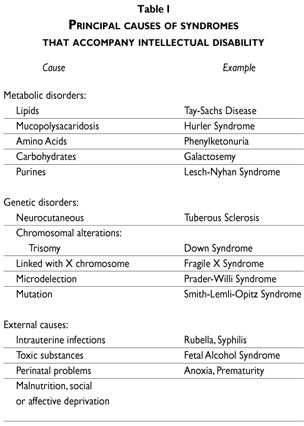
<body><![CDATA[<p><font size="2" face="Verdana">The term ID includes, by definition, three essential    components: a) intellectual functioning significantly below average with an    intelligence quotient (IQ) less than 70 (measured using psychometric tests such    as the <I>Wechsler Intelligence Scales for Children-Revised, Stanford-Binet,    Kaufman Assessment Battery for Children</I>); b) a marked deficit in the ability    of the individual to adapt to the daily demands of their social environment    (neither of these factors –low intelligence and deficient adaptive conduct–    is sufficient for establishing an ID diagnosis if they are regarded individually);    and c) onset before the age of 18. Slight variations exist in the codification    of the severity levels for ID, although the important division is that of mild    and moderate (IQ greater than 35-40), severe (IQ 20-25 to 35-40) and profound    (IQ less than 20-25). In spite of the fact that the above divisions are generally    agreed upon, the American Association on intellectual and Developmental Disabilities    (AAIDD), in their latest definition (2002), <SUP>5</SUP> moves away from the    importance given to date to the measurement of intelligence, which depends more    on the evaluator’s judgment than on intellectual tests. In addition, for the    purpose of using language that is focused more on needs and less on deficits,    the AAIDD proposes a new categorization for ID degrees: the need for intermittent,    limited, extensive or generalized support.</font></p>     <p><font size="2" face="Verdana">It also needs to be clarified that it is necessary    to view functional limitations in relation to the social and cultural context    of age and cultural peers and to consider cultural and linguistic diversity,    as well as differences in communication and sensorial, motor, and behavioral    aspects. The fundamental objective for the evaluation and diagnosis of ID is    the development of a profile of types of support necessary to enable the improved    functioning of persons with ID. Finally, the subjects’ abilities and skills    that may contribute to such improvement should also be evaluated.<SUP>3</sup></font></p>     <p><font size="2" face="Verdana"><b>Etiopathogenic and diagnostic factors</b></font></p>     <p><font size="2" face="Verdana">One factor in ID that contributes to conceptual    problems is the heterogeneity of the etiological factors, which are summarized    in <a href="#tab01">table I</a>. In addition, in 60% of persons diagnosed, the    deficit or alteration that causes ID is not known. In many mild ID cases it    is difficult to find a specific, underlying medical cause, although signs appear    that would suggest that neurological damage or social deprivation (poverty,    malnutrition, etc.) are possibilities. In this respect, Zigler<SUP>6</SUP> proposes    subdividing the population of persons with ID into those who have suffered an    interruption in the maturation process and those who do not reach the level    expected in the population, in spite of having completely developed. The first    group includes the majority of non-biological causes, especially social deprivation.    The second group includes all of the causes that can be characterized as biological,    since they are precisely what make average intellectual functioning impossible.</font></p>     <p><a name="tab01"></a></p>     <p>&nbsp;</p>     <p align="center"><img src="/img/revistas/spm/v50s2/a06tab01.gif"></p>     <p>&nbsp;</p>     <p><font size="2" face="Verdana">Among the diverse causes of ID, due to its importance    it is worth citing genetic anomalies, that make up 30% of the cases; standing    out among these, because of their high prevalence, are trisomy 21 or Down syndrome    (one in 800 live births) and fragile X syndrome (five out of every 10 000 births).</font></p>     <p><font size="2" face="Verdana">Determining the causes of ID is essential for    intervention since health care expenses would decrease and the response to treatment    and the prevention of possible complications would improve.<SUP>7</SUP> In this    respect, in recent years the term "behavioral phenotype" has been    introduced, which is described by Flint and Yule as: "a characteristic    pattern of motor, cognitive, linguistic, and social abnormalities that is consistently    associated with a biological disorder. In some cases, the behavioral phenotype    may constitute a psychiatric disorder; in others, behaviors which are not usually    regarded as symptoms of psychiatric disorders may occur".<SUP>8</sup></font></p>     ]]></body>
<body><![CDATA[<p><font size="2" face="Verdana">Knowledge about the behavioral phenotype helps    to plan and organize the care of persons with ID. Although the first behavioral    phenotypes were nearly exclusively based on syndromes with genetic origins,    today it is possible to talk also about behavioral phenotypes for non-genetic    conditions that accompany ID –such as fetal alcohol syndrome– which are applicable    to the set of ID disorders with biological origins.</font></p>     <p><font size="2" face="Verdana">It is necessary to take into account that ID    can be confused with other syndromes that begin in infancy or that also involve    cognitive or social functioning deficits, such as learning or communication    disorders (without a connection to ID), where a developmental alteration is    observed in a specific area (reading or expressive language, for example) but    there is not a generalized affect in intellectual development and adaptive skills.    In addition, it is necessary to differentiate ID from generalized development    disorders that are characterized by a qualitative developmental affectation    in social interaction and verbal and non-verbal social communication skills    that may or may not be connected with ID.</font></p>     <p><font size="2" face="Verdana">Furthermore, ID must be distinguished from other    syndromes or that are also associated with cognitive dysfunction, such as dementia    or cognitive deterioration, but whose diagnosis requires that memory affectation    and other cognitive deficits are significantly attenuated in comparison with    prior ability levels.</font></p>     <p><font size="2" face="Verdana">Lastly, limited intellectual ability is described    by an IQ interval higher than that required for ID (71-84). It is possible to    diagnose ID in individuals with IQ scores between 71 and 75 if they have the    characteristic deficit in adaptive behavior. In order to differentiate mild    ID from limited intellectual ability, careful review of all of the available    information is necessary.<SUP>9</sup></font></p>     <p><font size="2" face="Verdana"><b>Health and intellectual disability</b></font></p>     <p><font size="2" face="Verdana">Medical advances have enabled persons with ID    to live longer and have a better quality of life than in the past. Nevertheless,    increased life expectancy has resulted in new medical situations (for example,    a higher incidence of dementia) that, when added to the comorbility derived    from the very causes of ID, require an in-depth study of medical and health    factors related with ID.</font></p>     <p><font size="2" face="Verdana">This population has many difficulties in terms    of access to community health services. In Europe, an appropriate response to    this problem was the initiation of Project Pomona, <SUP>10</SUP> which has been    carried out in European Union countries since 2002. The principal objective    of this project is to identify the health indicators, based on evidence, that    reflect the most important areas for improving the quality of life of and equal    access to health care for persons with ID. This process in identifying factors    has been conducted with the participation of subjects with ID, their families,    professionals and administrators.</font></p>     <p><font size="2" face="Verdana">Project Pomona is based on the principal that    health is one of the parameters for quality of life. Individuals with ID are    citizens who have an inherent right to equal opportunities in terms of health    care and social inclusion. Nevertheless, this is not always carried out in practice    and the project, therefore, attempts to identify the factors that explain the    health disparities found between persons with ID and the general population.    The objective is for patients with ID to be able to make informed decisions    about their own health in an autonomous manner.</font></p>     <p><font size="2" face="Verdana">Health indicators identified by Project Pomona    include the following:</font></p>     <blockquote>        ]]></body>
<body><![CDATA[<p><font size="2" face="Verdana">1. Demographic indicators: prevalence, type      of housing, occupation, socio-economic status/income, life expectancy.    <br>     2. Health status indicators: epilepsy, buccal health, body mass index, mental      health, auditory and mobility skills.    <br>     3. Determinants: physical activity, behavioral problems, psychopharmacological      consumption.    <br>     4. Health system: hospitalization and contact with health professionals, health      check-ups, health promotion, specific training of medical professionals.</font></p> </blockquote>     <p><font size="2" face="Verdana"><b>Health problems for persons with ID</b></font></p>     <p><font size="2" face="Verdana">In recent years, it has been shown that subjects    with ID not only have more health needs than general population, but also that    these needs are barely covered and, when they are, the health care received    is usually not adequate. Various explanations have been formulated with respect    to this lack of care, <SUP>11</SUP> such as: lack of knowledge on the part of    primary care doctors about common medical problems in the ID population; communication    problems when interviewing a patient with ID, especially for those with severe    or profound disabilities; and the existing gap in assistance between social    services and health services, since nobody in particular is responsible for    these individuals.</font></p>     <p><font size="2" face="Verdana">Kerr and colleagues<SUP>12</SUP> state that this    population experiences the same health problems as the population without disabilities;    but some are more frequent and others are more specifically related to certain    syndromes that accompany ID, including:</font></p>     <blockquote>        <p><font size="2" face="Verdana">1. Cancer: Types of cancer most often found      in individuals with ID differ with respect to individuals without this disability;      there is a higher incidence of gastrointestinal cancers (esophagus, stomach,      gall bladder) –two times higher– in patients with ID and, to a lesser extent,      malignancies of the lung, prostate, breast and cervix.<SUP>13</sup>    <br>     2. Coronary disease: Coronary diseases are the second cause of death      in persons with ID.<SUP>14</SUP> These individuals are more prone to developing      hypertension and obesity and exercise is non-existent; all vulnerability factors      for cardiac ischemia. Persons with Down syndrome have a greater risk of congenital      cardiac disease.    ]]></body>
<body><![CDATA[<br>     3. Buccodental problems: Subjects with ID are more prone to developing cavities,      tooth loss and gum disease and experience a greater number of dental extractions.      This may be due to dietary deficiency, poor dental hygiene or the inaccessibility      of buccal hygiene campaigns to this population; persons with ID rarely visit      the dentist. Individuals with Down syndrome possess a higher rate of buccodental      problems, such as mouth deformations and gum problems.<SUP>15</sup>    <br>     4. Diabetes: Persons with ID have a higher rate of diabetes in comparison      with the general population. This may be due to the high rate of obesity,      poor diets or sedentary lifestyles.<SUP>16</sup>    <br>     5. Epilepsy: While epilepsy affects 1% of the population, it affects      33% of subjects with ID, and the percentage rises with the increased severity      of ID.<SUP>17</sup>    <br>     6. Gastrointestinal problems: Many persons with ID have high levels      of <I>Helicobacter pylori, </I> especially those who have lived in institutions      or shared residences.<SUP>18</SUP> Gastroesophageal Reflux Disease can affect      as many as half of the subjects with ID.<SUP>19</SUP> This anomaly has been      linked with fragile X syndrome and may be one of the causes for the enormous      rates in cancer of the esophagus. In addition, persons with Down syndrome      are more prone to colic.    <br>     7. Respiratory diseases: This is the leading cause of death in patients with      ID, <SUP>20</SUP> since they are more vulnerable to respiratory tract infections      due to aspiration or reflux, if they have deglutition difficulties. Persons      with Down syndrome are at particular risk since they are prone to suffering      pulmonary abnormalities, they have a deficient immune system and are likely      to breathe through the mouth.<SUP>21</SUP> Pulmonary complications have also      been reported in subjects with tuberous sclerosis.    <br>     8. Sensory problems: Auditory and visual problems are very common in these      patients. It is calculated that 40% have vision problems, and the percentage      is similar for auditory problems. In addition, subjects with ID are more prone      to develop eye and ear infections, while they less often seek out an ophthalmologist      or otorhynolaryngologist.<SUP>22</sup></font></p> </blockquote>     <p><font size="2" face="Verdana"><a href="#tab02">Table II</a> is a summary of    health problems most often related with ID. Of particular interest is the one-year    longitudinal study conducted by the British non-governmental organization Mencap.<SUP>23</SUP>    According to this protocol, persons with ID use primary care services significantly    less often than the rest of the population. Likewise, it was found that caregivers    for these people expressed a great deal of frustration to medical professionals    because they seldom referred patients with ID to colleagues in other specialties    to meet their health care needs.</font></p>     <p><a name="tab02"></a></p>     <p>&nbsp;</p>     <p align="center"><img src="/img/revistas/spm/v50s2/a06tab02.gif"></p>     ]]></body>
<body><![CDATA[<p>&nbsp;</p>     <p><font size="2" face="Verdana"><b>Psychiatric and behavioral disorders associated    with intellectual disability</b></font></p>     <p><font size="2" face="Verdana">In the last two decades, the problem of mental    illness in persons with ID (dual diagnosis) has received increasing attention    for two fundamental reasons: a) the recognition of the rights of individuals    with ID to receive appropriate medical care; in the past it was quite common    that these persons, collectively, were given elevated doses of psychopharmacologic    drugs –almost always antipsychotic– when their behavior became unacceptable,    without taking into account the diagnosis and collateral and evolutionary effects;    and b) the normalization principal is in favor of subjects with ID living in    the community and utilizing its resources. In fact, treatment and care of psychiatric    disorders in this population is considered to be a fundamental element of community    services.</font></p>     <p><font size="2" face="Verdana">Persons with ID reflect the entire spectrum of    psychiatric disorders described in the general population, but the prevalence    of mental problems/disorders/illness is higher. In one-third of the cases, ID    coexists with psychiatric alterations and recent studies report rates as high    as 40%, <SUP>24</SUP> with 10 to 20% having behavioral problems not related    to a mental illness. In 50% of the cases, mental illness goes by undetected    or is underdiagnosed, including in institutions with psychological support.<SUP>25</sup></font></p>     <p><font size="2" face="Verdana">If the situation of persons with ID is analyzed    synoptically, the higher proclivity toward psychiatric disorders is not surprising.    Publications have shown how biological alterations that often accompany ID are    also vulnerability factors for mental illness. One example is the proneness    to depression in persons with Down syndrome; it has been suggested that alterations    in pair 21 also cause alterations in the dopaminergic system<SUP>26</SUP> and,    therefore, may contribute to the higher rates seen in mood alterations. Also    evident is the way in which many psychological factors in these individuals    (such as low self-esteem) are vulnerability factors for mental illness. Lastly,    numerous social factors, which unfortunately are very present in this population,    increase the proclivity for mental illness, such as rejection, denial of opportunities,    abuse, the typically frequent change in caregivers, institutionalization, etc.    A more detailed analysis of the above is available in Matson and Sevin’s vulnerability    factors model.<SUP>27</SUP> It is important to remember that, from a biopsychosocial    perspective, all of these elements likely interact with each other (<a href="#tab03">table    III</a>).</font></p>     <p><a name="tab03"></a></p>     <p>&nbsp;</p>     <p align="center"><img src="/img/revistas/spm/v50s2/a06tab03.gif"></p>     <p>&nbsp;</p>     <p><font size="2" face="Verdana">Mental health care for subjects with ID is relatively    new and, as a result, much is not known in this area. These theoretical gaps    explain the variability that exists among data from epidemiological studies.    Some prevalence studies include personality disorders, autism, attention deficit    hyperactivity or dementias, but others do not identify them. The same is true    with behavioral alterations, which are so frequently seen in this population.    Nevertheless, there seems to be a consensus that the pathoplasty of mental illness    in patients with ID is often different than that found in the non-disabled population.    Depressive mood, for example, may be manifested as behavioral irregularities    or irritability, the same symptoms as anxiety.<SUP>28</SUP> In these cases,    the term used is "behavioral equivalents." Thus, the decision to use    diagnostic criteria found in common classifications (CIE-10, DSM-IV-TR), or    adapted criteria (<I>Diagnostic Criteria for Learning Disabilities, </I>DC-LD<SUP>29</SUP>    or DM-ID), <SUP>30</SUP> may also result in modifying epidemiological data since    many abnormalities do not satisfy sufficient criteria using standard classifications.</font></p>     ]]></body>
<body><![CDATA[<p><font size="2" face="Verdana">Likewise, Sovner<SUP>31</SUP> adds the following    points as difficulties in evaluating, interpreting and diagnosing the symptoms    of psychiatric disorders in persons with ID:</font></p> <ul>       <li>          <p><font size="2" face="Verdana">The presence of<I> disadaptive behavior prior</I>        to the mental illness;</font></p>   </li>       <li>          <p><font size="2" face="Verdana"><I>The existence of intellectual limitations</I>        that do not allow the patient with ID to understand the evaluator’s questions        or verbalize an appropriate response.</font></p>   </li>       <li>          <p><font size="2" face="Verdana"> The need to situate the symptoms within        the context of the <I>evolutive development</I> of the patient. In this        respect, Szymanski and King<SUP>32</SUP> state that subjects with ID have        interpersonal behavior and skills patterns corresponding to earlier chronological        stages (for example, infancy) and maintain these characteristics throughout        their lifecycle; thus, any attempt to interpret their symptoms should be        made in an evolutive context.</font></p>   </li>       <li>          <p><font size="2" face="Verdana"> The coexistence of <I>cognitive disorganization</I>        in persons with ID that provokes, for example, depression to be manifested        by psychotic instead of affective symptoms.</font></p>   </li>     </ul>     ]]></body>
<body><![CDATA[<p><font size="2" face="Verdana">Lastly, another particularly interesting phenomenon    for explaining why psychiatric problems in this population go undetected on    many occasions is what Reiss calls ID’s "diagnostic overshadowing."<SUP>33</SUP>    This term refers to the tendency by the clinical practitioner to attribute the    origin of psychiatric symptoms to ID, which results in masking mental illness;    symptoms such as depressive mood and delirium are consequently attributed to    ID and not to a mental illness. This impedes the implementation of corrective    measures for treating the anomaly. Likewise, a distorted view is produced in    the mind of the clinician that results in the minimization of the symptoms’    importance and, therefore, their diagnostic relevance. Therefore, when an adolescent    with normal intelligence displays inappropriate conduct, there is a tendency    to regard the subject as having a behavioral problem. If the same inappropriate    conduct is displayed by an adolescent with ID, the behavior is presumed to be    a result of the disability itself and is, therefore, of less concern than in    the first case. Further still, the clinician must often trust reports by third    persons in order to establish the diagnosis, which provokes distortions.</font></p>     <p><font size="2" face="Verdana">Another factor to be considered in ID is the    presence of behavioral disorders, recognizable in 25 to 60% of adults with ID    residing in the community; although this percentage decreases to 12 to 17% when    involving severe behavioral irregularities.<SUP>34, 35</SUP> A behavioral disorder    is a set of disruptive of negative behaviors of such intensity, frequency and    duration that it can put the physical security of the person or of others in    danger, or that may limit or delay the delivery of ordinary community resources.<SUP>36</SUP>    The principal behavioral problems associated with ID, according to the expanded    inventory (Inventory for Client and Agency Planning, ICAP), <SUP>37</SUP> are    the following: self-injurious behavior, aggressiveness toward or injuring others,    destruction of objects, disruptive behavior, atypical and repetitive habits    (stereotypical), offensive social conduct, timidity or lack of attention and    cooperation. The most frequent type of behavioral problem that requires treatment,    needs support and requires changes in daily life is aggressive behavior –whether    against others or oneself– especially in young subjects or adolescents who are    male.</font></p>     <p><font size="2" face="Verdana">The differences in prevalence data among the    diverse studies are due to the various definitions of behavioral problems, the    utilization of different lists for problematic behaviors, difficulty determining    the group of persons who truly represent a challenge for services, and reliability    problems from one observer to another because of variations in the criteria    used for severity among professionals who treat the same persons.</font></p>     <p><font size="2" face="Verdana">Finally, it is important to recognize the relation    between behavioral problems and mental illness. It is possible to point to the    study by Rojahn and colleagues, <SUP>38</SUP> that uses the <I>Behavioral Problems    Inventory</I> scales and <I>Diagnostic Assessment for the Severely Handicapped-II.</I>    This protocol finds that subjects with severe or profound ID who displayed self-injurious,    stereotyped or aggressive and destructive behavior generally had higher psychopathology    scores; in addition, the presence of behavioral problems tripled the probability    of the appearance of almost all of the psychiatric disorders.</font></p>     <p><font size="2" face="Verdana"><b>Conclusion: What can health sciences do for    persons with intellectual disability?</b></font></p>     <p><font size="2" face="Verdana">Medicine and health sciences in general should    contribute to improving the quality of life of individuals with ID; to accomplish    this, it is possible to design interventions that are closely related with the    diagnosis.<SUP>39</SUP> All available information about possible etiological    factors must be taken into account (for example, precipitating episodes, family    disposition, specific biological deficits, personality problems and specific    developmental difficulties). Factors such as the severity of the ID, related    disorders, the effects of prior treatments and the social environment should    also be considered. Due to the complexity of ailments in persons with ID, their    treatment must be planned from diverse perspectives (pharmacology, psychotherapy,    behavioral intervention, etc.). In this regard, Ferrell and colleagues<SUP>40</SUP>    propose a combined therapeutic model based on community support, along with    neuropsychiatric measures, as a type of effective intervention for psychiatric    and behavioral problems in persons with ID.</font></p>     <p><font size="2" face="Verdana">Nevertheless, for a long time the only medical    response to the problems experienced by subjects with ID has been the unrestricted    provision of antipsychotics for the control of behavioral problems, as well    as institutionalization of this individuals in psychiatric institutions; this    has generated rejection of and generally discredited psychopharmacology in this    field. Currently, there are consensual guidelines and recommendations for the    psychopharmacological treatment of this population.<SUP>39, 41</SUP> Contributions    by the Royal College of Psychiatrists, Birmingham University and the Mencap    Association should be noted, <SUP>42</SUP> who have developed a set of indications    for psychopharmacological treatment and reviewed the scientific evidence.</font></p>     <p><font size="2" face="Verdana">Prescribing doses and guidelines are the same    as those that apply to the general adult population, though increases in and    the suspension of medications should occur over a longer period of time. In    the case of psychotic and severe behavioral disorders in which an environmental,    organic or affective cause has been ruled out, the atypical antipsychotics that    have been studied the most in this population are risperidone, followed by olanzapine<SUP>28</SUP>    (a second choice is haloperidol and, third, clozapine, while taking into account    leukogram values). <a href="#tab04">Table IV</a> lists some general indications.</font></p>     <p><a name="tab04"></a></p>     <p>&nbsp;</p>     ]]></body>
<body><![CDATA[<p align="center"><img src="/img/revistas/spm/v50s2/a06tab04.gif"></p>     <p>&nbsp;</p>     <p><font size="2" face="Verdana">The principal problem faced by a medical professional    when considering the psychopharmacological treatment of mental disorders in    the ID population is the variability of syndromes. This situation, in turn,    provokes different medical, psychiatric and behavioral symptoms as compared    to the general population, which entails enormous difficulties in establishing    a psychiatric diagnosis, determining a prognosis for standard treatments, and    detecting possible undesirable effects and adverse reactions to medication.    Added to this is the scarcity of specific studies about the effectiveness and    safety of using psychopharmacological medications in patients with ID. Nearly    all are single-case studies, case series, retrospective reviews and open trials.</font></p>     <p><font size="2" face="Verdana">Furthermore, the results of controlled studies    with heterogeneous samples of persons with ID are suspect, since the biological    differences between a person with Down syndrome and another with Angelman syndrome,    for example, are much greater than those observed between adults in the general    population. In fact, controlled trials should be conducted in subjects with    the same or similar etiological diagnosis. Another factor that should not be    overlooked is the enormous individual variability in the response to and appearance    of secondary effects in these patients and the lack of acute and subacute facilities    for individuals in crisis, in such a way as to be able to control therapeutic    guidelines.</font></p>     <p><font size="2" face="Verdana">It is reasonable to act with extreme caution,    make an appropriate diagnosis, implement individualized therapeutic changes    (without modifying several medication regimens at one time) and instruct the    patient’s family in accordance with national guidelines. In this respect, it    is also worth remembering the old four rules for medical treatment by Cecil    Loeb: a) if the prescribed treatment works, don’t change it; b) if the prescribed    treatment does not work, suspend it; c) if you do not know what to do, do not    do anything; d) whatever you do, do not let your patient wind up in the hands    of the surgeon!</font></p>     <p><font size="2" face="Verdana">In response to the high degree of unsatisfied    health needs in the ID population, the following action steps have been suggested:<SUP>43</sup></font></p>     <blockquote>        <p><font size="2" face="Verdana">1. Preparation: familiarization and knowledge      of places (hospital, medical office), procedures and medical techniques.    <br>     2. Longer consultation time: with the goal of enabling persons with ID to      discuss their health problems.    <br>     3. Informal and non-threatening environment: modifying the environment in      order to attain a non-threatening space that helps to reduce the stress and      anxiety felt by these patients in a situation such as a doctor’s visit.</font></p> </blockquote>     ]]></body>
<body><![CDATA[<p><font size="2" face="Verdana">The U.S. Public Health Service published a report    in 2002<SUP>44</SUP> that highlighted general lines of action in the field of    ID for health services:</font></p>     <blockquote>        <p><font size="2" face="Verdana">1. Integrate the promotion of health for persons      with ID into community health care environments.    <br>     2. Increase knowledge about health factors related to ID and put into practice      this knowledge.    <br>     3. Improve the quality of health care for patients with ID.    <br>     4. Institute training programs for professionals who provide health care to      subjects with ID.    <br>     5. Guarantee that the health system produces good health indicators and results      for persons with ID.    <br>     6. Increase the accessibility of health services to individuals with ID.</font></p> </blockquote>     <p><font size="2" face="Verdana">In Europe, similar recommendations have been    developed.<SUP>45</SUP> This all leads to laying the groundwork so that in the    near future the health sciences will give ID the consideration needed by this    group.</font></p>     <p>&nbsp;</p>     ]]></body>
<body><![CDATA[<p><font size="3" face="Verdana"><b>References </b></font></p>     <!-- ref --><p><font size="2" face="Verdana">1. Schalock RL, Luckasson RA, Shogren KA, Borthwick-Duffy    S, Bradley V, Buntinx WH, <I>et al.</I> The renaming of mental retardation:    understanding the change to the term intellectual disability. Intellect Dev    Disabil 2007;45(2):116-124.</font>&nbsp;&nbsp;&nbsp;&nbsp;&nbsp;&nbsp;&nbsp;&nbsp;[&#160;<a href="javascript:void(0);" onclick="javascript: window.open('/scielo.php?script=sci_nlinks&ref=9304073&pid=S0036-3634200800080000600001&lng=','','width=640,height=500,resizable=yes,scrollbars=1,menubar=yes,');">Links</a>&#160;]<!-- end-ref --><!-- ref --><p><font size="2" face="Verdana">2. Salvador-Carulla L, Bertelli M. Mental retardation    or intellectual disability: time for a conceptual change. Psychopathology 2008;41:10-16.</font>&nbsp;&nbsp;&nbsp;&nbsp;&nbsp;&nbsp;&nbsp;&nbsp;[&#160;<a href="javascript:void(0);" onclick="javascript: window.open('/scielo.php?script=sci_nlinks&ref=9304074&pid=S0036-3634200800080000600002&lng=','','width=640,height=500,resizable=yes,scrollbars=1,menubar=yes,');">Links</a>&#160;]<!-- end-ref --><!-- ref --><p><font size="2" face="Verdana">3. Durkin M. The epidemiology of developmental    disabilities in low-income countries. Ment Retard Dev Disabil Res Rev 2002;8(3):206-211.</font>&nbsp;&nbsp;&nbsp;&nbsp;&nbsp;&nbsp;&nbsp;&nbsp;[&#160;<a href="javascript:void(0);" onclick="javascript: window.open('/scielo.php?script=sci_nlinks&ref=9304075&pid=S0036-3634200800080000600003&lng=','','width=640,height=500,resizable=yes,scrollbars=1,menubar=yes,');">Links</a>&#160;]<!-- end-ref --><!-- ref --><p><font size="2" face="Verdana">4. Polder JJ, Meerding WJ, Bonneux L, van der    Maas PJ. Healthcare costs of intellectual disability in the Netherlands: a cost-of-illness    perspective. J Intel Disabil Res 2002;46(Pt 2):168-178.</font>&nbsp;&nbsp;&nbsp;&nbsp;&nbsp;&nbsp;&nbsp;&nbsp;[&#160;<a href="javascript:void(0);" onclick="javascript: window.open('/scielo.php?script=sci_nlinks&ref=9304076&pid=S0036-3634200800080000600004&lng=','','width=640,height=500,resizable=yes,scrollbars=1,menubar=yes,');">Links</a>&#160;]<!-- end-ref --><!-- ref --><p><font size="2" face="Verdana">5. American Association on Mental Retardation    (AAMR). Mental retardation: definition, classification and systems of supports.    10th ed. Washington, D.C.: American Association on Mental Retardation (AAMR);    2002.</font>&nbsp;&nbsp;&nbsp;&nbsp;&nbsp;&nbsp;&nbsp;&nbsp;[&#160;<a href="javascript:void(0);" onclick="javascript: window.open('/scielo.php?script=sci_nlinks&ref=9304077&pid=S0036-3634200800080000600005&lng=','','width=640,height=500,resizable=yes,scrollbars=1,menubar=yes,');">Links</a>&#160;]<!-- end-ref --><!-- ref --><p><font size="2" face="Verdana">6. Zigler E. Can we "cure" mild mental    retardation among individuals in the lower socioeconomic stratum? Am J Public    Health 1995;85(3):302-304.</font>&nbsp;&nbsp;&nbsp;&nbsp;&nbsp;&nbsp;&nbsp;&nbsp;[&#160;<a href="javascript:void(0);" onclick="javascript: window.open('/scielo.php?script=sci_nlinks&ref=9304078&pid=S0036-3634200800080000600006&lng=','','width=640,height=500,resizable=yes,scrollbars=1,menubar=yes,');">Links</a>&#160;]<!-- end-ref --><p><font size="2" face="Verdana">7. Ouellette-Kuntz H, Garcin N, Lewis ME, Minnes    P, Martin C, Holden JJ. Addressing health disparities through promoting equity    for individuals with intellectual disability. Can J Public Health 2005;96(Suppl    2):S8-22.</font></p>     <p><font size="2" face="Verdana">8. Flint J, Yule W. Behavioural phenotypes. In:    Rutter M, Taylor E, Hersov L, editors. Child and adolescent psychiatry. Oxford:    Blackwell Science; 1994. p. 666-687.</font></p>     <p><font size="2" face="Verdana">9. American Psychiatric Association (APA). Manual    diagn&oacute;stico y estad&iacute;stico de los trastornos mentales. 4th ed.    (revised text). DSM-IV TR. Barcelona: Masson; 2002.</font></p>     ]]></body>
<body><![CDATA[<p><font size="2" face="Verdana">10. Walsh PN, Kerr M, van Schrojenstein Lantman-de    Valk HM. Health indicators for people with intellectual disabilities: a European    perspective. Eur J Public Health 2003;13(Suppl 3):47-50.</font></p>     <!-- ref --><p><font size="2" face="Verdana">11. Rodgers J. Primary health care provision    for people with learning difficulties. Health Soc Care Comm 1994;2(1):11-17.</font>&nbsp;&nbsp;&nbsp;&nbsp;&nbsp;&nbsp;&nbsp;&nbsp;[&#160;<a href="javascript:void(0);" onclick="javascript: window.open('/scielo.php?script=sci_nlinks&ref=9304083&pid=S0036-3634200800080000600011&lng=','','width=640,height=500,resizable=yes,scrollbars=1,menubar=yes,');">Links</a>&#160;]<!-- end-ref --><!-- ref --><p><font size="2" face="Verdana">12. Kerr MP. Primary health care for people with    an intellectual disability. J Intel Disabil Res 1997;41(5):363-364.</font>&nbsp;&nbsp;&nbsp;&nbsp;&nbsp;&nbsp;&nbsp;&nbsp;[&#160;<a href="javascript:void(0);" onclick="javascript: window.open('/scielo.php?script=sci_nlinks&ref=9304084&pid=S0036-3634200800080000600012&lng=','','width=640,height=500,resizable=yes,scrollbars=1,menubar=yes,');">Links</a>&#160;]<!-- end-ref --><!-- ref --><p><font size="2" face="Verdana">13. Cooke LB. Cancer and learning disability.    J Intel Disabil Res 1997;41(Pt 4):312-316.</font>&nbsp;&nbsp;&nbsp;&nbsp;&nbsp;&nbsp;&nbsp;&nbsp;[&#160;<a href="javascript:void(0);" onclick="javascript: window.open('/scielo.php?script=sci_nlinks&ref=9304085&pid=S0036-3634200800080000600013&lng=','','width=640,height=500,resizable=yes,scrollbars=1,menubar=yes,');">Links</a>&#160;]<!-- end-ref --><!-- ref --><p><font size="2" face="Verdana">14. Hollins S, Attard MT, von Fraunhofer N, McGuigan    S, Sedgwick P. Mortality in people with learning disability: risks, causes,    and death certification findings in London. Dev Med Child Neurol 1998;40(1):50-56.</font>&nbsp;&nbsp;&nbsp;&nbsp;&nbsp;&nbsp;&nbsp;&nbsp;[&#160;<a href="javascript:void(0);" onclick="javascript: window.open('/scielo.php?script=sci_nlinks&ref=9304086&pid=S0036-3634200800080000600014&lng=','','width=640,height=500,resizable=yes,scrollbars=1,menubar=yes,');">Links</a>&#160;]<!-- end-ref --><!-- ref --><p><font size="2" face="Verdana">15. Cumella S, Ransford N, Lyons J, Burnham H.    Needs for oral care among people with intellectual disability not in contact    with Community Dental Services. J Intel Disabil Res 2000;44(Pt 1):45-52.</font>&nbsp;&nbsp;&nbsp;&nbsp;&nbsp;&nbsp;&nbsp;&nbsp;[&#160;<a href="javascript:void(0);" onclick="javascript: window.open('/scielo.php?script=sci_nlinks&ref=9304087&pid=S0036-3634200800080000600015&lng=','','width=640,height=500,resizable=yes,scrollbars=1,menubar=yes,');">Links</a>&#160;]<!-- end-ref --><!-- ref --><p><font size="2" face="Verdana">16. Butler JV, Whittington JE, Holland AJ, Boer    H, Clarke D, Webb T. Prevalence of, and risk factors for, physical ill-health    in people with Prader-Willi syndrome: a population-based study. Dev Med Child    Neurol 2002;44(4):248-255.</font>&nbsp;&nbsp;&nbsp;&nbsp;&nbsp;&nbsp;&nbsp;&nbsp;[&#160;<a href="javascript:void(0);" onclick="javascript: window.open('/scielo.php?script=sci_nlinks&ref=9304088&pid=S0036-3634200800080000600016&lng=','','width=640,height=500,resizable=yes,scrollbars=1,menubar=yes,');">Links</a>&#160;]<!-- end-ref --><!-- ref --><p><font size="2" face="Verdana">17. Airaksinen EM, Matilainen R, Mononen T, Mustonen    K, Partanen J, Jokela V, <I>et al</I>. A population-based study on epilepsy    in mentally retarded children. Epilepsia 2000;41(9):1214-1220.</font>&nbsp;&nbsp;&nbsp;&nbsp;&nbsp;&nbsp;&nbsp;&nbsp;[&#160;<a href="javascript:void(0);" onclick="javascript: window.open('/scielo.php?script=sci_nlinks&ref=9304089&pid=S0036-3634200800080000600017&lng=','','width=640,height=500,resizable=yes,scrollbars=1,menubar=yes,');">Links</a>&#160;]<!-- end-ref --><!-- ref --><p> <font size="2" face="Verdana">18. Bohmer CJ, Klinkenberg-Knol EC, Kuipers    EJ, Niezen-de Boer MC, Schreuder H, Schuckink-Kool F, <I>et al.</I> The prevalence    of Helicobacter pylori infection among inhabitants and healthy employees of    institutes for the intellectually disabled. Am J Gastroenterol 1997;92(6):1000-1004.</font>&nbsp;&nbsp;&nbsp;&nbsp;&nbsp;&nbsp;&nbsp;&nbsp;[&#160;<a href="javascript:void(0);" onclick="javascript: window.open('/scielo.php?script=sci_nlinks&ref=9304090&pid=S0036-3634200800080000600018&lng=','','width=640,height=500,resizable=yes,scrollbars=1,menubar=yes,');">Links</a>&#160;]<!-- end-ref --><!-- ref --><p><font size="2" face="Verdana">19. Bohmer CJ, Niezen-de Boer MC, Klinkenberg-Knol    EC, Deville WL, Nadorp JH, Meuwissen SG. The prevalence of gastroesophageal    reflux disease in institutionalized intellectually disabled individuals. Am    J Gastroenterol 1999;94(3):804-810.</font>&nbsp;&nbsp;&nbsp;&nbsp;&nbsp;&nbsp;&nbsp;&nbsp;[&#160;<a href="javascript:void(0);" onclick="javascript: window.open('/scielo.php?script=sci_nlinks&ref=9304091&pid=S0036-3634200800080000600019&lng=','','width=640,height=500,resizable=yes,scrollbars=1,menubar=yes,');">Links</a>&#160;]<!-- end-ref --><!-- ref --><p><font size="2" face="Verdana">20. Janicki MP, Dalton AJ, Henderson CM, Davidson    PW. Mortality and morbidity among older adults with intellectual disability:    health services considerations. Disabil Rehabil 1999;21(5-6):284-294.</font>&nbsp;&nbsp;&nbsp;&nbsp;&nbsp;&nbsp;&nbsp;&nbsp;[&#160;<a href="javascript:void(0);" onclick="javascript: window.open('/scielo.php?script=sci_nlinks&ref=9304092&pid=S0036-3634200800080000600020&lng=','','width=640,height=500,resizable=yes,scrollbars=1,menubar=yes,');">Links</a>&#160;]<!-- end-ref --><!-- ref --><p><font size="2" face="Verdana">21. Hilton JM, Fitzgerald DA, Cooper DM. Respiratory    morbidity of hospitalized children with trisomy 21. J Paediatr Child Health    1999;35(4):383-386.</font>&nbsp;&nbsp;&nbsp;&nbsp;&nbsp;&nbsp;&nbsp;&nbsp;[&#160;<a href="javascript:void(0);" onclick="javascript: window.open('/scielo.php?script=sci_nlinks&ref=9304093&pid=S0036-3634200800080000600021&lng=','','width=640,height=500,resizable=yes,scrollbars=1,menubar=yes,');">Links</a>&#160;]<!-- end-ref --><p><font size="2" face="Verdana">22. Schrojenstein Lantman-de Valk HM, van den    AM, Maaskant MA, Haveman MJ, Urlings HF, Kessels AG, <I>et al</I>. Prevalence    and incidence of health problems in people with intellectual disability. J Intel    Disabil Res 1997;41(Pt 1):42-51.</font></p>     <!-- ref --><p><font size="2" face="Verdana">23. Band R. The NHS: health for all? Londres:    Mencap National Centre; 1998.</font>&nbsp;&nbsp;&nbsp;&nbsp;&nbsp;&nbsp;&nbsp;&nbsp;[&#160;<a href="javascript:void(0);" onclick="javascript: window.open('/scielo.php?script=sci_nlinks&ref=9304095&pid=S0036-3634200800080000600023&lng=','','width=640,height=500,resizable=yes,scrollbars=1,menubar=yes,');">Links</a>&#160;]<!-- end-ref --><!-- ref --><p><font size="2" face="Verdana">24. Cooper SA, Smiley E, Finlayson J, Jackson    A, Allan L, Williamson A, et al. The prevalence, incidence, and factors predictive    of mental ill-health in adults with profound intellectual disabilities. Prospective    study. J Appl Res Int Dis 2007;20:493-501.</font>&nbsp;&nbsp;&nbsp;&nbsp;&nbsp;&nbsp;&nbsp;&nbsp;[&#160;<a href="javascript:void(0);" onclick="javascript: window.open('/scielo.php?script=sci_nlinks&ref=9304096&pid=S0036-3634200800080000600024&lng=','','width=640,height=500,resizable=yes,scrollbars=1,menubar=yes,');">Links</a>&#160;]<!-- end-ref --><!-- ref --><p><font size="2" face="Verdana">25. Salvador-Carulla L, Rodr&iacute;guez-Blazquez    C, Rodriguez DM, Perez-Marin J, Velazquez R. Hidden psychiatric morbidity in    a vocational programme for people with intellectual disability. J Intel Disabil    Res 2000;44(Pt 2):147-154.</font>&nbsp;&nbsp;&nbsp;&nbsp;&nbsp;&nbsp;&nbsp;&nbsp;[&#160;<a href="javascript:void(0);" onclick="javascript: window.open('/scielo.php?script=sci_nlinks&ref=9304097&pid=S0036-3634200800080000600025&lng=','','width=640,height=500,resizable=yes,scrollbars=1,menubar=yes,');">Links</a>&#160;]<!-- end-ref --><!-- ref --><p><font size="2" face="Verdana">26. Collacott RA, Cooper SA, McGrother C. Differential    rates of psychiatric disorders in adults with Down’s syndrome compared with    other mentally handicapped adults. Br J Psychiatry 1992;161:671-674.</font>&nbsp;&nbsp;&nbsp;&nbsp;&nbsp;&nbsp;&nbsp;&nbsp;[&#160;<a href="javascript:void(0);" onclick="javascript: window.open('/scielo.php?script=sci_nlinks&ref=9304098&pid=S0036-3634200800080000600026&lng=','','width=640,height=500,resizable=yes,scrollbars=1,menubar=yes,');">Links</a>&#160;]<!-- end-ref --><!-- ref --><p><font size="2" face="Verdana">27. Salvador-Carulla L, Novell R. Gu&iacute;a    pr&aacute;ctica de la evaluaci&oacute;n psiqui&aacute;trica en el retraso mental.    Barcelona: Aula M&eacute;dica; 2002.</font>&nbsp;&nbsp;&nbsp;&nbsp;&nbsp;&nbsp;&nbsp;&nbsp;[&#160;<a href="javascript:void(0);" onclick="javascript: window.open('/scielo.php?script=sci_nlinks&ref=9304099&pid=S0036-3634200800080000600027&lng=','','width=640,height=500,resizable=yes,scrollbars=1,menubar=yes,');">Links</a>&#160;]<!-- end-ref --><!-- ref --><p><font size="2" face="Verdana">28. Hemmings CP, Gravestock S, Pickard M, Bouras    N. Psychiatric symptoms and problem behaviours in people with intellectual disabilities.    J Intel Disabil Res 2006;50(Pt 4):269-276.</font>&nbsp;&nbsp;&nbsp;&nbsp;&nbsp;&nbsp;&nbsp;&nbsp;[&#160;<a href="javascript:void(0);" onclick="javascript: window.open('/scielo.php?script=sci_nlinks&ref=9304100&pid=S0036-3634200800080000600028&lng=','','width=640,height=500,resizable=yes,scrollbars=1,menubar=yes,');">Links</a>&#160;]<!-- end-ref --><!-- ref --><p><font size="2" face="Verdana">29. Royal College of Psychiatrists. Diagnostic    criteria for psychiatric disorders for use with adults with learning disabilities/mental    retardation, DC-LD. London: Royal College of Psychiatrists; 2001.</font>&nbsp;&nbsp;&nbsp;&nbsp;&nbsp;&nbsp;&nbsp;&nbsp;[&#160;<a href="javascript:void(0);" onclick="javascript: window.open('/scielo.php?script=sci_nlinks&ref=9304101&pid=S0036-3634200800080000600029&lng=','','width=640,height=500,resizable=yes,scrollbars=1,menubar=yes,');">Links</a>&#160;]<!-- end-ref --><!-- ref --><p><font size="2" face="Verdana">30. Fletcher R, Loschen E, Stavrakaki C, First    M. Diagnostic Manual-Intellectual Disability (DM-ID): a textbook of diagnosis    of mental disorders in persons with intellectual disability. Kingston, NY: NADD    Press; 2007.</font>&nbsp;&nbsp;&nbsp;&nbsp;&nbsp;&nbsp;&nbsp;&nbsp;[&#160;<a href="javascript:void(0);" onclick="javascript: window.open('/scielo.php?script=sci_nlinks&ref=9304102&pid=S0036-3634200800080000600030&lng=','','width=640,height=500,resizable=yes,scrollbars=1,menubar=yes,');">Links</a>&#160;]<!-- end-ref --><!-- ref --><p><font size="2" face="Verdana">31. Sovner R. Limiting factors in the use of    DSM-III criteria with mentally ill/mentally retarded persons. Psychopharmacol    Bull 1986;22(4):1055-1059.</font>&nbsp;&nbsp;&nbsp;&nbsp;&nbsp;&nbsp;&nbsp;&nbsp;[&#160;<a href="javascript:void(0);" onclick="javascript: window.open('/scielo.php?script=sci_nlinks&ref=9304103&pid=S0036-3634200800080000600031&lng=','','width=640,height=500,resizable=yes,scrollbars=1,menubar=yes,');">Links</a>&#160;]<!-- end-ref --><!-- ref --><p><font size="2" face="Verdana">32. Szymanski L, King BH. Practice parameters    for the assessment and treatment of children, adolescents, and adults with mental    retardation and comorbid mental disorders. American Academy of Child and Adolescent    Psychiatry Working Group on Quality Issues. J Am Acad Child Adolesc Psychiatry    1999;38(12 Suppl):5S-31S.</font>&nbsp;&nbsp;&nbsp;&nbsp;&nbsp;&nbsp;&nbsp;&nbsp;[&#160;<a href="javascript:void(0);" onclick="javascript: window.open('/scielo.php?script=sci_nlinks&ref=9304104&pid=S0036-3634200800080000600032&lng=','','width=640,height=500,resizable=yes,scrollbars=1,menubar=yes,');">Links</a>&#160;]<!-- end-ref --><!-- ref --><p><font size="2" face="Verdana">33. Reiss S, Levitan GW, Szyszko J. Emotional    disturbance and mental retardation: diagnostic overshadowing. Am J Ment Defic    1982;86(6):567-574.</font>&nbsp;&nbsp;&nbsp;&nbsp;&nbsp;&nbsp;&nbsp;&nbsp;[&#160;<a href="javascript:void(0);" onclick="javascript: window.open('/scielo.php?script=sci_nlinks&ref=9304105&pid=S0036-3634200800080000600033&lng=','','width=640,height=500,resizable=yes,scrollbars=1,menubar=yes,');">Links</a>&#160;]<!-- end-ref --><!-- ref --><p><font size="2" face="Verdana">34. Emerson E, Bromley J. The form and function    of challenging behaviours. J Intel Disabil Res 1995;39(Pt 5):388-398.</font>&nbsp;&nbsp;&nbsp;&nbsp;&nbsp;&nbsp;&nbsp;&nbsp;[&#160;<a href="javascript:void(0);" onclick="javascript: window.open('/scielo.php?script=sci_nlinks&ref=9304106&pid=S0036-3634200800080000600034&lng=','','width=640,height=500,resizable=yes,scrollbars=1,menubar=yes,');">Links</a>&#160;]<!-- end-ref --><!-- ref --><p><font size="2" face="Verdana">35. Novell R, Salvador-Carulla L. Problemas de    conducta en el retraso mental. Siglo Cero Rev Esp Discap Intel 2003;34:78-86.</font>&nbsp;&nbsp;&nbsp;&nbsp;&nbsp;&nbsp;&nbsp;&nbsp;[&#160;<a href="javascript:void(0);" onclick="javascript: window.open('/scielo.php?script=sci_nlinks&ref=9304107&pid=S0036-3634200800080000600035&lng=','','width=640,height=500,resizable=yes,scrollbars=1,menubar=yes,');">Links</a>&#160;]<!-- end-ref --><!-- ref --><p><font size="2" face="Verdana">36. Emerson E, Barrett S, Bell C, Cummings R,    McCool C, Toogood A, <I>et al</I>. Developing services for people with severe    learning disabilities and severe challenging behaviours. Canterbury: University    of Kent at Canterbury, Institute of Social and Applied Psychology; 1987.</font>&nbsp;&nbsp;&nbsp;&nbsp;&nbsp;&nbsp;&nbsp;&nbsp;[&#160;<a href="javascript:void(0);" onclick="javascript: window.open('/scielo.php?script=sci_nlinks&ref=9304108&pid=S0036-3634200800080000600036&lng=','','width=640,height=500,resizable=yes,scrollbars=1,menubar=yes,');">Links</a>&#160;]<!-- end-ref --><!-- ref --><p><font size="2" face="Verdana">37. Bruininks RH, Hill BH, Weatherman RF, Woodcock    RW. Inventory for client and agency planning, ICAP. Allen, TX.: DLM Teaching    Resources; 1986.</font>&nbsp;&nbsp;&nbsp;&nbsp;&nbsp;&nbsp;&nbsp;&nbsp;[&#160;<a href="javascript:void(0);" onclick="javascript: window.open('/scielo.php?script=sci_nlinks&ref=9304109&pid=S0036-3634200800080000600037&lng=','','width=640,height=500,resizable=yes,scrollbars=1,menubar=yes,');">Links</a>&#160;]<!-- end-ref --><!-- ref --><p><font size="2" face="Verdana">38. Rojahn J, Matson JL, Naglieri JA, Mayville    E. Relationships between psychiatric conditions and behavior problems among    adults with mental retardation. Am J Ment Retard 2004;109(1):21-33.</font>&nbsp;&nbsp;&nbsp;&nbsp;&nbsp;&nbsp;&nbsp;&nbsp;[&#160;<a href="javascript:void(0);" onclick="javascript: window.open('/scielo.php?script=sci_nlinks&ref=9304110&pid=S0036-3634200800080000600038&lng=','','width=640,height=500,resizable=yes,scrollbars=1,menubar=yes,');">Links</a>&#160;]<!-- end-ref --><!-- ref --><p><font size="2" face="Verdana">39. Grey IM, Hastings RP. Evidence-based practices    in intellectual disability and behaviour disorders. Curr Opin Psychiatry 2005;18(5):469-475.</font>&nbsp;&nbsp;&nbsp;&nbsp;&nbsp;&nbsp;&nbsp;&nbsp;[&#160;<a href="javascript:void(0);" onclick="javascript: window.open('/scielo.php?script=sci_nlinks&ref=9304111&pid=S0036-3634200800080000600039&lng=','','width=640,height=500,resizable=yes,scrollbars=1,menubar=yes,');">Links</a>&#160;]<!-- end-ref --><!-- ref --><p><font size="2" face="Verdana">40. Ferrell RB, Wolinsky EJ, Kauffman CI, Flashman    LA, McAllister TW. Neuropsychiatric syndromes in adults with intellectual disability:    issues in assessment and treatment. Curr Psychiatry Rep 2004; 6(5):380-390.</font>&nbsp;&nbsp;&nbsp;&nbsp;&nbsp;&nbsp;&nbsp;&nbsp;[&#160;<a href="javascript:void(0);" onclick="javascript: window.open('/scielo.php?script=sci_nlinks&ref=9304112&pid=S0036-3634200800080000600040&lng=','','width=640,height=500,resizable=yes,scrollbars=1,menubar=yes,');">Links</a>&#160;]<!-- end-ref --><!-- ref --><p><font size="2" face="Verdana">41. Bokszanska A, Martin G, Vanstraelen M, Holt    G, Bouras N, Taylor D. Risperidone and olanzapine in adults with intellectual    disability: a clinical naturalistic study. Int Clin Psychopharmacol 2003;18(5):285-291.</font>&nbsp;&nbsp;&nbsp;&nbsp;&nbsp;&nbsp;&nbsp;&nbsp;[&#160;<a href="javascript:void(0);" onclick="javascript: window.open('/scielo.php?script=sci_nlinks&ref=9304113&pid=S0036-3634200800080000600041&lng=','','width=640,height=500,resizable=yes,scrollbars=1,menubar=yes,');">Links</a>&#160;]<!-- end-ref --><!-- ref --><p><font size="2" face="Verdana">42. Deb S, Clarke D, Unwin G. Using medication    to manage behaviour problems among adults with a learning disability. Quick    reference guide. Birmingham: University of Birmingham, Royal College of Psychiatrists    and Mencap; 2006.</font>&nbsp;&nbsp;&nbsp;&nbsp;&nbsp;&nbsp;&nbsp;&nbsp;[&#160;<a href="javascript:void(0);" onclick="javascript: window.open('/scielo.php?script=sci_nlinks&ref=9304114&pid=S0036-3634200800080000600042&lng=','','width=640,height=500,resizable=yes,scrollbars=1,menubar=yes,');">Links</a>&#160;]<!-- end-ref --><!-- ref --><p><font size="2" face="Verdana">43. Kandel I, Morad M, Merrick J. Health Needs    Assessment Report: people with learning disabilities in Scotland. J Pol Prac    Intel Disabil 2004;1(2):113-114. </font>&nbsp;&nbsp;&nbsp;&nbsp;&nbsp;&nbsp;&nbsp;&nbsp;[&#160;<a href="javascript:void(0);" onclick="javascript: window.open('/scielo.php?script=sci_nlinks&ref=9304115&pid=S0036-3634200800080000600043&lng=','','width=640,height=500,resizable=yes,scrollbars=1,menubar=yes,');">Links</a>&#160;]<!-- end-ref --><!-- ref --><p><font size="2" face="Verdana">44. U.S. Public Health Service. Closing the gap:    a national blueprint for improving the health of individuals with mental retardation.    Report of the surgeon general’s conference on health disparities and mental    retardation. Washington, D.C.: U.S. Public Health Service; 2002.</font>&nbsp;&nbsp;&nbsp;&nbsp;&nbsp;&nbsp;&nbsp;&nbsp;[&#160;<a href="javascript:void(0);" onclick="javascript: window.open('/scielo.php?script=sci_nlinks&ref=9304116&pid=S0036-3634200800080000600044&lng=','','width=640,height=500,resizable=yes,scrollbars=1,menubar=yes,');">Links</a>&#160;]<!-- end-ref --><!-- ref --><p><font size="2" face="Verdana">45. Dosen A, Bouras N, Bradl C, Salvador-Carulla    L, Efthimiopoulou G, <I>et al</I>. Functional Rehabilitation: Supporting Persons    with Mental Retardation. Working Group 3; Helios II Programme 1993-1996. Brussels:    European Commission; 1997.</font>&nbsp;&nbsp;&nbsp;&nbsp;&nbsp;&nbsp;&nbsp;&nbsp;[&#160;<a href="javascript:void(0);" onclick="javascript: window.open('/scielo.php?script=sci_nlinks&ref=9304117&pid=S0036-3634200800080000600045&lng=','','width=640,height=500,resizable=yes,scrollbars=1,menubar=yes,');">Links</a>&#160;]<!-- end-ref --><p>&nbsp;</p>     <p>&nbsp;</p>     <p><font size="2" face="Verdana">Accepted on: December 5, 2007</font></p>     <p>&nbsp;</p>     ]]></body>
<body><![CDATA[<p>&nbsp;</p>     <p><font size="2" face="Verdana">Address reprint requests to: Luis Salvador-Carulla.    San Marcos 6, Jerez 11403, Espa&ntilde;a. E-mail: <a href="mailto:luis.salvador@telefonica.net">luis.salvador@telefonica.net</a>    </font></p>      ]]></body><back>
<ref-list>
<ref id="B1">
<label>1</label><nlm-citation citation-type="journal">
<person-group person-group-type="author">
<name>
<surname><![CDATA[Schalock]]></surname>
<given-names><![CDATA[RL]]></given-names>
</name>
<name>
<surname><![CDATA[Luckasson]]></surname>
<given-names><![CDATA[RA]]></given-names>
</name>
<name>
<surname><![CDATA[Shogren]]></surname>
<given-names><![CDATA[KA]]></given-names>
</name>
<name>
<surname><![CDATA[Borthwick-Duffy]]></surname>
<given-names><![CDATA[S]]></given-names>
</name>
<name>
<surname><![CDATA[Bradley]]></surname>
<given-names><![CDATA[V]]></given-names>
</name>
<name>
<surname><![CDATA[Buntinx]]></surname>
<given-names><![CDATA[WH]]></given-names>
</name>
</person-group>
<article-title xml:lang="en"><![CDATA[The renaming of mental retardation: understanding the change to the term intellectual disability]]></article-title>
<source><![CDATA[Intellect Dev Disabil]]></source>
<year>2007</year>
<volume>45</volume>
<numero>2</numero>
<issue>2</issue>
<page-range>116-124</page-range></nlm-citation>
</ref>
<ref id="B2">
<label>2</label><nlm-citation citation-type="journal">
<person-group person-group-type="author">
<name>
<surname><![CDATA[Salvador-Carulla]]></surname>
<given-names><![CDATA[L]]></given-names>
</name>
<name>
<surname><![CDATA[Bertelli]]></surname>
<given-names><![CDATA[M]]></given-names>
</name>
</person-group>
<article-title xml:lang="en"><![CDATA[Mental retardation or intellectual disability: time for a conceptual change]]></article-title>
<source><![CDATA[Psychopathology]]></source>
<year>2008</year>
<volume>41</volume>
<page-range>10-16</page-range></nlm-citation>
</ref>
<ref id="B3">
<label>3</label><nlm-citation citation-type="journal">
<person-group person-group-type="author">
<name>
<surname><![CDATA[Durkin]]></surname>
<given-names><![CDATA[M]]></given-names>
</name>
</person-group>
<article-title xml:lang="en"><![CDATA[The epidemiology of developmental disabilities in low-income countries]]></article-title>
<source><![CDATA[Ment Retard Dev Disabil Res Rev]]></source>
<year>2002</year>
<volume>8</volume>
<numero>3</numero>
<issue>3</issue>
<page-range>206-211</page-range></nlm-citation>
</ref>
<ref id="B4">
<label>4</label><nlm-citation citation-type="journal">
<person-group person-group-type="author">
<name>
<surname><![CDATA[Polder]]></surname>
<given-names><![CDATA[JJ]]></given-names>
</name>
<name>
<surname><![CDATA[Meerding]]></surname>
<given-names><![CDATA[WJ]]></given-names>
</name>
<name>
<surname><![CDATA[Bonneux]]></surname>
<given-names><![CDATA[L]]></given-names>
</name>
<name>
<surname><![CDATA[van der Maas]]></surname>
<given-names><![CDATA[PJ]]></given-names>
</name>
</person-group>
<article-title xml:lang="en"><![CDATA[Healthcare costs of intellectual disability in the Netherlands: a cost-of-illness perspective]]></article-title>
<source><![CDATA[J Intel Disabil Res]]></source>
<year>2002</year>
<volume>46</volume>
<numero>Pt 2</numero>
<issue>Pt 2</issue>
<page-range>168-178</page-range></nlm-citation>
</ref>
<ref id="B5">
<label>5</label><nlm-citation citation-type="book">
<collab>American Association on Mental Retardation</collab>
<source><![CDATA[Mental retardation: definition, classification and systems of supports]]></source>
<year>2002</year>
<edition>10</edition>
<publisher-loc><![CDATA[Washington^eD.C. D.C.]]></publisher-loc>
<publisher-name><![CDATA[American Association on Mental Retardation (AAMR)]]></publisher-name>
</nlm-citation>
</ref>
<ref id="B6">
<label>6</label><nlm-citation citation-type="journal">
<person-group person-group-type="author">
<name>
<surname><![CDATA[Zigler]]></surname>
<given-names><![CDATA[E]]></given-names>
</name>
</person-group>
<article-title xml:lang="en"><![CDATA[Can we "cure" mild mental retardation among individuals in the lower socioeconomic stratum?]]></article-title>
<source><![CDATA[Am J Public Health]]></source>
<year>1995</year>
<volume>85</volume>
<numero>3</numero>
<issue>3</issue>
<page-range>302-304</page-range></nlm-citation>
</ref>
<ref id="B7">
<label>7</label><nlm-citation citation-type="journal">
<person-group person-group-type="author">
<name>
<surname><![CDATA[Ouellette-Kuntz]]></surname>
<given-names><![CDATA[H]]></given-names>
</name>
<name>
<surname><![CDATA[Garcin]]></surname>
<given-names><![CDATA[N]]></given-names>
</name>
<name>
<surname><![CDATA[Lewis]]></surname>
<given-names><![CDATA[ME]]></given-names>
</name>
<name>
<surname><![CDATA[Minnes]]></surname>
<given-names><![CDATA[P]]></given-names>
</name>
<name>
<surname><![CDATA[Martin]]></surname>
<given-names><![CDATA[C]]></given-names>
</name>
<name>
<surname><![CDATA[Holden]]></surname>
<given-names><![CDATA[JJ]]></given-names>
</name>
</person-group>
<article-title xml:lang="en"><![CDATA[Addressing health disparities through promoting equity for individuals with intellectual disability]]></article-title>
<source><![CDATA[Can J Public Health]]></source>
<year>2005</year>
<volume>96</volume>
<page-range>S8-22</page-range></nlm-citation>
</ref>
<ref id="B8">
<label>8</label><nlm-citation citation-type="book">
<person-group person-group-type="author">
<name>
<surname><![CDATA[Flint]]></surname>
<given-names><![CDATA[J]]></given-names>
</name>
<name>
<surname><![CDATA[Yule]]></surname>
<given-names><![CDATA[W]]></given-names>
</name>
</person-group>
<article-title xml:lang="en"><![CDATA[Behavioural phenotypes]]></article-title>
<person-group person-group-type="editor">
<name>
<surname><![CDATA[Rutter]]></surname>
<given-names><![CDATA[M]]></given-names>
</name>
<name>
<surname><![CDATA[Taylor]]></surname>
<given-names><![CDATA[E]]></given-names>
</name>
<name>
<surname><![CDATA[Hersov]]></surname>
<given-names><![CDATA[L]]></given-names>
</name>
</person-group>
<source><![CDATA[Child and adolescent psychiatry]]></source>
<year>1994</year>
<page-range>666-687</page-range><publisher-loc><![CDATA[Oxford ]]></publisher-loc>
<publisher-name><![CDATA[Blackwell Science]]></publisher-name>
</nlm-citation>
</ref>
<ref id="B9">
<label>9</label><nlm-citation citation-type="book">
<collab>American Psychiatric Association</collab>
<source><![CDATA[Manual diagnóstico y estadístico de los trastornos mentales]]></source>
<year>2002</year>
<edition>4th ed.</edition>
<publisher-loc><![CDATA[Barcelona ]]></publisher-loc>
<publisher-name><![CDATA[Masson]]></publisher-name>
</nlm-citation>
</ref>
<ref id="B10">
<label>10</label><nlm-citation citation-type="journal">
<person-group person-group-type="author">
<name>
<surname><![CDATA[Walsh]]></surname>
<given-names><![CDATA[PN]]></given-names>
</name>
<name>
<surname><![CDATA[Kerr]]></surname>
<given-names><![CDATA[M]]></given-names>
</name>
<name>
<surname><![CDATA[van Schrojenstein Lantman-de Valk]]></surname>
<given-names><![CDATA[HM]]></given-names>
</name>
</person-group>
<article-title xml:lang="en"><![CDATA[Health indicators for people with intellectual disabilities: a European perspective]]></article-title>
<source><![CDATA[Eur J Public Health]]></source>
<year>2003</year>
<volume>13</volume>
<page-range>47-50</page-range></nlm-citation>
</ref>
<ref id="B11">
<label>11</label><nlm-citation citation-type="journal">
<person-group person-group-type="author">
<name>
<surname><![CDATA[Rodgers]]></surname>
<given-names><![CDATA[J]]></given-names>
</name>
</person-group>
<article-title xml:lang="en"><![CDATA[Primary health care provision for people with learning difficulties]]></article-title>
<source><![CDATA[Health Soc Care Comm]]></source>
<year>1994</year>
<volume>2</volume>
<numero>1</numero>
<issue>1</issue>
<page-range>11-17</page-range></nlm-citation>
</ref>
<ref id="B12">
<label>12</label><nlm-citation citation-type="journal">
<person-group person-group-type="author">
<name>
<surname><![CDATA[Kerr]]></surname>
<given-names><![CDATA[MP]]></given-names>
</name>
</person-group>
<article-title xml:lang="en"><![CDATA[Primary health care for people with an intellectual disability]]></article-title>
<source><![CDATA[J Intel Disabil Res]]></source>
<year>1997</year>
<volume>41</volume>
<numero>5</numero>
<issue>5</issue>
<page-range>363-364</page-range></nlm-citation>
</ref>
<ref id="B13">
<label>13</label><nlm-citation citation-type="journal">
<person-group person-group-type="author">
<name>
<surname><![CDATA[Cooke]]></surname>
<given-names><![CDATA[LB]]></given-names>
</name>
</person-group>
<article-title xml:lang="en"><![CDATA[Cancer and learning disability]]></article-title>
<source><![CDATA[J Intel Disabil Res]]></source>
<year>1997</year>
<volume>41</volume>
<numero>Pt 4</numero>
<issue>Pt 4</issue>
<page-range>312-316</page-range></nlm-citation>
</ref>
<ref id="B14">
<label>14</label><nlm-citation citation-type="journal">
<person-group person-group-type="author">
<name>
<surname><![CDATA[Hollins]]></surname>
<given-names><![CDATA[S]]></given-names>
</name>
<name>
<surname><![CDATA[Attard]]></surname>
<given-names><![CDATA[MT]]></given-names>
</name>
<name>
<surname><![CDATA[von Fraunhofer]]></surname>
<given-names><![CDATA[N]]></given-names>
</name>
<name>
<surname><![CDATA[McGuigan]]></surname>
<given-names><![CDATA[S]]></given-names>
</name>
<name>
<surname><![CDATA[Sedgwick]]></surname>
<given-names><![CDATA[P]]></given-names>
</name>
</person-group>
<article-title xml:lang="en"><![CDATA[Mortality in people with learning disability: risks, causes, and death certification findings in London]]></article-title>
<source><![CDATA[Dev Med Child Neurol]]></source>
<year>1998</year>
<volume>40</volume>
<numero>1</numero>
<issue>1</issue>
<page-range>50-56</page-range></nlm-citation>
</ref>
<ref id="B15">
<label>15</label><nlm-citation citation-type="journal">
<person-group person-group-type="author">
<name>
<surname><![CDATA[Cumella]]></surname>
<given-names><![CDATA[S]]></given-names>
</name>
<name>
<surname><![CDATA[Ransford]]></surname>
<given-names><![CDATA[N]]></given-names>
</name>
<name>
<surname><![CDATA[Lyons]]></surname>
<given-names><![CDATA[J]]></given-names>
</name>
<name>
<surname><![CDATA[Burnham]]></surname>
<given-names><![CDATA[H]]></given-names>
</name>
</person-group>
<article-title xml:lang="en"><![CDATA[Needs for oral care among people with intellectual disability not in contact with Community Dental Services]]></article-title>
<source><![CDATA[J Intel Disabil Res]]></source>
<year>2000</year>
<volume>44</volume>
<numero>Pt 1</numero>
<issue>Pt 1</issue>
<page-range>45-52</page-range></nlm-citation>
</ref>
<ref id="B16">
<label>16</label><nlm-citation citation-type="journal">
<person-group person-group-type="author">
<name>
<surname><![CDATA[Butler]]></surname>
<given-names><![CDATA[JV]]></given-names>
</name>
<name>
<surname><![CDATA[Whittington]]></surname>
<given-names><![CDATA[JE]]></given-names>
</name>
<name>
<surname><![CDATA[Holland]]></surname>
<given-names><![CDATA[AJ]]></given-names>
</name>
<name>
<surname><![CDATA[Boer]]></surname>
<given-names><![CDATA[H]]></given-names>
</name>
<name>
<surname><![CDATA[Clarke]]></surname>
<given-names><![CDATA[D]]></given-names>
</name>
<name>
<surname><![CDATA[Webb]]></surname>
<given-names><![CDATA[T]]></given-names>
</name>
</person-group>
<article-title xml:lang="en"><![CDATA[Prevalence of, and risk factors for, physical ill-health in people with Prader-Willi syndrome: a population-based study]]></article-title>
<source><![CDATA[Dev Med Child Neurol]]></source>
<year>2002</year>
<volume>44</volume>
<numero>4</numero>
<issue>4</issue>
<page-range>248-255</page-range></nlm-citation>
</ref>
<ref id="B17">
<label>17</label><nlm-citation citation-type="journal">
<person-group person-group-type="author">
<name>
<surname><![CDATA[Airaksinen]]></surname>
<given-names><![CDATA[EM]]></given-names>
</name>
<name>
<surname><![CDATA[Matilainen]]></surname>
<given-names><![CDATA[R]]></given-names>
</name>
<name>
<surname><![CDATA[Mononen]]></surname>
<given-names><![CDATA[T]]></given-names>
</name>
<name>
<surname><![CDATA[Mustonen]]></surname>
<given-names><![CDATA[K]]></given-names>
</name>
<name>
<surname><![CDATA[Partanen]]></surname>
<given-names><![CDATA[J]]></given-names>
</name>
<name>
<surname><![CDATA[Jokela]]></surname>
<given-names><![CDATA[V]]></given-names>
</name>
</person-group>
<article-title xml:lang="en"><![CDATA[A population-based study on epilepsy in mentally retarded children]]></article-title>
<source><![CDATA[Epilepsia]]></source>
<year>2000</year>
<volume>41</volume>
<numero>9</numero>
<issue>9</issue>
<page-range>1214-1220</page-range></nlm-citation>
</ref>
<ref id="B18">
<label>18</label><nlm-citation citation-type="journal">
<person-group person-group-type="author">
<name>
<surname><![CDATA[Bohmer]]></surname>
<given-names><![CDATA[CJ]]></given-names>
</name>
<name>
<surname><![CDATA[Klinkenberg-Knol]]></surname>
<given-names><![CDATA[EC]]></given-names>
</name>
<name>
<surname><![CDATA[Kuipers]]></surname>
<given-names><![CDATA[EJ]]></given-names>
</name>
<name>
<surname><![CDATA[Niezen-de Boer]]></surname>
<given-names><![CDATA[MC]]></given-names>
</name>
<name>
<surname><![CDATA[Schreuder]]></surname>
<given-names><![CDATA[H]]></given-names>
</name>
<name>
<surname><![CDATA[Schuckink-Kool]]></surname>
<given-names><![CDATA[F]]></given-names>
</name>
</person-group>
<article-title xml:lang="en"><![CDATA[The prevalence of Helicobacter pylori infection among inhabitants and healthy employees of institutes for the intellectually disabled]]></article-title>
<source><![CDATA[Am J Gastroenterol]]></source>
<year>1997</year>
<volume>92</volume>
<numero>6</numero>
<issue>6</issue>
<page-range>1000-1004</page-range></nlm-citation>
</ref>
<ref id="B19">
<label>19</label><nlm-citation citation-type="journal">
<person-group person-group-type="author">
<name>
<surname><![CDATA[Bohmer]]></surname>
<given-names><![CDATA[CJ]]></given-names>
</name>
<name>
<surname><![CDATA[Niezen-de Boer]]></surname>
<given-names><![CDATA[MC]]></given-names>
</name>
<name>
<surname><![CDATA[Klinkenberg-Knol]]></surname>
<given-names><![CDATA[EC]]></given-names>
</name>
<name>
<surname><![CDATA[Deville]]></surname>
<given-names><![CDATA[WL]]></given-names>
</name>
<name>
<surname><![CDATA[Nadorp]]></surname>
<given-names><![CDATA[JH]]></given-names>
</name>
<name>
<surname><![CDATA[Meuwissen]]></surname>
<given-names><![CDATA[SG]]></given-names>
</name>
</person-group>
<article-title xml:lang="en"><![CDATA[The prevalence of gastroesophageal reflux disease in institutionalized intellectually disabled individuals]]></article-title>
<source><![CDATA[Am J Gastroenterol]]></source>
<year>1999</year>
<volume>94</volume>
<numero>3</numero>
<issue>3</issue>
<page-range>804-810</page-range></nlm-citation>
</ref>
<ref id="B20">
<label>20</label><nlm-citation citation-type="journal">
<person-group person-group-type="author">
<name>
<surname><![CDATA[Janicki]]></surname>
<given-names><![CDATA[MP]]></given-names>
</name>
<name>
<surname><![CDATA[Dalton]]></surname>
<given-names><![CDATA[AJ]]></given-names>
</name>
<name>
<surname><![CDATA[Henderson]]></surname>
<given-names><![CDATA[CM]]></given-names>
</name>
<name>
<surname><![CDATA[Davidson]]></surname>
<given-names><![CDATA[PW]]></given-names>
</name>
</person-group>
<article-title xml:lang="en"><![CDATA[Mortality and morbidity among older adults with intellectual disability: health services considerations]]></article-title>
<source><![CDATA[Disabil Rehabil]]></source>
<year>1999</year>
<volume>21</volume>
<numero>5-6</numero>
<issue>5-6</issue>
<page-range>284-294</page-range></nlm-citation>
</ref>
<ref id="B21">
<label>21</label><nlm-citation citation-type="journal">
<person-group person-group-type="author">
<name>
<surname><![CDATA[Hilton]]></surname>
<given-names><![CDATA[JM]]></given-names>
</name>
<name>
<surname><![CDATA[Fitzgerald]]></surname>
<given-names><![CDATA[DA]]></given-names>
</name>
<name>
<surname><![CDATA[Cooper]]></surname>
<given-names><![CDATA[DM]]></given-names>
</name>
</person-group>
<article-title xml:lang="en"><![CDATA[Respiratory morbidity of hospitalized children with trisomy 21]]></article-title>
<source><![CDATA[J Paediatr Child Health]]></source>
<year>1999</year>
<volume>35</volume>
<numero>4</numero>
<issue>4</issue>
<page-range>383-386</page-range></nlm-citation>
</ref>
<ref id="B22">
<label>22</label><nlm-citation citation-type="journal">
<person-group person-group-type="author">
<name>
<surname><![CDATA[Schrojenstein Lantman-de Valk]]></surname>
<given-names><![CDATA[HM]]></given-names>
</name>
<name>
<surname><![CDATA[van den]]></surname>
<given-names><![CDATA[AM]]></given-names>
</name>
<name>
<surname><![CDATA[Maaskant]]></surname>
<given-names><![CDATA[MA]]></given-names>
</name>
<name>
<surname><![CDATA[Haveman]]></surname>
<given-names><![CDATA[MJ]]></given-names>
</name>
<name>
<surname><![CDATA[Urlings]]></surname>
<given-names><![CDATA[HF]]></given-names>
</name>
<name>
<surname><![CDATA[Kessels]]></surname>
<given-names><![CDATA[AG]]></given-names>
</name>
</person-group>
<article-title xml:lang="en"><![CDATA[Prevalence and incidence of health problems in people with intellectual disability]]></article-title>
<source><![CDATA[J Intel Disabil Res]]></source>
<year>1997</year>
<volume>41</volume>
<numero>Pt 1</numero>
<issue>Pt 1</issue>
<page-range>42-51</page-range></nlm-citation>
</ref>
<ref id="B23">
<label>23</label><nlm-citation citation-type="book">
<person-group person-group-type="author">
<name>
<surname><![CDATA[Band]]></surname>
<given-names><![CDATA[R]]></given-names>
</name>
</person-group>
<source><![CDATA[The NHS: health for all?]]></source>
<year>1998</year>
<publisher-loc><![CDATA[Londres ]]></publisher-loc>
<publisher-name><![CDATA[Mencap National Centre]]></publisher-name>
</nlm-citation>
</ref>
<ref id="B24">
<label>24</label><nlm-citation citation-type="journal">
<person-group person-group-type="author">
<name>
<surname><![CDATA[Cooper]]></surname>
<given-names><![CDATA[SA]]></given-names>
</name>
<name>
<surname><![CDATA[Smiley]]></surname>
<given-names><![CDATA[E]]></given-names>
</name>
<name>
<surname><![CDATA[Finlayson]]></surname>
<given-names><![CDATA[J]]></given-names>
</name>
<name>
<surname><![CDATA[Jackson]]></surname>
<given-names><![CDATA[A]]></given-names>
</name>
<name>
<surname><![CDATA[Allan]]></surname>
<given-names><![CDATA[L]]></given-names>
</name>
<name>
<surname><![CDATA[Williamson]]></surname>
<given-names><![CDATA[A]]></given-names>
</name>
</person-group>
<article-title xml:lang="en"><![CDATA[The prevalence, incidence, and factors predictive of mental ill-health in adults with profound intellectual disabilities: Prospective study]]></article-title>
<source><![CDATA[J Appl Res Int Dis]]></source>
<year>2007</year>
<volume>20</volume>
<page-range>493-501</page-range></nlm-citation>
</ref>
<ref id="B25">
<label>25</label><nlm-citation citation-type="journal">
<person-group person-group-type="author">
<name>
<surname><![CDATA[Salvador-Carulla]]></surname>
<given-names><![CDATA[L]]></given-names>
</name>
<name>
<surname><![CDATA[Rodríguez-Blazquez]]></surname>
<given-names><![CDATA[C]]></given-names>
</name>
<name>
<surname><![CDATA[Rodriguez]]></surname>
<given-names><![CDATA[DM]]></given-names>
</name>
<name>
<surname><![CDATA[Perez-Marin]]></surname>
<given-names><![CDATA[J]]></given-names>
</name>
<name>
<surname><![CDATA[Velazquez]]></surname>
<given-names><![CDATA[R]]></given-names>
</name>
</person-group>
<article-title xml:lang="en"><![CDATA[Hidden psychiatric morbidity in a vocational programme for people with intellectual disability]]></article-title>
<source><![CDATA[J Intel Disabil Res]]></source>
<year>2000</year>
<volume>44</volume>
<numero>Pt 2</numero>
<issue>Pt 2</issue>
<page-range>147-154</page-range></nlm-citation>
</ref>
<ref id="B26">
<label>26</label><nlm-citation citation-type="journal">
<person-group person-group-type="author">
<name>
<surname><![CDATA[Collacott]]></surname>
<given-names><![CDATA[RA]]></given-names>
</name>
<name>
<surname><![CDATA[Cooper]]></surname>
<given-names><![CDATA[SA]]></given-names>
</name>
<name>
<surname><![CDATA[McGrother]]></surname>
<given-names><![CDATA[C]]></given-names>
</name>
</person-group>
<article-title xml:lang="en"><![CDATA[Differential rates of psychiatric disorders in adults with Down’s syndrome compared with other mentally handicapped adults]]></article-title>
<source><![CDATA[Br J Psychiatry]]></source>
<year>1992</year>
<volume>161</volume>
<page-range>671-674</page-range></nlm-citation>
</ref>
<ref id="B27">
<label>27</label><nlm-citation citation-type="book">
<person-group person-group-type="author">
<name>
<surname><![CDATA[Salvador-Carulla]]></surname>
<given-names><![CDATA[L]]></given-names>
</name>
<name>
<surname><![CDATA[Novell]]></surname>
<given-names><![CDATA[R]]></given-names>
</name>
</person-group>
<source><![CDATA[Guía práctica de la evaluación psiquiátrica en el retraso mental]]></source>
<year>2002</year>
<publisher-loc><![CDATA[Barcelona ]]></publisher-loc>
<publisher-name><![CDATA[Aula Médica]]></publisher-name>
</nlm-citation>
</ref>
<ref id="B28">
<label>28</label><nlm-citation citation-type="journal">
<person-group person-group-type="author">
<name>
<surname><![CDATA[Hemmings]]></surname>
<given-names><![CDATA[CP]]></given-names>
</name>
<name>
<surname><![CDATA[Gravestock]]></surname>
<given-names><![CDATA[S]]></given-names>
</name>
<name>
<surname><![CDATA[Pickard]]></surname>
<given-names><![CDATA[M]]></given-names>
</name>
<name>
<surname><![CDATA[Bouras]]></surname>
<given-names><![CDATA[N]]></given-names>
</name>
</person-group>
<article-title xml:lang="en"><![CDATA[Psychiatric symptoms and problem behaviours in people with intellectual disabilities]]></article-title>
<source><![CDATA[J Intel Disabil Res]]></source>
<year>2006</year>
<volume>50</volume>
<numero>Pt 4</numero>
<issue>Pt 4</issue>
<page-range>269-276</page-range></nlm-citation>
</ref>
<ref id="B29">
<label>29</label><nlm-citation citation-type="book">
<collab>Royal College of Psychiatrists</collab>
<source><![CDATA[Diagnostic criteria for psychiatric disorders for use with adults with learning disabilities/mental retardation, DC-]]></source>
<year>2001</year>
<publisher-loc><![CDATA[London ]]></publisher-loc>
<publisher-name><![CDATA[Royal College of Psychiatrists]]></publisher-name>
</nlm-citation>
</ref>
<ref id="B30">
<label>30</label><nlm-citation citation-type="book">
<person-group person-group-type="author">
<name>
<surname><![CDATA[Fletcher]]></surname>
<given-names><![CDATA[R]]></given-names>
</name>
<name>
<surname><![CDATA[Loschen]]></surname>
<given-names><![CDATA[E]]></given-names>
</name>
<name>
<surname><![CDATA[Stavrakaki]]></surname>
<given-names><![CDATA[C]]></given-names>
</name>
<name>
<surname><![CDATA[First]]></surname>
<given-names><![CDATA[M]]></given-names>
</name>
</person-group>
<source><![CDATA[Diagnostic Manual-Intellectual Disability (DM-ID): a textbook of diagnosis of mental disorders in persons with intellectual disability]]></source>
<year>2007</year>
<publisher-loc><![CDATA[Kingston^eNY NY]]></publisher-loc>
<publisher-name><![CDATA[NADD Press]]></publisher-name>
</nlm-citation>
</ref>
<ref id="B31">
<label>31</label><nlm-citation citation-type="journal">
<person-group person-group-type="author">
<name>
<surname><![CDATA[Sovner]]></surname>
<given-names><![CDATA[R]]></given-names>
</name>
</person-group>
<article-title xml:lang="en"><![CDATA[Limiting factors in the use of DSM-III criteria with mentally ill/mentally retarded persons]]></article-title>
<source><![CDATA[Psychopharmacol Bull]]></source>
<year>1986</year>
<volume>22</volume>
<numero>4</numero>
<issue>4</issue>
<page-range>1055-1059</page-range></nlm-citation>
</ref>
<ref id="B32">
<label>32</label><nlm-citation citation-type="journal">
<person-group person-group-type="author">
<name>
<surname><![CDATA[Szymanski]]></surname>
<given-names><![CDATA[L]]></given-names>
</name>
<name>
<surname><![CDATA[King]]></surname>
<given-names><![CDATA[BH]]></given-names>
</name>
</person-group>
<article-title xml:lang="en"><![CDATA[Practice parameters for the assessment and treatment of children, adolescents, and adults with mental retardation and comorbid mental disorders: American Academy of Child and Adolescent Psychiatry Working Group on Quality Issues]]></article-title>
<source><![CDATA[J Am Acad Child Adolesc Psychiatry]]></source>
<year>1999</year>
<volume>38</volume>
<numero>^s12</numero>
<issue>^s12</issue>
<supplement>12</supplement>
<page-range>5S-31S</page-range></nlm-citation>
</ref>
<ref id="B33">
<label>33</label><nlm-citation citation-type="journal">
<person-group person-group-type="author">
<name>
<surname><![CDATA[Reiss]]></surname>
<given-names><![CDATA[S]]></given-names>
</name>
<name>
<surname><![CDATA[Levitan]]></surname>
<given-names><![CDATA[GW]]></given-names>
</name>
<name>
<surname><![CDATA[Szyszko]]></surname>
<given-names><![CDATA[J]]></given-names>
</name>
</person-group>
<article-title xml:lang="en"><![CDATA[Emotional disturbance and mental retardation: diagnostic overshadowing]]></article-title>
<source><![CDATA[Am J Ment Defic]]></source>
<year>1982</year>
<volume>86</volume>
<numero>6</numero>
<issue>6</issue>
<page-range>567-574</page-range></nlm-citation>
</ref>
<ref id="B34">
<label>34</label><nlm-citation citation-type="journal">
<person-group person-group-type="author">
<name>
<surname><![CDATA[Emerson]]></surname>
<given-names><![CDATA[E]]></given-names>
</name>
<name>
<surname><![CDATA[Bromley]]></surname>
<given-names><![CDATA[J]]></given-names>
</name>
</person-group>
<article-title xml:lang="en"><![CDATA[The form and function of challenging behaviours]]></article-title>
<source><![CDATA[J Intel Disabil Res]]></source>
<year>1995</year>
<volume>39</volume>
<numero>Pt 5</numero>
<issue>Pt 5</issue>
<page-range>388-398</page-range></nlm-citation>
</ref>
<ref id="B35">
<label>35</label><nlm-citation citation-type="journal">
<person-group person-group-type="author">
<name>
<surname><![CDATA[Novell]]></surname>
<given-names><![CDATA[R]]></given-names>
</name>
<name>
<surname><![CDATA[Salvador-Carulla]]></surname>
<given-names><![CDATA[L]]></given-names>
</name>
</person-group>
<article-title xml:lang="es"><![CDATA[Problemas de conducta en el retraso mental]]></article-title>
<source><![CDATA[Siglo Cero Rev Esp Discap Intel]]></source>
<year>2003</year>
<volume>34</volume>
<page-range>78-86</page-range></nlm-citation>
</ref>
<ref id="B36">
<label>36</label><nlm-citation citation-type="book">
<person-group person-group-type="author">
<name>
<surname><![CDATA[Emerson]]></surname>
<given-names><![CDATA[E]]></given-names>
</name>
<name>
<surname><![CDATA[Barrett]]></surname>
<given-names><![CDATA[S]]></given-names>
</name>
<name>
<surname><![CDATA[Bell]]></surname>
<given-names><![CDATA[C]]></given-names>
</name>
<name>
<surname><![CDATA[Cummings]]></surname>
<given-names><![CDATA[R]]></given-names>
</name>
<name>
<surname><![CDATA[McCool]]></surname>
<given-names><![CDATA[C]]></given-names>
</name>
<name>
<surname><![CDATA[Toogood]]></surname>
<given-names><![CDATA[A]]></given-names>
</name>
</person-group>
<source><![CDATA[Developing services for people with severe learning disabilities and severe challenging behaviours]]></source>
<year>1987</year>
<publisher-loc><![CDATA[Canterbury ]]></publisher-loc>
<publisher-name><![CDATA[University of Kent at Canterbury, Institute of Social and Applied Psychology]]></publisher-name>
</nlm-citation>
</ref>
<ref id="B37">
<label>37</label><nlm-citation citation-type="book">
<person-group person-group-type="author">
<name>
<surname><![CDATA[Bruininks]]></surname>
<given-names><![CDATA[RH]]></given-names>
</name>
<name>
<surname><![CDATA[Hill]]></surname>
<given-names><![CDATA[BH]]></given-names>
</name>
<name>
<surname><![CDATA[Weatherman]]></surname>
<given-names><![CDATA[RF]]></given-names>
</name>
<name>
<surname><![CDATA[Woodcock]]></surname>
<given-names><![CDATA[RW]]></given-names>
</name>
</person-group>
<source><![CDATA[Inventory for client and agency planning: ICAP]]></source>
<year>1986</year>
<publisher-loc><![CDATA[Allen^eTX TX]]></publisher-loc>
<publisher-name><![CDATA[DLM Teaching Resources]]></publisher-name>
</nlm-citation>
</ref>
<ref id="B38">
<label>38</label><nlm-citation citation-type="journal">
<person-group person-group-type="author">
<name>
<surname><![CDATA[Rojahn]]></surname>
<given-names><![CDATA[J]]></given-names>
</name>
<name>
<surname><![CDATA[Matson]]></surname>
<given-names><![CDATA[JL]]></given-names>
</name>
<name>
<surname><![CDATA[Naglieri]]></surname>
<given-names><![CDATA[JA]]></given-names>
</name>
<name>
<surname><![CDATA[Mayville]]></surname>
<given-names><![CDATA[E]]></given-names>
</name>
</person-group>
<article-title xml:lang="en"><![CDATA[Relationships between psychiatric conditions and behavior problems among adults with mental retardation]]></article-title>
<source><![CDATA[Am J Ment Retard]]></source>
<year>2004</year>
<volume>109</volume>
<numero>1</numero>
<issue>1</issue>
<page-range>21-33</page-range></nlm-citation>
</ref>
<ref id="B39">
<label>39</label><nlm-citation citation-type="journal">
<person-group person-group-type="author">
<name>
<surname><![CDATA[Grey]]></surname>
<given-names><![CDATA[IM]]></given-names>
</name>
<name>
<surname><![CDATA[Hastings]]></surname>
<given-names><![CDATA[RP]]></given-names>
</name>
</person-group>
<article-title xml:lang="en"><![CDATA[Evidence-based practices in intellectual disability and behaviour disorders]]></article-title>
<source><![CDATA[Curr Opin Psychiatry]]></source>
<year>2005</year>
<volume>18</volume>
<numero>5</numero>
<issue>5</issue>
<page-range>469-475</page-range></nlm-citation>
</ref>
<ref id="B40">
<label>40</label><nlm-citation citation-type="journal">
<person-group person-group-type="author">
<name>
<surname><![CDATA[Ferrell]]></surname>
<given-names><![CDATA[RB]]></given-names>
</name>
<name>
<surname><![CDATA[Wolinsky]]></surname>
<given-names><![CDATA[EJ]]></given-names>
</name>
<name>
<surname><![CDATA[Kauffman]]></surname>
<given-names><![CDATA[CI]]></given-names>
</name>
<name>
<surname><![CDATA[Flashman]]></surname>
<given-names><![CDATA[LA]]></given-names>
</name>
<name>
<surname><![CDATA[McAllister]]></surname>
<given-names><![CDATA[TW]]></given-names>
</name>
</person-group>
<article-title xml:lang="en"><![CDATA[Neuropsychiatric syndromes in adults with intellectual disability: issues in assessment and treatment]]></article-title>
<source><![CDATA[Curr Psychiatry Rep]]></source>
<year>2004</year>
<volume>6</volume>
<numero>5</numero>
<issue>5</issue>
<page-range>380-390</page-range></nlm-citation>
</ref>
<ref id="B41">
<label>41</label><nlm-citation citation-type="journal">
<person-group person-group-type="author">
<name>
<surname><![CDATA[Bokszanska]]></surname>
<given-names><![CDATA[A]]></given-names>
</name>
<name>
<surname><![CDATA[Martin]]></surname>
<given-names><![CDATA[G]]></given-names>
</name>
<name>
<surname><![CDATA[Vanstraelen]]></surname>
<given-names><![CDATA[M]]></given-names>
</name>
<name>
<surname><![CDATA[Holt]]></surname>
<given-names><![CDATA[G]]></given-names>
</name>
<name>
<surname><![CDATA[Bouras]]></surname>
<given-names><![CDATA[N]]></given-names>
</name>
<name>
<surname><![CDATA[Taylor]]></surname>
<given-names><![CDATA[D]]></given-names>
</name>
</person-group>
<article-title xml:lang="en"><![CDATA[Risperidone and olanzapine in adults with intellectual disability: a clinical naturalistic study]]></article-title>
<source><![CDATA[Int Clin Psychopharmacol]]></source>
<year>2003</year>
<volume>18</volume>
<numero>5</numero>
<issue>5</issue>
<page-range>285-291</page-range></nlm-citation>
</ref>
<ref id="B42">
<label>42</label><nlm-citation citation-type="book">
<person-group person-group-type="author">
<name>
<surname><![CDATA[Deb]]></surname>
<given-names><![CDATA[S]]></given-names>
</name>
<name>
<surname><![CDATA[Clarke]]></surname>
<given-names><![CDATA[D]]></given-names>
</name>
<name>
<surname><![CDATA[Unwin]]></surname>
<given-names><![CDATA[G]]></given-names>
</name>
</person-group>
<source><![CDATA[Using medication to manage behaviour problems among adults with a learning disability: Quick reference guide]]></source>
<year>2006</year>
<publisher-loc><![CDATA[Birmingham ]]></publisher-loc>
<publisher-name><![CDATA[University of Birmingham, Royal College of Psychiatrists and Mencap]]></publisher-name>
</nlm-citation>
</ref>
<ref id="B43">
<label>43</label><nlm-citation citation-type="journal">
<person-group person-group-type="author">
<name>
<surname><![CDATA[Kandel]]></surname>
<given-names><![CDATA[I]]></given-names>
</name>
<name>
<surname><![CDATA[Morad]]></surname>
<given-names><![CDATA[M]]></given-names>
</name>
<name>
<surname><![CDATA[Merrick]]></surname>
<given-names><![CDATA[J]]></given-names>
</name>
</person-group>
<article-title xml:lang="en"><![CDATA[Health Needs Assessment Report: people with learning disabilities in Scotland]]></article-title>
<source><![CDATA[J Pol Prac Intel Disabil]]></source>
<year>2004</year>
<volume>1</volume>
<numero>2</numero>
<issue>2</issue>
<page-range>113-114</page-range></nlm-citation>
</ref>
<ref id="B44">
<label>44</label><nlm-citation citation-type="book">
<collab>U.S. Public Health Service</collab>
<source><![CDATA[Closing the gap: a national blueprint for improving the health of individuals with mental retardation. Report of the surgeon general’s conference on health disparities and mental retardation]]></source>
<year>2002</year>
<publisher-loc><![CDATA[Washington^eD.C. D.C.]]></publisher-loc>
<publisher-name><![CDATA[U.S. Public Health Service]]></publisher-name>
</nlm-citation>
</ref>
<ref id="B45">
<label>45</label><nlm-citation citation-type="book">
<person-group person-group-type="author">
<name>
<surname><![CDATA[Dosen]]></surname>
<given-names><![CDATA[A]]></given-names>
</name>
<name>
<surname><![CDATA[Bouras]]></surname>
<given-names><![CDATA[N]]></given-names>
</name>
<name>
<surname><![CDATA[Bradl]]></surname>
<given-names><![CDATA[C]]></given-names>
</name>
<name>
<surname><![CDATA[Salvador-Carulla]]></surname>
<given-names><![CDATA[L]]></given-names>
</name>
<name>
<surname><![CDATA[Efthimiopoulou]]></surname>
<given-names><![CDATA[G]]></given-names>
</name>
</person-group>
<source><![CDATA[Functional Rehabilitation: Supporting Persons with Mental Retardation. Working Group 3; Helios II Programme 1993-1996]]></source>
<year>1997</year>
<publisher-loc><![CDATA[Brussels ]]></publisher-loc>
<publisher-name><![CDATA[European Commission]]></publisher-name>
</nlm-citation>
</ref>
</ref-list>
</back>
</article>
