<?xml version="1.0" encoding="ISO-8859-1"?><article xmlns:mml="http://www.w3.org/1998/Math/MathML" xmlns:xlink="http://www.w3.org/1999/xlink" xmlns:xsi="http://www.w3.org/2001/XMLSchema-instance">
<front>
<journal-meta>
<journal-id>0036-3634</journal-id>
<journal-title><![CDATA[Salud Pública de México]]></journal-title>
<abbrev-journal-title><![CDATA[Salud pública Méx]]></abbrev-journal-title>
<issn>0036-3634</issn>
<publisher>
<publisher-name><![CDATA[Instituto Nacional de Salud Pública]]></publisher-name>
</publisher>
</journal-meta>
<article-meta>
<article-id>S0036-36342008000800005</article-id>
<title-group>
<article-title xml:lang="en"><![CDATA[Intellectual disability: definition, etiological factors, classification, diagnosis, treatment and prognosis]]></article-title>
<article-title xml:lang="es"><![CDATA[Discapacidad intelectual: definición, factores etiológicos, clasificación, diagnóstico, tratamiento y prognosis]]></article-title>
</title-group>
<contrib-group>
<contrib contrib-type="author">
<name>
<surname><![CDATA[Katz]]></surname>
<given-names><![CDATA[Gregorio]]></given-names>
</name>
<xref ref-type="aff" rid="A01"/>
</contrib>
<contrib contrib-type="author">
<name>
<surname><![CDATA[Lazcano-Ponce]]></surname>
<given-names><![CDATA[Eduardo]]></given-names>
</name>
<xref ref-type="aff" rid="A02"/>
</contrib>
</contrib-group>
<aff id="A01">
<institution><![CDATA[,Universidad Nacional Autónoma de México Capacitación y Desarrollo Integral AC ]]></institution>
<addr-line><![CDATA[ ]]></addr-line>
</aff>
<aff id="A02">
<institution><![CDATA[,Instituto Nacional de Salud Pública Centro de Investigación en Salud Poblacional ]]></institution>
<addr-line><![CDATA[Cuernavaca Morelos]]></addr-line>
<country>México</country>
</aff>
<pub-date pub-type="pub">
<day>00</day>
<month>00</month>
<year>2008</year>
</pub-date>
<pub-date pub-type="epub">
<day>00</day>
<month>00</month>
<year>2008</year>
</pub-date>
<volume>50</volume>
<fpage>s132</fpage>
<lpage>s141</lpage>
<copyright-statement/>
<copyright-year/>
<self-uri xlink:href="http://www.scielo.org.mx/scielo.php?script=sci_arttext&amp;pid=S0036-36342008000800005&amp;lng=en&amp;nrm=iso"></self-uri><self-uri xlink:href="http://www.scielo.org.mx/scielo.php?script=sci_abstract&amp;pid=S0036-36342008000800005&amp;lng=en&amp;nrm=iso"></self-uri><self-uri xlink:href="http://www.scielo.org.mx/scielo.php?script=sci_pdf&amp;pid=S0036-36342008000800005&amp;lng=en&amp;nrm=iso"></self-uri><abstract abstract-type="short" xml:lang="en"><p><![CDATA[Etiology and classification: Causal factors related with cognitive disability are multiples and can be classified as follows: Genetic, acquired (congenital and developmental), environmental and sociocultural. Likewise, in relation to the classification, cognitive disability has as a common denominator a subnormal intellectual functioning level; nevertheless, the extent to which an individual is unable to face the demands established by society for the individual’s age group has brought about four degrees of severity: Mild, moderate, severe and profound. Diagnostic: The clinical history must put an emphasis on healthcare during the prenatal, perinatal and postnatal period and include the results of all previous studies, including a genealogical tree for at least three generations and an intentional search for family antecedents of mental delay, psychiatric illnesses and congenital abnormalities. The physical exam should focus on secondary abnormalities and congenital malformations, somatometric measurements and neurological and behavioral phenotype evaluations. If it is not feasible to establish a clinical diagnosis, it is necessary to conduct high-resolution cytogenetic studies in addition to metabolic clinical evaluations. In the next step, if no abnormal data are identified, submicroscopic chromosomal disorders are evaluated. Prognosis: Intellectual disability is not curable; and yet, the prognostic in general terms is good when using the emotional wellbeing of the individual as a parameter. Conclusions: Intellectual disability should be treated in a comprehensive manner. Nevertheless, currently, the fundamental task and perhaps the only one that applies is the detection of the limitation and abilities as a function of subjects’ age and expectations for the future, with the only goal being to provide the support necessary for each one of the dimensions or areas in which the person’s life is expressed and exposed.]]></p></abstract>
<abstract abstract-type="short" xml:lang="es"><p><![CDATA[Etiología y clasificación: múltiples factores causales están relacionados con la discapacidad cognoscitiva y pueden clasificarse de la siguiente manera: genéticos, adquiridos, (congénitos y de desarrollo), ambientales y socioculturales. Del mismo modo, en cuanto a la clasificación, la discapacidad cognoscitiva tiene como común denominador un nivel de funcionamiento intelectual por debajo de lo normal; sin embargo, la medida en que una persona es incapaz de afrontar las demandas establecidas por la sociedad para su grupo de edad ha dado origen a cuatro grados de severidad: ligera, moderada, severa y profunda. Diagnóstico: el historial clínico debe hacer énfasis en el cuidado de la salud durante el periodo prenatal, perinatal y postnatal e incluir los resultados de todos los estudios previos, incluyendo un árbol genealógico de al menos tres generaciones y una búsqueda intencional de antecedentes familiares de retraso mental, enfermedades psiquiátricas y anomalías congénitas. El examen físico debe concentrarse en anomalías secundarias y en malformaciones congénitas, mediciones somatométricas, y evaluaciones del fenotipo neurológico y conductual. Si no es posible establecer un diagnóstico clínico, se deben hacer estudios citogenéticos de alta resolución en adición a las evaluaciones clínicas metabólicas. Si no se identifican datos anormales, el siguiente paso consiste en la evaluación de trastornos cromosómicos submicroscópicos. Prognosis: la discapacidad intelectual no es curable, sin embargo el prognóstico es bueno en términos generales cuando se usa como parámetro el bienestar emocional del individuo. Conclusiones: el tratamiento para discapacidad intelectual requiere de un enfoque amplio. Sin embargo, la tarea principal y quizás la única que tiene aplicación es la detección de las limitaciones y habilidades en función de la edad y expectativas para el futuro de la persona, con el único fin de proporcionar el apoyo necesario para cada una de las dimensiones o áreas en las que se expresa y expone la vida del individuo.]]></p></abstract>
<kwd-group>
<kwd lng="en"><![CDATA[intellectual disability]]></kwd>
<kwd lng="en"><![CDATA[etiological factors]]></kwd>
<kwd lng="en"><![CDATA[classification]]></kwd>
<kwd lng="en"><![CDATA[diagnosis]]></kwd>
<kwd lng="en"><![CDATA[treatment and prognosis]]></kwd>
<kwd lng="es"><![CDATA[discapacidad intelectual]]></kwd>
<kwd lng="es"><![CDATA[factores etiológicos]]></kwd>
<kwd lng="es"><![CDATA[clasificación]]></kwd>
<kwd lng="es"><![CDATA[diagnóstico]]></kwd>
<kwd lng="es"><![CDATA[tratamiento y prognosis]]></kwd>
</kwd-group>
</article-meta>
</front><body><![CDATA[ <p align="right"><font size="2" face="Verdana"><b>ART&Iacute;CULO DE REVISI&Oacute;N</b></font></p>     <p>&nbsp;</p>     <p><font size="4" face="verdana"><b>Intellectual disability: definition, etiological    factors, classification, diagnosis, treatment and prognosis</b></font></p>     <p>&nbsp;</p>     <p><font size="3" face="verdana"><b>Discapacidad intelectual: definici&oacute;n,    factores etiol&oacute;gicos, clasificaci&oacute;n, diagn&oacute;stico, tratamiento    y prognosis</b></font></p>     <p>&nbsp;</p>     <p>&nbsp;</p>     <p><font size="2" face="Verdana"><b>Gregorio Katz, MD,<SUP>I</SUP>; Eduardo Lazcano-Ponce,    MD, ScD.<SUP>II</sup></b></font> </p>     <p><font size="2" face="Verdana"><sup>I</sup>Capacitaci&oacute;n y Desarrollo    Integral AC, Universidad Nacional Aut&oacute;noma de M&eacute;xico    <br>   <sup>II</sup>Centro de Investigaci&oacute;n en Salud Poblacional, Instituto    Nacional de Salud P&uacute;blica. Cuernavaca, Morelos, M&eacute;xico</font>  </p>     ]]></body>
<body><![CDATA[<p>&nbsp;</p>     <p>&nbsp;</p> <hr size="1" noshade>     <p><font size="2" face="VERDANA"><b>ABSTRACT</b></font> </p>     <p><font size="2" face="Verdana">Etiology and classification: Causal factors related    with cognitive disability are multiples and can be classified as follows: Genetic,    acquired (congenital and developmental), environmental and sociocultural. Likewise,    in relation to the classification, cognitive disability has as a common denominator    a subnormal intellectual functioning level; nevertheless, the extent to which    an individual is unable to face the demands established by society for the individual’s    age group has brought about four degrees of severity: Mild, moderate, severe    and profound. Diagnostic: The clinical history must put an emphasis on healthcare    during the prenatal, perinatal and postnatal period and include the results    of all previous studies, including a genealogical tree for at least three generations    and an intentional search for family antecedents of mental delay, psychiatric    illnesses and congenital abnormalities. The physical exam should focus on secondary    abnormalities and congenital malformations, somatometric measurements and neurological    and behavioral phenotype evaluations. If it is not feasible to establish a clinical    diagnosis, it is necessary to conduct high-resolution cytogenetic studies in    addition to metabolic clinical evaluations. In the next step, if no abnormal    data are identified, submicroscopic chromosomal disorders are evaluated. Prognosis:    Intellectual disability is not curable; and yet, the prognostic in general terms    is good when using the emotional wellbeing of the individual as a parameter.    Conclusions: Intellectual disability should be treated in a comprehensive manner.    Nevertheless, currently, the fundamental task and perhaps the only one that    applies is the detection of the limitation and abilities as a function of subjects’    age and expectations for the future, with the only goal being to provide the    support necessary for each one of the dimensions or areas in which the person’s    life is expressed and exposed. </font></p>     <p><font size="2" face="Verdana"><b>Key words:</b> intellectual disability; etiological    factors; classification; diagnosis; treatment and prognosis</font></p> <hr size="1" noshade>     <p><font size="2" face="Verdana"><b>RESUMEN</b></font></p>     <p><font size="2" face="Verdana">Etiolog&iacute;a y clasificaci&oacute;n: m&uacute;ltiples    factores causales est&aacute;n relacionados con la discapacidad cognoscitiva    y pueden clasificarse de la siguiente manera: gen&eacute;ticos, adquiridos,    (cong&eacute;nitos y de desarrollo), ambientales y socioculturales. Del mismo    modo, en cuanto a la clasificaci&oacute;n, la discapacidad cognoscitiva tiene    como com&uacute;n denominador un nivel de funcionamiento intelectual por debajo    de lo normal; sin embargo, la medida en que una persona es incapaz de afrontar    las demandas establecidas por la sociedad para su grupo de edad ha dado origen    a cuatro grados de severidad: ligera, moderada, severa y profunda. Diagn&oacute;stico:    el historial cl&iacute;nico debe hacer &eacute;nfasis en el cuidado de la salud    durante el periodo prenatal, perinatal y postnatal e incluir los resultados    de todos los estudios previos, incluyendo un &aacute;rbol geneal&oacute;gico    de al menos tres generaciones y una b&uacute;squeda intencional de antecedentes    familiares de retraso mental, enfermedades psiqui&aacute;tricas y anomal&iacute;as    cong&eacute;nitas. El examen f&iacute;sico debe concentrarse en anomal&iacute;as    secundarias y en malformaciones cong&eacute;nitas, mediciones somatom&eacute;tricas,    y evaluaciones del fenotipo neurol&oacute;gico y conductual. Si no es posible    establecer un diagn&oacute;stico cl&iacute;nico, se deben hacer estudios citogen&eacute;ticos    de alta resoluci&oacute;n en adici&oacute;n a las evaluaciones cl&iacute;nicas    metab&oacute;licas. Si no se identifican datos anormales, el siguiente paso    consiste en la evaluaci&oacute;n de trastornos cromos&oacute;micos submicrosc&oacute;picos.    Prognosis: la discapacidad intelectual no es curable, sin embargo el progn&oacute;stico    es bueno en t&eacute;rminos generales cuando se usa como par&aacute;metro el    bienestar emocional del individuo. Conclusiones: el tratamiento para discapacidad    intelectual requiere de un enfoque amplio. Sin embargo, la tarea principal y    quiz&aacute;s la &uacute;nica que tiene aplicaci&oacute;n es la detecci&oacute;n    de las limitaciones y habilidades en funci&oacute;n de la edad y expectativas    para el futuro de la persona, con el &uacute;nico fin de proporcionar el apoyo    necesario para cada una de las dimensiones o &aacute;reas en las que se expresa    y expone la vida del individuo.</font></p>     <p><font size="2" face="Verdana"><b>Palabras clave:</b>    discapacidad intelectual; factores etiol&oacute;gicos; clasificaci&oacute;n;    diagn&oacute;stico; tratamiento y prognosis</font></p> <hr size="1" noshade>     <p>&nbsp;</p>     <p>&nbsp;</p>     ]]></body>
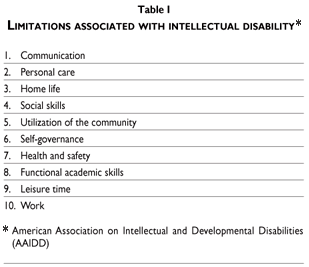
<body><![CDATA[<p><font size="2" face="Verdana">Intellectual disability (ID) is an abnormality    that has enormous social effects; it not only affects the people who suffer    from it but also the family and society as a group. Millions of people worldwide    have intellectual disability and prevalence is calculated to be 1 to 3% in developed    countries.<SUP>1</SUP> In Mexico, according to INDESOL (National Social Development    Institute) calculations, there are 2 925 000 persons with some type of intellectual    disability.<SUP>2</SUP> In spite of this fact, knowledge of its causes is very    limited and the etiological diagnosis in developed countries is almost always    established as being a little less than half of the subjects affected.<SUP>3</SUP>    The frequency with which exogenous and genetic causes are identified varies;    some authors have reported proportions ranging from 17 to 47%.<SUP>4,5</SUP>    Of course these differences are attributed to the selection of the population    studied, the degree of mental delay, the heterogeneity of study protocols, technological    advances and case definitions. This article outlines basic concepts related    to intellectual disability as a function of diagnosis, treatment and prognosis.</font></p>     <p>&nbsp;</p>     <p><font size="3" face="Verdana"><b>Definition</b></font></p>     <p><font size="2" face="Verdana">According to the tenth revision of the WHO (World    Health Organization):</font></p>     <blockquote>        <p><font size="2" face="Verdana">Intellectual disability (ID) is a disorder      defined by the presence of incomplete or arrested mental development, principally      characterized by the deterioration of concrete functions at each stage of      development and that contribute to the overall level of intelligence, such      as cognitive, language, motor and socialization functions; in this anomaly,      adaptation to the environment is always affected. For ID, scores for intellectual      development levels must be determined based on all of the available information,      including clinical signs, adaptive behavior in the cultural medium of the      individual and psychometric findings.</font></p> </blockquote>     <p><font size="2" face="Verdana">On the other hand, the American Association on    Intellectual and Developmental Disabilities (AAIDD) indicates that in addition    to a significantly sub-average intellectual functioning, concomitant limitations    are observed in two or more areas of adaptive skills, described in <a href="#tab01">table    I</a>, and the disorder presents itself before the age of 18.</font></p>     <p><a name="tab01"></a></p>     <p>&nbsp;</p>     <p align="center"><img src="/img/revistas/spm/v50s2/a05tab01.gif"></p>     ]]></body>
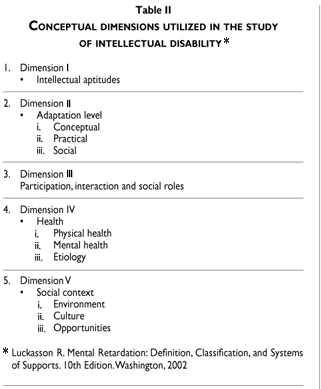
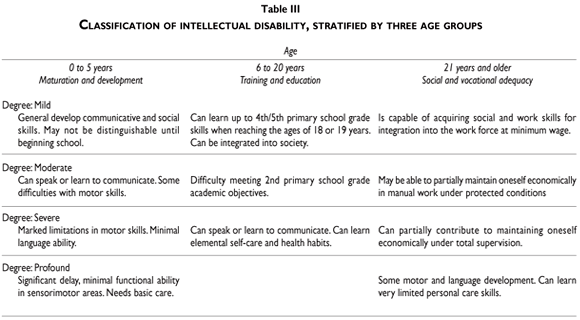
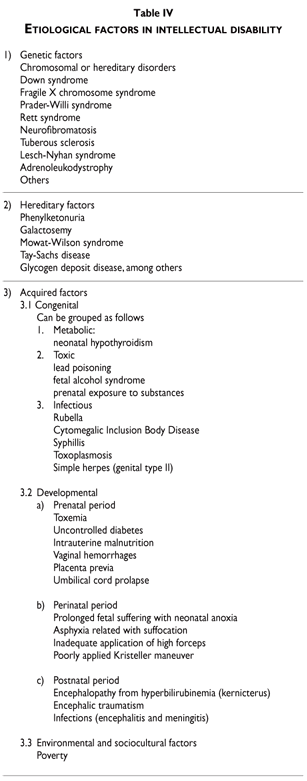
<body><![CDATA[<p>&nbsp;</p>     <p><font size="2" face="Verdana">In summary, intellectual disability is characterized    by evident limitations in intellectual functioning and adaptive conduct, the    latter expressed as conceptual, social and practical adaptive skills. Therefore,    for the study of ID, according to the AAIDD, five dimensions must be considered    (<a href="#tab02">table II</a>), one of which was recently included: the dimension    composed of participation, interaction and social networks. This definition    not only agrees with the International Association for the Scientific Study    of Intellectual Disability (IASSID), but also with the recent World Health Organization’s    International Classification of Functioning, Disability and Health (ICF).</font></p>     <p><a name="tab02"></a></p>     <p>&nbsp;</p>     <p align="center"><img src="/img/revistas/spm/v50s2/a05tab02.gif"></p>     <p>&nbsp;</p>     <p><font size="3" face="Verdana"><b>Etiopathogeny</b></font></p>     <p><font size="2" face="Verdana">Causal factors related with cognitive disability    are described in <a href="#tab03">table III</a> and can be classified as follows:    genetic, acquired (congenital and developmental), environmental and sociocultural.</font></p>     <p><a name="tab03"></a></p>     <p>&nbsp;</p>     ]]></body>
<body><![CDATA[<p align="center"><img src="/img/revistas/spm/v50s2/a05tab03.gif"></p>     <p>&nbsp;</p>     <p><font size="2" face="Verdana"><i>Genetic factors</i></font></p>     <p><font size="2" face="Verdana">Chromosomal or hereditary disorders<SUP>6</sup></font></p>     <p><font size="2" face="Verdana">The greatest number of cases are patients with    Down syndrome,<SUP>7</SUP> an anomaly that occurs in 15 of every 10000 births    and is due to chromosome 21 trisomy or the translocation of chromosomes 21 and    15. Other much less frequent chromosomal abnormalities are those of the fragile    X chromosome syndrome,<SUP>8</SUP> Prader-Willi syndrome,<SUP>9</SUP> Rett syndrome,    neurofibromatosis,<SUP>11</SUP> tuberous sclerosis,<SUP>12</SUP> Lesch-Nyhan    syndrome,<SUP>13</SUP> adrenoleukodystrophy<SUP>14</SUP> and other very rarely    occurring related conditions.</font></p>     <p><font size="2" face="Verdana"><i>Hereditary factors</i></font></p>     <p><font size="2" face="Verdana">Hereditary factors include phenylketonuria,<SUP>15</SUP>    galactosemy,<SUP>16</SUP> Mowat-Wilson syndrome,<SUP>17</SUP> Tay-Sachs disease,<SUP>18</SUP>    and glycogen deposit disease, among others. These illnesses can be easily diagnosed    when intra-hospital births are involved, during which neonatal metabolic screening    can be conducted; however, when the latter is not conducted a considerable risk    is presented since such causal factors for mental delay are not identified.</font></p>     <p><font size="2" face="Verdana"><i>Acquired factors</i></font></p>     <p><font size="2" face="Verdana">Congenital</font></p>     <p><font size="2" face="Verdana"> Can be grouped as follows:</font></p>     ]]></body>
<body><![CDATA[<blockquote>        <p><font size="2" face="Verdana">1. Metabolic: neonatal hypothyroidism;    <br>     2. Toxic: lead poisoning,<SUP>20</SUP>      fetal alcohol syndrome,<SUP>21</SUP> prenatal exposure to substances;<SUP>22      </SUP>and    <br>     3. Infectious: rubella,<SUP>23</SUP>      Cytomegalic Inclusion Body Disease,<SUP>24</SUP> syphillis,<SUP>25</SUP> toxoplasmosis,<SUP>26</SUP>      simple herpes (genital type II).<SUP>27</sup></font></p> </blockquote>     <p><font size="2" face="Verdana">Developmental</font></p>     <p><font size="2" face="Verdana">During the prenatal period, possible pregnancy    complications exist, such as toxemia<SUP>28</SUP> and uncontrolled diabetes,<SUP>29</SUP>    intrauterine malnutrition,<SUP>30</SUP> vaginal hemorrhages,<SUP>31</SUP> placenta    previa<SUP>32</SUP> and umbilical cord prolapse.<SUP>33</sup></font></p>     <p><font size="2" face="Verdana"> During the perinatal period, there are common    birth complications: prolonged fetal suffering with neonatal anoxia,<SUP>34</SUP>    asphyxia related with suffocation,<SUP>35</SUP> inadequate application of high    forceps<SUP>36</SUP> or a poorly applied Kristeller maneuver.<SUP>37</sup></font></p>     <p><font size="2" face="Verdana"> During the postnatal period, complications    are observed such as encephalopathy from hyperbilirubinemia (kernicterus),<SUP>38</SUP>    encephalic traumatism<SUP>39</SUP> and infections<SUP>40</SUP> (encephalitis    and meningitis).</font></p>     <p><font size="2" face="Verdana"><i>Environmental and sociocultural factors</i></font></p>     <p><font size="2" face="Verdana">Epidemiological studies have consistently reported    a notable link between poverty and intellectual disability. The available evidence    suggests that this connection reflects two distinct processes. The first establishes    that a relation exists between poverty and exposure to a wide range of environmental    and psychosocial factors;<SUP>41 </SUP>the second indicates that families with    members who suffer from intellectual disability have an increased risk of catastrophic    expenses that considerably affect poverty levels. These factors are direct causes    of the disproportionate increase in the incidence of intellectual disability    in developing countries.<SUP>42</SUP> Interactions have been reported between    scarcity and poor prenatal, perinatal and postnatal health care, adolescent    maternity, family instability, poor natal health care due to multiple and inadequate    caregivers and health professionals, low level of stimulation and education,    in addition to infant mistreatment.</font></p>     ]]></body>
<body><![CDATA[<p>&nbsp;</p>     <p><font size="3" face="Verdana"><b>Classification</b></font></p>     <p><font size="2" face="Verdana">Cognitive disability has as a common denominator    a subnormal intellectual functioning level; nevertheless, the extent to which    an individual is unable to face the demands established by society for the individual’s    age group has brought about four degrees of severity:<SUP>43</SUP> mild, moderate,    severe and profound. The characteristics of individuals in these age groups    have little in common with those of other age groups and, therefore, distinguishing    the limitations of each one in order to establish intervention guidelines, is    fundamental. Cognitive disability is classified according to the characteristics    outlined in <a href="#tab04">table IV</a>.</font></p>     <p><a name="tab04"></a></p>     <p>&nbsp;</p>     <p align="center"><img src="/img/revistas/spm/v50s2/a05tab04.gif"></p>     <p>&nbsp;</p>     <p><font size="3" face="Verdana"><b>Diagnosis</b></font></p>     <p><font size="2" face="Verdana">Subjects with intellectual disability and comorbidities,    especially those that are psychiatric in origin, have less social capital than    individuals with ID who do not have psychiatric disorders.<SUP>44</SUP> In addition,    the absence of legislation in developing countries, the lack of knowledge about    ID, the stigmatization and discrimination as well as the lack of training and    infrastructure for establishing a diagnosis significantly delays possibilities    for intervention and the utilization of specific services.<SUP>45</SUP> The    cultural context establishes denial on the part of the parents who are faced    with the possible diagnosis of intellectual disability. It is indisputable that    parents take on the diagnosis of mental delay with great difficulty, to the    extent that the doctor frequently chooses not to confort this reality in the    attempt to avoid the intense pain that it represents. It is unquestionable that    the acceptance of a condition that signifies a life of constant difficulties    is not easy for anyone.</font></p>     <p><font size="2" face="Verdana"> All parents expect to be gratified by their    children and hope that they will be intelligent, brilliant students, triumphant    and, subconsciously, expect then to become "a second, corrected and better    version of themselves". Nevertheless, upon confirmation of the diagnosis,    their expectations are destroyed becoming overwhelmed by a sense of loss, not    to mention the obligation of having an unwanted child. This news often provokes    feelings of guilt in the parents and outright aggression between them, in addition    to hostile reactions toward the doctor; consequently, it is necessary to be    prepared and to provide the support needed.</font></p>     ]]></body>
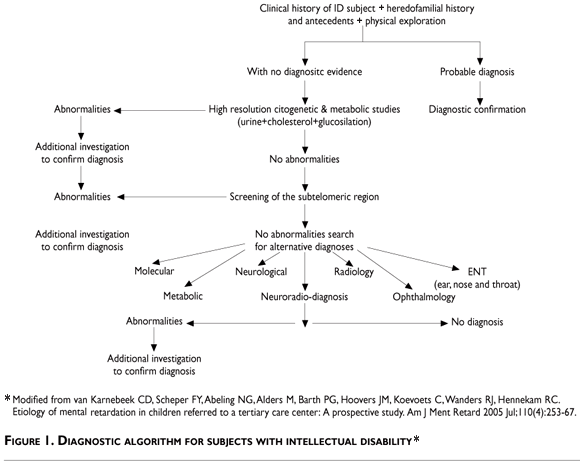
<body><![CDATA[<p><font size="2" face="Verdana"> The initial reaction is denial. Then, during    the first years, the parents justify the discrepancies during the critical development    periods while becoming more demanding as the child grows up, without results.    The impossibility of attaining the expected goals generates a great deal of    frustration and can lead to serious errors in childrearing, which without doubt,    significantly affects the psychological development of these children. As a    result, parents must face the correct diagnosis so as to minimize the denial    mechanism (among other issues that will be described later). A great deal of    empathy is required on the part of the doctor when reporting the diagnosis.    Parents need to perceive security and confidence from health professionals;    know that they will not face the problem alone and that they will receive guidance    throughout the long and arduous path.</font></p>     <p><font size="2" face="Verdana"> If the deficit is notable, the diagnosis    can be made earlier, but the effect is more devastating. It is necessary, therefore,    to provide support for accepting the diagnosis; only in this way can the search    for "magic cures" brought on by pain and denial be avoided. This not    only provokes catastrophic expenses but also extremely traumatic experiences;    each time, the failures become evident. </font></p>     <p><font size="2" face="Verdana"> When there is organic evidence, the initial    diagnosis and the need to confront the parents almost always falls on the gynecologists    or pediatricians (neonatologists). If a moderate or mild mental disability is    involved, the diagnosis is generally established by personnel in the field of    education. A referral to a doctor is recommended only if an incorrect diagnosis    is established, if behavioral problems are present or if the family requires    guidance. On occasion, when a diagnosis is determined by the educational institution,    a doctor will be consulted to corroborate the diagnosis or to advise the parents    as to treatment for behavioral disorders that prevent the child’s normal development    in school or at home. In these cases, the use of instruments for the diagnosis    is essential, such as psychometric tests, developmental scales, abilities and    adaptive behavior tests or psychopedagogical tests. These instruments are highly    useful for psychologists. Once the diagnosis is corroborated, the parents should    be advised as to the existing abilities and the expectations on the part of    the school or family, since an incompatibility could result in aberrant behavior.</font></p>     <p><font size="2" face="Verdana"> In Down syndrome, establishing a diagnosis    at birth is indispensable given that the characteristic features of this disorder    are evident; consequently, once the grief is overcome, there is a greater tendency    for acceptance on the part of the parents and society, which allows for less    to be demanded of them. As for their intellectual capacity, there is a large    discrepancy because it can vary from profound to mild disability, and in the    case of mosaicism (partial trisomy), even an average intelligence is possible.    Currently, some still believe that people with this syndrome live for just a    few years however. Thanks to medical progress, the life expectancy is roughly    50-60 years of age, at which point many develop Alzheimer’s disease.</font></p>     <p><font size="2" face="Verdana"> Another important group to mention is individuals    who possess an intelligence quotient (IQ) between 70 and 85 points range (borderline)    placing them in what is known today as limitrophe. Until the beginning of the    1980s they were considered to be subjects with mental delay, but since they    did not present adaptation problems they were not considered to have a disability.    </font></p>     <p><font size="2" face="Verdana"> Nevertheless countries like Mexico, this    population faces serious problems, especially in urban areas and mostly when    they belong to socioculturally and economically competitive classes; school    and work programs are designed for people with normal average IQ, which makes    it very difficult to satisfy such expectations. Furthermore, given their functionality    level, they can recognize their own limitations and generate a good deal of    suffering with notable tendencies toward depression. This group’s highest prevalence    is found in rural areas with the most important causal factor being family heredity;    therefore, the disorder in these cases does not result in serious conflicts    because social and family expectations adapt to their abilities. </font></p>     <p>&nbsp;</p>     <p><font size="3" face="Verdana"><b>Clinical diagnosis</b></font></p>     <p><font size="2" face="Verdana">In the <a href="#fig01">figure 1</a>, a proposed    algorithm for a diagnostic protocol is described.<SUP>46</SUP> The clinical    history must put an emphasis on health care during the prenatal, perinatal and    postnatal period and include the results of all previous studies, including    a genealogical tree for at least three generations and an intentional search    for family antecedents of mental delay, psychiatric illnesses and congenital    abnormalities.</font></p>     <p><a name="fig01"></a></p>     ]]></body>
<body><![CDATA[<p>&nbsp;</p>     <p align="center"><img src="/img/revistas/spm/v50s2/a05fig01.gif"></p>     <p>&nbsp;</p>     <p><font size="2" face="Verdana">The physical exam should focus on secondary abnormalities    and congenital malformations, somatometric measurements and neurological and    behavioral phenotype evaluations. If, as a result, signs suggesting a particular    etiological diagnosis are recognized, specific analyses are requested; in the    case of Rett syndrome, an MeCP2 gene mutation analysis is recommended.</font></p>     <p>&nbsp;</p>     <p><font size="3" face="Verdana"><b>Search for genetic abnormalities</b></font></p>     <p><font size="2" face="Verdana">If it is not feasible to establish a clinical    diagnosis, it is necessary to conduct high-resolution cytogenetic studies<SUP>47</SUP>    in addition to metabolic clinical evaluations.<SUP>48</sup></font></p>     <p><font size="2" face="Verdana"> For patients with normal results from the    previously mentioned analyses, it is possible to request fluorescence <I>in    situ</I> hybridization (FISH)<SUP>49</SUP> which is an evaluation of the entire    subtelomeric region. In the next step, if no abnormal data are identified, submicroscopic    chromosomal disorders are evaluated.</font></p>     <p><font size="2" face="Verdana"> Neuroimages can be useful only if the occipitofrontal    circumference of the head is abnormal –below the second or above the 98th percentile–    or if the neurological exams reveal abnormalities. In addition, they are recommended    if a specific neuroanatomical effect exists (tuberous sclerosis) or a clinical    history indicates perinatal hypoxy.</font></p>     <p><font size="2" face="Verdana"> Metabolic analyses can include urinary tests    for amino acids, organic acids, oligosaccharides, mucopolysaccarides and uric    acid. Plasma levels 7- and 8- dehydrocholesterol for total cholesterol and dienesterol    are useful for identifying defects in the distal cholesterol pathways. Other    diagnostic tests can be conducted for finding congenital disorders of glycosylation.<SUP>50</sup></font></p>     ]]></body>
<body><![CDATA[<p>&nbsp;</p>     <p><font size="3" face="Verdana"><b>Differential diagnosis</b></font></p>     <p><font size="2" face="Verdana">Since mental delay is a developmental disorder    that is secondary to many etiological factors, there are few nosological units    with which they can be confused; among these are generalized developmental disorders<SUP>51</SUP>    (DSM IV 299.00 to 299.80) and, in particular, autism with low-functionality    and autistic spectrum disorders.<SUP>52</SUP> Nevertheless, it is important    to establish a differential diagnosis since, while some therapeutic interventions    are similar with respect to social and work inclusion programs, future expectations    are very different.</font></p>     <p>&nbsp;</p>     <p><font size="3" face="Verdana"><b>The clinical profile</b></font></p>     <p><font size="2" face="Verdana">Based on the gradual division described above,    it is possible to infer that a specific clinical profile does not exist; each    one of the levels for each group has its own clinical characteristics.</font></p>     <p><font size="2" face="Verdana"> Symptoms are closely related to the specific    sensorimotor, linguistic and cognitive processes, among others. The more moderate    the disability, the less evident its symptoms; perhaps alterations in language    construction shed more light and, in particular, the comprehension level and    behavior of the children themselves compared with that of a chronologically    younger age. It is useful to ask the parents if they can establish a comparative    age in relation to brothers and sisters or close cousins in the family (if they    exist) who could serve as a reference. Parents often say that the patient "speaks    and understands everything"; in this case it is important to clarify if    they are referring to the use of nouns and verbs or the comprehension of orders    and concepts.</font></p>     <p><font size="2" face="Verdana"> It is essential to give credibility to the    parents when they insist that a doctor recognize a developmental disorder. It    is true that in some cases they tend to be delay or apprehensive or overprotective,    but it is more often the case that their perceptions are based on objective,    comparative judgments and are therefore correct. Frequently, by the time they    get to a doctor who establishes the diagnosis, they painfully express the great    frustration that they experienced when they had to repeatedly tell their doctor    that "something was wrong," especially if that doctor insisted on    not making comparisons and affirming that "no two human beings are alike,"    that "developing the skills is just a question of time"; such an attitude    causes late intervention, among other things. When a diagnosis of slow-learner    is established, this creates confusion since it suggests normality rather than    disability.</font></p>     <p>&nbsp;</p>     <p><font size="3" face="Verdana"><b>Comorbidities</b></font></p>     ]]></body>
<body><![CDATA[<p><font size="2" face="Verdana">Individuals who suffer mental delay are more    vulnerable for developing a psychiatric abnormality. Statistics exist today    that confirm that this population experiences two or three times more mood disorders,    anxiety disorders and behavioral problems than persons without intellectual    disability.<SUP>53</SUP> Such vulnerability, on occasion, leads to a set of    psychotic symptoms that are secondary to the stress experienced when social,    family and school demands are excessive.<SUP>54</SUP> On the other hand, other    illnesses comorbidly exist that are unrelated to this vulnerability factor;    the most common being epilepsy,<SUP>55</SUP> attention deficit disorder and    hyperactivity,<SUP>56</SUP> schizophrenia<SUP>57</SUP> and infantile cerebral    paralysis.</font></p>     <p>&nbsp;</p>     <p><font size="3" face="Verdana"><b>Treatment</b></font></p>     <p><font size="2" face="Verdana">Cognitive disability must, evidently, be understood    and diagnosed as a developmental disorder, but fundamental for providing adequate    professional care; than to take into account the intellectual level of the patient    and his or her ability to adapt to the existing environment and, of utmost importance,    the reaction of the parents to this situation.</font></p>     <p><font size="2" face="Verdana"> Since cognitive disability is not curable,    the treatment objectives must focus on the normalization of behavior in accordance    with the norms and rules determined by society. To this end, intervention as    early as possible is fundamental since treatment for developmental disorders    can reach its maximum scope only through early intervention. It must be remembered    that the process of cerebral plasticity has its greatest potential during to    the first five years of life and this is one of the most important supporting    factors in attaining the therapeutic goals. Furthermore, since the behavior    disorders which are so frequently observed are secondary –due to deficient childrearing    in the majority of cases– the parents must be worked with and advised as to    adequate childrearing methods for developing adaptation patterns that lead to    optimal social integration.</font></p>     <p><font size="2" face="Verdana"> People with mental delay, being limited to    a mental age of less than 13 years, cannot aspire to levels of abstract cognitive    thought that in normal conditions appear at the beginning of adolescence; for    this reason, educational objectives must be focused on the development of skills    for achieving a self-sufficient life at an adult age and not on schooling as    it happens in many countries. In addition, interaction between peers should    be promoted for creating group belonging (relationships with others with approximately    the same disability level).</font></p>     <p><font size="2" face="Verdana"> It is evident that the results obtained depend    on the age of the subject when the diagnosis is established and when treatment    is initiated, the severity of the disability, the affected areas and the methods    or techniques used for rehabilitating these areas. Accordingly, treatment is    established in the following manner:</font></p>     <p><font size="2" face="Verdana"> During the infancy period (zero to two years),    disorders in muscular tone and motor development are treated (motor therapy)    and signs of sensory disintegration that almost always accompany motor problems    are treated through sensory integration therapy. As for the linguistic developmental    disorders themselves, symbolization processes are treated (language therapy)    as well as muscular tone alterations that affect respiration, phonation and    the bucofacial region (articulation therapy). Likewise, cognitive stimulation    should be used for these children at the onset of treatment.</font></p>     <p><font size="2" face="Verdana"> When children are diagnosed after two years    of age and before puberty, the ideal is to use instruments that determine the    maturity level for each one of the developmental areas and apply the same therapies    (motor, sensory, linguistic, etc.), in addition promoting the development of    perceptual abilities, with deficits in, and learning abilities (reading, writing,    mathematics, etc.), using techniques similar to those used in children with    learning disorders (dyslexia, etc.).</font></p>     <p><font size="2" face="Verdana"> It is common to observe behavioral problems    in this population, which often motivate parents to seek out professional advice;    therefore, behavioral therapy should be included in the health care plan and    should be based on humanistic principles (clarification of feelings and positive    reinforcement) and not on aversion techniques. Finally, it is essential to work    with independent living skills and give the individual the necessary elements    for self-sufficiency.</font></p>     ]]></body>
<body><![CDATA[<p><font size="2" face="Verdana"> Although it is rare, an adolescent can be    seen in the doctor’s office for poor academic performance or behavioral problems    without having been previously diagnosed with ID. This most likely involves    a subject with limitrophe and who, upon entering middle school, does not manage    to pass the subjects that require abstract thinking (mathematics, physics, chemistry,    etc.).</font></p>     <p><font size="2" face="Verdana"> In these cases, as well as for adolescents    and adults with intellectual disability, programs oriented toward independent    living should be recommended. These programs should cover the areas necessary    for achieving a partially or totally self-sufficient life, among which are:    the academic-basic skills, community integration programs, developing skills    for managing domestic tasks, personal healthcare and sexuality. In addition,    a prevocational program should be included for the development of abilities    for the workplace and, when possible, for the individual to become integrated    into the labor market.</font></p>     <p><font size="2" face="Verdana"> Pharmacological treatment is used for the    treatment of comorbidities, and is specific for each one according to the criteria    followed for these disorders, both in psychiatry and in neurology. On occasion,    when a favorable response is not obtained, a random treatment scheme is established.    In the case of attention deficit disorder and hyperactivity, the use of stimulants    for the central nervous system (the treatment of choice for this disorder) had    been considered not to produce favorable results; nevertheless, recent research    shows that elevated doses of methylphenidate (0.60 mg/kg) produce obvious improvements    in symptoms related to inattention, impulsivity and hyperactivity. </font></p>     <p><font size="2" face="Verdana"> Because of the above, it is evident that    treatment for persons with cognitive disability must be multidisciplinary and    include medicine (family, pediatrics, neurology and psychiatry), psychology    (educational and clinical), education (regular, and special), rehabilitation    (physical, occupational and recreational), nursing, social work, etcetera.</font></p>     <p>&nbsp;</p>     <p><font size="3" face="Verdana"><b>Prognosis</b></font></p>     <p><font size="2" face="Verdana">As was already established, intellectual disability    is not curable; and yet, the prognosis in general terms is good when using the    emotional wellbeing of the individual as a parameter. When the parents of these    subjects are asked, after they have accepted the diagnosis, they express than    their long-term expectation, that "their children be happy" or that    "they be self-sufficient"; that is, to see them content and self-sufficient    compensates for the lost hope of having a professional child or one that satisfies    the parents’ unfulfilled dreams. This is a striking contrast with parents who    reject the disability and for whom the only acceptable parameter is "normality."    Of course, in these cases, the patients not only suffer more but the parents    also live in constant agony.</font></p>     <p><font size="2" face="Verdana"> Other conditions exist that, when attained,    guarantee the achievement of the objectives and, therefore, the prognosis in    terms of obtaining that state of happiness is wholly viable. It is feasible    to see an adult with mild or moderate cognitive disability or limitrophe maintain    a job, travel to the city, take care of his or her apartment, have a social    life or, in other words, manage on one’s own. It is therefore necessary to fulfill    the following requirements.</font></p>     <p><font size="2" face="Verdana"> The first and most important is the parents’    acceptance of their children’s limitations and the impossibility of attaining    "normality." After this, the age upon beginning the rehabilitation    program should be considered as well as obtaining a level of continual productivity    that is consistent with the disability, the existence of a group to which to    belong and, lastly, the unconditional affection of the parents. It has been    stated that the above mentioned factors reduce psychiatric comorbidities (depression,    anxiety, behavior) and a prevalence equal to that of the non-disabled population    is found; or as one patient said who was asked how it feels to attend an independent    living center: "I know I can’t go to the university like my brothers and    sisters but I can do everything that they can do."</font></p>     <p>&nbsp;</p>     ]]></body>
<body><![CDATA[<p><font size="3" face="Verdana"><b>Conclusions</b></font></p>     <p><font size="2" face="Verdana">Intellectual disability should be treated in    a comprehensive manner. Nevertheless, currently, the fundamental task and perhaps    the only one that applies is the detection of the limitation and abilities as    a function of subjects’ age and expectations for the future, with the only goal    being to provide the support necessary for each one of the dimensions or areas    in which the person’s life is expressed and exposed. Nevertheless, this perspective    tends to be reductionistic and subjects with disabilities who live in developing    countries should have multiple social benefits that today are not present, and    there are no signs of them on the near horizon. </font></p>     <p><font size="2" face="Verdana"> Intellectual disability has been absent in    the political, social and economic agenda of the countries in the region. In    this sense, Mexico is no exception. Subjects with intellectual disability are    not considered in the planning strategies for health services, the predominant    educational proposals are not based on scientific evidence and virtually no    research has been developed in this knowledge area. Substantive but elemental    aspects for a dignified life for individuals with intellectual disabilities    must be a priority in the legislative arena. Among these are the possibilities    for guaranteeing human development, teaching and education, home life, community    life, work, health and security, optimal behavioral development, social integration,    as well as protection and defense. The organized social response for confronting    the social needs of subjects with intellectual disabilities cannot be delayed    indefinitely. </font></p>     <p>&nbsp;</p>     <p><font size="3" face="Verdana"><b>References</b></font></p>     <!-- ref --><p><font size="2" face="Verdana">1. Petterson B, Bourke J, Leonard H, Jacoby P,    Bower C. Co-occurrence of birth defects and intellectual disability. Paediatr    Perinat Epidemiol 2007;21(1):65-75.</font>&nbsp;&nbsp;&nbsp;&nbsp;&nbsp;&nbsp;&nbsp;&nbsp;[&#160;<a href="javascript:void(0);" onclick="javascript: window.open('/scielo.php?script=sci_nlinks&ref=9314158&pid=S0036-3634200800080000500001&lng=','','width=640,height=500,resizable=yes,scrollbars=1,menubar=yes,');">Links</a>&#160;]<!-- end-ref --><!-- ref --><p><font size="2" face="Verdana">2. Available at: <a href="http://www.indesol.gob.mx" target="_blank">http://www.indesol.gob.mx</a>    &#91;Consultado 25 noviembre 2006&#93;</font>&nbsp;&nbsp;&nbsp;&nbsp;&nbsp;&nbsp;&nbsp;&nbsp;[&#160;<a href="javascript:void(0);" onclick="javascript: window.open('/scielo.php?script=sci_nlinks&ref=9314159&pid=S0036-3634200800080000500002&lng=','','width=640,height=500,resizable=yes,scrollbars=1,menubar=yes,');">Links</a>&#160;]<!-- end-ref --><!-- ref --><p><font size="2" face="Verdana">3. Battaglia A, Bianchini E, Carey JC. Diagnostic    yield of the comprehensive assessment of developmental delay/mental retardation    in an institute of child neuropsychiatry. Am J Med Genet 1999;82(1):60-66.</font>&nbsp;&nbsp;&nbsp;&nbsp;&nbsp;&nbsp;&nbsp;&nbsp;[&#160;<a href="javascript:void(0);" onclick="javascript: window.open('/scielo.php?script=sci_nlinks&ref=9314160&pid=S0036-3634200800080000500003&lng=','','width=640,height=500,resizable=yes,scrollbars=1,menubar=yes,');">Links</a>&#160;]<!-- end-ref --><!-- ref --><p><font size="2" face="Verdana">4. Bundey S, Webb TP, Thake A, Todd J. A community    study of severe mental retardation in the West Midlands and the importance of    the fragile X chromosome in its aetiology. J Med Genet 1985;22(4):258-266.</font>&nbsp;&nbsp;&nbsp;&nbsp;&nbsp;&nbsp;&nbsp;&nbsp;[&#160;<a href="javascript:void(0);" onclick="javascript: window.open('/scielo.php?script=sci_nlinks&ref=9314161&pid=S0036-3634200800080000500004&lng=','','width=640,height=500,resizable=yes,scrollbars=1,menubar=yes,');">Links</a>&#160;]<!-- end-ref --><!-- ref --><p> <font size="2" face="Verdana">5. Skuse DH. Rethinking the nature of genetic    vulnerability to autistic spectrum disorders. Trends Genet 2007;23(8):387-395.</font>&nbsp;&nbsp;&nbsp;&nbsp;&nbsp;&nbsp;&nbsp;&nbsp;[&#160;<a href="javascript:void(0);" onclick="javascript: window.open('/scielo.php?script=sci_nlinks&ref=9314162&pid=S0036-3634200800080000500005&lng=','','width=640,height=500,resizable=yes,scrollbars=1,menubar=yes,');">Links</a>&#160;]<!-- end-ref --><!-- ref --><p> <font size="2" face="Verdana">6. Schrander-Stumpel CT, Sinnema M, van den Hout    L, Maaskant MA, van Schrojenstein Lantman-de Valk HM, Wagemans A, Schrander    JJ, Curfs LM. Healthcare transition in persons with intellectual disabilities:    general issues, the Maastricht model, and Prader-Willi syndrome. Am J Med Genet    C Semin Med Genet 2007;145(3):241-247.</font>&nbsp;&nbsp;&nbsp;&nbsp;&nbsp;&nbsp;&nbsp;&nbsp;[&#160;<a href="javascript:void(0);" onclick="javascript: window.open('/scielo.php?script=sci_nlinks&ref=9314163&pid=S0036-3634200800080000500006&lng=','','width=640,height=500,resizable=yes,scrollbars=1,menubar=yes,');">Links</a>&#160;]<!-- end-ref --><!-- ref --><p> <font size="2" face="Verdana">7. Maatta T, Tervo-Maatta T, Taanila A, Kaski    M, Iivanainen M. Mental health, behaviour and intellectual abilities of people    with Down syndrome. Downs Syndr Res Pract 2006;11(1):37-43.</font>&nbsp;&nbsp;&nbsp;&nbsp;&nbsp;&nbsp;&nbsp;&nbsp;[&#160;<a href="javascript:void(0);" onclick="javascript: window.open('/scielo.php?script=sci_nlinks&ref=9314164&pid=S0036-3634200800080000500007&lng=','','width=640,height=500,resizable=yes,scrollbars=1,menubar=yes,');">Links</a>&#160;]<!-- end-ref --><!-- ref --><p> <font size="2" face="Verdana">8. Reiss AL, Hall SS. Fragile X syndrome: assessment    and treatment implications. Child Adolesc Psychiatr Clin N Am 2007;16(3):663-675.</font>&nbsp;&nbsp;&nbsp;&nbsp;&nbsp;&nbsp;&nbsp;&nbsp;[&#160;<a href="javascript:void(0);" onclick="javascript: window.open('/scielo.php?script=sci_nlinks&ref=9314165&pid=S0036-3634200800080000500008&lng=','','width=640,height=500,resizable=yes,scrollbars=1,menubar=yes,');">Links</a>&#160;]<!-- end-ref --><!-- ref --><p> <font size="2" face="Verdana">9. Jauregi J, Arias C, Vegas O, Alen F, Martinez    S, Copet P, Thuilleaux D. A neuropsychological assessment of frontal cognitive    functions in Prader-Willi syndrome. J Intellect Disabil Res 2007;51(Pt 5):350-365.</font>&nbsp;&nbsp;&nbsp;&nbsp;&nbsp;&nbsp;&nbsp;&nbsp;[&#160;<a href="javascript:void(0);" onclick="javascript: window.open('/scielo.php?script=sci_nlinks&ref=9314166&pid=S0036-3634200800080000500009&lng=','','width=640,height=500,resizable=yes,scrollbars=1,menubar=yes,');">Links</a>&#160;]<!-- end-ref --><!-- ref --><p> <font size="2" face="Verdana">10. Weaving LS, Ellaway CJ, Gecz J, Christodoulou    J. Rett syndrome: clinical review and genetic update. J Med Genet 2005;42(1):1-7.</font>&nbsp;&nbsp;&nbsp;&nbsp;&nbsp;&nbsp;&nbsp;&nbsp;[&#160;<a href="javascript:void(0);" onclick="javascript: window.open('/scielo.php?script=sci_nlinks&ref=9314167&pid=S0036-3634200800080000500010&lng=','','width=640,height=500,resizable=yes,scrollbars=1,menubar=yes,');">Links</a>&#160;]<!-- end-ref --><!-- ref --><p> <font size="2" face="Verdana">11. Mouridsen SE, Sorensen SA. Psychological aspects    of von Recklinghausen neurofibromatosis (NF1). J Med Genet 1995;32(12):921-924.</font>&nbsp;&nbsp;&nbsp;&nbsp;&nbsp;&nbsp;&nbsp;&nbsp;[&#160;<a href="javascript:void(0);" onclick="javascript: window.open('/scielo.php?script=sci_nlinks&ref=9314168&pid=S0036-3634200800080000500011&lng=','','width=640,height=500,resizable=yes,scrollbars=1,menubar=yes,');">Links</a>&#160;]<!-- end-ref --><!-- ref --><p> <font size="2" face="Verdana">12. Raznahan A, Higgins NP, Griffiths PD, Humphrey    A, Yates JR, Bolton PF. Biological markers of intellectual disability in tuberous    sclerosis. Psychol Med 2007;37(9):1293-304.</font>&nbsp;&nbsp;&nbsp;&nbsp;&nbsp;&nbsp;&nbsp;&nbsp;[&#160;<a href="javascript:void(0);" onclick="javascript: window.open('/scielo.php?script=sci_nlinks&ref=9314169&pid=S0036-3634200800080000500012&lng=','','width=640,height=500,resizable=yes,scrollbars=1,menubar=yes,');">Links</a>&#160;]<!-- end-ref --><!-- ref --><p> <font size="2" face="Verdana">13. Nyhan WL, Wulfeck BB, Tallal P, Marsden DL.    Metabolic correlates of learning disability. Birth Defects Orig Artic Ser 1989;25(6):153-169.</font>&nbsp;&nbsp;&nbsp;&nbsp;&nbsp;&nbsp;&nbsp;&nbsp;[&#160;<a href="javascript:void(0);" onclick="javascript: window.open('/scielo.php?script=sci_nlinks&ref=9314170&pid=S0036-3634200800080000500013&lng=','','width=640,height=500,resizable=yes,scrollbars=1,menubar=yes,');">Links</a>&#160;]<!-- end-ref --><!-- ref --><p> <font size="2" face="Verdana">14. Feanny SJ, Chuang SH, Becker LE, Clarke JT.    Intracerebral paraventricular hyperdensities: a new CT sign in Krabbe globoid    cell leukodystrophy. J Inherit Metab Dis 1987;10(1):24-27.</font>&nbsp;&nbsp;&nbsp;&nbsp;&nbsp;&nbsp;&nbsp;&nbsp;[&#160;<a href="javascript:void(0);" onclick="javascript: window.open('/scielo.php?script=sci_nlinks&ref=9314171&pid=S0036-3634200800080000500014&lng=','','width=640,height=500,resizable=yes,scrollbars=1,menubar=yes,');">Links</a>&#160;]<!-- end-ref --><!-- ref --><p> <font size="2" face="Verdana">15. Kalkanoglu HS, Ahring KK, Sertkaya D, Moller    LB, Romstad A, Mikkelsen I, Guldberg P, Lou HC, Guttler F. Behavioural effects    of phenylalanine-free amino acid tablet supplementation in intellectually disabled    adults with untreated phenylketonuria. Acta Paediatr 2005;94(9):1218-1222.</font>&nbsp;&nbsp;&nbsp;&nbsp;&nbsp;&nbsp;&nbsp;&nbsp;[&#160;<a href="javascript:void(0);" onclick="javascript: window.open('/scielo.php?script=sci_nlinks&ref=9314172&pid=S0036-3634200800080000500015&lng=','','width=640,height=500,resizable=yes,scrollbars=1,menubar=yes,');">Links</a>&#160;]<!-- end-ref --><!-- ref --><p> <font size="2" face="Verdana">16. Campos AP, Vaz C, Duque F, Leite M, Vilarinho    L, Diogo L, Garcia P. Galactosemia: a neurometabolic disease. Rev Neurol 2007;44(11):702-703.    </font>&nbsp;&nbsp;&nbsp;&nbsp;&nbsp;&nbsp;&nbsp;&nbsp;[&#160;<a href="javascript:void(0);" onclick="javascript: window.open('/scielo.php?script=sci_nlinks&ref=9314173&pid=S0036-3634200800080000500016&lng=','','width=640,height=500,resizable=yes,scrollbars=1,menubar=yes,');">Links</a>&#160;]<!-- end-ref --><!-- ref --><p> <font size="2" face="Verdana">17. Van de Putte T, Francis A, Nelles L, van Grunsven    LA, Huylebroeck D. Neural crest-specific removal of Zfhx1b in mouse leads to    a wide range of neurocristopathies reminiscent of Mowat-Wilson syndrome. Hum    Mol Genet 2007;16(12):1423-1436.</font>&nbsp;&nbsp;&nbsp;&nbsp;&nbsp;&nbsp;&nbsp;&nbsp;[&#160;<a href="javascript:void(0);" onclick="javascript: window.open('/scielo.php?script=sci_nlinks&ref=9314174&pid=S0036-3634200800080000500017&lng=','','width=640,height=500,resizable=yes,scrollbars=1,menubar=yes,');">Links</a>&#160;]<!-- end-ref --><!-- ref --><p> <font size="2" face="Verdana">18. Vallance H, Morris TJ, Coulter-Mackie M, Lim-Steele    J, Kaback M. Common HEXB polymorphisms reduce serum HexA and HexB enzymatic    activities, potentially masking Tay-Sachs disease carrier identification. Mol    Genet Metab 2006;87(2):122-127.</font>&nbsp;&nbsp;&nbsp;&nbsp;&nbsp;&nbsp;&nbsp;&nbsp;[&#160;<a href="javascript:void(0);" onclick="javascript: window.open('/scielo.php?script=sci_nlinks&ref=9314175&pid=S0036-3634200800080000500018&lng=','','width=640,height=500,resizable=yes,scrollbars=1,menubar=yes,');">Links</a>&#160;]<!-- end-ref --><p> <font size="2" face="Verdana">19. Buyukgebiz A. Congenital hypothyroidism clinical    aspects and late consequences. Pediatr Endocrinol Rev 2003;1(suppl 2):185-190.</font></p>     <!-- ref --><p> <font size="2" face="Verdana">20. T&eacute;llez-Rojo MM, Bellinger DC, Arroyo-Quiroz    C, Lamadrid-Figueroa H, Mercado-Garc&iacute;a A, Schnaas-Arrieta L, Wright RO,    Hern&aacute;ndez-&Aacute;vila M, Hu H. Longitudinal associations between blood    lead concentrations lower than 10 microg/dl and neurobehavioral development    in environmentally exposed children in Mexico City. Pediatrics 2006;118(2):e323-e230.</font>&nbsp;&nbsp;&nbsp;&nbsp;&nbsp;&nbsp;&nbsp;&nbsp;[&#160;<a href="javascript:void(0);" onclick="javascript: window.open('/scielo.php?script=sci_nlinks&ref=9314177&pid=S0036-3634200800080000500020&lng=','','width=640,height=500,resizable=yes,scrollbars=1,menubar=yes,');">Links</a>&#160;]<!-- end-ref --><!-- ref --><p> <font size="2" face="Verdana">21. Kodituwakku PW. Defining the behavioral phenotype    in children with fetal alcohol spectrum disorders: a review. Neurosci Biobehav    Rev 2007;31(2):192-201.</font>&nbsp;&nbsp;&nbsp;&nbsp;&nbsp;&nbsp;&nbsp;&nbsp;[&#160;<a href="javascript:void(0);" onclick="javascript: window.open('/scielo.php?script=sci_nlinks&ref=9314178&pid=S0036-3634200800080000500021&lng=','','width=640,height=500,resizable=yes,scrollbars=1,menubar=yes,');">Links</a>&#160;]<!-- end-ref --><!-- ref --><p> <font size="2" face="Verdana">22. Morrow CE, Culbertson JL, Accornero VH, Xue    L, Anthony JC, Bandstra ES. Learning disabilities and intellectual functioning    in school-aged children with prenatal cocaine exposure. Dev Neuropsychol 2006;30(3):905-931.</font>&nbsp;&nbsp;&nbsp;&nbsp;&nbsp;&nbsp;&nbsp;&nbsp;[&#160;<a href="javascript:void(0);" onclick="javascript: window.open('/scielo.php?script=sci_nlinks&ref=9314179&pid=S0036-3634200800080000500022&lng=','','width=640,height=500,resizable=yes,scrollbars=1,menubar=yes,');">Links</a>&#160;]<!-- end-ref --><!-- ref --><p> <font size="2" face="Verdana">23. Desmond MM, Montgomery JR, Melnick JL, Cochran    GG, Verniaud W. Congenital rubella encephalitis. Effects on growth and early    development. Am J Dis Child 1969;118(1):30-31.</font>&nbsp;&nbsp;&nbsp;&nbsp;&nbsp;&nbsp;&nbsp;&nbsp;[&#160;<a href="javascript:void(0);" onclick="javascript: window.open('/scielo.php?script=sci_nlinks&ref=9314180&pid=S0036-3634200800080000500023&lng=','','width=640,height=500,resizable=yes,scrollbars=1,menubar=yes,');">Links</a>&#160;]<!-- end-ref --><!-- ref --><p> <font size="2" face="Verdana">24. Odeberg J, Wolmer N, Falci S, Westgren M,    Sundtrom E, Seiger A, Soderberg-Naucler C. Late human cytomegalovirus (HCMV)    proteins inhibit differentiation of human neural precursor cells into astrocytes.    J Neurosci Res 2007;85(3):583-593.</font>&nbsp;&nbsp;&nbsp;&nbsp;&nbsp;&nbsp;&nbsp;&nbsp;[&#160;<a href="javascript:void(0);" onclick="javascript: window.open('/scielo.php?script=sci_nlinks&ref=9314181&pid=S0036-3634200800080000500024&lng=','','width=640,height=500,resizable=yes,scrollbars=1,menubar=yes,');">Links</a>&#160;]<!-- end-ref --><!-- ref --><p><font size="2" face="Verdana">25. Gilad R, Lampl Y, Blumstein G, Dan M. Neurosyphilis:    the reemergence of an historical disease. Isr Med Assoc J 2007;9(2):117-118.</font>&nbsp;&nbsp;&nbsp;&nbsp;&nbsp;&nbsp;&nbsp;&nbsp;[&#160;<a href="javascript:void(0);" onclick="javascript: window.open('/scielo.php?script=sci_nlinks&ref=9314182&pid=S0036-3634200800080000500025&lng=','','width=640,height=500,resizable=yes,scrollbars=1,menubar=yes,');">Links</a>&#160;]<!-- end-ref --><!-- ref --><p> <font size="2" face="Verdana">26. Sharif M, Ziaei H, Daryani A, Ajami A. Seroepidemiological    study of toxoplasmosis in intellectual    disability children in rehabilitation centers of northern Iran. Res Dev Disabil    2007;28(3):219-224.</font>&nbsp;&nbsp;&nbsp;&nbsp;&nbsp;&nbsp;&nbsp;&nbsp;[&#160;<a href="javascript:void(0);" onclick="javascript: window.open('/scielo.php?script=sci_nlinks&ref=9314183&pid=S0036-3634200800080000500026&lng=','','width=640,height=500,resizable=yes,scrollbars=1,menubar=yes,');">Links</a>&#160;]<!-- end-ref --><!-- ref --><p><font size="2" face="Verdana">27. Seppanen M, Meri S, Notkola IL, Seppala IJ,    Hiltunen-Back E, Sarvas H, Lappalainen M, Valimaa H, Palikhe A, Valtonen VV,    Lokki ML. Subtly impaired humoral immunity predisposes to frequently recurring    genital herpes simplex virus type 2 infection and herpetic neuralgia. J Infect    Dis 2006;194(5):571-578.</font>&nbsp;&nbsp;&nbsp;&nbsp;&nbsp;&nbsp;&nbsp;&nbsp;[&#160;<a href="javascript:void(0);" onclick="javascript: window.open('/scielo.php?script=sci_nlinks&ref=9314184&pid=S0036-3634200800080000500027&lng=','','width=640,height=500,resizable=yes,scrollbars=1,menubar=yes,');">Links</a>&#160;]<!-- end-ref --><!-- ref --><p> <font size="2" face="Verdana">28. Juul-Dam N, Townsend J, Courchesne E. Prenatal,    perinatal, and neonatal factors in autism, pervasive developmental disorder-not    otherwise specified, and the general population. Pediatrics 2001;107(4):E63.</font>&nbsp;&nbsp;&nbsp;&nbsp;&nbsp;&nbsp;&nbsp;&nbsp;[&#160;<a href="javascript:void(0);" onclick="javascript: window.open('/scielo.php?script=sci_nlinks&ref=9314185&pid=S0036-3634200800080000500028&lng=','','width=640,height=500,resizable=yes,scrollbars=1,menubar=yes,');">Links</a>&#160;]<!-- end-ref --><!-- ref --><p> <font size="2" face="Verdana">29. Leonard H, de Klerk N, Bourke J, Bower C.    Maternal health in pregnancy and intellectual disability in the offspring: a    population-based study. Ann Epidemiol 2006;16(6):448-454.</font>&nbsp;&nbsp;&nbsp;&nbsp;&nbsp;&nbsp;&nbsp;&nbsp;[&#160;<a href="javascript:void(0);" onclick="javascript: window.open('/scielo.php?script=sci_nlinks&ref=9314186&pid=S0036-3634200800080000500029&lng=','','width=640,height=500,resizable=yes,scrollbars=1,menubar=yes,');">Links</a>&#160;]<!-- end-ref --><!-- ref --><p> <font size="2" face="Verdana">30. Calis EA, Olieman JF, Rieken R, Penning C.    Impact of malnutrition on gastrointestinal disorders and gross motor abilities    in children with cerebral palsy. Brain Dev 2007;29(8):534.</font>&nbsp;&nbsp;&nbsp;&nbsp;&nbsp;&nbsp;&nbsp;&nbsp;[&#160;<a href="javascript:void(0);" onclick="javascript: window.open('/scielo.php?script=sci_nlinks&ref=9314187&pid=S0036-3634200800080000500030&lng=','','width=640,height=500,resizable=yes,scrollbars=1,menubar=yes,');">Links</a>&#160;]<!-- end-ref --><!-- ref --><p> <font size="2" face="Verdana">31. Scheller JM, Nelson KB. Does cesarean delivery    prevent cerebral palsy or other neurologic problems of childhood? Obstet Gynecol    1994;83(4):624-630.</font>&nbsp;&nbsp;&nbsp;&nbsp;&nbsp;&nbsp;&nbsp;&nbsp;[&#160;<a href="javascript:void(0);" onclick="javascript: window.open('/scielo.php?script=sci_nlinks&ref=9314188&pid=S0036-3634200800080000500031&lng=','','width=640,height=500,resizable=yes,scrollbars=1,menubar=yes,');">Links</a>&#160;]<!-- end-ref --><!-- ref --><p> <font size="2" face="Verdana">32. Naeye RL. Placenta previa. Predisposing factors    and effects on the fetus and surviving infants. Obstet Gynecol 1978;52(5):521-525.</font>&nbsp;&nbsp;&nbsp;&nbsp;&nbsp;&nbsp;&nbsp;&nbsp;[&#160;<a href="javascript:void(0);" onclick="javascript: window.open('/scielo.php?script=sci_nlinks&ref=9314189&pid=S0036-3634200800080000500032&lng=','','width=640,height=500,resizable=yes,scrollbars=1,menubar=yes,');">Links</a>&#160;]<!-- end-ref --><!-- ref --><p> <font size="2" face="Verdana">33. Niswander KR, Gordon M, Drage JS. The effect    of intrauterine hypoxia on the child surviving to 4 years. Am J Obstet Gynecol    1975;121(7): 892-899.</font>&nbsp;&nbsp;&nbsp;&nbsp;&nbsp;&nbsp;&nbsp;&nbsp;[&#160;<a href="javascript:void(0);" onclick="javascript: window.open('/scielo.php?script=sci_nlinks&ref=9314190&pid=S0036-3634200800080000500033&lng=','','width=640,height=500,resizable=yes,scrollbars=1,menubar=yes,');">Links</a>&#160;]<!-- end-ref --><!-- ref --><p><font size="2" face="Verdana">34. Ambalavanan N, Carlo WA, Shankaran S, Bann    CM, Emrich SL, Higgins RD, Tyson JE, O’Shea TM, Laptook AR, Ehrenkranz RA, Donovan    EF, Walsh MC, Goldberg RN, Das A; National Institute of Child Health and Human    Development Neonatal Research Network. Predicting outcomes of neonates diagnosed    with hypoxemic-ischemic encephalopathy. Pediatrics 2006;118(5):2084-2093.</font>&nbsp;&nbsp;&nbsp;&nbsp;&nbsp;&nbsp;&nbsp;&nbsp;[&#160;<a href="javascript:void(0);" onclick="javascript: window.open('/scielo.php?script=sci_nlinks&ref=9314191&pid=S0036-3634200800080000500034&lng=','','width=640,height=500,resizable=yes,scrollbars=1,menubar=yes,');">Links</a>&#160;]<!-- end-ref --><!-- ref --><p> <font size="2" face="Verdana">35. Siitonen SL, Kauppinen T, Leino TK, Vanninen    E, Kuronen P, Lansimies E. Cerebral blood flow during acceleration in flight    measured with SPECT. Aviat Space Environ Med 2003;74(3):201-206.</font>&nbsp;&nbsp;&nbsp;&nbsp;&nbsp;&nbsp;&nbsp;&nbsp;[&#160;<a href="javascript:void(0);" onclick="javascript: window.open('/scielo.php?script=sci_nlinks&ref=9314192&pid=S0036-3634200800080000500035&lng=','','width=640,height=500,resizable=yes,scrollbars=1,menubar=yes,');">Links</a>&#160;]<!-- end-ref --><!-- ref --><p> <font size="2" face="Verdana">36. Holota VIa, Sonnyk HT, Odarenko IM. Sequelae    for the infants of vacuum extraction operations with the subsequent application    of obstetrical forceps. Pediatr Akus Ginekol 1979;(3):57-59.</font>&nbsp;&nbsp;&nbsp;&nbsp;&nbsp;&nbsp;&nbsp;&nbsp;[&#160;<a href="javascript:void(0);" onclick="javascript: window.open('/scielo.php?script=sci_nlinks&ref=9314193&pid=S0036-3634200800080000500036&lng=','','width=640,height=500,resizable=yes,scrollbars=1,menubar=yes,');">Links</a>&#160;]<!-- end-ref --><!-- ref --><p> <font size="2" face="Verdana">37. Bouda J, Bouda JJ. Neurological complications    during gynecological pelvic surgery. Ceska Gynekol 2005;70(5):388-391.</font>&nbsp;&nbsp;&nbsp;&nbsp;&nbsp;&nbsp;&nbsp;&nbsp;[&#160;<a href="javascript:void(0);" onclick="javascript: window.open('/scielo.php?script=sci_nlinks&ref=9314194&pid=S0036-3634200800080000500037&lng=','','width=640,height=500,resizable=yes,scrollbars=1,menubar=yes,');">Links</a>&#160;]<!-- end-ref --><!-- ref --><p> <font size="2" face="Verdana">38. Falcao AS, Silva RF, Fernandes A, Brito MA,    Brites D. Influence of hypoxia and ischemia preconditioning on bilirubin damage    to astrocytes. Brain Res 2007;1149:191-199.</font>&nbsp;&nbsp;&nbsp;&nbsp;&nbsp;&nbsp;&nbsp;&nbsp;[&#160;<a href="javascript:void(0);" onclick="javascript: window.open('/scielo.php?script=sci_nlinks&ref=9314195&pid=S0036-3634200800080000500038&lng=','','width=640,height=500,resizable=yes,scrollbars=1,menubar=yes,');">Links</a>&#160;]<!-- end-ref --><!-- ref --><p> <font size="2" face="Verdana">39. Anderson V, Catroppa C, Morse S, Haritou F,    Rosenfeld J. Functional plasticity or vulnerability after early brain injury?    Pediatrics. 2005;116(6):1374-1382.</font>&nbsp;&nbsp;&nbsp;&nbsp;&nbsp;&nbsp;&nbsp;&nbsp;[&#160;<a href="javascript:void(0);" onclick="javascript: window.open('/scielo.php?script=sci_nlinks&ref=9314196&pid=S0036-3634200800080000500039&lng=','','width=640,height=500,resizable=yes,scrollbars=1,menubar=yes,');">Links</a>&#160;]<!-- end-ref --><p> <font size="2" face="Verdana">40. Noyola DE, Demmler GJ, Nelson CT, Griesser    C, Williamson WD, Atkins JT, Rozelle J, Turcich M, Llorente AM, Sellers-Vinson    S, Reynolds A, Bale JF Jr, Gerson P, Yow MD; Houston Congenital CMV Longitudinal    Study Group. Early predictors of neurodevelopmental outcome in symptomatic congenital    cytomegalovirus infection. J Pediatr 2001;138(3):325-331.</font></p>     <!-- ref --><p> <font size="2" face="Verdana">41. Leonard H, Petterson B, De Klerk N, Zubrick    SR, Glasson E, Sanders R, Bower C. Association of sociodemographic characteristics    of children with intellectual disability in Western Australia. Soc Sci Med 2005;60(7):1499-1513.</font>&nbsp;&nbsp;&nbsp;&nbsp;&nbsp;&nbsp;&nbsp;&nbsp;[&#160;<a href="javascript:void(0);" onclick="javascript: window.open('/scielo.php?script=sci_nlinks&ref=9314198&pid=S0036-3634200800080000500041&lng=','','width=640,height=500,resizable=yes,scrollbars=1,menubar=yes,');">Links</a>&#160;]<!-- end-ref --><!-- ref --><p> <font size="2" face="Verdana">42. Emerson E, Hatton C. Contribution of socioeconomic    position to health inequalities of British children and adolescents with intellectual    disabilities. Am J Ment Retard 2007;112(2):140-150.</font>&nbsp;&nbsp;&nbsp;&nbsp;&nbsp;&nbsp;&nbsp;&nbsp;[&#160;<a href="javascript:void(0);" onclick="javascript: window.open('/scielo.php?script=sci_nlinks&ref=9314199&pid=S0036-3634200800080000500042&lng=','','width=640,height=500,resizable=yes,scrollbars=1,menubar=yes,');">Links</a>&#160;]<!-- end-ref --><!-- ref --><p> <font size="2" face="Verdana">43. Matson JL, Dixon DR, Matson ML, Logan JR.    Classifying mental retardation and specific strength and deficit areas in severe    and profoundly mentally retarded persons with the MESSIER. Res Dev Disabil 2005;26(1):41-45.</font>&nbsp;&nbsp;&nbsp;&nbsp;&nbsp;&nbsp;&nbsp;&nbsp;[&#160;<a href="javascript:void(0);" onclick="javascript: window.open('/scielo.php?script=sci_nlinks&ref=9314200&pid=S0036-3634200800080000500043&lng=','','width=640,height=500,resizable=yes,scrollbars=1,menubar=yes,');">Links</a>&#160;]<!-- end-ref --><!-- ref --><p> <font size="2" face="Verdana">44. Widmer ED, Kempf-Constantin N, Robert-Tissot    C, Lanzi F, Carminati GG. How central and connected am I in my family? Family-based    social capital of individuals with intellectual disability. Res Dev Disabil    2007.</font>&nbsp;&nbsp;&nbsp;&nbsp;&nbsp;&nbsp;&nbsp;&nbsp;[&#160;<a href="javascript:void(0);" onclick="javascript: window.open('/scielo.php?script=sci_nlinks&ref=9314201&pid=S0036-3634200800080000500044&lng=','','width=640,height=500,resizable=yes,scrollbars=1,menubar=yes,');">Links</a>&#160;]<!-- end-ref --><p> <font size="2" face="Verdana">45. Maulik PK, Darmstadt GL. Childhood disability    in low- and middle-income countries: overview of screening, prevention, services,    legislation, and epidemiology. Pediatrics 2007;120(Suppl 1):S1-S55.</font></p>     ]]></body>
<body><![CDATA[<!-- ref --><p> <font size="2" face="Verdana">46. van Karnebeek CD, Scheper FY, Abeling NG,    Alders M, Barth PG, Hoovers JM, Koevoets C, Wanders RJ, Hennekam RC. Etiology    of mental retardation in children referred to a tertiary care center: a prospective    study. Am J Ment Retard 2005;110(4):253-267.</font>&nbsp;&nbsp;&nbsp;&nbsp;&nbsp;&nbsp;&nbsp;&nbsp;[&#160;<a href="javascript:void(0);" onclick="javascript: window.open('/scielo.php?script=sci_nlinks&ref=9314203&pid=S0036-3634200800080000500046&lng=','','width=640,height=500,resizable=yes,scrollbars=1,menubar=yes,');">Links</a>&#160;]<!-- end-ref --><!-- ref --><p> <font size="2" face="Verdana">47. Borg K, Bocian E, Stankiewicz P, Obersztyn    E, Kruczek A, Nowakowska B, Ilnicka A, Mazurczak T. Cytogenetic-molecular analysis    of balanced chromosomal rearrangements in nine patients with intellectual disability,    dysmorphic features and congenital abnormalities. Med Wieku Rozwoj 2006;10(1    Pt 2):227-246.</font>&nbsp;&nbsp;&nbsp;&nbsp;&nbsp;&nbsp;&nbsp;&nbsp;[&#160;<a href="javascript:void(0);" onclick="javascript: window.open('/scielo.php?script=sci_nlinks&ref=9314204&pid=S0036-3634200800080000500047&lng=','','width=640,height=500,resizable=yes,scrollbars=1,menubar=yes,');">Links</a>&#160;]<!-- end-ref --><!-- ref --><p> <font size="2" face="Verdana">48. Poplawski NK, Harrison JR, Norton W, Wiltshire    E, Fletcher JM. Urine amino and organic acids analysis in developmental delay    or intellectual disability. J Paediatr Child Health 2002;38(5):475-480.</font>&nbsp;&nbsp;&nbsp;&nbsp;&nbsp;&nbsp;&nbsp;&nbsp;[&#160;<a href="javascript:void(0);" onclick="javascript: window.open('/scielo.php?script=sci_nlinks&ref=9314205&pid=S0036-3634200800080000500048&lng=','','width=640,height=500,resizable=yes,scrollbars=1,menubar=yes,');">Links</a>&#160;]<!-- end-ref --><!-- ref --><p> <font size="2" face="Verdana">49. Rajcan-Separovic E, Harvard C, Liu X, McGillivray    B, Hall JG, Qiao Y, Hurlburt J, Hildebrand J, Mickelson EC, Holden JJ, Lewis    ME. Clinical and molecular cytogenetic characterisation of a newly recognised    microdeletion syndrome involving 2p15-16.1. J Med Genet 2007;44(4):269-276.</font>&nbsp;&nbsp;&nbsp;&nbsp;&nbsp;&nbsp;&nbsp;&nbsp;[&#160;<a href="javascript:void(0);" onclick="javascript: window.open('/scielo.php?script=sci_nlinks&ref=9314206&pid=S0036-3634200800080000500049&lng=','','width=640,height=500,resizable=yes,scrollbars=1,menubar=yes,');">Links</a>&#160;]<!-- end-ref --><!-- ref --><p> <font size="2" face="Verdana">50. Barone R, Sturiale L, Fiumara A, Uziel G,    Garozzo D, Jaeken J. Borderline mental development in a congenital disorder    of glycosylation (CDG) type Ia patient with multisystemic involvement (intermediate    phenotype). J Inherit Metab Dis 2007;30(1):107.</font>&nbsp;&nbsp;&nbsp;&nbsp;&nbsp;&nbsp;&nbsp;&nbsp;[&#160;<a href="javascript:void(0);" onclick="javascript: window.open('/scielo.php?script=sci_nlinks&ref=9314207&pid=S0036-3634200800080000500050&lng=','','width=640,height=500,resizable=yes,scrollbars=1,menubar=yes,');">Links</a>&#160;]<!-- end-ref --><!-- ref --><p> <font size="2" face="Verdana">51. Strydom A, Livingston G, King M, Hassiotis    A. Prevalence of dementia in intellectual disability using different diagnostic    criteria. Br J Psychiatry 2007;191:150-157.</font>&nbsp;&nbsp;&nbsp;&nbsp;&nbsp;&nbsp;&nbsp;&nbsp;[&#160;<a href="javascript:void(0);" onclick="javascript: window.open('/scielo.php?script=sci_nlinks&ref=9314208&pid=S0036-3634200800080000500051&lng=','','width=640,height=500,resizable=yes,scrollbars=1,menubar=yes,');">Links</a>&#160;]<!-- end-ref --><!-- ref --><p> <font size="2" face="Verdana">52. Matson JL, Wilkins J, Smith K, Ancona M. PDD-NOS    Symptoms in Adults with Intellectual Disability: toward an Empirically Oriented    Diagnostic Model. J Autism Dev Disord 2007.</font>&nbsp;&nbsp;&nbsp;&nbsp;&nbsp;&nbsp;&nbsp;&nbsp;[&#160;<a href="javascript:void(0);" onclick="javascript: window.open('/scielo.php?script=sci_nlinks&ref=9314209&pid=S0036-3634200800080000500052&lng=','','width=640,height=500,resizable=yes,scrollbars=1,menubar=yes,');">Links</a>&#160;]<!-- end-ref --><!-- ref --><p> <font size="2" face="Verdana">53. Ring H, Zia A, Lindeman S, Himlok K. Interactions    between seizure frequency, psychopathology, and severity of intellectual disability    in a population with epilepsy and a learning disability. Epilepsy Behav 2007;11(1):92-97.</font>&nbsp;&nbsp;&nbsp;&nbsp;&nbsp;&nbsp;&nbsp;&nbsp;[&#160;<a href="javascript:void(0);" onclick="javascript: window.open('/scielo.php?script=sci_nlinks&ref=9314210&pid=S0036-3634200800080000500053&lng=','','width=640,height=500,resizable=yes,scrollbars=1,menubar=yes,');">Links</a>&#160;]<!-- end-ref --><!-- ref --><p> <font size="2" face="Verdana">54. Regnard C, Reynolds J, Watson B, Matthews    D, Gibson L, Clarke C. Understanding distress in people with severe communication    difficulties: developing and assessing the Disability Distress Assessment Tool    (DisDAT). J Intellect Disabil Res 2007;51(Pt 4):277-292.</font>&nbsp;&nbsp;&nbsp;&nbsp;&nbsp;&nbsp;&nbsp;&nbsp;[&#160;<a href="javascript:void(0);" onclick="javascript: window.open('/scielo.php?script=sci_nlinks&ref=9314211&pid=S0036-3634200800080000500054&lng=','','width=640,height=500,resizable=yes,scrollbars=1,menubar=yes,');">Links</a>&#160;]<!-- end-ref --><!-- ref --><p> <font size="2" face="Verdana">55. Ring H, Zia A, Lindeman S, Himlok K. Interactions    between seizure frequency, psychopathology, and severity of intellectual disability    in a population with epilepsy and a learning disability. Epilepsy Behav 2007;11(1):92-97.</font>&nbsp;&nbsp;&nbsp;&nbsp;&nbsp;&nbsp;&nbsp;&nbsp;[&#160;<a href="javascript:void(0);" onclick="javascript: window.open('/scielo.php?script=sci_nlinks&ref=9314212&pid=S0036-3634200800080000500055&lng=','','width=640,height=500,resizable=yes,scrollbars=1,menubar=yes,');">Links</a>&#160;]<!-- end-ref --><!-- ref --><p> <font size="2" face="Verdana">56. Voigt RG, Barbaresi WJ, Colligan RC, Weaver    AL, Katusic SK. Developmental dissociation, deviance, and delay: Occurrence    of attention-deficit-hyperactivity disorder in individuals with and without    borderline-to-mild intellectual disability. Dev Med Child Neurol 2006;48(10):831-835.</font>&nbsp;&nbsp;&nbsp;&nbsp;&nbsp;&nbsp;&nbsp;&nbsp;[&#160;<a href="javascript:void(0);" onclick="javascript: window.open('/scielo.php?script=sci_nlinks&ref=9314213&pid=S0036-3634200800080000500056&lng=','','width=640,height=500,resizable=yes,scrollbars=1,menubar=yes,');">Links</a>&#160;]<!-- end-ref --><!-- ref --><p> <font size="2" face="Verdana">57. Gottesmann C, Gottesman I. The neurobiological    characteristics of rapid eye movement (REM) sleep are candidate endophenotypes    of depression, schizophrenia, mental retardation and dementia. Prog Neurobiol    2007;81(4):237-250.</font>&nbsp;&nbsp;&nbsp;&nbsp;&nbsp;&nbsp;&nbsp;&nbsp;[&#160;<a href="javascript:void(0);" onclick="javascript: window.open('/scielo.php?script=sci_nlinks&ref=9314214&pid=S0036-3634200800080000500057&lng=','','width=640,height=500,resizable=yes,scrollbars=1,menubar=yes,');">Links</a>&#160;]<!-- end-ref --><!-- ref --><p><font size="2" face="Verdana">58. Ibrahim AI, Hawamdeh ZM. Evaluation of physical    growth in cerebral palsied children and its possible relationship with gross    motor development. Int J Rehabil Res 2007;30(1):47-54.</font>&nbsp;&nbsp;&nbsp;&nbsp;&nbsp;&nbsp;&nbsp;&nbsp;[&#160;<a href="javascript:void(0);" onclick="javascript: window.open('/scielo.php?script=sci_nlinks&ref=9314215&pid=S0036-3634200800080000500058&lng=','','width=640,height=500,resizable=yes,scrollbars=1,menubar=yes,');">Links</a>&#160;]<!-- end-ref --><p>&nbsp;</p>     <p>&nbsp;</p>     <p><font size="2" face="Verdana">Accepted on: December 5, 2007</font></p>     <p>&nbsp;</p>     <p>&nbsp;</p>     <p><font size="2" face="Verdana">Address reprint requests to: Dr. Eduardo Lazcano.    Instituto Nacional de Salud P&uacute;blica. Av. Universidad 655.Santa    Mar&iacute;a Ahuacatitl&aacute;n, Cuernavaca, Morelos/Gregorio Katz. Hidalgo    7, col. Granjas de Guadalupe, Cuautitl&aacute;n Izcalli, Estado de M&eacute;xco,    54700 M&eacute;xico.E-mail: <a href="mailto:elazcano@insp.mx">elazcano@insp.mx</a>,    <a href="mailto:gkatzmina@prodigy.net.mx">gkatzmina@prodigy.net.mx</a> </font></p>      ]]></body><back>
<ref-list>
<ref id="B1">
<label>1</label><nlm-citation citation-type="journal">
<person-group person-group-type="author">
<name>
<surname><![CDATA[Petterson]]></surname>
<given-names><![CDATA[B]]></given-names>
</name>
<name>
<surname><![CDATA[Bourke]]></surname>
<given-names><![CDATA[J]]></given-names>
</name>
<name>
<surname><![CDATA[Leonard]]></surname>
<given-names><![CDATA[H]]></given-names>
</name>
<name>
<surname><![CDATA[Jacoby]]></surname>
<given-names><![CDATA[P]]></given-names>
</name>
<name>
<surname><![CDATA[Bower]]></surname>
<given-names><![CDATA[C]]></given-names>
</name>
</person-group>
<article-title xml:lang="en"><![CDATA[Co-occurrence of birth defects and intellectual disability]]></article-title>
<source><![CDATA[Paediatr Perinat Epidemiol]]></source>
<year>2007</year>
<volume>21</volume>
<numero>1</numero>
<issue>1</issue>
<page-range>65-75</page-range></nlm-citation>
</ref>
<ref id="B2">
<label>2</label><nlm-citation citation-type="">
<source><![CDATA[]]></source>
<year></year>
</nlm-citation>
</ref>
<ref id="B3">
<label>3</label><nlm-citation citation-type="journal">
<person-group person-group-type="author">
<name>
<surname><![CDATA[Battaglia]]></surname>
<given-names><![CDATA[A]]></given-names>
</name>
<name>
<surname><![CDATA[Bianchini]]></surname>
<given-names><![CDATA[E]]></given-names>
</name>
<name>
<surname><![CDATA[Carey]]></surname>
<given-names><![CDATA[JC]]></given-names>
</name>
</person-group>
<article-title xml:lang="en"><![CDATA[Diagnostic yield of the comprehensive assessment of developmental delay/mental retardation in an institute of child neuropsychiatry]]></article-title>
<source><![CDATA[Am J Med Genet]]></source>
<year>1999</year>
<volume>82</volume>
<numero>1</numero>
<issue>1</issue>
<page-range>60-66</page-range></nlm-citation>
</ref>
<ref id="B4">
<label>4</label><nlm-citation citation-type="journal">
<person-group person-group-type="author">
<name>
<surname><![CDATA[Bundey]]></surname>
<given-names><![CDATA[S]]></given-names>
</name>
<name>
<surname><![CDATA[Webb]]></surname>
<given-names><![CDATA[TP]]></given-names>
</name>
<name>
<surname><![CDATA[Thake]]></surname>
<given-names><![CDATA[A]]></given-names>
</name>
<name>
<surname><![CDATA[Todd]]></surname>
<given-names><![CDATA[J]]></given-names>
</name>
</person-group>
<article-title xml:lang="en"><![CDATA[A community study of severe mental retardation in the West Midlands and the importance of the fragile X chromosome in its aetiology]]></article-title>
<source><![CDATA[J Med Genet]]></source>
<year>1985</year>
<volume>22</volume>
<numero>4</numero>
<issue>4</issue>
<page-range>258-266</page-range></nlm-citation>
</ref>
<ref id="B5">
<label>5</label><nlm-citation citation-type="journal">
<person-group person-group-type="author">
<name>
<surname><![CDATA[Skuse]]></surname>
<given-names><![CDATA[DH]]></given-names>
</name>
</person-group>
<article-title xml:lang="en"><![CDATA[Rethinking the nature of genetic vulnerability to autistic spectrum disorders]]></article-title>
<source><![CDATA[Trends Genet]]></source>
<year>2007</year>
<volume>23</volume>
<numero>8</numero>
<issue>8</issue>
<page-range>387-395</page-range></nlm-citation>
</ref>
<ref id="B6">
<label>6</label><nlm-citation citation-type="journal">
<person-group person-group-type="author">
<name>
<surname><![CDATA[Schrander-Stumpel]]></surname>
<given-names><![CDATA[CT]]></given-names>
</name>
<name>
<surname><![CDATA[Sinnema]]></surname>
<given-names><![CDATA[M]]></given-names>
</name>
<name>
<surname><![CDATA[van den Hout]]></surname>
<given-names><![CDATA[L]]></given-names>
</name>
<name>
<surname><![CDATA[Maaskant]]></surname>
<given-names><![CDATA[MA]]></given-names>
</name>
<name>
<surname><![CDATA[van Schrojenstein Lantman-de Valk]]></surname>
<given-names><![CDATA[HM]]></given-names>
</name>
<name>
<surname><![CDATA[Wagemans]]></surname>
<given-names><![CDATA[A]]></given-names>
</name>
<name>
<surname><![CDATA[Schrander]]></surname>
<given-names><![CDATA[JJ]]></given-names>
</name>
<name>
<surname><![CDATA[Curfs]]></surname>
<given-names><![CDATA[LM]]></given-names>
</name>
</person-group>
<article-title xml:lang="en"><![CDATA[Healthcare transition in persons with intellectual disabilities: general issues, the Maastricht model, and Prader-Willi syndrome]]></article-title>
<source><![CDATA[Am J Med Genet C Semin Med Genet]]></source>
<year>2007</year>
<volume>145</volume>
<numero>3</numero>
<issue>3</issue>
<page-range>241-247</page-range></nlm-citation>
</ref>
<ref id="B7">
<label>7</label><nlm-citation citation-type="journal">
<person-group person-group-type="author">
<name>
<surname><![CDATA[Maatta]]></surname>
<given-names><![CDATA[T]]></given-names>
</name>
<name>
<surname><![CDATA[Tervo-Maatta]]></surname>
<given-names><![CDATA[T]]></given-names>
</name>
<name>
<surname><![CDATA[Taanila]]></surname>
<given-names><![CDATA[A]]></given-names>
</name>
<name>
<surname><![CDATA[Kaski]]></surname>
<given-names><![CDATA[M]]></given-names>
</name>
<name>
<surname><![CDATA[Iivanainen]]></surname>
<given-names><![CDATA[M]]></given-names>
</name>
</person-group>
<article-title xml:lang="en"><![CDATA[Mental health, behaviour and intellectual abilities of people with Down syndrome]]></article-title>
<source><![CDATA[Downs Syndr Res Pract]]></source>
<year>2006</year>
<volume>11</volume>
<numero>1</numero>
<issue>1</issue>
<page-range>37-43</page-range></nlm-citation>
</ref>
<ref id="B8">
<label>8</label><nlm-citation citation-type="journal">
<person-group person-group-type="author">
<name>
<surname><![CDATA[Reiss]]></surname>
<given-names><![CDATA[AL]]></given-names>
</name>
<name>
<surname><![CDATA[Hall]]></surname>
<given-names><![CDATA[SS]]></given-names>
</name>
</person-group>
<article-title xml:lang="en"><![CDATA[Fragile X syndrome: assessment and treatment implications]]></article-title>
<source><![CDATA[Child Adolesc Psychiatr Clin N Am]]></source>
<year>2007</year>
<volume>16</volume>
<numero>3</numero>
<issue>3</issue>
<page-range>663-675</page-range></nlm-citation>
</ref>
<ref id="B9">
<label>9</label><nlm-citation citation-type="journal">
<person-group person-group-type="author">
<name>
<surname><![CDATA[Jauregi]]></surname>
<given-names><![CDATA[J]]></given-names>
</name>
<name>
<surname><![CDATA[Arias]]></surname>
<given-names><![CDATA[C]]></given-names>
</name>
<name>
<surname><![CDATA[Vegas]]></surname>
<given-names><![CDATA[O]]></given-names>
</name>
<name>
<surname><![CDATA[Alen]]></surname>
<given-names><![CDATA[F]]></given-names>
</name>
<name>
<surname><![CDATA[Martinez]]></surname>
<given-names><![CDATA[S]]></given-names>
</name>
<name>
<surname><![CDATA[Copet]]></surname>
<given-names><![CDATA[P]]></given-names>
</name>
<name>
<surname><![CDATA[Thuilleaux]]></surname>
<given-names><![CDATA[D]]></given-names>
</name>
</person-group>
<article-title xml:lang="en"><![CDATA[A neuropsychological assessment of frontal cognitive functions in Prader-Willi syndrome]]></article-title>
<source><![CDATA[J Intellect Disabil Res]]></source>
<year>2007</year>
<volume>51</volume>
<numero>Pt 5</numero>
<issue>Pt 5</issue>
<page-range>350-365</page-range></nlm-citation>
</ref>
<ref id="B10">
<label>10</label><nlm-citation citation-type="journal">
<person-group person-group-type="author">
<name>
<surname><![CDATA[Weaving]]></surname>
<given-names><![CDATA[LS]]></given-names>
</name>
<name>
<surname><![CDATA[Ellaway]]></surname>
<given-names><![CDATA[CJ]]></given-names>
</name>
<name>
<surname><![CDATA[Gecz]]></surname>
<given-names><![CDATA[J]]></given-names>
</name>
<name>
<surname><![CDATA[Christodoulou]]></surname>
<given-names><![CDATA[J]]></given-names>
</name>
</person-group>
<article-title xml:lang="en"><![CDATA[Rett syndrome: clinical review and genetic update]]></article-title>
<source><![CDATA[J Med Genet]]></source>
<year>2005</year>
<volume>42</volume>
<numero>1</numero>
<issue>1</issue>
<page-range>1-7</page-range></nlm-citation>
</ref>
<ref id="B11">
<label>11</label><nlm-citation citation-type="journal">
<person-group person-group-type="author">
<name>
<surname><![CDATA[Mouridsen]]></surname>
<given-names><![CDATA[SE]]></given-names>
</name>
<name>
<surname><![CDATA[Sorensen]]></surname>
<given-names><![CDATA[SA]]></given-names>
</name>
</person-group>
<article-title xml:lang="en"><![CDATA[Psychological aspects of von Recklinghausen neurofibromatosis (NF1)]]></article-title>
<source><![CDATA[J Med Genet]]></source>
<year>1995</year>
<volume>32</volume>
<numero>12</numero>
<issue>12</issue>
<page-range>921-924</page-range></nlm-citation>
</ref>
<ref id="B12">
<label>12</label><nlm-citation citation-type="journal">
<person-group person-group-type="author">
<name>
<surname><![CDATA[Raznahan]]></surname>
<given-names><![CDATA[A]]></given-names>
</name>
<name>
<surname><![CDATA[Higgins]]></surname>
<given-names><![CDATA[NP]]></given-names>
</name>
<name>
<surname><![CDATA[Griffiths]]></surname>
<given-names><![CDATA[PD]]></given-names>
</name>
<name>
<surname><![CDATA[Humphrey]]></surname>
<given-names><![CDATA[A]]></given-names>
</name>
<name>
<surname><![CDATA[Yates]]></surname>
<given-names><![CDATA[JR]]></given-names>
</name>
<name>
<surname><![CDATA[Bolton]]></surname>
<given-names><![CDATA[PF]]></given-names>
</name>
</person-group>
<article-title xml:lang="en"><![CDATA[Biological markers of intellectual disability in tuberous sclerosis]]></article-title>
<source><![CDATA[Psychol Med]]></source>
<year>2007</year>
<volume>37</volume>
<numero>9</numero>
<issue>9</issue>
<page-range>1293-304</page-range></nlm-citation>
</ref>
<ref id="B13">
<label>13</label><nlm-citation citation-type="journal">
<person-group person-group-type="author">
<name>
<surname><![CDATA[Nyhan]]></surname>
<given-names><![CDATA[WL]]></given-names>
</name>
<name>
<surname><![CDATA[Wulfeck]]></surname>
<given-names><![CDATA[BB]]></given-names>
</name>
<name>
<surname><![CDATA[Tallal]]></surname>
<given-names><![CDATA[P]]></given-names>
</name>
<name>
<surname><![CDATA[Marsden]]></surname>
<given-names><![CDATA[DL]]></given-names>
</name>
</person-group>
<article-title xml:lang="en"><![CDATA[Metabolic correlates of learning disability]]></article-title>
<source><![CDATA[Birth Defects Orig Artic Ser]]></source>
<year>1989</year>
<volume>25</volume>
<numero>6</numero>
<issue>6</issue>
<page-range>153-169</page-range></nlm-citation>
</ref>
<ref id="B14">
<label>14</label><nlm-citation citation-type="journal">
<person-group person-group-type="author">
<name>
<surname><![CDATA[Feanny]]></surname>
<given-names><![CDATA[SJ]]></given-names>
</name>
<name>
<surname><![CDATA[Chuang]]></surname>
<given-names><![CDATA[SH]]></given-names>
</name>
<name>
<surname><![CDATA[Becker]]></surname>
<given-names><![CDATA[LE]]></given-names>
</name>
<name>
<surname><![CDATA[Clarke]]></surname>
<given-names><![CDATA[JT]]></given-names>
</name>
</person-group>
<article-title xml:lang="en"><![CDATA[Intracerebral paraventricular hyperdensities: a new CT sign in Krabbe globoid cell leukodystrophy]]></article-title>
<source><![CDATA[J Inherit Metab Dis]]></source>
<year>1987</year>
<volume>10</volume>
<numero>1</numero>
<issue>1</issue>
<page-range>24-27</page-range></nlm-citation>
</ref>
<ref id="B15">
<label>15</label><nlm-citation citation-type="journal">
<person-group person-group-type="author">
<name>
<surname><![CDATA[Kalkanoglu]]></surname>
<given-names><![CDATA[HS]]></given-names>
</name>
<name>
<surname><![CDATA[Ahring]]></surname>
<given-names><![CDATA[KK]]></given-names>
</name>
<name>
<surname><![CDATA[Sertkaya]]></surname>
<given-names><![CDATA[D]]></given-names>
</name>
<name>
<surname><![CDATA[Moller]]></surname>
<given-names><![CDATA[LB]]></given-names>
</name>
<name>
<surname><![CDATA[Romstad]]></surname>
<given-names><![CDATA[A]]></given-names>
</name>
<name>
<surname><![CDATA[Mikkelsen]]></surname>
<given-names><![CDATA[I]]></given-names>
</name>
<name>
<surname><![CDATA[Guldberg]]></surname>
<given-names><![CDATA[P]]></given-names>
</name>
<name>
<surname><![CDATA[Lou]]></surname>
<given-names><![CDATA[HC]]></given-names>
</name>
<name>
<surname><![CDATA[Guttler]]></surname>
<given-names><![CDATA[F]]></given-names>
</name>
</person-group>
<article-title xml:lang="en"><![CDATA[Behavioural effects of phenylalanine-free amino acid tablet supplementation in intellectually disabled adults with untreated phenylketonuria]]></article-title>
<source><![CDATA[Acta Paediatr]]></source>
<year>2005</year>
<volume>94</volume>
<numero>9</numero>
<issue>9</issue>
<page-range>1218-1222</page-range></nlm-citation>
</ref>
<ref id="B16">
<label>16</label><nlm-citation citation-type="journal">
<person-group person-group-type="author">
<name>
<surname><![CDATA[Campos]]></surname>
<given-names><![CDATA[AP]]></given-names>
</name>
<name>
<surname><![CDATA[Vaz]]></surname>
<given-names><![CDATA[C]]></given-names>
</name>
<name>
<surname><![CDATA[Duque]]></surname>
<given-names><![CDATA[F]]></given-names>
</name>
<name>
<surname><![CDATA[Leite]]></surname>
<given-names><![CDATA[M]]></given-names>
</name>
<name>
<surname><![CDATA[Vilarinho]]></surname>
<given-names><![CDATA[L]]></given-names>
</name>
<name>
<surname><![CDATA[Diogo]]></surname>
<given-names><![CDATA[L]]></given-names>
</name>
<name>
<surname><![CDATA[Garcia]]></surname>
<given-names><![CDATA[P]]></given-names>
</name>
</person-group>
<article-title xml:lang="en"><![CDATA[Galactosemia: a neurometabolic disease]]></article-title>
<source><![CDATA[Rev Neurol]]></source>
<year>2007</year>
<volume>44</volume>
<numero>11</numero>
<issue>11</issue>
<page-range>702-703</page-range></nlm-citation>
</ref>
<ref id="B17">
<label>17</label><nlm-citation citation-type="journal">
<person-group person-group-type="author">
<name>
<surname><![CDATA[Van de Putte]]></surname>
<given-names><![CDATA[T]]></given-names>
</name>
<name>
<surname><![CDATA[Francis]]></surname>
<given-names><![CDATA[A]]></given-names>
</name>
<name>
<surname><![CDATA[Nelles]]></surname>
<given-names><![CDATA[L]]></given-names>
</name>
<name>
<surname><![CDATA[van Grunsven]]></surname>
<given-names><![CDATA[LA]]></given-names>
</name>
<name>
<surname><![CDATA[Huylebroeck]]></surname>
<given-names><![CDATA[D]]></given-names>
</name>
</person-group>
<article-title xml:lang="en"><![CDATA[Neural crest-specific removal of Zfhx1b in mouse leads to a wide range of neurocristopathies reminiscent of Mowat-Wilson syndrome]]></article-title>
<source><![CDATA[Hum Mol Genet]]></source>
<year>2007</year>
<volume>16</volume>
<numero>12</numero>
<issue>12</issue>
<page-range>1423-1436</page-range></nlm-citation>
</ref>
<ref id="B18">
<label>18</label><nlm-citation citation-type="journal">
<person-group person-group-type="author">
<name>
<surname><![CDATA[Vallance]]></surname>
<given-names><![CDATA[H]]></given-names>
</name>
<name>
<surname><![CDATA[Morris]]></surname>
<given-names><![CDATA[TJ]]></given-names>
</name>
<name>
<surname><![CDATA[Coulter-Mackie]]></surname>
<given-names><![CDATA[M]]></given-names>
</name>
<name>
<surname><![CDATA[Lim-Steele]]></surname>
<given-names><![CDATA[J]]></given-names>
</name>
<name>
<surname><![CDATA[Kaback]]></surname>
<given-names><![CDATA[M]]></given-names>
</name>
</person-group>
<article-title xml:lang="en"><![CDATA[Common HEXB polymorphisms reduce serum HexA and HexB enzymatic activities, potentially masking Tay-Sachs disease carrier identification]]></article-title>
<source><![CDATA[Mol Genet Metab]]></source>
<year>2006</year>
<volume>87</volume>
<numero>2</numero>
<issue>2</issue>
<page-range>122-127</page-range></nlm-citation>
</ref>
<ref id="B19">
<label>19</label><nlm-citation citation-type="journal">
<person-group person-group-type="author">
<name>
<surname><![CDATA[Buyukgebiz]]></surname>
<given-names><![CDATA[A]]></given-names>
</name>
</person-group>
<article-title xml:lang="en"><![CDATA[Congenital hypothyroidism clinical aspects and late consequences]]></article-title>
<source><![CDATA[Pediatr Endocrinol Rev]]></source>
<year>2003</year>
<volume>1</volume>
<page-range>185-190</page-range></nlm-citation>
</ref>
<ref id="B20">
<label>20</label><nlm-citation citation-type="journal">
<person-group person-group-type="author">
<name>
<surname><![CDATA[Téllez-Rojo]]></surname>
<given-names><![CDATA[MM]]></given-names>
</name>
<name>
<surname><![CDATA[Bellinger]]></surname>
<given-names><![CDATA[DC]]></given-names>
</name>
<name>
<surname><![CDATA[Arroyo-Quiroz]]></surname>
<given-names><![CDATA[C]]></given-names>
</name>
<name>
<surname><![CDATA[Lamadrid-Figueroa]]></surname>
<given-names><![CDATA[H]]></given-names>
</name>
<name>
<surname><![CDATA[Mercado-García]]></surname>
<given-names><![CDATA[A]]></given-names>
</name>
<name>
<surname><![CDATA[Schnaas-Arrieta]]></surname>
<given-names><![CDATA[L]]></given-names>
</name>
<name>
<surname><![CDATA[Wright]]></surname>
<given-names><![CDATA[RO]]></given-names>
</name>
<name>
<surname><![CDATA[Hernández-Ávila]]></surname>
<given-names><![CDATA[M]]></given-names>
</name>
<name>
<surname><![CDATA[Hu]]></surname>
<given-names><![CDATA[H]]></given-names>
</name>
</person-group>
<article-title xml:lang="en"><![CDATA[Longitudinal associations between blood lead concentrations lower than 10 microg/dl and neurobehavioral development in environmentally exposed children in Mexico City]]></article-title>
<source><![CDATA[Pediatrics]]></source>
<year>2006</year>
<volume>118</volume>
<numero>2</numero>
<issue>2</issue>
<page-range>e323-e230</page-range></nlm-citation>
</ref>
<ref id="B21">
<label>21</label><nlm-citation citation-type="journal">
<person-group person-group-type="author">
<name>
<surname><![CDATA[Kodituwakku]]></surname>
<given-names><![CDATA[PW]]></given-names>
</name>
</person-group>
<article-title xml:lang="en"><![CDATA[Defining the behavioral phenotype in children with fetal alcohol spectrum disorders: a review]]></article-title>
<source><![CDATA[Neurosci Biobehav Rev]]></source>
<year>2007</year>
<volume>31</volume>
<numero>2</numero>
<issue>2</issue>
<page-range>192-201</page-range></nlm-citation>
</ref>
<ref id="B22">
<label>22</label><nlm-citation citation-type="journal">
<person-group person-group-type="author">
<name>
<surname><![CDATA[Morrow]]></surname>
<given-names><![CDATA[CE]]></given-names>
</name>
<name>
<surname><![CDATA[Culbertson]]></surname>
<given-names><![CDATA[JL]]></given-names>
</name>
<name>
<surname><![CDATA[Accornero]]></surname>
<given-names><![CDATA[VH]]></given-names>
</name>
<name>
<surname><![CDATA[Xue]]></surname>
<given-names><![CDATA[L]]></given-names>
</name>
<name>
<surname><![CDATA[Anthony]]></surname>
<given-names><![CDATA[JC]]></given-names>
</name>
<name>
<surname><![CDATA[Bandstra]]></surname>
<given-names><![CDATA[ES]]></given-names>
</name>
</person-group>
<article-title xml:lang="en"><![CDATA[Learning disabilities and intellectual functioning in school-aged children with prenatal cocaine exposure]]></article-title>
<source><![CDATA[Dev Neuropsychol]]></source>
<year>2006</year>
<volume>30</volume>
<numero>3</numero>
<issue>3</issue>
<page-range>905-931</page-range></nlm-citation>
</ref>
<ref id="B23">
<label>23</label><nlm-citation citation-type="journal">
<person-group person-group-type="author">
<name>
<surname><![CDATA[Desmond]]></surname>
<given-names><![CDATA[MM]]></given-names>
</name>
<name>
<surname><![CDATA[Montgomery]]></surname>
<given-names><![CDATA[JR]]></given-names>
</name>
<name>
<surname><![CDATA[Melnick]]></surname>
<given-names><![CDATA[JL]]></given-names>
</name>
<name>
<surname><![CDATA[Cochran]]></surname>
<given-names><![CDATA[GG]]></given-names>
</name>
<name>
<surname><![CDATA[Verniaud]]></surname>
<given-names><![CDATA[W]]></given-names>
</name>
</person-group>
<article-title xml:lang="en"><![CDATA[Congenital rubella encephalitis.: Effects on growth and early development]]></article-title>
<source><![CDATA[Am J Dis Child]]></source>
<year>1969</year>
<volume>118</volume>
<numero>1</numero>
<issue>1</issue>
<page-range>30-31</page-range></nlm-citation>
</ref>
<ref id="B24">
<label>24</label><nlm-citation citation-type="journal">
<person-group person-group-type="author">
<name>
<surname><![CDATA[Odeberg]]></surname>
<given-names><![CDATA[J]]></given-names>
</name>
<name>
<surname><![CDATA[Wolmer]]></surname>
<given-names><![CDATA[N]]></given-names>
</name>
<name>
<surname><![CDATA[Falci]]></surname>
<given-names><![CDATA[S]]></given-names>
</name>
<name>
<surname><![CDATA[Westgren]]></surname>
<given-names><![CDATA[M]]></given-names>
</name>
<name>
<surname><![CDATA[Sundtrom]]></surname>
<given-names><![CDATA[E]]></given-names>
</name>
<name>
<surname><![CDATA[Seiger]]></surname>
<given-names><![CDATA[A]]></given-names>
</name>
<name>
<surname><![CDATA[Soderberg-Naucler]]></surname>
<given-names><![CDATA[C]]></given-names>
</name>
</person-group>
<article-title xml:lang="en"><![CDATA[Late human cytomegalovirus (HCMV) proteins inhibit differentiation of human neural precursor cells into astrocytes]]></article-title>
<source><![CDATA[J Neurosci Res]]></source>
<year>2007</year>
<volume>85</volume>
<numero>3</numero>
<issue>3</issue>
<page-range>583-593</page-range></nlm-citation>
</ref>
<ref id="B25">
<label>25</label><nlm-citation citation-type="journal">
<person-group person-group-type="author">
<name>
<surname><![CDATA[Gilad]]></surname>
<given-names><![CDATA[R]]></given-names>
</name>
<name>
<surname><![CDATA[Lampl]]></surname>
<given-names><![CDATA[Y]]></given-names>
</name>
<name>
<surname><![CDATA[Blumstein]]></surname>
<given-names><![CDATA[G]]></given-names>
</name>
<name>
<surname><![CDATA[Dan]]></surname>
<given-names><![CDATA[M]]></given-names>
</name>
</person-group>
<article-title xml:lang="en"><![CDATA[Neurosyphilis: the reemergence of an historical disease]]></article-title>
<source><![CDATA[Isr Med Assoc J]]></source>
<year>2007</year>
<volume>9</volume>
<numero>2</numero>
<issue>2</issue>
<page-range>117-118</page-range></nlm-citation>
</ref>
<ref id="B26">
<label>26</label><nlm-citation citation-type="journal">
<person-group person-group-type="author">
<name>
<surname><![CDATA[Sharif]]></surname>
<given-names><![CDATA[M]]></given-names>
</name>
<name>
<surname><![CDATA[Ziaei]]></surname>
<given-names><![CDATA[H]]></given-names>
</name>
<name>
<surname><![CDATA[Daryani]]></surname>
<given-names><![CDATA[A]]></given-names>
</name>
<name>
<surname><![CDATA[Ajami]]></surname>
<given-names><![CDATA[A]]></given-names>
</name>
</person-group>
<article-title xml:lang="en"><![CDATA[Seroepidemiological study of toxoplasmosis in intellectual disability children in rehabilitation centers of northern Iran]]></article-title>
<source><![CDATA[Res Dev Disabil]]></source>
<year>2007</year>
<volume>28</volume>
<numero>3</numero>
<issue>3</issue>
<page-range>219-224</page-range></nlm-citation>
</ref>
<ref id="B27">
<label>27</label><nlm-citation citation-type="journal">
<person-group person-group-type="author">
<name>
<surname><![CDATA[Seppanen]]></surname>
<given-names><![CDATA[M]]></given-names>
</name>
<name>
<surname><![CDATA[Meri]]></surname>
<given-names><![CDATA[S]]></given-names>
</name>
<name>
<surname><![CDATA[Notkola]]></surname>
<given-names><![CDATA[IL]]></given-names>
</name>
<name>
<surname><![CDATA[Seppala]]></surname>
<given-names><![CDATA[IJ]]></given-names>
</name>
<name>
<surname><![CDATA[Hiltunen-Back]]></surname>
<given-names><![CDATA[E]]></given-names>
</name>
<name>
<surname><![CDATA[Sarvas]]></surname>
<given-names><![CDATA[H]]></given-names>
</name>
<name>
<surname><![CDATA[Lappalainen]]></surname>
<given-names><![CDATA[M]]></given-names>
</name>
<name>
<surname><![CDATA[Valimaa]]></surname>
<given-names><![CDATA[H]]></given-names>
</name>
<name>
<surname><![CDATA[Palikhe]]></surname>
<given-names><![CDATA[A]]></given-names>
</name>
<name>
<surname><![CDATA[Valtonen]]></surname>
<given-names><![CDATA[VV]]></given-names>
</name>
<name>
<surname><![CDATA[Lokki]]></surname>
<given-names><![CDATA[ML]]></given-names>
</name>
</person-group>
<article-title xml:lang="en"><![CDATA[Subtly impaired humoral immunity predisposes to frequently recurring genital herpes simplex virus type 2 infection and herpetic neuralgia]]></article-title>
<source><![CDATA[J Infect Dis]]></source>
<year>2006</year>
<volume>194</volume>
<numero>5</numero>
<issue>5</issue>
<page-range>571-578</page-range></nlm-citation>
</ref>
<ref id="B28">
<label>28</label><nlm-citation citation-type="journal">
<person-group person-group-type="author">
<name>
<surname><![CDATA[Juul-Dam]]></surname>
<given-names><![CDATA[N]]></given-names>
</name>
<name>
<surname><![CDATA[Townsend]]></surname>
<given-names><![CDATA[J]]></given-names>
</name>
<name>
<surname><![CDATA[Courchesne]]></surname>
<given-names><![CDATA[E]]></given-names>
</name>
</person-group>
<article-title xml:lang="en"><![CDATA[Prenatal, perinatal, and neonatal factors in autism, pervasive developmental disorder-not otherwise specified, and the general population]]></article-title>
<source><![CDATA[Pediatrics]]></source>
<year>2001</year>
<volume>107</volume>
<numero>4</numero>
<issue>4</issue>
<page-range>E63</page-range></nlm-citation>
</ref>
<ref id="B29">
<label>29</label><nlm-citation citation-type="journal">
<person-group person-group-type="author">
<name>
<surname><![CDATA[Leonard]]></surname>
<given-names><![CDATA[H]]></given-names>
</name>
<name>
<surname><![CDATA[de Klerk]]></surname>
<given-names><![CDATA[N]]></given-names>
</name>
<name>
<surname><![CDATA[Bourke]]></surname>
<given-names><![CDATA[J]]></given-names>
</name>
<name>
<surname><![CDATA[Bower]]></surname>
<given-names><![CDATA[C]]></given-names>
</name>
</person-group>
<article-title xml:lang="en"><![CDATA[Maternal health in pregnancy and intellectual disability in the offspring: a population-based study]]></article-title>
<source><![CDATA[Ann Epidemiol]]></source>
<year>2006</year>
<volume>16</volume>
<numero>6</numero>
<issue>6</issue>
<page-range>448-454</page-range></nlm-citation>
</ref>
<ref id="B30">
<label>30</label><nlm-citation citation-type="journal">
<person-group person-group-type="author">
<name>
<surname><![CDATA[Calis]]></surname>
<given-names><![CDATA[EA]]></given-names>
</name>
<name>
<surname><![CDATA[Olieman]]></surname>
<given-names><![CDATA[JF]]></given-names>
</name>
<name>
<surname><![CDATA[Rieken]]></surname>
<given-names><![CDATA[R]]></given-names>
</name>
<name>
<surname><![CDATA[Penning]]></surname>
<given-names><![CDATA[C]]></given-names>
</name>
</person-group>
<article-title xml:lang="en"><![CDATA[Impact of malnutrition on gastrointestinal disorders and gross motor abilities in children with cerebral palsy]]></article-title>
<source><![CDATA[Brain Dev]]></source>
<year>2007</year>
<volume>29</volume>
<numero>8</numero>
<issue>8</issue>
<page-range>534</page-range></nlm-citation>
</ref>
<ref id="B31">
<label>31</label><nlm-citation citation-type="journal">
<person-group person-group-type="author">
<name>
<surname><![CDATA[Scheller]]></surname>
<given-names><![CDATA[JM]]></given-names>
</name>
<name>
<surname><![CDATA[Nelson]]></surname>
<given-names><![CDATA[KB]]></given-names>
</name>
</person-group>
<article-title xml:lang="en"><![CDATA[Does cesarean delivery prevent cerebral palsy or other neurologic problems of childhood?]]></article-title>
<source><![CDATA[Obstet Gynecol]]></source>
<year>1994</year>
<volume>83</volume>
<numero>4</numero>
<issue>4</issue>
<page-range>624-630</page-range></nlm-citation>
</ref>
<ref id="B32">
<label>32</label><nlm-citation citation-type="journal">
<person-group person-group-type="author">
<name>
<surname><![CDATA[Naeye]]></surname>
<given-names><![CDATA[RL]]></given-names>
</name>
</person-group>
<article-title xml:lang="en"><![CDATA[Placenta previa: Predisposing factors and effects on the fetus and surviving infants]]></article-title>
<source><![CDATA[Obstet Gynecol]]></source>
<year>1978</year>
<volume>52</volume>
<numero>5</numero>
<issue>5</issue>
<page-range>521-525</page-range></nlm-citation>
</ref>
<ref id="B33">
<label>33</label><nlm-citation citation-type="journal">
<person-group person-group-type="author">
<name>
<surname><![CDATA[Niswander]]></surname>
<given-names><![CDATA[KR]]></given-names>
</name>
<name>
<surname><![CDATA[Gordon]]></surname>
<given-names><![CDATA[M]]></given-names>
</name>
<name>
<surname><![CDATA[Drage]]></surname>
<given-names><![CDATA[JS]]></given-names>
</name>
</person-group>
<article-title xml:lang="en"><![CDATA[The effect of intrauterine hypoxia on the child surviving to 4 years]]></article-title>
<source><![CDATA[Am J Obstet Gynecol]]></source>
<year>1975</year>
<volume>121</volume>
<numero>7</numero>
<issue>7</issue>
<page-range>892-899</page-range></nlm-citation>
</ref>
<ref id="B34">
<label>34</label><nlm-citation citation-type="journal">
<person-group person-group-type="author">
<name>
<surname><![CDATA[Ambalavanan]]></surname>
<given-names><![CDATA[N]]></given-names>
</name>
<name>
<surname><![CDATA[Carlo]]></surname>
<given-names><![CDATA[WA]]></given-names>
</name>
<name>
<surname><![CDATA[Shankaran]]></surname>
<given-names><![CDATA[S]]></given-names>
</name>
<name>
<surname><![CDATA[Bann]]></surname>
<given-names><![CDATA[CM]]></given-names>
</name>
<name>
<surname><![CDATA[Emrich]]></surname>
<given-names><![CDATA[SL]]></given-names>
</name>
<name>
<surname><![CDATA[Higgins]]></surname>
<given-names><![CDATA[RD]]></given-names>
</name>
<name>
<surname><![CDATA[Tyson]]></surname>
<given-names><![CDATA[JE]]></given-names>
</name>
<name>
<surname><![CDATA[O’Shea]]></surname>
<given-names><![CDATA[TM]]></given-names>
</name>
<name>
<surname><![CDATA[Laptook]]></surname>
<given-names><![CDATA[AR]]></given-names>
</name>
<name>
<surname><![CDATA[Ehrenkranz]]></surname>
<given-names><![CDATA[RA]]></given-names>
</name>
<name>
<surname><![CDATA[Donovan]]></surname>
<given-names><![CDATA[EF]]></given-names>
</name>
<name>
<surname><![CDATA[Walsh]]></surname>
<given-names><![CDATA[MC]]></given-names>
</name>
<name>
<surname><![CDATA[Goldberg]]></surname>
<given-names><![CDATA[RN]]></given-names>
</name>
<name>
<surname><![CDATA[Das]]></surname>
<given-names><![CDATA[A]]></given-names>
</name>
</person-group>
<collab>National Institute of Child Health and Human Development Neonatal Research Network</collab>
<article-title xml:lang="en"><![CDATA[Predicting outcomes of neonates diagnosed with hypoxemic-ischemic encephalopathy]]></article-title>
<source><![CDATA[Pediatrics]]></source>
<year>2006</year>
<volume>118</volume>
<numero>5</numero>
<issue>5</issue>
<page-range>2084-2093</page-range></nlm-citation>
</ref>
<ref id="B35">
<label>35</label><nlm-citation citation-type="journal">
<person-group person-group-type="author">
<name>
<surname><![CDATA[Siitonen]]></surname>
<given-names><![CDATA[SL]]></given-names>
</name>
<name>
<surname><![CDATA[Kauppinen]]></surname>
<given-names><![CDATA[T]]></given-names>
</name>
<name>
<surname><![CDATA[Leino]]></surname>
<given-names><![CDATA[TK]]></given-names>
</name>
<name>
<surname><![CDATA[Vanninen]]></surname>
<given-names><![CDATA[E]]></given-names>
</name>
<name>
<surname><![CDATA[Kuronen]]></surname>
<given-names><![CDATA[P]]></given-names>
</name>
<name>
<surname><![CDATA[Lansimies]]></surname>
<given-names><![CDATA[E]]></given-names>
</name>
</person-group>
<article-title xml:lang="en"><![CDATA[Cerebral blood flow during acceleration in flight measured with SPECT]]></article-title>
<source><![CDATA[Aviat Space Environ Med]]></source>
<year>2003</year>
<volume>74</volume>
<numero>3</numero>
<issue>3</issue>
<page-range>201-206</page-range></nlm-citation>
</ref>
<ref id="B36">
<label>36</label><nlm-citation citation-type="journal">
<person-group person-group-type="author">
<name>
<surname><![CDATA[Holota VIa]]></surname>
</name>
<name>
<surname><![CDATA[Sonnyk]]></surname>
<given-names><![CDATA[HT]]></given-names>
</name>
<name>
<surname><![CDATA[Odarenko]]></surname>
<given-names><![CDATA[IM]]></given-names>
</name>
</person-group>
<article-title xml:lang="en"><![CDATA[Sequelae for the infants of vacuum extraction operations with the subsequent application of obstetrical forceps]]></article-title>
<source><![CDATA[Pediatr Akus Ginekol]]></source>
<year>1979</year>
<numero>3</numero>
<issue>3</issue>
<page-range>57-59</page-range></nlm-citation>
</ref>
<ref id="B37">
<label>37</label><nlm-citation citation-type="journal">
<person-group person-group-type="author">
<name>
<surname><![CDATA[Bouda]]></surname>
<given-names><![CDATA[J]]></given-names>
</name>
<name>
<surname><![CDATA[Bouda]]></surname>
<given-names><![CDATA[JJ]]></given-names>
</name>
</person-group>
<article-title xml:lang="en"><![CDATA[Neurological complications during gynecological pelvic surgery]]></article-title>
<source><![CDATA[Ceska Gynekol]]></source>
<year>2005</year>
<volume>70</volume>
<numero>5</numero>
<issue>5</issue>
<page-range>388-391</page-range></nlm-citation>
</ref>
<ref id="B38">
<label>38</label><nlm-citation citation-type="journal">
<person-group person-group-type="author">
<name>
<surname><![CDATA[Falcao]]></surname>
<given-names><![CDATA[AS]]></given-names>
</name>
<name>
<surname><![CDATA[Silva]]></surname>
<given-names><![CDATA[RF]]></given-names>
</name>
<name>
<surname><![CDATA[Fernandes]]></surname>
<given-names><![CDATA[A]]></given-names>
</name>
<name>
<surname><![CDATA[Brito]]></surname>
<given-names><![CDATA[MA]]></given-names>
</name>
<name>
<surname><![CDATA[Brites]]></surname>
<given-names><![CDATA[D]]></given-names>
</name>
</person-group>
<article-title xml:lang="en"><![CDATA[Influence of hypoxia and ischemia preconditioning on bilirubin damage to astrocytes]]></article-title>
<source><![CDATA[Brain Res]]></source>
<year>2007</year>
<volume>1149</volume>
<page-range>191-199</page-range></nlm-citation>
</ref>
<ref id="B39">
<label>39</label><nlm-citation citation-type="journal">
<person-group person-group-type="author">
<name>
<surname><![CDATA[Anderson]]></surname>
<given-names><![CDATA[V]]></given-names>
</name>
<name>
<surname><![CDATA[Catroppa]]></surname>
<given-names><![CDATA[C]]></given-names>
</name>
<name>
<surname><![CDATA[Morse]]></surname>
<given-names><![CDATA[S]]></given-names>
</name>
<name>
<surname><![CDATA[Haritou]]></surname>
<given-names><![CDATA[F]]></given-names>
</name>
<name>
<surname><![CDATA[Rosenfeld]]></surname>
<given-names><![CDATA[J]]></given-names>
</name>
</person-group>
<article-title xml:lang="en"><![CDATA[Functional plasticity or vulnerability after early brain injury?]]></article-title>
<source><![CDATA[Pediatrics]]></source>
<year>2005</year>
<volume>116</volume>
<numero>6</numero>
<issue>6</issue>
<page-range>1374-1382</page-range></nlm-citation>
</ref>
<ref id="B40">
<label>40</label><nlm-citation citation-type="journal">
<person-group person-group-type="author">
<name>
<surname><![CDATA[Noyola]]></surname>
<given-names><![CDATA[DE]]></given-names>
</name>
<name>
<surname><![CDATA[Demmler]]></surname>
<given-names><![CDATA[GJ]]></given-names>
</name>
<name>
<surname><![CDATA[Nelson]]></surname>
<given-names><![CDATA[CT]]></given-names>
</name>
<name>
<surname><![CDATA[Griesser]]></surname>
<given-names><![CDATA[C]]></given-names>
</name>
<name>
<surname><![CDATA[Williamson]]></surname>
<given-names><![CDATA[WD]]></given-names>
</name>
<name>
<surname><![CDATA[Atkins]]></surname>
<given-names><![CDATA[JT]]></given-names>
</name>
<name>
<surname><![CDATA[Rozelle]]></surname>
<given-names><![CDATA[J]]></given-names>
</name>
<name>
<surname><![CDATA[Turcich]]></surname>
<given-names><![CDATA[M]]></given-names>
</name>
<name>
<surname><![CDATA[Llorente]]></surname>
<given-names><![CDATA[AM]]></given-names>
</name>
<name>
<surname><![CDATA[Sellers-Vinson]]></surname>
<given-names><![CDATA[S]]></given-names>
</name>
<name>
<surname><![CDATA[Reynolds]]></surname>
<given-names><![CDATA[A]]></given-names>
</name>
<name>
<surname><![CDATA[Bale Jr]]></surname>
<given-names><![CDATA[JF]]></given-names>
</name>
<name>
<surname><![CDATA[Gerson]]></surname>
<given-names><![CDATA[P]]></given-names>
</name>
<name>
<surname><![CDATA[Yow]]></surname>
<given-names><![CDATA[MD]]></given-names>
</name>
</person-group>
<collab>Houston Congenital CMV Longitudinal Study Group</collab>
<article-title xml:lang="en"><![CDATA[Early predictors of neurodevelopmental outcome in symptomatic congenital cytomegalovirus infection]]></article-title>
<source><![CDATA[J Pediatr]]></source>
<year>2001</year>
<volume>138</volume>
<numero>3</numero>
<issue>3</issue>
<page-range>325-331</page-range></nlm-citation>
</ref>
<ref id="B41">
<label>41</label><nlm-citation citation-type="journal">
<person-group person-group-type="author">
<name>
<surname><![CDATA[Leonard]]></surname>
<given-names><![CDATA[H]]></given-names>
</name>
<name>
<surname><![CDATA[Petterson]]></surname>
<given-names><![CDATA[B]]></given-names>
</name>
<name>
<surname><![CDATA[De Klerk]]></surname>
<given-names><![CDATA[N]]></given-names>
</name>
<name>
<surname><![CDATA[Zubrick]]></surname>
<given-names><![CDATA[SR]]></given-names>
</name>
<name>
<surname><![CDATA[Glasson]]></surname>
<given-names><![CDATA[E]]></given-names>
</name>
<name>
<surname><![CDATA[Sanders]]></surname>
<given-names><![CDATA[R]]></given-names>
</name>
<name>
<surname><![CDATA[Bower]]></surname>
<given-names><![CDATA[C]]></given-names>
</name>
</person-group>
<article-title xml:lang="en"><![CDATA[Association of sociodemographic characteristics of children with intellectual disability in Western Australia]]></article-title>
<source><![CDATA[Soc Sci Med]]></source>
<year>2005</year>
<volume>60</volume>
<numero>7</numero>
<issue>7</issue>
<page-range>1499-1513</page-range></nlm-citation>
</ref>
<ref id="B42">
<label>42</label><nlm-citation citation-type="journal">
<person-group person-group-type="author">
<name>
<surname><![CDATA[Emerson]]></surname>
<given-names><![CDATA[E]]></given-names>
</name>
<name>
<surname><![CDATA[Hatton]]></surname>
<given-names><![CDATA[C]]></given-names>
</name>
</person-group>
<article-title xml:lang="en"><![CDATA[Contribution of socioeconomic position to health inequalities of British children and adolescents with intellectual disabilities]]></article-title>
<source><![CDATA[Am J Ment Retard]]></source>
<year>2007</year>
<volume>112</volume>
<numero>2</numero>
<issue>2</issue>
<page-range>140-150</page-range></nlm-citation>
</ref>
<ref id="B43">
<label>43</label><nlm-citation citation-type="journal">
<person-group person-group-type="author">
<name>
<surname><![CDATA[Matson]]></surname>
<given-names><![CDATA[JL]]></given-names>
</name>
<name>
<surname><![CDATA[Dixon]]></surname>
<given-names><![CDATA[DR]]></given-names>
</name>
<name>
<surname><![CDATA[Matson]]></surname>
<given-names><![CDATA[ML]]></given-names>
</name>
<name>
<surname><![CDATA[Logan]]></surname>
<given-names><![CDATA[JR]]></given-names>
</name>
</person-group>
<article-title xml:lang="en"><![CDATA[Classifying mental retardation and specific strength and deficit areas in severe and profoundly mentally retarded persons with the MESSIER]]></article-title>
<source><![CDATA[Res Dev Disabil]]></source>
<year>2005</year>
<volume>26</volume>
<numero>1</numero>
<issue>1</issue>
<page-range>41-45</page-range></nlm-citation>
</ref>
<ref id="B44">
<label>44</label><nlm-citation citation-type="journal">
<person-group person-group-type="author">
<name>
<surname><![CDATA[Widmer]]></surname>
<given-names><![CDATA[ED]]></given-names>
</name>
<name>
<surname><![CDATA[Kempf-Constantin]]></surname>
<given-names><![CDATA[N]]></given-names>
</name>
<name>
<surname><![CDATA[Robert-Tissot]]></surname>
<given-names><![CDATA[C]]></given-names>
</name>
<name>
<surname><![CDATA[Lanzi]]></surname>
<given-names><![CDATA[F]]></given-names>
</name>
<name>
<surname><![CDATA[Carminati]]></surname>
<given-names><![CDATA[GG]]></given-names>
</name>
</person-group>
<article-title xml:lang="en"><![CDATA[How central and connected am I in my family?: Family-based social capital of individuals with intellectual disability]]></article-title>
<source><![CDATA[Res Dev Disabil]]></source>
<year>2007</year>
</nlm-citation>
</ref>
<ref id="B45">
<label>45</label><nlm-citation citation-type="journal">
<person-group person-group-type="author">
<name>
<surname><![CDATA[Maulik]]></surname>
<given-names><![CDATA[PK]]></given-names>
</name>
<name>
<surname><![CDATA[Darmstadt]]></surname>
<given-names><![CDATA[GL]]></given-names>
</name>
</person-group>
<article-title xml:lang="en"><![CDATA[Childhood disability in low- and middle-income countries: overview of screening, prevention, services, legislation, and epidemiology]]></article-title>
<source><![CDATA[Pediatrics]]></source>
<year>2007</year>
<volume>120</volume>
<page-range>S1-S55</page-range></nlm-citation>
</ref>
<ref id="B46">
<label>46</label><nlm-citation citation-type="journal">
<person-group person-group-type="author">
<name>
<surname><![CDATA[van Karnebeek]]></surname>
<given-names><![CDATA[CD]]></given-names>
</name>
<name>
<surname><![CDATA[Scheper]]></surname>
<given-names><![CDATA[FY]]></given-names>
</name>
<name>
<surname><![CDATA[Abeling]]></surname>
<given-names><![CDATA[NG]]></given-names>
</name>
<name>
<surname><![CDATA[Alders]]></surname>
<given-names><![CDATA[M]]></given-names>
</name>
<name>
<surname><![CDATA[Barth]]></surname>
<given-names><![CDATA[PG]]></given-names>
</name>
<name>
<surname><![CDATA[Hoovers]]></surname>
<given-names><![CDATA[JM]]></given-names>
</name>
<name>
<surname><![CDATA[Koevoets]]></surname>
<given-names><![CDATA[C]]></given-names>
</name>
<name>
<surname><![CDATA[Wanders]]></surname>
<given-names><![CDATA[RJ]]></given-names>
</name>
<name>
<surname><![CDATA[Hennekam]]></surname>
<given-names><![CDATA[RC]]></given-names>
</name>
</person-group>
<article-title xml:lang="en"><![CDATA[Etiology of mental retardation in children referred to a tertiary care center: a prospective study]]></article-title>
<source><![CDATA[Am J Ment Retard]]></source>
<year>2005</year>
<volume>110</volume>
<numero>4</numero>
<issue>4</issue>
<page-range>253-267</page-range></nlm-citation>
</ref>
<ref id="B47">
<label>47</label><nlm-citation citation-type="journal">
<person-group person-group-type="author">
<name>
<surname><![CDATA[Borg]]></surname>
<given-names><![CDATA[K]]></given-names>
</name>
<name>
<surname><![CDATA[Bocian]]></surname>
<given-names><![CDATA[E]]></given-names>
</name>
<name>
<surname><![CDATA[Stankiewicz]]></surname>
<given-names><![CDATA[P]]></given-names>
</name>
<name>
<surname><![CDATA[Obersztyn]]></surname>
<given-names><![CDATA[E]]></given-names>
</name>
<name>
<surname><![CDATA[Kruczek]]></surname>
<given-names><![CDATA[A]]></given-names>
</name>
<name>
<surname><![CDATA[Nowakowska]]></surname>
<given-names><![CDATA[B]]></given-names>
</name>
<name>
<surname><![CDATA[Ilnicka]]></surname>
<given-names><![CDATA[A]]></given-names>
</name>
<name>
<surname><![CDATA[Mazurczak]]></surname>
<given-names><![CDATA[T]]></given-names>
</name>
</person-group>
<article-title xml:lang="en"><![CDATA[Cytogenetic-molecular analysis of balanced chromosomal rearrangements in nine patients with intellectual disability, dysmorphic features and congenital abnormalities]]></article-title>
<source><![CDATA[Med Wieku Rozwoj]]></source>
<year>2006</year>
<volume>10</volume>
<numero>1 Pt 2</numero>
<issue>1 Pt 2</issue>
<page-range>227-246</page-range></nlm-citation>
</ref>
<ref id="B48">
<label>48</label><nlm-citation citation-type="journal">
<person-group person-group-type="author">
<name>
<surname><![CDATA[Poplawski]]></surname>
<given-names><![CDATA[NK]]></given-names>
</name>
<name>
<surname><![CDATA[Harrison]]></surname>
<given-names><![CDATA[JR]]></given-names>
</name>
<name>
<surname><![CDATA[Norton]]></surname>
<given-names><![CDATA[W]]></given-names>
</name>
<name>
<surname><![CDATA[Wiltshire]]></surname>
<given-names><![CDATA[E]]></given-names>
</name>
<name>
<surname><![CDATA[Fletcher]]></surname>
<given-names><![CDATA[JM]]></given-names>
</name>
</person-group>
<article-title xml:lang="en"><![CDATA[Urine amino and organic acids analysis in developmental delay or intellectual disability]]></article-title>
<source><![CDATA[J Paediatr Child Health]]></source>
<year>2002</year>
<volume>38</volume>
<numero>5</numero>
<issue>5</issue>
<page-range>475-480</page-range></nlm-citation>
</ref>
<ref id="B49">
<label>49</label><nlm-citation citation-type="journal">
<person-group person-group-type="author">
<name>
<surname><![CDATA[Rajcan-Separovic]]></surname>
<given-names><![CDATA[E]]></given-names>
</name>
<name>
<surname><![CDATA[Harvard]]></surname>
<given-names><![CDATA[C]]></given-names>
</name>
<name>
<surname><![CDATA[Liu]]></surname>
<given-names><![CDATA[X]]></given-names>
</name>
<name>
<surname><![CDATA[McGillivray]]></surname>
<given-names><![CDATA[B]]></given-names>
</name>
<name>
<surname><![CDATA[Hall]]></surname>
<given-names><![CDATA[JG]]></given-names>
</name>
<name>
<surname><![CDATA[Qiao]]></surname>
<given-names><![CDATA[Y]]></given-names>
</name>
<name>
<surname><![CDATA[Hurlburt]]></surname>
<given-names><![CDATA[J]]></given-names>
</name>
<name>
<surname><![CDATA[Hildebrand]]></surname>
<given-names><![CDATA[J]]></given-names>
</name>
<name>
<surname><![CDATA[Mickelson]]></surname>
<given-names><![CDATA[EC]]></given-names>
</name>
<name>
<surname><![CDATA[Holden]]></surname>
<given-names><![CDATA[JJ]]></given-names>
</name>
<name>
<surname><![CDATA[Lewis]]></surname>
<given-names><![CDATA[ME]]></given-names>
</name>
</person-group>
<article-title xml:lang="en"><![CDATA[Clinical and molecular cytogenetic characterisation of a newly recognised microdeletion syndrome involving 2p15-16.1]]></article-title>
<source><![CDATA[J Med Genet]]></source>
<year>2007</year>
<volume>44</volume>
<numero>4</numero>
<issue>4</issue>
<page-range>269-276</page-range></nlm-citation>
</ref>
<ref id="B50">
<label>50</label><nlm-citation citation-type="journal">
<person-group person-group-type="author">
<name>
<surname><![CDATA[Barone]]></surname>
<given-names><![CDATA[R]]></given-names>
</name>
<name>
<surname><![CDATA[Sturiale]]></surname>
<given-names><![CDATA[L]]></given-names>
</name>
<name>
<surname><![CDATA[Fiumara]]></surname>
<given-names><![CDATA[A]]></given-names>
</name>
<name>
<surname><![CDATA[Uziel]]></surname>
<given-names><![CDATA[G]]></given-names>
</name>
<name>
<surname><![CDATA[Garozzo]]></surname>
<given-names><![CDATA[D]]></given-names>
</name>
<name>
<surname><![CDATA[Jaeken]]></surname>
<given-names><![CDATA[J]]></given-names>
</name>
</person-group>
<article-title xml:lang="en"><![CDATA[Borderline mental development in a congenital disorder of glycosylation (CDG) type Ia patient with multisystemic involvement (intermediate phenotype)]]></article-title>
<source><![CDATA[J Inherit Metab Dis]]></source>
<year>2007</year>
<volume>30</volume>
<numero>1</numero>
<issue>1</issue>
<page-range>107</page-range></nlm-citation>
</ref>
<ref id="B51">
<label>51</label><nlm-citation citation-type="journal">
<person-group person-group-type="author">
<name>
<surname><![CDATA[Strydom]]></surname>
<given-names><![CDATA[A]]></given-names>
</name>
<name>
<surname><![CDATA[Livingston]]></surname>
<given-names><![CDATA[G]]></given-names>
</name>
<name>
<surname><![CDATA[King]]></surname>
<given-names><![CDATA[M]]></given-names>
</name>
<name>
<surname><![CDATA[Hassiotis]]></surname>
<given-names><![CDATA[A]]></given-names>
</name>
</person-group>
<article-title xml:lang="en"><![CDATA[Prevalence of dementia in intellectual disability using different diagnostic criteria]]></article-title>
<source><![CDATA[Br J Psychiatry]]></source>
<year>2007</year>
<volume>191</volume>
<page-range>150-157</page-range></nlm-citation>
</ref>
<ref id="B52">
<label>52</label><nlm-citation citation-type="journal">
<person-group person-group-type="author">
<name>
<surname><![CDATA[Matson]]></surname>
<given-names><![CDATA[JL]]></given-names>
</name>
<name>
<surname><![CDATA[Wilkins]]></surname>
<given-names><![CDATA[J]]></given-names>
</name>
<name>
<surname><![CDATA[Smith]]></surname>
<given-names><![CDATA[K]]></given-names>
</name>
<name>
<surname><![CDATA[Ancona]]></surname>
<given-names><![CDATA[M]]></given-names>
</name>
</person-group>
<article-title xml:lang="en"><![CDATA[PDD-NOS Symptoms in Adults with Intellectual Disability: toward an Empirically Oriented Diagnostic Model]]></article-title>
<source><![CDATA[J Autism Dev Disord]]></source>
<year>2007</year>
</nlm-citation>
</ref>
<ref id="B53">
<label>53</label><nlm-citation citation-type="journal">
<person-group person-group-type="author">
<name>
<surname><![CDATA[Ring]]></surname>
<given-names><![CDATA[H]]></given-names>
</name>
<name>
<surname><![CDATA[Zia]]></surname>
<given-names><![CDATA[A]]></given-names>
</name>
<name>
<surname><![CDATA[Lindeman]]></surname>
<given-names><![CDATA[S]]></given-names>
</name>
<name>
<surname><![CDATA[Himlok]]></surname>
<given-names><![CDATA[K]]></given-names>
</name>
</person-group>
<article-title xml:lang="en"><![CDATA[Interactions between seizure frequency, psychopathology, and severity of intellectual disability in a population with epilepsy and a learning disability]]></article-title>
<source><![CDATA[Epilepsy Behav]]></source>
<year>2007</year>
<volume>11</volume>
<numero>1</numero>
<issue>1</issue>
<page-range>92-97</page-range></nlm-citation>
</ref>
<ref id="B54">
<label>54</label><nlm-citation citation-type="journal">
<person-group person-group-type="author">
<name>
<surname><![CDATA[Regnard]]></surname>
<given-names><![CDATA[C]]></given-names>
</name>
<name>
<surname><![CDATA[Reynolds]]></surname>
<given-names><![CDATA[J]]></given-names>
</name>
<name>
<surname><![CDATA[Watson]]></surname>
<given-names><![CDATA[B]]></given-names>
</name>
<name>
<surname><![CDATA[Matthews]]></surname>
<given-names><![CDATA[D]]></given-names>
</name>
<name>
<surname><![CDATA[Gibson]]></surname>
<given-names><![CDATA[L]]></given-names>
</name>
<name>
<surname><![CDATA[Clarke]]></surname>
<given-names><![CDATA[C]]></given-names>
</name>
</person-group>
<article-title xml:lang="en"><![CDATA[Understanding distress in people with severe communication difficulties: developing and assessing the Disability Distress Assessment Tool (DisDAT)]]></article-title>
<source><![CDATA[J Intellect Disabil Res]]></source>
<year>2007</year>
<volume>51</volume>
<numero>Pt 4</numero>
<issue>Pt 4</issue>
<page-range>277-292</page-range></nlm-citation>
</ref>
<ref id="B55">
<label>55</label><nlm-citation citation-type="journal">
<person-group person-group-type="author">
<name>
<surname><![CDATA[Ring]]></surname>
<given-names><![CDATA[H]]></given-names>
</name>
<name>
<surname><![CDATA[Zia]]></surname>
<given-names><![CDATA[A]]></given-names>
</name>
<name>
<surname><![CDATA[Lindeman]]></surname>
<given-names><![CDATA[S]]></given-names>
</name>
<name>
<surname><![CDATA[Himlok]]></surname>
<given-names><![CDATA[K]]></given-names>
</name>
</person-group>
<article-title xml:lang="en"><![CDATA[Interactions between seizure frequency, psychopathology, and severity of intellectual disability in a population with epilepsy and a learning disability]]></article-title>
<source><![CDATA[Epilepsy Behav]]></source>
<year>2007</year>
<volume>11</volume>
<numero>1</numero>
<issue>1</issue>
<page-range>92-97</page-range></nlm-citation>
</ref>
<ref id="B56">
<label>56</label><nlm-citation citation-type="journal">
<person-group person-group-type="author">
<name>
<surname><![CDATA[Voigt]]></surname>
<given-names><![CDATA[RG]]></given-names>
</name>
<name>
<surname><![CDATA[Barbaresi]]></surname>
<given-names><![CDATA[WJ]]></given-names>
</name>
<name>
<surname><![CDATA[Colligan]]></surname>
<given-names><![CDATA[RC]]></given-names>
</name>
<name>
<surname><![CDATA[Weaver]]></surname>
<given-names><![CDATA[AL]]></given-names>
</name>
<name>
<surname><![CDATA[Katusic]]></surname>
<given-names><![CDATA[SK]]></given-names>
</name>
</person-group>
<article-title xml:lang="en"><![CDATA[Developmental dissociation, deviance, and delay: Occurrence of attention-deficit-hyperactivity disorder in individuals with and without borderline-to-mild intellectual disability]]></article-title>
<source><![CDATA[Dev Med Child Neurol]]></source>
<year>2006</year>
<volume>48</volume>
<numero>10</numero>
<issue>10</issue>
<page-range>831-835</page-range></nlm-citation>
</ref>
<ref id="B57">
<label>57</label><nlm-citation citation-type="journal">
<person-group person-group-type="author">
<name>
<surname><![CDATA[Gottesmann]]></surname>
<given-names><![CDATA[C]]></given-names>
</name>
<name>
<surname><![CDATA[Gottesman]]></surname>
<given-names><![CDATA[I]]></given-names>
</name>
</person-group>
<article-title xml:lang="en"><![CDATA[The neurobiological characteristics of rapid eye movement (REM) sleep are candidate endophenotypes of depression, schizophrenia, mental retardation and dementia]]></article-title>
<source><![CDATA[Prog Neurobiol]]></source>
<year>2007</year>
<volume>81</volume>
<numero>4</numero>
<issue>4</issue>
<page-range>237-250</page-range></nlm-citation>
</ref>
<ref id="B58">
<label>58</label><nlm-citation citation-type="journal">
<person-group person-group-type="author">
<name>
<surname><![CDATA[Ibrahim]]></surname>
<given-names><![CDATA[AI]]></given-names>
</name>
<name>
<surname><![CDATA[Hawamdeh]]></surname>
<given-names><![CDATA[ZM]]></given-names>
</name>
</person-group>
<article-title xml:lang="en"><![CDATA[Evaluation of physical growth in cerebral palsied children and its possible relationship with gross motor development]]></article-title>
<source><![CDATA[Int J Rehabil Res]]></source>
<year>2007</year>
<volume>30</volume>
<numero>1</numero>
<issue>1</issue>
<page-range>47-54</page-range></nlm-citation>
</ref>
</ref-list>
</back>
</article>