<?xml version="1.0" encoding="ISO-8859-1"?><article xmlns:mml="http://www.w3.org/1998/Math/MathML" xmlns:xlink="http://www.w3.org/1999/xlink" xmlns:xsi="http://www.w3.org/2001/XMLSchema-instance">
<front>
<journal-meta>
<journal-id>0036-3634</journal-id>
<journal-title><![CDATA[Salud Pública de México]]></journal-title>
<abbrev-journal-title><![CDATA[Salud pública Méx]]></abbrev-journal-title>
<issn>0036-3634</issn>
<publisher>
<publisher-name><![CDATA[Instituto Nacional de Salud Pública]]></publisher-name>
</publisher>
</journal-meta>
<article-meta>
<article-id>S0036-36342008000700006</article-id>
<title-group>
<article-title xml:lang="en"><![CDATA[Traumatic life events and posttraumatic stress disorder among Mexican adolescents: results from a survey]]></article-title>
<article-title xml:lang="es"><![CDATA[Eventos traumáticos de vida y trastorno de estrés postraumático en adolescentes mexicanos: resultados de encuesta]]></article-title>
</title-group>
<contrib-group>
<contrib contrib-type="author">
<name>
<surname><![CDATA[Orozco]]></surname>
<given-names><![CDATA[Ricardo]]></given-names>
</name>
<xref ref-type="aff" rid="A01"/>
<xref ref-type="aff" rid="A02"/>
</contrib>
<contrib contrib-type="author">
<name>
<surname><![CDATA[Borges]]></surname>
<given-names><![CDATA[Guilherme]]></given-names>
</name>
<xref ref-type="aff" rid="A02"/>
<xref ref-type="aff" rid="A03"/>
</contrib>
<contrib contrib-type="author">
<name>
<surname><![CDATA[Benjet]]></surname>
<given-names><![CDATA[Corina]]></given-names>
</name>
<xref ref-type="aff" rid="A02"/>
</contrib>
<contrib contrib-type="author">
<name>
<surname><![CDATA[Medina-Mora]]></surname>
<given-names><![CDATA[María Elena]]></given-names>
</name>
<xref ref-type="aff" rid="A02"/>
</contrib>
<contrib contrib-type="author">
<name>
<surname><![CDATA[López-Carrillo]]></surname>
<given-names><![CDATA[Lizbeth]]></given-names>
</name>
<xref ref-type="aff" rid="A03"/>
</contrib>
</contrib-group>
<aff id="A01">
<institution><![CDATA[,Ministry of Health  ]]></institution>
<addr-line><![CDATA[Mexico City ]]></addr-line>
<country>Mexico</country>
</aff>
<aff id="A02">
<institution><![CDATA[,National Institute of Psychiatry Ramón de la Fuente  ]]></institution>
<addr-line><![CDATA[Mexico City ]]></addr-line>
<country>Mexico</country>
</aff>
<aff id="A03">
<institution><![CDATA[,Metropolitan Autonomous University  ]]></institution>
<addr-line><![CDATA[Mexico City ]]></addr-line>
<country>Mexico</country>
</aff>
<aff id="A04">
<institution><![CDATA[,National Institute of Public Health  ]]></institution>
<addr-line><![CDATA[Cuernavaca ]]></addr-line>
<country>Mexico</country>
</aff>
<pub-date pub-type="pub">
<day>00</day>
<month>00</month>
<year>2008</year>
</pub-date>
<pub-date pub-type="epub">
<day>00</day>
<month>00</month>
<year>2008</year>
</pub-date>
<volume>50</volume>
<fpage>s29</fpage>
<lpage>s37</lpage>
<copyright-statement/>
<copyright-year/>
<self-uri xlink:href="http://www.scielo.org.mx/scielo.php?script=sci_arttext&amp;pid=S0036-36342008000700006&amp;lng=en&amp;nrm=iso"></self-uri><self-uri xlink:href="http://www.scielo.org.mx/scielo.php?script=sci_abstract&amp;pid=S0036-36342008000700006&amp;lng=en&amp;nrm=iso"></self-uri><self-uri xlink:href="http://www.scielo.org.mx/scielo.php?script=sci_pdf&amp;pid=S0036-36342008000700006&amp;lng=en&amp;nrm=iso"></self-uri><abstract abstract-type="short" xml:lang="en"><p><![CDATA[OBJECTIVE: To estimate the prevalence and the association of Traumatic Life Events (LEs) and Posttraumatic Stress Disorder (PTSD) among the Mexico City Metropolitan Area (MCMA) adolescent population. MATERIAL AND METHODS: Adolescents aged 12 to 17 were administered the adolescent version of the World Mental Health Composite International Diagnostic Interview (n=3 005). Data were collected using a stratified, multistage and probability sample. Prevalence, odds ratios and 95% confidence intervals for LEs and PTSD (assessed with DSM-IV criteria) were obtained. RESULTS: The percentage of adolescents reporting at least one traumatic event in their lifetimes was 68.9%, with differences by sex. Prevalence for PTSD were 1.8% (2.4% females and 1.2% males), and sexual-related traumas were the LEs most associated with PTSD [OR=3.9 (CI95%=1.8-8.2)], adjusted by sex, education and age. CONCLUSIONS: Exposure to traumatic life events is not uncommon among Mexico City adolescents. Effort should be made to reduce child and adolescent sexual abuse, a very traumatic event highly associated with PTSD.]]></p></abstract>
<abstract abstract-type="short" xml:lang="es"><p><![CDATA[OBJETIVO: Estimar la prevalencia y la asociación entre los Eventos Traumáticos (ET) y Trastorno de Estrés Postraumático (TEPT) en la población adolescente del Área Metropolitana de la Ciudad de México (AMCM). MATERIAL Y MÉTODOS: 3 005 adolescentes del AMCM entre 12 y 17 años fueron entrevistados empleando la versión para adolescentes de la Entrevista Dia gnóstica Internacional de Salud Mental, en una muestra probabilística, estratificada y multietápica. RESULTADOS: 68.9% de los adolescentes en el AMCM reportaron por lo menos un ET alguna vez en su vida, con diferencias por sexo. La prevalencia de TEPT fue 1.8% (2.4% mujeres y 1.2% hombres), y el abuso sexual se asoció al desarrollo de TEPT [OR=3.9(CI95%=1.8-8.2)], independientemente del sexo, educación o edad. CONCLUSIONES: La exposición a ET es común en los adolescentes. Se debe poner énfasis en los esfuerzos que buscan reducir el abuso sexual en la infancia y la adolescencia, ya que se asocia fuertemente al TEPT.]]></p></abstract>
<kwd-group>
<kwd lng="en"><![CDATA[stress disorders]]></kwd>
<kwd lng="en"><![CDATA[post-traumatic]]></kwd>
<kwd lng="en"><![CDATA[adolescent]]></kwd>
<kwd lng="en"><![CDATA[sexual violence]]></kwd>
<kwd lng="en"><![CDATA[violence]]></kwd>
<kwd lng="en"><![CDATA[Mexico]]></kwd>
<kwd lng="es"><![CDATA[trastornos por estrés postraumático]]></kwd>
<kwd lng="es"><![CDATA[adolescente]]></kwd>
<kwd lng="es"><![CDATA[violencia sexual]]></kwd>
<kwd lng="es"><![CDATA[violencia]]></kwd>
<kwd lng="es"><![CDATA[México]]></kwd>
</kwd-group>
</article-meta>
</front><body><![CDATA[ <p align="right"><font face="Verdana" size="2"><b>ART&Iacute;CULO ORIGINAL</b></font></P>     <p>&nbsp;</P>     <p><font face="Verdana" size="4"><b>Traumatic life events and posttraumatic stress    disorder among Mexican adolescents: results from a survey</b></font></P>     <p>&nbsp;</P>     <p><font face="Verdana" size="3"><b>Eventos traum&aacute;ticos de vida y trastorno    de estr&eacute;s postraum&aacute;tico en adolescentes mexicanos: resultados    de encuesta</b></font></P>     <p>&nbsp;</p>     <p>&nbsp;</p>     <p><font face="Verdana" size="2"><b>Ricardo Orozco, MSc<SUP>I,II</SUP>; Guilherme    Borges, ScD<SUP>II,III</SUP>; Corina Benjet, PhD<SUP>II</sup>; Mar&iacute;a    Elena Medina-Mora, PhD<SUP>II</SUP>; Lizbeth L&oacute;pez-Carrillo, PhD<SUP>IV</sup></b></font></P>     <p><font face="Verdana" size="2"><SUP>I</sup>Ministry of Health. Mexico City,    Mexico    <br>   <SUP>II</sup>National Institute of Psychiatry Ram&oacute;n de la Fuente. Mexico    City, Mexico    ]]></body>
<body><![CDATA[<br>   <SUP>III</sup>Metropolitan Autonomous University. Mexico City, Mexico    <br>   <SUP>IV</sup>National Institute of Public Health. Cuernavaca, Mexico</font></P>     <p>&nbsp;</p>     <p>&nbsp;</p> <hr size="1" noshade>     <P><font face="Verdana" size="2"><b>ABSTRACT</b></font></P>     <p><font face="Verdana" size="2"><B>OBJECTIVE:</b> To estimate the prevalence    and the association of Traumatic Life Events (LEs) and Posttraumatic Stress    Disorder (PTSD) among the Mexico City Metropolitan Area (MCMA) adolescent population.    <br>   <B>MATERIAL AND METHODS:</b> Adolescents aged 12 to 17 were administered the    adolescent version of the World Mental Health Composite International Diagnostic    Interview (<I>n=</I>3 005). Data were collected using a stratified, multistage    and probability sample. Prevalence, odds ratios and 95% confidence intervals    for LEs and PTSD (assessed with DSM-IV criteria) were obtained.    <br>   <B>RESULTS:</b> The percentage of adolescents reporting at least one traumatic    event in their lifetimes was 68.9%, with differences by sex. Prevalence for    PTSD were 1.8% (2.4% females and 1.2% males), and sexual-related traumas were    the LEs most associated with PTSD &#91;<I>OR=</I>3.9 (<I>CI</I>95%=1.8-8.2)&#93;, adjusted    by sex, education and age.    <br>   <B>CONCLUSIONS:</B> Exposure to traumatic life events is not uncommon among    Mexico City adolescents. Effort should be made to reduce child and adolescent    sexual abuse, a very traumatic event highly associated with PTSD.</font></P>     <p><font face="Verdana" size="2"><b>Key words:</b> stress disorders; post-traumatic;    adolescent; sexual violence; violence; Mexico</font></P>  <hr size="1" noshade>      ]]></body>
<body><![CDATA[<p><font face="Verdana" size="2"><b>RESUMEN</b></font></P>      <p><font face="Verdana" size="2"><B>OBJETIVO:</b> Estimar la prevalencia y la    asociaci&oacute;n entre los Eventos Traum&aacute;ticos (ET) y Trastorno de Estr&eacute;s    Postraum&aacute;tico (TEPT) en la poblaci&oacute;n adolescente del &Aacute;rea    Metropolitana de la Ciudad de M&eacute;xico (AMCM).    <br>   <B>MATERIAL Y M&Eacute;TODOS:</b> 3 005 adolescentes del AMCM entre 12 y 17    a&ntilde;os fueron entrevistados empleando la versi&oacute;n para adolescentes    de la Entrevista Diagn&oacute;stica Internacional de Salud Mental, en una muestra    probabil&iacute;stica, estratificada y multiet&aacute;pica.    <br>   <B>RESULTADOS:</b> 68.9% de los adolescentes en el AMCM reportaron por lo menos    un ET alguna vez en su vida, con diferencias por sexo. La prevalencia de TEPT    fue 1.8% (2.4% mujeres y 1.2% hombres), y el abuso sexual se asoci&oacute; al    desarrollo de TEPT &#91;<I>OR</I>=3.9(<I>CI</I>95%=1.8-8.2)&#93;, independientemente    del sexo, educaci&oacute;n o edad.    <br>   <B>CONCLUSIONES:</b> La exposici&oacute;n a ET es com&uacute;n en los adolescentes.    Se debe poner &eacute;nfasis en los esfuerzos que buscan reducir el abuso sexual    en la infancia y la adolescencia, ya que se asocia fuertemente al TEPT.</font></P>     <p><font face="Verdana" size="2"><b>Palabras clave:</b> trastornos por estr&eacute;s    postraum&aacute;tico; adolescente; violencia sexual; violencia; M&eacute;xico</font></P> <hr size="1" noshade>     <p>&nbsp;</P>     <p>&nbsp;</P>     <p><font face="Verdana" size="2">Traumatic Life Events (LEs) –such as violence,    accidents, sexual abuse and others– are highly prevalent among the general adult    Mexican population, with 68% of the population having ever been exposed to at    least one lifetime LE.<SUP>1</SUP> A similar prevalence has been found in studies    in the US.<SUP>2</SUP> Some LEs, like the unexpected death of a loved one, are    equally distributed over the lifespan, while others, like sexual assaults or    being beaten up by caregivers, are more likely to occur during childhood or    adolescence. In Mexico City, older adolescents reported the greatest number    of lifetime stressful life events.<SUP>3</SUP> Accidents and violence (mainly    outside the home) are the most important –and preventable– LEs in adolescence    from a public health point of view, since they are the main cause of health    care use for this population.<SUP>4,5</sup></font></P>     <p><font face="Verdana" size="2"> LEs have been identified as a risk factor for    mental disorders, the majority of which first manifest during childhood, adolescence    and early adulthood.<SUP>6</SUP> Many studies have found an association between    LEs and addiction, drug use and abuse,<SUP>7,8</SUP> depression,<SUP>9</SUP>    and suicidal behavior.<SUP>10</SUP> Several studies have documented the association    between childhood sexual abuse and subsequent onset of suicidal behavior as    well as with 14 mood, anxiety, and substance use disorders among females and    five among males.<SUP>10-12</SUP> Violence is the most studied LE and is consistently    associated with mental disorders.<SUP>13-15</sup></font></P>     ]]></body>
<body><![CDATA[<p><font face="Verdana" size="2"> Of the mental disorders, Posttraumatic Stress    Disorder (PTSD) is of particular interest, since it is causally linked (and,    therefore, is a direct consequence) of a traumatic event. PTSD is an anxiety    disorder that leads to financial burden upon society and individual disability    such as greater academic failure and more interpersonal problems.<SUP>2,16,17</SUP>    </font></P>     <p><font face="Verdana" size="2"> To our knowledge, PTSD prevalence has been scarcely    documented in the national epidemiologic literature, with a lifetime prevalence    of 1.5% and 2.6% according to DSM-IV and ICD-10 criteria for PTSD, respectively,    among the general adult population.<SUP>1,18</SUP> Another study found that    11.5% of the general population that reported at least one LE met criteria for    violence-related PTSD.<SUP>19</SUP> However, neither adolescent PTSD prevalence    nor the prevalence of a comprehensive list of LEs has been reported yet among    adolescents in Mexico City. The goal of this paper is to report the prevalence    of LE and its impact on PTSD among a representative sample of Mexico City Metropolitan    Area (MCMA) adolescents. This would be the first representative study to achieve    this goal in the MCMA adolescent population.</font></P>     <p>&nbsp;</P>     <p><font face="Verdana" size="3"><b>Material and Methods</b></font></P>     <p><font face="Verdana" size="2">This study performs a secondary data analysis    from the Mexican Adolescent Mental Health Survey (MAMHS), a multistage, probabilistic    and stratified household survey. This survey is part of the World Health Organization's    (WHO) World Mental Health Surveys Initiative, and uses a computer-assisted version    of the Composite International Diagnostic Interview (CIDI)<SUP>20</SUP> in order    to assess mental disorders according to the definition and criteria of the Diagnostic    and Statistical Manual of Mental Disorders (DSM-IV).<SUP>21</SUP> Translation    to Spanish was made according to WHO recommendations.</font></P>     <p><font face="Verdana" size="2"> Written informed consent was obtained from both    the adolescent and one parent (or legal guardian), after the interviewer explained    the procedures and goals of the study. All participants were given a mental    health resources card with the contact information for different institutions,    in case they wanted to seek mental health services. The Human Subjects Committee    of the National Institute of Psychiatry approved the recruitment, consent and    field procedures.<SUP>22</sup></font></P> <B>     <P><font face="Verdana" size="2">Study population</font></P> </B>      <p><font face="Verdana" size="2">Adolescents aged 12 to 17 who were permanent,    non-institutionalized (not living in government institutions) residents in the    Mexico City Metropolitan Area (MCMA) were interviewed face-to-face in their    homes by trained, non-clinician interviewers, from March through August, 2005.    A total of 3 005 subjects completed the interview, with a response rate of 71%.    Mean interview length was 2.5 hours. For each Strata, PSUs were census count    areas (AGEBs or groups of them), as defined by the Instituto Nacional de Estad&iacute;stica,    Geograf&iacute;a e Inform&aacute;tica (INEGI) in 2000. Secondary sampling units    were city blocks (or groups) selected with probability proportional to size.    All households within these city block units with adolescents aged 12 to 17    were selected. One eligible member was randomly selected from each of these    households with the Kish method of random numbers. More details on the methodology    has been published elsewere.<SUP>23,24</sup></font></P> <B>     <P><font face="Verdana" size="2">Assessment of LE</font></P> </B>      <p><font face="Verdana" size="2">The CIDI's PTSD section accounts for 23 different    lifetime traumatic events (such as rape, violence, serious injuries, domestic    violence, serious sickness, etc.), with questions like: "<I>Were you ever    involved in a very serious or life-threatening car accident?</I>" For each    LE, age of onset and number of times (or duration) was also asked. Symptoms    related to the event and symptoms' duration was asked of the single LE if the    participant reported solely one, or the "most upsetting" event if    the participant reported more than one LE. After the presentation of this list    of events, the respondent was still able to select an "Other/Private Event"    category. The "Other/Private Event" category was composed mainly with    "Private Event" responses, which allowed the participant to discuss    the symptoms related to the event without disclosing any details about the specific    trauma. Few "Other event" responses were traumas that did not fit    in any of the former 21 categories. Due to sample size and similarity between    some traumas, a grouping of traumatic events was made for some of the analyses.    For a comprehensive list of LEs and their definitions please refer to the <a href="#apnx">appendix</a>.</font></P> <B>     ]]></body>
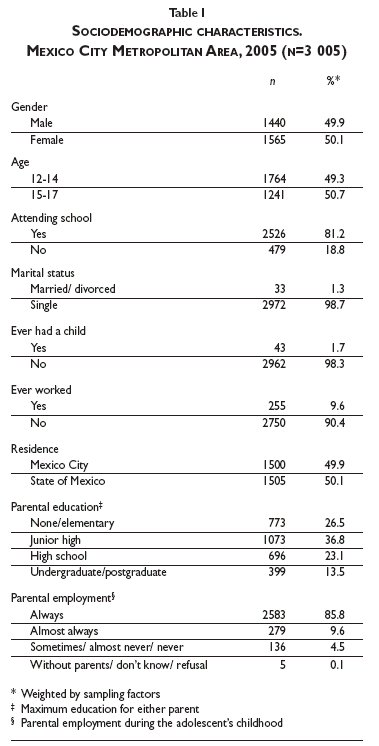
<body><![CDATA[<P><font face="Verdana" size="2">Assessment of PTSD</font></P> </B>      <p><font face="Verdana" size="2">Lifetime PTSD was assessed with all six DSM-IV    criteria:<SUP>21</SUP> a)the person's response to a traumatic event involved    intense fear, helplessness or horror; b)the traumatic event is persistently    re-experienced; c)avoidance of stimuli; d)increased arousal; e)symptom duration    of at least one month, and f)clinically significant distress or impairment.    When people were exposed to more than a single LE, PTSD was assessed only for    what the respondent considered the "most upsetting" event.<SUP>25</SUP>    The validity and reliability of the CIDI's PTSD module is documented elsewhere    (kappa=0.75<SUP>25</SUP> and kappa=0.62,<SUP>26</SUP> respectively).</font></P> <B>     <P><font face="Verdana" size="2">Data analysis</font></P> </B>      <p><font face="Verdana" size="2">Data were weighted to adjust for different probabilities    of selection and non-response, based on household size. Post-stratification    to the total MCMA adolescent population according to the 2000 census in the    target age and sex range was also performed.</font></P>     <p><font face="Verdana" size="2"> In order to take into account the survey's complex    design, SUDAAN's CROSSTABS and RLOGIST procedures<SUP>27</SUP> were used in    order to estimate standard errors (SE) and 95% confidence intervals (CI) for    proportions and odds ratios (OR), respectively, as well as independence Wald's    chi-square tests. Gender and total prevalence were calculated for each LE (or    grouped LEs). Wald's Chi-square test was conducted to determine female/male    differences. Geographic prevalence for Mexico City and the State of Mexico were    also performed, Mexico City was divided, according to the Mexican National Institute    of Statistics, Geography and Informatics, into three "<I>state coordinations</I>"<I>.</I><SUP>28</sup></font></P>     <p><font face="Verdana" size="2"> Survival curves were estimated using SAS software's    LIFETEST procedure,<a href="#nt01"><sup>*</sup></a> <a name="tx01"></a>in order    to calculate conditional survival probabilities in one-year periods.</font></P>     <p><font face="Verdana" size="2"> The prevalence of PTSD for each LE was computed    and the association between LEs and PTSD was estimated by unconditional logistic    regression; two sets of analyses were performed, the first model (model 1) included    each group of LE adjusted by age, gender and education; the second model (model    2), consisted of best fitted models including those variables that changed the    crude estimator in more than 10%. Respondents with at least one lifetime LE    were included in all logistic regressions, since they are the only ones at risk    for developing PTSD (<I>n=</I>2 022), and design effects were taken into account    for these logistic regressions. </font></P>     <p>&nbsp;</P>     <p><font face="Verdana" size="3"><b>Results</b></font></P>     <p><font face="Verdana" size="2"><a href="#tab01">Table I</a> shows the socio-demographic    characteristics of the sample. Frequencies are unweighted, while percentages    are weighted. About 19% of adolescents were not attending school at the time    of the interview, 1.3% were married or divorced, 1.7% had had a child, and about    ten percent ever worked.</font></P>     ]]></body>
<body><![CDATA[<p><a name="tab01"></a></P>     <p>&nbsp;</P>     <p align="center"><img src="/img/revistas/spm/v50s1/a06tab01.gif"></P>     <p>&nbsp;</p>     <p><font face="Verdana" size="2"> Traumatic life events were highly prevalent,    as shown in <a href="/img/revistas/spm/v50s1/a06tab02.gif">table II</a>, with 68.9% of adolescents    having reported at least one lifetime LE. The most common LEs were: unexpected    sudden death of a relative (25.8%), witnessing domestic violence and being involved    in a serious accident (19.4% each). There were several gender differences, with    males more likely to report accidents, illness, and witnessing or suffering    violence outside the home, while females were more likely to report sexual related    trauma, witnessing of domestic violence, unexpected death of a loved one as    well as Other/Private events. Multiple traumas were also frequent, with 28.2%    of the population reporting two or three events, and 13% reporting four or more,    with no differences in the number of lifetime LEs reported for females and males.</font></P>     <p><font face="Verdana" size="2"> Few significant differences were found across    MCMA territories (data not shown but available)."Life-threatening illness"    and being "mugged or threatened with a weapon" were less likely to    be reported in the southwest side of Mexico City, and "witnessed death    or dead body or saw someone else seriously hurt" were more likely to be    reported in the State of Mexico, as well as reports for any trauma.</font></P>     <p><font face="Verdana" size="2"> Survival curves for age of onset of grouped    LEs are shown in <a href="#fig01">figure 1</a>. Some LEs appear repeatedly over    time, such as accidents, illnesses, death or traumatic event to a loved one,    as well as domestic violence (against child or spouses). Some other LEs dramatically    appear in early adolescence, such as being a witness or being involved in violence    (as a victim or perpetrator). </font></P>     <p><a name="fig01"></a></P>     <p>&nbsp;</P>     <p align="center"><img src="/img/revistas/spm/v50s1/a06fig01.gif"></P>     ]]></body>
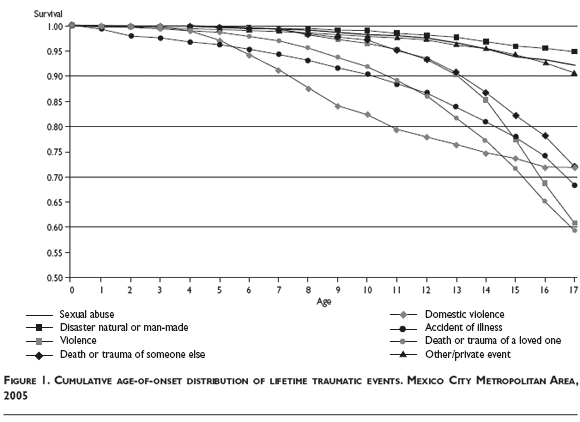
<body><![CDATA[<p>&nbsp;</p>     <p><font face="Verdana" size="2"> Interestingly, the "sexual abuse"    age of onset and the "Other/Private event" follow a similar survival    curve. </font></P>     <p><font face="Verdana" size="2"> Prevalence for PTSD in the MCMA was 1.8% (SE=0.36),    and was two times more prevalent in females (2.4%&#91;0.50&#93;) than in males (1.2%&#91;0.39&#93;).    As shown in table IV, adolescents reporting (a lifetime) sexual abuse (rape    or sexual assault) presented the highest PTSD prevalence (9.7%) and an odds    ratio of 3.9 (<I>CI=</I>1.81-8.23). "Other/Private event" was also    highly associated with PTSD, with an <I>OR=</I>3.3 (1.94-5.73). As evident from    this table, increased prevalence of PTSD was found among those who suffered    multiple LEs. ORs were also calculated among the subsample of those reporting    at least one event. Compared to those with only one event, those with 2 to 3    events and those with 4 or more events had 3.3 (1.63-6.48) and 6.1 (3.08-12.14)    increased odds of PTSD, respectively (<I>p&lt;</I>0.01 trend test). </font></P>     <p><font face="Verdana" size="2"> Given the large amount of multiple events in    this sample, we performed a test of whether sexual abuse and "Other/Private    event" were associated with PTSD independently of any other event. When    controlling for other LEs that changed the OR by 10% (model 2) and adding these    LEs to the model, none of the other LEs reached statistical significance except    for sexual abuse (<I>OR=</I>3.5, <I>CI=</I>1.54-7.80) and "Other/Private    event" (<I>OR=</I>3.0, <I>CI=</I>1.73-5.14).</font></P>     <p>&nbsp;</P>     <p><font face="Verdana" size="3"><b>Discussion</b></font></P>     <p><font face="Verdana" size="2">Exposure to traumatic life events is not uncommon    among Mexico City adolescents, with 69% having experienced at least one LE and    as many as 13% having experienced four or more LEs. The most common LE was the    unexpected death of a loved one, followed by witnessing domestic violence and    being involved in a serious accident. The lifetime prevalence of LEs in this    sample of MCMA adolescents is strikingly consistent with the national adult    estimate. However, given that adolescents have lived shorter lives, one might    expect a lower prevalence of LEs. Three possible reasons might account for this    similar instead of lower estimate. First, the prevalence of LEs is likely to    be higher in a large metropolitan area than for the overall national population;    second, adults might fail to report or remember all of their early traumatic    life events and third, this cohort of adolescents may be more exposed to LEs    than earlier generations. Additionally the similar prevalence between adults    and adolescents may not be that surprising given that many LEs such as physical    abuse by caregivers and sexual abuse are concentrated in the childhood and adolescent    years. </font></P>     <p><font face="Verdana" size="2"> In this study, it was found that the gender    distribution of LEs is consistent with findings from previous research with    adults in Mexico<SUP>1</SUP> and internationally.<SUP>29,30</SUP> For example,    females are more likely to report sexual abuse, and males more diverse forms    of violence, especially outside the home. Traditional gender roles may help    explain these differences such that males spend more time outside the home and    in more risk-taking activities, whereas females spend more time inside the home    and are more vulnerable to sexual aggression. </font></P>     <p><font face="Verdana" size="2"> While the majority of adolescents have suffered    a LE, fortunately most do not further develop PTSD. The percentage of the Mexico    City adolescents who reported PTSD was 1.8%, similar to the prevalence estimate    for Mexican adults and less than half the prevalence estimate for U.S. adolescents    (6.3% and 3.7% for US adolescent females and males, respectively).<SUP>13</SUP>    A key question in PTSD research is to determine what factors contribute to whether    or not a person exposed to a LE develops PTSD. We examined two such factors:    type of LE and number of LEs. </font></P>     <p><font face="Verdana" size="2"> Consistent with the international literature,    rape and sexual assault is the traumatic event most likely to result in PTSD.<SUP>25</SUP>    Moreover, this association may be even stronger, since the "Other/Private    event" category seems to be highly related to the former, as can be appreciated    in <a href="#fig01">figure 1</a>, where both survival curves are practically    the same, as are the adjusted ORs in <a href="/img/revistas/spm/v50s1/a06tab03.gif">table III</a>.    It is plausible that due to feelings of shame, adolescents did not want to talk    about sexual assaults and expressed them as "private events" instead.    </font></P>     ]]></body>
<body><![CDATA[<p><font face="Verdana" size="2"> One might posit that the twofold female-to-male    ratio in PTSD which has been consistently reported in epidemiological studies    in Mexico and internationally,<SUP>1,2,30</SUP> as well as in our current study,    is due to a greater exposure for females to traumas that are likely to develop    into PTSD, that is, sexual trauma. However, some studies have addressed this    point and found that the twofold risk of PTSD remains even after the sex distribution    for type of trauma is held constant and thus cannot be explained by greater    exposure to sexual assault.<SUP>30-32</SUP> Rather, Breslau and her colleagues    have found that women have a greater risk of developing PTSD than males after    experiencing assaultive violence only and hypothesize that assaultive violence    may affect women more because aggressors are more likely to be male and thus    more physically threatening and potentially injurious to females.<SUP>31</sup></font></P>     <p><font face="Verdana" size="2"> The cumulative number of events is also related    to the probability of developing PTSD such that a history of several traumas    weighs more than a single trauma in the development of PTSD.<SUP>33</SUP> Those    having experienced two or three LEs have more than three times the probability    and those having experienced four or more LEs more than six times the probability    of PTSD. </font></P>     <p><font face="Verdana" size="2"> Considering this sample was composed only of    non-institutionalized adolescents and permanent MCMA residents, it is very likely    that the prevalence of LEs –as well as of PTSD– is underestimated, since those    who have no permanent residence or live in government institutions (such as    correctional institutions or orphanages) may have higher early and/or actual<SUP>34</SUP>    rates of exposure to violent life events. Another source of under-estimation    may be due to participants' unwillingness to disclose information, particularly    for emotionally charged or embarrassing events. The inclusion of a "private    event", for which the participants could discuss related symptoms without    revealing the content of the event, was implemented to reduce this type of response    bias. Since people with PTSD could recall their LE in a different way than people    without PTSD, there is a chance of recall bias in this study. However, the structured    nature of the CIDI interview, as well as the short time lived by adolescents,    could limit this type of bias.</font></P>     <p><font face="Verdana" size="2"> Due to the frequency of traumatic life events    in adolescence, their potential to develop into PTSD and the disabling nature    of PTSD trauma should be considered a main public health concern. Despite that    PTSD is one of the most disabling of the anxiety disorders,<SUP>35</SUP> its    impact upon primary care for the adolescent population has been insufficiently    studied. Research suggests that those who experience trauma and suffer from    PTSD are not being adequately detected by health services.<SUP>36,37</SUP> Increased    research in this area is needed in order to improve detection and timely mental    health attention. </font></P>     <p><font face="Verdana" size="2"><b>Acknowledgments</b></font></P>     <p><font face="Verdana" size="2">The Mexican Adolescent Mental Health Survey was    supported by the National Council on Science and Technology (CONACyT CB-2006-CO1-60678)    in conjunction with the Ministry of Education (grant No. CONACyT-SEP-SSEDF-2003-CO1-22)    and the National Institute of Psychiatry Ramon de la Fuente (DIES-4845). The    survey was carried out in conjunction with the World Health Organization World    Mental Health (WMH) Survey Initiative. We thank the WMH staff for assistance    with instrumentation, fieldwork, and data analysis. These activities were supported    by the United States National Institute of Mental Health (R01MH070884), the    John D. and Catherine T. MacArthur Foundation, the Pfizer Foundation, the US    Public Health Service (R13-MH066849, R01-MH069864, and R01 DA016558), the Fogarty    International Center (FIRCA R01-TW006481), the Pan American Health Organization,    Eli Lilly and Company, Ortho-McNeil Pharmaceutical, Inc., GlaxoSmithKline, and    Bristol-Myers Squibb. A complete list of WMH publications can be found at <a href="http://www.hcp.med.harvard.edu/wmh/" target="_blank">http://www.hcp.med.harvard.edu/wmh/</a>.    We also wish to thank Sandra Morales and Alejandro Hernandez for their assistance    with pilot work and field supervision. Partial funding for this work also came    from the American Foundation for Suicide Prevention (Guilherme Borges, PI).</font></P>     <p>&nbsp;</P>     <P><font face="Verdana" size="3"><b>References</b></font></P>     <!-- ref --><P><font face="Verdana" size="2">1. Medina-Mora ME, Borges G, Lara C, Ramos-Lira    L, Zambrano J, Fleiz C. Prevalencia de sucesos violentos y de trastorno por    estr&eacute;s postraum&aacute;tico en la poblaci&oacute;n mexicana. Salud Publica    Mex 2005;47:8-22.</font>&nbsp;&nbsp;&nbsp;&nbsp;&nbsp;&nbsp;&nbsp;&nbsp;[&#160;<a href="javascript:void(0);" onclick="javascript: window.open('/scielo.php?script=sci_nlinks&ref=9260544&pid=S0036-3634200800070000600001&lng=','','width=640,height=500,resizable=yes,scrollbars=1,menubar=yes,');">Links</a>&#160;]<!-- end-ref --><P><font face="Verdana" size="2">2. Kessler RC. Posttraumatic stress disorder:    the burden to the individual and to society. J Clin Psychiatry 2000;61(suppl    5):4-12.</font></P>     ]]></body>
<body><![CDATA[<!-- ref --><P><font face="Verdana" size="2">3. Lucio E, Le&oacute;n I, Dur&aacute;n C, Bravo    E, Velasco E. Los sucesos de vida en dos grupos de adolescentes de diferente    nivel socioecon&oacute;mico. Salud Mental 2001;24:17-24.</font>&nbsp;&nbsp;&nbsp;&nbsp;&nbsp;&nbsp;&nbsp;&nbsp;[&#160;<a href="javascript:void(0);" onclick="javascript: window.open('/scielo.php?script=sci_nlinks&ref=9260546&pid=S0036-3634200800070000600003&lng=','','width=640,height=500,resizable=yes,scrollbars=1,menubar=yes,');">Links</a>&#160;]<!-- end-ref --><!-- ref --><P><font face="Verdana" size="2">4. La salud del adolescente en cifras. Salud    Publica Mex 2003;45:S153-S166.</font>&nbsp;&nbsp;&nbsp;&nbsp;&nbsp;&nbsp;&nbsp;&nbsp;[&#160;<a href="javascript:void(0);" onclick="javascript: window.open('/scielo.php?script=sci_nlinks&ref=9260547&pid=S0036-3634200800070000600004&lng=','','width=640,height=500,resizable=yes,scrollbars=1,menubar=yes,');">Links</a>&#160;]<!-- end-ref --><!-- ref --><P><font face="Verdana" size="2">5. Santos-Preciado JI, Villa-Barrag&aacute;n    JP, Garc&iacute;a-Avil&eacute;s MA, Le&oacute;n-&Aacute;lvarez G, Quezada-Bola&ntilde;os    S, Tapia-Conyer RT. La transici&oacute;n epidemiol&oacute;gica de las y los    adolescentes en M&eacute;xico. Salud Publica Mex 2003;45:S140-S152.</font>&nbsp;&nbsp;&nbsp;&nbsp;&nbsp;&nbsp;&nbsp;&nbsp;[&#160;<a href="javascript:void(0);" onclick="javascript: window.open('/scielo.php?script=sci_nlinks&ref=9260548&pid=S0036-3634200800070000600005&lng=','','width=640,height=500,resizable=yes,scrollbars=1,menubar=yes,');">Links</a>&#160;]<!-- end-ref --><!-- ref --><P><font face="Verdana" size="2">6. Medina-Mora ME, Aguilar-Gaxiola S. Implementation    of international research projects. Conference on strengthening mental health    research capacity in Latin America and the Caribbean; 2006 Dec 6; Mexico City,    M&eacute;xico.</font>&nbsp;&nbsp;&nbsp;&nbsp;&nbsp;&nbsp;&nbsp;&nbsp;[&#160;<a href="javascript:void(0);" onclick="javascript: window.open('/scielo.php?script=sci_nlinks&ref=9260549&pid=S0036-3634200800070000600006&lng=','','width=640,height=500,resizable=yes,scrollbars=1,menubar=yes,');">Links</a>&#160;]<!-- end-ref --><!-- ref --><P><font face="Verdana" size="2">7. El-Shikh H, Fahmy E, Michael VS, Moselhy HF.    Acontecimientos vitales y adicci&oacute;n: una revisi&oacute;n de la bibliograf&iacute;a.    Eur J Psychiat 2004;18:162-170.</font>&nbsp;&nbsp;&nbsp;&nbsp;&nbsp;&nbsp;&nbsp;&nbsp;[&#160;<a href="javascript:void(0);" onclick="javascript: window.open('/scielo.php?script=sci_nlinks&ref=9260550&pid=S0036-3634200800070000600007&lng=','','width=640,height=500,resizable=yes,scrollbars=1,menubar=yes,');">Links</a>&#160;]<!-- end-ref --><!-- ref --><P><font face="Verdana" size="2">8. Ramos-Lira L, Sald&iacute;var-Hern&aacute;ndez    G, Medina-Mora ME, Rojas-Guiot E, Villatoro-Vel&aacute;zquez J. Prevalencia    de abuso sexual en estudiantes y su relaci&oacute;n con el consumo de drogas.    Salud Publica Mex 1998;40:221-233.</font>&nbsp;&nbsp;&nbsp;&nbsp;&nbsp;&nbsp;&nbsp;&nbsp;[&#160;<a href="javascript:void(0);" onclick="javascript: window.open('/scielo.php?script=sci_nlinks&ref=9260551&pid=S0036-3634200800070000600008&lng=','','width=640,height=500,resizable=yes,scrollbars=1,menubar=yes,');">Links</a>&#160;]<!-- end-ref --><!-- ref --><P><font face="Verdana" size="2">9. Pardo G, Sandoval A, Umbarila D. Adolescencia    y depresi&oacute;n. Rev Colomb Psicol 2004;13-28.</font>&nbsp;&nbsp;&nbsp;&nbsp;&nbsp;&nbsp;&nbsp;&nbsp;[&#160;<a href="javascript:void(0);" onclick="javascript: window.open('/scielo.php?script=sci_nlinks&ref=9260552&pid=S0036-3634200800070000600009&lng=','','width=640,height=500,resizable=yes,scrollbars=1,menubar=yes,');">Links</a>&#160;]<!-- end-ref --><!-- ref --><P><font face="Verdana" size="2">10. Molnar BE, Berkman LF, Buka SL. Psychopathology,    childhood sexual abuse and other childhood adversities: relative links to subsequent    suicidal behaviour in the US. Psychol Med 2001;31:965-977.</font>&nbsp;&nbsp;&nbsp;&nbsp;&nbsp;&nbsp;&nbsp;&nbsp;[&#160;<a href="javascript:void(0);" onclick="javascript: window.open('/scielo.php?script=sci_nlinks&ref=9260553&pid=S0036-3634200800070000600010&lng=','','width=640,height=500,resizable=yes,scrollbars=1,menubar=yes,');">Links</a>&#160;]<!-- end-ref --><!-- ref --><P><font face="Verdana" size="2">11. Molnar BE, Buka SL, Kessler RC. Child sexual    abuse and subsequent psychopathology: results from the National Comorbidity    Survey. Am J Public Health 2001;91:753-760.</font>&nbsp;&nbsp;&nbsp;&nbsp;&nbsp;&nbsp;&nbsp;&nbsp;[&#160;<a href="javascript:void(0);" onclick="javascript: window.open('/scielo.php?script=sci_nlinks&ref=9260554&pid=S0036-3634200800070000600011&lng=','','width=640,height=500,resizable=yes,scrollbars=1,menubar=yes,');">Links</a>&#160;]<!-- end-ref --><!-- ref --><P><font face="Verdana" size="2">12. Valdez-Santiago R, Hijar-Medina M. II. Del    silencio privado a las salas de urgencias: la violencia familiar como un problema    de salud p&uacute;blica. Gac Med Mex 2002;138:159-163.</font>&nbsp;&nbsp;&nbsp;&nbsp;&nbsp;&nbsp;&nbsp;&nbsp;[&#160;<a href="javascript:void(0);" onclick="javascript: window.open('/scielo.php?script=sci_nlinks&ref=9260555&pid=S0036-3634200800070000600012&lng=','','width=640,height=500,resizable=yes,scrollbars=1,menubar=yes,');">Links</a>&#160;]<!-- end-ref --><!-- ref --><P><font face="Verdana" size="2">13. Kilpatrick DG, Ruggiero KJ, Acierno R, Saunders    BE, Resnick HS, Best CL. Violence and risk of PTSD, major depression, substance    abuse/dependence, and comorbidity: results from the National Survey of Adolescents.    J Consult Clin Psychol 2003;71:692-700.</font>&nbsp;&nbsp;&nbsp;&nbsp;&nbsp;&nbsp;&nbsp;&nbsp;[&#160;<a href="javascript:void(0);" onclick="javascript: window.open('/scielo.php?script=sci_nlinks&ref=9260556&pid=S0036-3634200800070000600013&lng=','','width=640,height=500,resizable=yes,scrollbars=1,menubar=yes,');">Links</a>&#160;]<!-- end-ref --><!-- ref --><P><font face="Verdana" size="2">14. Ramos-Lira L, Saltijeral MT, Caballero MA.    Impacto de la violencia en la salud mental. Estado actual y perspectivas. Salud    Ment 1996;19:19-32.</font>&nbsp;&nbsp;&nbsp;&nbsp;&nbsp;&nbsp;&nbsp;&nbsp;[&#160;<a href="javascript:void(0);" onclick="javascript: window.open('/scielo.php?script=sci_nlinks&ref=9260557&pid=S0036-3634200800070000600014&lng=','','width=640,height=500,resizable=yes,scrollbars=1,menubar=yes,');">Links</a>&#160;]<!-- end-ref --><!-- ref --><P><font face="Verdana" size="2">15. Sauceda-Garc&iacute;a JM. III. La salud mental    y la violencia familiar dirigida al menor. Gac Med Mex 2002;138:164-168.</font>&nbsp;&nbsp;&nbsp;&nbsp;&nbsp;&nbsp;&nbsp;&nbsp;[&#160;<a href="javascript:void(0);" onclick="javascript: window.open('/scielo.php?script=sci_nlinks&ref=9260558&pid=S0036-3634200800070000600015&lng=','','width=640,height=500,resizable=yes,scrollbars=1,menubar=yes,');">Links</a>&#160;]<!-- end-ref --><P><font face="Verdana" size="2">16. Ballenger JC. Focus on posttraumatic stress    disorder. 4th meeting of the International Consensus Group on Depression and    Anxiety. Montecatini, Italy, April 1999. J Clin Psychiatry 2000;61(suppl 5):3-66.</font></P>     <!-- ref --><P><font face="Verdana" size="2">17. Palacios L, Heinze G. Trastorno por estr&eacute;s    posttraum&aacute;tico: una revisi&oacute;n del tema (primera parte). Salud Ment    2002;25:19-26.</font>&nbsp;&nbsp;&nbsp;&nbsp;&nbsp;&nbsp;&nbsp;&nbsp;[&#160;<a href="javascript:void(0);" onclick="javascript: window.open('/scielo.php?script=sci_nlinks&ref=9260560&pid=S0036-3634200800070000600017&lng=','','width=640,height=500,resizable=yes,scrollbars=1,menubar=yes,');">Links</a>&#160;]<!-- end-ref --><!-- ref --><P><font face="Verdana" size="2">18. Medina-Mora ME, Borges G, Lara C, Benjet    C, Blanco J, Fleiz C, <I>et al</I>. Prevalencia de trastornos mentales y uso    de servicios: Resultados de la Encuesta Nacional de Epidemiolog&iacute;a Psiqui&aacute;trica    en M&eacute;xico. Salud Ment 2003;26:1-16.</font>&nbsp;&nbsp;&nbsp;&nbsp;&nbsp;&nbsp;&nbsp;&nbsp;[&#160;<a href="javascript:void(0);" onclick="javascript: window.open('/scielo.php?script=sci_nlinks&ref=9260561&pid=S0036-3634200800070000600018&lng=','','width=640,height=500,resizable=yes,scrollbars=1,menubar=yes,');">Links</a>&#160;]<!-- end-ref --><!-- ref --><P><font face="Verdana" size="2">19. Baker CK, Norris FH, D&iacute;az DM, Perilla    JL, Murphy AD, Hill EG. Violence and PTSD in Mexico: gender and regional differences.    Soc Psychiatry Psychiatr Epidemiol 2005;40:519-528.</font>&nbsp;&nbsp;&nbsp;&nbsp;&nbsp;&nbsp;&nbsp;&nbsp;[&#160;<a href="javascript:void(0);" onclick="javascript: window.open('/scielo.php?script=sci_nlinks&ref=9260562&pid=S0036-3634200800070000600019&lng=','','width=640,height=500,resizable=yes,scrollbars=1,menubar=yes,');">Links</a>&#160;]<!-- end-ref --><P><font face="Verdana" size="2">20. The World Health Organization (WHO) World    Mental Health (WMH) Survey Initiative version of the Composite International    Diagnostic Interview (CIDI). World Mental Health. &#91;Accessed: Jan, 2007&#93;. Available    at: <a href="http://www.hcp.med.harvard.edu/wmhcidi/" target="_blank">http://www.hcp.med.harvard.edu/wmhcidi/</a>.</font></P>     <P><font face="Verdana" size="2">21. American Psychiatric Association. DSM-IV:    Diagnostic and statistical manual of mental disorders. 4th ed. Washington, DC:    American Psychiatric Association, 1994.</font></P>     <!-- ref --><P><font face="Verdana" size="2">22. Benjet C, Medina-Mora ME, Borges G, Cruz    C, Blanco J, Fleiz C, <I>et al.</I> Mexican Adolescent Mental Health Survey:    An overview of Design and Field Procedures. M&eacute;xico, DF: Instituto Nacional    de Psiquiatr&iacute;a, 2007. </font>&nbsp;&nbsp;&nbsp;&nbsp;&nbsp;&nbsp;&nbsp;&nbsp;[&#160;<a href="javascript:void(0);" onclick="javascript: window.open('/scielo.php?script=sci_nlinks&ref=9260565&pid=S0036-3634200800070000600022&lng=','','width=640,height=500,resizable=yes,scrollbars=1,menubar=yes,');">Links</a>&#160;]<!-- end-ref --><!-- ref --><P><font face="Verdana" size="2">23. Benjet C, Borges G, Medina-Mora ME, Fleiz    C, Blanco J, Zambrano J <I>et al.</I> Prevalence and socio-demographic correlates    of drug use among adolescents: results from the Mexican Adolescent Mental Health    Survey. Addiction 2007;102:1261-1268.</font>&nbsp;&nbsp;&nbsp;&nbsp;&nbsp;&nbsp;&nbsp;&nbsp;[&#160;<a href="javascript:void(0);" onclick="javascript: window.open('/scielo.php?script=sci_nlinks&ref=9260566&pid=S0036-3634200800070000600023&lng=','','width=640,height=500,resizable=yes,scrollbars=1,menubar=yes,');">Links</a>&#160;]<!-- end-ref --><!-- ref --><P><font face="Verdana" size="2">24. Benjet C, Borges G, Medina-Mora ME, Blanco    J, Zambrano J, Orozco R, <I>et al</I>. Drug use opportunities and the transition    to drug use among adolescents from the Mexico City Metropolitan Area. Drug Alcohol    Depend 2007;90:128-134.</font>&nbsp;&nbsp;&nbsp;&nbsp;&nbsp;&nbsp;&nbsp;&nbsp;[&#160;<a href="javascript:void(0);" onclick="javascript: window.open('/scielo.php?script=sci_nlinks&ref=9260567&pid=S0036-3634200800070000600024&lng=','','width=640,height=500,resizable=yes,scrollbars=1,menubar=yes,');">Links</a>&#160;]<!-- end-ref --><!-- ref --><P><font face="Verdana" size="2">25. Kessler RC, Sonnega A, Bromet E, Hughes M,    Nelson CB, Breslau N. Epidemiological Risk Factors for Trauma and PTSD. En:    Yehuda R, comp. Risk Factors for Posttraumatic Stress Disorder. 1a. ed. Washington,    DC: American Psychiatric Press, 1999:23-60.</font>&nbsp;&nbsp;&nbsp;&nbsp;&nbsp;&nbsp;&nbsp;&nbsp;[&#160;<a href="javascript:void(0);" onclick="javascript: window.open('/scielo.php?script=sci_nlinks&ref=9260568&pid=S0036-3634200800070000600025&lng=','','width=640,height=500,resizable=yes,scrollbars=1,menubar=yes,');">Links</a>&#160;]<!-- end-ref --><!-- ref --><P><font face="Verdana" size="2">26. Breslau N, Kessler RC, Peterson EL. Post-traumatic    stress disorder assessment with a structured interview: reliability and concordance    with a standardized clinical interview. Int J Methods Psychiatr Res 1998;7:121-127.</font>&nbsp;&nbsp;&nbsp;&nbsp;&nbsp;&nbsp;&nbsp;&nbsp;[&#160;<a href="javascript:void(0);" onclick="javascript: window.open('/scielo.php?script=sci_nlinks&ref=9260569&pid=S0036-3634200800070000600026&lng=','','width=640,height=500,resizable=yes,scrollbars=1,menubar=yes,');">Links</a>&#160;]<!-- end-ref --><!-- ref --><P><font face="Verdana" size="2">27. Research Triangle Institute. SUDAAN Language    Manual, Release 9.0. Research Triangle Park, NC: Research Triangle Institute,    2004.</font>&nbsp;&nbsp;&nbsp;&nbsp;&nbsp;&nbsp;&nbsp;&nbsp;[&#160;<a href="javascript:void(0);" onclick="javascript: window.open('/scielo.php?script=sci_nlinks&ref=9260570&pid=S0036-3634200800070000600027&lng=','','width=640,height=500,resizable=yes,scrollbars=1,menubar=yes,');">Links</a>&#160;]<!-- end-ref --><!-- ref --><P><font face="Verdana" size="2">28. INEGI. Coordinaciones Estatales del INEGI.    INEGI; &#91;Accessed: Jan, 2007&#93;.    &nbsp;&nbsp;&nbsp;&nbsp;&nbsp;&nbsp;&nbsp;&nbsp;[&#160;<a href="javascript:void(0);" onclick="javascript: window.open('/scielo.php?script=sci_nlinks&ref=9260571&pid=S0036-3634200800070000600028&lng=','','width=640,height=500,resizable=yes,scrollbars=1,menubar=yes,');">Links</a>&#160;]<!-- end-ref --> Available at: <a href="http://www.observatoriolaboral.gob.mx/conteo1.asp" target="_blank">http://www.observatoriolaboral.gob.mx/conteo1.asp</a>.</font></P>     <!-- ref --><P><font face="Verdana" size="2">29. Goldberg LR, Freyd JJ. Self-reports of potentially    traumatic experiences in an adult community sample: gender differences and test-retest    stabilities of the items in a brief betrayal-trauma survey. J Trauma Dissociation    2006;7:39-63.</font>&nbsp;&nbsp;&nbsp;&nbsp;&nbsp;&nbsp;&nbsp;&nbsp;[&#160;<a href="javascript:void(0);" onclick="javascript: window.open('/scielo.php?script=sci_nlinks&ref=9260573&pid=S0036-3634200800070000600029&lng=','','width=640,height=500,resizable=yes,scrollbars=1,menubar=yes,');">Links</a>&#160;]<!-- end-ref --><!-- ref --><P><font face="Verdana" size="2">30. Zlotnick C, Johnson J, Kohn R, Vicente B,    Rioseco P, Saldivia S. Epidemiology of trauma, post-traumatic stress disorder    (PTSD) and co-morbid disorders in Chile. Psychol Med 2006;36:1523-1533.</font>&nbsp;&nbsp;&nbsp;&nbsp;&nbsp;&nbsp;&nbsp;&nbsp;[&#160;<a href="javascript:void(0);" onclick="javascript: window.open('/scielo.php?script=sci_nlinks&ref=9260574&pid=S0036-3634200800070000600030&lng=','','width=640,height=500,resizable=yes,scrollbars=1,menubar=yes,');">Links</a>&#160;]<!-- end-ref --><!-- ref --><P><font face="Verdana" size="2">31. Breslau N, Chilcoat HD, Kessler RC, Peterson    EL, Lucia VC. Vulnerability to assaultive violence: further specification of    the sex difference in post-traumatic stress disorder. Psychol Med 1999;29:813-821.</font>&nbsp;&nbsp;&nbsp;&nbsp;&nbsp;&nbsp;&nbsp;&nbsp;[&#160;<a href="javascript:void(0);" onclick="javascript: window.open('/scielo.php?script=sci_nlinks&ref=9260575&pid=S0036-3634200800070000600031&lng=','','width=640,height=500,resizable=yes,scrollbars=1,menubar=yes,');">Links</a>&#160;]<!-- end-ref --><!-- ref --><P><font face="Verdana" size="2">32. Kessler RC, Sonnega A, Bromet E, Hughes M,    Nelson CB. Posttraumatic stress disorder in the National Comorbidity Survey.    Arch Gen Psychiatry 1995;52:1048-1060.</font>&nbsp;&nbsp;&nbsp;&nbsp;&nbsp;&nbsp;&nbsp;&nbsp;[&#160;<a href="javascript:void(0);" onclick="javascript: window.open('/scielo.php?script=sci_nlinks&ref=9260576&pid=S0036-3634200800070000600032&lng=','','width=640,height=500,resizable=yes,scrollbars=1,menubar=yes,');">Links</a>&#160;]<!-- end-ref --><!-- ref --><P><font face="Verdana" size="2">33. Brock SE. Identifying individuals at risk    for psychological trauma. National Association of School Psychologists; &#91;Accessed:    Jan, 2007&#93;.    &nbsp;&nbsp;&nbsp;&nbsp;&nbsp;&nbsp;&nbsp;&nbsp;[&#160;<a href="javascript:void(0);" onclick="javascript: window.open('/scielo.php?script=sci_nlinks&ref=9260577&pid=S0036-3634200800070000600033&lng=','','width=640,height=500,resizable=yes,scrollbars=1,menubar=yes,');">Links</a>&#160;]<!-- end-ref --> Available at: <a href="http://www.nasponline.org/resources/crisis_safety/19-Brock.pdf" target="_blank">http://www.nasponline.org/resources/crisis_safety/19-Brock.pdf</a>.</font></P>     <!-- ref --><P><font face="Verdana" size="2">34. Lo b&aacute;sico sobre la violaci&oacute;n    entre rejas. Santa Barbara Rape Crisis Center. &#91;Accessed Jan, 2007&#93;. Available    at: <a href="http://www.sbrapecrisiscenter.org/05Volunteer/Marzo%202005.pdf" target="_blank">http://www.sbrapecrisiscenter.org/05Volunteer/Marzo%202005.pdf</a>.</font>&nbsp;&nbsp;&nbsp;&nbsp;&nbsp;&nbsp;&nbsp;&nbsp;[&#160;<a href="javascript:void(0);" onclick="javascript: window.open('/scielo.php?script=sci_nlinks&ref=9260579&pid=S0036-3634200800070000600034&lng=','','width=640,height=500,resizable=yes,scrollbars=1,menubar=yes,');">Links</a>&#160;]<!-- end-ref --><!-- ref --><P><font face="Verdana" size="2">35. Benjet C, Medina-Mora ME, Borges G, Cruz    C, Lara C, Blanco J, <I>et al</I>. 12 month prevalence, service use and demographic    correlates of DSM-IV psychiatric disorders in Mexican adolescents: Results from    the Mexican Adolescent Mental Health Survey. Conference on strengthening mental    health research capacity in Latin America and the Caribbean; 2006 Dec 7; M&eacute;xico    City, Mexico.</font>&nbsp;&nbsp;&nbsp;&nbsp;&nbsp;&nbsp;&nbsp;&nbsp;[&#160;<a href="javascript:void(0);" onclick="javascript: window.open('/scielo.php?script=sci_nlinks&ref=9260580&pid=S0036-3634200800070000600035&lng=','','width=640,height=500,resizable=yes,scrollbars=1,menubar=yes,');">Links</a>&#160;]<!-- end-ref --><P><font face="Verdana" size="2">36. Ballenger JC, Davidson JR, Lecrubier Y, Nutt    DJ, Marshall RD, Nemeroff CB, <I>et al</I>. Consensus statement update on posttraumatic    stress disorder from the international consensus group on depression and anxiety.    J Clin Psychiatry 2004;65(suppl 1):55-62.</font></P>     <P><font face="Verdana" size="2">37. Lecrubier Y. Posttraumatic stress disorder    in primary care: a hidden diagnosis. J Clin Psychiatry 2004;65(suppl 1):49-54.</font></P>     <p>&nbsp;</P>     <p>&nbsp;</P>     <p><font face="Verdana" size="2">Received on: April 26, 2007    ]]></body>
<body><![CDATA[<br>   Accepted on: November 15, 2007</font></P>     <p>&nbsp;</P>     <p>&nbsp;</P>     <p><font face="Verdana" size="2">Address reprint requests to: Ricardo Orozco Zavala.    Secretar&iacute;a de Salud. Direcci&oacute;n General de Evaluaci&oacute;n del    Desempe&ntilde;o. Reforma 450, piso 12, col. Ju&aacute;rez, 06600 M&eacute;xico    DF, M&eacute;xico. E-mail: <a href="mailto:ric_oz@imp.edu.mx">ric_oz@imp.edu.mx</a>,    <a href=" mailto:rorozcoz@salud.gob.mx">rorozcoz@salud.gob.mx</a>    <br>   <a name="nt01"></a><a href="#tx01">*</a> SAS for Windows &#91;computer program&#93;.    Version 9.1.3. SAS Institute Inc. Cary, NC, USA: 2003.</font></p>     <p>&nbsp;</p>     <p>&nbsp;</p>     <p><font face="Verdana" size="3"><a name="apnx"></a><b>Appendix</b></font></p>     <p><font face="Verdana" size="2"><b>Traumatic events questions of the World Mental    Health adolescent version of the Composite International Diagnostic Interview    (WMH-CIDI-A)<a href="#nt00"><sup>*</sup></a></b></font><a name="tx00"></a></p>     <p><font face="Verdana" size="2">Sexual abuse</font></p>     ]]></body>
<body><![CDATA[<blockquote>        <p><font face="Verdana" size="2"> Raped </font></p>       <blockquote>         <p><font face="Verdana" size="2"> 1 The next two questions are about sexual        assault. The first is about rape. We define this as someone either having        sexual intercourse with you or penetrating your body with a finger or object        when you did not want them to, either by threatening you, by using force        or when you were so small that you didn’t know what was happening. Did this        ever happen to you?</font></p>   </blockquote>       <p><font face="Verdana" size="2"> Sexually assaulted</font></p>       <blockquote>          <p><font face="Verdana" size="2"> 2 Other than rape, were you ever sexually        assaulted, where someone touched you inappropriately, or when you did not        want them to?</font></p>   </blockquote> </blockquote>     <p><font face="Verdana" size="2">Domestic violence </font></p>     <blockquote>        <p><font face="Verdana" size="2"> Beaten up by caregiver</font></p>       ]]></body>
<body><![CDATA[<blockquote>         <p><font face="Verdana" size="2"> 3 Were you ever badly beaten up by your        parents or the people raising you?</font></p>   </blockquote> </blockquote>     <p><font face="Verdana" size="2"> Witnessed physical fights at home</font></p>     <blockquote>        <blockquote>         <p><font face="Verdana" size="2"> 4 Did you ever witness serious physical        fights at home, like your father beating up your mother?</font></p>   </blockquote> </blockquote>     <p><font face="Verdana" size="2">Disaster natural or man-made</font></p>     <blockquote>        <p><font face="Verdana" size="2"> In region of terror</font></p>       <blockquote>          ]]></body>
<body><![CDATA[<p><font face="Verdana" size="2"> 5 Were you ever in a place where there was        a war, revolution, military coup, or where there was ongoing terror of civilians        for political, ethnic, religious or other reasons?</font></p>   </blockquote>       <p><font face="Verdana" size="2"> Disaster </font></p>       <blockquote>         <p><font face="Verdana" size="2"> 6 Were you ever involved in a major natural        disaster, like a devastating flood, hurricane, or earthquake?</font></p>   </blockquote> </blockquote>     <p><font face="Verdana" size="2">Accident or illness </font></p>     <blockquote>        <p><font face="Verdana" size="2"> Toxic exposure/ Automobile/ Life threatening      accident</font></p>       <blockquote>          <p><font face="Verdana" size="2"> 7 Were you ever exposed to a poisonous chemical        or substance that could cause you serious harm?</font></p>         <p><font face="Verdana" size="2"> 8 Were you ever involved in a serious or        life-threatening car accident?</font></p>         ]]></body>
<body><![CDATA[<p><font face="Verdana" size="2"> 9 Were you in any other serious or life-        threatening accident?</font></p>   </blockquote>       <p><font face="Verdana" size="2"> Life threatening illness</font></p>       <blockquote>         <p><font face="Verdana" size="2"> 10 Did you ever have a life-threatening        illness?</font></p>   </blockquote> </blockquote>     <p><font face="Verdana" size="2">Violence </font></p>     <blockquote>        <p><font face="Verdana" size="2"> Beaten up by romantic partner or someone else</font></p>       <blockquote>         <p><font face="Verdana" size="2"> 11 Were you ever badly beaten up by someone        you were dating or with whom you were romantically involved?</font></p>         <p><font face="Verdana" size="2"> 12 Were you ever badly beaten up by anyone        else?</font></p>   </blockquote> </blockquote>     ]]></body>
<body><![CDATA[<p><font face="Verdana" size="2"> Mugged or threatened with a weapon</font></p>     <blockquote>        <blockquote>          <p><font face="Verdana" size="2"> 13 Were you ever mugged, held up, or threatened        with a weapon?</font></p>   </blockquote>       <p><font face="Verdana" size="2"> Stalked </font></p>       <blockquote>          <p><font face="Verdana" size="2"> 14 Has someone ever stalked you – that is,        followed you or kept track of your activities in a way that made you feel        you were in serious danger?</font></p>   </blockquote>       <p><font face="Verdana" size="2"> Kidnapped </font></p>       <blockquote>         <p><font face="Verdana" size="2"> 15 Were you ever kidnapped or held captive?</font></p>   </blockquote> </blockquote>     ]]></body>
<body><![CDATA[<p><font face="Verdana" size="2">Death or trauma of a loved one</font></p>     <blockquote>        <p><font face="Verdana" size="2"> Unexpected death of a loved one</font></p>       <blockquote>          <p><font face="Verdana" size="2"> 16 Did someone very close to you ever die        unexpectedly; for example, they were killed in an accident, murdered, committed        suicide, or had a fatal heart attack at a young age?</font></p>   </blockquote>       <p><font face="Verdana" size="2"> Traumatic event of a loved one</font></p>       <blockquote>         <p><font face="Verdana" size="2"> 17 Did anyone very close to you ever have        a very stressful or life-threatening experience, like being kidnapped, tortured        or raped?</font></p>   </blockquote> </blockquote>     <p><font face="Verdana" size="2">Death or trauma of someone else</font></p>     <blockquote>        ]]></body>
<body><![CDATA[<p><font face="Verdana" size="2"> Witnessed death or dead body or saw someone      else seriously hurt</font></p>       <blockquote>          <p><font face="Verdana" size="2"> 18 Did you ever see someone being badly        injured or killed, or unexpectedly see a dead body?</font></p>   </blockquote>       <p><font face="Verdana" size="2"> Accidentally caused serious injury or death</font></p>       <blockquote>          <p><font face="Verdana" size="2"> 19 Did you ever do something that accidentally        led to the serious injury or death of another person?</font></p>   </blockquote>       <p><font face="Verdana" size="2"> Purposely injured, tortured or killed someone</font></p>       <blockquote>          <p><font face="Verdana" size="2"> 20 Did you ever on purpose either seriously        injure, torture, or kill another person?</font></p>   </blockquote>       <p><font face="Verdana" size="2">Other/ Private event </font></p>       ]]></body>
<body><![CDATA[<blockquote>         <p><font face="Verdana" size="2"> 21 Were you ever a refugee – that is, did        you ever flee from your home to a foreign country or place to escape danger        or persecution?</font></p>         <p><font face="Verdana" size="2"> 22 Did you ever experience any other extremely        upsetting or life-threatening event that I haven’t asked about yet?</font></p>         <p><font face="Verdana" size="2"> 23 Sometimes people have experiences they        don’t want to talk about in interviews. I won’t ask you to describe anything        like this, but, without telling me what it was, did you ever have an extremely        upsetting or life-threatening event that you didn’t tell me about because        you didn’t want to talk about it?</font></p>   </blockquote> </blockquote>     <p>&nbsp;</p>     <p>&nbsp;</p>     <p><font face="Verdana" size="2"><a name="nt00"></a><a href="#tx00">*</a> Traumatic    events are not shown in the order presented to participants</font></p>      ]]></body><back>
<ref-list>
<ref id="B1">
<label>1</label><nlm-citation citation-type="journal">
<person-group person-group-type="author">
<name>
<surname><![CDATA[Medina-Mora]]></surname>
<given-names><![CDATA[ME]]></given-names>
</name>
<name>
<surname><![CDATA[Borges]]></surname>
<given-names><![CDATA[G]]></given-names>
</name>
<name>
<surname><![CDATA[Lara]]></surname>
<given-names><![CDATA[C]]></given-names>
</name>
<name>
<surname><![CDATA[Ramos-Lira]]></surname>
<given-names><![CDATA[L]]></given-names>
</name>
<name>
<surname><![CDATA[Zambrano]]></surname>
<given-names><![CDATA[J]]></given-names>
</name>
<name>
<surname><![CDATA[Fleiz]]></surname>
<given-names><![CDATA[C]]></given-names>
</name>
</person-group>
<article-title xml:lang="es"><![CDATA[Prevalencia de sucesos violentos y de trastorno por estrés postraumático en la población mexicana]]></article-title>
<source><![CDATA[Salud Publica Mex]]></source>
<year>2005</year>
<volume>47</volume>
<page-range>8-22</page-range></nlm-citation>
</ref>
<ref id="B2">
<label>2</label><nlm-citation citation-type="journal">
<person-group person-group-type="author">
<name>
<surname><![CDATA[Kessler]]></surname>
<given-names><![CDATA[RC]]></given-names>
</name>
</person-group>
<article-title xml:lang="en"><![CDATA[Posttraumatic stress disorder: the burden to the individual and to society]]></article-title>
<source><![CDATA[J Clin Psychiatry]]></source>
<year>2000</year>
<volume>61</volume>
<page-range>4-12</page-range></nlm-citation>
</ref>
<ref id="B3">
<label>3</label><nlm-citation citation-type="journal">
<person-group person-group-type="author">
<name>
<surname><![CDATA[Lucio]]></surname>
<given-names><![CDATA[E]]></given-names>
</name>
<name>
<surname><![CDATA[León]]></surname>
<given-names><![CDATA[I]]></given-names>
</name>
<name>
<surname><![CDATA[Durán]]></surname>
<given-names><![CDATA[C]]></given-names>
</name>
<name>
<surname><![CDATA[Bravo]]></surname>
<given-names><![CDATA[E]]></given-names>
</name>
<name>
<surname><![CDATA[Velasco]]></surname>
<given-names><![CDATA[E]]></given-names>
</name>
</person-group>
<article-title xml:lang="es"><![CDATA[Los sucesos de vida en dos grupos de adolescentes de diferente nivel socioeconómico]]></article-title>
<source><![CDATA[Salud Mental]]></source>
<year>2001</year>
<volume>24</volume>
<page-range>17-24</page-range></nlm-citation>
</ref>
<ref id="B4">
<label>4</label><nlm-citation citation-type="journal">
<article-title xml:lang="es"><![CDATA[La salud del adolescente en cifras]]></article-title>
<source><![CDATA[Salud Publica Mex]]></source>
<year>2003</year>
<volume>45</volume>
<page-range>S153-S166</page-range></nlm-citation>
</ref>
<ref id="B5">
<label>5</label><nlm-citation citation-type="journal">
<person-group person-group-type="author">
<name>
<surname><![CDATA[Santos-Preciado]]></surname>
<given-names><![CDATA[JI]]></given-names>
</name>
<name>
<surname><![CDATA[Villa-Barragán]]></surname>
<given-names><![CDATA[JP]]></given-names>
</name>
<name>
<surname><![CDATA[García-Avilés]]></surname>
<given-names><![CDATA[MA]]></given-names>
</name>
<name>
<surname><![CDATA[León-Álvarez]]></surname>
<given-names><![CDATA[G]]></given-names>
</name>
<name>
<surname><![CDATA[Quezada-Bolaños]]></surname>
<given-names><![CDATA[S]]></given-names>
</name>
<name>
<surname><![CDATA[Tapia-Conyer]]></surname>
<given-names><![CDATA[RT]]></given-names>
</name>
</person-group>
<article-title xml:lang="es"><![CDATA[La transición epidemiológica de las y los adolescentes en México]]></article-title>
<source><![CDATA[Salud Publica Mex]]></source>
<year>2003</year>
<volume>45</volume>
<page-range>S140-S152</page-range></nlm-citation>
</ref>
<ref id="B6">
<label>6</label><nlm-citation citation-type="">
<person-group person-group-type="author">
<name>
<surname><![CDATA[Medina-Mora]]></surname>
<given-names><![CDATA[ME]]></given-names>
</name>
<name>
<surname><![CDATA[Aguilar-Gaxiola]]></surname>
<given-names><![CDATA[S]]></given-names>
</name>
</person-group>
<source><![CDATA[Implementation of international research projects: Conference on strengthening mental health research capacity in Latin America and the Caribbean]]></source>
<year>2006</year>
<month> D</month>
<day>ec</day>
<publisher-loc><![CDATA[Mexico City ]]></publisher-loc>
</nlm-citation>
</ref>
<ref id="B7">
<label>7</label><nlm-citation citation-type="journal">
<person-group person-group-type="author">
<name>
<surname><![CDATA[El-Shikh]]></surname>
<given-names><![CDATA[H]]></given-names>
</name>
<name>
<surname><![CDATA[Fahmy]]></surname>
<given-names><![CDATA[E]]></given-names>
</name>
<name>
<surname><![CDATA[Michael]]></surname>
<given-names><![CDATA[VS]]></given-names>
</name>
<name>
<surname><![CDATA[Moselhy]]></surname>
<given-names><![CDATA[HF]]></given-names>
</name>
</person-group>
<article-title xml:lang="es"><![CDATA[Acontecimientos vitales y adicción: una revisión de la bibliografía]]></article-title>
<source><![CDATA[Eur J Psychiat]]></source>
<year>2004</year>
<volume>18</volume>
<page-range>162-170</page-range></nlm-citation>
</ref>
<ref id="B8">
<label>8</label><nlm-citation citation-type="journal">
<person-group person-group-type="author">
<name>
<surname><![CDATA[Ramos-Lira]]></surname>
<given-names><![CDATA[L]]></given-names>
</name>
<name>
<surname><![CDATA[Saldívar-Hernández]]></surname>
<given-names><![CDATA[G]]></given-names>
</name>
<name>
<surname><![CDATA[Medina-Mora]]></surname>
<given-names><![CDATA[ME]]></given-names>
</name>
<name>
<surname><![CDATA[Rojas-Guiot]]></surname>
<given-names><![CDATA[E]]></given-names>
</name>
<name>
<surname><![CDATA[Villatoro-Velázquez]]></surname>
<given-names><![CDATA[J]]></given-names>
</name>
</person-group>
<article-title xml:lang="es"><![CDATA[Prevalencia de abuso sexual en estudiantes y su relación con el consumo de drogas]]></article-title>
<source><![CDATA[Salud Publica Mex]]></source>
<year>1998</year>
<volume>40</volume>
<page-range>221-233</page-range></nlm-citation>
</ref>
<ref id="B9">
<label>9</label><nlm-citation citation-type="journal">
<person-group person-group-type="author">
<name>
<surname><![CDATA[Pardo]]></surname>
<given-names><![CDATA[G]]></given-names>
</name>
<name>
<surname><![CDATA[Sandoval]]></surname>
<given-names><![CDATA[A]]></given-names>
</name>
<name>
<surname><![CDATA[Umbarila]]></surname>
<given-names><![CDATA[D]]></given-names>
</name>
</person-group>
<article-title xml:lang="es"><![CDATA[Adolescencia y depresión]]></article-title>
<source><![CDATA[Rev Colomb Psicol]]></source>
<year>2004</year>
<page-range>13-28</page-range></nlm-citation>
</ref>
<ref id="B10">
<label>10</label><nlm-citation citation-type="journal">
<person-group person-group-type="author">
<name>
<surname><![CDATA[Molnar]]></surname>
<given-names><![CDATA[BE]]></given-names>
</name>
<name>
<surname><![CDATA[Berkman]]></surname>
<given-names><![CDATA[LF]]></given-names>
</name>
<name>
<surname><![CDATA[Buka]]></surname>
<given-names><![CDATA[SL]]></given-names>
</name>
</person-group>
<article-title xml:lang="en"><![CDATA[Psychopathology, childhood sexual abuse and other childhood adversities: relative links to subsequent suicidal behaviour in the US]]></article-title>
<source><![CDATA[Psychol Med]]></source>
<year>2001</year>
<volume>31</volume>
<page-range>965-977</page-range></nlm-citation>
</ref>
<ref id="B11">
<label>11</label><nlm-citation citation-type="journal">
<person-group person-group-type="author">
<name>
<surname><![CDATA[Molnar]]></surname>
<given-names><![CDATA[BE]]></given-names>
</name>
<name>
<surname><![CDATA[Buka]]></surname>
<given-names><![CDATA[SL]]></given-names>
</name>
<name>
<surname><![CDATA[Kessler]]></surname>
<given-names><![CDATA[RC]]></given-names>
</name>
</person-group>
<article-title xml:lang="en"><![CDATA[Child sexual abuse and subsequent psychopathology: results from the National Comorbidity Survey]]></article-title>
<source><![CDATA[Am J Public Health]]></source>
<year>2001</year>
<volume>91</volume>
<page-range>753-760</page-range></nlm-citation>
</ref>
<ref id="B12">
<label>12</label><nlm-citation citation-type="journal">
<person-group person-group-type="author">
<name>
<surname><![CDATA[Valdez-Santiago]]></surname>
<given-names><![CDATA[R]]></given-names>
</name>
<name>
<surname><![CDATA[Hijar-Medina]]></surname>
<given-names><![CDATA[M]]></given-names>
</name>
</person-group>
<article-title xml:lang="es"><![CDATA[II. Del silencio privado a las salas de urgencias: la violencia familiar como un problema de salud pública]]></article-title>
<source><![CDATA[Gac Med Mex]]></source>
<year>2002</year>
<volume>138</volume>
<page-range>159-163</page-range></nlm-citation>
</ref>
<ref id="B13">
<label>13</label><nlm-citation citation-type="journal">
<person-group person-group-type="author">
<name>
<surname><![CDATA[Kilpatrick]]></surname>
<given-names><![CDATA[DG]]></given-names>
</name>
<name>
<surname><![CDATA[Ruggiero]]></surname>
<given-names><![CDATA[KJ]]></given-names>
</name>
<name>
<surname><![CDATA[Acierno]]></surname>
<given-names><![CDATA[R]]></given-names>
</name>
<name>
<surname><![CDATA[Saunders]]></surname>
<given-names><![CDATA[BE]]></given-names>
</name>
<name>
<surname><![CDATA[Resnick]]></surname>
<given-names><![CDATA[HS]]></given-names>
</name>
<name>
<surname><![CDATA[Best]]></surname>
<given-names><![CDATA[CL]]></given-names>
</name>
</person-group>
<article-title xml:lang="en"><![CDATA[Violence and risk of PTSD, major depression, substance abuse/dependence, and comorbidity: results from the National Survey of Adolescents]]></article-title>
<source><![CDATA[J Consult Clin Psychol]]></source>
<year>2003</year>
<volume>71</volume>
<page-range>692-700</page-range></nlm-citation>
</ref>
<ref id="B14">
<label>14</label><nlm-citation citation-type="journal">
<person-group person-group-type="author">
<name>
<surname><![CDATA[Ramos-Lira]]></surname>
<given-names><![CDATA[L]]></given-names>
</name>
<name>
<surname><![CDATA[Saltijeral]]></surname>
<given-names><![CDATA[MT]]></given-names>
</name>
<name>
<surname><![CDATA[Caballero]]></surname>
<given-names><![CDATA[MA]]></given-names>
</name>
</person-group>
<article-title xml:lang="pt"><![CDATA[Impacto de la violencia en la salud mental: Estado actual y perspectivas]]></article-title>
<source><![CDATA[Salud Ment]]></source>
<year>1996</year>
<volume>19</volume>
<page-range>19-32</page-range></nlm-citation>
</ref>
<ref id="B15">
<label>15</label><nlm-citation citation-type="journal">
<person-group person-group-type="author">
<name>
<surname><![CDATA[Sauceda-García]]></surname>
<given-names><![CDATA[JM]]></given-names>
</name>
</person-group>
<article-title xml:lang="es"><![CDATA[III. La salud mental y la violencia familiar dirigida al menor]]></article-title>
<source><![CDATA[Gac Med Mex]]></source>
<year>2002</year>
<volume>138</volume>
<page-range>164-168</page-range></nlm-citation>
</ref>
<ref id="B16">
<label>16</label><nlm-citation citation-type="journal">
<person-group person-group-type="author">
<name>
<surname><![CDATA[Ballenger]]></surname>
<given-names><![CDATA[JC]]></given-names>
</name>
</person-group>
<article-title xml:lang="en"><![CDATA[Focus on posttraumatic stress disorder: 4th meeting of the International Consensus Group on Depression and Anxiety. Montecatini, Italy, April 1999]]></article-title>
<source><![CDATA[J Clin Psychiatry]]></source>
<year>2000</year>
<volume>61</volume>
<page-range>3-66</page-range></nlm-citation>
</ref>
<ref id="B17">
<label>17</label><nlm-citation citation-type="journal">
<person-group person-group-type="author">
<name>
<surname><![CDATA[Palacios]]></surname>
<given-names><![CDATA[L]]></given-names>
</name>
<name>
<surname><![CDATA[Heinze]]></surname>
<given-names><![CDATA[G]]></given-names>
</name>
</person-group>
<article-title xml:lang="es"><![CDATA[Trastorno por estrés posttraumático: una revisión del tema (primera parte)]]></article-title>
<source><![CDATA[Salud Ment]]></source>
<year>2002</year>
<volume>25</volume>
<page-range>19-26</page-range></nlm-citation>
</ref>
<ref id="B18">
<label>18</label><nlm-citation citation-type="journal">
<person-group person-group-type="author">
<name>
<surname><![CDATA[Medina-Mora]]></surname>
<given-names><![CDATA[ME]]></given-names>
</name>
<name>
<surname><![CDATA[Borges]]></surname>
<given-names><![CDATA[G]]></given-names>
</name>
<name>
<surname><![CDATA[Lara]]></surname>
<given-names><![CDATA[C]]></given-names>
</name>
<name>
<surname><![CDATA[Benjet]]></surname>
<given-names><![CDATA[C]]></given-names>
</name>
<name>
<surname><![CDATA[Blanco]]></surname>
<given-names><![CDATA[J]]></given-names>
</name>
<name>
<surname><![CDATA[Fleiz]]></surname>
<given-names><![CDATA[C]]></given-names>
</name>
</person-group>
<article-title xml:lang="pt"><![CDATA[Prevalencia de trastornos mentales y uso de servicios: Resultados de la Encuesta Nacional de Epidemiología Psiquiátrica en México]]></article-title>
<source><![CDATA[Salud Ment]]></source>
<year>2003</year>
<volume>26</volume>
<page-range>1-16</page-range></nlm-citation>
</ref>
<ref id="B19">
<label>19</label><nlm-citation citation-type="journal">
<person-group person-group-type="author">
<name>
<surname><![CDATA[Baker]]></surname>
<given-names><![CDATA[CK]]></given-names>
</name>
<name>
<surname><![CDATA[Norris]]></surname>
<given-names><![CDATA[FH]]></given-names>
</name>
<name>
<surname><![CDATA[Díaz]]></surname>
<given-names><![CDATA[DM]]></given-names>
</name>
<name>
<surname><![CDATA[Perilla]]></surname>
<given-names><![CDATA[JL]]></given-names>
</name>
<name>
<surname><![CDATA[Murphy]]></surname>
<given-names><![CDATA[AD]]></given-names>
</name>
<name>
<surname><![CDATA[Hill]]></surname>
<given-names><![CDATA[EG]]></given-names>
</name>
</person-group>
<article-title xml:lang="en"><![CDATA[Violence and PTSD in Mexico: gender and regional differences]]></article-title>
<source><![CDATA[Soc Psychiatry Psychiatr Epidemiol]]></source>
<year>2005</year>
<volume>40</volume>
<page-range>519-528</page-range></nlm-citation>
</ref>
<ref id="B20">
<label>20</label><nlm-citation citation-type="book">
<collab>The World Health Organization World Mental Health Survey Initiative version of the Composite International Diagnostic Interview</collab>
<source><![CDATA[World Mental Health.]]></source>
<year>2007</year>
<publisher-loc><![CDATA[Accessed ]]></publisher-loc>
<publisher-name><![CDATA[Jan]]></publisher-name>
</nlm-citation>
</ref>
<ref id="B21">
<label>21</label><nlm-citation citation-type="book">
<collab>American Psychiatric Association</collab>
<source><![CDATA[DSM-IV:Diagnostic and statistical manual of mental disorders]]></source>
<year>1994</year>
<edition>4th ed.</edition>
<publisher-loc><![CDATA[DC ]]></publisher-loc>
<publisher-name><![CDATA[American Psychiatric Association]]></publisher-name>
</nlm-citation>
</ref>
<ref id="B22">
<label>22</label><nlm-citation citation-type="book">
<person-group person-group-type="author">
<name>
<surname><![CDATA[Benjet]]></surname>
<given-names><![CDATA[C]]></given-names>
</name>
<name>
<surname><![CDATA[Medina-Mora]]></surname>
<given-names><![CDATA[ME]]></given-names>
</name>
<name>
<surname><![CDATA[Borges]]></surname>
<given-names><![CDATA[G]]></given-names>
</name>
<name>
<surname><![CDATA[Cruz]]></surname>
<given-names><![CDATA[C]]></given-names>
</name>
<name>
<surname><![CDATA[Blanco]]></surname>
<given-names><![CDATA[J]]></given-names>
</name>
<name>
<surname><![CDATA[Fleiz]]></surname>
<given-names><![CDATA[C]]></given-names>
</name>
</person-group>
<source><![CDATA[Mexican Adolescent Mental Health Survey:An overview of Design and Field Procedures. México,]]></source>
<year>2007</year>
<publisher-loc><![CDATA[DF ]]></publisher-loc>
<publisher-name><![CDATA[Instituto Nacional de Psiquiatría]]></publisher-name>
</nlm-citation>
</ref>
<ref id="B23">
<label>23</label><nlm-citation citation-type="journal">
<person-group person-group-type="author">
<name>
<surname><![CDATA[Benjet]]></surname>
<given-names><![CDATA[C]]></given-names>
</name>
<name>
<surname><![CDATA[Borges]]></surname>
<given-names><![CDATA[G]]></given-names>
</name>
<name>
<surname><![CDATA[Medina-Mora]]></surname>
<given-names><![CDATA[ME]]></given-names>
</name>
<name>
<surname><![CDATA[Fleiz]]></surname>
<given-names><![CDATA[C]]></given-names>
</name>
<name>
<surname><![CDATA[Blanco]]></surname>
<given-names><![CDATA[J]]></given-names>
</name>
</person-group>
<collab>Zambrano J et al</collab>
<article-title xml:lang="en"><![CDATA[Prevalence and socio-demographic correlates of drug use among adolescents: results from the Mexican Adolescent Mental Health Survey]]></article-title>
<source><![CDATA[Addiction]]></source>
<year>2007</year>
<volume>102</volume>
<page-range>1261-1268</page-range></nlm-citation>
</ref>
<ref id="B24">
<label>24</label><nlm-citation citation-type="journal">
<person-group person-group-type="author">
<name>
<surname><![CDATA[Benjet]]></surname>
<given-names><![CDATA[C]]></given-names>
</name>
<name>
<surname><![CDATA[Borges]]></surname>
<given-names><![CDATA[G]]></given-names>
</name>
<name>
<surname><![CDATA[Medina-Mora]]></surname>
<given-names><![CDATA[ME]]></given-names>
</name>
<name>
<surname><![CDATA[Blanco]]></surname>
<given-names><![CDATA[J]]></given-names>
</name>
<name>
<surname><![CDATA[Zambrano]]></surname>
<given-names><![CDATA[J]]></given-names>
</name>
<name>
<surname><![CDATA[Orozco]]></surname>
<given-names><![CDATA[R]]></given-names>
</name>
</person-group>
<article-title xml:lang="en"><![CDATA[Drug use opportunities and the transition to drug use among adolescents from the Mexico City Metropolitan Area]]></article-title>
<source><![CDATA[Drug Alcohol Depend]]></source>
<year>2007</year>
<volume>90</volume>
<page-range>128-134</page-range></nlm-citation>
</ref>
<ref id="B25">
<label>25</label><nlm-citation citation-type="book">
<person-group person-group-type="author">
<name>
<surname><![CDATA[Kessler]]></surname>
<given-names><![CDATA[RC]]></given-names>
</name>
<name>
<surname><![CDATA[Sonnega]]></surname>
<given-names><![CDATA[A]]></given-names>
</name>
<name>
<surname><![CDATA[Bromet]]></surname>
<given-names><![CDATA[E]]></given-names>
</name>
<name>
<surname><![CDATA[Hughes]]></surname>
<given-names><![CDATA[M]]></given-names>
</name>
<name>
<surname><![CDATA[Nelson]]></surname>
<given-names><![CDATA[CB]]></given-names>
</name>
<name>
<surname><![CDATA[Breslau]]></surname>
<given-names><![CDATA[N]]></given-names>
</name>
</person-group>
<article-title xml:lang="en"><![CDATA[Epidemiological Risk Factors for Trauma and PTSD]]></article-title>
<person-group person-group-type="editor">
<name>
<surname><![CDATA[Yehuda]]></surname>
<given-names><![CDATA[R]]></given-names>
</name>
</person-group>
<source><![CDATA[Risk Factors for Posttraumatic Stress Disorder]]></source>
<year>1999</year>
<edition>1</edition>
<page-range>23-60</page-range><publisher-loc><![CDATA[Washington^eDC DC]]></publisher-loc>
<publisher-name><![CDATA[American Psychiatric Press]]></publisher-name>
</nlm-citation>
</ref>
<ref id="B26">
<label>26</label><nlm-citation citation-type="journal">
<person-group person-group-type="author">
<name>
<surname><![CDATA[Breslau]]></surname>
<given-names><![CDATA[N]]></given-names>
</name>
<name>
<surname><![CDATA[Kessler]]></surname>
<given-names><![CDATA[RC]]></given-names>
</name>
<name>
<surname><![CDATA[Peterson]]></surname>
<given-names><![CDATA[EL]]></given-names>
</name>
</person-group>
<article-title xml:lang="en"><![CDATA[Post-traumatic stress disorder assessment with a structured interview: reliability and concordance with a standardized clinical interview]]></article-title>
<source><![CDATA[Int J Methods Psychiatr Res]]></source>
<year>1998</year>
<volume>7</volume>
<page-range>121-127</page-range></nlm-citation>
</ref>
<ref id="B27">
<label>27</label><nlm-citation citation-type="book">
<collab>Research Triangle Institute</collab>
<source><![CDATA[SUDAAN Language Manual, Release 9.0. Research Triangle Park,]]></source>
<year>2004</year>
<publisher-loc><![CDATA[NC ]]></publisher-loc>
<publisher-name><![CDATA[Research Triangle Institute]]></publisher-name>
</nlm-citation>
</ref>
<ref id="B28">
<label>28</label><nlm-citation citation-type="book">
<person-group person-group-type="author">
<name>
<surname><![CDATA[INEGI]]></surname>
</name>
</person-group>
<source><![CDATA[Coordinaciones Estatales del INEGI. INEGI;]]></source>
<year>2007</year>
<publisher-loc><![CDATA[Accessed ]]></publisher-loc>
<publisher-name><![CDATA[Jan]]></publisher-name>
</nlm-citation>
</ref>
<ref id="B29">
<label>29</label><nlm-citation citation-type="journal">
<person-group person-group-type="author">
<name>
<surname><![CDATA[Goldberg]]></surname>
<given-names><![CDATA[LR]]></given-names>
</name>
<name>
<surname><![CDATA[Freyd]]></surname>
<given-names><![CDATA[JJ]]></given-names>
</name>
</person-group>
<article-title xml:lang="en"><![CDATA[Self-reports of potentially traumatic experiences in an adult community sample: gender differences and test-retest stabilities of the items in a brief betrayal-trauma survey]]></article-title>
<source><![CDATA[J Trauma Dissociation]]></source>
<year>2006</year>
<volume>7</volume>
<page-range>39-63</page-range></nlm-citation>
</ref>
<ref id="B30">
<label>30</label><nlm-citation citation-type="journal">
<person-group person-group-type="author">
<name>
<surname><![CDATA[Zlotnick]]></surname>
<given-names><![CDATA[C]]></given-names>
</name>
<name>
<surname><![CDATA[Johnson]]></surname>
<given-names><![CDATA[J]]></given-names>
</name>
<name>
<surname><![CDATA[Kohn]]></surname>
<given-names><![CDATA[R]]></given-names>
</name>
<name>
<surname><![CDATA[Vicente]]></surname>
<given-names><![CDATA[B]]></given-names>
</name>
<name>
<surname><![CDATA[Rioseco]]></surname>
<given-names><![CDATA[P]]></given-names>
</name>
<name>
<surname><![CDATA[Saldivia]]></surname>
<given-names><![CDATA[S]]></given-names>
</name>
</person-group>
<article-title xml:lang="en"><![CDATA[Epidemiology of trauma, post-traumatic stress disorder (PTSD) and co-morbid disorders in Chile]]></article-title>
<source><![CDATA[Psychol Med]]></source>
<year>2006</year>
<volume>36</volume>
<page-range>1523-1533</page-range></nlm-citation>
</ref>
<ref id="B31">
<label>31</label><nlm-citation citation-type="journal">
<person-group person-group-type="author">
<name>
<surname><![CDATA[Breslau]]></surname>
<given-names><![CDATA[N]]></given-names>
</name>
<name>
<surname><![CDATA[Chilcoat]]></surname>
<given-names><![CDATA[HD]]></given-names>
</name>
<name>
<surname><![CDATA[Kessler]]></surname>
<given-names><![CDATA[RC]]></given-names>
</name>
<name>
<surname><![CDATA[Peterson]]></surname>
<given-names><![CDATA[EL]]></given-names>
</name>
<name>
<surname><![CDATA[Lucia]]></surname>
<given-names><![CDATA[VC]]></given-names>
</name>
</person-group>
<article-title xml:lang="en"><![CDATA[Vulnerability to assaultive violence: further specification of the sex difference in post-traumatic stress disorder]]></article-title>
<source><![CDATA[Psychol Med]]></source>
<year>1999</year>
<volume>29</volume>
<page-range>813-821</page-range></nlm-citation>
</ref>
<ref id="B32">
<label>32</label><nlm-citation citation-type="journal">
<person-group person-group-type="author">
<name>
<surname><![CDATA[Kessler]]></surname>
<given-names><![CDATA[RC]]></given-names>
</name>
<name>
<surname><![CDATA[Sonnega]]></surname>
<given-names><![CDATA[A]]></given-names>
</name>
<name>
<surname><![CDATA[Bromet]]></surname>
<given-names><![CDATA[E]]></given-names>
</name>
<name>
<surname><![CDATA[Hughes]]></surname>
<given-names><![CDATA[M]]></given-names>
</name>
<name>
<surname><![CDATA[Nelson]]></surname>
<given-names><![CDATA[CB]]></given-names>
</name>
</person-group>
<article-title xml:lang="en"><![CDATA[Posttraumatic stress disorder in the National Comorbidity Survey]]></article-title>
<source><![CDATA[Arch Gen Psychiatry]]></source>
<year>1995</year>
<volume>52</volume>
<page-range>1048-1060</page-range></nlm-citation>
</ref>
<ref id="B33">
<label>33</label><nlm-citation citation-type="book">
<person-group person-group-type="author">
<name>
<surname><![CDATA[Brock]]></surname>
<given-names><![CDATA[SE]]></given-names>
</name>
</person-group>
<source><![CDATA[Identifying individuals at risk for psychological trauma: National Association of School Psychologists]]></source>
<year>2007</year>
<publisher-loc><![CDATA[Accessed ]]></publisher-loc>
<publisher-name><![CDATA[Jan]]></publisher-name>
</nlm-citation>
</ref>
<ref id="B34">
<label>34</label><nlm-citation citation-type="">
<source><![CDATA[Lo básico sobre la violación entre rejas: Santa Barbara Rape Crisis Center]]></source>
<year></year>
</nlm-citation>
</ref>
<ref id="B35">
<label>35</label><nlm-citation citation-type="confpro">
<person-group person-group-type="author">
<name>
<surname><![CDATA[Benjet]]></surname>
<given-names><![CDATA[C]]></given-names>
</name>
<name>
<surname><![CDATA[Medina-Mora]]></surname>
<given-names><![CDATA[ME]]></given-names>
</name>
<name>
<surname><![CDATA[Borges]]></surname>
<given-names><![CDATA[G]]></given-names>
</name>
<name>
<surname><![CDATA[Cruz]]></surname>
<given-names><![CDATA[C]]></given-names>
</name>
<name>
<surname><![CDATA[Lara]]></surname>
<given-names><![CDATA[C]]></given-names>
</name>
<name>
<surname><![CDATA[Blanco]]></surname>
<given-names><![CDATA[J]]></given-names>
</name>
</person-group>
<source><![CDATA[12 month prevalence, service use and demographic correlates of DSM-IV psychiatric disorders in Mexican adolescents: Results from the Mexican Adolescent Mental Health Survey]]></source>
<year></year>
<conf-name><![CDATA[ Conference on strengthening mental health research capacity in Latin America and the Caribbean]]></conf-name>
<conf-date>2006 Dec 7</conf-date>
<conf-loc>México City </conf-loc>
</nlm-citation>
</ref>
<ref id="B36">
<label>36</label><nlm-citation citation-type="journal">
<person-group person-group-type="author">
<name>
<surname><![CDATA[Ballenger]]></surname>
<given-names><![CDATA[JC]]></given-names>
</name>
<name>
<surname><![CDATA[Davidson]]></surname>
<given-names><![CDATA[JR]]></given-names>
</name>
<name>
<surname><![CDATA[Lecrubier]]></surname>
<given-names><![CDATA[Y]]></given-names>
</name>
<name>
<surname><![CDATA[Nutt]]></surname>
<given-names><![CDATA[DJ]]></given-names>
</name>
<name>
<surname><![CDATA[Marshall]]></surname>
<given-names><![CDATA[RD]]></given-names>
</name>
<name>
<surname><![CDATA[Nemeroff]]></surname>
<given-names><![CDATA[CB]]></given-names>
</name>
</person-group>
<article-title xml:lang="en"><![CDATA[Consensus statement update on posttraumatic stress disorder from the international consensus group on depression and anxiety]]></article-title>
<source><![CDATA[J Clin Psychiatry]]></source>
<year>2004</year>
<volume>65</volume>
<page-range>55-62</page-range></nlm-citation>
</ref>
<ref id="B37">
<label>37</label><nlm-citation citation-type="journal">
<person-group person-group-type="author">
<name>
<surname><![CDATA[Lecrubier]]></surname>
<given-names><![CDATA[Y]]></given-names>
</name>
</person-group>
<article-title xml:lang="en"><![CDATA[Posttraumatic stress disorder in primary care: a hidden diagnosis]]></article-title>
<source><![CDATA[J Clin Psychiatry]]></source>
<year>2004</year>
<volume>65</volume>
<page-range>49-54</page-range></nlm-citation>
</ref>
</ref-list>
</back>
</article>
