<?xml version="1.0" encoding="ISO-8859-1"?><article xmlns:mml="http://www.w3.org/1998/Math/MathML" xmlns:xlink="http://www.w3.org/1999/xlink" xmlns:xsi="http://www.w3.org/2001/XMLSchema-instance">
<front>
<journal-meta>
<journal-id>0036-3634</journal-id>
<journal-title><![CDATA[Salud Pública de México]]></journal-title>
<abbrev-journal-title><![CDATA[Salud pública Méx]]></abbrev-journal-title>
<issn>0036-3634</issn>
<publisher>
<publisher-name><![CDATA[Instituto Nacional de Salud Pública]]></publisher-name>
</publisher>
</journal-meta>
<article-meta>
<article-id>S0036-36342008000700004</article-id>
<title-group>
<article-title xml:lang="en"><![CDATA[Domestic violence surveillance system: a model]]></article-title>
<article-title xml:lang="es"><![CDATA[Sistema de vigilancia de violencia doméstica: un modelo]]></article-title>
</title-group>
<contrib-group>
<contrib contrib-type="author">
<name>
<surname><![CDATA[Espinosa]]></surname>
<given-names><![CDATA[Rafael]]></given-names>
</name>
<xref ref-type="aff" rid="A01"/>
</contrib>
<contrib contrib-type="author">
<name>
<surname><![CDATA[Gutiérrez]]></surname>
<given-names><![CDATA[María Isabel]]></given-names>
</name>
<xref ref-type="aff" rid="A01"/>
</contrib>
<contrib contrib-type="author">
<name>
<surname><![CDATA[Mena-Muñoz]]></surname>
<given-names><![CDATA[Jorge Humberto]]></given-names>
</name>
<xref ref-type="aff" rid="A01"/>
</contrib>
<contrib contrib-type="author">
<name>
<surname><![CDATA[Córdoba]]></surname>
<given-names><![CDATA[Patricia]]></given-names>
</name>
<xref ref-type="aff" rid="A01"/>
</contrib>
</contrib-group>
<aff id="A01">
<institution><![CDATA[,Universidad del Valle Instituto CISALVA ]]></institution>
<addr-line><![CDATA[ ]]></addr-line>
<country>Colombia</country>
</aff>
<pub-date pub-type="pub">
<day>00</day>
<month>00</month>
<year>2008</year>
</pub-date>
<pub-date pub-type="epub">
<day>00</day>
<month>00</month>
<year>2008</year>
</pub-date>
<volume>50</volume>
<fpage>s12</fpage>
<lpage>s18</lpage>
<copyright-statement/>
<copyright-year/>
<self-uri xlink:href="http://www.scielo.org.mx/scielo.php?script=sci_arttext&amp;pid=S0036-36342008000700004&amp;lng=en&amp;nrm=iso"></self-uri><self-uri xlink:href="http://www.scielo.org.mx/scielo.php?script=sci_abstract&amp;pid=S0036-36342008000700004&amp;lng=en&amp;nrm=iso"></self-uri><self-uri xlink:href="http://www.scielo.org.mx/scielo.php?script=sci_pdf&amp;pid=S0036-36342008000700004&amp;lng=en&amp;nrm=iso"></self-uri><abstract abstract-type="short" xml:lang="en"><p><![CDATA[OBJECTIVE: To develop a domestic violence surveillance system. MATERIAL AND METHODS: The strategies included implementation of a standard digitalized reporting and analysis system along with advocacy with community decision makers, strengthening inter-institutional attention networks, consultation for constructing internal flow charts, sensitizing and training network teams in charge of providing health care in cases of domestic violence and supporting improved public policy prevention initiatives. RESULTS: A total of 6 893 cases were observed using 2004 and 2005 surveillance system data. The system reports that 80% of the affected were women, followed by 36% children under 14 years. The identified aggressors were mainly females' partners. The system was useful for improving victim services. CONCLUSIONS: Findings indicate that significant gains were made in facilitating the attention and treatment of victims of domestic violence, improving the procedural response process and enhancing the quality of information provided to policy-making bodies.]]></p></abstract>
<abstract abstract-type="short" xml:lang="es"><p><![CDATA[OBJETIVO: Desarrollar un sistema de vigilancia sobre violencia doméstica. MATERIAL Y MÉTODOS: Las estrategias incluyeron la implementación de un sistema de análisis y reporte digitalizado estándar, a la par de hacer conciencia entre los tomadores de decisiones a nivel comunitario, fortalecer redes de atención interinstitucionales, consultoría para el diseño de diagramas de flujo internos, equipos de sensibilización y entrenamiento a cargo de proveer cuidados de salud en casos de violencia doméstica y de dar a poyo a iniciativas de prevención como parte de políticas públicas mejoradas. RESULTADOS: Se observó un total de 6893 casos a partir de datos de 2004 y 2005 de un sistema de vigilancia. El sistema informa que 80% de las víctimas fueron mujeres, seguidas de 36% de niños menores de 14 años. Los agresores identificados fueron principalmente los compañeros de las mujeres. El sistema resultó útil para mejorar los servicios a las víctimas. CONCLUSIONES: Los hallazgos indican que se lograron mejoras significativas en cuanto a facilitar la atención y tratamiento de las víctimas de violencia doméstica, mejorando el proceso de respuesta procedimental y la calidad de la información brindada a los organismos responsables de elaborar políticas.]]></p></abstract>
<kwd-group>
<kwd lng="en"><![CDATA[domestic violence]]></kwd>
<kwd lng="en"><![CDATA[health surveillance]]></kwd>
<kwd lng="en"><![CDATA[inter-sectorial action]]></kwd>
<kwd lng="en"><![CDATA[prevention and control]]></kwd>
<kwd lng="en"><![CDATA[public policies]]></kwd>
<kwd lng="es"><![CDATA[violencia doméstica]]></kwd>
<kwd lng="es"><![CDATA[vigilancia en salud]]></kwd>
<kwd lng="es"><![CDATA[acción intersectorial]]></kwd>
<kwd lng="es"><![CDATA[prevención y control]]></kwd>
<kwd lng="es"><![CDATA[políticas públicas]]></kwd>
</kwd-group>
</article-meta>
</front><body><![CDATA[ <p align="right"><font face="Verdana" size="2"><b>ART&Iacute;CULO ORIGINAL</b></font></P>     <p>&nbsp;</P>     <p><font face="Verdana" size="4"><b>Domestic violence surveillance system: a model</b></font></P>     <p>&nbsp;</P>     <p><font face="Verdana" size="3"><b>Sistema de vigilancia de violencia dom&eacute;stica:    un modelo</b></font></P>     <p>&nbsp;</P>     <p>&nbsp;</P>     <p><font face="Verdana" size="2"><b>Rafael Espinosa, MD, MSc; Mar&iacute;a Isabel    Guti&eacute;rrez, MD, MSc, PhD; Jorge Humberto Mena-Mu&ntilde;oz,    MD; Patricia C&oacute;rdoba, MSW</b></font></P>     <p><font face="Verdana" size="2">Instituto CISALVA, Universidad del Valle. Colombia</font></P>     <p>&nbsp;</P>     ]]></body>
<body><![CDATA[<p>&nbsp;</P> <hr size="1" noshade>      <P><font face="Verdana" size="2"><b>ABSTRACT</b></font></P>     <p><font face="Verdana" size="2"><B>OBJECTIVE:</b> To develop a domestic violence    surveillance system.    <br>   <B>MATERIAL AND METHODS:</b> The strategies included implementation of a standard    digitalized reporting and analysis system along with advocacy with community    decision makers, strengthening inter-institutional attention networks, consultation    for constructing internal flow charts, sensitizing and training network teams    in charge of providing health care in cases of domestic violence and supporting    improved public policy prevention initiatives.    <br>   <B>RESULTS:</b> A total of 6 893 cases were observed using 2004 and 2005 surveillance    system data. The system reports that 80% of the affected were women, followed    by 36% children under 14 years. The identified aggressors were mainly females'    partners. The system was useful for improving victim services.    <br>   <B>CONCLUSIONS:</B> Findings indicate that significant gains were made in facilitating    the attention and treatment of victims of domestic violence, improving the procedural    response process and enhancing the quality of information provided to policy-making    bodies.</font></P>     <p><font face="Verdana" size="2"><b>Key words:</b> domestic violence; health surveillance;    inter-sectorial action; prevention and control; public policies</font></P> <hr size="1" noshade>     <p><font face="Verdana" size="2"><b>RESUMEN</b></font></P>     <p><font face="Verdana" size="2"><B>OBJETIVO:</b> Desarrollar un sistema de vigilancia    sobre violencia dom&eacute;stica.    <br>   <B>MATERIAL Y M&Eacute;TODOS:</b> Las estrategias incluyeron la implementaci&oacute;n    de un sistema de an&aacute;lisis y reporte digitalizado est&aacute;ndar, a la    par de hacer conciencia entre los tomadores de decisiones a nivel comunitario,    fortalecer redes de atenci&oacute;n interinstitucionales, consultor&iacute;a    para el dise&ntilde;o de diagramas de flujo internos, equipos de sensibilizaci&oacute;n    y entrenamiento a cargo de proveer cuidados de salud en casos de violencia dom&eacute;stica    y de dar a poyo a iniciativas de prevenci&oacute;n como parte de pol&iacute;ticas    p&uacute;blicas mejoradas.    ]]></body>
<body><![CDATA[<br>   <B>RESULTADOS:</b> Se observ&oacute; un total de 6893 casos a partir de datos    de 2004 y 2005 de un sistema de vigilancia. El sistema informa que 80% de las    v&iacute;ctimas fueron mujeres, seguidas de 36% de ni&ntilde;os menores de 14    a&ntilde;os. Los agresores identificados fueron principalmente los compa&ntilde;eros    de las mujeres. El sistema result&oacute; &uacute;til para mejorar los servicios    a las v&iacute;ctimas.    <br>   <B>CONCLUSIONES:</b> Los hallazgos indican que se lograron mejoras significativas    en cuanto a facilitar la atenci&oacute;n y tratamiento de las v&iacute;ctimas    de violencia dom&eacute;stica, mejorando el proceso de respuesta procedimental    y la calidad de la informaci&oacute;n brindada a los organismos responsables    de elaborar pol&iacute;ticas.</font></P>     <p><font face="Verdana" size="2"><b>Palabras clave:</b> violencia dom&eacute;stica;    vigilancia en salud; acci&oacute;n intersectorial; prevenci&oacute;n y control;    pol&iacute;ticas p&uacute;blicas</font></P> <hr size="1" noshade>     <p>&nbsp;</P>     <p>&nbsp;</P>     <p><font face="Verdana" size="2">For over a decade, violence –defined as "the    use or threatened use of physical force with the intent to cause harm to oneself    or others"–<SUP>1</SUP> has been increasingly recognized as a public health    issue that best employs an epidemiological approach.<SUP>2</SUP> This approach    places an emphasis on developing reliable surveillance and monitoring systems    to collect accurate data on incidence, prevalence, settings, and victim and    perpetrator characteristics for selected events. Subsequently, the data of victims    and perpetrators are examined to identify social, environmental and, at times,    genetic risk factors. The next step in this process is to provide decision makers    with relevant information for devising suitable prevention and intervention    efforts to address risk factors. The effectiveness and efficiency of the intervention    efforts are, in turn, evaluated through the initial monitoring system.</font></P>     <p><font face="Verdana" size="2"> Domestic violence is a major public health problem    and social issue.<SUP>3,4</SUP> It falls within the broader category of interpersonal    violence<SUP>5</SUP> and may be defined as violence involving every act or omission    committed by any member of the family in a position of power or trust –regardless    of the physical space where it occurs– which harms the well-being, the physical    or psychological integrity or freedom, and the right to full development of    another family member.<SUP>6</SUP> </font></P>     <p><font face="Verdana" size="2"> According to the recent WHO multi-country study    on women's health and domestic violence, abused women were twice as likely as    non-abused women to have poor health and physical and psychological problems,    even when the violent acts occurred years before.<SUP>3</SUP> Up to one-half    of women physically assaulted suffered physical injuries and the costs of health    care were significantly higher due to more frequent visits to emergency departments    throughout their lives.<SUP>3</SUP> This finding also applies to the victims    of child abuse and neglect.</font></P>     <p><font face="Verdana" size="2"> Both the severity of the problem and the broad    range of its occurrence are relevant issues. On a regular basis, domestic violence    affects the lives of many. In fact, a report by the World Health Organization    indicates that domestic violence produces the majority of intentional injuries    for women between 15 and 44 years of age.<SUP>7</SUP> In Latin America and the    Caribbean, domestic violence affects between 10 and 75% of the population. In    Chile, 63% of children in eighth grade had suffered physical violence at home.<SUP>3</sup></font></P>     <p><font face="Verdana" size="2"> Two aspects make effective prevention of domestic    violence particularly difficult:</font></P>     ]]></body>
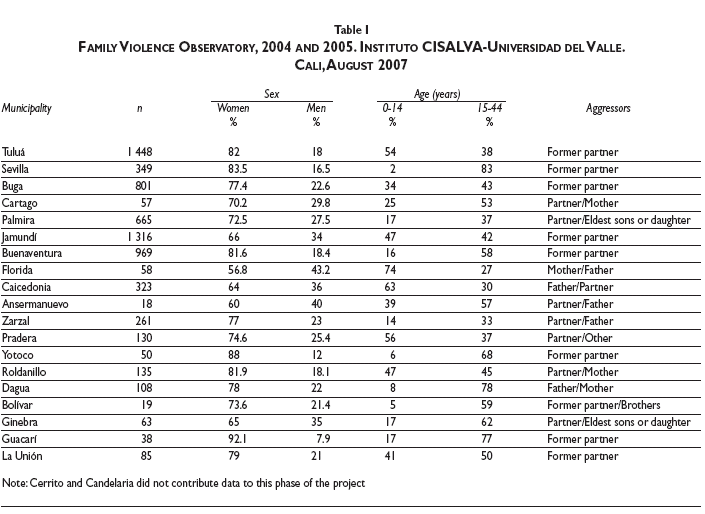
<body><![CDATA[<blockquote>        <p><font face="Verdana" size="2">1. The inter-generational nature of its effects,      e.g. female children of abused mothers are more likely to be abused as adults,      and male children of abused mothers are more likely to be abusers as adults;<SUP>6,7</SUP>      and,</font></P>       <p><font face="Verdana" size="2">2. The hidden quality of family violence. There      is under-reporting of cases, with only an estimated 2 to 20% of incidents      being reported.<SUP>5,8</SUP> An example of this was documented in a study      done in health institutions in Cali, Colombia by the Institute for the Study      of Violence/Injury Prevention and the Promotion of Coexistence (CISALVA),      in which only 13% of the women perceived themselves to be victims of some      type of abuse, although 47.6% of them were identified as battered women by      health care providers. In this same group, 34.7% turned out to be constantly      subjected to severe abuse.<SUP>9</SUP> Our project addressed this latter problem      through increasing institutional competencies and public awareness of these      services.</font></P> </blockquote>     <p><font face="Verdana" size="2"> For over a decade, violence has been addressed    in Colombia as a public health problem, and domestic violence as an important    symptom. In 2004, the Colombian Department of Legal Medicine reported the occurrence    of 59770 cases of domestic violence.<SUP>10</SUP> Of those, 9847 were cases    of child abuse, 36901 involved partner violence and 13022 were injuries caused    by other family members. According to the same source, in 2002 domestic violence    was acknowledged in 64979 cases, 62% of which correspond to partner violence,    23% to violence between family members and 16% to child abuse.</font></P> <B>     <P><font face="Verdana" size="2">Objective</font></P> </B>      <p><font face="Verdana" size="2">To address this problem, in 2002 CISALVA undertook    a four-year project to implement an epidemiological surveillance system related    to domestic violence that might eventually have, as a result, violence prevention    and the improvement of care for domestic violence victims in the province of    Valle, Colombia. With the support of the Secretary of Health of Valle, resources    from the basic health plan (PAB) were allocated for strengthening the municipal    reporting system and the response to domestic violence. </font></P>     <p>&nbsp;</P>     <p><font face="Verdana" size="3"><b>Materials and Methods</b></font></P>     <p><font face="Verdana" size="2">The project was developed between 2002 and 2005    in 21 municipalities situated in the province of Valle. It had three phases    for implementation: Eleven municipalities were selected in the first phase (2002-2003),    six smaller municipalities in the second (2003-2004), and four additional sites    in the third phase (2004-2005). To accomplish the purpose of this paper, only    information from 2004 and 2005 was taken into account. During these two years,    information from the 21 municipalities was completed (<a href="/img/revistas/spm/v50s1/a04tab01.gif">table    I</a>). These municipalities were jointly selected with the Province Health    Secretary authorities according to population size and political importance.    </font></P>     <p><font face="Verdana" size="2"> The work started with the creation of Observatories    of Domestic Violence. These "observatories" (domestic violence surveillance    systems)<SUP>11</SUP> were expected to develop knowledge and expertise in order    to 1) geographically reference and plot within the neighborhood the locations    of reported cases of domestic violence; 2) develop a prevention strategy and    early detection of child abuse and domestic violence; 3) construct charts for    decision making for each institution, and 4) construct and validate a common    protocol and flow chart for the referral of victims of child abuse and domestic    violence, within a network of inter-institutional prevention and treatment.    </font></P>     ]]></body>
<body><![CDATA[<p><font face="Verdana" size="2"> In this paper, "cases" refer to victims    of domestic violence in accordance with the used definition.</font></P>     <p><font face="Verdana" size="2"> More specifically, development focused on implementing    seven methodological strategies as follows:</font></P>     <p><font face="Verdana" size="2"> First, the project initiated a process of lobbying    and sensitizing decision makers to inform and reach agreement with departmental    and municipal authorities regarding timelines and execution mechanisms. </font></P>     <p><font face="Verdana" size="2"> Second, observatories for domestic violence    were formally established in each selected municipality. This strategy involved    standardized information gathering procedures originating from the different    data sources and subsequently compiling, validating and digitalizing the information    through a common software program. As an outcome, the observatories presented    reports providing compiled information and detailed analysis to policy decision    makers, stakeholders, and interested community members. In terms of epidemiological    surveillance systems (ESS), this project reflects a universal ESS system, i.e.    one including all cases occurring within a defined population, with active collection    and consolidation procedures. In other words, those in charge of the ESS contact    the persons who record the information and request data directly from them,    or verify and complete questionable or incomplete data. Third, inter-institutional    networks for prevention of and attention for intra-familial violence were strengthened.    This involved training in legal aspects of domestic violence, regular assessments    of progress toward program objectives, and a review of updated competencies    and qualifications of the individuals involved.<SUP>12-14</SUP> To accomplish    this, a testing process was used that objectively assessed staff knowledge of    flow charts to screen child abuse cases, procedural manuals, and technical documents    outlining agency competencies and integral involvement in the care process.</font></P>     <p><font face="Verdana" size="2"> Fourth, the project developed consensual inter-institutional    flow charts for the attention of domestic violence cases and group exercises    for the development of internal flow charts intended to clarify the process.<SUP>15</SUP>    </font></P>     <p><font face="Verdana" size="2"> Fifth, in each municipality the project team    identified local procedures regularly employed for the prevention and early    detection of child abuse. This involved providing encouragement, support, and    any needed consultation in developing prevention activities identified by teachers,    parents, and health or protection personnel. The promotion of children's rights,    humane childrearing practices, and assertive correction and discipline as a    substitute for corporal punishment were emphasized. To provide for ongoing educational    efforts the team identified a base of core facilitators and trained them in    the early detection of cases.</font></P>     <p><font face="Verdana" size="2"> Sixth, the project team made concerted efforts    for sensitizing and training welfare and administrative teams from the network    of health service providers handling cases of domestic violence. They did this    in agreement with the guidelines by the Colombian Ministry of Health for Minors    and Battered Women, which provides the framework for child and violence problems,    among which domestic violence is included.<SUP>15</sup></font></P>     <p><font face="Verdana" size="2"> Seventh, the project provided support for the    development of public policy on children, and for giving greater attention to    child abuse prevention issues. This strategy promoted, within the Social Policy    Councils of the municipalities, the elaboration of public action proposals aimed    at influencing the social policies of the municipality. These bodies have the    legal mandate to design and recommend social policy guidelines to their mayors.</font></P>     <p><font face="Verdana" size="2"> In line with the development of prevention programs    described in item five, the project tried to inform and educate the general    community. As the overall process intended to strengthen local governance and    relations with citizenry, the team project developed an indicator for the number    of complaints of family violence reported by community members to authorities    responsible for investigation and intervention. The number of unsubstantiated    complaints or allegations was not viewed as a measure of prevention programming    effectiveness, but as a measure of awareness of the problem and trust in the    authorities' capability to respond. Consequently, the project requested an evaluation    of the data on the number of complaints from each of the municipalities for    the first trimester of 2004 and first trimester of 2005 (<a href="#fig01">figure    1</a>).</font></P>     <p><a name="fig01"></a></P>     ]]></body>
<body><![CDATA[<p>&nbsp;</P>     <p align="center"><img src="/img/revistas/spm/v50s1/a04fig01.gif"></P>     <p>&nbsp;</P>     <p><font face="Verdana" size="3"><b>Results</b></font></P>     <p><font face="Verdana" size="2">A total of 6893 cases were observed using 2004    and 2005 surveillance system data. The magnitude, characteristics and circumstances    of cases of domestic violence were recorded. Representatives from nearly all    of the participating institutions in the 21 municipalities reported improved    integration and coordination of services in the quantity and quality of contacts    made. The program administrators also noted greater adherence to protocol among    participant institutions in inter-institutional networks, such as the Childhood    and Family Sub-committees, Child Abuse and Domestic Violence Prevention Networks,    and Social Policy Councils. </font></P>     <p><font face="Verdana" size="2"> An increase in the number of cases registered    by source information institutions was observed in all phases of the implementation    process for the 21 municipalities. </font></P>     <p><font face="Verdana" size="2"> In all, the principal 21 municipalities of Valle    established and developed observatories, initially in Palmira, Buenaventura,    Tulu&aacute;, Cartago, and Buga –intermediate cities with between 100000 and    350000 inhabitants– and later in smaller municipalities with populations between    30000 and 100000 inhabitants. In 19 of the 21 municipalities, it was possible    to integrate information from at least two sources. In Cerrito and Candelaria,    the process failed due to absence of political will. </font></P>     <p><font face="Verdana" size="2"> Males were minimally represented, with the exception    of Ansermanuevo with 40% (seven cases) and Florida with 43.2% (25 cases) of    men victims (e.g., Yotoco reported 12% (six cases) and Guacar&iacute; 7.9% (three    cases). On the contrary, in most municipalities, women were the victims, representing    between 60 and 90% of cases. Boys and girls less than 14 years were the age    group most affected by violence from their fathers, stepparents, and in some    occasions, mothers. In 13 of 19 municipalities, young people –mostly women between    15 and 45 years– suffered aggressions from intimate partners and former partners.    It is worth noting that in two municipalities the older sons or daughters appeared    as significant perpetrators of domestic violence against their parents, their    siblings, and other relatives. </font></P>     <p><font face="Verdana" size="2"> Tulu&aacute; (185000 inhabitants) is the most    striking example of this increased reporting and documentation of cases of domestic    violence. During 2002, the municipality documented 192 cases of domestic violence.    In 2003, the total number was 394, while for 2004 the number soared to 1059.<SUP>16</SUP>    This represents more than a five-fold increase in reported cases over a three-year    period. The reliability and validity of the data recorded by each municipal    surveillance system improved. Better coordination coupled with reporting of    higher technical quality resulted in more comprehensive, valid and pertinent    information. </font></P>     <p><font face="Verdana" size="2"> It was hypothesized that with a greater level    of community awareness, increased confidence in authorities and the improvement    of the registry of cases, the number of complaints would rise. Three municipalities,    Buga, Florida, and Caicedonia, did report gains in the number of complaints    filed (average 21.6%) from 2004 to 2005. </font></P>     ]]></body>
<body><![CDATA[<p><font face="Verdana" size="2"> Government officials and decision makers were    offered workshops on these issues and they became aware of the magnitude of    domestic violence in their localities to such an extent that they decided to    establish the observatories and helped in their development. In the localities    joining the project during the last year, it was possible to develop shared    activities, strengthen networks, and in general modify structures to facilitate    better attention for victims and improve the exchange of information.</font></P>     <p><font face="Verdana" size="2"> As a result of the project, all the observatories    currently use geo-referenced systems that allow them to locate and intervene    in cases of violence. For example, during the implementation of the observatories,    the number of reports of domestic violence increased in Tulu&aacute;, as shown    by the maps identifying cases. This mapping proved to be one of the most useful    tools in our work (<a href="#fig02">figure 2</a>). In Tulu&aacute;, as a result    of the mapping, local authorities created new centers for the attention of those    affected by domestic violence, including extended hours of attention up to 24    hours and during weekends. </font></P>     <p><a name="fig02"></a></P>     <p>&nbsp;</P>     <p align="center"><img src="/img/revistas/spm/v50s1/a04fig02.gif"></P>     <p>&nbsp;</P>     <p><font face="Verdana" size="3"><b>Discussion and Conclusions</b></font></P>     <p><font face="Verdana" size="2">The most direct beneficiaries of the increased    efficiency and effectiveness in service delivery of this project were: the public    institutions for health, social protection and justice; local governmental administrators,    and educational and other community agents, such as family educators, nursery    school teachers and community mothers.</font></P>     <p><font face="Verdana" size="2"> Significant gains were made on four fronts:</font></P>     <blockquote>        ]]></body>
<body><![CDATA[<p><font face="Verdana" size="2">1. Facilitation and coordination of the attention      and treatment of victims of domestic violence;</font></P>       <p><font face="Verdana" size="2">2. Encouragement and support for increased      public reporting;</font></P>       <p><font face="Verdana" size="2">3. Improved procedural response process, and</font></P>       <p><font face="Verdana" size="2">4. Enhanced reliability and validity of the      information provided to policy makers. </font></P> </blockquote>     <p><font face="Verdana" size="2"> The number of inter-agency meetings conducted    and the number of flow charts completed and coordination protocols developed    suggest that improvements occurred in every community with respect to the quality    of procedural response as well as social and medical attention for victims of    domestic violence. The number of informational and educational prevention campaigns    launched reflects that the public had been encouraged to report cases of suspected    domestic violence to appropriate public agencies. When this variable was measured    in terms of the increased number of complaints filed, the difference between    2004 and 2005 was a mere 5.3%. Nevertheless, this could signify some advancement,    in view of the absence of reliable information on domestic violence provided    to policy-making bodies before the program was started.</font></P>     <p><font face="Verdana" size="2"> The information gathered and the descriptive    data compiled on the magnitude and characteristics of domestic violence was    made available to departmental (provincial) authorities of Valle. Such information    has been subsequently utilized by the Subcommittees for Families and Children    and by the Social Policy Committees for planning prevention and intervention    policies executed by the municipalities in 2004 and 2005. For example, during    the implementation of the observatories, the number of reports of domestic violence    increased in all municipalities. The literature reports similar increases to    those seen throughout this period whenever programs as ours are implemented.<SUP>17,18</SUP>    Whatever the meaning of this, the importance of the development of mechanisms    to more accurately identify cases of violence is a step forward towards a solution    to the problem. </font></P>     <p><font face="Verdana" size="2"> The technical assistance made available by CISALVA    in compiling a directory for health centers and other social service sectors    in the Province of Valle, the surveillance systems, and the enhanced inter-institutional    coordination represent valuable tools for identifying troubled communities and    vulnerable groups, as well as for providing resources to foster more effective    promotion and prevention actions. Social Policy Councils have used this information    for advancing a social diagnosis –a basic requirement for the formulation of    social policies. Initial efforts have been directed at improving social policy    to address prevention programming with an emphasis on preventing child abuse    and violence against women. The effectiveness of the interventions calls for    the dissemination of the methodology to the 15 remaining small municipalities    in the province, as well as those throughout the region. </font></P>     <p><font face="Verdana" size="2"> Measuring domestic violence is a challenging    exercise.<SUP>18,19</SUP> Different than in cases of violent death, where there    are bodies showing the evidence, domestic violence is often a hidden phenomenon,    only known to outsiders in the most severe cases based on police or other institutional    reports. This limitation is a threat to the surveillance system validity and    increases the possibility of information bias. The best approach to diminish    this problem is through specialized surveys. </font></P>     <p><font face="Verdana" size="2"> Characterization of the most frequent forms    of abuse and perpetrators and identification of vulnerable groups can be used    as tools to sensitize decision makers, and also serves for the formulation of    certain actions to prevent violence.</font></P>     <p><font face="Verdana" size="2"> CISALVA's proposal integrates information from    several sources, a method that accurately reflects reality. This is different    than other Latin American systems, for example the Peruvian, where the Centers    of Emergency of the Ministry of Women and Social Development receive complaints;    the Nicaraguan, where women's organizations register cases that are later referred    to Women's Commissariats dependent on the police; or the Honduran, where cases    of domestic violence are registered by the office of the Director General for    Criminal Investigation, and there is a surveillance system functioning at the    Ministry of Health. </font></P>     ]]></body>
<body><![CDATA[<p><font face="Verdana" size="2"> The information collected by the implementation    of the surveillance system is a powerful tool for the detection of vulnerable    groups and for improved social diagnoses from which new strategies for the prevention    of domestic violence and formulation of better policies can be devised.<SUP>12,18,19</SUP>    It was thought that this outcome helped to construct a more accurate baseline    data for social diagnostic purposes and subsequent policy initiative planning.<SUP>12,18,19</SUP>    While at first glance this could reflect an increased incidence of the problem,    more likely this finding means increased public trust in the public agencies    involved and greater awareness, as well as increased agency competency and efficiency    in systematically recording and documenting referrals and complaints.<SUP>17-20</SUP>    Consequently, the under-reporting problem appears to have been impacted by the    project. </font></P>     <p><font face="Verdana" size="2"> Moreover, to guarantee a valid and reliable    surveillance system, periodic evaluations are needed. Even so, the system itself    facilitates the evaluation process.</font></P>     <p>&nbsp;</P>     <p><font face="Verdana" size="3"><b>References </b></font></P>     <!-- ref --><P><font face="Verdana" size="2">1. Krug, E, Dahlberg LL, Mercy JA, Zwi, AB, Lorenzo,    R, eds. World report on Violence and Health. Geneva, Switzerland: World Health    Organization, 2002.</font>&nbsp;&nbsp;&nbsp;&nbsp;&nbsp;&nbsp;&nbsp;&nbsp;[&#160;<a href="javascript:void(0);" onclick="javascript: window.open('/scielo.php?script=sci_nlinks&ref=9276027&pid=S0036-3634200800070000400001&lng=','','width=640,height=500,resizable=yes,scrollbars=1,menubar=yes,');">Links</a>&#160;]<!-- end-ref --><!-- ref --><P><font face="Verdana" size="2">2. Harpold JA. A medical model for community    policing. FBI Law Enforcement Bulletin 2000;69(6):23-29.</font>&nbsp;&nbsp;&nbsp;&nbsp;&nbsp;&nbsp;&nbsp;&nbsp;[&#160;<a href="javascript:void(0);" onclick="javascript: window.open('/scielo.php?script=sci_nlinks&ref=9276028&pid=S0036-3634200800070000400002&lng=','','width=640,height=500,resizable=yes,scrollbars=1,menubar=yes,');">Links</a>&#160;]<!-- end-ref --><!-- ref --><P><font face="Verdana" size="2">3. Garcia-Moreno C, Jansen HA, Ellsberg M, Heise    L, Watts CH. Prevalence of intimate partner violence: findings from the WHO    multi-country study on women's health and domestic violence. Lancet 2006;368:1260-1269.</font>&nbsp;&nbsp;&nbsp;&nbsp;&nbsp;&nbsp;&nbsp;&nbsp;[&#160;<a href="javascript:void(0);" onclick="javascript: window.open('/scielo.php?script=sci_nlinks&ref=9276029&pid=S0036-3634200800070000400003&lng=','','width=640,height=500,resizable=yes,scrollbars=1,menubar=yes,');">Links</a>&#160;]<!-- end-ref --><!-- ref --><P><font face="Verdana" size="2">4. Velzeboer M, Ellsberg M, Arcas CC, Garc&iacute;a-Moreno    C. Violence against women: the health sector responds. Washington, DC: Pan American    Health Organization 2003;12:8-19. </font>&nbsp;&nbsp;&nbsp;&nbsp;&nbsp;&nbsp;&nbsp;&nbsp;[&#160;<a href="javascript:void(0);" onclick="javascript: window.open('/scielo.php?script=sci_nlinks&ref=9276030&pid=S0036-3634200800070000400004&lng=','','width=640,height=500,resizable=yes,scrollbars=1,menubar=yes,');">Links</a>&#160;]<!-- end-ref --><!-- ref --><P><font face="Verdana" size="2">5. Krug EG, Mercy JA, Dahlberg LL, Zwi AB. The    world report on violence and health. Lancet 2002;360:1083-1088. </font>&nbsp;&nbsp;&nbsp;&nbsp;&nbsp;&nbsp;&nbsp;&nbsp;[&#160;<a href="javascript:void(0);" onclick="javascript: window.open('/scielo.php?script=sci_nlinks&ref=9276031&pid=S0036-3634200800070000400005&lng=','','width=640,height=500,resizable=yes,scrollbars=1,menubar=yes,');">Links</a>&#160;]<!-- end-ref --><!-- ref --><P><font face="Verdana" size="2">6. Sagot M, Research protocol: social response    to family violence at the local level. Gender and Public Health Series. Washington:    Pan American Health Organization, 2002. </font>&nbsp;&nbsp;&nbsp;&nbsp;&nbsp;&nbsp;&nbsp;&nbsp;[&#160;<a href="javascript:void(0);" onclick="javascript: window.open('/scielo.php?script=sci_nlinks&ref=9276032&pid=S0036-3634200800070000400006&lng=','','width=640,height=500,resizable=yes,scrollbars=1,menubar=yes,');">Links</a>&#160;]<!-- end-ref --><!-- ref --><P><font face="Verdana" size="2">7. Pan American Health Organization. Impact of    violence on the health of the populations in the Americas, 44th Directing Council    Report, 2003.</font>&nbsp;&nbsp;&nbsp;&nbsp;&nbsp;&nbsp;&nbsp;&nbsp;[&#160;<a href="javascript:void(0);" onclick="javascript: window.open('/scielo.php?script=sci_nlinks&ref=9276033&pid=S0036-3634200800070000400007&lng=','','width=640,height=500,resizable=yes,scrollbars=1,menubar=yes,');">Links</a>&#160;]<!-- end-ref --><!-- ref --><P><font face="Verdana" size="2">8. Kishor S. The heavy burden of a silent scourge:    domestic violence. Am J Public Health 2005;17(2):77-78.</font>&nbsp;&nbsp;&nbsp;&nbsp;&nbsp;&nbsp;&nbsp;&nbsp;[&#160;<a href="javascript:void(0);" onclick="javascript: window.open('/scielo.php?script=sci_nlinks&ref=9276034&pid=S0036-3634200800070000400008&lng=','','width=640,height=500,resizable=yes,scrollbars=1,menubar=yes,');">Links</a>&#160;]<!-- end-ref --><!-- ref --><P><font face="Verdana" size="2">9. Ortiz MC, Paz, MC. Vigilancia de maltrato    a la mujer: dise&ntilde;o y aplicaci&oacute;n de un procedimiento. Col Med 2002;33(2):81-89.    </font>&nbsp;&nbsp;&nbsp;&nbsp;&nbsp;&nbsp;&nbsp;&nbsp;[&#160;<a href="javascript:void(0);" onclick="javascript: window.open('/scielo.php?script=sci_nlinks&ref=9276035&pid=S0036-3634200800070000400009&lng=','','width=640,height=500,resizable=yes,scrollbars=1,menubar=yes,');">Links</a>&#160;]<!-- end-ref --><!-- ref --><P><font face="Verdana" size="2">10. Instituto Nacional de Mediciina Legal y Ciencias    Forenses. Forensis 2004. Datos para la vida. Bogot&aacute;, Colombia: INMLCF,    2004.</font>&nbsp;&nbsp;&nbsp;&nbsp;&nbsp;&nbsp;&nbsp;&nbsp;[&#160;<a href="javascript:void(0);" onclick="javascript: window.open('/scielo.php?script=sci_nlinks&ref=9276036&pid=S0036-3634200800070000400010&lng=','','width=640,height=500,resizable=yes,scrollbars=1,menubar=yes,');">Links</a>&#160;]<!-- end-ref --><!-- ref --><P><font face="Verdana" size="2">11. Concha A, Villaveces A. Guidelines for epidemiological    surveillance on injuries and violence. Washington: PAHO Publishing 2001:1-40.    </font>&nbsp;&nbsp;&nbsp;&nbsp;&nbsp;&nbsp;&nbsp;&nbsp;[&#160;<a href="javascript:void(0);" onclick="javascript: window.open('/scielo.php?script=sci_nlinks&ref=9276037&pid=S0036-3634200800070000400011&lng=','','width=640,height=500,resizable=yes,scrollbars=1,menubar=yes,');">Links</a>&#160;]<!-- end-ref --><!-- ref --><P><font face="Verdana" size="2">12. Pan American Health Organization. Experiences    with the inclusion of sexual violence indicators in the health information and    surveillance systems of Bolivia, Ecuador and Peru. 19th Session of the Subcommittee    of the Executive Committee on Women, Health, and Development. Washington, DC:    WHO, 2001.</font>&nbsp;&nbsp;&nbsp;&nbsp;&nbsp;&nbsp;&nbsp;&nbsp;[&#160;<a href="javascript:void(0);" onclick="javascript: window.open('/scielo.php?script=sci_nlinks&ref=9276038&pid=S0036-3634200800070000400012&lng=','','width=640,height=500,resizable=yes,scrollbars=1,menubar=yes,');">Links</a>&#160;]<!-- end-ref --><!-- ref --><P><font face="Verdana" size="2">13. Saltzman L, Fanslow J, McMahon P, Shelley    G. Intimate partner violence surveillance, uniform definitions and recommended    data elements. Atlanta, Georgia: Centers for Disease Control and Prevention,    National Center for Injury Prevention and Control 1999:1-95. </font>&nbsp;&nbsp;&nbsp;&nbsp;&nbsp;&nbsp;&nbsp;&nbsp;[&#160;<a href="javascript:void(0);" onclick="javascript: window.open('/scielo.php?script=sci_nlinks&ref=9276039&pid=S0036-3634200800070000400013&lng=','','width=640,height=500,resizable=yes,scrollbars=1,menubar=yes,');">Links</a>&#160;]<!-- end-ref --><!-- ref --><P><font face="Verdana" size="2">14. Schechter S, Edleson J, Effective intervention    in domestic violence and child maltreatment cases: Guidelines for policy and    practice. Washington, DC: National Council of Juvenile and Family Court Judges,    1999:16-47.</font>&nbsp;&nbsp;&nbsp;&nbsp;&nbsp;&nbsp;&nbsp;&nbsp;[&#160;<a href="javascript:void(0);" onclick="javascript: window.open('/scielo.php?script=sci_nlinks&ref=9276040&pid=S0036-3634200800070000400014&lng=','','width=640,height=500,resizable=yes,scrollbars=1,menubar=yes,');">Links</a>&#160;]<!-- end-ref --><!-- ref --><P><font face="Verdana" size="2">15. Guides of Colombian Ministry of Health, article    173, law 100 of 1993, resolution 5261 of 1994, agreement 117 of the National    Council of National Security of Health. </font>&nbsp;&nbsp;&nbsp;&nbsp;&nbsp;&nbsp;&nbsp;&nbsp;[&#160;<a href="javascript:void(0);" onclick="javascript: window.open('/scielo.php?script=sci_nlinks&ref=9276041&pid=S0036-3634200800070000400015&lng=','','width=640,height=500,resizable=yes,scrollbars=1,menubar=yes,');">Links</a>&#160;]<!-- end-ref --><!-- ref --><P><font face="Verdana" size="2">16. Bulletin of the Observatory for Domestic    Violence, Municipality of Tulu&aacute;, Valle de Cauca. Columbia: Secretary    of Health, 2005. </font>&nbsp;&nbsp;&nbsp;&nbsp;&nbsp;&nbsp;&nbsp;&nbsp;[&#160;<a href="javascript:void(0);" onclick="javascript: window.open('/scielo.php?script=sci_nlinks&ref=9276042&pid=S0036-3634200800070000400016&lng=','','width=640,height=500,resizable=yes,scrollbars=1,menubar=yes,');">Links</a>&#160;]<!-- end-ref --><!-- ref --><P><font face="Verdana" size="2">17. Bradley F, Smith M, Long J, O'Dowd T. Reported    frequency of domestic violence: cross sectional survey for women attending general    practice. BMJ 2002;324:271.</font>&nbsp;&nbsp;&nbsp;&nbsp;&nbsp;&nbsp;&nbsp;&nbsp;[&#160;<a href="javascript:void(0);" onclick="javascript: window.open('/scielo.php?script=sci_nlinks&ref=9276043&pid=S0036-3634200800070000400017&lng=','','width=640,height=500,resizable=yes,scrollbars=1,menubar=yes,');">Links</a>&#160;]<!-- end-ref --><!-- ref --><P><font face="Verdana" size="2">18. Campbell J. Promise and perils of surveillance    in addressing violence against women. Violence Against Women 2000;6(7):705-727.</font>&nbsp;&nbsp;&nbsp;&nbsp;&nbsp;&nbsp;&nbsp;&nbsp;[&#160;<a href="javascript:void(0);" onclick="javascript: window.open('/scielo.php?script=sci_nlinks&ref=9276044&pid=S0036-3634200800070000400018&lng=','','width=640,height=500,resizable=yes,scrollbars=1,menubar=yes,');">Links</a>&#160;]<!-- end-ref --><!-- ref --><P><font face="Verdana" size="2">19. Gordon M. Definitional issues in violence    against women, surveillance and research from a violence research perspective.    Violence Against Women 2000;6(7):747-783.</font>&nbsp;&nbsp;&nbsp;&nbsp;&nbsp;&nbsp;&nbsp;&nbsp;[&#160;<a href="javascript:void(0);" onclick="javascript: window.open('/scielo.php?script=sci_nlinks&ref=9276045&pid=S0036-3634200800070000400019&lng=','','width=640,height=500,resizable=yes,scrollbars=1,menubar=yes,');">Links</a>&#160;]<!-- end-ref --><!-- ref --><P><font face="Verdana" size="2">20. Gelles RJ. Estimating the incidence and prevalence    of violence against women, National Data Systems of Sources. Violence Against    Women 2000;6(7):784-804.</font>&nbsp;&nbsp;&nbsp;&nbsp;&nbsp;&nbsp;&nbsp;&nbsp;[&#160;<a href="javascript:void(0);" onclick="javascript: window.open('/scielo.php?script=sci_nlinks&ref=9276046&pid=S0036-3634200800070000400020&lng=','','width=640,height=500,resizable=yes,scrollbars=1,menubar=yes,');">Links</a>&#160;]<!-- end-ref --><P>&nbsp;</P>     <P>&nbsp;</P>     <P><font face="Verdana" size="2">Received on: April 26, 2007    <br>   Accepted on: January 10, 2008</font></P>     <p>&nbsp;</p>     <p>&nbsp;</p>     ]]></body>
<body><![CDATA[<p><font face="Verdana" size="2">Address reprint requests to: Rafael Espinosa.    Calle 4B, No. 36-00, Edificio Decanto de Salud, Oficina 114. Cali, Colombia.    E-mail: <a href="mailto:espinosa48@yahoo.com">espinosa48@yahoo.com</a>, <a href="mailto:cisalva@univalle.edu.co">cisalva@univalle.edu.co</a></font></p>      ]]></body><back>
<ref-list>
<ref id="B1">
<label>1</label><nlm-citation citation-type="book">
<person-group person-group-type="author">
<name>
<surname><![CDATA[Krug]]></surname>
</name>
<name>
<surname><![CDATA[E.Dahlberg]]></surname>
<given-names><![CDATA[LL]]></given-names>
</name>
<name>
<surname><![CDATA[Mercy]]></surname>
<given-names><![CDATA[JA]]></given-names>
</name>
<name>
<surname><![CDATA[Zwi.]]></surname>
<given-names><![CDATA[AB]]></given-names>
</name>
<name>
<surname><![CDATA[Lorenzo]]></surname>
<given-names><![CDATA[R]]></given-names>
</name>
</person-group>
<source><![CDATA[World report on Violence and Health]]></source>
<year>2002</year>
<publisher-loc><![CDATA[GenevaSwitzerland ]]></publisher-loc>
<publisher-name><![CDATA[World Health Organization]]></publisher-name>
</nlm-citation>
</ref>
<ref id="B2">
<label>2</label><nlm-citation citation-type="journal">
<person-group person-group-type="author">
<name>
<surname><![CDATA[Harpold]]></surname>
<given-names><![CDATA[JA]]></given-names>
</name>
</person-group>
<article-title xml:lang="en"><![CDATA[A medical model for community policing]]></article-title>
<source><![CDATA[FBI Law Enforcement Bulletin]]></source>
<year>2000</year>
<volume>69</volume>
<numero>6</numero>
<issue>6</issue>
<page-range>23-29</page-range></nlm-citation>
</ref>
<ref id="B3">
<label>3</label><nlm-citation citation-type="journal">
<person-group person-group-type="author">
<name>
<surname><![CDATA[Garcia-Moreno]]></surname>
<given-names><![CDATA[C]]></given-names>
</name>
<name>
<surname><![CDATA[Jansen]]></surname>
<given-names><![CDATA[HA]]></given-names>
</name>
<name>
<surname><![CDATA[Ellsberg]]></surname>
<given-names><![CDATA[M]]></given-names>
</name>
<name>
<surname><![CDATA[Heise]]></surname>
<given-names><![CDATA[L]]></given-names>
</name>
<name>
<surname><![CDATA[Watts]]></surname>
<given-names><![CDATA[CH]]></given-names>
</name>
</person-group>
<article-title xml:lang="en"><![CDATA[Prevalence of intimate partner violence: findings from the WHO multi-country study on women's health and domestic violence]]></article-title>
<source><![CDATA[Lancet]]></source>
<year>2006</year>
<volume>368</volume>
<page-range>1260-1269</page-range></nlm-citation>
</ref>
<ref id="B4">
<label>4</label><nlm-citation citation-type="book">
<person-group person-group-type="author">
<name>
<surname><![CDATA[Velzeboer]]></surname>
<given-names><![CDATA[M]]></given-names>
</name>
<name>
<surname><![CDATA[Ellsberg]]></surname>
<given-names><![CDATA[M]]></given-names>
</name>
<name>
<surname><![CDATA[Arcas]]></surname>
<given-names><![CDATA[CC]]></given-names>
</name>
<name>
<surname><![CDATA[García-Moreno]]></surname>
<given-names><![CDATA[C]]></given-names>
</name>
</person-group>
<source><![CDATA[Violence against women: the health sector responds]]></source>
<year>2003</year>
<page-range>8-19</page-range><publisher-loc><![CDATA[Washington^eDC DC]]></publisher-loc>
<publisher-name><![CDATA[Pan American Health Organization]]></publisher-name>
</nlm-citation>
</ref>
<ref id="B5">
<label>5</label><nlm-citation citation-type="journal">
<person-group person-group-type="author">
<name>
<surname><![CDATA[Krug]]></surname>
<given-names><![CDATA[EG]]></given-names>
</name>
<name>
<surname><![CDATA[Mercy]]></surname>
<given-names><![CDATA[JA]]></given-names>
</name>
<name>
<surname><![CDATA[Dahlberg]]></surname>
<given-names><![CDATA[LL]]></given-names>
</name>
<name>
<surname><![CDATA[Zwi]]></surname>
<given-names><![CDATA[AB]]></given-names>
</name>
</person-group>
<article-title xml:lang="en"><![CDATA[The world report on violence and health]]></article-title>
<source><![CDATA[Lancet]]></source>
<year>2002</year>
<volume>360</volume>
<page-range>1083-1088</page-range></nlm-citation>
</ref>
<ref id="B6">
<label>6</label><nlm-citation citation-type="book">
<person-group person-group-type="author">
<name>
<surname><![CDATA[Sagot]]></surname>
<given-names><![CDATA[M]]></given-names>
</name>
</person-group>
<collab>Research protocol: social response to family violence at the local level</collab>
<source><![CDATA[Gender and Public Health Series]]></source>
<year>2002</year>
<publisher-loc><![CDATA[Washington ]]></publisher-loc>
<publisher-name><![CDATA[Pan American Health Organization]]></publisher-name>
</nlm-citation>
</ref>
<ref id="B7">
<label>7</label><nlm-citation citation-type="confpro">
<collab>Pan American Health Organization</collab>
<source><![CDATA[Impact of violence on the health of the populations in the Americas]]></source>
<year></year>
<conf-name><![CDATA[44 Directing Council Report]]></conf-name>
<conf-date>2003</conf-date>
<conf-loc> </conf-loc>
</nlm-citation>
</ref>
<ref id="B8">
<label>8</label><nlm-citation citation-type="journal">
<person-group person-group-type="author">
<name>
<surname><![CDATA[Kishor]]></surname>
<given-names><![CDATA[S]]></given-names>
</name>
</person-group>
<article-title xml:lang="en"><![CDATA[The heavy burden of a silent scourge: domestic violence]]></article-title>
<source><![CDATA[Am J Public Health]]></source>
<year>2005</year>
<volume>17</volume>
<numero>2</numero>
<issue>2</issue>
<page-range>77-78</page-range></nlm-citation>
</ref>
<ref id="B9">
<label>9</label><nlm-citation citation-type="journal">
<person-group person-group-type="author">
<name>
<surname><![CDATA[Ortiz]]></surname>
<given-names><![CDATA[MC]]></given-names>
</name>
<name>
<surname><![CDATA[Paz]]></surname>
</name>
<name>
<surname><![CDATA[MC]]></surname>
</name>
</person-group>
<article-title xml:lang="es"><![CDATA[Vigilancia de maltrato a la mujer: diseño y aplicación de un procedimiento]]></article-title>
<source><![CDATA[Col Med]]></source>
<year>2002</year>
<volume>33</volume>
<numero>2</numero>
<issue>2</issue>
<page-range>81-89</page-range></nlm-citation>
</ref>
<ref id="B10">
<label>10</label><nlm-citation citation-type="book">
<collab>Instituto Nacional de Mediciina Legal y Ciencias Forenses</collab>
<source><![CDATA[Forensis 2004: Datos para la vida. Bogotá]]></source>
<year>2004</year>
<publisher-loc><![CDATA[Colombia ]]></publisher-loc>
<publisher-name><![CDATA[INMLCF]]></publisher-name>
</nlm-citation>
</ref>
<ref id="B11">
<label>11</label><nlm-citation citation-type="book">
<person-group person-group-type="author">
<name>
<surname><![CDATA[Concha]]></surname>
<given-names><![CDATA[A]]></given-names>
</name>
<name>
<surname><![CDATA[Villaveces]]></surname>
<given-names><![CDATA[A]]></given-names>
</name>
</person-group>
<source><![CDATA[Guidelines for epidemiological surveillance on injuries and violence]]></source>
<year>2001</year>
<page-range>1-40</page-range><publisher-loc><![CDATA[Washington ]]></publisher-loc>
<publisher-name><![CDATA[PAHO Publishing]]></publisher-name>
</nlm-citation>
</ref>
<ref id="B12">
<label>12</label><nlm-citation citation-type="book">
<collab>Pan American Health Organization</collab>
<source><![CDATA[Experiences with the inclusion of sexual violence indicators in the health information and surveillance systems of Bolivia, Ecuador and Peru: 19th Session of the Subcommittee of the Executive Committee on Women, Health, and Development. Washington]]></source>
<year>2001</year>
<publisher-loc><![CDATA[DC ]]></publisher-loc>
<publisher-name><![CDATA[WHO]]></publisher-name>
</nlm-citation>
</ref>
<ref id="B13">
<label>13</label><nlm-citation citation-type="book">
<person-group person-group-type="author">
<name>
<surname><![CDATA[Saltzman]]></surname>
<given-names><![CDATA[L]]></given-names>
</name>
<name>
<surname><![CDATA[Fanslow]]></surname>
<given-names><![CDATA[J]]></given-names>
</name>
<name>
<surname><![CDATA[McMahon]]></surname>
<given-names><![CDATA[P]]></given-names>
</name>
<name>
<surname><![CDATA[Shelley]]></surname>
<given-names><![CDATA[G]]></given-names>
</name>
</person-group>
<source><![CDATA[Intimate partner violence surveillance, uniform definitions and recommended data elements]]></source>
<year>1999</year>
<page-range>1-95</page-range><publisher-loc><![CDATA[Atlanta^eGeorgia Georgia]]></publisher-loc>
<publisher-name><![CDATA[Centers for Disease Control and Prevention, National Center for Injury Prevention and Control]]></publisher-name>
</nlm-citation>
</ref>
<ref id="B14">
<label>14</label><nlm-citation citation-type="book">
<person-group person-group-type="author">
<name>
<surname><![CDATA[Schechter]]></surname>
<given-names><![CDATA[S]]></given-names>
</name>
<name>
<surname><![CDATA[Edleson]]></surname>
<given-names><![CDATA[J]]></given-names>
</name>
</person-group>
<source><![CDATA[Effective intervention in domestic violence and child maltreatment cases: Guidelines for policy and practice]]></source>
<year>1999</year>
<page-range>16-47</page-range><publisher-loc><![CDATA[Washington^eDC DC]]></publisher-loc>
<publisher-name><![CDATA[National Council of Juvenile and Family Court Judges]]></publisher-name>
</nlm-citation>
</ref>
<ref id="B15">
<label>15</label><nlm-citation citation-type="">
<source><![CDATA[Guides of Colombian Ministry of Health, article 173, law 100 of 1993, resolution 5261 of 1994, agreement 117 of the National Council of National Security of Health]]></source>
<year></year>
</nlm-citation>
</ref>
<ref id="B16">
<label>16</label><nlm-citation citation-type="book">
<source><![CDATA[Bulletin of the Observatory for Domestic Violence.Municipality of Tuluá.Valle de Cauca]]></source>
<year>2005</year>
<publisher-loc><![CDATA[Columbia ]]></publisher-loc>
<publisher-name><![CDATA[Secretary of Health]]></publisher-name>
</nlm-citation>
</ref>
<ref id="B17">
<label>17</label><nlm-citation citation-type="journal">
<person-group person-group-type="author">
<name>
<surname><![CDATA[Bradley]]></surname>
<given-names><![CDATA[F]]></given-names>
</name>
<name>
<surname><![CDATA[Smith]]></surname>
<given-names><![CDATA[M]]></given-names>
</name>
<name>
<surname><![CDATA[Long]]></surname>
<given-names><![CDATA[J]]></given-names>
</name>
<name>
<surname><![CDATA[O'Dowd]]></surname>
<given-names><![CDATA[T]]></given-names>
</name>
</person-group>
<article-title xml:lang="en"><![CDATA[Reported frequency of domestic violence: cross sectional survey for women attending general practice]]></article-title>
<source><![CDATA[BMJ]]></source>
<year>2002</year>
<volume>324</volume>
<page-range>271</page-range></nlm-citation>
</ref>
<ref id="B18">
<label>18</label><nlm-citation citation-type="journal">
<person-group person-group-type="author">
<name>
<surname><![CDATA[Campbell]]></surname>
<given-names><![CDATA[J]]></given-names>
</name>
</person-group>
<article-title xml:lang="en"><![CDATA[Promise and perils of surveillance in addressing violence against women]]></article-title>
<source><![CDATA[Violence Against Women]]></source>
<year>2000</year>
<volume>6</volume>
<numero>7</numero>
<issue>7</issue>
<page-range>705-727</page-range></nlm-citation>
</ref>
<ref id="B19">
<label>19</label><nlm-citation citation-type="journal">
<person-group person-group-type="author">
<name>
<surname><![CDATA[Gordon]]></surname>
<given-names><![CDATA[M]]></given-names>
</name>
</person-group>
<article-title xml:lang="en"><![CDATA[Definitional issues in violence against women, surveillance and research from a violence research perspective]]></article-title>
<source><![CDATA[Violence Against Women]]></source>
<year>2000</year>
<volume>6</volume>
<numero>7</numero>
<issue>7</issue>
<page-range>747-783</page-range></nlm-citation>
</ref>
<ref id="B20">
<label>20</label><nlm-citation citation-type="journal">
<person-group person-group-type="author">
<name>
<surname><![CDATA[Gelles]]></surname>
<given-names><![CDATA[RJ]]></given-names>
</name>
</person-group>
<article-title xml:lang="en"><![CDATA[Estimating the incidence and prevalence of violence against women, National Data Systems of Sources]]></article-title>
<source><![CDATA[Violence Against Women]]></source>
<year>2000</year>
<volume>6</volume>
<numero>7</numero>
<issue>7</issue>
<page-range>784-804</page-range></nlm-citation>
</ref>
</ref-list>
</back>
</article>
