<?xml version="1.0" encoding="ISO-8859-1"?><article xmlns:mml="http://www.w3.org/1998/Math/MathML" xmlns:xlink="http://www.w3.org/1999/xlink" xmlns:xsi="http://www.w3.org/2001/XMLSchema-instance">
<front>
<journal-meta>
<journal-id>0036-3634</journal-id>
<journal-title><![CDATA[Salud Pública de México]]></journal-title>
<abbrev-journal-title><![CDATA[Salud pública Méx]]></abbrev-journal-title>
<issn>0036-3634</issn>
<publisher>
<publisher-name><![CDATA[Instituto Nacional de Salud Pública]]></publisher-name>
</publisher>
</journal-meta>
<article-meta>
<article-id>S0036-36342008000700002</article-id>
<title-group>
<article-title xml:lang="en"><![CDATA[Traumatic brain injury in Latin America and the Caribbean: a call for research]]></article-title>
</title-group>
<contrib-group>
<contrib contrib-type="author">
<name>
<surname><![CDATA[Puvanachandra]]></surname>
<given-names><![CDATA[Prasanthi]]></given-names>
</name>
</contrib>
<contrib contrib-type="author">
<name>
<surname><![CDATA[Hyder]]></surname>
<given-names><![CDATA[Adnan A.]]></given-names>
</name>
</contrib>
</contrib-group>
<aff id="A">
<institution><![CDATA[,  ]]></institution>
<addr-line><![CDATA[ ]]></addr-line>
</aff>
<pub-date pub-type="pub">
<day>00</day>
<month>00</month>
<year>2008</year>
</pub-date>
<pub-date pub-type="epub">
<day>00</day>
<month>00</month>
<year>2008</year>
</pub-date>
<volume>50</volume>
<fpage>s3</fpage>
<lpage>s5</lpage>
<copyright-statement/>
<copyright-year/>
<self-uri xlink:href="http://www.scielo.org.mx/scielo.php?script=sci_arttext&amp;pid=S0036-36342008000700002&amp;lng=en&amp;nrm=iso"></self-uri><self-uri xlink:href="http://www.scielo.org.mx/scielo.php?script=sci_abstract&amp;pid=S0036-36342008000700002&amp;lng=en&amp;nrm=iso"></self-uri><self-uri xlink:href="http://www.scielo.org.mx/scielo.php?script=sci_pdf&amp;pid=S0036-36342008000700002&amp;lng=en&amp;nrm=iso"></self-uri></article-meta>
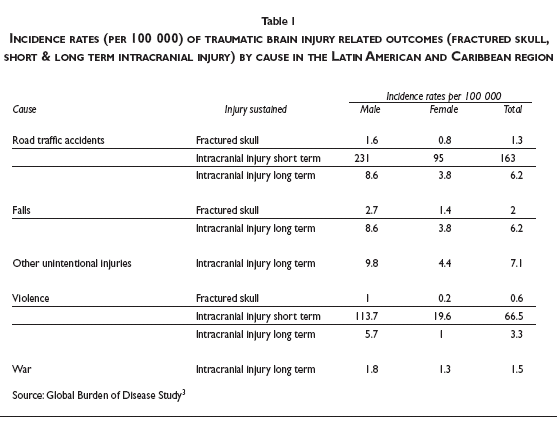
</front><body><![CDATA[ <p align="right"><font face="Verdana" size="2"><b>EDITORIAL</b></font></p>     <p>&nbsp;</p>     <p><font face="Verdana" size="4"><b>Traumatic brain injury in Latin America and    the Caribbean: a call for research</b></font></p>     <p>&nbsp;</p>     <p>&nbsp;</p>     <p><font face="Verdana" size="2">Traumatic Brain Injury (TBI) is a critical public    health problem affecting more than 10 million people worldwide and is set to    surpass many diseases as the leading cause of mortality and morbidity by the    year 2020.<sup>1</sup> The burden of this often neglected injury disproportionately    affects low and middle income countries (LMICs) which face not only a higher    preponderance of risk factors for TBI but also have less developed health systems    to deal with the associated health outcomes. Thus, both the incidence of TBI    and the case-fatality from TBI can be high and devastating.</font></p>     <p><font face="Verdana" size="2">The Latin American and Caribbean region (LAC)    consists of a large proportion of LMIC with approximately 36% of the region's    population living below the poverty line.<sup>2</sup> Studies stemming from    LAC regarding the burden of TBI are uncommon; and regional data is limited to    estimates derived in the mid-nineties. Data from the 1996 Global Burden of Disease    Report<sup>3</sup> focused on three TBI-related outcomes: intra-cranial injury    both short and long term, and fractured skull. These data demonstrate extremely    high incidence rates of intra-cranial injury following road traffic injuries    (RTI) and violence (<a href="#tab01">table I</a>). The LAC region was found    to have the highest incidence of intracranial injury worldwide secondary to    an RTI with an incidence rate of 163 per 100 000; this can be compared to a    world average of 106 per 100 000. Similarly the incidence rate due to violence    was the highest worldwide at 67 per 100 000 compared to a world average of 47    per 100 000 (<a href="#tab01">table I</a>).</font></p>     <p><a name="tab01"></a></p>     <p>&nbsp;</p>     <p align="center"><img src="/img/revistas/spm/v50s1/a02tab01.gif"></p>     ]]></body>
<body><![CDATA[<p>&nbsp;</p>     <p><font face="Verdana" size="2"><a href="#tab01">Table I</a> also shows that    males demonstrate a significantly higher rate of TBI-related outcomes than females.    RTIs and their sequelae are becoming a significant health problem in LAC; their    causes are also the focus of some research in the region.<sup>4</sup> This region    also has the second highest rates for short term intracranial injury as a consequence    of violence; and violence is the principal cause of death in Brazil, Columbia,    Venezuela, El Salvador and Mexico.<sup>5</sup>    <a href="#fig01">Figure 1</a> shows the percentage of cases of head injury by    cause in LAC; RTIs account for 66% of all cases, which is slightly higher than    the global average of 60%. Violence is responsible for 27% of TBI-related outcomes    in the region, which is considerably higher than the global average of 10%.<sup>6</sup></font></p>     <p><a name="fig01"></a></p>     <p>&nbsp;</p>     <p align="center"><img src="/img/revistas/spm/v50s1/a02fig01.gif"></p>     <p>&nbsp;</p>     <p><font face="Verdana" size="2">A systematic review of the literature revealed    that there is a paucity of TBI data from this region. Efforts to quantify the    magnitude of the burden are hampered by inconsistencies in the definition of    TBI, in addition to the finding that most minor brain injuries are not medically    treated and therefore often not reported. When caused by violence e.g. in war    or civil unrest settings, TBI often occurs in the context of multi-trauma and    is therefore either underreported or misclassified (with other causes of death).    This is particularly relevant in Latin America where such a large proportion    of TBI are caused by violence.</font></p>     <p><font face="Verdana" size="2">Data from individual countries provides additional    information on the extent of the burden of TBI in parts of Latin America. The    incidence rate for TBI in Sao Paulo, Brazil was found to be 360 per 100 000,7    much higher than the overall incidence rate of 200 per 100 000 for developed    countries.<sup>8</sup> A study from Salvador City, Brazil which described the    characteristics of victims of TBI, revealed that 83% were male, with the most    frequent age group being 21 to 30 years. The most common cause was RTIs (41%),    however violence with or without weapons was the second highest cause (25%),    closely followed by falls (24%).<sup>9</sup> Approximately 1 745 Mexicans are    hospitalized as a result of TBI every year; males (68%) and those aged 25-44    years are more likely to be affected.<sup>10</sup> Trends in causes of TBI follow    a similar pattern with RTIs and falls as the leading two causes (43% and 13%    respectively).<sup>10</sup></font></p>     <p><font face="Verdana" size="2">TBI amongst children is of growing concern, especially    amongst LMIC. There is a great lack of data surrounding this age group. The    causes of TBI amongst children in Latin America are highlighted in a study of    2 492 children where 33.5% were 0-2 years, 43.8% between 3-9 years and 22.7%    from 10-15 years.<sup>11</sup> Falls were    found to be the main cause of TBI in children less than three years, and RTIs    prevailed as the leading cause of TBI amongst older aged children. An incidence    rate of 566 child TBI cases per 100 000 and a corresponding mortality rate of    4.65 per 1 000 TBI cases was reported; this incidence rate is 2.97 times higher    than the international average.<sup>11</sup></font></p>     <p><font face="Verdana" size="2">Given that TBI can lead to significant mortality    and long term morbidity, not to mention the social and financial implications,    the silently growing epidemic of this injury is a pressing public health concern.    The lack of data concerning the burden of TBI within LAC should be addressed    to develop a detailed epidemiological profile in order to plan comprehensive    TBI prevention programs. Prioritizing and coordinating funds for the generation    of appropriate evidence and research is critical to meet the need to promote    evidence-based policy for TBI in the region.</font></p>     ]]></body>
<body><![CDATA[<p align="right"><font face="Verdana" size="2">Prasanthi Puvanachandra, MD, MPH,    MA,<a href="#nt01"><sup>*</sup></a><a name="tx01"></a>    <br>   Adnan A. Hyder MD, MPH, PhD.<a href="#nt02"><sup>**</sup></a><a name="tx02"></a>    <br>   <a href="mailto:ahyder@hsph.edu">ahyder@hsph.edu</a></font></p>     <p>&nbsp;</p>     <p><font face="Verdana" size="3"><b>References</b></font></p>     <!-- ref --><p><font face="Verdana" size="2">1.&nbsp;Zitnay GA. Lessons from national and    international TBI societies and funds like NBIRTT. Acta Neurochir Suppl 2005;93:131-133.</font>&nbsp;&nbsp;&nbsp;&nbsp;&nbsp;&nbsp;&nbsp;&nbsp;[&#160;<a href="javascript:void(0);" onclick="javascript: window.open('/scielo.php?script=sci_nlinks&ref=9260022&pid=S0036-3634200800070000200001&lng=','','width=640,height=500,resizable=yes,scrollbars=1,menubar=yes,');">Links</a>&#160;]<!-- end-ref --><!-- ref --><p><font face="Verdana" size="2">2.&nbsp;Leipziger D.The unfinished poverty agenda:    why Latin America and the caribbean lag behind. Finance and Development 2001    ;38( 1).</font>&nbsp;&nbsp;&nbsp;&nbsp;&nbsp;&nbsp;&nbsp;&nbsp;[&#160;<a href="javascript:void(0);" onclick="javascript: window.open('/scielo.php?script=sci_nlinks&ref=9260023&pid=S0036-3634200800070000200002&lng=','','width=640,height=500,resizable=yes,scrollbars=1,menubar=yes,');">Links</a>&#160;]<!-- end-ref --><!-- ref --><p><font face="Verdana" size="2">3.&nbsp;Murray CJ, López AD.The Global burden    of disease: a comprehensive assessment of mortality and disability from diseases,    injuries, and risk factors in 1990 and projected in 2020 Boston: Harvard School    of Public Health: Harvard University Press, 1996.</font>&nbsp;&nbsp;&nbsp;&nbsp;&nbsp;&nbsp;&nbsp;&nbsp;[&#160;<a href="javascript:void(0);" onclick="javascript: window.open('/scielo.php?script=sci_nlinks&ref=9260024&pid=S0036-3634200800070000200003&lng=','','width=640,height=500,resizable=yes,scrollbars=1,menubar=yes,');">Links</a>&#160;]<!-- end-ref --><!-- ref --><p><font face="Verdana" size="2">4.&nbsp;Hijar-Medina MC,Carrillo-Ordaz CE, Flores-Aldana    ME,Anaya R, López-López MV. &#91;Risk factors for injuries caused by traffic accidents    and the impact of an intervention on the road&#93;. Rev Saude Publica 1999;33(5):    505-512.</font>&nbsp;&nbsp;&nbsp;&nbsp;&nbsp;&nbsp;&nbsp;&nbsp;[&#160;<a href="javascript:void(0);" onclick="javascript: window.open('/scielo.php?script=sci_nlinks&ref=9260025&pid=S0036-3634200800070000200004&lng=','','width=640,height=500,resizable=yes,scrollbars=1,menubar=yes,');">Links</a>&#160;]<!-- end-ref --><!-- ref --><p><font face="Verdana" size="2">5.&nbsp;Briceño-León R.Violence and the right    to kill: public perceptions from Latin America.Venezuela: Central University    of Venezuela.</font>&nbsp;&nbsp;&nbsp;&nbsp;&nbsp;&nbsp;&nbsp;&nbsp;[&#160;<a href="javascript:void(0);" onclick="javascript: window.open('/scielo.php?script=sci_nlinks&ref=9260026&pid=S0036-3634200800070000200005&lng=','','width=640,height=500,resizable=yes,scrollbars=1,menubar=yes,');">Links</a>&#160;]<!-- end-ref --><!-- ref --><p><font face="Verdana" size="2">6.&nbsp;Gururaj G. An epidemiological approach    to prevention - Prehospital care and rehabilitation in neurotrauma. Neurology    India 1995;43(3): 95-105.</font>&nbsp;&nbsp;&nbsp;&nbsp;&nbsp;&nbsp;&nbsp;&nbsp;[&#160;<a href="javascript:void(0);" onclick="javascript: window.open('/scielo.php?script=sci_nlinks&ref=9260027&pid=S0036-3634200800070000200006&lng=','','width=640,height=500,resizable=yes,scrollbars=1,menubar=yes,');">Links</a>&#160;]<!-- end-ref --><!-- ref --><p><font face="Verdana" size="2">7.&nbsp;De Andrade A, Marino R, Ciquini O, Figueiredo    E,Machado A. Guidelines for neurosurgical trauma in Brazil.World J Surg 2001    ;V25(9): 1186-1201.</font>&nbsp;&nbsp;&nbsp;&nbsp;&nbsp;&nbsp;&nbsp;&nbsp;[&#160;<a href="javascript:void(0);" onclick="javascript: window.open('/scielo.php?script=sci_nlinks&ref=9260028&pid=S0036-3634200800070000200007&lng=','','width=640,height=500,resizable=yes,scrollbars=1,menubar=yes,');">Links</a>&#160;]<!-- end-ref --><!-- ref --><p><font face="Verdana" size="2">8.&nbsp;Bruns J Jr, Hauser WA.The epidemiology    of traumatic brain injury: a review. Epilepsia 2003;44(suppl 10):2-10.</font>&nbsp;&nbsp;&nbsp;&nbsp;&nbsp;&nbsp;&nbsp;&nbsp;[&#160;<a href="javascript:void(0);" onclick="javascript: window.open('/scielo.php?script=sci_nlinks&ref=9260029&pid=S0036-3634200800070000200008&lng=','','width=640,height=500,resizable=yes,scrollbars=1,menubar=yes,');">Links</a>&#160;]<!-- end-ref --><!-- ref --><p><font face="Verdana" size="2">9.&nbsp;Melo JR, Silva RA, Moreira ED Jr. Characteristics    of patients with head injury at Salvador City (Bahia-Brazil).Arq Neuropsiquiatr    2004;62(3A):711-714.</font>&nbsp;&nbsp;&nbsp;&nbsp;&nbsp;&nbsp;&nbsp;&nbsp;[&#160;<a href="javascript:void(0);" onclick="javascript: window.open('/scielo.php?script=sci_nlinks&ref=9260030&pid=S0036-3634200800070000200009&lng=','','width=640,height=500,resizable=yes,scrollbars=1,menubar=yes,');">Links</a>&#160;]<!-- end-ref --><!-- ref --><p><font face="Verdana" size="2">10.&nbsp;Brain Injury Association of New Mexico.    2000 &#91;cited 6th December 2006&#93;; Available at: <A href=http://www.braininjurynm.org/ target="_blank">http://www.braininjurynm.org/</A>.</font>&nbsp;&nbsp;&nbsp;&nbsp;&nbsp;&nbsp;&nbsp;&nbsp;[&#160;<a href="javascript:void(0);" onclick="javascript: window.open('/scielo.php?script=sci_nlinks&ref=9260031&pid=S0036-3634200800070000200010&lng=','','width=640,height=500,resizable=yes,scrollbars=1,menubar=yes,');">Links</a>&#160;]<!-- end-ref --><!-- ref --><p><font face="Verdana" size="2">11.Murgio A,FernándezMilaJ,Manolio A,Maurel D,UbedaC.    Minor head injury at paediatric age in Argentina. J Neurosurg Sci 1999;43( 1):    15-23.</font>&nbsp;&nbsp;&nbsp;&nbsp;&nbsp;&nbsp;&nbsp;&nbsp;[&#160;<a href="javascript:void(0);" onclick="javascript: window.open('/scielo.php?script=sci_nlinks&ref=9260032&pid=S0036-3634200800070000200011&lng=','','width=640,height=500,resizable=yes,scrollbars=1,menubar=yes,');">Links</a>&#160;]<!-- end-ref --><p>&nbsp;</p>     <p>&nbsp;</p>     <p><font face="Verdana" size="2"><a name="nt01"></a><a href="#tx01">*</a> Post-Doctoral    fellow. Department of International Health, Johns Hopkins Bloomberg School of    Public Health, USA.    <br>   <a name="nt02"></a><a href="#tx02">**</a> Department of International Health    and Center for Injury Research &amp; Policy, Johns Hopkins Bloomberg School    of Public Health, USA.</font></p>     ]]></body>
<body><![CDATA[ ]]></body><back>
<ref-list>
<ref id="B1">
<label>1</label><nlm-citation citation-type="journal">
<person-group person-group-type="author">
<name>
<surname><![CDATA[Zitnay]]></surname>
<given-names><![CDATA[GA.]]></given-names>
</name>
</person-group>
<article-title xml:lang="en"><![CDATA[Lessons from national and international TBI societies and funds like NBIRTT]]></article-title>
<source><![CDATA[Acta Neurochir Suppl]]></source>
<year>2005</year>
<volume>93</volume>
<page-range>131-133</page-range></nlm-citation>
</ref>
<ref id="B2">
<label>2</label><nlm-citation citation-type="journal">
<person-group person-group-type="author">
<name>
<surname><![CDATA[Leipziger]]></surname>
<given-names><![CDATA[D]]></given-names>
</name>
</person-group>
<article-title xml:lang="en"><![CDATA[The unfinished poverty agenda: why Latin America and the caribbean lag behind]]></article-title>
<source><![CDATA[Finance and Development]]></source>
<year>2001</year>
<volume>38</volume>
<numero>1</numero>
<issue>1</issue>
</nlm-citation>
</ref>
<ref id="B3">
<label>3</label><nlm-citation citation-type="book">
<person-group person-group-type="author">
<name>
<surname><![CDATA[Murray]]></surname>
<given-names><![CDATA[CJ]]></given-names>
</name>
<name>
<surname><![CDATA[López]]></surname>
<given-names><![CDATA[AD]]></given-names>
</name>
</person-group>
<source><![CDATA[The Global burden of disease: a comprehensive assessment of mortality and disability from diseases, injuries, and risk factors in 1990 and projected in 2020]]></source>
<year>1996</year>
<publisher-loc><![CDATA[Boston ]]></publisher-loc>
<publisher-name><![CDATA[Harvard School of Public Health: Harvard University Press]]></publisher-name>
</nlm-citation>
</ref>
<ref id="B4">
<label>4</label><nlm-citation citation-type="journal">
<person-group person-group-type="author">
<name>
<surname><![CDATA[Hijar-Medina]]></surname>
<given-names><![CDATA[MC]]></given-names>
</name>
<name>
<surname><![CDATA[Carrillo-Ordaz]]></surname>
<given-names><![CDATA[CE]]></given-names>
</name>
<name>
<surname><![CDATA[Flores-Aldana]]></surname>
<given-names><![CDATA[ME]]></given-names>
</name>
<name>
<surname><![CDATA[Anaya]]></surname>
<given-names><![CDATA[R]]></given-names>
</name>
<name>
<surname><![CDATA[López-López]]></surname>
<given-names><![CDATA[MV]]></given-names>
</name>
</person-group>
<article-title xml:lang="en"><![CDATA[Risk factors for injuries caused by traffic accidents and the impact of an intervention on the road]]></article-title>
<source><![CDATA[Rev Saude Publica]]></source>
<year>1999</year>
<volume>33</volume>
<numero>5</numero>
<issue>5</issue>
<page-range>505-512</page-range></nlm-citation>
</ref>
<ref id="B5">
<label>5</label><nlm-citation citation-type="book">
<person-group person-group-type="author">
<name>
<surname><![CDATA[Briceño-León]]></surname>
<given-names><![CDATA[R]]></given-names>
</name>
</person-group>
<source><![CDATA[Violence and the right to kill: public perceptions from Latin America]]></source>
<year></year>
<publisher-loc><![CDATA[Venezuela ]]></publisher-loc>
<publisher-name><![CDATA[Central University of Venezuela]]></publisher-name>
</nlm-citation>
</ref>
<ref id="B6">
<label>6</label><nlm-citation citation-type="journal">
<person-group person-group-type="author">
<name>
<surname><![CDATA[Gururaj]]></surname>
<given-names><![CDATA[G]]></given-names>
</name>
</person-group>
<article-title xml:lang="en"><![CDATA[An epidemiological approach to prevention: Prehospital care and rehabilitation in neurotrauma]]></article-title>
<source><![CDATA[Neurology India]]></source>
<year>1995</year>
<volume>43</volume>
<numero>3</numero>
<issue>3</issue>
<page-range>95-105</page-range></nlm-citation>
</ref>
<ref id="B7">
<label>7</label><nlm-citation citation-type="journal">
<person-group person-group-type="author">
<name>
<surname><![CDATA[De Andrade]]></surname>
<given-names><![CDATA[A]]></given-names>
</name>
<name>
<surname><![CDATA[Marino]]></surname>
<given-names><![CDATA[R]]></given-names>
</name>
<name>
<surname><![CDATA[Ciquini]]></surname>
<given-names><![CDATA[O]]></given-names>
</name>
<name>
<surname><![CDATA[Figueiredo]]></surname>
<given-names><![CDATA[E]]></given-names>
</name>
<name>
<surname><![CDATA[Machado]]></surname>
<given-names><![CDATA[A]]></given-names>
</name>
</person-group>
<article-title xml:lang="en"><![CDATA[Guidelines for neurosurgical trauma in Brazil]]></article-title>
<source><![CDATA[World J Surg]]></source>
<year>2001</year>
<volume>25</volume>
<numero>9</numero>
<issue>9</issue>
<page-range>1186-1201</page-range></nlm-citation>
</ref>
<ref id="B8">
<label>8</label><nlm-citation citation-type="journal">
<person-group person-group-type="author">
<name>
<surname><![CDATA[Bruns]]></surname>
<given-names><![CDATA[J Jr]]></given-names>
</name>
<name>
<surname><![CDATA[Hauser]]></surname>
<given-names><![CDATA[WA]]></given-names>
</name>
</person-group>
<article-title xml:lang="en"><![CDATA[The epidemiology of traumatic brain injury: a review]]></article-title>
<source><![CDATA[Epilepsia]]></source>
<year>2003</year>
<volume>44</volume>
<numero>^s10</numero>
<issue>^s10</issue>
<supplement>10</supplement>
<page-range>2-10</page-range></nlm-citation>
</ref>
<ref id="B9">
<label>9</label><nlm-citation citation-type="journal">
<person-group person-group-type="author">
<name>
<surname><![CDATA[Melo]]></surname>
<given-names><![CDATA[JR]]></given-names>
</name>
<name>
<surname><![CDATA[Silva]]></surname>
<given-names><![CDATA[RA]]></given-names>
</name>
<name>
<surname><![CDATA[Moreira]]></surname>
<given-names><![CDATA[ED Jr]]></given-names>
</name>
</person-group>
<article-title xml:lang="en"><![CDATA[Characteristics of patients with head injury at Salvador City (Bahia-Brazil)]]></article-title>
<source><![CDATA[Arq Neuropsiquiatr]]></source>
<year>2004</year>
<volume>62</volume>
<numero>3A</numero>
<issue>3A</issue>
<page-range>711-714</page-range></nlm-citation>
</ref>
<ref id="B10">
<label>10</label><nlm-citation citation-type="">
<collab>Brain Injury Association of New Mexico</collab>
<source><![CDATA[]]></source>
<year>2000</year>
</nlm-citation>
</ref>
<ref id="B11">
<label>11</label><nlm-citation citation-type="journal">
<person-group person-group-type="author">
<name>
<surname><![CDATA[Murgio]]></surname>
<given-names><![CDATA[A]]></given-names>
</name>
<name>
<surname><![CDATA[FernándezMila]]></surname>
<given-names><![CDATA[J]]></given-names>
</name>
<name>
<surname><![CDATA[Manolio]]></surname>
<given-names><![CDATA[A]]></given-names>
</name>
<name>
<surname><![CDATA[Maurel]]></surname>
<given-names><![CDATA[D]]></given-names>
</name>
<name>
<surname><![CDATA[Ubeda]]></surname>
<given-names><![CDATA[C]]></given-names>
</name>
</person-group>
<article-title xml:lang="en"><![CDATA[Minor head injury at paediatric age in Argentina]]></article-title>
<source><![CDATA[J Neurosurg Sci]]></source>
<year>1999</year>
<volume>43</volume>
<numero>1</numero>
<issue>1</issue>
<page-range>15-23</page-range></nlm-citation>
</ref>
</ref-list>
</back>
</article>
