<?xml version="1.0" encoding="ISO-8859-1"?><article xmlns:mml="http://www.w3.org/1998/Math/MathML" xmlns:xlink="http://www.w3.org/1999/xlink" xmlns:xsi="http://www.w3.org/2001/XMLSchema-instance">
<front>
<journal-meta>
<journal-id>0036-3634</journal-id>
<journal-title><![CDATA[Salud Pública de México]]></journal-title>
<abbrev-journal-title><![CDATA[Salud pública Méx]]></abbrev-journal-title>
<issn>0036-3634</issn>
<publisher>
<publisher-name><![CDATA[Instituto Nacional de Salud Pública]]></publisher-name>
</publisher>
</journal-meta>
<article-meta>
<article-id>S0036-36342008000500016</article-id>
<title-group>
<article-title xml:lang="en"><![CDATA[Secondhand smoke: facts and lies]]></article-title>
<article-title xml:lang="es"><![CDATA[Humo de segunda mano: hechos y mentiras]]></article-title>
</title-group>
<contrib-group>
<contrib contrib-type="author">
<name>
<surname><![CDATA[Samet]]></surname>
<given-names><![CDATA[Jonathan M]]></given-names>
</name>
<xref ref-type="aff" rid="A01"/>
</contrib>
</contrib-group>
<aff id="A01">
<institution><![CDATA[,The Johns Hopkins Bloomberg School of Public Health The Institute for Global Tobacco Control Department of Epidemiology]]></institution>
<addr-line><![CDATA[ ]]></addr-line>
</aff>
<pub-date pub-type="pub">
<day>00</day>
<month>10</month>
<year>2008</year>
</pub-date>
<pub-date pub-type="epub">
<day>00</day>
<month>10</month>
<year>2008</year>
</pub-date>
<volume>50</volume>
<numero>5</numero>
<fpage>428</fpage>
<lpage>434</lpage>
<copyright-statement/>
<copyright-year/>
<self-uri xlink:href="http://www.scielo.org.mx/scielo.php?script=sci_arttext&amp;pid=S0036-36342008000500016&amp;lng=en&amp;nrm=iso"></self-uri><self-uri xlink:href="http://www.scielo.org.mx/scielo.php?script=sci_abstract&amp;pid=S0036-36342008000500016&amp;lng=en&amp;nrm=iso"></self-uri><self-uri xlink:href="http://www.scielo.org.mx/scielo.php?script=sci_pdf&amp;pid=S0036-36342008000500016&amp;lng=en&amp;nrm=iso"></self-uri><abstract abstract-type="short" xml:lang="en"><p><![CDATA[Mexico ratified the Framework Convention for Tobacco Control in 2004 and is obligated to move forward with implementing its provisions, including Article 8 (Protection from exposure to tobacco smoke). The country has already faced opposition from the tobacco industry. This paper addresses industry tactics against tobacco control, describing the general strategies that have been pursued and the evidence relevant to combating these strategies. The approaches taken by the industry in an effort to discredit the scientific foundation for promoting smokefree environments, the efforts by the industry to propose ventilation of indoor spaces and separation of smokers from nonsmokers as an effective alternative to smokefree places, and finally, the strategy of raising fear of economic losses on the part of the hospitality industry and thereby gaining this sector as an ally in campaigning against smokefree policies are considered. As reviewed in this article: 1) There is scientific consensus on the adverse effects of inhaling SHS; 2) Only smokefree places fully protect nonsmokers from inhaling SHS; and 3) Smokefree policies do not bring economic harm to the hospitality industry.]]></p></abstract>
<abstract abstract-type="short" xml:lang="es"><p><![CDATA[En 2004 México ratificó el Convenio Marco para el Control del Tabaco y está obligado a implementar sus disposiciones, incluidas el Artículo 8 (Protección contra la exposición al humo de tabaco); esto ha generado oposición de la industria tabacalera. En este artículo se describen las tácticas de la industria para contrarrestar el control del tabaco, sus principales estrategias, y también se presentan las evidencias relevantes para combatirlas. Además, se describen las acciones emprendidas por la industria en el esfuerzo por desacreditar el fundamento científico de la promoción de ambientes libres de humo de tabaco, y su propuesta de usar sistemas de ventilación en espacios interiores y la de separación de áreas para fumadores y no fumadores, como alternativas efectivas a la creación de ambientes libres de humo de tabaco. Por último, las tabacaleras también han creado temor a las perdidas económicas para la industria restaurantera, ello con el objetivo de hacer de este sector un aliado en la lucha contra las políticas de ambientes libres de humo de tabaco. Este artículo concluye que: 1) existe un consenso científico sobre los efectos adversos para la salud causado por la exposición al humo de tabaco; 2) los ambientes libres de humo de tabaco son la única forma de proteger a los no fumadores de la exposición a humo de tabaco; 3) las políticas de ambientes libres de humo de tabaco no afectan económicamente a la industria restaurantera.]]></p></abstract>
<kwd-group>
<kwd lng="en"><![CDATA[secondhand smoke]]></kwd>
<kwd lng="en"><![CDATA[tobacco control]]></kwd>
<kwd lng="en"><![CDATA[scientific evidence]]></kwd>
<kwd lng="en"><![CDATA[smokefree policies]]></kwd>
<kwd lng="es"><![CDATA[humo de segunda mano]]></kwd>
<kwd lng="es"><![CDATA[control del tabaco]]></kwd>
<kwd lng="es"><![CDATA[evidencia científica]]></kwd>
<kwd lng="es"><![CDATA[políticas de ambientes libres de humo de tabaco]]></kwd>
</kwd-group>
</article-meta>
</front><body><![CDATA[ <p align="right"><font size="2" face="Verdana"><b>ENSAYO</b></font></p>     <p>&nbsp;</p>     <p><font size="4" face="verdana"><b>Secondhand smoke: facts and lies</b></font></p>     <p>&nbsp;</p>     <p><font size="3" face="verdana"><b>Humo de segunda mano: hechos y mentiras</b></font></p>     <p>&nbsp;</p>     <p>&nbsp;</p>     <p><font size="2" face="Verdana"><b>Jonathan M Samet, MD, MS</b></font></p>     <p><font size="2" face="Verdana">The Johns Hopkins Bloomberg School of Public    Health. Department of Epidemiology and The Institute for Global Tobacco Control</font></p>     <p>&nbsp;</p>     ]]></body>
<body><![CDATA[<p>&nbsp;</p> <hr size="1" noshade>     <p><font size="2" face="Verdana"><b>ABSTRACT</b></font></p>     <p><font size="2" face="Verdana">Mexico ratified the Framework Convention for    Tobacco Control in 2004 and is obligated to move forward with implementing its    provisions, including Article 8 (Protection from exposure to tobacco smoke).    The country has already faced opposition from the tobacco industry. This paper    addresses industry tactics against tobacco control, describing the general strategies    that have been pursued and the evidence relevant to combating these strategies.    The approaches taken by the industry in an effort to discredit the scientific    foundation for promoting smokefree environments, the efforts by the industry    to propose ventilation of indoor spaces and separation of smokers from nonsmokers    as an effective alternative to smokefree places, and finally, the strategy of    raising fear of economic losses on the part of the hospitality industry and    thereby gaining this sector as an ally in campaigning against smokefree policies    are considered. As reviewed in this article: 1) There is scientific consensus    on the adverse effects of inhaling SHS; 2) Only smokefree places fully protect    nonsmokers from inhaling SHS; and 3) Smokefree policies do not bring economic    harm to the hospitality industry.</font></p>     <p><font size="2" face="Verdana"><b>Key words:</b> secondhand smoke; tobacco control;    scientific evidence; smokefree policies</font></p> <hr size="1" noshade>     <p><font size="2" face="Verdana"><b>RESUMEN</b></font></p>     <p><font size="2" face="Verdana">En 2004 M&eacute;xico ratific&oacute; el Convenio    Marco para el Control del Tabaco y est&aacute; obligado a implementar sus disposiciones,    incluidas el Art&iacute;culo 8 (Protecci&oacute;n contra la exposici&oacute;n    al humo de tabaco); esto ha generado oposici&oacute;n de la industria tabacalera.    En este art&iacute;culo se describen las t&aacute;cticas de la industria para    contrarrestar el control del tabaco, sus principales estrategias, y tambi&eacute;n    se presentan las evidencias relevantes para combatirlas. Adem&aacute;s, se describen    las acciones emprendidas por la industria en el esfuerzo por desacreditar el    fundamento cient&iacute;fico de la promoci&oacute;n de ambientes libres de humo    de tabaco, y su propuesta de usar sistemas de ventilaci&oacute;n en espacios    interiores y la de separaci&oacute;n de &aacute;reas para fumadores y no fumadores,    como alternativas efectivas a la creaci&oacute;n de ambientes libres de humo    de tabaco. Por &uacute;ltimo, las tabacaleras tambi&eacute;n han creado temor    a las perdidas econ&oacute;micas para la industria restaurantera, ello con el    objetivo de hacer de este sector un aliado en la lucha contra las pol&iacute;ticas    de ambientes libres de humo de tabaco. Este art&iacute;culo concluye que: 1)    existe un consenso cient&iacute;fico sobre los efectos adversos para la salud    causado por la exposici&oacute;n al humo de tabaco; 2) los ambientes libres    de humo de tabaco son la &uacute;nica forma de proteger a los no fumadores de    la exposici&oacute;n a humo de tabaco; 3) las pol&iacute;ticas de ambientes    libres de humo de tabaco no afectan econ&oacute;micamente a la industria restaurantera.</font></p>     <p><font size="2" face="Verdana"><b>Palabras clave:</b> humo de segunda mano;    control del tabaco; evidencia cient&iacute;fica; pol&iacute;ticas de ambientes    libres de humo de tabaco</font></p> <hr size="1" noshade>     <p>&nbsp;</p>     <p>&nbsp;</p>     <p><font size="2" face="Verdana">Mexico, like many other countries, is at a critical    juncture in its effort to control tobacco use. Mexico ratified the Framework    Convention for Tobacco Control in 2004 and is obligated to move forward with    implementing its provisions, including Article 8 (Protection from exposure to    tobacco smoke).<SUP>1,2</SUP> At the most recent Conference of the Parties of    the ratifying nations, guidelines were adopted for moving forward with implementation    of Article 8.<SUP>3</SUP> The Guidelines give Mexico five years from ratification    to implement Article 8.</font></p>     ]]></body>
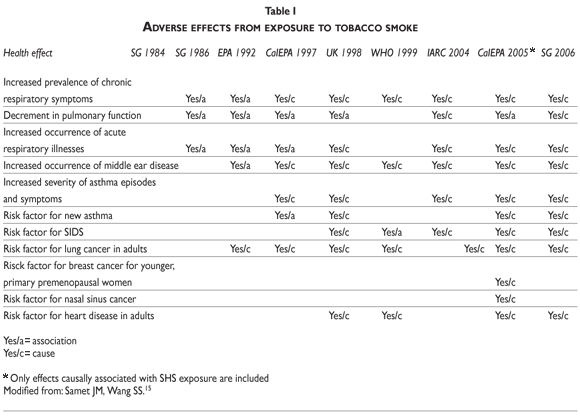
<body><![CDATA[<p><font size="2" face="Verdana">As it moves forward to implement Article 8, Mexico    has already faced opposition from the tobacco industry. For decades, the multinational    tobacco companies have followed aggressive agendas to oppose smokefree initiatives.    These tactics have changed over time. Initially, beginning in the 1980s, the    focus was on attempting to discredit the scientific evidence linking secondhand    smoke (SHS) to increased risk for diseases, such as lung cancer, and other adverse    health effects, such as reduced lung function in children.<SUP>4, 5</SUP> As    the evidence mounted and smokefree regulations were widely promulgated in the    United States and elsewhere, the industry proposed that healthy indoor air could    be achieved with ventilation of spaces where smoking was taking place. They    also advanced campaigns based in the concept that smokers and nonsmokers could    be comfortably accommodated within the same air space. In opposing smokefree    legislation and policies, the industry has repeatedly allied itself with the    hospitality industry around the claim that smoking bans lead to reduced revenue    for bars and restaurants.<SUP>6,7</SUP></font></p>     <p><font size="2" face="Verdana">This paper addresses these industry tactics,    describing the general strategies that have been pursued and the evidence relevant    to combating these strategies. In choosing the title, <I>Secondhand Smoke: Facts    and Lies</I>, language is based in the decision by Judge Gladys Kessler in the    case against the tobacco companies brought by the United States Department of    Justice (US <I>vs</I>. Philip Morris)<SUP>8</SUP> and in the many reviews of    the tobacco industry's own documents that document campaigns of fraud and deception.<SUP>9&#45;11</SUP>    With regard to the tobacco industry, Judge Kessler commented that the companies    <I>"marketed and sold their lethal product with zeal, with deception, with    a single&#45;minded focus on their financial success and without regard for the    human tragedy or social costs that success exacted." </I>The tactics involved    sustained "lies" about the facts with regard to the health effects    of tobacco smoke, misleading information on ventilation and separation of smokers    from nonsmokers, and deceptive reports on the economic consequences of smokefree    policies. Judge Kessler further commented: <I>"Philip Morris, BATCo, B&amp;W,    Lorillard, and RJR all deny in this lawsuit and in public statements that ETS    causes disease in nonsmokers, contrary to the definitive scientific evidence    and their own internal acknowledgements…Absent Court intervention, such denials    and distortions of material health information and scientific evidence on ETS    are, at a minimum, likely to continue."</I><SUP>8</sup></font></p>     <p><font size="2" face="Verdana">This paper begins with an overview of the current    state of the evidence with regard to the health effects of inhaling SHS, based    largely on recent reviews, including the 2004 monograph of the International    Agency for Research on Cancer (IARC) of the World Health Organization,<SUP>12</SUP>    the 2005 report of the California Environmental Protection Agency,<SUP>13</SUP>    and the 2006 report of the U.S. Surgeon General.<SUP>14</SUP> Subsequently,    the approaches taken by the industry in an effort to discredit the scientific    foundation for promoting smokefree environments, the efforts by the industry    to propose ventilation of indoor spaces and separation of smokers from nonsmokers    as an effective alternative to smokefree places, and finally, the strategy of    raising fear of economic losses on the part of the hospitality industry and    thereby gaining this sector as an ally in campaigning against smokefree policies    are considered.</font></p>     <p><font size="2" face="Verdana"><b>Consensus has been reached on the dangers    of secondhand smoke</b></font></p>     <p><font size="2" face="Verdana">Formal epidemiological research on secondhand    smoke dates to the 1960s when exposure to SHS was examined as a risk factor    for respiratory morbidity and allergy in children and adults.<SUP>15</SUP> The    first wave of studies on SHS continued to focus on respiratory morbidity, particularly    in children; the initial evidence came from cross&#45;sectional studies on respiratory    symptoms and illnesses and on lung function in children as well as cohort studies    of acute respiratory illness in infants and young children. Studies carried    out during the later 1970s showed the strength of smoking in indoor places as    a source of respirable particles, particles sufficiently small to reach the    small airways and alveoli (air sacs) of the lung.<SUP>14</sup></font></p>     <p><font size="2" face="Verdana">In terms of motivating smokefree policies, the    evidence on SHS and risk for lung cancer in never smokers has had the greatest    traction. The first major studies on this association were published in 1981:    the cohort study in Japan carried out by Hirayama<SUP>16</SUP> and the case&#45;control    study in Athens reported by Trichopoulos and colleagues.<SUP>17</SUP> Other    studies soon followed and by 1986 the U.S. Surgeon General,<SUP>18</SUP> the    International Agency for Research on Cancer (IARC) of the World Health Organization,<SUP>19</SUP>    and the U.S. National Research Council<SUP>20</SUP> had concluded that SHS was    a cause of lung cancer in never smokers. This conclusion was based not only    in the epidemiological findings on SHS but also on the by&#45;then extensive epidemiological    studies of active smokers and understanding of mechanisms of tobacco smoke carcinogenesis.    The Surgeon General's report and the National Research Council report also offered    conclusions on the adverse effects of SHS exposure on infants and children.</font></p>     <p><font size="2" face="Verdana">Since then, the evidence on adverse effects of    SHS exposure has grown substantially, supporting ever stronger and broader causal    conclusions (<a href="#tab01">table I</a>). Multiple meta&#45;analyses have been    performed, providing summary estimates of the quantitative risks associated    with SHS exposure. Consideration has been given to confounding factors that    might plausibly explain the associations and confounding has been set aside    as a plausible alternative to a causal association. In releasing the 2006 report    on SHS, U.S. Surgeon General Richard Carmona commented that a "scientific    consensus" had now been achieved on the adverse effects of SHS exposure.    The conclusions of his 2006 report are clear with regard to the short&#45; and long&#45;term    consequences of exposure to SHS (<a href="#tab02">table II</a>).<SUP>14</SUP></font></p>     <p><a name="tab01"></a></p>     <p>&nbsp;</p>     <p align="center"><img src="/img/revistas/spm/v50n5/a16tab01.gif"></p>     ]]></body>
<body><![CDATA[<p>&nbsp;</p>     <p><a name="tab02"></a></p>     <p>&nbsp;</p>     <p align="center"><img src="/img/revistas/spm/v50n5/a16tab02.gif"></p>     <p>&nbsp;</p>     <p><font size="2" face="Verdana"><b>The epidemiological findings  reflect    causal association</b></font></p>     <p><font size="2" face="Verdana">The epidemiological evidence on the health effects    of SHS has had a key role in policy formulation. The epidemiological studies    have provided evidence on health risks for the exposures experienced by the    population in their workplaces, homes, and other places. The tobacco industry,    recognizing the implications of this evidence, mounted an aggressive campaign    to attempt to counter the findings of epidemiological studies. Several review    articles cover aspects of this campaign, which is also well described in Brandt's    recent book, <I>The Cigarette Century,</I><SUP>4</SUP> and in Judge Kessler's    1 700 page decision in <I>U.S. vs. Philip Morris.</I><SUP>8</SUP> One thrust    of the campaign was to discredit epidemiological research in general while the    other involved critical attacks on specific studies or bodies of evidence. These    attacks were typically carried out by industry consultants, whose links to the    tobacco industry were hidden in some instances.<SUP>21</sup></font></p>     <p><font size="2" face="Verdana">Because of the central role of epidemiological    evidence, the tobacco industry attempted to broadly discredit the findings of    epidemiological research by smearing such studies as "junk science".<SUP>22,    23</SUP> The attack resembled early efforts by the tobacco industry to dismiss    the powerful findings of studies of active smoking and health as only indicating    hypotheses. This effort reached broadly and much of it was covert so that the    influence of the tobacco industry could not be discerned. In this campaign,    "sound science" was proposed as the opposite of "junk science",    and a destructive attempt was made to establish "evidence bars" that    could not be readily met. Fortunately, many of the details of this campaign    have now been revealed through access to the industry's documents and disclosures    in litigation.<SUP>24</sup></font></p>     <p><font size="2" face="Verdana">The industry also attacked the findings of individual    studies, particularly those with great import, in an effort to limit the policy    implications of their findings. Hirayama's landmark 1981 report in the <I>British    Medical Journal </I>was followed by numerous letters, many from industry consultants,    offering points of criticism &#150;see, for example reference 25. The attacks on    epidemiological studies have been based in well known principles in the interpretation    of epidemiological data, principles that are taught in basic courses in epidemiology.</font></p>     <p><font size="2" face="Verdana">Associations found in epidemiological research    may reflect the play of chance, the consequences of bias, or a true causal effect.<SUP>26</SUP>    Determining the existence of a causal effect is one goal of epidemiological    research, along with quantification of the magnitude of the effect as an indicator    of the risk posed to public health by a disease&#45;causing agent. The role of chance    is assessed with the methods of statistical inference; commonly, a <I>p</I>    value of 0.05 is considered sufficiently stringent to exclude chance as leading    to the association, particularly when findings are consistent with replication.    Bias refers to a systematic error in estimating the effect that arises from    the way that information is collected (information bias), from the way that    study participants are selected (selection bias), and from the effects of other    risk factors that are associated with the exposure under study (confounding).</font></p>     ]]></body>
<body><![CDATA[<p><font size="2" face="Verdana">The criticisms of the findings of individual    studies by the industry and its consultants have been primarily based in proposing    that information bias in the reporting of active and passive smoking may have    inflated estimates of the risk of SHS exposure and that confounding by uncontrolled    risk factors led to non&#45;causal associations. For lung cancer and SHS exposure,    the argument was made that misclassification of true active smokers as passively    exposed never smokers could lead to sufficient positive bias to explain the    observed association in never smokers. This bias was postulated for the studies    using marriage to a smoker as the index of SHS exposure; <SUP>27</SUP> since    smoking habits of spouses tend to be concordant, mis&#45;reporting of active smoking    would be differential by spouse smoking status and potentially introduce a positive    bias. This possibility has been addressed quantitatively and set aside.<SUP>14,28,29</SUP></font></p>     <p><font size="2" face="Verdana">For lung cancer, coronary heart disease, and    the adverse respiratory effects of SHS exposure on children, confounding by    various factors was proposed as leading to the observed associations. Industry    consultants developed lengthy lists of "confounders" and then claimed    that without control of all of the factors, residual confounding could not be    dismissed as explaining observed associations.<SUP>30,31</SUP> This tactic was    also used in legal proceedings by industry experts.<SUP>32</SUP> Epidemiologists    have given careful consideration to this possibility in interpreting individual    studies and the various reports have also addressed the potential for confounding    to have resulted in the observed associations. Both quantitative and qualitative    analyses allow confounding to be set aside as the source of the associations    of disease risk with SHS exposure. Additionally, there is a strong foundation    of experimental and toxicological evidence on SHS that further supports causality.</font></p>     <p><font size="2" face="Verdana"><b>Only smokefree policies protect nonsmokers    against shs exposure</b></font></p>     <p><font size="2" face="Verdana">Indoors, the concentration of SHS depends on    the number of smokers and their smoking patterns, the rate at which air inside    the room is exchanged with air from outdoors (the ventilation rate), air cleaning    by mechanical filtration or other means, and the natural processes of absorption    of gases and impaction of particles.<SUP>14</SUP> The interplay of these factors    is represented by the mass&#45;balance model, represented below in a very simple    form.</font></p>     <p align="center"><img src="/img/revistas/spm/v50n5/a16img01.gif"></p>     <p><font size="2" face="Verdana">The Mass Balance Model provides a useful framework    that illustrates how varying conditions of operation of a building will affect    SHS concentrations. SHS concentration depends on the ratio of the rate at which    SHS is produced to the rate at which it is removed.<SUP>33</SUP> The strength    of the source depends on both the number of people smoking and how much they    are smoking.<SUP>14</SUP> The cigarette is well characterized as to its emissions;    a burning cigarette is a strong source of both small particles that move rapidly    throughout a room and have a substantial residence time in the air and of gases.    These particles and gases move throughout a room due to the natural movement    of air as well as the movement of air via mechanical systems (HVAC systems or    heating, ventilating and air conditioning systems).</font></p>     <p><font size="2" face="Verdana">The mass&#45;balance model implies that doubling    the rate at which SHS is produced (source strength) doubles concentration; however,    doubling the rate at which SHS is removed (ventilation + cleaning) only halves    the concentration level. An eight&#45;fold increase in the effective ventilation    reduces concentration to one&#45;eighth, but no amount of ventilation can eliminate    all SHS. Thus, there is no practical level of ventilation that can effectively    protect against SHS exposure and air cleaners cannot remove SHS sufficiently    from the air.<SUP>14</SUP> For this reason, the American Society of Heating,    Refrigerating, and Air Conditioning Engineers (ASHRAE), which develops ventilation    standards for buildings, has concluded that ventilation cannot provide healthy    indoor air in the presence of smoking.<SUP>34</SUP> The movement of smoke throughout    a single air space also implies that separating smokers and nonsmokers within    the same airspace cannot protect the nonsmokers from exposure to SHS, a conclusion    reached in the 1986 report of the U.S. Surgeon General.<SUP>18</sup></font></p>     <p><font size="2" face="Verdana">The tobacco industry, notwithstanding the physical    principles that establish that neither ventilation of a room or separation of    smokers and nonsmokers within the same air space are effective, has long proposed    strategies that call for either ventilation or separation. They have developed    campaigns of "accommodation" and "courtesy" based in the    proposition that smokers and nonsmokers can be in the same airspace if certain    principles of behavior are followed.<SUP>6,35,36</SUP> Materials have been made    available to the hospitality industry for implementing these campaigns. Of course,    this approach cannot work as it leaves nonsmokers exposed to SHS in "non&#45;smoking"    sections and workers exposed to SHS in "smoking" sections. In a study    carried out nearly two decades ago, we measured levels of airborne nicotine,    a highly specific marker of SHS, in smoking and non&#45;smoking sections of restaurants;    nicotine levels in nonsmoking sections in some restaurants were higher than    level in smoking sections in other restaurants.<SUP>37</SUP> </font></p>     <p><font size="2" face="Verdana">The industry has also aggressively proposed that    ventilation can be effective in controlling SHS concentrations. In the United    States, the industry attempted to influence ventilation standards for indoor    air developed by the ASHRAE with the purpose of assuring that smoking would    be permitted if ventilation were at a level that was deemed sufficient to achieve    health indoor air quality.<SUP>38</SUP> This strategy ultimately failed and    ASHRAE has taken the position that healthy indoor air quality cannot be achieved    in the presence of smoking. Nonetheless, the industry continues to call for    ventilation as a means for controlling SHS concentrations. It has also introduced    cigarette&#45;like products that have been designed to provide nicotine without    open combustion so that emissions are lower than from conventional cigarettes.</font></p>     <p><font size="2" face="Verdana">In spite of the industry's countering propositions,    environments with the acceptable level of SHS, i.e., none, can only be achieved    by banning smoking indoors. In theory, an isolated room for smoking could be    designed and constructed, likely at great cost.<SUP>34</SUP> However, in practice,    such rooms are not a practical alternative to smokefree policies and if used    in the hospitality industry, they would not protect workers from being exposed.</font></p>     ]]></body>
<body><![CDATA[<p><font size="2" face="Verdana"><b>Smokefree policies do not harm </b>the hospitality    sector</font></p>     <p><font size="2" face="Verdana">As smokefree policies were implemented, concerns    were quickly raised with regard to the economic implications for the hospitality    industry, including such businesses as restaurants, bars, discos, gambling establishments,    and others. Because of the behavioral ties of smoking to eating and alcohol    consumption, the argument was made that smokers would be less likely to go to    these venues and that revenues would fall. For the two decades of the move towards    smokefree environments, the tobacco industry has repeatedly used the argument    of economic loss as a lever against smokefree policies and as a way to engage    the hospitality industry as an ally against smokefree policies. Even though    empirical data accumulated from the many places where smokefree policies document    that revenues do not fall and may grow. Nonetheless, the tobacco industry continues    to use this tactic, within and outside of the United States.</font></p>     <p><font size="2" face="Verdana">Some of the first economic studies were carried    out in the State of California, one of the first jurisdictions with a substantial    number of smokefree municipalities, and the first state in the United States    to become completely smokefree. In a pioneering study, Glantz and Smith<SUP>39</SUP>    examined the consequences of smokefree restaurant ordinances in municipalities    in California and Colorado over the period 1985&#45;1992. They did not find indication    of adverse economic impact in these communities. Subsequently, there have been    many further studies, all with similar findings.<SUP>14,40</SUP> Notably, in    New York City the hospitality sector continued to grow after the citywide smokefree    law was implemented and tourism did not decline, as predicted by some opponents    at the hearings in support of the ordinance.<SUP>41</sup></font></p>     <p><font size="2" face="Verdana">The tobacco industry has carried out its own    studies on the economic consequences of smokefree policies. Not surprisingly,    studies supported by the tobacco industry, largely not published in the peer&#45;reviewed    journals, are likely to find a negative economic impact.<SUP>42</SUP> This finding    is divergent from the larger body of studies in the peer&#45;reviewed literature<SUP>14</SUP>    and from increasing experience as more and more jurisdictions have become smokefree.    In regard to Latin America, the first data from Uruguay, following the nation&#45;wide    ban, do not show adverse consequences for the hospitality industry.</font></p>     <p><font size="2" face="Verdana">Unfortunately, the tobacco industry's arguments    about economic impact still hold sway with owners in the hospitality sector    and trade organizations have been widely recruited by the tobacco industry to    oppose smokefree legislation. Fortunately, objective economic data are increasingly    available to counter the arguments of the tobacco industry.<SUP>40</SUP> Additionally,    there is repeated confirmation that smokefree regulations benefit the health    of workers in the hospitality industry.<SUP>43,44</sup></font></p>     <p>&nbsp;</p>     <p><font size="3" face="Verdana"><b>Conclusions</b></font></p>     <p><font size="2" face="Verdana">The scientific evidence is now convincing: SHS    causes premature death and disease. Recognizing this avoidable threat to public    health, the majority of the world's countries, including Mexico, are taking    steps to reduce exposure to SHS as they implement measures to meet the goals    of Article 8 of the FCTC. While the tobacco industry continues to oppose these    measures, the arguments given in support of this opposition are fallacious.    As reviewed in this article: 1) There is scientific consensus on the adverse    effects of inhaling SHS; 2) Only smokefree places fully protect nonsmokers from    inhaling SHS; and 3) Smokefree policies do not bring economic harm to the hospitality    industry.</font></p>     <p>&nbsp;</p>     <p><font size="3" face="Verdana"><b>Acknowledgment</b></font></p>     ]]></body>
<body><![CDATA[<p><font size="2" face="Verdana">Support was provided by The Fogarty International    Center of the National Institutes of Health (grant R01&#45;HL&#45;73699). The Johns    Hopkins Bloomberg School of Public Health is one of five partner organizations    of the Bloomberg Initiative to Reduce Tobacco Use; its mission is to promote    freedom from smoking worldwide.</font></p>     <p>&nbsp;</p>     <p><font size="3" face="verdana"><b>References</b></font></p>     <!-- ref --><p><font size="2" face="Verdana">1. World Health Organization. Framework Convention    on Tobacco Control (FCTC). Geneva: WHO, 2003.</font>&nbsp;&nbsp;&nbsp;&nbsp;&nbsp;&nbsp;&nbsp;&nbsp;[&#160;<a href="javascript:void(0);" onclick="javascript: window.open('/scielo.php?script=sci_nlinks&ref=9273407&pid=S0036-3634200800050001600001&lng=','','width=640,height=500,resizable=yes,scrollbars=1,menubar=yes,');">Links</a>&#160;]<!-- end-ref --><!-- ref --><p><font size="2" face="Verdana">2. World Health Organization. Updated status    of the WHO Framework Convention on Tobacco Control. Geneva: WHO, 2006.</font>&nbsp;&nbsp;&nbsp;&nbsp;&nbsp;&nbsp;&nbsp;&nbsp;[&#160;<a href="javascript:void(0);" onclick="javascript: window.open('/scielo.php?script=sci_nlinks&ref=9273408&pid=S0036-3634200800050001600002&lng=','','width=640,height=500,resizable=yes,scrollbars=1,menubar=yes,');">Links</a>&#160;]<!-- end-ref --><!-- ref --><p><font size="2" face="Verdana">3. World Health Organization. Conference of the    Parties to the WHO Framework Convention for Tobacco Control. Second session.    WHO. 9&#45;20&#45;2007 &#91;accessed 12/05/2007&#93;. Available form: <a href="http://www.who.int/gb/fctc/PDF/cop2/FCTC_COP2_DIV9&#45;en.pdf" target="_blank">http://www.who.int/gb/fctc/PDF/cop2/FCTC_COP2_DIV9&#45;en.pdf</a>.</font>&nbsp;&nbsp;&nbsp;&nbsp;&nbsp;&nbsp;&nbsp;&nbsp;[&#160;<a href="javascript:void(0);" onclick="javascript: window.open('/scielo.php?script=sci_nlinks&ref=9273409&pid=S0036-3634200800050001600003&lng=','','width=640,height=500,resizable=yes,scrollbars=1,menubar=yes,');">Links</a>&#160;]<!-- end-ref --><!-- ref --><p><font size="2" face="Verdana">4. Brandt AM. The Cigarette Century: The Rise,    Fall, and Deadly Persistence of the Product That Defined America. New York:    Basic Books, 2007.</font>&nbsp;&nbsp;&nbsp;&nbsp;&nbsp;&nbsp;&nbsp;&nbsp;[&#160;<a href="javascript:void(0);" onclick="javascript: window.open('/scielo.php?script=sci_nlinks&ref=9273410&pid=S0036-3634200800050001600004&lng=','','width=640,height=500,resizable=yes,scrollbars=1,menubar=yes,');">Links</a>&#160;]<!-- end-ref --><!-- ref --><p><font size="2" face="Verdana">5. Kluger R. Ashes to ashes: America's hundred&#45;year    cigarette war, the public health, and the unabashed triumph of Philip Morris.    New York: Alfred A. Knopf, 1996.</font>&nbsp;&nbsp;&nbsp;&nbsp;&nbsp;&nbsp;&nbsp;&nbsp;[&#160;<a href="javascript:void(0);" onclick="javascript: window.open('/scielo.php?script=sci_nlinks&ref=9273411&pid=S0036-3634200800050001600005&lng=','','width=640,height=500,resizable=yes,scrollbars=1,menubar=yes,');">Links</a>&#160;]<!-- end-ref --><!-- ref --><p><font size="2" face="Verdana">6. Dearlove JV, Bialous SA, Glantz SA. Tobacco    industry manipulation of the hospitality industry to maintain smoking in public    places. Tob Control 2002; 11(2):94&#45;104.</font>&nbsp;&nbsp;&nbsp;&nbsp;&nbsp;&nbsp;&nbsp;&nbsp;[&#160;<a href="javascript:void(0);" onclick="javascript: window.open('/scielo.php?script=sci_nlinks&ref=9273412&pid=S0036-3634200800050001600006&lng=','','width=640,height=500,resizable=yes,scrollbars=1,menubar=yes,');">Links</a>&#160;]<!-- end-ref --><!-- ref --><p><font size="2" face="Verdana">7. Americans for Nonsmokers' Rights. What to    expect from the tobacco industry. Hospitality industry allies. Americans for    Nonsmokers' Rights. 2006 &#91;accessed 12/07/2007&#93;. Available from: <a href="http://www.no&#45;smoke.org/document.php?id=271" target="_blank">http://www.no&#45;smoke.org/document.php?id=271</a></font>&nbsp;&nbsp;&nbsp;&nbsp;&nbsp;&nbsp;&nbsp;&nbsp;[&#160;<a href="javascript:void(0);" onclick="javascript: window.open('/scielo.php?script=sci_nlinks&ref=9273413&pid=S0036-3634200800050001600007&lng=','','width=640,height=500,resizable=yes,scrollbars=1,menubar=yes,');">Links</a>&#160;]<!-- end-ref --><!-- ref --><p><font size="2" face="Verdana">8. Judge Gladys Kessler. United States of America    vs. Philip Morris USA, Inc., etc. Civil Action No. 99&#45;2496 (GK). 8&#45;17&#45;2006.</font>&nbsp;&nbsp;&nbsp;&nbsp;&nbsp;&nbsp;&nbsp;&nbsp;[&#160;<a href="javascript:void(0);" onclick="javascript: window.open('/scielo.php?script=sci_nlinks&ref=9273414&pid=S0036-3634200800050001600008&lng=','','width=640,height=500,resizable=yes,scrollbars=1,menubar=yes,');">Links</a>&#160;]<!-- end-ref --><!-- ref --><p><font size="2" face="Verdana">9. Muggli ME, Forster JL, Hurt RD, Repace JL.    The smoke you don't see: uncovering tobacco industry scientific strategies aimed    against environmental tobacco smoke policies. Am J Public Health 2001; 91(9):1419&#45;1423.</font>&nbsp;&nbsp;&nbsp;&nbsp;&nbsp;&nbsp;&nbsp;&nbsp;[&#160;<a href="javascript:void(0);" onclick="javascript: window.open('/scielo.php?script=sci_nlinks&ref=9273415&pid=S0036-3634200800050001600009&lng=','','width=640,height=500,resizable=yes,scrollbars=1,menubar=yes,');">Links</a>&#160;]<!-- end-ref --><!-- ref --><p><font size="2" face="Verdana">10. Muggli ME, Hurt RD, Blanke DD. Science for    hire: a tobacco industry strategy to influence public opinion on secondhand    smoke. Nicotine Tob Res 2003; 5(3):303&#45;314.</font>&nbsp;&nbsp;&nbsp;&nbsp;&nbsp;&nbsp;&nbsp;&nbsp;[&#160;<a href="javascript:void(0);" onclick="javascript: window.open('/scielo.php?script=sci_nlinks&ref=9273416&pid=S0036-3634200800050001600010&lng=','','width=640,height=500,resizable=yes,scrollbars=1,menubar=yes,');">Links</a>&#160;]<!-- end-ref --><!-- ref --><p><font size="2" face="Verdana">11. Drope J, Chapman S. Tobacco industry efforts    at discrediting scientific knowledge of environmental tobacco smoke: a review    of internal industry documents. J Epidemiol Community Health 2001; 55(8):588&#45;594.</font>&nbsp;&nbsp;&nbsp;&nbsp;&nbsp;&nbsp;&nbsp;&nbsp;[&#160;<a href="javascript:void(0);" onclick="javascript: window.open('/scielo.php?script=sci_nlinks&ref=9273417&pid=S0036-3634200800050001600011&lng=','','width=640,height=500,resizable=yes,scrollbars=1,menubar=yes,');">Links</a>&#160;]<!-- end-ref --><p><font size="2" face="Verdana">12. International Agency for Research on Cancer    (IARC). Tobacco smoke and involuntary smoking. IARC monograph 83. Lyon, France:    IARC, 2004.</font></p>     <p><font size="2" face="Verdana">13. California Environmental Protection Agency    (Cal EPA), Air Resources Board. Proposed identification of environmental tobacco    smoke as a toxic air contaminant. Sacramento, CA: California Environmental Protection    Agency, 2005.</font></p>     <!-- ref --><p><font size="2" face="Verdana">14. US Department of Health and Human Services    (USDHHS). The health effects of involuntary exposure to tobacco smoke. Rockville,    MD:US Department of Health and Human Services (USDHHS)/ Centers for Disease    Control and Prevention (CDC), 2006.</font>&nbsp;&nbsp;&nbsp;&nbsp;&nbsp;&nbsp;&nbsp;&nbsp;[&#160;<a href="javascript:void(0);" onclick="javascript: window.open('/scielo.php?script=sci_nlinks&ref=9273420&pid=S0036-3634200800050001600014&lng=','','width=640,height=500,resizable=yes,scrollbars=1,menubar=yes,');">Links</a>&#160;]<!-- end-ref --><!-- ref --><p><font size="2" face="Verdana">15. Samet JM, Wang SS. Environmental tobacco    smoke. In: Lippmann M, ed. Environmental Toxicants: Human Exposures and Their    Health Effects. New York: Van Nostrand Reinhold Company, Inc., 2000: 319&#45;375.</font>&nbsp;&nbsp;&nbsp;&nbsp;&nbsp;&nbsp;&nbsp;&nbsp;[&#160;<a href="javascript:void(0);" onclick="javascript: window.open('/scielo.php?script=sci_nlinks&ref=9273421&pid=S0036-3634200800050001600015&lng=','','width=640,height=500,resizable=yes,scrollbars=1,menubar=yes,');">Links</a>&#160;]<!-- end-ref --><!-- ref --><p><font size="2" face="Verdana">16. Hirayama T. Non&#45;smoking wives of heavy smokers    have a higher risk of lung cancer: A study from Japan. Br Med J (Clin Res Ed<I>)</I>    1981; 282(6259):183&#45;185.</font>&nbsp;&nbsp;&nbsp;&nbsp;&nbsp;&nbsp;&nbsp;&nbsp;[&#160;<a href="javascript:void(0);" onclick="javascript: window.open('/scielo.php?script=sci_nlinks&ref=9273422&pid=S0036-3634200800050001600016&lng=','','width=640,height=500,resizable=yes,scrollbars=1,menubar=yes,');">Links</a>&#160;]<!-- end-ref --><!-- ref --><p><font size="2" face="Verdana">17. Trichopoulos D, Kalandidi A, Sparros L, MacMahon    B. Lung cancer and passive smoking. Int J Cancer 1981; 27(1):1&#45;4.</font>&nbsp;&nbsp;&nbsp;&nbsp;&nbsp;&nbsp;&nbsp;&nbsp;[&#160;<a href="javascript:void(0);" onclick="javascript: window.open('/scielo.php?script=sci_nlinks&ref=9273423&pid=S0036-3634200800050001600017&lng=','','width=640,height=500,resizable=yes,scrollbars=1,menubar=yes,');">Links</a>&#160;]<!-- end-ref --><p><font size="2" face="Verdana">18. US Department of Health and Human Services    (USDHHS). The health consequences of involuntary smoking: A report of the Surgeon    General. DHHS Publication No. (CDC) 87&#45;8398. Washington, DC: US Government Printing    Office, 1986.</font></p>     <p><font size="2" face="Verdana">19. International Agency for Research on Cancer    (IARC). IARC Monographs on the Evaluation of the Carcinogenic Risk of Chemicals    to Humans: Tobacco Smoking. &#91;Monograph 38&#93;. Lyon, France: World Health Organization,    IARC, 1986.</font></p>     <p><font size="2" face="Verdana">20. National Research Council (NRC), Committee    on Passive Smoking. Environmental tobacco smoke: Measuring exposures and assessing    health effects. Washington, DC: National Academy Press, 1986.</font></p>     <!-- ref --><p><font size="2" face="Verdana">21. Diethelm PA, Rielle JC, McKee M. The whole    truth and nothing but the truth? The research that Philip Morris did not want    you to see. Lance<I>t</I> 2005; 366(9479):86&#45;92.</font>&nbsp;&nbsp;&nbsp;&nbsp;&nbsp;&nbsp;&nbsp;&nbsp;[&#160;<a href="javascript:void(0);" onclick="javascript: window.open('/scielo.php?script=sci_nlinks&ref=9273427&pid=S0036-3634200800050001600021&lng=','','width=640,height=500,resizable=yes,scrollbars=1,menubar=yes,');">Links</a>&#160;]<!-- end-ref --><!-- ref --><p><font size="2" face="Verdana">22. Ong EK, Glantz SA. Constructing "sound    science" and "good epidemiology": tobacco, lawyers, and public    relations firms. Am J Public Health 2001; 91(11):1749&#45;1757.</font>&nbsp;&nbsp;&nbsp;&nbsp;&nbsp;&nbsp;&nbsp;&nbsp;[&#160;<a href="javascript:void(0);" onclick="javascript: window.open('/scielo.php?script=sci_nlinks&ref=9273428&pid=S0036-3634200800050001600022&lng=','','width=640,height=500,resizable=yes,scrollbars=1,menubar=yes,');">Links</a>&#160;]<!-- end-ref --><!-- ref --><p><font size="2" face="Verdana">23. Samet JM, Burke TA. Turning science into    junk: the tobacco industry and passive smoking. Am J Public Health 2001; 91(11):1742&#45;1744.</font>&nbsp;&nbsp;&nbsp;&nbsp;&nbsp;&nbsp;&nbsp;&nbsp;[&#160;<a href="javascript:void(0);" onclick="javascript: window.open('/scielo.php?script=sci_nlinks&ref=9273429&pid=S0036-3634200800050001600023&lng=','','width=640,height=500,resizable=yes,scrollbars=1,menubar=yes,');">Links</a>&#160;]<!-- end-ref --><!-- ref --><p><font size="2" face="Verdana">24. Baba A, Cook DM, McGarity TO, Bero LA. Legislating    "sound science": the role of the tobacco industry. Am J Public Health    2005; 95 Suppl 1:S20&#45;S27.</font>&nbsp;&nbsp;&nbsp;&nbsp;&nbsp;&nbsp;&nbsp;&nbsp;[&#160;<a href="javascript:void(0);" onclick="javascript: window.open('/scielo.php?script=sci_nlinks&ref=9273430&pid=S0036-3634200800050001600024&lng=','','width=640,height=500,resizable=yes,scrollbars=1,menubar=yes,');">Links</a>&#160;]<!-- end-ref --><!-- ref --><p><font size="2" face="Verdana">25. Mantel N. Nonsmoking wives of heavy smokers    have a higher risk of lung cancer (Letter). Br Med J 1981; 283:914&#45;915.</font>&nbsp;&nbsp;&nbsp;&nbsp;&nbsp;&nbsp;&nbsp;&nbsp;[&#160;<a href="javascript:void(0);" onclick="javascript: window.open('/scielo.php?script=sci_nlinks&ref=9273431&pid=S0036-3634200800050001600025&lng=','','width=640,height=500,resizable=yes,scrollbars=1,menubar=yes,');">Links</a>&#160;]<!-- end-ref --><!-- ref --><p><font size="2" face="Verdana">26. Gordis L. Epidemiology. 3nd ed. Philadelphia:    WB Saunders, 2004.</font>&nbsp;&nbsp;&nbsp;&nbsp;&nbsp;&nbsp;&nbsp;&nbsp;[&#160;<a href="javascript:void(0);" onclick="javascript: window.open('/scielo.php?script=sci_nlinks&ref=9273432&pid=S0036-3634200800050001600026&lng=','','width=640,height=500,resizable=yes,scrollbars=1,menubar=yes,');">Links</a>&#160;]<!-- end-ref --><!-- ref --><p><font size="2" face="Verdana">27. Lee PN. Difficulties in assessing the relationship    between passive smoking and lung cancer. Stat Methods Med Res 1998; 7(2):137&#45;163.</font>&nbsp;&nbsp;&nbsp;&nbsp;&nbsp;&nbsp;&nbsp;&nbsp;[&#160;<a href="javascript:void(0);" onclick="javascript: window.open('/scielo.php?script=sci_nlinks&ref=9273433&pid=S0036-3634200800050001600027&lng=','','width=640,height=500,resizable=yes,scrollbars=1,menubar=yes,');">Links</a>&#160;]<!-- end-ref --><p><font size="2" face="Verdana">28. US Environmental Protection Agency (EPA).    Respiratory health effects of passive smoking: Lung cancer and other disorders.    EPA/600/006F. Washington, DC: US Government Printing Office, 1992.</font></p>     <p><font size="2" face="Verdana">29. Wu AH. Exposure misclassification bias in    studies of environmental tobacco smoke and lung cancer. Environ Health Perspect    1999; 107(Suppl 6):873&#45;877.</font></p>     <!-- ref --><p><font size="2" face="Verdana">30. Witorsch P, Witorsch RJ. Analysis of potential    confounding variables in epidemiologic studies of parental/household smoking    of respiratory health in preschool children. Indoor Environment 1993; 2:71&#45;91.</font>&nbsp;&nbsp;&nbsp;&nbsp;&nbsp;&nbsp;&nbsp;&nbsp;[&#160;<a href="javascript:void(0);" onclick="javascript: window.open('/scielo.php?script=sci_nlinks&ref=9273436&pid=S0036-3634200800050001600030&lng=','','width=640,height=500,resizable=yes,scrollbars=1,menubar=yes,');">Links</a>&#160;]<!-- end-ref --><!-- ref --><p><font size="2" face="Verdana">31. Lee PN. The role of confounding variables    in the relationship between ETS and lung cancer. Bates No. 2022931396/643. Neuchatel,    Switzerland: Philip Morris Europe, 1991.</font>&nbsp;&nbsp;&nbsp;&nbsp;&nbsp;&nbsp;&nbsp;&nbsp;[&#160;<a href="javascript:void(0);" onclick="javascript: window.open('/scielo.php?script=sci_nlinks&ref=9273437&pid=S0036-3634200800050001600031&lng=','','width=640,height=500,resizable=yes,scrollbars=1,menubar=yes,');">Links</a>&#160;]<!-- end-ref --><!-- ref --><p><font size="2" face="Verdana">32. Francis JA, Shea AK, Samet JM. Challenging    the epidemiologic evidence on passive smoking: tactics of tobacco industry expert    witnesses. Tob Control 2006; 15 Suppl 4:iv68&#45;iv76.</font>&nbsp;&nbsp;&nbsp;&nbsp;&nbsp;&nbsp;&nbsp;&nbsp;[&#160;<a href="javascript:void(0);" onclick="javascript: window.open('/scielo.php?script=sci_nlinks&ref=9273438&pid=S0036-3634200800050001600032&lng=','','width=640,height=500,resizable=yes,scrollbars=1,menubar=yes,');">Links</a>&#160;]<!-- end-ref --><p><font size="2" face="Verdana">33. Ott WR. Mathematical models for predicting    indoor air quality from smoking activity. Environ Health Perspect 1999; 107(Suppl    2):375&#45;381.</font></p>     <!-- ref --><p><font size="2" face="Verdana">34. Samet JM, Bohanon HR, Jr., Coultas DB, Houston    TP, Persily AK, Schoen, <I>LJ et al</I>. ASHRAE position document on environmental    tobacco smoke. Atlanta, GA: ASHRAE, 2005.</font>&nbsp;&nbsp;&nbsp;&nbsp;&nbsp;&nbsp;&nbsp;&nbsp;[&#160;<a href="javascript:void(0);" onclick="javascript: window.open('/scielo.php?script=sci_nlinks&ref=9273440&pid=S0036-3634200800050001600034&lng=','','width=640,height=500,resizable=yes,scrollbars=1,menubar=yes,');">Links</a>&#160;]<!-- end-ref --><!-- ref --><p><font size="2" face="Verdana">35. Smith EA, Malone RE. "Creative Solutions":    selling cigarettes in a smoke&#45;free world. Tob Control 2004; 13(1):57&#45;63.</font>&nbsp;&nbsp;&nbsp;&nbsp;&nbsp;&nbsp;&nbsp;&nbsp;[&#160;<a href="javascript:void(0);" onclick="javascript: window.open('/scielo.php?script=sci_nlinks&ref=9273441&pid=S0036-3634200800050001600035&lng=','','width=640,height=500,resizable=yes,scrollbars=1,menubar=yes,');">Links</a>&#160;]<!-- end-ref --><!-- ref --><p><font size="2" face="Verdana">36. Sebrie EM, Glantz SA. "Accommodating"    smoke&#45;free policies: tobacco industry's Courtesy of Choice programme in Latin    America. Tob Control 2007; 16(5):e6.</font>&nbsp;&nbsp;&nbsp;&nbsp;&nbsp;&nbsp;&nbsp;&nbsp;[&#160;<a href="javascript:void(0);" onclick="javascript: window.open('/scielo.php?script=sci_nlinks&ref=9273442&pid=S0036-3634200800050001600036&lng=','','width=640,height=500,resizable=yes,scrollbars=1,menubar=yes,');">Links</a>&#160;]<!-- end-ref --><!-- ref --><p><font size="2" face="Verdana">37. Lambert WE, Samet JM, Spengler JD. Environmental    tobacco smoke concentrations in no&#45;smoking and smoking sections of restaurants.    Am J Public Health 1993; 83:1339&#45;1341.</font>&nbsp;&nbsp;&nbsp;&nbsp;&nbsp;&nbsp;&nbsp;&nbsp;[&#160;<a href="javascript:void(0);" onclick="javascript: window.open('/scielo.php?script=sci_nlinks&ref=9273443&pid=S0036-3634200800050001600037&lng=','','width=640,height=500,resizable=yes,scrollbars=1,menubar=yes,');">Links</a>&#160;]<!-- end-ref --><!-- ref --><p><font size="2" face="Verdana">38. Bialous SA, Glantz SA. ASHRAE Standard 62:    tobacco industry's influence over national ventilation standards. Tob Control    2002; 11(4):315&#45;328.</font>&nbsp;&nbsp;&nbsp;&nbsp;&nbsp;&nbsp;&nbsp;&nbsp;[&#160;<a href="javascript:void(0);" onclick="javascript: window.open('/scielo.php?script=sci_nlinks&ref=9273444&pid=S0036-3634200800050001600038&lng=','','width=640,height=500,resizable=yes,scrollbars=1,menubar=yes,');">Links</a>&#160;]<!-- end-ref --><!-- ref --><p><font size="2" face="Verdana">39. Glantz SA, Smith LR. The effect of ordinances    requiring smoke&#45;free restaurants on restaurant sales. Am J Public Health 1994;    84(7):1081&#45;1085.</font>&nbsp;&nbsp;&nbsp;&nbsp;&nbsp;&nbsp;&nbsp;&nbsp;[&#160;<a href="javascript:void(0);" onclick="javascript: window.open('/scielo.php?script=sci_nlinks&ref=9273445&pid=S0036-3634200800050001600039&lng=','','width=640,height=500,resizable=yes,scrollbars=1,menubar=yes,');">Links</a>&#160;]<!-- end-ref --><!-- ref --><p><font size="2" face="Verdana">40. Eriksen M, Chaloupka F. The economic impact    of clean indoor air laws. CA Cancer J Clin 2007; 57(6):367&#45;378.</font>&nbsp;&nbsp;&nbsp;&nbsp;&nbsp;&nbsp;&nbsp;&nbsp;[&#160;<a href="javascript:void(0);" onclick="javascript: window.open('/scielo.php?script=sci_nlinks&ref=9273446&pid=S0036-3634200800050001600040&lng=','','width=640,height=500,resizable=yes,scrollbars=1,menubar=yes,');">Links</a>&#160;]<!-- end-ref --><!-- ref --><p><font size="2" face="Verdana">41. Hyland A, Puli V, Cummings KM, Sciandra R.    New York's smoke&#45;free regulations: effects on employment and sales in the hospitality    industry. Cornell Hotel Restaur Adm Q 2003; 44:9&#45;16.</font>&nbsp;&nbsp;&nbsp;&nbsp;&nbsp;&nbsp;&nbsp;&nbsp;[&#160;<a href="javascript:void(0);" onclick="javascript: window.open('/scielo.php?script=sci_nlinks&ref=9273447&pid=S0036-3634200800050001600041&lng=','','width=640,height=500,resizable=yes,scrollbars=1,menubar=yes,');">Links</a>&#160;]<!-- end-ref --><!-- ref --><p><font size="2" face="Verdana">42. Scollo M, Lal A, Hyland A, Glantz S. Review    of the quality of studies on the economic effects of smoke&#45;free policies on    the hospitality industry. Tob Control 2003; 12(1):13&#45;20.</font>&nbsp;&nbsp;&nbsp;&nbsp;&nbsp;&nbsp;&nbsp;&nbsp;[&#160;<a href="javascript:void(0);" onclick="javascript: window.open('/scielo.php?script=sci_nlinks&ref=9273448&pid=S0036-3634200800050001600042&lng=','','width=640,height=500,resizable=yes,scrollbars=1,menubar=yes,');">Links</a>&#160;]<!-- end-ref --><!-- ref --><p><font size="2" face="Verdana">43. Eisner MD, Smith AK, Blanc PD. Bartenders'    respiratory health after establishment of smoke&#45;free bars and taverns. JAMA    1998; 280(22):</font><font size="2" face="Verdana">1909&#45;1914.</font>&nbsp;&nbsp;&nbsp;&nbsp;&nbsp;&nbsp;&nbsp;&nbsp;[&#160;<a href="javascript:void(0);" onclick="javascript: window.open('/scielo.php?script=sci_nlinks&ref=9273449&pid=S0036-3634200800050001600043&lng=','','width=640,height=500,resizable=yes,scrollbars=1,menubar=yes,');">Links</a>&#160;]<!-- end-ref --><!-- ref --><p><font size="2" face="Verdana">44. Menzies D, Nair A, Williamson PA, Schembri    S, Al Khairalla MZ, Barnes M, <I>et al</I>. Respiratory symptoms, pulmonary    function, and markers of inflammation among bar workers before and after a legislative    ban on smoking in public places. JAMA 2006; 296(14):1742&#45;1748.</font>&nbsp;&nbsp;&nbsp;&nbsp;&nbsp;&nbsp;&nbsp;&nbsp;[&#160;<a href="javascript:void(0);" onclick="javascript: window.open('/scielo.php?script=sci_nlinks&ref=9273450&pid=S0036-3634200800050001600044&lng=','','width=640,height=500,resizable=yes,scrollbars=1,menubar=yes,');">Links</a>&#160;]<!-- end-ref --><p>&nbsp;</p>     <p>&nbsp;</p>     <p><font size="2" face="Verdana">Received on: December 7, 2007    ]]></body>
<body><![CDATA[<br>   Accepted on: July 2, 2008</font></p>     <p>&nbsp;</p>     <p>&nbsp;</p>     <p><font size="2" face="Verdana">Address reprint requests to: Dr. Jonathan M.    Samet. The Johns Hopkins Bloomberg School of Public Health.    <br>   Department of Epidemiology and The Institute for Global Tobacco Control. 615    N. Wolfe Street, Rm. W6041 Baltimore, Maryland 21205, USA    <br>   E&#45;mail: <a href="mailto:jsamet@jhsph.edu">jsamet@jhsph.edu</a>    <br>   This manuscript is based on a presentation given by the author on November 01,    2007, as part of the 20<SUP>th</SUP> anniversary celebration of the Instituto    Nacional de Salud Publica.</font></p>      ]]></body><back>
<ref-list>
<ref id="B1">
<label>1</label><nlm-citation citation-type="book">
<collab>World Health Organization</collab>
<source><![CDATA[Framework Convention on Tobacco Control (FCTC)]]></source>
<year>2003</year>
<publisher-loc><![CDATA[Geneva ]]></publisher-loc>
<publisher-name><![CDATA[WHO]]></publisher-name>
</nlm-citation>
</ref>
<ref id="B2">
<label>2</label><nlm-citation citation-type="book">
<collab>World Health Organization</collab>
<source><![CDATA[Updated status of the WHO Framework Convention on Tobacco Control]]></source>
<year>2006</year>
<publisher-loc><![CDATA[Geneva ]]></publisher-loc>
<publisher-name><![CDATA[WHO]]></publisher-name>
</nlm-citation>
</ref>
<ref id="B3">
<label>3</label><nlm-citation citation-type="">
<collab>World Health Organization</collab>
<source><![CDATA[Conference of the Parties to the WHO Framework Convention for Tobacco Control. Second session. WHO]]></source>
<year>9-20</year>
<month>-2</month>
<day>00</day>
</nlm-citation>
</ref>
<ref id="B4">
<label>4</label><nlm-citation citation-type="book">
<person-group person-group-type="author">
<name>
<surname><![CDATA[Brandt]]></surname>
<given-names><![CDATA[AM]]></given-names>
</name>
</person-group>
<source><![CDATA[The Cigarette Century:The Rise, Fall, and Deadly Persistence of the Product That Defined America]]></source>
<year>2007</year>
<publisher-loc><![CDATA[New York ]]></publisher-loc>
<publisher-name><![CDATA[Basic Books]]></publisher-name>
</nlm-citation>
</ref>
<ref id="B5">
<label>5</label><nlm-citation citation-type="book">
<person-group person-group-type="author">
<name>
<surname><![CDATA[Kluger]]></surname>
<given-names><![CDATA[R.]]></given-names>
</name>
</person-group>
<source><![CDATA[Ashes to ashes: America's hundred-year cigarette war, the public health, and the unabashed triumph of Philip Morris]]></source>
<year>1996</year>
<publisher-loc><![CDATA[New York ]]></publisher-loc>
<publisher-name><![CDATA[Alfred A. Knopf]]></publisher-name>
</nlm-citation>
</ref>
<ref id="B6">
<label>6</label><nlm-citation citation-type="journal">
<person-group person-group-type="author">
<name>
<surname><![CDATA[Dearlove]]></surname>
<given-names><![CDATA[JV]]></given-names>
</name>
<name>
<surname><![CDATA[Bialous]]></surname>
<given-names><![CDATA[SA]]></given-names>
</name>
<name>
<surname><![CDATA[Glantz]]></surname>
<given-names><![CDATA[SA]]></given-names>
</name>
</person-group>
<article-title xml:lang="en"><![CDATA[Tobacco industry manipulation of the hospitality industry to maintain smoking in public places]]></article-title>
<source><![CDATA[Tob Control]]></source>
<year>2002</year>
<volume>11</volume>
<numero>2</numero>
<issue>2</issue>
<page-range>94-104</page-range></nlm-citation>
</ref>
<ref id="B7">
<label>7</label><nlm-citation citation-type="">
<source><![CDATA[Americans for Nonsmokers' Rights: What to expect from the tobacco industry. Hospitality industry allies. Americans for Nonsmokers' Rights]]></source>
<year>2006</year>
</nlm-citation>
</ref>
<ref id="B8">
<label>8</label><nlm-citation citation-type="journal">
<person-group person-group-type="author">
<name>
<surname><![CDATA[Kessler]]></surname>
<given-names><![CDATA[Judge Gladys]]></given-names>
</name>
</person-group>
<article-title xml:lang="en"><![CDATA[United States of America vs. Philip Morris USA, Inc., etc]]></article-title>
<source><![CDATA[Civil Action]]></source>
<year>8-17</year>
<month>-2</month>
<day>00</day>
<numero>99</numero>
<issue>99</issue>
</nlm-citation>
</ref>
<ref id="B9">
<label>9</label><nlm-citation citation-type="journal">
<person-group person-group-type="author">
<name>
<surname><![CDATA[Muggli]]></surname>
<given-names><![CDATA[ME]]></given-names>
</name>
<name>
<surname><![CDATA[Forster]]></surname>
<given-names><![CDATA[JL]]></given-names>
</name>
<name>
<surname><![CDATA[Hurt]]></surname>
<given-names><![CDATA[RD]]></given-names>
</name>
<name>
<surname><![CDATA[Repace]]></surname>
<given-names><![CDATA[JL]]></given-names>
</name>
</person-group>
<article-title xml:lang="en"><![CDATA[The smoke you don't see: uncovering tobacco industry scientific strategies aimed against environmental tobacco smoke policies]]></article-title>
<source><![CDATA[Am J Public Health]]></source>
<year>2001</year>
<volume>91</volume>
<numero>9</numero>
<issue>9</issue>
<page-range>1419-1423</page-range></nlm-citation>
</ref>
<ref id="B10">
<label>10</label><nlm-citation citation-type="journal">
<person-group person-group-type="author">
<name>
<surname><![CDATA[Muggli]]></surname>
<given-names><![CDATA[ME]]></given-names>
</name>
<name>
<surname><![CDATA[Hurt]]></surname>
<given-names><![CDATA[RD]]></given-names>
</name>
<name>
<surname><![CDATA[Blanke]]></surname>
<given-names><![CDATA[DD]]></given-names>
</name>
</person-group>
<article-title xml:lang="en"><![CDATA[Science for hire: a tobacco industry strategy to influence public opinion on secondhand smoke]]></article-title>
<source><![CDATA[Nicotine Tob Res]]></source>
<year>2003</year>
<volume>5</volume>
<numero>3</numero>
<issue>3</issue>
<page-range>303-314</page-range></nlm-citation>
</ref>
<ref id="B11">
<label>11</label><nlm-citation citation-type="journal">
<person-group person-group-type="author">
<name>
<surname><![CDATA[Drope]]></surname>
<given-names><![CDATA[J]]></given-names>
</name>
<name>
<surname><![CDATA[Chapman]]></surname>
<given-names><![CDATA[S]]></given-names>
</name>
</person-group>
<article-title xml:lang="en"><![CDATA[Tobacco industry efforts at discrediting scientific knowledge of environmental tobacco smoke: a review of internal industry documents]]></article-title>
<source><![CDATA[J Epidemiol Community Health]]></source>
<year>2001</year>
<volume>55</volume>
<numero>8</numero>
<issue>8</issue>
<page-range>588-594</page-range></nlm-citation>
</ref>
<ref id="B12">
<label>12</label><nlm-citation citation-type="book">
<collab>International Agency for Research on Cancer</collab>
<source><![CDATA[Tobacco smoke and involuntary smoking: IARC monograph 83. Lyon]]></source>
<year>2004</year>
<publisher-loc><![CDATA[France ]]></publisher-loc>
<publisher-name><![CDATA[IARC]]></publisher-name>
</nlm-citation>
</ref>
<ref id="B13">
<label>13</label><nlm-citation citation-type="book">
<collab>California Environmental Protection Agency.Air Resources Board</collab>
<source><![CDATA[Proposed identification of environmental tobacco smoke as a toxic air contaminant. Sacramento,]]></source>
<year>2005</year>
<publisher-loc><![CDATA[CA ]]></publisher-loc>
<publisher-name><![CDATA[California Environmental Protection Agency]]></publisher-name>
</nlm-citation>
</ref>
<ref id="B14">
<label>14</label><nlm-citation citation-type="book">
<source><![CDATA[US Department of Health and Human Services (USDHHS): The health effects of involuntary exposure to tobacco smoke. Rockville, MD]]></source>
<year>2006</year>
<publisher-name><![CDATA[US Department of Health and Human Services (USDHHS)/ Centers for Disease Control and Prevention (CDC)]]></publisher-name>
</nlm-citation>
</ref>
<ref id="B15">
<label>15</label><nlm-citation citation-type="journal">
<person-group person-group-type="author">
<name>
<surname><![CDATA[Samet]]></surname>
<given-names><![CDATA[JM]]></given-names>
</name>
<name>
<surname><![CDATA[Wang]]></surname>
<given-names><![CDATA[SS]]></given-names>
</name>
</person-group>
<article-title xml:lang="en"><![CDATA[Environmental tobacco smoke. In: Lippmann M, ed. Environmental Toxicants: Human Exposures and Their Health Effects]]></article-title>
<source><![CDATA[New York: Van Nostrand Reinhold Company, Inc.,]]></source>
<year>2000</year>
<page-range>319-375</page-range></nlm-citation>
</ref>
<ref id="B16">
<label>16</label><nlm-citation citation-type="journal">
<person-group person-group-type="author">
<name>
<surname><![CDATA[Hirayama]]></surname>
<given-names><![CDATA[T]]></given-names>
</name>
</person-group>
<article-title xml:lang="en"><![CDATA[Non-smoking wives of heavy smokers have a higher risk of lung cancer: A study from Japan]]></article-title>
<source><![CDATA[Br Med J (Clin Res Ed)]]></source>
<year>1981</year>
<volume>282</volume>
<numero>6259</numero>
<issue>6259</issue>
<page-range>183-185</page-range></nlm-citation>
</ref>
<ref id="B17">
<label>17</label><nlm-citation citation-type="journal">
<person-group person-group-type="author">
<name>
<surname><![CDATA[Trichopoulos]]></surname>
<given-names><![CDATA[D]]></given-names>
</name>
<name>
<surname><![CDATA[Kalandidi]]></surname>
<given-names><![CDATA[A]]></given-names>
</name>
<name>
<surname><![CDATA[Sparros]]></surname>
<given-names><![CDATA[L]]></given-names>
</name>
<name>
<surname><![CDATA[MacMahon]]></surname>
<given-names><![CDATA[B]]></given-names>
</name>
</person-group>
<article-title xml:lang="en"><![CDATA[Lung cancer and passive smoking]]></article-title>
<source><![CDATA[Int J Cancer]]></source>
<year>1981</year>
<volume>27</volume>
<numero>1</numero>
<issue>1</issue>
<page-range>1-4</page-range></nlm-citation>
</ref>
<ref id="B18">
<label>18</label><nlm-citation citation-type="book">
<collab>US Department of Health and Human Services</collab>
<source><![CDATA[The health consequences of involuntary smoking:A report of the Surgeon General. DHHS Publication No. (CDC) 87-8398. Washington,]]></source>
<year>1986</year>
<publisher-loc><![CDATA[DC ]]></publisher-loc>
<publisher-name><![CDATA[US Government Printing Office]]></publisher-name>
</nlm-citation>
</ref>
<ref id="B19">
<label>19</label><nlm-citation citation-type="book">
<collab>International Agency for Research on Cancer</collab>
<source><![CDATA[IARC Monographs on the Evaluation of the Carcinogenic Risk of Chemicals to Humans:Tobacco Smoking.]]></source>
<year>1986</year>
<publisher-loc><![CDATA[France ]]></publisher-loc>
<publisher-name><![CDATA[World Health Organization, IARC]]></publisher-name>
</nlm-citation>
</ref>
<ref id="B20">
<label>20</label><nlm-citation citation-type="book">
<collab>National Research Council.Committee on Passive Smoking</collab>
<source><![CDATA[Environmental tobacco smoke:Measuring exposures and assessing health effects. Washington,]]></source>
<year>1986</year>
<publisher-loc><![CDATA[DC ]]></publisher-loc>
<publisher-name><![CDATA[National Academy Press]]></publisher-name>
</nlm-citation>
</ref>
<ref id="B21">
<label>21</label><nlm-citation citation-type="journal">
<person-group person-group-type="author">
<name>
<surname><![CDATA[Diethelm]]></surname>
<given-names><![CDATA[PA]]></given-names>
</name>
<name>
<surname><![CDATA[Rielle]]></surname>
<given-names><![CDATA[JC]]></given-names>
</name>
<name>
<surname><![CDATA[McKee]]></surname>
<given-names><![CDATA[M]]></given-names>
</name>
</person-group>
<article-title xml:lang="en"><![CDATA[The whole truth and nothing but the truth? The research that Philip Morris did not want you to see]]></article-title>
<source><![CDATA[Lancet]]></source>
<year>2005</year>
<volume>366</volume>
<numero>9479</numero>
<issue>9479</issue>
<page-range>86-92</page-range></nlm-citation>
</ref>
<ref id="B22">
<label>22</label><nlm-citation citation-type="journal">
<person-group person-group-type="author">
<name>
<surname><![CDATA[Ong]]></surname>
<given-names><![CDATA[EK]]></given-names>
</name>
<name>
<surname><![CDATA[Glantz]]></surname>
<given-names><![CDATA[SA]]></given-names>
</name>
</person-group>
<article-title xml:lang="en"><![CDATA[Constructing "sound science" and "good epidemiology": tobacco, lawyers, and public relations firms]]></article-title>
<source><![CDATA[Am J Public Health]]></source>
<year>2001</year>
<volume>91</volume>
<numero>11</numero>
<issue>11</issue>
<page-range>1749-1757</page-range></nlm-citation>
</ref>
<ref id="B23">
<label>23</label><nlm-citation citation-type="journal">
<person-group person-group-type="author">
<name>
<surname><![CDATA[Samet]]></surname>
<given-names><![CDATA[JM]]></given-names>
</name>
<name>
<surname><![CDATA[Burke]]></surname>
<given-names><![CDATA[TA]]></given-names>
</name>
</person-group>
<article-title xml:lang="en"><![CDATA[Turning science into junk: the tobacco industry and passive smoking]]></article-title>
<source><![CDATA[Am J Public Health]]></source>
<year>2001</year>
<volume>91</volume>
<numero>11</numero>
<issue>11</issue>
<page-range>1742-1744</page-range></nlm-citation>
</ref>
<ref id="B24">
<label>24</label><nlm-citation citation-type="journal">
<person-group person-group-type="author">
<name>
<surname><![CDATA[Baba]]></surname>
<given-names><![CDATA[A]]></given-names>
</name>
<name>
<surname><![CDATA[Cook]]></surname>
<given-names><![CDATA[DM]]></given-names>
</name>
<name>
<surname><![CDATA[McGarity]]></surname>
<given-names><![CDATA[TO]]></given-names>
</name>
<name>
<surname><![CDATA[Bero]]></surname>
<given-names><![CDATA[LA]]></given-names>
</name>
</person-group>
<article-title xml:lang="en"><![CDATA[Legislating "sound science": the role of the tobacco industry]]></article-title>
<source><![CDATA[Am J Public Health]]></source>
<year>2005</year>
<volume>95</volume>
<numero>^sSuppl 1</numero>
<issue>^sSuppl 1</issue>
<supplement>Suppl 1</supplement>
<page-range>S20-S27</page-range></nlm-citation>
</ref>
<ref id="B25">
<label>25</label><nlm-citation citation-type="journal">
<person-group person-group-type="author">
<name>
<surname><![CDATA[Mantel]]></surname>
<given-names><![CDATA[N]]></given-names>
</name>
</person-group>
<article-title xml:lang="en"><![CDATA[Nonsmoking wives of heavy smokers have a higher risk of lung cancer (Letter)]]></article-title>
<source><![CDATA[Br Med J]]></source>
<year>1981</year>
<volume>283</volume>
<page-range>914-915</page-range></nlm-citation>
</ref>
<ref id="B26">
<label>26</label><nlm-citation citation-type="book">
<person-group person-group-type="author">
<name>
<surname><![CDATA[Gordis]]></surname>
<given-names><![CDATA[L]]></given-names>
</name>
</person-group>
<source><![CDATA[Epidemiology]]></source>
<year>2004</year>
<edition>3nd ed.</edition>
<publisher-loc><![CDATA[Philadelphia ]]></publisher-loc>
<publisher-name><![CDATA[WB Saunders]]></publisher-name>
</nlm-citation>
</ref>
<ref id="B27">
<label>27</label><nlm-citation citation-type="journal">
<person-group person-group-type="author">
<name>
<surname><![CDATA[Lee]]></surname>
<given-names><![CDATA[PN]]></given-names>
</name>
</person-group>
<article-title xml:lang="en"><![CDATA[Difficulties in assessing the relationship between passive smoking and lung cancer]]></article-title>
<source><![CDATA[Stat Methods Med Res]]></source>
<year>1998</year>
<volume>7</volume>
<numero>2</numero>
<issue>2</issue>
<page-range>137-163</page-range></nlm-citation>
</ref>
<ref id="B28">
<label>28</label><nlm-citation citation-type="book">
<collab>US Environmental Protection Agency</collab>
<source><![CDATA[Respiratory health effects of passive smoking:Lung cancer and other disorders. EPA/600/006F. Washington,]]></source>
<year>1992</year>
<publisher-loc><![CDATA[DC ]]></publisher-loc>
<publisher-name><![CDATA[US Government Printing Office]]></publisher-name>
</nlm-citation>
</ref>
<ref id="B29">
<label>29</label><nlm-citation citation-type="journal">
<person-group person-group-type="author">
<name>
<surname><![CDATA[Wu]]></surname>
<given-names><![CDATA[AH]]></given-names>
</name>
</person-group>
<article-title xml:lang="en"><![CDATA[Exposure misclassification bias in studies of environmental tobacco smoke and lung cancer]]></article-title>
<source><![CDATA[Environ Health Perspect]]></source>
<year>1999</year>
<volume>107</volume>
<page-range>873-877</page-range></nlm-citation>
</ref>
<ref id="B30">
<label>30</label><nlm-citation citation-type="journal">
<person-group person-group-type="author">
<name>
<surname><![CDATA[Witorsch]]></surname>
<given-names><![CDATA[P]]></given-names>
</name>
<name>
<surname><![CDATA[Witorsch]]></surname>
<given-names><![CDATA[RJ]]></given-names>
</name>
</person-group>
<article-title xml:lang="en"><![CDATA[Analysis of potential confounding variables in epidemiologic studies of parental/household smoking of respiratory health in preschool children]]></article-title>
<source><![CDATA[Indoor Environment]]></source>
<year>1993</year>
<volume>2</volume>
<page-range>71-91</page-range></nlm-citation>
</ref>
<ref id="B31">
<label>31</label><nlm-citation citation-type="book">
<person-group person-group-type="author">
<name>
<surname><![CDATA[Lee]]></surname>
<given-names><![CDATA[PN]]></given-names>
</name>
</person-group>
<source><![CDATA[The role of confounding variables in the relationship between ETS and lung cancer. Bates No. 2022931396/643. Neuchatel,]]></source>
<year>1991</year>
<publisher-loc><![CDATA[Switzerland ]]></publisher-loc>
<publisher-name><![CDATA[Philip Morris Europe]]></publisher-name>
</nlm-citation>
</ref>
<ref id="B32">
<label>32</label><nlm-citation citation-type="journal">
<person-group person-group-type="author">
<name>
<surname><![CDATA[Francis]]></surname>
<given-names><![CDATA[JA]]></given-names>
</name>
<name>
<surname><![CDATA[Shea]]></surname>
<given-names><![CDATA[AK]]></given-names>
</name>
<name>
<surname><![CDATA[Samet]]></surname>
<given-names><![CDATA[JM]]></given-names>
</name>
</person-group>
<article-title xml:lang="en"><![CDATA[Challenging the epidemiologic evidence on passive smoking: tactics of tobacco industry expert witnesses]]></article-title>
<source><![CDATA[Tob Control]]></source>
<year>2006</year>
<volume>15</volume>
<numero>^sSuppl 4</numero>
<issue>^sSuppl 4</issue>
<supplement>Suppl 4</supplement>
<page-range>iv68-iv76</page-range></nlm-citation>
</ref>
<ref id="B33">
<label>33</label><nlm-citation citation-type="journal">
<person-group person-group-type="author">
<name>
<surname><![CDATA[Ott]]></surname>
<given-names><![CDATA[WR]]></given-names>
</name>
</person-group>
<article-title xml:lang="en"><![CDATA[Mathematical models for predicting indoor air quality from smoking activity]]></article-title>
<source><![CDATA[Environ Health Perspect]]></source>
<year>1999</year>
<volume>107</volume>
<page-range>375-381</page-range></nlm-citation>
</ref>
<ref id="B34">
<label>34</label><nlm-citation citation-type="book">
<person-group person-group-type="author">
<name>
<surname><![CDATA[Samet]]></surname>
<given-names><![CDATA[JM]]></given-names>
</name>
<name>
<surname><![CDATA[Bohanon]]></surname>
<given-names><![CDATA[HR]]></given-names>
</name>
<name>
<surname><![CDATA[Jr]]></surname>
</name>
<name>
<surname><![CDATA[Coultas]]></surname>
<given-names><![CDATA[DB]]></given-names>
</name>
<name>
<surname><![CDATA[Houston]]></surname>
<given-names><![CDATA[TP]]></given-names>
</name>
<name>
<surname><![CDATA[Persily]]></surname>
<given-names><![CDATA[AK]]></given-names>
</name>
<name>
<surname><![CDATA[Schoen]]></surname>
</name>
</person-group>
<collab>LJ et al</collab>
<source><![CDATA[ASHRAE position document on environmental tobacco smoke. Atlanta,]]></source>
<year>2005</year>
<publisher-loc><![CDATA[GA ]]></publisher-loc>
<publisher-name><![CDATA[ASHRAE]]></publisher-name>
</nlm-citation>
</ref>
<ref id="B35">
<label>35</label><nlm-citation citation-type="journal">
<person-group person-group-type="author">
<name>
<surname><![CDATA[Smith]]></surname>
<given-names><![CDATA[EA]]></given-names>
</name>
</person-group>
<collab>Malone RE "Creative Solutions": selling cigarettes in a smoke-free world</collab>
<article-title xml:lang="unknown"><![CDATA[Tob]]></article-title>
<source><![CDATA[Control]]></source>
<year>2004</year>
<volume>13</volume>
<numero>1</numero>
<issue>1</issue>
<page-range>57-63</page-range></nlm-citation>
</ref>
<ref id="B36">
<label>36</label><nlm-citation citation-type="journal">
<person-group person-group-type="author">
<name>
<surname><![CDATA[Sebrie]]></surname>
<given-names><![CDATA[EM]]></given-names>
</name>
</person-group>
<collab>Glantz SA "Accommodating" smoke-free policies: tobacco industry's Courtesy of Choice programme in Latin America</collab>
<article-title xml:lang="unknown"><![CDATA[Tob]]></article-title>
<source><![CDATA[Control]]></source>
<year>2007</year>
<volume>16</volume>
<numero>5</numero>
<issue>5</issue>
<page-range>e6</page-range></nlm-citation>
</ref>
<ref id="B37">
<label>37</label><nlm-citation citation-type="journal">
<person-group person-group-type="author">
<name>
<surname><![CDATA[Lambert]]></surname>
<given-names><![CDATA[WE]]></given-names>
</name>
<name>
<surname><![CDATA[Samet]]></surname>
<given-names><![CDATA[JM]]></given-names>
</name>
<name>
<surname><![CDATA[Spengler]]></surname>
<given-names><![CDATA[JD]]></given-names>
</name>
</person-group>
<article-title xml:lang="en"><![CDATA[Environmental tobacco smoke concentrations in no-smoking and smoking sections of restaurants]]></article-title>
<source><![CDATA[Am J Public Health]]></source>
<year>1993</year>
<volume>83</volume>
<page-range>1339-1341</page-range></nlm-citation>
</ref>
<ref id="B38">
<label>38</label><nlm-citation citation-type="journal">
<person-group person-group-type="author">
<name>
<surname><![CDATA[Bialous]]></surname>
<given-names><![CDATA[SA]]></given-names>
</name>
<name>
<surname><![CDATA[Glantz]]></surname>
<given-names><![CDATA[SA]]></given-names>
</name>
</person-group>
<article-title xml:lang="en"><![CDATA[ASHRAE Standard 62: tobacco industry's influence over national ventilation standards]]></article-title>
<source><![CDATA[Tob Control]]></source>
<year>2002</year>
<volume>11</volume>
<numero>4</numero>
<issue>4</issue>
<page-range>315-328</page-range></nlm-citation>
</ref>
<ref id="B39">
<label>39</label><nlm-citation citation-type="journal">
<person-group person-group-type="author">
<name>
<surname><![CDATA[Glantz]]></surname>
<given-names><![CDATA[SA]]></given-names>
</name>
<name>
<surname><![CDATA[Smith]]></surname>
<given-names><![CDATA[LR]]></given-names>
</name>
</person-group>
<article-title xml:lang="en"><![CDATA[The effect of ordinances requiring smoke-free restaurants on restaurant sales]]></article-title>
<source><![CDATA[Am J Public Health]]></source>
<year>1994</year>
<volume>84</volume>
<numero>7</numero>
<issue>7</issue>
<page-range>1081-1085</page-range></nlm-citation>
</ref>
<ref id="B40">
<label>40</label><nlm-citation citation-type="journal">
<person-group person-group-type="author">
<name>
<surname><![CDATA[Eriksen]]></surname>
<given-names><![CDATA[M]]></given-names>
</name>
<name>
<surname><![CDATA[Chaloupka]]></surname>
<given-names><![CDATA[F]]></given-names>
</name>
</person-group>
<article-title xml:lang="en"><![CDATA[The economic impact of clean indoor air laws]]></article-title>
<source><![CDATA[CA Cancer J Clin]]></source>
<year>2007</year>
<volume>57</volume>
<numero>6</numero>
<issue>6</issue>
<page-range>367-378</page-range></nlm-citation>
</ref>
<ref id="B41">
<label>41</label><nlm-citation citation-type="journal">
<person-group person-group-type="author">
<name>
<surname><![CDATA[Hyland]]></surname>
<given-names><![CDATA[A]]></given-names>
</name>
<name>
<surname><![CDATA[Puli]]></surname>
<given-names><![CDATA[V]]></given-names>
</name>
<name>
<surname><![CDATA[Cummings]]></surname>
<given-names><![CDATA[KM]]></given-names>
</name>
<name>
<surname><![CDATA[Sciandra]]></surname>
<given-names><![CDATA[R]]></given-names>
</name>
</person-group>
<article-title xml:lang="en"><![CDATA[New York's smoke-free regulations: effects on employment and sales in the hospitality industry]]></article-title>
<source><![CDATA[Cornell Hotel Restaur Adm Q]]></source>
<year>2003</year>
<volume>44</volume>
<page-range>9-16</page-range></nlm-citation>
</ref>
<ref id="B42">
<label>42</label><nlm-citation citation-type="journal">
<person-group person-group-type="author">
<name>
<surname><![CDATA[Scollo]]></surname>
<given-names><![CDATA[M]]></given-names>
</name>
<name>
<surname><![CDATA[Lal]]></surname>
<given-names><![CDATA[A]]></given-names>
</name>
<name>
<surname><![CDATA[Hyland]]></surname>
<given-names><![CDATA[A]]></given-names>
</name>
<name>
<surname><![CDATA[Glantz]]></surname>
<given-names><![CDATA[S]]></given-names>
</name>
</person-group>
<article-title xml:lang="en"><![CDATA[Review of the quality of studies on the economic effects of smoke-free policies on the hospitality industry]]></article-title>
<source><![CDATA[Tob Control]]></source>
<year>2003</year>
<volume>12</volume>
<numero>1</numero>
<issue>1</issue>
<page-range>13-20</page-range></nlm-citation>
</ref>
<ref id="B43">
<label>43</label><nlm-citation citation-type="journal">
<person-group person-group-type="author">
<name>
<surname><![CDATA[Eisner]]></surname>
<given-names><![CDATA[MD]]></given-names>
</name>
<name>
<surname><![CDATA[Smith]]></surname>
<given-names><![CDATA[AK]]></given-names>
</name>
<name>
<surname><![CDATA[Blanc]]></surname>
<given-names><![CDATA[PD]]></given-names>
</name>
</person-group>
<article-title xml:lang="en"><![CDATA[Bartenders' respiratory health after establishment of smoke-free bars and taverns]]></article-title>
<source><![CDATA[JAMA]]></source>
<year>1998</year>
<volume>280</volume>
<numero>22</numero>
<issue>22</issue>
<page-range>1909-1914</page-range></nlm-citation>
</ref>
<ref id="B44">
<label>44</label><nlm-citation citation-type="journal">
<person-group person-group-type="author">
<name>
<surname><![CDATA[Menzies]]></surname>
<given-names><![CDATA[D]]></given-names>
</name>
<name>
<surname><![CDATA[Nair]]></surname>
<given-names><![CDATA[A]]></given-names>
</name>
<name>
<surname><![CDATA[Williamson]]></surname>
<given-names><![CDATA[PA]]></given-names>
</name>
<name>
<surname><![CDATA[Schembri]]></surname>
<given-names><![CDATA[S]]></given-names>
</name>
<name>
<surname><![CDATA[Al Khairalla]]></surname>
<given-names><![CDATA[MZ]]></given-names>
</name>
<name>
<surname><![CDATA[Barnes]]></surname>
<given-names><![CDATA[M]]></given-names>
</name>
</person-group>
<article-title xml:lang="en"><![CDATA[Respiratory symptoms, pulmonary function, and markers of inflammation among bar workers before and after a legislative ban on smoking in public places]]></article-title>
<source><![CDATA[JAMA]]></source>
<year>2006</year>
<volume>296</volume>
<numero>14</numero>
<issue>14</issue>
<page-range>1742-1748</page-range></nlm-citation>
</ref>
</ref-list>
</back>
</article>
