<?xml version="1.0" encoding="ISO-8859-1"?><article xmlns:mml="http://www.w3.org/1998/Math/MathML" xmlns:xlink="http://www.w3.org/1999/xlink" xmlns:xsi="http://www.w3.org/2001/XMLSchema-instance">
<front>
<journal-meta>
<journal-id>0036-3634</journal-id>
<journal-title><![CDATA[Salud Pública de México]]></journal-title>
<abbrev-journal-title><![CDATA[Salud pública Méx]]></abbrev-journal-title>
<issn>0036-3634</issn>
<publisher>
<publisher-name><![CDATA[Instituto Nacional de Salud Pública]]></publisher-name>
</publisher>
</journal-meta>
<article-meta>
<article-id>S0036-36342008000400012</article-id>
<title-group>
<article-title xml:lang="en"><![CDATA[Serotypes and susceptibility of Streptococcus pneumoniae strains isolated from children in Mexico]]></article-title>
<article-title xml:lang="es"><![CDATA[Serotipos y susceptibilidad de cepas de Streptococcus pneumoniae aisladas de niños en México]]></article-title>
</title-group>
<contrib-group>
<contrib contrib-type="author">
<name>
<surname><![CDATA[Villaseñor-Sierra]]></surname>
<given-names><![CDATA[Alberto]]></given-names>
</name>
<xref ref-type="aff" rid="A01"/>
</contrib>
<contrib contrib-type="author">
<name>
<surname><![CDATA[Lomas-Bautista]]></surname>
<given-names><![CDATA[Maricarmen]]></given-names>
</name>
<xref ref-type="aff" rid="A01"/>
</contrib>
<contrib contrib-type="author">
<name>
<surname><![CDATA[Aguilar-Benavides]]></surname>
<given-names><![CDATA[Sergio]]></given-names>
</name>
<xref ref-type="aff" rid="A02"/>
</contrib>
<contrib contrib-type="author">
<name>
<surname><![CDATA[Martínez-Aguilar]]></surname>
<given-names><![CDATA[Gerardo]]></given-names>
</name>
<xref ref-type="aff" rid="A03"/>
</contrib>
</contrib-group>
<aff id="A01">
<institution><![CDATA[,Instituto Mexicano del Seguro Social Centro de Investigación Biomédica de Occidente ]]></institution>
<addr-line><![CDATA[Guadalajara ]]></addr-line>
<country>Mexico</country>
</aff>
<aff id="A02">
<institution><![CDATA[,Instituto Mexicano del Seguro Social Hospital de Pediatría UMAE]]></institution>
<addr-line><![CDATA[Guadalajara ]]></addr-line>
<country>Mexico</country>
</aff>
<aff id="A03">
<institution><![CDATA[,Instituto Mexicano del Seguro Social Centro de Investigación Biomédica ]]></institution>
<addr-line><![CDATA[ Durango]]></addr-line>
<country>Mexico</country>
</aff>
<pub-date pub-type="pub">
<day>00</day>
<month>08</month>
<year>2008</year>
</pub-date>
<pub-date pub-type="epub">
<day>00</day>
<month>08</month>
<year>2008</year>
</pub-date>
<volume>50</volume>
<numero>4</numero>
<fpage>330</fpage>
<lpage>333</lpage>
<copyright-statement/>
<copyright-year/>
<self-uri xlink:href="http://www.scielo.org.mx/scielo.php?script=sci_arttext&amp;pid=S0036-36342008000400012&amp;lng=en&amp;nrm=iso"></self-uri><self-uri xlink:href="http://www.scielo.org.mx/scielo.php?script=sci_abstract&amp;pid=S0036-36342008000400012&amp;lng=en&amp;nrm=iso"></self-uri><self-uri xlink:href="http://www.scielo.org.mx/scielo.php?script=sci_pdf&amp;pid=S0036-36342008000400012&amp;lng=en&amp;nrm=iso"></self-uri><abstract abstract-type="short" xml:lang="en"><p><![CDATA[Objective. To identify serotypes and susceptibility of S. pneumoniae strains from 48 children with invasive infections and 50 carriers. Material and Methods. Typing was performed by the Quellung reaction and susceptibility by Kirby-Bauer and Etest according to CLSI standards. Results. Of 31 meningeal strains, serotypes 19F, 3, 6B, 14 and 23F were predominant. Resistance to penicillin and STX was 16 and 58%, respectively; of 17 invasive non-meningeal strains, serotypes 19F and 3 were predominant and resistance to penicillin and SXT was 0 and 82%, respectively; of carrier strains, serotypes 6A, 6B, 19F and 23F were predominant. Conclusions. A 10-valent conjugate vaccine could offer a better coverage for meningeal strains.]]></p></abstract>
<abstract abstract-type="short" xml:lang="es"><p><![CDATA[Objetivo. Identificar serotipos y susceptibilidad en cepas aisladas de 48 niños con infecciones invasivas y de 50 portadores. Material y métodos. Serotipificación mediante reacción de Quellung y susceptibilidad mediante Kirby-Bauer y E-test. Resultados. De 31 cepas meníngeas, predominaron serotipos 19F, 3, 6B, 14 y 23F y la resistencia a penicilina (P) y trimetoprim-sulfametoxazol (SXT) fue de 16 y 58%. En 17 cepas invasivas no meníngeas, predominaron serotipos 19F y 3 y la resistencia a P y SXT fue de 0 y 82%, en cada caso. En portadores predominaron serotipos 6A, 6B, 19F y 23F. Conclusiones. La resistencia es similar a otros informes. La vacuna conjugada 10-valente podría ofrecer mejor cobertura para serotipos asociados a meningitis.]]></p></abstract>
<kwd-group>
<kwd lng="en"><![CDATA[Streptococcus pneumoniae]]></kwd>
<kwd lng="en"><![CDATA[serotyping]]></kwd>
<kwd lng="en"><![CDATA[vaccines, conjugate]]></kwd>
<kwd lng="en"><![CDATA[susceptibility]]></kwd>
<kwd lng="en"><![CDATA[anti-infective agents]]></kwd>
<kwd lng="en"><![CDATA[child, preschool]]></kwd>
<kwd lng="en"><![CDATA[child]]></kwd>
<kwd lng="en"><![CDATA[Mexico]]></kwd>
<kwd lng="es"><![CDATA[Streptococcus pneumoniae]]></kwd>
<kwd lng="es"><![CDATA[serotipificación]]></kwd>
<kwd lng="es"><![CDATA[vacunas conjugadas]]></kwd>
<kwd lng="es"><![CDATA[susceptibilidad]]></kwd>
<kwd lng="es"><![CDATA[agentes antiinfecciosos]]></kwd>
<kwd lng="es"><![CDATA[preescolar]]></kwd>
<kwd lng="es"><![CDATA[niño]]></kwd>
<kwd lng="es"><![CDATA[México]]></kwd>
</kwd-group>
</article-meta>
</front><body><![CDATA[ <p align="right"><font size="2" face="Verdana"><b>ART&Iacute;CULO BREVE</b></font></p>     <p>&nbsp;</p>     <p><font size="4" face="verdana"><b>Serotypes and susceptibility of Streptococcus    pneumoniae strains isolated from children in Mexico</b></font></p>     <p>&nbsp;</p>     <p><font size="3" face="Verdana"><b>Serotipos y susceptibilidad de cepas de <I>Streptococcus    pneumoniae </i>aisladas de ni&ntilde;os en M&eacute;xico</b></font></p>     <p>&nbsp;</p>     <p>&nbsp;</p>     <p><font size="2" face="Verdana"><b>Alberto Villase&ntilde;or-Sierra, MD<sup>I</sup>;    Maricarmen Lomas-Bautista, MD<sup>I</sup>; Sergio Aguilar-Benavides, MD<sup>II</sup>;    Gerardo Mart&iacute;nez-Aguilar, MD.<SUP>III</sup></b></font></p>     <p><font size="2" face="Verdana"><sup>I</sup>Centro de Investigaci&oacute;n Biom&eacute;dica    de Occidente. Instituto Mexicano del Seguro Social. Guadalajara, Mexico    <br>   <sup>II</sup>UMAE Hospital de Pediatr&iacute;a, Instituto Mexicano del Seguro    Social. Guadalajara, Mexico    ]]></body>
<body><![CDATA[<br>   <sup>III</sup>Centro de Investigaci&oacute;n Biom&eacute;dica, Instituto Mexicano    del Seguro Social. Durango, Mexico</font></p>     <p>&nbsp;</p>     <p>&nbsp;</p> <hr size="1" noshade>     <p><font size="2" face="VERDANA"><b>ABSTRACT</b></font></p>     <p><font size="2" face="Verdana"><B>Objective.</b> To identify serotypes and susceptibility    of <I>S. pneumoniae </I>strains from 48 children with invasive infections and    50 carriers.<B> Material and Methods. </B>Typing was performed by the Quellung    reaction and susceptibility by Kirby-Bauer and Etest according to CLSI standards.    <B>Results</B>. Of 31 meningeal strains, serotypes 19F, 3, 6B, 14 and 23F were    predominant. Resistance to penicillin and STX was 16 and 58%, respectively;    of 17 invasive non-meningeal strains, serotypes 19F and 3 were predominant and    resistance to penicillin and SXT was 0 and 82%, respectively; of carrier strains,    serotypes 6A, 6B, 19F and 23F were predominant. <B>Conclusions</B>. A 10-valent    conjugate vaccine could offer a better coverage for meningeal strains. </font></p>     <p><font size="2" face="Verdana"><b>Key words:</b> <I>Streptococcus pneumoniae</I>;    serotyping; vaccines, conjugate; susceptibility; anti-infective agents; child,    preschool; child; Mexico</font></p> <hr size="1" noshade>     <p><font size="2" face="Verdana"><b>RESUMEN</b></font></p>     <p><font size="2" face="Verdana"><B>Objetivo</b>. Identificar serotipos y susceptibilidad    en cepas aisladas de 48 ni&ntilde;os con infecciones invasivas y de 50 portadores.    <B>Material y m&eacute;todos. </B>Serotipificaci&oacute;n mediante reacci&oacute;n    de Quellung y susceptibilidad mediante Kirby-Bauer y E-test. <B>Resultados.</B>    De 31 cepas men&iacute;ngeas, predominaron serotipos 19F, 3, 6B, 14 y 23F y    la resistencia a penicilina (P) y trimetoprim-sulfametoxazol (SXT) fue de 16    y 58%. En 17 cepas invasivas no men&iacute;ngeas, predominaron serotipos 19F    y 3 y la resistencia a P y SXT fue de 0 y 82%, en cada caso. En portadores predominaron    serotipos 6A, 6B, 19F y 23F. <B>Conclusiones.</B> La resistencia es similar    a otros informes. La vacuna conjugada 10-valente podr&iacute;a ofrecer mejor    cobertura para serotipos asociados a meningitis.</font></p>     <p><font size="2" face="Verdana"><b>Palabras clave:</b> <I>Streptococcus pneumoniae</I>;    serotipificaci&oacute;n; vacunas conjugadas; susceptibilidad; agentes antiinfecciosos;    preescolar; ni&ntilde;o; M&eacute;xico</font></p> <hr size="1" noshade>     <p>&nbsp;</p>     ]]></body>
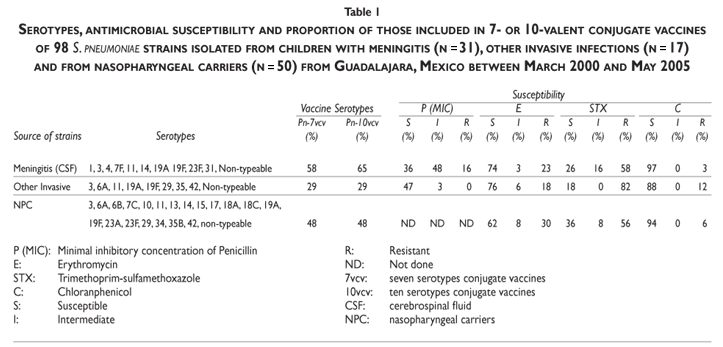
<body><![CDATA[<p>&nbsp;</p>     <p><font size="2" face="Verdana"><I>Streptococcus pneumoniae</i> (Pn) is the leading    cause of invasive infections in children, including meningitis pneumonia, bacteremia    and acute otitis media. It is also carried in the nasopharynx of asymptomatic    children and adults. Although 90 serotypes have been described, only a few of    these (4, 14, 18C, 23F, 6B, 19A, 19F, 6A, 9V and 9B) have been associated with    antimicrobial-resistance and invasive infections in children younger than two    years old.<SUP>1,2</SUP> The pneumococcal heptavalent conjugated vaccine (Pn-7vcv)    was developed based on the seven most prevalent serotypes associated with invasive    infections in children from the United States of America (USA).<SUP>1,3</SUP>    This vaccine had an efficacy of 93.9% in one intent-to-treat analysis of a double    blind clinical trial study conducted in the USA.<SUP>3</SUP> However, several    serotypes associated with invasive infections in some Navajo Indian communities    in the USA<SUP>4</SUP> as well as in Saudi Arabia,<SUP>5</SUP> Egypt,<SUP>6</SUP>    and various countries of Latin America<SUP>2,7</SUP> are not included in the    Pn-7vcv. </font></p>     <p><font size="2" face="Verdana"> By identifying <I>S. pneumoniae</I> serotypes    isolated from patients with invasive infections and carriers, we can explore    the adequacy of the current seven-valent pneumococcal conjugated vaccine as    well as that of other candidate vaccines containing a greater number of serotypes,    such as the eleven-valent conjugate vaccine (recently reduced into a ten-valent    one (Pn-10vcv) by elimination of serotype 3).<SUP>4-6,8</SUP> This will help    to determine if available conjugate vaccines are adequate or if specific vaccines    need to be formulated for use in Latin American countries. </font></p>     <p><font size="2" face="Verdana"> An additional issue in the treatment of patients    with invasive pneumococcal infections is the increasing prevalence of penicillin    (minimum inhibitory concentration <u>&gt;</u> 2</font><i><font>&#181;</font></i><font size="2" face="verdana">g/mL) and multi-drug    resistant strains.<SUP>2,7,9</SUP> In Mexico, a previous report demonstrated    that resistance to penicillin, erythromycin and trimethoprim-sulfamethoxazole    was elevated (20.8, 24.5 and 58.9%, respectively).<SUP>7</SUP> </font></p>     <p><font size="2" face="Verdana"> The aims of the present study were to identify    capsular serotypes and antimicrobial susceptibility profiles of <I>S. pneumoniae</I>    strains isolated from children with invasive infections and from healthy nasopharyngeal    carriers (NPC). We also determined the percent of potential coverage of the    serotypes included in the Pn-7vcv and Pn-10vcv.</font></p>     <p>&nbsp;</p>     <p><font size="3" face="Verdana"><b>Material and Methods</b></font></p>     <p><font size="2" face="Verdana">This cross-sectional study was performed between    March 2000 and May 2005. Protocol was approved by the IMSS Local Research and    Ethics Committee (No. F. 2005-1302-022). Informed consent was obtained from    the parents of the children attending day-care centers before taking nasopharyngeal    cultures. <I>S. pneumoniae</I> strains were isolated both from cultures taken    in children with invasive infections seen in a tertiary reference children’s    hospital and from nasopharyngeal cultures of healthy non-vaccinated children    attending day-care enters in the metropolitan area of Guadalajara, Mexico, and    used for comparative purposes. </font></p>     <p><font size="2" face="Verdana"> All the strains were identified by conventional    microbiological procedures. Antimicrobial susceptibility to chloranphenicol    (C; 30</font><i><font>&#181;</font></i><font size="2" face="verdana">g), vancomycin (Va; 30</font><i><font>&#181;</font></i><font size="2" face="verdana">g), erythromycin    (E; 15</font><i><font>&#181;</font></i><font size="2" face="verdana">g), and trimethoprim-sulfamethoxazole (STX; 1,25:23.75)    (BBL Becton Dickinson, Sparks USA) was determined by disc diffusion (Kirby-Bauer)    in Mueller-Hinton agar with 5% sheep blood, and interpreted according to the    criteria of the Clinical Laboratory Standards Institute (CLSI), USA (document    M100 S16, 2006).<SUP>10</SUP> Susceptibility to penicillin (P) was determined    by Etest strips (AB BIODISK Solna, Sweden) only for strains isolated from invasive    infections, and they were interpreted according to the CLSI criteria. For strains    isolated from the cerebrospinal fluid (CSF) of children with meningitis, strains    were considered resistant to penicillin if the MIC <u>&gt;</u> 2 </font><i><font>&#181;</font></i><font size="2" face="verdana">g/mL.    <I>S. pneumoniae</I> strain ATCC 49619 was used for quality control. </font></p>     <p><font size="2" face="Verdana"> Serogrouping-serotyping was performed in the    Infectious Disease Laboratory of the Texas Children’s Hospital of Houston, Texas    with the Quellung reaction, using sera produced by the Statens Seruminstitut,    Copenhagen, Denmark. </font></p>     ]]></body>
<body><![CDATA[<p>&nbsp;</p>     <p><font size="3" face="Verdana"><b>Results</b></font></p>     <p><font size="2" face="Verdana">Forty-eight <I>S. pneumoniae</I> strains were    recovered from the children with invasive infections. Another 50 strains were    isolated from the nasopharynx of the healthy non-vaccinated children. </font></p>     <p><font size="2" face="Verdana"> Invasive strains were isolated from the children    with an age range of 1-12 years (mean= 4.7 &plusmn; S.D. 4.3); 55% were males. Non-invasive    strains were isolated from NPC of similar age range (2 to 13 years, mean= 5.5    &plusmn; SD 2.9) and gender distribution. </font></p>     <p><font size="2" face="Verdana"> Of the 48 invasive strains (INV), 31 (65%) were    recovered from the CSF of patients with meningitis, and seventeen (35%) from    other normally sterile sites; 11 from middle ear effusion in acute otitis media    patients, one from a patient with mastoiditis; two from blood cultures of pneumonia    patients; two from patients with peritonitis and one from acute endophthalmitis.</font></p>     <p><font size="2" face="Verdana"> The serotypes isolated from 31 children with    meningitis were: 1, 3, 4, 6A, 6B, 7F, 9V, 11, 14, 19A, 19F, 23F, 31, and non-typeable.    From those, serotype 19F was the most frequently isolated (16%) followed by    3 (13%), 6B (13%), and 14 (13%). Twelve serotypes accounted for 90% of the isolates.    The proportion of serotypes included in both the Pn-7vcv and the Pn-10vcv was    58 and 65%, respectively (<a href="/img/revistas/spm/v50n4/a12tab01.gif">Table I</a>).</font></p>     <p><font size="2" face="Verdana"> The <I>S. pneumoniae</I> serotypes isolated    from each of the non-meningitis invasive infections were: acute otitis media    (19F, 3, 11, 19A, 29-35-42, and non-typeable); pneumonia (19F, 35); peritonitis    (19F); endophthalmitis (6A), and mastoiditis (3). Serotype 19F was the most    frequently isolated (29%), followed by serotype 3 (18%). Nine serotypes accounted    for 88% of the isolates. The proportion of serotypes included in both the Pn-7vcv    and the Pn-10vcv was 29% (<a href="/img/revistas/spm/v50n4/a12tab01.gif">table I</a>).</font></p>     <p><font size="2" face="Verdana"> Twenty-one serotypes were isolated from 50 carriers:    3, 6A, 6B, 7, 10, 11, 14, 15, 17, 18A, 18C, 19A, 19F, 23A, 23F, 28, 29-34-25-42,    29-35-42, 35B, 6-29-35-42, and non-typeable. Of these, the most prevalent serotypes    were: 6B (18%); 19F (16%); 23F (8%) and 6A (8%). Nineteen serotypes accounted    for 90% of the isolates. The proportion of serotypes included in both the Pn-7vcv    and the Pn-10vcv was 48% (<a href="/img/revistas/spm/v50n4/a12tab01.gif">table I</a>).</font></p>     <p><font size="2" face="Verdana"> None of the 98 strains was resistant to vancomycin    or ceftriaxone. From CSF strains, 16% were resistant to penicillin (MIC <u>&gt;</u>    2 </font><i><font>&#181;</font></i><font size="2" face="verdana">g/mL). Resistance to erythromycin was higher and resistance    to SXT was lower than in those from other invasive infections. No resistance    to penicillin was detected among the strains isolated from other invasive infections.    In NPC, resistance to erythromycin was higher (30%) and resistance to SXT was    lower (56%) than in the strains isolated from CSF (23 and 58%, respectively)    (<a href="/img/revistas/spm/v50n4/a12tab01.gif">table I</a>). Of those strains resistant (including    intermediate) to penicillin, chloranphenicol, erythromycin or trimethoprim-sulfamethoxazole,    almost half (50, 50, 55, and 52%, respectively) belonged to serotypes included    either in the 7<SUP>th</SUP> or 10<SUP>th</SUP> valent conjugate vaccines. </font></p>     <p>&nbsp;</p>     ]]></body>
<body><![CDATA[<p><font size="3" face="Verdana"><b>Discussion</b></font></p>     <p><font size="2" face="Verdana">It has been reported that Pn-7vcv offers good    protection for the USA Caucasian population. However, several authors have demonstrated    an inferior coverage of this vaccine for <I>S. pneumoniae</I> serotypes associated    with invasive diseases in Saudi Arabia, Egypt,<SUP>5,6</SUP> indigenous communities    (Navajos) of the southwestern USA,<SUP>4</SUP> and several Latin American countries.<SUP>2,7</SUP>    In these cases, Pn-10vcv could provide better coverage for those serotypes associated    with invasive infections in children when available.<SUP>2,4,5,7,8</sup></font></p>     <p><font size="2" face="Verdana"> In this study, the serotypes identified were    similar to those described by other authors in Latin American countries,<SUP>2,7</SUP>    Asia,<SUP>11</SUP> and Russia,<SUP>12</SUP> showing a worldwide distribution    of certain serotypes. We found that a slightly higher proportion of <I>S. pneumoniae</I>    serotypes isolated from children with meningitis (7%) were included in the Pn-10vcv    than in the Pn-7vcv. However, no differences in serotypes coverage by the 7-valent    or 10-valent conjugate vaccines was found in strains isolated from non-CSF invasive    strains and from non-vaccinated NPC. The typing of nasopharyngeal isolates is    useful as baseline information for future studies in vaccinated populations,    in which we can expect a shift towards and replacement by non-vaccine serotypes    <SUP>13</SUP>. </font></p>     <p><font size="2" face="Verdana"> Although the number of strains reported is limited,    they were collected during a four-year period in a tertiary referral hospital    that provides medical care to roughly 40% of the children living in a state    of 6.9 million inhabitants. Our findings show important similarities to the    serotypes associated with invasive disease in other Latin American and Asian    countries. </font></p>     <p><font size="2" face="Verdana"> The number of non-susceptible strains to penicillin    (considering intermediate and resistant strains together) was high (64%) in    children with meningitis. We also found a higher percentage of strains with    intermediate resistance than that in other reports from Latin American countries.<SUP>7</SUP>    However, all of these strains remained susceptible to vancomycin. The moderate    level of resistance to erythromycin and the high level to trimethoprim-sulfamethoxazole    found in the present study agree with the reports from other parts of the world    suggesting a worldwide spread of certain clones.<SUP>6,7,14</sup></font></p>     <p><font size="2" face="Verdana">In conclusion, the number of serotypes isolated    from patients with invasive infections and included in the Pn-10vcv was slightly    superior than those included in the Pn-7vcv. The number of strains with diminished    susceptibility to penicillin, moderate resistance to erythromycin, and high    resistance to trimethoprim-sulfamethoxazole could be associated with the abuse    of antimicrobial prescriptions or with the intercontinental spread of multi-resistant    strains. At least half of the serotypes with resistance to the antimicrobials    tested belonged to the ones included in the 7 or 10 valent conjugate vaccines.</font></p>     <p>&nbsp;</p>     <p><font size="3" face="Verdana"><b>Acknowledgments</b></font></p>     <p><font size="2" face="Verdana">This study was supported in part by Grant D43    TW01036 from the Fogarty International Center of the National Institutes of    Health. This work was presented in part in the 106th General Meeting of the    American Society for Microbiology, Orlando Fl. May 24, 2006 (Poster number C-244).    We thank Edward O. Mason Jr. PhD and Avril Forsyth MD for reviewing the manuscript;    Linda Lamberth, Mayra Qui&ntilde;onez-Alvarado, Martha Carranza-Martinez and    Maria Esther Carrillo-Macias for their technical support.</font></p>     <p>&nbsp;</p>     ]]></body>
<body><![CDATA[<p><font size="3" face="Verdana"><b>References</b></font></p>     <!-- ref --><p><font size="2" face="Verdana">1. Feikin DR, Klugman KP. Historical changes    in pneumococcal serogroup distribution: implications for the era of pneumococcal    conjugate vaccines. Clin Infect Dis 2002;35:547-555.</font>&nbsp;&nbsp;&nbsp;&nbsp;&nbsp;&nbsp;&nbsp;&nbsp;[&#160;<a href="javascript:void(0);" onclick="javascript: window.open('/scielo.php?script=sci_nlinks&ref=9296651&pid=S0036-3634200800040001200001&lng=','','width=640,height=500,resizable=yes,scrollbars=1,menubar=yes,');">Links</a>&#160;]<!-- end-ref --><!-- ref --><p><font size="2" face="Verdana">2. Di Fabio JL, Castaneda E, Agudelo CI, De La    Hoz F, Hortal M, Camou T, <I>et al</I>. Evolution of Streptococcus pneumoniae    serotypes and penicillin susceptibility in Latin America, Sireva-Vigia Group,    1993 to 1999. PAHO Sireva-Vigia Study Group. Pan American Health Organization.    Pediatr Infect Dis J 2001;20:959-967.</font>&nbsp;&nbsp;&nbsp;&nbsp;&nbsp;&nbsp;&nbsp;&nbsp;[&#160;<a href="javascript:void(0);" onclick="javascript: window.open('/scielo.php?script=sci_nlinks&ref=9296652&pid=S0036-3634200800040001200002&lng=','','width=640,height=500,resizable=yes,scrollbars=1,menubar=yes,');">Links</a>&#160;]<!-- end-ref --><!-- ref --><p><font size="2" face="Verdana">3. Black S, Shinefield H, Fireman B, Lewis E,    Ray P, Hansen JR, <I>et al</I>. Efficacy, safety and immunogenicity of heptavalent    pneumococcal conjugate vaccine in children. Northern California Kaiser Permanente    Vaccine Study Center Group. Pediatr Infect Dis J 2000;19:187-195.</font>&nbsp;&nbsp;&nbsp;&nbsp;&nbsp;&nbsp;&nbsp;&nbsp;[&#160;<a href="javascript:void(0);" onclick="javascript: window.open('/scielo.php?script=sci_nlinks&ref=9296653&pid=S0036-3634200800040001200003&lng=','','width=640,height=500,resizable=yes,scrollbars=1,menubar=yes,');">Links</a>&#160;]<!-- end-ref --><!-- ref --><p><font size="2" face="Verdana">4. O’Brien KL, Shaw J, Weatherholtz R, Reid R,    Watt J, Croll J, <I>et al</I>. Epidemiology of invasive Streptococcus pneumoniae    among Navajo children in the era before use of conjugate pneumococcal vaccines,    1989-1996. Am J Epidemiol 2004;160:270-278.</font>&nbsp;&nbsp;&nbsp;&nbsp;&nbsp;&nbsp;&nbsp;&nbsp;[&#160;<a href="javascript:void(0);" onclick="javascript: window.open('/scielo.php?script=sci_nlinks&ref=9296654&pid=S0036-3634200800040001200004&lng=','','width=640,height=500,resizable=yes,scrollbars=1,menubar=yes,');">Links</a>&#160;]<!-- end-ref --><!-- ref --><p><font size="2" face="Verdana">5. Al Mazrou A, Twum-Danso K, Al Zamil F, Kambal    A. Streptococcus pneumoniae serotypes/serogroups causing invasive disease in    Riyadh, Saudi Arabia: extent of coverage by pneumococcal vaccines. Ann Saudi    Med 2005;25:94-99.</font>&nbsp;&nbsp;&nbsp;&nbsp;&nbsp;&nbsp;&nbsp;&nbsp;[&#160;<a href="javascript:void(0);" onclick="javascript: window.open('/scielo.php?script=sci_nlinks&ref=9296655&pid=S0036-3634200800040001200005&lng=','','width=640,height=500,resizable=yes,scrollbars=1,menubar=yes,');">Links</a>&#160;]<!-- end-ref --><!-- ref --><p><font size="2" face="Verdana">6. Wasfy MO, Pimentel G, Abdel-Maksoud M, Russell    KL, Barrozo CP, Klena JD, <I>et al</I>. Antimicrobial susceptibility and serotype    distribution of Streptococcus pneumoniae causing meningitis in Egypt, 1998-2003.    J Antimicrob Chemother 2005;55:958-964.</font>&nbsp;&nbsp;&nbsp;&nbsp;&nbsp;&nbsp;&nbsp;&nbsp;[&#160;<a href="javascript:void(0);" onclick="javascript: window.open('/scielo.php?script=sci_nlinks&ref=9296656&pid=S0036-3634200800040001200006&lng=','','width=640,height=500,resizable=yes,scrollbars=1,menubar=yes,');">Links</a>&#160;]<!-- end-ref --><!-- ref --><p><font size="2" face="Verdana">7. Hortal M, Ruvinsky R, Rossi A, Agudelo CI,    Castaneda E, Brandileone C, <I>et al.</I> Impact of Streptococcus pneumoniae    on pneumonia in Latin American children. Sireva-Vigia Group. Rev Panam Salud    Publica 2000;8:185-195.</font>&nbsp;&nbsp;&nbsp;&nbsp;&nbsp;&nbsp;&nbsp;&nbsp;[&#160;<a href="javascript:void(0);" onclick="javascript: window.open('/scielo.php?script=sci_nlinks&ref=9296657&pid=S0036-3634200800040001200007&lng=','','width=640,height=500,resizable=yes,scrollbars=1,menubar=yes,');">Links</a>&#160;]<!-- end-ref --><!-- ref --><p><font size="2" face="Verdana">8. Dagan R, Kayhty H, Wuorimaa T, Yaich M, Bailleux    F, Zamir O, <I>et al</I>. Tolerability and immunogenicity of an eleven valent    mixed carrier Streptococcus pneumoniae capsular polysaccharide-diphtheria toxoid    or tetanus protein conjugate vaccine in Finnish and Israeli infants. Pediatr    Infect Dis J 2004;23:91-98.</font>&nbsp;&nbsp;&nbsp;&nbsp;&nbsp;&nbsp;&nbsp;&nbsp;[&#160;<a href="javascript:void(0);" onclick="javascript: window.open('/scielo.php?script=sci_nlinks&ref=9296658&pid=S0036-3634200800040001200008&lng=','','width=640,height=500,resizable=yes,scrollbars=1,menubar=yes,');">Links</a>&#160;]<!-- end-ref --><!-- ref --><p><font size="2" face="Verdana">9. Brown SD, Rybak MJ. Antimicrobial susceptibility    of Streptococcus pneumoniae, Streptococcus pyogenes and Haemophilus influenzae    collected from patients across the USA, in 2001-2002, as part of the PROTEKT    US study. J Antimicrob Chemother 2004;54 Suppl 1:i7-15.</font>&nbsp;&nbsp;&nbsp;&nbsp;&nbsp;&nbsp;&nbsp;&nbsp;[&#160;<a href="javascript:void(0);" onclick="javascript: window.open('/scielo.php?script=sci_nlinks&ref=9296659&pid=S0036-3634200800040001200009&lng=','','width=640,height=500,resizable=yes,scrollbars=1,menubar=yes,');">Links</a>&#160;]<!-- end-ref --><!-- ref --><p><font size="2" face="Verdana">10. Clinical and Laboratory Standards Institute.    Clinical and Laboratory Standards Institute/NCCLS. Performance Standards for    antimicrobial susceptibility testing; Sixteenth Informational Supplement. CLSI/NCCLS    document M100-S16. Ninth Edition. Wayne, PA: Clinical and Laboratory Standards    Institute/NCCLS, 2006.</font>&nbsp;&nbsp;&nbsp;&nbsp;&nbsp;&nbsp;&nbsp;&nbsp;[&#160;<a href="javascript:void(0);" onclick="javascript: window.open('/scielo.php?script=sci_nlinks&ref=9296660&pid=S0036-3634200800040001200010&lng=','','width=640,height=500,resizable=yes,scrollbars=1,menubar=yes,');">Links</a>&#160;]<!-- end-ref --><!-- ref --><p><font size="2" face="Verdana">11. Lauderdale TL, Wagener MM, Lin HM, Huang    IF, Lee WY, Hseih KS, <I>et al</I>. Serotype and antimicrobial resistance patterns    of Streptococcus pneumoniae isolated from Taiwanese children: comparison of    nasopharyngeal and clinical isolates. Diagn Microbiol Infect Dis 2006;56:421-426.</font>&nbsp;&nbsp;&nbsp;&nbsp;&nbsp;&nbsp;&nbsp;&nbsp;[&#160;<a href="javascript:void(0);" onclick="javascript: window.open('/scielo.php?script=sci_nlinks&ref=9296661&pid=S0036-3634200800040001200011&lng=','','width=640,height=500,resizable=yes,scrollbars=1,menubar=yes,');">Links</a>&#160;]<!-- end-ref --><!-- ref --><p><font size="2" face="Verdana">12. Stratchounski LS, Kretchikova OI, Kozlov    RS, Reshedko GK, Stetsiouk OU, Tarasova GD, <I>et al</I>. Antimicrobial resistance    of Streptococcus pneumoniae isolated from healthy children in day-care centers:    results of a multicenter study in Russia. Pediatr Infect Dis J 2000;19:196-200.</font>&nbsp;&nbsp;&nbsp;&nbsp;&nbsp;&nbsp;&nbsp;&nbsp;[&#160;<a href="javascript:void(0);" onclick="javascript: window.open('/scielo.php?script=sci_nlinks&ref=9296662&pid=S0036-3634200800040001200012&lng=','','width=640,height=500,resizable=yes,scrollbars=1,menubar=yes,');">Links</a>&#160;]<!-- end-ref --><!-- ref --><p><font size="2" face="Verdana">13. Singleton RJ, Hennessy TW, Bulkow LR, Hammitt    LL, Zulz T, Hurlburt DA, <I>et al</I>. Invasive pneumococcal disease caused    by nonvaccine serotypes among Alaska native children with high levels of 7-valent    pneumococcal conjugate vaccine coverage. JAMA 2007;297:1784-1792.</font>&nbsp;&nbsp;&nbsp;&nbsp;&nbsp;&nbsp;&nbsp;&nbsp;[&#160;<a href="javascript:void(0);" onclick="javascript: window.open('/scielo.php?script=sci_nlinks&ref=9296663&pid=S0036-3634200800040001200013&lng=','','width=640,height=500,resizable=yes,scrollbars=1,menubar=yes,');">Links</a>&#160;]<!-- end-ref --><!-- ref --><p><font size="2" face="Verdana">14. Doern GV, Heilmann KP, Huynh HK, Rhomberg    PR, Coffman SL, Brueggemann AB. Antimicrobial resistance among clinical isolates    of Streptococcus pneumoniae in the United States during 1999-2000, including    a comparison of resistance rates since 1994-1995. Antimicrob Agents Chemother    2001;45:1721-1729.</font>&nbsp;&nbsp;&nbsp;&nbsp;&nbsp;&nbsp;&nbsp;&nbsp;[&#160;<a href="javascript:void(0);" onclick="javascript: window.open('/scielo.php?script=sci_nlinks&ref=9296664&pid=S0036-3634200800040001200014&lng=','','width=640,height=500,resizable=yes,scrollbars=1,menubar=yes,');">Links</a>&#160;]<!-- end-ref --><p>&nbsp;</p>     <p>&nbsp;</p>     <p><font size="2" face="Verdana">Received on: August 9, 2007    <br>   Accepted on: April 4, 2008</font></p>     <p>&nbsp;</p>     ]]></body>
<body><![CDATA[<p>&nbsp;</p>     <p><font size="2" face="Verdana">Address reprint requests to: Dr. Alberto Villase&ntilde;or.    Centro de Investigaci&oacute;n Biom&eacute;dica de Occidente. Instituto Mexicano    del Seguro Social.    <br>   Sierra Mojada 800 Col. Independencia. 44340 Guadalajara, Jalisco.    <br>   E-mail: <a href="mailto:avillase@prodigy.net.mx">avillase@prodigy.net.mx</a></font></p>      ]]></body><back>
<ref-list>
<ref id="B1">
<label>1</label><nlm-citation citation-type="journal">
<person-group person-group-type="author">
<name>
<surname><![CDATA[Feikin]]></surname>
<given-names><![CDATA[DR]]></given-names>
</name>
<name>
<surname><![CDATA[Klugman]]></surname>
<given-names><![CDATA[KP]]></given-names>
</name>
</person-group>
<article-title xml:lang="en"><![CDATA[Historical changes in pneumococcal serogroup distribution: implications for the era of pneumococcal conjugate vaccines]]></article-title>
<source><![CDATA[Clin Infect Dis]]></source>
<year>2002</year>
<volume>35</volume>
<page-range>547-555</page-range></nlm-citation>
</ref>
<ref id="B2">
<label>2</label><nlm-citation citation-type="journal">
<person-group person-group-type="author">
<name>
<surname><![CDATA[Di Fabio]]></surname>
<given-names><![CDATA[JL]]></given-names>
</name>
<name>
<surname><![CDATA[Castaneda]]></surname>
<given-names><![CDATA[E]]></given-names>
</name>
<name>
<surname><![CDATA[Agudelo]]></surname>
<given-names><![CDATA[CI]]></given-names>
</name>
<name>
<surname><![CDATA[De La Hoz]]></surname>
<given-names><![CDATA[F]]></given-names>
</name>
<name>
<surname><![CDATA[Hortal]]></surname>
<given-names><![CDATA[M]]></given-names>
</name>
<name>
<surname><![CDATA[Camou]]></surname>
<given-names><![CDATA[T]]></given-names>
</name>
</person-group>
<article-title xml:lang="en"><![CDATA[Evolution of Streptococcus pneumoniae serotypes and penicillin susceptibility in Latin America, Sireva-Vigia Group, 1993 to 1999: PAHO Sireva-Vigia Study Group. Pan American Health Organization]]></article-title>
<source><![CDATA[Pediatr Infect Dis J]]></source>
<year>2001</year>
<volume>20</volume>
<page-range>959-967</page-range></nlm-citation>
</ref>
<ref id="B3">
<label>3</label><nlm-citation citation-type="journal">
<person-group person-group-type="author">
<name>
<surname><![CDATA[Black]]></surname>
<given-names><![CDATA[S]]></given-names>
</name>
<name>
<surname><![CDATA[Shinefield]]></surname>
<given-names><![CDATA[H]]></given-names>
</name>
<name>
<surname><![CDATA[Fireman]]></surname>
<given-names><![CDATA[B]]></given-names>
</name>
<name>
<surname><![CDATA[Lewis]]></surname>
<given-names><![CDATA[E]]></given-names>
</name>
<name>
<surname><![CDATA[Ray]]></surname>
<given-names><![CDATA[P]]></given-names>
</name>
<name>
<surname><![CDATA[Hansen]]></surname>
<given-names><![CDATA[JR]]></given-names>
</name>
</person-group>
<article-title xml:lang="en"><![CDATA[Efficacy, safety and immunogenicity of heptavalent pneumococcal conjugate vaccine in children: Northern California Kaiser Permanente Vaccine Study Center Group]]></article-title>
<source><![CDATA[Pediatr Infect Dis J]]></source>
<year>2000</year>
<volume>19</volume>
<page-range>187-195</page-range></nlm-citation>
</ref>
<ref id="B4">
<label>4</label><nlm-citation citation-type="journal">
<person-group person-group-type="author">
<name>
<surname><![CDATA[O’Brien]]></surname>
<given-names><![CDATA[KL]]></given-names>
</name>
<name>
<surname><![CDATA[Shaw]]></surname>
<given-names><![CDATA[J]]></given-names>
</name>
<name>
<surname><![CDATA[Weatherholtz]]></surname>
<given-names><![CDATA[R]]></given-names>
</name>
<name>
<surname><![CDATA[Reid]]></surname>
<given-names><![CDATA[R]]></given-names>
</name>
<name>
<surname><![CDATA[Watt]]></surname>
<given-names><![CDATA[J]]></given-names>
</name>
<name>
<surname><![CDATA[Croll]]></surname>
<given-names><![CDATA[J]]></given-names>
</name>
</person-group>
<article-title xml:lang="en"><![CDATA[Epidemiology of invasive Streptococcus pneumoniae among Navajo children in the era before use of conjugate pneumococcal vaccines, 1989-1996]]></article-title>
<source><![CDATA[Am J Epidemiol]]></source>
<year>2004</year>
<volume>160</volume>
<page-range>270-278</page-range></nlm-citation>
</ref>
<ref id="B5">
<label>5</label><nlm-citation citation-type="journal">
<person-group person-group-type="author">
<name>
<surname><![CDATA[Al Mazrou]]></surname>
<given-names><![CDATA[A]]></given-names>
</name>
<name>
<surname><![CDATA[Twum-Danso]]></surname>
<given-names><![CDATA[K]]></given-names>
</name>
<name>
<surname><![CDATA[Al Zamil]]></surname>
<given-names><![CDATA[F]]></given-names>
</name>
<name>
<surname><![CDATA[Kambal]]></surname>
<given-names><![CDATA[A]]></given-names>
</name>
</person-group>
<article-title xml:lang="en"><![CDATA[Streptococcus pneumoniae serotypes/serogroups causing invasive disease in Riyadh, Saudi Arabia: extent of coverage by pneumococcal vaccines]]></article-title>
<source><![CDATA[Ann Saudi Med]]></source>
<year>2005</year>
<volume>25</volume>
<page-range>94-99</page-range></nlm-citation>
</ref>
<ref id="B6">
<label>6</label><nlm-citation citation-type="journal">
<person-group person-group-type="author">
<name>
<surname><![CDATA[Wasfy]]></surname>
<given-names><![CDATA[MO]]></given-names>
</name>
<name>
<surname><![CDATA[Pimentel]]></surname>
<given-names><![CDATA[G]]></given-names>
</name>
<name>
<surname><![CDATA[Abdel-Maksoud]]></surname>
<given-names><![CDATA[M]]></given-names>
</name>
<name>
<surname><![CDATA[Russell]]></surname>
<given-names><![CDATA[KL]]></given-names>
</name>
<name>
<surname><![CDATA[Barrozo]]></surname>
<given-names><![CDATA[CP]]></given-names>
</name>
<name>
<surname><![CDATA[Klena]]></surname>
<given-names><![CDATA[JD]]></given-names>
</name>
</person-group>
<article-title xml:lang="en"><![CDATA[Antimicrobial susceptibility and serotype distribution of Streptococcus pneumoniae causing meningitis in Egypt, 1998-2003]]></article-title>
<source><![CDATA[J Antimicrob Chemother]]></source>
<year>2005</year>
<volume>55</volume>
<page-range>958-964</page-range></nlm-citation>
</ref>
<ref id="B7">
<label>7</label><nlm-citation citation-type="journal">
<person-group person-group-type="author">
<name>
<surname><![CDATA[Hortal]]></surname>
<given-names><![CDATA[M]]></given-names>
</name>
<name>
<surname><![CDATA[Ruvinsky]]></surname>
<given-names><![CDATA[R]]></given-names>
</name>
<name>
<surname><![CDATA[Rossi]]></surname>
<given-names><![CDATA[A]]></given-names>
</name>
<name>
<surname><![CDATA[Agudelo]]></surname>
<given-names><![CDATA[CI]]></given-names>
</name>
<name>
<surname><![CDATA[Castaneda]]></surname>
<given-names><![CDATA[E]]></given-names>
</name>
<name>
<surname><![CDATA[Brandileone]]></surname>
<given-names><![CDATA[C]]></given-names>
</name>
</person-group>
<article-title xml:lang="en"><![CDATA[Impact of Streptococcus pneumoniae on pneumonia in Latin American children: Sireva-Vigia Group]]></article-title>
<source><![CDATA[Rev Panam Salud Publica]]></source>
<year>2000</year>
<volume>8</volume>
<page-range>185-195</page-range></nlm-citation>
</ref>
<ref id="B8">
<label>8</label><nlm-citation citation-type="journal">
<person-group person-group-type="author">
<name>
<surname><![CDATA[Dagan]]></surname>
<given-names><![CDATA[R]]></given-names>
</name>
<name>
<surname><![CDATA[Kayhty]]></surname>
<given-names><![CDATA[H]]></given-names>
</name>
<name>
<surname><![CDATA[Wuorimaa]]></surname>
<given-names><![CDATA[T]]></given-names>
</name>
<name>
<surname><![CDATA[Yaich]]></surname>
<given-names><![CDATA[M]]></given-names>
</name>
<name>
<surname><![CDATA[Bailleux]]></surname>
<given-names><![CDATA[F]]></given-names>
</name>
<name>
<surname><![CDATA[Zamir]]></surname>
<given-names><![CDATA[O]]></given-names>
</name>
</person-group>
<article-title xml:lang="en"><![CDATA[Tolerability and immunogenicity of an eleven valent mixed carrier Streptococcus pneumoniae capsular polysaccharide-diphtheria toxoid or tetanus protein conjugate vaccine in Finnish and Israeli infants]]></article-title>
<source><![CDATA[Pediatr Infect Dis J]]></source>
<year>2004</year>
<volume>23</volume>
<page-range>91-98</page-range></nlm-citation>
</ref>
<ref id="B9">
<label>9</label><nlm-citation citation-type="journal">
<person-group person-group-type="author">
<name>
<surname><![CDATA[Brown]]></surname>
<given-names><![CDATA[SD]]></given-names>
</name>
<name>
<surname><![CDATA[Rybak]]></surname>
<given-names><![CDATA[MJ]]></given-names>
</name>
</person-group>
<article-title xml:lang="en"><![CDATA[Antimicrobial susceptibility of Streptococcus pneumoniae, Streptococcus pyogenes and Haemophilus influenzae collected from patients across the USA, in 2001-2002, as part of the PROTEKT US study]]></article-title>
<source><![CDATA[J Antimicrob Chemother]]></source>
<year>2004</year>
<volume>54</volume>
<numero>^sSuppl 1</numero>
<issue>^sSuppl 1</issue>
<supplement>Suppl 1</supplement>
<page-range>i7-15</page-range></nlm-citation>
</ref>
<ref id="B10">
<label>10</label><nlm-citation citation-type="book">
<collab>Clinical and Laboratory Standards Institute^dNCCLS</collab>
<source><![CDATA[Performance Standards for antimicrobial susceptibility testing: Sixteenth Informational Supplement. CLSI/NCCLS document M100-S16]]></source>
<year>2006</year>
<edition>Ninth</edition>
<publisher-loc><![CDATA[^ePA PA]]></publisher-loc>
<publisher-name><![CDATA[WayneClinical and Laboratory Standards Institute/NCCLS]]></publisher-name>
</nlm-citation>
</ref>
<ref id="B11">
<label>11</label><nlm-citation citation-type="journal">
<person-group person-group-type="author">
<name>
<surname><![CDATA[Lauderdale]]></surname>
<given-names><![CDATA[TL]]></given-names>
</name>
<name>
<surname><![CDATA[Wagener]]></surname>
<given-names><![CDATA[MM]]></given-names>
</name>
<name>
<surname><![CDATA[Lin]]></surname>
<given-names><![CDATA[HM]]></given-names>
</name>
<name>
<surname><![CDATA[Huang]]></surname>
<given-names><![CDATA[IF]]></given-names>
</name>
<name>
<surname><![CDATA[Lee]]></surname>
<given-names><![CDATA[WY]]></given-names>
</name>
<name>
<surname><![CDATA[Hseih]]></surname>
<given-names><![CDATA[KS]]></given-names>
</name>
</person-group>
<article-title xml:lang="en"><![CDATA[Serotype and antimicrobial resistance patterns of Streptococcus pneumoniae isolated from Taiwanese children: comparison of nasopharyngeal and clinical isolates]]></article-title>
<source><![CDATA[Diagn Microbiol Infect Dis]]></source>
<year>2006</year>
<volume>56</volume>
<page-range>421-426</page-range></nlm-citation>
</ref>
<ref id="B12">
<label>12</label><nlm-citation citation-type="journal">
<person-group person-group-type="author">
<name>
<surname><![CDATA[Stratchounski]]></surname>
<given-names><![CDATA[LS]]></given-names>
</name>
<name>
<surname><![CDATA[Kretchikova]]></surname>
<given-names><![CDATA[OI]]></given-names>
</name>
<name>
<surname><![CDATA[Kozlov]]></surname>
<given-names><![CDATA[RS]]></given-names>
</name>
<name>
<surname><![CDATA[Reshedko]]></surname>
<given-names><![CDATA[GK]]></given-names>
</name>
<name>
<surname><![CDATA[Stetsiouk]]></surname>
<given-names><![CDATA[OU]]></given-names>
</name>
<name>
<surname><![CDATA[Tarasova]]></surname>
<given-names><![CDATA[GD]]></given-names>
</name>
</person-group>
<article-title xml:lang="en"><![CDATA[Antimicrobial resistance of Streptococcus pneumoniae isolated from healthy children in day-care centers: results of a multicenter study in Russia]]></article-title>
<source><![CDATA[Pediatr Infect Dis J]]></source>
<year>2000</year>
<volume>19</volume>
<page-range>196-200</page-range></nlm-citation>
</ref>
<ref id="B13">
<label>13</label><nlm-citation citation-type="journal">
<person-group person-group-type="author">
<name>
<surname><![CDATA[Singleton]]></surname>
<given-names><![CDATA[RJ]]></given-names>
</name>
<name>
<surname><![CDATA[Hennessy]]></surname>
<given-names><![CDATA[TW]]></given-names>
</name>
<name>
<surname><![CDATA[Bulkow]]></surname>
<given-names><![CDATA[LR]]></given-names>
</name>
<name>
<surname><![CDATA[Hammitt]]></surname>
<given-names><![CDATA[LL]]></given-names>
</name>
<name>
<surname><![CDATA[Zulz]]></surname>
<given-names><![CDATA[T]]></given-names>
</name>
<name>
<surname><![CDATA[Hurlburt]]></surname>
<given-names><![CDATA[DA]]></given-names>
</name>
</person-group>
<article-title xml:lang="en"><![CDATA[Invasive pneumococcal disease caused by nonvaccine serotypes among Alaska native children with high levels of 7-valent pneumococcal conjugate vaccine coverage]]></article-title>
<source><![CDATA[JAMA]]></source>
<year>2007</year>
<volume>297</volume>
<page-range>1784-1792</page-range></nlm-citation>
</ref>
<ref id="B14">
<label>14</label><nlm-citation citation-type="journal">
<person-group person-group-type="author">
<name>
<surname><![CDATA[Doern]]></surname>
<given-names><![CDATA[GV]]></given-names>
</name>
<name>
<surname><![CDATA[Heilmann]]></surname>
<given-names><![CDATA[KP]]></given-names>
</name>
<name>
<surname><![CDATA[Huynh]]></surname>
<given-names><![CDATA[HK]]></given-names>
</name>
<name>
<surname><![CDATA[Rhomberg]]></surname>
<given-names><![CDATA[PR]]></given-names>
</name>
<name>
<surname><![CDATA[Coffman]]></surname>
<given-names><![CDATA[SL]]></given-names>
</name>
<name>
<surname><![CDATA[Brueggemann]]></surname>
<given-names><![CDATA[AB]]></given-names>
</name>
</person-group>
<article-title xml:lang="en"><![CDATA[Antimicrobial resistance among clinical isolates of Streptococcus pneumoniae in the United States during 1999-2000, including a comparison of resistance rates since 1994-1995]]></article-title>
<source><![CDATA[Antimicrob Agents Chemother]]></source>
<year>2001</year>
<volume>45</volume>
<page-range>1721-1729</page-range></nlm-citation>
</ref>
</ref-list>
</back>
</article>