<?xml version="1.0" encoding="ISO-8859-1"?><article xmlns:mml="http://www.w3.org/1998/Math/MathML" xmlns:xlink="http://www.w3.org/1999/xlink" xmlns:xsi="http://www.w3.org/2001/XMLSchema-instance">
<front>
<journal-meta>
<journal-id>0036-3634</journal-id>
<journal-title><![CDATA[Salud Pública de México]]></journal-title>
<abbrev-journal-title><![CDATA[Salud pública Méx]]></abbrev-journal-title>
<issn>0036-3634</issn>
<publisher>
<publisher-name><![CDATA[Instituto Nacional de Salud Pública]]></publisher-name>
</publisher>
</journal-meta>
<article-meta>
<article-id>S0036-36342008000400005</article-id>
<title-group>
<article-title xml:lang="en"><![CDATA[Cost-effectiveness of conventional cytology and HPV DNA testing for cervical cancer screening in Colombia]]></article-title>
<article-title xml:lang="es"><![CDATA[Costo-efectividad de la citología y la tamización con pruebas de ADN-VPH para cáncer de cuello uterino en Colombia]]></article-title>
</title-group>
<contrib-group>
<contrib contrib-type="author">
<name>
<surname><![CDATA[Andrés-Gamboa]]></surname>
<given-names><![CDATA[Oscar]]></given-names>
</name>
<xref ref-type="aff" rid="A01"/>
</contrib>
<contrib contrib-type="author">
<name>
<surname><![CDATA[Chicaíza]]></surname>
<given-names><![CDATA[Liliana]]></given-names>
</name>
<xref ref-type="aff" rid="A01"/>
<xref ref-type="aff" rid="A02"/>
</contrib>
<contrib contrib-type="author">
<name>
<surname><![CDATA[García-Molina]]></surname>
<given-names><![CDATA[Mario]]></given-names>
</name>
<xref ref-type="aff" rid="A01"/>
<xref ref-type="aff" rid="A02"/>
</contrib>
<contrib contrib-type="author">
<name>
<surname><![CDATA[Díaz]]></surname>
<given-names><![CDATA[Jorge]]></given-names>
</name>
<xref ref-type="aff" rid="A01"/>
<xref ref-type="aff" rid="A02"/>
</contrib>
<contrib contrib-type="author">
<name>
<surname><![CDATA[González]]></surname>
<given-names><![CDATA[Mauricio]]></given-names>
</name>
<xref ref-type="aff" rid="A01"/>
</contrib>
<contrib contrib-type="author">
<name>
<surname><![CDATA[Murillo]]></surname>
<given-names><![CDATA[Raúl]]></given-names>
</name>
<xref ref-type="aff" rid="A01"/>
</contrib>
<contrib contrib-type="author">
<name>
<surname><![CDATA[Ballesteros]]></surname>
<given-names><![CDATA[Mónica]]></given-names>
</name>
<xref ref-type="aff" rid="A01"/>
</contrib>
<contrib contrib-type="author">
<name>
<surname><![CDATA[Sánchez]]></surname>
<given-names><![CDATA[Ricardo]]></given-names>
</name>
<xref ref-type="aff" rid="A01"/>
<xref ref-type="aff" rid="A02"/>
</contrib>
</contrib-group>
<aff id="A01">
<institution><![CDATA[,National Cancer Institute of Colombia  ]]></institution>
<addr-line><![CDATA[ ]]></addr-line>
</aff>
<aff id="A02">
<institution><![CDATA[,National Cancer Institute of Colombia National University of Colombia ]]></institution>
<addr-line><![CDATA[ ]]></addr-line>
</aff>
<pub-date pub-type="pub">
<day>00</day>
<month>08</month>
<year>2008</year>
</pub-date>
<pub-date pub-type="epub">
<day>00</day>
<month>08</month>
<year>2008</year>
</pub-date>
<volume>50</volume>
<numero>4</numero>
<fpage>276</fpage>
<lpage>285</lpage>
<copyright-statement/>
<copyright-year/>
<self-uri xlink:href="http://www.scielo.org.mx/scielo.php?script=sci_arttext&amp;pid=S0036-36342008000400005&amp;lng=en&amp;nrm=iso"></self-uri><self-uri xlink:href="http://www.scielo.org.mx/scielo.php?script=sci_abstract&amp;pid=S0036-36342008000400005&amp;lng=en&amp;nrm=iso"></self-uri><self-uri xlink:href="http://www.scielo.org.mx/scielo.php?script=sci_pdf&amp;pid=S0036-36342008000400005&amp;lng=en&amp;nrm=iso"></self-uri><abstract abstract-type="short" xml:lang="en"><p><![CDATA[OBJECTIVE: To assess cost-effectiveness of conventional cytology and HPV DNA testing for cervical-cancer screening in Colombia. MATERIAL AND METHODS: The National Cancer Institute of Colombia (NCIC) in 2007 developed a Markov model on the natural history of cervical cancer; no screening, conventional cytology, and HPV DNA testing were compared. Only direct costs were used. Outcomes comprise cervical cancer mortality, years of life saved, and lifetime costs. Discounted incremental cost-effectiveness ratios were estimated and sensitivity analyses were conducted for key parameters. RESULTS: Depending on the screening strategy a 69-81% mortality reduction might be expected. The HPV DNA testing every five years is a cost-effective strategy (Incremental Cost-Effectiveness Ratio (ICER): USD$44/YLS) if the cost per test is under USD$31. The effectiveness was sensitive to coverage and primarily to follow-up. CONCLUSIONS: HPV DNA testing is a cost-effective alternative for screening in Colombia. Not only high coverage but high follow-up rates are critical for successful screening programs.]]></p></abstract>
<abstract abstract-type="short" xml:lang="es"><p><![CDATA[OBJETIVO: evaluar el costo-efectividad de la citología convencional y la prueba de ADN-VPH para tamización de cáncer cervical en Colombia. MATERIAL Y MÉTODOS: el Instituto Nacional de Cancerología de Colombia construyó en 2007 un modelo de Markov de historia natural del cáncer cervical. Se comparó "no tamización", citología convencional y prueba de ADN-VPH. Se utilizaron costos directos. Los desenlaces fueron mortalidad, años de vida ganados y costos. Se calcularon razones de costo-efectividad incremental. Se realizaron análisis de sensibilidad para parámetros clave. RESULTADOS: la mortalidad se redujo 69-81% según la estrategia. La tamización con ADN-VPH cada cinco años es costo-efectiva (ICER (Razón de Costo-Efectividad incremental por sus siglas en inglés): 44 dólares por año de vida saludable) si los costos por prueba son menores a 31 dólares. La efectividad fue más sensible al seguimiento que a la cobertura. CONCLUSIONES: La tamización con prueba ADN-VPH es costo-efectiva para Colombia. No solamente altas coberturas, sino también altos porcentajes de seguimiento son críticos para el éxito de la tamización.]]></p></abstract>
<kwd-group>
<kwd lng="en"><![CDATA[uterine cervical neoplasms]]></kwd>
<kwd lng="en"><![CDATA[cost-benefit analysis]]></kwd>
<kwd lng="en"><![CDATA[mass screening]]></kwd>
<kwd lng="en"><![CDATA[Colombia]]></kwd>
<kwd lng="es"><![CDATA[neoplasias del cuello uterino]]></kwd>
<kwd lng="es"><![CDATA[tamizaje masivo]]></kwd>
<kwd lng="es"><![CDATA[análisis costo-beneficio]]></kwd>
<kwd lng="es"><![CDATA[Colombia]]></kwd>
</kwd-group>
</article-meta>
</front><body><![CDATA[ <p align="right"><font size="2" face="Verdana"><b>ART&Iacute;CULO ORIGINAL</b></font></p>     <p>&nbsp;</p>     <p><font size="4" face="verdana"><b>Cost-effectiveness of conventional cytology    and HPV DNA testing for cervical cancer screening in Colombia</b></font></p>     <p>&nbsp;</p>     <p><font size="3" face="Verdana"><b>Costo-efectividad de la citolog&iacute;a y    la tamizaci&oacute;n con pruebas de ADN-VPH para c&aacute;ncer de cuello uterino    en Colombia</b></font></p>     <p>&nbsp;</p>     <p>&nbsp;</p>     <p><font size="2" face="Verdana"><b>Oscar Andr&eacute;s-Gamboa, MD<sup>I</sup>;    Liliana Chica&iacute;za, PhD<sup>I, II</sup>; Mario Garc&iacute;a-Molina, PhD<sup>I,    II</sup>; Jorge D&iacute;az, MSc<sup>I, II</sup>; Mauricio Gonz&aacute;lez,    MD<sup>I</sup>; Ra&uacute;l Murillo MD, MSc<sup>I</sup>; M&oacute;nica Ballesteros    MD, MSc<sup>I</sup>; Ricardo S&aacute;nchez MD, MSc.<SUP>I, II</sup></b></font></p>     <p><font size="2" face="Verdana"><sup>I</sup>National Cancer Institute of Colombia    <br>   <sup>II</sup>National University of Colombia</font></p>     ]]></body>
<body><![CDATA[<p>&nbsp;</p>     <p>&nbsp;</p> <hr size="1" noshade>     <p><font size="2" face="Verdana"><b>ABSTRACT</b></font></p>     <p><font size="2" face="Verdana"><B>OBJECTIVE: </b>To assess cost-effectiveness    of conventional cytology and HPV DNA testing for cervical-cancer screening in    Colombia.    <br>   <B>MATERIAL AND METHODS: </B>The National Cancer Institute of Colombia (NCIC)    in 2007 developed a Markov model on the natural history of cervical cancer;    no screening, conventional cytology, and HPV DNA testing were compared. Only    direct costs were used. Outcomes comprise cervical cancer mortality, years of    life saved, and lifetime costs. Discounted incremental cost-effectiveness ratios    were estimated and sensitivity analyses were conducted for key parameters.    <br>   <B>RESULTS: </B>Depending on the screening strategy a 69-81% mortality reduction    might be expected. The HPV DNA testing every five years is a cost-effective    strategy (Incremental Cost-Effectiveness Ratio (ICER): USD$44/YLS) if the cost    per test is under USD$31. The effectiveness was sensitive to coverage and primarily    to follow-up.    <br>   <B>CONCLUSIONS: </B>HPV DNA testing is a cost-effective alternative for screening    in Colombia. Not only high coverage but high follow-up rates are critical for    successful screening programs. </font></p>     <p><font size="2" face="Verdana"><b>Key words:</b> uterine cervical neoplasms;    cost-benefit analysis; mass screening; Colombia</font></p> <hr size="1" noshade>     <p><font size="2" face="Verdana"><b>RESUMEN</b></font></p>     <p><font size="2" face="Verdana"><B>OBJETIVO: </b>evaluar el costo-efectividad    de la citolog&iacute;a convencional y la prueba de ADN-VPH para tamizaci&oacute;n    de c&aacute;ncer cervical en Colombia.    ]]></body>
<body><![CDATA[<br>   <B>MATERIAL Y M&Eacute;TODOS: </B>el Instituto Nacional de Cancerolog&iacute;a    de Colombia construy&oacute; en 2007 un modelo de Markov de historia natural    del c&aacute;ncer cervical. Se compar&oacute; "no tamizaci&oacute;n",    citolog&iacute;a convencional y prueba de ADN-VPH. Se utilizaron costos directos.    Los desenlaces fueron mortalidad, a&ntilde;os de vida ganados y costos. Se calcularon    razones de costo-efectividad incremental. Se realizaron an&aacute;lisis de sensibilidad    para par&aacute;metros clave.    <br>   <B>RESULTADOS: </B>la mortalidad se redujo 69-81% seg&uacute;n la estrategia.    La tamizaci&oacute;n con ADN-VPH cada cinco a&ntilde;os es costo-efectiva (ICER    (Raz&oacute;n de Costo-Efectividad incremental por sus siglas en ingl&eacute;s):    44 d&oacute;lares por a&ntilde;o de vida saludable) si los costos por prueba    son menores a 31 d&oacute;lares. La efectividad fue m&aacute;s sensible al seguimiento    que a la cobertura.    <br>   <B>CONCLUSIONES: </B>La tamizaci&oacute;n con prueba ADN-VPH es costo-efectiva    para Colombia. No solamente altas coberturas, sino tambi&eacute;n altos porcentajes    de seguimiento son cr&iacute;ticos para el &eacute;xito de la tamizaci&oacute;n.</font></p>     <p><font size="2" face="Verdana"><b>Palabras clave:</b> neoplasias del cuello    uterino; tamizaje masivo; an&aacute;lisis costo-beneficio; Colombia</font></p> <hr size="1" noshade>     <p>&nbsp;</p>     <p>&nbsp;</p>     <p><font size="2" face="Verdana">Cervical cancer is the second cause of cancer-related    deaths in women. There are approximately 407000 new cases worldwide every year    (81% occurring in developing countries) and it is the leading cause of death    from cancer among Colombian women and the second among Latin American women.<SUP>1</SUP></font></p>     <p><font size="2" face="Verdana"> The incidence of cervical cancer has declined    substantially in developed nations due to the success of widespread cytology    programs;<SUP>2</SUP> however, this result has not been obtained in most developing    countries.<SUP>3,4</SUP> New technologies for early detection are promising    but costly, and due to severe resource constraints, decision-makers need to    estimate costs and effectiveness in order to determine the best alternatives.<SUP>5</sup></font></p>     <p><font size="2" face="Verdana"> Despite several economic studies that analyze    alternatives for cervical cancer screening, few have been conducted in Latin    America and none in Colombia,<SUP>6-10</SUP> and previous results on costs and    effectiveness for various screening alternatives cannot be directly applied    from other countries. Additionally, prior studies focused on screening tests    or type of program (opportunistic or organized)<SUP>11</SUP> and no direct assessments    of program component effectiveness have been regularly done other than for coverage.</font></p>     <p><font size="2" face="Verdana"> In Colombia, early detection of cervical cancer    is done on a 1-1-3 cytology strategy (annual conventional cytology until two    consecutive negative smears and every three years afterwards), but without organized    programs.<SUP>12</SUP> Currently there is no available information on screening    performance other than the lack of impact on cervical cancer mortality and some    reports about the yearly number of cytology tests.<SUP>4</SUP> This study performs    an economic evaluation of different cervical cancer screening alternatives and    assesses the effect of coverage and follow-up of abnormal screening results    on screening effectiveness in Colombia. </font></p>     ]]></body>
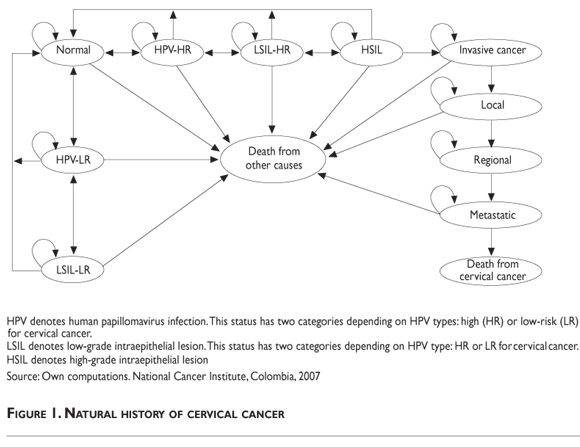
<body><![CDATA[<p>&nbsp;</p>     <p><font size="3" face="Verdana"><b>Material and methods</b></font></p>     <p><font size="2" face="Verdana">The study was approved by the IRB at the National    Cancer Institute in Colombia (NCIC). We developed a Markov model to simulate    the natural history of cervical neoplasias (DATA 4.0 &copy;) including five    models for various screening strategies. The outcomes comprise the reduction    of cervical cancer mortality, years of life saved, and lifetime costs. We determined    incremental cost-effectiveness ratios (ICER)<SUP>13</SUP> and costs and benefits    were discounted by a 3% annual rate. A strategy was considered cost-effective    if the cost per year of life saved was under the Colombian per capita GDP (US$3.200).<SUP>14,15</sup></font></p>     <p><font size="2" face="Verdana"> Sensitivity analyses were done for sensitivity    and specificity of screening tests, as well as for screening, diagnoses, and    treatment costs. The effect of coverage and follow-up of positive results on    mortality from cervical cancer was assessed for all screening strategies.</font></p>     <p><font size="2" face="Verdana"><b>Natural history model</b></font></p>     <p><font size="2" face="Verdana">The model incorporates the natural history of    cervical cancer (<a href="#fig01">figure 1</a>). A hypothetical cohort of unscreened    women without a history of cervical neoplasia was included in the model. The    women may transit between stages according to probabilities for annual cycles,    up to completing the life expectancy for Colombian women (76 years).<SUP>16</sup></font></p>     <p><a name="fig01"></a></p>     <p>&nbsp;</p>     <p align="center"><img src="/img/revistas/spm/v50n4/a05fig01.gif"></p>     <p>&nbsp;</p>     ]]></body>
<body><![CDATA[<p><font size="2" face="Verdana"> The model’s predictions were compared with published    data on incidence of HPV,<SUP>17</SUP> cervical intraepithelial lesions,<SUP>18</SUP>    and cancer among Colombian women,<SUP>19</SUP> as well as with data on mortality    from cervical cancer<SUP>20 </SUP>and previously published models.<SUP>21,22</sup></font></p>     <p><font size="2" face="Verdana"><b>Natural history and screening model assumptions</b></font></p>     <blockquote>        <p><font size="2" face="Verdana">1. All women are 15 years old and HPV infection      naive at admission.</font></p>       <p><font size="2" face="Verdana">2. All cases of cervical neoplasia occur in      presence of high-risk HPV infection. Low-risk HPV infections do not progress      to cervical cancer.<SUP>23,24</sup></font></p>       <p><font size="2" face="Verdana">3. HPV infection is age-dependent. </font></p>       <p><font size="2" face="Verdana">4. Probabilities of regression/progression      for HPV infection, as well as for low- and high-grade cervical intraepithelial      lesions (LSIL and HSIL) are age-dependent and related to HPV type.<SUP>17,18,25</sup></font></p>       <p><font size="2" face="Verdana">5. Women with LSIL do not receive treatment.</font></p>       <p><font size="2" face="Verdana">6. Once invasive cancer develops, the disease      does not regress; women can remain in the same stage, progress to the next      stage, or die from cancer or other causes.</font></p>       <p><font size="2" face="Verdana">7. Five years after treatment for cervical      cancer without relapse, the probability of death matches the general population      risk.<SUP>21</sup></font></p>       ]]></body>
<body><![CDATA[<p><font size="2" face="Verdana">8. Coverage is defined as the likelihood of      screening in the last year.</font></p>       <p><font size="2" face="Verdana">9. Follow-up is defined as the likelihood of      being diagnosed and treated after a positive screening result.</font></p>       <p><font size="2" face="Verdana">10. All women with positive screening results      (other than cancer) return after treatment to the screening program in the      model.</font></p>       <p><font size="2" face="Verdana">11. Program-related and implementation costs      were not considered.</font></p> </blockquote>     <p><font size="2" face="Verdana"><b>Screening strategies</b></font></p>     <p><font size="2" face="Verdana">The strategies included were determined by a    national Colombian panel of scientific advisors<SUP>12</SUP> and correspond    to those considered to have the greatest feasibility for application based on    scientific evidence and conditions that are unique to the Colombian health system:</font></p> <ul>       <li><font size="2" face="Verdana">Cytology at 1-1-3 intervals. Atypical squamous      cells of uncertain significance (ASCUS) received HPV-DNA testing (Hybrid Capture      II). LSIL or more and HPV-positive women went to colposcopy. </font></li>       <li><font size="2" face="Verdana"> Annual conventional cytology until three      consecutive negative smears and every three years afterwards (1-1-1-3 interval).      Management of LSIL or more and ASCUS as described for the 1-1-3 interval.</font></li>       <li><font size="2" face="Verdana"> HPV-DNA testing (Hybrid-capture II) every      three or five years (as independent strategies) followed by cytology in positive      results. ASCUS or more went to colposcopy.</font></li>     </ul>     ]]></body>
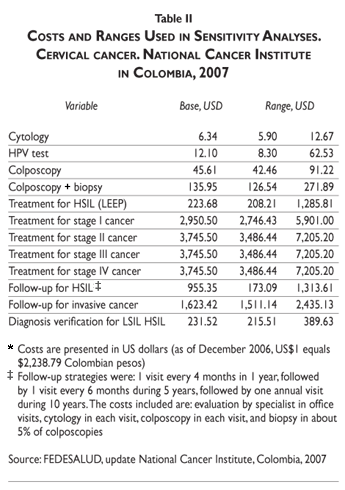
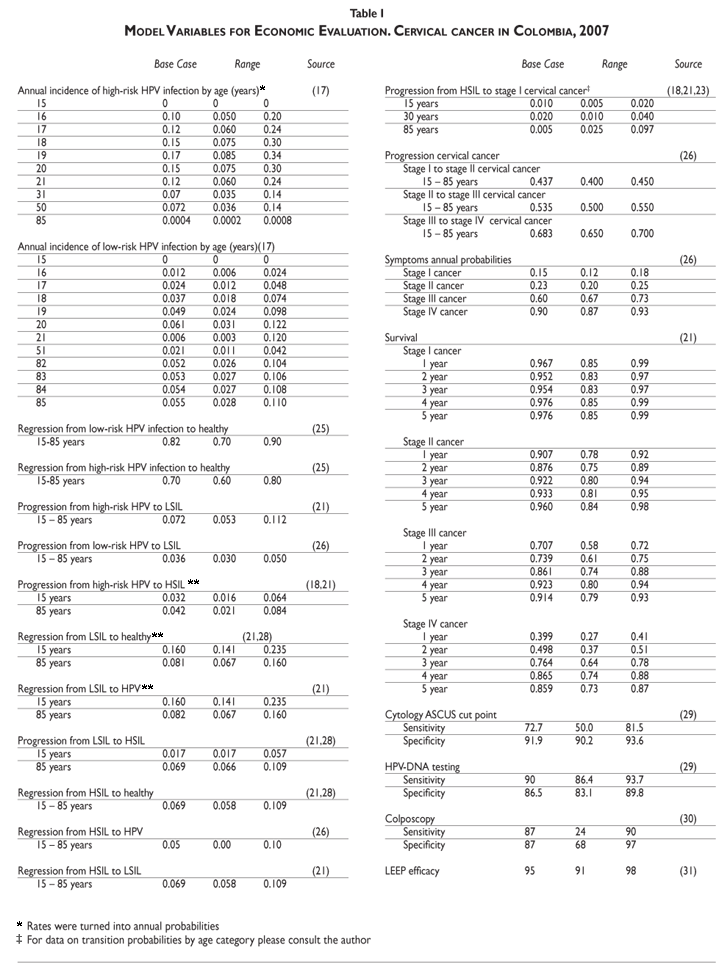
<body><![CDATA[<p><font size="2" face="Verdana"> Screening is based on a three-visit program    (screening, diagnosis, and treatment). The age range for cytology-based screening    is 21 to 69 years and for HPV-DNA, 30 to 69 years.</font></p>     <p><font size="2" face="Verdana"><b>Clinical data</b></font></p>     <p><font size="2" face="Verdana">Data on natural history were taken from the Bogota    cohort study,<SUP>17,25</SUP> previous cost-effectiveness models,<SUP>21,26</SUP>    and systematic reviews about the natural history of cervical cancer.<SUP>18,27,28</sup></font></p>     <p><font size="2" face="Verdana"> The performance of screening tests and the effectiveness    of treatment for HSIL were defined based on published literature.<SUP>29-31</SUP>    Number of years of life saved was used as an indicator of effectiveness for    screening strategies. Cervical cancer mortality is a result of the model rather    than an initial parameter, thus, reduction in mortality rates were not assumed    a priori.</font></p>     <p><font size="2" face="Verdana"> The likelihood of mortality from causes other    than cervical cancer is age-sensitive according to official data for Colombia.<SUP>20    </SUP>Probabilities for transition among states of natural history were adjusted    annually.<SUP>32</SUP> (<a href="/img/revistas/spm/v50n4/a05tab01.gif">Table I</a>)</font></p>     <p><font size="2" face="Verdana"><b>Cost data</b></font></p>     <p><font size="2" face="Verdana">The economic evaluation was from the payer’s    perspective. Costs are based on a study by the National Cancer Institute of    Colombia,<SUP>33</SUP> updated for 2007 (<a href="#tab02">table II</a>). We    analyzed direct costs for various screening strategies, diagnostic procedures,    treatment of HSIL (cold-knife conization), and treatment of cervical cancer    (local, regional, and distant invasive cancer). Cancer treatment-related costs    include staff, surgical procedures, medical treatments, and treatment for complications.    Diagnosis costs include those for false positive results. Estimations were based    on a micro-costing technique.<SUP>33</sup></font></p>     <p><a name="tab02"></a></p>     <p>&nbsp;</p>     <p align="center"><img src="/img/revistas/spm/v50n4/a05tab02.gif"></p>     ]]></body>
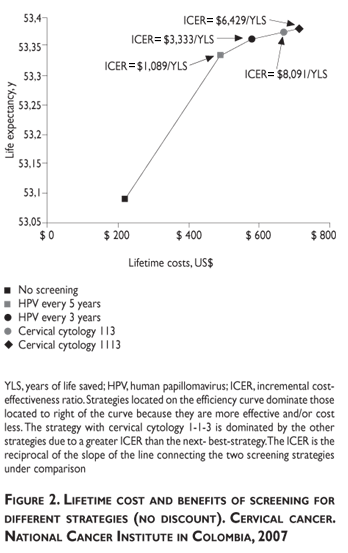
<body><![CDATA[<p>&nbsp;</p>     <p><font size="2" face="Verdana"> Program-related costs were not included, except    those for quality control such as second reading of Pap smears or additional    kits for HPV-DNA testing.</font></p>     <p>&nbsp;</p>     <p><font size="3" face="Verdana"><b>Results</b></font></p>     <p><font size="2" face="Verdana"><b>Cost-effectiveness of screening alternatives</b></font></p>     <p><font size="2" face="Verdana">Cervical cytology at a 1-1-1-3 interval reduced    the lifetime risk of death from cervical cancer by 81%, cervical cytology at    1-1-3 by 79%, HPV-DNA testing every three years by 77%, and HPV-DNA testing    every five years by 69%. Cervical cancer screening increases life expectancy    from 2.9 to 3.5 months depending on the screening strategy.</font></p>     <p><font size="2" face="Verdana"> Without discount, the most costly and effective    strategy was cervical cytology at a 1-1-1-3 interval and the least costly and    least effective was HPV-DNA testing every five years (<a href="#fig02">figure    2</a>). Without discount, cytology at 1-1-3 intervals has extended dominance,    which indicates a greater ICER when transferring from HPV-DNA testing every    three years to cytology at 1-1-3 intervals (USD$8,091) than for transferring    from this regimen to cytology 1-1-1-3 (USD$7,444).</font></p>     <p><a name="fig02"></a></p>     <p>&nbsp;</p>     <p align="center"><img src="/img/revistas/spm/v50n4/a05fig02.gif"></p>     ]]></body>
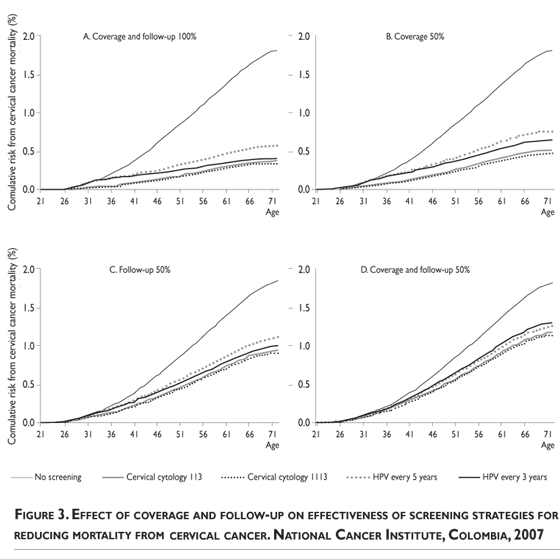
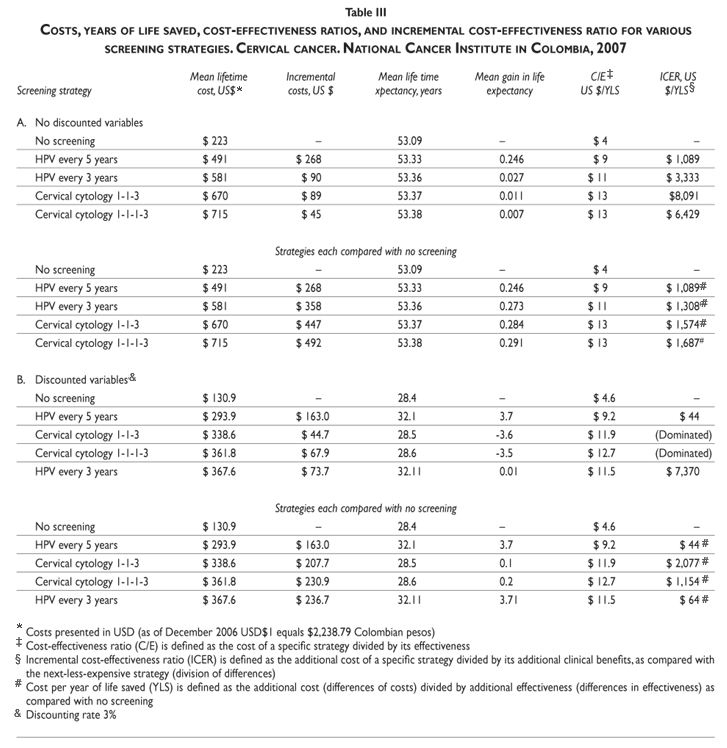
<body><![CDATA[<p>&nbsp;</p>     <p><font size="2" face="Verdana"> With discount, the least costly per year of    life saved was HPV-DNA testing every five years (USD$44/YLS). HPV-DNA testing    every three years has the highest lifetime cost (USD$367.6) and it is as effective    as HPV-DNA every five years. HPV-DNA screening dominates cytology-based screening    (<a href="/img/revistas/spm/v50n4/a05tab03.gif">table III</a>). </font></p>     <p><font size="2" face="Verdana"><b>Sensitivity analysis </b></font></p>     <p><font size="2" face="Verdana">The results, without discount, were sensitive    to costs, performance of screening tests, and diagnosis and treatment costs    for HSIL. However, when the parameters were modeled in a plausible range, only    costs for HPV-DNA testing and cytology sensitivity had an effect on the rank.</font></p>     <p><font size="2" face="Verdana"> Screening with HPV-DNA testing every five years    is cost-effective if the cost per test is under USD$31; otherwise the most cost-effective    strategy is cytology 1-1-3. Furthermore, cytology-based strategies are dominated    by HPV-DNA testing when the sensitivity is lower than 57%. The results with    discounted variables were robust in sensitivity analyses.</font></p>     <p><font size="2" face="Verdana"> Modeling the coverage from 25 to 100% does not    affect the rank; however, a reduction in follow-up to under 30% resulted in    HPV-DNA testing dominance over cytology (irrespective of the cytology interval).    Additionally, a reduction of 50% in coverage with 100% follow-up reduces the    efficacy of screening from 5 to 8% according to the screening strategy, but    a reduction of 50% in follow-up with 100% coverage reduces the screening efficacy    from 22 to 32 % (<a href="#fig03">figure 3</a>).</font></p>     <p><a name="fig03"></a></p>     <p>&nbsp;</p>     <p align="center"><img src="/img/revistas/spm/v50n4/a05fig03.gif"></p>     <p>&nbsp;</p>     ]]></body>
<body><![CDATA[<p><font size="2" face="Verdana"><b>Model validation</b></font></p>     <p><font size="2" face="Verdana">The natural history model revealed a bimodal    age distribution for high-risk HPV infection, as is described for the source    of data from a Colombian cohort of women.<SUP>17</sup></font></p>     <p><font size="2" face="Verdana"> Estimates from cross-sectional studies reveal    a lag time between HPV infection and HSIL from 7 to 15 years, with a peak of    HSIL around ages 25 to 30.<SUP>18</SUP> Our model predicts an HSIL incidence    of 600 per 100 000 with no screening, with peaks at ages 22 and 53. Data reported    by population-based cancer registries show incidence peaks of HSIL around ages    22 to 30.<SUP>18</sup></font></p>     <p><font size="2" face="Verdana"> Our model predicts a 125 per 100 000 invasive    cancer incidence at age 58, greater than that reported for the unscreened population    in the United States in 1930 (61/100 000 at 60), and similar to data from Germany    in 1960 (110/100000).<SUP>34</SUP> The Cancer Registry of Cali-Colombia showed    a 125.1 per 100 000 incidence at age 60 between 1987 and 1991.<SUP>19</sup></font></p>     <p><font size="2" face="Verdana"> The model predicted a peak of 51 per 100000    for cervical cancer mortality at age 60, similar to data by the Cancer Registry    of Cali between 1989 and 1993 (58.8 per 100000).<SUP>19</sup></font></p>     <p><font size="2" face="Verdana"> Goldie<I> et al </I>developed a Markov model    simulating the natural history of HPV infection for a hypothetical cohort of    North American women which predicted a 3.3% cervical cancer mortality with no    screening, with an invasive cancer incidence peak of 67 per 100000, and a prevalence    peak of 7.1% for HSIL around ages 30 to 40.<SUP>22 </SUP>Myers <I>et al </I>predicted    in their HPV natural history model an incidence peak for invasive cancer of    81 per 100000 at age 50, and a prevalence peak of 2.6% for HSIL around age 40.<SUP>21</sup></font></p>     <p><font size="2" face="Verdana"> The risk of death predicted by our model was    1.8%, with an incidence peak for invasive cancer of 125 per 100000 at 58; and    a prevalence peak for HSIL of 4% around age 30. Thus, the predictions in our    model are similar to the abovementioned models; the differences may be related    to history of high-risk HPV infections, since our data are from Colombian women    while other models include data from North American women.</font></p>     <p>&nbsp;</p>     <p><font size="3" face="Verdana"><b>Discussion</b></font></p>     <p><font size="2" face="Verdana">In an ideal scenario, cervical cancer mortality    could be reduced by 69 to 81%. This finding simulates previous reports<SUP>21</SUP>    and confirms the effectiveness of cervical cancer screening.</font></p>     ]]></body>
<body><![CDATA[<p><font size="2" face="Verdana"> Only HPV-DNA testing every five years was cost-effective    (ICER USD$44.4/YLS based on per capita GDP). Previous studies evidenced greater    costs for HPV testing compared to cytology.<SUP>6,7,8,35</SUP> Our findings    could be explained by the cytological triage for HPV-positive women,<SUP>36</SUP>    since this procedure could significantly reduce costs associated with false    positives and differs in this respect with published models. Different onset    of screening, increased screening intervals, and greater reproducibility of    HPV testing are additional contributions to the estimated reduction in lifetime    costs for HPV-DNA testing.</font></p>     <p><font size="2" face="Verdana"> Our study does not include program-related costs    except those associated with quality control. It is not possible at the moment    to clearly determine program-related needs for HPV-testing; however, any alternative    will require an organized program including personnel training, specimen or    sample transportation, and follow-up activities, among others; thus, we determine    that the final effect of program-related costs other than screening tests must    not be greater than the assessed alternatives. Nevertheless, given the fact    that our results reflect ongoing strategies, the costs for implementing programs    should be considered for decision-making because they may cost more than HPV    testing.</font></p>     <p><font size="2" face="Verdana"> HPV-DNA testing was cost-effective, with costs    per test lower than or equal to USD$31. Although prices for HPV tests are much    higher today, a scenario of massive screening with this technology would allow    for costs as used in the model. HPV-DNA testing has been associated with greater    efficacy than cytology due to its greater sensitivity and reproductibility.<SUP>11,37</SUP>    We found a lower effectiveness for HPV screening every five years without discount    but a lack of substantial differences in years of life saved compared to shorter    intervals for the same test (every three years) and compared to cytological    screening (<a href="#fig02">figure 2</a>). The difference may be attributable    to the later onset for HPV-DNA screening in our model. Moreover, using an age-related    differential sensitivity might lead HPV testing to render more savings in years    of life due to its higher sensitivity in older women.<SUP>38</SUP> </font></p>     <p><font size="2" face="Verdana"> We defined different onsets for screening strategies    as recommended by the Colombian advisory panel.<SUP>12</SUP> The dominance of    HPV testing with discounted rates should be carefully interpreted because the    differences in the onset could represent a bias in favor of strategies introduced    lately. Additionally, the extended dominance of cytology at 1-1-1-3 intervals    over 1-1-3 intervals cannot be understood as a direct comparison because this    finding is based on the change from an initial HPV testing-based strategy; thus,    comparing the two strategies directly may reveal different results.</font></p>     <p><font size="2" face="Verdana"> The Colombian advisory panel recommended screening    strategies and screening intervals, considering alternatives with greater feasibility    for application in the country. Although other studies have included more screening    strategies such as liquid-base cytology or visual inspection, it is less likely    that these alternatives can be used extensively as the basis for cervical cancer    screening in Colombia.<SUP>39</SUP> Likewise, previous studies report promising    results combining cytology and HPV-DNA tests,<SUP>37</SUP> but recent publications    show great benefits using HPV tests alone as the basis for screening, where    cytology is an alternative to triage HPV-positive women as done in our model,    and results in important savings.<SUP>36</sup></font></p>     <p><font size="2" face="Verdana"> Some reports have revealed an inverse ratio    between number of visits, costs, and effectiveness,<SUP>2,3</SUP> which can    also be interpreted in terms of program performance. Goldie et al have shown    lower costs and greater effectiveness for strategies linking screening and treatment    (reduced number of visits) in analyses in Peru.<SUP>6,7</SUP> Additionally,    an augment in lifetime screenings systematically generates an increase in costs    associated with a variable increase in effectiveness.<SUP>6 </SUP>These results    may indicate the burden of follow-up on program-related costs and its impact    on effectiveness.</font></p>     <p><font size="2" face="Verdana"> Comparing different strategies on the number    of lifetime screenings is reasonable due to differences among possible scenarios    for application, but despite the plausibility of reducing the number of visits,<SUP>40</SUP>    we restricted the alternatives in our study to those that would apply to current    programs and evidence in order to generate suitable recommendations for routine    healthcare services. Our programs are based on a three-visit strategy (screening,    diagnosis, and treatment) and HPV-screening does not currently apply to a one-visit    scenario.</font></p>     <p><font size="2" face="Verdana"> Nevertheless, we assessed the effect of follow-up    on program performance directly and found that a low follow-up for abnormal    screening results has a greater impact on mortality than low coverage. Despite    the synergic action between coverage and follow-up, the latter is not greatly    affected by reductions in coverage (<a href="#fig03">figure 3</a>). </font></p>     <p><font size="2" face="Verdana"> In Latin America, screening programs have made    great efforts to achieve high coverage without similar efforts on follow-up.<SUP>41</SUP>    This view may be motivated by reports on screening performance from developed    countries.<SUP>3</SUP> Our results indicate a need for a greater effort on adequate    follow-up, in spite of the obvious need for both components. Such results may    also be associated with reports indicating a better cost-effectiveness ratio    for organized than for opportunistic programs,<SUP>11</SUP> but it requires    a better understanding of the needs of an organized program.</font></p>     <p><font size="2" face="Verdana"> Our analysis has several limitations. We combined    data from various sources, different designs (cohort, clinical trials, population    cancer registries, etc.), and different eligibility criteria for participating    women. Additionally, these studies assessed results in short periods of time    projected to long periods in our model. These limitations are due to the lack    of country-specific information; nevertheless, this study is derived from a    thorough review of the literature that encompasses recent results as to the    benefits of screening tests for the natural history of infection.</font></p>     ]]></body>
<body><![CDATA[<p><font size="2" face="Verdana"> This is the first analysis with primary data    about the natural history of infection among Colombian women and is one of few    studies developed in Latin America.<SUP>6,10</SUP> Previous studies include    little information from Latin American countries and others combine analyses    of HPV vaccines and different screening strategies. The information from our    study could be more likely to be used in short-term policy design due to the    feasibility of introducing the tests and strategies in the model, while the    incorporation of vaccines in regular immunization programs could take more time.    If HPV vaccination is considered, additional analyses are required given its    impact on screening performance as well as differential costs and effectiveness    for interactive strategies.</font></p>     <p><font size="2" face="Verdana"> An optimal cervical cancer screening policy    needs to consider tests and screening alternatives as well as the effectiveness    of different treatment options for precancerous lesions. The natural history    model for cervical cancer must allow for a reasonable representation of heterogeneity    among populations at risk and be able to incorporate data on accessibility,    compliance, and feasibility with regard to a screening strategy. Clinical trials    and cohort studies are not capable of incorporating all elements or assessing    all possible strategies for all possible populations. These factors, along with    the need for decision-making in a setting where information is incomplete, make    analytical models useful tools for public health<SUP>5</SUP> if the scope and    limitations provided are adequately understood, suggesting future research for    additional screening tests (visual inspection, rapid HPV testing) or new programmatic    alternatives (HPV testing at younger ages, screening and treatment approaches,    etc.).</font></p>     <p>&nbsp;</p>     <p><font size="3" face="Verdana"><b>References</b></font></p>     <!-- ref --><p><font size="2" face="Verdana">1. Ferlay J, Bray F, Pisani P, Parkin DM. GLOBOCAN    2002 cancer incidence, mortality and prevalence worldwide. IARC CancerBase No.    5 version 2.0. Lyon: IARC Press,2004.</font>&nbsp;&nbsp;&nbsp;&nbsp;&nbsp;&nbsp;&nbsp;&nbsp;[&#160;<a href="javascript:void(0);" onclick="javascript: window.open('/scielo.php?script=sci_nlinks&ref=9295539&pid=S0036-3634200800040000500001&lng=','','width=640,height=500,resizable=yes,scrollbars=1,menubar=yes,');">Links</a>&#160;]<!-- end-ref --><!-- ref --><p><font size="2" face="Verdana">2. Lynge E, Madsen M, Engholm G. Effect of organised    screening on incidence and mortality of cervical cancer in Denmark. Cancer Res    1989; 49(8): 2157-2160.</font>&nbsp;&nbsp;&nbsp;&nbsp;&nbsp;&nbsp;&nbsp;&nbsp;[&#160;<a href="javascript:void(0);" onclick="javascript: window.open('/scielo.php?script=sci_nlinks&ref=9295540&pid=S0036-3634200800040000500002&lng=','','width=640,height=500,resizable=yes,scrollbars=1,menubar=yes,');">Links</a>&#160;]<!-- end-ref --><!-- ref --><p><font size="2" face="Verdana">3. Neto JE, Ramalho CM. Cervical Cancer in Laitn    America. Semin Oncol 2001; 28(2):188-197.</font>&nbsp;&nbsp;&nbsp;&nbsp;&nbsp;&nbsp;&nbsp;&nbsp;[&#160;<a href="javascript:void(0);" onclick="javascript: window.open('/scielo.php?script=sci_nlinks&ref=9295541&pid=S0036-3634200800040000500003&lng=','','width=640,height=500,resizable=yes,scrollbars=1,menubar=yes,');">Links</a>&#160;]<!-- end-ref --><!-- ref --><p><font size="2" face="Verdana">4. Pineros M, Hernandez G, Bray F. Increasing    mortality rates of common malignancies in Colombia: an emerging problem. Cancer    2004;101(10):2285-2292.</font>&nbsp;&nbsp;&nbsp;&nbsp;&nbsp;&nbsp;&nbsp;&nbsp;[&#160;<a href="javascript:void(0);" onclick="javascript: window.open('/scielo.php?script=sci_nlinks&ref=9295542&pid=S0036-3634200800040000500004&lng=','','width=640,height=500,resizable=yes,scrollbars=1,menubar=yes,');">Links</a>&#160;]<!-- end-ref --><!-- ref --><p><font size="2" face="Verdana">5. Goldie SJ. Chapter 15: Public health policy    and cost-effectiveness analysis. J Natl Cancer Inst Monogr 2003; 31: 102-110</font>&nbsp;&nbsp;&nbsp;&nbsp;&nbsp;&nbsp;&nbsp;&nbsp;[&#160;<a href="javascript:void(0);" onclick="javascript: window.open('/scielo.php?script=sci_nlinks&ref=9295543&pid=S0036-3634200800040000500005&lng=','','width=640,height=500,resizable=yes,scrollbars=1,menubar=yes,');">Links</a>&#160;]<!-- end-ref --><!-- ref --><p><font size="2" face="Verdana">6. Goldie SJ, Gaffikin L, Goldhaber JD, Gordillo    A, Levin C, Wright T, <I>et al</I>. Cost-Effectiveness of cervical-cancer screening    in five developing countries. N Engl J Med 2005; 353:2158-2168.</font>&nbsp;&nbsp;&nbsp;&nbsp;&nbsp;&nbsp;&nbsp;&nbsp;[&#160;<a href="javascript:void(0);" onclick="javascript: window.open('/scielo.php?script=sci_nlinks&ref=9295544&pid=S0036-3634200800040000500006&lng=','','width=640,height=500,resizable=yes,scrollbars=1,menubar=yes,');">Links</a>&#160;]<!-- end-ref --><!-- ref --><p><font size="2" face="Verdana">7. Goldie SJ, Kuhn L, Denny L, Pollack A, Wright    T. Policy analysis of cervical cancer screening strategies in low-resource settings.    JAMA 2001; 285(24): 3107-3126.</font>&nbsp;&nbsp;&nbsp;&nbsp;&nbsp;&nbsp;&nbsp;&nbsp;[&#160;<a href="javascript:void(0);" onclick="javascript: window.open('/scielo.php?script=sci_nlinks&ref=9295545&pid=S0036-3634200800040000500007&lng=','','width=640,height=500,resizable=yes,scrollbars=1,menubar=yes,');">Links</a>&#160;]<!-- end-ref --><!-- ref --><p><font size="2" face="Verdana">8. Legood R, Gray A, Mah&eacute; C, Javant k,    Nene BM, Sankaranarayanan R, <I>et al.</I> Screening for cervical cancer in    India: How much will it cost? A trial based analysis of the cost per case detected.    Int J Cancer 2005; 117: 981-987.</font>&nbsp;&nbsp;&nbsp;&nbsp;&nbsp;&nbsp;&nbsp;&nbsp;[&#160;<a href="javascript:void(0);" onclick="javascript: window.open('/scielo.php?script=sci_nlinks&ref=9295546&pid=S0036-3634200800040000500008&lng=','','width=640,height=500,resizable=yes,scrollbars=1,menubar=yes,');">Links</a>&#160;]<!-- end-ref --><!-- ref --><p><font size="2" face="Verdana">9. Holmes J, Hemmett L, Garfield S. The cost-effectiveness    of human papillomavirus screening for cervical cancer. Eur J Health Econom 2005;    50: 30-37. </font>&nbsp;&nbsp;&nbsp;&nbsp;&nbsp;&nbsp;&nbsp;&nbsp;[&#160;<a href="javascript:void(0);" onclick="javascript: window.open('/scielo.php?script=sci_nlinks&ref=9295547&pid=S0036-3634200800040000500009&lng=','','width=640,height=500,resizable=yes,scrollbars=1,menubar=yes,');">Links</a>&#160;]<!-- end-ref --><!-- ref --><p><font size="2" face="Verdana">10. Flores Y, Bishai D, Lazcano E, Shah K, L&ouml;rincz    A, Hern&aacute;ndez M, <I>et al</I>. Improving cervical cancer screening in    Mexico: results from the Morelos HPV Study. Salud Publica Mex 2003;45 Suppl    3:S388-S398.</font>&nbsp;&nbsp;&nbsp;&nbsp;&nbsp;&nbsp;&nbsp;&nbsp;[&#160;<a href="javascript:void(0);" onclick="javascript: window.open('/scielo.php?script=sci_nlinks&ref=9295548&pid=S0036-3634200800040000500010&lng=','','width=640,height=500,resizable=yes,scrollbars=1,menubar=yes,');">Links</a>&#160;]<!-- end-ref --><!-- ref --><p><font size="2" face="Verdana">11. Kim JJ, Leung GM, Woo P, Goldie SJ. Cost-effectiveness    of organized versus opportunistic cervical cytology screening in Hong Kong.    J Public Health 2004; 26(2): 130-137.</font>&nbsp;&nbsp;&nbsp;&nbsp;&nbsp;&nbsp;&nbsp;&nbsp;[&#160;<a href="javascript:void(0);" onclick="javascript: window.open('/scielo.php?script=sci_nlinks&ref=9295549&pid=S0036-3634200800040000500011&lng=','','width=640,height=500,resizable=yes,scrollbars=1,menubar=yes,');">Links</a>&#160;]<!-- end-ref --><!-- ref --><p><font size="2" face="Verdana">12. Instituto Nacional de Cancerolog&iacute;a.    Recomendaciones para la tamizaci&oacute;n de neoplasias de cuello uterino en    mujeres sin antecedentes de patolog&iacute;a cervical (preinvasora o invasora)    en Colombia. Bogot&aacute;: INC, 2007.</font>&nbsp;&nbsp;&nbsp;&nbsp;&nbsp;&nbsp;&nbsp;&nbsp;[&#160;<a href="javascript:void(0);" onclick="javascript: window.open('/scielo.php?script=sci_nlinks&ref=9295550&pid=S0036-3634200800040000500012&lng=','','width=640,height=500,resizable=yes,scrollbars=1,menubar=yes,');">Links</a>&#160;]<!-- end-ref --><!-- ref --><p><font size="2" face="Verdana">13. Prieto L, Sacrist&aacute;n JA, Anto&ntilde;anzas    F, Terr&eacute;s CR, Pinto JL, Rovira J. An&aacute;lisis coste-efectividad en    la evaluaci&oacute;n econ&oacute;mica de intervenciones sanitarias. Med Clin    (Barc) 2004; 122 (13):505-510.</font>&nbsp;&nbsp;&nbsp;&nbsp;&nbsp;&nbsp;&nbsp;&nbsp;[&#160;<a href="javascript:void(0);" onclick="javascript: window.open('/scielo.php?script=sci_nlinks&ref=9295551&pid=S0036-3634200800040000500013&lng=','','width=640,height=500,resizable=yes,scrollbars=1,menubar=yes,');">Links</a>&#160;]<!-- end-ref --><!-- ref --><p><font size="2" face="Verdana">14. World Health Organization. Macroeconomics    and health: investing in health for economic development: report of the Commission    on Macroeconomics and Health. Geneva: World Health Organization, 2001.</font>&nbsp;&nbsp;&nbsp;&nbsp;&nbsp;&nbsp;&nbsp;&nbsp;[&#160;<a href="javascript:void(0);" onclick="javascript: window.open('/scielo.php?script=sci_nlinks&ref=9295552&pid=S0036-3634200800040000500014&lng=','','width=640,height=500,resizable=yes,scrollbars=1,menubar=yes,');">Links</a>&#160;]<!-- end-ref --><!-- ref --><p><font size="2" face="Verdana">15. Departamento Administrativo Nacional de Estad&iacute;stica    (DANE). Cuentas regionales. &#091;Accesed February 11, 2008&#093;. </font><font size="2" face="Verdana">Available    at: <a href="http://www.dane.gov.co/files/investigaciones/pib/departamentales" target="_blank">www.dane.gov.co/files/investigaciones/pib/departamentales</a>.</font>&nbsp;&nbsp;&nbsp;&nbsp;&nbsp;&nbsp;&nbsp;&nbsp;[&#160;<a href="javascript:void(0);" onclick="javascript: window.open('/scielo.php?script=sci_nlinks&ref=9295553&pid=S0036-3634200800040000500015&lng=','','width=640,height=500,resizable=yes,scrollbars=1,menubar=yes,');">Links</a>&#160;]<!-- end-ref --><!-- ref --><p><font size="2" face="Verdana">16. Departamento Administrativo Nacional de Estad&iacute;stica    (DANE). Poblaci&oacute;n: indicadores demogr&aacute;ficos seg&uacute;n departamento.    &#91;Accesed August 31, 2007&#93;. Available at: <a href="http://www.dane.gov.co" target="_blank">www.dane.gov.co</a>.</font>&nbsp;&nbsp;&nbsp;&nbsp;&nbsp;&nbsp;&nbsp;&nbsp;[&#160;<a href="javascript:void(0);" onclick="javascript: window.open('/scielo.php?script=sci_nlinks&ref=9295554&pid=S0036-3634200800040000500016&lng=','','width=640,height=500,resizable=yes,scrollbars=1,menubar=yes,');">Links</a>&#160;]<!-- end-ref --><!-- ref --><p><font size="2" face="Verdana">17. Mu&ntilde;oz N, M&eacute;ndez F, Posso H,    Molano M, van de Brule A, Mu&ntilde;oz A, <I>et al</I>. Incidence, duration,    and determinants of cervical human papillomavirus infection in a cohort of Colombian    women with normal cytological results. J Infect Dis 2004;190(12):2077-2087.</font>&nbsp;&nbsp;&nbsp;&nbsp;&nbsp;&nbsp;&nbsp;&nbsp;[&#160;<a href="javascript:void(0);" onclick="javascript: window.open('/scielo.php?script=sci_nlinks&ref=9295555&pid=S0036-3634200800040000500017&lng=','','width=640,height=500,resizable=yes,scrollbars=1,menubar=yes,');">Links</a>&#160;]<!-- end-ref --><!-- ref --><p><font size="2" face="Verdana">18. Moscicki A, Schiffman M, Kjaer S, Villa L.    Updating the Natural History of HPV and anogenital cancer. Vaccine 2006; 24(3):    S42-S51.</font>&nbsp;&nbsp;&nbsp;&nbsp;&nbsp;&nbsp;&nbsp;&nbsp;[&#160;<a href="javascript:void(0);" onclick="javascript: window.open('/scielo.php?script=sci_nlinks&ref=9295556&pid=S0036-3634200800040000500018&lng=','','width=640,height=500,resizable=yes,scrollbars=1,menubar=yes,');">Links</a>&#160;]<!-- end-ref --><!-- ref --><p><font size="2" face="Verdana">19. Cali S. Poblation Registry of Cancer. Health    Faculty-Universidad del Valle Colombia. Cances Statistics &#91;Accesed March 115,    2008&#93; Available at: <a href="http://rpcc.univalle.edu.coles/Mortalidad/frames.php" target="_blank">http://rpcc.univalle.edu.coles/Mortalidad/frames.php</a>.</font>&nbsp;&nbsp;&nbsp;&nbsp;&nbsp;&nbsp;&nbsp;&nbsp;[&#160;<a href="javascript:void(0);" onclick="javascript: window.open('/scielo.php?script=sci_nlinks&ref=9295557&pid=S0036-3634200800040000500019&lng=','','width=640,height=500,resizable=yes,scrollbars=1,menubar=yes,');">Links</a>&#160;]<!-- end-ref --><!-- ref --><p><font size="2" face="Verdana">20. Departamento Administrativo Nacional de Estad&iacute;stica    (DANE). Poblaci&oacute;n: estad&iacute;sticas vitales. &#91;Accesed April 15, 2007&#93;.    Available at: <a href="http://www.dane.gov.co" target="_blank">www.dane.gov.co</a>.</font>&nbsp;&nbsp;&nbsp;&nbsp;&nbsp;&nbsp;&nbsp;&nbsp;[&#160;<a href="javascript:void(0);" onclick="javascript: window.open('/scielo.php?script=sci_nlinks&ref=9295558&pid=S0036-3634200800040000500020&lng=','','width=640,height=500,resizable=yes,scrollbars=1,menubar=yes,');">Links</a>&#160;]<!-- end-ref --><!-- ref --><p><font size="2" face="Verdana">21. Myers E, McCrory D, Nanda K, Bastian L, Matchar    D. Mathematical Model for the Natural History of Human Papillomavirus Infection    and Cervical Carcinogenesis. Am J Epidemiol 2000; 151(12): 1158-1171.</font>&nbsp;&nbsp;&nbsp;&nbsp;&nbsp;&nbsp;&nbsp;&nbsp;[&#160;<a href="javascript:void(0);" onclick="javascript: window.open('/scielo.php?script=sci_nlinks&ref=9295559&pid=S0036-3634200800040000500021&lng=','','width=640,height=500,resizable=yes,scrollbars=1,menubar=yes,');">Links</a>&#160;]<!-- end-ref --><!-- ref --><p><font size="2" face="Verdana">22. Goldie SJ, Kim JJ, Wright TC. Cost-effectiveness    of human papillomavirus DNA testing for cervical cancer screening in women aged    30 year or more. Obstet Gynecol 2004; 103: 619-631.</font>&nbsp;&nbsp;&nbsp;&nbsp;&nbsp;&nbsp;&nbsp;&nbsp;[&#160;<a href="javascript:void(0);" onclick="javascript: window.open('/scielo.php?script=sci_nlinks&ref=9295560&pid=S0036-3634200800040000500022&lng=','','width=640,height=500,resizable=yes,scrollbars=1,menubar=yes,');">Links</a>&#160;]<!-- end-ref --><!-- ref --><p><font size="2" face="Verdana">23. Mu&ntilde;oz N, Bosch X, Sanjos&eacute; S,    Herrero R, Castellsagu&eacute; X, Shah KV, <I>et al</I>. Epidemiologic classification    of human papillomavirus types associated with cervical cancer. N Engl J Med    2003; 348: 518-527.</font>&nbsp;&nbsp;&nbsp;&nbsp;&nbsp;&nbsp;&nbsp;&nbsp;[&#160;<a href="javascript:void(0);" onclick="javascript: window.open('/scielo.php?script=sci_nlinks&ref=9295561&pid=S0036-3634200800040000500023&lng=','','width=640,height=500,resizable=yes,scrollbars=1,menubar=yes,');">Links</a>&#160;]<!-- end-ref --><!-- ref --><p><font size="2" face="Verdana">24. Clifford G, Franceschi S, Diaz M, Mu&ntilde;oz    N, Villa L. HPV type-distribution in women with and without cervical neoplastic    diseases. Vaccine 2006; 24(3):S42-S51. </font>&nbsp;&nbsp;&nbsp;&nbsp;&nbsp;&nbsp;&nbsp;&nbsp;[&#160;<a href="javascript:void(0);" onclick="javascript: window.open('/scielo.php?script=sci_nlinks&ref=9295562&pid=S0036-3634200800040000500024&lng=','','width=640,height=500,resizable=yes,scrollbars=1,menubar=yes,');">Links</a>&#160;]<!-- end-ref --><!-- ref --><p><font size="2" face="Verdana">25. Molano M, van de Brule A, Plummer M, Weiderpass    E, Posso H, A&iacute;slan A, <I>et al</I>. Determinants of Clearance of Human    Papillomavirus Infections in Colombia Women with Normal Cytology: A Population-based,    5- year Follow- up study. Am J Epidemiol 2003; 158: 486-494.</font>&nbsp;&nbsp;&nbsp;&nbsp;&nbsp;&nbsp;&nbsp;&nbsp;[&#160;<a href="javascript:void(0);" onclick="javascript: window.open('/scielo.php?script=sci_nlinks&ref=9295563&pid=S0036-3634200800040000500025&lng=','','width=640,height=500,resizable=yes,scrollbars=1,menubar=yes,');">Links</a>&#160;]<!-- end-ref --><!-- ref --><p><font size="2" face="Verdana">26. Sanders G, Taira A. Cost-effectiveness of    a potential vaccine for human papillomavirus. Emerg Infect Dis 2003; 9(1): 37-48.</font>&nbsp;&nbsp;&nbsp;&nbsp;&nbsp;&nbsp;&nbsp;&nbsp;[&#160;<a href="javascript:void(0);" onclick="javascript: window.open('/scielo.php?script=sci_nlinks&ref=9295564&pid=S0036-3634200800040000500026&lng=','','width=640,height=500,resizable=yes,scrollbars=1,menubar=yes,');">Links</a>&#160;]<!-- end-ref --><!-- ref --><p><font size="2" face="Verdana">27. &Ouml;st&ouml;r A. Natural History of Cervical    Intraepiyhelial Neoplasis: A Critical Review. Int J Gynecol Pathol 1993; 12:    186-192. </font>&nbsp;&nbsp;&nbsp;&nbsp;&nbsp;&nbsp;&nbsp;&nbsp;[&#160;<a href="javascript:void(0);" onclick="javascript: window.open('/scielo.php?script=sci_nlinks&ref=9295565&pid=S0036-3634200800040000500027&lng=','','width=640,height=500,resizable=yes,scrollbars=1,menubar=yes,');">Links</a>&#160;]<!-- end-ref --><!-- ref --><p><font size="2" face="Verdana">28. Melnikow J, Nuevo J, Willan A, Chan B, Howell    L. Natural History of Cervical Squamous Intraepithelial Lesions: A meta-analysis.    Obstet Gynecol 1998; 4(2): 727-735.</font>&nbsp;&nbsp;&nbsp;&nbsp;&nbsp;&nbsp;&nbsp;&nbsp;[&#160;<a href="javascript:void(0);" onclick="javascript: window.open('/scielo.php?script=sci_nlinks&ref=9295566&pid=S0036-3634200800040000500028&lng=','','width=640,height=500,resizable=yes,scrollbars=1,menubar=yes,');">Links</a>&#160;]<!-- end-ref --><!-- ref --><p><font size="2" face="Verdana">29. Koliopoulos G, Arbyn M, Martin-Hirsch P,    Kyrgiou M, Prendiville W, Paraskevaidis E. Diagnostic accuracy of human papillomavirus    testing in primary cervical screening: A systematic review and meta-analysis    of non-randomized studies. Gynecol Oncol 2007;104(1):232-246.</font>&nbsp;&nbsp;&nbsp;&nbsp;&nbsp;&nbsp;&nbsp;&nbsp;[&#160;<a href="javascript:void(0);" onclick="javascript: window.open('/scielo.php?script=sci_nlinks&ref=9295567&pid=S0036-3634200800040000500029&lng=','','width=640,height=500,resizable=yes,scrollbars=1,menubar=yes,');">Links</a>&#160;]<!-- end-ref --><!-- ref --><p><font size="2" face="Verdana">30. Olaniyan O. Validity of colposcopy in the    diagnosis of early cervical neoplasia: a review. Afr J Reprod Health 2002;6(3):59-69.</font>&nbsp;&nbsp;&nbsp;&nbsp;&nbsp;&nbsp;&nbsp;&nbsp;[&#160;<a href="javascript:void(0);" onclick="javascript: window.open('/scielo.php?script=sci_nlinks&ref=9295568&pid=S0036-3634200800040000500030&lng=','','width=640,height=500,resizable=yes,scrollbars=1,menubar=yes,');">Links</a>&#160;]<!-- end-ref --><!-- ref --><p><font size="2" face="Verdana">31. Hirsch M, Kitchener P. Surgery for Cervical    Intraepithelial Neoplasis. The Cochrane Collaboration 1999. &#91;Accesed May 15,    2007&#93;. Available at: The Cochrane Library: <a href="http://www.cochrane.org" target="_blank">www.cochrane.org</a>.</font>&nbsp;&nbsp;&nbsp;&nbsp;&nbsp;&nbsp;&nbsp;&nbsp;[&#160;<a href="javascript:void(0);" onclick="javascript: window.open('/scielo.php?script=sci_nlinks&ref=9295569&pid=S0036-3634200800040000500031&lng=','','width=640,height=500,resizable=yes,scrollbars=1,menubar=yes,');">Links</a>&#160;]<!-- end-ref --><!-- ref --><p><font size="2" face="Verdana">32. Miller DK, Homan SM. Determining transition    probabilities: confusion and suggestions. Med Decis Making 1994;14: 52-58. </font>&nbsp;&nbsp;&nbsp;&nbsp;&nbsp;&nbsp;&nbsp;&nbsp;[&#160;<a href="javascript:void(0);" onclick="javascript: window.open('/scielo.php?script=sci_nlinks&ref=9295570&pid=S0036-3634200800040000500032&lng=','','width=640,height=500,resizable=yes,scrollbars=1,menubar=yes,');">Links</a>&#160;]<!-- end-ref --><!-- ref --><p><font size="2" face="Verdana">33. Fundaci&oacute;n para la Investigaci&oacute;n    y Desarrollo de la Salud y La Seguridad Social. Construcci&oacute;n de un sistema    de pagos por paquetes de diagn&oacute;stico e intervenci&oacute;n en enfermedades    neopl&aacute;sicas. Bogot&aacute;: Fedesalud, 2003.</font>&nbsp;&nbsp;&nbsp;&nbsp;&nbsp;&nbsp;&nbsp;&nbsp;[&#160;<a href="javascript:void(0);" onclick="javascript: window.open('/scielo.php?script=sci_nlinks&ref=9295571&pid=S0036-3634200800040000500033&lng=','','width=640,height=500,resizable=yes,scrollbars=1,menubar=yes,');">Links</a>&#160;]<!-- end-ref --><!-- ref --><p><font size="2" face="Verdana">34. McCrory DC, Matchar DB, Bastian L, Datta    S, Hasselblad V, Hickey J, <I>et al</I>. Evaluation of cervical cytology. Evidence    report/technology assessment no. 5. (Prepared by Duke University under contract    no. 290-97-0014). Rockville, MD: Agency for Health Care Policy and Research,    1999.    &nbsp;&nbsp;&nbsp;&nbsp;&nbsp;&nbsp;&nbsp;&nbsp;[&#160;<a href="javascript:void(0);" onclick="javascript: window.open('/scielo.php?script=sci_nlinks&ref=9295572&pid=S0036-3634200800040000500034&lng=','','width=640,height=500,resizable=yes,scrollbars=1,menubar=yes,');">Links</a>&#160;]<!-- end-ref --> (AHCPR publication no. 99-E010).</font></p>     <!-- ref --><p><font size="2" face="Verdana">35. Mandelblatt JS, Lawrence WF, Gaffikin L,    Limpahayom KK, Lumbiganon P, Warakamin S, <I>et al</I>. Costs and benefits of    different strategies to screen for cervical cancer in less-developed countries.    J Natl Cancer Inst 2002;94(19):1469-1483.</font>&nbsp;&nbsp;&nbsp;&nbsp;&nbsp;&nbsp;&nbsp;&nbsp;[&#160;<a href="javascript:void(0);" onclick="javascript: window.open('/scielo.php?script=sci_nlinks&ref=9295574&pid=S0036-3634200800040000500035&lng=','','width=640,height=500,resizable=yes,scrollbars=1,menubar=yes,');">Links</a>&#160;]<!-- end-ref --><!-- ref --><p><font size="2" face="Verdana">36. Cuzick J, Szarewski A, Cubie H, Hulman G,    Kitchener H, Luesley D, <I>et al</I>. Management of women who test positive    for high-risk types of human papillomavirus: the HART study. Lancet 2003;362(9399):1871-1876.</font>&nbsp;&nbsp;&nbsp;&nbsp;&nbsp;&nbsp;&nbsp;&nbsp;[&#160;<a href="javascript:void(0);" onclick="javascript: window.open('/scielo.php?script=sci_nlinks&ref=9295575&pid=S0036-3634200800040000500036&lng=','','width=640,height=500,resizable=yes,scrollbars=1,menubar=yes,');">Links</a>&#160;]<!-- end-ref --><!-- ref --><p><font size="2" face="Verdana">37. Mandelblatt JS, Lawrence WF, Womack SM, Jacobson    D, Yi B, Hwang YT, <I>et al</I>. Benefits and costs of using HPV testing to    screen for cervical cancer. JAMA 2002;287(18):2372-2381.</font>&nbsp;&nbsp;&nbsp;&nbsp;&nbsp;&nbsp;&nbsp;&nbsp;[&#160;<a href="javascript:void(0);" onclick="javascript: window.open('/scielo.php?script=sci_nlinks&ref=9295576&pid=S0036-3634200800040000500037&lng=','','width=640,height=500,resizable=yes,scrollbars=1,menubar=yes,');">Links</a>&#160;]<!-- end-ref --><!-- ref --><p><font size="2" face="Verdana">38. Cuzick J, Sasieni P, Davies P, Adams J, Normand    C, Frater A, <I>et al</I>. A systematic review of the role of human papillomavirus    testing within a cervical screening program. Health Technol Assess 1999;3(14):i-iv,    1-204.</font>&nbsp;&nbsp;&nbsp;&nbsp;&nbsp;&nbsp;&nbsp;&nbsp;[&#160;<a href="javascript:void(0);" onclick="javascript: window.open('/scielo.php?script=sci_nlinks&ref=9295577&pid=S0036-3634200800040000500038&lng=','','width=640,height=500,resizable=yes,scrollbars=1,menubar=yes,');">Links</a>&#160;]<!-- end-ref --><!-- ref --><p><font size="2" face="Verdana">39. IARC. Handbooks of cancer prevention. Cervix    cancer screening. Lyon: IARC Press, 2005.</font>&nbsp;&nbsp;&nbsp;&nbsp;&nbsp;&nbsp;&nbsp;&nbsp;[&#160;<a href="javascript:void(0);" onclick="javascript: window.open('/scielo.php?script=sci_nlinks&ref=9295578&pid=S0036-3634200800040000500039&lng=','','width=640,height=500,resizable=yes,scrollbars=1,menubar=yes,');">Links</a>&#160;]<!-- end-ref --><!-- ref --><p><font size="2" face="Verdana">40. Sankaranarayanan R, Esmy PO, Rajkumar R,    Muwonge R, Swaminathan R, Shanthakumari S, <I>et al</I>. Effect of visual screening    on cervical cancer incidence and mortality in Tamil Nadu, India: a cluster-randomised    trial. Lancet 2007;370(9585):398-406.</font>&nbsp;&nbsp;&nbsp;&nbsp;&nbsp;&nbsp;&nbsp;&nbsp;[&#160;<a href="javascript:void(0);" onclick="javascript: window.open('/scielo.php?script=sci_nlinks&ref=9295579&pid=S0036-3634200800040000500040&lng=','','width=640,height=500,resizable=yes,scrollbars=1,menubar=yes,');">Links</a>&#160;]<!-- end-ref --><!-- ref --><p><font size="2" face="Verdana">41. Goldie SJ, Kim JJ, Myers E. Chapter 19: Cost-effectiveness    of cervical cancer screening. Vaccine 2006;24 Suppl 3:S164-S170.</font>&nbsp;&nbsp;&nbsp;&nbsp;&nbsp;&nbsp;&nbsp;&nbsp;[&#160;<a href="javascript:void(0);" onclick="javascript: window.open('/scielo.php?script=sci_nlinks&ref=9295580&pid=S0036-3634200800040000500041&lng=','','width=640,height=500,resizable=yes,scrollbars=1,menubar=yes,');">Links</a>&#160;]<!-- end-ref --><p>&nbsp;</p>     <p>&nbsp;</p>     <p><font size="2" face="Verdana">Received on: September 28, 2007    <br>   Accepted on: March 14, 2008</font></p>     ]]></body>
<body><![CDATA[<p>&nbsp;</p>     <p>&nbsp;</p>     <p><font size="2" face="Verdana">Address reprint requests to: MD. Oscar Andr&eacute;s    Gamboa. Clinical Research Group, National Cancer Institute of Colombia. Av.    !ra. no. 9-85, Bogot&aacute; Colombia.    <br>   E-mail: <a href="mailto:ogamboa@cancer.gov.co">ogamboa@cancer.gov.co</a></font></p>      ]]></body><back>
<ref-list>
<ref id="B1">
<label>1</label><nlm-citation citation-type="book">
<person-group person-group-type="author">
<name>
<surname><![CDATA[Ferlay]]></surname>
<given-names><![CDATA[J]]></given-names>
</name>
<name>
<surname><![CDATA[Bray]]></surname>
<given-names><![CDATA[F]]></given-names>
</name>
<name>
<surname><![CDATA[Pisani]]></surname>
<given-names><![CDATA[P]]></given-names>
</name>
<name>
<surname><![CDATA[Parkin]]></surname>
<given-names><![CDATA[DM]]></given-names>
</name>
</person-group>
<source><![CDATA[GLOBOCAN 2002 cancer incidence, mortality and prevalence worldwide: IARC CancerBase No. 5 version 2.0]]></source>
<year>2004</year>
<publisher-loc><![CDATA[Lyon ]]></publisher-loc>
<publisher-name><![CDATA[IARC Press]]></publisher-name>
</nlm-citation>
</ref>
<ref id="B2">
<label>2</label><nlm-citation citation-type="journal">
<person-group person-group-type="author">
<name>
<surname><![CDATA[Lynge]]></surname>
<given-names><![CDATA[E]]></given-names>
</name>
<name>
<surname><![CDATA[Madsen]]></surname>
<given-names><![CDATA[M]]></given-names>
</name>
<name>
<surname><![CDATA[Engholm]]></surname>
<given-names><![CDATA[G]]></given-names>
</name>
</person-group>
<article-title xml:lang="en"><![CDATA[Effect of organised screening on incidence and mortality of cervical cancer in Denmark]]></article-title>
<source><![CDATA[Cancer Res]]></source>
<year>1989</year>
<volume>49</volume>
<numero>8</numero>
<issue>8</issue>
<page-range>2157-2160</page-range></nlm-citation>
</ref>
<ref id="B3">
<label>3</label><nlm-citation citation-type="journal">
<person-group person-group-type="author">
<name>
<surname><![CDATA[Neto]]></surname>
<given-names><![CDATA[JE]]></given-names>
</name>
<name>
<surname><![CDATA[Ramalho]]></surname>
<given-names><![CDATA[CM]]></given-names>
</name>
</person-group>
<article-title xml:lang="en"><![CDATA[Cervical Cancer in Laitn America]]></article-title>
<source><![CDATA[Semin Oncol]]></source>
<year>2001</year>
<volume>28</volume>
<numero>2</numero>
<issue>2</issue>
<page-range>188-197</page-range></nlm-citation>
</ref>
<ref id="B4">
<label>4</label><nlm-citation citation-type="journal">
<person-group person-group-type="author">
<name>
<surname><![CDATA[Pineros]]></surname>
<given-names><![CDATA[M]]></given-names>
</name>
<name>
<surname><![CDATA[Hernandez]]></surname>
<given-names><![CDATA[G]]></given-names>
</name>
<name>
<surname><![CDATA[Bray]]></surname>
<given-names><![CDATA[F]]></given-names>
</name>
</person-group>
<article-title xml:lang="en"><![CDATA[Increasing mortality rates of common malignancies in Colombia: an emerging problem]]></article-title>
<source><![CDATA[Cancer]]></source>
<year>2004</year>
<volume>101</volume>
<numero>10</numero>
<issue>10</issue>
<page-range>2285-2292</page-range></nlm-citation>
</ref>
<ref id="B5">
<label>5</label><nlm-citation citation-type="journal">
<person-group person-group-type="author">
<name>
<surname><![CDATA[Goldie]]></surname>
<given-names><![CDATA[SJ]]></given-names>
</name>
</person-group>
<article-title xml:lang="en"><![CDATA[Chapter 15: Public health policy and cost-effectiveness analysis]]></article-title>
<source><![CDATA[J Natl Cancer Inst Monogr]]></source>
<year>2003</year>
<volume>31</volume>
<page-range>102-110</page-range></nlm-citation>
</ref>
<ref id="B6">
<label>6</label><nlm-citation citation-type="journal">
<person-group person-group-type="author">
<name>
<surname><![CDATA[Goldie]]></surname>
<given-names><![CDATA[SJ]]></given-names>
</name>
<name>
<surname><![CDATA[Gaffikin]]></surname>
<given-names><![CDATA[L]]></given-names>
</name>
<name>
<surname><![CDATA[Goldhaber]]></surname>
<given-names><![CDATA[JD]]></given-names>
</name>
<name>
<surname><![CDATA[Gordillo]]></surname>
<given-names><![CDATA[A]]></given-names>
</name>
<name>
<surname><![CDATA[Levin]]></surname>
<given-names><![CDATA[C]]></given-names>
</name>
<name>
<surname><![CDATA[Wright]]></surname>
<given-names><![CDATA[T]]></given-names>
</name>
</person-group>
<article-title xml:lang="en"><![CDATA[Cost-Effectiveness of cervical-cancer screening in five developing countries]]></article-title>
<source><![CDATA[N Engl J Med]]></source>
<year>2005</year>
<volume>353</volume>
<page-range>2158-2168</page-range></nlm-citation>
</ref>
<ref id="B7">
<label>7</label><nlm-citation citation-type="journal">
<person-group person-group-type="author">
<name>
<surname><![CDATA[Goldie]]></surname>
<given-names><![CDATA[SJ]]></given-names>
</name>
<name>
<surname><![CDATA[Kuhn]]></surname>
<given-names><![CDATA[L]]></given-names>
</name>
<name>
<surname><![CDATA[Denny]]></surname>
<given-names><![CDATA[L]]></given-names>
</name>
<name>
<surname><![CDATA[Pollack]]></surname>
<given-names><![CDATA[A]]></given-names>
</name>
<name>
<surname><![CDATA[Wright]]></surname>
<given-names><![CDATA[T]]></given-names>
</name>
</person-group>
<article-title xml:lang="en"><![CDATA[Policy analysis of cervical cancer screening strategies in low-resource settings]]></article-title>
<source><![CDATA[JAMA]]></source>
<year>2001</year>
<volume>285</volume>
<numero>24</numero>
<issue>24</issue>
<page-range>3107-3126</page-range></nlm-citation>
</ref>
<ref id="B8">
<label>8</label><nlm-citation citation-type="journal">
<person-group person-group-type="author">
<name>
<surname><![CDATA[Legood]]></surname>
<given-names><![CDATA[R]]></given-names>
</name>
<name>
<surname><![CDATA[Gray]]></surname>
<given-names><![CDATA[A]]></given-names>
</name>
<name>
<surname><![CDATA[Mahé]]></surname>
<given-names><![CDATA[C]]></given-names>
</name>
<name>
<surname><![CDATA[Javant]]></surname>
<given-names><![CDATA[k]]></given-names>
</name>
<name>
<surname><![CDATA[Nene]]></surname>
<given-names><![CDATA[BM]]></given-names>
</name>
<name>
<surname><![CDATA[Sankaranarayanan]]></surname>
<given-names><![CDATA[R]]></given-names>
</name>
</person-group>
<article-title xml:lang="en"><![CDATA[Screening for cervical cancer in India: How much will it cost? A trial based analysis of the cost per case detected]]></article-title>
<source><![CDATA[Int J Cancer]]></source>
<year>2005</year>
<volume>117</volume>
<page-range>981-987</page-range></nlm-citation>
</ref>
<ref id="B9">
<label>9</label><nlm-citation citation-type="journal">
<person-group person-group-type="author">
<name>
<surname><![CDATA[Holmes]]></surname>
<given-names><![CDATA[J]]></given-names>
</name>
<name>
<surname><![CDATA[Hemmett]]></surname>
<given-names><![CDATA[L]]></given-names>
</name>
<name>
<surname><![CDATA[Garfield]]></surname>
<given-names><![CDATA[S]]></given-names>
</name>
</person-group>
<article-title xml:lang="en"><![CDATA[The cost-effectiveness of human papillomavirus screening for cervical cancer]]></article-title>
<source><![CDATA[Eur J Health Econom]]></source>
<year>2005</year>
<volume>50</volume>
<page-range>30-37</page-range></nlm-citation>
</ref>
<ref id="B10">
<label>10</label><nlm-citation citation-type="journal">
<person-group person-group-type="author">
<name>
<surname><![CDATA[Flores]]></surname>
<given-names><![CDATA[Y]]></given-names>
</name>
<name>
<surname><![CDATA[Bishai]]></surname>
<given-names><![CDATA[D]]></given-names>
</name>
<name>
<surname><![CDATA[Lazcano]]></surname>
<given-names><![CDATA[E]]></given-names>
</name>
<name>
<surname><![CDATA[Shah]]></surname>
<given-names><![CDATA[K]]></given-names>
</name>
<name>
<surname><![CDATA[Lörincz]]></surname>
<given-names><![CDATA[A]]></given-names>
</name>
<name>
<surname><![CDATA[Hernández]]></surname>
<given-names><![CDATA[M]]></given-names>
</name>
</person-group>
<article-title xml:lang="en"><![CDATA[Improving cervical cancer screening in Mexico: results from the Morelos HPV Study]]></article-title>
<source><![CDATA[Salud Publica Mex]]></source>
<year>2003</year>
<volume>45</volume>
<numero>^s3</numero>
<issue>^s3</issue>
<supplement>3</supplement>
<page-range>S388-S398</page-range></nlm-citation>
</ref>
<ref id="B11">
<label>11</label><nlm-citation citation-type="journal">
<person-group person-group-type="author">
<name>
<surname><![CDATA[Kim]]></surname>
<given-names><![CDATA[JJ]]></given-names>
</name>
<name>
<surname><![CDATA[Leung]]></surname>
<given-names><![CDATA[GM]]></given-names>
</name>
<name>
<surname><![CDATA[Woo]]></surname>
<given-names><![CDATA[P]]></given-names>
</name>
<name>
<surname><![CDATA[Goldie]]></surname>
<given-names><![CDATA[SJ]]></given-names>
</name>
</person-group>
<article-title xml:lang="en"><![CDATA[Cost-effectiveness of organized versus opportunistic cervical cytology screening in Hong Kong]]></article-title>
<source><![CDATA[J Public Health]]></source>
<year>2004</year>
<volume>26</volume>
<numero>2</numero>
<issue>2</issue>
<page-range>130-137</page-range></nlm-citation>
</ref>
<ref id="B12">
<label>12</label><nlm-citation citation-type="book">
<collab>Instituto Nacional de Cancerología</collab>
<source><![CDATA[Recomendaciones para la tamización de neoplasias de cuello uterino en mujeres sin antecedentes de patología cervical (preinvasora o invasora) en Colombia]]></source>
<year>2007</year>
<publisher-loc><![CDATA[Bogotá ]]></publisher-loc>
<publisher-name><![CDATA[INC]]></publisher-name>
</nlm-citation>
</ref>
<ref id="B13">
<label>13</label><nlm-citation citation-type="journal">
<person-group person-group-type="author">
<name>
<surname><![CDATA[Prieto]]></surname>
<given-names><![CDATA[L]]></given-names>
</name>
<name>
<surname><![CDATA[Sacristán]]></surname>
<given-names><![CDATA[JA]]></given-names>
</name>
<name>
<surname><![CDATA[Antoñanzas]]></surname>
<given-names><![CDATA[F]]></given-names>
</name>
<name>
<surname><![CDATA[Terrés]]></surname>
<given-names><![CDATA[CR]]></given-names>
</name>
<name>
<surname><![CDATA[Pinto]]></surname>
<given-names><![CDATA[JL]]></given-names>
</name>
<name>
<surname><![CDATA[Rovira]]></surname>
<given-names><![CDATA[J]]></given-names>
</name>
</person-group>
<article-title xml:lang="es"><![CDATA[Análisis coste-efectividad en la evaluación económica de intervenciones sanitarias]]></article-title>
<source><![CDATA[Med Clin (Barc)]]></source>
<year>2004</year>
<volume>122</volume>
<numero>13</numero>
<issue>13</issue>
<page-range>505-510</page-range></nlm-citation>
</ref>
<ref id="B14">
<label>14</label><nlm-citation citation-type="book">
<collab>World Health Organization</collab>
<source><![CDATA[Macroeconomics and health: investing in health for economic development:report of the Commission on Macroeconomics and Health]]></source>
<year>2001</year>
<publisher-loc><![CDATA[Geneva ]]></publisher-loc>
<publisher-name><![CDATA[World Health Organization]]></publisher-name>
</nlm-citation>
</ref>
<ref id="B15">
<label>15</label><nlm-citation citation-type="">
<collab>Departamento Administrativo Nacional de Estadística</collab>
<source><![CDATA[Cuentas regionales]]></source>
<year></year>
</nlm-citation>
</ref>
<ref id="B16">
<label>16</label><nlm-citation citation-type="">
<collab>Departamento Administrativo Nacional de Estadística</collab>
<source><![CDATA[Población: indicadores demográficos según departamento]]></source>
<year></year>
</nlm-citation>
</ref>
<ref id="B17">
<label>17</label><nlm-citation citation-type="journal">
<person-group person-group-type="author">
<name>
<surname><![CDATA[Muñoz]]></surname>
<given-names><![CDATA[N]]></given-names>
</name>
<name>
<surname><![CDATA[Méndez]]></surname>
<given-names><![CDATA[F]]></given-names>
</name>
<name>
<surname><![CDATA[Posso]]></surname>
<given-names><![CDATA[H]]></given-names>
</name>
<name>
<surname><![CDATA[Molano]]></surname>
<given-names><![CDATA[M]]></given-names>
</name>
<name>
<surname><![CDATA[van de Brule]]></surname>
<given-names><![CDATA[A]]></given-names>
</name>
<name>
<surname><![CDATA[Muñoz]]></surname>
<given-names><![CDATA[A]]></given-names>
</name>
</person-group>
<article-title xml:lang="en"><![CDATA[Incidence, duration, and determinants of cervical human papillomavirus infection in a cohort of Colombian women with normal cytological results]]></article-title>
<source><![CDATA[J Infect Dis]]></source>
<year>2004</year>
<volume>190</volume>
<numero>12</numero>
<issue>12</issue>
<page-range>2077-2087</page-range></nlm-citation>
</ref>
<ref id="B18">
<label>18</label><nlm-citation citation-type="journal">
<person-group person-group-type="author">
<name>
<surname><![CDATA[Moscicki]]></surname>
<given-names><![CDATA[A]]></given-names>
</name>
<name>
<surname><![CDATA[Schiffman]]></surname>
<given-names><![CDATA[M]]></given-names>
</name>
<name>
<surname><![CDATA[Kjaer]]></surname>
<given-names><![CDATA[S]]></given-names>
</name>
<name>
<surname><![CDATA[Villa]]></surname>
<given-names><![CDATA[L]]></given-names>
</name>
</person-group>
<article-title xml:lang="en"><![CDATA[Updating the Natural History of HPV and anogenital cancer]]></article-title>
<source><![CDATA[Vaccine]]></source>
<year>2006</year>
<volume>24</volume>
<numero>3</numero>
<issue>3</issue>
<page-range>S42-S51</page-range></nlm-citation>
</ref>
<ref id="B19">
<label>19</label><nlm-citation citation-type="">
<person-group person-group-type="author">
<name>
<surname><![CDATA[Cali]]></surname>
<given-names><![CDATA[S]]></given-names>
</name>
</person-group>
<source><![CDATA[Poblation Registry of Cancer: Health Faculty-Universidad del Valle Colombia. Cances Statistics]]></source>
<year></year>
</nlm-citation>
</ref>
<ref id="B20">
<label>20</label><nlm-citation citation-type="">
<collab>Departamento Administrativo Nacional de Estadística</collab>
<source><![CDATA[Población: estadísticas vitales]]></source>
<year></year>
</nlm-citation>
</ref>
<ref id="B21">
<label>21</label><nlm-citation citation-type="journal">
<person-group person-group-type="author">
<name>
<surname><![CDATA[Myers]]></surname>
<given-names><![CDATA[E]]></given-names>
</name>
<name>
<surname><![CDATA[McCrory]]></surname>
<given-names><![CDATA[D]]></given-names>
</name>
<name>
<surname><![CDATA[Nanda]]></surname>
<given-names><![CDATA[K]]></given-names>
</name>
<name>
<surname><![CDATA[Bastian]]></surname>
<given-names><![CDATA[L]]></given-names>
</name>
<name>
<surname><![CDATA[Matchar]]></surname>
<given-names><![CDATA[D]]></given-names>
</name>
</person-group>
<article-title xml:lang="en"><![CDATA[Mathematical Model for the Natural History of Human Papillomavirus Infection and Cervical Carcinogenesis]]></article-title>
<source><![CDATA[Am J Epidemiol]]></source>
<year>2000</year>
<volume>151</volume>
<numero>12</numero>
<issue>12</issue>
<page-range>1158-1171</page-range></nlm-citation>
</ref>
<ref id="B22">
<label>22</label><nlm-citation citation-type="journal">
<person-group person-group-type="author">
<name>
<surname><![CDATA[Goldie]]></surname>
<given-names><![CDATA[SJ]]></given-names>
</name>
<name>
<surname><![CDATA[Kim]]></surname>
<given-names><![CDATA[JJ]]></given-names>
</name>
<name>
<surname><![CDATA[Wright]]></surname>
<given-names><![CDATA[TC]]></given-names>
</name>
</person-group>
<article-title xml:lang="en"><![CDATA[Cost-effectiveness of human papillomavirus DNA testing for cervical cancer screening in women aged 30 year or more]]></article-title>
<source><![CDATA[Obstet Gynecol]]></source>
<year>2004</year>
<volume>103</volume>
<page-range>619-631</page-range></nlm-citation>
</ref>
<ref id="B23">
<label>23</label><nlm-citation citation-type="journal">
<person-group person-group-type="author">
<name>
<surname><![CDATA[Muñoz]]></surname>
<given-names><![CDATA[N]]></given-names>
</name>
<name>
<surname><![CDATA[Bosch]]></surname>
<given-names><![CDATA[X]]></given-names>
</name>
<name>
<surname><![CDATA[Sanjosé]]></surname>
<given-names><![CDATA[S]]></given-names>
</name>
<name>
<surname><![CDATA[Herrero]]></surname>
<given-names><![CDATA[R]]></given-names>
</name>
<name>
<surname><![CDATA[Castellsagué]]></surname>
<given-names><![CDATA[X]]></given-names>
</name>
<name>
<surname><![CDATA[Shah]]></surname>
<given-names><![CDATA[KV]]></given-names>
</name>
</person-group>
<article-title xml:lang="en"><![CDATA[Epidemiologic classification of human papillomavirus types associated with cervical cancer]]></article-title>
<source><![CDATA[N Engl J Med]]></source>
<year>2003</year>
<volume>348</volume>
<page-range>518-527</page-range></nlm-citation>
</ref>
<ref id="B24">
<label>24</label><nlm-citation citation-type="journal">
<person-group person-group-type="author">
<name>
<surname><![CDATA[Clifford]]></surname>
<given-names><![CDATA[G]]></given-names>
</name>
<name>
<surname><![CDATA[Franceschi]]></surname>
<given-names><![CDATA[S]]></given-names>
</name>
<name>
<surname><![CDATA[Diaz]]></surname>
<given-names><![CDATA[M]]></given-names>
</name>
<name>
<surname><![CDATA[Muñoz]]></surname>
<given-names><![CDATA[N]]></given-names>
</name>
<name>
<surname><![CDATA[Villa]]></surname>
<given-names><![CDATA[L]]></given-names>
</name>
</person-group>
<article-title xml:lang="en"><![CDATA[HPV type-distribution in women with and without cervical neoplastic diseases]]></article-title>
<source><![CDATA[Vaccine]]></source>
<year>2006</year>
<volume>24</volume>
<numero>3</numero>
<issue>3</issue>
<page-range>S42-S51</page-range></nlm-citation>
</ref>
<ref id="B25">
<label>25</label><nlm-citation citation-type="journal">
<person-group person-group-type="author">
<name>
<surname><![CDATA[Molano]]></surname>
<given-names><![CDATA[M]]></given-names>
</name>
<name>
<surname><![CDATA[van de Brule]]></surname>
<given-names><![CDATA[A]]></given-names>
</name>
<name>
<surname><![CDATA[Plummer]]></surname>
<given-names><![CDATA[M]]></given-names>
</name>
<name>
<surname><![CDATA[Weiderpass]]></surname>
<given-names><![CDATA[E]]></given-names>
</name>
<name>
<surname><![CDATA[Posso]]></surname>
<given-names><![CDATA[H]]></given-names>
</name>
<name>
<surname><![CDATA[Aíslan]]></surname>
<given-names><![CDATA[A]]></given-names>
</name>
</person-group>
<article-title xml:lang="en"><![CDATA[Determinants of Clearance of Human Papillomavirus Infections in Colombia Women with Normal Cytology: A Population-based, 5- year Follow- up study]]></article-title>
<source><![CDATA[Am J Epidemiol]]></source>
<year>2003</year>
<volume>158</volume>
<page-range>486-494</page-range></nlm-citation>
</ref>
<ref id="B26">
<label>26</label><nlm-citation citation-type="journal">
<person-group person-group-type="author">
<name>
<surname><![CDATA[Sanders]]></surname>
<given-names><![CDATA[G]]></given-names>
</name>
<name>
<surname><![CDATA[Taira]]></surname>
<given-names><![CDATA[A]]></given-names>
</name>
</person-group>
<article-title xml:lang="en"><![CDATA[Cost-effectiveness of a potential vaccine for human papillomavirus]]></article-title>
<source><![CDATA[Emerg Infect Dis]]></source>
<year>2003</year>
<volume>9</volume>
<numero>1</numero>
<issue>1</issue>
<page-range>37-48</page-range></nlm-citation>
</ref>
<ref id="B27">
<label>27</label><nlm-citation citation-type="journal">
<person-group person-group-type="author">
<name>
<surname><![CDATA[Östör]]></surname>
<given-names><![CDATA[A]]></given-names>
</name>
</person-group>
<article-title xml:lang="en"><![CDATA[Natural History of Cervical Intraepiyhelial Neoplasis: A Critical Review]]></article-title>
<source><![CDATA[Int J Gynecol Pathol]]></source>
<year>1993</year>
<volume>12</volume>
<page-range>186-192</page-range></nlm-citation>
</ref>
<ref id="B28">
<label>28</label><nlm-citation citation-type="journal">
<person-group person-group-type="author">
<name>
<surname><![CDATA[Melnikow]]></surname>
<given-names><![CDATA[J]]></given-names>
</name>
<name>
<surname><![CDATA[Nuevo]]></surname>
<given-names><![CDATA[J]]></given-names>
</name>
<name>
<surname><![CDATA[Willan]]></surname>
<given-names><![CDATA[A]]></given-names>
</name>
<name>
<surname><![CDATA[Chan]]></surname>
<given-names><![CDATA[B]]></given-names>
</name>
<name>
<surname><![CDATA[Howell]]></surname>
<given-names><![CDATA[L]]></given-names>
</name>
</person-group>
<article-title xml:lang="en"><![CDATA[Natural History of Cervical Squamous Intraepithelial Lesions: A meta-analysis]]></article-title>
<source><![CDATA[Obstet Gynecol]]></source>
<year>1998</year>
<volume>4</volume>
<numero>2</numero>
<issue>2</issue>
<page-range>727-735</page-range></nlm-citation>
</ref>
<ref id="B29">
<label>29</label><nlm-citation citation-type="journal">
<person-group person-group-type="author">
<name>
<surname><![CDATA[Koliopoulos]]></surname>
<given-names><![CDATA[G]]></given-names>
</name>
<name>
<surname><![CDATA[Arbyn]]></surname>
<given-names><![CDATA[M]]></given-names>
</name>
<name>
<surname><![CDATA[Martin-Hirsch]]></surname>
<given-names><![CDATA[P]]></given-names>
</name>
<name>
<surname><![CDATA[Kyrgiou]]></surname>
<given-names><![CDATA[M]]></given-names>
</name>
<name>
<surname><![CDATA[Prendiville]]></surname>
<given-names><![CDATA[W]]></given-names>
</name>
<name>
<surname><![CDATA[Paraskevaidis]]></surname>
<given-names><![CDATA[E]]></given-names>
</name>
</person-group>
<article-title xml:lang="en"><![CDATA[Diagnostic accuracy of human papillomavirus testing in primary cervical screening: A systematic review and meta-analysis of non-randomized studies]]></article-title>
<source><![CDATA[Gynecol Oncol]]></source>
<year>2007</year>
<volume>104</volume>
<numero>1</numero>
<issue>1</issue>
<page-range>232-246</page-range></nlm-citation>
</ref>
<ref id="B30">
<label>30</label><nlm-citation citation-type="journal">
<person-group person-group-type="author">
<name>
<surname><![CDATA[Olaniyan]]></surname>
<given-names><![CDATA[O]]></given-names>
</name>
</person-group>
<article-title xml:lang="en"><![CDATA[Validity of colposcopy in the diagnosis of early cervical neoplasia: a review]]></article-title>
<source><![CDATA[Afr J Reprod Health]]></source>
<year>2002</year>
<volume>6</volume>
<numero>3</numero>
<issue>3</issue>
<page-range>59-69</page-range></nlm-citation>
</ref>
<ref id="B31">
<label>31</label><nlm-citation citation-type="">
<person-group person-group-type="author">
<name>
<surname><![CDATA[Hirsch]]></surname>
<given-names><![CDATA[M]]></given-names>
</name>
<name>
<surname><![CDATA[Kitchener]]></surname>
<given-names><![CDATA[P]]></given-names>
</name>
</person-group>
<source><![CDATA[Surgery for Cervical Intraepithelial Neoplasis: The Cochrane Collaboration 1999]]></source>
<year></year>
</nlm-citation>
</ref>
<ref id="B32">
<label>32</label><nlm-citation citation-type="journal">
<person-group person-group-type="author">
<name>
<surname><![CDATA[Miller]]></surname>
<given-names><![CDATA[DK]]></given-names>
</name>
<name>
<surname><![CDATA[Homan]]></surname>
<given-names><![CDATA[SM]]></given-names>
</name>
</person-group>
<article-title xml:lang="en"><![CDATA[Determining transition probabilities: confusion and suggestions]]></article-title>
<source><![CDATA[Med Decis Making]]></source>
<year>1994</year>
<volume>14</volume>
<page-range>52-58</page-range></nlm-citation>
</ref>
<ref id="B33">
<label>33</label><nlm-citation citation-type="book">
<collab>Fundación para la Investigación y Desarrollo de la Salud y La Seguridad Social</collab>
<source><![CDATA[Construcción de un sistema de pagos por paquetes de diagnóstico e intervención en enfermedades neoplásicas]]></source>
<year>2003</year>
<publisher-loc><![CDATA[Bogotá ]]></publisher-loc>
<publisher-name><![CDATA[Fedesalud]]></publisher-name>
</nlm-citation>
</ref>
<ref id="B34">
<label>34</label><nlm-citation citation-type="book">
<person-group person-group-type="author">
<name>
<surname><![CDATA[McCrory]]></surname>
<given-names><![CDATA[DC]]></given-names>
</name>
<name>
<surname><![CDATA[Matchar]]></surname>
<given-names><![CDATA[DB]]></given-names>
</name>
<name>
<surname><![CDATA[Bastian]]></surname>
<given-names><![CDATA[L]]></given-names>
</name>
<name>
<surname><![CDATA[Datta]]></surname>
<given-names><![CDATA[S]]></given-names>
</name>
<name>
<surname><![CDATA[Hasselblad]]></surname>
<given-names><![CDATA[V]]></given-names>
</name>
<name>
<surname><![CDATA[Hickey]]></surname>
<given-names><![CDATA[J]]></given-names>
</name>
</person-group>
<source><![CDATA[Evaluation of cervical cytology: Evidence report/technology assessment no. 5. (Prepared by Duke University under contract no. 290-97-0014)]]></source>
<year>1999</year>
<publisher-loc><![CDATA[Rockville^eMD MD]]></publisher-loc>
<publisher-name><![CDATA[Agency for Health Care Policy and Research]]></publisher-name>
</nlm-citation>
</ref>
<ref id="B35">
<label>35</label><nlm-citation citation-type="journal">
<person-group person-group-type="author">
<name>
<surname><![CDATA[Mandelblatt]]></surname>
<given-names><![CDATA[JS]]></given-names>
</name>
<name>
<surname><![CDATA[Lawrence]]></surname>
<given-names><![CDATA[WF]]></given-names>
</name>
<name>
<surname><![CDATA[Gaffikin]]></surname>
<given-names><![CDATA[L]]></given-names>
</name>
<name>
<surname><![CDATA[Limpahayom]]></surname>
<given-names><![CDATA[KK]]></given-names>
</name>
<name>
<surname><![CDATA[Lumbiganon]]></surname>
<given-names><![CDATA[P]]></given-names>
</name>
<name>
<surname><![CDATA[Warakamin]]></surname>
<given-names><![CDATA[S]]></given-names>
</name>
</person-group>
<article-title xml:lang="en"><![CDATA[Costs and benefits of different strategies to screen for cervical cancer in less-developed countries]]></article-title>
<source><![CDATA[J Natl Cancer Inst]]></source>
<year>2002</year>
<volume>94</volume>
<numero>19</numero>
<issue>19</issue>
<page-range>1469-1483</page-range></nlm-citation>
</ref>
<ref id="B36">
<label>36</label><nlm-citation citation-type="journal">
<person-group person-group-type="author">
<name>
<surname><![CDATA[Cuzick]]></surname>
<given-names><![CDATA[J]]></given-names>
</name>
<name>
<surname><![CDATA[Szarewski]]></surname>
<given-names><![CDATA[A]]></given-names>
</name>
<name>
<surname><![CDATA[Cubie]]></surname>
<given-names><![CDATA[H]]></given-names>
</name>
<name>
<surname><![CDATA[Hulman]]></surname>
<given-names><![CDATA[G]]></given-names>
</name>
<name>
<surname><![CDATA[Kitchener]]></surname>
<given-names><![CDATA[H]]></given-names>
</name>
<name>
<surname><![CDATA[Luesley]]></surname>
<given-names><![CDATA[D]]></given-names>
</name>
</person-group>
<article-title xml:lang="en"><![CDATA[Management of women who test positive for high-risk types of human papillomavirus: the HART study]]></article-title>
<source><![CDATA[Lancet]]></source>
<year>2003</year>
<volume>362</volume>
<numero>9399</numero>
<issue>9399</issue>
<page-range>1871-1876</page-range></nlm-citation>
</ref>
<ref id="B37">
<label>37</label><nlm-citation citation-type="journal">
<person-group person-group-type="author">
<name>
<surname><![CDATA[Mandelblatt]]></surname>
<given-names><![CDATA[JS]]></given-names>
</name>
<name>
<surname><![CDATA[Lawrence]]></surname>
<given-names><![CDATA[WF]]></given-names>
</name>
<name>
<surname><![CDATA[Womack]]></surname>
<given-names><![CDATA[SM]]></given-names>
</name>
<name>
<surname><![CDATA[Jacobson]]></surname>
<given-names><![CDATA[D]]></given-names>
</name>
<name>
<surname><![CDATA[Yi]]></surname>
<given-names><![CDATA[B]]></given-names>
</name>
<name>
<surname><![CDATA[Hwang]]></surname>
<given-names><![CDATA[YT]]></given-names>
</name>
</person-group>
<article-title xml:lang="en"><![CDATA[Benefits and costs of using HPV testing to screen for cervical cancer]]></article-title>
<source><![CDATA[JAMA]]></source>
<year>2002</year>
<volume>287</volume>
<numero>18</numero>
<issue>18</issue>
<page-range>2372-2381</page-range></nlm-citation>
</ref>
<ref id="B38">
<label>38</label><nlm-citation citation-type="journal">
<person-group person-group-type="author">
<name>
<surname><![CDATA[Cuzick]]></surname>
<given-names><![CDATA[J]]></given-names>
</name>
<name>
<surname><![CDATA[Sasieni]]></surname>
<given-names><![CDATA[P]]></given-names>
</name>
<name>
<surname><![CDATA[Davies]]></surname>
<given-names><![CDATA[P]]></given-names>
</name>
<name>
<surname><![CDATA[Adams]]></surname>
<given-names><![CDATA[J]]></given-names>
</name>
<name>
<surname><![CDATA[Normand]]></surname>
<given-names><![CDATA[C]]></given-names>
</name>
<name>
<surname><![CDATA[Frater]]></surname>
<given-names><![CDATA[A]]></given-names>
</name>
</person-group>
<article-title xml:lang="en"><![CDATA[A systematic review of the role of human papillomavirus testing within a cervical screening program]]></article-title>
<source><![CDATA[Health Technol Assess]]></source>
<year>1999</year>
<volume>3</volume>
<numero>14</numero>
<issue>14</issue>
<page-range>i-iv</page-range><page-range>1-204</page-range></nlm-citation>
</ref>
<ref id="B39">
<label>39</label><nlm-citation citation-type="book">
<person-group person-group-type="author">
<name>
<surname><![CDATA[IARC]]></surname>
</name>
</person-group>
<source><![CDATA[Handbooks of cancer prevention: Cervix cancer screening]]></source>
<year>2005</year>
<publisher-loc><![CDATA[Lyon ]]></publisher-loc>
<publisher-name><![CDATA[IARC Press]]></publisher-name>
</nlm-citation>
</ref>
<ref id="B40">
<label>40</label><nlm-citation citation-type="journal">
<person-group person-group-type="author">
<name>
<surname><![CDATA[Sankaranarayanan]]></surname>
<given-names><![CDATA[R]]></given-names>
</name>
<name>
<surname><![CDATA[Esmy]]></surname>
<given-names><![CDATA[PO]]></given-names>
</name>
<name>
<surname><![CDATA[Rajkumar]]></surname>
<given-names><![CDATA[R]]></given-names>
</name>
<name>
<surname><![CDATA[Muwonge]]></surname>
<given-names><![CDATA[R]]></given-names>
</name>
<name>
<surname><![CDATA[Swaminathan]]></surname>
<given-names><![CDATA[R]]></given-names>
</name>
<name>
<surname><![CDATA[Shanthakumari]]></surname>
<given-names><![CDATA[S]]></given-names>
</name>
</person-group>
<article-title xml:lang="en"><![CDATA[Effect of visual screening on cervical cancer incidence and mortality in Tamil Nadu, India: a cluster-randomised trial]]></article-title>
<source><![CDATA[Lancet]]></source>
<year>2007</year>
<volume>370</volume>
<numero>9585</numero>
<issue>9585</issue>
<page-range>398-406</page-range></nlm-citation>
</ref>
<ref id="B41">
<label>41</label><nlm-citation citation-type="journal">
<person-group person-group-type="author">
<name>
<surname><![CDATA[Goldie]]></surname>
<given-names><![CDATA[SJ]]></given-names>
</name>
<name>
<surname><![CDATA[Kim]]></surname>
<given-names><![CDATA[JJ]]></given-names>
</name>
<name>
<surname><![CDATA[Myers]]></surname>
<given-names><![CDATA[E]]></given-names>
</name>
</person-group>
<article-title xml:lang="en"><![CDATA[Chapter 19: Cost-effectiveness of cervical cancer screening]]></article-title>
<source><![CDATA[Vaccine]]></source>
<year>2006</year>
<volume>24</volume>
<numero>^sSuppl 3</numero>
<issue>^sSuppl 3</issue>
<supplement>Suppl 3</supplement>
<page-range>S164-S170</page-range></nlm-citation>
</ref>
</ref-list>
</back>
</article>