<?xml version="1.0" encoding="ISO-8859-1"?><article xmlns:mml="http://www.w3.org/1998/Math/MathML" xmlns:xlink="http://www.w3.org/1999/xlink" xmlns:xsi="http://www.w3.org/2001/XMLSchema-instance">
<front>
<journal-meta>
<journal-id>0036-3634</journal-id>
<journal-title><![CDATA[Salud Pública de México]]></journal-title>
<abbrev-journal-title><![CDATA[Salud pública Méx]]></abbrev-journal-title>
<issn>0036-3634</issn>
<publisher>
<publisher-name><![CDATA[Instituto Nacional de Salud Pública]]></publisher-name>
</publisher>
</journal-meta>
<article-meta>
<article-id>S0036-36342008000300004</article-id>
<title-group>
<article-title xml:lang="en"><![CDATA[Health care utilization and health-related quality of life perception in older adults: a study of the Mexican Social Security Institute]]></article-title>
<article-title xml:lang="es"><![CDATA[Utilización de servicios de salud y percepción de calidad de vida relacionada a la salud en adultos mayores: un estudio en el Instituto Mexicano del Seguro Social]]></article-title>
</title-group>
<contrib-group>
<contrib contrib-type="author">
<name>
<surname><![CDATA[Gallegos-Carrillo]]></surname>
<given-names><![CDATA[Katia]]></given-names>
</name>
<xref ref-type="aff" rid="A01"/>
</contrib>
<contrib contrib-type="author">
<name>
<surname><![CDATA[García-Peña]]></surname>
<given-names><![CDATA[Carmen]]></given-names>
</name>
<xref ref-type="aff" rid="A02"/>
</contrib>
<contrib contrib-type="author">
<name>
<surname><![CDATA[Durán-Muñoz]]></surname>
<given-names><![CDATA[Carlos]]></given-names>
</name>
<xref ref-type="aff" rid="A02"/>
</contrib>
<contrib contrib-type="author">
<name>
<surname><![CDATA[Mudgal]]></surname>
<given-names><![CDATA[Jyoti]]></given-names>
</name>
<xref ref-type="aff" rid="A01"/>
</contrib>
<contrib contrib-type="author">
<name>
<surname><![CDATA[Durán-Arenas]]></surname>
<given-names><![CDATA[Luis]]></given-names>
</name>
<xref ref-type="aff" rid="A01"/>
</contrib>
<contrib contrib-type="author">
<name>
<surname><![CDATA[Salmerón-Castro]]></surname>
<given-names><![CDATA[Jorge]]></given-names>
</name>
<xref ref-type="aff" rid="A01"/>
</contrib>
</contrib-group>
<aff id="A01">
<institution><![CDATA[,Instituto Mexicano del Seguro Social  ]]></institution>
<addr-line><![CDATA[Cuernavaca ]]></addr-line>
<country>México</country>
</aff>
<aff id="A02">
<institution><![CDATA[,Instituto Mexicano del Seguro Social Centro Médico Nacional Siglo XXI ]]></institution>
<addr-line><![CDATA[México DF]]></addr-line>
</aff>
<pub-date pub-type="pub">
<day>00</day>
<month>06</month>
<year>2008</year>
</pub-date>
<pub-date pub-type="epub">
<day>00</day>
<month>06</month>
<year>2008</year>
</pub-date>
<volume>50</volume>
<numero>3</numero>
<fpage>207</fpage>
<lpage>217</lpage>
<copyright-statement/>
<copyright-year/>
<self-uri xlink:href="http://www.scielo.org.mx/scielo.php?script=sci_arttext&amp;pid=S0036-36342008000300004&amp;lng=en&amp;nrm=iso"></self-uri><self-uri xlink:href="http://www.scielo.org.mx/scielo.php?script=sci_abstract&amp;pid=S0036-36342008000300004&amp;lng=en&amp;nrm=iso"></self-uri><self-uri xlink:href="http://www.scielo.org.mx/scielo.php?script=sci_pdf&amp;pid=S0036-36342008000300004&amp;lng=en&amp;nrm=iso"></self-uri><abstract abstract-type="short" xml:lang="en"><p><![CDATA[OBJECTIVE: To establish how health care service utilization patterns are associated with health-related quality of life (HRQL) perception in older adults. MATERIAL AND METHODS: A cross-sectional study in adults aged 60 years or more was conducted in a random sample of 1150 beneficiaries of the Mexican Social Security Institute (IMSS) in Mexico City during 2003. Health care services utilization was categorized as preventive or curative, which generated six usage profiles. HRQL was measured by means of the SF-36 questionnaire. Analyses of variance and multiple linear regressions were conducted to evaluate the relationship between health care services utilization and HRQL. RESULTS: The use of preventive and curative services has a positive association with HRQL levels. Usage profiles with a prevalence of preventive services have a stronger positive association with HRQL scales. CONCLUSIONS: This study suggests a positive association between use patterns for primarily preventive health care services and a better HRQL perception among older adults.]]></p></abstract>
<abstract abstract-type="short" xml:lang="es"><p><![CDATA[OBJETIVO: Determinar cómo distintos patrones de utilización de servicios están asociados con calidad de vida relacionada a la salud (CVRS) de adultos mayores. MATERIAL Y MÉTODOS: Estudio transversal en adultos de 60 años y mayores con muestra aleatoria de 1150 derechohabientes del Instituto Mexicano del Seguro Social (IMSS) en la Ciudad de México en 2003. El uso de los servicios se clasificó en preventivos y curativos, lo que generó seis perfiles de utilización de servicios. La CVRS se midió con el SF-36. Para evaluar la asociación del uso de servicios con CVRS se realizaron análisis de varianza y regresión lineal múltiple. RESULTADOS: La utilización de servicios preventivos y curativos muestra una asociación positiva con CVRS. Los perfiles en que predominan servicios preventivos tienen una asociación positiva más fuerte con escalas de CVRS. CONCLUSIONES: Este estudio sugiere una asociación positiva de los perfiles de uso de servicios predominantemente preventivos con una mejor percepción de CVRS en adultos mayores.]]></p></abstract>
<kwd-group>
<kwd lng="en"><![CDATA[health services]]></kwd>
<kwd lng="en"><![CDATA[preventive care]]></kwd>
<kwd lng="en"><![CDATA[health of the elderly]]></kwd>
<kwd lng="en"><![CDATA[quality of life]]></kwd>
<kwd lng="en"><![CDATA[Mexico]]></kwd>
<kwd lng="es"><![CDATA[utilización]]></kwd>
<kwd lng="es"><![CDATA[servicios preventivos de salud]]></kwd>
<kwd lng="es"><![CDATA[salud del anciano]]></kwd>
<kwd lng="es"><![CDATA[calidad de vida]]></kwd>
<kwd lng="es"><![CDATA[México]]></kwd>
</kwd-group>
</article-meta>
</front><body><![CDATA[ <p align="right"><font face="Verdana, Arial, Helvetica, sans-serif" size="2"><b>ART&Iacute;CULO    ORIGINAL</b></font></p>     <p>&nbsp;</p>     <p><font face="Verdana, Arial, Helvetica, sans-serif" size="4"><b>Health care    utilization and health-related quality of life perception in older adults: a    study of the Mexican Social Security Institute</b></font></p>     <p>&nbsp;</p>     <p><font face="Verdana, Arial, Helvetica, sans-serif" size="3"><b>Utilizaci&oacute;n    de servicios de salud y percepci&oacute;n de calidad de vida relacionada a la    salud en adultos mayores: un estudio en el Instituto Mexicano del Seguro Social</b></font></p>     <p>&nbsp;</p>     <p>&nbsp;</p>     <p><font face="Verdana, Arial, Helvetica, sans-serif" size="2"><b>Katia Gallegos-Carrillo,    MSc<sup>I</sup>; Carmen Garc&iacute;a-Pe&ntilde;a, PhD<sup>II</sup>; Carlos    Dur&aacute;n-Mu&ntilde;oz, MSc<sup>II</sup>; Jyoti Mudgal, PhD<sup>I</sup>;    Luis Dur&aacute;n-Arenas, PhD<sup>III</sup>; Jorge Salmer&oacute;n-Castro, ScD<sup>I</sup></b></font></p>     <p><font face="Verdana, Arial, Helvetica, sans-serif" size="2"><sup>I</sup>Instituto    Mexicano del Seguro Social (IMSS). Cuernavaca, Morelos, M&eacute;xico    <br>   <sup>II</sup>Centro M&eacute;dico Nacional Siglo XXI, IMSS. M&eacute;xico DF    ]]></body>
<body><![CDATA[<br>   <sup>III</sup>Instituto Mexicano del Seguro Social (IMSS). M&eacute;xico DF</font></p>     <p>&nbsp;</p>     <p>&nbsp;</p> <hr size="1" noshade>     <p><font face="Verdana, Arial, Helvetica, sans-serif" size="2"><b>ABSTRACT</b></font></p>     <p><font face="Verdana, Arial, Helvetica, sans-serif" size="2"><b>OBJECTIVE:</b>    To establish how health care service utilization patterns are associated with    health-related quality of life (HRQL) perception in older adults.    <br>   <b>MATERIAL AND METHODS:</b> A cross-sectional study in adults aged 60 years    or more was conducted in a random sample of 1150 beneficiaries of the Mexican    Social Security Institute (IMSS) in Mexico City during 2003. Health care services    utilization was categorized as preventive or curative, which generated six usage    profiles. HRQL was measured by means of the SF-36 questionnaire. Analyses of    variance and multiple linear regressions were conducted to evaluate the relationship    between health care services utilization and HRQL.    <br>   <b>RESULTS:</b> The use of preventive and curative services has a positive association    with HRQL levels. Usage profiles with a prevalence of preventive services have    a stronger positive association with HRQL scales.    <br>   <b>CONCLUSIONS:</b> This study suggests a positive association between use patterns    for primarily preventive health care services and a better HRQL perception among    older adults.</font></p>     <p><font face="Verdana, Arial, Helvetica, sans-serif" size="2"><b>Key words:</b>    health services/utilization; preventive care; health of the elderly; quality    of life; Mexico</font></p> <hr size="1" noshade>     <p><font face="Verdana, Arial, Helvetica, sans-serif" size="2"><b>RESUMEN</b></font></p>     ]]></body>
<body><![CDATA[<p><font face="Verdana, Arial, Helvetica, sans-serif" size="2"><b>OBJETIVO:</b>    Determinar c&oacute;mo distintos patrones de utilizaci&oacute;n de servicios    est&aacute;n asociados con calidad de vida relacionada a la salud (CVRS) de    adultos mayores.     <br>   <b>MATERIAL Y M&Eacute;TODOS:</b> Estudio transversal en adultos de 60 a&ntilde;os    y mayores con muestra aleatoria de 1150 derechohabientes del Instituto Mexicano    del Seguro Social (IMSS) en la Ciudad de M&eacute;xico en 2003. El uso de los    servicios se clasific&oacute; en preventivos y curativos, lo que gener&oacute;    seis perfiles de utilizaci&oacute;n de servicios. La CVRS se midi&oacute; con    el SF-36. Para evaluar la asociaci&oacute;n del uso de servicios con CVRS se    realizaron an&aacute;lisis de varianza y regresi&oacute;n lineal m&uacute;ltiple.        <br>   <b>RESULTADOS:</b> La utilizaci&oacute;n de servicios preventivos y curativos    muestra una asociaci&oacute;n positiva con CVRS. Los perfiles en que predominan    servicios preventivos tienen una asociaci&oacute;n positiva m&aacute;s fuerte    con escalas de CVRS.     <br>   <b>CONCLUSIONES:</b> Este estudio sugiere una asociaci&oacute;n positiva de    los perfiles de uso de servicios predominantemente preventivos con una mejor    percepci&oacute;n de CVRS en adultos mayores.</font></p>     <p><font face="Verdana, Arial, Helvetica, sans-serif" size="2"><b>Palabras clave:    </b> utilizaci&oacute;n; servicios preventivos de salud/utilizaci&oacute;n;    salud del anciano; calidad de vida; M&eacute;xico</font></p> <hr size="1" noshade>     <p>&nbsp;</p>     <p>&nbsp;</p>     <p><font face="Verdana, Arial, Helvetica, sans-serif" size="2">In recent years,    the percentage of older adults in developing countries has increased in an unprecedented    way.<sup>1</sup> The annual growth rate of the elderly population in Mexico    was 3.5% in 2000, which if maintained, the current older-adult population (7.6%)    would double every 19 years and would amount to 28% of the total Mexican population    in 2050. In absolute terms, this means that the number of older adults will    equal the number of children by 2034.<sup>2</sup></font></p>     <p><font face="Verdana, Arial, Helvetica, sans-serif" size="2">This increase in    the elderly population represents a major challenge for health care institutions    due to the physical, social, and psychological changes that result from a complex    morbidity and mortality profile in middle-income countries like Mexico. In addition,    aged people have countless needs that health care institutions must address,    including infection-related diseases and chronic degenerative illnesses that    are common in old age. In fact, the latter are currently among the most frequent    causes of morbidity and mortality in Mexico.<sup>3</sup></font></p>     <p><font face="Verdana, Arial, Helvetica, sans-serif" size="2">This complex disease    pattern has resulted in an increasing demand for health care services other    than curative services, which have been the main focus of Mexican health care    institutions.<sup>4</sup> Thus, the burden on health care services has become    considerably greater and social security institutions are under increasing pressure    as they must adjust and adapt their medical units to meet the health care needs    of patients with chronic diseases.</font></p>     ]]></body>
<body><![CDATA[<p><font face="Verdana, Arial, Helvetica, sans-serif" size="2">Additionally, although    the Mexican health care system has been making efforts to increase the number    of preventive health care services delivered by public institutions, research    based on data from the Mexican Health and Aging Study<sup>5, 6</sup> has documented    that there are differences in older adults' use of preventive health care services    that relate to health insurance coverage, indicating that insured older adults    have better access to preventive health care services. Therefore, this study    has focused on the largest public health care institution in Mexico, the Mexican    Social Security Institute (IMSS per its abbreviation in Spanish), which covers    around 50% of the Mexican population by providing health care and social services    to workers and their families within the formal economy, mainly employed by    private firms. Since 75% of older adults in the IMSS use mainly curative health    care services,<sup>8</sup> over the past several years the IMSS has been developing    a series of projects and strategies concerning the delivery of preventive health    care services. The most recent project is the Health Integrated Programs (PREVENIMSS)    which is aimed both at improving the health status of the population covered    by the IMSS and increasing the use of preventive health care and coverage rates.<sup>7</sup></font></p>     <p><font face="Verdana, Arial, Helvetica, sans-serif" size="2">The IMSS's aging    insured population represents a huge challenge to the very essence of its mission    as a social security and health care institution. In the years to come, the    major difficulties resulting from aging will have to do with the financial impact    on the institution &#150;the need to allocate for both pensions and retirement    funds for a large aging Mexican generation as well as to provide the wide variety    of preventive, assistive, and curative health care services required by elderly    people. In view of this, it is crucial for decision-makers to have access to    scientific information on which to base their assessments of the impact of health    care services utilization on the health and health related quality of life (HRQL)    levels of older adults in the IMSS.<sup>9</sup> It is worth stressing that the    quality-of-life measurement, according to the definition of the World Health    Organization Quality of Life (WHOQOL), among this population is a valuable indicator.<sup>10</sup>    Indeed, WHO researchers describe quality of life as a comprehensive concept    related to the individual's perception of his or her position in life within    the context of her or his culture and value system and with relation to his    or her goals, expectations, and principles.<sup>11</sup></font></p>     <p><font face="Verdana, Arial, Helvetica, sans-serif" size="2">The relationship    between the use of health care services and HRQL among elderly people has been    studied from several perspectives. Some of the research, for example, is focused    on HRQL as a predictor of health care utilization.<sup>12,13</sup> In other    words, it has been questioned whether low HRQL levels are associated with high    service usage rates, and results have consistently revealed a positive association    among numerous populations.<sup>14,15</sup> However, other studies have found    a negative correlation between the use of health care services and HRQL levels    in aged people. Studies showing this relationship concern mainly patients with    specific chronic conditions, where the HRQL association has been determined    with regard to the use of a specific health care service; for example, patients    with chronic obstructive pulmonary disease (COPD). These studies show that a    higher use of emergency health care services and hospitalization correspond    with poorer HRQL levels.<sup>16</sup> Similarly, negative associations occur    between low HRQL and frequent use of curative services. Schoofs, <i>et al</i>.<sup>17</sup>    report that medical support for patients with fibromyalgia and/or chronic fatigue    syndrome is inversely proportional to their HRQL.</font></p>     <p><font face="Verdana, Arial, Helvetica, sans-serif" size="2">In addition, a    longitudinal study conducted by Kahana with the aim of establishing the impact    of proactive behaviors on quality of life concluded that an annual medical checkup    had no association with quality of life indicators.<sup>18</sup> Nevertheless,    other studies reveal opposite results with regard to preventive services. A    study in Mexico suggests that contact with the physician favors higher HRQL,<sup>19</sup>    and this agrees with Gleich's findings that concluded that annual medical checkups    may be a factor in maintaining good HRQL among older adults.<sup>20</sup> To    support those associations, other studies have explored the role of preventive    home visits to maintain or improve the functional status of the elderly and    reduce the use of institutional care.</font></p>     <p><font face="Verdana, Arial, Helvetica, sans-serif" size="2">It is uncertain    whether preventive home visits with older people have any impact whatsoever,    since some assessments have shown positive and others negative results. For    example, based on meta-regression analysis, Stuck <i>et al</i>. conclude that    preventive home visits are effective in relatively young target populations    with a lower risk of death,<sup>21</sup> while van Haastregt concludes that    no clear evidence exists supporting the effectiveness of preventive home visits    for community-dwelling aged people.<sup>22</sup> Meta-analysis findings indicate    that preventive home visits may reduce mortality and hospital admissions but    cannot improve the patient's functional status.<sup>23</sup> As reported, although    there are conflicting results among individual studies on preventive home visits,    some studies clearly indicate that the use of specific health care services    improves the health and functional status of older adults.<sup>21</sup></font></p>     <p><font face="Verdana, Arial, Helvetica, sans-serif" size="2">However, health    systems are currently focused on providing curative rather than preventive health    care services for chronic diseases. Hence, conclusive research is still needed    to unequivocally establish how patterns of preventive and curative services    are associated with HRQL perception.</font></p>     <p><font face="Verdana, Arial, Helvetica, sans-serif" size="2">The objective of    the present study is to determine how usage patterns for both preventive and    curative health care services are linked with the HRQL perception of elderly    people aged 60 and over who use health services at the IMSS, controlling the    impact of variables that may alter HRQL. We hypothesized that usage patterns    for health care services for patients who seek both preventive and curative    services, with a prevalence of preventive services, are associated with higher    HRQL perception in older adults.</font></p>     <p><font face="Verdana, Arial, Helvetica, sans-serif" size="2">The hope is that    this analysis will contribute to clearly identifying how the various kinds of    human and material resources that are continually administered in the delivery    of curative and preventive services impact the HRQL of older adults.</font></p>     <p>&nbsp;</p>     <p><font face="Verdana, Arial, Helvetica, sans-serif" size="3"><b>Material and    Methods</b></font></p>     ]]></body>
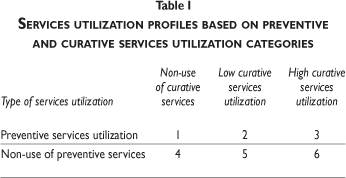
<body><![CDATA[<p><font face="Verdana, Arial, Helvetica, sans-serif" size="2">A survey among    insured adults aged 60 and older in the Mexican Social Security Institute in    Mexico City was carried out. The sample framework consisted of 131288 individuals    who were 60 years or older in 2003, based on the total list of insured individuals    from the medical units included in the study, and 1 150 subjects who were randomly    selected from the total list. At the time of the study, these subjects were    not in the terminal stage of a chronic disease and did not exhibit cognitive    impairment, the latter being determined by the Mini-Mental State Examination    (MMSE) which was adapted and validated for its administration, in Spanish, to    a Mexican population.<sup>24</sup> Data was collected by means of structured    personal interviews conducted by trained surveyors at the individuals' homes,    with their written consent. The IMSS Institutional Review Board evaluated and    approved the research procedures.</font></p>     <p><font face="Verdana, Arial, Helvetica, sans-serif" size="2"><b>Health-related    Quality of Life (HRQL)</b></font></p>     <p><font face="Verdana, Arial, Helvetica, sans-serif" size="2">HRQL was assessed    using the Medical Outcomes Study 36-Item-Short-Form Health Survey SF-36<sup>25</sup>    in its Spanish version, which has been validated for Mexican people.<sup>26,27</sup>    This questionnaire consists of 36 items that assess HRQL during the four-week    period previous to the administration of the questionnaire by means of eight    scales or dimensions: physical functioning (PF); limitations in role activities    due to physical health problems (RP); bodily pain (BP); social functioning (SF);    general mental health that includes psychological stress (MH); limitations in    role activities due to emotional problems (RE); vitality, energy, or fatigue    (VT); and general health perception (GH). The PF, RP, and BP scales reflect    the physical elements of health; the SF, RE, and MH represent psychological    aspects; and VT and GH indicate the subjective perception of health. Each scale    measured by this instrument has a transformed score ranging from 0 to 100, where    higher values denote better functioning and fewer limitations. SF-36-derived    scores do not have a cut-off point to differentiate between good or poor HRQL.<sup>25,28</sup></font></p>     <p><font face="Verdana, Arial, Helvetica, sans-serif" size="2"><b>Use of services</b></font></p>     <p><font face="Verdana, Arial, Helvetica, sans-serif" size="2">The use-of-services    variable includes both health and social services at the IMSS and other public    and private institutions. By means of direct interviews, information concerning    services utilization during the 12 months prior to survey administration was    collected. Based on the 1978 WHO Declaration of Alma Ata,<sup>29</sup> usage    of health and social services were grouped into two general categories: preventive    services utilization and curative services utilization. The following health    and social services classification is based on the health care services delivery    scheme at public health institutions in Mexico.</font></p>     <p><font face="Verdana, Arial, Helvetica, sans-serif" size="2"><i>Preventive Services.</i>    Under this classification utilization were considered as the use of at least    one of the following services within the past 12 months: 1) Preventive health-care    services: consultations in nutrition, use of psychological or preventive odontological    or medical services (including immunizations and screening services to detect    diabetes, hypertension, and obesity), educational sessions about health, and    health promotion activities; 2) Social services: physical activities, health    culture courses about personal hygiene and disease prevention, camps for social    activities such as cooking, handicrafts, and dance and weekend activities like    guided walks, among others. <i>Curative Services.</i> The use of the following    services were considered: out-patient consultation with family medicine or specialist    physician, emergency and short-hospitalization consultations, auxiliary diagnostic    studies (laboratory and/or other auxiliary diagnostic studies), pharmacy, surgery,    and hospitalization. Since curative services utilization is quite frequent,    we divided it into three groups: 1) non-use of curative services (no utilization    event within the past 12 months), 2) low curative services utilization (use    of services once or twice during the past 12 months), and 3) high curative services    utilization (on three or more occasions during the past 12 months).</font></p>     <p><font face="Verdana, Arial, Helvetica, sans-serif" size="2">To estimate the    health and social service utilization profile, six service utilization profiles,    or patterns, ranging from 1 to 6 were developed based on the above mentioned    preventive and curative categories, where profile 1 represents the highest service    utilization profile and 6 represents the lowest (<a href="#t1">table I</a>).</font></p>     <p><a name="t1"></a></p>     <p>&nbsp;</p>     <p align="center"><img src="/img/revistas/spm/v50n3/04t1.gif"></p>     ]]></body>
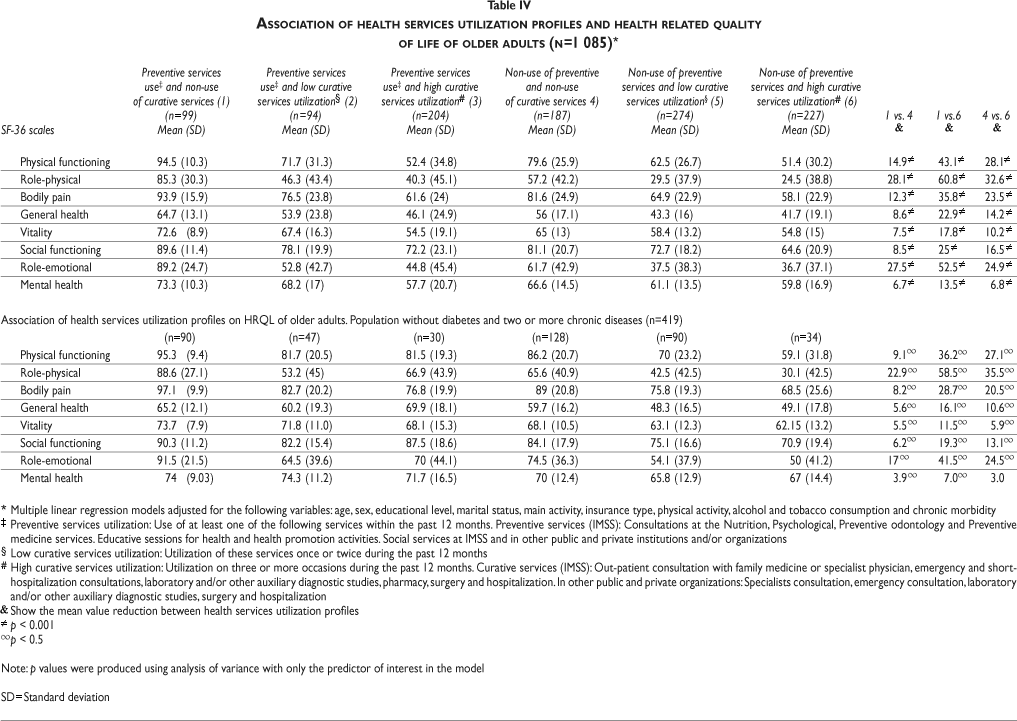
<body><![CDATA[<p>&nbsp;</p>     <p><font face="Verdana, Arial, Helvetica, sans-serif" size="2">In addition, certain    co-variables were measured and classified into three groups: first, the socio-demographic    variables comprising sex (men &#91;reference level&#93;), age (&lt;75 &#91;reference    level&#93;), schooling (1= no formal schooling &#91;reference level&#93;, 2=    elementary, 3=<u>&gt;</u> junior high), marital status and main activity; second,    habits and life style, comprising physical activity and tobacco or alcohol consumption,    and; third, the chronic morbidity variable, consisting of the total number of    chronic diseases previously diagnosed by a registered medical practitioner.</font></p>     <p><font face="Verdana, Arial, Helvetica, sans-serif" size="2"><b>Statistical    analysis</b></font></p>     <p><font face="Verdana, Arial, Helvetica, sans-serif" size="2">Descriptive analysis    was used to identify the general characteristics of the study population and    the particularities of health care services utilization by sex. The analysis    covered all subjects in the sample, by sex, to determine whether there were    differences in the use of preventive and curative services. Analysis of variance    was used to analyze differences in the eight HRQL scales versus the six service-utilization    profiles, using only the predictor of interest in the model. The analysis included    the whole sample of individuals not affected by diabetes and two or more chronic    diseases. Bivariate analysis was used to examine the impact of each utilization    profile on HRQL. Finally, multiple linear regression models were applied to    analyze the independent effect of six service-utilization profiles on each HRQL    scale, adjusting for the remaining co-variables. To control potential confounding    with regard to health care services utilization and morbidity, the same linear    regression analyses were made with all the participants' data and including    only patients without diabetes and two or more chronic diseases.</font></p>     <p>&nbsp;</p>     <p><font face="Verdana, Arial, Helvetica, sans-serif" size="3"><b>Results</b></font></p>     <p><font face="Verdana, Arial, Helvetica, sans-serif" size="2">Of the total sample,    1085 individuals were included in our study (58% women). The average age was    71 years with no significant differences between men and women. Regarding marital    status, almost 78% of the men were married versus 58% of the women; 18% of the    men were widowed, compared to 37% of the women (<i>p</i>&lt; 0.05). As for schooling,    20% of the sample reported no formal schooling, without any differences by sex.    Data about their main activity showed that 16% of men work outside the home    compared to 6% of women. In addition, 65.5% of men and 11% of women were retired    or pensioned (<i>p</i>&lt; 0.05). Differences in the chronic comorbidity categories    between men and women were not found (<a href="#t2">table II</a>).</font></p>     <p><a name="t2"></a></p>     <p>&nbsp;</p>     <p align="center"><img src="/img/revistas/spm/v50n3/04t2.gif"></p>     ]]></body>
<body><![CDATA[<p>&nbsp;</p>     <p><font face="Verdana, Arial, Helvetica, sans-serif" size="2">Seventy percent    of the subjects reported having used health services at IMSS Family Medicine    Units. With regard to preventive services, use of health education and promotion    services was low. As for social services, only half the people using social-type    services did so at IMSS facilities.</font></p>     <p><font face="Verdana, Arial, Helvetica, sans-serif" size="2">Curative services    utilization was concentrated in out-patient consultations as well as in family    medicine and medical specialty (87.56%) consultations, followed by pharmacy    services utilization (66.08%). Roughly 1% of older adults had undergone surgery    during the previous year. The use of several curative services at other public    or private institutions was around 1%, with the exception of out-patient specialty    consultations which was roughly 5% (<a href="/img/revistas/spm/v50n3/04t3.gif">table    III</a>).</font></p>     <p><font face="Verdana, Arial, Helvetica, sans-serif" size="2">When assessed the    mean values in all the HRQL scales, it was clear that the highest HRQL values    are found in profile 1 users &#150;i.e. preventive services users and non-users    of curative services&#150; while the lowest values across all the HRQL scales    are found in profile 6 &#150;i.e. non-use of preventive services and high curative    services utilization. The difference in the HRQL scores observed between profile    1 and profile 4, non-use of preventive services and non-use of curative services    show that similar differences are present in all the HRQL scales, particularly    in those for physical problems.</font></p>     <p><font face="Verdana, Arial, Helvetica, sans-serif" size="2">The mean difference    between both service utilization profiles exceeded 28 points (<a href="/img/revistas/spm/v50n3/04t4.gif">table    IV</a>). It is clear that the elderly using mainly preventive services reported    higher HRQL levels. These positive associations in favor of preventive health    care utilization are prevalent in older adults without diabetes and two or more    chronic diseases (<a href="/img/revistas/spm/v50n3/04t4.gif">table IV</a>).    It is worth stressing that the same analysis of health service utilization profiles    and HRQL by sex did not show statistically significant differences, suggesting    that the perception of each HRQL scale differs for men and women according to    the pattern of health care services utilization and not according to sex (data    not shown).</font></p>     <p><font face="Verdana, Arial, Helvetica, sans-serif" size="2">Multiple linear    regression analyses corroborate the association between the six service utilization    profiles and HRQL as well as the impact of the other variables on this relationship.    In addition, certain association patterns exist for HRQL scales and health care    service utilization profiles: for physical functioning, social functioning,    physical problems, and bodily pain, non-use of preventive and curative services    has a slightly higher association with these HRQL scales, whereas for patients    without diabetes or two or more chronic diseases the profile for preventive    health care utilization and non-use of curative services has the strongest association.    Likewise, in the vitality scale the latter profile presents the highest association    both in the sample population and in the group without comorbidity (<a href="/img/revistas/spm/v50n3/04t5.gif">table    V</a>).</font></p>     <p><font face="Verdana, Arial, Helvetica, sans-serif" size="2">Also, in the scales    related with mental HRQL dimensions, i.e. emotional problems and mental health,    a combination of preventive services with some degree of curative services utilization    resulted in higher scores (<a href="/img/revistas/spm/v50n3/04t5.gif">table    V</a>).</font></p>     <p><font face="Verdana, Arial, Helvetica, sans-serif" size="2">Finally, in the    general health scale, health service utilization profiles had no statistically    relevant association. Nevertheless, when the analysis was carried out among    patients without diabetes and two or more chronic diseases, a combination of    preventive and curative services utilization was associated with a better general    health perception (<i>p</i>&lt; 0.05 <i>B</i>=0.22) (<a href="/img/revistas/spm/v50n3/04t5.gif">table    V</a>).</font></p>     <p><font face="Verdana, Arial, Helvetica, sans-serif" size="2">The standardized    regression coefficients for both SF-36 and socio-demographic factors are shown    in <a href="/img/revistas/spm/v50n3/04t5.gif">table V</a>. As age increases,    HRQL perception becomes poorer. General health and social functioning scales    showed slight differences by sex, with female being associated with higher scores.    In addition, higher schooling was associated with higher HRQL. Finally, it is    worth mentioning that in the regression models, variables like insurance type    did not indicate any association with HRQL scales, after stratified analysis    and like-adjusted variables.</font></p>     <p>&nbsp;</p>     ]]></body>
<body><![CDATA[<p><font face="Verdana, Arial, Helvetica, sans-serif" size="3"><b>Discussion</b></font></p>     <p><font face="Verdana, Arial, Helvetica, sans-serif" size="2">This study suggests    a positive association between predominantly preventive health service utilization    patterns and better HRQL perception among the elderly. Before discussing the    specific findings of this study, some general aspects of the study population    and the use of health care services should be outlined.</font></p>     <p><font face="Verdana, Arial, Helvetica, sans-serif" size="2">The socio-demographic    characteristics of older adults covered by the IMSS differ to a certain extent    from those of the rest of the Mexican population. For example, when comparing    the results of this study with findings from the 2000 National Health Survey    (NHS-2000) and the Mexican Health and Aging Study, the average age of elderly    IMSS-insured patients is slightly higher, the percentage having no formal schooling    is smaller,<sup>30,31</sup> and since the uninsured population continues working    longer than elderly IMSS beneficiaries, there are more retired elderly people    among those insured by the IMSS than among the uninsured population. These findings    are consistent with data obtained from the analysis of the IMSS population included    in the NHS-2000.<sup>32</sup></font></p>     <p><font face="Verdana, Arial, Helvetica, sans-serif" size="2">It is worth noting    that when results for frequency of health care services utilization were compared    with the findings of other studies carried out among the Mexican population,    the proportion of patients using preventive care services is smaller than that    reported by Wong and D&iacute;az and Pagan, <i>et al</i>.<sup>5,6</sup> We are    aware that these findings could be limiting to our results and that the preventive    services association, therefore, may be underestimated. According to Borges    and Dantes, low preventive service utilization is reflected in an increase in    curative services utilization.<sup>33</sup> However, the frequency of services    utilization is consistent with the findings of a longitudinal study of IMSS-insured    aged people living in Mexico City.<sup>8</sup> As for the differences in the    use of preventive care services by men and women identified in a previous paper,<sup>5</sup>    they are not corroborated by our study since we did not find relevant sex-based    differences in the use of preventive and curative care services. We should stress,    though, that directly contrasting both series of findings is inadvisable due    to differences in methods for measuring the variable for preventive services    utilization.</font></p>     <p><font face="Verdana, Arial, Helvetica, sans-serif" size="2">Finally, in relation    to the pattern of curative services utilization by older adult patients in the    IMSS, we observe that our findings match the high frequency rates of health    services utilization that were reported by the NHS-2000 analysis of IMSS-insured    population, especially in the case of out-patient consultation services and    hospitalization.<sup>34</sup></font></p>     <p><font face="Verdana, Arial, Helvetica, sans-serif" size="2">The overall findings    on the positive association between preventive care utilization and HRQL in    older adults are in agreement with both the work of Stuck, <i>et al</i>.,<sup>21</sup>    who found a positive impact of home visits on the prevention of nursing home    admissions and functional decline, and that of Elkan, <i>et al</i>.,<sup>23</sup>    who also reported a positive impact of home-based support for older people on    their mortality and admission to long-term institutional care. Obviously, the    objective of this study differs from those of these two meta-analyses of controlled    trials. Still, our study shows a remarkable association for these kinds of curative    and preventive practices in Mexico and that patterns may be established by means    of a cross-sectional study.</font></p>     <p><font face="Verdana, Arial, Helvetica, sans-serif" size="2">These findings    are relevant because they make a case for preventive medicine as a potentially    effective intervention for older adult populations, and they are in agreement    with the work of Theander, <i>et al</i>., on Swedish older adults, concerning    the link between preventive services and HRQL.<sup>35</sup></font></p>     <p><font face="Verdana, Arial, Helvetica, sans-serif" size="2">Prior research    in this area has shown that poor HRQL is associated with health services utilization.<sup>14,15</sup>    However, the main focus of this study was to identify the impact of services    utilization patterns on elderly HRQL. In this regard, for example, Damian, <i>et    al</i>.<sup>36</sup> concluded that recent contact with a physician was associated    with poor health. These results concur with those of other studies that adjusted    for the patient's functional capacity.<sup>37,38</sup> Yet, these studies did    not discriminate between preventive and curative services utilization and focused    only on the functional aspects of HRQL.</font></p>     <p><font face="Verdana, Arial, Helvetica, sans-serif" size="2">In addition, this    study confirms the assumptions raised by Kahana, <i>et al</i>. in 2002 with    regard to the role of older adults' preventive and curative behaviors in their    HRQL.<sup>18</sup> The six profiles used to measure services utilization in    our study were based on the conceptual model of successful aging by Kahana &amp;    Kahana,<sup>39</sup> in which proactive preventive and curative behaviors represent    an important part of the model.</font></p>     <p><font face="Verdana, Arial, Helvetica, sans-serif" size="2">Despite being a    cross-sectional study, the stratified analysis among patients with and without    chronic diseases partially settled the temporality issue associated with cross-sectional    design. The results presented showed the association between health care utilization    patterns and HRQL in five of the eight scales used in this study, namely: physical    problems, bodily pain, vitality, emotional problems, and mental health scales.    A better HRQL perception was found among individuals that made use of preventive    services. Also, when older people with diabetes and two or more chronic diseases    were excluded, our results were still consistent. Thus, the chronic conditions    related to health status are not explained by our findings, since after reducing    the potential confounding arising from morbidity that could bias the utilization    pattern, we found a clear association between preventive health care services    utilization and a higher HRQL perception, while the correlation of curative    services utilization remained unchanged. The standardized regression coefficients    related to preventive services are higher than those for other utilization profiles,    except for the physical functioning scale, in which the non-use of preventive    and curative services profile shows a higher coefficient. This finding could    be accounted for by the fact that non-users of preventive and curative services    tended to be younger, as has been documented by other studies and our own findings.    Generally speaking, older age is an element that has a negative impact on quality    of life perception<sup>40</sup> and those not using health services are thus    likely to present fewer health problems and may have a better HRQL. It is worth    noting that even though scores were higher in the profiles of non-users of preventive    and curative services than in profiles that included curative users, they were    considerably lower than those for profile 1 (users of preventive services only).</font></p>     ]]></body>
<body><![CDATA[<p><font face="Verdana, Arial, Helvetica, sans-serif" size="2">The number of chronic    diseases represents a relevant variable: 79.53% of study subjects reported having    at least one previous medically diagnosed chronic disease, close to the 81.5%    found by Damian.<sup>36</sup> It is well known that chronic diseases have an    effect on the HRQL perception of non-hospitalized patients in health institutions<sup>12,36,41,42</sup>    as well as on that of individuals with a specific diagnosis.<sup>43</sup> Several    studies have shown that low HRQL is associated with higher health services utilization    among older adults,<sup>12,14</sup> which points to the fact that this relationship    is a complex one to assess, even more so when there are important differences    in the health care system, together with the socio-economic and cultural characteristics    of developing countries such as Mexico. Thus, the relationship between chronic    morbidity, HRQL, and health services utilization could be determined according    to the levels of each one. In this regard, our findings show that when the impact    of chronic diseases on older adults' HRQL is constant, preventive services utilization    is positively associated with a better HRQL perception.</font></p>     <p>&nbsp;</p>     <p><font face="Verdana, Arial, Helvetica, sans-serif" size="3"><b>Conclusions</b></font></p>     <p><font face="Verdana, Arial, Helvetica, sans-serif" size="2">Health-related    quality of life is important to assess the impact of preventive and curative    services utilization on health. It provides a comprehensive measure for several    health and well-being dimensions and is particularly useful in populations affected    mainly by chronic diseases.</font></p>     <p><font face="Verdana, Arial, Helvetica, sans-serif" size="2">This study found    that visits by older adults to medical care units for preventive services utilization    are associated with a better perception in all HRQL dimensions.</font></p>     <p><font face="Verdana, Arial, Helvetica, sans-serif" size="2">The use of curative    services is also related, to a lesser extent, to a better HRQL perception, and,    as this study suggests, is associated with the physical functioning, social    functioning, bodily pain, and vitality HRQL scales in the elderly; an association    that is significant after controlling for the effects of chronic diseases that    these patients suffer from and reducing potential confounding.</font></p>     <p><font face="Verdana, Arial, Helvetica, sans-serif" size="2">These results are    relevant as they show that it may be desirable to abandon the morbidity-centered    vision that limits the assessment of the impact of health programs, particularly    those concerning older adults with chronic diseases. Our main purpose should    be to slow down disease progression and preserve a good HRQL level in older    adults.</font></p>     <p><font face="Verdana, Arial, Helvetica, sans-serif" size="2">Health policy planning    and health program development for the elderly should acknowledge the relevance    of moving forward from curative to preventive services and from medical services    to social services. Only in this way may comprehensive health care services    for older adults be developed, with a view towards addressing the complex needs    of this growing population in our societies.</font></p>     <p><font face="Verdana, Arial, Helvetica, sans-serif" size="2">Since 2003, efforts    to increase the coverage of preventive care services at the Mexican Social Security    Institute have succeeded due to Health-Integrated Programs (PREVENIMSS), that    has as one of its main components the health of older adults. Therefore, in    the coming years, it would be crucial to undertake research aimed at establishing    the impact of the increase in PREVENIMSS coverage on the use of both preventive    and curative health care services and on the HRQL of older adults in the IMSS.</font></p>     <p>&nbsp;</p>     ]]></body>
<body><![CDATA[<p><font face="Verdana, Arial, Helvetica, sans-serif" size="3"><b>Acknowledgements</b></font></p>     <p><font face="Verdana, Arial, Helvetica, sans-serif" size="2">This study was    made possible thanks to the IMSS-2002/047 research grant bestowed by the National    Health Research Council of the Mexican Social Security Institute (IMSS).</font></p>     <p>&nbsp;</p>     <p><font face="Verdana, Arial, Helvetica, sans-serif" size="3"><b>References</b></font></p>     <!-- ref --><p><font face="Verdana, Arial, Helvetica, sans-serif" size="2">1. Dominguez LJ,    Galioto A, Ferlisi A, Pineo A, Putignano E, Belvedere M, <i>et al</i>. Ageing,    lifestyle modifications, and cardiovascular disease in developing countries.    J Nutr Health Aging 2006;10:143-149.</font>&nbsp;&nbsp;&nbsp;&nbsp;&nbsp;&nbsp;&nbsp;&nbsp;[&#160;<a href="javascript:void(0);" onclick="javascript: window.open('/scielo.php?script=sci_nlinks&ref=9294038&pid=S0036-3634200800030000400001&lng=','','width=640,height=500,resizable=yes,scrollbars=1,menubar=yes,');">Links</a>&#160;]<!-- end-ref --><!-- ref --><p><font face="Verdana, Arial, Helvetica, sans-serif" size="2">2. Consejo Nacional    de Poblaci&oacute;n. Estimaciones y proyecciones del Consejo Nacional de Poblaci&oacute;n    2002. Mexico City: CONAPO, 2002.</font>&nbsp;&nbsp;&nbsp;&nbsp;&nbsp;&nbsp;&nbsp;&nbsp;[&#160;<a href="javascript:void(0);" onclick="javascript: window.open('/scielo.php?script=sci_nlinks&ref=9294039&pid=S0036-3634200800030000400002&lng=','','width=640,height=500,resizable=yes,scrollbars=1,menubar=yes,');">Links</a>&#160;]<!-- end-ref --><!-- ref --><p><font face="Verdana, Arial, Helvetica, sans-serif" size="2">3. World Health    Organization. Innovative care for chronic conditions: building blocks for action.    Geneva: WHO, 2002.</font>&nbsp;&nbsp;&nbsp;&nbsp;&nbsp;&nbsp;&nbsp;&nbsp;[&#160;<a href="javascript:void(0);" onclick="javascript: window.open('/scielo.php?script=sci_nlinks&ref=9294040&pid=S0036-3634200800030000400003&lng=','','width=640,height=500,resizable=yes,scrollbars=1,menubar=yes,');">Links</a>&#160;]<!-- end-ref --><!-- ref --><p><font face="Verdana, Arial, Helvetica, sans-serif" size="2">4. Partnerships    for Health Reform Project. Cuentas Nacionales de Salud: M&eacute;xico. Informe    de Iniciativas Especiales 11. Bethesda, MD: Abt Associates, Inc., 1998.</font>&nbsp;&nbsp;&nbsp;&nbsp;&nbsp;&nbsp;&nbsp;&nbsp;[&#160;<a href="javascript:void(0);" onclick="javascript: window.open('/scielo.php?script=sci_nlinks&ref=9294041&pid=S0036-3634200800030000400004&lng=','','width=640,height=500,resizable=yes,scrollbars=1,menubar=yes,');">Links</a>&#160;]<!-- end-ref --><!-- ref --><p><font face="Verdana, Arial, Helvetica, sans-serif" size="2">5. Wong R, D&iacute;az    JJ. Health care utilization among older Mexicans: health and socioeconomic inequalities.    Salud Publica Mex 2007;49(suppl 4):S505-S514.</font>&nbsp;&nbsp;&nbsp;&nbsp;&nbsp;&nbsp;&nbsp;&nbsp;[&#160;<a href="javascript:void(0);" onclick="javascript: window.open('/scielo.php?script=sci_nlinks&ref=9294042&pid=S0036-3634200800030000400005&lng=','','width=640,height=500,resizable=yes,scrollbars=1,menubar=yes,');">Links</a>&#160;]<!-- end-ref --><!-- ref --><p><font face="Verdana, Arial, Helvetica, sans-serif" size="2">6. Pagan JA, Puig    A, Soldo BJ. Health insurance coverage and the use of preventive services by    Mexican adults. Health Econ 2007;12:1359-1369.</font>&nbsp;&nbsp;&nbsp;&nbsp;&nbsp;&nbsp;&nbsp;&nbsp;[&#160;<a href="javascript:void(0);" onclick="javascript: window.open('/scielo.php?script=sci_nlinks&ref=9294043&pid=S0036-3634200800030000400006&lng=','','width=640,height=500,resizable=yes,scrollbars=1,menubar=yes,');">Links</a>&#160;]<!-- end-ref --><p><font face="Verdana, Arial, Helvetica, sans-serif" size="2">7. Mej&iacute;a-Rodr&iacute;guez    I, Cisneros-Salazar M, Rosales-Pi&ntilde;&oacute;n A, Reyes-Ni&ntilde;o S, Reyes-Morales    H, Guti&eacute;rrez-Trujillo G. ENCOPREVENIMSS 2003, 2004 y 2005. 3. Avances    en los Programas de Salud de la Mujer, del Hombre y del Adulto Mayor. Rev Med    Inst Mex Seguro Soc 2006;44(suppl 1):S43-S54.</font></p>     <!-- ref --><p><font face="Verdana, Arial, Helvetica, sans-serif" size="2">8. Reyes-Frausto    S. Population ageing in the Mexican Institute of Social Security: Health policy    and economic implications. Mexico City: IMSS FUNSALUD, 2001:143-155.</font>&nbsp;&nbsp;&nbsp;&nbsp;&nbsp;&nbsp;&nbsp;&nbsp;[&#160;<a href="javascript:void(0);" onclick="javascript: window.open('/scielo.php?script=sci_nlinks&ref=9294045&pid=S0036-3634200800030000400008&lng=','','width=640,height=500,resizable=yes,scrollbars=1,menubar=yes,');">Links</a>&#160;]<!-- end-ref --><!-- ref --><p><font face="Verdana, Arial, Helvetica, sans-serif" size="2">9. Testa MA, Simonson    DC. Assessment of quality of life outcomes. N Eng J Med 1996;334:835-840.</font>&nbsp;&nbsp;&nbsp;&nbsp;&nbsp;&nbsp;&nbsp;&nbsp;[&#160;<a href="javascript:void(0);" onclick="javascript: window.open('/scielo.php?script=sci_nlinks&ref=9294046&pid=S0036-3634200800030000400009&lng=','','width=640,height=500,resizable=yes,scrollbars=1,menubar=yes,');">Links</a>&#160;]<!-- end-ref --><!-- ref --><p><font face="Verdana, Arial, Helvetica, sans-serif" size="2">10. Centers for    Disease Control and Prevention. Quality of life as a new public health measure.    Behavioral Risk Factor Surveillance System, 1993. Morb Mortal Wkly Rep 1994;43:375-380.</font>&nbsp;&nbsp;&nbsp;&nbsp;&nbsp;&nbsp;&nbsp;&nbsp;[&#160;<a href="javascript:void(0);" onclick="javascript: window.open('/scielo.php?script=sci_nlinks&ref=9294047&pid=S0036-3634200800030000400010&lng=','','width=640,height=500,resizable=yes,scrollbars=1,menubar=yes,');">Links</a>&#160;]<!-- end-ref --><p><font face="Verdana, Arial, Helvetica, sans-serif" size="2">11. The WHOQOL    Group. The World Health Organization Quality of Life Assessment (WHOQOL): Position    paper from the World Health Organization. Soc Sci Med 1995;10:1403-1409.</font></p>     <!-- ref --><p><font face="Verdana, Arial, Helvetica, sans-serif" size="2">12. Lam CL, Fong    DY, Lauder IJ, Lam TP. The effect of health-related quality of life (HRQOL)    on health service utilisation of a Chinese population. Soc Sci Med 2002;55:1635-1646.</font>&nbsp;&nbsp;&nbsp;&nbsp;&nbsp;&nbsp;&nbsp;&nbsp;[&#160;<a href="javascript:void(0);" onclick="javascript: window.open('/scielo.php?script=sci_nlinks&ref=9294049&pid=S0036-3634200800030000400012&lng=','','width=640,height=500,resizable=yes,scrollbars=1,menubar=yes,');">Links</a>&#160;]<!-- end-ref --><p><font face="Verdana, Arial, Helvetica, sans-serif" size="2">13. Parkerson GR    Jr, Hammond WE, Michener JL, Yarnall KS, Johnson JL. Risk classification of    adult primary care patients by self-reported quality of life. Med Care 2005;43:189-193.</font></p>     <!-- ref --><p><font face="Verdana, Arial, Helvetica, sans-serif" size="2">14. Miilunpalo    S, Vuori I, Oja P, Pasanen M, Arponen H. Self-rated health status as a health    measure. The predictive value of self-reported health status on the use of physician    services and on mortality in the working-age population. J Clin Epidemiol 1997;50:517-528.</font>&nbsp;&nbsp;&nbsp;&nbsp;&nbsp;&nbsp;&nbsp;&nbsp;[&#160;<a href="javascript:void(0);" onclick="javascript: window.open('/scielo.php?script=sci_nlinks&ref=9294051&pid=S0036-3634200800030000400014&lng=','','width=640,height=500,resizable=yes,scrollbars=1,menubar=yes,');">Links</a>&#160;]<!-- end-ref --><!-- ref --><p><font face="Verdana, Arial, Helvetica, sans-serif" size="2">15. Matsumura S.    Perceived health status as predictor of utilization of health-care resources    and the number of sick-leave days in Japan &#91;Abstract&#93;. Qual Life Res    2000;9:1063.</font>&nbsp;&nbsp;&nbsp;&nbsp;&nbsp;&nbsp;&nbsp;&nbsp;[&#160;<a href="javascript:void(0);" onclick="javascript: window.open('/scielo.php?script=sci_nlinks&ref=9294052&pid=S0036-3634200800030000400015&lng=','','width=640,height=500,resizable=yes,scrollbars=1,menubar=yes,');">Links</a>&#160;]<!-- end-ref --><!-- ref --><p><font face="Verdana, Arial, Helvetica, sans-serif" size="2">16. Wang Q, Bourbeau    J. Outcomes and health-related quality of life following hospitalization for    an acute exacerbation of COPD. Respirology 2005;10:334-440.</font>&nbsp;&nbsp;&nbsp;&nbsp;&nbsp;&nbsp;&nbsp;&nbsp;[&#160;<a href="javascript:void(0);" onclick="javascript: window.open('/scielo.php?script=sci_nlinks&ref=9294053&pid=S0036-3634200800030000400016&lng=','','width=640,height=500,resizable=yes,scrollbars=1,menubar=yes,');">Links</a>&#160;]<!-- end-ref --><!-- ref --><p><font face="Verdana, Arial, Helvetica, sans-serif" size="2">17. Schoofs N,    Bambini D, Ronning P, Bielak E, Woehl J. Death of a lifestyle: The effects of    social support and health care support on the quality of life of persons with    fibromyalgia and/or chronic fatigue syndrome. Orthop Nurs 2004;23:364-374.</font>&nbsp;&nbsp;&nbsp;&nbsp;&nbsp;&nbsp;&nbsp;&nbsp;[&#160;<a href="javascript:void(0);" onclick="javascript: window.open('/scielo.php?script=sci_nlinks&ref=9294054&pid=S0036-3634200800030000400017&lng=','','width=640,height=500,resizable=yes,scrollbars=1,menubar=yes,');">Links</a>&#160;]<!-- end-ref --><!-- ref --><p><font face="Verdana, Arial, Helvetica, sans-serif" size="2">18. Kahana E, Lawrence    RH, Kahana B, Kercher K, Wisniewski A, Stoller E, <i>et al.</i> Long-term impact    of preventive proactivity on quality of life of the old-old. Psychosom Med 2002;64:382-394.</font>&nbsp;&nbsp;&nbsp;&nbsp;&nbsp;&nbsp;&nbsp;&nbsp;[&#160;<a href="javascript:void(0);" onclick="javascript: window.open('/scielo.php?script=sci_nlinks&ref=9294055&pid=S0036-3634200800030000400018&lng=','','width=640,height=500,resizable=yes,scrollbars=1,menubar=yes,');">Links</a>&#160;]<!-- end-ref --><!-- ref --><p><font face="Verdana, Arial, Helvetica, sans-serif" size="2">19. Gallegos-Carrillo    K, Dur&aacute;n-Arenas L, L&oacute;pez-Carrillo L, L&oacute;pez-Cervantes M.    Factores asociados con las dimensiones de calidad de vida del adulto mayor en    Morelos. Rev Invest Clin 2003;55:260-269.</font>&nbsp;&nbsp;&nbsp;&nbsp;&nbsp;&nbsp;&nbsp;&nbsp;[&#160;<a href="javascript:void(0);" onclick="javascript: window.open('/scielo.php?script=sci_nlinks&ref=9294056&pid=S0036-3634200800030000400019&lng=','','width=640,height=500,resizable=yes,scrollbars=1,menubar=yes,');">Links</a>&#160;]<!-- end-ref --><!-- ref --><p><font face="Verdana, Arial, Helvetica, sans-serif" size="2">20. Gleich GS.    Health maintenance and prevention in the elderly. Prim Care 1995;22:697-711.</font>&nbsp;&nbsp;&nbsp;&nbsp;&nbsp;&nbsp;&nbsp;&nbsp;[&#160;<a href="javascript:void(0);" onclick="javascript: window.open('/scielo.php?script=sci_nlinks&ref=9294057&pid=S0036-3634200800030000400020&lng=','','width=640,height=500,resizable=yes,scrollbars=1,menubar=yes,');">Links</a>&#160;]<!-- end-ref --><!-- ref --><p><font face="Verdana, Arial, Helvetica, sans-serif" size="2">21. Stuck AE, Egger    M, Hammer A, Minder CE, Beck JC. Home visits to prevent nursing home admission    and functional decline in elderly people: Systematic review and Meta regression    analysis. JAMA 2002;287:1022-1028.</font>&nbsp;&nbsp;&nbsp;&nbsp;&nbsp;&nbsp;&nbsp;&nbsp;[&#160;<a href="javascript:void(0);" onclick="javascript: window.open('/scielo.php?script=sci_nlinks&ref=9294058&pid=S0036-3634200800030000400021&lng=','','width=640,height=500,resizable=yes,scrollbars=1,menubar=yes,');">Links</a>&#160;]<!-- end-ref --><!-- ref --><p><font face="Verdana, Arial, Helvetica, sans-serif" size="2">22. van Haastregt    JC, Diederiks JP, van Rossum E, de Witte LP, Crebolder HF. Effects of preventive    home visits to elderly people living in the community: systematic review. BMJ    2000;320:754-758.</font>&nbsp;&nbsp;&nbsp;&nbsp;&nbsp;&nbsp;&nbsp;&nbsp;[&#160;<a href="javascript:void(0);" onclick="javascript: window.open('/scielo.php?script=sci_nlinks&ref=9294059&pid=S0036-3634200800030000400022&lng=','','width=640,height=500,resizable=yes,scrollbars=1,menubar=yes,');">Links</a>&#160;]<!-- end-ref --><!-- ref --><p><font face="Verdana, Arial, Helvetica, sans-serif" size="2">23. Elkan R, Kendrick    D, Dewey M, Hewitt M, Robinson J, Blair M, <i>et al.</i> Effectiveness of home    based support for older people: a systematic review and meta-analysis. BMJ 2001;323:719-725.</font>&nbsp;&nbsp;&nbsp;&nbsp;&nbsp;&nbsp;&nbsp;&nbsp;[&#160;<a href="javascript:void(0);" onclick="javascript: window.open('/scielo.php?script=sci_nlinks&ref=9294060&pid=S0036-3634200800030000400023&lng=','','width=640,height=500,resizable=yes,scrollbars=1,menubar=yes,');">Links</a>&#160;]<!-- end-ref --><!-- ref --><p><font face="Verdana, Arial, Helvetica, sans-serif" size="2">24. Reyes-Beaman    S, Beaman PE, Garcia-Pe&ntilde;a C, Villa MA, Heres J, <i>et al</i>. Validation    of a modified version of the Mini-Mental State Examination (MMSE) in Spanish.    Aging Neuropsychol Cognition 2004:11:1-11.</font>&nbsp;&nbsp;&nbsp;&nbsp;&nbsp;&nbsp;&nbsp;&nbsp;[&#160;<a href="javascript:void(0);" onclick="javascript: window.open('/scielo.php?script=sci_nlinks&ref=9294061&pid=S0036-3634200800030000400024&lng=','','width=640,height=500,resizable=yes,scrollbars=1,menubar=yes,');">Links</a>&#160;]<!-- end-ref --><p><font face="Verdana, Arial, Helvetica, sans-serif" size="2">25. Ware JE Jr,    Sherbourne CD. The MOS 36-item short-form health survey (SF-36): I. Conceptual    framework and item selection. Med Care 1992;30:473-483.</font></p>     <!-- ref --><p><font face="Verdana, Arial, Helvetica, sans-serif" size="2">26. Z&uacute;&ntilde;iga    MA, Carrillo-Jim&eacute;nez GT, Fox PJ, Gandek B, Medina-Moreno MR. Evaluaci&oacute;n    del estado de salud con la Encuesta SF-36: resultados preliminares. Salud Publica    Mex 1999;41:110-118.</font>&nbsp;&nbsp;&nbsp;&nbsp;&nbsp;&nbsp;&nbsp;&nbsp;[&#160;<a href="javascript:void(0);" onclick="javascript: window.open('/scielo.php?script=sci_nlinks&ref=9294063&pid=S0036-3634200800030000400026&lng=','','width=640,height=500,resizable=yes,scrollbars=1,menubar=yes,');">Links</a>&#160;]<!-- end-ref --><!-- ref --><p><font face="Verdana, Arial, Helvetica, sans-serif" size="2">27. Duran-Arenas    L, Gallegos-Carrillo K, Salinas-Escudero G, Mart&iacute;nez-Salgado H. Towards    a Mexican normative standard for measurement of the Short Format 36 health-related    quality of life instrument. Salud Publica Mex 2004;46:306-315.</font>&nbsp;&nbsp;&nbsp;&nbsp;&nbsp;&nbsp;&nbsp;&nbsp;[&#160;<a href="javascript:void(0);" onclick="javascript: window.open('/scielo.php?script=sci_nlinks&ref=9294064&pid=S0036-3634200800030000400027&lng=','','width=640,height=500,resizable=yes,scrollbars=1,menubar=yes,');">Links</a>&#160;]<!-- end-ref --><!-- ref --><p><font face="Verdana, Arial, Helvetica, sans-serif" size="2">28. Ware JE, Snow    K, Kosinki M, Gandek B. The SF-36 Health Survey: Manual and Interpretation Guide.    Boston, MA, USA: New England Medical Center Health Institute, 1993.</font>&nbsp;&nbsp;&nbsp;&nbsp;&nbsp;&nbsp;&nbsp;&nbsp;[&#160;<a href="javascript:void(0);" onclick="javascript: window.open('/scielo.php?script=sci_nlinks&ref=9294065&pid=S0036-3634200800030000400028&lng=','','width=640,height=500,resizable=yes,scrollbars=1,menubar=yes,');">Links</a>&#160;]<!-- end-ref --><!-- ref --><p><font face="Verdana, Arial, Helvetica, sans-serif" size="2">29. World Health    Organization. Declaration of Alma Ata. International Conference on Primary Health    Care. Alma Ata USSR: WHO, 1978.</font>&nbsp;&nbsp;&nbsp;&nbsp;&nbsp;&nbsp;&nbsp;&nbsp;[&#160;<a href="javascript:void(0);" onclick="javascript: window.open('/scielo.php?script=sci_nlinks&ref=9294066&pid=S0036-3634200800030000400029&lng=','','width=640,height=500,resizable=yes,scrollbars=1,menubar=yes,');">Links</a>&#160;]<!-- end-ref --><!-- ref --><p><font face="Verdana, Arial, Helvetica, sans-serif" size="2">30. Wong R, Figueroa    ME. Morbilidad y utilizaci&oacute;n de servicios de salud entre poblaci&oacute;n    de edad avanzada: Un an&aacute;lisis comparativo. (ENSA-2000). Papeles de Poblaci&oacute;n    1999;5:103-124.</font>&nbsp;&nbsp;&nbsp;&nbsp;&nbsp;&nbsp;&nbsp;&nbsp;[&#160;<a href="javascript:void(0);" onclick="javascript: window.open('/scielo.php?script=sci_nlinks&ref=9294067&pid=S0036-3634200800030000400030&lng=','','width=640,height=500,resizable=yes,scrollbars=1,menubar=yes,');">Links</a>&#160;]<!-- end-ref --><p><font face="Verdana, Arial, Helvetica, sans-serif" size="2">31. Wong R, Espinoza    M, Palloni A. Adultos mayores en un contexto socioecon&oacute;mico amplio: salud    y envejecimiento. Salud Publica Mex 2007;49(suppl 4):S436-S447.</font></p>     <!-- ref --><p><font face="Verdana, Arial, Helvetica, sans-serif" size="2">32. Instituto Nacional    de Salud P&uacute;blica-Secretar&iacute;a de Salud. Encuesta Nacional de Salud    (ENSA 2000), M&eacute;xico, DF: INSP-SSA, 2000.</font>&nbsp;&nbsp;&nbsp;&nbsp;&nbsp;&nbsp;&nbsp;&nbsp;[&#160;<a href="javascript:void(0);" onclick="javascript: window.open('/scielo.php?script=sci_nlinks&ref=9294069&pid=S0036-3634200800030000400032&lng=','','width=640,height=500,resizable=yes,scrollbars=1,menubar=yes,');">Links</a>&#160;]<!-- end-ref --><!-- ref --><p><font face="Verdana, Arial, Helvetica, sans-serif" size="2">33. Borges-Ya&ntilde;ez    SA, Gomez-Dantes H. Use of health services by a population of 60-year olds and    older in Mexico. Salud Publica Mex 1998;40:12-23.</font>&nbsp;&nbsp;&nbsp;&nbsp;&nbsp;&nbsp;&nbsp;&nbsp;[&#160;<a href="javascript:void(0);" onclick="javascript: window.open('/scielo.php?script=sci_nlinks&ref=9294070&pid=S0036-3634200800030000400033&lng=','','width=640,height=500,resizable=yes,scrollbars=1,menubar=yes,');">Links</a>&#160;]<!-- end-ref --><!-- ref --><p><font face="Verdana, Arial, Helvetica, sans-serif" size="2">34. G&oacute;mez-Dant&eacute;s    H, V&aacute;zquez JL, Fern&aacute;ndez-Cant&oacute;n S. La salud de los adultos    en el Instituto Mexicano del Seguro Social. In: Mu&ntilde;oz O, Garc&iacute;a-Pe&ntilde;a    C, Dur&aacute;n-Arenas L. La salud del adulto mayor: temas y debates. M&eacute;xico,    DF: Instituto Mexicano del Seguro Social, 2004:45-61.</font>&nbsp;&nbsp;&nbsp;&nbsp;&nbsp;&nbsp;&nbsp;&nbsp;[&#160;<a href="javascript:void(0);" onclick="javascript: window.open('/scielo.php?script=sci_nlinks&ref=9294071&pid=S0036-3634200800030000400034&lng=','','width=640,height=500,resizable=yes,scrollbars=1,menubar=yes,');">Links</a>&#160;]<!-- end-ref --><!-- ref --><p><font face="Verdana, Arial, Helvetica, sans-serif" size="2">35. Theander E,    Edberg AK. Preventive home visits to older people in Southern Sweden. Scand    J Public Health 2005;33:392-400.</font>&nbsp;&nbsp;&nbsp;&nbsp;&nbsp;&nbsp;&nbsp;&nbsp;[&#160;<a href="javascript:void(0);" onclick="javascript: window.open('/scielo.php?script=sci_nlinks&ref=9294072&pid=S0036-3634200800030000400035&lng=','','width=640,height=500,resizable=yes,scrollbars=1,menubar=yes,');">Links</a>&#160;]<!-- end-ref --><!-- ref --><p><font face="Verdana, Arial, Helvetica, sans-serif" size="2">36. Damian J, Ruigomez    A, Pastor V, Martin-Moreno JM. Determinants of self assessed health among Spanish    older people living at home. J Epidemiol Community Health 1999;53:412-416.</font>&nbsp;&nbsp;&nbsp;&nbsp;&nbsp;&nbsp;&nbsp;&nbsp;[&#160;<a href="javascript:void(0);" onclick="javascript: window.open('/scielo.php?script=sci_nlinks&ref=9294073&pid=S0036-3634200800030000400036&lng=','','width=640,height=500,resizable=yes,scrollbars=1,menubar=yes,');">Links</a>&#160;]<!-- end-ref --><!-- ref --><p><font face="Verdana, Arial, Helvetica, sans-serif" size="2">37. Mutchler JE,    Burr JA. Racial differences in health and health care service utilization in    later life: the effect of socioeconomic status. J Health Soc Behav 1991;32:342-356.</font>&nbsp;&nbsp;&nbsp;&nbsp;&nbsp;&nbsp;&nbsp;&nbsp;[&#160;<a href="javascript:void(0);" onclick="javascript: window.open('/scielo.php?script=sci_nlinks&ref=9294074&pid=S0036-3634200800030000400037&lng=','','width=640,height=500,resizable=yes,scrollbars=1,menubar=yes,');">Links</a>&#160;]<!-- end-ref --><!-- ref --><p><font face="Verdana, Arial, Helvetica, sans-serif" size="2">38. Blaum CS, Liang    J, Liu X. The relationship of chronic disease and health status to the health    services utilization of older Americans. J Am Geriatr Soc 1994;42:1087-1093.</font>&nbsp;&nbsp;&nbsp;&nbsp;&nbsp;&nbsp;&nbsp;&nbsp;[&#160;<a href="javascript:void(0);" onclick="javascript: window.open('/scielo.php?script=sci_nlinks&ref=9294075&pid=S0036-3634200800030000400038&lng=','','width=640,height=500,resizable=yes,scrollbars=1,menubar=yes,');">Links</a>&#160;]<!-- end-ref --><!-- ref --><p><font face="Verdana, Arial, Helvetica, sans-serif" size="2">39. Kahana E, Kahana    B. Contextualizing successful aging: new directions in an age-old search. In:    Settersen RA Jr, ed. Invitation to the life course: toward a new understanding    of late life. New York: Baywood Publishing, 2003:225-255.</font>&nbsp;&nbsp;&nbsp;&nbsp;&nbsp;&nbsp;&nbsp;&nbsp;[&#160;<a href="javascript:void(0);" onclick="javascript: window.open('/scielo.php?script=sci_nlinks&ref=9294076&pid=S0036-3634200800030000400039&lng=','','width=640,height=500,resizable=yes,scrollbars=1,menubar=yes,');">Links</a>&#160;]<!-- end-ref --><!-- ref --><p><font face="Verdana, Arial, Helvetica, sans-serif" size="2">40. Regidor E,    Barrio G, de la Fuente L, Domingo A, Rodr&iacute;guez C, Alonso J. Association    between schooling and health-related quality of life in Spanish adults. J Epidemiol    Community Health 1999;53:75-82.</font>&nbsp;&nbsp;&nbsp;&nbsp;&nbsp;&nbsp;&nbsp;&nbsp;[&#160;<a href="javascript:void(0);" onclick="javascript: window.open('/scielo.php?script=sci_nlinks&ref=9294077&pid=S0036-3634200800030000400040&lng=','','width=640,height=500,resizable=yes,scrollbars=1,menubar=yes,');">Links</a>&#160;]<!-- end-ref --><p><font face="Verdana, Arial, Helvetica, sans-serif" size="2">41. Alonso J, Ferrer    M, Gandek B, Ware JE Jr, Aaronson NK, Mosconi P, <i>et al</i>. Health-related    quality of life associated with chronic conditions in eight countries: results    from the International Quality of Life Assessment (IQOLA) Project. Qual Life    Res 2004;13:283-298.</font></p>     <!-- ref --><p><font face="Verdana, Arial, Helvetica, sans-serif" size="2">42. Michelson H,    Bolund, C, Brandberg Y. Multiple chronic health problems are negatively associated    with health-related quality of life (HRQL) irrespective of age. Qual Life Res    2000; 9:1093-1104.</font>&nbsp;&nbsp;&nbsp;&nbsp;&nbsp;&nbsp;&nbsp;&nbsp;[&#160;<a href="javascript:void(0);" onclick="javascript: window.open('/scielo.php?script=sci_nlinks&ref=9294079&pid=S0036-3634200800030000400042&lng=','','width=640,height=500,resizable=yes,scrollbars=1,menubar=yes,');">Links</a>&#160;]<!-- end-ref --><!-- ref --><p><font face="Verdana, Arial, Helvetica, sans-serif" size="2">43. Aydemir O,    Ozdemir C, Koroglu E. The impact of co-morbid conditions on the SF-36: a primary-care-based    study among hypertensives. Arch Med Res 2005;36:136-141.</font>&nbsp;&nbsp;&nbsp;&nbsp;&nbsp;&nbsp;&nbsp;&nbsp;[&#160;<a href="javascript:void(0);" onclick="javascript: window.open('/scielo.php?script=sci_nlinks&ref=9294080&pid=S0036-3634200800030000400043&lng=','','width=640,height=500,resizable=yes,scrollbars=1,menubar=yes,');">Links</a>&#160;]<!-- end-ref --><p>&nbsp;</p>     <p>&nbsp;</p>     <p><font face="Verdana, Arial, Helvetica, sans-serif" size="2">Received on: May    22, 2007    ]]></body>
<body><![CDATA[<br>   Accepted on: January 8, 2008</font></p>     <p>&nbsp;</p>     <p>&nbsp;</p>     <p><font face="Verdana, Arial, Helvetica, sans-serif" size="2">Address reprint    requests to: M en C Katia Gallegos Carrillo. Unidad de Investigaci&oacute;n    en Epidemiolog&iacute;a y Servicios de Salud, Morelos.    <br>   Instituto Mexicano del Seguro Social, Hospital General Regional/Medicina Familiar.    Av. Plan de Ayala esquina calle Central s/n. Piso 11,    <br>   n&uacute;mero 1, col. Chapultepec. 62450 Cuernavaca, Morelos. M&eacute;xico.    <br>   E-mail: <a href="mailto:kgallegosc@cis.gob.mx">kgallegosc@cis.gob.mx</a></font></p>      ]]></body><back>
<ref-list>
<ref id="B1">
<label>1</label><nlm-citation citation-type="journal">
<person-group person-group-type="author">
<name>
<surname><![CDATA[Dominguez]]></surname>
<given-names><![CDATA[LJ]]></given-names>
</name>
<name>
<surname><![CDATA[Galioto]]></surname>
<given-names><![CDATA[A]]></given-names>
</name>
<name>
<surname><![CDATA[Ferlisi]]></surname>
<given-names><![CDATA[A]]></given-names>
</name>
<name>
<surname><![CDATA[Pineo]]></surname>
<given-names><![CDATA[A]]></given-names>
</name>
<name>
<surname><![CDATA[Putignano]]></surname>
<given-names><![CDATA[E]]></given-names>
</name>
<name>
<surname><![CDATA[Belvedere]]></surname>
<given-names><![CDATA[M]]></given-names>
</name>
</person-group>
<article-title xml:lang="en"><![CDATA[Ageing, lifestyle modifications, and cardiovascular disease in developing countries]]></article-title>
<source><![CDATA[J Nutr Health Aging]]></source>
<year>2006</year>
<volume>10</volume>
<page-range>143-149</page-range></nlm-citation>
</ref>
<ref id="B2">
<label>2</label><nlm-citation citation-type="book">
<collab>Consejo Nacional de Población</collab>
<source><![CDATA[Estimaciones y proyecciones del Consejo Nacional de Población 2002]]></source>
<year>2002</year>
<publisher-loc><![CDATA[Mexico City ]]></publisher-loc>
<publisher-name><![CDATA[CONAPO]]></publisher-name>
</nlm-citation>
</ref>
<ref id="B3">
<label>3</label><nlm-citation citation-type="book">
<collab>World Health Organization</collab>
<source><![CDATA[Innovative care for chronic conditions: building blocks for action]]></source>
<year>2002</year>
<publisher-loc><![CDATA[Geneva ]]></publisher-loc>
<publisher-name><![CDATA[WHO]]></publisher-name>
</nlm-citation>
</ref>
<ref id="B4">
<label>4</label><nlm-citation citation-type="journal">
<collab>Partnerships for Health Reform Project</collab>
<article-title xml:lang="es"><![CDATA[Cuentas Nacionales de Salud: México]]></article-title>
<source><![CDATA[Informe de Iniciativas Especiales]]></source>
<year>1998</year>
<numero>11</numero>
<issue>11</issue>
</nlm-citation>
</ref>
<ref id="B5">
<label>5</label><nlm-citation citation-type="journal">
<person-group person-group-type="author">
<name>
<surname><![CDATA[Wong]]></surname>
<given-names><![CDATA[R]]></given-names>
</name>
<name>
<surname><![CDATA[Díaz]]></surname>
<given-names><![CDATA[JJ]]></given-names>
</name>
</person-group>
<article-title xml:lang="en"><![CDATA[Health care utilization among older Mexicans: health and socioeconomic inequalities]]></article-title>
<source><![CDATA[Salud Publica Mex]]></source>
<year>2007</year>
<volume>49</volume>
<numero>^s4</numero>
<issue>^s4</issue>
<supplement>4</supplement>
<page-range>S505-S514</page-range></nlm-citation>
</ref>
<ref id="B6">
<label>6</label><nlm-citation citation-type="journal">
<person-group person-group-type="author">
<name>
<surname><![CDATA[Pagan]]></surname>
<given-names><![CDATA[JA]]></given-names>
</name>
<name>
<surname><![CDATA[Puig]]></surname>
<given-names><![CDATA[A]]></given-names>
</name>
<name>
<surname><![CDATA[Soldo]]></surname>
<given-names><![CDATA[BJ]]></given-names>
</name>
</person-group>
<article-title xml:lang="en"><![CDATA[Health insurance coverage and the use of preventive services by Mexican adults]]></article-title>
<source><![CDATA[Health Econ]]></source>
<year>2007</year>
<volume>12</volume>
<page-range>1359-1369</page-range></nlm-citation>
</ref>
<ref id="B7">
<label>7</label><nlm-citation citation-type="journal">
<person-group person-group-type="author">
<name>
<surname><![CDATA[Mejía-Rodríguez]]></surname>
<given-names><![CDATA[I]]></given-names>
</name>
<name>
<surname><![CDATA[Cisneros-Salazar]]></surname>
<given-names><![CDATA[M]]></given-names>
</name>
<name>
<surname><![CDATA[Rosales-Piñón]]></surname>
<given-names><![CDATA[A]]></given-names>
</name>
<name>
<surname><![CDATA[Reyes-Niño]]></surname>
<given-names><![CDATA[S]]></given-names>
</name>
<name>
<surname><![CDATA[Reyes-Morales]]></surname>
<given-names><![CDATA[H]]></given-names>
</name>
<name>
<surname><![CDATA[Gutiérrez-Trujillo]]></surname>
<given-names><![CDATA[G]]></given-names>
</name>
</person-group>
<article-title xml:lang="es"><![CDATA[ENCOPREVENIMSS 2003, 2004 y 2005. 3: Avances en los Programas de Salud de la Mujer, del Hombre y del Adulto Mayor]]></article-title>
<source><![CDATA[Rev Med Inst Mex Seguro Soc]]></source>
<year>2006</year>
<volume>44</volume>
<page-range>S43-S54</page-range></nlm-citation>
</ref>
<ref id="B8">
<label>8</label><nlm-citation citation-type="book">
<person-group person-group-type="author">
<name>
<surname><![CDATA[Reyes-Frausto]]></surname>
<given-names><![CDATA[S]]></given-names>
</name>
</person-group>
<source><![CDATA[Population ageing in the Mexican Institute of Social Security: Health policy and economic implications]]></source>
<year>2001</year>
<page-range>143-155</page-range><publisher-loc><![CDATA[Mexico City ]]></publisher-loc>
<publisher-name><![CDATA[IMSS FUNSALUD]]></publisher-name>
</nlm-citation>
</ref>
<ref id="B9">
<label>9</label><nlm-citation citation-type="journal">
<person-group person-group-type="author">
<name>
<surname><![CDATA[Testa]]></surname>
<given-names><![CDATA[MA]]></given-names>
</name>
<name>
<surname><![CDATA[Simonson]]></surname>
<given-names><![CDATA[DC]]></given-names>
</name>
</person-group>
<article-title xml:lang="en"><![CDATA[Assessment of quality of life outcomes]]></article-title>
<source><![CDATA[N Eng J Med]]></source>
<year>1996</year>
<volume>334</volume>
<page-range>835-840</page-range></nlm-citation>
</ref>
<ref id="B10">
<label>10</label><nlm-citation citation-type="journal">
<collab>Centers for Disease Control and Prevention</collab>
<article-title xml:lang="en"><![CDATA[Quality of life as a new public health measure: Behavioral Risk Factor Surveillance System, 1993]]></article-title>
<source><![CDATA[Morb Mortal Wkly Rep]]></source>
<year>1994</year>
<volume>43</volume>
<page-range>375-380</page-range></nlm-citation>
</ref>
<ref id="B11">
<label>11</label><nlm-citation citation-type="journal">
<collab>The Group WHOQOL</collab>
<article-title xml:lang="en"><![CDATA[The World Health Organization Quality of Life Assessment (WHOQOL): Position paper from the World Health Organization]]></article-title>
<source><![CDATA[Soc Sci Med]]></source>
<year>1995</year>
<volume>10</volume>
<page-range>1403-1409</page-range></nlm-citation>
</ref>
<ref id="B12">
<label>12</label><nlm-citation citation-type="journal">
<person-group person-group-type="author">
<name>
<surname><![CDATA[Lam]]></surname>
<given-names><![CDATA[CL]]></given-names>
</name>
<name>
<surname><![CDATA[Fong]]></surname>
<given-names><![CDATA[DY]]></given-names>
</name>
<name>
<surname><![CDATA[Lauder]]></surname>
<given-names><![CDATA[IJ]]></given-names>
</name>
<name>
<surname><![CDATA[Lam]]></surname>
<given-names><![CDATA[TP]]></given-names>
</name>
</person-group>
<article-title xml:lang="en"><![CDATA[The effect of health-related quality of life (HRQOL) on health service utilisation of a Chinese population]]></article-title>
<source><![CDATA[Soc Sci Med]]></source>
<year>2002</year>
<volume>55</volume>
<page-range>1635-1646</page-range></nlm-citation>
</ref>
<ref id="B13">
<label>13</label><nlm-citation citation-type="journal">
<person-group person-group-type="author">
<name>
<surname><![CDATA[Parkerson Jr]]></surname>
<given-names><![CDATA[GR]]></given-names>
</name>
<name>
<surname><![CDATA[Hammond]]></surname>
<given-names><![CDATA[WE]]></given-names>
</name>
<name>
<surname><![CDATA[Michener]]></surname>
<given-names><![CDATA[JL]]></given-names>
</name>
<name>
<surname><![CDATA[Yarnall]]></surname>
<given-names><![CDATA[KS]]></given-names>
</name>
<name>
<surname><![CDATA[Johnson]]></surname>
<given-names><![CDATA[JL]]></given-names>
</name>
</person-group>
<article-title xml:lang="en"><![CDATA[Risk classification of adult primary care patients by self-reported quality of life]]></article-title>
<source><![CDATA[Med Care]]></source>
<year>2005</year>
<volume>43</volume>
<page-range>189-193</page-range></nlm-citation>
</ref>
<ref id="B14">
<label>14</label><nlm-citation citation-type="journal">
<person-group person-group-type="author">
<name>
<surname><![CDATA[Miilunpalo]]></surname>
<given-names><![CDATA[S]]></given-names>
</name>
<name>
<surname><![CDATA[Vuori]]></surname>
<given-names><![CDATA[I]]></given-names>
</name>
<name>
<surname><![CDATA[Oja]]></surname>
<given-names><![CDATA[P]]></given-names>
</name>
<name>
<surname><![CDATA[Pasanen]]></surname>
<given-names><![CDATA[M]]></given-names>
</name>
<name>
<surname><![CDATA[Arponen]]></surname>
<given-names><![CDATA[H]]></given-names>
</name>
</person-group>
<article-title xml:lang="en"><![CDATA[Self-rated health status as a health measure: The predictive value of self-reported health status on the use of physician services and on mortality in the working-age population]]></article-title>
<source><![CDATA[J Clin Epidemiol]]></source>
<year>1997</year>
<volume>50</volume>
<page-range>517-528</page-range></nlm-citation>
</ref>
<ref id="B15">
<label>15</label><nlm-citation citation-type="journal">
<person-group person-group-type="author">
<name>
<surname><![CDATA[Matsumura]]></surname>
<given-names><![CDATA[S]]></given-names>
</name>
</person-group>
<article-title xml:lang="en"><![CDATA[Perceived health status as predictor of utilization of health-care resources and the number of sick-leave days in Japan]]></article-title>
<source><![CDATA[Qual Life Res]]></source>
<year>2000</year>
<volume>9</volume>
<page-range>1063</page-range></nlm-citation>
</ref>
<ref id="B16">
<label>16</label><nlm-citation citation-type="journal">
<person-group person-group-type="author">
<name>
<surname><![CDATA[Wang]]></surname>
<given-names><![CDATA[Q]]></given-names>
</name>
<name>
<surname><![CDATA[Bourbeau]]></surname>
<given-names><![CDATA[J]]></given-names>
</name>
</person-group>
<article-title xml:lang="en"><![CDATA[Outcomes and health-related quality of life following hospitalization for an acute exacerbation of COPD]]></article-title>
<source><![CDATA[Respirology]]></source>
<year>2005</year>
<volume>10</volume>
<page-range>334-440</page-range></nlm-citation>
</ref>
<ref id="B17">
<label>17</label><nlm-citation citation-type="journal">
<person-group person-group-type="author">
<name>
<surname><![CDATA[Schoofs]]></surname>
<given-names><![CDATA[N]]></given-names>
</name>
<name>
<surname><![CDATA[Bambini]]></surname>
<given-names><![CDATA[D]]></given-names>
</name>
<name>
<surname><![CDATA[Ronning]]></surname>
<given-names><![CDATA[P]]></given-names>
</name>
<name>
<surname><![CDATA[Bielak]]></surname>
<given-names><![CDATA[E]]></given-names>
</name>
<name>
<surname><![CDATA[Woehl]]></surname>
<given-names><![CDATA[J]]></given-names>
</name>
</person-group>
<article-title xml:lang="en"><![CDATA[Death of a lifestyle: The effects of social support and health care support on the quality of life of persons with fibromyalgia and/or chronic fatigue syndrome]]></article-title>
<source><![CDATA[Orthop Nurs]]></source>
<year>2004</year>
<volume>23</volume>
<page-range>364-374</page-range></nlm-citation>
</ref>
<ref id="B18">
<label>18</label><nlm-citation citation-type="journal">
<person-group person-group-type="author">
<name>
<surname><![CDATA[Kahana]]></surname>
<given-names><![CDATA[E]]></given-names>
</name>
<name>
<surname><![CDATA[Lawrence]]></surname>
<given-names><![CDATA[RH]]></given-names>
</name>
<name>
<surname><![CDATA[Kahana]]></surname>
<given-names><![CDATA[B]]></given-names>
</name>
<name>
<surname><![CDATA[Kercher]]></surname>
<given-names><![CDATA[K]]></given-names>
</name>
<name>
<surname><![CDATA[Wisniewski]]></surname>
<given-names><![CDATA[A]]></given-names>
</name>
<name>
<surname><![CDATA[Stoller]]></surname>
<given-names><![CDATA[E]]></given-names>
</name>
</person-group>
<article-title xml:lang="en"><![CDATA[Long-term impact of preventive proactivity on quality of life of the old-old]]></article-title>
<source><![CDATA[Psychosom Med]]></source>
<year>2002</year>
<volume>64</volume>
<page-range>382-394</page-range></nlm-citation>
</ref>
<ref id="B19">
<label>19</label><nlm-citation citation-type="journal">
<person-group person-group-type="author">
<name>
<surname><![CDATA[Gallegos-Carrillo]]></surname>
<given-names><![CDATA[K]]></given-names>
</name>
<name>
<surname><![CDATA[Durán-Arenas]]></surname>
<given-names><![CDATA[L]]></given-names>
</name>
<name>
<surname><![CDATA[López-Carrillo]]></surname>
<given-names><![CDATA[L]]></given-names>
</name>
<name>
<surname><![CDATA[López-Cervantes]]></surname>
<given-names><![CDATA[M]]></given-names>
</name>
</person-group>
<article-title xml:lang="es"><![CDATA[Factores asociados con las dimensiones de calidad de vida del adulto mayor en Morelos]]></article-title>
<source><![CDATA[Rev Invest Clin]]></source>
<year>2003</year>
<volume>55</volume>
<page-range>260-269</page-range></nlm-citation>
</ref>
<ref id="B20">
<label>20</label><nlm-citation citation-type="journal">
<person-group person-group-type="author">
<name>
<surname><![CDATA[Gleich]]></surname>
<given-names><![CDATA[GS]]></given-names>
</name>
</person-group>
<article-title xml:lang="en"><![CDATA[Health maintenance and prevention in the elderly]]></article-title>
<source><![CDATA[Prim Care]]></source>
<year>1995</year>
<volume>22</volume>
<page-range>697-711</page-range></nlm-citation>
</ref>
<ref id="B21">
<label>21</label><nlm-citation citation-type="journal">
<person-group person-group-type="author">
<name>
<surname><![CDATA[Stuck]]></surname>
<given-names><![CDATA[AE]]></given-names>
</name>
<name>
<surname><![CDATA[Egger]]></surname>
<given-names><![CDATA[M]]></given-names>
</name>
<name>
<surname><![CDATA[Hammer]]></surname>
<given-names><![CDATA[A]]></given-names>
</name>
<name>
<surname><![CDATA[Minder]]></surname>
<given-names><![CDATA[CE]]></given-names>
</name>
<name>
<surname><![CDATA[Beck]]></surname>
<given-names><![CDATA[JC]]></given-names>
</name>
</person-group>
<article-title xml:lang="en"><![CDATA[Home visits to prevent nursing home admission and functional decline in elderly people: Systematic review and Meta regression analysis]]></article-title>
<source><![CDATA[JAMA]]></source>
<year>2002</year>
<volume>287</volume>
<page-range>1022-1028</page-range></nlm-citation>
</ref>
<ref id="B22">
<label>22</label><nlm-citation citation-type="journal">
<person-group person-group-type="author">
<name>
<surname><![CDATA[van Haastregt]]></surname>
<given-names><![CDATA[JC]]></given-names>
</name>
<name>
<surname><![CDATA[Diederiks]]></surname>
<given-names><![CDATA[JP]]></given-names>
</name>
<name>
<surname><![CDATA[van Rossum]]></surname>
<given-names><![CDATA[E]]></given-names>
</name>
<name>
<surname><![CDATA[de Witte]]></surname>
<given-names><![CDATA[LP]]></given-names>
</name>
<name>
<surname><![CDATA[Crebolder]]></surname>
<given-names><![CDATA[HF]]></given-names>
</name>
</person-group>
<article-title xml:lang="en"><![CDATA[Effects of preventive home visits to elderly people living in the community: systematic review]]></article-title>
<source><![CDATA[BMJ]]></source>
<year>2000</year>
<volume>320</volume>
<page-range>754-758</page-range></nlm-citation>
</ref>
<ref id="B23">
<label>23</label><nlm-citation citation-type="journal">
<person-group person-group-type="author">
<name>
<surname><![CDATA[Elkan]]></surname>
<given-names><![CDATA[R]]></given-names>
</name>
<name>
<surname><![CDATA[Kendrick]]></surname>
<given-names><![CDATA[D]]></given-names>
</name>
<name>
<surname><![CDATA[Dewey]]></surname>
<given-names><![CDATA[M]]></given-names>
</name>
<name>
<surname><![CDATA[Hewitt]]></surname>
<given-names><![CDATA[M]]></given-names>
</name>
<name>
<surname><![CDATA[Robinson]]></surname>
<given-names><![CDATA[J]]></given-names>
</name>
<name>
<surname><![CDATA[Blair]]></surname>
<given-names><![CDATA[M]]></given-names>
</name>
</person-group>
<article-title xml:lang="en"><![CDATA[Effectiveness of home based support for older people: a systematic review and meta-analysis]]></article-title>
<source><![CDATA[BMJ]]></source>
<year>2001</year>
<volume>323</volume>
<page-range>719-725</page-range></nlm-citation>
</ref>
<ref id="B24">
<label>24</label><nlm-citation citation-type="journal">
<person-group person-group-type="author">
<name>
<surname><![CDATA[Reyes-Beaman]]></surname>
<given-names><![CDATA[S]]></given-names>
</name>
<name>
<surname><![CDATA[Beaman]]></surname>
<given-names><![CDATA[PE]]></given-names>
</name>
<name>
<surname><![CDATA[Garcia-Peña]]></surname>
<given-names><![CDATA[C]]></given-names>
</name>
<name>
<surname><![CDATA[Villa]]></surname>
<given-names><![CDATA[MA]]></given-names>
</name>
<name>
<surname><![CDATA[Heres]]></surname>
<given-names><![CDATA[J]]></given-names>
</name>
</person-group>
<article-title xml:lang="en"><![CDATA[Validation of a modified version of the Mini-Mental State Examination (MMSE) in Spanish]]></article-title>
<source><![CDATA[Aging Neuropsychol Cognition]]></source>
<year>2004</year>
<volume>11</volume>
<page-range>1-11</page-range></nlm-citation>
</ref>
<ref id="B25">
<label>25</label><nlm-citation citation-type="journal">
<person-group person-group-type="author">
<name>
<surname><![CDATA[Ware Jr]]></surname>
<given-names><![CDATA[JE]]></given-names>
</name>
<name>
<surname><![CDATA[Sherbourne]]></surname>
<given-names><![CDATA[CD]]></given-names>
</name>
</person-group>
<article-title xml:lang="en"><![CDATA[The MOS 36-item short-form health survey (SF-36): I. Conceptual framework and item selection]]></article-title>
<source><![CDATA[Med Care]]></source>
<year>1992</year>
<volume>30</volume>
<page-range>473-483</page-range></nlm-citation>
</ref>
<ref id="B26">
<label>26</label><nlm-citation citation-type="journal">
<person-group person-group-type="author">
<name>
<surname><![CDATA[Zúñiga]]></surname>
<given-names><![CDATA[MA]]></given-names>
</name>
<name>
<surname><![CDATA[Carrillo-Jiménez]]></surname>
<given-names><![CDATA[GT]]></given-names>
</name>
<name>
<surname><![CDATA[Fox]]></surname>
<given-names><![CDATA[PJ]]></given-names>
</name>
<name>
<surname><![CDATA[Gandek]]></surname>
<given-names><![CDATA[B]]></given-names>
</name>
<name>
<surname><![CDATA[Medina-Moreno]]></surname>
<given-names><![CDATA[MR]]></given-names>
</name>
</person-group>
<article-title xml:lang="es"><![CDATA[Evaluación del estado de salud con la Encuesta SF-36: resultados preliminares]]></article-title>
<source><![CDATA[Salud Publica Mex]]></source>
<year>1999</year>
<volume>41</volume>
<page-range>110-118</page-range></nlm-citation>
</ref>
<ref id="B27">
<label>27</label><nlm-citation citation-type="journal">
<person-group person-group-type="author">
<name>
<surname><![CDATA[Duran-Arenas]]></surname>
<given-names><![CDATA[L]]></given-names>
</name>
<name>
<surname><![CDATA[Gallegos-Carrillo]]></surname>
<given-names><![CDATA[K]]></given-names>
</name>
<name>
<surname><![CDATA[Salinas-Escudero]]></surname>
<given-names><![CDATA[G]]></given-names>
</name>
<name>
<surname><![CDATA[Martínez-Salgado]]></surname>
<given-names><![CDATA[H]]></given-names>
</name>
</person-group>
<article-title xml:lang="en"><![CDATA[Towards a Mexican normative standard for measurement of the Short Format 36 health-related quality of life instrument]]></article-title>
<source><![CDATA[Salud Publica Mex]]></source>
<year>2004</year>
<volume>46</volume>
<page-range>306-315</page-range></nlm-citation>
</ref>
<ref id="B28">
<label>28</label><nlm-citation citation-type="book">
<person-group person-group-type="author">
<name>
<surname><![CDATA[Ware]]></surname>
<given-names><![CDATA[JE]]></given-names>
</name>
<name>
<surname><![CDATA[Snow]]></surname>
<given-names><![CDATA[K]]></given-names>
</name>
<name>
<surname><![CDATA[Kosinki]]></surname>
<given-names><![CDATA[M]]></given-names>
</name>
<name>
<surname><![CDATA[Gandek]]></surname>
<given-names><![CDATA[B]]></given-names>
</name>
</person-group>
<source><![CDATA[The SF-36 Health Survey: Manual and Interpretation Guide]]></source>
<year>1993</year>
<publisher-loc><![CDATA[Boston^eMA MA]]></publisher-loc>
<publisher-name><![CDATA[New England Medical Center Health Institute]]></publisher-name>
</nlm-citation>
</ref>
<ref id="B29">
<label>29</label><nlm-citation citation-type="confpro">
<collab>World Health Organization</collab>
<source><![CDATA[Declaration of Alma Ata]]></source>
<year>1978</year>
<conf-name><![CDATA[ International Conference on Primary Health. Care]]></conf-name>
<conf-loc> </conf-loc>
<publisher-name><![CDATA[WHO]]></publisher-name>
</nlm-citation>
</ref>
<ref id="B30">
<label>30</label><nlm-citation citation-type="journal">
<person-group person-group-type="author">
<name>
<surname><![CDATA[Wong]]></surname>
<given-names><![CDATA[R]]></given-names>
</name>
<name>
<surname><![CDATA[Figueroa]]></surname>
<given-names><![CDATA[ME]]></given-names>
</name>
</person-group>
<article-title xml:lang="es"><![CDATA[Morbilidad y utilización de servicios de salud entre población de edad avanzada: Un análisis comparativo. (ENSA-2000)]]></article-title>
<source><![CDATA[Papeles de Población]]></source>
<year>1999</year>
<volume>5</volume>
<page-range>103-124</page-range></nlm-citation>
</ref>
<ref id="B31">
<label>31</label><nlm-citation citation-type="journal">
<person-group person-group-type="author">
<name>
<surname><![CDATA[Wong]]></surname>
<given-names><![CDATA[R]]></given-names>
</name>
<name>
<surname><![CDATA[Espinoza]]></surname>
<given-names><![CDATA[M]]></given-names>
</name>
<name>
<surname><![CDATA[Palloni]]></surname>
<given-names><![CDATA[A]]></given-names>
</name>
</person-group>
<article-title xml:lang="es"><![CDATA[Adultos mayores en un contexto socioeconómico amplio: salud y envejecimiento]]></article-title>
<source><![CDATA[Salud Publica Mex]]></source>
<year>2007</year>
<volume>49</volume>
<page-range>S436-S447</page-range></nlm-citation>
</ref>
<ref id="B32">
<label>32</label><nlm-citation citation-type="book">
<collab>Instituto Nacional de Salud Pública-Secretaría de Salud</collab>
<source><![CDATA[Encuesta Nacional de Salud (ENSA 2000)]]></source>
<year>2000</year>
<publisher-loc><![CDATA[México^eDF DF]]></publisher-loc>
<publisher-name><![CDATA[INSP-SSA]]></publisher-name>
</nlm-citation>
</ref>
<ref id="B33">
<label>33</label><nlm-citation citation-type="journal">
<person-group person-group-type="author">
<name>
<surname><![CDATA[Borges-Yañez]]></surname>
<given-names><![CDATA[SA]]></given-names>
</name>
<name>
<surname><![CDATA[Gomez-Dantes]]></surname>
<given-names><![CDATA[H]]></given-names>
</name>
</person-group>
<article-title xml:lang="en"><![CDATA[Use of health services by a population of 60-year olds and older in Mexico]]></article-title>
<source><![CDATA[Salud Publica Mex]]></source>
<year>1998</year>
<volume>40</volume>
<page-range>12-23</page-range></nlm-citation>
</ref>
<ref id="B34">
<label>34</label><nlm-citation citation-type="book">
<person-group person-group-type="author">
<name>
<surname><![CDATA[Gómez-Dantés]]></surname>
<given-names><![CDATA[H]]></given-names>
</name>
<name>
<surname><![CDATA[Vázquez]]></surname>
<given-names><![CDATA[JL]]></given-names>
</name>
<name>
<surname><![CDATA[Fernández-Cantón]]></surname>
<given-names><![CDATA[S]]></given-names>
</name>
</person-group>
<article-title xml:lang="es"><![CDATA[La salud de los adultos en el Instituto Mexicano del Seguro Social]]></article-title>
<person-group person-group-type="editor">
<name>
<surname><![CDATA[Muñoz]]></surname>
<given-names><![CDATA[O]]></given-names>
</name>
<name>
<surname><![CDATA[García-Peña]]></surname>
<given-names><![CDATA[C]]></given-names>
</name>
<name>
<surname><![CDATA[Durán-Arenas]]></surname>
<given-names><![CDATA[L]]></given-names>
</name>
</person-group>
<source><![CDATA[La salud del adulto mayor: temas y debates]]></source>
<year>2004</year>
<page-range>45-61</page-range><publisher-loc><![CDATA[México ]]></publisher-loc>
<publisher-name><![CDATA[Instituto Mexicano del Seguro Social]]></publisher-name>
</nlm-citation>
</ref>
<ref id="B35">
<label>35</label><nlm-citation citation-type="journal">
<person-group person-group-type="author">
<name>
<surname><![CDATA[Theander]]></surname>
<given-names><![CDATA[E]]></given-names>
</name>
<name>
<surname><![CDATA[Edberg]]></surname>
<given-names><![CDATA[AK]]></given-names>
</name>
</person-group>
<article-title xml:lang="en"><![CDATA[Preventive home visits to older people in Southern Sweden]]></article-title>
<source><![CDATA[Scand J Public Health]]></source>
<year>2005</year>
<volume>33</volume>
<page-range>392-400</page-range></nlm-citation>
</ref>
<ref id="B36">
<label>36</label><nlm-citation citation-type="journal">
<person-group person-group-type="author">
<name>
<surname><![CDATA[Damian]]></surname>
<given-names><![CDATA[J]]></given-names>
</name>
<name>
<surname><![CDATA[Ruigomez]]></surname>
<given-names><![CDATA[A]]></given-names>
</name>
<name>
<surname><![CDATA[Pastor]]></surname>
<given-names><![CDATA[V]]></given-names>
</name>
<name>
<surname><![CDATA[Martin-Moreno]]></surname>
<given-names><![CDATA[JM]]></given-names>
</name>
</person-group>
<article-title xml:lang="en"><![CDATA[Determinants of self assessed health among Spanish older people living at home]]></article-title>
<source><![CDATA[J Epidemiol Community Health]]></source>
<year>1999</year>
<volume>53</volume>
<page-range>412-416</page-range></nlm-citation>
</ref>
<ref id="B37">
<label>37</label><nlm-citation citation-type="journal">
<person-group person-group-type="author">
<name>
<surname><![CDATA[Mutchler]]></surname>
<given-names><![CDATA[JE]]></given-names>
</name>
<name>
<surname><![CDATA[Burr]]></surname>
<given-names><![CDATA[JA]]></given-names>
</name>
</person-group>
<article-title xml:lang="en"><![CDATA[Racial differences in health and health care service utilization in later life: the effect of socioeconomic status]]></article-title>
<source><![CDATA[J Health Soc Behav]]></source>
<year>1991</year>
<volume>32</volume>
<page-range>342-356</page-range></nlm-citation>
</ref>
<ref id="B38">
<label>38</label><nlm-citation citation-type="journal">
<person-group person-group-type="author">
<name>
<surname><![CDATA[Blaum]]></surname>
<given-names><![CDATA[CS]]></given-names>
</name>
<name>
<surname><![CDATA[Liang]]></surname>
<given-names><![CDATA[J]]></given-names>
</name>
<name>
<surname><![CDATA[Liu]]></surname>
<given-names><![CDATA[X]]></given-names>
</name>
</person-group>
<article-title xml:lang="en"><![CDATA[The relationship of chronic disease and health status to the health services utilization of older Americans]]></article-title>
<source><![CDATA[J Am Geriatr Soc]]></source>
<year>1994</year>
<volume>42</volume>
<page-range>1087-1093</page-range></nlm-citation>
</ref>
<ref id="B39">
<label>39</label><nlm-citation citation-type="book">
<person-group person-group-type="author">
<name>
<surname><![CDATA[Kahana]]></surname>
<given-names><![CDATA[E]]></given-names>
</name>
<name>
<surname><![CDATA[Kahana]]></surname>
<given-names><![CDATA[B]]></given-names>
</name>
</person-group>
<article-title xml:lang="en"><![CDATA[Contextualizing successful aging: new directions in an age-old search]]></article-title>
<person-group person-group-type="editor">
<name>
<surname><![CDATA[Settersen]]></surname>
<given-names><![CDATA[RA Jr]]></given-names>
</name>
</person-group>
<source><![CDATA[Invitation to the life course: toward a new understanding of late life]]></source>
<year>2003</year>
<page-range>225-255</page-range><publisher-loc><![CDATA[New York ]]></publisher-loc>
<publisher-name><![CDATA[Baywood Publishing]]></publisher-name>
</nlm-citation>
</ref>
<ref id="B40">
<label>40</label><nlm-citation citation-type="journal">
<person-group person-group-type="author">
<name>
<surname><![CDATA[Regidor]]></surname>
<given-names><![CDATA[E]]></given-names>
</name>
<name>
<surname><![CDATA[Barrio]]></surname>
<given-names><![CDATA[G]]></given-names>
</name>
<name>
<surname><![CDATA[de la Fuente]]></surname>
<given-names><![CDATA[L]]></given-names>
</name>
<name>
<surname><![CDATA[Domingo]]></surname>
<given-names><![CDATA[A]]></given-names>
</name>
<name>
<surname><![CDATA[Rodríguez]]></surname>
<given-names><![CDATA[C]]></given-names>
</name>
<name>
<surname><![CDATA[Alonso]]></surname>
<given-names><![CDATA[J]]></given-names>
</name>
</person-group>
<article-title xml:lang="en"><![CDATA[Association between schooling and health-related quality of life in Spanish adults]]></article-title>
<source><![CDATA[J Epidemiol Community Health]]></source>
<year>1999</year>
<volume>53</volume>
<page-range>75-82</page-range></nlm-citation>
</ref>
<ref id="B41">
<label>41</label><nlm-citation citation-type="journal">
<person-group person-group-type="author">
<name>
<surname><![CDATA[Alonso]]></surname>
<given-names><![CDATA[J]]></given-names>
</name>
<name>
<surname><![CDATA[Ferrer]]></surname>
<given-names><![CDATA[M]]></given-names>
</name>
<name>
<surname><![CDATA[Gandek]]></surname>
<given-names><![CDATA[B]]></given-names>
</name>
<name>
<surname><![CDATA[Ware Jr]]></surname>
<given-names><![CDATA[JE]]></given-names>
</name>
<name>
<surname><![CDATA[Aaronson]]></surname>
<given-names><![CDATA[NK]]></given-names>
</name>
<name>
<surname><![CDATA[Mosconi]]></surname>
<given-names><![CDATA[P]]></given-names>
</name>
</person-group>
<article-title xml:lang="en"><![CDATA[Health-related quality of life associated with chronic conditions in eight countries: results from the International Quality of Life Assessment (IQOLA) Project]]></article-title>
<source><![CDATA[Qual Life Res]]></source>
<year>2004</year>
<volume>13</volume>
<page-range>283-298</page-range></nlm-citation>
</ref>
<ref id="B42">
<label>42</label><nlm-citation citation-type="journal">
<person-group person-group-type="author">
<name>
<surname><![CDATA[Michelson]]></surname>
<given-names><![CDATA[H]]></given-names>
</name>
<name>
<surname><![CDATA[Bolund]]></surname>
</name>
</person-group>
<collab>C.Brandberg Y</collab>
<article-title xml:lang="en"><![CDATA[Multiple chronic health problems are negatively associated with health-related quality of life (HRQL) irrespective of age]]></article-title>
<source><![CDATA[Qual Life Res]]></source>
<year>2000</year>
<volume>9</volume>
<page-range>1093-1104</page-range></nlm-citation>
</ref>
<ref id="B43">
<label>43</label><nlm-citation citation-type="journal">
<person-group person-group-type="author">
<name>
<surname><![CDATA[Aydemir]]></surname>
<given-names><![CDATA[O]]></given-names>
</name>
<name>
<surname><![CDATA[Ozdemir]]></surname>
<given-names><![CDATA[C]]></given-names>
</name>
<name>
<surname><![CDATA[Koroglu]]></surname>
<given-names><![CDATA[E]]></given-names>
</name>
</person-group>
<article-title xml:lang="en"><![CDATA[The impact of co-morbid conditions on the SF-36: a primary-care-based study among hypertensives]]></article-title>
<source><![CDATA[Arch Med Res]]></source>
<year>2005</year>
<volume>36</volume>
<page-range>136-141</page-range></nlm-citation>
</ref>
</ref-list>
</back>
</article>