<?xml version="1.0" encoding="ISO-8859-1"?><article xmlns:mml="http://www.w3.org/1998/Math/MathML" xmlns:xlink="http://www.w3.org/1999/xlink" xmlns:xsi="http://www.w3.org/2001/XMLSchema-instance">
<front>
<journal-meta>
<journal-id>0036-3634</journal-id>
<journal-title><![CDATA[Salud Pública de México]]></journal-title>
<abbrev-journal-title><![CDATA[Salud pública Méx]]></abbrev-journal-title>
<issn>0036-3634</issn>
<publisher>
<publisher-name><![CDATA[Instituto Nacional de Salud Pública]]></publisher-name>
</publisher>
</journal-meta>
<article-meta>
<article-id>S0036-36342008000100013</article-id>
<title-group>
<article-title xml:lang="en"><![CDATA[Assessment of personal exposure to ozone in asthmatic children residing in Mexico City]]></article-title>
<article-title xml:lang="es"><![CDATA[Evaluación de la exposición personal a ozono en niños asmáticos de la Ciudad de México]]></article-title>
</title-group>
<contrib-group>
<contrib contrib-type="author">
<name>
<surname><![CDATA[Ramírez-Aguilar]]></surname>
<given-names><![CDATA[Matiana]]></given-names>
</name>
<xref ref-type="aff" rid="A01"/>
</contrib>
<contrib contrib-type="author">
<name>
<surname><![CDATA[Barraza-Villarreal]]></surname>
<given-names><![CDATA[Albino]]></given-names>
</name>
<xref ref-type="aff" rid="A01"/>
</contrib>
<contrib contrib-type="author">
<name>
<surname><![CDATA[Moreno-Macías]]></surname>
<given-names><![CDATA[Hortensia]]></given-names>
</name>
<xref ref-type="aff" rid="A01"/>
</contrib>
<contrib contrib-type="author">
<name>
<surname><![CDATA[Winer]]></surname>
<given-names><![CDATA[Arthur M]]></given-names>
</name>
<xref ref-type="aff" rid="A02"/>
</contrib>
<contrib contrib-type="author">
<name>
<surname><![CDATA[Cicero-Fernández]]></surname>
<given-names><![CDATA[Pablo]]></given-names>
</name>
<xref ref-type="aff" rid="A02"/>
</contrib>
<contrib contrib-type="author">
<name>
<surname><![CDATA[Vélez-Márquez]]></surname>
<given-names><![CDATA[Ma. Guadalupe Doris]]></given-names>
</name>
<xref ref-type="aff" rid="A01"/>
</contrib>
<contrib contrib-type="author">
<name>
<surname><![CDATA[Cortez-Lugo]]></surname>
<given-names><![CDATA[Marlene]]></given-names>
</name>
<xref ref-type="aff" rid="A01"/>
<xref ref-type="aff" rid="A03"/>
</contrib>
<contrib contrib-type="author">
<name>
<surname><![CDATA[Sienra-Monge]]></surname>
<given-names><![CDATA[Juan José]]></given-names>
</name>
<xref ref-type="aff" rid="A04"/>
</contrib>
<contrib contrib-type="author">
<name>
<surname><![CDATA[Romieu]]></surname>
<given-names><![CDATA[Isabelle]]></given-names>
</name>
<xref ref-type="aff" rid="A01"/>
</contrib>
</contrib-group>
<aff id="A01">
<institution><![CDATA[,Instituto Nacional de Salud Pública  ]]></institution>
<addr-line><![CDATA[ ]]></addr-line>
<country>México</country>
</aff>
<aff id="A02">
<institution><![CDATA[,University of California School of Public Health ]]></institution>
<addr-line><![CDATA[Los Angeles California]]></addr-line>
<country>USA</country>
</aff>
<aff id="A03">
<institution><![CDATA[,Hospital ABC Brimex II ]]></institution>
<addr-line><![CDATA[ ]]></addr-line>
<country>México</country>
</aff>
<aff id="A04">
<institution><![CDATA[,Hospital Infantil de México Federico Gómez  ]]></institution>
<addr-line><![CDATA[ ]]></addr-line>
</aff>
<pub-date pub-type="pub">
<day>00</day>
<month>02</month>
<year>2008</year>
</pub-date>
<pub-date pub-type="epub">
<day>00</day>
<month>02</month>
<year>2008</year>
</pub-date>
<volume>50</volume>
<numero>1</numero>
<fpage>67</fpage>
<lpage>75</lpage>
<copyright-statement/>
<copyright-year/>
<self-uri xlink:href="http://www.scielo.org.mx/scielo.php?script=sci_arttext&amp;pid=S0036-36342008000100013&amp;lng=en&amp;nrm=iso"></self-uri><self-uri xlink:href="http://www.scielo.org.mx/scielo.php?script=sci_abstract&amp;pid=S0036-36342008000100013&amp;lng=en&amp;nrm=iso"></self-uri><self-uri xlink:href="http://www.scielo.org.mx/scielo.php?script=sci_pdf&amp;pid=S0036-36342008000100013&amp;lng=en&amp;nrm=iso"></self-uri><abstract abstract-type="short" xml:lang="en"><p><![CDATA[OBJECTIVE: A study was conducted to evaluate personal ozone exposure (O3p) among asthmatic children residing in Mexico City. MATERIAL AND METHODS: A total of 158 chil-dren were recruited from December 1998 to April 2000. On average, three O3p measurements were obtained per child using passive badges. Time-activity patterns were recorded in a diary. Daily ambient ozone measurements (O3a) were obtained from the fixed station, according to children’s residence. Levels of O3a and ozone, weighted by time spent in different micro-environments (O3w), were used as independent variables in order to model O3p concentrations using a mixed-effects model. RESULTS: Mean O3p was 7.8 ppb. The main variables in the model were: time spent indoors, distance between residence and fixed station, follow-up group, and two interaction terms (overall R²=0.50, p<0.05). CONCLUSIONS: The O3w concentrations can be used as a proxy for O3p, taking into account time-activity patterns and the place of residence of asthmatic Mexican children.]]></p></abstract>
<abstract abstract-type="short" xml:lang="es"><p><![CDATA[OBJETIVO: Realizamos este estudio para evaluar la exposición personal a ozono (O3p) en niños asmáticos de la Ciudad de México. MATERIAL Y MÉTODOS: Se incluyeron 158 niños entre diciembre de 1998 y abril de 2000. En promedio se obtuvieron tres mediciones por niño, utilizando filtros pasivos para medir O3p. Se caracterizaron los patrones de actividad y las concentraciones ambientales diarias de ozono (O3a) se obtuvieron de estaciones fijas cercanas a la residencia del niño. Los niveles promedio de O3a y las concentraciones ponderadas por el tiempo en diferentes microambientes (O3w) fueron usados como variables independientes para modelar las concentraciones de O3p, utilizando modelos de efectos mixtos. RESULTADOS: La media de O3p fue 7.8 ppb. Las principales variables en el modelo fueron: tiempo en exteriores, distancia, periodo de seguimiento y dos términos de interacción (R²=0.50, p<0.05). CONCLUSIONES: Las concentraciones de O3w pueden usarse como "proxi" de O3p, tomando en cuenta patrones de actividad y lugar de residencia.]]></p></abstract>
<kwd-group>
<kwd lng="en"><![CDATA[personal measurements]]></kwd>
<kwd lng="en"><![CDATA[ozone]]></kwd>
<kwd lng="en"><![CDATA[asthmatics]]></kwd>
<kwd lng="en"><![CDATA[Mexico City]]></kwd>
<kwd lng="en"><![CDATA[activity patterns]]></kwd>
<kwd lng="es"><![CDATA[medición personal]]></kwd>
<kwd lng="es"><![CDATA[ozono]]></kwd>
<kwd lng="es"><![CDATA[asmáticos]]></kwd>
<kwd lng="es"><![CDATA[Ciudad de México]]></kwd>
<kwd lng="es"><![CDATA[patrones de actividad]]></kwd>
</kwd-group>
</article-meta>
</front><body><![CDATA[ <p align="right"><font size="2" face="Verdana"><b>ART&Iacute;CULO ORIGINAL</b></font></p>     <p>&nbsp;</p>     <p><font size="4" face="verdana"><b>Assessment of personal exposure to ozone in    asthmatic children residing in Mexico City</b></font></p>     <p>&nbsp;</p>     <p><font size="3" face="Verdana"><b>Evaluaci&oacute;n de la exposici&oacute;n    personal a ozono en ni&ntilde;os asm&aacute;ticos de la Ciudad de M&eacute;xico</b></font></p>     <p>&nbsp;</p>     <p>&nbsp;</p>     <p><font size="2" face="Verdana"><b>Matiana Ram&iacute;rez-Aguilar, MD, M Sc,    D Sc<SUP>I</SUP>; Albino Barraza-Villarreal, LEO, MSc<SUP>I</SUP>; Hortensia    Moreno-Mac&iacute;as LA, MSc<SUP>I</sup>; Arthur M Winer, PhD<SUP>II</SUP>;    Pablo Cicero-Fern&aacute;ndez MSc, DSc<SUP>II</SUP>; Ma. Guadalupe Doris V&eacute;lez-M&aacute;rquez,    LM<SUP>I</sup>; Marlene Cortez-Lugo, IA, MSc<SUP>I, III</SUP>; Juan Jos&eacute;    Sienra-Monge, MD<SUP>IV</SUP>; Isabelle Romieu MD, MPH, DSc<SUP>I</sup></b></font></p>     <p><font size="2" face="Verdana"><sup>I</sup>Instituto Nacional de Salud P&uacute;blica.    M&eacute;xico    <br>   <sup>II</sup>School of Public Health, University of California. Los Angeles,    California, USA    ]]></body>
<body><![CDATA[<br>   <sup>III</sup>Hospital ABC, Brimex II. M&eacute;xico    <br>   <sup>IV</sup>Hospital Infantil de M&eacute;xico Federico G&oacute;mez</font></p>     <p>&nbsp;</p>     <p>&nbsp;</p> <hr size="1" noshade>     <p><font size="2" face="Verdana"><b>ABSTRACT</b></font></p>     <p><font size="2" face="Verdana"><b>OBJECTIVE:</b> A study was conducted to evaluate    personal ozone exposure (O<SUB>3p</SUB>) among asthmatic children residing in    Mexico City.    <br>   <b>MATERIAL AND METHODS:</b> A total of 158 chil-dren were recruited from December    1998 to April 2000. On average, three O<SUB>3p</SUB> measurements were obtained    per child using passive badges. Time-activity patterns were recorded in a diary.    Daily ambient ozone measurements (O<SUB>3a</SUB>) were obtained from the fixed    station, according to children’s residence. Levels of O<SUB>3a</SUB> and ozone,    weighted by time spent in different micro-environments (O<SUB>3w</SUB>), were    used as independent variables in order to model O<SUB>3p</SUB> concentrations    using a mixed-effects model.    <br>   <B>RESULTS:</B> Mean O<SUB>3p</SUB> was 7.8 ppb. The main variables in the model    were: time spent indoors, distance between residence and fixed station, follow-up    group, and two interaction terms (overall R<SUP>2</SUP>=0.50, <I>p</I>&lt;0.05).    <br>   <B>CONCLUSIONS: </B>The O<SUB>3w</SUB> concentrations can be used as a proxy    for O<SUB>3p</SUB>, taking into account time-activity patterns and the place    of residence of asthmatic Mexican children.</font></p>     <p><font size="2" face="Verdana"><b>Key words: </b>personal measurements;    ozone; asthmatics; Mexico City; activity patterns</font></p> <hr size="1" noshade>     ]]></body>
<body><![CDATA[<p><font size="2" face="Verdana"><b>RESUMEN</b></font></p>     <p><font size="2" face="Verdana"><b>OBJETIVO:</b> Realizamos este estudio para    evaluar la exposici&oacute;n personal a ozono (O<SUB>3p</SUB>) en ni&ntilde;os    asm&aacute;ticos de la Ciudad de M&eacute;xico.    <br>   <b>MATERIAL Y M&Eacute;TODOS:</b> Se incluyeron 158 ni&ntilde;os entre diciembre    de 1998 y abril de 2000. En promedio se obtuvieron tres mediciones por ni&ntilde;o,    utilizando filtros pasivos para medir O<SUB>3p.</SUB> Se caracterizaron los    patrones de actividad y las concentraciones ambientales diarias de ozono (O<SUB>3a</SUB>)    se obtuvieron de estaciones fijas cercanas a la residencia del ni&ntilde;o.    Los niveles promedio de O<SUB>3a</SUB> y las concentraciones ponderadas por    el tiempo en diferentes microambientes (O<SUB>3w</SUB>) fueron usados como variables    independientes para modelar las concentraciones de O<SUB>3p</SUB>, utilizando    modelos de efectos mixtos.    <br>   <B>RESULTADOS:</B> La media de O<SUB>3p</SUB> fue 7.8 ppb. Las principales variables    en el modelo fueron: tiempo en exteriores, distancia, periodo de seguimiento    y dos t&eacute;rminos de interacci&oacute;n (R<SUP>2</SUP>=0.50, <I>p</I>&lt;0.05).    <br>   <B>CONCLUSIONES:</B> Las concentraciones de O<SUB>3w</SUB> pueden usarse como    "proxi" de O<SUB>3p</SUB>, tomando en cuenta patrones de actividad    y lugar de residencia.</font></p>     <p><font size="2" face="Verdana"><b>Palabras clave: </b>medici&oacute;n personal;    ozono; asm&aacute;ticos; Ciudad de M&eacute;xico; patrones de actividad</font></p> <hr size="1" noshade>     <p>&nbsp;</p>     <p>&nbsp;</p>     <p><font size="2" face="Verdana">The effect of ozone exposure on respiratory health    has been widely reviewed. The cumulative structural alteration of lung airways    has been consistently observed in rats and monkeys repeatedly exposed to ozone.<SUP>1</SUP>    In humans, short-term exposure to ozone is associated with a decrement in lung    function, increased coughing, increased airway reactivity, increased airway    permeability, increased airway inflammation, hypertrophy response of Clara cells,    alteration of macrophage function and accelerated tracheobronchial particle    clearance.<SUP>1-3</sup></font></p>     <p><font size="2" face="Verdana">Ozone can directly damage the respiratory    tract, and the cytotoxicity of this pollutant is thought to be due primarily    to the free radicals formed when ozone attacks biomolecules.<SUP>4</SUP> These    free radicals can injure resident lung cells, such as macrophages and epithelial    cells, initiating a cascade of reactions that result in lung damage, inflammation,    and changes in host defense capability.<SUP>5</SUP> Other health effects which    have been associated with exposure to ozone and other pollutants include increased    health care utilization, increased respiratory illness, exacerbation of asthma,    decreased lung function, emergency room visits, increased respiratory symptoms    and increased mortality.<SUP>5-9</sup></font></p>     ]]></body>
<body><![CDATA[<p><font size="2" face="Verdana">Evaluation of the relationship between health    effects and exposure to ozone has often been conducted using atmospheric concentrations,    measured by fixed-site monitors, as a proxy for personal exposure.<SUP>10-13</SUP>    However, atmospheric measurements do not generally reflect personal exposure    to ozone, which should be evaluated whilst taking into account other factors,    such as activity patterns, exercise habits and the characteristics of buildings    occupied.<SUP>14-15</sup></font></p>     <p><font size="2" face="Verdana">Many studies have evaluated both active and    passive ozone samplers to assess personal exposure in different populations.    Liu <I>et al</I>. conducted a study of children living in State College, Pennsylvania,    and found that personal ozone exposure was better estimated when both time spent    indoors as well as indoor and outdoor micro-environment concentrations were    included in their model (R<SUP>2</SUP>= 0.76). Based on the Canadian Research    on Exposure Assessment Modeling study conducted in the Toronto metropolitan    area, Liu <I>et al</I>.<SUP>16 </SUP>reported that mean personal concentrations    for school children were 3.3 ppb during the winter season and 9.4 ppb during    the summer. When they ran a model to evaluate which variables explained a substantial    percentage of the variability in the measured personal exposure, they found    that indoor and outdoor concentrations were the best predictors (R<SUP>2</SUP>=    0.50, <I>p</I>&lt;0.001). Geyh <I>et al</I>.<SUP>17</SUP> reported a field evaluation,    with 40 subjects, of the Harvard active ozone sampler, developed to improve    the accuracy and precision of passive sampler devices. The precision of the    active device was higher than that of the passive sampler, and the active sampler    measured 94% of ambient ozone reported by the UV photometric ozone monitors,    on average. In a study conducted of 10 shoe shiners in downtown Mexico City,    O’Neill <I>et al</I>.<SUP>18 </SUP>found an overall mean correlation of 0.72    between the nearby fixed monitor and the active sampler worn by the shoe shiners.</font></p>     <p><font size="2" face="Verdana">Previous studies in Mexico City have been    conducted to evaluate a passive ozone sampler.<SUP>19,20</SUP> These studies    evaluated air quality inside classrooms and the reproducibility of the sample,    but did not assess personal exposure to ozone. We therefore conducted a study    to evaluate personal ozone exposure and to determine which personal behaviors    and household characteristics contributed to personal exposure, in order to    further develop a personal exposure model for asthmatic children residing in    Mexico City. </font></p>     <p>&nbsp;</p>     <p><font size="3" face="Verdana"><b>Material and Methods</b></font></p>     <p><font size="2" face="Verdana"><b>Study design</b></font></p>     <p><font size="2" face="Verdana">Children selected for this study were participants    in an antioxidant supplementation study among asthmatic children in Mexico City.<SUP>21</SUP>    A total of 160 children aged 6 to 14 years were recruited through the Allergy    Department at the Hospital Infantil de Mexico (HIM). Children included in the    study had mild or moderate asthma and lived in the Mexico City metropolitan    area close to one of the fixed monitoring stations in the Red Automatica de    Monitoreo Ambiental (RAMA) operated by the Mexican government. Procedures to    be followed during the study were explained to the parents, who were asked to    sign an informed consent form if they agreed to their children’s participation.    The protocol was approved by the ethical committees of both institutions (HIM    and INSP). </font></p>     <p><font size="2" face="Verdana">Four groups of 40 children were followed    for 12 weeks; the first group started in October 1998 and ended in January 1999;    the second started in May 1999 and ended in August 1999; the third started in    September 1999 and ended in December 1999; and the fourth group started in January    2000 and ended in April 2000. Two of the 160 participating children dropped    out of the study before their follow up ended. </font></p>     <p><font size="2" face="Verdana">During the sampling period, participants    were asked to wear a passive badge close to their breathing zone (48 to 72 hours)    during the day and to place the badge on the night table when they were sleeping    and taking a shower, to avoid handling problems during the sampling period.    Six out of 158 participants were not able to wear the passive badge; by the    end of the study 91% (n=144) of the children participated in at least one of    the measurements.</font></p>     <p><font size="2" face="Verdana">The sampling period started in October 1998    and had ended by April 2000. We had planned to perform personal measurements    for each child three times during the study period, during three consecutive    days prior to performing the spirometry. On average, three measurements per    child were obtained, but three of the participants wore a personal sampler only    once and 87 wore the sampler only four times during the follow-up.</font></p>     ]]></body>
<body><![CDATA[<p><font size="2" face="Verdana"><b>Sampling method</b></font></p>     <p><font size="2" face="Verdana">The Ogawa sampler badges<SUP>14 </SUP>were used    to measure personal concentrations. The principle of the sampler is the oxidation    of nitrite (NO<SUB>2</SUB>) by O<SUB>3</SUB> to form nitrate (NO<SUB>3</SUB>),    which is quantified by ion chromatography. Badges were assembled in Mexico City    by a trained technician. Each badge cylinder was washed over three cycles using    Mili-Q water and dried at room temperature. Filters were received and kept at    4 °C, with the exception of the assembly procedure, when they were warmed to    ambient room temperature. After the assembly procedure, badges were labeled    and kept in an amber canister at 4ºC until the sampling period. After the    sampling period, the badges were refrigerated again in the amber canister and    later shipped to the Harvard School of Public Health for chemical analysis.</font></p>     <p><font size="2" face="Verdana">Over the entire sampling period, 10% of the    samplers were used as field blanks which were assigned to some of the children,    and their mothers were instructed to place the blank at room temperature inside    the plastic bag and amber canister for the sampling period. Approximately 10%    of these samplers were assigned to some of the participants to be used as duplicates,    referring to the same time and conditions as the personal sampler.</font></p>     <p><font size="2" face="Verdana"><b>Fixed-site monitoring measurements</b></font></p>     <p><font size="2" face="Verdana">Daily measurements of O<SUB>3</SUB> were obtained    from the appropriate RAMA station. Mean ozone concentrations were calculated    based on 24-hour measurements reported by the RAMA. The hourly air pollutant    levels for the entire sampling period were averaged. The residence of each participating    child was located on a map and the air quality of the closest monitoring station    was assigned to that child.</font></p>     <p><font size="2" face="Verdana"><b>Activity patterns</b></font></p>     <p><font size="2" face="Verdana">For each sampling period, children recorded their    activities in a diary, including their location, and briefly described their    activities. Diaries were divided into 30-minute increments from 7:00 until 21:00    and into 1-hr increments from 21:00 to 6:00 of the following day. Four times    during the follow-up, each child filled out one diary page for each day of the    monitoring period, usually three days. By the end of the monitoring period a    technician reviewed the diaries with the child and his or her parents to make    sure they had been completed.</font></p>     <p><font size="2" face="Verdana"><b>Chemical analysis</b></font></p>     <p><font size="2" face="Verdana">After the sampling period, badges were disassembled    in Mexico City using the ozone passive sampler protocol (Ozone passive sampler    protocol, 1994). Filters were kept at 4 °C until they were shipped to the Harvard    School of Public Health for chemical analysis. The average ozone concentration    measured by the sampler badge was calculated from the amount of NO<SUB>3</SUB>-accumulated,    which was determined by ion chromatography (Dionex model 2000; Dionex Corporation,    Sunnyvale, CA, USA).<SUP>22</SUP></font></p>     <p><font size="2" face="Verdana"><b>Statistical analysis</b></font></p>     ]]></body>
<body><![CDATA[<p><font size="2" face="Verdana">Descriptive analysis was performed for the complete    group of participants and for each cohort group. Comparisons between mean personal    and ambient ozone concentrations were obtained using an ANOVA test. Original    and duplicate measurements were compared using a linear regression model to    check for measurement precision. Average ambient (O<SUB>3a</SUB>) level for    the entire sampling period and calculated ozone level (O<SUB>3w</SUB>) weighted    by time spent in different micro-environments (equation 1) were used as independent    variables in order to model personal ozone concentrations (O<SUB>3p</SUB>).</font></p>     <p align="center"><img src="/img/revistas/spm/v50n1/a13frm01.gif"></p>     <p><font size="2" face="Verdana">where:</font></p>     <p><font size="2" face="Verdana">O<SUB>3w </SUB>is the ozone concentration weighted    by time spent in different micro-environments</font></p>     <p><font size="2" face="Verdana">O<SUB>3a </SUB>is the corresponding ambient ozone    concentration from the RAMA</font></p>     <p><font size="2" face="Verdana">t<SUB>o </SUB>is the average time spent outdoors    for each child (as a percentage)</font></p>     <p><font size="2" face="Verdana">t<SUB>t </SUB>is the average time spent in transit    for each child (as a percentage)</font></p>     <p><font size="2" face="Verdana">r<SUB>i/o </SUB>is the indoor/outdoor ratio obtained    in previous studies in Mexico City<SUP>19,20</sup></font></p>     <p><font size="2" face="Verdana">A random effects model was used to predict O<SUB>3p</SUB>,    including in the regression models the following as predicted variables: time    spent outdoors, distance of the residence from the fixed station, participation    group, area of residence and certain characteristics related to living conditions.    Several living conditions characteristics were included in both models, as well    as activity patterns for each participant. In the final model, only those variables    that contributed to the model and were statistically significant were included.    All statistical analyses were performed using Stata software release 7 (Stata    Corporation, College Park, Texas, USA).</font></p>     <p>&nbsp;</p>     ]]></body>
<body><![CDATA[<p><font size="3" face="Verdana"><b>Results</b></font></p>     <p><font size="2" face="Verdana"><b>Characteristics of the participants</b></font></p>     <p><font size="2" face="Verdana">Only 144 subjects in the original group of participants    wore a badge at least once. The response rate was 91%. <a href="#tab01">Table    I</a> shows the general characteristics of the participants as well as their    domestic conditions. More males than females participated, with 64% of the males    participating during the entire follow-up period. The second study group had    the highest percentage of male participants (75%). Age distribution was similar    in all follow-up groups, with the 6 to 9 year-old group being the most prevalent.    More children with more severe asthma were in groups 1 and 3 (67 and 60% respectively)    while in groups 2 and 4 there were more children with mild asthma (69 and 60%    respectively). Less than 50% of the participants in groups 1 and 3, and over    40% in groups 2 and 4, lived in a building with more than one dwelling. Cooking    gas was used in almost all of the houses, and in groups 2 and 3, around 40%    of the houses kept the pilot light on. Less than 10% of the children had a carpet    in their bedroom. More than 70% of the participants usually kept their windows    open, and more than 35% of the participants had pets at home (<a href="#tab01">table    I</a>).</font></p>     <p><a name="tab01"></a></p>     <p>&nbsp;</p>     <p align="center"><img src="/img/revistas/spm/v50n1/a13tab01.gif"></p>     <p>&nbsp;</p>     <p><font size="2" face="Verdana"><b>Precision of measurements</b></font></p>     <p><font size="2" face="Verdana">The precision of ozone measurements was determined    using duplicates. Ten percent of the total samplers (<I>n</I>=53) were randomly    assigned to some of the participants who wore a duplicate during one of the    sampling periods. <a href="#fig01">Figure 1</a> shows the regression graph comparing    the original concentration with the corresponding duplicate. The linear regression    equation was Y<SUB>i</SUB>= 0.256 + 0.920X<SUB>i</SUB> (where Y<SUB>i</SUB>=    the duplicate O<SUB>3P</SUB> measurement, X<SUB>i</SUB>= the original O<SUB>3P</SUB>    measurement), with a significant intercept and a regression coefficient (R<SUP>2</SUP>=    0.79).</font></p>     <p><a name="fig01"></a></p>     ]]></body>
<body><![CDATA[<p>&nbsp;</p>     <p align="center"><img src="/img/revistas/spm/v50n1/a13fig01.gif"></p>     <p>&nbsp;</p>     <p><font size="2" face="Verdana"><b>Activity patterns</b></font></p>     <p><font size="2" face="Verdana">In general, more than 80% of participants’ time    was spent indoors, with no differences between genders. Although the time spent    outdoors was similar between genders, groups 1 and 3 spent significantly less    time outdoors than groups 2 and 4, which might explain why a higher percentage    of severe asthmatics were found in the latter group. Regarding the time spent    in any type of transportation, the highest percentage was in males from group    2 (8.7%); the percentage in other groups was between 5 and 7% (<a href="#tab02">table    II</a>).</font></p>     <p><a name="tab02"></a></p>     <p>&nbsp;</p>     <p align="center"><img src="/img/revistas/spm/v50n1/a13tab02.gif"></p>     <p>&nbsp;</p>     <p><font size="2" face="Verdana"><b>Personal and ambient ozone concentrations</b></font></p>     ]]></body>
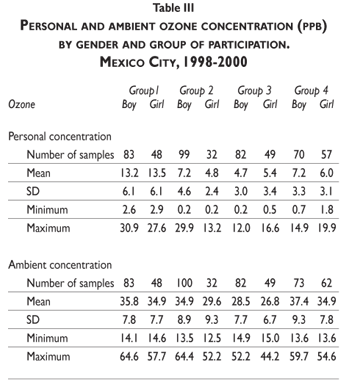
<body><![CDATA[<p><font size="2" face="Verdana"><a href="#tab03">Table III</a> summarizes personal    and corresponding ambient O<SUB>3</SUB> concentrations among groups by gender.    The highest median personal concentration was observed in boys from group 1    (13.0 ppb) and the lowest was found in boys from group 3 (4.1 ppb). Regarding    ambient concentration, the highest concentration was also found in boys from    group 1 (36.0 ppb) and the lowest was in girls from group 3 (25.4 ppb). The    highest mean concentration was observed in group 1. The mean concentrations    for groups 2, 3 and 4 were similar and significantly lower than that of group    1.</font></p>     <p><a name="tab03"></a></p>     <p>&nbsp;</p>     <p align="center"><img src="/img/revistas/spm/v50n1/a13tab03.gif"></p>     <p>&nbsp;</p>     <p><font size="2" face="Verdana">As for corresponding ambient concentrations,    the highest mean concentration was also observed in group 1 and the lowest was    observed in group 3 (<a href="#tab03">table III</a>). <a href="#fig02">Figure    2</a> shows personal, weighted, and ambient ozone concentrations (O<SUB>3p</SUB>,    O<SUB>3w</SUB> and O<SUB>3a</SUB>) according to the area of residence of the    participants. The highest concentrations for the three –ambient, weighted, and    personal ozone concentrations– were observed in the southwestern area of the    city, while the lowest concentrations were observed in the northeastern area.    The correlation between each of the ozone concentrations was significant, with    <I>r</I>=0.21 between O<SUB>3p</SUB> and O<SUB>3w</SUB> (<I>p</I>=0.000), <I>r</I>=0.35    between O<SUB>3p</SUB> and O<SUB>3a</SUB> (<I>p</I>=0.000), and r=0.46 between    O<SUB>3w </SUB>and O<SUB>3a </SUB>(<I>p</I>=0.000).</font></p>     <p><a name="fig02"></a></p>     <p>&nbsp;</p>     <p align="center"><img src="/img/revistas/spm/v50n1/a13fig02.gif"></p>     <p>&nbsp;</p>     ]]></body>
<body><![CDATA[<p><font size="2" face="Verdana"><b>Regression model</b></font></p>     <p><font size="2" face="Verdana"><a href="#tab04">Table IV</a> shows the regression    model for personal ozone concentration using ambient ozone concentration as    the main predictor variable. The variables which contribute most to the model    were: distance to the fixed station, time spent outdoors, study group, area    of residence and the two interaction terms –area of residence of the group,    and distance to the fixed station with time spent outdoors. The overall R<SUP>2</SUP>    was 0.50, and the interclass correlation was 0.36. In the lower part of <a href="#tab04">table    IV</a> the regression model is presented for personal ozone concentration using    the O<SUB>3w</SUB> (weighted personal ozone concentration) as the main predictor    variable. The variables which contributed most to the model were: distance from    the fixed station, time spent in any type of transportation, study group, area    of residence, and one interaction term, –the area of residence with the study    group. The overall R<SUP>2</SUP> was 0.49, with an interclass correlation of    0.30.</font></p>     <p><a name="tab04"></a></p>     <p>&nbsp;</p>     <p align="center"><img src="/img/revistas/spm/v50n1/a13tab04.gif"></p>     <p>&nbsp;</p>     <p><font size="3" face="Verdana"><b>Discussion</b></font></p>     <p><font size="2" face="Verdana">The present study found an average O<SUB>3p</SUB>    of 7.8 ppb (range 0.2 to 30.9 ppb), average O<SUB>3a</SUB> of 33.3 ppb (range    12.5-64.6 ppb) and an average O<SUB>3w</SUB> of 6.6 ppb (range 0.05 to 28.0    ppb). There was no difference according to gender. These ozone concentrations    might be considered low; however, similar results have been found in previous    studies in Mexico and also in other cities. Romieu et al.<SUP>13</SUP> reported    an indoor ozone concentration of about 5 and a 7 ppb mean concentration, although    there were no personal ozone measurements. Geyh et al.<SUP>21</SUP> reported    personal ozone concentrations in the range of 0.5 to 72.3 ppb in children from    two communities in California. Liu et al.<SUP>16</SUP> found personal ozone    concentrations in the range of 0.6 to 19.6 ppb in winter and 0 to 52.9 ppb in    summer in the Toronto metropolitan area. In Fraser Valley, Brauer et al.<SUP>23</SUP>    reported personal ozone concentrations in the range of 2 to 47 ppb. </font></p>     <p><font size="2" face="Verdana">In the population in this study, the majority    of participants’ time was spent indoors (81%). This percentage is similar to    that of other studies.<SUP>22,23</SUP> The children in the present study having    spent most of their time indoor (81%) might explain the low O<SUB>3p</SUB> exposure    observed. Our results can be extrapolated only to a similar population since    activity patterns among asthmatics are different than those among healthy children.</font></p>     <p><font size="2" face="Verdana">In the present study, the highest ozone concentration    was found in the southwest sector of the city, which is similar to previous    studies in Mexico City.<SUP>13 </SUP>The principal contributors to personal    ozone exposure were identified and include time spent outdoors, distance of    the residence from the fixed monitoring station, study group, and two interaction    terms. The overall R<SUP>2</SUP> was 0.50 when ambient ozone concentrations    were used, with an intercept of 6.55 (<I>p</I>=0.000), and the R<SUP>2</SUP>    was 0.49 when estimated ozone concentrations were used as a predicted variable,    with an intercept of 10.62 (<I>p</I>=0.000). These R<SUP>2</SUP> values were    similar to those estimated in other studies where investigators evaluated personal    concentrations of ozone and other gaseous pollutants compared with corresponding    ambient concentrations.<SUP>14,16,18,23,24 </SUP>However, other studies found    R<SUP>2</SUP> values lower than the present study. Chang <I>et al</I>.<SUP>25</SUP>    reported a weaker coefficient during winter and a stronger one during the summer    season in Baltimore. Avol et al.<SUP>12</SUP> also reported a poor correlation    between personal O<SUB>3</SUB> and ambient hourly data in southern California.    Although the R<SUP>2</SUP> found in the present study was higher than in other    studies, the coefficient was fairly low which might be due, among other factors,    to the use of different methods to measure personal exposure; the present study    used passive samplers and compared these concentrations with active samplers    used at fixed stations in the network system.</font></p>     ]]></body>
<body><![CDATA[<p><font size="2" face="Verdana">Because we usually correlate ambient ozone    concentrations to evaluate health effects, cross-classifica-tion between O<SUB>3p</SUB>    and O<SUB>3a</SUB> was calculated and a higher concordance among the extreme    groups was found (percentiles of classification). In the first percentile of    concentrations the correlation was 53% and in the third, the correlation was    50%. When O<SUB>3p</SUB> was compared with O<SUB>3w</SUB>, the correlation was    47% in the first percentile and 39% in the third percentile.</font></p>     <p><font size="2" face="Verdana">These results are important for this study    since a misclassification of the exposure could be considered a limitation;    ambient concentrations were used to evaluate the acute effect of ozone on the    respiratory health of asthmatic children<SUP>6 </SUP>and an inverse association    was found between lung function and ozone ambient levels. Obtaining a stronger    correlation between personal and ambient O<SUB>3</SUB> supports the findings    in the present study.</font></p>     <p><font size="2" face="Verdana">Several personal exposure assessments for    ozone have been demonstrated to be acceptable models for predicting personal    exposure using ambient ozone concentrations as a predicted variable; this was    observed in the present study. Variables such as distance from residence to    the fixed station, time spent in different micro-environments, and interaction    terms (area of residence times participation group and time spent outdoors times    distance of residence from the fixed monitoring stations) were found to significantly    contribute to the model for predicting personal exposure; these types of variables    have been found to be significant by other investigators. The model for the    present study might be improved by having other information, such as the ventilation    rate at home and indoor and outdoor micro-environmental passive measurements.</font></p>     <p>&nbsp;</p>     <p><font size="3" face="Verdana"><b>Conclusions</b></font></p>     <p><font size="2" face="Verdana">Several key results were found in the present    study: low personal ozone concentrations among asthmatic children residing in    the Mexico City metropolitan area; children in this population spent most of    their time indoors (81%); time spent outdoors and distance between the residence    and the fixed ambient monitoring stations were the major predictors of personal    exposure; variations in personal ozone exposure were greater between individuals    rather than for the same individual; estimated personal ozone exposure based    on fixed ambient monitoring stations can be used as a proxy for "actual"    personal ozone exposure, taking into account time-activity patterns and place    of residence of asthmatic children in Mexico City. Our findings can support    the use of ambient ozone concentrations as an exposure index in studies where    researchers need to determine the impact of air pollution on respiratory health    in asthmatic children, taking into account the time spent in different micro-environments. </font></p>     <p>&nbsp;</p>     <p><font size="3" face="Verdana"><b>Ackowledments</b></font></p>     <p><font size="2" face="Verdana">We thank the participants and their parents for    their enthusiasm during the study period, and Rafael Santiba&ntilde;ez and Tito    Alejandre for their hard work preparing badges and fieldwork during the sample    period, as well as the staff of the automatic monitoring network system in Mexico    City who generously provided ambient ozone concentrations. M. Ramirez thanks    the UCLA Center for Occupational and Environmental Health for the training grant    at UCLA (Award No. TW00623) and the Consejo Nacional de Ciencia y Tecnologia    (CONACYT) in Mexico for the scholarship (No. 115772). We thank the Department    of Environmental Health at Harvard School of Public Health, in particular Dr.    Petros Koutrakis, for the laboratory analyses of the badges. M. Ramirez wishes    to thank Dr. Adrian Fernandez Bremauntz for his constructive suggestions during    the preparation of this paper.</font></p>     <p>&nbsp;</p>     ]]></body>
<body><![CDATA[<p><font size="3" face="Verdana"><b>References</b></font></p>     <!-- ref --><p><font size="2" face="Verdana">1. Lippmann M. Health effects of ozone. A critical    review. JAPCA 1989;39:672-695.</font>&nbsp;&nbsp;&nbsp;&nbsp;&nbsp;&nbsp;&nbsp;&nbsp;[&#160;<a href="javascript:void(0);" onclick="javascript: window.open('/scielo.php?script=sci_nlinks&ref=9250370&pid=S0036-3634200800010001300001&lng=','','width=640,height=500,resizable=yes,scrollbars=1,menubar=yes,');">Links</a>&#160;]<!-- end-ref --><!-- ref --><p><font size="2" face="Verdana">2. Kelly FJ, Mudway I, Krishna MT, Holgate ST.    The free radical basis of air pollution: focus on ozone. Respir Med 1995;89:647-656.</font>&nbsp;&nbsp;&nbsp;&nbsp;&nbsp;&nbsp;&nbsp;&nbsp;[&#160;<a href="javascript:void(0);" onclick="javascript: window.open('/scielo.php?script=sci_nlinks&ref=9250371&pid=S0036-3634200800010001300002&lng=','','width=640,height=500,resizable=yes,scrollbars=1,menubar=yes,');">Links</a>&#160;]<!-- end-ref --><!-- ref --><p><font size="2" face="Verdana">3. Blomberg A. Airway inflammatory and antioxidant    responses to oxidative and particulate air pollutants - experimental exposure    studies in humans. Clin Exp Allergy 2000;30:310-317.</font>&nbsp;&nbsp;&nbsp;&nbsp;&nbsp;&nbsp;&nbsp;&nbsp;[&#160;<a href="javascript:void(0);" onclick="javascript: window.open('/scielo.php?script=sci_nlinks&ref=9250372&pid=S0036-3634200800010001300003&lng=','','width=640,height=500,resizable=yes,scrollbars=1,menubar=yes,');">Links</a>&#160;]<!-- end-ref --><!-- ref --><p><font size="2" face="Verdana">4. Bush KR. Environmental Asthma. New York: Marcel    Dekker, 2001.</font>&nbsp;&nbsp;&nbsp;&nbsp;&nbsp;&nbsp;&nbsp;&nbsp;[&#160;<a href="javascript:void(0);" onclick="javascript: window.open('/scielo.php?script=sci_nlinks&ref=9250373&pid=S0036-3634200800010001300004&lng=','','width=640,height=500,resizable=yes,scrollbars=1,menubar=yes,');">Links</a>&#160;]<!-- end-ref --><!-- ref --><p><font size="2" face="Verdana">5. Devlin BR, Raub AJ, Folinsbee JL. Health effects    of ozone. Science &amp; Medicine 1997;(3):8-17.</font>&nbsp;&nbsp;&nbsp;&nbsp;&nbsp;&nbsp;&nbsp;&nbsp;[&#160;<a href="javascript:void(0);" onclick="javascript: window.open('/scielo.php?script=sci_nlinks&ref=9250374&pid=S0036-3634200800010001300005&lng=','','width=640,height=500,resizable=yes,scrollbars=1,menubar=yes,');">Links</a>&#160;]<!-- end-ref --><!-- ref --><p><font size="2" face="Verdana">6. Romieu I, Cortes M, Ruiz S, S&aacute;nchez    S, Meneses F, Hern&aacute;ndez-Avila M. Air pollution and school absenteeism    among children in Mexico City. Am J Epidemiol 1992;136:1524-1531.</font>&nbsp;&nbsp;&nbsp;&nbsp;&nbsp;&nbsp;&nbsp;&nbsp;[&#160;<a href="javascript:void(0);" onclick="javascript: window.open('/scielo.php?script=sci_nlinks&ref=9250375&pid=S0036-3634200800010001300006&lng=','','width=640,height=500,resizable=yes,scrollbars=1,menubar=yes,');">Links</a>&#160;]<!-- end-ref --><!-- ref --><p><font size="2" face="Verdana">7. Romieu I, Meneses F, Sienra-Monge JJ, Huerta    J, White M, Ruiz S. Effects of urban air pollutants on emergency visits for    childhood asthma in Mexico City. Am J Epidemiol 1995;141:546-553.</font>&nbsp;&nbsp;&nbsp;&nbsp;&nbsp;&nbsp;&nbsp;&nbsp;[&#160;<a href="javascript:void(0);" onclick="javascript: window.open('/scielo.php?script=sci_nlinks&ref=9250376&pid=S0036-3634200800010001300007&lng=','','width=640,height=500,resizable=yes,scrollbars=1,menubar=yes,');">Links</a>&#160;]<!-- end-ref --><!-- ref --><p><font size="2" face="Verdana">8. Castillejos M, Gold DR, Damokosh AI, Serrano    P, Allen G, Mc Donnall DR. Acute effects of ozone on the pulmonary function    of exercising schoolchildren from Mexico City. Am J Respir Crit Care Med 1995;152:1501-1507.</font>&nbsp;&nbsp;&nbsp;&nbsp;&nbsp;&nbsp;&nbsp;&nbsp;[&#160;<a href="javascript:void(0);" onclick="javascript: window.open('/scielo.php?script=sci_nlinks&ref=9250377&pid=S0036-3634200800010001300008&lng=','','width=640,height=500,resizable=yes,scrollbars=1,menubar=yes,');">Links</a>&#160;]<!-- end-ref --><!-- ref --><p><font size="2" face="Verdana">9. Thurston GD, Ito K. Epidemiological studies    of acute ozone exposures and mortality. J Expo Anal Environ Epidemiol 2001;11:286-294.</font>&nbsp;&nbsp;&nbsp;&nbsp;&nbsp;&nbsp;&nbsp;&nbsp;[&#160;<a href="javascript:void(0);" onclick="javascript: window.open('/scielo.php?script=sci_nlinks&ref=9250378&pid=S0036-3634200800010001300009&lng=','','width=640,height=500,resizable=yes,scrollbars=1,menubar=yes,');">Links</a>&#160;]<!-- end-ref --><!-- ref --><p><font size="2" face="Verdana">10. McDonnell WF, Zenick H, Hayes CG. U.S. Environmental    Protection Agency’s Ozone Epidemiology Research Program: a strategy for assessing    the effects of ambient ozone exposure upon morbidity in exposed populations.    Air Waste 1993;43:950-954.</font>&nbsp;&nbsp;&nbsp;&nbsp;&nbsp;&nbsp;&nbsp;&nbsp;[&#160;<a href="javascript:void(0);" onclick="javascript: window.open('/scielo.php?script=sci_nlinks&ref=9250379&pid=S0036-3634200800010001300010&lng=','','width=640,height=500,resizable=yes,scrollbars=1,menubar=yes,');">Links</a>&#160;]<!-- end-ref --><!-- ref --><p><font size="2" face="Verdana">11. Romieu I, Meneses F, Ruiz S, Sierra JJ, Huerta    J, White MC. Effects of air pollution on the respiratory health of asthmatic    children living in Mexico City. Am J Respir Crit Care Med 1996;154:300-307.</font>&nbsp;&nbsp;&nbsp;&nbsp;&nbsp;&nbsp;&nbsp;&nbsp;[&#160;<a href="javascript:void(0);" onclick="javascript: window.open('/scielo.php?script=sci_nlinks&ref=9250380&pid=S0036-3634200800010001300011&lng=','','width=640,height=500,resizable=yes,scrollbars=1,menubar=yes,');">Links</a>&#160;]<!-- end-ref --><!-- ref --><p><font size="2" face="Verdana">12. Avol LE, Navidi CW, Rappaport EB, Peters    MJ. Acute effects of ambient ozone on asthmatic, wheezy, and healthy children.    Report Number 82: 1-30. Boston, MA: Health Effects Institute Research 1998:1-30.</font>&nbsp;&nbsp;&nbsp;&nbsp;&nbsp;&nbsp;&nbsp;&nbsp;[&#160;<a href="javascript:void(0);" onclick="javascript: window.open('/scielo.php?script=sci_nlinks&ref=9250381&pid=S0036-3634200800010001300012&lng=','','width=640,height=500,resizable=yes,scrollbars=1,menubar=yes,');">Links</a>&#160;]<!-- end-ref --><!-- ref --><p><font size="2" face="Verdana">13. Romieu I, Meneses F, Ramirez M, Ruiz S, P&eacute;rez    PR, Sierra JJ. Antioxidant supplementation and respiratory functions among workers    exposed to high levels of ozone. Am J Respir Crit Care Med 1998;158:226-232.</font>&nbsp;&nbsp;&nbsp;&nbsp;&nbsp;&nbsp;&nbsp;&nbsp;[&#160;<a href="javascript:void(0);" onclick="javascript: window.open('/scielo.php?script=sci_nlinks&ref=9250382&pid=S0036-3634200800010001300013&lng=','','width=640,height=500,resizable=yes,scrollbars=1,menubar=yes,');">Links</a>&#160;]<!-- end-ref --><!-- ref --><p><font size="2" face="Verdana">14. Liu LJ, Koutrakis P, Suh HH, Mulik JD, Burton    RM. Use of personal measurements for ozone exposure assessment: a pilot study.    Environ Health Perspect 1993;101:318-324.</font>&nbsp;&nbsp;&nbsp;&nbsp;&nbsp;&nbsp;&nbsp;&nbsp;[&#160;<a href="javascript:void(0);" onclick="javascript: window.open('/scielo.php?script=sci_nlinks&ref=9250383&pid=S0036-3634200800010001300014&lng=','','width=640,height=500,resizable=yes,scrollbars=1,menubar=yes,');">Links</a>&#160;]<!-- end-ref --><!-- ref --><p><font size="2" face="Verdana">15. Mu&ntilde;oz A. Design and analysis of studies    of the health effects of ozone. Environ Health Perspect 1993;101:231-235.</font>&nbsp;&nbsp;&nbsp;&nbsp;&nbsp;&nbsp;&nbsp;&nbsp;[&#160;<a href="javascript:void(0);" onclick="javascript: window.open('/scielo.php?script=sci_nlinks&ref=9250384&pid=S0036-3634200800010001300015&lng=','','width=640,height=500,resizable=yes,scrollbars=1,menubar=yes,');">Links</a>&#160;]<!-- end-ref --><!-- ref --><p><font size="2" face="Verdana">16. Liu LJ, Koutrakis P, Leech J, Broder I. Assessment    of ozone exposures in the greater metropolitan Toronto area. J Air Waste Manag    Assoc 1995;45:223-234.</font>&nbsp;&nbsp;&nbsp;&nbsp;&nbsp;&nbsp;&nbsp;&nbsp;[&#160;<a href="javascript:void(0);" onclick="javascript: window.open('/scielo.php?script=sci_nlinks&ref=9250385&pid=S0036-3634200800010001300016&lng=','','width=640,height=500,resizable=yes,scrollbars=1,menubar=yes,');">Links</a>&#160;]<!-- end-ref --><!-- ref --><p><font size="2" face="Verdana">17. Geyh AS, Roberts PT, Lurmann FW, Schoell    BM, Avol EL. Initial field evaluation of the Harvard active ozone sampler for    personal ozone monitoring. J Expo Anal Environ Epidemiol 1999;9:143-149.</font>&nbsp;&nbsp;&nbsp;&nbsp;&nbsp;&nbsp;&nbsp;&nbsp;[&#160;<a href="javascript:void(0);" onclick="javascript: window.open('/scielo.php?script=sci_nlinks&ref=9250386&pid=S0036-3634200800010001300017&lng=','','width=640,height=500,resizable=yes,scrollbars=1,menubar=yes,');">Links</a>&#160;]<!-- end-ref --><!-- ref --><p><font size="2" face="Verdana">18. O’Neill MS, Ram&iacute;rez-Aguilar M, Meneses-Gonzalez    F, et al. Ozone exposure among Mexico City outdoor workers. J Air Waste Manag    Assoc 2003;53:339-346.</font>&nbsp;&nbsp;&nbsp;&nbsp;&nbsp;&nbsp;&nbsp;&nbsp;[&#160;<a href="javascript:void(0);" onclick="javascript: window.open('/scielo.php?script=sci_nlinks&ref=9250387&pid=S0036-3634200800010001300018&lng=','','width=640,height=500,resizable=yes,scrollbars=1,menubar=yes,');">Links</a>&#160;]<!-- end-ref --><!-- ref --><p><font size="2" face="Verdana">19. Cortez-Lugo M, Romieu I, Palazuelos-Rend&oacute;n    E, Hern&aacute;ndez-Avila M. Estudio de validaci&oacute;n y reproducibilidad    de monitores pasivos a ozono. Salud Publica Mex 1995;37:219-223.</font>&nbsp;&nbsp;&nbsp;&nbsp;&nbsp;&nbsp;&nbsp;&nbsp;[&#160;<a href="javascript:void(0);" onclick="javascript: window.open('/scielo.php?script=sci_nlinks&ref=9250388&pid=S0036-3634200800010001300019&lng=','','width=640,height=500,resizable=yes,scrollbars=1,menubar=yes,');">Links</a>&#160;]<!-- end-ref --><!-- ref --><p><font size="2" face="Verdana">20. Cortez-Lugo M, Mercado-Garc&iacute;a A, Hern&aacute;ndez-Avila    M, Meneses-Gonz&aacute;lez F, Palazuelos-Rend&oacute;n E. Evaluaci&oacute;n    de la calidad del aire interior y exterior en un jard&iacute;n de ni&ntilde;os    de la Ciudad de M&eacute;xico. Salud Publica Mex 1998;40:415-420.</font>&nbsp;&nbsp;&nbsp;&nbsp;&nbsp;&nbsp;&nbsp;&nbsp;[&#160;<a href="javascript:void(0);" onclick="javascript: window.open('/scielo.php?script=sci_nlinks&ref=9250389&pid=S0036-3634200800010001300020&lng=','','width=640,height=500,resizable=yes,scrollbars=1,menubar=yes,');">Links</a>&#160;]<!-- end-ref --><!-- ref --><p><font size="2" face="Verdana">21. Romieu I, Sienra-Monge JJ, Ram&iacute;rez-Aguilar    M, T&eacute;llez MM, Moreno MH, Reyes NI. Antioxidant supplementation and lung    functions among children with asthma exposed to high levels of air pollutants.    Am J Respir Crit Care Med 2002;166: 703-709.</font>&nbsp;&nbsp;&nbsp;&nbsp;&nbsp;&nbsp;&nbsp;&nbsp;[&#160;<a href="javascript:void(0);" onclick="javascript: window.open('/scielo.php?script=sci_nlinks&ref=9250390&pid=S0036-3634200800010001300021&lng=','','width=640,height=500,resizable=yes,scrollbars=1,menubar=yes,');">Links</a>&#160;]<!-- end-ref --><!-- ref --><p><font size="2" face="Verdana">22. Geyh AS, Xue J, Ozkaynak H, Spengler JD.    The Harvard Southern California Chronic Ozone Exposure Study: assessing ozone    exposure of grade-school-age children in two Southern California communities.    Environ Health Perspect 2000;108:265-270.</font>&nbsp;&nbsp;&nbsp;&nbsp;&nbsp;&nbsp;&nbsp;&nbsp;[&#160;<a href="javascript:void(0);" onclick="javascript: window.open('/scielo.php?script=sci_nlinks&ref=9250391&pid=S0036-3634200800010001300022&lng=','','width=640,height=500,resizable=yes,scrollbars=1,menubar=yes,');">Links</a>&#160;]<!-- end-ref --><!-- ref --><p><font size="2" face="Verdana">23. Brauer MR. BJ. Ozone personal exposures and    health effects for selected groups residing in the Fraser Valley. Atmospheric    Environment 1997;31:2113-2121.</font>&nbsp;&nbsp;&nbsp;&nbsp;&nbsp;&nbsp;&nbsp;&nbsp;[&#160;<a href="javascript:void(0);" onclick="javascript: window.open('/scielo.php?script=sci_nlinks&ref=9250392&pid=S0036-3634200800010001300023&lng=','','width=640,height=500,resizable=yes,scrollbars=1,menubar=yes,');">Links</a>&#160;]<!-- end-ref --><!-- ref --><p><font size="2" face="Verdana">24. Ram&iacute;rez-Aguilar M, Cicero-Fern&aacute;ndez    P, Winer AM, Romieu I, Meneses-Gonz&aacute;lez F, Hern&aacute;ndez-Avila M.    Measurements of personal exposure to nitrogen dioxide in four Mexican cities    in 1996. J Air Waste Manag Assoc 2002;52:50-57.</font>&nbsp;&nbsp;&nbsp;&nbsp;&nbsp;&nbsp;&nbsp;&nbsp;[&#160;<a href="javascript:void(0);" onclick="javascript: window.open('/scielo.php?script=sci_nlinks&ref=9250393&pid=S0036-3634200800010001300024&lng=','','width=640,height=500,resizable=yes,scrollbars=1,menubar=yes,');">Links</a>&#160;]<!-- end-ref --><!-- ref --><p><font size="2" face="Verdana">25. Chang LT, Koutrakis P, Catalano PJ, Suh HH.    Hourly personal exposures to fine particles and gaseous pollutants--results    from Baltimore, Maryland. J Air Waste Manag Assoc 2000;50:1223-1235.</font>&nbsp;&nbsp;&nbsp;&nbsp;&nbsp;&nbsp;&nbsp;&nbsp;[&#160;<a href="javascript:void(0);" onclick="javascript: window.open('/scielo.php?script=sci_nlinks&ref=9250394&pid=S0036-3634200800010001300025&lng=','','width=640,height=500,resizable=yes,scrollbars=1,menubar=yes,');">Links</a>&#160;]<!-- end-ref --><p>&nbsp;</p>     <p>&nbsp;</p>     <p><font size="2" face="Verdana">Received on: March 27, 2007    <br>   Accepted on: September 24, 2007</font></p>     ]]></body>
<body><![CDATA[<p>&nbsp;</p>     <p>&nbsp;</p>     <p><font size="2" face="Verdana">Address reprint requests to: Mtro. Albino Barraza-Villarreal.    Instituto Nacional de Salud P&uacute;blica. Av. Universidad 655, col. Santa    Mar&iacute;a Ahuacatitl&aacute;n. 62508 Cuernavaca, M&eacute;xico E-mail: <a href="mailto:abarraza@correo.insp.mx">abarraza@correo.insp.mx</a></font></p>      ]]></body><back>
<ref-list>
<ref id="B1">
<label>1</label><nlm-citation citation-type="journal">
<person-group person-group-type="author">
<name>
<surname><![CDATA[Lippmann]]></surname>
<given-names><![CDATA[M]]></given-names>
</name>
</person-group>
<article-title xml:lang="en"><![CDATA[Health effects of ozone: A critical review]]></article-title>
<source><![CDATA[JAPCA]]></source>
<year>1989</year>
<volume>39</volume>
<page-range>672-695</page-range></nlm-citation>
</ref>
<ref id="B2">
<label>2</label><nlm-citation citation-type="journal">
<person-group person-group-type="author">
<name>
<surname><![CDATA[Kelly]]></surname>
<given-names><![CDATA[FJ]]></given-names>
</name>
<name>
<surname><![CDATA[Mudway]]></surname>
<given-names><![CDATA[I]]></given-names>
</name>
<name>
<surname><![CDATA[Krishna]]></surname>
<given-names><![CDATA[MT]]></given-names>
</name>
<name>
<surname><![CDATA[Holgate]]></surname>
<given-names><![CDATA[ST]]></given-names>
</name>
</person-group>
<article-title xml:lang="en"><![CDATA[The free radical basis of air pollution: focus on ozone]]></article-title>
<source><![CDATA[Respir Med]]></source>
<year>1995</year>
<volume>89</volume>
<page-range>647-656</page-range></nlm-citation>
</ref>
<ref id="B3">
<label>3</label><nlm-citation citation-type="journal">
<person-group person-group-type="author">
<name>
<surname><![CDATA[Blomberg]]></surname>
<given-names><![CDATA[A]]></given-names>
</name>
</person-group>
<article-title xml:lang="en"><![CDATA[Airway inflammatory and antioxidant responses to oxidative and particulate air pollutants: experimental exposure studies in humans]]></article-title>
<source><![CDATA[Clin Exp Allergy]]></source>
<year>2000</year>
<volume>30</volume>
<page-range>310-317</page-range></nlm-citation>
</ref>
<ref id="B4">
<label>4</label><nlm-citation citation-type="book">
<person-group person-group-type="author">
<name>
<surname><![CDATA[Bush]]></surname>
<given-names><![CDATA[KR]]></given-names>
</name>
</person-group>
<source><![CDATA[Environmental Asthma]]></source>
<year>2001</year>
<publisher-loc><![CDATA[New York ]]></publisher-loc>
<publisher-name><![CDATA[Marcel Dekker]]></publisher-name>
</nlm-citation>
</ref>
<ref id="B5">
<label>5</label><nlm-citation citation-type="journal">
<person-group person-group-type="author">
<name>
<surname><![CDATA[Devlin]]></surname>
<given-names><![CDATA[BR]]></given-names>
</name>
<name>
<surname><![CDATA[Raub]]></surname>
<given-names><![CDATA[AJ]]></given-names>
</name>
<name>
<surname><![CDATA[Folinsbee]]></surname>
<given-names><![CDATA[JL]]></given-names>
</name>
</person-group>
<article-title xml:lang="en"><![CDATA[Health effects of ozone]]></article-title>
<source><![CDATA[Science & Medicine]]></source>
<year>1997</year>
<numero>3</numero>
<issue>3</issue>
<page-range>8-17</page-range></nlm-citation>
</ref>
<ref id="B6">
<label>6</label><nlm-citation citation-type="journal">
<person-group person-group-type="author">
<name>
<surname><![CDATA[Romieu]]></surname>
<given-names><![CDATA[I]]></given-names>
</name>
<name>
<surname><![CDATA[Cortes]]></surname>
<given-names><![CDATA[M]]></given-names>
</name>
<name>
<surname><![CDATA[Ruiz]]></surname>
<given-names><![CDATA[S]]></given-names>
</name>
<name>
<surname><![CDATA[Sánchez]]></surname>
<given-names><![CDATA[S]]></given-names>
</name>
<name>
<surname><![CDATA[Meneses]]></surname>
<given-names><![CDATA[F]]></given-names>
</name>
<name>
<surname><![CDATA[Hernández-Avila]]></surname>
<given-names><![CDATA[M]]></given-names>
</name>
</person-group>
<article-title xml:lang="en"><![CDATA[Air pollution and school absenteeism among children in Mexico City]]></article-title>
<source><![CDATA[Am J Epidemiol]]></source>
<year>1992</year>
<volume>136</volume>
<page-range>1524-1531</page-range></nlm-citation>
</ref>
<ref id="B7">
<label>7</label><nlm-citation citation-type="journal">
<person-group person-group-type="author">
<name>
<surname><![CDATA[Romieu]]></surname>
<given-names><![CDATA[I]]></given-names>
</name>
<name>
<surname><![CDATA[Meneses]]></surname>
<given-names><![CDATA[F]]></given-names>
</name>
<name>
<surname><![CDATA[Sienra-Monge]]></surname>
<given-names><![CDATA[JJ]]></given-names>
</name>
<name>
<surname><![CDATA[Huerta]]></surname>
<given-names><![CDATA[J]]></given-names>
</name>
<name>
<surname><![CDATA[White]]></surname>
<given-names><![CDATA[M]]></given-names>
</name>
<name>
<surname><![CDATA[Ruiz]]></surname>
<given-names><![CDATA[S]]></given-names>
</name>
</person-group>
<article-title xml:lang="en"><![CDATA[Effects of urban air pollutants on emergency visits for childhood asthma in Mexico City]]></article-title>
<source><![CDATA[Am J Epidemiol]]></source>
<year>1995</year>
<volume>141</volume>
<page-range>546-553</page-range></nlm-citation>
</ref>
<ref id="B8">
<label>8</label><nlm-citation citation-type="journal">
<person-group person-group-type="author">
<name>
<surname><![CDATA[Castillejos]]></surname>
<given-names><![CDATA[M]]></given-names>
</name>
<name>
<surname><![CDATA[Gold]]></surname>
<given-names><![CDATA[DR]]></given-names>
</name>
<name>
<surname><![CDATA[Damokosh]]></surname>
<given-names><![CDATA[AI]]></given-names>
</name>
<name>
<surname><![CDATA[Serrano]]></surname>
<given-names><![CDATA[P]]></given-names>
</name>
<name>
<surname><![CDATA[Allen]]></surname>
<given-names><![CDATA[G]]></given-names>
</name>
<name>
<surname><![CDATA[Mc Donnall]]></surname>
<given-names><![CDATA[DR]]></given-names>
</name>
</person-group>
<article-title xml:lang="en"><![CDATA[Acute effects of ozone on the pulmonary function of exercising schoolchildren from Mexico City]]></article-title>
<source><![CDATA[Am J Respir Crit Care Med]]></source>
<year>1995</year>
<volume>152</volume>
<page-range>1501-1507</page-range></nlm-citation>
</ref>
<ref id="B9">
<label>9</label><nlm-citation citation-type="journal">
<person-group person-group-type="author">
<name>
<surname><![CDATA[Thurston]]></surname>
<given-names><![CDATA[GD]]></given-names>
</name>
<name>
<surname><![CDATA[Ito]]></surname>
<given-names><![CDATA[K]]></given-names>
</name>
</person-group>
<article-title xml:lang="en"><![CDATA[Epidemiological studies of acute ozone exposures and mortality]]></article-title>
<source><![CDATA[J Expo Anal Environ Epidemiol]]></source>
<year>2001</year>
<volume>11</volume>
<page-range>286-294</page-range></nlm-citation>
</ref>
<ref id="B10">
<label>10</label><nlm-citation citation-type="journal">
<person-group person-group-type="author">
<name>
<surname><![CDATA[McDonnell]]></surname>
<given-names><![CDATA[WF]]></given-names>
</name>
<name>
<surname><![CDATA[Zenick]]></surname>
<given-names><![CDATA[H]]></given-names>
</name>
<name>
<surname><![CDATA[Hayes]]></surname>
<given-names><![CDATA[CG]]></given-names>
</name>
</person-group>
<article-title xml:lang="en"><![CDATA[U.S. Environmental Protection Agency’s Ozone Epidemiology Research Program: a strategy for assessing the effects of ambient ozone exposure upon morbidity in exposed populations]]></article-title>
<source><![CDATA[Air Waste]]></source>
<year>1993</year>
<volume>43</volume>
<page-range>950-954</page-range></nlm-citation>
</ref>
<ref id="B11">
<label>11</label><nlm-citation citation-type="journal">
<person-group person-group-type="author">
<name>
<surname><![CDATA[Romieu]]></surname>
<given-names><![CDATA[I]]></given-names>
</name>
<name>
<surname><![CDATA[Meneses]]></surname>
<given-names><![CDATA[F]]></given-names>
</name>
<name>
<surname><![CDATA[Ruiz]]></surname>
<given-names><![CDATA[S]]></given-names>
</name>
<name>
<surname><![CDATA[Sierra]]></surname>
<given-names><![CDATA[JJ]]></given-names>
</name>
<name>
<surname><![CDATA[Huerta]]></surname>
<given-names><![CDATA[J]]></given-names>
</name>
<name>
<surname><![CDATA[White]]></surname>
<given-names><![CDATA[MC]]></given-names>
</name>
</person-group>
<article-title xml:lang="en"><![CDATA[Effects of air pollution on the respiratory health of asthmatic children living in Mexico City]]></article-title>
<source><![CDATA[Am J Respir Crit Care Med]]></source>
<year>1996</year>
<volume>154</volume>
<page-range>300-307</page-range></nlm-citation>
</ref>
<ref id="B12">
<label>12</label><nlm-citation citation-type="book">
<person-group person-group-type="author">
<name>
<surname><![CDATA[Avol]]></surname>
<given-names><![CDATA[LE]]></given-names>
</name>
<name>
<surname><![CDATA[Navidi]]></surname>
<given-names><![CDATA[CW]]></given-names>
</name>
<name>
<surname><![CDATA[Rappaport]]></surname>
<given-names><![CDATA[EB]]></given-names>
</name>
<name>
<surname><![CDATA[Peters]]></surname>
<given-names><![CDATA[MJ]]></given-names>
</name>
</person-group>
<source><![CDATA[Acute effects of ambient ozone on asthmatic, wheezy, and healthy children]]></source>
<year>1998</year>
<page-range>1-30</page-range><publisher-loc><![CDATA[Boston^eMA MA]]></publisher-loc>
<publisher-name><![CDATA[Health Effects Institute Research]]></publisher-name>
</nlm-citation>
</ref>
<ref id="B13">
<label>13</label><nlm-citation citation-type="journal">
<person-group person-group-type="author">
<name>
<surname><![CDATA[Romieu]]></surname>
<given-names><![CDATA[I]]></given-names>
</name>
<name>
<surname><![CDATA[Meneses]]></surname>
<given-names><![CDATA[F]]></given-names>
</name>
<name>
<surname><![CDATA[Ramirez]]></surname>
<given-names><![CDATA[M]]></given-names>
</name>
<name>
<surname><![CDATA[Ruiz]]></surname>
<given-names><![CDATA[S]]></given-names>
</name>
<name>
<surname><![CDATA[Pérez]]></surname>
<given-names><![CDATA[PR]]></given-names>
</name>
<name>
<surname><![CDATA[Sierra]]></surname>
<given-names><![CDATA[JJ]]></given-names>
</name>
</person-group>
<article-title xml:lang="en"><![CDATA[Antioxidant supplementation and respiratory functions among workers exposed to high levels of ozone]]></article-title>
<source><![CDATA[Am J Respir Crit Care Med]]></source>
<year>1998</year>
<volume>158</volume>
<page-range>226-232</page-range></nlm-citation>
</ref>
<ref id="B14">
<label>14</label><nlm-citation citation-type="journal">
<person-group person-group-type="author">
<name>
<surname><![CDATA[Liu]]></surname>
<given-names><![CDATA[LJ]]></given-names>
</name>
<name>
<surname><![CDATA[Koutrakis]]></surname>
<given-names><![CDATA[P]]></given-names>
</name>
<name>
<surname><![CDATA[Suh]]></surname>
<given-names><![CDATA[HH]]></given-names>
</name>
<name>
<surname><![CDATA[Mulik]]></surname>
<given-names><![CDATA[JD]]></given-names>
</name>
<name>
<surname><![CDATA[Burton]]></surname>
<given-names><![CDATA[RM]]></given-names>
</name>
</person-group>
<article-title xml:lang="en"><![CDATA[Use of personal measurements for ozone exposure assessment: a pilot study]]></article-title>
<source><![CDATA[Environ Health Perspect]]></source>
<year>1993</year>
<volume>101</volume>
<page-range>318-324</page-range></nlm-citation>
</ref>
<ref id="B15">
<label>15</label><nlm-citation citation-type="journal">
<person-group person-group-type="author">
<name>
<surname><![CDATA[Muñoz]]></surname>
<given-names><![CDATA[A]]></given-names>
</name>
</person-group>
<article-title xml:lang="en"><![CDATA[Design and analysis of studies of the health effects of ozone]]></article-title>
<source><![CDATA[Environ Health Perspect]]></source>
<year>1993</year>
<volume>101</volume>
<page-range>231-235</page-range></nlm-citation>
</ref>
<ref id="B16">
<label>16</label><nlm-citation citation-type="journal">
<person-group person-group-type="author">
<name>
<surname><![CDATA[Liu]]></surname>
<given-names><![CDATA[LJ]]></given-names>
</name>
<name>
<surname><![CDATA[Koutrakis]]></surname>
<given-names><![CDATA[P]]></given-names>
</name>
<name>
<surname><![CDATA[Leech]]></surname>
<given-names><![CDATA[J]]></given-names>
</name>
<name>
<surname><![CDATA[Broder]]></surname>
<given-names><![CDATA[I]]></given-names>
</name>
</person-group>
<article-title xml:lang="en"><![CDATA[Assessment of ozone exposures in the greater metropolitan Toronto area]]></article-title>
<source><![CDATA[J Air Waste Manag Assoc]]></source>
<year>1995</year>
<volume>45</volume>
<page-range>223-234</page-range></nlm-citation>
</ref>
<ref id="B17">
<label>17</label><nlm-citation citation-type="journal">
<person-group person-group-type="author">
<name>
<surname><![CDATA[Geyh]]></surname>
<given-names><![CDATA[AS]]></given-names>
</name>
<name>
<surname><![CDATA[Roberts]]></surname>
<given-names><![CDATA[PT]]></given-names>
</name>
<name>
<surname><![CDATA[Lurmann]]></surname>
<given-names><![CDATA[FW]]></given-names>
</name>
<name>
<surname><![CDATA[Schoell]]></surname>
<given-names><![CDATA[BM]]></given-names>
</name>
<name>
<surname><![CDATA[Avol]]></surname>
<given-names><![CDATA[EL]]></given-names>
</name>
</person-group>
<article-title xml:lang="en"><![CDATA[Initial field evaluation of the Harvard active ozone sampler for personal ozone monitoring]]></article-title>
<source><![CDATA[J Expo Anal Environ Epidemiol]]></source>
<year>1999</year>
<volume>9</volume>
<page-range>143-149</page-range></nlm-citation>
</ref>
<ref id="B18">
<label>18</label><nlm-citation citation-type="journal">
<person-group person-group-type="author">
<name>
<surname><![CDATA[O’Neill]]></surname>
<given-names><![CDATA[MS]]></given-names>
</name>
<name>
<surname><![CDATA[Ramírez-Aguilar]]></surname>
<given-names><![CDATA[M]]></given-names>
</name>
<name>
<surname><![CDATA[Meneses-Gonzalez]]></surname>
<given-names><![CDATA[F]]></given-names>
</name>
</person-group>
<article-title xml:lang="en"><![CDATA[Ozone exposure among Mexico City outdoor workers]]></article-title>
<source><![CDATA[J Air Waste Manag Assoc]]></source>
<year>2003</year>
<volume>53</volume>
<page-range>339-346</page-range></nlm-citation>
</ref>
<ref id="B19">
<label>19</label><nlm-citation citation-type="journal">
<person-group person-group-type="author">
<name>
<surname><![CDATA[Cortez-Lugo]]></surname>
<given-names><![CDATA[M]]></given-names>
</name>
<name>
<surname><![CDATA[Romieu]]></surname>
<given-names><![CDATA[I]]></given-names>
</name>
<name>
<surname><![CDATA[Palazuelos-Rendón]]></surname>
<given-names><![CDATA[E]]></given-names>
</name>
<name>
<surname><![CDATA[Hernández-Avila]]></surname>
</name>
</person-group>
<article-title xml:lang="es"><![CDATA[Estudio de validación y reproducibilidad de monitores pasivos a ozono]]></article-title>
<source><![CDATA[Salud Publica Mex]]></source>
<year>1995</year>
<volume>37</volume>
<page-range>219-223</page-range></nlm-citation>
</ref>
<ref id="B20">
<label>20</label><nlm-citation citation-type="journal">
<person-group person-group-type="author">
<name>
<surname><![CDATA[Cortez-Lugo]]></surname>
<given-names><![CDATA[M]]></given-names>
</name>
<name>
<surname><![CDATA[Mercado-García]]></surname>
<given-names><![CDATA[A]]></given-names>
</name>
<name>
<surname><![CDATA[Hernández-Avila]]></surname>
<given-names><![CDATA[M]]></given-names>
</name>
<name>
<surname><![CDATA[Meneses-González]]></surname>
<given-names><![CDATA[F]]></given-names>
</name>
<name>
<surname><![CDATA[Palazuelos-Rendón]]></surname>
<given-names><![CDATA[E]]></given-names>
</name>
</person-group>
<article-title xml:lang="es"><![CDATA[Evaluación de la calidad del aire interior y exterior en un jardín de niños de la Ciudad de México]]></article-title>
<source><![CDATA[Salud Publica Mex]]></source>
<year>1998</year>
<volume>40</volume>
<page-range>415-420</page-range></nlm-citation>
</ref>
<ref id="B21">
<label>21</label><nlm-citation citation-type="journal">
<person-group person-group-type="author">
<name>
<surname><![CDATA[Romieu]]></surname>
<given-names><![CDATA[I]]></given-names>
</name>
<name>
<surname><![CDATA[Sienra-Monge]]></surname>
<given-names><![CDATA[JJ]]></given-names>
</name>
<name>
<surname><![CDATA[Ramírez-Aguilar]]></surname>
<given-names><![CDATA[M]]></given-names>
</name>
<name>
<surname><![CDATA[Téllez]]></surname>
<given-names><![CDATA[MM]]></given-names>
</name>
<name>
<surname><![CDATA[Moreno]]></surname>
<given-names><![CDATA[MH]]></given-names>
</name>
<name>
<surname><![CDATA[Reyes]]></surname>
<given-names><![CDATA[NI]]></given-names>
</name>
</person-group>
<article-title xml:lang="en"><![CDATA[Antioxidant supplementation and lung functions among children with asthma exposed to high levels of air pollutants]]></article-title>
<source><![CDATA[Am J Respir Crit Care Med]]></source>
<year>2002</year>
<volume>166</volume>
<page-range>703-709</page-range></nlm-citation>
</ref>
<ref id="B22">
<label>22</label><nlm-citation citation-type="journal">
<person-group person-group-type="author">
<name>
<surname><![CDATA[Geyh]]></surname>
<given-names><![CDATA[AS]]></given-names>
</name>
<name>
<surname><![CDATA[Xue]]></surname>
<given-names><![CDATA[J]]></given-names>
</name>
<name>
<surname><![CDATA[Ozkaynak]]></surname>
<given-names><![CDATA[H]]></given-names>
</name>
<name>
<surname><![CDATA[Spengler]]></surname>
<given-names><![CDATA[JD]]></given-names>
</name>
</person-group>
<article-title xml:lang="en"><![CDATA[The Harvard Southern California Chronic Ozone Exposure Study: assessing ozone exposure of grade-school-age children in two Southern California communities]]></article-title>
<source><![CDATA[Environ Health Perspect]]></source>
<year>2000</year>
<volume>108</volume>
<page-range>265-270</page-range></nlm-citation>
</ref>
<ref id="B23">
<label>23</label><nlm-citation citation-type="journal">
<person-group person-group-type="author">
<name>
<surname><![CDATA[Brauer]]></surname>
<given-names><![CDATA[MR. BJ]]></given-names>
</name>
</person-group>
<article-title xml:lang="en"><![CDATA[Ozone personal exposures and health effects for selected groups residing in the Fraser Valley]]></article-title>
<source><![CDATA[Atmospheric Environment]]></source>
<year>1997</year>
<volume>31</volume>
<page-range>2113-2121</page-range></nlm-citation>
</ref>
<ref id="B24">
<label>24</label><nlm-citation citation-type="journal">
<person-group person-group-type="author">
<name>
<surname><![CDATA[Ramírez-Aguilar]]></surname>
<given-names><![CDATA[M]]></given-names>
</name>
<name>
<surname><![CDATA[Cicero-Fernández]]></surname>
<given-names><![CDATA[P]]></given-names>
</name>
<name>
<surname><![CDATA[Winer]]></surname>
<given-names><![CDATA[AM]]></given-names>
</name>
<name>
<surname><![CDATA[Romieu]]></surname>
<given-names><![CDATA[I]]></given-names>
</name>
<name>
<surname><![CDATA[Meneses-González]]></surname>
<given-names><![CDATA[F]]></given-names>
</name>
<name>
<surname><![CDATA[Hernández-Avila]]></surname>
<given-names><![CDATA[M]]></given-names>
</name>
</person-group>
<article-title xml:lang="en"><![CDATA[Measurements of personal exposure to nitrogen dioxide in four Mexican cities in 1996]]></article-title>
<source><![CDATA[J Air Waste Manag Assoc]]></source>
<year>2002</year>
<volume>52</volume>
<page-range>50-57</page-range></nlm-citation>
</ref>
<ref id="B25">
<label>25</label><nlm-citation citation-type="journal">
<person-group person-group-type="author">
<name>
<surname><![CDATA[Chang]]></surname>
<given-names><![CDATA[LT]]></given-names>
</name>
<name>
<surname><![CDATA[Koutrakis]]></surname>
<given-names><![CDATA[P]]></given-names>
</name>
<name>
<surname><![CDATA[Catalano]]></surname>
<given-names><![CDATA[PJ]]></given-names>
</name>
<name>
<surname><![CDATA[Suh]]></surname>
<given-names><![CDATA[HH]]></given-names>
</name>
</person-group>
<article-title xml:lang="en"><![CDATA[Hourly personal exposures to fine particles and gaseous pollutants: results from Baltimore, Maryland]]></article-title>
<source><![CDATA[J Air Waste Manag Assoc]]></source>
<year>2000</year>
<volume>50</volume>
<page-range>1223-1235</page-range></nlm-citation>
</ref>
</ref-list>
</back>
</article>