<?xml version="1.0" encoding="ISO-8859-1"?><article xmlns:mml="http://www.w3.org/1998/Math/MathML" xmlns:xlink="http://www.w3.org/1999/xlink" xmlns:xsi="http://www.w3.org/2001/XMLSchema-instance">
<front>
<journal-meta>
<journal-id>0036-3634</journal-id>
<journal-title><![CDATA[Salud Pública de México]]></journal-title>
<abbrev-journal-title><![CDATA[Salud pública Méx]]></abbrev-journal-title>
<issn>0036-3634</issn>
<publisher>
<publisher-name><![CDATA[Instituto Nacional de Salud Pública]]></publisher-name>
</publisher>
</journal-meta>
<article-meta>
<article-id>S0036-36342007001000007</article-id>
<title-group>
<article-title xml:lang="en"><![CDATA[Prevalence of self-reported overweight-obesity and its association with socioeconomic and health factors among older Mexican adults]]></article-title>
<article-title xml:lang="es"><![CDATA[Prevalencia de sobrepeso-obesidad autorreportados y su asociación con factores socioeconómicos y de salud en población de edad avanzada en México]]></article-title>
</title-group>
<contrib-group>
<contrib contrib-type="author">
<name>
<surname><![CDATA[Ruiz-Arregui]]></surname>
<given-names><![CDATA[Liliana]]></given-names>
</name>
<xref ref-type="aff" rid="A01"/>
</contrib>
<contrib contrib-type="author">
<name>
<surname><![CDATA[Castillo-Martínez]]></surname>
<given-names><![CDATA[Lilia]]></given-names>
</name>
<xref ref-type="aff" rid="A01"/>
</contrib>
<contrib contrib-type="author">
<name>
<surname><![CDATA[Orea-Tejeda]]></surname>
<given-names><![CDATA[Arturo]]></given-names>
</name>
<xref ref-type="aff" rid="A01"/>
</contrib>
<contrib contrib-type="author">
<name>
<surname><![CDATA[Mejía-Arango]]></surname>
<given-names><![CDATA[Silvia]]></given-names>
</name>
<xref ref-type="aff" rid="A01"/>
</contrib>
<contrib contrib-type="author">
<name>
<surname><![CDATA[Miguel-Jaimes]]></surname>
<given-names><![CDATA[Alejandro]]></given-names>
</name>
<xref ref-type="aff" rid="A01"/>
</contrib>
</contrib-group>
<aff id="A01">
<institution><![CDATA[,Instituto Nacional de Ciencias Médicas y Nutrición Salvador Zubirán  ]]></institution>
<addr-line><![CDATA[ ]]></addr-line>
<country>Mexico</country>
</aff>
<pub-date pub-type="pub">
<day>00</day>
<month>00</month>
<year>2007</year>
</pub-date>
<pub-date pub-type="epub">
<day>00</day>
<month>00</month>
<year>2007</year>
</pub-date>
<volume>49</volume>
<fpage>s482</fpage>
<lpage>s487</lpage>
<copyright-statement/>
<copyright-year/>
<self-uri xlink:href="http://www.scielo.org.mx/scielo.php?script=sci_arttext&amp;pid=S0036-36342007001000007&amp;lng=en&amp;nrm=iso"></self-uri><self-uri xlink:href="http://www.scielo.org.mx/scielo.php?script=sci_abstract&amp;pid=S0036-36342007001000007&amp;lng=en&amp;nrm=iso"></self-uri><self-uri xlink:href="http://www.scielo.org.mx/scielo.php?script=sci_pdf&amp;pid=S0036-36342007001000007&amp;lng=en&amp;nrm=iso"></self-uri><abstract abstract-type="short" xml:lang="en"><p><![CDATA[OBJECTIVE: To investigate the prevalence of obesity and its association with socioeconomic factors and comorbidities in a population-based study. MATERIAL AND METHODS: Data were examined from 4 605 persons ages 60 and older that participated in the 2001 Mexican Health and Aging Study, conducted in rural and urban communities in Mexico. The prevalence of obesity (according to self-reported weight and height) was obtained, stratified by age, and logistic regression was used to study cross-sectional associations between obesity and socioeconomic factors. RESULTS: Of the population studied, 20.9% were classified as obese and the prevalence diminishes with age. Overall, women were more likely than mentobe obese. Lower educational level was associated with lower risk of overweight. In both men and women, obesity was more common between subjects with hypertension (OR 1.38 and 1.71, respectively) and long-distance walk limitation (OR 2.08 and 2.21, respectively). CONCLUISON: In older Mexican adults, hypertension and long-distance walk limitation were independent associated factors for higher prevalence of obesity.]]></p></abstract>
<abstract abstract-type="short" xml:lang="es"><p><![CDATA[OBJETIVO: Estudiar la prevalencia de obesidad y su asociación con factores socioeconómicos y comorbilidades. MATERIAL Y MÉTODOS: Se analizaron los datos de 4 605 personas de 60 años y más que participaron en el Estudio Nacional sobre Salud y Envejecimiento en México 2001 (ENASEM 2001) en zonas rurales y urbanas. La prevalencia de obesidad (peso y talla autorreportados) se obtuvo estratificada por edad y mediante una regresión logística se asoció con factores socioeconómicos. RESULTADOS: 20.9% se clasificaron como obesos y la prevalencia disminuyó con la edad. En general las mujeres tuvieron mayor probabilidad de ser obesas. Una baja escolaridad se asoció con menor riesgo de sobrepeso. En hombres y mujeres la obesidad se asoció con hipertensión (RM 1.38 y 1.71 respectivamente) y con dificultad para caminar (RM 2.08 y 2.21 respectivamente). CONCLUSIÓN: En la población de edad avanzada en México la hipertensión y la dificultad para caminar varias cuadras se asoció con mayor prevalencia de obesidad.]]></p></abstract>
<kwd-group>
<kwd lng="en"><![CDATA[obesity]]></kwd>
<kwd lng="en"><![CDATA[elderly]]></kwd>
<kwd lng="en"><![CDATA[socioeconomic factors]]></kwd>
<kwd lng="en"><![CDATA[health factors]]></kwd>
<kwd lng="en"><![CDATA[Mexico]]></kwd>
<kwd lng="es"><![CDATA[obesidad]]></kwd>
<kwd lng="es"><![CDATA[anciano]]></kwd>
<kwd lng="es"><![CDATA[factores socioeconómicos]]></kwd>
<kwd lng="es"><![CDATA[salud]]></kwd>
<kwd lng="es"><![CDATA[México]]></kwd>
</kwd-group>
</article-meta>
</front><body><![CDATA[ <p align="right"><font size="2" face="Verdana, Arial, Helvetica, sans-serif"><b>ART&Iacute;CULO    ORIGINAL</b></font></p>     <p>&nbsp;</p>     <p><font size="4" face="Verdana, Arial, Helvetica, sans-serif"><b>Prevalence of    self-reported overweight-obesity and its association with socioeconomic and    health factors among older Mexican adults</b></font></p>     <p>&nbsp;</p>     <p><font size="3" face="Verdana, Arial, Helvetica, sans-serif"><b>Prevalencia    de sobrepeso-obesidad autorreportados y su asociaci&oacute;n con factores socioecon&oacute;micos    y de salud en poblaci&oacute;n de edad avanzada en M&eacute;xico</b></font></p>     <p>&nbsp;</p>     <p>&nbsp;</p>     <p><font size="2" face="Verdana, Arial, Helvetica, sans-serif"><b>Liliana Ruiz-Arregui,    M en C; Lilia Castillo-Mart&iacute;nez, M en C; Arturo Orea-Tejeda, MD; Silvia    Mej&iacute;a-Arango, PhD; Alejandro Miguel-Jaimes, MD</b></font></p>     <p><font size="2" face="Verdana, Arial, Helvetica, sans-serif">Instituto Nacional    de Ciencias M&eacute;dicas y Nutrici&oacute;n Salvador Zubir&aacute;n. Mexico</font></p>     <p>&nbsp;</p>     ]]></body>
<body><![CDATA[<p>&nbsp;</p> <hr size="1" "noshade">     <p><font size="2" face="Verdana, Arial, Helvetica, sans-serif"><b>ABSTRACT</b>    </font></p>     <p><font size="2" face="Verdana, Arial, Helvetica, sans-serif"><b>OBJECTIVE:</b>    To investigate the prevalence of obesity and its association with socioeconomic    factors and comorbidities in a population-based study.    <br>   <b>MATERIAL AND METHODS:</b> Data were examined from 4 605 persons ages 60 and    older that participated in the 2001 Mexican Health and Aging Study, conducted    in rural and urban communities in Mexico. The prevalence of obesity (according    to self-reported weight and height) was obtained, stratified by age, and logistic    regression was used to study cross-sectional associations between obesity and    socioeconomic factors.     <br>   <b>RESULTS: </b>Of the population studied, 20.9% were classified as obese and    the prevalence diminishes with age. Overall, women were more likely than mentobe    obese. Lower educational level was associated with lower risk of overweight.    In both men and women, obesity was more common between subjects with hypertension    (OR 1.38 and 1.71, respectively) and long-distance walk limitation (OR 2.08    and 2.21, respectively).     <br>   <b>CONCLUISON: </b>In older Mexican adults, hypertension and long-distance walk    limitation were independent associated factors for higher prevalence of obesity.    </font></p>     <p><font size="2" face="Verdana, Arial, Helvetica, sans-serif"><b>Key words:</b>    obesity; elderly; socioeconomic factors; health factors; Mexico </font></p> <hr size="1" "noshade">     <p><font size="2" face="Verdana, Arial, Helvetica, sans-serif"><b>RESUMEN</b>    </font></p>     <p><font size="2" face="Verdana, Arial, Helvetica, sans-serif"><b>OBJETIVO:</b>    Estudiar la prevalencia de obesidad y su asociaci&oacute;n con factores socioecon&oacute;micos    y comorbilidades.     <br>   <b>MATERIAL Y M&Eacute;TODOS:</b> Se analizaron los datos de 4 605 personas    de 60 a&ntilde;os y m&aacute;s que participaron en el Estudio Nacional sobre    Salud y Envejecimiento en M&eacute;xico 2001 (ENASEM 2001) en zonas rurales    y urbanas. La prevalencia de obesidad (peso y talla autorreportados) se obtuvo    estratificada por edad y mediante una regresi&oacute;n log&iacute;stica se asoci&oacute;    con factores socioecon&oacute;micos.     ]]></body>
<body><![CDATA[<br>   <b>RESULTADOS: </b>20.9% se clasificaron como obesos y la prevalencia disminuy&oacute;    con la edad. En general las mujeres tuvieron mayor probabilidad de ser obesas.    Una baja escolaridad se asoci&oacute; con menor riesgo de sobrepeso. En hombres    y mujeres la obesidad se asoci&oacute; con hipertensi&oacute;n (RM 1.38 y 1.71    respectivamente) y con dificultad para caminar (RM 2.08 y 2.21 respectivamente).        <br>   <b>CONCLUSI&Oacute;N:</b> En la poblaci&oacute;n de edad avanzada en M&eacute;xico    la hipertensi&oacute;n y la dificultad para caminar varias cuadras se asoci&oacute;    con mayor prevalencia de obesidad. </font></p>     <p><font size="2" face="Verdana, Arial, Helvetica, sans-serif"><b>Palabras clave:</b>    obesidad; anciano; factores socioecon&oacute;micos; salud; M&eacute;xico </font></p> <hr size="1" "noshade">     <p>&nbsp;</p>     <p>&nbsp;</p>     <p><font size="2" face="Verdana, Arial, Helvetica, sans-serif">Obesity is a serious    public health problem that is becoming very common in developed and developing    countries. Agreat number of persons become overweight or obese as they get older,    which is associated with a decrease in physical activity and basal metabolism,    and a body fat redistribution to the abdominal area.<sup>1 </sup></font></p>     <p><font size="2" face="Verdana, Arial, Helvetica, sans-serif"> Several studies    have found that the association between obesity and mortality is lower in elderly    persons; however, morbidity increases with body mass index.<sup>2,3 </sup>Overweight    and obesity are associated with medical conditions such as hypertension, type    2 diabetes mellitus, osteoarthritis, respiratory disease,<sup>4,5 </sup>and    depression.<sup>6,7 </sup>They are also related with diminished functional status,    principally because of mobility limitations. Decrease in physical activity causes    de-conditioning and the risk of fragility.<sup>8 </sup></font></p>     <p><font size="2" face="Verdana, Arial, Helvetica, sans-serif">The association    between obesity and cardiovascular disease has been reported in the adult population;    however, there are few studies of elderly patients and the results are contradictory.<sup>9    </sup></font></p>     <p><font size="2" face="Verdana, Arial, Helvetica, sans-serif">In several surveys,    tobacco and alcohol consumption have been found to be factors associated with    a lower prevalence of obesity and overweight, mainly because of a decrease in    intake and an increase in energy expenditure.<sup>10 </sup></font></p>     <p><font size="2" face="Verdana, Arial, Helvetica, sans-serif">According to the    National Center for Health Statistics, in 2000 the obesity rate for the U.S.    population ages 65-74 years was 36.05%.<sup>11 </sup>In 1997, in Canada the    prevalence of overweight and obesity in people ages 65 and older were 43.3 and    20.9%, respectively.<sup>12</sup></font></p>     ]]></body>
<body><![CDATA[<p><font size="2" face="Verdana, Arial, Helvetica, sans-serif">In developing countries    where overnutrition and undernutrition co-exist, the figures are also important.    In Mexico, the 2000 National Health Survey showed that the prevalence of obesity    and overweight increased from 21.5% in 1993 to 23.7% in 2000. In people ages    60-79 years, 39% were overweight and 26% were obese. <sup>13</sup></font></p>     <p><font size="2" face="Verdana, Arial, Helvetica, sans-serif">Several studies    in both developed and developing countries show that in all age groups, overweight    is more prevalent in men and obesity is more prevalent in women. An increase    in overweight and obesity according to age can be observed, however between    60 and 65 years of age, the body mass index (BMI) began to decrease.<sup>14,15    </sup> </font></p>     <p><font size="2" face="Verdana, Arial, Helvetica, sans-serif">Information about    distribution of obesity betweensocial classes in older populations is poor and    results obtained in young and adult populations are contradictory. Several studies    have confirmed an inverse association between obesity and socioeconomic levelin    adult women in developed countries; however, this association has not been observed    in men and children. Studies in developing countries have foundgreater occurrences    of obesity in higher socioeconomic classes.<sup>16 </sup></font></p>     <p><font size="2" face="Verdana, Arial, Helvetica, sans-serif">Few studies have    evaluated overweight and obesity prevalence and its determinants, or their relation    with morbidity and mortality in the elderly Latin American population. The aim    of this study was to investigate the prevalence of obesity and its independent    associations with socioeconomic factors and comorbidities such as hypertension,    myocardial infarction and diabetes in a large population-based study. </font></p>     <p>&nbsp;</p>     <p><font size="3" face="Verdana, Arial, Helvetica, sans-serif"><b>Material and    Methods </b></font></p>     <p><font size="2" face="Verdana, Arial, Helvetica, sans-serif">The 2001 Mexican    Health and Aging Study (MHAS) database was analyzed.<sup>17 </sup>The MHAS is    a cross-sectional, population-based study conducted in rural and urban communities    in Mexico in 2001. Data from 7 170 persons older than 60 years of age were included.    From this, 4 905 had self-reported weight and height which were verified by    Avila-Funes (2004), who concluded that it is a valid method that can be used    to accurately estimate height and weight in elderly Mexican people.<sup>18 </sup>Informed    consent was obtained for all subjects according to the "Declaration of Helsinki    on Ethical Principles for Medical Research Involving Human Subjects".</font></p>     <p><font size="2" face="Verdana, Arial, Helvetica, sans-serif">Based on self-reported    weight and height, body mass index (BMI) was calculated by dividing total body    weight (kilograms) by the squared standing height (square meter). Using this    index, patients were grouped, according to the World Health Organization classification,<sup>19    </sup>into low body weight (BMI<u>&lt;</u>19.9), normal body weight (BMI 20    to 24.9), overweight (BMI 25 to 29.9) and obesity (BMI<u>&gt;</u> 30). From    this analysis we excluded 300 (6.1%) patients with low body weight (BMI&lt;19.9).</font></p>     <p><font size="2" face="Verdana, Arial, Helvetica, sans-serif">The socio-demographic    variables studied were: gender, age (5-year groupings), educational level (equal    or less than primary <i>vs. </i>greater than primary), marital status (unmarried/    separated/ unmarried widower/ widow, married/ cohabitation) and self-rated economic    status (fair/ poor <i>vs.</i> good/ very good/ excellent). Health variables    included: functional limitation (problem with at least one activity of daily    living &#91;ADL&#93;), long-distance walk limitation, self-rated health status    (fair/ poor <i>vs. </i>good/ very good/ excellent), and self-reported morbidity    (depression, hypertension, diabetes, respiratory disease, myocardial infarction,    stroke, arthritis and bowel disease). Current smoking status and alcohol use    (abstainer &#91;none&#93;, infrequent &#91;&lt;1 drink per week&#93;), moderate    (1-20 drinks per week), and heavy (more than 20 drinks per week) were also included.    </font></p>     <p><font size="2" face="Verdana, Arial, Helvetica, sans-serif"><b>Statistical    Analysis</b> </font></p>     ]]></body>
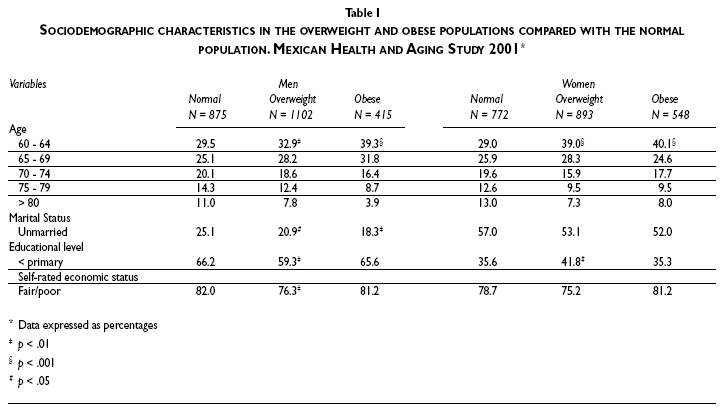
<body><![CDATA[<p><font size="2" face="Verdana, Arial, Helvetica, sans-serif">Results are presented    as percentages. For the proportion comparison among variables, Pearson x<sup>2    </sup>was used. Using stepwise logistic regression analyses, predictors of overweight    and obesity relative to normal weight were examined. Analyses were stratified    by gender. A <i>p </i>value&lt; 0.05 was considered significant. The SPSS Inc.    (Version 10.0) statistical program was used for the statistical analysis. </font></p>     <p>&nbsp;</p>     <p><font size="3" face="Verdana, Arial, Helvetica, sans-serif"><b>Results </b></font></p>     <p><font size="2" face="Verdana, Arial, Helvetica, sans-serif">Out of 4 605 persons    studied, 2 392 (51.9%) were men and2 213 (48.1%) were women. Normal weight was    presentin 35.8%, overweight in 43.3%, and obesity in 20.9% of thetotal population    studied. <a href="#fig1">Figure 1</a> shows the distributionof normal weight,    overweight and obesity among menand women stratified by age and gender. Women    weremore likely to be obese compared to men (24.8 <i>vs. </i>17.3%).In both    men and women, prevalence of overweight andobesity were low in the oldest age    groups.</font></p>     <p><a name="fig1"></a></p>     <p>&nbsp;</p>     <p align="center"><img src="/img/revistas/spm/v49s4/a07fig01.gif"></p>     <p>&nbsp;</p>     <p><font size="2" face="Verdana, Arial, Helvetica, sans-serif">All socioeconomic    and health variables included in this study have significant differences when    compared by gender, with the exception of age, education level, respiratory    disease, stroke and current smokers.</font></p>     <p><font size="2" face="Verdana, Arial, Helvetica, sans-serif"><a href="/img/revistas/spm/v49s4/a07tab01.gif">Table    I</a> shows demographic and socioeconomic characteristics stratified by gender    in subjects with normal weight, overweight and obesity. There is a statistically    significant lower occurrence of single men classified as overweight and obese    compared with normal weight. People with a low educational level have a lower    prevalence of overweight. In subjects classified as overweight, there were fewer    men who self-rated their socioeconomic status as poor.</font></p>     ]]></body>
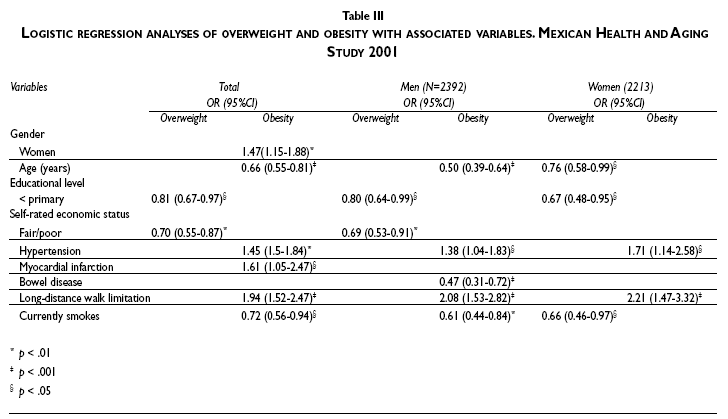
<body><![CDATA[<p><font size="2" face="Verdana, Arial, Helvetica, sans-serif"><a href="/img/revistas/spm/v49s4/a07tab02.gif">Table    II</a> shows health characteristics stratified bygender in subjects with normal    weight, overweight andobesity. In women, a self-rated health status of poorand    arthritis were associated with obesity. Hypertension, diabetes mellitus, comorbidity,    and long-distancewalk limitation were more frequent in subjects classified as    obese compared with normal. In men, therewas a higher occurrence of myocardial    infarction anda lower occurrence of bowel disease associated with overweight.    Current smokers had a statistically significant lower prevalence of obesity    and overweightin both genders. Alcohol consumption was associated with risk    of overweight.</font></p>     <p><font size="2" face="Verdana, Arial, Helvetica, sans-serif">Results from logistic    regression analysis, with adjusted odds ratio for the relationship between studied    variables and overweight or obesity, are presented in <a href="/img/revistas/spm/v49s4/a07tab03.gif">Table    III</a>. Overall, women were more likely than men to be obese (OR 1.47). Lower    educational level was significantly associated with lower risk of overweight    (among men andwomen, OR 0.80 and 0.67, respectively). Among men, poor economic    self-perception and bowel disease were inversely associated with overweight    and obesity, respectively. In the total population, obesity was associated witha    higher risk of myocardial infarction (OR 1.61), but inthe analysis stratified    by gender there was no significant association. In both men and women, obesity    was more common between subjects with hypertension (OR 1.38and 1.71, respectively)    and long-distance walk limitation (physically inactive) (OR 2.08 and 2.21, respectively).    Ageand tobacco use were inversely associated with obesity inmen (OR 0.50 and    0.61, respectively) and with overweightin women (OR 0.76 and 0.66, respectively).    The other variables were not significantly associated with the riskof overweight    or obesity. </font></p>     <p>&nbsp;</p>     <p><font size="3" face="Verdana, Arial, Helvetica, sans-serif"><b>Conclusion</b>    </font></p>     <p><font size="2" face="Verdana, Arial, Helvetica, sans-serif">The prevalence    of obesity and overweight according to age and gender found in the present study    was similar to that which was found in the Mexican National Health Survey, in    which the occurrence of obesity starts to decline from the 60 to 69 years age    group to the age group 80 years and older, probably caused by population surveillance.    In men 60 to 69 years old, obesity was found in 24.4% of the men, in the 70    to 79 years age group it was 16.5%, and in the age group 80 years and older,    10.7%. In comparison, in women ages 60 to 69 obesity was 36.5%, in the 70 to    79 years age group it was 27.9%, and in the age group 80 years and older, 17.3%.    <sup>13 </sup></font></p>     <p><font size="2" face="Verdana, Arial, Helvetica, sans-serif">In this study,    it was found that a lower educational level was associated with a lower prevalence    of overweight in women and men, and a poor self-rated socioeconomic status in    men. This is in concordance with Stunkard,<sup>16 </sup>who stated that in developing    countries, people from lower educational levels and with a lower socioeconomic    status may have difficulties getting accessto sufficient food in order to become    fat. On the other hand, in developed countries, people with a lower socioeconomic    status have a higher prevalence of overweightand obesity because they have access    to food but less knowledge about nutrition and poor physical activity.</font></p>     <p><font size="2" face="Verdana, Arial, Helvetica, sans-serif">It is important    to take into account the great differences that exist in the health and nutrition    of the Mexican population. People who live in cities generally present similar    characteristics to those in developed countries (a greater prevalence of obesity    and a tendency to besedentary), and those living in rural areas tend to be thinner,    their alimentation is mainly based on grains and vegetables and they have greater    physical activity.</font></p>     <p><font size="2" face="Verdana, Arial, Helvetica, sans-serif">On the other hand,    in the present study, the economic situation was defined based on self-perception    and not on investigating the actual situation based on a set of socioeconomic    variables. Therefore, the comprehensive investigation of the relation between    socioeconomic conditions and obesity is considered to be important.</font></p>     <p><font size="2" face="Verdana, Arial, Helvetica, sans-serif">Hypertension and    long-distance walk limitation were independently associated with obesity in    men and women. These results are consistent with several studies that show that    high BMI (past or current) is associated with a greater risk of self-reported    functional limitation (especially mobility) among older persons. Subjects with    a BMI ranking between 23 and 27 had about three times less chance of being ADL    dependent in five years.<sup>20 </sup>Risk of loss of mobility is significantly    associated with high BMI (&gt;80th percentile) compared with moderate (21st-80th    percentiles) BMI.<sup>21 </sup>Several studies have also shown that BMI and    fat mass are positively related to disability, limitation in activities of daily    living, walking upstairs, walking on flat surfaces, pulmonary disease, diabetes,    and arthritis.<sup>22 </sup></font></p>     <p><font size="2" face="Verdana, Arial, Helvetica, sans-serif">In men, we found    that smoking was inversely related to obesity, which is in accordance with Garrison    <i>et al</i>. 1983 who state that smoking is clearly related to body size: lean    individuals are more likely to be smokers than are those of normal or excess    weight.<sup>23 </sup>Cigarette smoking appears to reduce body fat in a number    of ways, including a reduction in caloric intake and an increased level of energy    expenditure. Smoking cessation is also related to body size. Studies of mortality    generally found that current smokers are leaner and have higher mortality than    nonsmokers or past smokers.</font></p>     ]]></body>
<body><![CDATA[<p><font size="2" face="Verdana, Arial, Helvetica, sans-serif">Diabetes and arthritis-two    diseases most commonly associated with excess weight-were not significantly    associated with overweight or obesity. These results could be explained because    subjects who are prone to the complications of overweight and obesity may have    already died, leaving those who are more resistant to its effects.<sup>24 </sup></font></p>     <p><font size="2" face="Verdana, Arial, Helvetica, sans-serif">In this study,    we found an effect of obesity on myocardial infarction in the total population,    but this effect disappears in the gender-stratified analysis. The evidence of    the effect of overweight and obesity in the incidence of cardiovascular disease    is contradictory in some cases or not consistent in the literature.<sup>25 </sup></font></p>     <p><font size="2" face="Verdana, Arial, Helvetica, sans-serif">Data from weight    and height were obtained fromself-reports and could be underestimated or overestimated,    especially in people 75 years and older; in the literature, however, we found    that several studies have consistent findings of high correlations of self-reported    height and weight with measured height and weight.<sup>26 </sup></font></p>     <p><font size="2" face="Verdana, Arial, Helvetica, sans-serif">Another aspect    to consider about self-reporting is that people with a low educational level    and or with cognitive decline would be underestimated.</font></p>     <p><font size="2" face="Verdana, Arial, Helvetica, sans-serif">In addition, measuring    height and weight in older adults, taking into account their physical (scoliosis,    lordosis, arthritis, amputations) and functional conditions (balance problems,    walking limitations, dementias, prostrated condition), represents a problem.</font></p>     <p><font size="2" face="Verdana, Arial, Helvetica, sans-serif">In conclusion,    some evidence was found of an association between overweight and obesity and    some common health and sociodemographic conditions in the elderly; however,    it is important to conduct longitudinal studies in order to discover the effect    of BMI and other nutritional status indicators, such as body composition, on    this population health group. This information can be useful for nutritionists    and physicians who work with elderly people, in terms of making decisions as    to whether or not to recommend losing weight. </font></p>     <p>&nbsp;</p>     <p><font size="3" face="Verdana, Arial, Helvetica, sans-serif"><b>References</b>    </font></p>     <!-- ref --><p><font size="2" face="Verdana, Arial, Helvetica, sans-serif">1. Inelmen EM,    Sergi G, Coin A, Miotto F, Peruzza S, Enzi G. Can obesity be a risk factor in    elderly people? Obes Rev 2003;4:147-155. </font>&nbsp;&nbsp;&nbsp;&nbsp;&nbsp;&nbsp;&nbsp;&nbsp;[&#160;<a href="javascript:void(0);" onclick="javascript: window.open('/scielo.php?script=sci_nlinks&ref=9281036&pid=S0036-3634200700100000700001&lng=','','width=640,height=500,resizable=yes,scrollbars=1,menubar=yes,');">Links</a>&#160;]<!-- end-ref --><!-- ref --><p><font size="2" face="Verdana, Arial, Helvetica, sans-serif">2. Sezginsoy B,    Ross K, Wright JE, Bernard MA. Obesity in the elderly: survival of the fit or    fat. J Okla State Med Assoc 2004;97(10):437-439. </font>&nbsp;&nbsp;&nbsp;&nbsp;&nbsp;&nbsp;&nbsp;&nbsp;[&#160;<a href="javascript:void(0);" onclick="javascript: window.open('/scielo.php?script=sci_nlinks&ref=9281037&pid=S0036-3634200700100000700002&lng=','','width=640,height=500,resizable=yes,scrollbars=1,menubar=yes,');">Links</a>&#160;]<!-- end-ref --><!-- ref --><p><font size="2" face="Verdana, Arial, Helvetica, sans-serif">3. Wannamethee    S, Gerald-Shaper A, Whincup PH, Walter M. Overweight and obesity and the burden    of disease and disability in elderly men. Int J Obes 2004;28(11):1374-1382.    </font>&nbsp;&nbsp;&nbsp;&nbsp;&nbsp;&nbsp;&nbsp;&nbsp;[&#160;<a href="javascript:void(0);" onclick="javascript: window.open('/scielo.php?script=sci_nlinks&ref=9281038&pid=S0036-3634200700100000700003&lng=','','width=640,height=500,resizable=yes,scrollbars=1,menubar=yes,');">Links</a>&#160;]<!-- end-ref --><!-- ref --><p><font size="2" face="Verdana, Arial, Helvetica, sans-serif">4. Lerman IG, Villa    AR, Mart&iacute;nez CL, Cervantes L, Aguilar CA, Wong B, <i>et al</i>. The prevalence    of diabetes and associated coronary risk factors in urban and rural older Mexican    populations. J Am Geriatr Soc 1998;46(11):1387-1396. </font>&nbsp;&nbsp;&nbsp;&nbsp;&nbsp;&nbsp;&nbsp;&nbsp;[&#160;<a href="javascript:void(0);" onclick="javascript: window.open('/scielo.php?script=sci_nlinks&ref=9281039&pid=S0036-3634200700100000700004&lng=','','width=640,height=500,resizable=yes,scrollbars=1,menubar=yes,');">Links</a>&#160;]<!-- end-ref --><!-- ref --><p><font size="2" face="Verdana, Arial, Helvetica, sans-serif"> 5. National Institutes    of Health, National Heart, Lung, and Blood Institute; NHLBI Obesity Education    Initiative; and North American Association for the Study of Obesity. Identifying,    evaluating, and treatment overweight in adults. Pan Am J Public Health 2001;10(2):118-125.    </font>&nbsp;&nbsp;&nbsp;&nbsp;&nbsp;&nbsp;&nbsp;&nbsp;[&#160;<a href="javascript:void(0);" onclick="javascript: window.open('/scielo.php?script=sci_nlinks&ref=9281040&pid=S0036-3634200700100000700005&lng=','','width=640,height=500,resizable=yes,scrollbars=1,menubar=yes,');">Links</a>&#160;]<!-- end-ref --><!-- ref --><p><font size="2" face="Verdana, Arial, Helvetica, sans-serif">6. Stunkard A,    Faith M, Allison K. Depression and obesity. Bio Psychiatry 2003;54(3):330-337.    </font>&nbsp;&nbsp;&nbsp;&nbsp;&nbsp;&nbsp;&nbsp;&nbsp;[&#160;<a href="javascript:void(0);" onclick="javascript: window.open('/scielo.php?script=sci_nlinks&ref=9281041&pid=S0036-3634200700100000700006&lng=','','width=640,height=500,resizable=yes,scrollbars=1,menubar=yes,');">Links</a>&#160;]<!-- end-ref --><!-- ref --><p><font size="2" face="Verdana, Arial, Helvetica, sans-serif">7. Blazer D, Moody-Ayers    S, Craft-Morgan J, Burchett B. Depression in diabetes and obesity. J of Psychosom    Res 2002;53(4):913-916. </font>&nbsp;&nbsp;&nbsp;&nbsp;&nbsp;&nbsp;&nbsp;&nbsp;[&#160;<a href="javascript:void(0);" onclick="javascript: window.open('/scielo.php?script=sci_nlinks&ref=9281042&pid=S0036-3634200700100000700007&lng=','','width=640,height=500,resizable=yes,scrollbars=1,menubar=yes,');">Links</a>&#160;]<!-- end-ref --><!-- ref --><p><font size="2" face="Verdana, Arial, Helvetica, sans-serif">8. Zoico E, Di    Francesco V, Guralnik JM, Mazzali G, Bortolani A, Guariento S, <i>et al</i>.    Physical disability and muscular strength in relation to obesity and different    body composition indexes in a sample of healthy elderly women. Int J Obes 2004;28(2):234-241.    </font>&nbsp;&nbsp;&nbsp;&nbsp;&nbsp;&nbsp;&nbsp;&nbsp;[&#160;<a href="javascript:void(0);" onclick="javascript: window.open('/scielo.php?script=sci_nlinks&ref=9281043&pid=S0036-3634200700100000700008&lng=','','width=640,height=500,resizable=yes,scrollbars=1,menubar=yes,');">Links</a>&#160;]<!-- end-ref --><!-- ref --><p><font size="2" face="Verdana, Arial, Helvetica, sans-serif">9. Heiat A,Vaccarino    V, Krumholz M. An Evidence-Based Assessment of Federal Guidelines for Overweight    and Obesity as they Apply to Elderly Persons. Arch Intern Med 2001;161:1194-1203.    </font>&nbsp;&nbsp;&nbsp;&nbsp;&nbsp;&nbsp;&nbsp;&nbsp;[&#160;<a href="javascript:void(0);" onclick="javascript: window.open('/scielo.php?script=sci_nlinks&ref=9281044&pid=S0036-3634200700100000700009&lng=','','width=640,height=500,resizable=yes,scrollbars=1,menubar=yes,');">Links</a>&#160;]<!-- end-ref --><!-- ref --><p><font size="2" face="Verdana, Arial, Helvetica, sans-serif">10. Himes CL. Obesity,    disease, and functional limitation in later life. Demography 2000;37:73-82.    </font>&nbsp;&nbsp;&nbsp;&nbsp;&nbsp;&nbsp;&nbsp;&nbsp;[&#160;<a href="javascript:void(0);" onclick="javascript: window.open('/scielo.php?script=sci_nlinks&ref=9281045&pid=S0036-3634200700100000700010&lng=','','width=640,height=500,resizable=yes,scrollbars=1,menubar=yes,');">Links</a>&#160;]<!-- end-ref --><!-- ref --><p><font size="2" face="Verdana, Arial, Helvetica, sans-serif">11. American Obesity    Association. AOA Fact Sheets. Available on: <a href="http://www.obesity.org/subs/factfacts/obesity_global_epidemic.shtml" target="_blank">http://www.obesity.org/subs/factfacts/obesity_global_epidemic.shtml    </a></font>&nbsp;&nbsp;&nbsp;&nbsp;&nbsp;&nbsp;&nbsp;&nbsp;[&#160;<a href="javascript:void(0);" onclick="javascript: window.open('/scielo.php?script=sci_nlinks&ref=9281046&pid=S0036-3634200700100000700011&lng=','','width=640,height=500,resizable=yes,scrollbars=1,menubar=yes,');">Links</a>&#160;]<!-- end-ref --><!-- ref --><p><font size="2" face="Verdana, Arial, Helvetica, sans-serif">12. Kaplan MS,    Huguet N, Newsom JT, McFarland BH, Lindsay J. Prevalence and correlates of overweight    and obesity among older adults: findings from the Canadian national population    health surveys. J Gerontol 2003;58A:1018-1030. </font>&nbsp;&nbsp;&nbsp;&nbsp;&nbsp;&nbsp;&nbsp;&nbsp;[&#160;<a href="javascript:void(0);" onclick="javascript: window.open('/scielo.php?script=sci_nlinks&ref=9281047&pid=S0036-3634200700100000700012&lng=','','width=640,height=500,resizable=yes,scrollbars=1,menubar=yes,');">Links</a>&#160;]<!-- end-ref --><!-- ref --><p><font size="2" face="Verdana, Arial, Helvetica, sans-serif">13. OIais G, Rojas    R, Barquera S, Shamah T,Aguilar C, Cravioto P, <i>et al</i>. Encuesta Nacional    de Salud 2000.Tomo 2, La salud de los adultos. Cuernavaca, Morelos, M&eacute;xico:    Instituto Nacional de Salud P&uacute;blica, 2003. </font>&nbsp;&nbsp;&nbsp;&nbsp;&nbsp;&nbsp;&nbsp;&nbsp;[&#160;<a href="javascript:void(0);" onclick="javascript: window.open('/scielo.php?script=sci_nlinks&ref=9281048&pid=S0036-3634200700100000700013&lng=','','width=640,height=500,resizable=yes,scrollbars=1,menubar=yes,');">Links</a>&#160;]<!-- end-ref --><!-- ref --><p><font size="2" face="Verdana, Arial, Helvetica, sans-serif">14. Perissinotto    E, Pisent C, Sergi G, Grigoletto F. ILSA Working Group. Anthropometric measurements    in the elderly: age and gender differences. Br J Nutr 2002;87(2):177-186. </font>&nbsp;&nbsp;&nbsp;&nbsp;&nbsp;&nbsp;&nbsp;&nbsp;[&#160;<a href="javascript:void(0);" onclick="javascript: window.open('/scielo.php?script=sci_nlinks&ref=9281049&pid=S0036-3634200700100000700014&lng=','','width=640,height=500,resizable=yes,scrollbars=1,menubar=yes,');">Links</a>&#160;]<!-- end-ref --><!-- ref --><p><font size="2" face="Verdana, Arial, Helvetica, sans-serif">15. Guti&eacute;rrez-Fisac    JL, L&oacute;p&eacute;z E, Banegas J, Graciani A, Rodr&iacute;guez F. Prevalence    of Overweight and Obesity in Elderly People in Spain. Obes Res 2004;12(4):710-714.    </font>&nbsp;&nbsp;&nbsp;&nbsp;&nbsp;&nbsp;&nbsp;&nbsp;[&#160;<a href="javascript:void(0);" onclick="javascript: window.open('/scielo.php?script=sci_nlinks&ref=9281050&pid=S0036-3634200700100000700015&lng=','','width=640,height=500,resizable=yes,scrollbars=1,menubar=yes,');">Links</a>&#160;]<!-- end-ref --><!-- ref --><p><font size="2" face="Verdana, Arial, Helvetica, sans-serif">16. Stunkard AJ.    Factors in obesity: current views. In: Pe&ntilde;a M. Bacallao J, eds. Obesity    and Poverty: A New Public Health Challenge. Scientific Publication 576. Washington    DC: Pan American Health Organization/ World Health Organization, 2000: 23-28.    </font>&nbsp;&nbsp;&nbsp;&nbsp;&nbsp;&nbsp;&nbsp;&nbsp;[&#160;<a href="javascript:void(0);" onclick="javascript: window.open('/scielo.php?script=sci_nlinks&ref=9281051&pid=S0036-3634200700100000700016&lng=','','width=640,height=500,resizable=yes,scrollbars=1,menubar=yes,');">Links</a>&#160;]<!-- end-ref --><!-- ref --><p><font size="2" face="Verdana, Arial, Helvetica, sans-serif">17. University    of Pennsylvania, University of Maryland, University of Wisconsin (USA), Instituto    Nacional de Estad&iacute;stica, Geograf&iacute;a e Inform&aacute;tica (Mexico).    Estudio Nacional sobre Salud y Envejecimiento en M&eacute;xico 2001. Available    on: <a href="http://WWW.ssc.upenn.edu" target="_blank">http://WWW.ssc.upenn.edu    </a></font>&nbsp;&nbsp;&nbsp;&nbsp;&nbsp;&nbsp;&nbsp;&nbsp;[&#160;<a href="javascript:void(0);" onclick="javascript: window.open('/scielo.php?script=sci_nlinks&ref=9281052&pid=S0036-3634200700100000700017&lng=','','width=640,height=500,resizable=yes,scrollbars=1,menubar=yes,');">Links</a>&#160;]<!-- end-ref --><!-- ref --><p><font size="2" face="Verdana, Arial, Helvetica, sans-serif">18. Avila-Funes    JA, Guti&eacute;rrez-Robledo LM, Ponce de Le&oacute;n-Rosales S. Validity of    heigh and weight self-report in Mexican adults: results from the National Health    and Aging Study. J Nutr Health Aging 2004;8(5):355-361. </font>&nbsp;&nbsp;&nbsp;&nbsp;&nbsp;&nbsp;&nbsp;&nbsp;[&#160;<a href="javascript:void(0);" onclick="javascript: window.open('/scielo.php?script=sci_nlinks&ref=9281053&pid=S0036-3634200700100000700018&lng=','','width=640,height=500,resizable=yes,scrollbars=1,menubar=yes,');">Links</a>&#160;]<!-- end-ref --><!-- ref --><p><font size="2" face="Verdana, Arial, Helvetica, sans-serif">19. World Health    Organization. Physical status: the use and interpretation of anthropometry.    Geneva:WHO,1995. </font>&nbsp;&nbsp;&nbsp;&nbsp;&nbsp;&nbsp;&nbsp;&nbsp;[&#160;<a href="javascript:void(0);" onclick="javascript: window.open('/scielo.php?script=sci_nlinks&ref=9281054&pid=S0036-3634200700100000700019&lng=','','width=640,height=500,resizable=yes,scrollbars=1,menubar=yes,');">Links</a>&#160;]<!-- end-ref --><!-- ref --><p><font size="2" face="Verdana, Arial, Helvetica, sans-serif">20. Galanos AN,    Pieper CF, Cornoni-Huntley JC, Bales CW, Fillenbaum GG. Nutrition and function:    is there a relationship between body mass index and functional capabilities    of community-dwelling elderly? J Am Geriatr Soc 1994;42:368-373. </font>&nbsp;&nbsp;&nbsp;&nbsp;&nbsp;&nbsp;&nbsp;&nbsp;[&#160;<a href="javascript:void(0);" onclick="javascript: window.open('/scielo.php?script=sci_nlinks&ref=9281055&pid=S0036-3634200700100000700020&lng=','','width=640,height=500,resizable=yes,scrollbars=1,menubar=yes,');">Links</a>&#160;]<!-- end-ref --><!-- ref --><p><font size="2" face="Verdana, Arial, Helvetica, sans-serif">21. Deschamps V,Astier    X, Ferry M, Rainfray M, Emeriau JP, Barberger-Gateau P. Nutritional status of    healthy elderly persons living in Dordogne, France, and relation with mortality    and cognitive or functional decline. Eur J Clin Nutr 2002;56:305-312. </font>&nbsp;&nbsp;&nbsp;&nbsp;&nbsp;&nbsp;&nbsp;&nbsp;[&#160;<a href="javascript:void(0);" onclick="javascript: window.open('/scielo.php?script=sci_nlinks&ref=9281056&pid=S0036-3634200700100000700021&lng=','','width=640,height=500,resizable=yes,scrollbars=1,menubar=yes,');">Links</a>&#160;]<!-- end-ref --><!-- ref --><p><font size="2" face="Verdana, Arial, Helvetica, sans-serif">22. Jensen GL,    Rogers J, Obesity in older persons. J Am Diet Assoc 1998;98:1308-1311. </font>&nbsp;&nbsp;&nbsp;&nbsp;&nbsp;&nbsp;&nbsp;&nbsp;[&#160;<a href="javascript:void(0);" onclick="javascript: window.open('/scielo.php?script=sci_nlinks&ref=9281057&pid=S0036-3634200700100000700022&lng=','','width=640,height=500,resizable=yes,scrollbars=1,menubar=yes,');">Links</a>&#160;]<!-- end-ref --><!-- ref --><p><font size="2" face="Verdana, Arial, Helvetica, sans-serif">23. LaCroix AZ,    Guralnik JM, Berkman LF, Wallace RB, Satterfield S. Maintaining mobility in    late life. II Smoking, alcohol consumption, physical activity and body mass    index. Am J Epidemiol 1993;137:858-1869. </font>&nbsp;&nbsp;&nbsp;&nbsp;&nbsp;&nbsp;&nbsp;&nbsp;[&#160;<a href="javascript:void(0);" onclick="javascript: window.open('/scielo.php?script=sci_nlinks&ref=9281058&pid=S0036-3634200700100000700023&lng=','','width=640,height=500,resizable=yes,scrollbars=1,menubar=yes,');">Links</a>&#160;]<!-- end-ref --><!-- ref --><p><font size="2" face="Verdana, Arial, Helvetica, sans-serif">24. Marinos E.    Obesity in the Elderly. Obes Res 2001;9(4):S244-S248. </font>&nbsp;&nbsp;&nbsp;&nbsp;&nbsp;&nbsp;&nbsp;&nbsp;[&#160;<a href="javascript:void(0);" onclick="javascript: window.open('/scielo.php?script=sci_nlinks&ref=9281059&pid=S0036-3634200700100000700024&lng=','','width=640,height=500,resizable=yes,scrollbars=1,menubar=yes,');">Links</a>&#160;]<!-- end-ref --><!-- ref --><p><font size="2" face="Verdana, Arial, Helvetica, sans-serif">25. Garrison RJ,    Feinleib M, Castelli WP, McNamara PM. Cigarette smoking as a confounder of the    relationship between relative weight and long-term mortality. The Framingham    Heart Study. JAMA 1983;249(16):2199-2203. </font>&nbsp;&nbsp;&nbsp;&nbsp;&nbsp;&nbsp;&nbsp;&nbsp;[&#160;<a href="javascript:void(0);" onclick="javascript: window.open('/scielo.php?script=sci_nlinks&ref=9281060&pid=S0036-3634200700100000700025&lng=','','width=640,height=500,resizable=yes,scrollbars=1,menubar=yes,');">Links</a>&#160;]<!-- end-ref --><!-- ref --><p><font size="2" face="Verdana, Arial, Helvetica, sans-serif"> 26. Rowland M.    Self-reported weight and height. Am J Clin Nutr 1990;52:1125-1133. </font>&nbsp;&nbsp;&nbsp;&nbsp;&nbsp;&nbsp;&nbsp;&nbsp;[&#160;<a href="javascript:void(0);" onclick="javascript: window.open('/scielo.php?script=sci_nlinks&ref=9281061&pid=S0036-3634200700100000700026&lng=','','width=640,height=500,resizable=yes,scrollbars=1,menubar=yes,');">Links</a>&#160;]<!-- end-ref --><p>&nbsp;</p>     <p>&nbsp;</p>     <p><font size="2" face="Verdana, Arial, Helvetica, sans-serif">Received on: September    25, 2005     <br>   Accepted on: January 31, 2007 </font></p>     <p>&nbsp;</p>     <p>&nbsp;</p>     ]]></body>
<body><![CDATA[<p><font size="2" face="Verdana, Arial, Helvetica, sans-serif">Address reprint    request to: M en C Lilia Castillo-Mart&iacute;nez. Instituto Nacional de Ciencias    M&eacute;dicas y Nutrici&oacute;n Salvador Zubir&aacute;n.Vasco de Quiroga 15,    Col. Secci&oacute;n XVI. 14000 Tlalpan, M&eacute;xico DF, M&eacute;xico. E-mail:    <a href="mailto:caml1225@hotmail.com">caml1225@hotmail.com</a></font></p>      ]]></body><back>
<ref-list>
<ref id="B1">
<label>1</label><nlm-citation citation-type="journal">
<person-group person-group-type="author">
<name>
<surname><![CDATA[Inelmen]]></surname>
<given-names><![CDATA[EM]]></given-names>
</name>
<name>
<surname><![CDATA[Sergi]]></surname>
<given-names><![CDATA[G]]></given-names>
</name>
<name>
<surname><![CDATA[Coin]]></surname>
<given-names><![CDATA[A]]></given-names>
</name>
<name>
<surname><![CDATA[Miotto]]></surname>
<given-names><![CDATA[F]]></given-names>
</name>
<name>
<surname><![CDATA[Peruzza]]></surname>
<given-names><![CDATA[S]]></given-names>
</name>
<name>
<surname><![CDATA[Enzi]]></surname>
<given-names><![CDATA[G]]></given-names>
</name>
</person-group>
<article-title xml:lang="en"><![CDATA[Can obesity be a risk factor in elderly people?]]></article-title>
<source><![CDATA[Obes Rev]]></source>
<year>2003</year>
<volume>4</volume>
<page-range>147-155</page-range></nlm-citation>
</ref>
<ref id="B2">
<label>2</label><nlm-citation citation-type="journal">
<person-group person-group-type="author">
<name>
<surname><![CDATA[Sezginsoy]]></surname>
<given-names><![CDATA[B]]></given-names>
</name>
<name>
<surname><![CDATA[Ross]]></surname>
<given-names><![CDATA[K]]></given-names>
</name>
<name>
<surname><![CDATA[Wright]]></surname>
<given-names><![CDATA[JE]]></given-names>
</name>
<name>
<surname><![CDATA[Bernard]]></surname>
<given-names><![CDATA[MA]]></given-names>
</name>
</person-group>
<article-title xml:lang="en"><![CDATA[Obesity in the elderly: survival of the fit or fat]]></article-title>
<source><![CDATA[J Okla State Med Assoc]]></source>
<year>2004</year>
<volume>97</volume>
<numero>10</numero>
<issue>10</issue>
<page-range>437-439</page-range></nlm-citation>
</ref>
<ref id="B3">
<label>3</label><nlm-citation citation-type="journal">
<person-group person-group-type="author">
<name>
<surname><![CDATA[Wannamethee]]></surname>
<given-names><![CDATA[S]]></given-names>
</name>
<name>
<surname><![CDATA[Gerald-Shaper]]></surname>
<given-names><![CDATA[A]]></given-names>
</name>
<name>
<surname><![CDATA[Whincup]]></surname>
<given-names><![CDATA[PH]]></given-names>
</name>
<name>
<surname><![CDATA[Walter]]></surname>
<given-names><![CDATA[M]]></given-names>
</name>
</person-group>
<article-title xml:lang="en"><![CDATA[Overweight and obesity and the burden of disease and disability in elderly men]]></article-title>
<source><![CDATA[Int J Obes]]></source>
<year>2004</year>
<volume>28</volume>
<numero>11</numero>
<issue>11</issue>
<page-range>1374-1382</page-range></nlm-citation>
</ref>
<ref id="B4">
<label>4</label><nlm-citation citation-type="journal">
<person-group person-group-type="author">
<name>
<surname><![CDATA[Lerman]]></surname>
<given-names><![CDATA[IG]]></given-names>
</name>
<name>
<surname><![CDATA[Villa]]></surname>
<given-names><![CDATA[AR]]></given-names>
</name>
<name>
<surname><![CDATA[Martínez]]></surname>
<given-names><![CDATA[CL]]></given-names>
</name>
<name>
<surname><![CDATA[Cervantes]]></surname>
<given-names><![CDATA[L]]></given-names>
</name>
<name>
<surname><![CDATA[Aguilar]]></surname>
<given-names><![CDATA[CA]]></given-names>
</name>
<name>
<surname><![CDATA[Wong]]></surname>
<given-names><![CDATA[B]]></given-names>
</name>
</person-group>
<article-title xml:lang="en"><![CDATA[The prevalence of diabetes and associated coronary risk factors in urban and rural older Mexican populations]]></article-title>
<source><![CDATA[J Am Geriatr Soc]]></source>
<year>1998</year>
<volume>46</volume>
<numero>11</numero>
<issue>11</issue>
<page-range>1387-1396</page-range></nlm-citation>
</ref>
<ref id="B5">
<label>5</label><nlm-citation citation-type="journal">
<collab>National Institutes of Health^dNational Heart, Lung, and Blood Institute</collab>
<collab>NHLBI Obesity Education Initiative</collab>
<collab>North American Association for the Study of Obesity</collab>
<article-title xml:lang="en"><![CDATA[Identifying, evaluating, and treatment overweight in adults]]></article-title>
<source><![CDATA[Pan Am J Public Health]]></source>
<year>2001</year>
<volume>10</volume>
<numero>2</numero>
<issue>2</issue>
<page-range>118-125</page-range></nlm-citation>
</ref>
<ref id="B6">
<label>6</label><nlm-citation citation-type="journal">
<person-group person-group-type="author">
<name>
<surname><![CDATA[Stunkard]]></surname>
<given-names><![CDATA[A]]></given-names>
</name>
<name>
<surname><![CDATA[Faith]]></surname>
<given-names><![CDATA[M]]></given-names>
</name>
<name>
<surname><![CDATA[Allison]]></surname>
<given-names><![CDATA[K]]></given-names>
</name>
</person-group>
<article-title xml:lang="en"><![CDATA[Depression and obesity]]></article-title>
<source><![CDATA[Bio Psychiatry]]></source>
<year>2003</year>
<volume>54</volume>
<numero>3</numero>
<issue>3</issue>
<page-range>330-337</page-range></nlm-citation>
</ref>
<ref id="B7">
<label>7</label><nlm-citation citation-type="journal">
<person-group person-group-type="author">
<name>
<surname><![CDATA[Blazer]]></surname>
<given-names><![CDATA[D]]></given-names>
</name>
<name>
<surname><![CDATA[Moody-Ayers]]></surname>
<given-names><![CDATA[S]]></given-names>
</name>
<name>
<surname><![CDATA[Craft-Morgan]]></surname>
<given-names><![CDATA[J]]></given-names>
</name>
<name>
<surname><![CDATA[Burchett]]></surname>
<given-names><![CDATA[B]]></given-names>
</name>
</person-group>
<article-title xml:lang="en"><![CDATA[Depression in diabetes and obesity]]></article-title>
<source><![CDATA[J of Psychosom Res]]></source>
<year>2002</year>
<volume>53</volume>
<numero>4</numero>
<issue>4</issue>
<page-range>913-916</page-range></nlm-citation>
</ref>
<ref id="B8">
<label>8</label><nlm-citation citation-type="journal">
<person-group person-group-type="author">
<name>
<surname><![CDATA[Zoico]]></surname>
<given-names><![CDATA[E]]></given-names>
</name>
<name>
<surname><![CDATA[Di]]></surname>
<given-names><![CDATA[Francesco V]]></given-names>
</name>
<name>
<surname><![CDATA[Guralnik]]></surname>
<given-names><![CDATA[JM]]></given-names>
</name>
<name>
<surname><![CDATA[Mazzali]]></surname>
<given-names><![CDATA[G]]></given-names>
</name>
<name>
<surname><![CDATA[Bortolani]]></surname>
<given-names><![CDATA[A]]></given-names>
</name>
<name>
<surname><![CDATA[Guariento]]></surname>
<given-names><![CDATA[S]]></given-names>
</name>
</person-group>
<article-title xml:lang="en"><![CDATA[Physical disability and muscular strength in relation to obesity and different body composition indexes in a sample of healthy elderly women]]></article-title>
<source><![CDATA[Int J Obes]]></source>
<year>2004</year>
<volume>28</volume>
<numero>2</numero>
<issue>2</issue>
<page-range>234-241</page-range></nlm-citation>
</ref>
<ref id="B9">
<label>9</label><nlm-citation citation-type="journal">
<person-group person-group-type="author">
<name>
<surname><![CDATA[Heiat]]></surname>
<given-names><![CDATA[A]]></given-names>
</name>
<name>
<surname><![CDATA[Vaccarino]]></surname>
<given-names><![CDATA[V]]></given-names>
</name>
<name>
<surname><![CDATA[Krumholz]]></surname>
<given-names><![CDATA[M]]></given-names>
</name>
</person-group>
<article-title xml:lang="en"><![CDATA[An Evidence-Based Assessment of Federal Guidelines for Overweight and Obesity as they Apply to Elderly Persons]]></article-title>
<source><![CDATA[Arch Intern Med]]></source>
<year>2001</year>
<volume>161</volume>
<page-range>1194-1203</page-range></nlm-citation>
</ref>
<ref id="B10">
<label>10</label><nlm-citation citation-type="journal">
<person-group person-group-type="author">
<name>
<surname><![CDATA[Himes]]></surname>
<given-names><![CDATA[CL]]></given-names>
</name>
</person-group>
<article-title xml:lang="en"><![CDATA[Obesity, disease, and functional limitation in later life]]></article-title>
<source><![CDATA[Demography]]></source>
<year>2000</year>
<volume>37</volume>
<page-range>73-82</page-range></nlm-citation>
</ref>
<ref id="B11">
<label>11</label><nlm-citation citation-type="">
<collab>American Obesity Association</collab>
<source><![CDATA[AOA Fact Sheets]]></source>
<year></year>
</nlm-citation>
</ref>
<ref id="B12">
<label>12</label><nlm-citation citation-type="journal">
<person-group person-group-type="author">
<name>
<surname><![CDATA[Kaplan]]></surname>
<given-names><![CDATA[MS]]></given-names>
</name>
<name>
<surname><![CDATA[Huguet]]></surname>
<given-names><![CDATA[N]]></given-names>
</name>
<name>
<surname><![CDATA[Newsom]]></surname>
<given-names><![CDATA[JT]]></given-names>
</name>
<name>
<surname><![CDATA[McFarland]]></surname>
<given-names><![CDATA[BH]]></given-names>
</name>
<name>
<surname><![CDATA[Lindsay]]></surname>
<given-names><![CDATA[J]]></given-names>
</name>
</person-group>
<article-title xml:lang="en"><![CDATA[Prevalence and correlates of overweight and obesity among older adults: findings from the Canadian national population health surveys]]></article-title>
<source><![CDATA[J Gerontol]]></source>
<year>2003</year>
<volume>58A</volume>
<page-range>1018-1030</page-range></nlm-citation>
</ref>
<ref id="B13">
<label>13</label><nlm-citation citation-type="book">
<person-group person-group-type="author">
<name>
<surname><![CDATA[OIais]]></surname>
<given-names><![CDATA[G]]></given-names>
</name>
<name>
<surname><![CDATA[Rojas]]></surname>
<given-names><![CDATA[R]]></given-names>
</name>
<name>
<surname><![CDATA[Barquera]]></surname>
<given-names><![CDATA[S]]></given-names>
</name>
<name>
<surname><![CDATA[Shamah]]></surname>
<given-names><![CDATA[T]]></given-names>
</name>
<name>
<surname><![CDATA[Aguilar]]></surname>
<given-names><![CDATA[C]]></given-names>
</name>
<name>
<surname><![CDATA[Cravioto]]></surname>
<given-names><![CDATA[P]]></given-names>
</name>
</person-group>
<source><![CDATA[Encuesta Nacional de Salud 2000: Tomo 2, La salud de los adultos]]></source>
<year>2003</year>
<publisher-loc><![CDATA[Cuernavaca^eMorelos Morelos]]></publisher-loc>
<publisher-name><![CDATA[Instituto Nacional de Salud Pública]]></publisher-name>
</nlm-citation>
</ref>
<ref id="B14">
<label>14</label><nlm-citation citation-type="journal">
<person-group person-group-type="author">
<name>
<surname><![CDATA[Perissinotto]]></surname>
<given-names><![CDATA[E]]></given-names>
</name>
<name>
<surname><![CDATA[Pisent]]></surname>
<given-names><![CDATA[C]]></given-names>
</name>
<name>
<surname><![CDATA[Sergi]]></surname>
<given-names><![CDATA[G]]></given-names>
</name>
<name>
<surname><![CDATA[Grigoletto]]></surname>
<given-names><![CDATA[F]]></given-names>
</name>
</person-group>
<collab>ILSA Working Group</collab>
<article-title xml:lang="en"><![CDATA[Anthropometric measurements in the elderly: age and gender differences]]></article-title>
<source><![CDATA[Br J Nutr]]></source>
<year>2002</year>
<volume>87</volume>
<numero>2</numero>
<issue>2</issue>
<page-range>177-186</page-range></nlm-citation>
</ref>
<ref id="B15">
<label>15</label><nlm-citation citation-type="journal">
<person-group person-group-type="author">
<name>
<surname><![CDATA[Gutiérrez-Fisac]]></surname>
<given-names><![CDATA[JL]]></given-names>
</name>
<name>
<surname><![CDATA[Lópéz]]></surname>
<given-names><![CDATA[E]]></given-names>
</name>
<name>
<surname><![CDATA[Banegas]]></surname>
<given-names><![CDATA[J]]></given-names>
</name>
<name>
<surname><![CDATA[Graciani]]></surname>
<given-names><![CDATA[A]]></given-names>
</name>
<name>
<surname><![CDATA[Rodríguez]]></surname>
<given-names><![CDATA[F]]></given-names>
</name>
</person-group>
<article-title xml:lang="en"><![CDATA[Prevalence of Overweight and Obesity in Elderly People in Spain]]></article-title>
<source><![CDATA[Obes Res]]></source>
<year>2004</year>
<volume>12</volume>
<numero>4</numero>
<issue>4</issue>
<page-range>710-714</page-range></nlm-citation>
</ref>
<ref id="B16">
<label>16</label><nlm-citation citation-type="book">
<person-group person-group-type="author">
<name>
<surname><![CDATA[Stunkard]]></surname>
<given-names><![CDATA[AJ]]></given-names>
</name>
</person-group>
<article-title xml:lang="en"><![CDATA[Factors in obesity: current views]]></article-title>
<person-group person-group-type="editor">
<name>
<surname><![CDATA[Peña]]></surname>
<given-names><![CDATA[M]]></given-names>
</name>
<name>
<surname><![CDATA[Bacallao]]></surname>
<given-names><![CDATA[J]]></given-names>
</name>
</person-group>
<source><![CDATA[Obesity and Poverty: A New Public Health Challenge]]></source>
<year>2000</year>
<page-range>23-28</page-range><publisher-loc><![CDATA[Washington^eDC DC]]></publisher-loc>
<publisher-name><![CDATA[Pan American Health Organization/ World Health Organization]]></publisher-name>
</nlm-citation>
</ref>
<ref id="B17">
<label>17</label><nlm-citation citation-type="">
<collab>University of Pennsylvania</collab>
<collab>University of Maryland</collab>
<collab>University of Wisconsin</collab>
<collab>Instituto Nacional de Estadística, Geografía e Informática</collab>
<source><![CDATA[Estudio Nacional sobre Salud y Envejecimiento en México 2001]]></source>
<year></year>
</nlm-citation>
</ref>
<ref id="B18">
<label>18</label><nlm-citation citation-type="journal">
<person-group person-group-type="author">
<name>
<surname><![CDATA[Avila-Funes]]></surname>
<given-names><![CDATA[JA]]></given-names>
</name>
<name>
<surname><![CDATA[Gutiérrez-Robledo]]></surname>
<given-names><![CDATA[LM]]></given-names>
</name>
<name>
<surname><![CDATA[León-Rosales S]]></surname>
<given-names><![CDATA[Ponce de]]></given-names>
</name>
</person-group>
<article-title xml:lang="en"><![CDATA[Validity of heigh and weight self-report in Mexican adults: results from the National Health and Aging Study]]></article-title>
<source><![CDATA[J Nutr Health Aging]]></source>
<year>2004</year>
<volume>8</volume>
<numero>5</numero>
<issue>5</issue>
<page-range>355-361</page-range></nlm-citation>
</ref>
<ref id="B19">
<label>19</label><nlm-citation citation-type="book">
<collab>World Health Organization</collab>
<source><![CDATA[Physical status: the use and interpretation of anthropometry]]></source>
<year>1995</year>
<publisher-loc><![CDATA[Geneva ]]></publisher-loc>
<publisher-name><![CDATA[WHO]]></publisher-name>
</nlm-citation>
</ref>
<ref id="B20">
<label>20</label><nlm-citation citation-type="journal">
<person-group person-group-type="author">
<name>
<surname><![CDATA[Galanos]]></surname>
<given-names><![CDATA[AN]]></given-names>
</name>
<name>
<surname><![CDATA[Pieper]]></surname>
<given-names><![CDATA[CF]]></given-names>
</name>
<name>
<surname><![CDATA[Cornoni-Huntley]]></surname>
<given-names><![CDATA[JC]]></given-names>
</name>
<name>
<surname><![CDATA[Bales]]></surname>
<given-names><![CDATA[CW]]></given-names>
</name>
<name>
<surname><![CDATA[Fillenbaum]]></surname>
<given-names><![CDATA[GG]]></given-names>
</name>
</person-group>
<article-title xml:lang="en"><![CDATA[Nutrition and function: is there a relationship between body mass index and functional capabilities of community-dwelling elderly?]]></article-title>
<source><![CDATA[J Am Geriatr Soc]]></source>
<year>1994</year>
<volume>42</volume>
<page-range>368-373</page-range></nlm-citation>
</ref>
<ref id="B21">
<label>21</label><nlm-citation citation-type="journal">
<person-group person-group-type="author">
<name>
<surname><![CDATA[Deschamps]]></surname>
<given-names><![CDATA[V]]></given-names>
</name>
<name>
<surname><![CDATA[Astier]]></surname>
<given-names><![CDATA[X]]></given-names>
</name>
<name>
<surname><![CDATA[Ferry]]></surname>
<given-names><![CDATA[M]]></given-names>
</name>
<name>
<surname><![CDATA[Rainfray]]></surname>
<given-names><![CDATA[M]]></given-names>
</name>
<name>
<surname><![CDATA[Emeriau]]></surname>
<given-names><![CDATA[JP]]></given-names>
</name>
<name>
<surname><![CDATA[Barberger-Gateau]]></surname>
<given-names><![CDATA[P]]></given-names>
</name>
</person-group>
<article-title xml:lang="en"><![CDATA[Nutritional status of healthy elderly persons living in Dordogne, France, and relation with mortality and cognitive or functional decline]]></article-title>
<source><![CDATA[Eur J Clin Nutr]]></source>
<year>2002</year>
<volume>56</volume>
<page-range>305-312</page-range></nlm-citation>
</ref>
<ref id="B22">
<label>22</label><nlm-citation citation-type="journal">
<person-group person-group-type="author">
<name>
<surname><![CDATA[Jensen]]></surname>
<given-names><![CDATA[GL]]></given-names>
</name>
<name>
<surname><![CDATA[Rogers]]></surname>
<given-names><![CDATA[J]]></given-names>
</name>
</person-group>
<article-title xml:lang="en"><![CDATA[Obesity in older persons]]></article-title>
<source><![CDATA[J Am Diet Assoc]]></source>
<year>1998</year>
<volume>98</volume>
<page-range>1308-1311</page-range></nlm-citation>
</ref>
<ref id="B23">
<label>23</label><nlm-citation citation-type="journal">
<person-group person-group-type="author">
<name>
<surname><![CDATA[LaCroix]]></surname>
<given-names><![CDATA[AZ]]></given-names>
</name>
<name>
<surname><![CDATA[Guralnik]]></surname>
<given-names><![CDATA[JM]]></given-names>
</name>
<name>
<surname><![CDATA[Berkman]]></surname>
<given-names><![CDATA[LF]]></given-names>
</name>
<name>
<surname><![CDATA[Wallace]]></surname>
<given-names><![CDATA[RB]]></given-names>
</name>
<name>
<surname><![CDATA[Satterfield]]></surname>
<given-names><![CDATA[S]]></given-names>
</name>
</person-group>
<article-title xml:lang="en"><![CDATA[Maintaining mobility in late life: II Smoking, alcohol consumption, physical activity and body mass index]]></article-title>
<source><![CDATA[Am J Epidemiol]]></source>
<year>1993</year>
<volume>137</volume>
<page-range>858-1869</page-range></nlm-citation>
</ref>
<ref id="B24">
<label>24</label><nlm-citation citation-type="journal">
<person-group person-group-type="author">
<name>
<surname><![CDATA[Marinos]]></surname>
<given-names><![CDATA[E]]></given-names>
</name>
</person-group>
<article-title xml:lang="en"><![CDATA[Obesity in the Elderly]]></article-title>
<source><![CDATA[Obes Res]]></source>
<year>2001</year>
<volume>9</volume>
<numero>4</numero>
<issue>4</issue>
<page-range>S244-S248</page-range></nlm-citation>
</ref>
<ref id="B25">
<label>25</label><nlm-citation citation-type="journal">
<person-group person-group-type="author">
<name>
<surname><![CDATA[Garrison]]></surname>
<given-names><![CDATA[RJ]]></given-names>
</name>
<name>
<surname><![CDATA[Feinleib]]></surname>
<given-names><![CDATA[M]]></given-names>
</name>
<name>
<surname><![CDATA[Castelli]]></surname>
<given-names><![CDATA[WP]]></given-names>
</name>
<name>
<surname><![CDATA[McNamara]]></surname>
<given-names><![CDATA[PM]]></given-names>
</name>
</person-group>
<article-title xml:lang="en"><![CDATA[Cigarette smoking as a confounder of the relationship between relative weight and long-term mortality: The Framingham Heart Study]]></article-title>
<source><![CDATA[JAMA]]></source>
<year>1983</year>
<volume>249</volume>
<numero>16</numero>
<issue>16</issue>
<page-range>2199-2203</page-range></nlm-citation>
</ref>
<ref id="B26">
<label>26</label><nlm-citation citation-type="journal">
<person-group person-group-type="author">
<name>
<surname><![CDATA[Rowland]]></surname>
<given-names><![CDATA[M]]></given-names>
</name>
</person-group>
<article-title xml:lang="en"><![CDATA[Self-reported weight and height]]></article-title>
<source><![CDATA[Am J Clin Nutr]]></source>
<year>1990</year>
<volume>52</volume>
<page-range>1125-1133</page-range></nlm-citation>
</ref>
</ref-list>
</back>
</article>