<?xml version="1.0" encoding="ISO-8859-1"?><article xmlns:mml="http://www.w3.org/1998/Math/MathML" xmlns:xlink="http://www.w3.org/1999/xlink" xmlns:xsi="http://www.w3.org/2001/XMLSchema-instance">
<front>
<journal-meta>
<journal-id>0036-3634</journal-id>
<journal-title><![CDATA[Salud Pública de México]]></journal-title>
<abbrev-journal-title><![CDATA[Salud pública Méx]]></abbrev-journal-title>
<issn>0036-3634</issn>
<publisher>
<publisher-name><![CDATA[Instituto Nacional de Salud Pública]]></publisher-name>
</publisher>
</journal-meta>
<article-meta>
<article-id>S0036-36342007000900003</article-id>
<title-group>
<article-title xml:lang="en"><![CDATA[Body mass index associated with hyperglycemia and alterations of components of metabolic syndrome in Mexican adolescents]]></article-title>
<article-title xml:lang="es"><![CDATA[Asociación entre índice de masa corporal, hiperglicemia y alteraciones de los componentes del síndrome metabólico en adolescentes mexicanos]]></article-title>
</title-group>
<contrib-group>
<contrib contrib-type="author">
<name>
<surname><![CDATA[Villalpando]]></surname>
<given-names><![CDATA[Salvador]]></given-names>
</name>
<xref ref-type="aff" rid="A01"/>
</contrib>
<contrib contrib-type="author">
<name>
<surname><![CDATA[Carrión]]></surname>
<given-names><![CDATA[Citlalli]]></given-names>
</name>
<xref ref-type="aff" rid="A01"/>
</contrib>
<contrib contrib-type="author">
<name>
<surname><![CDATA[Barquera]]></surname>
<given-names><![CDATA[Simón]]></given-names>
</name>
<xref ref-type="aff" rid="A01"/>
</contrib>
<contrib contrib-type="author">
<name>
<surname><![CDATA[Olaiz-Fernández]]></surname>
<given-names><![CDATA[Gustavo]]></given-names>
</name>
<xref ref-type="aff" rid="A02"/>
</contrib>
<contrib contrib-type="author">
<name>
<surname><![CDATA[Robledo]]></surname>
<given-names><![CDATA[Ricardo]]></given-names>
</name>
<xref ref-type="aff" rid="A01"/>
</contrib>
</contrib-group>
<aff id="A01">
<institution><![CDATA[,Instituto Nacional de Salud Pública  ]]></institution>
<addr-line><![CDATA[ ]]></addr-line>
<country>México</country>
</aff>
<aff id="A02">
<institution><![CDATA[,Secretaría de Salud  ]]></institution>
<addr-line><![CDATA[ ]]></addr-line>
<country>México</country>
</aff>
<pub-date pub-type="pub">
<day>00</day>
<month>00</month>
<year>2007</year>
</pub-date>
<pub-date pub-type="epub">
<day>00</day>
<month>00</month>
<year>2007</year>
</pub-date>
<volume>49</volume>
<fpage>s324</fpage>
<lpage>s330</lpage>
<copyright-statement/>
<copyright-year/>
<self-uri xlink:href="http://www.scielo.org.mx/scielo.php?script=sci_arttext&amp;pid=S0036-36342007000900003&amp;lng=en&amp;nrm=iso"></self-uri><self-uri xlink:href="http://www.scielo.org.mx/scielo.php?script=sci_abstract&amp;pid=S0036-36342007000900003&amp;lng=en&amp;nrm=iso"></self-uri><self-uri xlink:href="http://www.scielo.org.mx/scielo.php?script=sci_pdf&amp;pid=S0036-36342007000900003&amp;lng=en&amp;nrm=iso"></self-uri><abstract abstract-type="short" xml:lang="en"><p><![CDATA[OBJECTIVE: This research aims to describe the epidemiology of obesity and its association with alterations in some components of metabolic syndrome, such as serum concentrations of glucose, insulin, and some lipids in a sub-sample of the Mexican Health Survey (MHS) of youth ages 10 to 19 years. MATERIAL AND METHODS: This analysis is based on a randomly selected sub-sample of the MHS of 20% of the youth ages 10 to19 years (n=1977), carried-out in Mexico in the year 2000 and distinguishes differences between national, rural and urban areas as well as four geographical country regions. Serum concentrations of glucose, insulin, triglycerides (TG), total cholesterol (TC) and HDL-cholesterol (HDLc) were measured. The protocol was approved by the Ethics Committee of the Mexican National Institute of Public Health. RESULTS: Overall, 14.8% of the individuals were overweight, 6.7% were obese and 37.5% had a family history of type 2 diabetes mellitus (DM2). The overall mean concentrations of glucose, insulin, total cholesterol, and triglycerides were significantly higher and those of HDLc were significantly lower in obese subjects than in individuals with normal Body Mass Index (BMI) (p< 0.05-0.001). The probability ratio (PR) of being in quintile 5 for glucose distribution was significantly higher for obese males and females (RP=2.1, p<0.001) than for their non-obese counterparts. It was also higher for females with a history of DM2 (RP=1.12, p<0.02), but not for males. The PR of being in quintile 5 for insulin distribution was significantly higher for obese males (RP=3.51, p<0.001) and females (RP=3.3, p<0.001) than for non-obese counterparts. It was also higher for male (RP=1.28, p<0.02) and female (RP=1.27, p<0.02) subjects with a history of DM2. Finally, the PR for being in quintile 5 for TG distribution was significantly higher for obese males (RP=4.71, p<0.001) and females (RP=1.75, p<0.001) than for their non-obese counterparts. DISCUSSION: A strong association between obesity and the risk of higher concentrations of glucose, insulin, TG, and TC and a lower concentration of HDLc in youth has been demonstrated. These findings stress the risk of obesity at these early ages, with alterations in some of the components of metabolic syndrome.]]></p></abstract>
<abstract abstract-type="short" xml:lang="es"><p><![CDATA[OBJETIVO: Esta investigación tiene como objetivo describir la epidemiología de la obesidad y de su asociación con alteraciones de algunos componentes del síndrome metabólico, tales como las concentraciones séricas de glucosa, insulina y algunos lípidos en una muestra de jóvenes con edades entre 10-19 años estudiados en la Encuesta Nacional de Salud (ENSA). MATERIAL Y MÉTODOS: El presente análisis está basado en una submuestra de 20% de los sujetos de la ENSA, realizada en México en el año 2000, con edades entre 10-19 años (n=1977) seleccionada aleatoriamente, con poder para distinguir diferencias a nivel nacional, urbano rural y por cuatro regiones geográficas del país. Se midieron en el suero las concentraciones de glucosa, insulina, colesterol total (CT), triglicéridos (TG) y colesterol-HDL (cHDL). El protocolo fue aprobado por el Comité de Ética del Instituto Nacional de Salud Pública. RESULTADOS: El 14.8% de la muestra tuvieron sobrepeso, 6.7% obesidad y 37.5% tenían una historia familiar de diabetes mellitus tipo2 (DM2). La media de las concentraciones de glucosa, insulina, CT y TG fueron significativamente mayores y los de cHDL significativamente menores en los sujetos obesos que en los que tenían índice de Masa Corporal (IMC) normal (p<0.05-0.001). La razón de probabilidades (RP) de estar en el quintil 5 de la distribución de glucosa fue significativamente mayor para los hombres y mujeres con obesidad (RP=2.1, p<0.001) que para sus contrapartes no obesos, para la mujeres con historia familiar de DM2 (1.12, p<0.02), pero no para los hombres. La RP de estar en el quintil 5 de la distribución de insulina fue mayor para los hombres (RP=3.51, p<0.001) y para las mujeres (RP=3.3, p<0.001) con obesidad que para aquellos con IMC normal, así como para los hombres (RP=1.28, p<0.02) y las mujeres (RP=1.27, p<0.02) con historia familiar de DM2. La RP de estar en el quintil 5 de la distribución de triglicéridos fue mayor en los hombres (RP=4.71, p<0.001) y las mujeres (RP=1.75, p<0.001) obesos que en los no obesos. CONCLUSIONES: Se observó una fuerte asociación entre la obesidad y el riesgo de tener altas concentraciones de glucosa, insulina, TG y CT y bajas de cHDL en jóvenes. Tales hallazgos confirman el riesgo que tiene la obesidad de asociarse con anormalidades de algunos componentes del síndrome metabólico en jóvenes.]]></p></abstract>
<kwd-group>
<kwd lng="en"><![CDATA[obesity]]></kwd>
<kwd lng="en"><![CDATA[adolescents]]></kwd>
<kwd lng="en"><![CDATA[hyperglycemia]]></kwd>
<kwd lng="en"><![CDATA[insulin]]></kwd>
<kwd lng="en"><![CDATA[cholesterol]]></kwd>
<kwd lng="en"><![CDATA[HDL-cholesterol]]></kwd>
<kwd lng="es"><![CDATA[obesidad]]></kwd>
<kwd lng="es"><![CDATA[adolescentes]]></kwd>
<kwd lng="es"><![CDATA[hiperglicemia]]></kwd>
<kwd lng="es"><![CDATA[insulina]]></kwd>
<kwd lng="es"><![CDATA[colesterol]]></kwd>
<kwd lng="es"><![CDATA[HDL-colesterol]]></kwd>
</kwd-group>
</article-meta>
</front><body><![CDATA[ <p align="right"><font face="Verdana, Arial, Helvetica, sans-serif" size="2"><b>ART&Iacute;CULO    ORIGINAL</b></font></p>     <p>&nbsp;</p>     <p><font face="Verdana, Arial, Helvetica, sans-serif" size="4"><b>Body mass index    associated with hyperglycemia and alterations of components of metabolic syndrome    in Mexican adolescents</b></font></p>     <p>&nbsp;</p>     <p><font face="Verdana, Arial, Helvetica, sans-serif" size="3"><b>Asociaci&oacute;n entre &iacute;ndice de masa corporal, hiperglicemia y    alteraciones de los componentes del s&iacute;ndrome metab&oacute;lico en adolescentes    mexicanos</b></font></p>    <p>&nbsp;</p>    <p>&nbsp;</p>     <p><font face="Verdana, Arial, Helvetica, sans-serif" size="2"><b>Salvador Villalpando,    MD, PhD<sup>I</sup>; Citlalli Carri&oacute;n, MC, M en C<sup>I</sup>; Sim&oacute;n    Barquera, MD, MS, PhD<sup>I</sup>; Gustavo Olaiz-Fern&aacute;ndez, MD,    MSP<sup>II</sup>; Ricardo Robledo, PhD<sup>I</sup></b></font></p>     <p><font face="Verdana, Arial, Helvetica, sans-serif" size="2"><sup>I</sup>Instituto    Nacional de Salud P&uacute;blica. M&eacute;xico <sup>    <br>   II</sup>Secretar&iacute;a de Salud. M&eacute;xico</font></p>     ]]></body>
<body><![CDATA[<p>&nbsp;</p>     <p>&nbsp;</p> <hr size="1" noshade>    <p><font face="Verdana, Arial, Helvetica, sans-serif" size="2"><b>ABSTRACT</b></font></p>     <p><font face="Verdana, Arial, Helvetica, sans-serif" size="2"><b>OBJECTIVE: </b>    This research aims to describe the epidemiology of obesity and its association    with alterations in some components of metabolic syndrome, such as serum concentrations    of glucose, insulin, and some lipids in a sub-sample of the Mexican Health Survey    (MHS) of youth ages 10 to 19 years.     <br>   <b>MATERIAL AND METHODS: </b>This analysis is based on a randomly selected sub-sample    of the MHS of 20% of the youth ages 10 to19 years (n=1977), carried-out in Mexico    in the year 2000 and distinguishes differences between national, rural and urban    areas as well as four geographical country regions. Serum concentrations of    glucose, insulin, triglycerides (TG), total cholesterol (TC) and HDL-cholesterol    (HDLc) were measured. The protocol was approved by the Ethics Committee of the    Mexican National Institute of Public Health.     <br>   <b>RESULTS: </b> Overall, 14.8% of the individuals were overweight, 6.7% were    obese and 37.5% had a family history of type 2 diabetes mellitus (DM2). The    overall mean concentrations of glucose, insulin, total cholesterol, and triglycerides    were significantly higher and those of HDLc were significantly lower in obese    subjects than in individuals with normal Body Mass Index (BMI) (<i>p</i>&lt;    0.05-0.001). The probability ratio (PR) of being in quintile 5 for glucose distribution    was significantly higher for obese males and females (RP=2.1, <i>p</i>&lt;0.001)    than for their non-obese counterparts. It was also higher for females with a    history of DM2 (RP=1.12, <i>p</i>&lt;0.02), but not for males. The PR of being    in quintile 5 for insulin distribution was significantly higher for obese males    (RP=3.51, <i>p</i>&lt;0.001) and females (RP=3.3, <i>p</i>&lt;0.001) than for    non-obese counterparts. It was also higher for male (RP=1.28, <i>p</i>&lt;0.02)    and female (RP=1.27, <i>p</i>&lt;0.02) subjects with a history of DM2. Finally,    the PR for being in quintile 5 for TG distribution was significantly higher    for obese males (RP=4.71, <i>p</i>&lt;0.001) and females (RP=1.75, <i>p</i>&lt;0.001)    than for their non-obese counterparts.    <br>   <b>DISCUSSION: </b>A strong association between obesity and the risk of higher    concentrations of glucose, insulin, TG, and TC and a lower concentration of    HDLc in youth has been demonstrated. These findings stress the risk of obesity    at these early ages, with alterations in some of the components of metabolic    syndrome.</font></p>     <p><font face="Verdana, Arial, Helvetica, sans-serif" size="2"><b>Key words:</b>    obesity; adolescents; hyperglycemia; insulin; cholesterol; HDL-cholesterol</font></p> <hr size="1" noshade>    <p><font face="Verdana, Arial, Helvetica, sans-serif" size="2"><b>RESUMEN</b></font></p>     <p><font face="Verdana, Arial, Helvetica, sans-serif" size="2"><b>OBJETIVO: </b>   Esta investigaci&oacute;n tiene como objetivo describir la epidemiolog&iacute;a    de la obesidad y de su asociaci&oacute;n con alteraciones de algunos componentes    del s&iacute;ndrome metab&oacute;lico, tales como las concentraciones s&eacute;ricas    de glucosa, insulina y algunos l&iacute;pidos en una muestra de j&oacute;venes    con edades entre 10-19 a&ntilde;os estudiados en la Encuesta Nacional de Salud    (ENSA).     ]]></body>
<body><![CDATA[<br>   <b>MATERIAL Y M&Eacute;TODOS: </b>El presente an&aacute;lisis est&aacute; basado    en una submuestra de 20% de los sujetos de la ENSA, realizada en M&eacute;xico    en el a&ntilde;o 2000, con edades entre 10-19 a&ntilde;os (n=1977) seleccionada    aleatoriamente, con poder para distinguir diferencias a nivel nacional, urbano    rural y por cuatro regiones geogr&aacute;ficas del pa&iacute;s. Se midieron    en el suero las concentraciones de glucosa, insulina, colesterol total (CT),    triglic&eacute;ridos (TG) y colesterol-HDL (cHDL). El protocolo fue aprobado    por el Comit&eacute; de &Eacute;tica del Instituto Nacional de Salud P&uacute;blica.        <br>   <b>RESULTADOS: </b>El 14.8% de la muestra tuvieron sobrepeso, 6.7% obesidad    y 37.5% ten&iacute;an una historia familiar de diabetes mellitus tipo2 (DM2).    La media de las concentraciones de glucosa, insulina, CT y TG fueron significativamente    mayores y los de cHDL significativamente menores en los sujetos obesos que en    los que ten&iacute;an &iacute;ndice de Masa Corporal (IMC) normal (<i>p</i>&lt;0.05-0.001).    La raz&oacute;n de probabilidades (RP) de estar en el quintil 5 de la distribuci&oacute;n    de glucosa fue significativamente mayor para los hombres y mujeres con obesidad    (RP=2.1, <i>p</i>&lt;0.001) que para sus contrapartes no obesos, para la mujeres    con historia familiar de DM2 (1.12, <i>p</i>&lt;0.02), pero no para los hombres.    La RP de estar en el quintil 5 de la distribuci&oacute;n de insulina fue mayor    para los hombres (RP=3.51, <i>p</i>&lt;0.001) y para las mujeres (RP=3.3, <i>p</i>&lt;0.001)    con obesidad que para aquellos con IMC normal, as&iacute; como para los hombres    (RP=1.28, <i>p</i>&lt;0.02) y las mujeres (RP=1.27, <i>p</i>&lt;0.02) con historia    familiar de DM2. La RP de estar en el quintil 5 de la distribuci&oacute;n de    triglic&eacute;ridos fue mayor en los hombres (RP=4.71, <i>p</i>&lt;0.001) y    las mujeres (RP=1.75, <i>p</i>&lt;0.001) obesos que en los no obesos.     <br><b>CONCLUSIONES: </b>   Se observ&oacute; una fuerte asociaci&oacute;n entre la obesidad y el riesgo    de tener altas concentraciones de glucosa, insulina, TG y CT y bajas de cHDL    en j&oacute;venes. Tales hallazgos confirman el riesgo que tiene la obesidad    de asociarse con anormalidades de algunos componentes del s&iacute;ndrome metab&oacute;lico    en j&oacute;venes.</font></p>     <p><font face="Verdana, Arial, Helvetica, sans-serif" size="2"><b>Palabras clave:</b>    obesidad; adolescentes; hiperglicemia; insulina; colesterol; HDL-colesterol</font></p> <hr size="1" noshade>    <p>&nbsp;</p>    <p>&nbsp;</p>     <p><font face="Verdana, Arial, Helvetica, sans-serif" size="2">In Mexico, the    prevalence of obesity and type 2 diabetes mellitus (DM2) have steadily grown    over the last 10 years,<sup>1-3</sup> closely following global tendencies. The    prevalence of obesity among women 12 to 48 years of age doubled in 11 years,    according to the 1988 and 1999 Mexican National Nutrition Surveys (NNSs).<sup>2,4</sup>    Most probably, the prevalence of obesity in males in the same age group has    followed a similar pattern, although no data trends are available. Data from    the 2000 Mexican Health Survey (MHS) reported a similar prevalence of overweight    and obesity among males and females.<sup>5</sup> In 1999, the combined prevalence    of overweight and obesity in children and adolescents was already high, varying    from 5 to 25%, with a positive association with age.<sup>6</sup> The prevalence    of both overweight and obesity increased five percentage points between 1988    and 1999.<sup>6,7</sup> In other countries, the prevalence of overweight and    obesity in children and adolescents increased three-fold in the last decade.<sup>8</sup>    The increasing prevalence of obesity at early ages is an alarming public health    problem because 25% of obese six year-olds and 75% of 12 year-olds will remain    obese in adulthood.<sup>9</sup></font></p>     <p><font face="Verdana, Arial, Helvetica, sans-serif" size="2">In addition, obesity    is etiologically associated with other components of metabolic syndrome (such    as hypertension, high glucose concentrations, triglycerides, total cholesterol,    low concentrations of HDL-cholesterol, insulin resistance and truncal obesity).    All of these alterations have been identified as risk factors for atherosclerosis,    cardiovascular diseases and DM2.<sup>10</sup> Although DM2 is more frequent    in adults, its prevalence in children, and especially in adolescents,<sup>11</sup>    has increased ten-fold in the last two decades.<sup>12</sup> Those figures may    be underestimated because DM2 is often misclassified, not diagnosed or not frequently    reported.<sup>13,14</sup> Thus, it is accepted that obesity in childhood is    a risk factor for metabolic syndrome, DM2 and cardiovascular diseases in adult    life.</font></p>     <p><font face="Verdana, Arial, Helvetica, sans-serif" size="2">The National Cholesterol    Education Program of the United States has targeted obesity as one of the main    objectives in the primary prevention of cardiovascular diseases.<sup>15,16</sup></font></p>     <p><font face="Verdana, Arial, Helvetica, sans-serif" size="2">In Mexico, the    information available on the magnitude and distribution of the components of    metabolic syndrome and its association with obesity in children comes from non-probabilistic    studies,<sup>17</sup> some of which are from the Mexican-American population.<sup>18-20</sup></font></p>     ]]></body>
<body><![CDATA[<p><font face="Verdana, Arial, Helvetica, sans-serif" size="2">This research was    designed to describe the epidemiology of obesity and its association with several    components of metabolic syndrome, such as serum concentrations of glucose, insulin    and some lipids in a sample of youths ages 10 to 19 years selected from the    MHS (2000).</font></p>     <p><font face="Verdana, Arial, Helvetica, sans-serif" size="2">This information    can be useful for the design of interventions and as evidence of the effect    of this public health epidemic on Mexican youth.</font></p>     <p>&nbsp;</p>     <p><font face="Verdana, Arial, Helvetica, sans-serif" size="3"><b>Material    and Methods</b></font></p>     <p><font face="Verdana, Arial, Helvetica, sans-serif" size="2">Data for this analysis    was obtained from the Mexican Health Survey (MHS) (2000). The methodology has    been published in detail elsewhere.<sup>21</sup> Briefly, the sample was selected    based on the geographical characteristics of the localities and the states,    which were obtained from available georeferential databases administered by    the National Institute of Statistics, Geography and Informatics. This probabilistic    survey has the statistical basis for being representative at the national and    regional levels. The survey was carried out from November 1999 to June 2000    in 47 000 households. The sampling was multistage and multistratified. Sampling    units where households included one adult older than 20 years of age, one youth    between 10 to19 years old and one child younger than 10 years were surveyed.    The male: female ratio was 49.3:50.7%.</font></p>     <p><font face="Verdana, Arial, Helvetica, sans-serif" size="2">For the purpose    of this study, a sub-sample of 1 997 subjects was randomly selected, representing    10% of the total sample of 19 735 youth 10 to 19 years of age. The sub-sample    was representative of national rural and urban areas and four regional populations.    The sub-sample was balanced according to gender, age, urban and rural areas,    and geographic location. Rural households were defined as those located in communities    of less than 2 500 inhabitants. Four geographic regions were selected to represent    the degree of general economic development based on the classification previously    used for the National Nutrition Survey (1999), in which the northern region    was the most developed and the southern region the least developed. Central    and Mexico City regions are considered intermediate. The regions were composed    of the following states: 1) northern: Baja California, Baja California Sur,    Coahuila, Chihuahua, Durango, Nuevo Leon and Sonora, 2) central: Aguascalientes,    Colima, Guanajuato, Jalisco Mexico, Michoacan, Morelos, Nayarit, Queretaro,    San Luis Potosi, Sinaloa and Zacatecas, 3) Mexico City, a region by itself,    and 4) southern: Campeche, Chiapas, Guerrero, Hidalgo, Oaxaca, Puebla, Quintana    Roo, Tabasco, Tlaxcala, Veracruz and Yucatan.</font></p>     <p><font face="Verdana, Arial, Helvetica, sans-serif" size="2">Variables for each    subject selected were extracted from the general database and are described    below. Serum samples were identified and extracted from a serum bank where the    samples were stored at -70C. Original blood samples were obtained during the    survey house visit, occurring between 8:00 am and 6:00 pm, thus, an undetermined    proportion of blood samples with less than two hours of fasting were obtained.</font></p>     <p><font face="Verdana, Arial, Helvetica, sans-serif" size="2"><b>Variables</b></font></p>     <p><font face="Verdana, Arial, Helvetica, sans-serif" size="2">Selected variables    included: age, gender, housing, family history of DM2 and hypertension, height    and body weight measurements and other socioeconomic variables. Serum samples    frozen at -150&deg;C were used to determine the concentrations of glucose, total    cholesterol (TC), triglycerides (TG) and HDL-cholesterol (HDLc) in a Prestige    semiautomatic analyzer, model 24i (Tokyo Boeki Medical System LTD, Tokyo, Japan).    Insulin concentrations were measured by immunoassay in an automatic analyzer    (TOSOH, model AIA 600, Tosoh, Inc, Tokyo, Japan).</font></p>     <p><font face="Verdana, Arial, Helvetica, sans-serif" size="2">Overweight and    obesity were classified based on reference data for BMI (kg/m<sup>2</sup>) from    Cole et al, specific for age and gender with the following cut-off values: 1)    normal &lt;85th percentile, 2) overweight 85th-95th percentile and 3) obesity    &gt;95th percentile.<sup>22</sup></font></p>     ]]></body>
<body><![CDATA[<p><font face="Verdana, Arial, Helvetica, sans-serif" size="2"><b>Statistical    analysis</b></font></p>     <p><font face="Verdana, Arial, Helvetica, sans-serif" size="2">Due to the characteristics    of the survey design, in the present study the estimates were calculated using    the complex survey STATA 8.2 "SVY" module (College Station, TX). This program    makes adjustments based on the sample design and allows for the results to be    generalized to those individuals in the population.<a name="top1"></a><a href="#back1"><sup>*</sup></a>    First, a descriptive analysis of the population characteristics was conducted.    Gender-specific means and 95% confidence intervals (95%CI) were calculated for    age, glucose, insulin, total cholesterol, HDL-cholesterol and triglycerides.    Age-adjusted, gender-specific means were then estimated and stratified by BMI    or by quintiles. Next, non-conditional multivariate logistic regression models,    in order, were estimated for the purpose of analyzing the association between    the main independent variables &#150;BMI (normal, overweight and obese) and previous    family history of diabetes&#150; and gender, the prevalence of subjects in quintile    5 for distributions of glucose, insulin, total cholesterol, triglycerides or    quintile 1 for HDL-Cholesterol. The model's adjustment was carried out using    maximum likelihood estimates and a <i>p</i>-value cutoff point of &gt;0.05,    which indicated an appropriate adjustment. Probability ratios (PR) were estimated    from odds ratios using the method proposed by Zhang.<sup>23,24</sup></font></p>     <p><font face="Verdana, Arial, Helvetica, sans-serif" size="2"><b>Ethical considerations</b></font></p>     <p><font face="Verdana, Arial, Helvetica, sans-serif" size="2">Consent for participation    was obtained from a parent (usually the mother) or caregiver of all participants.    The project was approved by the scientific and ethics committees of the Mexican    National Institute of Public Health. In addition, data collection respected    the confidentiality and reserve rights stipulated by the Mexican Statistical    and Geographic information law.<sup>25</sup></font></p>     <p>&nbsp;</p>    <p><font face="Verdana, Arial, Helvetica, sans-serif" size="3"><b>Results</b></font></p>     <p><font face="Verdana, Arial, Helvetica, sans-serif" size="2">The analysis included    1 997 youths ages 10 to19 years, with a balanced distribution by gender (females=    50.5%) and urban and rural areas (urban= 44.5%). Overall, 14.8% of the youths    were overweight and 6.7% were obese. A total of 37.5% had a family history of    DM2. Mean serum concentrations of glucose, insulin, TG, TC, and HDLc were within    the normal limits proposed by the Atherosclerosis, Hypertension, and Obesity    in Youths Committee.<sup>15</sup> There were no significant gender differences    between these variables (<a href="#tab1">Table I</a>).</font></p>     <p><a name="tab1"></a></p>     <p>&nbsp;</p>     <p align="center"><img src="/img/revistas/spm/v49s3/02t1.gif"></p>     ]]></body>
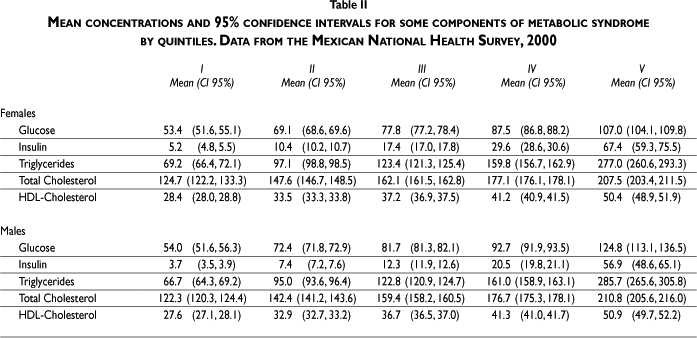
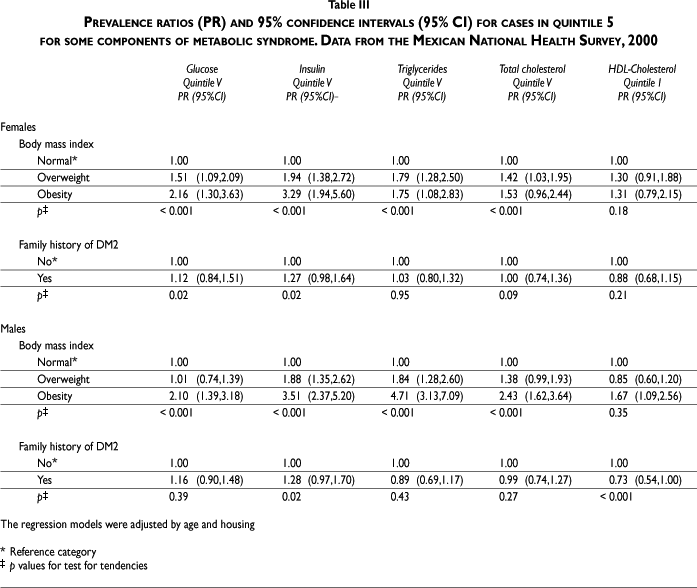
<body><![CDATA[<p>&nbsp;</p>     <p><font face="Verdana, Arial, Helvetica, sans-serif" size="2">The variations    across quintiles 1 through 5 in mean concentrations of glucose (53.4-107 mg/dl),    TG (69.2-277 mg/dl), TC (124.7-207.5 mg/dl) tended to be lower and those of    insulin (5.2-67.4 uU/ml) tended to be higher for females compared to males.    No statistical differences were found. Mean HDLc concentrations (females: 28.4-50.4    mg/dl) were comparable between genders (<a href="/img/revistas/spm/v49s3/02t2.gif">Table II</a>).    The overall mean concentrations of glucose, insulin, TC, and TG were significantly    higher and those of HDLc were significantly lower in obese subjects compared    to those with normal BMI (<i>p</i>&lt; 0.05- 0.001), (<a href="#fig1">figure    1</a>).</font></p>     <p><a name="fig1"></a></p>     <p>&nbsp;</p>     <p align="center"><img src="/img/revistas/spm/v49s3/02f1.gif"></p>     <p>&nbsp;</p>     <p><font face="Verdana, Arial, Helvetica, sans-serif" size="2">The PRs for being    in quintile 5 for glucose distribution were significantly higher for obese males    and females (PR= 2.1, <i>p</i>&lt; 0.001) than for their non-obese counterparts,    and for female subjects with a history of DM2 (PR= 1.12, <i>p</i>&lt; 0.02),    but not for males. The PRs for being in quintile 5 for insulin distribution    were significantly higher for obese males (PR= 3.51, <i>p</i>&lt; 0.001) and    females (PR= 3.3, <i>p</i>&lt; 0.001) than for their non-obese counterparts,    and for male (PR= 1.28, <i>p</i>&lt; 0.02) and female (PR= 1.27, <i>p</i>&lt;    0.02) subjects with a history of DM2. The PRs for being in quintile 5 for TG    distribution were significantly higher for obese males (4.71, <i>p</i>&lt; 0.001)    and females (1.75, <i>p</i>&lt; 0.001) than for their non-obese counterparts.    Family history of DM did not increase the PRs. The PRs of being in quintile    5 for TC distribution were significantly higher for obese males (2.43, <i>p</i>&lt;    0.001) and females (1.53, <i>p</i>&lt; 0.001) than for their non-obese counterparts.    Family history of DM did not increase the PRs for being in quintile 5 for total    cholesterol. Neither obesity nor having a family history of DM2 increased the    PRs for being in quintile 5 for HDLc distribution (<a href="/img/revistas/spm/v49s3/02t3.gif">Table    III</a>).</font></p>     <p>&nbsp;</p>    <p><font face="Verdana, Arial, Helvetica, sans-serif" size="3"><b>Discussion</b></font></p>     <p><font face="Verdana, Arial, Helvetica, sans-serif" size="2">A strong association    between obesity and the risk of higher serum concentrations of glucose, insulin,    TG, TC and HDLc in youths was observed in this national survey. Several studies    have shown that overweight and obesity in early years are risk factors for coronary    disease and metabolic syndrome in adult life.<sup>26,27</sup> Also, hyperinsulinemia    and insulin resistance play a role in the pathogenesis of hypertension.<sup>28</sup>    Hyperinsulinemia and hypertension are known risk factors for coronary hearth    disease.<sup>29</sup> In addition, obesity and hyperinsulinemia are considered    risks for type 2 diabetes mellitus, for which the prevalence is increasing at    an alarming rate, especially in adolescents.<sup>29,30</sup> Our data show that    these risks are already present in a significant number of Mexican youth, especially    in those that are obese. Identification of alterations in the components of    metabolic syndrome has clinical and epidemiological relevance because these    DM2 and cardiovascular disease risk factors can be reduced by individual and    public health interventions.<sup>31-33</sup> Even small reductions in body weight    are able to correct abnormalities in the components of metabolic syndrome, such    as hyperglycemia, hyperinsulinemia, and dislipidemias.<sup>32,33</sup> Interventions    aimed at increasing physical activity and improving the diet are cost effective    for reducing the risk of chronic diseases associated with obesity.<sup>31,34</sup></font></p>     ]]></body>
<body><![CDATA[<p><font face="Verdana, Arial, Helvetica, sans-serif" size="2">The authors recognize    that a limitation of this study is the inability to determine whether the cases    were or were not in fasting condition. Thus, we were unable to estimate the    prevalence of abnormal concentrations of glucose, insulin and lipids. However,    total cholesterol concentrations from this study are remarkably similar to those    found for Mexican-Americans participating in NHANES.<sup>35</sup> The companion    paper, reporting the distribution of dyslipidemias in adults (see Barquera et    al), found a prevalence of &gt;60% for males and females with HDL-cholesterol    values &lt;40 mg/dL, and &gt;70% for individuals between 20 and 29 years of    age. The prevalence of this abnormality was not significantly associated with    obesity. However, in our sample, the mean concentrations of HDLc were significantly    lower in non-obese subjects than in those who were overweight and obese. In    addition, there was no reason to assume that the distribution of fasting/non    fasting cases varies across BMI groups; thus, it is believed that the observed    associations are not biased.</font></p>     <p><font face="Verdana, Arial, Helvetica, sans-serif" size="2">The interpretation    of TG data in our study must be carefully considered since TG serum concentration    increases in the absorptive state. On the other hand, serum HDLc concentrations    show negligible changes in the absorptive state.<sup>36,37</sup></font></p>     <p><font face="Verdana, Arial, Helvetica, sans-serif" size="2">In summary, our    findings support the notion of a relevant association between obesity at these    early ages and the development of alterations in the components of metabolic    syndrome. These findings must be included in the development of informed interventions    through primary prevention aimed at the prevention and reduction of cardiovascular    risk factors.</font></p>     <p>&nbsp;</p>    <p><font face="Verdana, Arial, Helvetica, sans-serif" size="3"><b>Acknowledgments</b></font></p>     <p><font face="Verdana, Arial, Helvetica, sans-serif" size="2">This study was    possible thanks to the Mexican National Council of Science and Technology (CONACyT)    grant number 37194-M (Barquera S, Olaiz G, Villalpando S, Rivera J, Gonz&aacute;lez    C, Sep&uacute;lveda J. Contribution of overweight and obesity to the development    of risk factors for chronic diseases: analysis of the National Health Survey).</font></p>     <p>&nbsp;</p>    <p><font face="Verdana, Arial, Helvetica, sans-serif" size="3"><b>References</b></font></p>     <!-- ref --><p><font face="Verdana, Arial, Helvetica, sans-serif" size="2">1. Ch&aacute;vez    A, &Aacute;vila A, Shamah T. Cuarta Encuesta Nacional de Alimentaci&oacute;n    y Nutrici&oacute;n en el Medio Rural. ENAL96. M&eacute;xico: INNSZ, 1996.</font>&nbsp;&nbsp;&nbsp;&nbsp;&nbsp;&nbsp;&nbsp;&nbsp;[&#160;<a href="javascript:void(0);" onclick="javascript: window.open('/scielo.php?script=sci_nlinks&ref=9286738&pid=S0036-3634200700090000300001&lng=','','width=640,height=500,resizable=yes,scrollbars=1,menubar=yes,');">Links</a>&#160;]<!-- end-ref --><!-- ref --><p><font face="Verdana, Arial, Helvetica, sans-serif" size="2">2. Hern&aacute;ndez    B, Peterson K, Sobol A, Rivera J, Sep&uacute;lveda J, Lezana MA. Sobrepeso en    mujeres de 12 a 49 a&ntilde;os y ni&ntilde;os menores de cinco a&ntilde;os en    M&eacute;xico. Salud Publica Mex 1996;38:178-188.</font>&nbsp;&nbsp;&nbsp;&nbsp;&nbsp;&nbsp;&nbsp;&nbsp;[&#160;<a href="javascript:void(0);" onclick="javascript: window.open('/scielo.php?script=sci_nlinks&ref=9286739&pid=S0036-3634200700090000300002&lng=','','width=640,height=500,resizable=yes,scrollbars=1,menubar=yes,');">Links</a>&#160;]<!-- end-ref --><!-- ref --><p><font face="Verdana, Arial, Helvetica, sans-serif" size="2">3. Secretar&iacute;a    de Salud, Direcci&oacute;n General de Epidemiolog&iacute;a. Encuesta Nacional    de Enfermedades Cr&oacute;nicas, 1993. M&eacute;xico, DF: SSA,1993.</font>&nbsp;&nbsp;&nbsp;&nbsp;&nbsp;&nbsp;&nbsp;&nbsp;[&#160;<a href="javascript:void(0);" onclick="javascript: window.open('/scielo.php?script=sci_nlinks&ref=9286740&pid=S0036-3634200700090000300003&lng=','','width=640,height=500,resizable=yes,scrollbars=1,menubar=yes,');">Links</a>&#160;]<!-- end-ref --><!-- ref --><p><font face="Verdana, Arial, Helvetica, sans-serif" size="2">4. Gonz&aacute;lez    de Coss&iacute;o T, Rivera J, Shamah T, Ram&iacute;rez I, Barquera S, Morales    C, <i>et al</i>. Mujeres. En: Encuesta Nacional de Nutrici&oacute;n 1999. Cuernavaca,    Morelos, M&eacute;xico: INSP, 2001:103-178.</font>&nbsp;&nbsp;&nbsp;&nbsp;&nbsp;&nbsp;&nbsp;&nbsp;[&#160;<a href="javascript:void(0);" onclick="javascript: window.open('/scielo.php?script=sci_nlinks&ref=9286741&pid=S0036-3634200700090000300004&lng=','','width=640,height=500,resizable=yes,scrollbars=1,menubar=yes,');">Links</a>&#160;]<!-- end-ref --><!-- ref --><p><font face="Verdana, Arial, Helvetica, sans-serif" size="2">5. Del R&iacute;o-Navarro    BE, Vel&aacute;squez O, S&aacute;nchez-Castillo CP, Lara A, Berber A, Fanghaenel    G, <i>et al</i>. The high prevalence of overweight and obesity in Mexican children.    Obesity Res 2004;12:215-223.</font>&nbsp;&nbsp;&nbsp;&nbsp;&nbsp;&nbsp;&nbsp;&nbsp;[&#160;<a href="javascript:void(0);" onclick="javascript: window.open('/scielo.php?script=sci_nlinks&ref=9286742&pid=S0036-3634200700090000300005&lng=','','width=640,height=500,resizable=yes,scrollbars=1,menubar=yes,');">Links</a>&#160;]<!-- end-ref --><!-- ref --><p><font face="Verdana, Arial, Helvetica, sans-serif" size="2">6. Rivera J, Shamah    T, Villalpando S, Gonz&aacute;lez T, Hern&aacute;ndez B, Sep&uacute;lveda J,    eds. Encuesta Nacional de Nutrici&oacute;n 1999. Estado Nutricio de Ni&ntilde;os    y Mujeres en M&eacute;xico. Cuernavaca, Morelos, M&eacute;xico: INSP, 2001.</font>&nbsp;&nbsp;&nbsp;&nbsp;&nbsp;&nbsp;&nbsp;&nbsp;[&#160;<a href="javascript:void(0);" onclick="javascript: window.open('/scielo.php?script=sci_nlinks&ref=9286743&pid=S0036-3634200700090000300006&lng=','','width=640,height=500,resizable=yes,scrollbars=1,menubar=yes,');">Links</a>&#160;]<!-- end-ref --><!-- ref --><p><font face="Verdana, Arial, Helvetica, sans-serif" size="2">7. Sep&uacute;lveda-Amor    J, Lezana MA, Tapia-Conyer R, Valdespino JL, Madrigal H, Kumate J. Estado nutricional    de preescolares y mujeres en M&eacute;xico: resultados de una encuesta probabil&iacute;stica    nacional. Gac Med Mex 1990;126:207-224.</font>&nbsp;&nbsp;&nbsp;&nbsp;&nbsp;&nbsp;&nbsp;&nbsp;[&#160;<a href="javascript:void(0);" onclick="javascript: window.open('/scielo.php?script=sci_nlinks&ref=9286744&pid=S0036-3634200700090000300007&lng=','','width=640,height=500,resizable=yes,scrollbars=1,menubar=yes,');">Links</a>&#160;]<!-- end-ref --><!-- ref --><p><font face="Verdana, Arial, Helvetica, sans-serif" size="2">8. Atherosclerosis,    Hypertension, and Obesity in the young Committee: Obesity, insulin resistance,    diabetes, and cardiovascular risk in Children. Circulation 2003;107:1448-1453.</font>&nbsp;&nbsp;&nbsp;&nbsp;&nbsp;&nbsp;&nbsp;&nbsp;[&#160;<a href="javascript:void(0);" onclick="javascript: window.open('/scielo.php?script=sci_nlinks&ref=9286745&pid=S0036-3634200700090000300008&lng=','','width=640,height=500,resizable=yes,scrollbars=1,menubar=yes,');">Links</a>&#160;]<!-- end-ref --><!-- ref --><p><font face="Verdana, Arial, Helvetica, sans-serif" size="2">9. Dietz WH. Health    consequences of obesity in youth: childhood predictors of adult disease. Pediatrics    1998;101(3 Pt 2):518-525.</font>&nbsp;&nbsp;&nbsp;&nbsp;&nbsp;&nbsp;&nbsp;&nbsp;[&#160;<a href="javascript:void(0);" onclick="javascript: window.open('/scielo.php?script=sci_nlinks&ref=9286746&pid=S0036-3634200700090000300009&lng=','','width=640,height=500,resizable=yes,scrollbars=1,menubar=yes,');">Links</a>&#160;]<!-- end-ref --><!-- ref --><p><font face="Verdana, Arial, Helvetica, sans-serif" size="2">10. National Cholesterol    Education Program. Detection, Evaluation and Treatment of High Blood Cholesterol    in Adults (Adult Treatment Panel III: Full Report) .Bethesda, Md: National Institutes    of Health, 2001.</font>&nbsp;&nbsp;&nbsp;&nbsp;&nbsp;&nbsp;&nbsp;&nbsp;[&#160;<a href="javascript:void(0);" onclick="javascript: window.open('/scielo.php?script=sci_nlinks&ref=9286747&pid=S0036-3634200700090000300010&lng=','','width=640,height=500,resizable=yes,scrollbars=1,menubar=yes,');">Links</a>&#160;]<!-- end-ref --><!-- ref --><p><font face="Verdana, Arial, Helvetica, sans-serif" size="2">11. Pinhas-Hamiel    O, Dolan LM, Daniels SR, Standiford D, Khoury PR, Zeitler P. Increased incidence    of non-insulin-dependent diabetes mellitus among adolescents. J Pediatr 1996;128(5    Pt 1):608-615.</font>&nbsp;&nbsp;&nbsp;&nbsp;&nbsp;&nbsp;&nbsp;&nbsp;[&#160;<a href="javascript:void(0);" onclick="javascript: window.open('/scielo.php?script=sci_nlinks&ref=9286748&pid=S0036-3634200700090000300011&lng=','','width=640,height=500,resizable=yes,scrollbars=1,menubar=yes,');">Links</a>&#160;]<!-- end-ref --><!-- ref --><p><font face="Verdana, Arial, Helvetica, sans-serif" size="2">12. Fagot-Campagna    A, Pettitt DJ, Engelgau MM, Burrows NR, Geiss LS, Valdez R, <i>et al</i>. Type    2 diabetes among North American children and adolescents: an epidemiologic review    and a public health perspective. J Pediatr 2000;136(5):664-672.</font>&nbsp;&nbsp;&nbsp;&nbsp;&nbsp;&nbsp;&nbsp;&nbsp;[&#160;<a href="javascript:void(0);" onclick="javascript: window.open('/scielo.php?script=sci_nlinks&ref=9286749&pid=S0036-3634200700090000300012&lng=','','width=640,height=500,resizable=yes,scrollbars=1,menubar=yes,');">Links</a>&#160;]<!-- end-ref --><!-- ref --><p><font face="Verdana, Arial, Helvetica, sans-serif" size="2">13. Ludwig DS,    Ebbeling CB. Type 2 diabetes mellitus in children: primary care and public health    considerations. JAMA 2001;286(12):1427-1430.</font>&nbsp;&nbsp;&nbsp;&nbsp;&nbsp;&nbsp;&nbsp;&nbsp;[&#160;<a href="javascript:void(0);" onclick="javascript: window.open('/scielo.php?script=sci_nlinks&ref=9286750&pid=S0036-3634200700090000300013&lng=','','width=640,height=500,resizable=yes,scrollbars=1,menubar=yes,');">Links</a>&#160;]<!-- end-ref --><!-- ref --><p><font face="Verdana, Arial, Helvetica, sans-serif" size="2">14. Fagot-Campagna    A, Burrows NR, Williamson DF. The public health epidemiology of type 2 diabetes    in children and adolescents: a case study of American Indian adolescents in    the Southwestern United States. Clin Chim Acta 1999;286(1-2):81-95.</font>&nbsp;&nbsp;&nbsp;&nbsp;&nbsp;&nbsp;&nbsp;&nbsp;[&#160;<a href="javascript:void(0);" onclick="javascript: window.open('/scielo.php?script=sci_nlinks&ref=9286751&pid=S0036-3634200700090000300014&lng=','','width=640,height=500,resizable=yes,scrollbars=1,menubar=yes,');">Links</a>&#160;]<!-- end-ref --><!-- ref --><p><font face="Verdana, Arial, Helvetica, sans-serif" size="2">15. Pearson TA,    Blair SN, Daniels SR, Eckel RH, Fair JM, Fortmann SP, <i>et al</i>. AHA Guidelines    for Primary Prevention of Cardiovascular Disease and Stroke: 2002. Update: Consensus    Panel Guide to Comprehensive Risk Reduction for Adult Patients Without Coronary    or Other Atherosclerotic Vascular Diseases. American Heart Association Science    Advisory and Coordinating Committee. Circulation 2002;106(3):388-391.</font>&nbsp;&nbsp;&nbsp;&nbsp;&nbsp;&nbsp;&nbsp;&nbsp;[&#160;<a href="javascript:void(0);" onclick="javascript: window.open('/scielo.php?script=sci_nlinks&ref=9286752&pid=S0036-3634200700090000300015&lng=','','width=640,height=500,resizable=yes,scrollbars=1,menubar=yes,');">Links</a>&#160;]<!-- end-ref --><!-- ref --><p><font face="Verdana, Arial, Helvetica, sans-serif" size="2">16. Executive Summary    of The Third Report of The National Cholesterol Education Program (NCEP) Expert    Panel on Detection, Evaluation, and Treatment of High Blood Cholesterol In Adults    (Adult Treatment Panel III). JAMA 2001;285(19):2486-2497.</font>&nbsp;&nbsp;&nbsp;&nbsp;&nbsp;&nbsp;&nbsp;&nbsp;[&#160;<a href="javascript:void(0);" onclick="javascript: window.open('/scielo.php?script=sci_nlinks&ref=9286753&pid=S0036-3634200700090000300016&lng=','','width=640,height=500,resizable=yes,scrollbars=1,menubar=yes,');">Links</a>&#160;]<!-- end-ref --><!-- ref --><p><font face="Verdana, Arial, Helvetica, sans-serif" size="2">17. Cruz M, Garc&iacute;a-Macedo    R, Garc&iacute;a-Valerio Y, Guti&eacute;rrez M, Medina-Navarro R, Duran G, <i>et    al</i>. Low adiponectin levels predict type 2 diabetes in Mexican children.    Diabetes Care 2004;27(6):1451-1453.</font>&nbsp;&nbsp;&nbsp;&nbsp;&nbsp;&nbsp;&nbsp;&nbsp;[&#160;<a href="javascript:void(0);" onclick="javascript: window.open('/scielo.php?script=sci_nlinks&ref=9286754&pid=S0036-3634200700090000300017&lng=','','width=640,height=500,resizable=yes,scrollbars=1,menubar=yes,');">Links</a>&#160;]<!-- end-ref --><!-- ref --><p><font face="Verdana, Arial, Helvetica, sans-serif" size="2">18. Urrutia-Rojas    X, Menchaca J, Wadley W, Ahmad N, Lacko A, Bae S, <i>et al</i>. Cardiovascular    risk factors in Mexican-American children at risk for type 2 diabetes mellitus    (T2DM). J Adolesc Health 2004;34(4):290-299.</font>&nbsp;&nbsp;&nbsp;&nbsp;&nbsp;&nbsp;&nbsp;&nbsp;[&#160;<a href="javascript:void(0);" onclick="javascript: window.open('/scielo.php?script=sci_nlinks&ref=9286755&pid=S0036-3634200700090000300018&lng=','','width=640,height=500,resizable=yes,scrollbars=1,menubar=yes,');">Links</a>&#160;]<!-- end-ref --><!-- ref --><p><font face="Verdana, Arial, Helvetica, sans-serif" size="2">19. Trevino RP,    Marshall RM Jr, Hale DE, Rodr&iacute;guez R, Baker G, G&oacute;mez J. Diabetes    risk factors in low-income Mexican-American children. Diabetes Care 1999;22(2):202-207.</font>&nbsp;&nbsp;&nbsp;&nbsp;&nbsp;&nbsp;&nbsp;&nbsp;[&#160;<a href="javascript:void(0);" onclick="javascript: window.open('/scielo.php?script=sci_nlinks&ref=9286756&pid=S0036-3634200700090000300019&lng=','','width=640,height=500,resizable=yes,scrollbars=1,menubar=yes,');">Links</a>&#160;]<!-- end-ref --><!-- ref --><p><font face="Verdana, Arial, Helvetica, sans-serif" size="2">20. Glaser NS,    Jones KL. Non-insulin dependent diabetes mellitus in Mexican-American children.    West J Med 1998;168(1):11-16.</font>&nbsp;&nbsp;&nbsp;&nbsp;&nbsp;&nbsp;&nbsp;&nbsp;[&#160;<a href="javascript:void(0);" onclick="javascript: window.open('/scielo.php?script=sci_nlinks&ref=9286757&pid=S0036-3634200700090000300020&lng=','','width=640,height=500,resizable=yes,scrollbars=1,menubar=yes,');">Links</a>&#160;]<!-- end-ref --><!-- ref --><p><font face="Verdana, Arial, Helvetica, sans-serif" size="2">21. Valdespino    JL, Olaiz G, L&oacute;pez MP, Mendoza L, Palma O, Vel&aacute;zques O, <i>et    al</i>. Encuesta Nacional de Salud 2000. Cuernavaca, Morelos, M&eacute;xico:    INSP, 2003.</font>&nbsp;&nbsp;&nbsp;&nbsp;&nbsp;&nbsp;&nbsp;&nbsp;[&#160;<a href="javascript:void(0);" onclick="javascript: window.open('/scielo.php?script=sci_nlinks&ref=9286758&pid=S0036-3634200700090000300021&lng=','','width=640,height=500,resizable=yes,scrollbars=1,menubar=yes,');">Links</a>&#160;]<!-- end-ref --><!-- ref --><p><font face="Verdana, Arial, Helvetica, sans-serif" size="2">22. Cole T, Bellizzi    M, Flegal K, Dietz W. Establishing a standard definition of child overweight    and obesity worldwide: international survey. British Medical Journal 2000;320:1240-1243.</font>&nbsp;&nbsp;&nbsp;&nbsp;&nbsp;&nbsp;&nbsp;&nbsp;[&#160;<a href="javascript:void(0);" onclick="javascript: window.open('/scielo.php?script=sci_nlinks&ref=9286759&pid=S0036-3634200700090000300022&lng=','','width=640,height=500,resizable=yes,scrollbars=1,menubar=yes,');">Links</a>&#160;]<!-- end-ref --><!-- ref --><p><font face="Verdana, Arial, Helvetica, sans-serif" size="2">23. Zhang J, Yu    KF. What's the relative risk? A method of correcting the odds ratio in cohort    studies of common outcomes. JAMA 1998;280:1690-1691.</font>&nbsp;&nbsp;&nbsp;&nbsp;&nbsp;&nbsp;&nbsp;&nbsp;[&#160;<a href="javascript:void(0);" onclick="javascript: window.open('/scielo.php?script=sci_nlinks&ref=9286760&pid=S0036-3634200700090000300023&lng=','','width=640,height=500,resizable=yes,scrollbars=1,menubar=yes,');">Links</a>&#160;]<!-- end-ref --><!-- ref --><p><font face="Verdana, Arial, Helvetica, sans-serif" size="2">24. Must A, Spadano    J, Coakley EH, Field AE, Colditz G, Dietz WH. The disease burden associated    with overweight and obesity. JAMA 1999;282:1523-1529.</font>&nbsp;&nbsp;&nbsp;&nbsp;&nbsp;&nbsp;&nbsp;&nbsp;[&#160;<a href="javascript:void(0);" onclick="javascript: window.open('/scielo.php?script=sci_nlinks&ref=9286761&pid=S0036-3634200700090000300024&lng=','','width=640,height=500,resizable=yes,scrollbars=1,menubar=yes,');">Links</a>&#160;]<!-- end-ref --><!-- ref --><p><font face="Verdana, Arial, Helvetica, sans-serif" size="2">25. Ley de Informaci&oacute;n    Estad&iacute;stica y Geogr&aacute;fica. Diario Oficial de la Federaci&oacute;n.    Estados Unidos Mexicanos, 1980.</font>&nbsp;&nbsp;&nbsp;&nbsp;&nbsp;&nbsp;&nbsp;&nbsp;[&#160;<a href="javascript:void(0);" onclick="javascript: window.open('/scielo.php?script=sci_nlinks&ref=9286762&pid=S0036-3634200700090000300025&lng=','','width=640,height=500,resizable=yes,scrollbars=1,menubar=yes,');">Links</a>&#160;]<!-- end-ref --><!-- ref --><p><font face="Verdana, Arial, Helvetica, sans-serif" size="2">26. Must A, Jacques    PF, Dallal G, Bajerna CD, Dietz WW. Long-term morbidity and mortality of overweight    adolescents: a follow up of the Harvard Growth Study of 1922 to 1935. N Engl    J Med 1992;327: 1350-1355.</font>&nbsp;&nbsp;&nbsp;&nbsp;&nbsp;&nbsp;&nbsp;&nbsp;[&#160;<a href="javascript:void(0);" onclick="javascript: window.open('/scielo.php?script=sci_nlinks&ref=9286763&pid=S0036-3634200700090000300026&lng=','','width=640,height=500,resizable=yes,scrollbars=1,menubar=yes,');">Links</a>&#160;]<!-- end-ref --><!-- ref --><p><font face="Verdana, Arial, Helvetica, sans-serif" size="2">27. Vanhala MJ,    Vanhala PT, Keinanen-Kiukaanniemi SM, Kumpusalo EA, Takala JK. Relative weight    gain and obesity as a child predicts metabolic syndrome as an adult. Int J Obes    1999;23:656-659.</font>&nbsp;&nbsp;&nbsp;&nbsp;&nbsp;&nbsp;&nbsp;&nbsp;[&#160;<a href="javascript:void(0);" onclick="javascript: window.open('/scielo.php?script=sci_nlinks&ref=9286764&pid=S0036-3634200700090000300027&lng=','','width=640,height=500,resizable=yes,scrollbars=1,menubar=yes,');">Links</a>&#160;]<!-- end-ref --><!-- ref --><p><font face="Verdana, Arial, Helvetica, sans-serif" size="2">28. Reaven G. Insulin    resistance, hypertension and coronary heart disease. J Clin Hypertens 2003;5:269-274.</font>&nbsp;&nbsp;&nbsp;&nbsp;&nbsp;&nbsp;&nbsp;&nbsp;[&#160;<a href="javascript:void(0);" onclick="javascript: window.open('/scielo.php?script=sci_nlinks&ref=9286765&pid=S0036-3634200700090000300028&lng=','','width=640,height=500,resizable=yes,scrollbars=1,menubar=yes,');">Links</a>&#160;]<!-- end-ref --><!-- ref --><p><font face="Verdana, Arial, Helvetica, sans-serif" size="2">29. Ball GD, McCargar    LJ. Childhood obesity in Canada: a review of prevalence estimates and risk factors    for cardiovascular disease and type 2 diabetes. Can J Appl Physiol 2003;28:117-140.</font>&nbsp;&nbsp;&nbsp;&nbsp;&nbsp;&nbsp;&nbsp;&nbsp;[&#160;<a href="javascript:void(0);" onclick="javascript: window.open('/scielo.php?script=sci_nlinks&ref=9286766&pid=S0036-3634200700090000300029&lng=','','width=640,height=500,resizable=yes,scrollbars=1,menubar=yes,');">Links</a>&#160;]<!-- end-ref --><!-- ref --><p><font face="Verdana, Arial, Helvetica, sans-serif" size="2">30. Goran MI, Ball    GD, Cruz ML. Obesity and risk of type 2 diabetes and cardiovascular disease    in children and adolescents. J Clin Endocrinol Metab 2003;88:1417-1427.</font>&nbsp;&nbsp;&nbsp;&nbsp;&nbsp;&nbsp;&nbsp;&nbsp;[&#160;<a href="javascript:void(0);" onclick="javascript: window.open('/scielo.php?script=sci_nlinks&ref=9286767&pid=S0036-3634200700090000300030&lng=','','width=640,height=500,resizable=yes,scrollbars=1,menubar=yes,');">Links</a>&#160;]<!-- end-ref --><!-- ref --><p><font face="Verdana, Arial, Helvetica, sans-serif" size="2">31. Swiburn B,    Egger G. Preventive strategies against weight gain and obesity. Obes Rev 2002;3:289-301.</font>&nbsp;&nbsp;&nbsp;&nbsp;&nbsp;&nbsp;&nbsp;&nbsp;[&#160;<a href="javascript:void(0);" onclick="javascript: window.open('/scielo.php?script=sci_nlinks&ref=9286768&pid=S0036-3634200700090000300031&lng=','','width=640,height=500,resizable=yes,scrollbars=1,menubar=yes,');">Links</a>&#160;]<!-- end-ref --><!-- ref --><p><font face="Verdana, Arial, Helvetica, sans-serif" size="2">32. Brand-Miller    JC. Postprandial glycemia, glycemic index, and the prevention of type 2 diabetes.    Am J Clin Nutr 2004;80:243-244.</font>&nbsp;&nbsp;&nbsp;&nbsp;&nbsp;&nbsp;&nbsp;&nbsp;[&#160;<a href="javascript:void(0);" onclick="javascript: window.open('/scielo.php?script=sci_nlinks&ref=9286769&pid=S0036-3634200700090000300032&lng=','','width=640,height=500,resizable=yes,scrollbars=1,menubar=yes,');">Links</a>&#160;]<!-- end-ref --><!-- ref --><p><font face="Verdana, Arial, Helvetica, sans-serif" size="2">33. Grundy SM,    Brewer SB, Cleeman JI, Smith SC, Lenfant C. Definition of metabolic syndrome:    Report of the National Heart, Lung and Blood Institute, American Heart Association    conference on scientific issues related to definition. Circulation 2004;109:433-438.</font>&nbsp;&nbsp;&nbsp;&nbsp;&nbsp;&nbsp;&nbsp;&nbsp;[&#160;<a href="javascript:void(0);" onclick="javascript: window.open('/scielo.php?script=sci_nlinks&ref=9286770&pid=S0036-3634200700090000300033&lng=','','width=640,height=500,resizable=yes,scrollbars=1,menubar=yes,');">Links</a>&#160;]<!-- end-ref --><!-- ref --><p><font face="Verdana, Arial, Helvetica, sans-serif" size="2">34. G&oacute;mez-P&eacute;rez    FJ, R&iacute;os JT, Aguilar-Salinas CA, Lerman I, Rull JA. Posici&oacute;n de    la SMNE sobre el manejo del S&iacute;ndrome metab&oacute;lico (2ª parte).    Endocrinol Nutr 2005;13:9-23.</font>&nbsp;&nbsp;&nbsp;&nbsp;&nbsp;&nbsp;&nbsp;&nbsp;[&#160;<a href="javascript:void(0);" onclick="javascript: window.open('/scielo.php?script=sci_nlinks&ref=9286771&pid=S0036-3634200700090000300034&lng=','','width=640,height=500,resizable=yes,scrollbars=1,menubar=yes,');">Links</a>&#160;]<!-- end-ref --><!-- ref --><p><font face="Verdana, Arial, Helvetica, sans-serif" size="2">35. Carroll MD,    Lacher DA, Sorlie PD, Cleeman JI, Gordon DJ, Wolz M, <i>et al</i> Trends in    serum lipids and lipoproteins of adults, 1960-2002. JAMA 2005;294(14):1773-1781.</font>&nbsp;&nbsp;&nbsp;&nbsp;&nbsp;&nbsp;&nbsp;&nbsp;[&#160;<a href="javascript:void(0);" onclick="javascript: window.open('/scielo.php?script=sci_nlinks&ref=9286772&pid=S0036-3634200700090000300035&lng=','','width=640,height=500,resizable=yes,scrollbars=1,menubar=yes,');">Links</a>&#160;]<!-- end-ref --><!-- ref --><p><font face="Verdana, Arial, Helvetica, sans-serif" size="2">36. Kosuge K, Miida    T, Takahashi A, Obayashi K, Ito M, Ito T, <i>et al</i>. Estimating the fasting    triglyceride concentration from the postprandial HDL-cholesterol and apolipoprotein    CIII concentrations. Atherosclerosis 2005;14.</font>&nbsp;&nbsp;&nbsp;&nbsp;&nbsp;&nbsp;&nbsp;&nbsp;[&#160;<a href="javascript:void(0);" onclick="javascript: window.open('/scielo.php?script=sci_nlinks&ref=9286773&pid=S0036-3634200700090000300036&lng=','','width=640,height=500,resizable=yes,scrollbars=1,menubar=yes,');">Links</a>&#160;]<!-- end-ref --><!-- ref --><p><font face="Verdana, Arial, Helvetica, sans-serif" size="2">37. Desmeules S,    Arcand-Bosse JF, Bergeron J, Douville P, Agharazii M. Nonfasting non-high-density    lipoprotein cholesterol is adequate for lipid management in hemodialysis patients.    Am J Kidney Dis 2005;45(6): 1067-1072.</font>&nbsp;&nbsp;&nbsp;&nbsp;&nbsp;&nbsp;&nbsp;&nbsp;[&#160;<a href="javascript:void(0);" onclick="javascript: window.open('/scielo.php?script=sci_nlinks&ref=9286774&pid=S0036-3634200700090000300037&lng=','','width=640,height=500,resizable=yes,scrollbars=1,menubar=yes,');">Links</a>&#160;]<!-- end-ref --><p>&nbsp;</p>     <p>&nbsp;</p>     <p><font face="Verdana, Arial, Helvetica, sans-serif" size="2">Received on: February    2, 2006    <br>   Accepted on: February 7, 2007</font></p>     <p>&nbsp;</p>     ]]></body>
<body><![CDATA[<p>&nbsp;</p>     <p><font face="Verdana, Arial, Helvetica, sans-serif" size="2">Address reprint    requests to: PhD Salvador Villalpando. Av. Universidad 655. Col. Santa Mar&iacute;a    Ahuacatitl&aacute;n. 62508 Cuernavaca, Morelos, M&eacute;xico. E-mail:    <a href= "mailto:svillalp@insp.mx">svillalp@insp.mx</a>    <br>   <a name="back1"></a><a href="#top1">*</a>    Stata Corp. Stata reference manual. Release 8.2 College Station, TX: Stata Press,    2001.</font></p>      ]]></body><back>
<ref-list>
<ref id="B1">
<label>1</label><nlm-citation citation-type="book">
<person-group person-group-type="author">
<name>
<surname><![CDATA[Chávez]]></surname>
<given-names><![CDATA[A]]></given-names>
</name>
<name>
<surname><![CDATA[Ávila]]></surname>
<given-names><![CDATA[A]]></given-names>
</name>
<name>
<surname><![CDATA[Shamah]]></surname>
<given-names><![CDATA[T]]></given-names>
</name>
</person-group>
<source><![CDATA[Cuarta Encuesta Nacional de Alimentación y Nutrición en el Medio Rural: ENAL96]]></source>
<year>1996</year>
<publisher-loc><![CDATA[México ]]></publisher-loc>
<publisher-name><![CDATA[INNSZ]]></publisher-name>
</nlm-citation>
</ref>
<ref id="B2">
<label>2</label><nlm-citation citation-type="journal">
<person-group person-group-type="author">
<name>
<surname><![CDATA[Hernández]]></surname>
<given-names><![CDATA[B]]></given-names>
</name>
<name>
<surname><![CDATA[Peterson]]></surname>
<given-names><![CDATA[K]]></given-names>
</name>
<name>
<surname><![CDATA[Sobol]]></surname>
<given-names><![CDATA[A]]></given-names>
</name>
<name>
<surname><![CDATA[Rivera]]></surname>
<given-names><![CDATA[J]]></given-names>
</name>
<name>
<surname><![CDATA[Sepúlveda]]></surname>
<given-names><![CDATA[J]]></given-names>
</name>
<name>
<surname><![CDATA[Lezana]]></surname>
<given-names><![CDATA[MA]]></given-names>
</name>
</person-group>
<article-title xml:lang="es"><![CDATA[Sobrepeso en mujeres de 12 a 49 años y niños menores de cinco años en México]]></article-title>
<source><![CDATA[Salud Publica Mex]]></source>
<year>1996</year>
<volume>38</volume>
<page-range>178-188</page-range></nlm-citation>
</ref>
<ref id="B3">
<label>3</label><nlm-citation citation-type="book">
<collab>Secretaría de Salud^dDirección General de Epidemiología</collab>
<source><![CDATA[Encuesta Nacional de Enfermedades Crónicas, 1993]]></source>
<year>1993</year>
<publisher-loc><![CDATA[México^eDF DF]]></publisher-loc>
<publisher-name><![CDATA[SSA]]></publisher-name>
</nlm-citation>
</ref>
<ref id="B4">
<label>4</label><nlm-citation citation-type="book">
<person-group person-group-type="author">
<name>
<surname><![CDATA[González de Cossío]]></surname>
<given-names><![CDATA[T]]></given-names>
</name>
<name>
<surname><![CDATA[Rivera]]></surname>
<given-names><![CDATA[J]]></given-names>
</name>
<name>
<surname><![CDATA[Shamah]]></surname>
<given-names><![CDATA[T]]></given-names>
</name>
<name>
<surname><![CDATA[Ramírez]]></surname>
<given-names><![CDATA[I]]></given-names>
</name>
<name>
<surname><![CDATA[Barquera]]></surname>
<given-names><![CDATA[S]]></given-names>
</name>
<name>
<surname><![CDATA[Morales]]></surname>
<given-names><![CDATA[C]]></given-names>
</name>
</person-group>
<article-title xml:lang="es"><![CDATA[Mujeres]]></article-title>
<source><![CDATA[Encuesta Nacional de Nutrición 1999]]></source>
<year>2001</year>
<page-range>103-178</page-range><publisher-loc><![CDATA[Cuernavaca^eMorelos Morelos]]></publisher-loc>
<publisher-name><![CDATA[INSP]]></publisher-name>
</nlm-citation>
</ref>
<ref id="B5">
<label>5</label><nlm-citation citation-type="journal">
<person-group person-group-type="author">
<name>
<surname><![CDATA[Del Río-Navarro]]></surname>
<given-names><![CDATA[BE]]></given-names>
</name>
<name>
<surname><![CDATA[Velásquez]]></surname>
<given-names><![CDATA[O]]></given-names>
</name>
<name>
<surname><![CDATA[Sánchez-Castillo]]></surname>
<given-names><![CDATA[CP]]></given-names>
</name>
<name>
<surname><![CDATA[Lara]]></surname>
<given-names><![CDATA[A]]></given-names>
</name>
<name>
<surname><![CDATA[Berber]]></surname>
<given-names><![CDATA[A]]></given-names>
</name>
<name>
<surname><![CDATA[Fanghaenel]]></surname>
<given-names><![CDATA[G]]></given-names>
</name>
</person-group>
<article-title xml:lang="en"><![CDATA[The high prevalence of overweight and obesity in Mexican children]]></article-title>
<source><![CDATA[Obesity Res]]></source>
<year>2004</year>
<volume>12</volume>
<page-range>215-223</page-range></nlm-citation>
</ref>
<ref id="B6">
<label>6</label><nlm-citation citation-type="book">
<person-group person-group-type="author">
<name>
<surname><![CDATA[Rivera]]></surname>
<given-names><![CDATA[J]]></given-names>
</name>
<name>
<surname><![CDATA[Shamah]]></surname>
<given-names><![CDATA[T]]></given-names>
</name>
<name>
<surname><![CDATA[Villalpando]]></surname>
<given-names><![CDATA[S]]></given-names>
</name>
<name>
<surname><![CDATA[González]]></surname>
<given-names><![CDATA[T]]></given-names>
</name>
<name>
<surname><![CDATA[Hernández]]></surname>
<given-names><![CDATA[B]]></given-names>
</name>
<name>
<surname><![CDATA[Sepúlveda]]></surname>
<given-names><![CDATA[J]]></given-names>
</name>
</person-group>
<source><![CDATA[Encuesta Nacional de Nutrición 1999: Estado Nutricio de Niños y Mujeres en México]]></source>
<year>2001</year>
<publisher-loc><![CDATA[Cuernavaca^eMorelos Morelos]]></publisher-loc>
<publisher-name><![CDATA[INSP]]></publisher-name>
</nlm-citation>
</ref>
<ref id="B7">
<label>7</label><nlm-citation citation-type="journal">
<person-group person-group-type="author">
<name>
<surname><![CDATA[Sepúlveda-Amor]]></surname>
<given-names><![CDATA[J]]></given-names>
</name>
<name>
<surname><![CDATA[Lezana]]></surname>
<given-names><![CDATA[MA]]></given-names>
</name>
<name>
<surname><![CDATA[Tapia-Conyer]]></surname>
<given-names><![CDATA[R]]></given-names>
</name>
<name>
<surname><![CDATA[Valdespino]]></surname>
<given-names><![CDATA[JL]]></given-names>
</name>
<name>
<surname><![CDATA[Madrigal]]></surname>
<given-names><![CDATA[H]]></given-names>
</name>
<name>
<surname><![CDATA[Kumate]]></surname>
<given-names><![CDATA[J]]></given-names>
</name>
</person-group>
<article-title xml:lang="es"><![CDATA[Estado nutricional de preescolares y mujeres en México: resultados de una encuesta probabilística nacional]]></article-title>
<source><![CDATA[Gac Med Mex]]></source>
<year>1990</year>
<volume>126</volume>
<page-range>207-224</page-range></nlm-citation>
</ref>
<ref id="B8">
<label>8</label><nlm-citation citation-type="journal">
<article-title xml:lang="en"><![CDATA[Atherosclerosis, Hypertension, and Obesity in the young Committee: Obesity, insulin resistance, diabetes, and cardiovascular risk in Children]]></article-title>
<source><![CDATA[Circulation]]></source>
<year>2003</year>
<volume>107</volume>
<page-range>1448-1453</page-range></nlm-citation>
</ref>
<ref id="B9">
<label>9</label><nlm-citation citation-type="journal">
<person-group person-group-type="author">
<name>
<surname><![CDATA[Dietz]]></surname>
<given-names><![CDATA[WH]]></given-names>
</name>
</person-group>
<article-title xml:lang="en"><![CDATA[Health consequences of obesity in youth: childhood predictors of adult disease]]></article-title>
<source><![CDATA[Pediatrics]]></source>
<year>1998</year>
<volume>101</volume>
<numero>3</numero>
<issue>3</issue>
<page-range>518-525</page-range></nlm-citation>
</ref>
<ref id="B10">
<label>10</label><nlm-citation citation-type="book">
<collab>National Cholesterol Education Program</collab>
<source><![CDATA[Detection, Evaluation and Treatment of High Blood Cholesterol in Adults (Adult Treatment Panel III: Full Report)]]></source>
<year>2001</year>
<publisher-loc><![CDATA[Bethesda^eMd Md]]></publisher-loc>
<publisher-name><![CDATA[National Institutes of Health]]></publisher-name>
</nlm-citation>
</ref>
<ref id="B11">
<label>11</label><nlm-citation citation-type="journal">
<person-group person-group-type="author">
<name>
<surname><![CDATA[Pinhas-Hamiel]]></surname>
<given-names><![CDATA[O]]></given-names>
</name>
<name>
<surname><![CDATA[Dolan]]></surname>
<given-names><![CDATA[LM]]></given-names>
</name>
<name>
<surname><![CDATA[Daniels]]></surname>
<given-names><![CDATA[SR]]></given-names>
</name>
<name>
<surname><![CDATA[Standiford]]></surname>
<given-names><![CDATA[D]]></given-names>
</name>
<name>
<surname><![CDATA[Khoury]]></surname>
<given-names><![CDATA[PR]]></given-names>
</name>
<name>
<surname><![CDATA[Zeitler]]></surname>
<given-names><![CDATA[P]]></given-names>
</name>
</person-group>
<article-title xml:lang="en"><![CDATA[Increased incidence of non-insulin-dependent diabetes mellitus among adolescents]]></article-title>
<source><![CDATA[J Pediatr]]></source>
<year>1996</year>
<volume>128</volume>
<numero>5</numero>
<issue>5</issue>
<page-range>608-615</page-range></nlm-citation>
</ref>
<ref id="B12">
<label>12</label><nlm-citation citation-type="journal">
<person-group person-group-type="author">
<name>
<surname><![CDATA[Fagot-Campagna]]></surname>
<given-names><![CDATA[A]]></given-names>
</name>
<name>
<surname><![CDATA[Pettitt]]></surname>
<given-names><![CDATA[DJ]]></given-names>
</name>
<name>
<surname><![CDATA[Engelgau]]></surname>
<given-names><![CDATA[MM]]></given-names>
</name>
<name>
<surname><![CDATA[Burrows]]></surname>
<given-names><![CDATA[NR]]></given-names>
</name>
<name>
<surname><![CDATA[Geiss]]></surname>
<given-names><![CDATA[LS]]></given-names>
</name>
<name>
<surname><![CDATA[Valdez]]></surname>
<given-names><![CDATA[R]]></given-names>
</name>
</person-group>
<article-title xml:lang="en"><![CDATA[Type 2 diabetes among North American children and adolescents: an epidemiologic review and a public health perspective]]></article-title>
<source><![CDATA[J Pediatr]]></source>
<year>2000</year>
<volume>136</volume>
<numero>5</numero>
<issue>5</issue>
<page-range>664-672</page-range></nlm-citation>
</ref>
<ref id="B13">
<label>13</label><nlm-citation citation-type="journal">
<person-group person-group-type="author">
<name>
<surname><![CDATA[Ludwig]]></surname>
<given-names><![CDATA[DS]]></given-names>
</name>
<name>
<surname><![CDATA[Ebbeling]]></surname>
<given-names><![CDATA[CB]]></given-names>
</name>
</person-group>
<article-title xml:lang="en"><![CDATA[Type 2 diabetes mellitus in children: primary care and public health considerations]]></article-title>
<source><![CDATA[JAMA]]></source>
<year>2001</year>
<volume>286</volume>
<numero>12</numero>
<issue>12</issue>
<page-range>1427-1430</page-range></nlm-citation>
</ref>
<ref id="B14">
<label>14</label><nlm-citation citation-type="journal">
<person-group person-group-type="author">
<name>
<surname><![CDATA[Fagot-Campagna]]></surname>
<given-names><![CDATA[A]]></given-names>
</name>
<name>
<surname><![CDATA[Burrows]]></surname>
<given-names><![CDATA[NR]]></given-names>
</name>
<name>
<surname><![CDATA[Williamson]]></surname>
<given-names><![CDATA[DF]]></given-names>
</name>
</person-group>
<article-title xml:lang="en"><![CDATA[The public health epidemiology of type 2 diabetes in children and adolescents: a case study of American Indian adolescents in the Southwestern United States]]></article-title>
<source><![CDATA[Clin Chim Acta]]></source>
<year>1999</year>
<volume>286</volume>
<numero>1-2</numero>
<issue>1-2</issue>
<page-range>81-95</page-range></nlm-citation>
</ref>
<ref id="B15">
<label>15</label><nlm-citation citation-type="journal">
<person-group person-group-type="author">
<name>
<surname><![CDATA[Pearson]]></surname>
<given-names><![CDATA[TA]]></given-names>
</name>
<name>
<surname><![CDATA[Blair]]></surname>
<given-names><![CDATA[SN]]></given-names>
</name>
<name>
<surname><![CDATA[Daniels]]></surname>
<given-names><![CDATA[SR]]></given-names>
</name>
<name>
<surname><![CDATA[Eckel]]></surname>
<given-names><![CDATA[RH]]></given-names>
</name>
<name>
<surname><![CDATA[Fair]]></surname>
<given-names><![CDATA[JM]]></given-names>
</name>
<name>
<surname><![CDATA[Fortmann]]></surname>
<given-names><![CDATA[SP]]></given-names>
</name>
</person-group>
<article-title xml:lang="en"><![CDATA[AHA Guidelines for Primary Prevention of Cardiovascular Disease and Stroke: 2002. Update: Consensus Panel Guide to Comprehensive Risk Reduction for Adult Patients Without Coronary or Other Atherosclerotic Vascular Diseases]]></article-title>
<source><![CDATA[Circulation]]></source>
<year>2002</year>
<volume>106</volume>
<numero>3</numero>
<issue>3</issue>
<page-range>388-391</page-range></nlm-citation>
</ref>
<ref id="B16">
<label>16</label><nlm-citation citation-type="journal">
<article-title xml:lang="en"><![CDATA[Executive Summary of The Third Report of The National Cholesterol Education Program (NCEP) Expert Panel on Detection, Evaluation, and Treatment of High Blood Cholesterol In Adults (Adult Treatment Panel III)]]></article-title>
<source><![CDATA[JAMA]]></source>
<year>2001</year>
<volume>285</volume>
<numero>19</numero>
<issue>19</issue>
<page-range>2486-2497</page-range></nlm-citation>
</ref>
<ref id="B17">
<label>17</label><nlm-citation citation-type="journal">
<person-group person-group-type="author">
<name>
<surname><![CDATA[Cruz]]></surname>
<given-names><![CDATA[M]]></given-names>
</name>
<name>
<surname><![CDATA[García-Macedo]]></surname>
<given-names><![CDATA[R]]></given-names>
</name>
<name>
<surname><![CDATA[García-Valerio]]></surname>
<given-names><![CDATA[Y]]></given-names>
</name>
<name>
<surname><![CDATA[Gutiérrez]]></surname>
<given-names><![CDATA[M]]></given-names>
</name>
<name>
<surname><![CDATA[Medina-Navarro]]></surname>
<given-names><![CDATA[R]]></given-names>
</name>
<name>
<surname><![CDATA[Duran]]></surname>
<given-names><![CDATA[G]]></given-names>
</name>
</person-group>
<article-title xml:lang="en"><![CDATA[Low adiponectin levels predict type 2 diabetes in Mexican children]]></article-title>
<source><![CDATA[Diabetes Care]]></source>
<year>2004</year>
<volume>27</volume>
<numero>6</numero>
<issue>6</issue>
<page-range>1451-1453</page-range></nlm-citation>
</ref>
<ref id="B18">
<label>18</label><nlm-citation citation-type="journal">
<person-group person-group-type="author">
<name>
<surname><![CDATA[Urrutia-Rojas]]></surname>
<given-names><![CDATA[X]]></given-names>
</name>
<name>
<surname><![CDATA[Menchaca]]></surname>
<given-names><![CDATA[J]]></given-names>
</name>
<name>
<surname><![CDATA[Wadley]]></surname>
<given-names><![CDATA[W]]></given-names>
</name>
<name>
<surname><![CDATA[Ahmad]]></surname>
<given-names><![CDATA[N]]></given-names>
</name>
<name>
<surname><![CDATA[Lacko]]></surname>
<given-names><![CDATA[A]]></given-names>
</name>
<name>
<surname><![CDATA[Bae]]></surname>
<given-names><![CDATA[S]]></given-names>
</name>
</person-group>
<article-title xml:lang="en"><![CDATA[Cardiovascular risk factors in Mexican-American children at risk for type 2 diabetes mellitus (T2DM)]]></article-title>
<source><![CDATA[J Adolesc Health]]></source>
<year>2004</year>
<volume>34</volume>
<numero>4</numero>
<issue>4</issue>
<page-range>290-299</page-range></nlm-citation>
</ref>
<ref id="B19">
<label>19</label><nlm-citation citation-type="journal">
<person-group person-group-type="author">
<name>
<surname><![CDATA[Trevino]]></surname>
<given-names><![CDATA[RP]]></given-names>
</name>
<name>
<surname><![CDATA[Marshall]]></surname>
<given-names><![CDATA[RM Jr]]></given-names>
</name>
<name>
<surname><![CDATA[Hale]]></surname>
<given-names><![CDATA[DE]]></given-names>
</name>
<name>
<surname><![CDATA[Rodríguez]]></surname>
<given-names><![CDATA[R]]></given-names>
</name>
<name>
<surname><![CDATA[Baker]]></surname>
<given-names><![CDATA[G]]></given-names>
</name>
<name>
<surname><![CDATA[Gómez]]></surname>
<given-names><![CDATA[J]]></given-names>
</name>
</person-group>
<article-title xml:lang="en"><![CDATA[Diabetes risk factors in low-income Mexican-American children]]></article-title>
<source><![CDATA[Diabetes Care]]></source>
<year>1999</year>
<volume>22</volume>
<numero>2</numero>
<issue>2</issue>
<page-range>202-207</page-range></nlm-citation>
</ref>
<ref id="B20">
<label>20</label><nlm-citation citation-type="journal">
<person-group person-group-type="author">
<name>
<surname><![CDATA[Glaser]]></surname>
<given-names><![CDATA[NS]]></given-names>
</name>
<name>
<surname><![CDATA[Jones]]></surname>
<given-names><![CDATA[KL]]></given-names>
</name>
</person-group>
<article-title xml:lang="en"><![CDATA[Non-insulin dependent diabetes mellitus in Mexican-American children]]></article-title>
<source><![CDATA[West J Med]]></source>
<year>1998</year>
<volume>168</volume>
<numero>1</numero>
<issue>1</issue>
<page-range>11-16</page-range></nlm-citation>
</ref>
<ref id="B21">
<label>21</label><nlm-citation citation-type="book">
<person-group person-group-type="author">
<name>
<surname><![CDATA[Valdespino]]></surname>
<given-names><![CDATA[JL]]></given-names>
</name>
<name>
<surname><![CDATA[Olaiz]]></surname>
<given-names><![CDATA[G]]></given-names>
</name>
<name>
<surname><![CDATA[López]]></surname>
<given-names><![CDATA[MP]]></given-names>
</name>
<name>
<surname><![CDATA[Mendoza]]></surname>
<given-names><![CDATA[L]]></given-names>
</name>
<name>
<surname><![CDATA[Palma]]></surname>
<given-names><![CDATA[O]]></given-names>
</name>
<name>
<surname><![CDATA[Velázques]]></surname>
<given-names><![CDATA[O]]></given-names>
</name>
</person-group>
<source><![CDATA[Encuesta Nacional de Salud 2000]]></source>
<year>2003</year>
<publisher-loc><![CDATA[Cuernavaca^eMorelos Morelos]]></publisher-loc>
<publisher-name><![CDATA[INSP]]></publisher-name>
</nlm-citation>
</ref>
<ref id="B22">
<label>22</label><nlm-citation citation-type="journal">
<person-group person-group-type="author">
<name>
<surname><![CDATA[Cole]]></surname>
<given-names><![CDATA[T]]></given-names>
</name>
<name>
<surname><![CDATA[Bellizzi]]></surname>
<given-names><![CDATA[M]]></given-names>
</name>
<name>
<surname><![CDATA[Flegal]]></surname>
<given-names><![CDATA[K]]></given-names>
</name>
<name>
<surname><![CDATA[Dietz]]></surname>
<given-names><![CDATA[W]]></given-names>
</name>
</person-group>
<article-title xml:lang="en"><![CDATA[Establishing a standard definition of child overweight and obesity worldwide: international survey]]></article-title>
<source><![CDATA[British Medical Journal]]></source>
<year>2000</year>
<volume>320</volume>
<page-range>1240-1243</page-range></nlm-citation>
</ref>
<ref id="B23">
<label>23</label><nlm-citation citation-type="journal">
<person-group person-group-type="author">
<name>
<surname><![CDATA[Zhang]]></surname>
<given-names><![CDATA[J]]></given-names>
</name>
<name>
<surname><![CDATA[Yu]]></surname>
<given-names><![CDATA[KF]]></given-names>
</name>
</person-group>
<article-title xml:lang="en"><![CDATA[What's the relative risk?: A method of correcting the odds ratio in cohort studies of common outcomes]]></article-title>
<source><![CDATA[JAMA]]></source>
<year>1998</year>
<volume>280</volume>
<page-range>1690-1691</page-range></nlm-citation>
</ref>
<ref id="B24">
<label>24</label><nlm-citation citation-type="journal">
<person-group person-group-type="author">
<name>
<surname><![CDATA[Must]]></surname>
<given-names><![CDATA[A]]></given-names>
</name>
<name>
<surname><![CDATA[Spadano]]></surname>
<given-names><![CDATA[J]]></given-names>
</name>
<name>
<surname><![CDATA[Coakley]]></surname>
<given-names><![CDATA[EH]]></given-names>
</name>
<name>
<surname><![CDATA[Field]]></surname>
<given-names><![CDATA[AE]]></given-names>
</name>
<name>
<surname><![CDATA[Colditz]]></surname>
<given-names><![CDATA[G]]></given-names>
</name>
<name>
<surname><![CDATA[Dietz]]></surname>
<given-names><![CDATA[WH]]></given-names>
</name>
</person-group>
<article-title xml:lang="en"><![CDATA[The disease burden associated with overweight and obesity]]></article-title>
<source><![CDATA[JAMA]]></source>
<year>1999</year>
<volume>282</volume>
<page-range>1523-1529</page-range></nlm-citation>
</ref>
<ref id="B25">
<label>25</label><nlm-citation citation-type="journal">
<article-title xml:lang="es"><![CDATA[Ley de Información Estadística y Geográfica]]></article-title>
<source><![CDATA[Diario Oficial de la Federación. Estados Unidos Mexicanos]]></source>
<year>1980</year>
</nlm-citation>
</ref>
<ref id="B26">
<label>26</label><nlm-citation citation-type="journal">
<person-group person-group-type="author">
<name>
<surname><![CDATA[Must]]></surname>
<given-names><![CDATA[A]]></given-names>
</name>
<name>
<surname><![CDATA[Jacques]]></surname>
<given-names><![CDATA[PF]]></given-names>
</name>
<name>
<surname><![CDATA[Dallal]]></surname>
<given-names><![CDATA[G]]></given-names>
</name>
<name>
<surname><![CDATA[Bajerna]]></surname>
<given-names><![CDATA[CD]]></given-names>
</name>
<name>
<surname><![CDATA[Dietz]]></surname>
<given-names><![CDATA[WW]]></given-names>
</name>
</person-group>
<article-title xml:lang="en"><![CDATA[Long-term morbidity and mortality of overweight adolescents: a follow up of the Harvard Growth Study of 1922 to 1935]]></article-title>
<source><![CDATA[N Engl J Med]]></source>
<year>1992</year>
<volume>327</volume>
<page-range>1350-1355</page-range></nlm-citation>
</ref>
<ref id="B27">
<label>27</label><nlm-citation citation-type="journal">
<person-group person-group-type="author">
<name>
<surname><![CDATA[Vanhala]]></surname>
<given-names><![CDATA[MJ]]></given-names>
</name>
<name>
<surname><![CDATA[Vanhala]]></surname>
<given-names><![CDATA[PT]]></given-names>
</name>
<name>
<surname><![CDATA[Keinanen-Kiukaanniemi]]></surname>
<given-names><![CDATA[SM]]></given-names>
</name>
<name>
<surname><![CDATA[Kumpusalo]]></surname>
<given-names><![CDATA[EA]]></given-names>
</name>
<name>
<surname><![CDATA[Takala]]></surname>
<given-names><![CDATA[JK]]></given-names>
</name>
</person-group>
<article-title xml:lang="en"><![CDATA[Relative weight gain and obesity as a child predicts metabolic syndrome as an adult]]></article-title>
<source><![CDATA[Int J Obes]]></source>
<year>1999</year>
<volume>23</volume>
<page-range>656-659</page-range></nlm-citation>
</ref>
<ref id="B28">
<label>28</label><nlm-citation citation-type="journal">
<person-group person-group-type="author">
<name>
<surname><![CDATA[Reaven]]></surname>
<given-names><![CDATA[G]]></given-names>
</name>
</person-group>
<article-title xml:lang="en"><![CDATA[Insulin resistance, hypertension and coronary heart disease]]></article-title>
<source><![CDATA[J Clin Hypertens]]></source>
<year>2003</year>
<volume>5</volume>
<page-range>269-274</page-range></nlm-citation>
</ref>
<ref id="B29">
<label>29</label><nlm-citation citation-type="journal">
<person-group person-group-type="author">
<name>
<surname><![CDATA[Ball]]></surname>
<given-names><![CDATA[GD]]></given-names>
</name>
<name>
<surname><![CDATA[McCargar]]></surname>
<given-names><![CDATA[LJ]]></given-names>
</name>
</person-group>
<article-title xml:lang="en"><![CDATA[Childhood obesity in Canada: a review of prevalence estimates and risk factors for cardiovascular disease and type 2 diabetes]]></article-title>
<source><![CDATA[Can J Appl Physiol]]></source>
<year>2003</year>
<volume>28</volume>
<page-range>117-140</page-range></nlm-citation>
</ref>
<ref id="B30">
<label>30</label><nlm-citation citation-type="journal">
<person-group person-group-type="author">
<name>
<surname><![CDATA[Goran]]></surname>
<given-names><![CDATA[MI]]></given-names>
</name>
<name>
<surname><![CDATA[Ball]]></surname>
<given-names><![CDATA[GD]]></given-names>
</name>
<name>
<surname><![CDATA[Cruz]]></surname>
<given-names><![CDATA[ML]]></given-names>
</name>
</person-group>
<article-title xml:lang="en"><![CDATA[Obesity and risk of type 2 diabetes and cardiovascular disease in children and adolescents]]></article-title>
<source><![CDATA[J Clin Endocrinol Metab]]></source>
<year>2003</year>
<volume>88</volume>
<page-range>1417-1427</page-range></nlm-citation>
</ref>
<ref id="B31">
<label>31</label><nlm-citation citation-type="journal">
<person-group person-group-type="author">
<name>
<surname><![CDATA[Swiburn]]></surname>
<given-names><![CDATA[B]]></given-names>
</name>
<name>
<surname><![CDATA[Egger]]></surname>
<given-names><![CDATA[G]]></given-names>
</name>
</person-group>
<article-title xml:lang="en"><![CDATA[Preventive strategies against weight gain and obesity]]></article-title>
<source><![CDATA[Obes Rev]]></source>
<year>2002</year>
<volume>3</volume>
<page-range>289-301</page-range></nlm-citation>
</ref>
<ref id="B32">
<label>32</label><nlm-citation citation-type="journal">
<person-group person-group-type="author">
<name>
<surname><![CDATA[Brand-Miller]]></surname>
<given-names><![CDATA[JC]]></given-names>
</name>
</person-group>
<article-title xml:lang="en"><![CDATA[Postprandial glycemia, glycemic index, and the prevention of type 2 diabetes]]></article-title>
<source><![CDATA[Am J Clin Nutr]]></source>
<year>2004</year>
<volume>80</volume>
<page-range>243-244</page-range></nlm-citation>
</ref>
<ref id="B33">
<label>33</label><nlm-citation citation-type="journal">
<person-group person-group-type="author">
<name>
<surname><![CDATA[Grundy]]></surname>
<given-names><![CDATA[SM]]></given-names>
</name>
<name>
<surname><![CDATA[Brewer]]></surname>
<given-names><![CDATA[SB]]></given-names>
</name>
<name>
<surname><![CDATA[Cleeman]]></surname>
<given-names><![CDATA[JI]]></given-names>
</name>
<name>
<surname><![CDATA[Smith]]></surname>
<given-names><![CDATA[SC]]></given-names>
</name>
<name>
<surname><![CDATA[Lenfant]]></surname>
<given-names><![CDATA[C]]></given-names>
</name>
</person-group>
<article-title xml:lang="en"><![CDATA[Definition of metabolic syndrome: Report of the National Heart, Lung and Blood Institute, American Heart Association conference on scientific issues related to definition]]></article-title>
<source><![CDATA[Circulation]]></source>
<year>2004</year>
<volume>109</volume>
<page-range>433-438</page-range></nlm-citation>
</ref>
<ref id="B34">
<label>34</label><nlm-citation citation-type="journal">
<person-group person-group-type="author">
<name>
<surname><![CDATA[Gómez-Pérez]]></surname>
<given-names><![CDATA[FJ]]></given-names>
</name>
<name>
<surname><![CDATA[Ríos]]></surname>
<given-names><![CDATA[JT]]></given-names>
</name>
<name>
<surname><![CDATA[Aguilar-Salinas]]></surname>
<given-names><![CDATA[CA]]></given-names>
</name>
<name>
<surname><![CDATA[Lerman]]></surname>
<given-names><![CDATA[I]]></given-names>
</name>
<name>
<surname><![CDATA[Rull]]></surname>
<given-names><![CDATA[JA]]></given-names>
</name>
</person-group>
<article-title xml:lang="es"><![CDATA[Posición de la SMNE sobre el manejo del Síndrome metabólico (2ª parte)]]></article-title>
<source><![CDATA[Endocrinol Nutr]]></source>
<year>2005</year>
<volume>13</volume>
<page-range>9-23</page-range></nlm-citation>
</ref>
<ref id="B35">
<label>35</label><nlm-citation citation-type="journal">
<person-group person-group-type="author">
<name>
<surname><![CDATA[Carroll]]></surname>
<given-names><![CDATA[MD]]></given-names>
</name>
<name>
<surname><![CDATA[Lacher]]></surname>
<given-names><![CDATA[DA]]></given-names>
</name>
<name>
<surname><![CDATA[Sorlie]]></surname>
<given-names><![CDATA[PD]]></given-names>
</name>
<name>
<surname><![CDATA[Cleeman]]></surname>
<given-names><![CDATA[JI]]></given-names>
</name>
<name>
<surname><![CDATA[Gordon]]></surname>
<given-names><![CDATA[DJ]]></given-names>
</name>
<name>
<surname><![CDATA[Wolz]]></surname>
<given-names><![CDATA[M]]></given-names>
</name>
</person-group>
<article-title xml:lang="en"><![CDATA[Trends in serum lipids and lipoproteins of adults, 1960-2002]]></article-title>
<source><![CDATA[JAMA]]></source>
<year>2005</year>
<volume>294</volume>
<numero>14</numero>
<issue>14</issue>
<page-range>1773-1781</page-range></nlm-citation>
</ref>
<ref id="B36">
<label>36</label><nlm-citation citation-type="journal">
<person-group person-group-type="author">
<name>
<surname><![CDATA[Kosuge]]></surname>
<given-names><![CDATA[K]]></given-names>
</name>
<name>
<surname><![CDATA[Miida]]></surname>
<given-names><![CDATA[T]]></given-names>
</name>
<name>
<surname><![CDATA[Takahashi]]></surname>
<given-names><![CDATA[A]]></given-names>
</name>
<name>
<surname><![CDATA[Obayashi]]></surname>
<given-names><![CDATA[K]]></given-names>
</name>
<name>
<surname><![CDATA[Ito]]></surname>
<given-names><![CDATA[M]]></given-names>
</name>
<name>
<surname><![CDATA[Ito]]></surname>
<given-names><![CDATA[T]]></given-names>
</name>
</person-group>
<article-title xml:lang="en"><![CDATA[Estimating the fasting triglyceride concentration from the postprandial HDL-cholesterol and apolipoprotein CIII concentrations]]></article-title>
<source><![CDATA[Atherosclerosis]]></source>
<year>2005</year>
<volume>14</volume>
</nlm-citation>
</ref>
<ref id="B37">
<label>37</label><nlm-citation citation-type="journal">
<person-group person-group-type="author">
<name>
<surname><![CDATA[Desmeules]]></surname>
<given-names><![CDATA[S]]></given-names>
</name>
<name>
<surname><![CDATA[Arcand-Bosse]]></surname>
<given-names><![CDATA[JF]]></given-names>
</name>
<name>
<surname><![CDATA[Bergeron]]></surname>
<given-names><![CDATA[J]]></given-names>
</name>
<name>
<surname><![CDATA[Douville]]></surname>
<given-names><![CDATA[P]]></given-names>
</name>
<name>
<surname><![CDATA[Agharazii]]></surname>
<given-names><![CDATA[M]]></given-names>
</name>
</person-group>
<article-title xml:lang="en"><![CDATA[Nonfasting non-high-density lipoprotein cholesterol is adequate for lipid management in hemodialysis patients]]></article-title>
<source><![CDATA[Am J Kidney Dis]]></source>
<year>2005</year>
<volume>45</volume>
<numero>6</numero>
<issue>6</issue>
<page-range>1067-1072</page-range></nlm-citation>
</ref>
</ref-list>
</back>
</article>