<?xml version="1.0" encoding="ISO-8859-1"?><article xmlns:mml="http://www.w3.org/1998/Math/MathML" xmlns:xlink="http://www.w3.org/1999/xlink" xmlns:xsi="http://www.w3.org/2001/XMLSchema-instance">
<front>
<journal-meta>
<journal-id>0036-3634</journal-id>
<journal-title><![CDATA[Salud Pública de México]]></journal-title>
<abbrev-journal-title><![CDATA[Salud pública Méx]]></abbrev-journal-title>
<issn>0036-3634</issn>
<publisher>
<publisher-name><![CDATA[Instituto Nacional de Salud Pública]]></publisher-name>
</publisher>
</journal-meta>
<article-meta>
<article-id>S0036-36342007000800014</article-id>
<title-group>
<article-title xml:lang="en"><![CDATA[Use of Geographical Information Systems for billboards and points-of-sale surveillance in two Mexico cities]]></article-title>
<article-title xml:lang="es"><![CDATA[Vigilancia de la propaganda de los productos del tabaco en espectaculares y en puntos de venta en dos ciudades de México usando un Sistema de Información Geográfica (GIS)]]></article-title>
</title-group>
<contrib-group>
<contrib contrib-type="author">
<name>
<surname><![CDATA[Hernández-Ávila]]></surname>
<given-names><![CDATA[Juan Eugenio]]></given-names>
</name>
<xref ref-type="aff" rid="A01"/>
</contrib>
<contrib contrib-type="author">
<name>
<surname><![CDATA[Tirado-Ramírez]]></surname>
<given-names><![CDATA[Enrique]]></given-names>
</name>
<xref ref-type="aff" rid="A01"/>
</contrib>
<contrib contrib-type="author">
<name>
<surname><![CDATA[Santos-Luna]]></surname>
<given-names><![CDATA[René]]></given-names>
</name>
<xref ref-type="aff" rid="A01"/>
</contrib>
<contrib contrib-type="author">
<name>
<surname><![CDATA[Reynales-Shigematsu]]></surname>
<given-names><![CDATA[Luz Myriam]]></given-names>
</name>
<xref ref-type="aff" rid="A01"/>
</contrib>
</contrib-group>
<aff id="A01">
<institution><![CDATA[,Instituto Nacional de Salud Pública  ]]></institution>
<addr-line><![CDATA[ ]]></addr-line>
<country>México</country>
</aff>
<pub-date pub-type="pub">
<day>00</day>
<month>00</month>
<year>2007</year>
</pub-date>
<pub-date pub-type="epub">
<day>00</day>
<month>00</month>
<year>2007</year>
</pub-date>
<volume>49</volume>
<fpage>s241</fpage>
<lpage>s246</lpage>
<copyright-statement/>
<copyright-year/>
<self-uri xlink:href="http://www.scielo.org.mx/scielo.php?script=sci_arttext&amp;pid=S0036-36342007000800014&amp;lng=en&amp;nrm=iso"></self-uri><self-uri xlink:href="http://www.scielo.org.mx/scielo.php?script=sci_abstract&amp;pid=S0036-36342007000800014&amp;lng=en&amp;nrm=iso"></self-uri><self-uri xlink:href="http://www.scielo.org.mx/scielo.php?script=sci_pdf&amp;pid=S0036-36342007000800014&amp;lng=en&amp;nrm=iso"></self-uri><abstract abstract-type="short" xml:lang="en"><p><![CDATA[OBJECTIVE: To assess the degree of compliance with current legislation using Geographic Information Systems. MATERIAL AND METHODS: Schools and billboards advertising tobacco were geo-referenced and the distance to schools were measured. Students’ access to purchasing tobacco products was observed. RESULTS: In Cuernavaca, billboards were found within 250 meter from schools and students had access to buying cigarettes. In Culiacan, students were less exposed to tobacco advertising. CONCLUSIONS: Geographic Information Systems were useful for studying compliance with the law and could also be useful for its continuous monitoring and for suggesting changes for diminishing tobacco advertising exposure. This exposure and the ease of access to purchasing cigarettes could explain the higher prevalence of active smokers among students in Cuernavaca. This suggests that current legislation is still not enough enforced for diminishing Mexican adolescents’ exposure to tobacco advertising and products.]]></p></abstract>
<abstract abstract-type="short" xml:lang="es"><p><![CDATA[OBJETIVO: Determinar el grado de cumplimiento de la legislación y su impacto mediante la utilización de Sistemas de Información Geográfica (GIS). MATERIAL Y MÉTODOS: Se georreferenciaron escuelas y espectaculares con propaganda de tabaco en Culiacán y Cuernavaca. Se midió la distancia a las escuelas. Se observó si los estudiantes tenían acceso a comprar productos de tabaco. RESULTADOS: En Cuernavaca se encontraron espectaculares a 250 m de escuelas. Los estudiantes tenían acceso a adquirir productos del tabaco. En Culiacán los estudiantes estuvieron menos expuestos a propaganda y productos del tabaco. CONCLUSIONES: Los GIS fueron útiles para estudiar la observancia de la legislación actual y podrían serlo para monitorear su cumplimiento, así como para sugerir modificaciones que disminuyan la exposición a la propaganda de tabaco. Esta exposición y la facilidad para adquirir cigarrillos podrían explicar la prevalencia de fumadores activos más elevada en los estudiantes de Cuernavaca. Esto sugiere que la legislación vigente no es suficiente para la disminución de la exposición de los jóvenes mexicanos a propaganda y productos del tabaco.]]></p></abstract>
<kwd-group>
<kwd lng="en"><![CDATA[tobacco control]]></kwd>
<kwd lng="en"><![CDATA[surveillance]]></kwd>
<kwd lng="en"><![CDATA[geographical information system (GIS)]]></kwd>
<kwd lng="en"><![CDATA[Mexico]]></kwd>
<kwd lng="es"><![CDATA[control de tabaco]]></kwd>
<kwd lng="es"><![CDATA[vigilancia]]></kwd>
<kwd lng="es"><![CDATA[sistemas de información geográfica (GIS)]]></kwd>
<kwd lng="es"><![CDATA[México]]></kwd>
</kwd-group>
</article-meta>
</front><body><![CDATA[ <p align="right"><font size="2" face="Verdana"><b>ART&Iacute;CULO ORIGINAL</b></font></p>     <p>&nbsp;</p>     <p><font size="4" face="verdana"><b>Use of Geographical Information Systems for    billboards and points-of-sale surveillance in two Mexico cities </b></font></p>     <p>&nbsp;</p>     <p><font size="3" face="verdana"><b>Vigilancia de la propaganda de los productos    del tabaco en espectaculares y en puntos de venta en dos ciudades de    M&eacute;xico usando un Sistema de Informaci&oacute;n Geogr&aacute;fica (GIS)</B></font></p>     <p>&nbsp;</p>     <p>&nbsp;</p>     <p><FONT SIZE="2" face="Verdana"><b>Juan Eugenio Hern&aacute;ndez-&Aacute;vila,    M en C; Enrique Tirado-Ram&iacute;rez, L en Plan Terr; Ren&eacute; Santos-Luna,    Ing Elec; Luz Myriam Reynales-Shigematsu, MD, M en C, Dra en C</b></FONT></p>     <p><FONT SIZE="2" face="Verdana">Instituto Nacional de Salud P&uacute;blica. M&eacute;xico</FONT></p>     <p>&nbsp;</p>     ]]></body>
<body><![CDATA[<p>&nbsp;</p> <hr size="1" noshade>     <p><FONT SIZE="2" face="Verdana"><b>ABSTRACT</b></FONT></p>     <p><FONT SIZE="2" face="Verdana"><B>OBJECTIVE:</b> To assess the degree of compliance    with current legislation using Geographic Information Systems.    <br>   <B>MATERIAL AND METHODS:</B> Schools and billboards advertising tobacco were    geo-referenced and the distance to schools were measured. Students’ access to    purchasing tobacco products was observed.    <br>   <B>RESULTS:</B> In Cuernavaca, billboards were found within 250 meter from schools    and students had access to buying cigarettes. In Culiacan, students were less    exposed to tobacco advertising.    <br>   <B>CONCLUSIONS:</B> Geographic Information Systems were useful for studying    compliance with the law and could also be useful for its continuous monitoring    and for suggesting changes for diminishing tobacco advertising exposure. This    exposure and the ease of access to purchasing cigarettes could explain the higher    prevalence of active smokers among students in Cuernavaca. This suggests that    current legislation is still not enough enforced for diminishing Mexican adolescents’    exposure to tobacco advertising and products.</FONT></p>     <p><FONT SIZE="2" face="Verdana"><b>Key words:</b> tobacco control; surveillance;    geographical information system (GIS); Mexico</FONT></p> <hr size="1" noshade>     <p><font size="2" face="Verdana"><B>RESUMEN</B></font></p>     <p><FONT SIZE="2" face="Verdana"><B>OBJETIVO: </b> Determinar el grado de cumplimiento    de la legislaci&oacute;n y su impacto mediante la utilizaci&oacute;n de Sistemas    de Informaci&oacute;n Geogr&aacute;fica (GIS).    <br>   <B>MATERIAL Y M&Eacute;TODOS:</B> Se georreferenciaron escuelas y espectaculares    con propaganda de tabaco en Culiac&aacute;n y Cuernavaca. Se midi&oacute; la    distancia a las escuelas. Se observ&oacute; si los estudiantes ten&iacute;an    acceso a comprar productos de tabaco.<B>    ]]></body>
<body><![CDATA[<br>   RESULTADOS:</B> En Cuernavaca se encontraron espectaculares a 250 m de escuelas.    Los estudiantes ten&iacute;an acceso a adquirir productos del tabaco. En Culiac&aacute;n    los estudiantes estuvieron menos expuestos a propaganda y productos del tabaco.<B>    <br>   CONCLUSIONES:</B> Los GIS fueron &uacute;tiles para estudiar la observancia    de la legislaci&oacute;n actual y podr&iacute;an serlo para monitorear su cumplimiento,    as&iacute; como para sugerir modificaciones que disminuyan la exposici&oacute;n    a la propaganda de tabaco. Esta exposici&oacute;n y la facilidad para adquirir    cigarrillos podr&iacute;an explicar la prevalencia de fumadores activos m&aacute;s    elevada en los estudiantes de Cuernavaca. Esto sugiere que la legislaci&oacute;n    vigente no es suficiente para la disminuci&oacute;n de la exposici&oacute;n    de los j&oacute;venes mexicanos a propaganda y productos del tabaco. </FONT></p>     <p><FONT SIZE="2" face="Verdana"><b>Palabras clave:</b> control de tabaco; vigilancia;    sistemas de informaci&oacute;n geogr&aacute;fica (GIS); M&eacute;xico</FONT></p> <hr size="1" noshade>     <p>&nbsp;</p>     <p>&nbsp;</p>     <p><FONT SIZE="2" face="Verdana">The results of the Global Youth Tobacco Survey    in Mexico show that the prevalence of active smokers in a representative sample    of 42 024 adolescents 12 to 15 years of age from 492 secondary schools during    2003 to 2005 was 19.96%. Sixty percent of smokers had access to cigarettes regardless    of their age and 86% had seen cigarette advertising in the previous month. It    is no wonder that adolescents are starting to smoke at 11 or 12 years of age.<SUP>1,2</SUP>    Maybe the most distinctive feature of the tobacco epidemic in Mexico is that    the starting ages, as well as the prevalence of smoking for men and women, are    similar across the country. </FONT></p>     <p><FONT SIZE="2" face="Verdana"> Cigarettes are one of the most heavily advertised    and promoted products in many parts of the world; Mexico is no exception. Tobacco    companies claim that the advertising is directed to adults and to promote brand    loyalty or switching, but there is now a large amount of literature that links    this advertising to adolescent cigarette smoking. Breslau and Peterson have    pointed out that the starting age for smoking is a determinant factor in the    probability of cessation.<SUP>3</SUP> The odds of quitting for smokers that    started after 13 years of age were higher than for those who started before    13 years old, and these odds increased as the age for starting increased. It    is therefore of utmost importance to stop the tobacco industry from targeting    children for advertising and promotion of cigarette smoking. </FONT></p>     <p><FONT SIZE="2" face="Verdana"> In May 2003, the member states of the World    Health Organization (WHO) agreed upon a public health treaty to control tobacco    supply and consumption: The WHO Framework Convention for Tobacco Control (FCTC).    It covers tobacco taxation, smoking prevention and treatment, illicit trade,    advertising, sponsorship and promotion, and product regulation. This framework    was signed by Mexico in April 2004 and ratified in May 28th 2004. The FCTC sets    the guidelines for the development of laws to slow down the tobacco epidemic.    As a signatory country, Mexico has already implemented actions to control tobacco    advertising, including a law passed by congress in October 2000 prohibiting    tobacco advertising on radio and television, as well as on internet sites. This    law also banned tobacco advertising on billboards within a 250 meter radius    around schools, up to and including high school education, as well as near hospitals,    recreational parks and other sports and family centers. </FONT></p>     <p><FONT SIZE="2" face="Verdana"> A pilot project was carried out in a sample    of schools in the cities of Cuernavaca, Morelos and Culiac&aacute;n, Sinaloa    between November 2005 and January 2006 to investigate the feasibility of using    a Geographic Information System (GIS) for determining the extent to which tobacco    industries in Mexico are complying with the tobacco advertising law and to assess    its impact on the prevalence of active teenage smoking in secondary schools.    </FONT></p>     <p><FONT SIZE="2" face="Verdana"> A geographic information system is a set of    computer tools to enter, edit, display, manage and analyze data with spatial    reference, such as the location of schools and billboards. It also provides    tools to manage and analyze related data such as number of students per school    and type of advertising. Geographic information systems and analyses based on    their use have become more and more common in the field of public health and    can be used as an important way to understand how humans interact with their    environment.<SUP>4,5</SUP> Although many of the applications are related to    environmental studies and the assessment of exposure levels, other applications    have explored the realm of health systems and access to health services. <SUP>6,    7</SUP> In addition, closely related to the present work, Luke, Esmundo and    Bloom<SUP>8</SUP> used GIS to assess the extent to which tobacco companies were    locating billboards in close proximity to minority neighborhoods and to schools    in the San Louis metropolitan area.</FONT></p>     ]]></body>
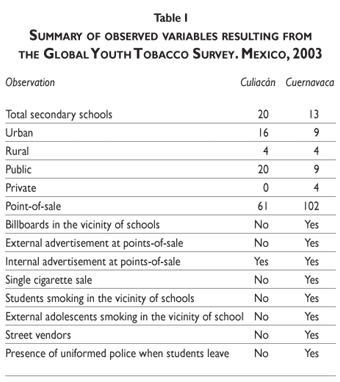
<body><![CDATA[<p><FONT SIZE="2" face="Verdana"> GIS tools can be used to monitor tobacco advertising    in the vicinity of schools and compliance with the current legislation, which    can also be used to support the development of new laws for decreasing the level    of exposure of students to tobacco advertising.</FONT></p>     <p><FONT SIZE="2" face="Verdana"> In view of the potential benefits that GIS can    bring to public health analysis, the Department of Informatics and Medical Geography    at the National Institute of Public Health (INSP for its initials in Spanish)    developed and maintains a GIS with national data on health and health related    data, such as the geographical distribution of mortality, morbidity, health    care infrastructure, and demographics and socioeconomic characteristics of the    Mexican population. Cartographic information such as urban trace for more than    18 000 localities, digital elevation models, aerial photography and satellite    images can also be found in this GIS, which served as a starting point for the    development of this project. This GIS can be freely accessed at <A HREF="http://naais.insp.mx/" target="_blank">http://naais.insp.mx</A>.</font></p>     <p>&nbsp;</p>     <p><font size="3" face="Verdana"><b>Material and Methods</b></font></p>     <p><FONT SIZE="2" face="Verdana">This is a study case for evaluating the feasibility    of using a GIS to determine the degree of compliance with the tobacco advertisement    law and its impact on secondary school students in the cities of Cuernavaca,    Morelos and Culiacan, Sinaloa, by observing billboard and/or tobacco advertising    at points-of-sale and relating it to the results of the Global Youth Tobacco    Survey. The project was carried out between November 2005 and January 2006.    The cities of Cuernavaca and Culiacan were selected for convenience to minimize    costs. Culiacan was selected due to the fact that one of our field teams was    scheduled to validate, with GPS equipment, the urban cartographic information    for that city and the National Institute of Public Health is located in Cuernavaca.</FONT></p>     <p><FONT SIZE="2" face="Verdana"><I>Schools</i>: A random sample of schools participating    in the Global Youth Tobacco Survey in the cities of Cuernavaca and Culiac&aacute;n    was selected to be geocoded by address and incorporated into the GIS. Addresses    of the selected schools were obtained from the public website managed by the    Ministry of Education.</FONT></p>     <p><FONT SIZE="2" face="Verdana"><I>Billboards</i>: Billboards were defined as    outdoor stationary structures upon which tobacco advertising was posted, including    elevated signs and signs attached or painted to the side of buildings.</FONT></p>     <p><FONT SIZE="2" face="Verdana"><I>Points of sale</i>: Points of sale were defined    as supermarkets, convenience stores, gas stations, small retail outlets, tobacco    stores, liquor stores and street vendors.</FONT></p>     <p><FONT SIZE="2" face="Verdana"><I>Study areas</i>: A 500 meter buffer around    the schools was constructed using the GIS to delimit the study area for each    school. </FONT></p>     <p><FONT SIZE="2" face="Verdana"><I>Field work</i>: A printed map of all schools    and their surroundings was produced to help field personnel find the schools    (<a href="/img/revistas/spm/v49s2/a14fig01.gif">Figure 1</a>). All billboards and points-of-sale    within the schools’ study areas were geo-referenced using a GPS device. We also    asked the field personnel to draw the location of billboards and points-of-sale    on the printed maps as a way to verify the information and to evaluate the possibility    of eliminating the use of GPS (as a way to lower costs) for a larger study by    simply incorporating them in the GIS by digitizing them on the screen based    on the paper map.</FONT></p>     ]]></body>
<body><![CDATA[<p><FONT SIZE="2" face="Verdana"> An instrument was developed to observe exterior    advertising (billboards) and the line of view from the school entrance. Another    instrument was developed for recording information about advertising strategies    at the points-of-sale. At each point-of-sale, promotional information and settings    offering cigarettes were observed and recorded. In addition, field personnel    asked about prices by the pack and carton of cigarettes. </FONT></p>     <p><FONT SIZE="2" face="Verdana"> The team spoke with school authorities, identifying    themselves as workers from the National Institute of Public Health, in order    to be allowed to photograph the schools and their surroundings at the time the    students were leaving. The behavior of the students was observed as they got    out of the schools and started on their way back home. </FONT></p>     <p>&nbsp;</p>     <p><font size="3" face="Verdana"><b>Results</b></font></p>     <p><FONT SIZE="2" face="Verdana">A total of 33 schools were visited, 20 in Culiacan    and 13 in Cuernavaca. Eighty percent were in urban areas in Culiacan and 69%    were in urban areas in Cuernavaca. Thirty-one percent of the schools in Cuernavaca    were private and 100% in Culiacan were public. No billboards were found that    advertised tobacco products in the study areas of the schools in Culiacan, but    they were found in Cuernavaca. There was as much as twice the number of points-of-sale    in Cuernavaca compared to Culiacan, even though more schools were visited in    the latter (<a href="#fig02">Figure 2</a> and <a href="/img/revistas/spm/v49s2/a14fig03.gif">3</a>).    Also, no tobacco advertising and no street vendors were observed in the exterior    of the points-of-sale in Culiacan, as opposed to Cuernavaca where they were    observed.</FONT></p>     <p><a name="fig02"></a></p>     <p>&nbsp;</p>     <p align="center"><img src="/img/revistas/spm/v49s2/a14fig02.gif"></p>     <p>&nbsp;</p>     <p><FONT SIZE="2" face="Verdana"> The general behavior of students leaving the    school varied by type of school and also by the presence, or not, of uniformed    police surveillance. In private schools, all students were orderly escorted    to a relative who came to pick them up and so none of them stayed in the surroundings    of the school. In public schools, the students gathered in the surroundings    of the school, along with other adolescents not from the school, some of who    were smoking. The presence of uniformed police determined the amount of time    the students took to disperse and their general behavior. It also determined    where street vendors sell single cigarettes and their location with respect    to the school entrance. In general, compliance with advertising laws was observed    to be higher in Culiacan than in Cuernavaca (<a href="#tab01">Table I</a>).</FONT></p>     ]]></body>
<body><![CDATA[<p><a name="tab01"></a></p>     <p>&nbsp;</p>     <p align="center"><img src="/img/revistas/spm/v49s2/a14tab01.gif"></p>     <p>&nbsp;</p>     <p><FONT SIZE="2" face="Verdana"> In Cuernavaca, students often did not present    identification when purchasing cigarettes, they had the option to buy single    cigarettes, and they were exposed to tobacco propaganda inside stores and through    the use of illegal billboards within 250 meters of the schools. In Culiacan,    there was less tobacco propaganda compared to Cuernavaca, possibly because Culiacan    schools were located in non-commercial areas. This correlates with the GYTS    survey findings showing that 21.3% of the students in Cuernavaca and 10.8% in    Culiacan were active smokers.</FONT></p>     <p>&nbsp;</p>     <p><font size="3" face="Verdana"><b>Discussion</b></font></p>     <p><FONT SIZE="2" face="Verdana">Geographic information systems have been successfully    used to assess exposure levels to environmental pollutants in many settings<SUP>9,10</SUP>    and to map and measure the level of exposure to tobacco advertising in urban    areas.<SUP>8</SUP> The use of geographic information systems in this project    was successful. It was used to map the amount of tobacco-related advertising    in the vicinity of secondary schools. Both the use of GPS and the direct digitizing    from the printed field maps were adequate for the purposes of the project; the    latter could be used to optimize resources in future work around the world as    part of a compliance surveillance tool. The Department of Medical Geography    and Informatics at the National Institute of Public Health has experience working    with GIS tools for the purpose of assessing the coverage of the Ministry of    Health hospital system.<SUP>6</SUP> Recently, we have developed web-based GIS    tools to geocode water quality in households based on addresses. This tool is    now being used by the Federal Commission for Sanitary Risk Protection (Comisi&oacute;n    Federal de Protecci&oacute;n contra Riesgos Sanitarios, COFEPRIS)</FONT></p>     <p><FONT SIZE="2" face="Verdana"> A similar tool could be used to promote civil    participation in the creation of geocodes for all tobacco-related billboards.    </FONT></p>     <p><FONT SIZE="2" face="Verdana"> The results of this project also show that in    the city where there was less exposure to tobacco advertising in the vicinity    of schools and less access to tobacco products, the prevalence of active smokers    was lower among secondary school students. Although this is a pilot project,    it supports the idea that tobacco advertising is targeting the adolescent population;    this, in-turn, supports the decrease in the age at which children start smoking.    </FONT></p>     ]]></body>
<body><![CDATA[<p><FONT SIZE="2" face="Verdana"> The current legislation is still not enough    enforced to diminish the exposure of students in secondary schools to tobacco    advertising. The observations in the present study show that, in spite of the    fact that the billboards are more than 250 meters away from school entrances,    they are strategically located along the paths that students walk to go home.    In addition, tobacco advertising was found in places where students wait for    the bus, and at outside points-of-sale. Around some schools in Cuernavaca, students    had access to purchasing individual cigarettes. This suggests that further work    has to be done in terms of the revision of the laws for protecting students    from exposure to tobacco advertising as well as their enforcement. </FONT></p>     <p>&nbsp;</p>     <p><FONT SIZE="3" face="Verdana"><b>References</b></FONT></p>     <!-- ref --><p><FONT SIZE="2" face="Verdana">1. Vald&eacute;s-Salgado R, Thrasher J, S&aacute;nchez-Zamorano    LM, Lazcano-Ponce E, Reynales-Shigematsu LM, Meneses-Gonz&aacute;lez F, <I>et    al</I>. Los retos del convenio marco para el control del tabaco en M&eacute;xico:    un diagn&oacute;stico a partir de la Encuesta sobre Tabaquismo en J&oacute;venes.    Salud Publica Mex 2006;48:5-16.</FONT>&nbsp;&nbsp;&nbsp;&nbsp;&nbsp;&nbsp;&nbsp;&nbsp;[&#160;<a href="javascript:void(0);" onclick="javascript: window.open('/scielo.php?script=sci_nlinks&ref=9244013&pid=S0036-3634200700080001400001&lng=','','width=640,height=500,resizable=yes,scrollbars=1,menubar=yes,');">Links</a>&#160;]<!-- end-ref --><!-- ref --><p><FONT SIZE="2" face="Verdana">2. Campuzano-Rinc&oacute;n JC, Hern&aacute;ndez-Avila    M, Sammet JM, M&eacute;ndez-Ram&iacute;rez I, Tapia-Conyer R, Sep&uacute;lveda-Amor    J. Comportamiento de los fumadores en M&eacute;xico seg&uacute;n las Encuestas    Nacionales de Adicciones 1988 a 1998. In: Vald&eacute;s-Salgado R, Lazcano-Ponce    EC, Hern&aacute;ndez-Avila M. Primer informe sobre el combate al tabaquismo.    M&eacute;xico ante el Convenio Marco para el Control del Tabaco, M&eacute;xico.    Cuernavaca: Instituto Nacional de Salud P&uacute;blica, 2005.</FONT>&nbsp;&nbsp;&nbsp;&nbsp;&nbsp;&nbsp;&nbsp;&nbsp;[&#160;<a href="javascript:void(0);" onclick="javascript: window.open('/scielo.php?script=sci_nlinks&ref=9244014&pid=S0036-3634200700080001400002&lng=','','width=640,height=500,resizable=yes,scrollbars=1,menubar=yes,');">Links</a>&#160;]<!-- end-ref --><!-- ref --><p><FONT SIZE="2" face="Verdana">3. Breslau N, Peterson EL. Smoking cessation    in young adults: age at initiation of cigarette smoking and other suspected    influences. Am J Public Health 1996;86:214-220.</FONT>&nbsp;&nbsp;&nbsp;&nbsp;&nbsp;&nbsp;&nbsp;&nbsp;[&#160;<a href="javascript:void(0);" onclick="javascript: window.open('/scielo.php?script=sci_nlinks&ref=9244015&pid=S0036-3634200700080001400003&lng=','','width=640,height=500,resizable=yes,scrollbars=1,menubar=yes,');">Links</a>&#160;]<!-- end-ref --><!-- ref --><p><FONT SIZE="2" face="Verdana">4. Ricketts TC. Geographic information systems    and public health. Ann Rev Public Health 2003;24:1-6.</FONT>&nbsp;&nbsp;&nbsp;&nbsp;&nbsp;&nbsp;&nbsp;&nbsp;[&#160;<a href="javascript:void(0);" onclick="javascript: window.open('/scielo.php?script=sci_nlinks&ref=9244016&pid=S0036-3634200700080001400004&lng=','','width=640,height=500,resizable=yes,scrollbars=1,menubar=yes,');">Links</a>&#160;]<!-- end-ref --><!-- ref --><p><FONT SIZE="2" face="Verdana">5. Cromley HK, McLafferty SL. GIS and public    health. New York:Guilford, 2002;15-38.</FONT>&nbsp;&nbsp;&nbsp;&nbsp;&nbsp;&nbsp;&nbsp;&nbsp;[&#160;<a href="javascript:void(0);" onclick="javascript: window.open('/scielo.php?script=sci_nlinks&ref=9244017&pid=S0036-3634200700080001400005&lng=','','width=640,height=500,resizable=yes,scrollbars=1,menubar=yes,');">Links</a>&#160;]<!-- end-ref --><!-- ref --><p><FONT SIZE="2" face="Verdana">6. Hern&aacute;ndez-Avila JE, Rodr&iacute;guez    MH, Rodr&iacute;guez NE, Santos R, Morales E, Cruz C, <I>et al</I>. Cobertura    geogr&aacute;fica del sistema mexicano de salud y an&aacute;lisis espacial de    la utilizaci&oacute;n de hospitales generales de la Secretar&iacute;a de Salud    en 1998. Salud Publica Mex 2002;44:519-532.</FONT>&nbsp;&nbsp;&nbsp;&nbsp;&nbsp;&nbsp;&nbsp;&nbsp;[&#160;<a href="javascript:void(0);" onclick="javascript: window.open('/scielo.php?script=sci_nlinks&ref=9244018&pid=S0036-3634200700080001400006&lng=','','width=640,height=500,resizable=yes,scrollbars=1,menubar=yes,');">Links</a>&#160;]<!-- end-ref --><!-- ref --><p><FONT SIZE="2" face="Verdana">7. McLafferty SL. GIS and health care. Ann Rev    Public Health 2003;24:25-42.</FONT>&nbsp;&nbsp;&nbsp;&nbsp;&nbsp;&nbsp;&nbsp;&nbsp;[&#160;<a href="javascript:void(0);" onclick="javascript: window.open('/scielo.php?script=sci_nlinks&ref=9244019&pid=S0036-3634200700080001400007&lng=','','width=640,height=500,resizable=yes,scrollbars=1,menubar=yes,');">Links</a>&#160;]<!-- end-ref --><!-- ref --><p><FONT SIZE="2" face="Verdana">8. Luke D, Esmundo E, Bloom Y. Smoke signs: patterns    of tobacco billboard advertising in a metropolitan region. Tob    Control 2000;9:16-23.</font>&nbsp;&nbsp;&nbsp;&nbsp;&nbsp;&nbsp;&nbsp;&nbsp;[&#160;<a href="javascript:void(0);" onclick="javascript: window.open('/scielo.php?script=sci_nlinks&ref=9244020&pid=S0036-3634200700080001400008&lng=','','width=640,height=500,resizable=yes,scrollbars=1,menubar=yes,');">Links</a>&#160;]<!-- end-ref --><!-- ref --><p><FONT SIZE="2" face="Verdana">9. Brody J, Melly S, Rudel R, Maxwell N. GIS    exposure assessment for pesticides and drinking water in the Cape Cod breast    cancer and environment study. Epidemiology 2000;11:102.</FONT>&nbsp;&nbsp;&nbsp;&nbsp;&nbsp;&nbsp;&nbsp;&nbsp;[&#160;<a href="javascript:void(0);" onclick="javascript: window.open('/scielo.php?script=sci_nlinks&ref=9244021&pid=S0036-3634200700080001400009&lng=','','width=640,height=500,resizable=yes,scrollbars=1,menubar=yes,');">Links</a>&#160;]<!-- end-ref --><!-- ref --><p><FONT SIZE="2" face="Verdana">10. Josef C, Matthias H, Ulrike G, Hoek G, Diegmann    V, Brunekreef B, <I>et al</I>. GIS-based estimation of exposure to particulate    matter and NO<SUB>2</SUB> in an urban area: Stochastic versus dispersion modeling.    Environ Health Perspect 2005; 113: 987-992.</FONT>&nbsp;&nbsp;&nbsp;&nbsp;&nbsp;&nbsp;&nbsp;&nbsp;[&#160;<a href="javascript:void(0);" onclick="javascript: window.open('/scielo.php?script=sci_nlinks&ref=9244022&pid=S0036-3634200700080001400010&lng=','','width=640,height=500,resizable=yes,scrollbars=1,menubar=yes,');">Links</a>&#160;]<!-- end-ref --><p>&nbsp;</p>     <p>&nbsp;</p>     <p><FONT SIZE="2" face="Verdana">Received on: April 4, 2007    <br>   Accepted on: April 30, 2007</FONT></p>     <p>&nbsp;</p>     <p>&nbsp;</p>     <p><FONT SIZE="2" face="Verdana">Solicitud de sobretiros: Mtro. Juan Eugenio Hern&aacute;ndez-&Aacute;vila.    Instituto Nacional de Salud P&uacute;blica. Av. Universidad 655, Col. Santa    Mar&iacute;a Ahuacatitl&aacute;n. 62508, Cuernavaca, Morelos, M&eacute;xico.    Correo electr&oacute;nico: <a href="mailto:juan_eugenio@correo.insp.mx">juan_eugenio@correo.insp.mx</a></FONT></p>     ]]></body>
<body><![CDATA[ ]]></body><back>
<ref-list>
<ref id="B1">
<label>1</label><nlm-citation citation-type="journal">
<person-group person-group-type="author">
<name>
<surname><![CDATA[Valdés-Salgado]]></surname>
<given-names><![CDATA[R]]></given-names>
</name>
<name>
<surname><![CDATA[Thrasher]]></surname>
<given-names><![CDATA[J]]></given-names>
</name>
<name>
<surname><![CDATA[Sánchez-Zamorano]]></surname>
<given-names><![CDATA[LM]]></given-names>
</name>
<name>
<surname><![CDATA[Lazcano-Ponce]]></surname>
<given-names><![CDATA[E]]></given-names>
</name>
<name>
<surname><![CDATA[Reynales-Shigematsu]]></surname>
<given-names><![CDATA[LM]]></given-names>
</name>
<name>
<surname><![CDATA[Meneses-González]]></surname>
<given-names><![CDATA[F]]></given-names>
</name>
<name>
<surname><![CDATA[et]]></surname>
<given-names><![CDATA[al]]></given-names>
</name>
</person-group>
<article-title xml:lang="es"><![CDATA[Los retos del convenio marco para el control del tabaco en México: un diagnóstico a partir de la Encuesta sobre Tabaquismo en Jóvenes]]></article-title>
<source><![CDATA[Salud Publica Mex]]></source>
<year>2006</year>
<volume>48</volume>
<page-range>5-16</page-range></nlm-citation>
</ref>
<ref id="B2">
<label>2</label><nlm-citation citation-type="book">
<person-group person-group-type="author">
<name>
<surname><![CDATA[Campuzano-Rincón]]></surname>
<given-names><![CDATA[JC]]></given-names>
</name>
<name>
<surname><![CDATA[Hernández-Avila]]></surname>
<given-names><![CDATA[M]]></given-names>
</name>
<name>
<surname><![CDATA[Sammet]]></surname>
<given-names><![CDATA[JM]]></given-names>
</name>
<name>
<surname><![CDATA[Méndez-Ramírez]]></surname>
<given-names><![CDATA[I]]></given-names>
</name>
<name>
<surname><![CDATA[Tapia-Conyer]]></surname>
<given-names><![CDATA[R]]></given-names>
</name>
<name>
<surname><![CDATA[Sepúlveda-Amor]]></surname>
<given-names><![CDATA[J]]></given-names>
</name>
</person-group>
<article-title xml:lang="es"><![CDATA[Comportamiento de los fumadores en México según las Encuestas Nacionales de Adicciones 1988 a 1998]]></article-title>
<person-group person-group-type="editor">
<name>
<surname><![CDATA[Valdés-Salgado]]></surname>
<given-names><![CDATA[R]]></given-names>
</name>
<name>
<surname><![CDATA[Lazcano-Ponce]]></surname>
<given-names><![CDATA[EC]]></given-names>
</name>
<name>
<surname><![CDATA[Hernández-Avila]]></surname>
<given-names><![CDATA[M]]></given-names>
</name>
</person-group>
<source><![CDATA[Primer informe sobre el combate al tabaquismo: México ante el Convenio Marco para el Control del Tabaco, México]]></source>
<year>2005</year>
<publisher-loc><![CDATA[Cuernavaca ]]></publisher-loc>
<publisher-name><![CDATA[Instituto Nacional de Salud Pública]]></publisher-name>
</nlm-citation>
</ref>
<ref id="B3">
<label>3</label><nlm-citation citation-type="journal">
<person-group person-group-type="author">
<name>
<surname><![CDATA[Breslau]]></surname>
<given-names><![CDATA[N]]></given-names>
</name>
<name>
<surname><![CDATA[Peterson]]></surname>
<given-names><![CDATA[EL]]></given-names>
</name>
</person-group>
<article-title xml:lang="en"><![CDATA[Smoking cessation in young adults: age at initiation of cigarette smoking and other suspected influences]]></article-title>
<source><![CDATA[Am J Public Health]]></source>
<year>1996</year>
<volume>86</volume>
<page-range>214-220</page-range></nlm-citation>
</ref>
<ref id="B4">
<label>4</label><nlm-citation citation-type="journal">
<person-group person-group-type="author">
<name>
<surname><![CDATA[Ricketts]]></surname>
<given-names><![CDATA[TC]]></given-names>
</name>
</person-group>
<article-title xml:lang="en"><![CDATA[Geographic information systems and public health]]></article-title>
<source><![CDATA[Ann Rev Public Health]]></source>
<year>2003</year>
<volume>24</volume>
<page-range>1-6</page-range></nlm-citation>
</ref>
<ref id="B5">
<label>5</label><nlm-citation citation-type="book">
<person-group person-group-type="author">
<name>
<surname><![CDATA[Cromley]]></surname>
<given-names><![CDATA[HK]]></given-names>
</name>
<name>
<surname><![CDATA[McLafferty]]></surname>
<given-names><![CDATA[SL]]></given-names>
</name>
</person-group>
<source><![CDATA[GIS and public health]]></source>
<year>2002</year>
<page-range>15-38</page-range><publisher-loc><![CDATA[New York ]]></publisher-loc>
<publisher-name><![CDATA[Guilford]]></publisher-name>
</nlm-citation>
</ref>
<ref id="B6">
<label>6</label><nlm-citation citation-type="journal">
<person-group person-group-type="author">
<name>
<surname><![CDATA[Hernández-Avila]]></surname>
<given-names><![CDATA[JE]]></given-names>
</name>
<name>
<surname><![CDATA[Rodríguez]]></surname>
<given-names><![CDATA[MH]]></given-names>
</name>
<name>
<surname><![CDATA[Rodríguez]]></surname>
<given-names><![CDATA[NE]]></given-names>
</name>
<name>
<surname><![CDATA[Santos]]></surname>
<given-names><![CDATA[R]]></given-names>
</name>
<name>
<surname><![CDATA[Morales]]></surname>
<given-names><![CDATA[E]]></given-names>
</name>
<name>
<surname><![CDATA[Cruz]]></surname>
<given-names><![CDATA[C]]></given-names>
</name>
<name>
<surname><![CDATA[et]]></surname>
<given-names><![CDATA[al]]></given-names>
</name>
</person-group>
<article-title xml:lang="es"><![CDATA[Cobertura geográfica del sistema mexicano de salud y análisis espacial de la utilización de hospitales generales de la Secretaría de Salud en 1998]]></article-title>
<source><![CDATA[Salud Publica Mex]]></source>
<year>2002</year>
<volume>44</volume>
<page-range>519-532</page-range></nlm-citation>
</ref>
<ref id="B7">
<label>7</label><nlm-citation citation-type="journal">
<person-group person-group-type="author">
<name>
<surname><![CDATA[McLafferty]]></surname>
<given-names><![CDATA[SL]]></given-names>
</name>
</person-group>
<article-title xml:lang="en"><![CDATA[GIS and health care]]></article-title>
<source><![CDATA[Ann Rev Public Health]]></source>
<year>2003</year>
<volume>24</volume>
<page-range>25-42</page-range></nlm-citation>
</ref>
<ref id="B8">
<label>8</label><nlm-citation citation-type="journal">
<person-group person-group-type="author">
<name>
<surname><![CDATA[Luke]]></surname>
<given-names><![CDATA[D]]></given-names>
</name>
<name>
<surname><![CDATA[Esmundo]]></surname>
<given-names><![CDATA[E]]></given-names>
</name>
<name>
<surname><![CDATA[Bloom]]></surname>
<given-names><![CDATA[Y]]></given-names>
</name>
</person-group>
<article-title xml:lang="en"><![CDATA[Smoke signs: patterns of tobacco billboard advertising in a metropolitan region]]></article-title>
<source><![CDATA[Tob Control]]></source>
<year>2000</year>
<volume>9</volume>
<page-range>16-23</page-range></nlm-citation>
</ref>
<ref id="B9">
<label>9</label><nlm-citation citation-type="journal">
<person-group person-group-type="author">
<name>
<surname><![CDATA[Brody]]></surname>
<given-names><![CDATA[J]]></given-names>
</name>
<name>
<surname><![CDATA[Melly]]></surname>
<given-names><![CDATA[S]]></given-names>
</name>
<name>
<surname><![CDATA[Rudel]]></surname>
<given-names><![CDATA[R]]></given-names>
</name>
<name>
<surname><![CDATA[Maxwell]]></surname>
<given-names><![CDATA[N]]></given-names>
</name>
</person-group>
<article-title xml:lang="en"><![CDATA[GIS exposure assessment for pesticides and drinking water in the Cape Cod breast cancer and environment study]]></article-title>
<source><![CDATA[Epidemiology]]></source>
<year>2000</year>
<volume>11</volume>
<page-range>102</page-range></nlm-citation>
</ref>
<ref id="B10">
<label>10</label><nlm-citation citation-type="journal">
<person-group person-group-type="author">
<name>
<surname><![CDATA[Josef]]></surname>
<given-names><![CDATA[C]]></given-names>
</name>
<name>
<surname><![CDATA[Matthias]]></surname>
<given-names><![CDATA[H]]></given-names>
</name>
<name>
<surname><![CDATA[Ulrike]]></surname>
<given-names><![CDATA[G]]></given-names>
</name>
<name>
<surname><![CDATA[Hoek]]></surname>
<given-names><![CDATA[G]]></given-names>
</name>
<name>
<surname><![CDATA[Diegmann]]></surname>
<given-names><![CDATA[V]]></given-names>
</name>
<name>
<surname><![CDATA[Brunekreef]]></surname>
<given-names><![CDATA[B]]></given-names>
</name>
</person-group>
<article-title xml:lang="en"><![CDATA[GIS-based estimation of exposure to particulate matter and NO2 in an urban area: Stochastic versus dispersion modeling]]></article-title>
<source><![CDATA[Environ Health Perspect]]></source>
<year>2005</year>
<volume>113</volume>
<page-range>987-992</page-range></nlm-citation>
</ref>
</ref-list>
</back>
</article>