<?xml version="1.0" encoding="ISO-8859-1"?><article xmlns:mml="http://www.w3.org/1998/Math/MathML" xmlns:xlink="http://www.w3.org/1999/xlink" xmlns:xsi="http://www.w3.org/2001/XMLSchema-instance">
<front>
<journal-meta>
<journal-id>0036-3634</journal-id>
<journal-title><![CDATA[Salud Pública de México]]></journal-title>
<abbrev-journal-title><![CDATA[Salud pública Méx]]></abbrev-journal-title>
<issn>0036-3634</issn>
<publisher>
<publisher-name><![CDATA[Instituto Nacional de Salud Pública]]></publisher-name>
</publisher>
</journal-meta>
<article-meta>
<article-id>S0036-36342007000800004</article-id>
<title-group>
<article-title xml:lang="en"><![CDATA[Adult smoking trends in Mexico: an analysis of the Mexican National Addiction Surveys]]></article-title>
<article-title xml:lang="es"><![CDATA[Tendencias del tabaquismo en adultos en México: análisis de las Encuestas Nacionales de Adicciones]]></article-title>
</title-group>
<contrib-group>
<contrib contrib-type="author">
<name>
<surname><![CDATA[Franco-Marina]]></surname>
<given-names><![CDATA[Francisco]]></given-names>
</name>
<xref ref-type="aff" rid="A01"/>
</contrib>
</contrib-group>
<aff id="A01">
<institution><![CDATA[,Instituto Nacional de Rehabilitación División de Epidemiología ]]></institution>
<addr-line><![CDATA[ ]]></addr-line>
<country>México</country>
</aff>
<pub-date pub-type="pub">
<day>00</day>
<month>00</month>
<year>2007</year>
</pub-date>
<pub-date pub-type="epub">
<day>00</day>
<month>00</month>
<year>2007</year>
</pub-date>
<volume>49</volume>
<fpage>s137</fpage>
<lpage>s146</lpage>
<copyright-statement/>
<copyright-year/>
<self-uri xlink:href="http://www.scielo.org.mx/scielo.php?script=sci_arttext&amp;pid=S0036-36342007000800004&amp;lng=en&amp;nrm=iso"></self-uri><self-uri xlink:href="http://www.scielo.org.mx/scielo.php?script=sci_abstract&amp;pid=S0036-36342007000800004&amp;lng=en&amp;nrm=iso"></self-uri><self-uri xlink:href="http://www.scielo.org.mx/scielo.php?script=sci_pdf&amp;pid=S0036-36342007000800004&amp;lng=en&amp;nrm=iso"></self-uri><abstract abstract-type="short" xml:lang="en"><p><![CDATA[OBJECTIVE: To describe and explain the recent trends of four smoking indicators in Mexico. MATERIALS AND METHODS: Comparable data from four national probabilistic household surveys (1988-1992) were analyzed using statistical techniques for survey data. The analysis was restricted to persons aged 18 to 65 years. Changes in indicators compare 2002 to 1988. RESULTS: The overall prevalence of never smokers increased by 10% and increased more in men. The prevalence of daily smokers shows a 16% reduction in men and reductions are concentrated in persons 45 and older. The average number of cigarettes smoked daily shows a 31% decrease in men and no decrease in women. The prevalence of heavy smokers (one pack or more) is 60% higher in women in 2002. CONCLUSIONS: Mexico does not closely follow the WHO model for the evolving tobacco epidemic. Nevertheless, the tobacco epidemic is in an advanced stage, with a decreasing prevalence in men and a rising one in women and the young. The improvement in the smoking situation was mainly due to the country’s economic stagnation during the analyzed period and to public awareness of the dangers of tobacco exposure rather than to a sound control policy on the part of the state.]]></p></abstract>
<abstract abstract-type="short" xml:lang="es"><p><![CDATA[OBJETIVO: Describir y explicar las tendencias recientes de cuatro indicadores de tabaquismo en México. MATERIAL Y MÉTODOS: Se analizan datos comparables de las cuatro Encuestas Nacionales de Adicciones (1988-1992) mediante técnicas estadísticas adecuadas para datos muestrales. En el análisis se incluye a personas entre 18 y 65 años de edad. Los cambios en indicadores comparan 2002 con respecto a 1988. RESULTADOS: La prevalencia en ambos sexos de nunca fumadores aumentó 10% pero dicho aumento ocurrió solo en hombres. La prevalencia de fumadores diarios se redujo un 16% en hombres y en ambos sexos las reducciones más importantes ocurrieron en las personas de 45 y más años. El promedio de cigarrillos diarios se redujo en 31% en hombres exclusivamente. La prevalencia de fumadores de una cajetilla o más fue 60% mayor en mujeres en 2002. CONCLUSIONES: México no sigue completamente el modelo de la OMS de la epidemia de tabaquismo. En todo caso, se encuentra en una etapa avanzada de la epidemia con reducciones en la prevalencia en hombres y aumento en las mujeres y los jóvenes. La mejoría observada se debió principalmente al estancamiento económico observado en el país y al mayor conocimiento de la población de los efectos dañinos del tabaquismo, más que a una sólida política estatal de control.]]></p></abstract>
<kwd-group>
<kwd lng="en"><![CDATA[Smoking epidemic stages]]></kwd>
<kwd lng="en"><![CDATA[Smoking trends]]></kwd>
<kwd lng="en"><![CDATA[Never smokers]]></kwd>
<kwd lng="en"><![CDATA[Daily smokers]]></kwd>
<kwd lng="en"><![CDATA[smoking intensity]]></kwd>
<kwd lng="en"><![CDATA[smoking economic determinants]]></kwd>
<kwd lng="en"><![CDATA[Mexico]]></kwd>
<kwd lng="es"><![CDATA[Etapas de la epidemia de tabaquismo]]></kwd>
<kwd lng="es"><![CDATA[Tendencias en el tabaquismo]]></kwd>
<kwd lng="es"><![CDATA[Nunca fumadores]]></kwd>
<kwd lng="es"><![CDATA[fumadores diarios]]></kwd>
<kwd lng="es"><![CDATA[intensidad del tabaquismo]]></kwd>
<kwd lng="es"><![CDATA[determinantes económicos del tabaquismo]]></kwd>
<kwd lng="es"><![CDATA[México]]></kwd>
</kwd-group>
</article-meta>
</front><body><![CDATA[ <p align="right"><FONT size="2" FACE="Verdana"><b>ART&Iacute;CULO ORIGINAL</b></font></p>     <p>&nbsp;</p>     <p><FONT size="4" FACE="verdana"><b>Adult smoking trends in Mexico: an analysis    of the Mexican National Addiction Surveys </b></font></p>     <p>&nbsp;</p>     <p><font size="3" face="verdana"><B>Tendencias del tabaquismo en adultos en M&eacute;xico:    an&aacute;lisis de las Encuestas Nacionales de Adicciones</B></font></p>     <p>&nbsp;</p>     <p>&nbsp;</p>     <p><font size="2" face="Verdana"><B>Francisco Franco-Marina MC, MPH, MHSc</B></font></p>     <p><font size="2" face="Verdana">Divisi&oacute;n de Epidemiolog&iacute;a. Instituto    Nacional de Rehabilitaci&oacute;n. M&eacute;xico</font></p>     <p>&nbsp;</p>     ]]></body>
<body><![CDATA[<p>&nbsp;</p> <hr size="1" noshade>     <p><font size="2" face="Verdana"><B>ABSTRACT</B></font></p>     <p><font size="2" face="Verdana"><B>OBJECTIVE:</b> To describe and explain the    recent trends of four smoking indicators in Mexico.    <br>   <B>MATERIALS AND METHODS:</B> Comparable data from four national probabilistic    household surveys (1988-1992) were analyzed using statistical techniques for    survey data. The analysis was restricted to persons aged 18 to 65 years. Changes    in indicators compare 2002 to 1988.    <br>   <B>RESULTS:</B> The overall prevalence of never smokers increased by 10% and    increased more in men. The prevalence of daily smokers shows a 16% reduction    in men and reductions are concentrated in persons 45 and older. The average    number of cigarettes smoked daily shows a 31% decrease in men and no decrease    in women. The prevalence of heavy smokers (one pack or more) is 60% higher in    women in 2002.    <br>   <B>CONCLUSIONS: </B>Mexico does not closely follow the WHO model for the evolving    tobacco epidemic. Nevertheless, the tobacco epidemic is in an advanced stage,    with a decreasing prevalence in men and a rising one in women and the young.    The improvement in the smoking situation was mainly due to the country’s economic    stagnation during the analyzed period and to public awareness of the dangers    of tobacco exposure rather than to a sound control policy on the part of the    state.</font></p>     <p><font size="2" face="Verdana"><b>Keywords:</b> Smoking epidemic stages; Smoking    trends; Never smokers; Daily smokers; smoking intensity; smoking economic determinants;    Mexico</font></p> <hr size="1" noshade>     <p><font size="2" face="Verdana"><B>RESUMEN</B></font></p>     <p><font size="2" face="Verdana"><B>OBJETIVO:</b> Describir y explicar las tendencias    recientes de cuatro indicadores de tabaquismo en M&eacute;xico.    <br>   <B>MATERIAL Y M&Eacute;TODOS:</B> Se analizan datos comparables de las cuatro    Encuestas Nacionales de Adicciones (1988-1992) mediante t&eacute;cnicas estad&iacute;sticas    adecuadas para datos muestrales. En el an&aacute;lisis se incluye a personas    entre 18 y 65 a&ntilde;os de edad. Los cambios en indicadores comparan 2002    con respecto a 1988.    ]]></body>
<body><![CDATA[<br>   <B>RESULTADOS:</B> La prevalencia en ambos sexos de nunca fumadores aument&oacute;    10% pero dicho aumento ocurri&oacute; solo en hombres. La prevalencia de fumadores    diarios se redujo un 16% en hombres y en ambos sexos las reducciones m&aacute;s    importantes ocurrieron en las personas de 45 y m&aacute;s a&ntilde;os. El promedio    de cigarrillos diarios se redujo en 31% en hombres exclusivamente. La prevalencia    de fumadores de una cajetilla o m&aacute;s fue 60% mayor en mujeres en 2002.    <br>   <B>CONCLUSIONES:</B> M&eacute;xico no sigue completamente el modelo de la OMS    de la epidemia de tabaquismo. En todo caso, se encuentra en una etapa avanzada    de la epidemia con reducciones en la prevalencia en hombres y aumento en las    mujeres y los j&oacute;venes. La mejor&iacute;a observada se debi&oacute; principalmente    al estancamiento econ&oacute;mico observado en el pa&iacute;s y al mayor conocimiento    de la poblaci&oacute;n de los efectos da&ntilde;inos del tabaquismo, m&aacute;s    que a una s&oacute;lida pol&iacute;tica estatal de control. </font></p>     <p><font size="2" face="Verdana"><b>Palabras claves:</b> Etapas de la epidemia    de tabaquismo;Tendencias en el tabaquismo; Nunca fumadores; fumadores diarios;    intensidad del tabaquismo; determinantes econ&oacute;micos del tabaquismo; M&eacute;xico</font></p> <hr size="1" noshade>     <p>&nbsp;</p>     <p>&nbsp;</p>     <p><font size="2" face="Verdana">Lopez <I>et al.</I> introduced a descriptive    model of the tobacco epidemic in developed countries based on nearly 100 years    of observations of countries with a long history of widespread cigarette use.<SUP>1</SUP>    Such a model divides the smoking epidemic into four stages, characterized by    different smoking prevalences in men and women and subsequent attributable mortality.    Although it was originally proposed to explain apparent paradoxes, like an increase    in attributable mortality concurrent with decreasing smoking prevalence, it    has become a standard reference for classifying the status of the smoking epidemic    within the context of the global pandemic.<SUP>2</SUP> The model seems to be    appropriate for describing the rising tobacco epidemic in most Asian emerging    economies.<SUP>3-6</SUP> However, when the model is applied to Latin American    countries, including Mexico, it seems to place these countries at an earlier    stage<SUP>7,2</SUP> than what is suggested by other data. One possible explanation    for this inadequate fit is that the Lopez <I>et al.</I> model is based on the    observation of growing economies at a time when very little was known about    the deleterious effects of tobacco consumption.</font></p>     <p><font size="2" face="Verdana"> Like other Latin American countries, Mexico    has suffered at least 25 years of economic stagnation, increasing inequalities    and decreasing wages. This economic context has undoubtedly shaped the course    of the smoking epidemic. Public awareness of the health risks of smoking should    also have had some effect on the trends of the smoking epidemic in Mexico. To    examine these hypotheses, this paper presents an analysis of smoking information    for adults aged 18 to 65 included in the Mexican National Addiction Surveys    (MNAS) conducted in 1988, 1993, 1998 and 2002. Most of the period covered by    these surveys was characterized by very low economic growth and the virtual    absence of effective smoking control policies. MNAS data were obtained through    a probabilistic sampling design with face-to-face interviews of the respondents.    Although methodological differences exist among the four MNAS waves, an attempt    has been made to make the information comparable.</font></p>     <p>&nbsp;</p>     <p><FONT size="3" FACE="Verdana"><b>Materials and Methods </b></font></p>     <p><font size="2" face="Verdana"><B>Data sources and data preparation</B></font></p>     ]]></body>
<body><![CDATA[<p><font size="2" face="Verdana">Information analyzed in this paper comes from    the four MNAS. The basic sampling design used in all survey years consisted    of a stratified multistage cluster-sampling scheme. Within state regions, census    tracts (AGEBs, per its initials in spanish) were randomly selected and blocks    and subsequently households were randomly sampled. The last stage of sampling    consisted of the random selection of a person of the appropriate age range within    the households.</font></p>     <p><font size="2" face="Verdana"> Although all MNAS waves used a similar sampling    scheme, important differences occurred over time in terms of the target population.    Thus, the first three waves, designed and conducted by the Ministry of Health,    focused more on urban populations, whereas the last wave, designed and conducted    by the National Institute of Statistics Geography and Informatics of Mexico    (INEGI, per its initials in spanish), focused on the entire Mexican population.    Smoking prevalence and intensity is lower in Mexican rural populations. Therefore,    to increase the comparability of the target population in all MNAS years for    trend analysis, only information pertaining to municipalities with a similar    level of urban development as that observed in most MNAS waves was selected    for analysis. Urban development in the municipalities was evaluated using the    marginality index, a standardized socioeconomic deprivation index developed    by the Mexican Population Council (CONAPO, per its acronym in spanish) based    on census data, which includes housing and socioeconomic indicators of the population    as well as information on the proportion of the population living in towns with    less than 15 000 persons.<SUP>8</SUP> For the present analysis, the marginality    index developed with data from the 1990 census was used, which included only    the observations in the 2002 MNAS obtained from municipalities with a 1990 marginality    index <U>&lt;</u> 1.425. This excluded from the analysis 0.96% of the observations    from the 2002 MNAS corresponding to highly rural municipalities.</font></p>     <p><font size="2" face="Verdana"> All MNAS waves used standardized questionnaires,    administered face-to-face by trained interviewers. However, smoking questions    on the questionnaires have changed with each wave and this, coupled with the    limited exploration in most waves with regard to former smoking, has limited    the type of smoking indicators whose trends over time could be analyzed. Thus,    for instance, current smoking ascertainment is not directly comparable between    years since the direct question, "<I>¿Fuma usted actualmente? / Do you    currently smoke?"</I> that was included in the first two MNAS years, was    deleted in the subsequent ones and substituted by questions such as: "<I>En    (el) los &uacute;ltimo(s) __ (d&iacute;as, semanas, mes) ¿ha fumado tabaco?    / Have you smoked during the last __ days/weeks/month?"</I> In addition,    the generally asked question,<I> "¿Durante su vida ha fumado m&aacute;s    de 100 ciga-rrillos (5 cajetillas)? / During your lifetime have you smoked more    than 100 cigarrettes (5 packs)?"</I> was only included in the last three    MNAS waves. </font></p>     <p><font size="2" face="Verdana"> Given the mentioned changes in the questionnaires,    it was decided to analyze the trends of four smoking indicators that were directly    comparable in all MNAS waves:</font></p>     <blockquote>        <p><font size="2" face="Verdana">a) Never smokers: Persons who answered "no"      to the question "<I>¿Ha fumado tabaco alguna vez en su vida?/ During      your lifetime, have you ever smoked tobacco?"</I> All MNAS waves included      this question.</font></p>       <p><font size="2" face="Verdana">b) Daily smokers: Persons who smoked daily.      The question used to determine daily smoking the first year was "<I>¿Usted      fuma a diario?/ Do you smoke daily?</I>" Years two and three included      the question<I> "¿Cu&aacute;ntos cigarros fuma y con qu&eacute; frecuencia      (diario, semanal, etc.)?/ How many cigarettes do you smoke and how often (daily,      per week, etc)?"</I> Finally, year four included the question "<I>¿Aproximadamente,      cu&aacute;ntos cigarrillos ha fumado diariamente en los &uacute;ltimos 30      d&iacute;as?/ Approximately, how many cigarettes have you smoked daily during      the last 30 days?"</i></font></p>       <p><font size="2" face="Verdana">c) Smoking intensity in daily smokers: All      waves included questions on the approximate number of cigarettes smoked daily,      as indicated above. Waves one through three had open answers to these questions.      Wave four had closed answers with the following intervals: 1-5, 6-10, 11-20,      21 or more. In order to make data comparable among the survey waves, the number      of cigarettes smoked in wave one to year three was categorized as in wave      four. Then the average number of cigarettes smoked within wave four in each      category was obtained by combining the information from waves one to three.      The average number of cigarettes smoked in the intervals used in wave four,      according to the information from waves one to three, were 3.2, 8.4, 14.5      and 23.6. These averages allowed for the computing of the number of cigarettes      smoked daily for each person in waves one through four using the same categorization      in all waves for cigarettes smoked daily as in wave four. The trends of the      percentage of heavy daily smokers (persons who smoked 21 or more cigarettes      daily) were also assessed.</font></p>       <p><font size="2" face="Verdana">d) Daily smokers who had ever attempted to      quit: Persons who answered "yes" to the question "<I>¿Alguna      vez ha intentado dejar de fumar? / Have you ever attempted to quit smoking?"</I>      All MNAS waves used the same question.</font></p> </blockquote>     <p><font size="2" face="Verdana"><B>Statistical analysis</B></font></p>     ]]></body>
<body><![CDATA[<p><font size="2" face="Verdana">All statistical procedures employed in this report    made allowances for the selection probabilities of each observation. The observations’    expansion factors were available in each MNAS database and their inverse was    used as the selection probability. Additional information on the primary sampling    units and survey strata were available but were not used because the expansion    factors that were used were produced using such information and national data    were the focus of this report. Statistical survey procedures available in STATA    version 9 were used throughout this analysis.<SUP>9</SUP> </font></p>     <p><font size="2" face="Verdana"> Information was analyzed for persons between    18 and 65 years of age. Either proportions or means were used as appropriate    smoking indicator summaries. Statistical models with the following general form    assessed time trends for these indicators:</font></p>     <p align="center"><font size="2" face="Verdana"> <font face="Symbol">Æ</font>    = <font face="Symbol">b</font><I><SUB>o</sub></I> + <font face="Symbol">Sb</font><SUB><i>k</i></SUB><i>a<SUB>k</SUB></i>    + <font face="Symbol">Sb</font><I><SUB>i</sub></I><font face="Symbol">l</font><SUB><i>i</i></SUB>    + <font face="Symbol">Sb</font><SUB><i>1</i> </SUB>&#181;    + <font face="Symbol">Sb</font><I><SUB>2</sub></I><font face="Symbol">l</font>    + <font face="Symbol">e</font></font></p>     <p><font size="2" face="Verdana">Where <font face="Symbol">Æ</font> is the response    variable, the log odds for proportions or the mean value for the number of cigarettes    smoked, <font face="Symbol">b</font><SUB>o </SUB>is the intercept, <font face="Symbol">b</font><I><SUB>k</SUB>a<SUB>k</SUB>    </I>is a vector of <I>k</I> slopes (<font face="Symbol">b</font><I>k</I>) for    dummy variables indicating a particular 5-year age group (<I>a<SUB>k</sub></I>),    <font face="Symbol">b</font><I><SUB>i</sub></I><font face="Symbol">l</font><I><SUB>i</sub></I>    is a vector of <I>i</I> slopes (<font face="Symbol">b</font><I>i</I>) for dummy    variables indicating a particular survey year (<font face="Symbol">l</font><I><SUB>l</sub></I>),    <font face="Symbol">b</font><I><SUB>l </sub></I>is the slope for male gender    (&#181;), <font face="Symbol">b</font><I>2</I> is the    slope for the marginality index (<font face="Symbol">l</font><I>)</I> and <font face="Symbol">e</font> is the random error. Fitting logistic or multiple    regression models as just described was carried out for obtaining indicator    summaries (proportions or means) for the entire Mexican population, adjusted    for age, sex and marginality. Indicator summaries were obtained specifically    for a population resembling the 2005 age and sex distribution in Mexico<SUP>10</SUP>    and for the country’s 1990 marginality index in 2005 (-1.09). Thus, the smoking    indicators estimated could be directly compared with other national surveys    carried out in 2005. Additionally, similar statistical techniques were applied    to the MNAS databases to obtain smoking indicators for both genders and for    broad age groups. Percent changes in 1993, 1998 and 2002 in the adjusted smoking    indicators were also calculated using 1988 as the reference year. Statistical    significance of the changes in smoking indicators was assessed from the fitted    multivariate models described above using the Wald test.</font></p>     <p>&nbsp;</p>     <p><font size="3" face="Verdana"><b>Results </b></font></p>     <p><font size="2" face="Verdana">The four MNAS databases had a total 43 914 observations.    However, only 38 841 observations (88.4% of the original number) had complete    information on the analysis variables. The 1993 MNAS had the largest proportion    of missing information in one or more of the analysis variables (16.2%). The    number of observations analyzed was 10 396, 13 654, 5 308 and 9 483 for MNAS    waves 1988, 1993, 1998 and 2002, respectively. Mean age, weighted by selection    probabilities, ranged from 32.0 years in the 1988 survey to 34.4 in the 2002    survey. The weighted proportion of females was 54% in the first two waves, 58%    in the third and 56% in the fourth wave. The average marginality index of sampled    municipalities was -1.56, -1.51, -1.44 and -1.31 in years one through four,    respectively. As explained in the statistical analysis section, all results    presented in the following sections have been projected according to the characteristics    of the entire Mexican population in 2005.</font></p>     <p><font size="2" face="Verdana"><B>Never smokers</B></font></p>     <p><font size="2" face="Verdana"><a href="#tab01">Table I</a> presents the adjusted    prevalence of never smoker adults estimated in the four MNAS waves. Compared    to 1988, the three more recent surveys show a statistically significant 10 to    18% increase in the proportion of never smokers in the whole population. During    the same period, males show increases close to 30% in this category, whereas    females show lower and more erratic increases of between 2 and 8% compared to    1988. According to the 2002 MNAS, the adjusted proportion of Mexican adults    between the ages of 18 and 65 years that had never smoked was 52%, a figure    much larger in females (74%) than in males (30%). Interestingly, the last three    MNAS waves show a similar adjusted prevalence of never smokers in both genders.</font></p>     <p><a name="tab01"></a></p>     ]]></body>
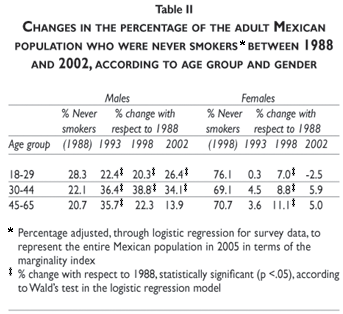
<body><![CDATA[<p>&nbsp;</p>     <p align="center"><img src="/img/revistas/spm/v49s2/a04tab01.gif"></p>     <p>&nbsp;</p>     <p><font size="2" face="Verdana"><a href="#tab02">Table II</a> presents the changes    in the adjusted prevalence of never smokers over the study period, according    to broad age groups and each gender. Men below the age of 45 present consistent    increases over time in the adjusted proportion of never smokers, which are more    intense in the 30 to 44 age group. In contrast, older men present a statistically    significant increase in the proportion of never smokers in the 1993 survey and    then a non-significant increase in the subsequent survey years. On the other    hand, only women show statistically significant increases in the adjusted proportion    of never smokers in the 1998 survey, although less intense than those observed    in men. During 1988, females across all age groups show roughly three times    the observed prevalence of never smokers than males. However, this ratio is    smaller in younger age groups.</font></p>     <p><a name="tab02"></a></p>     <p>&nbsp;</p>     <p align="center"><img src="/img/revistas/spm/v49s2/a04tab02.gif"></p>     <p>&nbsp;</p>     <p><font size="2" face="Verdana"><B>Daily smokers</B></font></p>     <p><font size="2" face="Verdana">The adjusted prevalence of daily smokers in 2002    was 22.7% in males and 5.4% in females (<a href="#tab03">Table III</a>). Overall,    this prevalence has significantly decreased, around 20%, in the latter MNAS    waves with respect to the 1988 survey. In the second and third waves, the reduction    in the prevalence of daily smokers with respect to the first survey year was    close to 30% in women and slightly lower than 20% in men. Nevertheless, the    last MNAS wave shows a reverse in the declining trend in women, whereas men    show almost the same reduction during the latter three years with respect to    1988. </font></p>     ]]></body>
<body><![CDATA[<p><a name="tab03"></a></p>     <p>&nbsp;</p>     <p align="center"><img src="/img/revistas/spm/v49s2/a04tab03.gif"></p>     <p>&nbsp;</p>     <p><font size="2" face="Verdana"><a href="#tab04">Table IV</a> presents the adjusted    prevalence of daily smokers by gender and broad age groups. The proportion of    daily smokers during 1988 was lower in younger persons, a pattern seen in both    males and females. Compared to 1988, the adjusted proportion of daily smokers    shows reductions in almost all age groups and in both genders. Statistically    significant reductions in this indicator tend to concentrate in the second and    third MNAS waves and are seen in all age groups. These reductions are more marked    in women. In the 2002 survey, the reductions are more pronounced in both genders    in the 45 to 65 age group. Additionally, women between 18 and 29 years of age    show a 20% rise in the prevalence of daily smokers.</font></p>     <p><a name="tab04"></a></p>     <p>&nbsp;</p>     <p align="center"><img src="/img/revistas/spm/v49s2/a04tab04.gif"></p>     <p>&nbsp;</p>     <p><font size="2" face="Verdana"><B>Smoking intensity in daily smokers</B></font></p>     ]]></body>
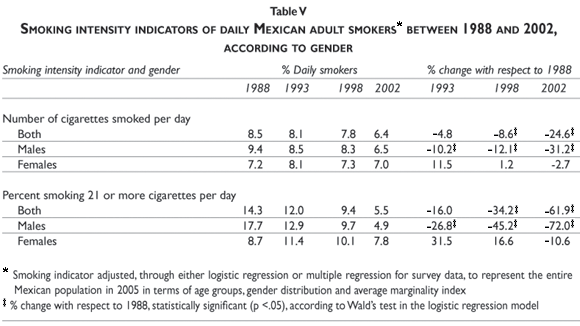
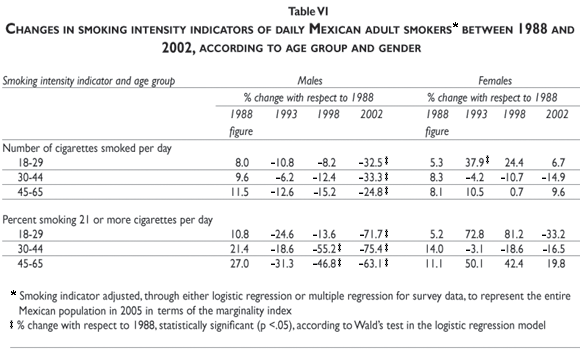
<body><![CDATA[<p><font size="2" face="Verdana">Trends in smoking intensity indicators in daily    smokers are presented in <a href="#tab05">Table V</a>. Considering the entire    population, the adjusted average number of cigarettes smoked daily was 6.4 in    the 2002 MNAS, with women smoking on average 0.5 cigarettes more than men. During    that year, the overall reduction in the average number of cigarettes was 24.6%    from 1988 and reached statistical significance only in men, who showed a 31.2%    reduction in 2002 with respect to 1988. Similar findings are observed with regard    to the proportion of heavy cigarette smokers among daily smokers (21 or more    cigarettes daily). In 2002, the adjusted percentage of heavy smokers among daily    smokers was 5.5, considering the entire population, a figure 62% lower then    that observed in 1988. In that same year, women showed a higher percentage of    heavy smokers among daily smokers than men (7.8% vs. 4.9%). In men, the percent    reduction observed between 1998 and 2002 was again higher than in females (72%    vs. 10.6%).</font></p>     <p><a name="tab05"></a></p>     <p>&nbsp;</p>     <p align="center"><img src="/img/revistas/spm/v49s2/a04tab05.gif"></p>     <p>&nbsp;</p>     <p><font size="2" face="Verdana"><a href="#tab06">Table VI</a> shows the observed    changes in adjusted smoking intensity indicators in daily smokers according    to broad age groups and gender. With regard to the average number of daily cigarettes    smoked, important reductions between 1988 and 2002 are seen in all age groups    in males, but not in females. Decreases in the average number of cigarettes    smoked are also higher in persons below age 45. Additionally, although not statistically    significant, in most age groups females show an increase in the average number    of cigarettes smoked between 1988 and 2002. The percentage of daily heavy smokers    shows similar trends as those just described. Statistically significant reductions    in the adjusted proportion of heavy smokers, between 63 and 75%, are observed    only in men. Women under 45 years of age present a 16 to 33% reduction in this    indicator but show an increase in the 45 to 65 age group. None of these last    changes is statistically significant. <a href="#tab06">Table VI</a> also suggests    that in 1988 smoking was more intense in the older birth cohorts of daily smokers.</font></p>     <p><a name="tab06"></a></p>     <p>&nbsp;</p>     <p align="center"><img src="/img/revistas/spm/v49s2/a04tab06.gif"></p>     <p>&nbsp;</p>     ]]></body>
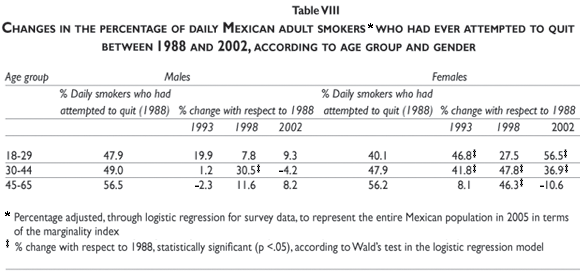
<body><![CDATA[<p><font size="2" face="Verdana"><B>Daily smokers who had ever attempted to quit</B></font></p>     <p><font size="2" face="Verdana">Trends in the adjusted percentage of daily smokers    who had ever attempted to quit are shown in <a href="#tab07">Table VII</a>,    according to gender. Regardless of gender, the majority of daily smokers over    the study period had attempted to quit at some point in their life. In 2002,    the adjusted percentage of ever attempters is somewhat larger in females than    in males (60.9 <I>vs</I>. 52.4). This is because women show more significant    and consistent increases with respect to 1988 for this indicator than men (28.8    <I>vs</I>. 4.5% increase in 2002, respectively).</font></p>     <p><a name="tab07"></a></p>     <p>&nbsp;</p>     <p align="center"><img src="/img/revistas/spm/v49s2/a04tab07.gif"></p>     <p>&nbsp;</p>     <p><font size="2" face="Verdana"><a href="#tab08">Table VIII</a> shows the changes    in the percentage of daily smokers who had ever attempted to quit in the latter    three MNAS years with respect to 1988 for broad age groups and each gender.    Significant increases in this indicator over the study period are almost confined    to women, especially in the age groups 18 to 29 and 30 to 44. For instance,    in the 2002 MNAS, women between the ages 18 and 29 show a 56.5% increase in    the percentage of daily smokers who had ever attempted to quit, whereas those    aged 30 to 44 show a 39.6% increase. In 1988, the percentage of ever attempters    is very similar in both genders and in each age group. Also noticeable is an    increase in the adjusted percentage of ever attempters with age, a finding seen    in the 1988 survey in both males and females.</font></p>     <p><a name="tab08"></a></p>     <p>&nbsp;</p>     <p align="center"><img src="/img/revistas/spm/v49s2/a04tab08.gif"></p>     ]]></body>
<body><![CDATA[<p>&nbsp;</p>     <p><FONT size="3" FACE="Verdana"><b>Discussion </b></font></p>     <p><font size="2" face="Verdana">Smoking data in Mexico prior to the late eighties    are scarce and limited to specific populations. The four National Addictions    Surveys conducted in Mexico between 1988 and 2002 represent one of the first    serious attempts to derive national smoking data from representative samples    and direct interviews. Unfortunately, as has been described in the methods section,    smoking questions included in each MNAS year are not homogeneous and a consistent    estimate of the prevalence of current smokers could not be directly obtained.    Additionally, most survey years did not include enough information on former    smokers. Given these limitations, the present analysis focused on never smokers    and current daily cigarette smokers. The proportion of never smokers provides    information about general exposure to tobacco addiction in the population. Current    daily cigarette smokers is group that is most exposed to the deleterious effects    of tobacco. The first two MNAS waves, which used the standard question "¿Fuma    usted actualmente? / <I>do you currently smoke</I>?" show that current    daily Mexican smokers represented 64% of all current smokers in 1988 and 55%    of all current smokers in 1993. Therefore, even though the MNAS information    on smoking does not provide a complete picture of this health problem, it does    provide useful information on the trends of smoking in never smokers and the    most frequent and exposed type of smokers, namely, daily smokers.</font></p>     <p><font size="2" face="Verdana"> Another MNAS problem has to do with the target    population. The first three MNAS waves focused on urban populations<SUP>11,12</SUP>    while the last one focused on the entire Mexican population &#91;Medina-Mora ME,    personal communication, March 2007&#93;. There was interest in obtaining estimates    for the smoking indicators over time that could refer to the entire Mexican    population and, therefore, the smoking summary measures needed to be adjusted.    The adjustment procedure consisted of two steps. First, the highly rural populations    that were sampled in the 2002 MNAS were excluded from the analysis using the    municipality’s marginality index, from which observations came. Second, the    data was analyzed using appropriate survey techniques and an adjusted proportion    or mean was obtained for a population closely resembling the 2005 Mexican population    in terms of age and gender distribution as well as average marginality. The    correlation between both smoking prevalence and smoking intensity and marginality    was negative, indicating a better smoking situation in the rural regions of    Mexico (data not shown). Average marginality for the whole country in 2005 was    within one standard deviation from the sampled average in each MNAS wave. Therefore,    analyzed data were suitable for national estimation in terms of marginality.    Additionally, overall adjusted summary measures by gender, estimated using the    same age structure in each gender, allowed for direct comparisons to be made    between genders.</font></p>     <p><font size="2" face="Verdana"> Findings from this analysis generally indicate    that over the study period, tobacco use in Mexico shows both positive and negative    trends. On the positive side, the overall percentage of Mexicans between 18    and 65 years of age who have never smoked has increased between 1988 and 2002.    In addition, the prevalence of daily smokers shows a 17% reduction over the    same period and the proportion of daily heavy smokers in 2002 is 62% lower than    in 1988. Furthermore, the average number of cigarettes smoked by daily smokers    in 2002 is 6.4, representing a 25% reduction with respect to the 1988 corresponding    figure. However, some of these indicators show the greatest improvements between    1998 and 1993 with some reversal of the trend in the most recent MNAS year.    Nevertheless, these positive trends are consistent with an economical analysis    of the Mexican Income and Expenses Survey in Households.<SUP>13</SUP> Such analysis    shows that between 1992 and 1998 there was a significant reduction in the prevalence    of household tobacco spending and a reduction in household monetary spending    on tobacco. In addition, the per capita annual number of packs shows a 10 to    20% reduction between 1988 and 1996.<SUP>14</sup></font></p>     <p><font size="2" face="Verdana"> On the negative side, trends in smoking indicators    over the study period are mixed when analyzing data by gender and age group.    Although the adjusted proportion of never smokers is about 2.5 times greater    in women, it shows a more rapid increase in men. This is more evident in younger    men for whom the entire increase in never smokers occurs, whereas younger women    show no change or even some decrease in the proportion of never smokers between    1988 and 2002. Trends in the adjusted proportion of daily smokers, for their    part, also show differential improvements by gender and age. Over the study    period, the proportion of daily Mexican smokers is approximately four times    greater in men than in women; whereas men show a 16% reduction in 2002 with    respect to 1988, women show more significant reductions than men in 1993 and    2002, although there was an increase in 2002. This increase is observed in women    under 30 years of age. On the other hand, the reduction in the prevalence of    daily smokers is more consistently observed in persons 45 years or older in    both genders. Smoking intensity indicators in daily smokers also show that their    overall reductions are concentrated in men, whereas women show almost no change    with regard to the average number smoked daily and the percentage of heavy smokers.    As a result, in 2002, Mexican women who were daily smokers smoked on average    0.5 cigarettes more than men did and represent a 60% higher proportion of heavy    smokers than men.</font></p>     <p><font size="2" face="Verdana"> In summary, the present analysis shows a reduction    during the last decade of the twentieth century in smoking exposure, daily smoking    prevalence and smoking intensity in Mexico. This reduction has either been more    intense or occurred exclusively in men, depending on the analyzed indicator.    Additionally, the most significant reduction both in the prevalence of daily    active smokers and in smoking intensity occurred in older age groups in both    genders. Women, for their part, during the latter part of the analyzed period    present a reversal in the downward trend in these smoking indicators, and in    2002, daily female smokers smoked a greater amount of cigarettes than men. Nevertheless,    men still present a worse smoking situation than women in terms of both prevalence    of daily smokers and percentage of daily smokers. </font></p>     <p><font size="2" face="Verdana"> A downward smoking trend in men and the beginning    of an upward trend in women is, therefore, one of the salient features of the    tobacco epidemic in Mexico between 1988 and 2002. Other surveys conducted in    Mexico during the analyzed period provide similar findings. For instance, a    survey conducted in Mexican physicians in the early 1990s found a greater prevalence    in female physicians.<SUP>15</SUP> Another survey of university students also    found a rising smoking prevalence in females between 1989 and 1998.<SUP>16</sup></font></p>     <p><font size="2" face="Verdana"> The pattern of a declining prevalence in men    and a rising prevalence in women observed in Mexico is similar to that observed    a few decades ago in the United States, Canada and most European countries.<SUP>17-23</SUP>    In this sense, the cigarette epidemic in Mexico over the analyzed period is    thus similar to that described as the end of stage III by Lopez et al.<SUP>1</SUP>    In addition, lung cancer mortality in Mexico is consistent with stage IV of    the lung cancer epidemic. Mortality from this disease reached a peak in Mexico    in cohorts born around 1930, with subsequent cohorts showing consistently lower    mortality rates at the same age in both genders.<SUP>24,25</SUP> The local tobacco    industry in Mexico was well established in the early twentieth century, with    over 700 factories in 1900.<SUP>14</sup></font></p>     <p><font size="2" face="Verdana"> However, the Mexican tobacco epidemic shows    important differences with the general pattern observed by Lopez et al.<SUP>1</SUP>    in developed countries. In other surveys conducted during the 1990s, as in those    analyzed here, smoking prevalence is high but smoking intensity is generally    low, with about 70% of current smokers smoking less than 10 cigarettes per day.<SUP>26,27</SUP>    In the present analysis, an average of 6.4 cigarettes per day in 2002 was shown    for daily smokers, the most exposed group.</font></p>     ]]></body>
<body><![CDATA[<p><font size="2" face="Verdana"> Furthermore, only 5.5% of daily smokers consumed    20 or more cigarettes during that year. Another salient feature of the epidemic    in Mexico is that smoking prevalence and intensity is generally higher in more    educated and wealthier persons. Two of three surveys conducted of Mexican health    care workers during the 1990s found a higher smoking prevalence than in the    general population.<SUP>15,28,29</SUP> The inverse relationship observed by    the MNAS between marginality and smoking prevalence and intensity lends additional    support to this assertion. In addition, a survey conducted in Latin men in the    United States has found a direct association between smoking and educational    attainment in that population.<SUP>30</SUP> These counterintuitive findings    underscore the need for health education programs specially tailored for our    population.</font></p>     <p><font size="2" face="Verdana"> Other data also suggest that economic factors    are important determinants of the smoking patterns of the Mexican population    observed over the analyzed period. The economic analysis of the Mexican Income    and Expenses Survey in Households referred to above shows that, in the Mexican    population, the two main determinants of cigarette spending are price and income.<SUP>13</SUP>    Over the study period, cigarette prices in Mexico increased in real terms and    wages decreased, especially during the 1995 economic crisis.<SUP>31,32</SUP>    It is well known that a 10 percent price increase may decrease cigarette consumption    between 2 and 7%.<SUP>33,31</SUP> Therefore, it is likely that the harsh economic    context explains a significant proportion of the reduction in prevalence and    intensity observed in Mexico during the 1990s. During this decade, tobacco control    measures in Mexico were focused on legislation banning smoking in public places,    but with inadequate enforcement.<SUP>34</SUP> More effective control measures    were only implemented in the early 2000s, including mass media advertising bans,    enforcement legislation to ban smoking in federal buildings and other public    places and successive taxation increases.<SUP>35-37</SUP> Consequently, in the    absence of a strong state policy, the other reason for the decrease in smoking    prevalence and intensity over the study period is public awareness possibly    acquired by informal means or by contact with health personnel. The finding    in the present analysis that, in 2002, about 52% of male daily smokers and 61%    of female daily smokers had attempted to quit lends support to this hypothesis.    </font></p>     <p><font size="2" face="Verdana"> Since the most recent tobacco control measures    implemented in Mexico, especially through taxation, are expected to be effective    in reducing the prevalence and intensity of tobacco exposure,<SUP>38,39,40</SUP>    a further improvement in the situation is expected, at least in the short term.    However, the rising smoking trends in women and the young already present are    likely to continue and worsen in the future, especially if the Mexican economy    returns to a path of solid economic growth not seen since the late 1960s. As    with other health matters, such as alcohol consumption or obesity, there is    a need for an effective state policy that promotes healthier life styles.</font></p>     <p><font size="2" face="Verdana"><B>Acknowledgments</B></font></p>     <p><font size="2" face="Verdana">The author expresses his gratitude to Drs. Eduardo    Lazcano-Ponce and Luz Miriam Reynales Shigematsu for providing the data and    for their helpful insights.</font></p>     <p>&nbsp;</p>     <p><font size="3" face="Verdana"><B>References</B></font></p>     <!-- ref --><p><font size="2" face="Verdana">1. L&oacute;pez AD, Collishaw NE, Piha T. A descriptive    model of the cigarette epidemic in developing countries. Tob Control 1994;3:242-247</font>&nbsp;&nbsp;&nbsp;&nbsp;&nbsp;&nbsp;&nbsp;&nbsp;[&#160;<a href="javascript:void(0);" onclick="javascript: window.open('/scielo.php?script=sci_nlinks&ref=9299492&pid=S0036-3634200700080000400001&lng=','','width=640,height=500,resizable=yes,scrollbars=1,menubar=yes,');">Links</a>&#160;]<!-- end-ref --><!-- ref --><p><font size="2" face="Verdana">2. Thun MJ, Da Costa e Silva VL. Introduction    and Overview of Global Tobacco Surveillance. In: Shafey O, Dolwick S, Guindon    GE (Eds): The 12th World Conference on Tobacco or Health. Tobacco Control Country    Profiles (Second Edition). American Cancer Society, Inc., World Health Organization,    and International Union Against Cancer, 2003</font>&nbsp;&nbsp;&nbsp;&nbsp;&nbsp;&nbsp;&nbsp;&nbsp;[&#160;<a href="javascript:void(0);" onclick="javascript: window.open('/scielo.php?script=sci_nlinks&ref=9299493&pid=S0036-3634200700080000400002&lng=','','width=640,height=500,resizable=yes,scrollbars=1,menubar=yes,');">Links</a>&#160;]<!-- end-ref --><!-- ref --><p><font size="2" face="Verdana">3. Araya RI, Laranjeira R. Tobacco epidemic or    bonanza? The global connection. Br J Addict1991 Mar;86(3):253-5.</font>&nbsp;&nbsp;&nbsp;&nbsp;&nbsp;&nbsp;&nbsp;&nbsp;[&#160;<a href="javascript:void(0);" onclick="javascript: window.open('/scielo.php?script=sci_nlinks&ref=9299494&pid=S0036-3634200700080000400003&lng=','','width=640,height=500,resizable=yes,scrollbars=1,menubar=yes,');">Links</a>&#160;]<!-- end-ref --><!-- ref --><p><font size="2" face="Verdana">4. Mackay J, Crofton J. Tobacco and the developing    world. Br Med Bull 1996 Jan;52(1):206-21.</font>&nbsp;&nbsp;&nbsp;&nbsp;&nbsp;&nbsp;&nbsp;&nbsp;[&#160;<a href="javascript:void(0);" onclick="javascript: window.open('/scielo.php?script=sci_nlinks&ref=9299495&pid=S0036-3634200700080000400004&lng=','','width=640,height=500,resizable=yes,scrollbars=1,menubar=yes,');">Links</a>&#160;]<!-- end-ref --><!-- ref --><p><font size="2" face="Verdana">5. Warner KE. The role of research in international    tobacco control. Am J Public Health 2005 Jun;95(6):976-84.</font>&nbsp;&nbsp;&nbsp;&nbsp;&nbsp;&nbsp;&nbsp;&nbsp;[&#160;<a href="javascript:void(0);" onclick="javascript: window.open('/scielo.php?script=sci_nlinks&ref=9299496&pid=S0036-3634200700080000400005&lng=','','width=640,height=500,resizable=yes,scrollbars=1,menubar=yes,');">Links</a>&#160;]<!-- end-ref --><!-- ref --><p><font size="2" face="Verdana">6. Yach D, Wipfli H. A century of smoke. Ann    Trop Med Parasitol 2006 Jul-Sep;100(5-6):465-79.</font>&nbsp;&nbsp;&nbsp;&nbsp;&nbsp;&nbsp;&nbsp;&nbsp;[&#160;<a href="javascript:void(0);" onclick="javascript: window.open('/scielo.php?script=sci_nlinks&ref=9299497&pid=S0036-3634200700080000400006&lng=','','width=640,height=500,resizable=yes,scrollbars=1,menubar=yes,');">Links</a>&#160;]<!-- end-ref --><!-- ref --><p><font size="2" face="Verdana">7. Da Costa e Silva VL, Koifman S. Smoking in    Latin America: a major public health problem. Cad Saude Publica 1998;14 Suppl    3:99-108.</font>&nbsp;&nbsp;&nbsp;&nbsp;&nbsp;&nbsp;&nbsp;&nbsp;[&#160;<a href="javascript:void(0);" onclick="javascript: window.open('/scielo.php?script=sci_nlinks&ref=9299498&pid=S0036-3634200700080000400007&lng=','','width=640,height=500,resizable=yes,scrollbars=1,menubar=yes,');">Links</a>&#160;]<!-- end-ref --><!-- ref --><p><font size="2" face="Verdana">8. CONAPO. Indicadores socioecon&oacute;micos    e &iacute;ndice de marginaci&oacute;n municipal, 1990: primer informe t&eacute;cnico    del proyecto:desigualdad regional y marginaci&oacute;n municipal en M&eacute;xico.    M&eacute;xico, D. F.: Consejo Nacional de Poblaci&oacute;n, 1993.</font>&nbsp;&nbsp;&nbsp;&nbsp;&nbsp;&nbsp;&nbsp;&nbsp;[&#160;<a href="javascript:void(0);" onclick="javascript: window.open('/scielo.php?script=sci_nlinks&ref=9299499&pid=S0036-3634200700080000400008&lng=','','width=640,height=500,resizable=yes,scrollbars=1,menubar=yes,');">Links</a>&#160;]<!-- end-ref --><!-- ref --><p><font size="2" face="Verdana">9. StataCorp. Stata Statistical Software: Release    9. College Station, TX: StataCorp LP, 2005</font>&nbsp;&nbsp;&nbsp;&nbsp;&nbsp;&nbsp;&nbsp;&nbsp;[&#160;<a href="javascript:void(0);" onclick="javascript: window.open('/scielo.php?script=sci_nlinks&ref=9299500&pid=S0036-3634200700080000400009&lng=','','width=640,height=500,resizable=yes,scrollbars=1,menubar=yes,');">Links</a>&#160;]<!-- end-ref --><!-- ref --><p><font size="2" face="Verdana">10. CONAPO. Proyecciones de poblacion 2005-2050.    available at: <a href="http://www.conapo.gob.mx/00cifras/5.htm" target="_blank">http://www.conapo.gob.mx/00cifras/5.htm</a></font>&nbsp;&nbsp;&nbsp;&nbsp;&nbsp;&nbsp;&nbsp;&nbsp;[&#160;<a href="javascript:void(0);" onclick="javascript: window.open('/scielo.php?script=sci_nlinks&ref=9299501&pid=S0036-3634200700080000400010&lng=','','width=640,height=500,resizable=yes,scrollbars=1,menubar=yes,');">Links</a>&#160;]<!-- end-ref --><!-- ref --><p><font size="2" face="Verdana">11. Tapia-Conyer R, Medina-Mora ME, Sepulveda    J, De la Fuente R, Kumate J. The national addictions survey of Mexico. Salud    Publica Mex 1990 Sep-Oct;32(5):507-22.</font>&nbsp;&nbsp;&nbsp;&nbsp;&nbsp;&nbsp;&nbsp;&nbsp;[&#160;<a href="javascript:void(0);" onclick="javascript: window.open('/scielo.php?script=sci_nlinks&ref=9299502&pid=S0036-3634200700080000400011&lng=','','width=640,height=500,resizable=yes,scrollbars=1,menubar=yes,');">Links</a>&#160;]<!-- end-ref --><!-- ref --><p><font size="2" face="Verdana">12. Tapia-Conyer R, Kuri-Morales P, Hoy-Gutierrez    MJ. Epidemiologic overview of smoking in Mexico. Salud Publica Mex 2001 Sep-Oct;43(5):478-84.</font>&nbsp;&nbsp;&nbsp;&nbsp;&nbsp;&nbsp;&nbsp;&nbsp;[&#160;<a href="javascript:void(0);" onclick="javascript: window.open('/scielo.php?script=sci_nlinks&ref=9299503&pid=S0036-3634200700080000400012&lng=','','width=640,height=500,resizable=yes,scrollbars=1,menubar=yes,');">Links</a>&#160;]<!-- end-ref --><!-- ref --><p><font size="2" face="Verdana">13. Sesma-Vazquez S, Campuzano-Rincon JC, Carreon-Rodriguez    VG, Knaul F, Lopez-Antunano FJ, Hernandez-Avila M. Trends of tobacco demand    in Mexico: 1992-1998. Salud Publica Mex. 2002;44 Suppl 1:S82-92.</font>&nbsp;&nbsp;&nbsp;&nbsp;&nbsp;&nbsp;&nbsp;&nbsp;[&#160;<a href="javascript:void(0);" onclick="javascript: window.open('/scielo.php?script=sci_nlinks&ref=9299504&pid=S0036-3634200700080000400013&lng=','','width=640,height=500,resizable=yes,scrollbars=1,menubar=yes,');">Links</a>&#160;]<!-- end-ref --><!-- ref --><p><font size="2" face="Verdana">14. Meneses-Gonzalez F, Marquez-Serrano M, Sepulveda-Amor    J, Hernandez-Avila M. The tobacco industry in Mexico. Salud Publica Mex 2002;44    Suppl 1:S161-9.</font>&nbsp;&nbsp;&nbsp;&nbsp;&nbsp;&nbsp;&nbsp;&nbsp;[&#160;<a href="javascript:void(0);" onclick="javascript: window.open('/scielo.php?script=sci_nlinks&ref=9299505&pid=S0036-3634200700080000400014&lng=','','width=640,height=500,resizable=yes,scrollbars=1,menubar=yes,');">Links</a>&#160;]<!-- end-ref --><!-- ref --><p><font size="2" face="Verdana">15. Tapia-Conyer R, Cravioto P, de la Rosa B,    Galvan F, Garcia-de la Torre G, Kuri P. Cigarette smoking; knowledge and attitudes    among Mexican physicians. Salud Publica Mex 1997 Nov-Dec;39(6):507-12.</font>&nbsp;&nbsp;&nbsp;&nbsp;&nbsp;&nbsp;&nbsp;&nbsp;[&#160;<a href="javascript:void(0);" onclick="javascript: window.open('/scielo.php?script=sci_nlinks&ref=9299506&pid=S0036-3634200700080000400015&lng=','','width=640,height=500,resizable=yes,scrollbars=1,menubar=yes,');">Links</a>&#160;]<!-- end-ref --><!-- ref --><p><font size="2" face="Verdana">16. Valdes-Salgado R, Micher JM, Hernandez L,    Hernandez M, Hernandez-Avila M. Trends of tobacco use among new students at    the Autonomous National University of Mexico, from 1989 to 1998. Salud Publica    Mex 2002;44 Suppl 1:S44-53.</font>&nbsp;&nbsp;&nbsp;&nbsp;&nbsp;&nbsp;&nbsp;&nbsp;[&#160;<a href="javascript:void(0);" onclick="javascript: window.open('/scielo.php?script=sci_nlinks&ref=9299507&pid=S0036-3634200700080000400016&lng=','','width=640,height=500,resizable=yes,scrollbars=1,menubar=yes,');">Links</a>&#160;]<!-- end-ref --><!-- ref --><p><font size="2" face="Verdana">17. Pelletier F, Marcil-Gratton N, Legare J.    A cohort approach to tobacco use and mortality: the case of Quebec. Prev Med    1996 Nov-Dec;25(6):730-40.</font>&nbsp;&nbsp;&nbsp;&nbsp;&nbsp;&nbsp;&nbsp;&nbsp;[&#160;<a href="javascript:void(0);" onclick="javascript: window.open('/scielo.php?script=sci_nlinks&ref=9299508&pid=S0036-3634200700080000400017&lng=','','width=640,height=500,resizable=yes,scrollbars=1,menubar=yes,');">Links</a>&#160;]<!-- end-ref --><!-- ref --><p><font size="2" face="Verdana">18. Baldini EH, Strauss GM. Women and lung cancer:    waiting to exhale. Chest 1997 Oct;112;4 Suppl:229S-234S.</font>&nbsp;&nbsp;&nbsp;&nbsp;&nbsp;&nbsp;&nbsp;&nbsp;[&#160;<a href="javascript:void(0);" onclick="javascript: window.open('/scielo.php?script=sci_nlinks&ref=9299509&pid=S0036-3634200700080000400018&lng=','','width=640,height=500,resizable=yes,scrollbars=1,menubar=yes,');">Links</a>&#160;]<!-- end-ref --><!-- ref --><p><font size="2" face="Verdana">19. Hill C. Trends in tobacco smoking and consequences    on health in France. Prev Med 1998 Jul-Aug;27(4):514-9.</font>&nbsp;&nbsp;&nbsp;&nbsp;&nbsp;&nbsp;&nbsp;&nbsp;[&#160;<a href="javascript:void(0);" onclick="javascript: window.open('/scielo.php?script=sci_nlinks&ref=9299510&pid=S0036-3634200700080000400019&lng=','','width=640,height=500,resizable=yes,scrollbars=1,menubar=yes,');">Links</a>&#160;]<!-- end-ref --><!-- ref --><p><font size="2" face="Verdana">20. Osler M, Prescott E, Gottschau A, Bjerg A,    Hein HO, Sjol A, Schnohr P. Trends in smoking prevalence in Danish adults, 1964-1994.    The influence of gender, age, and education. Scand J Soc Med 1998 Dec;26(4):293-8.</font>&nbsp;&nbsp;&nbsp;&nbsp;&nbsp;&nbsp;&nbsp;&nbsp;[&#160;<a href="javascript:void(0);" onclick="javascript: window.open('/scielo.php?script=sci_nlinks&ref=9299511&pid=S0036-3634200700080000400020&lng=','','width=640,height=500,resizable=yes,scrollbars=1,menubar=yes,');">Links</a>&#160;]<!-- end-ref --><!-- ref --><p><font size="2" face="Verdana">21. Pinilla J, Gonzalez B. Profile of the population    of Spain with respect to the smoking habit, period 1993-1997. Eur J Public Health    2001 Sep;11(3):346-51.</font>&nbsp;&nbsp;&nbsp;&nbsp;&nbsp;&nbsp;&nbsp;&nbsp;[&#160;<a href="javascript:void(0);" onclick="javascript: window.open('/scielo.php?script=sci_nlinks&ref=9299512&pid=S0036-3634200700080000400021&lng=','','width=640,height=500,resizable=yes,scrollbars=1,menubar=yes,');">Links</a>&#160;]<!-- end-ref --><!-- ref --><p><font size="2" face="Verdana">22. Maziak W, Hense HW, Doring A, Keil U. Ten-year    trends in smoking behaviour among adults in southern Germany. Int J Tuberc Lung    Dis 2002 Sep;6(9):824-30.</font>&nbsp;&nbsp;&nbsp;&nbsp;&nbsp;&nbsp;&nbsp;&nbsp;[&#160;<a href="javascript:void(0);" onclick="javascript: window.open('/scielo.php?script=sci_nlinks&ref=9299513&pid=S0036-3634200700080000400022&lng=','','width=640,height=500,resizable=yes,scrollbars=1,menubar=yes,');">Links</a>&#160;]<!-- end-ref --><!-- ref --><p><font size="2" face="Verdana">23. Fernandez E, Schiaffino A, Borras JM. &#91;Epidemiology    of smoking in Europe&#93;. Salud Publica Mex 2002;44 Suppl 1:S11-9.</font>&nbsp;&nbsp;&nbsp;&nbsp;&nbsp;&nbsp;&nbsp;&nbsp;[&#160;<a href="javascript:void(0);" onclick="javascript: window.open('/scielo.php?script=sci_nlinks&ref=9299514&pid=S0036-3634200700080000400023&lng=','','width=640,height=500,resizable=yes,scrollbars=1,menubar=yes,');">Links</a>&#160;]<!-- end-ref --><!-- ref --><p><font size="2" face="Verdana">24. Franco-Marina F, Villalba-Caloca J. La epidemia    de c&aacute;ncer pulmonar en M&eacute;xico. Rev Inst Nal Enf Resp Mex 2001;4:207–14.</font>&nbsp;&nbsp;&nbsp;&nbsp;&nbsp;&nbsp;&nbsp;&nbsp;[&#160;<a href="javascript:void(0);" onclick="javascript: window.open('/scielo.php?script=sci_nlinks&ref=9299515&pid=S0036-3634200700080000400024&lng=','','width=640,height=500,resizable=yes,scrollbars=1,menubar=yes,');">Links</a>&#160;]<!-- end-ref --><!-- ref --><p><font size="2" face="Verdana">25. Tovar-Guzman VJ, Lopez-Antunano FJ, Rodriguez-Salgado    N. &#91;Trends in mortality from lung cancer in Mexico, 1980-2000&#93;. Rev Panam Salud    Publica 2005 Apr;17(4):254-62</font>&nbsp;&nbsp;&nbsp;&nbsp;&nbsp;&nbsp;&nbsp;&nbsp;[&#160;<a href="javascript:void(0);" onclick="javascript: window.open('/scielo.php?script=sci_nlinks&ref=9299516&pid=S0036-3634200700080000400025&lng=','','width=640,height=500,resizable=yes,scrollbars=1,menubar=yes,');">Links</a>&#160;]<!-- end-ref --><!-- ref --><p><font size="2" face="Verdana">26. Gonzalez-Villalpando C, Stern MP, Arredondo-Perez    B, Mitchell B, Valdez R, Haffner S. &#91;Tobacco use in Mexico City&#93;. Salud Publica    Mex 1994 Jan-Feb;36(1):46-50.</font>&nbsp;&nbsp;&nbsp;&nbsp;&nbsp;&nbsp;&nbsp;&nbsp;[&#160;<a href="javascript:void(0);" onclick="javascript: window.open('/scielo.php?script=sci_nlinks&ref=9299517&pid=S0036-3634200700080000400026&lng=','','width=640,height=500,resizable=yes,scrollbars=1,menubar=yes,');">Links</a>&#160;]<!-- end-ref --><!-- ref --><p><font size="2" face="Verdana">27. Fernandez-Garate IH, Escobedo-de la Pena    J, Hernandez-Tamayo D, Tudon-Garces H, Ramirez-Galindo JD, Benitez-Martinez    MG, Zarate-Aguilar A, Madrazo-Navarro M. Tobacco consumption in the population    insured by Mexican Institute of Social Security. Salud Publica Mex 1997 Mar-Apr;39(2):125-32.</font>&nbsp;&nbsp;&nbsp;&nbsp;&nbsp;&nbsp;&nbsp;&nbsp;[&#160;<a href="javascript:void(0);" onclick="javascript: window.open('/scielo.php?script=sci_nlinks&ref=9299518&pid=S0036-3634200700080000400027&lng=','','width=640,height=500,resizable=yes,scrollbars=1,menubar=yes,');">Links</a>&#160;]<!-- end-ref --><!-- ref --><p><font size="2" face="Verdana">28. Sansores RH, Villalba-Caloca J, Herrera-Kiengelher    L, Soriano-Rodriguez A, Ramirez-Venegas A. Prevalence of cigarette smoking among    employees of the Mexican National Institutes of Health. Salud Publica Mex 1999    Sep-Oct;41(5):381-8.</font>&nbsp;&nbsp;&nbsp;&nbsp;&nbsp;&nbsp;&nbsp;&nbsp;[&#160;<a href="javascript:void(0);" onclick="javascript: window.open('/scielo.php?script=sci_nlinks&ref=9299519&pid=S0036-3634200700080000400028&lng=','','width=640,height=500,resizable=yes,scrollbars=1,menubar=yes,');">Links</a>&#160;]<!-- end-ref --><!-- ref --><p><font size="2" face="Verdana">29. Salmeron-Castro J, Arillo-Santillan E, Campuzano-Rincon    JC, Lopez-Antunano FJ, Lazcano-Ponce EC. Smoking among health professionals    of the Mexican Social Security Institute, Morelos. Salud Publica Mex 2002;44    Suppl 1:S67-75.</font>&nbsp;&nbsp;&nbsp;&nbsp;&nbsp;&nbsp;&nbsp;&nbsp;[&#160;<a href="javascript:void(0);" onclick="javascript: window.open('/scielo.php?script=sci_nlinks&ref=9299520&pid=S0036-3634200700080000400029&lng=','','width=640,height=500,resizable=yes,scrollbars=1,menubar=yes,');">Links</a>&#160;]<!-- end-ref --><!-- ref --><p><font size="2" face="Verdana">30. Siegel D, Faigeles B. Smoking and socioeconomic    status in a population-based inner city sample of African-Americans, Latinos    and whites. J Cardiovasc Risk 1996 Jun;3(3):295-300.</font>&nbsp;&nbsp;&nbsp;&nbsp;&nbsp;&nbsp;&nbsp;&nbsp;[&#160;<a href="javascript:void(0);" onclick="javascript: window.open('/scielo.php?script=sci_nlinks&ref=9299521&pid=S0036-3634200700080000400030&lng=','','width=640,height=500,resizable=yes,scrollbars=1,menubar=yes,');">Links</a>&#160;]<!-- end-ref --><!-- ref --><p><font size="2" face="Verdana">31. Blecher EH, van Walbeek CP. An international    analysis of cigarette affordability. Tob Control 2004 Dec;13(4):339-46</font>&nbsp;&nbsp;&nbsp;&nbsp;&nbsp;&nbsp;&nbsp;&nbsp;[&#160;<a href="javascript:void(0);" onclick="javascript: window.open('/scielo.php?script=sci_nlinks&ref=9299522&pid=S0036-3634200700080000400031&lng=','','width=640,height=500,resizable=yes,scrollbars=1,menubar=yes,');">Links</a>&#160;]<!-- end-ref --><!-- ref --><p><font size="2" face="Verdana">32. Davis B, Handa S, Soto H. Hogares, pobreza    y pol&iacute;ticas en &eacute;pocas de crisis. M&eacute;xico, 1992-1996. Revista    de la CEPAL 2004; 82:192-215</font>&nbsp;&nbsp;&nbsp;&nbsp;&nbsp;&nbsp;&nbsp;&nbsp;[&#160;<a href="javascript:void(0);" onclick="javascript: window.open('/scielo.php?script=sci_nlinks&ref=9299523&pid=S0036-3634200700080000400032&lng=','','width=640,height=500,resizable=yes,scrollbars=1,menubar=yes,');">Links</a>&#160;]<!-- end-ref --><!-- ref --><p><font size="2" face="Verdana">33. Fernandez E, Gallus S, Schiaffino A, Lopez-Nicolas    A, La Vecchia C, Barros H, Townsend J. Price and consumption of tobacco in Spain    over the period 1965-2000. Eur J Cancer Prev 2004 Jun;13(3):207-11</font>&nbsp;&nbsp;&nbsp;&nbsp;&nbsp;&nbsp;&nbsp;&nbsp;[&#160;<a href="javascript:void(0);" onclick="javascript: window.open('/scielo.php?script=sci_nlinks&ref=9299524&pid=S0036-3634200700080000400033&lng=','','width=640,height=500,resizable=yes,scrollbars=1,menubar=yes,');">Links</a>&#160;]<!-- end-ref --><!-- ref --><p><font size="2" face="Verdana">34. Valdes-Salgado R, Hernandez Avila M, Sepulveda    Amor J. Tobacco use in the region of the Americas: elements for a program of    action. Salud Publica Mex 2002;44 Suppl 1:S125-35.</font>&nbsp;&nbsp;&nbsp;&nbsp;&nbsp;&nbsp;&nbsp;&nbsp;[&#160;<a href="javascript:void(0);" onclick="javascript: window.open('/scielo.php?script=sci_nlinks&ref=9299525&pid=S0036-3634200700080000400034&lng=','','width=640,height=500,resizable=yes,scrollbars=1,menubar=yes,');">Links</a>&#160;]<!-- end-ref --><!-- ref --><p><font size="2" face="Verdana">35. Agreement on international tobacco control.    Salud Publica Mex 2003 Mar-Apr;45(2):145-6.</font>&nbsp;&nbsp;&nbsp;&nbsp;&nbsp;&nbsp;&nbsp;&nbsp;[&#160;<a href="javascript:void(0);" onclick="javascript: window.open('/scielo.php?script=sci_nlinks&ref=9299526&pid=S0036-3634200700080000400035&lng=','','width=640,height=500,resizable=yes,scrollbars=1,menubar=yes,');">Links</a>&#160;]<!-- end-ref --><!-- ref --><p><font size="2" face="Verdana">36. Valdes Salgado R. The Framework Convention    on Tobacco Control. Salud Publica Mex 2003 May-Jun;45(3):153-4.</font>&nbsp;&nbsp;&nbsp;&nbsp;&nbsp;&nbsp;&nbsp;&nbsp;[&#160;<a href="javascript:void(0);" onclick="javascript: window.open('/scielo.php?script=sci_nlinks&ref=9299527&pid=S0036-3634200700080000400036&lng=','','width=640,height=500,resizable=yes,scrollbars=1,menubar=yes,');">Links</a>&#160;]<!-- end-ref --><!-- ref --><p><font size="2" face="Verdana">37. Lopez Antunano FJ. Mexico facing the World    Health Organization’s Framework Convention on Tobacco Control. Salud Publica    Mex 2003 May-Jun;45(3):155-6.</font>&nbsp;&nbsp;&nbsp;&nbsp;&nbsp;&nbsp;&nbsp;&nbsp;[&#160;<a href="javascript:void(0);" onclick="javascript: window.open('/scielo.php?script=sci_nlinks&ref=9299528&pid=S0036-3634200700080000400037&lng=','','width=640,height=500,resizable=yes,scrollbars=1,menubar=yes,');">Links</a>&#160;]<!-- end-ref --><!-- ref --><p><font size="2" face="Verdana">38. Hu TW, Bai J, Keeler TE, Barnett PG, Sung    HY. The impact of California Proposition 99, a major anti-smoking law, on cigarette    consumption. J Public Health Policy 1994 Spring;15(1):26-36.</font>&nbsp;&nbsp;&nbsp;&nbsp;&nbsp;&nbsp;&nbsp;&nbsp;[&#160;<a href="javascript:void(0);" onclick="javascript: window.open('/scielo.php?script=sci_nlinks&ref=9299529&pid=S0036-3634200700080000400038&lng=','','width=640,height=500,resizable=yes,scrollbars=1,menubar=yes,');">Links</a>&#160;]<!-- end-ref --><!-- ref --><p><font size="2" face="Verdana">39. Sung HY, Hu TW, Ong M, Keeler TE, Sheu ML.    A major state tobacco tax increase, the master settlement agreement, and cigarette    consumption: the California experience. Am J Public Health 2005 Jun;95(6):1030-5.</font>&nbsp;&nbsp;&nbsp;&nbsp;&nbsp;&nbsp;&nbsp;&nbsp;[&#160;<a href="javascript:void(0);" onclick="javascript: window.open('/scielo.php?script=sci_nlinks&ref=9299530&pid=S0036-3634200700080000400039&lng=','','width=640,height=500,resizable=yes,scrollbars=1,menubar=yes,');">Links</a>&#160;]<!-- end-ref --><!-- ref --><p><font size="2" face="Verdana">40. Armendares PE, Reynales Shigematsu LM. Fiscal    policy and tobacco control: A unique opportunity to benefit public health and    the public treasury. Salud Publica Mex 2006;48 suppl 1:S167-S172.41. </font>&nbsp;&nbsp;&nbsp;&nbsp;&nbsp;&nbsp;&nbsp;&nbsp;[&#160;<a href="javascript:void(0);" onclick="javascript: window.open('/scielo.php?script=sci_nlinks&ref=9299531&pid=S0036-3634200700080000400040&lng=','','width=640,height=500,resizable=yes,scrollbars=1,menubar=yes,');">Links</a>&#160;]<!-- end-ref --><p>&nbsp;</p>     <p>&nbsp;</p>     <p><font size="2" face="Verdana">Received on: April 13, 2007    ]]></body>
<body><![CDATA[<br>   Accepted on: May 2, 2007</font></p>     <p>&nbsp;</p>     <p>&nbsp;</p>     <p><font size="2" face="Verdana">Solicitud de sobretiros: Mtro. Francisco Franco.    Divisi&oacute;n de Epidemiolog&iacute;a. Instituto Nacional de Rehabilitaci&oacute;n.    Calzada M&eacute;xico- Xochimilco 289, col. Arenal de Guadalupe. 14389 M&eacute;xico    DF, M&eacute;xico. E-mail: <a href="mailto:ffrancom@prodigy.net.mx">ffrancom@prodigy.net.mx</a></font></p>      ]]></body><back>
<ref-list>
<ref id="B1">
<label>1</label><nlm-citation citation-type="journal">
<person-group person-group-type="author">
<name>
<surname><![CDATA[López]]></surname>
<given-names><![CDATA[AD]]></given-names>
</name>
<name>
<surname><![CDATA[Collishaw]]></surname>
<given-names><![CDATA[NE]]></given-names>
</name>
<name>
<surname><![CDATA[Piha]]></surname>
<given-names><![CDATA[T]]></given-names>
</name>
</person-group>
<article-title xml:lang="en"><![CDATA[A descriptive model of the cigarette epidemic in developing countries]]></article-title>
<source><![CDATA[Tob Control]]></source>
<year>1994</year>
<volume>3</volume>
<page-range>242-247</page-range></nlm-citation>
</ref>
<ref id="B2">
<label>2</label><nlm-citation citation-type="confpro">
<person-group person-group-type="author">
<name>
<surname><![CDATA[Thun]]></surname>
<given-names><![CDATA[MJ]]></given-names>
</name>
<name>
<surname><![CDATA[Da Costa e Silva]]></surname>
<given-names><![CDATA[VL]]></given-names>
</name>
</person-group>
<article-title xml:lang="en"><![CDATA[Introduction and Overview of Global Tobacco Surveillance]]></article-title>
<person-group person-group-type="editor">
<name>
<surname><![CDATA[Shafey]]></surname>
<given-names><![CDATA[O]]></given-names>
</name>
<name>
<surname><![CDATA[Dolwick]]></surname>
<given-names><![CDATA[S]]></given-names>
</name>
<name>
<surname><![CDATA[Guindon]]></surname>
<given-names><![CDATA[GE]]></given-names>
</name>
</person-group>
<source><![CDATA[Tobacco Control Country Profiles]]></source>
<year></year>
<conf-name><![CDATA[12th World Conference on Tobacco or Health]]></conf-name>
<conf-loc> </conf-loc>
</nlm-citation>
</ref>
<ref id="B3">
<label>3</label><nlm-citation citation-type="journal">
<person-group person-group-type="author">
<name>
<surname><![CDATA[Araya]]></surname>
<given-names><![CDATA[RI]]></given-names>
</name>
<name>
<surname><![CDATA[Laranjeira]]></surname>
<given-names><![CDATA[R]]></given-names>
</name>
</person-group>
<article-title xml:lang="en"><![CDATA[Tobacco epidemic or bonanza?: The global connection]]></article-title>
<source><![CDATA[Br J Addict]]></source>
<year>1991</year>
<month> M</month>
<day>ar</day>
<volume>86</volume>
<numero>3</numero>
<issue>3</issue>
<page-range>253-5</page-range></nlm-citation>
</ref>
<ref id="B4">
<label>4</label><nlm-citation citation-type="journal">
<person-group person-group-type="author">
<name>
<surname><![CDATA[Mackay]]></surname>
<given-names><![CDATA[J]]></given-names>
</name>
<name>
<surname><![CDATA[Crofton]]></surname>
<given-names><![CDATA[J]]></given-names>
</name>
</person-group>
<article-title xml:lang="en"><![CDATA[Tobacco and the developing world]]></article-title>
<source><![CDATA[Br Med Bull]]></source>
<year>1996</year>
<month> J</month>
<day>an</day>
<volume>52</volume>
<numero>1</numero>
<issue>1</issue>
<page-range>206-21</page-range></nlm-citation>
</ref>
<ref id="B5">
<label>5</label><nlm-citation citation-type="journal">
<person-group person-group-type="author">
<name>
<surname><![CDATA[Warner]]></surname>
<given-names><![CDATA[KE]]></given-names>
</name>
</person-group>
<article-title xml:lang="en"><![CDATA[The role of research in international tobacco control]]></article-title>
<source><![CDATA[Am J Public Health]]></source>
<year>2005</year>
<month> J</month>
<day>un</day>
<volume>95</volume>
<numero>6</numero>
<issue>6</issue>
<page-range>976-84</page-range></nlm-citation>
</ref>
<ref id="B6">
<label>6</label><nlm-citation citation-type="journal">
<person-group person-group-type="author">
<name>
<surname><![CDATA[Yach]]></surname>
<given-names><![CDATA[D]]></given-names>
</name>
<name>
<surname><![CDATA[Wipfli]]></surname>
<given-names><![CDATA[H]]></given-names>
</name>
</person-group>
<article-title xml:lang="en"><![CDATA[A century of smoke]]></article-title>
<source><![CDATA[Ann Trop Med Parasitol]]></source>
<year>2006</year>
<month> J</month>
<day>ul</day>
<volume>100</volume>
<numero>5-6</numero>
<issue>5-6</issue>
<page-range>465-79</page-range></nlm-citation>
</ref>
<ref id="B7">
<label>7</label><nlm-citation citation-type="journal">
<person-group person-group-type="author">
<name>
<surname><![CDATA[Da Costa e Silva]]></surname>
<given-names><![CDATA[VL]]></given-names>
</name>
<name>
<surname><![CDATA[Koifman]]></surname>
<given-names><![CDATA[S]]></given-names>
</name>
</person-group>
<article-title xml:lang="en"><![CDATA[Smoking in Latin America: a major public health problem]]></article-title>
<source><![CDATA[Cad Saude Publica]]></source>
<year>1998</year>
<volume>14</volume>
<numero>^s3</numero>
<issue>^s3</issue>
<supplement>3</supplement>
<page-range>99-108</page-range></nlm-citation>
</ref>
<ref id="B8">
<label>8</label><nlm-citation citation-type="book">
<collab>CONAPO</collab>
<source><![CDATA[Indicadores socioeconómicos e índice de marginación municipal, 1990: primer informe técnico del proyecto:desigualdad regional y marginación municipal en México]]></source>
<year>1993</year>
<publisher-loc><![CDATA[México^eD. F. D. F.]]></publisher-loc>
<publisher-name><![CDATA[Consejo Nacional de Población]]></publisher-name>
</nlm-citation>
</ref>
<ref id="B9">
<label>9</label><nlm-citation citation-type="book">
<collab>StataCorp</collab>
<source><![CDATA[Stata Statistical Software: Release 9]]></source>
<year>2005</year>
<publisher-loc><![CDATA[Station^eTX TX]]></publisher-loc>
<publisher-name><![CDATA[StataCorp LP]]></publisher-name>
</nlm-citation>
</ref>
<ref id="B10">
<label>10</label><nlm-citation citation-type="">
<collab>CONAPO</collab>
<source><![CDATA[Proyecciones de poblacion 2005-2050]]></source>
<year></year>
</nlm-citation>
</ref>
<ref id="B11">
<label>11</label><nlm-citation citation-type="journal">
<person-group person-group-type="author">
<name>
<surname><![CDATA[Tapia-Conyer]]></surname>
<given-names><![CDATA[R]]></given-names>
</name>
<name>
<surname><![CDATA[Medina-Mora]]></surname>
<given-names><![CDATA[ME]]></given-names>
</name>
<name>
<surname><![CDATA[Sepulveda]]></surname>
<given-names><![CDATA[J]]></given-names>
</name>
<name>
<surname><![CDATA[De la Fuente]]></surname>
<given-names><![CDATA[R]]></given-names>
</name>
<name>
<surname><![CDATA[Kumate]]></surname>
<given-names><![CDATA[J]]></given-names>
</name>
</person-group>
<article-title xml:lang="en"><![CDATA[The national addictions survey of Mexico]]></article-title>
<source><![CDATA[Salud Publica Mex]]></source>
<year>1990</year>
<month> S</month>
<day>ep</day>
<volume>32</volume>
<numero>5</numero>
<issue>5</issue>
<page-range>507-22</page-range></nlm-citation>
</ref>
<ref id="B12">
<label>12</label><nlm-citation citation-type="journal">
<person-group person-group-type="author">
<name>
<surname><![CDATA[Tapia-Conyer]]></surname>
<given-names><![CDATA[R]]></given-names>
</name>
<name>
<surname><![CDATA[Kuri-Morales]]></surname>
<given-names><![CDATA[P]]></given-names>
</name>
<name>
<surname><![CDATA[Hoy-Gutierrez]]></surname>
<given-names><![CDATA[MJ]]></given-names>
</name>
</person-group>
<article-title xml:lang="en"><![CDATA[Epidemiologic overview of smoking in Mexico]]></article-title>
<source><![CDATA[Salud Publica Mex]]></source>
<year>2001</year>
<month> S</month>
<day>ep</day>
<volume>43</volume>
<numero>5</numero>
<issue>5</issue>
<page-range>478-84</page-range></nlm-citation>
</ref>
<ref id="B13">
<label>13</label><nlm-citation citation-type="journal">
<person-group person-group-type="author">
<name>
<surname><![CDATA[Sesma-Vazquez]]></surname>
<given-names><![CDATA[S]]></given-names>
</name>
<name>
<surname><![CDATA[Campuzano-Rincon]]></surname>
<given-names><![CDATA[JC]]></given-names>
</name>
<name>
<surname><![CDATA[Carreon-Rodriguez]]></surname>
<given-names><![CDATA[VG]]></given-names>
</name>
<name>
<surname><![CDATA[Knaul]]></surname>
<given-names><![CDATA[F]]></given-names>
</name>
<name>
<surname><![CDATA[Lopez-Antunano]]></surname>
<given-names><![CDATA[FJ]]></given-names>
</name>
<name>
<surname><![CDATA[Hernandez-Avila]]></surname>
<given-names><![CDATA[M]]></given-names>
</name>
</person-group>
<article-title xml:lang="en"><![CDATA[Trends of tobacco demand in Mexico: 1992-1998]]></article-title>
<source><![CDATA[Salud Publica Mex.]]></source>
<year>2002</year>
<volume>44</volume>
<numero>^s1</numero>
<issue>^s1</issue>
<supplement>1</supplement>
<page-range>S82-92</page-range></nlm-citation>
</ref>
<ref id="B14">
<label>14</label><nlm-citation citation-type="journal">
<person-group person-group-type="author">
<name>
<surname><![CDATA[Meneses-Gonzalez]]></surname>
<given-names><![CDATA[F]]></given-names>
</name>
<name>
<surname><![CDATA[Marquez-Serrano]]></surname>
<given-names><![CDATA[M]]></given-names>
</name>
<name>
<surname><![CDATA[Sepulveda-Amor]]></surname>
<given-names><![CDATA[J]]></given-names>
</name>
<name>
<surname><![CDATA[Hernandez-Avila]]></surname>
<given-names><![CDATA[M]]></given-names>
</name>
</person-group>
<article-title xml:lang="en"><![CDATA[The tobacco industry in Mexico]]></article-title>
<source><![CDATA[Salud Publica Mex]]></source>
<year>2002</year>
<volume>44</volume>
<numero>^s1</numero>
<issue>^s1</issue>
<supplement>1</supplement>
<page-range>S161-9</page-range></nlm-citation>
</ref>
<ref id="B15">
<label>15</label><nlm-citation citation-type="journal">
<person-group person-group-type="author">
<name>
<surname><![CDATA[Tapia-Conyer]]></surname>
<given-names><![CDATA[R]]></given-names>
</name>
<name>
<surname><![CDATA[Cravioto]]></surname>
<given-names><![CDATA[P]]></given-names>
</name>
<name>
<surname><![CDATA[de]]></surname>
<given-names><![CDATA[la Rosa B]]></given-names>
</name>
<name>
<surname><![CDATA[Galvan]]></surname>
<given-names><![CDATA[F]]></given-names>
</name>
<name>
<surname><![CDATA[Garcia-de]]></surname>
<given-names><![CDATA[la Torre G]]></given-names>
</name>
<name>
<surname><![CDATA[Kuri]]></surname>
<given-names><![CDATA[P]]></given-names>
</name>
</person-group>
<article-title xml:lang="en"><![CDATA[Cigarette smoking: knowledge and attitudes among Mexican physicians]]></article-title>
<source><![CDATA[Salud Publica Mex]]></source>
<year>1997</year>
<month> N</month>
<day>ov</day>
<volume>39</volume>
<numero>6</numero>
<issue>6</issue>
<page-range>507-12</page-range></nlm-citation>
</ref>
<ref id="B16">
<label>16</label><nlm-citation citation-type="journal">
<person-group person-group-type="author">
<name>
<surname><![CDATA[Valdes-Salgado]]></surname>
<given-names><![CDATA[R]]></given-names>
</name>
<name>
<surname><![CDATA[Micher]]></surname>
<given-names><![CDATA[JM]]></given-names>
</name>
<name>
<surname><![CDATA[Hernandez]]></surname>
<given-names><![CDATA[L]]></given-names>
</name>
<name>
<surname><![CDATA[Hernandez]]></surname>
<given-names><![CDATA[M]]></given-names>
</name>
<name>
<surname><![CDATA[Hernandez-Avila]]></surname>
<given-names><![CDATA[M]]></given-names>
</name>
</person-group>
<article-title xml:lang="en"><![CDATA[Trends of tobacco use among new students at the Autonomous National University of Mexico, from 1989 to 1998]]></article-title>
<source><![CDATA[Salud Publica Mex]]></source>
<year>2002</year>
<volume>44 Suppl 1</volume>
<page-range>S44-53</page-range></nlm-citation>
</ref>
<ref id="B17">
<label>17</label><nlm-citation citation-type="journal">
<person-group person-group-type="author">
<name>
<surname><![CDATA[Pelletier]]></surname>
<given-names><![CDATA[F]]></given-names>
</name>
<name>
<surname><![CDATA[Marcil-Gratton]]></surname>
<given-names><![CDATA[N]]></given-names>
</name>
<name>
<surname><![CDATA[Legare]]></surname>
<given-names><![CDATA[J]]></given-names>
</name>
</person-group>
<article-title xml:lang="en"><![CDATA[A cohort approach to tobacco use and mortality: the case of Quebec]]></article-title>
<source><![CDATA[Prev Med]]></source>
<year>1996</year>
<month> N</month>
<day>ov</day>
<volume>25</volume>
<numero>6</numero>
<issue>6</issue>
<page-range>730-40</page-range></nlm-citation>
</ref>
<ref id="B18">
<label>18</label><nlm-citation citation-type="journal">
<person-group person-group-type="author">
<name>
<surname><![CDATA[Baldini]]></surname>
<given-names><![CDATA[EH]]></given-names>
</name>
<name>
<surname><![CDATA[Strauss]]></surname>
<given-names><![CDATA[GM]]></given-names>
</name>
</person-group>
<article-title xml:lang="en"><![CDATA[Women and lung cancer: waiting to exhale]]></article-title>
<source><![CDATA[Chest]]></source>
<year>1997</year>
<month> O</month>
<day>ct</day>
<volume>112</volume>
<numero>^s4</numero>
<issue>^s4</issue>
<supplement>4</supplement>
<page-range>229S-234S</page-range></nlm-citation>
</ref>
<ref id="B19">
<label>19</label><nlm-citation citation-type="journal">
<person-group person-group-type="author">
<name>
<surname><![CDATA[Hill]]></surname>
<given-names><![CDATA[C]]></given-names>
</name>
</person-group>
<article-title xml:lang="en"><![CDATA[Trends in tobacco smoking and consequences on health in France]]></article-title>
<source><![CDATA[Prev Med]]></source>
<year>1998</year>
<month> J</month>
<day>ul</day>
<volume>27</volume>
<numero>4</numero>
<issue>4</issue>
<page-range>514-9</page-range></nlm-citation>
</ref>
<ref id="B20">
<label>20</label><nlm-citation citation-type="journal">
<person-group person-group-type="author">
<name>
<surname><![CDATA[Osler]]></surname>
<given-names><![CDATA[M]]></given-names>
</name>
<name>
<surname><![CDATA[Prescott]]></surname>
<given-names><![CDATA[E]]></given-names>
</name>
<name>
<surname><![CDATA[Gottschau]]></surname>
<given-names><![CDATA[A]]></given-names>
</name>
<name>
<surname><![CDATA[Bjerg]]></surname>
<given-names><![CDATA[A]]></given-names>
</name>
<name>
<surname><![CDATA[Hein]]></surname>
<given-names><![CDATA[HO]]></given-names>
</name>
<name>
<surname><![CDATA[Sjol]]></surname>
<given-names><![CDATA[A]]></given-names>
</name>
<name>
<surname><![CDATA[Schnohr]]></surname>
<given-names><![CDATA[P.]]></given-names>
</name>
</person-group>
<article-title xml:lang="en"><![CDATA[Trends in smoking prevalence in Danish adults, 1964-1994: The influence of gender, age, and education]]></article-title>
<source><![CDATA[Scand J Soc Med]]></source>
<year>1998</year>
<month> D</month>
<day>ec</day>
<volume>26</volume>
<numero>4</numero>
<issue>4</issue>
<page-range>293-8</page-range></nlm-citation>
</ref>
<ref id="B21">
<label>21</label><nlm-citation citation-type="journal">
<person-group person-group-type="author">
<name>
<surname><![CDATA[Pinilla]]></surname>
<given-names><![CDATA[J]]></given-names>
</name>
<name>
<surname><![CDATA[Gonzalez]]></surname>
<given-names><![CDATA[B]]></given-names>
</name>
</person-group>
<article-title xml:lang="en"><![CDATA[Profile of the population of Spain with respect to the smoking habit, period 1993-1997]]></article-title>
<source><![CDATA[Eur J Public Health]]></source>
<year>2001</year>
<month> S</month>
<day>ep</day>
<volume>11</volume>
<numero>3</numero>
<issue>3</issue>
<page-range>346-51</page-range></nlm-citation>
</ref>
<ref id="B22">
<label>22</label><nlm-citation citation-type="journal">
<person-group person-group-type="author">
<name>
<surname><![CDATA[Maziak]]></surname>
<given-names><![CDATA[W]]></given-names>
</name>
<name>
<surname><![CDATA[Hense]]></surname>
<given-names><![CDATA[HW]]></given-names>
</name>
<name>
<surname><![CDATA[Doring]]></surname>
<given-names><![CDATA[A]]></given-names>
</name>
<name>
<surname><![CDATA[Keil]]></surname>
<given-names><![CDATA[U]]></given-names>
</name>
</person-group>
<article-title xml:lang="en"><![CDATA[Ten-year trends in smoking behaviour among adults in southern Germany]]></article-title>
<source><![CDATA[Int J Tuberc Lung Dis]]></source>
<year>2002</year>
<month> S</month>
<day>ep</day>
<volume>6</volume>
<numero>9</numero>
<issue>9</issue>
<page-range>824-30</page-range></nlm-citation>
</ref>
<ref id="B23">
<label>23</label><nlm-citation citation-type="journal">
<person-group person-group-type="author">
<name>
<surname><![CDATA[Fernandez]]></surname>
<given-names><![CDATA[E]]></given-names>
</name>
<name>
<surname><![CDATA[Schiaffino]]></surname>
<given-names><![CDATA[A]]></given-names>
</name>
<name>
<surname><![CDATA[Borras]]></surname>
<given-names><![CDATA[JM]]></given-names>
</name>
</person-group>
<article-title xml:lang="en"><![CDATA[Epidemiology of smoking in Europe]]></article-title>
<source><![CDATA[Salud Publica Mex]]></source>
<year>2002</year>
<volume>44</volume>
<numero>^s1</numero>
<issue>^s1</issue>
<supplement>1</supplement>
<page-range>S11-9</page-range></nlm-citation>
</ref>
<ref id="B24">
<label>24</label><nlm-citation citation-type="journal">
<person-group person-group-type="author">
<name>
<surname><![CDATA[Franco-Marina]]></surname>
<given-names><![CDATA[F]]></given-names>
</name>
<name>
<surname><![CDATA[Villalba-Caloca]]></surname>
<given-names><![CDATA[J]]></given-names>
</name>
</person-group>
<article-title xml:lang="es"><![CDATA[La epidemia de cáncer pulmonar en México]]></article-title>
<source><![CDATA[Rev Inst Nal Enf Resp Mex]]></source>
<year>2001</year>
<volume>4</volume>
<page-range>207-14</page-range></nlm-citation>
</ref>
<ref id="B25">
<label>25</label><nlm-citation citation-type="journal">
<person-group person-group-type="author">
<name>
<surname><![CDATA[Tovar-Guzman]]></surname>
<given-names><![CDATA[VJ]]></given-names>
</name>
<name>
<surname><![CDATA[Lopez-Antunano]]></surname>
<given-names><![CDATA[FJ]]></given-names>
</name>
<name>
<surname><![CDATA[Rodriguez-Salgado]]></surname>
<given-names><![CDATA[N]]></given-names>
</name>
</person-group>
<article-title xml:lang="es"><![CDATA[Trends in mortality from lung cancer in Mexico, 1980-2000]]></article-title>
<source><![CDATA[Rev Panam Salud Publica 2005]]></source>
<year>Apr</year>
<volume>17</volume>
<numero>4</numero>
<issue>4</issue>
<page-range>254-62</page-range></nlm-citation>
</ref>
<ref id="B26">
<label>26</label><nlm-citation citation-type="journal">
<person-group person-group-type="author">
<name>
<surname><![CDATA[Gonzalez-Villalpando]]></surname>
<given-names><![CDATA[C]]></given-names>
</name>
<name>
<surname><![CDATA[Stern]]></surname>
<given-names><![CDATA[MP]]></given-names>
</name>
<name>
<surname><![CDATA[Arredondo-Perez]]></surname>
<given-names><![CDATA[B]]></given-names>
</name>
<name>
<surname><![CDATA[Mitchell]]></surname>
<given-names><![CDATA[B]]></given-names>
</name>
<name>
<surname><![CDATA[Valdez]]></surname>
<given-names><![CDATA[R]]></given-names>
</name>
<name>
<surname><![CDATA[Haffner]]></surname>
<given-names><![CDATA[S]]></given-names>
</name>
</person-group>
<article-title xml:lang="en"><![CDATA[Tobacco use in Mexico City]]></article-title>
<source><![CDATA[Salud Publica Mex]]></source>
<year>1994</year>
<month> J</month>
<day>an</day>
<volume>36</volume>
<numero>1</numero>
<issue>1</issue>
<page-range>46-50</page-range></nlm-citation>
</ref>
<ref id="B27">
<label>27</label><nlm-citation citation-type="journal">
<person-group person-group-type="author">
<name>
<surname><![CDATA[Fernandez-Garate]]></surname>
<given-names><![CDATA[IH]]></given-names>
</name>
<name>
<surname><![CDATA[Escobedo-de la Pena]]></surname>
<given-names><![CDATA[J]]></given-names>
</name>
<name>
<surname><![CDATA[Hernandez-Tamayo]]></surname>
<given-names><![CDATA[D]]></given-names>
</name>
<name>
<surname><![CDATA[Tudon-Garces]]></surname>
<given-names><![CDATA[H]]></given-names>
</name>
<name>
<surname><![CDATA[Ramirez-Galindo]]></surname>
<given-names><![CDATA[JD]]></given-names>
</name>
<name>
<surname><![CDATA[Benitez-Martinez]]></surname>
<given-names><![CDATA[MG]]></given-names>
</name>
<name>
<surname><![CDATA[Zarate-Aguilar]]></surname>
<given-names><![CDATA[A]]></given-names>
</name>
<name>
<surname><![CDATA[Madrazo-Navarro]]></surname>
<given-names><![CDATA[M]]></given-names>
</name>
</person-group>
<article-title xml:lang="en"><![CDATA[Tobacco consumption in the population insured by Mexican Institute of Social Security]]></article-title>
<source><![CDATA[Salud Publica Mex]]></source>
<year>1997</year>
<month> M</month>
<day>ar</day>
<volume>39</volume>
<numero>2</numero>
<issue>2</issue>
<page-range>125-32</page-range></nlm-citation>
</ref>
<ref id="B28">
<label>28</label><nlm-citation citation-type="journal">
<person-group person-group-type="author">
<name>
<surname><![CDATA[Sansores]]></surname>
<given-names><![CDATA[RH]]></given-names>
</name>
<name>
<surname><![CDATA[Villalba-Caloca]]></surname>
<given-names><![CDATA[J]]></given-names>
</name>
<name>
<surname><![CDATA[Herrera-Kiengelher]]></surname>
<given-names><![CDATA[L]]></given-names>
</name>
<name>
<surname><![CDATA[Soriano-Rodriguez]]></surname>
<given-names><![CDATA[A]]></given-names>
</name>
<name>
<surname><![CDATA[Ramirez-Venegas]]></surname>
<given-names><![CDATA[A]]></given-names>
</name>
</person-group>
<article-title xml:lang="en"><![CDATA[Prevalence of cigarette smoking among employees of the Mexican National Institutes of Health]]></article-title>
<source><![CDATA[Salud Publica Mex]]></source>
<year>1999</year>
<month> S</month>
<day>ep</day>
<volume>41</volume>
<numero>5</numero>
<issue>5</issue>
<page-range>381-8</page-range></nlm-citation>
</ref>
<ref id="B29">
<label>29</label><nlm-citation citation-type="journal">
<person-group person-group-type="author">
<name>
<surname><![CDATA[Salmeron-Castro]]></surname>
<given-names><![CDATA[J]]></given-names>
</name>
<name>
<surname><![CDATA[Arillo-Santillan]]></surname>
<given-names><![CDATA[E]]></given-names>
</name>
<name>
<surname><![CDATA[Campuzano-Rincon]]></surname>
<given-names><![CDATA[JC]]></given-names>
</name>
<name>
<surname><![CDATA[Lopez-Antunano]]></surname>
<given-names><![CDATA[FJ]]></given-names>
</name>
<name>
<surname><![CDATA[Lazcano-Ponce]]></surname>
<given-names><![CDATA[EC]]></given-names>
</name>
</person-group>
<article-title xml:lang="en"><![CDATA[Smoking among health professionals of the Mexican Social Security Institute, Morelos]]></article-title>
<source><![CDATA[Salud Publica Mex]]></source>
<year>2002</year>
<volume>44</volume>
<numero>^s1</numero>
<issue>^s1</issue>
<supplement>1</supplement>
<page-range>S67-75</page-range></nlm-citation>
</ref>
<ref id="B30">
<label>30</label><nlm-citation citation-type="journal">
<person-group person-group-type="author">
<name>
<surname><![CDATA[Siegel]]></surname>
<given-names><![CDATA[D]]></given-names>
</name>
<name>
<surname><![CDATA[Faigeles]]></surname>
<given-names><![CDATA[B]]></given-names>
</name>
</person-group>
<article-title xml:lang="en"><![CDATA[Smoking and socioeconomic status in a population-based inner city sample of African-Americans, Latinos and whites]]></article-title>
<source><![CDATA[J Cardiovasc Risk 1996]]></source>
<year>Jun</year>
<volume>3</volume>
<numero>3</numero>
<issue>3</issue>
<page-range>295-300</page-range></nlm-citation>
</ref>
<ref id="B31">
<label>31</label><nlm-citation citation-type="journal">
<person-group person-group-type="author">
<name>
<surname><![CDATA[Blecher]]></surname>
<given-names><![CDATA[EH]]></given-names>
</name>
<name>
<surname><![CDATA[van Walbeek]]></surname>
<given-names><![CDATA[CP]]></given-names>
</name>
</person-group>
<article-title xml:lang="en"><![CDATA[An international analysis of cigarette affordability]]></article-title>
<source><![CDATA[Tob Control]]></source>
<year>2004</year>
<month> D</month>
<day>ec</day>
<volume>13</volume>
<numero>4</numero>
<issue>4</issue>
<page-range>339-46</page-range></nlm-citation>
</ref>
<ref id="B32">
<label>32</label><nlm-citation citation-type="journal">
<person-group person-group-type="author">
<name>
<surname><![CDATA[Davis]]></surname>
<given-names><![CDATA[B]]></given-names>
</name>
<name>
<surname><![CDATA[Handa]]></surname>
<given-names><![CDATA[S]]></given-names>
</name>
<name>
<surname><![CDATA[Soto]]></surname>
<given-names><![CDATA[H]]></given-names>
</name>
</person-group>
<article-title xml:lang="es"><![CDATA[Hogares, pobreza y políticas en épocas de crisis: México, 1992-1996]]></article-title>
<source><![CDATA[Revista de la CEPAL]]></source>
<year>2004</year>
<volume>82</volume>
<page-range>192-215</page-range></nlm-citation>
</ref>
<ref id="B33">
<label>33</label><nlm-citation citation-type="journal">
<person-group person-group-type="author">
<name>
<surname><![CDATA[Fernandez]]></surname>
<given-names><![CDATA[E]]></given-names>
</name>
<name>
<surname><![CDATA[Gallus]]></surname>
<given-names><![CDATA[S]]></given-names>
</name>
<name>
<surname><![CDATA[Schiaffino]]></surname>
<given-names><![CDATA[A]]></given-names>
</name>
<name>
<surname><![CDATA[Lopez-Nicolas]]></surname>
<given-names><![CDATA[A]]></given-names>
</name>
<name>
<surname><![CDATA[La Vecchia]]></surname>
<given-names><![CDATA[C]]></given-names>
</name>
<name>
<surname><![CDATA[Barros]]></surname>
<given-names><![CDATA[H]]></given-names>
</name>
<name>
<surname><![CDATA[Townsend]]></surname>
<given-names><![CDATA[J]]></given-names>
</name>
</person-group>
<article-title xml:lang="en"><![CDATA[Price and consumption of tobacco in Spain over the period 1965-2000]]></article-title>
<source><![CDATA[Eur J Cancer Prev]]></source>
<year>2004</year>
<month> J</month>
<day>un</day>
<volume>13</volume>
<numero>3</numero>
<issue>3</issue>
<page-range>207-11</page-range></nlm-citation>
</ref>
<ref id="B34">
<label>34</label><nlm-citation citation-type="journal">
<person-group person-group-type="author">
<name>
<surname><![CDATA[Valdes-Salgado]]></surname>
<given-names><![CDATA[R]]></given-names>
</name>
<name>
<surname><![CDATA[Hernandez]]></surname>
<given-names><![CDATA[Avila M]]></given-names>
</name>
<name>
<surname><![CDATA[Sepulveda Amor]]></surname>
<given-names><![CDATA[J]]></given-names>
</name>
</person-group>
<article-title xml:lang="en"><![CDATA[Tobacco use in the region of the Americas: elements for a program of action]]></article-title>
<source><![CDATA[Salud Publica Mex]]></source>
<year>2002</year>
<volume>44</volume>
<numero>^s1</numero>
<issue>^s1</issue>
<supplement>1</supplement>
<page-range>S125-35</page-range></nlm-citation>
</ref>
<ref id="B35">
<label>35</label><nlm-citation citation-type="journal">
<article-title xml:lang="en"><![CDATA[Agreement on international tobacco control]]></article-title>
<source><![CDATA[Salud Publica Mex]]></source>
<year>2003</year>
<month> M</month>
<day>ar</day>
<volume>45</volume>
<numero>2</numero>
<issue>2</issue>
<page-range>145-6</page-range></nlm-citation>
</ref>
<ref id="B36">
<label>36</label><nlm-citation citation-type="journal">
<person-group person-group-type="author">
<name>
<surname><![CDATA[Valdes Salgado]]></surname>
<given-names><![CDATA[R]]></given-names>
</name>
</person-group>
<article-title xml:lang="en"><![CDATA[The Framework Convention on Tobacco Control]]></article-title>
<source><![CDATA[Salud Publica Mex]]></source>
<year>2003</year>
<month> M</month>
<day>ay</day>
<volume>45</volume>
<numero>3</numero>
<issue>3</issue>
<page-range>153-4</page-range></nlm-citation>
</ref>
<ref id="B37">
<label>37</label><nlm-citation citation-type="journal">
<person-group person-group-type="author">
<name>
<surname><![CDATA[Lopez Antunano]]></surname>
<given-names><![CDATA[FJ]]></given-names>
</name>
</person-group>
<article-title xml:lang="en"><![CDATA[Mexico facing the World Health Organization’s Framework Convention on Tobacco Control]]></article-title>
<source><![CDATA[Salud Publica Mex]]></source>
<year>2003</year>
<month> M</month>
<day>ay</day>
<volume>45</volume>
<numero>3</numero>
<issue>3</issue>
<page-range>155-6</page-range></nlm-citation>
</ref>
<ref id="B38">
<label>38</label><nlm-citation citation-type="journal">
<person-group person-group-type="author">
<name>
<surname><![CDATA[Hu]]></surname>
<given-names><![CDATA[TW]]></given-names>
</name>
<name>
<surname><![CDATA[Bai]]></surname>
<given-names><![CDATA[J]]></given-names>
</name>
<name>
<surname><![CDATA[Keeler]]></surname>
<given-names><![CDATA[TE]]></given-names>
</name>
<name>
<surname><![CDATA[Barnett]]></surname>
<given-names><![CDATA[PG]]></given-names>
</name>
<name>
<surname><![CDATA[Sung]]></surname>
<given-names><![CDATA[HY]]></given-names>
</name>
</person-group>
<article-title xml:lang="en"><![CDATA[The impact of California Proposition 99, a major anti-smoking law, on cigarette consumption]]></article-title>
<source><![CDATA[J Public Health Policy]]></source>
<year>1994</year>
<month> S</month>
<day>pr</day>
<volume>15</volume>
<numero>1</numero>
<issue>1</issue>
<page-range>26-36</page-range></nlm-citation>
</ref>
<ref id="B39">
<label>39</label><nlm-citation citation-type="journal">
<person-group person-group-type="author">
<name>
<surname><![CDATA[Sung]]></surname>
<given-names><![CDATA[HY]]></given-names>
</name>
<name>
<surname><![CDATA[Hu]]></surname>
<given-names><![CDATA[TW]]></given-names>
</name>
<name>
<surname><![CDATA[Ong]]></surname>
<given-names><![CDATA[M]]></given-names>
</name>
<name>
<surname><![CDATA[Keeler]]></surname>
<given-names><![CDATA[TE]]></given-names>
</name>
<name>
<surname><![CDATA[Sheu]]></surname>
<given-names><![CDATA[ML]]></given-names>
</name>
</person-group>
<article-title xml:lang="en"><![CDATA[A major state tobacco tax increase, the master settlement agreement, and cigarette consumption: the California experience]]></article-title>
<source><![CDATA[Am J Public Health]]></source>
<year>2005</year>
<month> J</month>
<day>un</day>
<volume>95</volume>
<numero>6</numero>
<issue>6</issue>
<page-range>1030-5</page-range></nlm-citation>
</ref>
<ref id="B40">
<label>40</label><nlm-citation citation-type="journal">
<person-group person-group-type="author">
<name>
<surname><![CDATA[Armendares]]></surname>
<given-names><![CDATA[PE]]></given-names>
</name>
<name>
<surname><![CDATA[Reynales Shigematsu]]></surname>
<given-names><![CDATA[LM]]></given-names>
</name>
</person-group>
<article-title xml:lang="en"><![CDATA[Fiscal policy and tobacco control: A unique opportunity to benefit public health and the public treasury]]></article-title>
<source><![CDATA[Salud Publica Mex]]></source>
<year>2006</year>
<volume>48</volume>
<numero>^s1</numero>
<issue>^s1</issue>
<supplement>1</supplement>
<page-range>S167-S172.41</page-range></nlm-citation>
</ref>
</ref-list>
</back>
</article>