<?xml version="1.0" encoding="ISO-8859-1"?><article xmlns:mml="http://www.w3.org/1998/Math/MathML" xmlns:xlink="http://www.w3.org/1999/xlink" xmlns:xsi="http://www.w3.org/2001/XMLSchema-instance">
<front>
<journal-meta>
<journal-id>0036-3634</journal-id>
<journal-title><![CDATA[Salud Pública de México]]></journal-title>
<abbrev-journal-title><![CDATA[Salud pública Méx]]></abbrev-journal-title>
<issn>0036-3634</issn>
<publisher>
<publisher-name><![CDATA[Instituto Nacional de Salud Pública]]></publisher-name>
</publisher>
</journal-meta>
<article-meta>
<article-id>S0036-36342007000600008</article-id>
<title-group>
<article-title xml:lang="en"><![CDATA[SHV-type extended-spectrum beta-lactamase (ESBL) are encoded in related plasmids from enterobacteria clinical isolates from Mexico]]></article-title>
<article-title xml:lang="es"><![CDATA[beta-Lactamasas de espectro extendido (BLEE) tipo SHV están codificadas en plásmidos relacionados en aislamientos clínicos de enterobacterias en México]]></article-title>
</title-group>
<contrib-group>
<contrib contrib-type="author">
<name>
<surname><![CDATA[Garza-Ramos]]></surname>
<given-names><![CDATA[Ulises]]></given-names>
</name>
<xref ref-type="aff" rid="A01"/>
</contrib>
<contrib contrib-type="author">
<name>
<surname><![CDATA[Martínez-Romero]]></surname>
<given-names><![CDATA[Esperanza]]></given-names>
</name>
<xref ref-type="aff" rid="A02"/>
</contrib>
<contrib contrib-type="author">
<name>
<surname><![CDATA[Silva-Sánchez]]></surname>
<given-names><![CDATA[Jesús]]></given-names>
</name>
<xref ref-type="aff" rid="A01"/>
</contrib>
</contrib-group>
<aff id="A01">
<institution><![CDATA[,Instituto Nacional de Salud Pública Centro de Investigaciones Sobre Enfermedades Infecciosas Departamento de Resistencia Bacteriana]]></institution>
<addr-line><![CDATA[ ]]></addr-line>
</aff>
<aff id="A02">
<institution><![CDATA[,Universidad Nacional Autónoma de México Centro de Ciencias Genómicas ]]></institution>
<addr-line><![CDATA[Cuernavaca ]]></addr-line>
<country>México</country>
</aff>
<pub-date pub-type="pub">
<day>00</day>
<month>12</month>
<year>2007</year>
</pub-date>
<pub-date pub-type="epub">
<day>00</day>
<month>12</month>
<year>2007</year>
</pub-date>
<volume>49</volume>
<numero>6</numero>
<fpage>415</fpage>
<lpage>421</lpage>
<copyright-statement/>
<copyright-year/>
<self-uri xlink:href="http://www.scielo.org.mx/scielo.php?script=sci_arttext&amp;pid=S0036-36342007000600008&amp;lng=en&amp;nrm=iso"></self-uri><self-uri xlink:href="http://www.scielo.org.mx/scielo.php?script=sci_abstract&amp;pid=S0036-36342007000600008&amp;lng=en&amp;nrm=iso"></self-uri><self-uri xlink:href="http://www.scielo.org.mx/scielo.php?script=sci_pdf&amp;pid=S0036-36342007000600008&amp;lng=en&amp;nrm=iso"></self-uri><abstract abstract-type="short" xml:lang="en"><p><![CDATA[OBJECTIVE: In this work we report the molecular characterization of beta-lactam antibiotics resistance conferred by genes contained in plasmids from enterobacteria producing extended-spectrum beta-lactamases (ESBL). MATERIAL AND METHODS: Fourteen enterobacterial clinical isolates selected from a group of strains obtained from seven different hospitals in Mexico during 1990-1992 and 1996-1998 were analyzed at the Bacterial Resistance Laboratory (National Institute Public Health, Cuernavaca). Molecular characterization included PFGE, IEF of beta-lactamases, bacterial conjugation, PCR amplification and DNA sequencing, plasmid extraction and restriction. RESULTS: Isolates were genetically unrelated. ESBL identified were SHV-2 (5/14) and SHV-5 (9/14) type. Cephalosporin-resistance was transferable in 9 of 14 (64%) clinical isolates with only one conjugative plasmid, DNA finger printing showed a similar band pattern in plasmids. CONCLUSIONS: The dissemination of cephalosporin resistance was due to related plasmids carrying the ESBL genes.]]></p></abstract>
<abstract abstract-type="short" xml:lang="es"><p><![CDATA[OBJETIVO: En este trabajo se reporta la caracterización molecular de la resistencia a antibiótico beta-lactámicos conferida por genes contenidos en plásmidos de enterobacterias productoras de beta-lactamasas de espectro extendido (BLEEs). MATERIAL Y MÉTODOS: Catorce aislamientos clínicos de enterobacterias fueron seleccionados por conveniencia de un banco de cepas obtenidas de siete diferentes hospitales de México durante los periodos 1990-1992 y 1996-1998 y fueron procesados en el Laboratorio de Resistencia Bacteriana (Instituto Nacional de Salud Pública, Cuernavaca). En la caracterización se empleó PFGE, IEF para beta-lactamasas, conjugación bacteriana, amplificación por PCR y secuenciación de DNA, extracción y restricción de plásmidos. RESULTADOS: Las 14 cepas fueron no relacionadas genéticamente. Se identificaron BLEEs tipo SHV-2 (5/14) y SHV-5 (9/14). La resistencia a cefalosporinas fue transferida por conjugación en 9 de 14 (64%) aislamientos clínicos mediante un plásmido que mostró un patrón de restricción similar entre ellos. CONCLUSIÓN: Se sugiere que la diseminación de la resistencia a cefalosporinas fue debida a plásmidos relacionados que contienen los genes que codifican BLEEs.]]></p></abstract>
<kwd-group>
<kwd lng="en"><![CDATA[enterobacteria]]></kwd>
<kwd lng="en"><![CDATA[plasmid]]></kwd>
<kwd lng="en"><![CDATA[ESBL]]></kwd>
<kwd lng="en"><![CDATA[SHV-5]]></kwd>
<kwd lng="en"><![CDATA[SHV-2]]></kwd>
<kwd lng="en"><![CDATA[Mexico]]></kwd>
<kwd lng="es"><![CDATA[enterobacterias]]></kwd>
<kwd lng="es"><![CDATA[plásmido]]></kwd>
<kwd lng="es"><![CDATA[BLEE]]></kwd>
<kwd lng="es"><![CDATA[SHV-5]]></kwd>
<kwd lng="es"><![CDATA[SHV-2]]></kwd>
<kwd lng="es"><![CDATA[México]]></kwd>
</kwd-group>
</article-meta>
</front><body><![CDATA[ <p align="right"><font size="2" face="Verdana"><b>ART&Iacute;CULO ORIGINAL</b></font></p>     <p>&nbsp;</p>     <p> <font size="4" face="verdana"><b>SHV-type extended-spectrum <font face="Symbol">b</font>-lactamase    (ESBL) are encoded in related plasmids from enterobacteria clinical isolates    from Mexico</b></font> </p>     <p>&nbsp;</p>     <p><font size="3" face="verdana"><b> <font face="Symbol">b</font>-Lactamasas de    espectro extendido (BLEE) tipo SHV est&aacute;n codificadas en pl&aacute;smidos    relacionados en aislamientos cl&iacute;nicos de enterobacterias en M&eacute;xico</b></font></p>     <p>&nbsp;</p>     <p>&nbsp;</p>     <p><font size="2" face="Verdana"><b>Ulises Garza-Ramos, M en C<SUP>I</SUP>; Esperanza    Mart&iacute;nez-Romero, PhD<SUP>II</SUP>; Jes&uacute;s Silva-S&aacute;nchez,    PhD<sup>I</sup></b></font></p>     <p><font size="2" face="Verdana"><sup>I</sup>Departamento de Resistencia Bacteriana,    Centro de Investigaciones Sobre Enfermedades Infecciosas. Instituto Nacional    de Salud P&uacute;blica    <br>   <sup>II</sup>Centro de Ciencias Gen&oacute;micas, Universidad Nacional Aut&oacute;noma    de M&eacute;xico. Cuernavaca, M&eacute;xico</font></p>     ]]></body>
<body><![CDATA[<p>&nbsp;</p>     <p>&nbsp;</p> <hr size="1" noshade>     <p><font size="2" face="Verdana"><b>ABSTRACT</b></font></p>     <p><font size="2" face="Verdana"><B>OBJECTIVE: </b> In this work we report the    molecular characterization of <font face="Symbol">b</font>-lactam antibiotics    resistance conferred by genes contained in plasmids from enterobacteria producing    extended-spectrum <font face="Symbol">b</font>-lactamases (ESBL).    <br>   <B>MATERIAL AND METHODS: </B>Fourteen enterobacterial clinical isolates selected    from a group of strains obtained from seven different hospitals in Mexico during    1990-1992 and 1996-1998 were analyzed at the Bacterial Resistance Laboratory    (National Institute Public Health, Cuernavaca). Molecular characterization included    PFGE, IEF of <font face="Symbol">b</font>-lactamases, bacterial conjugation,    PCR amplification and DNA sequencing, plasmid extraction and restriction.    <br>   <B>RESULTS: </B> Isolates were genetically unrelated. ESBL identified were SHV-2    (5/14) and SHV-5 (9/14) type. Cephalosporin-resistance was transferable in 9    of 14 (64%) clinical isolates with only one conjugative plasmid, DNA finger    printing showed a similar band pattern in plasmids.     <br>   <B>CONCLUSIONS: </B> The dissemination of cephalosporin resistance was due to    related plasmids carrying the ESBL genes.</font></p>     <p><font size="2" face="Verdana"><b>Keywords:</b> enterobacteria; plasmid; ESBL;    SHV-5; SHV-2; Mexico</font></p> <hr size="1" noshade>     <p><font size="2" face="Verdana"><b>RESUMEM</b></font></p>     <p><font size="2" face="Verdana"><B>OBJETIVO: </b>En este trabajo se reporta la    caracterizaci&oacute;n molecular de la resistencia a antibi&oacute;tico <font face="Symbol">b</font>-lact&aacute;micos    conferida por genes contenidos en pl&aacute;smidos de enterobacterias productoras    de <font face="Symbol">b</font>-lactamasas de espectro extendido (BLEEs).     ]]></body>
<body><![CDATA[<br>   <B>MATERIAL Y M&Eacute;TODOS: </B> Catorce aislamientos cl&iacute;nicos de enterobacterias    fueron seleccionados por conveniencia de un banco de cepas obtenidas de siete    diferentes hospitales de M&eacute;xico durante los periodos 1990-1992 y 1996-1998    y fueron procesados en el Laboratorio de Resistencia Bacteriana (Instituto Nacional    de Salud P&uacute;blica, Cuernavaca). En la caracterizaci&oacute;n se emple&oacute;    PFGE, IEF para <font face="Symbol">b</font>-lactamasas, conjugaci&oacute;n bacteriana,    amplificaci&oacute;n por PCR y secuenciaci&oacute;n de DNA, extracci&oacute;n    y restricci&oacute;n de pl&aacute;smidos.    <br>   <B>RESULTADOS: </B> Las 14 cepas fueron no relacionadas gen&eacute;ticamente.    Se identificaron BLEEs tipo SHV-2 (5/14) y SHV-5 (9/14). La resistencia a cefalosporinas    fue transferida por conjugaci&oacute;n en 9 de 14 (64%) aislamientos cl&iacute;nicos    mediante un pl&aacute;smido que mostr&oacute; un patr&oacute;n de restricci&oacute;n    similar entre ellos.    <br>   <B>CONCLUSI&Oacute;N: </B> Se sugiere que la diseminaci&oacute;n de la resistencia    a cefalosporinas fue debida a pl&aacute;smidos relacionados que contienen los    genes que codifican BLEEs.</font></p>     <p><font size="2" face="Verdana"><b>Palabras clave: </b>enterobacterias; pl&aacute;smido;    BLEE; SHV-5; SHV-2; M&eacute;xico</font></p> <hr size="1" noshade>     <p>&nbsp;</p>     <p>&nbsp;</p>     <p><font size="2" face="Verdana">There is a need to study the epidemiology of    extended-spectrum <font face="Symbol">b</font>-lactamase-producing enterobacteria    (ESBL-PE) as antibiotic resistance is an increasing problem in healthcare institutions.<SUP>1</SUP>    Novel ESBLs gene variants have emerged.<SUP>2,3</SUP> Most ESBLs are variants    of the classical TEM-1 and SHV-1 <font face="Symbol">b</font>-lactamases, with    one or more amino acid substitutions that confer resistance to broad-spectrum    cephalosporins and aztreonam.<SUP>3</SUP> These changes alter the catalytic    site allowing the hydrolysis of oxyimino cephalosporins and monobactams.<SUP>4</SUP>    Almost all SHV coding ESBL genes have G/A mutations, which specify glycine/serine    and glutamate/lysine substitutions at amino acids 238 and 240, respectively.<SUP>5</SUP>    In general, the substitution at position 238 (SHV-2) confers a large increase    in resistance to cefotaxime, while the additional substitution at position 240    (SHV-5) confers a large increase in resistance to ceftazidime.<SUP>6</SUP> These    mutations have been documented in clinical isolates of <I>Klebsiella pneumoniae    </I>from hospitals in Mexico and have been implicated in outbreaks with high    mortality.<SUP>7-9.</SUP>Meanwhile, 101 different SHV mutants have been recognized    worldwide (<a href="http://www.lahey.org/Studies/" target="_blank">http://www.lahey.org/Studies/</a>).</font></p>     <p><font size="2" face="Verdana">Because the genes coding for these enzymes are    located on plasmids,<SUP>8-10</SUP> we wondered if some of the plasmids expressing    <I>shv</I><SUB>-derived</SUB> enzymes from different clinical isolates in Mexico    could be related, thus we used restriction enzymes to analyze the plasmids expressing    these enzymes isolated from different geographically distant hospitals over    several years.</font></p>     <p><font size="2" face="Verdana"> The approach that we followed was to characterize    ESBL-producers by the isoelectric point of the <font face="Symbol">b</font>-lactamases,    PCR analyses, sequence of the genes involved and restriction patterns of the    DNA of the plasmids encoding these genes.</font></p>     <p>&nbsp;</p>     ]]></body>
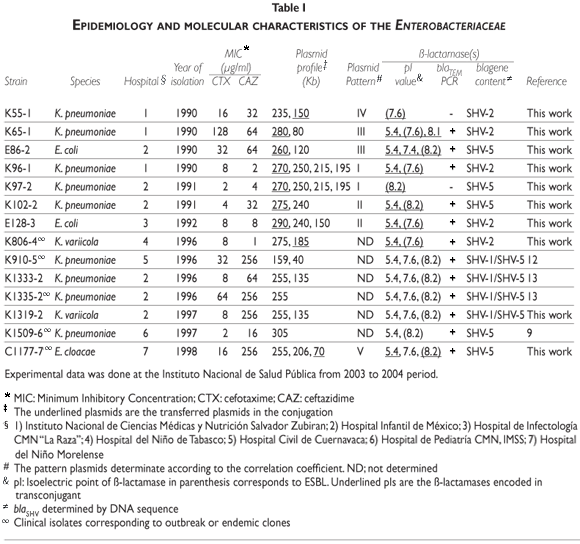
<body><![CDATA[<p><font size="3" face="Verdana"><b>Material and Methods</b></font></p>     <p><font size="2" face="Verdana"><I>Bacterial strains.</i> One-hundred and fifty-seven    clinical isolates of ESBL-PE causing nosocomial infections were each collected    from a different patient during a six-year period (1990-1992 and 1996-1998)    in seven hospitals in Mexico. Hospitals 1, 2, 3 and 6 are located in Mexico    City, hospitals 5 and 7 are 70 km from Mexico City, and hospital 4 is 785 km    from Mexico City (<a href="#tab01">table I</a>). All clinical isolates were    identified with the API 20E system (BioMerieux, Merck. Germany) and confirmed    as ESBL-producers. In order to perform further molecular characterization, 14    strains were selected to include one strain from each hospital. In cases corresponding    to an outbreak or endemic clone in the hospital, the strain represents from    6 to 94 independent clinical isolates: this was the case of strains K806-4 (6    isolates),<SUP>11</SUP> K910-5 (21 isolates),<SUP>12</SUP> K1333-2 and K1335-2    (12 isolates),<SUP>13</SUP> K1509-6 (94 isolates)<SUP>9</SUP> and C1177-7 (16    isolates) (this work) as indicated in <a href="#tab01">table I</a>. The species    included were: nine of <I>K. pneumoniae</I>, two <I>K. variicola</I>, two <I>E.    coli</I>, and one <I>E. cloacae.</I> Strains were named first with the first    letter of the corresponding specie, followed by the number of the strain and    finally number of the hospital where it was obtained.</font></p>     <p><a name="tab01"></a></p>     <p>&nbsp;</p>     <p align="center"><img src="/img/revistas/spm/v49n6/a08tab01.gif"></p>     <p>&nbsp;</p>     <p><font size="2" face="Verdana"><I>Susceptibility testing.</i> Bacterial antimicrobial    susceptibility was initially determined with the MicroScan (Dade, Behring, USA)    system using the combo 20 panel. Subsequently, MICs for cefotaxime and ceftazidime    were determined by Etest strips on Mueller-Hinton agar following the recommendations    of Clinical and Laboratory Standards Institute (CLSI). ESBL production was confirmed    by the double disk diffusion method with cefotaxime and ceftazidime alone and    in combination with clavulanic acid, interpretation criteria was as indicated    in the CLSI.<SUP>14</sup></font></p>     <p><font size="2" face="Verdana"><I>Genomic DNA typing.</i> For pulse-field gel    electrophoresis (PFGE) typing, whole cell DNA was obtained according to the    method described by Kaufmann. <SUP>15</SUP> DNA was digested with <I>Xba</I>I    (Gibco, BRL, UK.) and separated in 2% agarose gels (Pulsed Field-Certified;    Pronadisa, Madrid) with a Gene-Path System (Bio-Rad, Hercules, USA). Gels were    stained with ethidium bromide and analysed according to the criteria of Tenover    et al.<SUP>16</sup></font></p>     <p><font size="2" face="Verdana"><I>Plasmid profile and mating experiments.</i>    Plasmid DNA was extracted from clinical isolates and the respective transconjugant    according to the method described by Kieser.<SUP>17 </SUP>DNA was visualized    after vertical electrophoresis in 0.7% agarose gels stained with ethidium bromide.    Plasmids R6K (40 kb), RP4 (54 kb), R1 (205 kb) and pUA21 (300 kb) were used    as molecular weight markers. Matings were performed on filters placed on solid    LB-Luria medium according to Miller,<SUP>18</SUP> using <I>Escherichia coli</I>    J53-2 (F<SUP>-</SUP>, <I>pro, met</I>, Rif<SUP>r</SUP>) as the receptor strain.    In all cases, transconjugants were selected on Luria agar supplemented with    rifampin (100&#181;g/ml) in combination with cefotaxime    (1&#181;g/ml), or ampicillin (50&#181;g/ml).    Transconjugants were denoted with an X after the donor strain designation.</font></p>     <p><font size="2" face="Verdana"><I>IEF of </i><font face="Symbol">b</font><I>-lactamases    and bioassay.</i> Crude cell protein preparations from clinical isolates and    transconjugants were obtained from sonicated extracts prepared in 0.05M phosphate    buffer (pH 7.0). Crude extracts were subjected to isoelectric focusing (IEF)    by the procedure described previously,<SUP>19</SUP> using a Phast system minigel    with a pH range from 3 to 9 (Amersham, Biosciences, UK). Following IEF, <font face="Symbol">b</font>-lactamase    bands were visualized with nitrocefin (Oxoid, Hampshire, UK). After IEF, the    cefotaxidimase activities of separated <font face="Symbol">b</font>-lactamases    were detected by the bioassay described previously.<SUP>20</SUP> Extracts from    TEM-1, SHV-1 and SHV-5-producing strains were used as the standards for pIs    of 5.4, 7.6 and 8.2, respectively.</font></p>     ]]></body>
<body><![CDATA[<p><font size="2" face="Verdana"><I>TEM and SHV-specific PCR and DNA sequencing.</i>    The oligonucleotide primers OT1 and OT2 which amplify a region of TEM genes    were used.<SUP>21</SUP> Only ESBL genes were considered for further molecular    characterization using the DNA from some ESBL strains and resulting transconjugants.    To amplify SHV-related genes the oligonucleotide primers SE5 and SB3 were used    for PCR amplification as described by Silva et al.<SUP>12</SUP> Reactions were    carried out in a 50 &#181;l volume containing 1 X PCR    amplification buffer, 3 X Enhancer buffer (PCRx Enhancer System; Gibco, BRL,    USA), amplification conditions were: 5 min of denaturation at 94° C; 30 cycles    of 30 sec at 94° C, 30 sec at 58° C and 2 min at 72° C; and a final extension    for 15 min at 72° C. The resulting PCR products were analysed in 1.5% agarose    gels; samples producing one sharp band were purified with a column kit (High    Pure<SUP>TM</SUP> PCR Purification Kit, Boheringer, USA) and used for sequencing    reactions with the dideoxy chain termination using an automatic sequencer (ABI    PRISM 377-18, kit EL:Taq FS Dye Terminator Cycle Sequencing Fluorescence-Based    Sequencing). Primers SEC5' (5'-TCAGGAGGTTGACTATGCGT-3') (this study) and P1    (5'-ATCGAATGAGGCGCTTCC-3'),<SUP>22</SUP> were used for sequencing the amplified    PCR products.</font></p>     <p><FONT SIZE=2 face="Verdana"><I>Sequence Analysis. </i>Amino acid sequences    were obtained using Translate tool, available at ExPASy (<a href="http://www.expasy.ch/tools/dna.html" target="_blank">http://www.expasy.ch/tools/dna.    html</a>). Multiple-alignment of nucleotide and amino acid sequences was done    with ClustalW (<a href="http://clustalw.genome.jp/" target="_blank">http://clustalw.genome.jp/</a>)    and compared with the SHV-1 gene (GENBANK Accession number AF148850).</font></p>     <p><font size="2" face="Verdana"><I>Plasmid DNA fingerprinting.</i> Plasmid DNA    purification from transconjugants was performed with QIAGEN Plasmid Midi Kit    (QIAGEN, Hilden, Germany) ionic interchange columns, according to the manufacturer’s    procedure. Fingerprinting analysis was performed with <I>Dra</I>I restriction    enzyme (Promega. USA and Gibco, BRL, USA). The resulting DNA fragments were    analysed in 2% agarose gels. The dendrogram of <I>DraI</I> restriction pattern    was achieved using the NTSYSpc 2.0 program.</font></p>     <p>&nbsp;</p>     <p><font size="3" face="Verdana"><b>Results</b></font></p>     <p><FONT SIZE=2 face="Verdana"><I>Clinical isolates and susceptibility test.</i>    Isolation dates spanned a period of six years, from 1990 to 1992 and 1996 to    1998, collected from seven hospitals and three different cities in Mexico. <B>G</B>eneral    characteristics of all 14 clinical isolates are described in <a href="#tab01">table    I</a>. All strains were susceptible to cefoxitin, imipenem and ciprofloxacine,    they were confirmed as ESBL producers by the double disc method. In general    the MICs for ceftazidime and cefotaxime were heterogeneous. Five of these clinical    isolates represent outbreaks or endemic clones at each hospital, some of them    reported previously: K806-4, K910-5, K1332-2, K1335-2, K1509-6 and C1177-7,    representing 6, 21, 12, 94 and 16 endemic clones, respectively (see methods    and table).</font></p>     <p><font size="2" face="Verdana"><I>Typing by genomic DNA PFGE analysis. </i>In    this work, PFGE genomic DNA analysis from each species group was carried out    with the nine clinical isolates of <I>K. pneumoniae</I>, two <I>K. variicola    </I>and two <I>E. coli</I>. The <I>Xba</I>I restriction profiles showed different    DNA patterns between these three groups (data not shown), indicating no genetic    relation within the species. </font></p>     <p><font size="2" face="Verdana"><I>Plasmid profile and mating experiments.</i>    The 14 clinical isolates harboured 1-4 plasmids with sizes of 40-290 kb. To    define if the resistance genes were plasmid borne, bacterial conjugation was    performed and resistant recipients were selected. Only 9 of 14 clinical isolates    were capable of transferring the resistance to the susceptible <I>E. coli </I>J53-2    strain, and corresponded to five of the nine <I>K. pneumoniae</I> clinical isolates    tested, one of the two <I>K. variicola </I>tested, the two <I>E. coli</I> and    the <I>E. cloacae</I> clinical isolates included in this study. In all cases    the transconjugants received one plasmid originally contained in the respective    isolate; these plasmids are underlined in <a href="#tab01">table I</a>.</font></p>     <p><font size="2" face="Verdana"><I><font face="Symbol">b</font>-Lactamase profiles    and detection of ESBL.</i> All 14 clinical isolates expressed 1 to 3 <font face="Symbol">b</font>-lactamases    with different isoelectric points (pI). Three main bands were identified with    pI’s of 5.4, 7.6 and 8.2. In addition to these bands, two more bands were detected    with pI’s of 7.4 (strain E86-2) and 8.1 (strain K65-1), (<a href="#tab01">table    I</a>). The <font face="Symbol">b</font>-lactamase with pI 5.4 was identified    in 12/14 isolates, and the enzyme with pI 7.6 was expressed in 10/14 isolates.    The <font face="Symbol">b</font>-lactamase with pI 8.2 was present in 9/14 strains.    In order to identify the ESBL encoded in each clinical isolate and the respective    transconjugant, the bioassay (as mentioned in Material and Methods) was performed    on the IEF gels. Two bands (one from each clinical isolate and transconjugant)    were detected as ESBL. The enzyme with pI 7.6 was identified in 5/14 clinical    isolates and was obtained from three <I>K. pneumoniae</I>, one <I>K. variicola</I>,    and one <I>E. coli</I>. The ESBL with pI 8.2 was detected in 9/14 clinical isolates    which included six <I>K. pneumoniae</I>, one <I>K. variicola, </I>one <I>E.    coli</I>, and one <I>E. cloacae</I>. Five of these strains produced an enzyme    with pI 7.6 with no cefotaximase activity (non-ESBL). Considering the <font face="Symbol">b</font>-lactamase    profile and the ESBL encoded in transconjugants, two major groups (including    four strains each) were identified with pI 5.4, 7.6; and 5.4, 8.2. Data corresponding    to transconjugants are underlined indicated in table. The detection of TEM-encoding    <font face="Symbol">b</font>-lactamase by PCR amplification for <I>bla</I><SUB>TEM</SUB>    allele was carried out with all clinical isolates. A fragment of 503-pb was    obtained in 12 of 14 bacterial strains and corresponded to the isolates that    expressed the <font face="Symbol">b</font>-lactamase with pI 5.4, which does    not have cefotaximase activity in the bioassay and does not correspond to an    ESBL (<a href="#tab01">table I</a>).</font></p>     <p><font size="2" face="Verdana"><I>Identification of SHV-type ESBL by PCR amplification    and sequencing.</i> Only ESBL genes were considered for the molecular characterization,    according to the pI values (7.6 and 8.2) these enzymes could correspond to SHV-derived    ESBL. PCR amplification of SHV genes was performed with 14 isolates; all of    them produced a DNA fragment corresponding to the expected size of 0.9 kb (representing    the complete <I>bla</I><SUB>SHV</SUB> gene and the signal peptide region). In    order to identify mutations in this gene, the 14 PCR products obtained were    sequenced and the deduced amino acid sequence compared with the wild type SHV-1    enzyme.<SUP>23</SUP> In five cases, a Gli238Ser (G697A) substitution was detected    indicating the presence of the previously described SHV-2.<SUP>25</SUP> Nine    clinical isolates showed Gli238Ser (G697A) and Glu240Lys (G680/A) substitutions,    which corresponded to SHV-5.<SUP>25</SUP> (<a href="#tab01">table I</a>). Amplicons    from clinical isolates K910-5, K1333-2, K1335-2 and K1319-2 yielded sequences    with clear double G/A peak nucleotides at the first position of codons 238 and    240. In addition to this mutation, the PCR sequence of strain K1335-2 included    a double peak nucleotide at the third position of codon 240. The double nucleotide    peak at the first position of codon 238 corresponded to adenine (A) and guanine    (G) nucleotides, corresponding to serine (<u>A</u>GC) and glycine (<u>G</u>GC)    codons, respectively. A similar case was identified at the first and third positions    of codon 240 in strain K1335-2, where the base combinations corresponded to    glutamic acid (<u>G</u>A<u>G</u>, <u>G</u>A<u>A</u>) and lysine (<u>A</u>A<u>G</u>,    <u>A</u>A<u>A</u>) codons. These results suggest the amplification of a mixture    of PCR products, one of them corresponding to SHV-1 (non ESBL) and the other    to SHV-5 (ESBL).</font></p>     ]]></body>
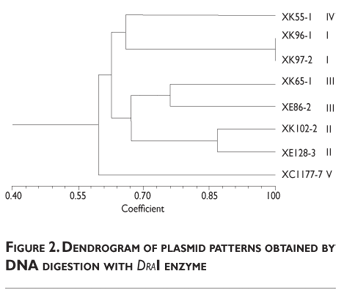
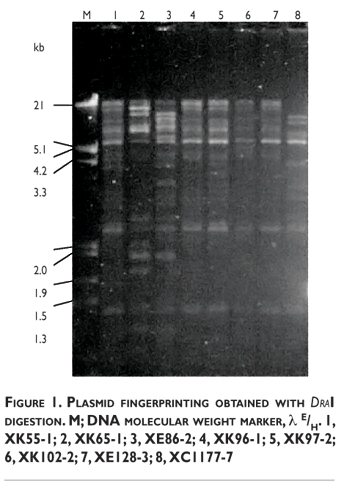
<body><![CDATA[<p><font size="2" face="Verdana"><I>Plasmid profile.</i> With the goal of identifying    similar DNA regions in the conjugative plasmids expressing SHV-derived ESBL,    the plasmidic DNA from transconjugants (which contain only one plasmid) was    digested with <I>Dra</I>I enzyme. The restriction pattern showed at least three    common bands in all plasmids with sizes of 6.5, 2.1 and 1.0 kb (<a href="#fig01">figure    1</a>), with additional bands shared between several plasmids. Interestingly,    the plasmid from the transconjugants of clinical isolates K96-1 and K97-2 had    identical DNA restriction pattern, even though they were collected during different    years (1990 and 1991, respectively) and hospitals settings (<a href="#fig01">figure    1</a>, slots 4 and 5). The dendrogram generated with the <I>Dra</I>I restriction    pattern of conjugative plasmids showed three main groups of plasmids excluding    the XK55-1 and XC1177-7 strains; in general the correlation coefficient was    up to 0.55 (<a href="#fig02">figure 2</a>). Group I included XK96-1 and XK97-2,    group II included XK102-2 and XE128-3 and group III included XK65-1 and XE86-2    transconjugants. </font></p>     <p><a name="fig01"></a></p>     <p>&nbsp;</p>     <p align="center"><img src="/img/revistas/spm/v49n6/a08fig01.gif"></p>     <p>&nbsp;</p>     <p><a name="fig02"></a></p>     <p>&nbsp;</p>     <p align="center"><img src="/img/revistas/spm/v49n6/a08fig02.gif"></p>     <p>&nbsp;</p>     <p><font size="3" face="Verdana"><b>Discussion</b></font></p>     ]]></body>
<body><![CDATA[<p><font size="2" face="Verdana">The present study includes the molecular characterization    of cephalosporin resistance in 14 clinical isolates of ESBL-EP (including endemic    clones from different hospitals) and the respective plasmids patterns encoding    the SHV-derived enzyme. The ESBL identified in all clinical isolates analysed    were SHV-2 and SHV-5. There was a relatedness of plasmids coding these enzymes    from isolates collected during six years from seven different hospitals and    three different locations in Mexico. </font></p>     <p><FONT SIZE=2 face="Verdana"> Three groups were identified according to the    results of IEF, sequence analysis of PCR product and mating experiments: Group    1: Transconjugants XK55-1, XK65-1, XK96-1 XE128-3 and XK806-44 contained only    one plasmid from the clinical isolate, they expressed the SHV-2 ESBL with a    pI of 7.6; Group 2: Transconjugants XE86-2, XK97-2, XK102-2 and XC1177-7 harbour    only one plasmid, they expressed the SHV-5 ESBL with a pI of 8.2; Finally, Group    3: The clinical isolates K910-5, K1319-2, K1333-2, K1335-2 and K1509-6 that    did not have the ability to transfer the resistance by conjugation and they    expressed the SHV-5 ESBL with pI 8.2 and SHV-1 not ESBL with pI 7.6. The interpretation    of these results was based on the sequence analysis of the PCR products including    double C/A peaks at the first position of codons 238 and 240, indicating a mixture    of PCR products. These amino acid combinations suggested that one enzyme corresponded    to SHV-1 (glycine 238, glutamic acid 240) with a pI of 7.6, and the second to    the SHV-5 (serine 238, lysine 240) with pI of 8.2. These possible combinations    of amino acids are deduced based on the fact that a mutant of SHV including    only the lysine at position 240 has not been previously reported (<a href="http://www.lahey.org/Studies/" target="_blank">http://www.lahey.org/Studies/</a>).    Similar results have been described in 13 ESBL-producer strains, in which at    least four of them carried <I>bla</I><SUB>SHV-11 </SUB>(non-ESBL) genes in addition    to the <I>bla</I><SUB>SHV-2a </SUB>or <I>bla</I><SUB>SHV-2 </SUB>(ESBLs).<SUP>26    </sup></font></p>     <p><font size="2" face="Verdana">It is known that the <I>bla</I><SUB>SHV-1</SUB>    gene has a chromosomal <I>K. pneumoniae</I> origin,<SUP>27 </SUP>this observation    must be in the clinical isolates of third group. Interestingly, the gene coding    for the plasmidic SHV-5 enzyme was located on a compound transposon which originated    from the <I>K. pneumoniae </I>chromosome.<SUP>10</SUP> Coexistence of two different    <font face="Symbol">b</font>-lactamases of SHV (SHV-11 and SHV-2a, or SHV-11    and SHV-12) in the same clinical isolate has been reported previously.<SUP>26</sup></font></p>     <p> <font size="2" face="Verdana">The horizontal transfer of a plasmid carrying    ESBL SHV genes between non-related strains has been reported.<SUP>28</SUP> Also,    the clonal and horizontal spread of SHV genes in clinical isolates of <I>K.    pneumoniae</I> has been documented.<SUP>9</SUP> In general, transconjugants    harboured the conjugative plasmid corresponded to the largest one, with exception    of XK55-1 and XC1177-7. Five clinical isolates (K910-5, K1319-2, K1333-2, K1335-2    and K1509-6) did not have the ability to transfer the resistance by conjugation    under the conditions tested; however, the K1333-2 and K1319-2 isolates belong    to different species which were collected in different years with identical    number and size plasmids and ESBLs.</font></p>     <p><font size="2" face="Verdana"> According to the plasmid restriction pattern    from transconjugants, group I have identical restriction profile but encode    different SHV-type ESBL: this group included K96-1 and K97-2 isolates which    were collected in different years and hospitals. This pattern had a correlation    coefficient of &gt;0.55 with the plasmid pattern IV that represents the plasmid    from isolate K55-1 collected in the same hospital and year as isolate K96-1,    both plasmids encode SHV-2 ESBL. Plasmid pattern II includes the K102-2 and    E128-3 isolates that corresponded to two different species and encode SHV-5    and SHV-2 enzymes respectively, these isolates were collected in different hospitals.    This situation is similar to isolates included in plasmid pattern III (K65-1    and E86-2 isolates), both groups have a high similarity (&gt; 0.65 correlation    coefficient). In general there is relatedness between plasmids encoding different    SHV-type ESBLs. This situation could be explained first as plasmids are promiscuous    mobile genetic elements and can be transferred horizontally within different    enterobacterial species.<SUP>29</SUP> Secondly, one mutation distinguishes SHV-2    from SHV-5 enzymes (E240K), this mutation could occur in an independent event    from SHV-2 and selected by the antibiotic exposure converting the enzyme to    SHV-5.<SUP>4,30</SUP> The dissemination of cephalosporin resistance among nosocomial    enterobacteria strains in different hospitals in Mexico, suggests that it could    be due to horizontal plasmid transmission among clonally unrelated strains (PFGE).    </font></p>     <p><font size="2" face="Verdana"> This situation highlights the need to establish    a study for molecular epidemiology of ESBLs and plasmids harboured in this kind    of clinical isolates. We hope that this study will contribute to a more complete    understanding of the spread and evolution of the SHV genes in hospital settings.</font></p>     <p>&nbsp;</p>     <p><font size="3" face="Verdana"><b>Acknowledgments</b></font></p>     <p><font size="2" face="Verdana">This work was supported by grants 30938 and SALUD    2003-C01-009 from CONACyT. Ulises Garza-Ramos was a fellow from CONACyT. We    thank Bertha Carrillo and Teresa Rojas for excellent technical assistance. Authors    want to thank Dr. Jose Sifuentes (INCMNSZ), Dra. Luz Elena Espinosa de los Monteros    (HIM), Dr. Rodolfo Gatica (HCC), Q. Eduardo Escamilla (HNT), Dra. Guadalupe    Miranda y Dr. Fortino Sol&oacute;rzano (HP CMN, IMSS), MC Veronica Andrade (HNM),    for providing the clinical isolates for this study, also to Dr. Michael Dunn    (Centro de Ciencias Gen&oacute;micas, UNAM), Cuernavaca, Morelos, Mexico, for    reviewing the manuscript. </font></p>     <p>&nbsp;</p>     ]]></body>
<body><![CDATA[<p><font size="3" face="Verdana"><b>References</b></font></p>     <!-- ref --><p><font size="2" face="Verdana">1. Burwen D, Banerjee, S, Gaynes R. Ceftazidime    resistance among selected nosocomial gram-negative bacilli in the United States.    National Nosocomial Infections Surveillance System. J Infect Dis 1994; 170:1622-1625.</font>&nbsp;&nbsp;&nbsp;&nbsp;&nbsp;&nbsp;&nbsp;&nbsp;[&#160;<a href="javascript:void(0);" onclick="javascript: window.open('/scielo.php?script=sci_nlinks&ref=9280783&pid=S0036-3634200700060000800001&lng=','','width=640,height=500,resizable=yes,scrollbars=1,menubar=yes,');">Links</a>&#160;]<!-- end-ref --><!-- ref --><p><font size="2" face="Verdana">2. Bradford P. Extended-spectrum <font face="Symbol">b</font>-lactamases    in the 21st century: characterization, epidemiology, and detection of this important    resistance threat. Clin Microbiol Rev 2001; 14:933-951.</font>&nbsp;&nbsp;&nbsp;&nbsp;&nbsp;&nbsp;&nbsp;&nbsp;[&#160;<a href="javascript:void(0);" onclick="javascript: window.open('/scielo.php?script=sci_nlinks&ref=9280784&pid=S0036-3634200700060000800002&lng=','','width=640,height=500,resizable=yes,scrollbars=1,menubar=yes,');">Links</a>&#160;]<!-- end-ref --><!-- ref --><p><font size="2" face="Verdana">3. Bush K, Jacoby G, Medeiros A. A functional    classification scheme for <font face="Symbol">b</font>-lactamases and its correlation    with molecular structure. Antimicrob Agents Chemother 1995; 39:1211-1233.</font>&nbsp;&nbsp;&nbsp;&nbsp;&nbsp;&nbsp;&nbsp;&nbsp;[&#160;<a href="javascript:void(0);" onclick="javascript: window.open('/scielo.php?script=sci_nlinks&ref=9280785&pid=S0036-3634200700060000800003&lng=','','width=640,height=500,resizable=yes,scrollbars=1,menubar=yes,');">Links</a>&#160;]<!-- end-ref --><!-- ref --><p><font size="2" face="Verdana">4. Tzouvelekis L S, Bonomo R A. SHV-type b-lactamases.    Curr Pharm Des 1999;5:847-864.</font>&nbsp;&nbsp;&nbsp;&nbsp;&nbsp;&nbsp;&nbsp;&nbsp;[&#160;<a href="javascript:void(0);" onclick="javascript: window.open('/scielo.php?script=sci_nlinks&ref=9280786&pid=S0036-3634200700060000800004&lng=','','width=640,height=500,resizable=yes,scrollbars=1,menubar=yes,');">Links</a>&#160;]<!-- end-ref --><!-- ref --><p><font size="2" face="Verdana">5. Howard C, van Daal A, Kelly G, Schooneveldt    J, Nimmo G, Giffard P. Identification and minisequencing-based discrimination    of SHV <font face="Symbol">b</font>-lactamases in nosocomial infection-associated    <I>Klebsiella pneumoniae</I> in Brisbane, Australia. Antimicrob Agents Chemother    2002; 46:659-664.</font>&nbsp;&nbsp;&nbsp;&nbsp;&nbsp;&nbsp;&nbsp;&nbsp;[&#160;<a href="javascript:void(0);" onclick="javascript: window.open('/scielo.php?script=sci_nlinks&ref=9280787&pid=S0036-3634200700060000800005&lng=','','width=640,height=500,resizable=yes,scrollbars=1,menubar=yes,');">Links</a>&#160;]<!-- end-ref --><!-- ref --><p><font size="2" face="Verdana">6. Du Bois S K, Marriott M S and Amyes S G B.    TEM-and SHV-derived extended-spectrum b-lactamases: relationship between selection,    structure and function. J. Antimicrob. Chemother 1995; 35:7-22.</font>&nbsp;&nbsp;&nbsp;&nbsp;&nbsp;&nbsp;&nbsp;&nbsp;[&#160;<a href="javascript:void(0);" onclick="javascript: window.open('/scielo.php?script=sci_nlinks&ref=9280788&pid=S0036-3634200700060000800006&lng=','','width=640,height=500,resizable=yes,scrollbars=1,menubar=yes,');">Links</a>&#160;]<!-- end-ref --><!-- ref --><p><font size="2" face="Verdana">7. Martinez-Aguilar G, Alpuche-Aranda C, Anaya    C <I>et al</I>. Outbreak of nosocomial sepsis and pneumonia in a newborn intensive    care unit by multiresistant extended-spectrum <font face="Symbol">b</font>-lactamase-producing    <I>Klebsiella pneumoniae</I>: high impact on mortality. Infect Control Hosp    Epidemiol 2001; 22:725-728.</font>&nbsp;&nbsp;&nbsp;&nbsp;&nbsp;&nbsp;&nbsp;&nbsp;[&#160;<a href="javascript:void(0);" onclick="javascript: window.open('/scielo.php?script=sci_nlinks&ref=9280789&pid=S0036-3634200700060000800007&lng=','','width=640,height=500,resizable=yes,scrollbars=1,menubar=yes,');">Links</a>&#160;]<!-- end-ref --><!-- ref --><p><font size="2" face="Verdana">8. Alcantar-Curiel, D, Tinoco J, Gayosso C, Carlos    A <I>et al</I>. Nosocomial bacteremia and urinary tract infections caused by    extended-spectrum <font face="Symbol">b</font>-lactamase producing <I>Klebsiella    pneumoniae</I> with plasmids carrying both SHV-5 and TLA-1 genes. Clin Infect    Dis 2004; 38:1067-1074.</font>&nbsp;&nbsp;&nbsp;&nbsp;&nbsp;&nbsp;&nbsp;&nbsp;[&#160;<a href="javascript:void(0);" onclick="javascript: window.open('/scielo.php?script=sci_nlinks&ref=9280790&pid=S0036-3634200700060000800008&lng=','','width=640,height=500,resizable=yes,scrollbars=1,menubar=yes,');">Links</a>&#160;]<!-- end-ref --><!-- ref --><p><font size="2" face="Verdana">9. Miranda, G, Castro N, Lea&ntilde;os B <I>et    al</I>. Clonal and Horizontal Dissemination of <I>Klebsiella pneumoniae </I>Expressing    SHV-5 extended-spectrum <font face="Symbol">b</font>-lactamase in a Mexican    pediatric hospital. J Clin Microbiol 2004; 42:30-35.</font>&nbsp;&nbsp;&nbsp;&nbsp;&nbsp;&nbsp;&nbsp;&nbsp;[&#160;<a href="javascript:void(0);" onclick="javascript: window.open('/scielo.php?script=sci_nlinks&ref=9280791&pid=S0036-3634200700060000800009&lng=','','width=640,height=500,resizable=yes,scrollbars=1,menubar=yes,');">Links</a>&#160;]<!-- end-ref --><!-- ref --><p><font size="2" face="Verdana">10. Preston K, Venezia R, Stellrecht K. The SHV-5    extended-spectrum <font face="Symbol">b</font>-lactamase gene of pACM1 is located    on the remnant of a compound transposon. Plasmid 2004; 51:48-53.</font>&nbsp;&nbsp;&nbsp;&nbsp;&nbsp;&nbsp;&nbsp;&nbsp;[&#160;<a href="javascript:void(0);" onclick="javascript: window.open('/scielo.php?script=sci_nlinks&ref=9280792&pid=S0036-3634200700060000800010&lng=','','width=640,height=500,resizable=yes,scrollbars=1,menubar=yes,');">Links</a>&#160;]<!-- end-ref --><!-- ref --><p><font size="2" face="Verdana">11. Rosenblueth M, Martinez L, Silva J, Martinez-Romero    E. <I>Klebsiella variicola</I>, a novel species with clinical and plant-associated    isolates. Syst Appl Microbiol 2004; 27:27-35.</font>&nbsp;&nbsp;&nbsp;&nbsp;&nbsp;&nbsp;&nbsp;&nbsp;[&#160;<a href="javascript:void(0);" onclick="javascript: window.open('/scielo.php?script=sci_nlinks&ref=9280793&pid=S0036-3634200700060000800011&lng=','','width=640,height=500,resizable=yes,scrollbars=1,menubar=yes,');">Links</a>&#160;]<!-- end-ref --><!-- ref --><p><FONT SIZE=2 face="Verdana">12. Silva J, Gatica R, Aguilar C <I>et al.</I>    Outbreak of infection with extended-spectrum <font face="Symbol">b</font>-lactamase-producing <I>Klebsiella    pneumoniae </I>in a Mexican hospital. J Clin Microbiol 2001; 39:3193-3196.</font>&nbsp;&nbsp;&nbsp;&nbsp;&nbsp;&nbsp;&nbsp;&nbsp;[&#160;<a href="javascript:void(0);" onclick="javascript: window.open('/scielo.php?script=sci_nlinks&ref=9280794&pid=S0036-3634200700060000800012&lng=','','width=640,height=500,resizable=yes,scrollbars=1,menubar=yes,');">Links</a>&#160;]<!-- end-ref --><!-- ref --><p><font size="2" face="Verdana">13. Andrade V, Silva-S&aacute;nchez J, Grupo    de Resistencia Bacteriana. Caracterizaci&oacute;n de <I>Klebsiella pneumoniae    </I>productora de la <font face="Symbol">b</font>-lactamasa SHV-5 en una unidad    de cuidados intensivos. Salud Publica Mex 2004;46:524-528.</font>&nbsp;&nbsp;&nbsp;&nbsp;&nbsp;&nbsp;&nbsp;&nbsp;[&#160;<a href="javascript:void(0);" onclick="javascript: window.open('/scielo.php?script=sci_nlinks&ref=9280795&pid=S0036-3634200700060000800013&lng=','','width=640,height=500,resizable=yes,scrollbars=1,menubar=yes,');">Links</a>&#160;]<!-- end-ref --><!-- ref --><p><font size="2" face="Verdana">14. Clinical Laboratory Standards Institute.    Methods for dilution antimicrobial susceptibility tests for bacteria that grow    aerobically. Approved standard M100-S14. Clinical Laboratory Standards Institute,    Wayne, Pa. 2005: 35.</font>&nbsp;&nbsp;&nbsp;&nbsp;&nbsp;&nbsp;&nbsp;&nbsp;[&#160;<a href="javascript:void(0);" onclick="javascript: window.open('/scielo.php?script=sci_nlinks&ref=9280796&pid=S0036-3634200700060000800014&lng=','','width=640,height=500,resizable=yes,scrollbars=1,menubar=yes,');">Links</a>&#160;]<!-- end-ref --><!-- ref --><p><font size="2" face="Verdana">15. Kaufmann ME. Methods Mol Med <B>15</B>, 17-31    1998.</font>&nbsp;&nbsp;&nbsp;&nbsp;&nbsp;&nbsp;&nbsp;&nbsp;[&#160;<a href="javascript:void(0);" onclick="javascript: window.open('/scielo.php?script=sci_nlinks&ref=9280797&pid=S0036-3634200700060000800015&lng=','','width=640,height=500,resizable=yes,scrollbars=1,menubar=yes,');">Links</a>&#160;]<!-- end-ref --><!-- ref --><p><font size="2" face="Verdana">16. Tenover F, Arbeit R, Goering V <I>et al.</I>    Interpreting chomosomal DNA restriction patterns produced by pulsed-field gel    electrophoresis: criteria for bacterial strain typing. J Clin Microbiol 1995;    33:2233-2239.</font>&nbsp;&nbsp;&nbsp;&nbsp;&nbsp;&nbsp;&nbsp;&nbsp;[&#160;<a href="javascript:void(0);" onclick="javascript: window.open('/scielo.php?script=sci_nlinks&ref=9280798&pid=S0036-3634200700060000800016&lng=','','width=640,height=500,resizable=yes,scrollbars=1,menubar=yes,');">Links</a>&#160;]<!-- end-ref --><!-- ref --><p><font size="2" face="Verdana">17. Kieser T. Factors affecting the isolation    of CCC DNA from <I>Streptomyces lividans</I> and <I>Escherichia coli</I>. Plasmid    1984; 12:19-36.</font>&nbsp;&nbsp;&nbsp;&nbsp;&nbsp;&nbsp;&nbsp;&nbsp;[&#160;<a href="javascript:void(0);" onclick="javascript: window.open('/scielo.php?script=sci_nlinks&ref=9280799&pid=S0036-3634200700060000800017&lng=','','width=640,height=500,resizable=yes,scrollbars=1,menubar=yes,');">Links</a>&#160;]<!-- end-ref --><!-- ref --><p><font size="2" face="Verdana">18. Miller J. Experiments in molecular genetics.    New York, NY: Cold Spring Harbour Laboratory Press 1972:82-85.</font>&nbsp;&nbsp;&nbsp;&nbsp;&nbsp;&nbsp;&nbsp;&nbsp;[&#160;<a href="javascript:void(0);" onclick="javascript: window.open('/scielo.php?script=sci_nlinks&ref=9280800&pid=S0036-3634200700060000800018&lng=','','width=640,height=500,resizable=yes,scrollbars=1,menubar=yes,');">Links</a>&#160;]<!-- end-ref --><!-- ref --><p><font size="2" face="Verdana">19. Matthew M, Harris A, Marshall M, Ross G.    The use of analytical isoelectric focusing for detection and identification    of <font face="Symbol">b</font>-lactamases. J Gen Microbiol 1975; 88:169-178.</font>&nbsp;&nbsp;&nbsp;&nbsp;&nbsp;&nbsp;&nbsp;&nbsp;[&#160;<a href="javascript:void(0);" onclick="javascript: window.open('/scielo.php?script=sci_nlinks&ref=9280801&pid=S0036-3634200700060000800019&lng=','','width=640,height=500,resizable=yes,scrollbars=1,menubar=yes,');">Links</a>&#160;]<!-- end-ref --><!-- ref --><p><font size="2" face="Verdana">20. Silva J, Aguilar C. <font face="Symbol">b</font>-lactamase    Bioassay: A simplified method to determine extended-spectrum <font face="Symbol">b</font>-lactamases    (ESBL) in enterobacteria. Arch Med Res 1997; 28:285-287.</font>&nbsp;&nbsp;&nbsp;&nbsp;&nbsp;&nbsp;&nbsp;&nbsp;[&#160;<a href="javascript:void(0);" onclick="javascript: window.open('/scielo.php?script=sci_nlinks&ref=9280802&pid=S0036-3634200700060000800020&lng=','','width=640,height=500,resizable=yes,scrollbars=1,menubar=yes,');">Links</a>&#160;]<!-- end-ref --><!-- ref --><p><font size="2" face="Verdana">21. Arlet G, Philippon A. Construction by polymerase    chain reaction and use of intragenic DNA probes for three main types of transferable    <font face="Symbol">b</font>-lactamases (TEM, SHV, CARB). FEMS Microbiol Lett    1991; 66:19-25.</font>&nbsp;&nbsp;&nbsp;&nbsp;&nbsp;&nbsp;&nbsp;&nbsp;[&#160;<a href="javascript:void(0);" onclick="javascript: window.open('/scielo.php?script=sci_nlinks&ref=9280803&pid=S0036-3634200700060000800021&lng=','','width=640,height=500,resizable=yes,scrollbars=1,menubar=yes,');">Links</a>&#160;]<!-- end-ref --><!-- ref --><p><font size="2" face="Verdana">22. Prodinger, W, Fille M, Bauernfeind A <I>et    al</I>. Molecular epidemiology of <I>Klebsiella pneumoniae</I> producing    SHV-5 <font face="Symbol">b</font>-lactamase: parallel outbreaks due to multiple plasmid transfer.    J Clin Microbiol 1996; 34:564-68.</font>&nbsp;&nbsp;&nbsp;&nbsp;&nbsp;&nbsp;&nbsp;&nbsp;[&#160;<a href="javascript:void(0);" onclick="javascript: window.open('/scielo.php?script=sci_nlinks&ref=9280804&pid=S0036-3634200700060000800022&lng=','','width=640,height=500,resizable=yes,scrollbars=1,menubar=yes,');">Links</a>&#160;]<!-- end-ref --><!-- ref --><p><font size="2" face="Verdana">23. Barthelemy M, Peduzzi J, Labia R. Complete    amino acid sequence of p453-plasmid-mediated PIT-2 <font face="Symbol">b</font>-lactamase (SHV-1).    Biochem J 1988; 251:73-79.</font>&nbsp;&nbsp;&nbsp;&nbsp;&nbsp;&nbsp;&nbsp;&nbsp;[&#160;<a href="javascript:void(0);" onclick="javascript: window.open('/scielo.php?script=sci_nlinks&ref=9280805&pid=S0036-3634200700060000800023&lng=','','width=640,height=500,resizable=yes,scrollbars=1,menubar=yes,');">Links</a>&#160;]<!-- end-ref --><!-- ref --><p><font size="2" face="Verdana">24. Bradford P. Automated thermal cycling is    superior to traditional methods for nucleotide sequencing of blaSHV genes. Antimicrob    Agents Chemother 1999; 43:2960-2963.</font>&nbsp;&nbsp;&nbsp;&nbsp;&nbsp;&nbsp;&nbsp;&nbsp;[&#160;<a href="javascript:void(0);" onclick="javascript: window.open('/scielo.php?script=sci_nlinks&ref=9280806&pid=S0036-3634200700060000800024&lng=','','width=640,height=500,resizable=yes,scrollbars=1,menubar=yes,');">Links</a>&#160;]<!-- end-ref --><!-- ref --><p><font size="2" face="Verdana">25. Billot-Klein D, Gutmann L, Collatz E. Nucleotide    sequence of the SHV-5 <font face="Symbol">b</font>-lactamase gene of a <I>Klebsiella    pneumoniae</I> plasmid. Antimicrob Agents Chemother 1990; 34:2439-2441.</font>&nbsp;&nbsp;&nbsp;&nbsp;&nbsp;&nbsp;&nbsp;&nbsp;[&#160;<a href="javascript:void(0);" onclick="javascript: window.open('/scielo.php?script=sci_nlinks&ref=9280807&pid=S0036-3634200700060000800025&lng=','','width=640,height=500,resizable=yes,scrollbars=1,menubar=yes,');">Links</a>&#160;]<!-- end-ref --><!-- ref --><p><font size="2" face="Verdana">26. Essack S, Hall L, Pillay D, McFadyen M, Livermore    D. Complexity and diversity of <I>Klebsiella pneumoniae</I> strains with extended-spectrum    <font face="Symbol">b</font>-lactamases isolated in 1994 and 1996 at a teaching    hospital in Durban, South Africa. Antimicrob Agents Chemother 2001; 45:88-95.</font>&nbsp;&nbsp;&nbsp;&nbsp;&nbsp;&nbsp;&nbsp;&nbsp;[&#160;<a href="javascript:void(0);" onclick="javascript: window.open('/scielo.php?script=sci_nlinks&ref=9280808&pid=S0036-3634200700060000800026&lng=','','width=640,height=500,resizable=yes,scrollbars=1,menubar=yes,');">Links</a>&#160;]<!-- end-ref --><!-- ref --><p><font size="2" face="Verdana">27. Chaves J, Ladona M, Segura, Coira C, Reig    R, Ampurdan&eacute;s C. SHV-1 <font face="Symbol">b</font>-lactamase is mainly    achromosomally encoded species-specific enzyme in <I>Klebsiella pneumoniae</I>.    Antimicrob. Agents Chemother 2001; 45:2856-2861.</font>&nbsp;&nbsp;&nbsp;&nbsp;&nbsp;&nbsp;&nbsp;&nbsp;[&#160;<a href="javascript:void(0);" onclick="javascript: window.open('/scielo.php?script=sci_nlinks&ref=9280809&pid=S0036-3634200700060000800027&lng=','','width=640,height=500,resizable=yes,scrollbars=1,menubar=yes,');">Links</a>&#160;]<!-- end-ref --><!-- ref --><p><font size="2" face="Verdana">28. Gniadkowski M, Paucha A, Grzesiowski P, Hryniewicz    W. Outbreak of ceftazidime-resistant <I>Klebsiella pneumoniae </I>in a pediatric    hospital in Warsaw, Poland: Clonal Spread of the TEM-47 Extended-Spectrum beta-lactamase    (ESBL)-producing strain and transfer of a plasmid carrying the SHV-5-like ESBL-encoding    gene. Antimicrob Agents Chemother 1998; 42:3079-3085.</font>&nbsp;&nbsp;&nbsp;&nbsp;&nbsp;&nbsp;&nbsp;&nbsp;[&#160;<a href="javascript:void(0);" onclick="javascript: window.open('/scielo.php?script=sci_nlinks&ref=9280810&pid=S0036-3634200700060000800028&lng=','','width=640,height=500,resizable=yes,scrollbars=1,menubar=yes,');">Links</a>&#160;]<!-- end-ref --><!-- ref --><p><font size="2" face="Verdana">29. Sorensen S, Bailey M, Hansen L et al. Studying    plasmid horizontal transfer <I>in situ</I>: a critical review. Nat Rev Micro    2005; 3:700-710.</font>&nbsp;&nbsp;&nbsp;&nbsp;&nbsp;&nbsp;&nbsp;&nbsp;[&#160;<a href="javascript:void(0);" onclick="javascript: window.open('/scielo.php?script=sci_nlinks&ref=9280811&pid=S0036-3634200700060000800029&lng=','','width=640,height=500,resizable=yes,scrollbars=1,menubar=yes,');">Links</a>&#160;]<!-- end-ref --><!-- ref --><p><font size="2" face="Verdana">30. Ford P, Avison M. Evolutionary mapping of    the SHV <font face="Symbol">b</font>-lactamase and evidence for two separate IS26-dependent blaSHV    mobilization events from the <I>Klebsiella pneumoniae</I> chromosome. J Antimicrob    Chemother 2004; 54:69-75.</font>&nbsp;&nbsp;&nbsp;&nbsp;&nbsp;&nbsp;&nbsp;&nbsp;[&#160;<a href="javascript:void(0);" onclick="javascript: window.open('/scielo.php?script=sci_nlinks&ref=9280812&pid=S0036-3634200700060000800030&lng=','','width=640,height=500,resizable=yes,scrollbars=1,menubar=yes,');">Links</a>&#160;]<!-- end-ref --><p>&nbsp;</p>     <p>&nbsp;</p>     <p><font size="2" face="Verdana">Received on: September 11, 2006    <br>   Accepted on: September 18, 2007</font></p>     <p>&nbsp;</p>     <p>&nbsp;</p>     <p><font size="2" face="Verdana">Address reprint requests to: Dr. Jes&uacute;s    Silva-S&aacute;nchez. Instituto Nacional de Salud P&uacute;blica. Av. Universidad    655, col. Santa Mar&iacute;a Ahuacatitl&aacute;n, 62508 Cuernavaca, Morelos,    M&eacute;xico. E-mail: <a href="mailto:jsilva@correo.insp.mx">jsilva@correo.insp.mx</a>.</font></p>      ]]></body><back>
<ref-list>
<ref id="B1">
<label>1</label><nlm-citation citation-type="journal">
<person-group person-group-type="author">
<name>
<surname><![CDATA[Burwen]]></surname>
<given-names><![CDATA[D]]></given-names>
</name>
<name>
<surname><![CDATA[Banerjee]]></surname>
<given-names><![CDATA[S]]></given-names>
</name>
<name>
<surname><![CDATA[Gaynes]]></surname>
<given-names><![CDATA[R]]></given-names>
</name>
</person-group>
<article-title xml:lang="en"><![CDATA[Ceftazidime resistance among selected nosocomial gram-negative bacilli in the United States: National Nosocomial Infections Surveillance System]]></article-title>
<source><![CDATA[J Infect Dis]]></source>
<year>1994</year>
<volume>170</volume>
<page-range>1622-1625</page-range></nlm-citation>
</ref>
<ref id="B2">
<label>2</label><nlm-citation citation-type="journal">
<person-group person-group-type="author">
<name>
<surname><![CDATA[Bradford]]></surname>
<given-names><![CDATA[P]]></given-names>
</name>
</person-group>
<article-title xml:lang="en"><![CDATA[Extended-spectrum beta-lactamases in the 21st century: characterization, epidemiology, and detection of this important resistance threat]]></article-title>
<source><![CDATA[Clin Microbiol Rev]]></source>
<year>2001</year>
<volume>14</volume>
<page-range>933-951</page-range></nlm-citation>
</ref>
<ref id="B3">
<label>3</label><nlm-citation citation-type="journal">
<person-group person-group-type="author">
<name>
<surname><![CDATA[Bush]]></surname>
<given-names><![CDATA[K]]></given-names>
</name>
<name>
<surname><![CDATA[Jacoby]]></surname>
<given-names><![CDATA[G]]></given-names>
</name>
<name>
<surname><![CDATA[Medeiros]]></surname>
<given-names><![CDATA[A]]></given-names>
</name>
</person-group>
<article-title xml:lang="en"><![CDATA[A functional classification scheme for beta-lactamases and its correlation with molecular structure]]></article-title>
<source><![CDATA[Antimicrob Agents Chemother]]></source>
<year>1995</year>
<volume>39</volume>
<page-range>1211-1233</page-range></nlm-citation>
</ref>
<ref id="B4">
<label>4</label><nlm-citation citation-type="journal">
<person-group person-group-type="author">
<name>
<surname><![CDATA[Tzouvelekis]]></surname>
<given-names><![CDATA[L S]]></given-names>
</name>
<name>
<surname><![CDATA[Bonomo]]></surname>
<given-names><![CDATA[R A]]></given-names>
</name>
</person-group>
<article-title xml:lang="en"><![CDATA[SHV-type b-lactamases]]></article-title>
<source><![CDATA[Curr Pharm Des]]></source>
<year>1999</year>
<volume>5</volume>
<page-range>847-864</page-range></nlm-citation>
</ref>
<ref id="B5">
<label>5</label><nlm-citation citation-type="journal">
<person-group person-group-type="author">
<name>
<surname><![CDATA[Howard]]></surname>
<given-names><![CDATA[C]]></given-names>
</name>
<name>
<surname><![CDATA[van Daal]]></surname>
<given-names><![CDATA[A]]></given-names>
</name>
<name>
<surname><![CDATA[Kelly]]></surname>
<given-names><![CDATA[G]]></given-names>
</name>
<name>
<surname><![CDATA[Schooneveldt]]></surname>
<given-names><![CDATA[J]]></given-names>
</name>
<name>
<surname><![CDATA[Nimmo]]></surname>
<given-names><![CDATA[G]]></given-names>
</name>
<name>
<surname><![CDATA[Giffard]]></surname>
<given-names><![CDATA[P]]></given-names>
</name>
</person-group>
<article-title xml:lang="en"><![CDATA[Identification and minisequencing-based discrimination of SHV beta-lactamases in nosocomial infection-associated Klebsiella pneumoniae in Brisbane, Australia]]></article-title>
<source><![CDATA[Antimicrob Agents Chemother]]></source>
<year>2002</year>
<volume>46</volume>
<page-range>659-664</page-range></nlm-citation>
</ref>
<ref id="B6">
<label>6</label><nlm-citation citation-type="journal">
<person-group person-group-type="author">
<name>
<surname><![CDATA[Du Bois]]></surname>
<given-names><![CDATA[S K]]></given-names>
</name>
<name>
<surname><![CDATA[Marriott]]></surname>
<given-names><![CDATA[M S]]></given-names>
</name>
<name>
<surname><![CDATA[Amyes]]></surname>
<given-names><![CDATA[S G B]]></given-names>
</name>
</person-group>
<article-title xml:lang="en"><![CDATA[TEM-and SHV-derived extended-spectrum b-lactamases: relationship between selection, structure and function]]></article-title>
<source><![CDATA[J. Antimicrob. Chemother]]></source>
<year>1995</year>
<volume>35</volume>
<page-range>7-22</page-range></nlm-citation>
</ref>
<ref id="B7">
<label>7</label><nlm-citation citation-type="journal">
<person-group person-group-type="author">
<name>
<surname><![CDATA[Martinez-Aguilar]]></surname>
<given-names><![CDATA[G]]></given-names>
</name>
<name>
<surname><![CDATA[Alpuche-Aranda]]></surname>
<given-names><![CDATA[C]]></given-names>
</name>
<name>
<surname><![CDATA[Anaya]]></surname>
<given-names><![CDATA[C]]></given-names>
</name>
</person-group>
<article-title xml:lang="en"><![CDATA[Outbreak of nosocomial sepsis and pneumonia in a newborn intensive care unit by multiresistant extended-spectrum beta-lactamase-producing Klebsiella pneumoniae: high impact on mortality]]></article-title>
<source><![CDATA[Infect Control Hosp Epidemiol]]></source>
<year>2001</year>
<volume>22</volume>
<page-range>725-728</page-range></nlm-citation>
</ref>
<ref id="B8">
<label>8</label><nlm-citation citation-type="journal">
<person-group person-group-type="author">
<name>
<surname><![CDATA[Alcantar-Curie]]></surname>
<given-names><![CDATA[D]]></given-names>
</name>
<name>
<surname><![CDATA[Tinoco]]></surname>
<given-names><![CDATA[J]]></given-names>
</name>
<name>
<surname><![CDATA[Gayosso]]></surname>
<given-names><![CDATA[C]]></given-names>
</name>
<name>
<surname><![CDATA[Carlos]]></surname>
<given-names><![CDATA[A]]></given-names>
</name>
</person-group>
<article-title xml:lang="en"><![CDATA[Nosocomial bacteremia and urinary tract infections caused by extended-spectrum beta-lactamase producing Klebsiella pneumoniae with plasmids carrying both SHV-5 and TLA-1 genes]]></article-title>
<source><![CDATA[Clin Infect Dis]]></source>
<year>2004</year>
<volume>38</volume>
<page-range>1067-1074</page-range></nlm-citation>
</ref>
<ref id="B9">
<label>9</label><nlm-citation citation-type="journal">
<person-group person-group-type="author">
<name>
<surname><![CDATA[Miranda]]></surname>
<given-names><![CDATA[G]]></given-names>
</name>
<name>
<surname><![CDATA[Castro]]></surname>
<given-names><![CDATA[N]]></given-names>
</name>
<name>
<surname><![CDATA[Leaños]]></surname>
<given-names><![CDATA[B]]></given-names>
</name>
</person-group>
<article-title xml:lang="en"><![CDATA[Clonal and Horizontal Dissemination of Klebsiella pneumoniae Expressing SHV-5 extended-spectrum beta-lactamase in a Mexican pediatric hospital]]></article-title>
<source><![CDATA[J Clin Microbiol]]></source>
<year>2004</year>
<volume>42</volume>
<page-range>30-35</page-range></nlm-citation>
</ref>
<ref id="B10">
<label>10</label><nlm-citation citation-type="journal">
<person-group person-group-type="author">
<name>
<surname><![CDATA[Preston]]></surname>
<given-names><![CDATA[K]]></given-names>
</name>
<name>
<surname><![CDATA[Venezia]]></surname>
<given-names><![CDATA[R]]></given-names>
</name>
<name>
<surname><![CDATA[Stellrecht]]></surname>
<given-names><![CDATA[K]]></given-names>
</name>
</person-group>
<article-title xml:lang="en"><![CDATA[The SHV-5 extended-spectrum beta-lactamase gene of pACM1 is located on the remnant of a compound transposon]]></article-title>
<source><![CDATA[Plasmid]]></source>
<year>2004</year>
<volume>51</volume>
<page-range>48-53</page-range></nlm-citation>
</ref>
<ref id="B11">
<label>11</label><nlm-citation citation-type="journal">
<person-group person-group-type="author">
<name>
<surname><![CDATA[Rosenblueth]]></surname>
<given-names><![CDATA[M]]></given-names>
</name>
<name>
<surname><![CDATA[Martinez]]></surname>
<given-names><![CDATA[L]]></given-names>
</name>
<name>
<surname><![CDATA[Silva]]></surname>
<given-names><![CDATA[J]]></given-names>
</name>
<name>
<surname><![CDATA[Martinez-Romero]]></surname>
<given-names><![CDATA[E]]></given-names>
</name>
</person-group>
<article-title xml:lang="en"><![CDATA[Klebsiella variicola, a novel species with clinical and plant-associated isolates]]></article-title>
<source><![CDATA[Syst Appl Microbiol]]></source>
<year>2004</year>
<volume>27</volume>
<page-range>27-35</page-range></nlm-citation>
</ref>
<ref id="B12">
<label>12</label><nlm-citation citation-type="journal">
<person-group person-group-type="author">
<name>
<surname><![CDATA[Silva]]></surname>
<given-names><![CDATA[J]]></given-names>
</name>
<name>
<surname><![CDATA[Gatica]]></surname>
<given-names><![CDATA[R]]></given-names>
</name>
<name>
<surname><![CDATA[Aguilar]]></surname>
<given-names><![CDATA[C]]></given-names>
</name>
</person-group>
<article-title xml:lang="en"><![CDATA[Outbreak of infection with extended-spectrum beta-lactamase-producing Klebsiella pneumoniae in a Mexican hospital]]></article-title>
<source><![CDATA[J Clin Microbiol]]></source>
<year>2001</year>
<volume>39</volume>
<page-range>3193-3196</page-range></nlm-citation>
</ref>
<ref id="B13">
<label>13</label><nlm-citation citation-type="journal">
<person-group person-group-type="author">
<name>
<surname><![CDATA[Andrade]]></surname>
<given-names><![CDATA[V]]></given-names>
</name>
<name>
<surname><![CDATA[Silva-Sánchez]]></surname>
<given-names><![CDATA[J]]></given-names>
</name>
</person-group>
<article-title xml:lang="es"><![CDATA[Grupo de Resistencia Bacteriana: Caracterización de Klebsiella pneumoniae productora de la beta-lactamasa SHV-5 en una unidad de cuidados intensivos]]></article-title>
<source><![CDATA[Salud Publica Mex]]></source>
<year>2004</year>
<volume>46</volume>
<page-range>524-528</page-range></nlm-citation>
</ref>
<ref id="B14">
<label>14</label><nlm-citation citation-type="book">
<collab>Clinical Laboratory Standards Institute</collab>
<source><![CDATA[Methods for dilution antimicrobial susceptibility tests for bacteria that grow aerobically: Approved standard M100-S14]]></source>
<year>2005</year>
<page-range>35</page-range><publisher-loc><![CDATA[Wayne^ePa Pa]]></publisher-loc>
<publisher-name><![CDATA[Clinical Laboratory Standards Institute]]></publisher-name>
</nlm-citation>
</ref>
<ref id="B15">
<label>15</label><nlm-citation citation-type="">
<person-group person-group-type="author">
<name>
<surname><![CDATA[Kaufmann]]></surname>
<given-names><![CDATA[ME]]></given-names>
</name>
</person-group>
<source><![CDATA[Methods Mol Med]]></source>
<year>1998</year>
<page-range>17-31</page-range></nlm-citation>
</ref>
<ref id="B16">
<label>16</label><nlm-citation citation-type="journal">
<person-group person-group-type="author">
<name>
<surname><![CDATA[Tenover]]></surname>
<given-names><![CDATA[F]]></given-names>
</name>
<name>
<surname><![CDATA[Arbeit]]></surname>
<given-names><![CDATA[R]]></given-names>
</name>
<name>
<surname><![CDATA[Goering]]></surname>
<given-names><![CDATA[V]]></given-names>
</name>
</person-group>
<article-title xml:lang="en"><![CDATA[Interpreting chomosomal DNA restriction patterns produced by pulsed-field gel electrophoresis: criteria for bacterial strain typing]]></article-title>
<source><![CDATA[J Clin Microbiol]]></source>
<year>1995</year>
<volume>33</volume>
<page-range>2233-2239</page-range></nlm-citation>
</ref>
<ref id="B17">
<label>17</label><nlm-citation citation-type="journal">
<person-group person-group-type="author">
<name>
<surname><![CDATA[Kieser]]></surname>
<given-names><![CDATA[T]]></given-names>
</name>
</person-group>
<article-title xml:lang="en"><![CDATA[Factors affecting the isolation of CCC DNA from Streptomyces lividans and Escherichia col]]></article-title>
<source><![CDATA[Plasmid]]></source>
<year>1984</year>
<volume>12</volume>
<page-range>19-36</page-range></nlm-citation>
</ref>
<ref id="B18">
<label>18</label><nlm-citation citation-type="book">
<person-group person-group-type="author">
<name>
<surname><![CDATA[Miller]]></surname>
<given-names><![CDATA[J]]></given-names>
</name>
</person-group>
<source><![CDATA[Experiments in molecular genetics]]></source>
<year>1972</year>
<page-range>82-85</page-range><publisher-loc><![CDATA[New York ]]></publisher-loc>
<publisher-name><![CDATA[Cold Spring Harbour Laboratory Press]]></publisher-name>
</nlm-citation>
</ref>
<ref id="B19">
<label>19</label><nlm-citation citation-type="journal">
<person-group person-group-type="author">
<name>
<surname><![CDATA[Matthew]]></surname>
<given-names><![CDATA[M]]></given-names>
</name>
<name>
<surname><![CDATA[Harris]]></surname>
<given-names><![CDATA[A]]></given-names>
</name>
<name>
<surname><![CDATA[Marshall]]></surname>
<given-names><![CDATA[M]]></given-names>
</name>
<name>
<surname><![CDATA[Ross]]></surname>
<given-names><![CDATA[G]]></given-names>
</name>
</person-group>
<article-title xml:lang="en"><![CDATA[The use of analytical isoelectric focusing for detection and identification of beta-lactamases]]></article-title>
<source><![CDATA[J Gen Microbiol]]></source>
<year>1975</year>
<volume>88</volume>
<page-range>169-178</page-range></nlm-citation>
</ref>
<ref id="B20">
<label>20</label><nlm-citation citation-type="journal">
<person-group person-group-type="author">
<name>
<surname><![CDATA[Silva]]></surname>
<given-names><![CDATA[J]]></given-names>
</name>
<name>
<surname><![CDATA[Aguilar]]></surname>
<given-names><![CDATA[C]]></given-names>
</name>
</person-group>
<article-title xml:lang="en"><![CDATA[beta-lactamase Bioassay: A simplified method to determine extended-spectrum beta-lactamases (ESBL) in enterobacteria]]></article-title>
<source><![CDATA[Arch Med Res]]></source>
<year>1997</year>
<volume>28</volume>
<page-range>285-287</page-range></nlm-citation>
</ref>
<ref id="B21">
<label>21</label><nlm-citation citation-type="journal">
<person-group person-group-type="author">
<name>
<surname><![CDATA[Arlet]]></surname>
<given-names><![CDATA[G]]></given-names>
</name>
<name>
<surname><![CDATA[Philippon]]></surname>
<given-names><![CDATA[A]]></given-names>
</name>
</person-group>
<article-title xml:lang="en"><![CDATA[Construction by polymerase chain reaction and use of intragenic DNA probes for three main types of transferable beta-lactamases (TEM, SHV, CARB)]]></article-title>
<source><![CDATA[FEMS Microbiol Lett]]></source>
<year>1991</year>
<volume>66</volume>
<page-range>19-25</page-range></nlm-citation>
</ref>
<ref id="B22">
<label>22</label><nlm-citation citation-type="journal">
<person-group person-group-type="author">
<name>
<surname><![CDATA[Prodinger]]></surname>
<given-names><![CDATA[W]]></given-names>
</name>
<name>
<surname><![CDATA[Fille]]></surname>
<given-names><![CDATA[M]]></given-names>
</name>
<name>
<surname><![CDATA[Bauernfeind]]></surname>
<given-names><![CDATA[A]]></given-names>
</name>
</person-group>
<article-title xml:lang="en"><![CDATA[Molecular epidemiology of Klebsiella pneumoniae producing SHV-5 beta-lactamase: parallel outbreaks due to multiple plasmid transfer]]></article-title>
<source><![CDATA[J Clin Microbiol]]></source>
<year>1996</year>
<volume>34</volume>
<page-range>564-68</page-range></nlm-citation>
</ref>
<ref id="B23">
<label>23</label><nlm-citation citation-type="journal">
<person-group person-group-type="author">
<name>
<surname><![CDATA[Barthelemy]]></surname>
<given-names><![CDATA[M]]></given-names>
</name>
<name>
<surname><![CDATA[Peduzzi]]></surname>
<given-names><![CDATA[J]]></given-names>
</name>
<name>
<surname><![CDATA[Labia]]></surname>
<given-names><![CDATA[R]]></given-names>
</name>
</person-group>
<article-title xml:lang="en"><![CDATA[Complete amino acid sequence of p453-plasmid-mediated PIT-2 beta-lactamase (SHV-1)]]></article-title>
<source><![CDATA[Biochem J]]></source>
<year>1988</year>
<volume>251</volume>
<page-range>73-79</page-range></nlm-citation>
</ref>
<ref id="B24">
<label>24</label><nlm-citation citation-type="journal">
<person-group person-group-type="author">
<name>
<surname><![CDATA[Bradford]]></surname>
<given-names><![CDATA[P]]></given-names>
</name>
</person-group>
<article-title xml:lang="en"><![CDATA[Automated thermal cycling is superior to traditional methods for nucleotide sequencing of blaSHV genes]]></article-title>
<source><![CDATA[Antimicrob Agents Chemother]]></source>
<year>1999</year>
<volume>43</volume>
<page-range>2960-2963</page-range></nlm-citation>
</ref>
<ref id="B25">
<label>25</label><nlm-citation citation-type="journal">
<person-group person-group-type="author">
<name>
<surname><![CDATA[Billot-Klein]]></surname>
<given-names><![CDATA[D]]></given-names>
</name>
<name>
<surname><![CDATA[Gutmann]]></surname>
<given-names><![CDATA[L]]></given-names>
</name>
<name>
<surname><![CDATA[Collatz]]></surname>
<given-names><![CDATA[E]]></given-names>
</name>
</person-group>
<article-title xml:lang="en"><![CDATA[Nucleotide sequence of the SHV-5 beta-lactamase gene of a Klebsiella pneumoniae plasmid]]></article-title>
<source><![CDATA[Antimicrob Agents Chemother]]></source>
<year>1990</year>
<volume>34</volume>
<page-range>2439-2441</page-range></nlm-citation>
</ref>
<ref id="B26">
<label>26</label><nlm-citation citation-type="journal">
<person-group person-group-type="author">
<name>
<surname><![CDATA[Essack]]></surname>
<given-names><![CDATA[S]]></given-names>
</name>
<name>
<surname><![CDATA[Hall]]></surname>
<given-names><![CDATA[L]]></given-names>
</name>
<name>
<surname><![CDATA[Pillay]]></surname>
<given-names><![CDATA[D]]></given-names>
</name>
<name>
<surname><![CDATA[McFadyen]]></surname>
<given-names><![CDATA[M]]></given-names>
</name>
<name>
<surname><![CDATA[Livermore]]></surname>
<given-names><![CDATA[D]]></given-names>
</name>
</person-group>
<article-title xml:lang="en"><![CDATA[Complexity and diversity of Klebsiella pneumoniae strains with extended-spectrum beta-lactamases isolated in 1994 and 1996 at a teaching hospital in Durban, South Africa]]></article-title>
<source><![CDATA[Antimicrob Agents Chemother]]></source>
<year>2001</year>
<volume>45</volume>
<page-range>88-95</page-range></nlm-citation>
</ref>
<ref id="B27">
<label>27</label><nlm-citation citation-type="journal">
<person-group person-group-type="author">
<name>
<surname><![CDATA[Chaves]]></surname>
<given-names><![CDATA[J]]></given-names>
</name>
<name>
<surname><![CDATA[Ladona]]></surname>
<given-names><![CDATA[M]]></given-names>
</name>
<name>
<surname><![CDATA[Segura]]></surname>
</name>
<name>
<surname><![CDATA[Coira]]></surname>
<given-names><![CDATA[C]]></given-names>
</name>
<name>
<surname><![CDATA[Reig]]></surname>
<given-names><![CDATA[R]]></given-names>
</name>
<name>
<surname><![CDATA[Ampurdanés]]></surname>
<given-names><![CDATA[C]]></given-names>
</name>
</person-group>
<article-title xml:lang="en"><![CDATA[SHV-1 beta-lactamase is mainly achromosomally encoded species-specific enzyme in Klebsiella pneumoniae]]></article-title>
<source><![CDATA[Antimicrob. Agents Chemother]]></source>
<year>2001</year>
<volume>45</volume>
<page-range>2856-2861</page-range></nlm-citation>
</ref>
<ref id="B28">
<label>28</label><nlm-citation citation-type="journal">
<person-group person-group-type="author">
<name>
<surname><![CDATA[Gniadkowski]]></surname>
<given-names><![CDATA[M]]></given-names>
</name>
<name>
<surname><![CDATA[Paucha]]></surname>
<given-names><![CDATA[A]]></given-names>
</name>
<name>
<surname><![CDATA[Grzesiowski]]></surname>
<given-names><![CDATA[P]]></given-names>
</name>
<name>
<surname><![CDATA[Hryniewicz]]></surname>
<given-names><![CDATA[W]]></given-names>
</name>
</person-group>
<article-title xml:lang="en"><![CDATA[Outbreak of ceftazidime-resistant Klebsiella pneumoniae in a pediatric hospital in Warsaw, Poland: Clonal Spread of the TEM-47 Extended-Spectrum beta-lactamase (ESBL)-producing strain and transfer of a plasmid carrying the SHV-5-like ESBL-encoding gene]]></article-title>
<source><![CDATA[Antimicrob Agents Chemother]]></source>
<year>1998</year>
<volume>42</volume>
<page-range>3079-3085</page-range></nlm-citation>
</ref>
<ref id="B29">
<label>29</label><nlm-citation citation-type="journal">
<person-group person-group-type="author">
<name>
<surname><![CDATA[Sorensen]]></surname>
<given-names><![CDATA[S]]></given-names>
</name>
<name>
<surname><![CDATA[Bailey]]></surname>
<given-names><![CDATA[M]]></given-names>
</name>
<name>
<surname><![CDATA[Hansen]]></surname>
<given-names><![CDATA[L]]></given-names>
</name>
</person-group>
<article-title xml:lang="en"><![CDATA[Studying plasmid horizontal transfer in situ: a critical review]]></article-title>
<source><![CDATA[Nat Rev Micro]]></source>
<year>2005</year>
<volume>3</volume>
<page-range>700-710</page-range></nlm-citation>
</ref>
<ref id="B30">
<label>30</label><nlm-citation citation-type="journal">
<person-group person-group-type="author">
<name>
<surname><![CDATA[Ford]]></surname>
<given-names><![CDATA[P]]></given-names>
</name>
<name>
<surname><![CDATA[Avison]]></surname>
<given-names><![CDATA[M]]></given-names>
</name>
</person-group>
<article-title xml:lang="en"><![CDATA[Evolutionary mapping of the SHV beta-lactamase and evidence for two separate IS26-dependent blaSHV mobilization events from the Klebsiella pneumoniae chromosome]]></article-title>
<source><![CDATA[J Antimicrob Chemother]]></source>
<year>2004</year>
<volume>54</volume>
<page-range>69-75</page-range></nlm-citation>
</ref>
</ref-list>
</back>
</article>