<?xml version="1.0" encoding="ISO-8859-1"?><article xmlns:mml="http://www.w3.org/1998/Math/MathML" xmlns:xlink="http://www.w3.org/1999/xlink" xmlns:xsi="http://www.w3.org/2001/XMLSchema-instance">
<front>
<journal-meta>
<journal-id>0036-3634</journal-id>
<journal-title><![CDATA[Salud Pública de México]]></journal-title>
<abbrev-journal-title><![CDATA[Salud pública Méx]]></abbrev-journal-title>
<issn>0036-3634</issn>
<publisher>
<publisher-name><![CDATA[Instituto Nacional de Salud Pública]]></publisher-name>
</publisher>
</journal-meta>
<article-meta>
<article-id>S0036-36342007000500002</article-id>
<title-group>
<article-title xml:lang="en"><![CDATA[Interpersonal relationships and group A streptococcus spread in a Mexican day-care center]]></article-title>
<article-title xml:lang="es"><![CDATA[Relaciones interpersonales y diseminación del estreptococo del grupo A (EGA) en una guardería de México]]></article-title>
</title-group>
<contrib-group>
<contrib contrib-type="author">
<name>
<surname><![CDATA[Villaseñor-Sierra]]></surname>
<given-names><![CDATA[Alberto]]></given-names>
</name>
<xref ref-type="aff" rid="A01"/>
</contrib>
<contrib contrib-type="author">
<name>
<surname><![CDATA[Quiñonez-Alvarado]]></surname>
<given-names><![CDATA[Mayra G.]]></given-names>
</name>
<xref ref-type="aff" rid="A01"/>
</contrib>
<contrib contrib-type="author">
<name>
<surname><![CDATA[Caballero-Hoyos]]></surname>
<given-names><![CDATA[José Ramiro]]></given-names>
</name>
<xref ref-type="aff" rid="A02"/>
</contrib>
</contrib-group>
<aff id="A01">
<institution><![CDATA[,Instituto Mexicano del Seguro Social Centro de Investigación Biomédica de Occidente ]]></institution>
<addr-line><![CDATA[Guadalajara Jalisco]]></addr-line>
<country>México</country>
</aff>
<aff id="A02">
<institution><![CDATA[,IMSS UIESSA ]]></institution>
<addr-line><![CDATA[Tonalá Jalisco]]></addr-line>
<country>México</country>
</aff>
<pub-date pub-type="pub">
<day>00</day>
<month>10</month>
<year>2007</year>
</pub-date>
<pub-date pub-type="epub">
<day>00</day>
<month>10</month>
<year>2007</year>
</pub-date>
<volume>49</volume>
<numero>5</numero>
<fpage>323</fpage>
<lpage>329</lpage>
<copyright-statement/>
<copyright-year/>
<self-uri xlink:href="http://www.scielo.org.mx/scielo.php?script=sci_arttext&amp;pid=S0036-36342007000500002&amp;lng=en&amp;nrm=iso"></self-uri><self-uri xlink:href="http://www.scielo.org.mx/scielo.php?script=sci_abstract&amp;pid=S0036-36342007000500002&amp;lng=en&amp;nrm=iso"></self-uri><self-uri xlink:href="http://www.scielo.org.mx/scielo.php?script=sci_pdf&amp;pid=S0036-36342007000500002&amp;lng=en&amp;nrm=iso"></self-uri><abstract abstract-type="short" xml:lang="en"><p><![CDATA[OBJECTIVE: To study the effect of different degrees of centrality on the carrying of identical group A streptococcus (GAS) clones in the nasopharynx of children from a Mexican public day-care center. MATERIAL AND METHODS: Nasopharyngeal cultures were performed in children from rooms B (RB) (n = 35) and C (RC) (n = 37). The Restriction Fragment Length Polymorphism (RFLP) patterns were compared among GAS isolates. A social networks questionnaire was filled out for each child and 10 classmates. Structure coefficients were compared among children with and without GAS. RESULTS: Four GAS clones were identified; clone I in five children from RC; clone II in two from RC and one from RB; clone III in one from RB and one from RC; and clone IV in one from RC. Social network structure: Density of RB and RC = 0.40 (± 0.87) and 0.35 (± 0.80), respectively. In RB, the homophily pattern of interaction was different in carriers (0.00), non-carriers (0.47) and both (0.47) p = 0.35. In RC, the homophily pattern was also different in carriers (0.46), non-carriers (0.68) and mixed (0.19), p = .001. In 4/5 with clone I, the values of degree, closeness and betweenness were above the group mean. In 3/3 with clone II, the values of degree and betweenness were also above the mean. In contrast, in those with clone III and IV, the values of degree, closeness and betweenness were below the group mean. CONCLUSION: The spread of specific GAS clones was associated with groups of children having a high proportion of ties and a high centrality level. This is evidence that spread of GAS strains among children attending day-care centers is not random but dependent on the degree of communication and physical contact between pairs.]]></p></abstract>
<abstract abstract-type="short" xml:lang="es"><p><![CDATA[OBJETIVO: Evaluar el efecto de grados diferentes de centralidad con la presencia de clonas idénticas de estreptococo del grupo A (EGA) en la nasofaringe de niños de una guardería pública de México. MATERIAL Y MÉTODOS: Se realizaron cultivos nasofaríngeos en niños de los salones B (SB) (n = 35) y C (SC) (n = 37). El patrón de polimorfismos de longitud de fragmento por restricción (Restriction Fragment Length Polymorphism, RFLP) fue comparado entre aislamientos de EGA. Un cuestionario de redes sociales fue llenado para cada niño y 10 compañeros. Los coeficientes de estructura fueron comparados entre niños con y sin EGA. RESULTADOS: Se identificaron cuatro clonas de EGA. Clona I en cinco niños del SC; clona II en dos del SC y en uno del SB; clona III en uno del SB y uno del SC; y clona IV en uno del SC. Estructura de redes sociales: Densidad SB y SC = 0.40 (± 0.87) y 0.35 (± 0.80), respectivamente. En SB, el patrón de homofilia de la interacción fue distinto en portadores (0.00), no portadores (0.47) y ambos (0.47) p = 0.35. En SC, el patrón de homofilia fue distinto en portadores (0.46), no portadores (0.68) y mixto (0.19), p = .001. En 4/5 con la clona I, los valores de grado, cercanía e intermediación estuvieron por arriba de la media grupal. En 3/3 con la clona II, los valores de grado e intermediación estuvieron por arriba de la media grupal. En contraste, en los niños con clonas III y IV, los valores de grado, cercanía e intermediación estuvieron por debajo de la media grupal. CONCLUSIONES: La diseminación de clonas específicas de EGA se asoció a grupos de niños con gran proporción de lazos entre ellos y un alto nivel de centralidad. Esto evidencia que la transmisión de EGA entre niños de guardería no ocurre al azar sino que depende del grado de comunicación y contacto físico entre éstos.]]></p></abstract>
<kwd-group>
<kwd lng="en"><![CDATA[Streptococcus pyogenes]]></kwd>
<kwd lng="en"><![CDATA[networks]]></kwd>
<kwd lng="en"><![CDATA[child day-care centers]]></kwd>
<kwd lng="en"><![CDATA[Mexico]]></kwd>
<kwd lng="es"><![CDATA[Streptococcus pyogenes]]></kwd>
<kwd lng="es"><![CDATA[relaciones interpersonales]]></kwd>
<kwd lng="es"><![CDATA[guarderías]]></kwd>
<kwd lng="es"><![CDATA[México]]></kwd>
</kwd-group>
</article-meta>
</front><body><![CDATA[ <p ALIGN="right"><font size="2" face="Verdana"><b>ART&Iacute;CULO ORIGINAL</b></font></p>     <p>&nbsp;</p>     <p><font size="4" face="verdana"><b>Interpersonal relationships and group A streptococcus    spread in a Mexican day-care center</b></font></p>     <p>&nbsp;</p>     <p><font size="3" face="verdana"><b>Relaciones interpersonales y diseminaci&oacute;n    del estreptococo del grupo A (EGA) en una guarder&iacute;a de M&eacute;xico</b></font></p>     <p>&nbsp;</p>     <p>&nbsp;</p>     <p><font size="2" face="Verdana"><b>Alberto Villase&ntilde;or-Sierra, D en C<sup>I</sup>;    Mayra G. Qui&ntilde;onez-Alvarado, M en C<sup>I</sup>; Jos&eacute; Ramiro Caballero-Hoyos,    D en Sociol<sup>II</sup></b></font></p>     <p><font size="2" face="Verdana"><sup>I</sup>Centro de Investigaci&oacute;n Biom&eacute;dica    de Occidente, Instituto Mexicano del Seguro Social (IMSS), Guadalajara, Jalisco,    M&eacute;xico    <br>   <sup>II</sup>UIESSA. IMSS. Tonal&aacute;, Jalisco, M&eacute;xico</font></p>     ]]></body>
<body><![CDATA[<p>&nbsp;</p>     <p>&nbsp;</p> <hr size="1" noshade>     <p><font size="2" face="Verdana"><b>ABSTRACT</b></font></p>     <P><font size="2" face="Verdana"><b>OBJECTIVE:</b> To study the effect of different    degrees of centrality on the carrying of identical group A streptococcus (GAS)    clones in the nasopharynx of children from a Mexican public day-care center.    <br>   <B>MATERIAL AND METHODS:</B> Nasopharyngeal cultures were performed in children    from rooms B (RB) (<I>n </I>= 35) and C (RC) (<I>n </I>= 37). The Restriction    Fragment Length Polymorphism (RFLP) patterns were compared among GAS isolates.    A social networks questionnaire was filled out for each child and 10 classmates.    Structure coefficients were compared among children with and without GAS.    <br>   <B>RESULTS: </B>Four GAS clones were identified; clone I in five children from    RC; clone II in two from RC and one from RB; clone III in one from RB and one    from RC; and clone IV in one from RC. Social network structure: Density of RB    and RC = 0.40 (± 0.87) and 0.35 (± 0.80), respectively. In RB, the homophily    pattern of interaction was different in carriers (0.00), non-carriers (0.47)    and both (0.47)<I> p </I>= 0.35. In RC, the homophily pattern was also different    in carriers (0.46), non-carriers (0.68) and mixed (0.19),<I> p </I>= .001. In    4/5 with clone I, the values of degree, closeness and betweenness were above    the group mean. In 3/3 with clone II, the values of degree and betweenness were    also above the mean. In contrast, in those with clone III and IV, the values    of degree, closeness and betweenness were below the group mean.     <br>   <B>CONCLUSION:</B> The spread of specific GAS clones was associated with groups    of children having a high proportion of ties and a high centrality level. This    is evidence that spread of GAS strains among children attending day-care centers    is not random but dependent on the degree of communication and physical contact    between pairs.</font></p>     <P><font size="2" face="Verdana"><b>Keywords:</b> <I>Streptococcus pyogenes</I>;    networks; child day-care centers; Mexico</font></p> <hr size="1" noshade>     <p><font size="2" face="Verdana"><b>RESUMEN</b></font></p>     <P><font size="2" face="Verdana"><B>OBJETIVO: </b> Evaluar el efecto de grados    diferentes de centralidad con la presencia de clonas id&eacute;nticas de estreptococo    del grupo A (EGA) en la nasofaringe de ni&ntilde;os de una guarder&iacute;a    p&uacute;blica de M&eacute;xico.    ]]></body>
<body><![CDATA[<br>   <B>MATERIAL Y M&Eacute;TODOS: </B>Se realizaron cultivos nasofar&iacute;ngeos    en ni&ntilde;os de los salones B (SB) (<I>n </I>= 35) y C (SC) (<I>n </I>= 37).    El patr&oacute;n de polimorfismos de longitud de fragmento por restricci&oacute;n    (Restriction Fragment Length Polymorphism, RFLP) fue comparado entre aislamientos    de EGA. Un cuestionario de redes sociales fue llenado para cada ni&ntilde;o    y 10 compa&ntilde;eros. Los coeficientes de estructura fueron comparados entre    ni&ntilde;os con y sin EGA.    <br>   <B>RESULTADOS: </B> Se identificaron cuatro clonas de EGA. Clona I en cinco    ni&ntilde;os del SC; clona II en dos del SC y en uno del SB; clona III en uno    del SB y uno del SC; y clona IV en uno del SC. Estructura de redes sociales:    Densidad SB y SC = 0.40 (± 0.87) y 0.35 (± 0.80), respectivamente. En SB, el    patr&oacute;n de homofilia de la interacci&oacute;n fue distinto en portadores    (0.00), no portadores (0.47) y ambos (0.47)<I> p </I>= 0.35. En SC, el patr&oacute;n    de homofilia fue distinto en portadores (0.46), no portadores (0.68) y mixto    (0.19),<I> p </I>= .001. En 4/5 con la clona I, los valores de grado, cercan&iacute;a    e intermediaci&oacute;n estuvieron por arriba de la media grupal. En 3/3 con    la clona II, los valores de grado e intermediaci&oacute;n estuvieron por arriba    de la media grupal. En contraste, en los ni&ntilde;os con clonas III y IV, los    valores de grado, cercan&iacute;a e intermediaci&oacute;n estuvieron por debajo    de la media grupal.     <br>   <B>CONCLUSIONES: </B> La diseminaci&oacute;n de clonas espec&iacute;ficas de    EGA se asoci&oacute; a grupos de ni&ntilde;os con gran proporci&oacute;n de    lazos entre ellos y un alto nivel de centralidad. Esto evidencia que la transmisi&oacute;n    de EGA entre ni&ntilde;os de guarder&iacute;a no ocurre al azar sino que depende    del grado de comunicaci&oacute;n y contacto f&iacute;sico entre &eacute;stos.</font></p>     <P><font size="2" face="Verdana"><b>Palabras clave:</b> <I>Streptococcus pyogenes</I>;    relaciones interpersonales; guarder&iacute;as; M&eacute;xico</font></p> <hr size="1" noshade>     <P>&nbsp;</p>     <P>&nbsp;</p>     <P><font size="2" face="Verdana">Group A Streptococcus (GAS) is an important cause    of mild, moderate and severe human infections worldwide.<SUP>1,2</SUP> In day-care    centers, GAS is responsible for nasopharyngeal, perianal and respiratory infections    in children, along with impetigo, outbreaks of scarlet fever, and invasive infections    associated with varicella.<SUP>3-7</sup></font></p>     <P><font size="2" face="Verdana"> Several studies have determined the prevalence    of GAS carriers and the spread of the bacteria during outbreaks among children    attending day-care centers.<SUP>4,8-10</SUP> Healthy GAS carriers play an important    role as potential sources of spread of GAS strains (with diverse degrees of    virulence) between individuals.<SUP>11</SUP> Results from these studies showed    that some risk factors related to the spread of virulent GAS strains are: a)    sharing the index case’s room, and b) the time in hours (more than 24 hours)    that the " contacts"  spend with the index case during a seven day period.    A deeper approach for studying the relationships and interactions between groups    of people, and how an action of one may affect others, is called the Social    Network Analysis (SNA).<SUP>12</SUP> This approach makes it possible to identify    the " most important or central"  actors in a group.<SUP>13</SUP> SNA    has been used to study the spread of diseases<SUP>14,15</SUP> and thus can be    applied to help understand the effect of different degrees of communication    and physical interaction patterns on the spread of a particular GAS strain among    children. Common SNA measurements distinguish a specific actor based in their    centrality in the network. Centrality measures include degree, closeness, and    betweenness, which quantify the prominence of an individual actor embedded in    a network.<SUP>13,16</sup></font></p>     <P><font size="2" face="Verdana"> The aim of the study was to determine the relationship    between sharing the same GAS clones and the interpersonal communication structure    in children from a day-care center in Mexico.</font></p>     <p>&nbsp;</p>     ]]></body>
<body><![CDATA[<p><font size="3" face="Verdana"><b>Materials and Methods</b></font></p>     <P><font size="2" face="Verdana">A microbiologic survey was conducted from October    31st to November 7th, 2001, to detect nasopharyngeal carriers of GAS among children    3 to 4 years old, from two rooms (room B; <I>n</I> = 35 and room C; <I>n</I>    = 37) at a day-care center of the Instituto Mexicano del Seguro Social (Mexican    Institute of Social Security). Children attending the day-care center were from    a middle socioeconomic stratum of Guadalajara, Mexico. Signed parental consent    and approval of the Local Research and Ethics Committee (1305) of the Instituto    Mexicano del Seguro Social were obtained prior to the survey, Samples were taken    from the nasopharynx using a sterile cotton swab, transported to the microbiology    laboratory in Stuart’s medium, and cultured in 5% sheep blood agar within two    hours of obtaining the specimen. Agar plates were incubated at 37 °C and 5%    CO<SUB>2</SUB> for 18 hours. Beta hemolytic colonies were isolated and plated    on a 5% sheep blood agar to test the sensitivity to bacitracin (TAXO A, BBL,    Becton Dickinson. Sparks, MD, USA). Sensitive strains were subjected to latex    agglutination (Strepto-Kit, bioMerieux. Marey, France) to confirm their identity    as group A streptococci.</font></p>     <P><font size="2" face="Verdana"> Because a history of antimicrobial consumption    could affect the rate of GAS isolation in the nasopharynx cultures, parents    of each child were asked about antibiotic use during the last two months. The    type of antibiotic and the time elapsed since the last dose were recorded. </font></p>     <P><font size="2" face="Verdana"> The polymorphisms of DNA from GAS isolates were    analyzed by comparing the RFLP patterns of the VIR regulon by the method described    by Gardiner et al<SUP>17</SUP> and modified by Hartas et al.<SUP>18</SUP> Briefly,    one colony of a GAS strain was cultured overnight (ON) in Todd Hewitt Broth    supplemented with yeast extract and glycine (THBYG), at 37 °C and 5% CO2. After    a purity check was performed, a 10% volume of the ON culture was sub-cultured    in fresh warm THBYG and incubated under the same conditions for two hours to    obtain a logarithmic phase culture. The culture was then centrifuged and the    bacterial pellet washed twice with Tris-HCl pH 8.2. Bacterial lysis was performed    by adding polyethylene-glycol (PEG) and lysozyme, and incubating the mix at    37 °C in an ON water bath. The sample was then centrifuged, the pellet re-suspended    in Tris-HCl, EDTA, Proteinase K and SDS, and incubated in water bath at 37 °C.    After ON incubation, NaCl was added and the sample centrifuged. The supernatant    was discarded and the resulting DNA pellet was washed twice with ethyl alcohol    and air dried overnight. The DNA was incubated at 37 °C in TE buffer until dissolved.    A sample of DNA was run in a 1% agarose gel and stained with ethidium bromide    to visualize the DNA. The DNA was then quantified and the Vir regulon amplified    using primers VUF and SBR with the following PCR conditions: one cycle at 95    °C (1’), 30 cycles at 95 °C (15" ), one cycle at 60 °C (2’) and one cycle    at 68 °C (6’). The amplified products were verified by running the samples in    a 2% agarose gel. The DNA was then digested adding either <I>Hae</I>III or <I>Hinf</I>I    and incubated in a water bath for two hours. The digested products were run    in a 2.5% agarose gel and the bands obtained between 200-4000 bp were compared    visually among each GAS strain. We considered a strain to be a distinct clone    if at least one band was different.</font></p>     <P><font size="2" face="Verdana"> Social networks evaluation was performed by    one investigator blinded to the culture result. This investigator separately    interviewed the two persons in charge of the children of each room by asking    the question " with whom does each child have the most communication?"     The question was applied to a list of approximately ten classmates of each child.    Frequency of communication with each classmate was ranged as extensive, some,    or little. Because information regarding the communication profiles of each    child was obtained from two persons in charge of the child, discrepancies did    arise. These were resolved by re-questioning the caregivers until complete agreement    was obtained.</font></p>     <P><font size="2" face="Verdana"> Degree is a term used to describe the extent    to which persons are tied to others in the " network" . The closeness    is a measure of how close or integrated is an actor to an interaction pattern    of a local network of actors. An actor is central if he or she has a better    efficiency in the connection to others, due to a more direct communication path.    The betweenness refers to how a particular actor might be able to control interactions    between pairs of other actors in the network. Density is the proportion of ties    in a social network. Finally, homophily is a pattern of communication between    actors who share some similar attributes. Measures of centrality (degree, closeness    and betweenness) were compared among children with and without GAS. Central    actors have a maximal centrality index.</font></p>     <P><font size="2" face="Verdana"> Statistical analysis. Descriptive analysis was    performed calculating frequencies, means and standard deviation. Comparative    analysis included comparison of proportions among independent groups.</font></p>     <p>&nbsp;</p>     <p><font size="3" face="Verdana"><b>Results</b></font></p>     <P><font size="2" face="Verdana"><I>GAS isolates and antimicrobial usage</i>.    GAS was detected in 2/35 (5.7%) and in 9/37 (24.3%) of the children from rooms    B and C respectively. The percentage of children having used antimicrobials    during the last two months was as follows: Group B, 12/35 (34.3%); Group C,    11/37 (29.7%). There were no differences in the history of antimicrobial usage    between children harboring GAS and those without GAS from either group B (Chi    square 1.38, d.f. = 1;<I> p </I>= .43) or group C (Chi square 0.32, d.f. = 1;<I>    p </I>= .69). The time elapsed since the last antibiotic dose ranged from 1    to 60 days (median = 5) in the children from group B, and from 2 to 30 days    (median = 12) in the children from group C. The antimicrobials most frequently    prescribed for those from group B were <font face="Symbol">b</font>-lactams    such as ampicillin or amoxicillin (50%), cephalosporins (25%), macrolides (16.6%)    and sulfonamides (8.4%); whereas those used by group C were ampicillin/amoxicillin    (54.5%), sulfonamides (27.3%), cephalosporins (9.1%) and macrolides (9.1%) (<a href="#tab01">tables    I</a> and <a href="#tab02">II</a>).</font></p>     ]]></body>
<body><![CDATA[<P><a name="tab01"></a></p>     <P>&nbsp;</p>     <P align="center"><img src="/img/revistas/spm/v49n5/a02tab01.gif"></p>     <P>&nbsp;</p>     <P><a name="tab02"></a></p>     <P>&nbsp;</p>     <P align="center"><img src="/img/revistas/spm/v49n5/a02tab02.gif"></p>     <P>&nbsp;</p>     <P><font size="2" face="Verdana"><I>GAS isolation in children with and without    symptoms of upper respiratory infection</i>. Information regarding symptoms    of upper respiratory tract infections in the last 15 days was available in 29/35    (83%) children of group B and in 34/37 (92%) of group C. Among these children,    14/29 children of group B had symptoms of an upper respiratory tract infection;    of those, 2 had a GAS isolated (2/14, 14%) and 12 were negative for GAS (Fisher’s    exact test, 2.30 d.f. 1; <I>p</I> = .22). In children of group C, upper respiratory    symptoms were present in 23/34; of these, GAS was isolated in 7 (7/23, 30%)    (Fisher’s Exact Test 0.57, d.f. 1;<I> p </I>= .68).</font></p>     <P><font size="2" face="Verdana"><I> Identification of GAS clones</i>. The RFLP    patterns of the various GAS isolates were heterogeneous and four different clones    were identified and named I to IV according to the prevalence of the clones.    Clone I was isolated in five children of group C; clone II in two children of    group C and in one of group B; clone III was isolated in one child of group    B and in one of group C; clone IV was isolated in a single child of group C    (<a href="#fig01">figure 1</a>).</font></p>     ]]></body>
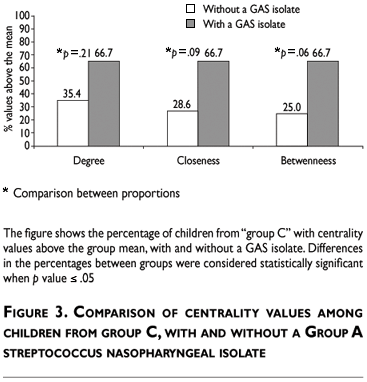
<body><![CDATA[<P><a name="fig01"></a></p>     <P>&nbsp;</p>     <P align="center"><img src="/img/revistas/spm/v49n5/a02fig01.gif"></p>     <P>&nbsp;</p>     <P><font size="2" face="Verdana"><I>Partnership among children of group C with    identical GAS clones</i>. Among the 5 children harboring clone I, the degrees    of communication between each other was: " extensive"  (<I>n</I> = 2),    " some"  (<I>n</I> = 1), " little"  (<I>n</I> = 1) and none    (<I>n</I> = 1). The 2 children harboring clone II shared " some"  degree    of communication. Although children harboring clone III belonged to different    rooms, they shared a single dining room at lunchtime. </font></p>     <P><font size="2" face="Verdana"><I> The social network analysis</i>. The density    coefficient values of groups B and C were 0.40 (± 0.87) and 0.35 (± 0.80). This    means that in group B the proportion of ties among the group was 40%, whereas    in group C the proportion was 35%. The homophily pattern of interaction in group    B was different in carriers (0.00), non carriers (0.47) and both groups together    (0.47), (<I>p</I> = .35). The homophily pattern in group C was also different    in carriers (0.46), non-carriers (0.68) and both groups together (0.19), (<I>p</I>    = .001). </font></p>     <P><font size="2" face="Verdana"> The centrality data showed that in 4/5 children    with clone I, the values of degree, closeness and betweenness were higher than    the group mean. In 3/3 children with clone II, values of degree and betweenness    were also higher than the group mean. On the other hand, in the two children    with clone III and the one with clone IV (the less frequently isolated clones),    the values of degree and betweenness were lower than the group mean. The most    widely distributed clones (I and II) were associated with those children having    the highest centrality levels (<a href="#fig02">figures 2</a> and <a href="#fig03">3</a>).</font></p>     <p><a name="fig02"></a></p>     <p>&nbsp;</p>     <p align="center"><img src="/img/revistas/spm/v49n5/a02fig02.gif"></p>     ]]></body>
<body><![CDATA[<p>&nbsp;</p>     <p><a name="fig03"></a></p>     <p>&nbsp;</p>     <p align="center"><img src="/img/revistas/spm/v49n5/a02fig03.gif"></p>     <p>&nbsp;</p>     <p><font size="3" face="verdana"><b>Discussion</b></font></p>     <P><font size="2" face="Verdana">Group A Streptococcus was found in the nasopharynx    of children from a day-care center in Mexico, and the clonal diversity between    the isolated strains as well as the degree of physical interaction between pairs    was evaluated. We found that individuals having a high level of centrality in    the interaction shared a common GAS isolate. </font></p>     <P><font size="2" face="Verdana"> The prevalence of GAS isolated from the nasopharynx    of the children studied was similar to reports from other day-care centers.<SUP>4,9</SUP>    In contrast with the frequent isolation of a single clone of GAS in outbreaks    of pharyngitis and other day-care associated infections, multiple clones GAS    have been described in healthy GAS carriers,<SUP>19</SUP> even among those sharing    the same space. Indeed, in our study there were four different GAS clones isolated    simultaneously from healthy children sharing the same room.</font></p>     <P><font size="2" face="Verdana"> Regarding the measurement of interaction among    the children, the density values of the groups showed an expected proportion    of ties. On the other hand, the homophily pattern clearly defined two groups    of children, i.e., those with and without a GAS isolate. Belonging to any of    these groups integrated by some particular characteristics (i.e. age, gender)    could facilitate the natural spread of strains of GAS once it has been introduced    into one particular group. </font></p>     <P><font size="2" face="Verdana"> Genetic analysis of the isolated bacteria was    crucial for demonstrating epidemiological patterns. For example, of the five    children carrying the most widespread strain (clone I), four had values of ties    with others (degree), mediation between pairs (betweenness), and efficient communication    actors (closeness) that were superior to the mean group values. The next most    widespread strain (clone II) was isolated in three children whose values of    degree and betweenness were also above the mean of the group. Finally, in the    two children with clone III and in the one child with clone IV, the values of    degree and betweenness were below the group mean. </font></p>     ]]></body>
<body><![CDATA[<P><font size="2" face="Verdana"> Our results provide strong evidence that the    horizontal transmission of GAS strains between carriers in children attending    day-care centers is predictable. Specifically, we found that the children from    this day-care center tend to group by some common characteristics. That grouping    is usually associated with a high proportion of ties among their members, and    may facilitate the spread of GAS strains. Transmissibility of GAS in daycare    centers has not been previously quantified. This evidence could be helpful to    target children at highest risk of infection by virulent GAS clones acquired    from index children with invasive infections. It also provides guidance regarding    the use of nasopharyngeal cultures or prophylactic antimicrobial treatment.</font></p>     <P><font size="2" face="Verdana"> In conclusion, the GAS strains isolated simultaneously    from children sharing the same room were genetically diverse. The sharing of    specific GAS clones between carriers was not random but was associated with    natural formation of groups based upon some particular characteristic, high    proportion of ties among them and a high level of communication centrality.    </font></p>     <p>&nbsp;</p>     <p><font size="3" face="Verdana"><b>Acknowledgments</b></font></p>     <P><font size="2" face="Verdana">We thank the critical review and important contributions    to this manuscript of Dennis L. Stevens M.D. Ph.D. and Amy Bryant Ph.D. from    the Department of Infectious Diseases at the V.A. Medical Center in Boise, Idaho.</font></p>     <P><font size="2" face="Verdana"> Financial support. This work was supported in    part by the Research Council (FOFOI) of the Instituto Mexicano del Seguro Social    (Grants 2000-249/006 and 2004/126). </font></p>     <P><font size="2" face="Verdana"> This work was presented in part at the 103<SUP>rd</SUP>    General Meeting of the American Society for Microbiology. Washington DC. May    20, 2003. (Poster number C-125).</font></p>     <P>&nbsp;</p>     <P><font size="3" face="Verdana"><b>References</b></font></p>     <!-- ref --><p><font size="2" face="Verdana">1. Stevens DL. Invasive group A streptococcus    infections. Clin Infect Dis 1992;14:2-13.</font>&nbsp;&nbsp;&nbsp;&nbsp;&nbsp;&nbsp;&nbsp;&nbsp;[&#160;<a href="javascript:void(0);" onclick="javascript: window.open('/scielo.php?script=sci_nlinks&ref=9278870&pid=S0036-3634200700050000200001&lng=','','width=640,height=500,resizable=yes,scrollbars=1,menubar=yes,');">Links</a>&#160;]<!-- end-ref --><!-- ref --><p><font size="2" face="Verdana">2. Stevens DL. Invasive group A streptococcal    infections: the past, present and future. Pediatr Infect Dis J 1994;13:561-566.</font>&nbsp;&nbsp;&nbsp;&nbsp;&nbsp;&nbsp;&nbsp;&nbsp;[&#160;<a href="javascript:void(0);" onclick="javascript: window.open('/scielo.php?script=sci_nlinks&ref=9278871&pid=S0036-3634200700050000200002&lng=','','width=640,height=500,resizable=yes,scrollbars=1,menubar=yes,');">Links</a>&#160;]<!-- end-ref --><!-- ref --><p><font size="2" face="Verdana">3. Muotiala A, Saxen H, Vuopio-Varkila J. Group    A streptococcal outbreak of perianal infection in a day-care centre. Adv Exp    Med Biol 1997;418:211-215.</font>&nbsp;&nbsp;&nbsp;&nbsp;&nbsp;&nbsp;&nbsp;&nbsp;[&#160;<a href="javascript:void(0);" onclick="javascript: window.open('/scielo.php?script=sci_nlinks&ref=9278872&pid=S0036-3634200700050000200003&lng=','','width=640,height=500,resizable=yes,scrollbars=1,menubar=yes,');">Links</a>&#160;]<!-- end-ref --><!-- ref --><p><font size="2" face="Verdana">4. Yagupsky P, Landau D, Beck A, Dagan R. Carriage    of Streptococcus pyogenes among infants and toddlers attending day-care facilities    in closed communities in southern Israel. Eur J Clin Microbiol Infect Dis 1995;14:54-58.</font>&nbsp;&nbsp;&nbsp;&nbsp;&nbsp;&nbsp;&nbsp;&nbsp;[&#160;<a href="javascript:void(0);" onclick="javascript: window.open('/scielo.php?script=sci_nlinks&ref=9278873&pid=S0036-3634200700050000200004&lng=','','width=640,height=500,resizable=yes,scrollbars=1,menubar=yes,');">Links</a>&#160;]<!-- end-ref --><!-- ref --><p><font size="2" face="Verdana">5. Falck G, Kjellander J. Outbreak of group A    streptococcal infection in a day-care center. Pediatr Infect Dis J 1992;11(11):914-919.</font>&nbsp;&nbsp;&nbsp;&nbsp;&nbsp;&nbsp;&nbsp;&nbsp;[&#160;<a href="javascript:void(0);" onclick="javascript: window.open('/scielo.php?script=sci_nlinks&ref=9278874&pid=S0036-3634200700050000200005&lng=','','width=640,height=500,resizable=yes,scrollbars=1,menubar=yes,');">Links</a>&#160;]<!-- end-ref --><!-- ref --><p><font size="2" face="Verdana">6. Hsueh PR, Teng LJ, Lee PI, Yang PC, Huang    LM, Chang SC, et al. Outbreak of scarlet fever at a hospital day-care centre:    analysis of strain relatedness with phenotypic and genotypic characteristics.    J Hosp Infect 1997;36:191-200.</font>&nbsp;&nbsp;&nbsp;&nbsp;&nbsp;&nbsp;&nbsp;&nbsp;[&#160;<a href="javascript:void(0);" onclick="javascript: window.open('/scielo.php?script=sci_nlinks&ref=9278875&pid=S0036-3634200700050000200006&lng=','','width=640,height=500,resizable=yes,scrollbars=1,menubar=yes,');">Links</a>&#160;]<!-- end-ref --><!-- ref --><p><font size="2" face="Verdana">7. Smith TD, Wilkinson V, Kaplan EL. Group A    streptococcus-associated upper respiratory tract infections in a day-care center.    Pediatrics 1989;83:380-384.</font>&nbsp;&nbsp;&nbsp;&nbsp;&nbsp;&nbsp;&nbsp;&nbsp;[&#160;<a href="javascript:void(0);" onclick="javascript: window.open('/scielo.php?script=sci_nlinks&ref=9278876&pid=S0036-3634200700050000200007&lng=','','width=640,height=500,resizable=yes,scrollbars=1,menubar=yes,');">Links</a>&#160;]<!-- end-ref --><!-- ref --><p><font size="2" face="Verdana">8. Engelgau MM, Woernle CH, Schwartz B, Vance    NJ, Horan JM. Invasive group A streptococcus carriage in a child care centre    after a fatal case. Arch Dis Child 1994;71:318-322.</font>&nbsp;&nbsp;&nbsp;&nbsp;&nbsp;&nbsp;&nbsp;&nbsp;[&#160;<a href="javascript:void(0);" onclick="javascript: window.open('/scielo.php?script=sci_nlinks&ref=9278877&pid=S0036-3634200700050000200008&lng=','','width=640,height=500,resizable=yes,scrollbars=1,menubar=yes,');">Links</a>&#160;]<!-- end-ref --><!-- ref --><p><font size="2" face="Verdana">9. al Qutob R, Na’was T, Mawajdeh S. The role    of day-care givers in the identification and prevention of infections. Soc Sci    Med 1991;33:859-862.</font>&nbsp;&nbsp;&nbsp;&nbsp;&nbsp;&nbsp;&nbsp;&nbsp;[&#160;<a href="javascript:void(0);" onclick="javascript: window.open('/scielo.php?script=sci_nlinks&ref=9278878&pid=S0036-3634200700050000200009&lng=','','width=640,height=500,resizable=yes,scrollbars=1,menubar=yes,');">Links</a>&#160;]<!-- end-ref --><!-- ref --><p><font size="2" face="Verdana">10. Weiss K, Laverdiere M, Lovgren M, Delorme    J, Poirier L, Beliveau C. Group A Streptococcus carriage among close contacts    of patients with invasive infections. Am J Epidemiol 1999;149:863-868.</font>&nbsp;&nbsp;&nbsp;&nbsp;&nbsp;&nbsp;&nbsp;&nbsp;[&#160;<a href="javascript:void(0);" onclick="javascript: window.open('/scielo.php?script=sci_nlinks&ref=9278879&pid=S0036-3634200700050000200010&lng=','','width=640,height=500,resizable=yes,scrollbars=1,menubar=yes,');">Links</a>&#160;]<!-- end-ref --><!-- ref --><p><font size="2" face="Verdana">11. Nguyen L, Levy D, Ferroni A, Gehanno P, Berche    P. Molecular epidemiology of Streptococcus pyogenes in an area where acute pharyngotonsillitis    is endemic. J Clin Microbiol 1997;35:2111-2114.</font>&nbsp;&nbsp;&nbsp;&nbsp;&nbsp;&nbsp;&nbsp;&nbsp;[&#160;<a href="javascript:void(0);" onclick="javascript: window.open('/scielo.php?script=sci_nlinks&ref=9278880&pid=S0036-3634200700050000200011&lng=','','width=640,height=500,resizable=yes,scrollbars=1,menubar=yes,');">Links</a>&#160;]<!-- end-ref --><!-- ref --><p><font size="2" face="Verdana">12. Social Network Analysis in the Social and    Behavioral Sciences. En: Wasserman S, Faust K, eds. Social Network Analysis.    Cambridge: Cambridge University Press, 1994:3-27.</font>&nbsp;&nbsp;&nbsp;&nbsp;&nbsp;&nbsp;&nbsp;&nbsp;[&#160;<a href="javascript:void(0);" onclick="javascript: window.open('/scielo.php?script=sci_nlinks&ref=9278881&pid=S0036-3634200700050000200012&lng=','','width=640,height=500,resizable=yes,scrollbars=1,menubar=yes,');">Links</a>&#160;]<!-- end-ref --><!-- ref --><p><font size="2" face="Verdana">13. Freeman, LC. Centrality in Social Networks:    I. Conceptual Clarification. Social Networks 1979;1:215-239.</font>&nbsp;&nbsp;&nbsp;&nbsp;&nbsp;&nbsp;&nbsp;&nbsp;[&#160;<a href="javascript:void(0);" onclick="javascript: window.open('/scielo.php?script=sci_nlinks&ref=9278882&pid=S0036-3634200700050000200013&lng=','','width=640,height=500,resizable=yes,scrollbars=1,menubar=yes,');">Links</a>&#160;]<!-- end-ref --><!-- ref --><p><font size="2" face="Verdana">14. Fitzpatrick LK, Hardacker JA, Heirendt W,    Agerton T, Streicher A, Melnyk H, <I>et al</I>. A preventable outbreak of tuberculosis    investigated through an intricate social network. Clin Infect Dis 2001;33:1801-1806.</font>&nbsp;&nbsp;&nbsp;&nbsp;&nbsp;&nbsp;&nbsp;&nbsp;[&#160;<a href="javascript:void(0);" onclick="javascript: window.open('/scielo.php?script=sci_nlinks&ref=9278883&pid=S0036-3634200700050000200014&lng=','','width=640,height=500,resizable=yes,scrollbars=1,menubar=yes,');">Links</a>&#160;]<!-- end-ref --><!-- ref --><p><font size="2" face="Verdana">15. Edmunds WJ, O’Callaghan CJ, Nokes DJ. Who    mixes with whom? A method to determine the contact patterns of adults that may    lead to the spread of airborne infections. Proc Biol Sci 1997;264:949-957.</font>&nbsp;&nbsp;&nbsp;&nbsp;&nbsp;&nbsp;&nbsp;&nbsp;[&#160;<a href="javascript:void(0);" onclick="javascript: window.open('/scielo.php?script=sci_nlinks&ref=9278884&pid=S0036-3634200700050000200015&lng=','','width=640,height=500,resizable=yes,scrollbars=1,menubar=yes,');">Links</a>&#160;]<!-- end-ref --><!-- ref --><p><font size="2" face="Verdana">16. Centrality and Prestige. En: Wasserman S,    Faust K, eds. Social Network Analysis. 1st. Cambridge: Cambridge University    Press, 1994:169-219.</font>&nbsp;&nbsp;&nbsp;&nbsp;&nbsp;&nbsp;&nbsp;&nbsp;[&#160;<a href="javascript:void(0);" onclick="javascript: window.open('/scielo.php?script=sci_nlinks&ref=9278885&pid=S0036-3634200700050000200016&lng=','','width=640,height=500,resizable=yes,scrollbars=1,menubar=yes,');">Links</a>&#160;]<!-- end-ref --><!-- ref --><p><font size="2" face="Verdana">17. Gardiner D, Hartas J, Currie B, Mathews JD,    Kemp DJ, Sriprakash KS. Vir typing: a long-PCR typing method for group A streptococci.    PCR Methods Appl 1995;4:288-293.</font>&nbsp;&nbsp;&nbsp;&nbsp;&nbsp;&nbsp;&nbsp;&nbsp;[&#160;<a href="javascript:void(0);" onclick="javascript: window.open('/scielo.php?script=sci_nlinks&ref=9278886&pid=S0036-3634200700050000200017&lng=','','width=640,height=500,resizable=yes,scrollbars=1,menubar=yes,');">Links</a>&#160;]<!-- end-ref --><!-- ref --><p><font size="2" face="Verdana">18. Hartas J, Hibble M, Sriprakash KS. Simplification    of a locus-specific DNA typing method (Vir typing) for Streptococcus pyogenes.    J Clin Microbiol 1998;36:1428-1429.</font>&nbsp;&nbsp;&nbsp;&nbsp;&nbsp;&nbsp;&nbsp;&nbsp;[&#160;<a href="javascript:void(0);" onclick="javascript: window.open('/scielo.php?script=sci_nlinks&ref=9278887&pid=S0036-3634200700050000200018&lng=','','width=640,height=500,resizable=yes,scrollbars=1,menubar=yes,');">Links</a>&#160;]<!-- end-ref --><!-- ref --><p><font size="2" face="Verdana">19. Kaplan EL. The group A streptococcal upper    respiratory tract carrier state: an enigma. J Pediatr 1980;97:337-345.</font>&nbsp;&nbsp;&nbsp;&nbsp;&nbsp;&nbsp;&nbsp;&nbsp;[&#160;<a href="javascript:void(0);" onclick="javascript: window.open('/scielo.php?script=sci_nlinks&ref=9278888&pid=S0036-3634200700050000200019&lng=','','width=640,height=500,resizable=yes,scrollbars=1,menubar=yes,');">Links</a>&#160;]<!-- end-ref --><p>&nbsp;</p>     <p>&nbsp;</p>     ]]></body>
<body><![CDATA[<p><font size="2" face="Verdana">Received on: September 22, 2006    <br>   Accepted on: June 13, 2007</font></p>     <p>&nbsp;</p>     <p>&nbsp;</p>     <p><font size="2" face="Verdana">Address reprint requests to: Dr. Alberto Villase&ntilde;or-Sierra.    Centro de Investigaci&oacute;n Biom&eacute;dica de Occidente, Instituto Mexicano    del Seguro Social. Paseo de la Reforma 476, Col. Ju&aacute;rez, 6698 M&eacute;xico,    DF. E-mail: <a href="mailto:avillase@prodigy.net.mx">avillase@prodigy.net.mx</a></font></p>      ]]></body><back>
<ref-list>
<ref id="B1">
<label>1</label><nlm-citation citation-type="journal">
<person-group person-group-type="author">
<name>
<surname><![CDATA[Stevens]]></surname>
<given-names><![CDATA[DL]]></given-names>
</name>
</person-group>
<article-title xml:lang="en"><![CDATA[Invasive group A streptococcus infections]]></article-title>
<source><![CDATA[Clin Infect Dis]]></source>
<year>1992</year>
<volume>14</volume>
<page-range>2-13</page-range></nlm-citation>
</ref>
<ref id="B2">
<label>2</label><nlm-citation citation-type="journal">
<person-group person-group-type="author">
<name>
<surname><![CDATA[Stevens]]></surname>
<given-names><![CDATA[DL]]></given-names>
</name>
</person-group>
<article-title xml:lang="en"><![CDATA[Invasive group A streptococcal infections: the past, present and future]]></article-title>
<source><![CDATA[Pediatr Infect Dis J]]></source>
<year>1994</year>
<volume>13</volume>
<page-range>561-566</page-range></nlm-citation>
</ref>
<ref id="B3">
<label>3</label><nlm-citation citation-type="journal">
<person-group person-group-type="author">
<name>
<surname><![CDATA[Muotiala]]></surname>
<given-names><![CDATA[A]]></given-names>
</name>
<name>
<surname><![CDATA[Saxen]]></surname>
<given-names><![CDATA[H]]></given-names>
</name>
<name>
<surname><![CDATA[Vuopio-Varkila]]></surname>
<given-names><![CDATA[J]]></given-names>
</name>
</person-group>
<article-title xml:lang="en"><![CDATA[Group A streptococcal outbreak of perianal infection in a day-care centre]]></article-title>
<source><![CDATA[Adv Exp Med Biol]]></source>
<year>1997</year>
<volume>418</volume>
<page-range>211-215</page-range></nlm-citation>
</ref>
<ref id="B4">
<label>4</label><nlm-citation citation-type="journal">
<person-group person-group-type="author">
<name>
<surname><![CDATA[Yagupsky]]></surname>
<given-names><![CDATA[P]]></given-names>
</name>
<name>
<surname><![CDATA[Landau]]></surname>
<given-names><![CDATA[D]]></given-names>
</name>
<name>
<surname><![CDATA[Beck]]></surname>
<given-names><![CDATA[A]]></given-names>
</name>
<name>
<surname><![CDATA[Dagan]]></surname>
<given-names><![CDATA[R]]></given-names>
</name>
</person-group>
<article-title xml:lang="en"><![CDATA[Carriage of Streptococcus pyogenes among infants and toddlers attending day-care facilities in closed communities in southern Israel]]></article-title>
<source><![CDATA[Eur J Clin Microbiol Infect Dis]]></source>
<year>1995</year>
<volume>14</volume>
<page-range>54-58</page-range></nlm-citation>
</ref>
<ref id="B5">
<label>5</label><nlm-citation citation-type="journal">
<person-group person-group-type="author">
<name>
<surname><![CDATA[Falck]]></surname>
<given-names><![CDATA[G]]></given-names>
</name>
<name>
<surname><![CDATA[Kjellander]]></surname>
<given-names><![CDATA[J]]></given-names>
</name>
</person-group>
<article-title xml:lang="en"><![CDATA[Outbreak of group A streptococcal infection in a day-care center]]></article-title>
<source><![CDATA[Pediatr Infect Dis J]]></source>
<year>1992</year>
<volume>11</volume>
<numero>11</numero>
<issue>11</issue>
<page-range>914-919</page-range></nlm-citation>
</ref>
<ref id="B6">
<label>6</label><nlm-citation citation-type="journal">
<person-group person-group-type="author">
<name>
<surname><![CDATA[Hsueh]]></surname>
<given-names><![CDATA[PR]]></given-names>
</name>
<name>
<surname><![CDATA[Teng]]></surname>
<given-names><![CDATA[LJ]]></given-names>
</name>
<name>
<surname><![CDATA[Lee]]></surname>
<given-names><![CDATA[PI]]></given-names>
</name>
<name>
<surname><![CDATA[Yang]]></surname>
<given-names><![CDATA[PC]]></given-names>
</name>
<name>
<surname><![CDATA[Huang]]></surname>
<given-names><![CDATA[LM]]></given-names>
</name>
<name>
<surname><![CDATA[Chang]]></surname>
<given-names><![CDATA[SC]]></given-names>
</name>
</person-group>
<article-title xml:lang="en"><![CDATA[Outbreak of scarlet fever at a hospital day-care centre: analysis of strain relatedness with phenotypic and genotypic characteristics]]></article-title>
<source><![CDATA[J Hosp Infect]]></source>
<year>1997</year>
<volume>36</volume>
<page-range>191-200</page-range></nlm-citation>
</ref>
<ref id="B7">
<label>7</label><nlm-citation citation-type="journal">
<person-group person-group-type="author">
<name>
<surname><![CDATA[Smith]]></surname>
<given-names><![CDATA[TD]]></given-names>
</name>
<name>
<surname><![CDATA[Wilkinson]]></surname>
<given-names><![CDATA[V]]></given-names>
</name>
<name>
<surname><![CDATA[Kaplan]]></surname>
<given-names><![CDATA[EL]]></given-names>
</name>
</person-group>
<article-title xml:lang="en"><![CDATA[Group A streptococcus-associated upper respiratory tract infections in a day-care center]]></article-title>
<source><![CDATA[Pediatrics]]></source>
<year>1989</year>
<volume>83</volume>
<page-range>380-384</page-range></nlm-citation>
</ref>
<ref id="B8">
<label>8</label><nlm-citation citation-type="journal">
<person-group person-group-type="author">
<name>
<surname><![CDATA[Engelgau]]></surname>
<given-names><![CDATA[MM]]></given-names>
</name>
<name>
<surname><![CDATA[Woernle]]></surname>
<given-names><![CDATA[CH]]></given-names>
</name>
<name>
<surname><![CDATA[Schwartz]]></surname>
<given-names><![CDATA[B]]></given-names>
</name>
<name>
<surname><![CDATA[Vance]]></surname>
<given-names><![CDATA[NJ]]></given-names>
</name>
<name>
<surname><![CDATA[Horan]]></surname>
<given-names><![CDATA[JM]]></given-names>
</name>
</person-group>
<article-title xml:lang="en"><![CDATA[Invasive group A streptococcus carriage in a child care centre after a fatal case]]></article-title>
<source><![CDATA[Arch Dis Child]]></source>
<year>1994</year>
<volume>71</volume>
<page-range>318-322</page-range></nlm-citation>
</ref>
<ref id="B9">
<label>9</label><nlm-citation citation-type="journal">
<person-group person-group-type="author">
<name>
<surname><![CDATA[al Qutob]]></surname>
<given-names><![CDATA[R]]></given-names>
</name>
<name>
<surname><![CDATA[Na’was]]></surname>
<given-names><![CDATA[T]]></given-names>
</name>
<name>
<surname><![CDATA[Mawajdeh]]></surname>
<given-names><![CDATA[S]]></given-names>
</name>
</person-group>
<article-title xml:lang="en"><![CDATA[The role of day-care givers in the identification and prevention of infections]]></article-title>
<source><![CDATA[Soc Sci Med]]></source>
<year>1991</year>
<volume>33</volume>
<page-range>859-862</page-range></nlm-citation>
</ref>
<ref id="B10">
<label>10</label><nlm-citation citation-type="journal">
<person-group person-group-type="author">
<name>
<surname><![CDATA[Weiss]]></surname>
<given-names><![CDATA[K]]></given-names>
</name>
<name>
<surname><![CDATA[Laverdiere]]></surname>
<given-names><![CDATA[M]]></given-names>
</name>
<name>
<surname><![CDATA[Lovgren]]></surname>
<given-names><![CDATA[M]]></given-names>
</name>
<name>
<surname><![CDATA[Delorme]]></surname>
<given-names><![CDATA[J]]></given-names>
</name>
<name>
<surname><![CDATA[Poirier]]></surname>
<given-names><![CDATA[L]]></given-names>
</name>
<name>
<surname><![CDATA[Beliveau]]></surname>
<given-names><![CDATA[C]]></given-names>
</name>
</person-group>
<article-title xml:lang="en"><![CDATA[Group A Streptococcus carriage among close contacts of patients with invasive infections]]></article-title>
<source><![CDATA[Am J Epidemiol]]></source>
<year>1999</year>
<volume>149</volume>
<page-range>863-868</page-range></nlm-citation>
</ref>
<ref id="B11">
<label>11</label><nlm-citation citation-type="journal">
<person-group person-group-type="author">
<name>
<surname><![CDATA[Nguyen]]></surname>
<given-names><![CDATA[L]]></given-names>
</name>
<name>
<surname><![CDATA[Levy]]></surname>
<given-names><![CDATA[D]]></given-names>
</name>
<name>
<surname><![CDATA[Ferroni]]></surname>
<given-names><![CDATA[A]]></given-names>
</name>
<name>
<surname><![CDATA[Gehanno]]></surname>
<given-names><![CDATA[P]]></given-names>
</name>
<name>
<surname><![CDATA[Berche]]></surname>
<given-names><![CDATA[P]]></given-names>
</name>
</person-group>
<article-title xml:lang="en"><![CDATA[Molecular epidemiology of Streptococcus pyogenes in an area where acute pharyngotonsillitis is endemic]]></article-title>
<source><![CDATA[J Clin Microbiol]]></source>
<year>1997</year>
<volume>35</volume>
<page-range>2111-2114</page-range></nlm-citation>
</ref>
<ref id="B12">
<label>12</label><nlm-citation citation-type="book">
<article-title xml:lang="en"><![CDATA[Social Network Analysis in the Social and Behavioral Sciences]]></article-title>
<person-group person-group-type="author">
<name>
<surname><![CDATA[Wasserman]]></surname>
<given-names><![CDATA[S]]></given-names>
</name>
<name>
<surname><![CDATA[Faust]]></surname>
<given-names><![CDATA[K]]></given-names>
</name>
</person-group>
<source><![CDATA[Social Network Analysis]]></source>
<year>1994</year>
<page-range>3-27</page-range><publisher-loc><![CDATA[Cambridge ]]></publisher-loc>
<publisher-name><![CDATA[Cambridge University Press]]></publisher-name>
</nlm-citation>
</ref>
<ref id="B13">
<label>13</label><nlm-citation citation-type="journal">
<person-group person-group-type="author">
<name>
<surname><![CDATA[Freeman]]></surname>
<given-names><![CDATA[LC]]></given-names>
</name>
</person-group>
<article-title xml:lang="en"><![CDATA[Centrality in Social Networks: I. Conceptual Clarification]]></article-title>
<source><![CDATA[Social Networks]]></source>
<year>1979</year>
<volume>1</volume>
<page-range>215-239</page-range></nlm-citation>
</ref>
<ref id="B14">
<label>14</label><nlm-citation citation-type="journal">
<person-group person-group-type="author">
<name>
<surname><![CDATA[Fitzpatrick]]></surname>
<given-names><![CDATA[LK]]></given-names>
</name>
<name>
<surname><![CDATA[Hardacker]]></surname>
<given-names><![CDATA[JA]]></given-names>
</name>
<name>
<surname><![CDATA[Heirendt]]></surname>
<given-names><![CDATA[W]]></given-names>
</name>
<name>
<surname><![CDATA[Agerton]]></surname>
<given-names><![CDATA[T]]></given-names>
</name>
<name>
<surname><![CDATA[Streicher]]></surname>
<given-names><![CDATA[A]]></given-names>
</name>
<name>
<surname><![CDATA[Melnyk]]></surname>
<given-names><![CDATA[H]]></given-names>
</name>
</person-group>
<article-title xml:lang="en"><![CDATA[A preventable outbreak of tuberculosis investigated through an intricate social network]]></article-title>
<source><![CDATA[Clin Infect Dis]]></source>
<year>2001</year>
<volume>33</volume>
<page-range>1801-1806</page-range></nlm-citation>
</ref>
<ref id="B15">
<label>15</label><nlm-citation citation-type="journal">
<person-group person-group-type="author">
<name>
<surname><![CDATA[Edmunds]]></surname>
<given-names><![CDATA[WJ]]></given-names>
</name>
<name>
<surname><![CDATA[O’Callaghan]]></surname>
<given-names><![CDATA[CJ]]></given-names>
</name>
<name>
<surname><![CDATA[Nokes]]></surname>
<given-names><![CDATA[DJ]]></given-names>
</name>
</person-group>
<article-title xml:lang="en"><![CDATA[Who mixes with whom?: A method to determine the contact patterns of adults that may lead to the spread of airborne infections]]></article-title>
<source><![CDATA[Proc Biol Sci]]></source>
<year>1997</year>
<volume>264</volume>
<page-range>949-957</page-range></nlm-citation>
</ref>
<ref id="B16">
<label>16</label><nlm-citation citation-type="book">
<article-title xml:lang="en"><![CDATA[Centrality and Prestige]]></article-title>
<person-group person-group-type="author">
<name>
<surname><![CDATA[Wasserman]]></surname>
<given-names><![CDATA[S]]></given-names>
</name>
<name>
<surname><![CDATA[Faust]]></surname>
<given-names><![CDATA[K]]></given-names>
</name>
</person-group>
<source><![CDATA[Social Network Analysis]]></source>
<year>1994</year>
<edition>1</edition>
<page-range>169-219</page-range><publisher-loc><![CDATA[Cambridge ]]></publisher-loc>
<publisher-name><![CDATA[Cambridge University Press]]></publisher-name>
</nlm-citation>
</ref>
<ref id="B17">
<label>17</label><nlm-citation citation-type="journal">
<person-group person-group-type="author">
<name>
<surname><![CDATA[Gardiner]]></surname>
<given-names><![CDATA[D]]></given-names>
</name>
<name>
<surname><![CDATA[Hartas]]></surname>
<given-names><![CDATA[J]]></given-names>
</name>
<name>
<surname><![CDATA[Currie]]></surname>
<given-names><![CDATA[B]]></given-names>
</name>
<name>
<surname><![CDATA[Mathews]]></surname>
<given-names><![CDATA[JD]]></given-names>
</name>
<name>
<surname><![CDATA[Kemp]]></surname>
<given-names><![CDATA[DJ]]></given-names>
</name>
<name>
<surname><![CDATA[Sriprakash]]></surname>
<given-names><![CDATA[KS]]></given-names>
</name>
</person-group>
<article-title xml:lang="en"><![CDATA[Vir typing: a long-PCR typing method for group A streptococci]]></article-title>
<source><![CDATA[PCR Methods Appl]]></source>
<year>1995</year>
<volume>4</volume>
<page-range>288-293</page-range></nlm-citation>
</ref>
<ref id="B18">
<label>18</label><nlm-citation citation-type="journal">
<person-group person-group-type="author">
<name>
<surname><![CDATA[Hartas]]></surname>
<given-names><![CDATA[J]]></given-names>
</name>
<name>
<surname><![CDATA[Hibble]]></surname>
<given-names><![CDATA[M]]></given-names>
</name>
<name>
<surname><![CDATA[Sriprakash]]></surname>
<given-names><![CDATA[KS]]></given-names>
</name>
</person-group>
<article-title xml:lang="en"><![CDATA[Simplification of a locus-specific DNA typing method (Vir typing) for Streptococcus pyogenes]]></article-title>
<source><![CDATA[J Clin Microbiol]]></source>
<year>1998</year>
<volume>36</volume>
<page-range>1428-1429</page-range></nlm-citation>
</ref>
<ref id="B19">
<label>19</label><nlm-citation citation-type="journal">
<person-group person-group-type="author">
<name>
<surname><![CDATA[Kaplan]]></surname>
<given-names><![CDATA[EL]]></given-names>
</name>
</person-group>
<article-title xml:lang="en"><![CDATA[The group A streptococcal upper respiratory tract carrier state: an enigma]]></article-title>
<source><![CDATA[J Pediatr]]></source>
<year>1980</year>
<volume>97</volume>
<page-range>337-345</page-range></nlm-citation>
</ref>
</ref-list>
</back>
</article>