<?xml version="1.0" encoding="ISO-8859-1"?><article xmlns:mml="http://www.w3.org/1998/Math/MathML" xmlns:xlink="http://www.w3.org/1999/xlink" xmlns:xsi="http://www.w3.org/2001/XMLSchema-instance">
<front>
<journal-meta>
<journal-id>0036-3634</journal-id>
<journal-title><![CDATA[Salud Pública de México]]></journal-title>
<abbrev-journal-title><![CDATA[Salud pública Méx]]></abbrev-journal-title>
<issn>0036-3634</issn>
<publisher>
<publisher-name><![CDATA[Instituto Nacional de Salud Pública]]></publisher-name>
</publisher>
</journal-meta>
<article-meta>
<article-id>S0036-36342007000400012</article-id>
<title-group>
<article-title xml:lang="en"><![CDATA[Review of health research on indigenous populations in Latin America, 1995-2004]]></article-title>
<article-title xml:lang="es"><![CDATA[Revisión de la investigación en salud en poblaciones indígenas de Latinoamérica, 1995-2004]]></article-title>
</title-group>
<contrib-group>
<contrib contrib-type="author">
<name>
<surname><![CDATA[San Sebastián]]></surname>
<given-names><![CDATA[Miguel]]></given-names>
</name>
<xref ref-type="aff" rid="A01"/>
</contrib>
<contrib contrib-type="author">
<name>
<surname><![CDATA[Hurtig]]></surname>
<given-names><![CDATA[Anna-Karin]]></given-names>
</name>
<xref ref-type="aff" rid="A01"/>
</contrib>
</contrib-group>
<aff id="A01">
<institution><![CDATA[,Umeå University Umeå International School of Public Health ]]></institution>
<addr-line><![CDATA[ ]]></addr-line>
<country>Sweden</country>
</aff>
<pub-date pub-type="pub">
<day>00</day>
<month>08</month>
<year>2007</year>
</pub-date>
<pub-date pub-type="epub">
<day>00</day>
<month>08</month>
<year>2007</year>
</pub-date>
<volume>49</volume>
<numero>4</numero>
<fpage>316</fpage>
<lpage>320</lpage>
<copyright-statement/>
<copyright-year/>
<self-uri xlink:href="http://www.scielo.org.mx/scielo.php?script=sci_arttext&amp;pid=S0036-36342007000400012&amp;lng=en&amp;nrm=iso"></self-uri><self-uri xlink:href="http://www.scielo.org.mx/scielo.php?script=sci_abstract&amp;pid=S0036-36342007000400012&amp;lng=en&amp;nrm=iso"></self-uri><self-uri xlink:href="http://www.scielo.org.mx/scielo.php?script=sci_pdf&amp;pid=S0036-36342007000400012&amp;lng=en&amp;nrm=iso"></self-uri><abstract abstract-type="short" xml:lang="en"><p><![CDATA[OBJECTIVE: To review health research conducted among indigenous populations in Latin America during the period 1995-2004. Material and methods. The search strategy was purposely broad to ensure the identification of all relevant studies indexed in the PubMed and Lilacs databases. RESULTS: Six-hundred ninety citations were included. One hundred fifty-nine (23.0%) papers dealt with indigenous populations in Central America and 509 (73.8%) papers with South American populations. Three hundred two (43.8%) of the studies were quantitative, 39 (5.7%) qualitative, 259 (37.5%) mainly based on laboratory work and 24 (3.5%) dealt with policy analyses. The most common researched theme was human biology with 200 (29.0 %) papers, followed by communicable diseases (150 papers, 21.7 %). CONCLUSIONS: There is a special need for policy studies in the field of indigenous health. An increased commitment to resources and capacity building will be the real challenge for indigenous health research in the nearest future.]]></p></abstract>
<abstract abstract-type="short" xml:lang="es"><p><![CDATA[OBJETIVO: Revisar la investigación en salud realizada en poblaciones indígenas de Latinoamérica, de 1995 a 2004. MATERIAL Y MÉTODOS: La estrategia de búsqueda fue amplia para asegurar la identificación de todos aquellos estudios relevantes catalogados en las bases de datos PubMed y Lilacs. RESULTADOS: Se incluyeron 690 citaciones; de ellas, 509 (73.8%) artículos trataron sobre poblaciones indígenas sudamericanas y 159 (23.0%) sobre poblaciones indígenas de Centroamérica. Trescientos dos (43.8%) de los estudios fueron cuantitativos, 39 (5.7%) cualitativos, 259 (37.5%) basados principalmente en trabajo de laboratorio y 24 (3.5%) trataron sobre análisis de políticas de salud. El tema de investigación más estudiado fue el de biología humana con 200 artículos (29.0%), seguido de enfermedades transmisibles (150 artículos, 21.7%). CONCLUSIONES: Existe una necesidad especial de estudios de políticas de salud en el campo de la salud indígena. Un mayor compromiso de recursos y formación de capacidades son los grandes desafíos para la investigación de la salud indígena en un futuro próximo.]]></p></abstract>
<kwd-group>
<kwd lng="en"><![CDATA[review]]></kwd>
<kwd lng="en"><![CDATA[indigenous health]]></kwd>
<kwd lng="en"><![CDATA[Latin America]]></kwd>
<kwd lng="es"><![CDATA[revisión]]></kwd>
<kwd lng="es"><![CDATA[salud indígena]]></kwd>
<kwd lng="es"><![CDATA[Latinoamérica]]></kwd>
</kwd-group>
</article-meta>
</front><body><![CDATA[ <p align="right"><font face="Verdana, Arial, Helvetica, sans-serif" size="2"><b>ART&Iacute;CULO    DE REVISI&Oacute;N</b></font></p>     <p>&nbsp;</p>     <p><font face="Verdana, Arial, Helvetica, sans-serif" size="4"><b>Review of health    research on indigenous populations in Latin America, 1995-2004</b></font></p>     <p>&nbsp;</p>     <p><font face="Verdana, Arial, Helvetica, sans-serif" size="3"><b>Revisi&oacute;n    de la investigaci&oacute;n en salud en poblaciones ind&iacute;genas de    Latinoam&eacute;rica, 1995-2004</b></font></p>     <p>&nbsp;</p>    <p>&nbsp;</p>     <p><font face="Verdana, Arial, Helvetica, sans-serif" size="2"><b>Miguel San Sebasti&aacute;n,    MD, PhD; Anna-Karin Hurtig, MD, PhD</b></font></p>     <p><font face="Verdana, Arial, Helvetica, sans-serif" size="2">Ume&aring; International    School of Public Health. Ume&aring; University. Sweden</font></p>     <p>&nbsp;</p>     ]]></body>
<body><![CDATA[<p>&nbsp;</p> <hr size="1" noshade>    <p><font face="Verdana, Arial, Helvetica, sans-serif" size="2"><b>ABSTRACT</b></font></p>     <p><font face="Verdana, Arial, Helvetica, sans-serif" size="2"><b>OBJECTIVE: </b>   To review health research conducted among indigenous populations in Latin America    during the period 1995-2004. <b>Material and methods</b>. The search strategy    was purposely broad to ensure the identification of all relevant studies indexed    in the PubMed and Lilacs databases.     <br><b>RESULTS: </b>Six-hundred ninety citations    were included. One hundred fifty-nine (23.0%) papers dealt with indigenous populations    in Central America and 509 (73.8%) papers with South American populations. Three    hundred two (43.8%) of the studies were quantitative, 39 (5.7%) qualitative,    259 (37.5%) mainly based on laboratory work and 24 (3.5%) dealt with policy    analyses. The most common researched theme was human biology with 200 (29.0    %) papers, followed by communicable diseases (150 papers, 21.7 %).     <br><b>CONCLUSIONS: </b>   There is a special need for policy studies in the field of indigenous health.    An increased commitment to resources and capacity building will be the real    challenge for indigenous health research in the nearest future.</font></p>     <p><font face="Verdana, Arial, Helvetica, sans-serif" size="2"><b>Key words:</b>    review; indigenous health; Latin America </font></p> <hr size="1" noshade>     <p><font face="Verdana, Arial, Helvetica, sans-serif" size="2"><b>RESUMEN</b></font></p>     <p><font face="Verdana, Arial, Helvetica, sans-serif" size="2"><b>OBJETIVO: </b>   Revisar la investigaci&oacute;n en salud realizada en poblaciones ind&iacute;genas    de Latinoam&eacute;rica, de 1995 a 2004.     <br><b>MATERIAL Y M&Eacute;TODOS: </b>La    estrategia de b&uacute;squeda fue amplia para asegurar la identificaci&oacute;n    de todos aquellos estudios relevantes catalogados en las bases de datos PubMed    y Lilacs.     <br><b>RESULTADOS: </b>Se incluyeron 690 citaciones; de ellas, 509 (73.8%)    art&iacute;culos trataron sobre poblaciones ind&iacute;genas sudamericanas y    159 (23.0%) sobre poblaciones ind&iacute;genas de Centroam&eacute;rica. Trescientos    dos (43.8%) de los estudios fueron cuantitativos, 39 (5.7%) cualitativos, 259    (37.5%) basados principalmente en trabajo de laboratorio y 24 (3.5%) trataron    sobre an&aacute;lisis de pol&iacute;ticas de salud. El tema de investigaci&oacute;n    m&aacute;s estudiado fue el de biolog&iacute;a humana con 200 art&iacute;culos    (29.0%), seguido de enfermedades transmisibles (150 art&iacute;culos, 21.7%).        ]]></body>
<body><![CDATA[<br><b>CONCLUSIONES: </b>Existe una necesidad especial de estudios de pol&iacute;ticas    de salud en el campo de la salud ind&iacute;gena. Un mayor compromiso de recursos    y formaci&oacute;n de capacidades son los grandes desaf&iacute;os para la investigaci&oacute;n    de la salud ind&iacute;gena en un futuro pr&oacute;ximo.</font></p>     <p><font face="Verdana, Arial, Helvetica, sans-serif" size="2"><b>Palabras clave: </b>   revisi&oacute;n; salud ind&iacute;gena; Latinoam&eacute;rica</font></p> <hr size="1" noshade>    <p>&nbsp;</p>    <p>&nbsp;</p>     <p><font face="Verdana, Arial, Helvetica, sans-serif" size="2">In 1993, the United    Nations proclaimed the International Decade of the World's Indigenous Peoples    (1995-2004) with the objective of strengthening international cooperation for    the solutions of problems faced by indigenous people in areas such as human    rights, the environment, development, education and health.<sup>1</sup></font></p>     <p><font face="Verdana, Arial, Helvetica, sans-serif" size="2">The same year,    the Pan American Health Organization (PAHO) proposed a more careful consideration    of the health and well being of indigenous peoples in the Americas. Following    a consultation workshop held in Winnipeg, Canada, with the participation of    representatives of indigenous populations and governments and others from 18    countries, recommendations were incorporated into a proposal, the Health of    Indigenous Peoples Initiative.<sup>2</sup> This initiative aimed mainly to encourage    countries to detect and monitor inequities based upon ethnicity and to put programs    and processes into place. Along these years, different strategic directions    have been formulated, the latest one for 2005-2007.<sup>3</sup> Recent reports    about indigenous health in Latin America consider poverty, discrimination, lack    of water and sanitation and inadequate access to health services as the main    determinants of this population health. High mortality and morbidity rates in    women and children related to reproductive health, malnutrition and infectious    diseases (diarrhoea, acute respiratory infection, tuberculosis and malaria)    are major health problems.<sup>4,5</sup></font></p>     <p><font face="Verdana, Arial, Helvetica, sans-serif" size="2">Although progress    has been made in raising awareness about inequities in health status and access    to care, significant disparities between the health of indigenous peoples and    that of the general population continue to exist, particularly in Latin America.<sup>6</sup>    A recent review from the World Bank in five Latin American countries with the    largest indigenous populations concluded that although indigenous people in    the region have increased their political power since 1994, virtually no reduction    in the proportion of indigenous people in poverty was achieved. Less access    to basic health services and high rates of malnutrition among children were    also observed.<sup>7</sup> Health research can assist not only in assessing    why these differences persist and how to solve them but also in improving the    health information of and for the indigenous people. The end of the Decade of    the World's Indigenous People provides an appropriate time to examine and evaluate    the focus of the research among indigenous populations of the region.</font></p>     <p><font face="Verdana, Arial, Helvetica, sans-serif" size="2">The aim of this    paper is therefore to review health research on indigenous populations of Latin    America during the period 1995-2004.</font></p>     <p><font face="Verdana, Arial, Helvetica, sans-serif" size="2"><b>Population</b></font></p>     <p><font face="Verdana, Arial, Helvetica, sans-serif" size="2">Although the term    indigenous people in the Americas is widely used, that generalization encompasses    more than 400 different ethnic groups, with different beliefs and different    health practices. Based on the estimates and sources available, the indigenous    population of the Americas is approximately 42 million. This represents around    6% of the total population of the region and slightly less than 10% of the population    of Latin America and the Caribbean. Of these, approximately 80% live in Central    America and the central Andes. The majority of indigenous people live in Mexico    (12 million or 14% of the national population), Guatemala (5.3 million, or 66%),    Peru (9.3 million or 47%), Bolivia (4.9 million or 71%) and Ecuador (4.1 million    or 43%).<sup>8</sup></font></p>     ]]></body>
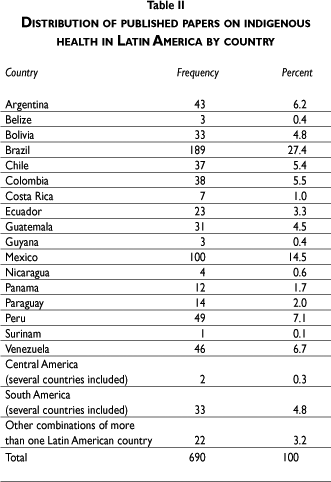
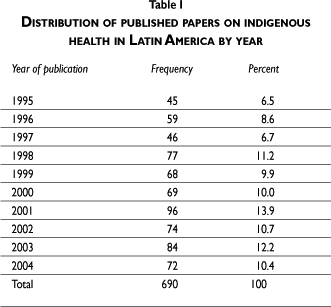
<body><![CDATA[<p><font face="Verdana, Arial, Helvetica, sans-serif" size="2">Demographic estimates    of indigenous populations, however, must be carefully handled. Both census criteria    to define who is indigenous and dates diverge. Several additional problems have    to be taken into consideration: there are people about whom there is simply    no information at all and very little is known about the indigenous that live    in urban areas. Numbers can also be modified because some isolated indigenous    groups are now recognised or because some people start to claim their indigenous    background.</font></p>     <p>&nbsp;</p>     <p><font face="Verdana, Arial, Helvetica, sans-serif" size="3"><b>Material and    methods</b></font></p>     <p><font face="Verdana, Arial, Helvetica, sans-serif" size="2">The search strategy    was purposely broad to ensure the identification of all relevant studies. Searches    were made via the PubMed and Lilacs electronic databases using the following    terms: "Indian", "indigenous", "aboriginal", "native", "Amazon" and all the    different countries of Latin America (18 countries). All published papers between    1995 and 2004 relating to health in indigenous populations in Latin America    were included. Citations without abstracts and clinical case reports, corresponding    to less than 5% of the citations, were eliminated. The abstract of all articles    was independently examined by the two authors to ensure that inclusion and exclusion    criteria were considered. Information on aboriginal identity, age-gender group,    comparison group, geographic location of research, main research group and research    topic was collected. Research topics were broadly divided into nine groups using    a similar division as a previous review on indigenous health research in Canada:<sup>9</sup>    human biology, communicable diseases, nutrition, non-communicable diseases,    traditional medicine and history, physical environment, oral health, reproductive    health and others.</font></p>     <p>&nbsp;</p>    <p><font face="Verdana, Arial, Helvetica, sans-serif" size="3"><b>Results</b></font></p>     <p><font face="Verdana, Arial, Helvetica, sans-serif" size="2">After considering    the inclusion and exclusion criteria, 690 citations generated by PubMed and    Lilacs were included. The mean number of publications per year in this period    was 69 (range 45-96), with a slight increase after 1997 (<a href="#tab1">Table    I</a>). One hundred fifty-nine (23.0%) papers dealt with indigenous populations    in Central America and 509 (73.8%) papers with South American populations; a    further 22 (3.2%) papers included both regions. The country distribution of    these papers is presented in <a href="#tab2">Table II</a>. Four hundred four    (58.6%) of the papers had a national researcher or research group as the lead    author, 126 (18.3%) from the United States of America and 116 (16.8%) papers    were led by European researchers; the remaining 44 (6.3%) were from various    other countries. Five hundred thirty six (77.7% of the papers were published    in English, 91 (13.2%) in Spanish, 59 (8.6%) in Portuguese and 4 (0.6%) in other    languages. Three hundred sixty six (53.6%) papers presented local studies, the    remaining 324 (47.05%) national or international studies. Two hundred forty    seven (35.8 %) studies compared the indigenous population with a non-indigenous    population in the same country or internationally.</font></p>     <p><a name="tab1"></a></p>     <p>&nbsp;</p>     <p align="center"><img src="/img/revistas/spm/v49n4/09t1.gif"></p>     ]]></body>
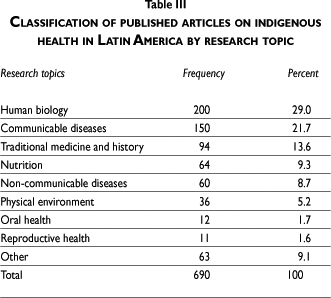
<body><![CDATA[<p>&nbsp;</p>     <p><a name="tab2"></a></p>     <p>&nbsp;</p>     <p align="center"><img src="/img/revistas/spm/v49n4/09t2.gif"></p>     <p>&nbsp;</p>     <p><font face="Verdana, Arial, Helvetica, sans-serif" size="2">Three hundred two    (43.8 7%) of the studies were quantitative, 39 (5.7%) qualitative, 259 (37.5%)    mainly based on laboratory work and 24 (3.5%) dealt with policy analyses. The    remaining 66 (9.6%) articles were review articles or used a mixed set of methods.</font></p>     <p><font face="Verdana, Arial, Helvetica, sans-serif" size="2">The most common    researched theme was human biology with 200 (29.0%) papers, followed by communicable    diseases (150 papers, 21.7%), traditional medicine and history (94 papers, 13.6%),    and nutrition 64 (9.3%) (<a href="#tab3">Table III</a>). Forty three (6.2%)    papers dealt especially with women's health although only 11 (1.6%) papers dealt    with reproductive health among women. Sixty five (9.4%) papers presented research    on the health of children with a focus on nutrition.</font></p>     <p><a name="tab3"></a></p>     <p>&nbsp;</p>     <p align="center"><img src="/img/revistas/spm/v49n4/09t3.gif"></p>     ]]></body>
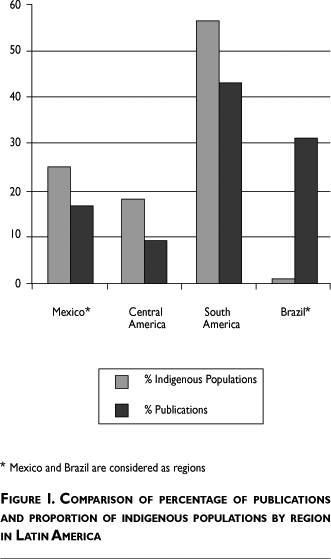
<body><![CDATA[<p>&nbsp;</p>     <p><font face="Verdana, Arial, Helvetica, sans-serif" size="2">In 182 (91.0%)    of the papers on human biology, genetics was studied. Among communicable diseases,    human T-cell leukemia virus (HTLV) 1 and 2 were most commonly studied (36 papers,    24.0%), followed by hepatitis (21 papers, 14.0%) and tuberculosis (16 papers,    10.6%).</font></p>     <p><font face="Verdana, Arial, Helvetica, sans-serif" size="2"><a href="#fig1">Figure    I</a> shows the relationship between the proportion of indigenous population    by regions (Brazil and Mexico considered as regions) and the percentage of publications    during the last decade. Only in Brazil was the proportion of publications higher    compared to its share of indigenous population in Latin America.</font></p>     <p><a name="fig1"></a></p>     <p>&nbsp;</p>     <p align="center"><img src="/img/revistas/spm/v49n4/09f1.gif"></p>     <p>&nbsp;</p>     <p><font face="Verdana, Arial, Helvetica, sans-serif" size="3"><b>Conclusions</b></font></p>     <p><font face="Verdana, Arial, Helvetica, sans-serif" size="2">The purpose of    this review was to have an understanding of what are the main issues regarding    indigenous health that the researchers are focusing on. Only research that was    reported in journals indexed in PubMed or Lilacs was considered. It is not,    therefore, an exhaustive review and government and non-governmental sources,    master and doctoral thesis were not included. The authors do also recognise    that there are anthropological and social science journals, among others, not    indexed in these databases that might deal with indigenous health. We think,    however, that the majority of peer-reviewed research articles communicated to    medical and public health practitioners are covered in this review.</font></p>     <p><font face="Verdana, Arial, Helvetica, sans-serif" size="2">The methodology    used to study health problems were dominated by epidemiology and laboratory-based    methods. Just 5.7% of the studies used qualitative methods and 3.5% policy analysis.    To discuss if these methodologies were best suited to elucidate the particular    problems to be studied is out of the scope of this review. It is however likely    that there is a special need for policy studies in the field of indigenous health.</font></p>     ]]></body>
<body><![CDATA[<p><font face="Verdana, Arial, Helvetica, sans-serif" size="2">Over one fourth    of all studies dealt with genetics and very few focused on the unique health    needs of women and children. It is also worthwhile to note that the most common    studies on communicable diseases were those of HTLV 1 and 2, for which interest    mostly lies in that it was the first retrovirus to be linked to human disease<sup>10</sup>    rather than its public health impact. Articles exploring the socioeconomic determinants    of health were few. These findings reflect a biomedical approach and the dominance    of a reductionist use of epidemiology when applied to indigenous health research.    A broader perspective is required within the disciplines of public health and    epidemiology to identify the health needs of the indigenous populations as a    basis for public health interventions meaningful for these groups.</font></p>     <p><font face="Verdana, Arial, Helvetica, sans-serif" size="2">The research failed    to reflect the demographic composition of Latin America indigenous populations,    with severe under-representation of indigenous groups from Mexico, Central and    South America. The exception of Brazil might be explained by the strong research    tradition in the Brazilian society and also by the commitment of national government    and research groups to their indigenous populations. The implementation of special    indigenous health districts all across the nation or the recent formation of    the Committee on the Demography of Indigenous Peoples in the Brazilian Association    for Population Studies and the Working Group on Indigenous Health in the Brazilian    Association of Graduate Studies in Collective Health are examples of these efforts.<sup>11</sup>    Lessons from the experiences of the Canadian Institute of Aboriginal People's    Health<sup>12</sup> regarding capacity building and research translation should    make international organizations and governments in Latin America reflect on    the pathway of indigenous health research in the region. Their commitment to    resources and training support will be the real challenges for indigenous health    research in the nearest future.</font></p>     <p>&nbsp;</p>    <p><font face="Verdana, Arial, Helvetica, sans-serif" size="3"><b>References</b></font></p>     <!-- ref --><p><font face="Verdana, Arial, Helvetica, sans-serif" size="2">1. Office of the    United Nations High Commissioner for Human Rights. International Decade of the    World's Indigenous People (1995-2004). <a href="http://www.ohchr.org/english/issues/indigenous/decade.htm" target="_blank">http://www.ohchr.org/english/issues/indigenous/decade.htm</a>    (accessed on July 20, 2006).</font>&nbsp;&nbsp;&nbsp;&nbsp;&nbsp;&nbsp;&nbsp;&nbsp;[&#160;<a href="javascript:void(0);" onclick="javascript: window.open('/scielo.php?script=sci_nlinks&ref=9316064&pid=S0036-3634200700040001200001&lng=','','width=640,height=500,resizable=yes,scrollbars=1,menubar=yes,');">Links</a>&#160;]<!-- end-ref --><!-- ref --><p><font face="Verdana, Arial, Helvetica, sans-serif" size="2">2. Pan American    Health Organization. Resolution V- Health of the indigenous peoples. <a href="http://www.paho.org/English/AD/THS/OS/indig-Resol-V.htm" target="_blank">http://www.paho.org/English/AD/THS/OS/indig-Resol-V.htm</a>    (accessed on July 20, 2006).</font>&nbsp;&nbsp;&nbsp;&nbsp;&nbsp;&nbsp;&nbsp;&nbsp;[&#160;<a href="javascript:void(0);" onclick="javascript: window.open('/scielo.php?script=sci_nlinks&ref=9316065&pid=S0036-3634200700040001200002&lng=','','width=640,height=500,resizable=yes,scrollbars=1,menubar=yes,');">Links</a>&#160;]<!-- end-ref --><!-- ref --><p><font face="Verdana, Arial, Helvetica, sans-serif" size="2">3. Pan American    Health Organization. Health of the indigenous peoples initiative. Strategic    directions and plan of action 2003-2007. <a href="http://www.paho.org/English/AD/THS/OS/Plan2003-2007-eng.doc" target="_blank">http://www.paho.org/English/AD/THS/OS/    Plan2003-2007-eng.doc</a> (accessed on July 21, 2006).</font>&nbsp;&nbsp;&nbsp;&nbsp;&nbsp;&nbsp;&nbsp;&nbsp;[&#160;<a href="javascript:void(0);" onclick="javascript: window.open('/scielo.php?script=sci_nlinks&ref=9316066&pid=S0036-3634200700040001200003&lng=','','width=640,height=500,resizable=yes,scrollbars=1,menubar=yes,');">Links</a>&#160;]<!-- end-ref --><!-- ref --><p><font face="Verdana, Arial, Helvetica, sans-serif" size="2">4. Pan American    Health Organization. Health in the Americas. Washington DC: PAHO; 2002.</font>&nbsp;&nbsp;&nbsp;&nbsp;&nbsp;&nbsp;&nbsp;&nbsp;[&#160;<a href="javascript:void(0);" onclick="javascript: window.open('/scielo.php?script=sci_nlinks&ref=9316067&pid=S0036-3634200700040001200004&lng=','','width=640,height=500,resizable=yes,scrollbars=1,menubar=yes,');">Links</a>&#160;]<!-- end-ref --><!-- ref --><p><font face="Verdana, Arial, Helvetica, sans-serif" size="2">5. Hughes J. Gender,    equity and indigenous women's health in the Americas. Washington DC: PAHO; 2004.    <a href="http://www.paho.org/English/AD/GE/IndigenousWomen-Hughes0904.pdf" target="_blank">http://www.paho.org/English/AD/GE/IndigenousWomen-Hughes0904.    pdf</a> (accessed on July 21, 2006).</font>&nbsp;&nbsp;&nbsp;&nbsp;&nbsp;&nbsp;&nbsp;&nbsp;[&#160;<a href="javascript:void(0);" onclick="javascript: window.open('/scielo.php?script=sci_nlinks&ref=9316068&pid=S0036-3634200700040001200005&lng=','','width=640,height=500,resizable=yes,scrollbars=1,menubar=yes,');">Links</a>&#160;]<!-- end-ref --><!-- ref --><p><font face="Verdana, Arial, Helvetica, sans-serif" size="2">6. Pan American    Health Organization. Health of indigenous peoples. Pan Am J Public Health 1997;2(5):357-362.</font>&nbsp;&nbsp;&nbsp;&nbsp;&nbsp;&nbsp;&nbsp;&nbsp;[&#160;<a href="javascript:void(0);" onclick="javascript: window.open('/scielo.php?script=sci_nlinks&ref=9316069&pid=S0036-3634200700040001200006&lng=','','width=640,height=500,resizable=yes,scrollbars=1,menubar=yes,');">Links</a>&#160;]<!-- end-ref --><!-- ref --><p><font face="Verdana, Arial, Helvetica, sans-serif" size="2">7. Hall G, Patrinos    HA. Indigenous peoples, poverty and human development in Latin America: 1994&#150;2004.    Washington DC: The World Bank; 2005. <a href="http://web.worldbank.org/WBSITE/EXTERNAL/COUNTRIES/LACEXT/ontentMDK:20505834%7EmenuPK:258559%7EpagePK:146736%7EpiPK:226340%7EtheSitePK:258554,00.html" target="_blank">http://web.worldbank.org/WBSITE/EXTERNAL/COUNTRIES/LACEXT/ontentMDK:    20505834~menuPK:258559~pagePK:146736~piPK:226340~theSitePK:258554,00.html</a>    (accessed on July 25, 2006).</font>&nbsp;&nbsp;&nbsp;&nbsp;&nbsp;&nbsp;&nbsp;&nbsp;[&#160;<a href="javascript:void(0);" onclick="javascript: window.open('/scielo.php?script=sci_nlinks&ref=9316070&pid=S0036-3634200700040001200007&lng=','','width=640,height=500,resizable=yes,scrollbars=1,menubar=yes,');">Links</a>&#160;]<!-- end-ref --><!-- ref --><p><font face="Verdana, Arial, Helvetica, sans-serif" size="2">8. Pan American    Health Organization. Health in the Americas. Washington DC: PAHO; 1998.</font>&nbsp;&nbsp;&nbsp;&nbsp;&nbsp;&nbsp;&nbsp;&nbsp;[&#160;<a href="javascript:void(0);" onclick="javascript: window.open('/scielo.php?script=sci_nlinks&ref=9316071&pid=S0036-3634200700040001200008&lng=','','width=640,height=500,resizable=yes,scrollbars=1,menubar=yes,');">Links</a>&#160;]<!-- end-ref --><!-- ref --><p><font face="Verdana, Arial, Helvetica, sans-serif" size="2">9. Young TK. Review    of research on aboriginal populations in Canada: relevance to their health needs.    BMJ 2003;327:419-422.</font>&nbsp;&nbsp;&nbsp;&nbsp;&nbsp;&nbsp;&nbsp;&nbsp;[&#160;<a href="javascript:void(0);" onclick="javascript: window.open('/scielo.php?script=sci_nlinks&ref=9316072&pid=S0036-3634200700040001200009&lng=','','width=640,height=500,resizable=yes,scrollbars=1,menubar=yes,');">Links</a>&#160;]<!-- end-ref --><!-- ref --><p><font face="Verdana, Arial, Helvetica, sans-serif" size="2">10. Prioietti FA,    Carneiro-Prioietti AB. HTLV in the Americas. Pan Am J Public Health 2006;19(1):7-8.</font>&nbsp;&nbsp;&nbsp;&nbsp;&nbsp;&nbsp;&nbsp;&nbsp;[&#160;<a href="javascript:void(0);" onclick="javascript: window.open('/scielo.php?script=sci_nlinks&ref=9316073&pid=S0036-3634200700040001200010&lng=','','width=640,height=500,resizable=yes,scrollbars=1,menubar=yes,');">Links</a>&#160;]<!-- end-ref --><!-- ref --><p><font face="Verdana, Arial, Helvetica, sans-serif" size="2">11. Santos RV,    Pereira N de O. Indigenous peoples in the Brazilian national census. Cad Sa&uacute;de    P&uacute;blica 2005;21(6):1626-1627.</font>&nbsp;&nbsp;&nbsp;&nbsp;&nbsp;&nbsp;&nbsp;&nbsp;[&#160;<a href="javascript:void(0);" onclick="javascript: window.open('/scielo.php?script=sci_nlinks&ref=9316074&pid=S0036-3634200700040001200011&lng=','','width=640,height=500,resizable=yes,scrollbars=1,menubar=yes,');">Links</a>&#160;]<!-- end-ref --><!-- ref --><p><font face="Verdana, Arial, Helvetica, sans-serif" size="2">12. Reading J.    The Canadian Institutes of Health Research, Institute of Aboriginal People's    Health: a global model and national network for Aboriginal health research excellence.    Can J Public Health 2003;94(3): 185-189.</font>&nbsp;&nbsp;&nbsp;&nbsp;&nbsp;&nbsp;&nbsp;&nbsp;[&#160;<a href="javascript:void(0);" onclick="javascript: window.open('/scielo.php?script=sci_nlinks&ref=9316075&pid=S0036-3634200700040001200012&lng=','','width=640,height=500,resizable=yes,scrollbars=1,menubar=yes,');">Links</a>&#160;]<!-- end-ref --><p>&nbsp;</p>     <p>&nbsp;</p>     <p><font face="Verdana, Arial, Helvetica, sans-serif" size="2">Received on: September    18, 2006    <br>   Accepted on: May 28, 2007</font></p>     ]]></body>
<body><![CDATA[<p>&nbsp;</p>     <p>&nbsp;</p>     <p><font face="Verdana, Arial, Helvetica, sans-serif" size="2">Address reprint    request to: Miguel San Sebasti&aacute;n, PhD. Ume&aring; International School    of Public Health, Epidemiology and Public Health Sciences, Dept of Public Health    and Clinical Medicine, Ume&aring; University. SE-901 85 Ume&aring;, Sweden.    E-mail: <a href="mailto:miguel.sansebastian@epiph.umu.se">miguel.sansebastian@epiph.umu.se</a></font></p>      ]]></body><back>
<ref-list>
<ref id="B1">
<label>1</label><nlm-citation citation-type="">
<collab>Office of the United Nations High Commissioner for Human Rights</collab>
<source><![CDATA[International Decade of the World's Indigenous People (1995-2004)]]></source>
<year></year>
</nlm-citation>
</ref>
<ref id="B2">
<label>2</label><nlm-citation citation-type="">
<collab>Pan American Health Organization</collab>
<source><![CDATA[Resolution V- Health of the indigenous peoples]]></source>
<year></year>
</nlm-citation>
</ref>
<ref id="B3">
<label>3</label><nlm-citation citation-type="">
<collab>Pan American Health Organization</collab>
<source><![CDATA[Health of the indigenous peoples initiative: Strategic directions and plan of action 2003-2007]]></source>
<year></year>
</nlm-citation>
</ref>
<ref id="B4">
<label>4</label><nlm-citation citation-type="book">
<collab>Pan American Health Organization</collab>
<source><![CDATA[Health in the Americas]]></source>
<year>2002</year>
<publisher-loc><![CDATA[Washington^eDC DC]]></publisher-loc>
<publisher-name><![CDATA[PAHO]]></publisher-name>
</nlm-citation>
</ref>
<ref id="B5">
<label>5</label><nlm-citation citation-type="book">
<person-group person-group-type="author">
<name>
<surname><![CDATA[Hughes]]></surname>
<given-names><![CDATA[J.]]></given-names>
</name>
</person-group>
<source><![CDATA[Gender, equity and indigenous women's health in the Americas]]></source>
<year>2004</year>
<publisher-loc><![CDATA[Washington^eDC DC]]></publisher-loc>
<publisher-name><![CDATA[PAHO]]></publisher-name>
</nlm-citation>
</ref>
<ref id="B6">
<label>6</label><nlm-citation citation-type="journal">
<collab>Pan American Health Organization</collab>
<article-title xml:lang="en"><![CDATA[Health of indigenous peoples]]></article-title>
<source><![CDATA[Pan Am J Public Health]]></source>
<year>1997</year>
<volume>2</volume>
<numero>5</numero>
<issue>5</issue>
<page-range>357-362</page-range></nlm-citation>
</ref>
<ref id="B7">
<label>7</label><nlm-citation citation-type="book">
<person-group person-group-type="author">
<name>
<surname><![CDATA[Hall]]></surname>
<given-names><![CDATA[G]]></given-names>
</name>
<name>
<surname><![CDATA[Patrinos]]></surname>
<given-names><![CDATA[HA]]></given-names>
</name>
</person-group>
<source><![CDATA[Indigenous peoples, poverty and human development in Latin America: 1994-2004]]></source>
<year>2005</year>
<publisher-loc><![CDATA[Washington^eDC DC]]></publisher-loc>
<publisher-name><![CDATA[The World Bank]]></publisher-name>
</nlm-citation>
</ref>
<ref id="B8">
<label>8</label><nlm-citation citation-type="book">
<collab>Pan American Health Organization</collab>
<source><![CDATA[Health in the Americas]]></source>
<year>1998</year>
<publisher-loc><![CDATA[Washington^eDC DC]]></publisher-loc>
<publisher-name><![CDATA[PAHO]]></publisher-name>
</nlm-citation>
</ref>
<ref id="B9">
<label>9</label><nlm-citation citation-type="journal">
<person-group person-group-type="author">
<name>
<surname><![CDATA[Young]]></surname>
<given-names><![CDATA[TK.]]></given-names>
</name>
</person-group>
<article-title xml:lang="en"><![CDATA[Review of research on aboriginal populations in Canada: relevance to their health needs]]></article-title>
<source><![CDATA[BMJ]]></source>
<year>2003</year>
<volume>327</volume>
<page-range>419-422</page-range></nlm-citation>
</ref>
<ref id="B10">
<label>10</label><nlm-citation citation-type="journal">
<person-group person-group-type="author">
<name>
<surname><![CDATA[Prioietti]]></surname>
<given-names><![CDATA[FA]]></given-names>
</name>
<name>
<surname><![CDATA[Carneiro-Prioietti]]></surname>
<given-names><![CDATA[AB]]></given-names>
</name>
</person-group>
<article-title xml:lang="en"><![CDATA[HTLV in the Americas]]></article-title>
<source><![CDATA[Pan Am J Public Health]]></source>
<year>2006</year>
<volume>19</volume>
<numero>1</numero>
<issue>1</issue>
<page-range>7-8</page-range></nlm-citation>
</ref>
<ref id="B11">
<label>11</label><nlm-citation citation-type="journal">
<person-group person-group-type="author">
<name>
<surname><![CDATA[Santos]]></surname>
<given-names><![CDATA[RV]]></given-names>
</name>
<name>
<surname><![CDATA[Pereira]]></surname>
<given-names><![CDATA[N de O.]]></given-names>
</name>
</person-group>
<article-title xml:lang="en"><![CDATA[Indigenous peoples in the Brazilian national census]]></article-title>
<source><![CDATA[Cad Saúde Pública]]></source>
<year>2005</year>
<volume>21</volume>
<numero>6</numero>
<issue>6</issue>
<page-range>1626-1627</page-range></nlm-citation>
</ref>
<ref id="B12">
<label>12</label><nlm-citation citation-type="journal">
<person-group person-group-type="author">
<name>
<surname><![CDATA[Reading]]></surname>
<given-names><![CDATA[J.]]></given-names>
</name>
</person-group>
<article-title xml:lang="en"><![CDATA[The Canadian Institutes of Health Research, Institute of Aboriginal People's Health: a global model and national network for Aboriginal health research excellence]]></article-title>
<source><![CDATA[Can J Public Health]]></source>
<year>2003</year>
<volume>94</volume>
<numero>3</numero>
<issue>3</issue>
<page-range>185-189</page-range></nlm-citation>
</ref>
</ref-list>
</back>
</article>