<?xml version="1.0" encoding="ISO-8859-1"?><article xmlns:mml="http://www.w3.org/1998/Math/MathML" xmlns:xlink="http://www.w3.org/1999/xlink" xmlns:xsi="http://www.w3.org/2001/XMLSchema-instance">
<front>
<journal-meta>
<journal-id>0036-3634</journal-id>
<journal-title><![CDATA[Salud Pública de México]]></journal-title>
<abbrev-journal-title><![CDATA[Salud pública Méx]]></abbrev-journal-title>
<issn>0036-3634</issn>
<publisher>
<publisher-name><![CDATA[Instituto Nacional de Salud Pública]]></publisher-name>
</publisher>
</journal-meta>
<article-meta>
<article-id>S0036-36342007000200008</article-id>
<title-group>
<article-title xml:lang="en"><![CDATA[Assessing phytochemical intake in a group of Mexican women]]></article-title>
<article-title xml:lang="es"><![CDATA[Estimación de la ingesta de fitoestrógenos en un grupo de mujeres mexicanas]]></article-title>
</title-group>
<contrib-group>
<contrib contrib-type="author">
<name>
<surname><![CDATA[Galvan-Portillo]]></surname>
<given-names><![CDATA[Marcia V]]></given-names>
</name>
<xref ref-type="aff" rid="A01"/>
</contrib>
<contrib contrib-type="author">
<name>
<surname><![CDATA[Wolff]]></surname>
<given-names><![CDATA[Mary S]]></given-names>
</name>
<xref ref-type="aff" rid="A02"/>
</contrib>
<contrib contrib-type="author">
<name>
<surname><![CDATA[Torres-Sánchez]]></surname>
<given-names><![CDATA[Luisa E]]></given-names>
</name>
<xref ref-type="aff" rid="A01"/>
</contrib>
<contrib contrib-type="author">
<name>
<surname><![CDATA[López-Cervantes]]></surname>
<given-names><![CDATA[Malaquías]]></given-names>
</name>
<xref ref-type="aff" rid="A03"/>
</contrib>
<contrib contrib-type="author">
<name>
<surname><![CDATA[López-Carrillo]]></surname>
<given-names><![CDATA[Lizbeth]]></given-names>
</name>
<xref ref-type="aff" rid="A01"/>
</contrib>
</contrib-group>
<aff id="A01">
<institution><![CDATA[,Mexico's National Institute of Public Health  ]]></institution>
<addr-line><![CDATA[Cuernavaca Morelos]]></addr-line>
<country>México</country>
</aff>
<aff id="A02">
<institution><![CDATA[,Mount Sinai School of Medicine Department of Community and Preventive Medicine Division of Environmental Health Science]]></institution>
<addr-line><![CDATA[New York NY]]></addr-line>
<country>USA</country>
</aff>
<aff id="A03">
<institution><![CDATA[,National Autonomous University of Mexico School of Medicine ]]></institution>
<addr-line><![CDATA[Cuernavaca Morelos]]></addr-line>
<country>México</country>
</aff>
<pub-date pub-type="pub">
<day>00</day>
<month>04</month>
<year>2007</year>
</pub-date>
<pub-date pub-type="epub">
<day>00</day>
<month>04</month>
<year>2007</year>
</pub-date>
<volume>49</volume>
<numero>2</numero>
<fpage>126</fpage>
<lpage>131</lpage>
<copyright-statement/>
<copyright-year/>
<self-uri xlink:href="http://www.scielo.org.mx/scielo.php?script=sci_arttext&amp;pid=S0036-36342007000200008&amp;lng=en&amp;nrm=iso"></self-uri><self-uri xlink:href="http://www.scielo.org.mx/scielo.php?script=sci_abstract&amp;pid=S0036-36342007000200008&amp;lng=en&amp;nrm=iso"></self-uri><self-uri xlink:href="http://www.scielo.org.mx/scielo.php?script=sci_pdf&amp;pid=S0036-36342007000200008&amp;lng=en&amp;nrm=iso"></self-uri><abstract abstract-type="short" xml:lang="en"><p><![CDATA[OBJECTIVE: Identify the content of selected phytochemicals (PHYs) in Mexican foods and evaluate the reliability of a food frequency questionnaire (FFQ) in assessing PHYs intake among Mexican women. MATERIAL AND METHODS: Values for PHYs content were obtained from four different data sets. PHYs intake was assessed in 50 women of reproductive age enrolled in a longitudinal cohort study. Values were obtained from a FFQ administered twice, one year apart in order to evaluate its reliability. Selected PHYs included flavonol (FOL), flavones (FES), flavanol (FAL), secoisolariciresinol (SE), matairesinol (MA), lariciresinol (LA), pinoresinol (PI), cynamic acid (CA) and coumestrol (CU). RESULTS: Daily PHYs intake ranged from 1.3 µg ± 0.9 for MA to 116.3 ± 43.8 mg for CA. The adjusted correlation coefficients ranged from 0.17 for FAL to 0.47 for LA. Pinto beans, oranges, hot sauce, broccoli, apples and onions were the main sources of the selected PHYs daily intake. DISCUSSION: The results of this study contribute to our understanding of the consumption of PHYs in the Mexican diet, and would help evaluate their potential health impact.]]></p></abstract>
<abstract abstract-type="short" xml:lang="es"><p><![CDATA[OBJETIVO: Crear una base de datos con el contenido de nueve fitoestrógenos (FIT) presentes en alimentos mexicanos y calcular su ingestión y reproducibilidad en 50 mujeres participantes en un estudio de cohorte en México. MATERIAL Y MÉTODOS: Los FIT seleccionados incluyeron flavonol (FOL), flavones (FES), flavanol (FAL), secoisolariciresinol (SE), matairesinol (MA), lariciresinol (LA), pinoresinol (PI), ácido cinámico (CA) y coumestrol (CU). El contenido de estos compuestos se obtuvo de cuatro diferentes fuentes de datos. La ingestión diaria se estimó a través de un cuestionario de frecuencia de consumo de alimentos, aplicado en dos oportunidades con una diferencia de un año a cada participante. La reproducibilidad en el reporte de cada FIT se estimó mediante coeficientes de correlación intraclase ajustados por residuales de energía. RESULTADOS: La media de consumo de los FIT seleccionados varió de 1.3 ± 0.8 µg/d de MA hasta 116.3 ± 43.8 mg/d de CA. La reproducibilidad varió desde 0.17 para FAL hasta 0.47 para LA. Las principales fuentes de FIT fueron frijoles, naranja, salsa picante, brócoli, manzana y cebolla. DISCUSIÓN: Este es el primer estudio que calcula la ingestión de FIT en México y podría constituir una herramienta útil para la futura evaluación de su efecto en la salud.]]></p></abstract>
<kwd-group>
<kwd lng="en"><![CDATA[phytochemical intake]]></kwd>
<kwd lng="en"><![CDATA[Mexican populations]]></kwd>
<kwd lng="en"><![CDATA[reliability]]></kwd>
<kwd lng="en"><![CDATA[México]]></kwd>
<kwd lng="es"><![CDATA[ingesta de fitoestrógenos]]></kwd>
<kwd lng="es"><![CDATA[población mexicana]]></kwd>
<kwd lng="es"><![CDATA[reproducibilidad]]></kwd>
<kwd lng="es"><![CDATA[Mexico]]></kwd>
</kwd-group>
</article-meta>
</front><body><![CDATA[ <p align="right"><font size="2" face="Verdana"><b>ART&Iacute;CULO ORIGINAL</b></font></p>     <p>&nbsp;</p>     <p><font size="4" face="verdana"><b>Assessing phytochemical intake in a group    of Mexican women </b></font></p>     <p>&nbsp;</p>     <p><font size="3" face="verdana"><b>Estimaci&oacute;n de la ingesta de fitoestr&oacute;genos    en un grupo de mujeres mexicanas</b></font></p>     <p>&nbsp;</p>     <p>&nbsp;</p>     <p><font size="2" face="Verdana"><b>Marcia V Galvan-Portillo, MSc,<SUP>I</SUP>;    Mary S Wolff, PhD,<SUP>II</SUP>; Luisa E Torres-S&aacute;nchez, Dr PH,<SUP>I</SUP>;    Malaqu&iacute;as L&oacute;pez-Cervantes, PhD,<SUP>III</SUP>; Lizbeth L&oacute;pez-Carrillo,    Dr PH.<SUP>I</SUP></b></font></p>     <p><font size="2" face="Verdana"><sup>I</sup>Mexico's National Institute of Public    Health. Cuernavaca, Morelos, M&eacute;xico    <br>   <sup>II</sup>Division of Environmental Health Science, Department of Community    and Preventive Medicine, Mount Sinai School of Medicine. New York, NY, USA    ]]></body>
<body><![CDATA[<br>   <sup>III</sup>School of Medicine. National Autonomous University of Mexico.    Cuernavaca, Morelos, M&eacute;xico</font></p>     <p>&nbsp;</p>     <p>&nbsp;</p> <hr size="1" noshade>     <p><font size="2" face="VERDANA"><b>ABSTRACT</b></font></p>     <p><font size="2" face="Verdana"><B>OBJECTIVE:</b> Identify the content of selected    phytochemicals (PHYs) in Mexican foods and evaluate the reliability of a food    frequency questionnaire (FFQ) in assessing PHYs intake among Mexican women.    <br>   <B>MATERIAL AND METHODS:</B> Values for PHYs content were obtained from four    different data sets. PHYs intake was assessed in 50 women of reproductive age    enrolled in a longitudinal cohort study. Values were obtained from a FFQ administered    twice, one year apart in order to evaluate its reliability. Selected PHYs included    flavonol (FOL), flavones (FES), flavanol (FAL), secoisolariciresinol (SE), matairesinol    (MA), lariciresinol (LA), pinoresinol (PI), cynamic acid (CA) and coumestrol    (CU).    <br>   <B>RESULTS:</B> Daily PHYs intake ranged from 1.3 &#181;g    ± 0.9 for MA to 116.3 ± 43.8 mg for CA. The adjusted correlation coefficients    ranged from 0.17 for FAL to 0.47 for LA. Pinto beans, oranges, hot sauce, broccoli,    apples and onions were the main sources of the selected PHYs daily intake.    <br>   <B>DISCUSSION:</B> The results of this study contribute to our understanding    of the consumption of PHYs in the Mexican diet, and would help evaluate their    potential health impact. </font></p>     <p><font size="2" face="Verdana"><b>Key words:</b> phytochemical intake; Mexican    populations; reliability; M&eacute;xico</font></p> <hr size="1" noshade>     <p><font size="2" face="VERDANA"><b>RESUMEN</b></font></p>     ]]></body>
<body><![CDATA[<p><font size="2" face="Verdana"><B>OBJETIVO:</b> Crear una base de datos con    el contenido de nueve fitoestr&oacute;genos (FIT) presentes en alimentos mexicanos    y calcular su ingesti&oacute;n y reproducibilidad en 50 mujeres participantes    en un estudio de cohorte en M&eacute;xico.    <br>   <B>MATERIAL Y M&Eacute;TODOS:</B> Los FIT seleccionados incluyeron flavonol    (FOL), flavones (FES), flavanol (FAL), secoisolariciresinol (SE), matairesinol    (MA), lariciresinol (LA), pinoresinol (PI), &aacute;cido cin&aacute;mico (CA)    y coumestrol (CU). El contenido de estos compuestos se obtuvo de cuatro diferentes    fuentes de datos. La ingesti&oacute;n diaria se estim&oacute; a trav&eacute;s    de un cuestionario de frecuencia de consumo de alimentos, aplicado en dos oportunidades    con una diferencia de un a&ntilde;o a cada participante. La reproducibilidad    en el reporte de cada FIT se estim&oacute; mediante coeficientes de correlaci&oacute;n    intraclase ajustados por residuales de energ&iacute;a.    <br>   <B>RESULTADOS:</B> La media de consumo de los FIT seleccionados vari&oacute;    de 1.3 ± 0.8 &#181;g/d de MA hasta 116.3 ± 43.8    mg/d de CA. La reproducibilidad vari&oacute; desde 0.17 para FAL hasta 0.47    para LA. Las principales fuentes de FIT fueron frijoles, naranja, salsa picante,    br&oacute;coli, manzana y cebolla.    <br>   <B>DISCUSI&Oacute;N:</B> Este es el primer estudio que calcula la ingesti&oacute;n    de FIT en M&eacute;xico y podr&iacute;a constituir una herramienta &uacute;til    para la futura evaluaci&oacute;n de su efecto en la salud. </font></p>     <p><font size="2" face="Verdana"><b>Palabras clave:</b> ingesta de fitoestr&oacute;genos;    poblaci&oacute;n mexicana; reproducibilidad; Mexico</font></p> <hr size="1" noshade>     <p>&nbsp;</p>     <p>&nbsp;</p>     <p><font size="2" face="Verdana">Phytochemicals (PHYs) are plant compounds with    estrogen-like activity. Epidemiological evidence suggest that high ingestion    of these compounds is associated with a decrease on the risk of breast,<SUP>1-4</SUP>    prostate,<SUP>2,5,6</SUP> and gastric cancer,<SUP>7,8</SUP> as well as cardiovascular    diseases,<SUP>4,9-11</SUP> osteoporosis,<SUP>2,12-14</SUP> and menopausal symptoms,<SUP>15-16</SUP>    Fruits and vegetables are an important source of PHYs; however their consumption    varies throughout the world.<SUP>5,12,15</SUP> In Latin American countries,    the energy intake from fruits and vegetables is approximately three times higher    than in North America, North-Central Europe and Asian countries.<SUP>17</SUP>    This variation in phytochemical intake may explain differences in PHYs related    disease patterns. The lack of comprehensive phytochemical composition food tables    precludes the study of their health impact, especially in developing countries.    This study aims to identify the content of selected PHYs in Mexican foods and    evaluate the reliability of a food frequency questionnaire in assessing PHYs    intake among women living in Mexico. </font></p>     <p>&nbsp;</p>     <p><font size="3" face="Verdana"><b>Material and Methods </b></font></p>     ]]></body>
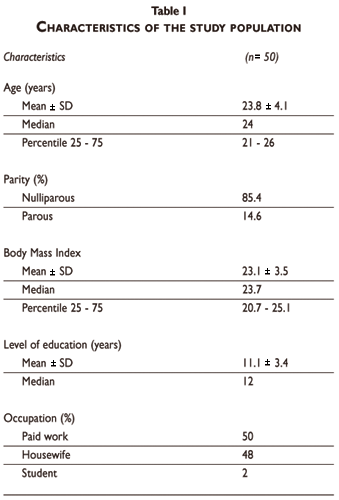
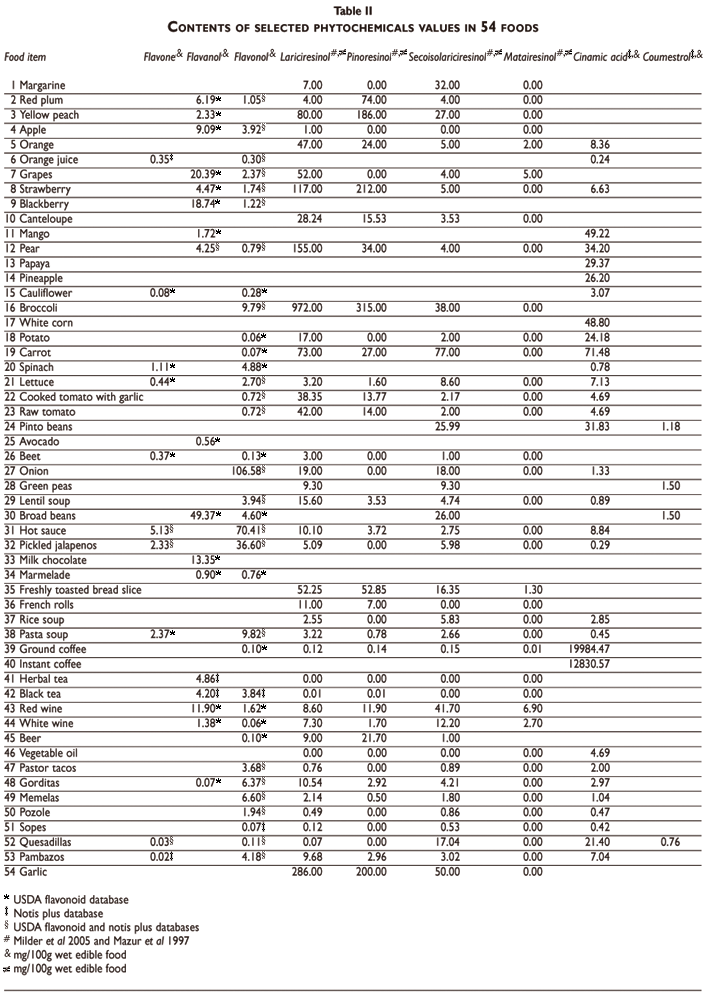
<body><![CDATA[<p><font size="2" face="Verdana">Intake of selected PHYs was estimated in a sample    of 50 women, aged between 17 and 37 years, participating in a longitudinal cohort    study in the state of Morelos, Mexico from 2001-2002 that was approved by the    IRB of the Mexico National Institute of Public Health. </font></p>     <p><font size="2" face="Verdana"> Eligible participants were non-pregnant and    non-lactating women, who reported no change in their diet over the past 12 months    and signed an informed consent document. A more detailed description of the    study design is published elsewhere.<a name="tx01"></a><a href="#nt01"><sup>*</sup></a>    </font></p>     <p><font size="2" face="Verdana"> Women were asked about their dietary habits,    on two different occasions using a standardized food frequency questionnaire    (FFQ).<SUP>18,19 </SUP>Trained personnel completed the in-person interviews    one year apart and during the same season of the year. The frequency of the    consumption of foods that are sources of PHYs (54/100 items included in the    FFQ) was calculated considering a pre-determined portion size and 10 frequency    categories ranging from never to six times per day. </font></p>     <p><font size="2" face="Verdana"> To determine PHYs intake, we developed a database    of nine selected PHYs present in the 54 foods included in the FFQ. Selected    PHYs included three flavonoids (FLAV): flavonol (FOL), flavones (FES), flavanol    (FAL); four Lignans (LI): secoisolariciresinol (SE), matairesinol (MA), lariciresinol    (LA), pinoresinol (PI); cinnamic acid (CA) and coumestrol (COU). Mean values    of FOL, FES and FAL were imputed from the 2003 USDA flavonoid data set,<SUP>20</SUP>    while the 1998 Notice plus data base<SUP>21</SUP> was used as a source of CA    and COU. Mean values for SE, MA, LA and PI were also obtained from published    databases.<SUP>22,23</SUP> The taxonomic name, genus and species of vegetables    were verified in the imputation process.<SUP>24</SUP> PHYs contents in mg/100g    and &#181;g/100g referred to wet edible portions. If values    of PHYs for an individual food item were available from several references,    we calculated a mean value from the pool of values. Non-vegetable sources of    PHYs included milk chocolate, jam, wine and beer. Recipes of local dishes were    also used to determine whether they included ingredients that were sources of    PHYs.<SUP>25</SUP> The Food Intake Analysis software, along with a program written    with Fox Pro v.9.0, was used to estimate the individual intake of nutrients    and PHYs of interest. A detailed description of nutrient calculation is published    elsewhere.<SUP>26</SUP> </font></p>     <p><font size="2" face="Verdana"> Descriptive statistics were calculated to assess    the characteristics of the study population. Energy adjusted (by means of energy    residuals) intra-class correlation coefficients (<font face="Symbol">r</font><SUB>1</SUB>)    were calculated to evaluate the reliability of the FFQ results. The main food    sources of selected PHYs intake were identified by partial R<SUP>2</SUP> through    estimated multiple linear regression models. All analyses were performed using    the statistical software package STATA 7.0.</font></p>     <p>&nbsp;</p>     <p><font size="3" face="Verdana"><b>Results </b></font></p>     <p><font size="2" face="Verdana">General characteristics of the study population    are displayed in <a href="#tab01">Table I</a>. The study sample included mostly    young (mean age 23.8 years), nulliparous (85.4%) women, with normal body mass    index scores (23.7 kg/m<SUP>2</SUP>). Approximately half of the women had at    least 12 years of education and reported having a paid job. <a href="/img/revistas/spm/v49n2/a08tab02.gif">Table    II</a> shows the imputed values (mg/100g or &#181;g/100g in fresh edible weight)    for the PHYs in the foods included in our FFQ. </font></p>     <p><a name="tab01"></a></p>     <p>&nbsp;</p>     ]]></body>
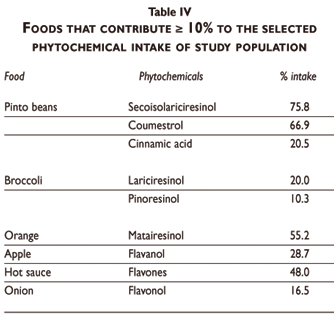
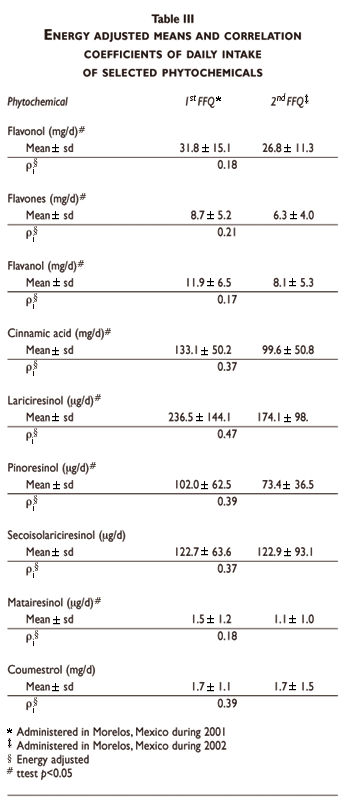
<body><![CDATA[<p align="center"><img src="/img/revistas/spm/v49n2/a08tab01.gif"></p>     <p>&nbsp;</p>     <p><font size="2" face="Verdana"><a href="#tab03">Table III</a> shows the energy-adjusted    means of selected PHYs estimated in the two interviews, along with their energy    adjusted intraclass correlation coefficients. The daily nutrient intake was    estimated to be 2336.7 ± 476.3 kcal for energy, 76.7 ± 6.3 g for protein,    273.6 ± 26.8 g for carbohydrates and 109.5 ± 12.3 g for total fat    (data not included in the table). The daily FLAV intake varied from 7.5 ±    3.8 mg for FES to 29.3 ± 10.1 mg for FOL. LI daily intake varied from 1.3    ± 0.9 &#181;g for MA to 205.3 ± 111.6 &#181;g    for LA. CA daily intake resulted 116.3 mg ± 43.8 while COU intake was 1.7    ± 1.1 mg. The adjusted correlation coefficients ranged from 0.17 for FAL    to 0.47 for LA. </font></p>     <p><a name="tab03"></a></p>     <p>&nbsp;</p>     <p align="center"><img src="/img/revistas/spm/v49n2/a08tab03.gif"></p>     <p>&nbsp;</p>     <p><font size="2" face="Verdana">Foods that contributed 10% or more to the selected    PHYs daily intake are shown in <a href="#tab04">Table IV</a>. Pinto beans were    the main sources of CA, SE and COU intake, and apples accounted for 28.7% of    the FLA intake variance. Hot sauce was the main contributor of FES and onion    contributed to FOL intake. Broccoli was the primary source of LA and PI, and    oranges explained 53.2% of the MA intake variation.</font></p>     <p><a name="tab04"></a></p>     <p>&nbsp;</p>     ]]></body>
<body><![CDATA[<p align="center"><img src="/img/revistas/spm/v49n2/a08tab04.gif"></p>     <p>&nbsp;</p>     <p><font size="3" face="Verdana"><b>Discussion </b></font></p>     <p><font size="2" face="Verdana">These results provide information about the intake    of selected PHYs in a group of Mexican women. Our database contains information    about frequently consumed foods in the Mexican diet, which are sources of PHYs.    </font></p>     <p><font size="2" face="Verdana"> There are several important limitations to our    study. First, our analyses were limited to nine selected PHYs, therefore we    were not able to calculate total PHYs consumption. Second, we were unable to    obtain data about the PHYs content of some local and frequently consumed foods    included in the FFQ, including edible cactus, squash blossoms, mamey, zapote    and prickly pears (local fruits). Finally, information about food preparation    was not included in our questionnaire; therefore we were not able to adjust    for its affect on PHYs content. Certain food preparation methods may alter the    content of PHYs, although the magnitude of these effects is still unknown.<SUP>1,27</SUP>    </font></p>     <p><font size="2" face="Verdana"> Pinto beans provided the highest percentage    of three PHYs intake (SE, COU and CA). According to very recent information    several PHYs are present in different kinds of Mexican beans<SUP>28,29 </SUP>however,    only one type of bean was evaluated in our FFQ, further studies should include    other types of beans. </font></p>     <p><font size="2" face="Verdana"> The variability in the estimated intake of PHYs    among countries may be explained by the fact that the many of the databases    do not contain complete information on PHYs content. For example, not all database    values refer to the same compounds –they may comprise as many as 4000 structurally    different phytochemicals with structures varying from simple molecules (e.g.    phenolic acid) to highly polymerized substances (e.g. tannins).<SUP>30</SUP>    </font></p>     <p><font size="2" face="Verdana"> Worldwide comparisons of PHYs should be approached    with caution, as methodologies used to calculate these estimates are not standardized.    </font></p>     <p><font size="2" face="Verdana"> In spite of these limitations, the results of    this study provide an important first step towards improving our knowledge about    the consumption of PHYs in the Mexican diet that might be useful to further    evaluate their health impact.</font></p>     <p><font size="2" face="Verdana"><b>Acknowledgements </b></font></p>     ]]></body>
<body><![CDATA[<p><font size="2" face="Verdana">This study was supported in part by Mount Sinai    School of Medicine/Queens College International Training and Research in Environmental    and Occupational Health Program funded by the National Institutes of Health    (D43TW00640). </font></p>     <p>&nbsp;</p>     <p><font size="3" face="Verdana"> <b>References </b></font></p>     <!-- ref --><p><font size="2" face="Verdana">1. Mishra S, Dickerson V, Najm W. Phytoestrogens    and breast cancer prevention: What is the evidence? Am J Obstet Gynecol 2003;188(5):s66-s70.    </font>&nbsp;&nbsp;&nbsp;&nbsp;&nbsp;&nbsp;&nbsp;&nbsp;[&#160;<a href="javascript:void(0);" onclick="javascript: window.open('/scielo.php?script=sci_nlinks&ref=9233988&pid=S0036-3634200700020000800001&lng=','','width=640,height=500,resizable=yes,scrollbars=1,menubar=yes,');">Links</a>&#160;]<!-- end-ref --><!-- ref --><p><font size="2" face="Verdana">2. Murkies A, Wilcox G, Davis S. Clinical Review    92: Phytoestrogens. J Clin Endocrinol Metab 1998;83(2):297-303. </font>&nbsp;&nbsp;&nbsp;&nbsp;&nbsp;&nbsp;&nbsp;&nbsp;[&#160;<a href="javascript:void(0);" onclick="javascript: window.open('/scielo.php?script=sci_nlinks&ref=9233989&pid=S0036-3634200700020000800002&lng=','','width=640,height=500,resizable=yes,scrollbars=1,menubar=yes,');">Links</a>&#160;]<!-- end-ref --><!-- ref --><p><font size="2" face="Verdana">3. Peeters P, Keinan-Boker L, van der Schouw    Y, Grobbee D. Phytoestrogens and breast cancer risk. Review of the epidemiological    evidence. Breast Cancer Research and Treatment 2003;77:171-183. </font>&nbsp;&nbsp;&nbsp;&nbsp;&nbsp;&nbsp;&nbsp;&nbsp;[&#160;<a href="javascript:void(0);" onclick="javascript: window.open('/scielo.php?script=sci_nlinks&ref=9233990&pid=S0036-3634200700020000800003&lng=','','width=640,height=500,resizable=yes,scrollbars=1,menubar=yes,');">Links</a>&#160;]<!-- end-ref --><!-- ref --><p><font size="2" face="Verdana">4. Arts I, Hollman P. Polyphenols and disease    risk in epidemiologic studies. Am J Clin Nutr 2005;81(suppl):S317-S325. </font>&nbsp;&nbsp;&nbsp;&nbsp;&nbsp;&nbsp;&nbsp;&nbsp;[&#160;<a href="javascript:void(0);" onclick="javascript: window.open('/scielo.php?script=sci_nlinks&ref=9233991&pid=S0036-3634200700020000800004&lng=','','width=640,height=500,resizable=yes,scrollbars=1,menubar=yes,');">Links</a>&#160;]<!-- end-ref --><!-- ref --><p><font size="2" face="Verdana">5. Kurzer M, Xu X. Dietary phytoestrogens. Annu    Rev Nutr 1997;17:353-381. </font>&nbsp;&nbsp;&nbsp;&nbsp;&nbsp;&nbsp;&nbsp;&nbsp;[&#160;<a href="javascript:void(0);" onclick="javascript: window.open('/scielo.php?script=sci_nlinks&ref=9233992&pid=S0036-3634200700020000800005&lng=','','width=640,height=500,resizable=yes,scrollbars=1,menubar=yes,');">Links</a>&#160;]<!-- end-ref --><!-- ref --><p><font size="2" face="Verdana">6. Strom S, Yamamura Y, Duphorne Ch, Spitz M,    Babaian R, Pillow P, <I>et al</I>. Phytoestrogen intake and prostate cancer:    a case-control study using a new database. Nutr Cancer 1999;33(1):20-25. </font>&nbsp;&nbsp;&nbsp;&nbsp;&nbsp;&nbsp;&nbsp;&nbsp;[&#160;<a href="javascript:void(0);" onclick="javascript: window.open('/scielo.php?script=sci_nlinks&ref=9233993&pid=S0036-3634200700020000800006&lng=','','width=640,height=500,resizable=yes,scrollbars=1,menubar=yes,');">Links</a>&#160;]<!-- end-ref --><!-- ref --><p><font size="2" face="Verdana">7. Garcia-Closas R, Gonzalez C, Agudo A, Riboli    E. Intake of specific carotenoids and flavonoids and the risk of gastric cancer    in Spain. Cancer Causes and Control1999;10:71-75. </font>&nbsp;&nbsp;&nbsp;&nbsp;&nbsp;&nbsp;&nbsp;&nbsp;[&#160;<a href="javascript:void(0);" onclick="javascript: window.open('/scielo.php?script=sci_nlinks&ref=9233994&pid=S0036-3634200700020000800007&lng=','','width=640,height=500,resizable=yes,scrollbars=1,menubar=yes,');">Links</a>&#160;]<!-- end-ref --><!-- ref --><p><font size="2" face="Verdana">8. Lagiou P, Samoli E, Lagiou A, Peterson J,    Tzonou A, Dwyer J, <I>et al</I>. Flavonoids, vitamin C and adenocarcinoma of    the stomach. Cancer Causes and Control 2004;15:67-72. </font>&nbsp;&nbsp;&nbsp;&nbsp;&nbsp;&nbsp;&nbsp;&nbsp;[&#160;<a href="javascript:void(0);" onclick="javascript: window.open('/scielo.php?script=sci_nlinks&ref=9233995&pid=S0036-3634200700020000800008&lng=','','width=640,height=500,resizable=yes,scrollbars=1,menubar=yes,');">Links</a>&#160;]<!-- end-ref --><!-- ref --><p><font size="2" face="Verdana">9. Hertog M, Kromhout D, Aravanis C, Blackburn    H, Buzina R, Fidanza F, <I>et al</I>. Flavonoid intake and long-term risk of    coronary heart disease and cancer in the seven countries study. Arch Intern    Med 1995;155:381-386. </font>&nbsp;&nbsp;&nbsp;&nbsp;&nbsp;&nbsp;&nbsp;&nbsp;[&#160;<a href="javascript:void(0);" onclick="javascript: window.open('/scielo.php?script=sci_nlinks&ref=9233996&pid=S0036-3634200700020000800009&lng=','','width=640,height=500,resizable=yes,scrollbars=1,menubar=yes,');">Links</a>&#160;]<!-- end-ref --><!-- ref --><p><font size="2" face="Verdana">10. Rimm E, Katan M, Ascherio A, Stampfer M,    Willett W. Relation between intake of flavonoids and risk for coronary heart    disease in male health professionals. Ann Intern Med 1996;125:384-389. </font>&nbsp;&nbsp;&nbsp;&nbsp;&nbsp;&nbsp;&nbsp;&nbsp;[&#160;<a href="javascript:void(0);" onclick="javascript: window.open('/scielo.php?script=sci_nlinks&ref=9233997&pid=S0036-3634200700020000800010&lng=','','width=640,height=500,resizable=yes,scrollbars=1,menubar=yes,');">Links</a>&#160;]<!-- end-ref --><!-- ref --><p><font size="2" face="Verdana">11. Hirvonen T, Pirjo P, Virtanen M, Ovaskainen    M, H&auml;kkinen S, Albanes D, <I>et al</I>. Intake of Flavonols and Flavones    and Risk of Coronary Heart Disease in Male Smokers. Epidemiology 2001;12:62-67.    </font>&nbsp;&nbsp;&nbsp;&nbsp;&nbsp;&nbsp;&nbsp;&nbsp;[&#160;<a href="javascript:void(0);" onclick="javascript: window.open('/scielo.php?script=sci_nlinks&ref=9233998&pid=S0036-3634200700020000800011&lng=','','width=640,height=500,resizable=yes,scrollbars=1,menubar=yes,');">Links</a>&#160;]<!-- end-ref --><!-- ref --><p><font size="2" face="Verdana">12. Setchell K, Cassidy A. Dietary Isoflavones:    Biological Effects and Relevance to Human Health. <I>J Nutr </I>1999;129:S758-S767.    </font>&nbsp;&nbsp;&nbsp;&nbsp;&nbsp;&nbsp;&nbsp;&nbsp;[&#160;<a href="javascript:void(0);" onclick="javascript: window.open('/scielo.php?script=sci_nlinks&ref=9233999&pid=S0036-3634200700020000800012&lng=','','width=640,height=500,resizable=yes,scrollbars=1,menubar=yes,');">Links</a>&#160;]<!-- end-ref --><!-- ref --><p><font size="2" face="Verdana">13. Setchell K, Lydeking-Olsen E. Dietary phytoestrogens    and their effect on bone: evidence from in vitro and in vivo, human observational,    and dietary intervention studies. Am J Clin Nutr 2003;78(suppl):S593-S609.</font>&nbsp;&nbsp;&nbsp;&nbsp;&nbsp;&nbsp;&nbsp;&nbsp;[&#160;<a href="javascript:void(0);" onclick="javascript: window.open('/scielo.php?script=sci_nlinks&ref=9234000&pid=S0036-3634200700020000800013&lng=','','width=640,height=500,resizable=yes,scrollbars=1,menubar=yes,');">Links</a>&#160;]<!-- end-ref --><!-- ref --><p><font size="2" face="Verdana"> 14. Atkinson C, Compston J, Day N, Dowsett M,    Bingham S. The effects of phytoestrogen isoflavones on bone density in women:    a double-blind, randomized, placebo-controlled trial. Am J Clin Nutr 2004;79(2):326-333.    </font>&nbsp;&nbsp;&nbsp;&nbsp;&nbsp;&nbsp;&nbsp;&nbsp;[&#160;<a href="javascript:void(0);" onclick="javascript: window.open('/scielo.php?script=sci_nlinks&ref=9234001&pid=S0036-3634200700020000800014&lng=','','width=640,height=500,resizable=yes,scrollbars=1,menubar=yes,');">Links</a>&#160;]<!-- end-ref --><!-- ref --><p><font size="2" face="Verdana">15. Setchell K. Phytoestrogens: the biochemistry,    physiology, and implications for human health of soy isoflavones. Am J Clin    Nutr 1998;68(suppl 6):S1333-S1346. </font>&nbsp;&nbsp;&nbsp;&nbsp;&nbsp;&nbsp;&nbsp;&nbsp;[&#160;<a href="javascript:void(0);" onclick="javascript: window.open('/scielo.php?script=sci_nlinks&ref=9234002&pid=S0036-3634200700020000800015&lng=','','width=640,height=500,resizable=yes,scrollbars=1,menubar=yes,');">Links</a>&#160;]<!-- end-ref --><!-- ref --><p><font size="2" face="Verdana">16. Carusi D. Phytoestrogens as hormone replacement    therapy: an evidence-based approach. Prim Care Update Ob/ Gyns 2000;7(6):253-259.    </font>&nbsp;&nbsp;&nbsp;&nbsp;&nbsp;&nbsp;&nbsp;&nbsp;[&#160;<a href="javascript:void(0);" onclick="javascript: window.open('/scielo.php?script=sci_nlinks&ref=9234003&pid=S0036-3634200700020000800016&lng=','','width=640,height=500,resizable=yes,scrollbars=1,menubar=yes,');">Links</a>&#160;]<!-- end-ref --><!-- ref --><p><font size="2" face="Verdana">17. World Cancer Research Fund/American Institute    for Cancer Research. Patterns of diet. In: Food, Nutrition and the prevention    of cancer: a global perspective. Press, 1997:20-52. </font>&nbsp;&nbsp;&nbsp;&nbsp;&nbsp;&nbsp;&nbsp;&nbsp;[&#160;<a href="javascript:void(0);" onclick="javascript: window.open('/scielo.php?script=sci_nlinks&ref=9234004&pid=S0036-3634200700020000800017&lng=','','width=640,height=500,resizable=yes,scrollbars=1,menubar=yes,');">Links</a>&#160;]<!-- end-ref --><!-- ref --><p><font size="2" face="Verdana">18. Bonilla-Fern&aacute;ndez P, L&oacute;pez-Cervantes    M, Torres-S&aacute;nchez LE, Tortolero-Luna G, L&oacute;pez-Carrillo L. Nutritional    factors and breast cancer in Mexico. Nutr Cancer 2003;45(2):148-155. </font>&nbsp;&nbsp;&nbsp;&nbsp;&nbsp;&nbsp;&nbsp;&nbsp;[&#160;<a href="javascript:void(0);" onclick="javascript: window.open('/scielo.php?script=sci_nlinks&ref=9234005&pid=S0036-3634200700020000800018&lng=','','width=640,height=500,resizable=yes,scrollbars=1,menubar=yes,');">Links</a>&#160;]<!-- end-ref --><!-- ref --><p><font size="2" face="Verdana">19. Galv&aacute;n-Portillo M, Torres-S&aacute;nchez    L, L&oacute;pez-Carrillo L. Dietary and reproductive factors associated with    benign breast disease in Mexican women. Nutr Cancer 2002;43(2):133-140. </font>&nbsp;&nbsp;&nbsp;&nbsp;&nbsp;&nbsp;&nbsp;&nbsp;[&#160;<a href="javascript:void(0);" onclick="javascript: window.open('/scielo.php?script=sci_nlinks&ref=9234006&pid=S0036-3634200700020000800019&lng=','','width=640,height=500,resizable=yes,scrollbars=1,menubar=yes,');">Links</a>&#160;]<!-- end-ref --><!-- ref --><p><font size="2" face="Verdana">20. Nutrient data lab, Food composition lab,    Beltsville Human Nutrition Research Center, ARS, U.S. Department of Agriculture.    USDA Database for the Flavonoid Content of selected foods 2003;1-77. Available    on: <a href="http://www.nal.usda.gov/fnic/foodcomp" target="_blank">http://www.nal.usda.gov/fnic/foodcomp</a>.    </font>&nbsp;&nbsp;&nbsp;&nbsp;&nbsp;&nbsp;&nbsp;&nbsp;[&#160;<a href="javascript:void(0);" onclick="javascript: window.open('/scielo.php?script=sci_nlinks&ref=9234007&pid=S0036-3634200700020000800020&lng=','','width=640,height=500,resizable=yes,scrollbars=1,menubar=yes,');">Links</a>&#160;]<!-- end-ref --><!-- ref --><p><font size="2" face="Verdana">21. Institute of Food Research. Biotechnology    &amp; Biological Sciences Research Council. Colney, Norwich NR4 7UA, UK. CD-ROM    Notis<SUP>plus</SUP> a database of bioactive compounds found in food plants    (1998). </font>&nbsp;&nbsp;&nbsp;&nbsp;&nbsp;&nbsp;&nbsp;&nbsp;[&#160;<a href="javascript:void(0);" onclick="javascript: window.open('/scielo.php?script=sci_nlinks&ref=9234008&pid=S0036-3634200700020000800021&lng=','','width=640,height=500,resizable=yes,scrollbars=1,menubar=yes,');">Links</a>&#160;]<!-- end-ref --><!-- ref --><p><font size="2" face="Verdana">22. Milder I, Arts I, van de Putte B, Venema    D, Hollman P. Lignan contents of Dutch plant foods: a database including lariciresinol,    pinoresinol, secoisolariciresinol and matairesinol. Br J Nutr 2005;93: 393-402.    </font>&nbsp;&nbsp;&nbsp;&nbsp;&nbsp;&nbsp;&nbsp;&nbsp;[&#160;<a href="javascript:void(0);" onclick="javascript: window.open('/scielo.php?script=sci_nlinks&ref=9234009&pid=S0036-3634200700020000800022&lng=','','width=640,height=500,resizable=yes,scrollbars=1,menubar=yes,');">Links</a>&#160;]<!-- end-ref --><!-- ref --><p><font size="2" face="Verdana">23. Mazur W, Duke J, Wahala K, Rasku S, Adlercreutz    H. Isoflavonoids and lignans in legumes: nutritional and health aspects in humans.    J Nutr Biochem 1998;9:193-200. </font>&nbsp;&nbsp;&nbsp;&nbsp;&nbsp;&nbsp;&nbsp;&nbsp;[&#160;<a href="javascript:void(0);" onclick="javascript: window.open('/scielo.php?script=sci_nlinks&ref=9234010&pid=S0036-3634200700020000800023&lng=','','width=640,height=500,resizable=yes,scrollbars=1,menubar=yes,');">Links</a>&#160;]<!-- end-ref --><!-- ref --><p><font size="2" face="Verdana">24. USDA, ARS, National Genetic Resources Program.    Germplasm Resources Information Network - (GRIN) &#91;Online Database&#93;. National    Germplasm Resources Laboratory, Beltsville, Maryland. &#91;Accessed on 25 augustt,    2005&#93;. Available on: <a href="http://www.ars-grin.gov2/cgi-bin/npgs/html/index.pl" target="_blank">http://www.ars-grin.gov2/cgi-bin/npgs/html/index.pl</a>    (25 August 2005). </font>&nbsp;&nbsp;&nbsp;&nbsp;&nbsp;&nbsp;&nbsp;&nbsp;[&#160;<a href="javascript:void(0);" onclick="javascript: window.open('/scielo.php?script=sci_nlinks&ref=9234011&pid=S0036-3634200700020000800024&lng=','','width=640,height=500,resizable=yes,scrollbars=1,menubar=yes,');">Links</a>&#160;]<!-- end-ref --><!-- ref --><p><font size="2" face="Verdana">25. Mu&ntilde;oz Z R. Diccionario Enciclop&eacute;dico    de Gastronom&iacute;a Mexicana. Mexico: Clio, 2000. </font>&nbsp;&nbsp;&nbsp;&nbsp;&nbsp;&nbsp;&nbsp;&nbsp;[&#160;<a href="javascript:void(0);" onclick="javascript: window.open('/scielo.php?script=sci_nlinks&ref=9234012&pid=S0036-3634200700020000800025&lng=','','width=640,height=500,resizable=yes,scrollbars=1,menubar=yes,');">Links</a>&#160;]<!-- end-ref --><!-- ref --><p><font size="2" face="Verdana">26. L&oacute;pez-Carrillo L, L&oacute;pez-Cervantes    M, Ward MH, Bravo-Alvarado J, Ramirez-Espitia A. Nutrient intake and gastric    cancer in Mexico. Int J Cancer 1999; 83(5):601-605. </font>&nbsp;&nbsp;&nbsp;&nbsp;&nbsp;&nbsp;&nbsp;&nbsp;[&#160;<a href="javascript:void(0);" onclick="javascript: window.open('/scielo.php?script=sci_nlinks&ref=9234013&pid=S0036-3634200700020000800026&lng=','','width=640,height=500,resizable=yes,scrollbars=1,menubar=yes,');">Links</a>&#160;]<!-- end-ref --><!-- ref --><p><font size="2" face="Verdana">27. Goldman I, Kader A, Heintz M. Influence of    production, handling and storage on phytonutrient content of foods. Nut Rev    1999; 57(9): S46-S52. </font>&nbsp;&nbsp;&nbsp;&nbsp;&nbsp;&nbsp;&nbsp;&nbsp;[&#160;<a href="javascript:void(0);" onclick="javascript: window.open('/scielo.php?script=sci_nlinks&ref=9234014&pid=S0036-3634200700020000800027&lng=','','width=640,height=500,resizable=yes,scrollbars=1,menubar=yes,');">Links</a>&#160;]<!-- end-ref --><!-- ref --><p><font size="2" face="Verdana">28. Espinosa-Alonso LG, Lygin A, Widholm JM,    Valverde ME, Paredes-Lopez O. Polyphenols in wild and weedy Mexican common beans    (Phaseolus vulgaris L.). J Agric Food Chem 2006;54(12):4436-4444. </font>&nbsp;&nbsp;&nbsp;&nbsp;&nbsp;&nbsp;&nbsp;&nbsp;[&#160;<a href="javascript:void(0);" onclick="javascript: window.open('/scielo.php?script=sci_nlinks&ref=9234015&pid=S0036-3634200700020000800028&lng=','','width=640,height=500,resizable=yes,scrollbars=1,menubar=yes,');">Links</a>&#160;]<!-- end-ref --><!-- ref --><p><font size="2" face="Verdana">29. Diaz-Batalla L, Widholm JM, Fahey GC Jr,    Castano-Tostado E, Paredes-Lopez O. Chemical components with health implications    in wild and cultivated Mexican common bean seeds (Phaseolus vulgaris L.). J    Agric Food Chem 2006;54(6):2045-2052. </font>&nbsp;&nbsp;&nbsp;&nbsp;&nbsp;&nbsp;&nbsp;&nbsp;[&#160;<a href="javascript:void(0);" onclick="javascript: window.open('/scielo.php?script=sci_nlinks&ref=9234016&pid=S0036-3634200700020000800029&lng=','','width=640,height=500,resizable=yes,scrollbars=1,menubar=yes,');">Links</a>&#160;]<!-- end-ref --><!-- ref --><p><font size="2" face="Verdana">30. Middleton E, Kandaswami C, Theoharides Th.    The effects of plant flavonoids on mammalian cells: Implications for inflammation,    heart disease, and cancer. Pharmacol Rev 2000; 52(4): 673-751.</font>&nbsp;&nbsp;&nbsp;&nbsp;&nbsp;&nbsp;&nbsp;&nbsp;[&#160;<a href="javascript:void(0);" onclick="javascript: window.open('/scielo.php?script=sci_nlinks&ref=9234017&pid=S0036-3634200700020000800030&lng=','','width=640,height=500,resizable=yes,scrollbars=1,menubar=yes,');">Links</a>&#160;]<!-- end-ref --><p>&nbsp;</p>     <p>&nbsp;</p>     <p><font size="2" face="Verdana">Received on: July 14, 2006    <br>   Accepted on: October 13, 2006.</font></p>     <p>&nbsp;</p>     <p>&nbsp;</p>     <p><font size="2" face="Verdana">Address reprint request to: Dra. Lizbeth L&oacute;pez    Carrillo. Instituto Nacional de Salud P&uacute;blica. Av. Universidad 655, col.    Santa Mar&iacute;a Ahuacatitl&aacute;n. 62508 Cuernavaca Morelos, M&eacute;xico.    E-mail: <a href="mailto:lizbeth@insp.mx">lizbeth@insp.mx</a>    ]]></body>
<body><![CDATA[<br>   <a name="nt01"></a><a href="#tx01">*</a> Torres-S&aacute;nchez L, Rothenberg    SJ, Schnaas L, Cebri&aacute;n-Garc&iacute;a M, Osorio E, Hern&aacute;ndez M,    <I>et al</I>. In utero p,p'-DDE exposure and infant neurodevelopment: perinatal    cohort in M&eacute;xico, 2006. En prensa. </font></p>      ]]></body><back>
<ref-list>
<ref id="B1">
<label>1</label><nlm-citation citation-type="journal">
<person-group person-group-type="author">
<name>
<surname><![CDATA[Mishra]]></surname>
<given-names><![CDATA[S]]></given-names>
</name>
<name>
<surname><![CDATA[Dickerson]]></surname>
<given-names><![CDATA[V]]></given-names>
</name>
<name>
<surname><![CDATA[Najm]]></surname>
<given-names><![CDATA[W]]></given-names>
</name>
</person-group>
<article-title xml:lang="en"><![CDATA[Phytoestrogens and breast cancer prevention: What is the evidence?]]></article-title>
<source><![CDATA[Am J Obstet Gynecol]]></source>
<year>2003</year>
<volume>188</volume>
<numero>5</numero>
<issue>5</issue>
<page-range>s66-s70</page-range></nlm-citation>
</ref>
<ref id="B2">
<label>2</label><nlm-citation citation-type="journal">
<person-group person-group-type="author">
<name>
<surname><![CDATA[Murkies]]></surname>
<given-names><![CDATA[A]]></given-names>
</name>
<name>
<surname><![CDATA[Wilcox]]></surname>
<given-names><![CDATA[G]]></given-names>
</name>
<name>
<surname><![CDATA[Davis]]></surname>
<given-names><![CDATA[S]]></given-names>
</name>
</person-group>
<article-title xml:lang="en"><![CDATA[Clinical Review 92: Phytoestrogens]]></article-title>
<source><![CDATA[J Clin Endocrinol Metab]]></source>
<year>1998</year>
<volume>83</volume>
<numero>2</numero>
<issue>2</issue>
<page-range>297-303</page-range></nlm-citation>
</ref>
<ref id="B3">
<label>3</label><nlm-citation citation-type="journal">
<person-group person-group-type="author">
<name>
<surname><![CDATA[Peeters]]></surname>
<given-names><![CDATA[P]]></given-names>
</name>
<name>
<surname><![CDATA[Keinan-Boker]]></surname>
<given-names><![CDATA[L]]></given-names>
</name>
<name>
<surname><![CDATA[van der Schouw]]></surname>
<given-names><![CDATA[Y]]></given-names>
</name>
<name>
<surname><![CDATA[Grobbee]]></surname>
<given-names><![CDATA[D]]></given-names>
</name>
</person-group>
<article-title xml:lang="en"><![CDATA[Phytoestrogens and breast cancer risk: Review of the epidemiological evidence]]></article-title>
<source><![CDATA[Breast Cancer Research and Treatment]]></source>
<year>2003</year>
<volume>77</volume>
<page-range>171-183</page-range></nlm-citation>
</ref>
<ref id="B4">
<label>4</label><nlm-citation citation-type="journal">
<person-group person-group-type="author">
<name>
<surname><![CDATA[Arts]]></surname>
<given-names><![CDATA[I]]></given-names>
</name>
<name>
<surname><![CDATA[Hollman]]></surname>
<given-names><![CDATA[P]]></given-names>
</name>
</person-group>
<article-title xml:lang="en"><![CDATA[Polyphenols and disease risk in epidemiologic studies]]></article-title>
<source><![CDATA[Am J Clin Nutr]]></source>
<year>2005</year>
<volume>81</volume>
<numero>^ssuppl</numero>
<issue>^ssuppl</issue>
<supplement>suppl</supplement>
<page-range>S317-S325</page-range></nlm-citation>
</ref>
<ref id="B5">
<label>5</label><nlm-citation citation-type="journal">
<person-group person-group-type="author">
<name>
<surname><![CDATA[Kurzer]]></surname>
<given-names><![CDATA[M]]></given-names>
</name>
<name>
<surname><![CDATA[Xu]]></surname>
<given-names><![CDATA[X]]></given-names>
</name>
</person-group>
<article-title xml:lang="en"><![CDATA[Dietary phytoestrogens]]></article-title>
<source><![CDATA[Annu Rev Nutr]]></source>
<year>1997</year>
<volume>17</volume>
<page-range>353-381</page-range></nlm-citation>
</ref>
<ref id="B6">
<label>6</label><nlm-citation citation-type="journal">
<person-group person-group-type="author">
<name>
<surname><![CDATA[Strom]]></surname>
<given-names><![CDATA[S]]></given-names>
</name>
<name>
<surname><![CDATA[Yamamura]]></surname>
<given-names><![CDATA[Y]]></given-names>
</name>
<name>
<surname><![CDATA[Duphorne]]></surname>
<given-names><![CDATA[Ch]]></given-names>
</name>
<name>
<surname><![CDATA[Spitz]]></surname>
<given-names><![CDATA[M]]></given-names>
</name>
<name>
<surname><![CDATA[Babaian]]></surname>
<given-names><![CDATA[R]]></given-names>
</name>
<name>
<surname><![CDATA[Pillow]]></surname>
<given-names><![CDATA[P]]></given-names>
</name>
</person-group>
<article-title xml:lang="en"><![CDATA[Phytoestrogen intake and prostate cancer: a case-control study using a new database]]></article-title>
<source><![CDATA[Nutr Cancer]]></source>
<year>1999</year>
<volume>33</volume>
<numero>1</numero>
<issue>1</issue>
<page-range>20-25</page-range></nlm-citation>
</ref>
<ref id="B7">
<label>7</label><nlm-citation citation-type="journal">
<person-group person-group-type="author">
<name>
<surname><![CDATA[Garcia-Closas]]></surname>
<given-names><![CDATA[R]]></given-names>
</name>
<name>
<surname><![CDATA[Gonzalez]]></surname>
<given-names><![CDATA[C]]></given-names>
</name>
<name>
<surname><![CDATA[Agudo]]></surname>
<given-names><![CDATA[A]]></given-names>
</name>
<name>
<surname><![CDATA[Riboli]]></surname>
<given-names><![CDATA[E]]></given-names>
</name>
</person-group>
<article-title xml:lang="en"><![CDATA[Intake of specific carotenoids and flavonoids and the risk of gastric cancer in Spain]]></article-title>
<source><![CDATA[Cancer Causes and Control]]></source>
<year>1999</year>
<volume>10</volume>
<page-range>71-75</page-range></nlm-citation>
</ref>
<ref id="B8">
<label>8</label><nlm-citation citation-type="journal">
<person-group person-group-type="author">
<name>
<surname><![CDATA[Lagiou]]></surname>
<given-names><![CDATA[P]]></given-names>
</name>
<name>
<surname><![CDATA[Samoli]]></surname>
<given-names><![CDATA[E]]></given-names>
</name>
<name>
<surname><![CDATA[Lagiou]]></surname>
<given-names><![CDATA[A]]></given-names>
</name>
<name>
<surname><![CDATA[Peterson]]></surname>
<given-names><![CDATA[J]]></given-names>
</name>
<name>
<surname><![CDATA[Tzonou]]></surname>
<given-names><![CDATA[A]]></given-names>
</name>
<name>
<surname><![CDATA[Dwyer]]></surname>
<given-names><![CDATA[J]]></given-names>
</name>
</person-group>
<article-title xml:lang="en"><![CDATA[Flavonoids, vitamin C and adenocarcinoma of the stomach]]></article-title>
<source><![CDATA[Cancer Causes and Control]]></source>
<year>2004</year>
<volume>15</volume>
<page-range>67-72</page-range></nlm-citation>
</ref>
<ref id="B9">
<label>9</label><nlm-citation citation-type="journal">
<person-group person-group-type="author">
<name>
<surname><![CDATA[Hertog]]></surname>
<given-names><![CDATA[M]]></given-names>
</name>
<name>
<surname><![CDATA[Kromhout]]></surname>
<given-names><![CDATA[D]]></given-names>
</name>
<name>
<surname><![CDATA[Aravanis]]></surname>
<given-names><![CDATA[C]]></given-names>
</name>
<name>
<surname><![CDATA[Blackburn]]></surname>
<given-names><![CDATA[H]]></given-names>
</name>
<name>
<surname><![CDATA[Buzina]]></surname>
<given-names><![CDATA[R]]></given-names>
</name>
<name>
<surname><![CDATA[Fidanza]]></surname>
<given-names><![CDATA[F]]></given-names>
</name>
</person-group>
<article-title xml:lang="en"><![CDATA[Flavonoid intake and long-term risk of coronary heart disease and cancer in the seven countries study]]></article-title>
<source><![CDATA[Arch Intern Med]]></source>
<year>1995</year>
<volume>155</volume>
<page-range>381-386</page-range></nlm-citation>
</ref>
<ref id="B10">
<label>10</label><nlm-citation citation-type="journal">
<person-group person-group-type="author">
<name>
<surname><![CDATA[Rimm]]></surname>
<given-names><![CDATA[E]]></given-names>
</name>
<name>
<surname><![CDATA[Katan]]></surname>
<given-names><![CDATA[M]]></given-names>
</name>
<name>
<surname><![CDATA[Ascherio]]></surname>
<given-names><![CDATA[A]]></given-names>
</name>
<name>
<surname><![CDATA[Stampfer]]></surname>
<given-names><![CDATA[M]]></given-names>
</name>
<name>
<surname><![CDATA[Willett]]></surname>
<given-names><![CDATA[W]]></given-names>
</name>
</person-group>
<article-title xml:lang="en"><![CDATA[Relation between intake of flavonoids and risk for coronary heart disease in male health professionals]]></article-title>
<source><![CDATA[Ann Intern Med]]></source>
<year>1996</year>
<volume>125</volume>
<page-range>384-389</page-range></nlm-citation>
</ref>
<ref id="B11">
<label>11</label><nlm-citation citation-type="journal">
<person-group person-group-type="author">
<name>
<surname><![CDATA[Hirvonen]]></surname>
<given-names><![CDATA[T]]></given-names>
</name>
<name>
<surname><![CDATA[Pirjo]]></surname>
<given-names><![CDATA[P]]></given-names>
</name>
<name>
<surname><![CDATA[Virtanen]]></surname>
<given-names><![CDATA[M]]></given-names>
</name>
<name>
<surname><![CDATA[Ovaskainen]]></surname>
<given-names><![CDATA[M]]></given-names>
</name>
<name>
<surname><![CDATA[Häkkinen]]></surname>
<given-names><![CDATA[S]]></given-names>
</name>
<name>
<surname><![CDATA[Albanes]]></surname>
<given-names><![CDATA[D]]></given-names>
</name>
</person-group>
<article-title xml:lang="en"><![CDATA[Intake of Flavonols and Flavones and Risk of Coronary Heart Disease in Male Smokers]]></article-title>
<source><![CDATA[Epidemiology]]></source>
<year>2001</year>
<volume>12</volume>
<page-range>62-67</page-range></nlm-citation>
</ref>
<ref id="B12">
<label>12</label><nlm-citation citation-type="journal">
<person-group person-group-type="author">
<name>
<surname><![CDATA[Setchell]]></surname>
<given-names><![CDATA[K]]></given-names>
</name>
<name>
<surname><![CDATA[Cassidy]]></surname>
<given-names><![CDATA[A]]></given-names>
</name>
</person-group>
<article-title xml:lang="en"><![CDATA[Dietary Isoflavones: Biological Effects and Relevance to Human Health]]></article-title>
<source><![CDATA[J Nutr]]></source>
<year>1999</year>
<volume>129</volume>
<page-range>S758-S767</page-range></nlm-citation>
</ref>
<ref id="B13">
<label>13</label><nlm-citation citation-type="journal">
<person-group person-group-type="author">
<name>
<surname><![CDATA[Setchell]]></surname>
<given-names><![CDATA[K]]></given-names>
</name>
<name>
<surname><![CDATA[Lydeking-Olsen]]></surname>
<given-names><![CDATA[E]]></given-names>
</name>
</person-group>
<article-title xml:lang="en"><![CDATA[Dietary phytoestrogens and their effect on bone: evidence from in vitro and in vivo, human observational, and dietary intervention studies]]></article-title>
<source><![CDATA[Am J Clin Nutr]]></source>
<year>2003</year>
<volume>78</volume>
<numero>^ssuppl</numero>
<issue>^ssuppl</issue>
<supplement>suppl</supplement>
<page-range>S593-S609</page-range></nlm-citation>
</ref>
<ref id="B14">
<label>14</label><nlm-citation citation-type="journal">
<person-group person-group-type="author">
<name>
<surname><![CDATA[Atkinson]]></surname>
<given-names><![CDATA[C]]></given-names>
</name>
<name>
<surname><![CDATA[Compston]]></surname>
<given-names><![CDATA[J]]></given-names>
</name>
<name>
<surname><![CDATA[Day]]></surname>
<given-names><![CDATA[N]]></given-names>
</name>
<name>
<surname><![CDATA[Dowsett]]></surname>
<given-names><![CDATA[M]]></given-names>
</name>
<name>
<surname><![CDATA[Bingham]]></surname>
<given-names><![CDATA[S]]></given-names>
</name>
</person-group>
<article-title xml:lang="en"><![CDATA[The effects of phytoestrogen isoflavones on bone density in women: a double-blind, randomized, placebo-controlled trial]]></article-title>
<source><![CDATA[Am J Clin Nutr]]></source>
<year>2004</year>
<volume>79</volume>
<numero>2</numero>
<issue>2</issue>
<page-range>326-333</page-range></nlm-citation>
</ref>
<ref id="B15">
<label>15</label><nlm-citation citation-type="journal">
<person-group person-group-type="author">
<name>
<surname><![CDATA[Setchell]]></surname>
<given-names><![CDATA[K]]></given-names>
</name>
</person-group>
<article-title xml:lang="en"><![CDATA[Phytoestrogens: the biochemistry, physiology, and implications for human health of soy isoflavones]]></article-title>
<source><![CDATA[Am J Clin Nutr]]></source>
<year>1998</year>
<volume>68</volume>
<numero>^s6</numero>
<issue>^s6</issue>
<supplement>6</supplement>
<page-range>S1333-S1346</page-range></nlm-citation>
</ref>
<ref id="B16">
<label>16</label><nlm-citation citation-type="journal">
<person-group person-group-type="author">
<name>
<surname><![CDATA[Carusi]]></surname>
<given-names><![CDATA[D]]></given-names>
</name>
</person-group>
<article-title xml:lang="en"><![CDATA[Phytoestrogens as hormone replacement therapy: an evidence-based approach]]></article-title>
<source><![CDATA[Prim Care Update Ob/ Gyns]]></source>
<year>2000</year>
<volume>7</volume>
<numero>6</numero>
<issue>6</issue>
<page-range>253-259</page-range></nlm-citation>
</ref>
<ref id="B17">
<label>17</label><nlm-citation citation-type="">
<collab>World Cancer Research Fund^dAmerican Institute for Cancer Research</collab>
<article-title xml:lang="en"><![CDATA[Patterns of diet]]></article-title>
<source><![CDATA[Food, Nutrition and the prevention of cancer: a global perspective]]></source>
<year>1997</year>
<page-range>20-52</page-range></nlm-citation>
</ref>
<ref id="B18">
<label>18</label><nlm-citation citation-type="journal">
<person-group person-group-type="author">
<name>
<surname><![CDATA[Bonilla-Fernández]]></surname>
<given-names><![CDATA[P]]></given-names>
</name>
<name>
<surname><![CDATA[López-Cervantes]]></surname>
<given-names><![CDATA[M]]></given-names>
</name>
<name>
<surname><![CDATA[Torres-Sánchez]]></surname>
<given-names><![CDATA[LE]]></given-names>
</name>
<name>
<surname><![CDATA[Tortolero-Luna]]></surname>
<given-names><![CDATA[G]]></given-names>
</name>
<name>
<surname><![CDATA[López-Carrillo]]></surname>
<given-names><![CDATA[L]]></given-names>
</name>
</person-group>
<article-title xml:lang="en"><![CDATA[Nutritional factors and breast cancer in Mexico]]></article-title>
<source><![CDATA[Nutr Cancer]]></source>
<year>2003</year>
<volume>45</volume>
<numero>2</numero>
<issue>2</issue>
<page-range>148-155</page-range></nlm-citation>
</ref>
<ref id="B19">
<label>19</label><nlm-citation citation-type="journal">
<person-group person-group-type="author">
<name>
<surname><![CDATA[Galván-Portillo]]></surname>
<given-names><![CDATA[M]]></given-names>
</name>
<name>
<surname><![CDATA[Torres-Sánchez]]></surname>
<given-names><![CDATA[L]]></given-names>
</name>
<name>
<surname><![CDATA[López-Carrillo]]></surname>
<given-names><![CDATA[L]]></given-names>
</name>
</person-group>
<article-title xml:lang="en"><![CDATA[Dietary and reproductive factors associated with benign breast disease in Mexican women]]></article-title>
<source><![CDATA[Nutr Cancer]]></source>
<year>2002</year>
<volume>43</volume>
<numero>2</numero>
<issue>2</issue>
<page-range>133-140</page-range></nlm-citation>
</ref>
<ref id="B20">
<label>20</label><nlm-citation citation-type="">
<source><![CDATA[Nutrient data lab, Food composition lab, Beltsville Human Nutrition Research Center, ARS, U.S. Department of Agriculture: USDA Database for the Flavonoid Content of selected foods]]></source>
<year>2003</year>
<page-range>1-77</page-range></nlm-citation>
</ref>
<ref id="B21">
<label>21</label><nlm-citation citation-type="">
<collab>Institute of Food Research</collab>
<source><![CDATA[Biotechnology & Biological Sciences Research Council: Colney, Norwich NR4 7UA, UK. CD-ROM Notis plus a database of bioactive compounds found in food plants]]></source>
<year>1998</year>
</nlm-citation>
</ref>
<ref id="B22">
<label>22</label><nlm-citation citation-type="journal">
<person-group person-group-type="author">
<name>
<surname><![CDATA[Milder]]></surname>
<given-names><![CDATA[I]]></given-names>
</name>
<name>
<surname><![CDATA[Arts]]></surname>
<given-names><![CDATA[I]]></given-names>
</name>
<name>
<surname><![CDATA[van de Putte]]></surname>
<given-names><![CDATA[B]]></given-names>
</name>
<name>
<surname><![CDATA[Venema]]></surname>
<given-names><![CDATA[D]]></given-names>
</name>
<name>
<surname><![CDATA[Hollman]]></surname>
<given-names><![CDATA[P]]></given-names>
</name>
</person-group>
<article-title xml:lang="en"><![CDATA[Lignan contents of Dutch plant foods: a database including lariciresinol, pinoresinol, secoisolariciresinol and matairesinol]]></article-title>
<source><![CDATA[Br J Nutr]]></source>
<year>2005</year>
<volume>93</volume>
<page-range>393-402</page-range></nlm-citation>
</ref>
<ref id="B23">
<label>23</label><nlm-citation citation-type="journal">
<person-group person-group-type="author">
<name>
<surname><![CDATA[Mazur]]></surname>
<given-names><![CDATA[W]]></given-names>
</name>
<name>
<surname><![CDATA[Duke]]></surname>
<given-names><![CDATA[J]]></given-names>
</name>
<name>
<surname><![CDATA[Wahala]]></surname>
<given-names><![CDATA[K]]></given-names>
</name>
<name>
<surname><![CDATA[Rasku]]></surname>
<given-names><![CDATA[S]]></given-names>
</name>
<name>
<surname><![CDATA[Adlercreutz]]></surname>
<given-names><![CDATA[H]]></given-names>
</name>
</person-group>
<article-title xml:lang="en"><![CDATA[Isoflavonoids and lignans in legumes: nutritional and health aspects in humans]]></article-title>
<source><![CDATA[J Nutr Biochem]]></source>
<year>1998</year>
<volume>9</volume>
<page-range>193-200</page-range></nlm-citation>
</ref>
<ref id="B24">
<label>24</label><nlm-citation citation-type="">
<collab>USDA^dARS, National Genetic Resources Program</collab>
<source><![CDATA[Germplasm Resources Information Network - (GRIN) [Online Database]. National Germplasm Resources Laboratory, Beltsville, Maryland]]></source>
<year></year>
</nlm-citation>
</ref>
<ref id="B25">
<label>25</label><nlm-citation citation-type="book">
<person-group person-group-type="author">
<name>
<surname><![CDATA[Muñoz]]></surname>
<given-names><![CDATA[Z R]]></given-names>
</name>
</person-group>
<source><![CDATA[Diccionario Enciclopédico de Gastronomía Mexicana]]></source>
<year>2000</year>
<publisher-name><![CDATA[Clio]]></publisher-name>
</nlm-citation>
</ref>
<ref id="B26">
<label>26</label><nlm-citation citation-type="journal">
<person-group person-group-type="author">
<name>
<surname><![CDATA[López-Carrillo]]></surname>
<given-names><![CDATA[L]]></given-names>
</name>
<name>
<surname><![CDATA[López-Cervantes]]></surname>
<given-names><![CDATA[M]]></given-names>
</name>
<name>
<surname><![CDATA[Ward]]></surname>
<given-names><![CDATA[MH]]></given-names>
</name>
<name>
<surname><![CDATA[Bravo-Alvarado]]></surname>
<given-names><![CDATA[J]]></given-names>
</name>
<name>
<surname><![CDATA[Ramirez-Espitia]]></surname>
<given-names><![CDATA[A]]></given-names>
</name>
</person-group>
<article-title xml:lang="en"><![CDATA[Nutrient intake and gastric cancer in Mexico]]></article-title>
<source><![CDATA[Int J Cancer]]></source>
<year>1999</year>
<volume>83</volume>
<numero>5</numero>
<issue>5</issue>
<page-range>601-605</page-range></nlm-citation>
</ref>
<ref id="B27">
<label>27</label><nlm-citation citation-type="journal">
<person-group person-group-type="author">
<name>
<surname><![CDATA[Goldman]]></surname>
<given-names><![CDATA[I]]></given-names>
</name>
<name>
<surname><![CDATA[Kader]]></surname>
<given-names><![CDATA[A]]></given-names>
</name>
<name>
<surname><![CDATA[Heintz]]></surname>
<given-names><![CDATA[M]]></given-names>
</name>
</person-group>
<article-title xml:lang="en"><![CDATA[Influence of production, handling and storage on phytonutrient content of foods]]></article-title>
<source><![CDATA[Nut Rev]]></source>
<year>1999</year>
<volume>57</volume>
<numero>9</numero>
<issue>9</issue>
<page-range>S46-S52</page-range></nlm-citation>
</ref>
<ref id="B28">
<label>28</label><nlm-citation citation-type="journal">
<person-group person-group-type="author">
<name>
<surname><![CDATA[Espinosa-Alonso]]></surname>
<given-names><![CDATA[LG]]></given-names>
</name>
<name>
<surname><![CDATA[Lygin]]></surname>
<given-names><![CDATA[A]]></given-names>
</name>
<name>
<surname><![CDATA[Widholm]]></surname>
<given-names><![CDATA[JM]]></given-names>
</name>
<name>
<surname><![CDATA[Valverde]]></surname>
<given-names><![CDATA[ME]]></given-names>
</name>
<name>
<surname><![CDATA[Paredes-Lopez]]></surname>
<given-names><![CDATA[O]]></given-names>
</name>
</person-group>
<article-title xml:lang="en"><![CDATA[Polyphenols in wild and weedy Mexican common beans (Phaseolus vulgaris L.)]]></article-title>
<source><![CDATA[J Agric Food Chem]]></source>
<year>2006</year>
<volume>54</volume>
<numero>12</numero>
<issue>12</issue>
<page-range>4436-4444</page-range></nlm-citation>
</ref>
<ref id="B29">
<label>29</label><nlm-citation citation-type="journal">
<person-group person-group-type="author">
<name>
<surname><![CDATA[Diaz-Batalla]]></surname>
<given-names><![CDATA[L]]></given-names>
</name>
<name>
<surname><![CDATA[Widholm]]></surname>
<given-names><![CDATA[JM]]></given-names>
</name>
<name>
<surname><![CDATA[Fahey]]></surname>
<given-names><![CDATA[GC Jr]]></given-names>
</name>
<name>
<surname><![CDATA[Castano-Tostado]]></surname>
<given-names><![CDATA[E]]></given-names>
</name>
<name>
<surname><![CDATA[Paredes-Lopez]]></surname>
<given-names><![CDATA[O]]></given-names>
</name>
</person-group>
<article-title xml:lang="en"><![CDATA[Chemical components with health implications in wild and cultivated Mexican common bean seeds (Phaseolus vulgaris L.)]]></article-title>
<source><![CDATA[J Agric Food Chem]]></source>
<year>2006</year>
<volume>54</volume>
<numero>6</numero>
<issue>6</issue>
<page-range>2045-2052</page-range></nlm-citation>
</ref>
<ref id="B30">
<label>30</label><nlm-citation citation-type="journal">
<person-group person-group-type="author">
<name>
<surname><![CDATA[Middleton]]></surname>
<given-names><![CDATA[E]]></given-names>
</name>
<name>
<surname><![CDATA[Kandaswami]]></surname>
<given-names><![CDATA[C]]></given-names>
</name>
<name>
<surname><![CDATA[Theoharides]]></surname>
<given-names><![CDATA[Th]]></given-names>
</name>
</person-group>
<article-title xml:lang="en"><![CDATA[The effects of plant flavonoids on mammalian cells: Implications for inflammation, heart disease, and cancer]]></article-title>
<source><![CDATA[Pharmacol Rev]]></source>
<year>2000</year>
<volume>52</volume>
<numero>4</numero>
<issue>4</issue>
<page-range>673-751</page-range></nlm-citation>
</ref>
</ref-list>
</back>
</article>